Operator
Greetings and welcome to the Simulations Plus 3rd Quarter Fiscal 2025 Financial Results Conference Call. At this time, all participants are in a listen-only mode. A question and answer session will follow the formal presentation. If anyone wants to require operator assistance, please press star zero on your telephone keypad. As a reminder, this conference call is being recorded. It is now my pleasure to introduce Lisa Fortuna from Financial Profiles. Ms. Fortuna, please go ahead.
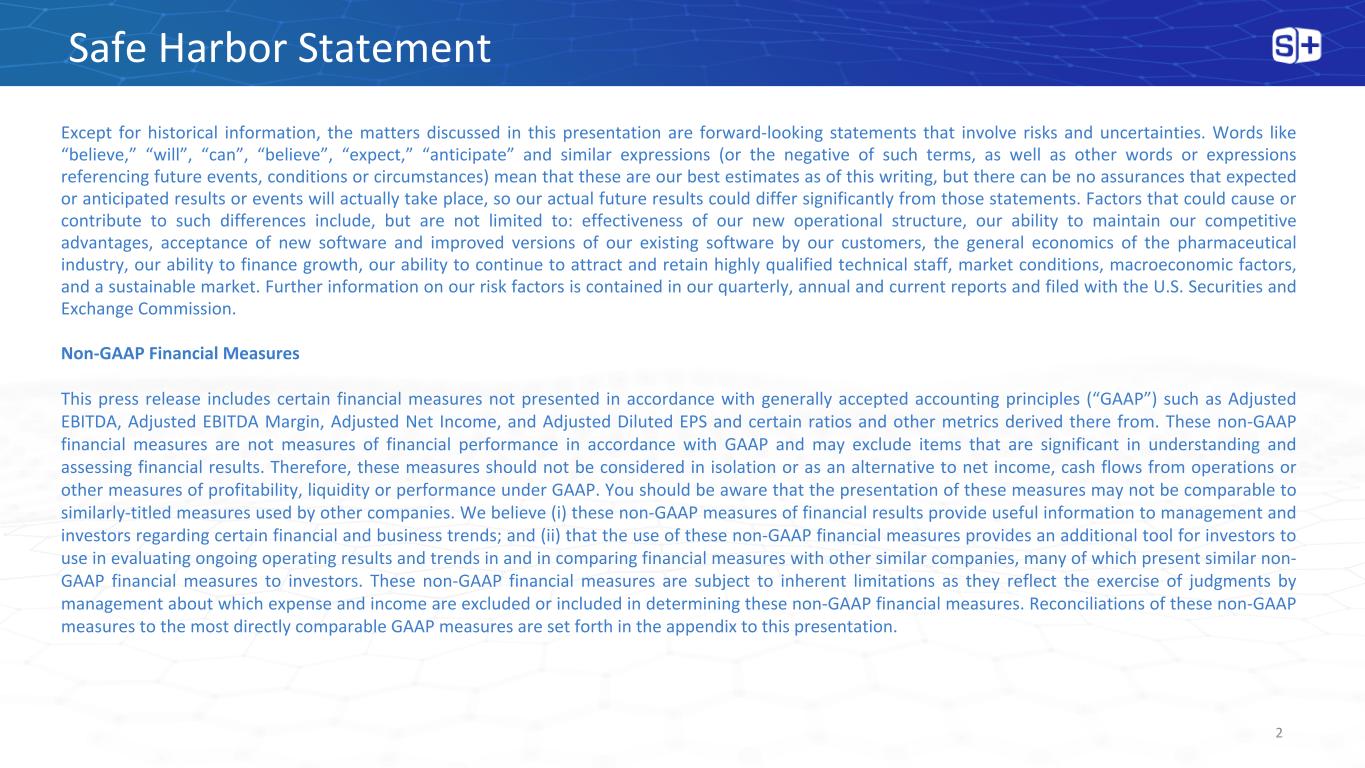
Good afternoon, everyone. Welcome to the Simulations Plus third quarter fiscal 2025 financial results conference call. With me today are Sean O'Connor, Chief Executive Officer, and Will Frederick, Chief Financial Officer of Simulations Plus. Please note that we updated our quarterly earnings presentation, which will serve as a supplement to today's prepared remarks. You can access the presentation on our Investor Relations website at simulationsplus.com. After management's commentary, we will open the call for questions. As a reminder, the information discussed today may include forward-looking statements that involve risks and uncertainties. Words like believe, expect, and anticipate refer to our best estimates as of this call, and actual future results could differ significantly from these statements. Further information on the company's risk factors is contained in the company's quarterly and annual reports and filed with the Securities and Exchange Commission. In the remarks or responses to questions, management may mention some non-GAAP financial measures. Reconciliations of these non-GAAP financial measures to the most directly comparable GAAP measures are available in the most recent earnings release and on the company's website. Please refer to the reconciliation tables in the accompanying materials for additional information. With that, I'll turn the call over to Sean O'Connor. Please go ahead.
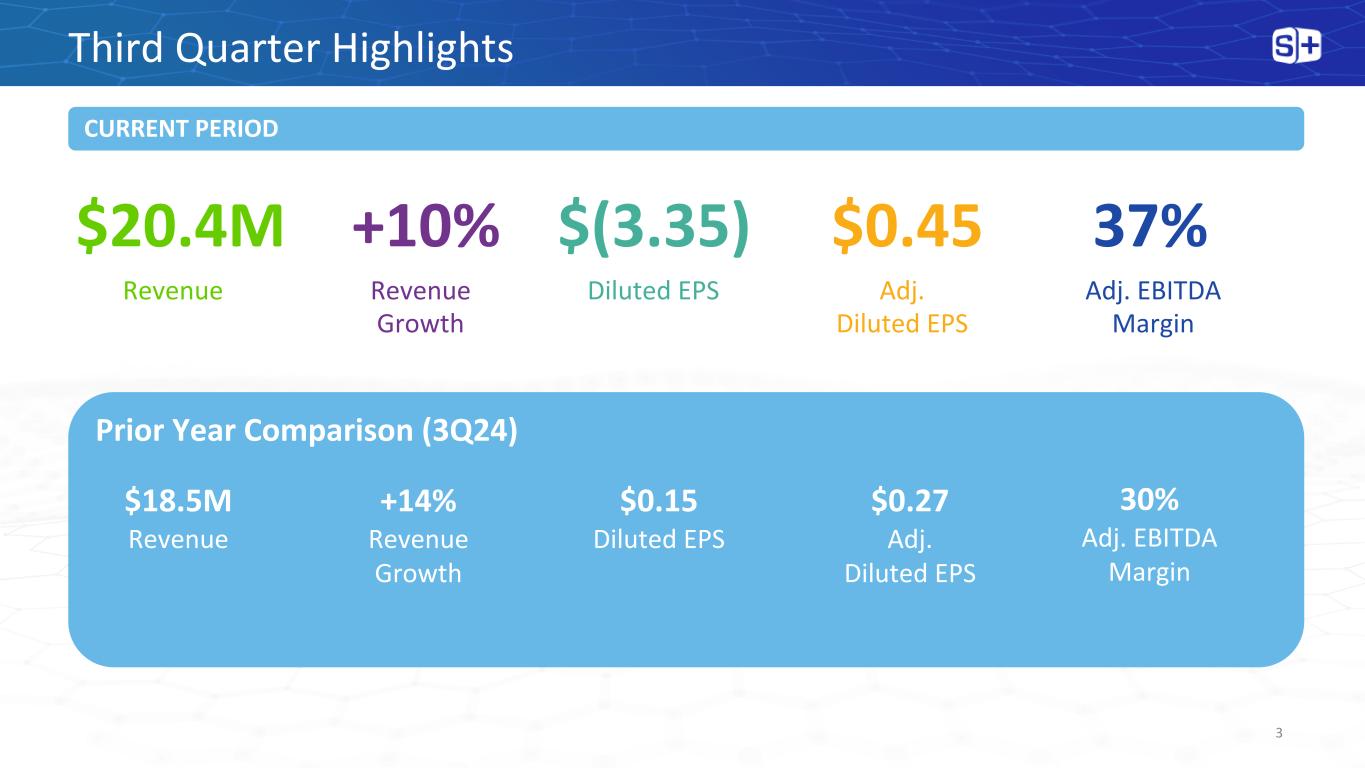
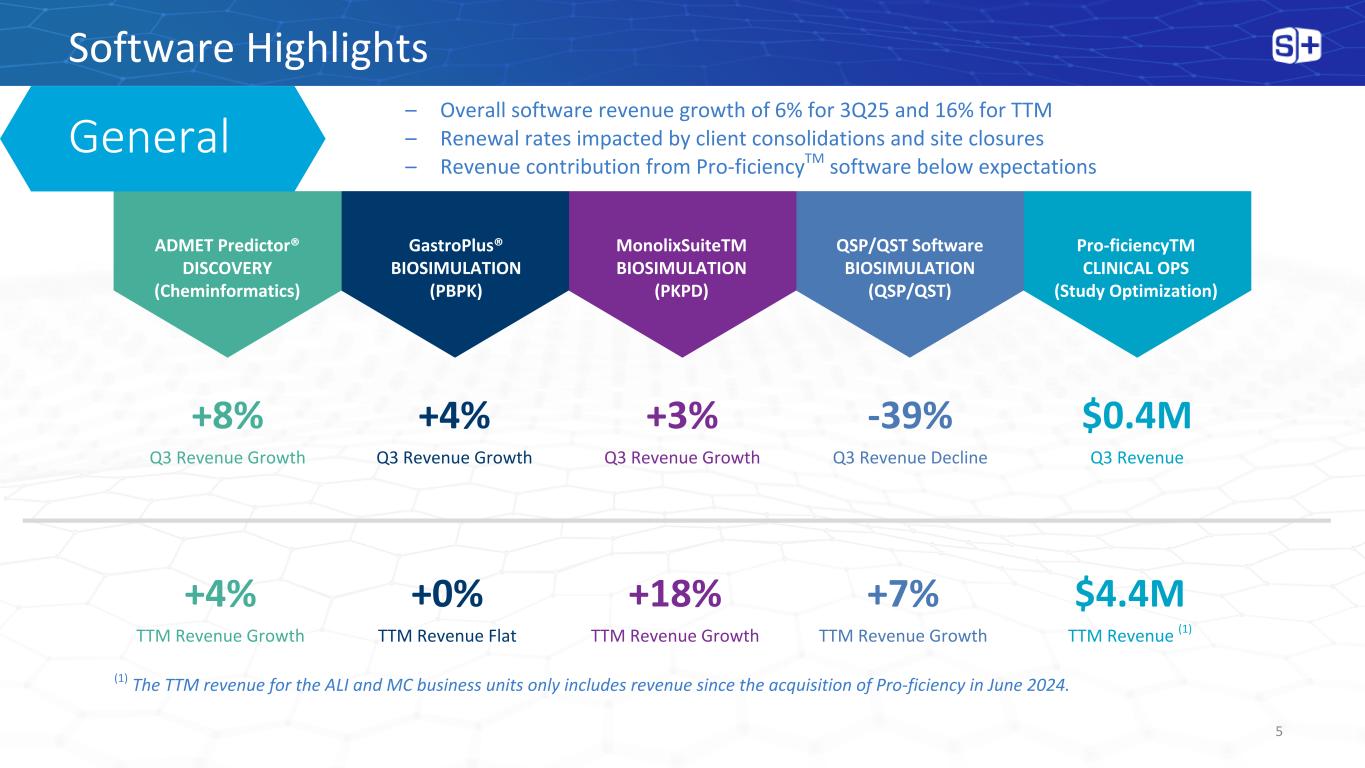
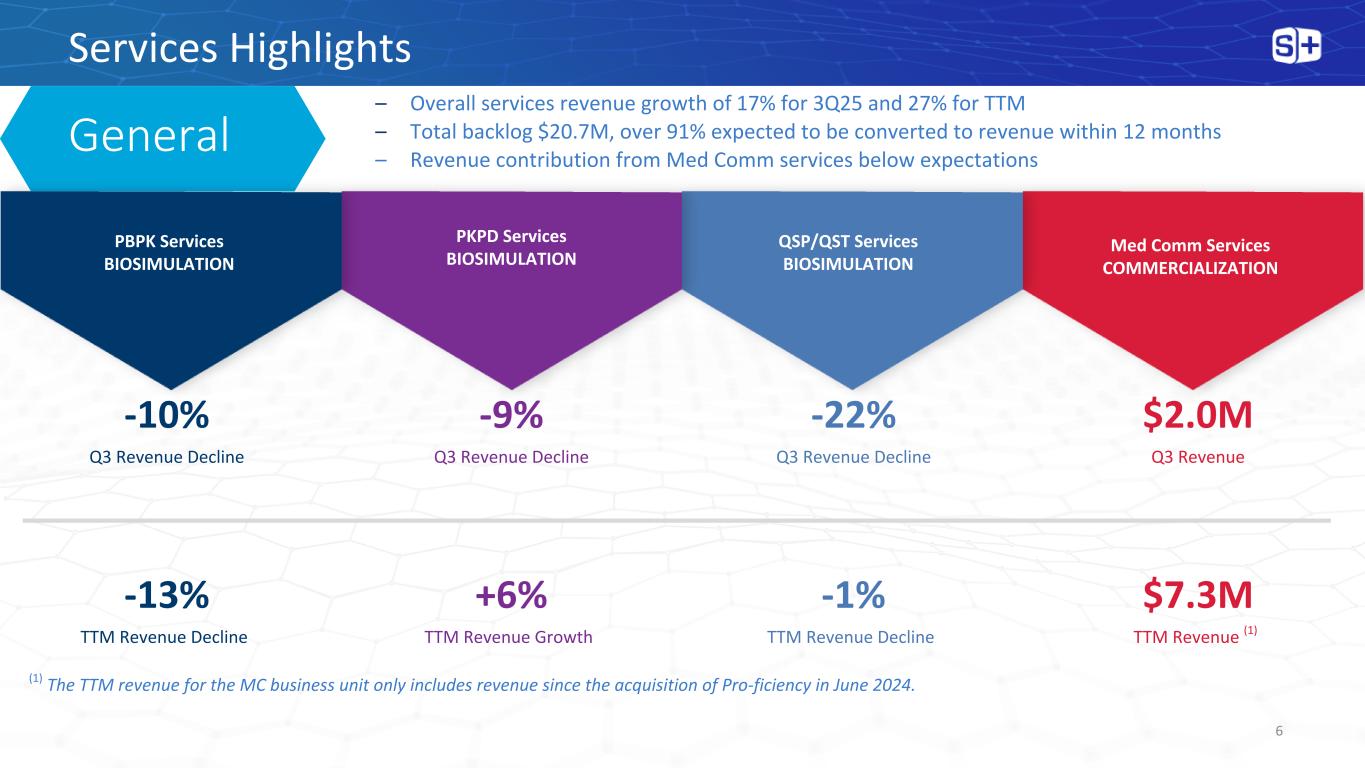
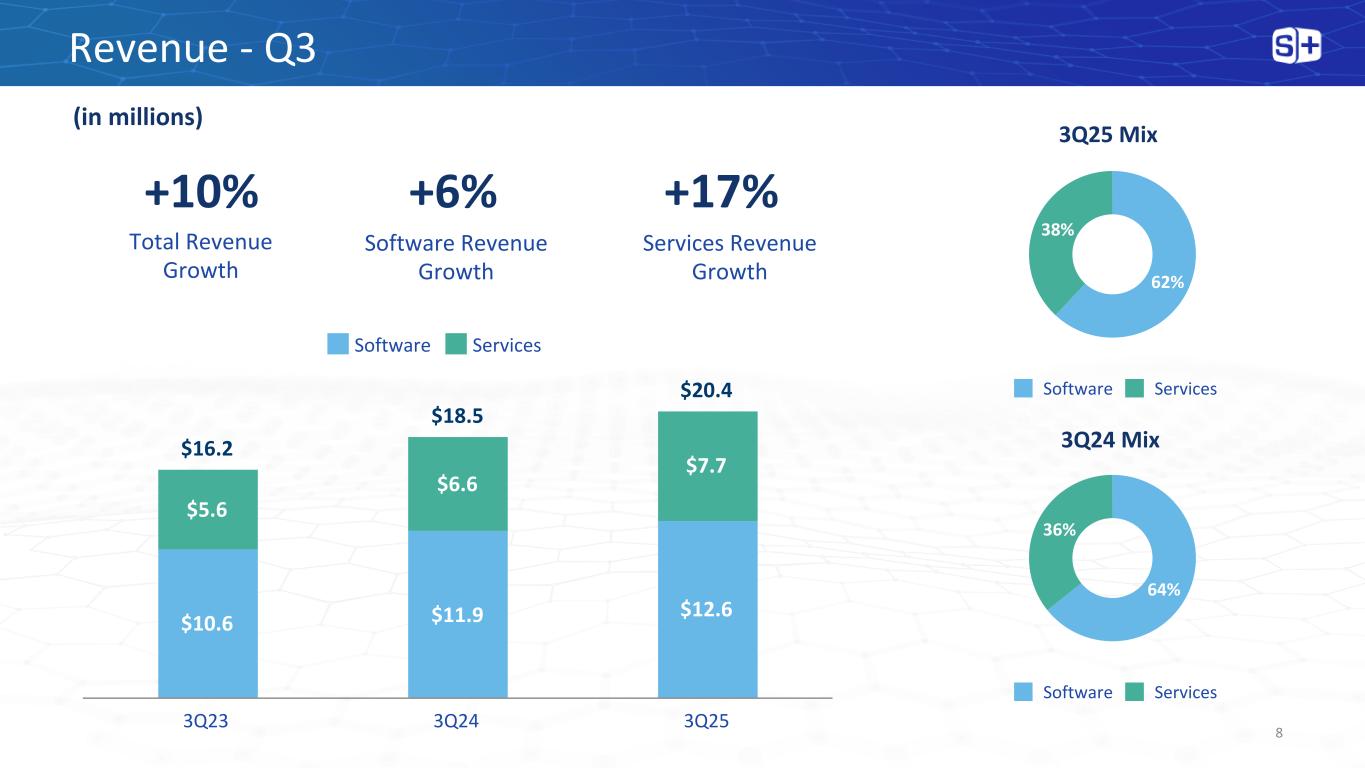
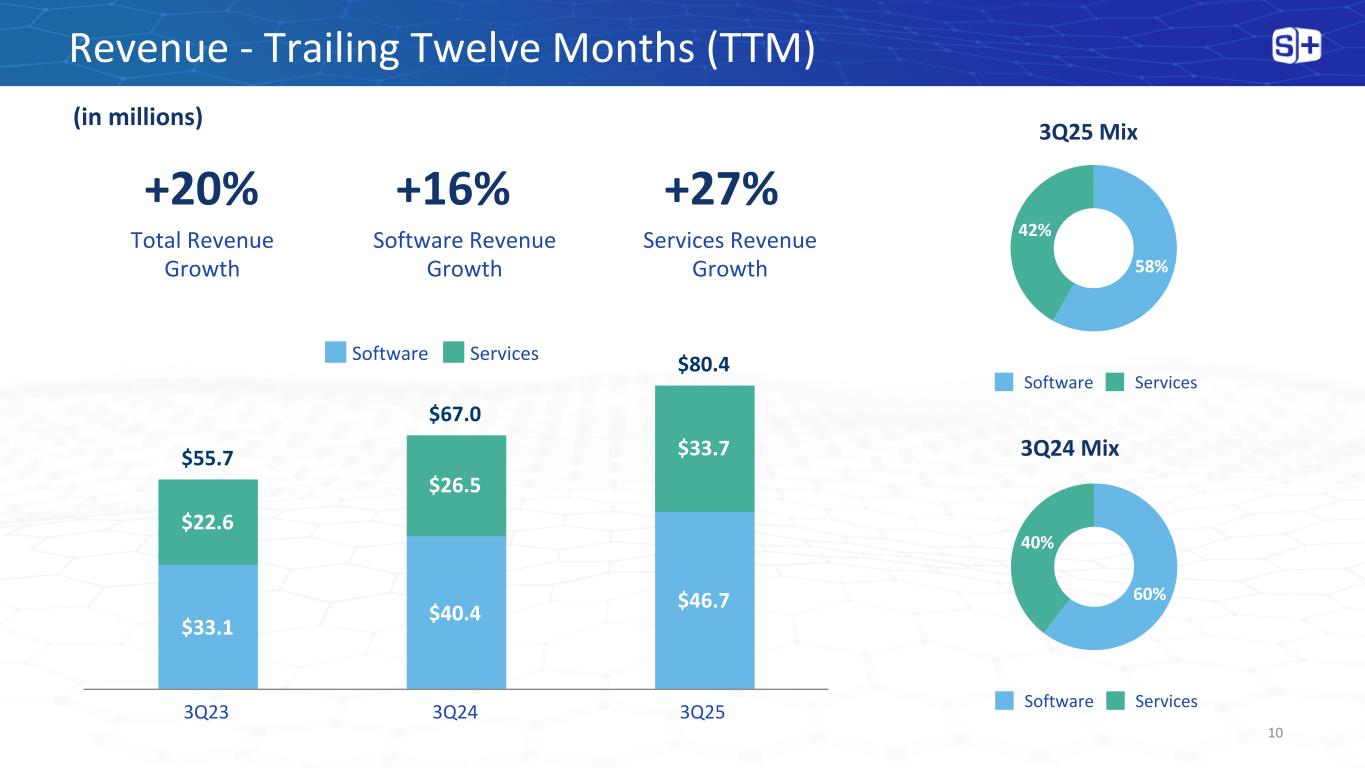
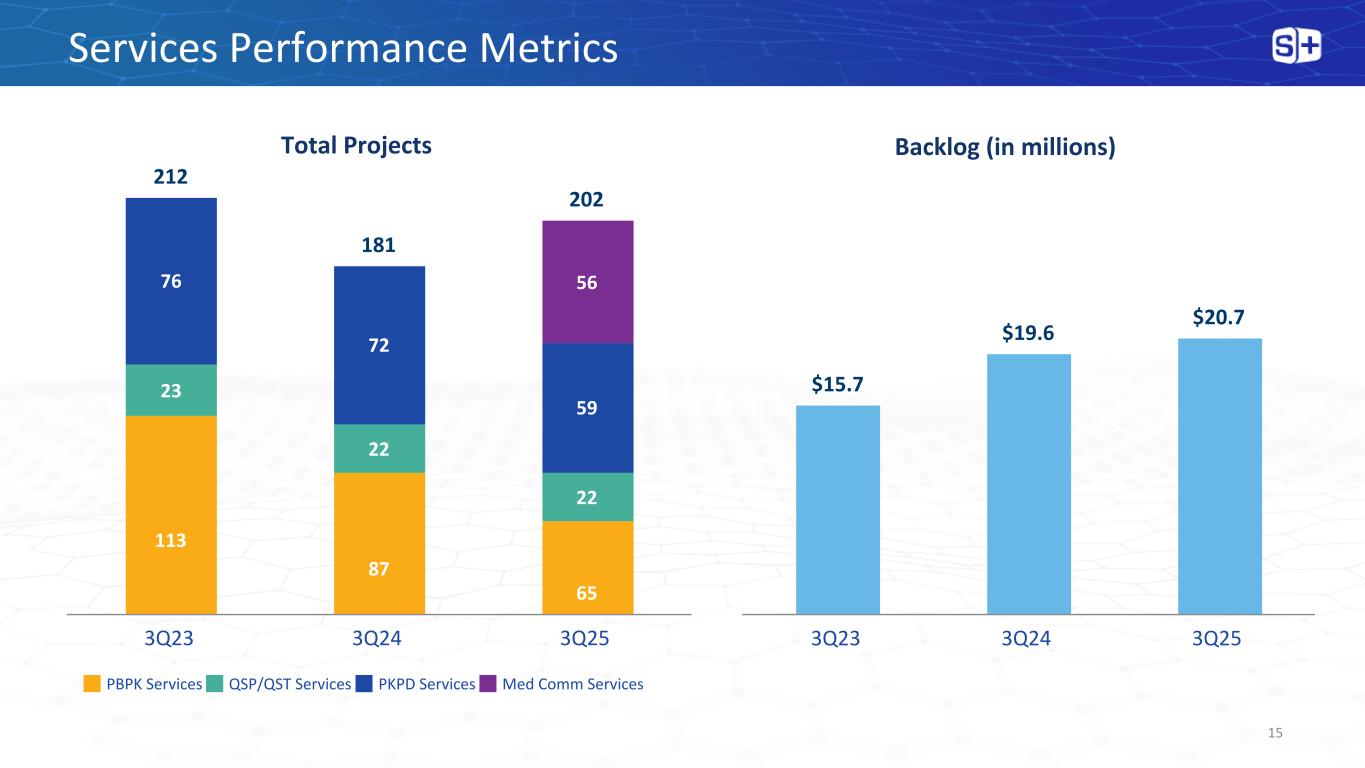
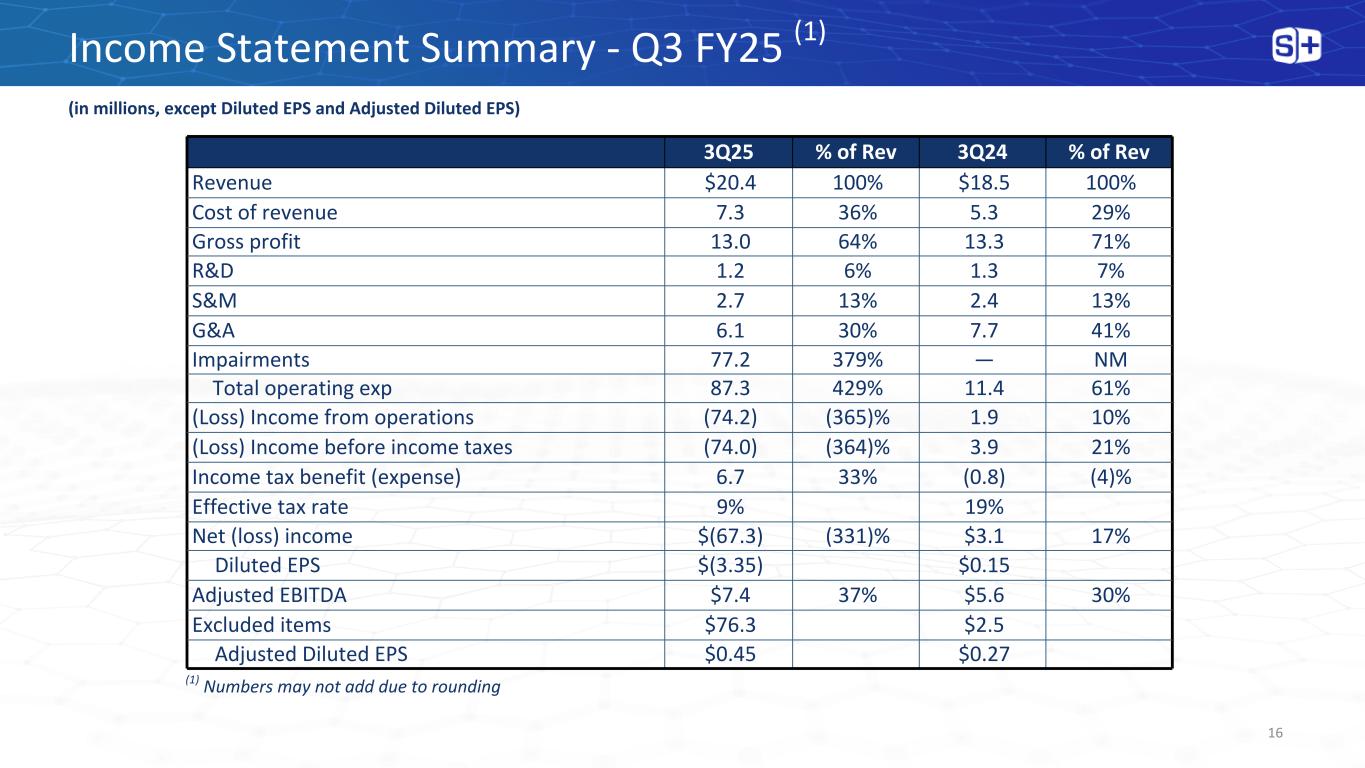
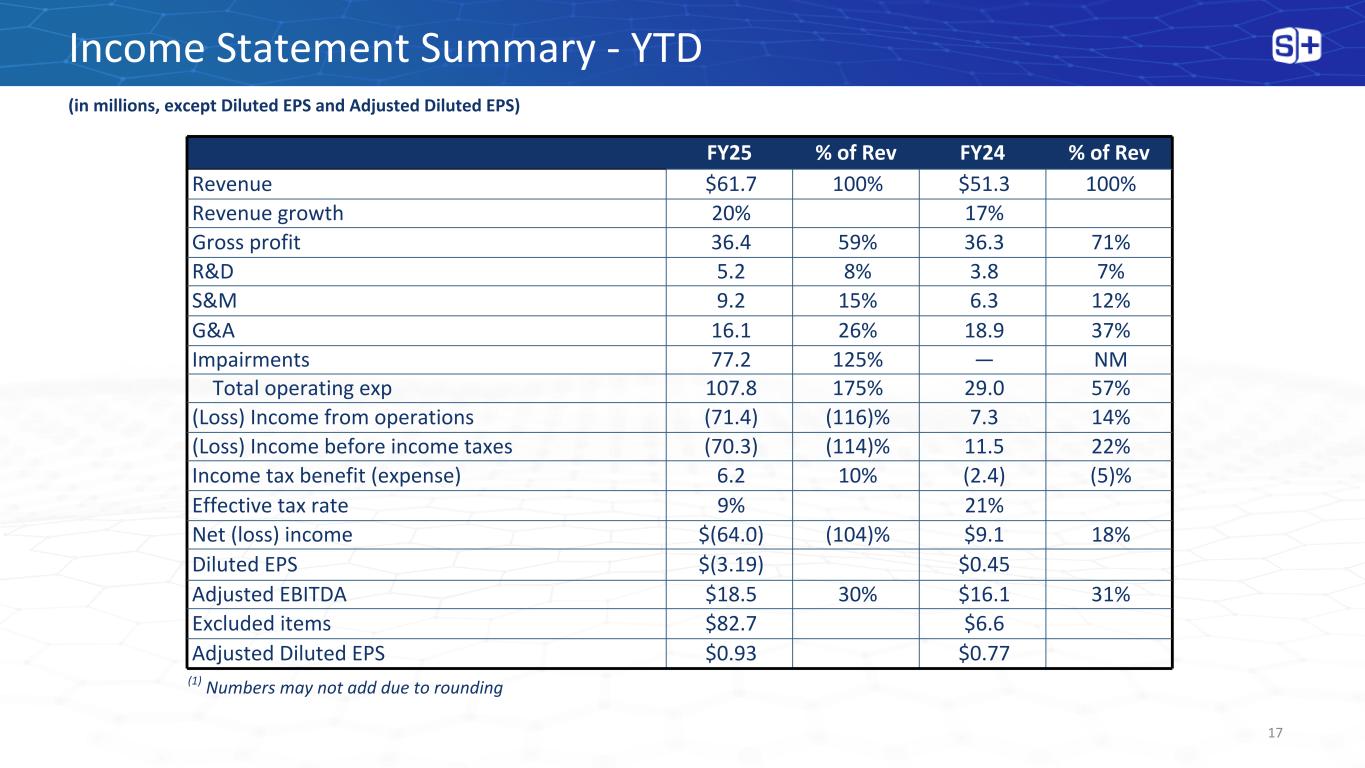
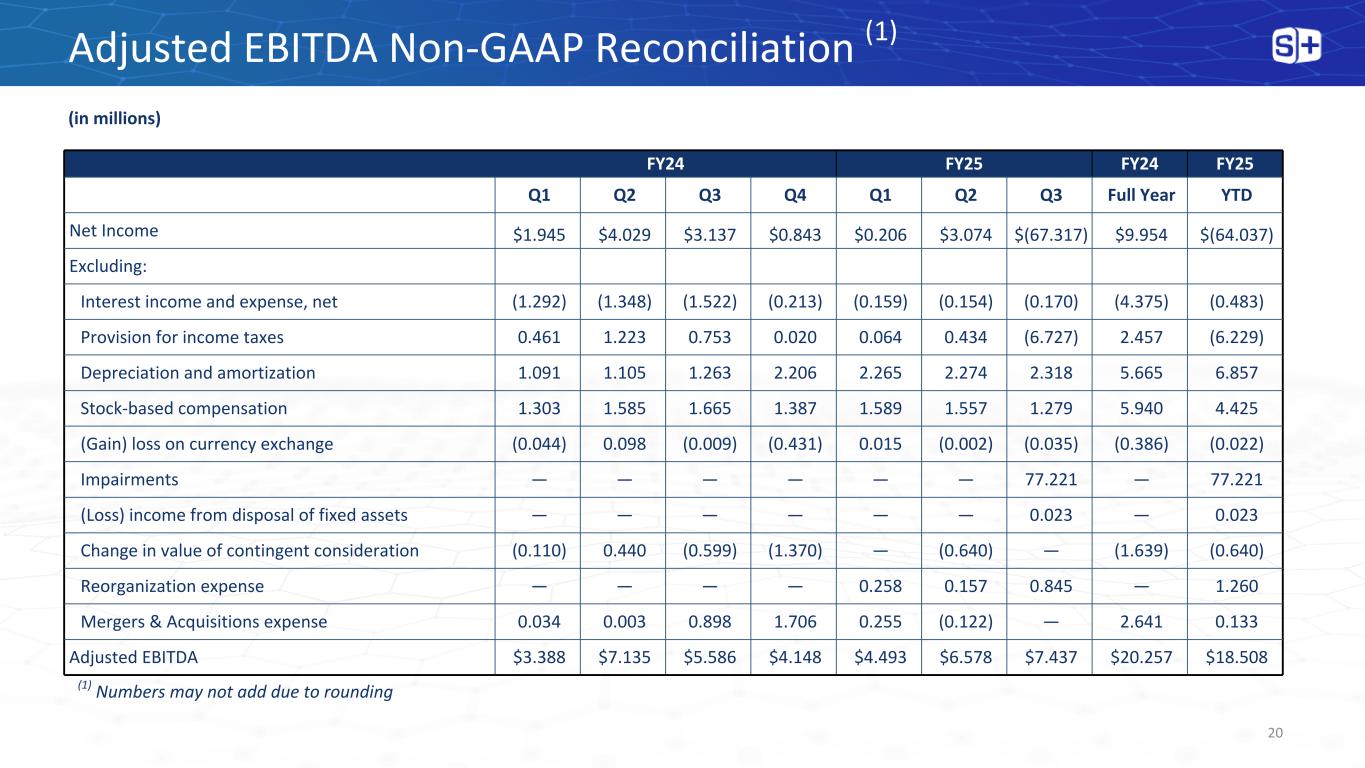
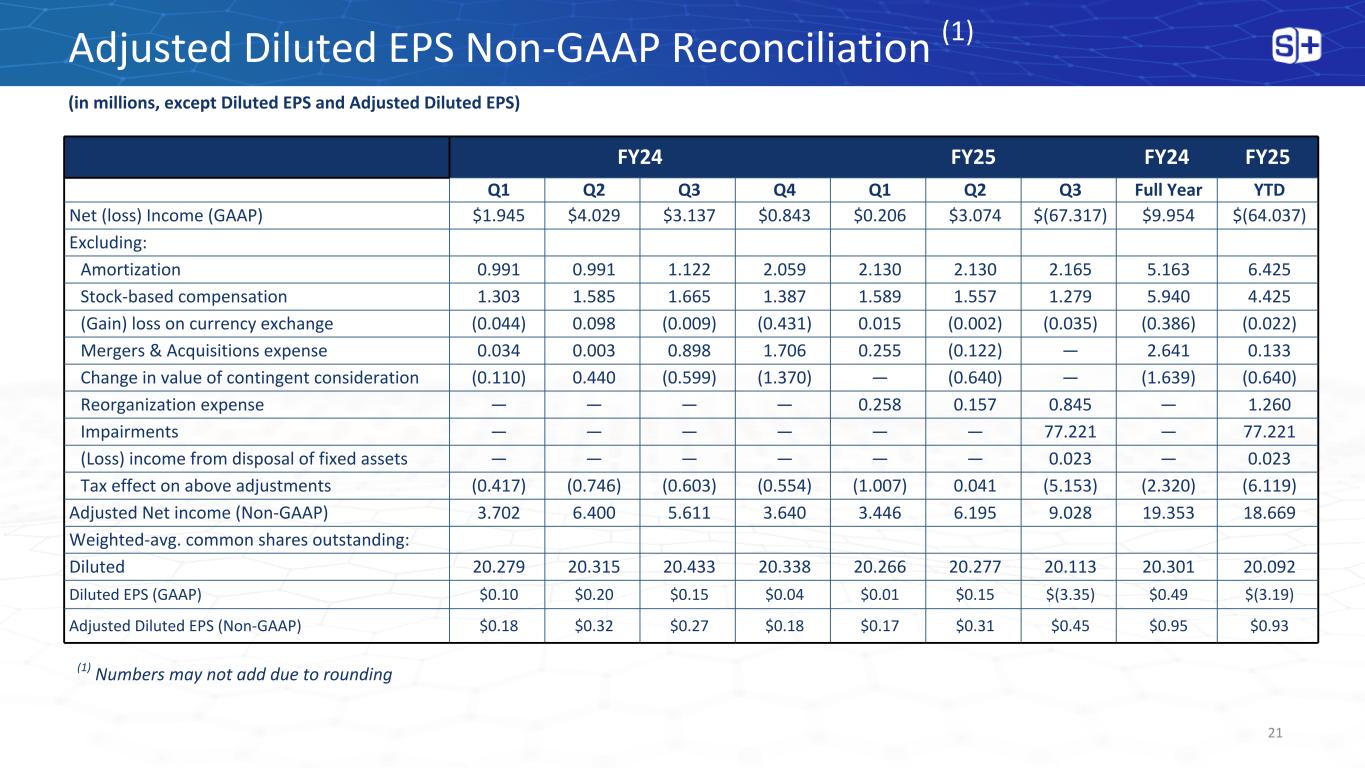
Thank you, Lisa. Good afternoon, everyone, and thank you for joining our third quarter fiscal 2025 conference call. Third quarter revenue came in slightly above our preliminary range communicated in June. Final results showed revenue growth of 10% to $20.4 million, including a $2.4 million contribution from the proficiency acquisition. On an organic basis, revenue declined 4% primarily due to lower QSP, QST software revenue and a decrease in our biosimulation services revenue. Diluted EPS loss was $3.35, which included a $77.2 million charge, non-cash impairment expense related to prior acquisitions compared to 15 cents last year. Adjusted diluted EPS was 45 cents compared to $0.27 last year. Adjusted EBITDA was $7.4 million, or 37% of revenue, compared to $5.6 million, or 30% of revenue last year. A year ago, we acquired proficiency to expand our capabilities into the clinical operations space to leverage our science and technology capabilities and the use of predictive analytics to support our clients' ability to better manage a critical contributor to clinical trial failures. The acquisition doubled our TAM and positions us well for future growth in clinical operations, where the opportunity to improve outcomes with better use of predictive technologies is recognized as an important area of potential improvement in drug development. The proficiency training platform and medical communication services have been significantly impacted by market headwinds that disrupted clinical trial initiations and tightened commercialization budgets. These are similar in nature to the headwinds encountered in our biosimulation market. As a result, our outlook for these revenue sources for fiscal year 25 and into fiscal year 26 decreased and we took what we believe was a prudent and conservative step to align the book value of these assets to their near-term market value. We are deeply committed to our clinical operations and medical communications businesses and their long-term growth outlook. The clinical operations space is rich with opportunities to combine science and new AI technologies to deliver significant clinical operational efficiencies. We remain bullish on this opportunity and believe the proficiency platform will provide the appropriate path to extend our footprint with new and current customers when the market stabilizes. And the technology acquired in the proficiency acquisition allows us to more quickly advance the introduction of AI applications across our full portfolio of software platforms. Reinforcing our commitment and belief in the opportunities presented in the clinical operations space, today we issued a press release announcing our investment in NeuroCore, which offers a software platform designed to improve efficiency, reusability, governance, and automation for pharmaceutical companies through the digitization in the clinical development phase. It is highly complementary to our proficiency software and is a straightforward extension of our presence in clinical trial design. With NeuroCore, we are further enhancing our capabilities to provide a more seamless and data-driven approach to trial execution, which reflects our ongoing commitment to clinical trial design services. As most of you are aware, the biopharma market has been difficult for the past several years. Large pharma is facing headwinds such as patent expirations and Inflation Reduction Act pricing pressures, while biotech companies have seen a significant pullback in available sources of capital. These challenges have been further exasperated by the threat of tariffs, most favored nation pricing policies, and significant budget reductions at the NIH and FDA. Combined, these market headwinds have created more uncertainty and further constrained biopharma spending. With solid revenue growth in the first half of our fiscal 2025, I think it's fair to say that our team has generally executed well through some choppy market conditions. Our software revenue, while impacted, has continued to grow well. However, our services revenue has been more significantly impacted by the cost constraints implemented by our clients. We encountered a slowdown in our services bookings in the third quarter that will affect near-term project flow. Additionally, more delays in contracted projects push services revenue out to future quarters. We also experienced a significant client cancellation during the quarter due to unfavorable outcomes in their drug programs that impacted near-term revenues by approximately $2 million. dollars taken together these factors had a substantial effect on our third quarter performance and they'll continue to flow into our fourth quarter and fiscal year 26. this lower than expected services revenue contributed to the downward provision of our full year 2025 guidance that will is going to cover shortly excuse me moving to our software revenue our software business continued to perform well, given its role as critical infrastructure and drug development programs. Software revenue grew 6% in the quarter, mainly driven by our AdMet Predictor solution and modest growth in our GastroPlus and Monolix Suite platforms, partially offset by a decline in our QSP-QST biosimulation platform. Our discovery cheminformatics platform, AdMet Predictor, grew 8% year-over-year and 4% on a trailing 12-month basis. At the end of the quarter, we released AdMet Predictor 13, our flagship machine learning modeling platform for the design, optimization, and selection of new molecules during various stages of drug discovery, with improved features in the areas of first-to-invent advantage, usage, elevated predictive power, and enterprise-ready automation. Our PBPK biosimulation platform, GASFIR Plus, increased 4% year-over-year and was flat on a trailing 12-month basis. Revenue growth for GASFIR Plus was below expectations as it was impacted by client consolidations and some site closures that resulted in lower renewal rates. Our outlook for GastroPlus remains strong in anticipation of the next upgrade later this year with enhanced AI capabilities. Our PKPV simulation platform, Monolix Suite, grew 3% year-over-year and 18% on a trailing 12-month basis. This platform was also impacted by a client consolidation this quarter, but otherwise it has continued to grow in the high teens. Our QSP-QSP bio-simulation platform declined 39% year-over-year and grew 7% on a trailing 12-month basis. The year-over-year decline was driven by very strong third quarter 2024 revenue. We have always communicated the lumpy nature of QSP software revenue, and while the revenue contribution was down this quarter, it was positive on a trailing 12-month basis. Our clinical operations platform, Proficiency, contributed $0.4 million in revenue for the quarter and $4.4 million on a trailing 12-month basis. Although a small contributor to software revenue, new licenses for this training platform have slowed along with the flow of clinical trial solutions. As we previously mentioned, demand for services has proven more sensitive to market volatility and came in below our expectations. Services revenue, which represented 38% of total revenue, grew 17% in the third quarter, primarily driven by solid performance in medical communication services, and grew 27% on a trailing 12-month basis. PVPK services revenue declined 10% year-over-year and declined 13% on a trailing 12-month basis. PKPD services revenue declined 9% year-over-year and grew 6% on a trailing 12-month basis. This is the service solution where we encountered the client cancellation that I noted before. QST revenue declined 22% year-over-year and 1% on a trailing 12-month basis. Medical communication services revenue was $2 million for the quarter and $7.3 million for the trailing 12-month period. Overall, we have a healthy pipeline of service projects, but the pace of contractual commitments slowed during the third quarter. Further, some contracted businesses business in our backlog has been delayed to future quarters. We ended the quarter with backlog of $20.7 million, up from $20.4 million in the second quarter, and up from $15.7 million year over year. We've always been a very client-centric company, and before I turn the call over to Will, I want to discuss the actions we've recently initiated to better serve our clients going forward and to position us as their partner of choice based on our innovative solutions that meet their current and future needs and for operational efficiencies that keep us competitive in the marketplace last month we implemented a strategic reorganization transitioning from a business unit structure to a functionally driven operating model we also made key leadership appointments to enhance client engagement and elevate our sales and marketing capabilities. These actions mark the final phase of a multi-year transformation aimed at streamlining operations, unlocking synergies across teams, and concentrating our resources on the most promising growth opportunities. We believe the new organizational structure will also foster greater collaboration through centralized product and technology development contributing to accelerated delivery of software enhancements platform integration and ai advancements two tangible examples of the benefits from this reorganization first by consolidating our product management and software development teams into a single functional organization we've achieved greater consistency in development improved efficiencies and accelerated delivery of enhancements across all our platforms this structure enables us to continue advancing the scientific enhancements of each of our products while maintaining our leadership position key development opportunities such as ai functionality optimized cloud infrastructure, and enhanced product interoperability will be more effectively executed through our unified software team. Second, the integration of our services group reflects the increasing value of our diverse modeling service solutions, which are often combined to support complex client projects. Our clients frequently present unique challenges that require multidisciplinary teams to efficiently solve their needs, and this consolidation allows us to better support them. Through this reorganization, we also streamlined our workforce, which will result in greater efficiency in our cost structure. Beyond these cost savings, we also aligned our services capacity more closely with current needs. We remain confident that we will be able to scale operations effectively as demand stabilizes. These changes are expected to improve operational efficiency and better position us for sustainable and profitable long-term growth.
Operator
With that, I'll turn the call over to Will.
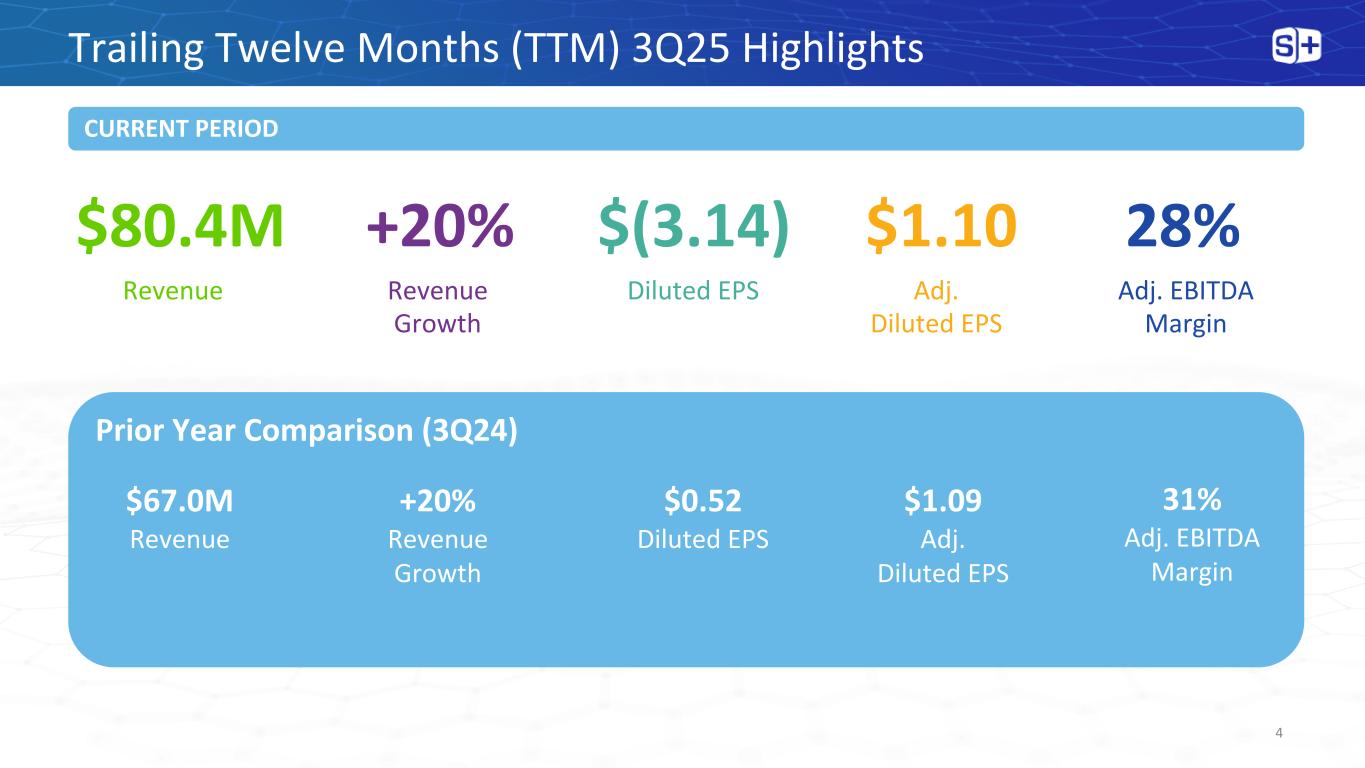
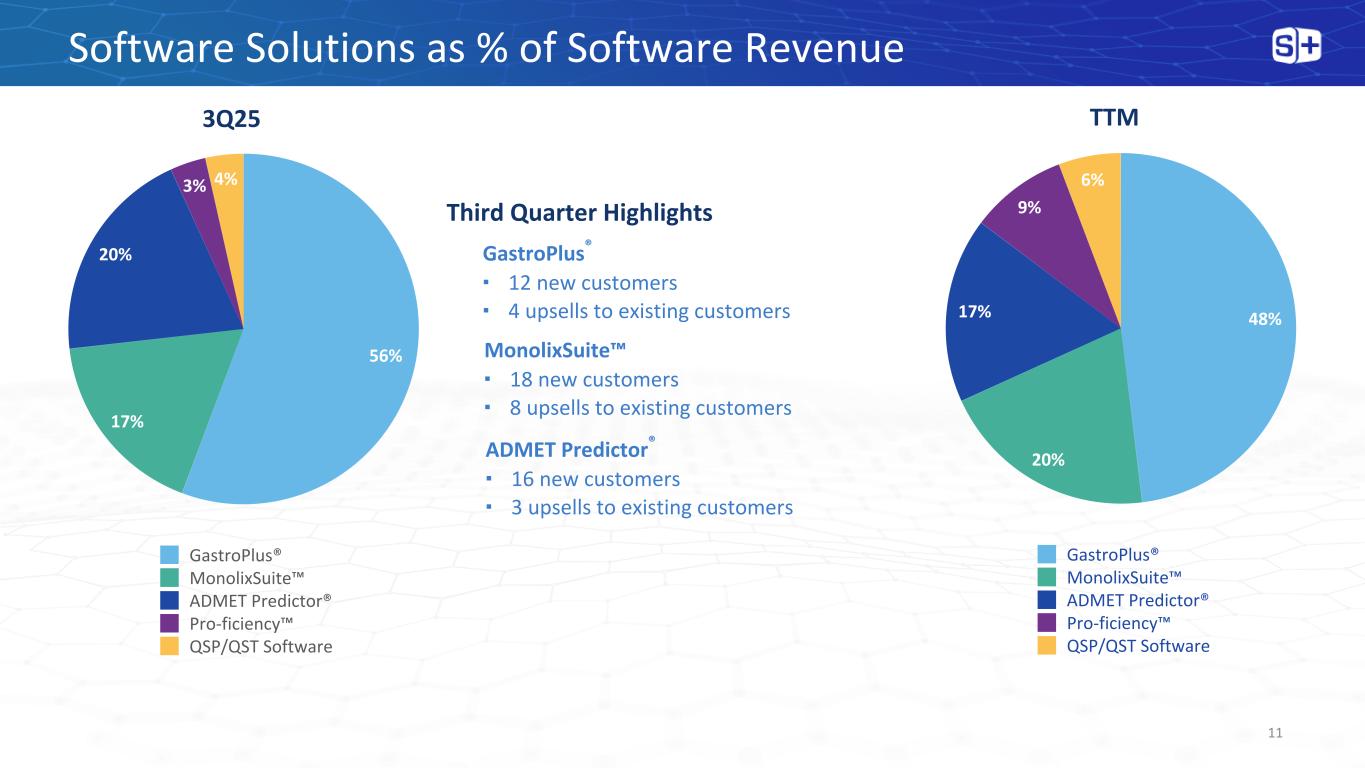
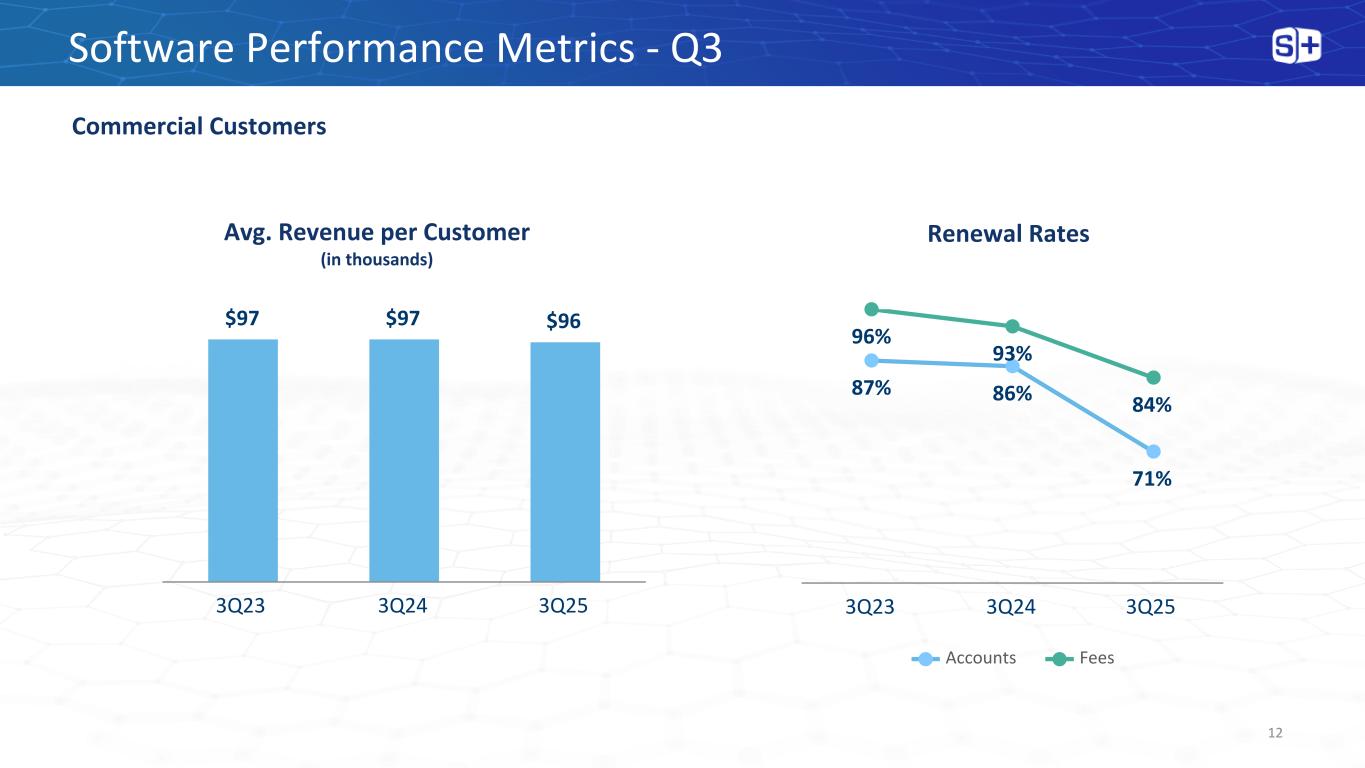
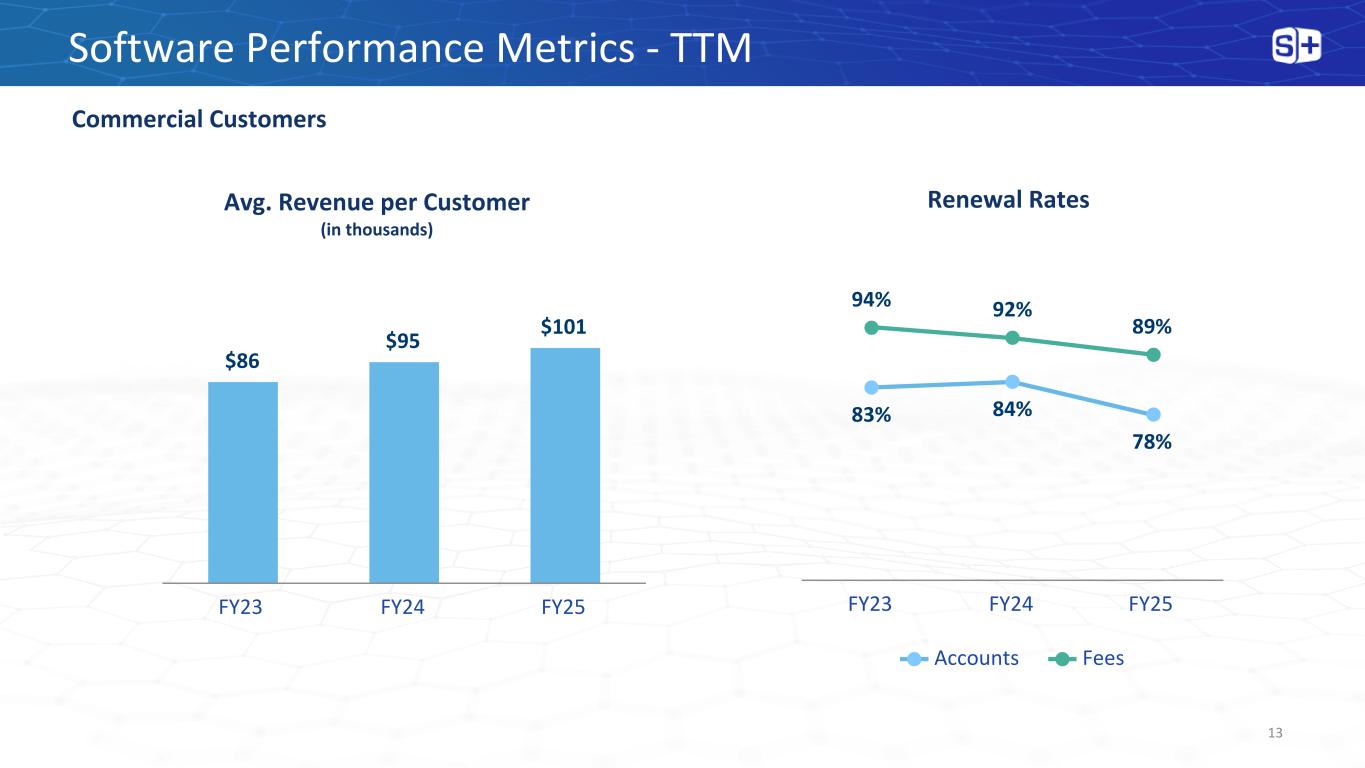
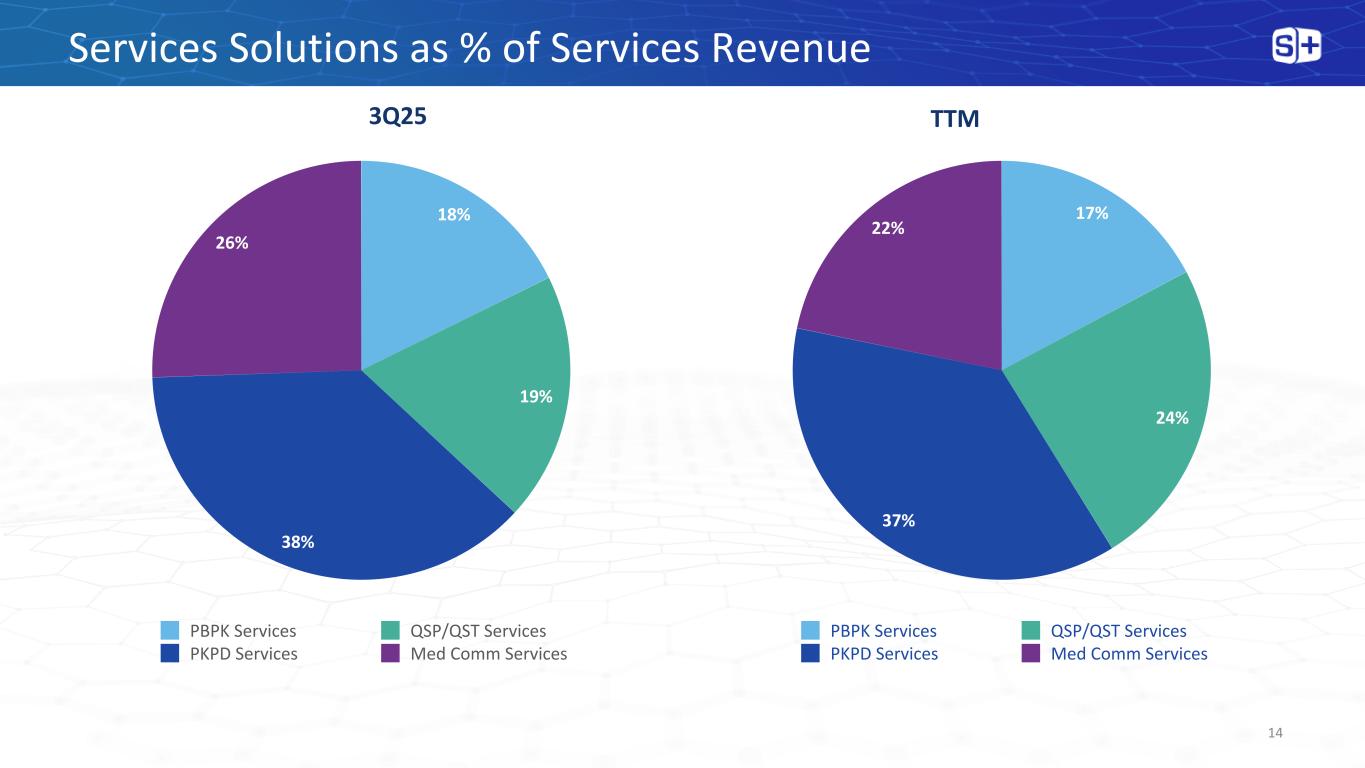
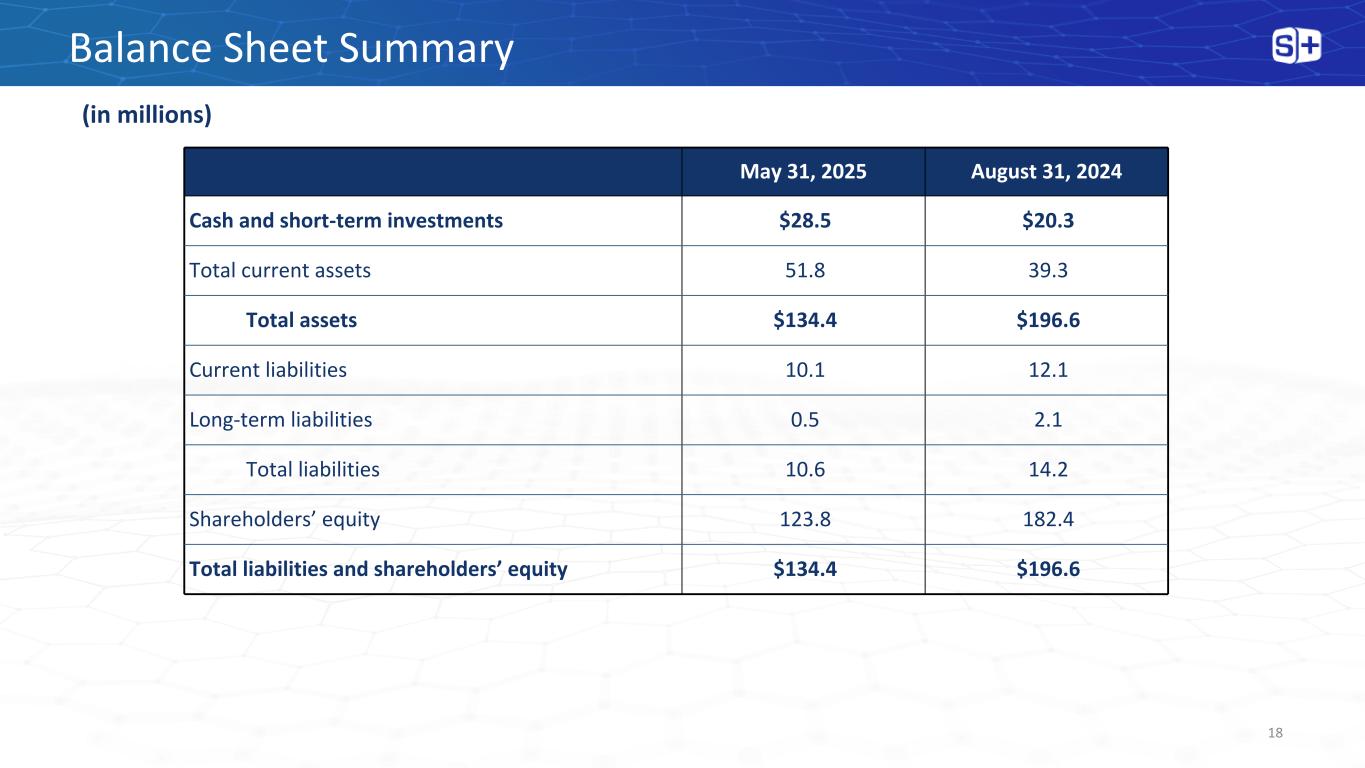
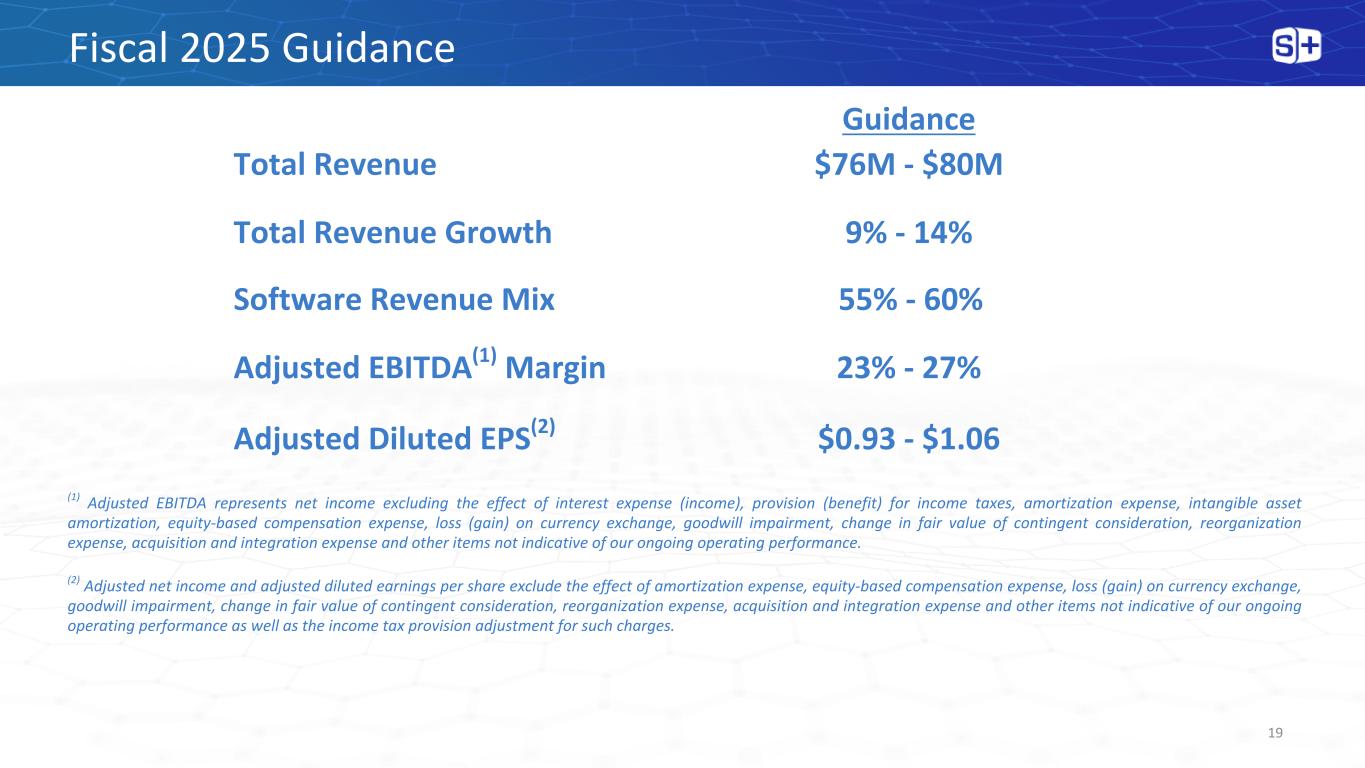
To recap our third quarter performance, total revenue increased 10% to $20.4 million, including a $2.4 million contribution from the proficiency acquisition software revenue increased 6% representing 62% of total revenue and services revenue increased 17% representing 38% of total revenue turning to the software revenue contribution from our products for the quarter gastro plus was 56% admit predictor was 20% monolix suite was 17% Proficiency was 3%, and QSP, QST products were 4%. For the trailing 12 months, GastroPlus was 48%, Monolix Suite was 20%, AdMet Predictor was 17%, Proficiency was 9%, and QSP, QST products were 6%. The trailing 12-month software revenue for Proficiency only includes revenue since the acquisition in June 2024. During the quarter, our software customer renewal rate was 84% based on fees and 71% based on accounts. Average software revenue per customer for the quarter was $96,000, down slightly both sequentially and compared to last year. On a trailing 12-month basis, our software customer renewal rate was 89% based on fees and 78% based on accounts, slightly lower than last fiscal year. Average revenue per customer increased to $101,000 from $95,000 on a trailing 12-month basis. Shifting to our services revenue contribution by solution for the quarter, PKPD services were 38%, MEDCOM services were 26%, QSP, QST services were 19%, and PVPK services were 18%. On a trailing 12-month basis, PK-PD services were 37 percent, QSP-QST services were 24 percent, MedCom services were 22 percent, and PVPK services were 17 percent. Again, the trailing 12-month MedCom services revenue only includes revenue since the acquisition of proficiency last June. total services projects worked on during the quarter were 202 and year-end backlog increased to 20.7 million dollars from 19.6 million dollars last year total gross margin for the quarter was 64 percent with software gross margin of 80 percent and services gross margin of 38%. On a comparative basis, total gross margin for the prior year quarter was 71% with software gross margin of 88% and services gross margin of 41%. The decrease in total gross margin was due to a $2 million increase in costs of revenues, of which $1.1 million was related to software-related costs, and $0.9 million was related to service-related costs. Turning to our consolidated income statement for the quarter, R&D expense was 6% of revenue compared to 7% last year. Sales and marketing expense was 13% of revenue, equivalent to last year. G&A expense was 30% of revenue compared to 41% last year. and total operating expenses, including impairment, excluding impairment expense, were 49% of revenue compared to 61% last year. Total operating expense for the quarter includes a one-time non-cash impairment expense of $77.2 million based on a valuation assessment we made to align the book value of our assets to their current market value. Income tax benefit for the quarter was $6.7 million compared to income tax expense of $0.8 million last year, and our effective tax rate was 9% compared to 19% last year. Net loss for the quarter was $67.3 million compared to net income of $3.1 million, and diluted EPS loss was $3.35 compared to diluted EPS of $0.15 last year. Adjusted EBITDA for the quarter was $7.4 million or 37% of revenue compared to $5.6 million or 30% of revenue last year and adjusted diluted EPS was $0.45 compared to $0.27 last year. The reconciliation of non-GAAP financial metrics to the relevant GAAP metrics is in our earnings release and on our website. Turning to our balance sheet, we ended the quarter with $28.5 million in cash and short-term investments. The decrease in total assets this quarter reflects the non-cash impact of the impairment charge. We remain well capitalized with no debt and strong free cash flow to execute our growth strategy. Moving on to our revised outlook for fiscal year 2025, we now expect total revenue to be between $76 to $80 million and proficiency to contribute between $9 to $12 million. Year-over-year revenue growth in the range of 9% to 14%, software mix between 55% to 60%, adjusted EBITDA margin between 23% and 27%, and adjusted diluted earnings per share of between $0.93 and $1.06. I'll now turn the call back to Sean.
We faced new challenges in the third quarter, which recalibrated our outlook for the balance of fiscal 25. At the same time, we remain optimistic about the long-term prospects for biosimulation growth and the use of AI predictive analytics in clinical operations. Our positive long-term outlook is underpinned by growing demand for more efficient drug development, an area where our platforms and solutions deliver clear value. The regulatory environment is also increasingly supportive of in-silico methods, as demonstrated by the FDA's recently announced roadmap to reduce animal testing through the adoption of new approach methodologies. Additionally, the FDA commissioner has publicly endorsed the use of AI in drug development, highlighting its potential to enhance both speed and efficiency without sacrificing safety and efficacy. Just this week, the NIH announced that the biomedical agency would no longer award funding to a new grant proposal solely relying on animal testing. Since it remains unclear when the market will stabilize, we believe that we have taken necessary actions that will allow us to operate effectively and efficiently to serve our clients until the market dynamics improve. As in prior years, we will provide our fiscal 2026 outlook when we report fourth quarter results. Assuming current market conditions persist in the near term, we generally anticipate modest improvement in fiscal 2026 compared to fiscal 2025. We anticipate exiting fiscal year 25 with relatively flat organic revenue growth, with software revenue growth in the 5% to 9% range and services revenue decline in the 9% to 13% range. Between now and when we provide fiscal year 26 guidance, we will have the benefit of understanding the ongoing impact of market headwinds, as well as input from clients as they undertake their calendar year budgeting cycles. Looking to the future, Simulations Plus is rolling out a series of new AI-driven initiatives across our product suite as part of our commitment to innovation. Key upcoming developments include cloud platform development. Our expectation is that this platform will become the connective tissue linking artificial intelligence across our solutions, seamlessly embedding AI-driven insights and automation into each of our new products, each of our major projects. Our AI-enhanced Castro Plus release, anticipated later this year, will debut integrated AI assistants, accessible via a cloud platform. This will augment users' modeling workflows with intelligent guidance and real-time predictive analytics, demonstrating the first step in our cross-product AI integration. Specifically, our next GastroPlus release will include AssessmentsPlus, a modeling co-pilot that offers instant assessment and recommendations for compounds and simulations. Its expert-driven guidance is built on real scientist input and is engineered to avoid hallucinations. It ensures experienced modelers consider potential model optimizations and empowers newer users to quickly gain competency in model building and the multiple disciplines that underpin PVPK. Orchestrator, an automation package for complex and time-consuming workflows. once set up users can build modify execute and visualize modeling projects and results with a single click using r scripts python code and more streamlining tedious tasks minimizing errors and accelerating data processing to free up time for researchers to engage in deeper analysis and innovation. And GastroPlus GPT, an AI-powered chatbot that provides conversational-style real-time answers and support for technical and operational questions, and extracts information from unstructured data sources for effortless setup of GastroPlus input files and reports. The foundational OpenAI Large Language Model-Driven Program is available 24-7 and enhances users' modeling proficiency and efficiency. And finally, portfolio-wide AI rollout. Following the GastroPlus update, we plan to introduce additional AI integrations into our flagship tools such as AdMent Predictor and Monolex Suite in the next fiscal year. Each integration is aimed at enhancing product capabilities and delivering greater value to our clients through improved productivity, deeper data insights, and streamlined decision support. These AI initiatives underscore Simulation Plus's focus on applying advanced technologies like AI to drive innovation and business growth. By leveraging our new AI-powered features, we believe we will gain a distinct competitive advantage and expanded value proposition in the biosimulation market. This strategy not only enriches our product ecosystem, but also positions Simulations Plus for sustained growth, further solidifying our leadership in model-informed drug development solutions. Thank you for your time, Tegay, and with that, I'll turn the call over to the operator for questions.
Operator
Ladies and gentlemen, if you would like to ask a question, please press star 1 on the telephone keypad, and the confirmation tone will indicate your line is in the question You may press star 2 if you would like to remove your question from the queue. For participants using speaker equipment, it may be necessary to pick up your handset before pressing the star keys. And our first question comes from the line of Scott Schoenhaus with KeyBank Capital Markets. Please proceed.
Thanks for taking my question. So I guess my first question is on the implied fiscal fourth quarter margin guide. It comes down steeply from the margins you just posted, and you talked about your efficiencies and streamlining the operations to get to those margins this quarter. What is driving that margin erosion next quarter?
Yeah, the reorganization and the actions we took in terms of our expense structure, Scott, primarily did not impact the third quarter. They impact the business on a go-forward basis. As we had communicated, the RIF represented an annual cost savings of $4 million, and that starts to kick in in the fourth quarter, really impacts our next fiscal year. Our challenge in terms of the fourth quarter margins really is embracing that revenue step down on the top line. And while we're making our expense structure more efficient, fourth quarter revenues impact those margins and bring us down to that guidance in the mid to high 20s in terms of just the EBITDA.
And then on the renewal rates on the software side, you know, it's stepping down from, you know, 93% to 84% on the fees and 86% to 71% on the accounts. And I think you talked to me for prepared remarks about mostly this was driven by GastroPlus site closures from certain accounts. Can you just provide more color here? Seems like a pretty big drop off. And, you know, what historically have you seen that floor for renewal rates? Is there more risk for renewal rates to fall even further from here?
Yeah, our renewal rates, as we've said previously, historically, the renewal rate is impacted primarily by consolidations, site closures, combinations of our clients that result in, you know, a reduction of the renewal size, and that certainly was the case in the third quarter. A consolidation both with regard to a GastroPlus client and as well a Monolix client impacted those renewal rates for those two products. You know, I don't see, you know, others on the horizon of great significance, but consolidations are occurring in our client base. And, you know, as they have contributed historically, I'm sure they will in the future. I don't know that our experience here in the third quarter is indicative.
And we've maintained historical rates in that 90 to 95 renewal rate on fees, which I expect we will in the long term maintain.
Operator
Next question comes from the line of Matt Hewitt with Craig Howland Capital Group. Please proceed.
Good afternoon. Thanks for taking the questions. Maybe first up, regarding the April 10th guidance from the FDA, my sense was initially that there was a little bit of a pause, that your customers kind of pulled back a little bit, trying to understand what the new guidance was, how it impacted their business and their clinical trials and whatnot. Are you starting to see that come back as those customers become more comfortable with what the guidance calls for? And are you anticipating that things could start to pick up as we exit this calendar year and get into fiscal 26 for you guys?
Yeah, thanks, Matt. You know, Chris, I'd say that, you know, the announcement by the FDA with regard to use of NAMM, alternative methodologies and replacements of animal testing, you know, is one component of the drug development process. And, you know, that taking place in early preclinical translational activities with our clients, our products and services serve the full development cycle. And so, you know, the announcement is, A, very specific to a certain area of drug development, and B, you know, never underestimate the time it takes for these objectives, stating goals to be translated down into actionable steps. We certainly, it is topic, I hump the list of all of our conversations today with clients that are in that phase of development with some of their programs. But action is still at that stage of awaiting for clarity from the FDA in their stated process of putting together guidelines and interacting with the industry in their development. And that's a process that will take some time. Certainly, it is an indicator of momentum in terms of the use of modeling and simulation. there at that stage of development and broadly went in the sales of the use of modeling and simulation. It's where future drug development will go and become more dependent upon in silico techniques. But measuring it right now in a quarter-to-quarter basis impact on revenue is probably too quick in your anticipation of its impact. Certainly long-term impact, Modeling and simulation continues to grow over the years through its continued adoption of not only existing applications, but the creation of new applications like this will be over the long term that increase the ways in which modeling and simulation is used in the whole drug development process. So great news, certainly a topic of conversation that's quite prevalent, a lot of momentum in terms of modeling and simulation, patience required in terms of seeing its impact on top-line revenue.
Got it. And then maybe a different way of kind of looking at this, but you listed off a number of different headwinds that you're facing, the funding environment, customer consolidation, site closures. As you look at those, what do you think has been the biggest headwind recently? And what's it going to take for that to kind of ease so that you could maybe start to get back to double-digit growth, particularly on the software side?
Yeah, the million dollar question. I wouldn't point to any single factor. It's really the plethora of uncertainties that exist that cause clients to be cautious in their investment decisions, their spending decisions. and I think we've got to see a shortening of the list of all those items that are on that list that contribute to, hey, let's slow play and let's wait and see a little bit. Each of them has their impact with specific clients, specific programs. It's the length of that list that I think is really impactful right now. As we look at our business today, we've taken some actions to gain some efficiencies, right size, our expense run rates, and not anticipate a significant uptick in the market characteristics in the near term. They'll poise and be ready if they do, but, you know, our view right now is let's optimize performance in this environment and work and be ready to step up when the market does turn down the road.
Operator
Got it. Thank you.
The next question comes from the line of Max Smock with William Blair.
Hi, great. It's Christine Raines on for Max Smock. So just to start with, circling back on the previous question on 4Q EBITDA margin expectations, just hoping to get a bit more clarity here. So at the midpoint of your guide, it seems like revenue is dropping off around $4 million sequentially, but your adjusted EBITDA step down is roughly $6.5 million, even though I think you're expecting around $1 million savings from cost cuts. So maybe it would be helpful to get a breakdown of your expectations for COGS and OPEC spend as a percentage of revenue to help us get a handle on drivers for your margin guide for this year, and then how you expect both to trend in 2026, given your recent cost-cutting Yeah, I'll provide an answer at the high level, and then, Will, I certainly invite you to jump in.
And, you know, the revenue drop in the fourth quarter at an environment, even with a RIF and a reduction, our expense load generally is, you know, linear. And while that's impacted by some of the efficiencies, fourth quarter is also a quarter in which a lot of marketing activity takes place. A number of our conferences, key industry conferences occur in that quarter. And so the combination of revenue step-down and expense while muted, there are expense drivers that come into the fourth quarter. You know, we started out the year looking to try and step up. Our original guidance was pointed towards getting close to and stepping up to the 31% to 33% range. With a significant drop in revenue, some expense reduction has taken place, but that still is going to fall through and leads to a reduction on EBITDA guidance.
Will, I don't know if you have anything to add to that.
Yeah, I'd say that pretty much characterizes the expectation that with a revenue drop, but largely fixed costs for us on the personnel side, although we will see some cost reductions as a result of the layoffs in May. We've also got amortization costs with intangibles that I wouldn't expect to see a significant drop off in the cost of revenues or the operating expenses compared to, say, where we were in Q1. But with a lower revenue number, that will flow down to both that EBITDA margin as well as the adjusted diluted earnings per share.
Got it. That makes sense. And then when do you think it's a good timeline or reasonable to get back to kind of your initial guide range of low 30% for EBITDA?
Check in with us when we announce our fourth quarter results. You know, cautiously outlook over the fourth quarter here. We'll take into consideration what we learn in terms of change of those headwinds and or discussions with our clients as they enter their budgetary cycles. And that will help formulate certainly our expectations long-term in a market that is allowing us to grow top-line revenues at historical rates.
Our long-term expectation of being able to achieve 35% adjusted EBITDA is unchanged. question as to how quickly we can get to that point given the market conditions that's the open question right now and one more clarification question for us so it looks like your guide is calling for a step up sequentially in 4q for services on the top lines but a significant like around 20% sequential decline for software sales. So just hoping you can help us understand this dynamic, given it seems like your commentary and your prepared remarks was more focused on services pressure. And, I mean, software has been relatively resilient up until now and seems like expected going forward based on your commentary to be in 2026 more resilient.
Yeah, I don't know that our commentary implies that profile in terms of the fourth quarter software versus services. The impact on revenue decline in our guidance as it relates to fourth quarter is driven significantly by the service side. Our software business is anticipated that we'll continue to grow in the 5% to 9% level for fiscal year 25. And it's the service side that is down 9 to 13% anticipated for the year. So I think our first quarter is impacted primarily by service.
Got it. That makes sense. I think I was just applying the percentage breakdown that you had for your revenue by software and services. And maybe I was reading a little bit too much into that, but that clarity is helpful. Thank you for taking our questions.
Operator
Sure. The next question comes from the line of David Larson with BTIG. Please proceed.
Can you please remind us what the organic year-over-year revenue growth was in total and then also for software and then also for service, please?
Operator
For which period, Dave?
For the quarter, the organic growth rate for total revenue, software revenue, service revenue, please? Will, do you have that?
Yeah, I could jump in there. So total was, just for the quarter, down 3%, software was up 2%, and services were down 13%.
Okay, that's very helpful. Thank you. And then when I look at the number of ads for GastroPlus in the quarter, it actually looked pretty good to me. I think you added 12 new customers for gastro. That's relatively high over the past two years. And I think gastro revenue growth, we're estimating around 6% year-over-year growth for the quarter. That's fairly high relative to the past five quarters. I mean, correct me if I'm wrong, but it seems like the gastro business was doing fairly well. But monoliths maybe came under a little bit of pressure. Is there a difference in, like, the kinds of clients you're serving between the two? Can you just sort of – like, why would one grow nicely, but the other would not? Gastro looks pretty good. Mono looks under pressure.
Well, a couple of things. Let me unpack the question a little bit. You know, our software revenue generally has contributed 80% to renewals, 10% upsells, 10% new clients, round numbers on a quarterly basis. And as you point to, yeah, our upsells, new clients, you know, that continues to flow pretty well. Those tend to be, those new clients tend to be, you know, introductory clients starting with a small footprint, so smaller dollar value clients. Upsells were good. It's in that renewal side where, you know, a couple of consolidations, acquisition activity on our client base impacted us. The gas surplus in Monolix, yeah, Monolix on this quarter, in the third quarter, got impacted by one of those consolidations, but is growing very nicely. It's our fastest growing product up in the high teams, is on a 12-month, trailing 12-month basis, will be in that ballpark for the year, and expectations continue to be strong there. The dynamics of the two products are a little bit different in that Monolex and GastroPlus are sold to two different user bases. And so common clients, but two different user groups within our clients. And Monoliths has the benefit as well as not only chasing those upsells and new logos, but is also taking market share away from the primary product in that space, non-mem. And so that is contributing to its higher growth rate compared to the other software platforms, Sadness Protector and GastroPlus. All of those applications are growing quite nicely. We're in the high 5% to 9% range for the year and reflects the fact that, for the most part, there's no sort of cost-constrained pullback in spending on the software side. We'd anticipate that in better times that they'll be growing their departments more rapidly and therefore add to and contribute to software revenue growth that has historically been a 10% to 15% range historically. They're not growing their groups, but they're not dismantling. That dismantling, if anything, comes from consolidation when clients combine and are acquired. So hopefully that helps.
It does. And then on the service side, what was – how did bookings do? I think backlog – correct me if I'm wrong, but I think backlog was actually up 6% year-over-year. How are bookings themselves in the quarter on a year-over-year basis?
Yeah, a couple of comments there. One, backlog is up year-over-year. We've got backlog that's sourced in the medcommunications business that was not a component, zero contributor, if you will, a year ago at the end of the third quarter. So the backlog increase in part is due to Med Communications, the acquired business. Secondly, part of the issue has been the delays. We have backlogged accounts that their contractual start date, anticipated start date of that project and whatnot, gets deferred. And that certainly was the number of delays was on an uptick in the third quarter. So those delayed accounts, at some point if they've been delayed or we get information that tells us otherwise, we'll pull those accounts out of backlog. But we're seeing a prolonged time to initiation of projects out of the backlog accounts.
Okay, last one for me. Obviously, the broader S&P 500 pulled way back on Liberation Day, and it has since come back up, which I kind of view as the tariff relief rally. Um, you know, between the end of May, the close of the quarter and today, which is mid July has, have your salespeople sensed any improvement in the buying activity of your clients or is it all still completely sort of cautious in nature? Um, cause I mean, it seems to me like it's possible that, you know, maybe there was a slowdown in April and May during Liberation Day, but now we're in mid-July. The S&P is at an all-time high. The funding environment likely has improved. Has there been any discussion of any improvement at all, or are we still sort of in a very cautiously sort of careful, slow environment?
Yeah, I mean, we're talking about a short window of time. April and May, we're in July, so a few months, a short window of time to see movement. No, I'd say that the environment continues to be cautious, and we're entering summer months, which tends to slow down activity for annual reasons. And while the S&P has picked up, I don't know that the S&P is an indicator of communication between our sales force and decision-making necessarily at our client level. Yeah, I think these things have a shock value when they get announced and maybe an exaggerated slowdown that dissipates even though the issue, be it tariffs or whatever, doesn't go away. The shock value goes away and things start opening up more certainly out there. executing diligently in the marketplace to find those accounts that may have been pausing and are ready to move forward now. But I'd say it's too short of a window of time to draw and conclude.
Operator
Thanks very much. I'll hop back in the queue.
The next question comes from the line of Constantine Davids with Citizens.
Yeah. Can you just expand on the – you called out a services cancellation that had a $2 million – I think you used the word near-term impact. So was that all in the third quarter, or was this something that you'd contemplated in terms of hitting fourth quarter as well?
Yeah, Constantine, it was a single client with contracted services covering two drug programs, which, you know, from a contract basis were anticipated to begin contribution to the third quarter with more significant contribution to the fourth quarter. and both of those programs had bad readouts. The client canceled the contracts, canceled their programs, and in fact laid off 95% of their staff. So very impactful scenario. Its impact was the majority of it in the fourth quarter with some impact in the third quarter as well.
Got it. And then, you know, Sean, you alluded to a number of AI initiatives, new product initiatives, you know, some of the cloud initiatives as well. And, you know, you look at R&D expense, and it's running, you know, well below $10 million a year. And I know you're not giving guidance for next year, but I guess if you think generally about sort of the AI cycle we're in, which is going to be multi-year, the FDA initiatives around animal testing, you know, should we just start to think about, you know, more R&D investment over the next several years relative to where you've been? Just wondering if you can give us a little color on that. Thank you.
Yeah. Opportunities abound. We're very excited about what is both the near-term hopper in terms of our Gasper Plus release anticipated late summer with some pretty impactful AI functionality to be delivered to the marketplace. And beyond that, into next fiscal year, both the extension of that into our other platforms and the opportunities for its ongoing development more broadly. So opportunity abounds. Does that mean increased R&D expenditure next year? Hey, we're committed in balancing both previous questions in terms of getting our EBITDA, just EBITDA back up into 30 plus and to a longer term expectation of 35 percent. and opportunities to spend more in R&D. And we will cautiously balance those two opportunities as we move forward. The productivity on the AI side of the R&D team is high. It's been complemented with the technology that underlies the proficiency platform, which has provided us an accelerated ability to deliver, utilizing that technology to support the cloud platform and delivery of AI functionality into GastroPlus and subsequently down the road at particular in Monolex as well. So pretty exciting times on the technology side. But how that impacts R&D, it'll be a balancing act between EBITDA improvements and the needs on the R&D side.
The question comes from the line of Jeff Garrow with Stephen Wood.
Yeah, good afternoon. Maybe a couple follow-up from me on the AI topic. I wanted to ask if we should expect product development, product release pacing in line with historical product releases and adding new features and capabilities with regular updates, or will it be more discreet on the AI front? And then I also want to ask about any gross margin implications we should think about with AI and with some of the costs related to usage there. Do you move to a more transactional model? Thanks.
Yeah, I mean, I'll work backwards, you know, impact on margins. You know, we are, you know, a couple of things, both on the revenue line and on the cost side. On the revenue side, we're looking at, you know, pricing configurations for this increased functionality and how we can optimize both expansion in upsells and new clients, but also a step up in terms of renewal improvements. So there should be some contribution there on the expense side, really the banners on the service side where AI capabilities in our operational group can lend to improvements in terms of the cost to perform projects and anticipate we'll see some opportunity there. the pricing structure are we going to move to a more transactional sort of perspective you know not on the near-term horizon our clients really are not demanding that we may provide some of these solutions in a situation that is more transactional based but a movement to a transaction based SAS model is still deep in the horizon for our customers. And that's really driven by their desires at this point in time. Hope that answers your question, Jeff.
Then the first part of it was around pacing of releases, kind of regular updates or more Yeah, I think, you know, yes and no. Our ability to deliver more frequent updates is certainly a driver in terms of our new product and technology organization. Our clients operate in a regulatory environment, and their desire is primarily to not be updating frequently. So the base application, Gaster Plus or Monolix, it's, you know, releases on an annual basis. It's their need and their investment desires on updating inside their IT operations. To the extent that we provide some of these in the cloud that are more accessible outside their SOP environment, we may be able to deliver those more quickly paced during the course of the year and intend to be able to do so whether our clients will be able to in their environment and their IT infrastructure and cost and planning capabilities whether they adopt them more rapidly or not we'll certainly give them the opportunity to I appreciate that and I wanted to hit on the efficiency and see if you had any updated financial expectations for FY25
and any color you might be able to provide on the large proficiency engagement that was expected to start in the back half of the year that you had discussed last quarter.
Yeah, that engagement was in the medical communication side of the business, and that has proceeded. It was impacted a little bit, you know, delayed in part on the commercialization side by the client, not canceled, but delayed. But that project has initiated. Overall, as we indicated in our guidance, $9 to $12 million contribution from both the proficiency platform and the med communications business, certainly down from our expectations at the beginning of the year, but again driven by the same factors, headwinds, in terms of slow startup clinical trials and cost-constrained environment.
Got it. Thanks for taking the questions.
Operator
That concludes the question and answer session. I'll turn the call back to Sean O'Connor for closing remarks.
Thanks again, everyone, for joining our call and your interest in SIM+. In the next few months, we'll be attending some important industry events, including the Controlled Release Society Annual Meeting, which started today, and the American Chemical Society National Meeting in August. For the financial community, we'll be attending the Key Bank Annual Technology Leadership Forum in August, and the Wells Fargo 2025 Healthcare Conference, and the Morgan Stanley Annual Global Healthcare Conference, both in September. Hope to see many of you there. Appreciate you joining the call, and I look forward to talking to you again and updating you at the end of the fourth quarter. Take care, everyone.
Operator
This concludes today's conference. You may now disconnect your lines at this time. Thank you for your participation.