Operator
Hello, everyone. Thank you for joining us and welcome to Sprout Social First Quarter 2026 Earnings Call. After today's prepared remarks, we'll host a question and answer session. If you'd like to ask a question, please press star one to raise your hand. To withdraw your question, press star one again. I will now hand the conference over to Lexi Johnson, Investor Relations. Lexi, please go ahead.
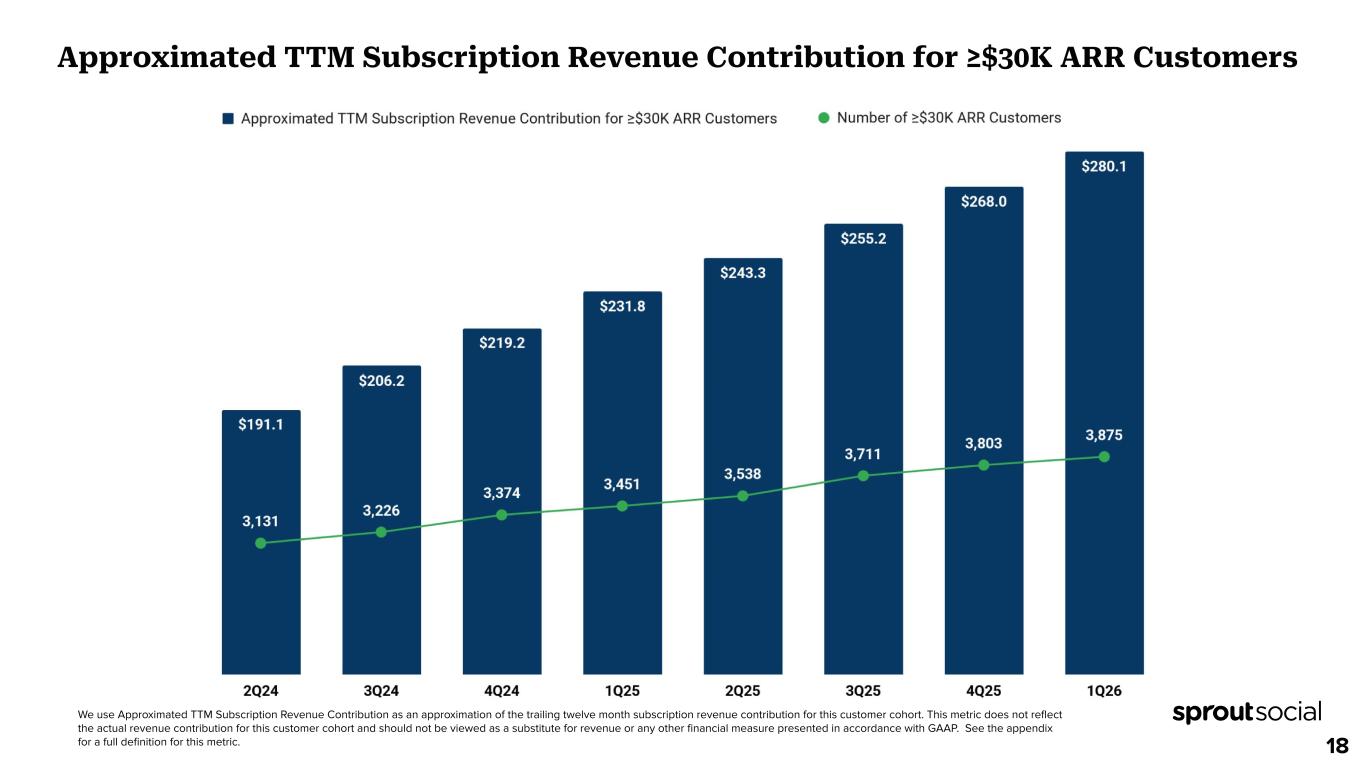
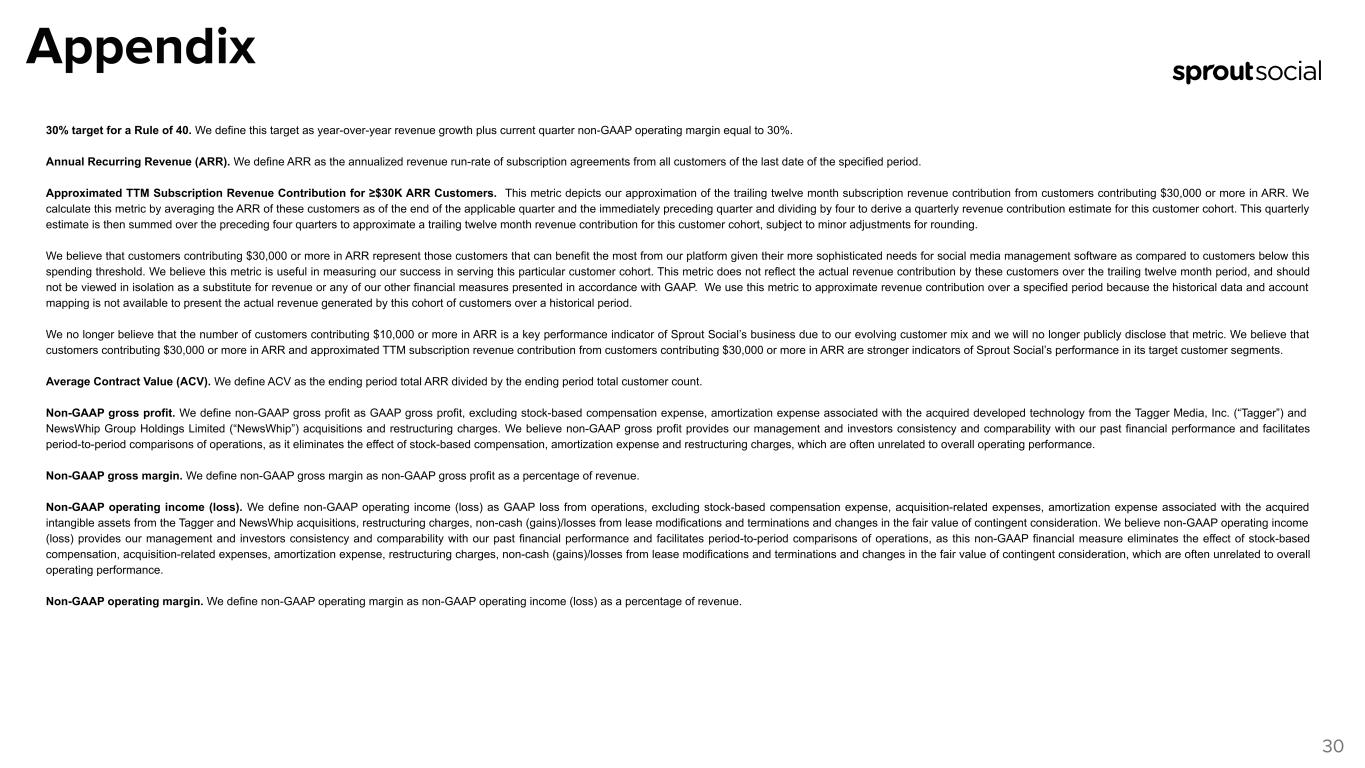
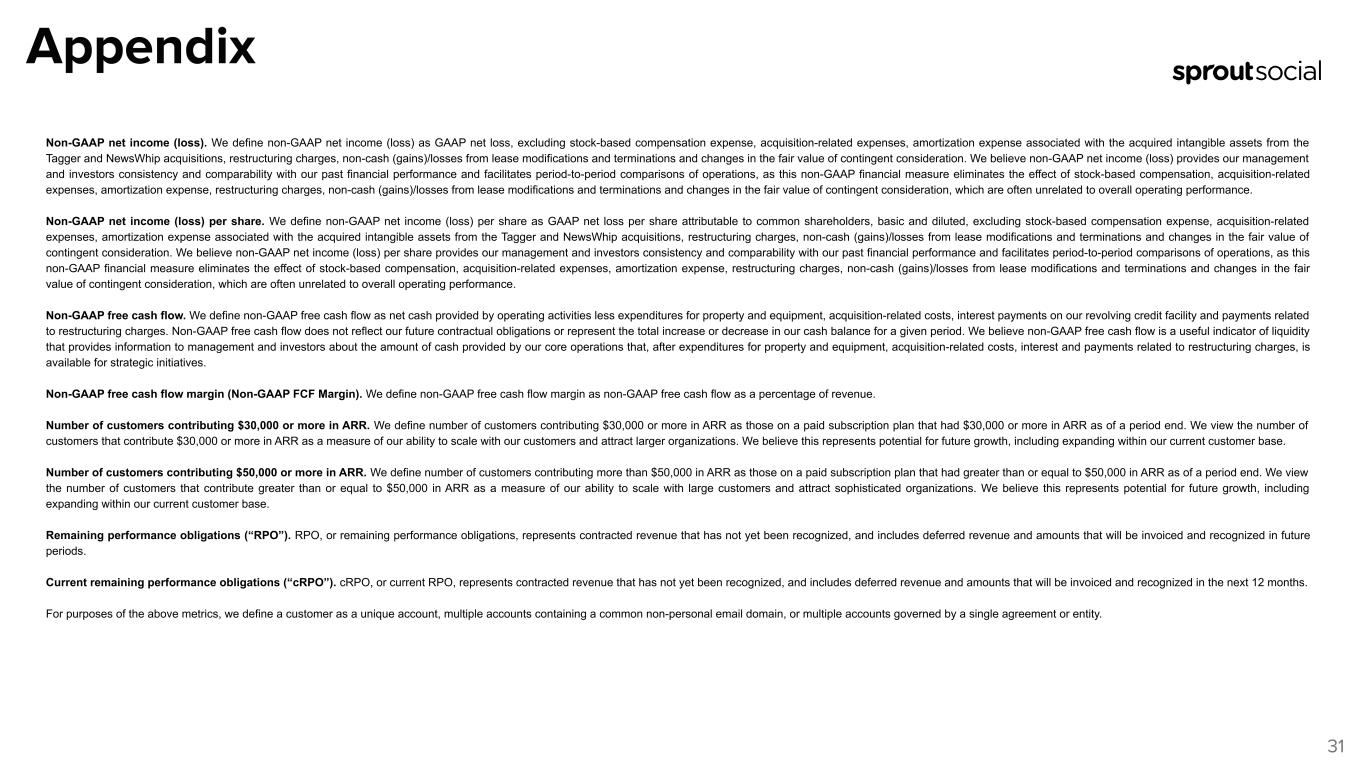
Thank you and welcome to Sprout Social's first quarter 2026 earnings call. We will be discussing the results announced in our press release issued after market close today and have also released an updated investor presentation which can be found on our website. With me are Spratt Social CEO Ryan Barreto and Vice President of Investor Relations and Corporate Development Alex Kurtz. Today's call will contain forward looking statements which are made pursuant to the safe harbor provisions of the Private Securities Litigation Reform Act of 1995. All statements other than statements of historical fact or forward-looking. These include, among others, statements concerning our expected future financial performance, including our Q2 and 2026 outlook, and business plans and objectives, and can be identified by words such as expect, anticipate, intend, plan, believe, seek, opportunity, target, or will. These statements reflect our views as of today only and should not be relied upon as representing our views at any subsequent date, and we do not undertake any duty to update these statements. Forward-looking statements address matters that are subject to risks and uncertainties that could cause actual results to differ materially. For a discussion of the risks and other important factors that could affect our actual results, please refer to our annual report on Form 10-K for the year ended December 31, 2025, as well as our quarterly report on Form 10-Q for the quarter ended March 31, 2026 to be filed with the SEC. During the call, we will discuss non-GAAP financial measures, which are not prepared in accordance with generally accepted accounting principles. Definitions of these non-GAAP financial measures, along with reconciliations to the most directly comparable GAAP financial measures, are included in our first quarter earnings release, which has been furnished to the SEC and is available on our website at investors.sproutsocial.com. Last quarter, we introduced a new metric, approximated subscription revenue contribution for customers contributing $30,000 and above in ARR. This metric is intended to approximate the subscription revenue of a subset of customers over a historical period by using their average ARR as a proxy and chilling this quarterly estimate on a trailing 12-month basis. For brevity, we'll refer to this metric through the rest of this call as 30K and above subscription revenue. With that, let me turn the call over to Ryan. Ryan?
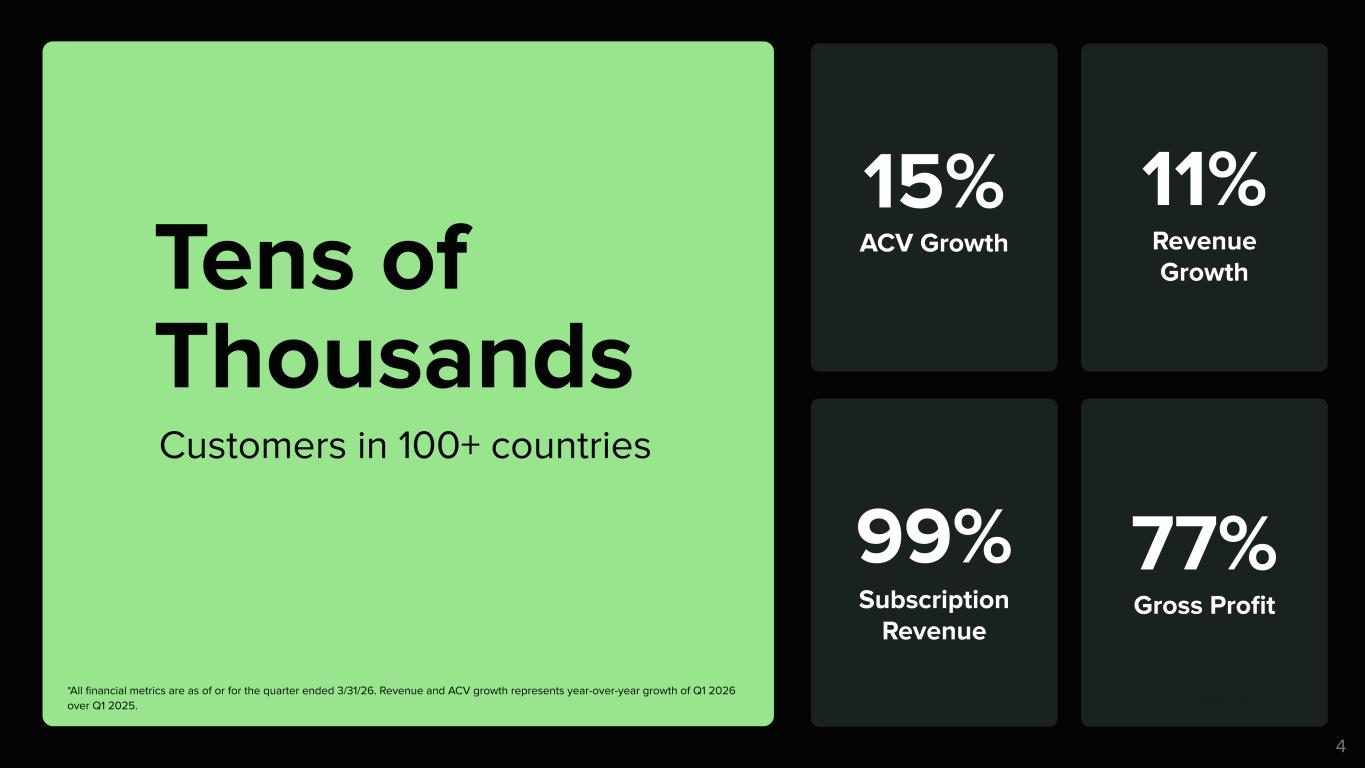
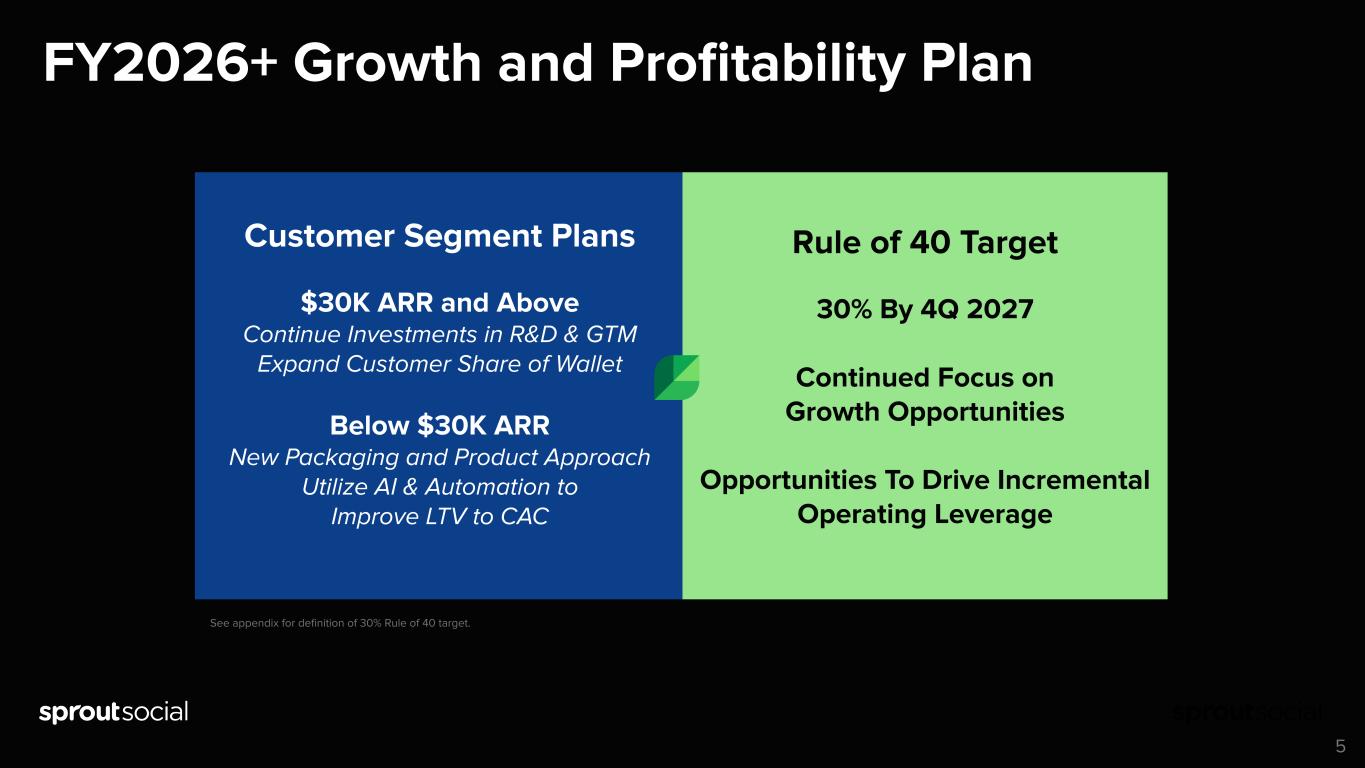
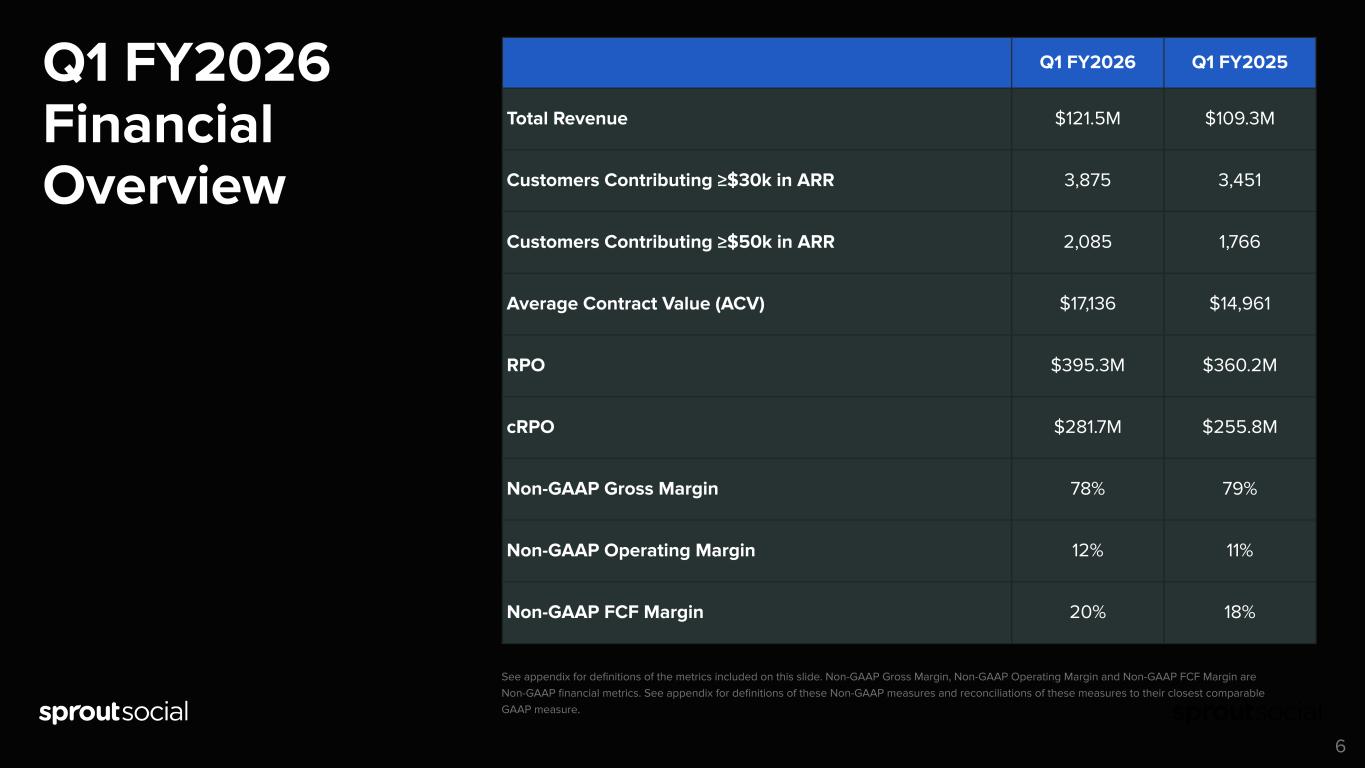
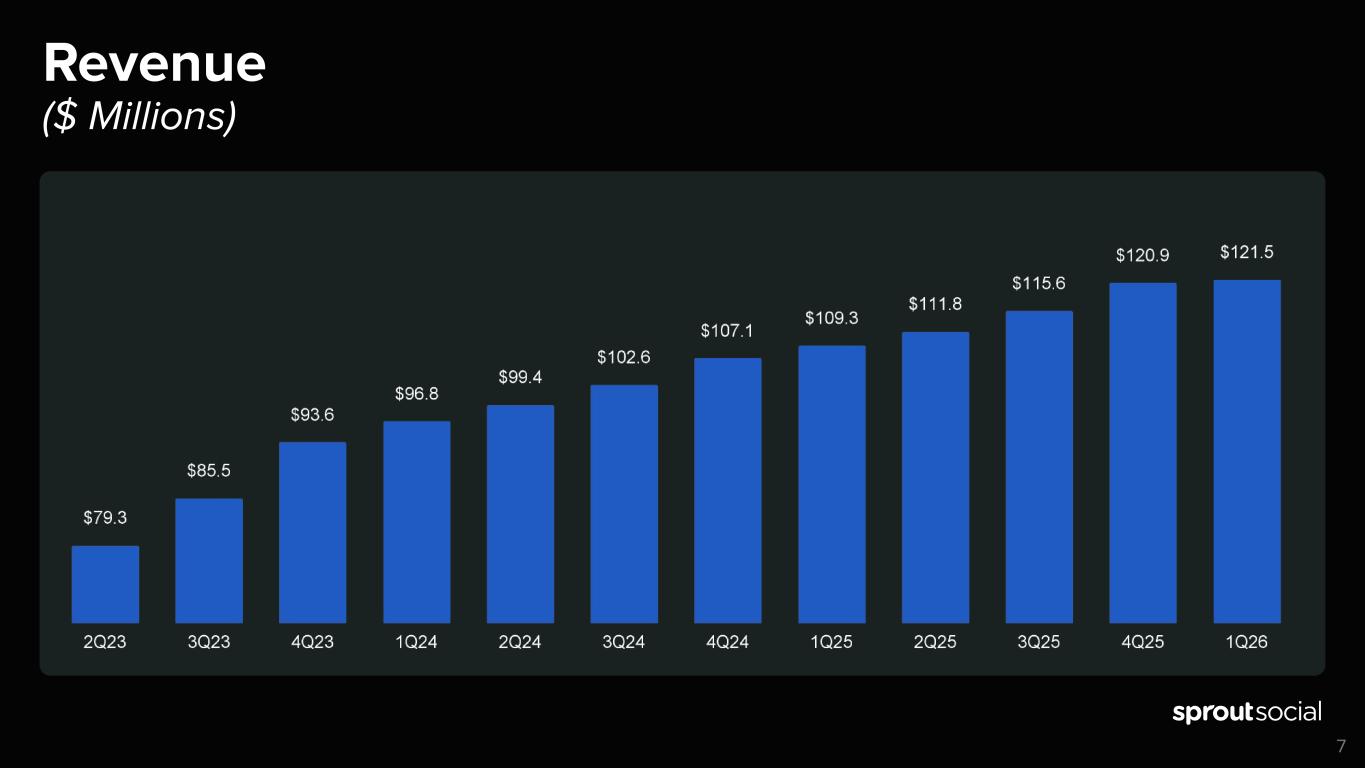
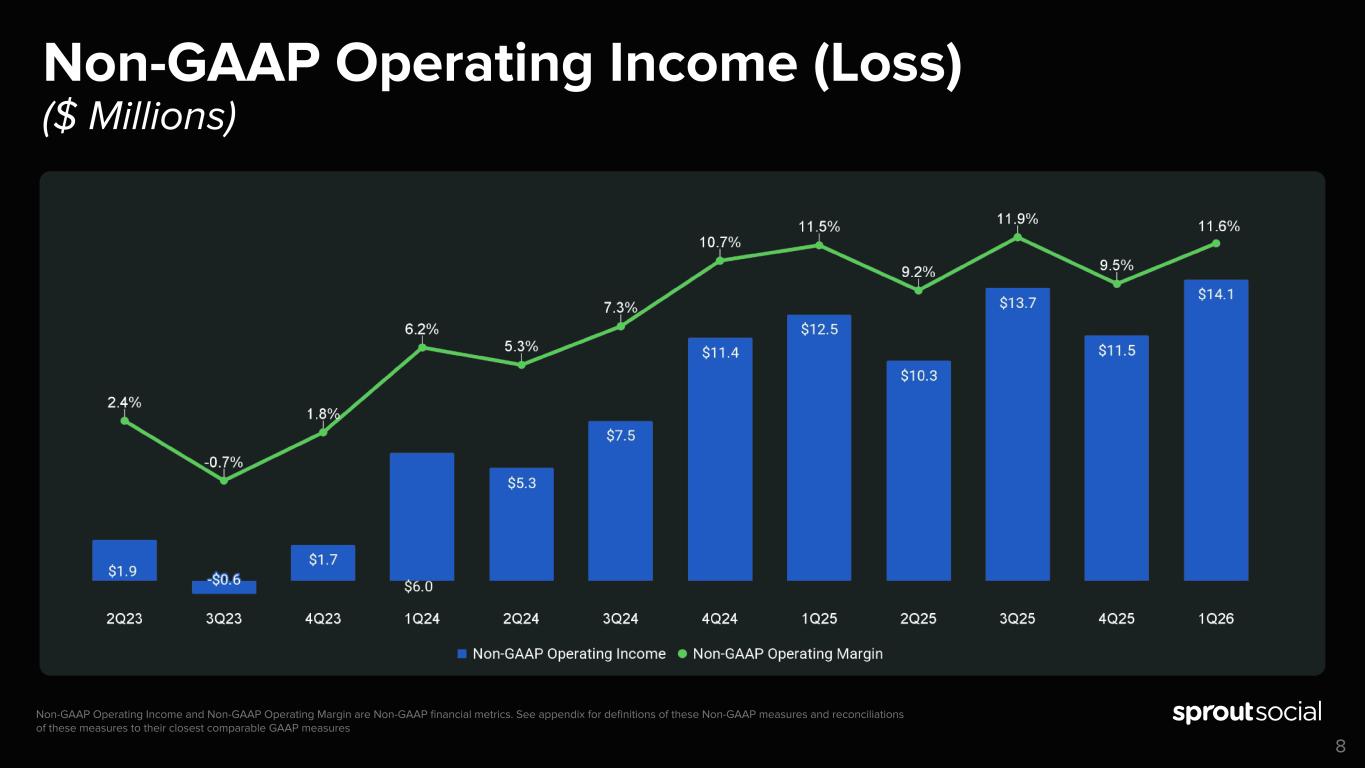
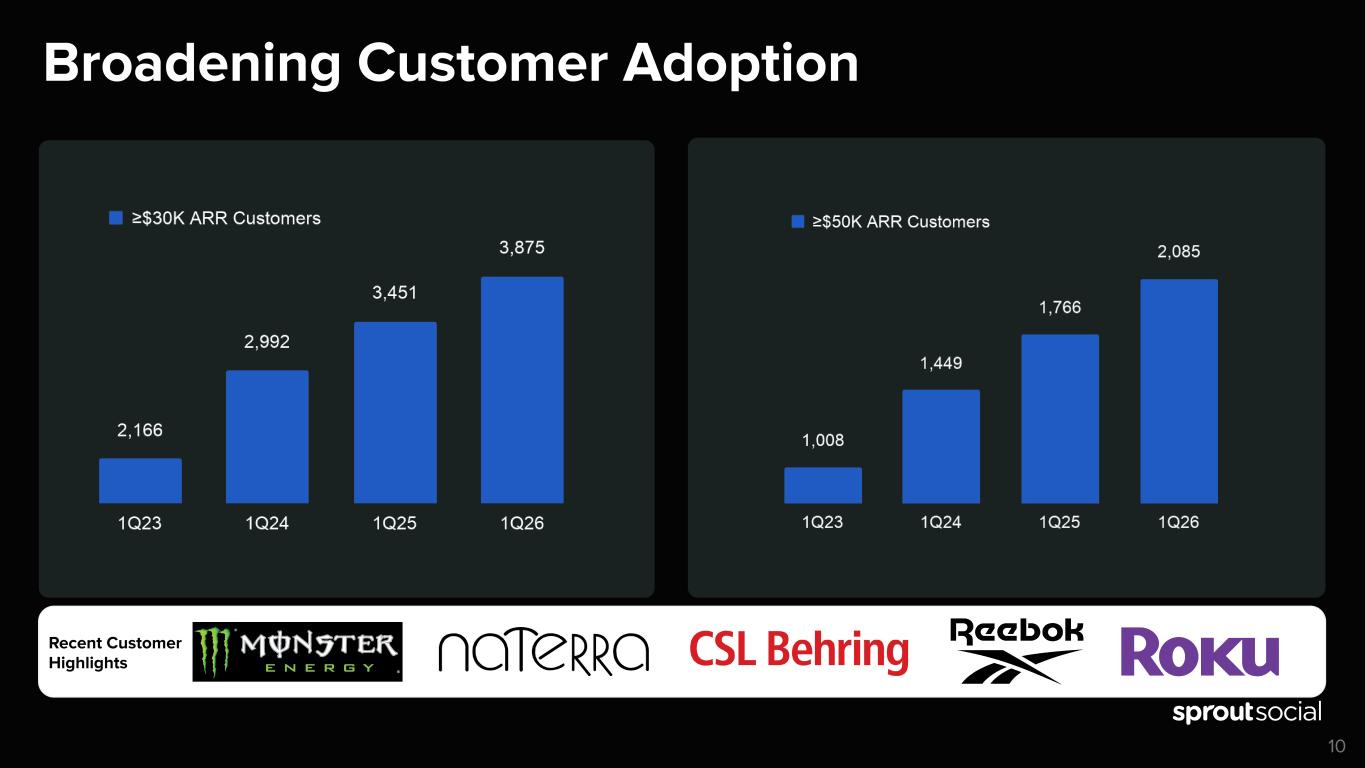
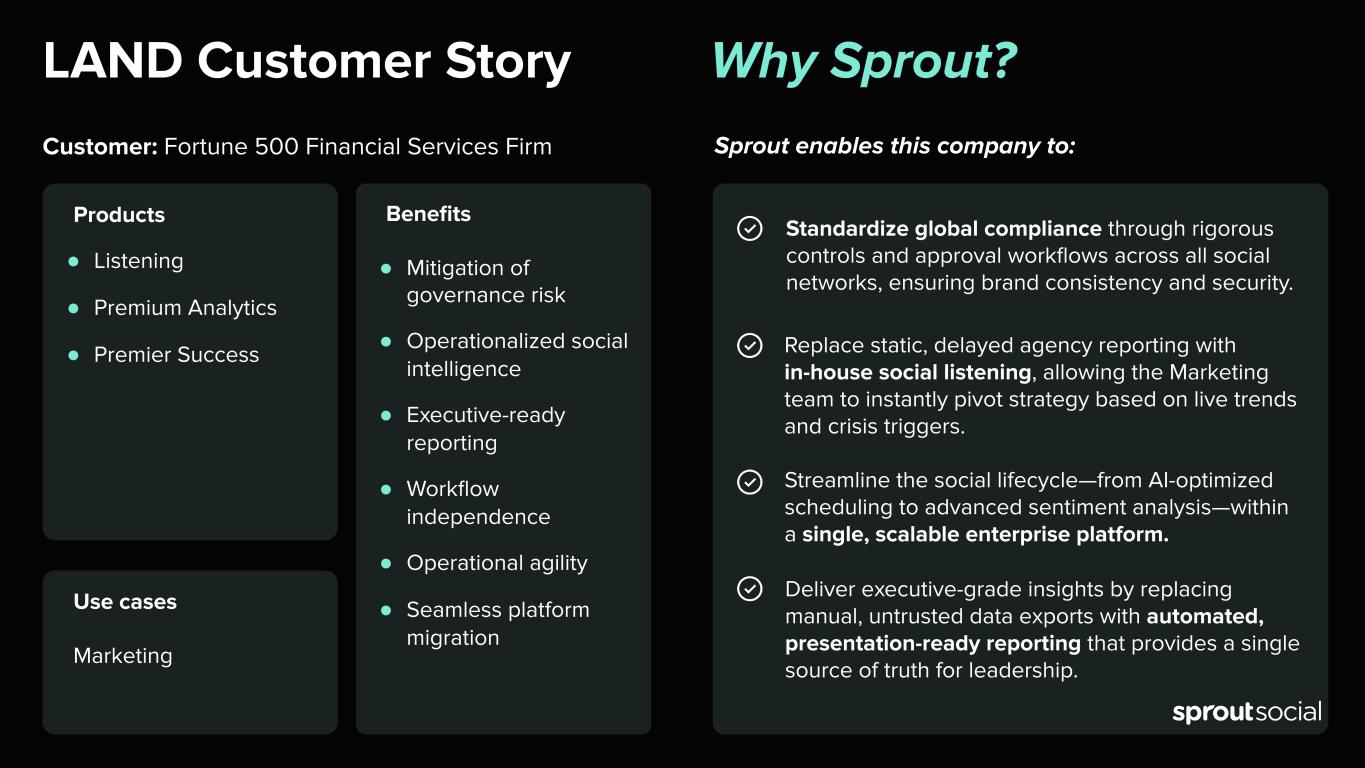
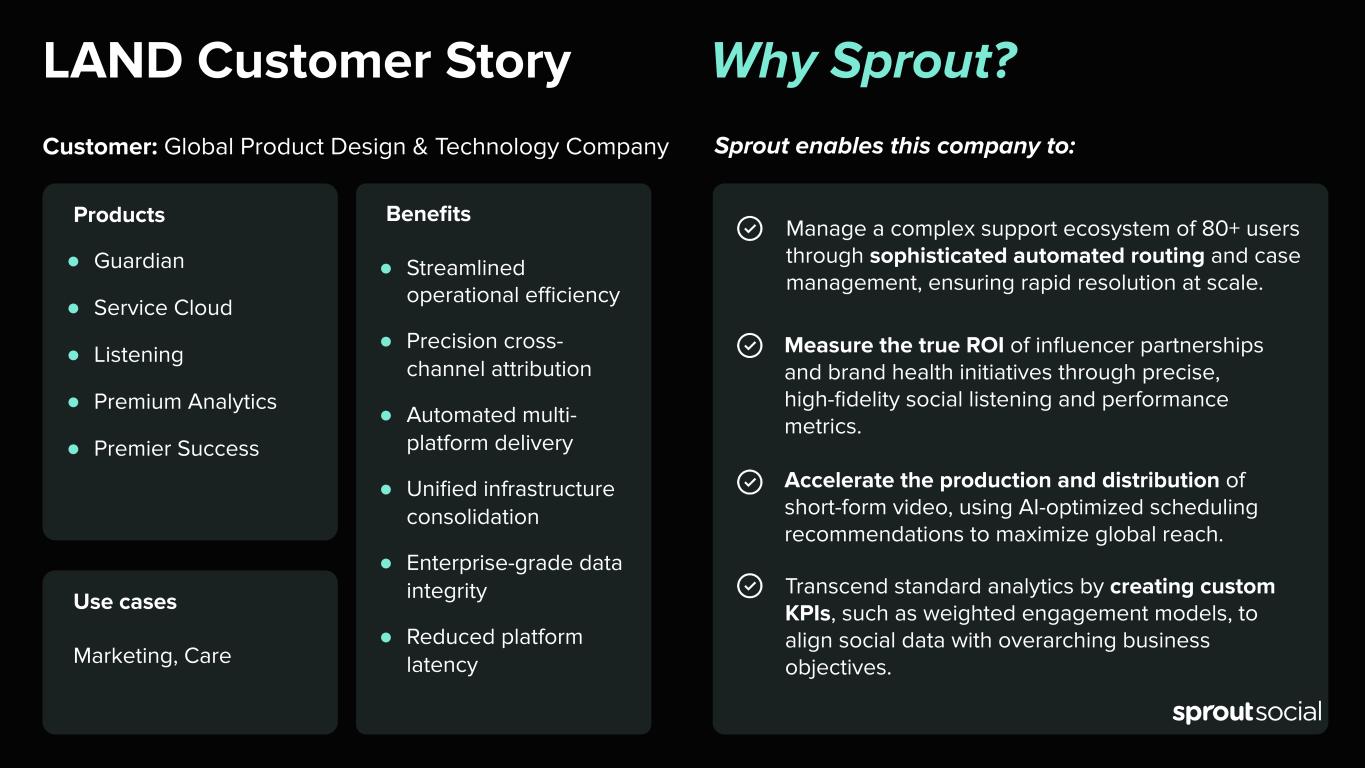
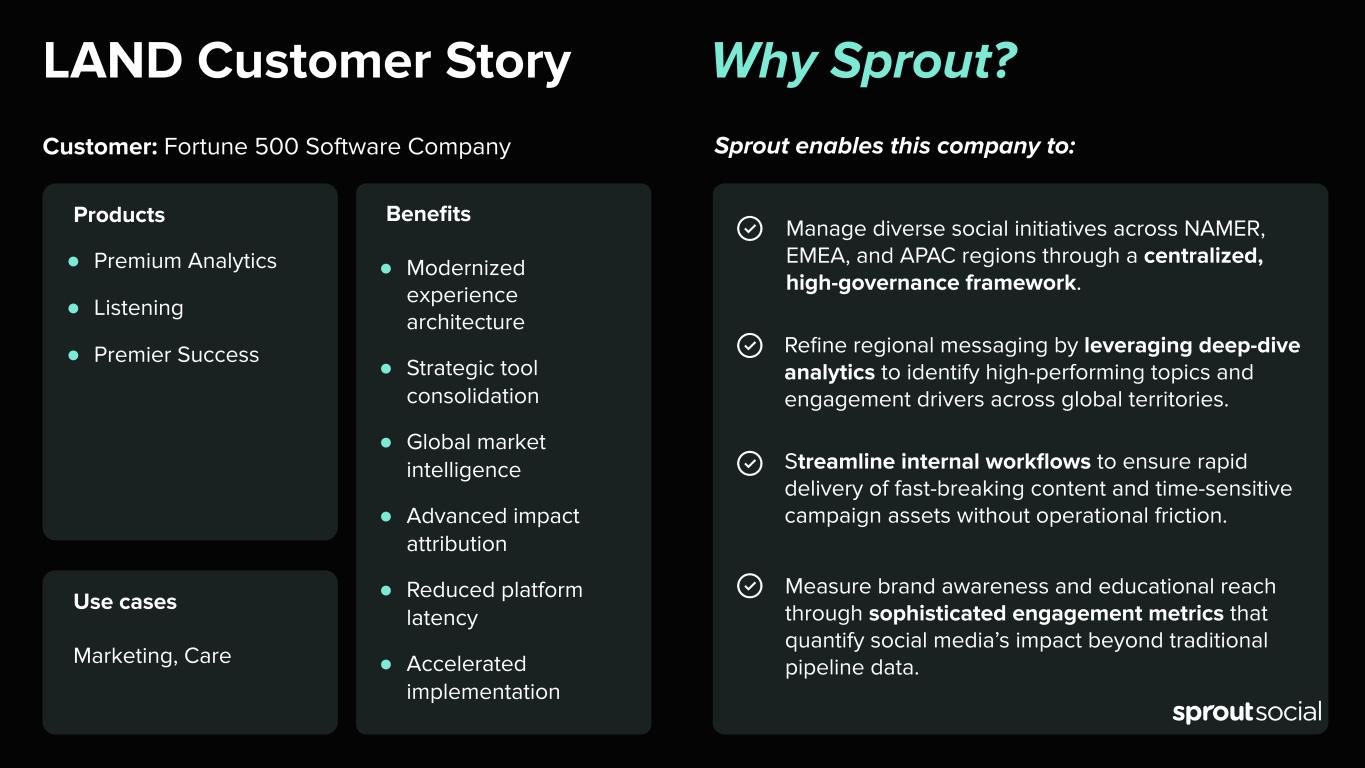
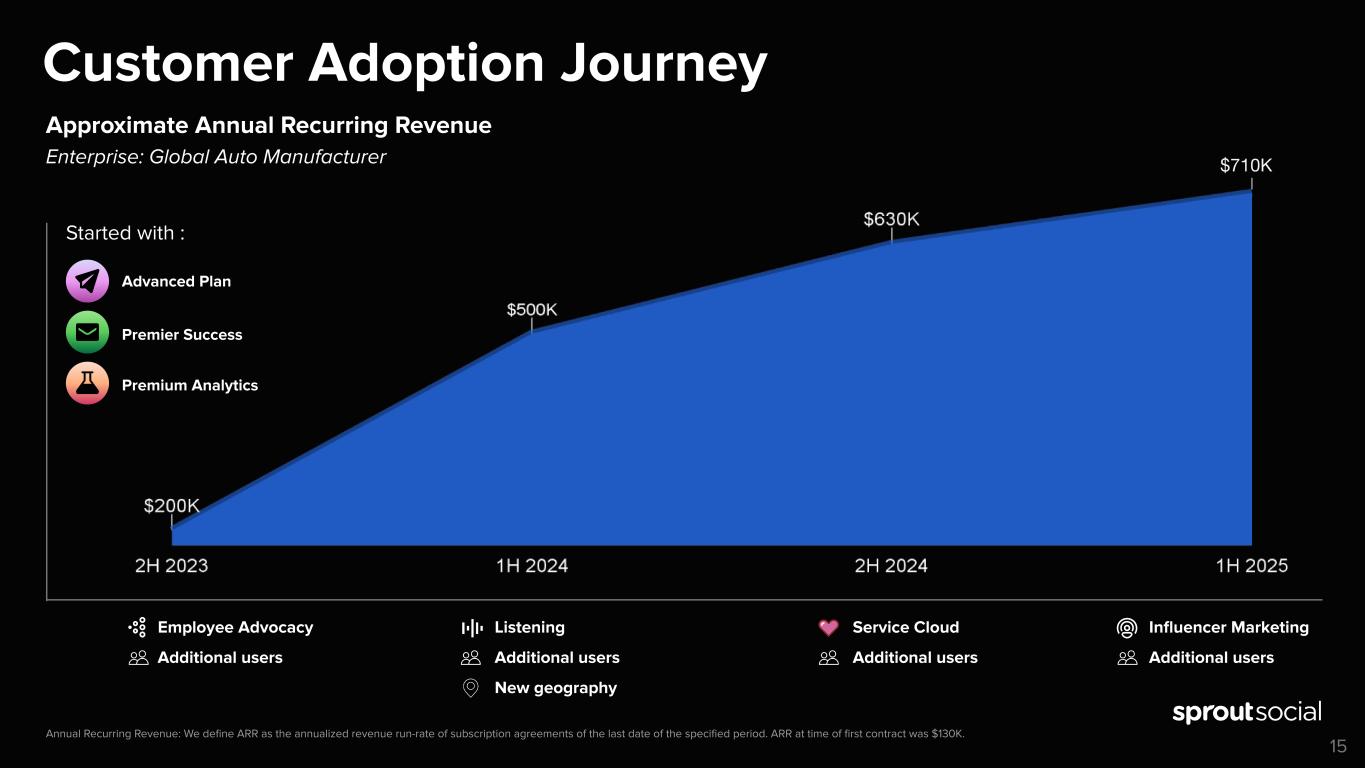
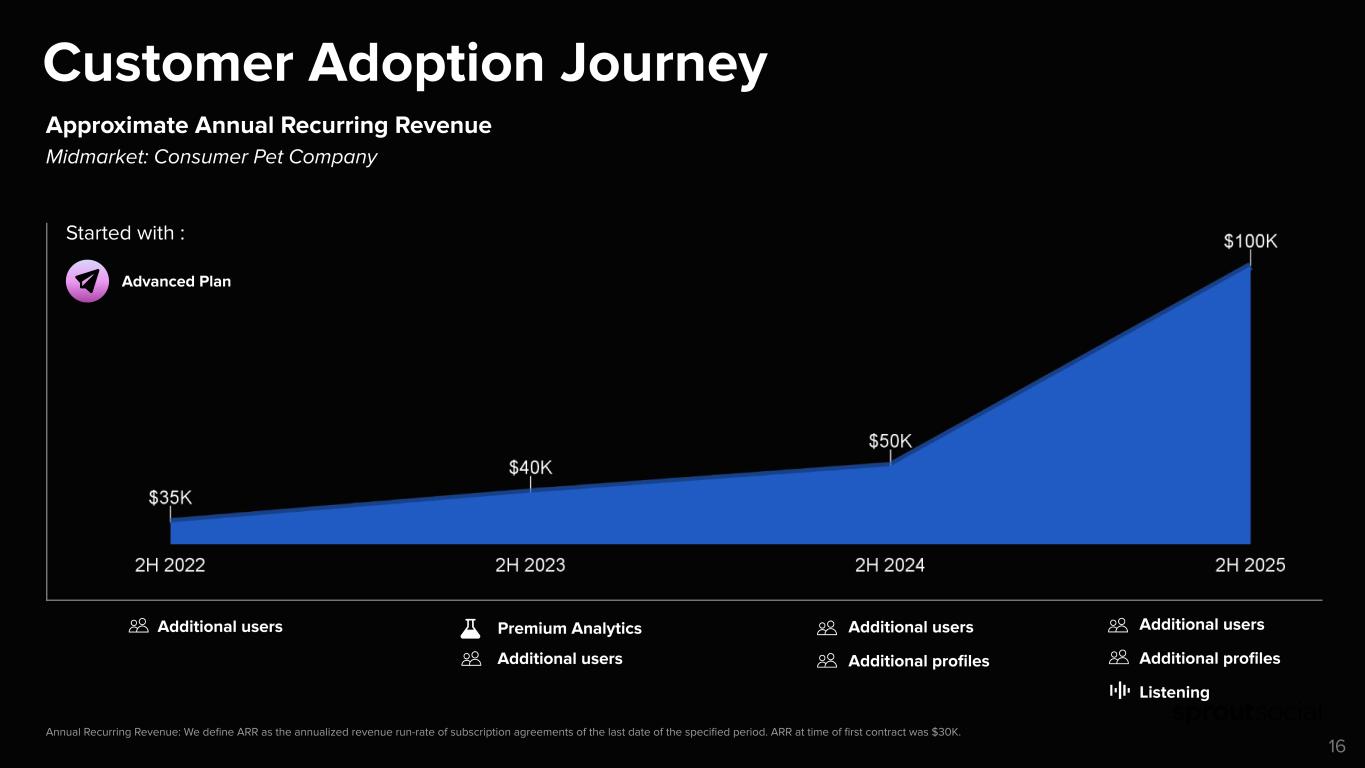
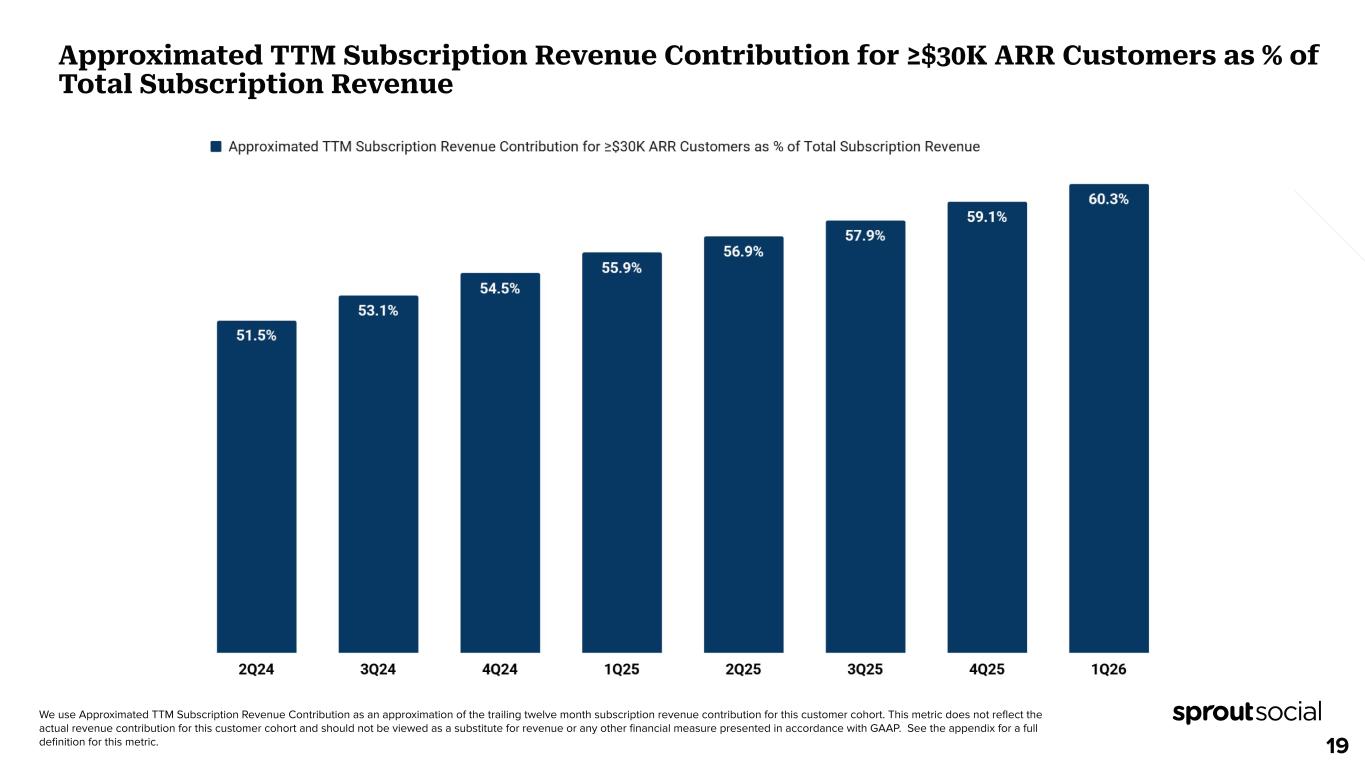
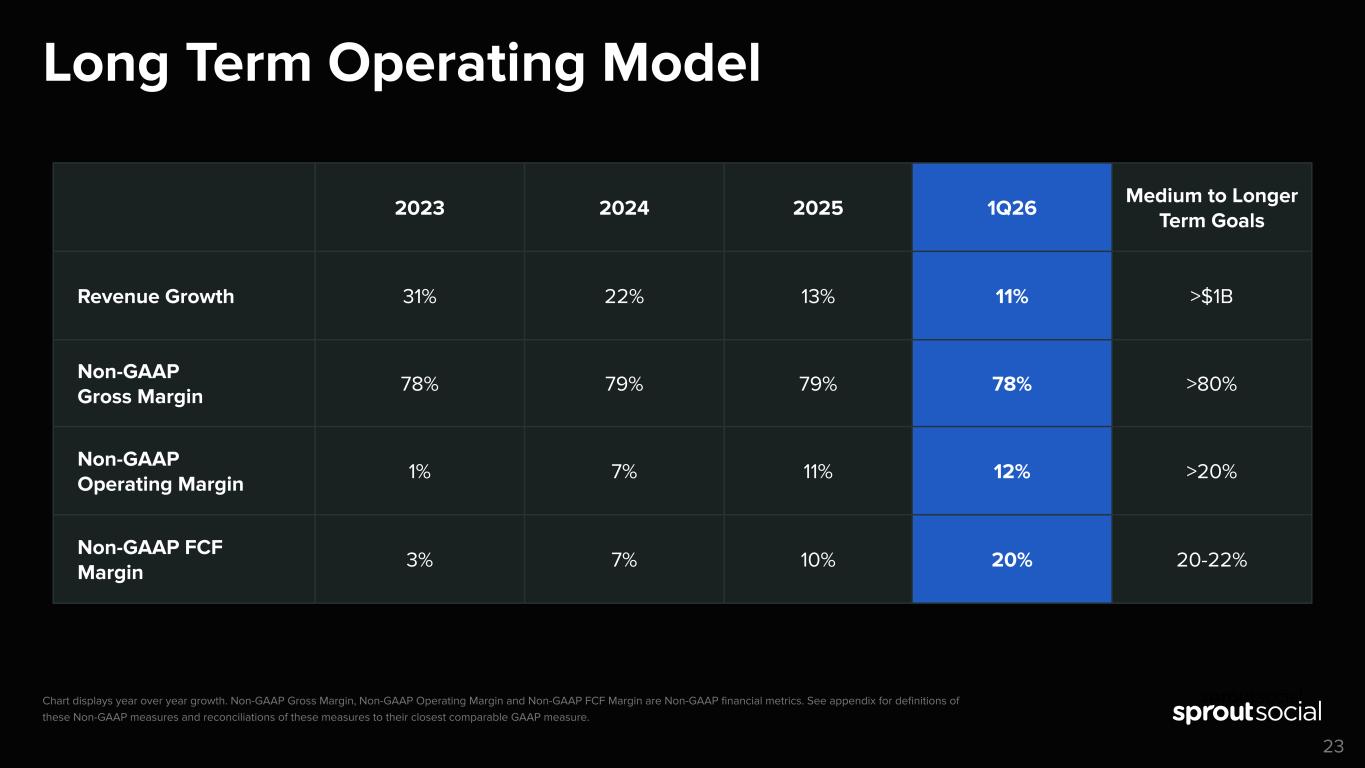
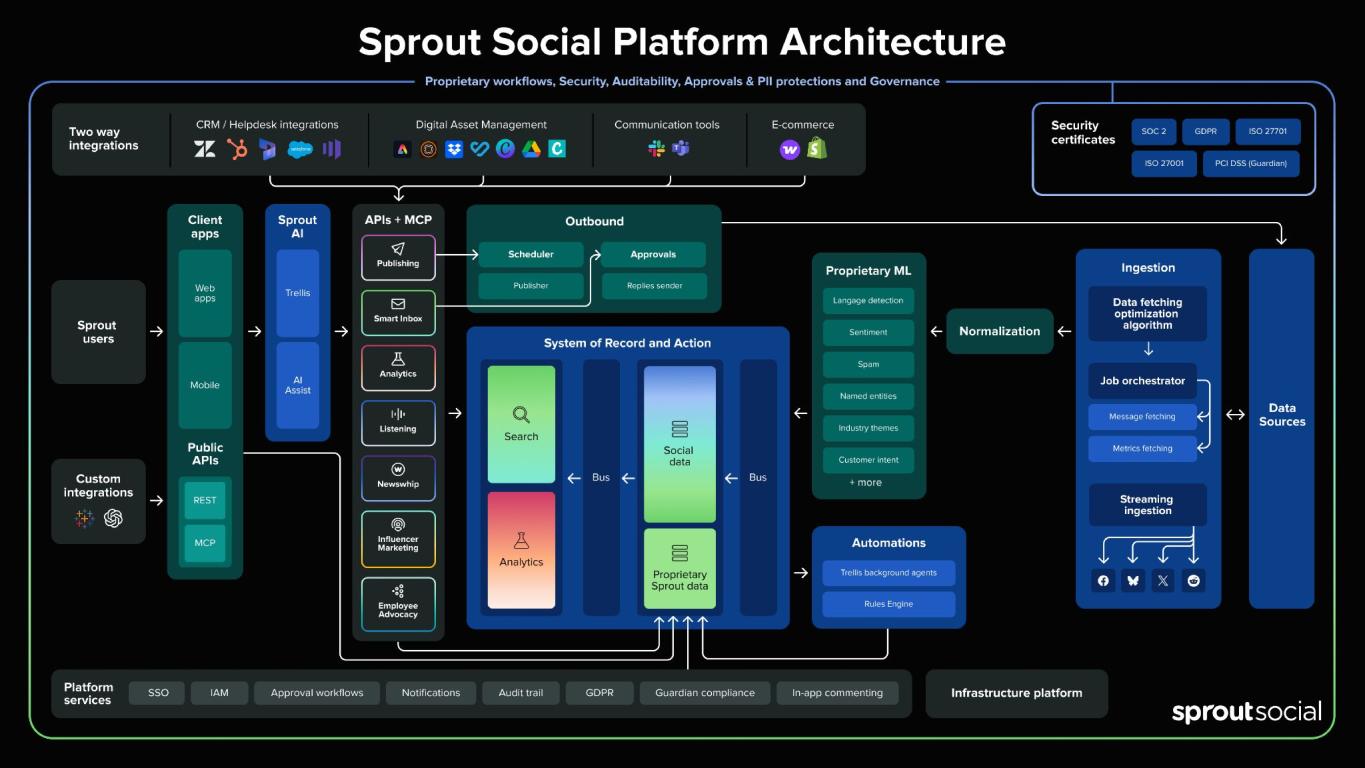
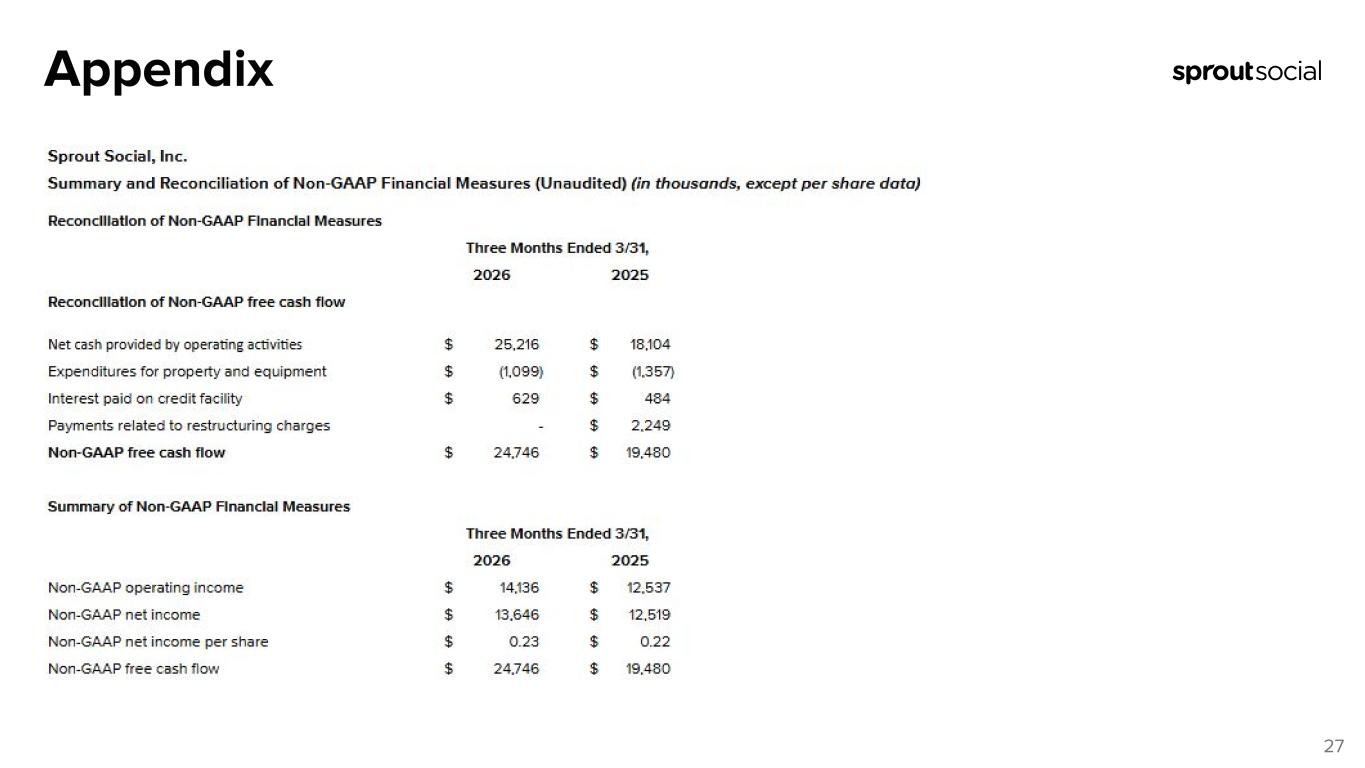
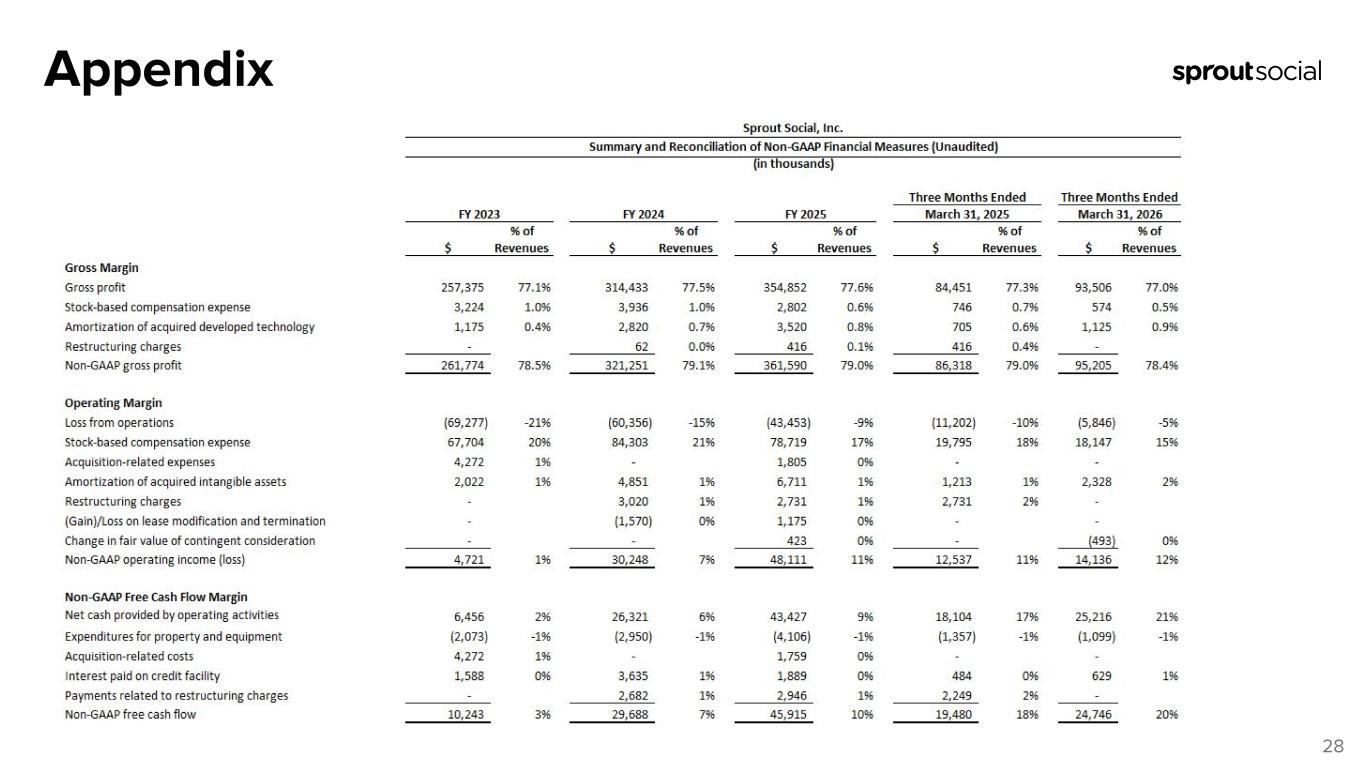
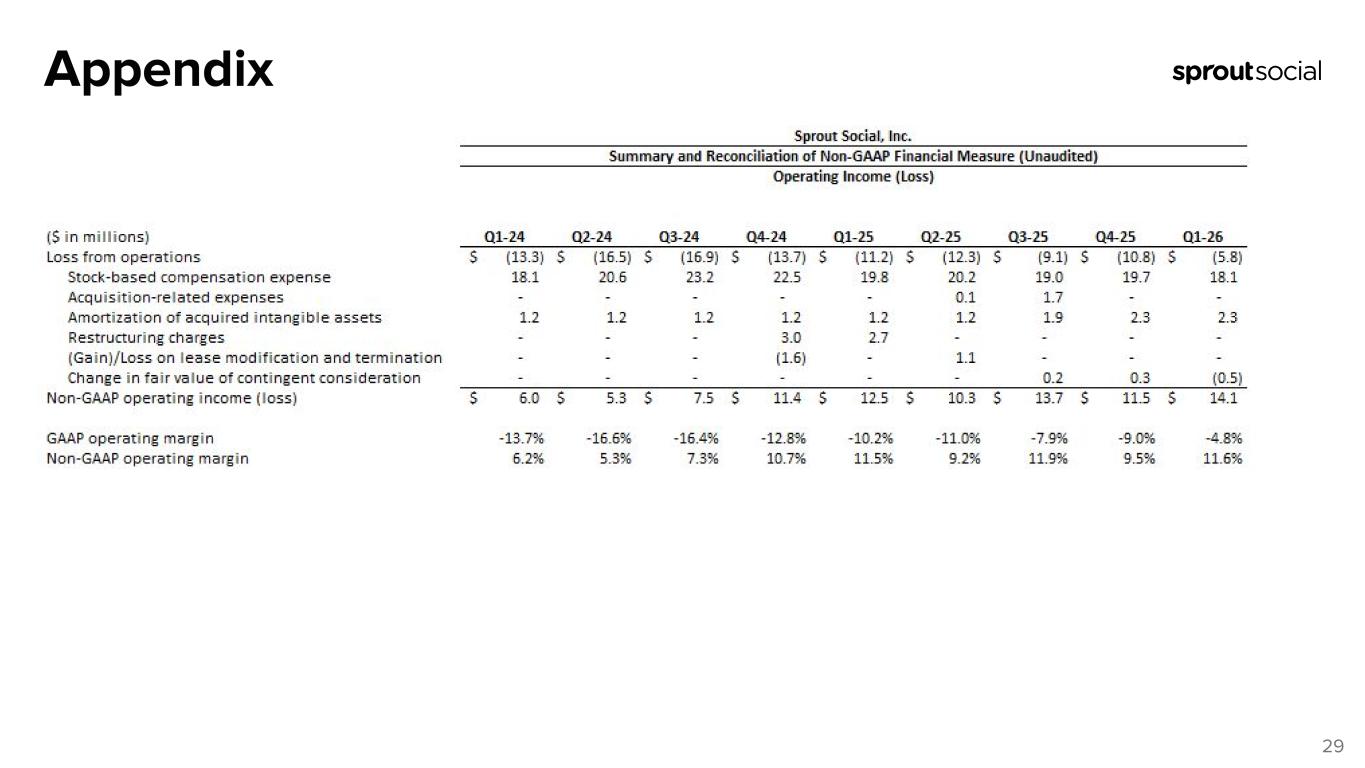
Thank you, Lexi, and welcome to our first quarter earnings call for fiscal 2026. Sprout delivered another strong quarter with revenue of $121.5 million, representing 11.2% year-over-year growth, and we closed out the quarter with non-GAAP operating margin at 11.6%, up 16 basis points year-over-year. Current remaining performance obligations grew 10% year-over-year to $281.7 million, and total remaining performance obligations grew approximately 10%. We are also seeing customers making longer-term commitments to Sprout, with multi-year contracts now representing nearly half of our contract mix, up from about one-third two years ago. This reflects the growing confidence in Sprout as a strategic platform and supports our broader motion with larger, more sophisticated customers. customers. Sprout also delivered strong non-GAAP free cash flow in the first quarter at $24.7 million, an improvement of approximately 27% year over year, and our single largest non-GAAP free cash flow quarter in the company's history. On a trailing 12-month basis, the company has generated over $51 million in non-GAAP free cash flow. This improvement underscores our ongoing ability to drive leverage in our model as we focus on efficient investments. And today, we are pleased to announce that our board has authorized Sprout's first share repurchase program of up to $50 million. This authorization reflects our confidence in the durability of our business, our ability to generate free cash flow, and the long-term opportunity we see ahead. It also reflects our belief that there is a meaningful disconnect between current valuation levels and the long-term value we expect to create. We believe repurchasing shares at these levels is a compelling and disciplined use of capital, particularly because we can do so while continuing to invest in the areas that matter most, organic innovation, our AI strategy, and selective strategic opportunities. We believe this program will give us another lever to create long-term shareholder value, manage dilution, and act on the confidence we have and spread its long-term opportunity. On our last earnings call, we discussed how the rapidly evolving AI landscape is highlighting the critical importance of data architecture for enterprise software platforms. We believe the durability of our business is driven by our ability to solve the complexity of social data at scale, a challenge that has only become more pronounced as brands move from AI experimentation to integrated governed workflows. On March 11th, our CTO, Alan Boyce, and distinguished engineer Kevin Stanton, hosted a technical overview of our data architecture. During the session, they detailed the scale and sophistication of our data operations, and I highly recommend reviewing the recording available on our IR website. This matters because social intelligence is not a one-time task or a fixed queue of work. Conversations, customer expectations, brand risks, competitive dynamics, and market opportunities are always changing. The value of AI in this category is not simply generating an answer, it's helping teams interpret a continuous stream of real-time signals while applying business context and moving from insight to action with the right judgment and governance. That is where we believe Sprout has a clear advantage. We have remained focused on building the proprietary foundation that makes AI useful for the enterprise. In this quarter, our progress centered on putting our AI orchestration framework, Trellis, directly into the hands of our customers. During the first quarter, we moved Trellis out of beta, and it is now live for customers across listening and news web. Early customer feedback on Trellis has been very strong, particularly around the speed and quality of insights. Since reaching general availability, adoption has scaled quickly across thousands of customers. We are especially encouraged by engagement within listening, where half of our listening customers have already discovered Trellis in the product, reinforcing how naturally Trellis fits into our existing customer workflows. Trellis is now the most used AI feature across the Sprout platform. In Newswhip, Trellis is available as an always-on agent purpose-built for communication teams, helping surface emerging stories, brand risks, and market-moving narratives with timely, analyst quality updates. By identifying high-stakes developments and filtering out the noise, Trellis helps teams act faster with messaging that resonates in the moment. These organizations rely on Sprout because Trellis is built on more than 15 years of network-native social data, premium network partnerships, and structured workflows across social channels. We believe that foundation is a meaningful advantage. It helps Trellis turn social signals into timely, context-rich insights inside the workflows where brands operate. We are already seeing this advantage in action with one of the country's largest broadcasting organizations. By integrating Trellis into their daily workflow, they have transformed their content strategy from manual data digging to receiving quick, actionable insights. This efficiency is a game changer for their high-pressure newsrooms, allowing teams to sift through massive volumes of online conversations to identify unique story angles competitors might miss. Trellis has moved the needle from simple reporting to active content gathering, ultimately providing a decisive edge in how the company's news stations and podcasts report on their markets in real time. We also saw Trellis create real impact for a leading hospitality and entertainment company during a fast-moving moment with reputational risk. A pricing concern involving one of their premium offerings started gaining traction across Reddit and other digital channels, prompting executive leadership to ask the social team for immediate context. Instead of relying on a traditional listening workflow of building queries, filtering dashboards, and manually piecing together the story, the team was able to ask Trellis a direct question and identify the source of the conversation, the key themes driving engagement, and the underlying sentiment all within minutes. In a moment where executives need answers quickly, Trellis helped the team move from a fast moving social escalation to a clear read on source, sentiment, and narrative while there is still time to shape the response and mitigate risk. The traction we're seeing in listening in Newswhip is only the first phase. At Breaking Ground on May 13th, we will introduce the largest AI release in Sprout's history, bringing Trellis beyond listening and into workflows across the Sprout ecosystem. We will also share our usage-based pricing and packaging framework designed to support broad adoption while allowing monetization to scale with customer usage and value over time. Investors can register for the live webcast or receive the recording at sproutsocial.com backslash breaking ground. Moving on, during our fourth quarter earnings call, we introduced two important and highly connected strategic initiatives. First, our multi-year plan to drive our two distinct customer segments and how this plan can drive better overall growth at Sprout. And second, how we can improve the overall margin profile of the company over the next two years with a target of reaching 30% against our Rule of 40 framework by the fourth quarter of 2027. So I'd like to now provide an update on how we're executing against our two primary customer segments. As we discussed last quarter, our strategy is increasingly focused on larger, more sophisticated customers, where Sprout's platform breadth, product roadmap, and go-to-market investments are most aligned with customer needs. We are seeing that strategy show up in the mix of the business. This quarter, approximated trailing 12-month subscription revenue for customers contributing $30,000 or more in ARR grew 21% year-over-year and crossed 60% of total subscription revenue for the first time. This $30,000-plus customer segment has stronger unit economics, better retention and expansion profile, and they tend to adopt more of our strategic products than is typical with our smaller customers. On this point, for customers above 30k, we generally see a much higher multi-product attach rate, which is multiples of our corporate average with products like influencer marketing and Newswhip, which carry higher ACV. As we look to the remainder of 2026, we would expect to see this segment represent an increasing percentage of our subscription revenue. Our logo count for customers contributing $30,000 or more in ARR continues to compound as we added 72 net new customers in the segment during the first quarter and 424 over the trailing 12 months. This quarter, we also saw customers contributing $50,000 or more in ARR grow at 18% year-over-year, with that segment's contribution moving closer to 50% of total subscription revenue. Now, let me take you through three customer stories from the quarter that should help illustrate why we see so much opportunity here. This quarter, we closed a seven-figure new business deal with a Fortune 500 multinational financial services leader, underscoring Sprout's role as a mission-critical partner and navigating the complexities of highly regulated industries. By consolidating their fragmented social tech stack onto our unified enterprise platform, they're mitigating governance risk through rigorous, standardized compliance controls. This transition enables them to move away from the latency of traditional agency reporting towards real-time monitoring of global conversations and crisis triggers, allowing for real-time brand pivots with enhanced security and consistency across all social networks. Sprout further drives operational agility by replacing manual spreadsheet-based tracking and untrusted data exports with automated, executive-ready reporting. By streamlining the social lifecycle from sophisticated scheduling to advanced sentiment analysis, Sprout supports their many global users on a single, scalable infrastructure. This story illustrates Sprout's ability to execute on a seamless platform migration from one of the world's largest financial institutions while turning social data into a secure, high-fidelity strategic asset. We also landed a six-figure new business deal with a global product design and technology company. By deploying a comprehensive suite of products, including Guardian, Service Cloud, Listening, and Premium Analytics, this customer has been able to manage a complex support environment of over 80 users with sophisticated automated routing and case management. Beyond operational efficiency, Sprout has enabled them to measure the true ROI of their influencer and brand health initiatives through high-fidelity social listening. They're also leveraging our advanced scheduling tools to accelerate the distribution of short-form video globally and are utilizing custom KPIs such as weighted engagement models to align their social data directly with overarching business objectives. This level of infrastructure consolidation and data integrity underscores our ability to drive enterprise-scale impact and reduce platform latency for our largest partners. This quarter, we also secured a 900k new business deal with a Fortune 500 software company, a story that highlights our ability to modernize the social architecture for global enterprise leaders. By consolidating their strategic tools onto Sprout, this customer is now managing diverse social initiatives across North America, EMEA, and APAC through a centralized high governance framework. This transition has eliminated operational friction, allowing their teams to streamline internal workflows and ensure the rapid delivery of fast-breaking, time-sensitive content across 75 global users. Beyond operational efficiency, they're leveraging Sprout's premium analytics and listening to gain deep-dive global market intelligence. This allows them to refine regional messaging by identifying high-performing engagement drivers and to quantify social's impact beyond traditional pipeline data. By measuring brand awareness and educational reach through our sophisticated engagement metrics, this customer is achieving advanced impact attribution and a level of cross-territory visibility that underscores Sprout's unique value as a scalable enterprise-grade partner. Next, I'd like to turn to our strategy for customers below $30,000 in approximated subscription revenue. This cohort represents 40% of approximated subscription revenue in the trailing 12 months ending March 31st, 2026, compared to 61% in the trailing 12 months ending March 31st, 2022. This 20-point shift reflects our multi-year move towards larger, more strategic customers, while also highlighting the opportunity we have to serve this part of the market with a more efficient product and go-to-market potion. While we continue to believe there is strong potential in the customer segment, it has clearly been a drag to the growth of Sprout over the last few years. It's a business that has its own very distinct dynamics as far as customer acquisition costs, pricing and packaging, and how these customers use our platform relative to larger customers. As you may recall, last quarter we shared our updated strategy for this customer segment. First, the evolution of our self-serve motion powered by automation and AI to move customers through evaluation, onboarding, and support with minimal human touch. We expect these enhancements will lower the cost to acquire and serve these customers and improve conversion and unit economics over time while keeping our direct sales team focused on more socially sophisticated customers. Second, we are reworking the lower end of the market around a simpler product and a more efficient self-serve motion. During the first quarter, we introduced essentials on our pricing page, a focused entry point built around the core publishing workflows smaller customers need most, with faster time to value and a price point aligned to how they buy. While it's still early, the initial response has been encouraging and indicates that essentials can become a more scalable entry point into the Sprout customer base. Over time, we believe this can help us serve the segment with better unit economics while creating a natural expansion path as customers' social needs become more sophisticated. As we look ahead, I'm confident in the foundation we are building. Our 30K and above customer segment continues to become a larger part of the business. Trellis is moving from early adoption to broader platform expansion, and our new sub-30K strategy provides a path to efficiently serving an important part of the market over time. Combined with their free cash flow generation and disciplined capital allocation, we believe Sprout is becoming a more focused, more durable company that is better positioned to create long-term shareholder value. And with that, I'll turn the call over to Alex.
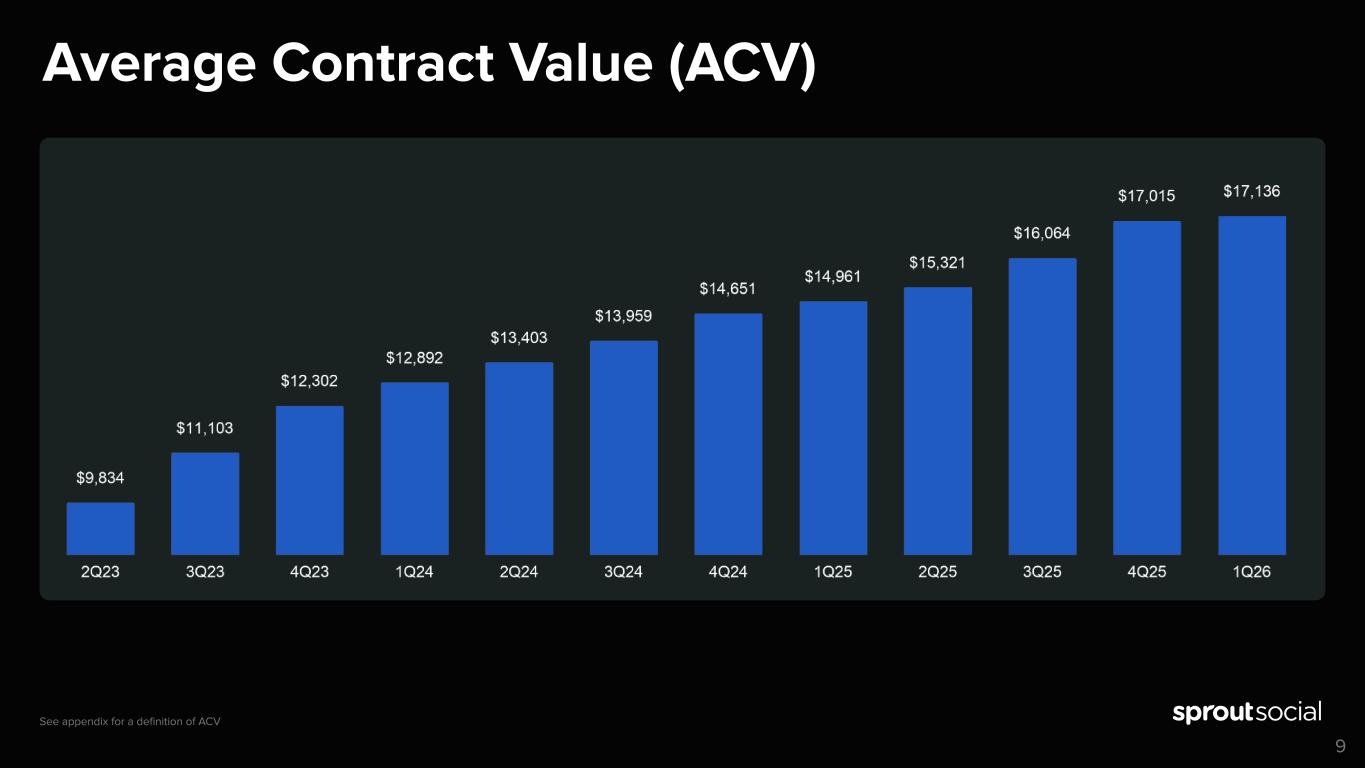
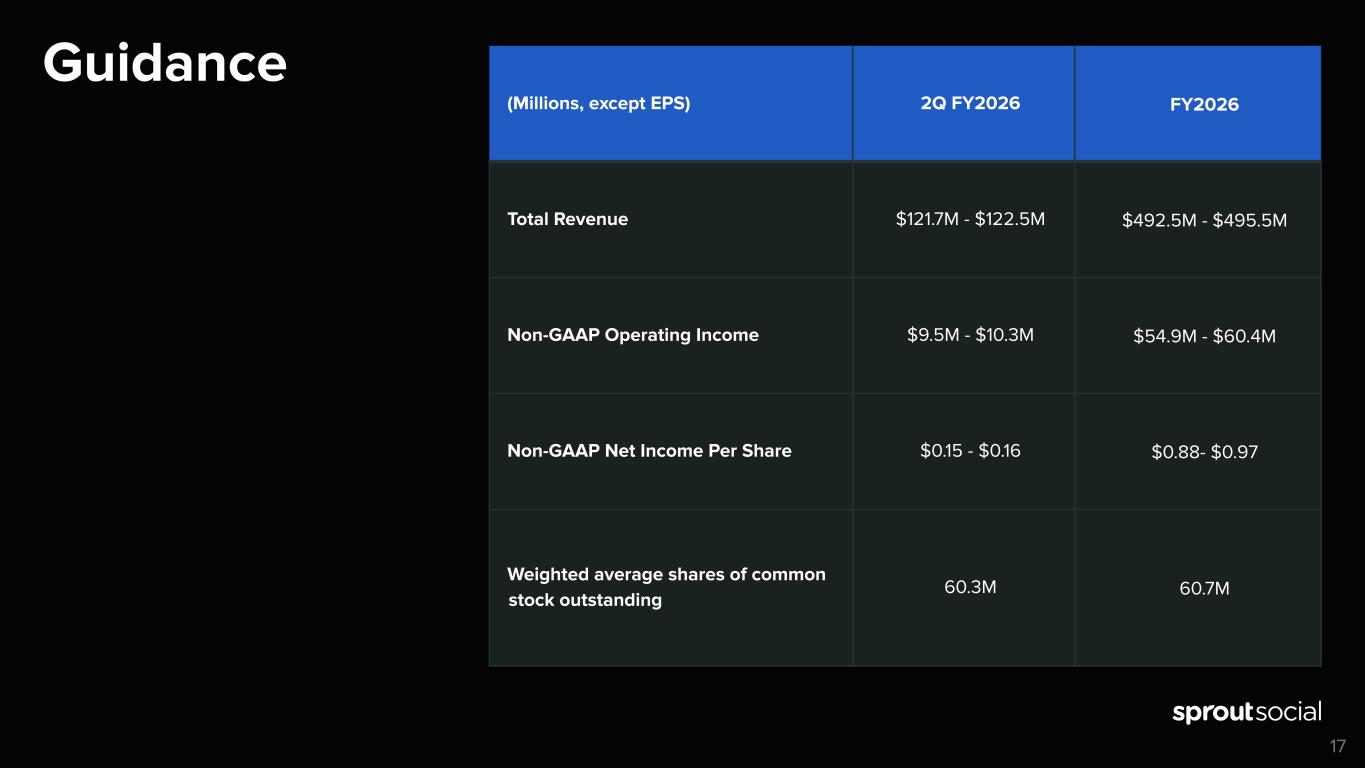
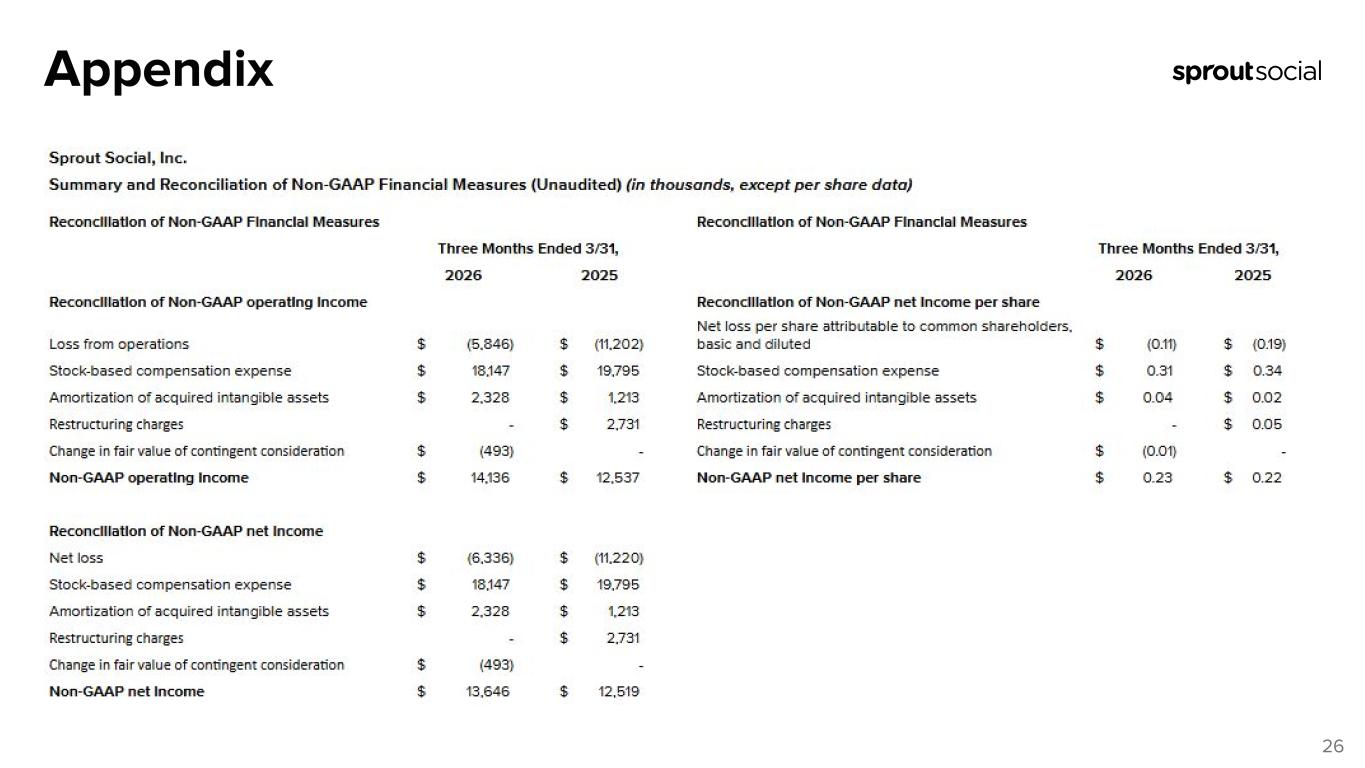
Thanks, Ryan. I'll run through our financial results and then guidance. Our first quarter results were highlighted by a quarterly non-GAAP operating margin of 11.6%, up 16 basis points year-over-year, an ongoing expansion of our $30K and above customer segment. Total revenue was $121.5 million, representing 11.2% year-over-year growth. Subscription revenue was $120 million, up 10.4% year-over-year. We ended the quarter with 3,875 customers contributing $30,000 or more in ARR, and 2,085 customers over 50,000 in ARR, up 12% and 18% respectively on an annual basis. Since the fourth quarter of 2022, we've added over 1,800 customers contributing $30,000 or more in ARR and 1,100 customers contributing 50,000 or more in ARR. Growing these more socially sophisticated customers remains a central part of our long-term strategy. For the past three years, Sprout has focused on a strategy aimed at multi-year contracts with these larger customers, which enhances our visibility to the customer base and opens up more paths for multi-product sales and customer success. This quarter marked a milestone as monthly customers fell below 10% of our contract masks for the first time. And this is the first quarter in which multi-year deals represent a larger percentage of our ARR than one-year deals. Turning to cash flow, we generated $24.7 million in non-GAAP free cash flow during the quarter, an increase of approximately 27% from the prior year. As we've communicated previously, we expect our non-GAAP free cash flow margin to closely track our non-GAAP operating margin on an annual basis, and we remain committed to growing non-GAAP operating leverage on a fiscal year basis. Q1 ACV increased 14.5% year-over-year, reflecting the continued mix shift towards larger, more sophisticated customers and broader adoption of higher-value products across the platform. Expanding ACV remains a core part of our strategy, and we see continued opportunity to grow customer value through products like influencer marketing, customer care, premium analytics, and Newswhip. Our strategy to drive ACV growth remains focused on shifting to a higher enterprise mix and strengthening premium module attach rates, such as influencer marketing, customer care, premium analytics, and now Newswhip. RPO totaled $395.3 million, representing growth of 9.7% year-over-year. We expect to recognize 71.3%, or $281.7 million, of total RPO as revenue over the next 12 months, representing CRPO growth of 10.1% year-over-year. We ended the quarter with $111.6 million in cash and equivalents, up from $100.9 million a year ago. And as Ryan mentioned earlier, today we announced Sprout's first share repurchase authorization of up to $50 million. We believe this program will give us the flexibility to act on the valuation dislocation Ryan discussed while continuing to invest in organic product development and selective strategic opportunities. We view it as a disciplined extension of our capital allocation framework and another tool to return capital, manage solution, and support long-term shareholder value creation. Now on to guidance. For the second quarter of fiscal 2026, we expect revenue in the range of $121.7 to $122.5 million. Non-GAAP operating income in the range of $9.5 to $10.3 million. Non-GAAP net income per share between $0.15 and $0.16. This assumes approximately $60.3 million weighted average basic shares of common stock outstanding. For fiscal year 2026, we expect revenue in the range of $492.5 to $495.5 million, non-GAAP operating income in the range of $54.9 to $60.4 million. For modeling purposes, we expect to exit Q4 with a non-GAAP operating margin close to 15%, and non-GAAP net income per share between $0.88 and $0.97, assuming approximately $60.7 million weighted average basic shares of common stock outstanding. We have not yet made any assumptions regarding share repurchases for purposes of our EPS guidance, as the timing and amount of repurchases is inherently uncertain and subject to a number of restrictions and other requirements. Our full-year outlook reflects continued discipline on spend while preserving flexibility to invest behind trellis, AI-driven product expansion, and a self-serve motion for customers below $30,000. We continue to expect meaningful operating leverage for the year. Finally, we are reaffirming our target of reaching 30% under our Rule of 40 framework by the fourth quarter of fiscal 2027. We expect the path to come from continued growth in our $30K and above customer segment, a more efficient motion for our customers below $30K, and ongoing operating leverage across the business. This is not a margin-only framework for us. Our focus is improving the quality and durability of growth while continuing to expand our non-GAAP profitability. We appreciate your interest in Sprout Social, and with that, Ryan and I are happy to take any of your questions. Operator?
Operator
We will now begin the question and answer session. Please limit yourself to one question and one follow-up. If you would like to ask a question, please press star 1 to raise your hand. To draw your question, press star 1 again. We ask that you pick up your headset when asking a question to allow for a minimum sound or optimum sound quality. If you are locally muted, please remember to unmute your device. Please stand by while we compile the Q&A roster. Your first question comes from the line of Lucas Sarasola from Morgan Stanley. Your line is live.
I'm on for a list of the quarter tonight. Thanks for taking my questions. As you see more customers consolidate their point solutions on to Sprout, what are the clearest signs that this consolidation trend is strengthening, and where is it showing up most in deals today?
Thanks, Lucas. appreciate the question. Yeah, I think I'd probably point to just the progress that we saw in the quarter in our 30K plus. We shared some stories in our prepared remarks, you know, a couple of Fortune 500s, a really large product company. And in all of those examples, you're seeing a lot of consolidation. These are organizations that have pretty sophisticated needs. They need multi-product to solve the problems that they have. And they're identifying that Sprout is a platform that has all the products that they need, be it the publishing, care, listening, advocacy, engagement. It's really across the board. So we've seen a lot of consolidation from that standpoint that's really showing up as a differentiator for us. And then the other piece that's really stood out for us here is just the speed to value. You've heard me talk about this before, but especially in the enterprise and especially in an environment like this, customers are looking for fast ROI. They want to know that they can get up and running really quickly on the software, and they want to know that it's a perfect fit for them. So our trial-based model continues to be a real differentiator for us as we're getting in front of customers, large and small, with this multi-product approach.
Operator
Your next question comes from the line of Nate Ruos from KeyBunk. Your line is live.
Hey, this is Nate Ruos, Alfred Jacksonator. Thanks for taking our question today. So looking at social media platforms you engage with, are there specific social media platforms where you're seeing outsized customer engagement or monetization today? And how is that shaping your product investment priorities going forward?
Thanks, Nate. Appreciate the question. You know, one of the biggest differentiators for us is the depth and breadth of access that we have to the social networks. And so for us, there's a long list of social networks that our customers think about and count on every single day. Certainly, there's names you know out there, the Reddits and TikToks and all the meta properties and LinkedIn and YouTube, and the list goes on and on. But the reality is our customers really have to show up wherever their customers are, and it happens across a diverse set of networks. You know, I think the last time we shared this data, the number was, you know, 90% plus of our customers use five or more networks to get in front of their customers. So for us, it's really about the depth and breadth that we're bringing to bear for our customers. It's allowing our customers to log in in one place and sprout and be able to engage with their customers, whether that's sending out marketing campaigns, responding to customers from a customer care engagement perspective, or really analyzing all of the data and really understanding the performance across all of the networks. So, you know, each customer will have some nuance for them and where more of their customers may exist. but the places in which their customers exist really dictate where they need to spend time and it's our job to make sure that our teams are building against that demand and that we have it built into the product. Now, that is certainly a pretty challenging engineering feat when you think about the number of companies that we integrate in and how quickly these APIs change, but we've got an unbelievable engineering organization behind this and this has really stood out as one of the differentiators for Sprout over 16 years.
Yeah, thank you. That's helpful, caller. And I guess a second question. I know it's still early with the Trellis rollout, but do you guys have any incremental color on Trellis attach rates with contracts so far and what you expect going forward?
Yeah, I appreciate it. Nothing specific to share there on attach rates. We'll definitely be coming back to you in the future and just sharing some of the progress. Just as a reminder, we just went general availability with it at the end of the quarter here in Q1, so pretty early on. But the progress, as I shared my prepared remarks, has been remarkable. Just a ton of kudos to the teams behind the scenes that have been working on this. It's been extraordinary to see the adoption from our customers. We started with Trellis in the listing part of the product. We will be expanding that as we get through the year. But so far, the adoption has been really exciting. We're seeing some really interesting things in terms of usage from our customers and then just speed to value from our customers. We saw that in the beta. We've already seen it in the general availability. And we expect that there's going to be a lot of good adoption here, not just in listening, but certainly as we get across the rest of the platform and expose Trellis to customers that may be in publishing or engagement and not in listening as well. So more to follow there, but really good progress so far.
Nate, I'll just add in the preparer remarks, we mentioned that thousands of customers are engaging with the product now since going general availability.
Great. Thanks so much, guys.
Operator
Your next question comes from the line of Arjun Bhatia from William Blair & Company. Your line is live.
I'm Willow on for Arjun Bhatia. Thanks for taking your question. I appreciate the go-to-market changes in the sub-30K group of customers are recent, but can you get additional details on the updated onboarding experience and pricing system? Are there any learnings from the quarter or tweaks you need to make to better support this group of customers?
Yeah, well, thanks for the question. We're really excited about the progress that we're making. Similar to Trellis, pretty early on in the journey there, we launched Essentials on the website. basically the end of Q1. But we're seeing really good progress there. Again, I think that the biggest thing to call out is this is a purpose-built product, really focusing in on publishing, which is where those customers spend the majority of their time, ensuring that we have the right features and capabilities for those customers at a price point that makes sense. The team's been working pretty hard behind the scenes on all the PLG elements, the self-serve elements of that Essentials product. And the beauty of this as well is those benefits will certainly help us in Essentials, but they help us across all of our products for Sprout. So I think the big takeaways for us so far is we're continuing to see a lot of good progress as we're making incremental changes to the onboarding experience. As people are coming in through the trial, we're seeing good progress in terms of the product market fit, in terms of the publishing use case. And I think we'll have more updates for you in the future once we have a little bit more time with this being available on the website.
Yeah. And I'll just add, Willow, that we mentioned this on the Q4 call and it's worth mentioning again. A lot of these implementations on the pricing and packaging essentials, this is just happening right now.
So we do expect to see a modest deceleration in the sub-30K segment this year and then looking to stabilize going into next sure that's great thanks guys thank you your next question comes from the line of rob oliver from baird your line is live great thanks very much appreciate it i'm on for myself tonight um two questions one for you ryan and then uh alex one for you a follow-up um i mean ryan you've been selling to marketing departments for a long time, and I'm sure that's informing how you guys are thinking about Trellis. And I know we're going to get more next week, but I guess I'd maybe ask the question a different way. What are you seeing in terms of patterns of behavior among users within marketing departments, users of Sprout, that gives you optimism that Trellis may perhaps be an avenue or an opportunity to, you know, get more of those additional products, say influencer marketing, Newswhip, Premium Analytics, into customers' hands natively via kind of an AI-driven platform. Any early reads there would be helpful, recognizing we're going to get, obviously, more on that next week. And then I had a quick follow-up.
Yeah, appreciate it. Good to have you on, Rob. A few things I'd call out. So one, I think one of the biggest things here is just speed to insights. We talk a lot about social intelligence, and Trellis is really landing that for customers. You know, we gave the example and the prepared remarks of the entertainment company that had a reputational issue that was going viral on social. Historically, for most listening solutions, that would have been a very difficult thing for a practitioner or a marketer to be able to figure out. You think about the amount of time to be able to try and go through and create a Boolean query and report to be able to identify this type of issue, to get the data, to then have an analyst go through it and then make some decisions and take action. And we're talking about minutes now in which our customer was able to figure out what the situation was, where it was happening, what the sentiment was, what the source was, and could quickly turn that into updating an executive team and then turning it into action. So there's just a ton of value for customers in the speed to insights and really delivering social intelligence. We're also just seeing for our customers, as you can imagine, as we go past listening into other parts of the platform, the ability to create better performing content or to ensure that you're responding to customer issues that might be gaining traction, those are really big value adds for customers that are really resonating for customers today and feel like pretty unique experiences that exist in the market. So those things are all things that are really standing out for our marketing customers today. And, you know, we're excited to have it in more hands as we get Trellis across listening in the rest of the product set.
Okay, great. Really, really helpful caller. Thank you. And then, Alex, just one from you on the margins, obviously really strong margin in Q1, nice beat. And the full year was raised, but a little bit lighter on Q2. And just if you could just refresh us or help us understand just that the cadence there, is there some seasonality in where that additional margin is going in terms of spend? Thanks, guys.
Appreciate that, Rob. Good to have you on. So we're pleased with Q1 leverage performance and the discipline team showed on the spend side. At the same time, we wouldn't view the Q1 beat as like a dollar-for-dollar change in the full-year cost structure. So a meaningful portion of the upside for Q1 came from expense timing and spend cadence, particularly around hiring and just the pacing of investments early in the year, right? So we're maintaining the flexibility for the balance of the year, not assuming that every Q1 expense benefit repeats. Importantly, this does not change our operating discipline. So we're pleased to raise the operating margin a bit for the year, But, you know, we're still committed to 15% operating margin exiting the year and getting to that 30% number for Q4 2027.
Operator
Your next question comes from the line of Ramo Lenshao from Barclays. Your line is live.
Similar to what people have been asking so far. Could you speak to the conversations you're having with customers and their appetite to purchase, you know, social marketing products? and are you seeing continued tightness around budgets as a result of AI? And if AI is a core criteria during these deals, how is Trellis helping during this motion? Thank you.
I think you're on mute for the first part of your question. Would you mind just repeating yourself?
Yeah, absolutely. No, I was just going to say that my question was more around the buying environment and sort of what you're seeing in front of you. If you could speak to the conversations you're having with the customers about their appetite to purchase social marketing tools amid the bifurcation between AI and non-AI budgets. That would be really helpful.
Yeah, I appreciate the question. You know, I think like everywhere, the demand environment is similar to what we experienced last year. You know, there's customers that are certainly facing budget constraints today, but, you know, you can see it in some of the customer stories that we've had and the performance in Q1. Customers are still buying. They're just expecting really strong return on investment on those purchases, and they're expecting that the speed to value, that the speed to onboarding and adoption happens really And similar to one of the earlier questions that I'd highlight, this really comes down to what kind of impact are you having for customers today in this environment? How can you help them either grow revenue, reduce risk, or contain costs? And so we see our opportunities across all of those things. From a revenue growth perspective, certainly this is a great opportunity for customers to be able to run really great campaigns, whether they're organic or paid, and to know exactly how to leverage their dollars to drive greater pipeline for the organization. We're also seeing that our customers have to be where their customers are. And the reality is today, social is becoming one of the number one channels for customers to go to from a customer service perspective. And when they show up on social, they have a high bar in terms of expectation on you responding and the timeliness of that. So ensuring that our customers are set up to respond as fast as possible to have these conversations with their customers is incredibly important. And then the social intelligence, the data component of this is huge, right? That the signal that exists on social is absolutely massive. It's unfiltered. It's unbiased. It's your customers and the customers you want to get. And we have the ability to parse through all of this data and give real insights to our customers to help them make really transformative decisions in how they're running their business.
So these are all the things that end up being at the forefront as customers are in cycles with us today and as we're helping justify that the value for them as they're investing in in sprout and and convincing their cfos that this is a really smart thing for the growth of their business okay perfect maybe just one follow-up um on trellis it's really nice to hear the early traction you guys are seeing from the going ga um if you think about the long-term opportunity within the platform from monetization perspective is there a possibility i mean it sounds like it might be just be embedded within the platform pricing, but is there an opportunity in the long tail of it to be sort of standalone pricing lover or how are you guys thinking about that?
Yeah, I appreciate the question. And so the answer is yes. And we mentioned on the call, but we'll be going a little bit deeper into the monetization strategy as well, a bunch of the AI advancements that we're making at breaking ground on May 13th. So hopefully you and a bunch of others will join us, but at a high level, the way to think about this is Trellis initially will use a hybrid model that will combine user access with usage-based monetization. And this really reflects how the product works. So customers need access to the AI layer inside of Sprout, and that usage should scale with the amount of value and compute being consumed. So our goal really is simple to start in that we want to drive adoption. We want to make sure that customers are getting in there, that they're having these magical experiences with the product and seeing value. They're building it in the workflows. And then as we're getting it in customers' hands, we expect that it's going to drive usage, and it's going to happen across, you know, listening today in Newswhip, but later, the broader Sprout platform. And as more of those customers adopt Trellis across all of those capabilities, we expect to see that usage and value go up, which we'll be monetizing as well. So we will have a SKU for it that we'll be talking about. we do see it as another area of opportunity for us to be able to grow our ACVs and to grow our overall revenue with our customer base while adding more value.
Operator
Your next question comes from the line of Adam Hotchkiss from Goldman Sachs. Your line is live.
Okay, great. Thanks for taking the questions. I'd love to ask a quick follow-up around the AI products, how do you think about token costs within the context of these AI products as they scale? I sort of think of social platforms, obviously, as having high volumes of data. And I'm curious if there's inherently higher inference loads associated with that compared to more narrow application use cases. So maybe just talk at a high level about how that impacts scalability of use cases or whether there are mitigating factors that we should know about in terms of token usage and inference load. Thanks so much.
Yeah, Adam, I appreciate it. Yeah, I mean, I think probably a few things that I would take away here. One, we feel really good about our ability to manage the costs related to AI and tokens. Two, a lot of credit to our engineering team who spent a lot of time within all of this thinking about the models that we use in the backend and the way that we approach these things and ways to be most cost-efficient in the work that we're doing. Obviously, the use of AI and the use of models varies depending on the use cases that go in. So there's this opportunity for us to be able to swap out things in the back end and make sure that we're optimizing token costs based on what our customers are doing. And then we're doing, as you might imagine, a ton of modeling in the background. We've had the opportunity while Trellis was in beta to understand usage patterns from customers and developing our monetization model. And then obviously making sure that the SKU that we'll be sharing more details on factors in the expected costs, as well as we'll have tiering systems to allow us to make sure that we're monetizing any of the consumption that's going in.
So this ends up being a really good net positive for the company while customers get more value. okay got it great that's that's really helpful color and then i guess second um could you just update us on what the mix of your your channel for for new logo looks like particularly for some of the the 30k plus new ads that you're doing today maybe versus um historical i know we had historically talked about things like social studio conversions and the salesforce relationship and you obviously have the the robust direct sales team but how should we think about that mix today and how you think about that going forward? Thanks.
Yeah, I appreciate it. You know, the majority of our business is direct through our sales teams. We certainly have some great relationships out in the market. Salesforce is a great example. You know, we continue to be in a lot of events with Salesforce and our integrations into things like Service Cloud and Agent Force help us get referred in and help us co-sell many places. We've built some amazing integrations into other places like Canva and Adobe and a number of other organizations, which ends up being a helpful thing for us as we think about the ecosystem value of having integrations. But the majority of our channel is direct for us, and there's a healthy mix in our customer base of inbound versus outbound, and then customers that are moving from other competitors, and then customers that are either using an agency or might be just directly in the native networks. So we see it as many different opportunities for our sales teams to be able to create pipeline and go execute against that opportunity.
I would just add, Adam, as you'd expect, and we went through some of these customer stories in the call today. I mean, when you're getting into deals for customers over $30K, over $50K in ARR, those are majority direct. I mean, agency is still a really critical part of our go-to-market strategy, but it's a little bit more down market at times.
Thank you both. Thank you.
Operator
Your next question comes from the line of Scott Berg from Needham & Company. Your line is live.
Luke's from the Capon for Scott Berg. Thanks for taking the questions. Maybe just a question for you, Alex. It's been a few years since the company moved from ARR to CRPO for measuring bookings on a quarterly basis. But it really hasn't been kind of a perfect proxy to date. And I guess with CRPO kind of growing that 10% year over year versus where the 1Q revenue growth rate shook out, So I guess, would you say, are we at the point that CRPO gives the right view kind of on the current business momentum?
So is the question about RPO performance in the quarter or just how to better understand the business?
Yeah, just kind of how to better understand kind of if CRPO is the right metric to be watching.
Yeah, so I can talk a little bit about RPO, then we can talk a little bit about the segmentation we provided last quarter. So, you know, RPO and CRPO reflect, you know, the demand environment we're operating in today and reflective really of the performance from 2025, right? So both metrics grew approximately 10% year over year, which is now much more aligned with revenue growth. So from a revenue visibility standpoint, we feel the guide appropriately reflects what we're seeing in the business today. You know, that said, we're not satisfied with the bookings performance underneath those metrics. The pressure is not broad-based, you know, customer value or renewals, right? So the renewal base remains durable, and customers continue to make longer commitments to Sprout, which we talked about with our multi-year contract mix, which is now half of our overall contract mix. The opportunity is moving the pace of new business and expansion in the current environment, and really that's what Ryan and the team are focused on. The part of the business that's most aligned to our strategy continues to perform better, right? So $30K and above, that grew 21% year over year and crossed that 60% threshold for total subscription revenue. And then customers above $50K grew nicely in the quarter as well. So I think that's where I would leave the RPO discussion. I think when we contemplated the data disclosure on the Q4 call, we really wanted to help investors and analysts understand how to better model the business. And that's why we gave you the $30K and above and below, because we really think that's what is ultimately the strategy of the company that we're driving at right now for both segments. And, you know, we understand that we had to come back with something when we took ARR away a couple of years ago.
Thanks, Alex. That's helpful, caller.
Operator
Your next question comes from the line of David Hines from Canaccord Genuity. Your line is live. Hey, guys.
Operator
Thanks for taking our questions.
Speaker 7
So, AI has obviously led to this great re-evaluation of existing tools across the tech stack. So a bit of a two-parter, but do you typically find that social has its own dedicated budget for AI experimentation or is it included within marketing? And then if it is within marketing, where would you say it stacks up against other conceding priorities?
Yeah, I appreciate the question, Ryan. You know, I think from a budget perspective, I don't know that our customers today are thinking about it as one in the same. I do think we have a huge opportunity here to help them with it. You know, most customers we're talking to are trying to figure out how to better leverage AI to move their business forward. I think there's a huge opportunity that we see as we're getting in front of customers to help them see the art of the possible, to help them see specifically in the marketing department where there's massive opportunity for them. You know, the examples that we gave on the call today with Trellis and with AI are some really good examples of where value is coming. speed to insights for customers, enabling you to create better content that's going to perform, helping you differentiate against your competitors, identifying potentially challenging reputational issues. So these are some of the things that we get to take these AI needs and put some real products and solutions behind them, which I think is really, really helpful for our customers. And then, you know, in terms of how they think about the, you know, the stack rank and the prioritization, what we hear from our customers today is, you know, budgets are tight, but we've got to figure out a way to grow, and we've got to figure out a way to make sure that we're reducing risk and consolidating cost. And so, similar to an earlier question that I provided some feedback on, we see opportunities to help customers and all those things. You know, from a growth perspective, we can help you create amazing content, whether it's organic or paid to make sure that you're driving the right amount of awareness or pipeline from a social campaign perspective. We know that our customers more and more are getting pulled into social to be able to engage with customers from a community management or social care perspective. And then we know that that data that exists on social can really help them thinking about the investment strategy that they need. So it tends to be one of those things because of the way that social shows up on where our customers' customers are, that it becomes pretty important. But I think that in this budget environment, making sure that you're really tying the ROI back for customers, and ideally, in many cases, consolidating some of their other solutions or spend is really how you help.
Speaker 7
Okay, makes sense. And then maybe more of a higher level one. So we saw Meta acquired Notebook a couple months ago. So I was just wondering, as agents get more sophisticated and conversational, do you think there's a legitimate risk that these large social networks will develop their own conversational agents for brand users to directly engage with their customers?
Yeah, I mean, one of the reasons that we exist is that we really, you know, kind of going back to an earlier question that we had today just about the networks that our customers use and the proliferation of those and which ones are most important. We see this every single day. And so kind of going back to that stat, 90% of our customers use five or more social networks. The reality is, is that's just continuing to grow, you know, certainly across all the meta properties, but then all of the social networks and our customers need to show up across all of them. They can't just work within one social network and hope that they're addressing all the things that they need to do from a marketing perspective, a sales perspective, a customer support perspective. And so, you know, historically through time, you know, we'll see some of the social networks create some sorts of productivity assets for their own internal network. But what we hear from our customers is that's not going to be – it's not going to be the full solution. It's not going to allow them to change their workflows because they need to think holistically about their social strategy. And that's where we come into play. Our customers log in to Sprout Social every single day. our practitioners are spending hours a day in our platform and this is how they're accessing all the social networks this is how they're sending out their marketing campaigns and engaging with customers so I expect that in scenarios like that that might play for a customer that's maybe more in the SMB space that might only be on one network for but from a business tool perspective and for that the customers were really focused they need to be thinking across all of their networks and they need a platform like sprout to able to show up in the right places got it thanks guys appreciate it thanks for the question your next question comes from the line of jack mcshane from stifle your line is now live
yeah hey everyone this is jack on for parker thanks for taking the questions today uh ryan for you kind of a two-parter but can you speak on how your current ai feature set and roadmap has resonated in the market to the extent that it's had any material impact on the top of funnel. And, you know, similar to that, you know, within your existing base, have the launches of launch and marketing of Trellis impacted upsell conversations around the core underlying premium products like listening and Newswhip?
Yeah, I appreciate the question, Jack. So in terms of the AI features and resonating, I'd say, again, we're pretty early on here. The progress is being strong from the standpoint that we were in beta for the end of the last year going into this year. We went general availability at the end of the first quarter here. So pretty early on, too early to really call out any specific numbers. But I will say that it is differentiating us in conversations with customers. We're getting a lot of great feedback from new business customers and prospects. And then on the side of things, you know, clearly we've had a lot of good adoption in a short period of time and listening with the thousands of users that have got access to it. Certainly it is a huge opportunity for us, one from a driving adoption and value perspective and listening in Newswhip for the customers that have it. And then certainly from an upsell opportunity, as you can imagine, these products deliver these magical experiences. And if you've used something like listening, there's not many products that look like Newswip, but if you've tried to understand what's happening from a PR perspective, and then you look at what Trellis offers to our customers today, it's really a magical experience. It's enabling customers to get insights in a way that wasn't available before, wasn't possible before. And so we certainly see this as something that's going to help us over time from a new business perspective, from an expansion perspective, and then certainly from an adoption, usage, retention, and renewal perspective.
Got it. And on the essentials package, just be curious, is this more so targeting you know, low-end existing customers or net new?
Yeah, it would be targeting net new customers. We know that there's an addressable market out there. We know that we have a code base and a platform that could serve those customers today. We see them coming into our inbound funnel. But, you know, in the historic state, the pricing and packaging wasn't the right fit. The product had too many capabilities for what those customers were coming in for. And so now we've got, you know, a really targeted effort for those customers with the right product mix, with the right pricing and packaging. And then for us, it's, you know, with the PLG and self-serve motion of it, it's really reducing the customer acquisition cost against it. So it's definitely targeting new customers.
And we think that, you know, there's a lot of customers out there that'll get great value from great thank you thank you your final question comes from the line of matt van fleet from canter your line is now live all right good afternoon thanks for taking the question curious on on how uh you're approaching i guess third-party models and agents from accessing the data in Sprout to run workflows across the business. I guess what's your approach on sort of a more open platform versus monetizing that access point and understanding that there's a lot of unique and critical data here and not wanting to just simply be a data source and actually help with those workflows?
Yeah, thanks, Matt. I appreciate the question. And actually, you know, the answer is really wrapped up And the final part of your question here is, you know, we are sitting on really important, incredible data that is not easily accessible in most cases, not accessible at all by any of these frontier models or the LLMs. It's the data set that we have is incredibly rich and real time and unbiased. And, you know, a huge part of what we do is taking that data and making sense of it. If we think about the work that we've done over the last 16 years, to be able to understand the various data sources, the sentiment behind these sources, to be able to categorize this and put it in a place that we can leverage AI to make sense of it is a huge part of the secret sauce here at Sprout and the value that we're adding to customers. And so for us today, this really isn't about having third-party agents and models tapping in to the raw data and the things that we're doing. Over time, I think there's a conversation to be had in terms of how do we take the insights and the things that we've uniquely done with our proprietary models and put it in a place that can hand off to agents so that customers can use it in the rest of their tech ecosystem. So, you know, I think a future conversation to happen there, but so much of the work that we're doing today is so nuanced, and that's really what our competitive advantage is from an AI perspective and the work that we're doing for our customers today in Trellis.
Very helpful. And then as you look at the customer care offering, curious on what you're seeing in terms of usage and resolution rate and ultimately where you think you can take that as Trellis is built more fully into that product as well.
Yeah. You know, we were really excited about this. We talked a lot about it last year in that we really surged within the customer care use case. We've got some massive organizations and brands that entrust us every single day to be able to manage the massive volume that they have from a social customer care perspective. We built a lot last year when we think about our cases, our integration into the service cloud, our ability to really drive up human agent productivity and to help customers understand what's happening from a service perspective and then to take that data and have it go across the rest of the organization. And certainly as we think about Trellis, you know, we believe that there's these massive opportunities to drive even more efficiencies for the service centers that are in social customer care every day. You know, part of what goes into the work that we're doing here as well is just thinking about where our customers are on the adoption scale for this. You know, because of the public nature of social, human in the loop is really important to our customers. So having AI solutions that might help you get much quicker at potential ideas to answer a question from our customer or to triage and route, you know, MVP customers to certain spots, make sure that you're delivering on SLA. So these are all things that the AI can help with. And then if we can do it in a way that increases the efficiency and productivity of agents, but still keeps humans in the loop, that's really what our customers are looking for. So, you know, we're excited about the work that we're going to be able to do with Trellis within customer care, and we think that it's going to be an additional unlock for customers as they think about how they're serving their customers, especially with a lot of the brands that just have such high volume. And, you know, similar to what I said before, the expectation on social is that you are responding faster than many other channels, and the pressure on a brand to do that is heightened given the social nature of it. So we know that we have a really big role to play there. We're excited about what we've been seeing with customers today, and, you know, we think we get some unlocks when we unlock Trellis for those customers.
Operator
That concludes our question and answer session. I will now turn the call back over to Ryan Barreto for closing remarks.
Thanks very much, and thank you all for joining us this evening. I know it's a busy night across software, and we will be connecting with many of you in the days ahead. Before I close, I just want to highlight a few of the takeaways from the first quarter. First, our 30K-plus customer segment remains a clear growth engine for the company, up 21% year-over-year, and now representing more than 60% of our subscription revenue for the first time. These customers are demonstrating stronger retention, broader multi-product adoption, greater expansion potential, and deeper alignment with our social intelligence vision. Second, we're still early in the changes we're making below $30K. This part of the business requires a different product and go-to-market motion, and we're now implementing that through the Essentials product and self-serve, and we've created a more efficient onboarding and support model. We expect this cohort to continue to de-sell through 2026, which is reflected in our outlook. with the overall benefits of this strategy becoming more visible as we move into 2027. Third, we're making real progress with Trellis and AI. We spent a lot of time on that tonight. Trellis is now live across listening and Newswhip. We're seeing adoption scaling, and we're really looking forward to sharing more at Breaking Ground on May 13th, including our broader AI roadmap and the monetization framework that we're rolling it as well. And then finally, our board's authorization of a $50 million share repurchase program reflects our confidence in the durability of this business, our free cash flow generation, and the long-term opportunity we see ahead. We believe there's a meaningful disconnect between the current valuation levels and the long-term value we expect to create, and we see this as a compelling use of capital. And I'll end with just a big thank you to our customers for their continued trust and partnership, and to our team for their focus and discipline and the care they bring to their work every single day. We appreciate all of your time tonight and your continued interest in Sprout, and we will talk to you soon. Have a great evening. Thanks, everybody.
Operator
That concludes today's call. Thank you for attending. You may now disconnect.