Operator
Good day, and thank you for standing by. Welcome to the Upbound Group Q1-2026 Earnings Conference Call. At this time, all participants are in a listen-only mode. After the speaker's presentation, there'll be a question-and-answer session. To ask a question during the session, you'll need to press star-11 on your telephone. You'll then hear an automated message advising that your hand is raised. To withdraw your question, please press star 1-1 again. Please be advised that today's conference is being recorded. I would now like to hand the conference over to your first speaker today, Stephen Koss of Upbound Investor Relations. Please go ahead.
Good morning, and thank you all for joining to discuss the company's performance for the first quarter of 2026. We issued our earnings release this morning before the market opened, and the release and all related materials, including a link to the live webcast, are available on our website at investor.upbound.com. On the call today from Upbound Group, we have Fami Kudum, our Chief Executive Officer, and Hal Khuri, our Chief Financial Officer. As a reminder, some of the statements provided on this call are forward-looking and are subject to factors that could cause actual results to differ materially and adversely from our expectations. These factors are described in our earnings release, as well as in the company's most recent Form 10-K, upcoming Form 10-Q, and other SEC filings. Upbound Group undertakes no obligation to publicly update or revise any forward-looking statements except as required by law. This call will also include references to non-GAAP financial measures. Please refer to today's earnings release, which can be found on our website, for a description of the non-GAAP financial measures and the reconciliations to the most comparable GAAP financial measures. Finally, Upbound Group is not responsible for, and does not edit or guarantee the accuracy of, our earnings teleconference transcripts provided by third parties. Please refer to our website for the only authorized webcast. With that, I'll turn the call over to Sammy. Thank you, Stephen, and good morning, everyone.
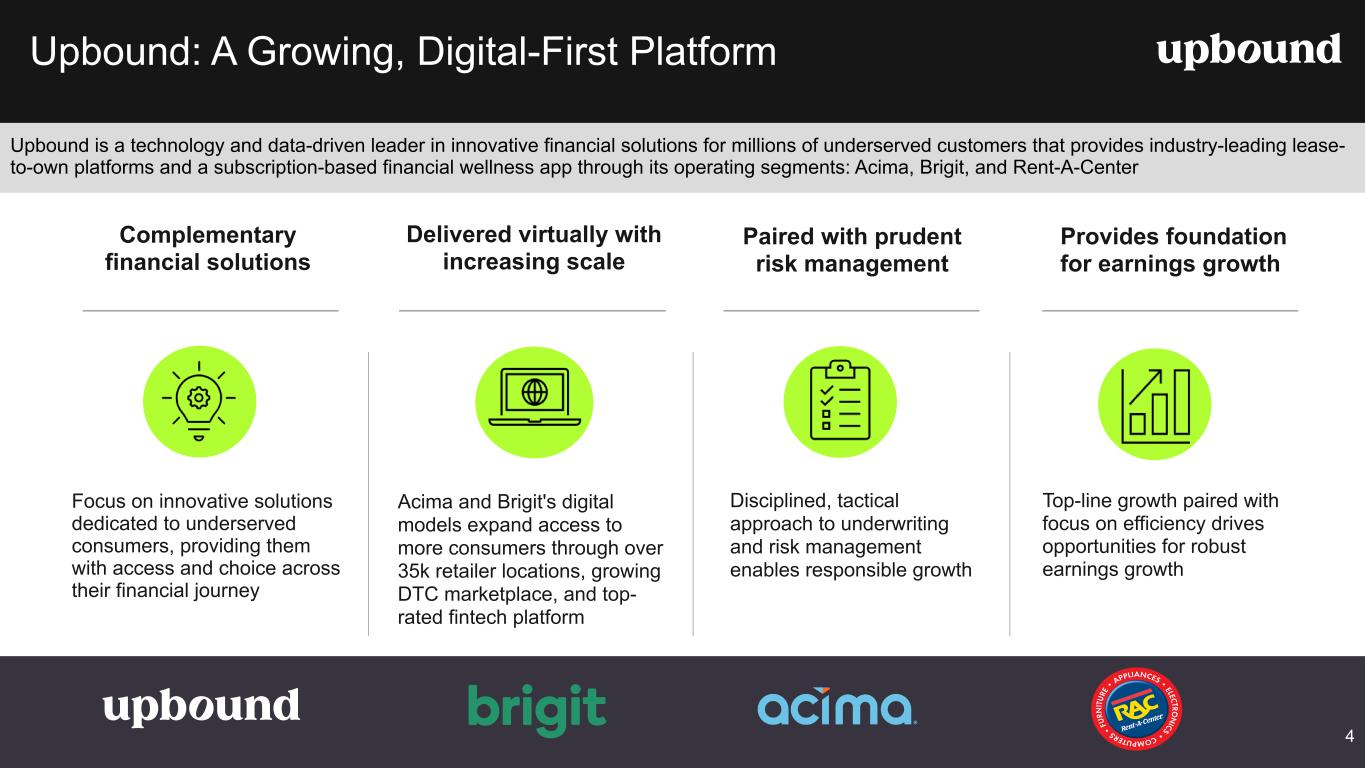
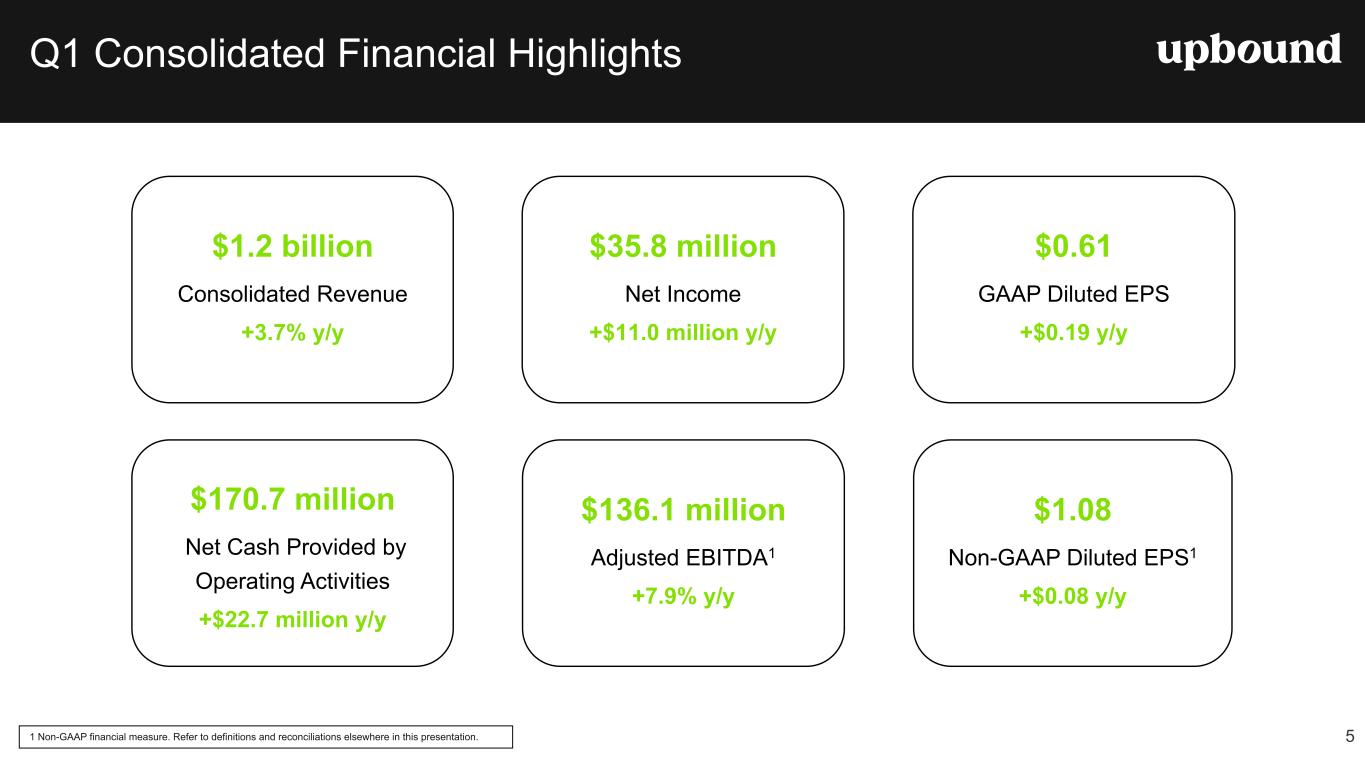
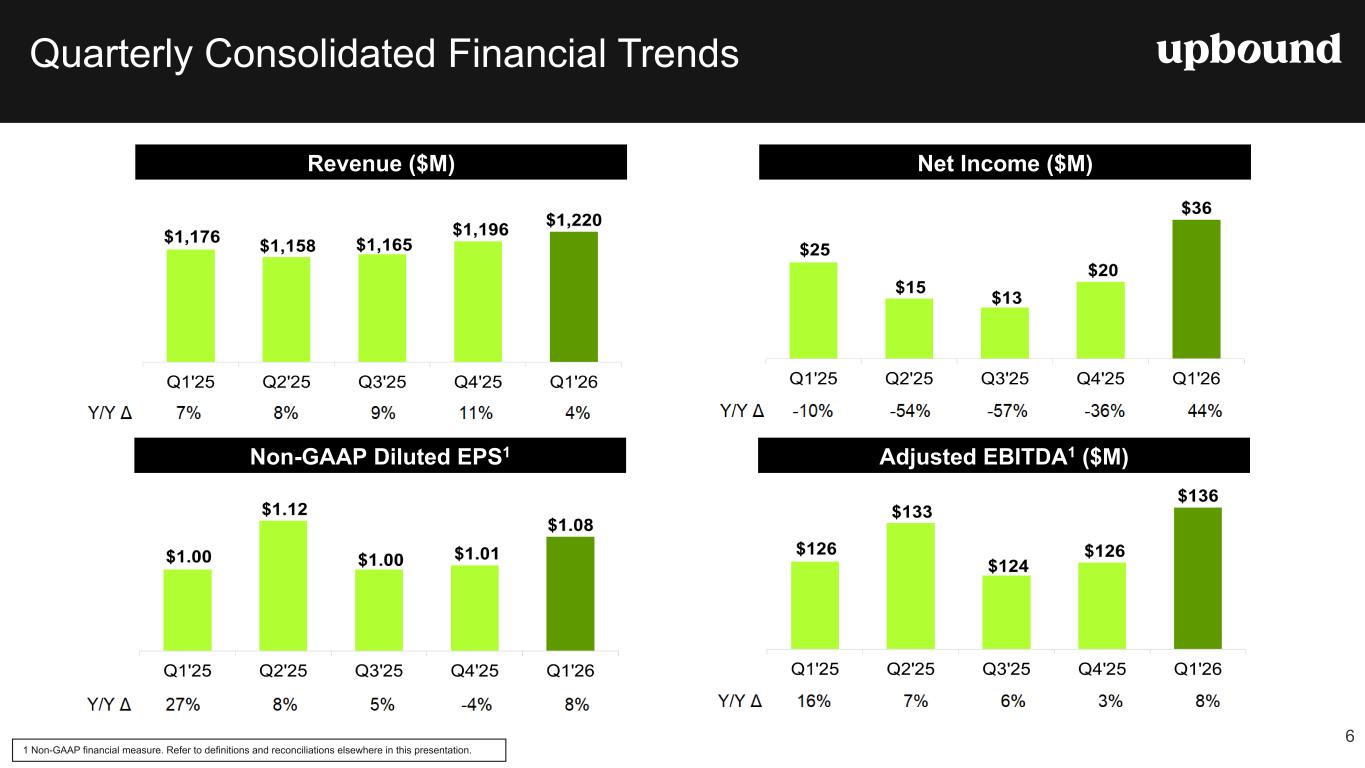
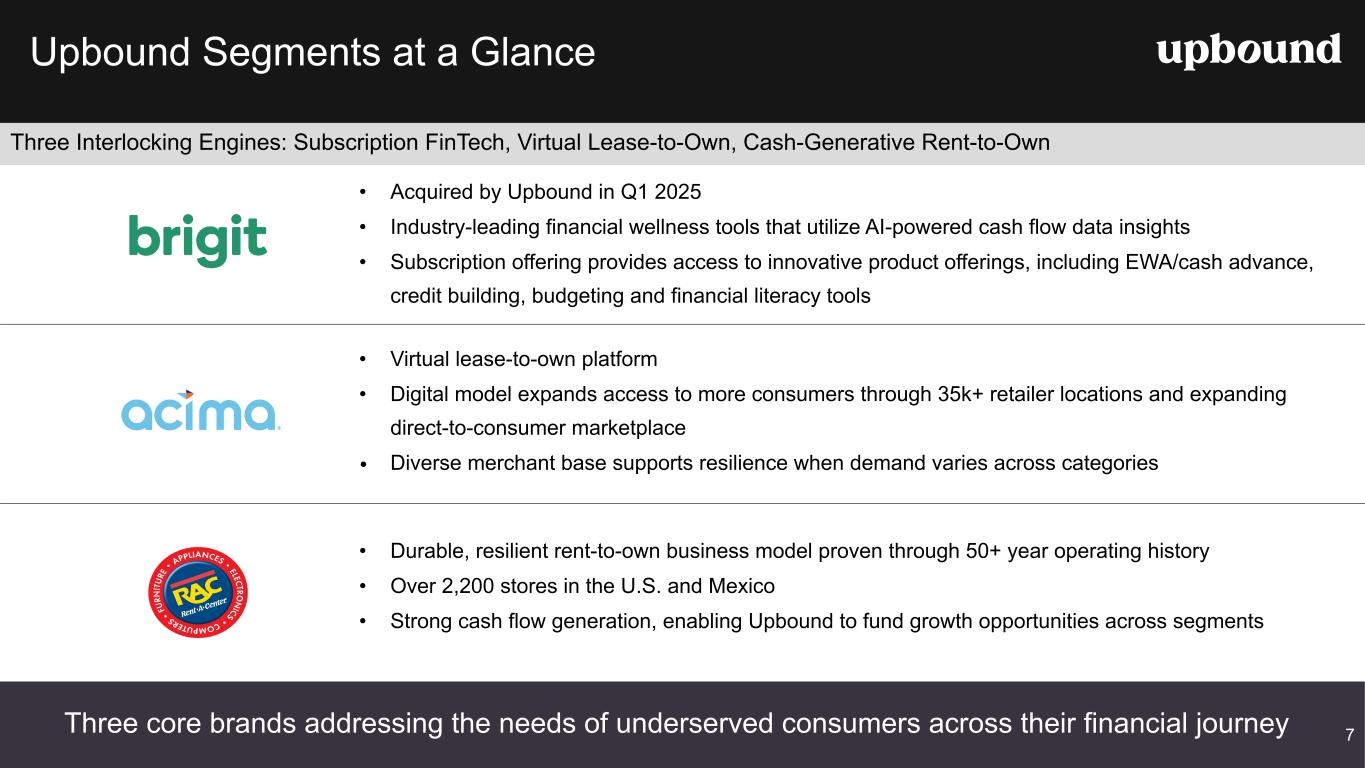
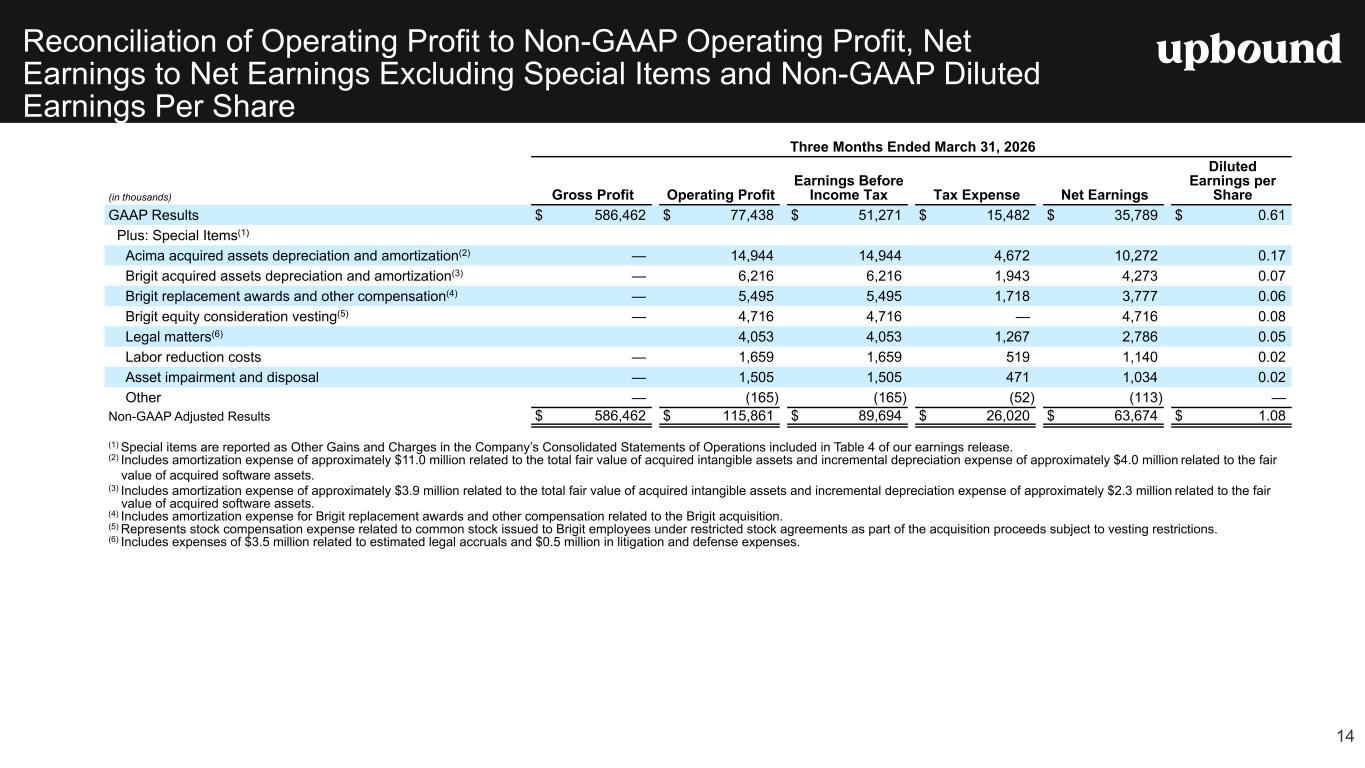
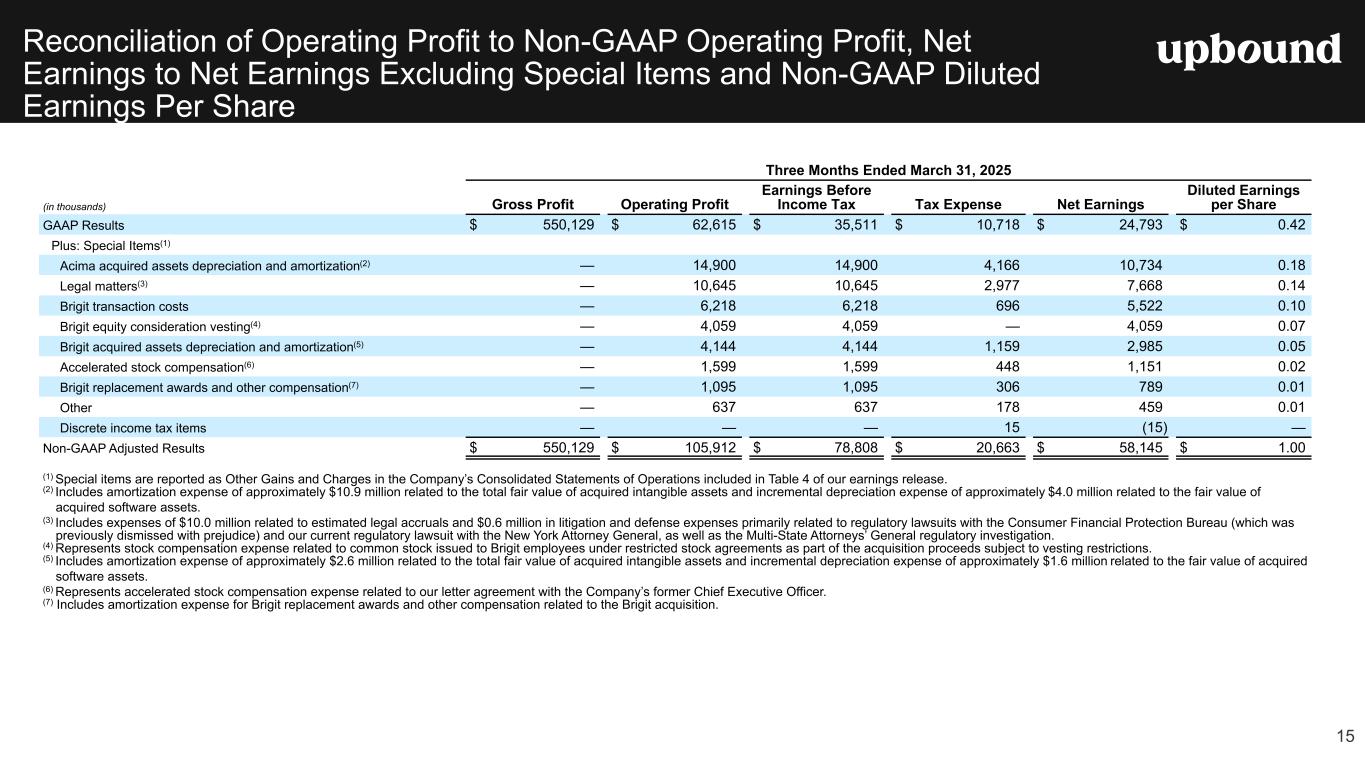
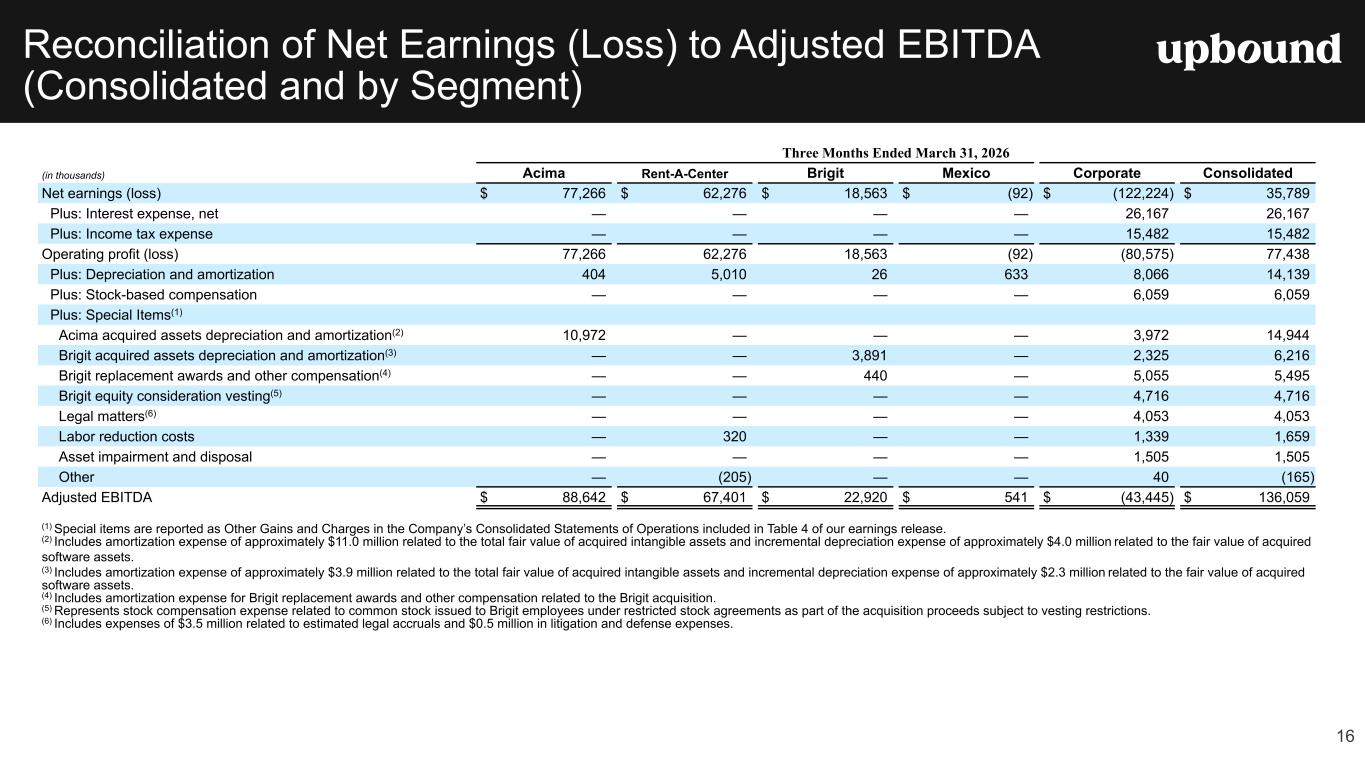
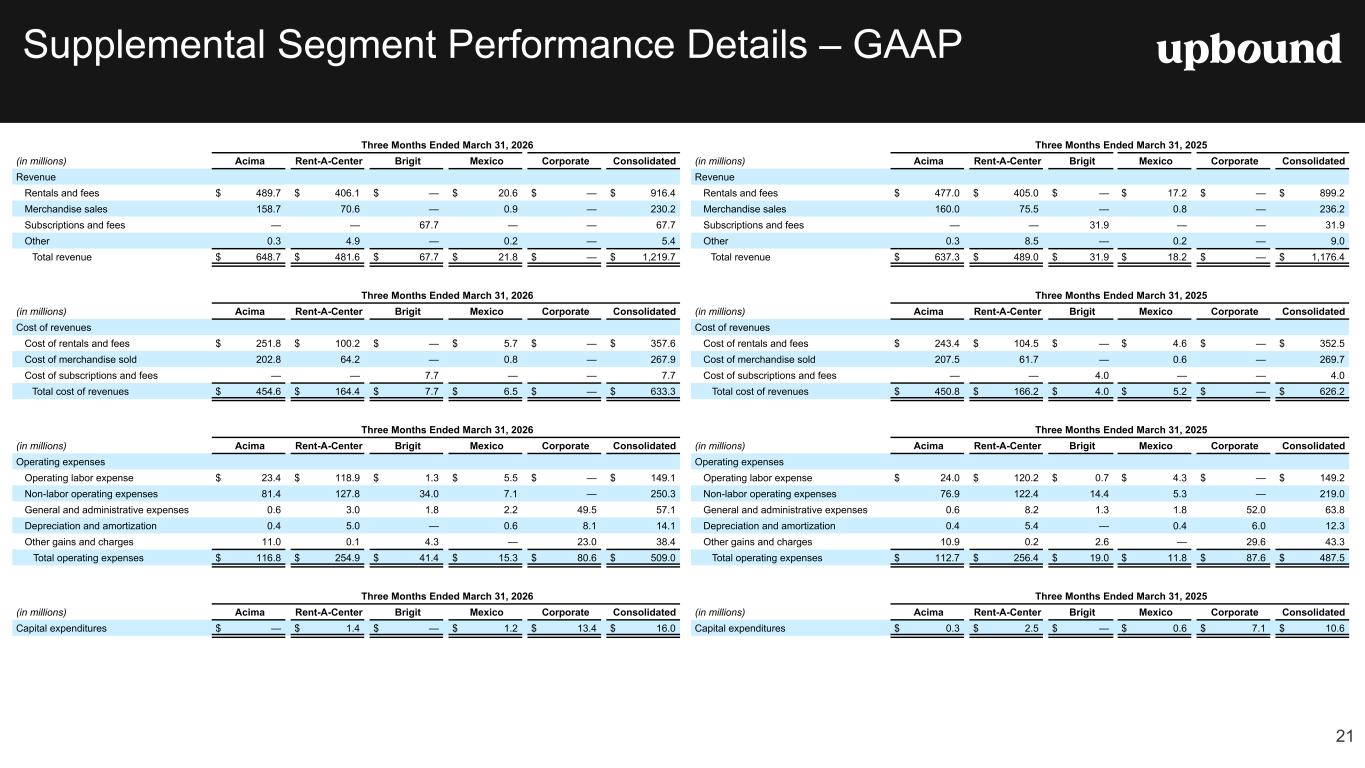
I'll start with a review of our first quarter performance and the progress we're making on our 2026 priorities. I'll then hand it over to Hal for a more detailed discussion of our financial results and outlook. After that, we'll take some of your questions. Our first quarter represented a solid start to 2026 for Upbound. We executed well in a difficult operating environment, delivered results in line with our financial targets, generated robust cash flow, and deleveraged our balance sheet while continuing to advance key initiatives that support long-term value creation. We believe Upbound's expanded and increasingly digital portfolio is well-suited to meet consumers' needs in this environment, as consumers seek flexible, convenient, and affordable financial solutions. With our Bridget acquisition last year, we have three complementary brands that deliver a wide range of financial solutions to a similar and sizable target consumer base and that diversification helps us manage through category swings creates multiple paths to growth and gives us more opportunities to deepen relationships with customers over time our work is guided by a set of clear priorities for 2026 we're building upbound into a more connected tech enabled financial platform while fostering sustainable, profitable growth. Across the company, our focus is on using data, advanced analytics, and AI to improve personalization, strengthen underwriting, and enhance operating efficiency across our organization. When we talk about becoming more connected, this refers to creating a better, deeper experience for customers and a more efficient operating model for the company. That means meeting customers where they are, providing a broader set of solutions across their financial journeys, and using data collected at any and every interaction across our brands and channels to make smarter decisions, from product development, value proposition, customer acquisition, conversion, and underwriting, to account management and retention. Over time, this stronger connection should translate into enhanced customer engagement, better outcomes, and higher returns on capital. We're also advancing a more unified operating structure for the company. In practical terms, that means a common delivery model, shared resources, and shared data foundations that allow each brand to move faster without recreating the same work in multiple places. Ultimately, this operating model helps ensure teams have the clarity, focus, and tools necessary to execute effectively across key enterprise initiatives. Alongside that, we're applying analytics and AI in practical ways across the enterprise. Our initial focus is on use cases that improve outcomes in underwriting, customer communications, operating efficiency, and enhanced servicing and collections. These are targeted initiatives aimed at enabling better decisions, higher productivity, and a better customer experience. and we're prioritizing areas where we can measure impact and scale what works. We expect to improve merchant experience and onboarding and to remove friction points, which will enhance both merchant and consumer conversion. These efforts should translate into more loyal customers, repeat interactions, higher LTV per customer, and overall lower customer acquisition costs. A big part of delivering on those priorities is leadership and organizational clarity. We've continued investing in key senior leadership roles and talent and we're thrilled to welcome our new Chief Technology Officer Balaji Kumar. Balaji brings more than 25 years of technology leadership experience across financial services and retail. Bringing Balaji on board strengthens our ability to modernize systems, accelerate execution, and build scalable technology capabilities that support the roadmap we've laid out. With the recent leadership additions of Hal, our CFO, Rebecca Wooters, our Chief Growth Officer, and now Balaji in place, along with the balance of our season's executive team, we believe we are well positioned for 2026 and for the long-term future growth. Now let's turn to our segments and how our first quarter performance exemplifies this approach. Beginning with Bridget, we're pleased with the segment's growth and momentum to start the year. In the first quarter, paying subscribers and monthly average revenue per user both increased double digits year-over-year, driving a revenue increase of over 40% year-over-year. This performance reflects strong demand and solid execution, and as a result, the segment remains on track to hit its financial targets for 2026. Bridget continues to invest prudently in the products and marketing that will enable additional growth and profitability in future years. As the business continues to enhance its value proposition, driving increased engagement and monetization across the platform. As the brand scales, more and more users are finding value in Bridget's flexible and transparent financial wellness and liquidity solutions, and we're excited about the opportunities ahead for Bridget as we continue expanding how and where customers can use the platform. In particular, product development remains an important focus at Bridget, with the line of credit pilot continuing to advance. We're preparing for a broader rollout later this year, taking a measured approach that prioritizes unit economics, customer outcomes, and long-term value creation. Turning to ACIMA, the positive results of our targeted efforts to strengthen portfolio health given the challenging operating environment became even clearer in the first quarter, as the prudent underwriting actions taken over the past year have proven effective. Least charge-offs are approximately 8.8% in the first quarter. representing a meaningful improvement from the elevated levels in the second half of last year, including a 130 basis point improvement compared to the fourth quarter. This improvement validates the data-driven approach our team has adopted to protect portfolio quality and improve long-term economics, and it supports a foundation for continued investment in the business as we move through 2026. Tightening underwriting, coupled with macro headwinds which impacted demand, pressured our GMB in the first quarter. GMB finished the quarter below our expectations, coming in lower than last year's first quarter performance, which was prior to us making meaningful underwriting changes. In a moment, how we'll go over our guidance and how GMB and the stronger Q1 loss performance are expected to impact our results for the balance of 2026. ASEMA will continue to be disciplined in its approach and will continue building toward meaningful growth opportunities. We're sharpening the value proposition of our flexible leasing solutions and expanding our digital capabilities. At the same time, we're investing in merchant relationships and strengthening the customer experience at tens of thousands of retailers across the country, as well as online through our direct-to-consumer marketplace, which grew approximately 9% year-over-year in the first quarter. We also remain encouraged by the merchant pipeline across small, medium, and large retailers, and by the diversity of the merchant base, which helps support resilience when demand varies across categories. During the quarter, we signed a new agreement with an existing merchant partner that furthers our partnership and is expected to drive meaningful GMV in the second half of the year. The revised agreement enhances our integration and provides the SEMA exclusive rights as a checkout option at the largest e-commerce furniture retailer in the country. At Rent-A-Center, our focus remains on continued cost optimization while strengthening the foundation for more consistent performance. That progress was evident in the first quarter, with the segment achieving year-over-year same-store sales growth for the second consecutive quarter following our strategic tightening over the past several months. The team continues to prioritize portfolio quality while advancing initiatives aimed at improving the customer experience and store-level execution. This is not a single initiative, it's a consistent, integrated operating approach that combines investment and expanding digital capabilities with targeted work to strengthen engagement and execution in the field. In particular, we are focused on measurable initiatives expected to improve performance over time, from reinforcing coworker training and execution in the field to expanding relevant product offering for Rent-A-Center's strongest and most loyal customers. We're also excited about the Amazon partnership we announced last week. While still early, this collaboration enables convenient Amazon order pickup and returns at more than 1,700 Rent-A-Center corporate-owned stores, increasing store relevance, driving brand awareness, and in-store traffic, and supporting new customer acquisitions. These are the type of initiatives that leverage our existing footprint, enhance the customer experience and help us introduce our portfolio of flexible financial solutions to an even greater number of consumers. Before turning to consolidated financial highlights, I want to briefly step back and tie together what we're seeing across the business. Across the enterprise, we continue to strengthen the platform by connecting data, capabilities, and teams in more deliberate ways. We are improving personalization, making more targeted, data-driven risk decisions, and and identifying opportunities to engage customers more effectively across brands. This work is focused on execution fundamentals, targeting the right customers across channels while delivering value and service that drives repeat business, and then scaling those improvements consistently over time. It's also important to acknowledge the operating environment we're navigating. The non-prime consumer continues to face pressure from elevated costs in essential categories such as groceries, rent, utilities, and energy, which influences purchasing behavior and weighs on discretionary spending, particularly for larger ticket items. At the same time, the first quarter featured a stronger-than-normal tax refund season. While that supported liquidity for many consumers, it was partially offset by higher energy prices following recent geopolitical developments. Despite this challenging backdrop in the first quarter, our consolidated results were solid and in line with our expectations. Revenue was $1.2 billion, up 3.7% year over year. Adjusted EBITDA increased nearly 8% to $136 million, and non-GAAP diluted EPS was $1.08, up 8% from the prior year. These results reflect disciplined execution and improving outcomes across the platform. Cash flow and deleveraging were also strong in the quarter. Net cash provided by operating activities was $171 million, up $23 million year over year, and free cash flow was $136 million, up from $127 million in the prior year quarter. Strong cash generation supports reinvestment in the business, discipline deleveraging, and our broader capital allocation priorities. We're encouraged by our first quarter results and by the progress the teams are making across the company. We're investing where it matters most, staying disciplined on investments, cost, and underwriting, and scaling capabilities that support operating leverage over time. As we look ahead, our priorities are clear, our leadership team is in place, and we'll stay focused on execution throughout the rest of 2026. With that, I'll turn the call over to Hal to walk through the financials in more detail.
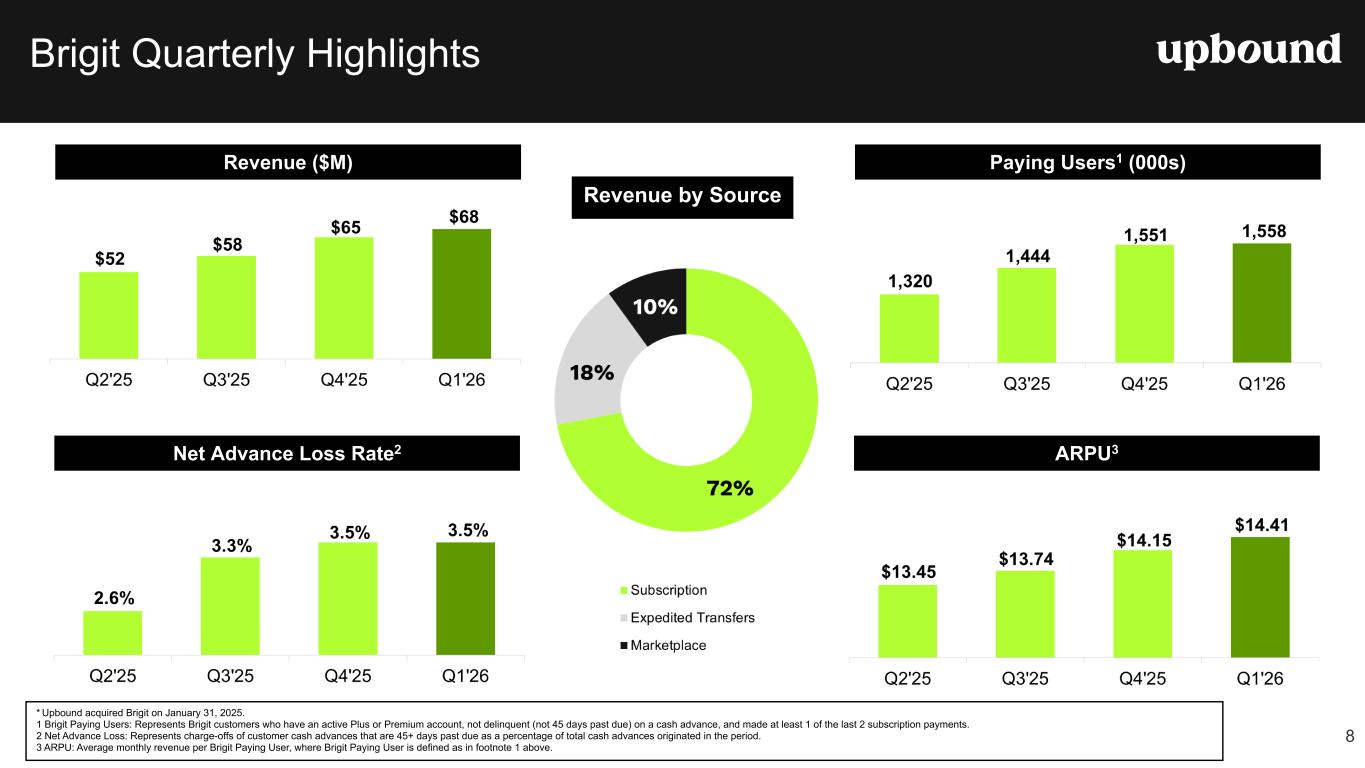
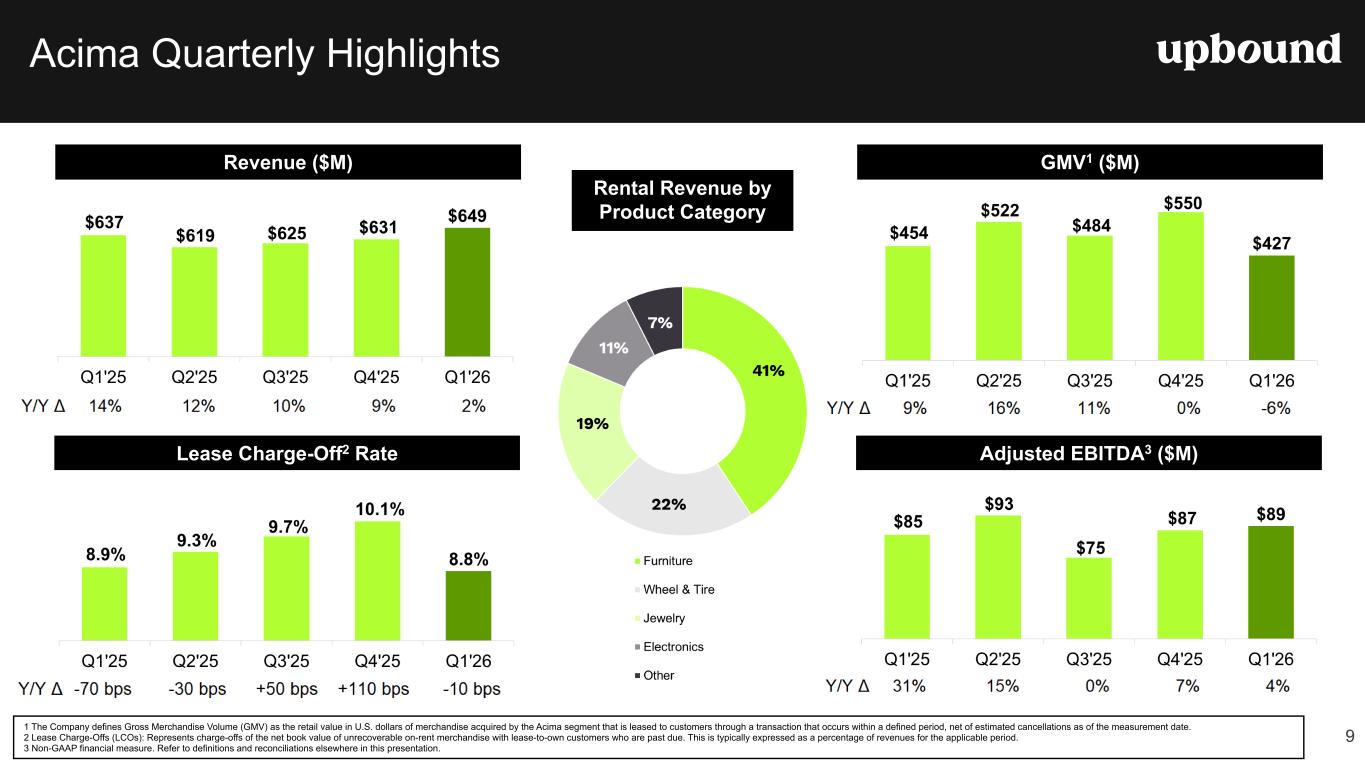
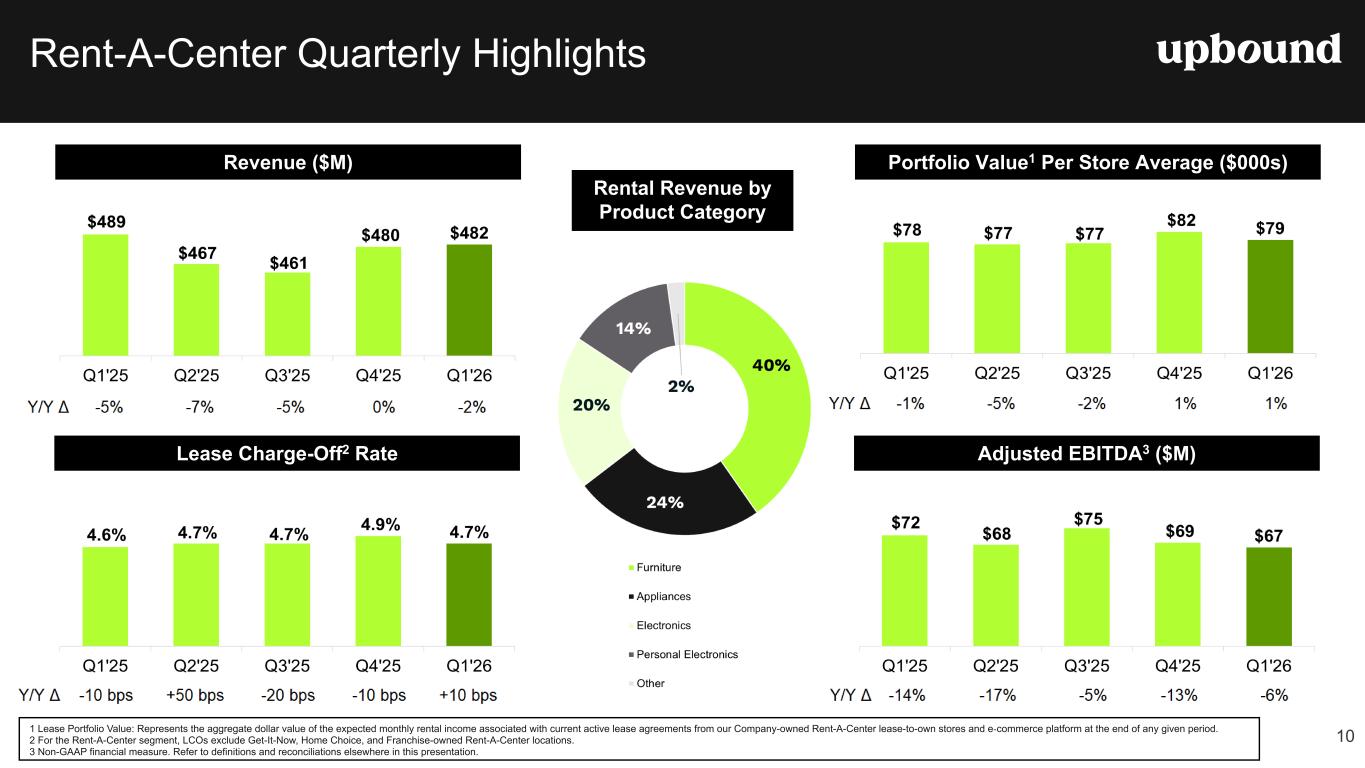
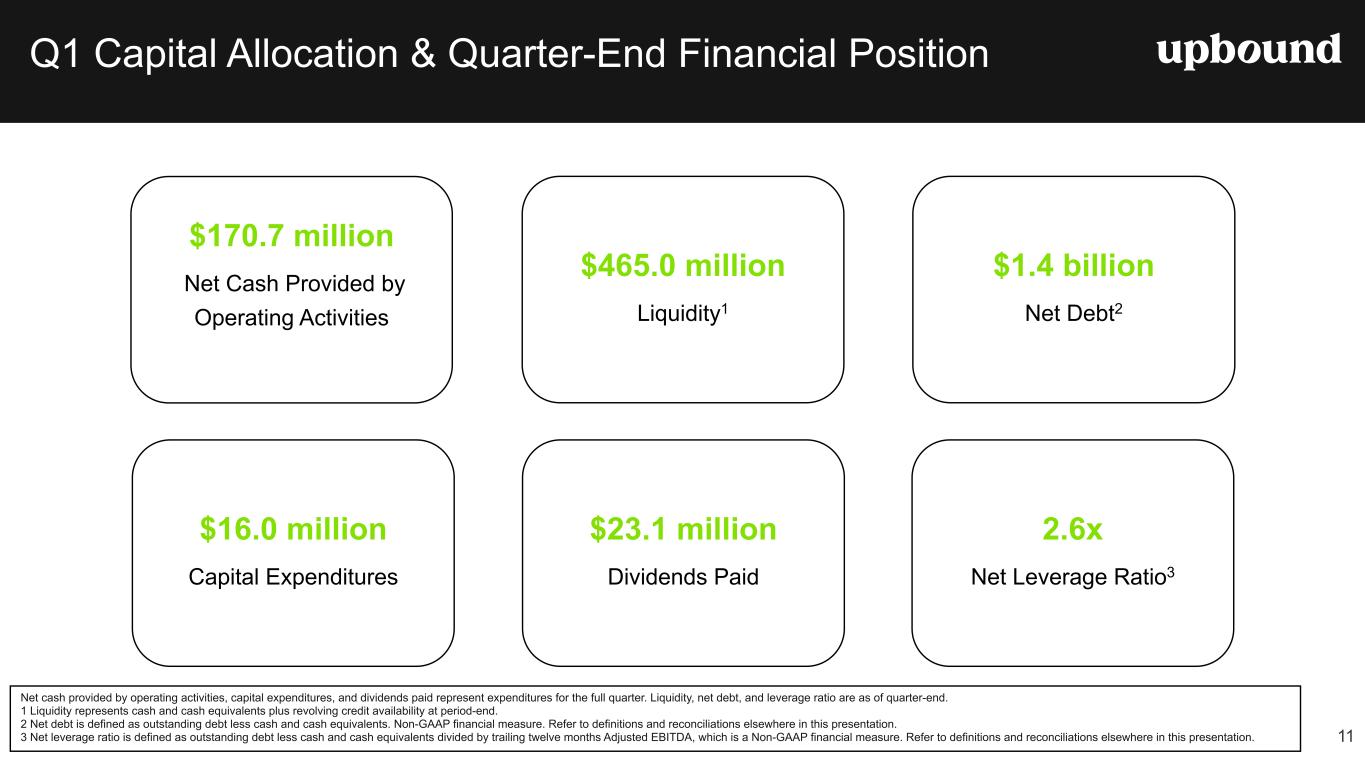
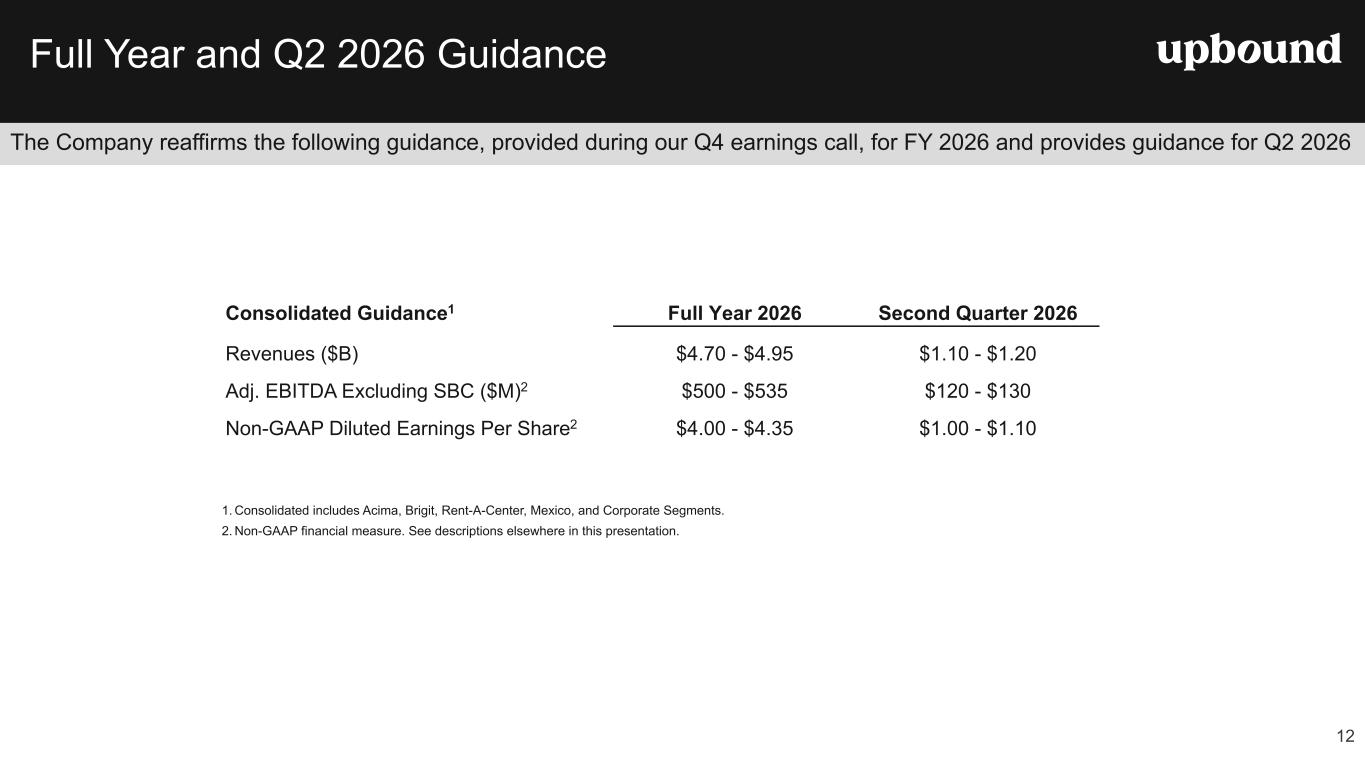
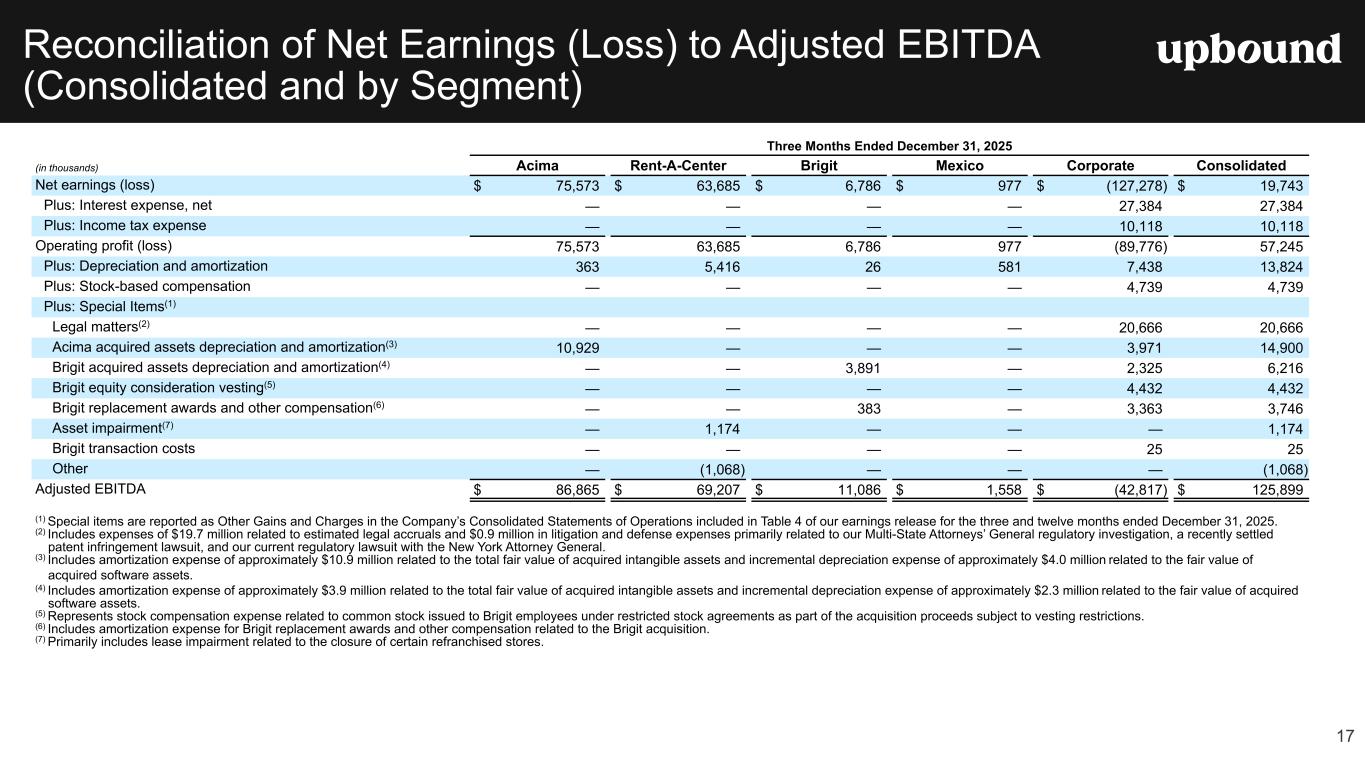
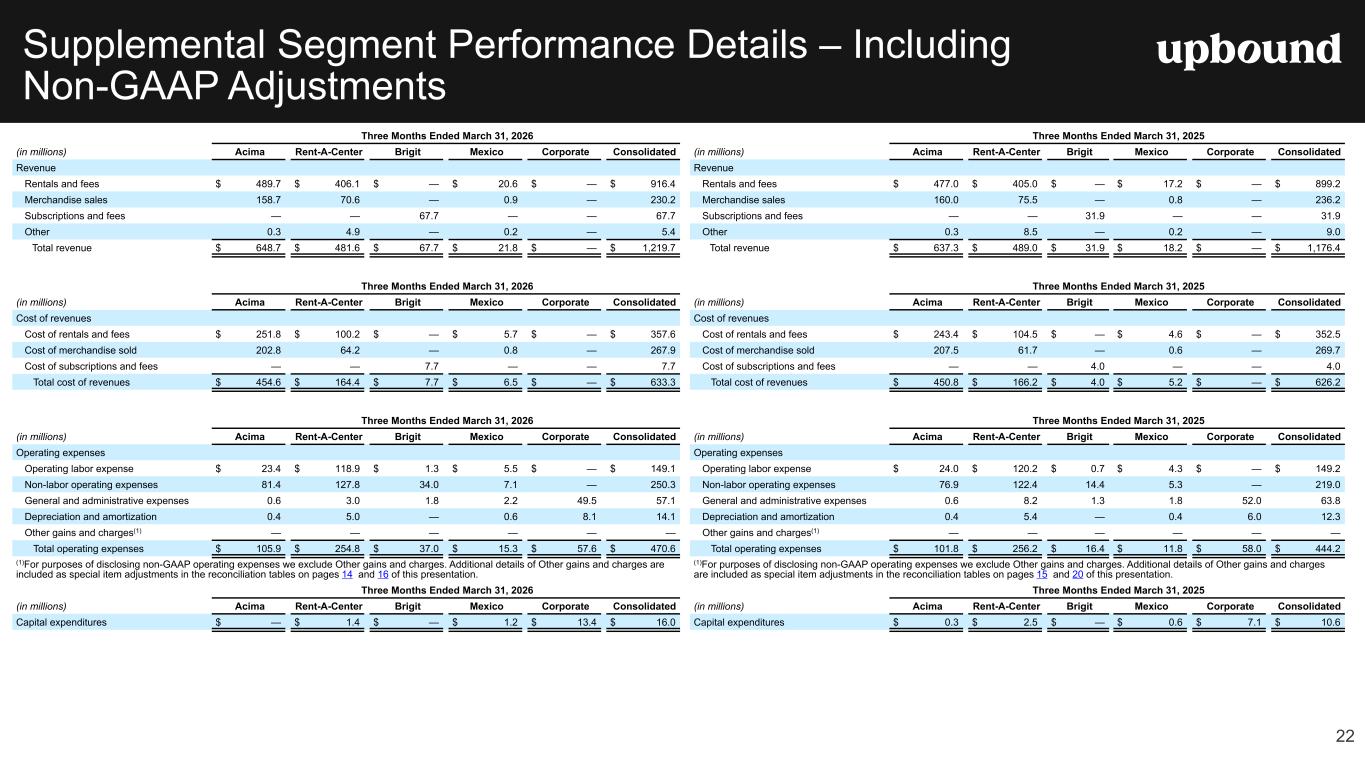
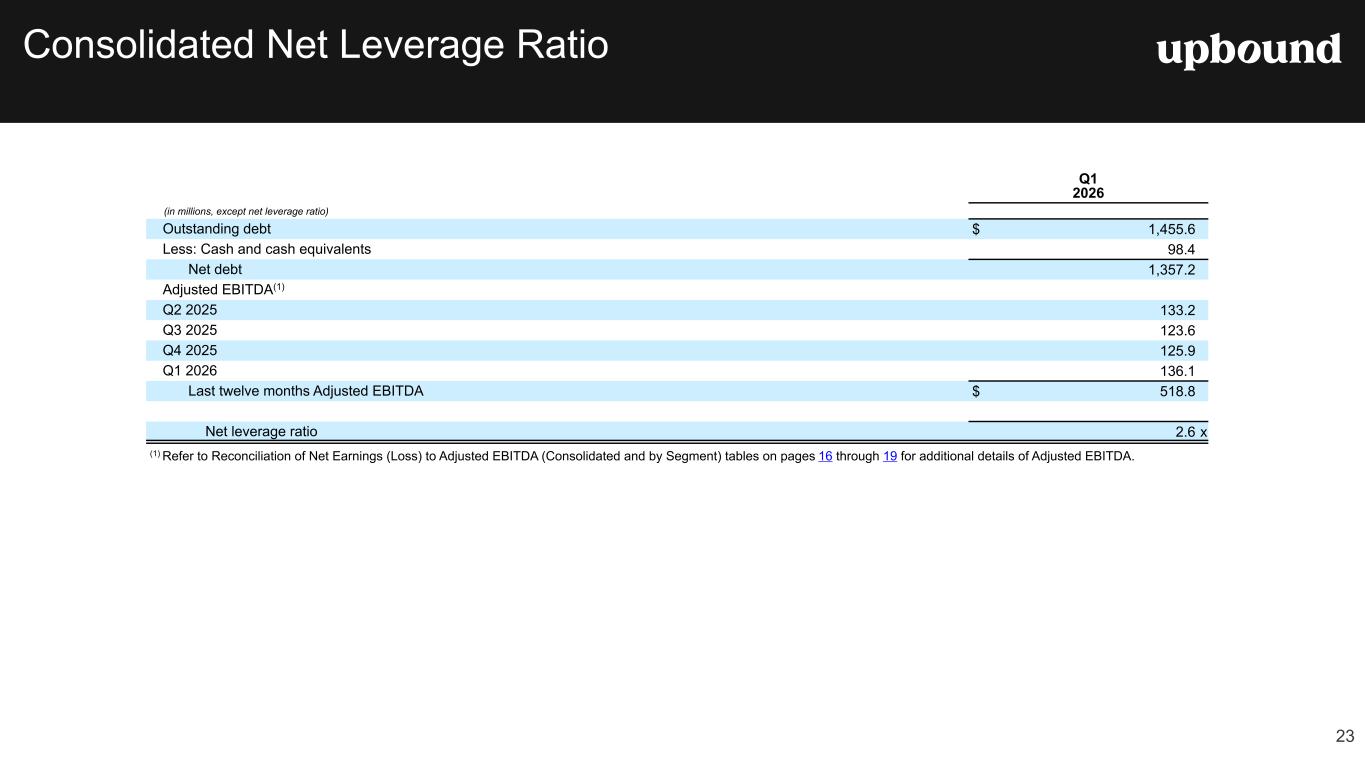
Thank you, Femi, and good morning, everyone. I'll begin with a review of our segment results for the first quarter, then spend time on capital allocation and liquidity before closing with our outlook and guidance. As you heard from FAMI, we are executing well in a challenging operating environment, demonstrated through improving portfolio performance and strong cash generation. Those two factors are central to how we think about sustainable long-term value creation. Starting with Bridget, the first quarter demonstrated strong performance across the business revenue was 68 million more than double bridges revenue contribution to our consolidated results in the first quarter of 2025 as a reminder upbound acquired bridget at the end of january 2025 and did not include bridget revenue for the first month of last year in its reporting excluding timing impact of the acquisition last year bridget comparative revenue grew more than 40 percent in line with recent performance trends Revenue growth in the quarter reflected continued expansion in paying users and improved monthly ARPU, which increased nearly 12% year-over-year to $14.41, supported by increased shift towards Bridget's premium tier, deeper engagement with marketplace offers, and higher optional expedited transfer revenue. Paying users were approximately 1.6 million at quarter end, up approximately 27% year-over-year. Net advance loss rate was approximately 3.5%, consistent with recent quarters and within expectations. Bridges adjusted EBITDA contribution in the first quarter, approximately 22.9 million, more than doubled year-over-year as scale benefits continue to build. In the year ahead, we remain focused on disciplined growth and measured product rollout with a clear emphasis on unit economics as we expand capabilities over time. Turning to ASEMA, first quarter revenue was $649 million, up approximately 2% year-over-year, driven primarily by a nearly 3% increase in rental and fee revenue, partially offset by a 1% decrease in merchandise sales revenue. GMB was approximately $427 million, down approximately 6% year-over-year. This outcome reflects a couple of factors, including tighter consumer conditions that limit discretionary spending, particularly for durable goods, and the deliberate underwriting tightening actions taken in 2025, as we remain prudent in customer acquisition. These tightening actions were intentional and focused on improving long-term portfolio socioeconomics, rather than maximizing near-term volume, particularly given the broader non-prime consumer landscape. That brings us to the other side of that trade-off, loss performance, which was a clear success story in the first quarter. The SEMA lease charge-offs were approximately 8.8%, representing roughly 130 basis points of sequential improvement and 10 basis points lower year-over-year. The early indicators we monitor, including payment behavior and delinquency trends, support our confidence that the portfolio is benefiting from the underwriting actions implemented last year. In the year ahead, we will continue to track macroeconomic trends and focus on optimizing our models accordingly. Adjusted EBITDA for ACIMO was $89 million, up approximately 4% year-over-year, while adjusted EBITDA margin was 13.7%, an increase of 40 basis points year over year. Revenue growth coupled with a 60 basis point increase in gross margin and improved loss performance outcomes were each contributors to the increase in the SEMA profitability. As we move through the year, we remain focused on maintaining a balance of sustainable growth paired with solid portfolio performance and profitability. At Rent-A-Center, our disciplined approach led to same-store sales increasing approximately 40 basis points in the first quarter, following its return to same-store sales growth last quarter. First quarter revenue was $482 million, down approximately 2% year-over-year, driven by a decrease in merchandise sales, partially offset by an improvement in rentals and fees revenues and lower revenue contribution from our franchisees. We remain prudent in our approach to underwriting at Rent-A-Center, and as a result, lease charge offs were approximately 4.7% in the first quarter, representing a 20 basis point sequential decrease and a 10 basis point increase year over year, reflecting stable performance within our target range and slightly better than expectations. Adjusted EBITDA for Rent-A-Center was $67 million, down approximately 6% year over year. The decline was driven by lower revenue and profit contribution from our franchise business and inflationary pressure on margins. We remain encouraged by initiatives the team is executing, including continued progress on the digital customer experience, the expansion of product offerings to Renda Center's strongest customers, and efforts to increase store traffic, such as the Amazon partnership that Femi mentioned earlier. Stepping back across the organization, we were pleased with overall performance in the quarter given the broader operating environment. At Bridget, we continue to see strong growth and engagement while our lease-to-own business continued to adjust dynamically to shifts in consumer demand and payment behaviors. The actions we've taken over the past year are translating into lost performance that is running better than our expectations within a SEMA and rent center and while some volume related metrics reflect those actions taken together our performance reinforces our confidence in the resilience of our model and our ability to serve our core consumer in an uncertain environment turning to cash flow liquidity and capital allocation one of the enduring strengths of our model continues to be the ability to convert earnings into cash and the first quarter is another example of that net cash provided by operating activities was approximately $171 million, up from $148 million in the prior year quarter, and free cash flow was approximately $136 million, up from $127 million a year ago. While the first quarter trends to be a seasonally stronger period for cash flow due in parts of the timing of tax refunds and following the holiday shopping season, these figures reflect solid underlying performance and do not yet include all of the anticipated cash tax benefits we discussed on our fourth quarter call. As those benefits materialize later in the year, we expect cash generation to be further supported. We continue to invest capital on key initiatives, which are aligned with the strategy FAMI outlined and are focused on technology modernization, data platform initiatives, and digital capabilities that support underwriting, personalization, and operating efficiency. We remain selective and returns-oriented in how we deploy capital. Over the full year, we expect capital expenditures to be similar to 2025, and we continue to evaluate pacing and return on investment as we continue to move through 2026. We also drove shareholder return by funding a quarterly dividend of $0.39 per share, which amounted to approximately $23 million during the quarter and represents an approximately 8% dividend yield. The dividend remains an important component of our capital allocation framework. Strong free cash flow allows to support the dividend while also pursuing our other priorities, including reinvesting and deleveraging. Turning to liquidity and debt, quarter-end liquidity was approximately $465 million, reflecting cash on hand and available revolver capacity net debt was approximately 1.4 billion and leverage was 2.6 times trailing 12 month adjusted EBITDA a meaningful sequential reduction from 2.9 times at year-end 2025. While the leverage ratio may fluctuate slightly due to timing of cash inflow and outflow over the course of the year we were pleased with the debt reduction achieved in the first quarter We continue to prioritize disciplined deleveraging as a primary use of incremental cash, targeting leverage in the two times range over the long term. Taken together, our capital allocation actions during the quarter reflect a disciplined, consistent framework focused on strengthening the balance sheet, supporting returns to shareholders, and reinvesting selectively to drive long-term value. That discipline gives us flexibility and positions the company well as we move into the remainder of the year. With that context, let me turn to our outlook and guidance. As we look ahead, our expectations reflect continued prudence in underwriting, disciplined operating execution, and steady progress against our strategic priorities. Our outlook assumes a continuation of the current challenging external operating environment, uneven macro factors that pressure our core consumers' discretionary income and demand levels, but also tend to make our complementary range of flexible financial solutions even more relevant to these customers. Considering the trajectory of our business, including first quarter financial results that were generally in line with or above our expectations, we believe that we were well positioned to achieve the target ranges we shared for 2026 revenue, adjusted EBITDA, and non-GAAP diluted EPS on our previous earnings call. As a reminder, those targets are consolidated revenue approximately $4.7 to $4.95 billion, adjusted EBITDA of $500 to $535 million, and non-GAAP diluted earnings per share of $4 to $4.35. We also expect free cash flow of approximately $200 million in 2026. As mentioned on our prior earnings call, this guidance is inclusive in an estimated 2026 payment outflow of approximately $70 million in non-ordinary course legal and regulatory settlements and assumes relatively flat cap expense to support business growth initiatives. These factors position upbound favorability to advance its capital allocation priorities as we focus on delivering compelling and sustainable returns for shareholders. I'll now move on to share updated segment-level commentary. At SEMA, we revised our outlook to account for first quarter results the deliberate underwriting tightening we've completed and our expectation of continued macro headwinds we expect 2026 gmb and revenue to be flat to up to low single digits year over year losses for the year should be slightly better than our original expectations stabilizing in the low nine percent area for the year our outlook for a sema margins has improved relative to our previous guidance, and we now expect a SEMA adjusted EBITDA margin to finish the year up slightly relative to 2025, offsetting revenue pressures. Turning to Bridget, our outlook remains unchanged, with annualized revenue growth of over 30% in the $265 to $285 million range and an adjusted EBITDA in the $50 to $60 million range. These expectations assume continued growth in paying users while maintaining net advance loss rate around current levels for the year. We remain focused on disciplined growth and measured rollout of new products and capabilities as the year unfolds. At Rent-A-Center, while trends with the company-owned segment have stabilized, lower revenue and profit contribution from our franchise business are expected to have a modest impact on full-year performance. As a result, we expect renaissance or segment revenue to be flat to down low single digits for the year, no change to adjusted EBITDA margin, which should remain relatively flat to 2025. Looking to the second quarter of 2026, we expect consolidated revenue of $1.1 to $1.2 billion, adjusted EBITDA of $120 to $130 million, and non-GAAP diluted earnings per share of $1 to $1.10. plan. These expectations reflect typical seasonal dynamics and continued underwriting discipline. With respect to loss rates, we expect both Rent-A-Centers and SEMA's lease charge-off rate to remain flat to slightly higher sequentially. Second quarter GMB should improve sequentially and be down low to mid-single digits year-over-year with continued improvement over the balance of the year and returning to year-over-year growth in the second half of the year. Bridget's that advanced loss rate in the second quarter should be in the mid 3% range in line with historical quarter over quarter trends. Now, as we wrap up, I'd like to reinforce a couple of points Fannie mentioned earlier. During the first quarter, the company continued to execute against its strategic priorities, delivering solid operating and financial performance while maintaining discipline in how we balance growth, risk, and returns. The actions taken over the past year to strengthen portfolio performance are showing up in the results particularly in lost trends and cash generation looking ahead we remain confident in our ability to navigate the current environment and continue building long-term value for shareholders our diversified and complementary portfolio strong cash flow generation and disciplined approach to capital allocation position us well as we move through the remainder of 2026. thank you for your time this morning. Operator, you may now open the line for questions.
Operator
Thank you. As mentioned, at this time, we'll conduct the question and answer session. As a reminder, to ask a question, you'll need to press star 11 on your telephone and wait for your name to be announced. To withdraw your question, please press star 11 again. Please stand by while we compile our Q&A roster. Your first question comes to a line of Kyle Joseph with Stevens. Your line is now open.
Hey, good morning, guys. Thanks for taking my questions. A lot of moving parts there in the first quarter are obviously going into it. Everyone was focused on elevated tax refunds, and then in March we got the spike in gas prices. But just kind of hoping if you guys can walk through each segment and kind of walk us through performance and give us a cadence, you know, and and how, you know, the customer was impacted throughout the quarter by those kind of two big macro factors.
Morning, Kyle. It's Fanny. I'll start, and Hal can chime in. I'll try to cover most of the segments, but just kind of give you just a high-level overview of maybe the consumer because they're directionally the same between the businesses, even though their impact slightly differently, and same with seasonality in our business as well. But maybe I'll start with just the high-level macro and then go into the impacts on the businesses. But as we said in the prepared remarks, the operating environment is pretty tough for our core consumer. You know, the labor market seems to be cooling a bit, wage growth slowed a bit throughout the quarter, and inflation seems to be pretty sticky. And, you know, one of the measures that we follow very closely is fuel prices, And that's been obviously very volatile over the last couple months. So think about a cash-strapped consumer that's going paycheck to paycheck already, and that puts a lot of pressure on their discretionary spending. And so people were very cautious with their dollars, looking for value, looking to stretch its ability to, you know, especially on bigger ticket items, which should lend well for our, you know, our consumer base and as far as our products go. So the non-prime consumer has been resilient and has done that over several cycles. And, you know, why it's important for us to get our underwriting right, which we've done over the last several months, especially on the SEMA, which improved to 130 basis points. As far as tax season goes, a little bit of a mixed bag came in, about 10% on average, a little higher than the year past, which was on the low end of what people were talking about, you know, coming into tax season. It started off a little bit slower in February and caught up in March. And by the time some of the money started to hit, you started having some of the fuel price implications. And so what we saw was people started to still cleaned up delinquencies and losses, but definitely didn't exercise the payout options as much as they had in years past. And what that does is it has an impact on revenue, but also an impact on our gross profit margin. Lesser so on Rent-A-Center, but much more so on SEMA. And you saw that in our gross profit increasing by about 60 basis points year over year. So tax season, in line with what we expected, a little bit of betterment from a gross profit standpoint at SEMA. And then with Bridget, you know, tax season, seasonality for Bridget, you know, it's our most profitable quarter, given that consumers are usually flush with cash in the first quarter. Given tax season, we take a light on the marketing spend, and you saw that, and it generated almost 35% EBITDA margins in the quarter, so a really strong start to the year on Bridget. So I'll try to cover as much as I could, Kyle, in kind of the first question, but I'll leave it for you on a follow-up.
Yeah, no, that's great, Pammy. Appreciate it. And then just digging into SEMA a little bit, kind of remind us exactly the timing on the underwriting changes. You know, obviously they're having their desired effects, but, you know, just as we think about kind of the growth trajectory, recognizing, you know, GMV is the leading indicator for ultimately, you know, revenue over time.
Sure. Yeah, we really started tightening, I would say, into the summer months into the third quarter. So we'll start lapping some of the changes, I would say, by Q3 in earnest once we've kind of gotten through most of the changes. But look, we're very pleased aware of the poor FEMA. We were able to recognize some of the softness pretty quickly and within two quarters get it back in line with our expectations. As we said, it was going to peak around 10% in the fourth quarter. It did that, and it dropped 130 basis points into Q1. So, you know, the first quarter GMV, you know, was a little bit below what we had thought. We were hoping it would be flat year over year. But given some of the underwriting changes, given some of that macro pressure I just mentioned on the consumer, or you couple those together, we were down about 6%. But if you take a big step back and look at what Asima has done over the last few years, you know, that GMV growth has been a great story at Asima. And if you just take it over the last two years, the first quarter is still positive, almost mid-single digits for the first quarter in GMV growth. So a little bit soft on GMV, but very, very happy with where the portfolio is and then the health of the portfolio, and as you saw on the revised guide, we think the margin will be better than we thought coming into the year. So, again, good news, delinquencies are down, losses are in line, the health of the portfolio is good, and, you know, if things get better from here, we know exactly where to go get some GMV, and we're exactly to go get some of that growth, but if things get worse from here, we also have a recession playbook that we can activate, and be even tighter. Good news is I think we're pretty conservative as it is right now. So if something were to deteriorate and we had to get a little bit tighter, you would expect to see some trade down come our way, which obviously would help with GMB. So I would say, Kyle, by the second half of this year, we should return to growth at GMB.
Got it. Really helpful. Thanks for taking my questions.
Thank you. your next call come to the line of bobby griffin with raymond james your line is now open hey everyone good morning thanks for taking the questions i guess uh family i want to stay on a sema is there any way you can help put some context around like how much of the gmv decline is from the tightening actions versus anything else in the industry and you know i'm kind of asking i guess in context of the other peers that we look at in in fully understanding everyone goes through different customer transitions and stuff at different times, and as well as tighten actions. But, you know, is there metrics like app growth or active doors or anything like that just to help us understand as SEMA's positioning remaining kind of strong and nothing else bleeding off to cause the GMV decline?
Yeah, look, I think it's a combination of the things I mentioned already, Bobby, between underwriting and, you know, just general softness with the consumer. I would say the majority of what we saw in the first quarter is around the underwriting tightness. I think we, again, we identified where the softness was pretty quickly. We took swift action, and you saw that reflected in our GMB both in the fourth quarter and the first quarter. And just given the uncertainty in the environment, we think that's the right position to take, not knowing exactly how long are the impacts of the volatility in the market and the rising cost, how that's going to impact the consumer. So most of it is on the underwriting side. We feel like that's the right approach given the uncertainty in the market. As far as the categories and maybe where the GMB is coming from, I would say most categories were down year over year in the kind of low single-digit area. But for us, when you look at when we tightened, we really tightened around the jewelry category, and that was down probably low to mid-teens. But generally, I would say it's an underwriting story around first quarter GMB performance.
Thank you. And then maybe just pivoting over to Bridget, you know, we don't have the full context of last year's 1Q, but it looks like it's off to a great start here with $23 million of adjusted E. But can you just remind us, like, what's built in in terms of new products? I know there was a little bit of delay with getting some of the new products out. We talked about last quarter, but what's in the guide, again, for 26 from a new product introduction? Anything update there as we think about the strong start to 1Q?
Sure. Yeah, very pleased with over 40%, subscriber growth at 27% for the quarter, which is a great sign, EBITDA contribution of $23 million at almost 35% margin. And, you know, with a loss rate in line with what we thought, a little bit elevated year over year as we test out some of those new products and, you know, ramping up on, you know, just testing out. We have multiple tests in the market with pricing. We've recently increased from, you know, the max from $250 to $500 on the EWA. We had that new line of credit product that we've talked about in quarters past that's still scaling, performing in line with our expectations. We're poised to, you know, launch that later in the year more broadly than we have today. You know, and I've mentioned it a couple times on past calls, you know, for folks that we approve in the pilot, you know, over 90% of them are actually opening an account, which just tells you the level of demand and the level of conversion that that product is going to do. You know, we're taking a cautious approach, as we said last quarter, you know, given the uncertainty in the market. You know, anytime you roll out a new product, you know, you're focused on customer experience, making sure the underwriting is right, performance is right, and the economics, the unit economics are right. So we're making progress there. The guide for the year has us continuing to, you know, do those pricing tests and have the line of credit kind of come online later in the year. It's going to be more of a 2027 story than a 2026 story. Just, again, being cautious around making sure that we get the early reads on performance before we launch it more broadly.
Thank you. Best of luck here in the second quarter.
Operator
Thank you. Your next call comes to the line of Vincent Kantik with BTIG. Your line is now open.
Hey, good morning. Thanks for taking my questions. First, I wanted to talk about your human talent. So, first, welcome to your new chief technology officer. I was just wondering, you've added, you know, a couple of new talents so far, if there's any more talent that you'd like to add to the upbound team. And then I also saw that there was a turnover at Bridget. So, I'm just wondering if there's any change to expectations on the earnouts.
Morning, Vincent. Thanks for the question. Yeah, happy to touch on both. I'll start with our new CTO, Balaji, and as I mentioned, you know, building the team out. Since I've taken over from Mitch, we've got our new CFO at Hal. We have our new chief growth officer, Rebecca, and now we have our new chief technology officer as we continue to try to find, you know, accelerate our transformation, accelerate our growth and our digital transformation in a pretty, you know, competitive and dynamic landscape. and that's what this team is being built to do. And it was important for us to make sure that we have, you know, somebody who can tag along with the growth organization and really, again, advance our abilities both on the AI front as well as the data analytics front and then overall automation and digital platform front across the board. And Balji, we're excited to have him in the building and look for big things from him going forward. On the Bridget side, yeah, both of the founders are still in the business but are going to transition into more of an advisory and consulting role in 2026. The CTO, Hamill, transitioned into advisory role this month in April, and Zubin, the CEO, will transition in the second half of the year. And, you know, this is a natural evolution that you would expect coming out of the transaction that the founders would eventually move on. They've been fantastic partners throughout the process, and I feel lucky to have them as long as we had them. Most founders don't stick around this long and want to move on to their next big and exciting thing. And they've been great partners with us so far, and the good news is they built a great business that we have a lot of different things that we can do with from a synergy standpoint, a cross-sell standpoint, and we're just on the forefront of all those things. So we're extremely bullish on our ability to take that business and grow even further from here. And as part of building that great business, as most companies do, they also built a great bench. And so we're excited that, you know, we're going to be able to promote from within and have leaders who have been in the business now for several years take on more and more responsibilities and keep the momentum that we have with Bridget going. So, again, to me, this is a natural evolution with the founders. They've been fantastic to date, and we look forward to kind of continuing the integration plan with Bridget moving forward.
Hey, Vincent, it's Hal here. Maybe just to bolt on to Tammy's point around a strong bench, you know, obviously bringing in fantastic leadership at the top of the house across the enterprise, but I'd also say, you know, it goes beyond that as we look to bring on additional talent in support of the business across our leadership organization as well, particularly in the areas of digital technology and advancement that we've been talking about, specialized expertise, you know, in AI, underwriting, and across the platform overall. So, very excited by, to echo Fannie's point, around the broader talent that we have in the organization to kind of continue the momentum that we have going.
Okay, great. Very helpful. Thanks for all that detail. Secondly, I actually wanted to switch over to Rent-A-Center. So, you know, just kind of seeing the revenues in the EBITDA versus the GMV growth. I'm just wondering when, you know, kind of what gets that business growing again in terms of the revenues in EBITDA. And then I also did want to talk about that Amazon partnership. I thought that was really interesting. If you can maybe talk about what we should be expecting in terms of, I don't know, foot traffic or if there's any economics that you can talk about there. That'd be great. Thank you.
Thanks, Vincent. Yeah, happy to switch over to to Rent-A-Center a bit, another strong quarter for the Rent-A-Center business, you know, second consecutive quarter of same-store sales growth, coming off 80 basis points in Q4, growing at 40 basis points in Q1. And, again, a tough operating environment. I mean, you look at our loss performance, improved 20 basis points sequentially, relatively flat year over year. And if you compare that for the other businesses, So the Rent-A-Center consumer probably has the lowest amount of income and is the most cash strapped. So we have to be very mindful of where the consumer is on the Rent-A-Center business. So in a difficult operating environment to grow 40 basis points, we were very pleased with that. And the segment continues to produce significant free cash flow. As far as the Amazon partnership goes, yeah, we're super excited about announcing that last week. We've been piloting this concept with them now for several months and tested different ways to go to market. We started out with some lockers, then shifted over to just having it at the counter on both sides and agreeing that that was the better move. So we'll be up and running in over 1,700 of our corporate-owned stores in June. And as I mentioned in our prepared remarks, you know, this is a way for us to really leverage our footprint, You know, create some new brand awareness, especially with the younger generation, add traffic to the stores, and add a bunch of new customers or potential customers. And, you know, we know when people walk into our stores, our coworkers are fantastic salespeople, along with underwriters and account managers and everything else that we ask them to do. But first and foremost, they are a sales organization, and getting folks to walk in the door is going to be great for them. In the pilot, we had about a little over 20 stores, about almost 25 stores that were scattered across the country. And what we saw from a traffic standpoint is that we saw about a little over 50 customers come in or consumers come in per store per week. And so heavy traffic, and most of them were actually new to the rent-a-center business. So you can do the math on that, you know, and 50 per week per store at 1,700 stores. that's millions of customers coming into the Rent-A-Center business over the year, and it's on us to convert those folks into leases. And something that we didn't have in the pilot that we have up and running now and will be part of our launch in June, when someone selects Rent-A-Center as their pickup or drop-off option, we're going to be able to actually, in real time, give them a promotional item right there on the Amazon app. So, you know, very real-time marketing. So we're super excited about it. It's still early to kind of quantify the impacts for us, but it's a great place to start with a partner like Amazon and hopefully also introduce them to some of the other upbound brands.
Okay, great. That's really interesting. Thanks very much.
Operator
Thank you. Your next question comes to the line of Anthony Chukamba with Loop Capital Markets. Your line is now open.
Good morning. Thank you for taking my question. So I just wanted to see if I could get a little more color on that partnership that you mentioned with a large online furniture retailer. I'm assuming that's Wayfair. Specifically, if you can just give a little bit more color in terms of the semi-exclusive checkout partner, what exactly does that mean?
Good morning, Anthony. Thanks for the question. Another one that's an existing partner of ours that we're trying to further expand our relationship with. What this exclusivity gives us is a checkout option at the face of their website. It gives our ability for consumers to select a SEMA directly and have our own checkout button versus going through a waterfall where we would obviously have to compete for those applications, but also what this gives us is first look, so it should give us hopefully not just more apps and more leases, but also better quality looks as well, so we get rid of some of the competition and some of the adverse selection. So that will be up and running later this quarter and should hopefully produce some nice tailwind for GMV into the second half of the year.
That's helpful. And then just one real quick one on Bridget. So you talked about you're on a pro forma basis revenues were up. I think that was pro forma, 40%. You know, I saw that the EBITDA margin was down a little, you know, a couple hundred basis points on a gap basis. I was just wondering what that would be on a kind of a pro forma basis for the adjusted EBITDA margin.
It's pretty close, Anthony, as far as, you know, removing just one month of January, January, it's actually fairly close. You know, look, between a 33% and a 35%, some of that is just timing of marketing spend and marketing dollars. But very happy with being able to generate that kind of EBITDA and that kind of cash flow, if you will, for Bridget in the first quarter. As I said, seasonally, that's going to be our big quarter. Going into the next quarter, given some of the traction that we're seeing on the marketing side, both from the fourth quarter spend and what we spent in the first quarter, we're going to lean into that into the second quarter and so we'll we'll get back into the low teens to mid-teens EBITDA margin on Bridget in the second quarter where if you recall last year when we got to the second quarter we didn't see that same level of conversion and traction on the marketing spend and so we didn't actually spend much last year given where we are we're trying to grow that business and some of the conversion rates that we're seeing and the customer acquisition costs that we're seeing in today's environment, we're going to lean into that in the second quarter. And as you look at the guide for the year for Bridget, we're right in line with our targets in the second quarter. It's going to come off that mid-30s and be more in the mid-teens from an EBITDA margin standpoint.
Operator
Thank you. Your next question comes to a line of John Hecht with Jeffries. Your line is now open.
Excuse me. Morning, guys. Thanks for taking my questions. Most of them have been actually asked and answered. But, you know, a theme focusing on there, the DTC marketplace is showing good momentum. I think it's like 10% GMV growth. How does that cohort compare to the merchant-generated cohort, and how do we think about the focus there?
Yeah, it's a big focus for us, and it's been a nice growth story for us over the last several quarters, John. I think we're starting to lap some of the onboarding of some of the bigger retailers, Amazon, Walmarts, that we put on the marketplace a year ago. but still a very nice channel for us that's mostly 99% returning customers. And so it performs relatively well compared to the general population because we're able to market to returning customers. It's a little bit buffered from the overall macro environment. So that's the distinction between maybe just the regular population of retailers and the direct-to-consumers. They're returning customers, so we can market to them better. They're engaged with us already. We still are dabbling in the personalization offers, both Rent-A-Center and Asima. Once we get that dialed in, that channel for both businesses is going to be really strong for us and a theme that you'll hear us talk about going forward.
Okay, that's very helpful. And then follow-up is you expressed your longer-term goals for leverage and the balance sheet. How big of that is a priority for you? Is that something that you think is going to happen in the near term or is that just a gradual deployment? and how do we think about just call it the capital allocation plans in the meantime?
Yeah, hey, it's Howell here. Maybe I'll take that one. You know, obviously our goal and desire is to continue to bring down debt and our overall leverage position. You know, but first and foremost, it's continuing to lean into fueling the overall business. And I think that's subject to where we land through the back end of this year around GMV growth, total overall demand is going to play into the equation as we look at overall free cash flow. But certainly, we do have some distinct headwinds and tailwinds coming in. Certainly from a tax standpoint, we're seeing some refunds come in, as well as the benefits of accelerated tax depreciation from the one big beautiful bill. That's going to be a tailwind, and we're going to leverage and use our cash flow to pay off some of the outstanding litigation that's out there, regulatory liabilities that are there. So we're contemplating paying that off and then aggressively paying down the debt. And so our goal would still be to be in the two times overall leverage range over time. But there's no real clock on that, I would say, but just ensuring that the sources and uses of cash are being used appropriately.
But one of the benefits, Hal, if I can just add on to that, of being a little bit tighter from an underwriting standpoint is the higher – and it gives us the ability to pay down debt if we're not getting the right risk-adjusted margin. And that's the tradeoff that we're going to make from an underwriting standpoint is we're focused on maximizing risk-adjusted margin. And if it's there, we'll lean into GMB. And if it's not there, then we'll benefit from the cash flows.
And maybe just lastly, you know, we've given a view and an outlook of roughly $200 million of free cash flow this year. Again, subject to, you know, the performance on the overall business and the volumes, there may be some upside to that number as well as we look at the contribution to the balance sheet through the balance of the year.
Operator
Thank you. Your next question comes in line of Brad Thomas with KeyBank Capital Markets. your line is now open.
Thanks. Good morning. Fami, I wanted to just ask again about the underwriting trends, and if you could just help us get a better understanding of, you know, maybe what level of conservatism is in sort of the underwriting trends today. I think we're all fearful of an environment where gasoline prices remain higher for longer, and that that just grinds away a bit at consumer spending and so can you help us think about um you know what kind of buffer you may have in the current underwriting and and how that's tied to your guidance um and then maybe just as a quick follow-up to that uh you know obviously we have a long history with rena center and a medium history with a sema but just any uh thoughts on the kind of sensitivity of the bridget customer um you know to a world where uh higher gas prices may go on for longer Sure, Brad.
Thanks for the question. Look, on the underwriting side, we remain highly disciplined, highly, I would say, conservative in our posture. And I just kind of mentioned it on the risk-adjusted margin piece. We are focused on making sure that from a capital allocation standpoint that we actually get the right risk-adjusted margin part of it. So I would say we're fairly conservative right now, and the guide has us remaining fairly. I would say from a portfolio yield standpoint on the SEMA side, when you have lower 90-day buyouts, you typically have higher yields on those vintages. We're not really forecasting that into the guide. We're taking even a conservative approach there as well. But we think that's the right thing right now in this environment. As I mentioned earlier, if things get better, we know exactly where to go to get the growth. And if things get worse, we also have a playbook there that we can activate. But going into whatever we're going into for the second half of the year, we feel like with the portfolio is in a really good spot. and we have the right tools and folks around the table to make sure that we stay very disciplined in our approach. As far as the sentiment with the Bridget side, I think very similar to our other businesses around being paycheck to paycheck and cash strapped. And that's one of the main benefits of us acquiring Bridget was for us to be more relevant to our consumers and have these liquidity solutions. I've mentioned it a little bit around some of the traction we're getting with our marketing spend. I think it's because people are feeling that pressure and need that extra cash and that extra liquidity. That bodes well for subscriber growth. That bodes well for our margin profile. As we test more and more expansion from $250 to $500, the line of credit being $500 over a longer period of time, you know, all those things point to more subscriber growth and hopefully better retention going forward. And the macro backdrop, I think, also supports that thesis as far as those consumers go on the Bridget level.
And it's out here. Maybe if I could just tack on there, there is quite a bit of sophistication that goes into our credit and underwriting modeling. You know, looking at that by business segment, you know, obviously the customer profiles will look a little bit different in terms of how they perform, looking at that across risk tiers, looking at that across categories as well, looking at that in terms of the origination source that's coming through. But, you know, to say we've been, you know, prudent around our overall credit management in, you know, this operating environment, I think, is the right call. Certainly, there's areas of opportunity for us, particularly as I think about the Bridget business that you referenced in there as well. We could be a little bit more aggressive, given the margins there, but, you know, we'll monitor that as the next few months unfold and get a better read on the broader environment, and that'll allow us to get a sense of the ability to kind of loosen up a little bit.
That's helpful. Thank you. And as a clarification question on the new furniture partner agreement that you talked about, I just want to try and be clear. Fami, I think you referenced the phrase being exclusive. I'm just trying to understand, is that the exclusivity with the new checkout features? Or do you become the sole rent-to-own provider for this retailer with no other competitors in that tier for them?
It's the form checkout button.
Thank you so much. You have it just on the button.
Operator
Thank you. Your next question comes in the line upon win with TD Cowan. Your line is now open.
Thank you, and thanks for taking my questions. Most of it have been asked, but maybe I want to dig a little bit deeper on Bridget. Obviously, very, very strong growth there, but you continue to reiterate your expectation that some of that growth will get pushed out from 26 to 27. I guess, I mean, in the context of more volatile macro environments, I mean, how do you think about that with respect to your product launches at this point, you know, the cadence of growth this year, next year? And, you know, what could make you feel more confident to, you know, launch these new products earlier or, you know, maybe have to push them back?
Good question. I wouldn't say we're going to push it back. I think we're being pretty cautious right now. You know, the easy thing for us to be is to turn it on broadly right now and add a bunch of subscribers, but we're not there yet. We think it's more prudent to take a cautious approach and roll it out over time. You know, the market environment, as I said, you know, it lends itself to more and more subscribers taking us up on our offer. So in one sense, you know, the environment's great for our, you know, our existing products, and we should see some hopefully upside from what we're guiding to now. But the environment doesn't lend us to be really aggressive on the new products. I think it's too uncertain for us to go out with new products to new customers, especially when you're going, again, we talked about this. The earned wage access product is a, you know, typically you get paid back in 10 to 12 days, and it's on average a $75 to $100, you know, exposure per subscriber. The line of credit, you're up to $500 over a much longer period of time, and so we just want to be very cautious and careful before we roll it out. So I said the demand is there. Now we're just going to make sure the performance follows suit, and then we'll roll it out. So the environment doesn't lend itself to being more aggressive on new products, but I think what we're guided to between the end of this year and going into 2027 is appropriate.
Got it. And maybe another one. And on the legal accrual, I saw that you guys added a couple of million dollars. I think the bulk of it was last quarter when you expected most of these to be resolved pretty soon. So, I mean, can you give an update on that? And, yeah, thank you.
Sure. Yeah, I would say the accrual this quarter was more in the normal course where in quarters past you saw a much bigger increase because the cases between the multi-state and the one that the McBurney one that we we've already settled you just haven't paid off yet we actually paid off post quarter end but the two million that we added this quarter I think we're just normal normal course not related to some of the bigger cases that we've talked about in quarters past maybe just to bolt on though that we do feel that the provision and reserve that we do have on the balance sheet for legal settlements is appropriate
and, you know, again, cautiously optimistic that we'll look to actually resolve those in the coming months.
Operator
Thank you. Your next question comes to the line of William Ruder. Your line is now open. Are you there, William, with Bank of America?
Hi. Sorry, I was on mute. Given it's late in the call, I'll just ask one. When you did see the spike in fuel prices, have you seen an immediate reaction from your customers in terms of reduced activity? I'm wondering how quickly you actually see changes in their behavior. That's it. Thanks.
Morning, Bill. People have to also get their arms around where it's going, the impact, how long it's going to be, and those kind of things. So, it wasn't an immediate spike, but definitely a noticeable change in how they spent their tax refunds this year.
Great. Thank you. Thank you.
Operator
Your next question comes from the line of Casey Coates with Loop Capital Markets. Your line is now open.
Good morning. Thanks for squeezing me in here. I just wanted to ask on updates on the product mix. I know furniture continues to be pressured, and I believe you mentioned pressure and jewelry, but are you seeing any strength in other categories? Thank you.
I think across the board, I would say, given that most of the reduction in GMV came from us underwriting, tightening, from tightening underwriting, that it was pretty broad-based. And as I said earlier in the call, most categories were down low single digits to mid-single digits. But jewelry, given it's the highest loss content and the riskiest segment, that's the one that probably dropped the most when you look at it year over year.
Operator
Thank you. I'm showing no further questions at this time, and we'd now like to turn it back to Fami Karan for closing remarks.
Thank you, Operator, and thank you to everyone who joined us today for an update on our Q1 performance. I'm very thankful for the collective efforts of our exceptionally talented and dedicated coworkers and our merchants who helped deliver strong first quarter results while laying the foundation for the transformational year ahead. We're grateful for your interest and support, and we look forward to updating you all again next quarter. Have a great day, everyone.
Operator
Thank you for your participation in today's conference. This does conclude the program, and you may now disconnect.