Good day, ladies and gentlemen, and thank you for standing by. Welcome to the GeneDX First Quarter 2026 Earnings Conference Call. At this time, all participants are in a listen-only mode. After the speaker's presentation, there will be a question and answer session. To ask a question at that time, you need to press star 11 on your telephone keypad. Please be reminded that this conference call is being recorded. At this time, I'd like to introduce your host for today's presentation, Ms. Sabrina Dunbar of Investor Relations. Ma'am, please begin.
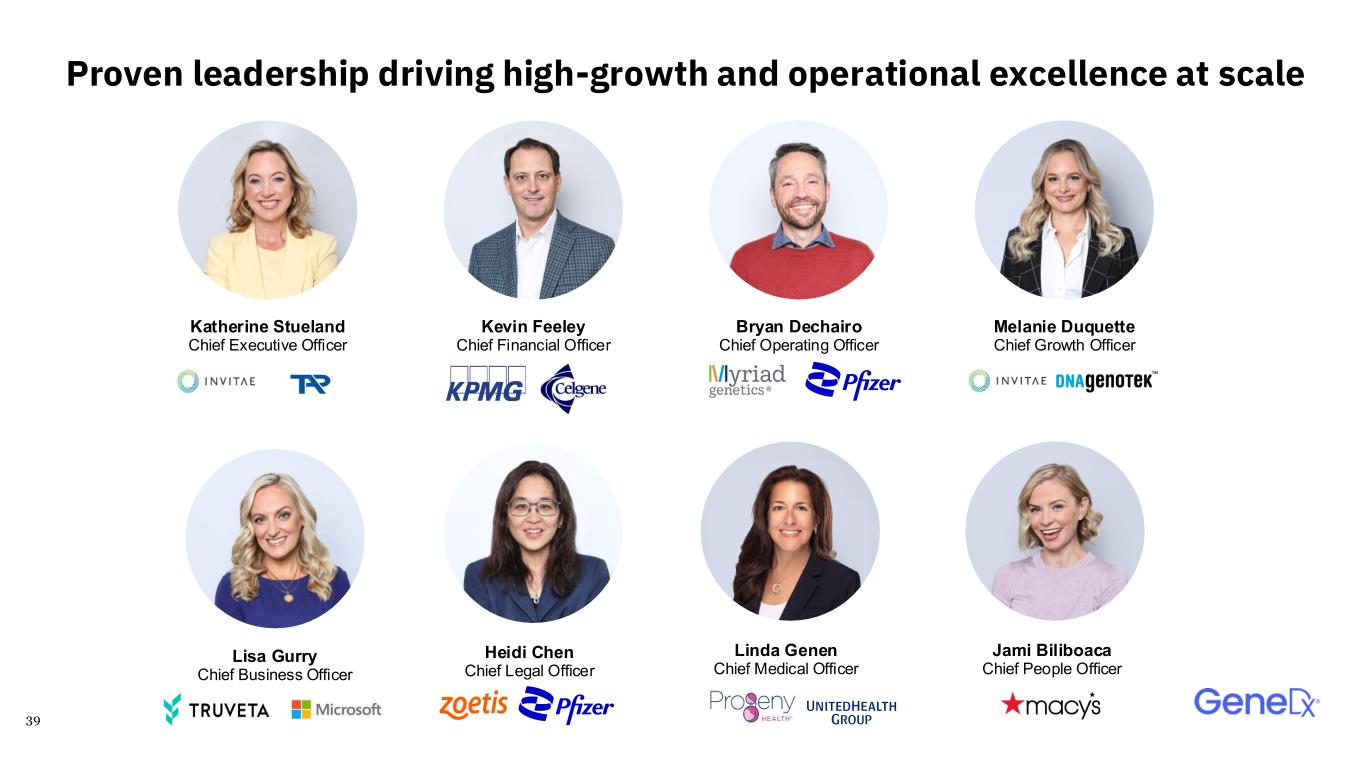
Thank you, Operator, and thank you to everyone for joining us today. On the call, we have Catherine Stulin, President and Chief Executive Officer, and Kevin Feeley, Chief Financial Officer. Earlier today, GNDX released financial results for the first quarter ended March 31, 2026. Before we begin, please take note of our cautionary statement. We may make forward-looking statements on today's call, including about our business plans, guidance, and outlook. Forward-looking statements inherently involve risks and uncertainties and only reflect our view as of today, May 4th, and we're under no obligation to update. When discussing our results, we refer to non-GAAP measures, which exclude certain items from reported results. Please refer to our first quarter 2026 earnings release and slides available at IR.GNDX.com for definitions and reconciliations of non-GAAP measures and additional information regarding our results, including a discussion of factors that could cause actual results to materially differ from forward-looking statements. With that, I'll turn the call over to Catherine.
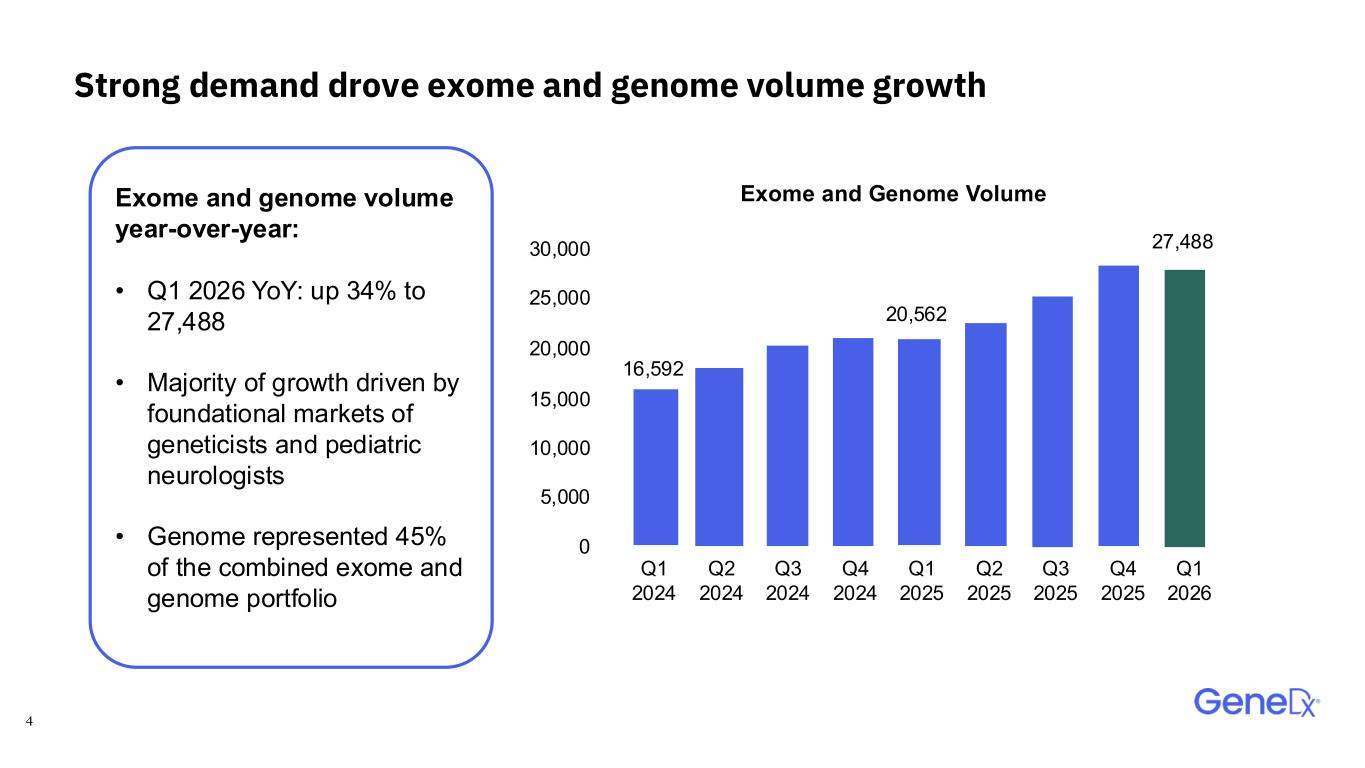
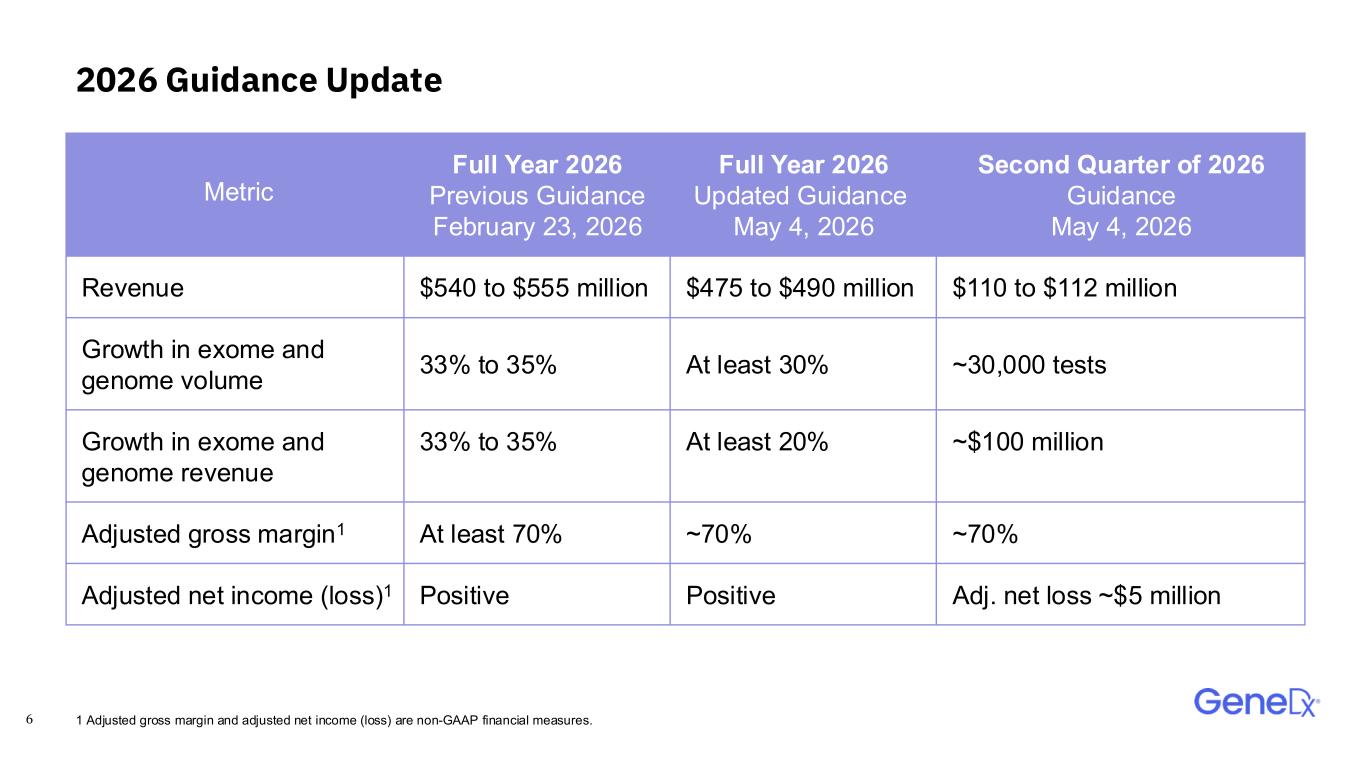
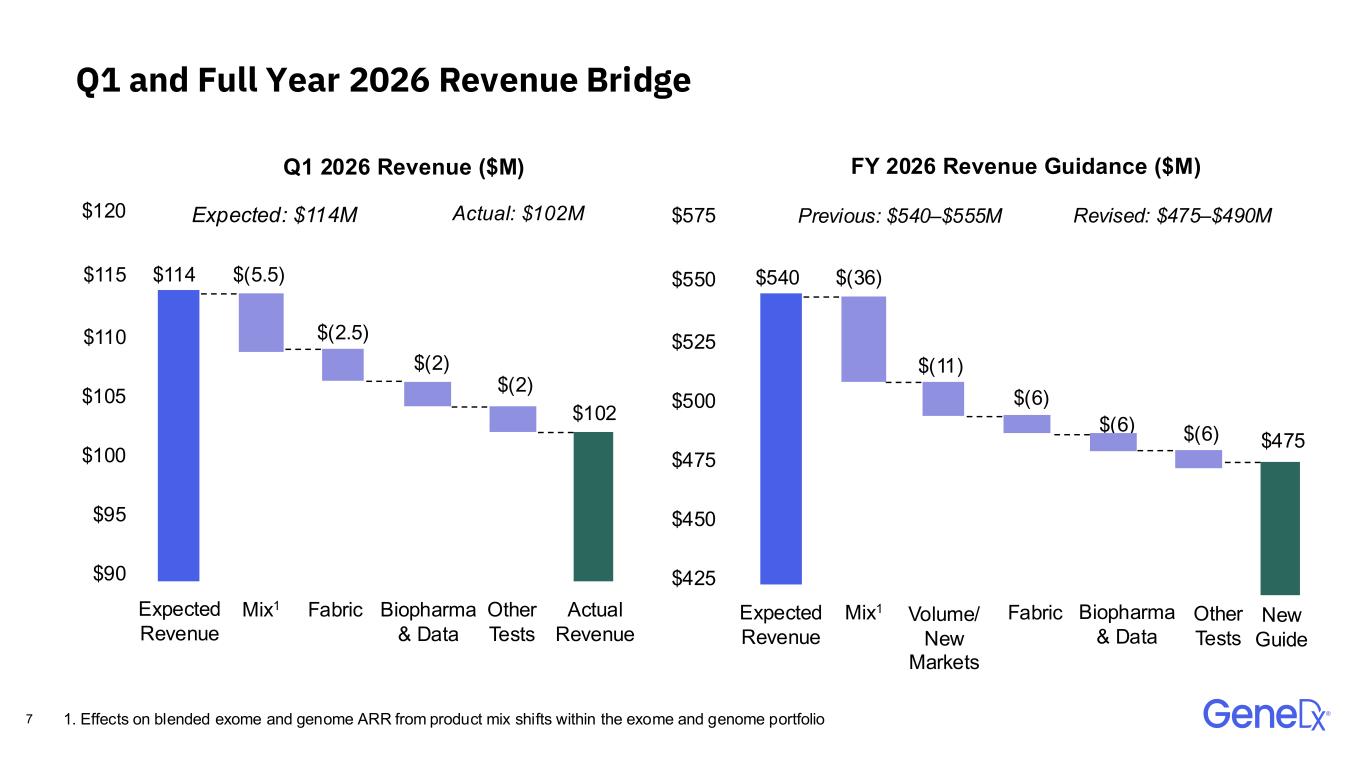
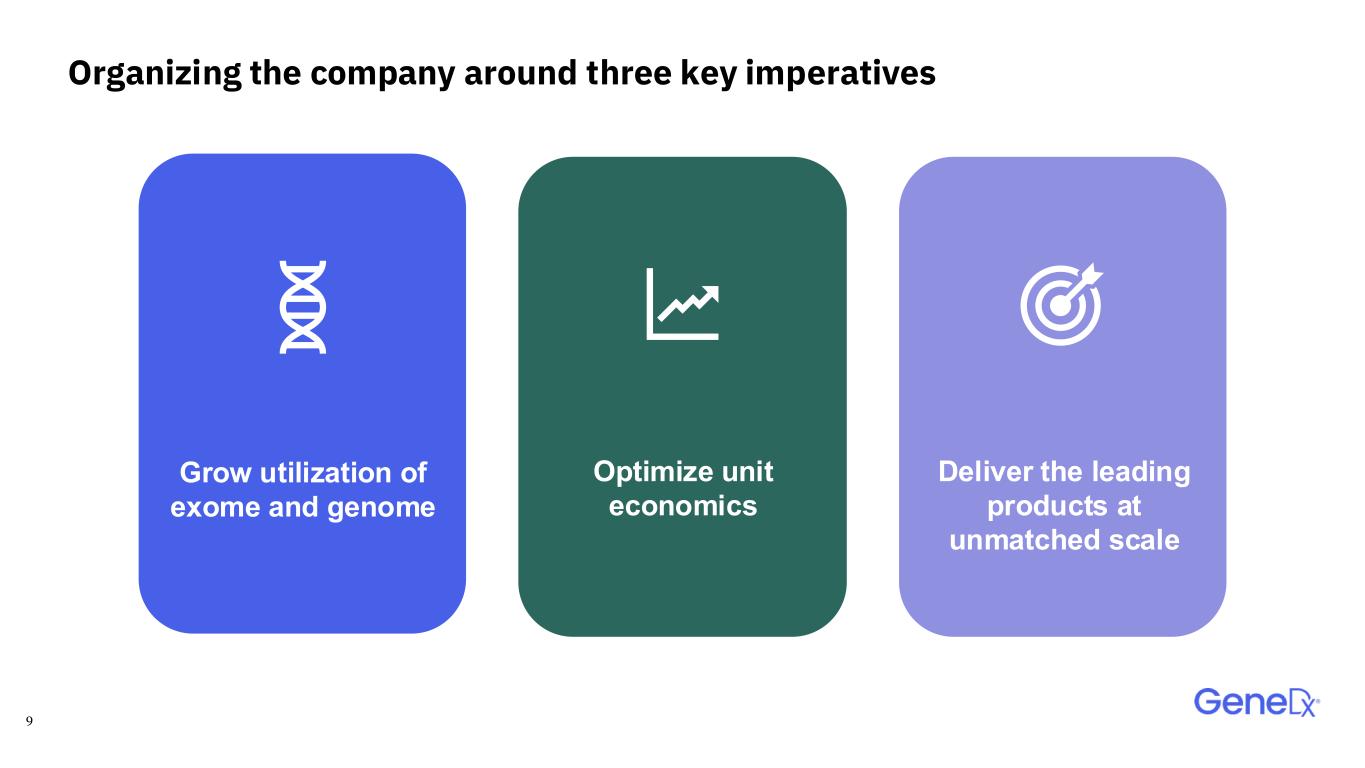
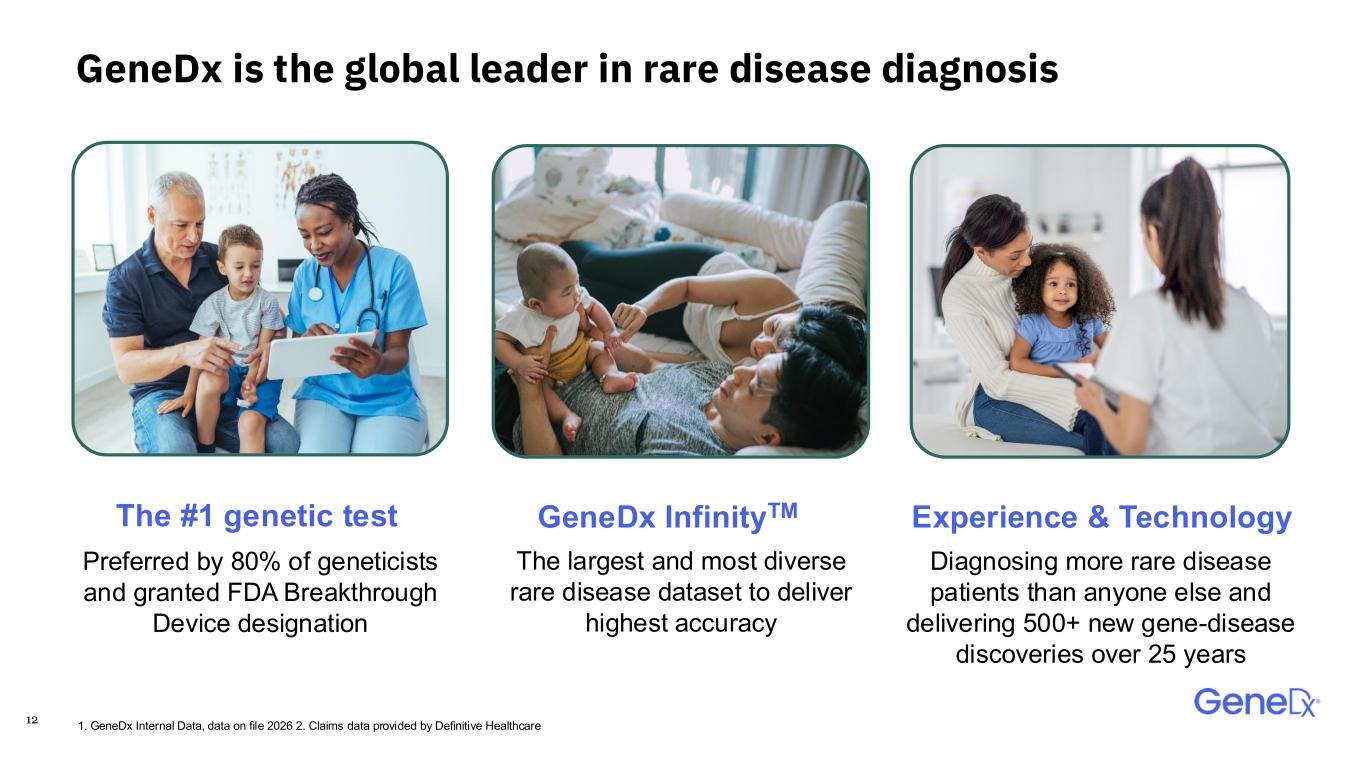
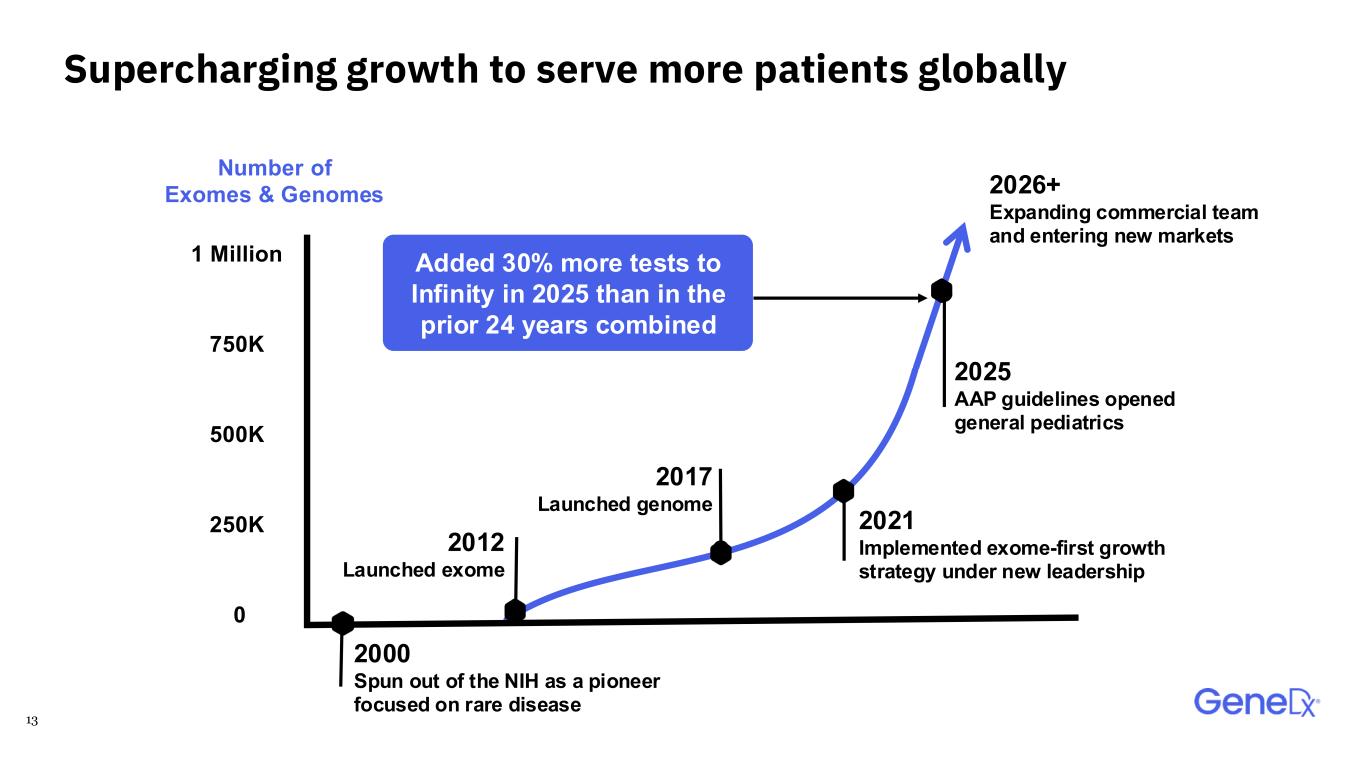
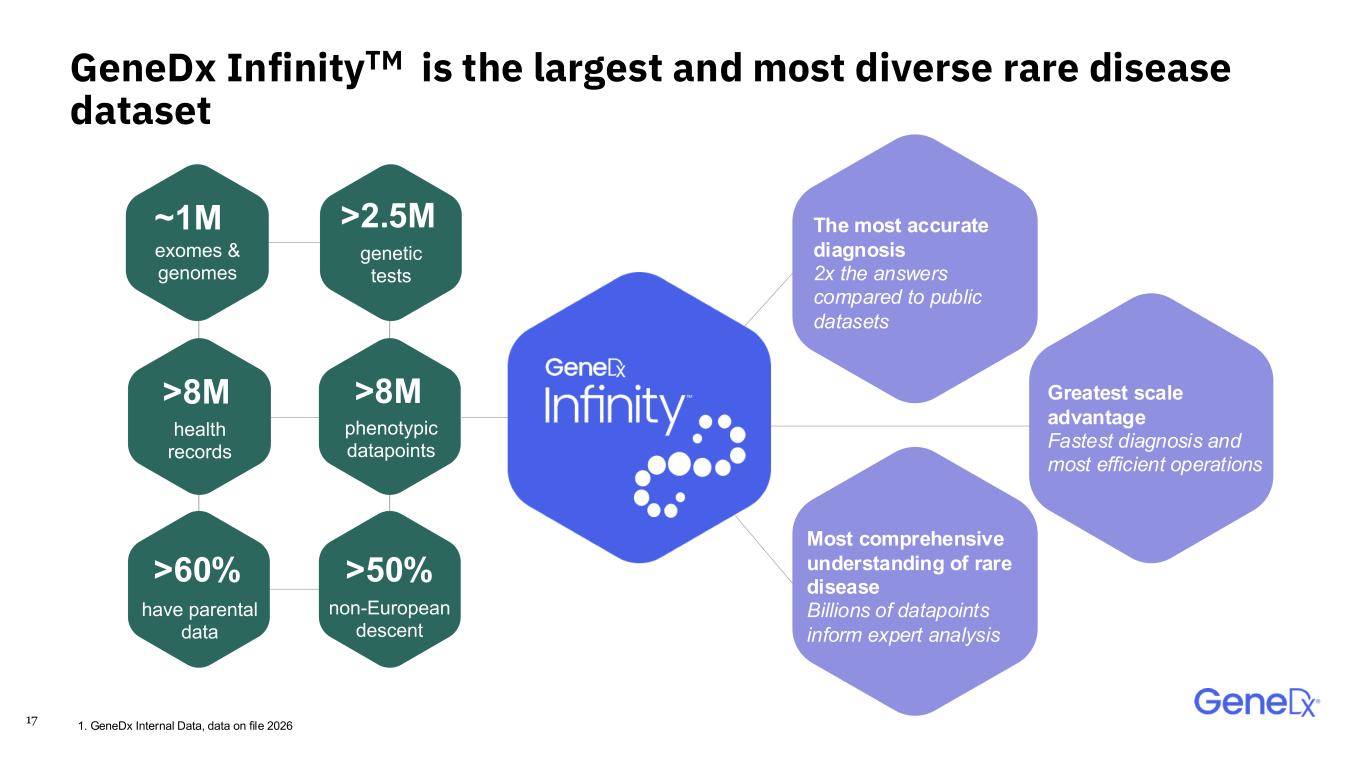
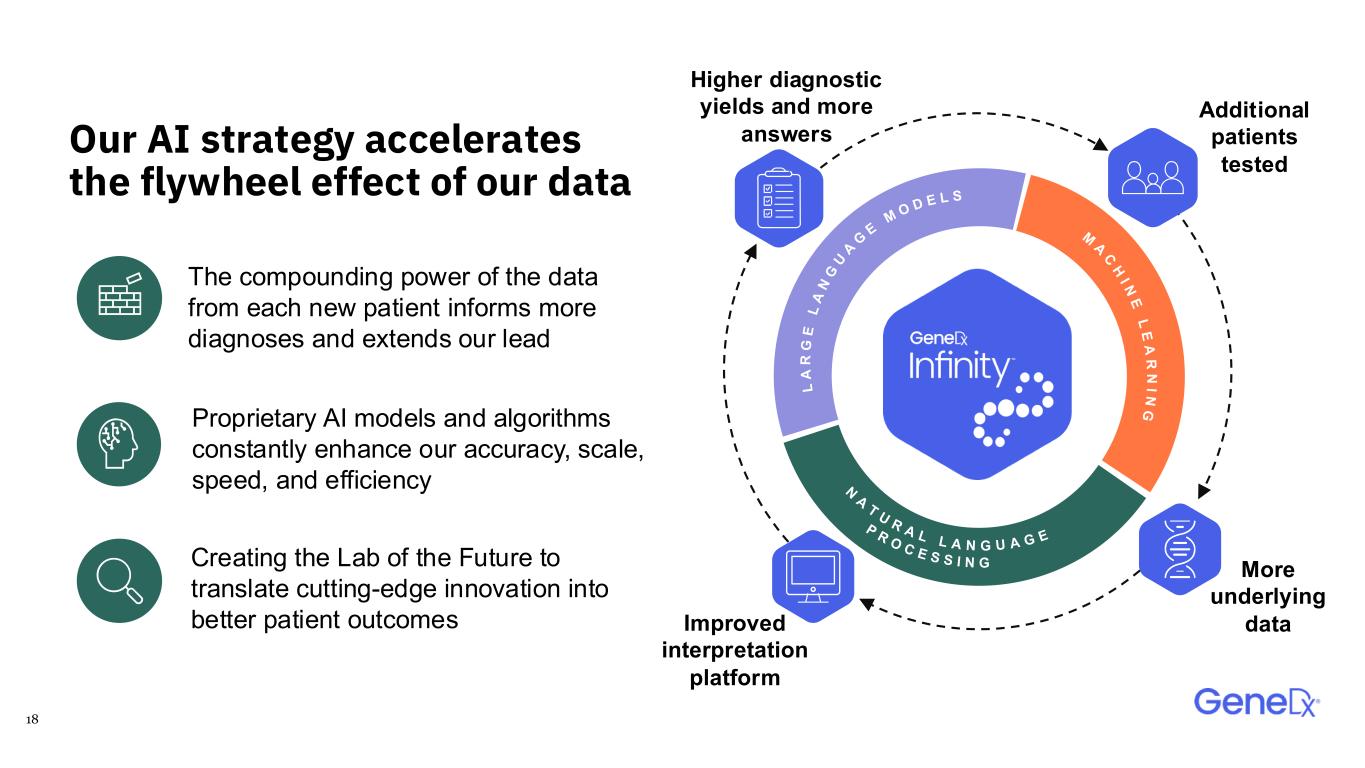
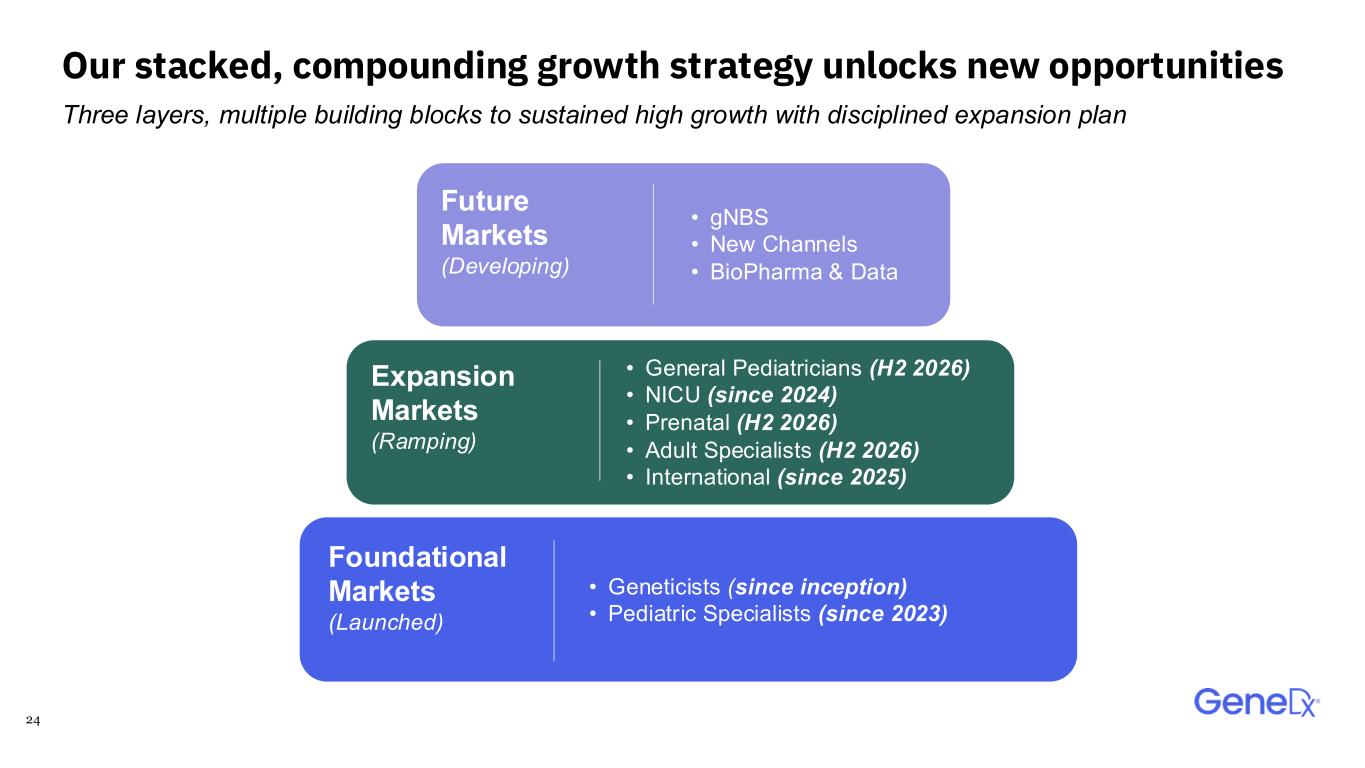
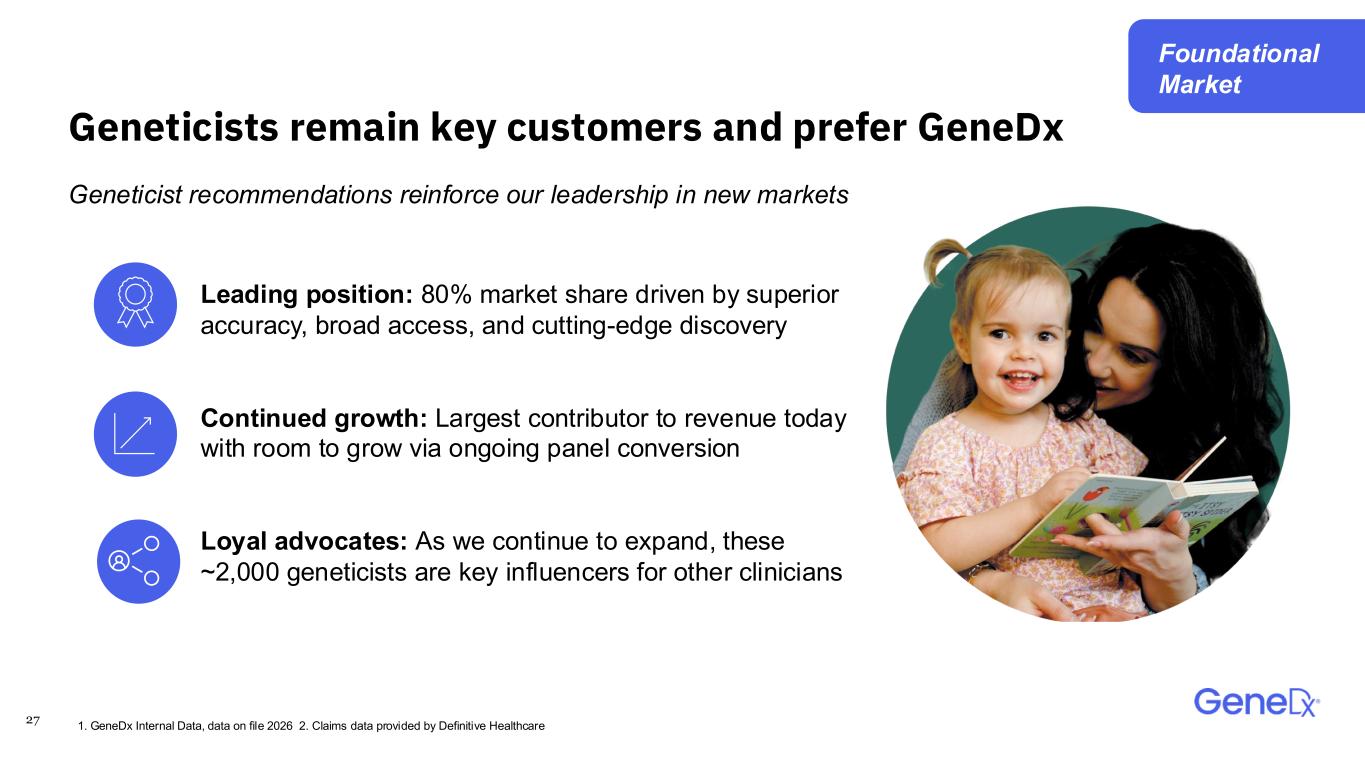
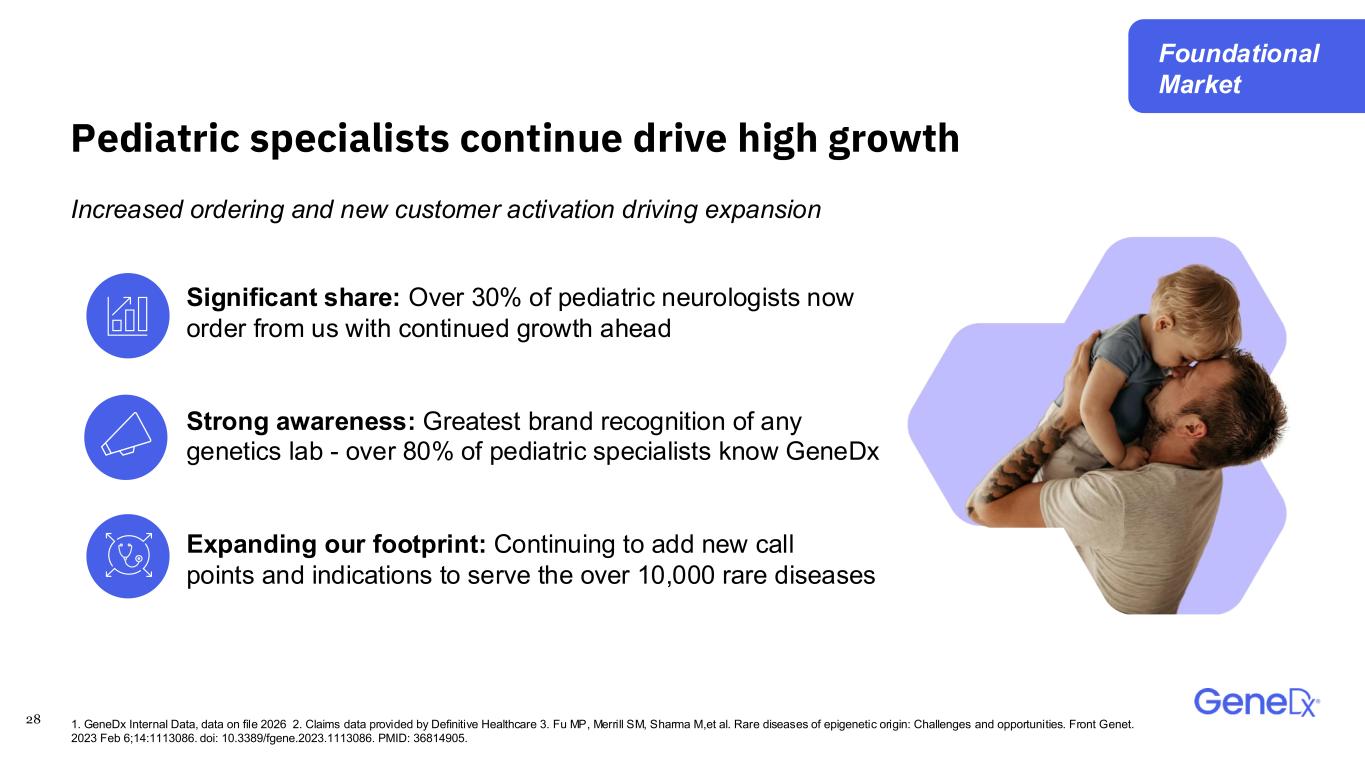
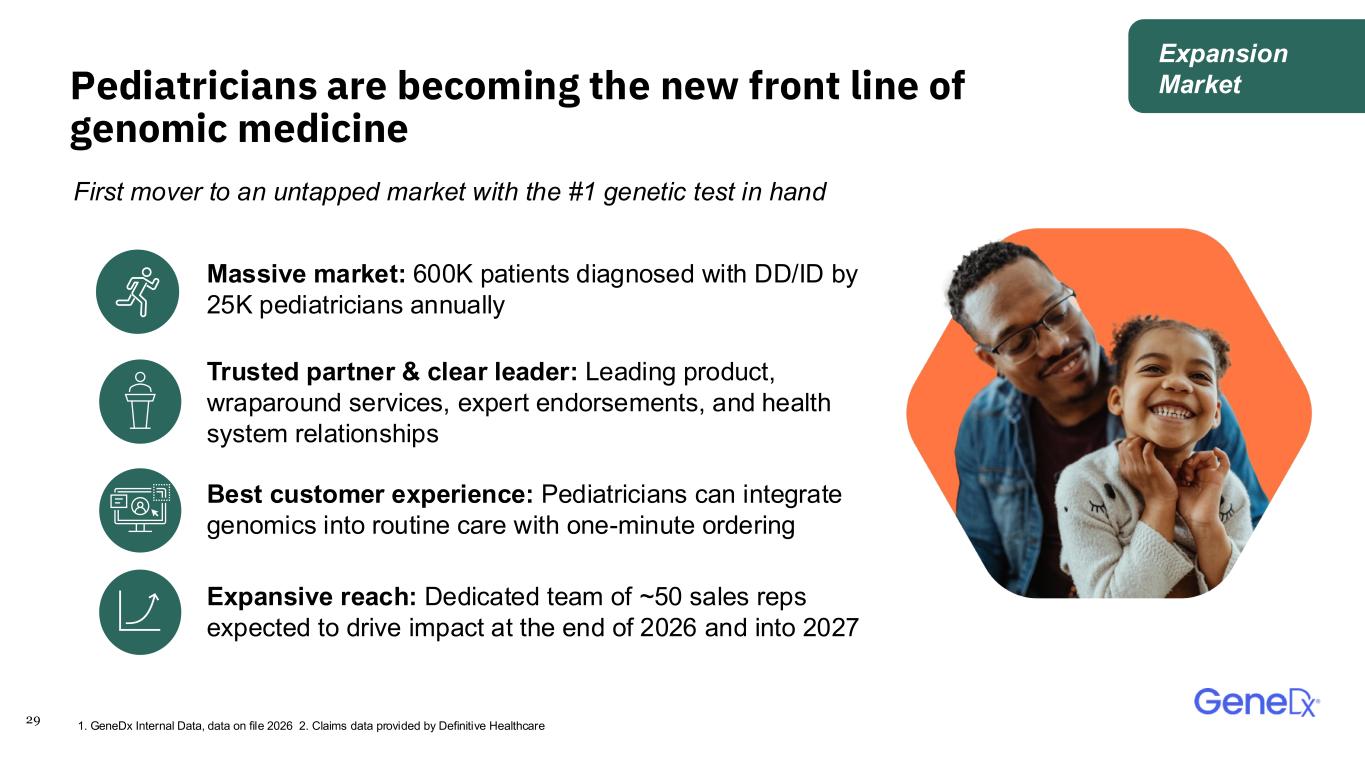
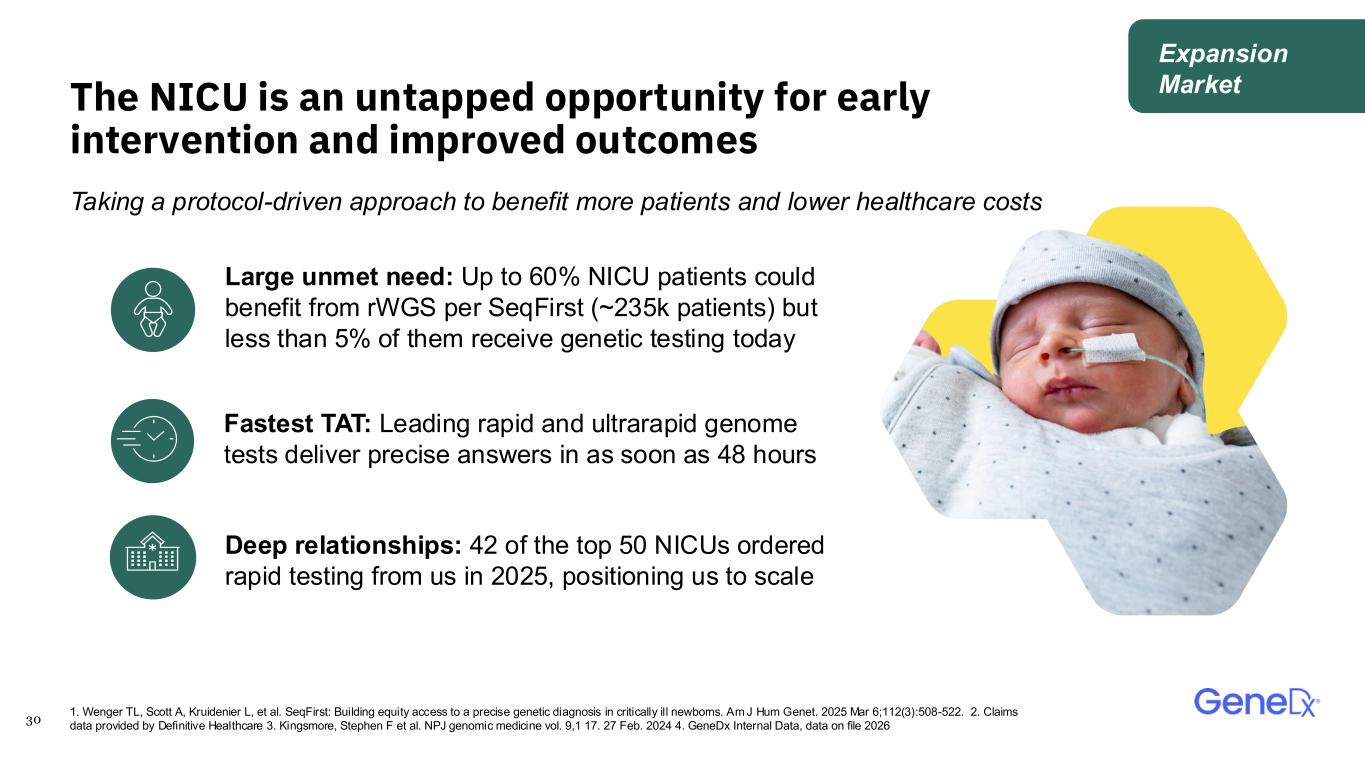
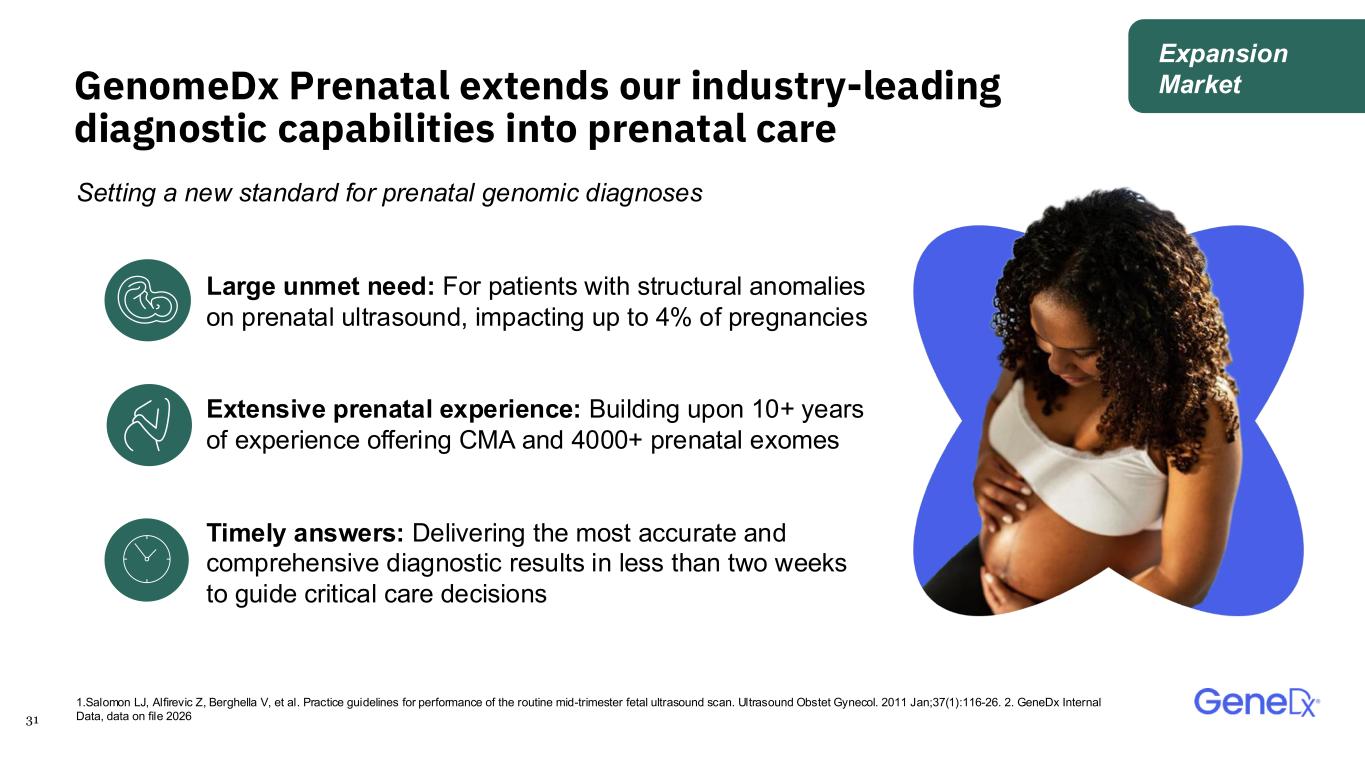
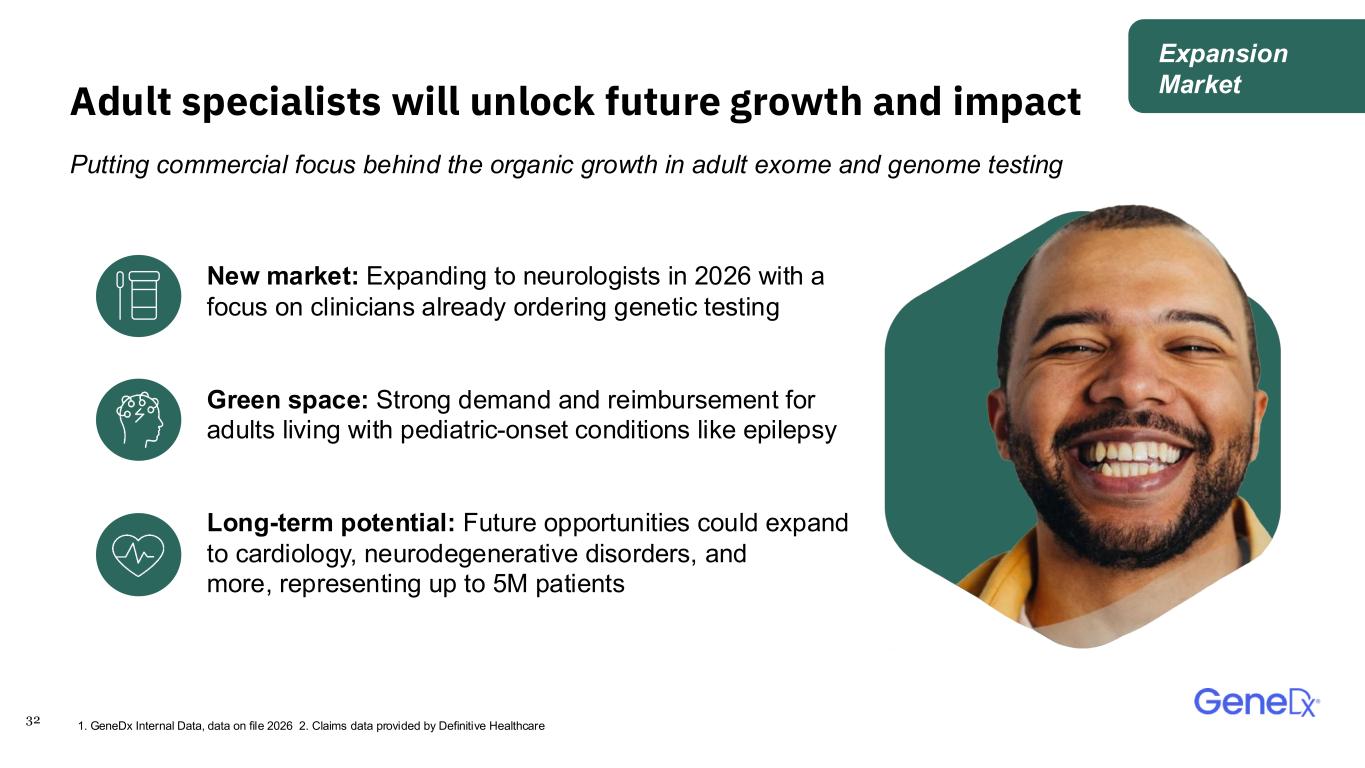
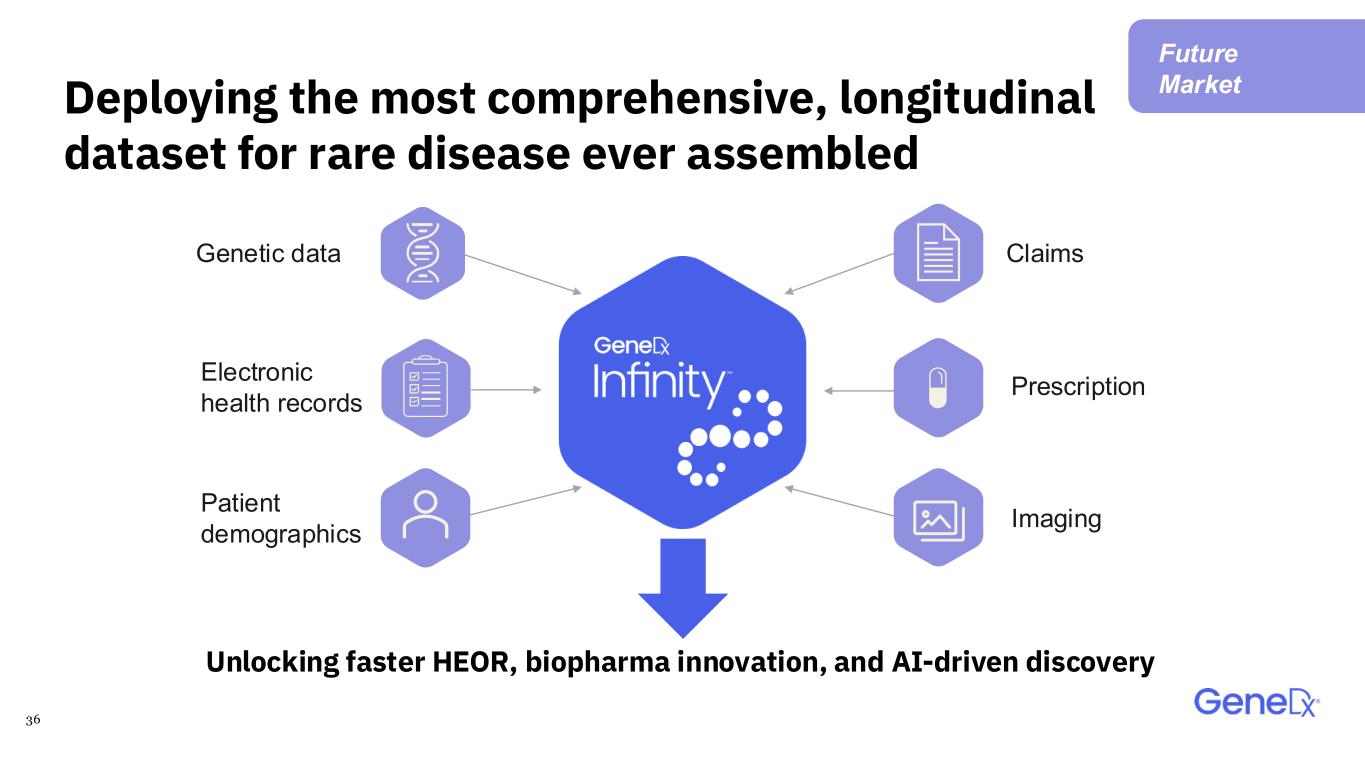
Thanks, Sabrina, and good afternoon, everyone. In the first quarter, GeneDx continued our mission of enabling everyone to live their healthiest life through genomics, leading the shift from diagnosing genetic conditions using multi-gene panels to the most comprehensive genetic test available, exome and genome. In Q1, exome and genome volume grew 34% year over year, demonstrating robust demand in our foundational markets and indicating positive early momentum in our expansion markets. Our competitive advantage continues to set us apart from others in the market. The combined strength of our large, diverse dataset, GeneDxInfinity, our team of genetics experts, and our advanced technology underpins product fundamentals that cement our leadership position, as evidenced by a loyal and growing customer base that drove the 34% volume growth in Q1. While volume growth outpaced our expectations, total revenue was $12 million lower than expected. We conducted a thorough channel-by-channel business review to diagnose what happened, and what we learned was that it was driven by two factors. First, approximately $5.5 million was due to a lower than expected blended average reimbursement rate for exome and genome. And second, approximately $6.5 million was due to softer than expected performance from our non-core business lines. As a result, we're updating our outlook for the year and now expect total revenue to be in the range of $475 to $490 million with strong continued exome and genome volume growth of at least 30% and gross margins of approximately 70%. We're also committed to returning to profitability on an adjusted basis for the full year and expect profitability to grow significantly into 2027 and beyond as we continue to lead and shape this large and ever-expanding market. Now, I want to walk you through the Q1 revenue dynamics in more detail. Starting with the blended average reimbursement rate, ARR was primarily impacted by product mix with no structural changes in pricing. Through our business review, we identified clear opportunities to improve reimbursement dynamics, spanning commercial execution and revenue cycle management, and our team has already taken action. Moving to our non-core business lines, which includes fabric and our bioforma business. It's been one year since we closed the fabric genomics acquisition, and it has become increasingly clear that the interpretation as a service product is best suited for international markets. We're fully integrating the fabric team technology and services into the GNDX brand, and we're focusing our resources to support international growth and key domestic drivers. We're lowering our expectations for revenue contribution in 2026 accordingly. On the biopharma and data business, we saw positive underlying momentum but fell short of delivering Q1 revenue due to a longer than anticipated sales cycle. As we continue to build demand for our data asset and engage with biopharma companies large and small, our conviction around this business continues to strengthen. These partnerships can offer meaningful long-term value creation for patients and for GNDX, and the value proposition will grow alongside our clinical testing business. With more than 2.5 million patients, more than a million exomes and genomes, and more than 8 million matched phenotypic profiles, our contactable database stands apart. We've right-sized revenue contributions to the 2026 guide based on high probability deals in our pipeline, positioning this business as upside as it continues to ramp. With our guidance now reflecting these shifts and with the strong performance thus far in q2 we're confident in the path forward with a massive focus on our core diagnostics business as the primary driver let's walk through each of the customer segments to give you more color starting with geneticists as we continue to lead the market transition from multi-gene panels to exo and genome geneticists are leaning into genome this is an exciting development we chose the ticker symbol wgs because we've always believed that the market would move to genome over time, but the speed of this transition in Q1 outpaced our expectations. We made the strategic decision to begin capturing the stair. Importantly, the experts are the clinicians who are interested in genomes. Most patients in the outpatient setting remain best served by exome testing, given that it covers approximately 85% of known disease-causing mutations. GDX is best positioned to lead the genome future by leveraging our scale, brand, clinician relationship, first-mover advantage, and vast data set, GeneDx Infinity. Infinity enables us to interpret both coding and non-coding regions of the genome with speed and precision. And as genome coverage matures, access improves, and volumes scale, the flywheel effect of this additional data will compound our competitive advantage across our portfolio. Informed by early data, we launched a Reflex offering in February to balance clinical demand with a relatively higher gross margin product. Customer feedback is in positive, and early adoption has reinforced that we can actively manage this market transition. Looking at pediatric specialists, we continue to deliver steady growth supported by exome utilization, high clinician retention, and robust same store sales in the quarter. However, the blended exome ARR came in lower than expected based on the mix of tests submitted with parental comparator samples, a shift that we've already mobilized to correct with customer experience features, sales messaging, and incentives. We expect a return to longstanding XM reimbursement norms in the near future. In the NICU, we're seeing good progress driven by rapid and ultra-rapid genomes. It has been just over a year since the first study data was published, demonstrating how a programmatic approach to testing can ensure that every NICU baby who needs a genome receives one. Genome ARR and gross margins are desirable in the inpatient setting, and with a robust set of institutions already ordering from us, our focus remains on increasing utilization as accounts mature. We've expanded the sales team to accelerate this ramp and plan to leverage our dominant market position to fuel continued growth. General Pediatrics is our largest long-term opportunity and our earliest stage market. We're beginning to see encouraging signals with early XM orders coming in as our sales reps get accounts up and running. It typically takes several touch points and meetings before the first order is placed, and we're seeing that progression play out. While volumes are still modest, our experience is reinforcing that education, awareness, and service are all critical in this market. Our tailored customer experience for non-expert clinicians remains on track in upcoming workflow enhancements, including streamlined registration, bundled ordering, and improved post-test guidance are all designed to reduce friction and accelerate uptake in the second half of the year. And finally, prenatal. Demand has been building steadily in this new market, and we're seeing good traction with maternal fetal medicine physicians. Importantly, genome adoption appears additive to our small but existing exome volume in this channel. Stepping back, our core testing business is well-positioned to translate demand momentum into profitable growth. We have line of sight to at least 30% volume growth and approximately 70% gross margins on the exome and genome portfolio, and we're committed to a return to profitability on the balance of the year. We've taken the decisive step of cutting $25 million of OpEx for the year, and we're putting our capital and team to work on the three biggest levers for the business. Number one, growing utilization of exome and genome. Number two, optimizing unit economics through both ARR and COGS. And number three, delivering the leading products to unmatched scale. Aligned around these three goals, we're moving forward with more clarity and operating rigor than ever before. With that, I'll pass it over to Kevin.
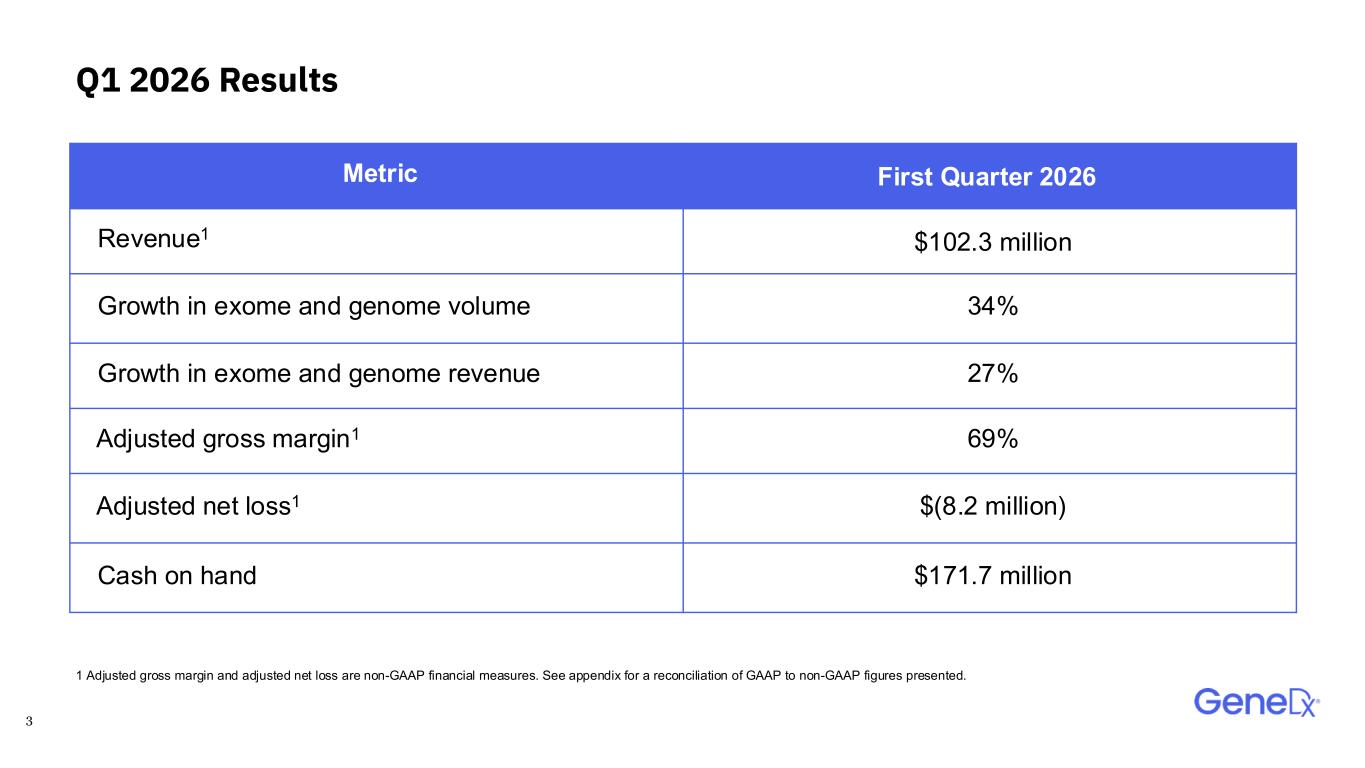
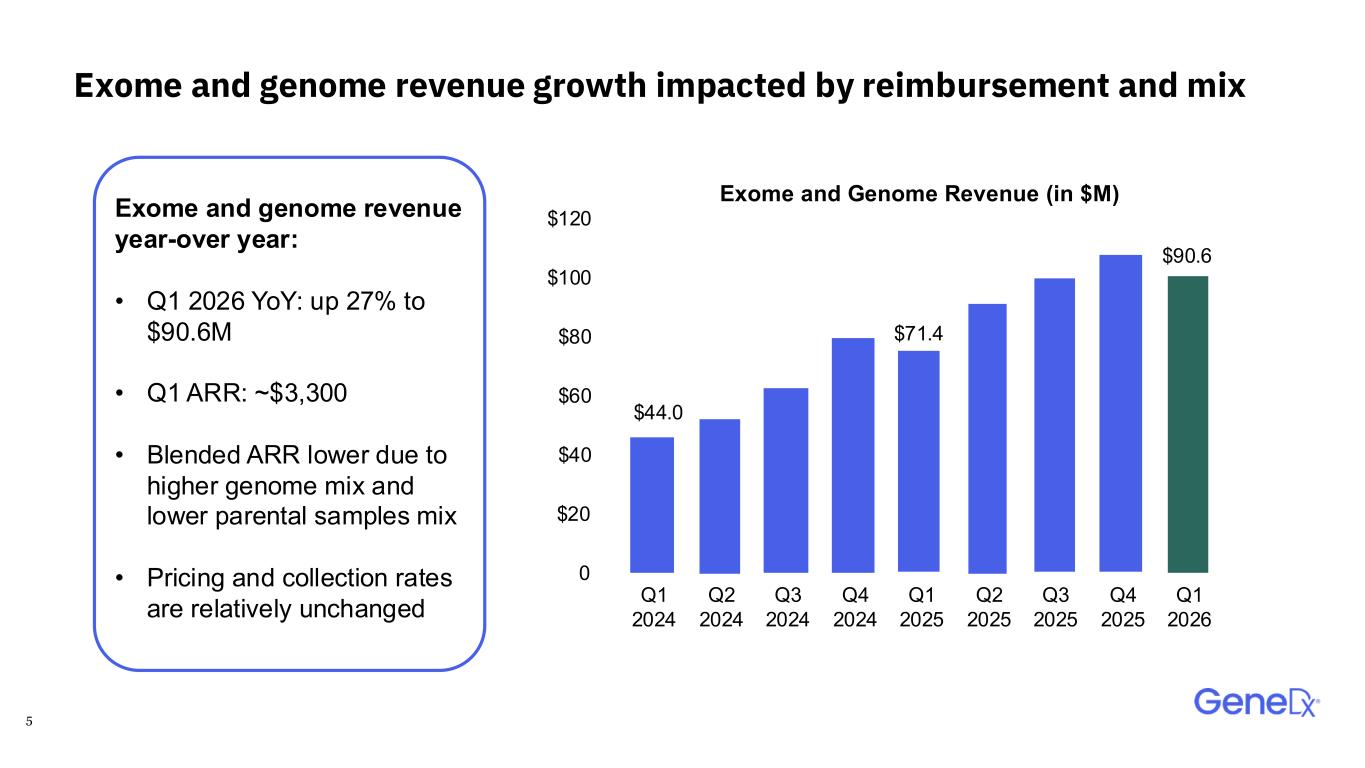
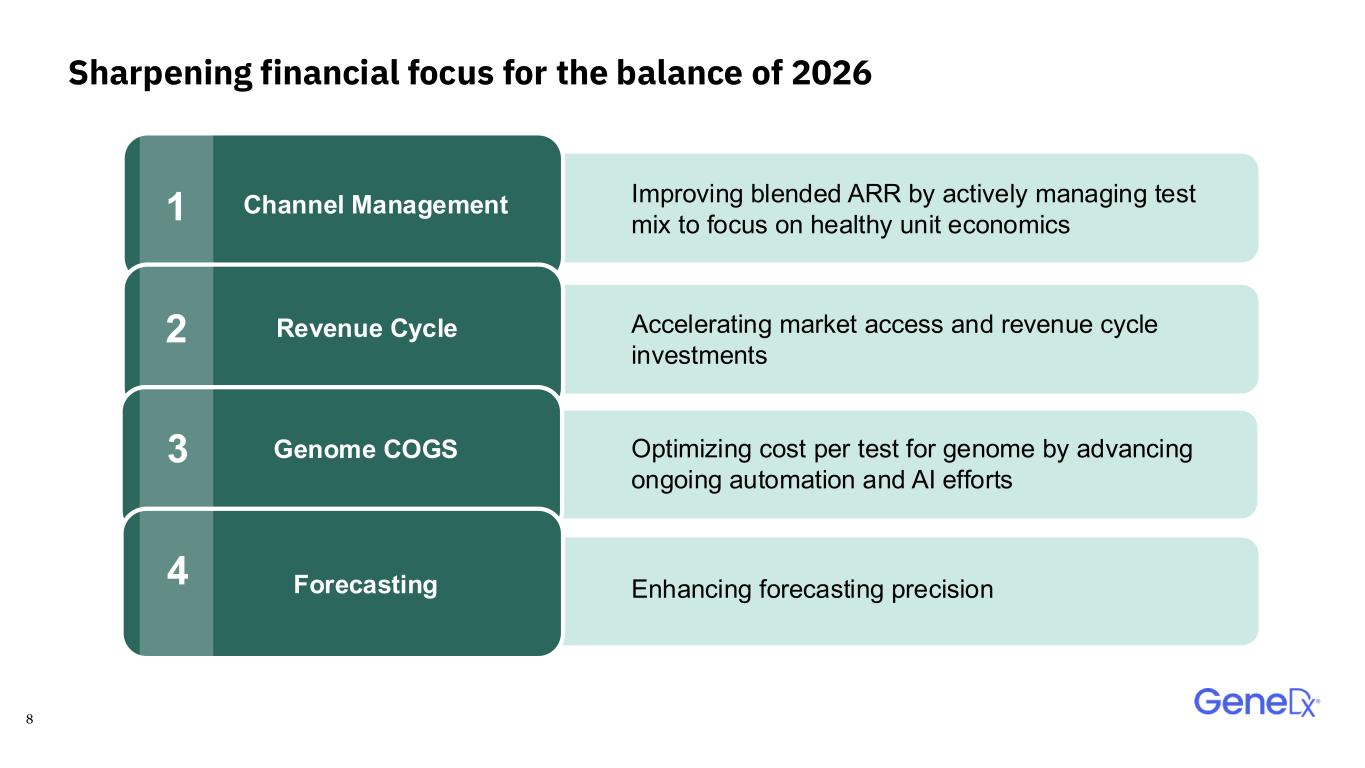
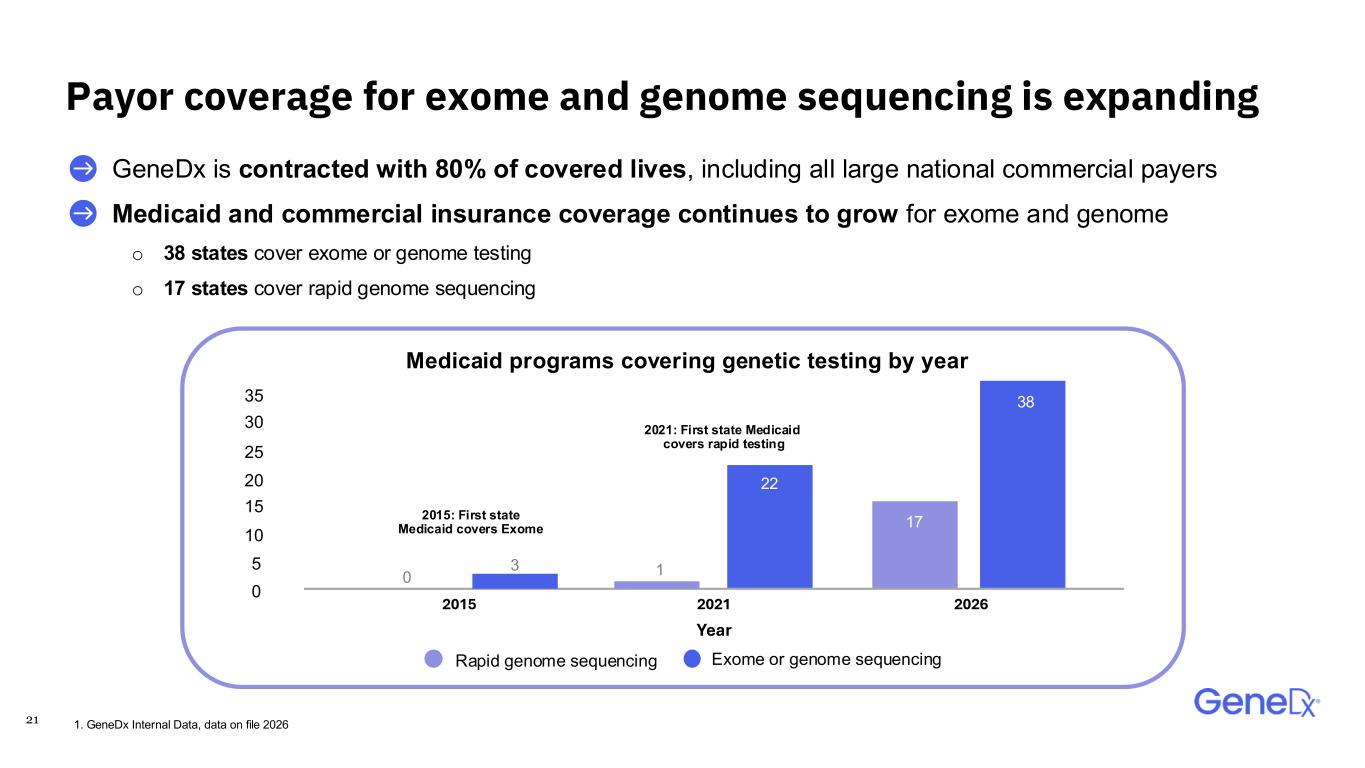
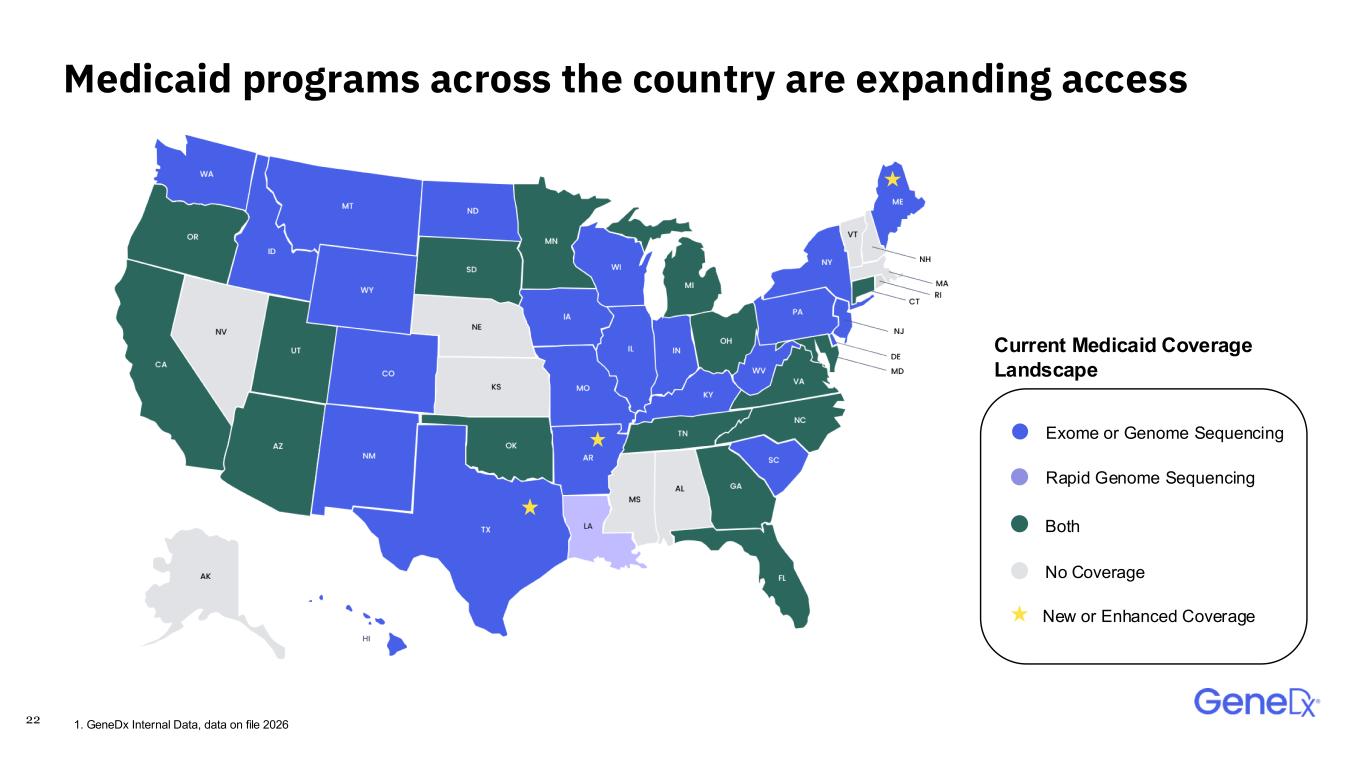
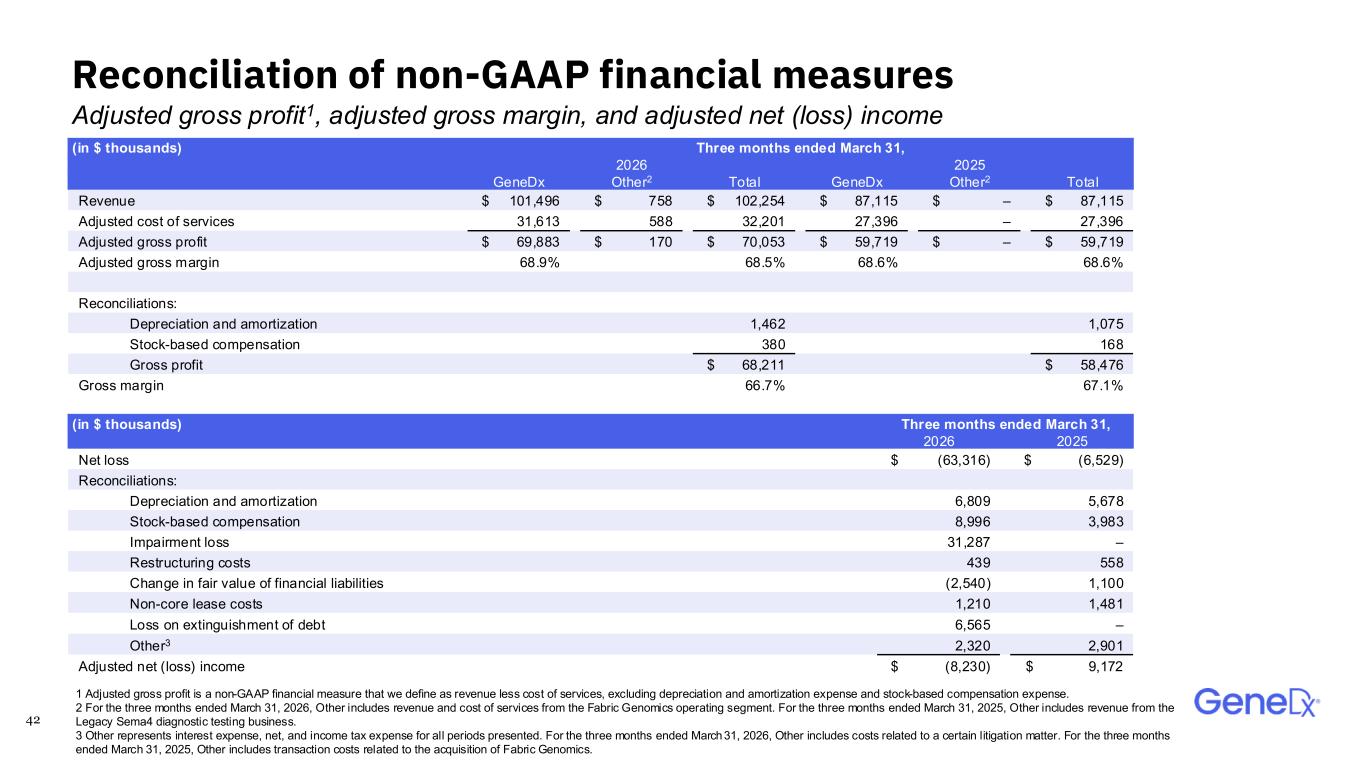
Thanks, Catherine. In the first quarter, we delivered $102.3 million of total revenue, including $90.6 million of exome and genome revenue, up 27%, and test result volume of 27,488 tests, up 34%. The blended average reimbursement rate was approximately $3,300. Adjusted gross margin was 69%, and we reported an adjusted net loss of $8.2 million. As Catherine outlined, two factors drove the quarter. mixed dynamics resulting in a lower than expected blended average reimbursement rate and softer non-core business line performance. First, the blended ARR came in approximately $200 below expectations. I want to be very clear. On a like-for-like basis, ARR byproduct is relatively unchanged. There have been no meaningful contracted price changes nor any material variations in coverage or collection rates across each respective channel. Instead, the lower ARR is primary result of product mix shifts within the exome and genome portfolio. The impact of mix is important, so let me walk you through it. Starting with payers, roughly 85 percent of volume is insurance-based outpatient services, and 15 percent is institutional pay. Specific to outpatient, genome was approximately 40 percent of volume in the first quarter, which is roughly double from a year ago. We expect that mix shift to continue, but at a far more moderate pace as we manage the transition. Both exome and genome are good for patients and our business, but in terms of ARR, an outpatient exome is closer to a blended average of $4,000 per test after all denials, and we're reimbursed more for cases with parental comparators than cases without them. In contrast, an outpatient genome blended ARR today is about half that of exome due to the relative maturity of payer coverage. Each have a very wide array of medical necessity criteria across payers. Policies are not all created equal, and policy coverage does not always equal broad access nor guarantee payment. Over time, a strengthening coverage landscape will help close the gap between products, while continued investment in automation and AI creates meaningful opportunity to improve collection rates across both as we scale. Our team continues to make the case for expanded coverage with payers, leveraging clinical and health economic evidence like the recent SAVEs Kids study to open access for both exome and genome testing, which found that the GeneDx exome and genome leads to cost savings of up to $80,000 in the first year after testing for children with neurodevelopmental disorders. That tells us testing should be covered much more broadly than it is today to deliver cost efficiencies to the U.S. healthcare system. We're in the early days of making the case. And across state Medicaid programs, there are now 38 states covering either test. Go back just a few years, there were none. Additions have been coming almost quarterly, and it would be reasonable to expect momentum to continue, but it will take time. In the meantime, we'll continue to accept samples in states without coverage which is an intentional margin investment in market share and the evidence necessary to influence policy makers as more states adopt coverage what are zeros today in our blended arr will become something more our strategy remains intentionally driving each market first from lower margin panels to exome and eventually towards genome for all while genome reimbursement is currently constrained by coverage we expect rates to strengthen over time as clinician demand grows, clinical and economic evidence builds, advocacy efforts advance, and the need for biopharma to identify patient drives payer modernization. Genome COGS are also higher than exomes, specifically due to higher reagent input costs. Unprecedented, we can assume the cost curve here will continue to come down as utilization and scale grow. Not to be overlooked, approximately half of all tests we've resulted in the first quarter were single gene, multi-gene panels. Conversion has always been a cornerstone of our strategy. It remains both a big growth opportunity ahead and evidence that our market-leading exome will be durable for years to come. We've also taken steps to more actively manage the longer-term transition to genome, in particular with our Reflex product, enabling more patient access to this innovative testing while maintaining higher unit economics. Parental sample mix also impacted the blended ARR this quarter moving 200 basis points across the combined portfolio we view this as a function of an opportunity for stronger field force training and execution as well as new clinician education rather than any structural shift and we're addressing it directly moving forward we expect the blended ARR to stabilize and improve modestly over the balance of the year to reiterate there have been no changes to pricing and a balanced pair coverage policy has and is expected to continue to expand over the coming years. The lower realized rate in the first quarter was driven by product mix shifts within the portfolio, many of which are transitory and should have been better anticipated. We've invested significantly over the past several weeks to enhance forecasting precision, including bringing an expert external perspective to rigorously stress test our updated market assumptions and bottoms-up plan. This work reinforced our conviction in the long-term opportunity, while sharpening our near-term expectations. With that added rigor and better visibility into each channel, the business is more predictable today than it was at the start of the year. Moving to non-core business lines, where revenue fell $6.5 million short. In fabric, the $2.5 million miss reflected legacy positioning and its go-to-market approach. The gap financials include a non-cash impairment charge of approximately $31.3 million to write down goodwill and certain intangible assets. In biopharma and data, a $2 million miss was timing-related, reflecting longer sales cycles. We're treating this business as line-of-sight for the purposes of guidance rather than relying on it. In multi-gene panels, a $2 million miss was caused by overestimating the timing of organic CMA uptake in the pediatric market prior to our sales force efforts ramping. This reflects a forecasting correction and should not be read as a demand signal. So we're taking four actions to get the year back on track. First, improving blended ARR through tighter channel management. Second, accelerating market access and revenue cycle investments. Third, optimizing cost per test per genome as we scale. And fourth, enhancing forecasting precision. Finally, we've already reduced and reallocated approximately $25 million in planned spend to align investments with current performance and remain committed to full year 2026 adjusted profitability. This is not a cut out of our current run rate spend, but rather a reduction in future plan increases to match our updated revenue timing. The reductions are primarily a recalibration of our hiring and marketing timing, essentially slowing out your non-direct expenses while protecting investments in our proven channels and more line-of-sight expansion markets. Now on to guidance. We're reducing full-year revenue guidance by 12%. We're $65 million at the midpoint. The bridge on that is $36 million from the effects of blended ARR, $11 million from lower volume contribution across new expansion markets, and $18 million from non-core business lines split evenly between fabric, biopharma, and other testing. With that, we expect full year 2026 total revenues of $475 to $490 million, exome and genome volume growth of at least 30%, translating to approximately 126,400 tests, exome and genome revenue growth of at least 20%, adjusted gross margin of approximately 70%, and profitability on an adjusted basis. In the second quarter of 2026, we expect total revenues of $110 to $112 million, exome and genome volume of approximately 30,000 tests, exome and genome revenue of approximately $100 million, adjusted gross margin of approximately 70%, and an adjusted net loss of approximately $5 million in the second quarter as we move back to profitable in the third quarter. This is a framework we can execute with confidence. Catherine, back to you.
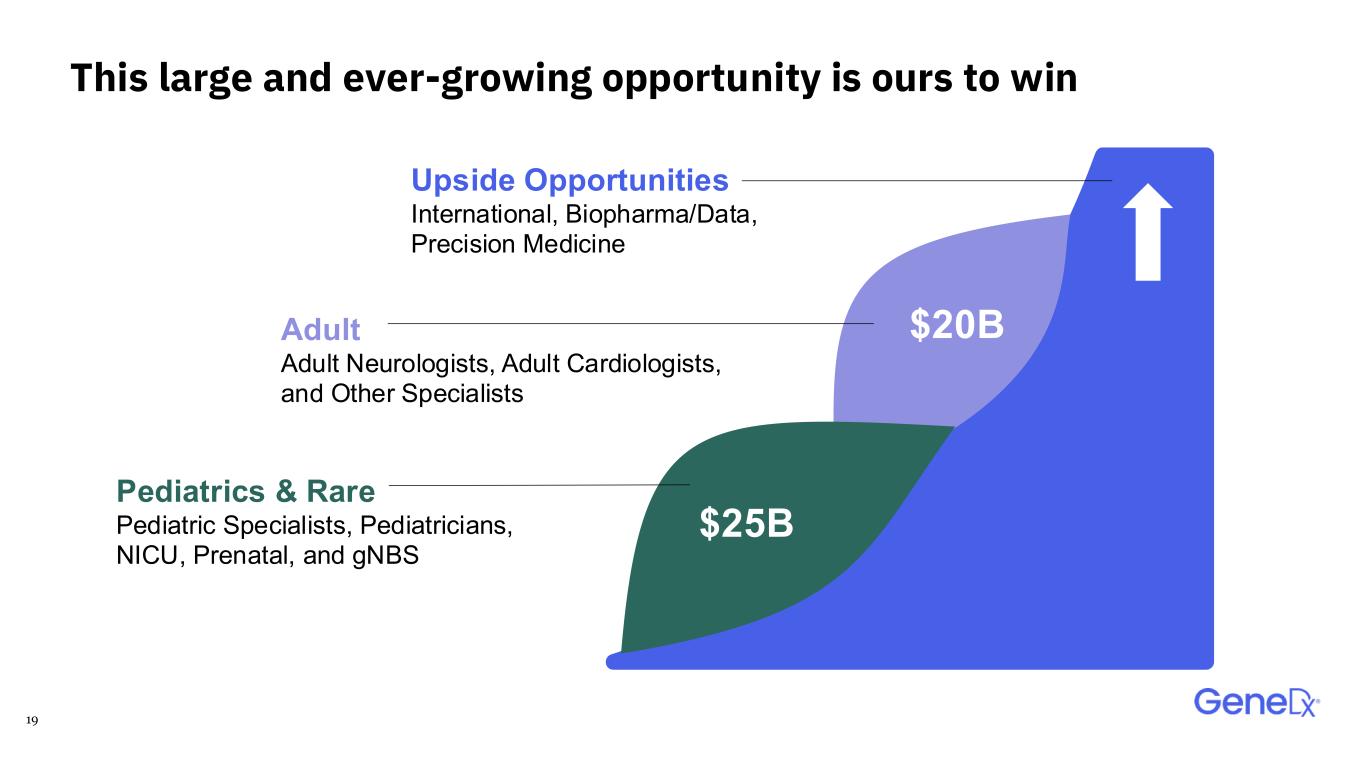
Thank you, Kevin. Just 20 years ago, it cost millions of dollars and multiple weeks to sequence and interpret a genome. Today, GNDX has scaled the promise of this technology like no one else in our space with turnarounds in as little as 48 hours, and we continue to innovate. Over 300 million people are living with a rare disease globally, and we've never been more confident about our ability to drive possible growth and service of these patients and shareholders. I recognize that resetting expectations is difficult, but it also gives us all great clarity and conviction in our ability to deliver on our commitment. We're grateful to our shareholders for the support and patience as we continue to deliver on a bold mission. Leading a generational shift in medicine is no small undertaking. It requires taking some big swings, learning quickly, and moving forward with urgency to satisfy the growing number of patients who need our services. You have my assurance that we've recalibrated our assumptions, taken decisive action, and positioned the company for long-term sustainable and profitable growth. Thank you. And we'll now open the call up for Q&A.
Thank you. Ladies and gentlemen, if you have a question or comment at this time, please press star one one on your telephone keypad. If your question has been answered or you wish to remove yourself from the queue, simply press star one one again. In an effort to facilitate as many participants as possible, we ask that you please limit yourself to two questions. If you have additional questions, you may re-enter the queue again by pressing star one one. Again, please limit yourself to two questions. Please stand by while we compile the Q&A roster. Our first question or comment comes from the line of Mark Massaro from BTIG. Your line is open.
Thank you. There's a lot to digest here. I guess the first question I want to ask is on the Q2 guidance, because clearly when I look at it, it doesn't look like that's fully de-risked either. Can you give me a sense for why you're guiding to $30,000 in Q2, and can you just give us a sense for what type of traction you're picking up in the NICU? Because I know that that is an area where I think you have noted that you missed in 2025, and I just wanted to get a sense for how you're doing here in 2026.
Yeah, I'll start. So first of all, what we're seeing in the business today is strong momentum. So I think as we arrive at a Q2 guide, it's coming from a knowing place reflective of the momentum that we're seeing in terms of volumes coming in for the quarter and overall just the business behaving in line with the way that we want it to. So, I would say we're operating from a place of strength and clarity for that Q2 side. On NICU, you know, I think we have continued to see with our expanded sales force, really good continued traction there. So, we had a lot of ambition last year, and I would say we right-sized that in the guide. So, we're feeling really good about line of sight in terms of momentum in the NICU.
Okay. Can you give us a sense for if any part of your guidance has been a function of the end markets being, in any of the sub markets, being a little different than you had expected? But I also wanted to ask about competitive dynamics. Are you seeing any changes in the field? Because, you know, you did a good job, I think, of volumes in Q1, but sort of lowering your volume uptake. I'm wondering to what extent of that might have an impact from competition.
Sure. Well, first, as we look at the channels that we're in, this is the first time that we have four sales teams going after different clinicians, and there's a different product for each of those clinicians. So we are learning a lot. I think reassuringly, we learned we're in the right channel. So we have a good business model. we're in the right channels. As we really dug into our business review, we're not pivoting out of any of those channels because we've got the right overall strategy. The tweaks that we need to make, we talked a bit about the genome dynamic for the expert geneticists. We talked about the pediatric neurologists and how do we get them ordering more parental comparators. So that's an area that we've already actioned through sales messaging, through incentives. And so we have great confidence that that's something within our control. And similar goes for the general pediatric segment. We're pleased to be in that channel. We're learning that it takes multiple touch points and meetings to get an account activated and just start seeing orders come through, but we are seeing early signs of XM. So, I would say there's more reassuring here in terms of we're in the right market with the right product. We're tweaking our sales strategy and our commercial strategy to make sure we're really optimizing the way that we're showing up in those markets. And so, I believe that we have in hand the right course correction to make sure that we can realize the guide and continue to, from my perspective, just execute on a really clear and not just achievable plan, but we want to make sure that we go out there and crush it as the leader.
Okay. I'll hop back in the queue.
Thank you. Our next question or comment comes from the line of David Westenberger from Piper Sandler. Your line is now open.
Hi, thank you for taking my question. So I just wanted to talk about some of the commercial footprint here and maybe kind of some of the potential productivity per rep that we would expect to see in the back half of the year. So can you just talk about adding on those additional reps, seeing those, how we should think about productivity, and then I just kind of want to think about you did add, you're doubling, tripling the sales force. Was there any, you know, issues with looking at some of the other parts of the business, like small panels or fabric or anything like that that could have been impacted?
So as we look at the sales force, a couple of things. There's four sales teams. So we have 75 people selling to specialists, about 25 of them new and added. And so we're just starting to see them move out of their early stage and starting to get into greater productivity. Gen P, 50 reps, they're still in their early days. And, you know, frankly, that's a new channel where we don't have a sense yet exactly what full productivity is going to look like. Is it going to mirror what we see in the specialist sector or is it going to be a little bit different? We're seeing that it takes several meetings to get accounts activated. So, you know, I would say more to come as we spend more time in the field with new reps there, 10 reps in the NICU and 10 reps in the prenatal space, and they're all still in the early days. So I would say as we look at one of the important factors that we're going to keep an eye on is Salesforce productivity and how that's changing week to week, month to month, quarter to quarter. But we're in the early stages with a lot of these reps. And, again, I think that should give us a lot of confidence in terms of our ability to continue to generate more volume and more good, healthy volume across these different sales channels.
Got it. Thank you. Oh, sorry.
I didn't say that. That was the grounding philosophy of the guide, which is to build it from the core business with tighter assumptions and less reliance on areas where visibility is limited, including what those new reps in new channels might translate to in the back half of the year. So it's a more disciplined framework than one where we started the year. And at this point, it comes down to execution and we'll learn and iterate as we move forward.
Got it. And I'll just ask one follow-up on the genome mix. I really appreciate the color around, you know, 40% and the SP being around $200, I mean, $2,000. Can you talk about, is there any possibility of seeing a big coverage decision in that area? Is there blocking and tackling that you can do in the near term to get that ASP up? I mean, as we're looking out a couple of years from now, can that ASP become around the same ASP as the Exome? Thank you very much, and that will be my last question.
Yeah, we think it can get towards parity with Exome. There's a number of factors there, including improving commercial coverage, which today is far more expansive for exome than genome. And there's also, as you alluded to, a lot of blocking and tackling with respect to ensuring that as we submit claims, it's adhering to what is a wide array of medical necessity and documentation requirements. And so how do we use better process technology automation in order to tighten up the revenue cycle, in order to reduce denials, improve collection rates, all while expanding policy coverage for genome?
We've run this playbook before.
We just happen to be years behind Exome in driving commercial payers and Medicaid towards improving coverage similar to Exome. We've seen it be done. We're confident we can get it done, but there's a lot of work to do in that regard to march genome ARR up towards parity with Exome. It's going to take a number of quarters here, and we expect that we built that level of expectation into the blended ARR in that guide.
And I would just add, you know, control what you can control, and the COG side of the house is an area where we think with AI and automation that gives us a really important ability to continue to reduce our cost of goods on the genome product. So, that's without a doubt going to be a huge factor for us internally because we've done that masterfully on the exome side of things, and we'll rinse and repeat that on the genome side.
Thank you. Our next question or comment comes from the line of Dan Brennan from TD Cowan. Mr. Brennan, your line is open.
Great. Thank you. Thanks for the questions. Maybe just the first one on the $11 million cut on the growth expansion markets and the cut to volumes on exome genome to 30%. Just walk through the thinking there. Is that just delisking? You guys seeing something versus your original expectations?
Yeah, Dan. Look, we've gone through an extensive exercise through the core business, really channel by channel, bottoms up by assumptions, and tighten a number of product mix assumptions, not just exome versus genome, but how much to expect with respect to parent comparators. We've recently introduced a reflex product, which will play an important part in just one-channel geneticists. And so the outlook representative of a lot of work to tear down and rebuild assumptions really at a more granular level by channel. And in doing so, the overarching philosophy was to rely on things that are far more line of sight rather than have to pull out any heroics and improving any of those metrics or over reliance in the expansion markets. and so for those new markets, namely prenatal and general pediatricians, I've taken those down some and the balance coming from the core foundational markets, but really to ensure that we get back to an old habit of setting expectations here that we can deliver upon.
Got it. Okay, thank you for that. And then maybe just one more back to price. I know it's come up a few times. Just, Catherine, you led off talking about the benefits of whole genome. That was the ticker symbol. So as this transition occurs, is the goal just to get the genome price back to parity with the exome to taking like a fully reimbursed exome and now you're swapping in this lower price genome trying to get back up there? Is that the idea or is there a future benefit long term for the genome? Just trying to understand that. And then, Kevin, if there's any way you can give us any color as we think about the back half of the year pricing, like kind of what's baked in, you know, I think we can solve for Q2, but in the back half? And, you know, any high-level math on this genome-exome split that we can think about? Thank you.
So I'll kick it off, Dan. You know, as we can, we have good gross margins on the genome product, and the transition and the demand for genome is a really, really good thing. So we're excited about this, and we're excited about the opportunity to continue to improve the unit economics on the genome product. And we've introduced this reflex test that enables us to satisfy the need of a geneticist for more content while also having the benefit of better unit economics for us. And on top of that, the whole genome opportunity continues to help us generate more and more data, which, of course, continues to build our competitive moat, which, by the way, is proving to indeed be effective out there, which is fantastic to see. And I think the demand is part of the way that we're measuring our effectiveness in terms of the competitive lead. So, we do want to see a future where we're running genomes for everyone. But the reality is for a lot of clinicians, like general pediatricians and many p-neurose, an exome is going to do the job because it's going to satisfy information for 85% of the diseases that we can diagnose off of a genome. So I would say it's a yes and. We want to continue to usher in this era that we've been thinking about for a long time. And we have to continue to improve the unit economics. And we have a portfolio of products that help ensure that we can provide the right clinical information and insight for the right patient and the right customer channel at the right time.
Thank you. Our next question or comment comes from the line of Bill Bonello from Craig Hallam. Mr. Bonello, your line is now open.
Thanks a lot. So, I just want to push a little bit more on some of these pricing or ASP dynamics. So, on the geneticist side, I'm assuming, but I want to confirm that the geneticists were just, you know, obviously ordering a straight-up genome, not the reflex product. I think maybe you just introduced that, and then maybe understand what happens. So, going forward, are you going to offer just standalone genome or do you have to order the reflex? And then if the reflex is ordered, can you bill for an exome with payers where you're not reimbursed for a genome? That would be helpful to know. And then maybe just explain a little bit more about this shift in the parental mix and why you would be seeing, you know, suddenly fewer trios and how that's happening.
Let me start with that one, Phil, and thank you. On the parental comparator side of things, which is mainly in the pediatric neurology space, the good news is it's not a structural problem. It's an execution problem. And we've already implemented the changes in the sales force and in our messaging and incentives to address it. And so, we've got that on track. So, I would say that was purely an execution. When you're going from one sales force to four sales forces, you're going to get some things right and you're going to get some things wrong. And this was one that we got wrong and we were thrilled to diagnose that and figure out that there was course correction immediately to be implemented. On what we're selling to geneticists, if a geneticist wants a genome, we're selling them a genome. like full stop. So, that is, that's the way that we are operating. Now, we're also offering them the additional reflex product. Because our turnaround times are so fast on an exome and a genome, we can actually turn around both tests quickly. But it's essentially to the super savvy geneticist who knows for most patients an exome is going to do it. And if they want to reflex to a genome than they can.
Yeah, think of the reflex as a tool to manage the transition in the geneticist's office only. And look, from a margin perspective, don't get confused. Genome is still a good margin test for a business, and it's a great test for patients. Exome has a higher gross margin than genome, and the reflex product slots in between in terms of its gross margin profile.
Sure. Okay. But if I understand your answer right, basically, we're going to, while there's less coverage for genome than there is for exome, you're going to just have to live through a phase as the market continues to shift to genome where you're just getting more zero pays. Is that basically what I'm hearing?
Maybe you've misspoke. So there is more coverage for exome today than genome. That's what I was saying. Yeah, it has a higher average reimbursement rate today. And now what we've got to do is work on ensuring that access for genome expands in commercial policy, that we're tightening the revenue cycle in order to get the reimbursement rate between the two closer to parity. The reflex test will have a reimbursement rate closer to exome.
Yeah, okay. I'll take it as a yes, and I'll jump back in the queue.
Thank you. Our next question or comment comes from the line of Tycho Peterson from Jefferies. Mr. Peterson, your line is now open.
Hey, thanks. Kevin, I want to just understand the linearity here. There's a little bit of deja vu from a year ago. I mean, different issues, but, you know, you guys guided late February. You're out, you know, the second week of March on the conference circuit. When did you see the impact from the genome mix shift, you know, in the quarter? Maybe start with that and then, you know, maybe get us a little bit more comfortable that you actually have, you know, better visibility here going forward.
Yeah, I was glad to see volume come in above expectations. It came in slightly ahead of expectations this first quarter. A quarter ago, it was 100 tests less in terms of the consensus number. So the demand and volume number, I think we ended up exactly where we expected to. And that demand strength is what informed most of the quarter. As the quarter wrapped up, trends and mix in particular began to crystallize at the tail end of March. That's what triggered extensive work to go back into each and every channel and reset assumptions. And those reset assumptions are what's baked into the Q2 guide and full-year guide that we just put out. You know, the volume flows in terms of incoming orders were strong and continued strong through the end of April here. But the mixed dynamic we were slow to pick up on in our models and forecasting did not anticipate those as well as they should have.
And in the 30% volume guide, can you maybe just clarify what the specific assumptions are now for foundational growth versus new market growth? And what's the key driver behind the lower foundational guide?
Yeah, it's effectively the core foundational markets plus the NICU make up the overwhelming portion of the guide leading very little with respect to the expansion markets beyond that. We want to see those markets begin to develop before we bake them into forward-looking projections.
And then the $25 million on OPEX, I guess, just to get us comfortable that that doesn't have a revenue impact. And why are you no longer breaking out SG&A versus R&D? I mean, we're getting a little bit less visibility here as you're leaning into OPEX.
Yeah, so SG&A is broken out from R&D. What we did was combine the G&A and sales and marketing lines into SG&A. We think that's in line with all of our peers. So, the $25 million in cuts, as we said on the call, more so a calibration of longer-term investments we were making, slowing some anticipated hiring plans and longer-term R&D initiatives, indirect marketing spend, and some G&A build in anticipation of future growth, Certainly, competent sets. The core areas of investment remain untouched and, frankly, recalibrating some dollars to ensure that we're opening up more access, improving reimbursement rates, driving volume and growth, investing in the commercial expansion, AI and automation to reduce COGS. confidence that despite the trim's outlook in future expenditures, there's certainly enough investment in terms of OPEX and CAPEX to fund the growth plan that we've outlined.
And I would just add, we talked about this on the call. We've tracked every dollar and every effort to one of three areas of focus for us. One is utilization of XM and genome. Two is improving the unit economics, and three is making sure that we have the industry's leading products and services. So everything that we continue to invest in is tied to one of those three letters. So we have a high degree of confidence. We're not cutting into our growth strategy. We're making sure that we could trim where we could trim in order to get the team fully focused on the biggest levers for the business.
Thank you. Our next question or comment comes from the line of Keith Hinton from Freedom Capital Markets. Mr. Hinton, your line is now open.
Great. Thank you. I just wanted to push on the volume side of things a little bit since ASP has been pretty well covered. Just in terms of better understanding, you did come in a little bit above expectations for the first quarter, and yet you took the volume guide down. So I just wanted to a little bit better understand the drivers there. And then sort of related to this, it was asked about in a prior question, but just wanted to push on it a little bit. There was a large genomics player that recently announced they're launching into non-oncology rare diseases with a long read option. So, just any comment on the competitive diagnostic there or competitive dynamics there, whether that was a driver of the downgraded guidance at all, and maybe where you guys are in getting a long read or medium read option into the marketplace.
So, thanks, Keith. I'll start just on the competitive dynamics. We haven't seen any change in competitive dynamics from our point of view. So, nothing new happening out there. And so, as we think about continuing to lead the way with whole genome sequencing, long read for WGS is, without a doubt, an important element of something that we're working on. It will enable us to continue to drive our data set to be even more enriched on the genome side of things. So, it's something that we've been able to offer to some clients in a research setting, but we'll have it available at some point in a commercially available product as well.
Yeah, Keith, look, we set the initial guide. It proved to be too aggressive, primarily with respect to mix shift, and we want to make sure we don't get that wrong moving forward, in particular with contribution from the new markets. So we believe we corrected that. And look, we understand we need to rebuild credibility and the way we do that or expect to do that is by setting a guide now that we believe we can execute on and deliver against this guide today. We believe we can underwrite with more line of sight relying only on those more mature foundational markets, leaving volume contribution from the new channels as upside as they come.
Great. And just a quick clarification on the ASP side. So just to be clear, the reason why the average genome is lower is just because it's purely because of higher denial rates, right? There's not a situation where Genome has an actually when-paid ASP that's meaningfully lower than Exome, correct?
If you refer back to the clinical lab fee schedule, which is usually the basis for every contract negotiation without sharing sort of proprietary contracted rates, Exome has a higher contracted rate today than Genome, and Exome is in more commercial policy coverage than Genome today. So it's both price and coverage, and then the overall denial rate also plays in, and we've got room to improve both the contracted status as well as the overall collection denial rates to get those two ARRs over time, we think, towards parity.
Thank you. Our next question or comment comes from the line of Kyle Mixon from Canaccord Genuity.
Your line is now open. hey guys thanks for the questions um just wanted to actually go to the non-core revenue and i think it was like a 4.5 million dollar headwind on the non-core excluding other tests so fabric and biopharma on the fabric side you know i think the deal milestone was 12 million in revenue for this year you're clearly going to be well below that um and you have the impairment too which is i guess disappointing but you know what does the kind of refocus on international really mean for that business as well as, you know, powering some of these domestic competitive tests that we know about as well. And then on biopharma, I guess there's momentum, but like, you know, longer than anticipated sales cycles, that would probably imply you're going to get that revenue back one day. Like, I'm just curious how we should think about the non-core and the health of that sort of segment. Thanks.
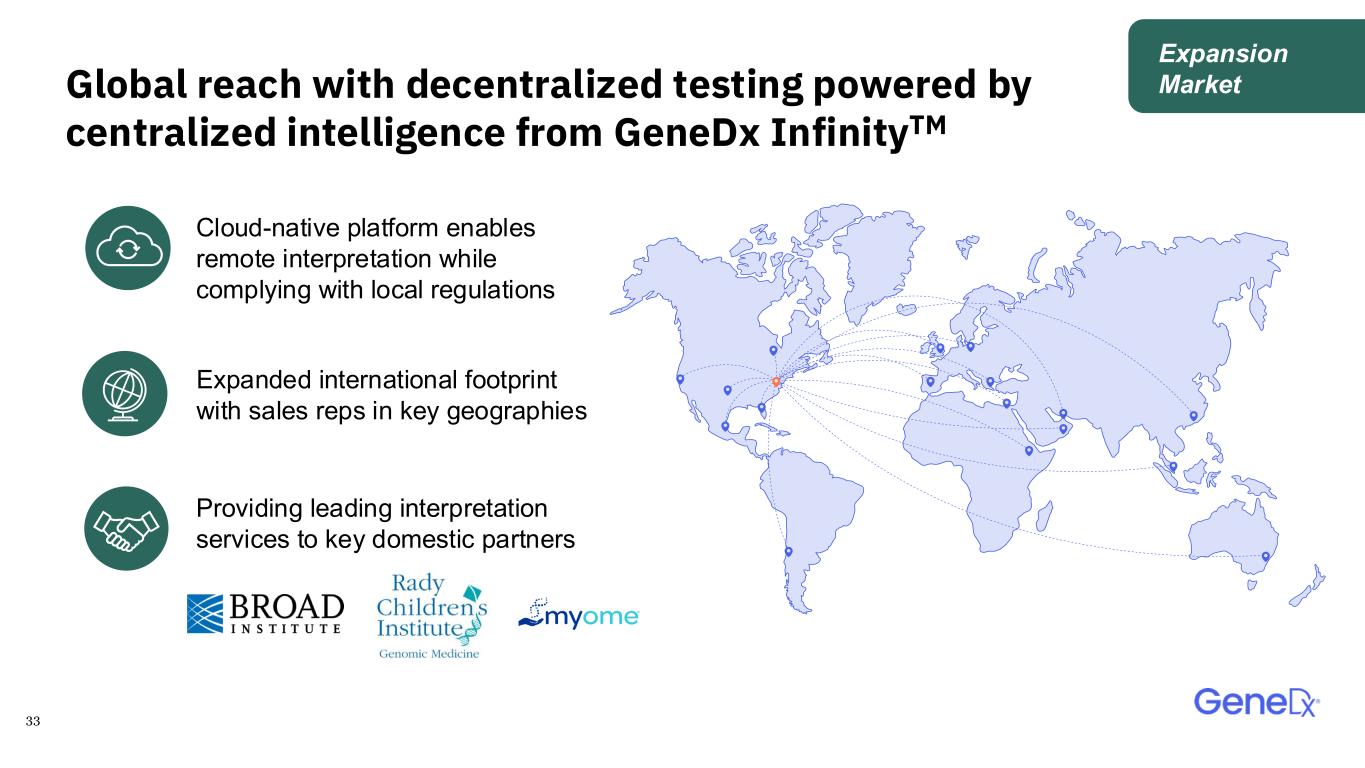
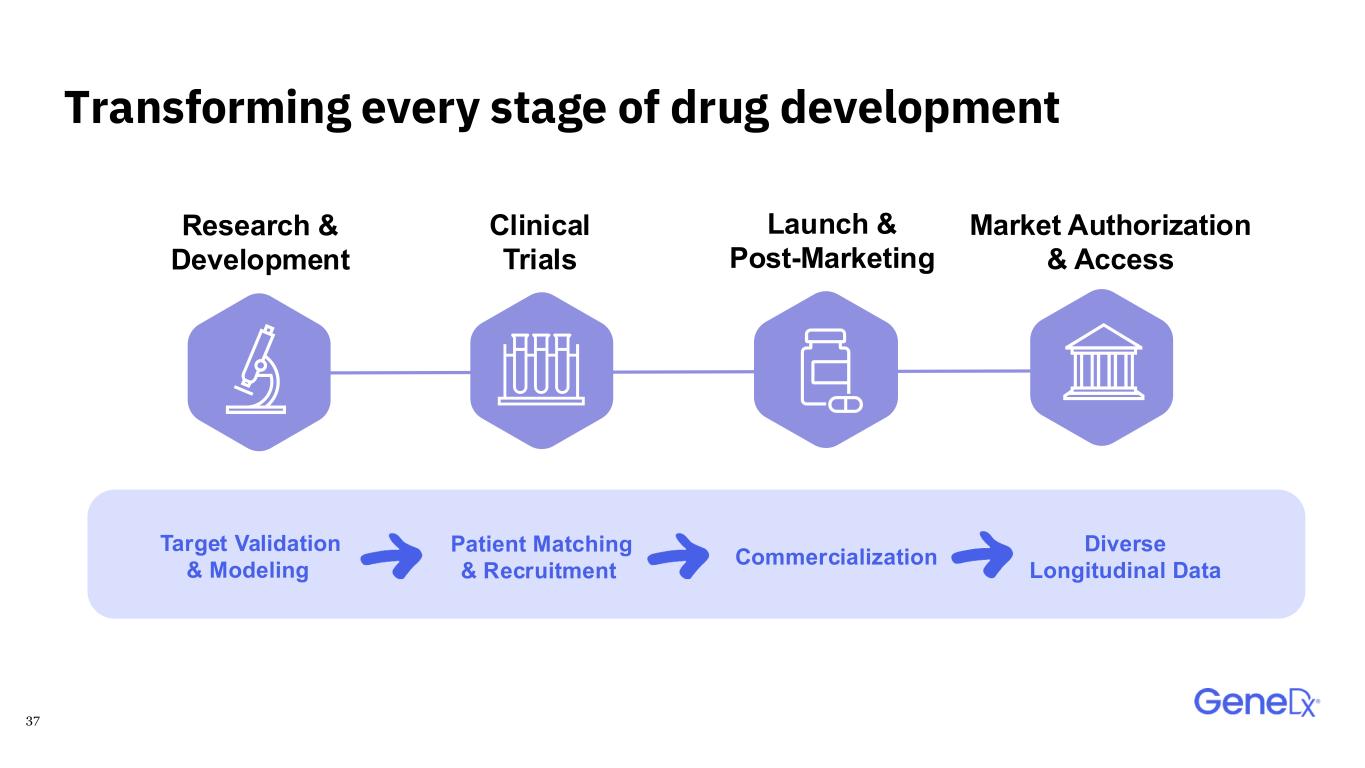
So, yeah, thank you so much. You know, starting with Fabric, the technology Technology is valuable. What changed for us was the durability of the domestic commercial opportunity. And so, as we've been building out and as we always have intended, Fabric's interpretation as a service is a really attractive way for us to cost-effectively drive international volumes. So, we've been integrating the team and the technology in order to support that. And so, as we think about the future for that, we've wanted to right-size our expectations for this year and make sure that we get it right. So, on the biopharma side of things, it really remains an important opportunity, not just from a patient perspective, but it fundamentally drives more testing, and it gives us the requisite next steps that every diagnosed patient needs in order to figure out exactly the healthiest course of action. So, the selling cycle is longer. I would say we're also, like, really taking a look that the data is even more robust than what we originally thought. We talked about the Komodo deal earlier this year. that's giving us really good insight into kind of the longitudinal nature of the view that is interesting to biopharma. So I would say with new products like that out there, we're learning a lot about the selling cycle. And so, yes, it takes longer, but in some respects, some of the deals that we were counting on at the end of Q1, we hope we'll realize at another point this year. But if not, we're really ramping up the pipeline with a sales team that we continue to expand.
Yeah, thanks, Catherine. And then on the pricing, to tack on to that. So it does seem like in the guidance, it seems we can get to like maybe mid-3000s ASP or AAR by the end of the year, this year. Could you get to maybe like the high 3000s by the end of 2027? And I also want to confirm that the 26 guidance now includes MediCal in there.
Yeah, look, the guide would, I think you've got the guide at 20% exome genome revenue growth and the 30% volume growth. You come back into what that ARR is, and it's, you know, if you look at what Q1 actualized around $3,300, it's just a very slight step up above that. We want to make sure we don't get too far ahead of our skis there. So certainly not going to go above the guide here. In 2027, of course, that's theoretical. What I'll say is we certainly believe that there's room to improve blocking and tackling on the revenue cycle to get paid more often. We certainly believe that it will become harder and harder for payers to ignore the clinical and economic evidence in support of opening up policy for genome. And those things should lead, along with greater clinician demand, to an improved ARR structure for whole genome in 27 and beyond, for sure.
Thank you. Our next question or comment comes from the line of Subbu Namdi from Guggenheim. Your line is now welcome.
Hey, guys. Thank you for taking my question. Just to be clear, given you give granular details, what are you assuming whole genome versus whole exome mix is going to be this year in the current guide? It used to be 70-30, right?
Yeah, so in the prepared remarks, it said genome is 40% of the outpatient volume. When you load in the NICU, genome is about 45% of all exome genome volume in the first quarter.
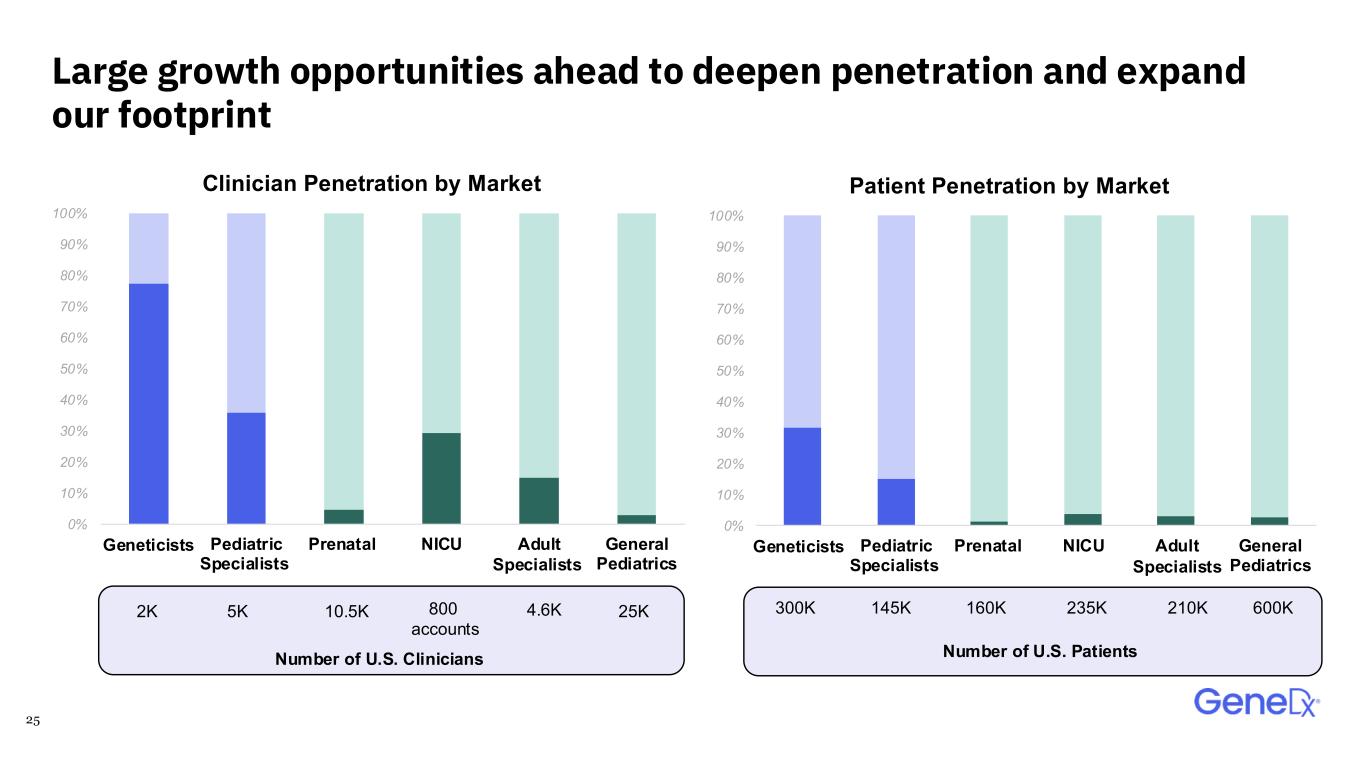
Don't anticipate giving that split in terms of how the guide falls out, but what I would point you to is the volume and inferred ARR in that. and again what what underpins that is different assumptions channel channel by channel thank you for that Kevin and then regarding your current market penetration you include a slide where you have penetration by market there is a bit of investor confusion about this analysis to explain the confusion let me give you an example if a patient sees a pediatric specialist and a geneticist after being referred that is still one patient and only one test does your analysis count this
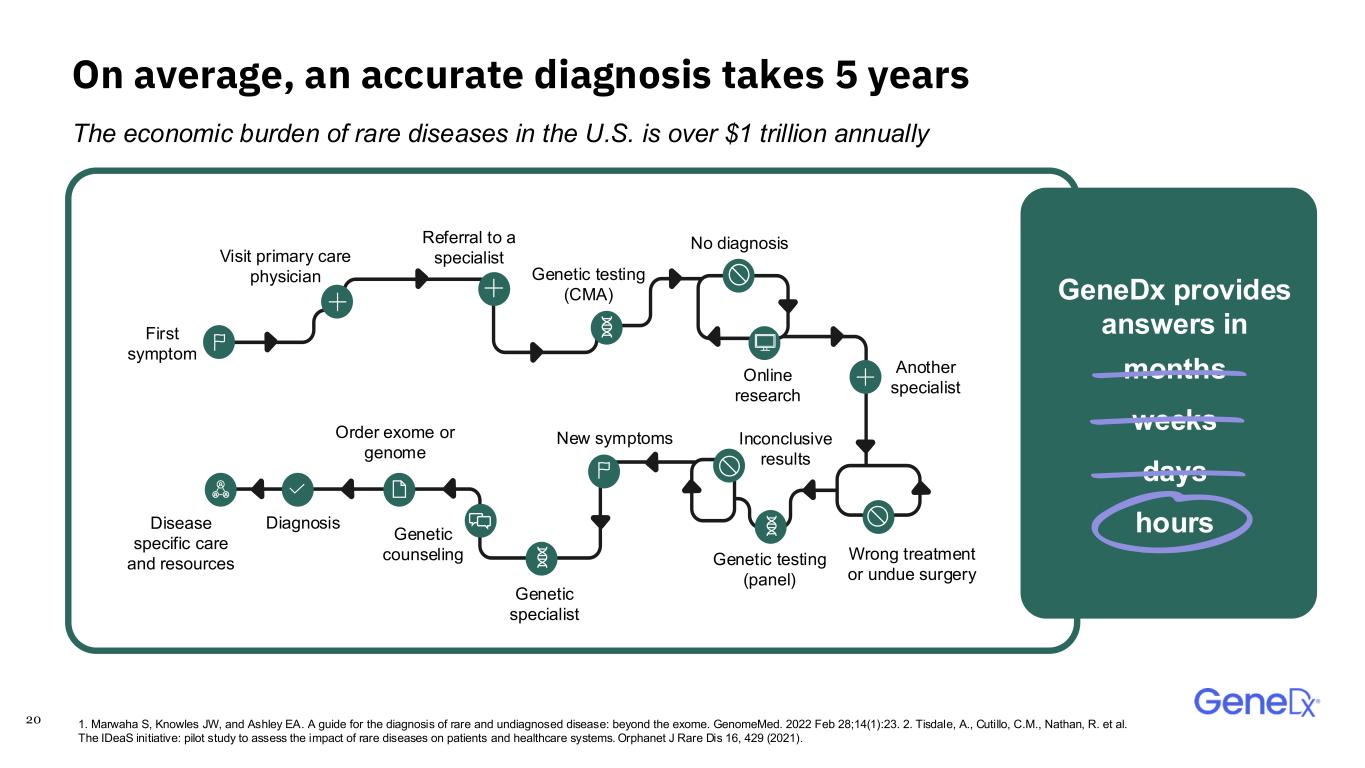
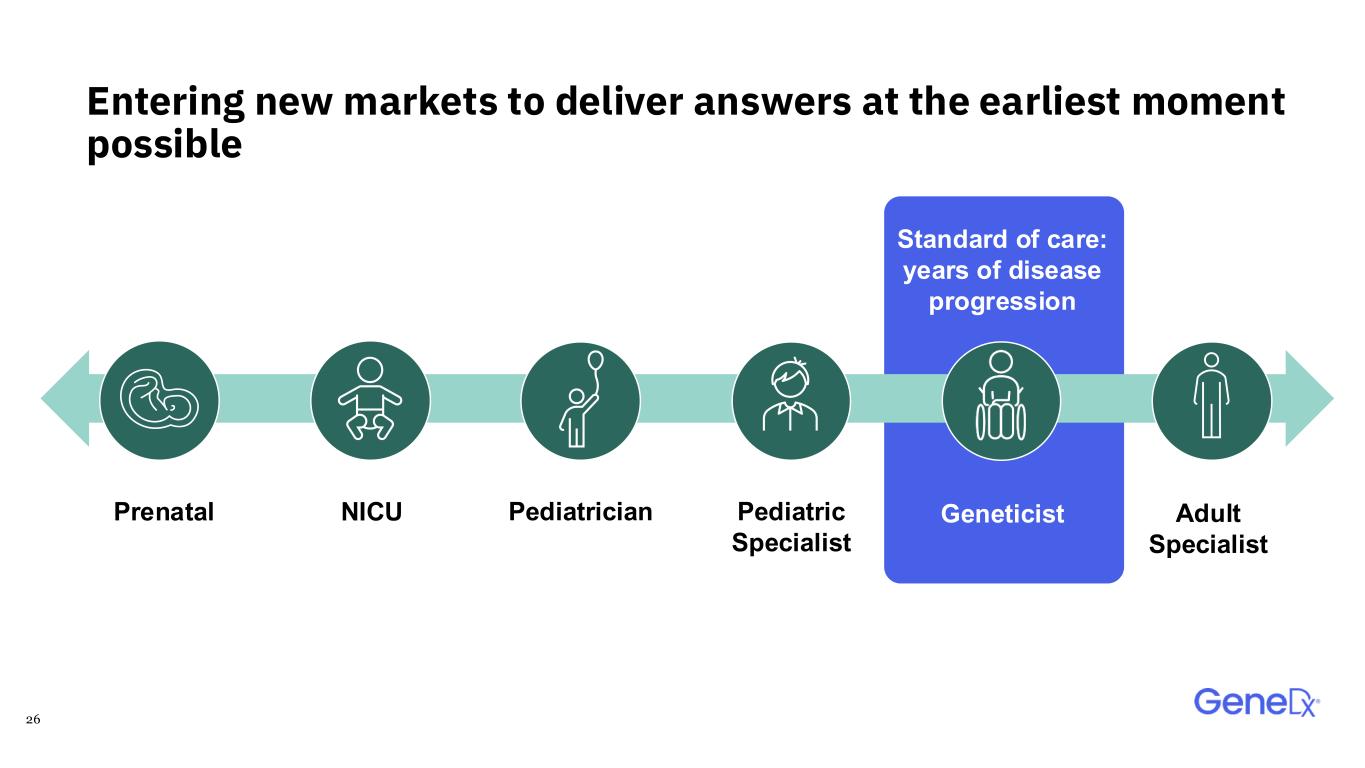
as one test in each specialty area meaning in both pediatrics and geneticist market or only once based on the clinician that actually orders the one test that would be super helpful so i think one um as we as we zoom out remember the diagnostic odyssey typically entails a patients seeing several different clinicians over that five-year period. So, they're starting with a general pediatrician, they're moving to a specialist, and then they're getting to a geneticist. So, as we take a look at the way that we're thinking about penetration, we're zeroing in on where the patients are landing and getting diagnosed. And so, we're focusing on the diagnosis this day as kind of the anchoring factor.
Thank you. Our next question or comment comes from the line of Brandon Couliard from Wells Fargo. Mr. Couliard, your line is open.
Kevin, just a few clarifications. Just did you say that the spike in the genome exomix wasn't evident until late in the quarter? And I just want to be really clear. Are you assuming that that mix is stable in the future periods or comes down? Just want to understand maybe just directionally what's embedded in the guide?
So, look, the bottom line was the signals that we had internally were not showing in real time, the extent of those shifts and the economic impact. And those didn't really become clear until late in the quarter and then more so until we dug in channel by channel through a fairly extensive review. What is in the go forward expectation is now resets clinician by clinician or channel by channel. informed by experience at the end of the quarter, as well as through the month of April here. And we think we've got proper expectations now at that granular level by channel and enough of a trend in which to make a call there.
Okay. And I believe you said that $25 million of OPEX savings was not in the current run rate, so don't necessarily expect it to decline sequentially in 2Q or 3Q. Is that correct?
Yeah, that's correct. I think Q1 is fairly representative on an annualized basis where we might end up. There'll be some puts and takes and some refocusing to ensure we're spending every dollar maximized in those that have a shorter payback and the most impactful ROI. But, you know, $25 million effectively came out of what was the planned expenditures for the fall of the year.
Thank you. I'm showing no additional questions in the queue at this time. Ladies and gentlemen, thank you for participating in today's conference. This concludes the program. You may now disconnect. Everyone have a wonderful day.