Operator
Good morning everyone and welcome to the West Bank of Second Quarter 2026 Earnings Conference All participants will be in a listen-only mode. Should you need assistance, please signal a conference specialist by pressing the star key followed by zero. After today's presentation, there will be an opportunity to ask questions. To ask a question, you may press star and then one on your touchtone telephones. To withdraw your questions, you may press star and two. Please also note, today's event is being recorded. At this time, I'd like to turn the conference call over to John Iannone, Senior Vice President of Investor Relations. Please go ahead.
Thank you. Good morning and welcome to WestBanco, Inc.'s second quarter, 2026 earnings conference call. Leading the call today are Jeff Jackson, President and Chief Executive Officer, and Dan Weiss, Senior Executive Vice President and Chief Financial Officer. Today's call, an archive of which will be available on our website for one year, contains forward-looking information. Cautionary statements about this information and reconciliations of non-GAAP measures are included in our earnings-related materials issued yesterday afternoon, as well as our other SEC filings and investor materials. These materials are available on the investor license section of our website, westbanko.com. All statements speak only as of July 22, 2026, and West Bank will undertake new obligations to update them. I would now like to turn the call over to Jeff. Jeff?
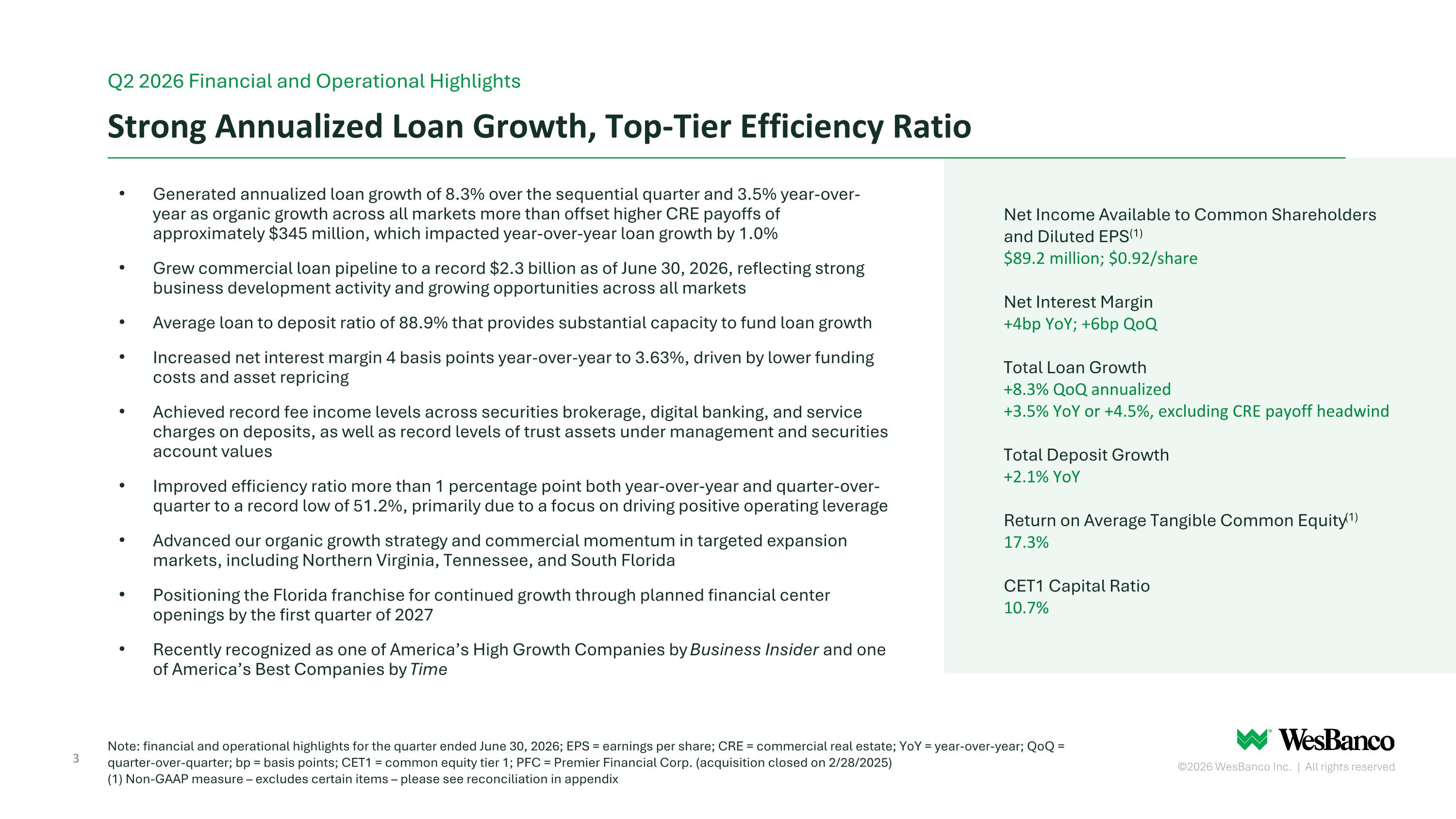
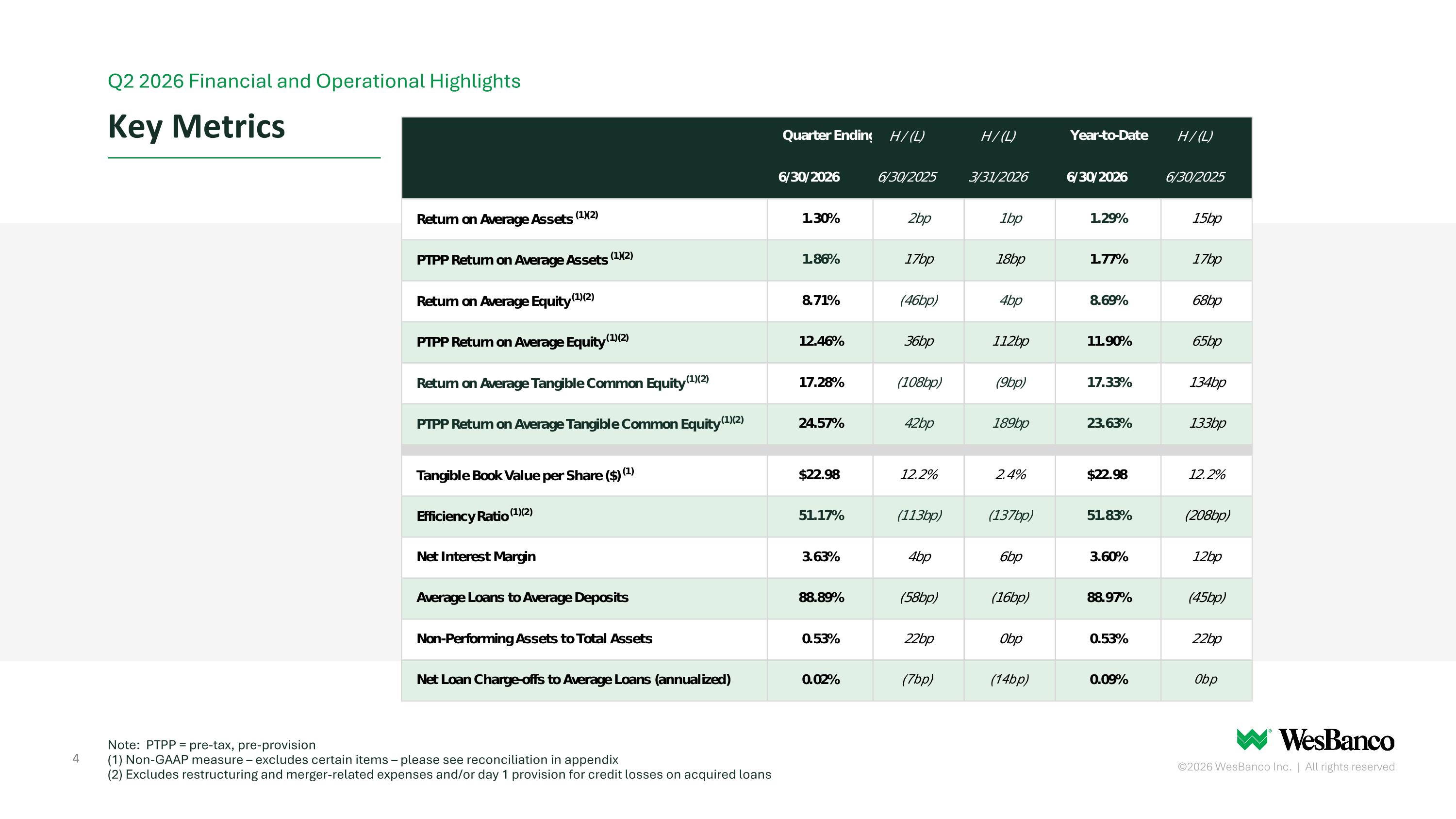
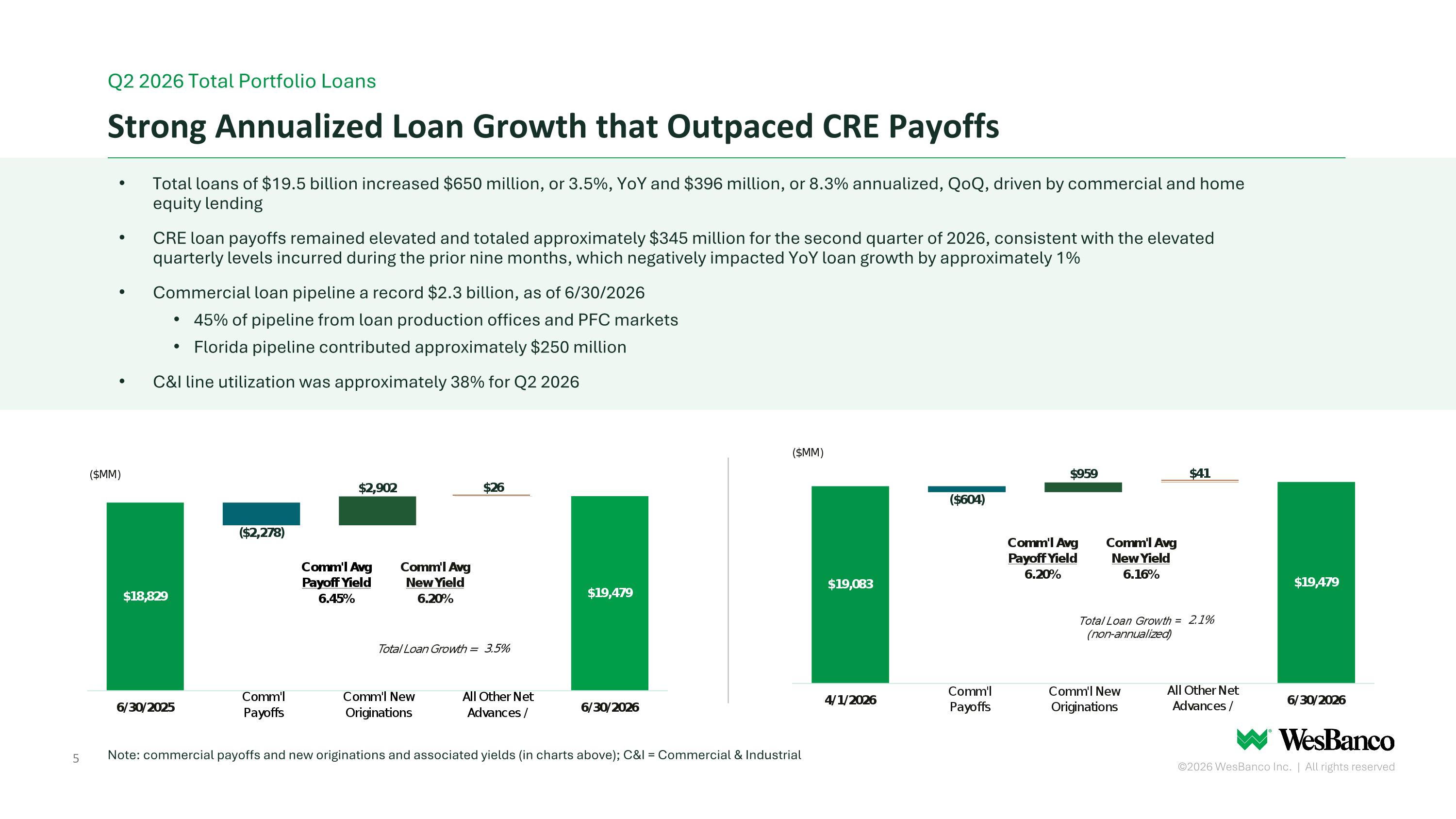
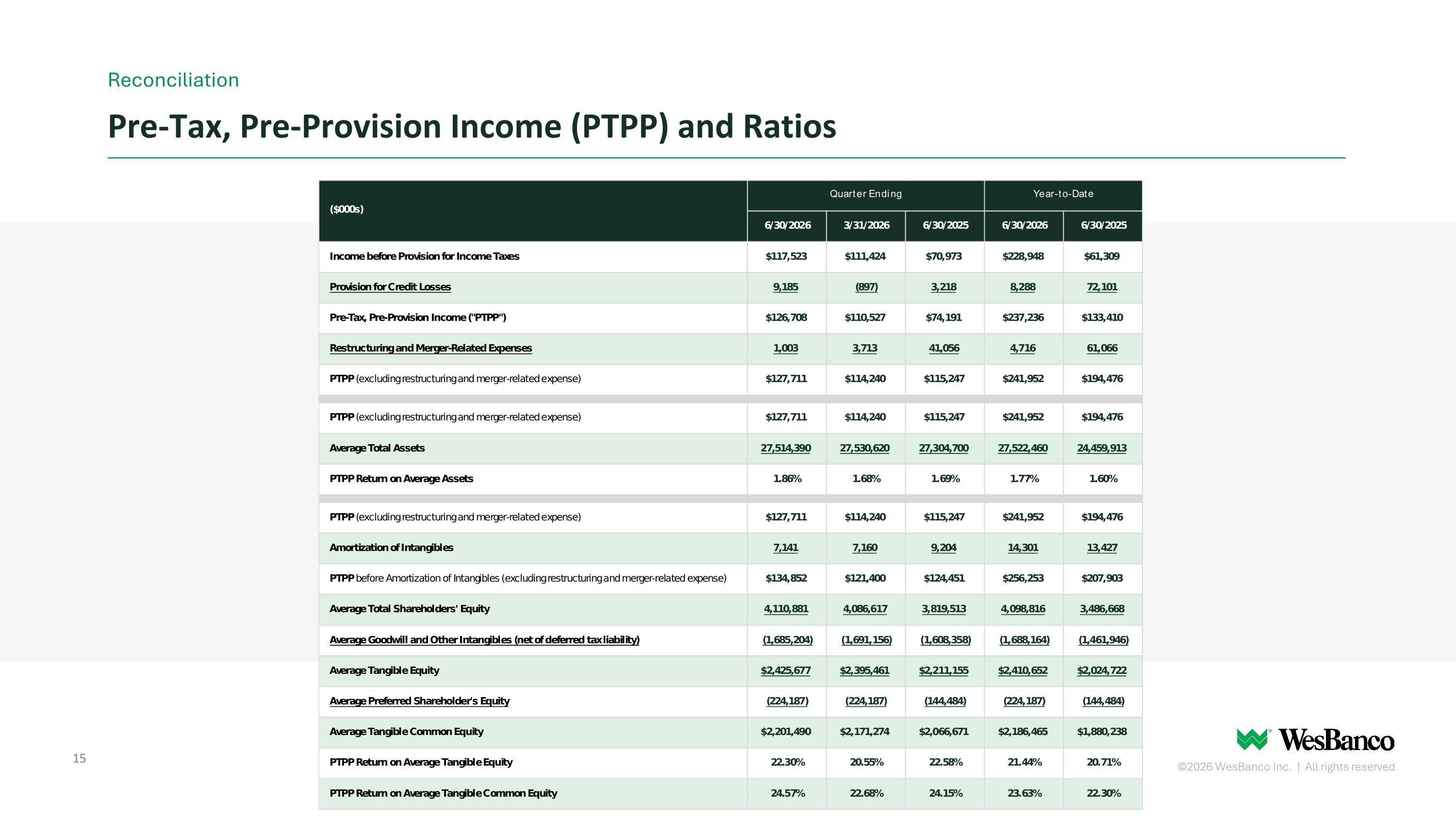
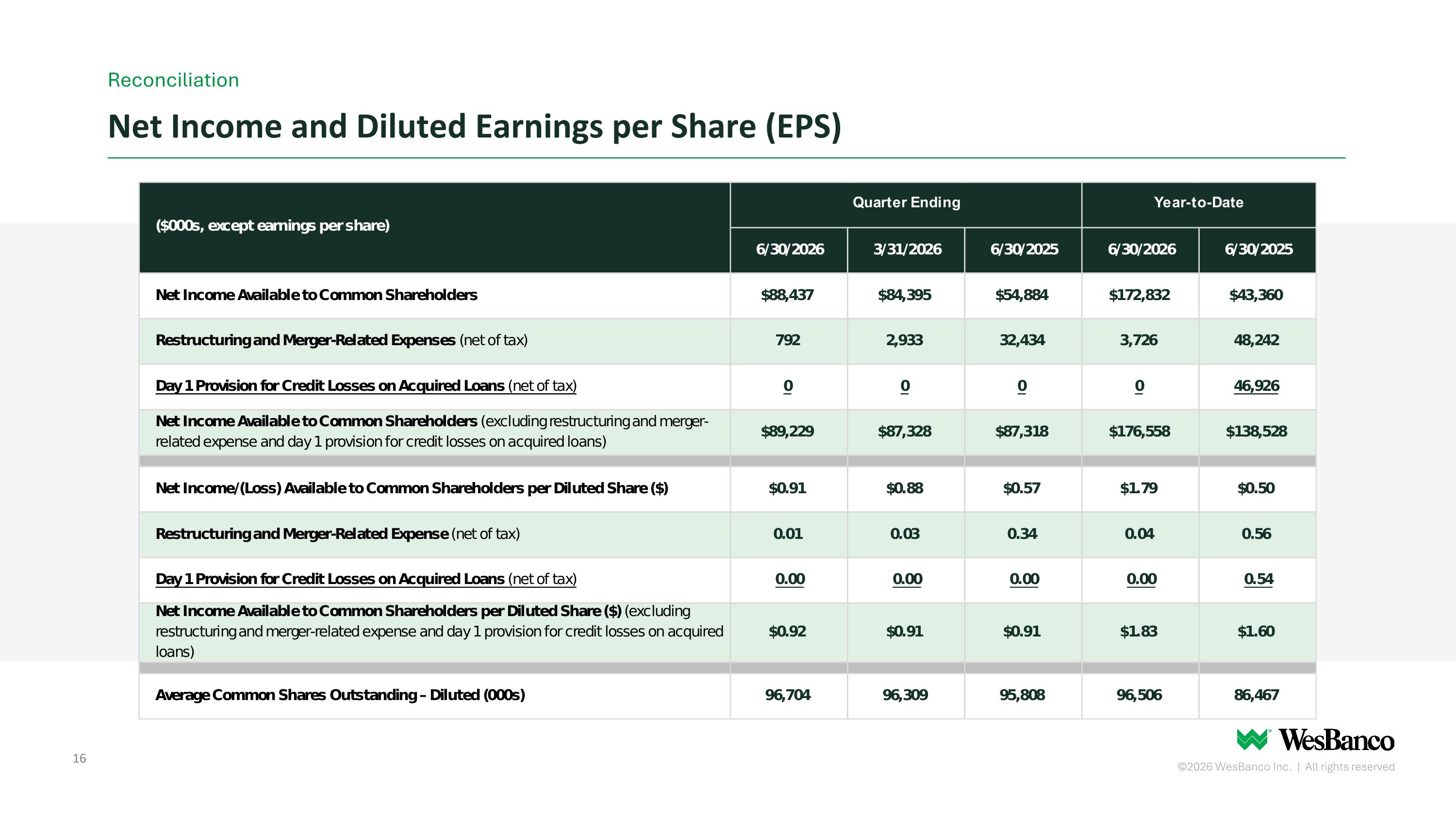
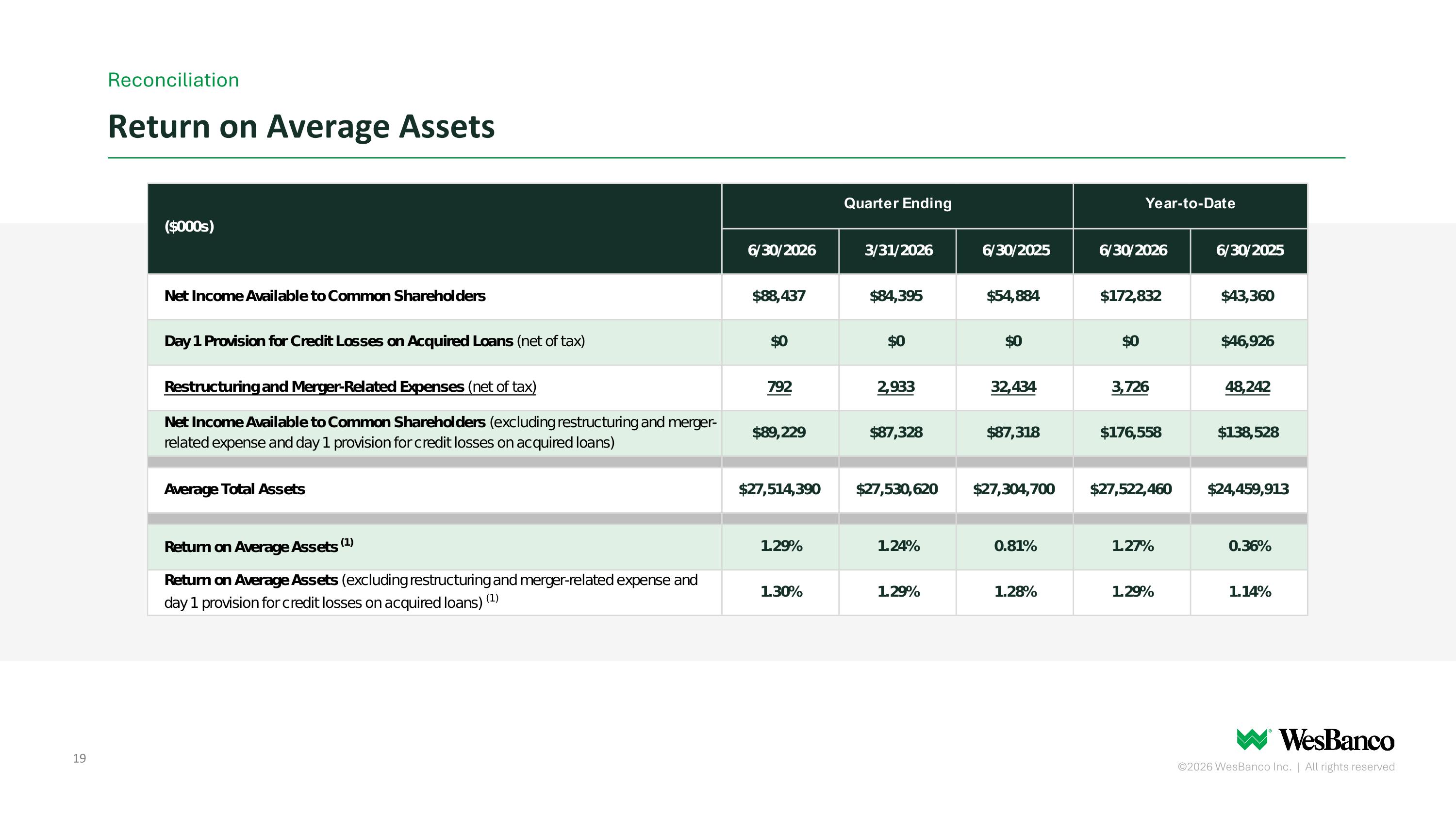
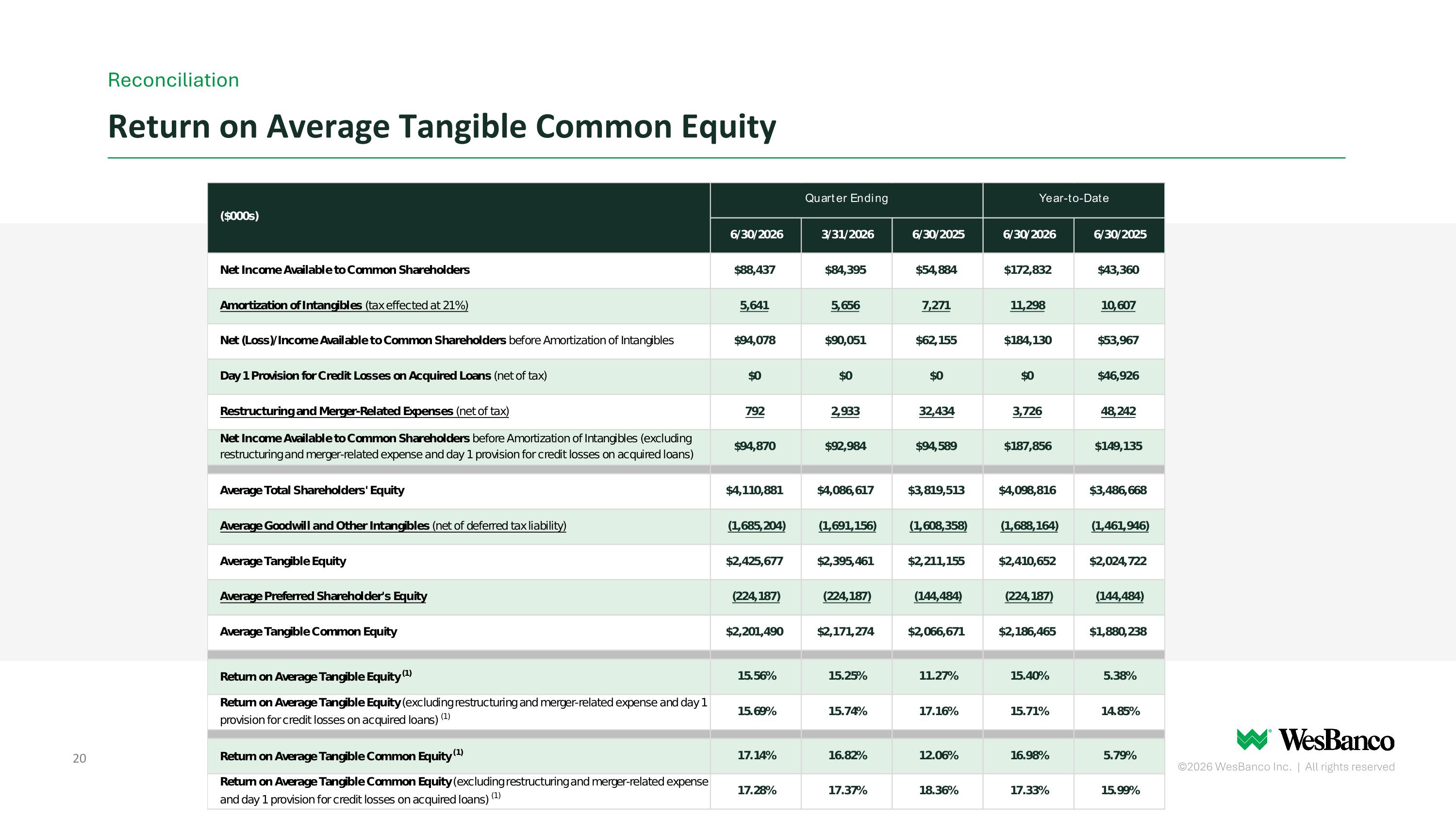
Thanks, John, and good morning, everyone. Today, we'll review our second quarter performance and share our current outlook for the rest of 2026. The defining theme of the quarter was momentum across our franchise. There are three key takeaways that really demonstrate that momentum. We delivered strong sequential quarter and year-over-year loan growth. We advanced our organic growth strategy and commercial momentum, driving record production and pipeline. We continued to generate profitable growth through positive operating leverage and disciplined execution. Turning briefly to our financial performance, our strong second quarter results reflect the continued success of our relationship-focused banking model and disciplined growth strategy. For the quarter ended June 30, 2026, we reported net income available to common shareholders of $89 million, excluding merger and restructuring charges. That translated to $0.92 per diluted share, while on a year-to-date basis, our earnings per share increased 14% to $1.83. On a similar basis, we reported year-to-date pre-tax, pre-provisioned earnings of $242 million, an increase of 24% year over year. The strength of our financial performance was reflected in our second quarter and year-to-date returns on average assets and tangible common equity of 1.3% and 17.3% respectively. Further, we are demonstrating our ability to drive profitable growth across the franchise as we generated strong positive operating leverage and an efficiency ratio of 51 percent. Our capital position also remained solid with a CET1 ratio of 10.7 percent, which allowed us to repurchase approximately 300,000 shares during the quarter, while also providing flexibility to support our growth expectations. The defining driver of our momentum this quarter was loan growth. Total loans increased 3.5 percent year-over-year and 8.3% annualized sequentially as our talented teams converted opportunities across our 10-state footprint. In particular, we continue to see the benefits from our recent growth investments as C&I lending demonstrated strong growth of 5% year-over-year and nearly 25% quarter-over-quarter annualized. During the first six months of the year, our commercial teams have generated record loan production of nearly $2.5 billion, approximately $1 billion more than the same period a year ago. Impressively, a second quarter loan growth significantly outpaced continued high levels of CRE payoffs, which created a 1% headwind to year-over-year growth. As we mentioned last quarter, we expected developers to continue to seek permanent financing and the sale of properties during the second quarter, but at a slower pace than the first quarter. But we experienced an upward swing during the latter half of the quarter that drove payoffs to total approximately $345 million for the second quarter, bringing the total amount of payoffs during the last 12 months to more than $1.3 billion. Adjusting for payoffs, headwind, during the quarter, total loans grew four and a half percent year over year. The fact that we generated this level of growth despite that headwind speaks to the strength of our customer demand and the effectiveness of our commercial teams. A great example of this customer demand was a recent win in our mid-Atlantic market. A team comprised of commercial treasury management derivatives and credit recently achieved a major milestone with earning a meaningful partnership with one of the region's most distinguished educational institutions. The team met with this new-to-bank client to explore financing options for a comprehensive renovation and modernization project to revitalize this campus, which resulted in the largest nonprofit school deal in our history. The resulting transaction included a tax-exempt bond financing in excess of $34 million, a full deposit and treasury management partnership, and a six-figure swap fee. The dedication and expertise of this team are testaments to the power of collaboration and further positions WestBanco as a trusted financial partner. At June 30th, our commercial pipeline reached a record $2.3 billion, increasing more than 40% from the prior quarter and 90% since year end. While our loan production offices and former premier markets continue to contribute meaningful to that growth, we are also seeing broad-based momentum across all our markets. In the few weeks since quarter end, the pipeline has remained stable, which gives us confidence in our outlook and supports our continued expectation for mid-single-digit loan growth in 2026. We are especially encouraged by what we are seeing in our expansion markets. Last quarter, we announced the advancement of our Southeastern expansion strategy with the launch of commercial banking and treasury management operations in Palm Beach and Broward counties. Last month, we expanded that strategy with the opening of a loan production office in Naples, extending our presence into another attractive Florida market. Naples is led by a seasoned leader with strong track record in the market, an individual who I've known for many, many years. The early results from our Florida teams have been very encouraging. In just three months, these teams have already begun generating new business, building meaningful customer relationships, and contributing to our record pipeline. Already, those teams account for approximately 10% of our total commercial pipeline, a proof point that our strategy is gaining traction. I firmly believe that our Florida franchise has the potential to be a $2 billion bank within the next couple of years. As part of that strategy, we are on track to open financial centers in Fort Lauderdale and West Palm Beach during the first half of 2027, as we have already identified locations and received FDIC approval. These banking centers will complement our commercial presence while enhancing our ability to gather deposits and deepen customer relationships to support future growth. Over time, we could add additional services such as wealth management and residential mortgage. Finally, I am excited that our long-term strategy and disciplined approach to growth are being recognized on a national level. We were recently named one of America's high-growth companies by Business Insider and one of America's best companies by Time. What these recognitions really represent is the dedication of our teams and the consistency with which they execute our strategy every day. Our momentum and success continue to be driven by talented people, strong customer relationships, and a commitment to disciplined growth. Our second quarter results demonstrate those fundamentals remain firmly in place and continue to position us well for the future. I would like to now turn the call over to Dan Weiss to walk through the financials and outlook in more detail. Dan.
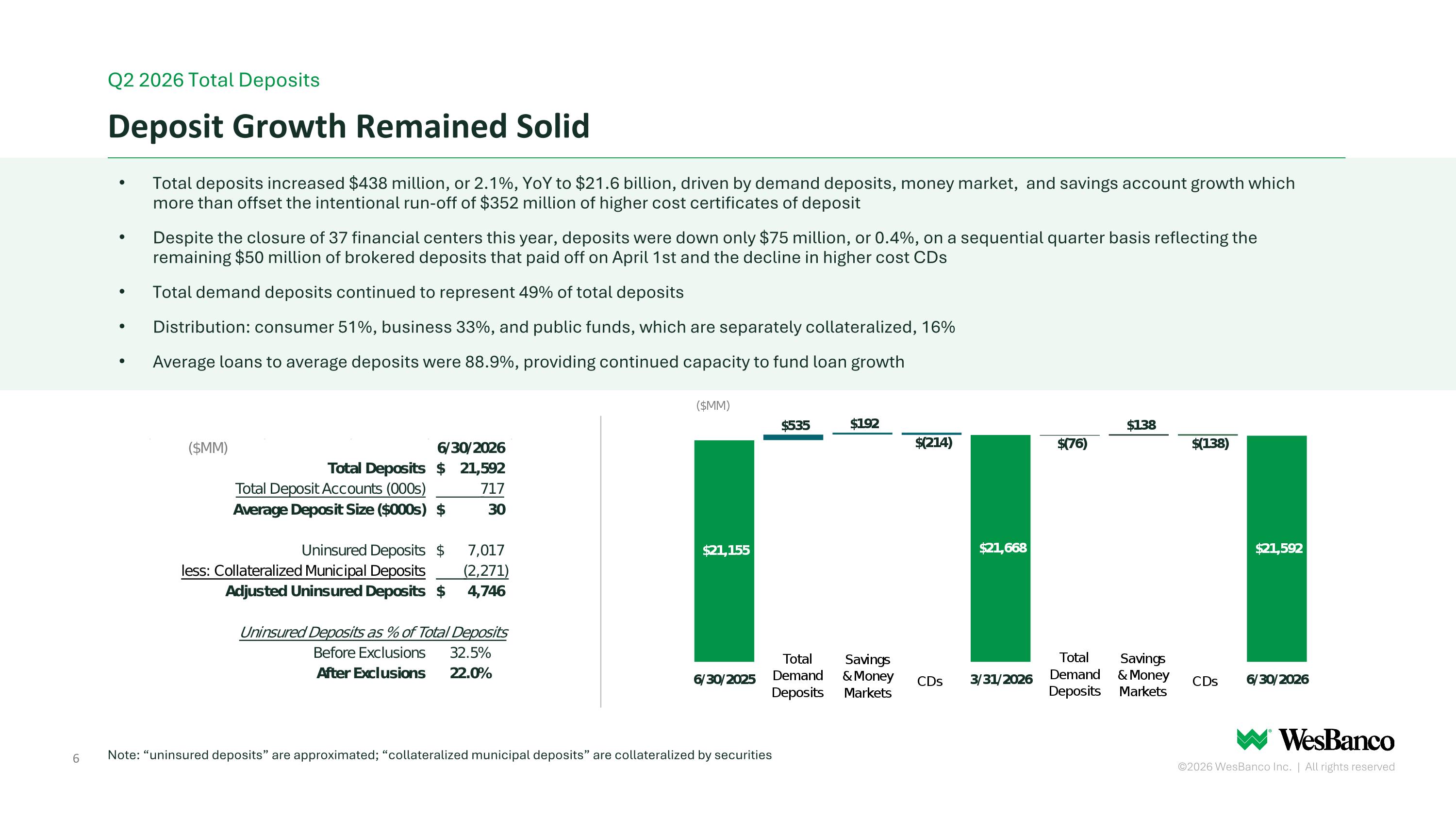
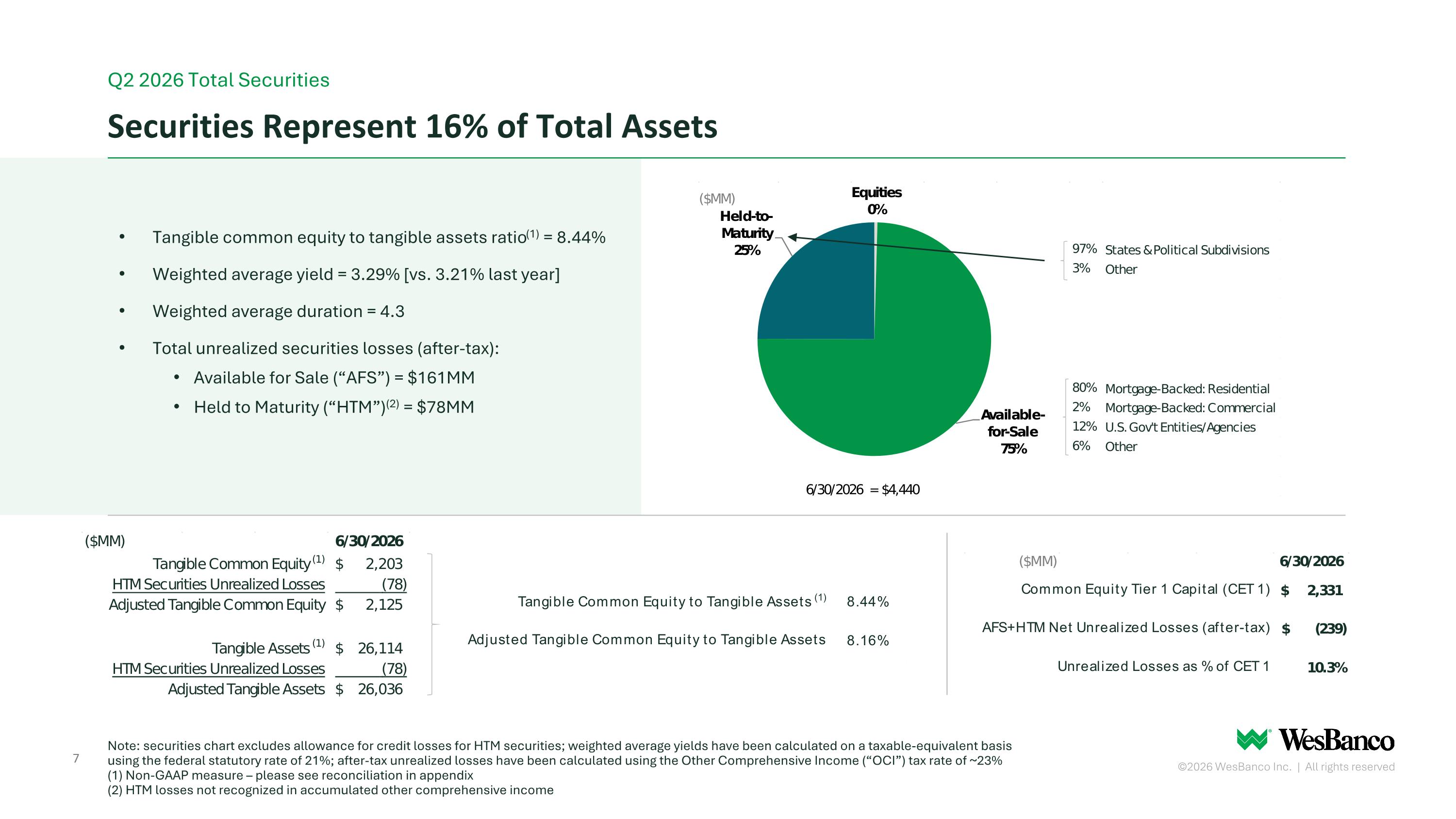
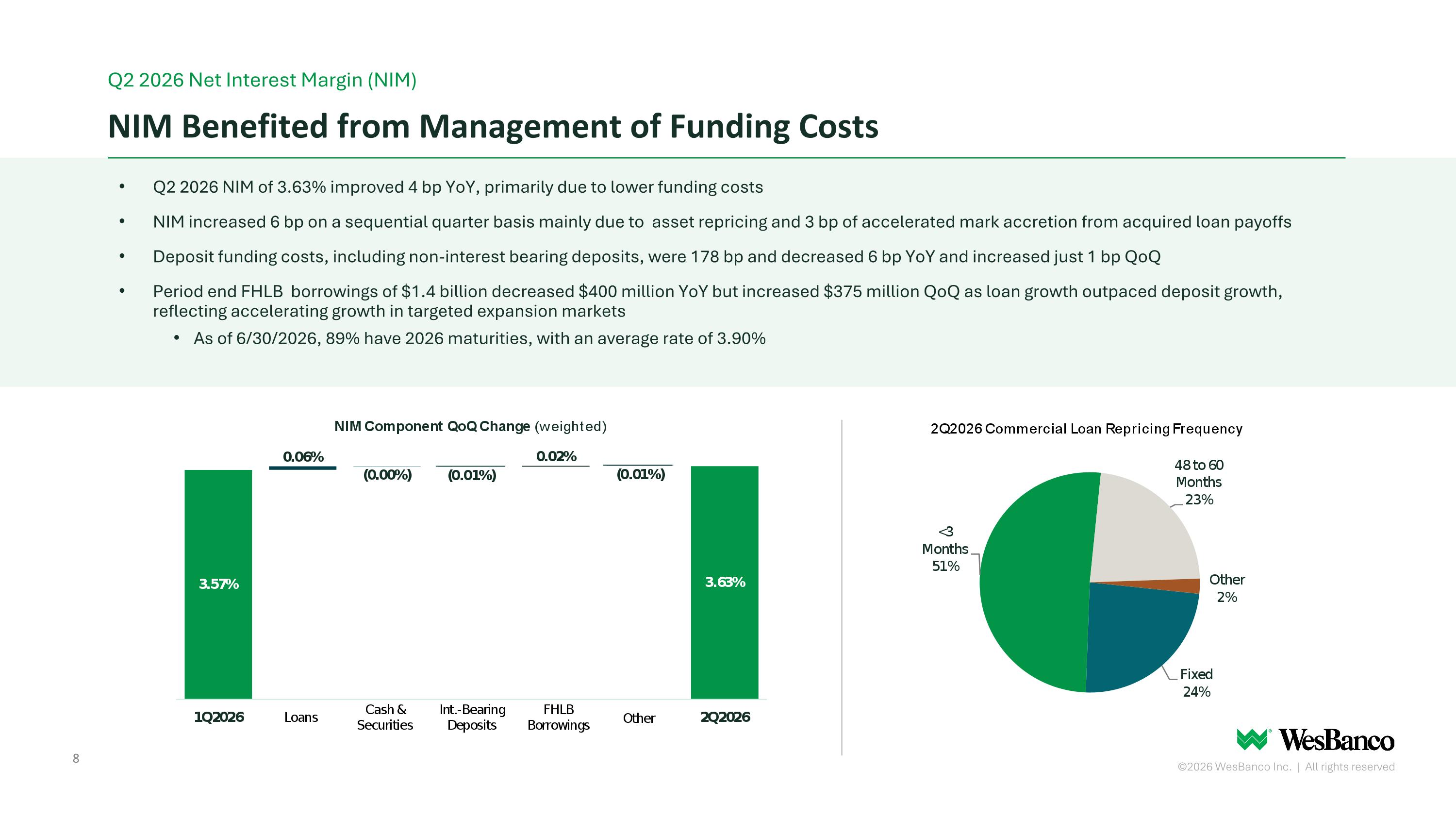
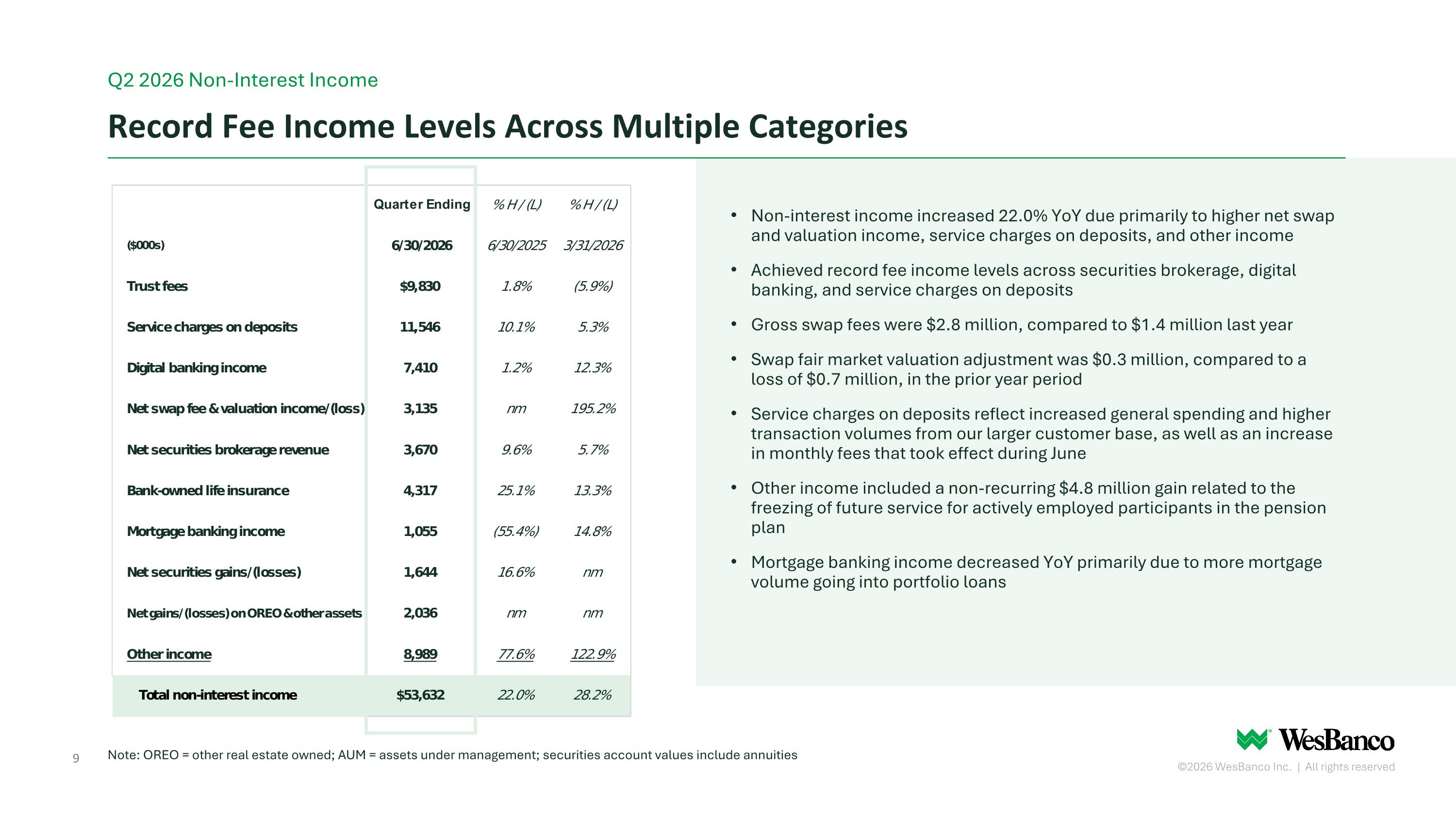
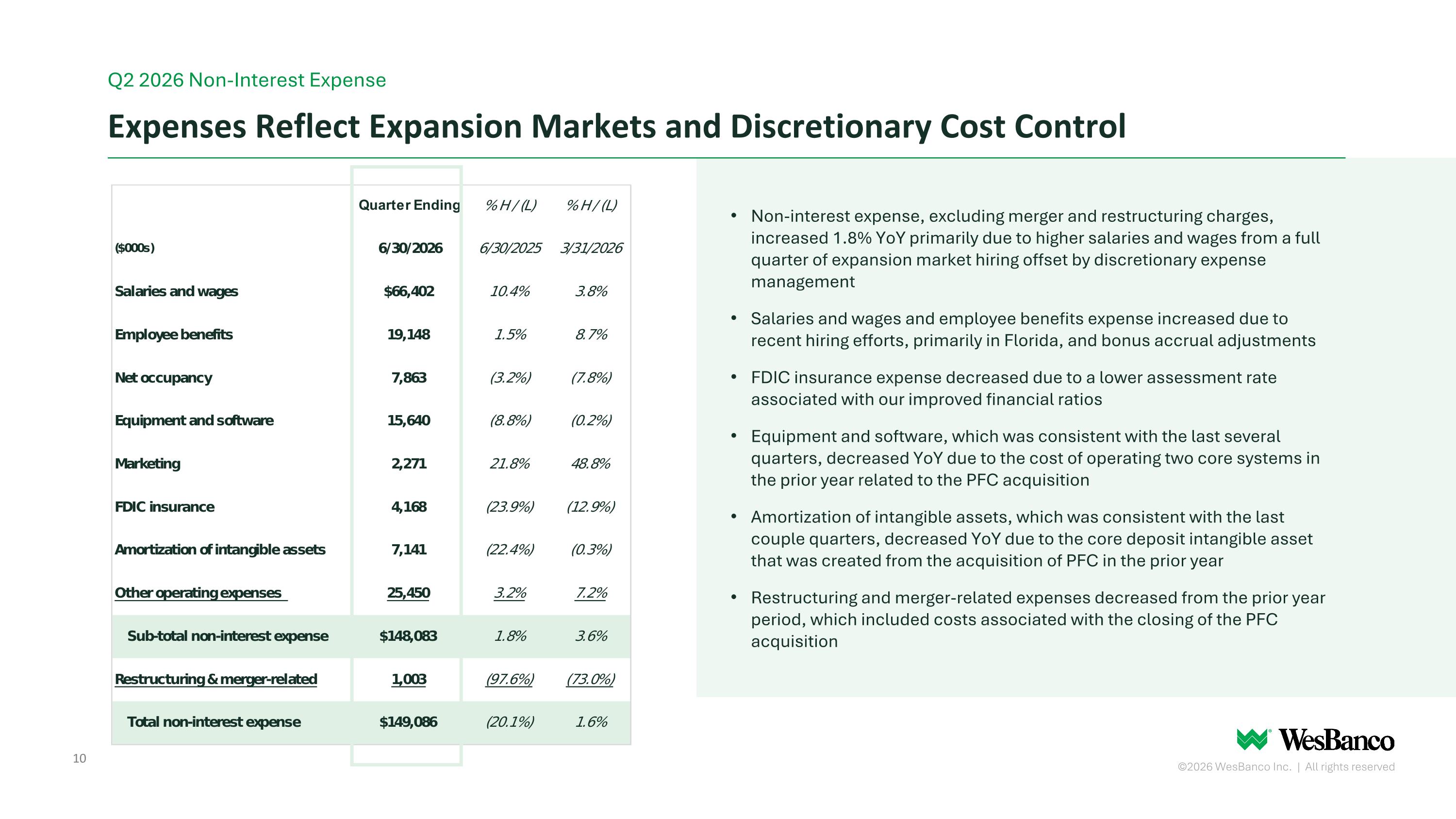
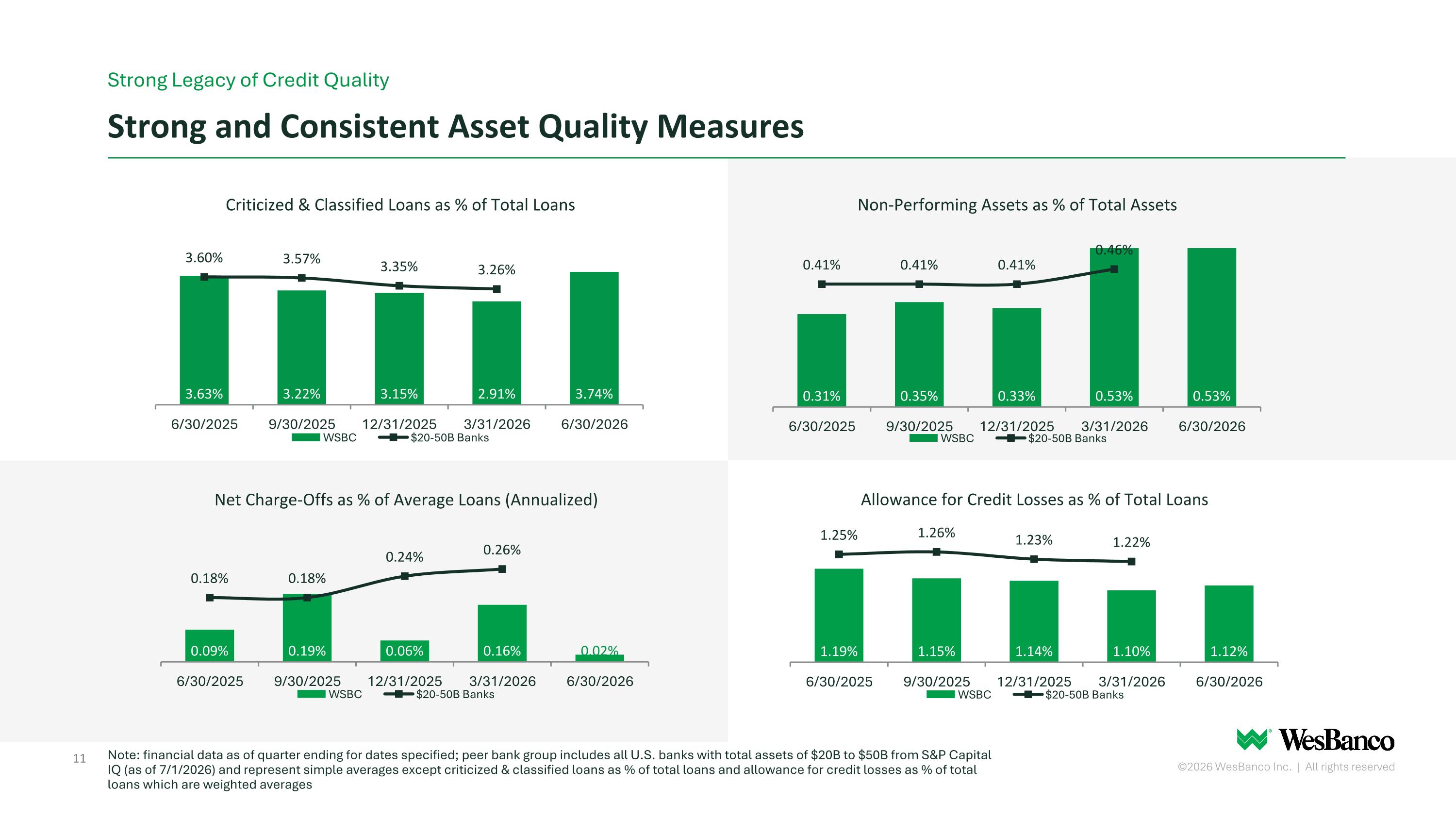
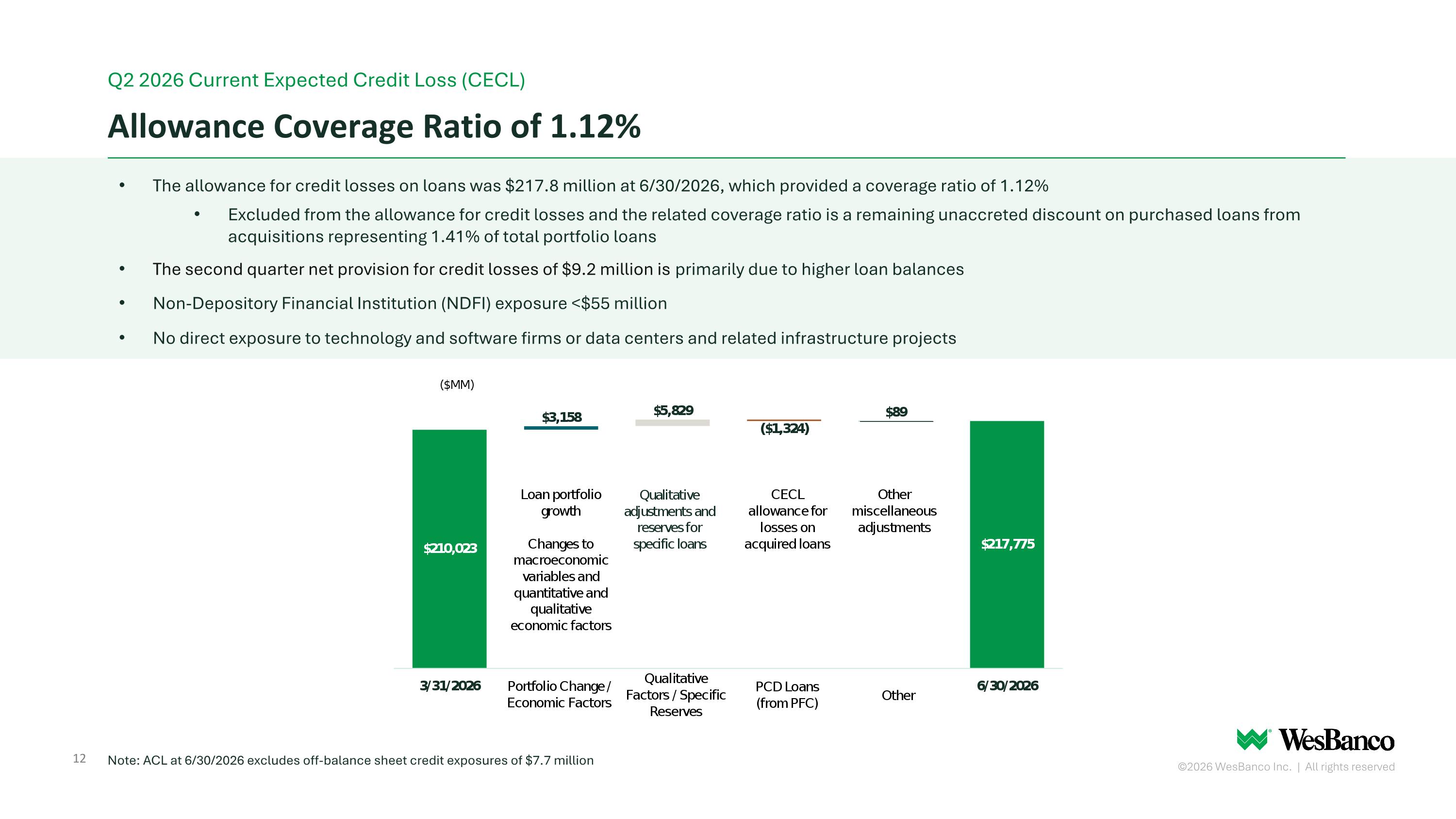
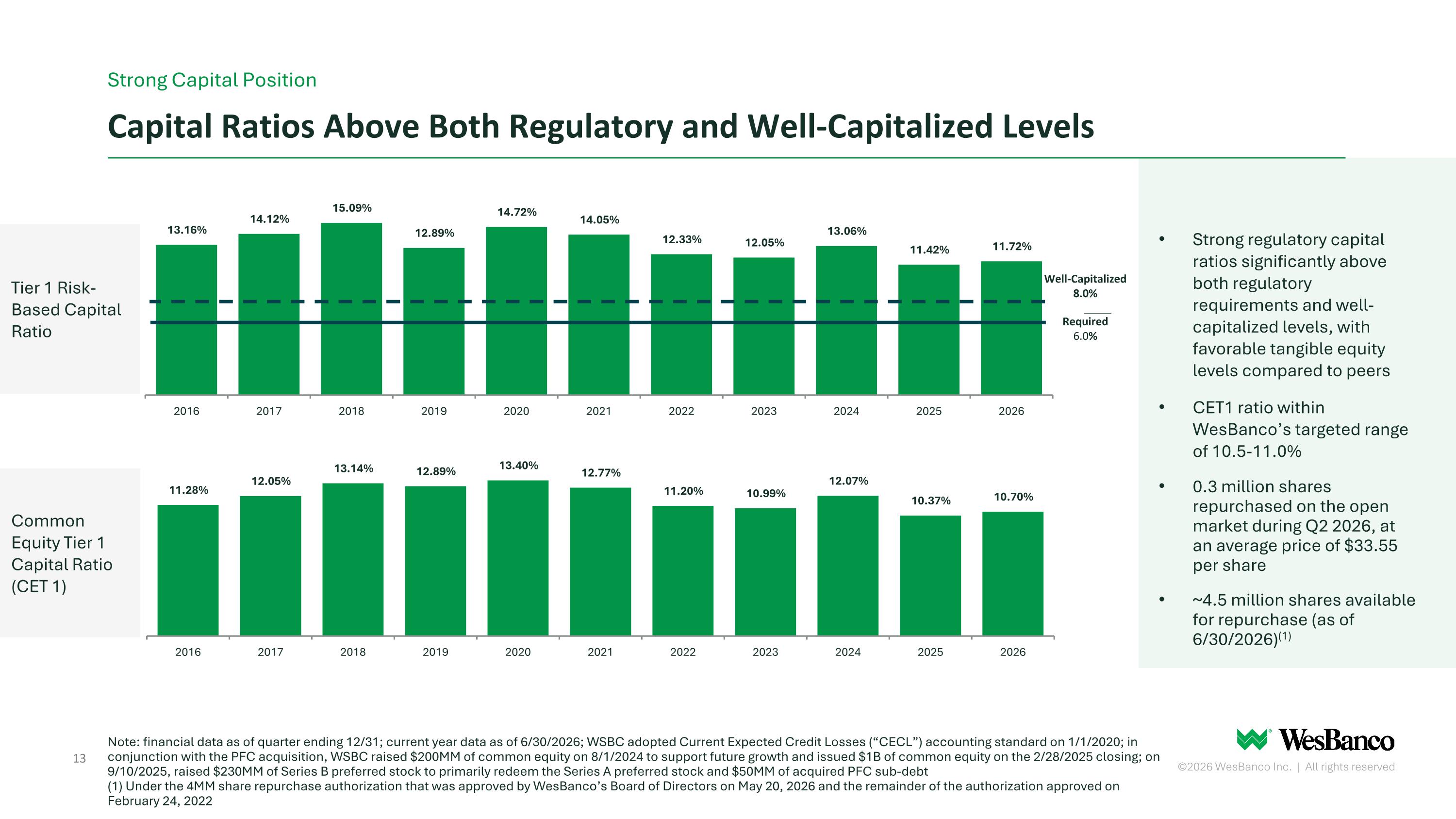
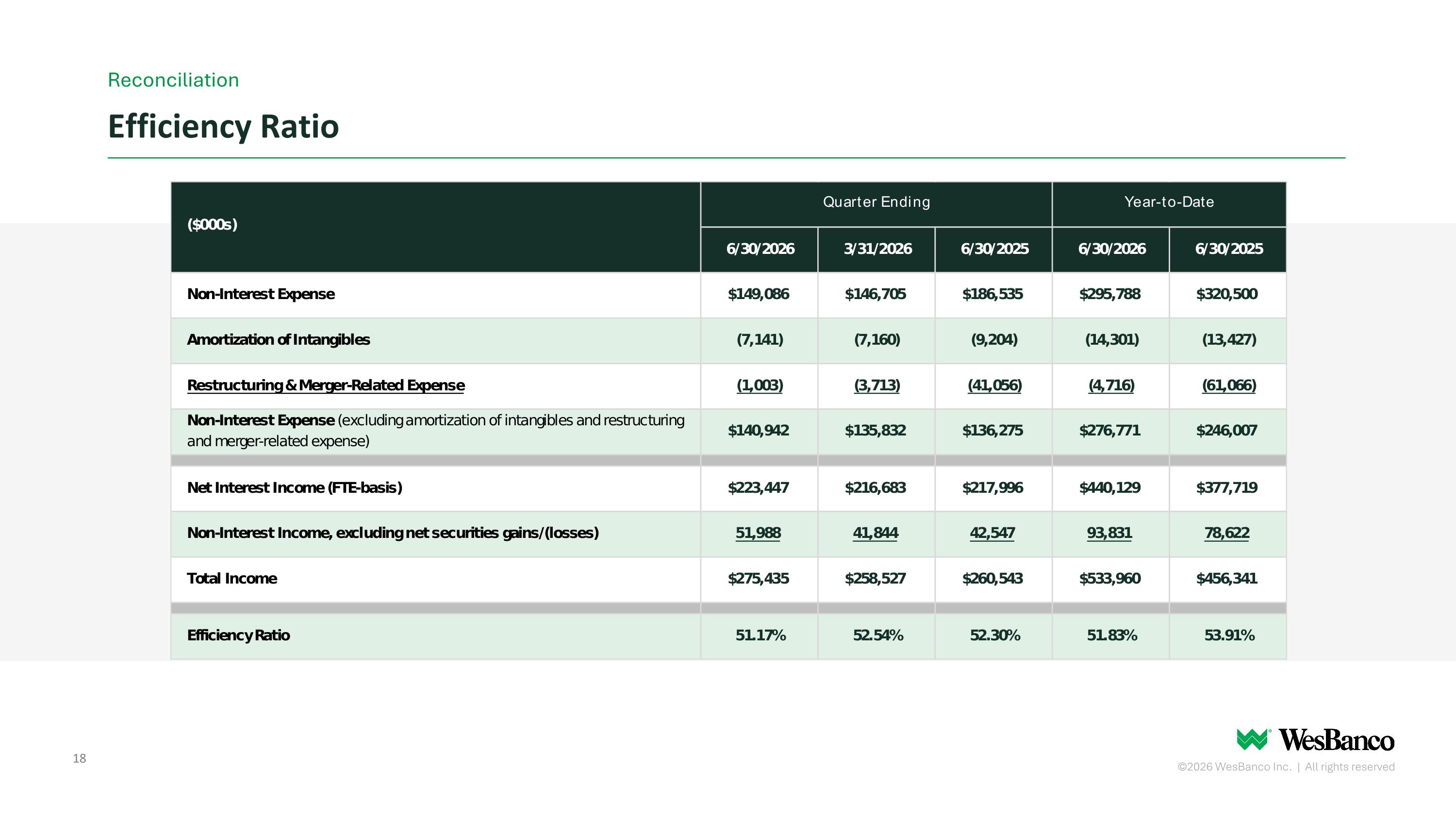
Thanks, Jeff, and good morning, everyone. For the second quarter, we reported GAAP net income available to common shareholders of $88 million, or 91 cents per share. And when excluding restructuring and merger-related expenses, second quarter net income was $89 million, or $0.92 per share. To highlight a few of the second quarter's year-over-year accomplishments, we grew pre-tax, pre-provisioned core earnings 11%, driven by strong annualized loan growth of 8.3%. We also reported record fee income levels and record trust and securities brokerage assets, as well as a reduced efficiency ratio to a record low of 51%. Total assets of $27.8 billion included total portfolio loans of $19.5 billion and securities of $4.4 billion, with securities now representing approximately 16% of total assets. Total portfolio loans increased 3.5% year-over-year due to organic growth of $650 million, partially offset by CRE payoffs. While we did experience elevated payoffs in the second quarter, similar to the first quarter, we continue to expect payoffs to taper during the second half of the year, with third quarter payoffs projected at roughly two-thirds of that at the second quarter level. That said, based on our current record pipeline, we expect to be able to outgrow payoffs for the remainder of the year to generate mid-single-digit growth for the year. Deposits increased 2.1% year-over-year to $21.6 billion from transaction account growth that more than offset the decline in higher-cost CDs. Encouragingly, deposit attrition related to the closure of 37 financial centers this year has trended meaningfully below our conservative attrition assumptions such that deposits were only down $75 million sequentially and mostly reflecting the remaining $50 million of broker deposits that paid off on April 1st and the decline in higher cost CDs. Credit quality metrics have remained relatively benign and in a consistent range from a historical perspective, while charge offs were just two basis points. The allowance for credit losses to total portfolio loans at June 30, 2026, was 1.12% of total loans, $218 million. And the increase from the first quarter was primarily due to higher loan balances. The second quarter margin of 3.63% was consistent with our first quarter outlook and improved four basis points year over year, primarily due to lower funding costs and improved six basis points sequentially due to asset repricing and three basis points or $1.7 million of accretion from unscheduled early payoffs of acquired loans. Total deposit funding costs, including non-interest bearing deposits, declined six basis points year every year to 178 basis points, which is essentially flat to the first quarter. We are seeing great traction across our franchise for our fee-based services as we earn record fees from deposit products, legal banking services, and securities brokerage, not to mention the record level of trust and securities brokerage assets of nearly $11 billion. For the second quarter, non-interest income of $54 million increased $9.7 million, or 22%, year-over-year, due primarily to higher net swap and valuation income, service charges on deposits, and other incomes. Gross swap fees were $2.8 million in the second quarter and $4 million on a year-to-date basis, as we are seeing solid customer demand from our commercial swap product and expect to see some meaningful improvement in swap fees in the back half of the year from our new Florida market. Other income also included a non-recurring $4.8 million gain related to the pension plan freeze, which had been closed to new entrants approximately 20 years ago. And gains on the sale of other real estate owned included a $1.6 million non-recurring gain on the sale of branch properties that were closed earlier in the year. Yonish's expense, excluding restructuring and merge-related costs for the second quarter of 2026 of $148 million, increased 1.8% year-over-year and 3.6% sequentially, primarily due to higher salaries and wages, which increased due to the recent hiring efforts, primarily in our southern footprint. Those hiring efforts occurred through the second quarter, so the quarter's results do not fully reflect the complete impact of that strategic expansion. Turning to capital, all of our key ratios improved quarter over quarter. Our CAT1 ratio at 10.7% as of June 30th was within our targeted range of a 10.5% to 11%, which allowed us to return capital to our shareholders through the repurchase of approximately 300,000 shares on the open market during the second quarter. Based on the strategic investments that we're making in South Florida, we anticipate CET1 to remain in that 10.7% range through the remainder of the year as loan growth continues to accelerate. Our current outlook for 2026 includes our targeted expansion markets, and we currently anticipate one Fed rate hike late in the fourth quarter with no meaningful impact to 2026 results. Earning asset yields should continue to benefit from loans and securities repricing upward, while deposit funding costs have likely hit a floor with the CD repricing benefit effectively fully repriced into the future maturing book. We anticipate our net interest margin for the remainder of the year to be relatively consistent to the second quarter around that 3.60% range as we expect loan growth in the back half of the year to accelerate and initially outpace deposit growth requiring a blend of higher-cost wholesale funding mixed with lower-cost deposits. This assumes, among other things, that the competition for loans and deposits remains stable, as well as an upward-sloping yield curve. And we also expect strong deposit growth in the back half of the year, and to the extent we experience more than modeled, this could positively benefit margins. There are no meaningful changes to our fee income outlook provided last quarter. Trust fees and securities brokerage revenue should benefit modestly from organic growth and be influenced by equity and fixed income market trends. Total treasury management revenues should see increases from 2025 as the compounding effect of our services continues to expand. Gross commercial swap fee income, excluding market adjustments should be in that $8 million to $10 million range, with our South Florida markets contributing meaningfully. Overall, we still anticipate our quarterly fee income to grow in that 3% to 5% range year-over-year during the remainder of 2026. While we have been making strategic investments in our targeted expansion markets to drive long-term value for our shareholders, there are no meaningful changes to our expense outlook provided last quarter. Salaries and wages will increase, reflecting a full quarter of the South Florida team and the annual mid-year merit increases. Occupancy expense should be slightly down as compared to 2025 due to our branch optimization efforts, offset somewhat by our branch expansion initiatives. Equipment and software expenses are expected to increase somewhat as compared to 2025 as we continue to invest in products, services, and technology to improve the customer experience and drive revenue growth. And in support of our organic loan and deposit growth model and our commercial business expansion efforts, marketing is expected to be in the $5 million range per quarter. And therefore, we continue to expect our quarterly expense run rate during the third and fourth quarters to be in the $153 million range. The provision for credit losses will depend upon changes to the macroeconomic forecast and qualitative factors, as well as various credit quality metrics, including the potential charge-offs, criticized and classified loan balances, and, of course, delinquencies, changes in prepayment speeds, and future loan growth. And lastly, we currently anticipate our full-year effective tax rate to be approximately 21%. Operator, we're now ready to take questions. Would you please review the instructions?
Operator
And at this time, we will begin the question and answer session. To ask a question, you may press star and then one using a touchtone telephone. If you are using a speakerphone, we do ask that you please pick up your handset prior to pressing the keys to ensure the best sound quality. To withdraw your questions, you may press star and two. In the interest of time, we do ask that you please limit yourselves to a single question and a follow-up. You may rejoin the question queue if you have additional questions. Once again, that is star and then one to join the queue. Our first question today comes from Dave Bishop from the Hopti Group. Please go ahead with your question.
Yeah, good morning, gentlemen. Good morning, Dave. Good morning, Dave. Hey, Jeff, Dan, sounds like you maybe have some line of sight into potential, maybe commercial deposit growth or account wins in the second half of the year. You know, you give, you know, great deal in the loan pipeline. I'm just curious, any line that's led into maybe the deposit pipeline into the second half of the year?
Yeah, sure. You know, our loan-to-deposit ratio went up slightly, about 90%. We feel like it's optimally performing in kind of that low 90s. But historically, what we've seen is in the back half of the year, third and fourth quarter, deposits have traditionally grown. We do have some programs that we're rolling out that we're starting to see some really nice traction there. as it relates to deposits and expect them to grow pretty nicely over the next couple quarters. Once again, if you look at our history, we've seen really strong deposit growth in the third and fourth quarter, and we are rolling out special programs in the retail and commercial space to attract more deposits.
As Dan mentioned, we do feel like kind of our deposit costs are near the bottom so we we don't see them really going any lower but I do feel like the growth will be there in the third and fourth quarter yeah I think historically you know if you look over the last three years we've been able to grow to pause by six seven hundred million dollars in the back half of the year and kind of you know anticipating some something similar to that got it then just one follow-up it's the the slide deck a little bit of an uptick in classified high-criticized loans, maybe some color, what drove the increase there?
Yeah, sure. Kind of like last year, we did some regrading on credits again. And some of it was timing as well. For instance, today, we're already down 11 basis points to 3.61. And we feel like it's really just timing. And I would expect by the end of third quarter, it should be down in the low threes. Also, just go ahead and address the three MPLs that we added last quarter. We do have solutions for those and feel like there's a great probability that all three will be resolved this quarter, if not early fourth quarter. But once again, we're well reserved there. Do not see any sort of impact to us as we get those three MPLs resolved, which we hopefully will get them done this quarter. But yeah, CNC is just a timing thing. As I mentioned before, It's already come down some since the end of the quarter.
Great. Appreciate the color.
Operator
Our next question comes from Russell Gunther from Stevens. Please go ahead with your question.
Hey, good morning, Russell.
Morning. I wanted to follow up on the margin discussion, sort of that 360-ish potential plus exit rate for the year. Dan, it still sounds like there's a decent repricing story here and room to flex the 90% loan-to-deposit ratio higher. But as we kind of look to the end of this year and into next, is that the point where we start trading NII dollars for margin expansion and see that NIM kind of flip lower? Or based on where you're bringing on this loan growth today, would you expect to be able to really defend that 360 NIM with whatever rate assumptions you guys have?
Yeah, Russell, I would say today we believe we can defend that 360 NIM. I mean, if you think about, you know, kind of asset repricing, we do have security cash flows as a very similar to last quarter, kicking off about $250 million a quarter and projected out for the next four quarters at least to be about $250 million per quarter. That's repricing from $330 up to right around $510 is where we're investing. So we're picking up about 180 basis points on the reinvestment on securities. And then on the loans as well, You know, we've got $3.3 billion in fixed-rate commercial loans. Weighted average is 5.01%. And of that, about $450 million of that fixed-rate commercial matures over the next 12 months at a weighted average rate of just $4.17. So there's a lot of opportunity there, almost 200 basis points, I would say, of repricing opportunity there. So those are certainly tailwinds. And then, you know, whenever we think about, you know, the funding mix and how we, you know, and the loan growth expectations that we've modeled, you know, we have, as Jeff said, kind of the deposit funding at this point. we think we've hit the floor. And at this point, you know, given the amount of loan growth, we think we may be mixing in a little bit of wholesale borrowings in the back half of the year as well to help fund some of that loan growth temporarily. So I think that's where you kind of, you know, the asset repricing probably is a little offset with maybe slightly higher funding costs such that you kind of maintain that 360. Once you get into the kind of 2027, which we're not going to get too detailed there, but we do have one rate hike right now projected in the back half in December of 26. And we do think that there's some opportunity to boost margin, you know, a couple basis points off of that. And then certainly what I would say, the caveat that always exists is to the extent that we can grow deposits at a faster rate and at a lower cost than what we're modeling, that certainly provides a lot of tailwind to margin. Likewise, if we don't grow deposits, you know, at the pace that we model, that would provide a little bit of headwind to margin. But right now, we're modeling that 360.
Yeah, very good. Thank you, Dan. Helpful. And then just for my follow-up switching gears on the loan growth discussion, so have some visibility into paydowns easing, record pipelines. Any reason to think this kind of high single-digit result this quarter would not carry into the back half of next year and really potentially pick up as we think about 27? And if I could sneak in just a request for an update on the healthcare vertical, that would be great.
Thank you. yeah no i think that's definitely possible for sure uh if you look at what south florida's doing what the health care vertical is doing uh what our other expansion markets are doing and then our just our existing footprint um i i totally believe that it is possible to to get that higher single digit loan growth um we could see it this quarter depends on payoffs once again um but you know i would just call out you know the south florida team uh along with health care you know In Florida now, we're basically $200 million in loans outstanding. So that's how quickly we've been able to gather business and bring over total relationships to our bank. Health care is still on a tear. They're doing a really great job. We continue to see strong growth with health care. I would think it would continue through the back half of the year and will be a very, very big driver for our loan growth as we move forward. But one other thing I just want to point out, as is mentioned in deposits, you know, we've closed 37 branches this year. And then in the second quarter, we also ran off $50 million in broker deposits. So basically flat for the year with 37 branches being closed, I think, is a really big win for us when you look at how much potential runoff we had modeled.
Thanks, guys, for taking my questions.
Operator
So our next question comes from Catherine Mueller from KBW. Please go ahead with your question.
Just thinking about expenses into next year, part of what has helped you fund your investment in some higher growth markets has been the branch closures that you had last year. Do you have the ability to do any more of that into 27? Just trying to think about the balance between new investments and then any cost savings that we've got at your fingertips.
Yeah, thanks, Catherine. Yes, we are working on phase three right now on the branch optimization and do believe that we have some more room to do some branch optimization cuts, probably look at rolling that out maybe in fourth quarter. Once again, we're still working on the plan. I think you would see some two-for-ones, three-for-ones repositioning on that. But, yes, we do see that as a potential opportunity to cut some costs toward the back half of this year, rolling into 2027 for sure.
Okay, great. And then on the buyback, can you talk about just your philosophy or how you're thinking about how active you'll be in this new buyback authorization relative to – loan growth is accelerating. So, you know, just kind of think about how we balance the two. And would you, even at this level of higher growth, would you still think you can exercise this entire authorization? Thanks.
Yeah, great question, Catherine. I'll take that one. I would say given our loan growth that we're modeling here over the next couple of quarters, we really don't see a whole lot of buyback, you know, over the next couple of quarters. I mean, think about, you know, we're kind of going to plan to deploy that excess capital into that loan growth, effectively compounding our returns. And based on that, we kind of modeled a CET1 ratio of about 10.7% to be fairly consistent over the next couple of quarters, and that's absent buyback. So, that puts us right in kind of the midpoint of kind of the range that we've talked about on capital CET1 range from 10.5% to 11%. Now, that being said, certainly, you know, to the extent that we don't see the loan growth that we're anticipating, that could open up the window sooner than later to buyback. And certainly, we'll definitely be opportunistic or have an opportunistic kind of buy if we see a downturn in the market. Of course, we saw that here a little bit this quarter and took advantage of that by repurchasing about 300,000 shares at just $33.55 on a weighted average basis compared to we've now eclipsed $40 per share. So feel good about that. But generally speaking, at least in the next couple of quarters. I think buyback will be pretty muted just because we've got such opportunity to grow loans and the returns there are just better.
Is there a growth rate at which you think if you target, like if you're below a certain level, that's when you would push into the buyback?
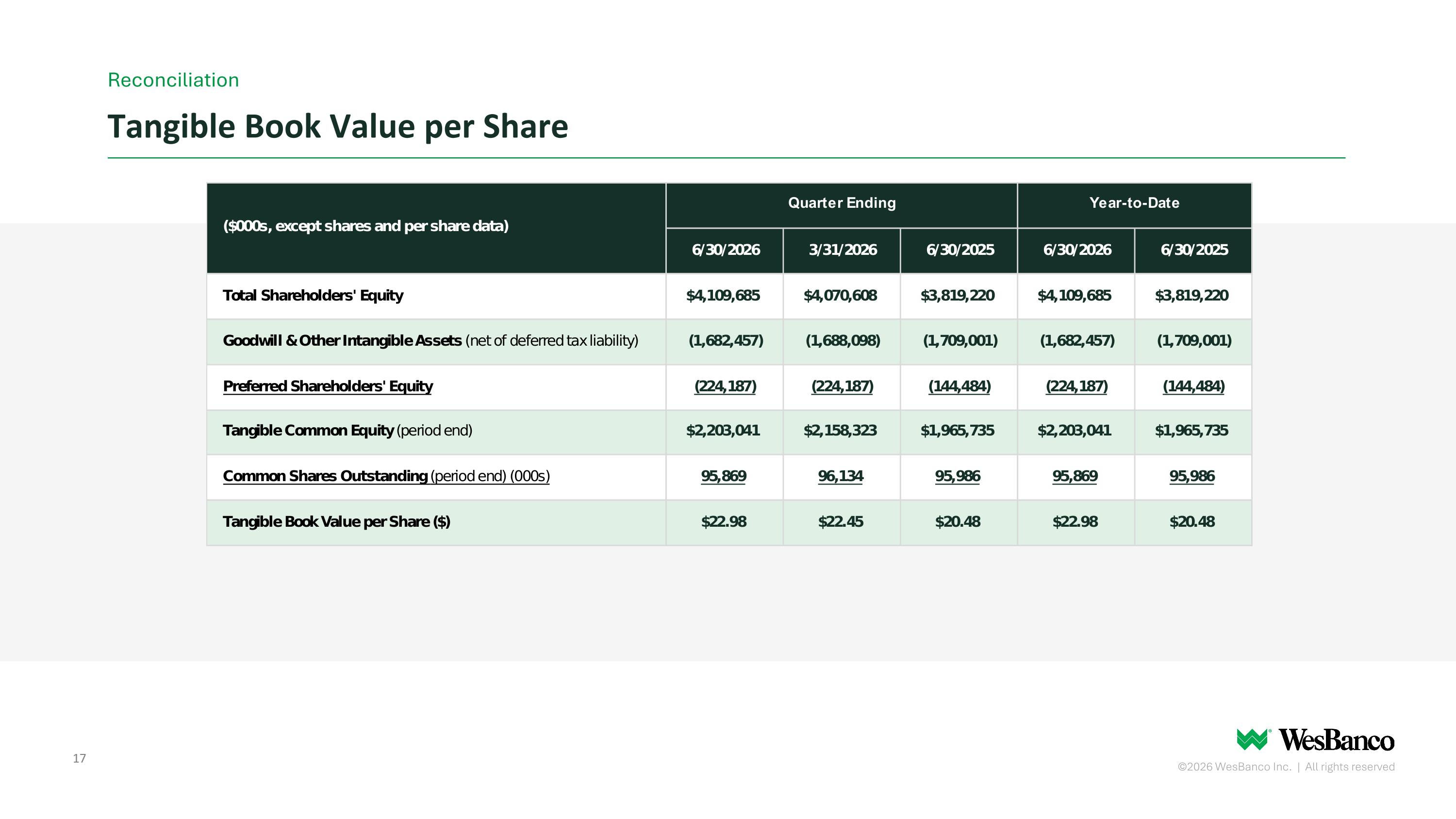
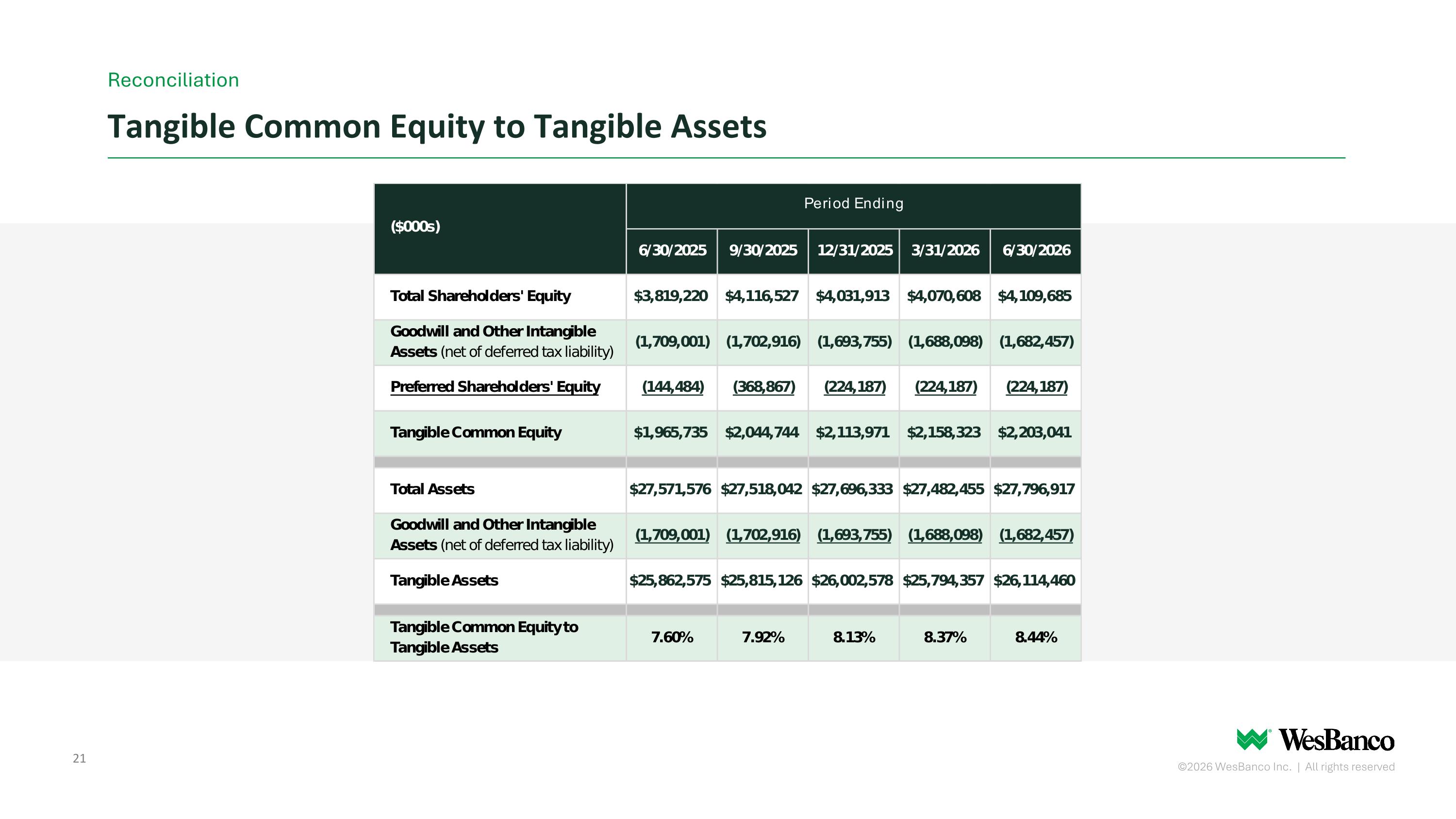
Yeah, I think it comes down to, like I said, we're kind of managing the buyback relative to that CET1 ratio. But we're accreting capital very quickly, but we plan to deploy that capital back into the loan growth. So to the extent that we don't see the loan growth maintaining that 10.7% say CET1, and we start to see that tick upward to 10.8, 10.9, 11, 11.1, that's when we really start pulling the trigger, I think, on buyback. And it's also, again, kind of dependent on stock price as well. We have certain hurdle rates that we want to achieve there as well. One other thing, you know, while we're on the subject of capital, I just kind of mentioned, we're talking, you know, the incredible accretion of capital that we're enjoying right now. We are kind of modeling that tangible book value per share, you know, to continue to improve about 70 to 80 cents per quarter off of that roughly $23 a share today. So we saw 50 cents pick up this quarter. And of course, some of that was impacted by the buyback. But, you know, we're modeling that 70 to 80 cents per quarter. That's about a 12% return on TBV. And, you know, if you think about like the current multiple that we trade at today, 1.8 times, 10 TBV, and we're growing, you know, say 70 cents per quarter. That's about $1.25, and I'll say theoretical stock price appreciation per quarter. Again, theoretical, theoretically, you can get, that's about $5 in stock price appreciation over the course of a year. So, you know, we do feel really good about the capital accretion that we're, that we're, that we have projected and modeled and feel great about, you know, how that can translate into stock price as well.
Operator
Our next question comes from Daniel Tamayo from Raymond James. Please go ahead with your question.
Good morning, Jeff. Morning, Dan. Maybe most of my questions have been asked and answered at this point, but, you know, obviously the Florida build out is a big part of the story for you guys right now. You know, curious, you, you mentioned the Naples LPO and then the, the coming Fort Lauderdale and Palm beach businesses. So are you close to filling out that, that footprint in terms of South Florida, where you want to be, if not, Where do you think you want to go and, you know, how you talked about $2 billion, like, is that kind of current footprint that you've talked about, or does that contemplate additional expansion?
Yes, we feel like right now we've kind of built out what we need, and the $2 billion would be the current footprint. Would we potentially look at some city north next year at some point? Yes, but right now we've kind of got South Florida built out for the most part. That doesn't mean we wouldn't hire one or two here or there. And we do believe that could be a $2 billion bank in the next couple of years for sure. As I mentioned, basically they're up to $200 million in loans already, and they haven't even been here but 90 days fully functioning. So the opportunities are just amazing. They represent, I believe, 10% of our current pipeline with a lot of other stuff behind it. But I think eventually we would continue to expand north maybe in 2027 with looking at a Tampa, Orlando, Sarasota, Jacksonville. You know, we don't have anything really picked out at this point. So we want to see this investment build up the assets, which we know they will.
And then in the future, we may look to expand that further. okay um understanding that the uh that that wouldn't be any in any kind of uh commentary around expenses right now but the uh the 153 million that you talked about dan for the back half of the year um that i'm sure incorporates the uh the recent hirings um does that incorporate kind of the the any of the kind of initial uh costs on the fort lauderdale and um palm beach hirings? And, you know, if not, like, how do you, how should we think about maybe the, the 27 anticipated path of expense growth?
Yeah, Danny, I would, I would tell you that the 153 million for third quarter does contemplate the, the South Florida expansion for sure. And part of that increase, I mean, I think I said it in my prepared comments, kind of, you've got three factors that are driving, you know, that expense growth from $148 million up to $153 million from second quarter, third quarter. That's mid-year merit increases, which are worth about $1.5 million. And then you've got, you know, a full quarter's worth, I would say, of like kind of salaries and wages related to the expansion efforts in the South. And then a pretty sizable increase in marketing expense, anticipating about $5 million in both in each of the third quarter and the fourth quarter in marketing. So that'd be up almost $3 million over the second quarter compared to third quarter. So yeah, certainly that's all baked in. I think probably with the story that's undersold somewhat is just the fact that we've been, how we've been able to manage our expenses throughout the year. You know, we're effectively investing the run rate today in our expansion efforts is about $3 million. We're anticipating that to be around $4 million per quarter, you know, kind of beginning or going forward through the third quarter and beyond. And you really don't see that much in the expense growth rate. So a lot of that comes from the optimization efforts that we've performed with branches and et cetera. And so we're really proud of our ability to be able to kind of significantly enhance our revenue growth opportunity while managing our expenses at a reasonable growth rate. The only thing I would add for fourth quarter, we do expect that to be pretty flat to third quarter, but there could be you know, some, some, I would say minor tech spend that would be placed in the service. Typically, um, you know, the, the, some of the tech and equipment gets placed in the service in the back half of the year, kind of midway through third quarter. So there could be a little bit of, of, you know, a little bit of additional expense there. Certainly, you know, we've got some branch openings, um, that would be kind of taking place and then, you know, maybe some residual revenue producing hires, but, uh, generally speaking, pretty flat to third quarter.
Understood. Thanks for all the color, Dan. I'll step back. Appreciate it.
Operator
Once again, if you would like to ask a question, please press star and then one. To withdraw your questions, you may press star and two. Our next question comes from Carl Shepard from RBC Capital Markets. Please go ahead with your question.
Hey, good morning, Carl. Good morning, Carl.
A few quick follow-ups, I guess. I think last quarter you teased the Nashville LPO. Any update on that?
Yeah, sure, Carl. We have hired some people in Nashville toward the middle of last quarter, and those people, by the way, are all in the run rate of the 153, just to be clear. And, yeah, they're just getting started. And, you know, we've been in Nashville for a while, but we have a now stronger presence there with a group of people we've hired. And I feel like they're just getting started. They're building their pipeline, which I believe is about $150 million at this point. So should see some good, strong contributions from Nashville in third quarter and fourth quarter.
Okay. And then I guess, Jeff, I think you guys have a lot going on and a lot of opportunity ahead of you from the new offices in Florida. Has the bar to pursue a new LPO or hire people into the franchise gone up a little bit? Are you happy with what you have today, or do you think you want to be more aggressive in the next couple of quarters? Is there some dislocation across some of the markets?
Yeah, I think we've done a lot of expansion, a lot of LPOs, and, yes, the bar has definitely gone up tremendously. From what we're seeing in these new LPOs, the opportunities are very abundant. So, once again, I don't really see us doing any more expansion. I think we want to make sure that these investments pay off, and they are. and they're driving really strong loan growth, fee growth, and deposits. And so for us, I don't really see any more expansions in the back half of this year. Once again, at some point next year, we'd probably look at, you know, some other part of Florida. But, yes, it's got to be very, very meaningful, driving a very strong return, which, once again, these new ones are going to do that. So, yes, I would agree with your conclusion that the bar has been raised. We're always out talking to people, but I feel like we're in great markets at this point.
And then one last one for me. I think in the script you mentioned an upward swing in payoffs late in the quarter. Is there anything to call out from that, or is that just strictly timing? It doesn't really change your thinking on any of the payoffs tapering?
No, it doesn't change any of my thinking at all. We're continuing to see the payoffs. We do believe, you know, I feel like I said this last quarter, but we do believe third quarter will be slightly less than second quarter, maybe a third less than second quarter. But once again, with our pipelines being at all-time highs, $2.3 billion, and 30% of that is from LPOs, we feel like we will grow through any sort of potential payoffs. But, yeah, it's been the same story. It's CRE refinances, restructurings. Some of them have been CNC credits we've been able to get off. So I think it continues in the third quarter. Hopefully it's a little bit less. As we move toward the fourth quarter, we think it should be less than that, but we'll have to wait and see. But I can tell you that our pipelines remain at all-time highs with all the actions we've taken. So I would expect very strong loan growth in the third and fourth quarter.
Great. I appreciate all the help and good quarter, guys.
Operator
And our next question comes from Manuel Navis from Piper Sandler. Please go ahead with your question.
Hey, good morning. So with the bar being raised on new LPOs, it seems like a lot of pipeline for future growth in Florida. Where does the capital deployment in M&A stand across your kind of options?
Yeah, good morning, Manuel. Well, we're not really looking at M&A at all at this point. For us, we're seeing great returns, as Dan mentioned, on the tangible book value buildback, also the organic growth that we're going to be seeing over the next couple years. M&A is really at the very bottom. Once again, we're not pursuing any M&A really focused on the heavy organic growth, and you're going to see that over the next several quarters. That feels like the best use of our capital at this point.
I appreciate that. Is there any differentiation across the regions on the CRE payoffs? Is there any place that kind of is driving more of it, or is it pretty spread out?
It's pretty well diverse. It's pretty spread out throughout our entire footprint. Once again, it's a lot of permanent – a lot of going to permanent financing, a lot of sales of property. And so, as you know, we put on a lot of CRE. I think at one point we had a very high CRE concentration that's come down significantly. And so it's really pretty widespread. There's not one specific area that we're seeing CRE payoffs in.
And I appreciate the discussion of deposit costs are probably hitting a floor. What's kind of the marginal funding for growth across borrowings and maybe new deposits?
Yeah, today we would say right around 3%, I would say, and that would be assuming, you know, the higher tier money markets, interest bearing coming on around 3.5%, 3.75%, mixed in with, you know, about 20%, 25% of NIB.
I appreciate it. Thank you, guys.
Operator
And with that, ladies and gentlemen, we'll be concluding today's question and answer session. I'd like to turn the floor back over to Jeff Jackson for closing comments.
Thank you. To wrap up, our year-to-date financial results demonstrate the success of our relationship-focused banking model and disciplined growth strategy. And with solid funding position and strong momentum across our markets, particularly in our expansion markets, northern Virginia, Tennessee, Florida, we are well-positioned for continued growth. Thank you for joining us today. We appreciate your continued interest in West Banco and look forward to speaking with you at one of our upcoming investor events. Have a great day.
Operator
And with that, ladies and gentlemen, we'll be concluding today's presentation. We do thank you for joining. You may now disconnect your lines.