Operator
Good day, ladies and gentlemen, and welcome to the Ziff Davis Second Quarter 2026 Earnings Conference Call. My name is Tom, and I will be the operator assisting you today. At this time, all participants are in a listen-only mode. A question and answer session will follow the formal presentation. If anyone should require operator assistance during the conference, please press star zero on your telephone keypad. On this call will be Vivek Shah, CEO of ZIF Davis, and Brett Richter, Chief Financial Officer of ZIF Davis. I will now turn the call over to Brett Richter, Chief Financial Officer of ZIF Davis. Thank you. You may begin.
Thank you. Good morning, everyone, and welcome to the ZIF Davis Investor Conference Call for the second quarter of fiscal year 2026. As the operator mentioned, I am Brett Richter, Chief Financial Officer of Zip Davis, and I am joined by our Chief Executive Officer of Vex Shop. A presentation is available for today's call. The presentation and our earnings release are available on our website, www.zipdavis.com. You can access the webcast from this site. When you launch the webcast, there is a button on the viewer on the right-hand side which will allow you to expand the slides. after completing the presentation we will be conducting a q a the operator will provide instructions regarding the procedures for asking questions in addition you can email questions to investor at zip davis.com before we begin our prepared remarks allow me to read the safe harbor language as you know this call on the webcast will include forward-looking statements such statements may involve risks and uncertainties that could cause actual results to differ materially from the anticipated results some of those risks and uncertainties include but are not limited to the risk factors that we have disclosed in our sec filings including our 10k filings recent 10q filings various proxy statements and 8k filings as well as additional risks and uncertainties that we have included as part of the slideshow for the webcast we refer you to discussions in those documents regarding safe harbor language and forward-looking statements. In addition, following our Business Outlook slides are our supplemental materials, including reconciliation statements for non-GAAP measures to the nearest GAAP equivalent. Now let me turn the call over to Vivek for his remarks.
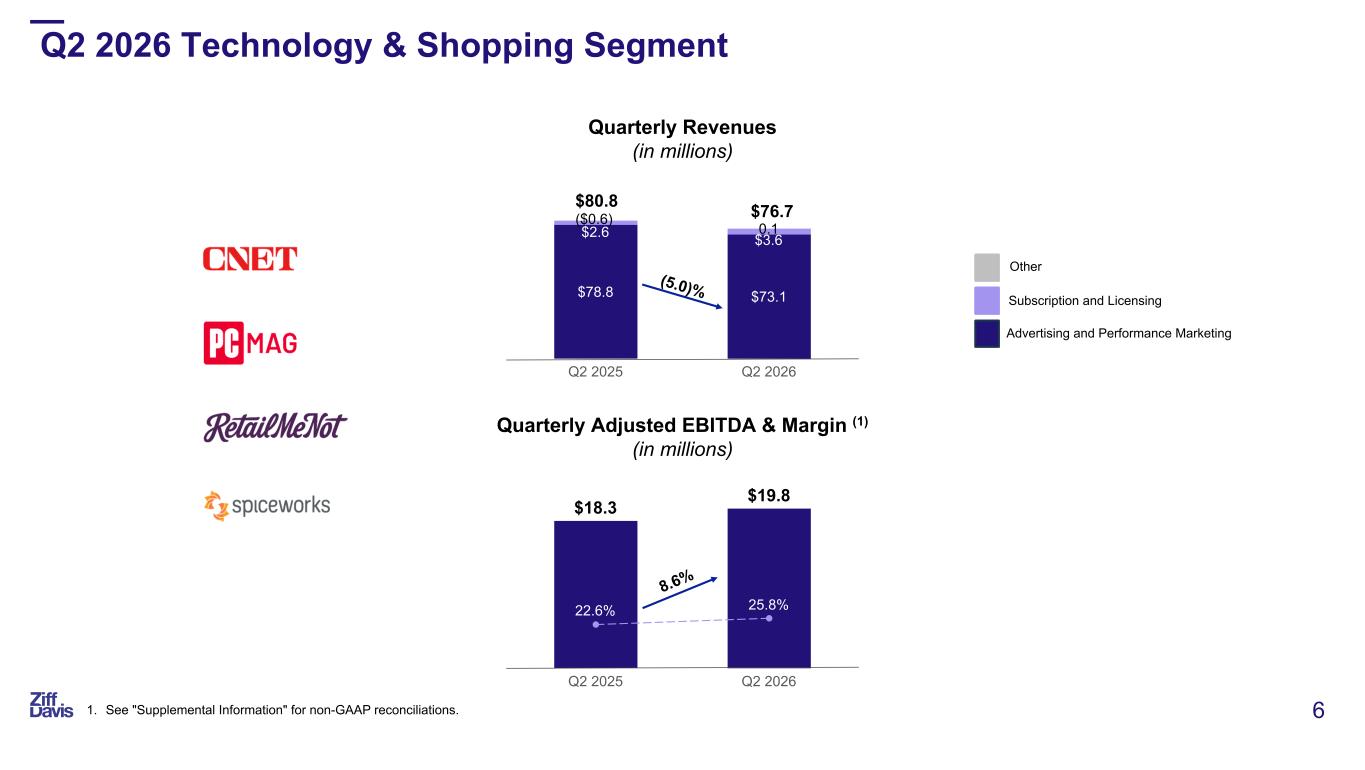
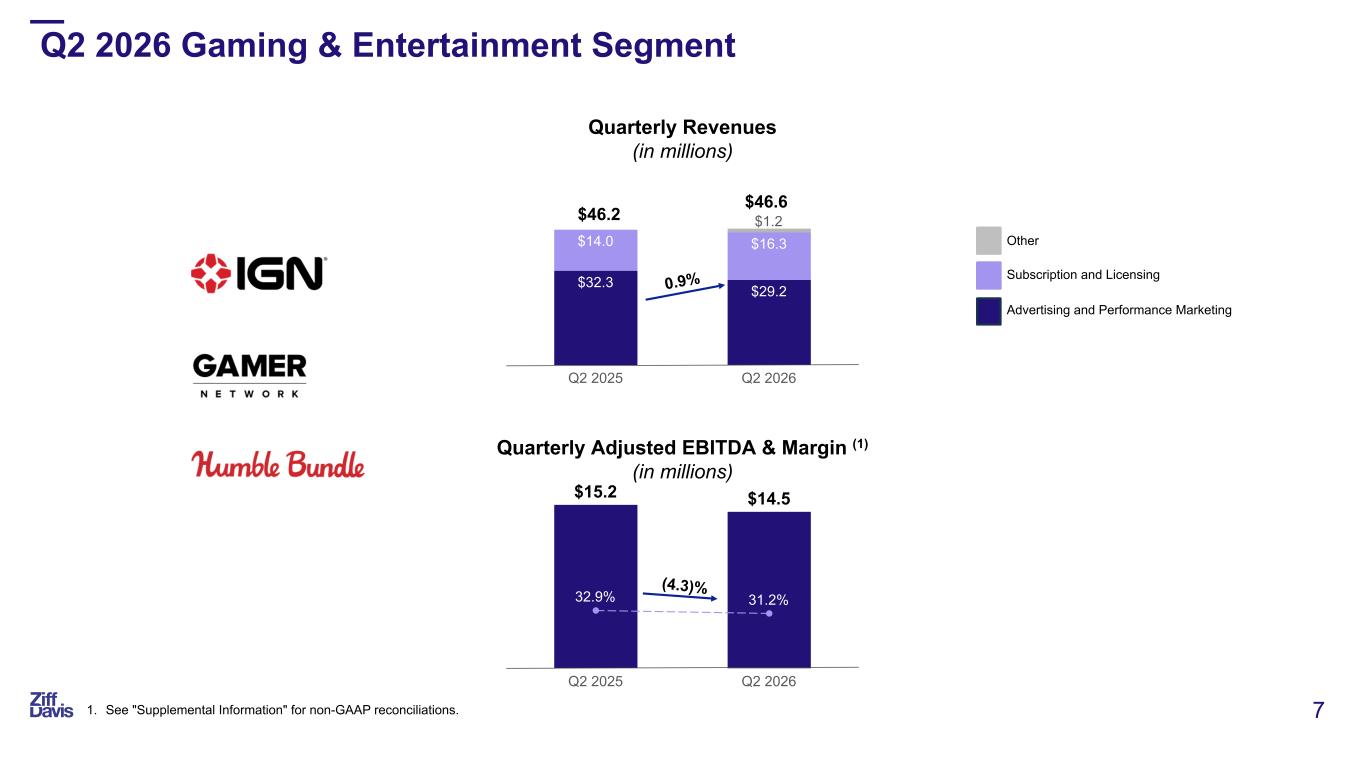
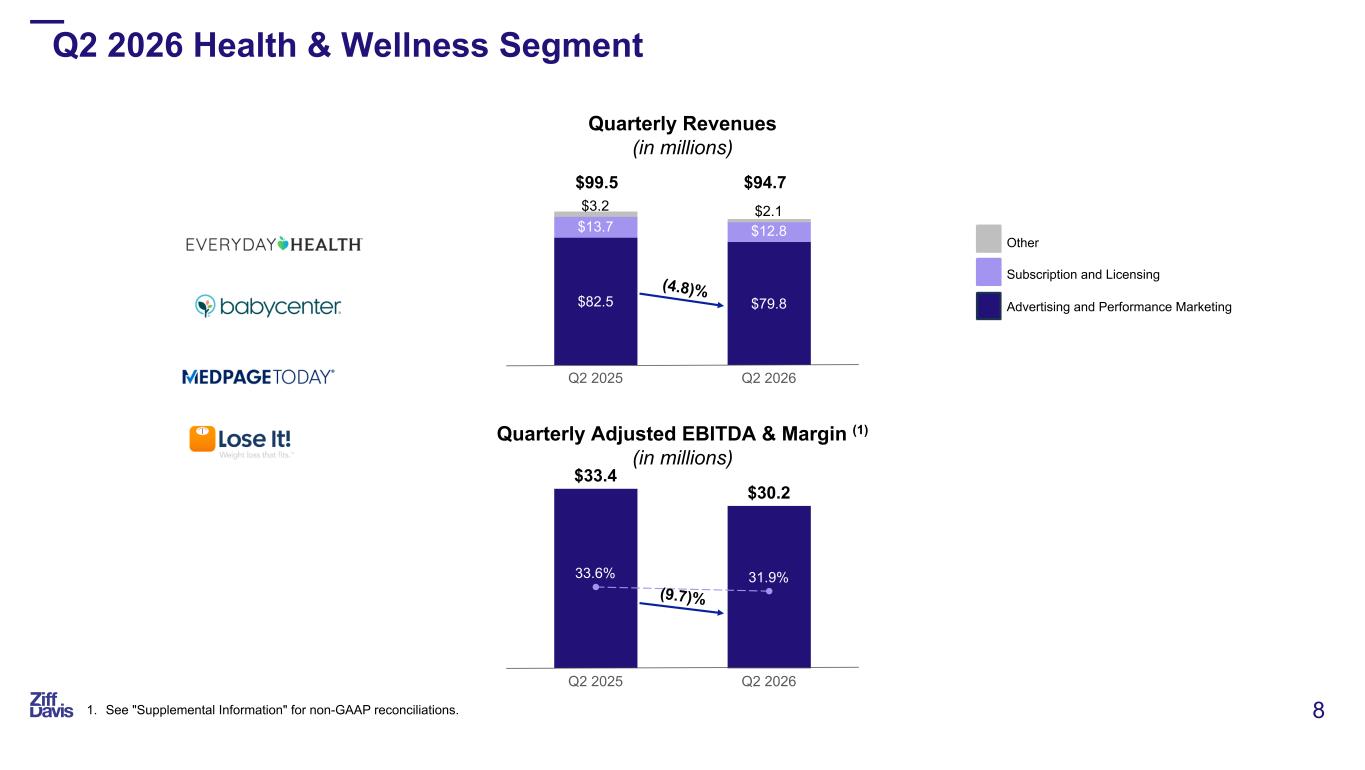
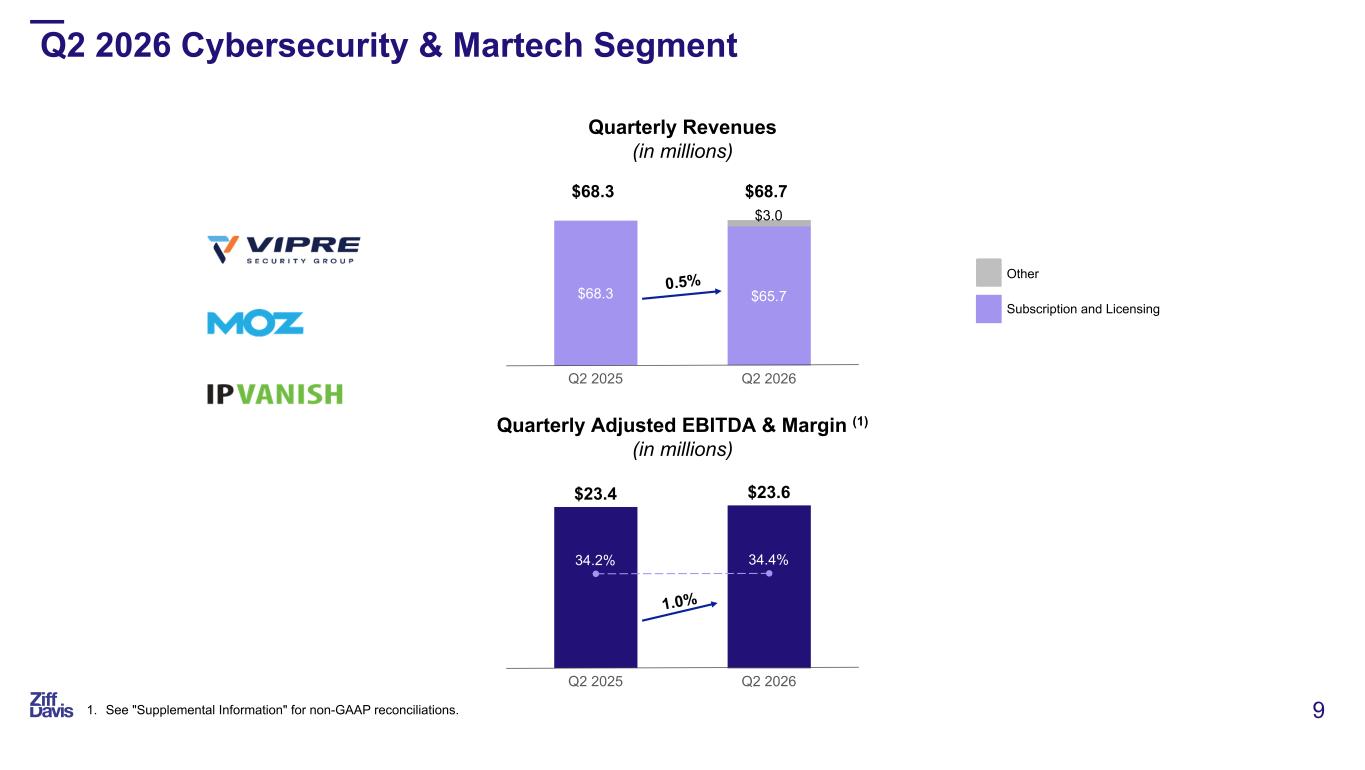
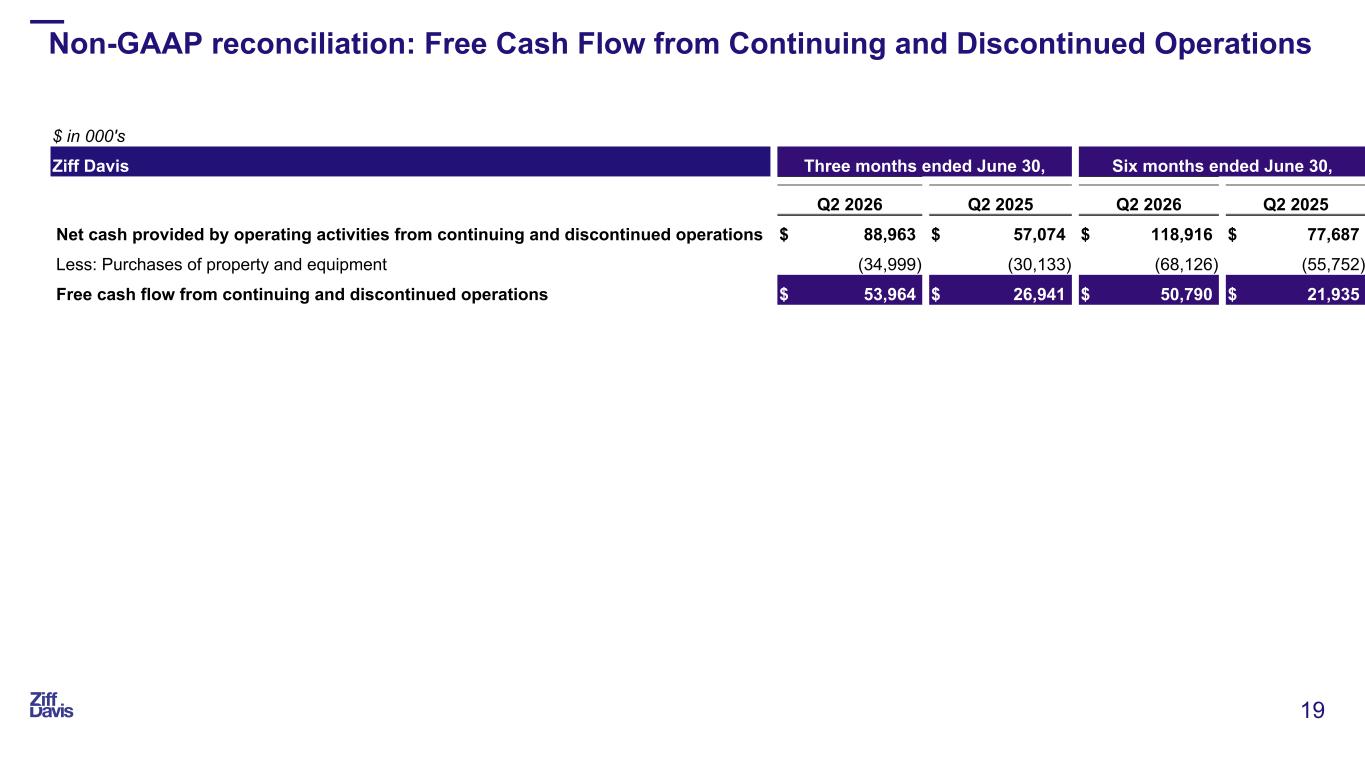
Thank you, Brett, and good morning, everyone. During the second quarter, we completed the sale of our connectivity business to Accenture for $1.2 billion. This is a transformative transaction and a concrete illustration of the quality of our underlying businesses. As a reminder, the acquisition price reflected a 14.5 times multiple of the connectivity businesses trailing 12 months of adjusted EBITDA, less capex. This transaction also highlights our willingness to monetize assets as a key tool in addressing the gap we see between our share price and the value of the businesses in our portfolio. Since our last earnings call, we repurchased approximately 2.8 million shares under a 10B51 program. Thus far in 2026, we have deployed more than $200 million to buy back 4.5 million shares, reducing the number of shares outstanding by nearly 11% over the course of just seven months. Going forward, a portion of our cash will be allocated to settling our tax obligations related to the transaction, with payments estimated to be approximately $200 million. We also plan to repay our $149 million of our convertible debt, which matures in the beginning of November of 2026. Even after those payments, we expect to be in a very strong cash position. We believe that making open market purchases enables us to return capital to shareholders in a methodical and cost-effective manner. This approach also reduces the risk of short-term price distortions, which can result from buybacks executed through a tender process. Overall, we are pleased with the market's response to our efforts to unlock additional value. ZIF Davis stock is up approximately 45% year-to-date and approximately 65% over the past year. But there is more work to do, so we will avail ourselves of all capital allocation choices, continue to explore monetization opportunities, and remain a very disciplined buyer of attractively valued assets. We will remain deliberate, strategic, and patient. Now, I'd like to share some observations about our second quarter performance. With the sale of connectivity, we now have four reportable segments. Our second quarter consolidated revenue across those four segments declined 2.7% versus last year, consistent with the expectations we set last quarter. We had modest growth in gaming and entertainment and cybersecurity and martech offset by lower revenues in tech and shopping and in health and wellness. Adjusted EBITDA declined 3.7% year over year, while adjusted EPS grew 13% as we continue to reduce our share count. We had a strong cash generating quarter with approximately $54 million of free cash flow. Tech and shopping's second quarter revenues declined 5% year over year, a significant improvement from the 13% drop in the first quarter and the 18 percent drop in Q4, while adjusted EBITDA rose more than 8 percent. While headwinds persist in traditional search traffic, we continue to make progress in growing our tech and shopping audiences through off-platform channels such as Instagram, Facebook, TikTok, and YouTube, as well as CTV and events. We have also started to generate meaningful affiliate commissions earned directly through our social channels, and we see opportunities to grow this revenue stream in the coming quarters. In addition to our Internet properties, social channels, and newsletters, our deep brand credibility is a valuable asset in the evolving AI content universe. Both CNET and PCMag were highlighted in a recent SEMrush AI Visibility Index report as being among the most cited information sources across major LLMs, which has marketers seeking to be attached to our trusted, high-quality, and high-authority editorial brands. Gaming and entertainment revenues grew by almost 1% as compared with the second quarter of 2025, driven by another record quarter at Humble Bundle, offsetting ad revenue declines at IGN, which we believe is primarily attributable to the current state of the video game market and the current slate of titles rather than underlying traffic trends. Adjusted EBITDA fell slightly. IGN's Game Help tools continue to grow in popularity, with Map Genie traffic up 30%, and IGN's Destination for Action RPG players' max role up 11% in traffic year-over-year. On the events front, IGN Live celebrated its third year, with more than 10,000 attendees in Los Angeles, while the show's content reached an audience of almost 300 million across 35 platforms in over 100 countries. IGN's Women in Gaming platform, focused on supporting female-led success in the games industry, continue to expand, holding successful events in both the U.S. and the U.K. in the second quarter. Health and wellness second quarter revenues were down nearly 5%, and adjusted EBITDA was down nearly 10% year-over-year, due primarily to lower HCP advertising revenue at MedPage today, offset in part by strength in consumer DTC advertising revenues. HCP advertising revenue at MedPage today was down year over year, as some large pharma clients have reduced their spend levels and have shifted spending to lower-cost platforms. However, we grew sequentially over Q1 and expect sequential growth to continue through the balance of 2026. MedPage is actively expanding its distribution, including a newsletter product integrated within electronic health record systems at the point of care. We also strengthened our association partnerships at Healthy Careers, our leading career healthcare platform, with the addition of the American Thoracic Society and the American Academy of Family Physicians to our exclusive association job board partnerships. Our consumer DTC advertising and subscription businesses continue to benefit from the rapid growth in GLP-1 prescriptions and related promotional spend. In addition, GLP-1 support was introduced on both iOS and Android versions of our Lose It Weight Loss and Nutrition app to help GLP-1 users maintain a healthy diet as their food intake volume declines. We have seen continued momentum in our hospital media network. where we serve as the exclusive digital advertising partner for highly trusted medical institutions. We recently expanded the network with the addition of the University of Pittsburgh Medical Center, a world-renowned health care provider. In cybersecurity and MarTech, second quarter revenues and adjusted EBITDA both grew nearly 1% year-over-year, led by strong performance in our consumer cybersecurity business. IP Vanish, our flagship consumer security offering, grew year-over-year for the fifth straight quarter, driven by continued growth in our white-label partnerships, as well as strong growth in Q2 customer additions. In MarTech, SMTP.com, our API-based email delivery solution, has consistently delivered double-digit growth by providing exceptional inbox delivery for high-volume senders across a variety of use cases and applications. In addition, we're very pleased with the first-year performance of Symantec Labs, our performance-based customer acquisition business, which has grown steadily since we purchased the business in Q3 of 2025. Turning to developments in our firm-wide AI initiatives, last quarter I described how AI has moved to the center of our product development process and how we'd begun deploying that approach across key engineering teams. I want to update you on progress. In a single quarter, the share of the code we released that is AI authored has roughly doubled, and the majority of new or updated code we release is now written by AI. This shift has taken hold broadly across our teams. We're currently on track to have nearly all of our code authored by AI before the end of 2026, with our product workforce increasingly focused on architecture and innovation rather than writing code line-by-line. We are already seeing the results. We shipped 24% more code in the second quarter than we did in the first quarter on lower engineering headcount, with initial metrics suggesting delivery quality is holding steady. That is operating leverage in the form we described in the last earnings call. lower cost per feature delivered, and the capacity to spark a broader roadmap without proportionally scaling or resourcing. We expect this approach to improve our operational efficiency in the coming quarters. Looking ahead, ZIF Davis is in an extremely strong financial position, with a substantial net cash balance, strong free cash flow generation, and four profitable business segments with numerous trusted category-leading brands. With the connectivity sale and the stepped-up capital returns this year, we believe we have delivered on our promise to unlock additional shareholder value and believe we can continue to deliver even more value in the years ahead. With that, let me hand the call back to Brett.
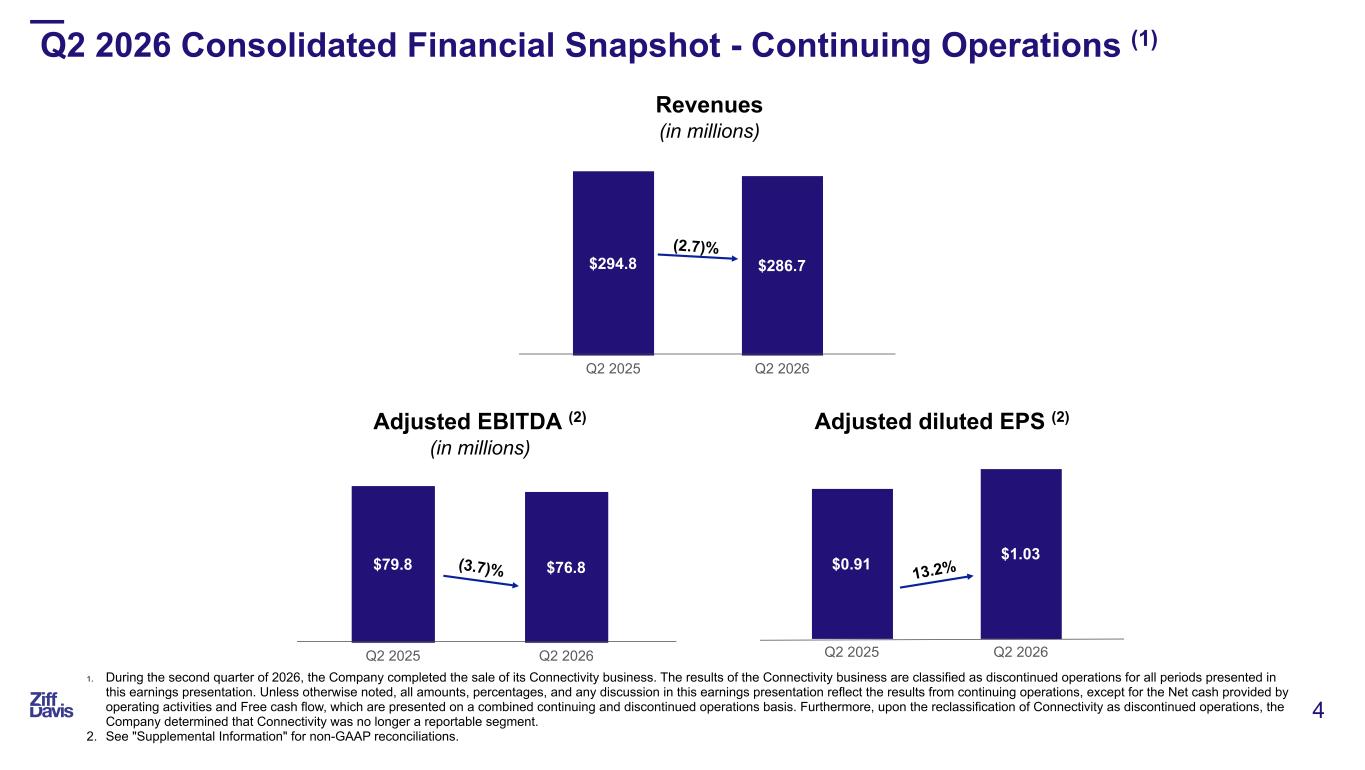
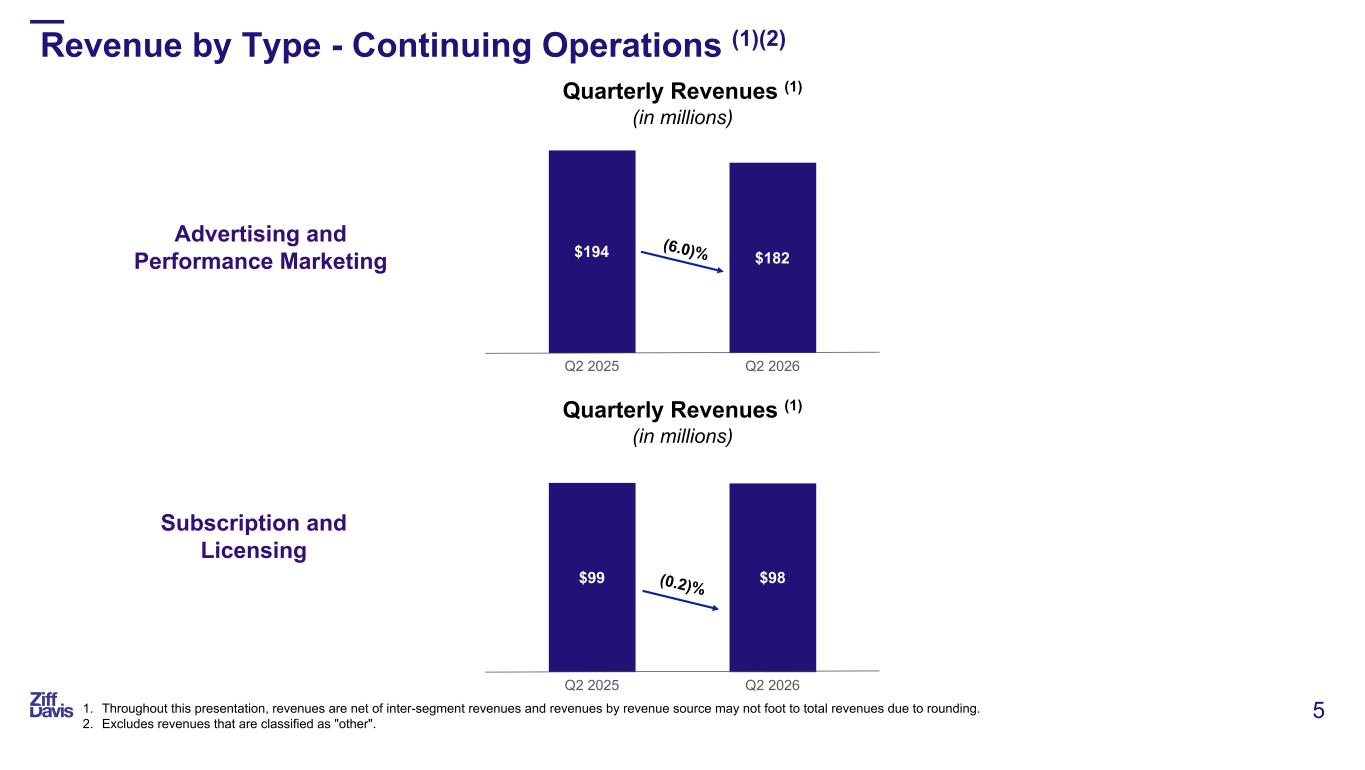
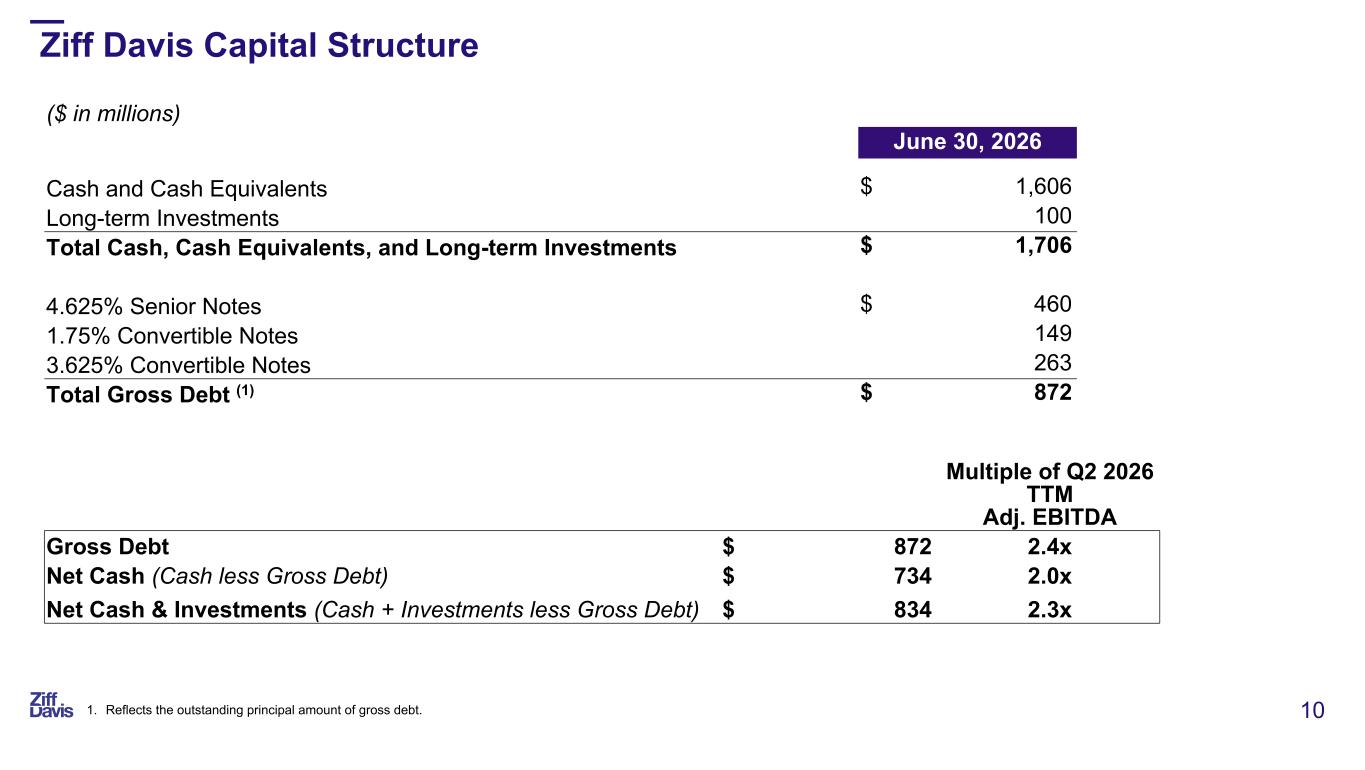
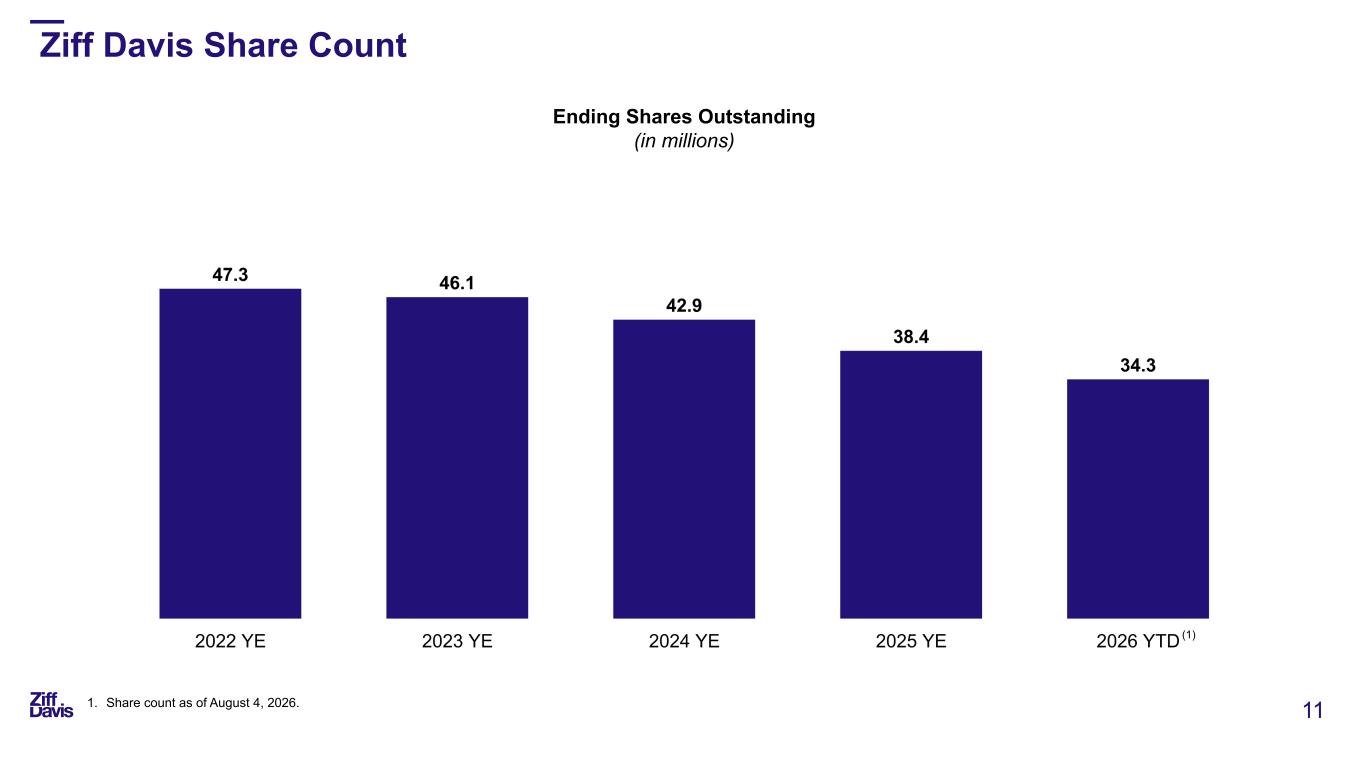
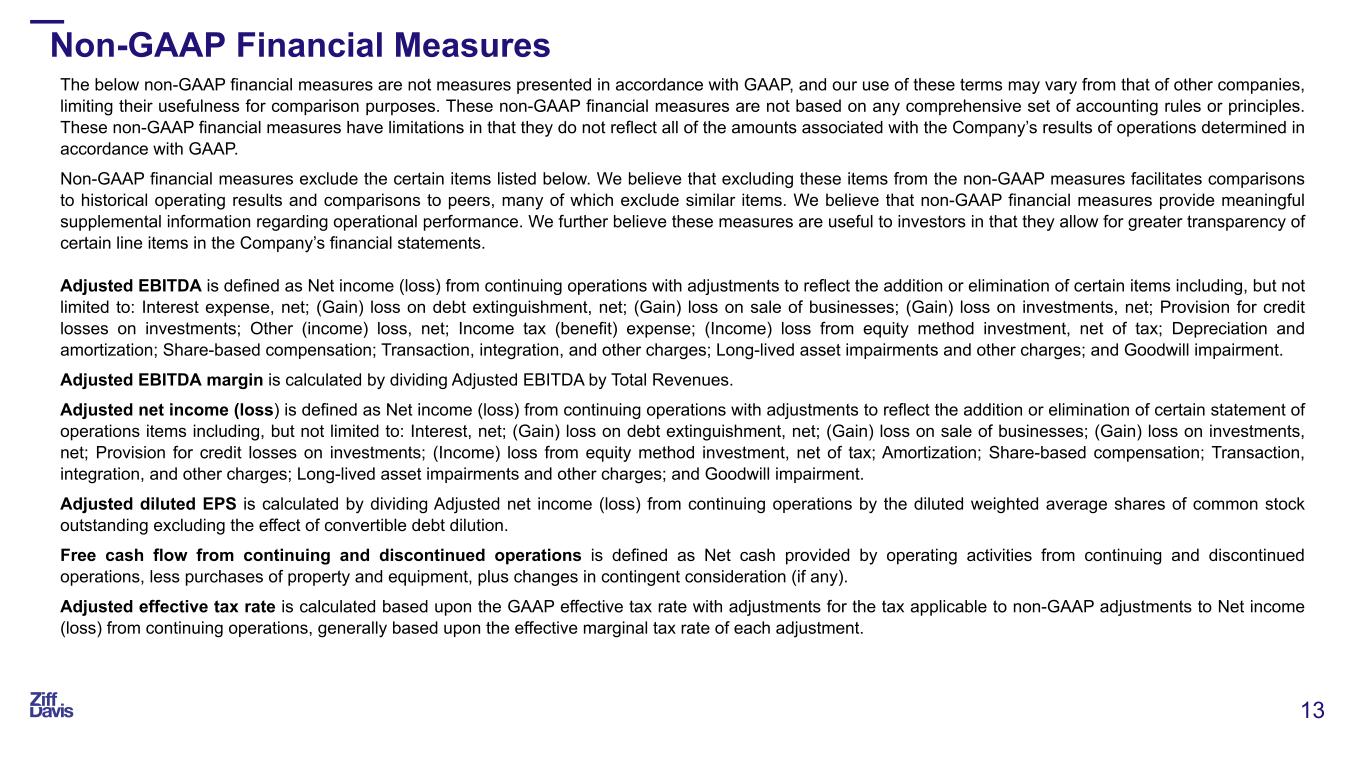
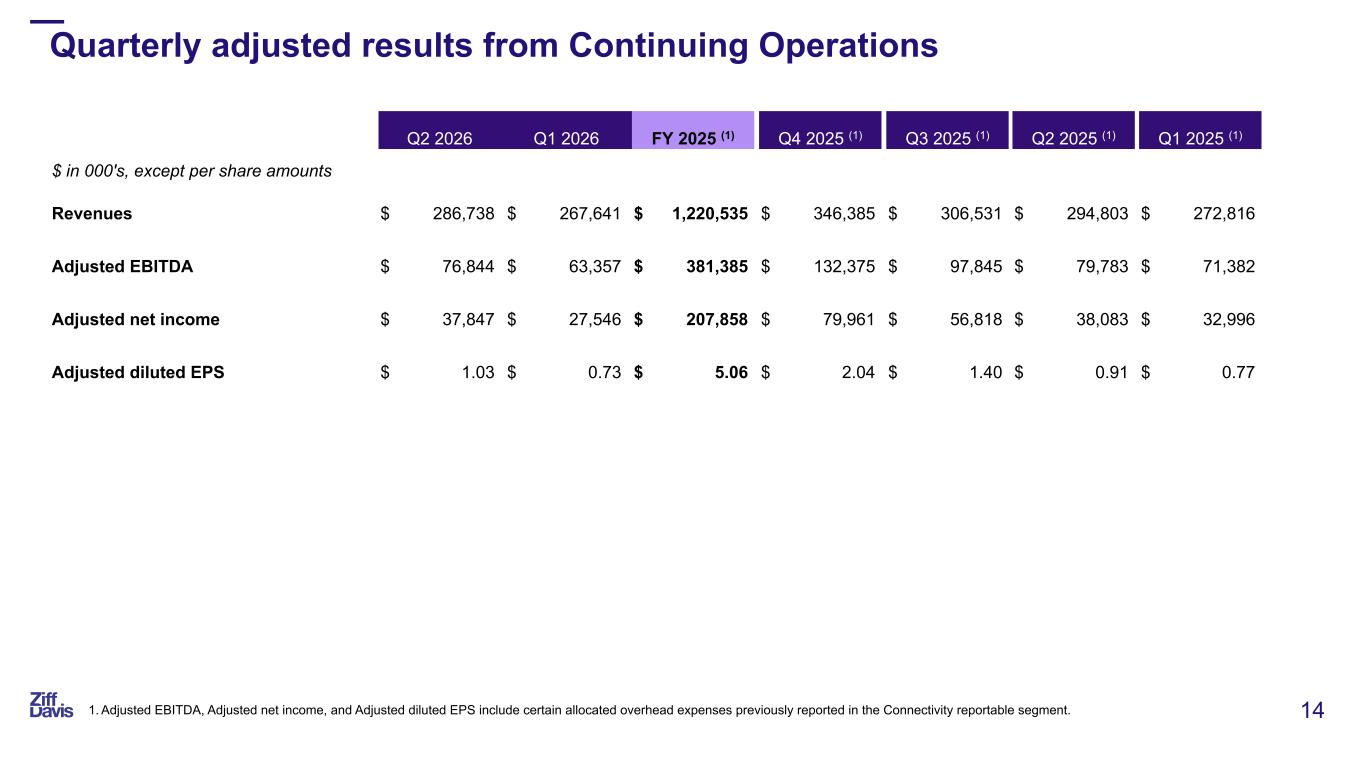
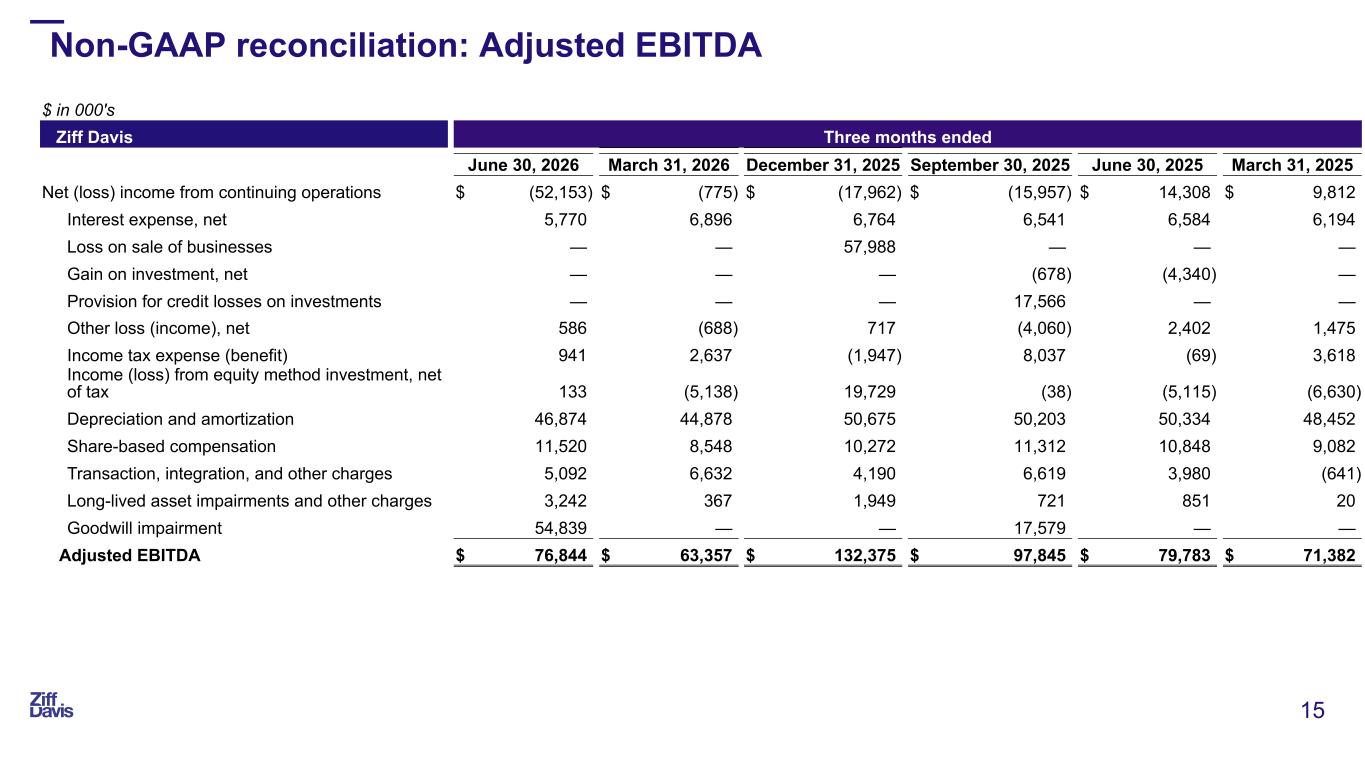
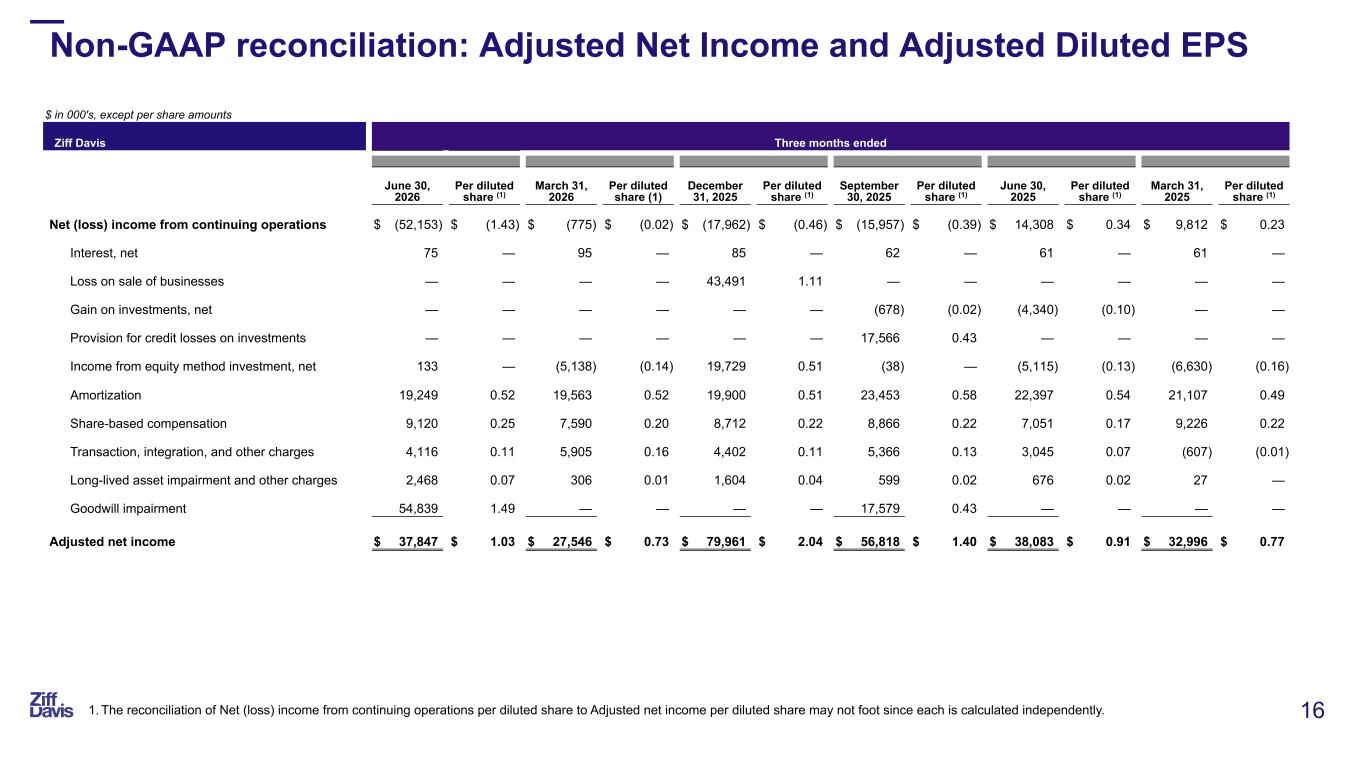
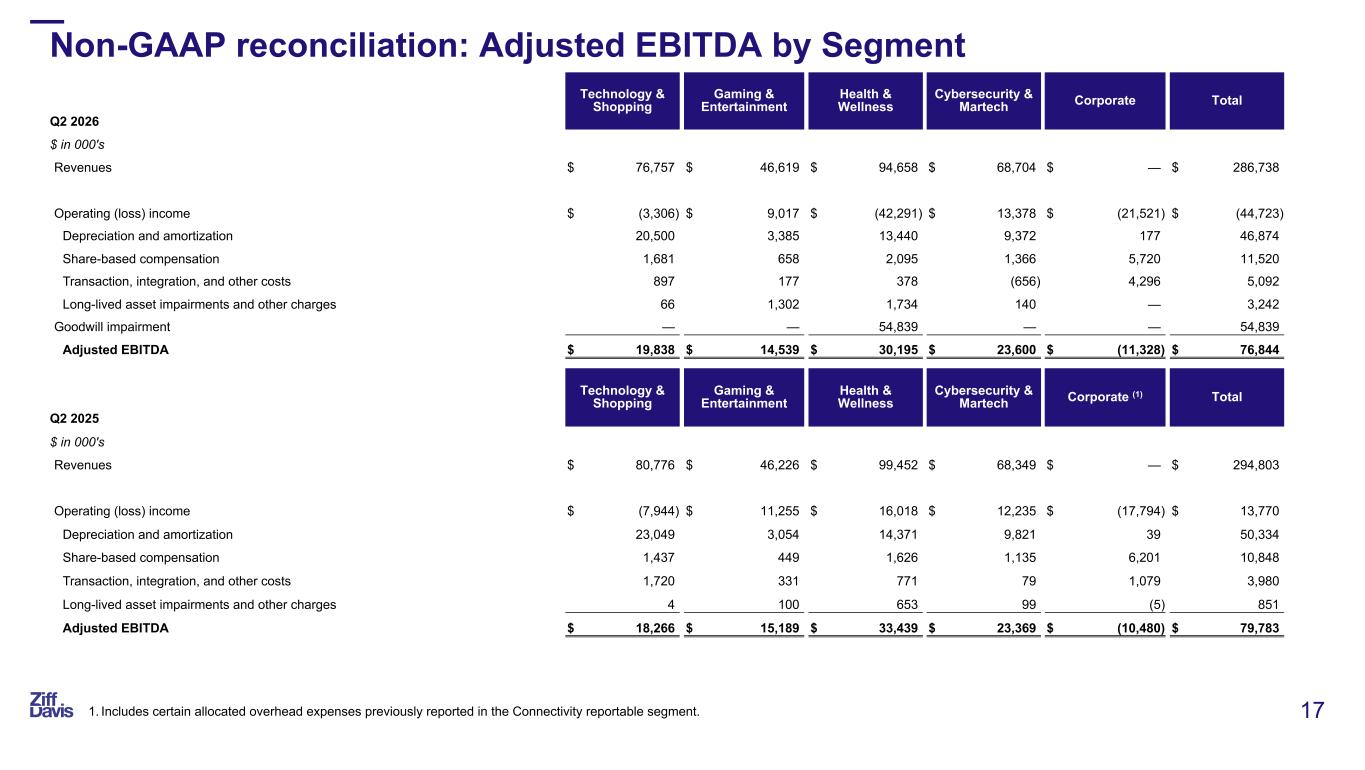
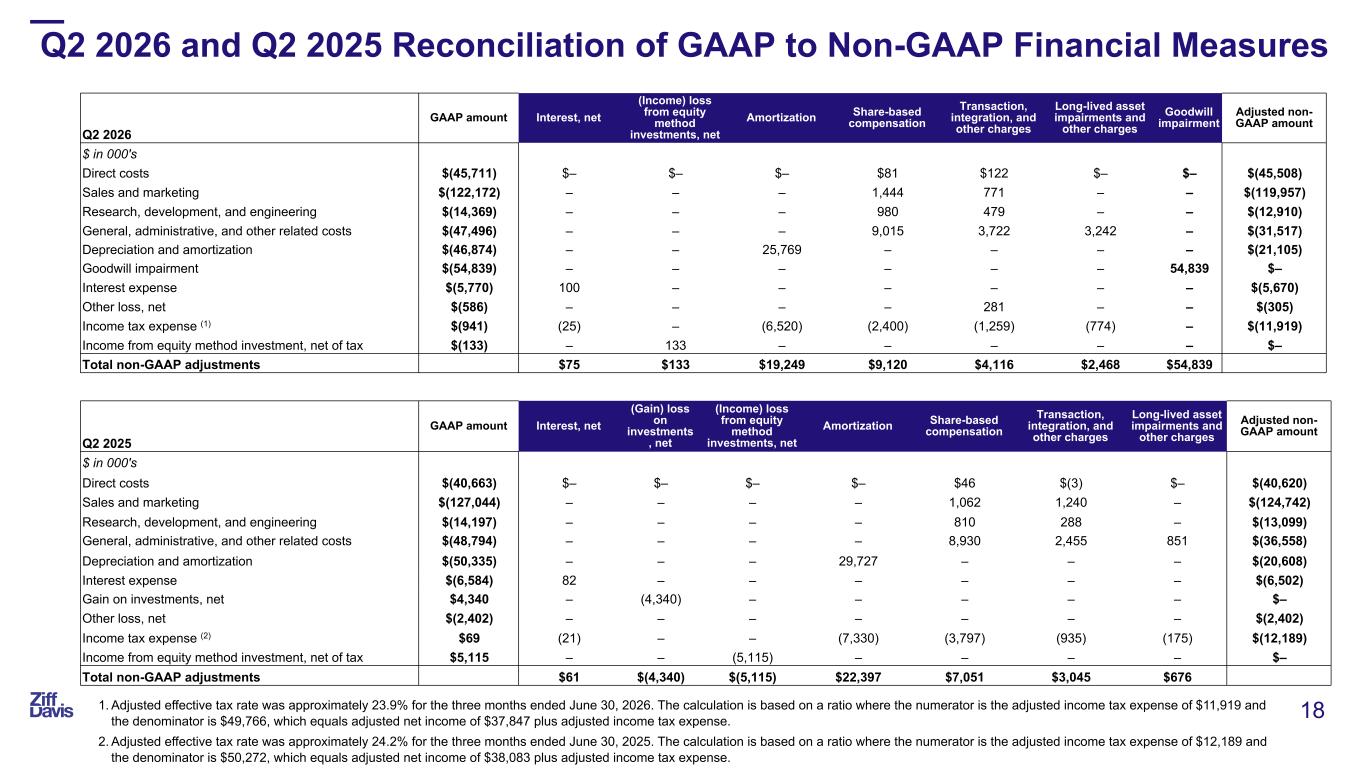
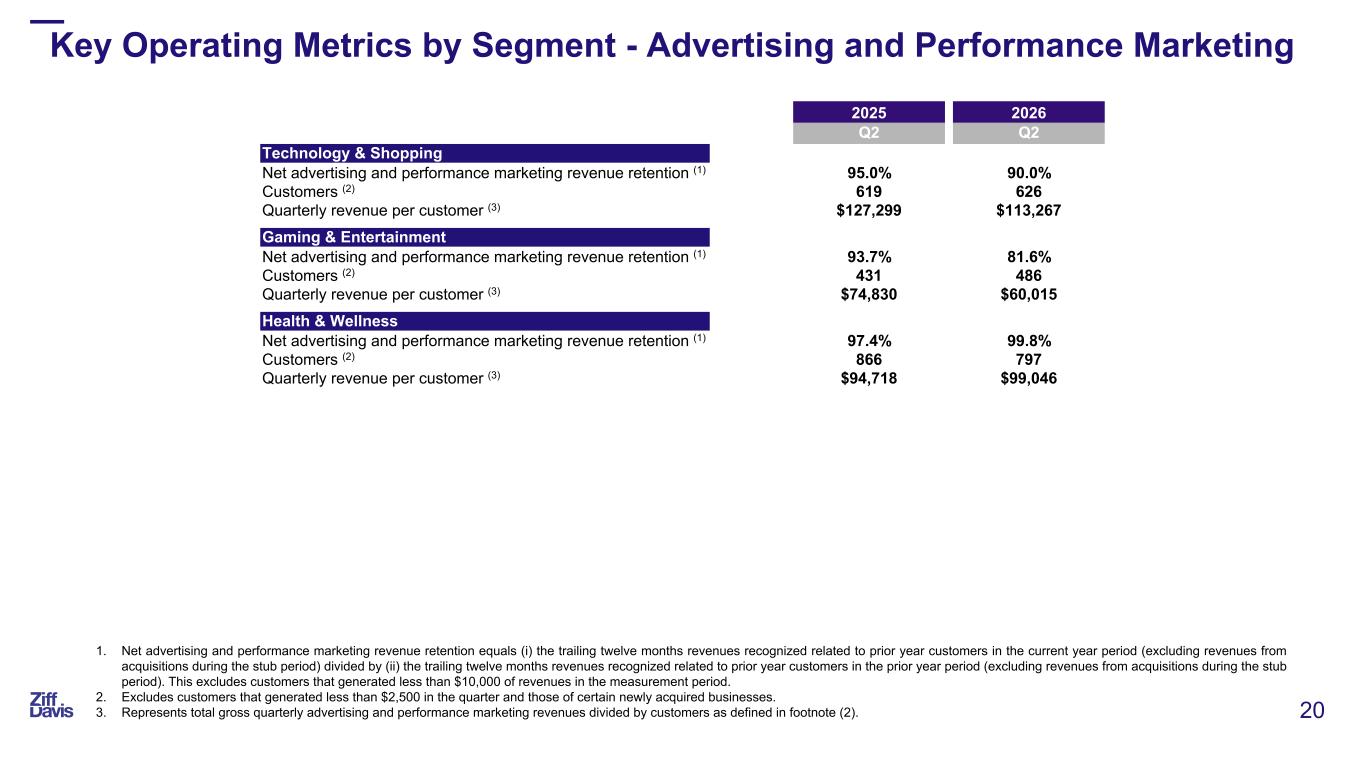
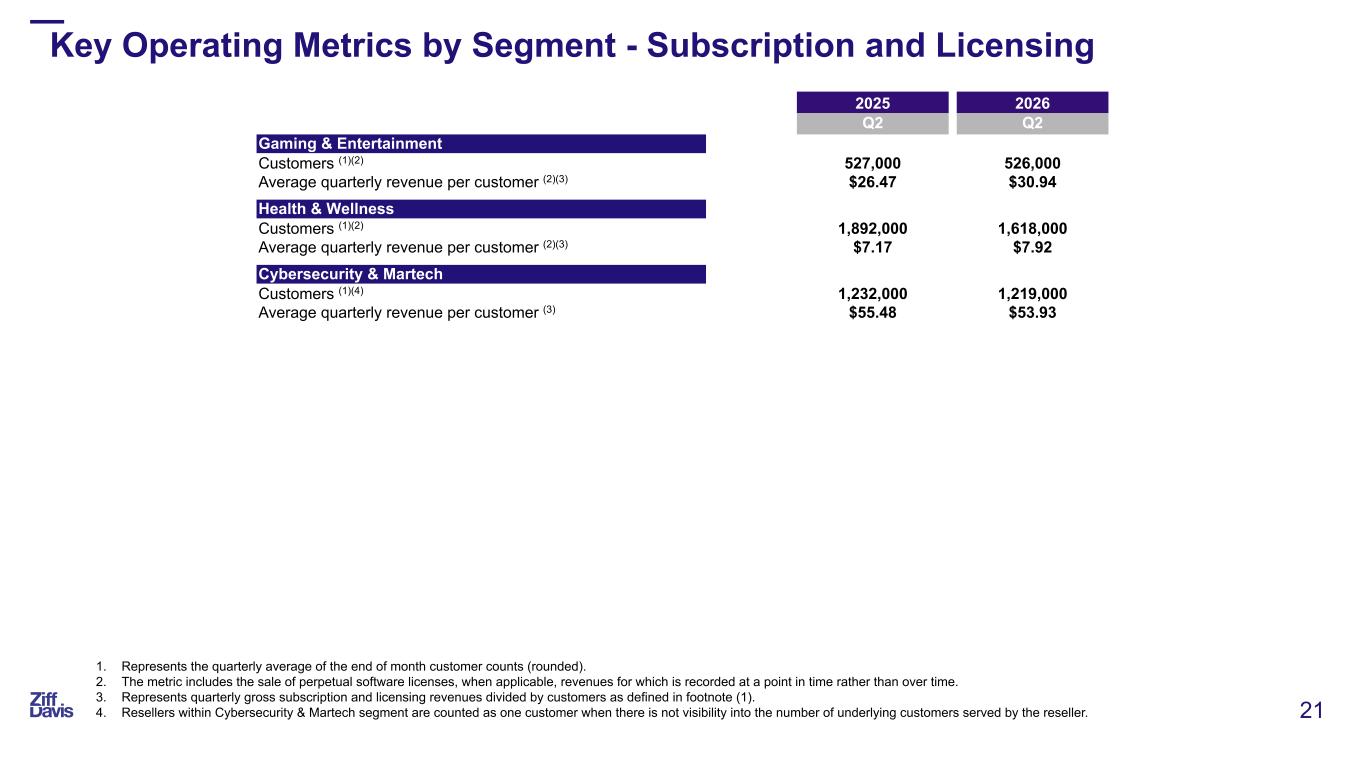
Thank you, Vivek. Let's discuss our financial results. Our earnings release reflects both our GAAP and adjusted financial results for Q2-2026. My commentary will primarily relate to our Q2-2026 adjusted financial results for continuing operations and their comparisons to the relevant prior period. Our results from continuing operations exclude the partial quarter results of the connectivity division, which are reflected in our results from discontinued operations. Please see slide four for the summary of our Q2-2026 financial results. Q2-2026 revenues were $286.7 million. This reflects a decline of 2.7% as compared with revenues of $294.8 million for Q2-2025. Q2-2026 adjusted EBITDA was $76.8 million, as compared with $79.8 million for the prior year period. Our adjusted EBITDA margin for the quarter was 26.8 percent, down less than half a percentage point as compared with an adjusted EBITDA margin of 27.1 percent in Q2-2025. These results, particularly the adjusted EBITDA margins, are an improvement from the Q2-2026 expectations we provided last quarter. Q2-2026 adjusted diluted EPS was $1.03, an increase of 13.2% as compared with $0.91 in the prior year period, due primarily to the significant share count reduction from our stock buyback activity during the past year. Slide 5 reflects performance summaries for our two primary sources of revenue, advertising and performance marketing and subscription and licensing. Q2-2026 advertising and performance marketing revenues declined 6% as compared with the prior year period, while subscription and licensing revenues were essentially flat. Other revenues more than doubled, increasing by approximately 3.7 million dollars year over year in q2 2026 due in large part to the contribution of semantic labs in our martech group slide six through nine reflect the q2 financial results of each of our four reportable segments tech and shopping adjusted EBITDA margins improved despite a modest drop in revenues reflecting lower expenses due in part to the impact of cost savings measures implemented in the second half of 2025. Gaming and entertainment adjusted EBITDA margins were lower year-over-year despite a 1% increase in revenues, due in part to higher aggregate marketing and content costs associated with the record quarter at Humble Bundle. Health and wellness adjusted EBITDA margins were lower, primarily reflecting the flow-through impact of the year-over-year decline in revenues. And in our cybersecurity and MarTech segment, adjusted EBITDA margins were up slightly from the prior year period. Please refer to slide 10 as we review our balance sheet. As of the end of Q2-2026, we had $1.6 billion of cash and cash equivalents and $100 million of long-term investments. As of June 30, 2026, gross leverage was 2.4 times trailing 12-month adjusted EBITDA, and our cash and cash equivalents exceeded our outstanding debt balances by $734 million. As Vivek noted earlier, we expect to pay approximately $200 million to satisfy our domestic and international tax obligations related to the connectivity transaction. We have taken certain steps to execute the transaction tax efficiently, and we continue to explore ways to positively impact our aggregate cash tax obligations, including through the potential use of investment tax credits. We currently expect to satisfy the vast majority of our cash tax payments by the end of the first quarter of 2027. In addition, $149 million of our convertible debt comes due on November 1, 2026. We plan to satisfy this maturity with cash. Our next significant outstanding debt maturity is in 2028, and we have no plans to redeem any of our debt prior to its maturity at this time slide 11 shows the historical change in our share count since the end of 2022 through earlier this week our dedication of investable capital to our stock repurchase program has been significant and we thought a graphic description of this activity during the last few years might be helpful to our stakeholders during the second quarter of 2026, we ramped up activity in our stock buyback program, buying back 2.6 million shares under a 10B51 plan. We deployed $121.5 million related to share repurchases in the quarter. Since July 1st, 2026, we have repurchased 700,000 additional shares in the open market. Cumulatively, since the beginning of 2024, we have repurchased almost 13 million shares. The total amount currently available for repurchase under our Board's current buyback authorization is approximately 7 million shares. We completed two small acquisitions during Q2 2026, and year-to-date we have deployed a total of $9.2 million to support our M&A activities. As Vivek noted, we plan to be a disciplined acquirer going forward as opportunities arise to add businesses at attractive prices, which offer the potential for strong cash-on-cash returns. Looking ahead to the rest of 2026, our primary financial objectives remain unchanged, driving profitable growth, generating robust free cash flow, and highlighting the intrinsic value of our businesses to our shareholders. We plan to continue our disciplined capital allocation program, taking advantage of the strength of our balance sheet, and continuing to repurchase our stock at attractive levels while pursuing M&A opportunities that offer a risk-weighted opportunity to generate shareholder value. Now we'd like to offer some insight related to our current financial performance expectations for the second half of 2026. We expect our Q3 2026 results from continuing operations to broadly reflect our performance in Q2 2026. Revenues in Q3 are expected to increase sequentially, but decline low to mid-single digits year over year, while our adjusted EBITDA margin percentage is expected to show modest improvement as compared with this quarter's margin. Q4 2026 is expected to show improvement as compared with Q3, with a lower rate of revenue decline and adjusted EBITDA margins slightly down year-over-year. We expect adjusted diluted EPS to continue to reflect the benefit of the year-over-year reduction in shares outstanding due to our active buyback program. Going forward, excluding the tax payments related to the connectivity sale, we expect our non-GAAP tax rate to remain in the 24 to 25% range on an annual basis. Turning now to our supplemental information, slide 14 provides a summary of our adjusted results from continuing operations for each quarter of 2025 as well as the first two quarters of 2026. Slides 15 through 18 show reconciliation statements for the various non-GAAP measures to the nearest GAAP equivalents. Slide 19 includes a reconciliation of free cash flow from continuing and discontinued operations. Free cash flow in the second quarter of 2026 was $54 million, up 100% from Q2 2025. Please note that in the second half of 2026, we expect our conversion rate of adjusted EBITDA to free cash flow to be negatively impacted by certain professional fees and taxes associated with the sale of the connectivity business. However, excluding these and similar discrete items going forward we expect continued strong free cash flow conversion of our continuing operations adjusted EBITDA overall we are very pleased with what we were able to accomplish in the first half of 2026. as we move forward we remain focused on executing our plans to continue to deliver shareholder value in the coming quarters and with that I will now ask the operator to rejoin us to instruct you on how to queue for questions.
Operator
Thank you. We will now be conducting a question and answer session. If you would like to ask a question, please press star 1 on your telephone keypad. A confirmation tone will indicate your line is in the question queue. You may press star 2 if you would like to remove yourself from queue. for participants using speaker equipment it may be necessary to pick up your handset before pressing the star keys one moment please while we begin and our first question this morning is coming from robert kulbreth from evercore robert your line is live please go ahead great thank you very much for taking the questions um i just wanted to ask a little bit more on hcp uh if you could talked about the demand environment that you're seeing for HCCP advertising.
And then I think you had said that bookings actually firmed up a little bit, X and Q1, but I wanted to ask about that. And then maybe you could talk a little bit about, you know, any efforts underway or opportunities to maybe leverage AI to broaden your service area. And then secondly, on gaming and entertainment, I understand what you're saying about the slate right now, but it seems as though whether maybe it could be some at least small catalysts in the back half around the slate. Just wanted to ask if you could maybe talk a little bit about your expectations there or maybe historical experience with respect to blockbuster launches like we can expect in the back half.
Yeah, no, thanks, Rob, and all good questions. Let me start with your first, which was HCP Advertising, which mainly shows up within our MedPage business. So, look, the good news is that MedPage grew sequentially over the first quarter. And as I said, we expect that sequential improvement to continue through the balance of 2026. The structural challenge is also real, right? We have some large pharma clients who have reduced their overall spend levels with us. and have shifted towards some lower cost platforms. Many of those are actually AI-based platforms. And so as we have more entrants in the marketplace, adding inventory to what has historically been a fairly tight HCP ad market, that's put pressure on us. And so what we're doing is looking to expand our distribution. We mentioned the EHR opportunity. And so that's probably where we're mostly focused. I think in the end, we produce content that is valuable and can feed a lot of these engines, but I don't think we have the ambition necessarily to be an AI medical chat bot. The other thing I'll just say is one of the advantages I think we have within our health business is that we're both on the HCP side as well as on the consumer side, the patient side. And the consumer side, the DTC advertising is performing quite well. We're seeing it both in the advertising business as well as the subscription business, which is Luzit, where the rapid growth of GLP-1s is only helping those businesses. I also mentioned on this call, and I think calls in the past, just about the hospital media network that we have assembled. We continue to expand that. We think that is a strategic asset. I think with respect to your second question around the game environment and the slate, yes, my own experience is that gaming is very much a hits-driven business. A lot of the gaming slate gets anchored around major releases. GTA 6 has been delayed a few times. It is slated to launch in November of this year. We think that unlocks a fair amount of activity. We're excited for it. So blockbuster games like that, major AAA franchises can be helpful. So we do think that will help sort of get us some recovery on the IGN side. As you know, in the gaming business, we also have our humble business humble bundle business and that's done very very well and so there we have some new leadership they've done a great job in enhancing the content that we package and sell through bundles and through our subscription product called choice and it's there frankly where they were really the first of our businesses where we took fully an agentic coding approach to essentially a platform redevelopment process that as it reaches its conclusion shortly, puts us in a position of just rolling out features at a much faster pace. And so we're excited about the revenue potential that comes out of unlocking much faster feature rollout on a platform like Humble and then across the rest of the company.
Got it. Thank you very much.
Rob, did I answer all your questions or did I miss one?
Operator
Thank you. thank you thank you your next question is coming from rishi jaluria from rbc rishi your line is live please go ahead oh wonderful thanks so much for taking my questions uh great to see the connectivity uh divestment and now some greater optionality maybe two questions from me um first i wanted to you know with vivek i recognize capital options are still very much everything is on the table. I maybe want to understand, you know, what, number one, what is the kind of potential pipeline out there? Look, and maybe more broadly speaking, strategically, should we be thinking about, you know, additional acquisitions, again, assuming it's going to come at a reasonable price and you're going to be disciplined on valuation, but should we assume that, you know, or think of this as more of a try to diversify a way or, diversify the set so it's less susceptible to a lot of those kind of traffic-driven bear cases that we unfortunately consistently hear? Or is there an opportunity to maybe lean even further into it because all those cases are creating probably some major dislocations in assets that maybe were not attractive a year ago and maybe are starting to look a little bit more attractive now? And then just turning to the cybersecurity and MarTech business, you know, it seems like there's starting to be some green shoots there. Wanted to understand, you know, within MarTech, you know, do you see kind of a longer term data opportunity? I'm obviously trying to draw some of the parallels with the value of data in that asset. And I'm not talking about selling the MarTech business, but at least in terms of finding new ways of monetizing the data asset that you have within the MarTech group. I would love to hear your thoughts on all of you, Bob. Thanks so much.
No, thank you, Rishi. Great questions. And let me just start, I think, on your question around sort of our thinking around acquisitions and just M&A dynamics. We have a lot of cash on the balance sheet, $1.7 billion. dollars, strong cash flow generation from the portfolio of assets we continue to own. And so, and you know, the history of the company, we were built through acquisitions. We were a serial and programmatic acquirer, and that is our DNA. And that is very much part of our business model. So we're going to continue to look for attractive opportunities, you know, in the small to mid market, which is where, you know, we generally fit, think businesses between five and 50 million of EBITDA. We look for great brands. We think brands matter, particularly in an AI era and trusted brands in particular, and where we see an opportunity to create value. And we do believe that the market fear in digital businesses broadly, it's gone beyond even what you would think of as media or advertising-based businesses, presents us a unique opportunity to be an active buyer as long as the valuations are compelling. But at the same time, I think we recognize that all these acquisitions have to compete with our own stock. And we've obviously tilted our buying towards our stock over a number of quarters now. So look, I think it's all on the table. We're not dogmatic. I think we're practical. We are pragmatic. We look at this really on a case-by-case basis, and we're going to continue to do that. The thing that I would just counsel is patience. I think we have to be really thoughtful about this, and I think we're showing ourselves to be. The company has always been about patience and discipline, and I don't see why we would abandon that mindset at this point. On your question, Brett, maybe anything you wanted to add before I go on to the cyber and martech?
Yeah, not so much as added, maybe emphasized, that the focus is on shareholder value creation and per share price. The decisions we make will be driven by facts and circumstances. You can look at our business back five plus years and see along part of your question was about diversifying our revenue, diversifying deeply into subscription and licensing revenue to the point where it was almost 50% of our total revenue, but then presented with the opportunity to monetize connectivity which was purely a subscription and licensing business at the value that we were able to monetize it and capture what we believe to be the gap between the trading price and the implied value of all our assets but you know see through to connectivity versus the value we were able to capture on a cash basis through that transaction overcame sort of that strategy if you will of diversifying more into subscription licensing revenue. So I think emphasizing everything Vivek said, but noting that the numbers, the perception of risk-weighted returns, and the facts and circumstances as they develop will influence our decision.
Yeah. You know, I think on cyber and hard tech, I will highlight, because there are a lot of brands and businesses in there. I'll highlight IPVanish as being a business that a few years ago was a business that we talked about seeing potential for growth on better customer acquisition, better retention, and in a B2B2C platform where we provide white-label solutions for other companies looking to provide VPN services. And we've done those three things, and the business has pointed and returned to growth and is now one of our better businesses. And so I think that there's an example of something where we were able to find this asset and get it to a good growth position. You know, I think also I'd highlight SMTP. I mentioned it in the prepared remarks. It's a really good infrastructural play within the email ecosystem that is really growing nicely. And we see some nice potential. You know, on the data question, I'll be careful. I certainly don't see it necessarily on the cyber security side. Obviously, as a VPN provider, there is no data collection and there is no log. And so that's important to us. You know, I think on the on the MarTech side. Yeah, I think we've got we've got some interesting data assets in the email space, in the SEO space. And so looking for ways to unlock that. I also believe, by the way, we have interesting data within our media businesses as well. And so, look, that's very much part of the – we talk about multiple rent extraction out of our assets. That's certainly a rent, which is, you know, leveraging data, data for licensing, data to improve product, et cetera. So much.
Operator
Thank you. Thank you. Your next question is coming from Ron Josie from Citi. Ron, your line is live. Please go ahead.
Thanks for taking the question. And Vivek, I wanted to ask a little bit more about your comments as related to tech and shopping regarding headwinds and traditional search traffic and just seeing if there, as alternatives sort of become more clear as you look at lower, as the industry sort of understands what's going on from a traffic perspective, to talk to us about the plans overall as we look to continue to shore up or grow tech and shopping. And then, you know, I also wanted to hear a little bit more just about the progress you're making in growing off-platform channels. You know, we talked about alternatives, social as an example to manage perhaps the offset and search, but any insights there would be very helpful.
Yeah, no, thanks, Ron. Great question. So, you know, look, we continue to see declines in search referral traffic. We're certainly not alone. I think this is an industry-wide experience. We're seeing an increase in the rate of AIOs within the Google search experience on the queries that are relevant to our properties. I think the last time I provided a statistic, I think it was around 36% of our queries presented AIOs. That's at 50%. And that's kind of in line with, I think, overall prevalence of AIOs within search. So this is clearly going in that direction. But as you point out, we continue to make progress in other sources of traffic and engagement. You know, social platforms, so the usual suspects within our native apps. With an email, we are, you know, quite good as an email publisher getting into the inbox. You know, when we acquired the skim, for instance, it was very much recognizing that inbox placement and having permission to be an inbox. Maybe one of the last places where you really can't get this intermediated, video, both on domain, distributed, OTT, YouTube. So all of those are growing. and why the ad revenue decline is not equal to the web traffic decline. It is those offsets. I'll also point out we have a lot of non-traffic businesses inside of the company, and I think that points a little bit to the earlier question and observation that we've always been thoughtful about having a nice balance between businesses that extract traffic, you know, rents from traffic versus those that are more about extracting transaction or subscription or licensing revenues. I also mentioned we've had success in citations and answer share when it comes to Google AIOs. And it's worth pointing out that Google is by far the largest AI answer platform because of the AIO experience. And so that's not going unnoticed. I mentioned SEMrush. I should have mentioned IGN was also on their list of of of top-sided sources and so that sparked a lot of interest from marketers in aligning with with our brands who have trust in a time where i think everyone's trying to sort of just you know distance themselves from from ai slop so i think there's a lot going on it is a period of transition it's one that you know is it new it's been going on for quite some time and i think we've managed well. And I do think in the end, these brands, because they're leadership brands in high value vertical categories, do really stand a great chance of being successful in whatever comes next, because there'll be something that I haven't even mentioned here that gets developed in the ecosystem. And I think we'll have a very good opportunity to present our brands onto whatever platforms those represent.
That's super interesting. And just talk just a little bit more in this new world of AIOs and also AILMs or just LLMs, how important it is to build up the brand and what the team is doing to sort of continue to grow the brand so that, you know, as IGN, you talked about as being a top-sided source, you know, more advertisers are going to IGN directly given the traffic that's coming from AIOs. Thank you.
Yeah, no, you just nailed it, right? I think that what's happening now is in marketer assessment of media partners, citation and answer share has become part of that conversation. And we do very, very well with that within Google, which is really the dominant platform, right? It's well over 70% of the market, and you also have Gemini, which is coming on. And so, look, I think that in the end, translating that into value for us is the key, but it certainly caught the attention of others. And these are third parties who are, you know, there are a bunch of companies, including Semrush, including our own Moz, that report on AI visibility and sort of GEO. And so GEO has become kind of the new SEO. So I think we feel good about that. It's early days. How do you translate, you know, our strong position into strong media partnerships? But that's absolutely happening right now.
Thank you. Appreciate it. of course.
Operator
Thank you. Your next question is coming from Sean Patil from Susquehanna. Sean, your line is live. Please go ahead.
Great. Thanks. This is Daniel on for Sean. Thanks so much for taking our question. I was just curious if you have any thoughts about Bending Spoons. They're also an acquirer of digital assets, and they've generally had a positive reception in the markets of their IPO. So what's your view there? And then also curious based on just AI content licensing and just how should we think about that and what type of assets in the portfolio you would view as the most attractive to potentially monetize from that perspective? Thank you.
Yeah, you know, so Bending Spoons, it's a useful data point. You know, we know them. We got to know them some years ago. They do a great job. They really do. You're right. They have a very similar model to ours, acquiring, improving and operating, you know, durable digital brands. And so there are similarities. I think there are differences maybe in terms of size of what we're looking at. So I don't think we necessarily run into each other in the M&A market. And you're right. Look, the market has assigned them a double-digit multiple, and it just reinforces kind of our own view that trusted brands like CNET and PCMag and IGN and Everyday Health and Baby Center and all the properties that we operate and own carry much more value than our current multiple reflects. And so for us, the answer to that is to be an aggressive buyer of our own stock, you know, not necessarily just wait for the market to re-rate us. And so that's kind of how we look at it. But it's nice, you know, historically, a lot of times people, you know, have asked, you know, well, who can we compare you to and what are comps in the marketplace? And so, you know, we're pleased to see them do well and, you know, we can, you know, do what we do and hope the market starts to recognize that as well on our side. In terms of AI licensing, I sort of reiterate what I said last quarter, which is we're just not inclined to sign a RAG-focused agreement that compromises our right to fair compensation for foundational training. This is the important position that we have taken. And so we want to establish the right financial precedent more than anything else than booking client of a quick dollar. So the litigation that we have with OpenAI is proceeding. And we continue to believe that as greater clarity on sort of the underlying legal questions come to bear, that it'll lead to a rational licensing market for us and frankly, for everyone. So I'd rather be patient than early and lock in a little bit of cash. And so that's kind of where we are there.
Operator
Thank you. This does conclude today's question and answer session. I would now like to pass the floor back to Brett Richter for closing remarks.
Thank you, Tom. And thank you, everyone, for joining us this morning. We continue to appreciate your investment of your time, energy, and resources into our company. We look forward to our next update with you in the third quarter and for connecting in the interim period.
Operator
Thank you. This does conclude today's conference call. You may disconnect at this time and have a wonderful day. Thank you once again for your participation.