Operator
Good day, and welcome to the Bank of California 2nd Quarter 2026 Earnings Call. All participants will be in listen-only mode. Should you need assistance, please signal a conference specialist by pressing the star key followed by zero. After today's presentation, there will be an opportunity to ask questions. To ask a question, you may press star, then 1 on your telephone keypad. To withdraw your question, please press star, then 2. Please note this event is being recorded. I would now like to turn the conference over to Anne DeVries. Please go ahead.
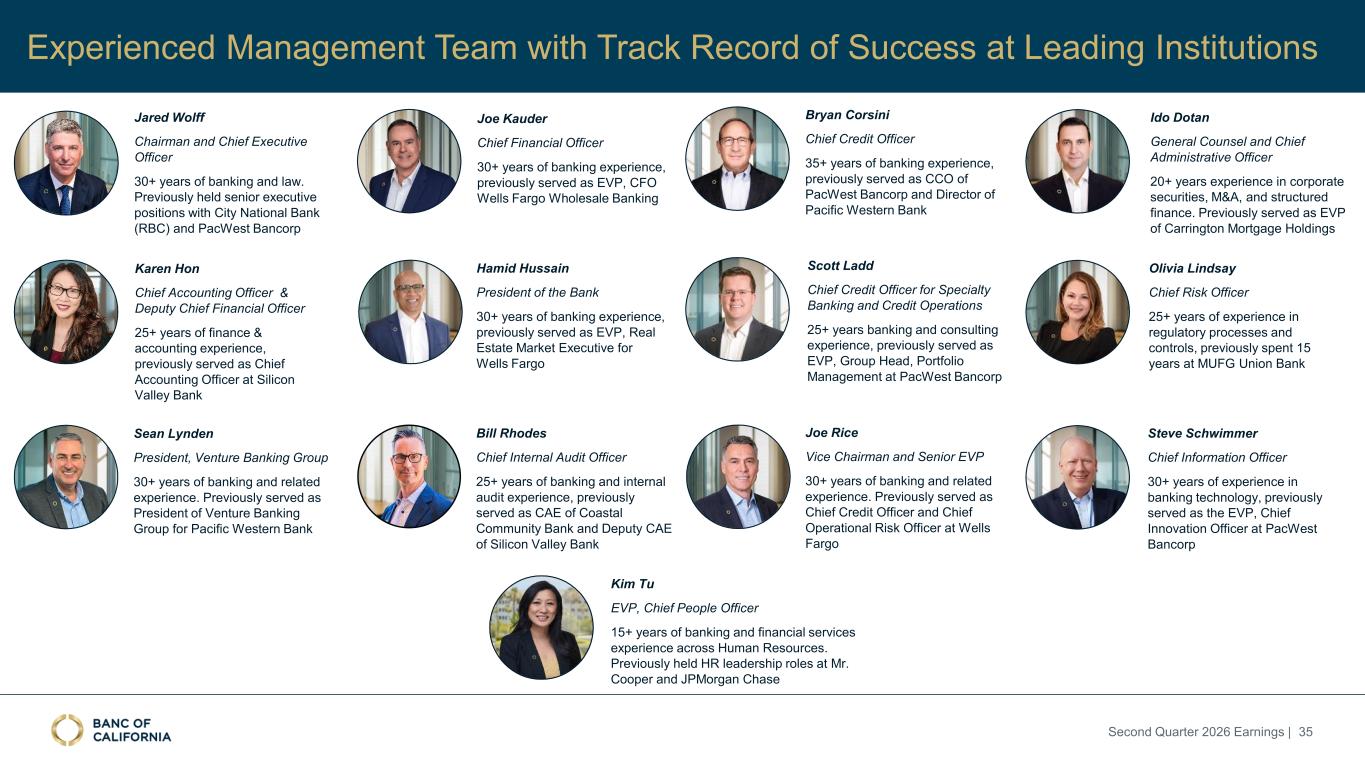
Good morning, and thank you for joining Bank of California's second quarter earnings call. Today's call is being recorded, and a copy of the recording will be available later today on our Investor Relations website. Today's presentation will also include non-GAAP measures. The reconciliations for these measures and additional required information are available in the earnings press release and earnings presentation, which are available on our Investor Relations website. Before we begin, we would like to remind everyone that today's call will include forward-looking statements, including statements about our targets, goals, strategies, and outlook for 2026 and beyond, which are subject to risks, uncertainties, and other factors outside of our control, and actual results may differ materially. For a discussion of some of the risks that could affect our results, please see our safe harbor statement on forward-looking statements included in both the earnings release and the earnings presentation, as well as the risk factors section of our most recent 10K. Joining me on today's call are Jared Wolf, Chairman and Chief Executive Officer, and Joe Cowder, Chief Financial Officer. After our prepared remarks, we'll be taking questions from the analyst community. I would like to now turn the call over to Jared.
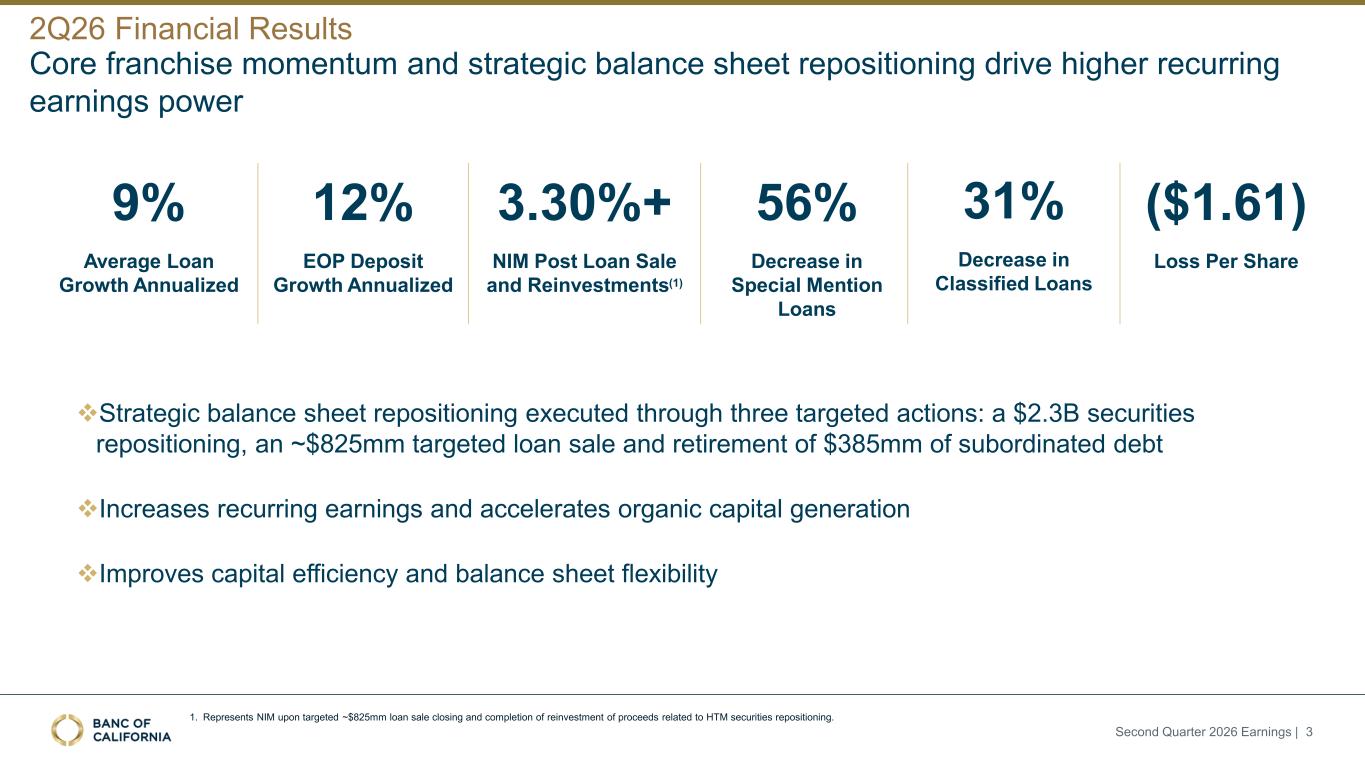
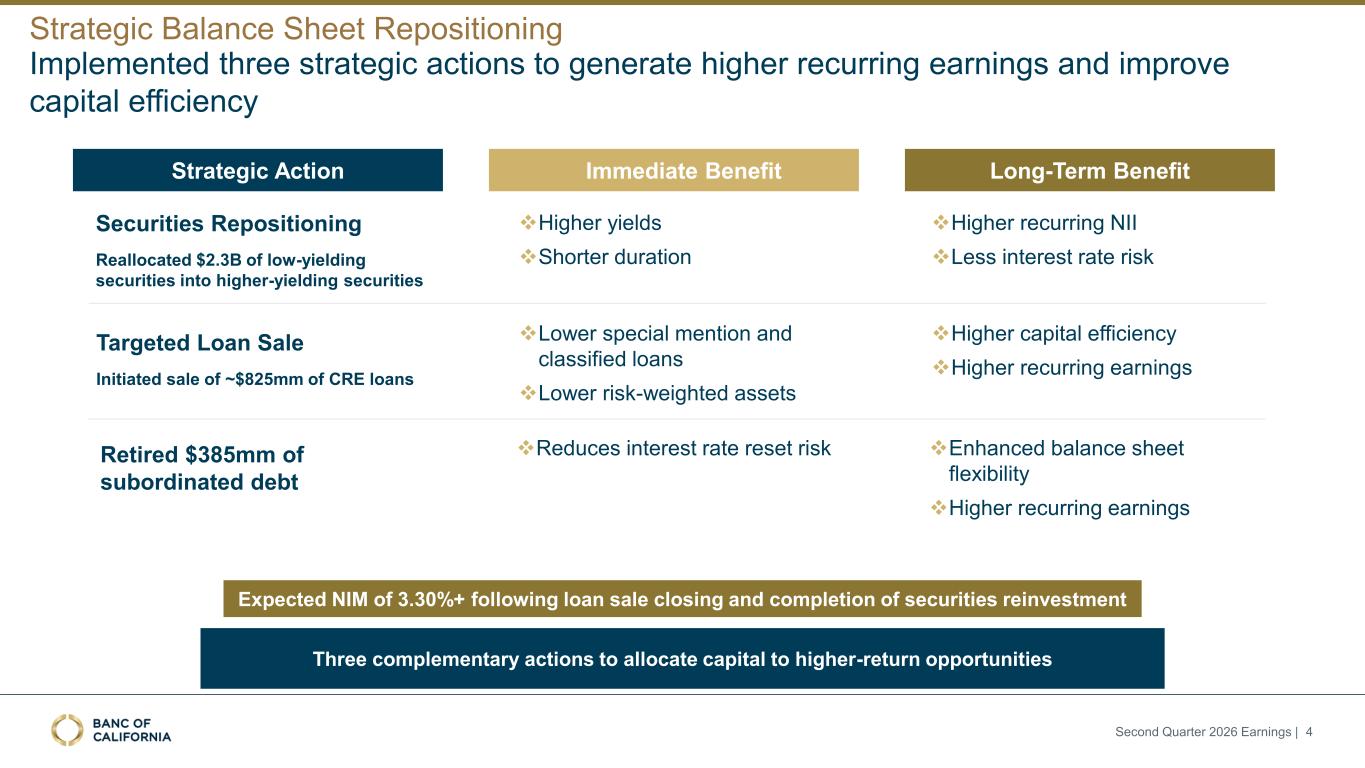
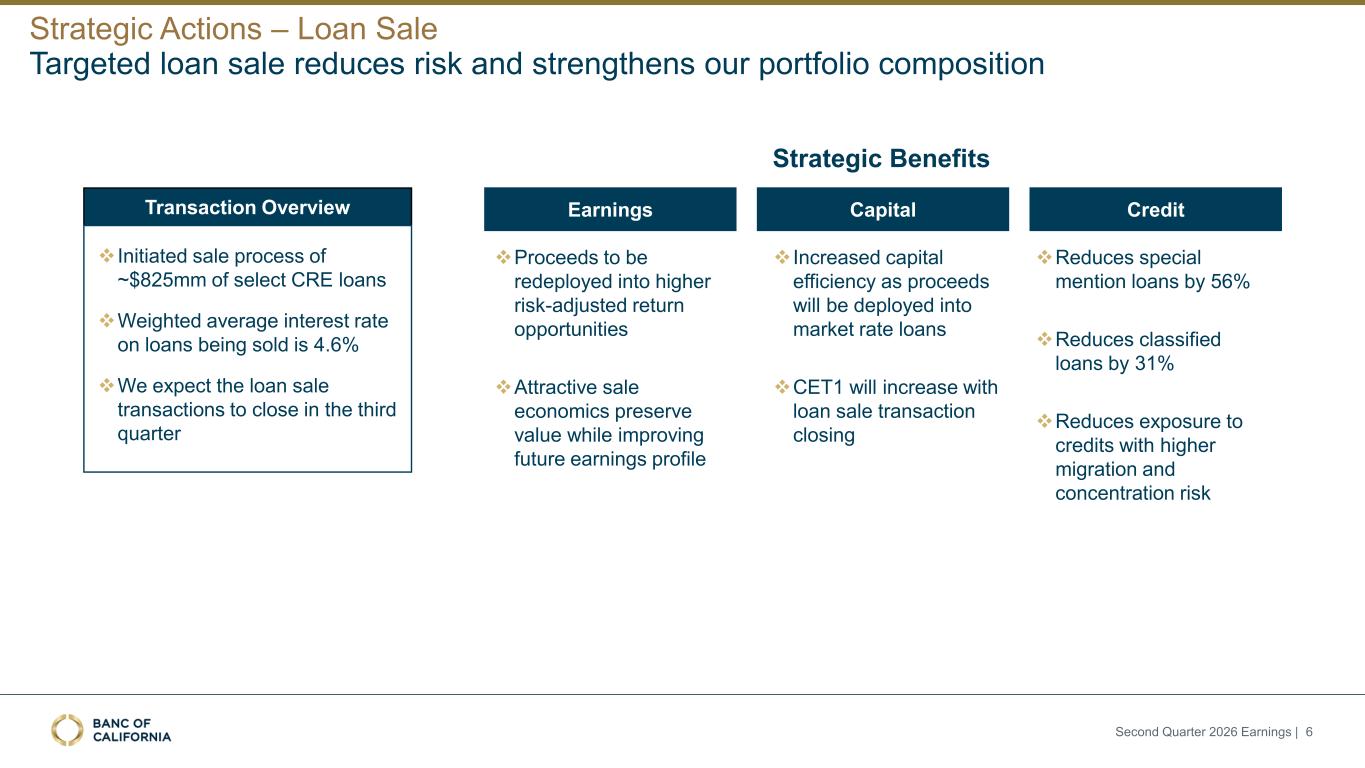
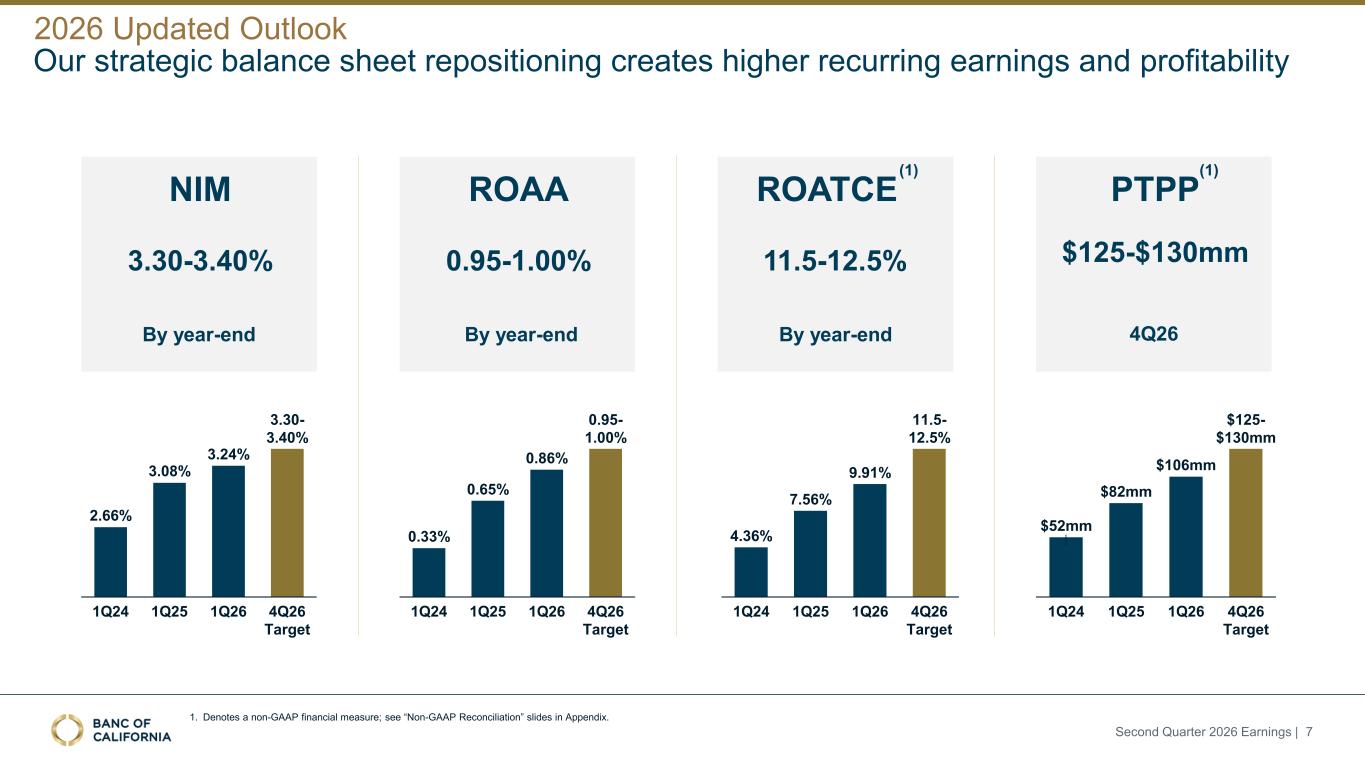
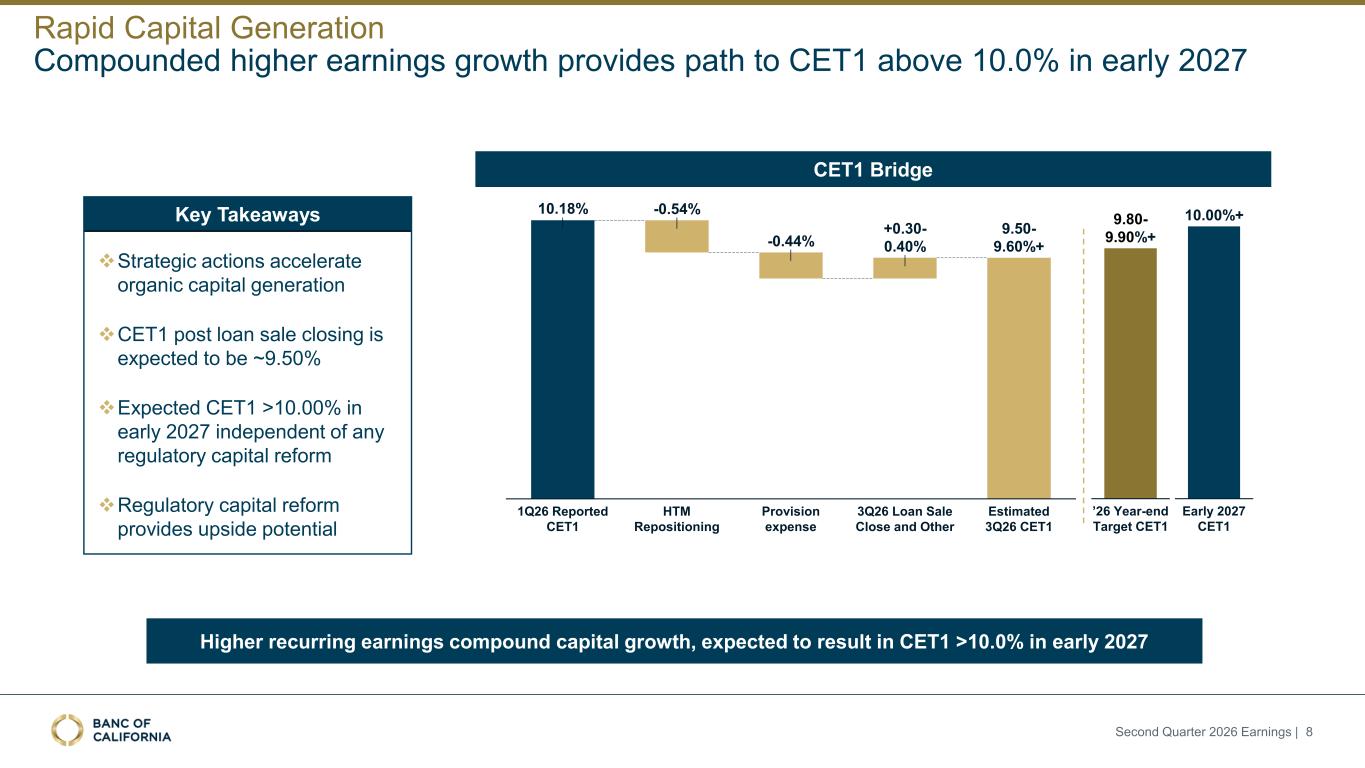
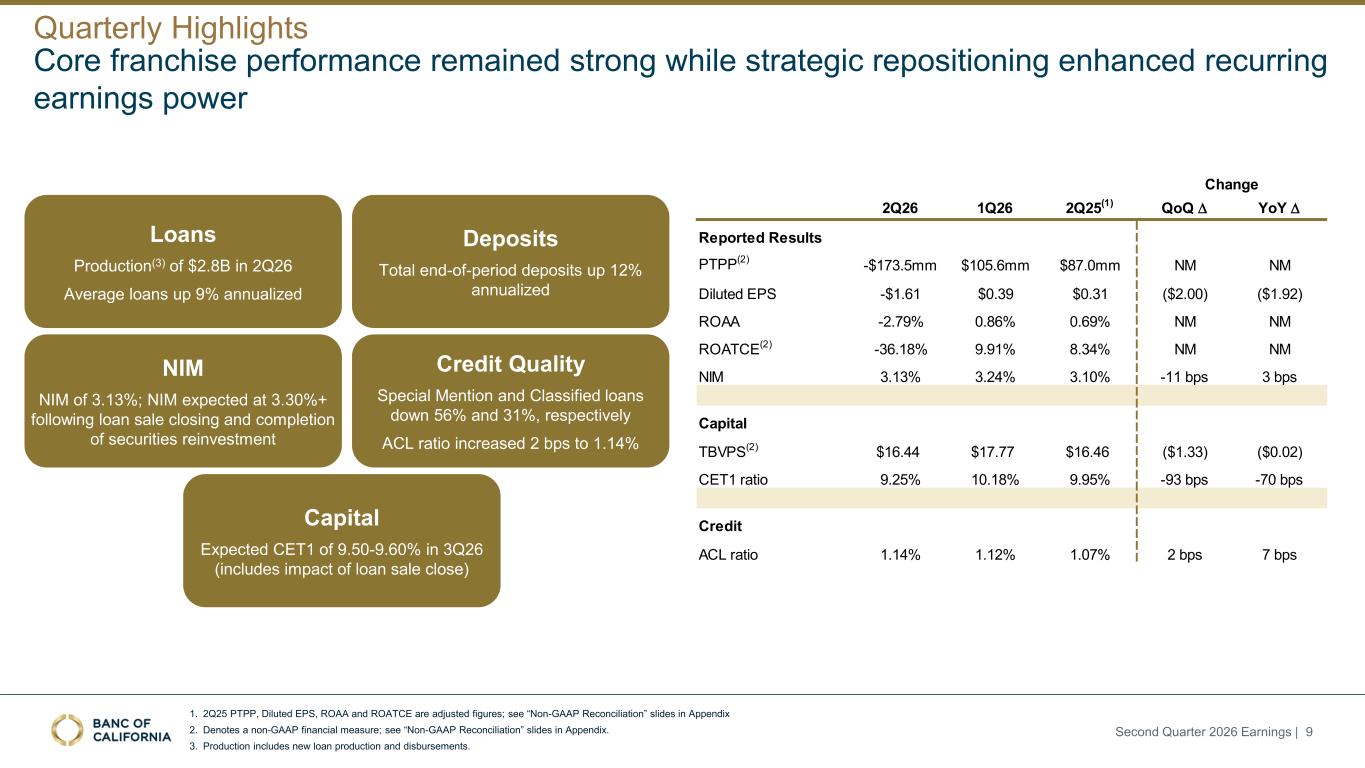
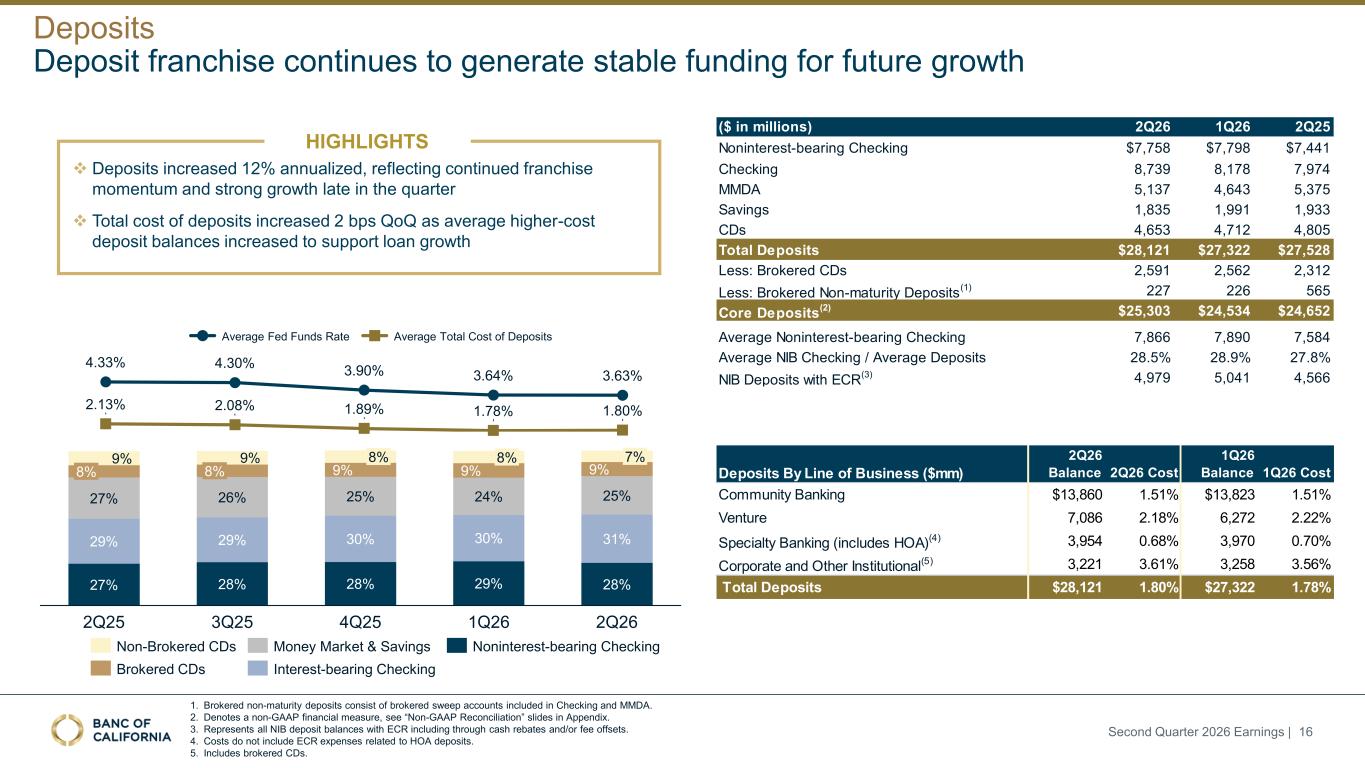
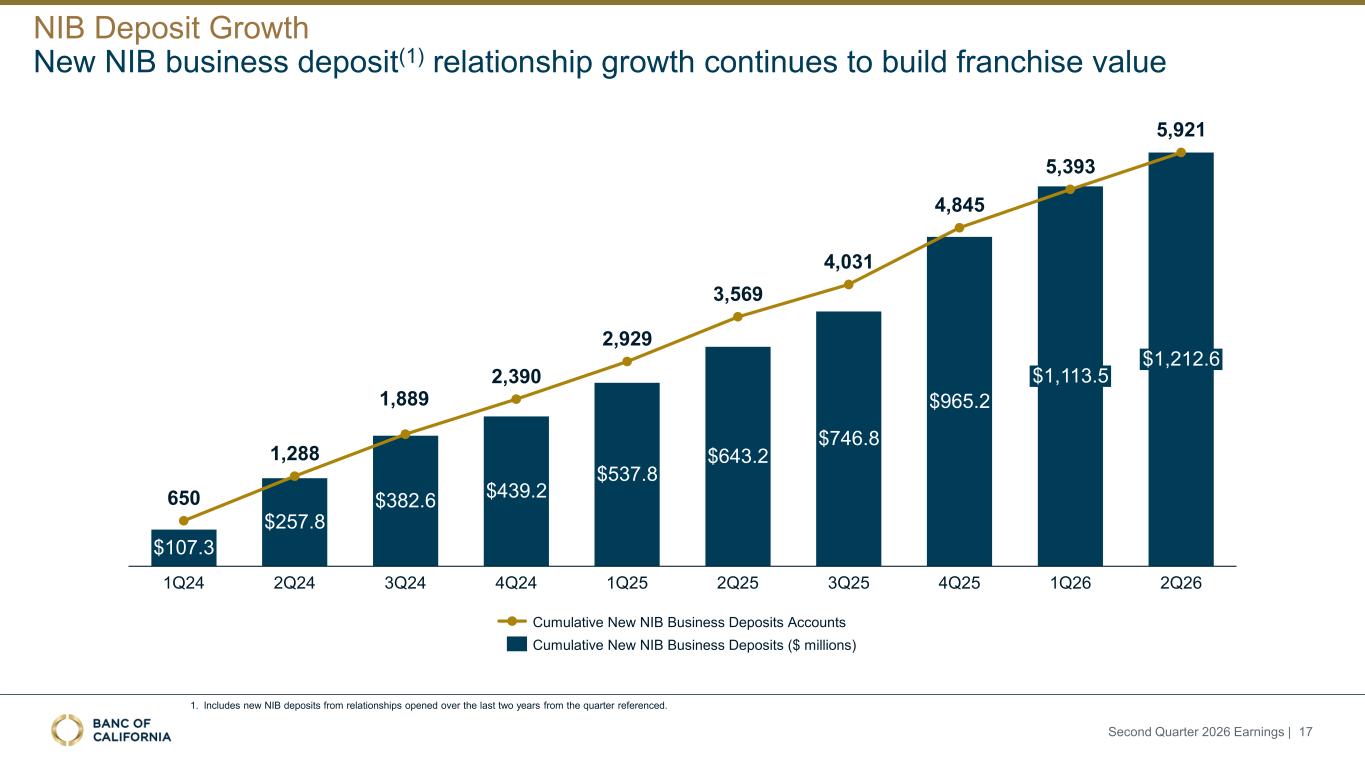
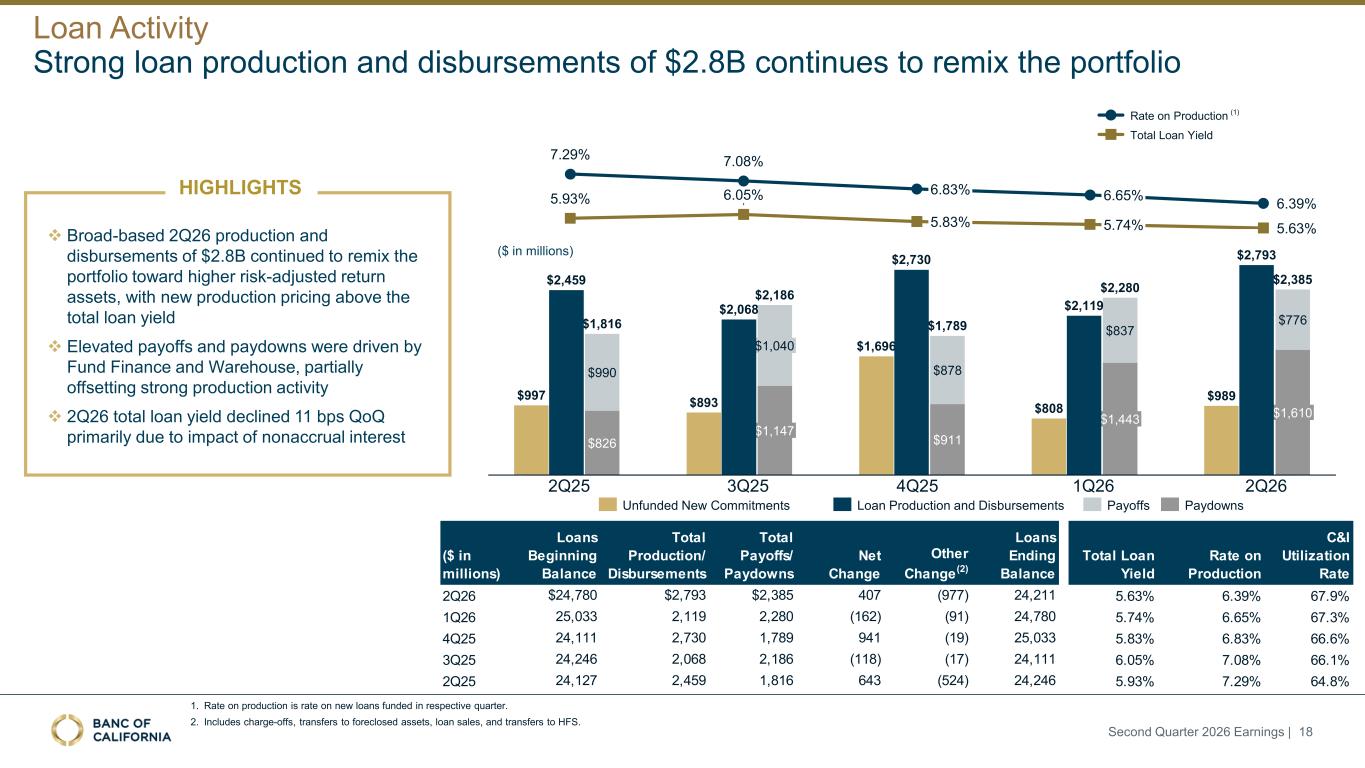
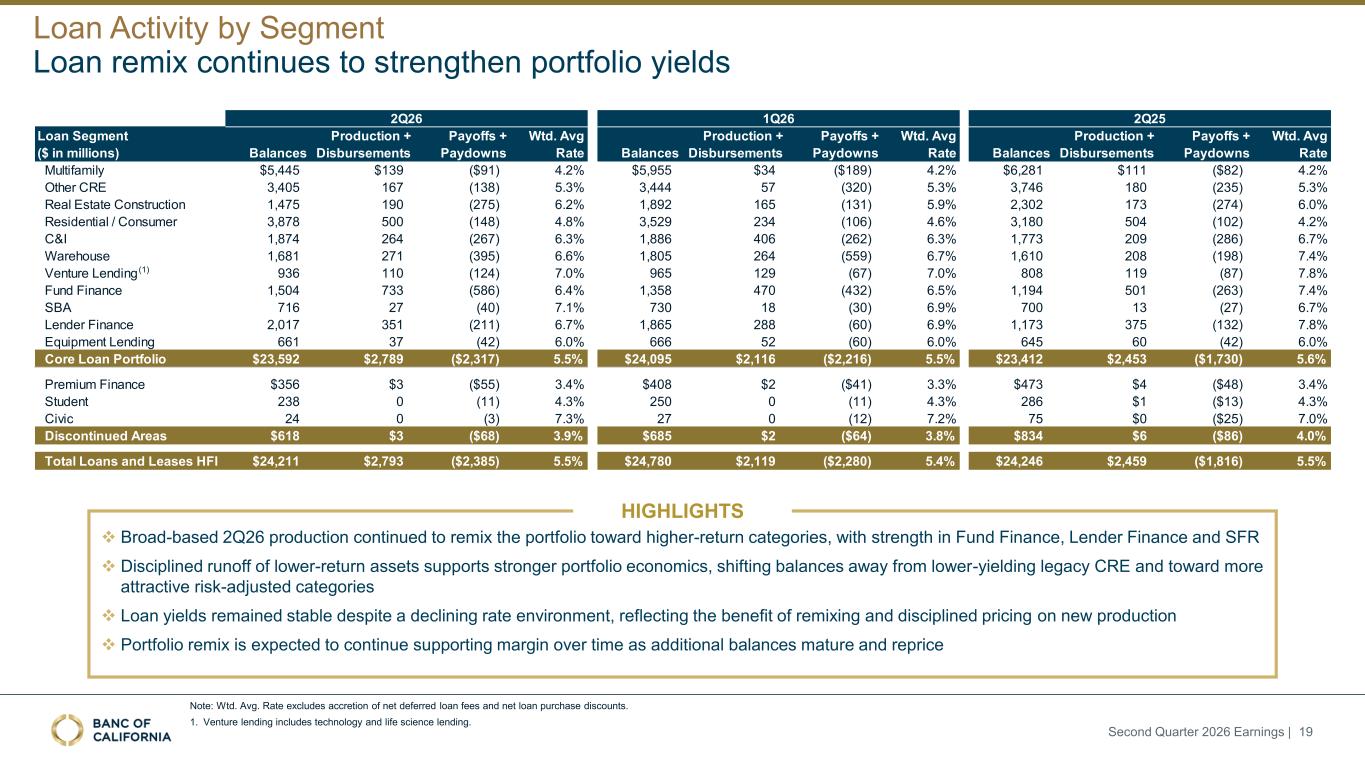
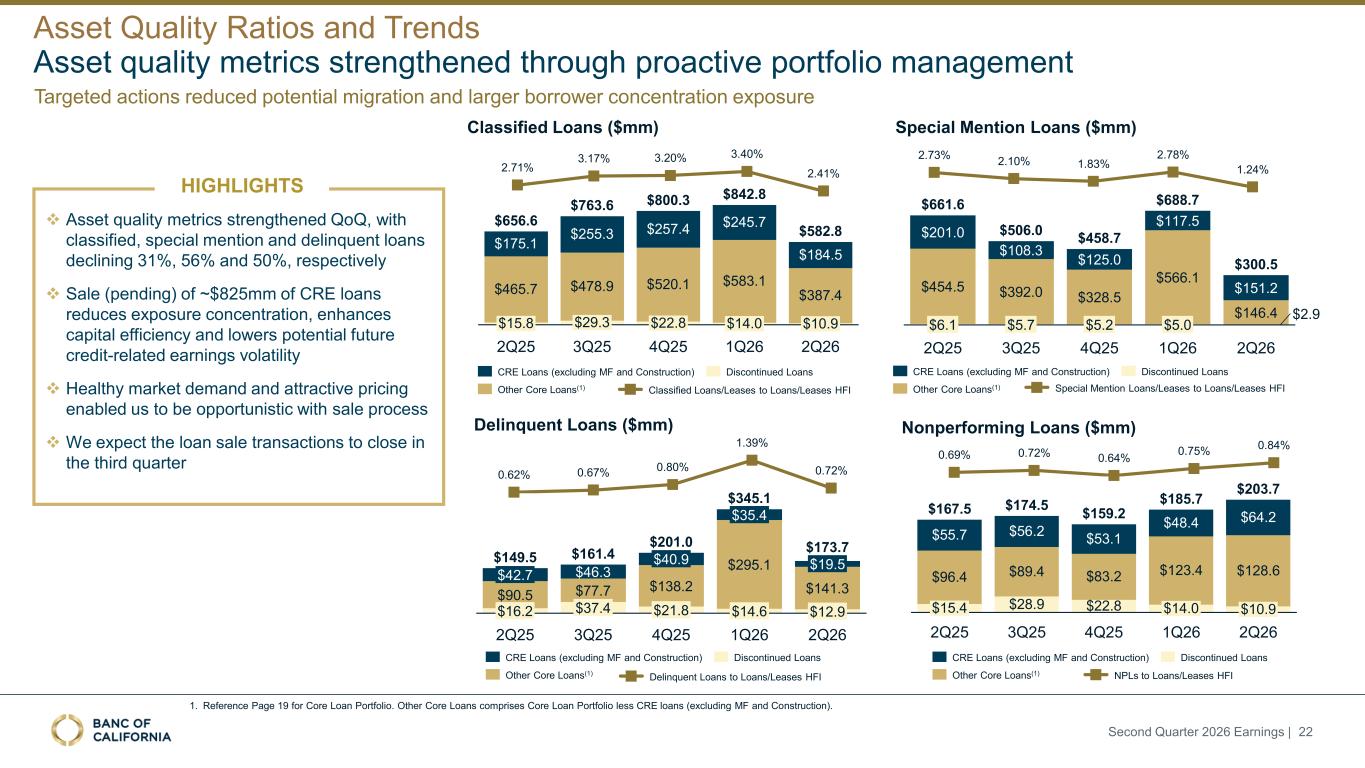
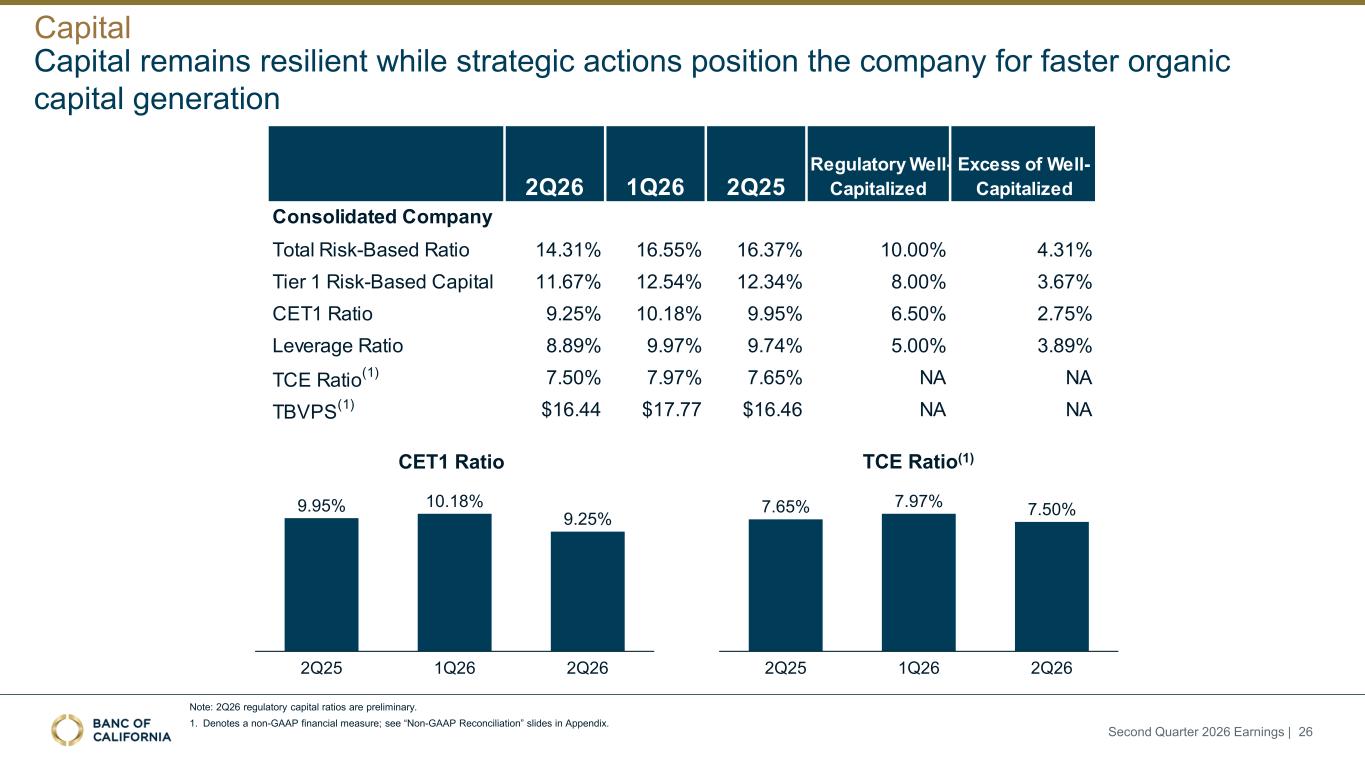
Thanks, Anne, and good morning, everyone. The second quarter was another strong quarter for Bank of California. Our loan and deposit growth shined, with 9% annualized loan growth and 12% annualized deposit growth. Loan production of $2.8 billion was particularly strong. I mentioned these items at the outset so they are not overshadowed by the important strategic moves that we made in the quarter. In fact, the strength of the underlying franchise is one of the key reasons we decided to take the strategic actions we did. In order for the true earnings power of our team and this franchise to show up quarter after quarter, we felt it was time to remove some of the weights hanging over us, namely over $2 billion yielding long-duration securities in our held-to-maturity portfolio. Accordingly, the second quarter was an important step for Bank of California as we made a strategic decision to allocate capital towards opportunities that we believe will enhance stronger long-term returns for our shareholders and allow the true earnings power of this franchise and team to come through. We implemented that strategy through three complementary actions, which included, first, the repositioning of $2.3 billion of lower-yielding securities, two, a targeted loan sale of approximately $825 million of select loans, and three, the retirement of $385 million of subordinated debt ahead of a significantly higher contractual reset rate. Together, we believe these actions will create a more efficient balance sheet, increase recurring earnings power, and accelerate capital generation. The securities reposition was the largest and most impactful component of this strategy. We sold $2.3 billion of lower-yielding securities, which we partially redeployed into higher-yielding, shorter-duration securities, with the remaining proceeds expected to be reinvested in this quarter. The reposition generated a 276 basis point yield pickup. which will drive net interest margin expansion and higher recurring earnings power. Importantly, we executed this sale without raising equity and maintained capital ratios well above well-capitalized regulatory thresholds. At a time when many banks are managing margin pressure, this strategic repositioning puts us in a favorable position with early benefits to net interest margin already visible. We expect our NIM following the targeted loan sale close and full reinvestment of the securities repositioning proceeds to come in above 330 and to expand further in the second half of the year. We also use favorable market conditions to sell approximately $825 million of select commercial real estate and multifamily construction loans. After a competitive sale process, we have executed purchase and sale agreements for the entire $825 million. We expect closings to be completed by the end of the third quarter. The loans chosen for sale fell into two buckets. The first group, about $300 million, were construction loans to a single borrower that were personally guaranteed but showing signs of weakness. The second group, about $525 million, were all performing CRE loans but on average carried lower interest rates. The blended interest rate of all $825 million is around 4.6%. The sale allows us to redeploy funds into market rate loans reduce concentration risk, and lower the risk of future credit-related volatility. Combined with other actions taken in the quarter, credit metrics improve meaningfully quarter over quarter, with reduction in special mention loans by 56%, classified loans by 31%, and delinquent loans by 50%. These changes provide a positive glide path for the strong earnings trajectory we expect going into the second half of the year. Finally, retiring $385 million of subordinated debt ahead of a much higher reset rate lowers our future funding costs, and together with the securities repositioning and the impact of the anticipated loan sales, supports immediate expansion of net interest margin, higher recurring earnings, and accelerated organic capital generation. Capital remains solid, and we expect CET1 to build as the loan sale closes and retained earnings increase, with expected CET1 of approximately 9.5% to 9.6% in the third quarter, 9.8% to 9.9% by year-end, and above 10% in early 2027. This assumes no regulatory capital reform, which, if implemented, is expected to increase capital by roughly 60 basis points. Our expected capital generation, combined with a larger earnings base and stronger margin trajectory, gives us greater flexibility as we evaluate future capital allocation, including for the potential to redeem our preferred stock in 2027. As I noted at the outset, our franchise continues to perform very well. In addition to our strong deposit and loan growth, new loan production was broad-based and continued to support our remix toward higher return categories. We continue to add new non-interest-sparing business deposit relationships, which is one of the clearest indicators that our franchise is gaining traction. Our cumulative new non-interest-sparing deposits from relationships opened in the last two years reached approximately $1.2 billion at quarter end. That reflects the strength of our teams, the quality of our client relationships, and the continued value of our relationship-based banking model. Having taken these important balance sheet steps, we entered the second half of the year with a higher margin trajectory, strong franchise momentum, and a clear focus on execution. Our updated outlook reflects the earnings power created by the actions we took this quarter. By year end, we are now targeting our NIM, ROA, and ROTC to be in a higher range and fourth quarter pre-tax pre-provision income of $125 million to $130 million. These targets are conservative and reflect stronger earnings profile driven by a more productive securities portfolio, continued balance sheet remixing, disciplined expense management, and higher recurring debt interest income. We believe these actions position Bank of California to generate stronger returns, build capital organically, and create meaningful long-term value for shareholders. Now let me turn the call over to Joe for a financial update, and then I'll return back at the end.
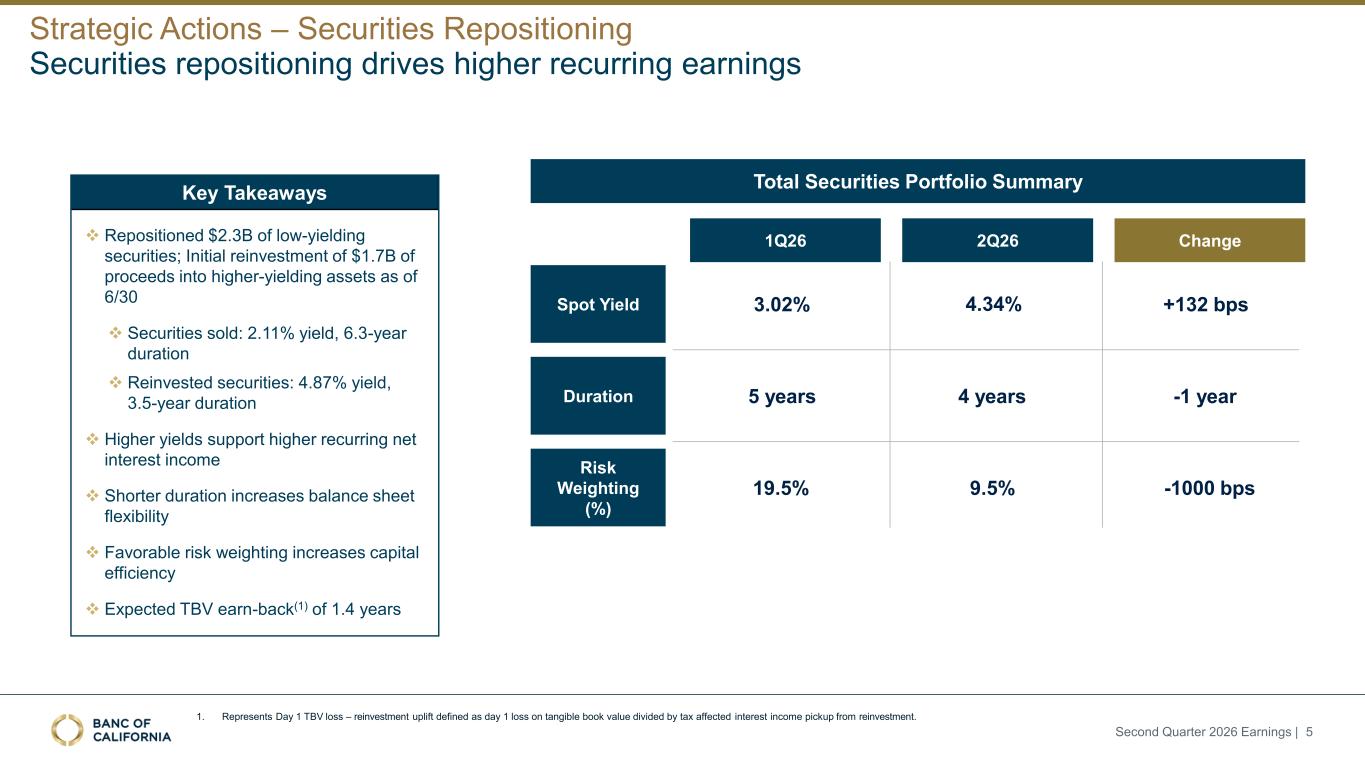
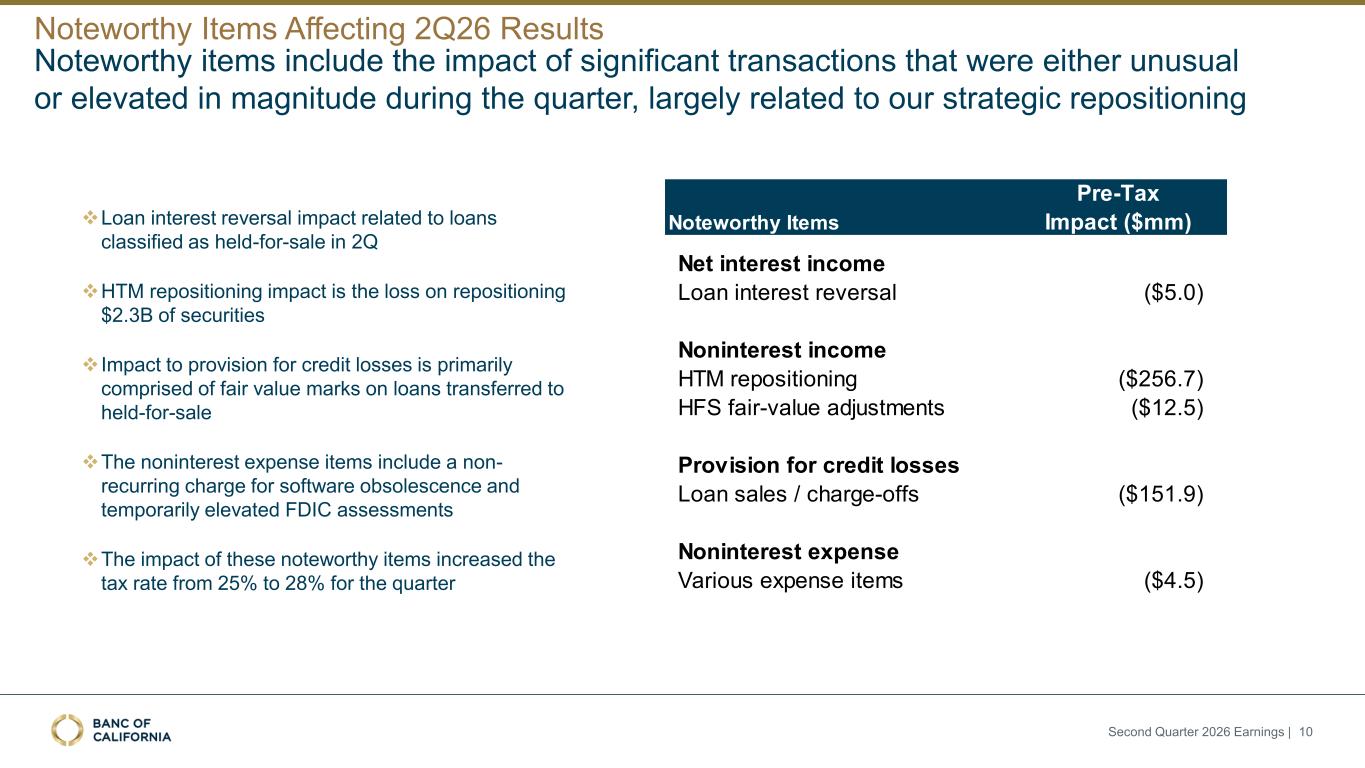
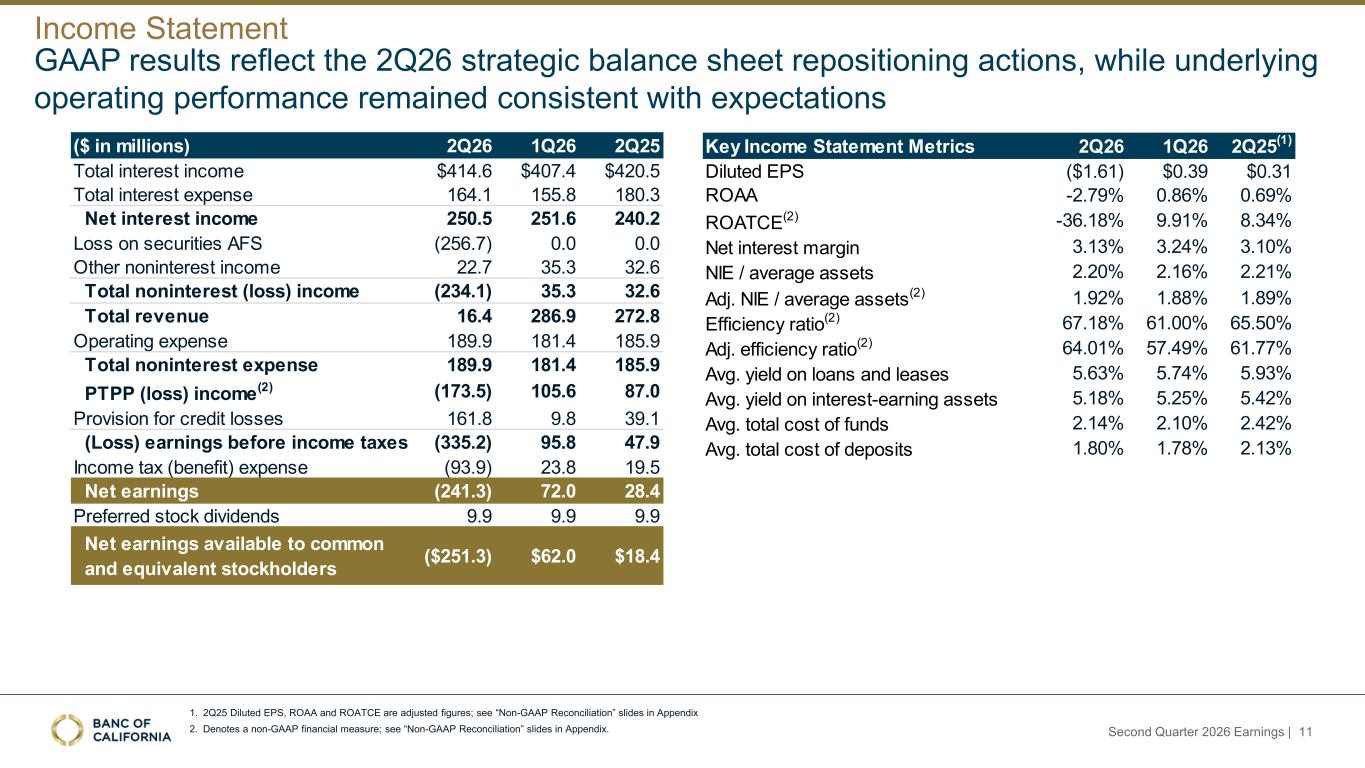
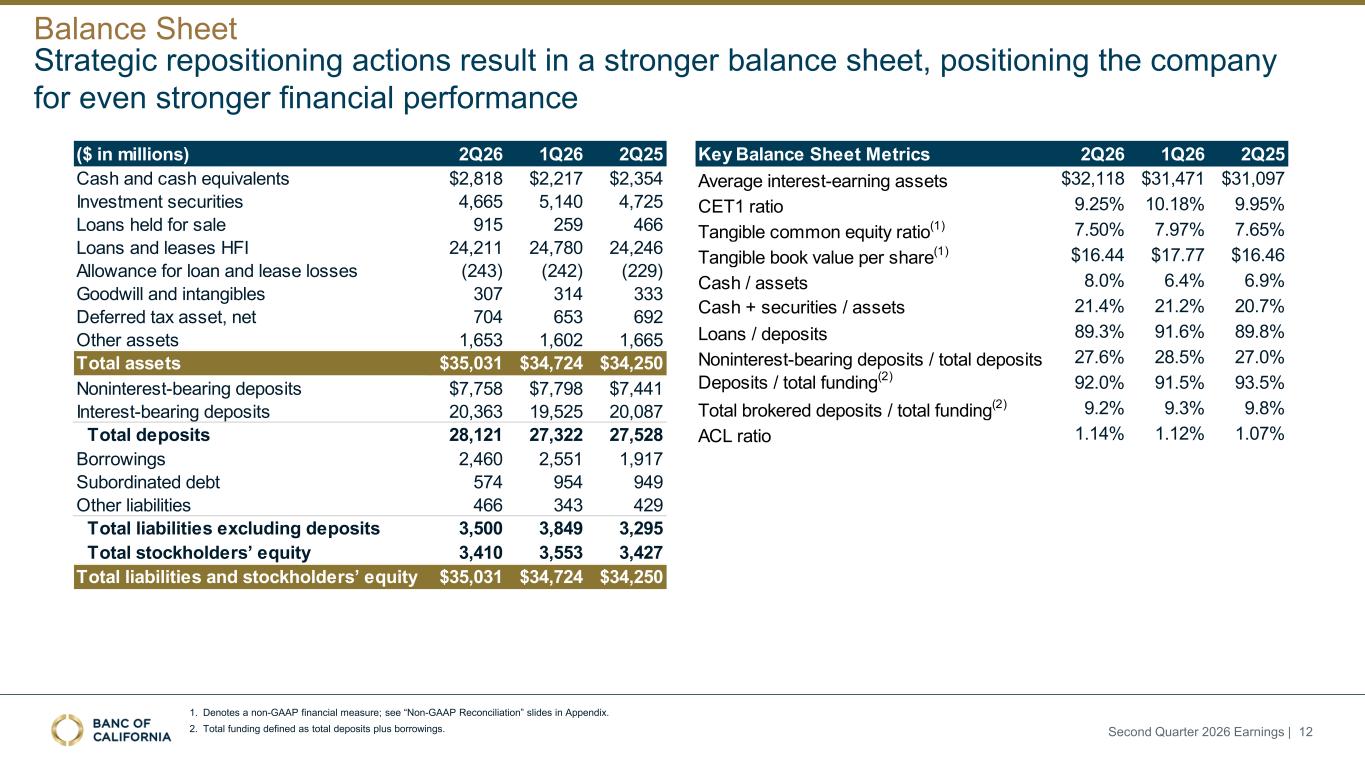
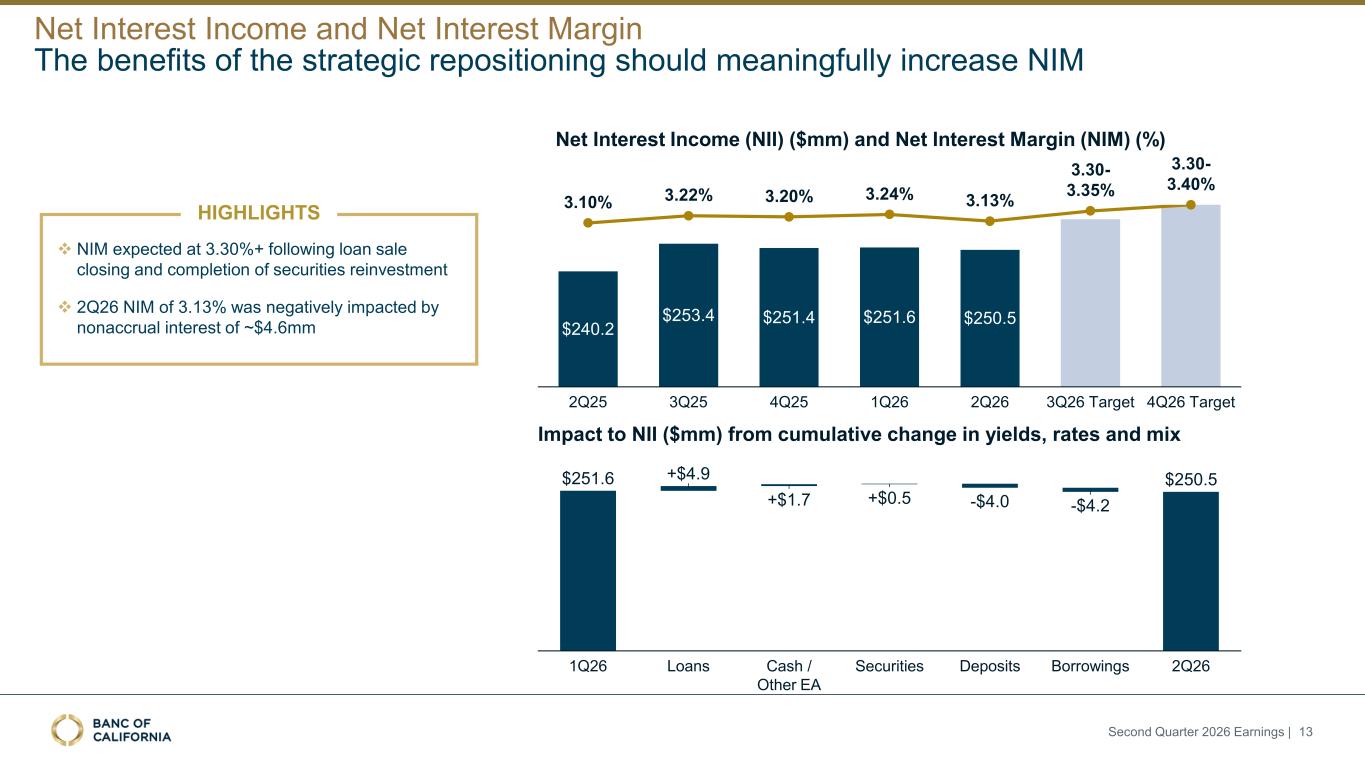
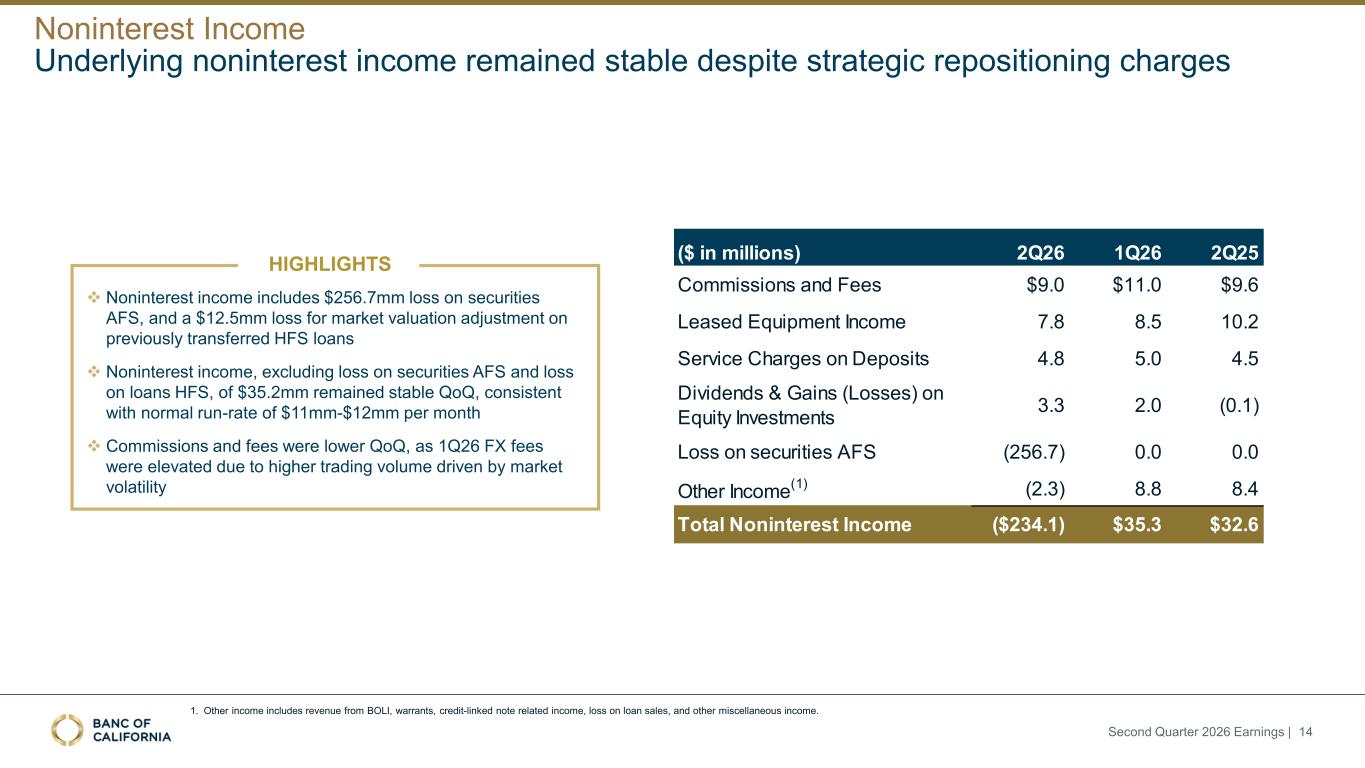
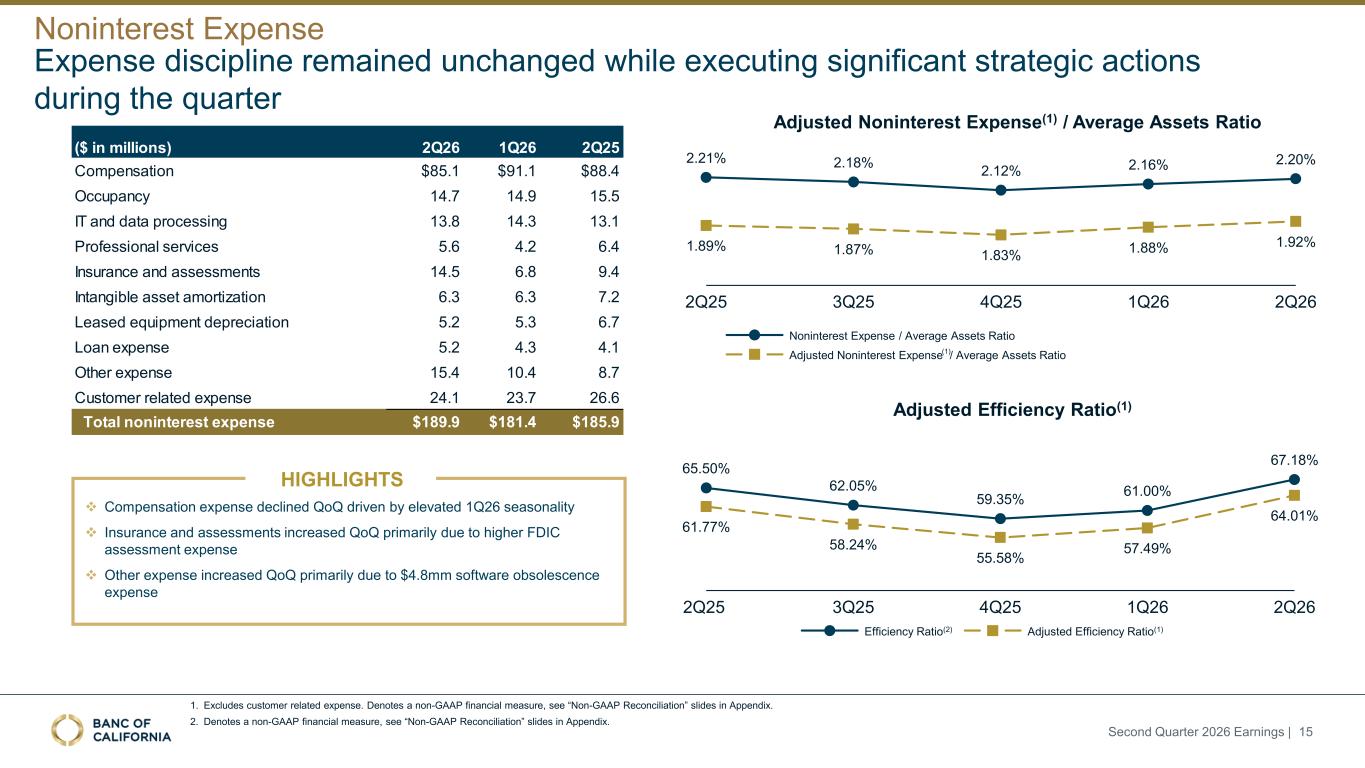
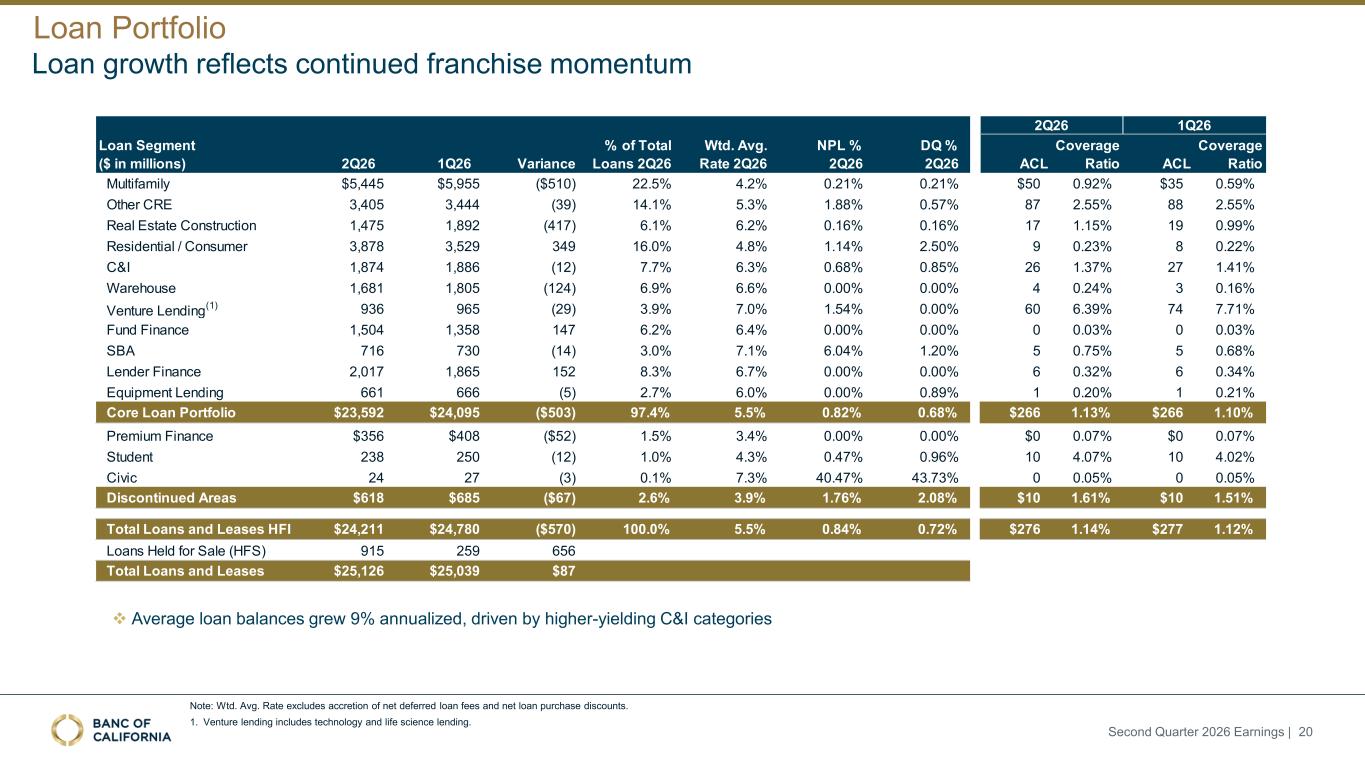
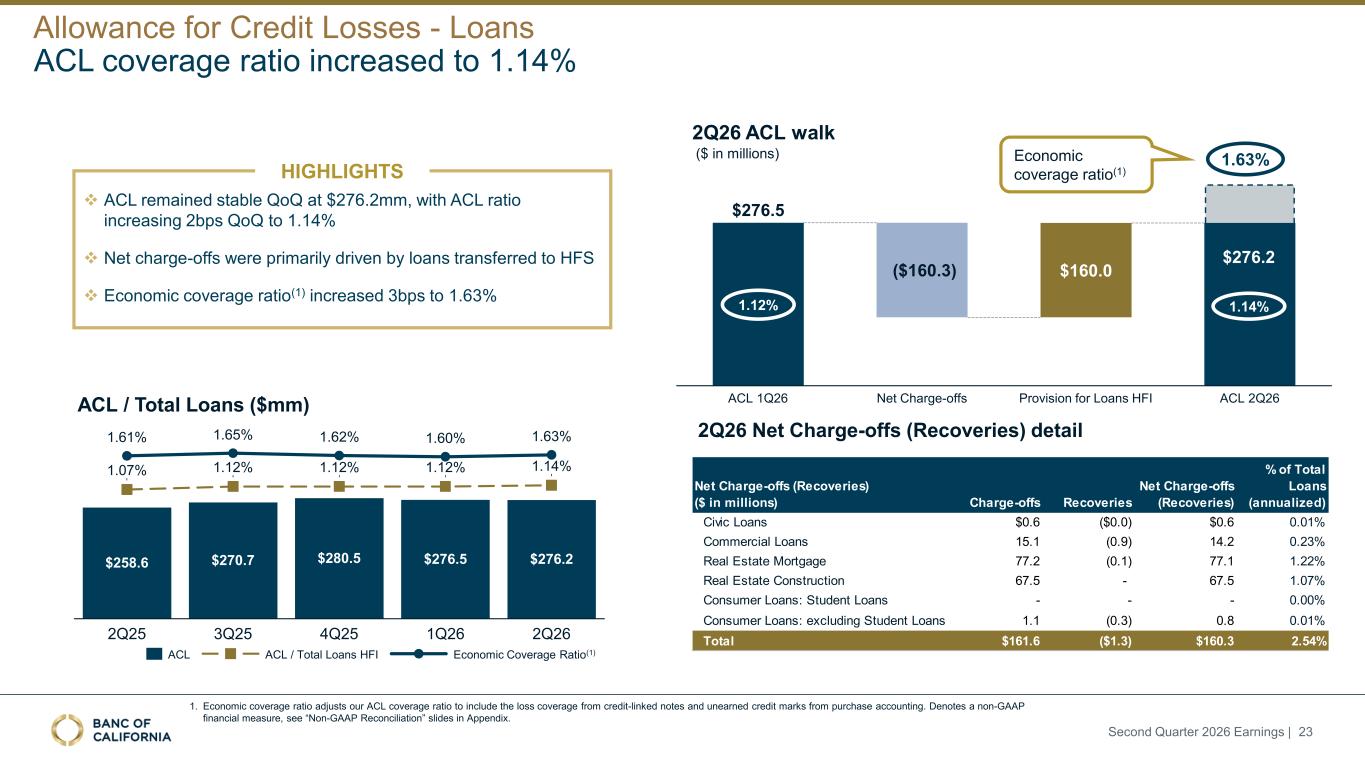
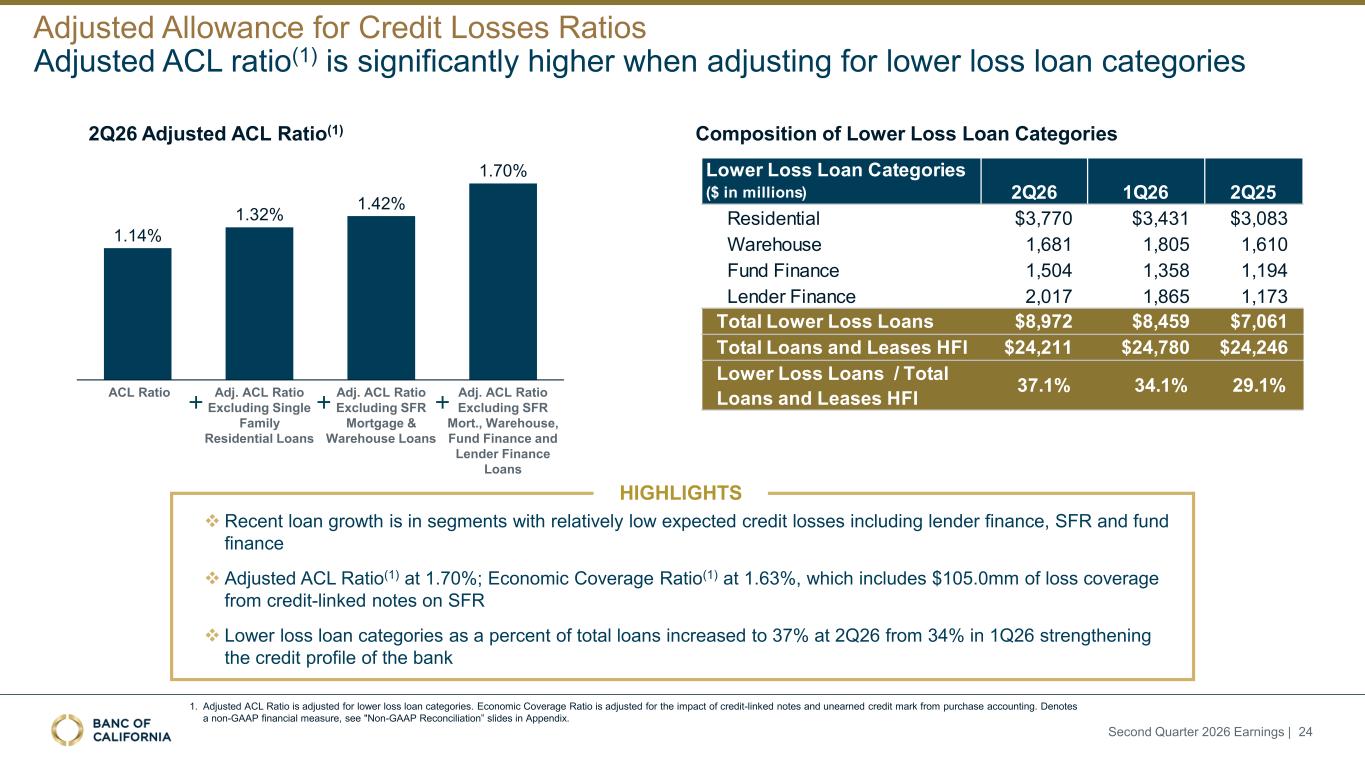
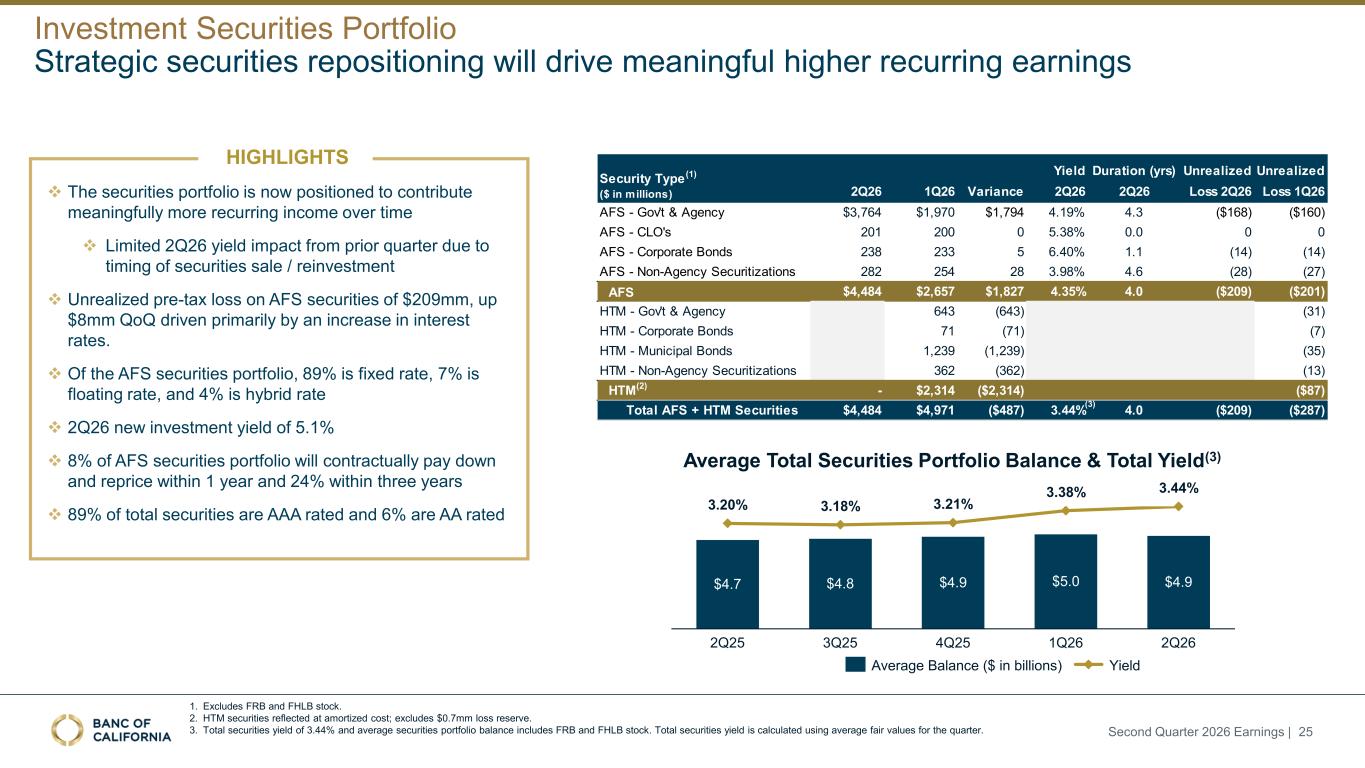
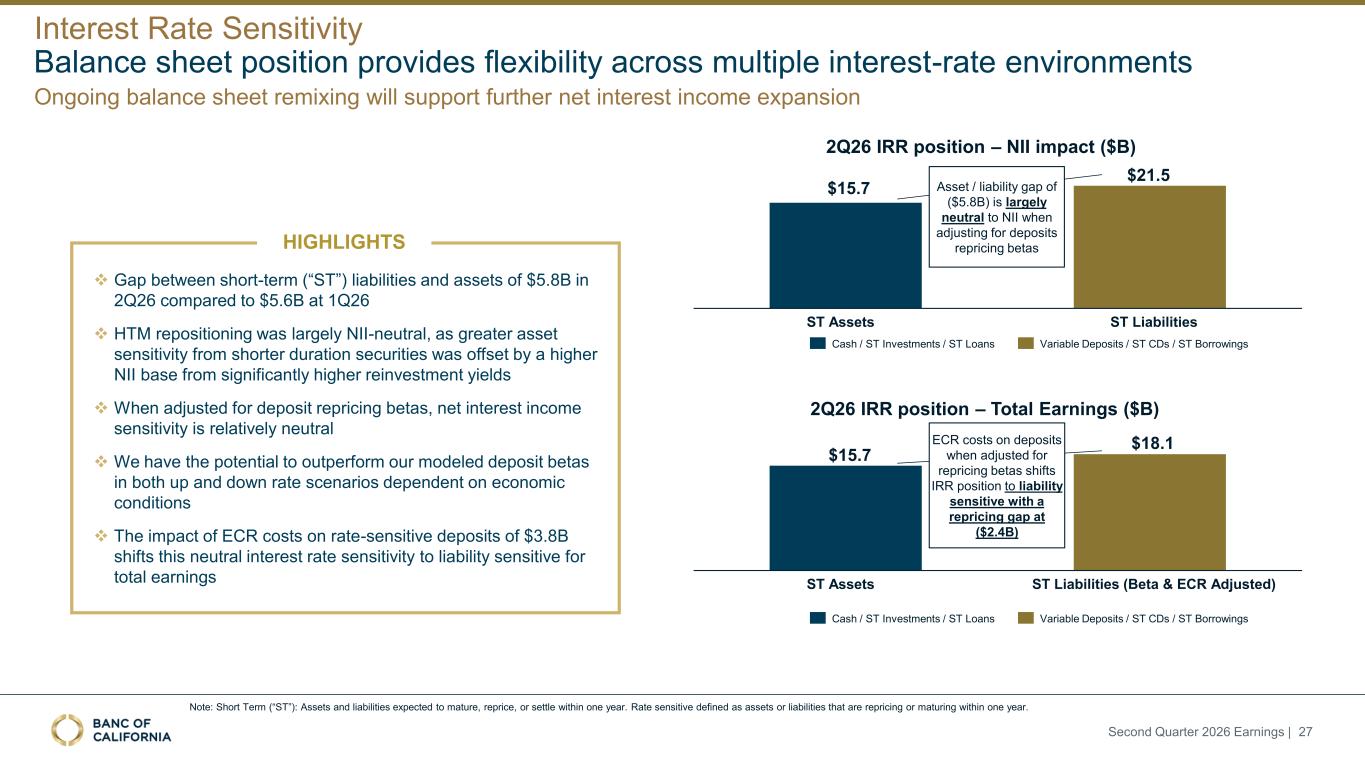
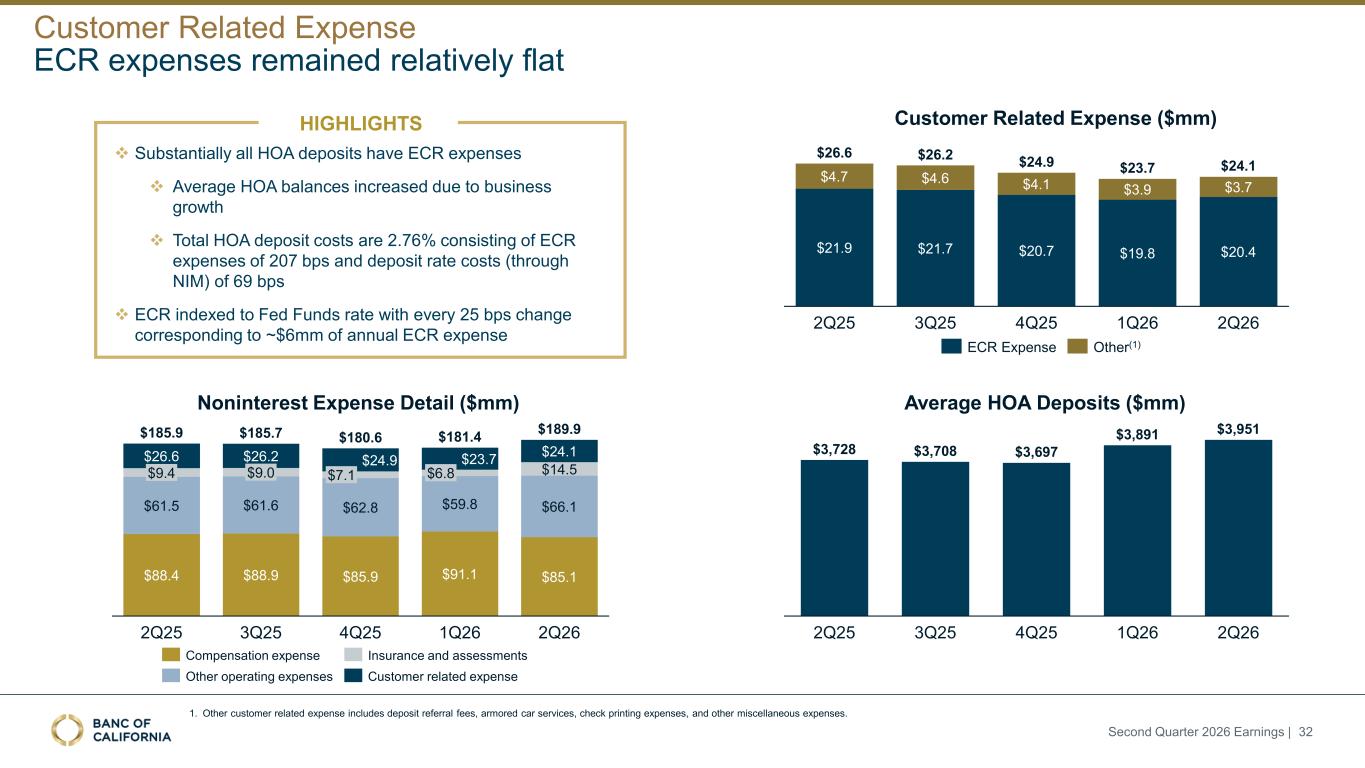
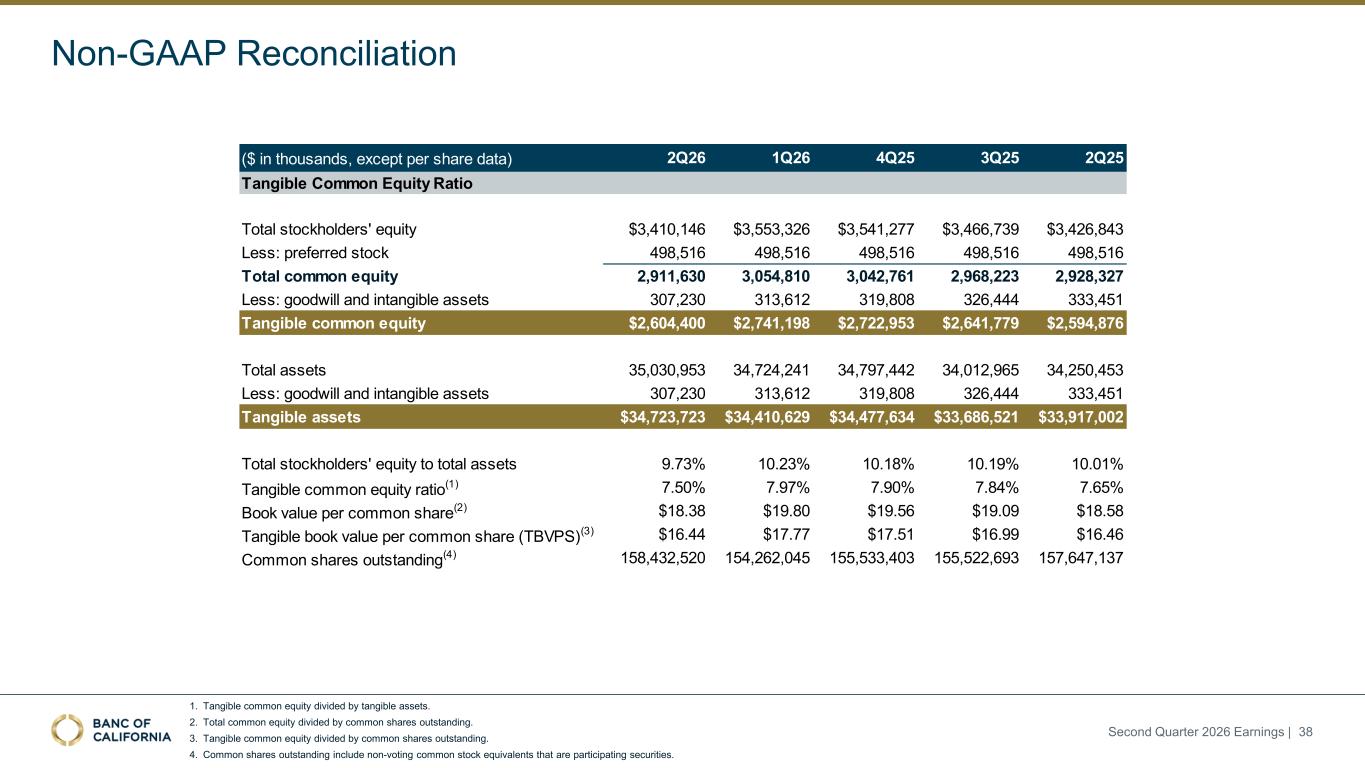
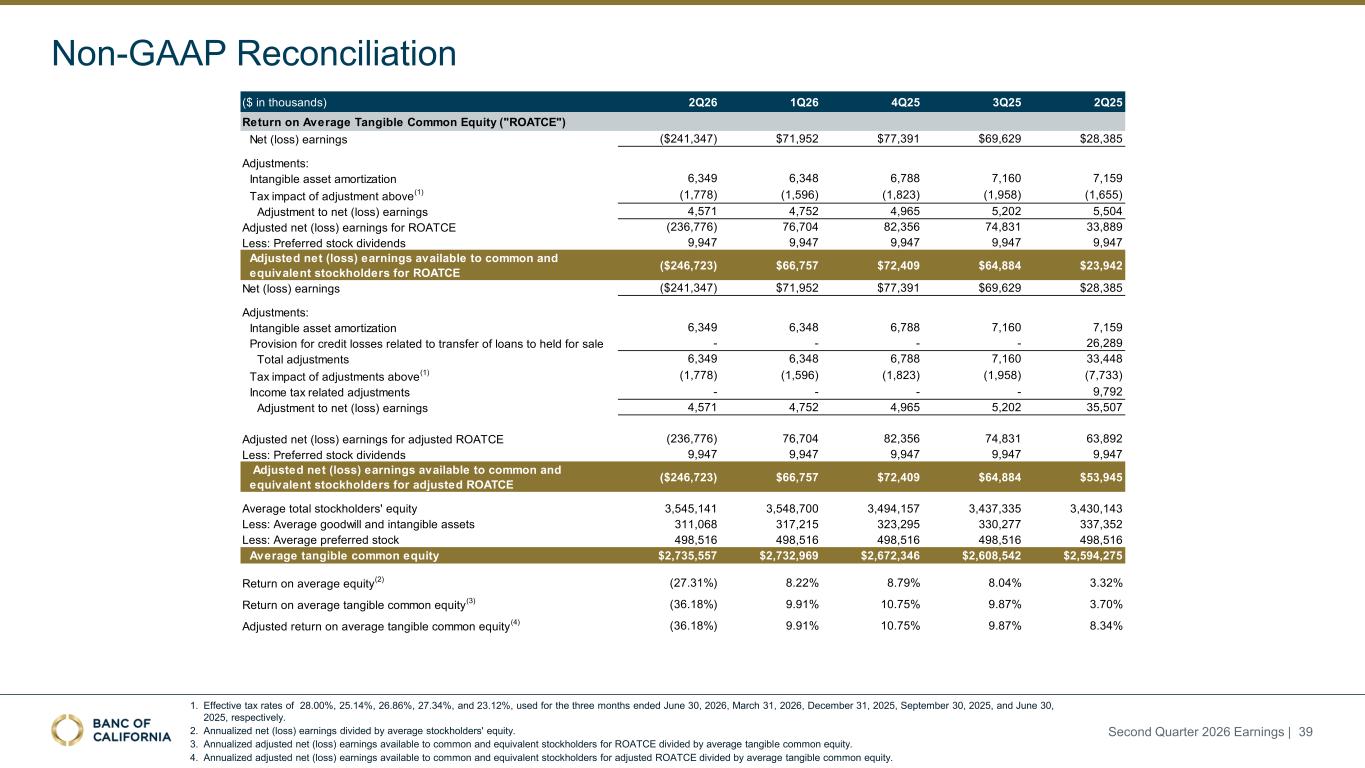
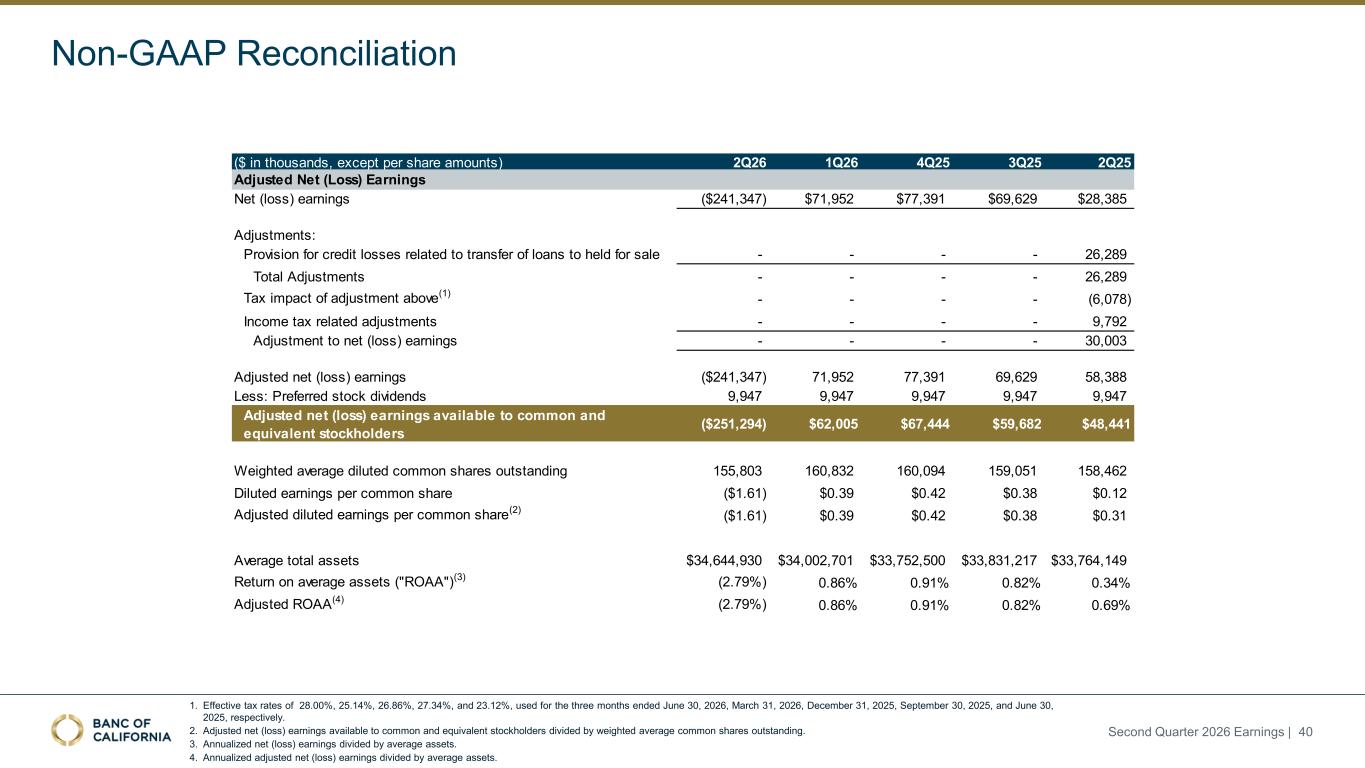
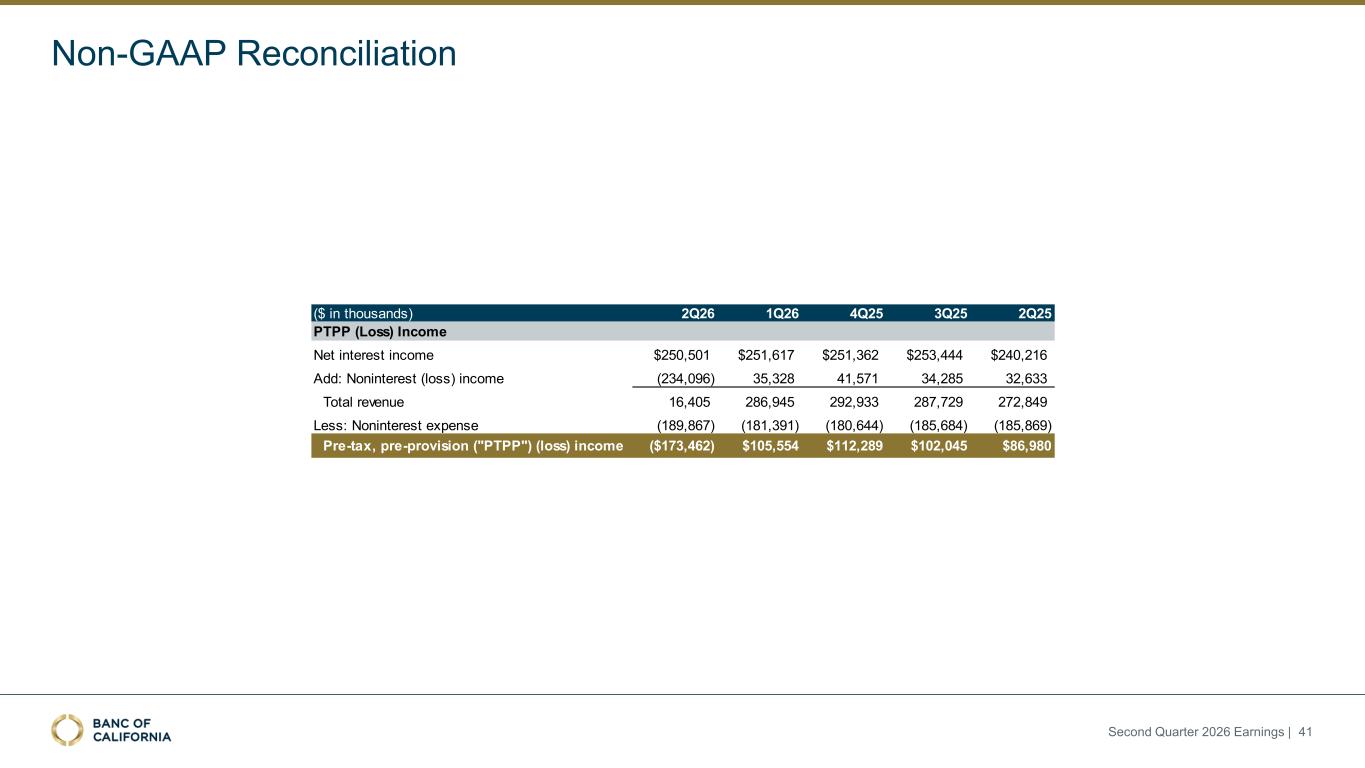
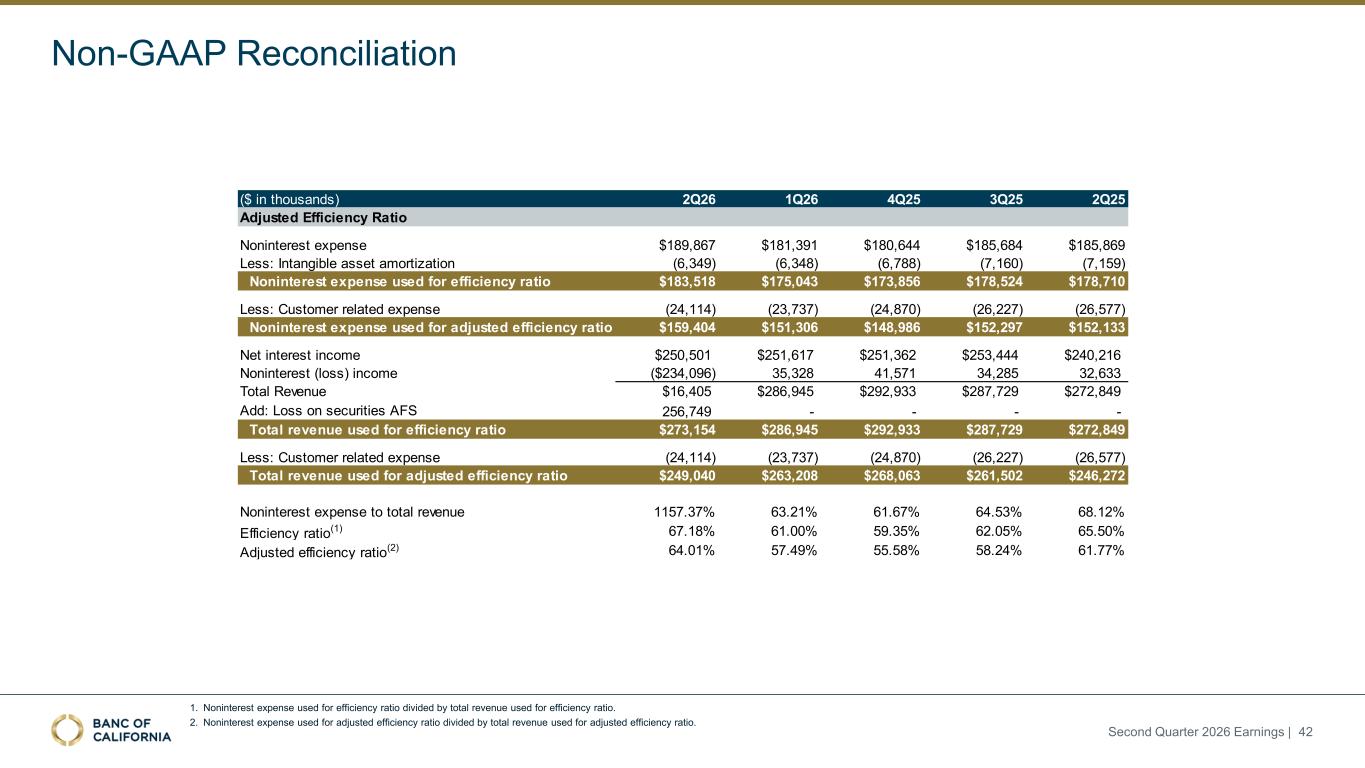
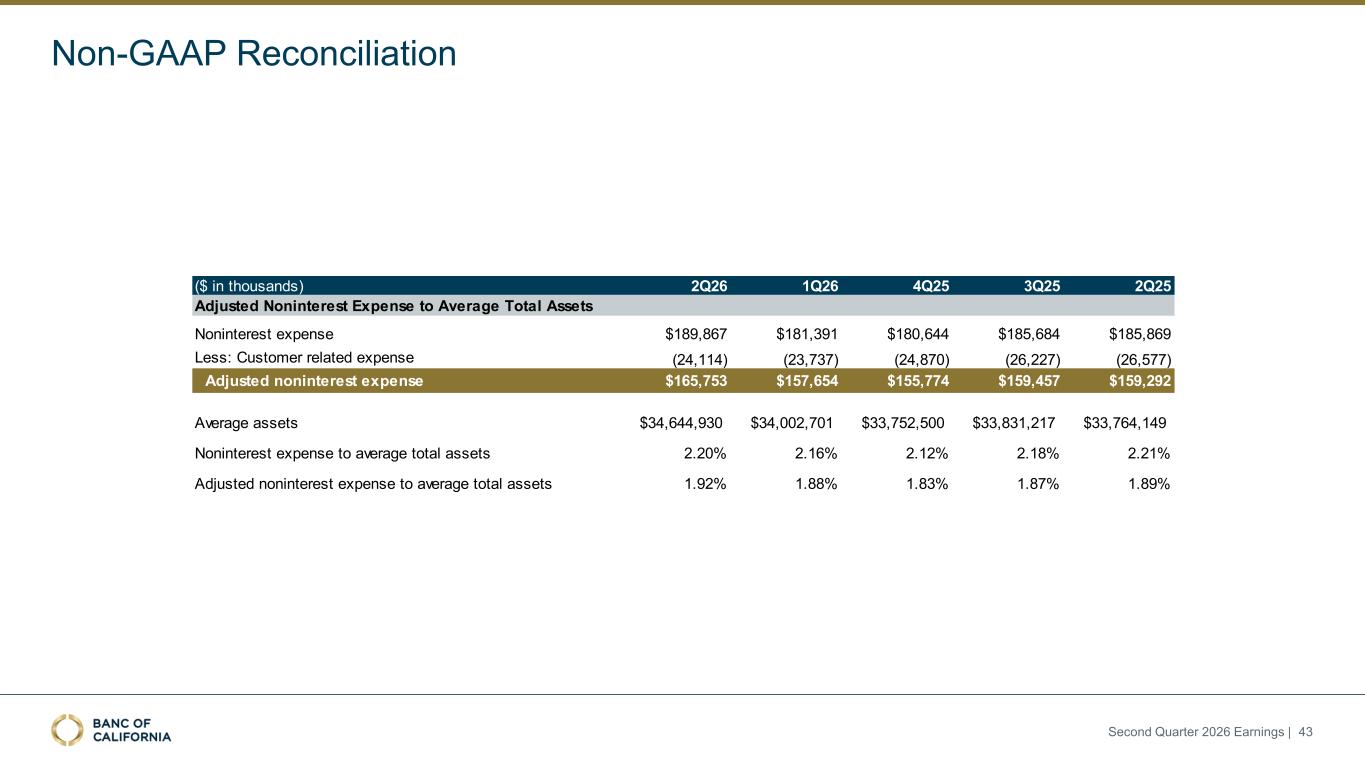
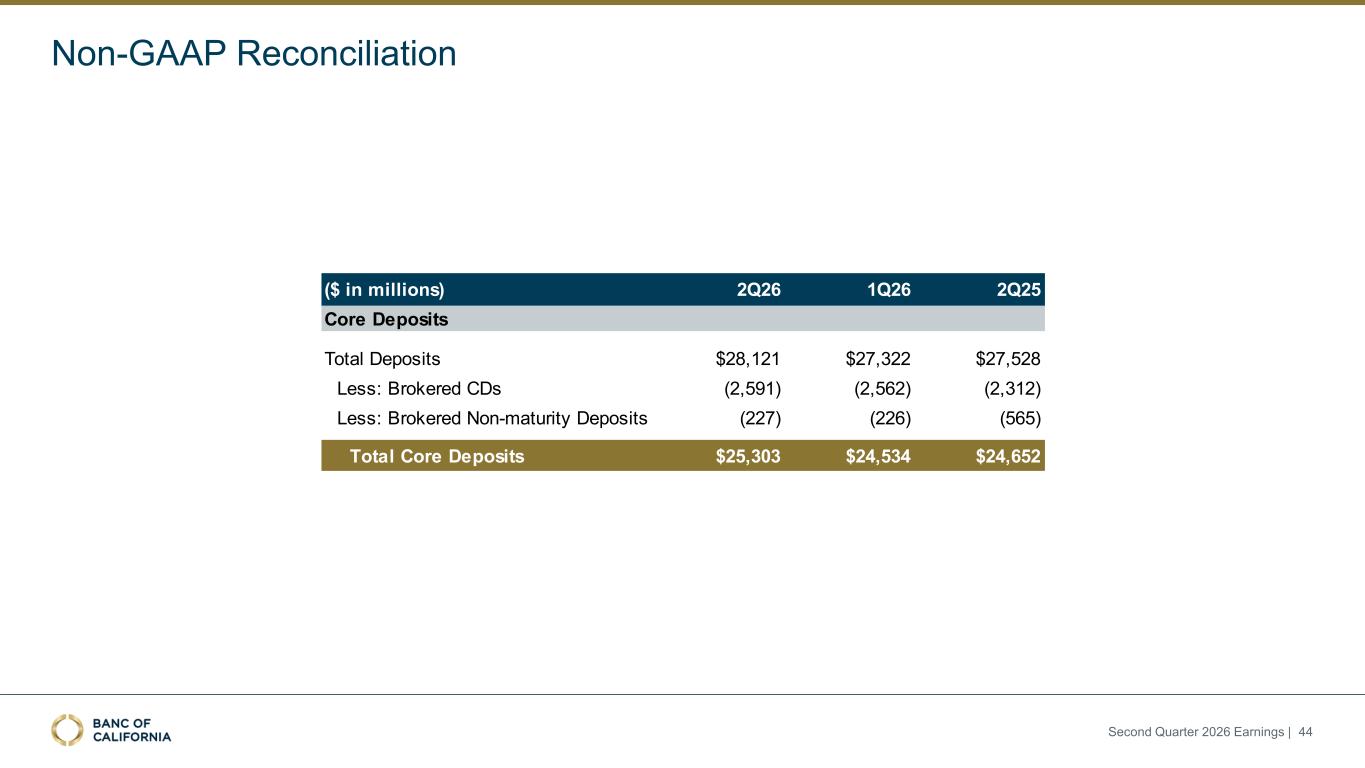
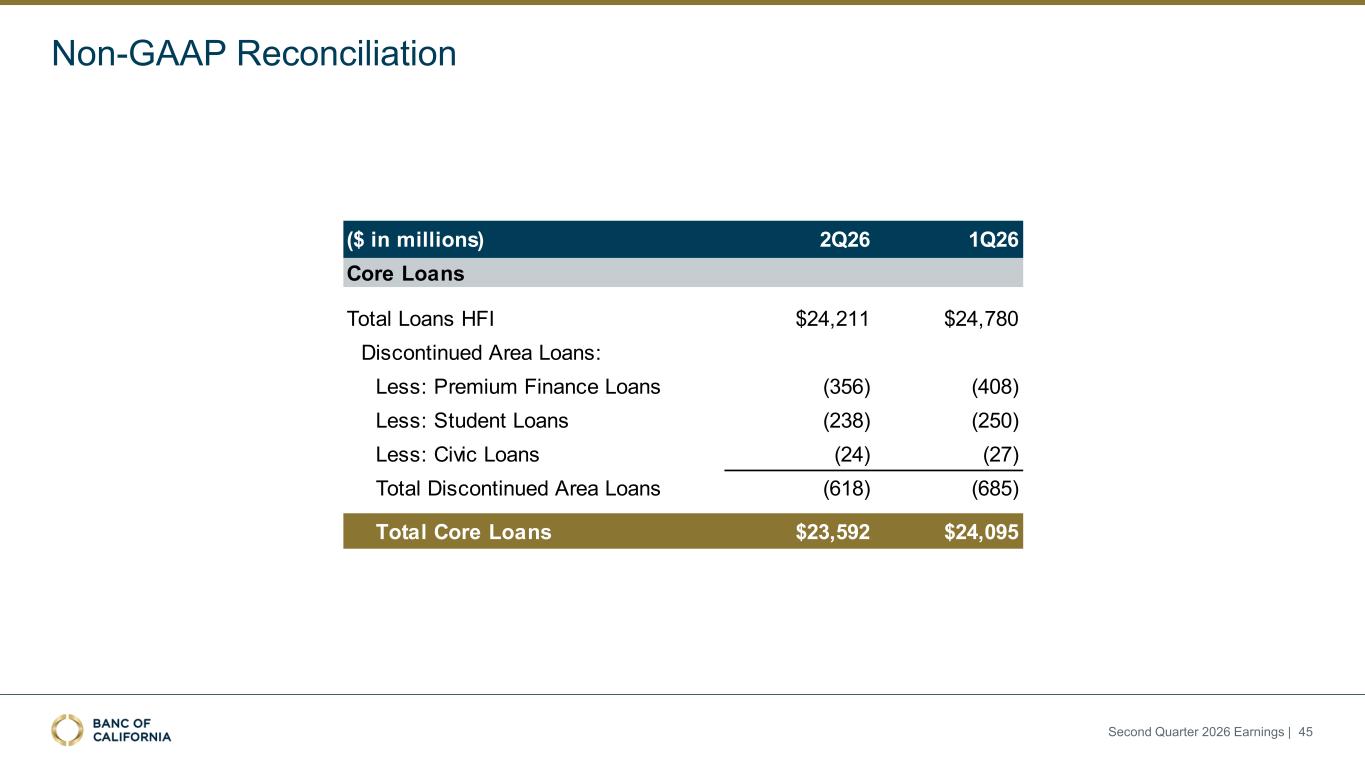
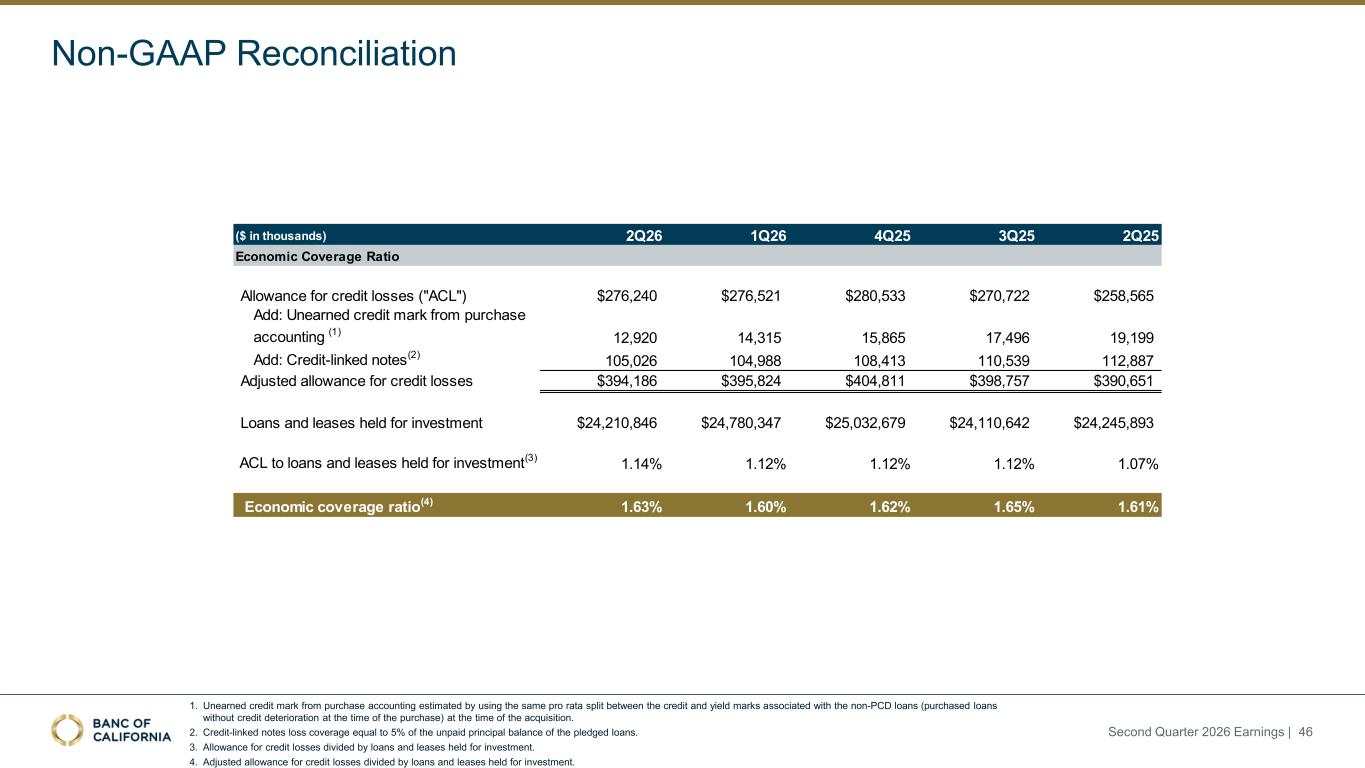
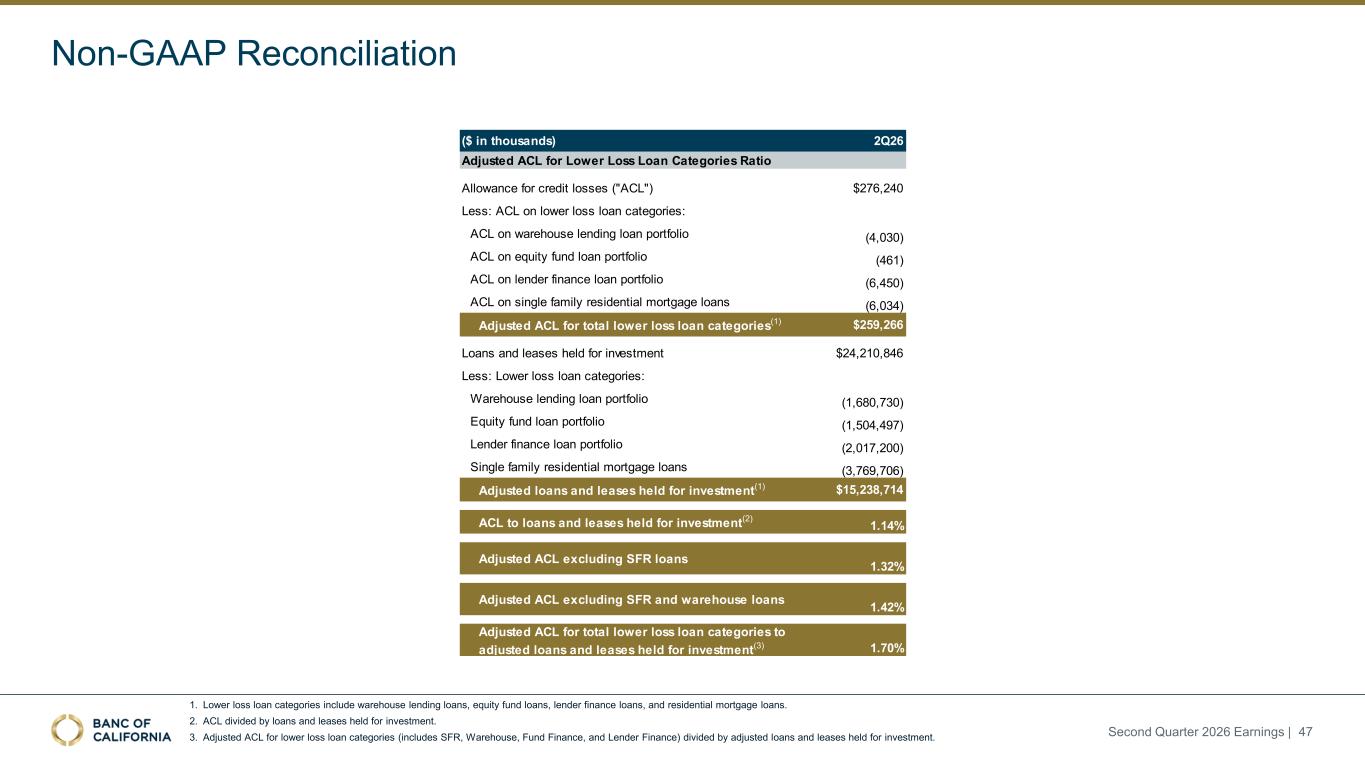
Thank you, Jared. Second quarter report results reflect the impact of the strategic balance sheet actions that Jared discussed. Let me note at the outset that we have provided in our earnings materials a page on noteworthy items affecting second-quarter financial results. This page is intended to provide a roadmap to normalizing our earnings with the prior quarter. For the quarter, we reported a net loss available to common and equivalent shareholders of $251.3 million, or $1.61 per dilutive share. The reported loss reflects the near-term accounting impact of the securities repositioning, the targeted loan sale process, and the retirement of subordinated debt. The largest item was the $2.3 billion securities repositioning transfer from held to maturity to available for sale and subsequent sale of most of these securities. The transaction resulted in a $256.7 million pre-tax loss on sale of the securities. The securities sold had an average yield of approximately 2.1%. As of June 30, we had reinvested $1.7 billion of proceeds at a weighted average yield of 4.87%, resulting in a 276 basis point yield pickup on redeployed balances. As of today, we have reinvested most of the proceeds with about $100 million remaining to invest. Based on the proceeds that have been reinvested so far, we expect tangible book value earned back to be relatively short at about 1.4 years. In addition to the yield pickup, the repositioning provides further balance sheet efficiency by taking duration of the overall securities portfolio down from five years to four years and also lowers the risk-weighting profile of the portfolio from 19.5% to 9.5%. Most importantly, it is expected to increase recurring net interest income as the benefits of the reinvestment are realized. Net interest income of $250.5 million was down from the first quarter, partially due to non-accrual loan interest reversals, which negatively impacted interest income by $5 Excluding that item, net interest income would have increased by approximately $3.9 million quarter over quarter, reflecting average balance sheet growth partially offset by higher funding The reported net interest margin was 3.13% for the second quarter, down 11 basis points quarter over quarter. Approximately seven basis points of decline was attributable to the non-accrual interest impact. The remainder was driven primarily by loan growth outpacing core deposit growth early in the quarter, which required greater use of wholesale funding, as well as the replacement of $385 million of subordinated debt with higher cost borrowing. The replacement funding increased borrowing costs in the quarter, but it was well below the subordinated debt's contractual reset rate, creating a meaningful reduction in future interest expense. Core deposit growth strengthened late in the quarter, which helped our funding profile as we entered the third quarter. New production pricing remained attractive at 6.39%, which continues to support the portfolio remixed over time. Average loan yield declined 11 basis points to 5.63%, largely reflecting the non-accrual interest impact. On the funding side, the total cost of deposits increased two basis points to 1.80%, while total cost of funds increased four basis points to 2.14%, due to the dynamics I mentioned earlier around late-quarter deposit growth and subordinated debt replacement funding. Importantly, the quarter reflected only a partial benefit from the securities repositioning. As the remaining securities proceeds are invested and the targeted loan sale closes, we expect the go-forward margin to come in around 3.30%. Margin expansion is expected to continue building through the second half of the year, supporting our year-end NIM target between 3.30 and 3.40%. On interest rate sensitivity, our balance sheet remains positioned to perform across a range of rate environments. The HTM repositioning was largely net interest income neutral, as greater asset sensitivity from shorter duration securities was offset by a higher net interest income base and significantly higher reinvestment yields. When adjusted for deposit repricing betas, our net interest income sensitivity remains relatively neutral, while ongoing balance sheet remixing should continue to support net interest income expansion over time. Non-interest income was a loss of $234.1 million for the quarter, driven by the $256.7 million securities loss and a $12.5 million lower of cost or market adjustment on loans held for sale. Excluding those items, non-interest income was $35.2 million, which was stable with prior quarters and consistent with our normal monthly run rate of approximately $11 million to $12 million a month. Non-interest expense was $189.9 million compared with $181.4 million in the first quarter. The increase was primarily driven by temporarily elevated FDIC assessment expenses resulting from our strategic actions this quarter and a non-recurring charge for software obsolescence. These were partially offset by lower compensation expenses following elevated first-quarter seasonality. Expense discipline remains a priority, and we expect operating leverage to strengthen as the revenue benefit of the repositionings come through. Turning to provision and credit, provision expense was $161.8 million for the quarter, driven primarily by the transfer of $827 million of select loans to help or sale in connection with the pending loan sale process. These loans were recorded at the lower cost or market value, which resulted in charge-offs and additional provision expense during the quarter. While the provision impacts create some noise in our reported results, the anticipated targeted loan sales enhanced capital efficiency and strengthened our portfolio composition. During the quarter, classified loans declined 31 percent, special mention loans declined 56 percent, and delinquent loans declined 50 percent from first quarter. Our allowance position remained stable with the ACL ratio up two basis points to 1.14 percent. We believe overall loan reserve levels are appropriate, particularly given the continued shift in growth towards historically lower-loss categories, which now represent 37% of loans held for investment, up from 34% in the first quarter. Capital remained well above well-capitalized regulatory thresholds. CET1 was 9.25% at June 30 and is expected to increase to approximately 9.5% upon closing of the targeted loan sale. We expect CE1 to continue building to approximately 9.5% to 9.6% by the end of the third quarter and 9.8% to 9.9% by the end of the fourth quarter and 10% early in 2027. As we move through the second half of the year, we expect the benefits of the strategic actions taken this quarter to come through more clearly in recurring net interest income, expanding margins, accelerated profitability, and organic capital generation. With that, I'll turn the call back to Jared.
Thanks, Joe. As we enter the second half of the year, our priorities are straightforward. Execute against the higher earnings profile we created this quarter through our strategic actions, continue growing high-quality client relationships, and maintain the credit and expense discipline that supports consistent returns. The balance sheet is more productive today, and our updated outlook reflects that. We expect the benefits of the securities repositioning, targeted loan sales, and debt retirement to become increasingly visible through stronger recurring net interest income, a higher margin, greater operating leverage, and faster organic capital generation. We have clear financial targets, strong franchise momentum, and a flexibility to allocate capital toward the businesses and relationships where we see the best risk-adjusted returns. That is the work ahead, and our team is focused on delivering on it. I want to thank our employees across Bank of California for their hard work and execution this quarter. They completed a significant set of balance sheet actions while continuing to serve our clients, build relationships, and support one another. I am very proud of the team and grateful for their continued commitment to our clients, communities, and shareholders. Operator, we're ready to open the line for questions.
Operator
We will now begin the question and answer session. To ask a question, you may press star then 1 on your telephone keypad. If you are using a speakerphone, please pick up your handset before pressing the keys. If at any time your question has been addressed and you would like to withdraw your question, please press star then 2. At this time, we will momentarily assemble our roster. The first question comes from Ben Gerlinger with Citi. Please go ahead.
Hi, good morning. We could unpack the loan sale a bit here with the charge-off perspective. It roughly took, let's call it 20%. How much of that was rate or how much of that was actual credit itself? And then kind of dovetail off of that, if you could, into more non-performing was still up despite all the changes. There's just quite a bit going on. I'm wondering if you could just unpack it a little bit.
Yeah, let me unpack the last piece first. In terms of NPAs, there was one loan that was part of the loan sale that got kicked out that we moved, that came out of held for sale. That loan has since been sold. It will be off our books this quarter, so NPAs will drop by about $34 million, which is the reflection of that increase. So NPAs will be down, and that loan was sold at par. So let me put that to bed. NPAs will be down, and could have been down, but there was one loan that lagged. And so that loan is off the books, will be off the books this quarter. In terms of how the buyers valued credit versus interest rate, that's hard for me to say. What I feel good about is that we got very strong bids. We conservatively marked them. I think we marked them more, I know we marked them more conservatively than the bids received. So that could flow back to us. I'm going to be conservative there because you need to give room for the buyers to maybe retrade or look for something and still have the loan sales close as expected. So we were pretty conservative here, but it's hard for me to say how they valued the loans in terms of what amount they applied to interest versus credit. But what I tried to give was a description of what the loans were. $525 million all performing. $300 million was one relationship in process construction. It was the same loans that we had highlighted in the first quarter that we said were going south and that caused the uptick in problems, and so we just took the opportunity to get rid of it.
And then when you gave the guide of kind of the 4Q Roths, can you unpack, like, provisioning and or tax rate just because there's – I mean, it is what it is, but just kind of how you got there? to our guide for 11.5% to 12.5% brought to you by the end of the year?
I'm not sure how to answer that specifically. Can you rephrase your question in terms of exactly what you're asking for? Because obviously that's a calculation of what our returns are going to be and what our capital is going to be.
Right. No, I understand that. Because we can kind of get the NII, but what would you assume for average provisioning or what would you assume for the tax rate?
Sure. Joe, you want to touch on that, Joe?
Yeah. Yeah. So for provision, I'd go back to a normalized provision run rate, what you saw from us prior to this quarter, which was like somewhere in like the, say, $9 million to $11 million, $12 million range, depending on individual quarter. And then on the tax rate, you'll see it come down just – I think you'll see it come down a little bit by one or two basis – one or two percent as we go through the year in each of the remaining quarters.
Okay, I'll step back so others can ask questions, but I'll be back in the queue.
Thanks, Ben. Appreciate it.
Operator
The next question comes from Gary Tenner with DA Davidson. Please go ahead.
Thanks. Good morning. Jared, I wanted to go back to the loan sale. Last year in the second quarter, you did a loan sale of, I think, or you transferred and eventually sold about $475 million of loans, and the thought at the time was you wanted to kind of remove a credit overhang and there were some characteristics of those loans you didn't care for a longer term. How do you kind of give investors in the market kind of confidence that this is, now it's $1.3 billion total over those two transactions?
Well, one thing I'll point to, Gary, is our earnings keep going up and our tangible book value has grown pretty aggressively and our stock price has reflected that. So I'm never going to say that's it because, you know, that's a setup for, and I know you didn't mean it that way, but I want to be clear, like we're going to maintain flexibility to do what's right for shareholders. And I feel really good about the fact that we've been able to grow earnings through various restructurings and have grow earnings per shareholders in a meaningful way, and I think this is a continuation of that. I'd like to think that, you know, I've been trying to preview with shareholders that there are certain actions that we want to take. PacWest was very comfortable having large relationships. And I have talked multiple times about how I've tried to reduce concentrations in those relationships and try to have more granular lending that reflects kind of the bank that we want to be versus the bank that PacWest was. And they did many, many things very, very well. But they had some very large relationships, which I think is different than the way we're operating going forward. So I think we're pretty much through that. I don't ever want to take off the table that I wouldn't sell loans in the future if I thought it was the right thing for shareholders in any given quarter. So I don't want to say that that's not a tool that we have to use. But I think to your question about, you know, from what we can identify today, is this kind of do we think we've gotten through the things we need to get through? I think the answer is yes. I understand the idea and appreciate completely that people don't want to see this multiple quarters in a row. They want to have some sort of steadiness to where we go. And I think one thing that we've been able to point to is the fact that earnings do keep growing. You know, and one of the things we're really excited about this quarter is how much this is going to accelerate our pace of earnings. You know, we gave up a little bit of tangible book value, but we're earning it back in 1.4 years. I think most of the banks that I'm familiar with that did a HTM restructuring raised capital around it. We didn't raise capital around it. We can see how quickly we're building up capital. The earnback is incredibly low. And one of the reasons the earnback is so low is because the timing was good to sell. Most of the AOCI had already been captured in HTM, so there wasn't a meaningful uptick in AOCI since the securities had been moved to HTM. That's the first piece of it, is that the loss was contained. And second is the timing for reinvestment was really good, and we were able to get a pickup that was pretty meaningful, and our team did a great job executing. So I know I'm expanding beyond your question, but we feel good about kind of the different things that we did this quarter, and hopefully we don't see loan sales any time in the near future.
Thanks, Jared. Appreciate the thoughts there.
Gary, just to clarify, when I say we don't see loans, We don't see any problem loan sales any time in the near future. I just want to, you know, I think that's what you're asking about, and I just want to clarify that.
Yep, got it. Thanks. And then just a quick expense question, you know, elevated FDIC assessment, just given, you know, I guess the process this quarter. What's the timeline for that normalizing?
How long does that take? I'm going to let Joe, I think it starts in the third quarter, and then by the end of the year it normalizes. Joe, go ahead.
Yeah, it's going to start to come down in both the third and fourth quarter, and it will probably fully normalize sometime in early 2027 when we get back when the capital fully rebuilds back up over 10. Okay, got it. Thank you. Thank you. Thank you, Gary.
Operator
The next question comes from David Giaverini with Jeffries. Please go ahead.
Hi, thanks for taking the question. So I wanted to ask about the net interest margin in the outlook. I hear you on the guide of 330 to 340. It sounds like, just to clarify, it sounds like 330 is what you're pointing to for the third quarter. Is that right?
We believe that when the loan sales are concluded and the securities are fully invested, that our margin should be around 330. So the margin for Q3, at this point, we think will be in the 330 range. That is correct.
That is accurate. That is accurate. Okay.
Got it. And in your prepared comment, you mentioned about expanding further in the back half of the year. Can you talk through some of the drivers there between fixed asset repricing, whether there's any kind of rate sensitivity, and what are you included in that? Can you tell us, you know, what you're assuming in terms of rate activity from the Fed?
So we're relatively neutral. We did not assume any rate hikes. And this is the it's going to start expanding because we're going to have full quarter benefit of all the securities repositioning, full quarter benefit of having lower yielding loans off our books and higher yielding loans on our books and continuing to make loans at the rates that we are currently making them. We don't assume that loan yields are going to go down. We assume that they're going to stay flat, even though we are not expecting any rate hikes. Joe, anything else that you would add there?
Yeah, I would also say that I think that, you know, our deposit cost trajectory should return towards our normal. We've been taking that deposit cost, you know, down every quarter. And, you know, aspirational, we had a strong deposit inflows at the end of the second quarter. We've had continued strong inflows so far in the third quarter. So I'd like to think that, you know, our cost of funds will continue to come down a bit and contribute to that.
Very helpful. Thanks, David.
Operator
The next question comes from Matthew Clark with Piper Sandler. Please go ahead.
Hey, this is Adam Kroll. I'm from Matthew Clark, and thanks for taking my question. Of course. Maybe starting on loan growth, It looks like overall production was pretty strong this quarter, so I guess I'd be curious to hear your overall expectations for loan growth in the back half of the year and where the pipelines stand today.
Loans have been holding up remarkably well. So, you know, we gave guidance of mid-single-digit loan growth for the year. I think obviously it looks like we're outpacing that. I don't know what the back half of the year is going to be. I don't know what the Fed's going to do today in terms of how that's going to affect the economy. Everything seems to be holding up remarkably well, and I'm a little bit surprised by it because it feels like the underlying signals of the economy seem mediocre to me. They don't seem outstanding to me. They seem just mediocre. But restaurants are still full. There's a lot of loan demand. We're competing really, really well. Our teams are getting a lot of looks in the areas that we want to get it, And we're choosing which loans we want to do. One of the dynamics that I'm seeing right now, which is very positive, is that there's stuff we're turning down. And that's not affecting kind of our loan volume. We're proactively saying, yeah, that's probably not for us. Let's move past that. And our teams have a lot of opportunities. We're not looking to do that, but we do believe that we can be selective and make the loans that we want to do. And our teams are working really hard. So I would just say that it looks good right now from a loan perspective. and I would think that mid-single digits is something that we should be able to achieve reasonably well this year and hopefully outpace that.
Got it. I appreciate the cover there, Jared. And then maybe moving to expenses. They checked out this quarter, even stripping out the $5 million or so of non-recurring items. So I guess I was just curious, should we think about the expense run rate in the back half? Joe, you want to take that?
Yeah. Yeah. So, I think, you know, we put out guidance at the beginning of the year, which was, I think, a 3% increase year-over-year, and I think you can expect us from a total perspective to come in well below that, and I think you could expect to see our expense levels be flat to down from the level of what you see here in the second quarter as we move through the third and fourth quarter.
Got it. Thanks for taking my questions. Thank you.
Operator
The next question comes from David Beaster with Raymond James. Please go ahead.
Hey, good morning, everybody.
Look, we've spent a lot of managerial bandwidth working on these balance sheet optimization You've accomplished a lot, clearly. Obviously, there's still some left to do, but you've done most of the heavy lifting. What's next for you as you refocus management's attention towards, you know, what are some of the key initiatives that you're working on to deliver some of those targets that you laid out over time that we've talked about?
Well, thank you for the question. The good news is that all the pieces are in place and we're executing. I think what we've been doing quarter over quarter has been working exceptionally well. But when you've got $2 billion of assets on your balance sheet, that are not earning any money because they're at 2% funded by 4%. They're holding you back, and you're not making as much money as you should. And fortunately, we had plenty of excess capital, didn't need to raise any capital to do something like this, and the timing was right. So the short story to your answer is that in order to achieve our goals, we need to keep doing what we've been doing, and the earnings are going to show up because we've already been doing it, and our teams have done an exceptional job on the loan and deposit front. That said, there are initiatives that we have in place that I expect to play an important role in the future. Not this year, but we've talked about payments and really excited what the team is doing there on cards and acquiring. We've got a board presentation on it this quarter because the prospects are looking really good. We have a private banking initiative that we're rolling out that is going to be serving high net worth individuals with really high quality tailored banking solutions. We don't need to provide mortgages. We don't need to provide wealth management. We need to provide really high-quality tailored solutions, and there's a huge demand for it in our markets, and that's being rolled out. These are some interesting things that we're doing that complement what we're already doing, and I think those things are going to bear fruit. But the short answer is we're doing all the things already, David, and our teams are executing really well. Okay, that's helpful.
I should have mentioned, David, that the preferred stock is obviously going to be an accelerant. So when you think about what are other levers that we have to pull, you know, when that is redeemable in the third quarter of next year, as of now, we would love to do that. And we've said that, you know, it's $40 million of net income after tax that we have to pay. It's a tax on the common. We're going to have to fund it somehow. But our expectation is that we're going to get at least a 50% pickup. You know, so at least $20 million is going to come back to the common from that transactional loan.
Okay, that's helpful. And then I wanted to follow up kind of on Joe's commentary about, you know, improving, you know, the funding side, right, and some deposit cost leverage potentially. I mean, you guys have been very active managing this, obviously, for deposit. But could you touch on some of the initiatives you've got in place, how you think about opportunities, basically core deposit growth as we look forward? Obviously, you've had success on the NIB side and the new accounts like you talked about. But how do you think about additional opportunities to optimize the funding base?
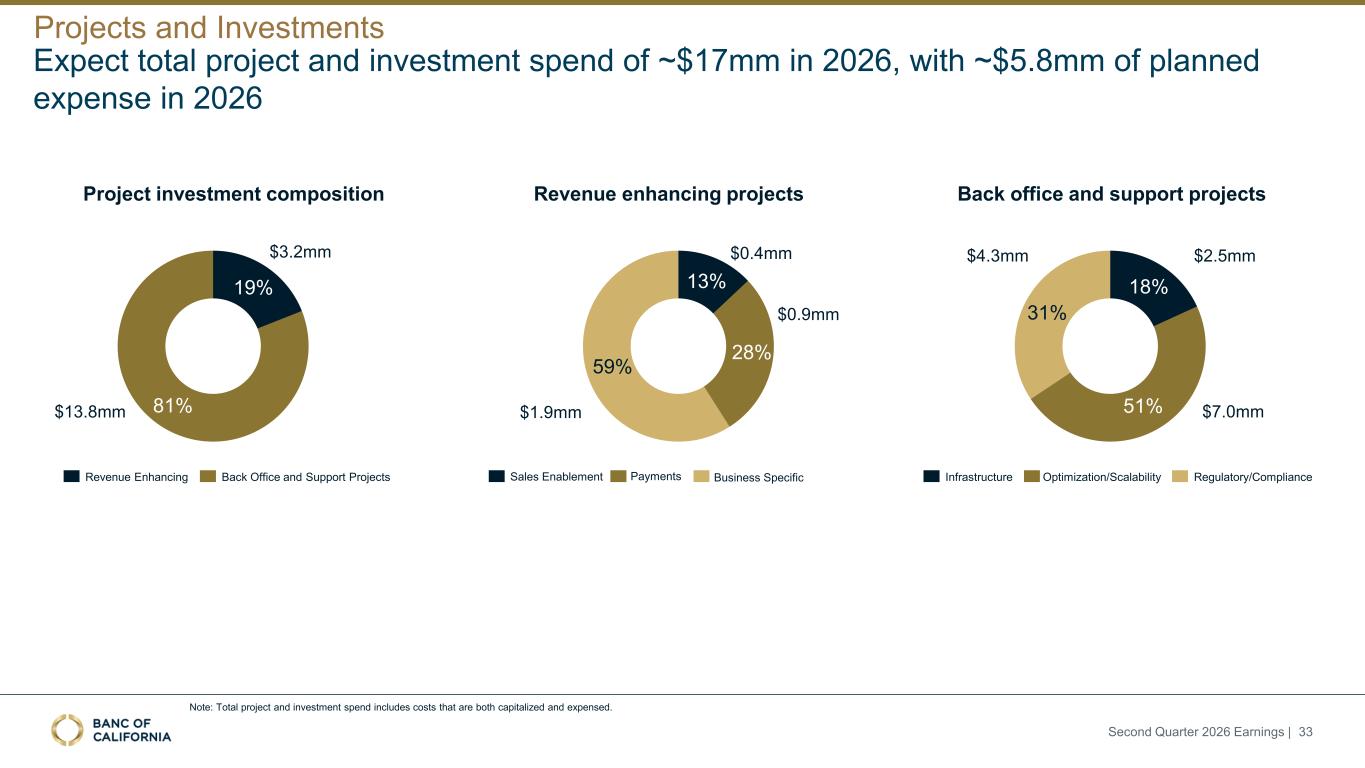
Well, we have a project called Project Stay, which is intended to capture deposits that might leave for higher rate. You know, one of the things that we found is we're able to retain depositors at a lower rate who might be looking for rate than going out and finding new ones. And so that project has yielded a lot of fruit. These are generally rate-sensitive customers that don't have a huge relationship with us, but we made an active campaign to retain those customers, and our teams through the branches and otherwise have done an outstanding job of executing on that, and that had an impact this quarter. We saw that outflows were much lower. So, you know, you don't want to be bringing in deposits in the front door while they're leaving out at the back door. And so you want to make sure you have a clear understanding of all the movements on deposits. Second is we found that we are – our teams are very good at speaking with clients about rate and figuring out where there's opportunity to maybe lower rate. So we're not always assuming that rates need to stay where they are. we can go to clients and actively manage the relationship and say, hey, we'd like to lower the rate a little bit here and there. And our teams have done a really good job with that. It's not on all clients, but we've figured that out. Third is I would say that we have some institutional relationships that we tap that tend to be less expensive than brokered. And those are larger relationships that we've been able to bring in. And our treasury team and our deposit solutions team do a really good job of bringing those in. Those are three things that we're doing to make it look that I think have helped our deposit narrative quite a bit. One of the things that we have done on the technology side that makes us more attractive is we've added APIs and solutions that will allow us to be more attractive to future clients, clients' prospects, and also make sure that we're tied more closely to existing clients so they're more embedded with us. It makes it harder for them to leave, but it makes them more reliant on our services. And those APIs can be very valuable. And so we've been investing in doing that with more and more clients. And, Joe, thank you for that comment. He was texting me that I should mention that. Anything else we should mention?
No, I think you hit him. Well, thanks for the help.
That's great. Thanks, everybody. Thank you, David.
Operator
The next question comes from Jared Shaw with Barclays. Please go ahead.
Hi, good morning. This is John Brown.
Just thinking about the loan sale a little bit more, what are the proceeds from that unexpected to be used for? And also, are there any deposit or fee relationships with these borrowers or any impact we should watch there?
Yeah, there is no expected impact on the deposit side. And, in fact, some of the loans that we had that we sold were tied to larger relationships and we told the borrowers that are good relationships that we were selling the loans and, you know, made sure that they knew so that they weren't surprised. And so we don't expect any change in our deposit relationships as a result of the loan sale. In terms of what we're going to do with the proceeds, you know, it's a function of deposits and loan growth and we'll just play it by ear. where we can obviously, as we're making loans, we'll reinvest at higher rates. If loan gross flows, we're going to pay off borrowings, pay off broker deposits. But we would expect to make loans at higher yields, and that's kind of what we've modeled.
Okay, thanks. That's helpful. And then just thinking about the CET1 guidance, what impact is there to RWA density or just RWA dollars? after the loan sale goes through.
Joe, you want to take that? So, you know, there was $827 million on the loan sale, and those are, you know, for the most part, 100 or 100, in some cases even a little bit over 100% risk-weighted. So those all come off our sheet, and, you know, that's an immediate benefit to our capital. And so we should see an uptick when those come off. Now, as we reapply those proceeds into loans or maybe on day one, they were probably, you know, allocated into some, you know, cash securities or something, you know, something like that until loan growth kind of, you know, absorbs them, you should see a significant improvement in the RWA and CC1. And, in fact, just the loan sales coming off our books, you know, that immediately will add, you know, up to 30 basis points of CET1, and we have that on page 8 of our investors' deck.
Yeah, there's kind of a CET1 walk on page 8 that shows, you know, how we get to and what the components of it are in terms of how it's going to end up for the year.
Okay, gotcha. That's all I have. Thank you for all the comments. Appreciate it. Thank you.
Operator
The next question comes from Chris McBrady with KBW. Please go ahead.
Good morning. Morning, Chris. Going to your comments, Jared, about you're optimistic about, you know, the PPNR exit, I guess the question would be, if you look at consensus numbers, they're kind of at the low end already. And so I was hoping you could unpack the conservatism that you described have you prepared remarks? And then again, where, if you do get that, that would show up in the PPNR as you exit 26th.
Thanks. Yeah. So I would say the first thing is, I think I went back and I looked at consensus. And, you know, we try to keep the range within reason, although we don't control what people write. And I think there was a pretty wide range. I think that there were some outliers in terms of the expectations. So I need to kind of keep the consensus front and center, but there were a couple ones that were really high outliers. So I think that's driving the consensus to be higher. There is a much tighter range among many, and then there's a couple that are way up. And I think that that pushes the consensus a little bit higher. So let me start off by saying that. I don't know that maybe we need to do a better job of managing that range, but we can't always control it, and we obviously don't control what numbers the analysts put out. They're doing it based on their own models, which we try to help inform. Joe, do you want to speak to what some of the assumptions are for our pre-tax pre-provision going forward?
Yeah. Yeah. So, Chris, I'd start by saying, you know, you asked with conservatism, you know, we tried to do our best to forecast income with a level of humility and moderation because, you know, we don't know what the back half of the year is going to hold in terms of economic environment. You know, there is still a war going on. There could be higher rates. There could be inflation, et cetera. So I would, you know, start by saying that. But, you know, if you look out, you know, through the year, you know, you see some, you know, continued loan growth in the mid-single digits that we've talked about. You see deposit growth, you know, keeping up a little bit, you know, lagging behind a little bit behind the loan growth. but, you know, still being fairly strong. And then, you know, we hope to bring expenses down, keep our provisions stable. Our tax rate goes down a little bit. And so, you know, as we look out into where we might have opportunities, you know, if we can do a better job of, you know, if we outperform on loan growth or, you know, bringing in more deposits, obviously that will fall to the bottom line. And, you know, expenses is something that we have control over, and we always try to strive to optimize that.
And just to put a finer point on it, Chris, to answer more directly now that we've put in all the assumptions, we believe that our outlook is conservative. You know, we've said the margin should be the third quarter at 330. We obviously hope to beat that. We have said 125 to 130 by the end of the year. I think with our expected margin expansion and the conservatism that Joe laid out, We think these numbers are conservative.
Okay. Thanks. And then, Jared, on the 60 basis points on the come with Basel, how do we think about, like, urgency to use, like, stack ranking, what would happen? How do you foresee that point out?
In terms of what we would do with excess capital?
With the 60 basis points from Basel 3. If you get the helper, I know it's not in your guide, But if you get to 60 basis points, what do you do?
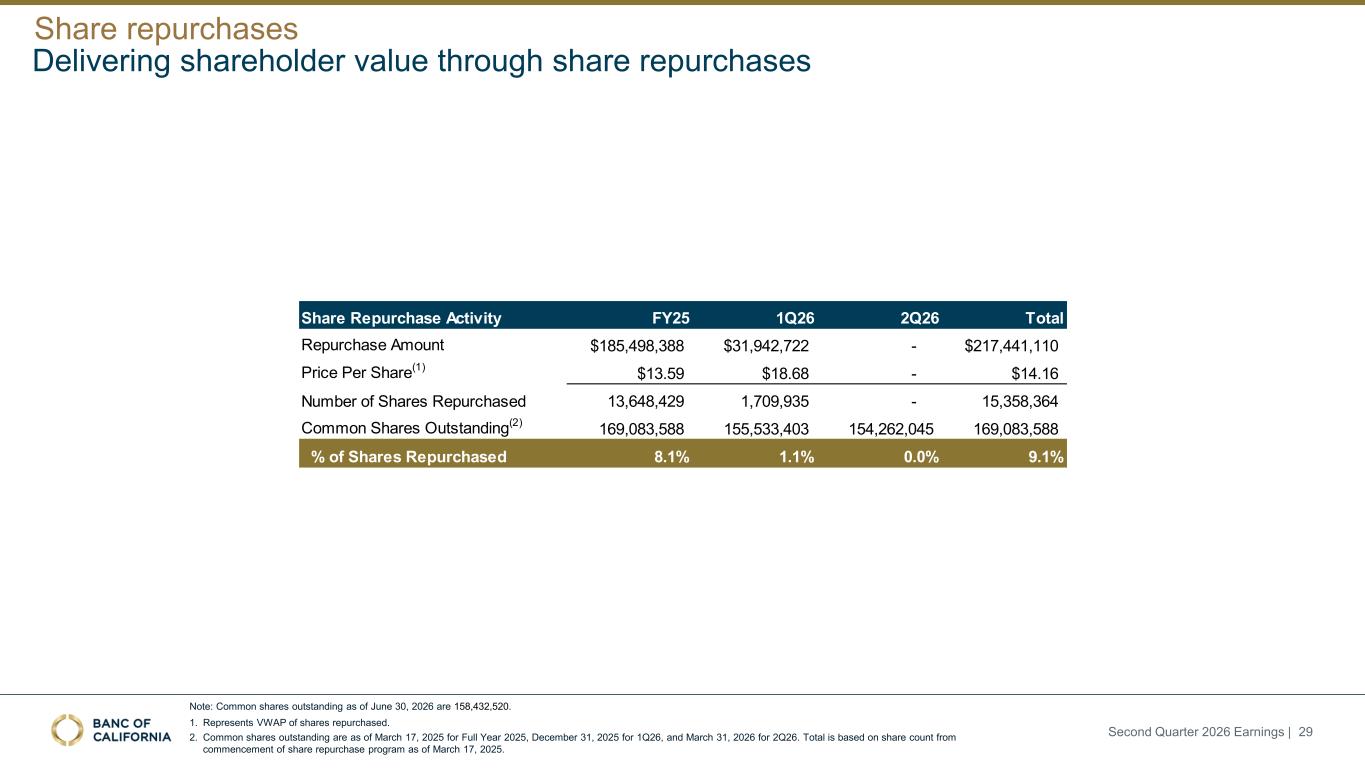
Yeah, so, I mean, it matters where our stock is trading. Yeah, it's the same capital allocation list. So now we're in excess capital land, right? We're going to get back to 10. We're in excess capital land. Everything is going well. You know, we have a buyback program that's still active. We have a whole bunch of unauthorized but, you know, not yet utilized buyback. And depending on where we're trading, I don't think we would hesitate to pull the trigger there. It's not mutually exclusive from doing other things. We obviously have the ability to buy back to preferred, and we have liquidity sources that we've identified to do that. But I think buyback is not out of question.
Great. Thank you. Thank you.
Operator
The next question comes from Anthony Elion with JPMorgan. Please go ahead.
Hi, Jared. Just following up on Chris's question, you note that the balance sheet actions are going to support higher recurring earnings over time. There's a lot of moving pieces here. Can you help us quantify how much of a benefit to run rate earnings you expect all these actions to contribute, right? If I just look at consensus for next year earnings, it's about $2 per share.
That's the consensus number for the full year for 2027?
That's right. I see somewhere in the low twos.
Yeah. So I'm not going to put a number out there, Tony, but we should beat that. I mean, look, we gave up. Let me try to put this in context without putting a specific number on that because that would be a forward guidance number that we haven't given, but this context may help. We diluted tangible value by about 7%. We're not diluting tangible value by 7% to grow earnings by 7%. We want to grow earnings double the percentage of dilution of tangible book. So you could say mid-double digits, right? On that, you could say mid-teens would be a reasonable expectation for how we're going to grow earnings relative to the dilution of tangible book. That's why tangible book value is going to grow back so quickly. And people will be able to calculate that when they see how quickly we're building up CET1. And so, you know, the ROA, ROTC expectations also have embedded in there. You know, we didn't really shrink the bank. So, we didn't, you know, we're not getting to a higher ROA and ROTC because we shrunk the bank. We have to grow earnings. And so, if all of a sudden our earnings, if our return and profitability expectations drop, that means that we're growing earnings faster. And hopefully that puts it into context.
Fair. Okay. Okay. And then in the prepared remarks, you mentioned that the balance sheet actions were done to remove some weights from the company. Any other weights you see across the franchise, including balance sheet actions, loan portfolios, or anything on the expense side? Thank you.
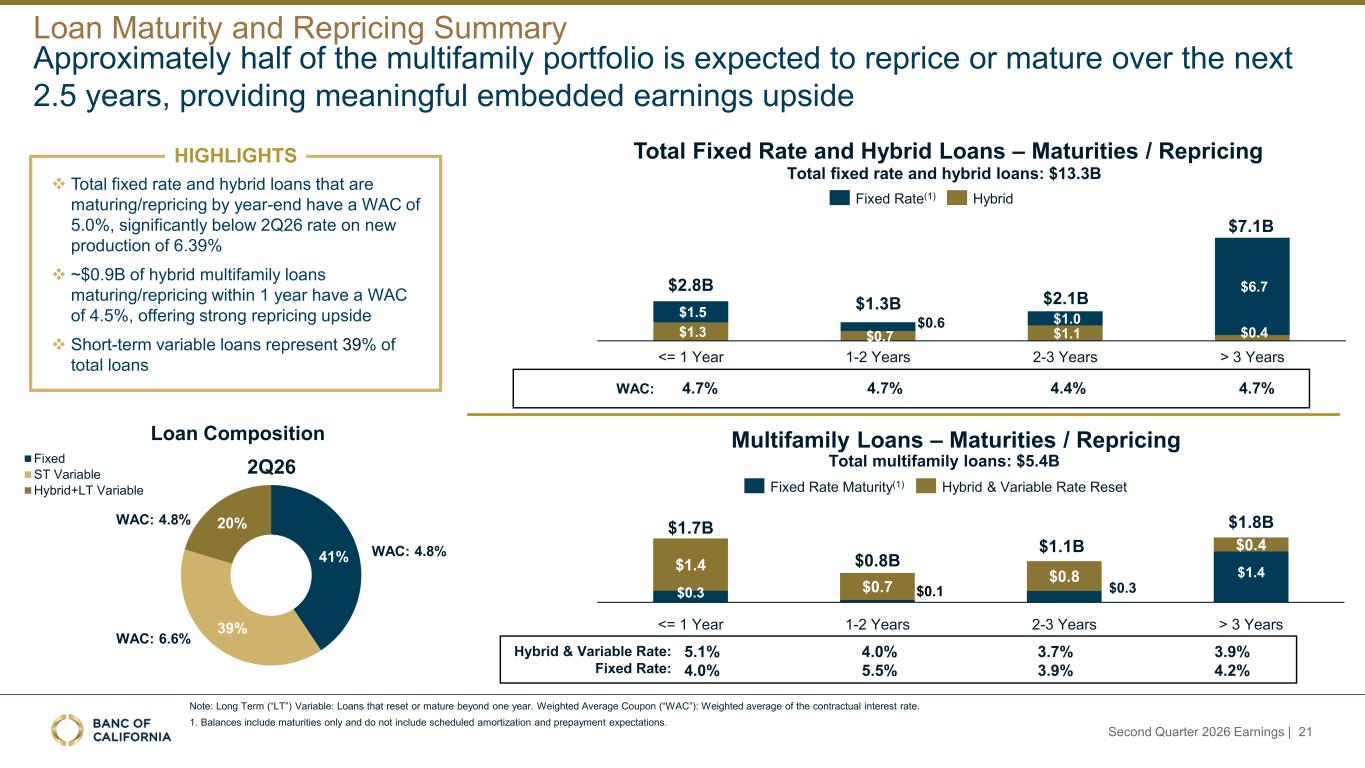
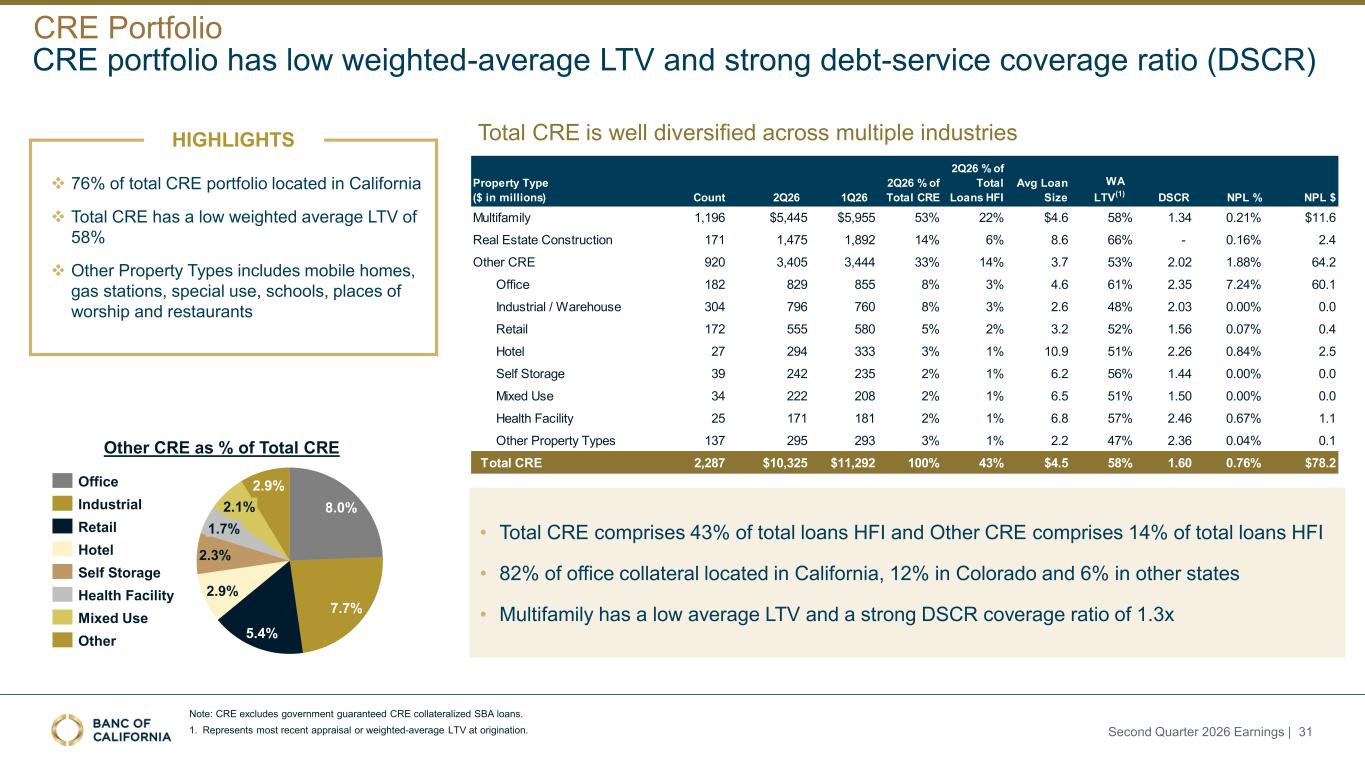
Yeah, I don't know that there's anything clear on the expense side. I mean, one thing that people have asked about is multifamily. I mean, we've got $6 billion at 4%. That we put one of the reasons that we put in in our deck every quarter is the burn rate on that so people can see how quickly that's coming off. That seems to be taking care of itself. There is some longer duration multifamily. I mean, one of the things that we found out in this in this loan sales, there's a really active market for loan sales. I mean, and and when you look at when you look at multifamily, it's completely capital neutral if we wanted to sell it. But that's not something that I have teed up as of right now. and we think that we have some pretty high recurring earnings power right now and we're building up tangible book value and we want to show this out and make sure people see what we're doing here. But people ask about it all the time, so it's not wrong of me to put it out there and people say, what are you going to do about that? That's one of the reasons we put that information in the deck is so that people can see what the repricing timeline is for that multifamily book. and when the accretion will kind of come on. Thank you. Yep, thank you.
Operator
The next question comes from Timothy Coffey with Breen Capital. Please go ahead.
Thank you. So a question on the loan yields, right? So if you were to back out the loans that you plan to offload this quarter, is there a material change to the overall average loan yield? if we were to back out the loans that yielded 4.6%.
Well, our new production yield was 6.4%. So, I mean, we are putting on loans at much higher rates than loans that are coming off. Our loan yield, our weighted average yield for the quarter, here, I'm looking at it. We're at 5.8%. The loan yield is 5.78%, 5.8% was the average for the quarter. Last quarter, it was 5.74%. So, you know, it upticked a little bit. And so it's just a volume question from the production side and payoffs. But, you know, I would say that there's probably, when you take away $800 million of loans at 4.6% when we're generating 6.5% or whatever it is, it's probably going to help the overall loan yield for the portfolio a little bit. We have $24 billion of loans, so whatever that is as a percentage.
Okay. And do you have a sense, and I apologize if I missed this, of what the provision would it been, excluding the marks on the loans moved held for sale?
I think we're looking at our provisioning just being normalized going forward. So it's 9 to 11, 10 to 12, something like that is where we're estimating it's going to be going forward. It's hard to break out this one quarter because there's just a lot of pieces and we're not actually allowed to. That's why we had to have those noteworthy items in there, is because we're not allowed from SEC purposes to kind of remove provision expense to try to come up with a core number. But we've tried to provide the groundwork for that.
Does that make sense, Jim? Yeah, you've got to see what I'm trying to get to with that question, just because the idea of what the core earnings power was.
Yeah, we think for the quarter, we were kind of, you know, if you work out the numbers, we were $0.39 or $0.40. sense. I mean, it was, in my view, that's where we were, just that's why we provided those noteworthy items. But it's going to be different this quarter because our margin is going up. And so it's a 10 million core provision is generally what we think it's going to be. That's probably the average going forward.
Right. Okay. Okay. I appreciate that. And then on the buyback, I understand what you're saying about the expected capital generation over time, but given that you're starting from a lower capital spot, does near-term buybacks, is it reasonable to think that there might not be any near-term buybacks?
Yeah, I mean, the question that was asked about Basel was, and Basel is not expected to go into effect until next year. And so we're not at 10% yet. And we've said that 10% is kind of where we want to maintain capital for buybacks. Now, I want to remind people that there were a lot of shareholders who said, hey, why wouldn't you go below 10% to buy back shares? And I said, I don't know that it makes sense. The securities repositioning, it made a ton of sense. It's a 1.4-year earnback. It's wildly accretive. And so that made a ton of sense. But buybacks have a much longer duration in terms of earnback. They're not as accretive. That doesn't mean you shouldn't do it. So, yeah, we wouldn't be buying back our stock until we're back above 10%. and then it just matters what other things are on the table. I shouldn't say – and I shouldn't put a bright line on it because you never know, but I think that's the general guidance we've given, and I think that general guidance is still reasonable.
I think so, too. I think so, too. And could there be upside – we'll just be on the PPNR question one more time. Could there be upside to that estimate if you're able to deploy the proceeds from the loan sale quicker into new loans, given that – I think we believe that our PTPP guidance is reasonable and probably conservative. All right. Those are my questions. Thank you.
Operator
Again, if you have a question, please press star, then one. We have a follow-up question from Ben Gerlinger with Citi. Please go ahead.
Hi. For the loan sale, you kind of gave the implication that the price is not fully determined. Maybe I'm just reading it too much. Are we in a cool-off period, or is it like more just closing timeline?
Closing timeline. So we've signed executed purchase and sale agreements. The buyers have the ability to kick out loans if during now, and there's a reasonable period for diligence that's more diligence than what they were able to do before signing a purchase and sale agreement. They have the ability to do those, but if they kick out loans or change pricing, we don't have to close with them. We have backup buyers. This was a very competitive process, and there were multiple bids. And so there is some competitive tension. We think that the pricing is fairly strict. And even if there were some price changes, we've reserved at levels that we think are in our numbers already. So I don't see any impact to our numbers if that helps. yeah it sounds like you're asking whether or not we could have a bigger charge if the pricing came in differently kind of i'm a little more worried like if if part of them don't actually sell but there's yeah i feel i feel good about i feel i feel good about it and if they didn't sell to these buyers they'd sell to somebody else and we had multiple bids so we we feel good about it and as i mentioned one loan that we didn't sell through the loan sale process sold after the quarter ended and we'll come out of our numbers to $34 million this quarter.
Thank you, Ben. Appreciate it.
Operator
This concludes our question and answer session. The conference has now concluded. Thank you for attending today's presentation. You may now disconnect.