Operator
Thank you for standing by. My name is Tina and I will be your conference operator today. At this time, I would like to welcome everyone to the Beacon Financial Corporation First Quarter 2026 Earnings Conference Call. All lines have been placed on mute to prevent any background noise. After the speaker's remarks, there will be a question and answer session. To ask a question, simply press star 1 on your telephone keypad. To withdraw your question, press star 1 again. It is now my pleasure to turn the call over to Dario Hernandez, Corporate Counsel. You may begin.
Thank you, Tina, and good afternoon, everyone. Yesterday, we issued our earnings release and presentation, which is available on the Investor Relations page of our website, DeaconFinancialCorporation.com, and has been filed with the SEC. This afternoon's call will be hosted by Paul Perrault and Carl Carlson. During the question and answer session, they will also be joined by Mark Mickeljohn, the Chief Credit Officer. This call may contain forward-looking statements with respect to the financial condition, results of operations, and business of Beacon Financial Corporation. Please refer to page two of our earnings presentation for our forward-looking statement disclosure. Also, please refer to our other filings with the Securities and Exchange Commission, which contain risk factors that could cause actual results to differ materially from these forward-looking statements. Any references made during this presentation to non-GAAP measures are only made to assist you in understanding Beacon Financial's results and performance trends and should not be relied on as financial measures of actual results or future predictions. For a comparison and reconciliation to GAAP earnings, please see our earnings released.
At this time, I'm pleased to introduce Beacon Financial's president and chief executive officer paul pearl thanks dariel and good afternoon everyone and thank you for joining us for our first quarter earnings call i'm pleased to share that we achieved the major milestone in our integration process in the first quarter with the successful completion of the core systems conversion in mid-february i would like to recognize the hard work and dedication of our teams and executing on this very critical step and just as importantly their efforts to achieve strong client retention throughout that process. That outcome reflects months of preparation, disciplined execution, and a continued focus on serving clients during a period of significant change. From a financial perspective, I am very disappointed with our first quarter results. Loan growth and the margin fell far short of our expectations and reflects some near-term pressures, uncertainty in the economic environment, and the tail end of merger activity gap earnings for the first quarter were 55 cents per share and operating earnings were 70 cents per share excluding merger related charges while operating results were below both of our prior quarter and our expectations the core returns remain good with operating roa just over one percent and operating return on tangible common equity of 11.25%. As we discussed coming out of the fourth quarter, the operating environment during the first quarter remained quite challenging. Balance sheet contraction, margin pressure from declining rates, and lower fee income all weighed on our results. Importantly, several of these headwinds aren't structural in nature. They were influenced by seasonal dynamics, timing, and the uncertainty created in economic environment from persistent inflation, extremely thin pricing, global events, and the prospect of rent control legislation in our major markets. Collectively, these headwinds impacted loan volumes. While the pipelines remain strong, clients are cautious, yet optimistic as the economic environment remains quite fluid. Excuse me. On the positive side, we continue to make progress on the strategic priorities we laid out at the time of the merger. Expense discipline remains strong. Core funding costs improve sequentially. Capital levels are robust, with CET1 at 11 percent and tangible common equity at just over 9 percent. and while credit metrics move modestly higher during the quarter they remain manageable and well-reserved reflecting proactive credit management in a still uncertain environment now that the systems conversion is behind us and merger charges are largely complete our focus shifts squarely to execution stabilizing the balance sheet restoring growth momentum and fully capturing the revenue and efficiency benefits we outlined when we announced the merger We believe the pieces are now in place to close the gap between current performance and our planned runway as we move through the remainder of the year. Before I turn it over to Carl, I'll note that our board approved a quarterly dividend of 32.25 cents per share, consistent with our commitment to returning capital to stockholders. in addition the board authorized a 50 million dollar stock we purchase program subject to regulatory approval reflecting our confidence in the franchise our capital strength and long-term value creation opportunity that we see ahead i will now turn it over to carl to walk us through the financial results in some more detail carl thank you paul i'll begin with the high-level summary of the quarter and then walk through the income statement balance sheet and credit trends in more detail first quarter operating results declined sequentially driven primarily by
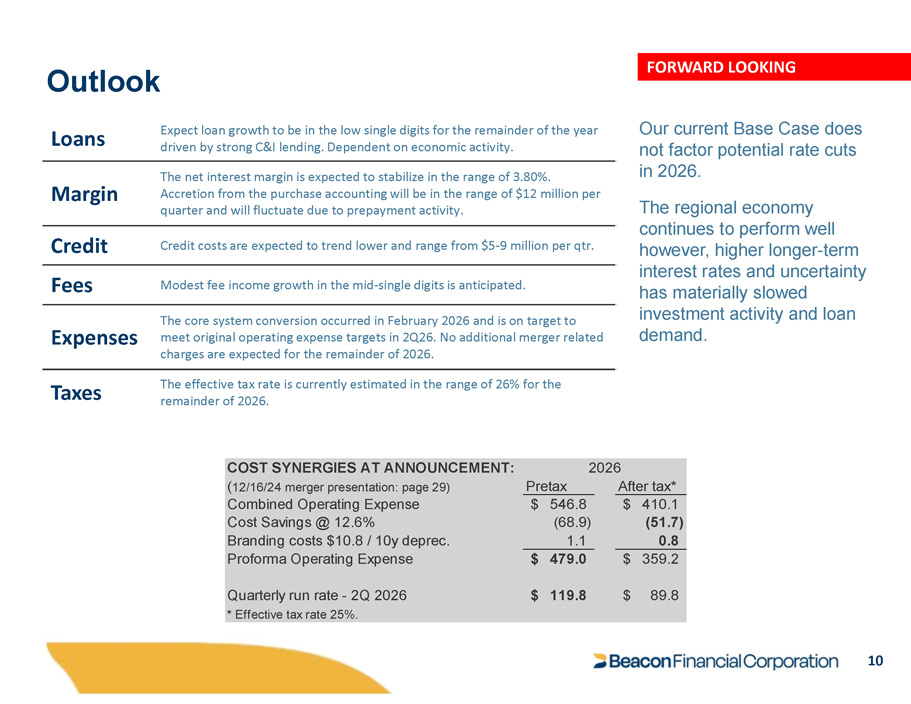
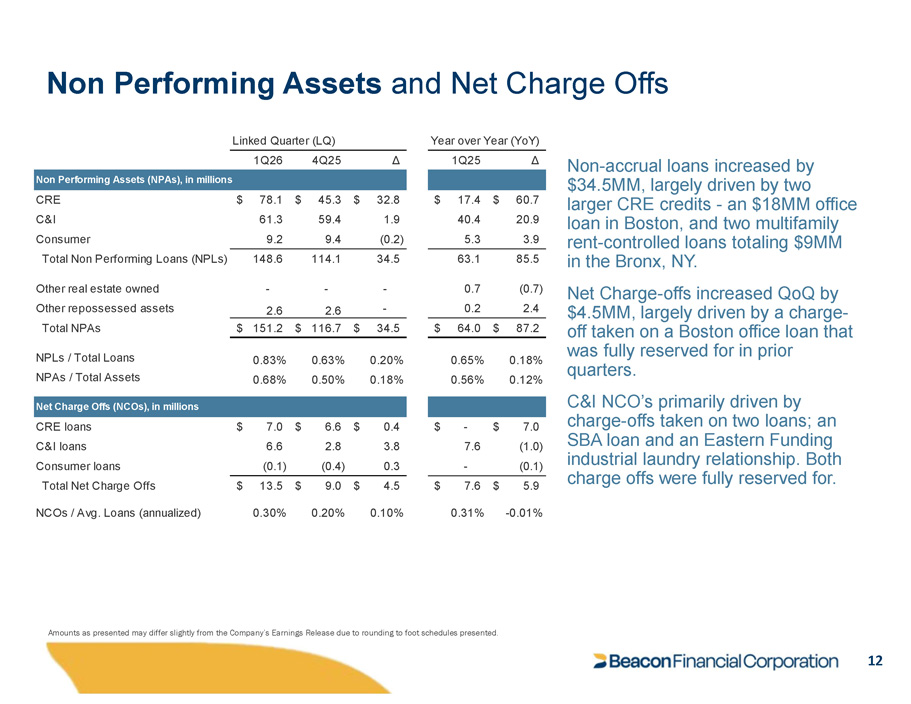
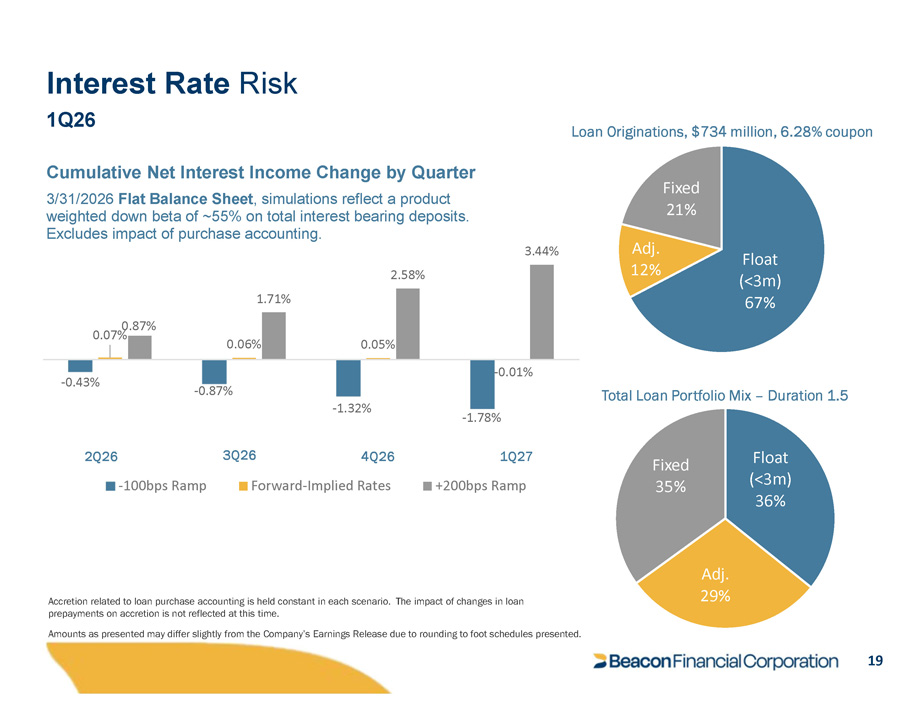
balance sheet contraction modest net interest margin pressure tied to the rate environment and lower non-interest income gap earnings totaled 46.2 million dollars or 55 cents per share operating earnings were 58.4 million or 70 cents per share which excludes 13 million dollars of one-time pre-tax merger-related charges. Operating return metrics remained healthy. Operating ROA was 1.01%, and operating return on tangible common equity was 11.24%, reflecting continued expense discipline and solid core profitability, even with lower revenues. Turning to the income statement in more detail, net interest income was $190.8 million, down $8.9 million, or 4% from the fourth quarter. This decline was driven by lower average earning assets and a modest reduction in asset yields as rates moved lower in late 2025. The net interest margin declined by four basis points to 3.78%. Importantly, funding costs improved sequentially. Interest-bearing deposit costs declined 17 basis points, and we expect continued improvement as pricing actions taken continue to flow through. As balance sheet growth resumes, we believe this positions the margin more favorably looking ahead. Non-interest income totaled $23.9 million, down $2 million, or 8%, from the prior quarter. The decline was primarily driven by lower deposit fees and reduced gains on loan sales, as SBA activity moderated from a very strong fourth quarter. These declines were partially offset by higher mark-to-market income on derivatives, tax credit and investment income, and relatively stable wealth management fees. On the expense side, operating costs remained well-controlled. Total manage expense was essentially flat compared to the fourth quarter. It came in nearly $1 million below budget. This performance reflects disciplined cost management and continued execution against merger synergies, offset modestly by seasonal increases in occupancy costs and a true up in FDIC insurance. Excluding merger charges, the operating efficiency ratio for the quarter was 59.5%, underscoring the underlying expense discipline in the business. Now, turning to the balance sheet, total assets declined $992 million to $22.2 billion, driven primarily by lower cash balances associated with point-in-time payroll fulfillment deposits. Loans declined approximately 1%, reflecting continued runoff in the commercial real estate and consumer portfolios, partially offset by growth in core commercial lending. Loan originations and draws were $734 million, with a weighted average coupon of 628 basis points. 67% of originations were floating rate. Deposits declined 6%, driven largely by payroll deposits and brokered balances. Excluding payroll and brokered deposits, core customer deposits declined approximately 2%, reflecting typical seasonal outflows related to tax payments and commercial activity. Turning to credit. Credit metrics deteriorated modestly during the quarter. Non-performing loans increased to 83 basis points of total loans, driven primarily by migration of Boston office exposure and several rent-controlled multifamily properties in New York City. Net charge-offs total 13.6 million or 30 basis points annualized, reflecting resolutions of a small number of larger credits. The allowance for loan losses closed the quarter at $244 million, representing 1.36 percent of loans. Given portfolio composition and current risk trends, we believe reserve coverage remains appropriate. Provision expense declined modestly from the prior quarter and we continue to expect provisioning to be less than that charge-offs as we work through existing criticized credits. Capital generation remains a clear strength. CET1 ended the quarter at 11%, tangible common equity at 9.1%, and tangible book value increased 16 cents to $23.48 per share. Importantly, with the core systems conversions completed in early February, we have now recognized the final significant merger charges total merger costs were in line with expectations and management is confident the announced cost synergies of the merger have been realized looking ahead we anticipate improving earnings momentum now that the merger costs and system conversions are completed and announced expense synergies have been realized we expect loan growth to remain soft in the second quarter then strengthen throughout the remainder of the year we expect the margin to stabilize around 380 basis points and gradually improve. While near-term macro and rate uncertainties remain, we believe the franchise is well positioned to improve performance and close the gap to our targeted run rate over the coming quarters. That concludes my prepared remarks. Thank you, Paul.
Thank you, Carl. We will now be joined by Michael John and Michael McFurdy and we'll open it up for questions.
Operator
As a reminder to ask a question, simply press star one on your telephone keypad. and our first question comes from the line of justin crawley with piper sandler please go ahead hey good afternoon everyone hi just wanted to to start out on the margin um in the outlook there can you just uh carl maybe provide a little more detail on the reset on accretion expectations uh just what changed from the original assumptions that went into that and what got you from $15 million down to that $12 million number just on a go-forward basis?
Sure. Thanks for the question. So, when we first estimated the purchase accounting, we tried to take out the impact of prepayments and things of that nature. And we're estimating it around $15 million. A lot of the schedules suggested that. We've got these all set up in in our systems to track as as loans pay down and it's coming in a little bit lower and we're not seeing any kind of prepayment activity at this point that that's meaningful to to the amounts and so we're it's coming for this quarter came in at 12.1 i believe it was over 13 million last quarter and uh so i'm feeling more confident that the 12 million dollar range is is something uh So now that the system conversions have been taking place, we had two general ledger conversions and old systems conversions onto a new system, I feel more confident that this will be the number going forward.
Operator
Okay, understood. And just, I guess, some of the moving pieces there, you know, if I look at the average balance sheet and just loan yields, what they did for the quarter, that 596 was down over 30 basis points. and you pointed it out but you know without a huge huge swing in accretion income uh you know and i know we had lower rates filtering through but seemed like a big move so i was just curious if there's anything else underneath the surface there that just drove that yield down for the quarter so uh as you mentioned the purchase accounting did come down in the quarter from 13.8 to 12.2 uh and so that's about uh that was 1.6 million of the impact which was about seven basis points uh on the on the other side it's just the the movements last uh last quarter or
the fourth quarter in rate 75 basis points basically moved by the fed uh we saw that you know throughout the quarter really impact q1 as as uh you see the full impact on in the quarter and you still have some loans that are you know repriced every three months and things of that nature coming in and repricing down as well uh so but i'd say we're not uh particularly surprised by where where the yields came in uh when you exclude the purchase accounting uh impact uh what what didn't help us here is you know we we expect a little bit more loan growth and uh and at more current yields and so you know we're we're originating loans uh in the 620s uh right
Operator
now and so that you're not getting that lift from from new originations uh as as much okay um and then just one other one sticking with the margin um you just flesh out a little more just your thoughts on deposit cost from here um you know we've heard from a lot of your competitors that you know we're at a point where there there could now perhaps be some upward pressure on funding uh just given competition and with rate cuts off the table for the time being um you know sounds like you said there's some more room to go lower there so just was wondering what factored into that and just what we're pricing maybe left um on the book sure so again we we're going into a
systems conversion uh and we we probably lagging our deposit costs on on moving down our non-maturing deposit costs a bit uh so i think we'll see the benefits of that more so in the second quarter and into the third quarter, and so that's where we are on that. We probably could have done a little bit more, but we're going into assistance conversion. It didn't make a lot of sense to be moving rates at that point. And so on the non-maturity deposits, we see opportunity there. The CD book is roughly $1.4 billion, $1.5 billion that we'll be repricing. I don't see tremendous opportunity there. I think things that are rolling off, the rates that they're rolling off, they're kind of – there'll be some opportunity, 10, 20, maybe even 30 basis points there. But the competition's pretty tough, so we've got to be competitive in the market. And on the rest of the funding book, the Federal Home Loan Bank advances and brokered deposits, we're basically at market at this point. Not a lot of benefit on that side. Things are kind of rolling into current – at rates that are current rates now.
The margin of gain is going to be with better loan production in that environment. That's the better lever that I can see as I look a few months down the road.
Operator
Okay, great. I will leave it there. I appreciate it. Yep, okay.
Operator
Your next question comes from the line of David Bishop with HUB Group. Please go ahead.
Speaker 12
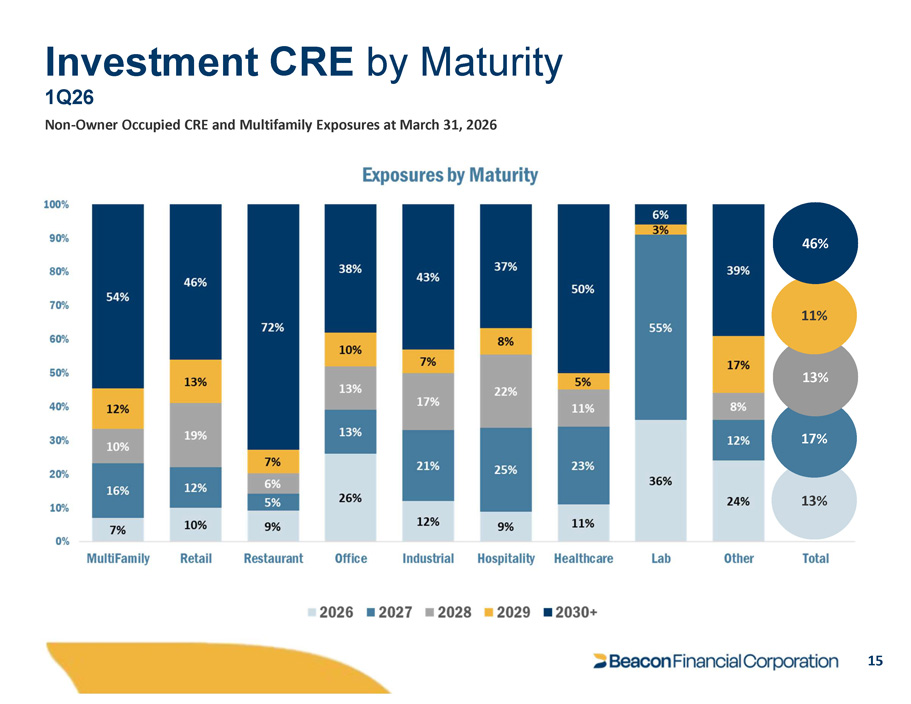
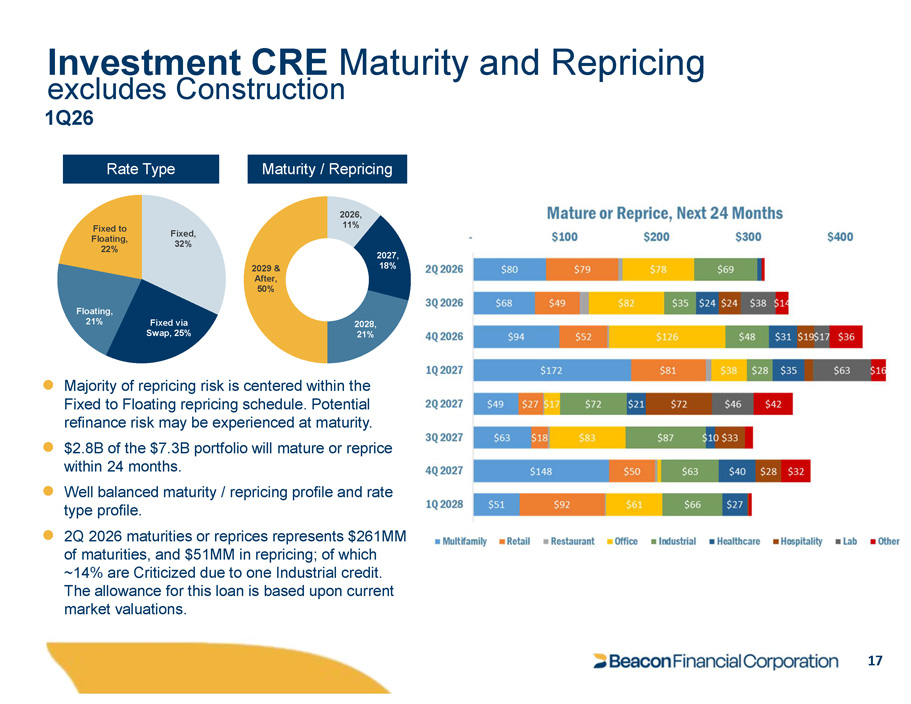
Yeah, good afternoon. Hi, David. Hey, quick question, Paul, Carl, in terms of the investor theory, appreciate the slide in the back there, looks like a slug of that is coming up for maturing or repricing. Just curious in terms of the risk you point out there, is that more of a debt service coverage risk or a refinance risk or both? I'm just curious where you see maybe some of those.
I didn't catch the preface, David. I couldn't clearly hear what the preface was. What is it that you're asking about?
Speaker 12
On the investor's theory portfolio that's coming up for maturity here in the next couple quarters, I think in the slide deck you mentioned some risk factors there. Just curious if that's more pertinent in terms of debt service coverage, risk, refinance risk, or a combination of both, where you see the risk in that book. Thanks.
Mark will answer that. yes i'll take i'll take that and we you know we have um you know the the the maturity and and refinance you know there's a fair amount coming up over the next four quarters as we look forward through it um i was taking a look at it the other day and there's you know one substandard loan in that in that portfolio um it's one that you know is a property that's being redeveloped we expect that to work itself out and there are two smaller criticized loans the rest of that is a is a is a pass a pass book so I think we feel pretty good both with maturity and repricing as we move through those maturities whether they're
Speaker 12
you know hard maturities or pricing maturities got it and then I noticed just the link quarter trends. The loans 90-day past due seemed to decline the same amount non-accruals went up. Was it the right way to read into it that they just sort of migrated to non-accrual from past due? Yeah, I think that's fair to say. Got it. Then just one follow-up in terms of, you know, Paul, the board approval for the buyback there. Any color or indication when you might be getting regulatory approval?
I don't know if there's any sort of a time frame you feel comfortable well there is a little time frame uh i never i never try to uh predict exactly what the federal reserve is going to do but we expect it to happen reasonably quickly within the month got it thank you nobody in line maybe it's only a few days okay who's up who's up next i'm sorry your next question comes from the line of carl shepherd with rbc capital markets please go ahead hey good afternoon guys just maybe to get ahead of ourselves a little bit
Operator
on the regulatory approval of the buyback but maybe just high-level thoughts how do you want us to think about what could go into your decision-making process if you want to go ahead and use it any of the CRE issue or concentration but you also have lots of capital so maybe can you bring up a little actually we're actually pretty far ahead on the uh on the real estate uh piece of for the for the leverage of concentration um so we've we've created an opportunity to do these kinds of things with that go ahead carl any other factors no i think uh we still remain committed to hit that 300 percent uh the board is is certainly behind that uh and and wants us to hit that and stay on target uh
But as capital continues to grow and the size of the balance sheet, I think we're in good shape to be able to continue to move forward with at least this initial authorization.
Operator
Okay. So let me just try it one more time, I guess. If you feel like you're on pace to get under the 300 by the end of 27, you're comfortable using a little bit of buyback. Is that a fair way to think about it?
Yeah, particularly when you couple it with the current shrinking of the balance sheet with originations being off, way off from what we're used to, and payoffs being still coming in. So when you look at the current environment, the idea of a buyback seems to fit in very nicely.
Operator
Great. I appreciate that. I know it's a topic for investors. And then I guess on a follow-up question here for you guys, both of you used the term close the gap, and I was wondering if you can help us understand what gives you the confidence that some of the macro or environmental headwinds you guys saw this quarter are starting to fade, and then what did you get one quarter past the conversion? You know, what kind of tailwinds do you see at the core then from not having to, you know, spend the time and energy and focus on getting that right?
Well, I expect people to move from making sure we have customer retention and problem solving. You always have those things associated with a massive conversion like this. And we're at the point now where I think of it as like you built a new home where you move in as a punch list of things that need to get done. And that's kind of where we are. So I'm expecting that our bankers and support personnel will now continue to shift toward loan production and free income production, which will sort of get us on the right track to where we had hoped we would be. Carl, do you want to add anything?
No, I think just the uncertainty in the market. So we feel good about our loan pipelines. We feel good about what's going on out there. But we know they could be better. And there's just a lot of uncertainty in the market when, you know, late February, and then we've got, you know, the geopolitical things that are going on. But then also with, you know, we've seen interest rates increase, particularly the yield curve steepened, which, you know, sets people back, even if it's momentarily. And we also have the multifamily proposals for rent control in the Boston market, which has a lot of folks putting things on a wait-and-see mode.
And Rhode Island was passed in Providence. So there's a number of things that we think will get resolved sooner rather than later, or hope to get resolved sooner rather than later, that take some of that uncertainty off the table and move things forward. uh thank you both okay carl your next question comes from the line of steve moss with raymond james please go ahead uh good afternoon hey hey paul uh carl maybe starting for you on i'll just circle back to the margin here um in terms of just thinking about the day count here you do have um you know it looks like you know five six base points drag or increased potential in the upcoming quarter on on the margin just curious like maybe if you could be a little bit over the 380 number for the second quarter here uh anything's possible further to the third loop for that way so i uh yeah but the day counts always come into play here in a number of as far as i i'm less concerned about the margin number and more more concerned with the the actual net interest income that we earn uh and just to give you a little sense around that payroll deposits are something that uh drags us on the margin right so we we have we get we have average payroll deposits and uh that are substantial and in the first quarter they're about a 1.2 billion dollars in average balances uh now they're highly volatile during the week and so depending on what day of the week we close on for the quarter that's kind of the ending balance of those those balances but that's 1.2 billion dollars and usually the first quarter uh and trust me i'm just learning all this usually the first quarter is the highest quarter for for average balances that's because of taxes and other things that go through that uh and that's just follow and that it's a little bit more than uh 200 it was 200 million more than uh the fourth quarter and we expect that to drop so the average balance in q2 will be lower and uh it'll be lower still i think in q3 and then bounce back uh in q4 so but that's that's that's a those balances uh we we have a very very little spread on right that's a that's mostly a fee income business uh and the the the margins around that maybe around 35 40 basis points and so that's something that we want to keep keep in mind uh that as those balances moving could move the margin uh overall so as as carl is learning
about the payroll business it's not because he's not doing his job it's because it was a legacy berkshire uh business that they have been in for some time but it is it is quite volatile i i look at it daily and it goes i think the lowest i've seen is about 600 million dollars in deposits to a little over 2 billion in deposit so we we don't employ it as we do our other sources of funding uh but on the loan side we do have a lot of you know so on the commercial side uh you look at the cree loans and the cni loans those are actual day basis loans uh and and the others are 3360.
And so we'll get a pickup, you know, there's an extra day next quarter that we get. But I'll let you guys figure out how you want to calculate the margin. I see it get calculated lots of different ways.
100% on that. Okay, that's fair enough. And then I guess The second thing here for me, just in terms of credit and the provision and charge-off guidance, so provision to exceed charge-off, kind of how are you thinking about the level of charge-offs for the remainder of the year?
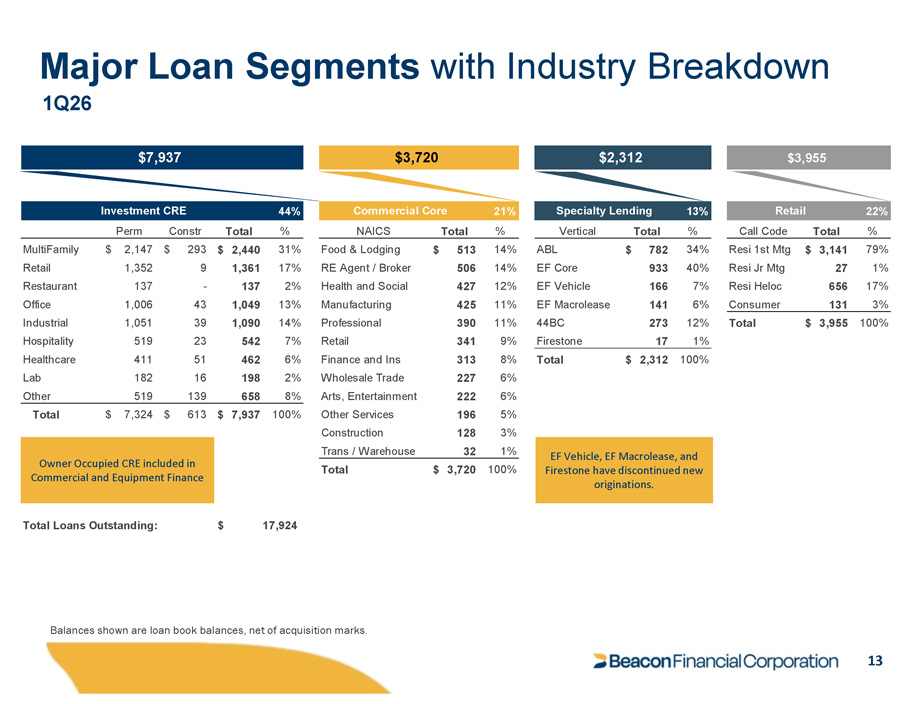
So I think we're expecting that, I think we provided some guidance on the provision. I think those are good numbers, probably trending a little bit towards the high end of that guidance. Charge-offs, I expect to be—I expect to exceed the provision, and that's as a result of the aggressive reserving that we have in place and the credit marks that we have in place. You know, as an example, we have about $80 million on our substandard portfolio, and, you know, net of substandard, we're at about 91 basis points coverage. So I think, you know, what we'll be doing is those charge-offs will effectively be funded out of that reserve, and so I expect provision will run lower than charge-offs.
Okay, so pretty substantial charge-offs then as the year goes on.
Yeah, that's hard to say. It depends on how we resolve some of these loans. I'll say they'll be in excess of provision. Okay.
Okay, fair enough. And then just, you know, sticking with credit for the moment here in terms of the, you know, office loan that went to non-accruel here and the multifamily. Maybe just kind of color around the LTVs and kind of, you know, debt service coverage ratios for those properties and timing on resolution.
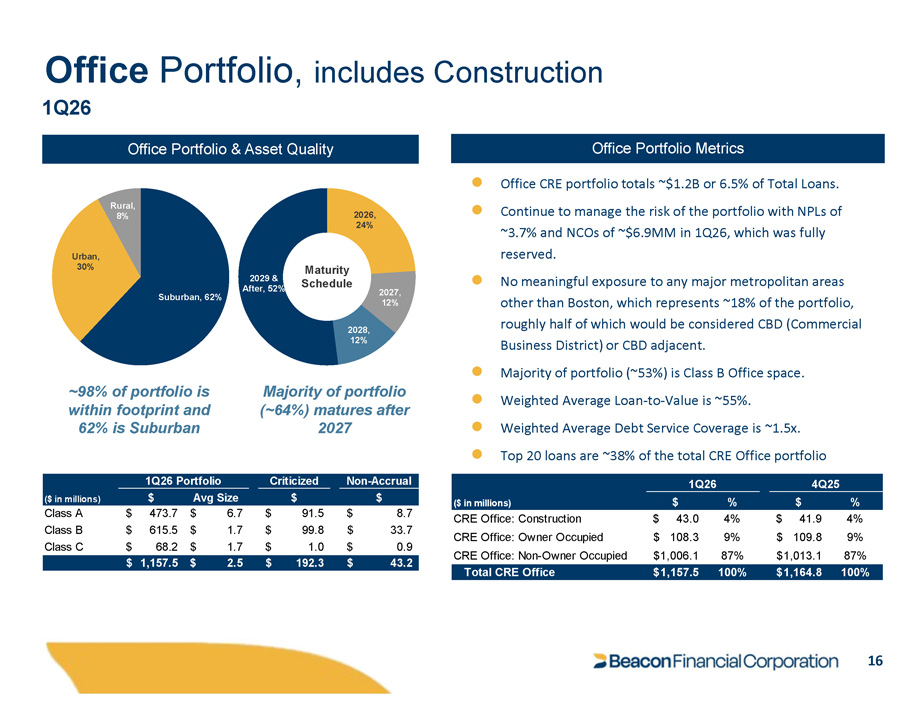
Yeah, so I'll start with the larger loan, which is the office property. That is a downtown Boston property. It's a larger loan. We have a participant in that deal. Our share of that deal is around $17 million and change. There's about 50% occupancy, about a 0.7 debt service coverage. On that particular loan, we are working with the sponsor on a potential sale of that property. And between specific reserves and then customer reserves that we hold against the loan, we've got about 40% coverage on that loan. So I think we feel pretty good, even though it's a somewhat new non-accrual. I think we feel like we're in a pretty good place from a reserving perspective, and we'll be able to work with the borrower through that. As far as the rent control, I just want to make a comment on New York rent control. I think this came up last quarter, but we only have seven rent control properties in New York. It's a total of $18 million, so that represents the entire portfolio. This was two particular loans. They are related to each other. They total $9 million. I don't have the statistics on those loans, loan-to-value debt service coverage, but again, I will say that we're about 40% coverage on a reserve basis, and we're potentially looking at selling either the notes or the loans near term. Great.
Appreciate that, Culler, there. Maybe just on the loan growth outlook for the second quarter in the pipeline here, just kind of, you know, maybe wrestling a little bit with the flattish comment for the upcoming quarter. You know, is it just maybe more CRE runoff at the end of the day than you guys expected that kind of drives that versus the pipeline? Or, you know, are they kind of both locally driving maybe?
It might be equal, but it's the distraction and it's the internal focus that everybody's had now for a number of months, coupled with more prepayments than we expected, coupled with customers and prospects aren't moving as quickly as we might have thought on purchases or activity that would cause loan drawdowns, if you will. and to get that cranking again it's going to take a little while but we're on it um i think it'll happen um how quickly and how deeply um i i would be speculating but we're all uh knowing what we
Operator
need to do to get there okay great um that's everything for me at the moment appreciate all the car thanks that's fine our next question comes from the line of lori hunsicker with seaport research please go ahead yeah hi good afternoon um just to stay with credit here um so just and i really appreciate the details on on slide 16 the 192 million criticized office how much of that is coming due this year and next year you know are there any lumps any colors you can give us obviously you you referenced um some maturing i just didn't know the amount Yeah, so that was, the answer would be the same.
I'll go cover it again for you, Lori, but the answer would be the same as the previous. Over the next, I have the next four quarters in front of me. And in terms of criticized and classified, the total is about $55 million. $20 million of that is substandard. Again, I mentioned earlier that's a property that is being redeveloped for a major retail tenant. That's a relatively new event, a new happening. So I think that's going to help us with some sort of a favorable resolution there. sorry. The other two loans are both special mention, and they have very strong sponsors. I don't expect any issues with those. One is $18 million maturing in the third quarter, and the other is $17 million maturing in the first quarter of 27. And that represents the total of criticized or classified loans in office. Okay.
Operator
And I'm sorry, just to clarify, the $18 million and the $17 million, those are office?
And how much of how much office charge-offs were there this quarter so it was i think it's in the deck but there was um a single charge off for just under seven million dollars and that represented the resolution of a um downtown office property that we've we've had in non-accruel for some time we took the charge up in the first quarter that loan will actually resolve in the second quarter The deal's been inked. We're just waiting for it to close. But we went ahead and took charge on that.
Operator
Okay. And I'm so sorry. What is the total balance of that loan?
Operator
So, great. So, all of your C&I charge-offs this quarter were office.
Operator
And it was a single loan, Lori, just to be clear.
It was one single loan. One single loan. Right. Yeah.
Operator
Okay. Great. And then your C&I charge-offs is $6.6 million.
I'm thinking most of that is is that uh the discontinued especially vehicles or the eastern funding or can you help us think about you know what what that is and what the non-performers are on those categories yeah so that was split uh pretty evenly uh between sba and uh eastern funding um in the case of eastern funding it was a charge down of a loan that's been a long-term workout. And in the case of the SBA, it was just an SBA charge-off. In terms of the non-performing balances, vehicle is at $3.9 million. Macro lease is at $5.5 million. That's down pretty significantly from prior quarter. We did have a—we had a resolution of an $11 million loan. It was that uh orange theory uh franchise that we had talked about last quarter i believe um so that was resolved itself and i expect we'll be back uh accruing within the current quarter um and uh i'm sorry it is accruing already it'll be upgraded within the current quarter and then uh you didn't ask but firestone is is a little under a million dollars oh that's great okay that's great okay great um and then just one last question for me i guess carl this is to you so your final one-time charges of 13 million a little bit higher than the 10 million you had expected can you just help us think about what what were the differences
there thanks so much sure uh so on the compensation side uh those those numbers came in a little bit higher uh accounting and tax came in a little bit higher uh and some of the contract terminations came in a little higher than i expected for the month for the for the quarter but uh overall we came in on top of what we originally announced of 93 million uh it was our original estimate when we announced the transaction we came on you know basically right on top of that number uh in different buckets than we thought but uh the the uh the it folks did a great job of uh negotiating and uh executing on on a lot of the contracts uh and the conversion costs uh which which helped help pay for some of the things that went over but at the end of the day came in right on top of the original 93 million and and merger charges are over now they're they're done uh basically everybody knows that. We did a great job of getting around that and controlling that cost. And now, if anything sneaks through, it's not going to be a margin chart. It'll just go in the operating run rate.
Operator
Perfect. Thanks so much.
Operator
Next question comes from the line of David Conrad with KBW. Please go ahead.
Yeah. Hey, good afternoon. I just want to circle back on the NIM a little bit because it's pretty important with what the stock's doing today. I just want to clarify the kind of language of the 580 stabilized NIM, or the 380, sorry.
Are you thinking about that for the second quarter and then built from there, or is 380 kind of the full 26 average NIM in your thoughts i really like the 580 you threw out there so we feel we feel pretty good about the 380 for q2 uh and okay and feel that we'll be building on that uh again a lot of this has to do with uh it's dependent on loan growth that really drives a lot of this uh i think this the second quarter will be more about the funding side as well as long growth, but I expect that we'll get the funding where it needs to be, the rates down to where they're supposed to be on some of our deposit products. Now, of course, everything changes in the market, but we've got a little bit of a steeper yield curve, so I feel good about how things look going forward. Now, if rates drop 25 basis points, Just to throw that out there, even though there's no expectation of this right now, if rates happen to drop 25 base points, that would cost us about $6.6, $6.8 million a year in net interest income, and that's a parallel move. But I don't think anybody's expecting rates to go up, but we'll see what happens.
A lot of our loan originations are in the five-year neighborhood, and those generations should be helpful as we go forward into the second and third quarter.
And so commercial yields, you know, the commercial loan book at around $620,000, that's probably pretty good for now. So that'll just benefit from the mix as it grows. and then I guess the key is to grow the commercial real estate at $574 to get that up to the $620 range.
Yeah, but I would add that we're still on track to target getting the 300% leverage of commercial real estate to capital.
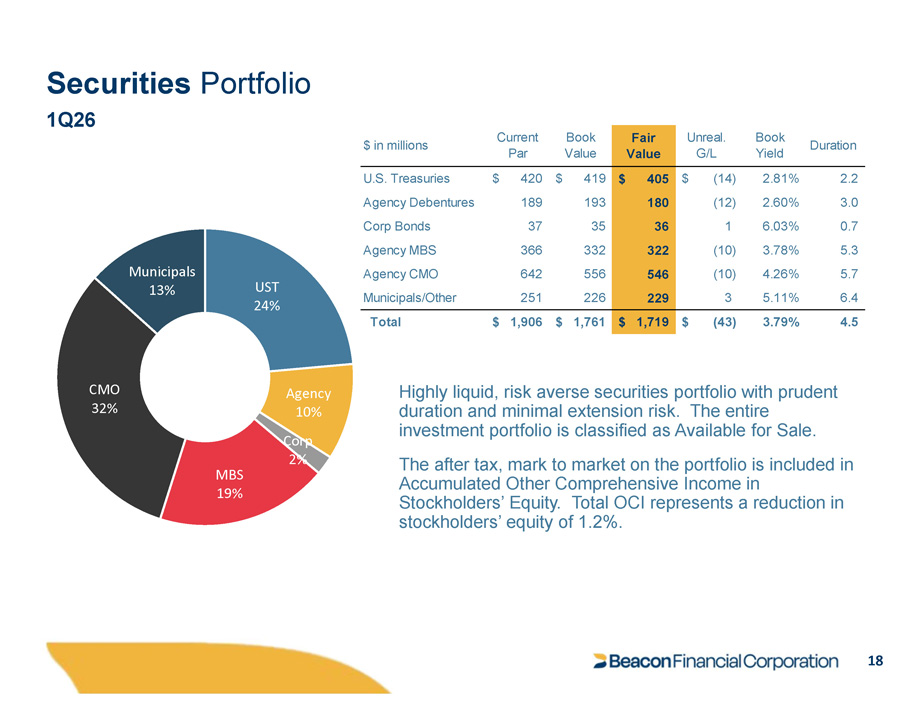
We're probably ahead of the original schedule, and so we've turned the real estate lenders back on because we can easily absorb decent production and still make the targets to get to the 300 percent in plenty of time so that's all good news on the own product yeah and just no i just wanted to add a little bit of color on on the the loan origination side of things um so we had we had loan as far as the loans that were originated this quarter uh this decree loans the whack on those loans were at 6 30. uh cni loans were 634 And the consumer loans were coming at $6.03. Just the spot weighted average coupon on those books at commercial real estate at the end of the quarter were $5.57. For CRE, C&I at $6.75. And consumer loans at $5.01. So we're originating at higher coupons than what's on the book. now those coupons don't include i don't think they include purchase of county at all so you just keep that in mind that's just the the rate on the on the loan right okay and then last one just building off of that on the uh the bond book um yeah you actually do some lift there what what is new money going in on the on the uh bond portfolio yeah that's that's going in at around $4.29. I think we purchased about $130 million during the quarter. Duration are in about three and a half, 3.8 on that book.
Okay. Thank you. That's all I had. Appreciate it. Okay. And our final question comes from the whole line of Daniel Cardenas with bring capital more research please go ahead hey afternoon guys um just just a couple follow-up questions on the office the boston uh office property that that went on mpas this quarter was that uh class a property or class b it's a b okay and and so the occupancy rate that you gave about that 50 percent is that kind of indicative of the overall marketplace no no I don't think so I think it's you know there's certainly pressure and occupancy you know is down I think
I think it's about 25 percent I was going to say 75 percent occupancy about 25 percent in the central business district yes to be the number so that's well now how much of that is being unused but still under good lease you can speculate on what that may or may not be but I think we read about some green shoots in leasing that have been happening not not the least of which is JP Morgan moving into the big new building over the South Station area quite a few floors so they'll introduce some competition maybe.
And so how does the rest of your portfolio look? I'm sure you've taken a deep dive. I mean, are there any concerns in that Boston office portfolio?
Well, we have taken, excuse me, we have taken a deep dive. You know, we have about a billion two in office and only about $200 million is in downtown Boston. We've talked about two problem loans on the call already, one that we took the charge off on and then the new non-accrual. Those actually are, you know, the two largest non-accruals in our book. Beyond that, you know, the portfolio is criticized, but we have good reserves and we look very closely at all those loans and we reassess the reserves all the time and then uh last question for me is i think about um operating expenses for you guys um you know what um so what we daniel i think we lost you but you're asking about operating expenses i've been getting this question all the time uh so i'm going to guess what you're asking but we're certainly on target
if not if not better than what uh we originally anticipated targeted for an operating cost uh and i i we've laid that out out in the deck um so we we feel good about where we are right now uh going forward are you there daniel we have lost daniel as long as we didn't lose you with no further questions in queue i will hand the call back over to ceo paul terrell for closing remarks thanks dina and thank all of you for joining us today and we look forward to talking
Operator
with you next quarter have a good day thank you again for joining us today this does conclude today's conference call you may now disconnect