Operator
Ladies and gentlemen, thank you for standing by. My name is Desiree and I will be your conference operator today. At this time, I would like to welcome everyone to the Bloom Energy 4th Quarter 2025 Earnings Conference Call. All lines have been placed on mute to prevent any background noise. After the speaker's remarks, there will be a question and answer session. If you would like to ask a question during this time, simply press the star followed by the number 1 on your telephone keypad. If you would like to withdraw your question again, press the star 1. I would now like to turn the conference over to Michael Tierney, Vice President of Investor Relations. You may begin.
Thank you and good afternoon, everybody. Thank you for joining us for Bloom Energy's fourth quarter and full year 2025 earnings call. To supplement this conference call, we furnished our fourth quarter and full year 2025 earnings press release with the SEC on Form 8K and have posted along with supplemental financial information that we will reference throughout this call to our Investor Relations website. During this conference call, both in our prepared remarks and in answers to your questions, we may make forward-looking statements that represent our expectations regarding future events and our future financial performance. These include statements about the company's business results, products, new markets, strategy, financial position, liquidity, and full-year outlook for 2026. These statements are predictions based upon our expectations, estimates, and assumptions. However, as these statements deal with future events, they are subject to numerous known and unknown risks and uncertainties, as discussed in detail in our documents filed with the SEC, including our most recently filed forms 10-K and 10-Q. We assume no obligation to revise any forward-looking statements made on today's call. During this call, and in our fourth quarter and full year 2025 earnings press release, we refer to GAAP and non-GAAP financial measures. The non-GAAP financial measures are not prepared in accordance with U.S. generally accepted accounting principles and are in addition to and not a substitute for or superior to measures of financial performance prepared in accordance with GAAP. A reconciliation between the GAAP and non-GAAP financial measures is included in our fourth quarter and full year 2025 earnings press release available on our investor relations website. Joining me on the call today are K.R. Sridhar, Founder, Chairman, and Chief Executive Officer, and Maciek Krasinski, our Acting Principal Financial Officer and also our Principal Accounting Officer. K.R. will begin with an overview of our progress, and then Maciek will review financial highlights for the quarter. After our prepared remarks, we will have time to take your questions. I now turn the call over to K.R.
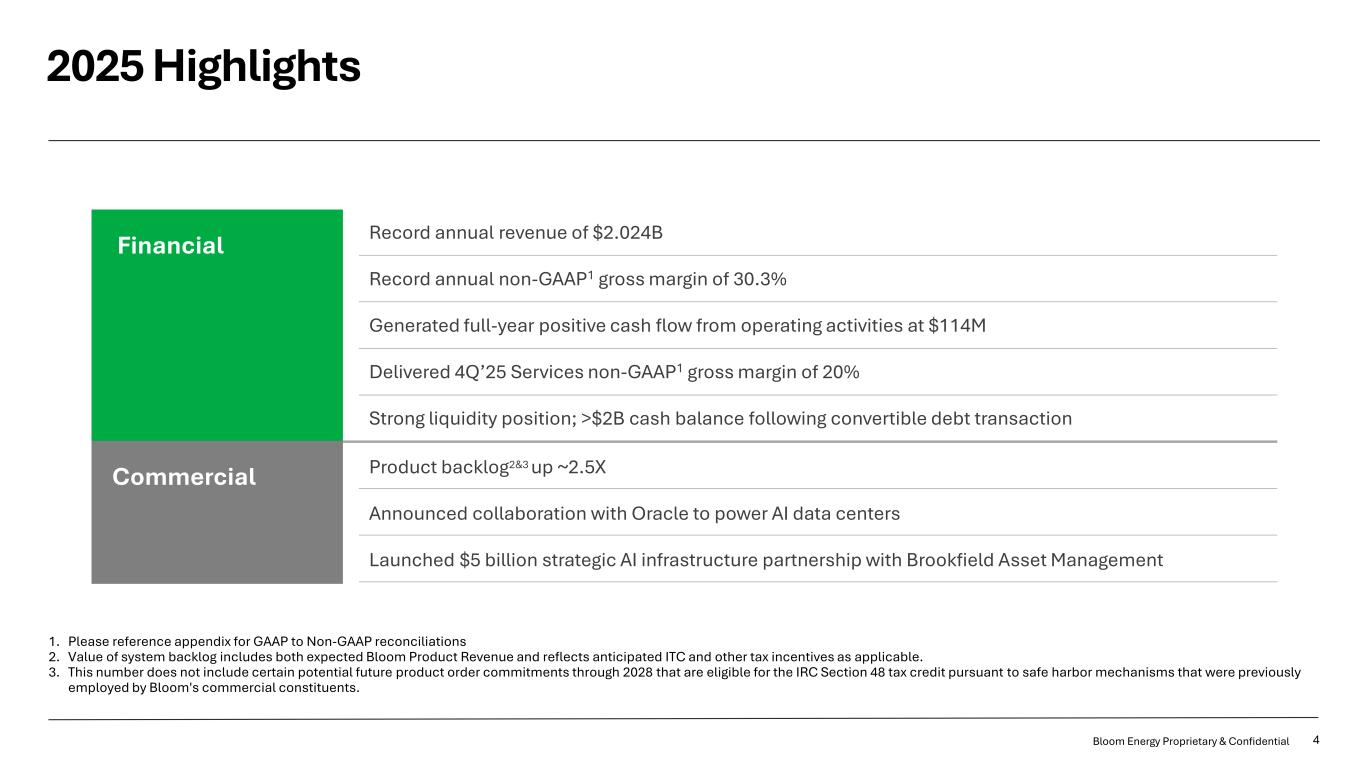
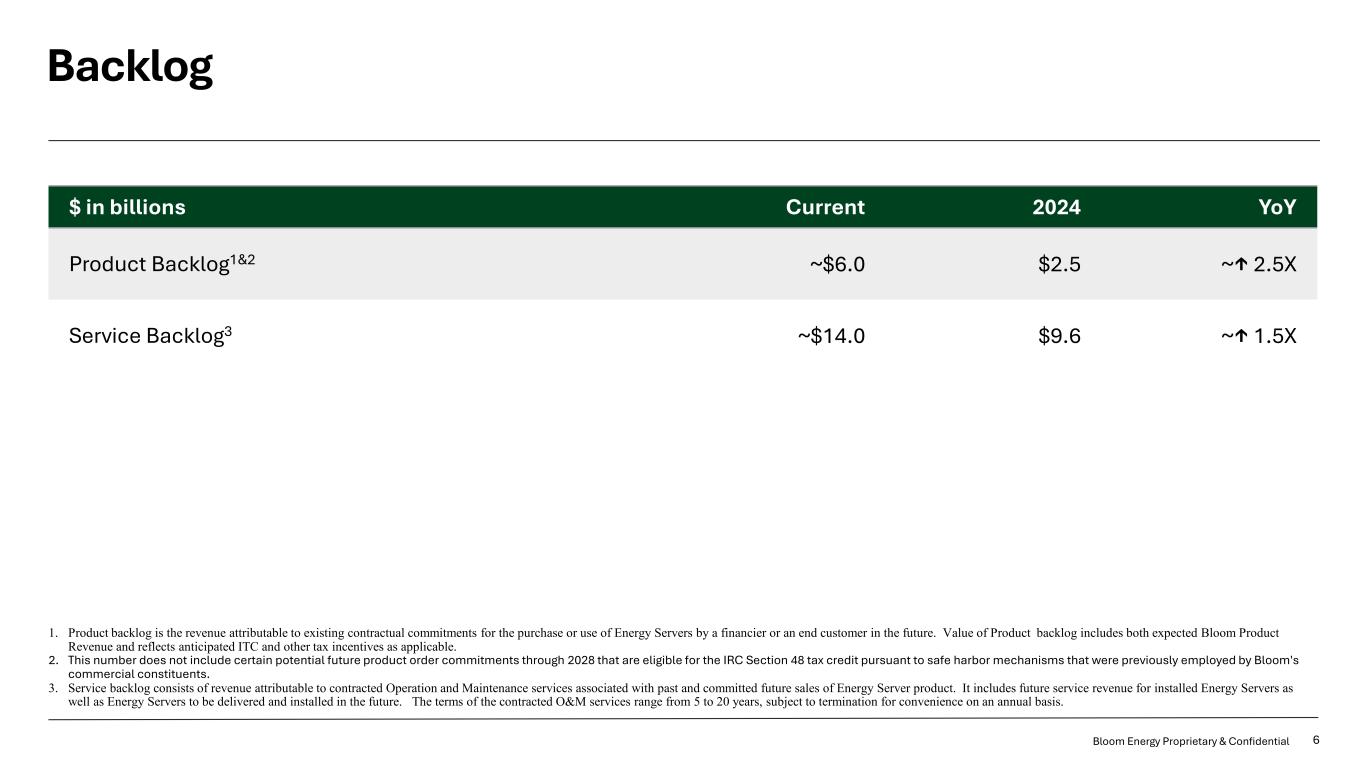
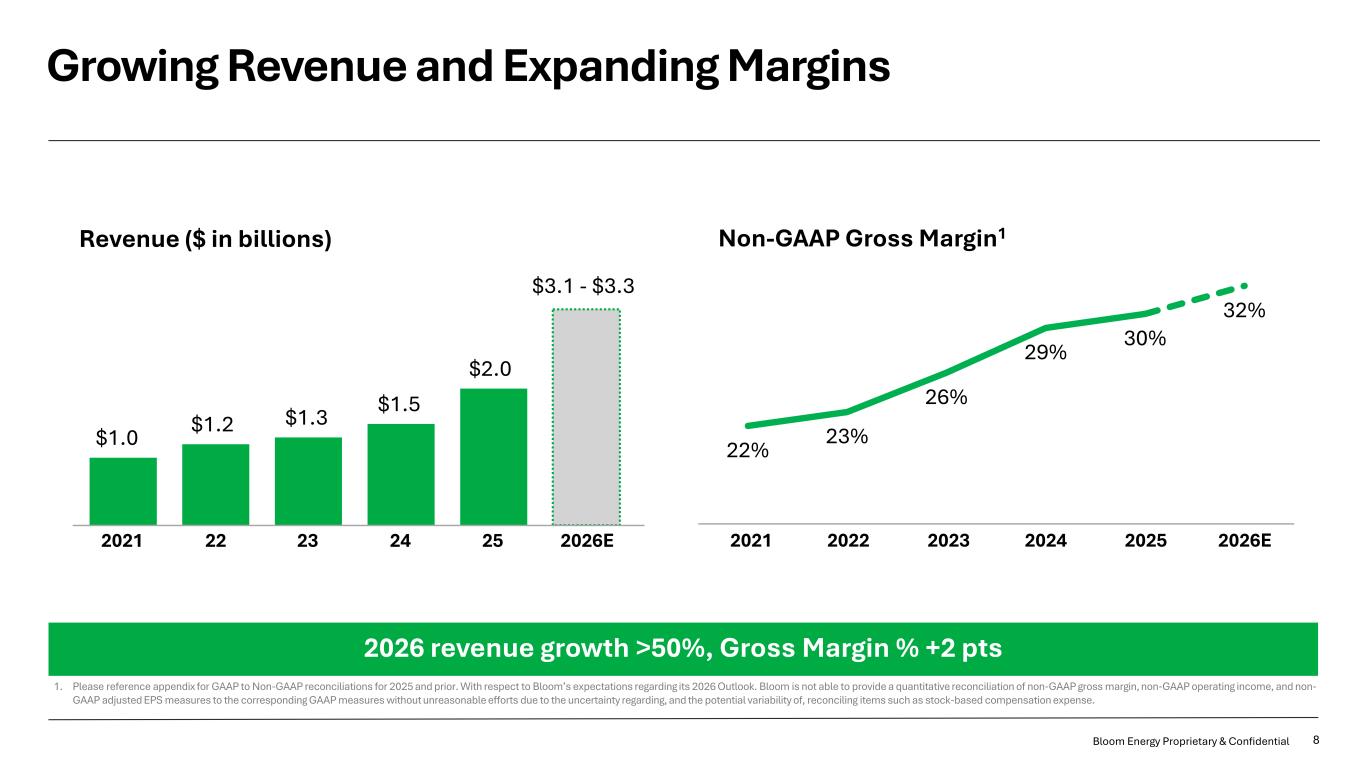
Good afternoon, and thank you for joining us today. Bloom is rapidly becoming the standard for on-site power. As evidenced by our excellent fourth quarter, capping our best year yet, we delivered record revenue, gross margin, and operating margin for the year. Our product backlog increased 140% year-over-year to about $6 billion. Our service business has been profitable for eight quarters in a row, and in the fourth quarter, we achieved 20% gross margin in service. With around $14 billion of service backlog and a growing product backlog that is 100% attached to service, Bloom is well-positioned for durable growth in service revenue and profits in the years ahead. Our growth has been fueled by seismic changes in customer attitudes towards power. Bring your own power has become the mantra for data centers and power-hungry factories. On-site power has moved from being a decision of last resort to a vital business necessity. This shift has led large power users to seek bloom to fulfill their needs. Our demand from data center and commercial and industrial, or CNI, customers is secular and growing. In 2026, we will further invest in our commercial team to capitalize on growing sales opportunities. AI is a huge tailwind for the power industry and a big catalyst for Bloom's growth. The backlog we reported today includes half a dozen hyperscale and neocloud end customers compared to just one a year ago. Bloom has a master contract structure to enable these customers to keep returning to us for repeat orders, much as we have expanded with our CNI customers. And we are also experiencing surging demand in our CNI business. CNI backlog grew over 135% year over year, and it consists of several verticals, Telecom, manufacturing, logistics, retail, health care, and education. Digitization, automation, electrification, and reshoring are driving CNI customers to seek on-site power. And our CNI sales pipeline is stronger than ever. The geographic mix of our U.S. backlog is noteworthy. Two years ago, over 80% of our U.S. backlog was composed of installations in California and the Northeast, traditionally the high cost of power states. But this year, over 80% of our backlog comes from other states with lower power costs. This geographic shift highlights two important dynamics at play. First, companies are locating factories and data centers in states where they can quickly secure reliable and affordable power, either from the grid or on-site. The states where we are growing fastest have robust natural gas infrastructure and favorable regulatory and policy frameworks for on-site power generation. Second, in these states with lower power costs, Bloom is cost competitive. Our value proposition, fast time to power, high reliability, and lower emissions, strongly resonates for our customers. In short, our customer base is diversified with numerous customers in every key sector, including AI. We are rapidly becoming the standard for on-site power. Given our healthy backlog and our robust funnel, I'm sure your questions will now shift from why we are expanding manufacturing capacity to when we will expand even more. Let me address that with some background. At the core, Bloom is a technology innovator that rapidly delivers cost-competitive platform products at meaningful scale to satisfy customers current and future needs we are building solid state digital power for the digital age we are not an industrial era energy company bloom's manufacturing ip and supply chain diversity enable us to scale without facing the multi-year delivery backlogs plaguing traditional suppliers our ability to scale also comes with a high ROI and low risk profile capacity expansion requires a significantly lower upfront investment a fraction of what legacy players need our return on invested capital for capacity expansion is a few months not years this gives us the freedom to expand without predicting market size many years into the future to justify our deployment of capital the simplicity of our manufacturing process is anything but simple it represents years of innovation thought and intellectual property we have created a differentiated asset light approach to manufacturing with the control and execution afforded only by in-house production and complemented with a diversified and global supply chain that flexes to meet market demand much like a tech supplier so my answer to questions on capacity expansion is simple the bloom energy team reiterates its clear and simple promise to potential customers that have large time to power needs bloom will not be the bottleneck to your growth and you can count on us to deliver timely power we will deliver our power platform faster than you can build your greenfield facilities, be it an AI factory or a CNI facility. We demonstrated this recently by delivering a hyperscale AI factory order in 55 days against a 90-day commitment and power for a large factory before they could complete construction and commence operation. That is quick time to power. the Bloom way. In short, we will continue to expand deliberately and with discipline. At a fraction of the cost and time, it will take traditional legacy vendors. And we will offer our customers quickly deployable power that's reliable, clean, and price competitive to meet their present and future needs. Speaking of future needs, let me address 800-volt PC. First, what is 800-volt PC, and why does it matter? The electric grid, turbines, and engines were designed for the electricity loads of the 20th century factories and process industries. Large amounts of alternating current, or AC, power delivered at high voltage 35,000 to 69,000 volts contrast that to the needs of the digital age computer chips devices and other semiconductor equipment everything digital in our modern world run on low voltage direct current or DC power the upcoming AI computer racks will consume almost 100 times more power than traditional CPU computer racks of extra years to reduce copper use increase efficiency and enhance compute density AI racks will be architected to receive 800 volts DC. This switch to 800 volts DC is a necessity and not a choice and will happen at the compute rack level irrespective of whether power is being supplied from an electric grid or on-site power. 800 volts DC will soon be the data center standard because physics requires it. Any AI data center using grid, turbines, or engines will need to install numerous transformers, rectifiers, and power conditioning tools to convert high-voltage AC to 800 volts DC. This adds significant cost, reduces reliability, and increases emissions. Bloom, and only Bloom, natively produces 800 volts DC today. No band-aids or adapters needed. Starting now, every Bloom server we ship will be 800 volts DC ready, with a removable adapter that allows customers to deploy in legacy AC environments and migrate to DC on their own timeline. This is a compelling future-proofed offering. We also offer to convert any servers we have shipped in the past to 800 volts DC with simple modifications, highlighting backward compatibility of this new future. 800 Wolves DC is one of our many innovative apps that integrates seamlessly on our energy platform, much like an app installed to a smartphone. We'll continue to make healthy investments in technology advancements this year and further strengthen our position as the innovative leader in the power sector. While we invest in the future, we'll continue to reduce costs of our core platform, keeping us on a path of anticipated margin accretion and further increasing our advantage over traditional solutions. We look forward to a strong 2026 as we continue our journey to become the standard for on-site power a benchmark for speed reliability and customer value in the digital age over to my check now for a financial overview I'll join you in a few minutes to answer questions my check thank you KR and good afternoon everyone on today's call I will discuss results of both the fourth quarter and the full year and also provide our full year 2026 guidance let me start by recognizing all of our our employees have blown an incredible execution in 2025 by calling out three
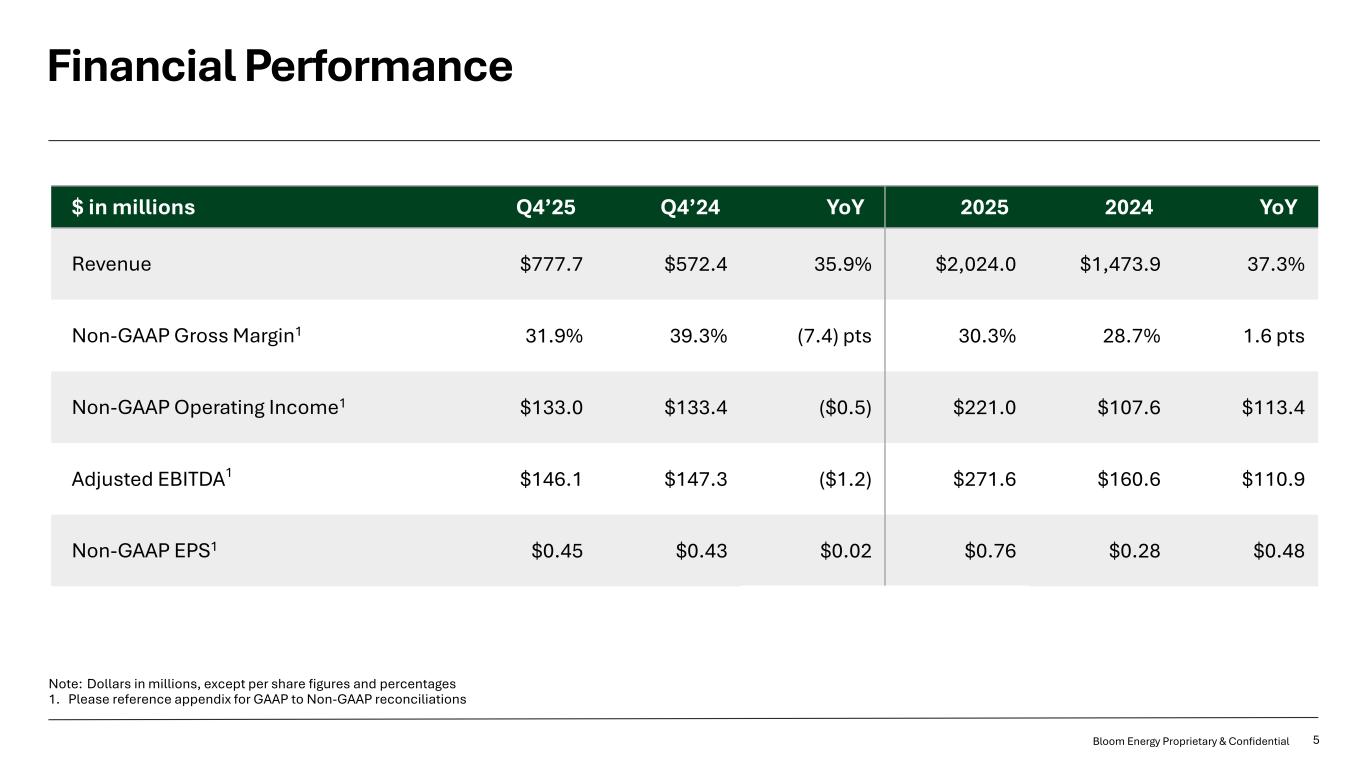
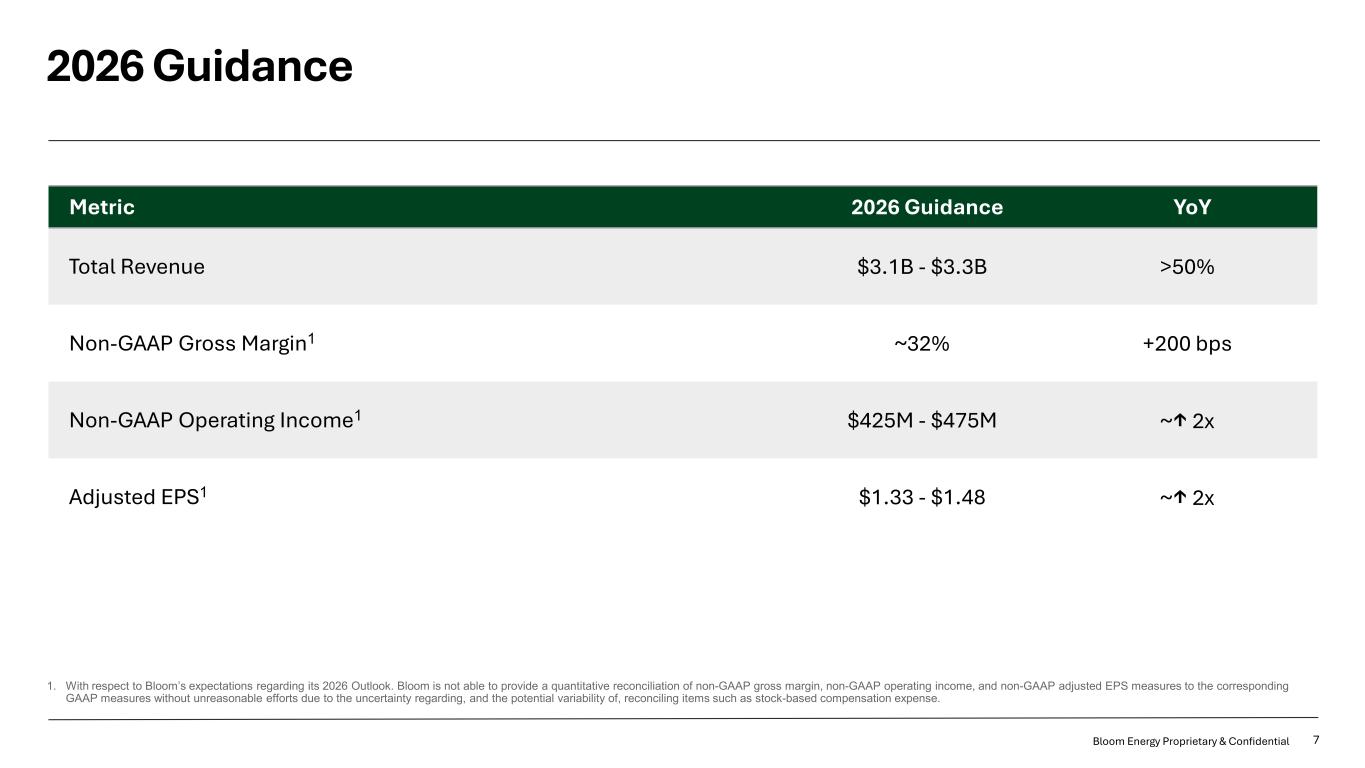
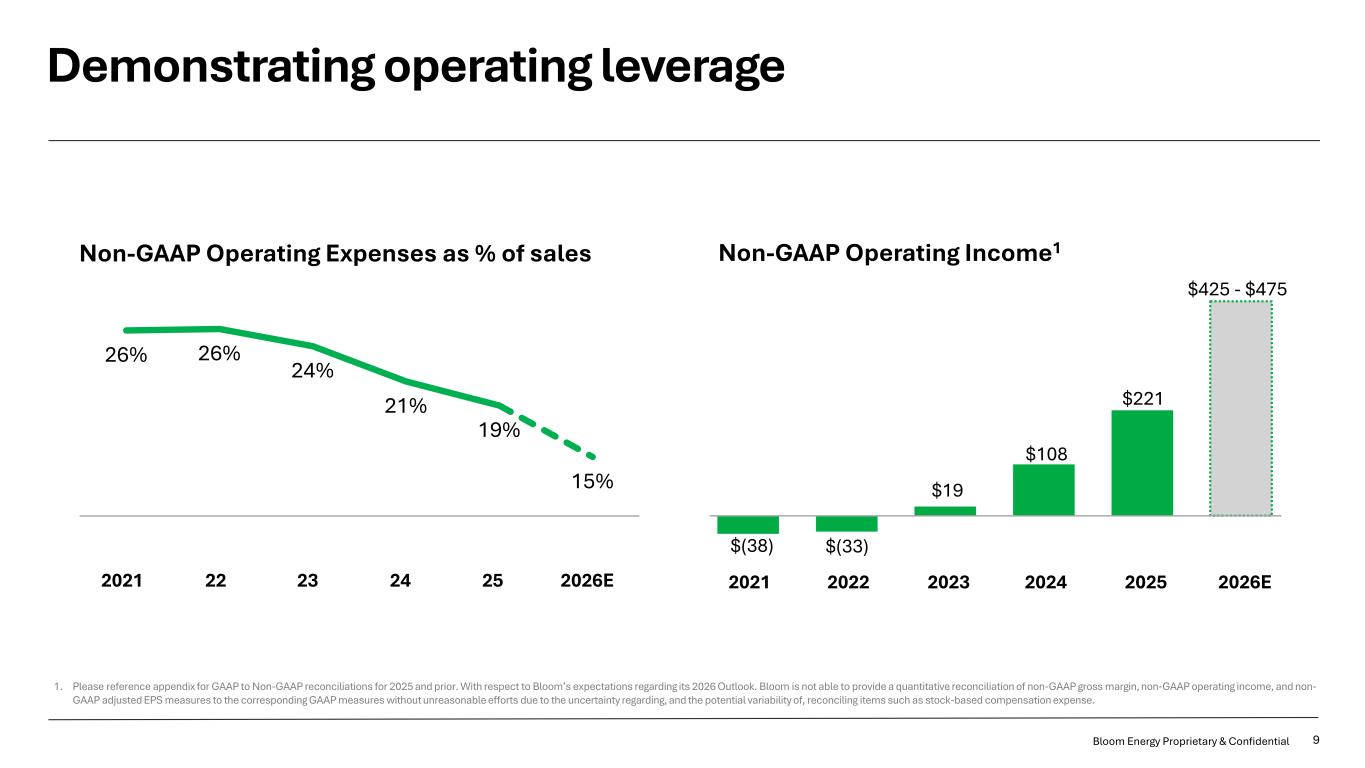
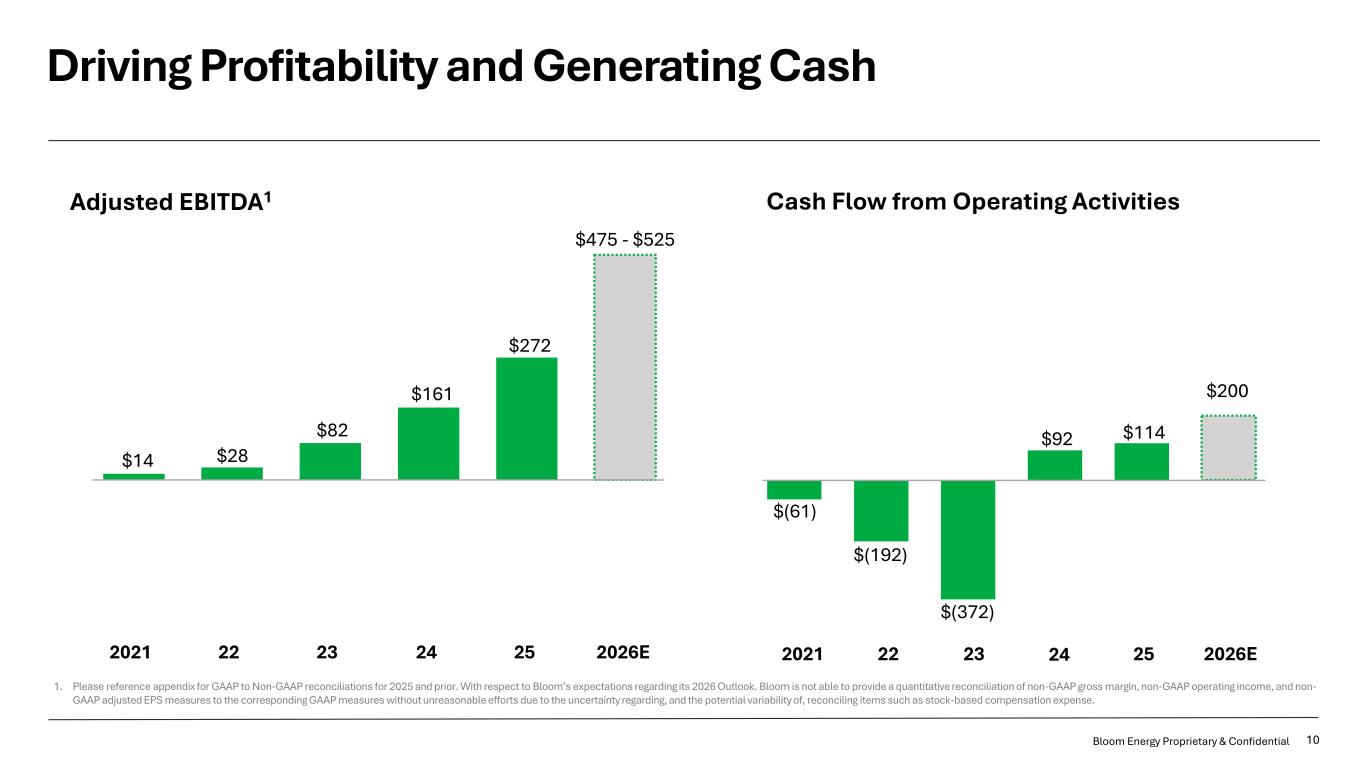
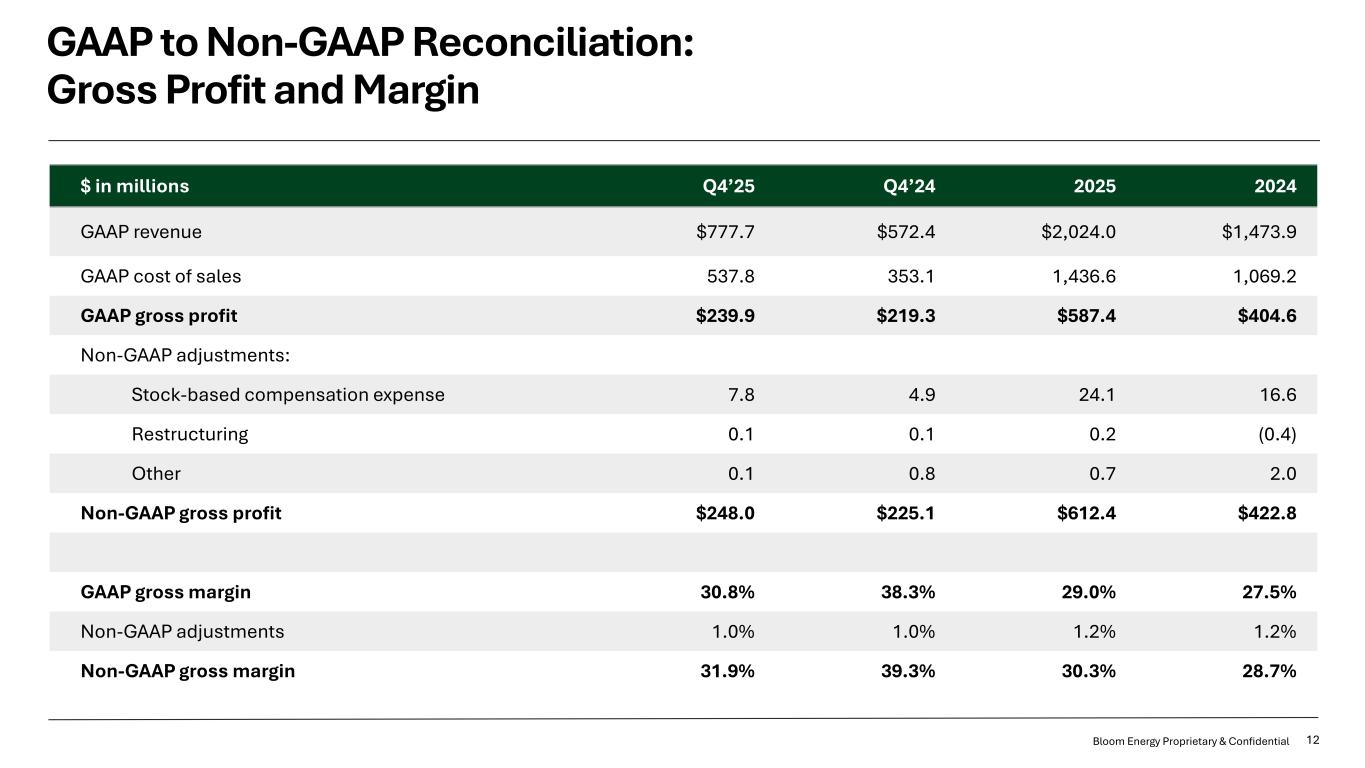
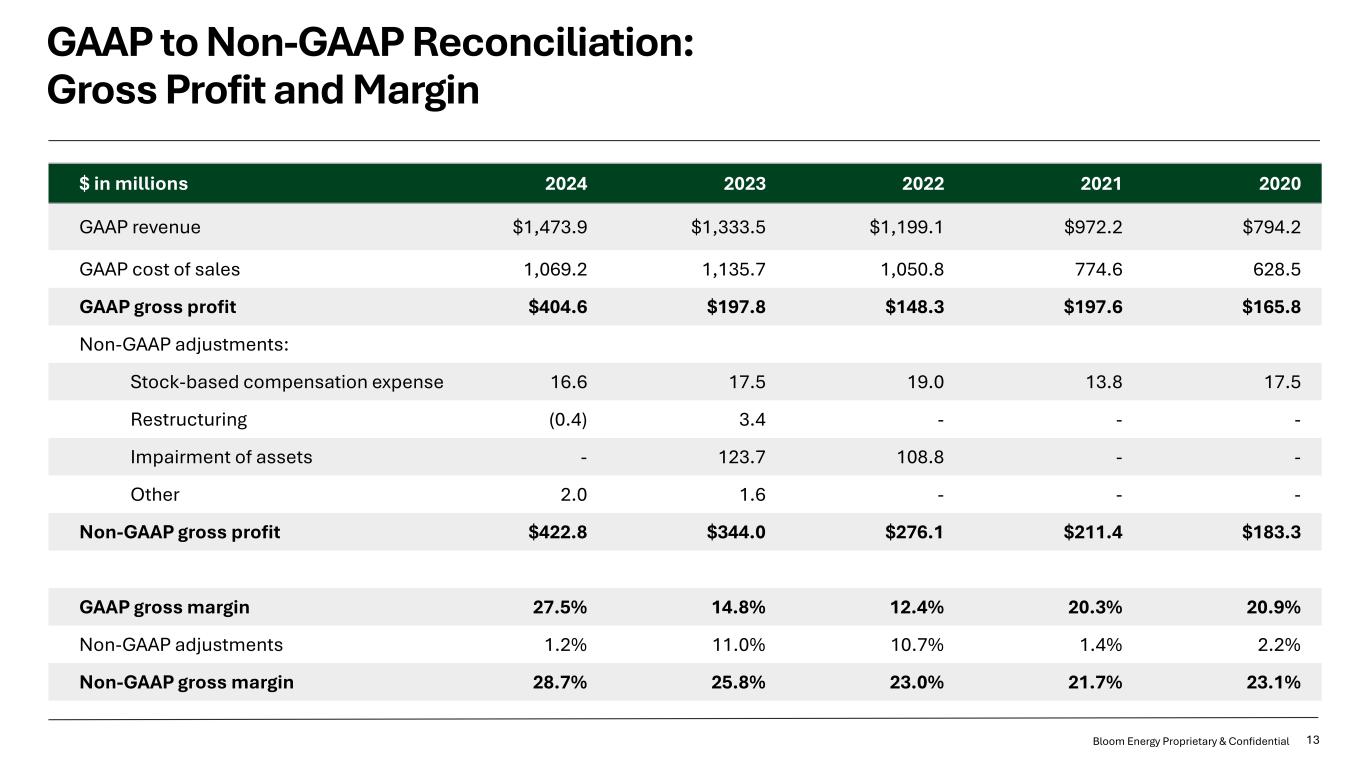
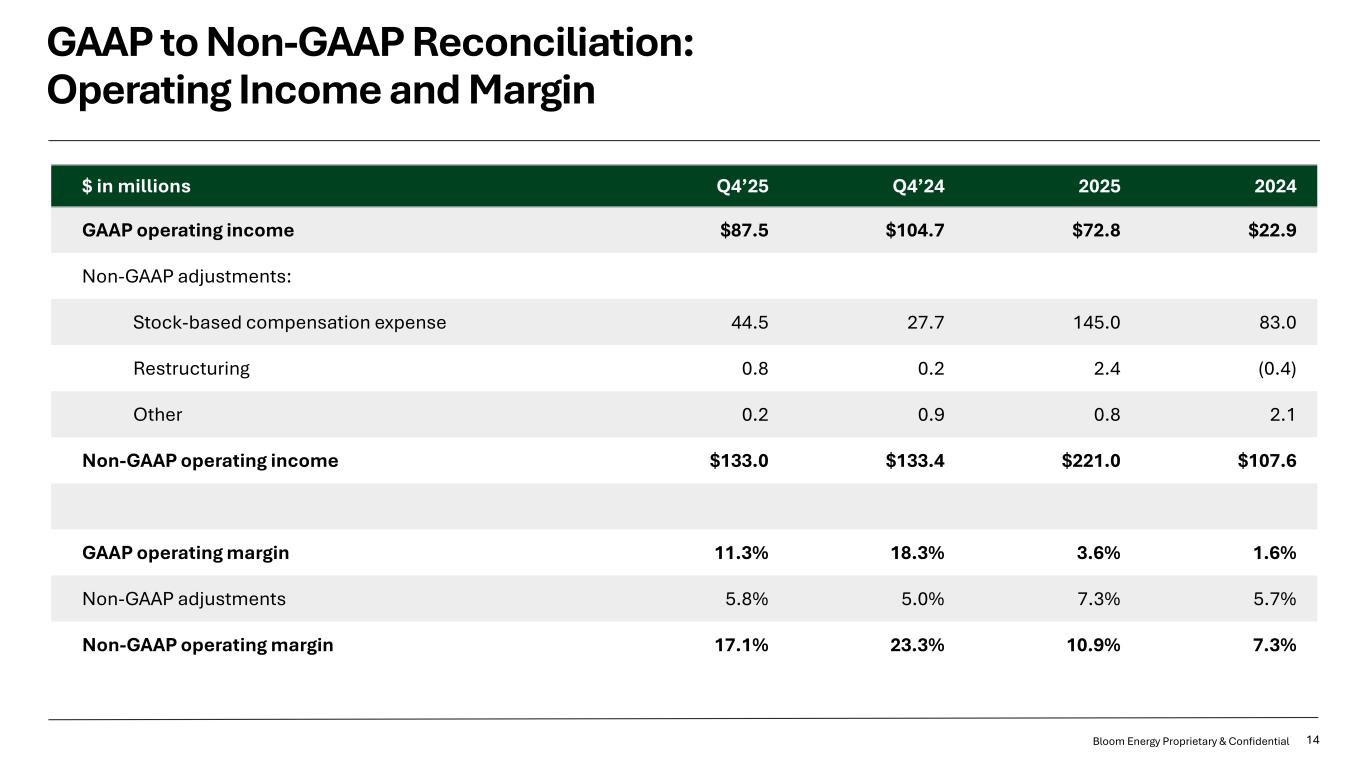
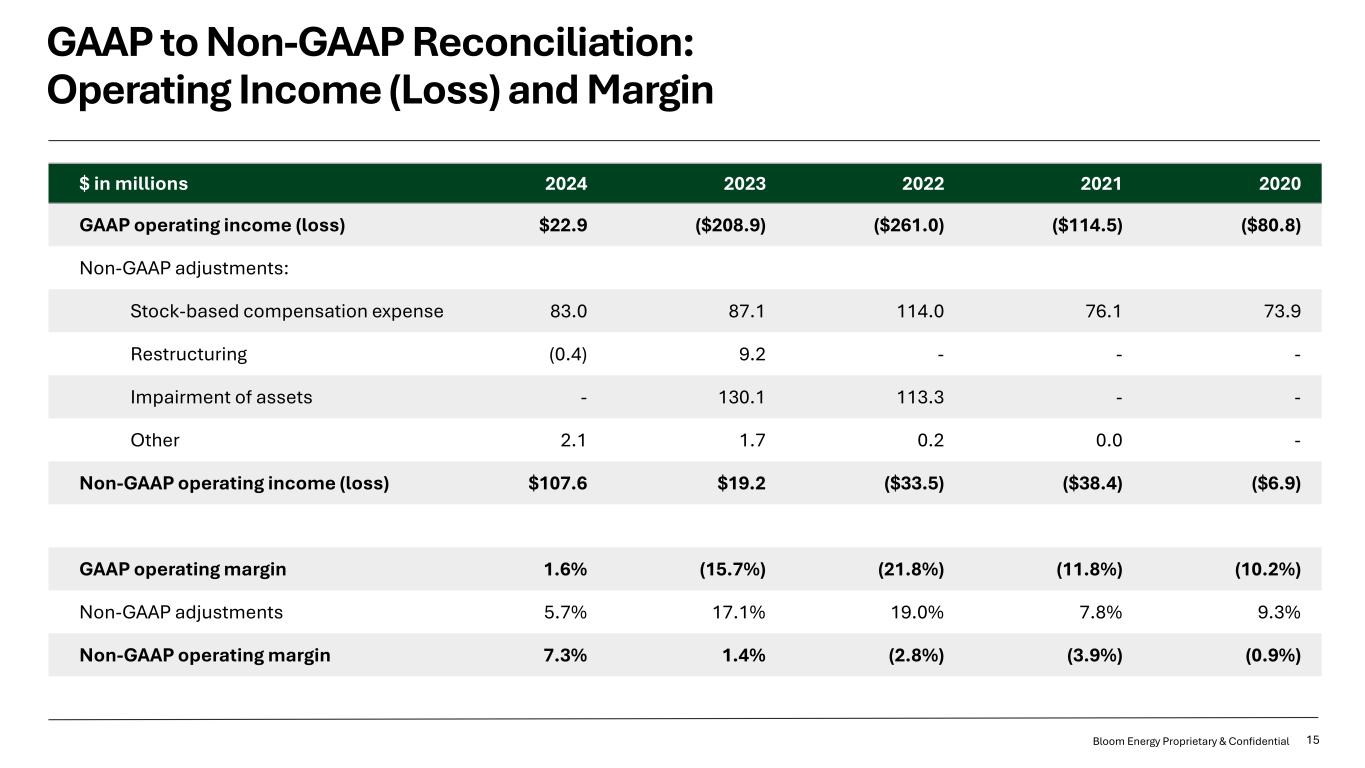
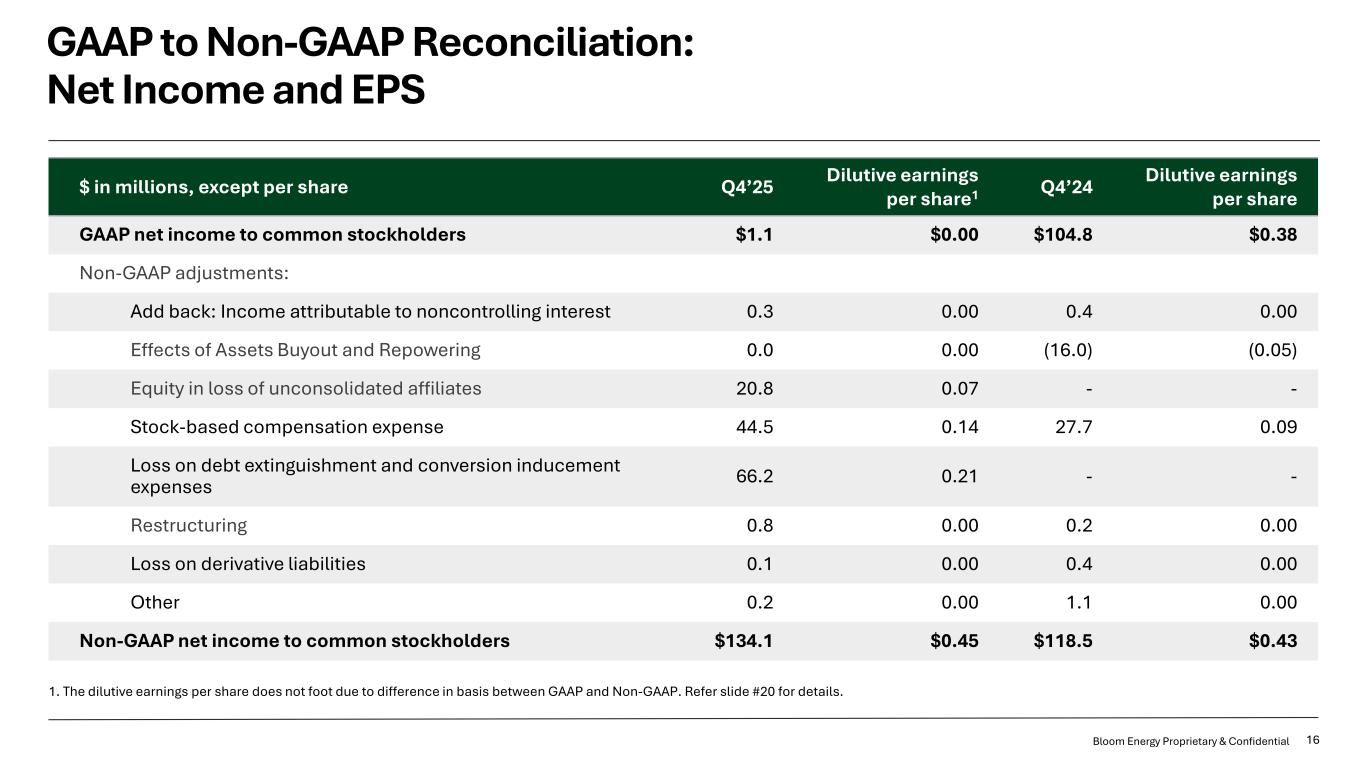
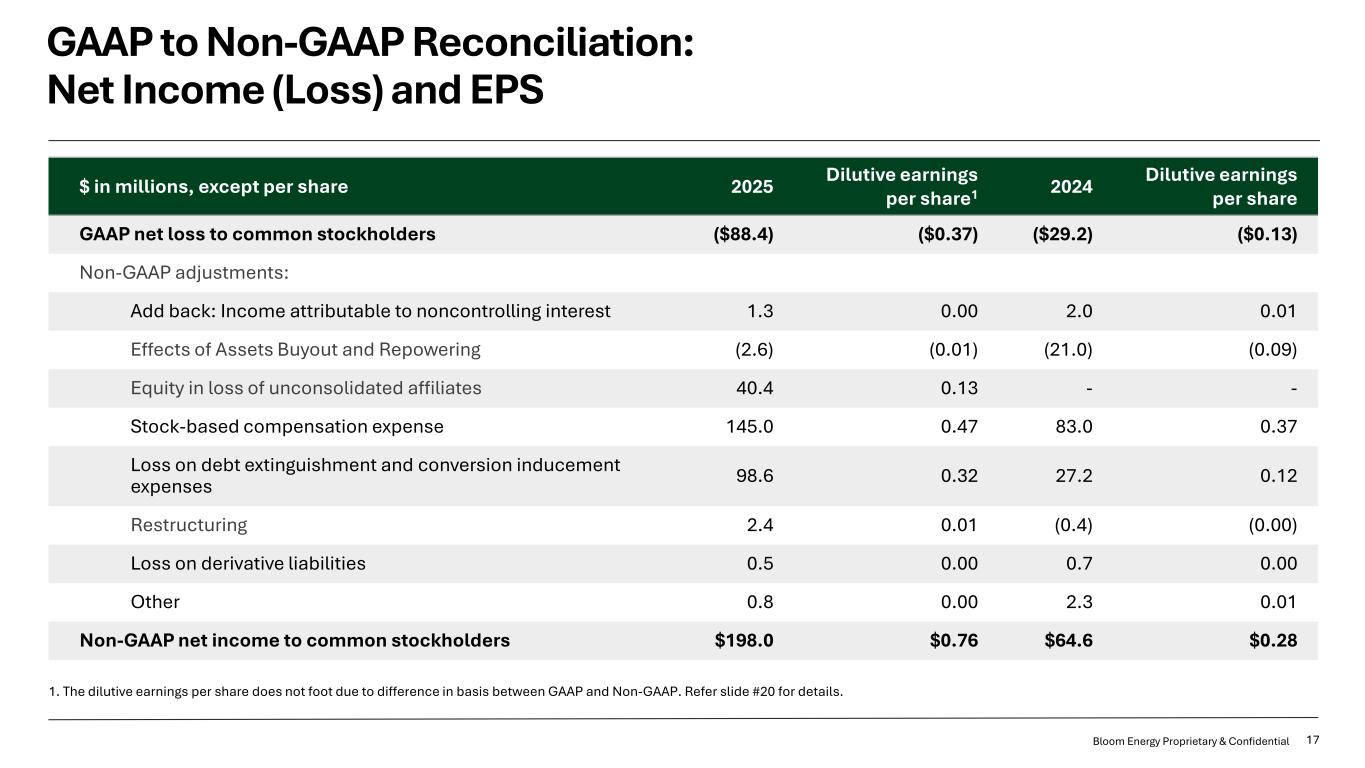
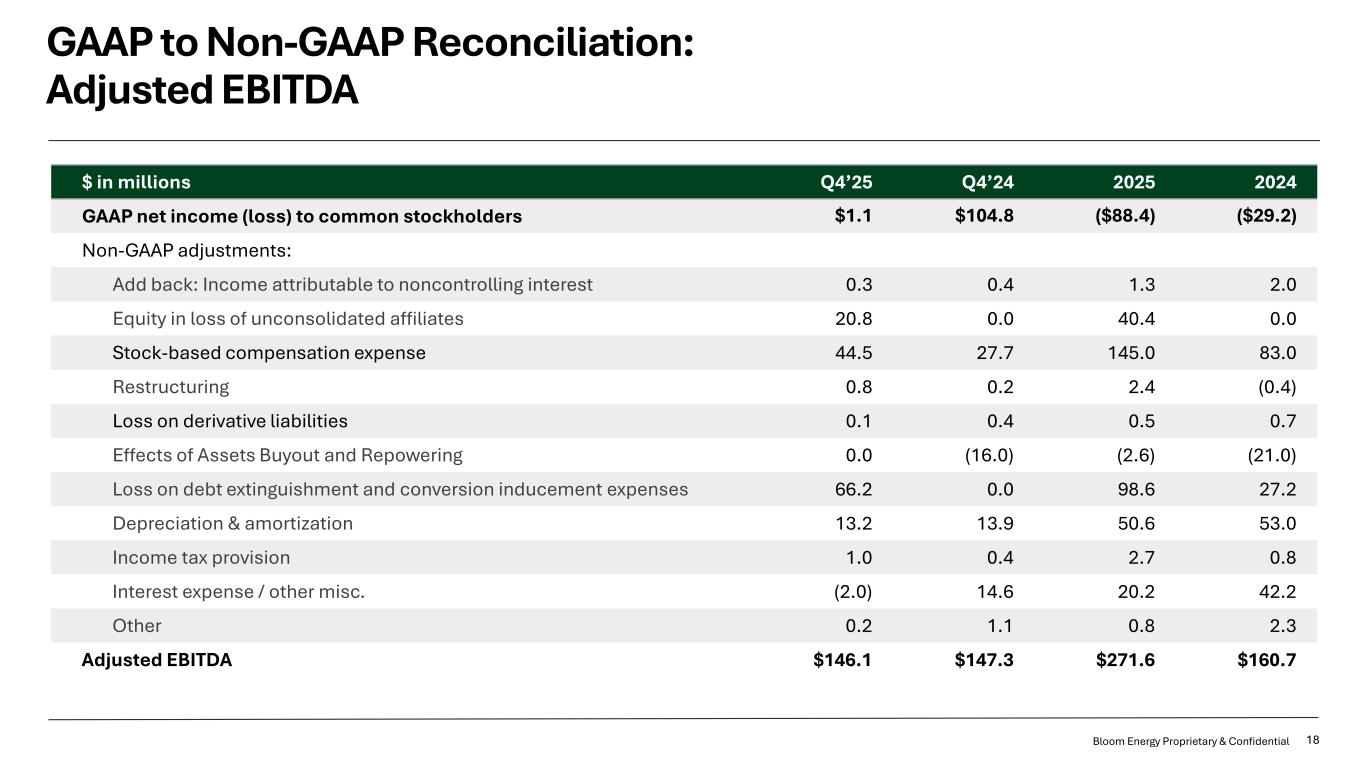
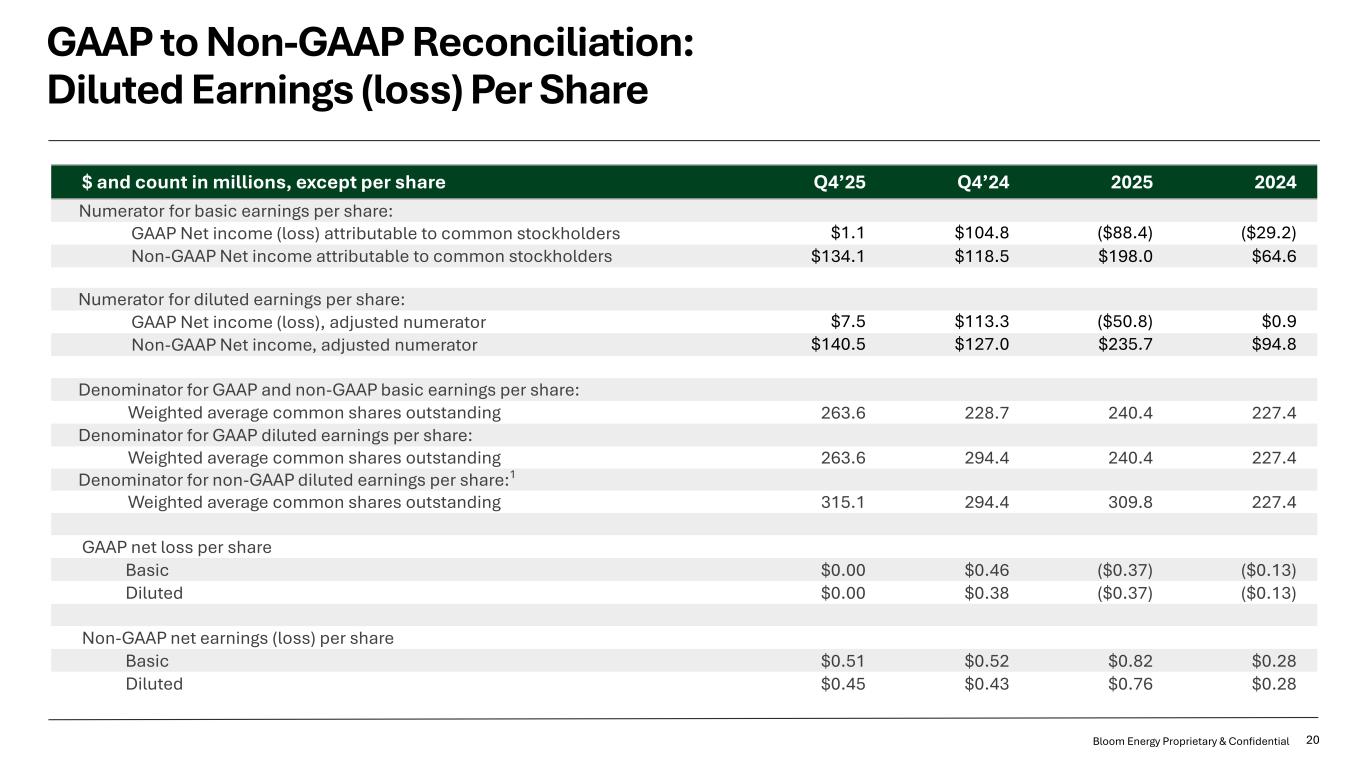
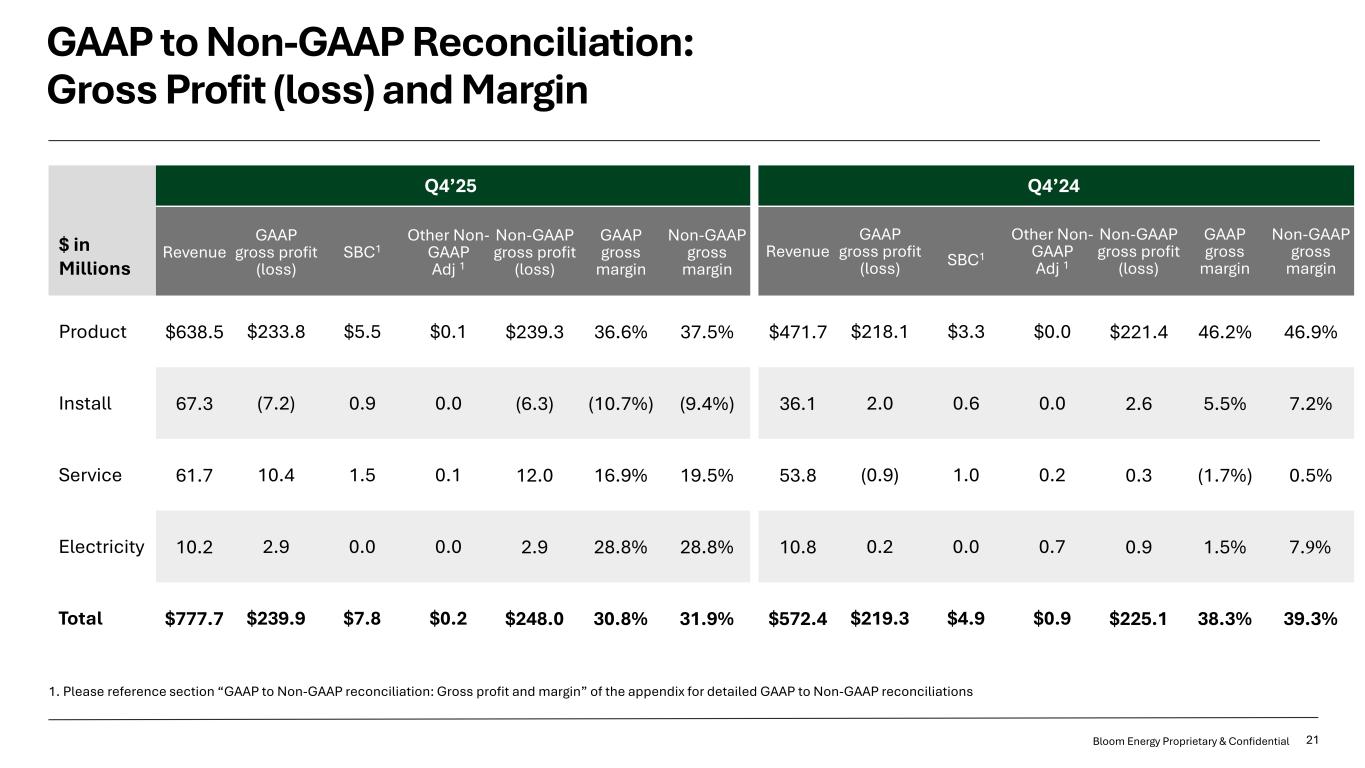
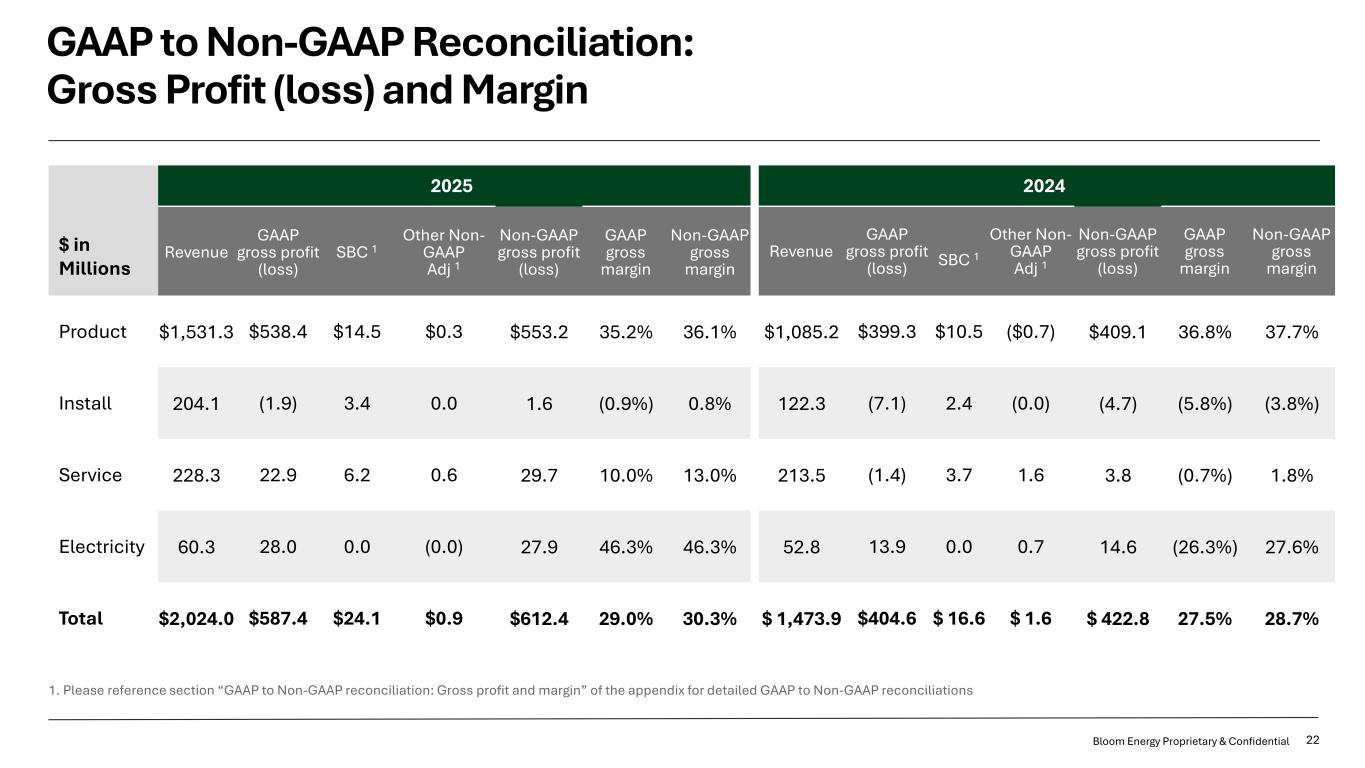
highlights that the team drove this year. First, we achieved record financial results with several key metrics. I would like to highlight the $271.6 million in adjusted EBITDA, proving just how much operating leverage there is in the business as we start to scale. Second, we were free cash flow positive for the second consecutive year. And third, our service business achieved approximately 20% non-GAAP cross margin for the first time. None of that would be possible without the fantastic performance and dedication of the entire Bloom team. As a reminder, I will focus my discussion on non-GAAP adjusted financial metrics. For a reconciliation of GAAP to non-GAAP, please see our press release and the supplemental deck on our website. Revenue for the quarter was $777.7 million, up 55.9% year-over-year. On-site power continues to accelerate relative to the grid, and Bloom's ability to deploy our energy servers and power up sites in record time continues to highlight Bloom's value proposition and drive revenue growth. Gross margin was 51.9%, lower than the 39.3% gross margin in Q4 of 2024. Gross margin will continue to fluctuate given the mix of individual projects in the quarter, but we will continue to manage this movement through product cost reduction efforts and operating expense efficiencies, leading to a stronger EBITDA. Our operating income was $153 million versus $153.4 million in Q4 last year. Adjusted EBITDA was $146.1 million versus $147.3 million in Q4, while EPS was $0.45. Again, these are all non-GAAP results. Our product margins were 37%, while our service margins were approximately 20%. This is the first straight quarter of double-digit margins in the service business, and while we will see some volatility in these results on a quarterly basis, we expect to continue to see annual improvement. Our balance sheet is much stronger than a year ago, as we added significant cash to convertible bonds. We ended the quarter with $2.5 billion in total cash on the balance sheet. Our inventory ended the year at $643 million, slightly higher than what we expected at the beginning of 2020. Our cash flow from operating activities was an inflow of $113.9 million, while CapEx was turning to the full year. Revenue was a record $2 billion, up 37.3% from 2024. Non-GAAP gross margin of 30.3% was up from 28.7% in 2024. Non-GAAP operating profit of $221 million, up $113.4 million from the previous year on a revenue increase of $550.1 million. Over 20.6% dropped through to operating income. Non-GAAP gross profit in our service business was $29.7 million, dollars, a significant improvement. This was profitable on a non-gap basis during every quarter of 2020. Looking forward, we continue to expectability as we continue to do. Before we get to guidance, I want to talk a bit about our backlog. We see tremendous momentum in commercial engagement across both the data center market as well as CNI. Our product backlog has more than doubled from a year ago. We also have approximately $14 billion dollars in service backlog. We have grown our backlog while maintaining healthy customer mix and do not have oversized concentration to any one customer. This brings us to guidance for 2026. While 2025 was a great year for Bloom, we expect 2026 to accelerate. We expect 2026 revenue to be 3.1 billion dollars to 3.3 billion dollars. Non-GAAP gross margin of approximately 32 percent and non-GAAP operating income of approximately $25 million to $475 million. We expect capital spending to be $150 to $200 million, and cash flow from operations to be... We do expect to invest in our R&D roadmap, and as you can see from our operating income projections, we expect to capitalize on the significant operating leverage of the business. To conclude, loans discipline execution is delivering accelerated growth while maintaining sustainable profitability as we scale. We believe that we are rapidly becoming the standard for the on-site power generation market and I could not be more excited about the opportunity in front of us. Operator, we are now happy to take questions.
Operator
Thank you. We will now begin the question and answer session. If you have dialed in and would like to ask a question, please press star 1 on your telephone keypad to raise your hand and join the queue. If you would like to rejoin your question, simply press star 1 again. If you are called upon to ask your question and are listening via speakerphone on your device, please pick up your handset to ensure that your phone is not on mute when asking your question. We do request for today's session that you please limit to one question and one follow-up question only. Thank you. And our first question comes from the line of David Arcaro with Morgan Stanley. Your line is open.
Oh, hi. Thanks so much for taking my questions. I was wondering, could you speak to the follow-on opportunities at existing customers? I was curious, how have the initial projects gone, and how seriously are some of those customers now considering follow-on orders with you?
Hi, David. Nice to hear from you. Yes, look, that's a very important question you're asking. You build a strong company on the basis of happy customers. We have seen that from the day we started. We can tell you even in our commercial and industrial business that has been our traditional bread and butter. Over two-thirds of our business, year over year, comes from repeat customers bringing in multiple repeat orders to us. This is how it operates. Once people get used to Bloom, they love Bloom because we keep our promise and we deliver to them. So this is no different right now with the newer sectors and the customers that have lately engaged with us, be it our utility partners, be it a high-skill-end customer, is seeking us out once they've tried us out, and that's a strong faction. Oracle would be a very good example that is, you know, that's happening on a daily basis. We have great conversations with them on so many projects, and we are working with them on many projects, many prospective projects in the future.
Okay, excellent. I appreciate that color. And also some of your thoughts on further manufacturing capacity expansion. I was wondering, you know, as you consider the potential for the next one, the next capacity expansion? Just curious, what are the milestones or triggers that you'd be watching for? And when do you think a decision could potentially be made about that next tranche of additional production capacity?
Look, for us, making a decision on expanding is like everyday business for us. It's not a major issue for a very simple reason. We are extremely capital light in order for us to expand. We have standing orders with our suppliers of equipment, with our supply chain, with everybody else to ramp up as quickly as we need to. And the return on investment for us is a few months. So, you know, when do we make a decision? It's fairly simple. So if we see a large opportunity on a time to power, and we need to be able to expand our capacity to be able to provide that additional power to a customer, we can ramp up and provide that additional power to that customer before they are ready. Typically, it takes more than a year to stand up a greenfield data center. It takes more than a year to stand up a factory, from permits all the way to full implementation. We can be ready for them before then. So this is a continuous decision we will make going forward, quarter after quarter. The reason we signaled to you last year that we're going from one to two gigawatts was there was concern in the market about do we have a pipeline, do we have an order? We just wanted you to show how much confidence we had, so we signaled that, and now you all understand why we are expanding. But going forward, we'll just continuously keep expanding our capacity, and that's just normal business for us.
Thank you. Absolutely. Okay, great. Thanks so much.
Operator
Our next question comes from the line of Chris Dendrinos with RBC Capital Markets. Your line is open.
Yeah, good evening, and congratulations on the strong quarter and year, and outlook. I guess to start here, I wanted to follow up on the HVDC architecture and, you know, I guess, when do you think we could start seeing that solution set deployed and, you know, how are those conversations going with customers? It seems like you all will have quite a bit of an advantage here from a cost perspective about needing to deploy all that extra electrical equipment.
So, I'm just curious how that's shaping up in the pipeline and how you're thinking about that opportunity thanks look I think thank you for that question and you know thank you Chris for your sentiments about the quarter and the year we are super excited about the accelerating momentum that we are seeing in our business as we as we sit here today and clearly we just I think add even more of a competitive advantage by bringing in the 800-volt DC, and I think you're all beginning to understand why that's important from whether it's a CapEx perspective, a reliability perspective, use of copper and lack of availability of copper and transformers with the alternative option, as well as the operating cost because of efficiency losses you get from switching from extremely high-voltage DC or medium-voltage DC to the 800-volt DC, all those things you understand. now we are we are betting likely bet 25 years ago DC architecture is the right way to go and you can see where we are today and we are betting that very quickly this solution is going to be sought after and anybody who's not implementing that on day one for their data centers now because they don't have the supply chain on their sides ready for implementing that architecture will want to switch our equipment to that DC as soon as they're ready that's the reason you're going to shift everything going forward as they can report you see your question on when will the data centers be ready for it that's better left to ask them as opposed to us we are always going to future-proof them and be a step ahead the key to being a great supplier in the digital economy is you You're anticipating what their needs are, and you're there ahead of when they need it. And that brings everyone forward with greater speed. We are moving at AI speed on this one. Thank you.
Thank you. And I guess maybe as a follow-up, just sticking on that point of anticipating customer needs, you know, I guess on the R&D side of things and the technology roadmap, you know, what's What's the next kind of step for Bloom here, and how are you thinking about the evolution of the product?
Look, we are working on a lot of apps right now, but I'll tell you one that I think we have talked about a little bit here and there in the past, and one I'm super excited about, and makes our customers and potential customers who come out to take a look at our operating systems in the lab is this rapid load following of the AI load being handled by our systems without requiring batteries.
And the ability to, in an islanded mode, operate our systems without needing any backup in terms of backup generators because of our high reliability, but add to that not needing batteries to keep up with the wild swings that the AI load have in terms of power. It is a super important application, and every day we are making that better and more robust. And any time a potential customer throws an AI load profile at us, our team is able to just seamlessly integrate that into our product and show them why it will work really well. That's a huge advantage, not just in terms of cost savings, in terms of safety of avoiding all those batteries inside a data center, you know, a complex, and the, you know, like fire assets that may, you know, like that may create the maintenance issues that may create. On top of that, think about this. As the AI data centers grow, that battery supply chain also becomes a constraint, and we're completely eliminating that constraint, not even mitigating it. So super excited about applications like that. There'll be many more to come as the time goes by. Stay tuned. And all that I can tell you is we have a lot more ideas of a lot more apps that are going to reside on this smart platform.
Operator
Next question comes from the line of Manas Gupta with UBS. Your line is open.
Congrats on a very strong quarter, Kher. I wanted to ask you about the progress you're making on combined heat and power solutions. Most data centers are using vapor compression chillers powered by electricity. I think your absorption chillers would be using thermal process that is powered from waste heat. At this point, vapor compression chillers are the primary source of cooling, and then absorption chillers are being deployed for some supplemental cooling. I'm trying to understand in a world where electricity is very expensive and grid power is not available, can absorption chillers actually go at a faster pace than vapor chillers, and if it does happen, then how does BE benefit? Your product already has a 800-volt advantage. Do absorption chillers make it even more competitive?
Manav, I wouldn't have expected anything other than a strong technical question from you. You know, like kudos to you on your very good research report on the 800 volts DC. I think it's a must-read for people to understand that. Well done on that. So, on the absorption chillers, here's the answer, right, thus far, vapor compression was being used simply because the energy coming into a data center came in the form of electricity from a wire. The generation facility that made that electricity was made hundreds of miles away somewhere, and therefore, you couldn't pipe the heat, the excess heat, all the way from that far away generation capacity to where the data center is. Now, with on-site power generation being the go-to option, a necessity option for data center customers, if we are generating power for them on-site, in addition to our extremely high electrical efficiency, we have high-quality heat, and that heat is allowed to drive a very well-established technology called absorption chilling to provide cooling. We think we can reduce electricity usage in the data center by at least 20%, 2-0. That's a big number for these huge, power-hungry, gigawatt-class data centers. And what do we do with that? It's chilled water at somewhere around 5 degrees Celsius or 40 degrees Fahrenheit coming in. We have systems now that we are operating in this mode, chilling and cooling our factory, just to demonstrate to customers. Customers are super interested in the solution right now, A, because it is more efficient, less expensive, and there's an additional environmental benefit coming out of those absorption chillers in that they don't use hydrofluorocarbons, and that is a big issue for global warming. And lastly, by using absorption chillers that they do on-site power generation, they are not competing with the same supply chain constraints that they have to on the vapor compression. For all those reasons, this is extremely important. So think of this as another app on our platform, and, you know, you ask the question of does it make us more competitive? A smartphone that has more apps and can solve more problems for a customer is always a more competitive solution. That is what we are quickly becoming out here, as you can see.
Speaker 11
Thank you for a very detailed response, and congrats on all the positive developments that are happening in your company, sir. congratulations I'll turn it over thank you next question comes from the line of Davis Sandler with beer your line is open hey guys thank you very much for the time and please let me echo the ones before me and saying congratulations on a great quarter in a great year I wanted to ask your guys's technology is increasingly being comped to legacy incumbents such as combined cycle gas turbines could you maybe talk about if you guys are seeing project wins against these or other types of technologies so so our answer to you I won't I won't
discuss about the competitive landscape that is something you should ask the end user in terms of what did they compare before they choose us but you can clearly see from the stamp sizes of the projects we operate we are operating in that class very clearly and you know we are no longer that 10 and 20 megawatt systems, we have hundreds of megawatts going into the gigawatts very soon, kind of, you know, single site location, that is the stamp size you're looking at. So, very clearly, it's in the same category of a combined cycle gas turbine, right? If you consider the entire value proposition, not just in any one narrow aspect, from a customer's point of view, if it is onsite power that is islanded, can a combined cycle gas turbine operate and provide power at partial loads? Can it swing up and down with the needs of the load? What happens to that system in high altitude? What happens to that efficiency? Let's say, can you modularly pay as you grow and operate that system, or is it monolithic? None of the features of a very large stamp size anything really matches with how a digital world of a data center operates. Okay? When you've taken the cost associated with all that stuff. And then very large mechanical equipment with its inertia cannot swing up and down in milliseconds and seconds like our solid state digital platform does. So it cannot follow a load that way. So you need band-aids for that. And then a huge combined cycle gas turbine, because of the large amount of power it puts out monolithically, can only do that with reasonable amount of copper at very high voltage. And you need bandage to now be able to bring that to 800 volts. You put all that together. Can we compete? Yes, we can. And the fact that we are winning these kind of stamp sizes should show you that we are able to do that, not just in high cost value places, but in states where cost of electricity is traditionally low. So even in a place where irrespective of gas prices, irrespective of utility prices, we are able to compete, you're soon becoming the standard. and, you know, the customers who evaluate the entire value proposition will choose us. Customers who just look at first cost, surely, you know, if you can find it and if you can install it in a short amount of time, you'll be able to use a combined cycle customer.
Speaker 11
Thank you, K.R. And as a follow-up, could you talk just a bit about how the life of fuel cell stacks has improved, maybe how it relates to service margins, and how you guys think about risk in the services business? And thank you very much.
Yeah. So, you know, thank you for asking me to highlight that. That should no longer be a question on any one of your minds. We fully understand when we were losing money every single quarter on service, And we told you that we have a roadmap to get to gross margin neutral and then gross margin positive and keep accreting. You had a reason to wonder about tell us the specifics, show us that you're making progress. What you're looking from the last eight coders is eight continuous coders, continuous and continuous coders of like profit profits in the service business. And on top of that, Q4 of 2025, we had a 20% gross margin. And as our fleet sizes increase, as our technology keeps getting better, and if you look at our $14 billion backlog in service, and then you understand that every order that we are booking has 100% attached rate to service and will add to that backlog, you will clearly see that service is going to be a growing, profit-generating, revenue-generating business for Bloom for years to come, which is going to be a huge advantage. This is the reason why we have worked so hard on it, and we'll continue to work hard on it. Improving life, lots of reducing cost, operating the system with AI-driven digital platform. Let me highlight that for a second. Here is what you need to know. We have a few trillion cell hours of field operation, is what Bloom has. Few trillion cell hours. More than six billion data points come from our field to us every single day. We are using AI. We are not only benefiting from AI on our revenue side. We are using AI to our benefit for all this to improve our performance every single day because we have a digital twin associated to every single fuel cell stack, and data from the real field is coming and feeding the digital twin and making our models better and better. So this is how we're going to build that business. It's a strong business for us. You shouldn't have to worry going forward about what are we going to do with service business. The more important question is, are you placing enough enterprise value to this service business? Thank you.
Operator
Next question comes from the line of Michael Bloom with Wells Fargo. Your line is open.
Thank you. Congrats on the quarter and good evening, everyone. So I'm wondering if you can speak to one of your suppliers. MTAR Technologies had extremely bullish comments on the earnings call, projecting 30% growth CAGR to 2030 for Bloom Energy. So I'm wondering if you could just speak to that and maybe help us square that with the updated backlog number.
You know, we are appreciative of the enthusiasm that our strong supply chain partners have and how bullish they are about what we do. But, Michael, either to all of you or to our board or to our vendors, we have not provided any long-term guidance. And, you know, you can't attribute any of that to us. You would have to ask them where their confidence is coming from and square that with your own models. But we don't, you know, we have not provided any guidance that far out. And again, there's not a flippant comment. Let me tell you what's just happening, right? Just take the last three days, last two days of what you're all seeing in the market. Amazon came out today along with us after the market and said they're upping their capital expense almost 100% to $200 billion for the year, 2026, right? Google did the same thing yesterday, or, yeah, yesterday after the bell, and again, upping their CapEx heavily to $175 to $185 billion. This is all for the digital infrastructure. You know what? What you're seeing happening is the horizon at best is six months, long-term horizon. Nobody has visibility past that because this entire field is accelerating at that pace. For us to sit here and talk about 2030, you know, that's the old industrial age resource planning that the utility companies used to do. That's not where the digital age is going. We don't have any predictions for 2030 right now other than to say we're extremely bullish and it's going to accelerate. Thank you.
Thanks. I appreciate the clarity there, so thank you. Other question I had was on the backlog. I'm wondering if you could tell us what the mix is, U.S. international, and really the broader question is if you could speak to your conversations you're having with prospective customers, should we expect most of your business is going to be in the U.S. going forward, or is there a meaningful international market opportunity also that we should be thinking about?
Thank you. That's a good question. You know, we don't break down the mixes between U.S. and international, but look, to answer your broader question, Bloom's going to be a global company. We are going to expand and, you know, really play a major role in other countries. That is going to actually, if you think about what is the kind of infrastructure we need to be able to play in those areas, it's going to lag behind the US simply because LNG terminals, the amount of LNG available for new projects, given what's happened in the world with Russian gas being cut off to Europe, things like that, is necessarily going to take a few more years to take off in a big way. If there is gas going to these countries now, it is to support existing infrastructure. It's barely available to support new growing infrastructure, and you're not seeing very large projects in Europe for that reason. You're not hearing about the half a gigawatt and gigawatt data centers being built out there, right, other than where power is already available. So, it's going to lag behind a little bit, but we are going to stay on top of it. The predominance of the opportunities right now for everybody in the world is here in the U.S. The growth rate is unbelievable. So, do we see at least for the foreseeable future, this being the key area, U.S. being the key area of focus, the answer is yes. in terms of the diversity of the mix I want to remind you all as much as we talk about AI commercial and industrial business is very strong for us we have had a hundred and thirty-five percent growth year over year on in our commercial and industrial backlog companies factories campuses retail businesses they're all digitizing they're all automating they're you know they're all using robots they're all seeking AI depth their power needs their power draws going up so so that electricity demand is very high and when a factory is getting built they can't wait for the power company to give them the power at their own pace so there we see them coming more and more to us, and it's all happening in the middle of the country where there's gas availability and where there's proper policy for, you know, on-site power being encouraged. Thank you.
Operator
Next question comes from the line of Connie Roche with Oppenheimer. Your line is open.
Thanks so much. You know, guys, as you look at the depth of the market and the breadth of customers that you're dealing with and the value-added elements that you have to your system with future-proofing and cooling dynamics, can you just talk about your pricing strategy as you get a little bit deeper into this? How much pricing leverage do you have and how much do you want to take, you know, here over the next 12 to 24 months?
Sorry, I didn't. Look, pricing really is very much a market phenomenon, you know, based on where people are. People are now going to states where they can get affordable power, but affordable power, remember, is value-based. Okay, most of our customers place value on time to power, place value on ease of permitting because we don't create air pollution and they don't want to get caught in a backlash or either a non-permit or a backlash from their local community. And we feel very, very good that our customers truly value the proposition we bring to them. And so if you just looked at where we are, we don't see us having to choose between growth and profitability. Okay? Okay, between our continuous cost reductions and efficiencies, and given their electricity prices are going elsewhere, and you know, if you just listen to the legacy suppliers of turbines and engines, they're all talking about pricing leverage. What does that mean? They're actually increasing their price. So electricity for customers is going in only one direction. what we offer is really a competitive price, but it's a value stack that they're extremely happy with and are willing to pay. So I don't think in the foreseeable future we have to be looking at worrying about, you know, like pricing.
Thanks so much. And then, you know, the follow-up here is really around any interest in potential M&A. Obviously, you've got a lot of wood to chop with the core product here. But, you know, with an augmented balance sheet and, you know, a very robust currency right now with the stock, is there any reason or opportunities for you guys to start looking at incremental acquisitions to scale the platform at all?
Look, we can be selective about things that matter to us and things that matter to our customers. And if we had some acquisitions, will that make it easier for us to bring that entire smart platform to our customers in a better way? Other than that, our potential addressable market and our ability to light up the planet is just, you know, it's just unthinkably big that we don't need to be looking at what else should we be doing you know if we just you know like lighting up the planet is a good day job I don't need another day job thank you thanks so much guys next question comes from the line of Mark Strauss with JP Martin your line is open
Speaker 9
yes good afternoon thank you very much for taking our questions KR I thought it was really interesting when you said that over 80% of the backlog today is in some of those lower cost states outside of California in the Northeast. Appreciating maybe some of that's driven by data centers, I was curious if you could maybe give that metric for your non-AI business, kind of what that mix might look like.
I know, sorry, we just don't do that.
Speaker 9
Give me another question, I can answer you. okay all right I'll follow up offline thank you can I ask on the the book and ship business you know this time last year I think you said 2024 was the first year the majority of your revenue came from book and ship can you talk about what that looked like in 25 and how you're thinking about that going forward thank you yeah yeah sure you know and and that's an important thing right, in like 25, we had a significant double-digit percentage, let's just put it that way, of book and ship that we were able to do, booking, shipping, turning power on for our customer.
And you heard one example of that where we powered a data center in like 55 days, right? So that was a significant part of the business, and we would expect there are plenty of our valued customers who are going to come to us and want that power very urgently for whatever reason they have. And most often, I can tell you, Mark, it is some other vendor who did not keep their promise, and they come to us. We see this as a competitive advantage, and we want to be able to support a customer under those circumstances. So we have the capacity to do that. We would love to do that, and I would think it will still be in, like, double digits in terms of percentages. Thank you.
Operator
Question comes from the line of Sherrick L. McGrady with BTIG. Your line is open.
Hi. Thanks for taking my questions. So last month, AEP exercised their option for fuel cells under that gigawatt agreement with Bloom, but the offtake won't be finalized until the second quarter of this year. So my question is, would you expect them to take delivery of the fuel cells regardless, given the existing power demand environment? and the infrastructure they put in the ground as well.
Yes, AAP very clearly said that in their press release, and we reiterated that, that our sale of that product is unconditional, and they will take possession. And obviously, they wouldn't have accepted that if they didn't believe very strongly that they could get this going, number one, in terms of that project. But additionally, here's what you need to know, right? AET and us are working on several projects together, and they're great partners of ours, and we expect that our combined business is only going to grow. So they didn't have any concerns about signing a definitive order with us, even though they had to go through some formalities on their side. you know you know because you know Bloom's energy servers are not a perishable they can because you know they can easily put that to use in multiple other locations that they are potentially considering us for thank you thank you second I do want to ask about the warrant transaction with Oracle that deal helps align your interests of course and I'm wondering how do you think about doing similar transactions with other hyperscalers if that's something they're interested in again you know we we still haven't executed that agreement as you know we are working through that strategic partnership agreement that we have and because of that I can't speak to I can't speak to the details of it because it's not out there but but you'll see that soon everything is on a case-by-case basis you know in this particular case I'll tell you what the criteria was it is a great strategic partnership there both enterprises had locked the game and by doing that and remember these are not penny warrants these were done at market pricing on the day we agreed to you know like what we do so it is not it is not in lieu of something other than both parties enhancing enterprise value so if so I'm not going to say yes or no to this it will all be evaluated on a case-by-case basis if there's enterprise value so it's so the answer is you know neither a yes or no it depends thank you great color thank you KR and our last question comes from the Lion of Noel Parks with Toei Brothers.
Operator
Your line is open.
Hi, good afternoon. I wanted to ask about the product margins and the supply chain. I was just wondering what your thoughts are on your visibility into your input costs for components. And I'm just wondering if there is any trend you're considering towards longer-term contracting or forward purchasing from vendors to sort of exercise your leverage with cost?
No, thank you so much. And I'm going to ask for your indulgence and say, let me not do a follow-up question because we are, you know, like running on the hour, but let me answer this very good question you asked. Look, we are constantly working both internally in the company and with our supply chain partners. to figure out efficiencies, how to bring scale-related efficiencies, how to bring about technology and process-related efficiencies, and continuously keep bringing down the cost. We are also extremely judicious of watching what is going on in the world and securing, you know, risk bias if we need to, if we see, you know, certain things happen. You can see, you know, we are not pinching the last penny on the amount of inventory we hold. You know, there are very good reasons for those things because we're very strategic about all those decisions. And in terms of cost reduction overall, double-digit cost reduction is in our DNA every single year, you know, and we make that happen. Sometimes all of that translates out. Sometimes, because suddenly a terrorist regime came along, instead of saying our cost went up, we were able to neutralize a lot of that, or during COVID, then the cost of logistics went up. We didn't have to increase our price because we could make up for that cost increase using our cost reductions. But we have always delivered that, and we'll continue to deliver that, and that's in our DNA. So that's how we're going to bring about margin accretion over a long period of time in this company and keep growing our margins, okay? With that, let me conclude to say in my closing, look, you all see Bloom's really executing from a position of strength, but we are also scaling with discipline, and we are on a very firm path to make sure that we become the standard for on-site power, the benchmark for speed, reliability, flexibility, As you heard in the last couple days from the large digital companies, they're all increasing their capex by amounts that would have seemed unbelievable even two years ago these numbers are staggering and this is all for capex infrastructure everything is digital this is digital infrastructure digital runs on electricity electricity at that pace cannot be delivered by anyone in the free world today using Poulson wires on-site power is a necessity bloom brings very clear competitive advantages that legacy providers that built their technology for the industrial age cannot adapt to so we are very confident in the path we have charted for ourselves and are excited for the future we look forward to another very good year thank you so much ladies and gentlemen that concludes today's call thank you all for joining and you may now disconnect