Operator
Thank you for standing by. My name is Abby and I will be your conference operator today. At this time, I would like to welcome everyone to the Bloom Energy First Quarter 2026 conference call. All lines have been placed on mute to prevent any background noise. After the speaker's remarks, there will be a question and answer session. If you would like to ask a question during this time, simply press star followed by the number one on your telephone keypad. If you would like to withdraw your question, press star one a second time. Thank you. And I would now like to turn the conference over to Michael Tierney, Vice President, Investor Relations. You may begin.
Thank you, and good afternoon, everybody. Thank you for joining us for Bloom Energy's first quarter, 2026 earnings call. To supplement this conference call, we furnished our first quarter, 2026 earnings press release and supplemental financial information with the SEC on Form 8K, and have posted these materials, which we will reference throughout this call to our investor relations website. During this conference call, both in our prepared remarks and in answers to your questions, we may make forward-looking statements that represent our expectations regarding future events and our future financial performance. These include statements about the company's business results, products, technology, customers, new markets, strategy, financial and competitive position, investments, liquidity, and full year outlook for 2026 these statements which relate to matters including time to both power and market the standard for on-site power cost efficiency capacity expansion innovation affordability and community acceptance as we look to keep pace with the rapid evolution of our markets our predictions based upon our expectations estimates and assumptions however as these statements deal with future events they are subject to numerous known and unknown risks and uncertainties as as discussed in detail in our documents filed with the SEC, including our most recently filed Forms 10-K and 10-Q. We assume no obligation to revise any forward-looking statements made on today's call. During this call and in our first quarter 2026 earnings press release and supplemental financial information, we refer to GAAP and non-GAAP financial measures. The non-GAAP financial measures are not prepared in accordance with U.S. generally accepted accounting principles and are in addition to and not a substitute for or superior to measures of financial performance prepared. A reconciliation between the GAAP and non-GAAP financial measures is included in these materials, which are available on our Investor Relations website. Joining me today are K.R. Sridhar, founder, chairman, and chief executive officer, and Simon Edwards, our chief financial officer. K.R. will begin with an overview of our progress, and then Simon will review financial highlights for the quarter. After our prepared remarks, we will have time to take your questions. I now turn the call over to K.R.
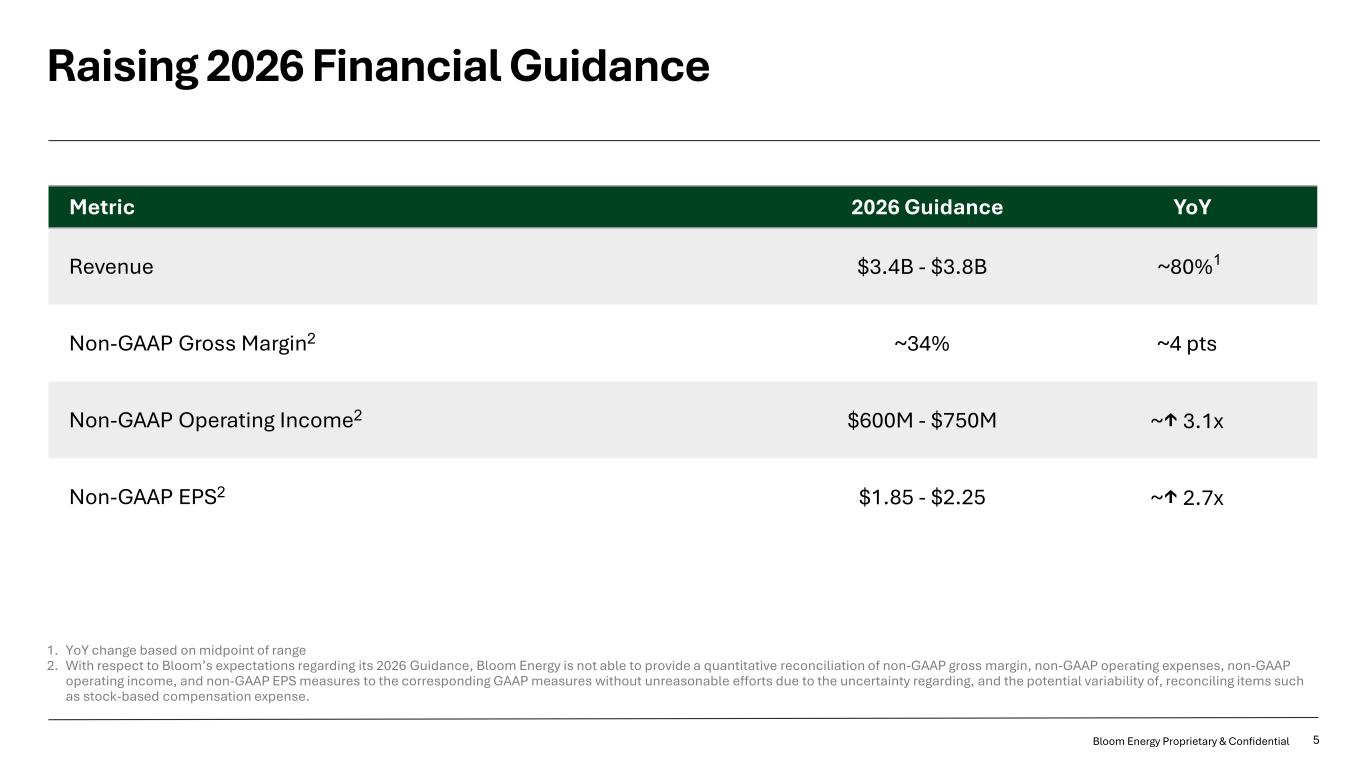
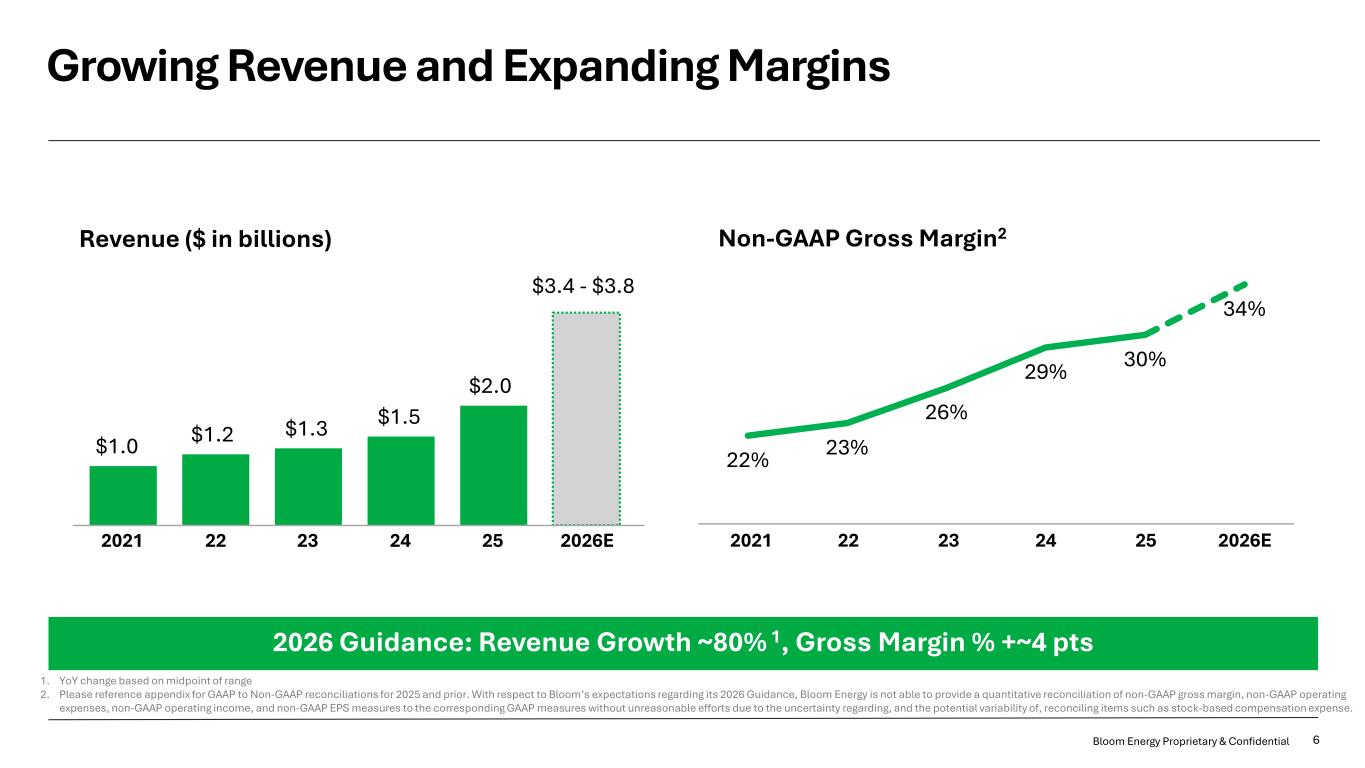
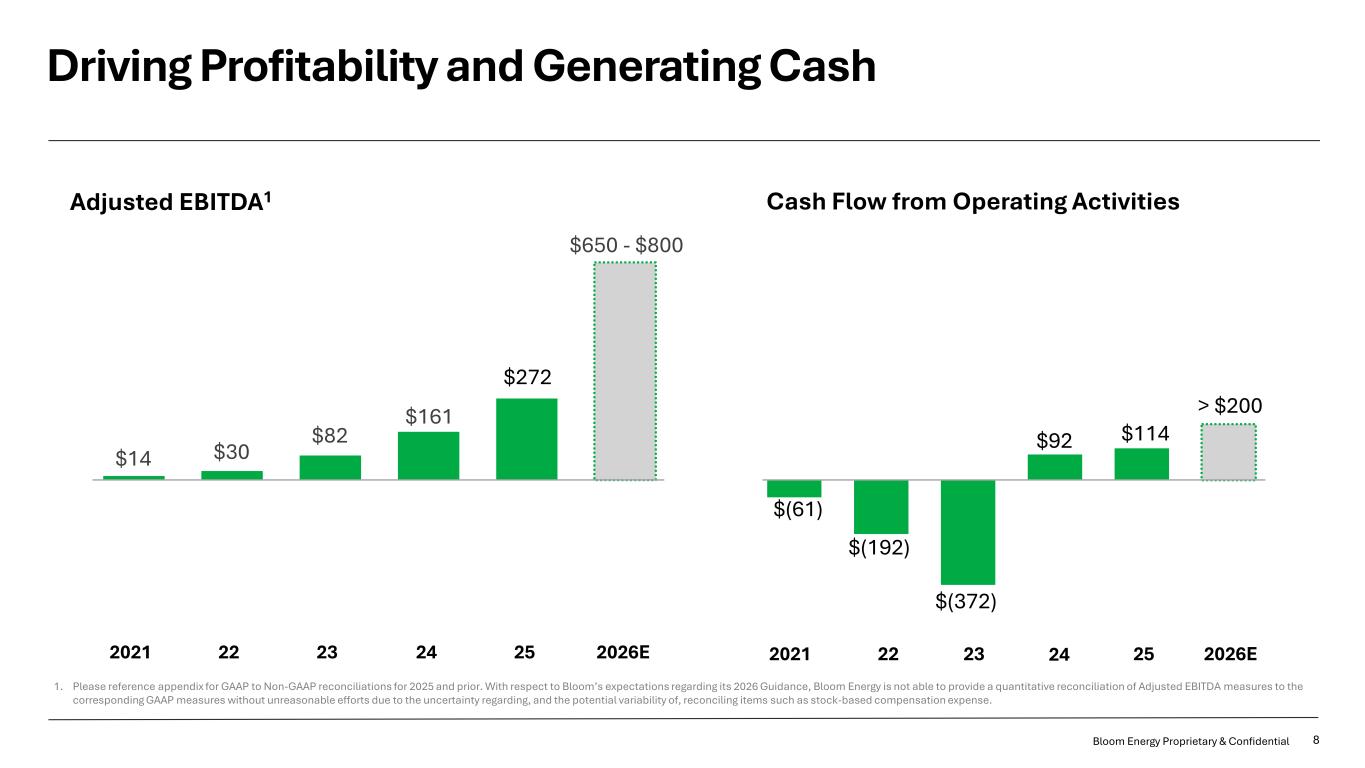
Good afternoon and thank you for joining us today. Bloom delivered a record first quarter. Revenue, gross margin, and operating income all came in materially above our prior outlook. Based on what we are seeing across the business, we are also raising our full year guidance. And raising it materially, we will walk through the numbers in a few minutes. But first, I want to talk about what is happening in our market because the headline numbers, as strong as they are, are a lagging indicator and don't convey the whole story. We at Bloom are ushering in the era of digital power for the digital age. Now the marketplace is recognizing and embracing our proposition of clean, reliable on-site power that is community-friendly and deployed at the speed of AI. Bloom is rapidly becoming the standard and go-to choice for on-site power. Last night, Oracle announced a new power paradigm for Project Jupiter, a multi-gigawatt AI factory to be built in New Mexico. We are thrilled to partner with Oracle and applaud them for their visionary leadership. This Up to 2.45 gigawatt power block will replace Project Jupiter's previously planned gas turbines and backup diesel generators with Bloom Energy servers. It will be 100% Bloom. When completed, it will be one of the largest islanded microgrid power facilities in the world. Oracle pivoted to Bloom-only solution for two main reasons. First, be a responsible corporate citizen and partner by being responsive to residents' concerns about air quality, water use, noise, and increasing electricity rates. Second, to stand up their grid-independent and clean AI factory with even greater reliability and speed. Bloom is the cleanest commercially available on-site power generation option for such data centers and the most water efficient. Given Bloom's community-friendly attributes, Oracle should be able to energize the campus materially faster than any other available alternative solution in the market. At a time where every quarter of delay translates into hundreds of millions in foregone AI revenue and loss of competitive advantage, speed of powered infrastructure development is the difference between leading and following. becoming the sole power provider for Project Jupiter is a milestone for Bloom, but it's not going to be a one-off project. Where Oracle is going is where the broader market is headed. On our Q3 call, I described our playbook for becoming the standard. In each vertical, we establish credibility with the Lighthouse customer, then build on that success with other tier one customers. Two quarters later, that's exactly what's happening across the AI ecosystem. Oracle is rightfully getting headline attention today, but well more than half of our current data center backlog comes from other hyperscalers, neoclouds, and co-location providers. Just like the Oracle Jupiter project. These microgrid installations will use no grid, no dirty diesel generators for backup, no battery banks for load following, no engines, no turbines, just bloom and bloom alone. We are continuing to engage with more hyperscalers and new clouds by signing new contracts and slot reservations and working with them to evaluate many new opportunities. Our pipeline today is diverse and robust in the AI segment. Parenthetically, let me also remind you that this is a rinse and repeat of our CNI business playbook. That segment is also experiencing strong demand, is diverse, and continuing to grow. I want to give you a perspective on why we are experiencing the cyber growth, because Because it will shape how you think of Bloom going forward. For over 25 years, we built this company around the conviction that clean, reliable, affordable on-site power would become essential to a digital world. The market is now validating that vision at scale. And AI power demand is simply accelerating it. Time to power has gone from a procurement consideration to an existential necessity. The companies driving the AI transformation are racing against each other on the one hand, and on the other, bumping into the bottlenecks common to building conventional infrastructure, such as permissions, permits, and community acceptance. The winner will be the one who can grow and deploy faster and on the schedule the market demands. You see, that's a different game than the one the legacy power industry is set up to play. Their model is industrial. Long cycle times, capital-heavy capacity additions, product improvement measured over decades rather than quarters. Our model is different at every layer. We innovate and improve continuously, be it in our technology, in our product, in how we manufacture, in our capital intensity, in how we deploy, in how we operate and service our systems, and in time to market. That is what allows us to deliver double digit cost reductions year after year, expand capacity with materially less capital than industrial-era players, and meet our customers' schedule needs. Our differentiated and unique operating rhythm and mindset will be obvious to you if you visited our factory floor. It's a state-of-the-art production facility, a busy construction zone, and a buzzing innovation hub. We are manufacturing product on schedule to meet customer needs, adding lines and expanding capacity to meet growing demand, and innovating to reduce cycle times, space needs, and costs. Product manufacturing, capacity expansions, and innovation, all occurring concurrently, all the time, all under the same roof, and all with factory floor team members and engineers working as one team for one common purpose. to be better tomorrow than we are today and keep marching towards the North Star of maximum entitlement. This is an example of our operating model. We call it the Bloom Way. As a result of this approach, the contrast in outcomes is simple. Their supply to current orders arrives only in 2029 or later irrespective of the customer's needs. Ours arrives this year or the next or whenever the customer is ready. Based on demand profile, we have now shifted to adding capacity continuously, hundreds of megawatts a quarter, as opposed to lumpy one-off additions to be completed in a years time. How we think about and execute on capacity addition is one of the clearest ways to see what makes Bloom different. The traditional power industry has spent the past two years celebrating its backlog that is four and five years out. Backlog at that scale and time frame in the age of AI is a result of their constrained supply. At Bloom, we see it differently. Our ability to expand capacity is our competitive advantage. We want to rapidly build capacity, build product, help build productive AI factories, help build commercial and industrial facilities, and help build our economy, not just be satisfied with simply building backlog. Our current manufacturing footprint will allow us to deliver five gigawatts of product annually. We will expand to that capacity and meet the delivery dates needed by our customers. In other words, today we are not order constrained and not capacity constrained. The pace of our revenue growth is decided by how fast our customers can build their greenfield sites not how fast we can power them we will never be the bottleneck to our customers we built our business around that promise going beyond the five gigawatt capacity our supply chain and manufacturing strategy and planning allows us to build that capacity significantly faster than any other option in the market using our copy exact model. We will strive to bring power to our customers faster than they can stand up their greenfield facilities. We were able to make that promise because we invested deliberately ahead of demand. We expanded manufacturing capacity, built inventory, diversified our supply chain, strengthened our balance sheet, and assembled an ecosystem of long-term supply partners that scales with us. Given our low capital intensity, those investments carried materially lower risk for shareholders than they would have for an industrial era supplier. They were disciplined decisions made with conviction that this market shift was coming. While our new orders that we are telling you today are news to you, we have advanced visibility and anticipated such wins for months. So, we planned out our capacity expansions accordingly. Our strategy and judicious investments have positioned us to become the standard for both on-site power and time to power. Beyond speed, our architecture creates real flexibility for our customers. Our modular copy exact systems are portable and fungible and meet air quality requirements in virtually all jurisdictions. If a customer needs to shift deployment from one site to another, our master services agreement is structured to enable that. With the master service agreement, our hyperscale customers have the geographic flexibility to move a bloom deployment from one site to another based on a speed-up at one site or a delay in another. Bloom moves with the customer to the location where the GPUs are ready to convert the power to tokens of intelligence and revenue dollars. Unlike a traditional power plant, our platform is also a different kind of neighbor in a community. We are community-friendly. As more on-site generation gets deployed to support AI and industrial growth, communities care deeply about what kind of infrastructure shows up next door. Bloom preserves local air quality. We do not combust and pollute the air like conventional technologies. We use minimal water at startup and none during normal operations. We are quiet, compact, and efficient with land use. We integrate well with environments rather than disrupt them and become an eyesore. As permits and permissions become the gating factor for AI infrastructure, community acceptance matters increasingly. Our fully-islanded, grid-independent, one-stop, full-stack power solution does not raise the monthly electricity bill for community residents and brings them economic development without compromises. The cost equation has also shifted in our favor. We have spent years driving down product cost while improving performance. That work is meeting the market at exactly the right time. Our energy servers are now cost-competitive with grid power in most U.S. markets and with off-grid alternatives in nearly all markets. With over a decade of double-digit cost reductions, we remain the only on-site generation solution with a sustained downward-sloping cost curve. As affordability of power becomes a national issue, we expect to become the solution of choice from that perspective also. Bloom delivers a value proposition built on the principle of AND, not OR. Customers can have the power that is clean and reliable and fast and affordable. Now to our outlook for the year. To say that the commercial landscape is fluid and dynamic would be a massive understatement. The strength of the quarter and the commercial momentum we see across the board gives us conviction and confidence to raise guidance materially. We are raising 2026 revenue guidance of 3.1 to 3.3 billion to 3.4 to 3.8 billion. At the midpoint, that takes growth from 60% year over year to 80%. We are also raising our gross margin outlook from 32% to 34% barring any global shock or exogenous factors. You can see we are prioritizing growth and profitability in equal measure. Now, I want to introduce Simon Edwards, who recently joined Bloom as our Chief Financial Officer. Over the past year, we have been deliberate in our search. It was important to us that we not only find the right CFO for Bloom today, but the right leader and business partner to help Bloom scale for the future. Simon brings a rare combination of capabilities. With his systems engineering background, he has built disciplined operating models and scaled manufacturing operations for complex systems. As CFO of leading software franchises, he has applied a digitally native approach to building businesses, leveraging data and analytics as competitive advantage and employed automation for speed and efficiency. His time at Grok has given him a front-row seat to the explosive growth occurring across AI. All of that translates directly to where Bloom is headed. I also want to thank Machek and the finance team for their outstanding work in supporting the business without missing a beat during last year. Their performance speaks to the depth of the Bloom talent at all levels. I'm proud. finally to the bloom team thank you what you have built over more than two decades is meeting the market at exactly the right moment you believed and always knew that an inflection point would come none of what we see today would be possible but for your faith dedication diligence and discipline much gratitude with that Simon a very warm welcome and the mic is yours the kind words today and the warm welcome that
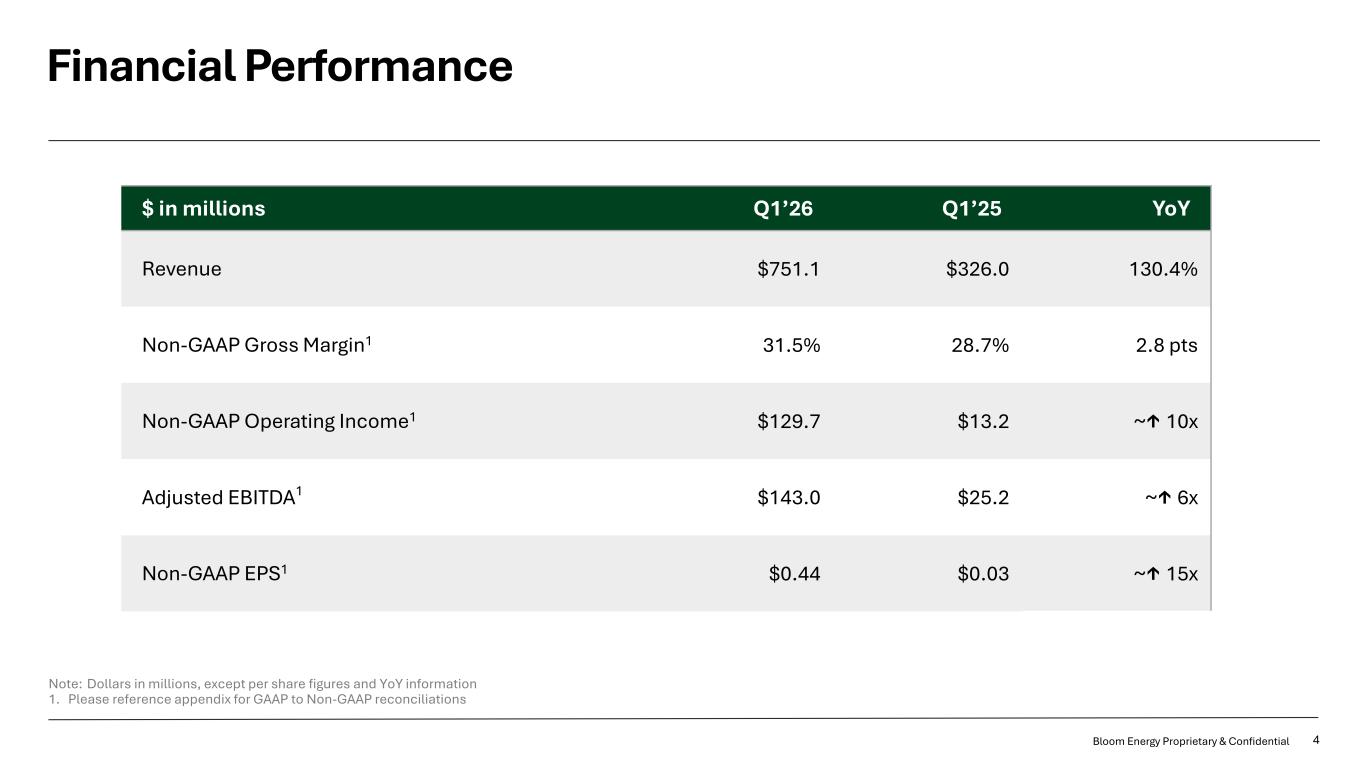
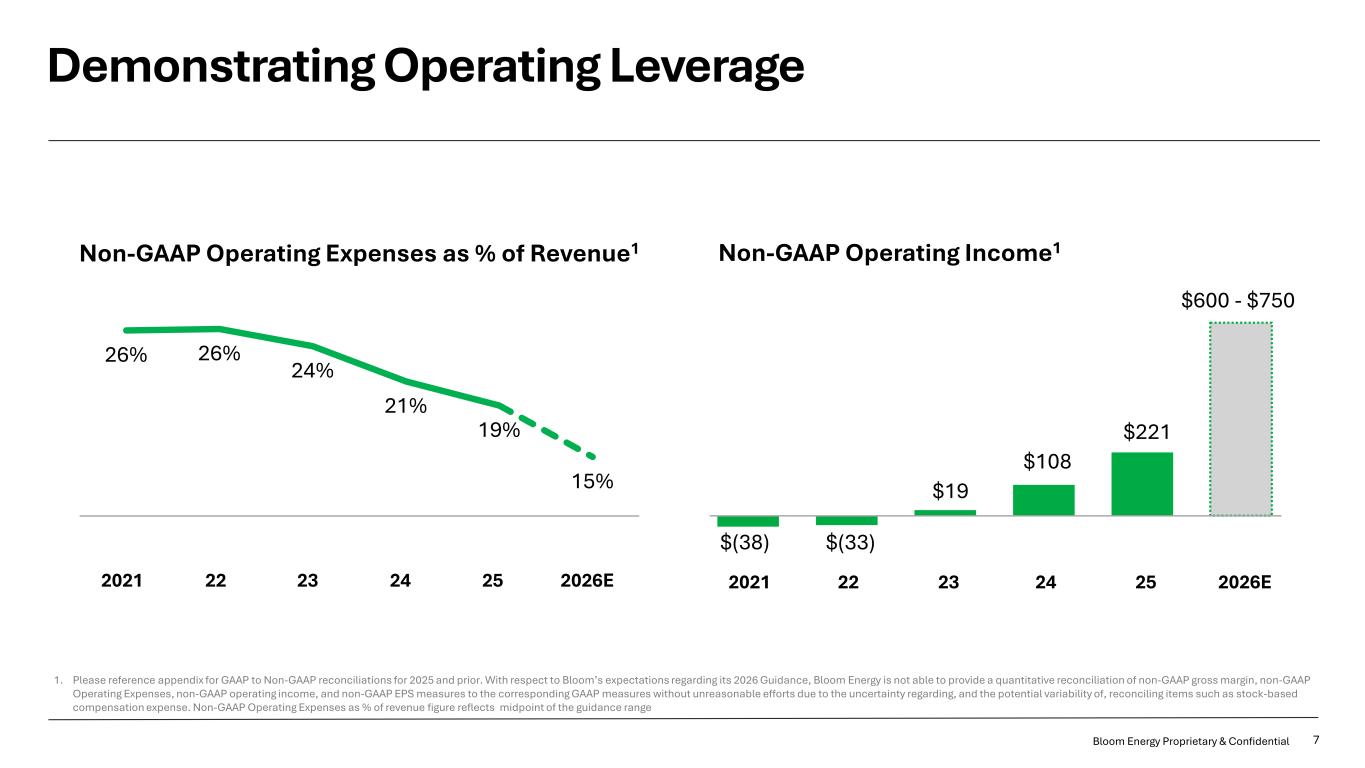
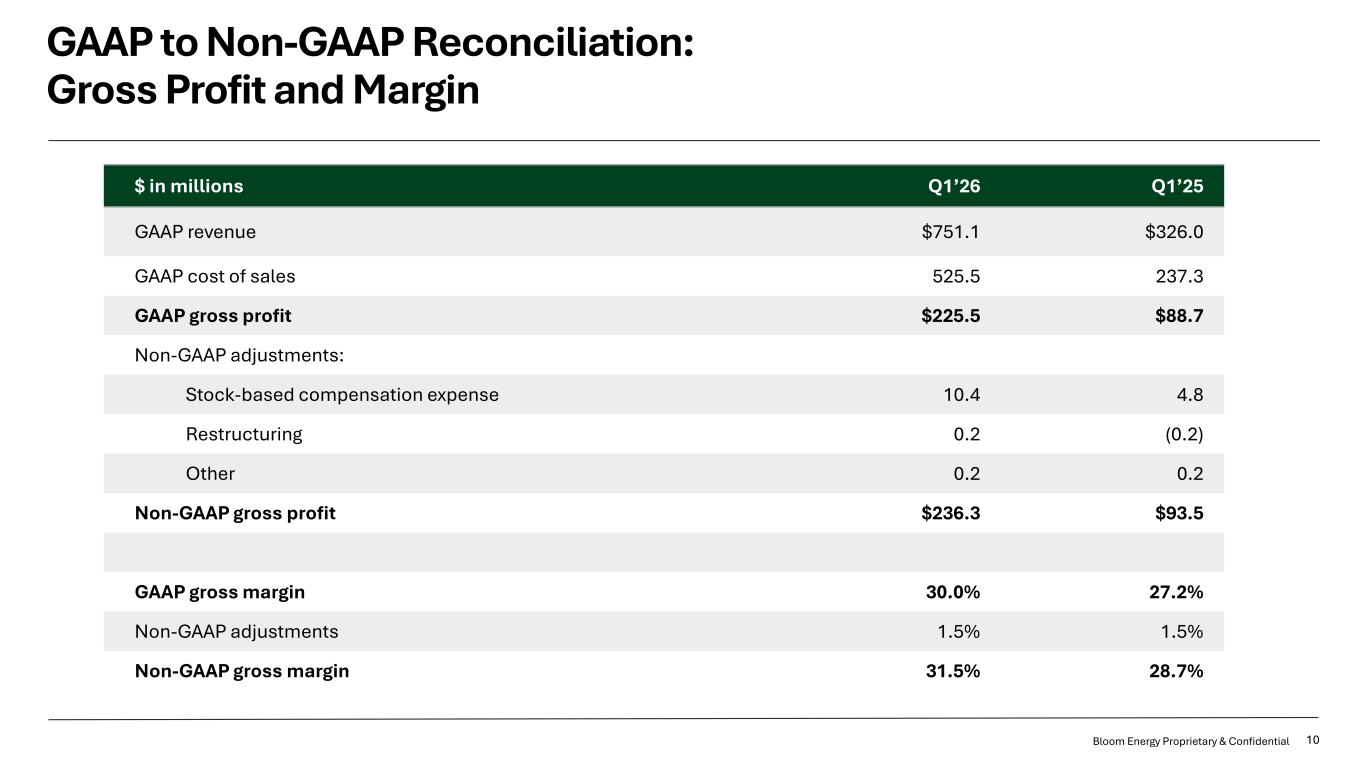
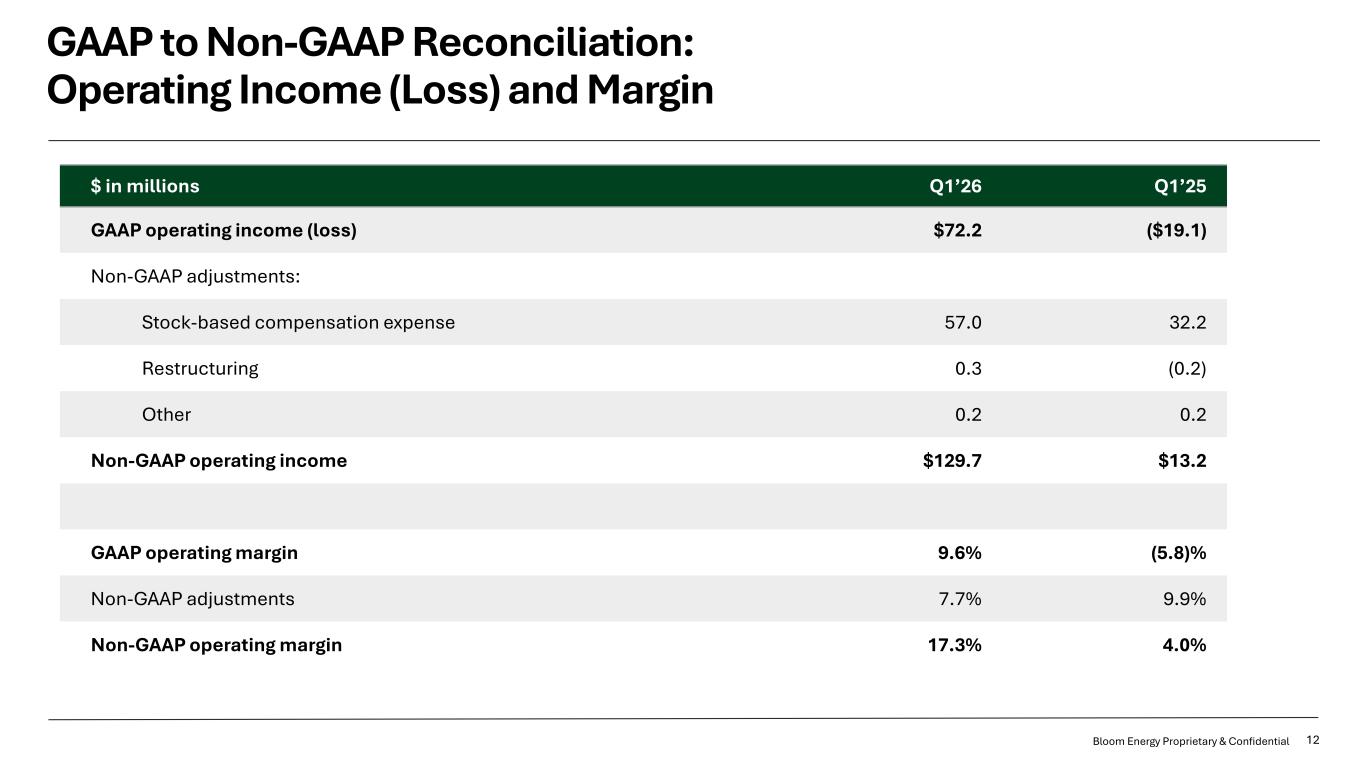
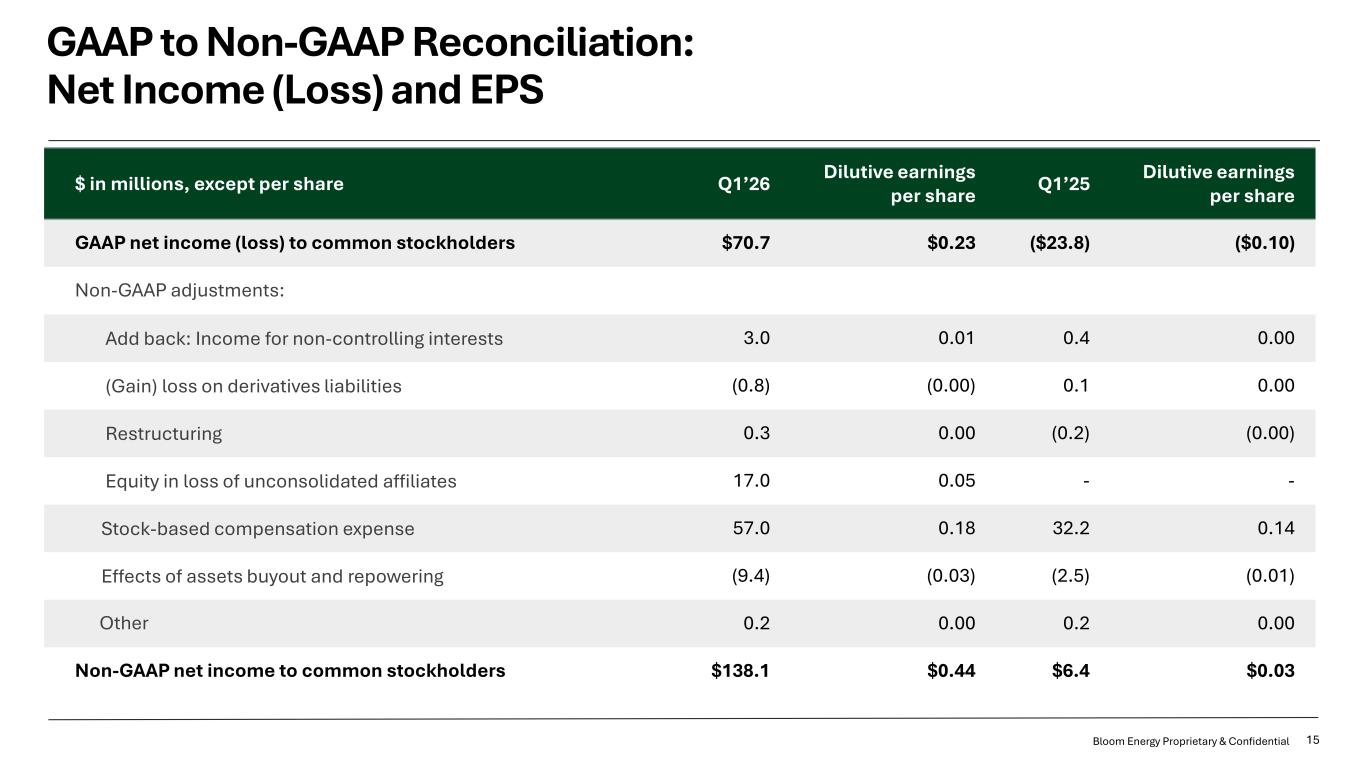
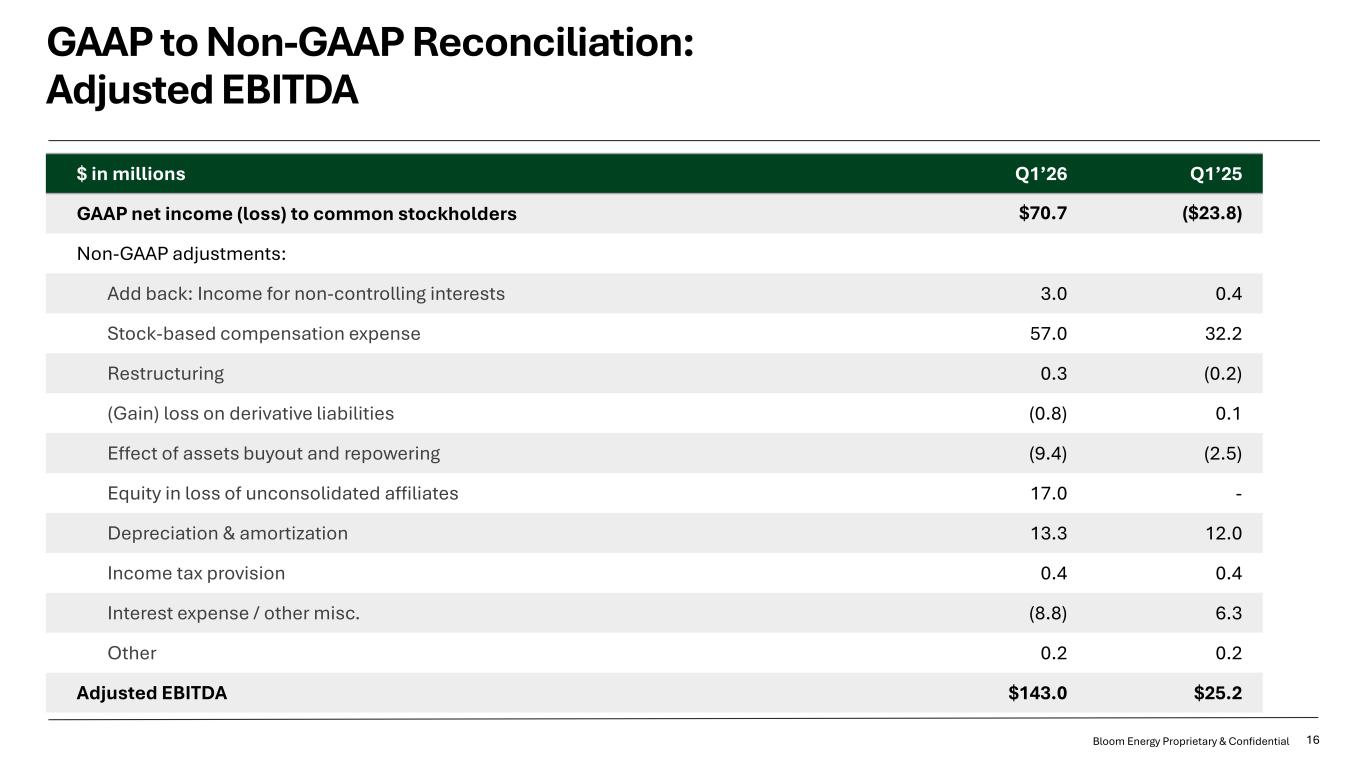
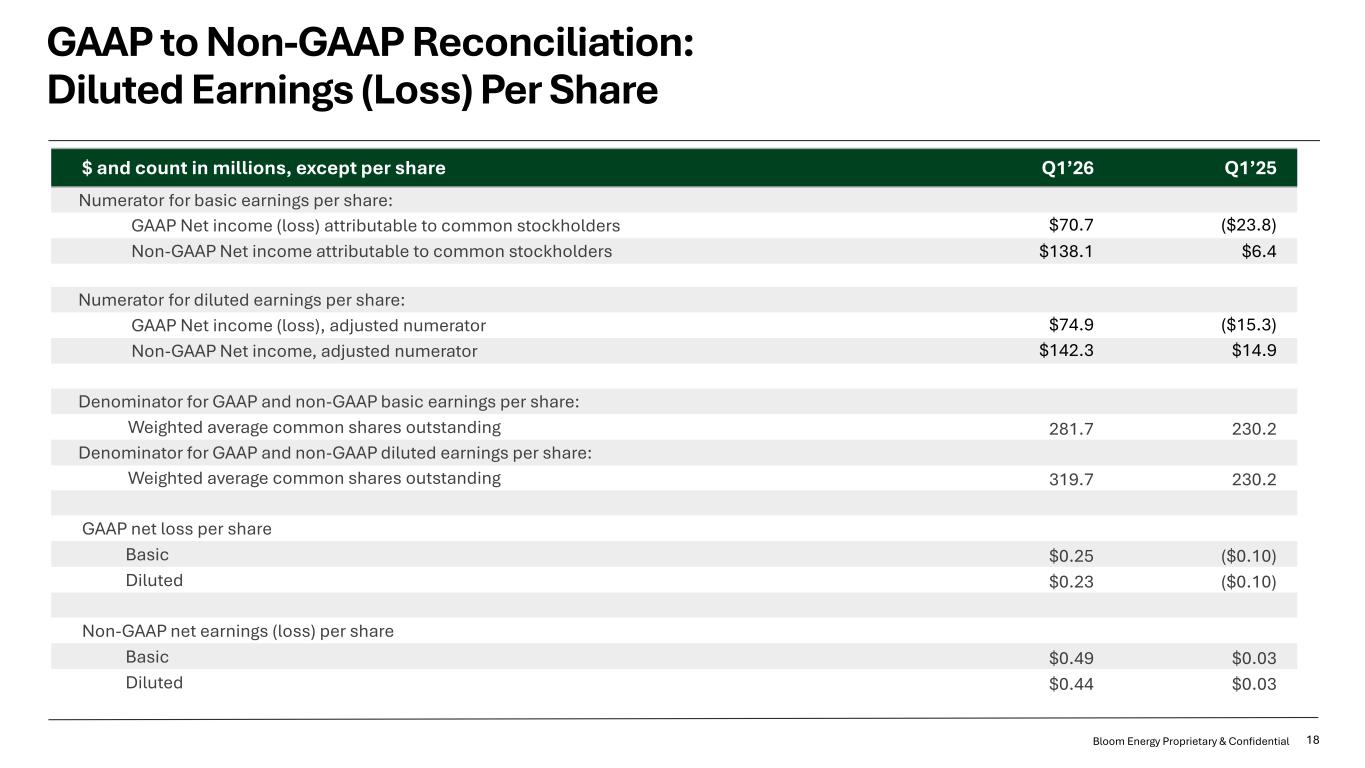
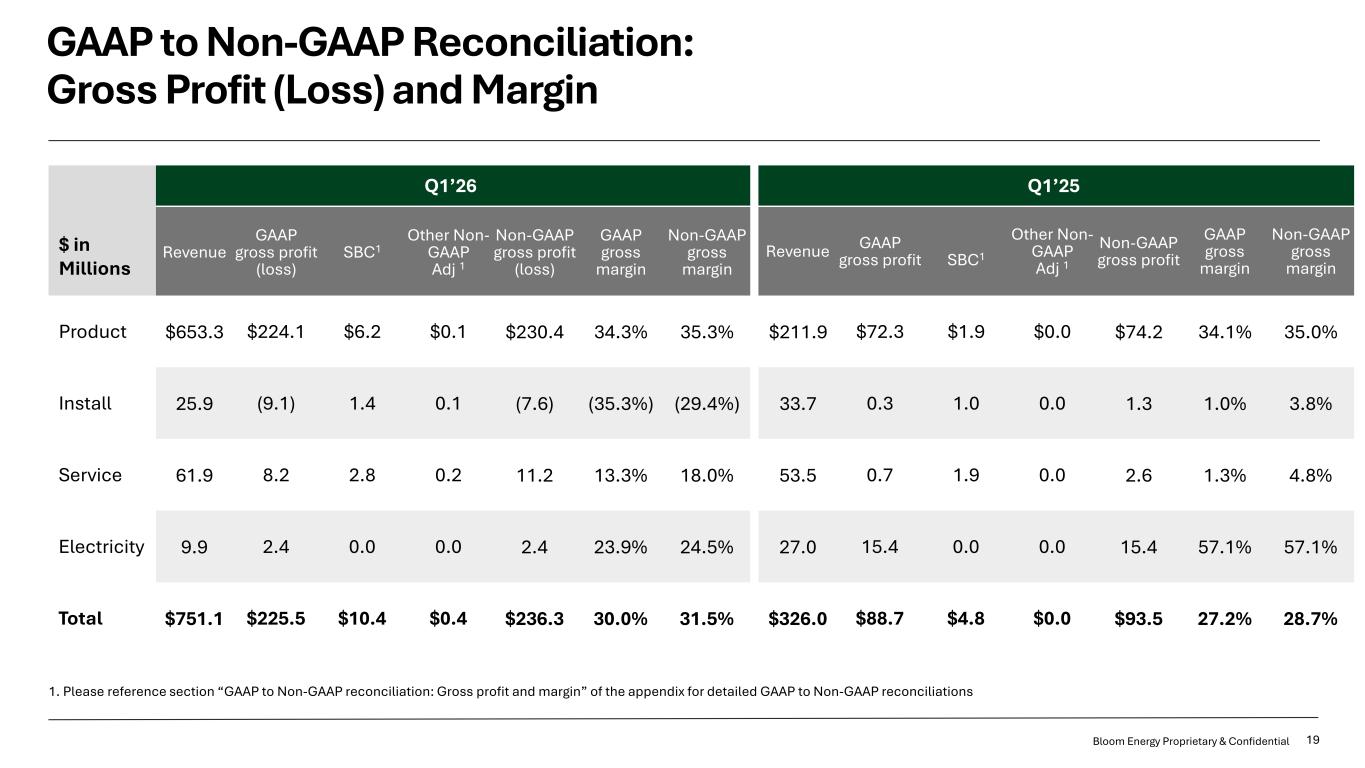
I've received here at bloom over the party to be part of the bloom team and to be speaking for the first time I chose to join bloom for a few reasons first KR talked about the architectural shift driving a large town with increasing momentum. Having seen the powerful tailwinds around AI infrastructure and electrification, I recognize very real bottlenecks. Bloom is uniquely positioned to address that challenge with a long-term opportunity that extends well beyond AI. Second, Bloom is a Silicon Valley innovator. I was drawn to Bloom's visionary leadership and the depth and quality of the leadership team. There's a clear strategy, strong alignment, and a mindset focused on building something enduring that starts with kr and permeates throughout the entire organization and third this is a chance to help build a truly generational company one that can capitalize on long runway for growth and create long-term value for customers and since joining two weeks ago i have already been impressed by what i have seen the team is highly engaged and motivated the demand environment and pipeline are exceptionally strong and there is a clear bias towards results turning that demand into delivered systems cash flow and sustainable performance in addition the sense of mission is clearly apparent among bloom's employees many of our employees have been here for 10 to 15 years long before ai was a common phrase these employees stayed here because they believed in the bloom mission to make clean reliable energy affordable for everyone in the world. This is a driving force behind everything we do here at Bloom and the mission I'm excited to be part of. Moving to our numbers, I will discuss our Q1 financial performance and make a few comments about what we expect. It includes record Q1 revenue with year-over-year growth of more than 100%, continued year-over-year gross margin expansion, and record Q1 cash. For a reminder, I will focus my discussion on non-GAAP adjustment. For a reconciliation of gap to non-gap, please see our press release and the supplemental deck for the quarter was up 130.4% year over year. And 100% revenue was up both year over year and an all-time high of six service revenue for the quarter was $61.9 million. Up to 15.6 for the quarter was 31.5, approximately 280 basis for 35.3%. As we grow, we should see incremental progress on production of manufacturing overhead across engineering and supply. Services margins were 18%, up 13 points from Q1 last year, achieving a double-digit gross margin for the fourth consecutive quarter and profitability for the ninth consecutive quarter. Expect margins for the services business to continue to benefit. Operating income for the quarter was $129.7 to $13.2 million last year. Operating margins reaching 17.3%, up more than 1,300 basis. The adjusted EBITDA for the quarter was $143 million compared to $25.2 million last year, an increase of $117.8 million, with EBITDA margin expanding by more than 1,100 basis points to approximately 19%. This margin expansion highlights the significant operating leverage in the model as revenue growth continues to outpick. Non-GAAP fully diluted EPS for the quarter was $0.44 versus $0.03 a year ago. While we will continue to invest to support the growth ahead of us, I am impressed so far with Bloom's ability to deliver at an increasing scale while managing costs through both operational efficiency and gaining leverage through technology. As KR mentioned earlier, we are rapidly expanding capacity through our innovative manufacturing scale in months, not years. that growth requires upfront working capital to support higher production and with those investments cash flow from operating activities with an inflow of 73.6 million dollars positive for the first time in the first quarter of the year driven by a step customer prepay start of the year and anticipating that q2 revenue should be at least as good as q1 we are raising our fiscal 2026 guidance to new levels increasing our revenue projections from the previous range of 3.1 to 3.3 billion dollars up to a range of 3.4 to 3.8 billion lower end of the updated range cent euro-over-year growth the progress we have made in adding manufacturing philosophy of our pipeline and the opportunity to continue to prosecute our non-GAAP gross margin 34% four-point improvement euro non-GAAP operating income expected 750 acknowledging the higher revenue and margin flow through but also recognizing that we plan to invest to support the growth for this year and that fully diluted EPS expectation is now $1.85 to $2.25 to conclude we delivered record q1 financial results and we are optimistic in our full year 2026 financials i'm looking forward to working with kr and the entire balloon team and spending time with our operator we are now happy to take thank you and we'll now begin the question and answer session if you have dialed in and would like to ask a question please press star one on your telephone keypad to raise your hand and join the queue.
Operator
If you would like to withdraw your question, simply press star 1 a second time. If you're called upon to ask your question and are listening via speakerphone on your device, please pick up your handset and ensure that your phone is not on mute when asking your question. To be able to take as many questions as possible, we ask that you please limit yourself to one question and one follow-up. Again, it is star 1 to join the queue. And our first question comes from the line of Mark Strauss with J.P. Morgan. Your line is open.
Yes, great. Thank you very much for taking our questions. Maybe starting with Simon. So first of all, congrats on the new role and welcome to the fray here. You mentioned kind of how you're impressed with the operating leverage in the business. I'm just curious, I fully appreciate you haven't been there very long, but kind of your initial take on as this business scales, how you're thinking about that margin over time. If you look at three, four, five gigawatts, whatever it might be of annual capacity, how you're thinking about the margins in this business?
Yeah, thanks, Mark. Excited to be here. First of all, I can say the amount of rigor that goes into planning and execution here is something that's been really impressive. It starts, obviously, at the management team level, but down at the individual project level as well, the team is very focused on execution. In terms of how we think about margin, I would say what you see in this quarter is significant margin expansion as a function of just revenue growth, really out-facing where we've been in the past. I think we're very focused on where we want to invest, though. So I think that starts with go-to-market. There's a number of growth factors that we're exploring. Obviously, from a technology standpoint, growth is highly innovative and we're investing in innovative areas and then on top of all of that i think kr has mentioned in the past cost reduction is in the dna of bloom and so i think uh really what we're focused on is a how do we execute on the the projects in the plan right now that deliver on the gross margin expansion that we've we've highlighted second is as you look at our updated guide you'll see there's incremental uh operating margin expansion based into the revised guidance And then finally, as it relates to longer-term guidance here, I don't think that's something we'll provide right now, but continuing to execute on these vectors is something that I know everyone here is very focused on.
If I could ask one more follow-up to KR, clearly your orders are accelerating here. I'm curious if you can comment on what you're seeing with your service contracts, particularly the duration of those contracts. I think in the past you said some of these data center contracts have been somewhere around six or seven years in duration. I'm curious if you're seeing any change there, potentially longer than 10 years or so. Somewhat similar to your C&I business. Thank you.
Hello, Mark. Thank you. And look, I think it's important because some people may be coming in new into the story. we have a 100% attach rate between our product sales and our service. That's the first place to start. There is not a single deal that we do without an attach rate to our service. Even with the data center opportunities, on average, it's 10 to 15 years, somewhere in that range. And so it's a tremendous source of annuity revenue that we see. and you can see us executing on the margin targets that we have provided. So it's going to be a phenomenally great business for us going forward, along with our product business. Thank you.
Operator
Question comes from the line of David Arcaro with Morgan Stanley. Your line is open.
Oh, hi. Thanks so much for taking my question. Congratulations on the results here and a warm welcome to Simon as well from me. Maybe I was wondering if you could touch on the pricing backdrop that you're seeing. I'm wondering if you're seeing opportunities to hold pricing or potentially seeing projects with increased price opportunities in the current environment, just where we're seeing it seems like all other alternatives are increasing in cost to the customer.
So we completely distinguish and think differently about this. at the end of the day, we don't compare our pricing with engines and turbines. It's apples and oranges. We are creating a completely different value for our customer, be it an 800-old DC being eliminating all the paraphernalia, the band-aids as I would call them, to a mechanical age solution going to a digital age, be it the amount of overbuild that you need to have when it comes to getting the reliability that you need because it's very obvious these big projects are not going to have grid backing it up. You know, the local rate payer is not going to be providing that reliability for free. And so you bake all that in. We just always focus not on cost, not on price. Obviously, we are going to create margin for the business. And as the first question was asked to Simon, We will focus on that. But at the end of the day, we're going to build our business with our partners by creating value for them and creating value for us. So we don't look at anybody else's pricing and what they do. Thank you.
Understood. Yeah, that's helpful. I appreciate you characterizing that. And I was wondering, you know, as you look to ramp up your scale significantly here, could you also speak to how you're seeing the supply chain and its ability to ramp with you you know we've seen labor as an example become a constraint elsewhere wondering if you're seeing pressure there or in upstream materials that's a great question David thanks for asking and because that's a significant distinguisher between what we do and what other people do so if you have come to our factory and seen the few hundred people that we have manufacturing our stacks when we were doing 200 megawatts a year, and
if you came at the end of this year when we will be doing almost 10 times that amount, the number of employees on the shop floor will be the same. You know, not almost equal, will be the same. And that is the innovation we bring into the field, knowing that for us, automation and figuring out how to train our existing employees, upskill them as they grow. And by the way, most of them happen to be the same employees too. They are upskilled from doing that manual labor to automation. That's why with their help, as you heard in my script, In the shop floor, we don't talk in harsh tones about bringing automation to remove a particular manual process out because our team members are actively involved in it. And this is the same philosophy with which we are approaching our supply chain. We have approached our supply chain and are approaching our supply chain because these were custom suppliers built for us in whom we expected that same bloom-way mentality when we're enforcing it. So, you know, the ramps we're talking about are pre-steep ramps. Can you hit some speed bumps along the way? Maybe, but are we worried about it or lose sleep or think that we cannot get over those bumps? Absolutely not.
We are confident in being able to deliver the promises we make to our customers not just because we have a very good manufacturing shop for us that manufacturing extends to our supply chain partners and they adopt the same philosophy thank you our next question comes from the line of chris dendrinos with rbc capital markets your line is open yeah good evening and just echoing the congratulations on the strong quarter and welcome to Simon I guess my question here is you know if I go back last quarter you had talked about scaling capacity as your customers you know call call in to order that now you're talking about continuous capacity increases so I'm just wondering if you could provide a bit more color sort of on what's changed here the past three months that that changes that approach and what are you seeing from from your conversations with customers to give you confidence to continue to expand here hey Chris thank you for that question look to say that business is accelerating is an understatement okay we are very very clearly seeing that demand and we just don't look at the demands coming to us at any point in time in isolation we are a power
company embedded in Silicon Valley and we understand the end-user technology extremely well we can get into the basics of what is happening in the field of AI and understand why that demand is going to be there and I can tell you this is a secular demand that's going to last for many many years to come it is with that conviction, when we draw to that conviction and we understand, you know, we talked, if you remember a couple calls ago, about people just grasping on the crumbs of utility capacity being available. Those crumbs that we need now. So we clearly see where this is going to go, and we see what we fundamentally see is the following. The amount of demand The demand that is being generated and the rate at which that's growing is significantly faster than what alternative providers of power can create.
That creates a beautiful opportunity for us that we see over many, many years, and it gives us the confidence to be able to say, we are now going to continuously grow, so think of Bloom's capacity increase as an analog dial that constantly keeps increasing as opposed to some digital step function that happens once in a while got it and I guess maybe just as a follow-up to that and that that step function comment I mean is there a step function between going to five gigawatts and then maybe going beyond five gigawatts you know do you need to see something different from like a customer commitment schedule to add a physical footprint or do you think about adding an extra but in the same way?
Yeah, Chris, that's a valid question. Absolutely. So the answer would be the following, right? As we sat there, whenever we made that statement to you, that existing facility was 5 gigawatts. In my script I talked about we are constantly innovating. I don't know how much more we can milk out of it, but no matter what we do, we are going to need new factories as we go forward. Bloom was built on the vision of lighting up the planet. You know, 5 gigawatts a year or 6 gigawatts a year is not going to light up the planet. So we are going to build factories as needed, and that's just going to be a normal course of operation for us. And the step functions at which we grow will purely depend on where the market is and where the market needs us.
Thank you. Thank you very much.
Operator
And our next question comes from the line of Nick Amacucci with Evercore ISI. Your line is open.
Good afternoon, guys, and welcome, Simon McCourt, to working with you in the future. Quick question for you, KR, to just kind of piggybacking on Chris's question. So when we're kind of seeing that, you know, seeing demand and it's not coming through in isolation, is it fair to say, too, that the vast majority, if not all, of the backlog currently is probably tethered towards your towards like AI training and then there's conceivably an incremental leg of growth when we kind of think about inference and just the lack of need for air permits and kind of the ease of citing and permitting and so on ah you're you're absolutely right let me tweak your statement in the following way inference is going to be much bigger than training in terms of total gigawatt need, but it is going to be not concentrated
in the multi-gigawatt data centers that you're looking at. And think about this, inference by definition is at the edge, a lot closer to highly dense populations of people and processes. if you're seeing the resistance you're seeing today to a conventional power plant being built in the backyard of a large training data center that happens to be in a small remote town just think about what that resistance would be in a city if you don't have clean solutions let me put this in perspective for you okay you just heard about the Oracle announcement of up to 2.45 gigawatts I'm going to use it as an example not that particular site take that number two point think about a 2.5 gigawatt power block that needs to power a large training data center somewhere the obvious example that you would go to would be a large CCGT a bunch of large CCGT, good gas, to be able to provide that power. Put it in perspective for the people listening this call, that is the capacity of the state of Rhode Island in one single data center. And that happens to be, if you use CCGT, you will use all the water that all residents used to shower a day in Rhode Island just to power that power plant close to a million showers a day and it will create knots from it air pollution that is the equivalent of all the cars in Rhode Island almost in that one location so even in a you know you know it's remote town you can understand why there's a pushback and why clean is going to be important if that's how
important it is for a large data center imagine now for inference where it's going to go so we see that as a huge opportunity coming our way as we go forward thank you that's definitely helpful and then KR as we think about obviously there there are certain kind of other I guess coming out with kind of solutions that are more of a bridge power type of solution are there any conversations that you guys are having with kind of your hyperscaler customers or the neoclads where it's kind of we want to leverage a fuel cell to get up and running speed to power is paramount but ultimately still feel the need to be grid tied or just giving the
reliability attributes of your fuel cell offering is that kind of a moot point you know earlier in this conversation they used to bring up the concept of bridge power with us and I would smile and always say we're happy to sell you a bridge to a bridge because Superman ain't coming okay so today that conversation is non-existent and our next question comes from the line of Manav Gupta with UBS your line is open yeah I had some somewhat of two technical questions and I'll ask them
together while there are other solutions but they do depend very heavily on battery packs for load balancing and backup batteries are expensive they decay they take space and they generate heat your solution with ultra capacitor and high reliability needs minimal battery backup and in some cases no battery backup so can you talk about that and the second question is as it is getting clear that Khyber and Rubin are the future those building those hyperscalers are looking for conversion parts that can help them go from 415 volt AC to 800 volt DC now based on the channel checks we have done a large power transformers, medium volt switch gears, centralized rectifiers are all seeing long queues and delays in shipment. Again your solution avoids those costs and those delays. So can you talk a little about these two factors? Thank you.
Hey Manav, thank you. Do you want to come work for us? You're making a very good sales pitch here for Bloom. Thank you. So yeah.
That would be an honor sir. Obviously.
Look, this is what you're saying is very true. Here are the two things. Number one, we are purpose-built and purpose-designed to provide digital power to a digital age. Now, it is fully understandable as I see it for large data centers to be extremely cautious about introducing any new technology until it's proven out because the stakes are very high for them. So we had to pay our dues and slowly get in and pull the solution out using AC, using all their backup generation, everything. But today, and the most important point I want to highlight to you from, you know, So like today's script that you saw from me, it's not just the deal we did with Oracle, but we talked about several other projects we're working on where there is no grid connectivity. There is no diesel backup generators. There are no turbines and there are no engines. engines. And, like you correctly pointed out, there are no batteries because 100% Bloom one-stop solution can solve that for them in our combined solution between our fuel cells and our ultracuts. Okay? So, that has to start resonating, and it started resonating. Now, the next step is for them to go straight to that 800-volt DC. It is, as I see it, it's self-evident to me that that is going to come it's inevitable that they're going to switch to that because the world does not have enough copper like you pointed out the world does not have enough transformers so necessity is going to force them there and once they try it they will not go back on it thank you thank you question comes from the line of ben calo with baird your Your line is open.
Hey, thank you, congrats and welcome, Simon. Hey, I wanted to talk just maybe on the demand front and just, you know, the different channels, you know, we saw your large utility deal, now obviously with Oracle and Hyperscaler. How do you think it evolves, you know, where the growth comes from, you know, additional hyperscalers? Is there a new channel like companies, something like that? And then how do we think about the international? Is that kind of a delayed growth area, just kind of lagging what the U.S. is doing here? And then I'll have a follow-up.
Ben, great questions. So, you know, let me be quick and answer those questions in the following way. You're absolutely right. What we are doing in AI right now is truly a rinse and repeat of what we have done in the commercial and industrial space, right? Work hard, get a pilot with a lighthouse customer, delight them, scale out with them, use them as a reference, sign on brand new customers, and continue to build, and 70% to 80% of our business kept coming from repeat customers who were very, very happy. That's exactly what we set out to do in AI, and we are doing this. Now, with the utility-scale customers, for the first time, I think they are seeing favorable regulation that allows them to rate-base and offer better solutions to their customers. So we see a strong interest coming from both gas utilities and electric utilities to say, in the face of that favorable regulatory and price design, rate design environment, can we partner with you?
They're always happy to partner with them, right?
And our commercial industrial business is robust, strong, and growing. Just the size of these big A ideals make us focus there, but trust me, we have a very active group prosecuting these orders. And think about the reshoring of big factories to America. How are they going to get the power? We see that as a huge opportunity for us. So we are fully engaged in it. Our team is fully engaged in it. We just don't seem to talk more about it because of the size and scale of the AI opportunity right now. On the international front, look, it's very similar to what you're seeing everywhere else. On an 80-20 rule, pretty much the action today on AI and, therefore, the huge power needs seem to be in the U.S., and that's what us and everybody else is focused on. However, we will continue to develop them. We are continuing to develop them, and we believe that there will be a pause before it takes off. Very clearly, what happened with Russia and Europe with natural gas followed up with what's now happening with Qatar and natural gas, those things have an impact of slowing down development in those other countries, but we all know it's not if it'll happen, it's when it'll happen. So there is going to be a delay, and we are going to be prepared for it when that opportunity comes.
Thank you. And just my follow-up is on the cost front. You know, with everything you have going on, just with demand, can you just talk to us about, you know, your focus and, you know, kind of what you've done and what you plan to do on both the stack life and just…
Ben, thank you. You know, if you walk around the floors of Bloom, there'll be one thing anybody and everybody will tell you bloom is about the genius of and it's not about or okay so we don't accept false choices it's it's it's not about growing demand only it's not just about increasing capacity it's not just about reducing cost it's not about continuously you know not only about continuously innovating it's about all of the above all the time. It's and, and, and, and, and. People are sick of hearing me talk about the genius of and, but that is really what, how we think, or it's not in our vocabulary. So, are we continuing to do that? Absolutely. Should you expect a double-digit cost reduction like we have over the last decade? The answer is absolutely yes. We will focus on that, and in terms of field performance, we continue to improve field performance and that's the reason you're seeing our service margins do what they are I'm very proud of our dedicated team thank you and to be able to take as many of our remaining questions as possible we ask that you now please limit yourself to one question our next question comes from the line of Colin rush with Oppenheimer your line is open thanks so much guys and could you talk about the cadence of your installation times and how we should think about that trend into the balance of the year and then If you could talk a little bit about the potential to leverage some of your available capacity
into participation in project-level economics for some of your customers.
Yeah, that's a great question. So, look, we have, because we saw this tsunami of demand coming our way and we understood that the primary driver there is going to be time to power, And we also understood when these large data centers prosecute on multiple projects, just like any construction project, some are going to get delayed, some are going to be on schedule, some may speed up, and they need that total flexibility. For all those reasons, we shifted from a have somebody dig dirt, pour concrete, play the conduits, get the tradespeople to come there and do all the work, to a solution on a skid that will just show up and get connected with the least amount of work that can happen. What is the result of that? We have close to an order of magnitude reduction in the field time that it takes for us to be able to install our systems. That's a huge innovation. We have not talked about it at all. Now that you're bringing it up, I'm just mentioning it to you. But that's again the genius of Ant. We just continue to innovate on every single area every single day. So that's what we see. So I can assure you that we can get a 100 megawatt project up and running faster and with the least amount of field hours than any competing technology out there. So this is innovation on all fronts. So thank you for asking that question.
Operator
Our next question comes from the line of Mahit Mamloy with Mizuho Securities. Your line is open.
Thanks for the question. And let me just quick two parts. First, just on the operating leverage, how should we think about that with the volumes going to five gigawatts here? And specifically on the service needs, how much of that five gigawatts would be for the service needs in the future here? Thanks.
Thank you. I'm going to be very quick with that answer. The answer is very simple. we only talk about commercial product capacity we always bake in our service requirements on its own that's kept separately so when we give you a number that is our commercial product revenue capacity thank you next question and our final question comes from the line of Vikram Bagri with Citi your line is open hi good evening everyone and welcome Simon to the team you clearly We are a better stock picker than a lot of us on Wall Street.
The first question I had, Kiar, was you highlighted the culture of continuous innovation and improvement that leads to double-digit cost reduction, which appears to be a significant advantage, as you highlighted toward the call versus the competition. I wanted to ask if there is price elasticity to demand, and I understand you don't benchmark their pricing against competition. It's apples and oranges, fully understand the benefits of the technology, whether it's speed to power, air quality, water, backup, and so forth. But we're still seeing premium being paid for CCGT, pricing being up 10% to 20% year-to-date this year. Is pricing something that, if it goes down over time, we'll see more pronounced market share gain for bloom from CCGT and the premium for CCGT getting eroded over time? Is it better understanding of the product? Is it seeing the product work at a significantly larger scale at a record? You know, sort of like leads to more market share gain. I'm just trying to understand what's the tipping point where you see pronounced market share gains from CCGT and that premium sort of like getting eroded over time.
Thanks, Vikram. You're absolutely right on the cost reduction part. I'm going to indulge you and try to see if you would think about this differently. You're talking about some future tipping point. The rate of our growth is faster than what any energy technology ever has done in the past, and that's what we see in our pathway. So for us, it's not a tipping point. And gone are the days, you know, if you just go back to the traditional energy analysts from even a decade ago, it was just a decade ago, 2015, 2016. The utility industries, think tank, Edison Institute, and all you analysts were talking about a downward spiral for electricity. This is not a zero-sum game. We don't care about what anybody else in the business does and who buys what. from anybody else. We are going to make sure that we are continuously improving our product to offer the best value to our customers, the best neighborly solution to our communities where they operate, and create new demand and capture new demand because that new demand is going to be significantly larger than the industrial age demand. The digital age demand is going to be significantly larger, and we are the digital solution to that digital demand. So we don't think about price. We don't think about cost. We don't think about elasticity. We think about meeting the needs and making sure that we win the AI race. Power doesn't become an impediment to reassuring factories. Power doesn't become an impediment to electrification. or doesn't become an impediment to digitization first in the United States and then use that model across the world to power up the planet. That is really what this company is about. And I'm going to use your question as also my closing remarks since we are on the hour and simply state that hopefully what you all understand is the following. Let me make a few statements and ask you to think about would you agree with it or not. The use of AI and the amount of power that AI is going to use is going to go up and up and up over the next few years. The rate at which that growth has happened is not going to be met just by transmission and distribution upgrades. that means on-site power is absolutely essential if on-site power is absolutely essential in no neighborhood would a community willingly want a power plant in their backyard that pollutes noisy and an eyesore bloom offers a no compromise solution to both the digital customer and any community and neighborhood if you bet against any one of the statements that I made you can bet against Bloom otherwise he got a great ride with us thank you for your attention and ladies and gentlemen this concludes today's call and we thank you for your participation you may not disconnect