Operator
Good day, and thank you for standing by. Welcome to the Popular, Inc. first quarter 2026 conference call. At this time, all participants are in a listen-only mode. After the speaker's presentation, there will be a question and answer session. To ask a question during the session, you will need to press star 11 on your telephone. You will then hear an automated message advising your hand is raised.
To withdraw your question, please press star 11 again. please be advised that today's conference is being recorded I would now like to hand the conference over to the investor relations officer at Popular Inc. Paul Cardillo please go ahead good morning and thank you for joining us with me on the call today is our president and CEO Javier Ferrer our CFO Jorge Garcia and our CRO Lidio Soriano they will review our results for the first quarter and then answer your questions other members of our management team will also be available during the Q&A session. Before we begin, I would like to remind you that during today's call, we may make forward-looking statements regarding Popular, such as projections of revenue, earnings, credit quality, expenses, taxes, and capital, as well as statements regarding Popular's plans and objectives. These statements are based on management's current expectations and are subject to risks and uncertainties. Factors that could cause actual results to differ materially from these forward-looking statements are discussed in today's earnings release and our SEC filings. You may find today's press release and our SEC filings on our webpage at popular.com. I will now turn the call over to Javier.
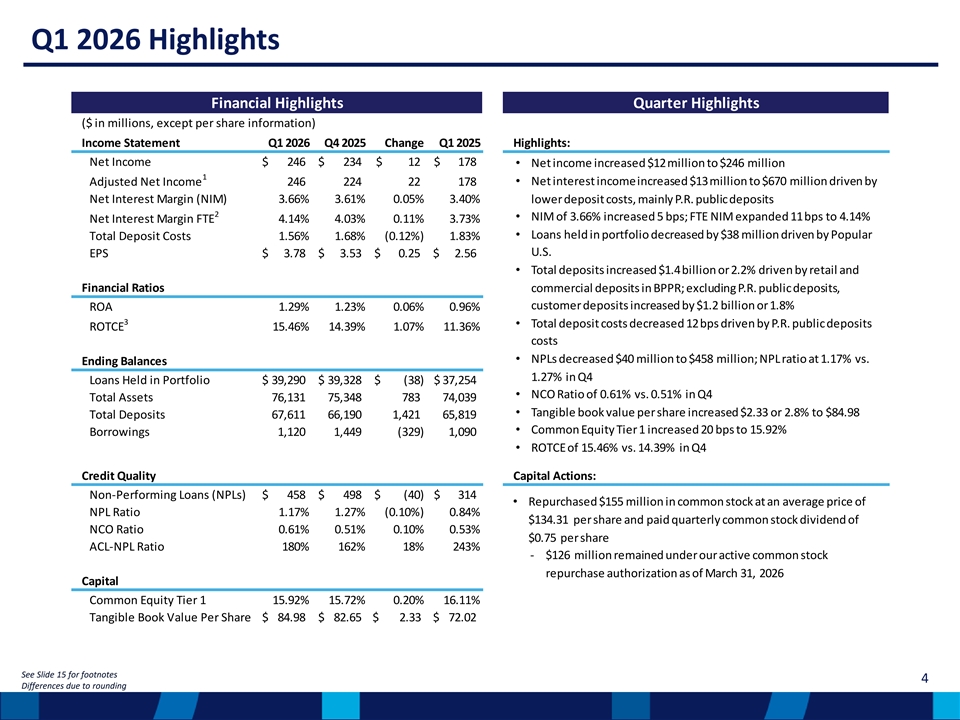
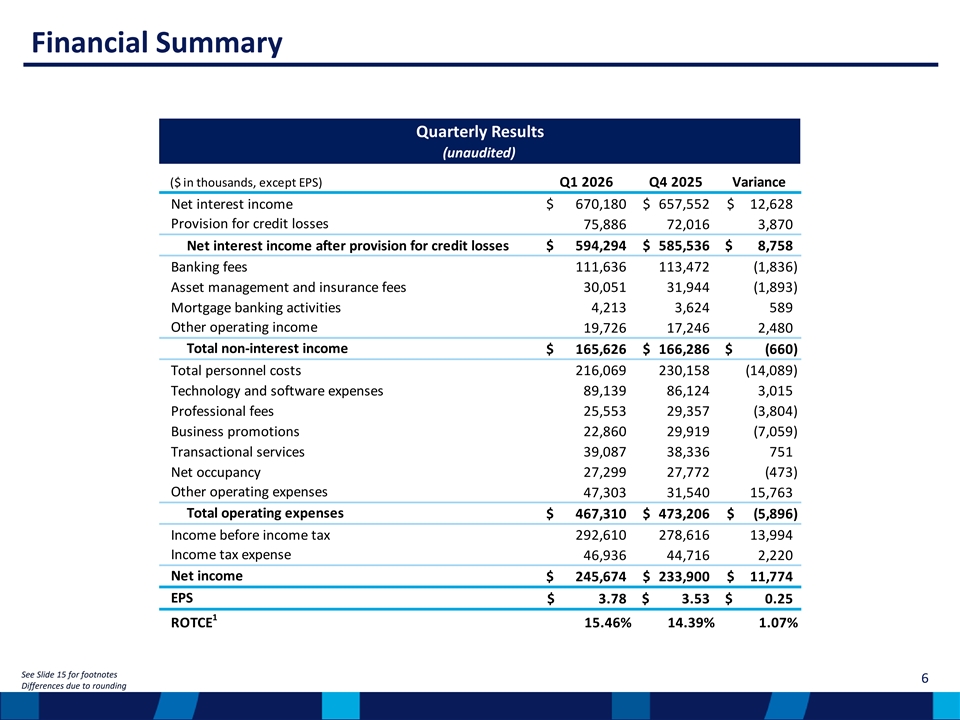
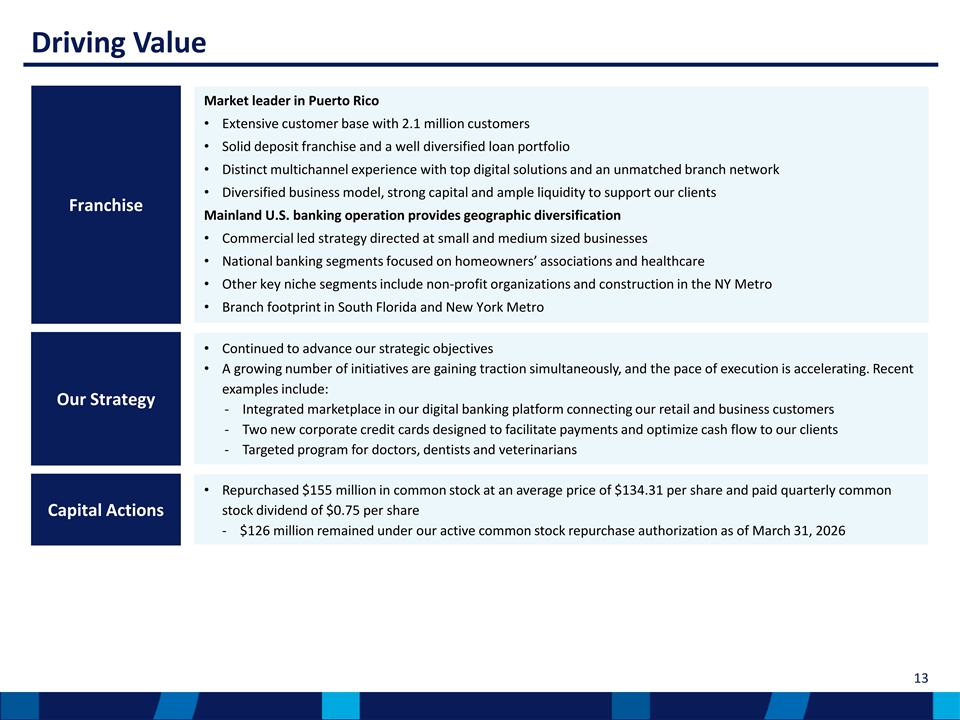
Thank you, Paul, and good morning, everyone. Please turn to slide four, where we share highlights of our strong operating performance in the first quarter. We reported net income of $246 million and earnings per share of $3.78, cents, up $12,025,000 per share from the fourth quarter. The improvement was driven by higher net interest income, margin expansion, and lower operating expenses. Net income and EPS improved by 38% and 48% respectively compared to the first quarter of 2025. We continue to invest in our businesses and expand our capabilities in support of our strategic objectives. When we deliver for customers, our franchise strengthens and our shareholders benefit. Overall credit trends remain favorable with lower NPLs and improved NPL ratios. Quarterly net charge-offs increase primarily due to a single previously identified commercial relationship. We also demonstrated our commitment to returning capital to our shareholders by repurchasing $155 million in common stock and paying a quarterly common stock dividend of $0.75 per share. Our ROTC activity was 15.5%, up from 14.4% in the fourth quarter of 2025 and 11.4% a year ago. We are very pleased with these returns and remain focused on reaching our 14% through the cycle objective. Before turning the call over to Jorge, I will comment on the business environment in Puerto Puerto Rico. Business activity in Puerto Rico remains positive, supported by steady trends in employment and consumer activity, with manufacturing, construction, and tourism leading the way. We're closely monitoring ongoing geopolitical developments as sustained higher oil and commodity prices can impact our customer base. As of the end of the first quarter, we have not seen significant signs of economic stress. The labor market remains healthy, with the unemployment rate at 5.6%, stable near historic lows. Three sectors have outperformed the broader labor market, construction, transportation and warehousing, and leisure and hospitality. Consumer spending remains healthy. Combined credit and debit card purchase by Banco Popular customers increased by approximately 5% compared to the first quarter of 2025. We continue to see healthy demand for homes in Puerto Rico. Mortgage balances at Banco Popular increased modestly during the quarter. Momentum in the construction sector continues to be solid, with public and private investment fueling high employment and strong activity. We're optimistic that these trends will persist given the backlog of obligated federal disaster recovery funds. On the private side, real estate and tourism development projects and the renewed focus on reshoring to Puerto Rico by global manufacturing companies should continue to support economic growth on the island. The tourism and hospitality sector continues to be an important contributor to the Puerto Rico economy. Year to date through February, hotel occupancy increased to 83 percent, up from 76 percent in the same period last year. Over the same period, REF PAR increased 6%. Hotel demand averaged roughly 400,000 room nights, representing 10% growth versus the same months in 2025. Passenger traffic at Luis Munoz Marín International Airport was down 2% in the first quarter after a record year in 2025. JetBlue also announced an expansion of its San Juan Harbor with five new nonstop domestic routes beginning in the spring of 2026. Cruise activity has also been a meaningful tailwind. after record cruise arrivals in 2025, arrivals accelerated sharply in the first two months of 2026, with year-to-date arrivals through February up 40% year-over-year. In addition, the Puerto Rico Tourism Company announced a strategic partnership with Royal Caribbean beginning in July of this year that would establish San Juan as the cruise line's home port. Moving to our strategic framework, we continue to advance our three objectives. A growing number of initiatives are gaining traction simultaneously, and the pace of execution is accelerating. One of our objectives is to be the number one bank for our customers by delivering exceptional service and products. A key part of that is making it easier for customers to engage with Popular through our digital channels. We recently launched an integrated marketplace within our digital app MiBanco, one of Puerto Rico's most widely used mobile apps. The platform gives our retail customers access to exclusive offers, discounts, and benefits from a wide variety of merchants, while enabling businesses, many of them small and medium-sized, to reach a high volume of potential customers. This allows us to create meaningful connections between our retail and commercial customers and strengthens the value of banking with Popular. are. We also launched two new corporate credit cards designed to facilitate payments and optimize cash flow. Both have gained traction and driven purchase volume. In addition to our core retail and commercial efforts, we are advancing targeted segment strategies to improve service, enable more personal, relationship-based engagement, and position Poplar as the primary bank earlier in our relationship with our customers. A recent example is our newly launched program designed to meet the unique financial needs of doctors, dentists, and veterinarians. The momentum behind these initiatives reflects the energy and focus of our teams. We are encouraged to see that execution, that execution translating into to stronger results and we expect the benefits to become more visible over time. And with that, I turn the call over to Jorge for more details on our financial results.
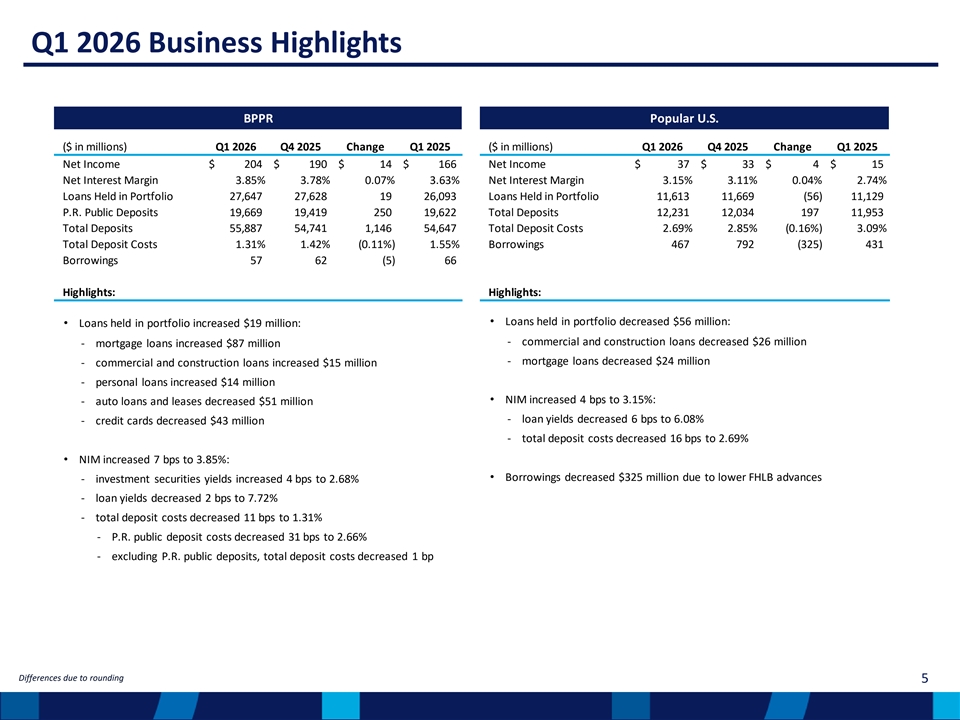
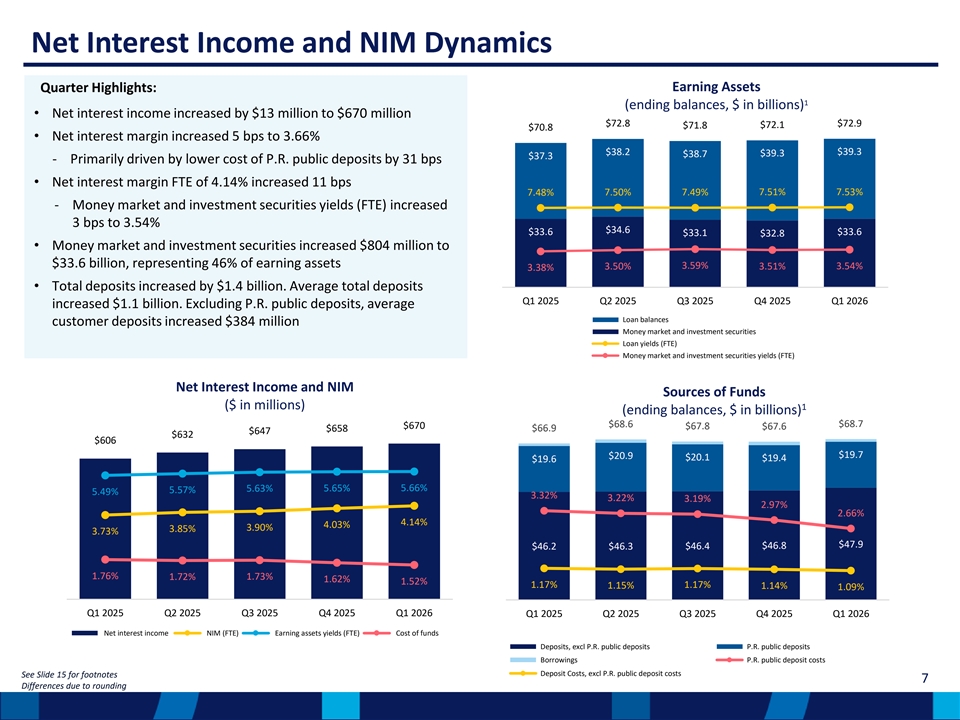
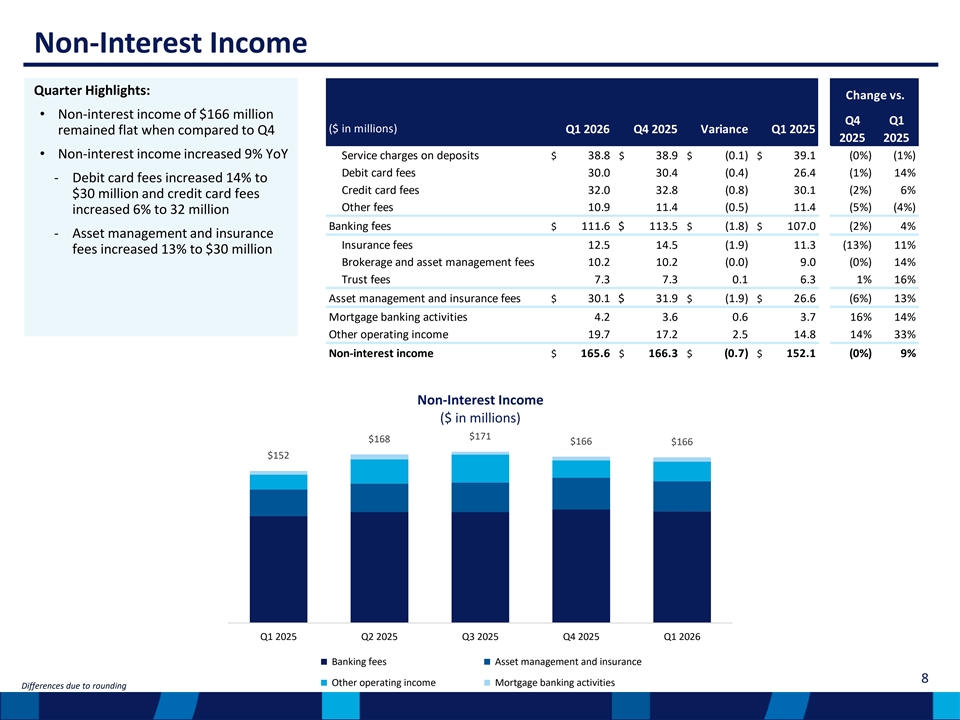
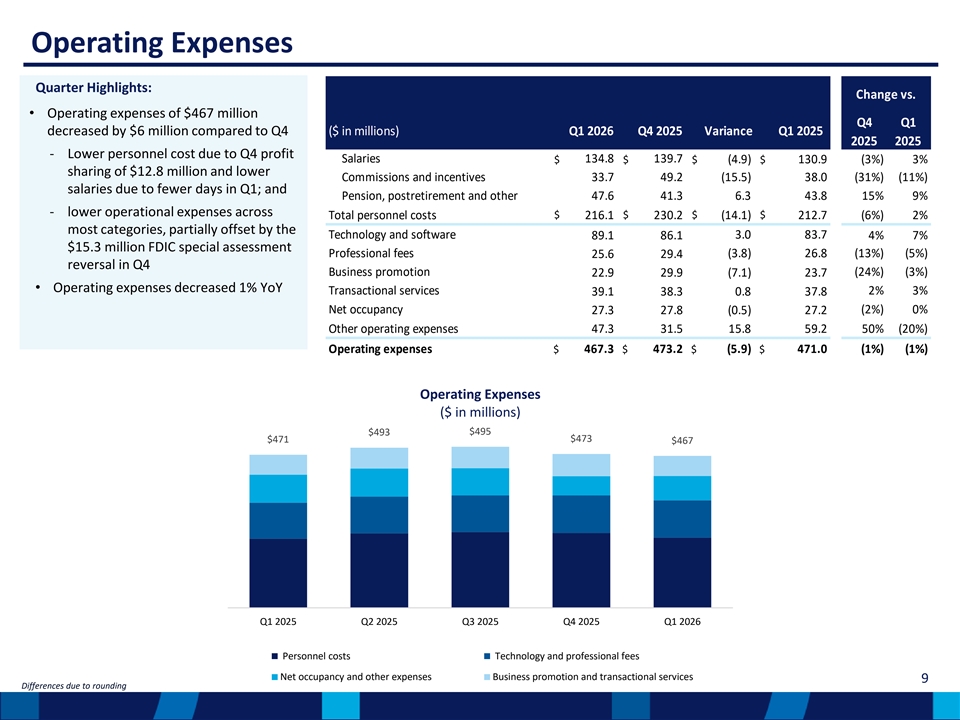
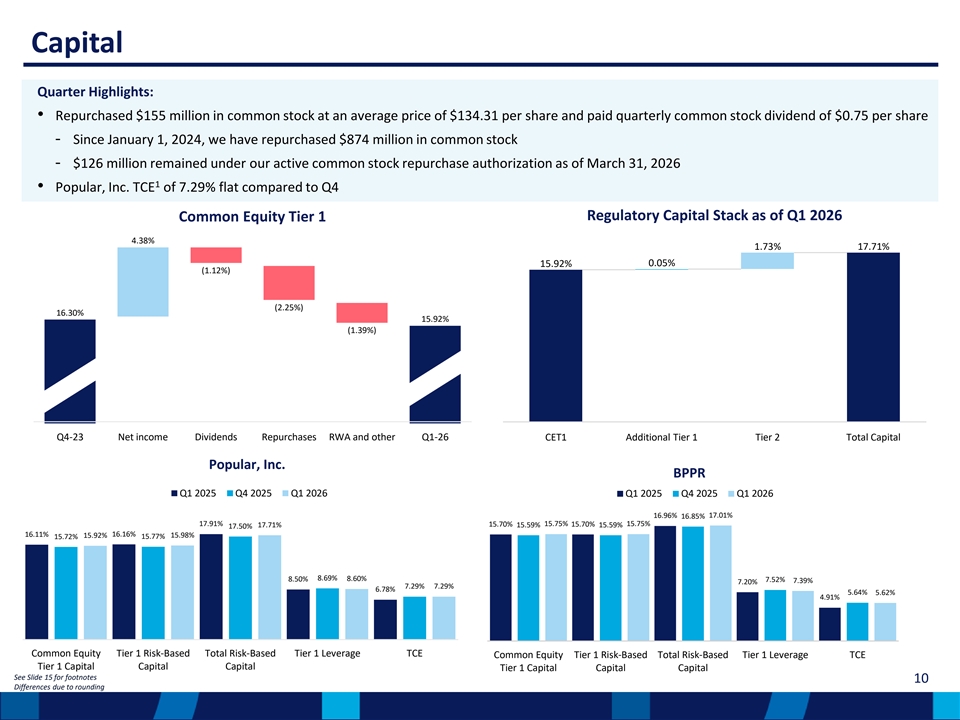
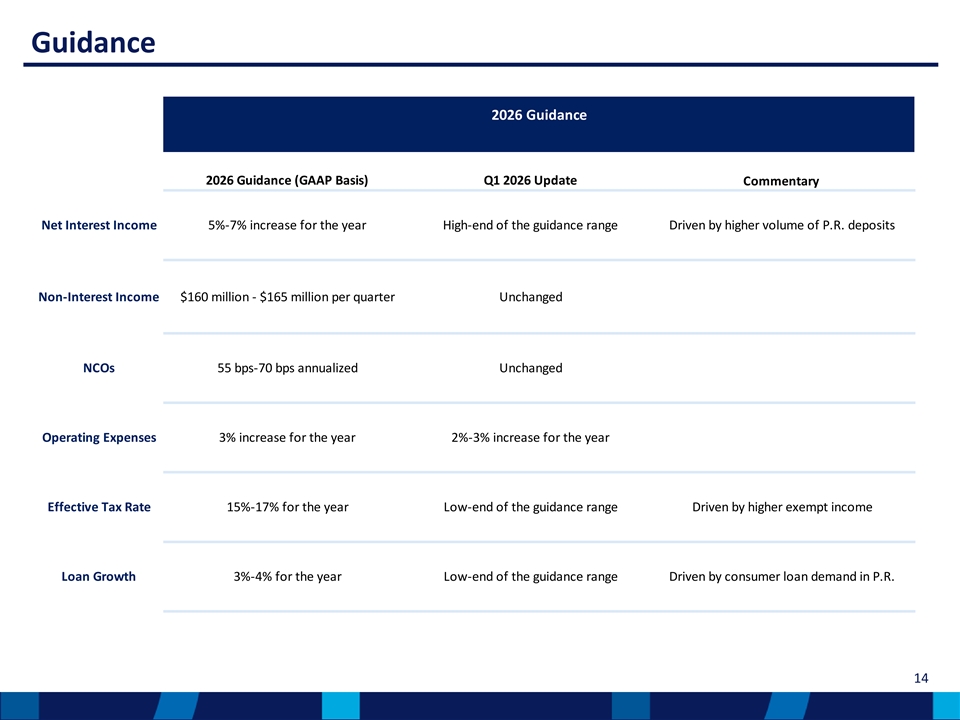
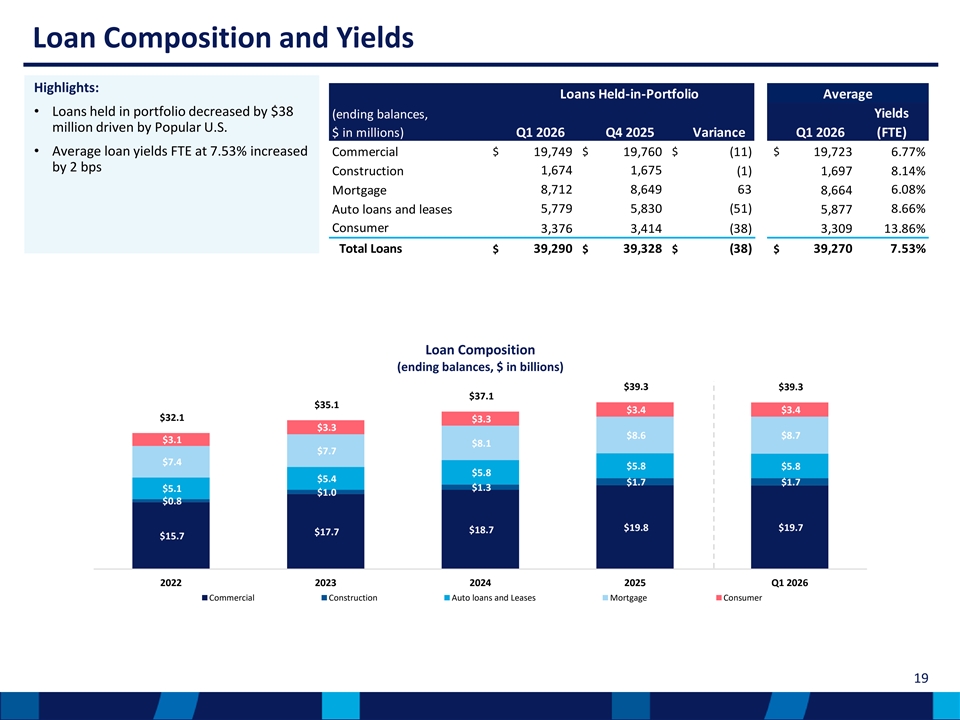
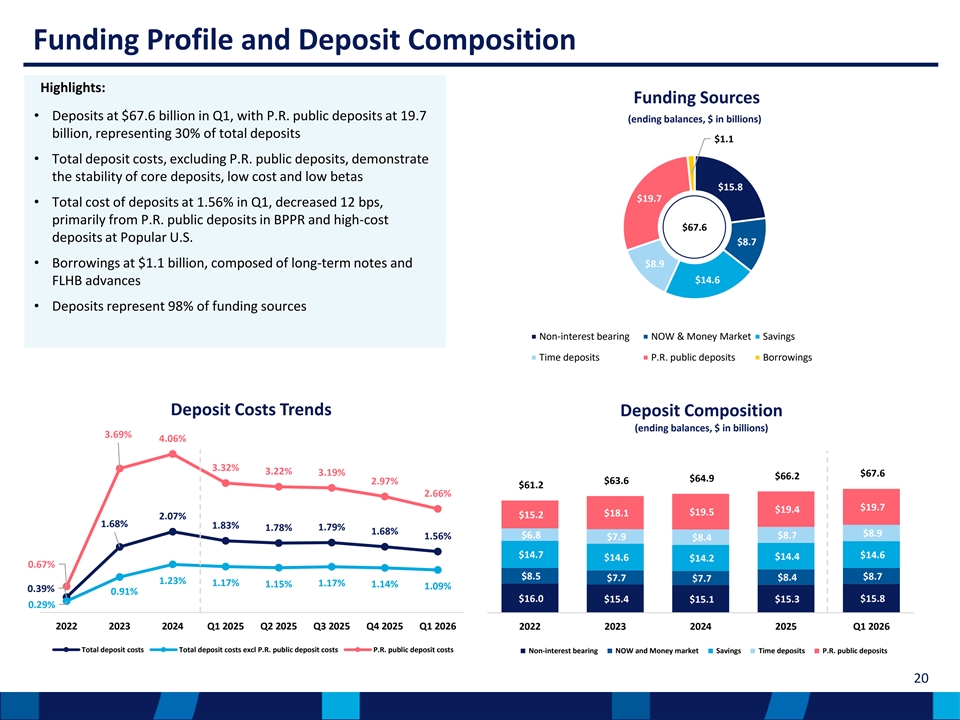
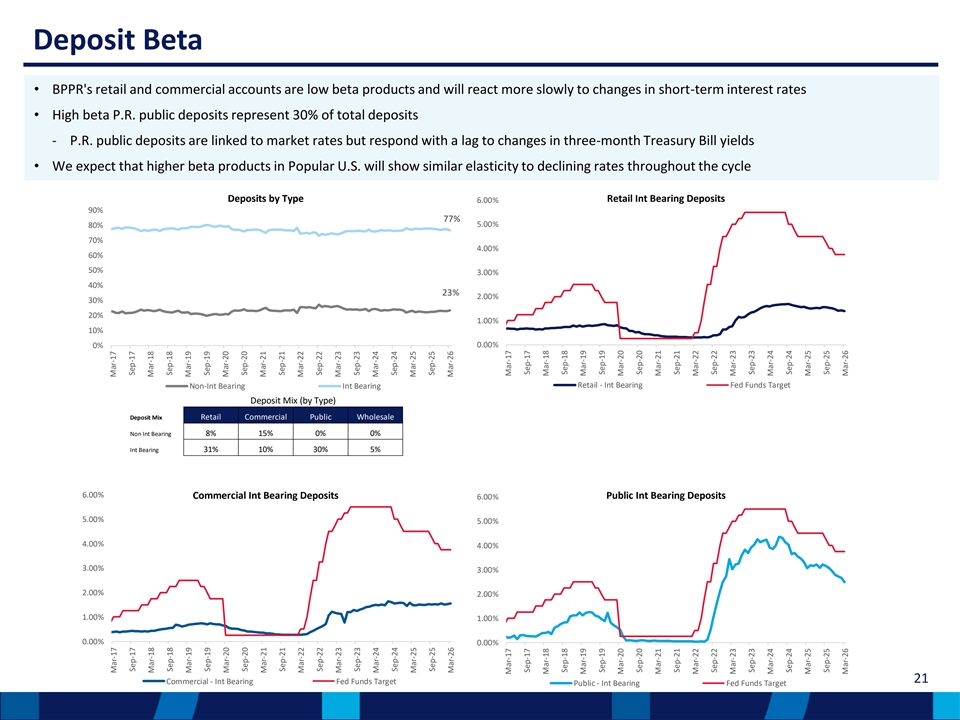
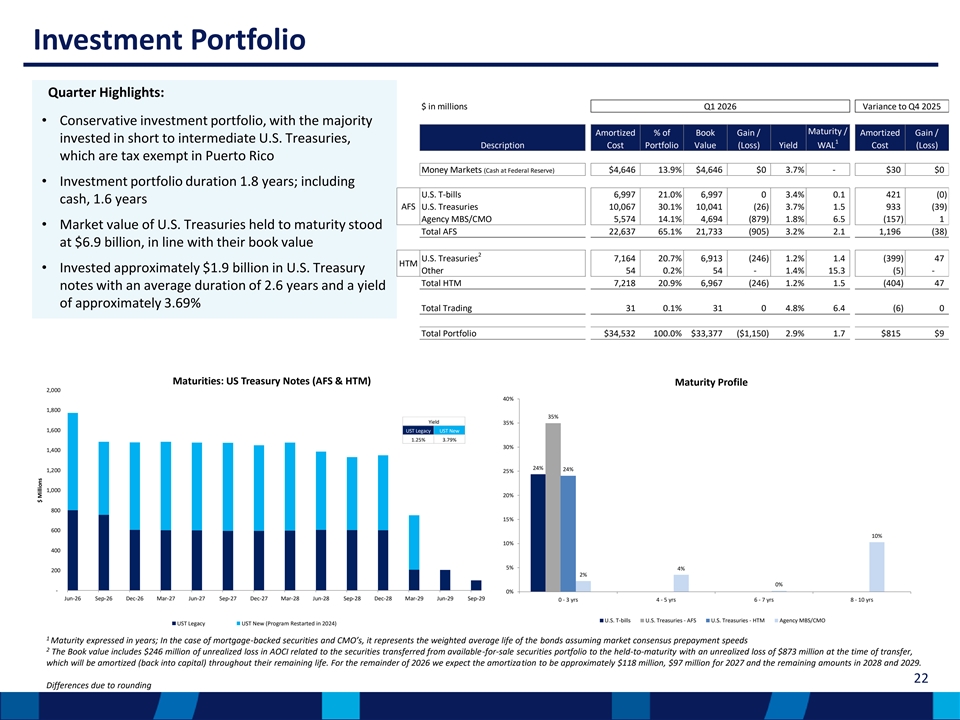
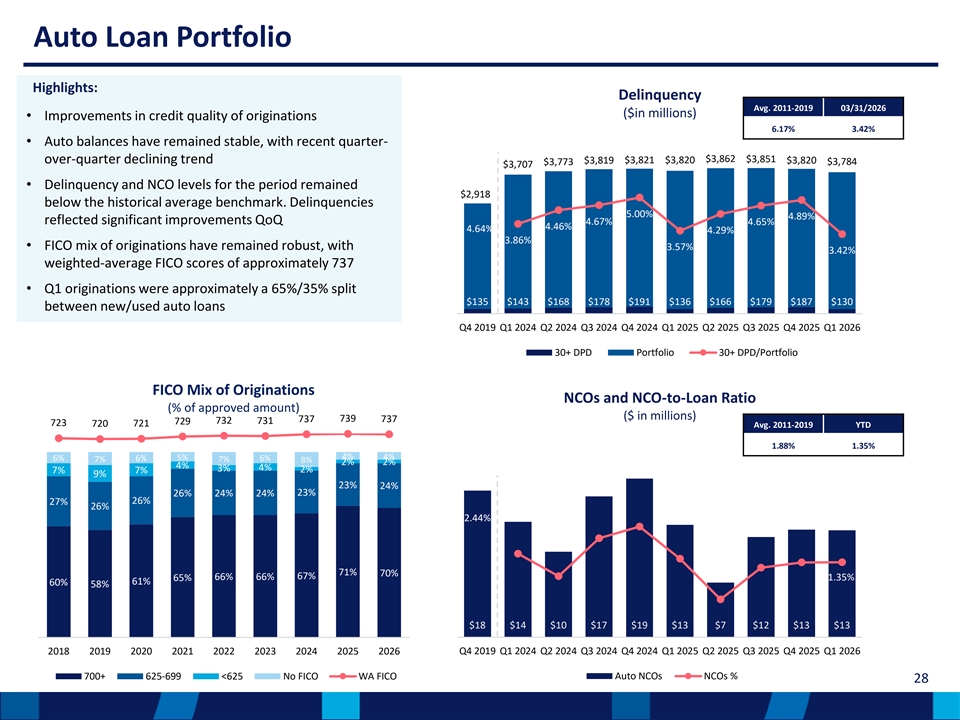
Thank you, Javier. Good morning and thank you all for joining the call today. As Javier mentioned, our quarterly net income increased by 12 million to 246 million and our EPS improved by 25 cents to $3.78. compared to adjusted net income in the fourth quarter which excluded a partial reversal of the FDIC special assessment reserve net income increased by 22 million these results were driven by better NII higher NIM and lower expenses partly offset by a slightly higher provision for credit losses our objective is to deliver sustainable financial results and we're pleased to have generated a 15.5% Roxy for the period. We will continue to use all levers to position the company as a top performing bank when compared to our mainland peers. Please turn to slide 7. Net interest income of $670 million increased by approximately $13 million, driven by fixed rate asset repricing and a higher balance of investments due to to higher deposit balances and lower deposit costs at both banks. Net interest margin expanded five basis points to 3.66% on a gap basis. On a taxable equivalent basis, the margin improved by 11 basis points to 4.14% during primarily by lower interest expense, including a meaningful reduction in the cost of Puerto Rico public deposits. Ending loan balances were essentially flat at $39.3 billion, down about $38 million from the fourth quarter, driven primarily by lower balances at Popular Bank due to paydowns in the construction segment and runoff from the exited residential mortgage business. At BPPR, modest growth in the mortgage and commercial segments were somewhat offset by weaker trends in auto lending. Given the slower demand in the consumer and auto segments, we expect consolidated loan growth in 2026 to be at the low end of our original 3-4% range. In our investment portfolio, we have maintained our strategy of reinvesting proceeds from bond venturities into U.S. Treasury notes and bills. During the quarter, we purchased approximately $1.9 billion of Treasury notes with a duration of 2.6 years and an average yield of around 3.7%, taking advantage of a modestly steeper curve. Deposit balance has ended the quarter at $67.6 billion, $1.4 billion higher than the fourth quarter. Retail and commercial deposits increased by $1.2 billion, driven by tax refund activity. On an average basis, total deposits increased by $1.1 billion, or by $384 million when excluding Puerto Rico public deposits. Puerto Rico public deposits increased by 250 million to end the quarter at 19.7 billion. We continue to expect public deposits to be in a range of 18 to 20 billion for the year. Total deposit costs decreased by 12 basis points quarter over quarter to 1.56 percent, with improvement in both of our banks. Excluding Puerto Rico public deposits, total deposit costs decreased by five basis points to 1.09%. At BPPR, deposit costs decreased by 11 basis points, mostly as a result of Puerto Rico public deposits repricing lower by 31 basis points due to lower short-term rates. At Popular Bank, the 16 basis points reduction in deposit costs was primarily related to lower online savings deposit costs and repricing of time deposits. Given positive deposit trends in Puerto Rico, we now expect 2026 net interest income growth at the upper end of our 5% to 7% guidance range. Please turn to slide 8. Net interest income was $166 million, in line with Q4 and at the high end of our quarterly guidance, with solid performance across most of our fee-generating segments. Compared to the first quarter of 2025, non-interest income improved by 9%, driven by growth in debit and credit card fees of 14 and 6% respectively, as well as 13% increase in asset management and insurance fees, demonstrating our ability to benefit from our breadth of product offerings. We continue to expect quarterly non-interest income to be in the range of $160 to $165 million. Please turn to slide nine. Total operating expenses were 467 million, a decrease of 6 million when compared to Q4. Excluding the FDIC reversal in Q4, operating expenses decreased by 22 million. The decrease was primarily driven by lower personnel costs as the fourth quarter included a profit-sharing accrual of approximately 13 million, along with the impact of fewer calendar days in the first quarter. This quarter also benefited from lower employee healthcare-related costs. We also saw lower seasonal business promotion expenses and lower professional fees, partly offset by higher technology and software expenses, reflecting our continued investment in technology and transformation initiatives. We expect full-year expenses to increase by 2% to 3% compared to our original guidance of 3%. We will continue to prioritize investments in our people and technology and continue to target expense efficiencies. Our effective tax rate in the first quarter was 16%, unchanged from the fourth quarter. We now expect the effective tax rate for the year to be at the low end of our original 15% to 17% guidance range due to higher projected income. Please turn to slide 10. Tangible book value per share at the end of the quarter was $84.98, an increase of $2.33 per share, driven by our net income and offset in part by our capital return activity. During the quarter, we repurchased approximately $155 million in common stock. We ended the quarter with $126 million remaining under our active repurchase authorization, which we expect to exhaust during the second quarter. As we have said in the past, we seek to maintain an active repurchase authorization in place, and we are targeting an update on capital actions before the second quarter's earnings call. In addition to common stock repurchases, we also expect to continue evaluating capital optimization alternatives and pursue a dividend increase during the year. Of course, our plans are subject to market conditions, regulatory considerations, and any required board approvals. With that, I turn the call over to Lydia.
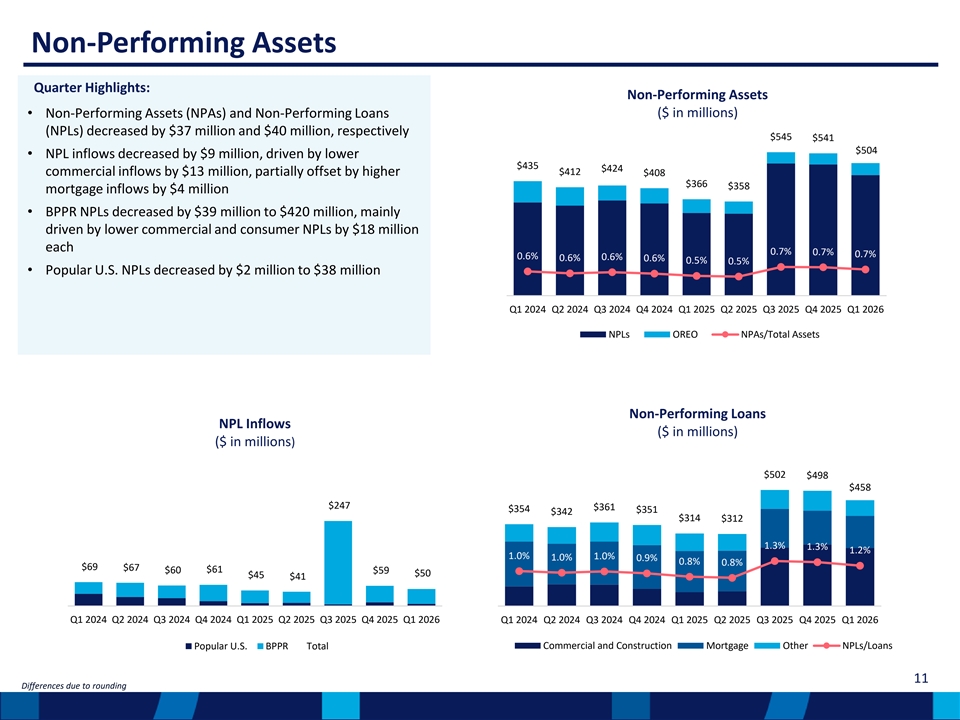
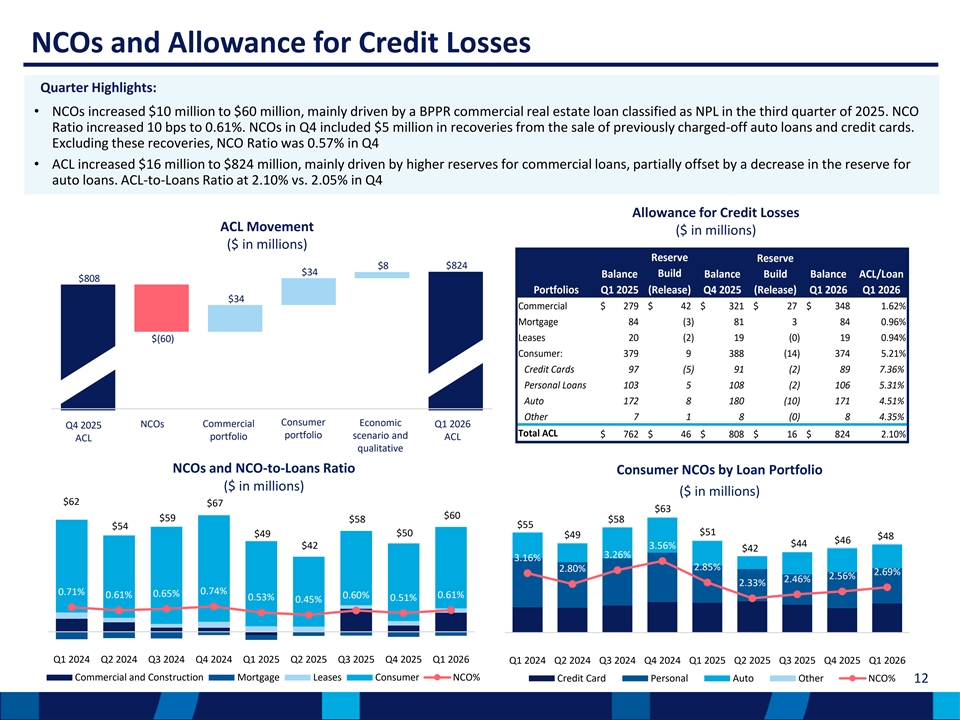
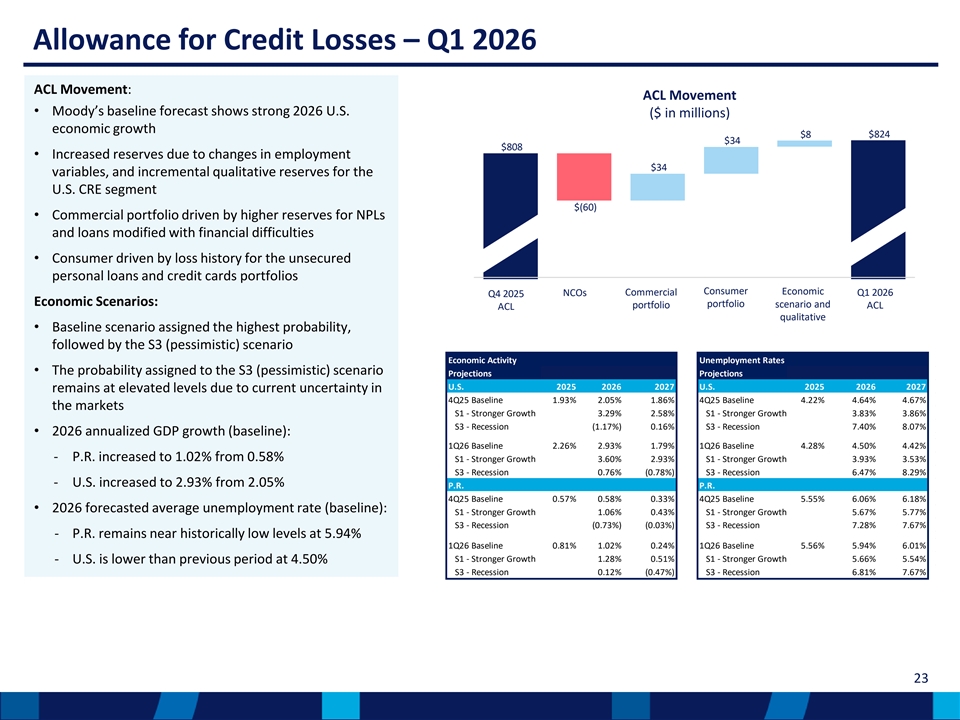
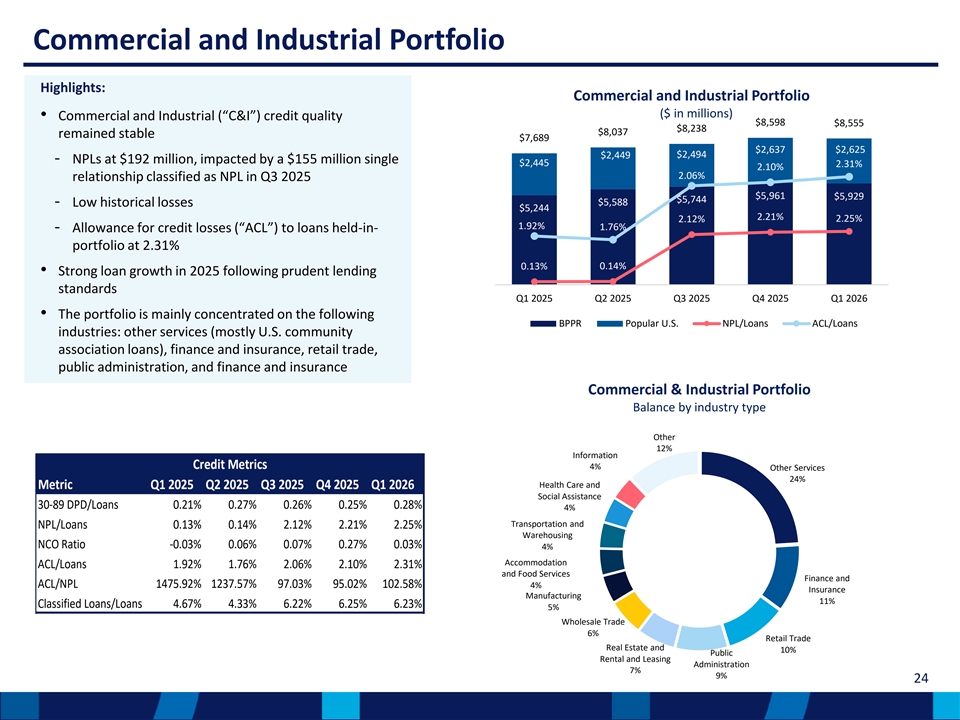
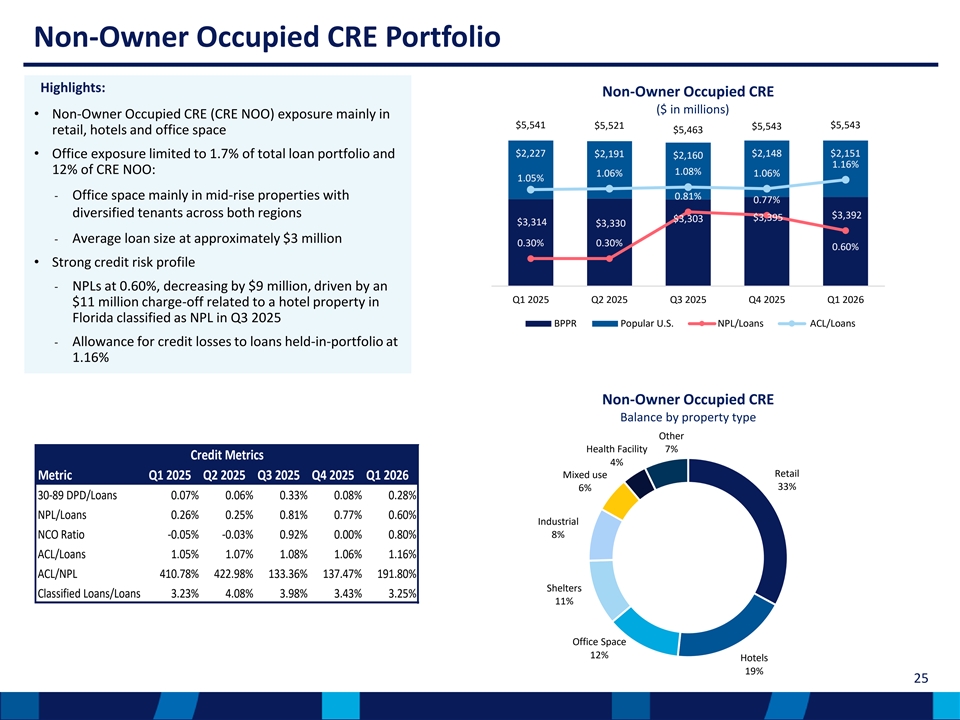
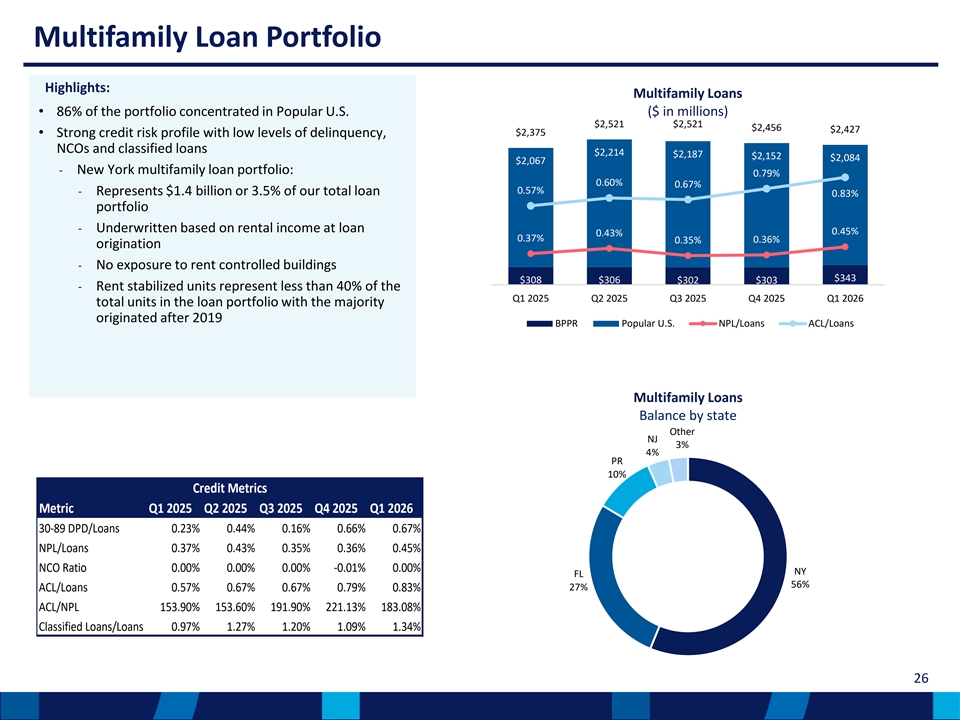
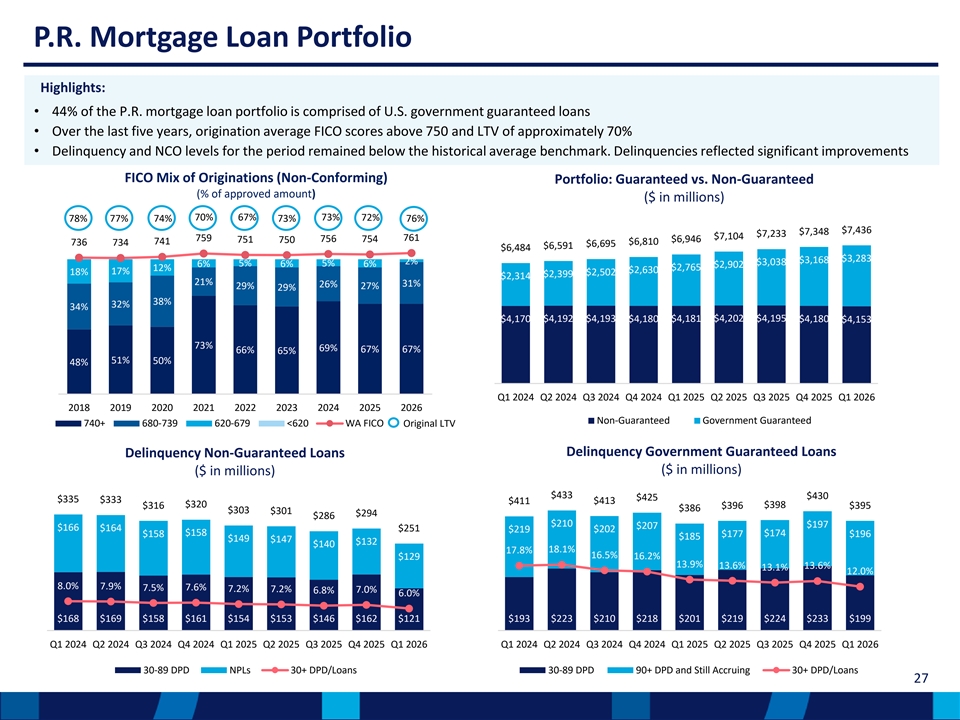
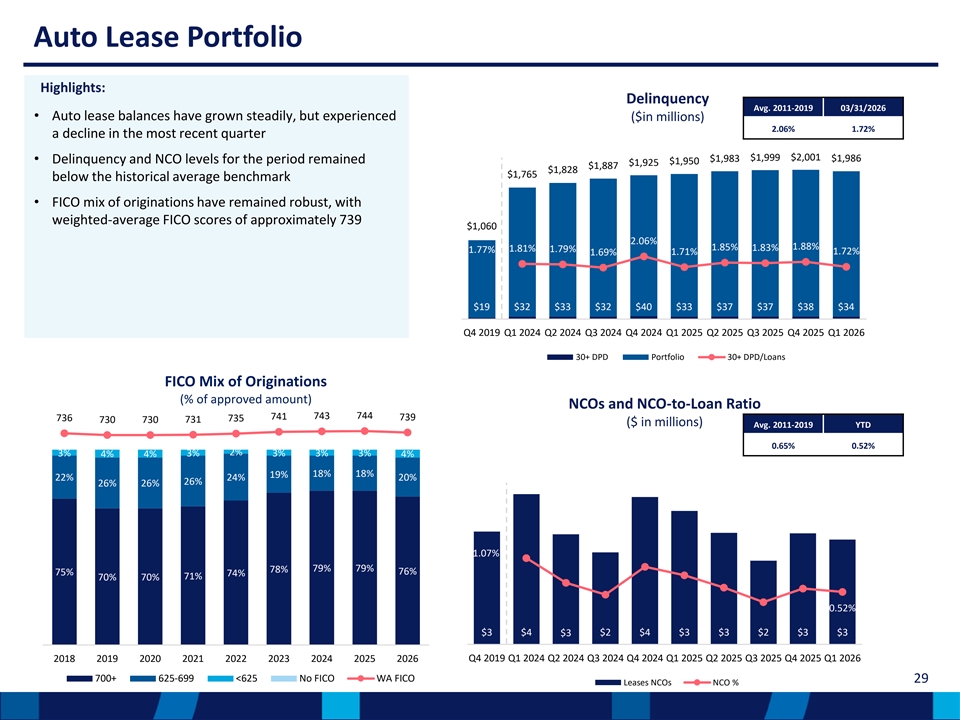
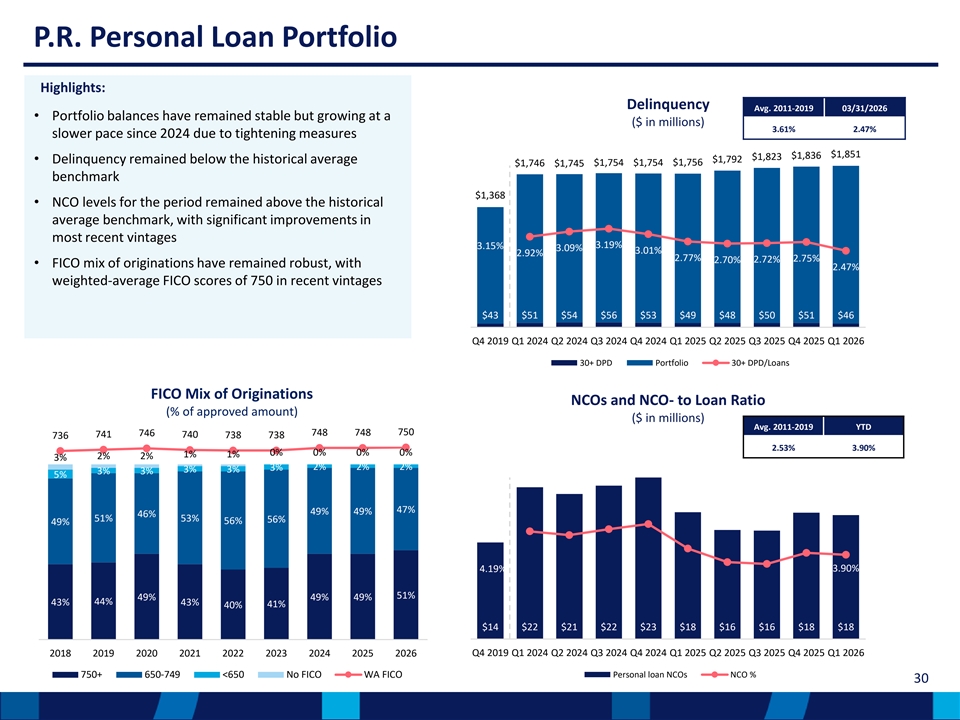
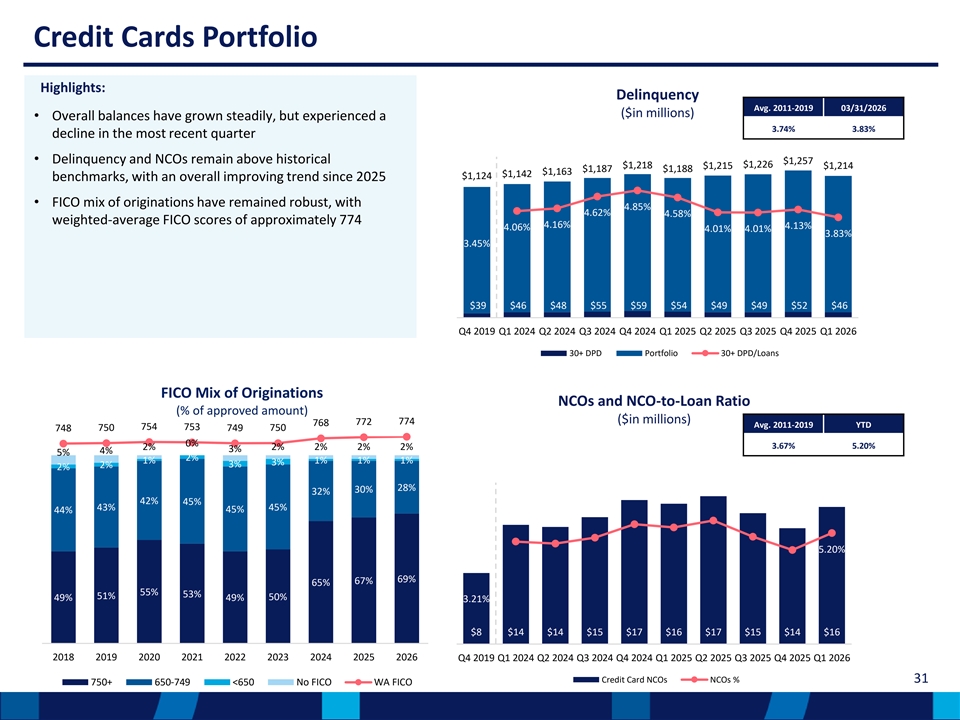
Thank you Jorge, and good morning to all. Credit quality metrics remained stable during the first quarter with lower early delinquency, NPLs and inflows, and higher net charge-offs. Despite the uncertain economic environment, our consumers, businesses remain resilient. We continuously monitor our portfolios for signs of stress, where our data remain consistent with normal seasonal behavior and no deterioration. Turning to slide number 11, non-performing assets and loans decreased by $37 million and $40 million, respectively, mainly due to Banco Popular de Puerto Rico. NPLs in BDPR decreased by $39 million. This was driven by reductions in the commercial portfolio due to an $11 million charge-off related to a commercial real estate facility classified as NPL in the third quarter of 2025 and consumer due to lower auto NPLs driven by increased payment activity. In the U.S., NPLs decreased by 2 million, inflows of NPLs decreased by 7 million with an improvement of 5 million in the U.S. and 2 million in BEPR. The ratio of NPLs to total loans held in portfolio was 1.17% compared to 1.27% in the previous quarter. Turning to slide number 12, net charge-off amounted to $60 million or annualized 61 basis points, compared to $50 million or 51 basis points in the prior quarter. Last quarter results included $5 million in recoveries from the sales of previously charged off auto loans and credit cards. Excluding this, the net charge-off ratio for the fourth quarter was 67 basis points. Net charge-off in BVPR increased by $10 million during the $11 million commercial net charge-off mentioned previously. Based on current trends and macroeconomic outlook, we reiterate our 2026 annual net charge of guidance of 55 to 70 basis points. The allowance for credit losses increased by 16 million to 824 million. The change was mostly in BPR, which had higher reserves in the commercial portfolio due to loan modifications and additional and specific reserves for a single borrower in the telecommunication industry additionally the ACL for the mortgage portfolio increased slightly due to changes in the macroeconomic scenarios these increases were offset in part by reduction in the ACL for consumer loans mainly in the auto portfolio reflecting improvements in credit quality in the US the ACL increased by 1.4 million from the previous quarter the The cooperation ratio of the ACL to loans held in portfolio was 2.10 percent compared to 2.05 percent in the previous quarter, while the ratio of the ACL to MPLs held in portfolio increased to 180 percent from 162 percent. With that, I would like to turn the call over to Javier for his concluding remarks. Thank you.
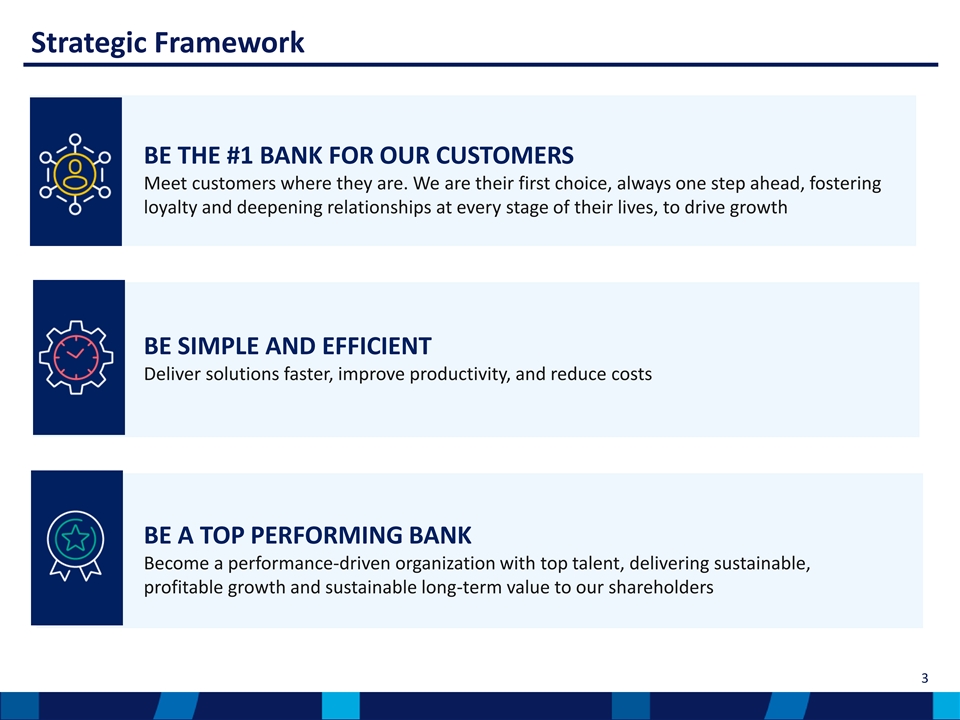
Thank you, Lidia and Jorge, for your updates. We're happy with our strong first quarter results. We grew an interest income, expanded our margin, and reduced operating expenses, all while continuing to invest in the franchise and advance our strategic priorities. While we are very pleased with the quarter, we remain focused on execution, growing deposits, regaining loans, and maintaining strong expense discipline. We are confident that the sustained execution of our strategy will advance our ultimate goal, to be a top-performing bank with excellent talent, delivering sustainable, profitable growth, and long-term value to our shareholders. A more personal note, this past February marked a milestone for Popular. We brought together our 9,200 employees for the first time in over 20 years, and I have to say, it was awesome. The event reminded each one of us what it means to be part of Popular and connected us with our history. The excitement was palpable and it was simply an unforgettable day. On behalf of my colleagues, I thank our clients and shareholders for their continued trust and support. We are very proud to be the leader in the Puerto Rico market. We're ready to answer your questions.
Operator
Thank you. We will now conduct the question and answer session. As a reminder, to ask a question, please press star 11 on your telephone and wait for your name to be announced. To withdraw your question, please press star 11 again. Please stand by while we compile the Q&A roster. And our first question comes from Jared Shaw of Barclays. Your line is open.
Hi, thanks. Good afternoon. Good morning.
Maybe just starting with the great growth on the deposit side, how should we think about average and end-of-period deposits sort of over the next few quarters as some of the tax refunds maybe get spent?
Yeah, so traditionally we do see increases in ending deposits in the first quarter. This quarter we saw also increases in average deposits is that we're bringing in the strength from the fourth quarter results. Historically, in the second quarter, we would also expect ending balances to trend lower, but average balances higher as the tax season overlaps the March and April, and people kind of spend that money through the quarter. And then, as you know, the third quarter is where we actually see ending balances coming down, and then in the fourth quarter, we tend to see ending balances come back up historically. So, you know, our guide increased towards the higher end of the guide because we are expecting, you know, more retention of those deposit balances. Our teams are very much focused on not only retention, but also in deposit growth. And so we, you know, while we would expect ending balances to perhaps come down from these levels, we do not expect them to see a runoff as we saw like in 2024, for example.
Okay. So, I mean, overall, though, I mean, you're still feeling like average account size is stabilized at a higher level. And so the magnitude of what, like you said, in the past may not be as severe.
Yeah. So I think we saw the peak in 2022. Those averages are like 40% higher. Those have come down to like the low 30s, 30, 32, and that's been stable for the last couple of years. We are bringing in new clients. That's resulting in higher balances. We're seeing, you know, strength across not only the retail but commercial. We see strength in our small and middle market clients. Our corporate clients also have a lot of liquidity, but they tend to be managing their treasury excess cash a little bit better. So, overall, we've been very happy with the trends.
Okay, thanks. And then, you know, in the past, you've talked about looking for potential acquisitions in the mainland. that match up with your geographic focus. Any update on your thoughts there? And if you're not able to find something that fits, could we expect maybe more of an organic de novo expansion utilizing some of your capital?
Xavier, I'll go for the first one. No change in our outlook on M&A. Our primary focus continues to be our transformation efforts and growing profitability of the institution.
And in terms of De Novo growth strategy, I mean, it's tough to compete in the U.S. markets in retail, which is what normally you would see with De Novos. We have been successful in expanding some of our national businesses through either team acquisition or team hires. And maybe that's an opportunity. It's not unusual for banks our size to be looking at that, leveraging those niche businesses. But I think at this stage, we have opportunity to improve profitability in our U.S. operations organically, but not necessarily through investing in a big branch de novo expansion.
And in Puerto Rico, frankly, we're the strongest in the market given our branch footprint. It's a differentiating factor for us, continues to be. And the United States, as I was saying, our strategy is more commercial-led. So, I mean, it's going to be difficult to actually expand in any major way our footprint in terms of branches. So, that's where we're at.
Okay. Okay, thanks. And if I could just ask one final one. Have you been seeing any spread compression on the loan portfolio or on new loans?
And where were you putting on new loans in the quarter? if you look at the levels and yields we continue to be successful in expanding and are keeping our our loans yields fairly flat even with rates coming down so we have not seen that broad base i mean we talked in the last call how competition particularly in puerto rico and auto and you know you've seen kind of with our with the trends in that portfolio that we could see potentially you know maybe more competition in pricing but so far you know we've tried to get our teams to focus particularly in the US business where we see maybe a particular beginning of the year more competitive pricing we try to push our teams to be smart and provide you know profitable long growth not just long growth and focus on relationship banking making sure that those relationships are coming in with deposits so that you know you you know, gives us kind of a fresh start on making sure that we're not chasing irrational pricing on loans. Okay.
Operator
Thank you. And our next question comes from Brett Rabbitin of Stonex Group. Your line has been...
Hey, good morning, everyone. Wanted to start on the NII guide, and, you know, it was great to see the first quarter higher NII than expected, lower expenses. just thinking about the high end of the guide with the slight growth and balance sheet would kind of imply the margin is fairly flattish but you still have securities that are maturing you know any thoughts on I know you don't like to give margin guidance but any thoughts on the margin and then just as you see it maybe the opportunities relative to NII growth from here We do expect the margin to grow by the end of the year.
You know, we had a nice expansion in the first quarter, driven a lot by the repricing of the public deposits. We don't expect that level of repricing to occur. That's going to be, you know, dependent on what happens to short-term rates and certainly, you know, the price with a lag. So I think, you know, I would expect the expansion of the margin to be slower in the second quarter, but then continue to expand as we drive to that higher NII guidance. So, you know, as you said, we do have the tailwinds of the fixed rate investment portfolio to continue to reprice. So that hasn't changed.
Okay, and if the Fed doesn't cut interest rates, would that put you above the higher end of the range on NII?
Our current guidance assumes no further cuts in 2026. For us, I'd love to see the steepening of the curve, but margin really depends on the mix of deposits. If we are heavier on public deposits, that will have an impact on that margin. Really, the NII guidance is kind of how we see the front now. Deposit balances will, as we said, and the deposit costs are really kind of the drivers of that spread and being able to get above our current guidance.
Okay. That's helpful, Jorge. And then the other question I had was just around capital and 15.9% CET1, and it sounds like you're going to give a lot more color in 2Q. And I think it's great that you guys have kind of acknowledged that investors have wanted to see the capital base deployed. Any color that you can give us just around your thoughts on end-of-year capital ratios or targets or anything as you're working through this that you could share with us on your progress there?
We want them to be lower than they are now, unless we make a lot of money and not. But no, I mean, we are committed. We obviously have said in the past that we want this to be, you know, we want to do it in a kind of overtime in a controlled manner. But we certainly are committed in doing that. We're trying to be more intentful in our language and how we communicate about this. And, you know, we are committed to executing.
Okay. Great. I appreciate all the color. Thanks, guys.
Operator
Thank you. And our next question comes from Timur Brasillier of UBS. Your line is open.
Going back to the profitability comment, two straight quarters now above that 14% objective. I guess, Javier, I was a little surprised to kind of hear you reiterate that comment on remaining focused on reaching that 14% through the cycle objective are we not there yet and I guess that phrase through the cycle like how far out are we looking in terms of that level of sustainability well thank you for your question I think that um I mean to quote two quarters to great back-to-back rough sea quarters a trend doesn't necessarily make so I mean we like that to continue obviously and I think that through the through the cycle comment
refers to a period when of course we were seeing stress major measures in the economy and so that so that we actually demonstrate that you know facing this sort of more sort of headwinds, we deliver on profitability targets. So that's how we're thinking about it. Again, I think the teams are doing great, but we don't want to – remember that we also use the concept of sustainability. It needs to be sustainable. So that will take a little bit longer for us to claim victory. And, of course, once we get there, we're not stopping there. And that's important. I mean, remember that we used the 14 when we launched a little bit over three years ago, our transformation program. So, again, very happy with the mindset shift and what we're producing for shareholders, but we're not there yet.
Got it. Okay, that's a good caller. I appreciate that. Maybe sticking on the capital question, any kind of caller you can provide on just Basel III proposals? what type of impact that might have on your capital base?
Yeah, so, you know, first, we're not subject to the, you know, category four, you know, with AOCI, so we're small enough that that doesn't impact us. We've done the preliminary review teamer, and basically our estimates are consistent with what the Fed guidance is that will be the impact for smaller banks. Obviously, the end result will depend on our balance sheet when that goes into place and whatever the final, you know, rule has. But right now, it's consistent with the estimates. And that's a reduction in risk-weighted assets, basically.
Yep, okay. And then just one more from me. Appreciate the full-year guide on public funds. Just wondering, second quarter specifically, if there's any reason why we shouldn't be penciling in kind of a historical type run rate for the planned increase in public funds in 2-2.
I mean, I don't want to speculate. I mean, as you know, it's over 200 different clients, thousands of accounts.
You know, we talk to our clients, our relationship officers talk to our clients. we have some some visibility but you know some of these these are big numbers and that move around so we're going to stick to the 18 to 20 billion dollar range okay and then sorry just i just want to make sure i'm understanding the basel 3 impact i think it was around seven percent was the fed guidance is that kind of what you're alluding to in terms of impact on rwa thank you and our next
Operator
This question comes from Aaron Zaganovich of Truist. Your line is open.
I just want to hear your views on onshoring manufacturing in Puerto Rico. Obviously, last year there were a lot of large announced investments. I haven't really seen any kind of new ones yet this year or anything that you're hearing in terms of new potential investments. and have you seen any actual benefits yet from the ones that were announced last year?
Hold up. You're right. There hasn't been any new public announcements by the government, so we don't want to get in front of them. But they continue working through the grapevine. They continue working on more entities coming in. And there's two more entities that, you know, we've heard about, but again, looking at what's happening in the world, it's totally rational to believe that the momentum in continued investment, be it in big operations that are relocated in Puerto Rico or new entities coming into Puerto Rico, not only from the United States, but also from Canada and the Far East and Europe even, should continue. So we are, again, expecting announcements from the Puerto government on it, but we don't want to get in front of rumors. But so far, all the rumors we've heard before, the actual announcements from last year, the LA Lilies, the Amgens of the world panned out, so we have our fingers crossed that the momentum will continue on reshoring for Puerto Rico. And as you know, manufacturing represents approximately 44% of our GDP, so it's, you know, it's an important contributor to our economy. Not only direct jobs, they're also indirect jobs, most importantly.
Have any of the ones that were announced last year started to get, you know, produced yet, or any movement there? Is it going to take some time?
It's going to take some time. We have seen some new ones coming in and opening accounts with us, and purchasing property and stuff like that. So they're setting up. Typically, it's a process where once they announce, the government announce, that means that they've gotten to an agreement with the companies, and then the companies, after that, start opening bank accounts, investing in real estate, getting third-party service providers coming in and doing the work. So we've seen some of that. So it has started. But as we've always said, it's going to take three to five years to actually get the actual numbers, you know, and the impact.
And the largest announcements are expansions of facilities, so they will require some significant construction investment and time. So we will first see that impact on the construction side, you know.
And then lastly, just Lydia, you had mentioned some loan modifications in commercial. Are these anything new, abnormal, increases, decreases? Just curious if you could give us a little color on that.
I mean, nothing that I will characterize as being affecting the broader portfolio. Just one-offs. Some clients are having some financial difficulty, and we executed some modification, but nothing that impacts the whole portfolio.
Operator
Thank you. And our next question comes from Kelly Mata of KBW. Your line is open. Hey, good morning.
Thanks for the question. Maybe to kick it off on expenses, I see you were very well controlled in the first quarter and the guidance range was brought down a bit. Just wondering if you can opine upon the drivers of that variance. I know there's some transformation efforts in play, wondering if, you know, some of those investments have been kicked out another year or two.
Thank you, Kelly. I mean, there's always part of projects that maybe are slow to start. I wouldn't say that anything has been canceled or, you know, that is resulting in that reduction. But we are seeing we did benefit from a handful of things, better negotiations, some adjustments to expected expenditures that were lower in the first quarter, we reduced some excess accruals from incentive payouts for profit sharing from last year. So those are all things that you see the benefit in the first quarter and that benefit will sustain for the year. there's others that are timing differences and you know but but you know I will continue to invest in technology will continue to invest in people we will continue efficiency efforts our our expense targets for the year already included around 50 million dollars of efficiency efforts we continue to improve upon some of those so that that's all part of our embedded guidance so there's just a lot of things going on but in no moment are we like pulling back on our technology and transformation efforts there are shifts for example we went live on our erp in january so there are shifts in how those costs uh translate you know in in terms of expenses you know that things maybe were being capitalized before now they're being amortized but overall we are happy with the level of focus of our teams on cost control and in execution got it and just just as a point of clarification I guess this this guidance range doesn't include any of that excess profit sharing so if you were to say be you know your NII outlook that's that's the type of thing where
where those expenses would kick in is that their correct way to think think through that cadence?
That is the correct way. I mean, we'd love to be able to pay profit sharing. You know, we believe that those programs are aligned with our shareholders. That means that we are performing better than expectations. And if you assume that our original guidance are based in part by our expectations and budgets, then our interests should be aligned. Our current guidance does not include any profit sharing expense.
But remember last year, even with a near $40 million profit sharing expense we were able to deliver on our original expense guidance and of course we always want to challenge our teams to be able to do more and absorb any incremental expenses that were not part of our plan got it maybe maybe last question if I can just slip it in on on the size of the balance sheet cash money market investments have come down you You know, year over year, they're relatively flat, about $4.8, $4.9 billion-ish the past two quarters. Is that a good level on a go-forward basis, or would you anticipate, you know, continued roll into securities and loans off that 485 level?
Yeah, I think we've had that level for the last two or three quarters.
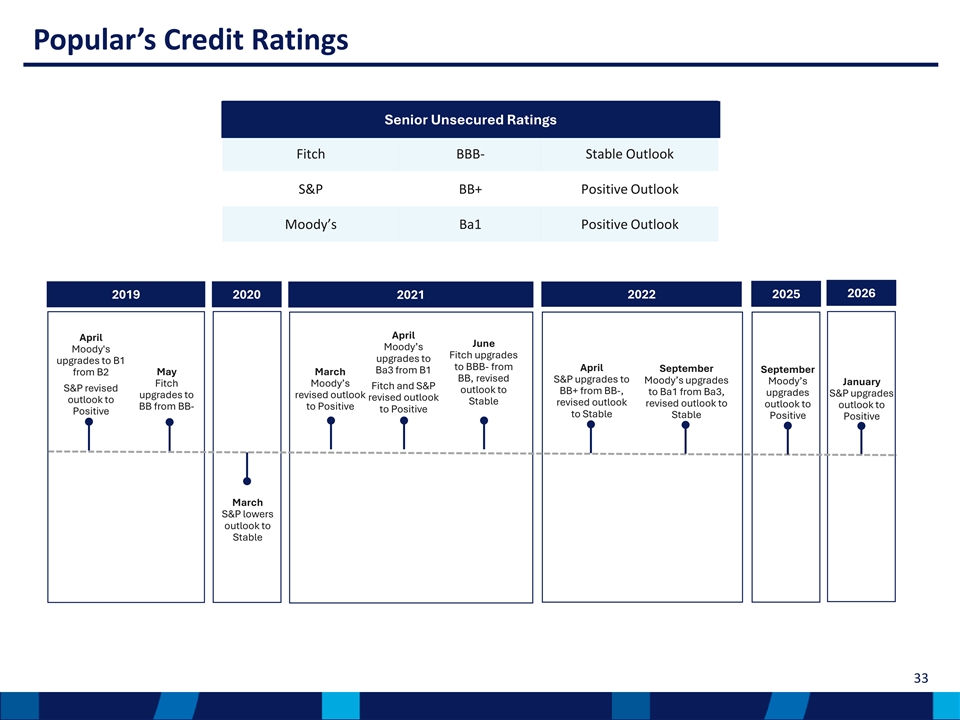
You know, we're comfortable with where we're at on that. we still have you know yeah I'll leave it at that okay thank you so much thank you and our next question comes from Gerard Cassidy of RBC your line is open if I recall my credit ratings correctly and looking at this your slide deck you showed that S&P and Moody's have you on watch lists with positive implications, and it looks like you're a notch below investment grade by those two rating agencies. I know Fitch, I think, is an investment grade. Can you share with us when you think they'll determine whether they're going to lift that credit rating? And can you also remind us, what was the last time popular was rated investment grade by Moody's or S&P's?
Well, I'd love to be able to guess and answer the first question, Gerard. What I would say is that we are focused on discussions with the rating agencies. We had an advocacy effort to make sure we continue to educate them and spending time making sure that they are up to date on everything that's going on with Popular and Puerto Rico.
But I cannot begin to guess. we believe that our ratings should be better frankly but you know and how long has it been and my guess is probably go back to you know 2005 2006 before the financial crisis it's an insightful question you know I think that if you we have sort of retaken the efforts to meet with SMP and Moody's and visit with I was suggesting if you look at it, if you look at the purely numerical thresholds for us to be considered investment grade, I mean, we were there, but there are other things that may come into their consideration of us as Puerto Rico's largest financial institution as they see Puerto Rico. But I think, again, if you were to look at us as our peer banks, given our performance, we would definitely be investing great-rated. But we'll take that as momentum. Yeah, we'll take that as momentum.
Yeah, I agree. Yeah, I agree. As a follow-up question, I know you guys talked about the price of oil. You haven't seen any significant signs of economic stress at these elevated price levels. Can you share with us a couple of things? Do you recall in the first quarter of 2022 when Russia invaded Ukraine, obviously the price of oil shot up? What kind of impact did that have on credit quality back then? And then second, if oil stays elevated at $125 a barrel, let's say, throughout the year, it would appear to weigh on not only the Puerto Rican economy, but the U.S. economy as well. And what do you think that could do to credit quality? And then lastly, can you also remind us, I know the island is very dependent upon oil for its energy, but I thought the island was moving to other alternative sources, maybe, natural gas, LNG. If you can update us on anything, if I remember that correctly.
I will say, Gerard, this is Lidio, I will say that the answer to that is going to depend on the length where the pressure of oil stays at this level. I mean, similar to the, in 2022, I mean, the situation was, or the increase in oil prices was short-lived, and that had very minimal impact in terms of the delinquencies and the quality of our portfolio. So for us, I think the key is, and the key and the impact for Puerto Rico and our portfolio is going to be the length of time in which we have elevated oil prices in the island. And as we noted in our prepared remarks, we are very comfortable with our portfolios. We have seen no deterioration in the credit quality, we've seen normal seasonal patterns, and actually our delinquencies are better than the last quarter, obviously, and much better than this time last year. So we're very, very pleased with our portfolios.
So the premise, Jared, the premise in your question is spot on. I mean, we're no different than international institutions in the United States if the conflict continues for a long time and oil doesn't come down, as you know, we're dependent on that to generate electricity in Puerto Rico. There's been growth in other sources of energy for Puerto Rico, but I don't think we're going to be able to switch quick enough not to have higher oil prices for longer impact us and our customers. But so far, you know, so far we haven't seen it. I think the second quarter will be, you know, will tell the tale more accurately if, in fact, the conflict continues and the price continues to go up or stay higher for longer.
Very good. And, Lidio, can I just circle back on your comment about delinquencies? Is it as simple as the health of the economy being as good as it is? you guys mentioned the unemployment rate is near record lows is it that straightforward that the health of the economy is the underlying factor why the delinquencies and credit are as strong as they are in the consumer books as always a combination of factors but certainly I mean the driver for the performance of consumer books is employment in addition to that as eluded by Horan in his remarks, you also have them in the first quarter, refund activity.
In Puerto Rico we have given, based on data provided by the local IRS, they have returned refund to customers around 2.2 billion, which is slightly ahead of the pace of last year, about 200 million ahead of the pace of last year. that's obviously impacted the liquidity of consumers in Puerto Rico and their ability to pay their loans.
Operator
Thank you. And as a reminder, if you have a question, please press star 11. And our next question comes from Manuel Navas at Piper Sandler. Your line is open.
I think this builds off a little bit of the last commentary. But you added reserves on the commercial NPL from the third quarter, But most other loan buckets had lower reserves, especially with the auto and consumer, especially with delinquencies down. Could there be some upside in provisioning from here, reserves coming down? Or how do you feel the progression should go forward from here in credit costs?
I mean, I like your thoughts. I mean, I agree with you. I mean, we had very strong performance from our consumer books, and that led to a release of reserves, particularly in the auto portfolio. We have done a lot over the last few years in order to improve the performance, so it is not by chance. It's also by the work that we have done. In the commercial book, as we have said in the past, this is mostly corporate book, so every now and then we have a situation with one-off clients that we may need to reserve for. We haven't seen anything that indicates that we have product-based issues with our portfolios. We have dealt, as we mentioned, in the third quarter of last year, and to some extent in the first quarter of this year, with two particular cases, one related to commercial real estate in the U.S., and one related to a telecom company in Puerto Rico. but we think if the economy stays where we are and delinquency at this level that there might be opportunity in the quarters ahead so we'll see and that opportunity could show up in a couple different places and i'm going to probably ask a question that has already been asked a couple times is do you anticipate the buyback accelerates i mean we we you know um we'll be consistent you
know, we'll come back to you and as to the levels, you know, we'll be consistent in trying to bring down the level of capital, but frankly, I mean, we're looking at it over a multi-quarter period to try to get to, you know, levels that, you know, target levels that make sense, and I'm not sure that any given quarter, any provision really, you know, changes in our projected provision or where we're at is going to make a difference in our repurchase strategy went on understandable is the the update that we're expecting at some point this quarter would it include business line changes anything beyond um just an update on a reauthorization of shares we're talking about just uh our traditional kind of update on kind of authorization from our from our board and um and perhaps dividend increases etc okay i appreciate it thank you thank you i'm showing no further questions at this time this concludes today's conference call thank you for participating and you may now disconnect