Operator
Thank you for standing by. At this time, I would like to welcome everyone to today's Clarivate Q3 2025 earnings conference call. All lines have been placed on mute to prevent any background noise. After the speaker's remarks, there will be a question and answer session. If you'd like to ask a question during this time, simply press star followed by the number one on your telephone keypad. Once again, star one. And if you'd like to withdraw your question, simply press star one again. Thank you. I would now like to turn the call over to Mark Donoghue, Head of Investor Relations. Mark.
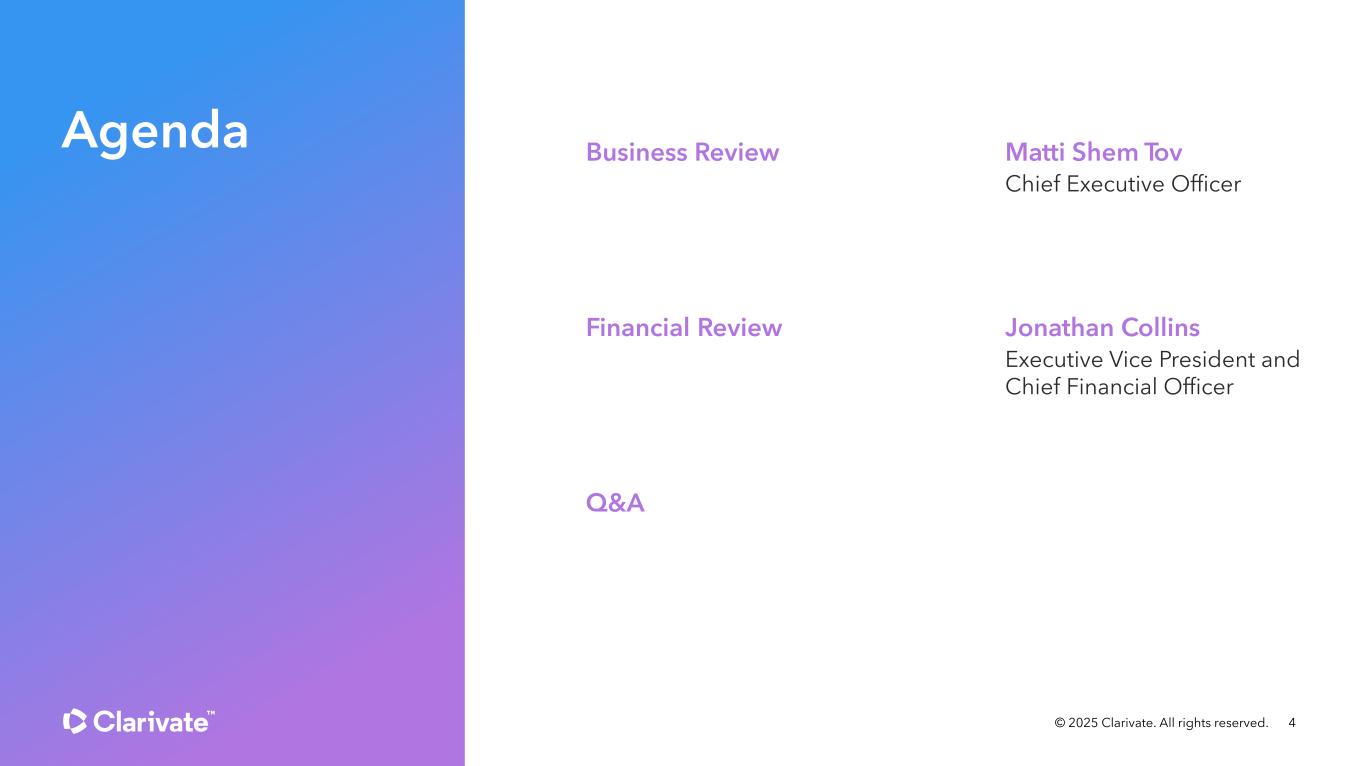
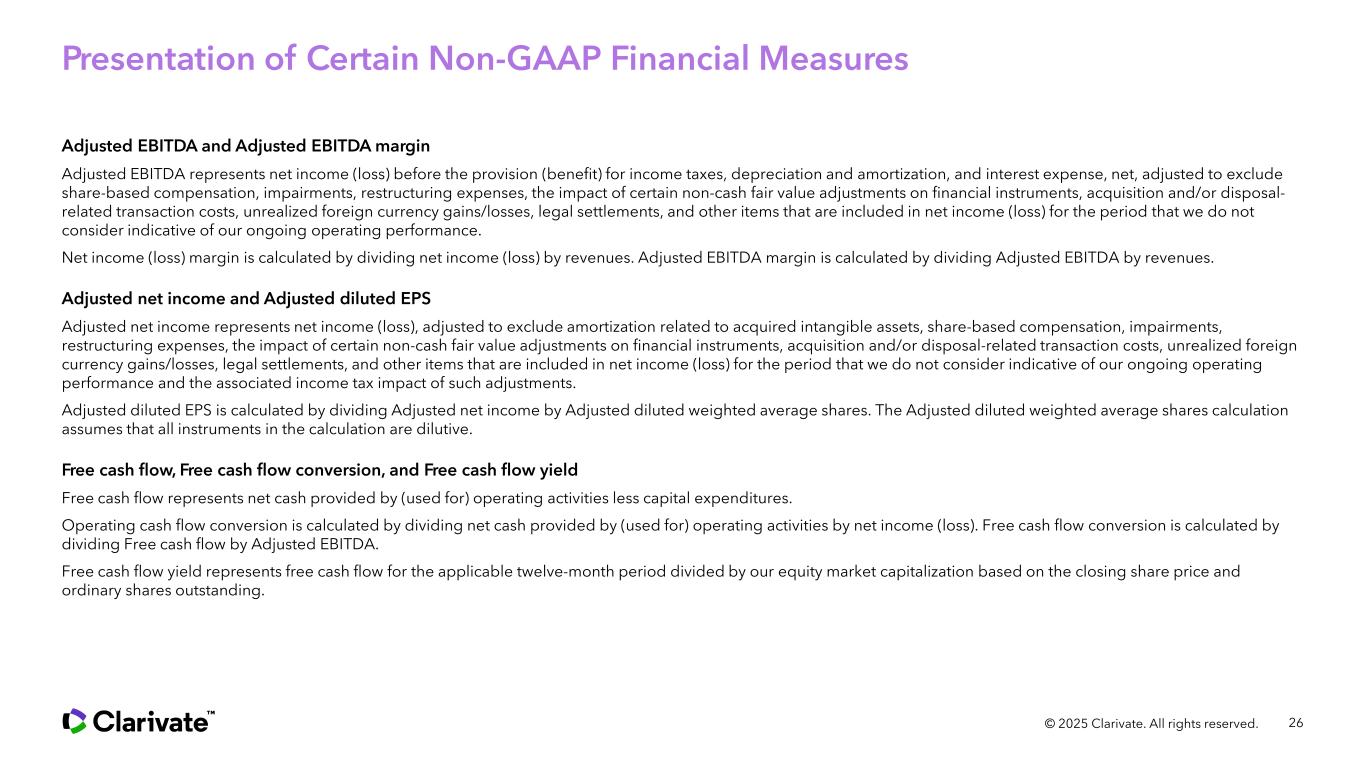
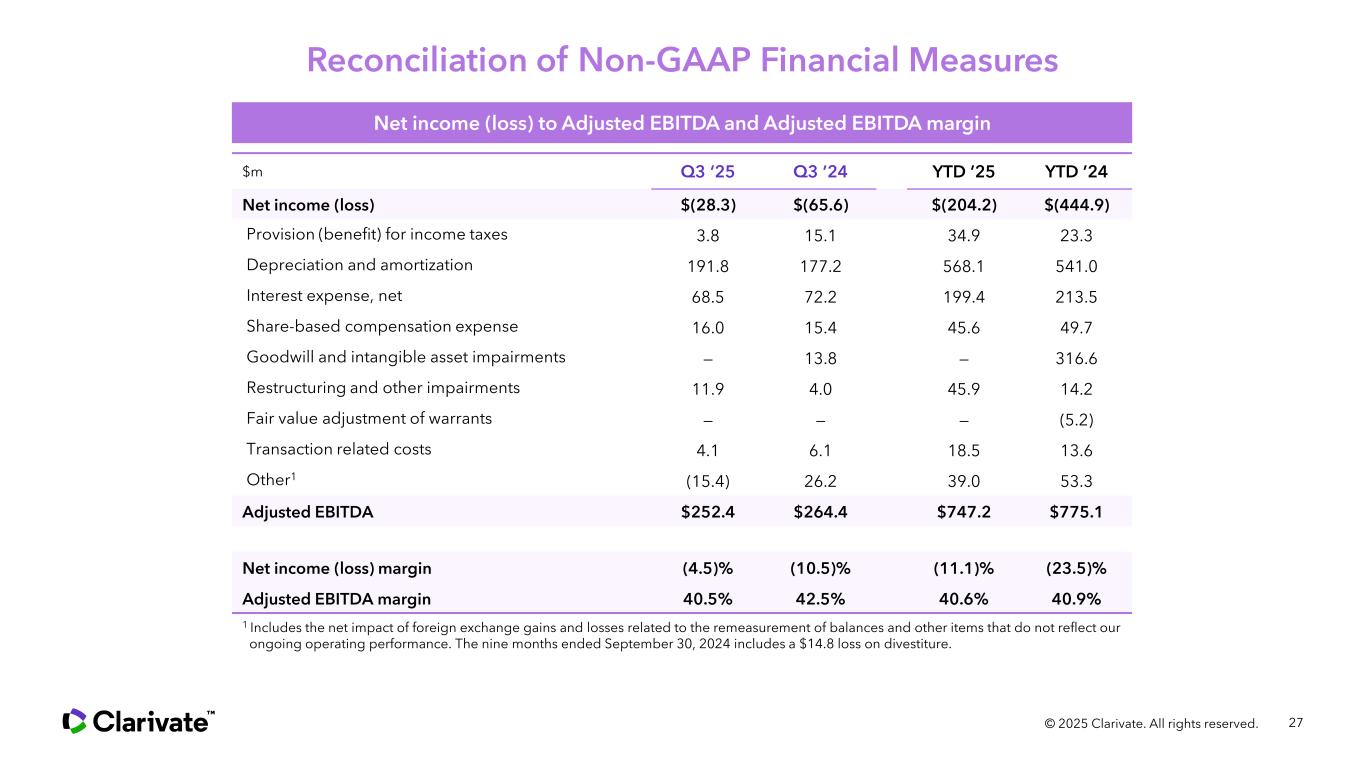
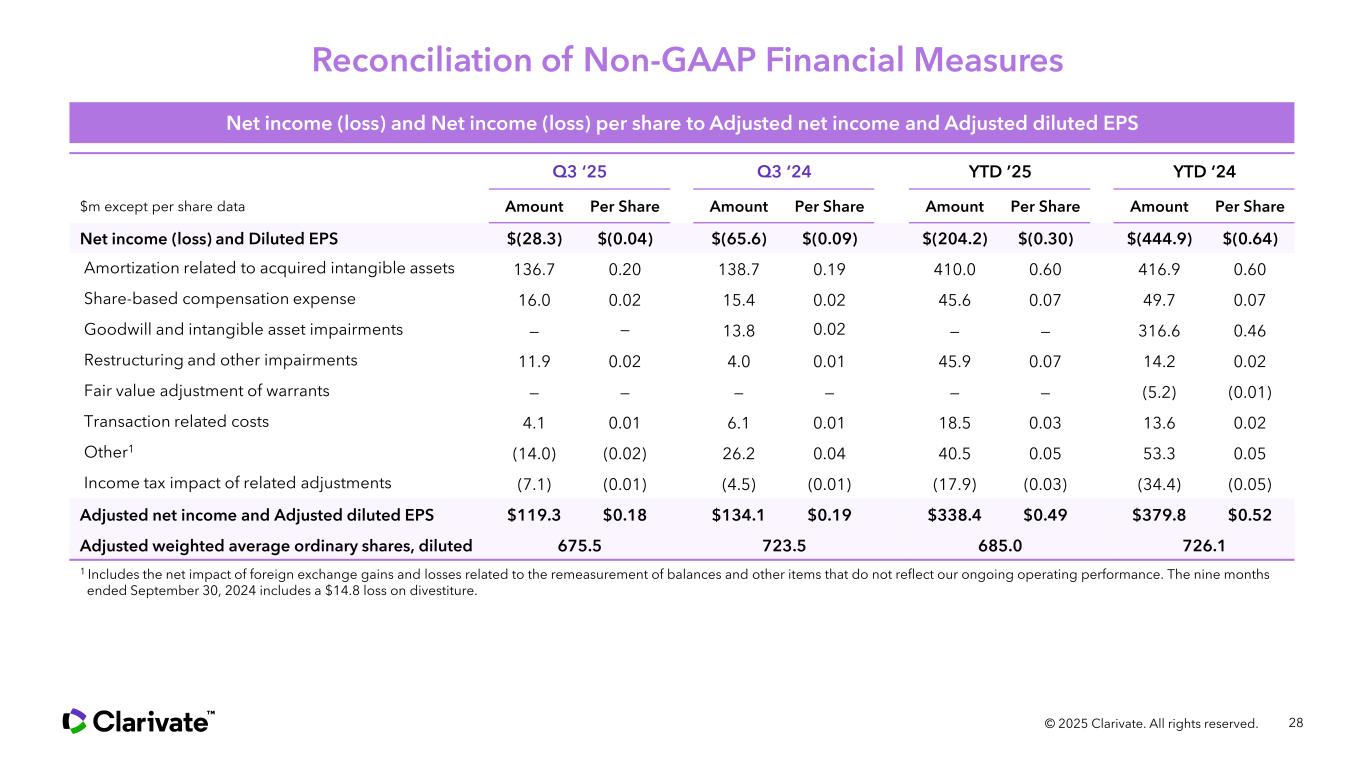
Thank you, Greg. Good morning, everyone. Thank you for joining us for the Clarivate Third Quarter 2025 Earnings Conference Call. As a reminder, this conference call is being recorded and webcast and is copyrighted property of Clarivate, and the rebroadcast of this information in whole or in part without prior written consent of Clarivate is prohibited, and the accompanying earnings call presentation is available on the investor relations section of the company's website. During our call, we may make certain follower-looking statements within the meaning of the applicable securities laws. Such follower-looking statements involve known and unknown risks, uncertainties, and other factors that may cause the actual results, performance, or achievements of the business or developments in clarity rates industry to differ materially from the anticipated results, performance, achievements, or developments expressed or implied by such forward-looking statements. Information about the factors that call as actual results of different materials and anticipated results or performance can be found in Clarivate's filings at the SEC and on the company's website. Our discussion will include non-GAAP measures or adjusted numbers. Clarivate believes non-GAAP results are useful in order to enhance understanding of our ongoing operating performance, but they are supplemented to and should not be considered in isolation from, or as a substitute for GAAP financial measures. Reconciliations of these measures, the GAAP measures are available on our earnings release and supplement our presentation on our website. With me today are Amadi Shemtabs, Chief Executive Officer, and Jonathan Collins, Chief Financial After our prepared remarks, we'll open the call to your questions.
Speaker 0
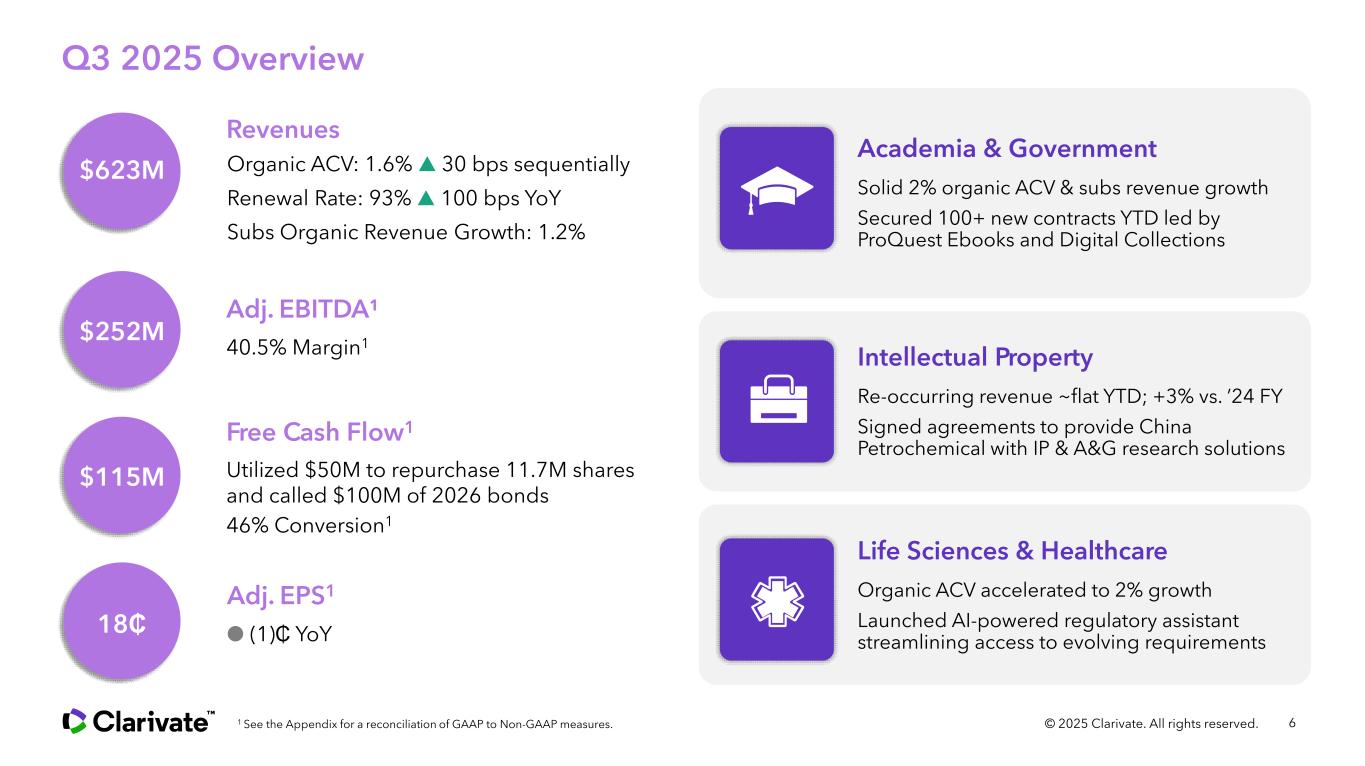
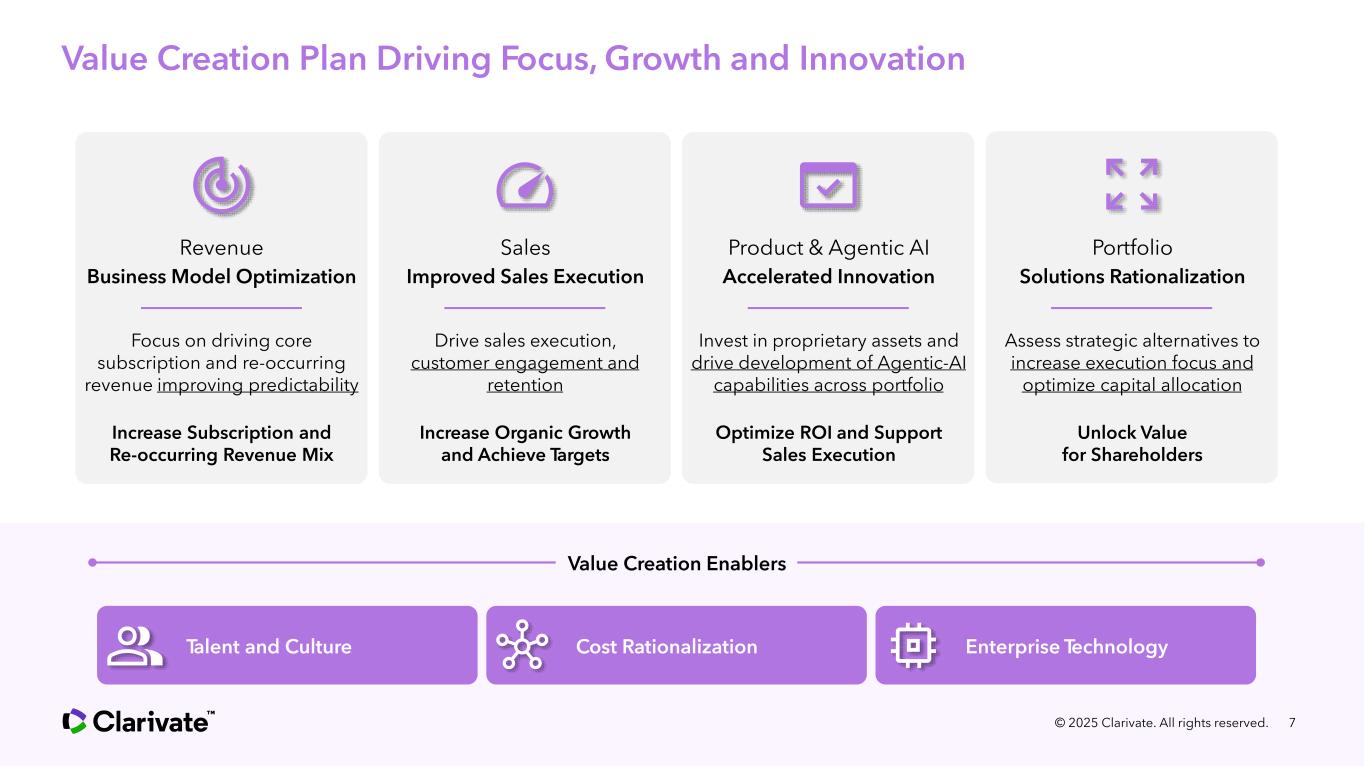
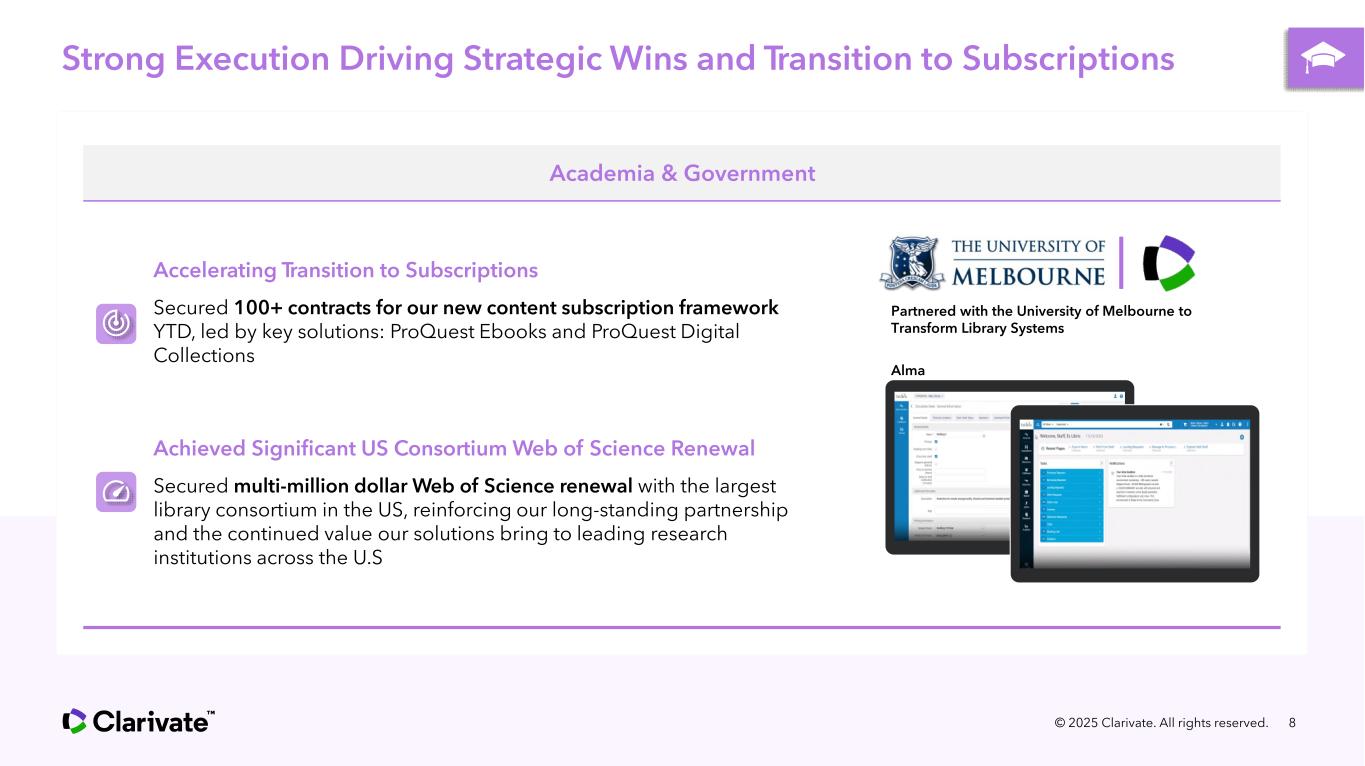
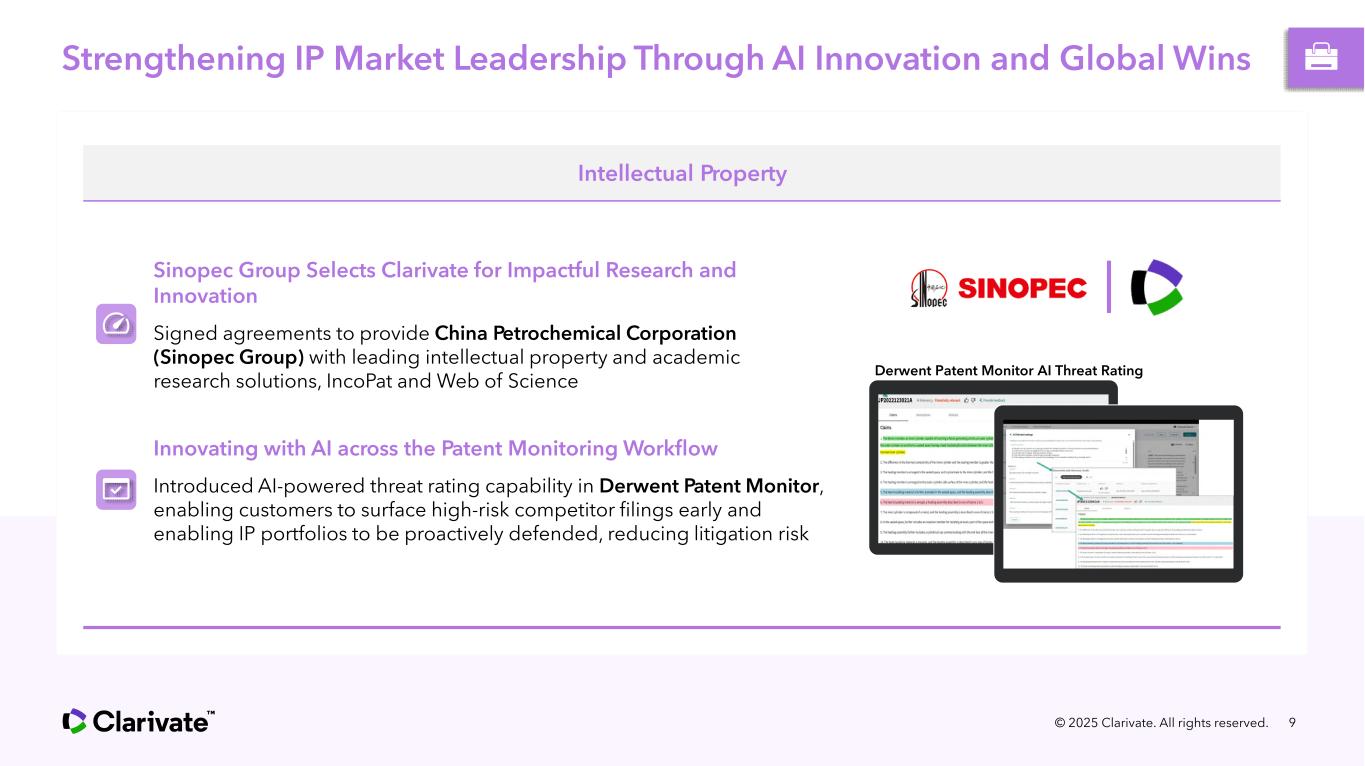
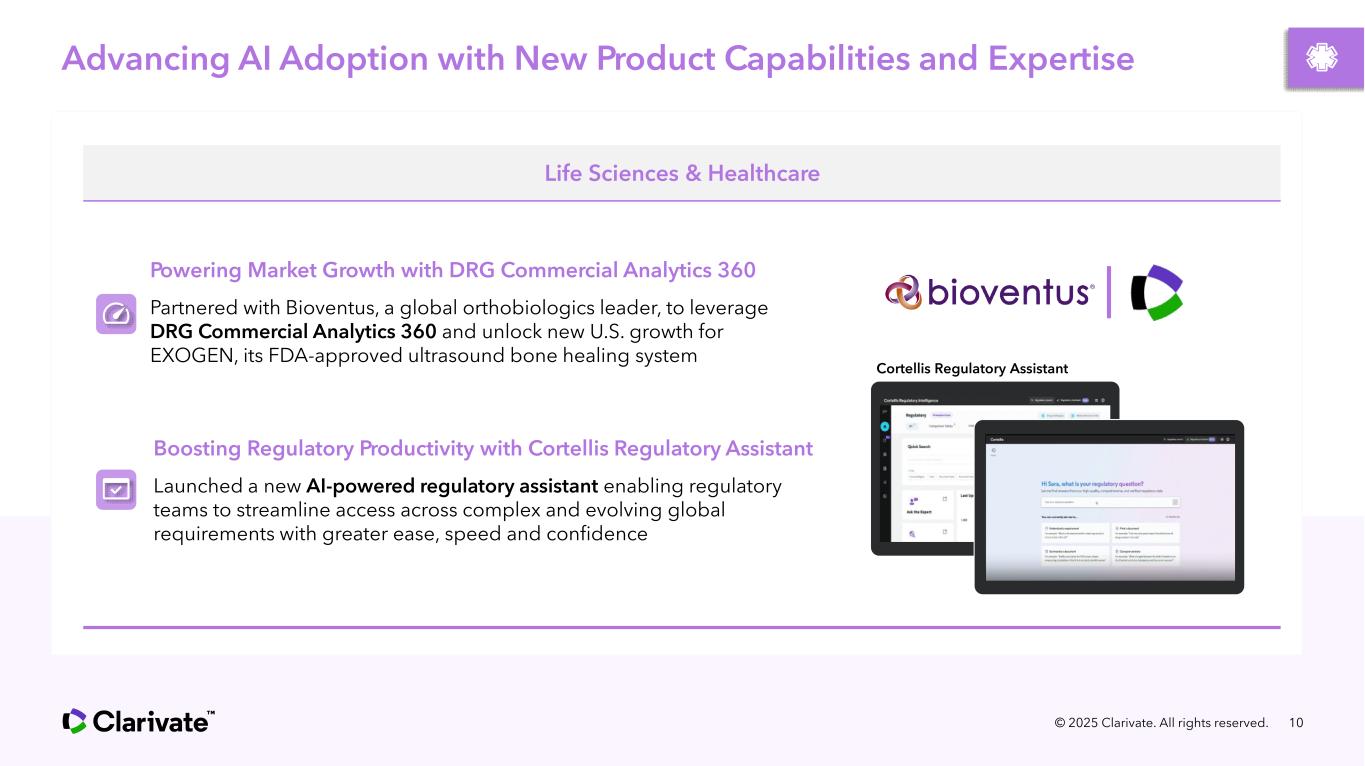
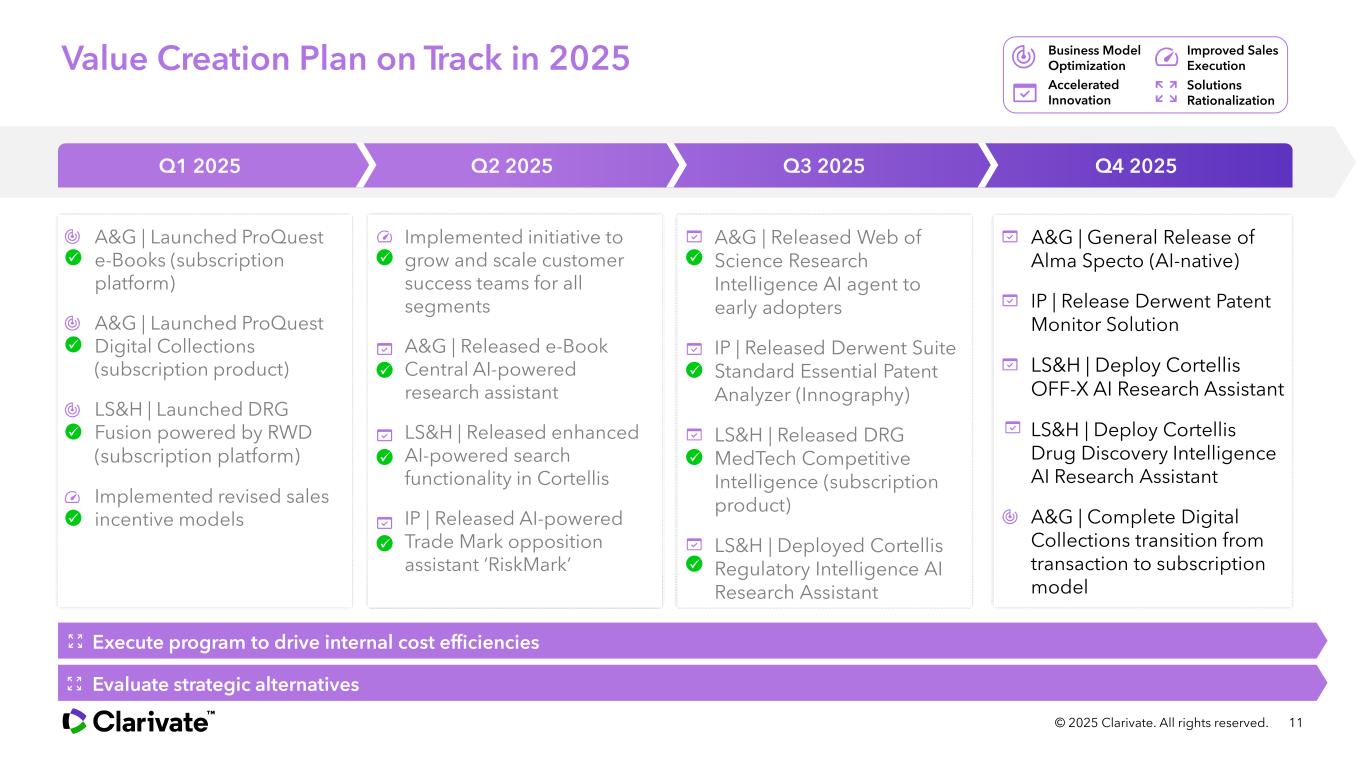
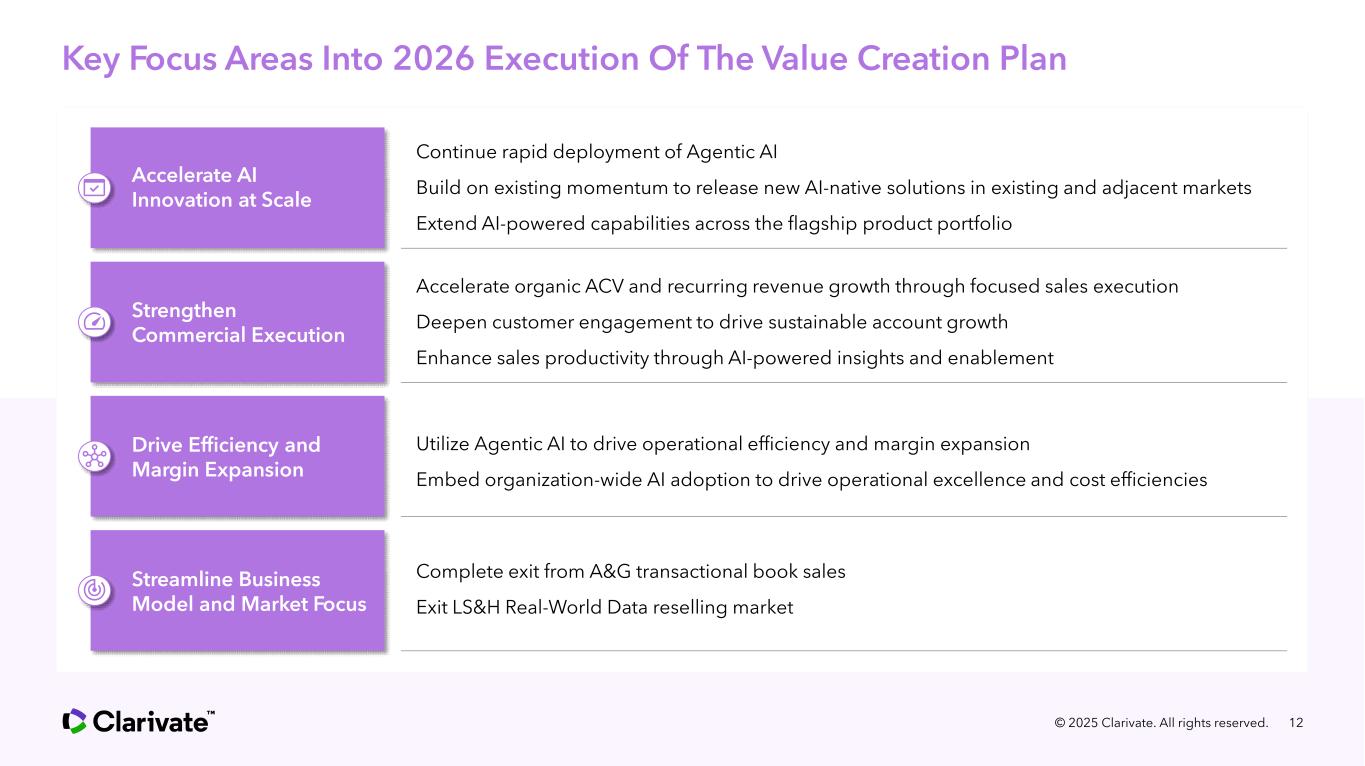
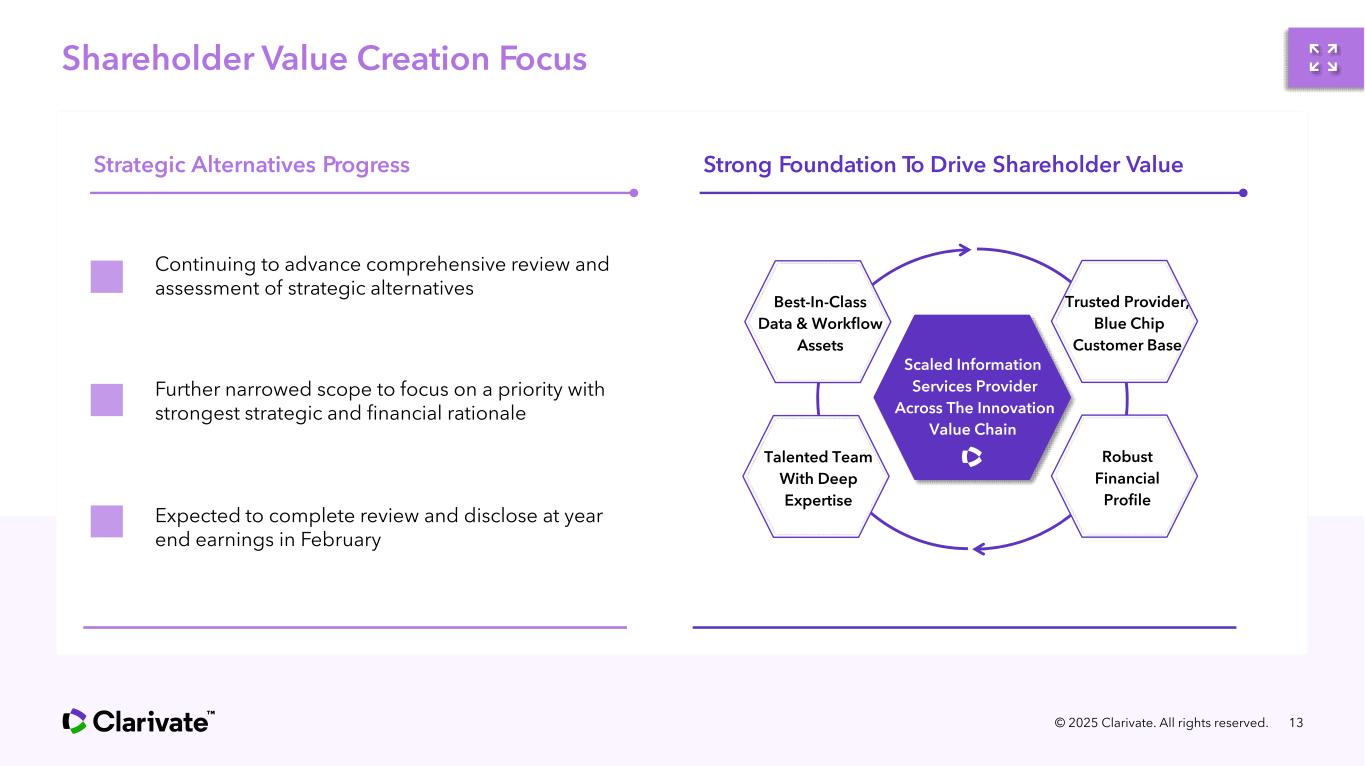
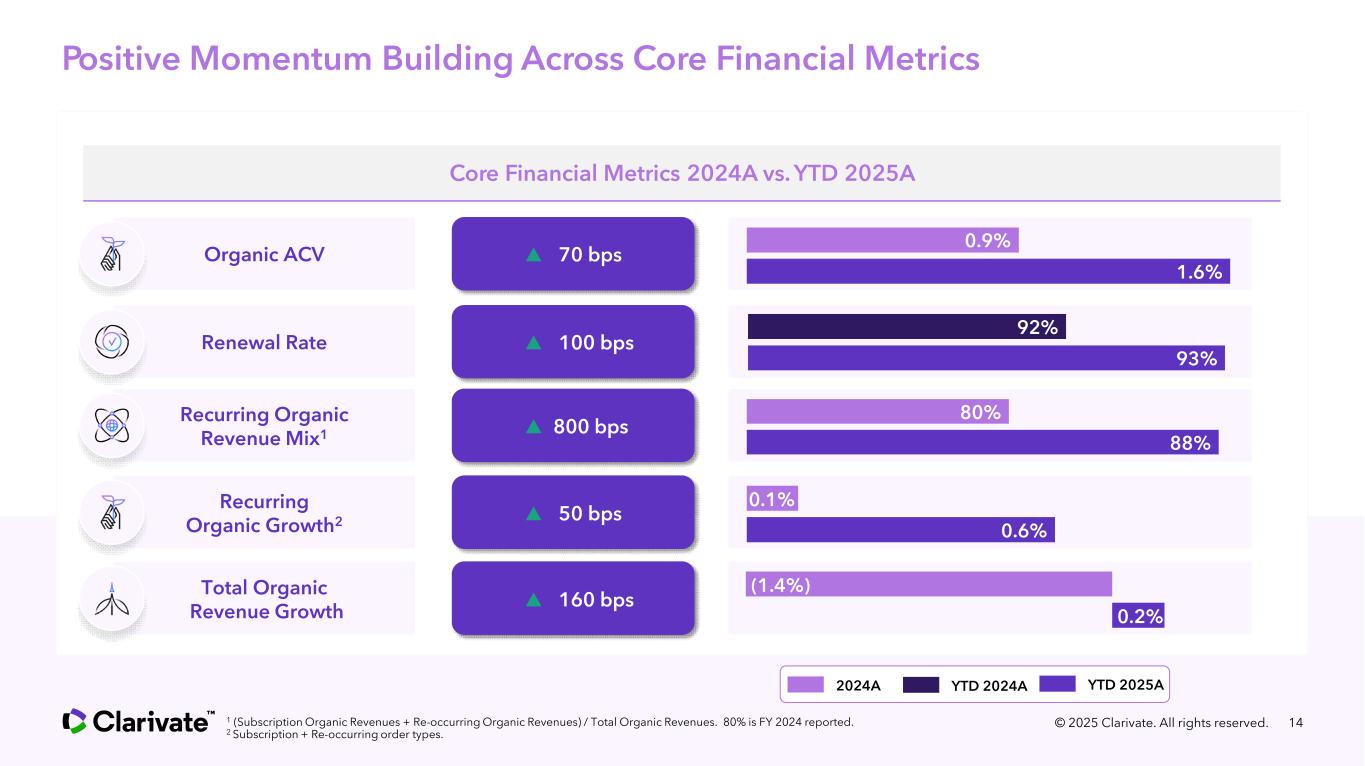
And with that, it's a pleasure to turn the call over to Amadi. Good morning, everyone. Thank you for joining us today as we review Clarivate's performance for the third quarter 2025. On slide six, I'm pleased to share that our results this quarter reflect continued progress in our value creation plan, improve operational and financial results, and strong commitment to deliver value for our shareholders. Our forward-looking metrics, such as annual contracts Value continued to improve to 1.6%, making a 30 basis point sequential improvement, driven by 2% ACV growth across academia and government in life science and health. Our renewal rate of 93%, an important indicator, was up 100 basis points year over year. Our free cash flow generation continue to support our balanced capital allocation, including $150 million of opportunistic share repurchases year-to-date, as well as $100 million of debts paid down. This results are testament to our team's dedication and the ongoing progress of our value creation plan. Jonathan will cover the quarterly result in more detail shortly. Our VCP on the slide 7, our VCP is driving improved focus, growth, and innovation across the business. We are accelerating product and AI development by investing in proprietary assets and collaborating very closely with our customers. Over the past year, we have launched 12 product and AI-powered capabilities across our segments. We expect this R&D investment to result in higher organic growth and improved renewal rates in the future. Our sales execution has improved, supported stronger customer engagement and revenue retention, and helping us achieve our organic growth outlook through the first nine months of 2025. We remain committed to optimizing our business model with a focus on increasing our core subscription and reoccurring mix to improve predictability, as evidenced by the 8% improvement this year compared to last year. And our portfolio rationalization is enhancing our execution focus and capital allocation, which is expected to unlock greater value. Turning to A&G segment, positive sales performance, including 2% ACV growth, is contributed to predictable top-line results driven by our transition from transactional sales of detail collection and looks to subscription-based revenue streams. This transition has resulted in our AMG subscription mix now at 93% compared to 81% last year. I believe this was clearly the right decision, and I want to acknowledge our teams for the great work in assisting our customers through this transition. We are pleased with the progress to date as we have secured more than 100 contracts for our new content subscription framework driven by the new offerings such as ProQuest data collections and ProQuest e-books. We continue to see strong renewal patterns with 90% of global ANG subscription for the full year successfully renewed through October 27. We are also pleased to share with you that we have completed a multi-million dollar renewal of Web of Science with the largest library consortium in the United States. Considering the increased constraint on higher education research funding, especially in the U.S., this renewal underscores the continued value that our solutions deliver to major research institutions nationwide. Our global reach is unmatched, as evidenced by just some of the large international deals we have shared with you this year, including the British Library, Canadian Research Knowledge Network, and CAFEZ in Brazil. Recently, we finalized an agreement with the University of Melbourne, Australia's premier university. The deployment includes library workflow solution, which provides comprehensive support for library management, resource discovery, resource sharing, and reading list creation. Moving to the intellectual property segment. For the first nine months, the patent and trademark maintenance services reoccurring revenue was flat compared to the same period last year. We are encouraged by this, as it represents 3% improvement in the organic growth rate relative to the full year of 2024. force. Whereas these results show improvement, we are committing to returning the segment to sustainable growth. With Maroon Murad as our new president of IP, we are confident we will drive continued progress across the business by increasing agility and streamlined processes, as well as market recovery. We continue to invest in AI-based products and service innovation while maintaining a leadership position in the global IP ecosystem. For instance, IPfolio introduced an AI-powered product taxonomy that automates product patterned mapping. It enables companies to better identify which product corresponds to their patent, a valuable tool for large patent holders making strategic portfolio decisions. We continue to make improvements to the Derwent platform with cutting-edge AI innovation, which is being integrated throughout the patent management workflow. An exciting addition is the Derwent Patent Monitor, an AI threat rating feature empowering clients to identify potentially high-risk competitor filings. This achievement allows users to proactively safeguard their intellectual property portfolio and help mitigate risks. During the third quarter, we were chosen to supply China petrochemical cooperation, mainly China's largest oil petrochemical supplier, with intellectual property solution and the Web of Science platform. This cross-cell collaboration is a testament to our ability to leverage expertise and provide customers with solutions that meet all IP and research needs. Moving to life science and health segment, I am personally excited it has returned to 2% ACV growth this year. The business has demonstrated strong performance by introducing new products and advancing AI integration through improved offering and specialized expertise within our life science platform. We recently launched DRG Commercial Analytics 360, a data analytics tool aimed specifically at the meta-examatic sector. We were pleased to partner with BioVentus, a global autobiologics leader, to leverage this new offering. This comprehensive analytics platform will assist BioVentus in making more informed decisions to enhance product adoption, improve patient outcomes, and strengthen its position as a global leader. In September, we introduced our AI-powered regulatory assistant in Cotelis Regulatory Intelligence to help professionals manage global requirements more efficiently. Developed with customer feedback and tested by industry partners, it meets the needs of biopharma, medtech, and clinical research organizations. With new features such as conversational AI, with referenced answers and multilingual capabilities, it allows users to search and interact in preferred languages. We are also embedding additional AI agents, a cross-key existing life science offering, as well as launching new AI-native products. We expect this offering to help us expand ACV going forward. On the next slide, I'm pleased with the significant progress we have made by executing our value creation plan. Across all three segments, we introduce AI-powered solutions, including Web of Science, Research Intelligence, AI Agent, trademark opposition assistant, risk mark, and search and regulatory functionality within Kotelis. We have also driven internal cost efficiency, scaled our customer success teams, and improved sales execution. This action has optimized our business model and accelerated innovation across our portfolio. As we look ahead to 2026, our focus remains on executing our robust value creation plan while driving innovation and operational excellence across Clarivate. We will continue the rapid deployment of Agentic AI, embedding it across customer workflows and segments. Building on our momentum, we will release new AI-native solutions and extending AI-powered capabilities across our flagship portfolio. Accelerating AI innovation at scale is a top priority as we're driving organic ACV and recurring revenue growth through focused sales execution. We will aim to continue to boost sales productivity by focusing on our people, processes, and tools, leveraging AI insights, engaging customers to support ongoing account growth, and improving commercial execution. We believe operational efficiency and margin expansion will be achieved by utilizing agentic AI and embedding organization-wide AI adoption for cost efficiencies. Finally, we are streaming our business model in making focus and market focus by completing pleating our exits from anti-transactional books sales and the life science real world data resale market reselling markets um strategic alternatives earlier early this year we have highlighted that we are actively progressing through a comprehensive review and assessment of strategic alternatives as we communicated to you in july we are making good progress and expect to share more details with you when we report our fourth quarter results in February 2026. In closing, our performance this year is starting to demonstrate clear and positive momentum across our core financial metrics. We remain on track to deliver our 2025 financial guidance. We have achieved sequential and year-over-year improvement in organic ACV to 1.6% and renewal rate to 93%. Recurring organic revenue growth has improved to 0.6% for the first nine months of 2025 compared to 0.1% last year. And organic revenue mix has risen to 88% up from 80 percent in 2024. These results reflect our commitment to driving sustainable growth and operational excellence. As we look forward, we are confident that our strong foundation and ongoing momentum position us, position us well to create shareholder value. Thank you for your continued support and an interest in Clarivate. We look forward to updating you on our progress in the quarters to come, and I'd like to now to turn the call over to Jonathan for a review of our financial results. Thank you.
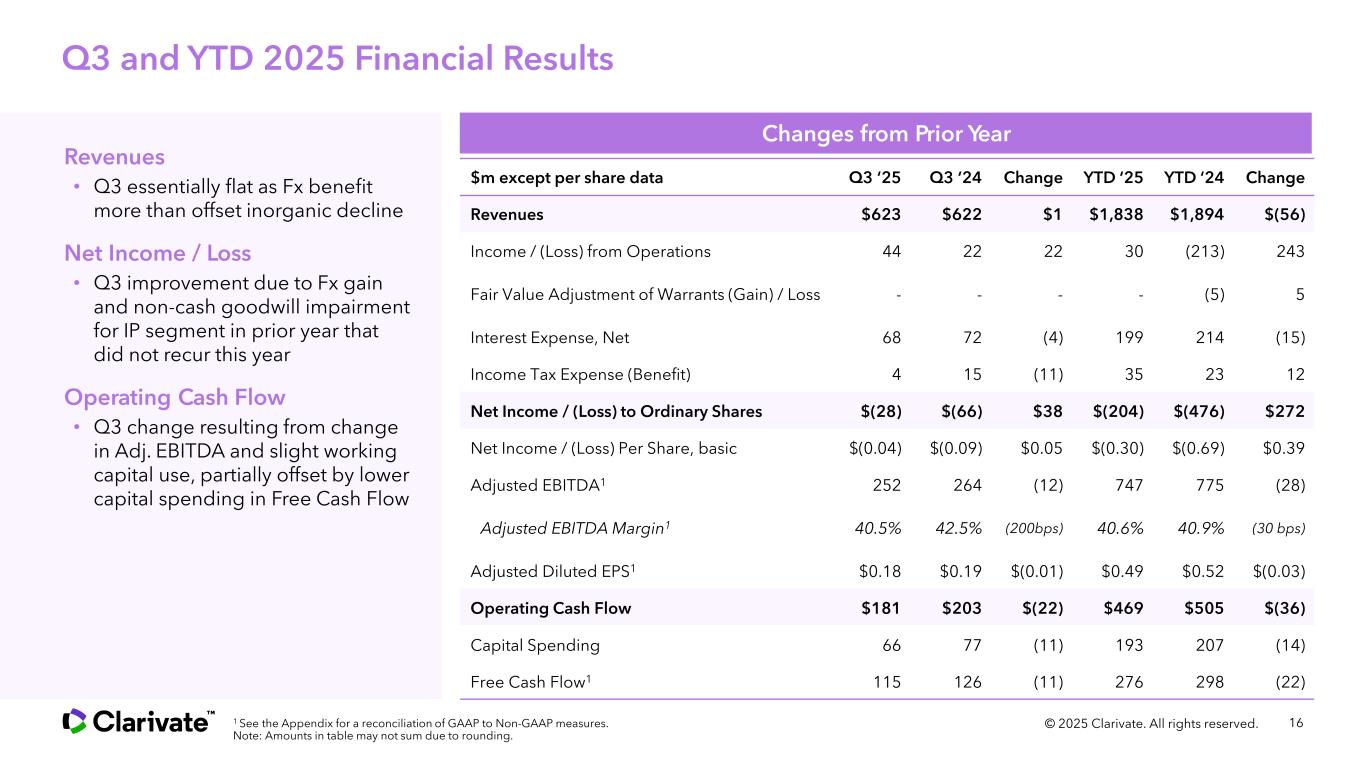
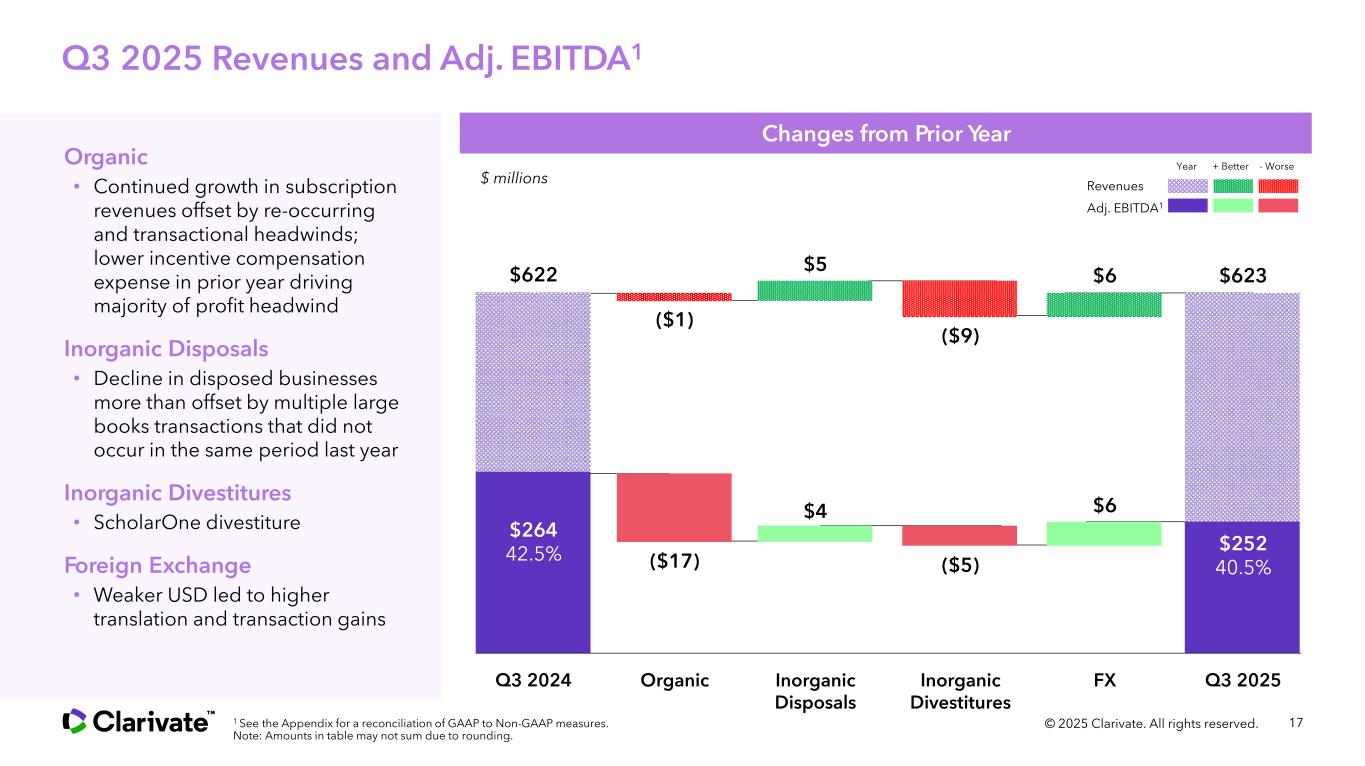
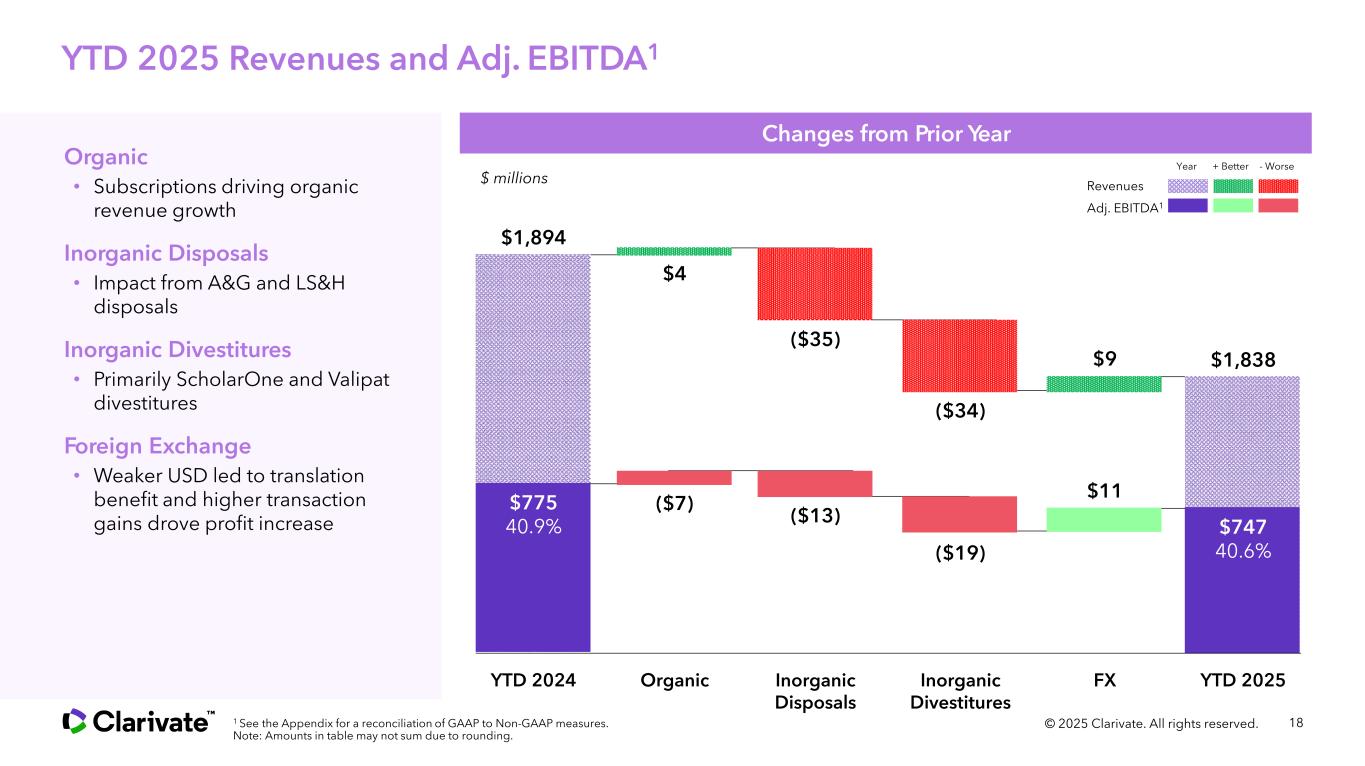
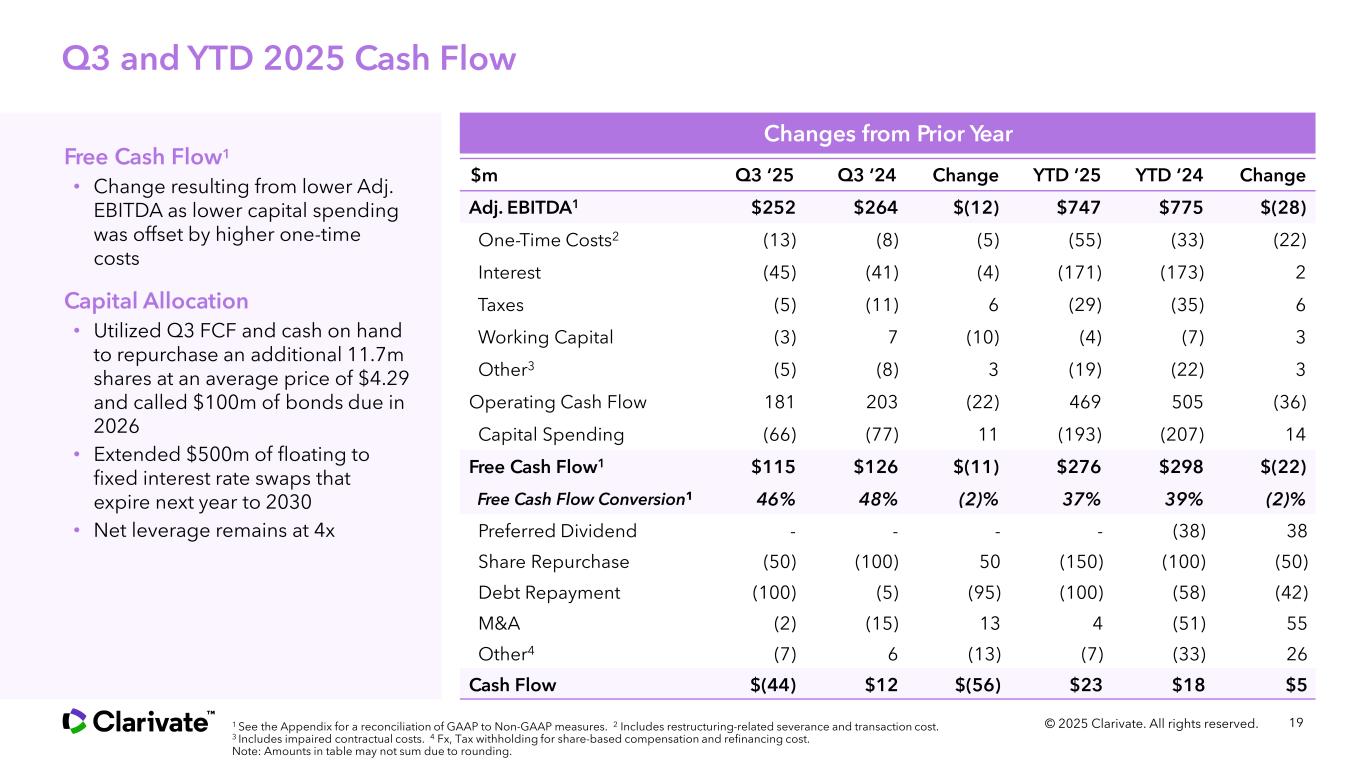
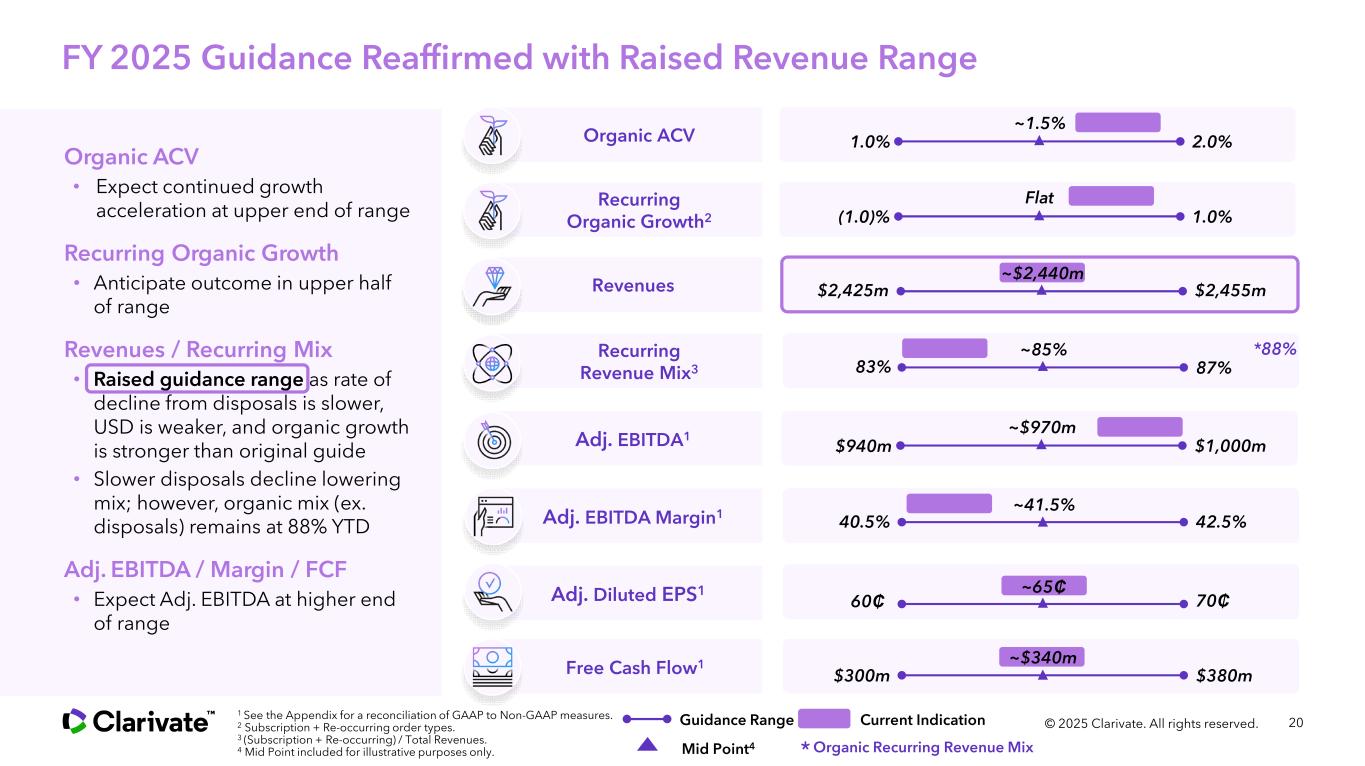
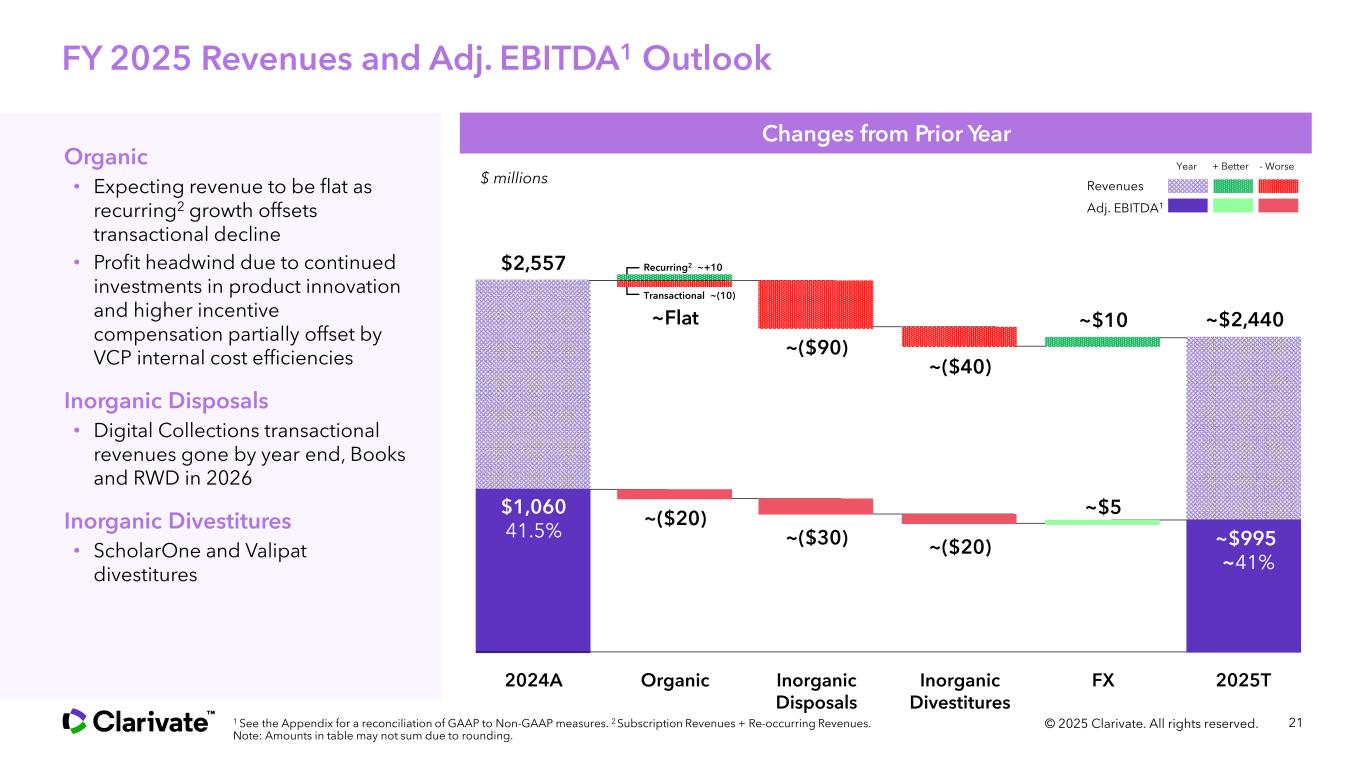
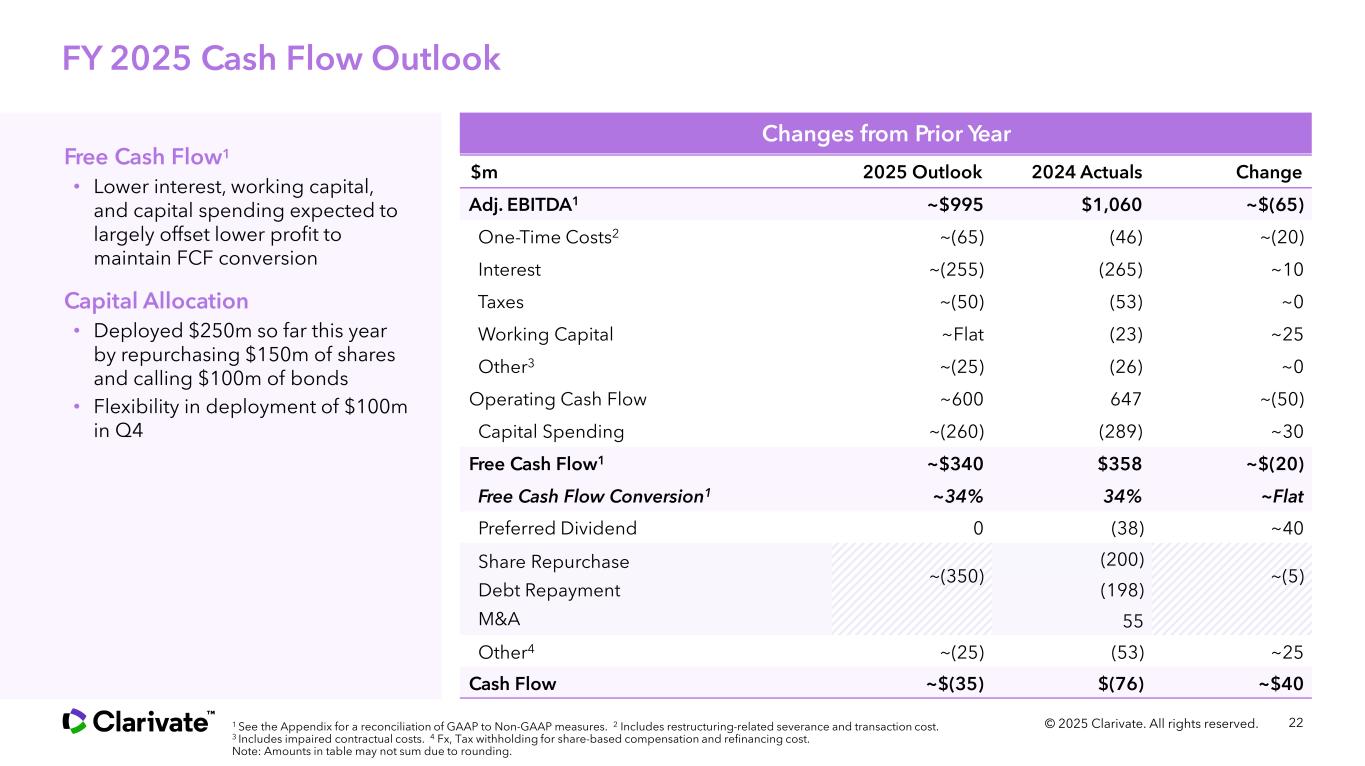
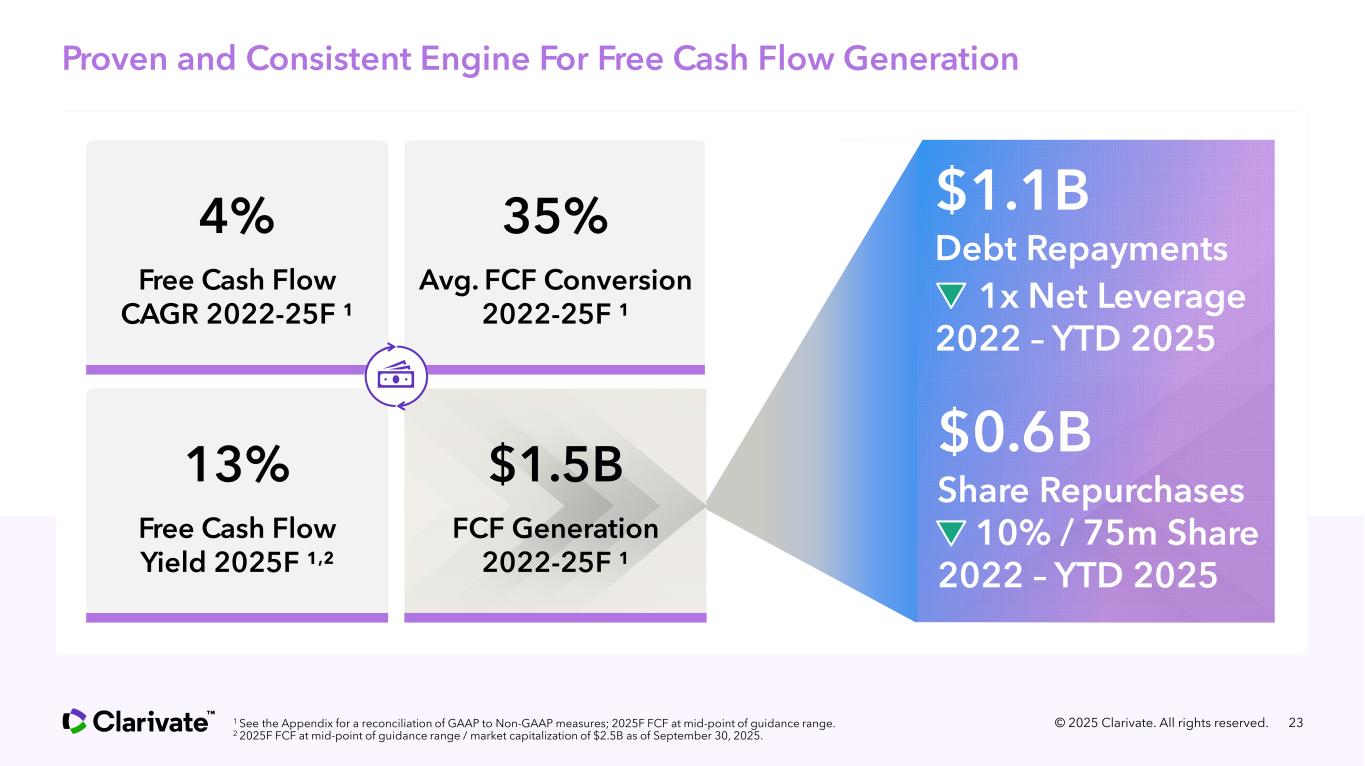
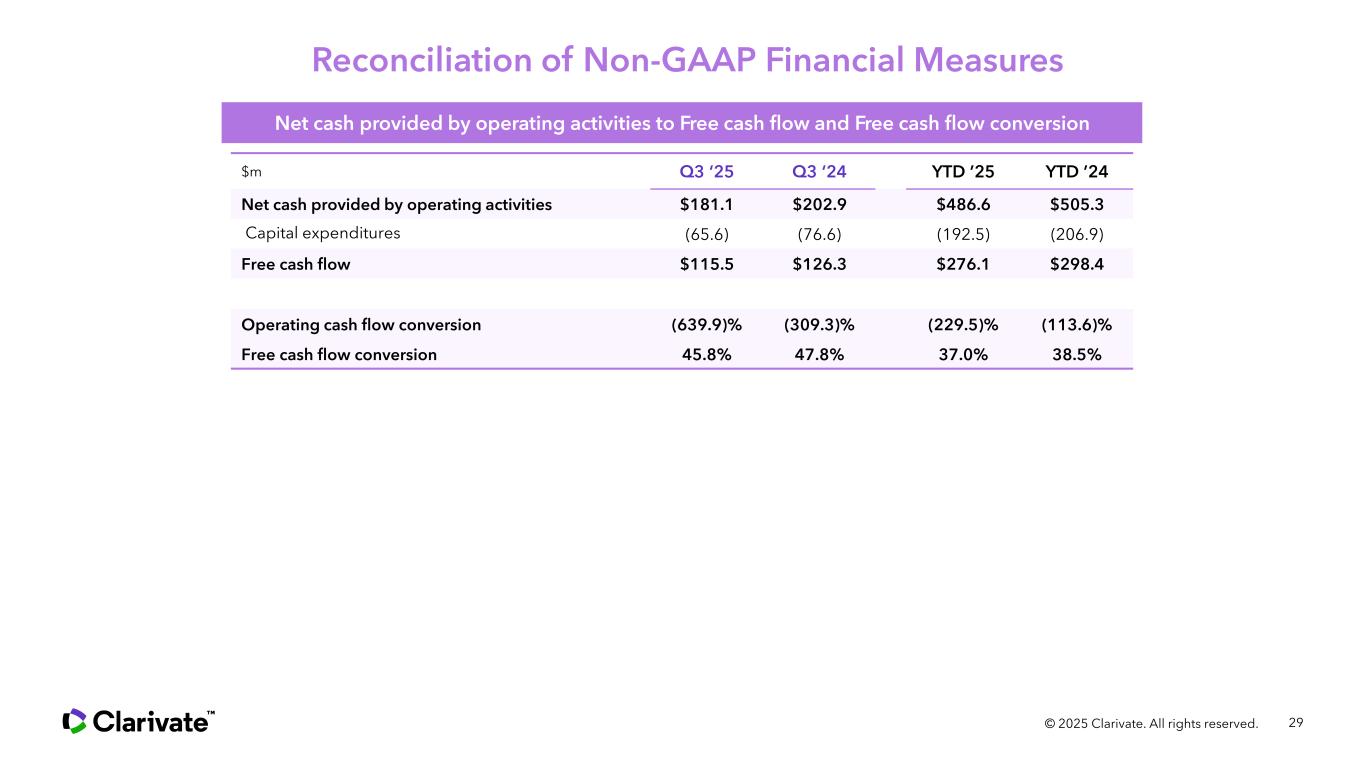
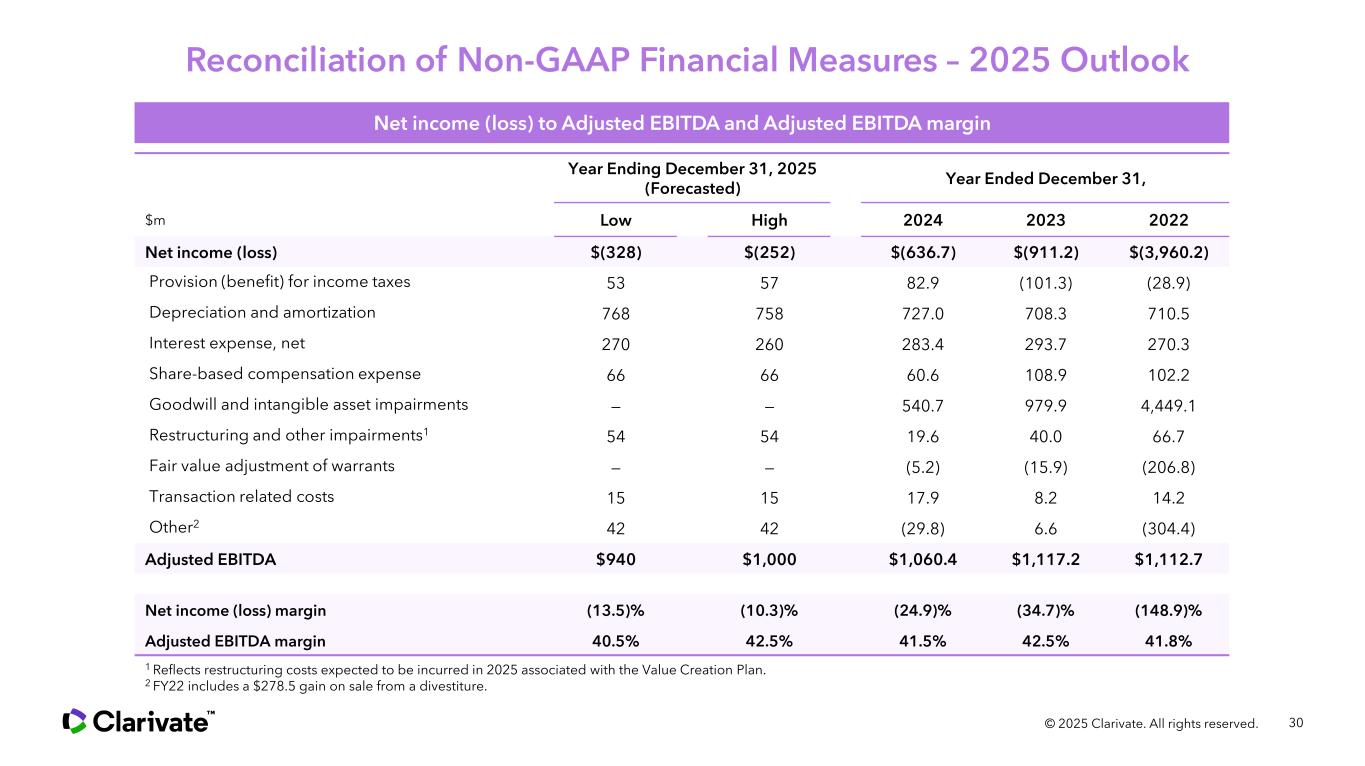
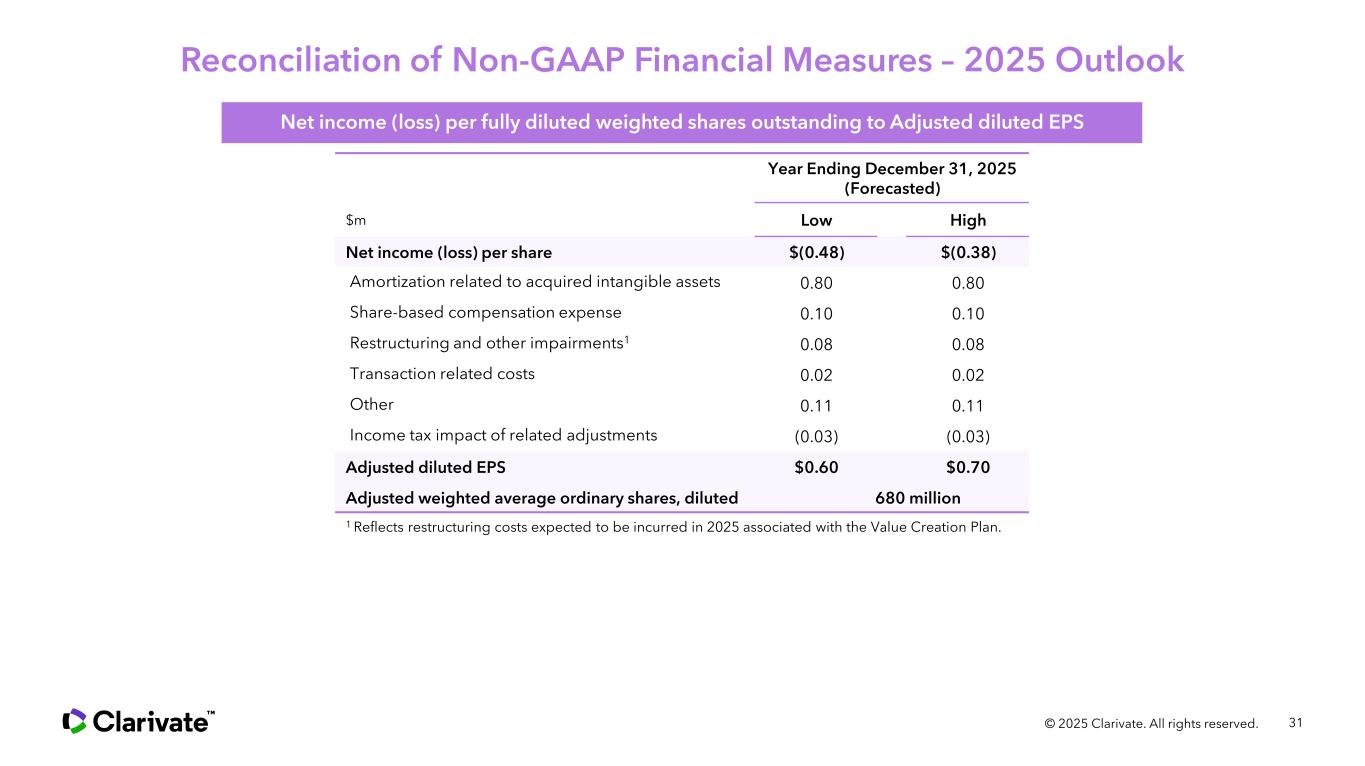
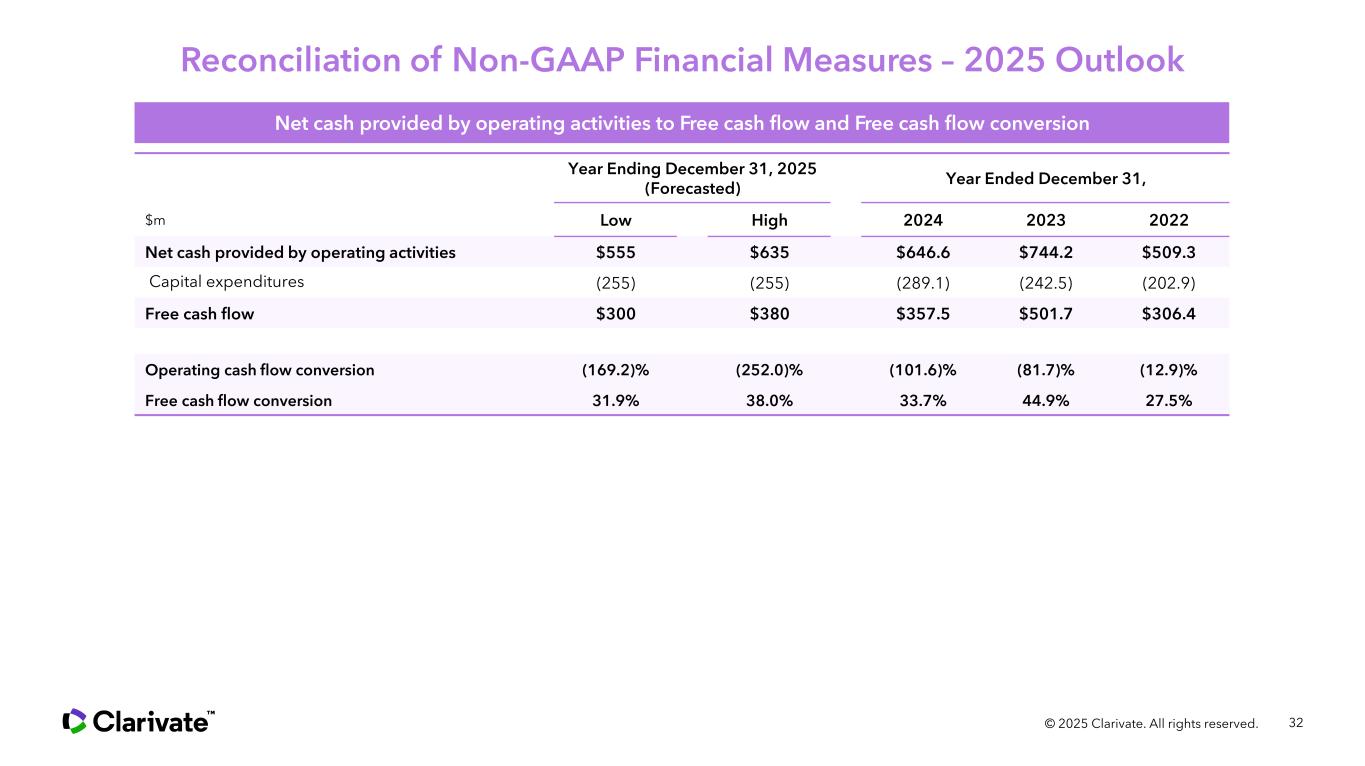
Thank you, Madi, and good morning, everyone. Slide 16 is an overview of our third quarter and year-to-date financial results compared with the same periods from the prior year. Q3 revenue was $623 million, essentially flat over the same period in the prior year, bringing the year-to-date to $1.84 billion. The third-quarter net loss was $28 million. The improvement over Q3 of the prior year is driven by higher foreign exchange gains and the non-cash impairment charge recorded last year that did not recur this year. Adjusted diluted EPS, which excludes items like the impairment, was flat sequentially at $0.18. cents. The change over last year is entirely attributed to the divestiture of Scholar 1. Operating cash flow was $181 million in the quarter. The change compared to last year is driven by adjusted EBITDA and working capital. Please turn with me now to page 17 for a closer look at the drivers of the third quarter top and bottom line changes from the prior year. The top line was essentially flat in the third quarter, yet margins were lower, as expected, as we continue to invest for future growth and remain on track to deliver our full-year guidance. The changes were driven by four primary factors. First, while organic subscription revenues continued to grow at more than 1% following the continued acceleration in our ACV, total organic revenue is essentially flat as the subs growth was offset by modest reoccurring and transactional declines. Operating expenses were higher in the third quarter as we continue to invest to drive growth and incurred higher incentive compensation expense as we remain on track to deliver our full-year guidance. Second, during Q3, the businesses we are disposing actually increased slightly over the prior year due to multiple large, one-time, yet low-margin e-book sales, which more than offset continued declines in the other products. This is a meaningful contributor to the raising of our full-year guidance range on revenue, which I'll come to in just a few moments. Third, as we've seen in the last couple of quarters, we continue to experience the inorganic impact of the Scholar One divestiture. And fourth, the U.S. dollar remained relatively weaker against the basket of foreign currencies, which caused a foreign exchange tailwind on the top and bottom lines. Please turn with me now to page 18 to review how these same drivers impacted the top and bottom line changes on a year-to-date basis compared to the same period in the prior year. Year-to-date, revenues have declined by more than $50 million. However, margins are within 30 bits of the same period in the prior year. Let's step through the major drivers of this change. As Mahdi noted in his remarks, year-to-date, organic growth has improved by 160 basis points over where we ended last year. This modest top-line growth over last year is offset by higher operating costs as we continue to invest to grow the business, while offsetting some of the cost inflation with efficiencies. The combined impact of the disposals and divestitures lowered revenue by nearly $70 million and adjusted EBITDA by just over $30 million compared to the same period last year. Both the top and bottom lines benefited from foreign exchange translations so far this year, as the U.S. dollar remains weaker than a basket of foreign currencies, and the profit conversion on the change is high as a result of transactional gains. Please turn with me now to page 19 for a look at how the Q3 and year-to-date adjusted EBITDA converted to free cash flow and how we allocated the capital. Free cash flow was $115 million in the third quarter, bringing the year-to-date to $276 million. The change so far this year over the prior year is driven entirely by the adjusted EBITDA impact outlined on the last two pages, as higher one-time costs are offset by lower capital spending. We incurred $13 million of one-time cost in Q3 and $55 million so far this year, largely driven by restructuring-related outflows associated with the implementation of the value creation plan. Capital spending was $11 million lower than last year in Q3 as we begin to recognize the savings associated with the disposals. We used a combination of free cash flow we generated in the third quarter and cash on hand to repurchase another 11.7 million shares, bringing the year-to-date buybacks to 150 million, and we called 100 million of the bonds that are due next year. The balanced capital deployment this year has allowed us to maintain net leverage of about four turns while retiring nearly 35 million or about 5% of our outstanding shares. We also took the opportunity during the third quarter to extend our interest rate protection on our floating rate debt by four years by entering into 500 million of interest rate swaps through 23. Please turn with me now to page 20 for a look at our full year financial guidance ranges for this year. Beginning at the top of the page, based on the continued acceleration of our organic annual contract value in the third quarter, we are raising the indication from the midpoint towards the higher end of our range as we expect continued acceleration in the fourth quarter. We continue to anticipate recurring organic growth in the upper half of our range. As a result of the better-than-planned organic performance combined with a weaker U.S. dollar and slower-than-anticipated attrition in the business disposals, we are raising our revenue guidance by $50 million from our last indication near the upper end of the previous range to $2.44 billion at the midpoint of our new range. Due to the slower-than-expected decline in our revenue of the businesses we're disposing, we now anticipate recurring revenue mix will likely be towards the low end of the range. It's worth reiterating what Mahdi indicated earlier. Our organic recurring revenue mix, which excludes the disposals, is already at 88% year-to-date, and we expect will remain at this level through the end of the year. Moving down the page, we now expect adjusted EBITDA at the high end of the range and our profit margin at approximately 41% due to higher revenues from the disposals in FX which have lower profit conversions. We continue to anticipate diluted adjusted EPS and free cash flow near the midpoint of the ranges. Please turn with me now to page 21 for more details on the full year top and bottom line changes we're expecting compared to last year. The full year guidance for the top and bottom lines is based on our expectation that Q4 revenue and adjusted EBITDA will be about $600 million and approach $250 million, respectively. The anticipated changes in revenue and, to a large extent, adjusted EBITDA for the full year compared to last year are largely driven by the disposals targeted at optimizing our business model and the divestiture of non-core products and services. We continue to expect organic growth will be essentially flat, as the growth in recurring revenues will offset the originally anticipated decline in our remaining transactional business. This represents about a $10 million improvement over our initial indication at the midpoint of the original revenue guidance range. We continue to expect a profit headwind in this area of about $20 million as cost efficiencies will not fully offset inflation and higher incentive compensation expense. The strategic disposals are now expected to lower revenue this year by approximately $90 million, and we are reducing operating expenses by $60 million, which yields a profit impact of about $30 million. We expect most of the remaining more than $100 million revenue reduction will take place next year. The divestitures of both Valley Patent Scholar One last year will lower revenue by about $40 million and profit by about $20 million. We continue to anticipate a modest foreign exchange translation benefit to the top and bottom lines of $10 million and $5 million, respectively, as the U.S. dollar has remained slightly weaker against other foreign currencies compared to the prior year. Please turn with me now to page 22 to step through the components that will lead to more than a third of the adjusted EBITDA converting to free cash flow. As I mentioned, we continue to expect free cash flow near the midpoint of our range. One-time costs are expected to be elevated over last year as we invest to execute the value creation plan. We expect cash interest to improve by about $10 million over the prior year as a result of the debt we prepaid last year. Cash taxes are expected to be in line with 2024. We anticipate the change in working capital this year will be negligible, which will represent an improvement over last year of about $25 million. And while we remain committed to investing in product innovation, the strategic disposals and cost efficiencies will improve capital spending by about $30 million. The net impact of these changes is free cash flow of 340 million at the midpoint of the range and will result in the same conversion on adjusted EBITDA last year at about 34 percent from a capital allocation perspective we continue to have the flexibility between share repurchases and deleveraging as we move into the fourth quarter in closing on page 23 i'd like to draw your attention to the consistent free cash flow we've generated over the past four years delivering free cash flow at the midpoint of this year's guidance range will result in a four-year cumulative average growth rate of four percent during the same period our free cash flow conversion on adjusted EBITDA will be about 35 at the end of q3 our stock was yielding a double-digit free cash flow return of 13 by the end of the year we'll have generated 1.5 billion of free cash flow over the past four years which we've used to repay over a billion dollars of debt lowering our net leverage by a turn and to repurchase more than a half a billion of stock, lowering our share count by 10%. We believe that executing the value creation plan will lead to healthy, sustainable, organic revenue growth and further improve free cash flow, delivering meaningful value for shareholders moving forward. I'd like to finish by thanking all of you for listening in this morning. And I'm now going to turn the call back over to Greg so that we can take your questions. Greg, please go ahead. Great.
Operator
Thanks, Jonathan. At this time, I would like to remind everyone in order to ask a question, press star and the number one on your telephone keypad. Once again, star one. And we will pause just a moment to compile the Q&A roster. All right. Looks like our first question today comes from the line of Tony Kaplan with Morgan Stanley. Tony, please go ahead. Hey, good morning. This is Greg Parrish on for Tony. Thanks for taking our question.
Thought maybe we could dive into the patent renewal business there. Obviously, it's been under a little bit of pressure over the last couple of years due to market volume headwinds. Hoping you could provide some color on the competitive landscape and where your product stacks up with some other products in the market, like an Aqua and how you're positioned. And then And some of the more recent pressures, say, you know, year-to-date, you know, how would you characterize that in terms of market headwinds versus competitive headwinds?
Yeah, thank you for the question, Greg. I'll touch on the numbers a bit, and then Maddie will probably want to add some color on the market positioning. So just as a highlight, the reoccurring order type for us is predominantly or almost entirely our patent and trademark renewal service that you highlight. Last year, that part of our business declined by about 3%. And on a year-to-date basis, we're about flat. So the trajectory is headed in the right direction. and we believe in the coming years under Maroon's leadership and with the rest of the team, we can return that business to healthy organic growth. And it's really a combination of two factors. It's the improvement of our competitive position. We continue to make meaningful investments in our workflow software that we deliver to the market, which is an important tool in driving this part of the business. But in addition to that, we expect the market to continue to recover and move in the right direction. So I think the message for us is we're moving in the right direction, improved year-over-year change compared to what we saw last year, but there's still room to improve here as we move into 2026.
Speaker 0
Maybe calling back on the value creation plan. I mean, we have the value creation plan in place for just about a year. We're making headways and progress on the ANG side and life science side. We are introducing also some changes into our IP segment with, you know, renewed sales structure and processes with some upcoming new products, products that we have launched already, like, you know, Trademark, Riskmark, Devon Fight and Monitor, you know, IP for your law. And we are very confident in the same way we've improved performance with LifeScience and ANG with Maroon coming on, Maroon Run coming on. I think we have all the confidence we will turn IP into a growing segment as well.
Operator
Okay. Thank you, Greg. All right. And our next question comes from the line of Scott Wurzel with Wolf Research. Scott, please go ahead.
Hey, good morning, guys, and thank you for taking my questions. Just on the value creation plan and some of the updates there, notice that, you know, you added a couple of new innovations, whether it's Alma Spector or the AuthX AI Research Assistant. Just wondering if you can talk a little bit about, you know, those products that you sort of added to your roadmap here and, you know, what you sort of see those, you know, kind of creating for the business as a whole.
Speaker 0
Overall, you know, I'm just referring to my background. I'm a product person by, this is me. I am very, very upbeat about introducing products. So we have, when I joined, and part of a fundamental piece of our value creation plan is product innovation. So we went two ways in the three product. One is AI enablement of the existing product portfolio, both to protect the retention rate and to be more competitive in the market. And this is evidenced by that growing of ACV and by a better retention rate. At the same time, we are also implementing changes or introducing products, which were native AI born. One example is a RISCMA product from trademarks on the IP segment. Another product is a Web of Science Research Intelligence, which is an up-and-coming product. We have already closed about 20 contracts, and the product is only going to be launched in the first quarter of 2026. There's a lot of energy focus going into AI innovation, both existing and new AI-native product. We are utilizing some of the processes that we have developed in the ANG, in my background being CEO of Exhibition ProQuest, a lot of collaboration with our customer base, which are working well for us. So there are a lot of different product innovation all over the segment, renewed energy around product. This is the way we will continue to conduct our business in years to come. Thank you for the question.
Operator
Of course. Thanks, guys. Thanks, Scott. Thank you, Scott. And our next question comes from the line of Shlomo Rosenbaum with Steeple. Shlomo, please go ahead.
Hi, thank you. I have one quick one for Jonathan that I want to ask you something, Mahdi. Jonathan, it looks like there were some multiple large book transactions that occurred in advance of the company shutting down that area. Could you quantify for us the impact of those transactions versus what you were expecting both for revenue and EBITDA? And then after that, Monty, maybe after a year on the job over here, could you just give us an idea as to, you know, what you think the potential of this business is after, you know, working on it, trying to put in your new plan, making some, you know, a lot of strategic changes in it? what do you think the potential is versus when you joined over here? And if you could just give us some thoughts about how we should think about this business longer term.
Yeah, happy to take the first part, Shlomo. So in the quarter, we've had multiple larger e-book type transactions. Without those in the quarter, we would have seen disposals be down over 20 million. So the impact was material in the quarter. We didn't have anything like that in Q3 of the prior year. We did have a pretty sizable deal in Q4 of last year that will lap, which is why when we indicated revenue in Q4 should be around $600 million. You know, that'll be down versus prior year. So these are ones that, from a top-line standpoint, are material. Margin's not very high on those, given the nature of the transaction, but that's a little bit of color on the proposals.
Speaker 0
So thank you. Thank you for the question, Swamo. Again, I'm really enjoying the journey here. There's a lot to do, as you can imagine. This company has gone through a lot, and I think we've got it now all focused in the right direction. The more I learn about the company, the more I meet customers and know our people. We have some very great fundamentals, including the amazing assets we have in the different product line or the different segment, as well as great customer base, very supportive, and great talent in-house. As opposed to where we're taking the company, I believe over time we can take the company back to market growth rate. If you ask me, NG, 3-4% over time. This is the market growth rate that we believe is. In IP, 4-5%, this is the growth rate. And I think we should be there. And in life science, it's slightly higher. But definitely, I believe we will be taking the company over a few years into market. We have the people, we have the product, and we have the customer base. So no reason why not to be, you know, to take the company to where it belongs in terms of growing the business all the time.
Speaker 0
Any specifics we can?
Thank you, Samo. Next question, please.
Operator
Yes. Before our next question, just one more reminder, star one on your telephone keypad to ask a question. Once again, star one. And our next question comes from the line of Ashish Sabhadra with RBC Capital Markets. Ashish, please go ahead.
Hey, good morning, guys. This is Will Chi on for Ashish Sabhadra. I appreciate you guys taking our question. When you guys think about the ACV acceleration to 4Q, could you give a little bit of context maybe on which segments you guys would call out as the primary drivers? And also maybe just any commentary around where you think that that kind of largest room for improvement might be as well.
Yeah, thanks for the question, Will. I think the encouraging sign for us as we've progressed through this year, we started the year at ACV less than 1%. We're now up over a percent and a half. We've seen improvement in all of our segments. So each segment has made a contribution. The most notable improvement has been with the life sciences business, where we saw a nice improvement in retention as we moved into this year and traction on new sales as we invest in those products. I think as we move into Q4, I think we think there's continued room there in life sciences and in the IP segment, which is where there's the most headroom. So we indicated we're growing at about 2% ACV in A&G and in life sciences, both at about that level, which means that our IP business is closer to flat. And we have made some meaningful investments over the past couple of years that we expect to start to benefit the IP business as we move forward. We've launched the Derwent patent search this year in general release with AI-powered search and new functionality on our very strong database of the Derwent World Patent Index. We have the Derwent Patent Monitor tool that will be coming into market later this year. And as Marty mentioned in his comments, continued investment in our IPMS software and IPfolio, namely IPfolio Law. So we think those investments in those products that are subscription products will help to drive ACV from about flat to being a growing business as we move forward.
Thank you, guys, and congrats on the quarter.
Operator
Thanks, Will. Thanks, Will. And our next question comes from the line of George Tong with Goldman Sachs. George, please go ahead.
Hi, thanks. You mentioned you expect the IP market to recover and move in the right direction. Can you talk more about underlying trends you're seeing with new patents and trademarks and catalysts for recovery in volumes?
Yeah, thanks for the question, George. Similar to what we had talked about last quarter, we believe that the overall patents in force in our core markets continue to tick up. For a few years coming out of COVID, they were essentially flat. In 23, we started to see growth. We believe we saw growth last year as well, too. And it takes a couple of years for that patent-enforced growth to make its way into our renewal book, Because in some jurisdictions, your initial patent's good for a few years before it needs to be renewed. So that's one leading indicator that we continue to watch. And we are seeing a little bit of help on the volume side. There's work that we've done in our own business from a competitive standpoint to see some modest improvements. So those things are moving in the right direction. And we also drew attention to the fact, as we look out, you know, in the coming years, we do believe we are in a bit of a innovation upswing with the advent of AI. And we think that's going to help lift patents in force in the next couple of years and put some wind in our sails a few years out in our renewal business. So we think the market trends are good. There can be some lumpiness quarter to quarter in our business, depending on the customer base in the regions. But in principle, being flat this year compared to a 3% decline in that reoccurring renewal services business is a step in the right direction. And we're encouraged by that trajectory.
Operator
Thanks, George. And our next question comes from the line of Manav Potnick with Barclays.
Manav, please go ahead. i just had a question broadly on you know ai i guess um you know i think most of your initiatives that you've talked about have been more on the workflow side of the equation where i guess you know i think people have a view that there's going to be a lot more competition there but but my question was more on the content side can you help us you know by a division just help us appreciate the content you have behind those workflows and how much of that is actually proprietary?
Speaker 0
No, I'm not sure. Thank you for the question. I think a lot of our AI innovations go to our information services piece. I mean, the Web of Science, ProQuest, One Academic, Primo, Delwent Innovation. So a lot of it is actually supporting the information services, It's a discovery piece of it. And yes, we do have quite a lot of sort of proprietary data that we collect from different sources that we acquire or lease from a lot of different people. And we massage them. We put them together. We index them. And we kind of put them in front of our customer base. A lot of our AI innovations go to this product.
We do have some AI automation around workflow solution as well, indeed but the majority goes to the informational services offering that we have all right thank you mano and our final question today comes from the line of surrender thinned with jeffries surrender please go ahead hey that's cool known for surrender um my question is kind of similar to shlomo's earlier just kind of around uh transactional revenues and um obviously they were a bit better on the quarter just kind of question around um the improvement it looked like in the guide from last quarter this quarter in terms of the inorganic disposals and that headwinds um to the business broadly like how that's kind of impacting results um and the guy that you guys have guys have for this year and also i think you talked about some of like a slower roll off of those transactional um disposals as well so just kind of wanted to get an update in terms of like timeline expectations of like you know next year how much of a headwind that might be um you know if there there's a bit of a benefit this quarter, how much of that headwind is for next year. That's all for me.
Yeah, you got it, Cole. I'll just kind of refer back to page 21 in the remarks there. So we have improved our top line outlook from our last indication to our current indication by about 50 million. The majority of that is the disposals at trading at a slower rate than we expected. And those couple of large transactions in Q3 that I mentioned were a contributor to that. That business will go to zero. And now where I would have expected that of that $200 million going away, most of it would go away this year. It's going to be closer to balanced. So we've got about $90 million this year and then probably a little over $100 million next year that will go away. So just the timing of that business and how it's leaving is the primary impact there. The other factor I'll point to is just on the FX side. So we were a bit cautious on where the dollar had been. It's continued to stay a bit weaker compared to other currencies. So that's going to lift the top line a bit compared to what we were originally expecting. So the combination of those two are the primary drivers, and then, of course, the recurring organic growth at the higher end of the range in the upper half compared to where we were at the midpoint is also helping to lift that revenue number. So a combination of all of those are what's baked into our raised full-year guidance. Great. Thank you. Thanks for the question, Cole.
Thank you very much. So that concludes our call for today. I want to thank you all for joining us. and I look forward to speaking to you soon. Thank you.
Operator
And ladies and gentlemen, again, that concludes the call. You may now disconnect.