Operator
Good morning, everyone, and welcome to the Essential Properties Realty Trust Third Quarter 2025 Earnings Conference Call. This call is being recorded, and a replay will be accessible three hours after the call concludes for the next two weeks. You can find the dial-in details for the replay in yesterday's press release. There will also be an audio webcast available on Essential Properties' website, which will be archived for 90 days. On the call this morning are Peter Mavoides, President and Chief Executive Officer; Mark Patten, Chief Financial Officer; Max Jenkins, Chief Operating Officer; A.J. Peil, Chief Investment Officer; and Rob Salisbury, Head of Corporate Finance and Strategy. I will now hand the call over to Rob Salisbury.
Speaker 1
Thank you, operator. Good morning, everyone, and thank you for joining us today for Essential Properties' Third Quarter 2025 Earnings Conference Call. During this conference call, we will make certain statements that may be considered forward-looking statements under federal securities law. The company's actual future results may differ significantly from the matters discussed in these forward-looking statements, and we may not release revisions to those forward-looking statements to reflect changes after the statements were made. Factors and risks that could cause actual results to differ materially from expectations are disclosed from time to time in greater detail in the company's filings with the SEC and in yesterday's earnings press release. With that, I'll turn the call over to Pete.
Speaker 2
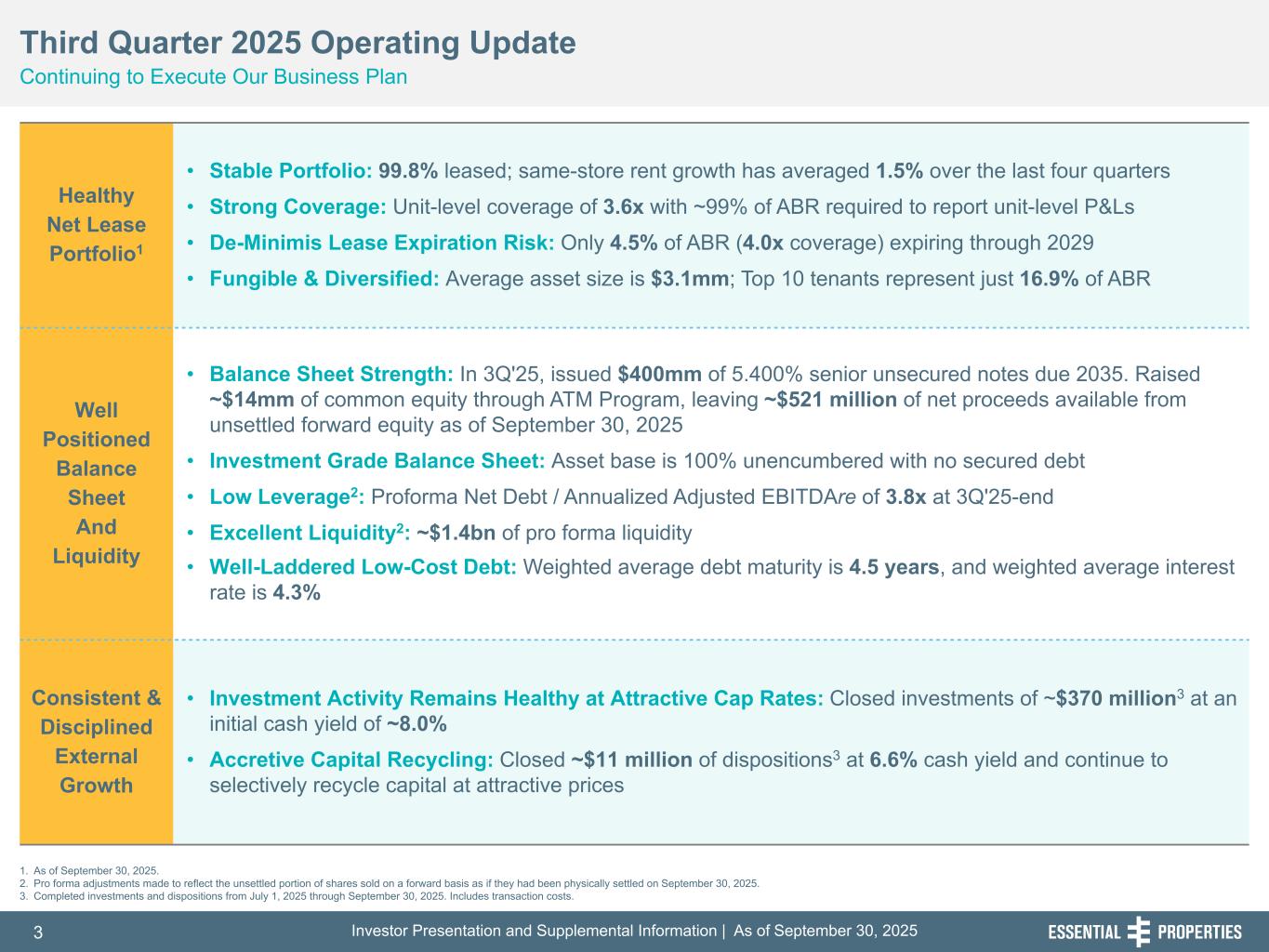
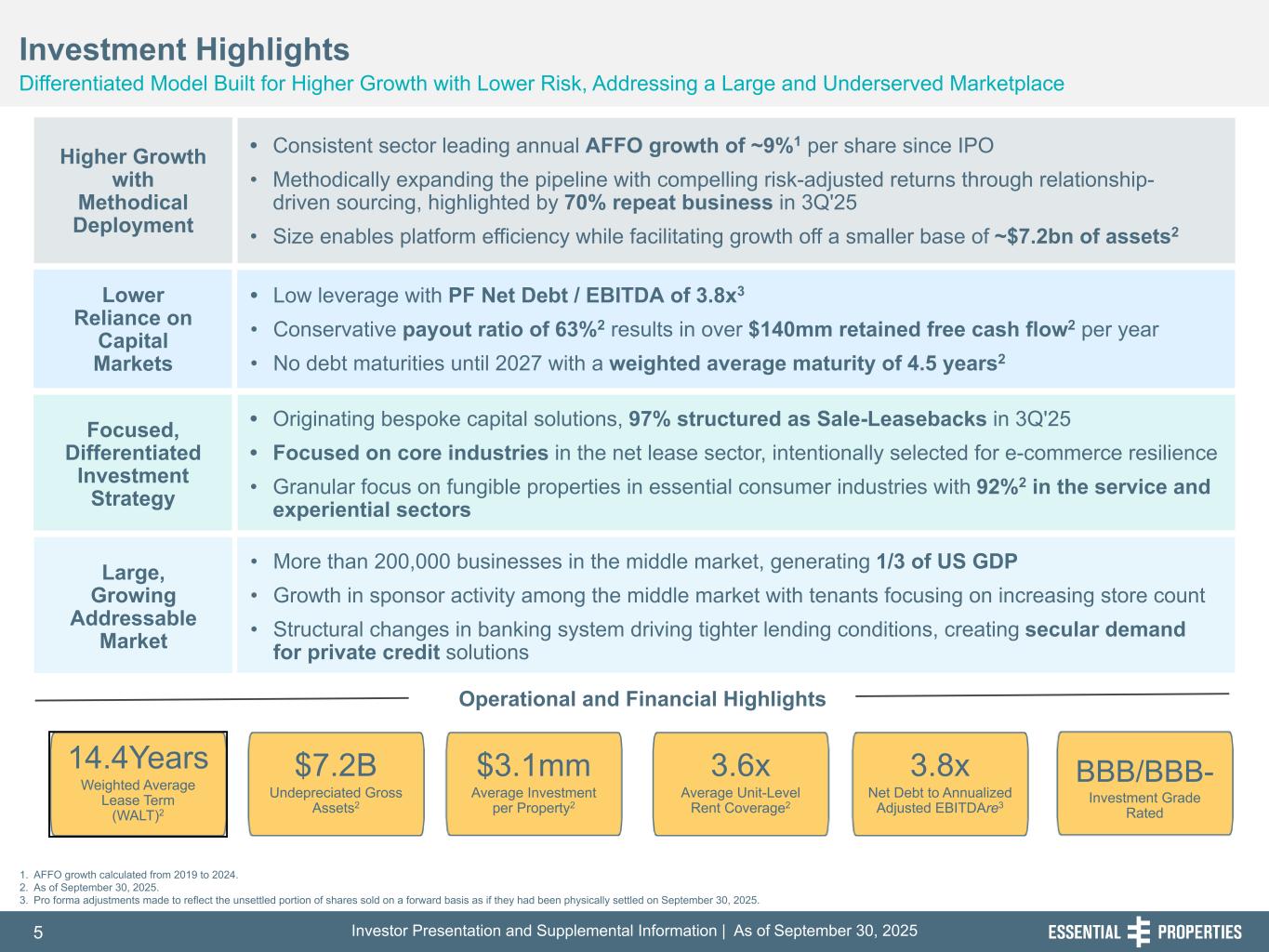
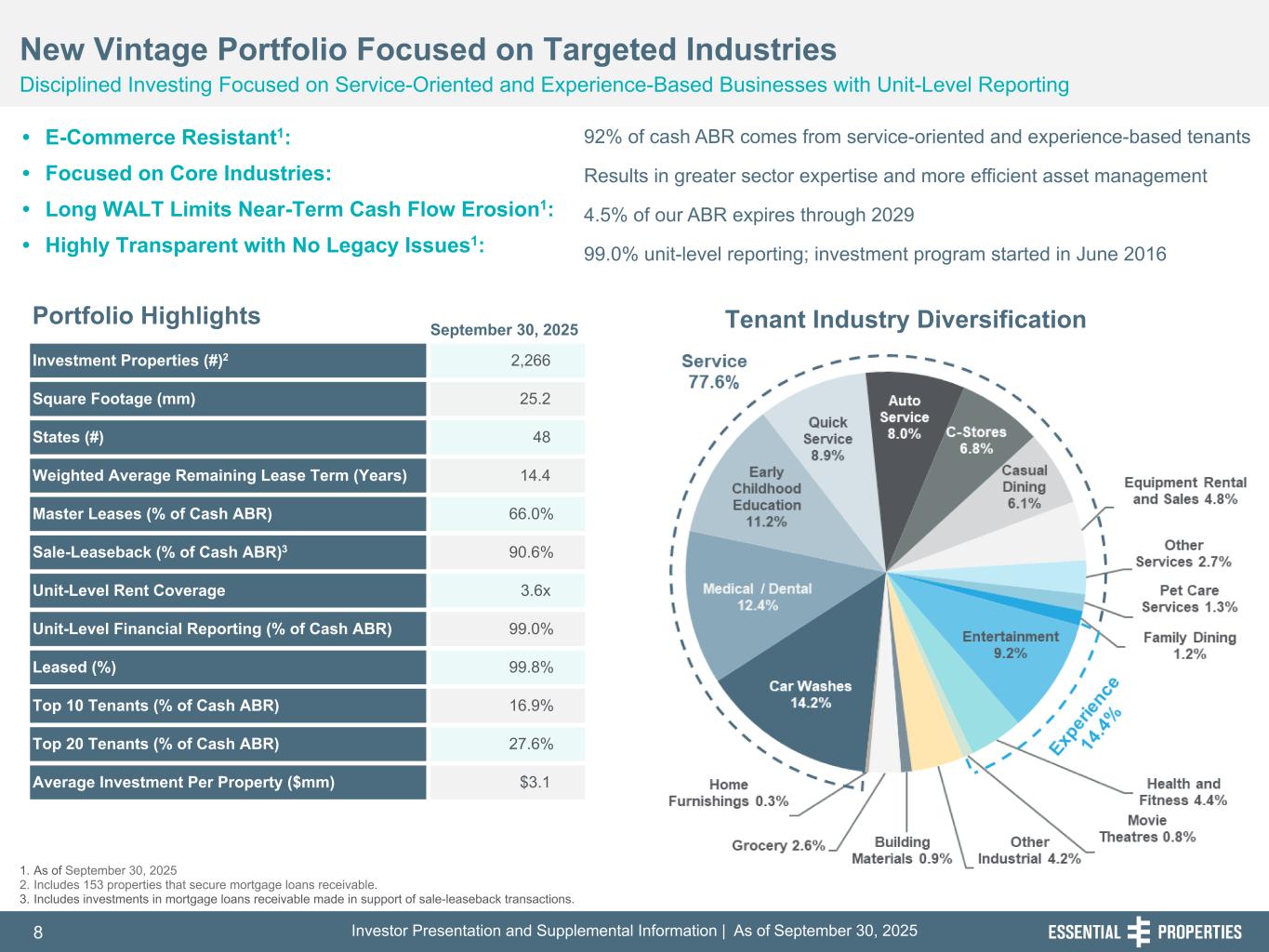
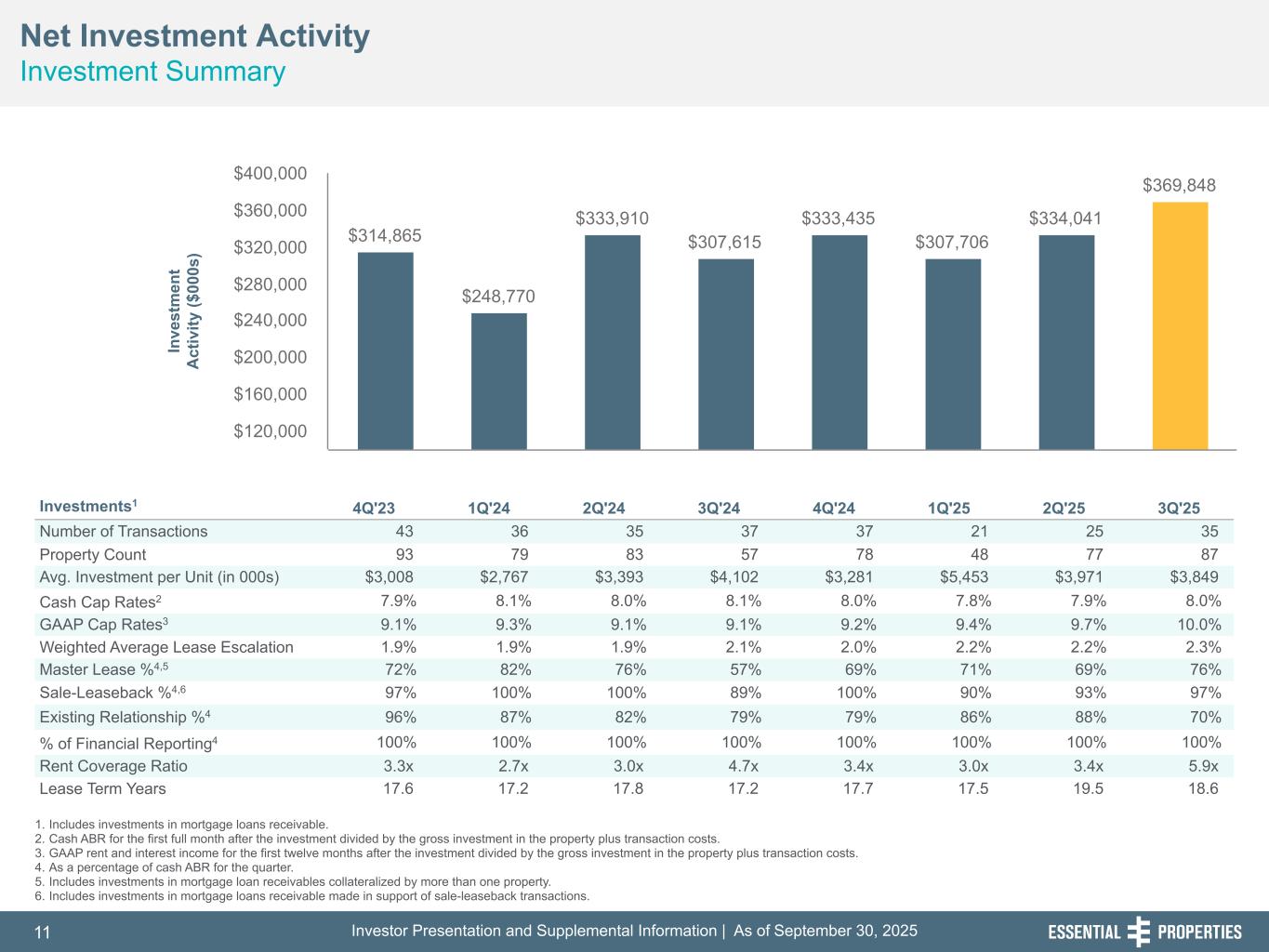
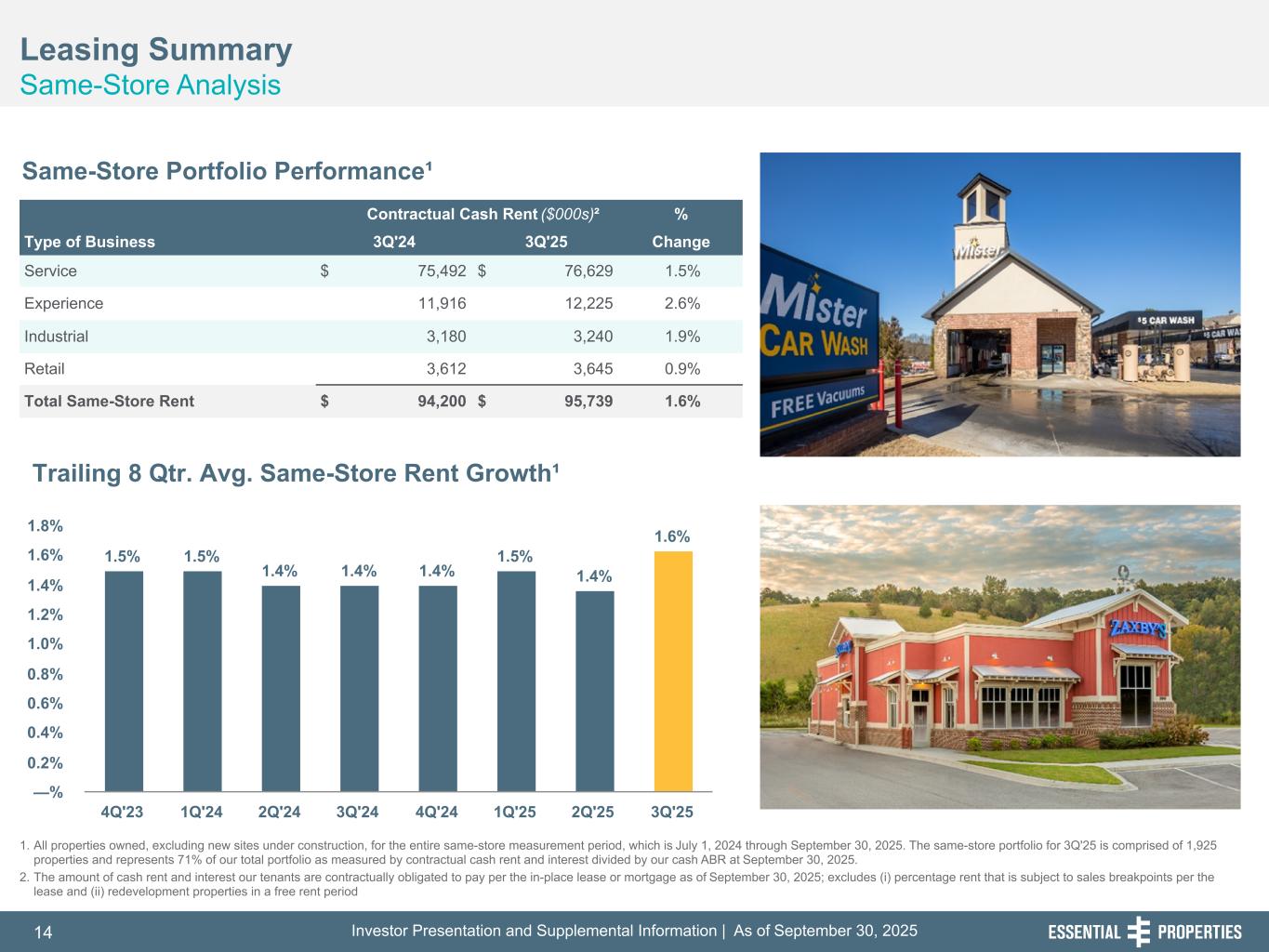
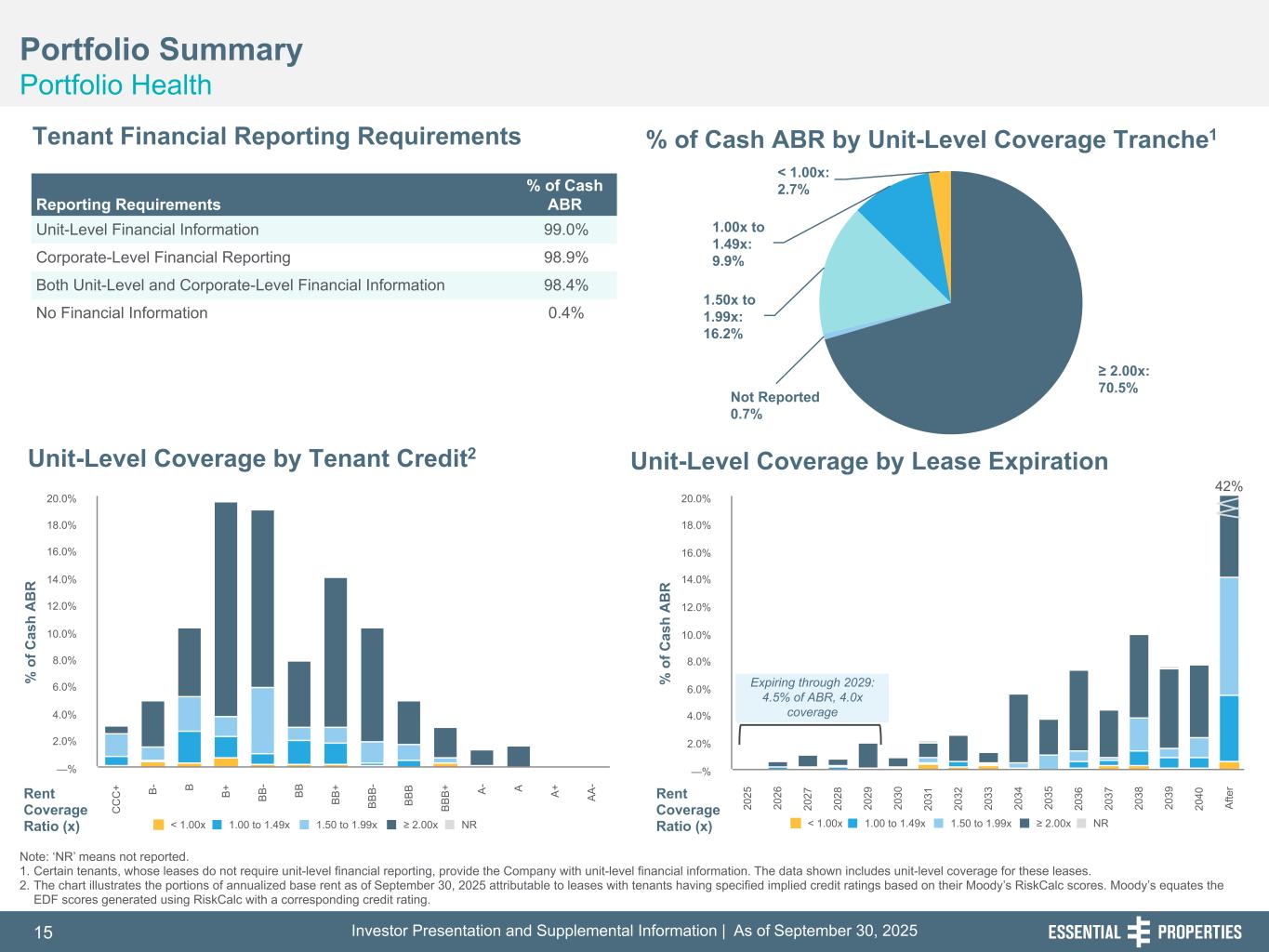
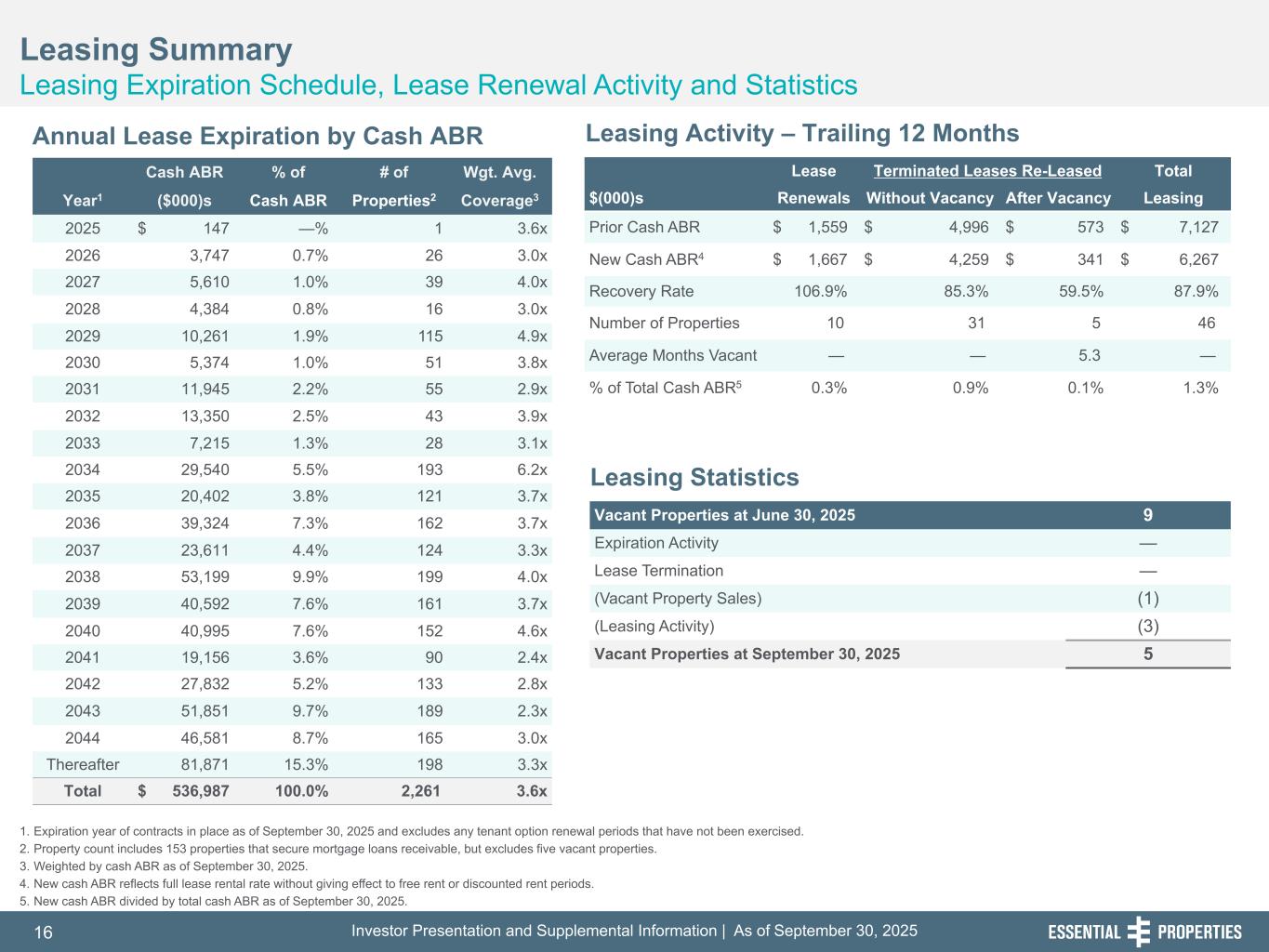
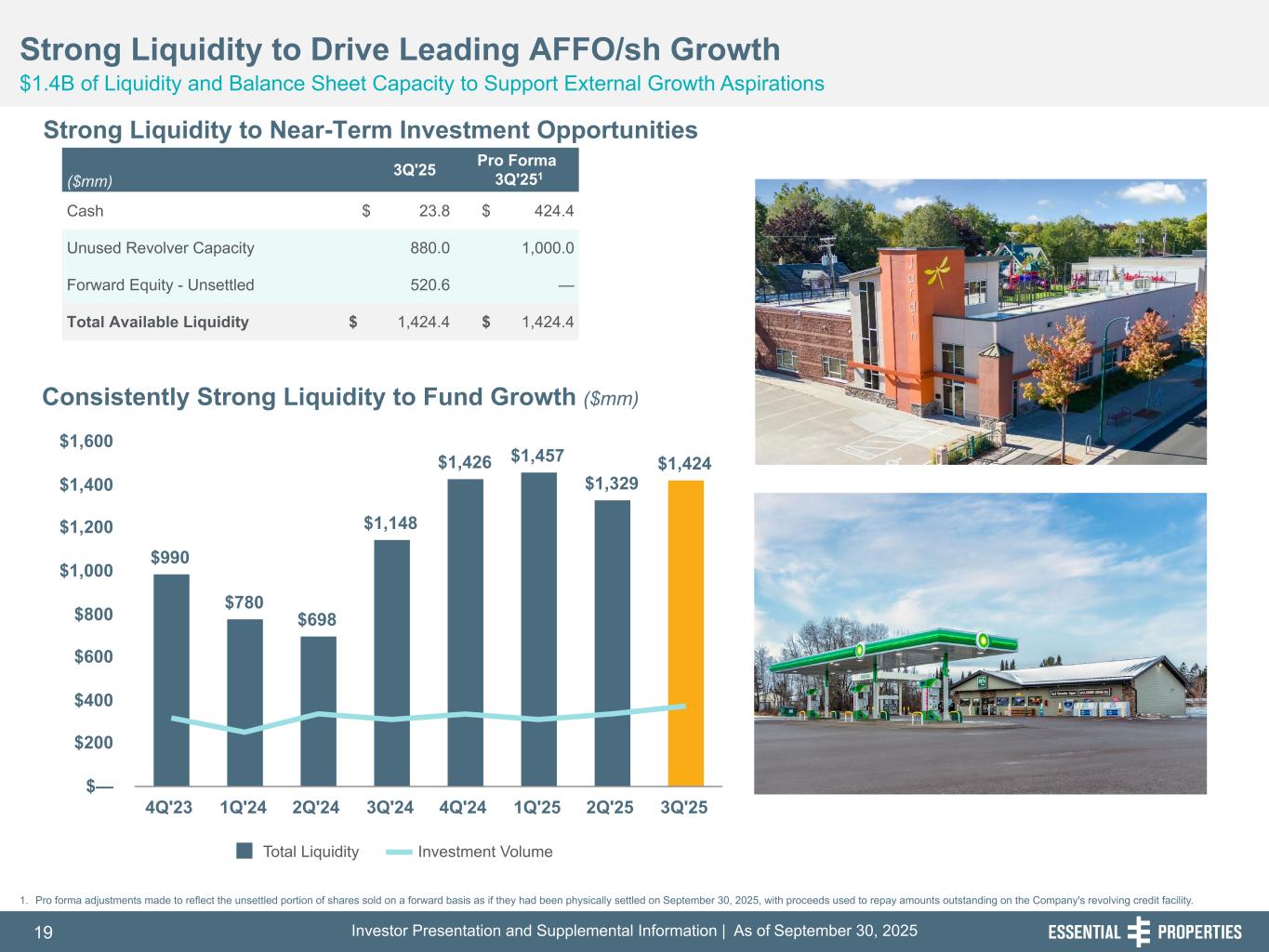
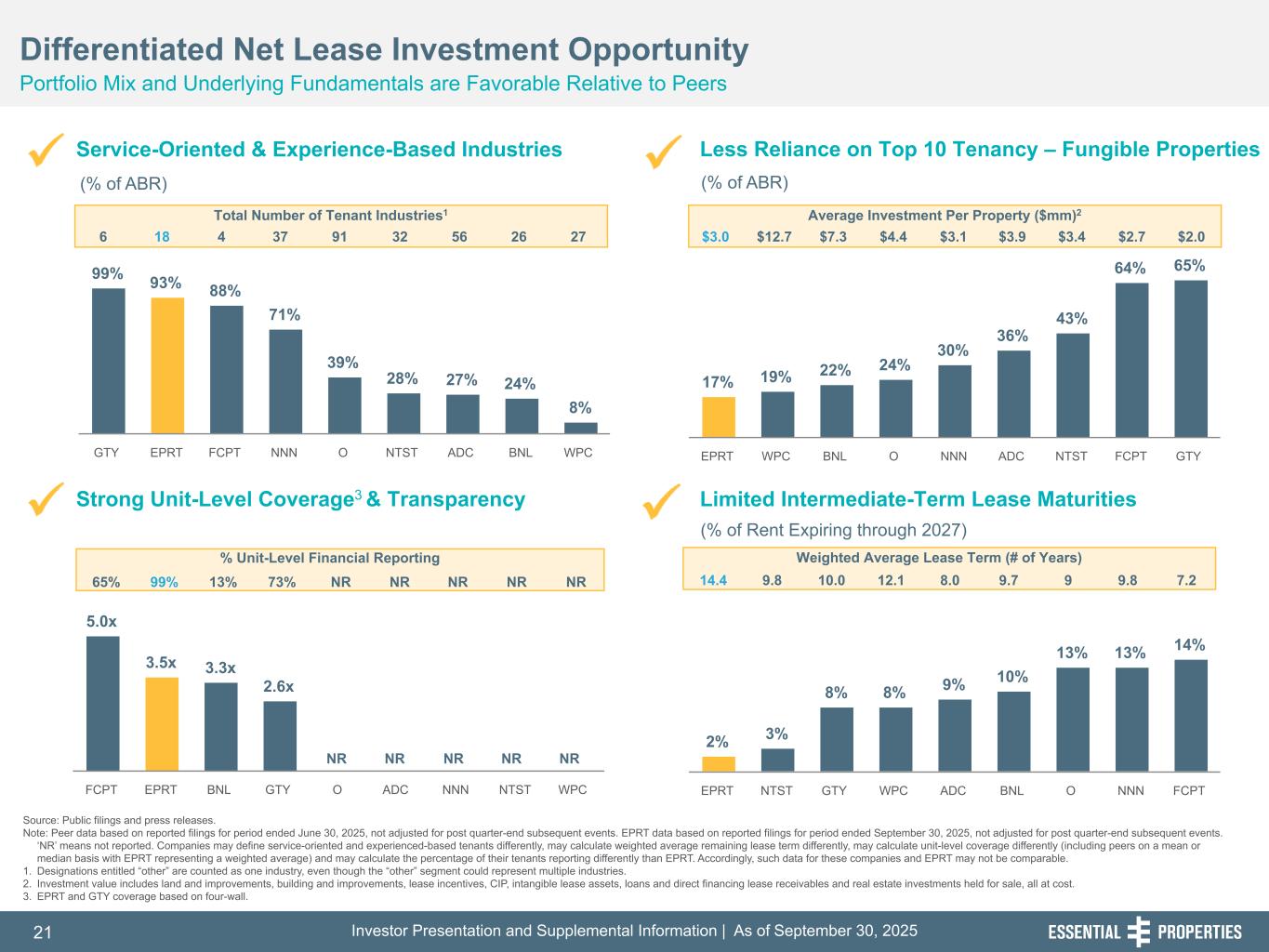
Thanks, Rob, and thank you to everyone joining us today for your interest in Essential Properties. In the third quarter, we continued to execute on our focused investment strategy as our team sourced attractive opportunities to deploy capital accretively into middle market sale-leasebacks with growing operators. During the quarter, we added new operators to our portfolio while continuing to support our existing relationships, which contributed 70% of our $370 million of investments, highlighting a healthy balance within our investment sourcing. Pricing was very favorable again this quarter with a weighted average initial cash yield of 8% and a strong average GAAP yield of 10%, which represents the highest level for us and an approximately 450 basis point spread to our estimated weighted average cost of capital. Our portfolio performance was another highlight this quarter with same-store rent growth of 1.6%, an increase in overall rent coverage to 3.6x, a 120 basis point decline in the percentage of ABR under 1x rent coverage and a decline in the tenant credit watch list, all of which is better than our budgeted expectations. Our capital position remains healthy with pro forma leverage of 3.8x and $1.4 billion of liquidity, which was supported by our unsecured bond issuance during the quarter. This positions us well to continue to invest, support our relationships and grow our portfolio, all to generate sustainable earnings growth for our shareholders. With operating and financial trends coming in ahead of budgeted expectations, we are again increasing our 2025 AFFO per share guidance to a range of $1.87 to $1.89, and our investment volume guidance to a range of $1.2 billion to $1.4 billion. Additionally, we are establishing our initial 2026 AFFO per share guidance range of $1.98 to $2.04, which implies a growth rate of 6% to 8%. Our guidance for 2026 reflects continued strong portfolio performance and a pace of investments generally consistent with our trailing 8-quarter average. Cap rates are expected to compress modestly over the coming quarters, reflecting a lower and stable interest rate environment. Specifically, we expect to invest between $1 billion and $1.4 billion in 2026. Additionally, we expect cash G&A expense to be between $31 million and $35 million, resulting in continued efficiency gains. Turning to the portfolio. We ended the quarter with investments in 2,266 properties that were leased to over 400 tenants. Our weighted average lease terms continued to be approximately 14 years for the 18th consecutive quarter, with just 4.5% of our annual base rent expiring over the next 5 years. With that, I'll turn the call over to A.J. Peil, our Chief Investment Officer, who will provide an update on our portfolio and asset management activities.
Speaker 3
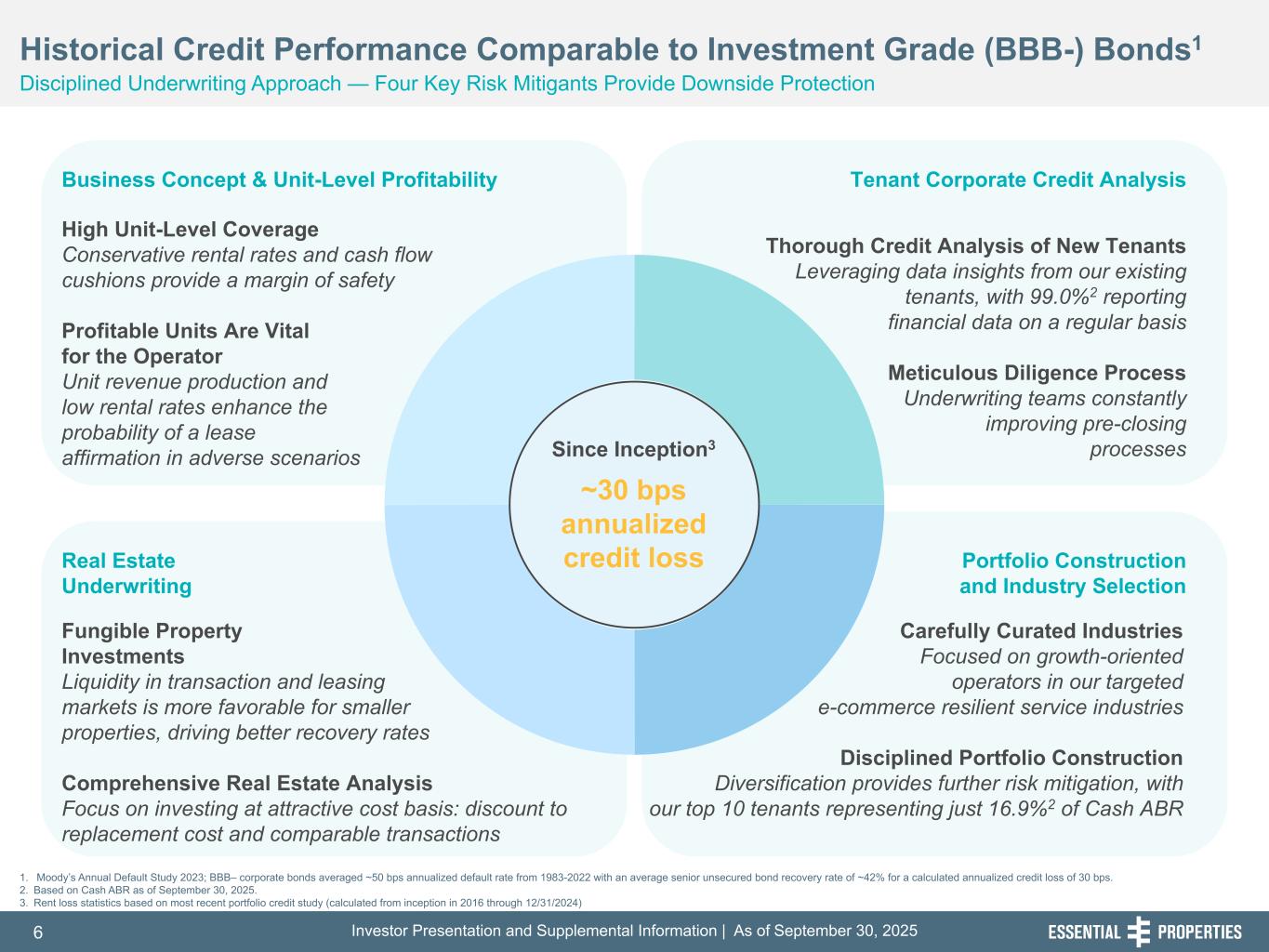
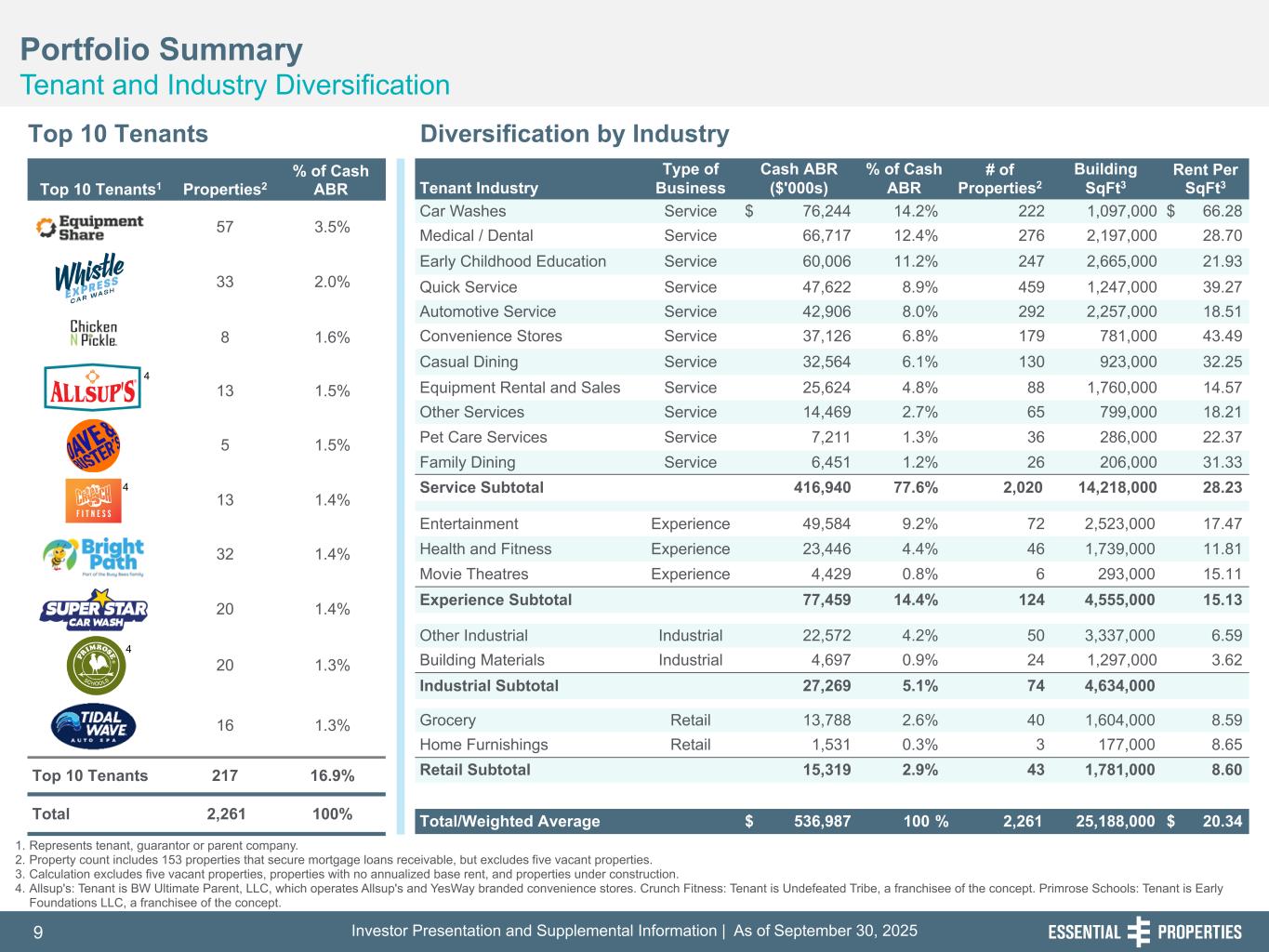
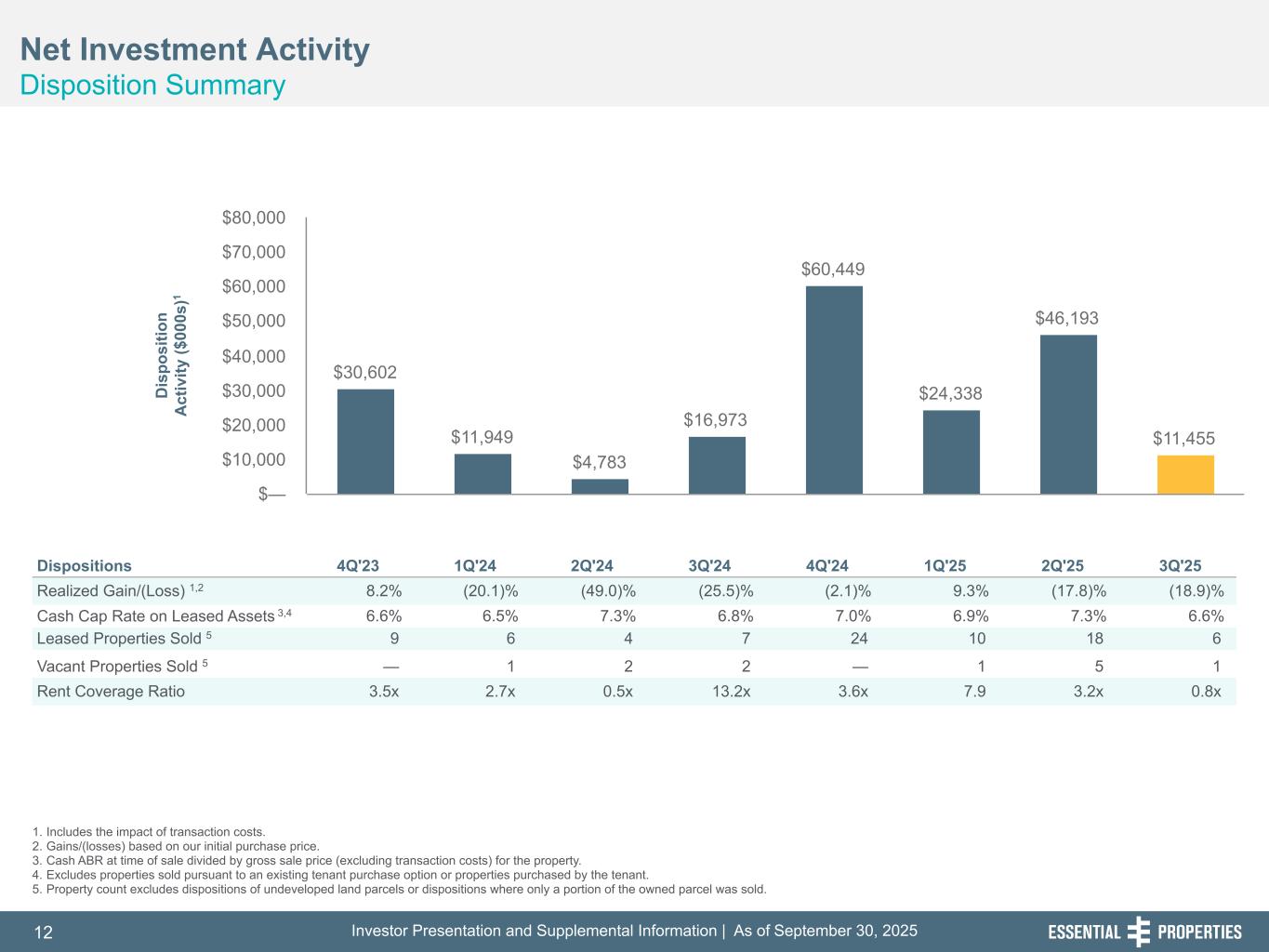
Thanks, Pete. As Pete mentioned, at a high level, our portfolio credit trends remain very healthy, with same-store rent growth in the third quarter of 1.6%, up from 1.4% last quarter and occupancy of 99.8% with only 5 vacant properties. Overall portfolio rent coverage increased to 3.6x from 3.4x last quarter, and the percentage of ABR under 1x rent coverage declined by 120 basis points. There were no noteworthy credit events during the third quarter, and overall tenant credit trends have performed better than our budgeted expectations and our historical credit loss levels of 30 basis points. From a portfolio diversification perspective, our top tenant concentration continues to decline with our largest tenant equipment share representing just 3.5% of ABR at quarter end, our top 10 tenants overall accounting for just 16.9% of ABR and our top 20 accounting for only 27.6% of ABR. Tenant diversity is an important risk mitigation tool, and it is a direct benefit of our focus on middle market operators. On the disposition front, during the third quarter, we sold 7 properties for $11.5 million in net proceeds. This represents an average of $1.6 million per property, highlighting the importance of owning fungible liquid properties, allowing us to proactively manage portfolio risk. The dispositions this quarter were executed at a 6.6% weighted average cash yield. Over the near term, we expect our disposition activity to be consistent with our trailing 8-quarter average, driven by opportunistic asset sales and ongoing portfolio management activity. With that, I'll turn the call over to Max Jenkins, our Chief Operating Officer, who will provide an update on our investment activities and the current market dynamics.
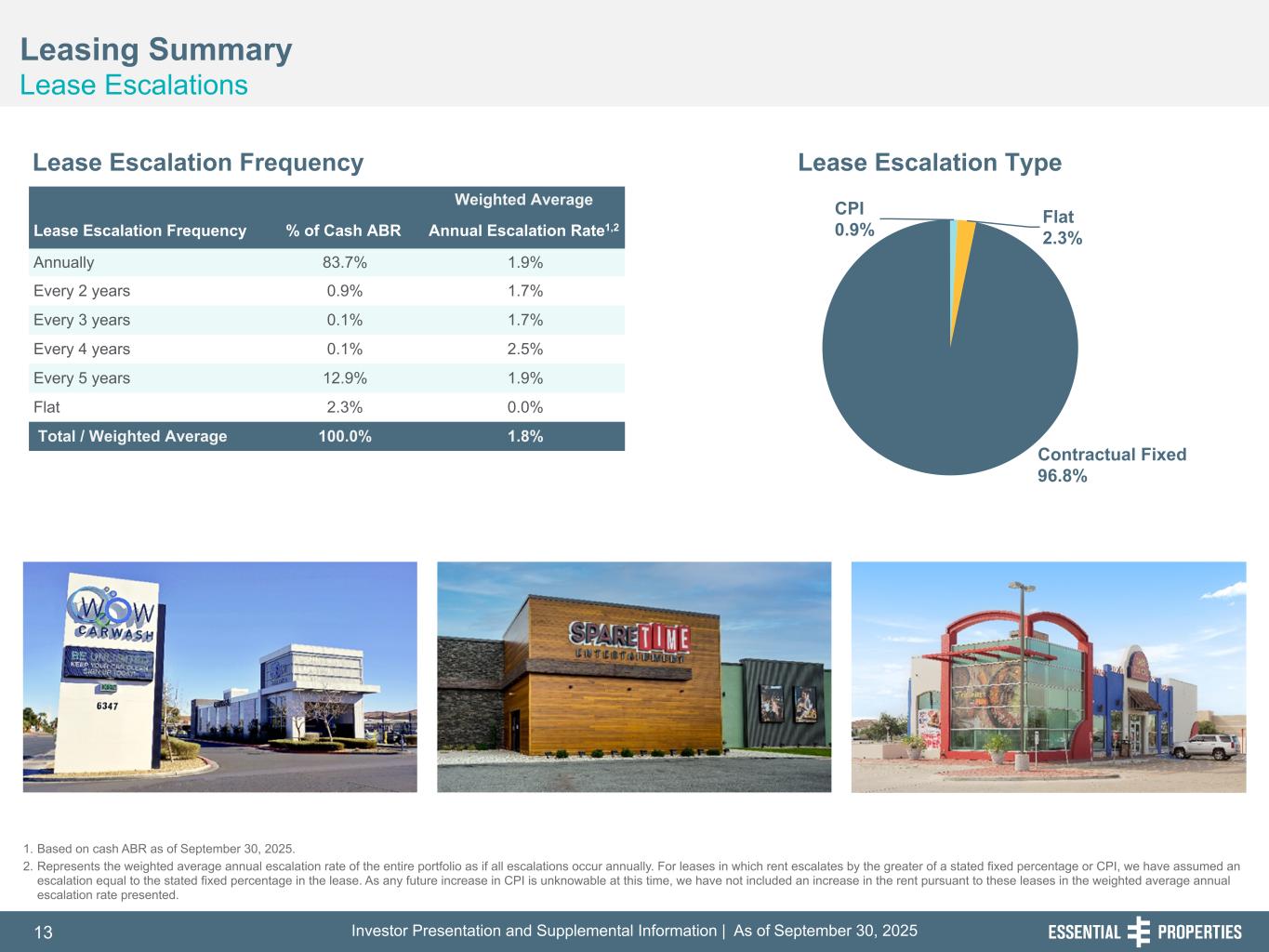
Thanks, A.J. On the investment side, during the third quarter, we invested $370 million at a weighted average cash yield of 8%. Our capital deployment was broad-based across most of our top industries with no notable departures from our investment strategy. During the third quarter, our investments had a weighted average initial lease term of 18.6 years and a weighted average annual rent escalation of 2.3%, generating a strong average GAAP yield of 10%. During the quarter, we closed 35 transactions comprising 87 properties, of which 97% were sale-leasebacks. Investment per property was $3.8 million this quarter as our deal activity was characterized by granular freestanding properties, which is one of our core elements of our investment strategy. Looking ahead, our investment pipeline remains strong. Pricing in our pipeline has cap rates in the mid- to high 7% range, which represents a healthy spread to our cost of capital with elevated contractual escalations supporting our long-term growth trajectory. Combined with our investments of $1 billion year-to-date, we have again increased our full year investment guidance to a new range of $1.2 billion to $1.4 billion. With that, I'd like to turn the call over to Mark Patten, our Chief Financial Officer, who will take you through the financials for the third quarter.
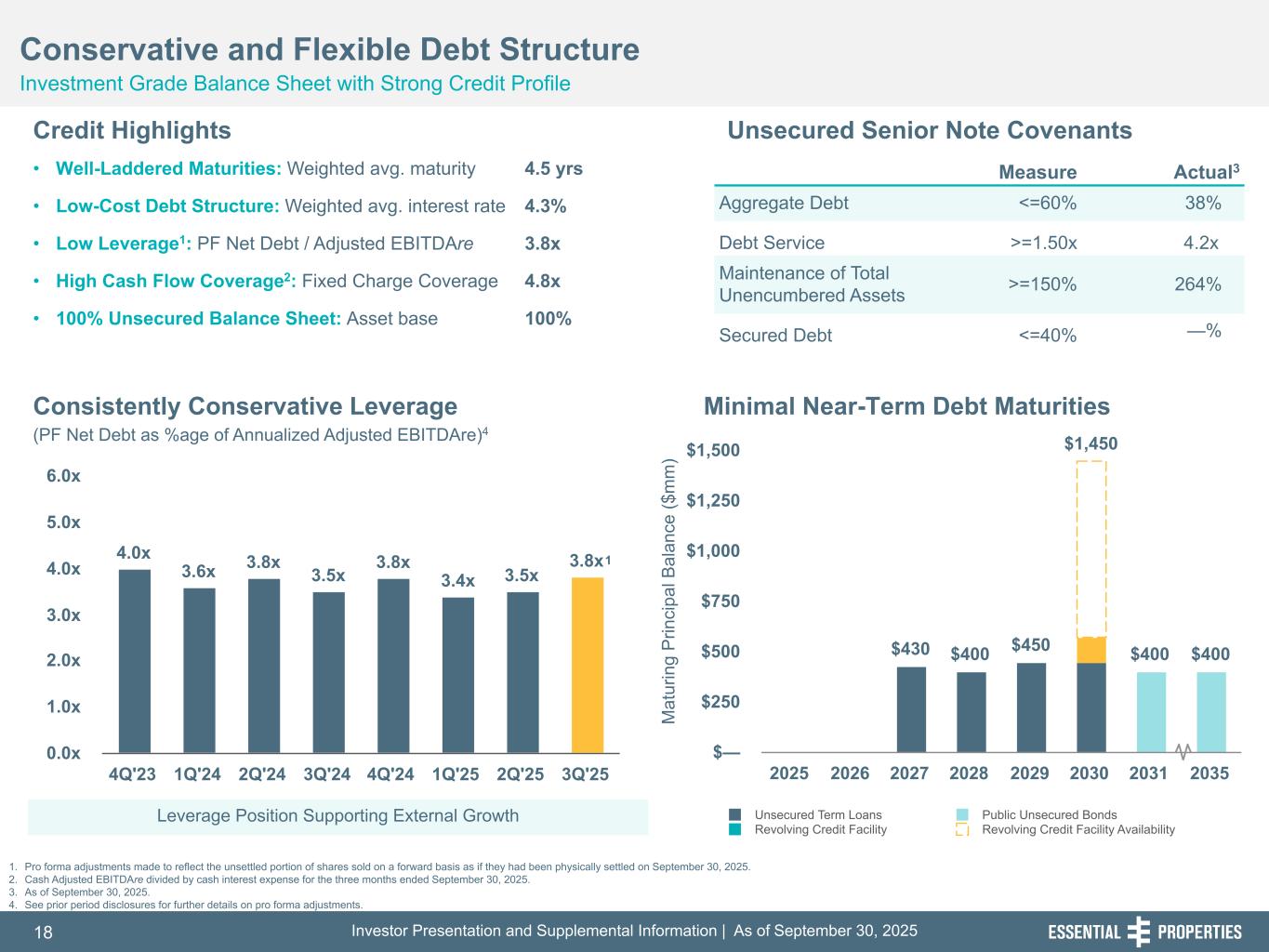
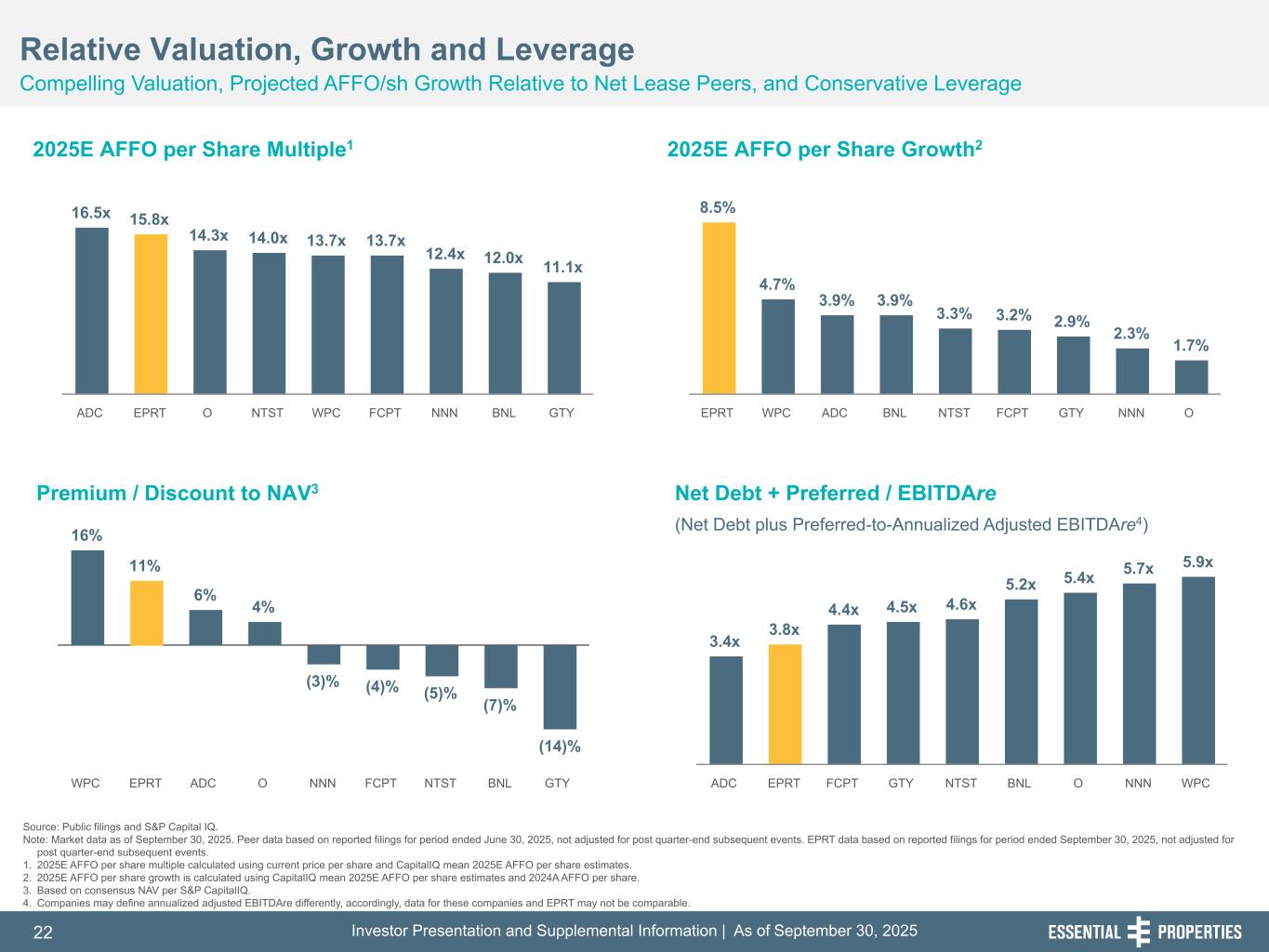
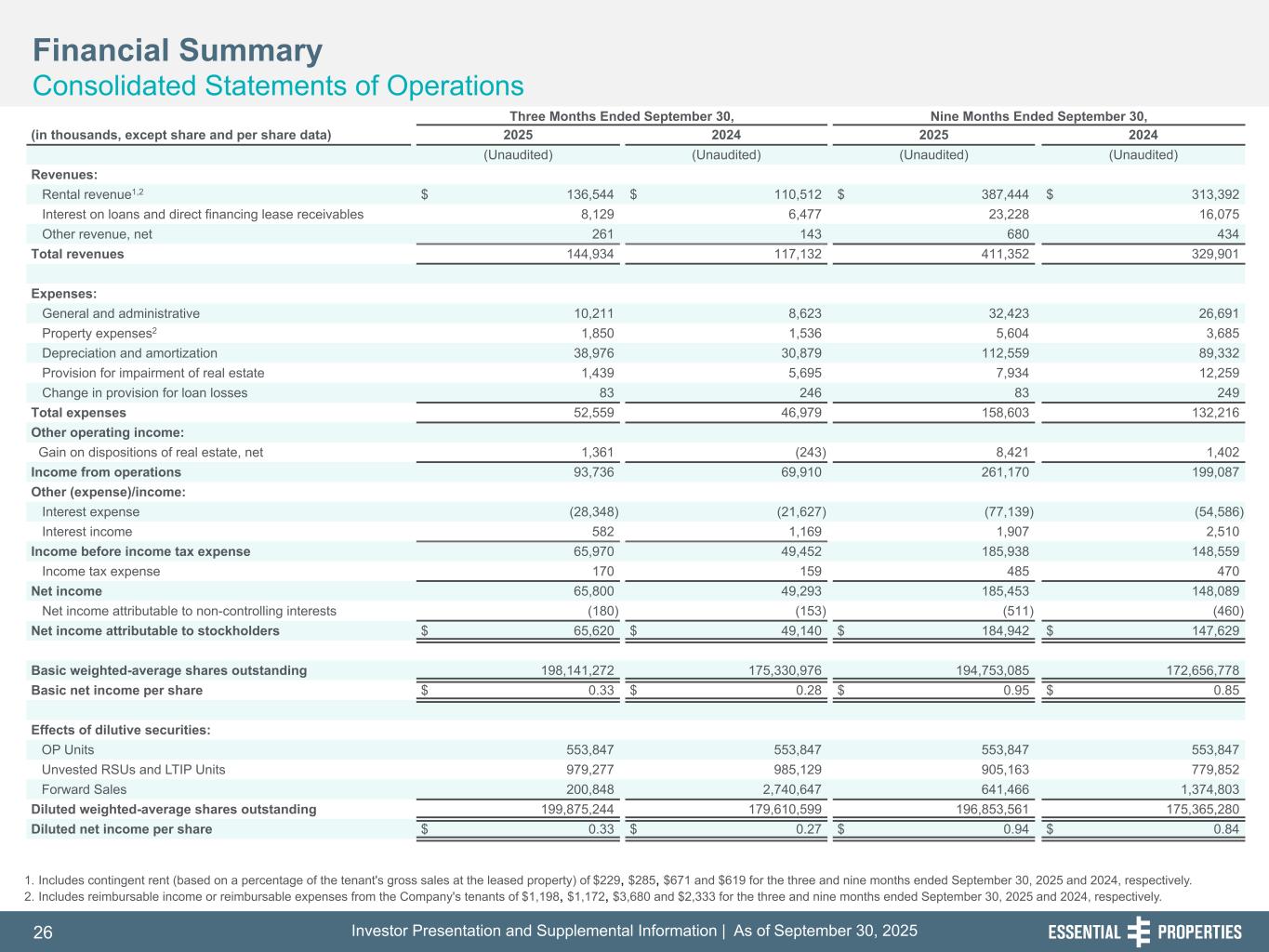
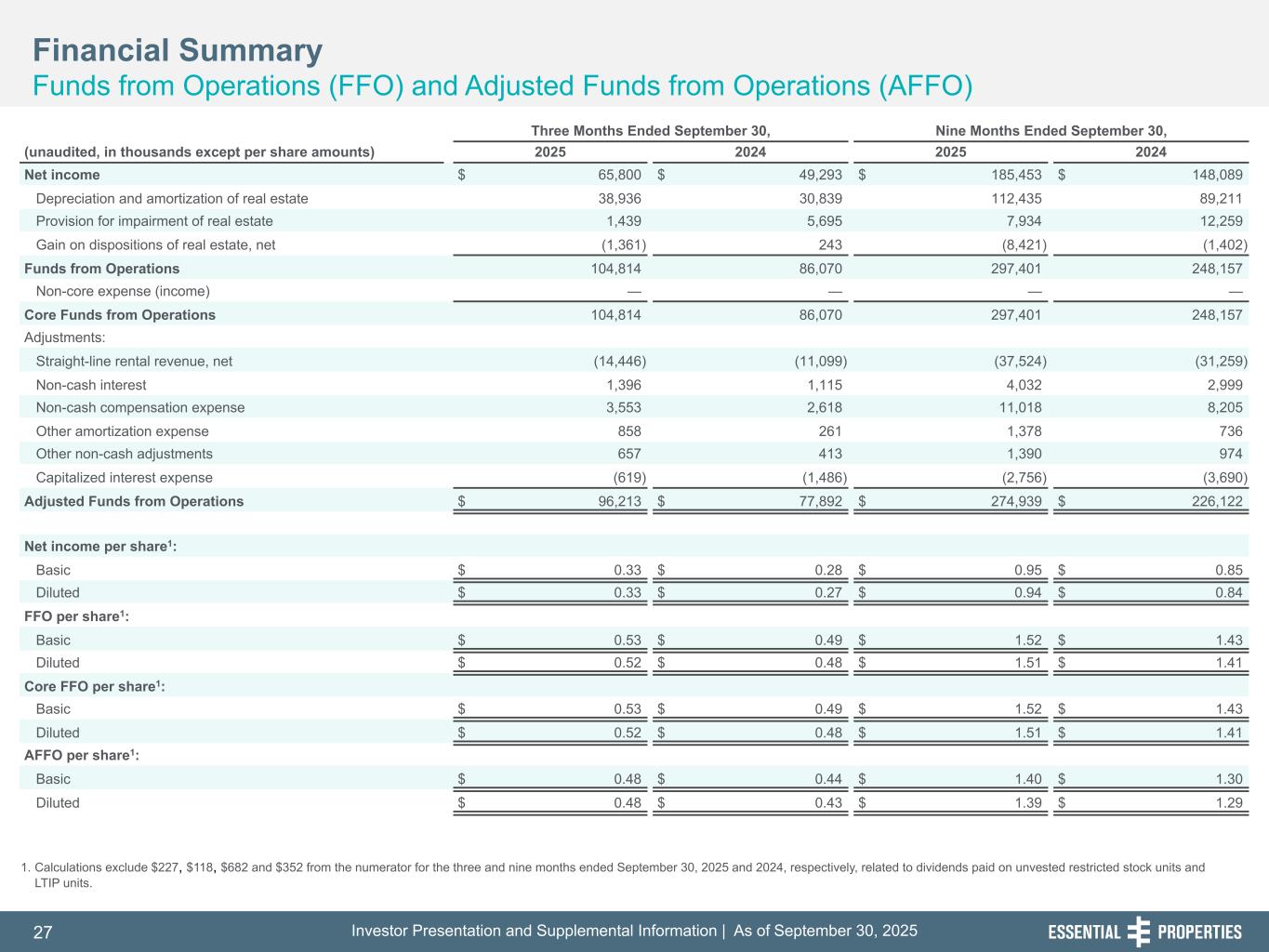
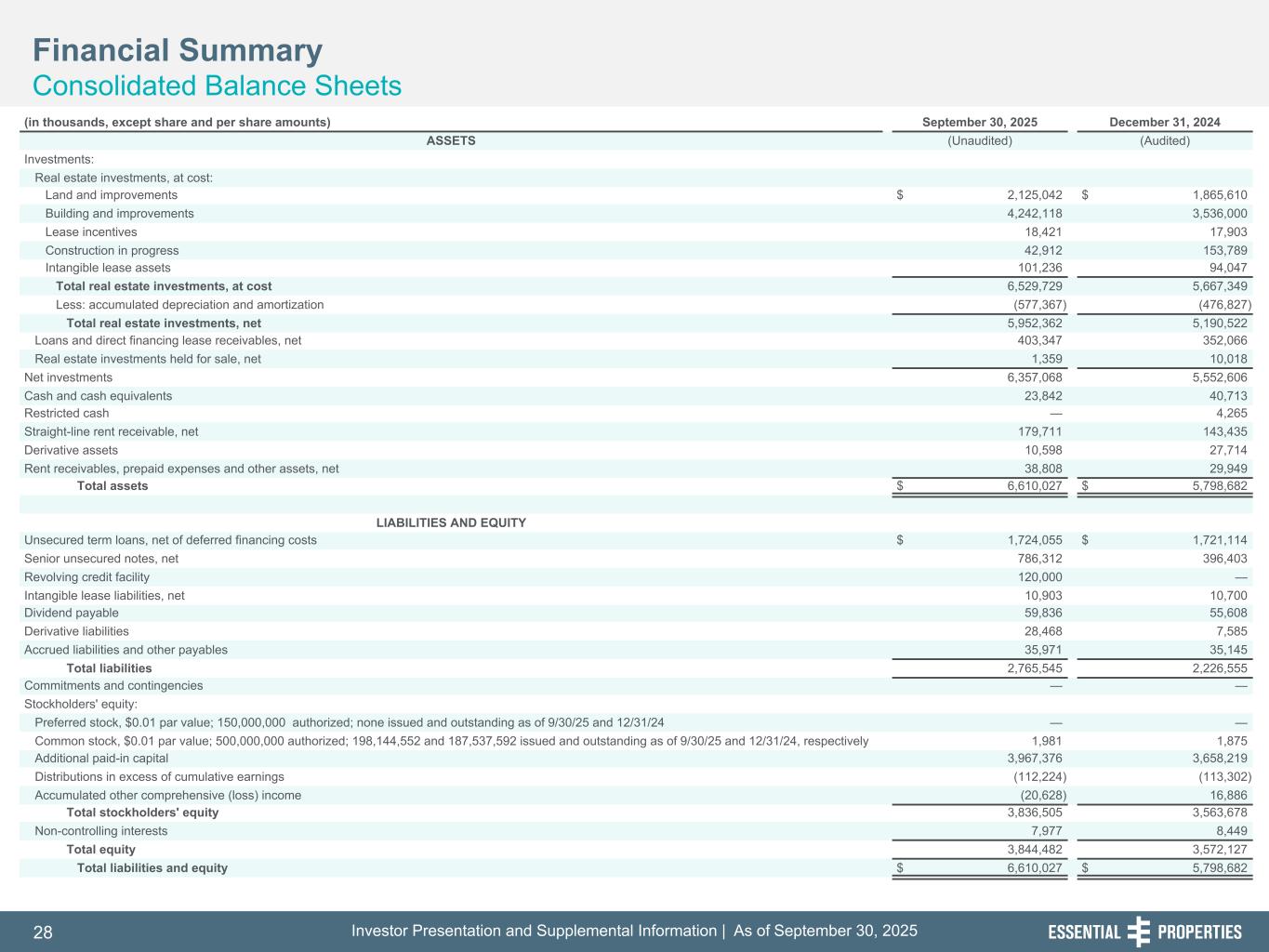
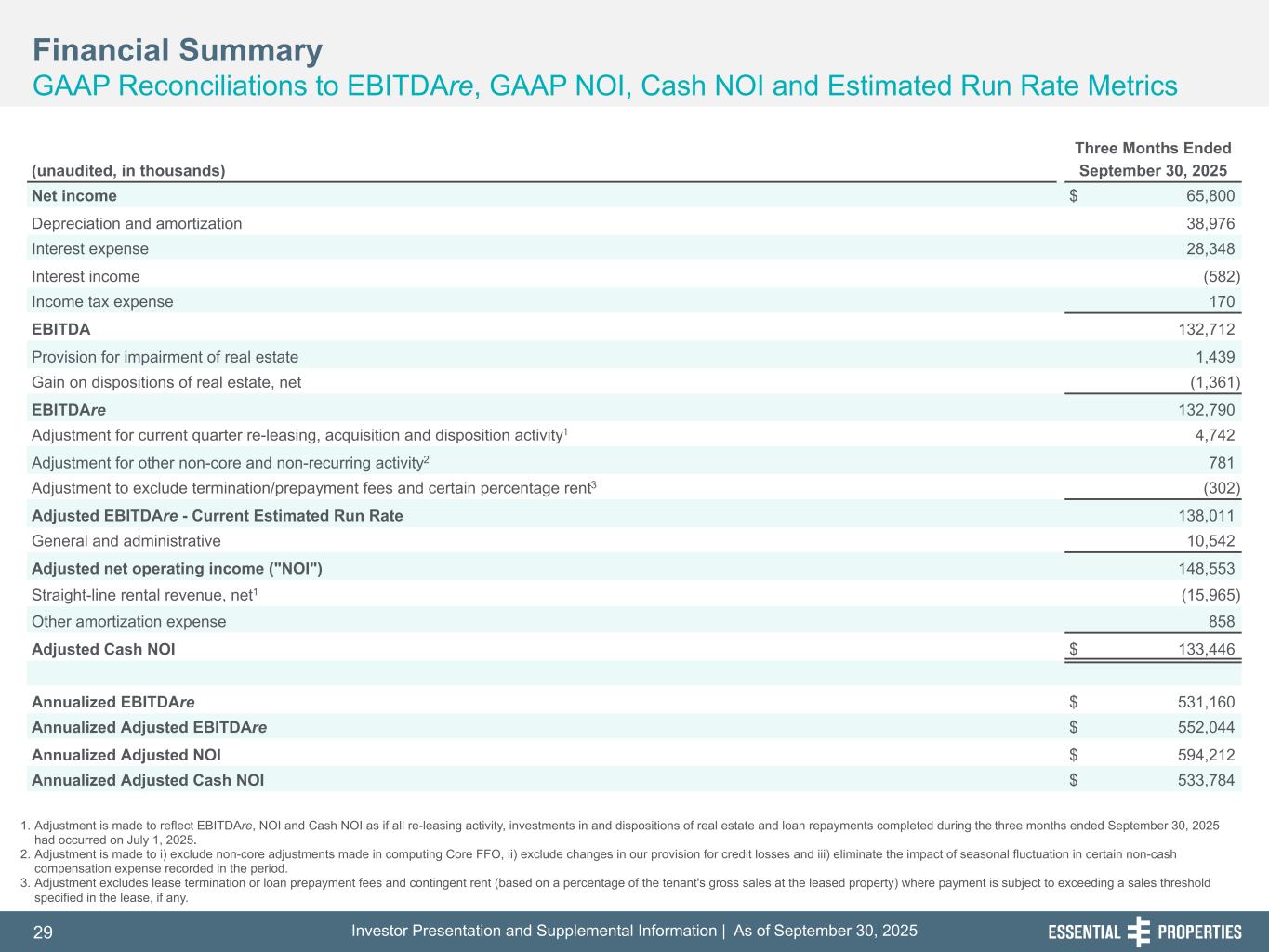
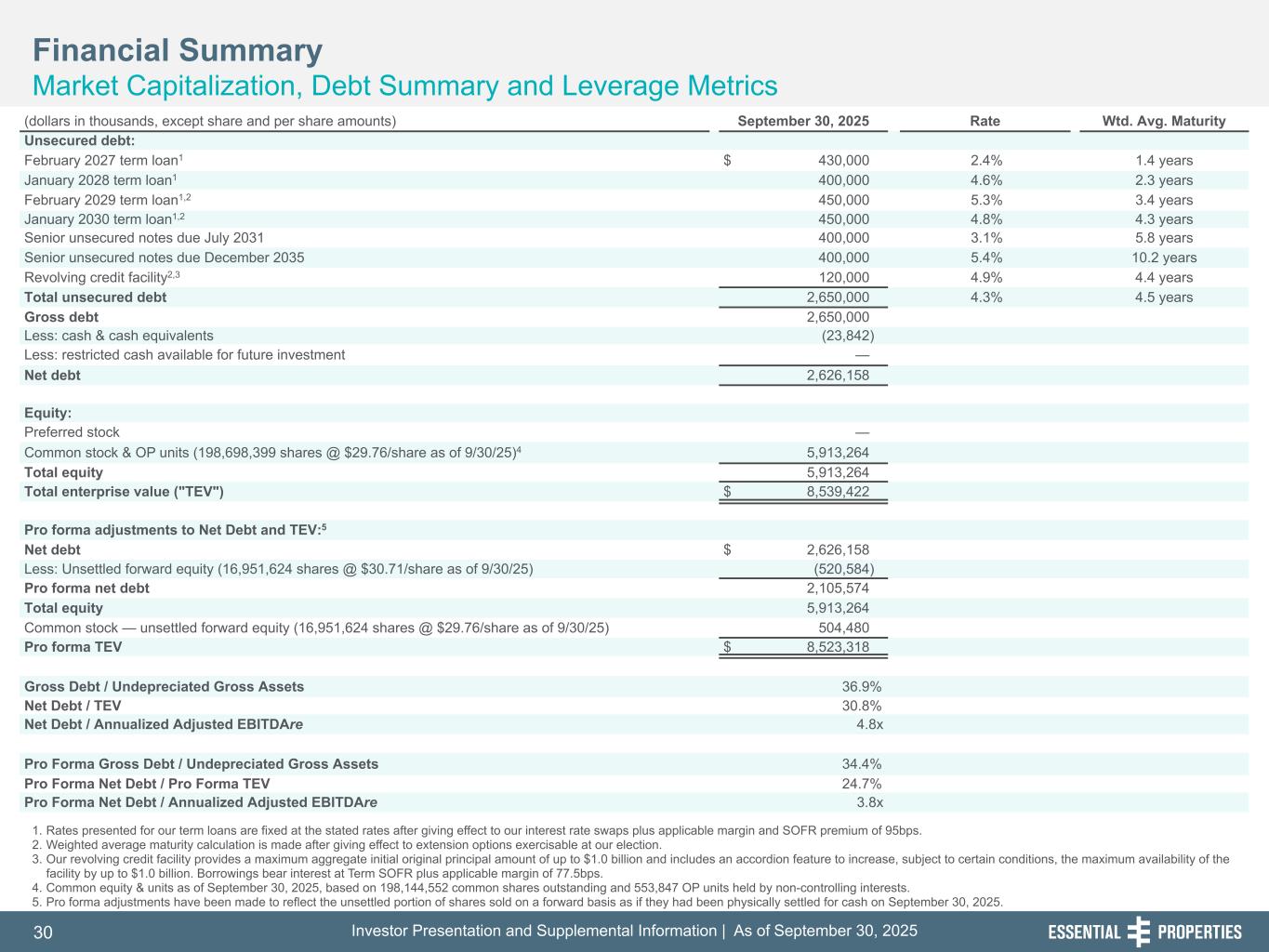
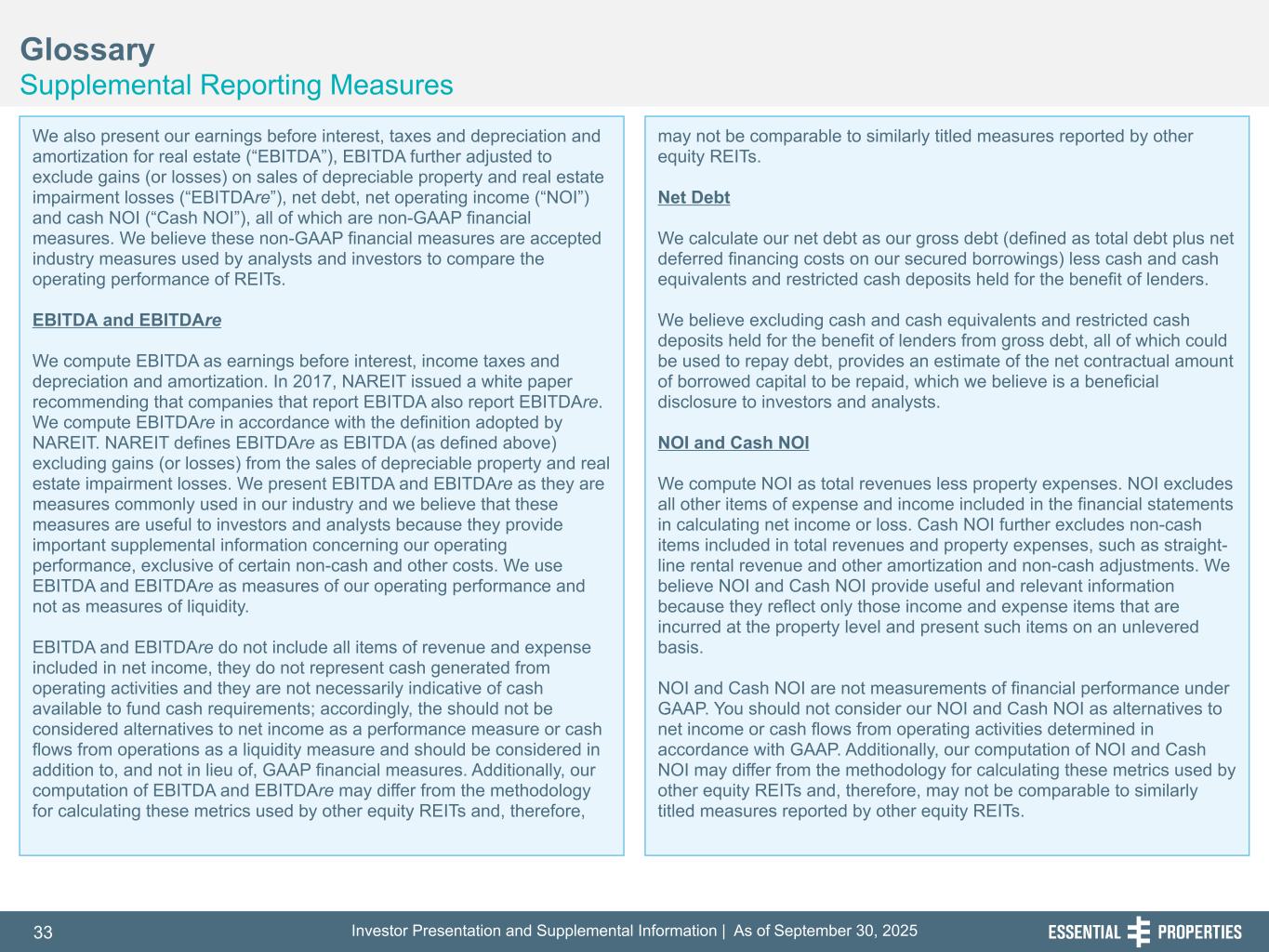
Thanks, Max. Overall, we were very pleased with our third quarter results, highlighted by the record level of investments and our AFFO per share, which totaled $0.48, representing an increase of 12% versus Q3 of 2024. On a nominal basis, our AFFO totaled $96.2 million for the quarter, which is up 24% from the same period in 2024. This AFFO performance was consistent with our expectations as reflected in our guidance range. Total G&A in Q3 2025 was $10.2 million versus $8.6 million for the same period in 2024, which is consistent with our budgeted expectations. The majority of the year-over-year increase is related to increased compensation expense, including stock compensation as we continue to invest in our team in support of driving our growth ambitions. Our cash G&A was approximately $6.7 million this quarter, which is consistent with our guidance range of $28 million to $31 million for the full year and represents just 4.6% of total revenue, down from 5.1% from the same period a year ago. We declared a cash dividend of $0.30 in the quarter, which represents an AFFO payout ratio of 63%. Our retained free cash flow after dividends continues to build, reaching $36.4 million in the third quarter, equating to over $140 million per annum on a run rate basis or approximately 10% of the top end of our 2026 investment guidance. Turning to our balance sheet. With the net investment activity in Q3 2025, our income-producing gross assets reached nearly $7 billion at quarter end. The increasing scale and diversity of our income-producing portfolio continues to build, improving our credit profile. On the capital markets front, we successfully executed a $400 million 10-year unsecured bond offering in August with a 5.4% coupon. This achieved an important advancement in a strategic objective of our capital markets program as we continue to build a more liquid bond complex and work to more closely align the weighted average duration on our liabilities with our long-dated assets. Our weighted average debt maturity improved by approximately 18% to 4.5 years, owing in large part to this issuance. With the liquidity from the bond offering, we were able to be more selective on the equity side this quarter, raising approximately $14 million through our ATM Program. We did not settle any forward equity during the quarter, leaving us with a balance of unsettled forward equity totaling $521 million at quarter end. We expect to utilize these funds in the near term to support our investment activities and preserve our balance sheet flexibility by repaying our revolving credit facility balance. Similar to last quarter, our share price remained above the weighted average price of our unsettled forwards of $30.71 at quarter end. As a result, under the treasury stock method, the potential dilution from these forward shares is included in our diluted share count. For the third quarter, our diluted share count of 199.9 million shares included an adjustment for 0.2 million shares from our unsettled forward equity related to this treasury stock calculation. This represented a modest headwind to our AFFO per share for the quarter, which was consistent with our budgeted expectations. Based on our current share price, we expect a very modest headwind from the impact of the treasury stock method in the fourth quarter. Our pro forma net debt to annualized adjusted EBITDAre, as adjusted for unsettled forward equity, remained low at 3.8x as of quarter end. We remain committed to maintaining a well-capitalized and conservative balance sheet with low leverage and significant liquidity to continue to fuel our external growth and allow us to service our tenant relationships in this dynamic environment. Lastly, as we noted in the earnings press release, we have increased our 2025 AFFO per share guidance to a new range of $1.87 to $1.89. Importantly, this guidance range requires no incremental equity issuance to achieve, and we anticipate ending the year at pro forma leverage of approximately 4x, leaving us ample runway to fund our growth ambition in 2026. Turning to 2026. As Pete noted, we have established an initial AFFO per share guidance range for 2026 of $1.98 to $2.04, reflecting a growth rate of approximately 6% to 8%. With that, I'll turn the call back over to Pete.
Speaker 2
Thanks, Mark. We are happy with our third quarter results. The portfolio is performing well. The investment market is exceptional and the capital markets are supportive. Operator, please open the call for questions.
Operator
We'll take our first question from Haendel St. Juste with Mizuho.
Speaker 6
So I guess, first, congrats on another strong quarter. I wanted to ask, I was intrigued, Pete, by your comments about expecting lower cap rates going forward. I understand a lot of that is from lower cost of debt here, but I'm also curious if any of that is from the increased competition we're hearing about. And if you expect any of this new competition to impact your ability to source sale-leasebacks going forward?
Speaker 2
Sure. Thanks, Haendel, and thanks for the compliment on the quarter. It was a great quarter, and we feel pretty good about it. Listen, the 10-year is down materially, and the interest rate environment is more stable than it has been, which all contributes to a lower cap rate environment. We continue to source a strong pipeline of sale-leaseback opportunities as evidenced by the fourth quarter, as evidenced by our increase in investment guidance for the fourth quarter. And we can compete with any competition in the market. And so there's always competition. I think the cap rates are going to be driven down more by the stability in the interest rate environment, and we have an ample opportunity set.
Speaker 6
Appreciate that. One more, I wanted to ask about the new industrial assets you acquired. I know you have a little exposure there already, but there were really high rent coverage and I'm curious if there's an expectation perhaps to do more of that asset type going forward?
Speaker 2
Yes, sure. We've been investing in industrial outdoor storage sites with service-based companies for quite some time now. Our investment in the industrial space really focuses on granular, fungible assets. And so one of the important considerations when we're doing those deals is making sure that we're having a very fungible piece of real estate. And we like it. We like the sale-leaseback where we can structure master leases on our lease, and that's been a part of our business and will continue to be a part of our business going forward. I wouldn't expect it to be disproportional. I would expect it to grow ratably.
Operator
Our next question comes from Michael Goldsmith with UBS.
Speaker 7
To follow up on Haendel's initial question about the expectation for cap rates to decrease, when you combine that with your first outlook for 2026, are you considering tighter spreads in that scenario? I'm trying to understand how the decrease in cap rates will impact the overall flow.
Speaker 2
Yes. I mean I've been saying this consistently for the past 2 years that we expect cap rates to come down. Certainly, as we look at the business, we did in the third quarter, initial cap rate of 8% with a 10% GAAP yield. As I said in past calls, that's pretty much as good as it gets. As I said earlier, a 10-year going from 4.5% to 4 certainly contributes to downward pressure on cap rates. And if you think about the lag in the business, there's generally going to be a 60- to 90-day lag between movements in underlying interest rates and movements in cap rates. So similar to last year, as we look out here very early, 15 months in advance, we anticipate some downward pressure on cap rates. And overall, and as we think about the forward yield curve, I think it really results in a static spread, if anything. Maybe some compression in spread. I certainly feel like there's some room for that with our historically wide spreads. But there's certainly, as there always is a certain amount of conservatism baked into our forward assumptions because it is pretty early.
Speaker 7
As a follow-up, the percentage of ABR was less than 1%, and the rent coverage decreased. It appears you sold some assets. Can you share details about what was sold, what remains in the portfolio with that less than 1x coverage, and if you intend to make further disposals of similar assets?
Speaker 2
Yes. Selling 7 assets at $11 million really isn't going to drive a material movement in that. It's at the margin. As we generally say, we take a very close look at those assets. And if they're permanently impaired, we come up with a strategy, whether disposal, restructuring or whatever to fix that. Many of the assets in those buckets are assets that are transitional, and we expect to come out of that bucket over time. And so we take an asset-by-asset look. And if we see permanently impaired assets, we'll move them out of the portfolio. I think what you see in the quarter is decrease in that bucket is just general improvement in some of the underlying operating conditions.
Operator
Our next question comes from John Kilichowski with Wells Fargo.
Speaker 8
Maybe, Pete, just to kind of go back into the guide here and talk about the drivers. I think it would be really helpful to talk about your assumptions this year versus last year. I understand for the past 2 years, you've been assuming some cap rate compression. I don't know if on the low and the high end, if you could talk to maybe the sizing of that and how that looked on this guide versus the last guide? And then maybe also on credit loss, maybe if there's more conservatism there and if that's just general conservatism given weakness in some of the private credit markets or if there's specific tenants that are on your watch list today that weren't last year, that would be really helpful.
Speaker 2
I would start by saying that we have built our guidance focusing on an AFFO per share range and considering what we need to achieve that. As we mentioned in the call, we expect a 6% to 8% increase, and the investment volumes support this expectation. When it comes to cap rates, interestingly, our assumptions are quite similar to what we considered at this time last year, which suggests a slight decrease in cap rates. We observed that as interest rates rose and cap rates increased, they remained sticky. We expect cap rates to be somewhat resistant to decrease as well. To provide some context, I wouldn't anticipate cap rates falling into the mid- to low 7s by the end of the year. Moreover, there are various assumptions included in our guidance. Regarding credit loss assumptions, we thoroughly analyze our portfolio, examining specific assets and tenants to create scenarios for potential losses. In addition to that, we include an unknown credit loss assumption to safeguard against unforeseen events. The credit loss scenarios included in this year's guidance are largely in line with our considerations from the previous year. We hope that as the year progresses, our credit loss experience will prove to be better than our current assumptions. I don't know if Rob or Mark would like to add anything to that.
Yes. John, it's Rob. As you think about the low end and the high end of the range, one of the biggest drivers is actually just the timing of when we close investments and close on capital markets activities. Cap rates and credit losses, of course, will move it a little bit, but it's really when you're going to close deals throughout. So that's the main flux in the bottom versus the high end.
Speaker 8
Okay. That's very helpful. And then maybe just on the credit side, given the issues we've seen with BDCs and private credit this year, can you talk about how you've been able to outperform on the credit side as it relates to the migration out of that sub 1x coverage bucket and just your overall coverage?
Speaker 2
Yes. And I would really look at the outperformance in our same-store rent growth, right, which at 1.6% reflects a pretty strong pass-through of our contractual rent escalations. And I think our outperformance is really due to our focused and disciplined investment strategy by focusing on service and experience-based industries that are a little less volatile than general retailing, focusing on owning assets at a conservative basis and owning granular fungible assets that give us the ability to manage risk and ultimately, being the most secured creditor as a landlord in these businesses puts us first in line for the cash flows. So I think it's really a tribute to the team and the discipline in the underwriting and a tribute to the assets that we own.
Operator
Our next question comes from Smedes Rose with Citi.
Speaker 9
I wanted to ask if you could share what you're observing in terms of activity in the fourth quarter. Historically, this quarter tends to see a seasonal increase, as people rush to wrap things up by year-end. Are you experiencing that? Additionally, could you provide insight into what you've closed so far and what the letter of intent pipeline looks like?
Speaker 2
Sure, Smedes. With our revised guidance, we have established a good indication of what the fourth quarter may look like. It's still early in the quarter, and the year-end rush hasn't started yet. We didn't share details on subsequent activities because they weren’t significant. However, I generally expect the fourth quarter to align closely with our average of the last eight quarters, around the $300 million mark. There could be events that are notably larger or smaller, but that’s our current expectation.
Speaker 9
And then I just wanted to ask if you expect to settle the forward equity. Is that reflected in your 2026 guidance regarding the share count we should be considering?
Yes. Actually, thanks, Smedes. So that actually is reflected still in our 2025 guide as well. So that would be reflective there, and it would also be reflective of how we see the capital markets activity playing out for 2026 and the way we've utilized the transactions.
Operator
Our next question comes from Jana Galan with Bank of America.
Speaker 10
Sorry, one more on cap rate expectations. In the prepared remarks, there was a comment of kind of the mid- to high 7% range. I'm just curious if that's the current pipeline or if that's kind of the range embedded in the '26 guide?
Speaker 2
Yes, I believe it’s a combination of both. We have clarity on part of our fourth quarter pipeline, which falls in the mid- to high 7% range. Looking ahead, we don’t expect cap rates to decline sharply; we anticipate they will remain relatively stable, influenced by the capital markets. Overall, we expect to maintain our spread. As I've mentioned before, we don’t have visibility beyond about 90 days, but those are our expectations.
Speaker 10
I think Mark mentioned that the historical credit loss has been 30 basis points. Could you help outline the scenarios you've considered for 2026?
Speaker 2
Yes. Rob, Mark?
Yes. I mean, look, Jana, as you might have suspected, the range in our guidance, and I'll let Rob dig into it. But the range of our guidance incorporates a wide range of assumptions around credit. Certainly, we orient the first aspect of it to be our historical experience at that 30 basis points. But as Pete said, we do a deep dive on the portfolio and just look at both just kind of a general assumption. And if there are some risk mitigation or otherwise kind of orientation around it, that seems to be appropriate. And that tends to be for us as we move through the year, as Pete, I think pointed out, if our experience is better than we expected, so far this year, that would be a scenario like that, that gives us an opportunity to tighten the range on our assumptions.
Speaker 10
I'm sorry. I don't know if the line was cut off.
Speaker 2
No, we're here.
Speaker 2
Yes. So we don't guide specific credit loss assumptions, and there's a wide range in there, Jana.
And Jana, as we mentioned earlier on the call, our credit loss experience has come in much better than we had anticipated, which has been part of the driver for our guidance increases.
Operator
Our next question comes from Caitlin Burrows with Goldman Sachs.
Speaker 12
Pete, in the press release, you mentioned the expanding platform that EPRT has. You also mentioned G&A efficiencies in the prepared remarks. So I was wondering if you could talk more about the potential of the platform and maybe why the '26 midpoint volume guidance isn't necessarily a continuation of growth from '25.
Speaker 2
Yes, as I mentioned earlier, our goal is to achieve growth in AFFO per share while presenting a business plan that minimizes execution risks. As we expand our platform and identify more opportunities, we are careful not to simply pursue growth for the sake of it. Instead, we are focused on executing a strategy that ensures sustained and significant growth over the long term. While our platform and relationships are expanding and our ability to secure transactions is improving, we believe that a guidance of 6% to 8% for AFFO per share growth is sufficient and reduces execution risks.
Speaker 12
That makes sense. And then as you guys think about funding, obviously, you did use debt during the quarter, a small amount of dispositions. Could you go through like to what extent did share price moves in the quarter impact your equity issuance activity and maybe even bigger picture, not just 3Q, but how you think of it over time?
I would approach it from the opposite perspective. In any given year, our capital raising through equity and debt issuance could be around 50% to 40%. As I previously mentioned, over 10% of our annual capital requirements are now covered through free cash flows. We were exploring access to the bond market as we aim to establish a bond complex that aligns our debt maturity with our long-term leases. This bond execution allows us to be more selective regarding equity. We already had more than $500 million of unsettled forward equity, so we didn't need to aggressively pursue equity this quarter, especially with the bond deal in place. Looking ahead to 2026, we remain in a low-leverage position. Our decisions concerning equity access will be influenced by the pricing of both debt and equity, while we will continue utilizing the bond market for our debt needs.
Operator
Our next question will come from Jay Kornreich with Cantor Fitzgerald.
Speaker 13
Just curious, you added a new top 10 tenant this quarter with Primrose Schools. And as the majority of the deal flow comes from repeat business, I guess I'm just curious, how do you think about prioritizing obtaining new tenants that can really set the stage for continued business going forward? And can we expect more additions to that top 10 quadrant as the next 12 months come on?
Speaker 2
Yes. Max, why don't you tackle that for us?
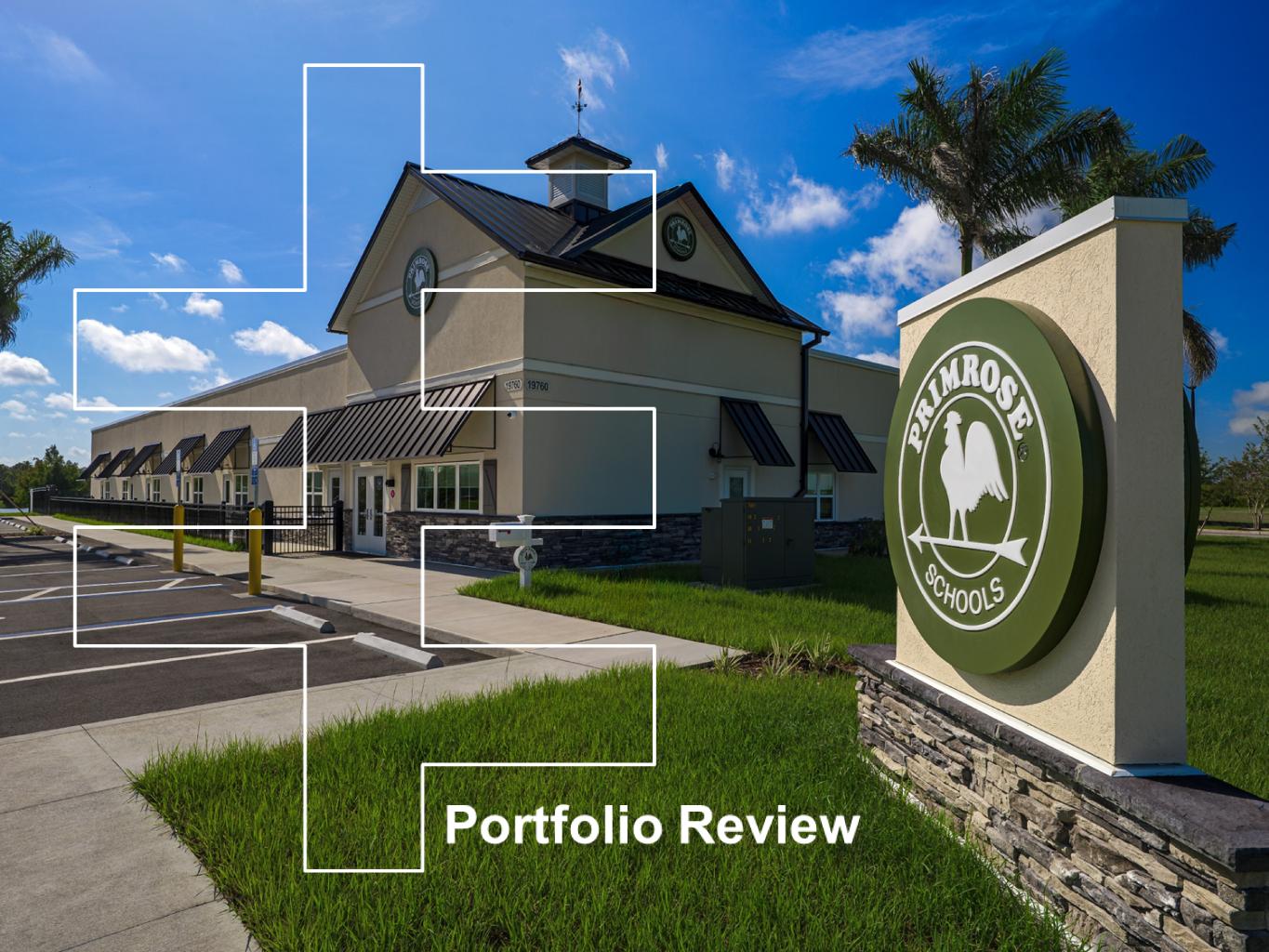
Sure. Thanks, Pete. Primrose is a premium childcare concept with over 500 locations across the country, and we've been partnering with their largest franchisee over the last couple of years and so a subsequent transaction put them in the top 10. But on the sourcing front, we're constantly adding new tenants and relationships to the portfolio. And frankly, it's been pretty consistent over the years of every quarter, we're adding anywhere between 5 and 10 new tenants. But then we're obviously focused on repeat business and growing ratably with those operators throughout our industries. And so it's always going to be a two-pronged approach.
Speaker 13
And then just as a follow-up, in addition to sticky cap rates lately, you also ticked up the lease escalations to 2.3%. And so I'm curious what's driving that lease negotiation leverage and is that something on the lease escalations that you feel like you can continue to increase even in an environment where lowering interest rates could lower cap rates?
Speaker 2
Yes. Listen, I think that's a key economic term of the sale-leasebacks we're negotiating. And ultimately, in any deal, we're negotiating the best terms we can. And whether or not we win a deal is really a factor of competition and having an ample opportunity set to focus on the deals with the least amount of competition. I would not anticipate that going higher. And as I said in our prepared remarks, a 10% average cap rate over the life of these leases is as high as we've seen and pretty compelling. If you look back to 2020, 2021, where interest rates were low and competition was at a very high level, our escalators were down around 1.4%, 1.5%. And so over a longer period of time, I would expect downward pressure on that key economic term.
Operator
Our next question comes from Rich Hightower with Barclays.
Speaker 14
I guess just to maybe follow up on the same theme. I mean, obviously, one of the big, I guess, headlines in net lease this year has been that added private market competition. And so we probably asked this question last quarter as well. But just tell us about what you're seeing in the marketplace and how the different features of deal negotiation are impacted as more capital flows into the space? And does that affect the way you underwrite, you think about guidance, et cetera?
Speaker 2
Yes. I mean it's always a competitive market. There's always competitive forces, competitive sources of capital, competitive alternatives for our tenants. And ultimately, we compete on our reliability and our ability to execute and deliver capital into capital needs. And I think when you have a lot of new entrants, there's a lot of footfalls and a lot of misstarts. And I think the priority on reliability and certainty and relationships and the ability to service those relationships reliably gets rewarded. And that's been our operating thesis since starting this company and will continue to be the way we go to market. And so I'm confident that we'll be able to offer more compelling and certain capital to our counterparties than new market participants.
Speaker 14
I appreciate it, Pete. Maybe just to follow up or put a finer point on it. If you are losing out on a transaction, where are you typically losing and on what terms and that sort of thing?
Speaker 2
Yes. We're going to lose on price. I believe the initial cap rate is the most sensitive factor. If we lose a deal, it's because we're choosing not to pursue it. We're opting not to chase the price because we see a different risk-adjusted return and prefer to invest our capital elsewhere. So it's not merely about losing a deal; it's about deciding to invest in a different opportunity.
Operator
Our next question comes from Eric Borden with BMO Capital Markets.
Speaker 15
Just a quick question on the bad debt watch list. I understand that it's coming in above your underwriting. Just curious if you could provide an update on the watch list and where it sits today. I believe last quarter, you said it was approximately 160 basis points.
Speaker 2
A.J., it's you, Buddy.
Speaker 11
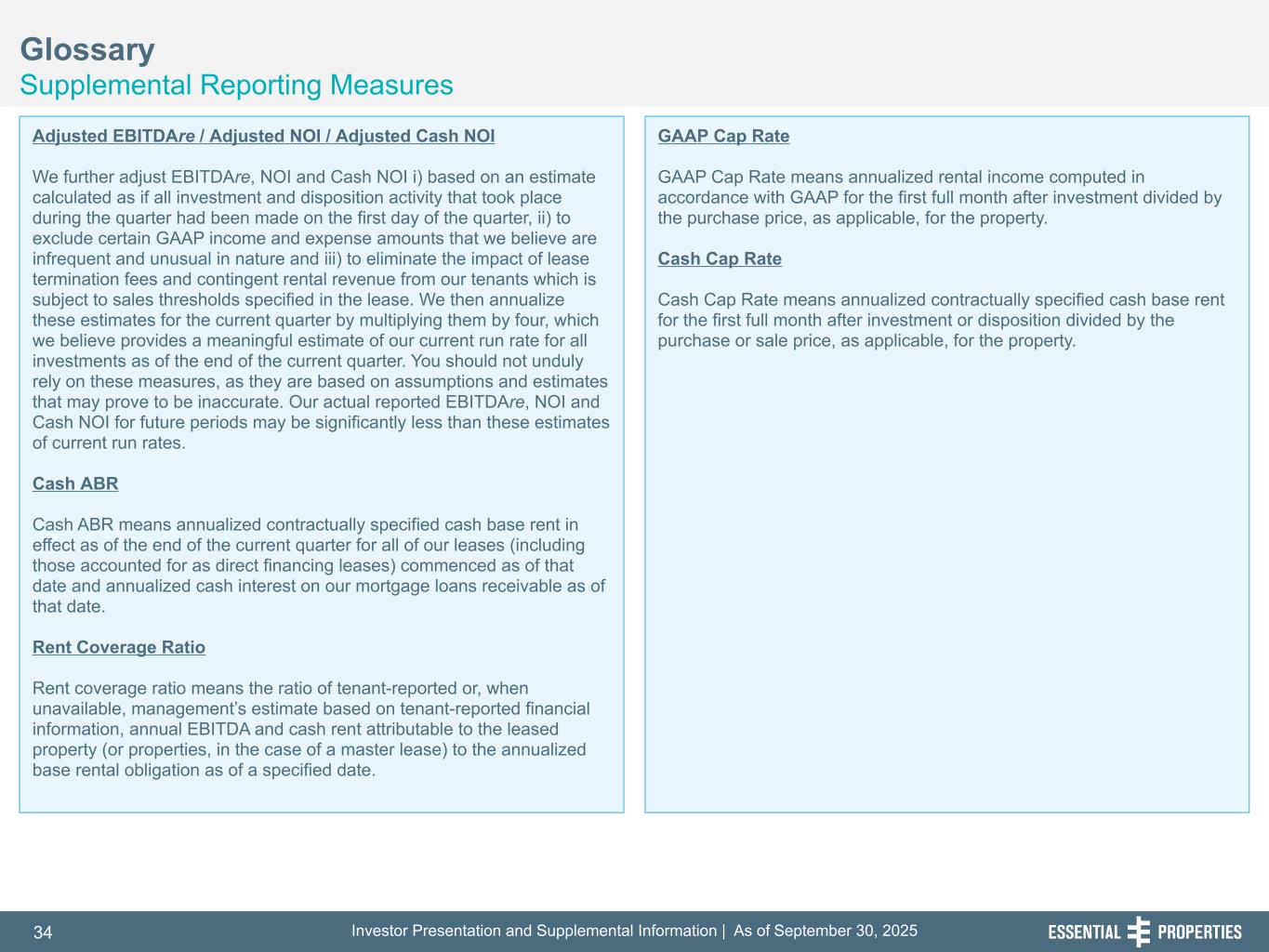
Yes. So our watch list, and again, just to refresh, is the intersection of B- and less than 1.5x coverage. Today, that sits at 1.2x. And there's a variety of tenants on the list that we keep a close eye on, but it is down 40 basis points quarter-over-quarter.
Operator
Our next question comes from Dan Guglielmo with Capital One Securities.
Speaker 16
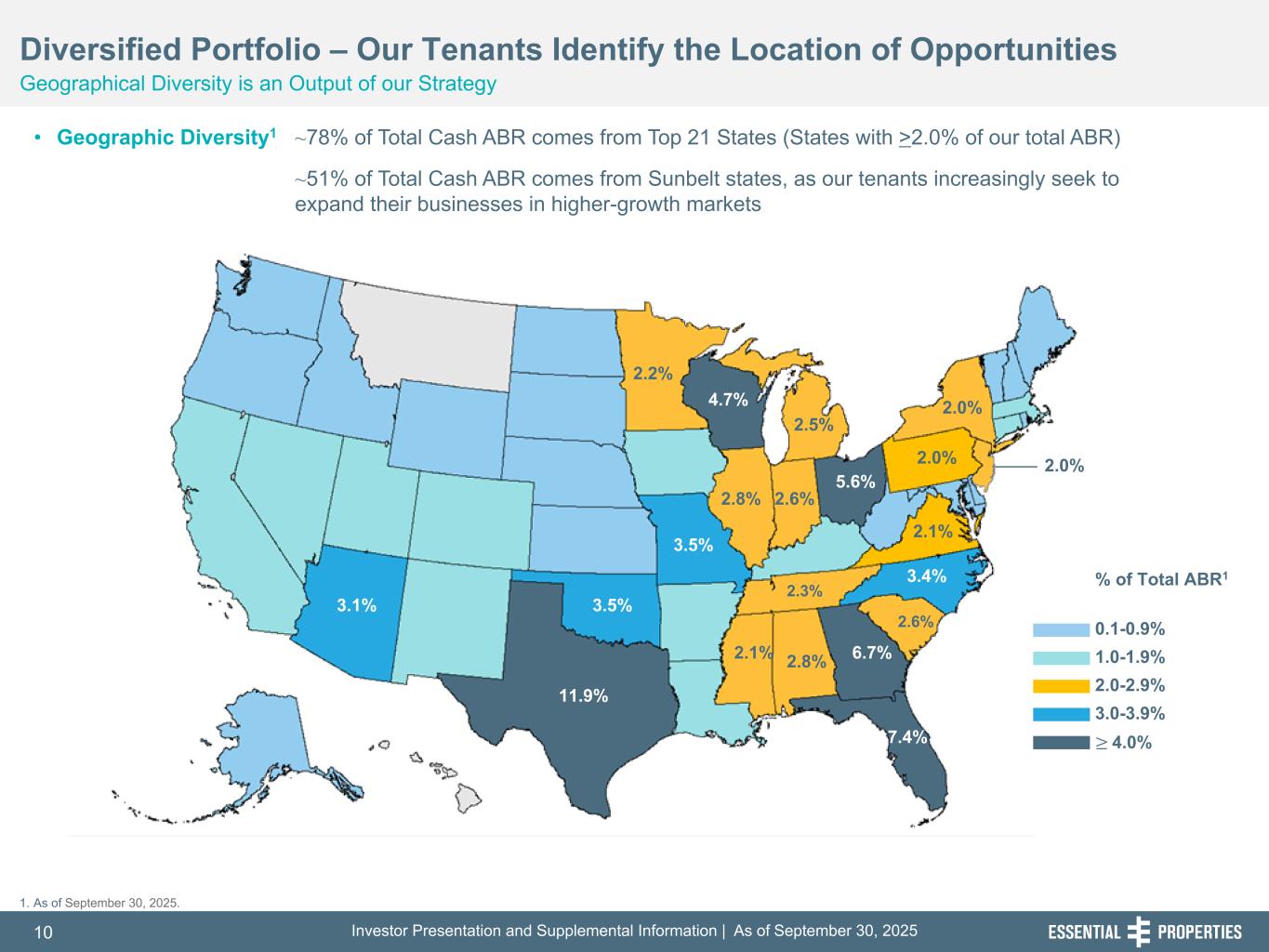
There were some changes to the ABR by state, but nothing that jumps off the page. When looking at the existing pipeline, are there states or regions where you see better investment opportunities over the next year or so?
Speaker 2
Yes. As we think about it, geography is always an output, not an input, and we go where our tenant relationships bring us in the United States. And so there's certainly good opportunities across all states, and we just prioritize the best opportunities with the best operators. And so I wouldn't expect any material deviation in our geographies as we think about 2026.
Speaker 16
I appreciate that. And then as a follow-up to the question on the elevated lease escalation number, are there any additional risks you think through for the higher annual rent bumps on some of the newer tenant leases? Anything kind of incremental?
Speaker 2
Yes, rent escalations are an important economic factor. One advantage of lower escalations is that they create a more attractive rent structure for the counterparty. Conversely, higher rent escalations can increase the credit risk associated with your assets over time. We are comfortable with our current level, which is around CPI. However, if lease rates increase faster than CPI, tenants may struggle to generate enough profit to keep up with rent. It's crucial to ensure healthy rent payments and coverage as we consider the future, specifically in the 10 to 20-year range. It’s a balancing act; while higher is better, we must ensure that we set appropriate levels and have tenants who can meet their obligations throughout the lease duration.
Operator
Our next question comes from James Kammert with Evercore.
Speaker 17
You've covered a lot. Just to go back on the credit loss assumptions for '26. Would you just say as a platform, you're adopting a more conservative expectation for credit loss for '26 given the economy or the portfolio? Or I'm reading too much into this? Or it's very similar to what you kind of started the 2025 outlook for when you started in late '24?
Speaker 2
Yes. I would say we're looking at it through the same lens. We have the same guys doing the same work, taking the same assumptions with the same base of experience, and our assumptions are based on the most current data that we have in the shop. Ultimately, the result of that process is very consistent with what we're looking at last year at this time. But the risks in the portfolio tend to be very idiosyncratic and not really driven by macro trends. It's more just specific operators who are not operating the way we would expect. So it's a consistent process. The result just happens to be very consistent to last year as we sit today, but nothing out of norm.
Operator
We will take our next question from Omotayo Okusanya with Deutsche Bank.
Speaker 18
Could you provide a high-level overview of the tenants with rent coverage below 1x, including the sector or industry they belong to, even if you can't disclose specific names?
Speaker 2
Yes. It's a group of assets. First and foremost, let's focus on the real estate properties that we own. And there's really not a consistent theme. It's very much specific idiosyncratic risk to those assets and the lease obligations that the tenants have at those assets. It's going to be across all our industries. It's going to be across all our geographies and it's just specific sites that aren't working. It could be very idiosyncratic as a childcare center lost an operator or a manager or it could be a restaurant where there's a road widening and the access is off-line or it can be a car wash that's just opened and really ramping into its membership base. So very idiosyncratic stuff, not terribly material. Certainly, we're happy that it's come down, but nothing thematic that I would point out.
Operator
Our next question comes from Greg McGinniss with Scotiabank.
Speaker 19
It's never particularly low, but acquisitions through existing relationships hit 70% this quarter, which maybe one could argue is relatively lower than usual. I'm curious if this is an indicator for the growth of EPRT's name as a source of capital? Or how do those non-relationship deals come about? Is it market deals, the seller approaching you? I'm just trying to understand if you start having even more investment opportunities as you grow.
Speaker 2
Yes. I think you see that we're having more investment opportunities. Our underwritten pipeline has grown consistently over the years. I think the opportunity set that we've written offers on this year is approaching $7 billion versus $5 billion last year. And we're doing the hard work in attending conferences, sending out mailers, dialing the phone to find new relationships in our industries and find new partners. And I think our execution and our reliability has given us a good reputation as a capital provider, and that continues to drive incremental opportunities. So having that number at 70% is great. I wouldn't concern me if that was 50% because certainly, relationships outgrow us from a concentration perspective, and it's important that we're finding new people to bring deals in the coming years.
Speaker 19
And then I just wanted to kind of confirm whether or not you start seeing any indications of increased competition today or if this is kind of similar to last year at this time when you expected greater competition to materialize given historically wide spreads and the success that you've been having?
Speaker 2
Yes. There are other buyers out there. We're seeing them bid on deals. We continue to be successful where we choose and where we see appropriate risk-adjusted returns. So there's platforms out there. There's people investing and there's competition, but we're continuing to execute well and have a good reputation and are able to pick and choose the deals that we do.
Operator
Our next question comes from Ryan Caviola with Green Street.
Speaker 20
Is there any color you could share on the differences in yields between your traditional retail portfolio versus the industrial properties that you mentioned earlier in this call? And is that expectation of cap rate compression, does that apply to these industrial properties as well? Or is that mostly in the retail space?
Speaker 2
Yes. I would say there's really no differentiation. The biggest driver of differences in cap rates will be the counterparty, the credit, and the real estate pricing, not necessarily whether it's retail, service, or industrial. So there's really no differentiation, and we would expect cap rate compression across our entire opportunity set driven by lower interest rates and more stable capital markets.
Speaker 20
And then I know you've mentioned a few times that credit losses have been better than expected throughout this year. The only notable story across retail that comes to mind for this quarter is some distress in autos. Has any of that flowed into the portfolio? Or how are you viewing that space for the rest of the year and going into '26?
Speaker 2
Yes. We haven't seen it. Our auto exposure is largely focused on automotive service. And so the noise around automotive retailing and dealerships isn't in our portfolio. The noise around auto parts suppliers isn't in our portfolio. So we still think automotive service is a good industry for us, and we like the real estate in that industry, which is granular, bite-sized, well-located boxes. And so we'll most likely continue to invest ratably across that industry as we think about 2026.
Operator
Our next question comes from John Massocca with B. Riley.
Speaker 21
Sticking with the industrial assets, and sorry if I missed this earlier in the call, do those properties house consumer-facing businesses? Or are they part of a tenant's internal supply chain? And if it's the latter, how are you calculating rent coverage?
Speaker 2
Yes, they are industrial properties, specifically outdoor storage yards where service-based operators conduct their business. The coverage is determined by the revenue and profitability generated from each site. I do recognize that this revenue and profitability are less directly linked to the real estate compared to traditional retail locations like restaurants, but these sites remain crucial for the operator's business. The switching costs are significant, leading us to expect long-term tenancy in these assets.
Speaker 21
Are they selling goods produced at that location directly to other businesses, or is it more of an internal arrangement within a tenant where you’re relying on their estimates of the revenue contribution from that specific manufacturing or storage facility?
Speaker 2
It's a wide range of businesses and operations. So I would say there's probably a little of both of that.
Speaker 21
And then as you do your credit underwriting for potential investments with private equity-backed tenants, does the size of the private equity sponsor matter to you at all? I mean, especially in the current environment where private equity capital raising, liquidity events are a little bit more uncertain versus in years past?
Speaker 2
Yes. We begin by assessing real estate and the profitability at the unit level, as well as the economics of the site, before considering the corporate credit. I usually remain neutral about the source of equity, whether it's private or large private equity and credit. Ultimately, we focus on acquiring a solid piece of real estate at a reasonable price, supported by a strong lease structure and rents backed by the operating business.
Speaker 21
Is there any difference versus maybe a smaller regional private equity operator versus a bigger brand name one? Or would there be a trend do you think in the current kind of credit environment to move one way or another between the two in terms of how you're thinking about valuing potential transactions with those tenants and their sponsors?
Speaker 2
No. There's good big operators and bad big operators, and there's good small operators and bad small operators. And we really focus on our history and our relationships. And the bigger the operator, we find the more use of leverage, and so we certainly take that into consideration, but it's underwriting credit.
Operator
And it appears we have no further questions at this time. I'll turn the program back to the speakers for any additional or closing remarks.
Speaker 2
Super. Well, thank you all for your questions today, and thank you for your time, and we look forward to seeing everyone in the conferences in the upcoming months. Have a great day.
Operator
This concludes today's program. Thank you for your participation, and you may disconnect at any time.