Operator
Good day and welcome to the Hope Bancorp 2024 Fourth Quarter Earnings Conference Call. All participants will be in a listen-only mode. Please note this event is being recorded. I would now like to turn the conference over to Ms. Angie Yang, Director of Investor Relations. Please go ahead, ma'am.
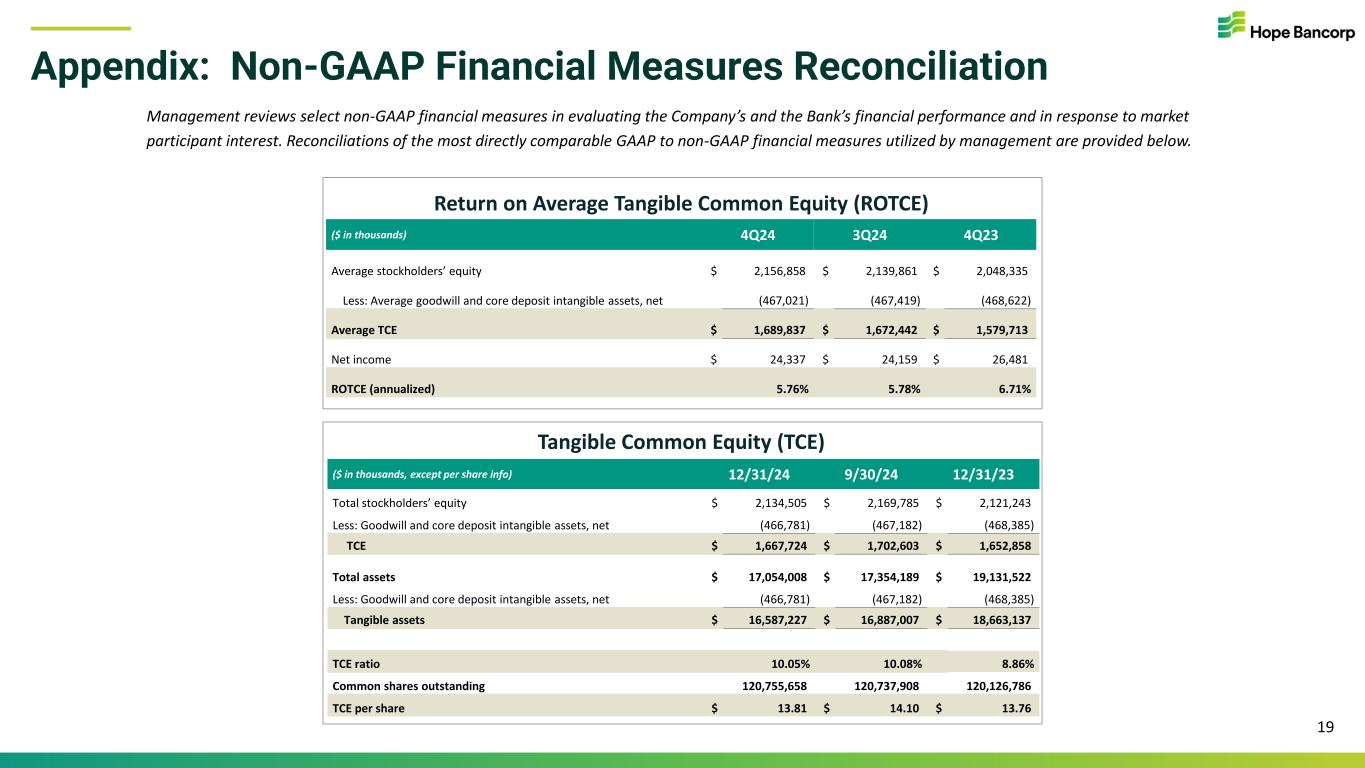
Thank you, Chuck. Good morning, everyone and thank you for joining us for the Hope Bancorp 2024 fourth quarter investor conference call. As usual, we will be using a slide presentation to accompany our discussion this morning, which is available in the presentations page of our Investor Relations website. Beginning on Slide 2, let me start with a brief statement regarding forward-looking remarks. The call today contains forward-looking projections regarding the future financial performance of the company and future events, as well as statements regarding the pending transaction between Hope Bancorp and Territorial Bancorp. The closing of the pending transaction is subject to regulatory approvals and other customary closing conditions. Forward-looking statements are not guarantees of future performance; actual outcomes and results may differ materially. Hope Bancorp assumes no obligation to revise any forward-looking projections that may be made on today's call. In addition, some of the information referenced on this call today are non-GAAP financial measures. For a more detailed description of the risk factors and a reconciliation of the GAAP to non-GAAP financial measures, please refer to the company's filings with the SEC, as well as the Safe Harbor Statement in our press release issued this morning. Now, we've allotted one hour for this call. Presenting from the management side today will be Kevin Kim, Hope Bancorp's Chairman, President and CEO; and Julianna Balicka, our Chief Financial Officer. Peter Koh, our Chief Operating Officer, is also here with us as usual and will be available for the Q&A session. With that, let me turn the call over to Kevin Kim. Kevin?
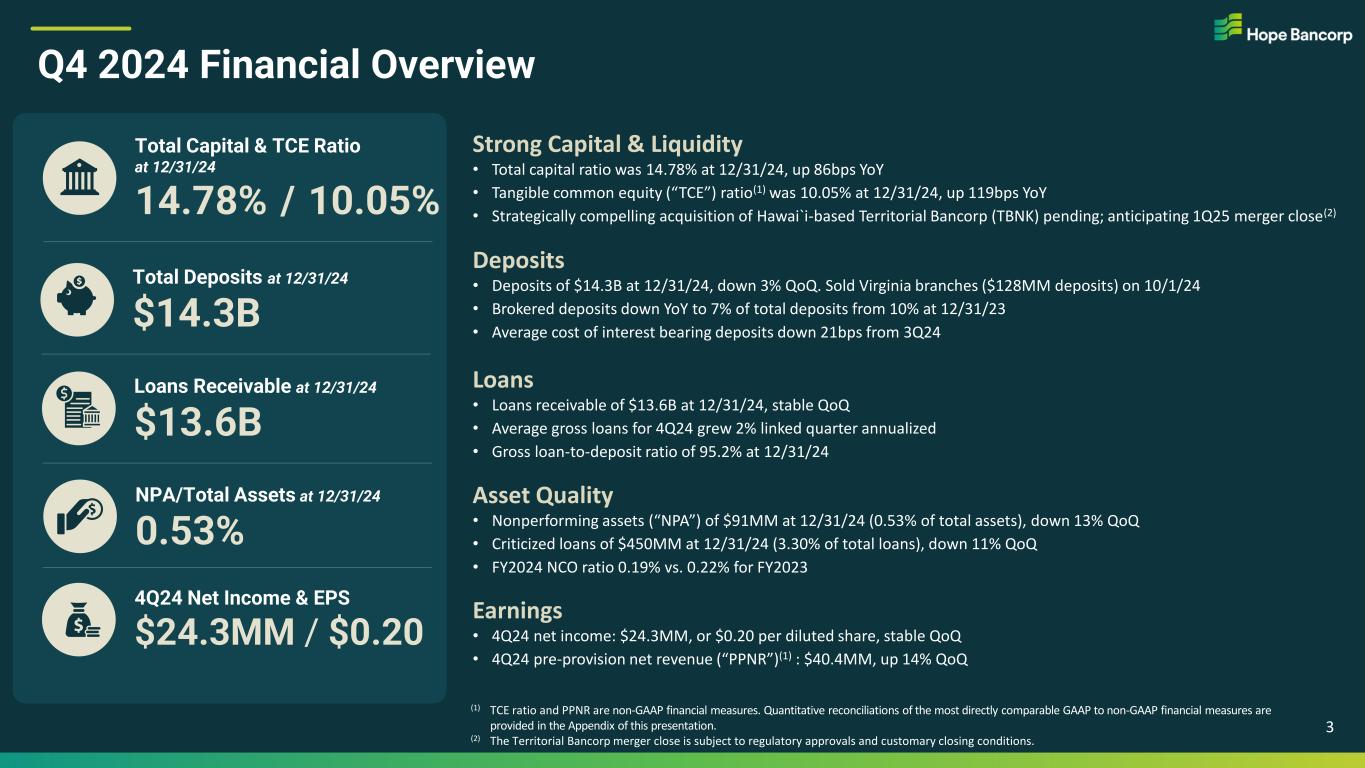
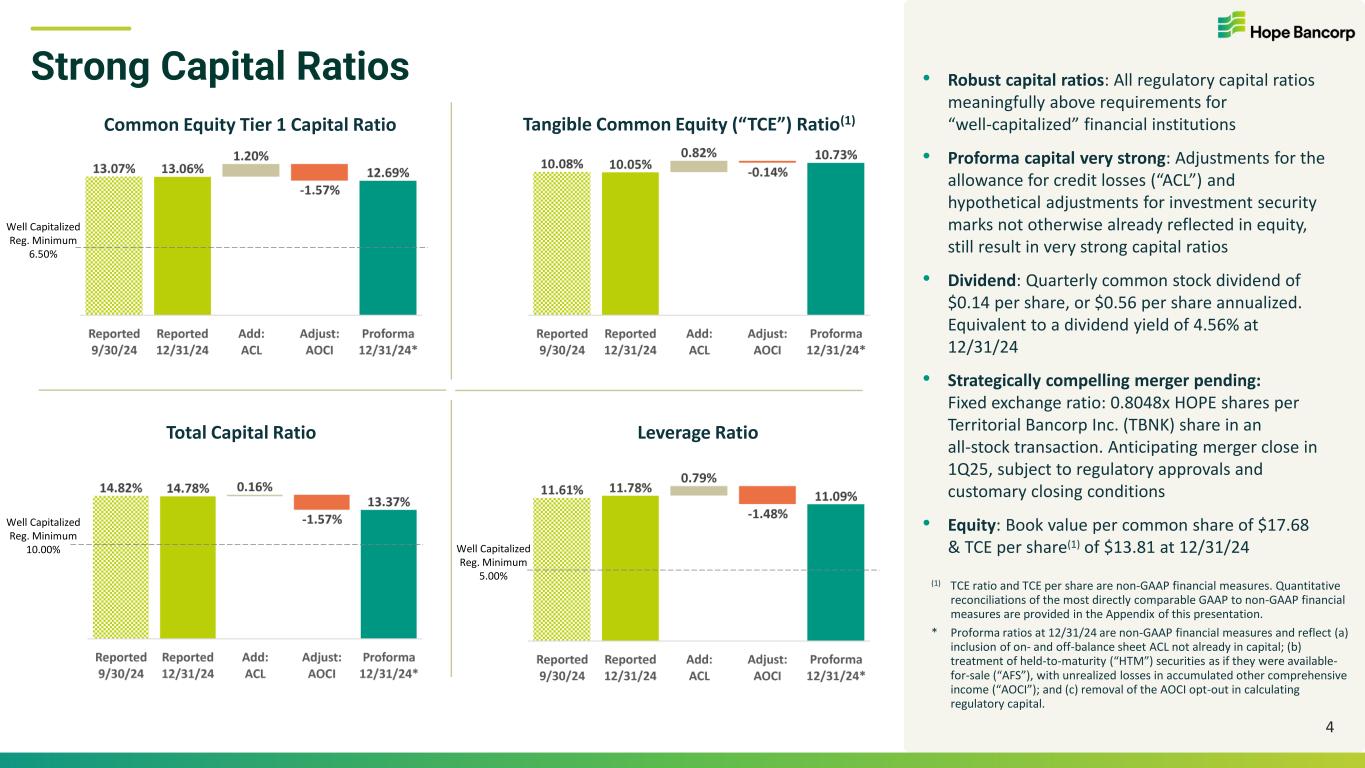
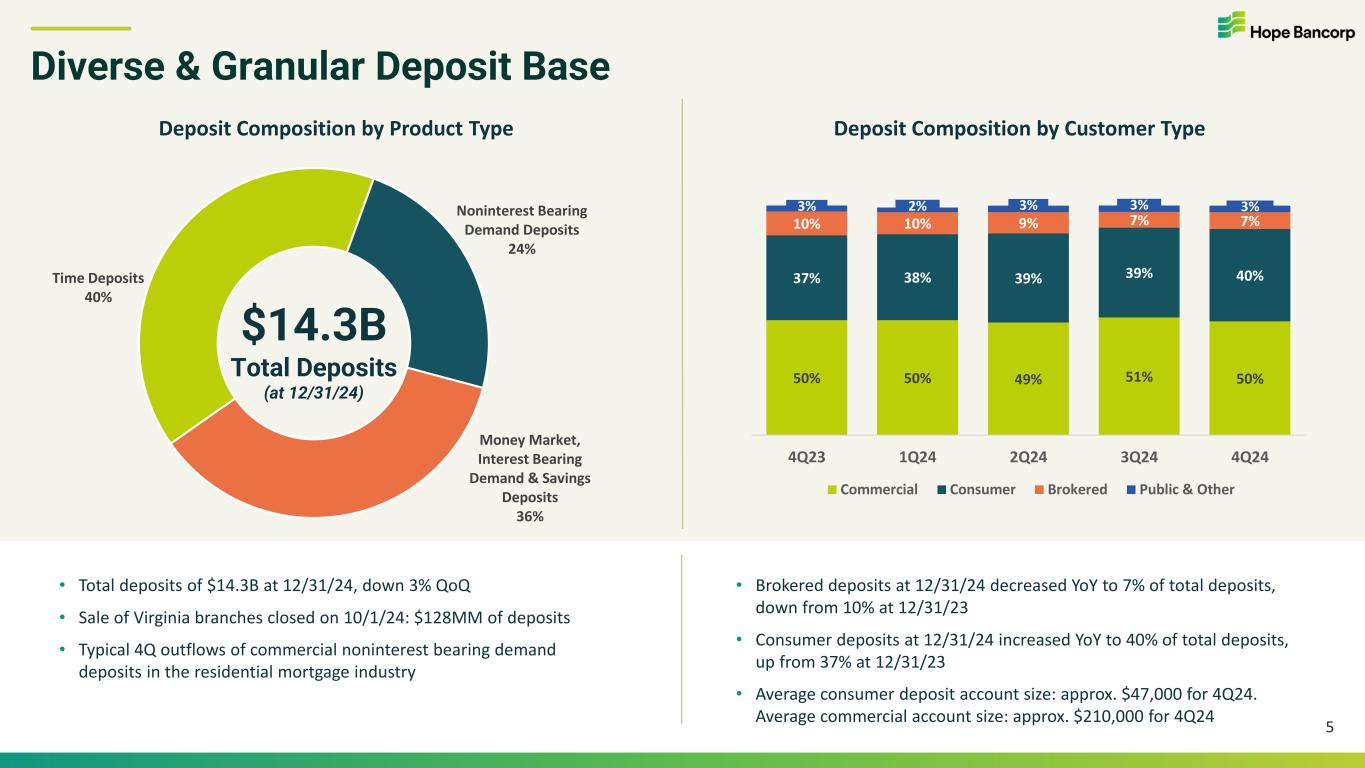
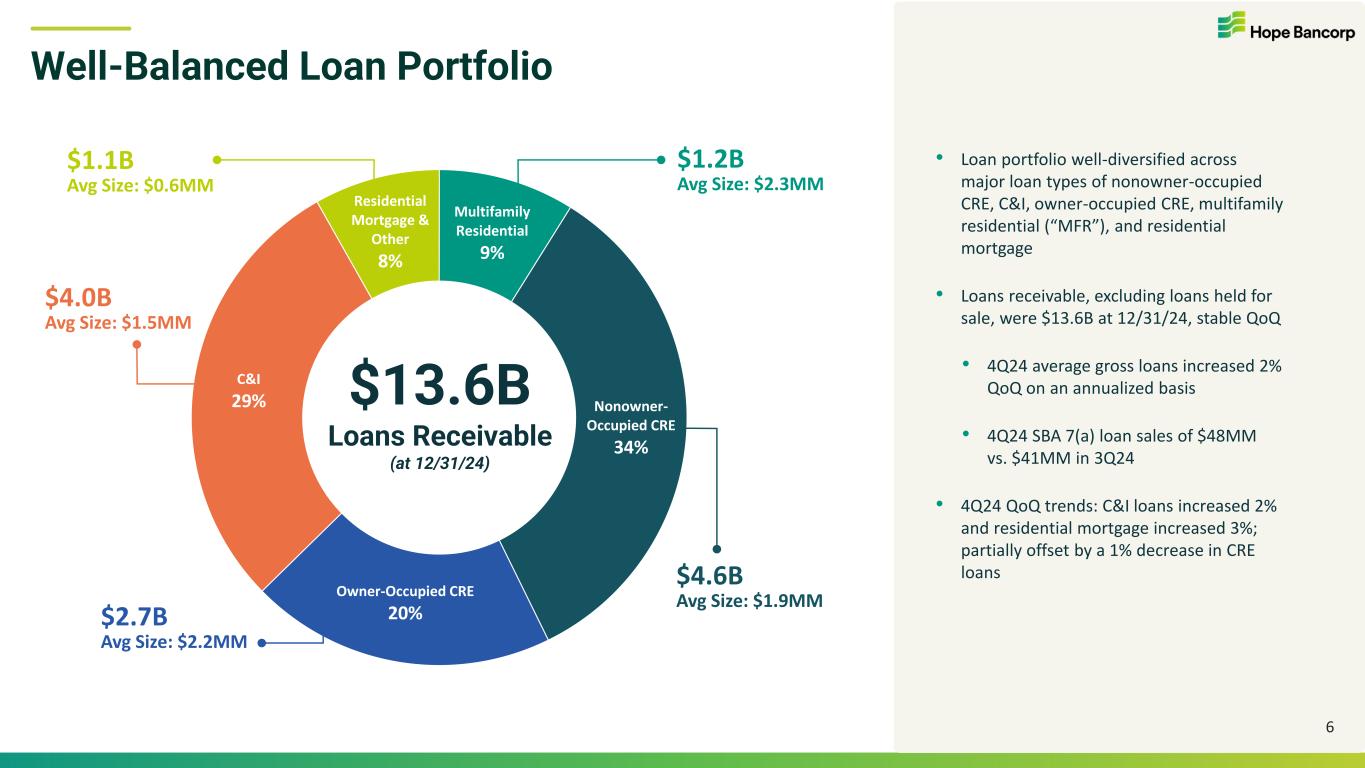
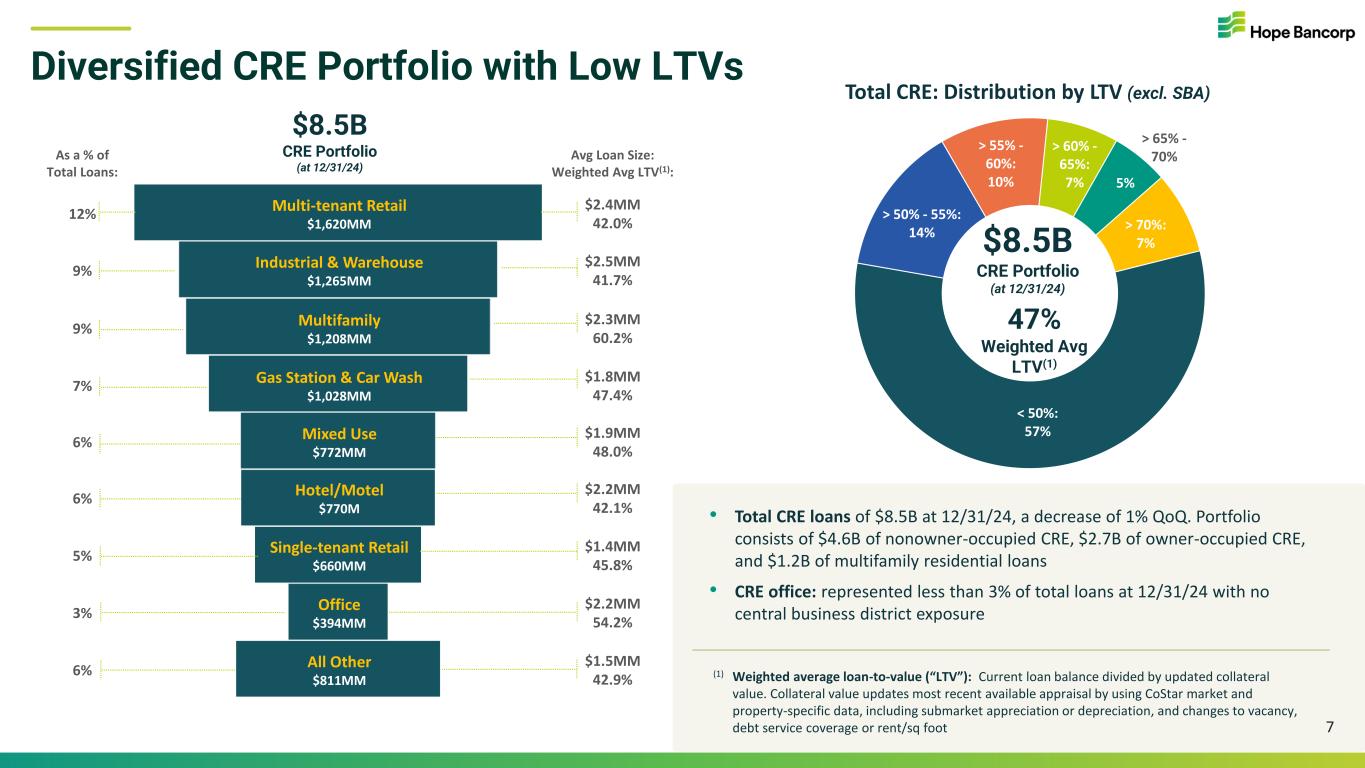
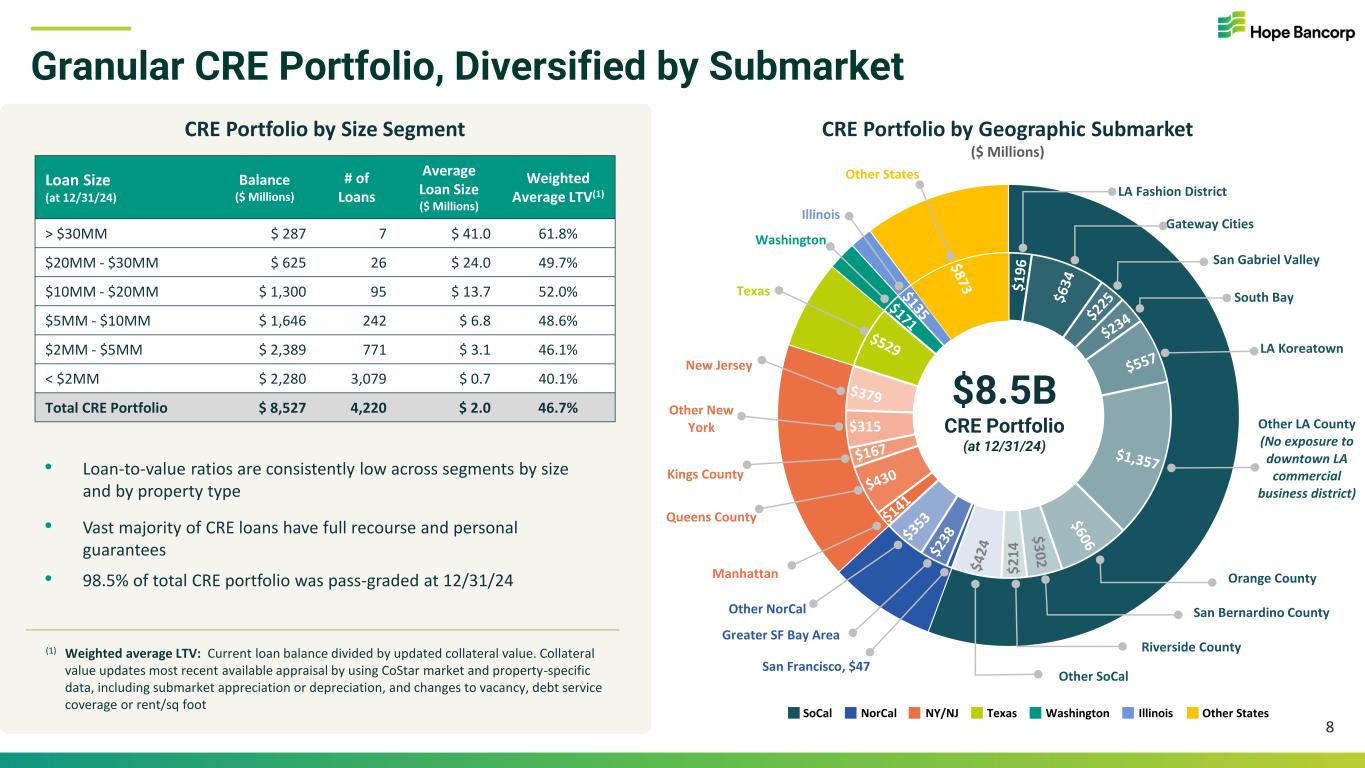
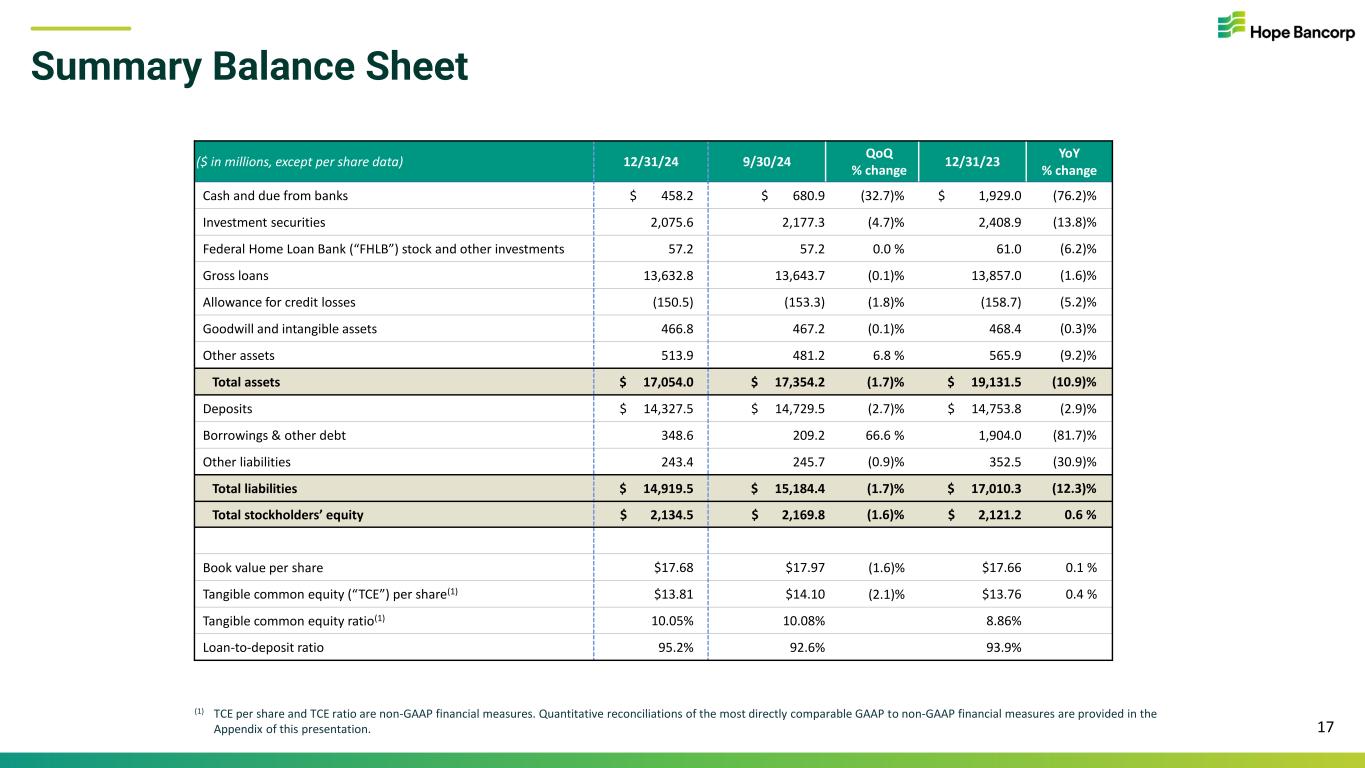
Thank you, Angie. Good morning, everyone and thank you for joining us today. Before we get into our results, let me just take a moment to comment about the greater Los Angeles area fires. We are truly heartbroken to see the unprecedented destruction across our region. As one of the largest independent banks headquartered in this great city, we are committed to taking a leadership role in addressing the immediate and rebuilding needs of those impacted by the fires. Our recent cash donation to the United Way of Greater Los Angeles Wildfire Response Fund underscores our unwavering commitment to our community. I am confident that the impacted areas will be rebuilt stronger and better in the foreseeable future. Now moving on to our results, let's begin on Slide 3 with a brief overview of the quarter. For the fourth quarter of 2024, we earned net income of $24.3 million, or $0.20 per diluted share. And our pre-provision net revenue was $40 million, up 14% from September 30, 2024. Quarter-over-quarter, revenue grew and expenses decreased, improving our efficiency and pre-provision profitability. 2024 was a building year as we worked to position our balance sheet for future growth and improved profitability. We focused on strengthening our deposit base, lowering broker deposits down to 7% of total deposits as of December 31, 2024, compared with 10% as of December 31, 2023, and down from a peak of 15% in April 2023. We turned the corner on loan growth in the second half of 2024 with loans receivable of $13.6 billion as of December 31, 2024, up 1% on an annualized basis from June 30, 2024. Quarter-over-quarter, fourth quarter average gross loans increased 2% on an annualized basis from the third quarter. We are optimistic in our outlook for 2025 and look forward to accelerating our earnings growth and profitability driven by an improved deposit mix, organic loan growth, and strong fee income growth. Furthermore, the addition of Territorial Bancorp's low-cost core deposits and residential mortgage loans with pristine asset quality will be meaningful, positive contributors to the combined company in 2025. On Slide 4, you can see our strong capital ratios with a tangible common equity ratio over 10% and a total capital ratio of nearly 15% as of December 31, 2024. This positions us well to support organic and strategic growth in the coming year. We expect to close the pending transaction with Territorial Bancorp during the first quarter, subject to regulatory approvals. Our Board of Directors declared a quarterly common stock dividend of $0.14 per share payable on February 20th to stockholders of record as of February 6, 2025. Continuing to Slide 5, at December 31, 2024, our total deposits were $14.3 billion, down 3% from the end of the prior quarter. This included a decrease of $128 million from the sale of our Virginia branches, which closed on October 1st. In addition, during the fourth quarter, we saw typical year-end fluctuations in certain commercial deposits in the residential mortgage industry. Lastly, we exited some deposits due to high costs. Moving on to Slide 6, at December 31, 2024, our loans receivable of $13.6 billion, excluding loans held for sale, were up slightly from September 30. Fourth quarter average gross loans increased 2% on an annualized basis from the third quarter of 2024. We sold $48 million of SBA loans in the fourth quarter, compared with $41 million in the third quarter. In regard to the direct impact from the wildfires, we reviewed our loan portfolio to identify commercial SBA and residential mortgage properties located in and surrounding the fire zones. Thus far, our exposure has been minimal or less than $5 million in aggregate of loans outstanding from a handful of customers. On Slides 7 and 8, we provide more details on our commercial real estate loans, which are well diversified by property type and granular in size. The loan to values remain low with a weighted average of approximately 47% at December 31, 2024, and the profile of our commercial real estate portfolio has not changed. Asset quality remains stable with over 98% of the commercial real estate loans pass-graded at year-end. With that, I will ask Julianna to provide additional details on our financial performance for the fourth quarter.
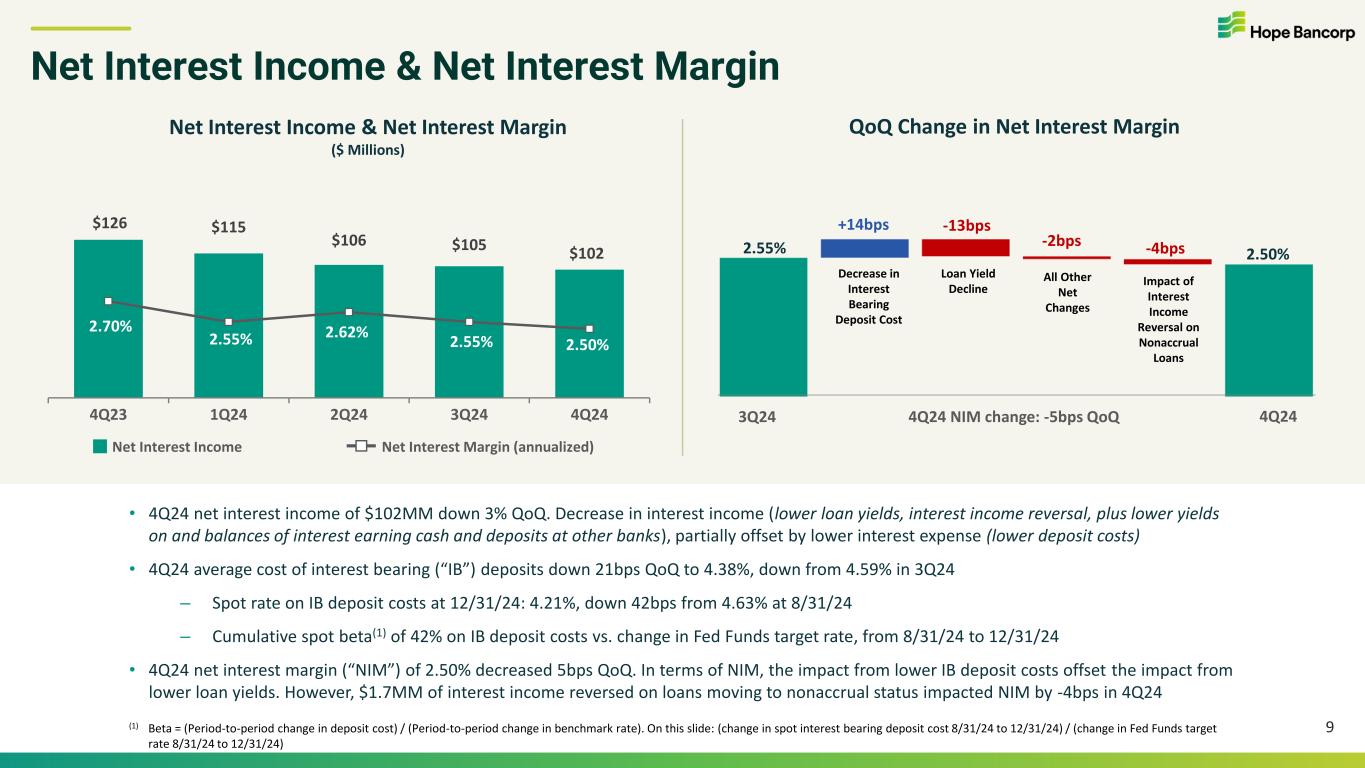
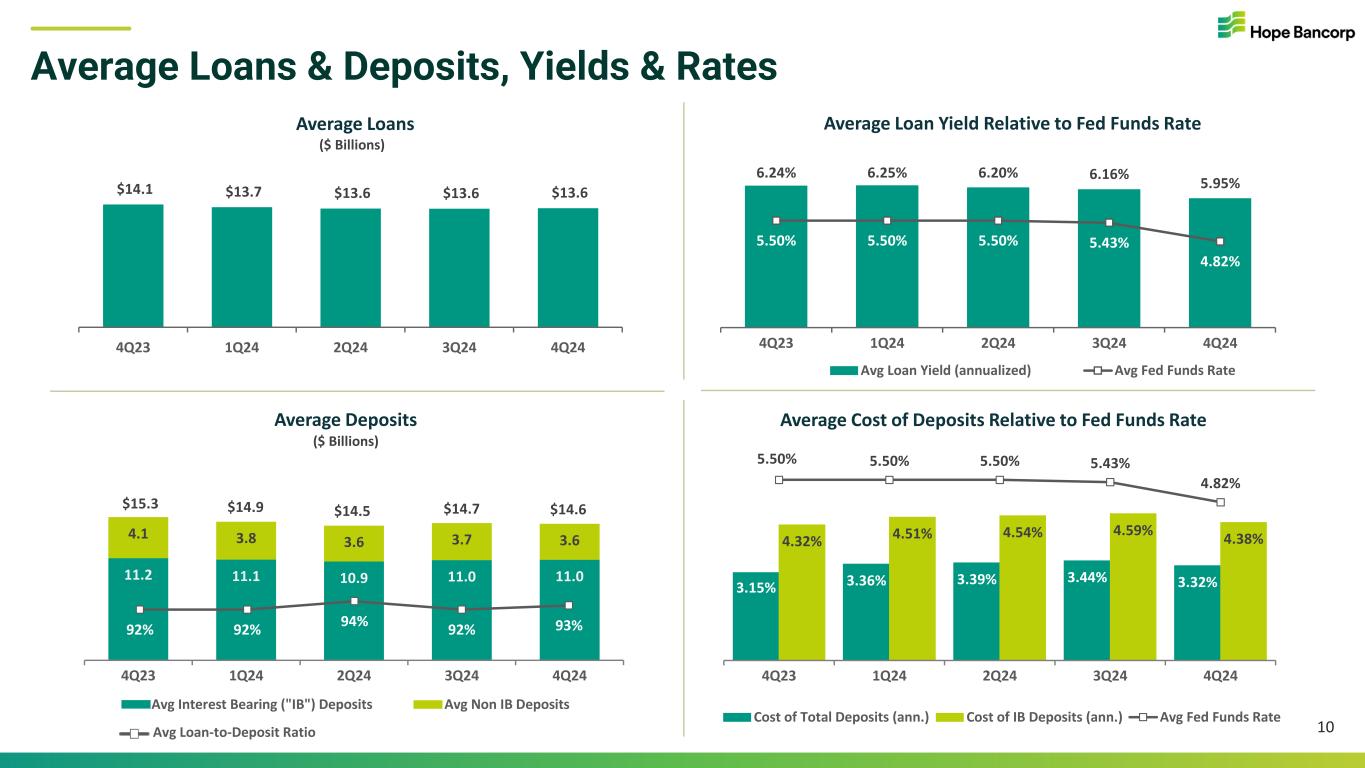
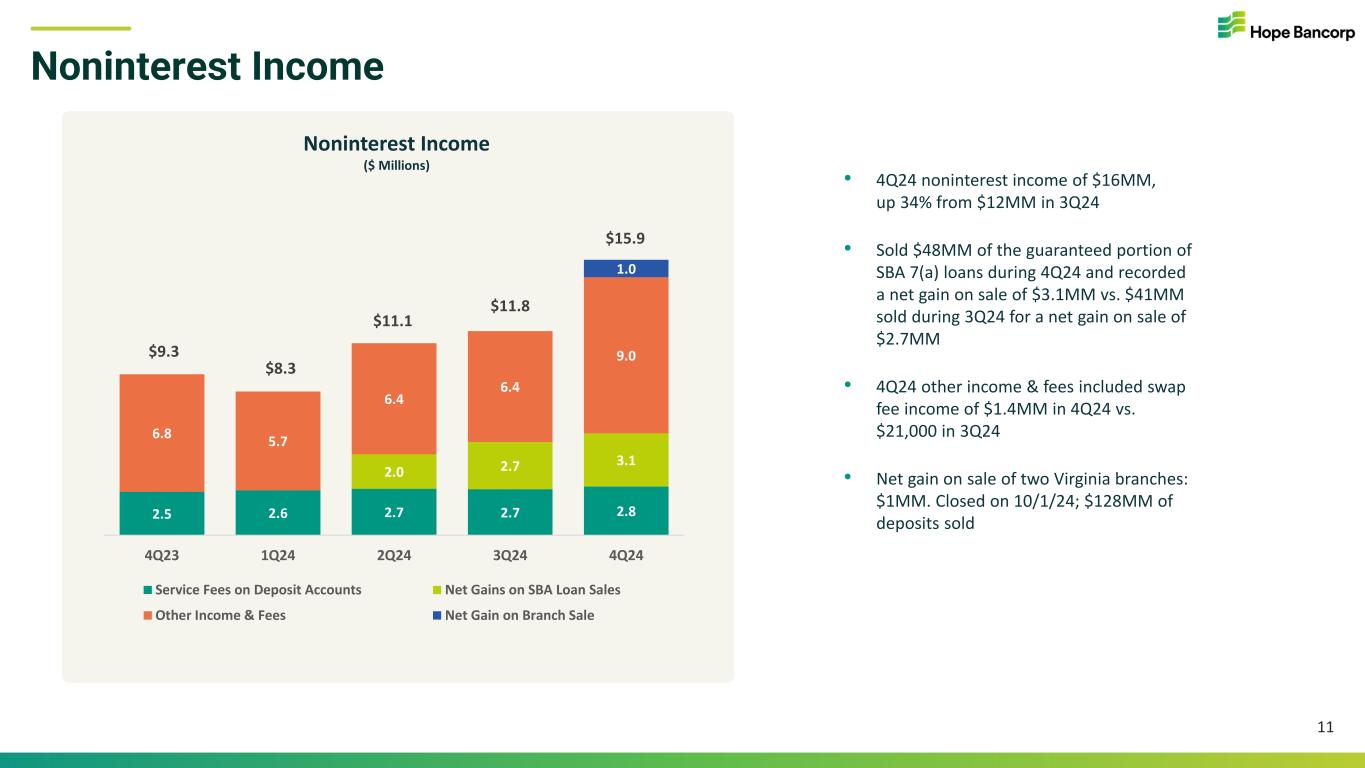
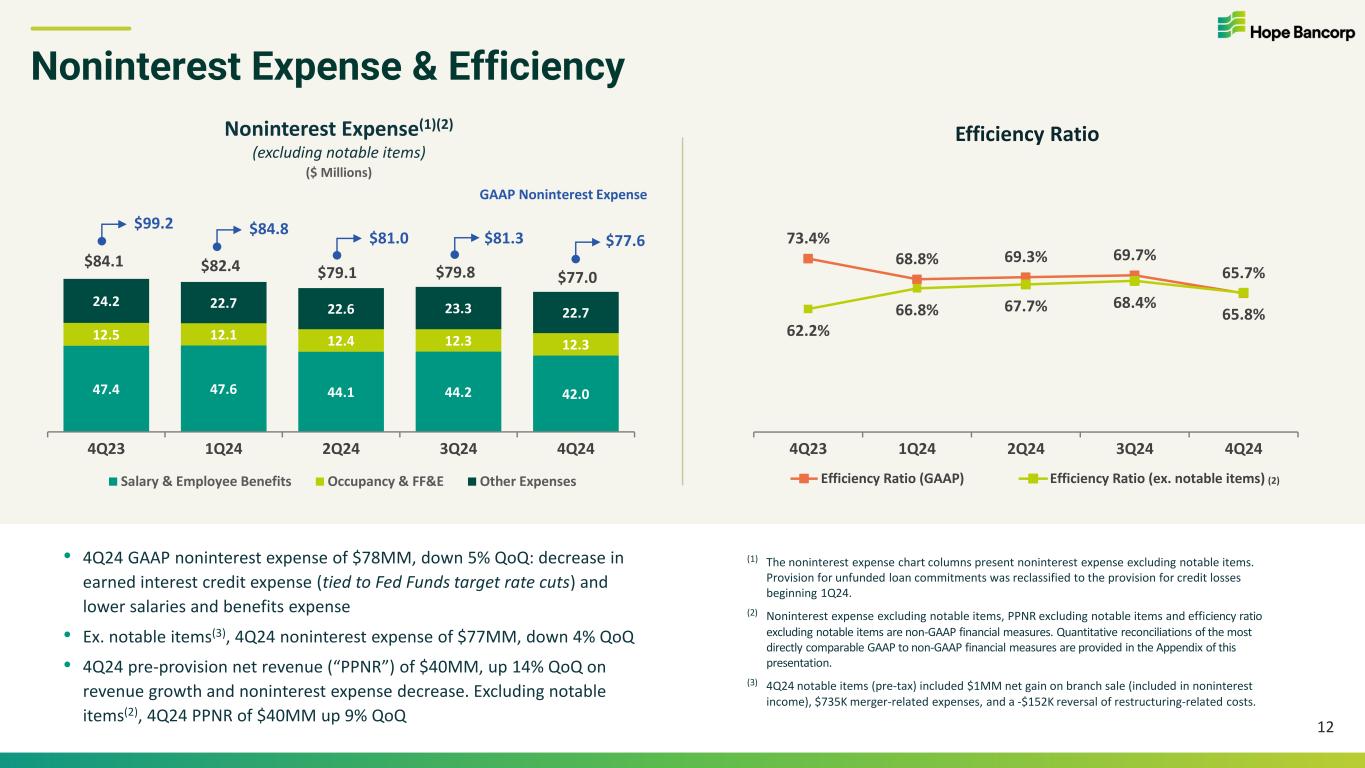
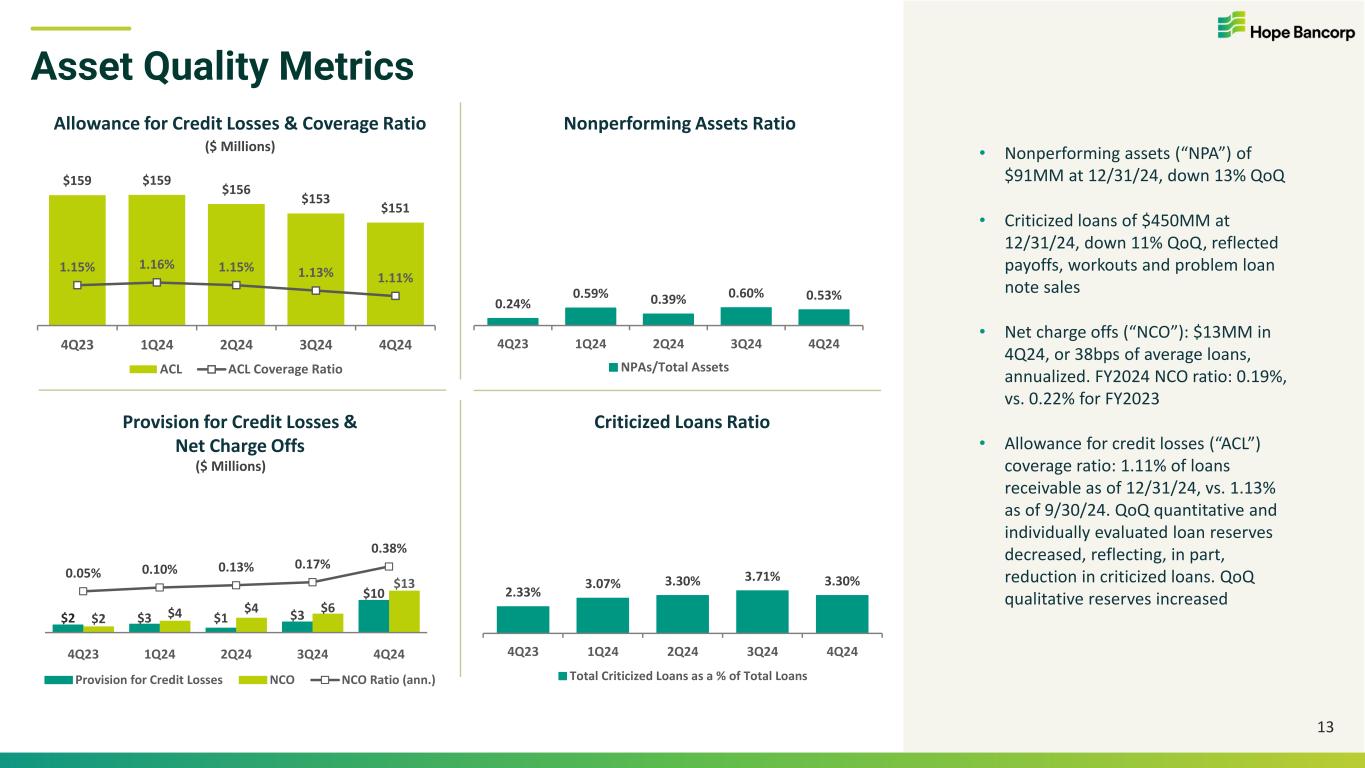
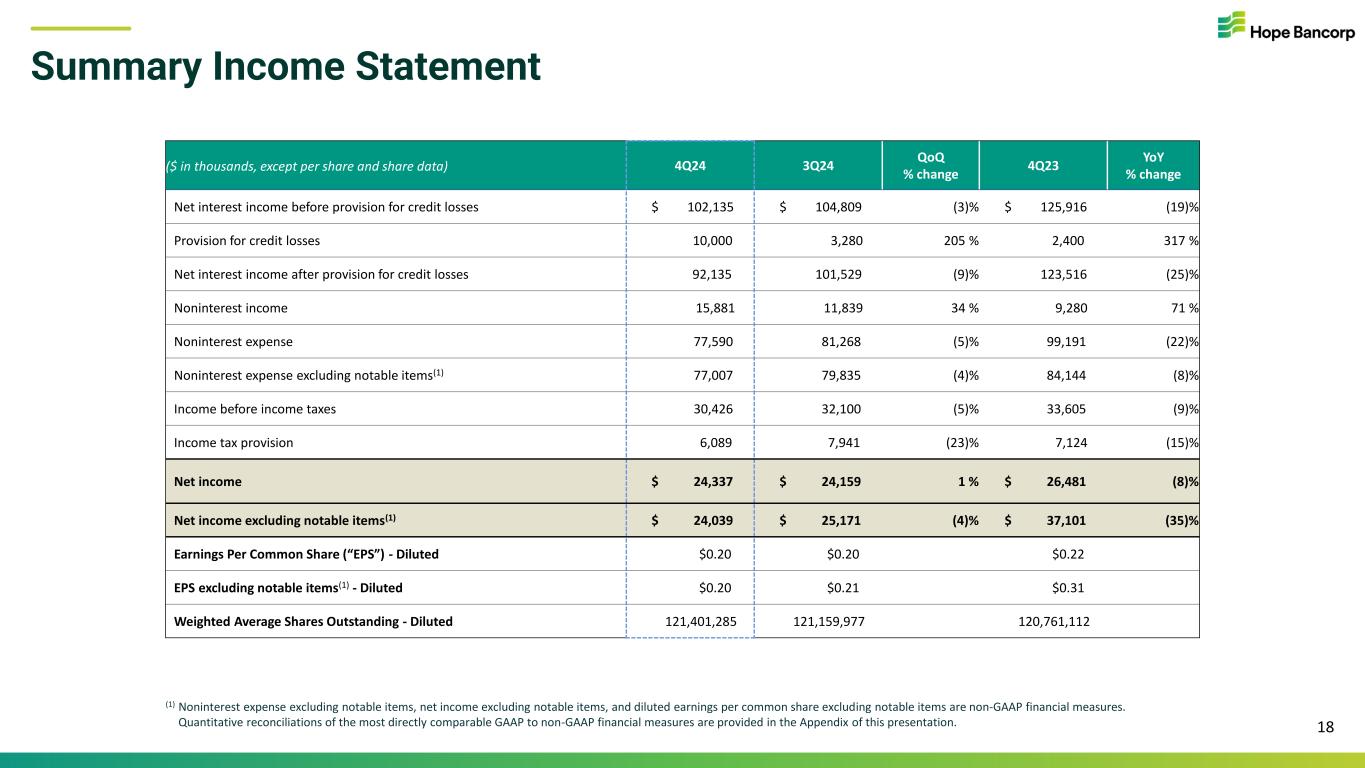
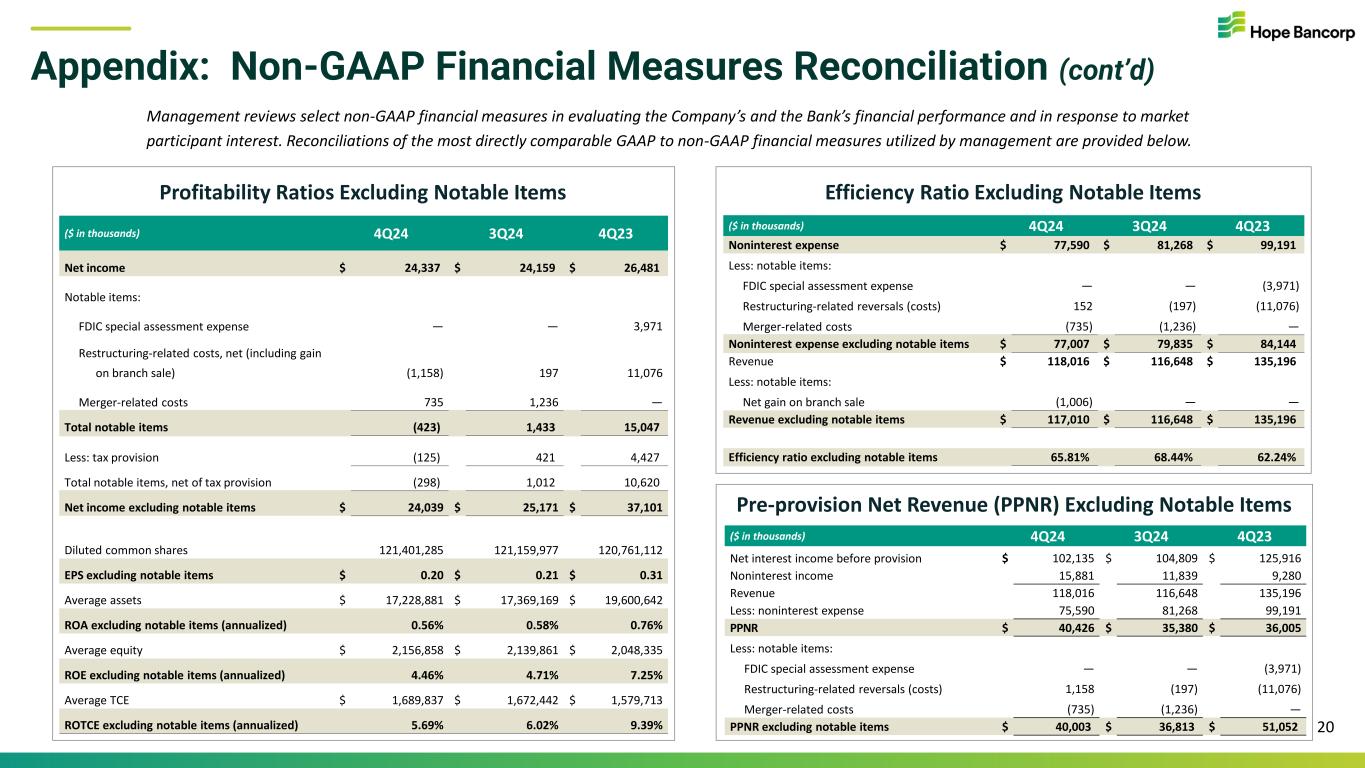
Thank you, Kevin, and good morning, everyone. Beginning with Slide 9, our net interest income totaled $102 million for the fourth quarter of 2024, a decrease of $3 million or 3% from the third quarter. Our weighted average cost of interest-bearing deposits in the fourth quarter was 4.38%, down 21 basis points from the third quarter. The spot rate on our interest-bearing deposits was 4.21% as of December 31, 2024, down 42 basis points from 4.63% as of August 31. This translates to a cumulative beta of 42% on a spot basis for interest-bearing deposits relative to the cuts in the Fed funds' target rate over the same period. The fourth quarter 2024 net interest margin declined by 5 basis points, quarter-over-quarter to 2.50%. In terms of net interest margin, the positive impact from lower deposit costs in the fourth quarter offset the pressure from lower loan yields. However, we reversed $1.7 million of interest income due to loans moving to non-accrual status in the fourth quarter. Excluding the impact of the reversed interest income, our fourth quarter net interest margin would have been 2.54%. On Slide 10, we show you the quarterly trends in our average loan and deposit balances and the weighted average yields and costs. On to Slide 11, non-interest income was $16 million for the fourth quarter, an increase of $4.1 million or 34% from the third quarter. During the fourth quarter, we reported $3.1 million of net gains on the sale of SBA loans. Swap fee income increased to $1.4 million, up from $21,000 in the third quarter, reflecting improved customer activity. We also recorded a $1 million gain on the sale of our Virginia branches. Moving on to non-interest expense on Slide 12, we continue to closely manage our expenses. Our non-interest expense was $78 million in the fourth quarter, down 5% from the prior quarter. This was driven by a decrease in earned interest credit expense, reflecting the Fed funds rate cuts and lower average balances of the underlying deposits, as well as lower salaries and benefits expense. Excluding notable items, non-interest expense was down 4% linked quarter. Together with the quarter-over-quarter growth in total revenue, the reduction in expenses led to 14% growth in reported pre-provision net revenue for the fourth quarter, or 9% growth in PPNR excluding notable items. Lastly, while talking about expenses broadly here, we want to make one comment on income tax expense. Due to a solar tax credit investment that we made, the fourth quarter effective tax rate was 20% compared with 25% in the third quarter. For the full year 2024, the effective tax rate was 25%. Now, moving on to Slide 13, I'll review our asset quality metrics. Non-performing assets were down 13% quarter-over-quarter to $91 million as of December 31, 2024, equivalent to 53 basis points of total assets. Criticized loans were also down 11% quarter-over-quarter to $450 million as of December 31, or 3.30% of total loans, compared with 3.71% of total loans as of September 30th. These meaningful decreases reflected payoffs, workouts, and note sales in the fourth quarter. Fourth quarter net charge of the $13 million or annualized 38 basis points of average loans and provision for credit losses of $10 million reflected the activity to improve problem loans. The full year 2024 net charge-off ratio was 19 basis points down slightly from 22 basis points in 2023. At the December 31, 2024, our allowance coverage ratio was 111 basis points compared with 113 basis points at September 30. Quarter-over-quarter, quantitative and individually evaluated loan reserves decreased, reflecting in part the reduction in criticized and non-performing loans. This was partially offset by an increase in qualitative reserves. With that, let me turn the call back to Kevin.
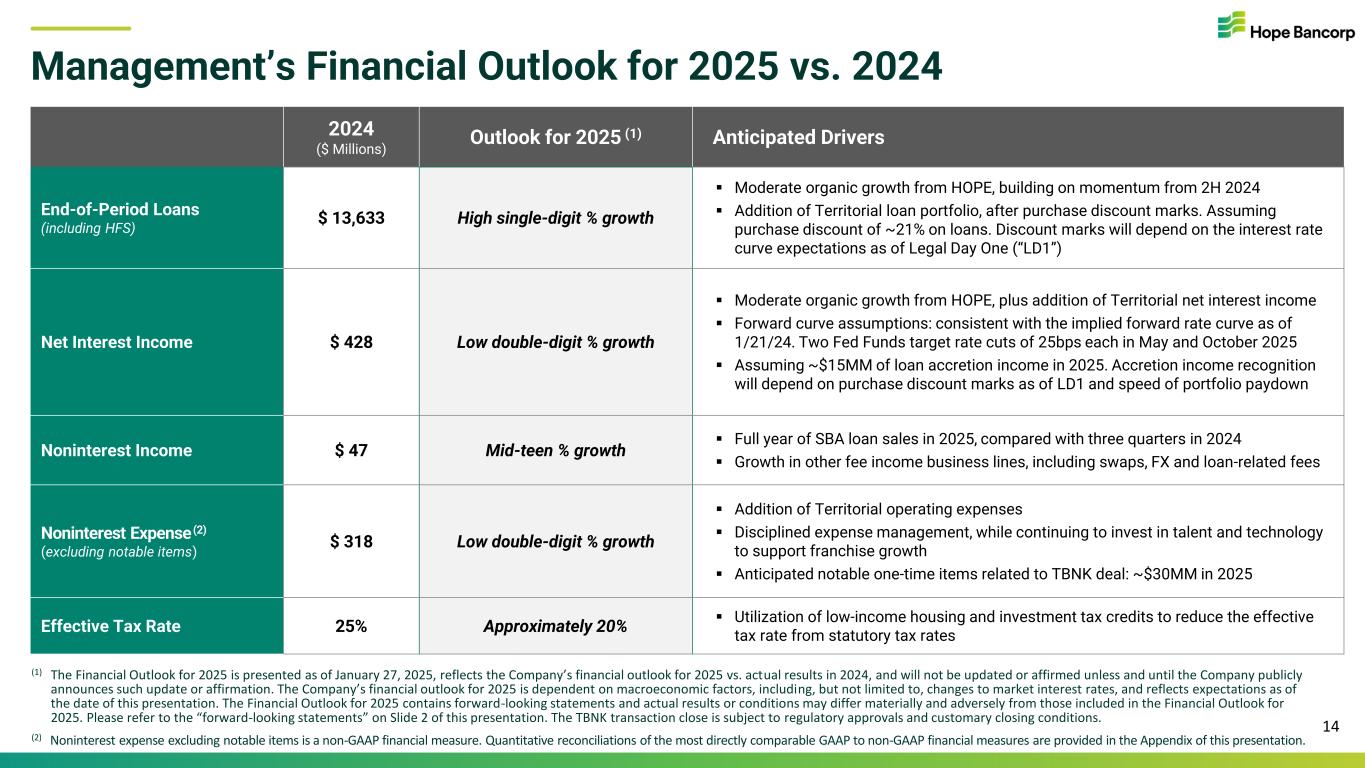
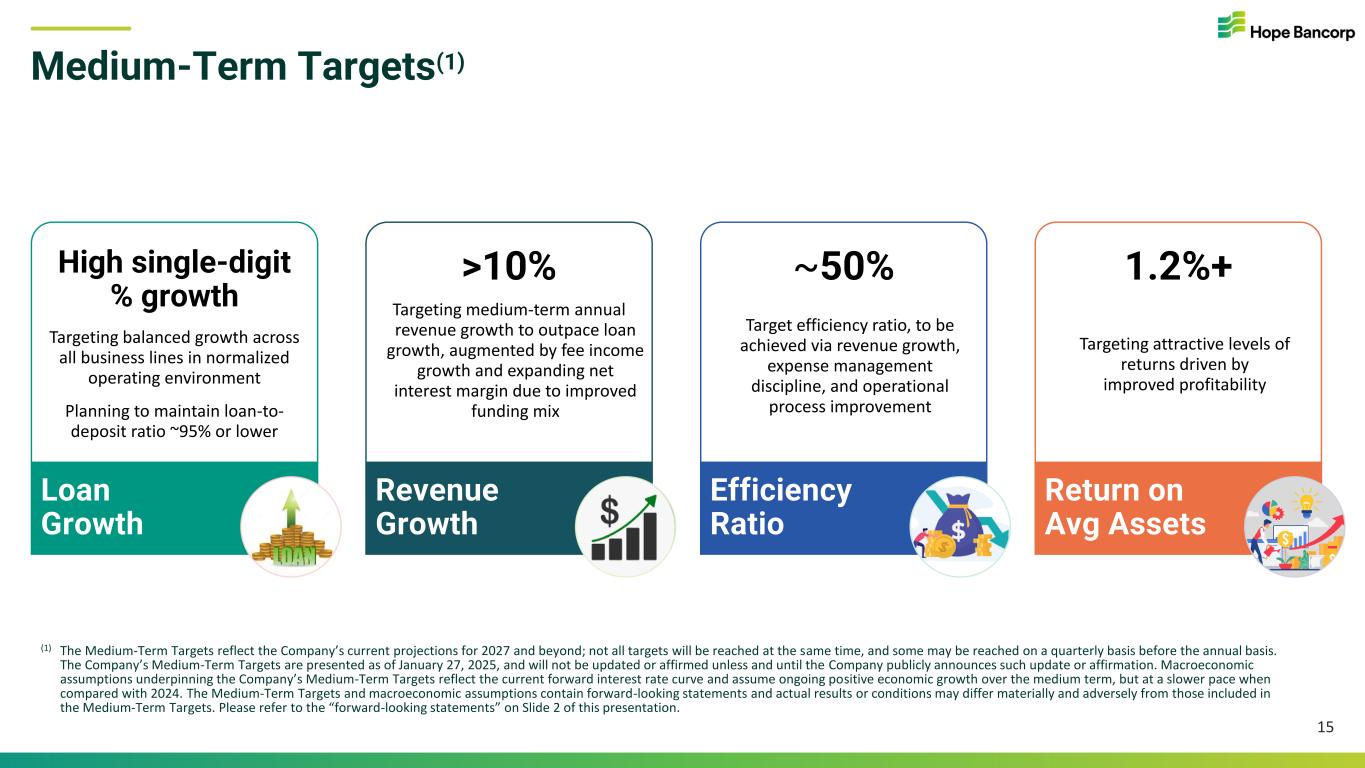
Thank you, Julianna. Moving on to Slide 14, I will now review our outlook for 2025. Our outlook includes the impact of the Territorial Bancorp transaction, the close of which we anticipate in the first quarter of 2025, subject to regulatory approvals. We are excited about the pending merger and the value created through this compelling combination. For 2025, we expect loan growth in the high single-digit percentage range, which reflects moderate organic loan growth in Bank of Hope and the addition of Territorial loans. We expect net interest income growth in the low double-digit percentage range, which includes moderate organic growth from Bank of Hope and the addition of Territorial. We are assuming approximately $15 million of accretion income in 2025. Underpinning our net interest income outlook are two Fed funds target rate cuts of 25 basis points each in May and October, consistent with the forward rate curve. In 2025, we expect non-interest income to grow in the mid-teen percentage range reflecting continuing trends from the fourth quarter and a full year of gains on SBA loan sales. We expect non-interest expenses, excluding notable items, to increase in the low double-digit percentage range year-over-year. This reflects the addition of operating expenses from Territorial and disciplined expense management, while continuing to invest in talent and technology to support franchise growth. We anticipate that one-time expenses related to the close of the Territorial transaction will be approximately $30 million in 2025. Lastly, we are planning for an effective tax rate of approximately 20% for the full year 2025 based upon utilization of low-income housing and investment tax credits. Moving on to Slide 15, for a brief look at our medium-term financial targets. Our bottom-line financial target is a return on average assets of 1.2% and higher. To achieve this metric, we are targeting loan growth in the high single-digit percentage range and revenue growth over 10% on an annual basis, outpacing loan growth. Revenue growth will reflect loan growth combined with strong fee income growth and an expanding net interest margin. Beyond changes in market interest rates, we expect to expand our net interest margin from an improved funding mix. Over the medium term, we are also targeting an efficiency ratio of approximately 50%, which will be the outcome of the revenue growth and continued disciplined expense management. With the strength of the balance sheet we have built, the improved productivity that we are seeing from our banking teams, and the synergies we expect to realize from the Territorial merger, we believe that we are well positioned to improve our financial performance and earnings growth in 2025 and beyond. With that, operator, please open up the call for questions.
Operator
Thank you. We will now begin the question-and-answer session. And the first question will come from Matthew Clark with Piper Sandler. Please go ahead.
Speaker 4
Hey, good morning, everyone. Just first on your outlook on the deposit beta, I think interest-bearing, this past cycle rates up was just over 80%. You looking to match that this cycle or, you know, what are your updated thoughts there?
Well, hi, Matthew. This is Julianna. In terms of this cycle, obviously one would want to achieve a high beta as possible in terms of interest-bearing deposit costs, and we certainly are looking to achieve a better beta than we have in past cycles. So when you look at past Hope cycles, you will see that on non-interest rate cycles, the beta was lower than what we've already achieved at the 42% on interest-bearing, and we're looking to continue to expand that. Hopefully, we'll reach 80%, but we need the rate cuts to help us, and I know that we're being more proactive this cycle than in past cycles.
Speaker 4
Okay. I understand. Regarding the expense run rate, you noted it at low double digits with Territorial, which seems a bit higher than I anticipated. Could you explain the latest $77 million run rate? What factors contributed to the reversal of comp accruals, and what are the various components that lead to that low double-digit growth based on the information provided in the presentation?
Yeah, let me just maybe start with the kind of, let me just talk more about the forward look rather. I think that'll help you a little bit more. You know, when it comes to the addition of the Territorial expenses for the three quarters of 2025, because we are expecting to close the transaction during the first quarter, but for the ease of modeling, we're starting with April 1st, right? But of course, hopefully it will happen sooner. Regardless, the 2025 still includes a transition period in terms of operating costs from Territorial, as we work on the integration. So the run rate in 2026, the annualized run rate in 2026 will be lower in 2025. But that's kind of contributing to the guide for 2025. On Hope standalone, we are looking at moderate expense growth as well. And part of that is continued investment in the franchise and talent and technology to help support growth. Albeit, as you saw from our performance this year, we're continuing to practice disciplined expense management. But vis-a-vis your statement that this is a little higher than you would have expected, I think maybe the difference could be coming from A, closing only three quarters of Territorial versus having the deal close at year end and B, a longer time period of a transition versus a full run rate of cost savings, if you will.
Speaker 4
Okay. And the contribution you're assuming from Territorial in terms of operating expense and any updated thoughts on the amount of cost saves? We obviously know what you provided months ago, but just any update on those numbers?
Well, I mean, the update that we're providing for you is the outlook that we have here for 2025 in terms of the expense growth, and that's for the combined company. I will say that the cost saves that we're looking at are coming in lower than what we had initially penciled out at the announcement, frankly, because integrating the two franchises, we're being conscientious about building in a well-thought-out transition plan. If you recall at our announcement, we did talk about maintaining the branch network and the customer-facing employees and not changing the experience for customers. As you kind of go through the process, you find that you need maybe more operational support, et cetera, and all in. It kind of reduces maybe the cost base that one thinks about initially from an investment banking perspective. But I think over time we will achieve that.
Speaker 5
Oh, great. Thanks for the question. Julianna, just a quick modeling question on the Territorial accretion. I think it says $15 million from the loans. What are you assuming for the securities accretion? Or is that all in the low double-digit guidance, trying to parse out the accretion.
Yes, so we pointed out the loan accretion specifically. The securities income is in the low double-digit guidance, and we are evaluating how much of that securities book we want to keep versus reposition. So that's why we haven't specified that more precisely.
Speaker 5
Okay great, and then that was my follow-up to Kevin. Anything that you might be considering at close or shortly after close that could perhaps accelerate this transition to the ROA goals that you've laid out for the medium term?
Chris, maybe you can rephrase that question.
Speaker 5
Oh, sure. Yeah. The balance sheet at close, is there anything you're considering more, you know, opportunistic from either your or the acquired balance sheet that could help improve the return? You've got the capital to absorb some sort of a modest restructure. Is there anything being contemplated that could accelerate that transition from the ROA you're currently at to where you hope to be over the next two or three years?
Yeah. Chris, that's a great question. And I think it applies to both balance sheets rather than just the one Territorial balance sheet. As I shared with you right now, we are evaluating what of the acquired securities portfolio we want to keep and or sell for other usage purposes. But vis-a-vis commentary on our broader Bank of Hope balance sheet or any kind of optionality there, I think discussing that kind of activity is premature while the transaction is still pending.
Speaker 5
Great. If I could just sneak one more in on buybacks, Kevin, could you just provide your latest thoughts on whether that could be something post-closed that you would consider given where the stock is trading?
Chris, as we have repeatedly shared in the past, we think it is premature to comment about that at this point before the actual consummation of the merger. Having said that, our Board will continue to evaluate both short-term and long-term capital deployment opportunities in the best interest of the bank, as well as in the best interest of the shareholders.
Speaker 6
Thanks. Good morning. I wanted to ask a question about the deposit trends in the quarter. Obviously, a little bit of a mixed shift away from non-interest bearing, and heavier money market balances. We've been hearing that, you know, even though you did have some success on the interest bearing side, that the competitive environment in the Korean American space has remained very high. Can you talk about kind of the competitive environment on the pricing side and to what degree that's maybe hampered efforts to reduce overall funding costs?
Well, first of all, I will say that what you saw in the fourth quarter is similar that you see in the fourth quarter for us typically. We have some depositors, commercial depositors in the residential mortgage industry where you see outflows of those DDAs in the fourth quarter related around property tax payments and the like. So that is the effect on the DDAs that you are noting. In regards to the other part of your question around competitive pricing, I mean, deposit pricing remains competitive in the marketplace. That’s just the reality of where we are today. But I will say that achieving a 42% beta on our interest-bearing deposit costs across our network is a pretty good result for Hope. And I would like to thank all of our front lines across all of our segments for helping to drive that result.
Speaker 6
Alright. I appreciate the background there and then just on your guide as it relates to the fee income side, you noted obviously the benefit of a full year of sales in SBA. Are you kind of assuming the kind of back half of the year of 2024 in that kind of $2.7 million to $3 million range? Is that kind of the range you would expect on a quarterly basis for next year?
Yeah. I think the fourth quarter is generally a good run rate and as we said we would expect to continue selling SBA loans in 2025.
Speaker 4
Thank you. Regarding the loan growth outlook, we anticipate high single-digit growth with Territorial. Can you provide some insights on the legacy Hope trends? It seems reasonable to expect that C&I will grow at a solid pace, while commercial real estate may continue to decline. What are your thoughts on reducing the CRE portfolio and whether we can expect it to stabilize or keep shrinking in the near future?
Well, Matthew, we had a turnaround in the second quarter of 2024. So from the Hope organic side, we still expect a moderate low single-digit growth in our loan portfolio before we add the Territorial portfolio. The majority will be coming from the C&I side. And for CRE, if there is any growth, that will be nominal.
Speaker 4
Okay, but just trying to get a sense for it.
The majority will be coming from the C&I side. And for CRE, if there is any growth, that will be nominal.
Speaker 4
Okay, fair enough.
Operator
Thank you. This concludes our question-and-answer session. I would like to turn the conference back over to management for any closing remarks. Please go ahead.
Thank you, Matthew. Once again, thank you all for joining us today, and we look forward to speaking with you again soon next quarter. Bye everyone.
Operator
The conference is now concluded. Thank you for attending today's presentation, you may now disconnect.