Operator
Hello everyone and welcome to the Independent Bank Corporation Report 2025 second quarter results. My name is Ezra and I will be your coordinator for today. If you would like to ask a question please press star followed by one on your telephone keypad. If you change your mind please press star followed by two. We will be taking questions after the prepared remarks. I will now hand over to our host, Brad Kessel, President and CEO, to begin. Please go ahead.
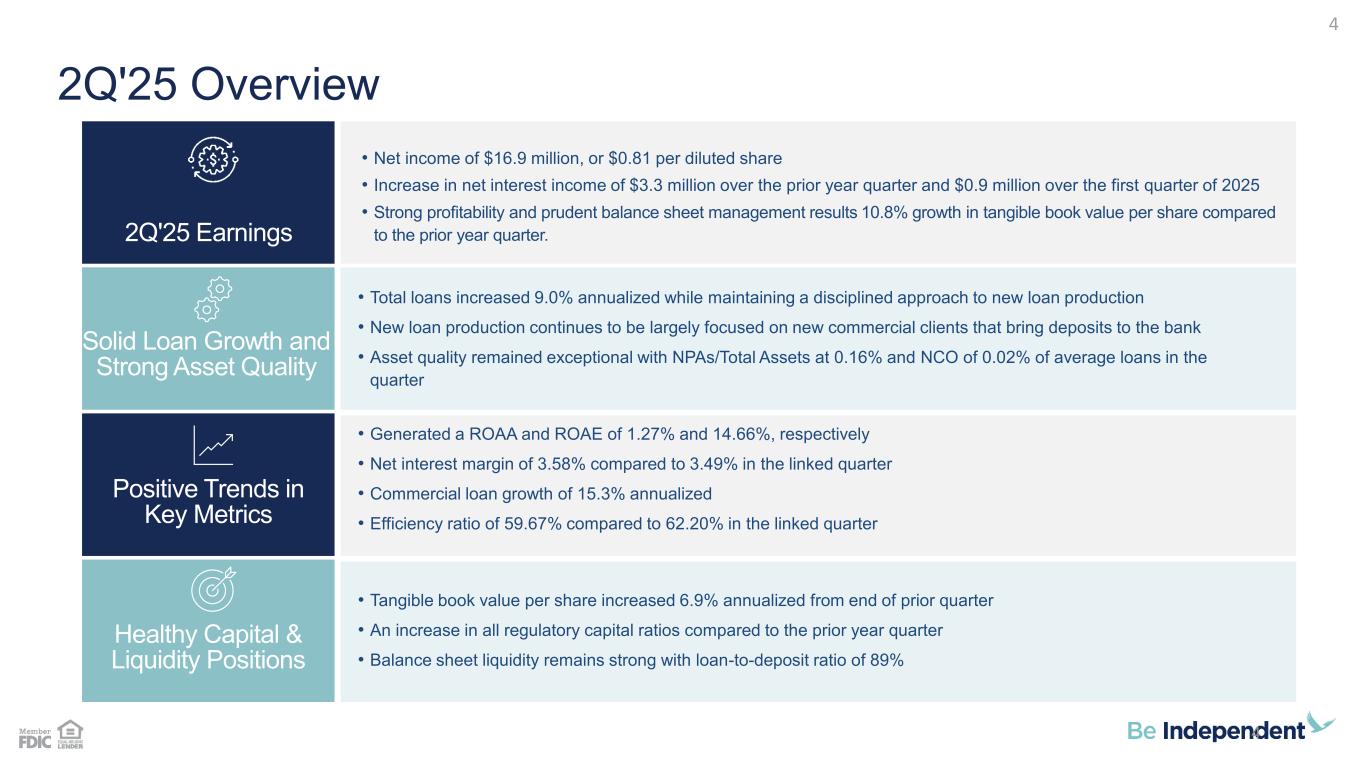
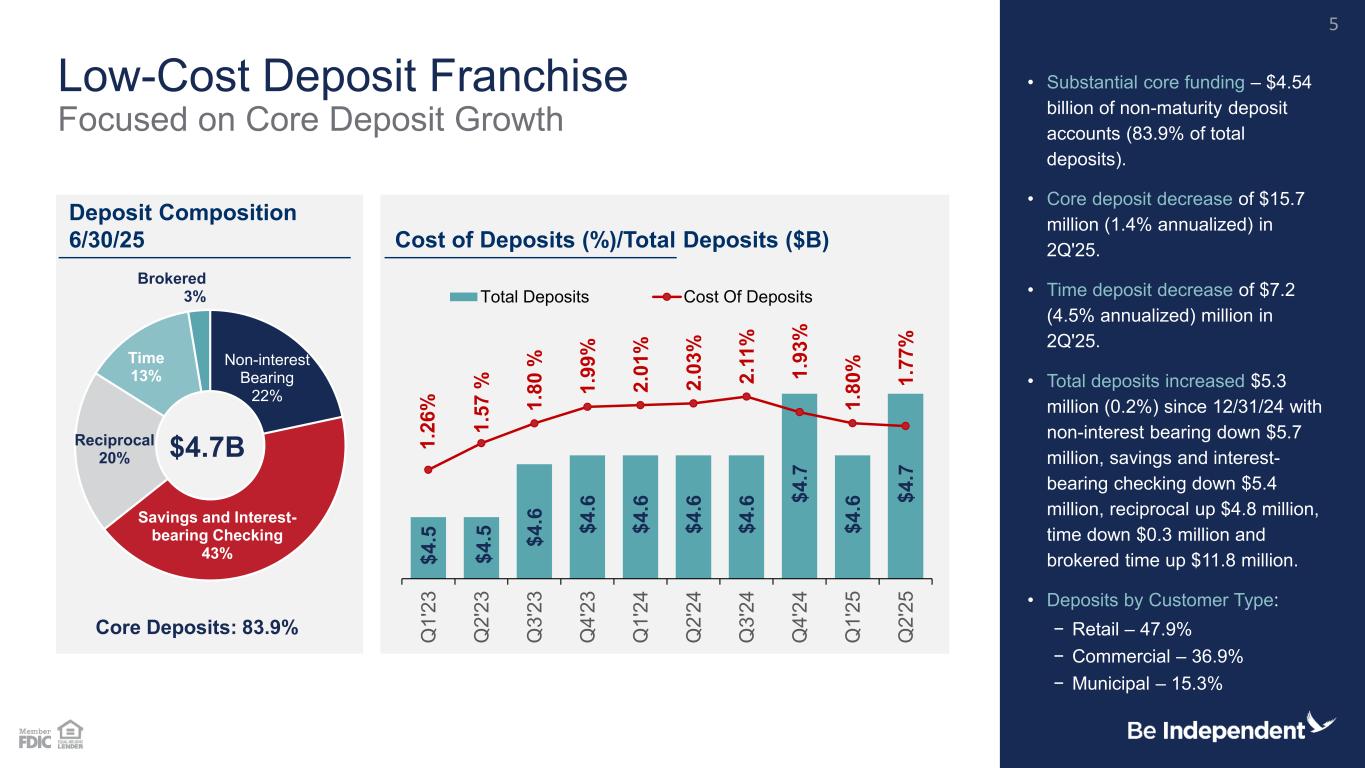
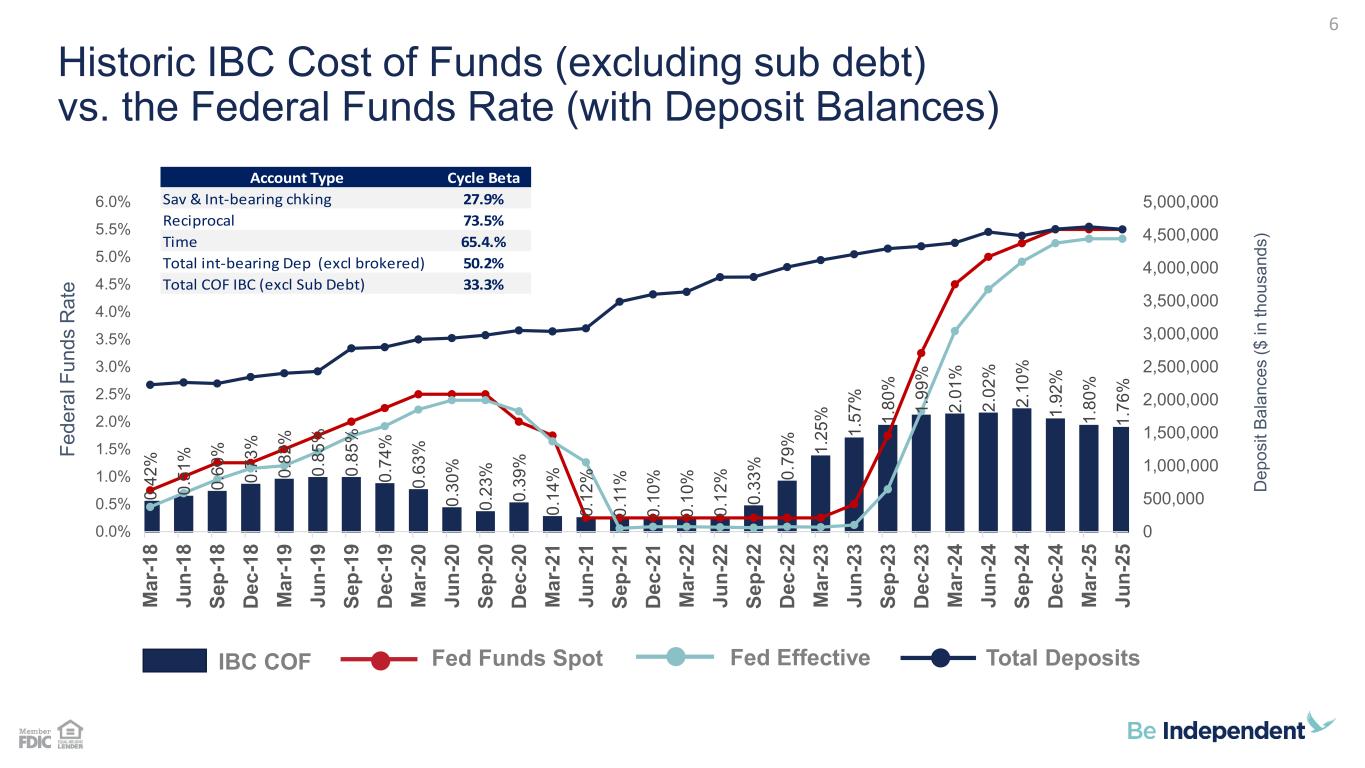
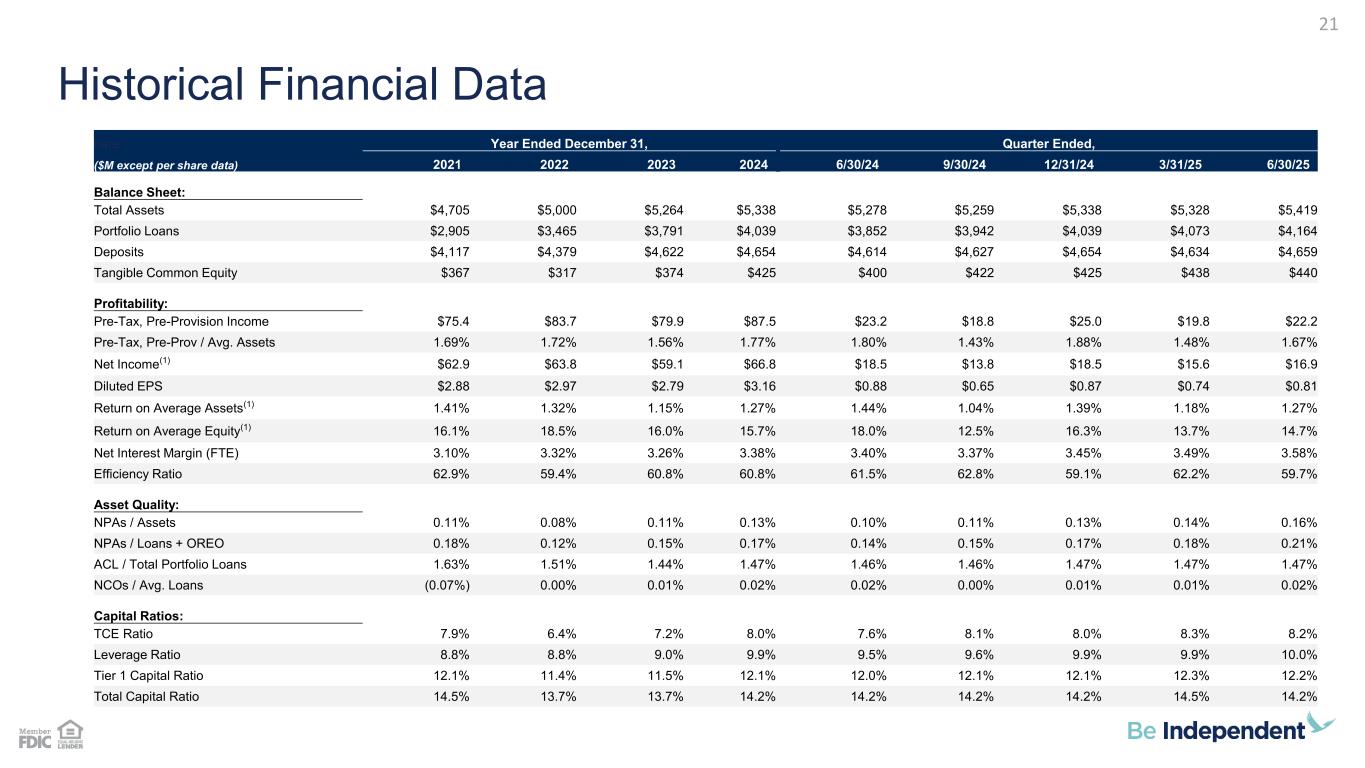
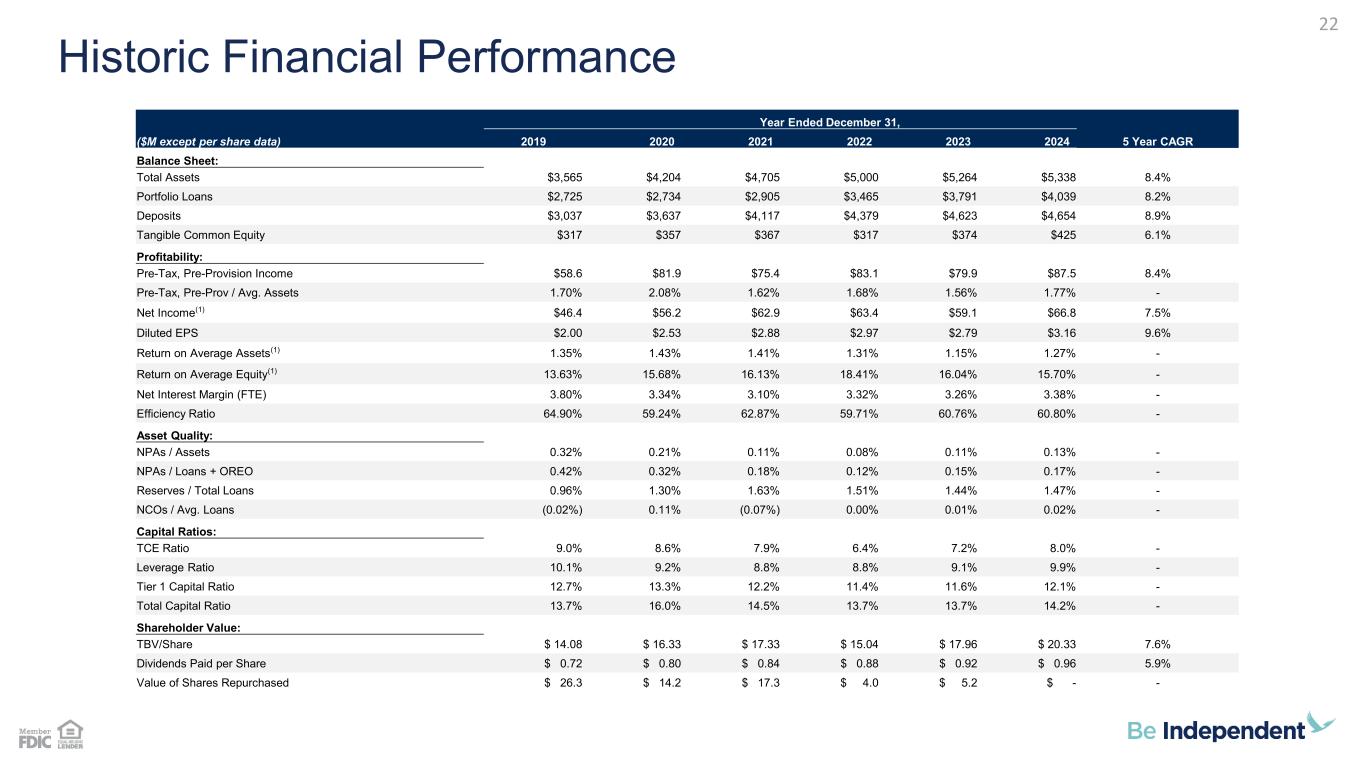
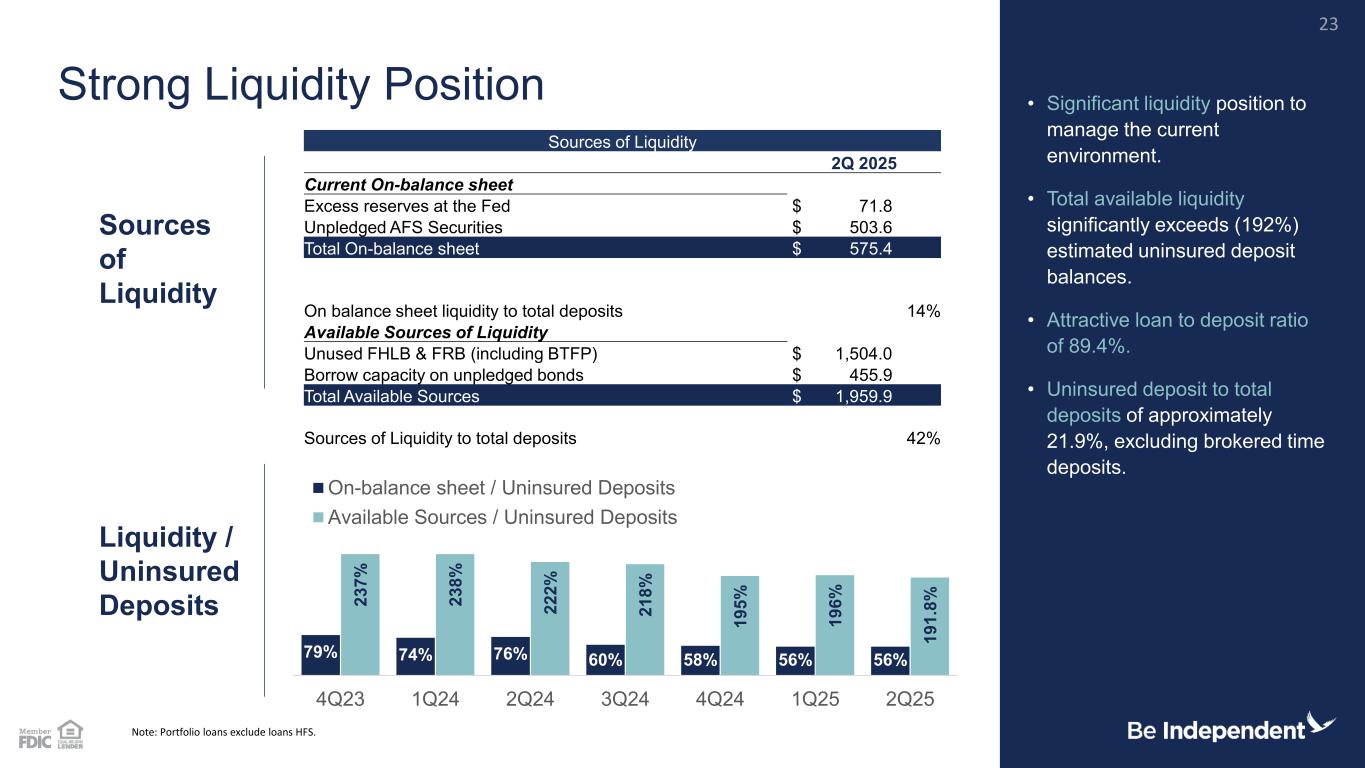
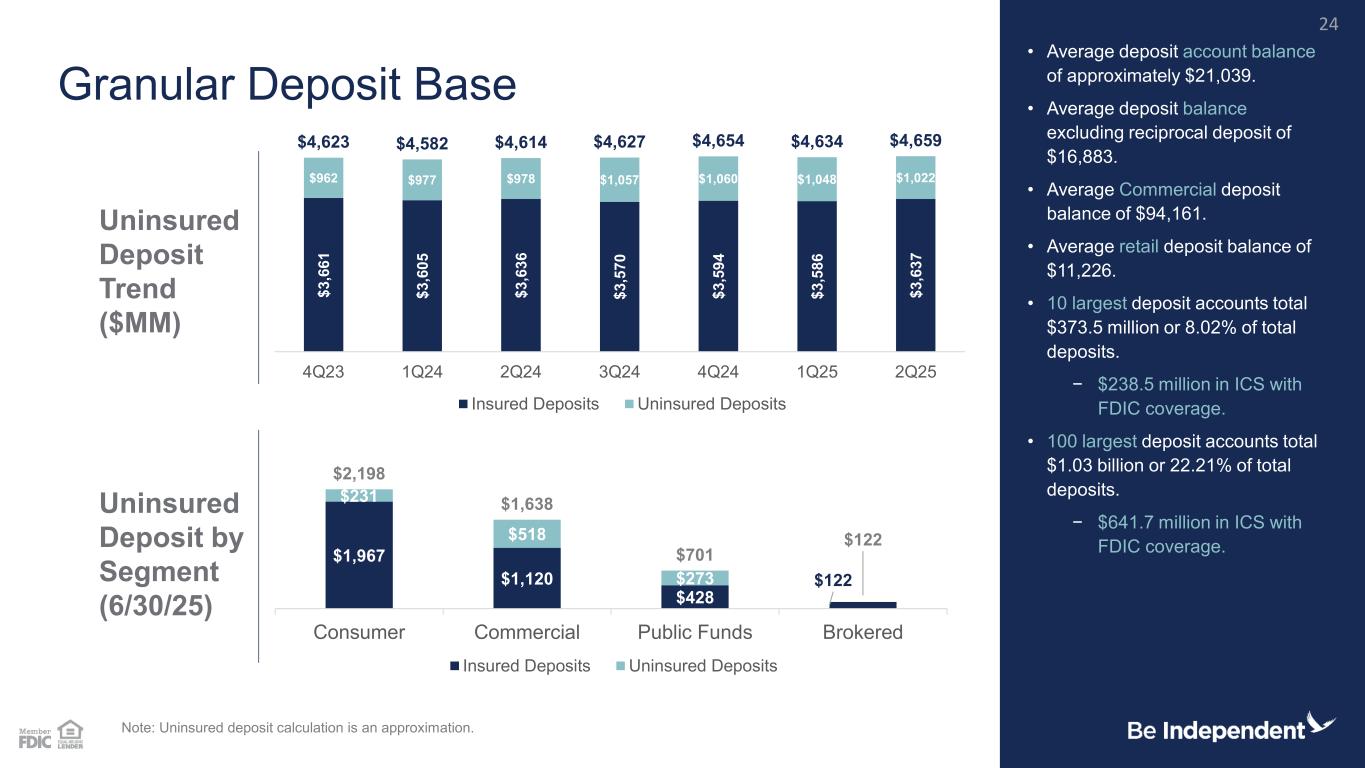
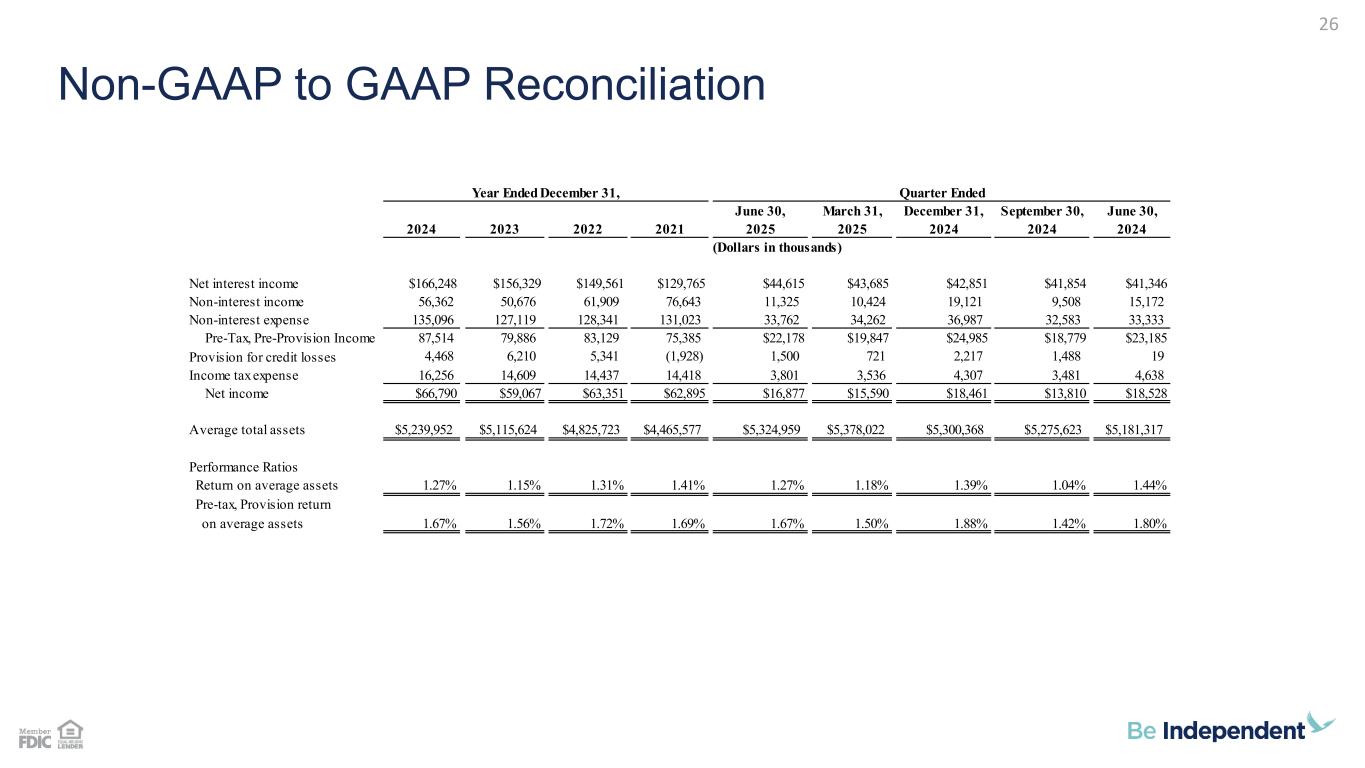
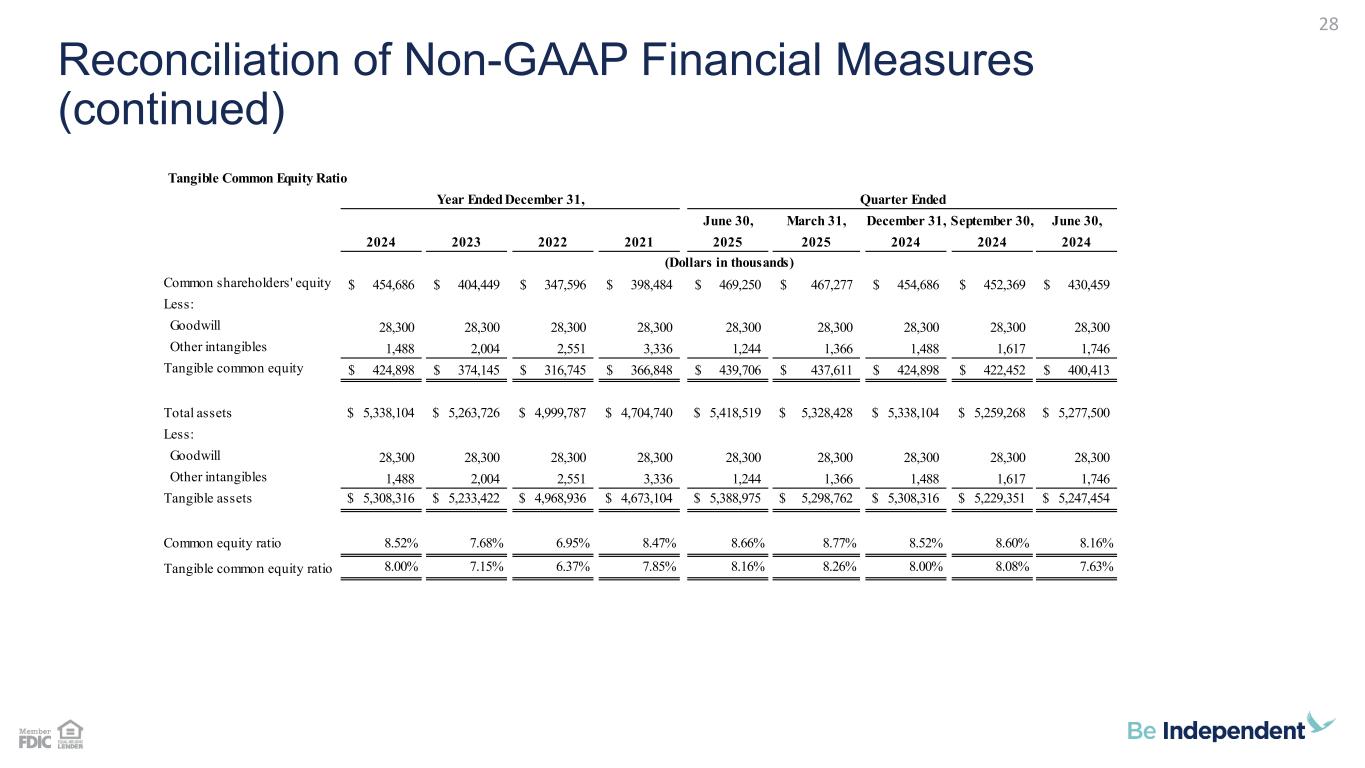
Good morning, and welcome to today's call. Thank you for joining us for Independent Bank Corporation's conference call and webcast to discuss the company's second quarter 2025 results. I am Brad Kessel, President and Chief Executive Officer, and joining me is Gavin Moore, EVP and Chief Financial Officer, and Joel Rahn, EVP Commercial Banking. Before we begin today's call, I would like to direct you to the important information on page two of our presentation, specifically the cautionary note regarding forward-looking statements. If anyone does not already have a copy of the press release issued by us today, you can access it at the company's website, independentbank.com. The agenda for today's call will include prepared remarks, followed by a question and answer session, and then closing remarks. I am pleased to report our solid second quarter results as we advance our mission of inspiring financial independence today with tomorrow in mind. Our vision is a future where people approach their finances with confidence, clarity, and the determination to succeed. Our core values of courage, drive, integrity, people-focused, and teamwork are the blueprint our employees live by. We strive to be Michigan's most people-focused bank. Today, Independent Bank Corporation reported second quarter 2025 net income of $16.9 million or 81 cents per diluted share versus net income of $18.5 million or 88 cents per diluted share in the prior year period. Significant items impacting comparable second quarter 25 and 24 results include the following. Changes in the fair value due to price of capitalized mortgage loan servicing rights was a loss of 0.2 million or one penny per diluted share after tax for the three months ending June 30, 25, as compared to 0.9 million or three cents per diluted share after tax gain for the three-month period June 30, 2024. Also, a gain on equity securities at fair value of $2.7 million or 10 cents per diluted share after tax in the second quarter of June 30, 24, attributable to the exchange of our Visa Class B1 common stack. No gain or loss in equity securities at fair value was recorded in the second quarter of 25. I'm very proud of our team and pleased to see us continue our positive trends with our second quarter 25 results. Overall loans increased by 9% annualized, while core deposits were down 1.4% annualized due to seasonality. We generated net interest income growth on both a linked quarter basis and a year-over-year quarterly basis, producing nine basis points of margin expansion from the prior quarter. Our expenses are well-managed, and we continue to see improved operational scale from strategic investments made in recent years. These fundamentals draw positive growth and tangible common equity per share of common stock 10.8% compared to the prior year quarter. along with very healthy performance returns, a return on average assets of 1.27% and a return on average equity of 14.66%. Despite heightened uncertainty in the markets during the quarter, our credit metrics remain strong with low levels of watch credits, 16 basis points of non-performing assets to total assets, and two basis points in net charge-offs to average loans of the quarter annualized. The allowance for credit losses was 1.47% of total loans. Our team has been effective in many areas during the first half of 25, including business development from the existing customer base and onboarding new relationships, which have enhanced the geographic and product line diversification of our business. We continue to succeed in recruiting talented bankers to join the independent bank team. During the second quarter, we rolled out several new technologies to make banking easier for both our customers and associates serving our customers. For all these reasons, I am optimistic about our prospects for growth for the balance of 25 and in the 26. Moving to page five of our presentation, total deposits as of June 30, 25 were $4.7 billion. Overall, core deposits decreased $15.7 million during the second quarter of 2025. On a linked quarter basis, retail deposits were down $13.8 million. Business deposits were up by $60.5 million, and municipal deposits decreased by $64 million. Our sales team continues to bring in new relationships well below our wholesale cost of funds. On page six, we have included in our presentation a historical view of our cost of funds as compared to the Fed Fund Spot Rate and Fed Effective Rate. For the quarter, our total cost of funds declined by four basis points to 1.76%. At this time, I'd like to turn the presentation over to Joel Rahm to share a few comments on the success we're having in growing our loan portfolios and provide an update on our credit metrics.
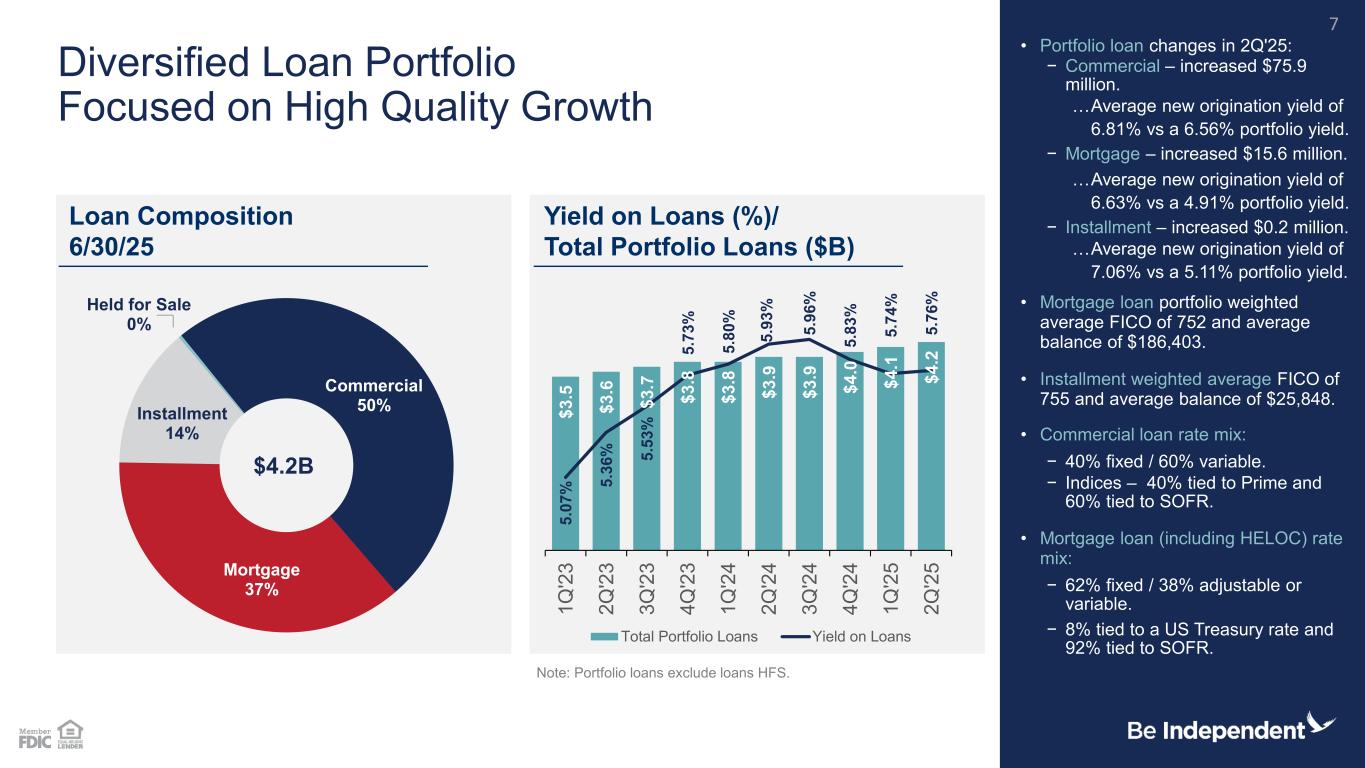
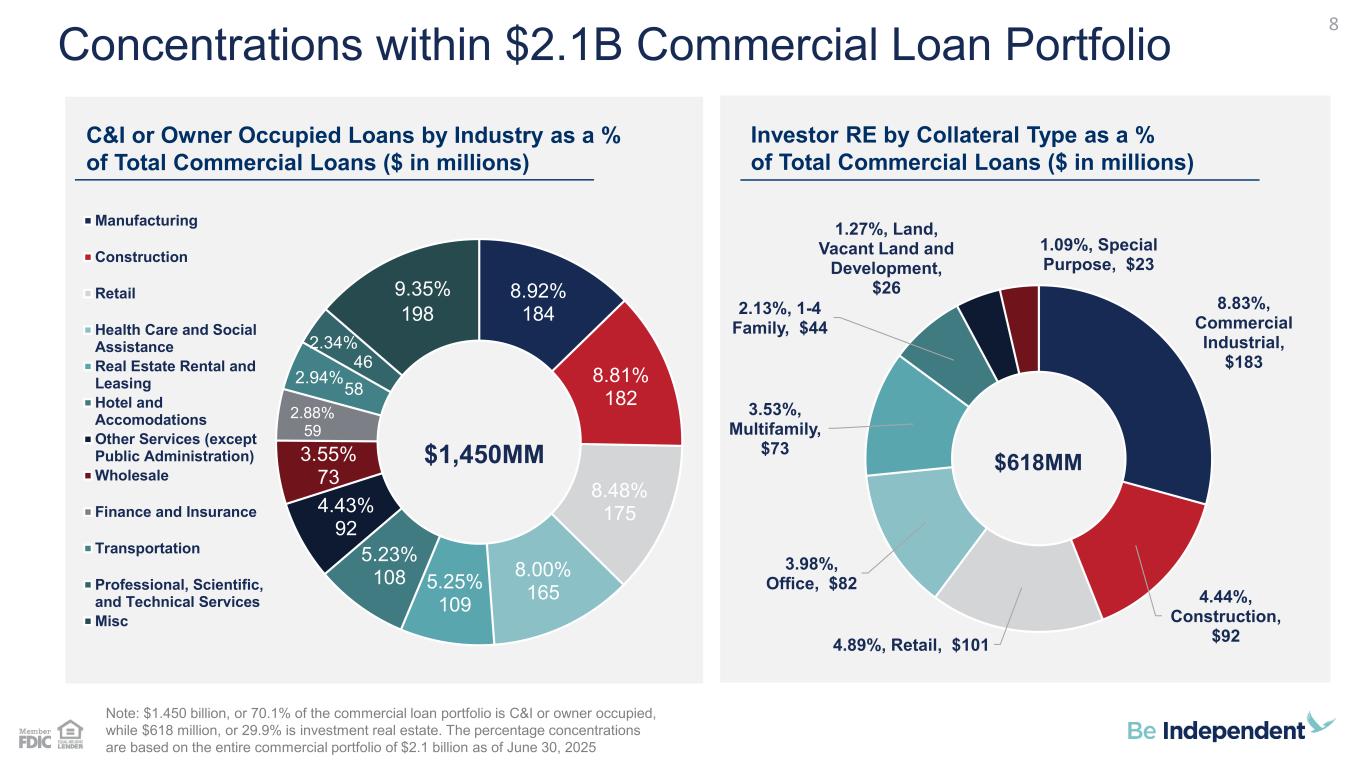
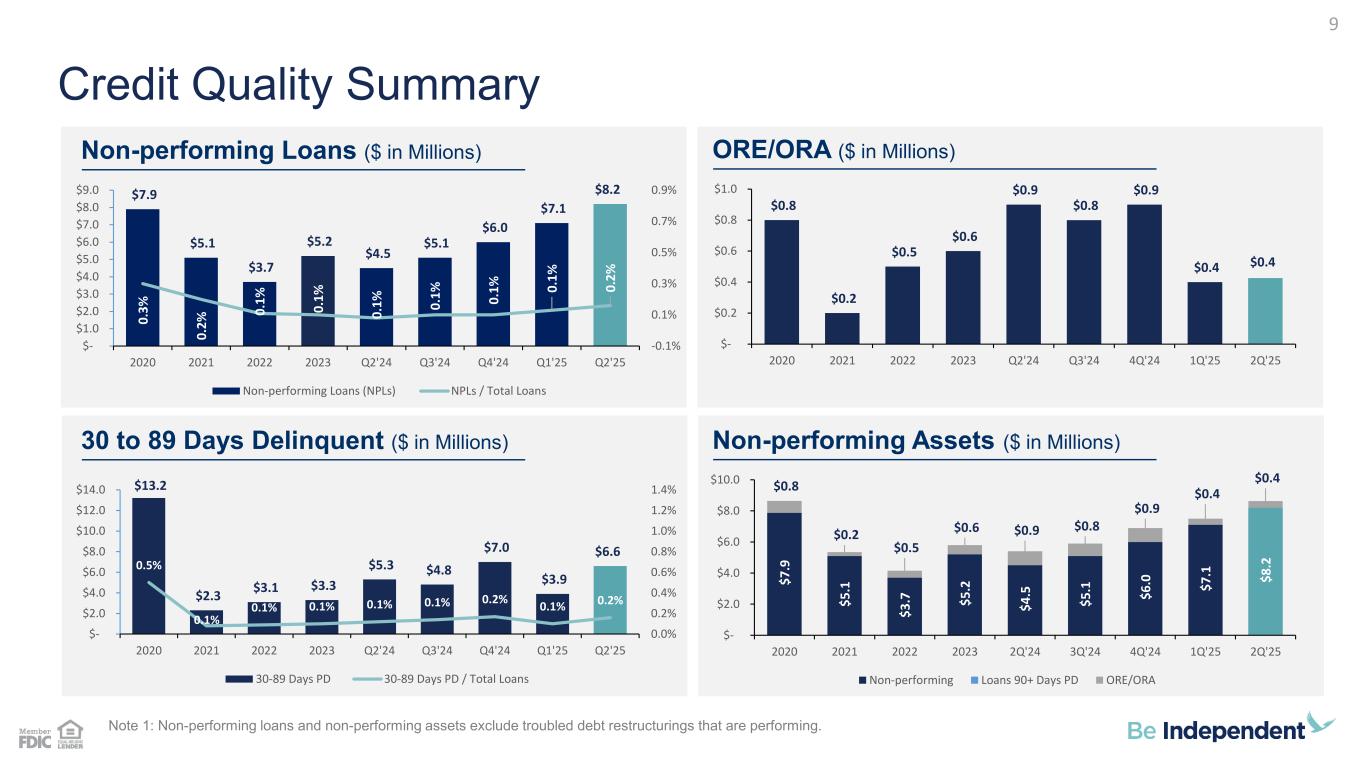
Joel Rahm Thanks, Brad, and good morning, everyone. On page seven, we share an update on loan activity for the quarter. We continued to experience solid loan growth in the second quarter with total loans growing by 91.7 million or 9% annualized. Commercial loan generation was strong, resulting in 75.8 million of quarterly growth, which is 15.3% on an annualized basis. Our residential mortgage portfolio grew by 15.6 million and our installment loan portfolio was up slightly for the quarter. Our continued strategic investment in commercial banking talent continues to supplement our loan growth. We added three experienced commercial bankers in the second quarter, bringing our team to 50 bankers across our statewide footprint. Our staff additions include launching a new LPO in Kalamazoo. We're very excited to have a commercial presence in that market. Looking ahead, we believe we will continue low double-digit growth of our commercial loan portfolio in the second half of the year based upon a strong pipeline. We continue to see market share opportunities from regional banks and are seeing some uptick in organic growth from our existing customers. As noted in previous quarters, our new loan production in all categories continues to come on at yields well above the respective portfolio yield. Looking at the commercial loan production activity on a year-to-date basis, the mix of C&I lending versus investment real estate is 59% and 41% respectively. For our commercial portfolio, our mix is 70% C&I and 30% IRE. Page 8 provides detail on our commercial loan portfolio concentrations. There's not been any significant shift in our portfolio and the portfolio continues to be very well diversified. Our largest segment of the CNI category is manufacturing at 184 million or 8.9% of the total portfolio. It's worth noting that within the manufacturing segment is 157 million of automotive industry exposure that we're monitoring closely for any tariff-related impact. To date, the impact has been nominal. Key credit quality metrics and trends are outlined on page nine. Overall, credit quality continues to be excellent, as Brad said. Total non-performing loans were 8.2 million, or 20 basis points of total loans at quarter end, up slightly from 17 basis points at 331. Past due loans totaled 6.6 million, or 16 basis points, also up slightly from 10 basis points at 331. It's not reflected on the slide, and Brad mentioned it just a moment ago, but it's worth noting that our year-to-date charge-offs are $442,000 or two basis points of average loans on an annualized basis. At this time, I'd like to turn the presentation over to Gavin for his comments, including the outlook for the remainder of the year.
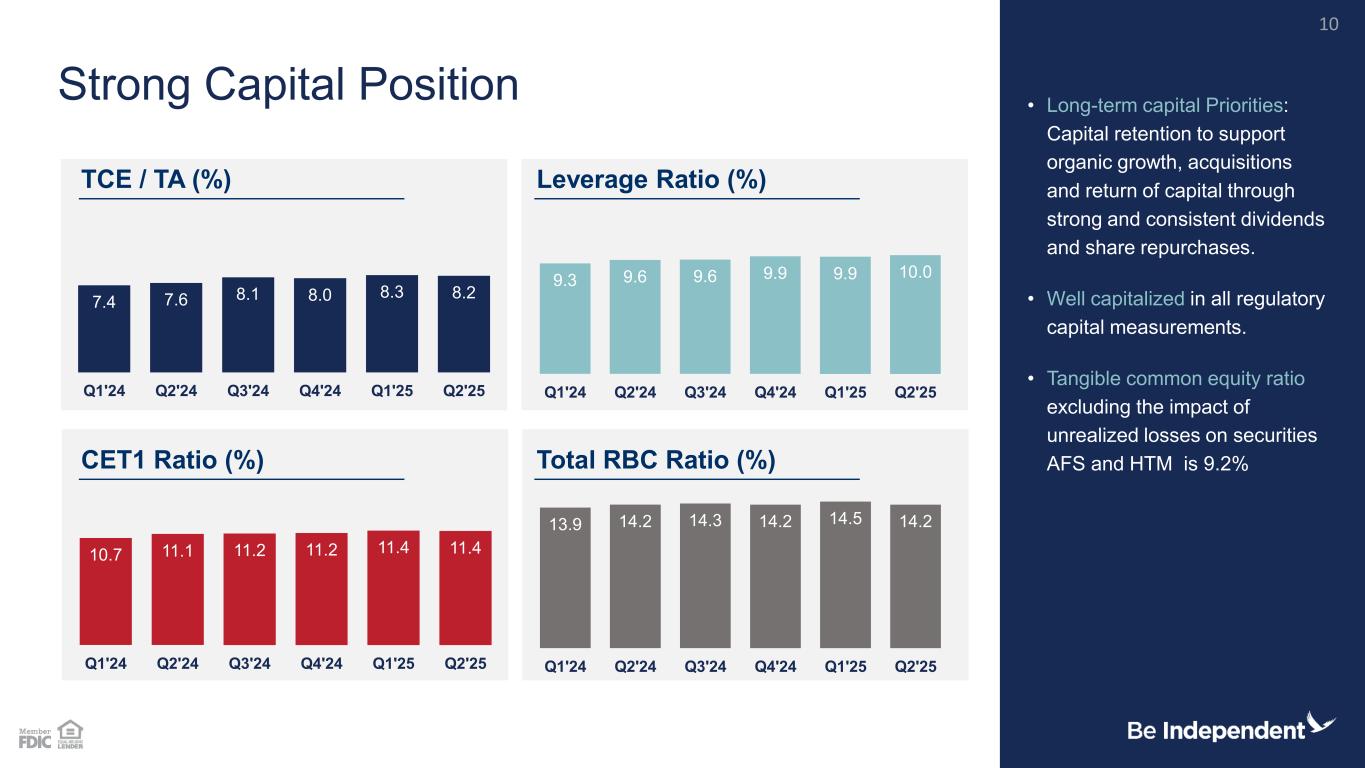
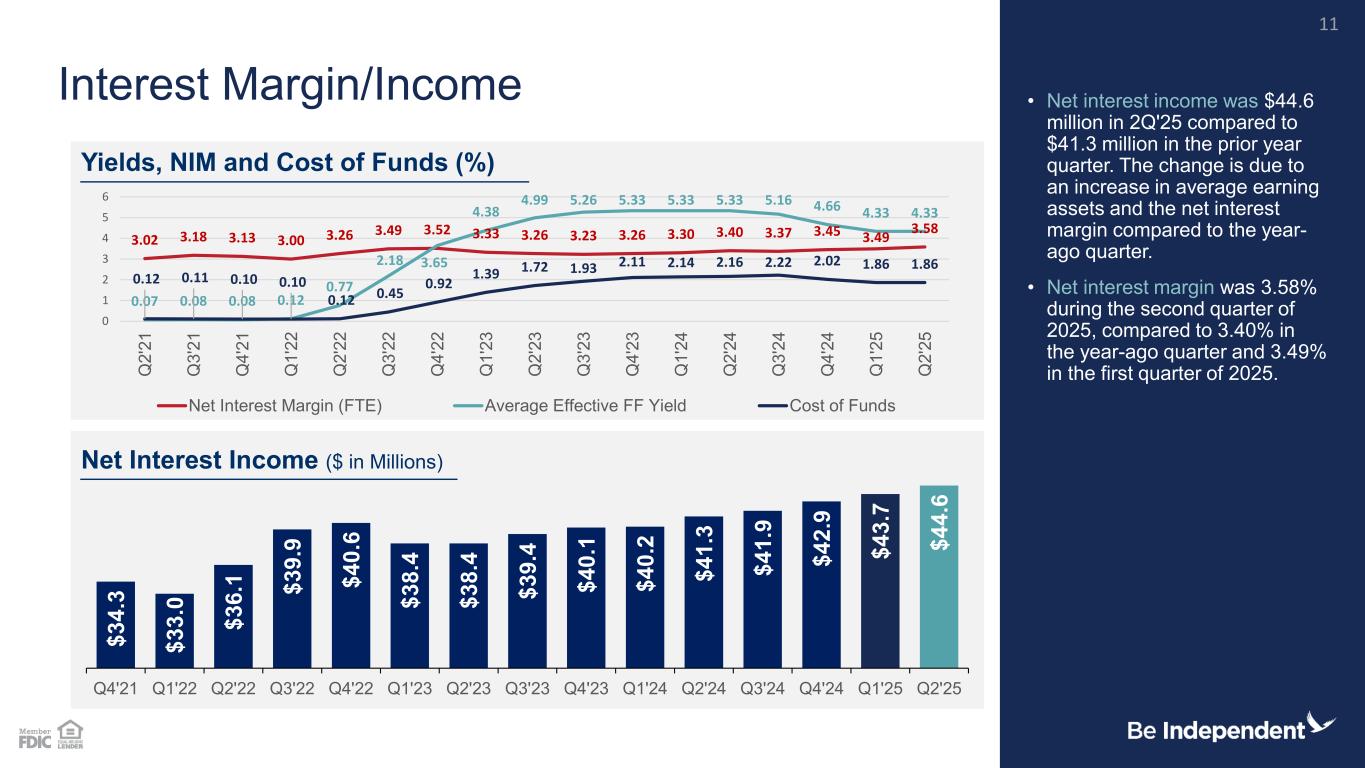
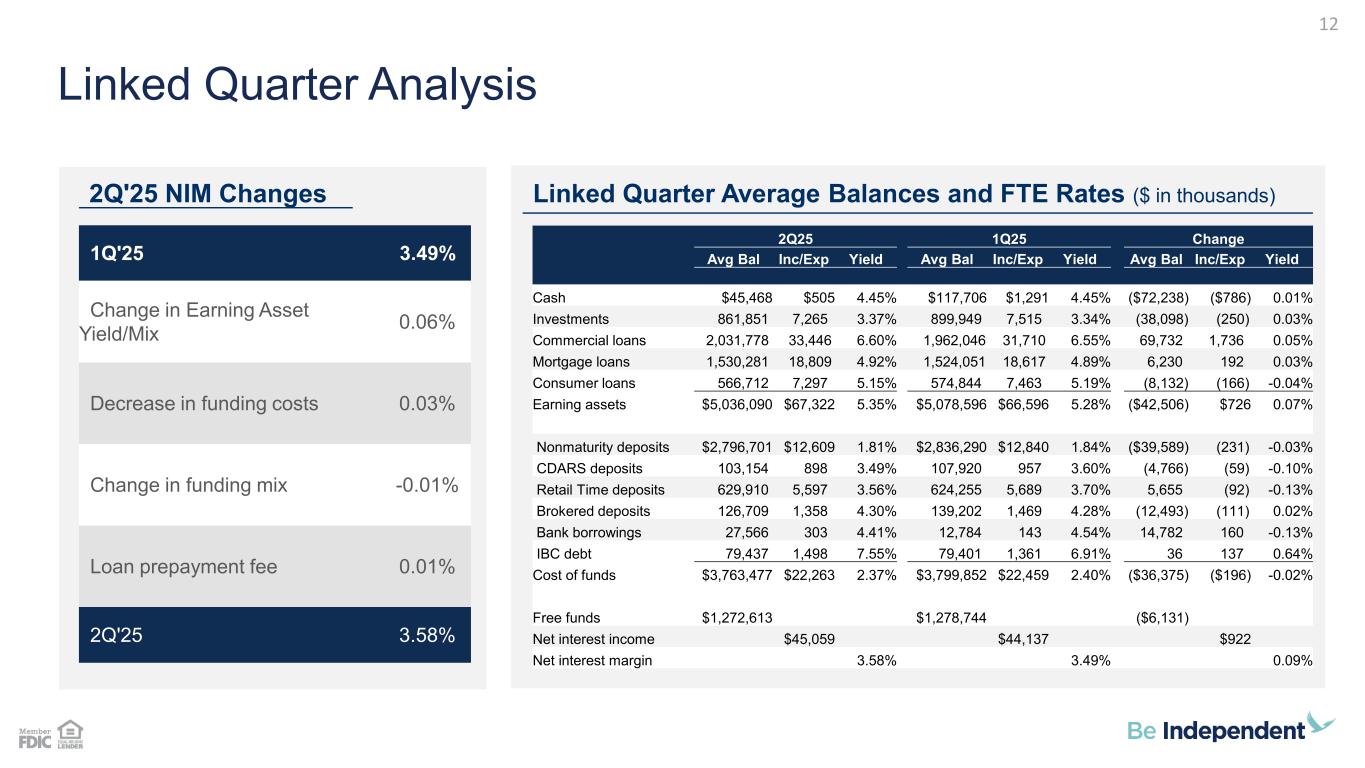
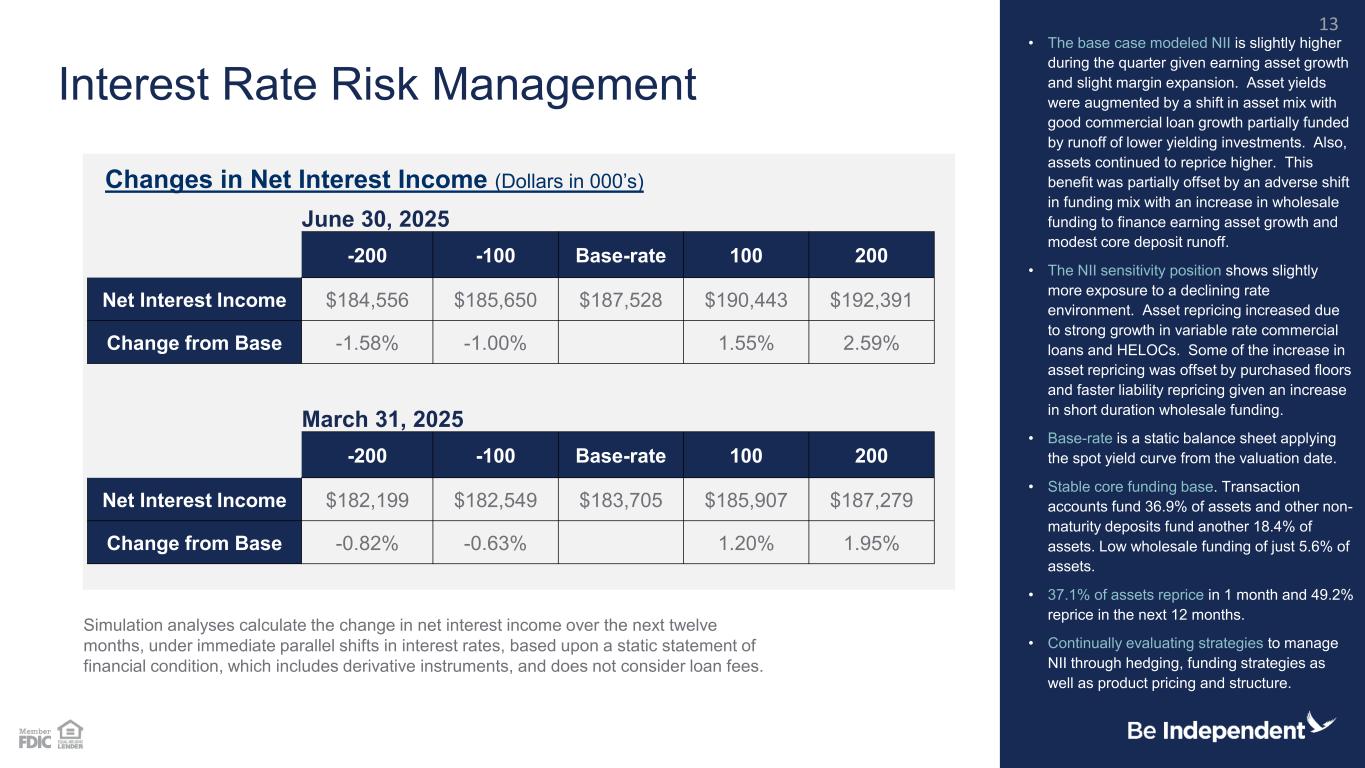
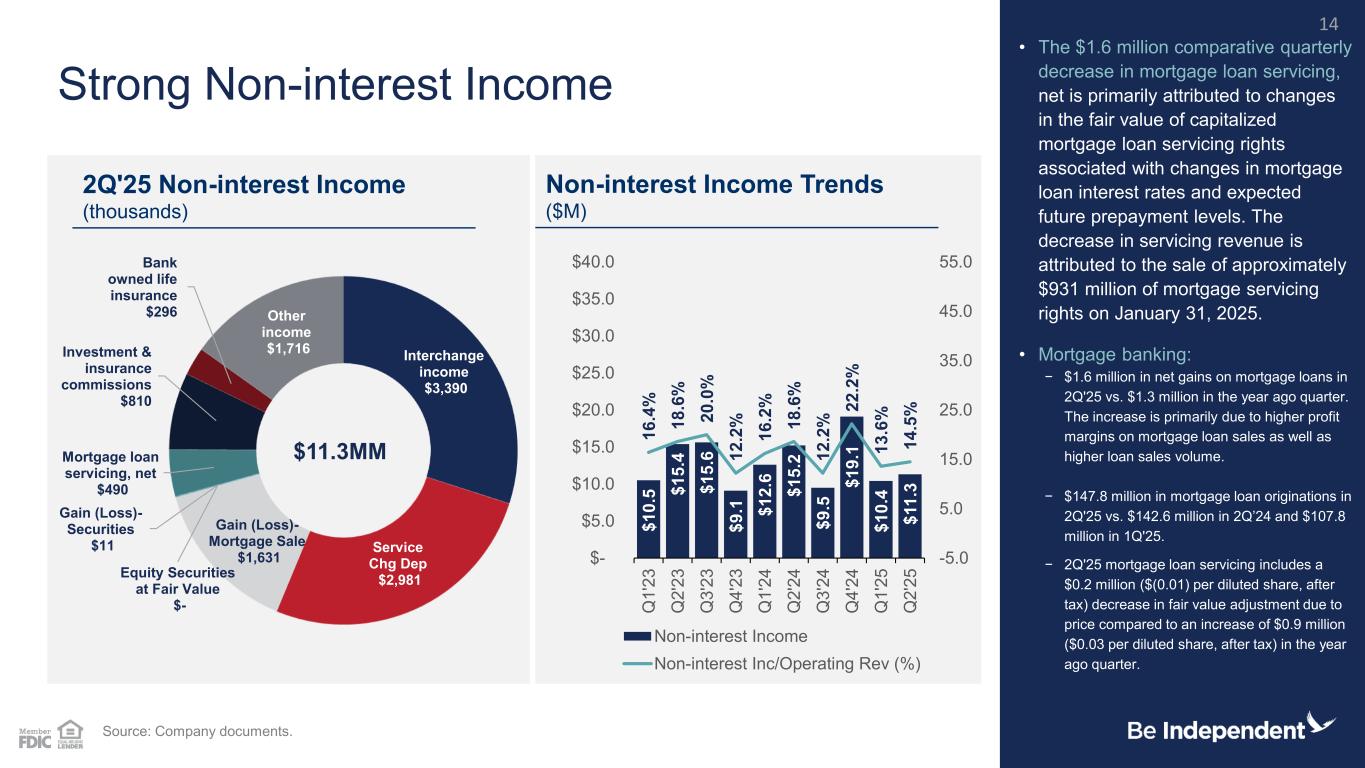
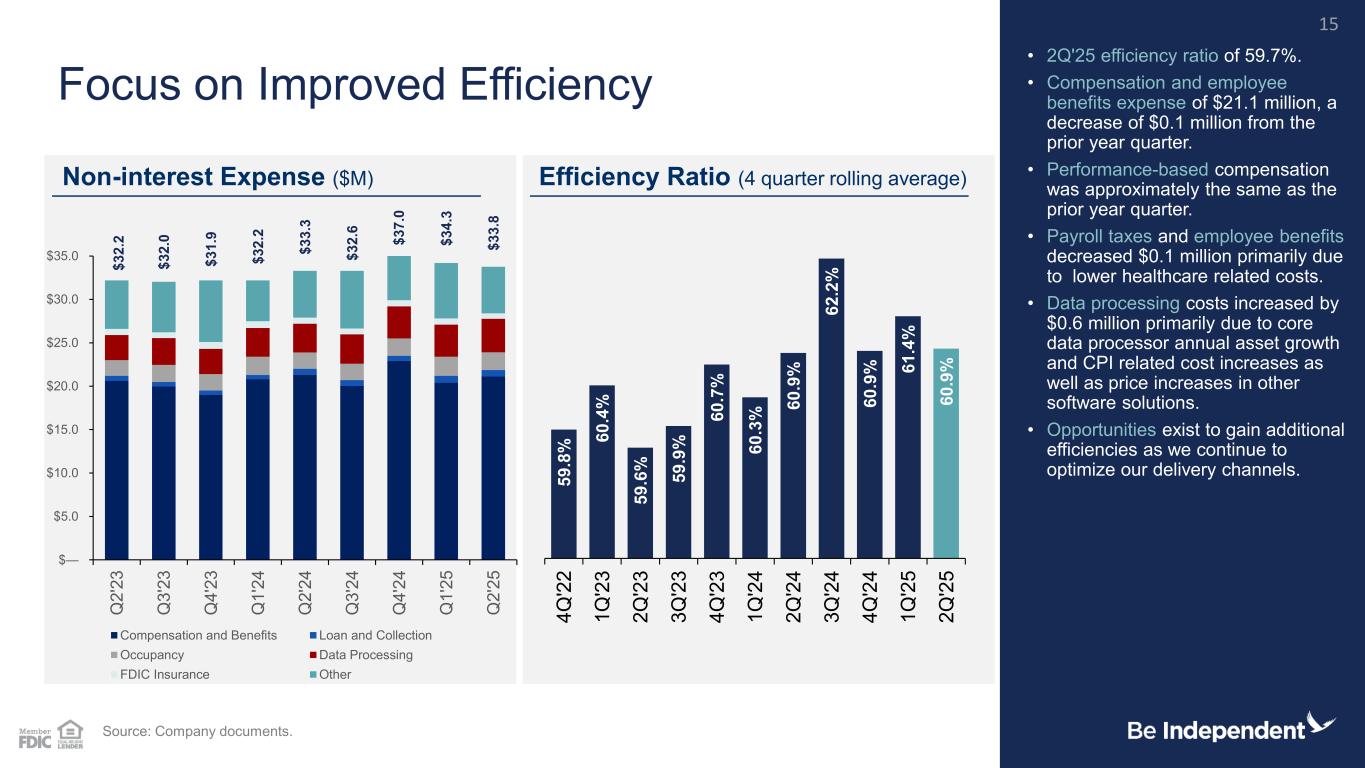
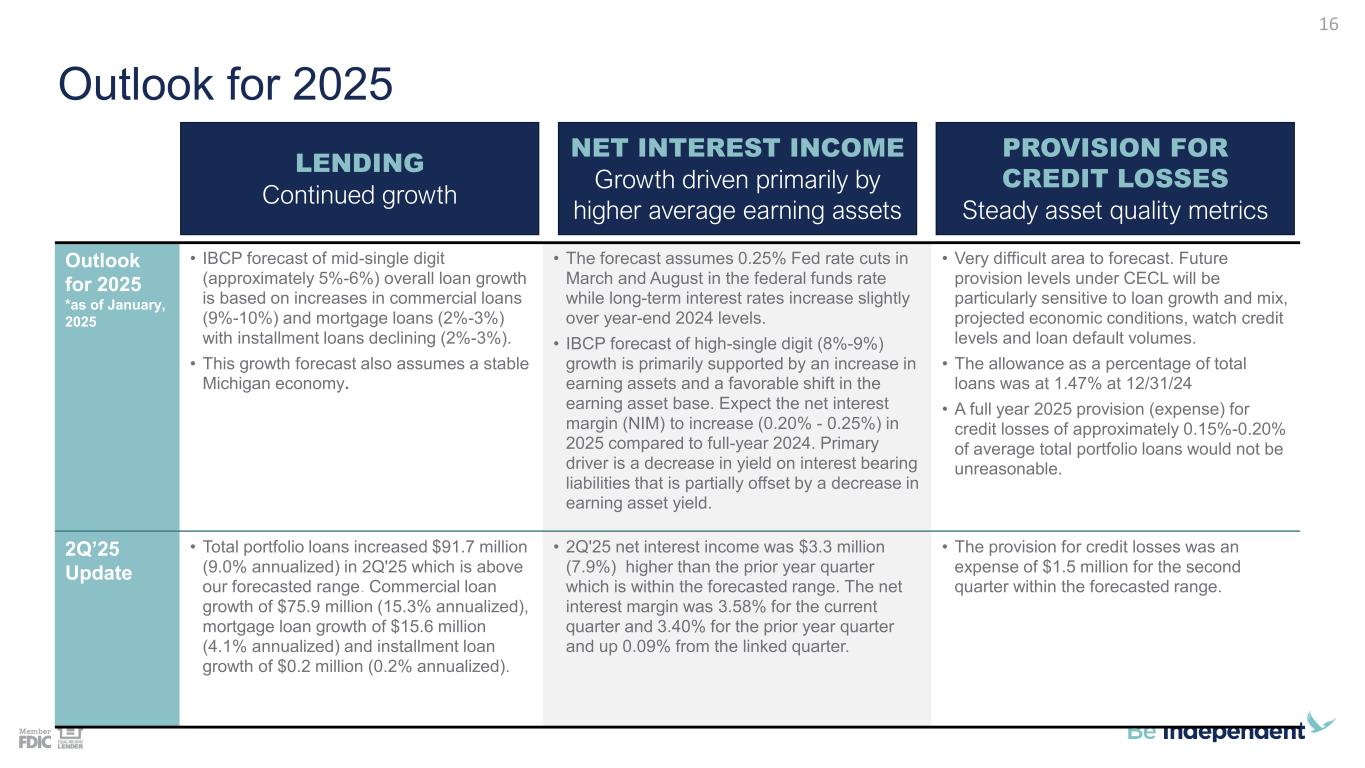
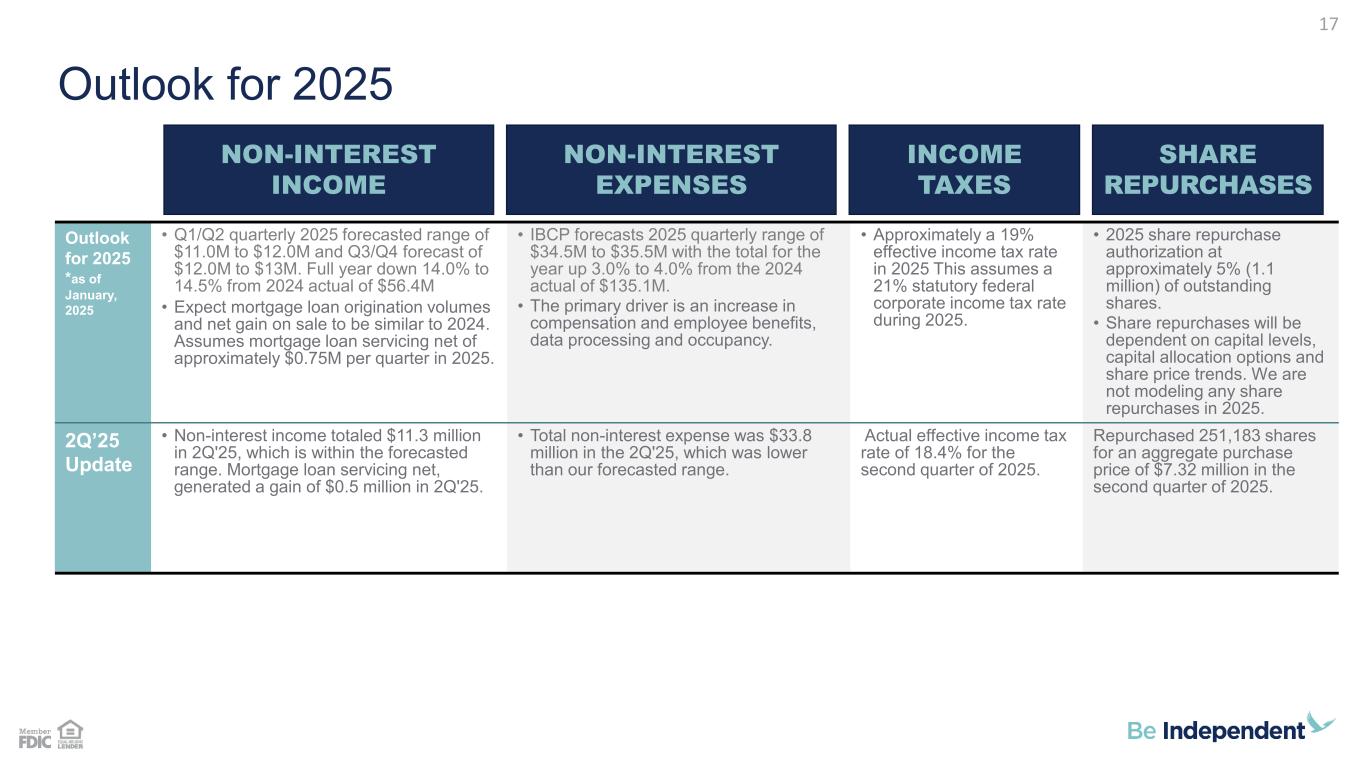
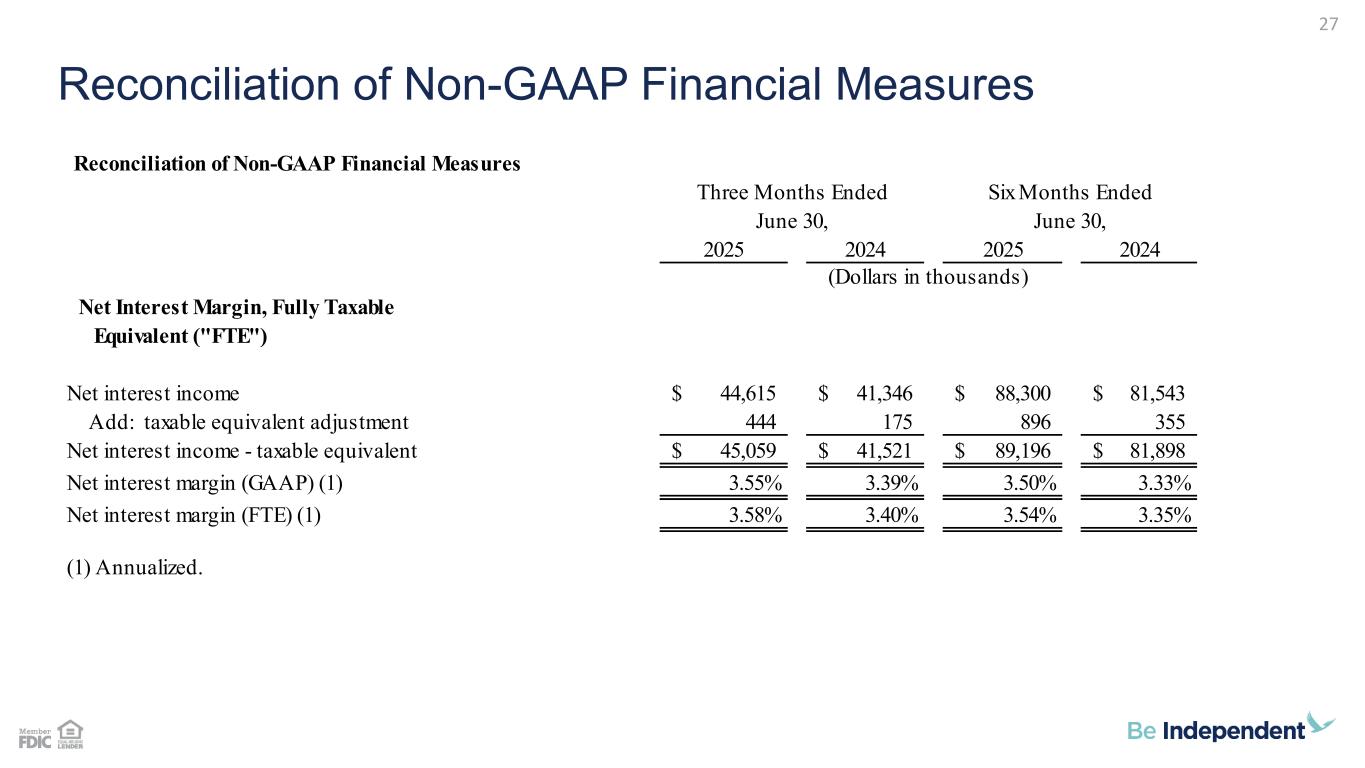
Thanks, Joel, and good morning, everyone. I'm starting on page 10 of our presentation. Page 10 highlights our strong regulatory capital position. Turning to page 11, net interest income increased $3.3 million from the year-ago period. For tax-equivalent net interest margin, it was 3.58% during the second quarter of 2025 compared to 3.40% in the second quarter of 2024 and up nine basis points from the first quarter of 2025. Average interest-earning assets were $5.04 billion in the second quarter of 2025 compared to $4.89 billion in the year-ago quarter and $5.08 billion in the first quarter of 2025. Page 12 contains a more detailed analysis of the linked quarter increase in net interest income and the net interest margin. On a linked quarter basis, our second quarter 2025 net interest margin was positively impacted by three factors. A decrease in funding costs contributed three basis points. Change in earning asset yield and mix contributed six basis points and a loan prepayment fee that contributed one basis point. These were partially offset by a change in funding mix that negatively impacted the margin by one basis point. On page 13, we provide details on the institution's interest rate risk position. The comparative simulation analysis for second quarter 25 and first quarter 25 calculates the change in net interest income over the next 12 months under five rate scenarios. All scenarios assume a static balance sheet. The base rate scenario applies the spot yield curve from the valuation date. The shock scenarios consider immediate, permanent, and parallel rate changes. The base case modeled NII is slightly higher during the quarter, given earning asset growth and slight margin expansion. Asset yields were augmented by a shift in asset mix with good commercial loan growth, partially funded by runoff of lower-yielding investments. Also, assets continue to reprice higher. this this benefit was particular partially offset by an adverse shift in funding mix with an increase in wholesale funding to finance earning asset growth in a modest core deposit runoff the nii sensitivity position shows slightly more exposure to a declining rate environment asset repricing increased due to strong growth and variable rate commercial loans and helocs some of the in some of the increase in asset repricing was offset by purchase floors and faster liability repricing given an increase in short-duration wholesale funding, currently 37.1% of assets repriced in one month and 49.2% repriced in the next 12 months. Moving on to page 14, non-interest income totaled $11.3 million in the second quarter of 2025 compared to $15.2 million in the year-ago quarter and $10.4 million in the first quarter of 2025. Second quarter, 25 net gains on mortgage loans totaled $1.6 million compared to $1.3 million in the second quarter of 2024. The increase is due to higher profit margins and higher volume of loan sales. No gain or loss on equity securities at fair value is recorded for the second quarter of 2025 compared to $2.7 million gain in the prior year's quarter due the exchange of Visa Class B-1 common stock, positively impacting non-interest income was $0.5 million gain on mortgage loan servicing net. This is comprised of $0.2 million or one cent per diluted share after-tax loss due to change in price, $0.9 million decrease due to paydowns, and a $0.1 million loss on sale of originated servicing rights as offset by $1.6 million dollars of servicing revenue in the second quarter of 2025. The decline in servicing revenue compared to the prior year quarters attributed to the sale of approximately 931 million of mortgage servicing rights on January 31st, 2025. As detailed on page 15, our non-interest expense totaled $33.8 million in the second quarter of 2025 as compared to $33.3 million in the year-ago quarter and $34.3 million dollars in the first quarter of 25. Compensation expense decreased 0.1 million dollars primarily due to lower incentive-based compensation expense, lower health benefits related costs, and higher deferred loan origination costs due to higher commercial and mortgage loan production. Data processing costs increased by 0.6 million from the prior year period primarily due to core data process or annual asset growth and CPI related cost increases and increases and other software solutions. Page 16 is our update for our 2025 outlook to see how our actual performance during the second quarter compared to the original outlook that we provided in January 2025. Our outlook estimated loan growth in the mid-single digits. Loans increased $91.7 million in the second quarter of 2025, or 9% annualized, which is above our forecasted range. Commercial mortgage and installment loans increased in the second quarter of 2025. Second quarter 2025 net interest income increased by 7.9% over 2024, which is slightly below our forecast of a high single digit growth. The net interest margin was 3.58% for the current quarter, 3.4% for the prior year quarter and up nine basis points from a linked quarter perspective. The second quarter 2025 provision for credit losses was an expense of $1.5 million, which was within our forecasted range. Moving on to 17, page 17, non-interest income total of $11.3 million in the second quarter of 2025, which was within our forecasted range of $11 to $12 million in the second quarter. Second quarter of 2025 mortgage loan origination sales and gains totaled $147.8 million, $95.4 million, and $1.6 million, respectively. Mortgage loan servicing net generated a gain of a half million dollars in the second quarter of 2025, which is below our forecasted target. Non-interest expense was $33.8 million in the second quarter, below our forecasted range of $34.5 to $35.5 million. Our effective income tax rate was 18.4 percent the second quarter of 2025. Lastly, there were 251,183 shares of common stock repurchased for an aggregate purchase price of $7.3 million in the second quarter of 2025. That concludes my prepared remarks, and I would like to now turn the call back over to Thanks, Gavin.
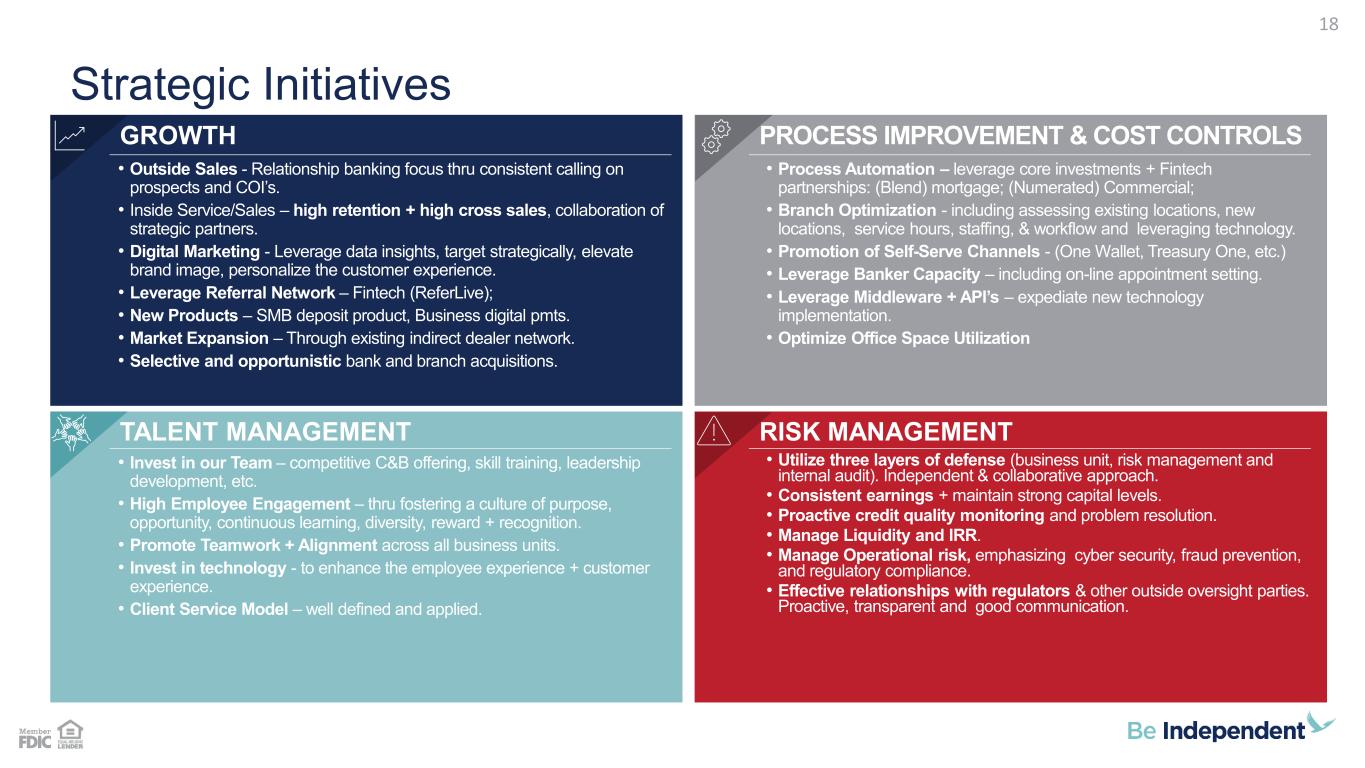
We've built a strong community bank franchise, which positions us well to effectively manage through a variety of economic environments and continue delivering strong and consistent results for our shareholders. As we move through the second half of 2025, our focus will be continuing to invest in our team, leveraging our technology and supporting our communities. At this point, we'd like to open up the call for questions.
Operator
Thank you very much. If you would like to ask a question, please press star followed by one on your telephone keypad now. Please ensure your device is unmuted locally. If you change your mind or your question has already been answered, please press star followed by two. Our first question comes from Peter Winter with C.A. Davidson. Peter, your line is now open. Please go ahead.
Thanks. Good morning. You guys had really nice, strong margin expansion this quarter.
And I was just wondering, could you talk about maybe the outlook for the margin the second half of the year? you know especially if we get maybe two rate cuts uh based on the forward curve yeah uh peter i would uh this is gavin um thanks for joining today we so the margin forecast that we provided um is is we're still very uh confident in um that we provided in january the two basis point cuts um is uh factored into that uh forecast i would i would share that um given the current positioning in our for our the balance sheet um the cut of a quarter to 50 basis points does not have a
significant impact in the margin one or one or two bases specifically okay that's helpful um You guys also have done a nice job managing your deposit costs lower. Do you still see room to lower deposit costs absent if there are no recuts? And if so, what are some of the drivers?
I think that right now where we're at in the deposit costs, we're probably seeing a plateau, Peter. The longer we stay or the longer they hold flat and as asset growth continues, you can kind of feel the pressure build. If I look at where we're currently seeing our CDs reprice and where we're issuing new, those are at the same level. So I don't see if we stay here a lot of opportunity to reprice down from here.
Got it. And then, Brad, if I can ask just a question. Treasury Secretary, Scott Besson, he seems very focused on bank regulation, trying to kind of level the playing field for the commercial banks. So the question is, have you seen anything that benefits you from a competitive standpoint against credit unions?
Oh, that's a great question. No, not with specifically credit unions. I do think that since the change in the administration, there were quite a few rules that were under review, including like CRA, Dodd-Frank, Section 1070. one small business data collection uh and and so on and it those have uh sort of been paused or or set aside so uh that that that's significant for for banks for community banks because it would have been i think costly uh to move forward as those regulations were being proposed so uh and And then saying on top of that, I think we are still looking for further relief and excited to see Fed Governor Mickey Bowman, who's, I think, a friend of community banks and her role in charge of the compliance side. So I think there's still more to come, but again, back to your original question, that fair and equitable playing field with the non-banks, there's been no change.
Okay. Thanks, Brad. That's helpful.
Operator
Our next question comes from Brendan Nozzle with Hovda Group. Brendan, your line is now open. Please go ahead.
Good morning, folks. Hope you're doing well. um maybe just starting off here i'm kind of curious at a top level walking through your local economies can you just kind of take us through your markets region by region and you know where you're seeing pockets of strength um and you know where when you look at the footprint now you see the biggest long-term opportunity yeah brendan this is joel um so i i would just focus on the two largest MSAs in our footprint, and that's West Michigan and then the Metro Detroit market.
And they're both very similar in many respects. So, the manufacturing base is, you know, pretty much the same. And there's maybe, you know, there's certainly diversity to it, but it's still heavily automotive dependent. And that's why earlier in my comments, I specifically commented on automotive. We have a relatively small exposure to the automotive industry from a supply base, and they're holding up very well. We were really concerned when things first were announced back in early April, what does this mean? And maybe you could argue that all the full impact hasn't been felt yet. And that's a point that has credibility. So we just continue to stay really close but so far uh i think our economy has held up very well i i like to tell people if i don't read the news headlines i'd tell you just based on customer feedback um economy's fine um home building uh is still uh pretty strong especially in west michigan uh and um uh like i said manufacturing is holding up okay and then in our northern michigan offices um There's a lot of – it's a very strong tourist economy, and the consumers are still spending money. So that's just some kind of high-level thoughts to your question.
Thank you, Joel. That's a super helpful caller. Maybe moving on just to the competitive landscape, I'm just kind of curious how it's evolved over the past couple of months. I'm certainly hearing that some larger regionals are stepping back into certain asset classes like commercial real estate. So just kind of, you know, wondering how that's, you know, been impacting you and how you're seeing that on the ground.
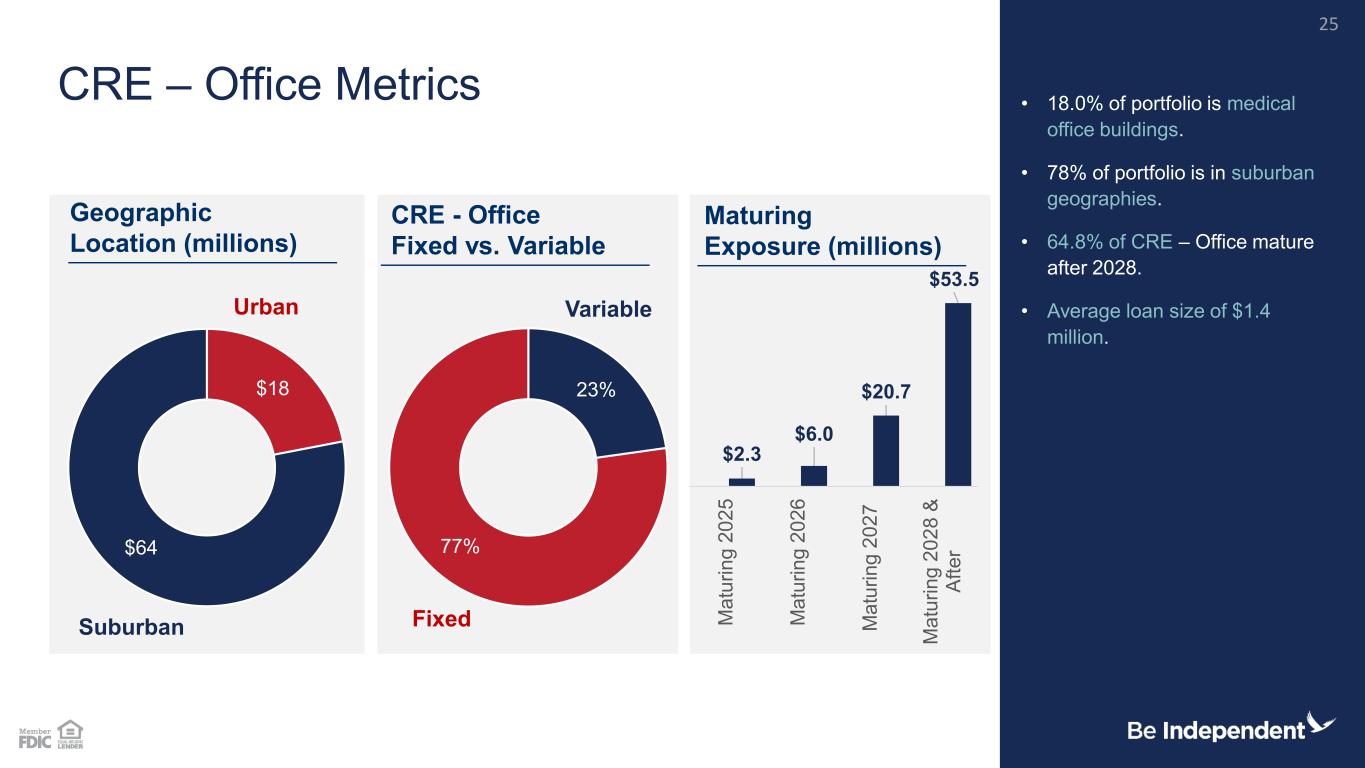
Yeah, I guess I'll take that one as well. And Brad can chime in. But, you know, it really hasn't changed. A lot of our market share lift still comes from the larger banks. We, as a community bank, we sell very well against a larger bank. And so that hasn't changed. Interestingly, we're seeing some opportunity. I agree with your comment that the large banks have they're very, very careful and maybe just not interested at all in commercial real estate right now. And that's not just the obvious office segment. It's just kind of any commercial real estate. So we have continued to to put good investment real estate in our portfolio. We keep it in balance. As I mentioned earlier, we like our mix of 70% CNI and 30% investment real estate overall in our portfolio, but we continue to write deals. I was going to say the one interesting thing, Brendan, is we've actually seen deal opportunity coming off of CMBS maturities and and especially like in the medical office space um you know we pick our spots but medical office we've had good success with rewriting deals that are coming off of cmbs because that market is not as robust and not as aggressive as it once was um so yeah a variety of places but overall the the mix or the you know the where our opportunities are coming from really hasn't shifted much.
Yeah, Joel, I think that was excellent. I would just add, I mean, we were out on a call with a prospect last week, whereby, you know, sort of that dollar size between 10 and 20 million, which I'd say is sort of a sweet spot for us, was considered too small by the entity's incumbent bank. And so that is a terrific opportunity for us. So we're on a good spot. Great question, Brennan.
No, that's really great color. So thank you. I'm going to sneak one more in here. Maybe just turning to capital M&A activity, it certainly feels like deals have picked up not only across the country, but in the Midwest specifically. So just kind of curious how you're viewing the M&A landscape at the moment, whether you're seeing signs of pickup and activity on your end and just, you know, updated thoughts on your own appetite for any inorganic opportunities right now.
Well, I think that we've seen several very nice deals here in Michigan this year. And so there's definitely, you know, activity going on and there's discussions being held. And, you know, here in Michigan, we have plus or minus about 80 chartered banks still left. And, you know, so for independent, I would say that, and this is not new, organic growth will continue to be the primary driver of our overall growth, but we would be interested in acquired growth where it makes sense. And so where it makes sense gets down to, you know, obviously it starts with culture and there's size and there's geography and there's also, you know, price. And so I'm hopeful that as we move forward, we'll be able to complement the organic growth with some intelligent acquired growth, too.
Fantastic, Brad. Thanks for taking my questions this morning.
Operator
Our next question comes from Adam Kroll with Piper Sandler. Adam, your line is now open. Please go ahead.
Hi, good morning. This is Adam Kroll. I'm for Nathan Race, and thanks for taking my questions. Yeah, so maybe just a question for Gavin, going back to the margin. If the Fed were to remain on hold for the remainder of the year, do you think the margin can just grind higher with new loans still coming on at a higher rate than the portfolio? yield and maybe could you remind us how much cash flow is coming off the bond book and maybe in terms of what your fixed rate loan repricing looks like over the next couple quarters yeah um so to answer your first question yes uh i do believe that uh i'm confident that it would if rates stay uh where they're at we would continue to grind higher in the margin barring any type of disruption in the funding market we have a in the next 12 months we have about a hundred
and ten million of securities forecasted to reprice and the I'm just looking here on your have your question here on the commercial the fixed rate loans repricing me one second in the next I don't have it broken down by order Adam but I can tell you in the next 12 months we have fixed-rate loans repricing at 121 million with an exit rate of 615 in total so okay that's that's super helpful.
And then maybe switching to fees, you had really solid mortgage loan volume during the quarter. And obviously, the loan sale margin saw a drop with all the rate volatility during the quarter. But I was just wondering if you have any visibility on how you see mortgage trending so far this quarter?
Yeah, you know, the gain on sale margin did come in lower than what we had anticipated. A couple of things going on there. One, just the competitiveness of the market continues to be very, very competitive. And so the gains were not as high as what we thought they would be there. There's also some nuance going on in certain sectors of the saleable market where we were, the industry was paying a much higher premium into the secondary. So the GSE specifically, that premium has pulled back pretty significantly. We didn't see that coming out of our control. So that's had an impact as well. And then we also annually go through a review of the cost of origination, and so that was higher this year, and so that pulled down the margin as well. So there's a number of moving pieces there, but I would share on the main driver is just the competitiveness of the mortgage space today.
Got it. I really appreciate that, and thanks for taking my questions. Thank you.
Operator
Our next question comes from Damon Del Monte with KBW. Damon, your line is now open. Please go ahead.
Hey, everybody. It's Matt Rank filling in for Damon. Hope everybody's doing okay. My first question is just a follow-up to the capital management. As you guys look for that inorganic opportunity, do you think you'll still be active with buybacks, or should we expect you guys to kind of put those on pause in the meantime?
Yeah, this is Gavin, Matt. Yeah, we evaluate it daily, and as we've explained in the past, we do model the buybacks like we would a M&A opportunity, and we believe it needs to be at a price range that has a reasonable earnback for our shareholders. The current range is outside, or the current price is outside of that range of earn back that we're comfortable with. That being said, as we continue to go forward and build capital, we reserve the right to change those parameters. but I would say here in the more of the short term, if the stock continues to trade in the current ranges, the buybacks will be limited.
Okay, great. And then last one for me, you guys mentioned you implemented some new technologies to help customers and associates. Just kind of curious what those technologies are and if you have any other planned investments coming up?
Yeah, that's a great question. So in the second quarter, we put in sort of a AI chat function on our website and within the banking platform that's getting a lot of use from our customer base. So that's essentially customers being able to maybe more quickly get answers to their questions. We're using probably several dozen AI use cases around the company that is helping our staff maybe more quickly respond to customers when we've got them on the line within our call center. We are leveraging some AI use cases to identify next best product opportunities with our customers. We've also leveraged technology just in terms of maybe in the loan processing underwriting area that to significantly reduce time. So those are a handful, but really excited about, you know, sort of where we've been, where we're at, and even where we can go continuing to leverage our technology.
Okay, great. That's all for me.
Operator
Thank you very much. We currently have no more questions, so I will hand back over to Brad for any closing remarks.
Thanks, Ezra. In closing, I'd like to thank our board of directors and our senior management for their support and leadership. I also want to thank all our associates. I continue to be so proud of the job being done by each member of our team. Each team member in his or her own way continues to do their part toward our common goal of guiding our customers to be independent. Finally, I would like to thank each of you for your interest in Independent Bank Corporation and for joining us on today's call. Have a great day.
Operator
Thank you very much, Brad, and thank you to all our speakers on today's call. We appreciate everyone for joining. You may now disconnect your lines.