Operator
Good morning, everyone. My name is Alexandra. I would like to welcome everyone to the JetBlue Airways second quarter 2026 earnings conference call. As a reminder, today's call is being recorded. At this time, all participants are in a listen-only mode. I would now like to turn the call over to JetBlue's Director of Investor Relations, Koush Patel. Please go ahead, sir.
Thanks, Alexandra. Good morning, everyone, and thank you for joining us for our second quarter 2026 earnings call. This morning, we issued our earnings release and a presentation that we will reference during this call. All of those documents are available on our website at investor.jeffleu.com and on the SEC's website at www.sec.gov. In New York, to discuss our results are Joanna Garrity, our Chief Executive Officer, Marty St. George, our President, and Ursula Hurley, our Chief Financial Officer. During today's call, we will make forward-looking statements about our outlook, strategy, and future performance. These statements are based on our current expectations and are subject to risks and uncertainties that could cause actual results to differ materially. Please refer to our earnings release and SEC filings for information about risk factors that could cause those differences. These statements speak only as of today, and we undertake no obligation to update them. We may also discuss certain non-GAAP financial measures. Reconciliations to the most directly comparable gap measures are included in our earnings materials and available on our Investor Relations website. And now, I'd like to turn the call over to Joanna Garrity, JetBlue CEO.
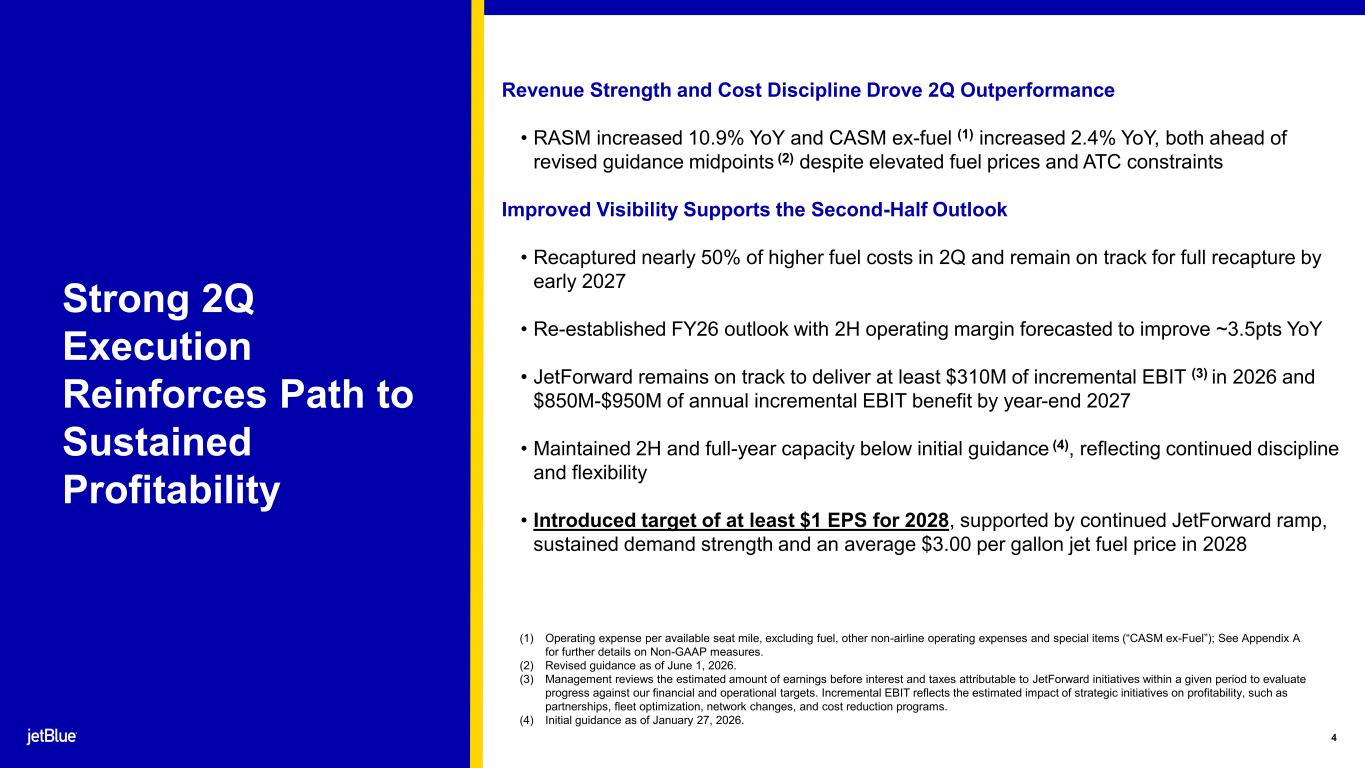
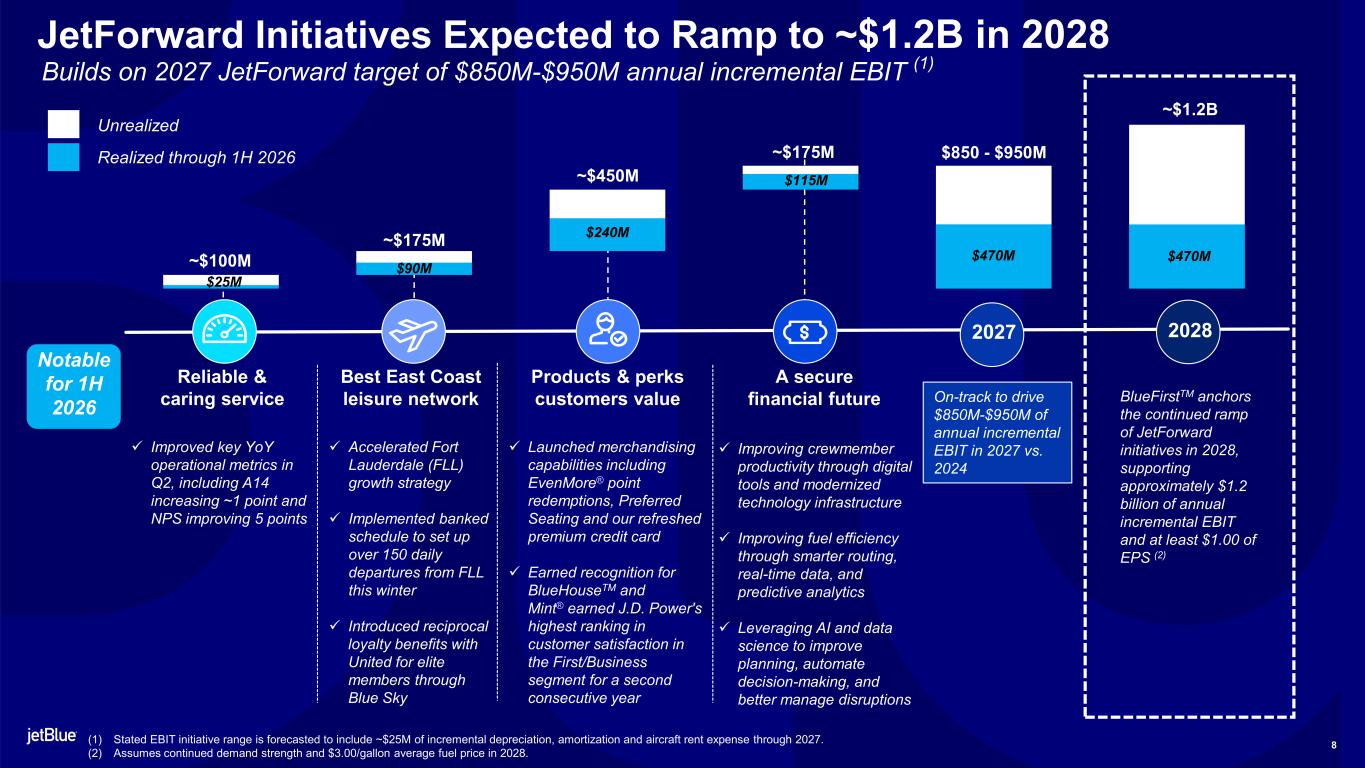
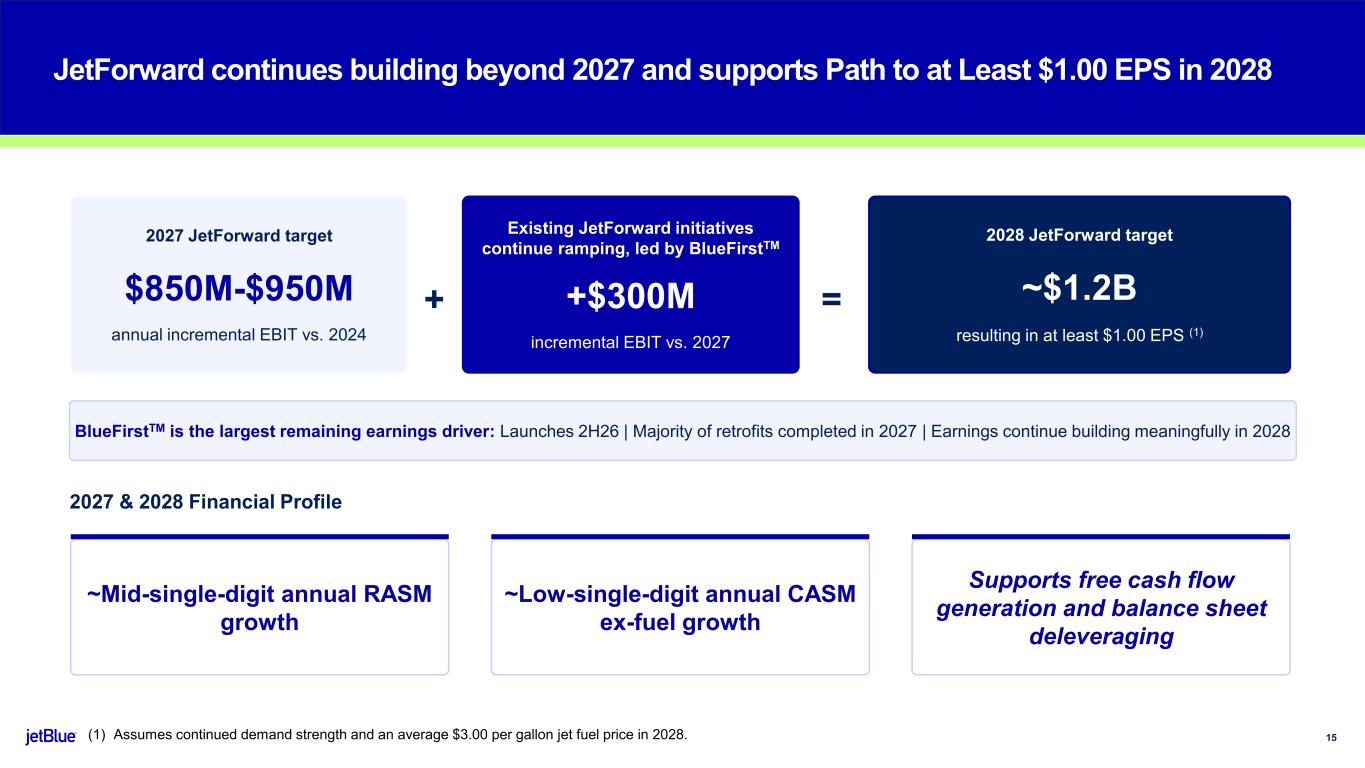
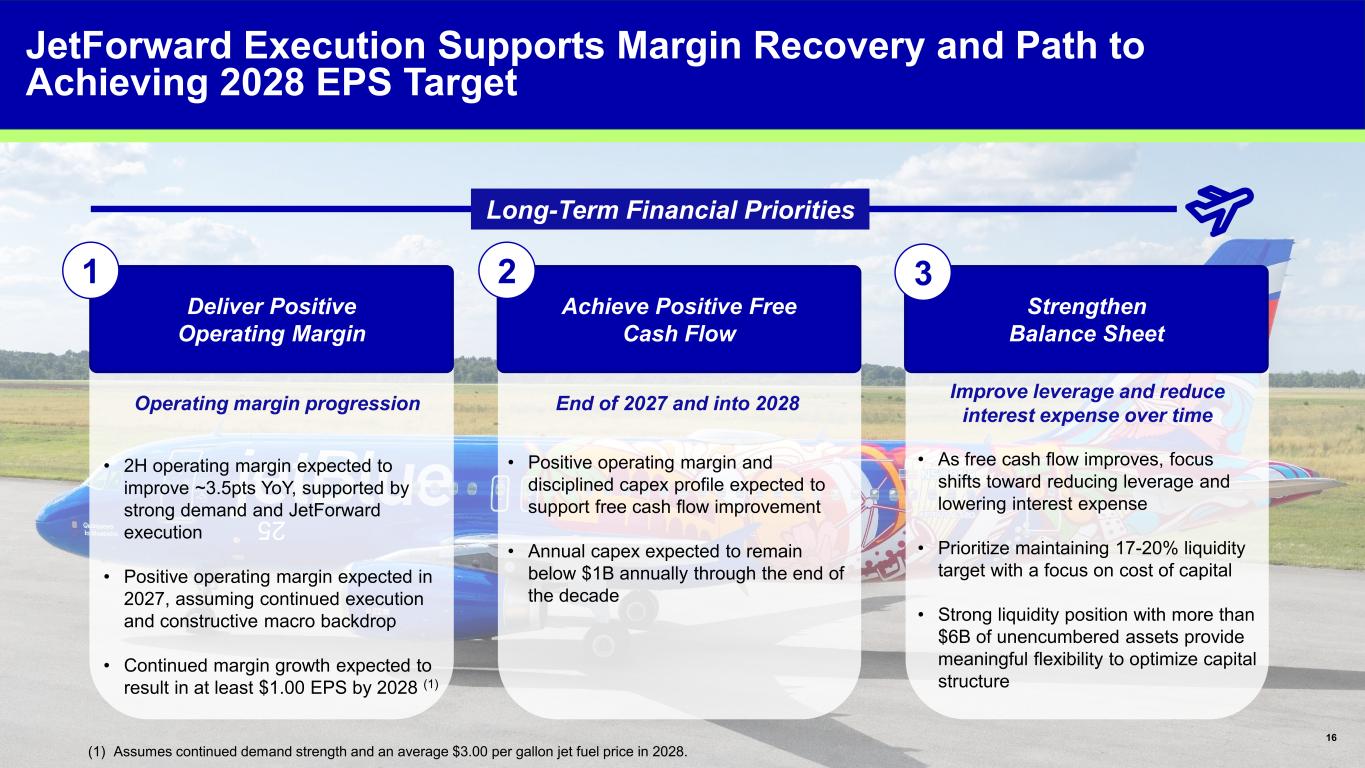
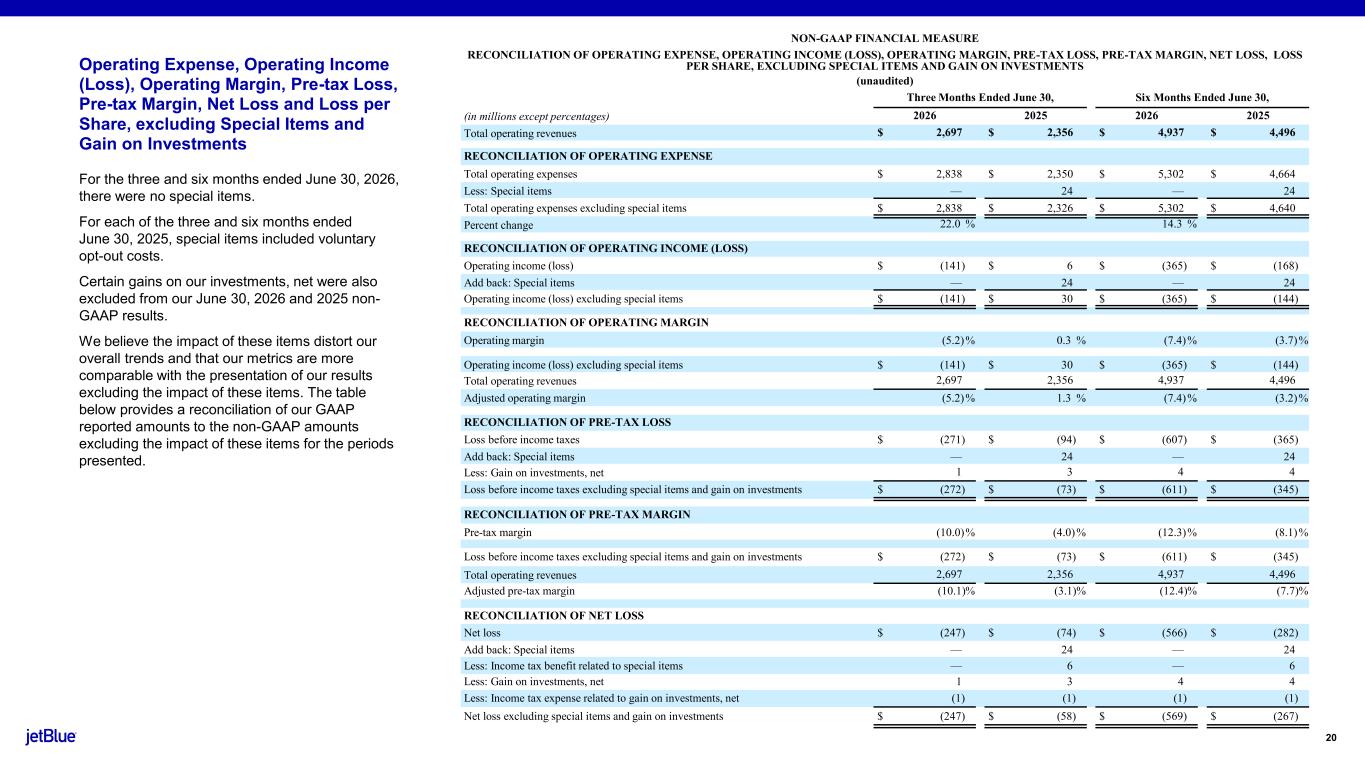
Thank you, Koush. Good morning, and thank you for joining JetBlue's second quarter 2026 earnings call. Before we begin, I want to recognize our crew members for their outstanding work throughout a particularly challenging July. Despite extremely In extremely difficult, unpredictable convective weather, coupled with ongoing ATC staffing constraints, our team has shown incredible dedication to our customers and each other. I'm especially appreciative of the many customers who have taken the time to recognize our crew members' professionalism, compassion, and dedication during these very challenging operations. Their performance reflects the very best of JetBlue. It has been two years since we announced JetForward, and during the second quarter, we once again demonstrated our ability to execute and deliver results, even as we continue to strengthen our foundation for the long term. Through JetForward, we are building a more reliable operation, a more compelling customer offering, and a more focused network, while reinforcing our path to sustained profitability. Our ongoing work across each jet forward priority move enabled our crew members to execute during another quarter, marked by a complex operating environment, including elevated fuel prices, significant thunderstorm activity, and periods of airspace constraints. Delivering a reliable operation remains foundational to JetBlue. And, despite these challenges, the investments that we have made in technology and process improvement are driving better performance. Fort Lauderdale is another clear example of our progress. We have grown rapidly and are seeing very strong customer demand for our added flying. We're working closely with the Broward County Aviation Department who shares our common goal of building a stronger and more diversified portfolio of destinations for South Florida travelers. We are very thankful for our long-standing partnership with the airport as we work together to formalize additional gate leases this fall. We've made changes to enhance our customer experience, which in turn improved our revenue performance. Second quarter RASM beat the midpoint of our revised and previously raised guidance. We were able to capitalize on strong demand across nearly all products and geographies, even as JetBlue and industry fares moved higher throughout the quarter. Fuel prices alone do not determine our earnings trajectory. What matters is how effectively we respond throughout the quarter we made adjustments to both pricing and capacity in response to higher fuel costs these actions along with resilient customer demand enabled us to recover fuel costs more quickly than we originally anticipated based on the strength of demand and the traction from our commercial actions we achieved nearly 50 fuel recapture in the second quarter exceeding our expectation of 40 or more looking ahead sustained demand strength gives us greater visibility into the second half, even as fuel prices remain very volatile. Assuming demand strength persists, we continue to expect to achieve 100% fuel recapture by early 2027. Following a very strong early start to the year, we withdrew our full year outlook last quarter after the external environment changed dramatically over a short period of time, even though our confidence in the underlying business remained strong. since then demand has remained resilient our commercial actions have proven effective and fuel prices moderated as expected from the elevated levels we saw in april recent volatility not withstanding collectively we believe these developments provide sufficient visibility to re-establish our full-year outlook we now expect full-year operating margin of approximately negative two percent to negative five percent an improvement from our very challenging first half of the year the midpoint of our guidance implies a significant inflection in our profitability with second half operating margin approximately three and a half points better year over year we widened our operating margin range given the recent fuel volatility but still believe that pricing will continue to help offset higher fuel prices if they remain elevated despite this second half earnings improvement we plan to continue to maintain a conservative capacity profile given that the geopolitical backdrop remains fluid and fuel remains volatile. JetForward is the key driver of our expected improvement. In the first half of 2026, we delivered $165 million of incremental EBIT from JetForward, bringing the cumulative benefit to $470 million. The most important takeaway is that JetForward is doing exactly what we said it would do. We established a clear plan, committed to measurable milestones, and were delivering against them. While there have undoubtedly been quarters influenced by factors outside of our control from weather to macro, the underlying trajectory of the business continues to improve, and our confidence in the years ahead continues to grow. We are on track to deliver at least $310 million of incremental jet forward even in 2026, and several of our largest initiatives are still ahead of us or in early ramps including blue sky and blue first our new domestic first class product as those initiatives continue to ramp we expect 2027 to mark a return to sustained operating profitability an important milestone toward annual positive free cash flow looking further ahead we expect blue first and other jet forward initiatives to continue ramping into 2028 and beyond helping to drive jet forward annual incremental EBIT to approximately 1.2 billion and a return to positive pre-tax margin based on this plan trajectory we expect to achieve 2028 EPS of at least one dollar per share assuming continued demand strength and an average three dollars per gallon jet fuel price in 2028. as i look ahead our priorities and commitments are clear. Taking care of our people so they can deliver their best. Executing Jeff forward, restoring sustained profitability, improving free cash flow, and strengthening our balance sheet. Our board and leadership team are confident that this disciplined focus is the right path, the best path to create long-term shareholder value while building a stronger, more resilient Jeff Liu. With that, over to you, Marty.
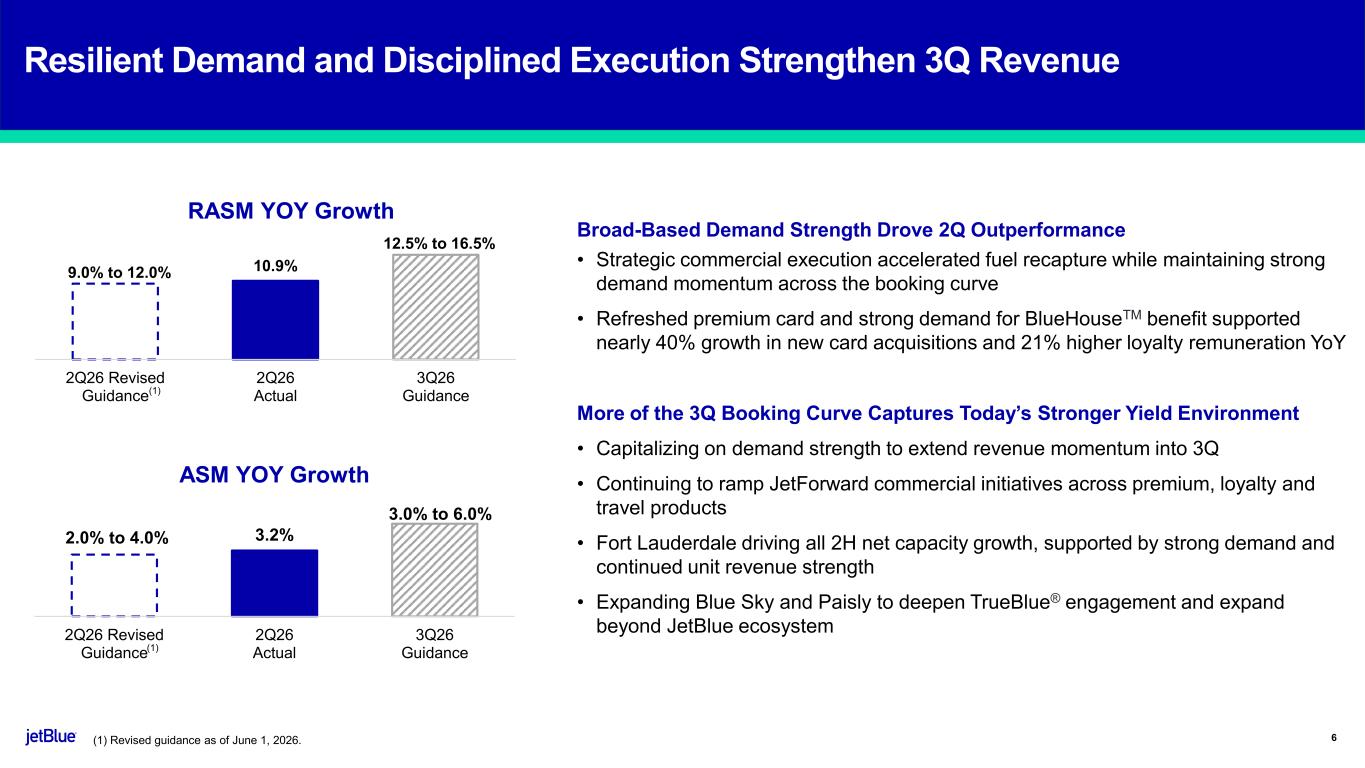
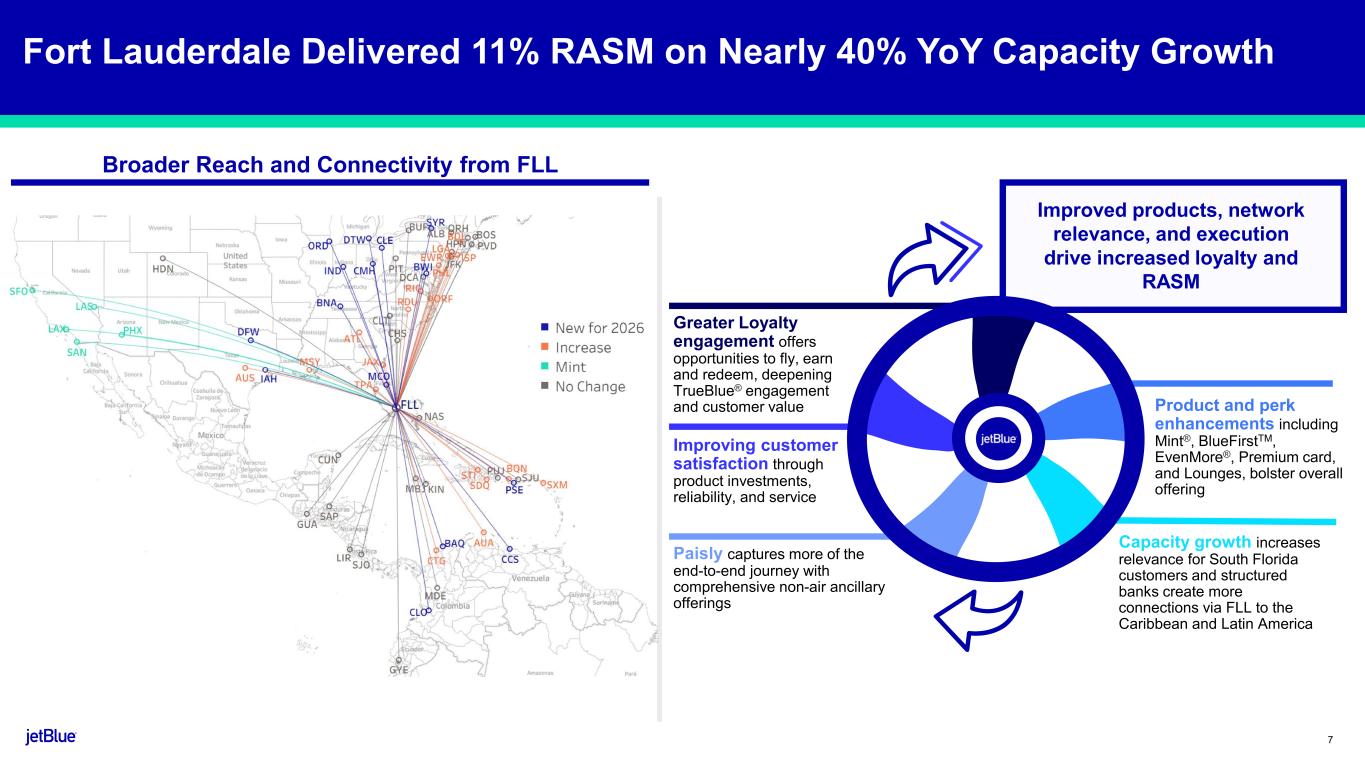
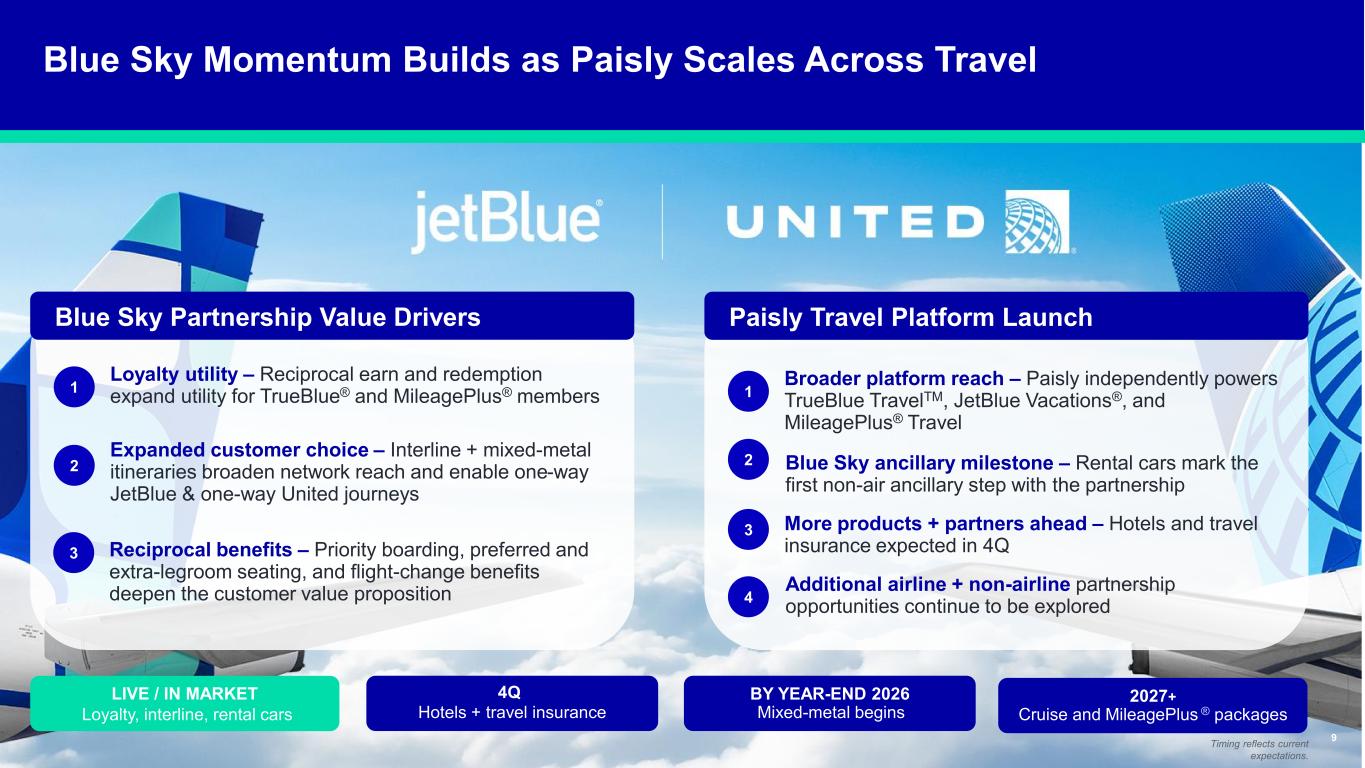
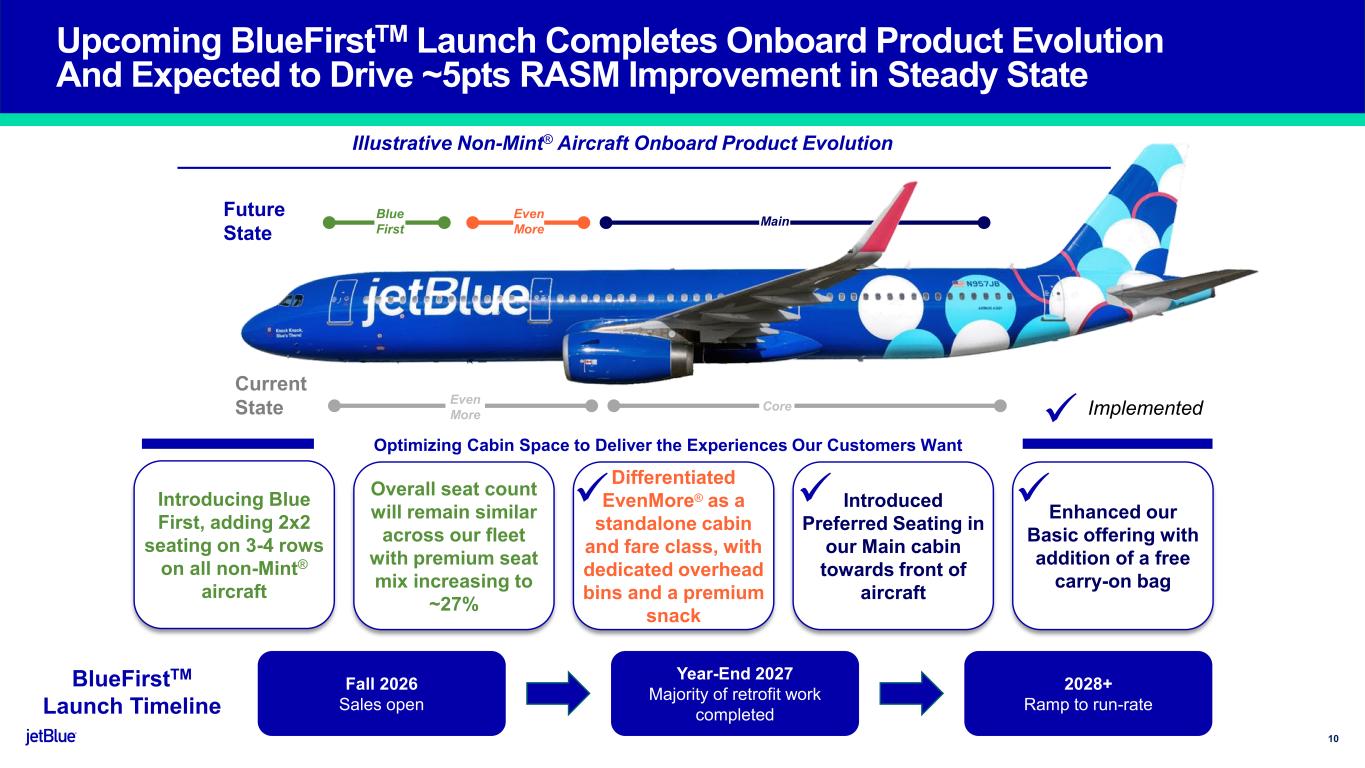
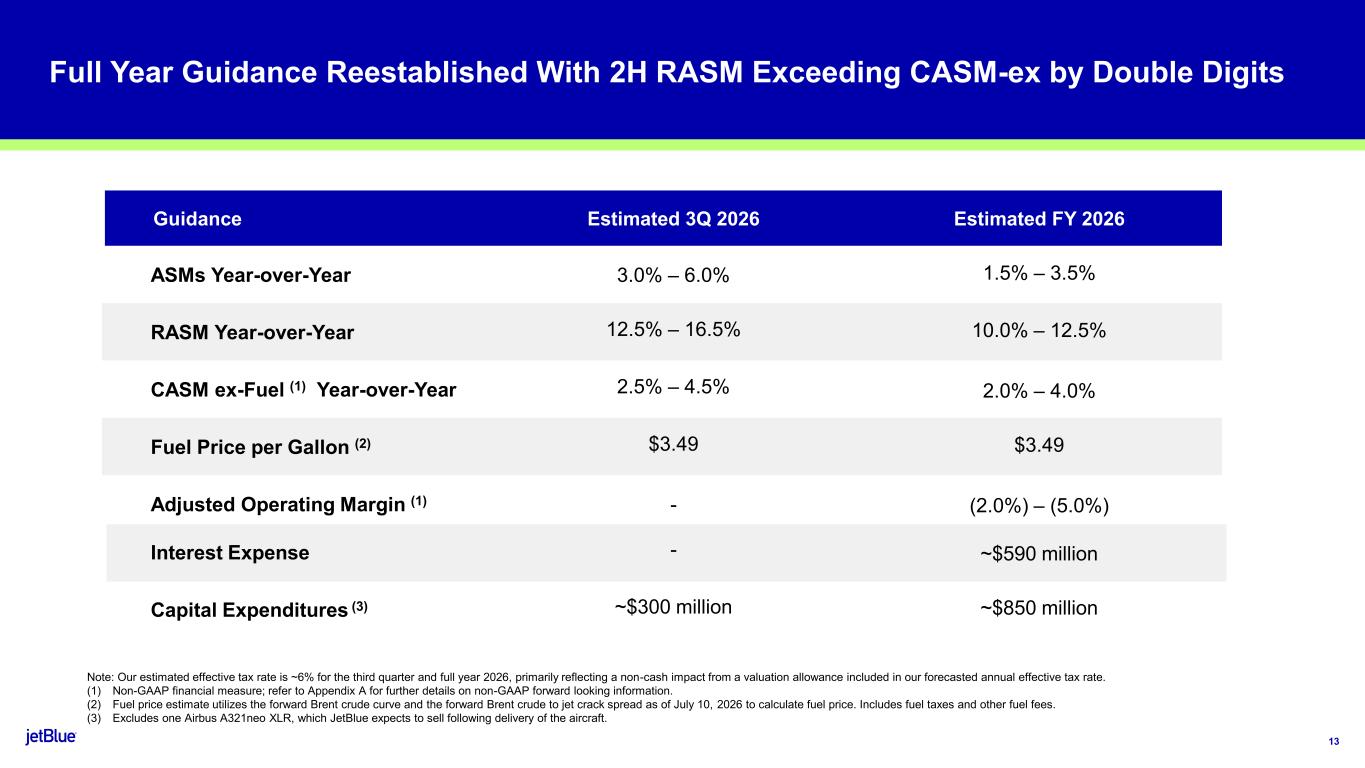
Thank you, Joanna, and thanks again to our crew members for their executions in the quarter. Our second quarter results reflect continued demand for the distinctive JetBlue products and traction from our JetBlue initiatives. We delivered strong revenue performance in the second quarter, with rather increasing 10.9% year-over-year, driven by robust consumer demand across our network. Importantly, demand held up well, even as fares moved higher, and we did not see material signs of elasticity. Demand strength was robust throughout the booking curve, including close-end demand, and that strength has carried into the third quarter. Premium products, including Mint and even more, continued to perform exceptionally well. Importantly, our main cabin also saw meaningful improvement, benefiting from a healthy pricing environment and resilient major demand. Turn to the Fort Lauderdale. Given our existing focus city there, Spirit's Exit represented one of the most significant strategic opportunities JetBlue has seen in many years. By this winter, we expect to operate more than 150 daily flights from Fort Lauderdale, our largest schedule ever from the airport, including our largest mint presence as well. Earlier this month, we launched a more structured bank schedule, with two southbound and two northbound banks designed to better connect customers to the Caribbean and Latin America. The capacity is ramping well, and customer response to our added flying has been very positive. For the second quarter, Fort Lauderdale Rasm was up 11%, even with capacity growth of nearly 40%. Turning to loyalty, refreshed premium cards and strong demand for Blue House benefit supported nearly 40% growth in new card acquisitions and 21% higher loyalty remuneration for the quarter. We expect similar momentum when our second Blue House Lounge opens in Boston and August. In addition, South Florida was a standout contributor to our loyalty results, with True Blue enrollments growing 44% and co-brand acquisitions more than doubling year over year. This momentum reinforces our confidence that investments we've made in loyalty will create value well beyond the quarter and keep us on track to deliver meaningful sequential growth in multi-revenue over the coming quarters. We want to thank Parkles for their continued partnership. As the only major co-brain issuer without a competing proprietary travel card, Parkles is uniquely aligned with JetBlue and focused on growing the long-term value of our portfolio. More broadly, the earnings progress we were delivering reflects our ability to better monetize demand across the network through JetForward. We modernized their revenue management capabilities, which improves our ability to optimize premium products like Mint, better manages both local and connecting demand across our network, and unlocks new merchandising capabilities. We've added new ways to pay, and now Kuglu members can redeem true blue points for even more seats. And yesterday, we announced a simpler shopping experience that makes it easier for customers to compare our onboard experiences and fairer options, expands customer choice and creates more opportunities for customers to experience our premium products. Our Blue Sky Partnership is another important contributor. It continues to ramp and reach another milestone in May, with the introduction of reciprocal loyalty benefits for lead members. This further benefits customers and enhances their access to the broader network made available to the partnership. Finally, Paisley continues to be an important part of our broader growth strategy, and engagement is growing as customers use JetBlue Locations and TrueBlue Travel to book more of their end-to-end travel. As part of Blue Sky, Paisley recently began distributing United's car rental products through the Paisley-powered MilesPlus travel site, and we look forward to powering Everts Health later this year. Beyond the Blue Sky Partnership, they continue to explore additional airlines and non-airline partnerships as it continues to grow. Blue Sky and Blue First are two of our most meaningful commercial initiatives, and we are still in the very early inning of realizing the associated management benefits. Blue First is the largest individual Jet4 initiative. It represents an important next step in evolving JetBlue's product offering, allowing us to and better serve customers looking for a premium experience while strengthening unit revenue over time. We plan to share additional product details and to launch tails in the fall. We remain on track to complete the majority of our retrofit work by the end of 2027 and expect Blue First's full revenue and margin contribution to continue building in 2028 and beyond. At run rate, we believe Blue First will support meaningful unit revenue and margin expansion, completion, including nearly 5 points of rising growth. These initiatives reinforce our confidence to head forward and the earnings power we are building across the business. Turning to our outlook, we are starting the third quarter from a stronger position with substantially more of the booking curve exposed to today's favorable pricing environment. With that context, we expect the strong revenue trends we saw in the first half to continue into the third quarter. regarding third quarter capacity growth of 3% to 6% year-over-year and RASM to 12.5% to 16.5% year-over-year. For the full year, we expect capacity to increase 1.5% to 3.5% year-over-year and RASM to increase 10% to 12.5% year-over-year, supported by healthy demand, a strong yield environment, and continued execution on Jet Forward. While July has been more operationally challenging, our outlook assumes third-quarter completion factor returns to historic levels to the balance of the quarter. We remain optimistic about our revenue trajectory for the balance of the year. Since 2019, prices across the broader economy have increased meaningfully, yet airfare started the year down in real terms by approximately 30%. This gives us confidence that the pricing environment that we are seeing now is sustainable. Even with a strong pricing environment, our capacity plan remains highly disciplined. The second half, we are concentrating on incremental growth in Fort Lauderdale, where we have seen a compelling opportunity to strengthen our network and deepen our relevance with leisure customers. As a result, all of our net capacity growth is expected to come from Fort Lauderdale, while capacity across the rest of the network is expected to be down year-over-year. In mid-July, as fuel prices increased, we decided to reduce our fourth Florida schedule by approximately one point, reinforcing our commitment to growing only where we can see the strongest returns. Our plan is to remain disciplined, and we plan to rebuild the capacity again as needed. At LaGuardia, we've recently secured additional slots and are excited to get the opportunity to build a more robust schedule to Florida for our most loyal customers, both New York and down south. While we currently operate from Terminal B, we continue to seek a return to the lower cost and more convenient marine air terminals. In conclusion, we have a strong commercial backdrop in place and our revenue and network initiatives further strengthen our conviction in our outlook for the second half of 2036 and beyond. With that, I will hand it over to Ursula to walk through fuel, costs, and our financial performance in more detail.
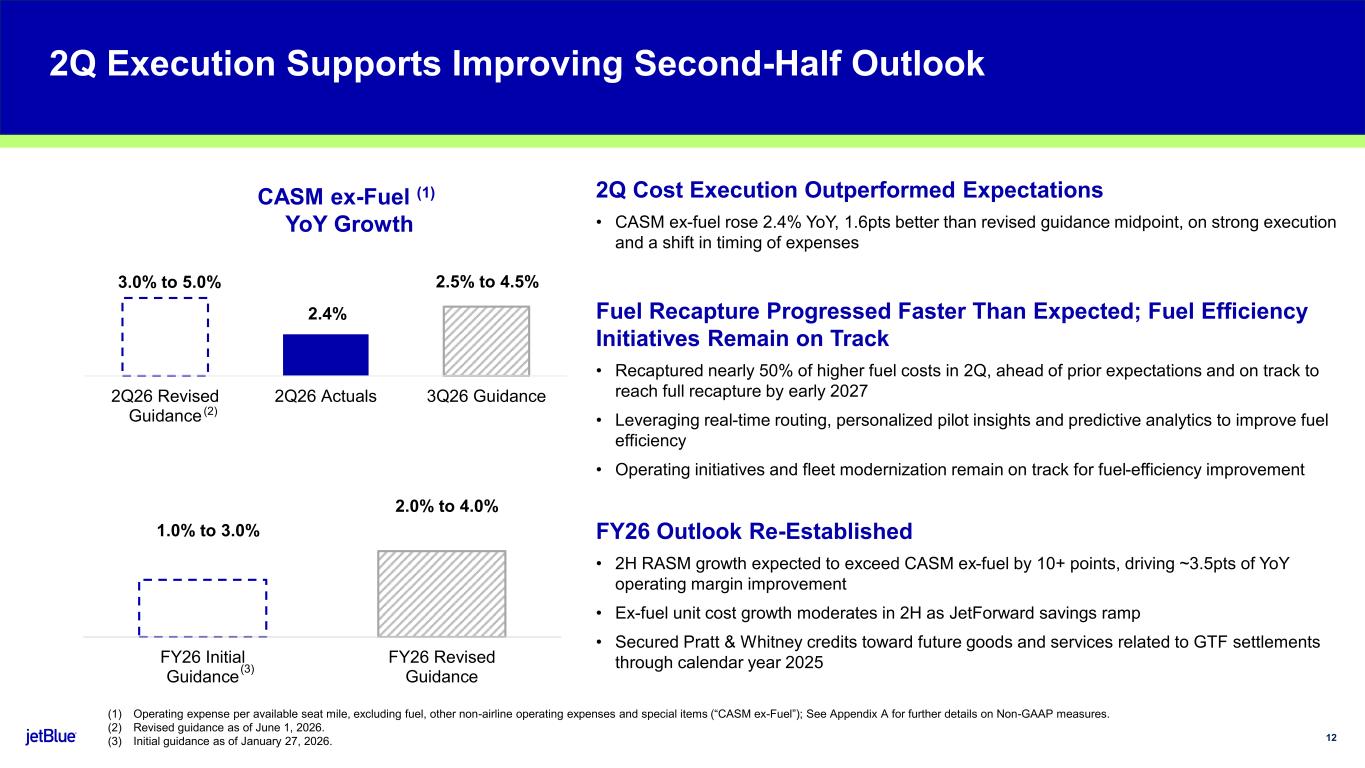
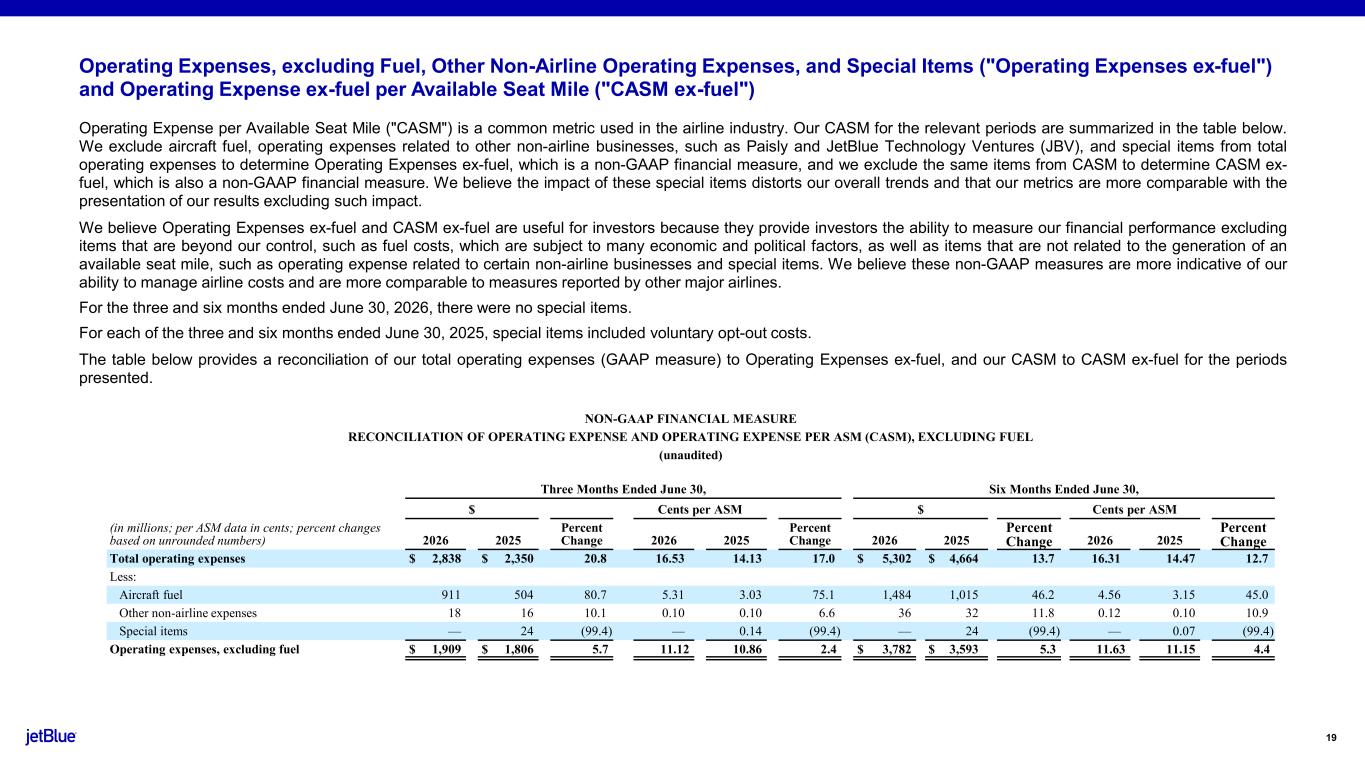
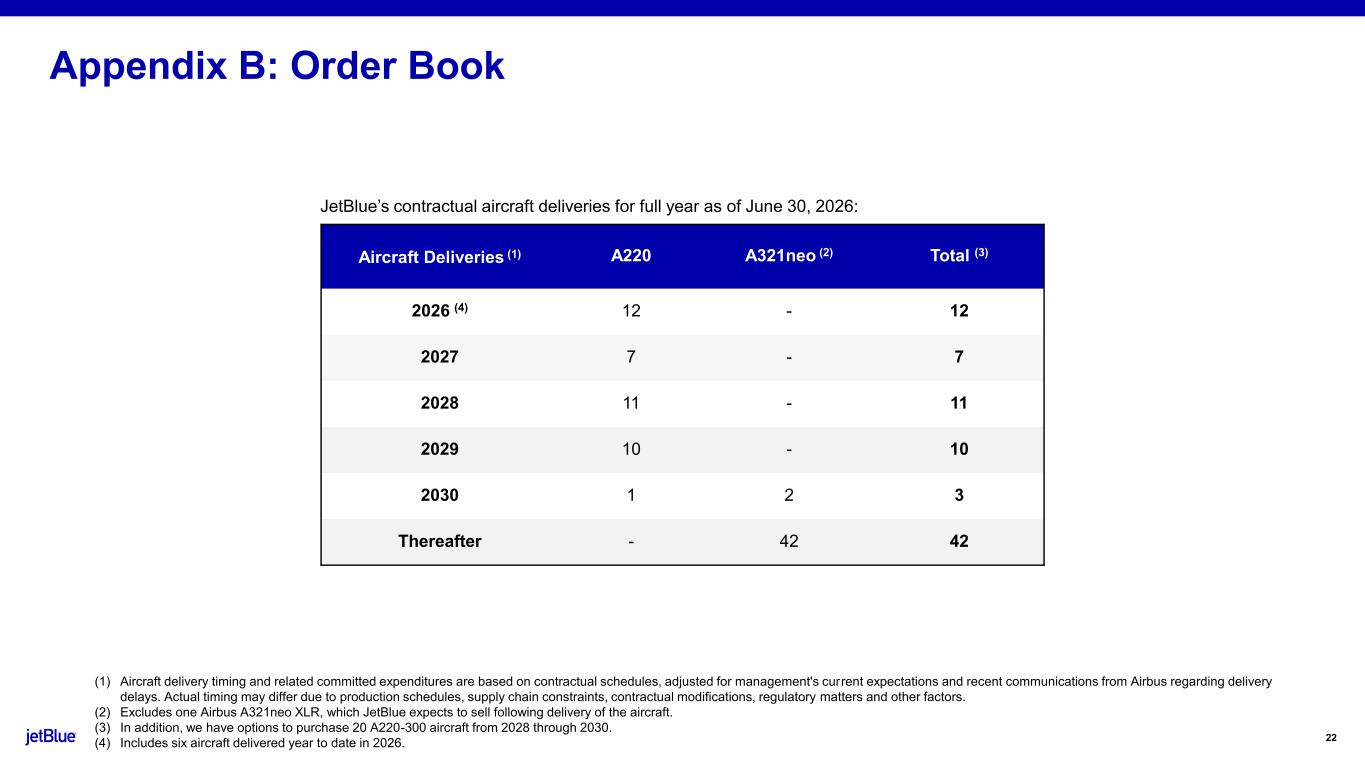
Thank you, Marty. The revenue progress and network actions Marty shared reflect our strong execution and provide us a clear path through the balance of the year. Of course, we continue to manage the business conservatively, given the potential for further volatility in fuel prices. Against that backdrop, we remain focused on disciplined execution across the levers within our control. our capacity pricing and cost actions helped offset nearly 50 of the higher fuel costs in the second quarter while preserving our flexibility to remain nimble as conditions evolve turning to chasm x fuel we delivered second quarter performance ahead of our guidance range chasmx fuel increased 2.4 percent year over year approximately one and a half points better than the midpoint of our guidance reflecting strong execution as well as a shift in timing of expenses looking ahead we expect third quarter chasmx fuel to increase two and a half percent to four and a half percent year over year we continue to expect non-fuel unit cost growth to moderate meaningfully in the second half of the year as jet forward cost savings initiatives take hold for the full year we now expect chasm x fuel to increase two percent to four percent year over year excluding the impact of first quarter weather related operational disruptions we remain on track with our initial full year chasen x fuel outlook this reflects disciplined execution across the business as we continue to offset headwinds while investing strategically in our operation our crew members and the customer experience. Turning to fuel, we have used our normal process and timing for marking fuel and acknowledge pricing has been extremely volatile the past few weeks. Given strong customer demand and our ability to adjust capacity, we believe pricing will provide an offset that if recent fuel price increases stick. Using the forward fuel curve at market closed on July 10th, we expect fuel price per gallon to be $3.49 for both the third quarter and the full year. We remain focused on fuel optimization with cross-functional teams increasingly leveraging real-time data and advanced technology to improve efficiency. whether it's identifying more efficient routing opportunities in flight providing pilots with personalized operational insights or using predictive planning and ground operation analytics to improve consistency we're creating a more connected data-driven approach to fuel management across the airline together with our fleet modernization efforts these initiatives keep us on track to achieve our fuel efficiency improvement goals. Turning to capital expenditures, we expect third quarter CapEx of approximately $300 million and full year 2020 CIPs CapEx of approximately $850 million, driven primarily by 12 aircraft deliveries this year, the initial spend associated with retrofitting aircraft for Blue First, and the incremental Ligordia slots we've recently secured. We continue to expect annual CapEx to remain below $1 billion through the end of the decade. This level of investment supports prudent long-term capacity growth while preserving flexibility and maintaining our focus on generating free cash flow turning to the balance sheet we executed a 500 million aircraft backed financing transaction in the second quarter further strengthening our liquidity position we ended the quarter with 2.2 billion of cash and investment securities representing approximately 23% of trailing 12-month revenue, excluding our $600 million undrawn credit facility. We remain committed to maintaining liquidity within our target range of 17% to 20% of trailing 12-month revenue, while optimizing our cost and capital. Should additional financing be required, the amount and timing will depend on how fuel and the macro environment evolves. We would expect to first look to the aircraft-backed transactions accordion, while also evaluating other low-cost opportunities. We expect to continue to take a disciplined and proactive approach to managing the balance sheet, with a focus on preserving liquidity, reducing interest expense where possible, supporting JetForward, and positioning the business for sustained profitability. I want to be clear that I am very confident in our plan and optimistic about the direction we are heading. We believe we are reaching a major inflection point in the business. RASM is now expected to be 10 plus points higher than CAS and XFUEL in the second half, And we expect operating margin to improve by approximately 3.5 points year over year, demonstrating the meaningful operating leverage we are beginning to realize. that progress extends beyond 2026 as jet forward initiatives already underway continue to mature and blue first begins to ramp we expect to return to sustained operating profitability in 2027 and make meaningful progress towards positive free cash flow looking to 2028 our confidence in the earnest power we are building is reflected in our EPS target of at least $1 per share. After navigating a highly volatile first half of the year and month of July, we look forward with greater visibility and a stronger financial outlook. The financial roadmap we've outlined today makes clear why we are confident in our plans and why this is the plan we are pursuing while there is still work ahead we believe the progress we've made has positioned jet blue for meaningful earnings acceleration in the second half of the year and a stronger financial trajectory in the years ahead. We remain firmly focused on restoring sustained profitability, generating free cash flow, strengthening the balance sheet, and creating meaningful long-term value for our shareholders. With that, we are happy to take your questions. Back over to you, Alexandra.
Operator
Thank you. We will now begin the question and answer session. Please limit yourself to one question and one follow up. If you would like to ask a question, please press star one to raise your hand. To withdraw your question, press star one again. We ask that you pick up your handset when asking a question to allow for optimum sound quality. If you are muted locally, please remember to unmute your device.
Operator
Please stand by while we compile the Q&A roster. your first question comes from the line of mike linenberg with deutsch bank your line is now open please go ahead oh yeah hey um good morning everyone um marty i just want to sort of dig into fort rotterdale um i think actually joanna mentioned about you know working with the county and being able to secure more leases i think you mentioned that as well how how big could you actually get in in fort lauderdale you talk about 150 or 150 more and as that has as you've built out that hub can you just give us some you know um data on just like connectivity today versus
where it was local versus connect and where you actually see it going and then i have a follow-up hey mike thanks for the question um so you know we said we're going to be over 150 um at the end in the 2026, early 27, we do think there's another tranche of growth that can come in. I think it's important to note that as a company, we're growing basically a little bit in the digits. So we don't have an aggressive growth rate beyond this. We're extremely excited where our numbers are right now. And I say, we've spent a lot of time working with the county to make sure that we have the facilities we need. It is going to be tough because especially for international rivals at the constrained airport, but I have complete confidence. We'll get to where need to be with the county uh we are building uh a terminal five there uh but that's you know gonna be a 20 30 arrival uh if we're lucky so um again our results are fantastic i'd love to go faster but i think what we're doing right now is quite prudent as far as banking and connectivity um i don't really want to give a number it'll be well under 50 percent because south florida does have very good local demand but what we're really excited about more than anything is how the banking brings a lot more destinations into the mix in the north. You know, the example I'd like to give was Albany. You know, if you look at Boston and New York, we have great access to any leisure destination in the Americas. If you look at a place like Albany, you know, we went to Lauderdale and Orlando. Now, with connectivity in Fort Lauderdale, if you're a customer in Albany, for example, you get access to all of the Caribbean and everywhere we fly in Central and South America.
Operator
So I think it's really a game changer for true blue as much as it's for the system's local market great thanks and then just my second question um to ursula on the i guess the initial phase of a pratt agreement here it looks like it's through 2025 so presumably i guess that covers two years of of disruption and as i recall you know you had highlighted that it was maybe three points of margin on a direct basis versus There's also an indirect element. This has got to be one of the biggest deals out there. And it seems like it's one of the last ones to actually get done. Although I guess you're going to get compensated for 2026 and beyond. How are we going to see this in the numbers? You know, how should we look at this? Is this going to be going forward some reduction in DNA, some reduction in maintenance expense? Like, this is a big deal, and it should find its way into the P&L. How should we think about the potential, you know, benefits from this?
Yeah, good morning, Mike. Thanks for the question. So we are pleased to have an initial settlement complete with PRAT. You're correct. This closes out 2024 and 2025. 80% of the settlement will be a reduction in operating expense between now and the end of 2027, and 20% of it will be a reduction to CapEx. At a high level, about 25% of the settlement will impact 2026, and obviously is included in our guide, and then the remainder will hit 2027.
Operator
Your next question comes from the line of Jamie Baker with JP Morgan. Jamie, your line is now open. Please go ahead.
Oh, hey, good morning. In for a little bit more color on blue first. You know, it obviously took the industry quite some time to monetize the front of domestic cabins. You know, but consumers have adapted. So I'm assuming the ramp for JetBlue is going to be, you know, much steeper, much quicker than, you know, Delta's decade long journey in this regard. But further to that, can you begin monetizing with the very first aircraft or do you effectively have to wait until most of the retrofits are done? I know 2028 is the real ramp to run rate. I'm just trying to think of how to layer on any yield benefits in 2027.
Great, Jamie. Well, I will start actually with our experience with Mint. We were a little bit different when we started Mint versus the rest of the industry. For many, many years, there was no way to get in the Mint cabin without paying for it. You know, our job was to basically come up with everyday low prices that would give the most value to the customers. And although we do have limited ways to get into points right now, we fundamentally believe we can find a great product at a very reasonable price. I think we have, you know, 15 years of experience in the industry monetizing the first class cabin. And I think we expect to take full advantage of all the ways to get into that cabin that our competitors have already demonstrated to be successful. And actually, we're very excited about it. I think we'll give you more detail on the ramp as we get closer in, but we are very excited to get customer benefits very quickly. I'll give you the one sneak tip is we have one airplane out there this fall. Probably the first one will not be monetized, but the minute we get to two, we're going to start selling this product on the fleet as it flies.
Okay, helpful. And then, Ursula, just following up on your prepared remarks regarding liquidity, given the delay in the move to positive cash flow, how should Mark and I think about the cadence of liquidity against current cash burn, your targets, your options? We know there's this meeting coming up next week to meet with lenders and creditors. Maybe you could give us some color on that. Do you intend to raise more liquidity? And with loyalty trading over 13% right now, what's sort of your assumed cost of other liquidity the options that you referenced, if you decide to go down that path. Thanks in advance.
Appreciate the question, Jamie. So, first and foremost, our liquidity target is 17 to 20 percent of trailing 12-month revenue. I'm extremely pleased with where we ended the quarter. We're at 23 percent. Obviously, our liquidity needs in the back half of the year are heavily going to depend on the fuel environment. I was pleased within the second quarter, we executed a $500 million aircraft-backed financing deal. The average rate on that deal was 6.5%. As part of that deal, the deal has an accordion feature that is $250 million at the 6.5%. If we need liquidity in the second half of this year, our number one priority will be pulling on the accordion. If we need liquidity above and beyond that, given oil, we will look to do additional aircraft financing. I want to also remind everyone across the entirety of our capital structure, our weighted average cost of debt is 6.8%. So we're very focused on cost to capital and the interest expense level that we have on books and we're going to be extremely thoughtful um with any additional liquidity needs we do have a normal course a business meeting next week with investors and this is a consistent approach that that we've taken over the last several years um we engage within the quarter with equity and fixed income investors across conferences, non-deal roadshows, one-on-ones. We also historically have done in-person and virtual meetings with senior leadership to better understand the investor perspective and quite frankly to communicate the progress that we're making on JetForward. So next week's meeting with fixed income investors is ongoing outreach and we're only going to be discussing what's publicly available in terms of information on the company and JetForward. So we're very much looking forward to the discussion.
Operator
Your next question comes from the line of John Godden with Citigroup. John, your line is now open. Please go ahead.
Hey, thanks for taking my question. You mentioned that we're at a major inflection point for initiatives, and you've given a lot of great detail for the balance of 26. I was hoping we could just spend a minute talking more about how things layer on in 2027 and then 28 to ultimately hit the dollar number. I'm not sure if things are getting phased on uniformly, front-end loaded, back-end loaded, you know, when we think about 27.
I know Jamie asked about the Blue First retrofit timeline, but I just wanted to kind of square up the numbers more broadly, the cost initiatives, blue sky, how things are maturing, whatever you're willing to reveal perfect john thanks i'll take that um i think headline our strategy it remains unchanged this is all about jet forward working there's really nothing new in the way of initiatives um what you're seeing is initiatives continuing to mature and build on one another so end of 2027 we expect to deliver 850 to 950 million of incremental ebit after that blue sky some of our cost initiatives blue first continue to mature and become much more meaningful contributors in 2020 particularly blue first obviously that's that's the one you know the bulk of the fleet will be done through 27 will complete it first you know first half or so of 28 so that's that's really the momentum in terms of those 28 earnings so these initiatives compound in 28 and drive the 1.2 incremental EBIT. So you should think of that basically supporting the roughly $1 EPS for 2028. You know, one of the reasons why we put that dollar out there is because current consensus doesn't accurately reflect how these initiatives do build over time. And as I said, Blue First in particular, that's the one where we see, you know, pretty, pretty strong momentum into 2028. And we're hoping that this better aligns the investor framework with the earnings trajectory that we're seeing with these jet forward initiatives maybe another ad i'll just say all of this does contemplate three dollar three dollar jet fuel price in 2028 um and then i think we mentioned low to mid single capacity growth mid single digit ras and growth and low uh single digit chasmx fuel in 27 and 28. okay great that that was uh that was helpful of color and and just to follow up on on for 2026 you talked about the meaningful moderation in chasmx in the second half as initiatives take hold.
I was just hoping you could add a bit of color and elaborate there.
Yeah, thanks for the question, John. We've been extremely pleased with the team's execution on controllable costs. If you exclude the Q1 disruptions that we experienced, we've maintained our full-year controllable cost guide. The initiatives within JetForward continue to ramp In the past half of the year, I think I would point to three areas of focus. We've created and introduced new digital tools across a few different teams, customer support, airports, maintenance, and that's enabling task automation, faster access to information, and just the team is more empowered to make decisions more quickly. The second area is we're continuing to modernize our technology infrastructure, which is driving greater optimization of cloud usage and infrastructure costs. So we're moving to a more scalable, lower-cost model within the technology framework. And then the third is we're really leaning into data science across a multitude of operational teams across various areas, right, crew description management, improving crew utilization, improving reliability. And so that's kind of the third area where we're leaning into. So the team's doing a great job in execution, and you're seeing that benefit in the back half of the year, as well as, you know, a slight step up in capacity as well. So those are the really drivers of execution. The other thing, the last thing I would add is, you know, over the next two years, the ultimate goal is to deliver load events, single digit capacity growth. And as a result, we're going to have a low single digit Casamex fuel. And we believe that that's really foundational to help us achieve the 850 to 950 and jet forward, and then ultimately deliver the at least a dollar EPS in 2028.
Operator
Your next question comes from the line of Brandon Oglensky with Barclays. Brandon, your line is now open. Please go ahead.
Good morning. Thanks for taking the question. Marty, I wonder if you could talk more generally about the pricing environment, especially post-Spirit. I know you've talked a lot about Fort Lauderdale, but maybe more generally across your network. And then the outlook for mid-single digit annual RASM growth in 27 and 28, I mean, that would be pretty significant. I guess a lot of investors are just worried that, like, what is different this time? If fuel prices do come down, doesn't the industry ultimately give it back? Thank you.
Hey, Braden, thanks for the question. I need to start by saying air travel is still an incredibly good value. You know, back to a point in the script, on a real basis, airfares started at 26 down 30% from where they were in 2019. You will not find any other major commodity in this economy that has that much decline in their real pricing. And even with the changes that happened in 2026, we are still well below 2019 levels. That's point number one. Point number two is, even in the world where we've got an industry where the majority of airlines are not profitable, even the profitable airlines are well below their return that they had in the teens. And I think if you look at the environment we're seeing right now, the lack of elasticity proves that customers actually recognize that it's still a really, really good value. And as far as the RASM growth in 27-28, it's one of the reasons why in the script I specifically called out the Blue First benefit. I think if you think of a run rate Blue first RASM of five points, and then back that out of the mid-single-digit number, I think you'll recognize that the RASM growth, the underlying RASM growth absent proof first is actually a lot lower than the number we've called out. So that's one of the reasons why I called it out specifically, because I knew someone was going to ask this question, and we want to make sure we gave you as much guidance as we could, because it is really a unique initiative that we have, very similar to what we saw with Mint. You know, when we looked at Mint originally 10 years ago, we saw an airline where, you Coach cabin to coach cabin, we performed extremely well. Our competitors had 20 points of ransom on top of that. That came from their premium cabin that we didn't have. And that's actually the benefit we're going to get with Blue First, which is getting new revenue on the airplane that we didn't have before.
I appreciate that, Marty. And Russell, just really quick. So it sounds like in the near term, you think your liquidity is fine. And I think you said end of 2027 reaching positive free cash flow. Can you unpack that a little bit?
Yeah, listen, like, clearly we are on a path to deliver a positive operating margin in 2027. The goal will be to deliver positive free cash flow next year. We've taken the steps to lay out the order book to give us a runway to actually deliver I continue to be pleased with jump forward execution, and so that's definitely the goal in 2027.
Operator
Your next question comes from the line of Dwayne Fennigworth with Evercore. Your line is now open. Please go ahead.
Maybe just to start with where you left off on that last question on the run rate of five points for blue first, when do you think you'll hit that run rate? And, you know, can you quantify maybe in like a fourth quarter how much tailwind there would be from this blue first?
Let me start by saying fourth quarter 26, it'll be diminished because it'll be a small number of airplanes that come relatively late. So I think it's not a number you should be modeling. We've got a pretty aggressive schedule in 2027 of installations. The majority of the planes will be done by the end of 27, but it's really going to be at the 28 before you see the entire fleet done. So any hitting of run rate is going to be late 28 or 29. So we're not looking at this as something that's going to accelerate fast as far as run rate. We see this as a prudent addition in the revenue sort of portfolio for JetBlue.
Okay. Thanks, Marty. That's helpful. And then from arm's length, if we just look at maybe some of the changes and some of the opportunities that opened up, it feels like you're maybe de-emphasizing higher-cost airports and redeploying into lower-cost airports. Maybe just react to that concept. How far along are you in that transition? And is there any way to quantify the cost tailwind or the margin tailwind once this transition is complete?
Hey, Dwayne, I'll take that. We can take offline what the cost tailwind is and and calculate that i think from a high level perspective we're very mindful of the cost to operate at higher higher cost airports and we haven't been quiet about that it's one of the reasons why we'd love to move back to marine air terminal at laguardia assuming there would be a lower operating cost there with the slots that we have secured with that said you know fort lauderdale is a great deal particularly when you compare it to miami and spirits liquidation has presented us with a great opportunity to redeploy some of the flying that we see at some of these higher cost airports into Fort Lauderdale and provide a better experience for customers at a lower price given the differential in cost that ECAS has been able to achieve with operating down there. So it's very front and center. You know JetBlue was founded on affordable air travel and we want to make sure we continue to deliver that mission and you know it does require us to look very carefully at the places we're flying and when we speak with airport authorities you know this is item number one um well you know people love the fountains and the artwork at the end of the day we need to make sure that um that these airports are you know really providing what matters the most to people so that we can ensure we pass on low airfares to customers flying us okay thank you your next question comes from the line of savvy seat with raymond james your line is now open please go ahead hey good
Operator
Good morning, everyone.
Marty, if I might run on Fort Lauderdale, just another question. You know, unit revenue up 11%, despite kind of 40% growth is impressive. I'm guessing that's a combination of a drag from like the market ramp, but then offset by maybe kind of spirit exiting. I was just kind of curious if that's the right way to think about it and how we should think about then the kind of the sequential improvement as those kind of growth matures over the next six to 12 months?
Hey, sorry, thanks for the question. I think the experience we had in Fort Lauderdale is somewhat unique for the industry. You know, you have an airline flying, it's starting for the last 20 years, an airline flying, you know, 80, 90 flights a day that disappears overnight. So there was an incredible amount of pent-up demand in Broward County already for travel. And I think you can see from our announcement, we've been planning on this for a long time. You know, we announced it with hours of them shutting down, and we've been really, really excited to try to backfill what we thought would be the most profitable parts of what would represent the most profitable parts of spirit if we were to fly it. Clearly, if you look at our results, the capacity is taken very well. We're basically at, you know, slightly above system average RASM for this time period on 40% growth. So that shows you how optimistic we are about the market. Now, we added service. We had competitors who added service. There are certainly places where we do continue to see up that upside but i'll say the ramp overall was quicker than we thought um there's certainly upside because there are definitely markets that are standing out sort of more conventionally i think markets where we were less well known um but you know overall we could not be more bullish but a lot of them and we look forward to continuing growth and i'll just add you know other areas beyond just um the um the airfare component you know we're well known in south florida but not that well known because we haven't had as robust a schedule um so we have an opportunity to really strengthen awareness down there, deepen customer penetration.
And then our loyalty program, you know, it's relatively immature for South Florida. So there's, we believe, you know, tremendous upside in delivering a great True Blue program. Obviously, looking at Lounge and Fort Lauderdale longer term as we work through available spaces. So, you know, this is, you know, very early stages and excited by the opportunity that it presents to JetBlue.
That's all helpful. Thank you. And if I just might, on the blue first, how many kind of even more seats than main cabin seats are kind of being offset by it? I'm just not clear on just the, I'm sure the RASM opportunity is much greater, but I'm clear about, you know, how much of the other kind of seats you'll be cannibalizing on this.
So, we have not released the details of that yet. I think we will later on in the year when we actually announced the details of the product. We're really excited about what the Blue First cabin is going to offer our customers. We'll make some changes to the Even More cabin because one of the points that we had made was that we have incredible pent-up demand from our existing customers for this product. So I think it's fair to say the Even More cabin is going to be slightly smaller than we are right now. But overall, no matter which experience you choose as a customer, we're excited about the value we're going to offer the customers, whether it's Main Cabin, Even More, or in Blue First.
Operator
Thank you. Your next question comes from the line of Catherine O'Brien with Goldman Sachs. Catherine, your line is now open. Please go ahead.
Hey, good morning, everyone. Thanks for the time. So your 2027 and 2028 high-level assumptions, you know, that drive the dollar plus VPS in 2028 include mid-single-digit RASM and then low-single-digit CASM. Ursula, I think in your response to John earlier, you mentioned capacity would be low single digit, which correct me if I'm wrong there. And you would still be able to hold chasm next to that low single digit inflation. You know, that's better than your longer term guidance that you'd need to be growing mid single to get to low single chasm. I guess what's driving that better performance over the next couple of years?
Sorry. Right. Yeah. So the growth projections have always been low to mid-single-digit capacity over the next few years. And so in that scenario, Katie, you know, we believe we can deliver a low single-digit CASMX fuel growth. In terms of top line, you know, mid-single-digit RASM, these are kind of the high-level inputs that are going to deliver, quite frankly, positive operating margin next year. And then in turn, the at least dollar EPS in 2028. Specific to costs, I mean, we have a really strong record of hitting our controllable cost guide. So this is just a continued ramp up of the initiatives. I mentioned some of them earlier, right? Just around data science, digital tools, modernizing our technology infrastructure. And so, these continue to grow and impact obviously 2027 in our achievement of the 850-950 EBIT in 2027, and then in turn the EPS target in 2028.
Okay, great, that's helpful. And then, just wanted to dig in a little bit more on the new slots in LaGuardia. You know, obviously, back when you were pulling down out of the Northeast Alliance, that was a very different structure. You had LaGuardia then. Can you just talk about how maybe the routes, the lower cost terminal, change how you think about what the margin impact of adding at LaGuardia will be versus the growth you had put up a couple of years ago? Any color that would be helpful? Thanks.
Yeah, Katie. To be clear, this is nothing like what we did during NEA. There's basically no comparison whatsoever. We have a very successful franchise from LaGuardia to Florida. And obviously Florida is a very important destination for Metro New York customers. So, you know, I think we said that we see this as a chance to bolster our Florida services out of LaGuardia. We're also working with the Port Authority and very optimistic and hopeful about being able to get into the Green Air Terminal. Significantly cheaper cost per employment versus what we see in Terminal B. No fountains, but definitely lower cost, which means hopefully better fares for our customers.
Very helpful, Marty. Thanks.
Operator
Your next question comes from the line of Ravi Shankar with Morgan Stanley. Your line is now open. Please go ahead.
Great. Thanks. Morning, everyone. Just one follow-up from me, just on the 28th guide itself. I get that you guys have cleared an inflection in Jet Forward, but there's obviously still a lot going on in the world. So if you can just kind of give us a little more color on kind of what gave you the confidence in kind of giving us this guide now versus kind of maybe a little bit, waiting a little bit longer, and just how detached from the macro these assumptions are?
Yeah, maybe I'll take it. I mean, at the end of the day, we see the underlying business performing, and we're seeing these jet forward initiatives continuing to gain traction. As you know, industry revenue trends are improving, and fares are finally beginning to catch up after years of lagging broader inflation. You know, the 2020 EPS guide assumes the current fare is the baseline, so we don't assume further acceleration. And obviously, you know, the ability to recover and recapture, you know, higher fuel costs has been a positive in all of this. So, you know, at the end of the day, as I mentioned, you know, our biggest concern is consensus does not reflect how these initiatives are building over time. And we did not feel that it was fully capturing the impact of Blue First and Blue First ramping. And so when you look at, you know, the incremental EBIT that's needed to accomplish that 1.2 million, it's 300 million over the 2027 jet forward number. So, you know, we're going to have that this year alone. So we felt confident that that it was the right time to do this. Obviously, if, you know, the war in Iran continues and, you know, fuel goes up much higher than it is today, that's something that, you know, we in the industry would need to adjust for. But this assumes a $3 jet fuel price in 2028. And listen, it's gone up, but it could go down just as easily. So, you know, your guess is as good as mine on that front. But in terms of what we control, we feel confident that these jet forward initiatives are working and it's the cumulative impact of them driving this benefit.
Operator
Your next question comes from the line of Tom Fitzgerald with TD Cohen. Tom, your line is now open. Please go ahead.
Hi, everyone. Thanks very much for the time. Question for Marty on Paisley. You talked about being in conversations with other airlines. If that comes to fruition, is that contemplated in the guide already, or would that be incremental to an upside to what you've discussed today?
Hey, John. Thanks for asking. No, it's not in the guide. We did put the benefits of the United Relationship in the guide when we updated to 850 to 950, but there's no assumption in here about additional airlines or non-airline partners. Besides that, obviously, if something comes to fruition, we'll be making an update for investors.
Okay. Okay. That's really helpful. And then great to see the growth in cash remuneration for loyalty. Just as some of the overall carrot and stick flywheel keeps maturing, do you think that could continue growing at those type of rates?
Or how do you think about growth in the program here? thanks again for the time uh thanks tom um we're actually very optimistic about true blue growth uh and more importantly credit card growth uh you know one thing that is very clear to us is that uh we are under penetrated for true blue in florida uh we've got enrollments double we have co-brain signups up like uh well well under double digits uh and i think that reflects the runway that we're going uh ahead of us i also feel like the addition of the connecting opportunities uh connecting operation in Fort Lauderdale is going to really help us in our sort of bread and butter markets of New England and New York as far as creating more access to more destinations from a lot of the places, the sort of secondary markets outside of JFK in Boston. So we are really bullish about True Blue. And I'll go back to the point that I made earlier, which is we are very fortunate to be working with Barclays. When they will keep making an investment, they're not trying to decide whether they want to spend the money on us or they want to spend on their proprietary card. It's all focused on their co-brain partners. So we think that's really a great advantage for us. And I think it is being shown in the numbers we've seen. I mean, you know, some of our competitors talked about remuneration numbers in their quarterly response. You know, no one's got their first digits at the two on it. So I think we're really, really bullish.
Operator
Your next question comes from the line of Scott Group with Wolf Research. Your line is now open. Please hold. Scott, your line is now open. Please go ahead.
Thanks. Good morning. So, Ursula, your comment, hey, if fuel ends up a little bit higher, we can offset that with price, and certainly you in the industry have been doing that. Maybe, can you just give an update, like as fuel has picked up again in July, like any update of Like you and broader industry, like incremental fare increases, anything like that, any color you can add?
A new environment. I mean, we were pleased in the second quarter. We exceeded our fuel recapture. We achieved 50%. Obviously, in the third quarter, you know, we're going to take advantage of more of the booking curve being at elevated fare levels that have transpired across the sector. So our fuel recapture number in the third quarter is definitely going to meaningfully step change beyond the 50%. I also said in my remarks that, you know, the goal is to at least 100% recapture by early 2027. Maybe, Marty, over to you just on revenue environment.
Sure. Thanks, Ursuline. Thanks, Scott. Listen, let me start by saying that, yes, air travel is a very good value. Nobody loves fare increases, but at the end of the day, this is a business where we have to cover our costs. If you look at the cost structure of the industry, absent fuel versus the period before COVID, the industry costs around 30%, 40%, and prices haven't come anywhere close to matching that. So I think what we're seeing right now is that because of this very, very long period without real price increases in the industry, I think we're finally seeing some price and traction for the industry. And again, still a great value. We continue to do our Uber test, which is $150 from JFK to Midtown and $99 from JFK to Fort Lauderdale. And by the way, to go to Midtown, it's one person in a car that costs $50,000 versus a $60 million airplane. So it's a fantastic value, and I think customers are seeing that, and it's why we're seeing such good responses to elasticity.
Okay, and then last one, Ursula, just quickly. I know you mentioned 75% of, like, the PRAT cost benefit is in 27. Like, is there any way to quantify, like, what the chasm benefit is or the dollar benefit of that is?
A Q&A response. So the total settlement is $105 million. 80% of that is going to hit operating expense, and so 25% will hit in 2026 and impacts calcium mixed fuel, and then the remainder will hit in 2027. You should be able to get there.
Operator
Your next question comes from the line of Andrew DeTura with Bank of America. Your line is now open. Please go ahead.
Hey, good morning. Just one last question from me. Just, Ursula, when we think about the 2028 guidance and CHASM being up kind of low single digits, you know, understood that this is probably the item that you have the most color into given your capacity. I guess, what was the framework or kind of what did you include in that number just from a new kind of labor deal perspective over the next, you know, over the next two and a half years and maybe kind of what type of headwind that presents for CASM embedded in that number? That's it for me. Thanks.
Yeah, listen, at the highest level, our 2028 guide assumes labor assumptions for each of our work groups that we think are market competitive. So that is included in our low single digit Chasm X fuel assumption in 2028. In addition to that, it is just the continued ramp up and benefit of all of the cost initiatives within Jet Forward. And I kind of highlighted the areas earlier around data science, digital tools, technology infrastructure. So, it's the combination of those two major inputs that generate a low single-digit CASMX.
Operator
Our last question comes from the line of Atul Maheshwari with UBS. Your line is now open. Please go ahead.
Thanks a lot for taking my question. your guidance is calling for fourth quarter revenues or RASM to decelerate relative to the third. That's different to, you know, how your peers have guided for fourth quarter. So I'm just trying to understand if there's anything different going on in JetBlue relative to what your peers might be seeing. And if not, what's the rationale behind why fourth quarter revenue growth would decelerate relative to the third at JetBlue?
Hey, Joel, thanks for the question. I'll say two things. First of all, it's still a rising growth that's into the teens. So we actually like the rising growth we have. I think if you were to go dig deep into 2025, you would see that third quarter, the fourth quarter, there was a pretty big inflection in the fourth quarter last year. I think if you look at the macroeconomic impact that we face, especially as a more of a leisure airline versus some of the airlines are more business, third quarter was really you know, a period that was pretty well impacted, but we saw great acceleration in fourth quarter. We're assuming that it will have a much more normal curve in fourth quarter 26 versus fourth quarter 25. So this is really a question of comps more than any lack of underlying strength.
Understood. And then as my quick follow-up, what's your assumption around industry capacity or competitive capacity over the next few years that's embedded in the mid-single-digit RASM expectations for 2700.8?
Yeah, we're basically looking at the current growth rates we're seeing. I call it low to mid-single digits, maybe closer to mid than low, but based on what we're seeing in sort of delivery schedules and stuff like that, retirements, it's slightly higher than our assumption, but than our own number, but not dramatically.
Our assumption is- Thanks for that, and good luck with that. Okay, good luck with the rest of the year.
Operator
Thank you. And again, we will conclude today's conference call. Thank you all for your participation.