Operator
Hello, everyone, and welcome to Noble Corp's first quarter 2026 earnings call. Please note that this call is being recorded. After the speaker's prepared remarks, there will be a question and answer session. If you'd like to ask a question during that time, please press star and then one on your telephone keypad. Thank you. I would now like to hand the call over to Ian McPherson, Vice President of Investor Relations. You may now go ahead.
Thank you, operator, and welcome, everyone. to Noble Corporation's first quarter 2026 earnings call. You can find a copy of our earnings report along with the supporting statements and schedules on our website at noblecorp.com. We will reference an earnings presentation that's posted on the investor relations page of our website as well. Today's call will feature prepared remarks from our president and CEO, Robert Eifler, as well as our CFO, Richard Barker. We also have with us Blake Denton, Senior Vice President of Marketing and Contracts, and Joey Kawaja, Senior Vice President of Operations. During the course of this call, we may make certain forward-looking statements regarding various matters related to our business and companies that are not historical facts. Such statements are based upon current expectations and assumptions of management and are therefore subject to certain risks and uncertainties. Many factors can cause actual results to differ materially from these forward-looking statements, and Noble does not assume any obligation to update these statements. Also note we are referencing non-GAAP financial measures on the call today. You can find the required supplemental disclosure for these measures, including the most directly comparable gap measure and an associated reconciliation in our earnings report issued yesterday and filed with the SEC. Now, I'll turn the call over to Robert Eifler, President and CEO of Noble.
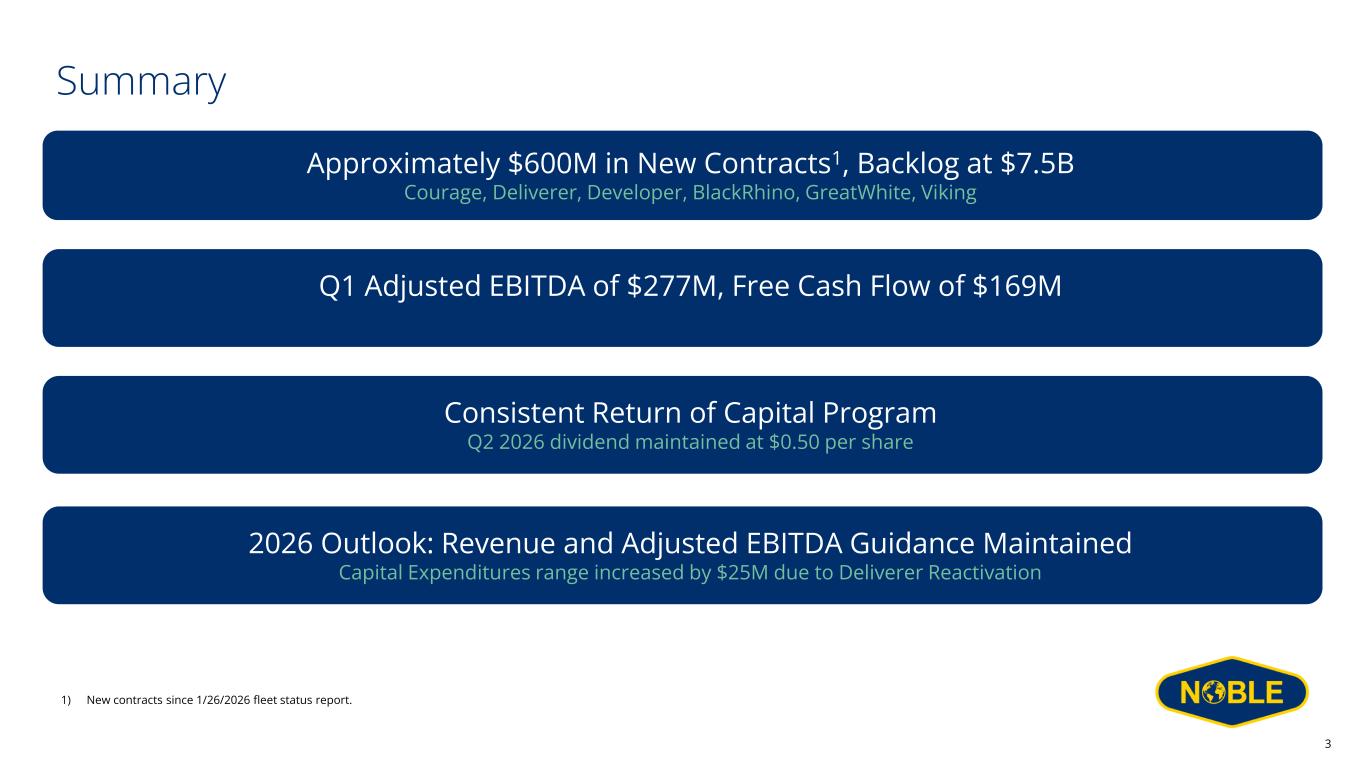
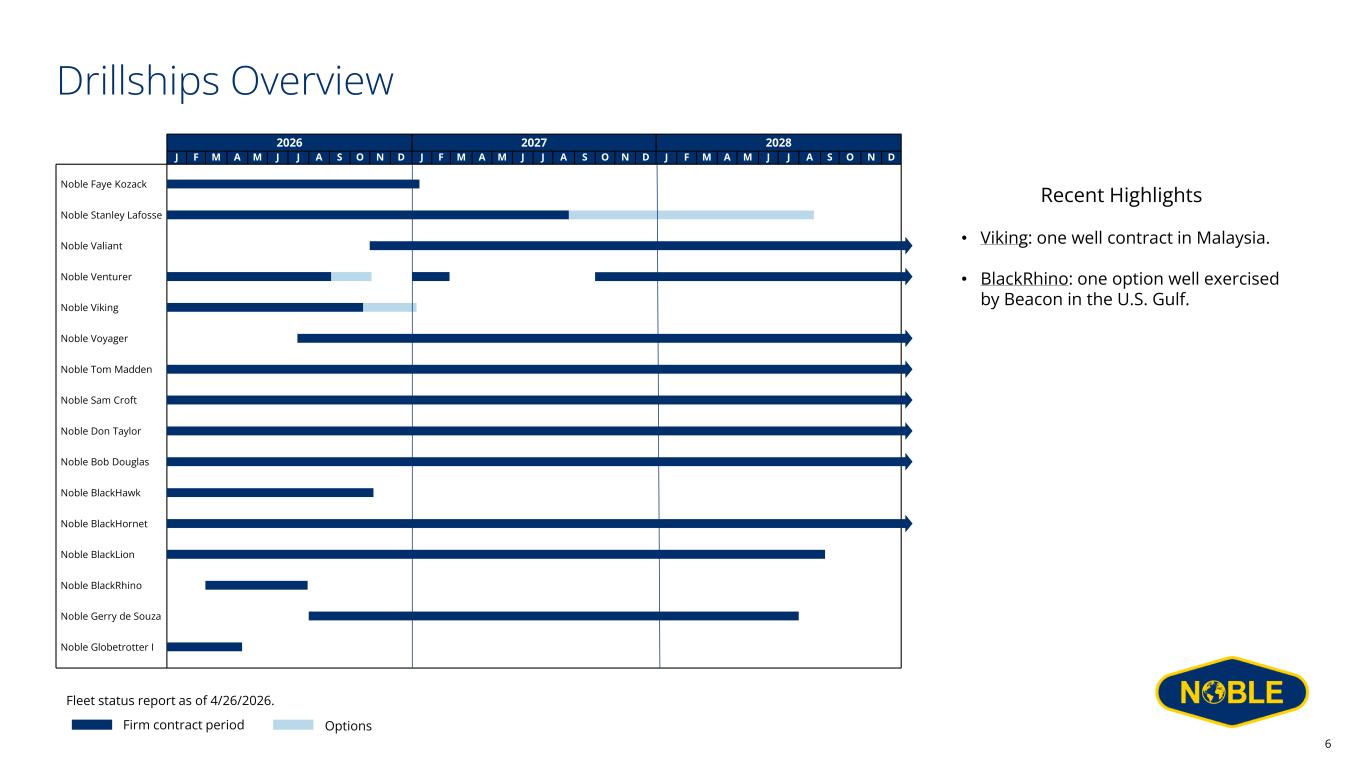
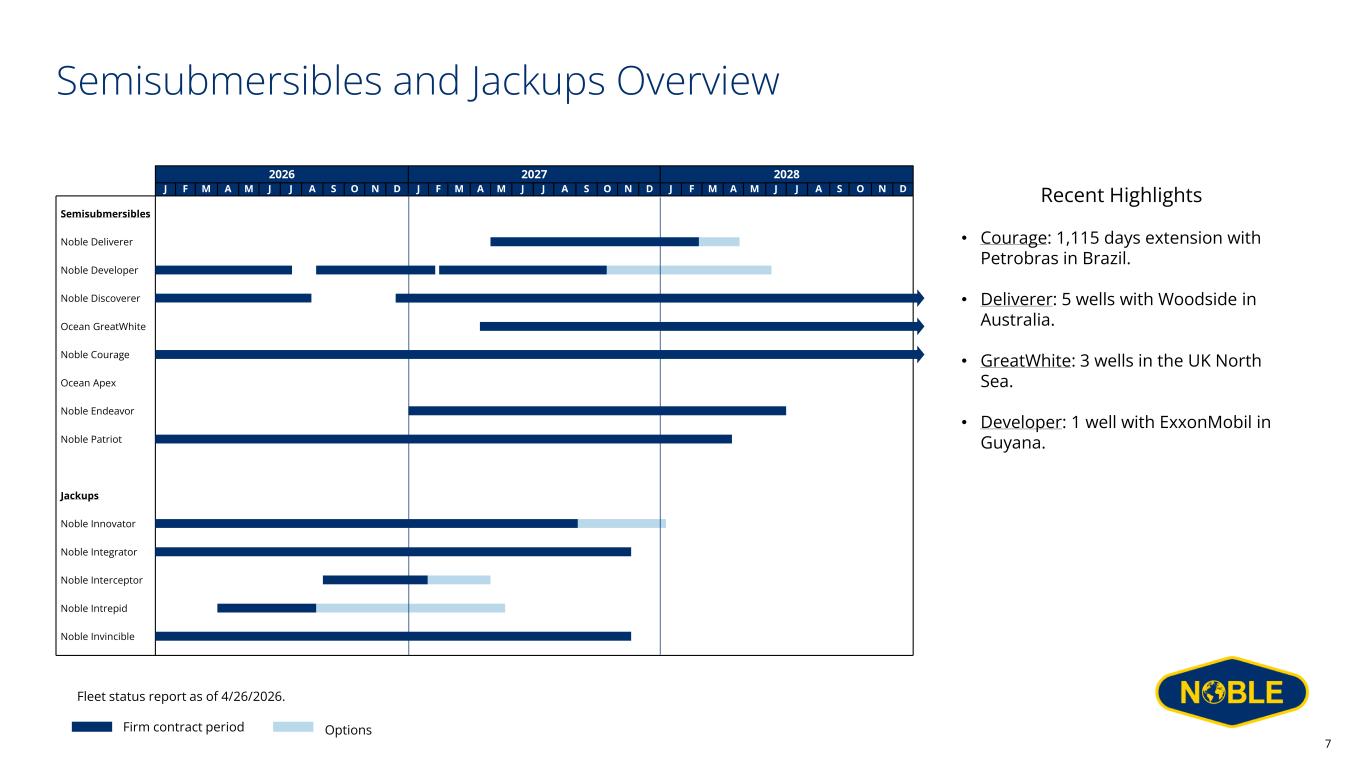
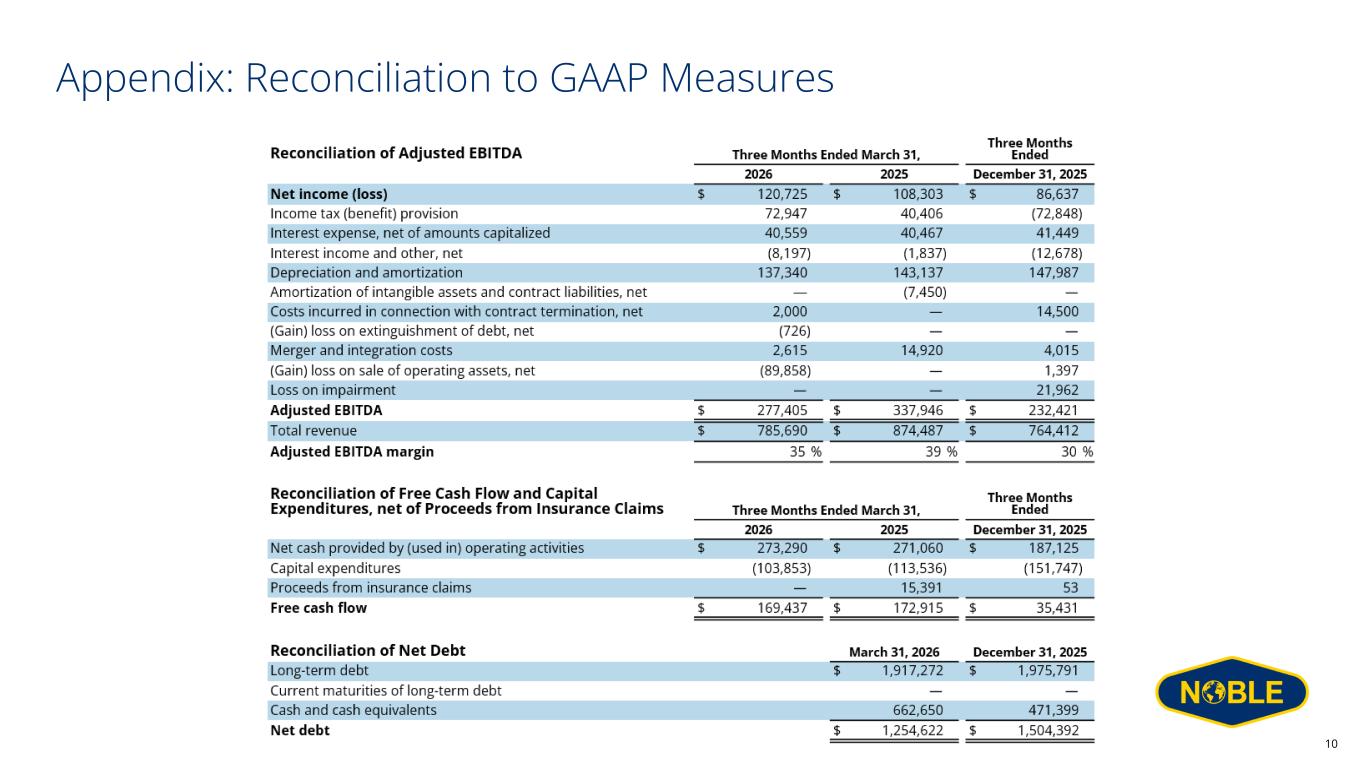
Thanks, Ian. Welcome, everyone, and thank you for joining us. I'll open today's call with a brief summary of our Q1 highlights and recent contract awards, followed by an update on the market. Richard will then cover the financials before I wrap up with closing remarks and move to Q&A. During the first quarter, we earned adjusted EBITDA of $277 million and generated free cash flow of $169 million. We again distributed our 50 cent quarterly dividend and yesterday our board declared a 50 cent per share dividend for the second quarter, maintaining our consistent and highly differentiated return of cash strategy. Overall, it was a solid start to the year, and I'd like to thank our outstanding men and women of NOBLE around the world for your fantastic teamwork in helping us to realize our first-choice offshore performance standards. While it's an understatement to say that energy markets have seen extreme volatility over the past couple of months since the outset of the Iran conflict, we are fortunate to have experienced limited operational disruption confined to just one jack up in the Middle East, the Mick O'Brien, which we sold in January, but have continued to operate under a bare boat agreement. All of our crew and related personnel were safely evacuated from the rig during the early days of the conflict, and Richard will expand on the rig's current status. Outside of the war impacted region in the Middle East, commercial momentum throughout the offshore drilling market remains brisk irrespective in many ways of the recent oil price surge however the recent reawakening of energy security concerns around the world and the corresponding move higher in the oil futures strip are clearly supportive of the already steadily improving demand trends evident in the deep water and harsh environment offshore markets where we operate over the past three months we've secured new contract awards totaling approximately 565 million dollars first the noble courage received an extension with petrol broth of slightly more than three years which will keep that rig committed in brazil through the end of 2030. this extension represents net incremental backlog of 339 million dollars with the current day rate reduced from 290 000 to 280 000 from april 1st 2026 through late 2027, followed by the extension of slightly over three years at just over $309,000 per day. Next, I'm pleased to announce that the noble deliverer has been awarded a five-well contract from Woodside in Australia, which will support that rig's reactivation. This contract is valued at $121 million, based on an estimated 300 days of firm scope, excluding options, and also does not include revenue for additional services or potential rig upgrades. In Guyana, the Noble Developer has been awarded a one-well contract with ExxonMobil at $375,000 per day, which is scheduled to slot in after the rig's current program right around year end. Next, the Noble Black Rhino has recently commenced an exercised option well for Beacon in the U.S. Gulf with an estimated duration of 100 days. In Ghana, the Noble Venturer has been awarded a one-well contract with Planet One in Ghana at a day rate of $430,000, expected to commence late this year with estimated duration of approximately 45 days, with two unpriced options. And finally, in Southeast Asia, the Noble Viking has received an additional one-well contract in Malaysia, which is expected to extend the rig through October this year. With these awards, our current backlog stands at $7.5 billion. Now I'll share a few observations on recent developments in the market. In short, all measurable and anecdotal indicators of deep water rigged demand are flashing green. And I would submit that this is not a reflection of $100 oil because most of what we're seeing in the market today has been in motion for months or longer. But of course, recent events absolutely have elevated energy security priorities around the world, and improved upstream cash flows will only serve to enhance an already strong and expanding demand picture and deep water exploration thesis. In parallel, the volume of deep water contract fixtures has spiked in the early part of this year, partially but not entirely due to the execution of Petrobras' wide-reaching contract extensions. The first quarter saw 32 rig years of UDW fixtures, which was roughly double the average quarterly run rate of last year. And with conclusion of Petrobras' extensions in April, this month alone has already had more than 40 additional UDW rig years fixed, bringing year-to-date backlog additions significantly above the entirety of last year's contracting volumes for the full year. Petrobras has comprised over half of 2026 year-to-date deepwater rig years fixed, and non-petrobras contracting activity has also continued at a healthy level. And notably, despite this recent surge in contract fixtures, the pipeline of open demand in the form of tenders and pretenders has actually continued to expand rather than deplete. Last quarter, we observed slightly over 100 rig years of open floater demand, which was a 33% year-on-year increase. This figure has now eclipsed 110 rig years. All this tendering activity is developing alongside an increasingly tightening supply-demand balance. Total UDW contracted utilization is currently 105 rigs, or 95% of marketed supply. This is approaching recent peak contracted demand levels of two years ago, albeit with markedly different directional momentum, especially considering the renewed length of backlog across the South America region, juxtaposed against open demand throughout the rest of the world that's now more than 55% higher compared to the previous high water mark two years ago. The contracted UDW count of 105 includes 14 rigs with future contracts that aren't yet working today, six of which happen to be noble rigs. We have been anticipating the convergence of future contracted utilization in present utilization as a critical factor that could substantially eliminate industry white space and result in a comprehensively tight market. This convergence becomes increasingly tangible as these 14 future contracted assets ramp up over the next six to 12 months with average contract durations of two years per rig. Taken together, all these market dynamics are resulting in upward day rate pressure. Therefore, we believe it is likely that we will begin to see floater rates move higher as we move through the rest of this year.
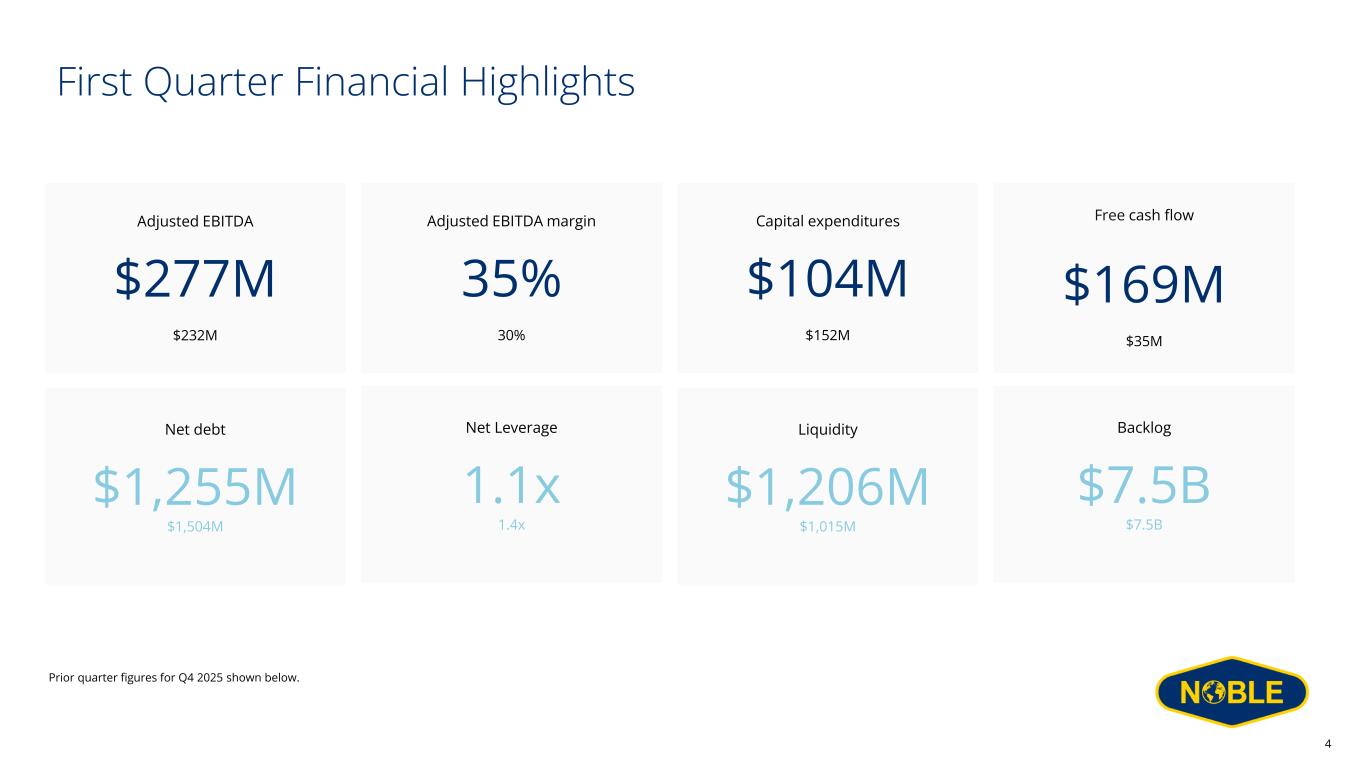
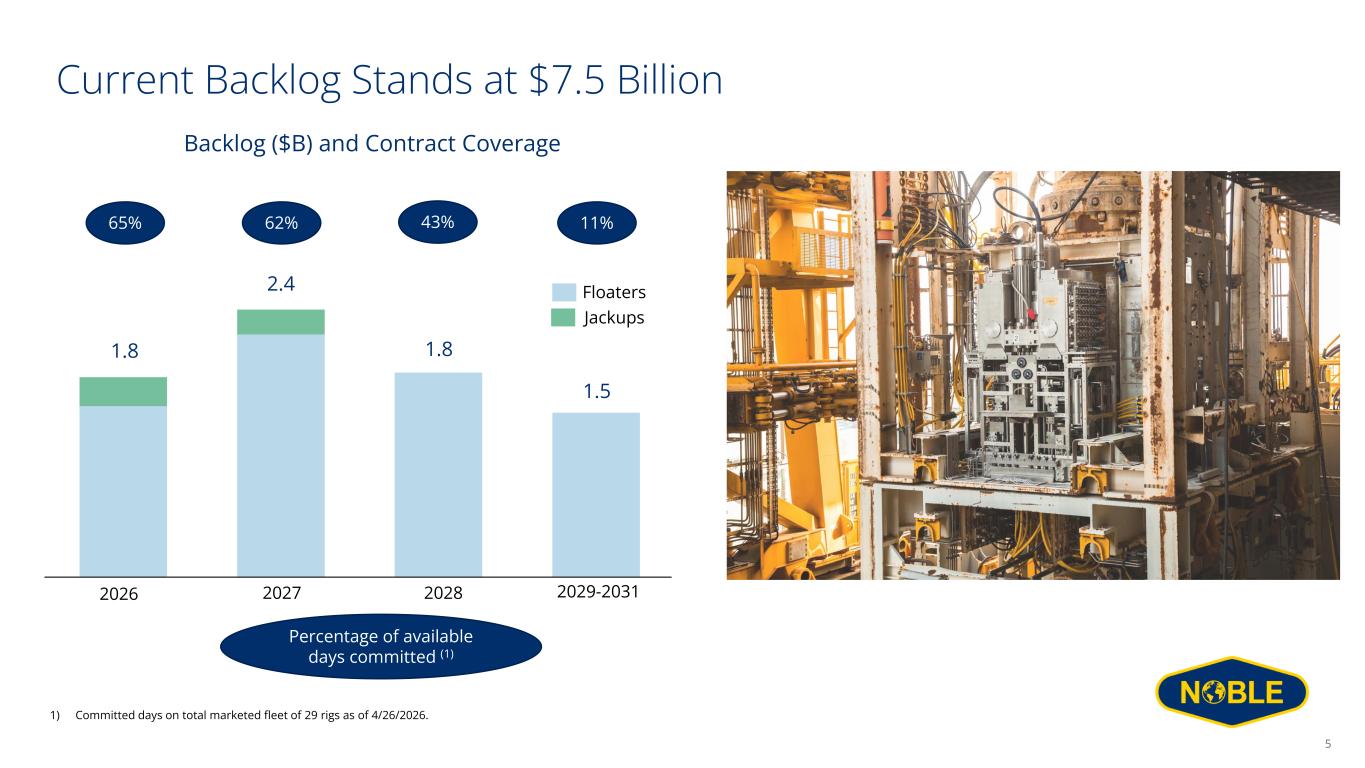
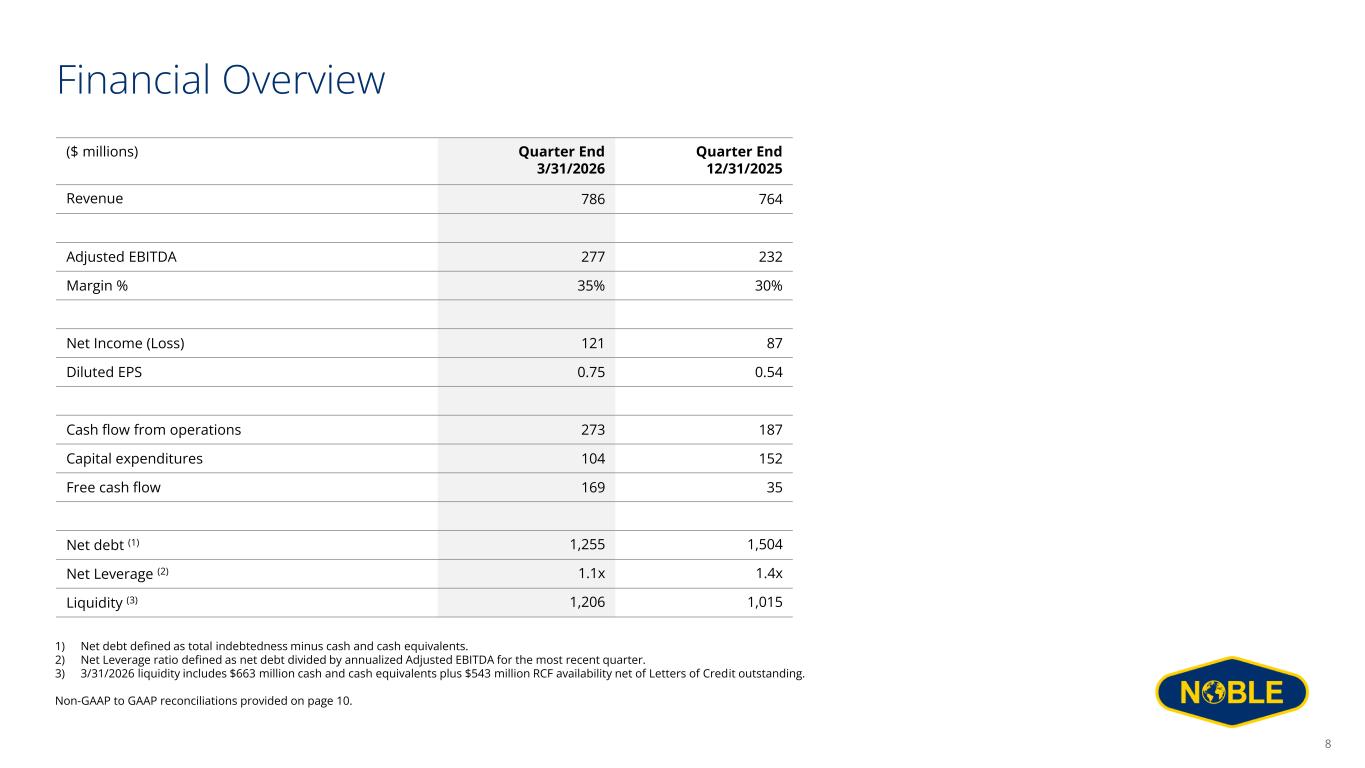
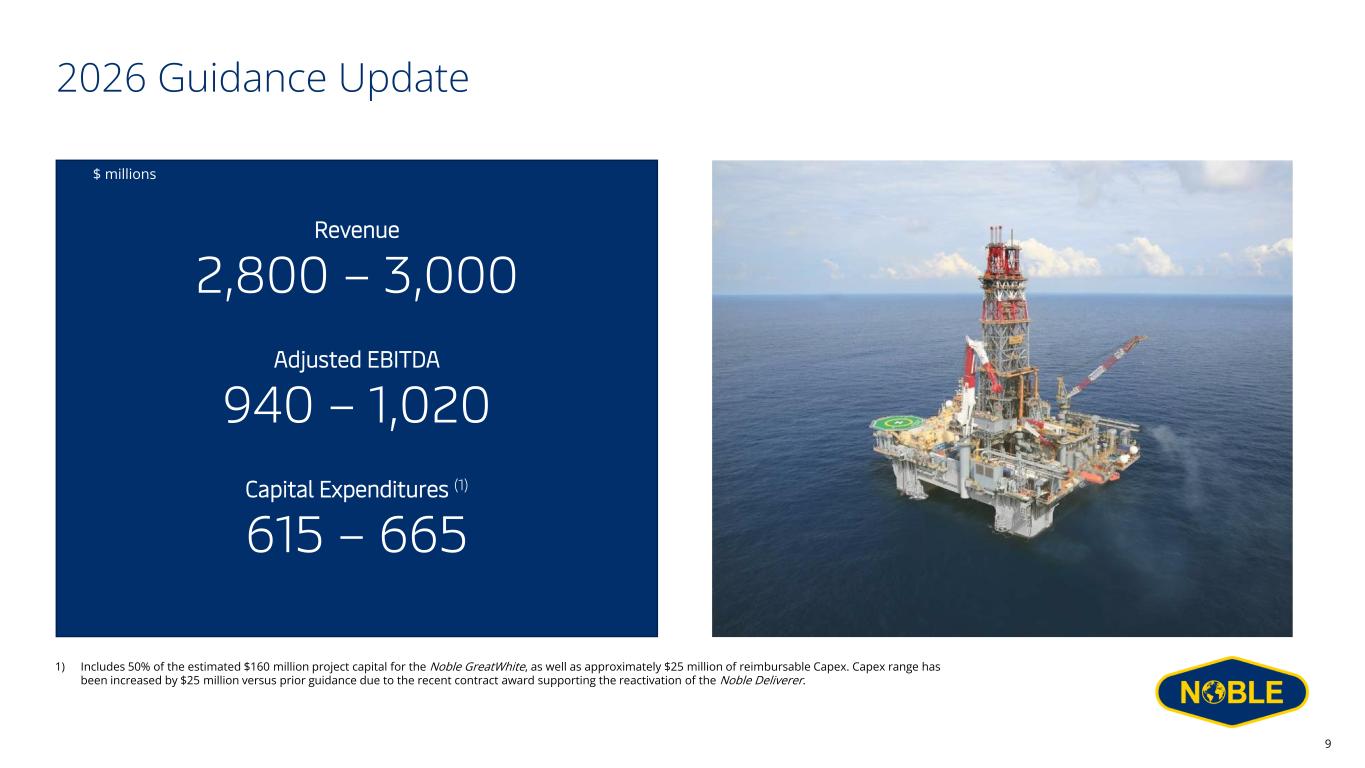
So overall, with the continuing positive development of our backlog, as well as the state of the drilling market more broadly, we're even more optimistic about the years ahead than we were last quarter now i'll pass the call over to richard for the financial review thank you robert and good morning or good afternoon all in my prepared remarks today i will briefly review the highlights of our first quarter and then discuss the outlook for the remainder of 2026. starting with our quarterly results contract drilling services revenue for the first quarter totaled $742 million. Adjusted EBITDA was $277 million, and adjusted EBITDA margin was 35%. Q1 cash flow from operations was $273 million, capital expenditures were $104 million, and free cash flow was $169 million. I'd like to touch on a few discrete cash flow-related items during the first quarter. Firstly, we received $210 million in cash proceeds from the jack-of-sale to board drilling, in addition to the $150 million seller's note, which is recorded in other assets on the balance sheet. Secondly, we completed the lease buyout on the first two of the four Blackships BOP systems for $36.5 million. The buyout of the remaining two BOP systems is expected to occur during Q2 and Q4 this year for approximately $18 million each. In total, the lease buyout for all four systems is expected to cost $73 million. The cash outflow for these payments is not part of capital expenditures, but instead is part of financing activities on our cash flow statements. Lastly, during the first quarter, we were doing $55 million principal amount of the 8.5% senior secured notes at 103 as an opportunistic and efficient use of capital. As summarized on page 5 of the earnings presentation slide, our total backlog as of April 26th stands at $7.5 billion. As a reminder, our backlog excludes reimbursable revenue as well as revenue from ancillary services. Our current backlog includes approximately $1.8 billion that is scheduled for revenue conversion during the remainder of 2026 and $2.4 billion scheduled for 2027. Referring to page 9 of the earnings presentation, we are maintaining full year 2026 guidance for total revenue between $2.8 and $3 billion, which includes approximately $150 million in reimbursable and other revenues, and adjusted EBITDA between $940 million to $1.02 billion. Capital expenditures guidance for this year is increased by $25 million, and this is due to the contract award supporting the reactivation of the Noble Deliverer. The lower side of our adjusted EBITDA range is fully contracted by current backlog. Although we have banked a somewhat stronger than expected first quarter in terms of adjusted EBITDA, this is offset by a few discrete items, including the recent notice of early contract termination on the Mick O'Brien, the lower near-term day rate revision resulting from the Courage's blend and extend, and slightly later estimated contract commencement dates for the Jerry D'Souza and endeavor driven by customer schedules regarding the nick o'briant recall that we close the sales aboard drilling in january and have continued to manage the rig through the completion of its current contracting cantar with a corresponding bare boat that we pay to bore into early december 2026. on april 12th we received notice of early release from the customer qe lng and we are now in the process of winding down operations the contract termination is effective after 30 days and this will result in an estimated negative impact of approximately 15 million due to our remaining bare boat obligations through early december as well as stacking costs for the rig to sum up we have had a very solid start of 2026 from a financial point of view with continued contract wins in the quarter and solid project execution we continue to solidify the expected path to a healthy inflection in both EBITDA and free cash flow starting in 2027, as we outlined in detail on our call last quarter. With that, I'll now pass it back to Robert for concluding remarks.
Thank you, Richard. Starting this summer with the Voyager, Jerry D'Souza, and Interceptor startups, followed by the Valiant and Endeavor later this year, and then the Great White Deliverer and venturer throughout next year, we have a sharp organizational focus on project execution. This is a large slate of projects to deliver in a quote normal time and these are of course hardly normal times given the various dislocations resulting from the Strait of Hormuz impasse. But overall, I'm pleased to report that all of our projects are progressing very well so far and we're incredibly excited to be preparing for commencement on these important drilling campaigns for our customers. These programs span virtually all of the major non-OPEC offshore basins around the world, which are increasingly critical to current and future energy supply. To wrap up, as Outlook for our business continues to improve, Novel is very well positioned to grow into the next leg of the offshore drilling cycle with a strong balance sheet, $7.5 billion of backlog and repricing opportunities across some of the most capable drill ships and jackups in the world. If anything, we feel better about 2027 today versus last quarter, given the deliverer contract, as well as the improving market dynamics confronting our open drill ship capacity. Meanwhile, we will continue to drive shareholder value through our robust return of capital program. With that, I'll turn it back to the operator for questions.
Operator
Answer session. If you'd like to ask a question, please press star, followed by one on your telephone keypad. Again, that's star, followed by one on your telephone keypad. Kindly limit your question to one question and one follow-up. Your first question comes from the line of Arun Jayaram of JPMorgan Securities, LLC. your line is now open.
Yeah, good morning, gentlemen. Robert, one of the themes of OFS earnings thus far has been just the potential impact from rising energy security concerns on just the CapEx cycle, in your case, what this means for offshore rig demand. Robert, historically, when we've seen a sharp move up in Khmer prices, it's obviously tend to positively impact shallow water demand. But I was wondering if you could maybe elaborate on your thoughts on how some of these energy security concerns could impact the deep water. And I'm thinking about, you know, are there kind of projects that called the majors have been sitting on that they may not have pursued in a lower commodity price environment that may come back into the fold, you know, at STRIP?
Yeah, thanks, Ryan. It's a good question. I think it's the topic on everyone's mind right now, including our end. So, I'd say a couple things. First of all, I'd reiterate that I think all of the positive indicators that we mentioned in our prepared remarks and that we're focused on right now started before the conflict in Iran. And so this growing narrative around deep water, I think, is very real. And I think what I would say is there are certain regions that respond more quickly to oil prices in the deep water than others. Traditionally, the U.S. Gulf of Mexico has been one of those. So we're hopeful that we see something that comes perhaps as an early indicator out of the U.S. I think it's less likely that at this point today our customers have rewritten their budgets or made a huge five- or ten-year move. That would obviously be a question for them. But I think from what we see and hear, we don't have necessarily really tangible evidence today of positive changes that have hit us. But I think that we hear, obviously, positive narrative, as you do, and we're pretty hopeful. And we don't really see any way that this doesn't turn out positively for our business on top of everything else that we've already seen. And, you know, these aren't necessarily the end-all, be-all on indicators, but the numbers we used just a moment ago I think are really striking, When you think about the amount of deepwater backlog that's been printed so far this year by Noble and our competitors and compare that against the amount of outstanding activity that we see. And obviously, our numbers were just open tenders, but there are direct negotiations and everything that comes along with our business behind all that as well.
Got it. Got it. And maybe just a housekeeping question. You guys are buying in your lease options on the BOPs, which you talked about in the prepared remarks. Can you maybe help us think about the impact on OPEX from buying in those BOPs? I'm thinking about maybe the impact in 26 and maybe as we think about 27 on a go-forward basis when you buy in all four of those leases. Sure.
Yeah. So we're obviously buying in the leases during the course of this year. And on an annualized basis, it will have a benefit to EBITDA of about $25 million. And so in 2026, probably about half of that rule will be realized.
Operator
Your next question comes from the line of Scott Gruber of Citigroup. Your line is now open.
Yes, good morning, Robert and Richard. I kind of want to follow on Arun's question just around how customers may respond to higher oil prices. I know it's early days, but I'm just curious, in the conversations you're having with customers, are they starting to indicate incremental interest in exploration? I know people were talking about it even before the conflict, but, you know, is there a sense that there will be, you know, incremental interest in more exploration? Is there incremental interest in infill activity with quick paybacks? Just, you know, any additional color you can provide on what the conversations with customers are indicating in terms of the potential incremental activity.
Yeah, thanks, Scott. Look, I think that, so for sure, yes, there is an increase in narrative around, in discussion around exploration work. You know, I don't know that, like I said before, I don't know that we can put our finger on a specific example that has a direct cause and effect, you know, related to Iran. uh but i think that uh generally we're seeing um conversations uh gain momentum uh and uh and i think across the board uh the realization that uh that deep water is going to play a really important uh part in in in the supply stack post everything that's happened here um you know Our hope is that some of the demand that we've seen, whether it be from India or elsewhere, is more likely to solidify than before the Iran issue.
But today, I'm not sure that there's a direct link so far. okay we'll uh we'll wait um and then on the developer uh deliver um you know on that rig you bumped a full year capex by 25 million for the reactivation cost is that the total cost of restart or is there some more spend you know required next year and then does the incremental spend including the upgrade uh investment that would add to the day rate or is that just a your restart costs.
Yeah, the $25 million is the total required for the Woodside contract. If there are any incremental rig upgrades then there would be incremental capital to that. But think about the $25 million is what's needed for the Woodside contract.
Okay, great. That's it for me. Appreciate it.
Operator
Your next question comes from the line of Eddie Kim of Barclays. Your line is now open.
Hi, good morning. You highlighted the high UDW contracted utilization currently at 95% and that the market is beginning to tighten here, which of course results in higher pricing over time. We haven't quite seen that move up in day rates yet. It feels like leading edge pricing is still in the low 400s. But just based on the current backdrop and the amount of tendering and activity you expect to see over the next year or two, do you think by sometime in 2027, we could be back up into the mid to high 400s, which is where leading hedge pricing was at about a year or two ago?
Is the market currently setting up for that based on what you see today? yeah i guess what i would say is we definitely see uh the market tightening um and that's that's because of that convergence i mentioned but also uh because of this a lot of the the um demand that we see uh behind even the the 95 percent the demand that's creating that 95 number um and Obviously, tight market leads to higher day rates, so we'll see what happens, but we're pretty optimistic about a really tight market.
Got it. Great to hear. My follow-up is just on the Petrobras blend and extends. It seems like they handed out a lot of extensions. Were you at all surprised by just the number of rig years they extended, or was this kind of all part of their plan and in line with your expectations?
No, I think it's in line with our expectations. You know, we had always kind of thought Petrobras on total rig count would be flat, and they're going to end up dropping by a couple of rigs, at least in the near term. We're still hopeful that through time, uh, their, their number remains flat and, you know, there's some possibility, I guess, that it could actually go up, but, um, look, I think this is, Petrobras are very savvy, um, and I think this is, um, in line with, with their behavior, uh, through time and, um, they've secured their, their rig supply and, um, uh, probably done it at a, at a pretty good time.
Sure did. Great. Thanks for that call, Rob. I'll turn it back. Eddie.
Operator
Your next question comes from the line of Keith Beckman of Pickering Energy Partners. Your line is now open.
Hey, thanks for taking my question. I just kind of wanted, you know, we've kind of talked about some of the really strong contracting that we've seen to start the year here, a lot of it driven by Petrobras in Brazil. Are there any other regions in particular that maybe you have stronger confidence in now for more significant tender conversion throughout the rest of the year? Maybe on the back of energy security, but just any regions in particular you wanted to highlight that could potentially be stronger contract conversion through the rest of the year?
Yeah, I mean, here's what I would say. Well, I mentioned the U.S. earlier, which I think is a region that sometimes responds quickly. So we don't have anything necessarily tangible to report there, but fingers crossed. But I think the real, probably the meat of your question would sit in two places. First would be Asia, where we think that we had growing demand even before they were in conflict, And we think that that's very likely to solidify going forward because of the renewed security concerns, which, you know, is obviously a good outcome if that happens for the Viking and follow-on work also in Australia. And then secondly, I would say that a lot of the growth that we've been forecasting has been from West Africa, and higher oil prices just help that region. There's just no way that hurts all of that. So I think if anything, if not incremental in West Africa, then projects on the table, you know, we're hopeful that projects on the table are just even more likely to come through in time.
Awesome. That's really helpful. And then my second question was just trying to get the outlook for a few rigs. So I think about kind of the Black Rhino, the Globetrotter 1, and Apex system rigs that could still fill out some work. you know you know they roll off or early off contract maybe what do you do you think the black rhino could still potentially uh find work in the gulf or do you think it may have to head elsewhere and then just any potential works go through the globetrotter one or apex uh at this time so you could help me out on that thank you sure yeah um so uh black rhino could very easily stay in the u.s um uh that's uh most likely to be 27 work but like i said our fingers are crossed about potentially some 26 work popping up.
It is bid outside of the region as well. So we'll, you know, just a little too soon to tell where that rig will end up. The GT1 is in the same place it's been where we're chasing primarily intervention work. We believe in that market, you know, and everything that's happened, And it kind of makes us believe at least as much, if not more, in that market. So we're hopeful to have some sort of news on that rig in, you know, I don't know, the next couple of quarters. But it remains focused on intervention work. And then there's a couple of jobs out there, like the one in the Black Sea, that really kind of work very well for that rig. We're not bidding it into very many drilling programs, but there's a couple of things out there that we're chasing right now. So we're hopeful to have something for that rig, which would be like, you know, 27 start. And then the APEX is an older unit, and we're just evaluating options on that rig right now. There are some opportunities for the rig, and we'll make a decision on what to do with that rig here over the next couple of quarters.
Awesome. That was really helpful. I will turn it back. Appreciate your time. Thanks.
Operator
Your next question comes from the line of Frederick's team. Of Clarkson's Securities, your line is now open.
Dear Overton team, I hope you are well. Thank you for the prepared remarks and the market commentary in particular. I wanted to circle back briefly on Brazil and the Renecon. You got the extension on the Courage, which was nice to see, keeping that rig working until end 2030. but i was wondering about the say kozak uh as well uh that's rolling off i think later this year or early next year but nothing announced on this one does that mean that it's you know hasn't been part of uh renecon can we expect that to be extended nonetheless or did you feel like the terms that were potentially you know agreeable for petrobus weren't agreeable for you and that you might see that work sorry that rig working working elsewhere thanks yeah so the the fake
hozak is not a part of the the blended extends that have now been announced um we did have it uh very close on a on a different program and so what i would say is there are opportunities in South America for the rig that we're chasing but that we're also starting to bid that rig elsewhere.
It's obviously not impossible for that rig to continue working for Petrobras but it's not part of the current blend and extended discussions. all right thank you that's very clear um then one for richard as well in addition to buying or buying out two of your bops with two more uh following later this year you also brought back some of your 2030s uh secured bonds um and i think you said that you bought back 55 million dollars which based on cash flow at least would suggest the price of 103 at least if it's 55 blank which would be you know good compared to market pricing but I was also wondering if we should kind of read more into this given the core structures of the bond that this is quote early stages of a potential will uh refi since you're still you know siloed in a way with legacy noble legacy niable sorry legacy noble legacy diamond debt structures at the moment and everything is playing pretty height versus historical spreads at least so any commentary around that would be super helpful thanks sure yeah so uh there was a specific clause in the legacy diamond notes that allowed us to buy back 10 percent at 103 you know the bond was trading at 105 106 so so we think it
was a very value uh uh creative move for our shareholders if you will to to to buy in to to buy in that debt um the legacy noble bonds are callable now the legacy diamond bond is callable later this year um and um you know at the right time we'll definitely refinance the capital structure and collapse that back it all collapsed down into one silo um and you know through that process we would expect to to realize material cash interest savings on on an annual basis so um obviously both bonds are trading well in excess of par uh today uh but we're going to find the right time to go for for us right great appreciate all the answers and uh wish a good day that's all
Operator
Your next question comes from the line of Doug Becker of Capital One. Your line is now open. Mr. Becker, your line is now open.
Thank you. Robert, just as the market evolves, do you see an opportunity for some upgrades on the drill ships to even improve their competitiveness even further?
That's a good question. I think we highlighted it last call, But as a reminder, we feel we've got one of the most competitive fleets on the globe right now. All of the rigs will have MPD here in the not-too-distant future. And I think we have more of NOV's automation equipment installed on our rigs than the entire rest of the world combined. So we're really proud of where we sit on rig technology. We have upgraded or will upgrade a couple of the rigs for derrick capacity, which is a pretty easy upgrade for a couple of our rig classes. I could see us doing something like that for certain programs. By and large, we're pretty happy with where everything sits right now, though. And I guess I'd add one caveat. We are constantly in communication with our customers around technology that they value and, of course, work with them as a normal course of business to find technology that works for our rigs. And, you know, there's always some discussion around who pays for that stuff. But I think right now what we're seeing is a real push by customers to have the best technologies as a lot of things are really starting to prove their value, whether it's in the form of safety, perhaps red zone management, or, of course, on efficiency, which would be more like MPD and automation and other things. So we think that the trend will continue. Some of that's going to come from customer supply CapEx. Some of that's possible from us, but I think we're starting from a pretty high place right now as a company.
I would agree. Richard, a quick one. You mentioned the low end of the range was kind of de-risked through contracting. What would we need to see happen to get to the high end of the rain for this year?
Sure, Doug. Yeah, I think there's a few paths, if you will, to get to the high end. Obviously, in Q1, we had great uptime performance and fantastic cost control throughout the entire company. I think, obviously, there's opportunities there, if you will, to drive cash flow that way. You know, I think if specific maybe to the black brine, if opportunities come to the laboratory for that rig in the back half of the year, then that would lead, I think, to us being towards the higher end of the range.
Operator
Your next question comes from the line of Ben Somers of BTIG. Your line is now open.
Hey, good morning. Thanks for taking my question. So first, I kind of wanted to ask a bit more about your comments earlier that the U.S. Gulf is a basin that typically reacts quickly to changes in oil prices. Just kind of curious if you've heard anything yet from customers in the region. And I guess, you know, thinking more about your fleet, maybe how that could have some implications for a river like the Black Rhino. Thank you.
That's a good question. I wish I had a great story for you. I can't say, you know, our customers continue to preach discipline and will continue to be disciplined. But I think the U.S. is a place where, you know, some of the smaller independents can be a little bit more price sensitive in the near term, perhaps, than some of the majors are. And I would say, but also kind of related to Richard's statement just a moment ago, you know, to the extent that something pops up for the Black Rhino, that's some upside in 2026 for us. And so we're hopeful that this environment eventually translates to a little bit of incremental work.
Great. Thank you. And then I just wanted to turn to the jacket quickly, you know, now with the closing of the sale behind us, kind of just curious, you know, on anything you want to highlight on the longer-term outlooks in Norway and the UK. And I know that a lot of, you know, 26 is spoken for for these rigs, but I guess just kind of thinking about 27 and beyond. That's a good question.
I think for the CJ-70s in 2027, we've got – I think we feel really good about having four of those rigs contracted and with multiple paths to having all five of those rigs contracted. And so we're happy with that. We're probably a little bit short of scarcity in that market on programs that genuinely require CJ-70s. But I think I would kind of broadly characterize our view as flat to up for CJ-70s. And so we're in a little while since we would say that with that conviction. conviction. So, cautiously optimistic there.
Great. Thank you for taking my questions.
Operator
Thanks. Your next question comes from the line of Josh James of Daniel Energy Partners. Your line is now open.
Over the next 12 months and the focus on execution. Could you speak to what you're saying?
Josh, two seconds. Let me interrupt you. You just came in. We didn't hear the first part of your question. Sorry, we may have got an issue on our end.
That's okay. Can you hear me now?
So, just want to touch on inflation and supply chains. So, you highlighted a number of project and rigged startups you'll have over the next 12 months and the focus on execution.
Could you speak to what you're seeing with respect to global supply chains, maybe not just only the straight, but also outside of the straight, and how you're managing things to make sure the projects start on time with no delays yeah thanks it's a good question it's something we're extremely focused on here as we mentioned so I would say logistics are strained and some of that started before in but obviously fuel prices are way up now and so that's adding a little bit of cost into the system right now I would say cost wise we're not seeing material effects uh as as a as a you know directly correlated to the war um transportation costs up yes uh but i think everything else you know all the stuff we're buying these projects has been built uh effectively uh and so um we feel reasonable although uh there's there's probably you know there's risk there obviously given everything happening um we're really focused on timing right now, and that's where we're seeing a lot of pressure, and we're going multiple layers deep here to track the equipment we need and try to ensure that we get everything on time so that we're ready to go for our customers. Um, so again, we're, we're, I guess I'd say we're, uh, we're optimistic, uh, and, and, and, and working hard, uh, to make sure that we stay on time here. Uh, there, there is a lot of pressure out there, uh, on, on the groups trying to pull everything together.
Understood. Thanks. And then, uh, maybe just one follow-up just to address, uh, latest, um, developments in autonomy. So there was a release in March where Noble, in conjunction with Halliburton and Exxon, automated rig operations and subsurface interpretation, real-time hydraulics. Maybe you could just speak to that and where you think we're going over the next couple of years with respect to advances in autonomy on the rig floor.
Yeah, that's going to continue. That's the path of everything. You know, Noble doesn't do anything specifically subsurface. We are focused on making sure that we have the most efficient rigs and then some of the logistics around that. But we work very closely with other service companies and with our customers, of course. And I think one of the things that's the mark of kind of where things are headed is that everyone is much more collaborative today so that I think maximum efficiency is achieved by service companies and operators really working together early, collaborating on shared technologies like what you just referenced. And there are a number of examples like that out there. But that is the path of drilling today. And I think, you know, we've said before that we kind of wax poetic about the change from the concept of drilling yourselves out of a job and into the mindset of drilling yourselves into a job. We mentioned previously that we've seen that work directly in Guyana, where they've had FID under a set of circumstances that probably were not possible even three or four years ago, given efficiency then. So we think that technology and automation is really an enabler for deep water work going forward. And the further deep water comes down the cost curve, the more there is for the entire industry. So we're really optimistic about all of that.
Understood. Thanks for taking my questions. Thanks, Josh.
Operator
Your next question comes from the line of James West of Milleus Research. Your line is now open.
Hey, good morning, Robert and Richard. Robert, curious, as we think about the various regions around the world that you guys participate it in um which one would you say over the last or which one or two or three over the last kind of 90 days have started to show a bit more urgency uh on moving FIDs maybe forward or just getting FIDs done uh for projects um as this deep water cycle you know steps up I'll give an answer like Blake, make sure I get it right.
But I think Asia, for sure, we've seen a real change in the amount of demand and urgency there. And then I would say CARICOM, where there's an enormous amount of work that obviously a lot of it we knew in Guyana, but then suddenly Venezuela seems more open and a number of other actually kind of shallower water trends that are creating a lot of demand through that region is all pretty interesting.
Okay, okay, got it. And then on the managed pressure drilling, I think you mentioned all of your rigs are now or will be outfitted with MPD. What percentage of the wells now are being drilled with MPD, and how much of the actual well is drilled with MPD?
Yeah, so just to clarify, the drill ships will be all the drill ships that have MPD. Sorry, okay, drill ships. I don't know if I have a percentage on – it's a high percentage. uh and look there's there are certain technologies out there uh that can be used out outside of npd but i you know the feeling for us has been that over the past really 10 years that that npd is kind of going the path of the top drive where it's it's almost ubiquitous and um so we're we're pretty happy with uh with with where we are on on having the rigs outfitted it's you know it's it's a 25 to 30 million dollar expense depending on where your piping is and and then uh and that's before you get out of service time so we're we're pretty happy to have all that pretty much uh uh paid for got it thanks robert thanks your next question comes from the line of Noelle Parks of Cooley Brothers.
Operator
Your line is now open.
Hi, good morning. You know, we've touched on sort of the edges of this, but I've been thinking, of course, that one of the artifacts of things tightening up again in the rig market could be that we have begin to see some lengthening of contract term length. And it seems like I haven't really necessarily seen that yet, but I feel like I have noticed some more prompt contract extensions maybe suggesting that, you know, any operators who might have been betting on lower for longer day rates may realize they're losing that bet. So I'm just wondering if you were seeing that yourself.
Yeah, sorry, when you said term, do you mean like contractual terms or the length of the contract? Length of the contract. Yeah, yeah. So if you recall two or three years ago, the last time we kind of hit this inflection, I think average contract term was still less than a year. And so, you know, I think that's one important point we kind of made in the comments is uh yeah if you have there i don't think there's a ton of priced options out there uh if someone has a priced option i think they're pretty likely to take it right now um but uh across the board i think we're seeing more and more uh big development projects uh that are driving this demand uh and and like we mentioned earlier i think the average contract term was was at least two years on some of this recent contracting, that's a huge change compared to where we were before. So you think about hitting kind of similar utilization point as when the last time day rates hit right at 500, we're approaching a similar utilization point, but with more term and a lot more open demand than before, like double open demand. So we're pretty optimistic.
Great. Right. And I'm just wondering, you did mention briefly that the factors of discipline, capital, discipline are still very much in place with producers. And I was just wondering if, you know, this time around, I'm sort of thinking with the geopolitical turmoil, I'm sort of thinking back to 2022, that, you know, we had, you know, we still had sort of more uncertain macro environment. The rate environment was about to take off and head a lot higher. So I'm just wondering if this, as far as you see them trying to decision-make during the current uncertainty, is this very reminiscent of sort of our last big, you know, international flare-up, or do they sort of are just looking past it and just thinking about, you know, whatever comes next?
Yeah, I mean, our customers are very long-term minded, obviously, and I think that there has been this big movement towards exploration in the deep water, which to me is the most important test of the market. That started before Iran. That hasn't slowed down. We hope that it is only solidified by what's happening right now. And so I guess another way to put it would be we certainly wouldn't expect our customers to waver from their commitment to discipline. And our optimism does not require them to abandon any discipline.
Operator
Your next question comes from the line of Aaron Rosenthal of J.P. Morgan. Your line is now open.
Hey, good morning, and thanks for the time. Can you just elaborate on the moving pieces with the Mick O'Brien? I think you called out 15 million impact. Maybe how much is the bear boat piece of that versus I believe you mentioned a stacking cost?
And then does the termination, or I guess when the rig does go stacked, does that effectively end the relationship between the two entities and that rig is free to seek work elsewhere or are there any other you know lingering items we should be aware of yeah um yeah so so obviously it's an early termination for the rig um so the the 15 million dollars if you think about that it's about um you know the six months of the bare boat charter plus stacking costs so that's essentially the $15 million. So, you know, that's the extent of the impact. We don't see any other impact to our financials. And obviously, once we get to early December, that way, we'll move over to BOR.
Operator
As of right now, we don't have any pending questions. I'd now like to hand the call back to the Noble Court Management for closing remarks.
Thanks for joining us today, everyone. We appreciate your interest, and we'll look forward to speaking with you again next quarter. Have a great day.
Operator
Thank you for attending today's call. You may now disconnect. Goodbye.