Operator
Good day and thank you for standing by. Welcome to the Alpine Q4 year-end 2025 earnings call. At this time, all participants are in a listen-only mode. After the speaker's presentation, there will be a question and answer session. To ask a question during this session, you will need to press star 11 on your telephone. You will then hear an automated message advising that your hand is raised. To withdraw your question, please press star 11 again. Please be advised that today's conference is being recorded.
I would now like to hand the conference over to your first speaker today jenna mckinney finance director please go ahead thank you joining me in participating on the call this morning are john albright president and ceo philip mays cfo and other members of the executive team who will be available to answer questions during the call as a reminder many of our comments today are considered forward-looking statements under federal securities laws the company's actual future results may differ significantly from the matters discussed in these forward-looking statements, and we undertake no duty to update these statements. Factors and risks that could cause actual results to differ materially from expectations are disclosed from time to time in greater detail in the company's Form 10-K, Form 10-Q, and other SEC filings. You can find our SEC reports, earnings release, and most recent investor presentation, which contain reconciliations of the non-GAAP financial measures we use on our website at www.alpinereit.com. With that, I will turn the call over to John.
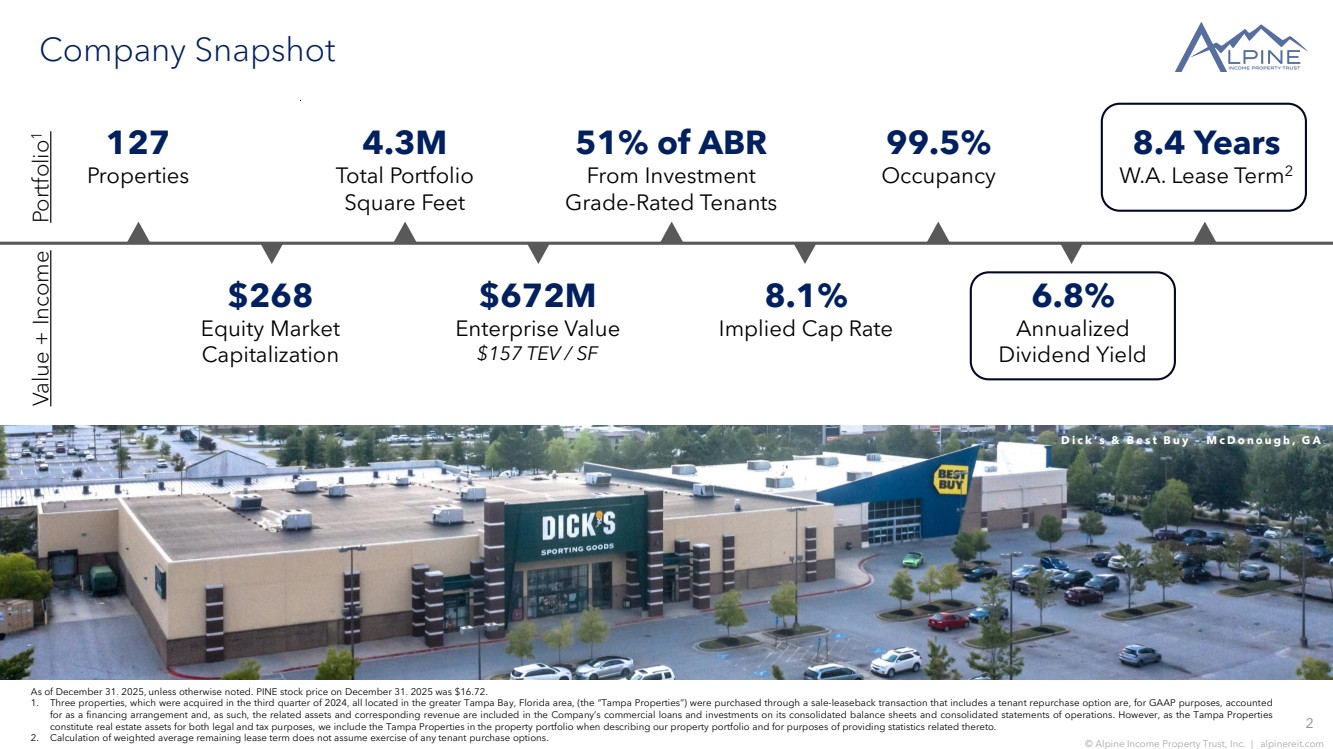
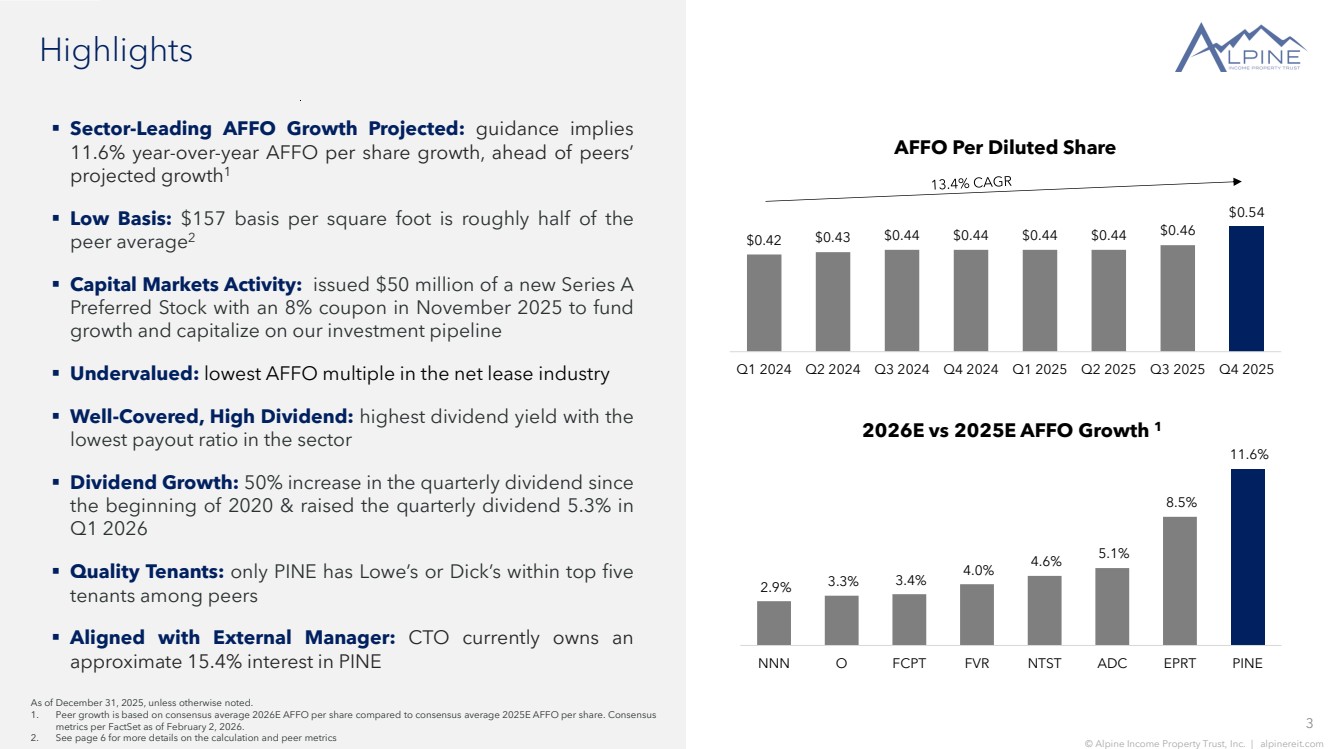
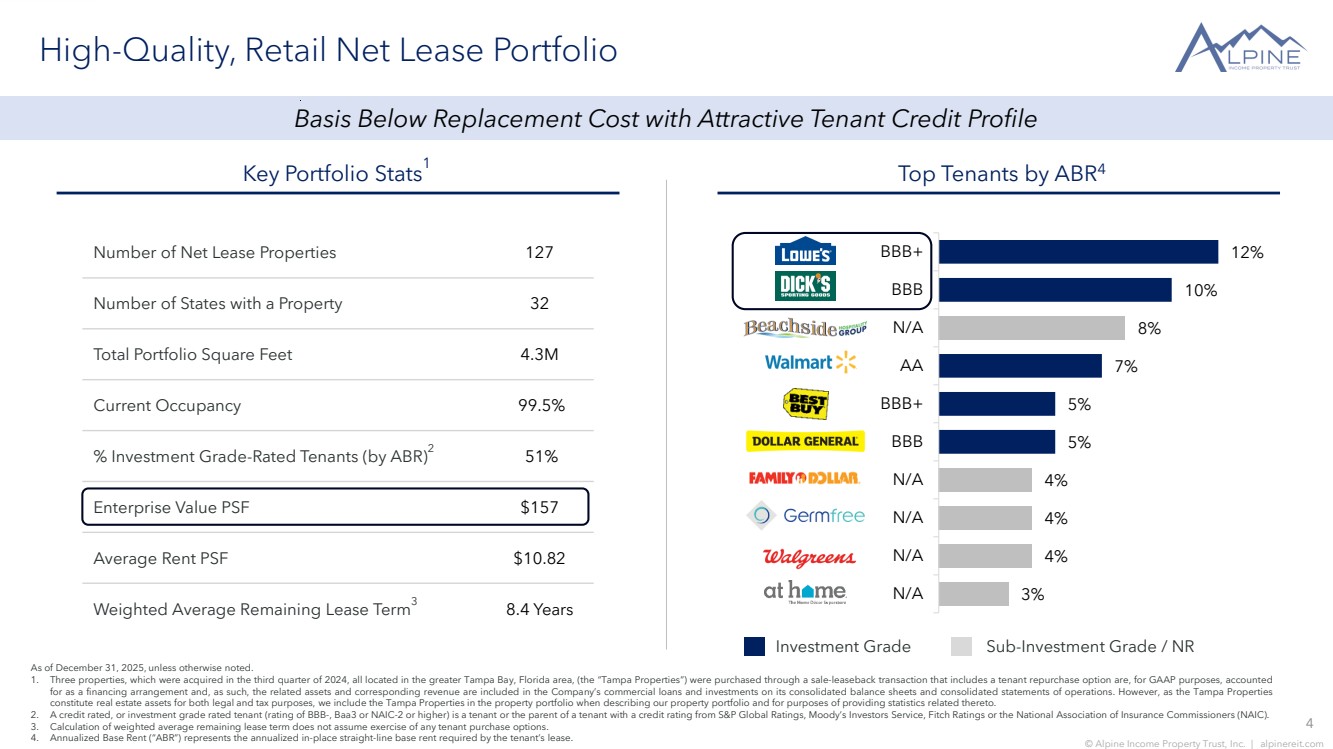
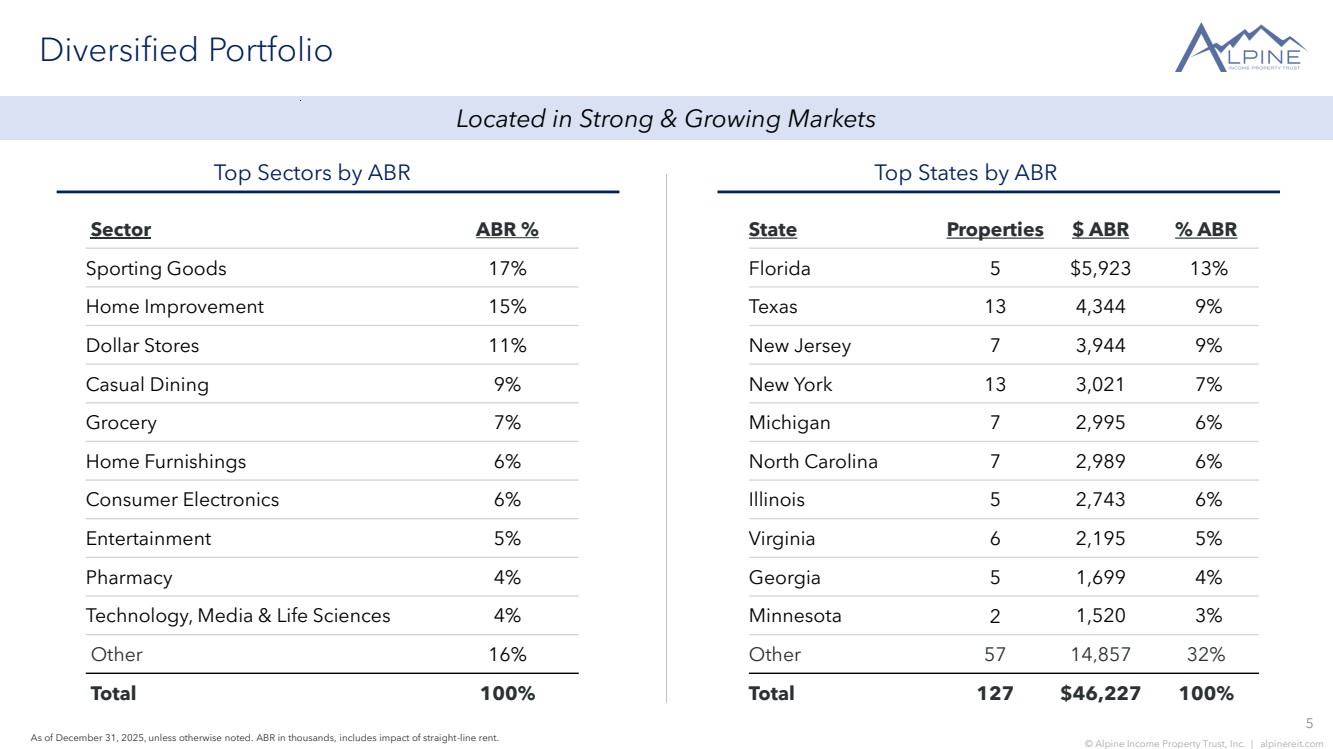
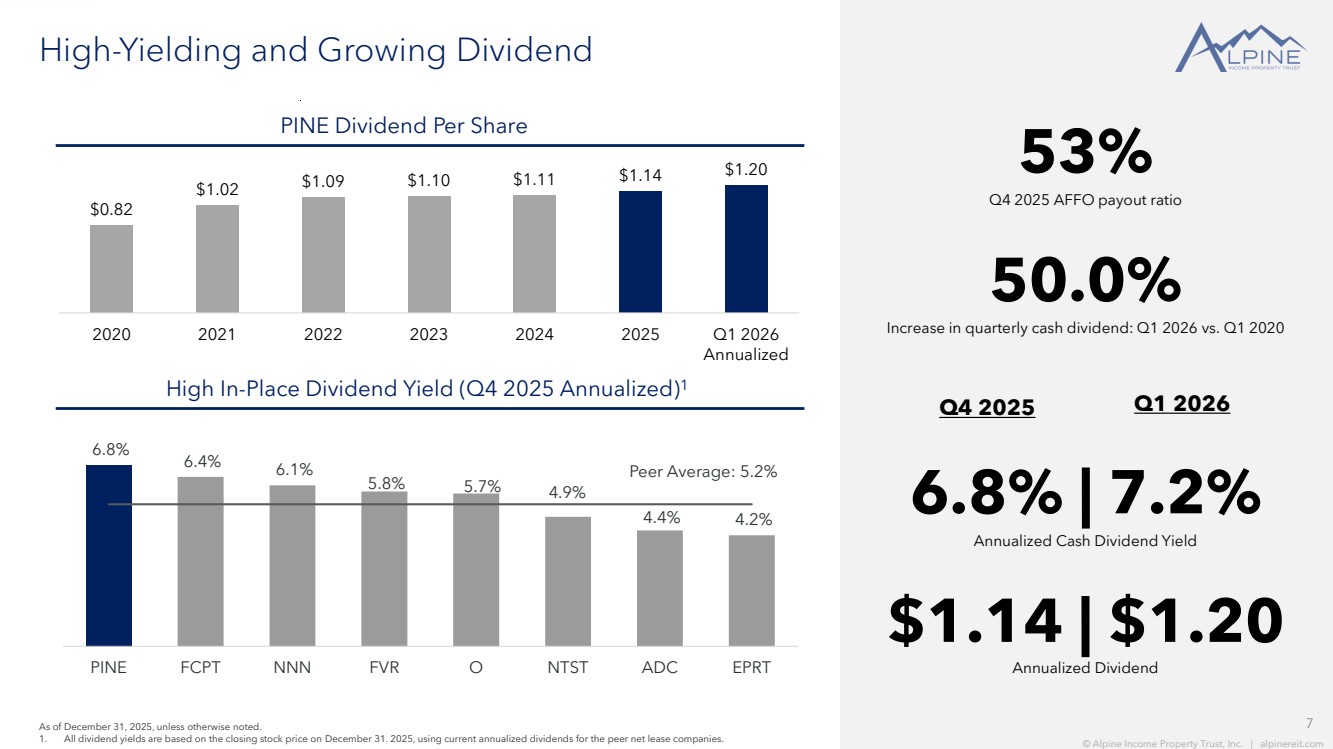
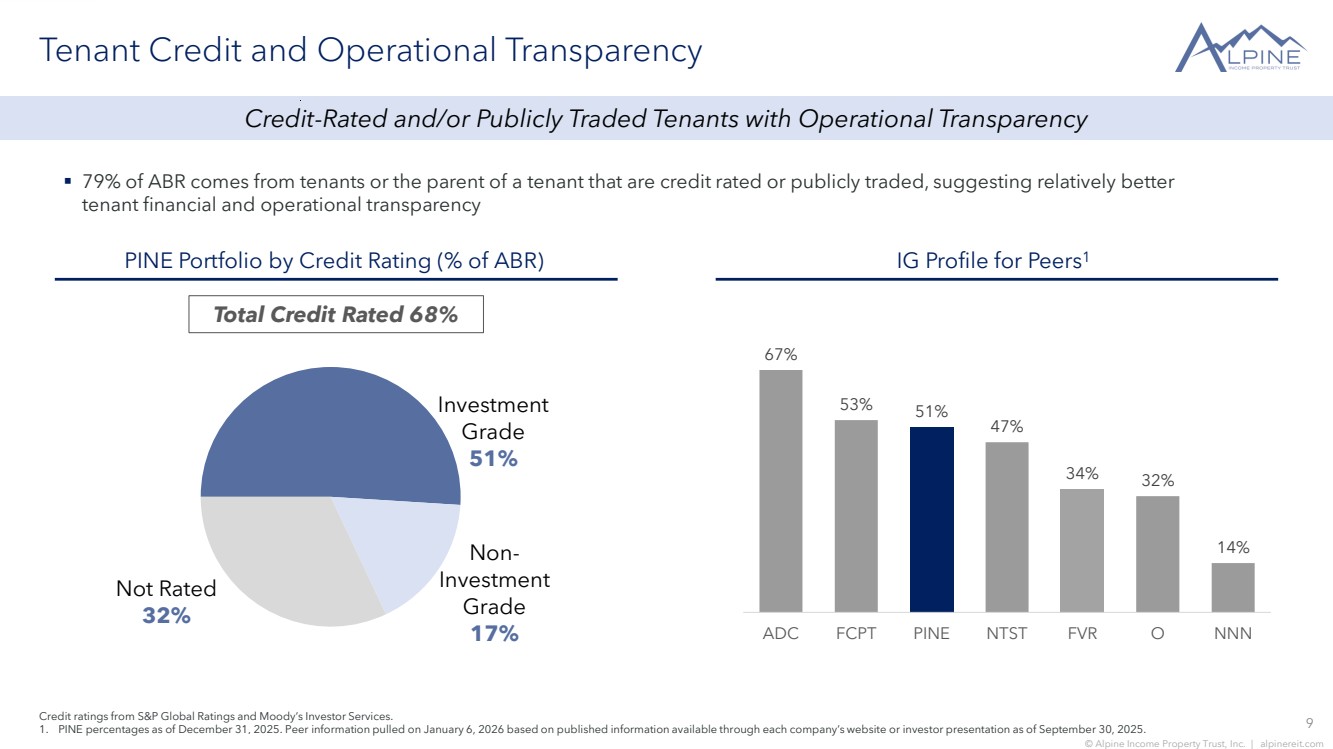
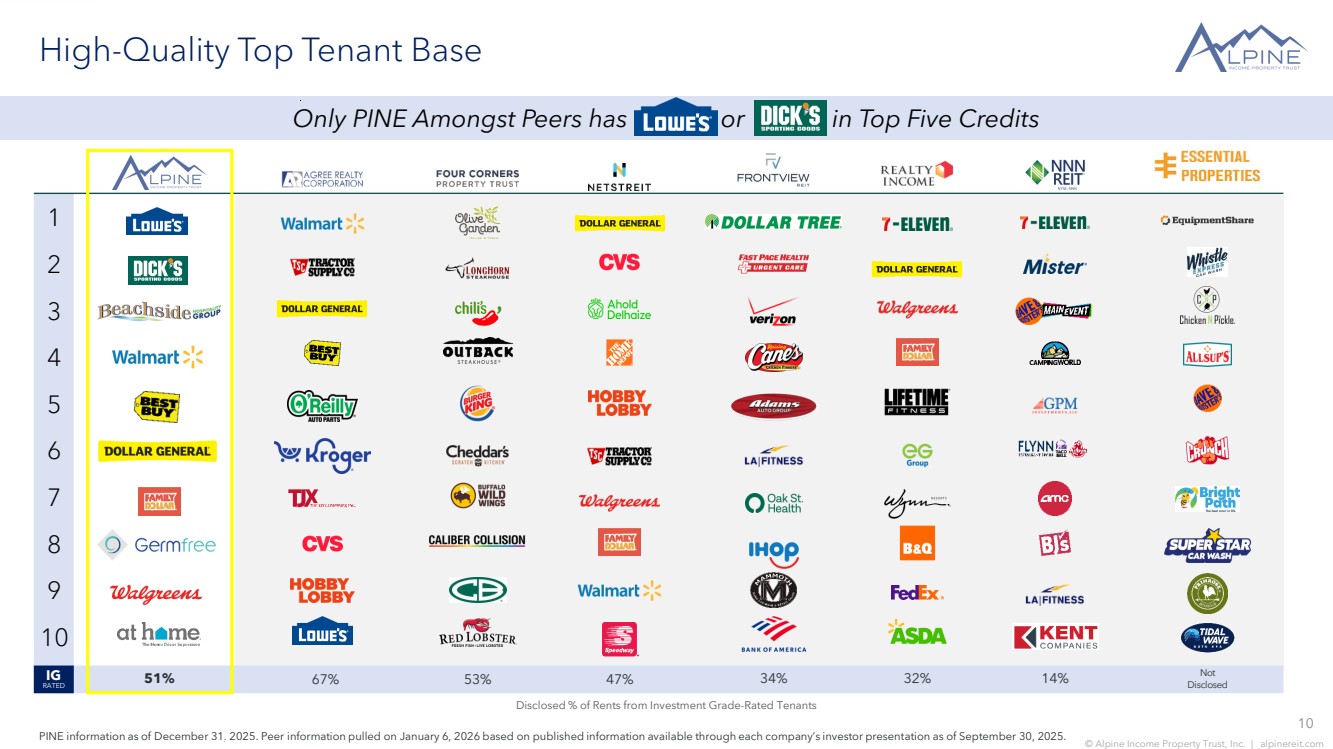
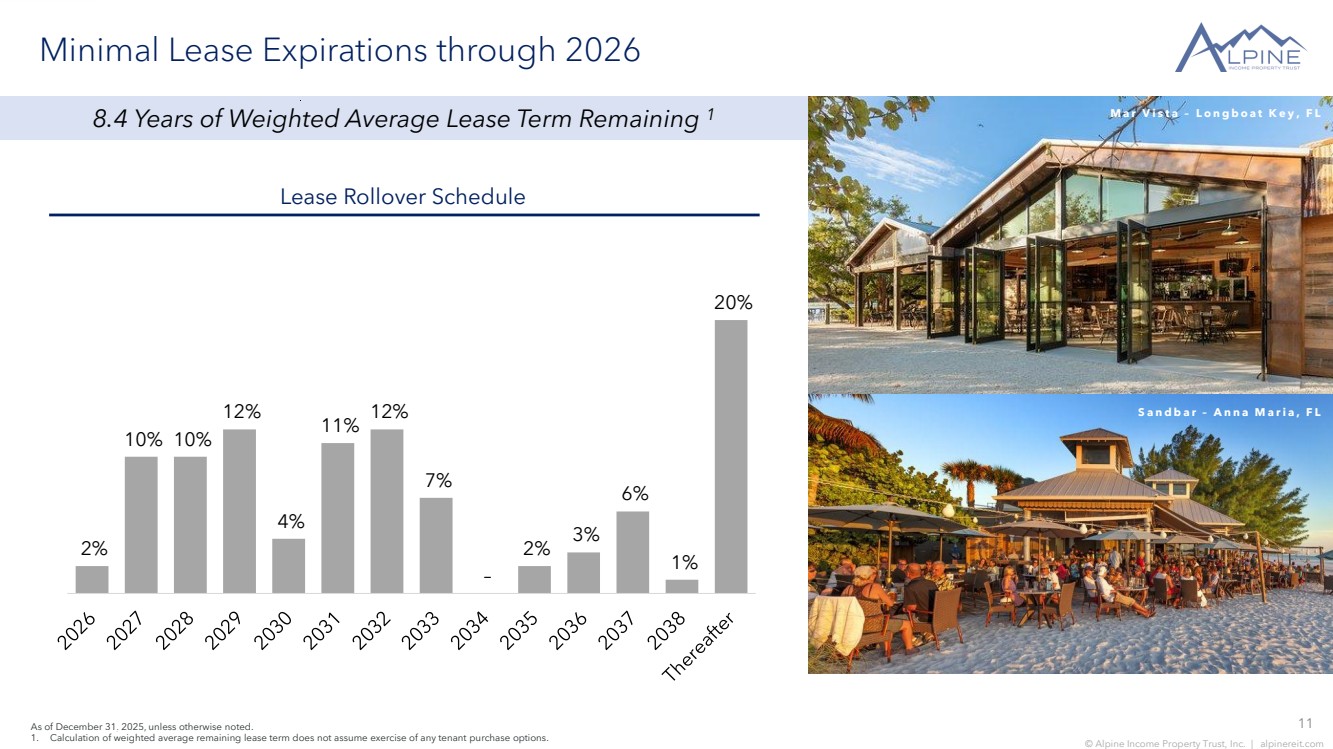
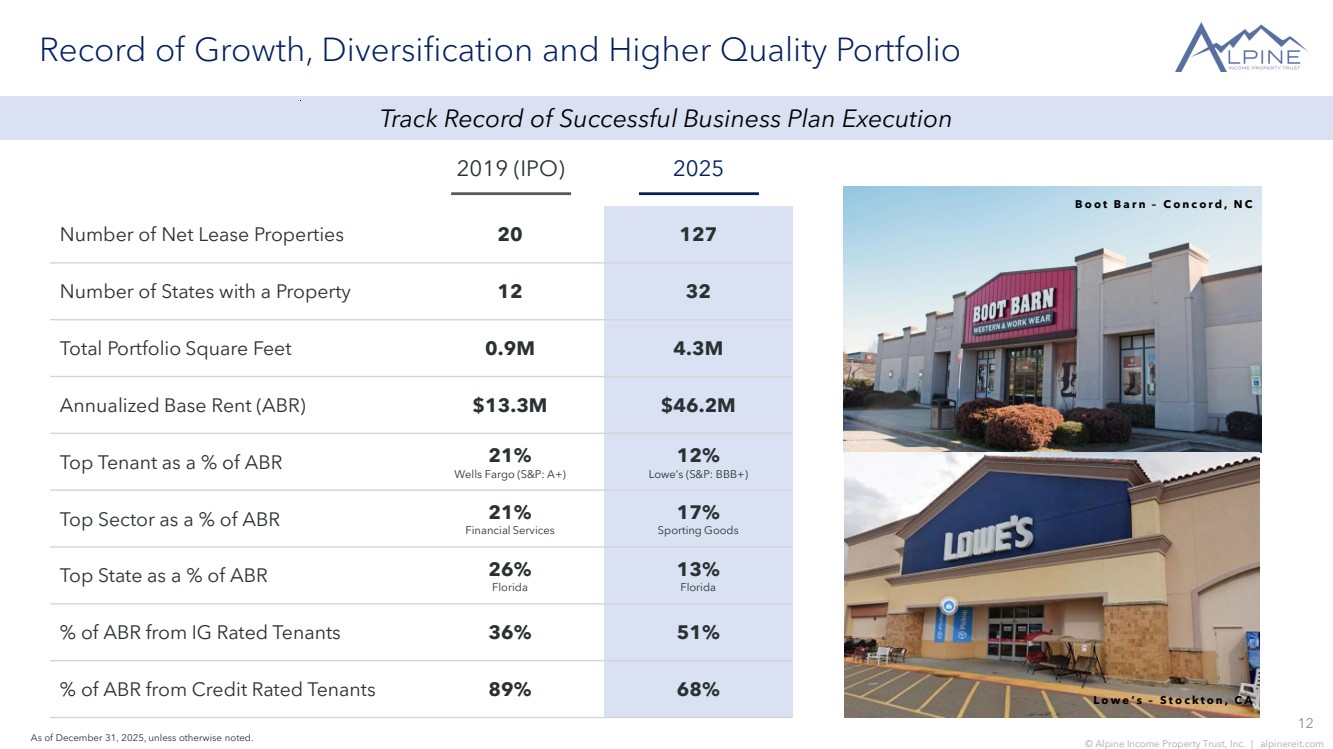
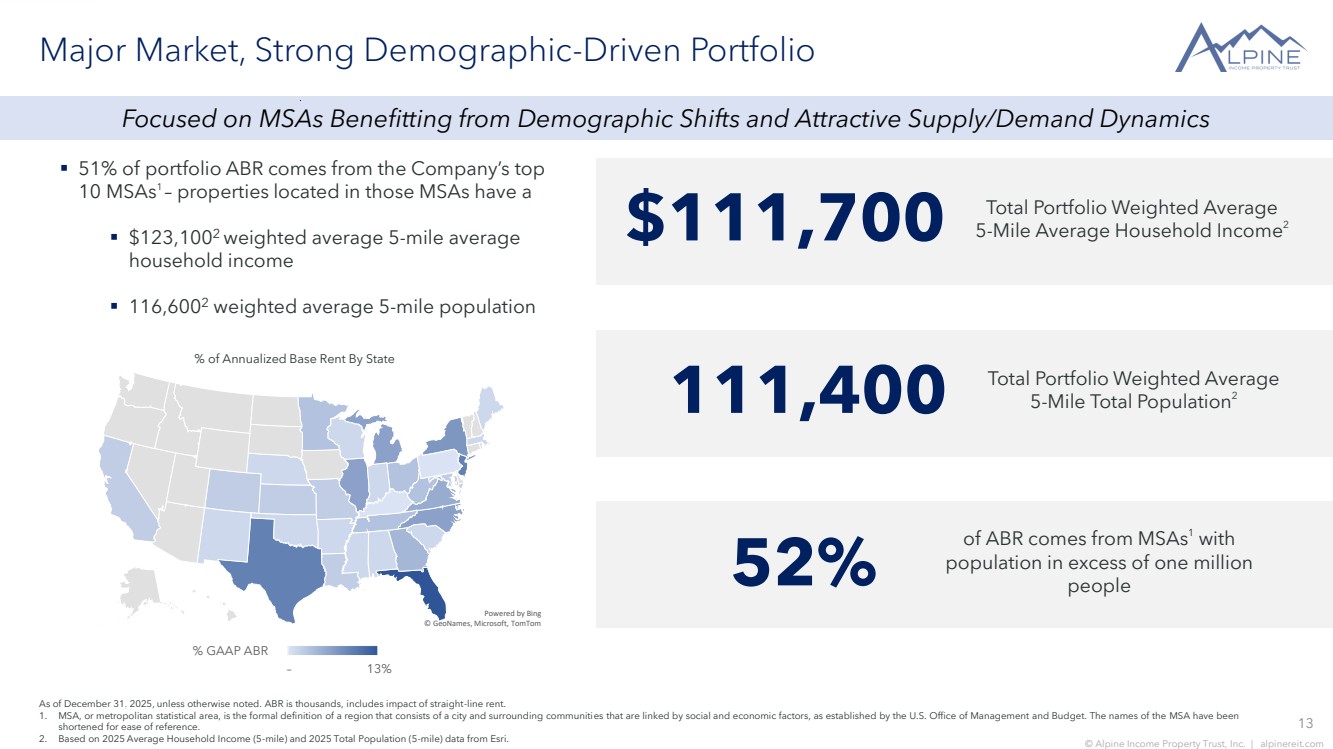
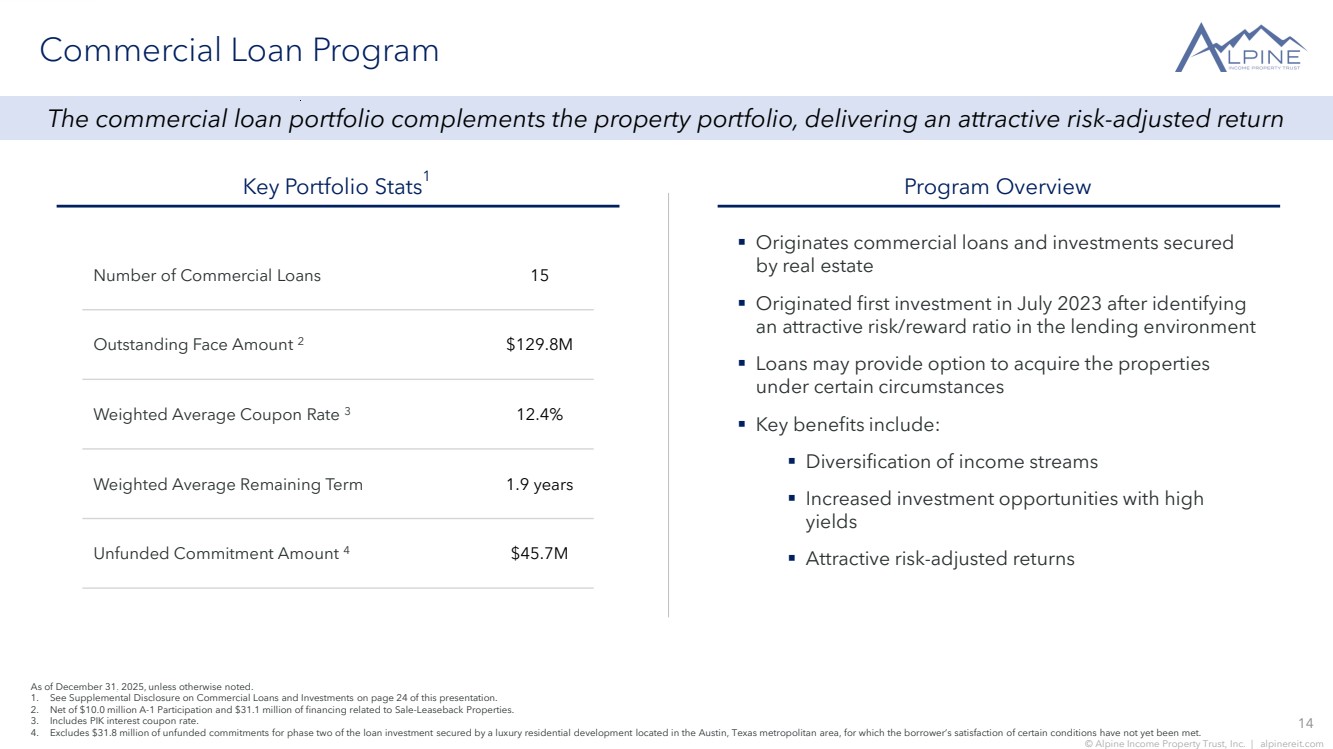
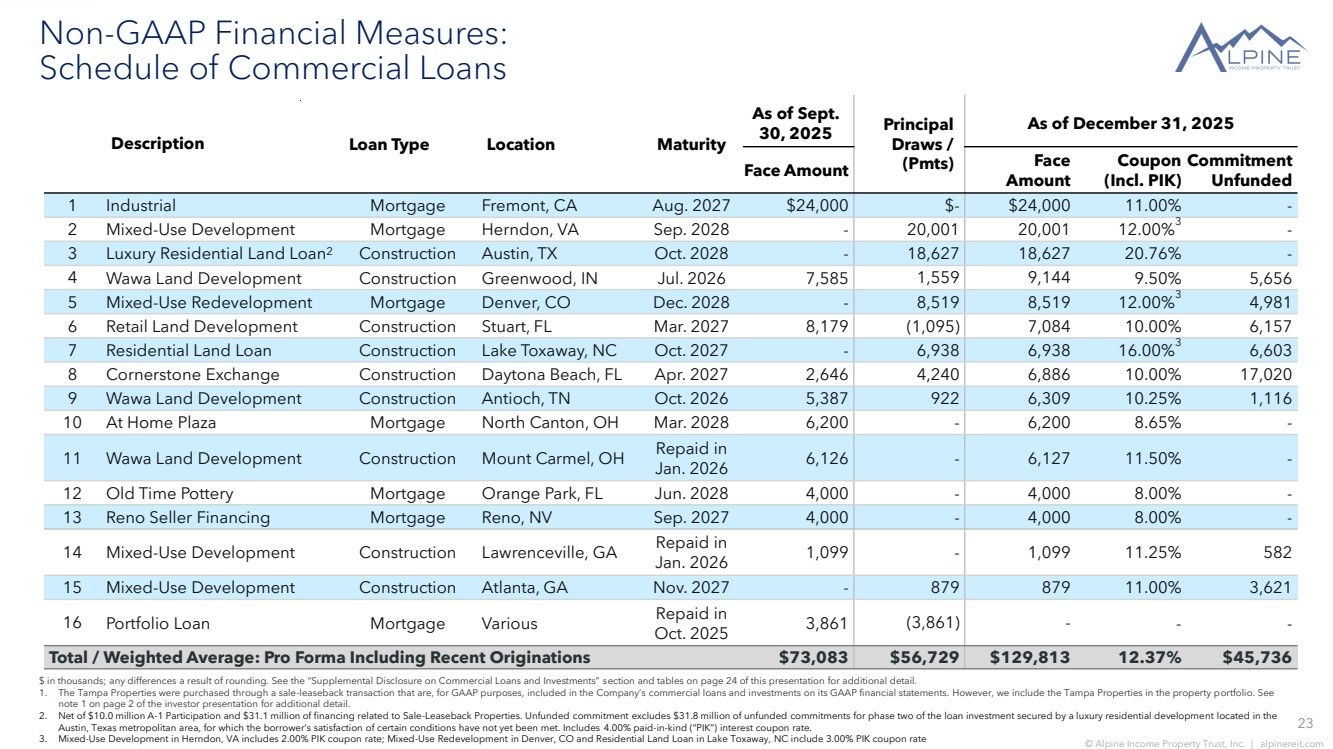
Thank you, Jenna, and good morning, everyone. We are pleased to report a strong fourth quarter highlighted by 22.7% growth in AFFO per common share and $142.1 million of investments to to complete an annual record of $277.7 million of investments for 2025. This record annual investment volume consisted in driving 8.6% growth in AFFO per common share for the full year 2025. Beyond investment volume, we successfully executed on all areas of our business plan during the year. Specifically, as it relates to property acquisitions, during the fourth quarter, we acquired eight properties for approximately $40 million at a weighted average initial cash cap rate of 6.9%. For the full year, we acquired 13 properties for $100.6 million at a weighted average initial cap rate of 7.4%. Notably, these acquisitions are representative of our strategic barbell approach to acquisitions and included investment-grade rated tenants such as Lowe's and Walmart, plus higher-yielding property investments like the headquarters and manufacturing facility for germ-free labs. Alongside this 2025 acquisition activity in the fourth quarter, we also continue to successfully execute our strategic recycling plan, selling nine non-core properties for $38.4 million at weighted average exit cap rate of 7.7%, bringing property disposition volume for the full year 2025 to $72.8 million, consisting of $67.4 million of income-producing properties at weighted average exit cap rate of 8% and $5.3 million related to vacant properties. As a result, this combined 2025 property portfolio activity, 51% of our ABR is now generated from investor-grade rated tenants. Notably, Lowe's, Dick's Sporting Goods, and Walmart are now all within the top five tenants, collectively representing 29% of our ABR. Further, Walgreens currently represents 4% of ABR and has fallen to our ninth tenant, with only five remaining locations in our portfolio. More broadly, at year-end, our property portfolio consisted of 127 properties, totaling 4.3 million square feet across 32 states, with a walt of 8.4 years and 99.5% occupancy. Now moving to the exciting growth in our commercial loan portfolio. As a result of our longstanding reputation in deep industry relationships, we continue to see and capitalize on compelling opportunities to originate high-yielding commercial loans with quality sponsors at attractive risk-adjusted returns. During the fourth quarter, we originated five commercial loan investments and amended one commercial loan, totaling a combined $102.3 million of commitments at a weighted average initial coupon of 13.5%, bringing our full year to $177 million of commercial loan originations and weighted average initial coupon of 12%, including paid-in-kind interest when applicable. The high-quality real estate projects underlying these loans are located in major MSAs, supported by strong sponsors, and have been many years in the making. We are excited to be a part of these projects. Additionally, during the fourth quarter, we sold a $10 million senior interest in a our previously announced commercial loans secured by a luxury residential development located in Austin Texas metropolitan area this sell reduced concentration one of our largest commercial loans from time to time we will likely consider additional cells of senior interests in larger loan investments to efficiently manage diversification while enhancing the yield of our net interest at year-end our net commercial loan portfolio was approximately $129.8 million, up from $48 million at the beginning of the year, highlighting the significant scale and momentum captured by our platform during the past year. Additionally, we are targeting our commercial loan portfolio to generally run at approximately 20% of our total undepreciated asset value, complementing our property portfolio investments and increasing our overall yield on our total assets, although timing of funding and repayments of loan investments may vary quarter to quarter. Combined, completed property acquisitions and loan originations were approximately $142.1 million for the fourth quarter at a weighted average initial yield of 11.7% and $277.7 million for the full year at a weighted average initial yield of 10.3%. The $277.7 million of investments completed was our most productive year in our company's history. To support this level of investment activity, we not only generated capital through strategic asset sales, but also opportunistically accessed the capital markets. In November, we issued a $50 million of a new Series A preferred stock with an 8% coupon. Additionally, late in the fourth quarter of 2025, early in the first quarter of 2026, we utilize both our common ATM and the Series A preferred ATM programs, raising the combined $18.3 million of equity. Lastly, as we look to 2026, we're excited about the outlook for the company. We believe our investment activity, equity raises, and recent debt refinancings for which Phil will provide more details have positioned the company well as we start the new year. Further, our board recently decided to increase our quarterly common dividend per share of 5.3% to $0.30 per share beginning in the first quarter of this year. And with that, I will turn the call over to Phil.
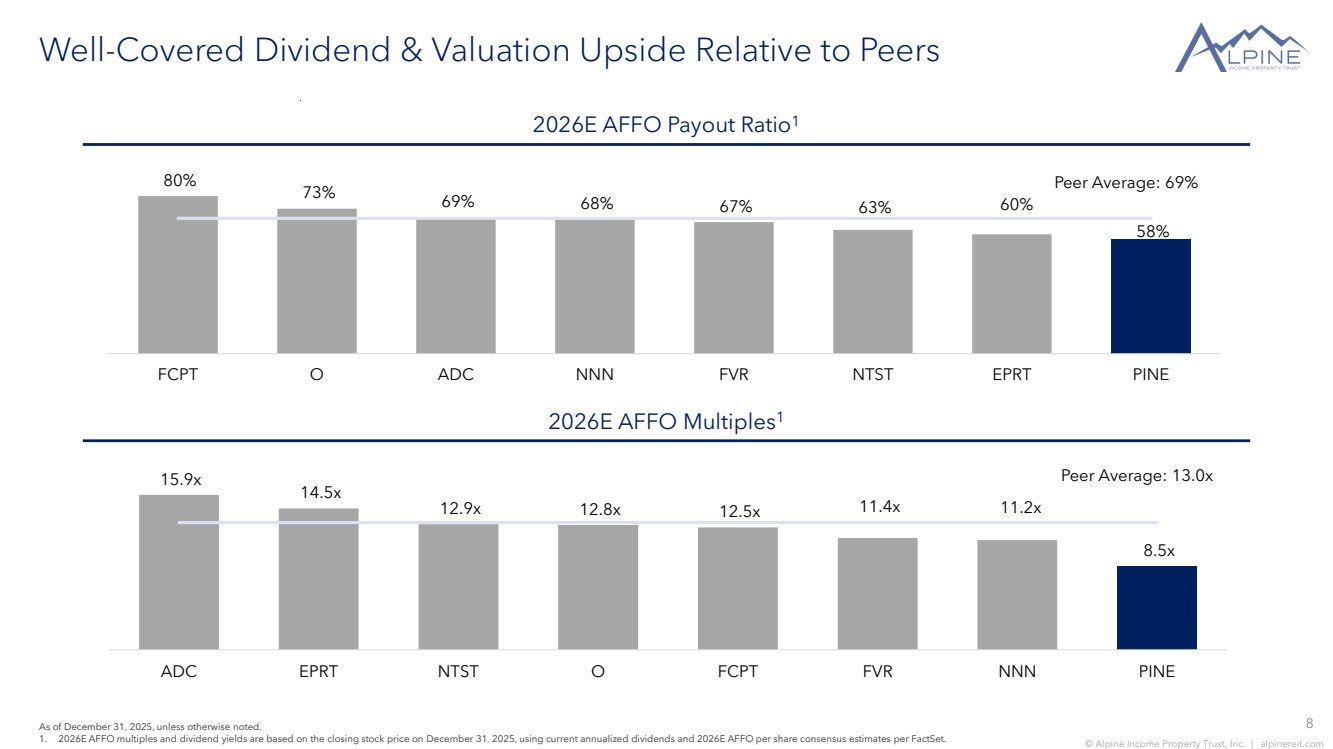
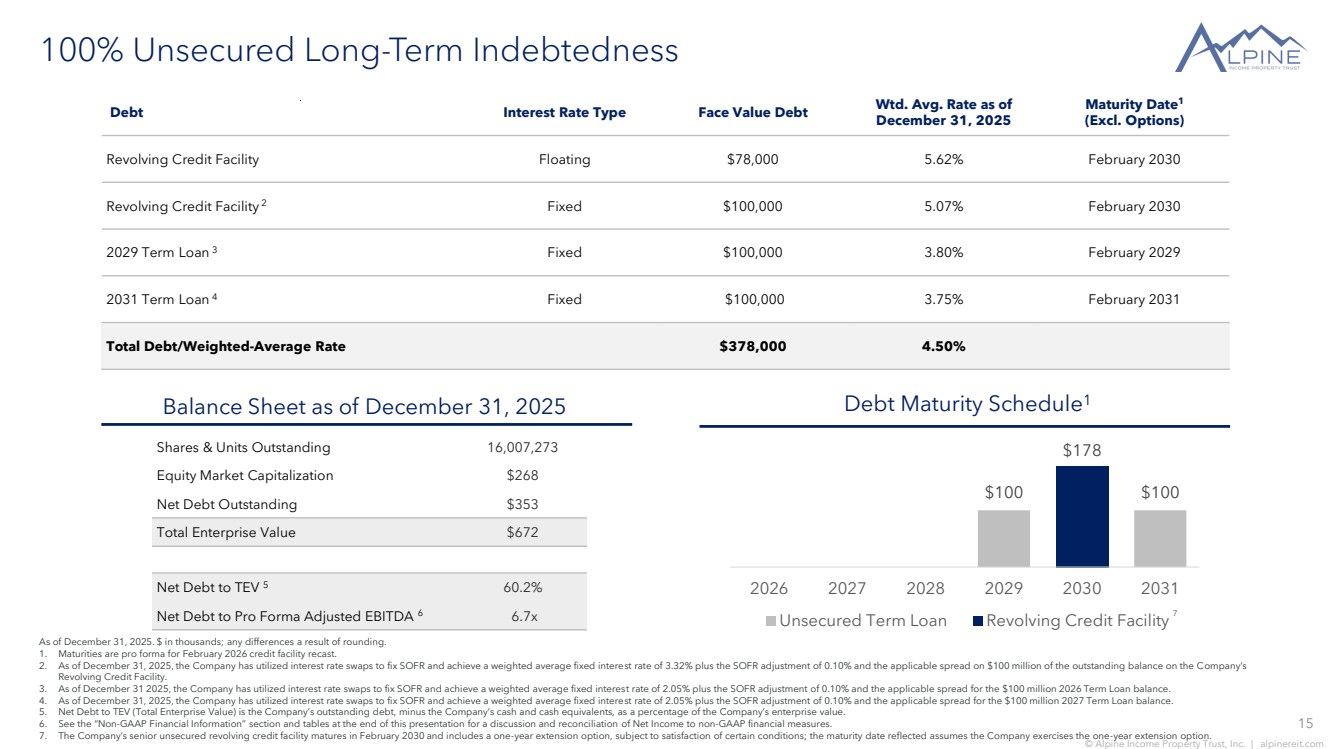
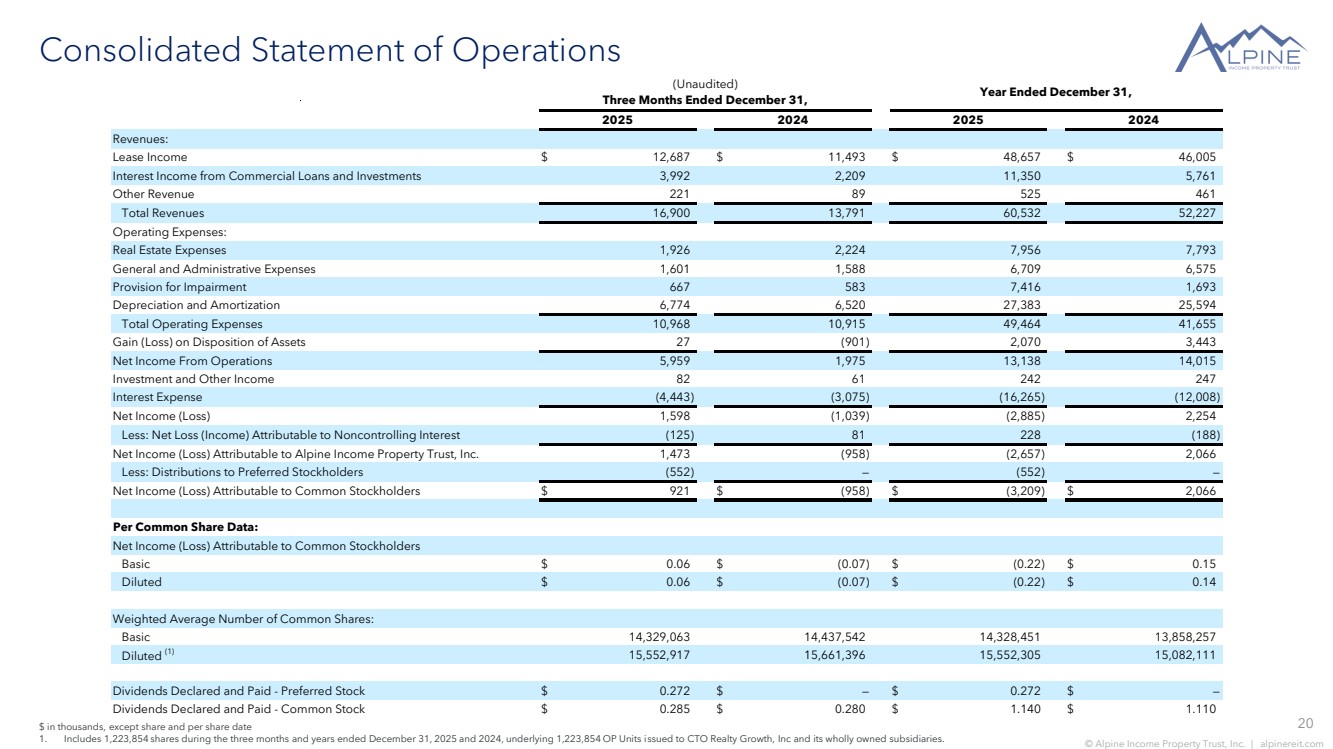
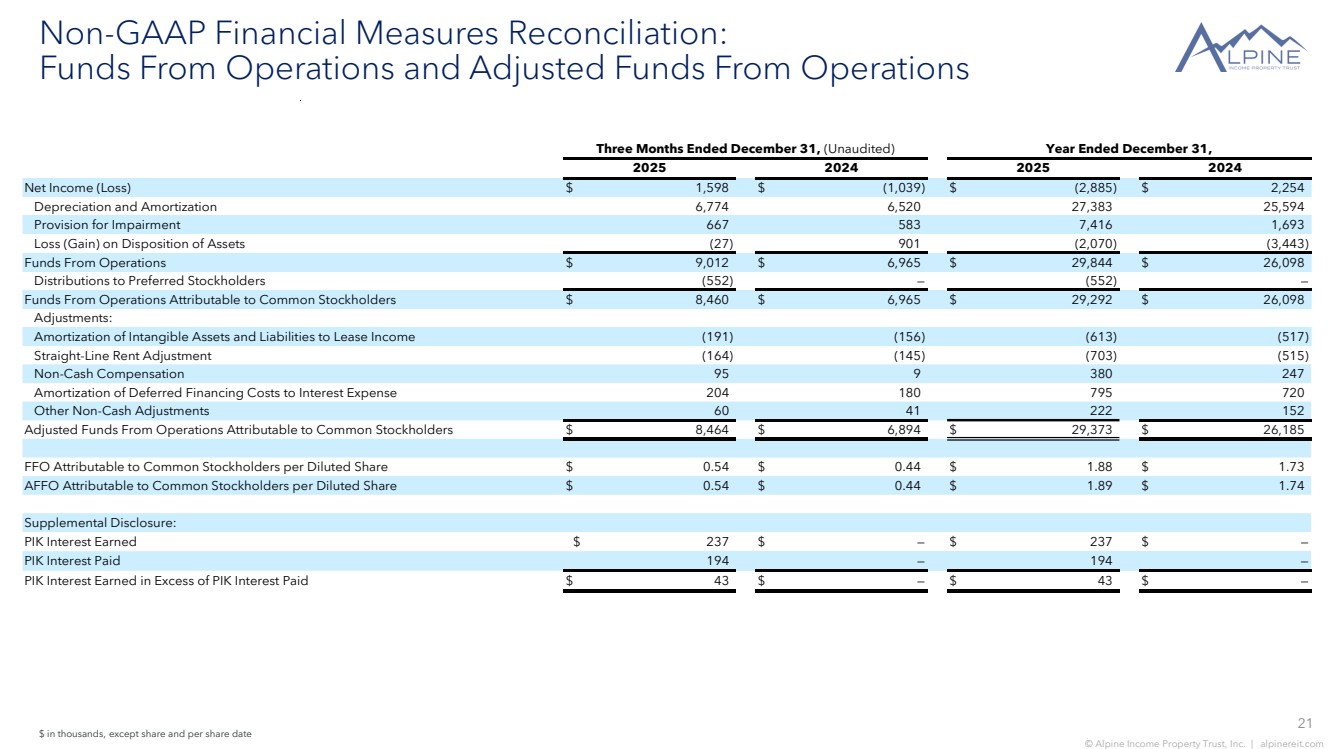
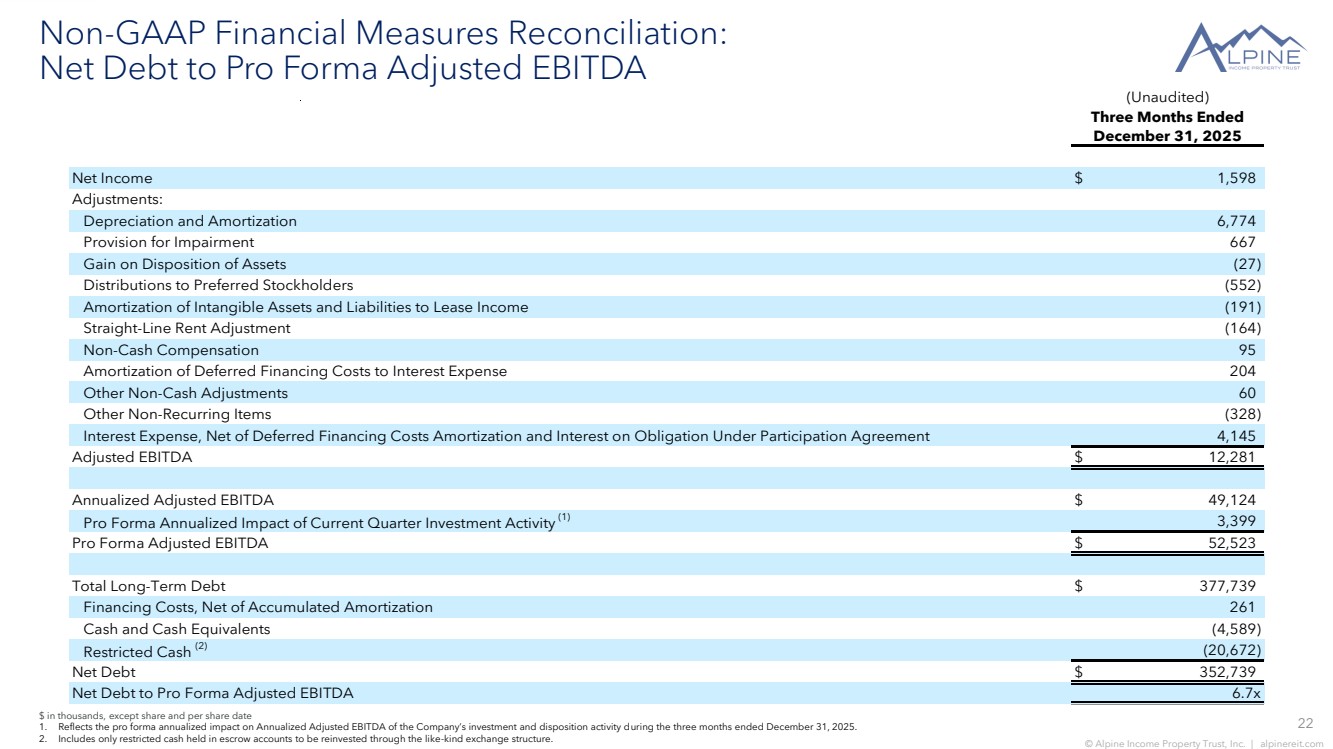
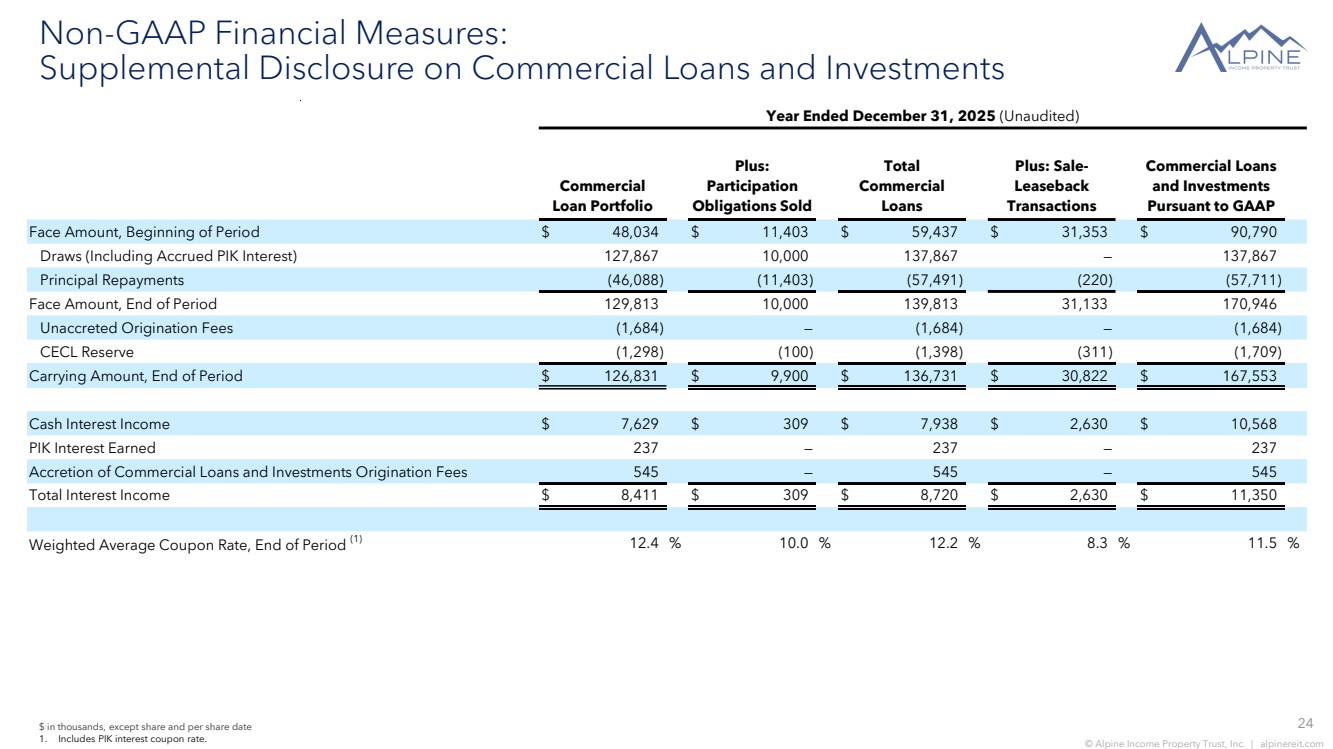
Thanks, John. Beginning with a quick summary of financial results. For the fourth quarter, total revenue was $16.9 million, including lease income of $12.7 million and interest income from commercial loan investments of $4 million. Both FFO and AFFO, attributable to common stockholders for the quarter, were 54 cents per diluted share, representing 22.7% growth over the comparable quarter of the prior year. For the full year, total revenue was $60.5 million, including lease income of $48.7 million and interest income from commercial loan investments of $11.4 million. dollars. FFO and AFFO attributable to common stockholders were $1.88 and $1.89 per diluted share, respectively, representing approximately 8.6% growth over the prior year. Earnings growth for the quarter and the year was primarily driven by the investment activity John discussed combined with disciplined balance sheet management. Moving to the balance sheet, similar to our investment activity, we had significant amount of capital markets activity in the fourth quarter of 2025 and early in the first quarter of 2026. First, on November 12th, we completed a public offering of 2 million shares of Series A preferred stock at a price of $25 per share within 8% coupon. This preferred offering resulted in $50 million of gross proceeds before deducting the underwriting discount and other offering expenses, with net proceeds totaling $48.1 million. We supplemented the preferred offering proceeds with a modest amount of issuance under both our Series A preferred and common equity ATM programs, beginning with our preferred ATM programs. From late fourth quarter to early in the first quarter of 2026, we issued just over 116,000 shares of our Series A preferred stock at a weighted average price of $24.92 per share. for total net proceeds of approximately $2.8 million. Likewise, during this time, under our Cummins stock ATM program, we issued just over 918,000 shares at a weighted average price of $17.13 for total net proceeds of approximately $15.5 million. Additionally, earlier this week, we closed a new unsecured credit facility and completely recast the company's unsecured debt. The new credit facility consists of a $250 million revolving credit facility with an initial term of four years with two six-month extension options, a $100 million three-year term loan, and a $100 million five-year term loan. The proceeds from the new credit facility were used to fully repay and retire the company's prior revolving credit facility and term loans, resulting in the company now having no debt maturities for three years. Further, pricing for borrowings under the new credit facility improved by 10 to 15 basis points, and it provides for more flexibility and borrowing capacity related to our commercial loan investments. Please see our recent press release related to this credit facility for more details. We ended the year with net debt to pro forma adjusted EBITDA of 6.7 times compared to 7.4 times at the beginning of the year. Additionally, we had $65.8 million of liquidity consisting of approximately $25.3 million of cash available for use and $40.6 million available under our revolving credit facility. However, with in-place bank commitments, the availability under our revolving credit facility can expand by an additional $31.4 million as we acquire properties and fund commercial loans, providing for total potential liquidity of $97.3 million at year end. Summarizing our investments at year end, our property portfolio had annualized base rent of $46.2 million on a straight-line basis, and our net commercial loan portfolio had loans with an aggregate base amount of $129.8 million at a weighted average coupon rate of 12.4%. One additional note regarding our commercial loan portfolio. Two loan investments totaling $7.2 million at year-end with a weighted average coupon rate of approximately 11.5% were repaid in January of 2026. Additionally, as we noted previously, Our property portfolio includes approximately $3.8 million of ADR related to three single-tenant restaurant properties acquired in 2024 through a sales-leaseback transaction. Although these properties constitute real estate for both legal and tax purposes, GAP requires them to be accounted for as a financing. Accordingly, current annual cash payments of approximately $2.8 million are reflected as interest income rather than lease income. To provide more information about this matter and our commercial loan program, we have added additional disclosures to our pressure lease, including the supplemental table providing details for both the loan portfolio and related interest earnings. We hope you find this additional information helpful in understanding our investments. Now turning to our 2026 outlook. Our initial earnings guidance for the full year of 2026 is $2.07 to $2.11 for FFO per diluted common share and $2.09 to $2.13 for AFFO per diluted common share. Key assumptions reflected in our initial guidance include investment volume of $70 million to $100 million and disposition volume of $30 million to $60 million. I do want to note that our 2026 guidance in growth and earnings reflects dispositions generally closing earlier than acquisitions. Furthermore, our revenue for 2025 included $221,000 in the fourth quarter and $525,000 for the full year related to fees we received for managing and selling the third-party properties that supported our portfolio loan. During the fourth quarter of 2025, substantially all these third-party assets were sold and the portfolio loan was repaid in full. Accordingly, these fees will not be a significant source of revenue in 2026. One last note. As John discussed, the board has increased our quarterly common dividend to 30 cents per share beginning in the first quarter of 2026. Even with this increase, our dividend remains well covered. Specifically, this new quarterly common dividend rate represents just a 56% AFFO payout ratio as computed on AFFO for the fourth quarter of 2025. With that, operator, please open the call to questions.
Operator
Certainly. As a reminder, to ask a question, please press star 1-1 on your telephone and wait for your name to be announced. To withdraw your question, please press star 1-1 again. Please stand by while we compile our Q&A roster. And our first question will be coming from Michael Goldsmith of UBS. Your line is open, Michael.
Good morning, guys. Thanks a lot for taking my question. First question is on the loan portfolio. it looks like you set kind of an upper boundary of 20% of the portfolio. So let me just talk a little bit about, you know, how you came to setting it at that level, I guess where the loan portfolio stands today relative to that, and then just how much more you can do to kind of hit that max, and if you expect to hit that this year.
Yeah, Michael, it's John. You know, I think that, you know, really 20% felt like that was a reasonable number, not making it too large, of course, and something that, you know, obviously is complementary to the company and the business. So it's really not an incredibly magic number, but it's, you know, low enough where it's not a distraction to our investors and enough to be, you know, interesting investments for sure. And so I'll let Phil talk about kind of where we are. But, you know, as you could see from Phil's comments that, you know, we've already had a couple loans repay. And so that will continue as we do, you know, find sources for new investments as well.
Yeah, Michael. Well, so probably the easiest way to think about kind of where we stand in the runway is John mentioned 20% of total undepreciated assets. So at the end of the year, that would have been $770 million. So 20% is $155 million, $160 million. The portfolio had $130 million or so outstanding. So, you know, kind of runway for another $25 million, $30 million on top of what was outstanding at the end of the year.
Helpful. Thanks for that. And then my follow-up is you continue to reduce your exposure to some of the tenants that aren't in favor while Green has moved considerably down the list, I guess. Where do you stand with that? Is there more work to do? Are you happy with where you're at, just trying to get a sense of, you know, are we at the end of the activity or is there just a little bit more to do? No, there's definitely...
Yeah, thank you. There's definitely a little more to do, and we're actively on selling additional Walgreens now, and so we'll continue chipping away at it, and it'll be gone at some point, but now that we've gotten it way down the list, it's not as sort of like super focused on it. We just want to take our time and find the right buyers and not just sell it just to sell it. So we'll take the cash flow and be prudent about selling them, but we're working on continuing that sales process.
Nice job. Good luck in 2026. Thanks, Michael.
Operator
And our next question will be coming from Jay Cornridge of Cancer Fitzgerald. Your line is open, Jay.
Speaker 7
Hi, good morning. Thanks for taking the question. I guess just following up on that first question about the 20% threshold for the loan investments, that's really been such a strong source of growth for you guys and continues to be. And as a large swath of the investments this past year was focused on that. So I guess even though you've outlined how much more room you have for the 20%, I mean, why not push much greater beyond that 20% threshold? Do you guys, I guess, consider doing that? But do you want to do that as you think about your opportunities in 2026?
No, I don't think we, I mean, certainly we could. I mean, there's enough volume out there, but it's really, you know, not wanting to, you know, flip the script, if you will, as far as, you know, our primary source of the business, which is the net lease properties, core properties. So this business has been, you know, fantastic. It gets us deeper into developer relationships and tenant relationships, and it provides us a source of future net lease investments. And it's very much complimentary, but I don't want it to be sort of a distraction.
Speaker 7
Okay. I appreciate that. And then just one follow-up. You talked about some of the capital raising you did in the fourth quarter, and I wanted to talk about the $10 million on the ATM that you guys tapped. And I'm just curious about how you think about deploying more equity capital at these current stock prices. I guess assessing your cost of equity, I'm assuming that's really being more used for the higher yield divestment loans. So I'm just curious how you think about, you know, deal spreads relative to your cost of capital versus investment loans, just how you target that and think about issuing more.
Yeah, I mean, we'll be prudent about it. But clearly, as you mentioned that, you know, most of it is to fund these highly accretive investments. And so even though the stock price is not kind of where we'd like it, it does work. The math does work. And certainly, you know, as you've seen with many companies that, you know, investors seem to have a lot more interest in companies where there's more liquidity and ability. And so, you know, a lot of you think about it, we bought back a lot of stock last year. And, you know, we're, you know, in essence, reissuing, you know, some of those those shares. So, you know, it's not any sort of, you know, massive dilution sort of activity. It's just being prudent with with funding. You know, some of these are very accretive investments.
Speaker 7
OK, all right. I'll hold it there. Thanks very much.
Operator
And our next question will be coming from Wesley Galladay of Baird. Your line is open, Wesley.
Good morning, everyone. Just a question on the dividend. You definitely raised it again. And when you think about that, is that mainly driven by the earnings growth that you have and having to pay out a dividend that's a little bit higher? And why not try and retain more cash flow?
Phil, I'll let you address that.
Yeah, so it was earnings growth, but also just taxable income growth. So that kind of balanced the two. I didn't catch the last part of your question there, Wes.
Oh, I'm just saying why the one basically increased because you had to pay it out. And just because, you know, you're issuing stock here, just why not just retain more cash flow versus raise the dividend?
Yeah, so it's a lot of it's, you know, growth and taxable income. You know, when you think about the loan portfolio, right, there's no depreciation that goes with that. So even though it's 20% of total assets and the properties make up more, there is no kind of tax cover or depreciation to go with it. So it does help drive taxable income up. So the raise was really just to kind of be where we need to be to pay out taxable income.
Got it. That makes sense. One question on the loan where you have the developer for the phase one. Are you starting to see any lot sales there, and when can you expect to get repaid? And then a follow-up would be, would you expect the second loan to start funding before the first one starts paying off?
Yeah, I mean, the loan's already starting to be repaid as lot sales are happening. And it's really going to – it is going to the senior participation we sold off. uh and and so uh i would not the the loan that we have out now won't be fully repaid by the time that the the second portion is is funded uh but you can expect you know really the the activity on the repayment will probably come more to us you know late spring so it'll really really be going to the first mortgage sort of participation first.
Okay, thanks for that. And then I guess when you look at your pipeline of potential loans, what are you seeing in I mean, you have a big residential loan here. Do you have other sectors that you're looking at to diversify it a bit?
Yeah, so we're really pleased with the pipeline for sure. we're talking about more kind of grocery anchored development and also investment grade credit development with terrific tenants and new relationships. It's old relationships but new relationships for Pine and so we're very excited as we continue to work on the pipeline so more to come. Awesome. Okay, thanks guys. Thank you.
Operator
And our next question will come from RJ Milligan of Raymond James. Your line is open.
Hey, good morning, guys. Just want to follow up on the loan book. John, longer term, as some of these loans are paid off, do you expect to continue to redeploy that capital and maintain that 20% allocation over the next several years, or do you expect that to come down over time?
Thanks, RJ. No, we intend and see the opportunity to keep it at that 20%. You know, the pipeline is very strong right now. So as loans burn off, they will be – we fully intend them to be refilled.
Got it. So this is a longer-term, you know, 20% allocation part of the PIN strategy.
Great. And then, Phil, I just had some housekeeping on fourth quarter, obviously a pretty big number and beat relative to consensus. I think there may have been some one-time items in fourth quarter. I was wondering maybe you could sort of talk about those and sort of how we get to a good run rate going into first quarter of this year.
Yeah, thanks, RJ. there's there's several one-time items in there and just you a good way to see it is when we one of our schedules the debt to EBITDA we have a line item that says non-recurring items in there and it was a little over 300 grand for the quarter that's primarily the management fees that I talked about on my prepared remarks that are going away and then also a prepayment penalty we got from One of the loans that paid off early that made up that 300 and some thousand. So that's a couple of cents that's non-recurring. And then also keep in mind the fourth quarter doesn't have the full burden of the prep outstanding and the management fee that goes with that. So the 54 cents, if you take it down for all those items, you're probably 50, 51 cents on a run rate at the end of the quarter. Great. Makes sense. Thanks, guys.
Operator
And our next question will be coming from Gaurav Mehta of Alliance Global Partners. Your line is open, Gaurav.
Yeah, thank you. Good morning. I wanted to follow up on the balance sheet and wondering if you would comment on your leverage expectations in 2026.
Yeah, I mean, we're pretty happy with where we currently stand, you know, and we're in a nice pricing tier on our debt. so I think you know kind of where we're currently at is about where you know we expect it to run for the year but obviously that depends on the opportunities we see okay second follow-up on on the investment opportunities you in the prepared remarks you commented on following the barbell approach in 26 just wondering if you would comment on on I guess the opportunities that you're seeing both on the investment grade and not investment great part of the portfolio for acquisitions yeah we're very excited
about you know some of the opportunities we see on the net lease side where we have the ability to possibly bring in new investment grade credits further up into the top five top ten tenancy and so we're really you know you know focused on that. And so, you know, we have a good portfolio that, you know, opportunities that we're looking at right now. So, pretty excited about, you know, the composition of the net lease portfolio this year.
All right. Thank you. That's all I had.
Operator
Our next question will be coming from Jason Weaver of Jones Trading. Your line is open, Jason.
Hey, good morning, guys. And congrats on a big year in 25. thank you first first on the uh the acquisition and disposition guide which is down a lot versus 25 with the capital base growing is there anything we can read into that such as you know just taking from a point of conservatism is it some sort of hesitance about market conditions or is there something else that out there yeah you know we just want to be um you know really have a cadence that you know something we feel very very comfortable hitting without having uh such a big number that you feel like you're forced into buying things that maybe you're not too excited about.
So we just want to be real careful on curating a super strong portfolio and not being forced into more commodity assets. I got it.
That's fair enough. And then next, I wonder if you can clue us into the expected funding mix on any new investments and as well as the unfunded commitments, whether that will be done with some combination of ATM draw versus credit facility drawdown, and sort of what mix thereof are you looking to target?
I'll just kind of start off and let Phil dive deeper. But clearly, our mix in the past probably is somewhat reflective of what's going to be in the future. and that's still recycling, still selling down non-core sort of credits and using that for investments. And then obviously we talked about a little bit of the loans naturally maturing and paying off, but then there will be a mix of perhaps the ATM and the line, but keeping everything pretty modest.
Yeah, I mean, John covered it. All right.
That's good color, guys. I appreciate it.
Operator
And our next question will be coming from Craig Cacera of Lucid Capital Markets. Your line is open, Craig.
Thank you, and good morning, guys. Phil, you included the PIC interest earned in the AFFO, and I understand that makes sense this quarter because there was hardly anything that wasn't collected in cash. Is that your expectation for the foreseeable future?
Yeah, I think we'll stick with that. Yeah, well, we also did, Craig, just to be clear on how much PIC is in there, at the bottom of the table, we added a schedule that shows the cash interest and the PIC interest, and we'll continue to also include that, so you'll know exactly what is included. But just felt like that was an easier way to go.
No, that was helpful. I did see that. But changing gears, you know, in your discussions with your developers that still have unfunded commitments, do you expect those guys to pull down most of that capital in 2026? Or I know a lot of those loans mature later in 27 and even 28, but just some thoughts on that.
Yeah, we fully expect that those will be drawn down for sure. It's part of the project. And as the project gets going, that's fully kind of specified for those needs. Okay, thank you.
And in the schedule of your commercial loans, you mentioned that Phase 2 in Austin has some conditions that are unmet. Can you give us some color on what that is and when you think those conditions might be met and the loan is funded?
Yeah, let Phil answer that.
Yes. So, on the funding, probably 2Q. But keep in mind, you know, as with the first phase, you know, we sold off our participation of 10. So, just kind of using round numbers, the first phase was 30 million. The second phase is 30 million. We sold off our participation already for 10 there's likely to be another sell on that and you know so all together you know we might sell off another 10 20 so the net hold might be closer to half but yeah probably late first quarter early second quarter for the second phase funding and simultaneously with that we'll also So probably have some participation cell of 10 or 20, somewhere in that range. Got it.
So that's in the guidance then. Appreciate that. And I guess when that first phase was initially structured, I think it was 17% for like six months and then dropped to 16 for six. Once you sold that participation interest, it's now yielding north of 20%. Can you walk us through the math of how it adjusts net of the participation interest? Is there any change in the way that that loan is going to roll down?
The participation interest has a constant rate of 10%, and that, you know, it hyperamortizes, so that gets repaid first, and then we get repaid second. Is that helpful?
Yeah, I'll probably just circle back to you offline just to make sure I'm getting the math right. And finally, you did mention you amended the loan this quarter. Was that just a loan extension, or can you just give some additional color on that loan? Yeah, it was just an extension. All right, thanks, guys. That's it for me. Appreciate it.
Operator
And our next question will come from John Masaka of B. Riley Securities. Your line is open, John.
Good morning. So maybe just going back to guidance a little bit, And what's kind of the, it can be kind of broad ranges, but expected yield on the investment volume you're kind of putting into guidance? And I guess kind of implied in that question is, how do you see the mix in that expected volume being, you know, demarked between, you know, structured investments versus net lease investments?
I think on the loan side, you know, I talked earlier about the runway being $25 to $30 million. You know, look, it could bounce around a little bit depending on when draws happen, when fundings happen, repayments. But out of that, you know, out of the guidance, you should expect about that much to come from the loan side. And that will probably ramp up over the first half of the year. And then, you know, the balance of the guidance you can expect to be on the property side.
Kind of where do you think that puts you from a yield perspective or where do you think yields are today for structured loans and, you know, the type of net lease investments you're looking at?
Yeah. So, you know, in the current book and what's expected, the fund, you know.
You know, the yield, the loan yields really are not too dissimilar to what we've done in the past. so there's really no tightening in the market, if you will, even though there's a lot of capital out there, as we all know. It's just that the flexibility structure and the quickness of how we can react to opportunities leads to the little bit higher rates that we're able to achieve.
Yeah, the rate at the end of the quarter is a decent rate to use for the balance of the Okay.
And I guess on the net lease side, kind of where are you seeing cap rates today? I know you closed something subsequent to quarter end at an 8.5, but is that maybe a little higher than what's your target in the market today, or is that kind of indicative of what you can invest at?
No, you know, on the more, you know, investment grade sort of properties that we've been looking at, you know, it'll be lower than what we just did on that acquisition in Aspen. But, you know, very similar to the Sands Club we purchased and so forth. So I would say on cap rate direction, certainly for quality properties, it's still very tight. But a lot of the investments we've made in the past five years, we'll look at really strong real estate, very strong MSAs and maybe have a shorter lease duration where the likelihood of a tenant renewing is very high because the rental rates they're paying are very, very low. So they're almost like covered land plays. And we can get those at obviously higher yields than if it was like a fresh 15-year lease. And so that's where we like to play where we're picking up investment grade credits in large MSAs at way below market interest rates. And so those cap rates will still be similar to kind of what we did last year as well.
I appreciate that, Culler. And then maybe on the – you mentioned it in the context of the Austin structured investment, but are there opportunities for more participation interest sales on other structured loans in the portfolio or other deals that maybe are kind of contemplated in guidance?
I mean, we could sell off, you know, a lot if we wanted to, but we, I mean, they're fantastic loans, and we'd rather, you know, hold them all, but we will certainly sell senior participations to fund activity if we need to.
I guess, as it pertains to kind of as you're seeing the world today, it's Austin's going to be primarily where that comes from?
I'm sorry, I missed that last point. Can you say it one more time?
Well, just, I mean, you mentioned kind of what you were expecting to do on the participation interest sales side with the Austin structured investment. Is that kind of all that's really contemplated as we stand today?
As we stand today, and that's really, you know, we're really doing it as an accommodation for them, you know, coming in early on. Otherwise, you know, we wouldn't even want to sell that participation, but certainly want to be good counterparties and, you know, keep that participation investor, you know, there in case we'd like to do another one.
Makes sense. That's it for me. Thank you very much.
Operator
And this concludes today's program. Thank you for participating. You may now disconnect.