Operator
Good day, and welcome to the ProPetro Holding Corp. second quarter of 2026 conference call. Please note that this event is being recorded. I would now like to turn the call over to Matt Augustine, ProPetro's Vice President of Finance and Investor Relations. Please go ahead.
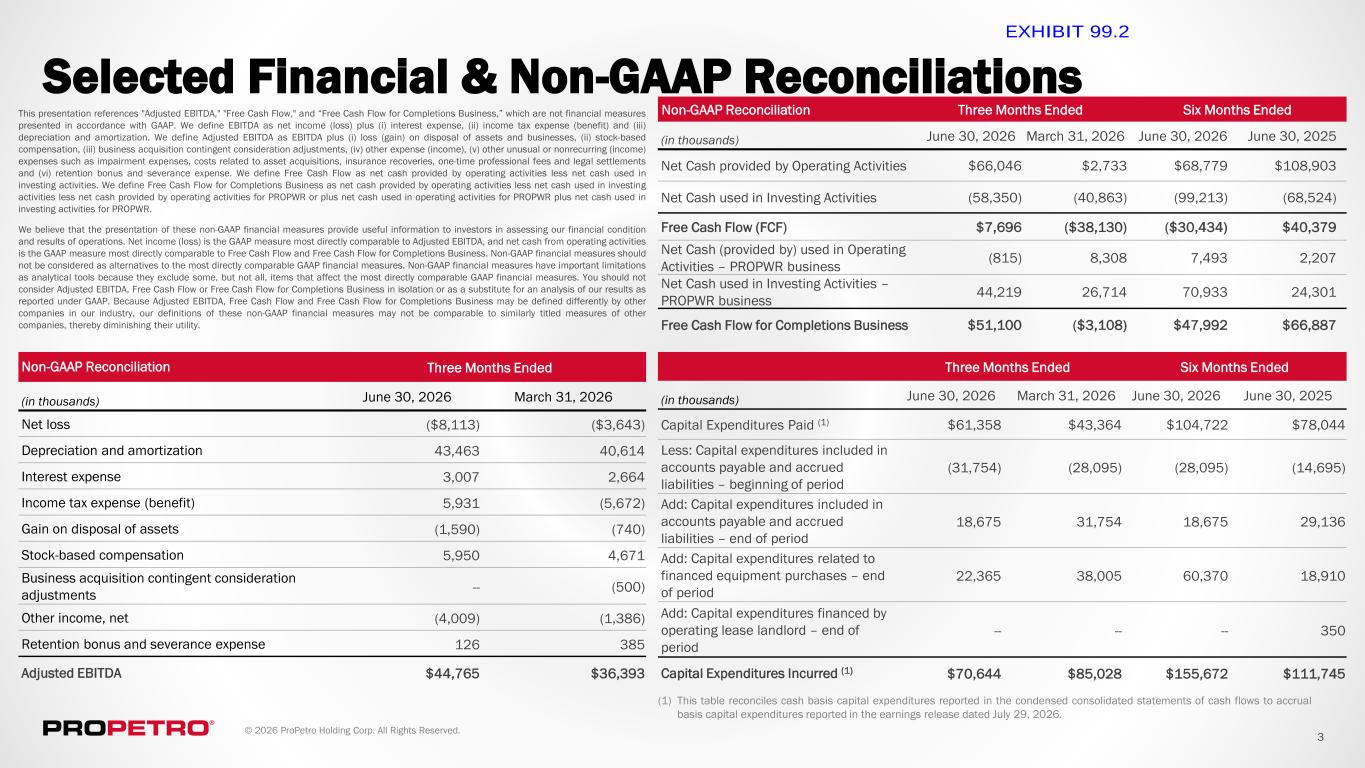
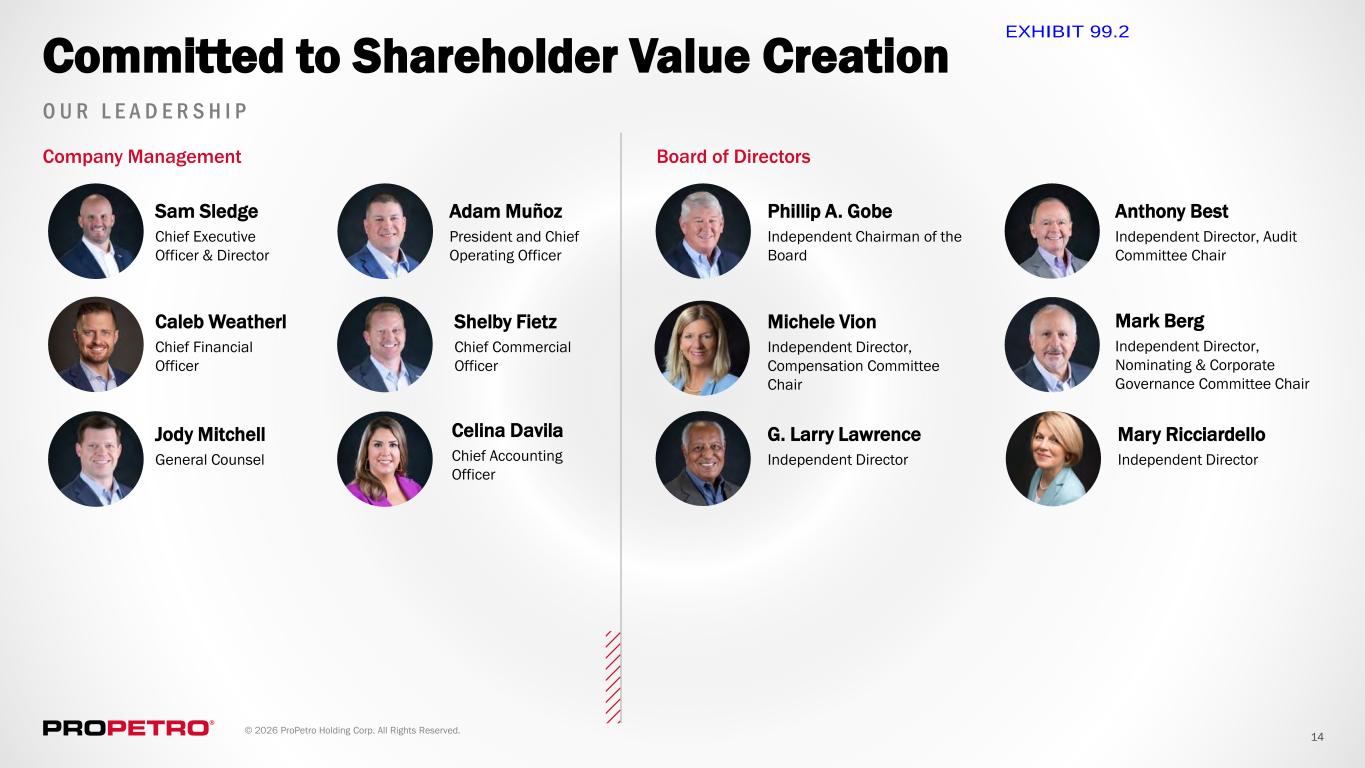
Thank you, and good morning. We appreciate your participation in today's call. With me are Chief Executive Officer Sam Slez, Chief Financial Officer Caleb Wetherall, President and Chief Operating Officer Adam Munoz, and President of ProPower Travis Simmery. This morning, we released our earnings results for the second quarter of 2026. Please note that any comments we make on today's call regarding projections or our expectations for future events are forward-looking statements covered by the Private Securities Litigation Reform Act. Forward-looking statements are subject to several risks and uncertainties, many of which are beyond our control. These risks and uncertainties can cause accurate results to differ materially from our current expectations. We advise listeners to review our earnings release and risk factors discussed in our filings with the SEC. Also during today's call, we will reference certain non-GAAP financial measures. Reconciliations of these non-GAAP measures, the most directly comparable GAAP measures, are included in our earnings release. Finally, after our prepared remarks, we will hold a question and answer session. With that, I would like to turn the call over to Sam.
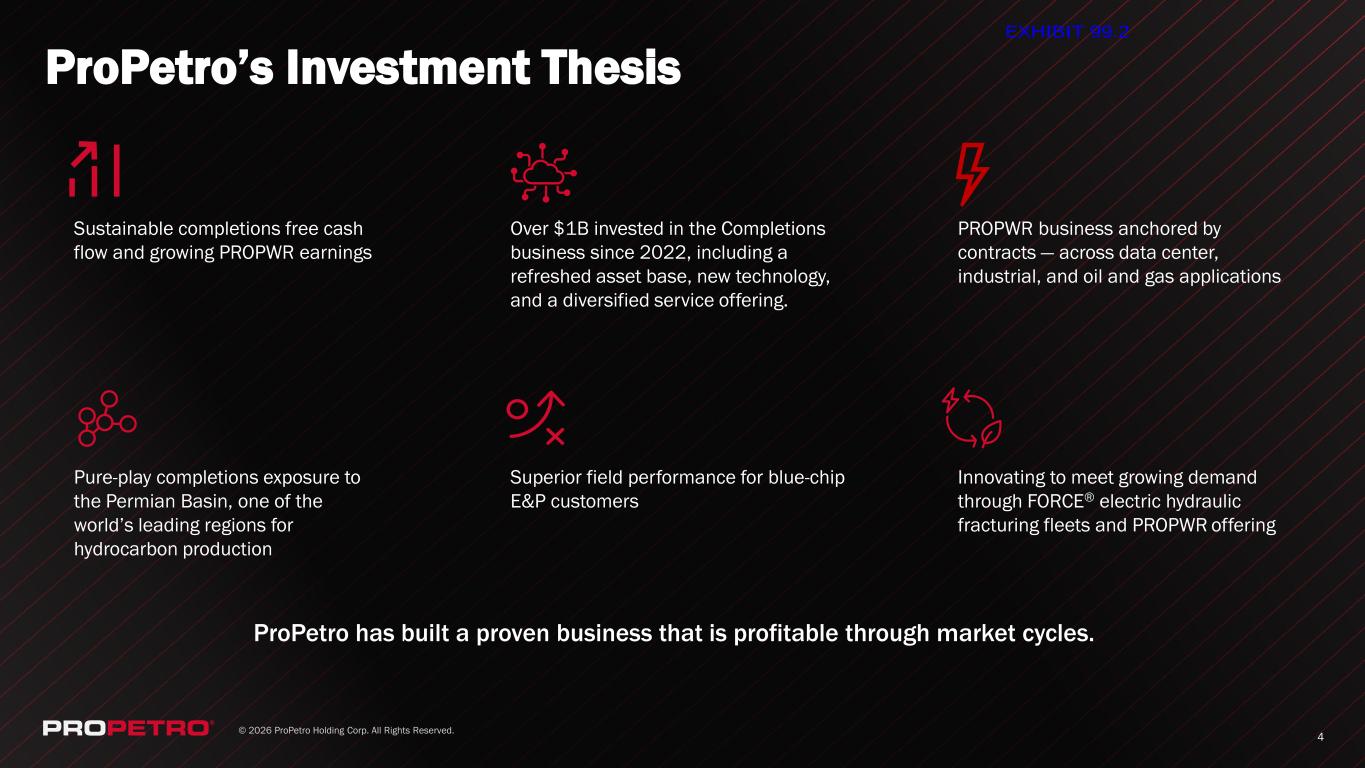
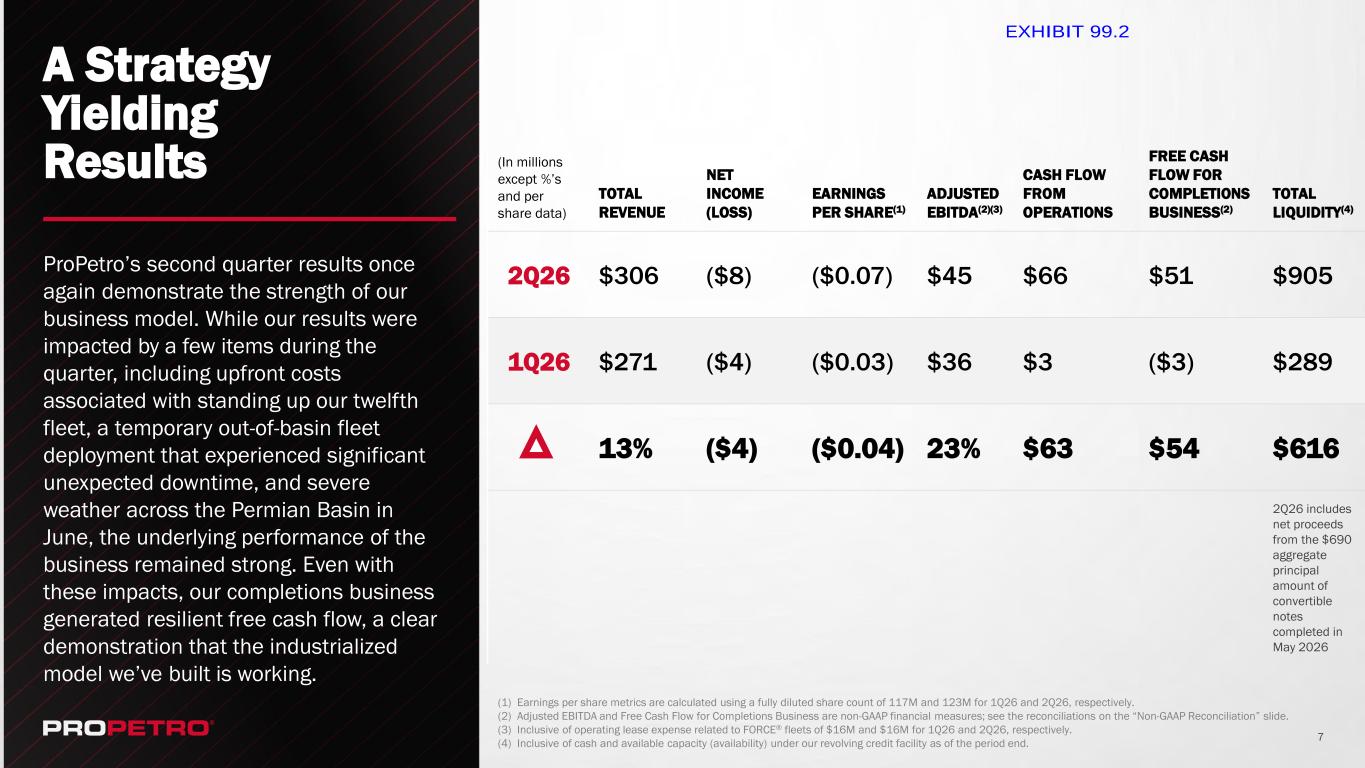
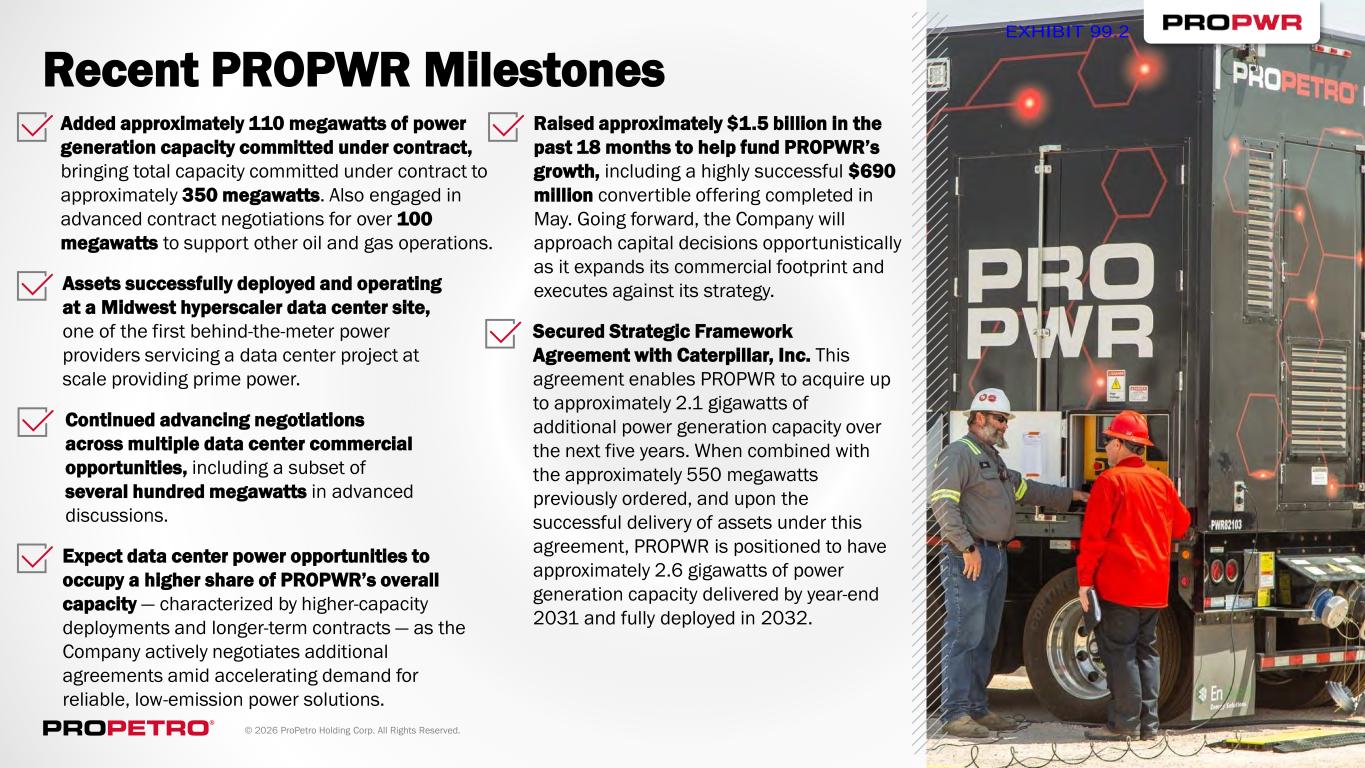
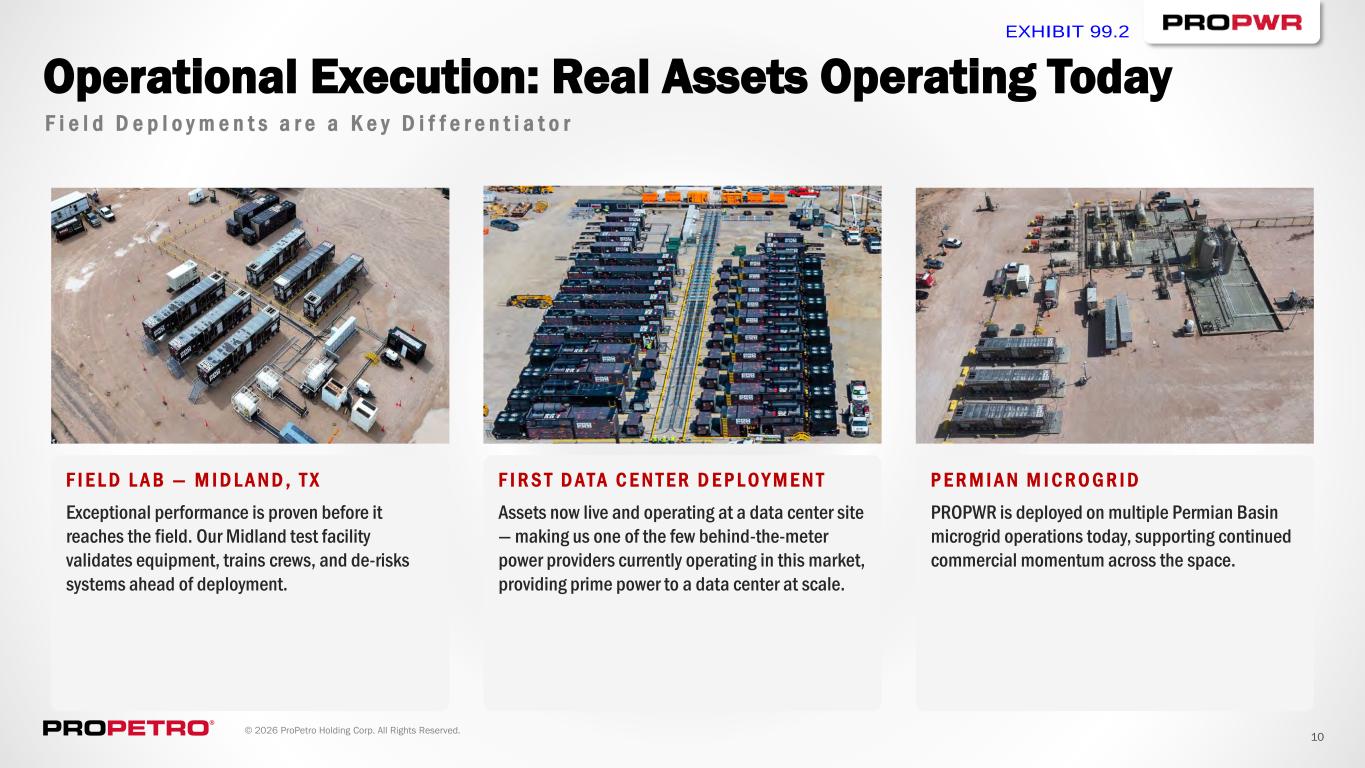
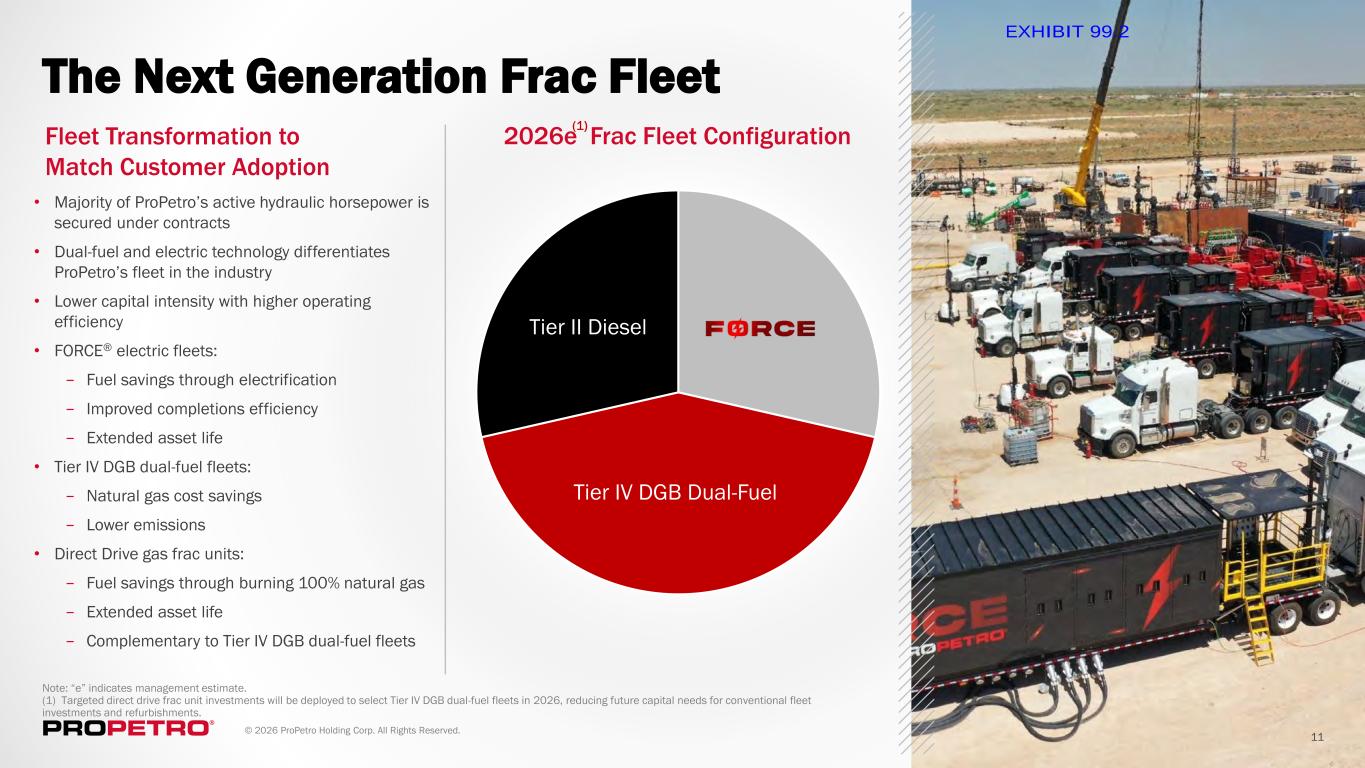
Thanks, Matt, and good morning, everyone. Our second quarter, 2026 financial results, once again demonstrated the strength of our business model. While our reported results were negatively impacted by a few items during the quarter, the underlying performance of the business remained strong, giving us confidence as we move through the third quarter. Our completion business generated resilient free cash flow again in the second quarter, which we believe is one of the clearest demonstrations that the industrialized model we've built is working. Our disciplined approach to capital deployment, operational efficiency, and cost management, paired with strategic actions we've taken over the past several years to optimize our asset base, continue to produce attractive cash flow in positions as well as the market conditions improve. We will continue leveraging the industrialized nature of our completions business to support the expansion of ProPower while maintaining disciplined capital allocation across the enterprise. Now, let me quickly touch on some of the headwinds that impacted the quarter. During the second quarter, we increased our active fleet count from 11 to 12. As we've discussed previously, standing up a new fleet requires up-front maintenance and deployment costs before the full earnings benefit is realized. We also temporarily deployed an existing fleet outside of the Permian to support a limited-scope FRAC program for a long-standing customer. The program experienced significant unexpected downtime before the fleet recently returned to the Permian Basin. That work, together with severe weather across the Permian in June, created unexpected operational disruptions across a portion of our fleet and impacted our quarterly financial results. As we look in this third quarter and beyond, we're encouraged by what we are seeing from both our customers and the broader market. This is reinforced by increased drilling activity, with the Permian Basin rig count up nearly 10% off of its first quarter low, according to Baker Hughes, a leading indicator that supports the strength we're seeing across the market. That confidence is also reflected in our decision to activate a 13th fleet, which we expect to begin contributing toward the end of the third quarter. We've remained disciplined throughout this cycle, and our capital allocation philosophy hasn't changed. We will only deploy additional horsepower when we see durable customer demand in an economic environment in which we can generate attractive long-term returns on our investments. Turning to the broader market environment, we acknowledge the significant macroeconomic uncertainty given the ongoing conflict in the Middle East. that said these recent events have emphasized something that was already taking place across the north american completions market even before the iran war started we've talked for several quarters about how market cycles create opportunity for discipline operators and after several years of depressed returns many smaller and less disciplined competitors were unable to sustain their operations through a prolonged downturn. As a result, the industry has consolidated through attrition, and much of the excess frack capacity that was weighed on the market has largely disappeared. As activity is stabilized, customers are increasingly recognizing just how many frack fleets have exited the market, and that's leading to increasingly constructive conversations around demand and pricing. While it's still too soon to know the full implications that the conflict in the Middle least, ultimately have on the global energy markets, early observations appear positive for our business. The floor appears to have risen for commodity prices, and that's translating into a more constructive operating environment. As a result, we're beginning to see positive pricing momentum across our completions business, particularly for our next generation natural gas burning fleets, where demand remains exceptionally strong given today's diesel versus natural gas prices. Industry-wide, next-generation natural gas-burning fleets are effectively sold out, while available Tier 2 diesel equipment has also become increasingly limited. Today, the majority of our active frack horsepower is contracted, with most of these contracts scheduled to renew over the next six to nine months. because a significant portion of that contracted horsepower consists of natural gas burning equipment. We're optimistic about the pricing and recontracting opportunities as the market fundamentals continue to move in our favor. We're also seeing improving economics for our diesel fleets as the overall market tightens. Finally, we still estimate that the Permian Basin is currently operating at roughly a mid-70s frack fleet count. Importantly, we believe it would be very challenging to see the active fleet count return above the mid-80s without meaningful reinvestment and growth rather than replacement capacity. At this time, we do not expect that growth reinvestment to materialize. In our view, the industry is structurally tighter than many appreciate. The barriers to adding meaningful new supply remain high, and we expect that environment to persist. Now moving to pro-power. We've continued to make meaningful progress across the business since our last update, both commercially and operationally. Most notably, we've increased our contracted power generation capacity since our last earnings call, growing from approximately 240 megawatts to 350 megawatts committed under contract today. We believe that's a significant milestone and further validates both the demand environment and the commercial momentum we're seeing across the business. Those incremental awards include approximately 110 megawatts of power generation capacity committed under contract across two separate projects, one supporting a leading integrated upstream operator in the Permian Basin, and another supporting a separate industrial customer. We're also engaged in advanced contract negotiations for an additional over 100 megawatts to support other oil and gas operations. These awards validate that demand for reliable, lower-emission power solution extends well beyond data centers. We're seeing meaningful opportunities across the oil and gas industrial markets as well. Importantly, while contract terms on these agreements are generally a little shorter in duration than those pro-power is pursuing in the data center arena, The pricing and expected annual returns are highly attractive and accretive to the overall return profile of the pro-power business as it continues to scale. That being said, we still continue to expect the majority of our future power capacity to be deployed within the data center market. As a reminder, a significant portion of our strategic framework agreement with Caterpillar includes highly efficient, stationary large natural gas engines purpose-built for data center and similar high-density applications, a meaningful differentiator that supports our commercial and operational advantages in this market. Importantly, we have pro-power assets currently deployed and operating live on a data center project and meeting all performance obligations, making us one of the few behind-the-meter power providers currently operating in this market, providing prime power to a data center at scale. That's a meaningful milestone that reinforces what we've been saying for several quarters. We're executing in the field, not just talking about opportunities. Having assets successfully operating in the field strengthens our commercial position and provides customers with tangible examples of our execution capabilities as we continue pursuing additional opportunities. This operational progress is already translating into financial results. Pro Power generated positive EBITDA in each of the final two months of the quarter, a notable achievement this early in the company's life. This is an exciting milestone as we scale deployments across multiple sites through the end of the year and into next year. Accordingly, we've also continued to make meaningful progress across our data center commercial pipeline, which includes a subset of several hundred megawatts currently in advanced negotiations. We also want to acknowledge that some of our discussions with data center developers and operators are taking longer than we originally anticipated. And frankly, it's not surprising now knowing the given size and duration of these agreements. These are generally very long-term commitments involving significant capital on both sides. So both the customers and ProPetro are spending considerable time evaluating contract structures, project timing, and risk allocation, but demand has not wanged. Interestingly, the strong demand we're seeing for our assets can actually lengthen the contracting process because we're focused on matching available capacity with the right long-term customers rather than simply signing the next available agreement. As project timing evolves across multiple opportunities, Available capacity then shifts as well, creating new opportunities in some cases while extending timelines in others. We will remain disciplined throughout this process, prioritizing real, actionable opportunities and agreements, whether they're shovel-ready or already have shovels in the ground, that create the most long-term value for our shareholders. That said, we continue to see near-term momentum across our pipeline, including the contracts announced this quarter. and expect that momentum to continue through 2026. As we deploy capital to grow ProPower, we're proud of the work we've done to position ProPetro's capital structure to support that growth. From a financing perspective, we've now raised approximately $1.5 billion over the past 18 months to help fund ProPower's growth, including our highly successful offering of $690 million aggregate principal amount of convertible notes completed in May, which resulted in 0% coupon notes with no dilution for shareholders until the stock price reaches $29.49 per share after taking the effect of the associated cap call transaction into account. Going forward, we'll approach future capital decisions opportunistically as we continue expanding our commercial footprint and executing against our strategy. Most importantly, we're excited to pair this capital with a well-defined plan to grow our asset base under our long-term Caterpillar framework agreement, giving us clear visibility into both costs and timeline of our equipment deliveries and deployments. We're extremely excited about the direction of the pro-power business. The progress we've made commercially, operationally, and strategically continues to validate our long-term vision, and we look forward to sharing additional milestones soon. I'll wrap up now with a quick summary and then hand it off to Kayla. First, in the completions market, we like what we're seeing across our active frack fleets and we're excited to activate our 13th fleet later this quarter. We have strong visibility through the remainder of 2026 for these fleets and we're pleased with the improving fundamentals we're seeing across the market. On the other side of our business, ProPower continues to build meaningful momentum as we focus on discipline execution, successful deployments, and continued de-risking of our operation. We believe this approach is building a strong foundation to support sustainable, profitable, long-term growth. We continue to expect ProPower to begin generating increasingly meaningful earnings during the second half of 2026 and end of 2027 as deployments accelerate. Stepping back, the strategy we've been executing over the past several years continues to gain attractive. Our completions business generates strong free cash flow and provides the financial foundation to help fund ProPower's expansion, while ProPower represents a differentiated growth platform well-positioned to capitalize on rapidly growing demand for reliable low-emissions power solutions. Importantly, ProPetro is executing from a position of strength, pursuing value-enhancing growth opportunities backed by a demonstrated business model. We maintain a healthy balance sheet capable of funding ProPower's continued expansion while preserving financial flexibility. At the same time, tailwinds are materializing across our completions business as supply titans and demand for our distributed power solution continues to excel. Despite the operational headwinds experienced in our completions business during the second quarter, we're encouraged by what we're seeing as we move into the back half of the year. With a first-class customer base, a first-class team, and a disciplined strategy that continues to deliver results, we believe ProPetro is exceptionally well-positioned to create meaningful long-term value for our shareholders.
With that, I'll turn it over to Kevin.
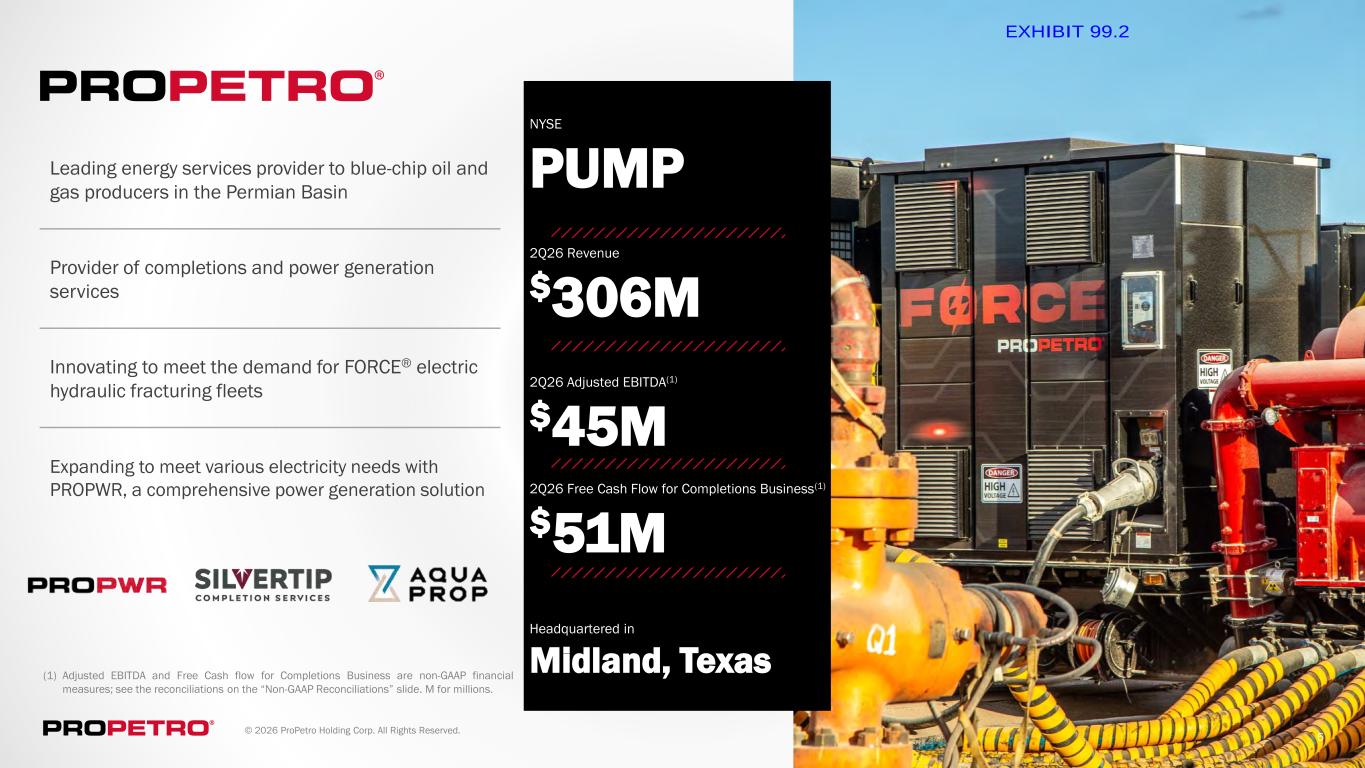
Thanks, Sam, and you can once again demonstrate operational headwinds, meaningful progress. During the second quarter, ProPetro generated total revenue of $306 million, an increase of 13% compared to the prior quarter. A net loss totaled $8 million, or $0.07 loss per diluted share, compared to a net loss of $4 million, or $0.03 loss per diluted share. Adjusted EBITDA totaled $45 million, representing 15% of revenue and increased. This includes approximately $16 million of lease expense related to our electricity, impacted by a few items, including weather disruptions. The Permian base shared the $3 million in the prior quarter. the increases.
As we wrap up our prepared remarks, over the past several years we've built ProPetro into a strong company that has continued to perform through challenging markets. Today we're encouraged by the improving backdrop in our completions business where a tighter supply environment and early pricing momentum gives us confidence as we move into the second half of the year. At the same time, ProPower continues to build momentum. We're making meaningful commercial and operational progress across data centers, oil and gas, and industrial markets, and we're excited to continue expanding our operating footprint through the back half of 2026 into 2027 and beyond. Most importantly, ProPetro is well-positioned with a healthy balance sheet, first-class customers, and above all, a first-class team. I'd like to thank all of our employees for their continued hard work and dedication. Their execution gives us confidence in our strategy, and in our ability to continue creating long-term value for our shareholders. With that, operator, we'll now open the call for questions.
Operator
If you have a question, please press star 1 on your telephone keypad to raise your hand and join the queue. If you wish to remove yourself from the queue, simply press star 1 again. One moment, please, for your first question. Your first question comes from the line of Sir Rob Pant of Bank of America. Your line is open.
Hi, good morning, guys. Good morning, Sar.
Sam, Caleb, I think just given everything that has happened in the market over the last one week, in this space maybe I would like to start with getting perhaps a little more color on your liquidity position. I know you talked about that a little bit, but maybe touch on that and that the financing agreements and then to the extent you can maybe give us a little bit more color on the cash needs for pro power over the next 12 months. I know you gave 26 guidance, which is helpful, but just a little beyond that. And then related to that, I know you've got the Carapilla Strategic Framework Agreement, which I'm sure gives you more certainty and some flexibility on the whole timing of it and related cash progress payments. But maybe touch all of that a little bit and just give us some color on how you are thinking about matching your cash inflows and outflows.
All right. A lot there. Great leadoff question. And I'll try and kind of address a couple of things at a high level. Caleb will probably want to talk about CapEx liquidity, maybe some of the details. Look, I think you're right. There's obviously been a lot of noise in the market here recently. Nothing's changed here. I think what we're trying to do today is to reiterate from, you know, an equipment and capital and outlook standpoint, especially as it pertains to pro power, very much of the same that we've said. Previously, I think we've we've we've done a pretty good job and we're really happy with the strategy that, you know, communication strategy that we pursued almost a year ago to give really clear guidance and a really clear and transparent five year outlook around how this power business would grow and scale. how much the equipment would cost, how we're going to finance it, and what we think our returns are going to be. I think maybe we've been more transparent than anybody else in the space. I think a big part of that, too, is procuring what we think is best-in-class equipment with a best-in-class supplier and then matching financing with that equipment and its timing and deployment plan so um look there's there's there's no really near to medium term financing or or uh funding need that said i think we're always in the market uh assessing the circumstances and the environment around us and making sure that we're being opportunistic uh to to raise capital and funds to ensure the long-term uh execution of the business so i guess that before And Caleb chimes in, this is more of the same from us. We're really, really proud of the communications plan that we pursued for almost a year now. And we think the plan is well at work right now. Caleb, you want to add to that?
Yeah, thanks, Sam. Good morning, Saurabh. Thanks for the question. So the way I think about liquidity is very simply, if you look at our whole year CapEx debt of $525 to $595 million. And then you factor in that our expanded cap finance facility as well as free cash flow from completions should cover a significant portion of that funding. And then look at our liquidity of over $900 million or even just cash of $784 million. You can see that exceeds the cash we need for the CapEx this year for what we've announced by hundreds of millions of dollars. So we have a lot of running room. Over the past 18 months, we've raised approximately a billion and a half dollars to support ProPowers growth, including our highly successful $690 million convert in May. And so we're really proud of the work we've done to position ProPetro's capital structure to support ProPowers growth. Like Sam mentioned, going forward, we are going to continue to approach future capital decisions opportunistically and try our best to come from a position of strength as we continue expanding our commercial footprint and executing against our strategy. So to some of the liquidity point, lots of running room currently, and we'll just continue to try to approach those capital decisions opportunistically and thoughtfully. On the CapEx point, importantly, we've not changed our guidance of $1.4 to $1.5 million per megawatt. Like Sam mentioned, we have a lot of visibility to the cost and timeline of equipment deliveries and deployments under our CAP framework agreement. And we've already ordered or have delivered 1.1 gigawatts of equipment. And so I think we're in really good shape from a liquidity CapEx standpoint and have a lot of visibility into what that's going to look like going forward.
Yeah, and I guess just one last thing before we get off of this. Our long-term future plan and guidance that we've given, especially the numbers that Caleb just gave on the cost per megawatt, earnings per megawatt, we've made all the best efforts to make sure that that includes inflation going forward as well. We'll obviously update the market over the long run if any of that changes, but we feel really good about these numbers that we've been sharing really for almost a year now, and we expect those to be pretty sturdy in the future.
No, that's very helpful, Kala, Sam, Caleb. Look, more of the same is good, right? So I'm glad there are no surprises. So just keep doing what you're doing. Just related to that, by the way, on the operations side of things, I don't know, maybe Travis wants to pitch in on this one. But it was really great to see the successful startup of the 60 megawatt data center project you've talked about. And again, maybe give us a little more color on that project. Just any early feedback, learnings, working on your first data center project. Any early surprises, good, bad, anything you've seen on the project. I think it's been barely a month, maybe a little more than a month or so.
But any early feedback, any learnings on that data center project? yeah thanks for the question Saurabh there is always learnings on these projects but I think for us to hit the timelines we set out on our first appointment was really important our customer recognized that I think the market recognizes that and it's helping us build commercial momentum because we're one of the few that can point to you know some of the hiccups maybe we have seen but got through to be able to successfully hit our deadlines and now be operational for a period of time you know really ahead of schedule quite honestly and so we're really excited about how that has turned out certainly learned some things that we can do differently in the future on some of these larger scale projects but 60 megawatts helps us set up you know ourselves for a really strong um platform to grow into these several hundred megawatt type sites yeah sorry but i'll I'll just add to that.
I think the most pleasing to me is learning about our team through a project like this, uh, to see the kind of life cycle of a deal from, you know, introducing yourself to a customer, negotiating a contract, finalizing a contract, project planning, going to work and executing. Um, we've already been doing that in the oil and gas space, but to see our team do that outside the Permian Basin, uh, at scale on a hyperscaler data center campus. Um, it's almost kind of like, you know, going into that first game of the year as a sports team, you might be really confident. You might think, you know, what you have, but until you get on the field, run around and score some points, you don't really know what you have yet. And we've put some points on the scoreboard. Um, and we're, I'm, I'm, I'm, I'm super proud of our team, uh, and really excited, for the next play in the next game.
Yeah, no, it's always easier said than done. So great to see that progress, and good luck. I'll turn it back to Sam.
Operator
Your next question comes from Arun J.R.M. of J.P. Morgan. Your line is open.
Yeah, good morning, Sam and team. Sam, I was wondering if you could maybe elaborate on how your commercial discussions are with data center customers. You mentioned that there's several hundred megawatts currently in advance negotiations. Would you view these, call it at the one yard line, or maybe just give us an update on how that's going? And perhaps you could also discuss maybe how you view oil and gas customers versus data center customers. You did mention maybe a little bit more contract term on the data center side, but are you relatively agnostic between, you know, deploying power for each of those, call it, broader segments?
Sure. I'll make a couple maybe broad comments, and Travis, please feel free to add on here. You know, I made some comments for Saurabh's question around, you know, that nothing's really changed here from a plan and execution outlook standpoint as it pertained to, you know, our funding and our acquisition of equipment, things like that. I think it's very much the same from a commercial standpoint as well. Um, you know, these, these, these larger, more long-term data center deals have taken a few twists and turns that were unexpected. That said, the demand is still there. The counterparties are still elbows on the table. We still very, very feel, feel very confident as we've mentioned in our, in our scripted materials here that we think the overwhelming majority of our capacity, uh, as we grow the pro power business is going to end up on data center sites, providing prime power. still very much believe that's the case. So I think the team's being very diligent and intentional about how we finalize what are the first couple marquee data center contracts that we're in extended negotiations with right now. And we're going to make sure we take our time and get it right and position our business to execute really well with customers that place of high value on our services.
Yeah, and the only thing I'd add there on just the contracting front is if you look at what we've laid out, 350 megawatts today, headed towards 450 very soon, and several hundred megawatts at the data center, you know, all that comes together to really round out almost all of, you know, middle of 28, maybe all of 28. And I think just piecing that together with these large data center customers and maintaining the contracts we have with the oil and gas customers, it's a big puzzle piece that we're just excited to be able to kind of evaluate all of it, but we're certainly not taking oil and gas meals and not able to still execute on the data center contracts that we've been negotiating. So we're super mindful of, you know, all of the deployment schedules and how they come together and, you know, really excited to be able to piece that together and get contracted backlog out into 28.
Yeah, and look, I know you hear us talk a lot about execution. You know, we're really proud of what the team's done to date like we've already mentioned um but you know our our ability to go perform on this data center site that we're currently on uh and deployed to today is is was highly enabled by our ability to go get some reps in on a lot of oil and gas locations as well um so there's a there's a there's a lot of benefits uh to being able to play in in a couple of different of these verticals um and i've mentioned this previously but i think it's mentioning again worth worth mentioning again that that these these oil and gas opportunities are in most instances more lucrative and higher return um than some of the longer data center
deals so i mean travis travis and his team you know as you heard in our scripted remarks they're they're the positive business you know 18 months into standing it up uh so we think that's really cool and that's going to be a part of you know the sturdiness and uh the ability of a business to exit okay great i want to maybe shift gears talk a little bit about um your completions business uh talk us through kind of the the decision to stand up the 13th um fleet and how would you just generalize you know pricing trends call it at the top end of the food chain in terms of some of the force units, the higher-end natural gas burning equipment versus maybe some of the more legacy fleets within the overall portfolio?
Yeah, I think the 13th fleet for us is kind of an interesting story. I think if you stood back and you guessed, you might think, oh, that's with a private operator that just fired up a new rig program or is increasing their rigs. And that's not the case. This 13th fleet is going to a blue-chip top-tier E&P that is just looking to make some high grades within their program. And because of the timing of that and the equipment that we're able to provide that customer and the performance obligations that we're confident to hold ourselves to the price and the returns are really good there because of the ability of that counterparty and that customer to execute and operate. It's also a new customer for us. So I think it's a little bit less of like a market growing story and a little bit more of a testament to kind of the, you know, ProPetro's execution prowess and our ability to provide a portfolio of technologies and equipment types to our customers. It might be worth mentioning Just again, we talked about this on the last call, but that 12th fleet that we stood up right after kind of the Iran conflict outbreak, that was already pre-planned earlier this year. We had a pretty good line of sight to 12. So this 13th fleet is really the first net add above our coming into this year. And like I said, it's with a top tier E&P at a great price. it's going to be a great mutual win for both sides, I think.
Your next question comes from a line of Derek Podhazer of Piper Sandler.
Operator
Your line is open.
Hey, good morning, guys. I wanted to go back to power, maybe talk a little bit more about the economics here, just thinking about the 110 megawatts you contracted. I think you could expand more, add some color on, talk about pricing, term, the return profile here. You sound a little bit shorter term, but just wanted to hear more about the longer-term goal for these projects. I mean, will the grid come into play, or given it's probably a more isolated area, is microgrid the right solution going forward? And if that's correct, when would you expect to really extend these contracts into that 10-year-plus range? So just a little bit more on the economics and then maybe some more long-term thinking on these projects.
Yeah, thanks, Derek. Yeah, as we mentioned, I mean, oil and gas deals in general are shorter term, but higher economics. I think a lot of these oil and gas operators are maybe still waiting to see on the grid or really trying out a micro grid for, you know, the term of these contracts. But we see a real opportunity to grow and expand with these customers. I think the market's telling you that, you know, the grid availability is likely pushed out. And in general, these types of operators are used to, you know, signing these deals pretty quickly. And so, you know, maybe don't want to go out that far and maintain optionality, which means higher economics for us. And we're OK with that to keep optionality on our side as well. So, you know, we like these oil and gas deals. We think it only progresses in a positive way for us, you know, either giving us higher economics down the road on deals that we really like or shifting assets down the road to, you know, the data center growth story. So we think this really fits into our story today of large-scale sites, which is great in getting execution ready for these center sites in the long term, creating earnings.
No, thanks, Travis. Maybe switching over to FRAC, maybe just some expectations around, you know, the pricing power that you're seeing. And everything sounds very positive, but obviously, you know, results are a little bit challenged. understand you have some temporary headwinds with the, you know, with the out-of-basin move on the frack spread. You have some weather standing up. It's all sleet, but some clear momentum with pricing given the tight environment here. So, how do we think about the earnings power for completions, you know, next quarter, third quarter, maybe beyond?
Just looking at the model, where's the path to get back to 25% segment EBITDA margins for frack? yeah caleb please please add to this if you need to but um you know i think i think near term i'll kind of split this up i think about it kind of near term and long-term perspective or near term and medium term uh from a near-term perspective as we stated in our uh prepared remarks that that 13th fleet doesn't really stand up till the toward the very end of q3 so the revenue contribution will be very low uh for that additional fleet in 3q that said you know our kind of fleet stand up and maintenance cost um we'll we'll see those in q3 so that'll be a little bit of a drag um and we're kind of in as as we operate here kind of in between 12 and 13 we're a bit in an overutilized state from an equipment standpoint we've been uh you know over the last couple years really been running only, you know, just the right equipment we need for the jobs that we have, and that still persists today. So the bigger the system gets and the more fleets that you get ready to deploy, the more that gets stretched on a short run. So that may be a little bit of a drag too. There's always still weather in the summer. It's hard to predict what that might be. Hopefully, it's less than what we just saw in June. But look, over the long term, which I think speaks to why we're confident to stand up an additional fleet right now is that the visibility we're getting with our customers and the confidence we're getting in pricing continuing to inflect is is very strong and those are those are very informed views from direct conversations with customers and their understanding of the market and how much equipment you know is or isn't out there. So, you know, we don't ever manage the business for the next quarter. We definitely do for the long run, and we think these are the right long run decisions to make to increase our returns and our profitability.
Appreciate the color, Sam. I'll turn it back.
Operator
Your next question comes from Alexa Breno of Goldman Sachs. Your line is open.
Hey, good morning, team, and thanks for taking our question. With the addition of the new contracted capacity this quarter, Can you provide some color on what the average contract duration looks like and the pricing structure, and then specifically maybe for the oil and gas and industrial contracts?
Yeah, I think we're at a point right now in the life cycle of ProPower where some of that's just a little bit too competitive to disclose. That said, I think we would classify almost all these deals as long-term in nature, most of them multi-year, almost all of them with extension options. so you know the initial term might be a little shorter but but the overall opportunity we think is very long term and as we as we start to ink some of these data center deals you know the average duration of a contracted megawatt in our business jumps significantly and I think you know as it pertains to the data center market I think most of those conversations are starting at 10 years many of them are well in excess of 10 years um so we think we think a balance is good um and
we think you know getting this equipment to work making a return uh and getting our reps in from an execution standpoint is definitely the right thing to do travis i don't know if you could add to that yeah just reiterating that the the earnings obviously are more attractive shorter term gas deals which really helps uh kind of create that sturdiness in terms of short-term earnings in the business. We feel like still gives us the opportunity to participate in these data center contracts. So we don't have to just wait around for the data center contract. We can go really execute on what's able to be executed.
Hey, this is Caleb. The only other thing I'd add is we haven't changed our guidance around the portfolio targeted paybacks of four to six years for the deal.
So still targeting those economics.
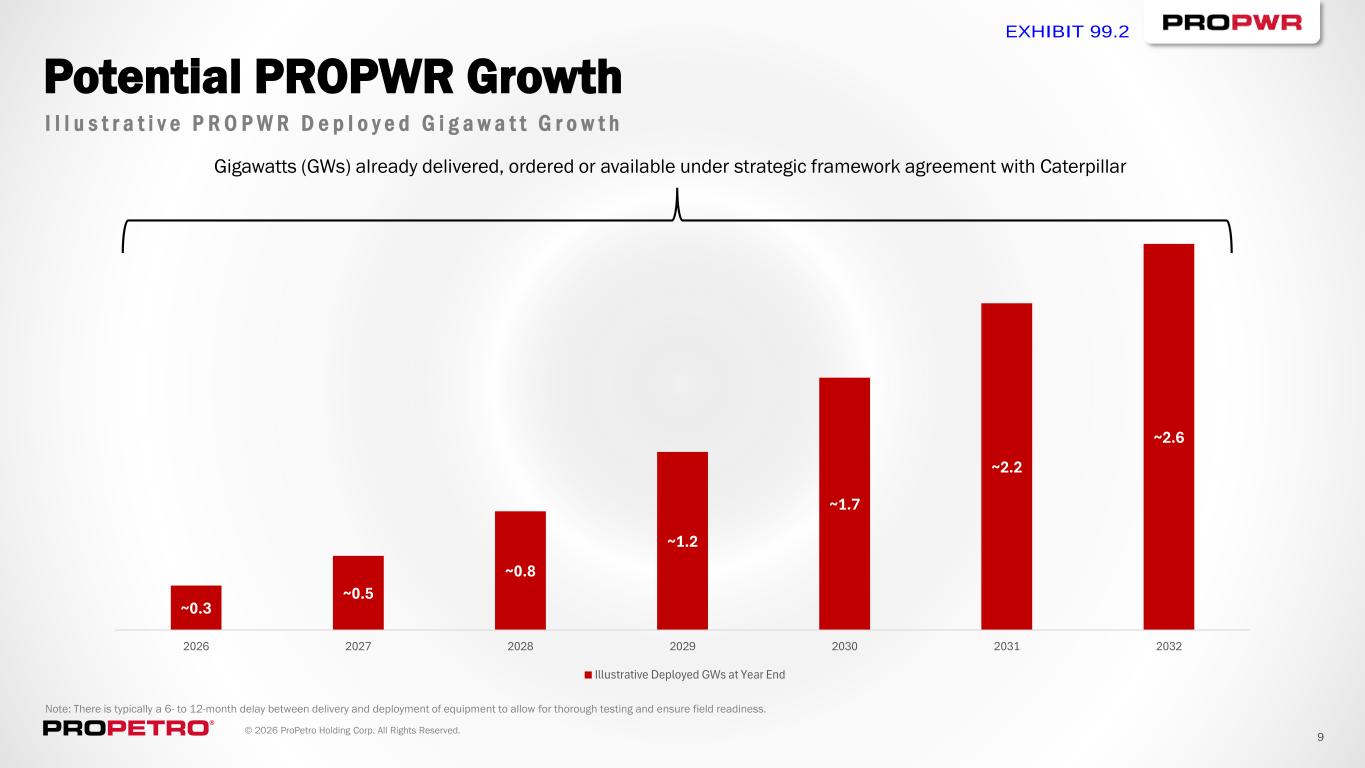
Awesome. That's all really helpful, Collar. Maybe as a follow-up, as you look to scale the power business toward that 2.6 gigawatt target, can you talk about the cadence of capital spend, maybe around timing of down payments for equipment and any other capital requirements just as we look out longer term?
Yeah, I would just direct you back to our investor slide where we've laid out pretty clearly our expectation around deployments And we expect, obviously, to receive the equipment before it's deployed. And so, like we talked about earlier in the call, we have a very clear picture of when that equipment is going to be delivered. And, yes, there are certainly some down payments associated with that. But then a significant amount of the CapEx is when the equipment is delivered.
But I think just to add to that, I think using kind of 2026 CapEx relative to megawatts is a pretty good way to do that moving forward. Obviously, we've got continued orders we'll be placing as part of the frame agreement that we'll have down payments. And so for this foreseeable future, we have a combination of down payments and delivered assets that 2026 Supreme has got.
Yeah. And Alexa, just for clarity, that's that's page nine in our IR deck. So that guidance, you can multiply those megawatt, gigawatt numbers by our cost per megawatt guidance that we've been giving is unchanged.
Since we don't expect that to change.
Your next question comes from the line of John Daniel of Daniel Energy Partners.
Operator
Your line is open.
Hey, guys. Sam, quick question on the 13th fleet. Can you tell us from the time you guys decided to reactivate to the time it's actually going to have to feel what that timeline is?
Okay. Is there enough demand today or any visibility that would give you confidence that a 14th fleet would be potentially going out? And if so, would it be a similar 60 to 90 day timeframe to bring that back?
I think there's likely portfolio optimization before there's a 14th fleet. I think every additional fleet for us gets meaningfully more expensive to redeploy. We're basically at the end of the road there with 13. And the amount of simul frack that we run and the slack that we need in the maintenance system. So I think there's portfolio optimization, which we've been doing here in the background as well. There's more of that to come, along with more probably pricing that we would need to see. And then you might need to see interest and contracts come back too before you do something like that. But today, with all the circumstances that exist today, there's no interest to do that on our side.
Fair enough. And if you'd be willing, could you provide a little bit of just high-level commentary on what you're seeing in both the cementing and wireline markets? Thank you.
Yeah, thanks for asking. These have been, I think, bright spots in both places. Cementing is inflecting as we speak with the rig count. You know, we talked about the rig count being up pretty meaningfully off of its lows earlier this year. We've had new leadership in the mix. We're adding some new high-spec equipment, albeit in a very small way, to our submitting operation. There's a lot of really good momentum there. um silver tip our wireline business has been probably the most um sturdy from a utilization and margin standpoint across all the ofs business lines remains almost full utilization uh very strong pricing those are those are definitely bright spot okay thank you very much your next question comes from line of scott gruber of city group your line is open yes good morning um so as part of the CAT agreement, you'll start receiving, you know, larger capacity units, specs for data
centers. How much of the 2.1 megawatts of the CAT capacity are larger capacity units? And I think I heard 1.1 megawatts order. It's a curious kind of, you know, how much of that slug is the larger capacity? And when do you start taking delivery of the larger capacity units? I'm just trying to get a sense of when you need to sign a data center contract to deploy that capacity to avoid having any idle, you know, upon delivery.
Yeah, Scott, it's over half the portfolio is going to be these higher density, high efficiency units. And really, when we start receiving those units, you know, we have to put them into So it takes a little time to install them. But we are well positioned to utilize our smaller units to get sites started. And actually, we kind of see a mix of those two types of assets on these data centers, providing a really good technical solution to be able to manage the load. So, I would say we're not really in a position to have idle assets for a while, say 18 months, which gives us a lot of time to really get, you know, these contracts in the right place and stage the assets we're going to use for data center contracts.
Yeah, the bigger block equipment is going to match up really well with the data center opportunities that we're really close on. And timing to deploy those.
Okay, yeah. So are the early deliveries from CAT not the larger block units? Those come kind of middle of the range. Is that fair?
Yeah, I think that's fair. I wouldn't say it's middle. It's near term, but like 27 is going to be a lot of more of the same for us, highly efficient, smaller modular units that we've already deployed. We know how to go do that. It allows us to get sites up and running while we install these larger units.
Okay, okay. And then when it turns back to the buyouts on the four fleet leases, you mentioned that you're kicking one into 27, so you'll execute on one this year. Can you just update us on the remaining four, how those spread across 27 and early 28?
Yeah, so like you mentioned, we have one towards the very end of this year. we expect roughly three in 27 and then roughly one in 28 and our intention to hasn't changed it's really just a timing change that one of those buyouts which was scheduled to be at the very end of this year kicked to the very beginning of next year okay i appreciate the comment thank you your next question comes from line of eddie kim of barclays your line is open Hi, good morning.
You said you signed up another Permian microgrid contract here. I understand the sensitivity about providing too many details, but could you talk about roughly how many megawatts are contracted for that microgrid and how many frack fleets is that going to support? Just in general, is there sort of a rule of thumb on how many fleets that, let's say, a 50-megawatt-permium microgrid will support? And do you still see a lot more opportunities for these microgrids beyond the ones you've signed up already?
Yeah, I'd say it's close to 100. It's a large microgrid. It's really a production application, so connected distribution for production in field. not necessarily supporting fracks of very consistent power output application we see continued momentum with the really large operators that are able to create these connected microgrids and then also midstream operators so you know that's an area that we're really excited about continuing to explore is as there's no grid connectivity so I think both of those provide really highly dense applications that kind of pair with what we've been deploying already on a, you know, larger scale between 50, 100 megawatts.
And just shifting over to FRAC, just trying to get a sense of how many fleets are left across the Permian to bring back. You mentioned that you estimate about mid-70s fleet count in the Permian today, but that it's very difficult to see the increase above the mid-80s without meaningful capital investment. So around 10 fleets in the Permian that are maybe relatively easy to bring back. Is that how we should think about it?
Yeah, maybe I need to clarify that mid-80s comment that we made earlier. That's going to require meaningful capital to get to mid 80s i mean we look around at the like the comments that i just made earlier about a potential 14th for us that's not capital we're we're willing to spend at this point at least to that magnitude we expect that to be the same um across the space especially for our larger our larger competitors as we sit here today in terms of like hot or warm equipment i I it's it's probably less than one hand's worth. It's it's very, very few. And those fleets are likely not necessarily parked. They might just be in rotation from one customer. So I I think the Permian's basically spoken for from a from a from a frack equipment standpoint, you know, a little bit of tightness in the first half of this year in the gas basins, I think bolstered that as well. that there's not really any good reason for companies to be rolling equipment to the Permian from other basins right now. So, you know, we talked a lot of we have been beating the attrition drum for several quarters and maybe what feels like years now. And we think that that, you know, we're on the front end of that really starting to show through, which also ties back to my comments earlier about our, you know, our positive outlook.
That's great to hear. Thanks for the clarification and the call out. I'll turn it back.
Operator
Your next question comes from a line of Jeffrey LeBlanc of TPH. Your line is open.
Good morning, Sam and team. Thank you for taking my question. Given the volatility and concerning the commodity prices, I wanted to see if you could just talk about customer conversations between public and private operators over how they've evolved over the past quarter. Thank you.
Yeah, I think in the first couple of months post the outbreak of the Iran conflict, I'd say in general on average, private or public, the average operator in the Permian was pretty disciplined. There really weren't going to be any knee-drug reactions or anything like that. But once you got a couple months past that conflict beginning, I think the private operators were probably the most interested in analyzing the opportunity, not necessarily acting on it, but trying to figure out, you know, how long is it going to take to stand up a drilling rig? What's a frack fleet going to cost if I need another one? I'd say a very small number of those have materialized across the space. But I think overall, both private and public, there's still really good amount of discipline across the space. There's just no knee-jerk reactions. There's a lot of skepticism of, you know, not what's the oil price going to be tomorrow, but what's the oil price going to be the middle of the year next year once I do potentially stand up some of this equipment. That said, you know, as we said in our scripted remarks, we think the floor is rising as we speak. We're not macro experts by any mean, but there's been a lot of oil come off the market that we think generally raises the floor on prices and gives operators in places like the Permian Basin more confidence over the long term to potentially look at adding activity. All the meanwhile, you know, we're sitting here talking about adding, added a 12th and adding a 13th fleet with the market really not expanding. You know, a lot of this is us, you know, taking the place of one of our competitors at a price that's higher than, you know, the lower end or the average price in our portfolio. So we can, we still have the ability even in a fairly captive market to compete to increase prices and increase profitability. So it's an interesting time. I think I said last call, nobody likes war and all the kind of bad things that it creates. But it is creating opportunity and it is structurally changing some things as it pertains to outlook for us and our customers.
So we're pretty confident about the long-term value proposition here given what's happened.
Okay. Thank you very much for the color. I'll hand the call back to the operator. Thank you.
Operator
And your next question comes from the line of Don Crist of Johnson Rice. Your line is open.
Thanks for letting me in right at the end here. But Sam, just one question from me. We've heard some antidotes that people are pulling forward RFPs into mid-year from, you know, the traditional September-October timeframe.
Are you seeing any of that right now? yes yes we are i think um you know in march april like i just mentioned it was people just kind of getting their feelers out but i feel like the larger more public operators are kind of using this conflict as a as an opportunity to pull forward 27 planning i i probably should have mentioned that earlier but that's a that's a variable that's playing into our decisions to stand up another fleet as well.
Okay. And just one follow-on to that, do you expect, you know, in the next six months or so to have all your contract renegotiations done? Or do you think it's, are you going to have some kind of in the spot market?
We definitely like the dedicated contract model when we can get it. That said, we like a portfolio and we like to preserve optionality uh to be able to act opportunistically so um you know the fact that most of those contracts are rolling all of them are on natural gas burning equipment um with where diesel prices are right now and where they likely stay high in the medium term given the you know refining issues that we're seeing globally we think that's a really good setup uh that we're that we're really excited about not only is this good technology that burns gas but it's paired with great teams that are executing it at some of the highest levels in the permian basin from an operational efficiency standpoint so you know our we we know when those when those uh customer when those uh contract repricings or check-ins are our customers know when they are and we're We're constantly in dialogue with our customers to try and manage that to both of our benefit in the future.
I appreciate the call. I'll turn it back. Good quarter, guys.
Operator
With no further questions, that concludes our Q&A session. I would now like to turn the call back over to CEO Sam Sledge for closing remarks.
Yeah, thanks, everybody, for joining us today. Thanks for your interest and support in our business. Look forward to talking to you again soon.
Operator
That concludes today's conference call. You may now disconnect.