Operator
Greetings and welcome to the ReadyCapRu fourth quarter 2025 earnings call. At this time, all participants are in a listen-only mode. A question and answer session will follow the formal presentation. If anyone should require operator assistance, please press star zero on your telephone keypad. It is now my pleasure to introduce your host, Andrew Albarn. Thank you. You may begin.
Thank you, operator, and good morning to those of you on the call. Some of our comments today will be forward-looking statements within the meaning of the federal securities laws. Such statements are subject to numerous risks and uncertainties that could cause actual results to differ materially from what we expect. Therefore, you should exercise caution in interpreting and relying on them. We refer you to our SEC filings for a more detailed discussion of the risk that could impact our future operating results and financial condition. During the call, we will discuss our non-GAAP measures, which we believe can be useful in evaluating the company's operating performance. These measures should not be considered in isolation or as a substitute for our financial results prepared in accordance with GAAP. A reconciliation of these measures to the most directly comparable GAAP measure is available on our fourth quarter 2025 earnings release and our supplemental information, which can be found in the Investors section of the Ready Capital website. I will now turn it over to Chief Executive Officer Tom Cabassi.
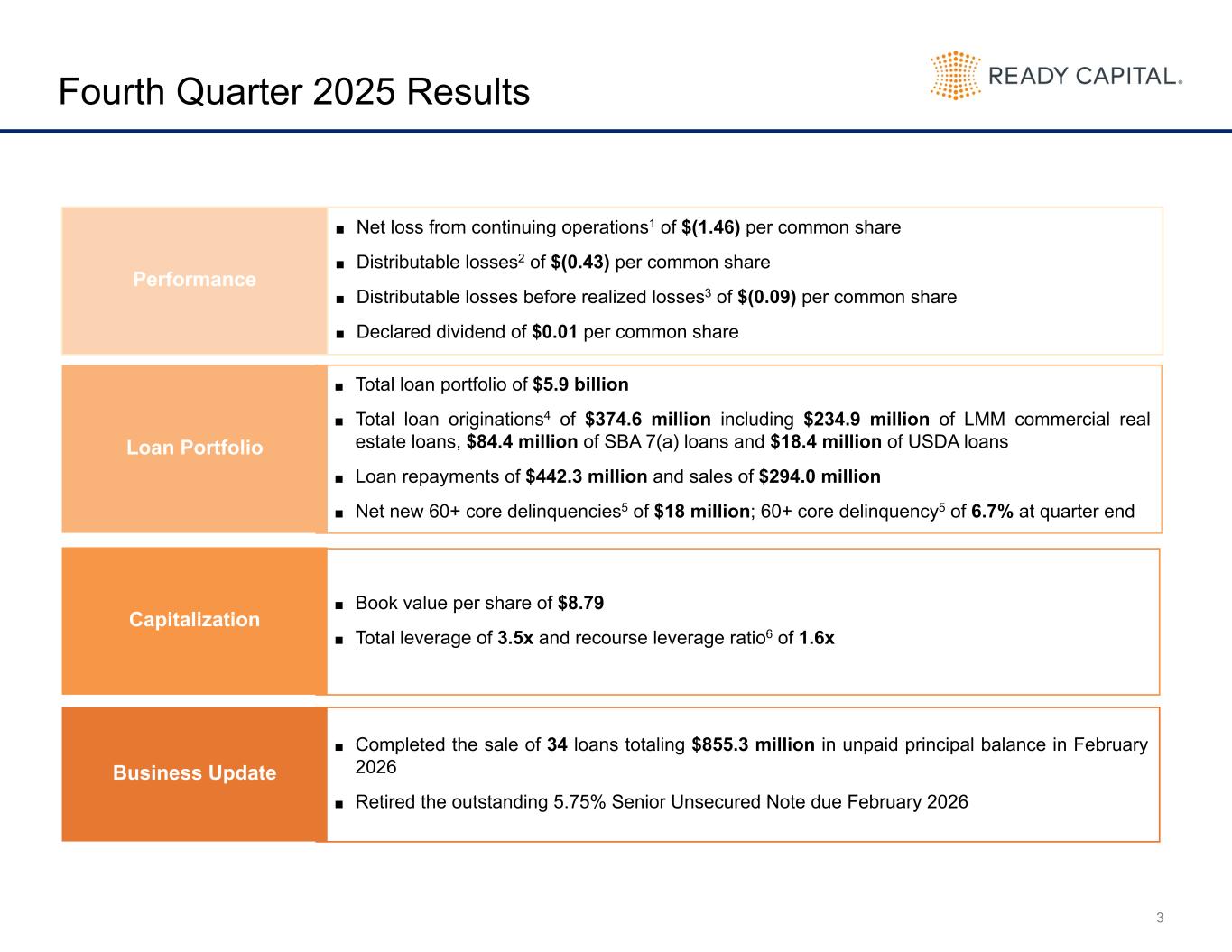
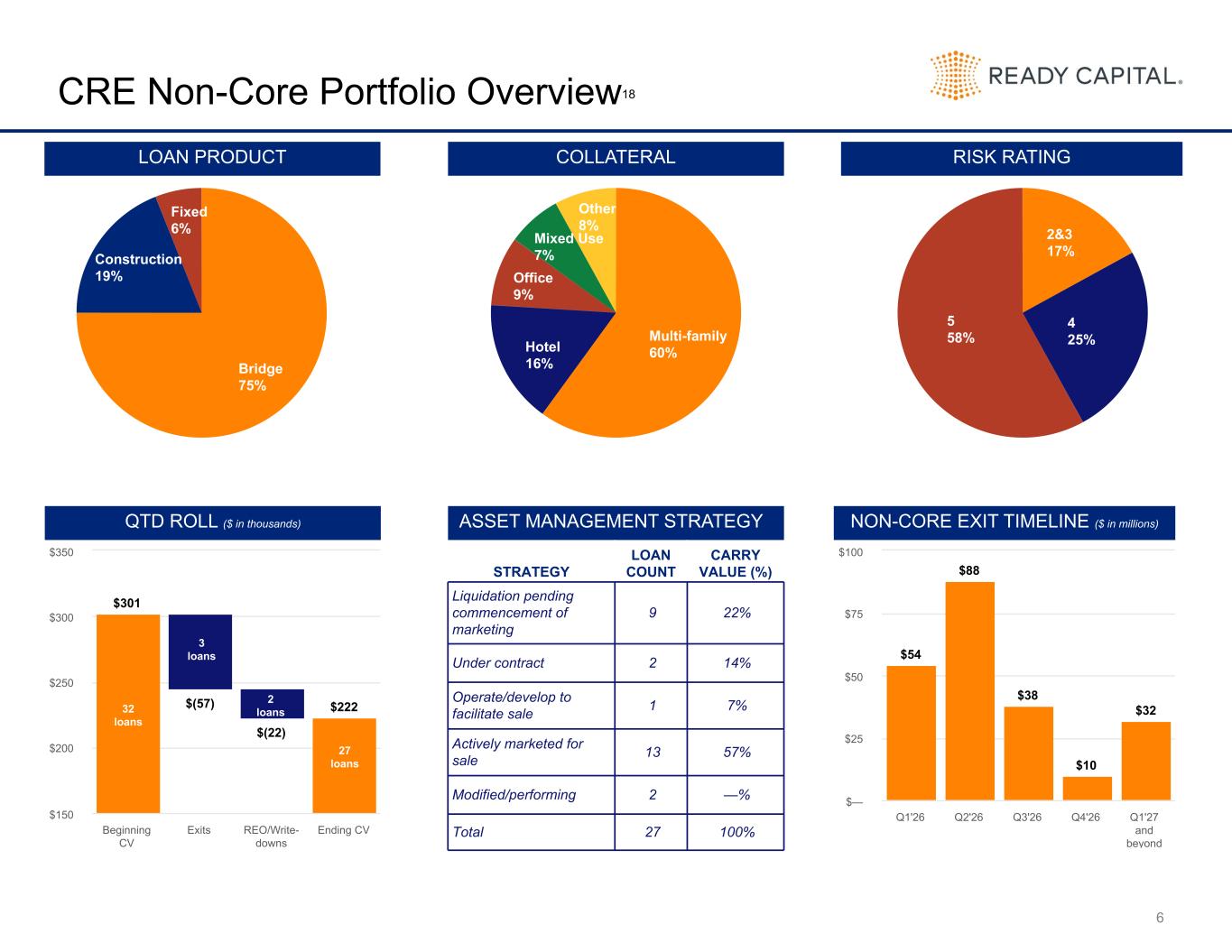
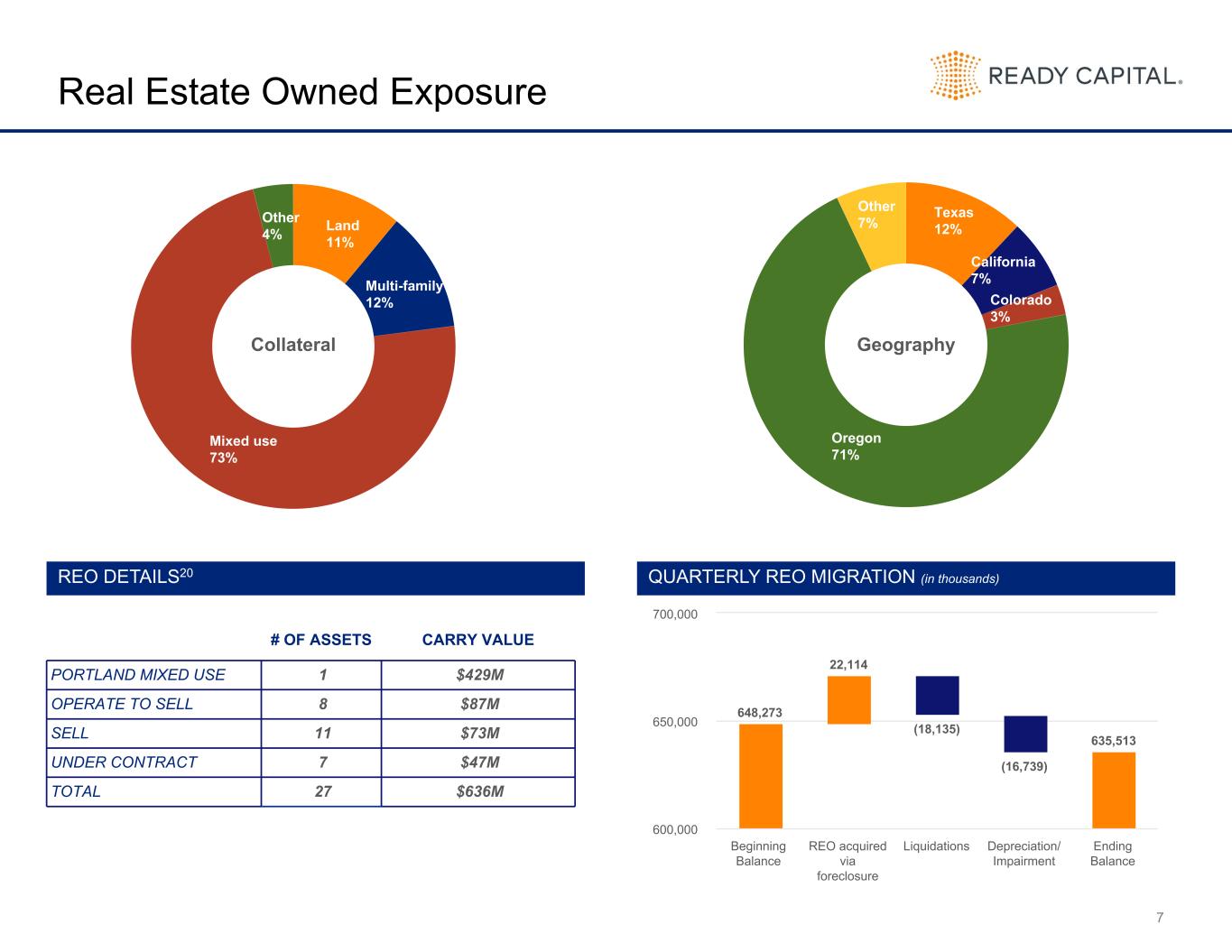
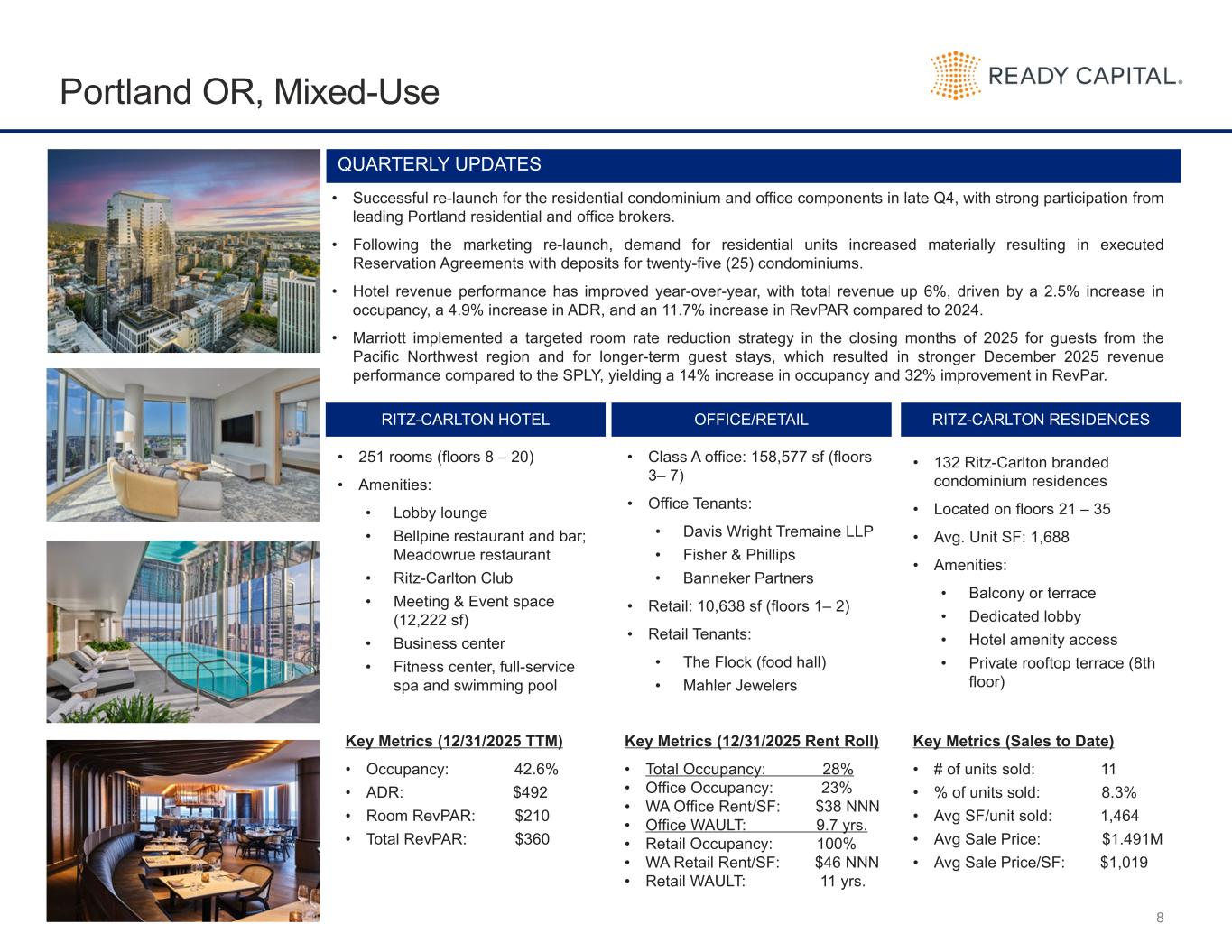
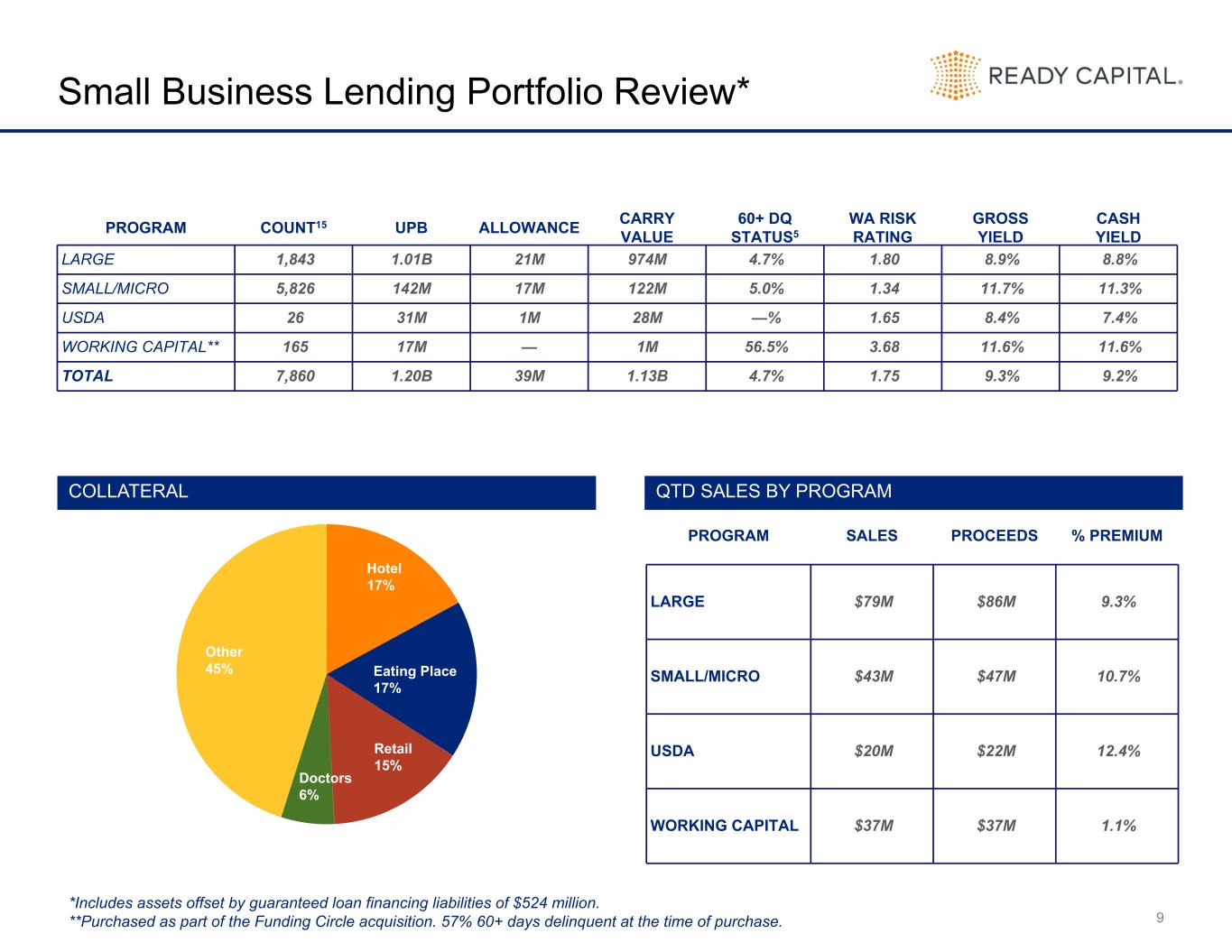
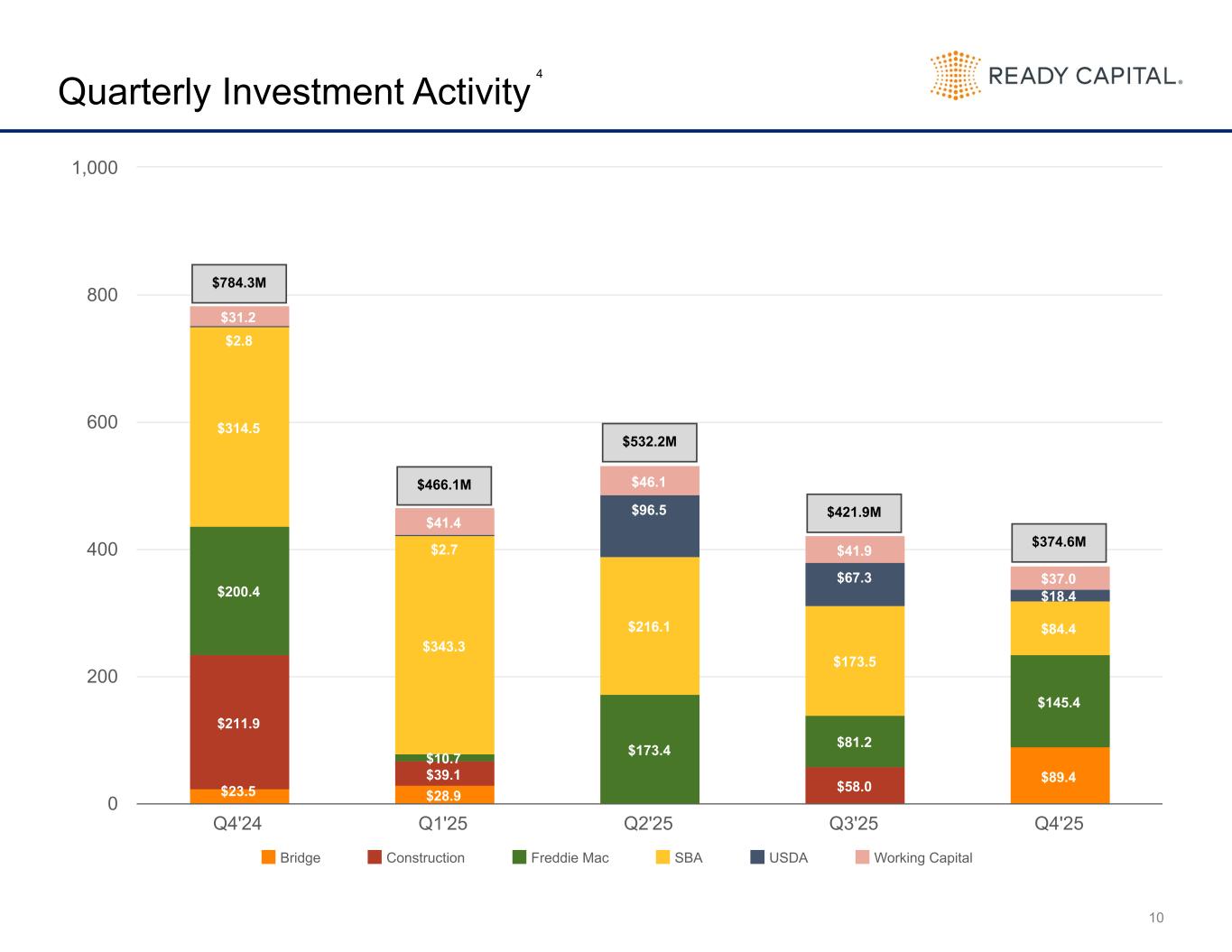
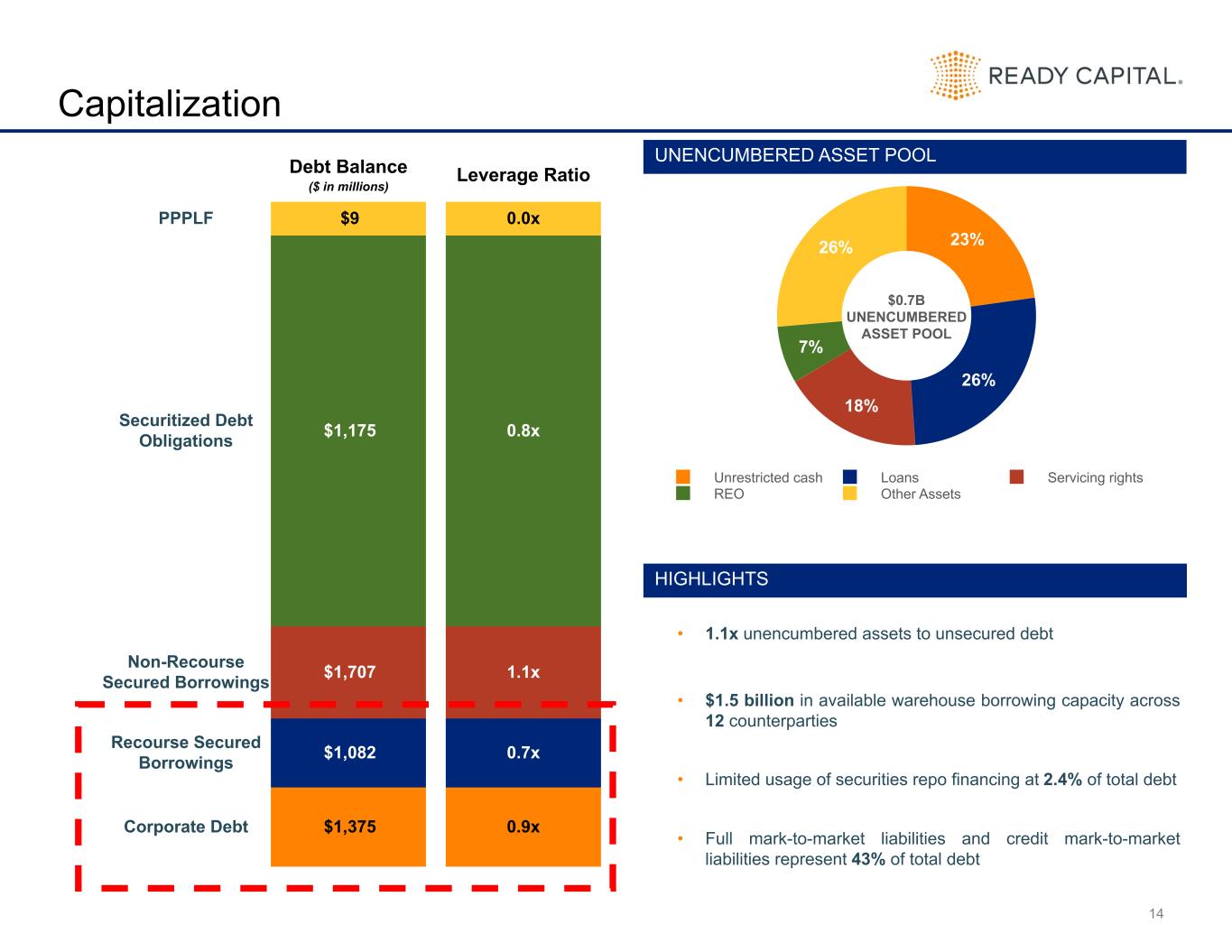
Thank you, Andrew. Good morning, everyone, and thank you for joining today's call. To begin, we have made significant progress advancing the comprehensive balance sheet repositioning strategy outlined in the third quarter. This disciplined plan remains focused on three key priorities. One, strengthening liquidity to generate free cash flow in excess of our 2026 debt maturities. Two, selling underperforming CRE assets to eliminate negative earnings drag. And three, positioning ready capital for sustainable future growth. The first phase of our repositioning strategy is focused on aggressive asset management, while the second will streamline the CRE origination business into a lower-cost structure with greater reliance on our external manager waterfalls, deep CRE investment capacity, and expertise. To that end, to support and lead these efforts, we have promoted Dominic Scali to Chief Credit Officer and co-president of our CRE operating business, ReadyCap Commercial. With over 24 years of CRE lending experience, including 10 years with Ready Capital, Dominic has significantly contributed to building our lending infrastructure. In his new role, he will oversee all aspects of our CRE strategy. Dom is joining us on today's call. Gary Taylor will transition to focus on our SBA business as president of ReadyCap Lending from his position as chief operating officer. Given Gary's over 30 years of experience leading non-bank SBA lenders, this change aligns well with our increasing emphasis on capital-like business lines going forward. I also want to express my gratitude to Adam Zausmer for his decade-long contributions to Ready Capital and the instrumental roles he has played over the years. These organizational changes support the execution of our repositioning plan and seize new opportunities as we progress. Now turning to the business update, we are making significant progress executing our liquidity plan to both address our corporate maturities and reposition the CRE portfolio. Our plan targets generating over $850 million of free cash and reduces the legacy CRE book 60% to approximately $2 billion, thereby optimizing the balance sheet to support future earnings growth. From the start of the fourth quarter to date, we have generated approximately $380 million in free cash from two primary sources, $130 million from bulk portfolio sales, and $250 million from portfolio runoff and other asset management resolutions. Overall, our liquidity projections anticipate generating an additional $500 million in free cash flow by year-end from two primary sources. First, we expect to generate $250 million from the portfolio runoff, consistent with our 36% trailing 12-month repayment rate. Second, we expect to generate approximately $250 million in free cash from planned $1.5 million of additional loan sales with a focus on NPL and sub-yielding assets. Loan sales are expected to be substantially complete by the end of the second quarter. within this gross reduction of our legacy CRE book our portfolio repositioning includes an aggressive asset management focus on the sale or resolution of approximately 1.4 billion of sub and non-performing loans at REO assets the currently the current quarterly negative earnings drag of this subset is approximately eight cents per share with cash outflows of $13 million per quarter. Continued execution of the liquidity plan may result in additional book value pressure depending on the specific actions we take to increase cash and reduce debt. In the fourth quarter, the company's book value declined 14% per share. The anticipated benefit is a more attractive portfolio with competitive earnings profile and a 1.0 times reduction in leverage to 2.5x, which would allow us to allocate more cash flow towards growth. Our immediate debt maturities include $67 million due in the third quarter and $450 million due in the fourth quarter. While we are discussing the refinance of a portion of these maturities into a new debt offering, we are executing a liquidity plan that ensures free cash significantly exceeding these obligations. We successfully retired our 5.75% February senior unsecured note upon maturity. Our plan also includes a targeted 25% reduction in operating costs to align with the business's more simplified CRE investment strategy and increase capital allocation to our capital light small business lending operations from 10% to 20%. I would also like to provide an update on two additional items. First, the RITS property remains our largest single equity allocation, representing 16% of year-end stockholders' equity. Since assuming control of the property in August, we have made meaningful progress in our stabilization plan. First, the condominiums, which represent 40% of the total project value. Along with the new sales agent, Christie, we have adopted a phased sales strategy to sell the smaller units first at lower prices and the larger units later at higher prices. This is designed to facilitate momentum and achieve a full sellout at target per square foot levels we successfully launched phase 1 in December placing 16 units under contract with an additional 9 units executing reservation agreements and deposits which would result in 27% sellout of the 131 total units the average pricing of the new sales was 737 dollars per square foot second the hotel which represents 50% of the total project value. We have adopted a strategy led by our property manager, Lincoln, that focuses on achieving higher occupancy given the more competitive market rates in the improving Portland area. As a result, year-over-year occupancy increased by 6.5%, ADR rose by 5% to $492, and REVPAR reached $210. Third, the combined office and retail spaces, which represent 10% of the total project value. We continue to maintain 28% occupancy, but prospective tenant tours have substantially increased since our relaunch. Separately, the impact of last year's government shutdown was estimated to have curtailed $5.3 billion of industry-wide SBA 7A originations, resulting in a 50% decline in our originations in a quarter to $84 million, a level significantly below 2026 volume targets. Importantly, we remain a top-five lender in the SBA market. We anticipate coming to market with our fourth SBA securitization during the second quarter, highlighting the growth of this key segment in 2026. In terms of our repositioning plan, greater capital allocation to this high ROE segment provides another foundation for future earnings growth. We continue to take deliberate steps to enhance liquidity and strengthen the platform. As of today, we generated approximately 35% of our target liquidity objective and continue to make steady progress. At the same time, we are refining our CRE business and increasing our reliance on Waterfall to expand investment capacity and reducing related operating costs. There is more work ahead, but we are encouraged by the progress made to date and remain focused on disciplined execution. With that said, I'll now turn it over to Andrew for a detailed review of the quarterly results.
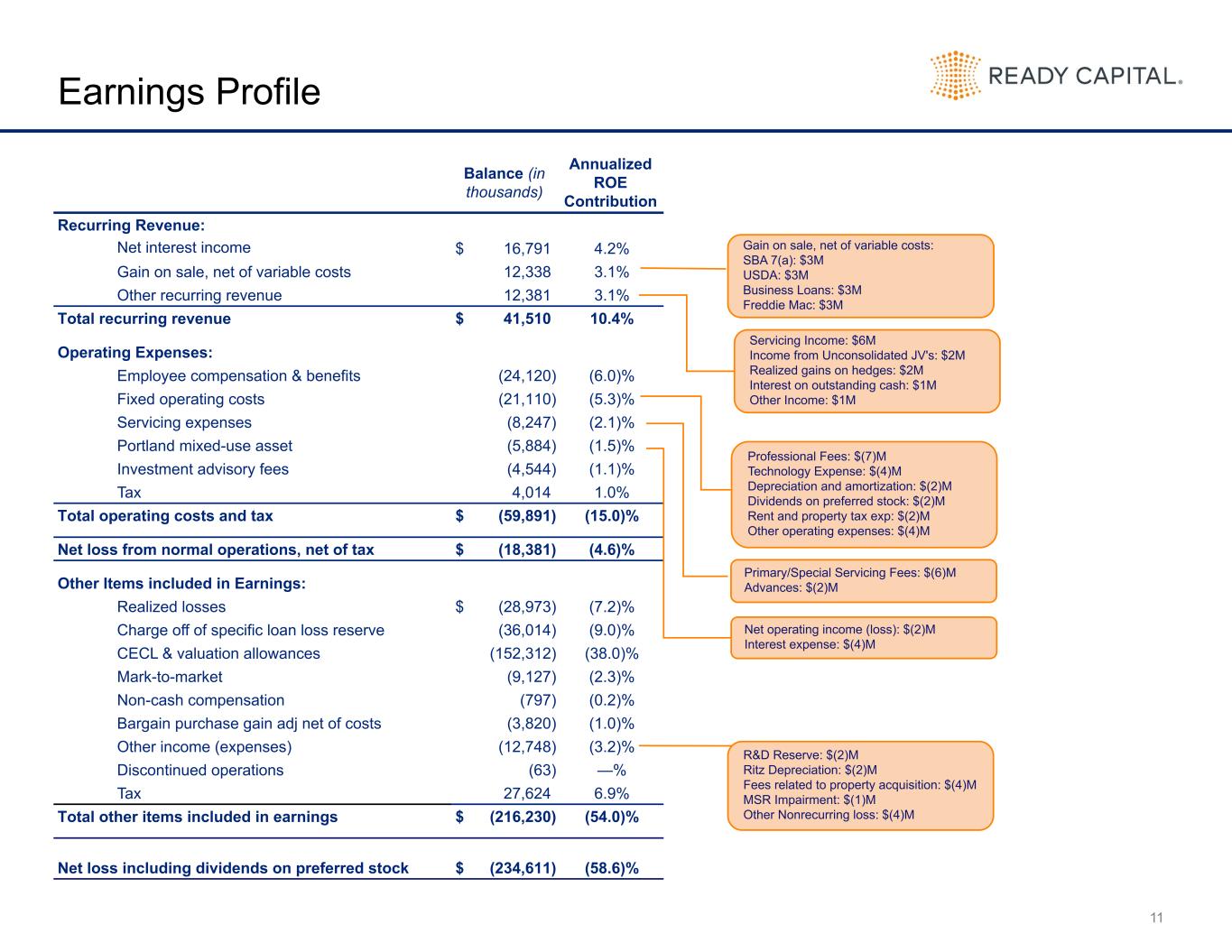
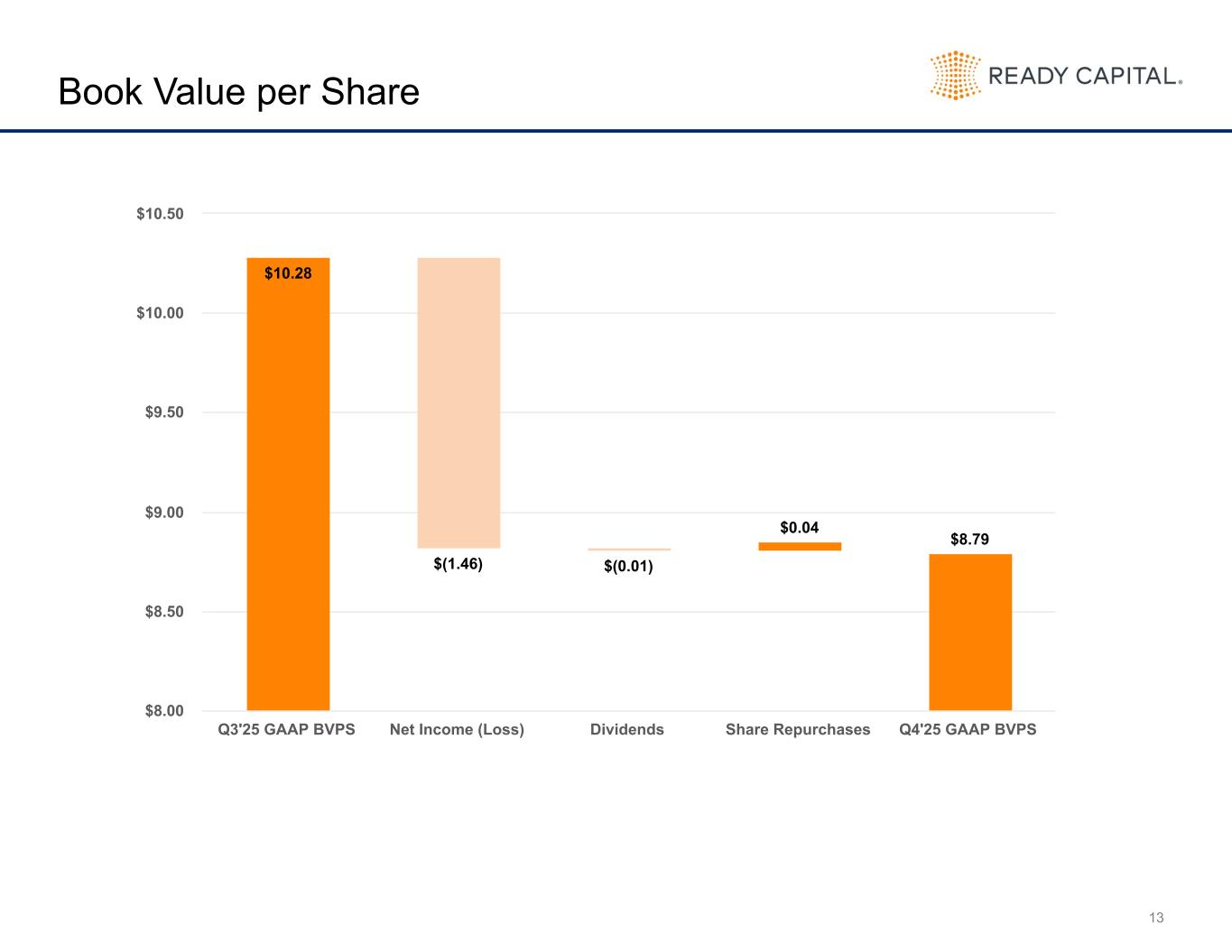
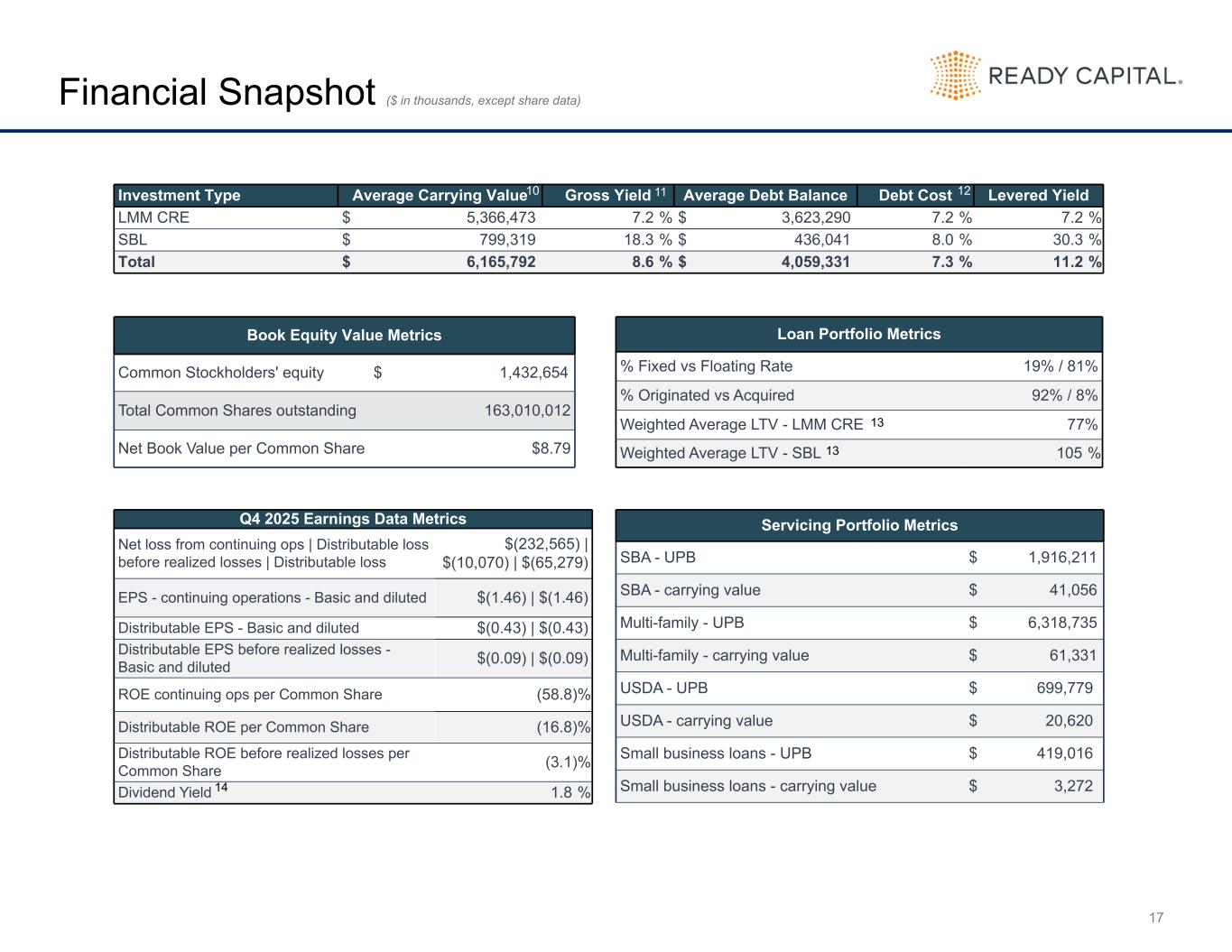
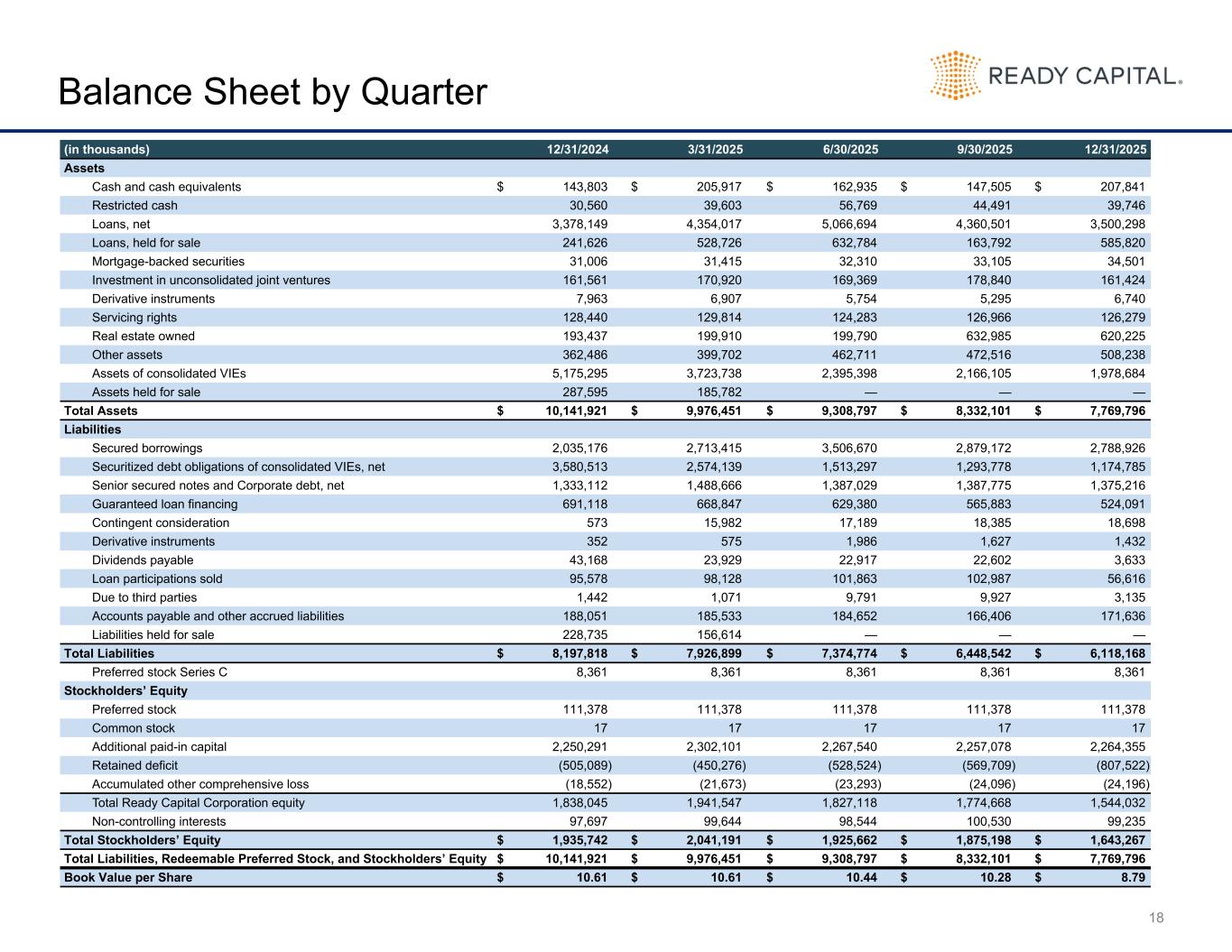
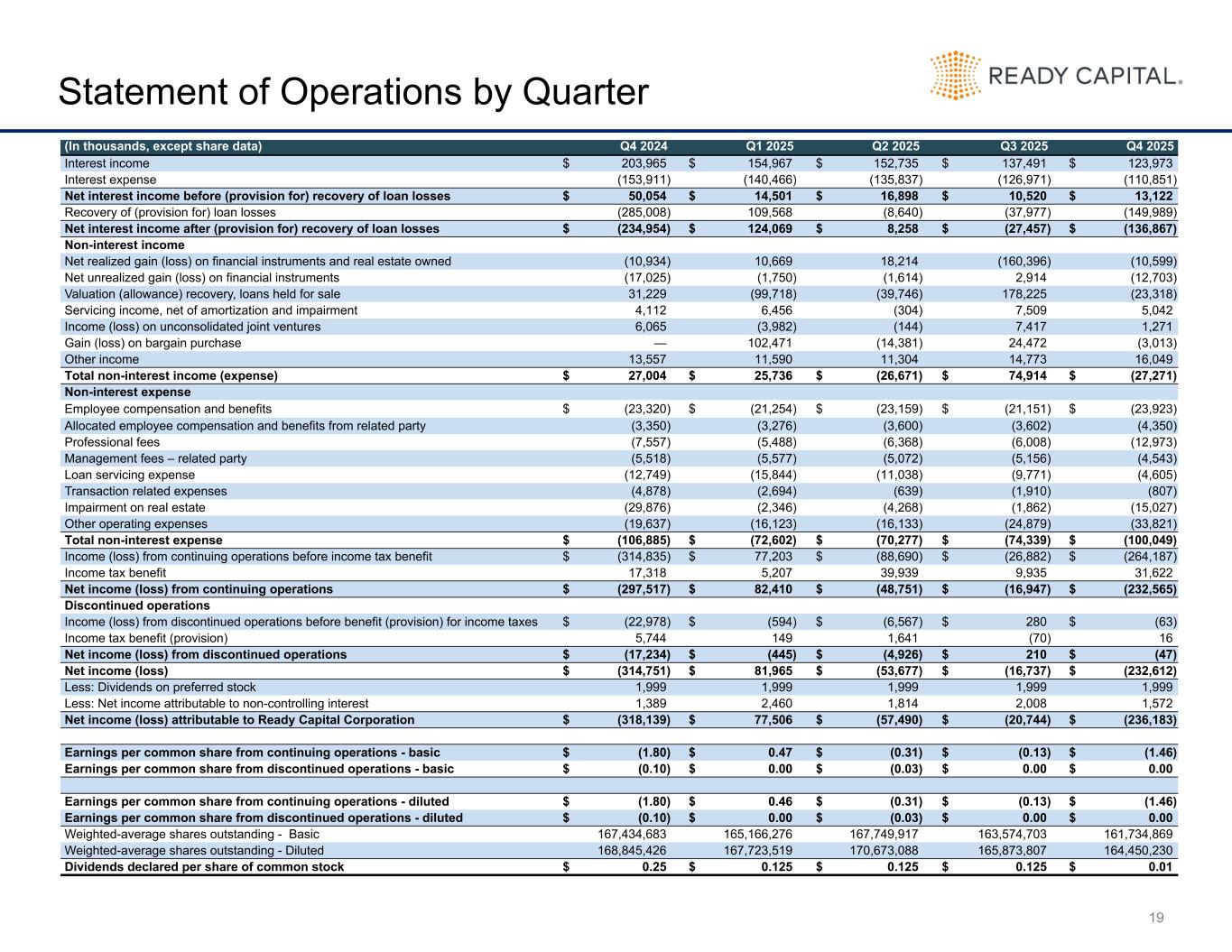
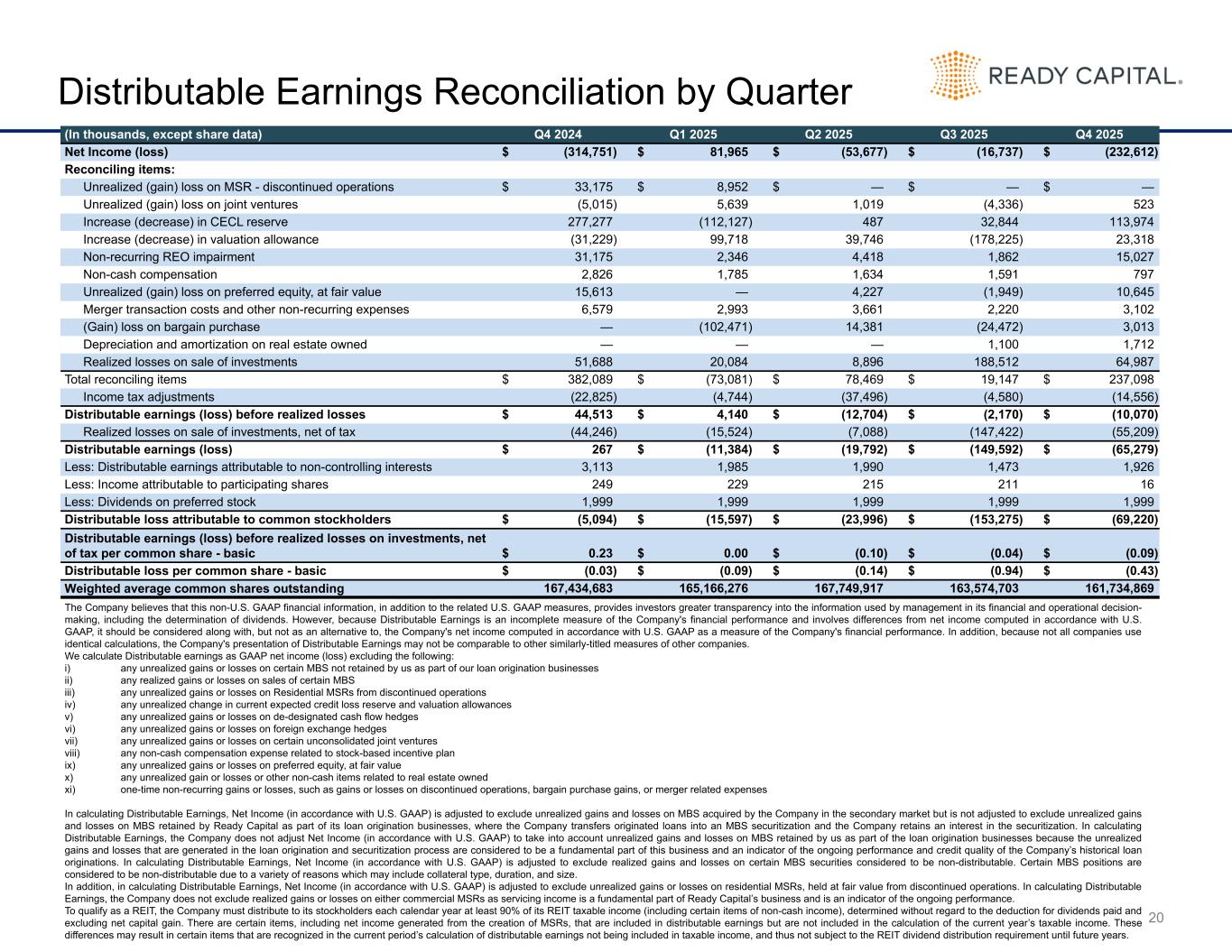
Thanks, Tom. The fourth quarter earnings and balance sheet are reflective of the repositioning strategy outlined by Tom. For the fourth quarter, we reported a gap loss from continuing operations of $1.46 per common share. Distributable earnings were a loss of $0.43 per common share and $0.09 per common share, excluding realized losses on asset sales. As Tom discussed, book value ended the year at $8.79 per share versus $10.28 per share in the prior quarter. This change was primarily due to an increase in the combined valuation allowance and CECL reserves of $173 million. The $23 million of valuation allowances relates to $600 million of loans that were transferred to held for sale in the fourth quarter and subsequently sold in the first quarter of 2026. The $150 million increase in CESOL reserves relates to more aggressive reserves on non-performing loans given the shortened resolution timelines. We also anticipate incurring increased valuation allowances as additional loans are identified for sale. In the net loss from normal operations, the following items were impactful. First, reoccurring revenue was $41.5 million compared to $47.3 million in the prior quarter. The change was primarily due to a $7.7 million reduction in gain on sale revenue from lower SBA 7A and USDA loan sales due to the government shutdown. This reduction was partially offset set by a $2.5 million increase in net interest income as we reduced the negative carry on non-performing loans. Second, operating expenses increased $7.4 million quarter over quarter to $59.9 million. This change was primarily due to increased compensation expense, higher legal fees, and a reduction in the tax benefit. Other items of significance included realized losses of $29 million on asset sales, $15 million of REO charge-offs, and $9.1 million of unrealized losses. Regarding the portfolio, we significantly increased the population of loans placed on non-accrual, which totaled 27% at year end. Given portfolio repositioning efforts, we have limited interest accruals to both loans we anticipate holding through maturity and to the cash yield on non-performing or loans that are potentially sale candidates we currently have a little under 200 million of free cash which positions us well to address our near-term obligations along with the items previously discussed by tom with that we will open the line for questions thank you we will now be conducting a question and answer session if you would like to ask a question please press star one on your telephone keypad a confirmation tone will indicate your line is the question queue.
Operator
You may press star 2 to remove yourself from the queue. For participants using speaker equipment, it may be necessary to pick up the handset before pressing the star keys. One moment, please, while we poll for questions.
Our first question comes from the line of Doug Harder with UBS. Please proceed with your question.
Thanks. In light of your comments around looking to kind of reposition the portfolio, accelerate dispositions, can you talk about, you know, the thoughts around keeping the Portland asset or whether that makes sense to kind of accelerate the timeframe on that?
Yeah, good question, Carter. So, you know, as you can see in the quarter, there's been a very dramatic change in the trajectories on both the red par, you know, given the change in the occupancy strategy by lowering the ADR. And secondly, the condominiums by putting two professional managers with specialization in both. So we're ahead of schedule right now in terms of our stabilization plan. So the short answer is we're making very strong progress. And, you know, would we hold to the last mile of that stabilization plan versus accelerated sale? Well, the answer is yes, we probably would, you know, lean in that direction. However, we're very confident of our ability to meet the stabilization plan on the two primary components, which are 90% of the value, the condos and the hotel. And we also note an overall improvement in the kind of Phoenix factor in the Portland market more broadly. So, yeah, so that being said, we would, if post, you know, stabilization with the appropriate, you know, pricing in relation to that, we would look for an early disposition.
Appreciate that. And just on the increase on the non-accruals, just to flesh that out, was there a change in the underlying performance or just a change in the strategy of how long you expect to hold those assets?
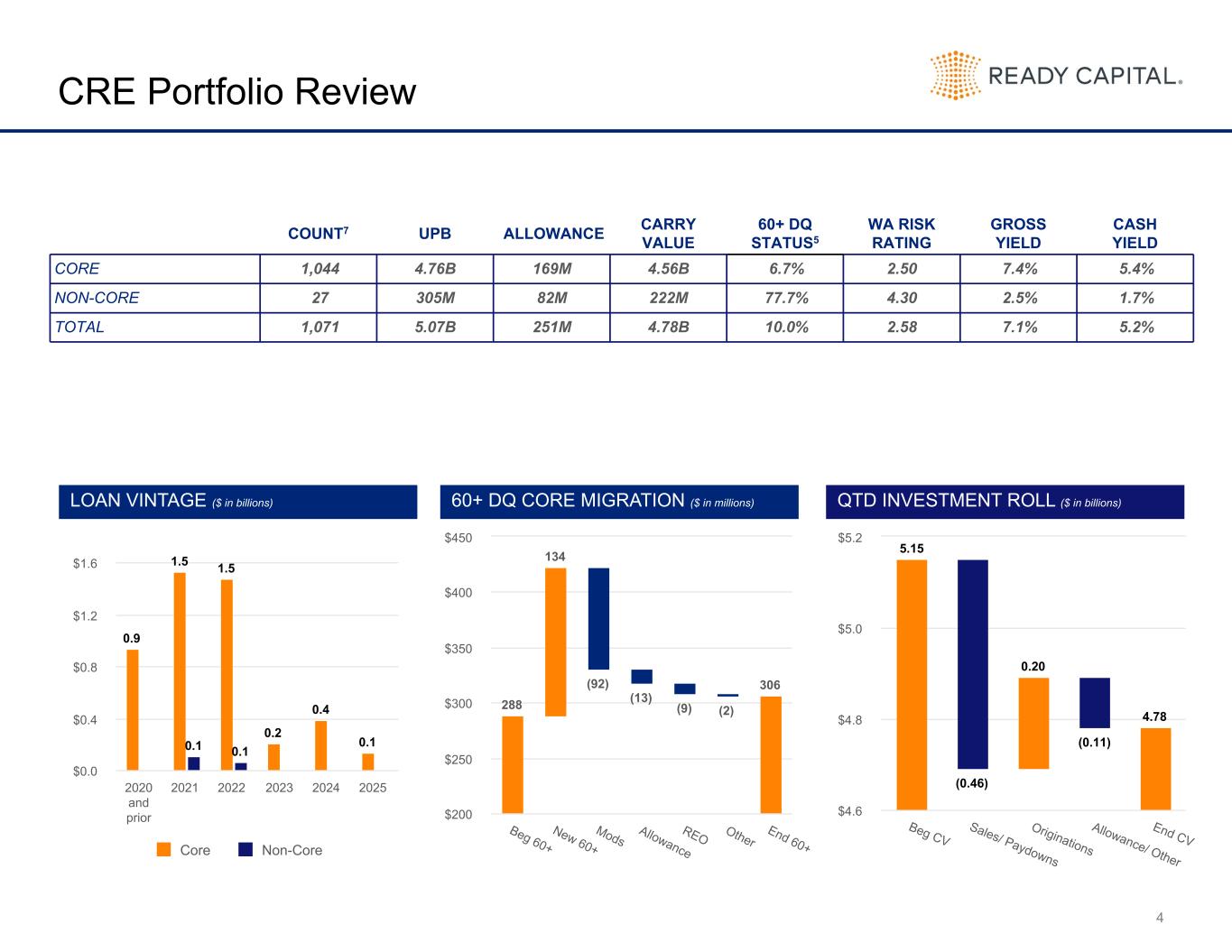
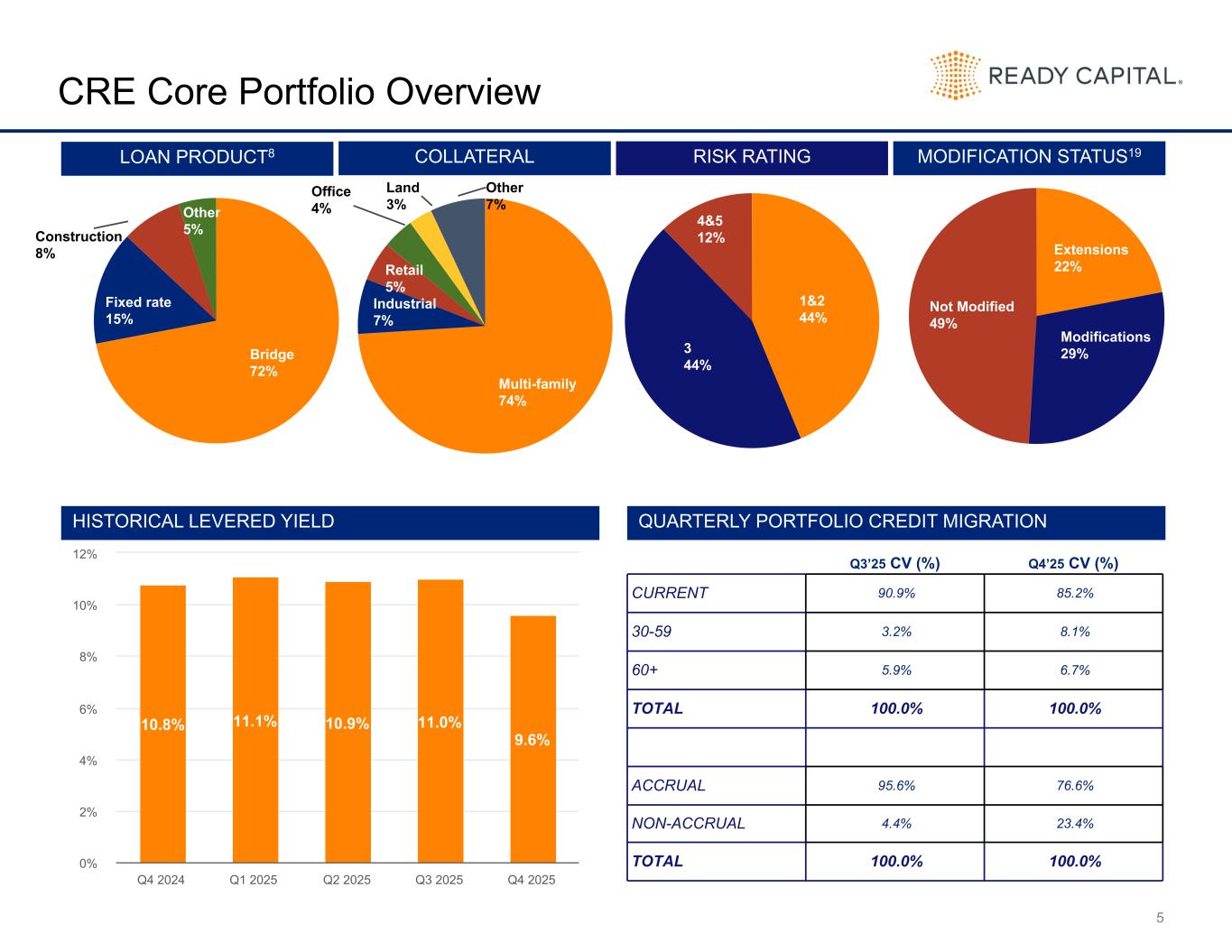
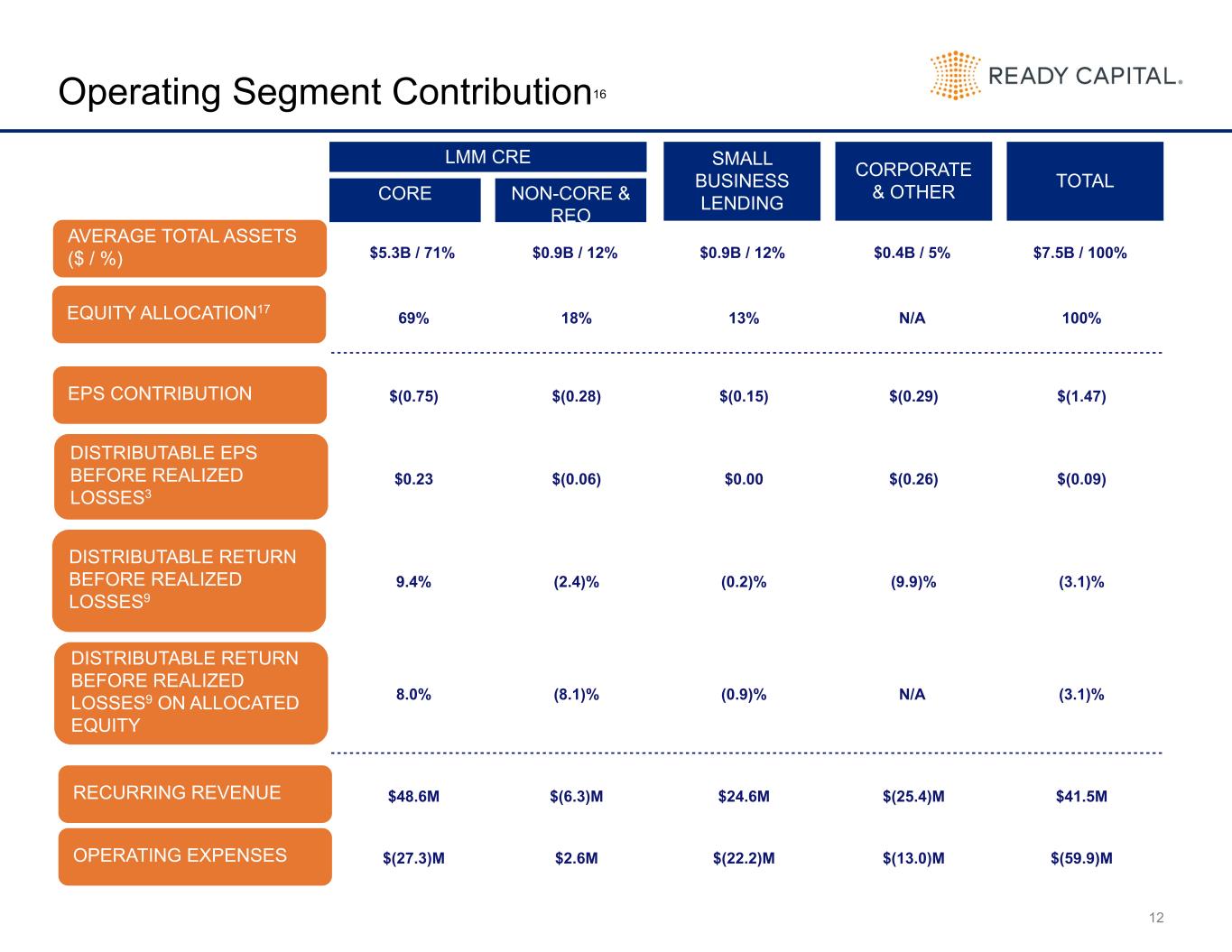
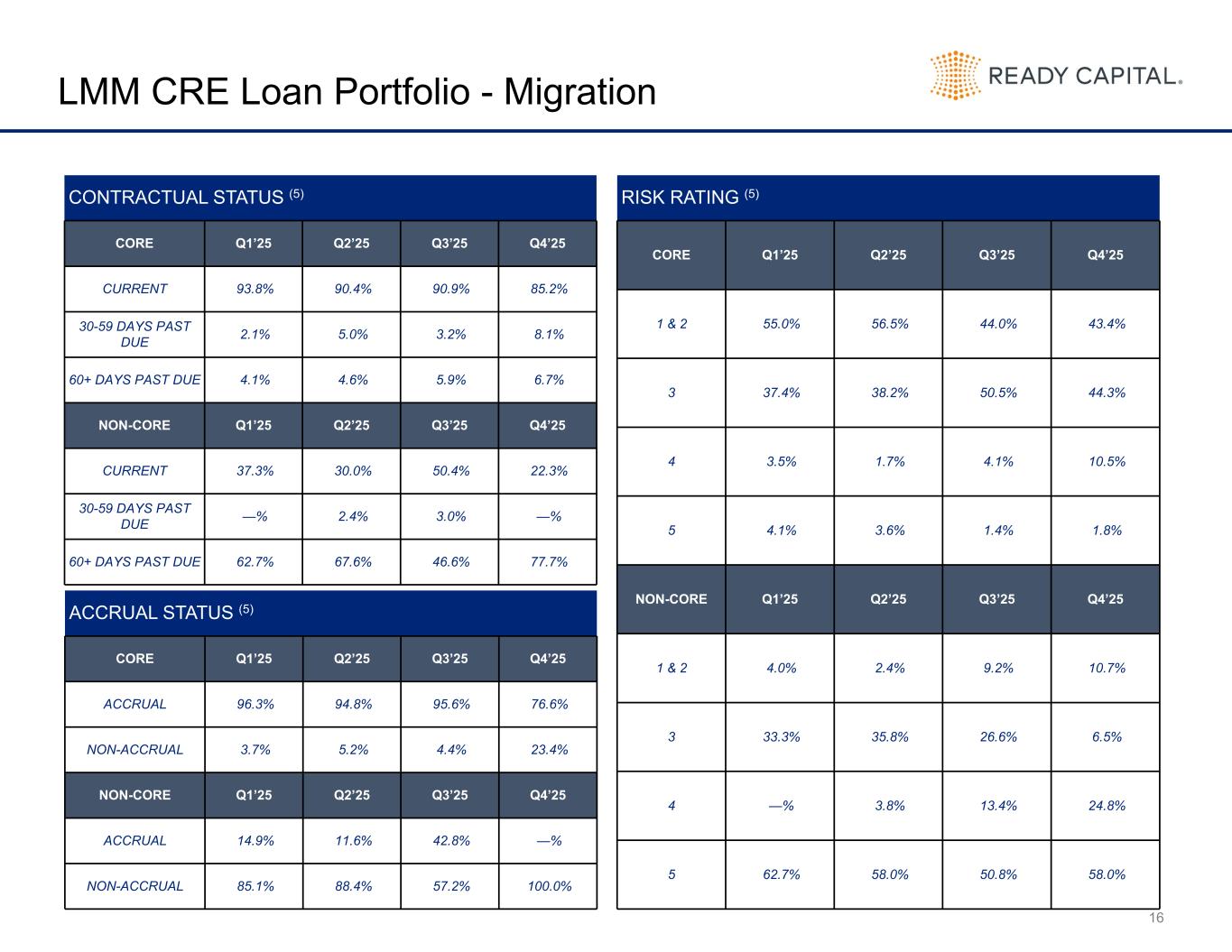
Yeah, no, it's actually 100% the latter on that point. It's a good question. So just to be very clear, what we are undertaking is a focus on short-term resolutions, which will, through both asset sales and what we call strategic asset management, and that will reduce the portfolio by 60% to $2 billion. So that actually renders our previous characterization of core and non-core as less relevant, as well as the typical 60-day metrics. And a good example of that is in the strategic asset management is we have, for example, a large loan with a sponsor who we might have otherwise extended, and we decide not to extend and that work with the sponsor to execute a sale of all or a portion of the portfolio. And actually, so that's very critical to understand. So it's not necessarily negative credit migration. It's really related to the assets, that asset management strategy itself.
Appreciate the clarification. Thank you.
Operator
As a reminder, if anyone has any questions, you may press star 1 on your telephone keypad to join the queue. Our next question comes from the line of Jade Ramamu with KBW. Please proceed with your question.
Thank you very much. On the core CRE and non-core CRE loan portfolios, the percentage of non-accruals, as you just said, increased sharply. Do you anticipate needing to reverse previously accrued interest on these loans as a result? If not, why not? And can you just comment on the underlying credit trends in both portfolios.
Andrew, you could touch on the accrual question, but, Jay, to be very clear, we're making strategic asset management decisions to not extend where we believe we're putting the borrower in a – we're not extending the loan and we're putting the borrower in a good place to be able to execute an alternative strategy, which is usually a portfolio sale. And so to put more granularity on it, and so therefore it's not negative credit migration. It's a conscious decision by us as the lender to not execute modification and extension strategies. So maybe we could do is, Andrew, if you could answer the question regarding the accrual, and then Dom, maybe just give Jade an example or two in terms of what we're looking at with respect to what we're deeming our strategic AM strategies?
So for loans that are being positioned for loans that were identified for sale in the fourth quarter and settled in the first quarter or loans that we anticipate selling, we have taken the reversals of the accrued interest in the fourth quarter numbers. So, you saw roughly a $53 million reduction in accrued interest. So, the accrued interest that's sitting on the balance sheet as of year-end is roughly $42 million, and really just related to loans we anticipate holding through maturity with full collectability on that interest.
But, Andrew, it does sound like you're stepping up the pace of loan resolutions, and you did say that you expect to increase valuation allowances on loan sales in the future. So would that not entail writing down that accrued interest balance as well?
Yeah, so the accrued interest associated with loans that, you know, may be subject to a market discount if we move them to the sales, the accrued interest attached to any of those loans was written down in the fourth quarter.
Helpful in terms of the accrual question. Don, maybe just give an example of a more granular example of what our asset management strategy is with respect to some of that larger loan.
Yeah, sure. Hey, good morning, Jade. So as Tom mentioned, obviously, you know, not entertaining, you know, longer-term modifications with some of our assets. You know, a concentration in sort of the increase in non-apprual is in four or five larger loan exposures where, you know, good sponsors, good quality asset, good performance, but unwilling to provide additional time. And what sponsors have pivoted to do is seek return of financing or potentially sell assets. So a good example is that we have a five-property portfolio in the Sunbelt region with an institutional sponsor. Obviously, they wouldn't prefer to have additional time and maybe some spread forbearance to get to the next 12 to 18 months. In lieu of that, they've sort of started marketing that portfolio with the national brokerage firm, and we're confident that we should be able to get repaid in the next quarter or so at or close to part. So just putting some pressure on borrowers on some of these assets where they will pivot ultimately to either seeking alternative financing or potentially selling the underlying assets.
Okay, thank you. Just on the Portland asset, the 25 reservation agreements, what percent will convert to contracts, and what's the average price?
Dom, you want to comment on that?
So, of the 25, 16 are in contract with hard deposits. The remaining nine should be converted to contracts with hard deposits within the next few weeks. We have actually closings in process this week and next. Those units sold for an average price of $737. And as Tom alluded to earlier on the call, you know, the lower per square foot is expected just given these are sort of the smaller units on the lower floors.
This is just part of a strategy we're working on with Christie's, our broker, and they have experienced globally with these rich residences and other luxury hotel concepts where the lower units sell at lower prices early on, and then the higher floor, higher units sell at higher prices later in the process. And we've faced it and we've bifurcated the 132 units of which were sold out now at 27% into, you know, these four phases. And we're highly confident of our ability to achieve on an average per square foot basis the numbers in our projection plans.
Okay. That's good to hear. And then on the $855 million of loans sold in February, what's the sale price relative to par and relative to carrying value?
Andrew, do you want to comment on that?
Yeah, so they sold in the high 90s shade. Carrying and UPB were right on top of each other. The pricing is the same there. Thanks very much.
Operator
Our next question comes from the line of Christopher Nolan with Lattinburg-Dowman. Please proceed with your question.
Tom, in your comments, you indicated that through reposition of the portfolio and dispositions, the leverage ratios are going to go down. How much was that again, please?
I have one turn to two and a half.
You know, the pro forma RC2O, if you will, is going to involve significantly less leverage with a multi-sector approach with a significant percentage of investment capacity being brought to bear by the external manager waterfall, which is a large private funds investor in commercial real estate debt and equity.
And then for the debt maturities that you guys are coming up in the second half of the Is the plan to retire that debt with just, you know, portfolio realizations and so forth?
Yeah, I'll let Andrew comment on that. But as we said before, the broader liquidity plan is to, you know, it's in excess of $800 million, which is a significant multiple of the total maturities. And we're 35% into that plan and are going to raise another $500 million, half through asset sales and half through runoff, which we've been running at a 36% repayment rate. And these asset management strategies that Dom just talked about will enable us to outperform there. And we've completed two of the four asset sales with the other two by the end of the second quarter. So given that plan, Andrew, what is the timing on the debt maturities?
Certainly, to the extent we can get execution levels that are accretive to the business from both an earnings perspective and a cash flow perspective, we would like to revive portions of the 26 maturities. With that being said, as Tom, you know, highlighted, the liquidity plan currently underway certainly provides a substantial cushion to take out all of the three remaining maturities with cash if needed. I think you will see us sort of sequentially take out these bonds in the upcoming weeks and months, given the current liquidity position.
Operator
And our final question comes from the line of Chris Mueller with Citizens Capital Markets. Please proceed with your question.
Hey, guys. Thanks for taking the question. I guess as you guys are focused on liquidity here, are there other monetization strategies that you guys would consider, like selling or spinning off a business line? And it also looks like there's a couple of GSE licenses up for sale right now. So maybe not the best time to be a seller there. But are there other avenues of raising some capital that you guys are looking at?
Yeah, there are. That's a good question, Chris. and appreciate you taking the time. Yeah, there's a number of what we'll call non-core assets that are not in this liquidity plan that we're entertaining potential dispositions. You know, I think one, obviously, one area, you're right, we do have opcos in the form of TRS, taxable re-subsidiaries, that are, you know, could be sold. However, I'll underscore that our commitment to the SBA business, which is a high ROE business and low capital allocation, we are strongly committed to that. However, there are other non-Corp assets that we are undertaking reviews for sale that could materially provide an additional buffer to the portfolio sales. but as far as the SBA we're really committed to that but are looking at other smaller non-core assets for additional sales Got it, it's very helpful, thanks for taking the question Thank you, we have reached the end of the question and answer session and therefore I would like to turn the call back over to CEO Thomas Capassi for closing remarks We appreciate everybody's time Ready Capital and our team remain highly confident of our ability to execute this liquidity plan and emerge in the latter half of this year in a position to improve the fundamental earnings capacity of the business, and we look forward to future calls.
Operator
Thank you. This concludes today's conference, and you may disconnect your lines at this time. We thank you for your participation.