Operator
Welcome to the RxL Q4 2025 Earnings Conference Call and Webcast. My name is Ina, and I will be your operator for today's call. Please note that this conference is being recorded. During this call, the committee will make certain forward-looking statements within the meaning of federal securities laws, which by the nature involve a number of risks, uncertainties, and other factors that could cause Azure results to differ materially from those in the forward-looking statements. A discussion of factors that could cause actual results to differ materially is contained in the company's SEC filings as well as in its earnings release. You should refer to a copy of the company's earnings release in the Investor Relations section on the company's website for additional important information regarding forward-looking statements and disclosures and reconciliations of NANGA financial measures that the company uses when it's discussing its results. I want to turn the quote over to Joe Wilkerson. Mr. Wilkerson, you may begin.
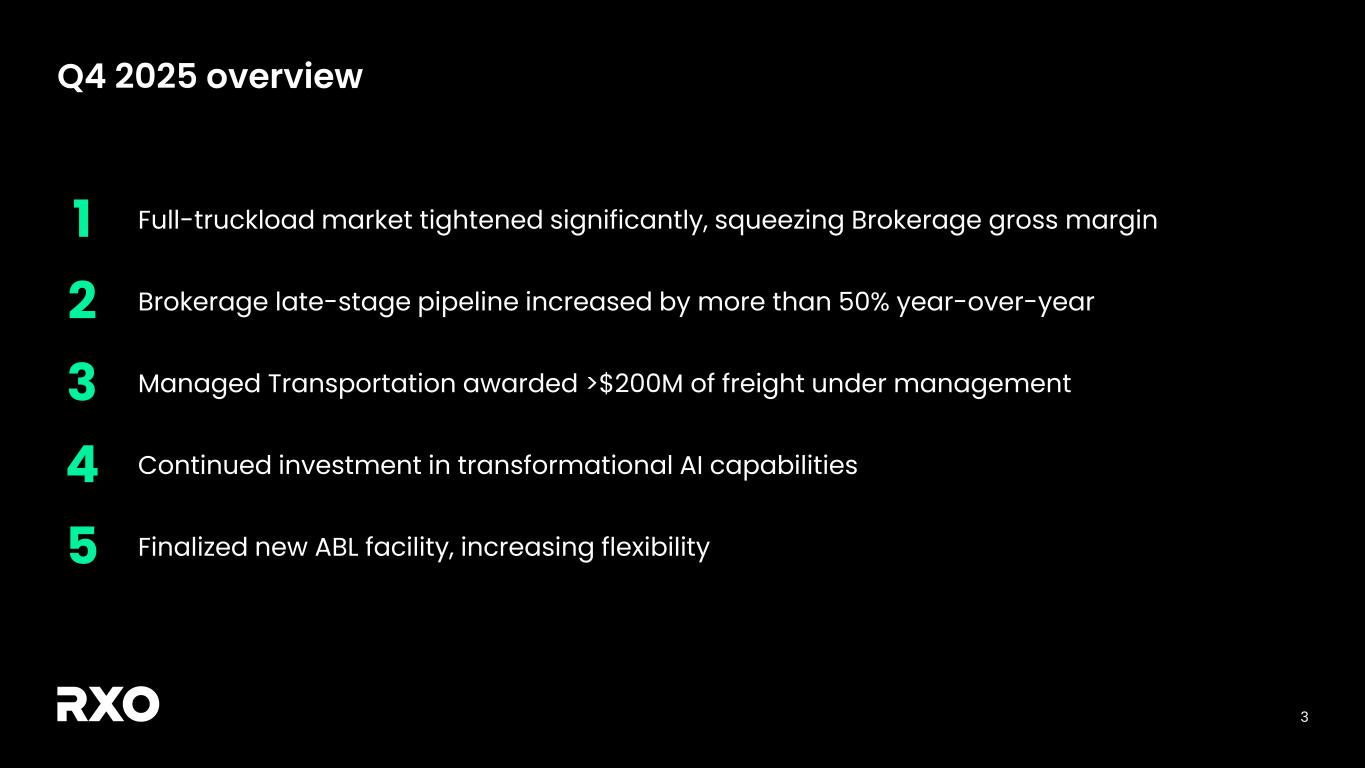
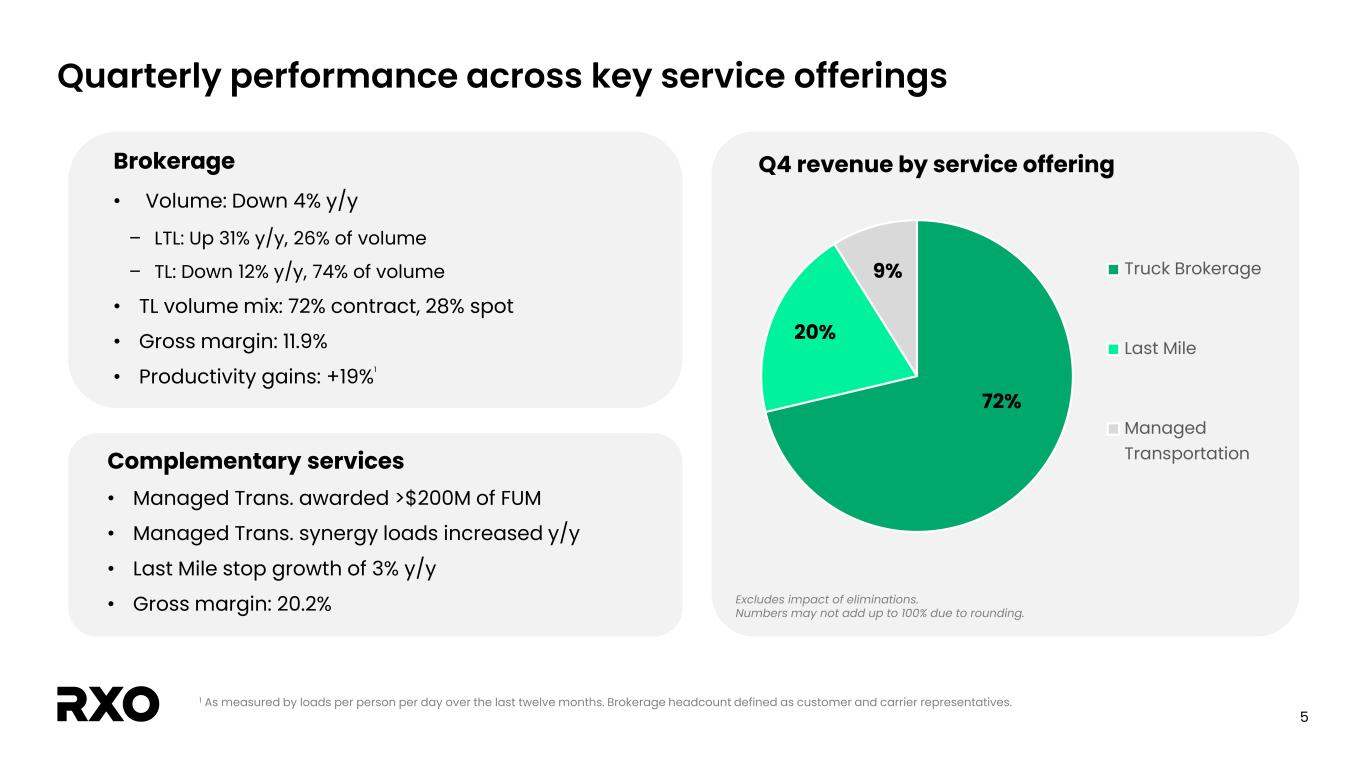
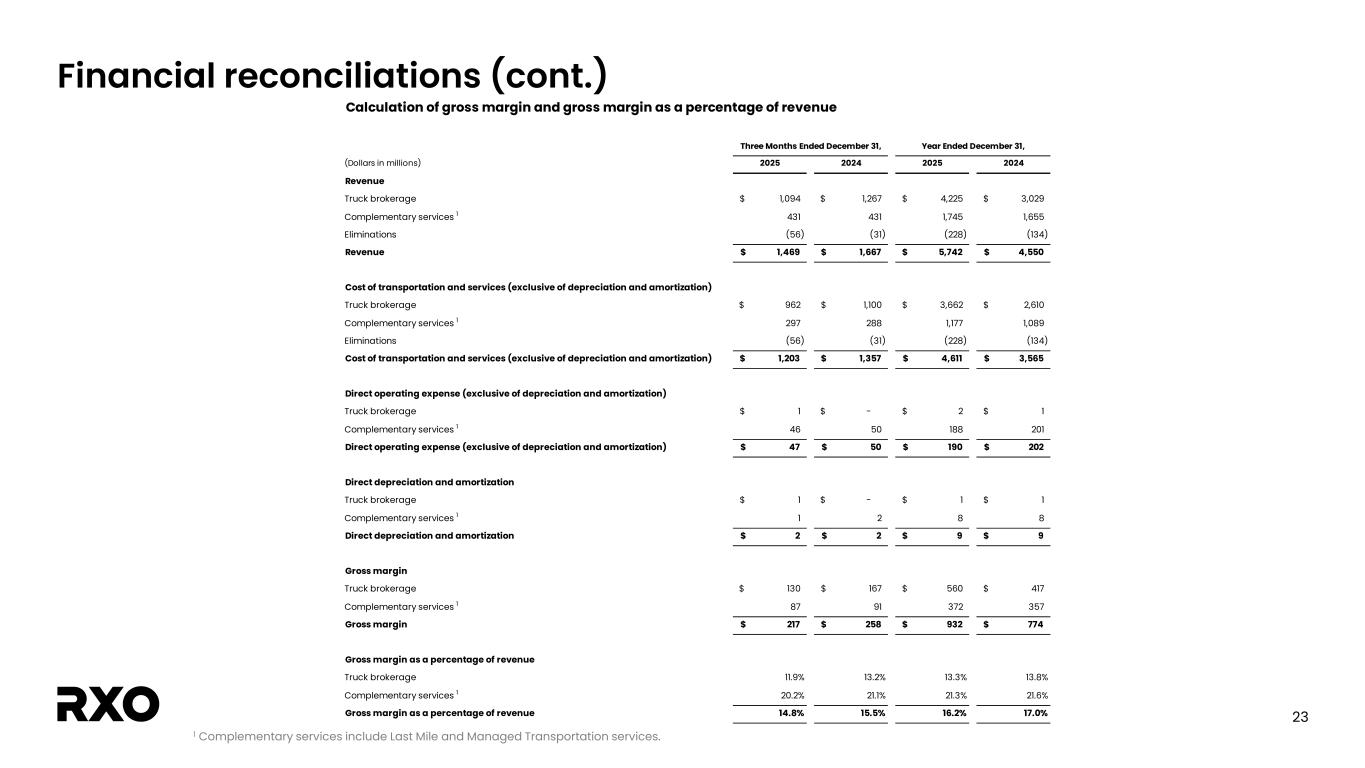
Good morning, everyone. Thank you for joining today. With me here in Charlotte are RSO's Chief Financial Officer, Jamie Harris, and Chief Strategy Officer, Jared Weissfeld. This morning, I want to cover three key points. First, we continue to take decisive actions to mitigate the effects of the prolonged soft freight market and significant capacity reductions, which are squeezing our brokerage gross margin. We have a rigorous, disciplined approach to optimizing our cost structure and our gross profit per load. We're taking steps to augment our carrier base, grow brokerage volume, grow businesses that are stable sources of EBITDA, and leverage our deep customer relationships and last mile hub network to design unique solutions for customers. Second, we've got a strong brokerage late-stage sales pipeline for new business, which grew more than 50% year-over-year. Most of that growth is driven by full truckload. Our managed transportation business continues to win and also has a very strong pipeline. Third, we finalized a new asset-based lending facility, which replaces our revolver. Our new facility is right-sized for our needs, decreases our costs, and provides us with increased flexibility across all market cycles. Now, let's discuss our fourth quarter results. In brokerage, overall volume declined by 4% year-over-year. Less than truckload volume growth of 31% was more than offset by a 12% decline in truckload volume. Brokerage gross margin was 11.9%. In Complementary Services, managed transportation was awarded more than $200 million of freight under management, and last-mile stops grew by 3% year-over-year.
Complementary Services gross margin was 20.2%.
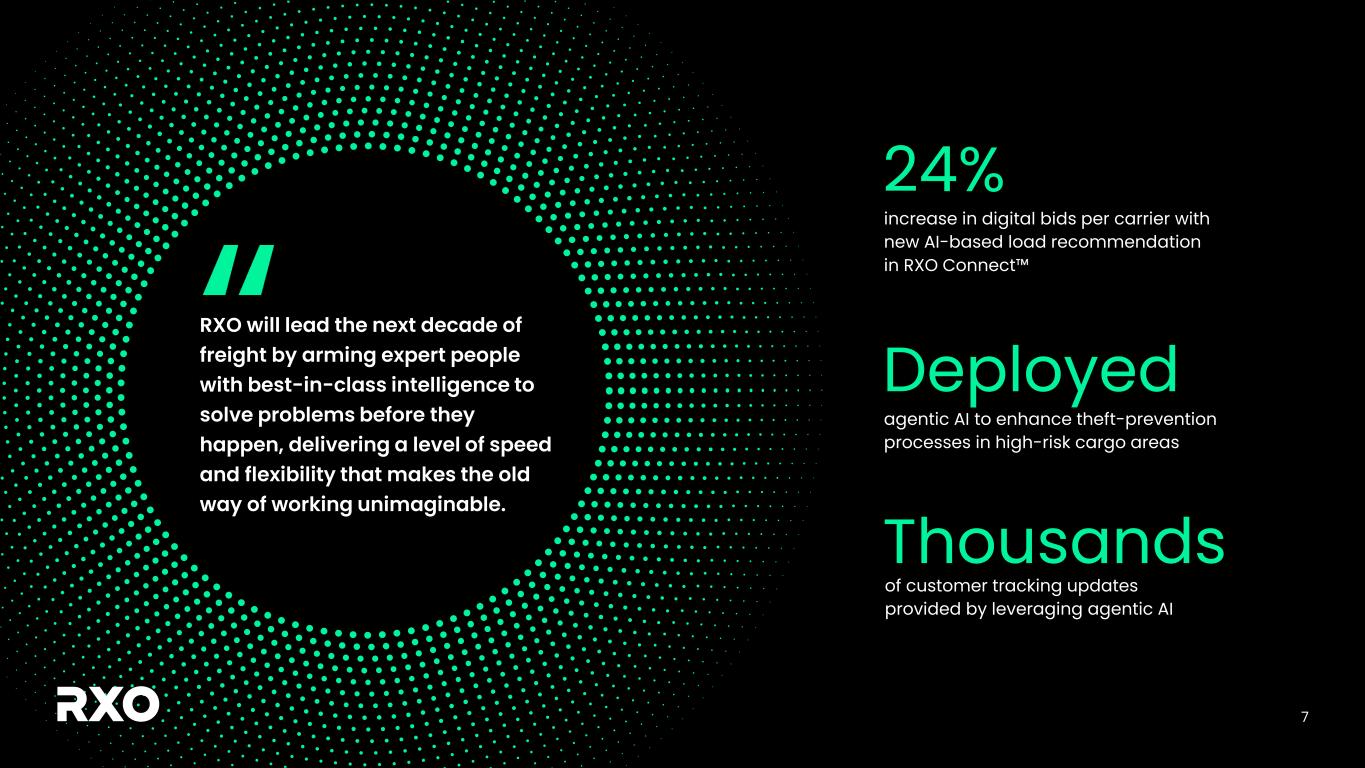
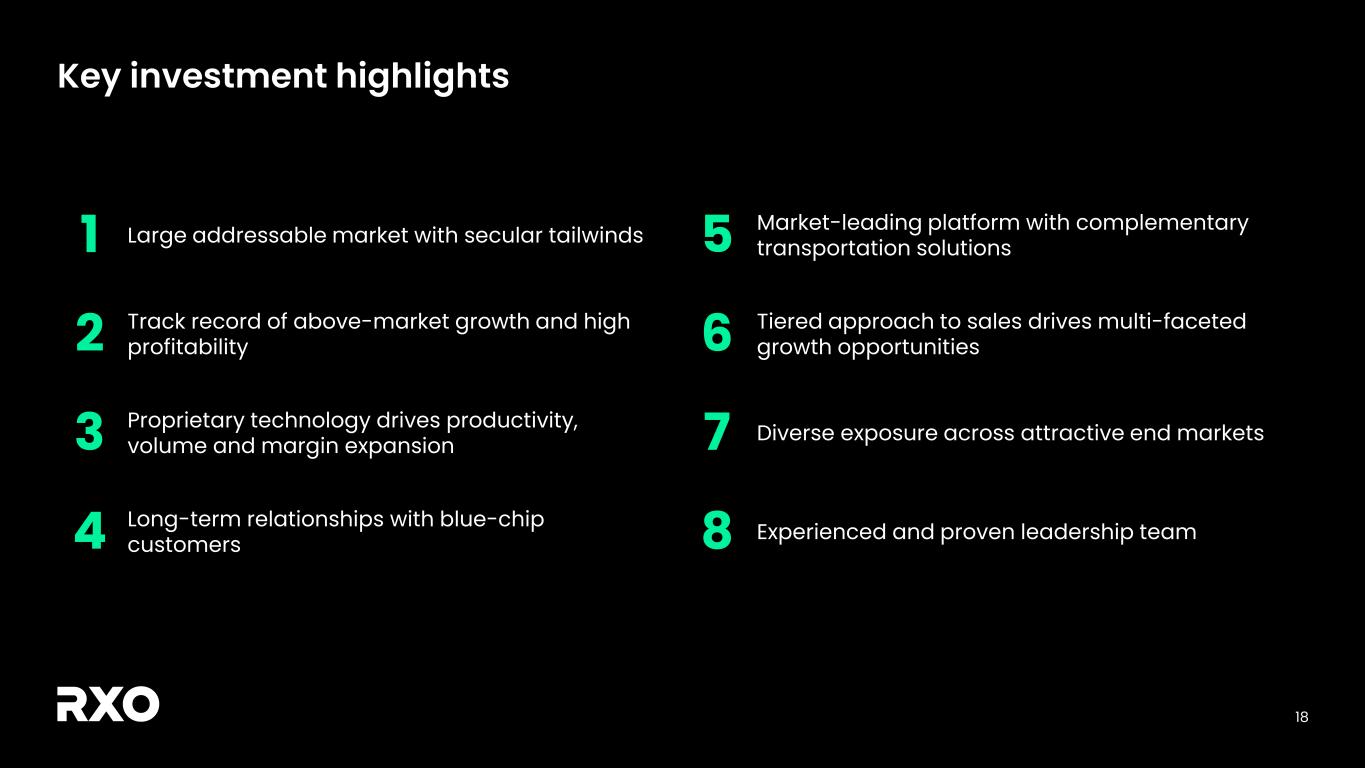
Overall, RSO's EBITDA was $17 million in the quarter, below our expectations primarily due to a more pronounced brokerage margin squeeze towards the end of the quarter. This was primarily driven by capacity exits, which led to the largest November to December increase in industry-wide buy rates in 16 years. In December, rates increased by about 15% month over month, much faster than our contractual sale rates. At the same time, demand remained soft with not enough spot loads to offset the rise in purchase transportation costs. Sonar tender rejections and the load-to-truck ratio reached the highest levels of the year in December, and both increased further in January. Because our book of business is largely contractual with enterprise customers, this affected our near-term brokerage gross margin performance. That said, winning contract business is a hallmark of our brokerage model because it positions us to win accretive spot opportunities, mini-bids, and special projects. The capacity reductions in the industry represent one of the largest structural changes to truckload supply since deregulation and should set the market up for a sharper inflection when demand recovers. The regulatory actions will also help improve the overall safety of the industry as well as help combat theft and fraud, but they do put pressure on near-term results. We're continuing to take decisive actions to navigate the market. Specifically, we remain disciplined when it comes to cost and optimizing our gross profit per load. We're expanding alternative sources of capacity, like private fleets, to help reduce buy rate volatility. We're working closely with our customers to optimize volume, service, and price this mid-season. We're also working to convert the strong late-stage brokerage sales pipeline. And we're developing more creative ways to leverage our hub network within Last Mile to provide customers with customized middle mile solutions. I remain extremely positive about the actions we're taking to mitigate this part of the freight cycle and all those we're taking to position RxO for future outperformance. More importantly, now that we're past the bulk of the integration, we're more unified than ever with the singular focus on returning to growth mode, leveraging our scale, and outperforming the market. We'll do that through our differentiated approach to sales and customer service and our unified tech platform. Our multi-layered sales team focuses on building exceptional customer relationships. This helped us grow our late-stage brokerage sales pipeline by more than 50% year-over-year. Strong momentum as we start 2026. This pipeline is composed of high-quality new names and long-tenured existing enterprise customers for which we have built successful solutions in the past. While bid season is not yet complete, we've seen early wins. The strength and makeup of our pipeline gives us confidence that we will resume year-over-year truckload volume outperformance as early as the middle of this year. In managed transportation, we also continue to win. We were awarded more than $200 million in freight under management in the fourth quarter and still have a very robust pipeline of opportunities. These wins will result in increased energy loads to RxO's other lines of business. We're very proud of the strength of our customer relationships across RxO. Recently, we received awards from blue-chip customers, including Kelanova, Lowe's, and Electrolux. Another reason I'm excited is our team is now operating on an integrated platform, which includes our CRM, our pricing tools, and our proprietary systems, RxO Connect and Freight Optimizer. The integration work we've done over the past year is now providing unparalleled visibility for our sales and operations team. It has enabled us to leverage decades worth of proprietary data from both Legacy RxO and Legacy Coyote to power our pricing algorithms and recommend the best truck for each load. We're positioning RxO for the long term through our investments in transformational AI capabilities. Our vision is that RxO will lead the next decade in freight by arming expert people with the best-in-class intelligence to solve problems before they happen, delivering a level of speed and flexibility that makes the old way of thinking unimaginable. Later in the call, Jared will talk more about the rapid progress and real results we're seeing from our initiatives rxo has a strong balance sheet and we took steps in the fourth quarter to further improve our capital structure we finalized a new asset-based lending facility which replaces our revolving credit facility we have tailored the new facility to better align with our business needs securing better pricing and greater financial flexibility across all parts of the market cycle. Jamie will walk you through these details later. In summary, we continue to take strategic actions to better position RSO for both the short and long term. I remain confident in RSO's ability to deliver outsized earnings growth driven by five key factors. Scale. Scale allows us to purchase transportation more effectively. Our technology platform and the Coyote acquisition have helped decrease our cost to serve by more than 20% since our spend. We also expect buy rate favorability to continue improving. Profitable growth. We're focused on gaining profitable truckload markets here, and we're expanding the parts of our business that are stable sources of EBITDA, like managed transportation, SMB, and LTL. In the fourth quarter alone, LTL volume grew 31%, the fourth consecutive quarter of double-digit growth, underscoring our momentum in this area. Technology, we invest over a hundred billion dollars annually in our best-in-class tech, all in service of achieving our future state tech vision, which will be driven by AI. Once fully implemented, our capabilities will fundamentally change how our people get work done and provide customers with the faster, more seamless way of managing their freight. Cash generation. Our asset light model is resilient. Despite soft market conditions, we achieved adjusted free cash flow conversion of 43% in 2025 within our long-term target range. Cost structure. Since becoming a standalone company, we've taken out more than $155 million in costs through targeted initiatives, including AI investment, real estate optimization, and productivity. We're not done yet. Notably, brokerage headcount declined by a mid-teens percentage year over year. Over the last 12 months, we also achieved a 19% increase in productivity. Our streamlined operations will provide us with substantial operating leverage. While we're not satisfied with near-term results in this soft environment, We're very excited about the path ahead for RxO. We've shifted from integration mode and are returning to growth mode to take advantage of our larger scale. We continue to adhere to the formula that has driven our success for over a decade. Exceptional service, comprehensive solutions, deep customer relationships, and cutting-edge technology. RxO has a unique algorithm for long-term growth. Now, Jamie will discuss our financial results in more detail.
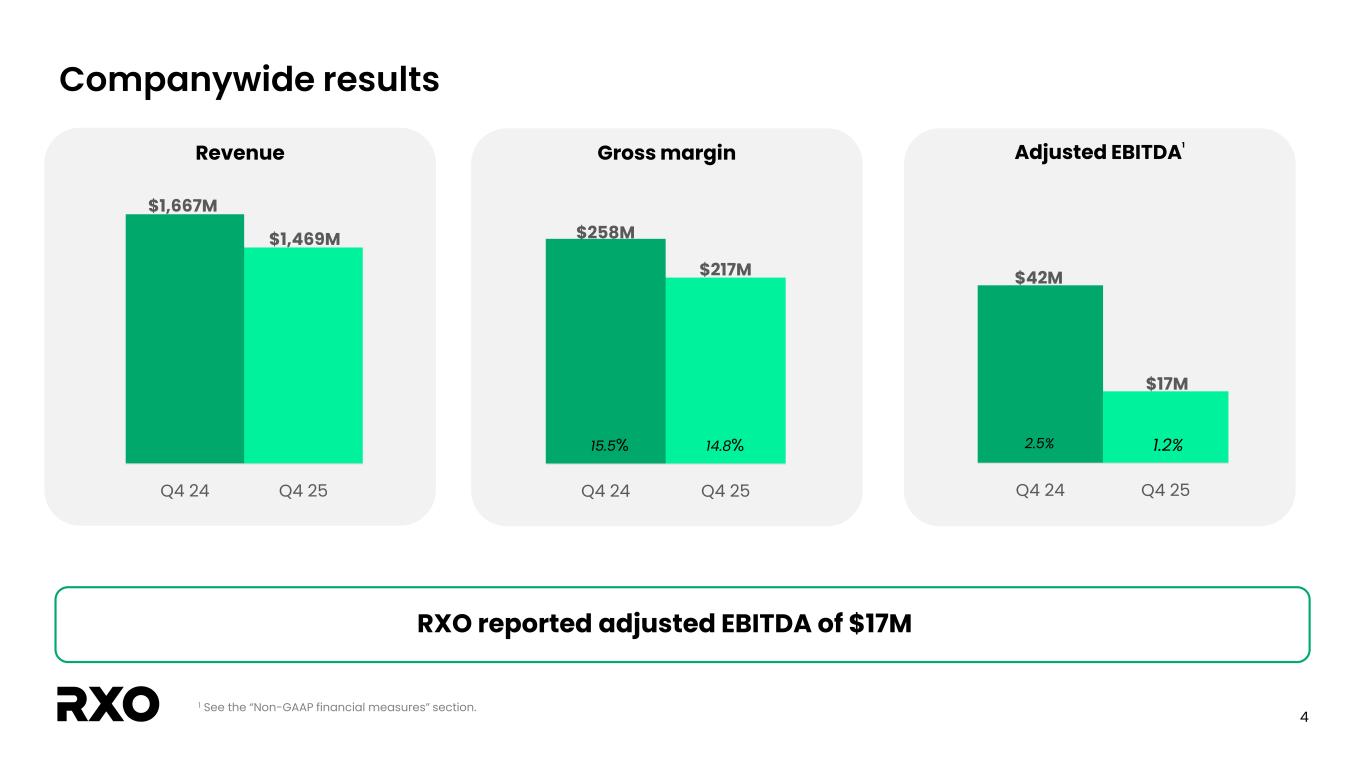
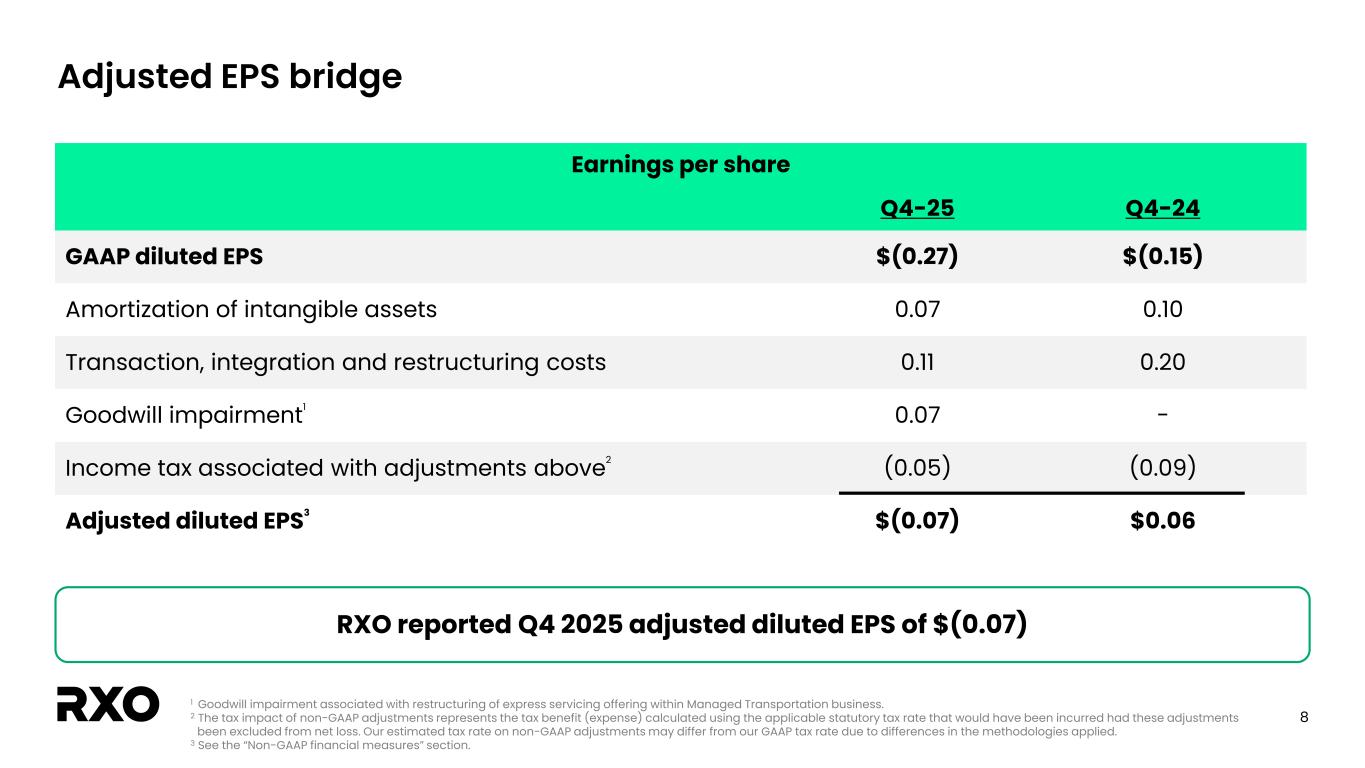
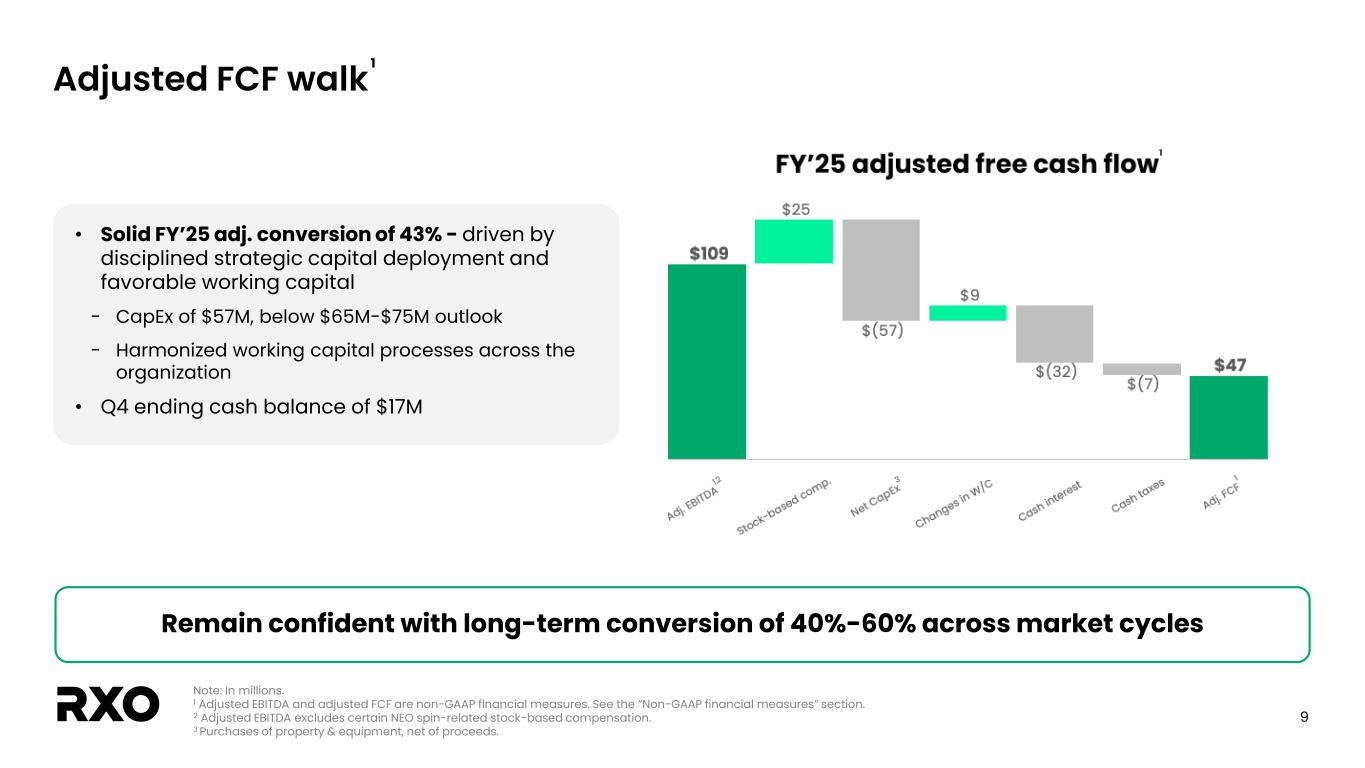
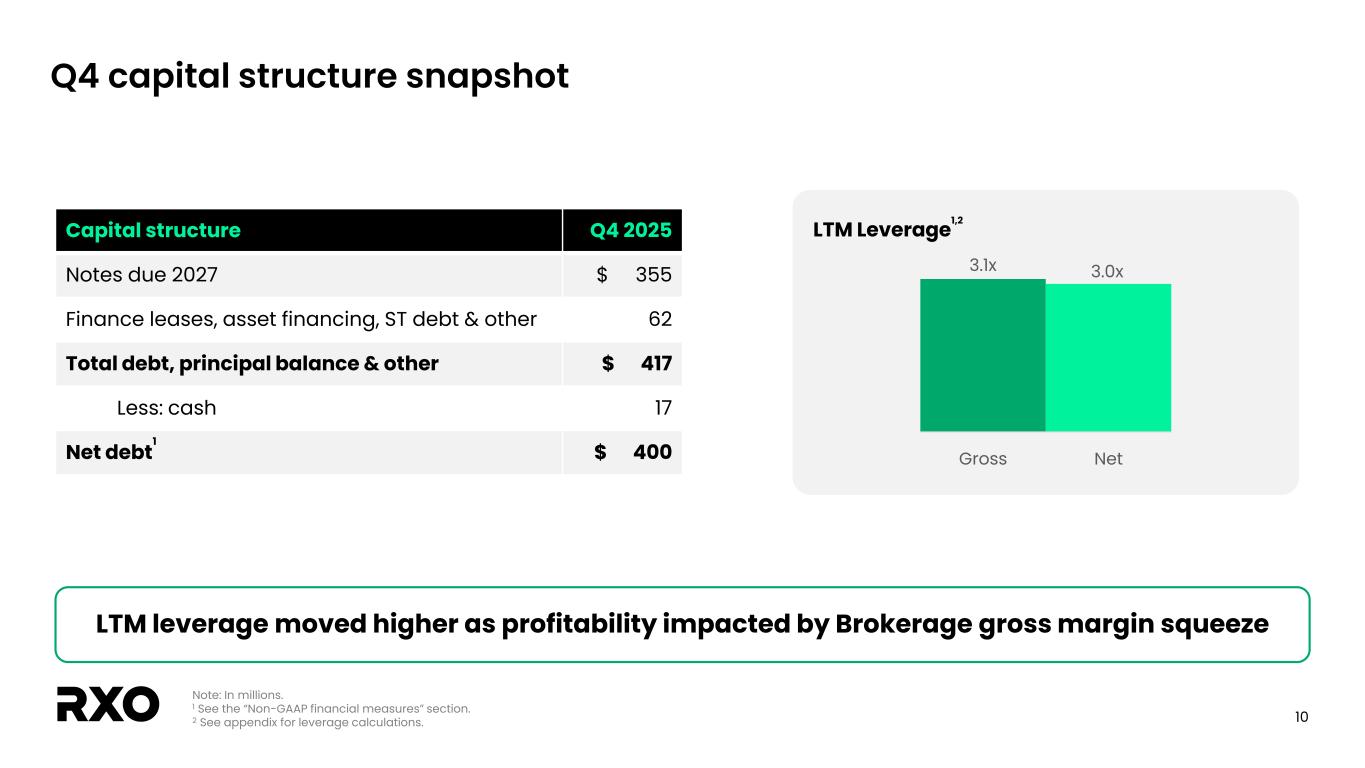
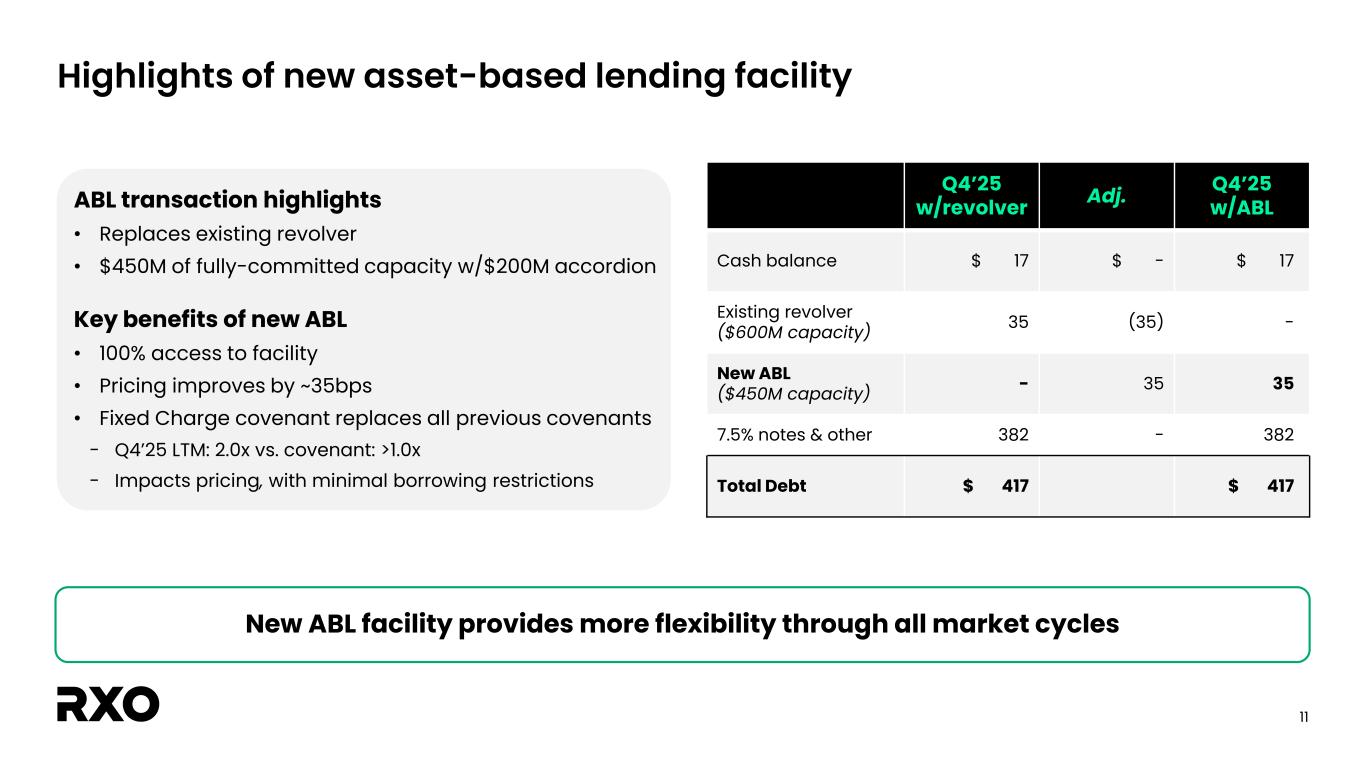
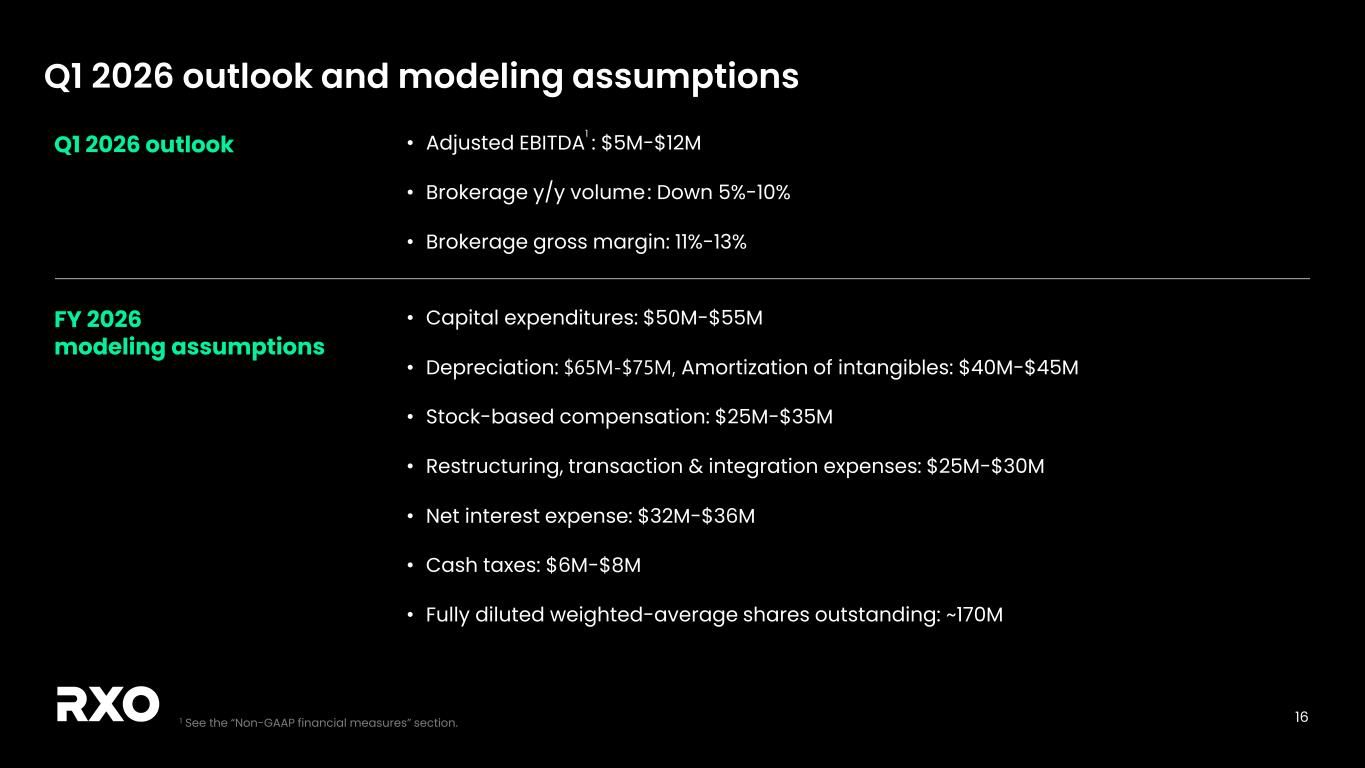
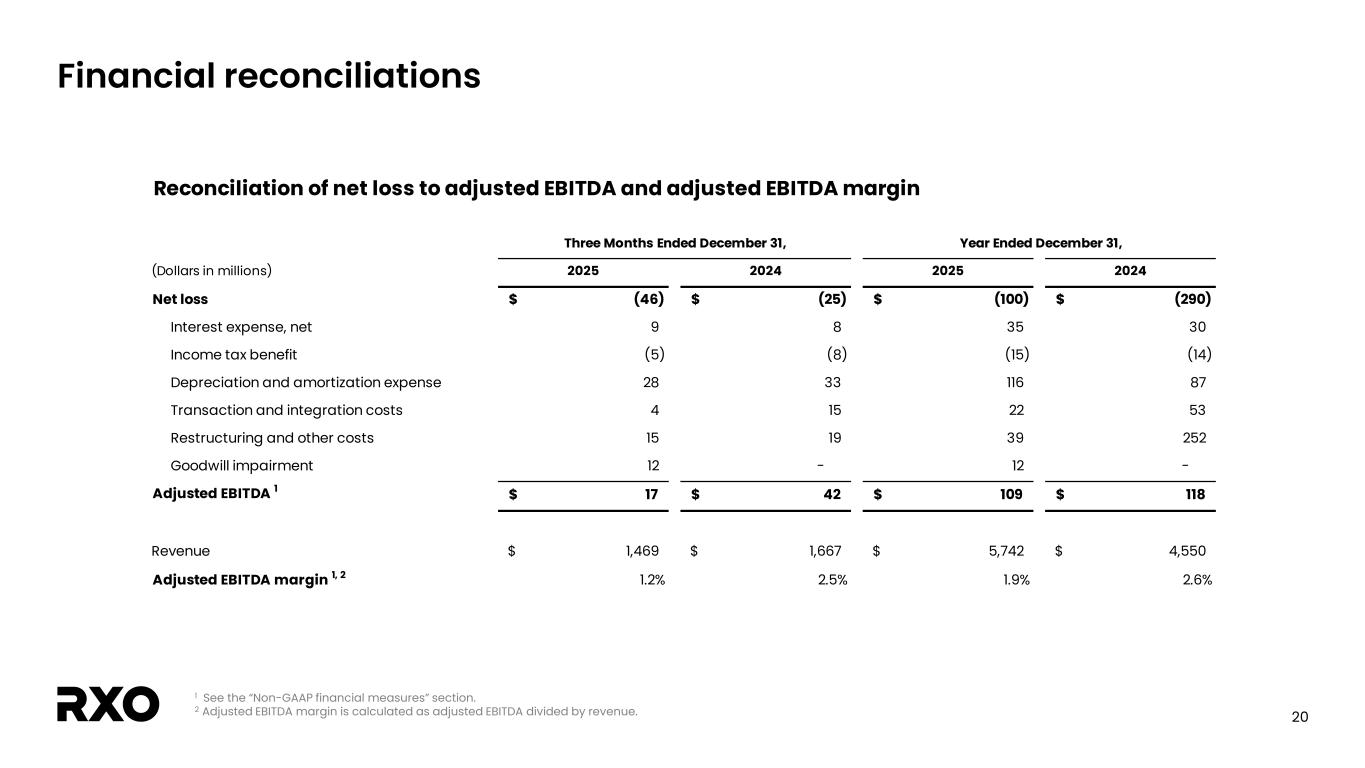
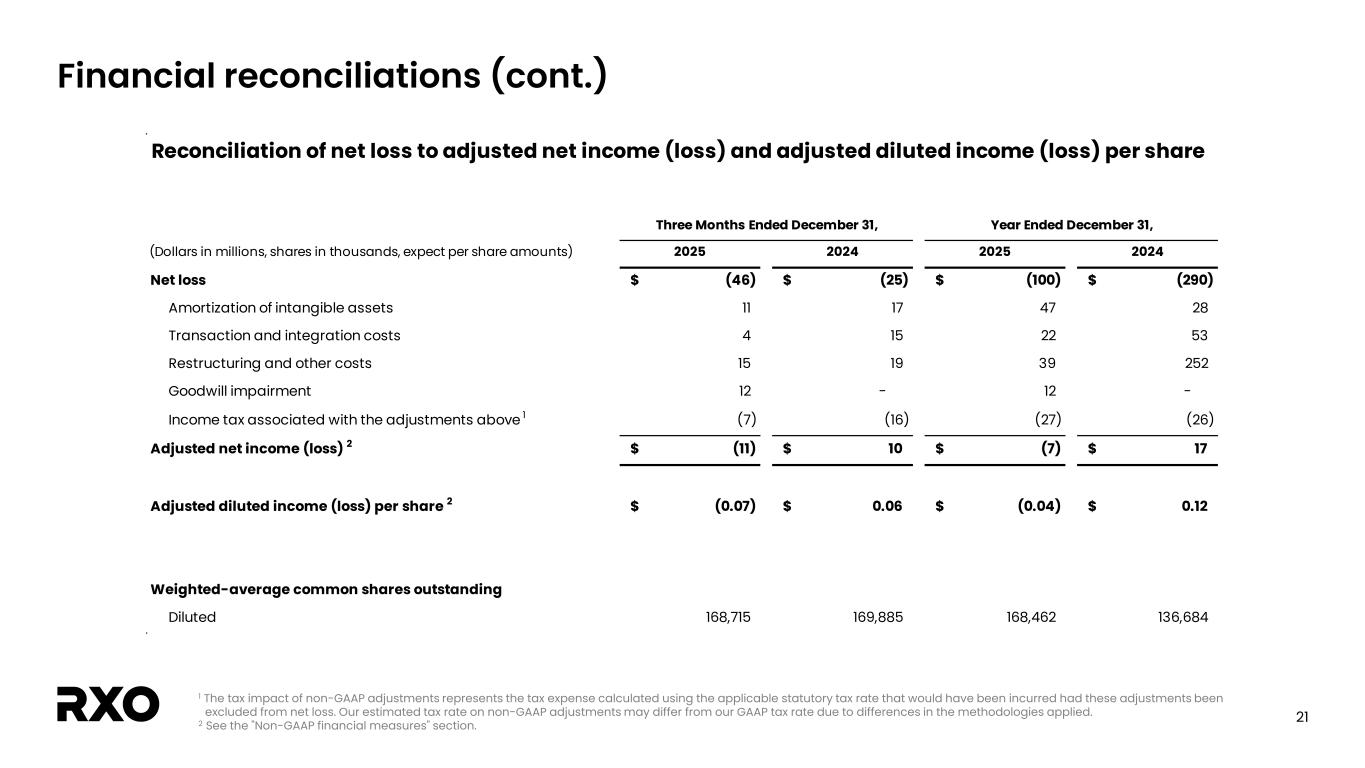
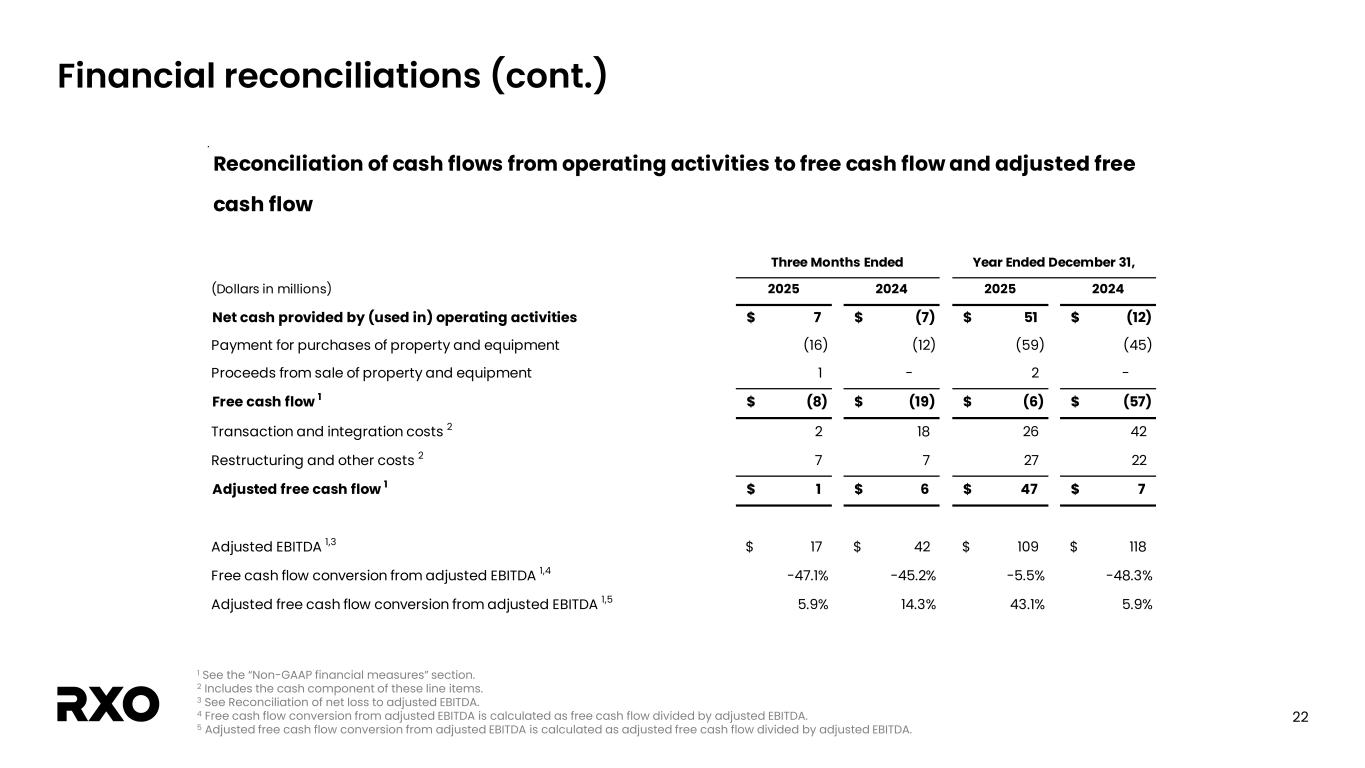
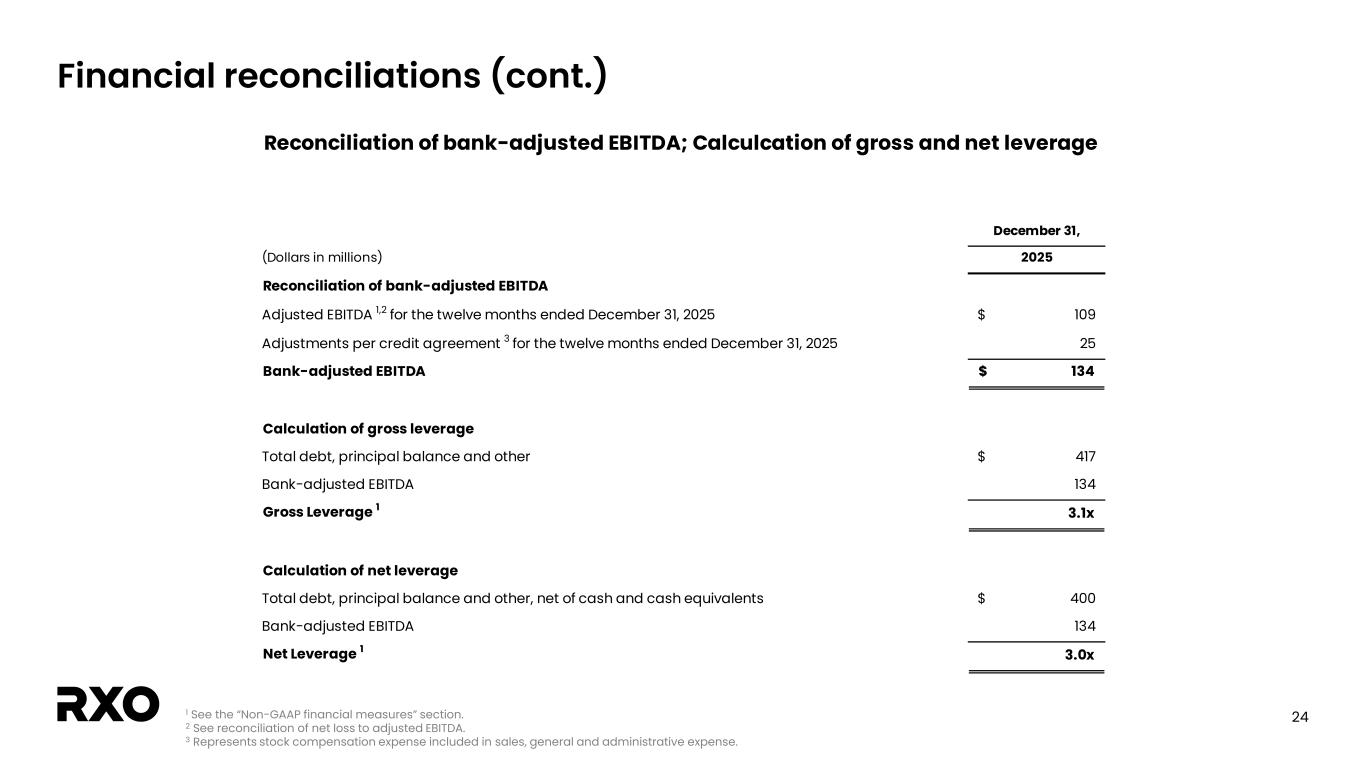
Thank you, Drew, and good morning. Let's review our fourth quarter and full-year performance in more detail. For the quarter, we reported $1.5 billion in total revenue, increased margin of 14.8%, adjusted EBITDA of $17 million, and adjusted EBITDA margin of 1.2%. Increased margin and adjusted EBITDA were negatively impacted by the increase in cost of transportation within our brokerage business and soft demand within last mile. Our interest expense was $9 million. For the quarter, our adjusted loss per share was $0.07. You can find a bridge to adjusted EPS on slide 8 of the earnings presentation. Of note, we had a $12 million goodwill impairment associated with the restructuring of our express service offering within our managed transportation business. This impairment was non-cash. Turning to our lines of business, brokerage revenue was $1.1 billion and was down 14% year-over-year due to continued soft-rate market conditions. Brokerage represented 72% of total revenue in the quarter. Cost of transportation increased in the quarter due to tightening of the full truckload market, primarily driven by regulatory developments and associated capacity exits. This occurred without a meaningful corresponding increase in sales rates or sufficient spot opportunities causing a margin squeeze on our contractual book of business. Jared will provide more details later in the call. Given the market tightening and resulting margin squeeze, brokerage gross margin was 11.9%, slightly below the low end of our outlook. Brokers gross margin declined 160 basis points sequentially and 130 basis points year-over-year. Complementary services revenue in a quarter of $431 million was flat year-over-year and represented 28% of total revenue. Complementary services gross margin was 20.2%, down 110 basis points sequentially and 90 basis points year-over-year, primarily due to weakening demand within last mile and the impact of the fixed cost structure of our last mile hubs. Within complimentary services, managed transportation generated $133 million of revenue in the quarter, down 6% year-over-year. Encouragingly, our year-over-year automotive headwind eased its company-wide automotive gross margin dollars declined by low to mid single digit percent year-over-year. Our last mile business generated $298 million in revenue in a quarter, up 3% year-over-year. Last mile stops also grew by 3%. As we communicated during our last call, big and bulky demand weakened towards the end of the third quarter, and that continued throughout the fourth quarter. Turning to the full year, We reported $5.7 billion in total revenue, gross margin of 16.2%, adjusted EBITDA of $109 million, and an adjusted EBITDA margin of 1.9%. Now let's discuss cash. We ended the quarter with $17 million of cash on the balance sheet, in line with our expectations. Cash decreased by $8 million sequentially, with no change to the revolver balance. As a reminder, in the quarter, we made our semi-annual bond payment of $13 million, and we had a $9 million cash usage associated with restructuring, transaction, and integration activities. For the quarter, our adjusted pre-cash flow conversion was 6%, and for the trail in six months, it was 39%. As you can see on slide 9, adjusted free cash flow for the year was $47 million, yielding a solid 43% conversion from adjusted EBITDA. This was primarily driven by disciplined strategic capital deployment and favorable working capital. Net capex for the year was $57 million, compared to our outlook of $65 to $75 million. dollars. We also harmonize working capital processes across the organization. Given our asset-like business model, we remain confident in a 40 to 60 percent conversion over the long term and across market cycles. We're very pleased with our full year conversion at this point in the freight cycle. Turning to slide 10, quarter in net leverage with three times LTM, bank-adjusted EBITDA. Our LTM EBITDA moved lower as profitability was impacted by the brokerage gross margin squeeze. On slide 11, I'd like to spend time walking through our new asset-based lending facility, which we announced this morning. The ABL is a $450 million facility and replaces our previous $600 million revolver. The ABL provides us with more flexibility through all market cycles. There are a few important points and key benefits associated with the new ABL facility. First, we intentionally structured the credit facility to $450 million of capacity based on the needs of the business, saving approximately $400,000 of annual unused commitment fees. The facility also has a $200 million accordion feature available. We have access to 100% of the facility to use for our cash needs and letters of credit requirements. At current utilization levels, our interest rate is approximately 35 basis points more favorable. Lastly, all covenants under the revolver, including the leverage and interest coverage covenants have been replaced with a fixed charge covenant that has minimal impact on our ability to borrow. Now let's move to slide 16 and discuss our outlook for the first quarter and our full year 2026 modeling assumptions. Similar to last quarter, our outlook continues to reflect weak freight demand across all our lines of business. Within our broker's business, we're not assuming a meaningful increase in either spot opportunities or sale rates in the first quarter. Additionally, our outlook reflects elevated purchase transportation costs. For the combined company in the first quarter, we expect to generate between $5 and $12 million of adjusted EBITDA. Jared will provide more details on our outlook shortly. For our 2026 modeling assumptions, we expect the following. CapEx to be between $50 and $55 million. Depreciation expense between 65 and 75 million dollars amortization expense between 40 and 45 million dollars stock-based compensation between 25 and 35 million dollars net interest expense between 32 and 36 million dollars and cash tax outflows of approximately 6 to 8 million dollars we anticipate restructuring transaction and integration expenses to be between 25 and 30 million dollars. It's important to note that approximately one-third of these expenses relate to actions taken in prior periods. The associated cash outflow with these actions is expected to be approximately 30 to 35 million dollars, about half of which is related to prior periods. We expect a fully diluted share account of approximately 170 million shares. To summarize, while elevated purchase transportation costs are squeezing our contractual brokerage gross margin and impacting profitability, this is a positive development for the long-term health of the freight market. As we think about the macroeconomy, we continue to see many developments that have the potential to stimulate demand. these include lower short-term interest rates new tax legislation proposals for housing affordability and domestic investment announcements as an example monday's ism report showed many positive developments in the manufacturing data a key leading indicator for the u.s economy the transportation industry and an important vertical for rxo specifically u.s manufacturing activity in January expanded by the most since 2022. While it's difficult to predict the timing of the demand recovery, any significant improvement in demand could set up for a sharp inflection and RxO is well positioned to benefit. Now I'd like to turn it over to Chief Strategy Officer Jared Weisfeld who will talk in more detail about our results and our outlook.
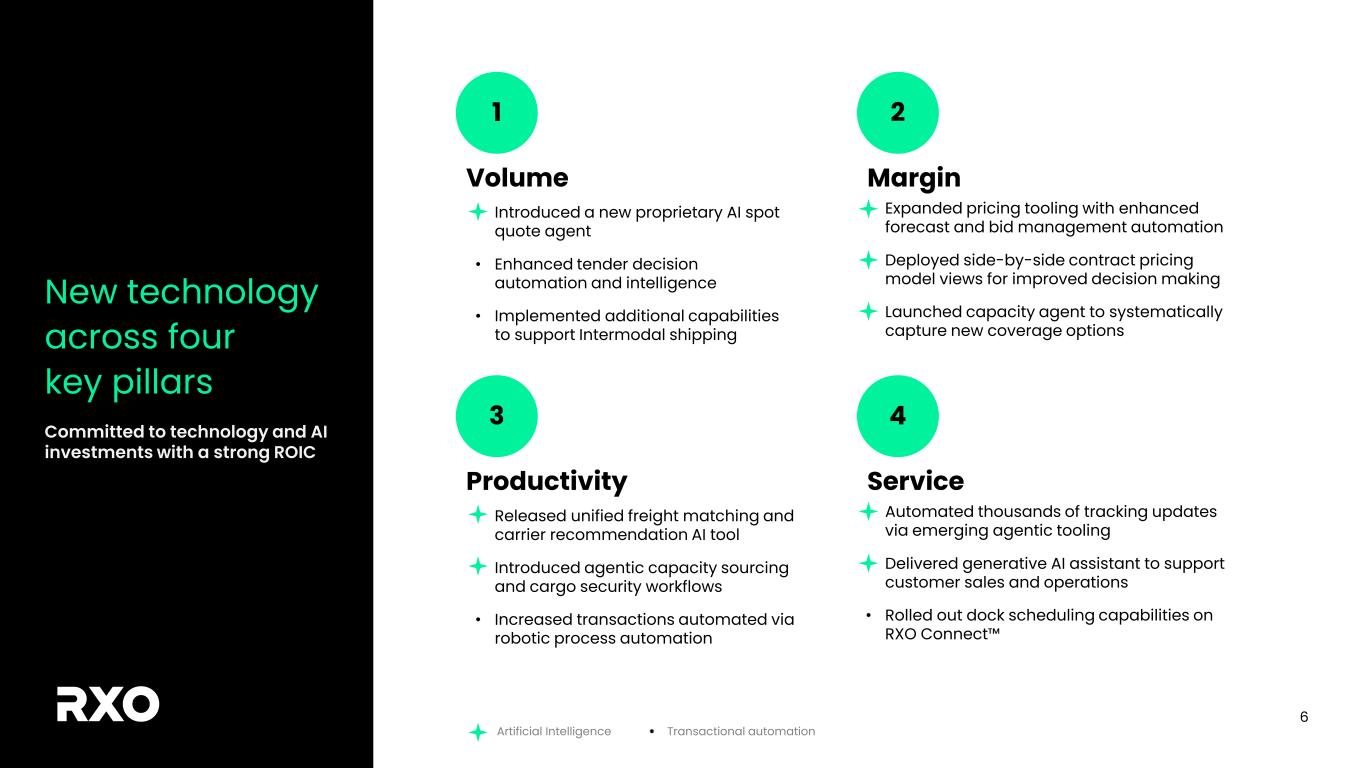
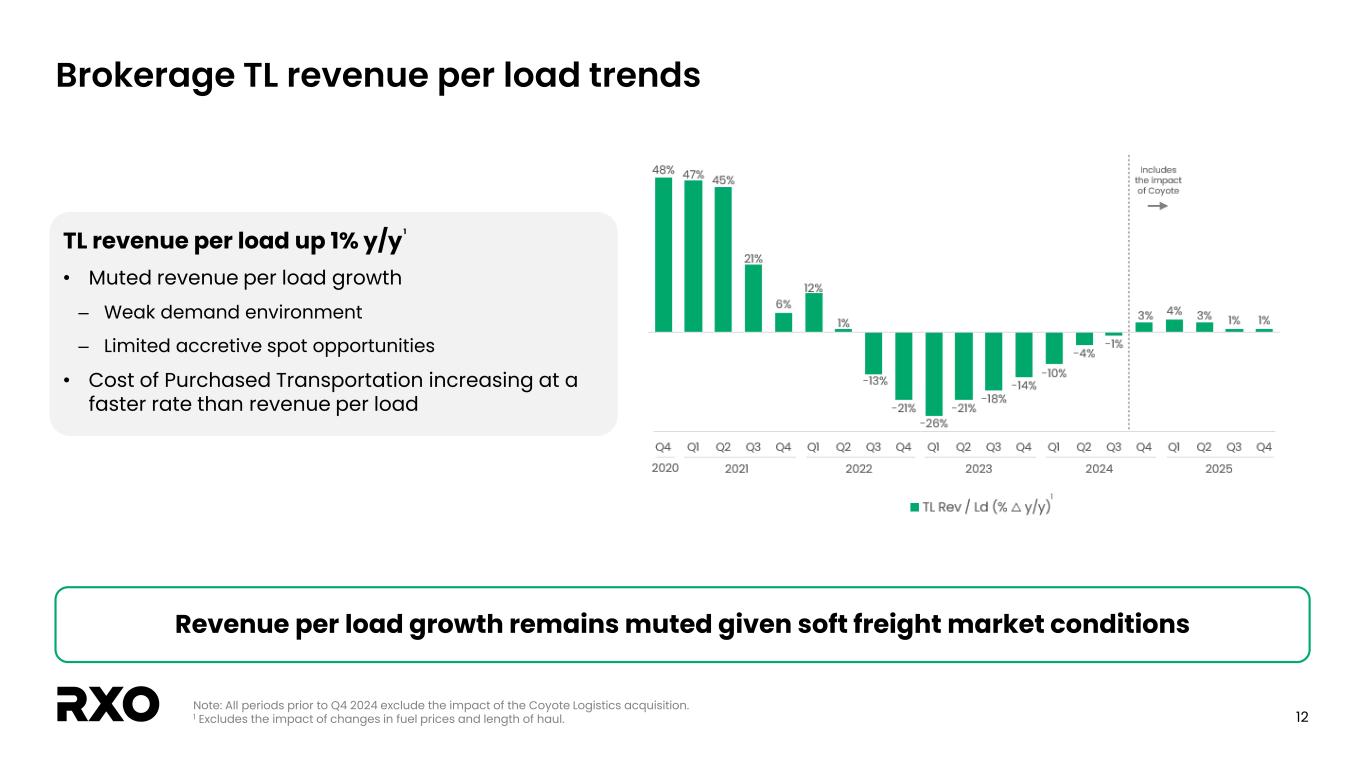
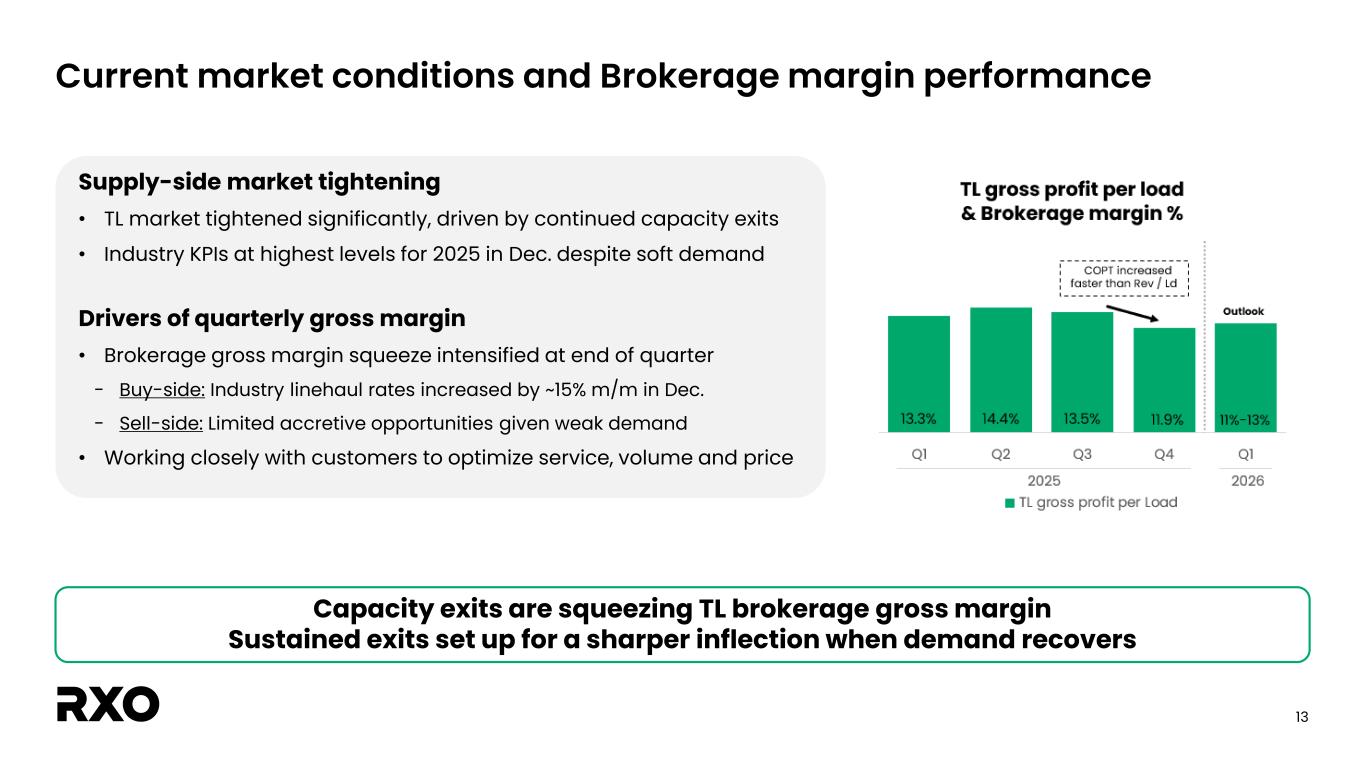
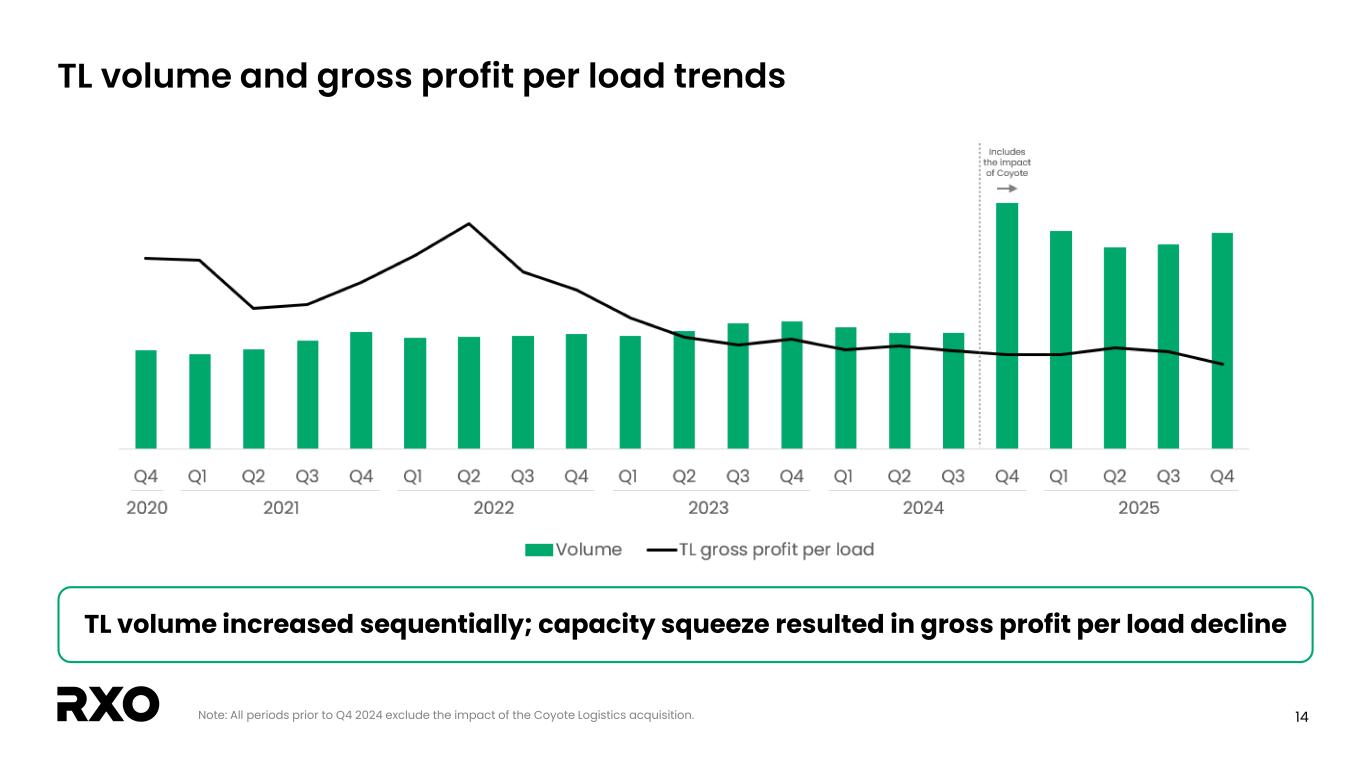
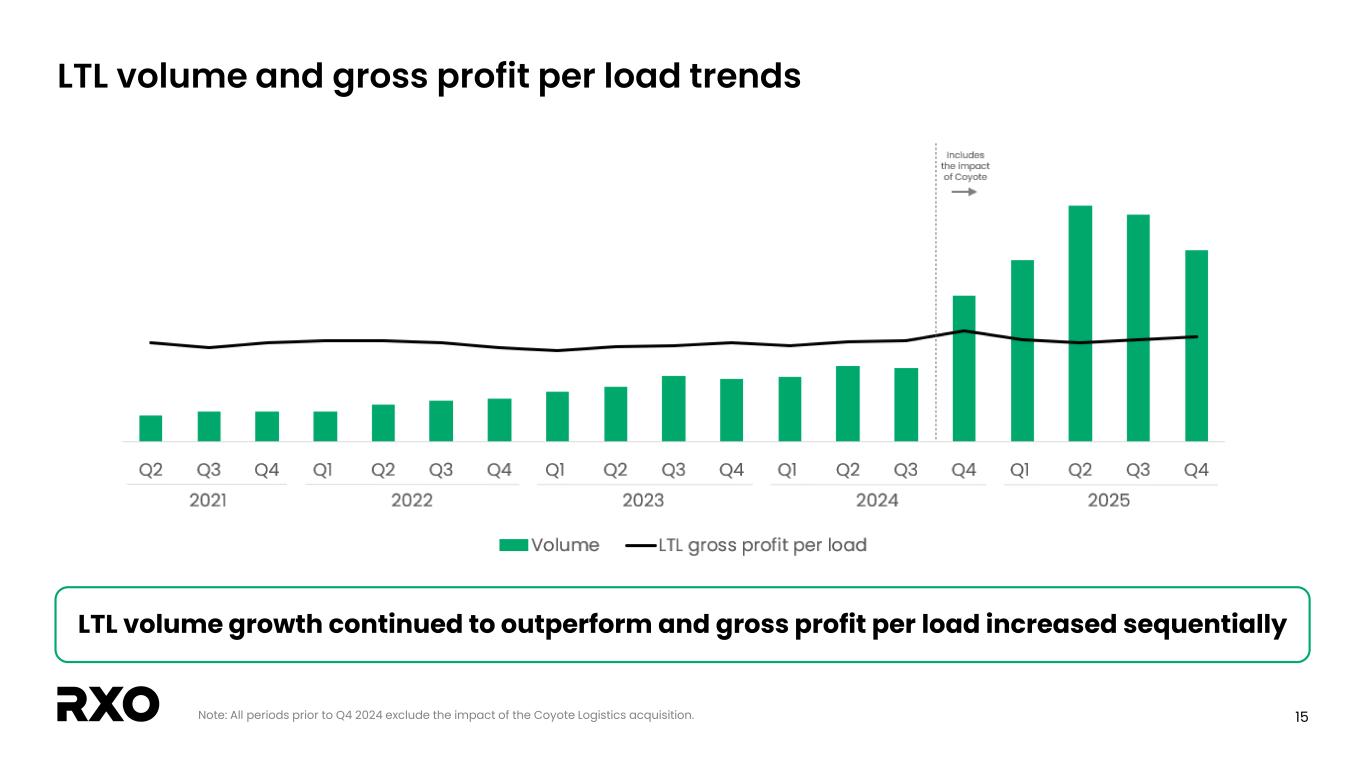
Thanks Jamie and good morning everyone. As I typically do, I'll start with an overview of our brokerage performance in the quarter. Overall brokerage volume declined by 4% year-over-year, outpacing the cash freight index, which declined by 8% year-over-year. LTL volume increased by 31% year-over-year and represented 26% of brokerage volume in the fourth quarter. Truckload volume declined by 12% year over year and represented 74% of brokerage volume. As a percentage of our brokerage business, truckload volume increased by 500 basis points sequentially. As a reminder, in support of a seasonal ramp with some customers, our brokerage business typically sees higher truckload volume in the fourth quarter when compared to the third. Truckload volume was impacted by our continued efforts to optimize price volume and service with our customers as well as broader market weakness let's now discuss what we saw within the verticals we support within our truckload business industrial and manufacturing trends continue to outperform our broader truckload trends volume within this vertical declined just one percent year-over-year benefiting from some special projects and opportunities we remain well positioned to capture our customers special project freight due to our close relationships and excellent service as jamie mentioned the year-over-year headwinds in our automotive business eased in the quarter automotive volume in brokerage declined by a mid-teen percentage easing from declines earlier in the year of almost 30 percent and from a company-wide standpoint overall automotive gross margin declined by only a low to mid single digit percentage contract volume was 72 percent of our overall truckload volume in the quarter contract business increased by 100 basis points sequentially spot represented 28 of our truckload volume in the quarter total spot volume on an absolute basis increased slightly sequentially as we capitalized on some additional spot opportunities however these were not meaningful enough to offset the significant margin compression in our contractual business i'll talk more about this shortly before reviewing our financial performance and market conditions in more detail i'd like to highlight the results from our transformational ai efforts that drew described we deliver technology that drives improvements across four key pillars volume margin productivity and service during the quarter we made progress further enhancing our ai capabilities across each pillar we recently introduced a new proprietary AI spot quote agent, which will unlock an incremental margin opportunity. We continue to make improvements to our pricing engine, and in the quarter, we extended pricing tooling with increased automation and launched a contract pricing model view for enhanced decision-making. We rolled out Agentec AI capacity sourcing in the quarter as we continue to attract qualified carriers to the RxO platform, and we also automated thousands of tracking updates via agentic ai tooling and delivered a generative ai assistant to support customer sales and operations here are some of the results we achieved we saw a 24 increase in digital bids per carrier with a new ai based load recommendation in rxo connect we enhanced our theft prevention processes across thousands of loads in high risk cargo areas by deploying an agentic ai solution And we perform thousands of customer tracking updates in the quarter by leveraging Agentec AI. We're applying AI to structurally improve the long-term margin profile of the business. Let's now review our brokerage financial performance and market conditions in more detail, starting with revenue per load on slide 12. In the fourth quarter, truckload revenue per load trends remain muted. Year over year, revenue per load, excluding the impacts of changes in fuel prices and length of haul, increased by 1%. This reflected a continued weak demand environment and limited accretive spot opportunities. Additionally, our cost of purchase transportation increased at a faster rate than revenue per load. Let's discuss that more on slide 13, which shows brokerage margin performance. truckload gross profit per load decreased by 10% from November to December alone as margins in our contractual book of business were squeezed. This squeeze was due to a significant tightening of the truckload market in the fourth quarter, and industry buy rates were up 15% in December month over month. Industry KPIs also moved higher, which has persisted into the first quarter. In fact, this week, tender rejections exceeded 13%, a level not seen since early 2022. Tighter market conditions have been primarily driven by supply-side dynamics as overall demand remains soft. This tightening in supply is largely due to enforcement actions related to non-domiciled CDLs and English language proficiency. Specifically, following regulatory changes effective in June of last year, English language proficiency violation rates have climbed back to pre-2016 levels near 3%, with the out-of-service enforcement rate spiking to over 30% from less than 5%. Turning to slide 14, as we just discussed, truckload gross profit per load declined in the fourth quarter, giving tighter capacity and continued soft demand. Our truckload gross profit per load in the month of December was about 30% below our five-year average, excluding COVID highs. Moving to slide 15, RxO's LTL brokerage volume continues to outperform the broader LTL market. In the quarter, LTL gross profit per load also improved sequentially. We continue to grow our LTL business with existing truckload customers and new customers that trust us with their freight because of our excellent service, increasing the stickiness of these relationships. I now like to look forward and give you some more details on our first quarter outlook. We're assuming continued soft demands across all our lines of business, starting with brokerage. We expect total brokerage volume to decline 5% to 10% year over year. It's important to note that our truckload volume has stabilized. On a sequential basis, we outperformed the cash rate index in the third and fourth quarters. While we do anticipate truckload volume to seasonally decline in the first quarter, given the strength of our late-stage brokerage pipeline, we expect our truckload volume to resume its year-on-year outperformance versus the market as early as the middle of the year. Turning to LTL, we expect LTL to grow by mid-single-digit percentage year over year. Recall, we have tougher comparisons due to the large LTL onboarding from last year, and year-on-year growth can be lumpy depending on new customer wins. Moving to truckload gross profit per load. In January, market conditions tightened to the highest levels in four years and we captured incremental spot opportunities, helping to mitigate some of the margin pressure on the contractual book of business. This resulted in January brokerage truckload gross profit per load slightly higher when compared to December. We expect tight market conditions to persist for the remainder of the first quarter. We anticipate that brokerage gross margin will be between 11% and 13% in the first Let's now talk about complementary services. Managed transportation has strong sales momentum, however, please note that Q1 is seasonally a softer period for managed transportation. In last mile, we expect big and bulky demand weakness will continue. We expect last mile stops to be down mid-single digit percent year over year. The first quarter is also typically the weakest quarter for last mile. Putting it all together, we expect RxO's first quarter adjusted EBITDA to be in the range of $5 to $12 million. The main drivers of the sequential decline from the fourth quarter to the first are the seasonal decline in truckload brokerage volume and last mile. The winter storms also impacted the month of January. To close, capacity exits and tighter market conditions are impacting the near-term profitability of our brokerage business. This supply-side shock is a result of continued enforcement of non-domiciled CDL restrictions and English language proficiency. These changes represent a major structural change to the industry, which we expect will lead to an increased freight rate environment. Continued enforcement will also improve safety and reduce theft and fraud. Longer term, this is a very positive development for large-scale brokerages like RxO that have access to massive high-quality capacity. While the current demand environment remains soft and it's difficult to predict the timing of the recovery, the supply-demand balance in the industry is fragile with generally lean inventory positions. Any significant improvement in demand could set up for a sharp inflection. We are also not waiting for the market recovery. We are taking aggressive actions to improve results, including reducing buy rate volatility, going after new profitable truckload volume, growing our SMB business, growing stable sources of EBITDA, including LTL and managed transportation, and leveraging our hub network. With our focus on best in class service and continued investment in transformational AI capabilities, We are well-positioned to drive significant long-term earnings and free cash flow growth. With that, I'll turn it over to the operator for Q&A.
Operator
Thank you. Ladies and gentlemen, we will now begin the question and answer session. Should you have a question, please press star or call by the one on your telephone keypad. And should you wish to cancel your request, please press star or call by the two. If you are using a speakerphone, please lift the handset before pressing any keys. One moment, please, for your first question. And your first question comes on the line of Ravi Shankar from Morgan Stanley. Please go ahead.
Good morning, everyone. So, Drew, you mentioned the 50% increase in the late-stage brokerage pipeline. Can you just unpack that a little bit? What drove that? What kind of customers are they? What kind of timing do you think that starts to come on, and what kind of pricing does Good morning, Ravi.
When you look at the pipeline, apples to apples from last year, it's up more than 50%, and I think it speaks to the focus of the team. Last year was a big year for us in terms of the integration of Coyote into the organization. It's the largest acquisition that has ever happened in the brokerage space. And this is all about us returning to what we do. It's returning to growth mode for the organization. It speaks to the strength of the relationships that we have with our customers. our largest customers have been with us for more than 15 years on average so a lot of the pipeline is existing customers and then we do have some new names in there as well and these are these are big new names and attractive new names to do business with for us the pipeline is important because you don't get the spot opportunities without having a significant presence on the contract side and so when you look at that that's a huge opportunity for us your second part on the timing the bids are typically implemented throughout the second quarter, which is why we speak to the optimism and the confidence that we've got about being able to return to outperforming the truckload market around the middle of the year. On the pricing side, you know, I think in line with what most other public companies have said, you're talking about something on the contractual side in the low to mid-single digits. On the spot side, we expect it to be significantly more than that.
Got it. And maybe as a quick initiative, you spoke of what you're doing there. I think late last year, you had spoken about a kind of mid-year inflection in that productivity coming through. Can you just talk about what the second half of the year looks like and maybe kind of how much this AI is helping with your SMB outreach? Thank you.
Hey, Ravi, it's Jared. So we are making significant progress with continued investment in transformational AI capabilities. We really look at it across four key pillars, volume, margin, productivity, and service. And you hit it right on the head because it's really two components when we think about the ability to go ahead and improve the cost structure of the business by leveraging AI efficiently. We look at productivity in 2025, up 19% year-over-year on a two-year stack, up almost 40%. So being able to go ahead and drive incremental throughput throughout the network at a rate that is disproportionate to volume growth, when you think about that volume growth really decoupling from headcount growth, bringing those strong incremental contribution margins, really important, and we think we are still in the early innings. The other key aspect to it, to your other point, was driving incremental margin opportunity across the business, and we look at the initiatives that we have across the company, especially on the volume side. We talked about rolling out agendic AI capabilities in the quarter. We feel really strong as we think about the second half of the year and into the rest of the year with rolling out these AI capabilities and what they mean from an incremental margin standpoint. I understand.
Operator
Thank you. And your next question calls from the line of Stephanie Moore from Jeffries. Please go ahead.
You know, maybe as I think through the results and your commentary, I mean, I think it's very clear that there's kind of two dynamics underway right now. You know, the first, the cycle does appear to be turning. And then second, I mean, you guys do have kind of numerous company actions underway. I mean, you call that a lot of them for AI actions, the Coyote integration, you know, buy rate improvements. You also have, you know, easier comps in 2026 as well. So can you speak to how and when these two dynamics can maybe start working together in 2026, meaning can your own actions start to offset some of the market dynamics near-term, or do we need to see the market improve first?
Hey, Steph, it's Jared. I can start and the rest of the team can come in. When we think about RxO entering in 2026, to your point, we're certainly seeing some positive developments as it relates to the macro. Earlier this week, Jamie talked about encouraging results from the ISM, hitting its highest level in four years, but we're not waiting just for the macro to turn, and we do have company-specific initiatives, and I would point to that late-stage pipeline that Drew just talked about, up more than 50% year-over-year with high-quality enterprise accounts, existing customers, new customers, the ability to go ahead and drive growth and resume our historical outperformance versus the truckload market. The team is very confident on executing on that pipe and resuming our truckload outperformance.
And then maybe this is one follow-up. I know that you called out a little bit of winter weather activity in the first quarter. I'm certainly not very familiar with that activity, but maybe talk a little bit about any impact that I could have had in the first quarter thus far.
Yes, Stephanie, this is Jamie. We did have a lot of winter weather in the southeast, southwest had two major snow ice storms back to back, which is very unusual. We've quantified it through January of about $2 million of EBITDA impact to the negative. So it's definitely impacted.
Stephanie, just to add to that, it's not just on the brokerage side that it impacts. If you think about the last mile section of the business, it has a huge impact on there whenever driveways are iced over and you can't get into them.
So the brokerage piece is one on the purchase transportation, but it also has an impact in our last mile business as well thank you and your next question comes from the line of scott group from wolf research please go ahead hey thanks good morning so uh drew a couple things for a while you've been saying hey once we get these tender objections north of 10 we're going to start seeing spot volume um why do you think it's been a couple months now why do you think we're not seeing the spot volume. And then, you know, I get, you know, 1Q squeeze. I get that. Like, what I'm not sure how to think about is, you know, if this market stays tight and we get some seasonal demand improvement, like, how much of a bounce in EBITDA earnings do you think is realistic as we look at a quarter or two?
Yeah, thanks, Scott. But when you look at tender rejections being north of 10, I would say you are starting to see spots. And when you look from the third quarter to the fourth quarter, you saw an increase in spot loads. And a lot of that was driven in December when you saw the tender rejections start to climb right there around 10. You saw that increase continue into January. But it has not been enough to offset the compression of what we've seen on the contractual side of the business in terms of gross profit per load. I think that we're in the early innings of continuing to see that. As you look out this week, tender rejections continue to climb. When you look at what's going on on the regulatory side, we think that, you know, you're setting up with any sort of demand to where you're going to see tender rejections climb and the spots will be more robust. We're already starting to see it in the waterfall routing guides where it's making it past the first, second, third, fourth carrier. So you are starting to see some waterfall routing guides break down. On the impact to EBITDA, Scott, you know, we talked about gross profit per load being more than 30% below our average, excluding the COVID highs off of that. And when you look at that, you know, we've said in the past that for every dollar that gross margin per load improves, it's well north of a million dollars in EBITDA annualized. So when you think about the earnings power during a recovery, it's extremely strong.
Just a quick follow-up. Can you just say, like, what are spot volumes tracking up or down year-over-year so far in Q1? And then maybe just, Jamie, can you just walk us through, put some takes on cash and confidence in free cash flow, positive free cash flow this year?
I'll take the first part. Spots are up on a year-over-year basis as we look into January, and then I'll turn it over to Jamie on the cash.
Thanks, Scott. Cash, you know, we ended the quarter 17, maybe even had a great year from a conversion standpoint, 43%. As we look into next year, or actually this year now, 26, Q1, you heard it, our guide. If you take the midpoint of the guide, we'll use low single digit amount of cash for the quarter. But I think if you look at the company over the kind of the annualized basis, if you take our cash outflows, which we've given in our guide, and you just apply let's just say 25 EBITDA as a proxy, that ends up being in the 45% range of a pre-cash flow conversion and we'd have a positive pre-cash flow if you can extrapolate that to what the cash flow production of this company will be in an up and mid-cycle will be significant. Short term cash is good, we've had a good cash year, good cash quarter, but look forward to still be in that 40% to 60% conversion rate over the long term.
So you think you'll have positive free cash flow on a reported basis this year?
It obviously depends on where the earnings line up, but absolutely, we believe it'll be a strong cash year. Thank you, guys. Appreciate it.
Operator
Thank you. And your next question comes from the line of Flukers Cervera from True with Securities. Please go ahead.
Hey, guys. Good morning. Thank you for the question. So you took steps this quarter to streamline parts of managed transportation.
How should we think about the earnings contribution from that business going forward after those Lucas, I don't know if I got the full question, but I think it was on managed transportation and the earnings of that business going forward. Some of our higher EBITDA margin business comes through our managed trans solutions business, and so, you know, that's the first piece that I would say. It's measured on a net revenue basis, not a gross. So, when you look at that business, we continue to grow our FUM on a year-over-year basis. But importantly for managed transportation, it's the synergy that it provides to the rest of the organization. And, you know, if our brokerage team and our last mile team have the right service, have the right rate, they've got the opportunity to grow with managed trans as a customer. And, you know, for every new win, it doesn't just impact managed transportation, it impacts the rest of the organization. So that's the beauty behind managed transportation, is you actually get to touch a customer across multiple lines of business.
Operator
Thank you. And your next question comes from the line of Ari Rosa from Citigroup. Please go ahead.
Good morning. So Drew, you've mentioned a couple of times that you expect truckload year-over-year volume outperformance to improve. I'm just curious how you define outperformance in that context. Like, what should we be looking for from kind of a pricing standpoint, from a volume standpoint, and from a, you know, from an EBITDA standpoint in terms of what we could be looking at for second half of the year and into 2027?
Yeah, so, I mean, the way that you broke it up was volume pricing and EBITDA on the outperformance. So, first, on the volume side, I think there's very clear external metrics of how well you're performing versus the market. And so when we say outperforming the market, that's what we mean, external metrics. It's something that we've got a history of doing. Over the last decade plus, we've been one of the largest share takers in the industry. And now that we've got Coyote largely integrated into RxO, we expect a return to growth mode. The pipeline supports that. What we're hearing back from customers on the wind supports that. On the pricing side, I said earlier that I think that, you know, we're setting up for somewhere in that low to mid-single digits on the contractual side, and what we're paying close attention to is what happens on the spot rates, because those are the rates that if you've got the contractual book of business, customers understand that typically during tighter times, you see contraction on that gross profit per load, where you more than make up for it is on the spot side, and so I expect those rates to be significantly higher. And on the EBITDA, I think it goes back to Scott's question. The biggest driver there is in gross profit per load, and so when you look at what that does, that every dollar of gross profit per load improvement on an annualized basis is well north of a million dollars of EBITDA. So for us, there's a lot of earnings power behind that as we continue to improve gross profit per load. We're not just sitting and waiting on the market to return to improve gross profit per load either. When you look at what we're doing on the purchase transportation side, we're expanding the utilization of private fleets. You look at the investments that we've got in AI and the way that we're sourcing capacity. We expect to continue to improve our purchase transportation versus market as well.
Okay, that's helpful. And then just as a follow-up, I was hoping you could talk about the different dynamics that you're seeing in LTL versus truckload. I understand that there's some things that are unique to RxO within those numbers, given kind of the evolution of the business. but we saw a similar trend from one of your main competitors who reported recently. Just talk about how those dynamics are different and why the strength is so much greater on the LTL side.
Well, I think, you know, typically when you think of LTL in the brokerage market, it's transactional loads, and it's a lot driven by SMB-type customers. We built out LTL in a different way. It was customers that we had really strong relationships with, and a lot of them of the enterprise nature. And these customers came to us and said, LTL is a pain point. There's a lot of touches. There's a lot of different carriers. We're having to track down claims, lost shipments, and damages. And so it became more of an outsource of a piece or all of their LTL. And so when you look at our LTL, it's going to be lumpy because this depends on when the onboardings happen. You saw us onboard several large customers last year. The pipeline in LTL is robust right now, but it'll depend on the timing of that as far as what that goes. On the truckload side, you know, those bids are typically implemented throughout the second quarter, and which is why we point to the confidence being able to return to outperformance on the truckload volume around the middle of the year.
Perfect. Okay, thank you.
Operator
Thank you. And your next question comes from the line of Ken Hoekster from Bank of America. Please go ahead.
Hey, good morning, Drew and team. Drew, if we could just maybe expand on that last answer, right? So the volumes down in truckload versus peer, you know, significantly outperforming and growing. I know you talked about flipping to growth and not using price. Is that – is this something different in your end markets that you want to highlight? I guess how should investors view the different compares we're seeing here? And then especially maybe – I'll expand on that. Sorry, just let me throw it all in at once. but in a view of where your first-quarter outlook, where EBITDA is getting worse sequentially, right, fourth quarter to first quarter, and I think well below consensus. So I guess maybe just helping people understand why the differential pressure points are, you know, continuing to expand.
I think, one, we've got to acknowledge that the peer-year reference in T.H. Robinson is executing well, and they had a great year last year. For us, our year was about integration and making sure that we were holding on to the people, to the customers, and integrating the technology. And we executed on that strategy when you look back at 2025. You know, when you look at integrating Coyote, we thought that we would stabilize the volume decline faster than what we did. But as you start to look at what happened in Q3 and Q4, we actually outperformed the truckload market on a sequential basis and what happened there. So I think when you look at that, we've stabilized the business and it's returning to growth mode for us. And it's something that we have done in the past, something that we're confident in. And it's not just blind confidence. It's confidence based off of the feedback that we're getting from our customers. When you look at the last part of your question, or two more parts of your question, the in-markets as well as the EBITDA, the in-market is a diverse pipeline, and we're touching a lot of different things. But where we're seeing some great wins is in high cargo value and technology. We've seen some recent wins come over in the automotive side, and there's a strong pipeline in industrial manufacturing as well right now. On the EBITDA Q1, you know, when you look at it, obviously we've talked about the squeeze that is happening in the brokerage business. Last Mile is a business that typically sequentially goes down from Q4 to Q1. That's being magnified this quarter because of the weather. So I think when you look at it, that's where we're pointing towards the optimism as you start to get towards the middle of the year and you start laughing some of these things.
Yeah, it seems like a gap. The restructuring costs seem to be, you know, still ramping up maybe a little more aggressively than I would have expected. Is there, you know, maybe walk through what the costs are and where that should head?
Yeah, Ken, this is Jamie. So, year over year, we do have some restructuring and we still got some initiatives going on, but our restructuring charges are actually down about 60% year over year. Of that number we gave, 25 to 30 for the year, about a third of that relates to actions taken last year that are running through the PML this year. So those actions we've already talked about. And then we're a couple of initiatives and we've still got some transformation work going on where we think there's some good opportunities for process improvement. We're still not 100% done with all the technology side of the integration, so that's to come. And then we're really putting a big focus on our footprint and our real estate and we've got some plans to consolidate even some more real estate to make us more efficient there. And so those are the three big buckets, but keep in mind, down 60%, a third of that number that we gave as a guide is really actions that carry over from prior years. So we feel like we're in a good spot and we feel like we've got some really good initiatives to produce a good ROI on it.
Operator
Thank you. Thank you. And your next question comes from the line of Tom Wiedwitz from UBS. Please go ahead.
Drew, I wanted to get your thoughts on just how much visibility, it's tough to have visibility in these markets, but how are you thinking about second quarter, and both from a gross margin perspective and then just kind of how much visibility on improvement in loads? I mean, you know, seasonally you can see some pressure with, you know, spot rates going up in May and road check and things like that, stronger freight. So, you know, seasonality might say gross margin percent could be lower 2Q, but, you know, if you get some catch-up on contract prices going up a bit, that could help. So, I mean, do you think gross margin could be, you know, show a little less pressure in 2Q? And then I guess on the volume side, I don't necessarily recall brokers talking a lot about, like, pipelines. I think of that for more, like, logistics or a little longer cycle businesses. But how good of an indicator do you think that is? I mean, so you're bidding on a lot more business, but are you confident that that will actually flow through? It's just not necessarily something I – I don't know how good the read is from that.
Yeah. Tom, I think I'll break the question up into three parts. First, on the second quarter gross margin, I think it depends on what's happening in the market and where we're sitting at in tender rejections. I think there's certainly opportunity whenever you start talking about the contractual price going up on a year-over-year basis whenever you start talking about spot loads. There's certainly a strong opportunity there, and we're ready to execute in any market. On the second part, on the improvement in loads, high confidence in improving loads from Q1 to Q2. On the third part, pipeline indicator. So the way that we break down the pipeline is there's a pre-pipeline, and when you look at the pre-pipeline, that's what you're digesting. seeing this all coming in from the customers, and it's big, big numbers. But that's more of what we would call a spray and pray method, where you're just putting out rates and just seeing what comes back. As you get into the late stage pipeline, this is where discussions become extremely targeted. It's a lane by lane basis, it's the value that you're adding to the customer, it's how much capacity you have coming in to a certain inbound lane, it's how much capacity that you've got to be able to reload certain lanes, where whenever you're doing drop trailers that you have trailer capacity that you're able to do? What are you able to do from a consolidation standpoint? So when we get to the late stage pipeline, our confidence is pretty high.
Okay. Yeah, that's helpful. And then just one other one. On the cost side, so you've got a lot of tech initiatives happening. Is there a way to think about translating those to kind of, you know, operating cost reduction, whether that's like an impact in 26 or a kind of multi-year impact?
Yeah, so this is Jamie. I'll start and turn it over to Jared. You know, it definitely has from a pure cost out standpoint. So some of the things I've talked about, you know, finishing up the completing integration, totally sunsetting old systems. We're way down the field on that. Got a little bit more work to do that we'll finish early 26. Secondly, we've got a lot of initiatives that just bring automation to the table, but all of those have good cost reductions. But Jared talked about kind of what our overall tech and AI strategy is, a lot of opportunity there to grow on the four pillars and it definitely includes cost and really honed in on productivity and service.
And Tom, when you think about the other side of this, not only is, you know, have we taken significant actions, to Jamie's point, on removing over $155 million of costs post-spin, but then you think about leveraging technology to make the organization more structurally efficient. It's all about the incrementals. So like we talked about earlier, how do we decouple volume growth from headcount growth? Because the incremental margins in brokerage for every dollar that comes in in gross profit can be as high as 80% in terms of flow through to EBITDA. So making our people more productive by leveraging that tech, it's not just about the cost outs, but it's how to make our people more efficient to benefit from the incremental margins.
Okay, but there's not necessarily a frame in terms of how much cost impact this year. It's maybe more further out. You can, we can have a little more visibility to that, I guess.
Yeah, but to Jimmy's point earlier, we do have some cost benefits, 26 versus 25 based on the actions we've taken, and we continue to drive incremental productivity that we expect to benefit in 2026.
Operator
Thank you. And your next question comes from the line of Fran Olsenbeck from JPMorgan. Ryan, please go ahead.
Thanks a lot for giving me on the call this morning. I appreciate it. Maybe two quick ones for Jamie and then a strategy one for Drew. Jamie, can you just talk a little bit more about, I think you said restructuring in the express service line. I don't know if that were related to maybe some of the high-value automotive stuff, so maybe you can elaborate a little bit more on that. And then, you know, what's the cash component of restructuring and integration costs for this coming year? Drew, it would be great to get your context on these customer conversations and given the capacity squeeze we've seen here recently, is there any tilt towards asset-based carriers? Are they indicating they have any more preference to that and maybe away from brokerage or does that not come up in these conversations? Thanks very much.
Yeah. Hey, this is Jamie. You know, the goodwill that you're speaking of wasn't an express service line that we had inside the managed transit. We restructured how that service was delivered, we spread the customers out amongst other service lines in our business to continue to do a good job there. We had some old goodwill that related back to an acquisition that was over 10 years ago that required an impairment because we restructured how we deliver that. It did not specifically relate to any of our auto business. In terms of cash and the restructuring charges for this coming year, we think you've counted the $30 million range there, half of that relates to actions taken prior to 26. You think about, you know, we take a charge for the P&L, some of the cash flow will trail that as payout. So think about half of that number is cashed out related to prior years. And then the couple big initiatives, you know, footprint consolidation on the real estate and just our general restructuring, some cost savings initiatives will be the reason for Yeah, and Brian, on the context on the customer conversations that we're having, obviously we're very bullish about what we're seeing in the late stage pipeline.
And if I think of conversion from asset-based to brokers, those conversations were the conversations of the early 2000s. And if you look at what's happened over the last 20 years, brokers have taken significant market share in the truckload market. It's gone from mid-single digits to the mid-20s. Right now, the conversation with customers is all about consolidating the carriers and finding the right carrier for the right load. And brokers, large brokers, financially stable brokers, offer a lot of flexibility in a market like this where you can flex capacity up and down. As you start to have brokers like RxO who have a strong trailer pool, we're actually able to flex capacity up and down on dropped trailers and take the business that was typically held by large asset-based carriers. So for us, like, we like the setup we're in. And as you go into a tighter market, that sets up for brokers to take more share.
Thanks, guys, for your time.
Operator
Thank you. And our last question comes from the line of Bruce Chan from CFL. Please go ahead.
Hey, good morning, team. This is Matt, my last one for Bruce. Thanks for squeezing us in here. Just piggybacking off one of the earlier questions, we're curious, you know, to what extent you believe demand recovery is ultimately needed to really drive some more spot opportunity. And I guess, you know, maybe barring that demand improvement, you know, how much would supply need to tighten before you see the spot opportunities really flow into the business.
Yeah, so I think when you look at what's happening on the regulatory side, you've basically gone from mid-single-digit tender rejections to double-digit tender rejections with a decline in demand. And so for the first time, you're seeing pressure on the supply side that is causing spot loads. Typically you do need a demand-driven inflection, and demand will certainly help. We're watching a lot of the data out there when you look at what's going on, and the ISM data, when you look at what's going on from some of the reports on the home building side, when you look at where inventory levels are, demand will obviously be something that can be a catalyst there, but you got into double digits that what was strictly happening off of the supply side.
Great, and then as a quick follow-up, if you could maybe provide sort of a diagnostic of the synergies that you expected from Coyote, and if that's been sort of realized at this point, how you might bridge any differential chill between what expected even there could have been pre-integration versus maybe where it is now.
Yeah. So I'll take kind of where we are, 25 and roll into 26. We talked about around $70 million of synergy, 60 of which was to hit OPEX, 10 of which hit CAPEX. A majority of that has flown through the P&L and 25. We see about an incremental $10 million of additional P&L realized in 26 versus 25 related to synergies alone. The other $10 million of CapEx spend, you see that through in our guide for CapEx in 26. That's where we're making capital investments on kind of both legacy RxO, legacy CODI that has now been put into one. And so we continue to see, you know, those savings that will continue throughout, you know, they have obviously not done enough to offset the change in gross margin that we've had over the last couple of years, but we see that as really positioning the company cost-wise when we see demand inflection, we'll see a lot of flow through the P&L. Thank you guys.
Operator
Thank you. We have reached the end of the question and answer session. I'll hand the floor back to Drew Wilkerson for any closing remarks.
Drew Wilkerson Thank you, Ina. Our team has taken the right actions to navigate the current market conditions. We're in growth mode and focused on converting our very strong sales pipeline. We expect to get back to outperforming when it comes to truckload brokerage volume as early as the middle of this year. We're operating on one tech platform, which is providing better data to our people and unparalleled visibility to our customers and carriers. We're making significant investments in our technology and are seeing real results from our AI initiatives. We have a slimmer cost structure that we continue to optimize and our capital structure provides us with more flexibility across all parts of the freight cycle. We will continue to focus on what differentiates RxO, exceptional service, comprehensive solutions, deep customer relationships and cutting-edge technology I remain confident in our ability to deliver outsized earnings growth over the long term thank you all for your time today and we look forward to seeing you at the upcoming investor conferences and this concludes today's call thank you for participating you may all disconnect