Good afternoon, everyone, and welcome to Tesla's first quarter 2026 Q&A webcast. My name is Travis Axelrod, head of Investor Relations, and I'm joined today by Elon Musk, Vebav Taneja, and a number of other executives. During this call, we will discuss our business outlook and make forward-looking statements. These comments are based on our predictions and expectations as of today. Actual events or results could differ materially due to a number of risks and uncertainties, including those mentioned in our most recent filings with the SEC. Before we jump into Q&A, Elon has some opening remarks.
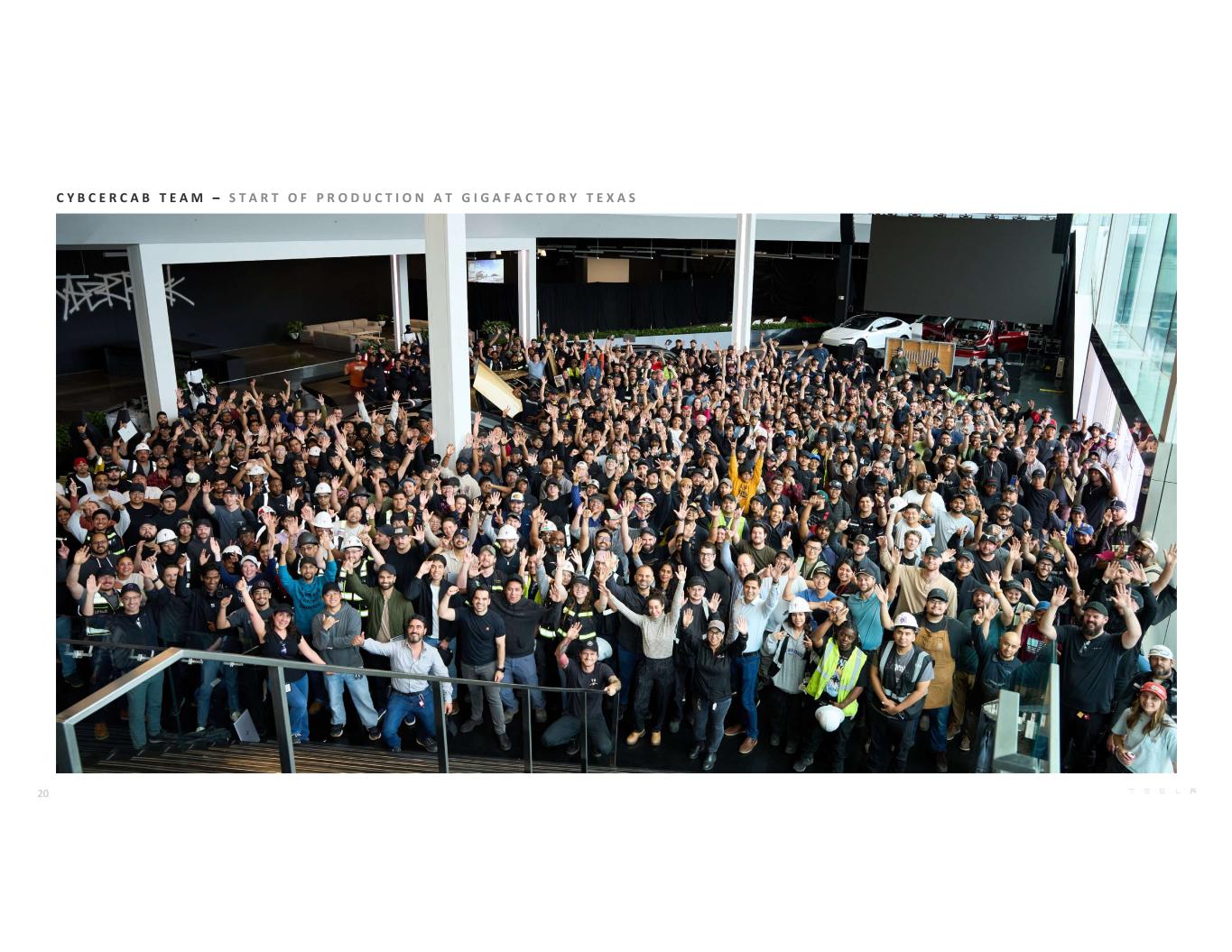
I think we've got a very exciting you're ahead of us with 2026. We're going to be substantially increasing our investments in the future. So you should expect to see significant increase in capital expenditures, but I think well justified for substantially increased future revenue stream. And obviously Tesla's not alone in this. I think you've seen most, if not all, certainly the major technology companies substantially increasing their capital investments. We're going to be doing the same. I think it's going to pay off in a very big way. So we're investing in and improving our core technologies, battery powertrain, AI software, AI training, chip design, laying the groundwork for significantly increased manufacturing production. We are also strengthening our supply chain across the board, batteries, energy, AI silicon, everything, and laying the groundwork, like I said, for what we expect to be a significant increase in vehicle production in the future, and a very significant increase, well, actually releasing Optimus, but increasing our internal production for testing, and then probably being able to have Optimus be useful outside of Tesla sometime next year. As you've heard me say a few times, I think Optimus will be our biggest product, not just Tesla's biggest product ever, but probably the biggest product ever. And I remain convinced of that conclusion. On our vehicle side, it's always worth noting that a Tesla car is incredible value for money and they're all autonomy ready, depending on what part of the world you're in. The supervised full self-driving is getting extremely good. We have just started production of CyberCab and we'll begin production of our semi-truck soon. And I should say, whenever you have a new product with a completely new supply chain, it's always a stretched out S-curve. So you should expect that initial production of CyberCab and semi will be very slow, but then ramping up and going kind of exponential towards the end of the year and certainly next year. In fact, we'll be ramping up production of all vehicles and all factories to the best of our ability through the balance of this year. On the energy front, the United States and the whole world will need a lot of energy storage to meet growing electricity demand. Demand for our Megapack is very strong, and we're excited to begin production of Megapack 3 later this year in our new world-class factory outside Houston. For full self-driving and robotaxi, version 14.3 was a major architectural update, and we have a whole pipeline of major improvements to full self-driving. I believe it will lead to unsupervised full self-driving being available anywhere in the world that it is legal to do so. And then there's a version 15, hopefully by the end of this year, but certainly by early next year. And that will be a complete overhaul of the software architecture and we'll run on AI4. At that point, we're really just increasing the safety level of FSD above human safety level even more. Meaning, I think even within version 14, we're significantly safer than human, but B15 will take that to another level. We've expanded Rover Taxi to Dallas and Houston using the same software as Austin and the Bay Area. The limiting factor for expansion is really rigorous validation, making sure things are completely safe. We don't want to have a single accident or injury with the expansion of RoboTaxi, and we have, to the credit of the team, not had a single one to date. Optimus, we're preparing Fremont for the start of production later this year with Optimus. Again, totally new supply chain, totally new technology, so therefore production at S-Curve is always very slow in the beginning. We'll ramp up to significant numbers next year. We're constructing a second Optimus factory at our Giga Texas location, and that'll probably start production around summer next year. The V3 Optimus design is almost ready to demonstrate. I think we want to just make sure it's polished. It works functionally, but there's some aesthetic elements that need to be finalized. Probably middle of this year, we should be able to show it off. We're also a little hesitant to show V3 off because we find our competitors do a frame frame analysis whenever we release something and copy everything they possibly can so i think there's some value to not showing new technology until it's close to production congratulations to tesla ai chip team for taping out ai5 that's going to be a great show i think probably the best ai inference chip for edge compute that exists and certainly i think unequivocally the best value for money team did a great job already have a lot of momentum for designing ai6 and we've begun to discuss ideas for dojo 3 we've also finalized plans for the research chip fab on the giga texas campus and we'll start construction of that this year in conclusion tesla is working on a lot of large ambitious projects they're all very challenging but i think they're gonna be revolutionary and this is what the team does best solve the hardest problems and build amazing products and i'd like to thank the tesla team for all the hard work and thank you to all of our supporters thank you very much elon and vebov also has some opening remarks 2026 has had an interesting starts, not just for us, but I think the world in general.
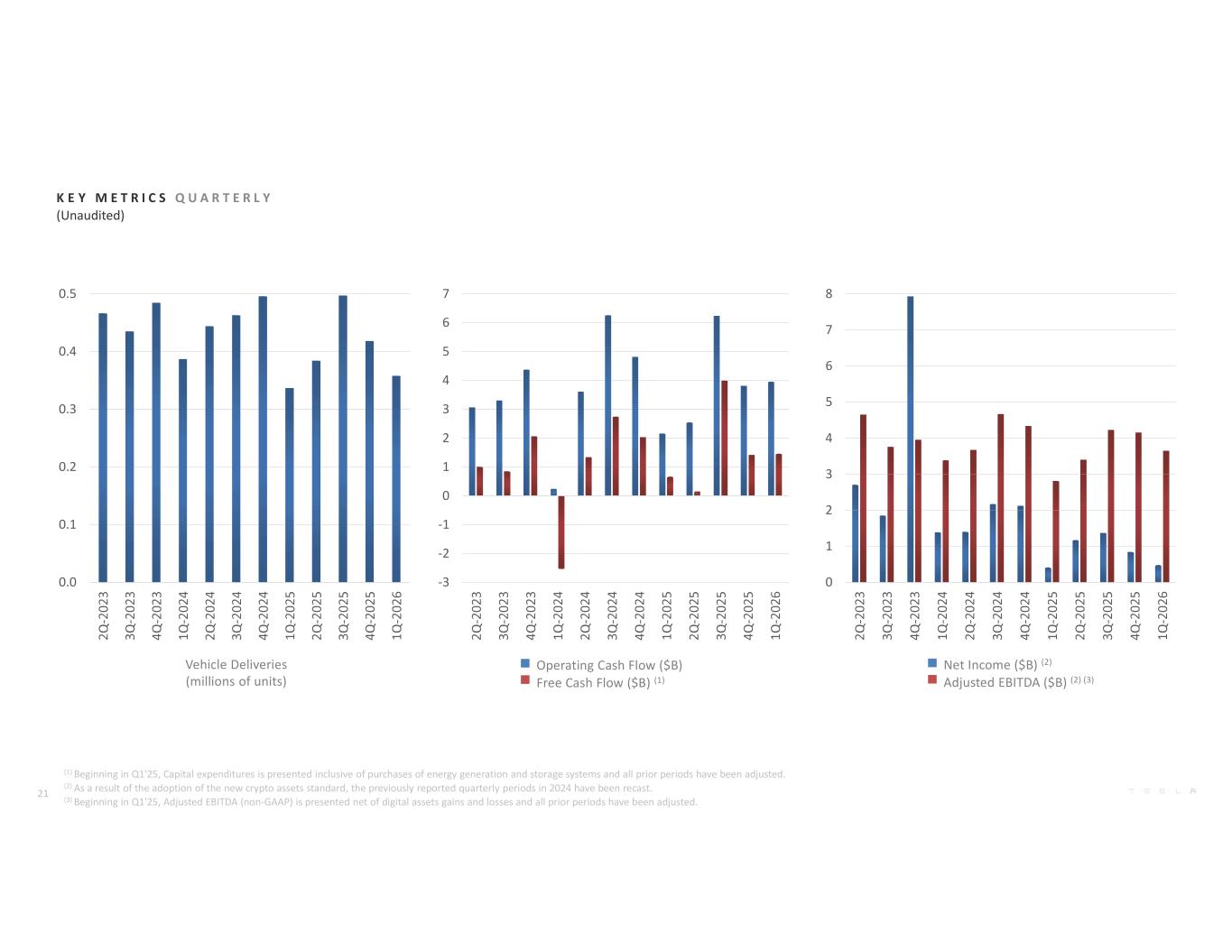
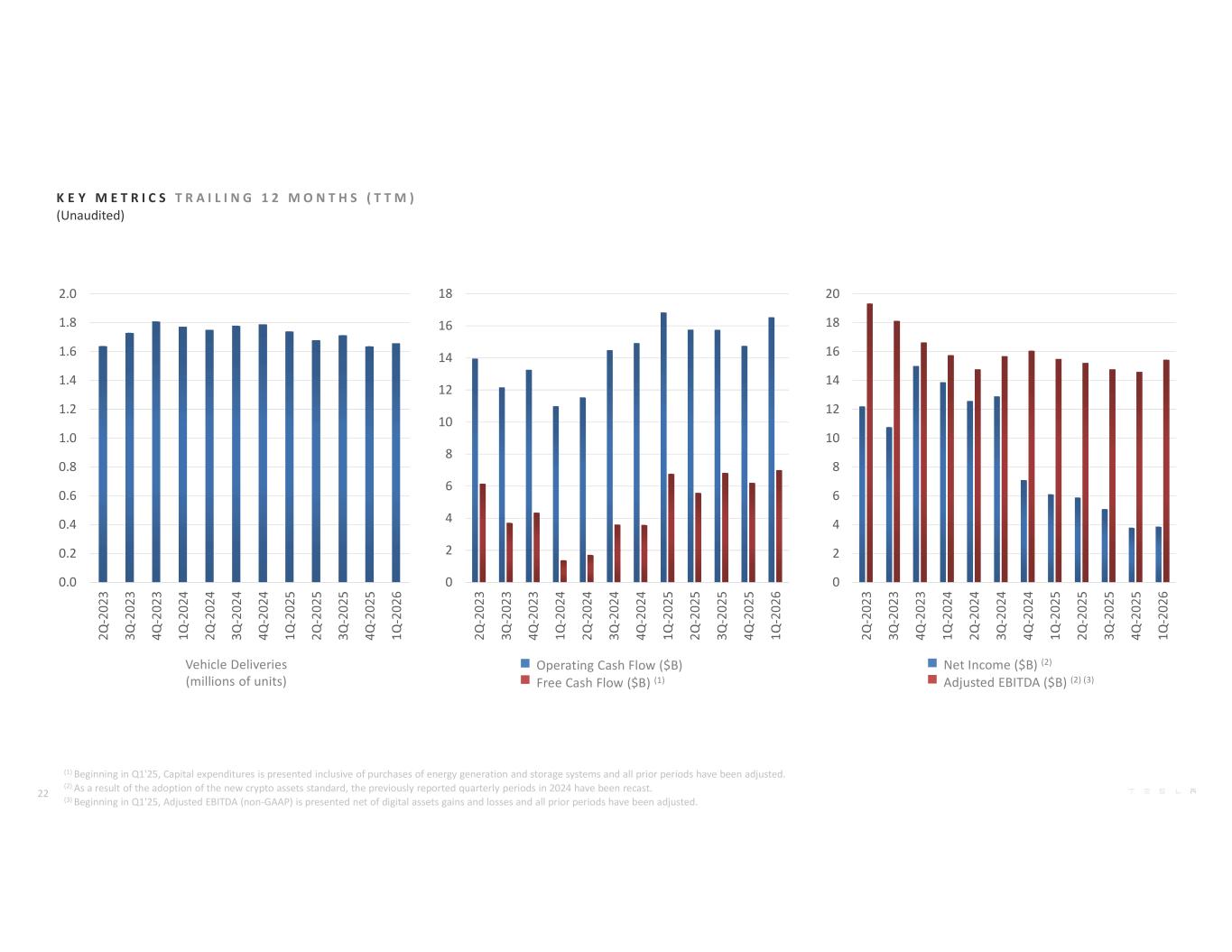
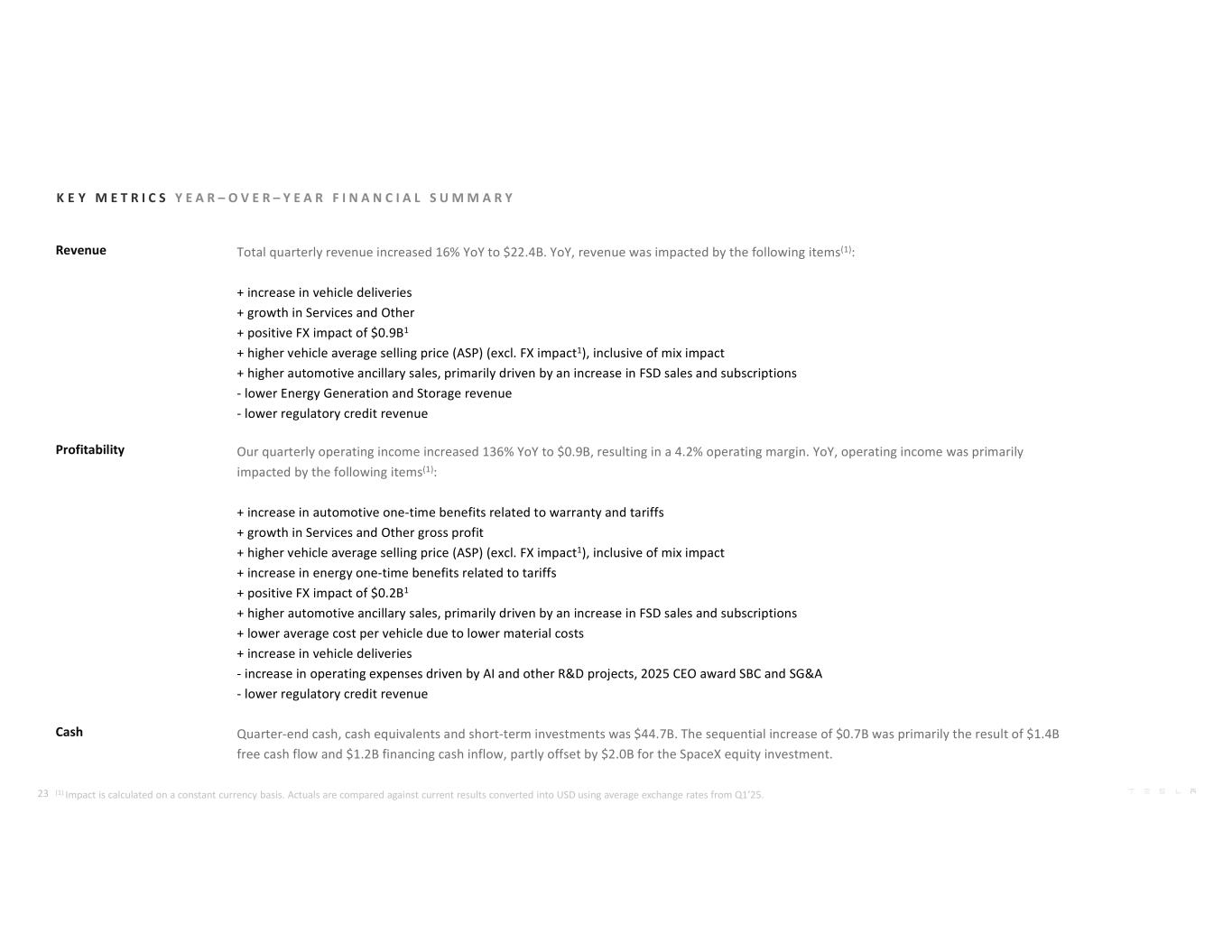
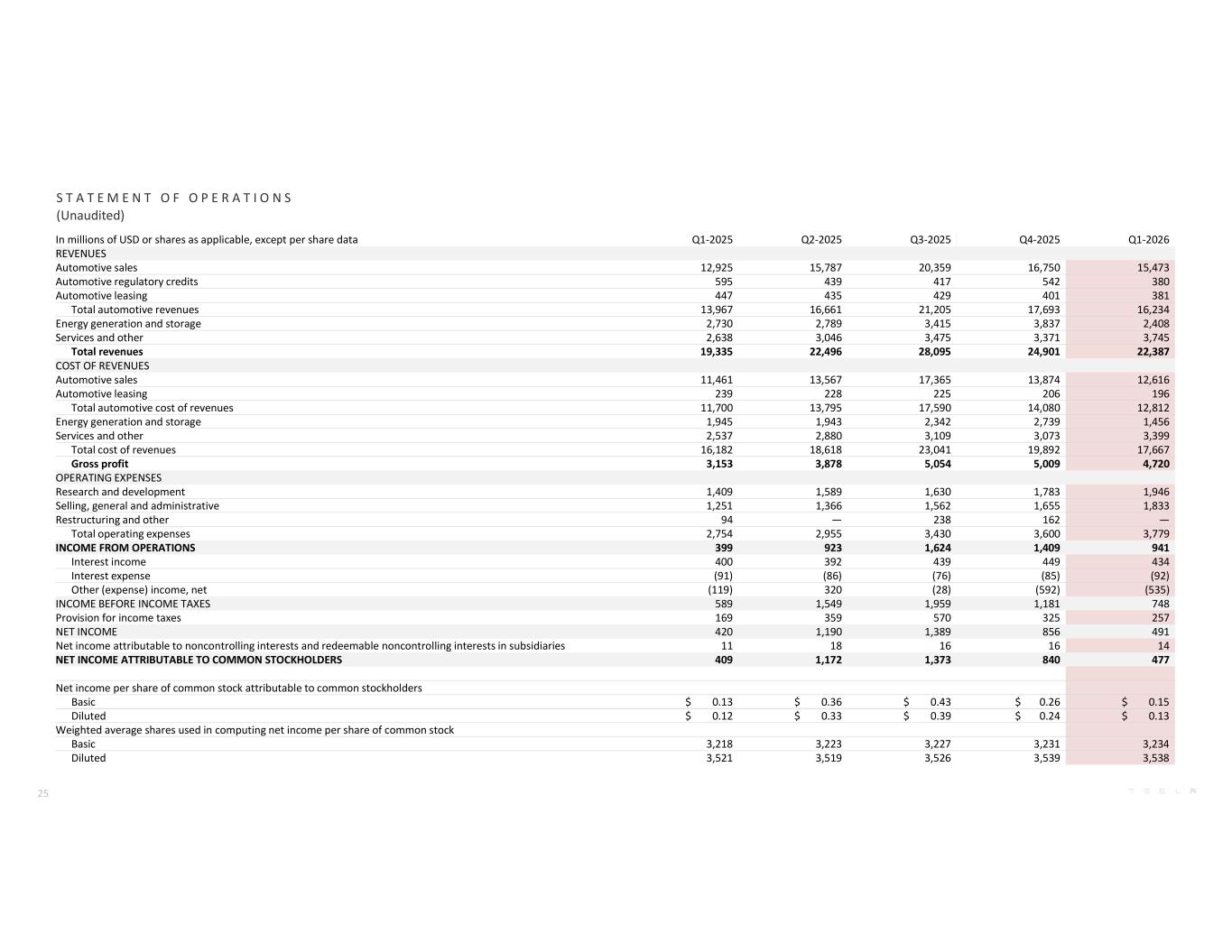
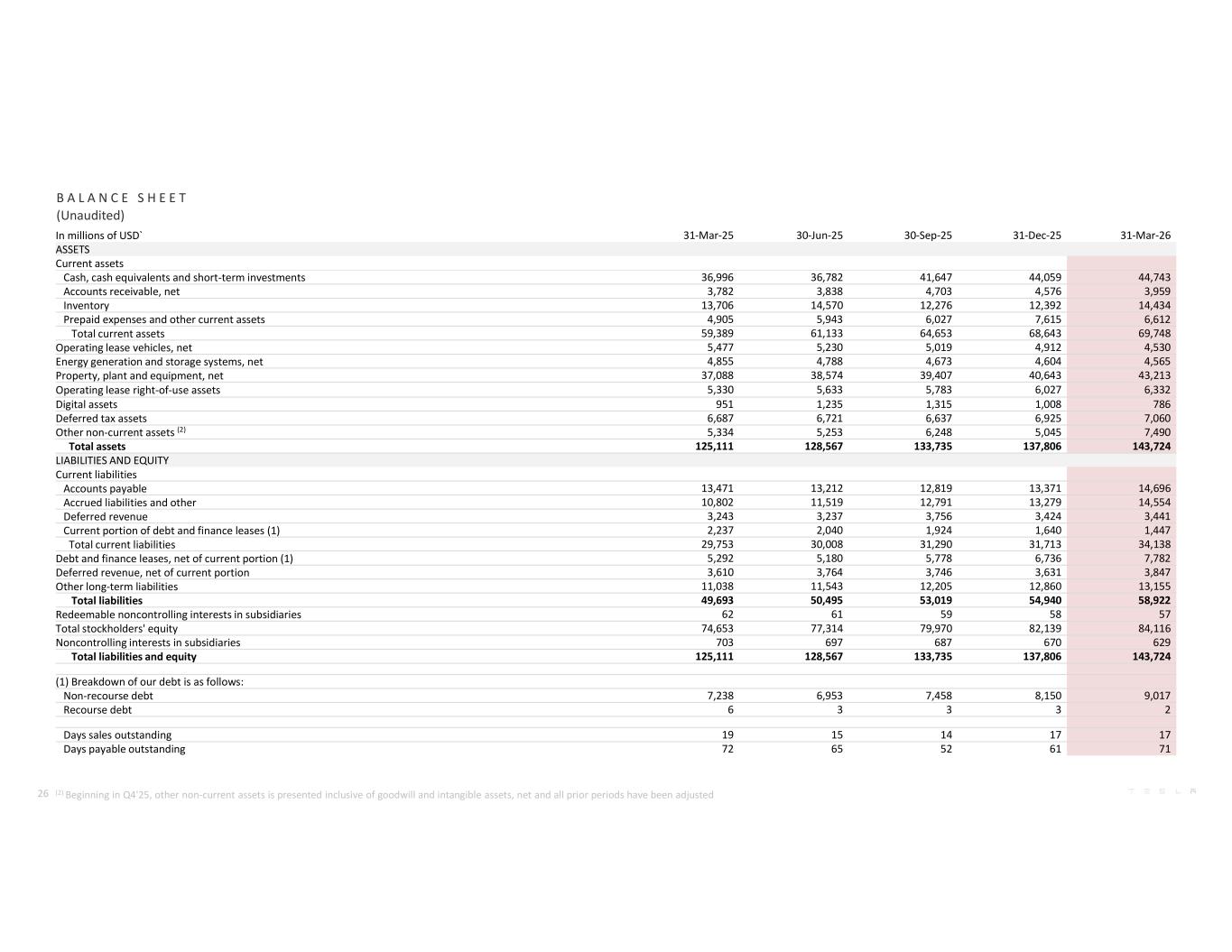
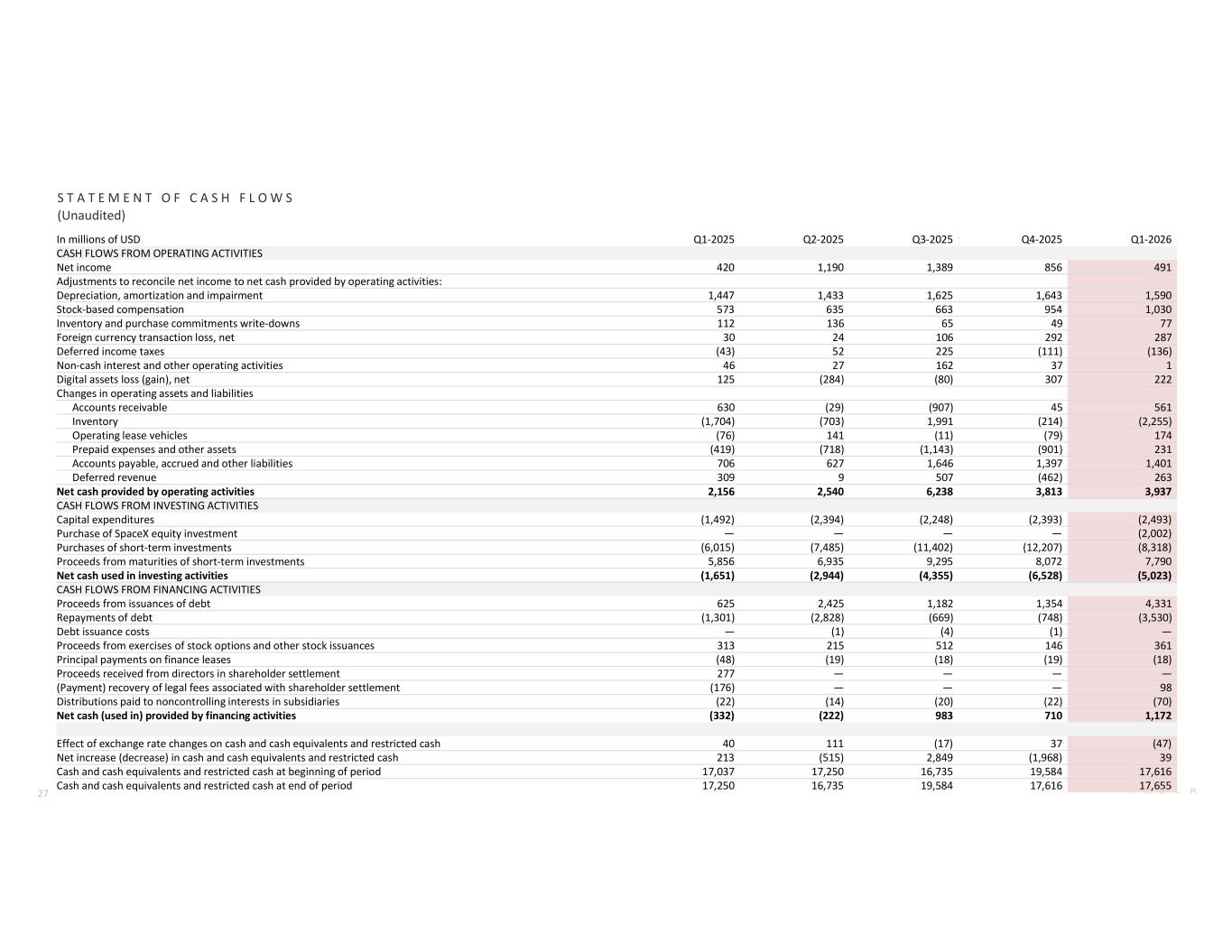
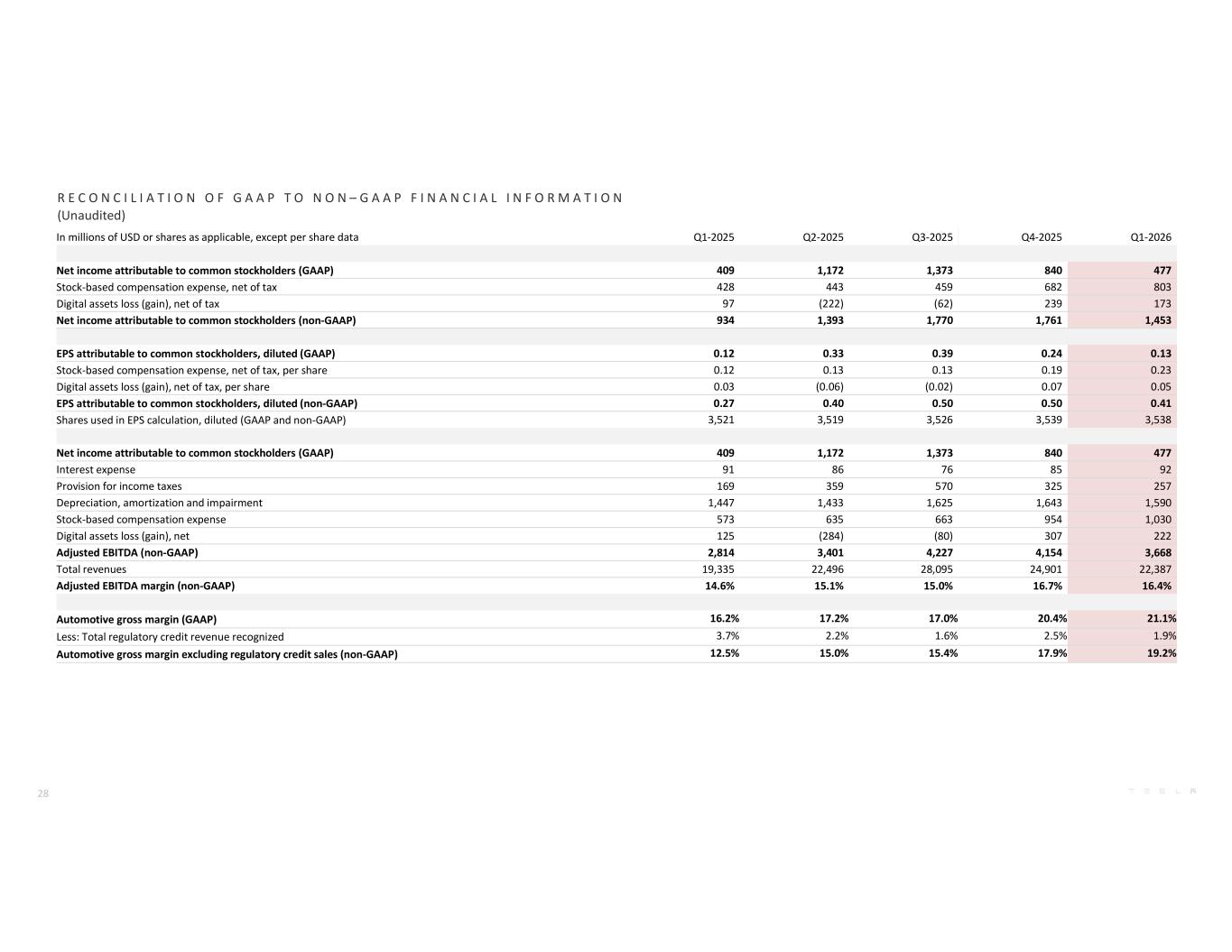
On the autos business, we have seen a resurgence in demand in EMEA and certain countries like France and Germany showing over 150% quarter-over-quarter growth in deliveries. In APAC, we witnessed growth in South Korea and Japan again in terms of deliveries. Even out here in the US, we've seen a slight growth in terms of quarter deliveries. On the auto backlog front, we ended the quarter with the highest Q1 order backlog in over two years. Whilst the recent increase in gas prices has had a positive impact on the order rate, this improvement started before the uptrend in gas prices. This is due to the work done by the Tesla team in bringing more compelling and affordable vehicles to market. Ten years back, when we launched Model 3 in the U.S. with the promise of $35,000 starting price, which if you adjust today for inflation, translates to about $48,000 in today's dollar terms. The starting price of Model 3 today is way less than that, while the product is way more compelling from where it started. Given this setup, we're focused on increasing our overall production volume, something that we already started in Q1. This volume increase is evidenced by the Giga Berlin reaching a record output of over 61,000 units in Q1. We plan to keep growing volumes further, not just in Berlin, but across all our factories. Our biggest limiter continues to be our battery pack capacity and we are actively working on resolving that. Auto margins excluding credits improved sequentially from 17.9 to 19.2 percent. Note that we've had certain one-time benefits from warranty true downs around 230 million and some relief on tariffs. We have not realized any benefit from the recent Supreme Court ruling on IPA tariffs as there is still a lot of uncertainty around the final outcome. Both tariffs and sustained high interest rates continue to add to our automotive cost. Interest rate subvention costs are recognized upfront. If interest rates continue to rise, our cost of subvention will continue to impact auto margins. On the FSD adoption front, we continue to see improvement, reaching nearly 1.3 million paid customers globally. The bulk of the growth came from subscriptions, while upfront purchases only increased 7% as we removed the purchase option in some markets in Q1. We recently received approvals for FSD in Netherlands. This sets up well for EU-wide approval later in Q2, and we're just gated by how the regulators go about it. Additionally, we've also received approvals in China. The broader approval is still not there, but we're working with the regulators in the country, and we're hoping that we can get approval by Q3. With these approvals coming through, we We expect the broader adoption of the software in the existing fleet and incremental demand for our vehicles. With all this in mind, we have evolved our vehicle sales strategy, where we now emphasize FSD as a product and vehicle as only the delivery mechanism. As we have noted previously, the energy storage business is inherently lumpy, tied to customer deployment timelines. In Q1, we deployed 6.8 GWh of energy storage, a 38% sequential decline. However, we still expect 2026 deployments to be higher than 2025. We set yet another record with gross margins in this business over 39.5% due to some one-time benefits from certain tariff recognitions of more than $250 million from certain tariffs which were paid in prior quarters. On a normalized basis, we continue to expect energy compression from here with increasing competition and tariff impacts. As previously discussed, tariffs in this business can have outsized impacts as most of the battery cells are procured from China. Our auto backlog for this business is robust and we're doing our best to build not just based on existing demand, but also on expected demand. Services and others improve sequentially from 8% to 9.2%. This includes a collection of efforts meant to support our customers like service centers, used cars, paid supercharging, parts sales, insurance, and even our robotaxi business. We're making deliberate investments in the infrastructure to help the robotaxi in the future. We grew the robotaxi fleet quarter over quarter, and we expect to keep ramping the fleet as we accelerate and get into other geographies. On operating expenses side, we did increase sequentially from a full-quarter stock-based compensation expense for the 2025 CO compensation plan, for which one milestone is still deemed probable. Additionally, our spend on AI-related initiatives, including expense on development of our own AI-5 trip and new products like CyberCaps, Semi, Optimus, and Megablock, etc., continue to be at elevated levels, and we expect this trend to continue for the full year 2026. Net income was impacted from mark-to-market charges on our Bitcoin holdings, which depreciated 22% as compared to the last quarter, and the unfavorable impact of FX primarily from our large intercompany borrowings. On free cash flow, we ended the quarter with just over $1.4 billion. As Elon mentioned, we are in a very big capital investment phase, which is going to start now and would last a couple of years. So based on that, our current expectation for 2025, 2026 is over 25 billion of CapEx. Just to remind you, we are paying for six factories, which we're going to go into operation. Some have already started, some would go into operation later part of this year. We're further increasing our investment in AI related initiatives, including the AI infrastructure to support Robotaxi and the launch of Optimus. We've already started placing orders for the research semiconductor fab in Austin and for solar manufacturing equipment. While this may seem a lot and we will have the impact of negative free cash flow for the rest of the year, we believe this is the right strategy to position the company for the next era. We'll make such investments in a very capital efficient manner. We're actively working on our mission of building a future of amazing abundance. However, that requires not just a lot of investment, but an immense amount of execution. The future is going to be great, and the whole Tesla team is rising to the occasion to make this a reality. Thanks.
Thank you very much, Vebov. Now we're going to go to investor questions. The first question is, when will we have the Optimus 3 reveal? When will Optimus production start? Since we ended the Model X and S production earlier this mid-year, what's the expected Optimus production rate exiting this year, and what are the initial targeted skills?
What we found is that when we've unveiled first Optimus versions, we found out how competitors literally do a frame-by-frame analysis and copy everything we're doing. So I think we want to push the Optimus 3 unveil maybe closer to production. The start of production is, we're assuming, is some late July, August timeframe. Just to inject some reality into these questions, since whoever does this question does not fully understand what happens with the production line. The last SX production will be in early May, but you have to look at the entire upstream portion of the production line. So you have to start with cells, battery packs, motor production. And so we've been dismantling the SX production line from the more basic level parts to, as you get to larger sub-assemblies, you start dismantling the line from the small parts first, not from the final assembly first. The final assembly line will be dismantled next month after the last of the SX vehicle's done. You can't dismantle some gigantic production line overnight it takes at least a few months to do so and then you've got to install a new production line and you've got to provide all of the wiring and communication test out the machines of the new production line for optimus so that also takes several months frankly if if we're able to go from stopping production on one line dismantling that entire line reinstalling a whole new line and turning that on in a matter of four months that is a an insanely fast speed i don't think any other company on earth has ever done that before I don't know what the production rate of Optimus will be this year. It is impossible to predict these things. When you have a brand new product and an entirely new production line, and you have 10,000 unique items, all of which have to go right to ramp production, it will move as fast as the least lucky, slowest, dumbest part in the entire 10,000. Optimus is a completely new product with a completely new production line. It's just literally impossible to predict, except that I think it will be quite slow at first as we iron out the 10,000-plus unique items that have to be sold for Optimus to reach volume production. Initial skills will be, obviously we're going to start with simple skills in the factory and then build up from there.
The next question is, what milestones are you targeting for unsupervised FSD and Robotaxi expansion beyond Austin this year, and how will that drive recurring revenue?
We certainly hope to have unsupervised FSD or Robotaxi operating in a dozen or so states by end of this year we're taking a very cautious approach to the rollout here like we haven't had any injuries and certainly no fatalities to date with the unsupervised fsd and rover taxi expansion we want to keep it that way unsupervised fsd or rover taxi revenue will not be super material this year but i do think it will be material probably in a significant way next year the next question is when do you expect fsd unsupervised to reach customer cars i'm just guessing here but probably in the fourth quarter it's difficult to release this like to everyone everywhere all at once because we do want to make sure that they're not unique situations in a city that particularly complex intersection they tend to be places where people get into accidents a lot because they're just like i said an unsafe intersection or bad road markings or a lot of weather challenges so i think we would release unsurvised gradually to the customer fleet as we We feel like a particular geography is confirmed to be safe.
The next question is, how will Hardware 3 cars reach unsupervised FSD?
I wish it were otherwise, but Hardware 3 simply does not have the capability to achieve unsupervised FSD. You know, we did think at one point it would have that, but relative to Hardware 4, it has only one-eighth of the memory bandwidth of Hardware 4, and memory bandwidth is one of the key elements needed for unsupervised FSD and it's just generally a thing that's needed for AI if you're doing an auto-aggressive transformer memory bandwidth is the true point. For customers that have bought FSD what we're offering is essentially a discounted trade-in for cars that have AI4 hardware and then we'll also be offering the ability to upgrade the car to replace the computer and you also need to replace the cameras unfortunately to go to hardware 4. To do this efficiently we're going to have to set up kind of micro factories or small factories in major metropolitan areas because if it's done at the service center it is extremely slow to do so and inefficient so we basically need like many production lines to make the change. I do think over time it's going to make sense for us to convert all hardware 3 cars to hardware 4 because that's what enables them to enter the robotaxi fleet and have unsupervised FSD.
In the meantime we're going to also release a V14 version for Hardware 3. This will be a distilled version of the same V14 software that we released for Hardware 4. People should be able to start the drives from Park State and basically have all the features that V14 for Hardware 4 has. And that's expected to come end of June.
The next question is, what enabled you to finish the AI5 tape out early? And were there any changes to the original vision? Last week, Elon said AI5 will go into Optimus and the supercomputer, but one month ago said it would go into the robotaxi. Has AI-5 been dropped from the vehicle roadmap?
The reason AI-5 tape out finished early was because the team worked incredibly hard to make it happen. Just over time, we gathered a lot of momentum. We did have to work every weekend for six months straight, including every holiday. A lot of sacrifice by the team, and I was there, of course, myself every weekend. Fortunately, we didn't make any major mistakes, at least that we're aware of, that required pushing out the tape out. The team just did a great job and worked incredibly hard is the reason. I do expect that AI5 will go into Optimus and into the data center because it's looking like we'll be able to achieve unsupervised self-driving with AI4 that is far greater than human safety levels, which means it's certainly not immediately needed in the car. At some point, I think it will make sense for us to switch to AI5 in the car, but there's not a pressing issue to do so. But at some point, the AI4 hardware is going to get so old that it's like, okay, the only reason they're keeping the factory open is for AI4. We are planning an AI4 upgrade to use newer generation RAM. It'll go from 16 gigabytes to, I think, 32 gigabytes per SOC, so a total of 64 gigabytes. Probably a 10% increase in compute and trillions of operations per second and in memory bandwidth. with. So that's AI 4.1 or AI 4 Plus probably goes into production in the middle of next year, I think. It depends. Samsung's doing the modifications for us, so it sort of depends on when they're able to finish those modifications and bring it to production.
The next question is, now that FSD has been approved in the Netherlands and is expected to launch across Europe this summer, can you discuss your Robotaxi strategy for the region?
We're probably jumping the gun here on Robotaxi in Europe since it took us an immense amount of time just to get supervised self-driving approved in Europe. We don't control the regulators, you know. We push as hard as we can, but it's ultimately up to the governments in Europe and the EU to decide what to do. As it is, we've only been approved in the Netherlands. We expect to be approved in a lot of other countries, and I think the supervised FSD goes to Brussels for EU review in May, yeah. Obviously, the next thing beyond that is to aim for unsupervised self-driving or rover taxi in Europe. I actually don't know what the time frame for that is. It would be somewhat at the mercy of the regulators as to when that approval would take place.
What we deployed in Netherlands and Europe is the same exact architecture and the training procedure and so on, except it had more Europe data. I suspect the same thing will be true for unsupervised FSD as well. Whatever we used to solve in the U.S. will work in other places in the rest of the world too, provided we were able to add the data from the local regions.
The next question is, given the recent NHTSA incident filings, Can you update us on the RoboTaxi safety data? If safety validation remains the primary bottleneck, why not deploy thousands of vehicles to accelerate removal of the safety driver?
We are increasing the amount of our QA fleet, but we also want to use the customer fleet to give us the useful metrics back so that we can scale it safely. Like you don't mention, we are absolutely focused on safety, and so far we have zero incidents, and that's what the NHTSA filing also shows. In addition to safety, we are also solving some of these so-called scaling issues. For example, you do not want the robot taxi to be stuck blocking intersections or don't want to be dropping people off at slightly incorrect locations and so on. So we are simultaneously solving the long tail of safety by monitoring the metrics across the entire Tesla customer vehicle fleet, which is close to driving 10 billion miles on FSD in the next few weeks, and also scaling up the amount of QA fleet that we have across the entire U.S. to accelerate our safety validation while also scaling the rest of the factors that can throttle the increase of unsupervised vehicles.
The next question is, is V14.3 still the last piece of the puzzle to enable large-scale unsupervised FSD and Robotaxi, or do we have to wait until V15?
14.3 is the last piece of the puzzle for unsupervised FSD. Now, the question is like degrees of safety, safety and convenience, I suppose. We have a lot of known improvements, major architectural improvements that we know would improve the probability of safety significantly. It's not going to make sense for us to deploy unsupervised FSD or overtaxi at large scale when we know that there are major architectural improvements to the software that can improve safety. So I think we're going to want to finish writing that software, validate it, and release it before going to large scale unsupervised FSD, depending on what large scale means. I mean, we are doing unsupervised FSD in three cities and we'll expand to, like I said, probably a dozen states or more later this year. So it kind of depends on what your definition of large scale is. It wouldn't be right for us to go to a very large scale and to advise FSD when we know that there are software improvements in the pipeline that would improve safety.
I'd like to note that the version of Robotaxi that's running in Austin, Dallas, Houston, etc., those are essentially 14.3 variants. And it's obviously safe that that's why we're able to launch in those cities and we continue to expand based on the V14.3 base for a while until V15 lands. And V15 is going to be a major upgrade.
The next two questions we've already answered about RoboTaxi roll out the data that we're observing. So we will end on the last question. What is Tesla doing to scale the energy generation business with solar? Residential roof deployments have stalled. Will Tesla move to regional solar and battery farms, perhaps coupled to superchargers? Will we deploy solar through utilities?
The overall U.S. residential solar market is going through a bit of a correction after the loss of the homeowner tax credit last year, but we still see strong demand shaping up for the second half of the year. Tesla introduced a lease product this year that allows us to capture the tax credit ourselves and offer competitive pricing for homeowners. We've also debuted our own solar panel with superior performance and aesthetics, as well as our own best-in-class mounting system that gives us a fully integrated home energy ecosystem. We strongly believe that solar and storage markets globally will continue to grow at both residential and utility scale, and we will continue to invest in that growth.
So now we're going to move on to analyst questions. The first question is going to come from Will Stein at Truist.
Considering the various parties involved in the TeraFab project, I'm hoping you can provide some details for investors about which party is going to take responsibility for each aspect of that project, funding it, designing it, building it, operating, taking production. We'd love to hear some more details.
We're still working out the details of the TeraFab deployment. In the near term, Tesla will be building the research fab on our giga texas campus this is something we expect to be probably a three billion dollar ish initiative capable of maybe a few thousand wafers per month but it's really intended to try out ideas the research fab we have some ideas for improving the fundamental technology of how chips are made and there's some new physics we'd like to test out but we also want to test out the ability to see if something is working in production so you need kind of like a few thousand way for starts a month to make sure that a production process is sound. And then SpaceX is going to take care of the initial phase of the scaled up TeraFab. That's what we've figured out thus far. Any kind of intercompany thing has to be approved by both the SpaceX and Tesla board of directors. It's got to go through a conflict resolution. It's unfortunately a lot of complexity because we've got to make sure Tesla shareholders are served and SpaceX shareholders are served and strike the right balance there. It takes a while to work through the independent director reviews on this. So that's basically what we've figured out thus far is Tails is doing the research fab, SpaceX is doing the initial part of the large-scale TerraFab, and then we've got to figure out the rest.
And what about Intel's involvement?
Intel is excited to partner with us on some of the core manufacturing technologies. We plan to use Intel's 14A process, which is state-of-the-art and, in fact, not yet totally complete. But given that by the time TerraFab scales up, 14a will be probably fairly mature or ready for prime time. 14a seems like the right move. We have a great relationship with Intel. A lot of respect for the CEO, the CTO, the new team there. We think it's going to be a great partnership.
The other thing on the research fab, I think we've said it before. We plan to do memory, logic, everything in the same place, including mass, because we want to have a quick iteration loop so that we can see and basically scale the technologies which we are trying to bring up.
Yeah, I think this will be unique in the world, or at least I'm not aware of any place where you have the lithography mask creation and then logic, memory, and packaging in one building. That's about the fastest I could possibly imagine recursive research and development and being able to try out some pretty radical ideas, some of which have this kind of long shot stuff, But if some of these long shots pan out, it would be radical improvements in the way chefs work. The next question is going to come from Pierre at Newstreet.
A quick one first on FSD adoption. So you have 180,000 new users, paying users this quarter. And I compare that to your overall install base, it might be 15%. But then if I shrink that to the U.S., to North America, where most of them are, it's probably more like 30%, 35%. And I compare that you probably sold about 100,000 cars in North America in the quarter. So you're winning twice more FSD users and you're selling cars. And then if I add to that picture the fact that I guess it's mostly hardware for owners who subscribe to FSD, it sounds like most drivers in North America who have hardware for would already be using FSD. Is that the right way to think about it? and the kind of success FSD is meeting today? Is that the right way to think about it?
I think you're thinking about it the right way, Pierre. And the other thing which I'll share is that you can't just look at one quarter versus the other quarter in terms of churn, but we are actually seeing churn of subscribers also coming down, which again is a reflection of the product is getting better. Obviously, if subscriptions are going up, that is a good metric. The other thing also to note is that we are seeing customers actually drive longer that's why you have lesser churn because people are liking the product if i just use my own personal behavior right i literally get in the car i press the button and it just goes and earlier i used to park now i don't even have to park and that is the experience which we want everybody to gain and that's why you're starting seeing it in the numbers come through maybe a quick follow-up completely different it's more on the optimist architecture you talked about the partnership with XAI and Grok.
And I was wondering if you can share with us anything about how the system to intelligence is going to be implemented. Is that going to be on board on chips inside Optimus? Or if we should think like your fleet of like a million Optimus being produced a year, actually driving very significant inference demand in data centers as well for system to thinking.
Well, we think we can put a lot of intelligence locally in the robot. It certainly needs to be enough intelligence that if the robot gets disconnected, like if it's a bad cellular signal or there isn't Wi-Fi, Optimus can't just get stuck. It needs to have enough local intelligence that it can still do useful things, even if it loses connection, kind of like the car. The car does not need any cellular Wi-Fi connection to be able to drive safely. I guess you can think of like Optimus needs kind of a manager to tell it what to do, broadly speaking, like if otherwise it's going to keep doing the same thing it did before. You need kind of an orchestration AI. Grock would be good for orchestration. And then Optimus' voice, having low latency, intelligent voice AI, Grock is actually very good for that. So if you want to talk to Optimus and have a Grock-level conversation, you kind of need to connect to a Grock-level AI for that. But I would expect the amount of interaction, apart from the voice stuff and asking complicated questions of the robot that necessarily needs a large AI model to answer, Kronk would probably have about as much interaction with Optimus as a manager would have with the people on their team. Meaning Optimus could probably work for several hours without any management oversight.
The next question is going to come from Dan at Barclays.
Elon, your chip suppliers generally generate pretty good economics on the chip they sell. Your approach has historically been on vertical integration. Part of that has been to get better economics. So the longer-term goal of TerraFab is to get the supply you need. But how much of TerraFab is also motivated to get better economics on your midterm chip purchases? And how long is it going to take to ramp to get to yield that achieves that type of economic parity?
TerraFab is not some sort of mechanism to generate leverage over our chip suppliers. Just literally, we don't see a path to having enough, a sufficient quantity of AI chips down the road as we scale production to high levels. Just the rate at which the industry is growing in logic, even more so in memory, we just anticipate hitting the wall if we don't make chips ourselves. That's the reason for the chair fab. We do have some ideas for how to make maybe radically better AI chips. These are kind of research ideas there, which means like long shot, but if long shot pays off, it's maybe a giant improvement. It's just easier to do that if we have our own research fab and are developing production technologies. And if you look sort of long-term at, say, having AI satellites, making chips for those, there's not just no way in hell the existing industry can keep up with that.
And our next question is going to come from Mark at Goldman Sachs.
Mark
Analyst — Goldman Sachs
I recognize the importance of FSD and that FSD can help to drive vehicle sales. And nice to see some of the improvements in the FSD technology more recently with version 14. However, I'm also hoping to understand if the company's view on new vehicle models has evolved. And I ask, given that Elon, you posted on X recently that Tesla could develop a family vehicle, and there's also been some past discussion about a compact vehicle.
I mean, CyberCab is the compact vehicle. It's actually, I mean, it's very roomy, but it's a two-person vehicle. And we do think probably most of our production long-term will be CyberCab because 90% of miles driven are with one or two people. So it would mean that, you know, you'd want a vast majority of your production to be CyberCab. Over time, it's going to make sense for our whole lineup to be autonomous vehicles of different sizes. I did talk a bit about this when we did the AI day in LA at Warner Brothers and you know showed like this is our current lineup and this is what some idea of what our future lineup will be which is that it's going to be almost entirely autonomous. In fact long term the only manually driven car will be the new Tesla Roadster. Speaking of which we may be able to debut that in a month or so. It requires a lot of testing and validation before we can actually have a demo and not have something go wrong with the demo but I think it will be one of the most exciting product unveils ever. I don't think it moves the needle massively from a revenue standpoint, but it is very cool. I think it might be one of the most spectacular demos ever.
Mark
Analyst — Goldman Sachs
My other question was on batteries, and the company mentioned batteries as a constraint on its growth. Can you speak more to how Tesla expects to resolve this and to what extent that might come from ramping up your own LFP and 4680 battery cell manufacturing? Or is this something that you'd expect to resolve primarily with increased sourcing from suppliers? Thank you.
At the moment, I think the limiter is not the cells itself. It's the battery pack capacity. And we're actively working on resolving this. There's more capacity being added as we speak. And I'll let Lars add a few more things to it.
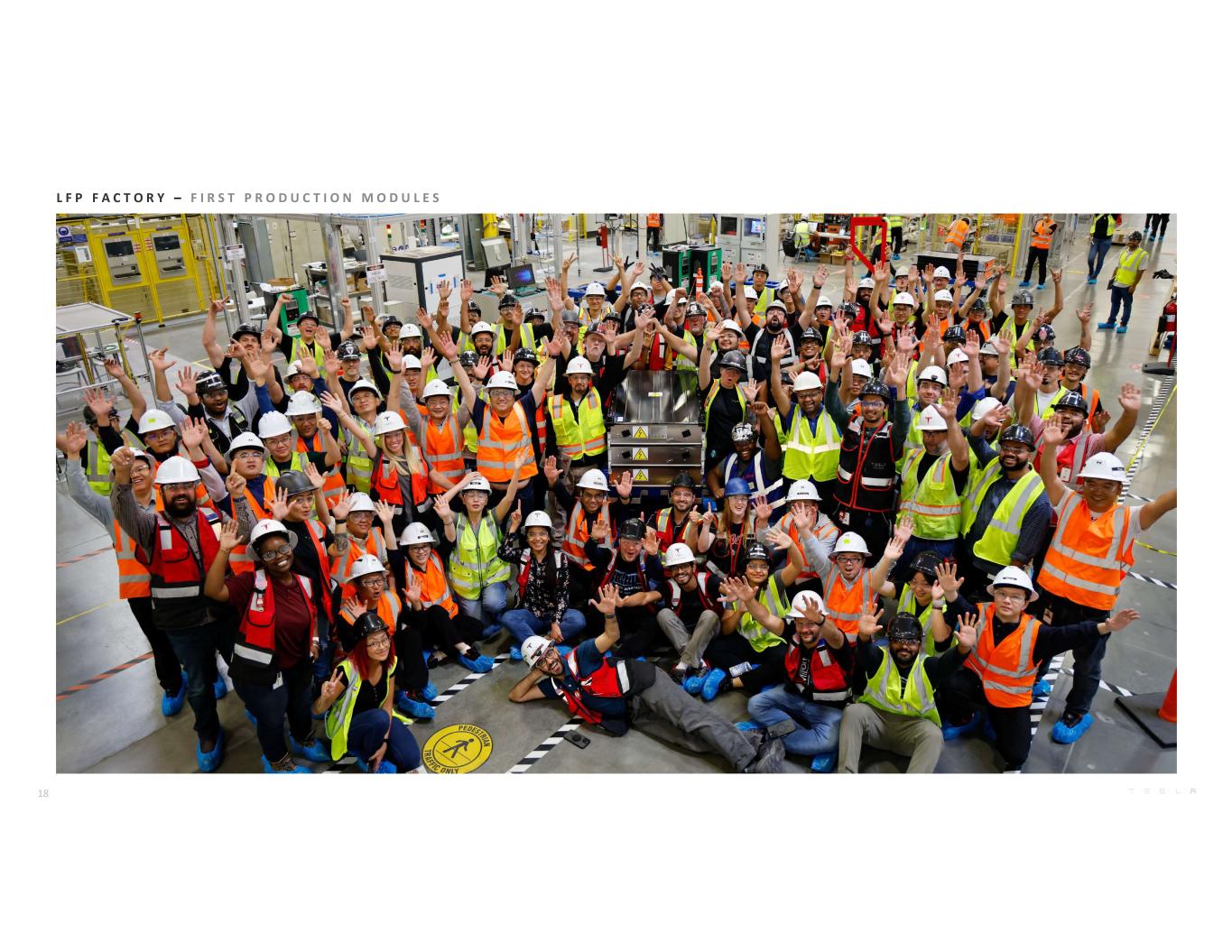
As you guys may have seen in Berlin, we started launching a Model Y battery pack with our in-house 4680 cells a few months ago, and that is ramping up nicely, adding to Berlin's output and helping with the demand surge that we've seen in Europe. We're adding additional capacity in our Reno facility, sort of retooling it as it's been building packs now for almost 10 years in order to put in some more efficient lines and get additional output out there. We continue to have growth in China as well, ramping in-house LFP module production and battery packs associated with that. So all of those things are happening now and in the next months, and that's plans we laid out a few months back to increase that output with the growing demand.
Our next analyst is going to be Colin from Wells Fargo.
Colin
Analyst — Wells Fargo
You moved the safety driver in Austin, and you're now expanding into Dallas and Houston. What are the key safety metrics that you're tracking that gives you confidence that RoboTaxi is safe in us to expand? Is it sort of miles per intervention, miles per accident, per fatality, and where do you stand on that now?
We track basically all the metrics that you mentioned. We have a pretty large QA fleet spread across all of the United States. And then we look at intervention that could happen and then sort of simulate both in track tests and also in our simulators that are very, very good nowadays using neural networks as what would have happened. And then based on all these analysis, we in the end make the call to expand. And so far, all of the expansions have gone according to our expectations.
A lot of what limits wider deployment of road taxi are actually not safety issues, but convenience issues, or the car basically gets paranoid and gets stuck. Because it's programmed for maximum safety. Problem is that then it sometimes just gets scared to do things. It sometimes gets scared to cross railroads, for example, or it'll get stuck at a light where the light never changes from red. I mean, there was one kind of amusing situation where a whole bunch of rover taxis got stuck in the left turn lane in Austin because, I kid you not, a Waymo had crashed into a bus. And so they could not turn left because the Waymo had crashed into the bus. And so you had this, like, long line of, like, I don't know, a dozen or more Tesla rover taxis that were waiting for the bus to move. But the bus was never going to move because the Waymo has crashed into the bus. That obviously drives people crazy if there's a whole bunch of rover taxis blocking the whole road. That's the single biggest thing, is just the car being scared to move or getting kind of stuck in situations like that. We've also had literal infinite loops where a car might want to make a turn into a road, but there's construction. And then it goes around the block, tries to turn into the road with construction, goes around the block, tries to turn the road. And so you have to stop the infinite looping. Those are by far the issues that we have to resolve as opposed to direct safety issues.
Colin
Analyst — Wells Fargo
Last year, I asked about FSD and camera and the issues with Sun Glare, and you noted that there was a breakthrough with direct photon counting that addressed this issue. A month ago, there was a NHTSA filing saying that they haven't received an update when the solution was deployed and the number of vehicles. Did it require a retrofit of the camera? Is this fully deployed? I guess I'm just curious since the filing mentioned it.
First, I want to say we did change the cameras some months ago, and those are out. And the NHTSA filing is referring to older vehicles. We always work directly with NHTSA on all of the issues that they raise with us, and they're asking for quite a bit of information, and we're complying with that in as timely a manner as possible. And so we expect to resolve that and any of the other investigations in short order.
Yeah, and we have also implemented stripper measures for the visibility of the camera. So in recent software builds, if the camera is not able to see things clearly because of residue, buildup, or whatever, FSD won't be available for those cars.
You have to clean the inside of the windscreen. Great. That, unfortunately, is all the time we have. today we appreciate everyone's questions and we look forward to talking to you next quarter thank you very much and goodbye