Good afternoon, everyone, and welcome to Tesla's second quarter 2026 Q&A webcast. My name is Travis Axelrod, head of Investor Relations, and I'm joined today by Elon Musk, Vibha Tanejia, and a number of other executives. Our Q2 results were announced at about 3 p.m. Central Time in the update deck we published at the same link as this webcast. During this call, we will discuss our business outlook and make forward-looking statements. These comments are based on our predictions and expectations as of today. Actual events or results could differ materially due to a number of risks and uncertainties, including those mentioned in our most recent filings with the SEC. During the question and answer portion of today's call, please limit yourself to one question and one follow-up. Please use the raise hand button to join the question queue. Before we jump into Q&A, Elon has some opening remarks. Elon? Thank you. So yeah, it's been a great quarter.
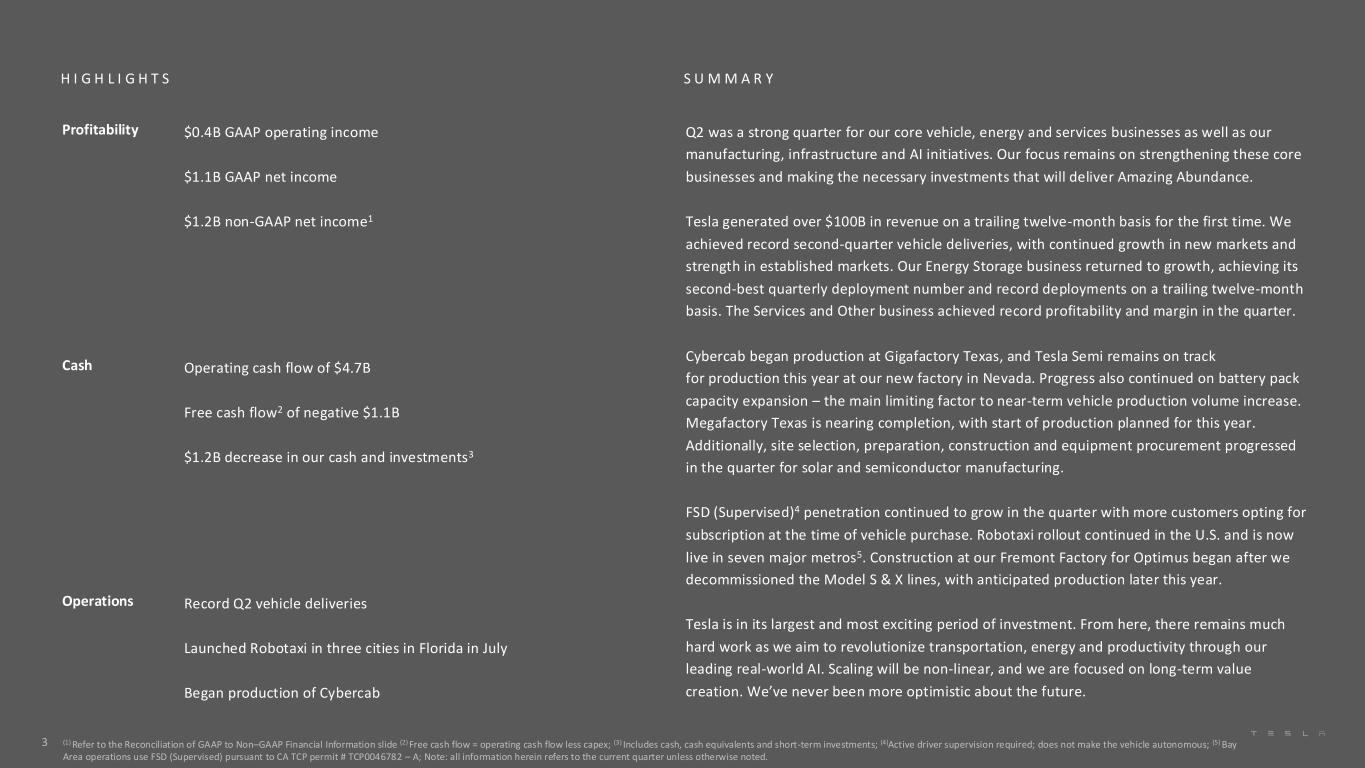
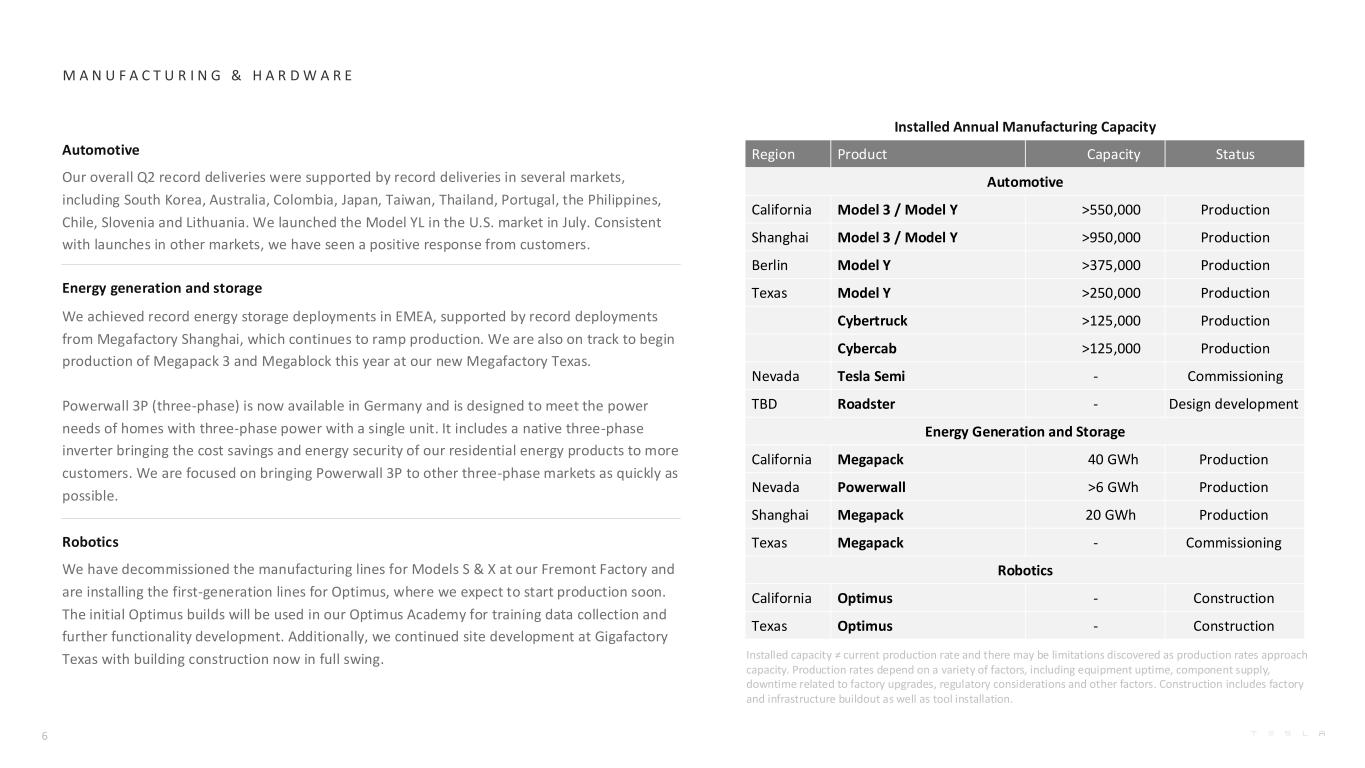
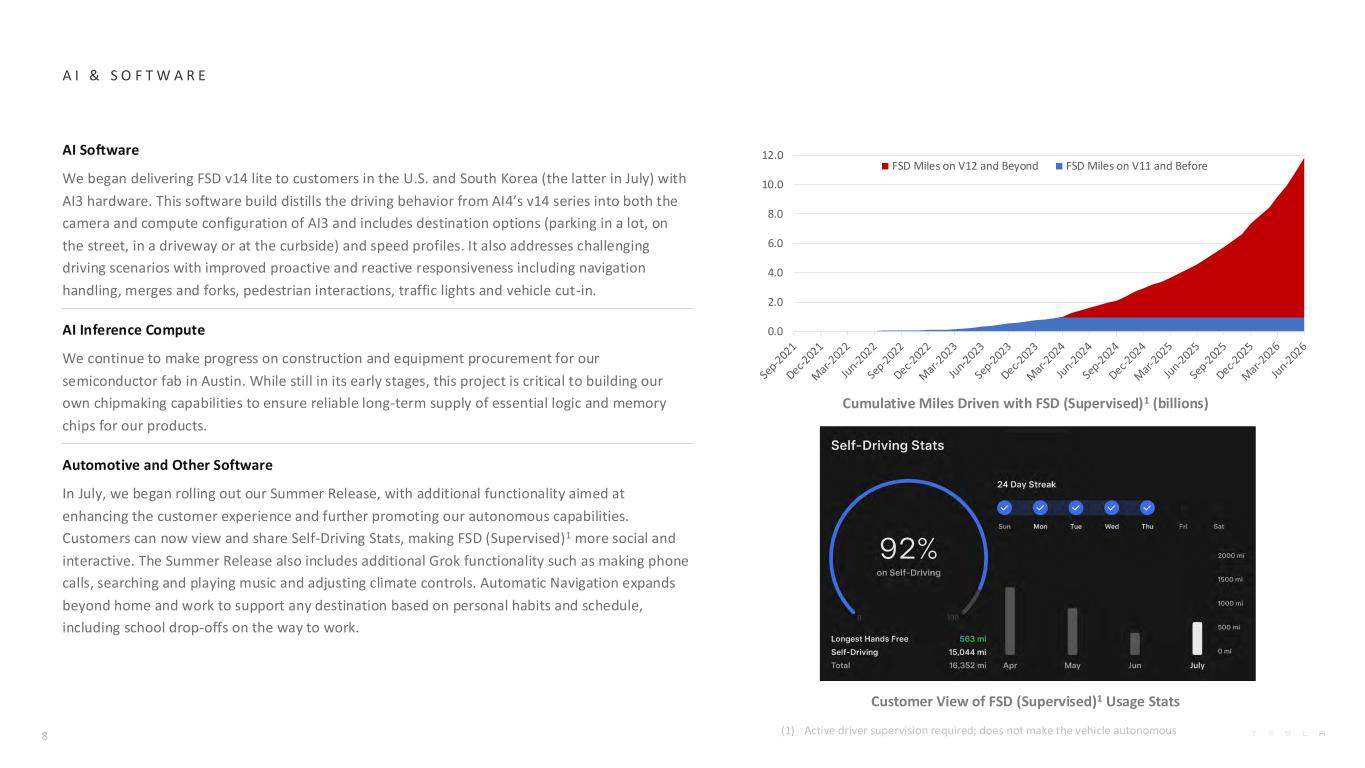
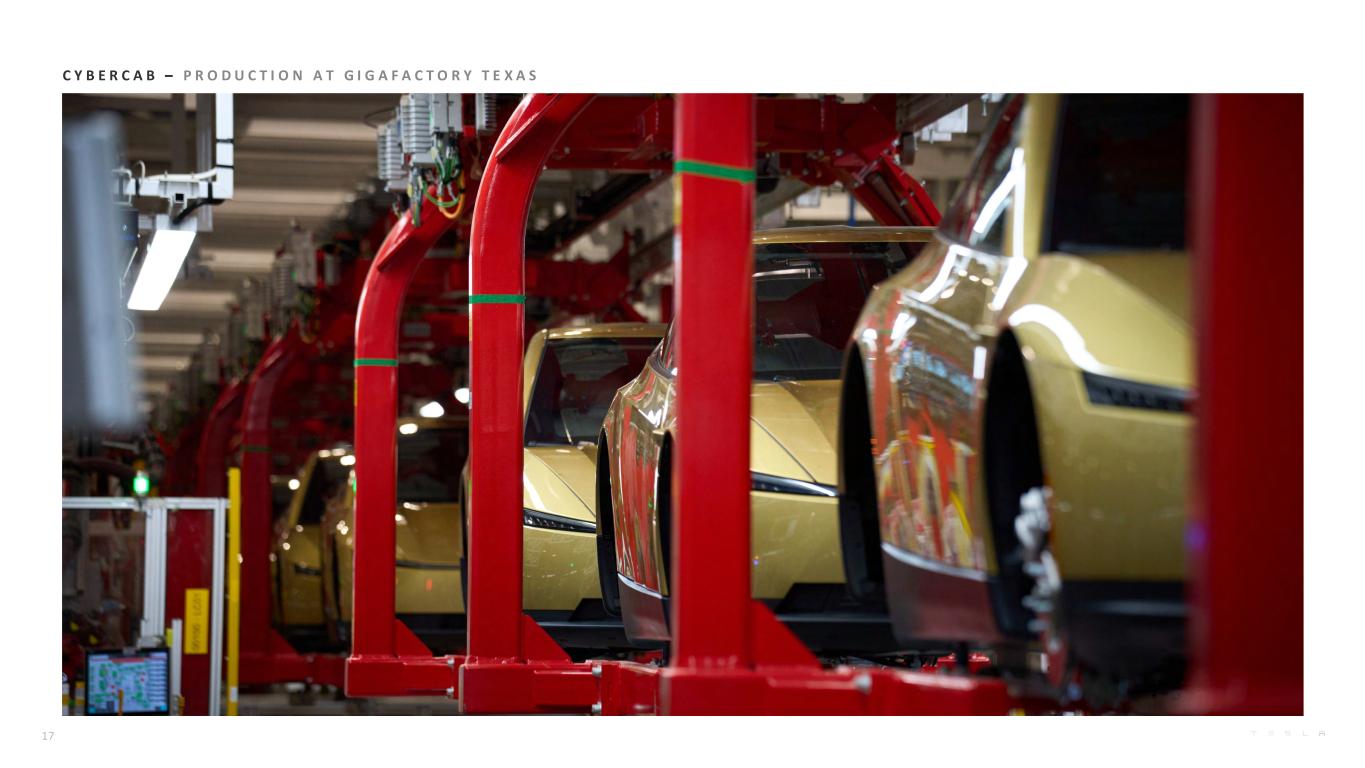
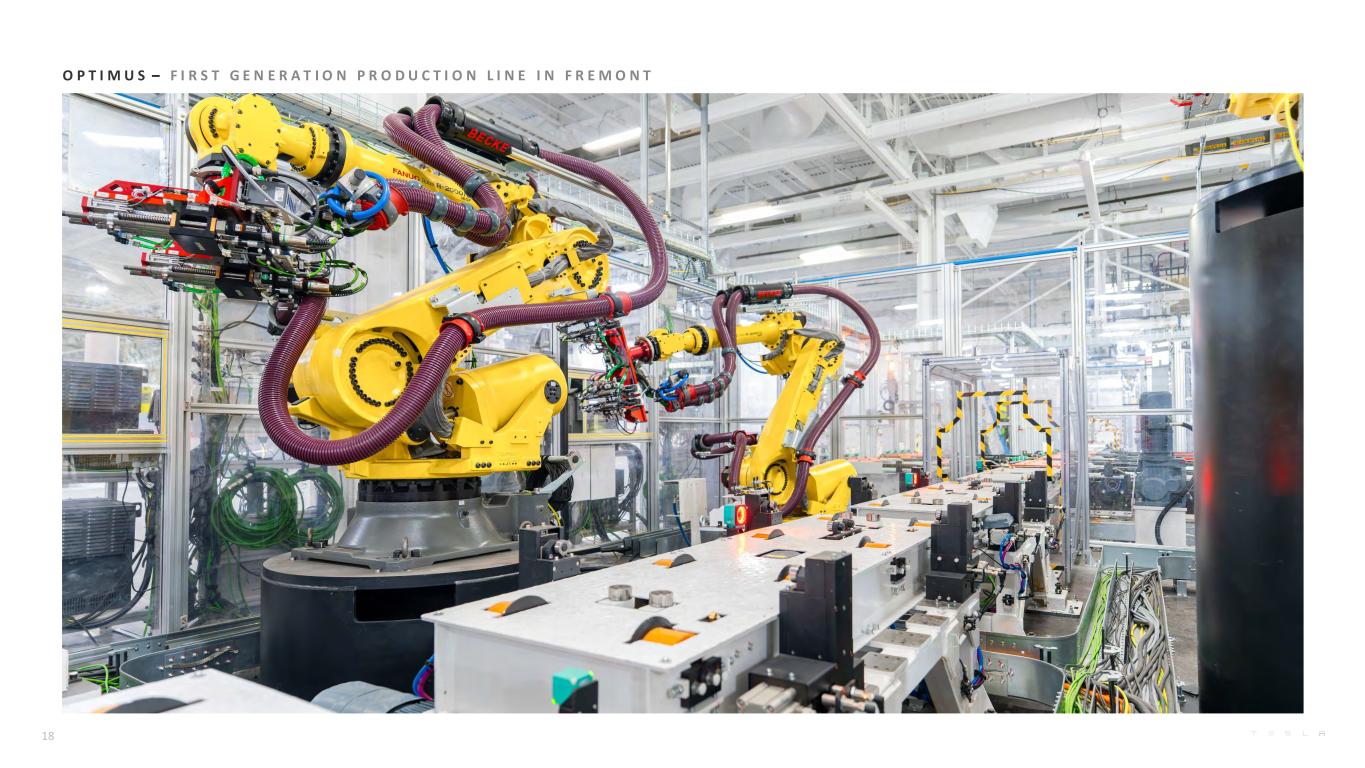
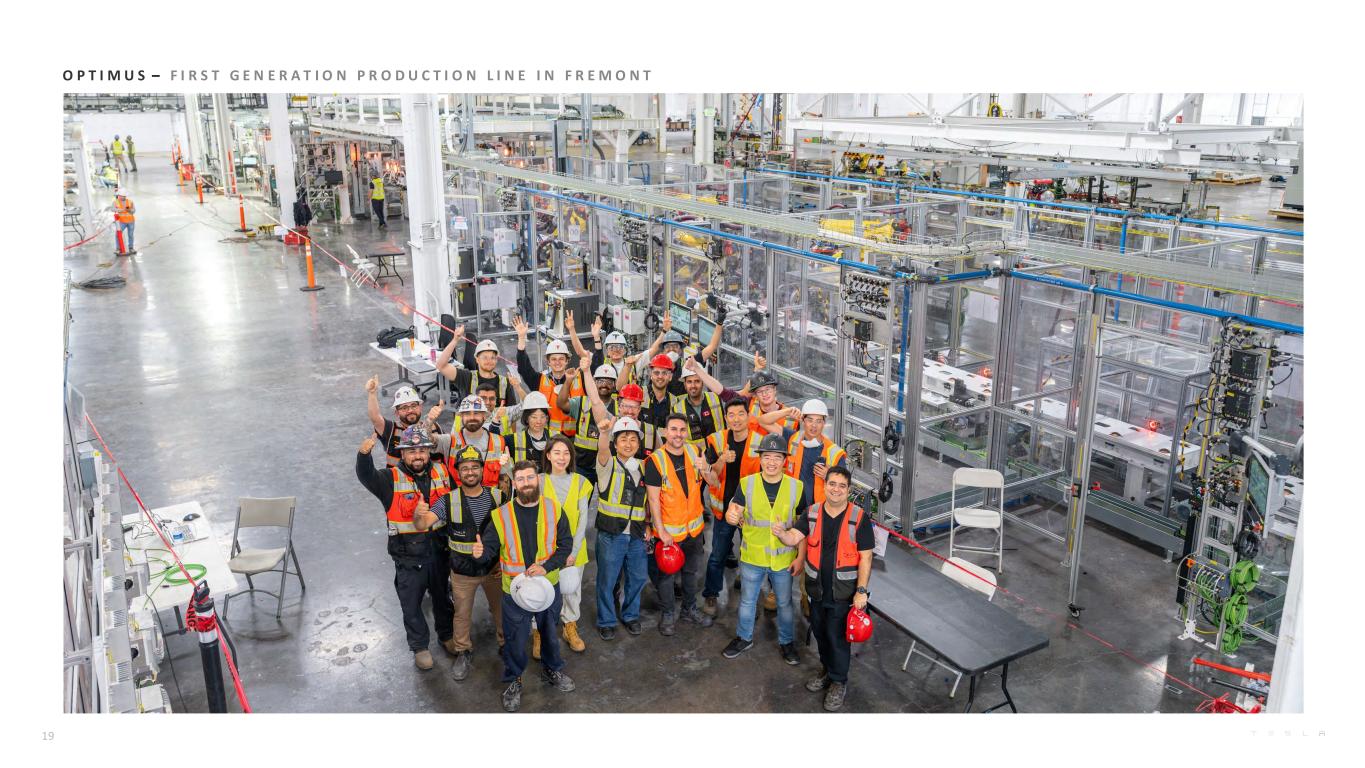
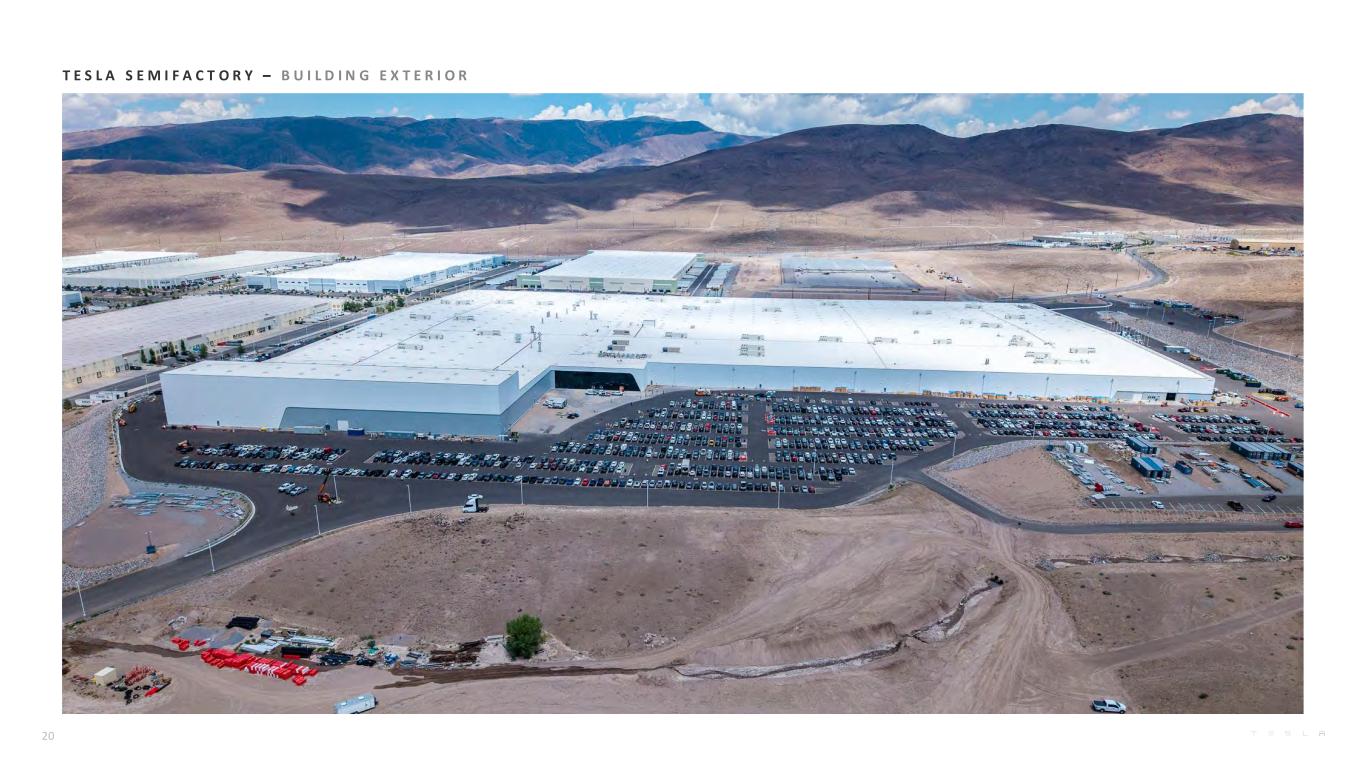
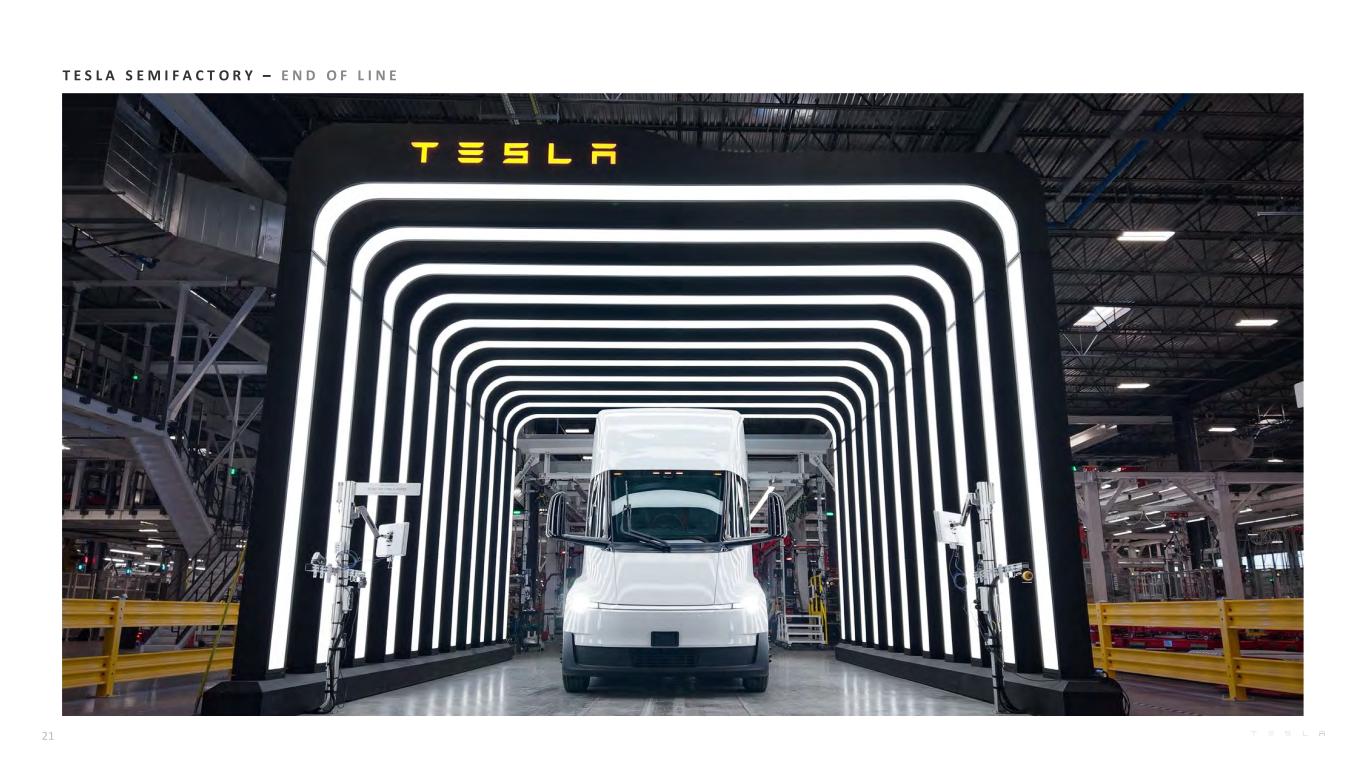
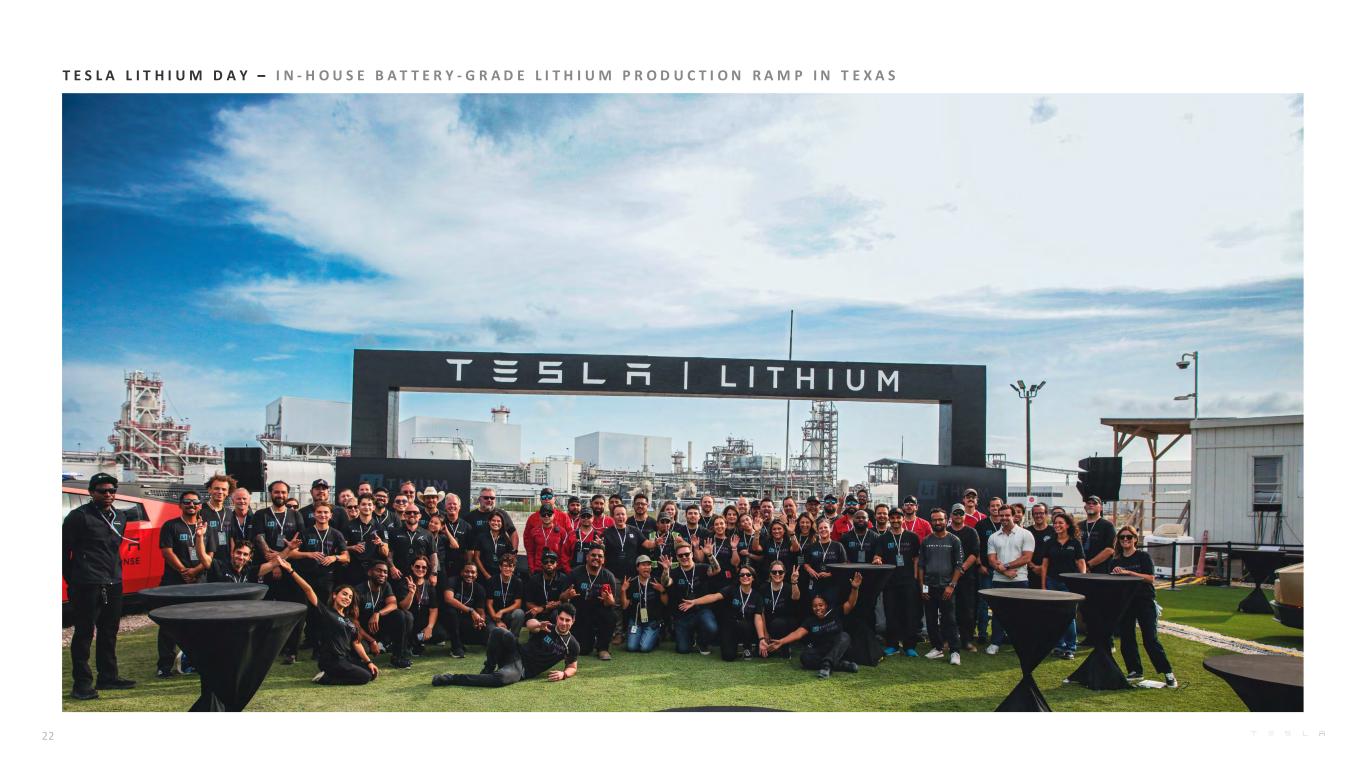
We achieved record Q2 deliveries. Model Y, I believe, is now, I think it's the best-selling car of any kind in the world and is setting records across the board. So its popularity is increasing tremendously. And we're seeing in locations that have FSD approved, we're seeing a very high tick rate of FSD. And in fact, I think for a lot of people, they're actually buying Tesla full self-driving with a car attached, as opposed to a car with FSD. They're coming into our stores in the U.S. and saying they want the full self-driving and with whatever car it comes with, essentially. So clearly, this is a significant demand driver. And as we get approval for FSD in different countries, I think we'll see a similar uptick in demand. So, yeah, it's looking very good on that front. The energy business is also growing incredibly fast and I think will be crucial for the scale up of artificial intelligence data centers. We're investing a lot in growing the core business and really preparing for the future. So this is this is a massive CapEx year, but I'm confident that all the things that we're investing in are what will yield incredible returns, really made the best CapEx returns that we've ever seen. um and and just the tesla team has performed incredibly well the sabcab has started production and we we also have uh started production and a ramping in uh well we will soon start production with with optimus we have started production with the tesla semi-truck uh we'll soon start production with mega pack three uh we've started production with the lithium refinery the cathode refinery we else have we're scaling up battery cell productions for battery cell production and we're also preparing to do a massive uh solar panel like solar cells and and and panel production actually this is going all the way from silicon refinement to producing the solar cell and then deployment of solar because there's going to be tremendous need for electricity in the future due to electrification of transport and and AI obviously so we're working on what we believe is the most ambitious for that of advanced infrastructure manufacturing capacity ever in history it's bigger so with a robotaxi our goals are very ambitious for robotaxi but we do need to be cautious about causing any accidents or causing any harm to anyone. Although there are, I think, 30,000 to 40,000 automotive deaths per year in the United States alone, most of those do not generate any press. You don't really read about almost any of those. But if we injure even one person, it will be worldwide headline news. And regulators will immediately clamp down on our activities. And we don't want to injure anyone. So we're going as fast as humanly possible in scaling Robotaxi, while trying to ensure that we do not harm anyone at all, and ideally do not even run over a pest. So that's really the constraint, is we want to grow as fast as possible with Robotaxi without harm to anyone. And we're providing live updates for RoboTaxi launch as we open up in the city. We immediately post that on X. So just follow the Tesla account on X, but we'll keep you informed as we scale to new We've opened up in a number of cities in Florida and in Texas, and obviously in the Bay Area. So we'll continue to scale, I think, very, very rapidly on quick-width. It looks like more than 10% a week in terms of miles driven. So it's a very high compound growth rate. So let's see, Optimus. As you've heard me say before, I think Optimus will be the biggest product ever. But it is a very complex problem to solve. It's one of the one of the hardest things to solve to make a an autonomous humanoid robot that can do tasks that you simply simply ask it to do something or show it a video it can do the task without any programming like no one's no one's ever achieved this and you've got there are many challenges in the electromechanical design of the robot to achieve sufficient dexterity and and rely and also be very reliable and have a long wear and tear, meaning it needs to be out in the field and not break down. Otherwise, you've got sort of a 70-kilogram robot that just flopped over and you've got to carry it out like a body. You know, there's no wheels. And we don't want Optimus to go haywire. So it's a lot of work to scale, to get the design right, and to scale production. And I really want to emphasize here that the production scaling challenge is very substantial. This is going to be the hardest product to scale manufacturing that we've ever made at Tesla, because everything on the robot is new. and the difficulty of scaling the production ramp is proportionate to the nearness of the parts in the road line. And, you know, at least with electric cars, the non-electric powertrain portions of the cars had an existing supply chain. So you could go to existing suppliers for wheels and side mirrors and windshield glass and that kind of thing, body panels. And with Optimus, there is no supply chain. So we've had to build up a supply chain in its entirety or in-house the production. We actually have in-house a tremendous amount. The Optimus production line that we're building out in Fremont in place of what used to be the Model SX production, it looks incredible. It's quite stunning to see. So, I just want to make sure to calibrate people correctly. Our first will follow the sort of normal S-curve of a manufacturing ramp, but the initial portion of the X-curve will be quite flat and long because of the newness of the parts in the robot. So, you've probably seen lots of impressive demonstrations of robots on the internet, but those demonstrations you're seeing are pre-programmed or remote controlled. So there is no humanoid robot that is actually able to do generalized tasks. Optimus will be the first one that is capable of doing that, where it's not just a demo, it's genuinely useful in day-to-day life so an optimist is designed to have full human dexterity so a hand that has the same level of dexterity if not higher than a human hand and the human hand is an incredible incredible thing the more you study the human hand the more amazing you realize how you realize how amazing hands are there it's more than just opposable thumbs i mean I mean, the nuances of how human hands work are amazing as the closer you look, the more amazed you are. And an optimist will have that capability, you'll have human and then superhuman dexterity. So it's really going to be quite something. Let's see, TeraFab. With TeraFab, we expect to announce the location soon and provide more details about our plans in that regard, which we'll leave that to the product, the launch announcement, rather than try to squeeze it into an earnings call, because I think this is a very big announcement and it deserves to have its own sort of stay in the spotlight and not be sort of squeezed into an earnings call. But I do think TerraFive is going to be an amazing initiative and a necessary one and one without which we will be constrained in our ability to scale Optimus production because we simply won't have enough AI chips. So it's crucial to solve that and we'll have to solve memory, logic, and packaging in order to scale Altruvess. So anyway, like I said, we'll leave that to its own announcement. We've placed equipment orders for our development fab in Austin, and that development fab, I think, is pretty cool because it's intended to be to have lithography mask production and then logic memory and packaging and chip testing all under one roof so you can have a very fast iterative cycle and try out new chip designs very quickly and see if they work i don't think such a building exists anywhere on earth so this is really going to be super helpful as we We try some exciting, adventurous, high-risk, high-payoff bets on AI chips. So it's focused, like I said, on primarily an optimist. Like, how do we make optimists as useful as possible? Then we have, like, we have digital optimists, which is basically driving a computer screen. I guess you could call it computer use or something like that. but driving a computer screen the same way that you drive a car so for the car with it's it's sort of pixels in or photons in and controls out the same thing is true for optimists a digital optimists it's photons in controls out so we feel confident we can adapt the the same tesla ai technology that we developed for uh self-driving cars to have a self-driving computer screen, self-driving computer, essentially. So the self-driving computer, where the Tesla, the very low cost, the AI4 computer can handle all of the sort of short-term tasks. They're doing real-time video control of the screen of the computer. So it's not like screenshots. Everything is real-time video at high frame rate. And the digital optimist will be important, obviously, for physical optimist because physical optimist needs to be able to operate computers. It can't come up to a touchscreen and not know what to do. It's got to have a generalized touchscreen and computer use capability. So that's looking promising. And this is in partnership with SpaceX. SpaceX is Gronk, so the big model that is kind of like the manager of Digital Optimist and kind of tells Digital Optimist what to do, provides it with a series of tasks, and then Digital Optimist goes and does those tasks. We're also building out a Megapod design that has, because AI core, computers with um with x86 this is a carry um x86 um computer with the tesla ai4 computer in a box and it's kind of just digital optimist in a box um and and in in a megapod you know kind of like the megapack uh packaging and so where we put just a a large number of of um ai4 plus x86 six combos in a giant box, essentially, and that these boxes can be placed anywhere in the country or outside the country. And this allows us to scale AI compute using disaggregated electricity production. So there's lots of places all around the world, including our superchargers. I think we've got something like seven gigawatts of power at our supercharges and growing. And we can place mega pods at many of these supercharges and and have distributed power for AI. So I think that that could be quite a big deal. So in conclusion, we're super excited about our autonomy and robotics roadmap. There's so much awesome stuff coming. it's like I said, hard to squeeze into an earning school. But we'll have a lot of product announcements. And this is going to be a great year for Tesla, I think, one of our best years ever. And then I think next year will be even better.
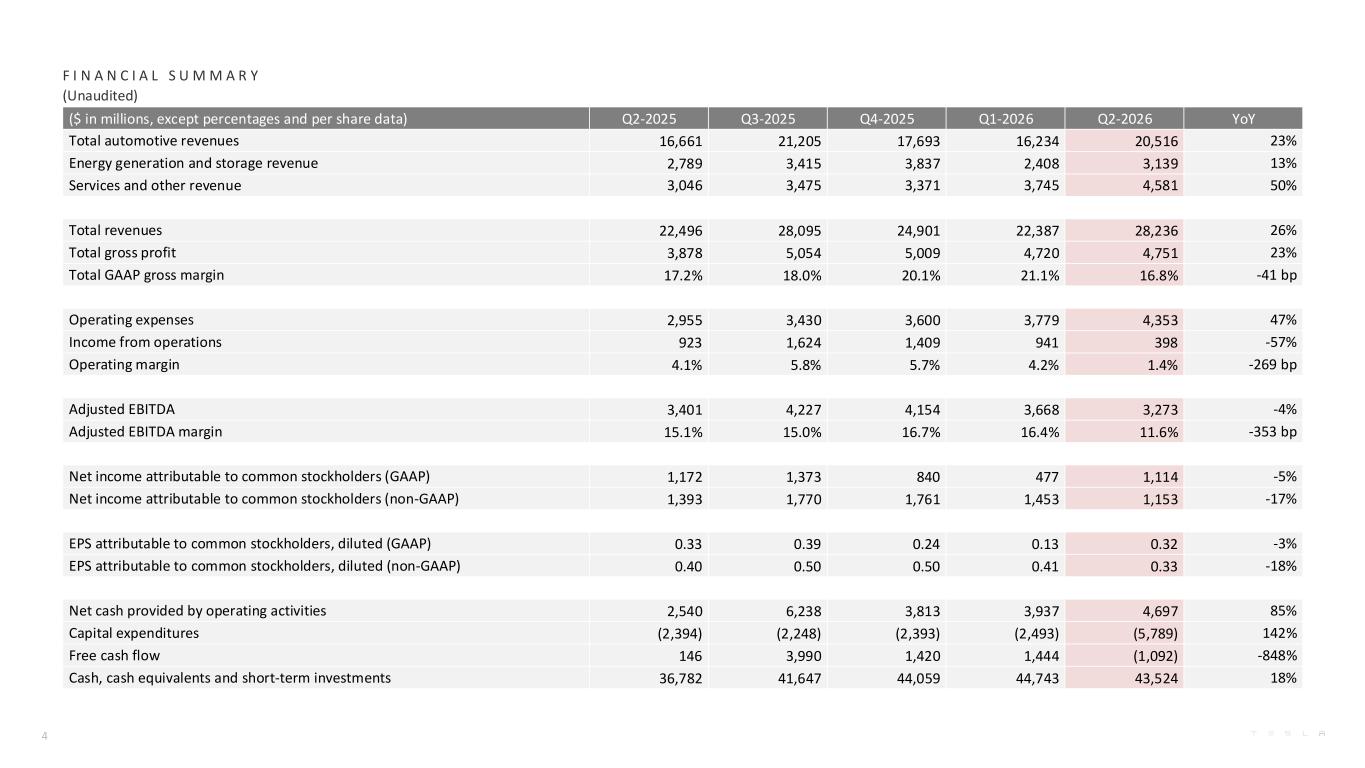
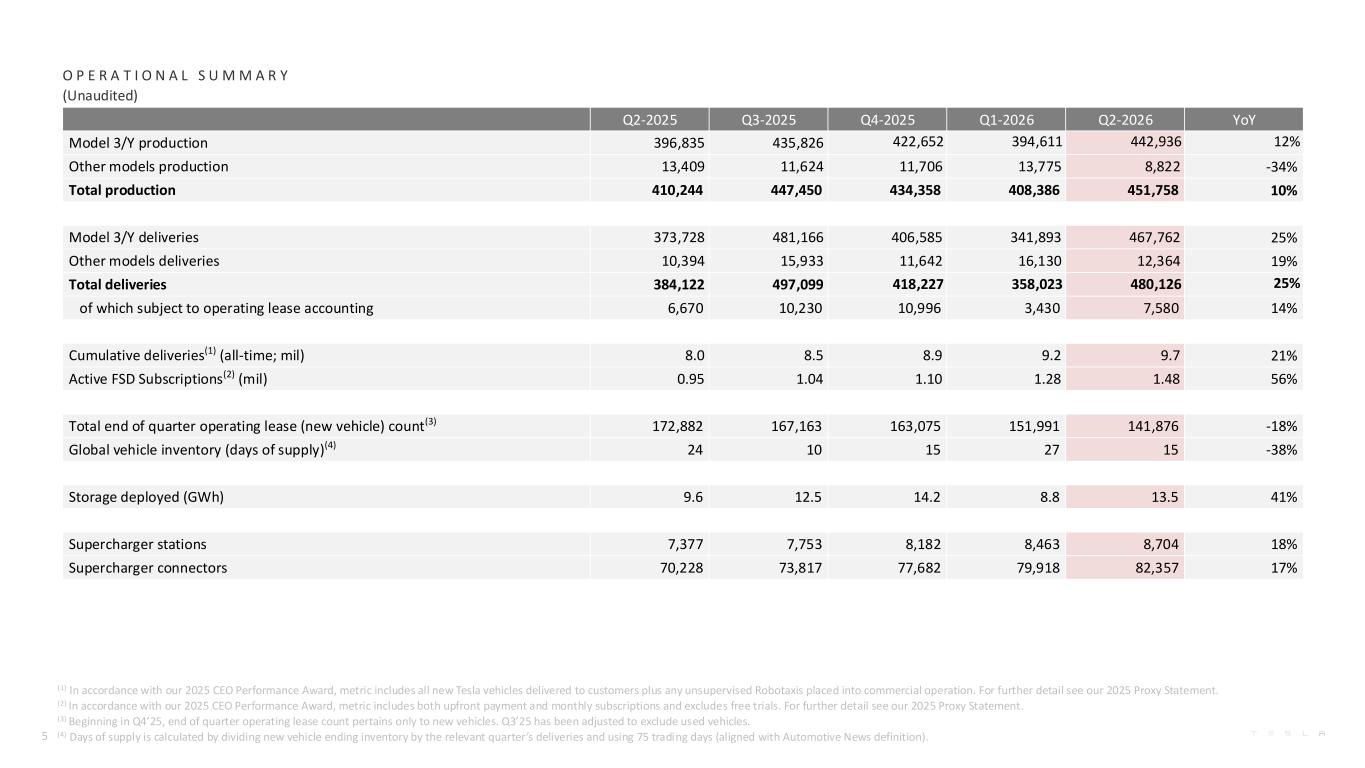
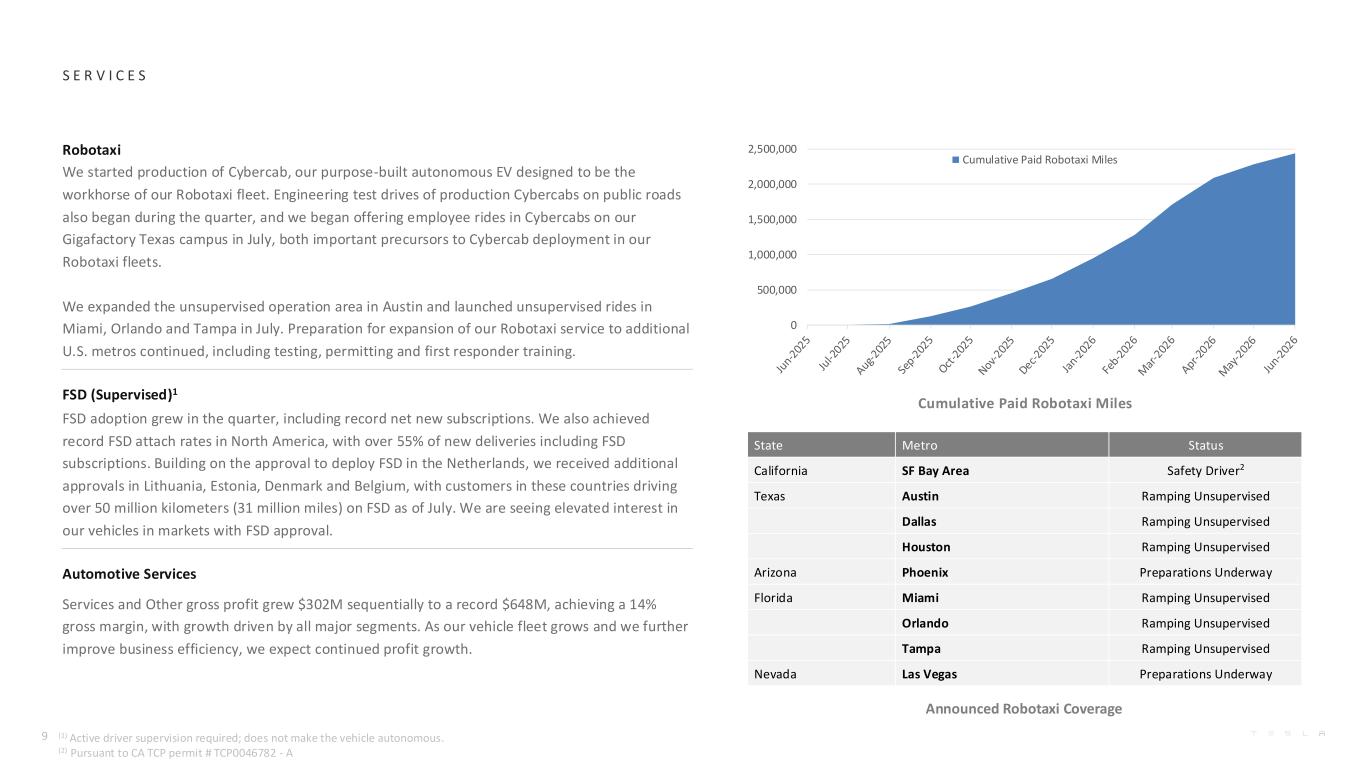
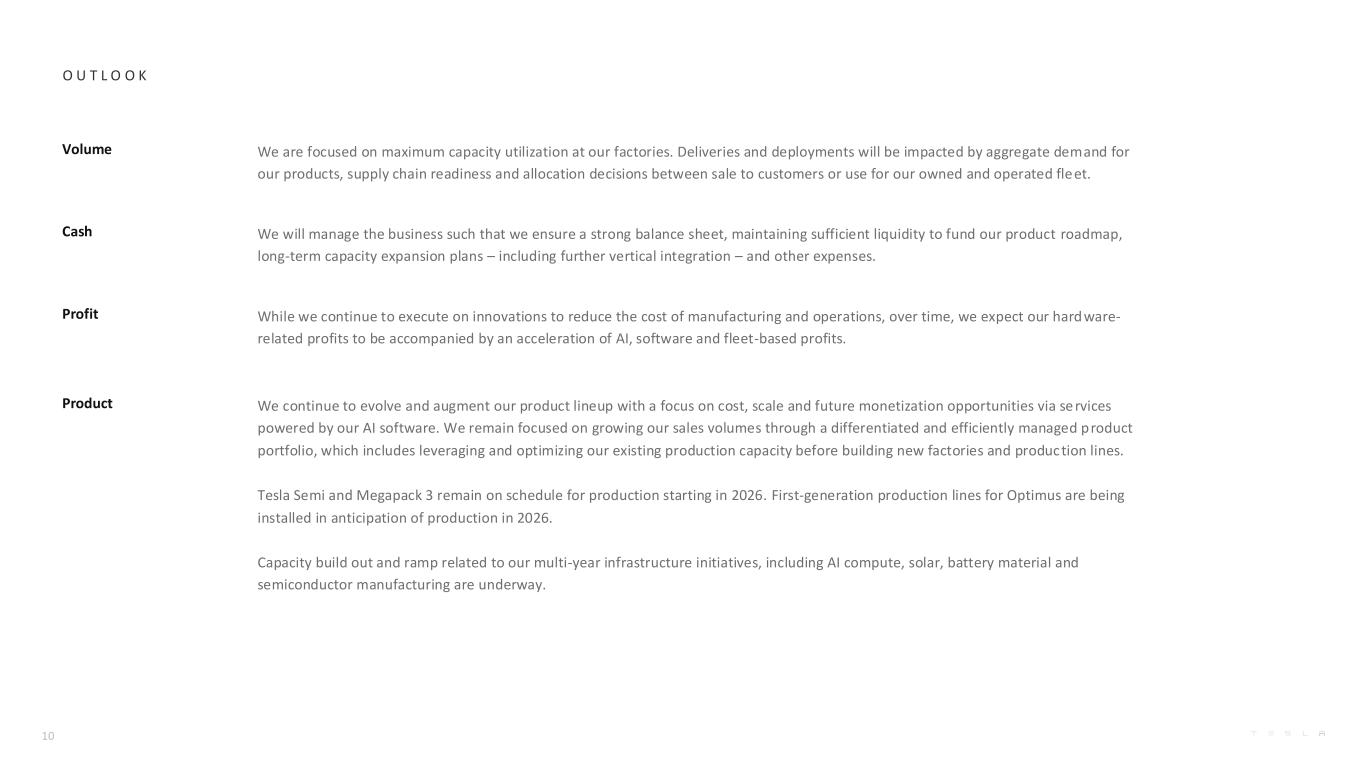
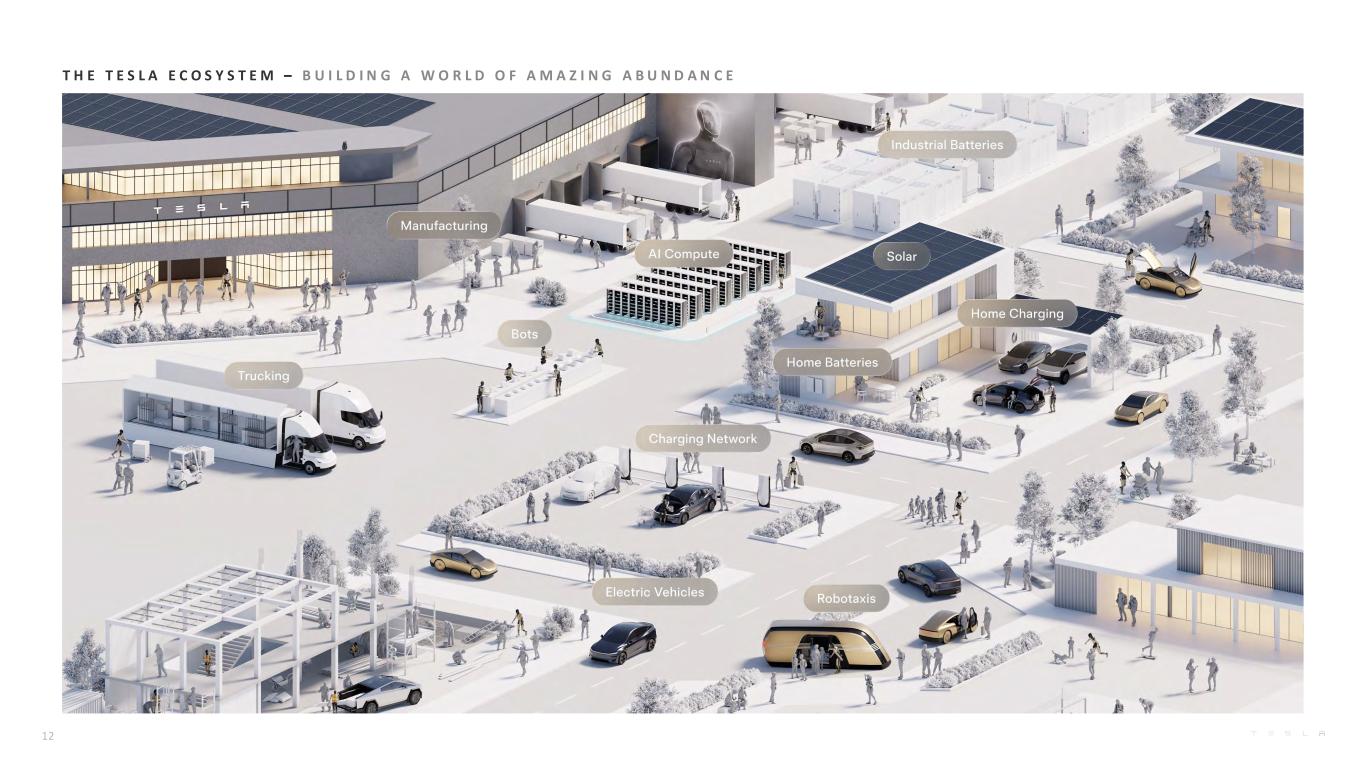
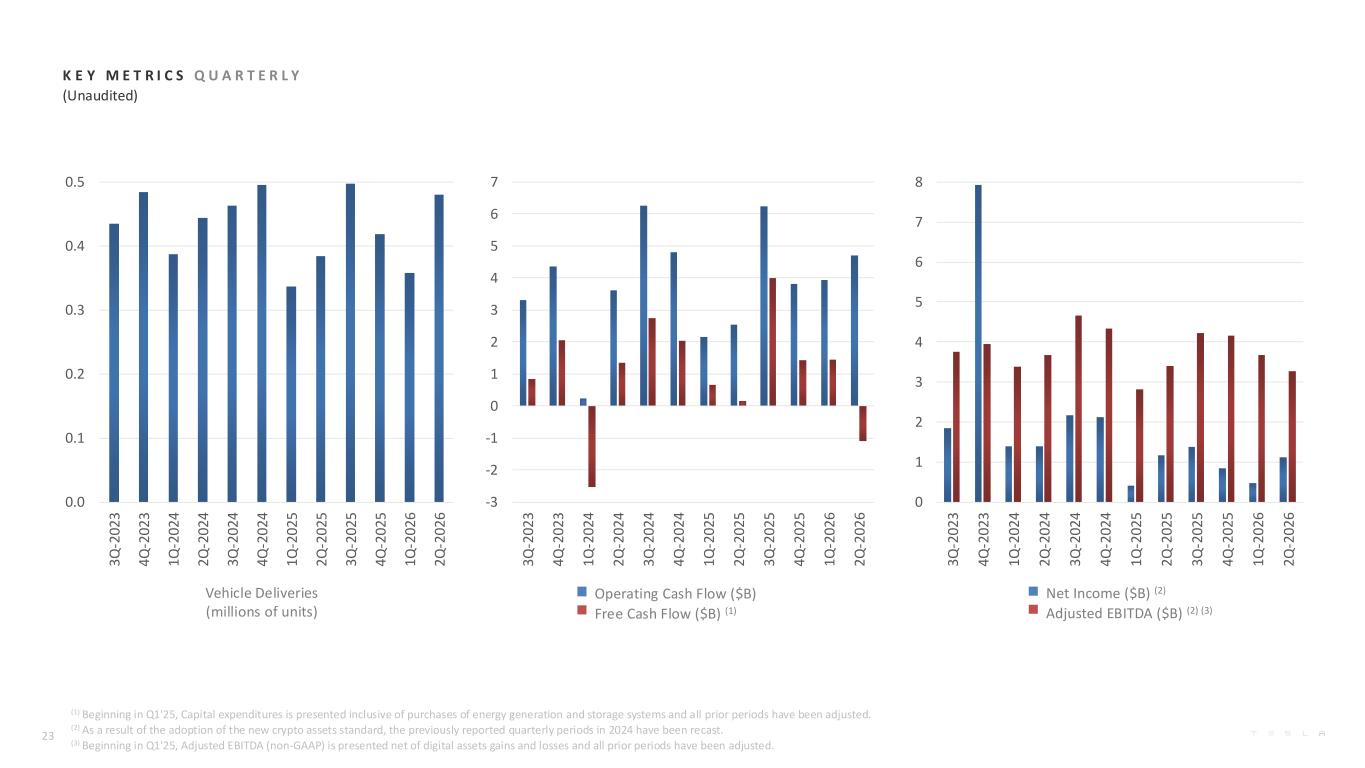
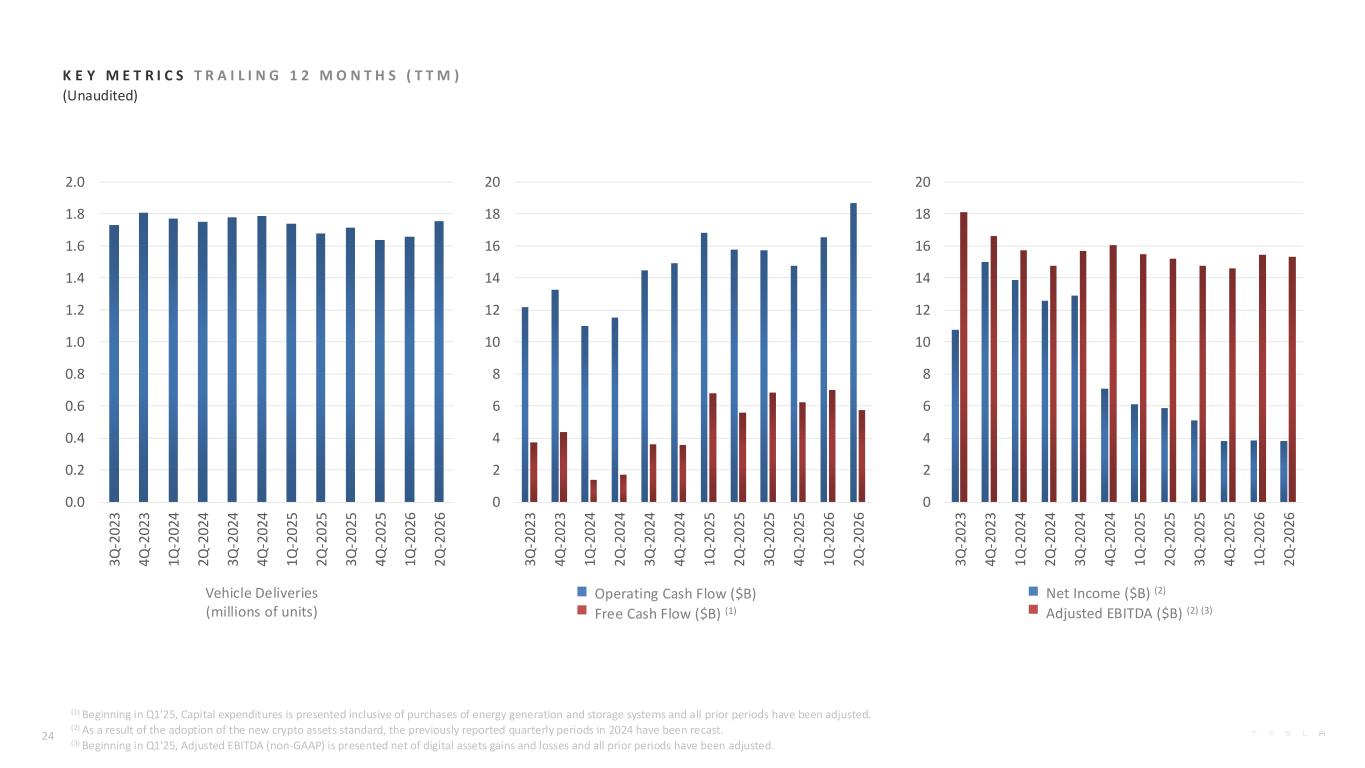
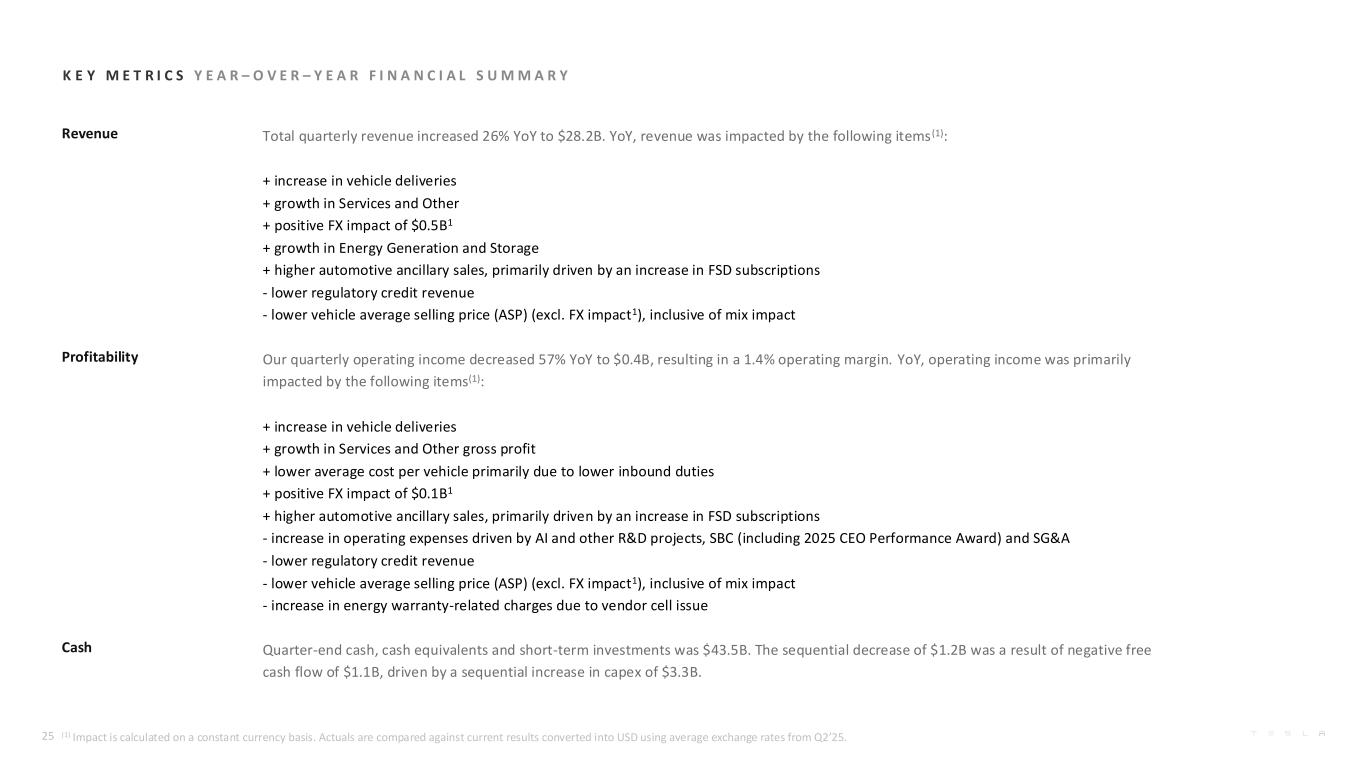
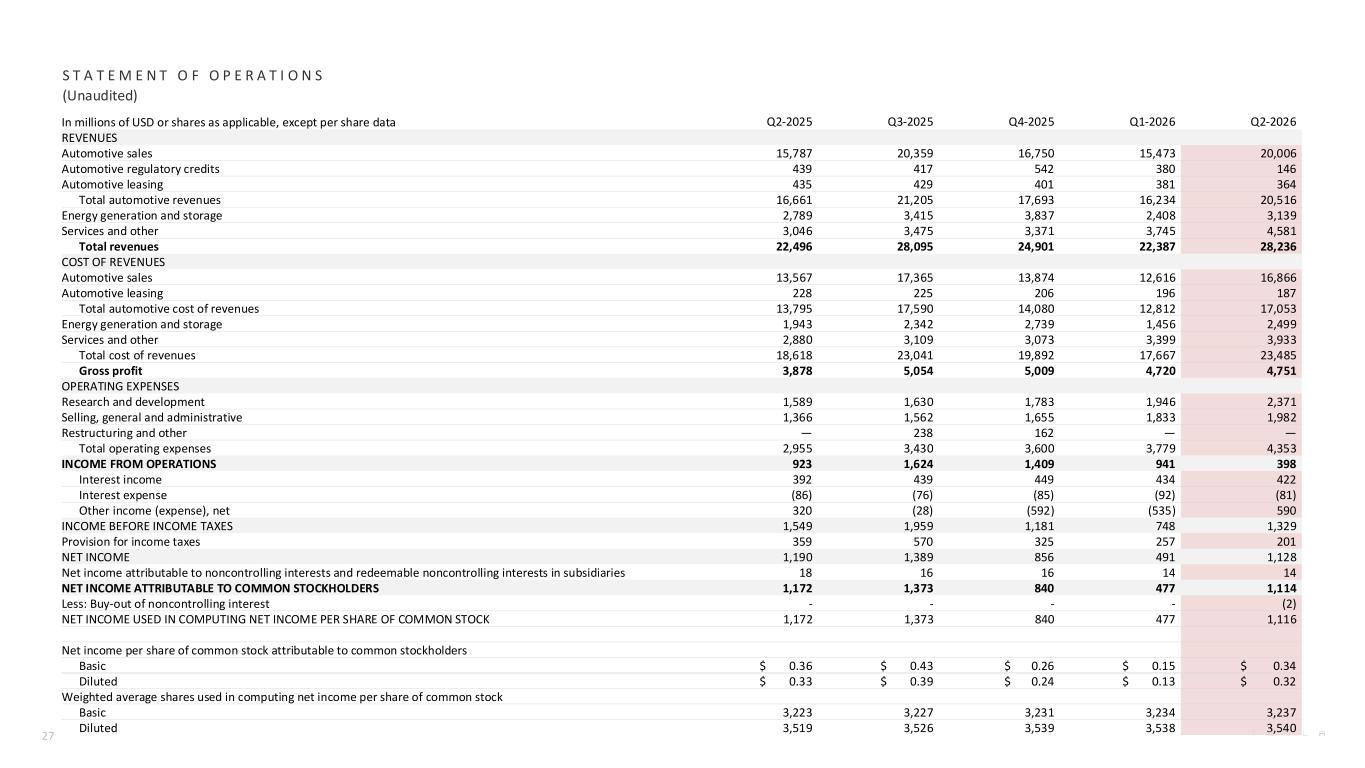
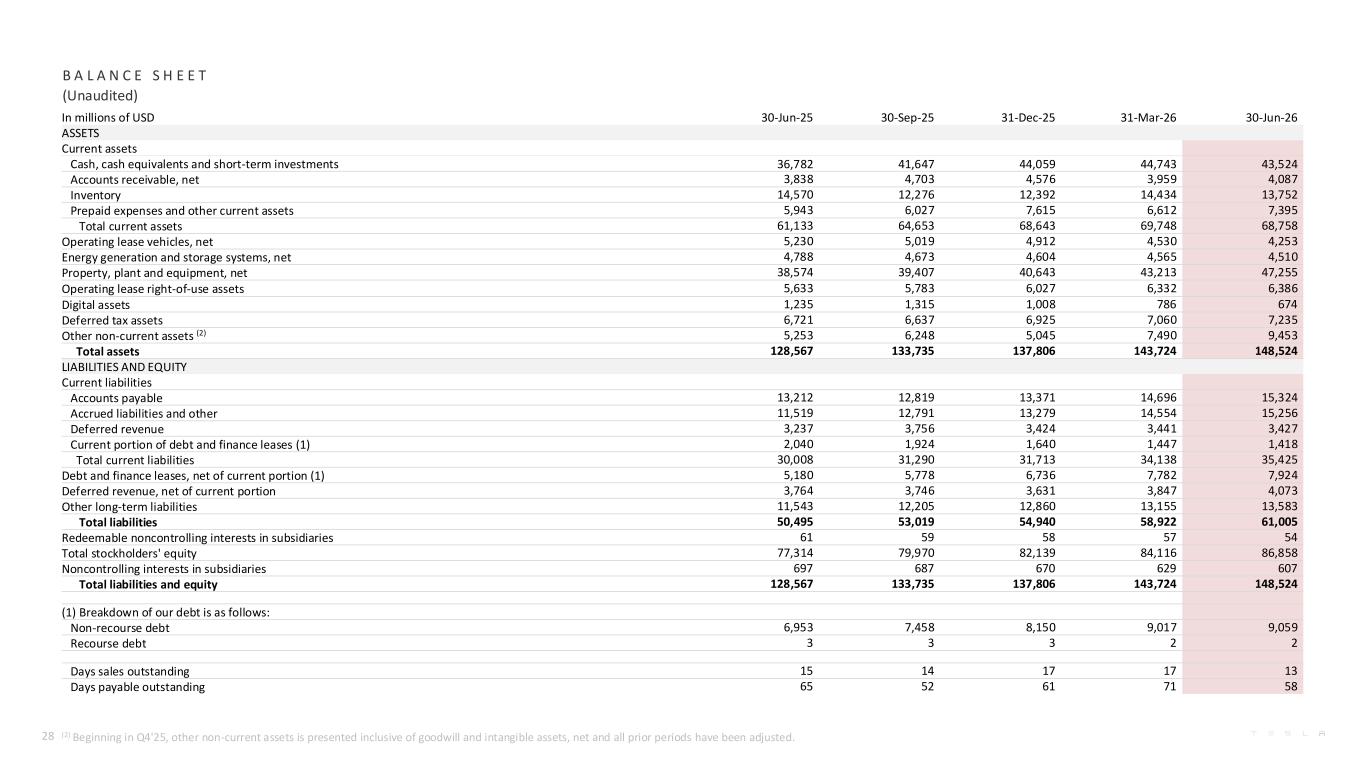
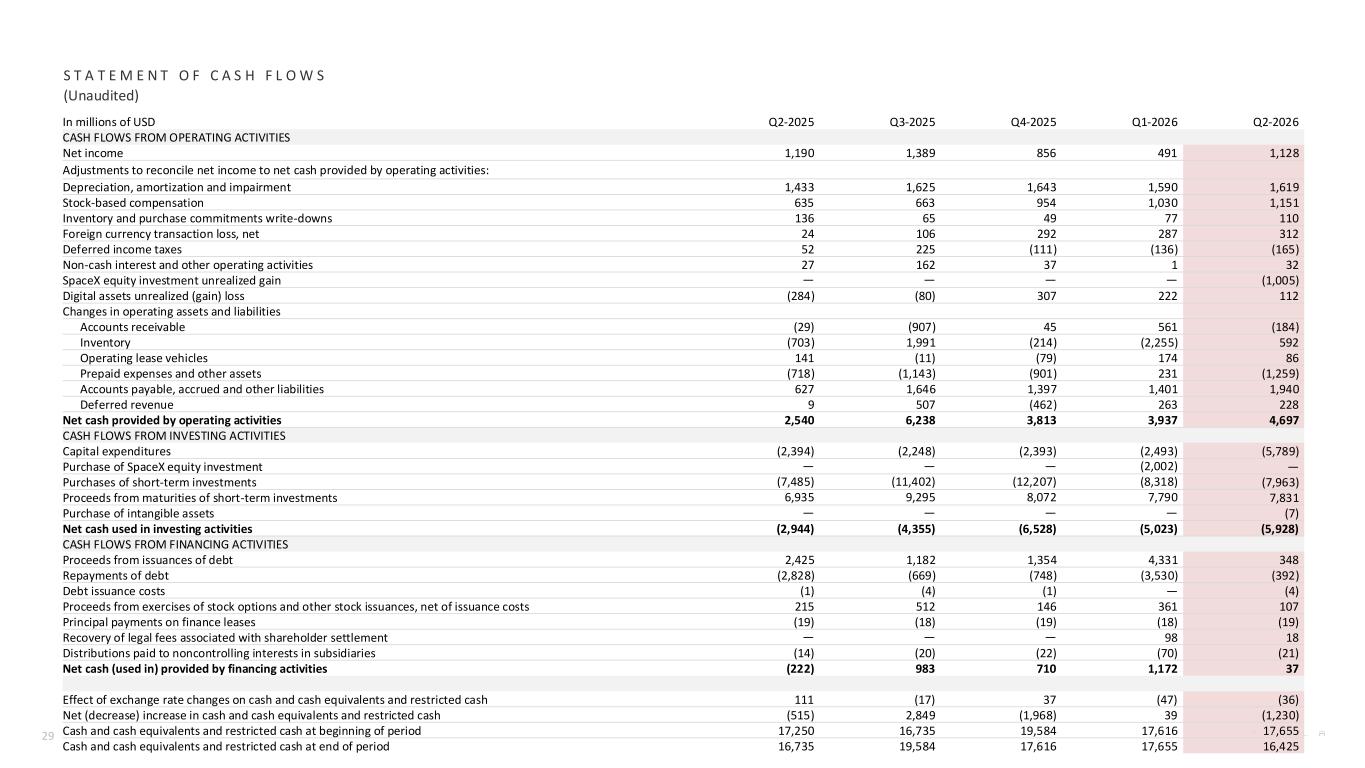
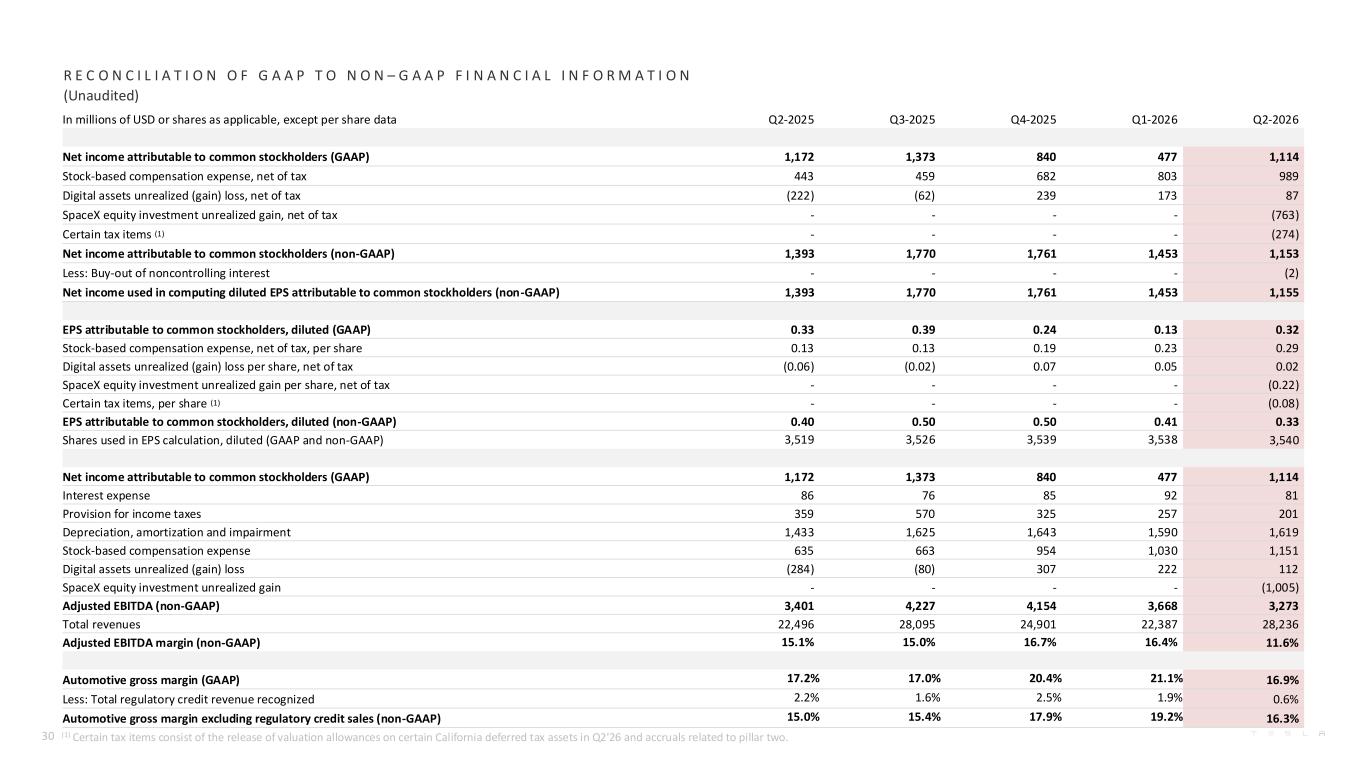
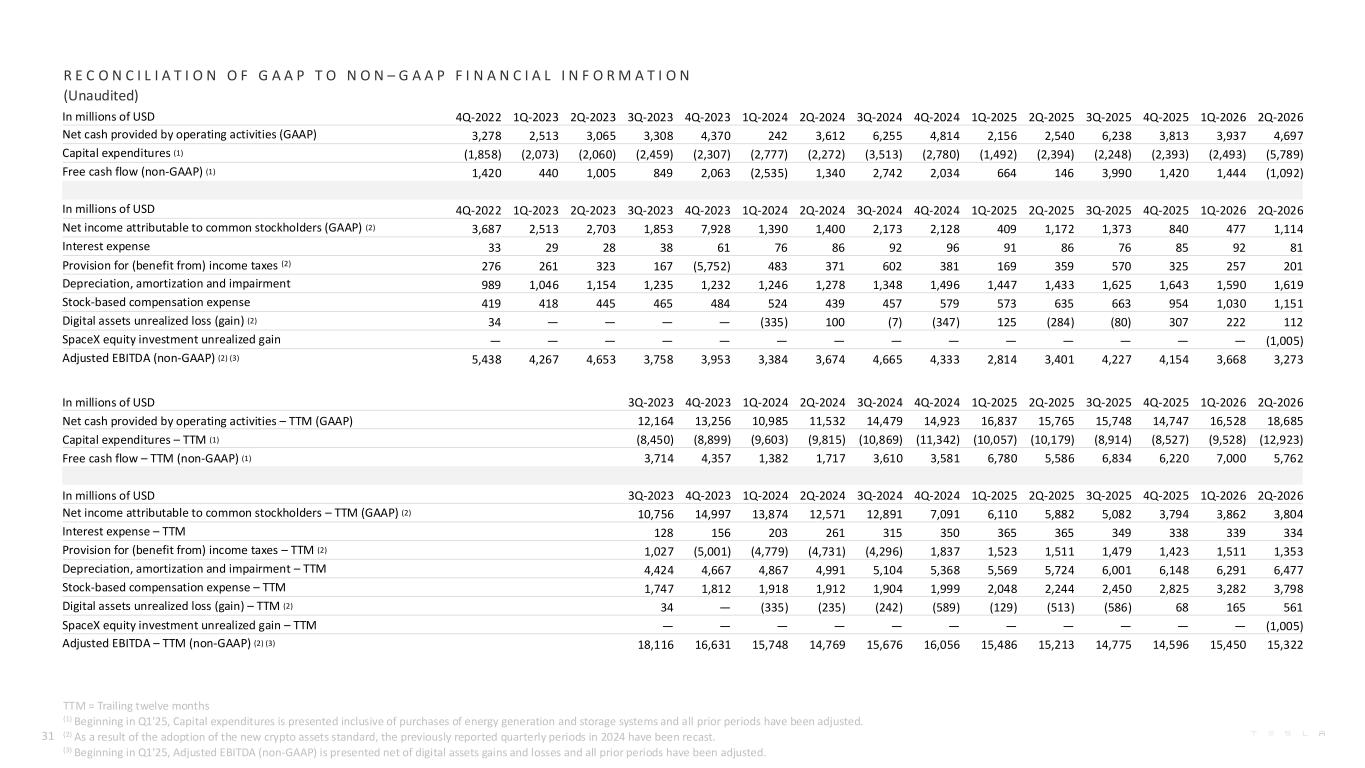
So in conclusion, I want to thank the Tesla team for their excellent execution and all of our supporters for joining us in this journey. thank you great thanks so much elon and now bob has some opening remarks thanks travis so q2 continued the trend that we saw at the end of q1 a resurgence in demand for vehicles across the globe we achieve record q2 deliveries globally with sequential growth across the americas APAC, and EMEA of 60%, 27%, and 12%, respectively. Additionally, Model Y set records in several key markets, including the Netherlands, Australia, and New Zealand. The efforts of the Tesla team to create compelling products at a reasonable price with the capability of autonomous driving are coming to fruition. We exited Q2 with our largest order backlog since 2023. three. We are therefore focused on increasing production at all our factories to meet this growing demand. Production growth will be limited by our supply chain. This includes not just batteries but also electronic components. We've been here before and like always our Tesla team is working actively to unblock the obstacles ahead by securing strategic deals with suppliers. Like Elon mentioned, one of the key factors for vehicle demand has been FSD. Our sales data suggests one of the main reasons customers are coming and looking at the car is because of FSD. In Q2, we had, in North America, about 55% of our deliveries had FSD subscription at the time of delivery enabled. Overall, FSD attached rates continue to improve, reaching nearly 1.5 million paid customers globally, of which 55% is upfront purchases and the remaining 45% is subscriptions. We expect that the bulk of the growth in FSD monetization will come from subscriptions as we've removed the purchase option in most markets. Automotive margins, excluding regulatory credits, declined sequentially from 19.2% to 16.3%. As a reminder, we had highlighted in Q1 that we had a $230 million benefit from warranty true downs and some tariff relief, which did not repeat in Q2. Controlling for the impact of those benefits from the prior quarter, our automotive gross margins excluding credits would have been approximately flat this demonstrated the effective pricing and cost management done by the tesla team as we continue to drive demand commodity price increases and interest rate changes all continue to add to our cost note that interest rate subvention costs are recognized up front as revenue offset so as interest rates have risen this year, the cost of subvention has risen along with them, which had a negative impact on automotive margins. As we have previously noted, energy business is inherently lumpy. Deployments are tied to customer timelines and largely out of our control. In Q2, we deployed 13.5 gigawatt hour of energy storage, a 53% sequential increase, and the second largest this quarter for energy business. Despite this growth, energy gross margins declined from 39.5% to 20.4%. This margin decline was a result of several dynamics. First, there was a warranty true up in the quarter of about 240 million related to certain vendor cell issues for our legacy deployments. Also, the tariff benefits we recognized in Q1 of more than 200 million did not repeat. and lastly we had previously guided that ASPs for industrial storage is coming down amidst growing competition. Long term we believe the energy business should normalize at a gross margin rate in the mid to low 20% range. Our order backlog of this business is robust and we are doing our best to build based on both existing demand and future demand we expect from data center growth and and overall electrification of the economy. Service and other margins improved sequentially from 9.2% to 14.1%, an all-time high. This was mainly driven by an uptake in volume and better cost management of our vehicle fleet that supports businesses such as used car, supercharging, service centers, and insurance. While marginal today, also included in this business are deliberate investments we are making in infrastructure that will help scale Robotaxi in the future. We continue to grow the Tesla Robotaxi fleet and have expanded to a total of seven markets in the U.S. We expect the ramp of the fleet to accelerate throughout the year along with expansion into new U.S. markets. As previously guided, operating expenses increased sequentially. The increase came primarily from significant research and development related activities including pre-production ramp costs for new products like the semi truck optimus cyber cab and other ai initiatives as well as the appreciation for an additional compute that we brought online additionally we had charges related to litigation expenses in the quota note that we are in a big investment cycle and expect our operating expenses largely driven by R&D to continue to grow in 2026 and beyond. Net income was positively impacted by a mark-to-market gain of $1 billion on our SpaceX holdings, which was offset by losses on FX of approximately $300 million and on Bitcoin of about $100 million. As previously guided, our free cash flow ended up being negative for the quarter most of the reason for the it going negative is because capex more than doubled sequentially and we expect it to increase further in the second half of 2026. we continue to expect that capex for this year will be more than 25 billion capex will grow for the next two or three years as we expand our robotaxi fleet expand our production capacity for Optimus, make investments for semiconductor fab, install solar manufacturing capacity, and AI compute infrastructure, in addition to all the other expansions we'll do for other manufacturing for automotive. In addition to using our cash for such investments, we are being opportunistic in securing certain debt facilities that will give us the capacity to borrow up to 30 billion to help accelerate such investments. We believe this is the right strategy to position the company for the next era and we'll always make such investments in a very capital efficient manner the path to amazing abundance is ever challenging and requires making bold bets our progress will not be will be non-linear the future is going to be great and we are ready to rise to the occasion i would like to end by thanking the tesla team our customers investors and suppliers for their confidence in us on this journey Thanks so much, Febhav.
As everyone on the call may have noticed, we've covered several of the Say.com questions already in opening remarks, including Optimist Production, TerraFab, and Digital Optimist. Ashok is joining us today, our VP of AI, and he's to cover questions related to RoboTaxi.
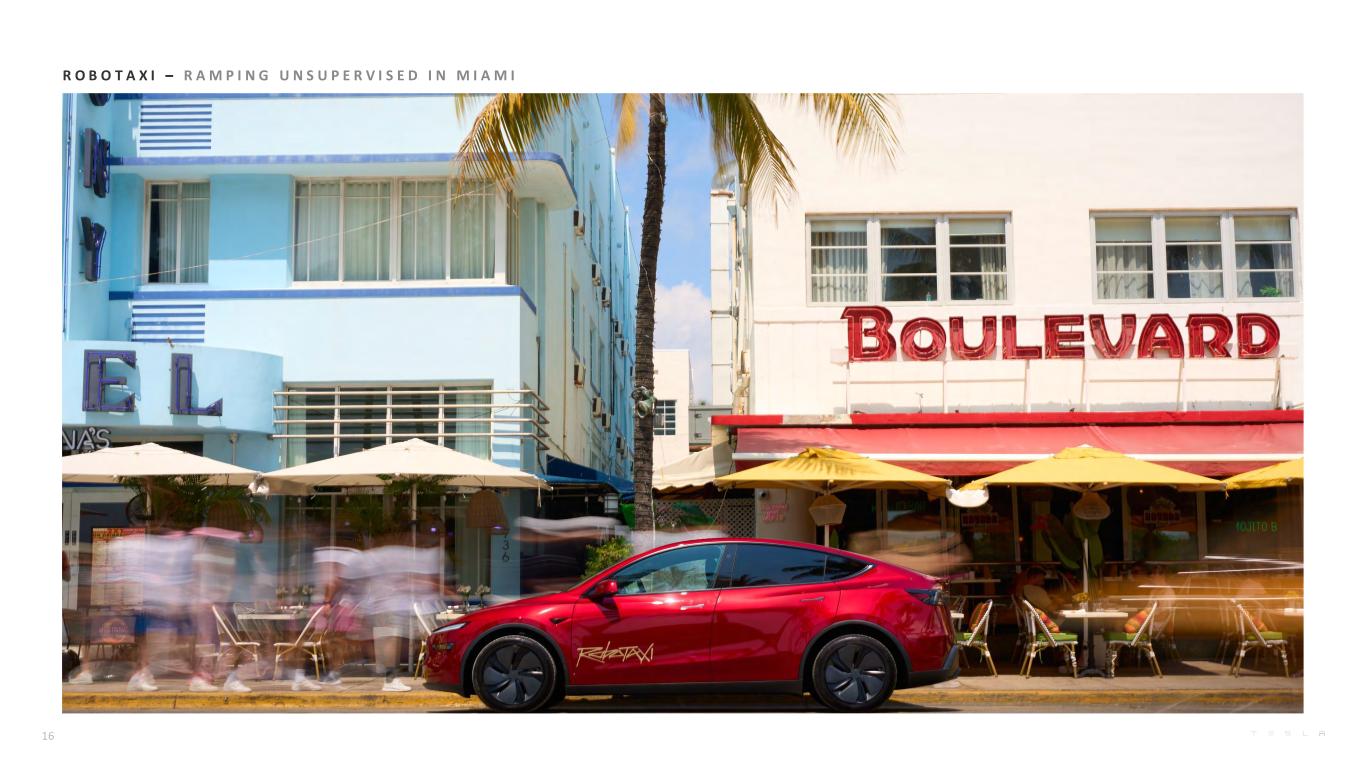
Thank you, Travis. Many of the questions on Say.com relate to RoboTaxi deployment and scaling, so we thought we'd provide a comprehensive view of where we are now and where we are going in the future. First of all, I'd like to state that the robotaxi program has been operating extremely well. Especially in terms of safety, the program has had an impeccable safety record. We have driven more than 380,000 miles of unsupervised robotaxi, now across six cities in two different states. We have had zero notable incidents. Any reports have been of other actors impacting us when we were stationary. Again, I'd like to emphasize how safe the operation has been so far. Zero notable incidents over 380,000 miles. Historically, the so-called experts have always claimed that you need LIDARs, radars, HD maps and the entire kitchen sink to drive safely. Here we show that such is not true. you can have safe comfortable and affordable autonomy with just cameras this record should be a huge validation of Tesla's entire AI approach second I'd like to discuss scaling we started the robot taxi program roughly a year ago in Austin we had safety monitors in the passenger seats of the cars back then around the end of last year we had the first fully unsupervised robotaxis in Austin. Since the beginning of this year we have grown at double digit growth rates to the number of unsupervised miles that the fleet drives every week. I repeat we have grown at such a high compounding rate on a week-over-week basis over the last several months. Not only that we expect to continue growing at such a large rate through the rest of this year. The other thing to note is that for expanding to new cities it has been relatively less effort on our front. We expect that the time to launch to a new city will continue to trend towards zero, towards an end where we operate in entire states as a whole instead of going by city by city. Such growth was only possible because we have a world-class engineering team on the frontier AI development here at Tesla. The currently operating Robotaxi fleet is already running early versions of the V15 FSD software that we had referred to in the past. For V15, we have planned roughly about seven major improvement tracks, and they're all happening in parallel. The early V15 builds that are running on Robotaxi have already 40% of those tracks merged together, and that's what's running in the fleet right now. As we continue to complete our work on V15, we will see that the car is going to be ridiculously safe and capable. We're already seeing internal signs that all of these beds that we have made for technology improvements are all starting to work and we expect that the payoff will be huge and that's what is going to help us sustain the same growth rate through the rest of this year and so on. Finally regarding the CyberCap, first of all it's a phenomenal product. Anyone who writes in it instantly falls in love with experience. We have aligned our manufacturing targets to roughly match the projected growth rate of the unsupervised miles the same v15 models that power the model y and other platforms will also work on cyber gaps in conclusion robot taxi growth so far has been literally exponential while keeping an impeccable safety record our technology bets are paying off helping us sustain the exponential growth for the foreseeable foreseeable future and the cyber cap is going to be awesome that's great uh thanks so much ashok um and there was one remaining question in on data collection for optimus training would you mind covering that as well yep definitely regarding optimus especially gen 3 optimus has been designed to not just match the appearance of human beings but also the functionality and dexterity of humans one of the main reasons for this approach is that having the human form factor and function allows us to learn from humans on how to perform a wide variety of tasks this opens up the entire world to provide data for training Optimus. Just like FSD, we have access to a broad fleet of humans giving us data from all of the workers at our factory. Optimus can learn quite a bit from observing them perform their tasks at the factories. We also have a dedicated data collection team who can provide relatively small amount but of very high quality demonstrations to do the post-training of these models. This This is all on top of any training we can do off of the entire Internet of data that shows demonstrations of people doing various tasks, both in industrial settings and home The second flywheel is when we have a large number of Optimus robots practicing their tasks in what we call the Optimus Academy. The data from the bots experiencing the tasks themselves will be invaluable and help us close any minor form factor gaps that may exist between the bot and the humans. This is also when the reinforcement learning loop kicks in, where the bot initially attempts some tasks, fails sometimes, learns from both the successes and failures of those tasks, and eventually learns to master those tasks at perhaps a superhuman level. Our AI strategy for Optimus is aligned with the same. It's the same end-to-end strategy that drives FSD, pixels in, controls out. and just like FSD we expect it to work broadly. In FSD you know you can get in the car, type in an address and then hit start and then it's like handles all of driving from park to park and the same thing is going to be true for Optimus as well. You're going to just ask it to do anything and then you should just perform the entire task on its own without you having to do anything along the way. And it's the same team that produced FSD you know the V12, V13, V14 and now V15 software that now works on Optimus as well. Hence I'm very confident that Optimus would have been an extremely capable robot.
Great. Thank you so much, Ashok. So that covers the say.com questions. Now we will move over to analyst questions. The first question comes from Tom from RBC. Tom, please feel free to unmute yourself when you're ready. Tom, you're still on mute, so please unmute yourself and go ahead and ask your question. All right, we're not getting any audio from Tom at the moment, So, we will try to move on to Andrew, and we'll add Tom back to the queue to come in next. So, Andrew, as soon as you can, please unmute yourself and ask your question.
Hey, can you hear me? Yes, we can. Awesome. Thanks so much for taking the question. So, maybe just to start out on Optimus, Elon, you mentioned that, you know, there's really no supply chain today for Optimus. You've had to mostly insource a lot of that yourself. I'm just curious, as you've gone through this exercise, are you seeing any suppliers willing to invest alongside you to set up domestic manufacturing to potentially help you scale more quickly in the US? Asking that in the context of, obviously, you want to control your own destiny to some extent and ramp as quickly as possible, but from an investment cycle standpoint, potentially more capital efficient to have some partners help you along way so i'm just curious how you're thinking about that and some of the dialogue you've had with potentially some external suppliers elon you may be on mute uh right now we can't hear you sorry yeah our supplies have been have been great and they've made uh that they have made and are making tremendous investments uh in support of um optimus and uh robotaxi and whatnot
You know, Samsung and TSMC in particular are building fabs at TSMC in Arizona and Samsung in Texas and putting in tens of billions of dollars to build AI compute for Optimus and Robotaxi. Panasonic has also invested many billions in increasing battery cell production. um probably i'm a little i'm a little i'm a little under the weather here i'm a bit ill so if i i sound a little off i'm kind of struggling with some looking a little bit ill today so um yeah but but our partners have been great um and i'd like to thank them for their their support and their investment and their hardware great thanks thanks for that and maybe just to the So, sorry, Andrew, we're going to have Karn hop in here for additional color briefly.
Yeah, just to add to Elon's point that, you know, the Samsung fab, that's going to be pretty significantly dedicated to future projects. That's a massive investment, multi-billion dollar. We're having, we're seeing the same level of investment going to memory. and also new specific metal injection molded parts, flexible printed circuits, and all sorts of nonlinear technologies that are, you know, more based for the robot as opposed to the traditional vehicle supply chain we've had. And in certain cases where we don't find a great partner, we've never hesitated from insourcing it. And we have a very capable manufacturing engineering team and a design team that helps us scale those things.
Yeah, and actually, I'd also like to thank Micron for giving us a memory allocation. They're going to make some very tough decisions on memory allocation. And we really appreciate Micron making room for Tesla in the years to come and giving us actually a very significant allocation on reasonable terms, given the pretty insane pricing of memory these days.
Great. We really appreciate that color. And maybe just my follow-up on RoboTaxis, you guys gave a lot of great, you know, information in your prepared remarks. But, you know, there seems to be some evolving regulations at the state level, potentially around sensor requirements. So I'm just curious, as you think about your own rollout, what do you want to see or what do you need to see from regulators to make sure that, you know, obviously some regulation might be good, but you don't want it to be overregulated? So what are you expecting to see? What do you want to see to make sure that this is done in a proper way?
And we've got Lars on the line. Lars, if you wouldn't mind covering this one, if you can.
Yeah, sure, Travis. I mean, I think, you know, we talk about regulation, particularly in the U.S. We've made a lot of headway and, you know, just good initiatives from the federal government in terms of FMVSS rules moving towards, you know, acceptance and adoption of purely built AVs. And I really appreciate the support from NHTSA on that. When it comes to like a state to state level, obviously the stuff in New Jersey, you know, is a little bit disheartening. I think ultimately, as Ashok said in his opening remarks, we really focus on the performance of the vehicle, and ultimately that's what's going to drive regulators and the public to adopt it. You know, I think, you know, the best regulations are those that provide companies and innovators with a goal or a task and allow us to figure out the solution. and when we see regulations that provide a solution before identifying the problem we really don't you know appreciate those but as tesla always has and will continue to do we'll let our performance speak for itself and i think ashore played that out really clearly and that that will be the foundation of our expansion moving forward great thanks for the questions uh thanks so much uh we're to try tom again uh from rbc uh tom can you unmute and try to speak please unfortunately tom
we see you unmuted but we're not hearing you so uh we're gonna have to send you back into the queue um next is alex from bank of america uh alex as soon as you can please unmute yourself hey uh thanks thanks for the questions here um just a few follow-ups on on robo taxi actually I guess, what milestone should investors be watching from here that would cause you to accelerate your fleet scaling or market deployments? You know, is it the further safety validation, like a miles driven per incident or something else? And then would you ever consider third-party distribution partnerships, such as with rideshare providers, to increase utilization? Or is the plan for now to keep RoboTaxi fully vertically integrated? Thanks.
Yeah, we expect to be both integrated with RoverTaxi as we are in the rest of our business. So I don't think we're going to have any demand challenges with RoverTaxi. So the economics will be so compelling that I think we will really have a lot more desire to use the service than, you know, like, I think demand will help our ability to service the demand. And so obviously, just there's no no you can just go vertical in that situation so it's really just about going through and what we call the march of nines of reliability where you need like like how many nines reliability do you need to scale you know ideally you want 99.999999 you know percent reliable and and so that's that's the it's just the march of nines of reliability i think the only thing really constraining our growth in road taxing.
Great. Thanks, Elon. The next question is going to come from Colin at Wells Fargo. Colin, please unmute yourself when you're ready.
Colin
Analyst — Wells Fargo
Oh, great. Thanks for taking my questions. There's been a lot of chatter about SpaceX and Tesla combining in some way. I'm in a lot of collaboration already today. I mean, Elon, do you see synergies eventually from combining the companies? And does that make sense for me from your perspective over time?
Well, I mean, as you can tell from the many collaborations on so many fronts with SpaceX, and there's more and more overlap, especially with TerraFab. That's really going to be a gigantic project. But obviously, we can't talk about combining companies and that kind of thing on a new It's just going to be done with the appropriate process. And with that, I'll turn it over to Brandon, our general counsel.
Thanks, Elon. And that's exactly right. We continue to benefit from our relationship with SpaceX, and they've been a great partner, and we have numerous beneficial transactions with them. And earlier this year, we deepened our relationship through an investment and a framework agreement. and this will allow us to continue to work with them on projects that Elon mentioned like TerraFab and DigitalOptimus.
Yeah, and there's many other things too. Obviously, you've got Grok in the car and Grok helping drive DigitalOptimus. You've also got Starlink being integrated into the CyberCab and Sonic will be integrated into all our power vehicles and at least for markets that Starlink is active because for a rover taxi situation, you need to have coverage everywhere. And there are many places, even in Silicon Valley, where the cellular coverage is terrible or sometimes non-existent, which is surprising for Silicon Valley. But I know when I try to work those first 10, 15 minutes, I can't actually do any calls, because the cellular connectivity is so bad so we can't have uh robotaxis um getting stuck in these like bermuda triangles of lack of cellular connectivity um so it's so starting with its ability to do connectivity anywhere is actually quite important um so we don't have you know robotaxis missing in action um and then obviously if if if people are sitting in the car they're going to want to do high productivity stuff or entertainment and with starlink you can watch you know 4k live sports um in the car and with with very low cost per gigabyte of data as
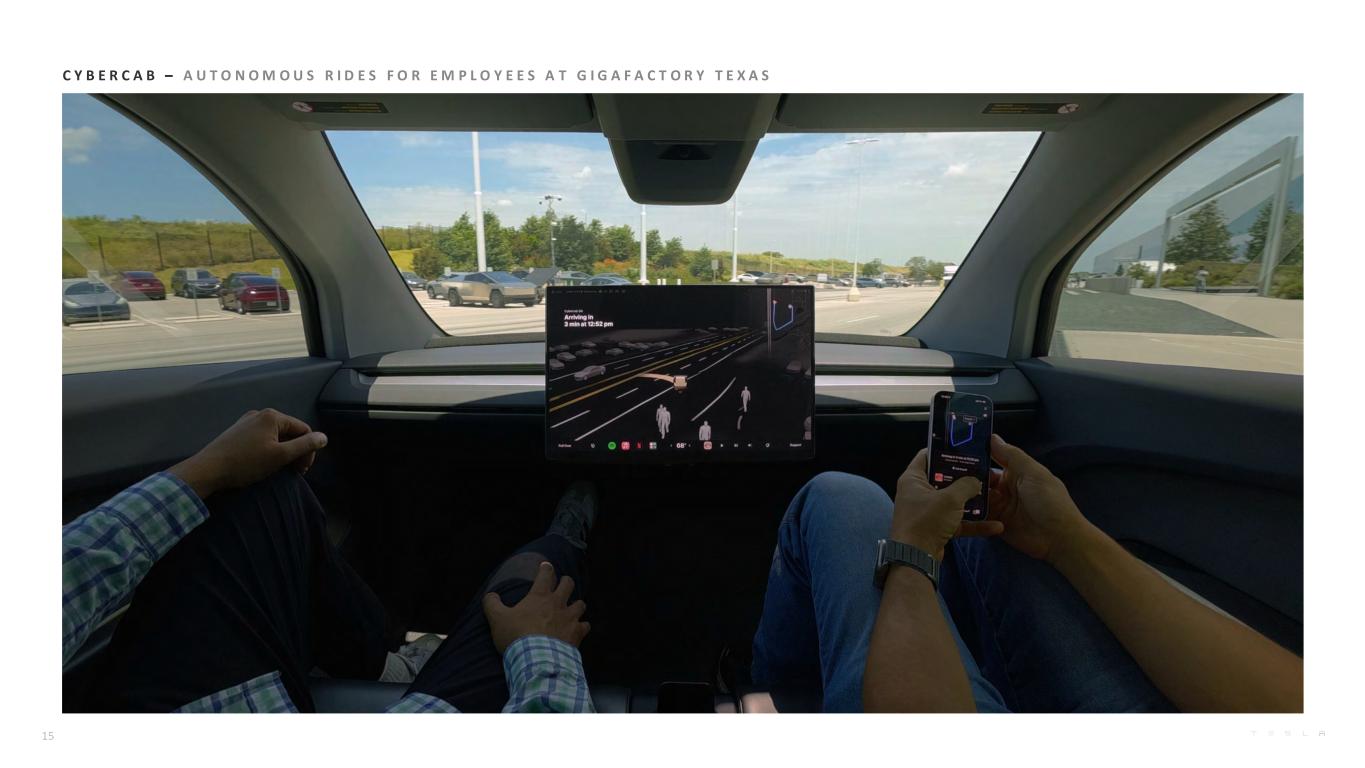
that's that's really not feasible by the cellular system and there's many there's many other situations yeah i mean i would say think of it like uh ashok was mentioning about cyber cap right that the experience is great in a world when you don't have to focus on driving you have you have all the play all the time in the car to do whether it's a conference call watch a movie or anything that's why if you look at the cyber cab design it has a big screen and you know we've started doing cyber cab rights in our factory in Austin and when you go through that experience you I I mean, soon, customers will be able to do it in not too distant future, and then you'll understand why that connectivity becomes so important.
Colin
Analyst — Wells Fargo
Great. And then, Colin, did you follow up? Yeah, just if I follow up on RoboTaxi, if I look at the launches, you've been adding cities, but the number of units is still, it looks like based on media reports, sort of in the dozens as opposed to hundreds. You know, why not just sort of scale up Austin or one or two cities before adding cities and sort of what do you need to sort of get that, you know, higher volume numbers in a major city? What sort is the roadblock to sort of adding more vehicles on the ground?
The reason we have been expanding across different cities instead of just doubling down a single city is that we want to make sure that our stack is a very general one. it is a general one we just want to like you know both prove to ourselves and to other folks that it is working across a lot of different cities without too much effort per city and that's what we see internally and then as Ilan mentioned earlier the growth rate has been literally exponential just it's in the early part of the exponential that's why it's hard for others to comprehend in terms of like miles versus the vehicles since these vehicles operating the robot taxi fleet drive basically continuously as opposed to human drivers who use vehicles for maybe a couple hours a day or something like that these vehicles are in mostly continuous operation which means that even
for a few vehicles you can get a lot of miles out of them and that's why we are tracking the amount of unsupervised miles or just the number of vehicles or something like that and we want to be operating in a very efficient fleet so all of the work that goes into the efficiency makes it even more so that we get a lot of miles per vehicle available in the fleet yeah and just to add further to this i'm like what think of it we're trying to scale this and we're trying to make sure that there are different kinks which would be there and there are things not just on the software front on the operation front which we're also trying to tackle so that's why we're trying to have a broader footprint to try and make sure before we go really high in terms of
deployment that we are able to sort these things out in a smaller fleet in a controlled manner yeah one of the things for cyber cab that should be noted is because it is a new vehicle chassis um we need we need to accumulate um driving data that is specific to the cyber cab before we can put a lot of them on the road uh so unlike say model 3 model y and our other vehicles we've got a lot of a lot of vehicles on the road millions vehicles on the road um we we we don't have that for sub caps so we actually have to accumulate um miles with the cybercaps that are retrofitted with steering wheels and and brakes acceleration braking battles that kind of thing um to calibrate to the cybercaps chassis. So you'll see, as we are confident about that, the number of cybercaps in cities will increase dramatically.
Great. Our next question is... Yeah, go ahead, Lars. So I can just add one thought here. The other reason I just want to point out is TCO, transportation, regulatory situations situations are different city by city, state by state. It is not a federal, you know, framework to do that. And so, like, the reason we're expanding city by city is to make sure that we're meeting all of those one at a time and we're satisfying, you know, all of the requests of each individual city and, you know, everywhere we can. So, we have to expand, you know, to each city to meet those requirements and we'll continue to do so. And to all of Ashok and Weibov and Ashok said, we'll follow with the scaling.
Thanks, Lars. The next question is coming from Walt from Lightshed. Walt, please unmute yourself.
Just a quick follow-up for that Lars comment. I mean, the NHTSA administrator, Jonathan Morrison, was just on CNBC. You know, he already, you know, he's trying to get rid of the pedal and said, I forget his exact term, but it seemed like he wanted to get rid of the steering wheel. It seemed like that would be a gating factor. But is there other things that you need at the federal level to really kind of unlock your ability to ramp CyberCab?
The short answer is no. I mean, I think we have a great relationship with Nitsa and Administrator Morrison especially. And, you know, I think they're just following through with what the public wants and the world knows is coming. and they're trying to stay ahead of it and make sure that you know they're doing the right things in place so um you know we've been open and honest with with them for the last couple years about what our plans were and what we're doing and um yeah i don't want to say we're in lockstep but but uh you know i feel like we have a partner there and we're working together on it got it and just you know it's kind of a road map question i guess um starlink obviously is integrated in cyber cab and and you guys just talked about the connectivity for watching movies but what about the flip side of that can these can the cyber cabs become remote hot spots for starlink mobile and
then similarly roadmap question on the semi you know when you anticipate um looking at autonomy for the semi because that seemed like a pretty sizable market as well in terms of autonomous trucking and the need for it given what's going on in our country right now yeah absolutely there as you allude to, there is a really serious shortage of truckers.
So, there just aren't enough people who want to drive trucks, which are crucial for transport throughout America. So, an autonomous semi is actually going to be very important to address the shortage of truck drivers. And also, it will be great for improving safety and making it easier on truck drivers to have a self-driving semi is going to dramatically improve safety and comfort for truck drivers that use the Tesla Semi. Since the total number of units of the Tesla Semi is still low and will continue to be a very small percentage even by the end of this year of our total vehicle fleet uh it makes sense for us to focus on our efforts our self-driving efforts on our high volume uh vehicles so model 3 and y um and and solving self-driving for and really getting to you know the point where it's a generalized unto advice self-driving for uh for for those vehicles, and cybercats. So we expect to get self-driving and working on the Tesla Semi probably around the end of this year or early next year. And I just don't want it to be a distraction on the March of 9th of self-driving, of safety for self-driving on 3-way and CyberCab. That's so that it's taking a bit of a backseat for the next six months or so for time this time. But it will be, you know, it will definitely be a bit working next year and in time for the scale up to high production of Tesla somewhere. For communications, yeah, I think there's an interesting angle there where you could use the Starlink terminals that are in the Tesla cars as like sort of cell towers, I suppose, or connectivity towers, basically for providing relays on the ground to cell phones and to anyone who would like Wi-Fi, basically. But yeah, this is a different subject, but obviously we could do that with the stationary stalling terminals too.
All right. Our next question is going to come from Will at Truist. Will, please unmute yourself.
Thanks so much for taking my question. Elon, you teased us a little bit about sort of the supply chain relative to Optimus, highlighting how difficult it's going to be, but we'd be really interested to understand what your propensity is uh to um manufacture uh semis for this yourself when we think about microprocessors microcontrollers actuators and other uh semiconductors that are going to be used it it occurs to me that uh you have many that are commercially available you have an option to design some of them uh made at third-party fabs you also have the option potentially to design and make them yourself what what should we think about your propensity to source these components
in these different manners you're talking about like um making like microcontrollers and smoking like the various computers that are in the car that operate um you know like the steering system and the braking system okay i'm i'm talking about for optimists not for um yeah um Optimus has a lot of really specialized power electronics and sort of boards. It's all Tesla design stuff, but it is fabricated by suppliers. For Optimus 4, which will be built in Boston, that will be a much more vertically integrated supply system for Optimus 4, and that would aim to have an order of magnitude more production of Optimus 4 than Optimus 3, so sort of aspirationally 10 million units a year versus a million units a year of Optimus 3, but with all the caveats there, which is insanely difficult to scale production um so um and and yeah office office will be much more vertically integrated so
probably uh doing a lot of the sort of pcb work in in-house for that uh as a follow-up um well first maybe you could talk about the timing as to when that when optimus 4 should be um should let's say start production but the the actual thought i wanted to ask was uh the plan to upgrade hardware 3 to hardware 4 in order to be able to process, I suppose it's version 15 of the, and future versions of FSD. Is that still the plan to do hardware upgrades on the cars?
I think it's going to make sense for, to upgrade all cars with that are, have less than hardware for almost any cars that have cameras, basically, because otherwise it would be probably too many modifications. But anything that's got sort of that's set up for cameras, it will be financially sensible at some point to upgrade them. And I think we'd want to upgrade them to the next generation of the next generation AI board. So it would be either like we haven't upgraded AI4 chip that's sort of a medium, sort of a moderate improvement over AI4 probably reaches production around the middle of next year. And then there's also AI5, which hopefully is in volume production around the middle of next year. AI5 will initially go into Optimus, and actually making very good progress. So the Tesla chip team is really doing great work and making incredibly fast progress on AI-5. And I'm very excited about the design of the Tesla AI-6 chip. I think it's going to be the best edge computing chip in the world. And if somebody's got a better one, I'd like to need that person to shake their head because the AI-6 chip is just so good. So, I think we've got things going really well on the chip front. Again, I'd like to thank our TSMC and Samsung and Micron for their support.
Great. We are coming up in the hour, but we're going to try to squeeze Dan in from Barclays. Dan, please unmute yourself.
Great. Thank you. Appreciate it. I'd like to ask about the pace and path of CapEx. Elon, in the past, you've said that you'll spend as much as you can, but really efficiency seems like it's the gating factor. So to what extent right now in this CapEx cycle is your pace of CapEx effectively capped simply because spending any more would be done in an inefficient manner?
And to what extent is the pace of CapEx really the primary determinant right now in unlocking the different supply constraints that you have? yeah it's a good question um i've actually you know my what i've asked the team to do is like really we should be spending on capex as fast as we can spend as fast as we can without it without it being too wasteful so i'm not trying to aim for like some extremely high efficient efficiency capital spend because that would slow things down um so it's trying to it's a balance between like how much cap you know sort of capital efficiency versus time um so if if we can be it's okay to be a little less capital efficient if we get things done sooner because that's actually going to be the the higher um mpb outcome for the company um so overall i'm pretty happy with how things going. I mean, we're doing an incredible amount of construction and production growth in so many different arenas simultaneously. I don't think there's ever been a company that's done this at the scale, you know, but maybe proportionately back in when Henry Ford did the Model T or something like that, but then World War II when, you know, companies were We're making, it has to sort of scale up weapons for weapons production. But I think probably this is the fastest industrial scale up since World War II in America.
Yeah, and I will just add a little bit on that. Basically, if you look at it, all our spend on CapEx is trying to do productive assets. We're basically scaling factories, whether it's Optimus, whether it's cyber cap whether it's lfp factory which went into operation earlier this year or the semi-factory or even putting in a semiconductor fab in there as well as you know we are trying to get a lot of solar manufacturing in the u.s in fact yeah yeah this is underrated by the way please go ahead yeah yeah basically you know the amount of solar manufacturing, which happens in the U.S., we're just going to multiply it with an order of magnitude. And none of these things are easy, right? Because what you have to do is, in order to build a factory, you have to start from ground zero. So just so you know, again, I don't think we have shared this. We end up being the general contractor for almost all our construction facilities because we are doing that much construction and so going back to what elo was saying we're going at a very rapid scale and yes uh you know this means that we have we are doing a lot of things all at the same time and that's why you know we just have to go as fast as we can humanly make things work in the real world yeah our capex efficiency i think is off-scale good already and then dan yeah did you have a follow-up that we can wrap up with yeah maybe
just a quick question on on energy storage which uh you know i i think is uh uh a key topic here maybe you can just address you know to what extent is energy storage going to be supply constrained for the foreseeable future and then just to what extent are are the deployments right now the typical peak shaving that you'd see at utilities versus you've talked about in some of your materials uh you know for battery storage addressing the the quality of power issue for data centers giving the sharp fluctuations in power use where you have an advantage given software power electronics so just what is that demand curve right now between a data center versus just broader peak shaving for utilities um well it's still mostly um it's not just peak
shaving but it's also grid balancing so it's not it's not just like the facts are on briefly but for balancing for balancing power from um wind generation and solar generation uh batteries are are awesome um i mean the solar battery combination will be how the vast majority of energy in the world is produced in the future um that's really of course how all of the styling satellites are are powered with is with solar panels and batteries so and you can just think of earth like a giant satellite um there's there's far more power available from the sun than anything else by far um and uh and we think power constraints are going to be um they already are a major issue for for ai you know just turning on the ai computers the air compute demand is so high that even the hyperscalers are having trouble turning on their AI compute and finding the power and then smoothing the power with, especially for the training runs, where the power cycles dramatically in a very short period of time, you can have during a training run, the power consumption can drop by 70% for 100 milliseconds. And you really need fast acting, advanced power electronics to be able to smooth out these massive, massive, massive changes in power, especially during during the training runs. So that's why SpaceX has bought so many mega packs for the data centers. It's actually mostly for smoothing out the power for the training runs. But it will also be useful for being able to have more power from the grid by, you know, if you tell utilities that they will not need to supply power during the, you know, the worst hours or the worst days of the year because the batteries can handle it, then and that makes it much easier for them to give you power. In fact, I mean, probably the best way to scale total energy production in the United States is simply using batteries, because there's, I think, around 1.2 or 1.3 terawatts of power production in the US, but the average power usage is only half a terawatt. So you've got two and a half times as much power generation as the average usage. um that means you could potentially double the energy out for the united states just with batteries so right so really we see demand for megapack being very very high in the future all righty uh that is all the time we have for today for q a we appreciate everyone's questions and we look forward to talking to you next quarter thank you very much thanks everyone