
AVD 8-K
American Vanguard Corp (AVD)
UNITED STATES
SECURITIES AND EXCHANGE COMMISSION
WASHINGTON, D.C. 20549
FORM 8-K
CURRENT REPORT
Pursuant to Section 13 or 15(d) of the Securities Exchange Act of 1934
Date of Report (Date of earliest event reported): |
(Exact name of Registrant as Specified in Its Charter)
(State or Other Jurisdiction |
(Commission File Number) |
(IRS Employer |
||
|
|
|
|
|
|
||||
|
||||
(Address of Principal Executive Offices) |
|
(Zip Code) |
||
Registrant’s Telephone Number, Including Area Code: |
|
(Former Name or Former Address, if Changed Since Last Report)
Check the appropriate box below if the Form 8-K filing is intended to simultaneously satisfy the filing obligation of the registrant under any of the following provisions:
Securities registered pursuant to Section 12(b) of the Act:
|
|
Trading |
|
|
|
|
Indicate by check mark whether the registrant is an emerging growth company as defined in Rule 405 of the Securities Act of 1933 (§ 230.405 of this chapter) or Rule 12b-2 of the Securities Exchange Act of 1934 (§ 240.12b-2 of this chapter).
Emerging growth company
If an emerging growth company, indicate by check mark if the registrant has elected not to use the extended transition period for complying with any new or revised financial accounting standards provided pursuant to Section 13(a) of the Exchange Act. ☐
Item 2.02 Results of Operations and Financial Condition.
On November 10, 2025, American Vanguard Corporation (“Registrant” or the “Company”) issued a press release announcing its unaudited financial results for the three-month period ended September 30, 2025. The full text of the press release is linked hereto as Exhibit 99.1 and is incorporated herein by reference.
Also on November 10, 2025, the Company held its previously announced earnings call regarding its unaudited financial results for the three- and nine-month periods ended September 30, 2025. A transcript of the earnings call is attached hereto as Exhibit 99.2 and is incorporated herein by reference.
Item 7.01 Regulation FD Disclosure.
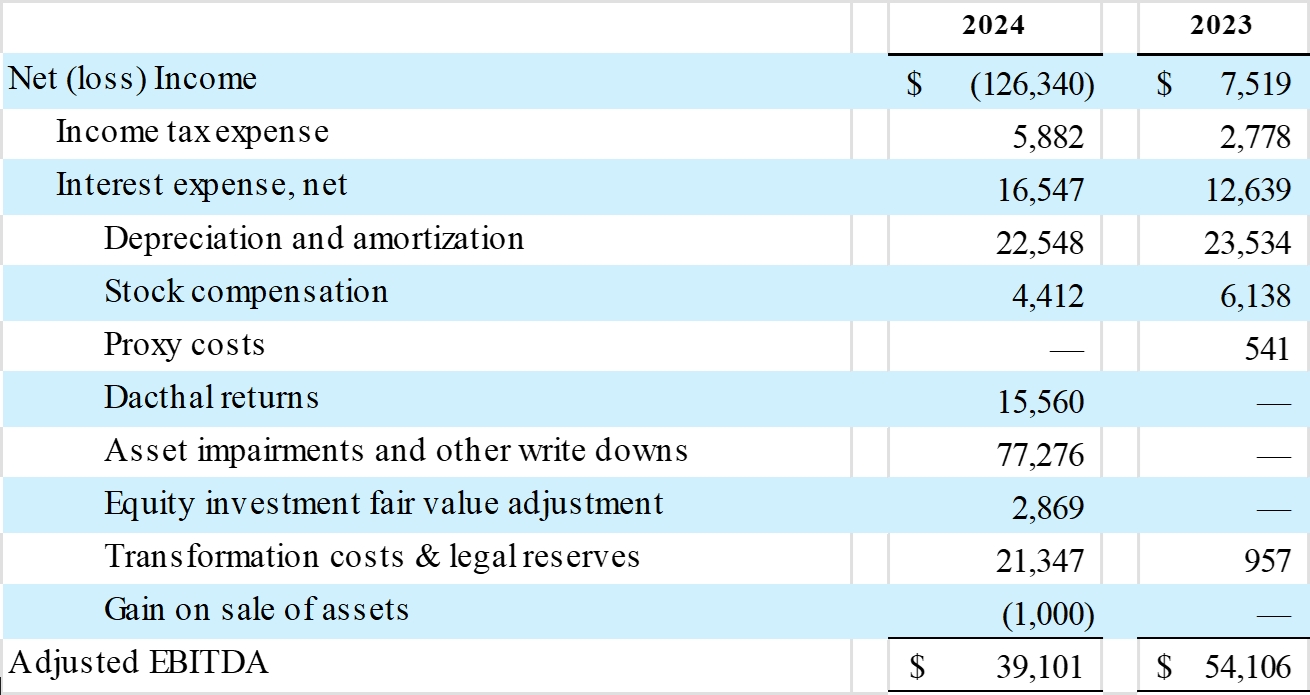
In the Company’s press release dated March 14, 2025, the Company disclosed preliminary Adjusted EBITDA (as defined below) for the full year ended December 31, 2024 of approximately $42 million. In connection with finalizing the Company’s Annual Report on Form 10-K for the fiscal year ended December 31, 2024, the Company concluded that its Adjusted EBITDA for the period was $39.1 million.
The Company defines EBITDA as net income or net income attributable to the Company, adjusted for non-controlling interests, depreciation and amortization, provision for income taxes and interest expense. The Company defines Adjusted EBITDA as EBITDA as further adjusted for certain items management believes are not reflective of the underlying operations of our business, including but not limited to the exclusion of charges that are considered by management to be unusual and not representative of the company’s underlying performance and future prospects. In 2024 that included non-recurring expenses and the profit on sale of an asset that was not held for sale. The resulting Adjusted EBITDA measure is exactly aligned with the Company’s metric for its current credit facility agreement.
The Company uses Adjusted EBITDA to assess the operating results and effectiveness and efficiency of its business. The Company presents this non-GAAP financial measure because it believes that investors consider Adjusted EBITDA to be an important supplemental measure of performance, and that this measure is frequently used by securities analysts, investors and other interested parties in the evaluation of companies in the industry. As the Company continues to work through its transformation efforts, management believes that presenting Adjusted EBITDA provides an effective comparison between the Company and its industry peers. Non-GAAP financial measures as reported by the Company may not be comparable to similarly titled metrics reported by other companies and may not be calculated in the same manner. These measures have limitations as analytical tools, and you should not consider them in isolation or as substitutes for analysis of our results as reported under GAAP.
For a reconciliation of the Company’s net income (loss) to Adjusted EBITDA for the three and nine months ended September 30, 2025 and 2024, see Exhibit 99.1. The following table sets forth a reconciliation of the Company’s net income (loss) to Adjusted EBITDA for the years ended December 31, 2024 and 2023:
(In thousands)
The information included in this Current Report on Form 8-K (including Exhibit 99.1 and 99.2 hereto) that is furnished pursuant to this Item 2.02 above and this Item 7.01 shall not be deemed to be “filed” for the purposes of Section 18 of the Securities Exchange Act of 1934, as amended, or otherwise subject to the liabilities of that Section or Sections 11 and 12(a)(2) of the Securities Act of 1933, as amended. In addition, the information included in this Current Report on Form 8-K (including Exhibit 99.1 and 99.2 hereto) that is furnished pursuant to this Item 2.02 above and this Item 7.01 shall not be incorporated by reference into any filing of the Registrant, whether made before or after the date hereof, regardless of any general incorporation language in such filing, unless expressly incorporated by specific reference into such filing.
Item 9.01 Financial Statements and Exhibits.
Exhibit No. |
|
Description |
|
|
|
99.1 |
|
|
|
|
|
99.2 |
|
|
|
|
|
104 |
|
Cover Page Interactive Data File (embedded within the Inline XBRL document) |
SIGNATURES
Pursuant to the requirements of the Securities Exchange Act of 1934, the registrant has duly caused this report to be signed on its behalf by the undersigned hereunto duly authorized.
|
|
|
AMERICAN VANGUARD CORPORATION |
|
|
|
|
Date: |
November 12, 2025 |
By: |
/s/ Timothy J. Donnelly |
|
|
|
Timothy J. Donnelly |
 FOR IMMEDIATE RELEASE
American Vanguard Reports Third Quarter 2025 Results
Quarterly Adjusted EBITDA of $8.2 million vs. $1.8 million in Q3 last year
Maintains full year 2025 EBITDA Guidance of $40 million to $44 million
Newport Beach, CA | November 10, 2025 — American Vanguard® Corporation, a diversified specialty and agricultural products company that develops, manufactures, and markets solutions for crop protection and nutrition, turf and ornamental management and commercial pest control, today reported financial results for the third quarter ended September 30, 2025.
Financial and Operational Highlights Third Quarter 2025 – versus Third Quarter 20241:
Dak Kaye, CEO of American Vanguard, stated “Since joining the company 11 months ago, my message has been to simplify, prioritize and deliver. I can see that our efforts to follow that mantra are yielding positive results. In the midst of a challenging agricultural environment, we experienced improved results compared to the year ago period. Greater manufacturing efficiency, lower net trade working capital, and reduced operational expenses have contributed to higher gross profit margins and a substantial improvement in EBITDA. By controlling the things that we can control and leaning into our customers’ needs, we have achieved these results in the midst of industry-wide uncertainty. Looking forward, we see signs of greater stability in our markets as we finish out the year and head into 2026. Against this backdrop, I am pleased to reiterate our full year 2025 adjusted EBITDA target in the range of $40 million to $44 million.”
Mr. Kaye continued, “In addition, in future filings and communications we intend to change the nomenclature of our non-crop business to the Specialty business. We think that changing the name to Specialty will help to put a clearer focus on the world-class technologies that this business is bringing to market and align the business terminology with our peers.”
David Johnson, Chief Financial Officer stated, “I am pleased to see the positive results of our business improvement plan. Our gross profit margin increased, in comparison to the same quarter of 2024, and our adjusted EBITDA margin increased
1 Third quarter 2024 are GAAP figures and include adjustments related to a product recall.
2 Adjusted earnings before interest, taxes, depreciation, and amortization (Adjusted EBITDA) is not a financial measure calculated and presented in accordance with U.S. generally accepted accounting principles (GAAP) and should not be considered as an alternative to net income (loss), operating income (loss) or any other financial measure so calculated and presented, nor as an alternative to cash flow from operating activities as a measure of liquidity. The items excluded from adjusted EBITDA are detailed in the reconciliation attached to this news release. Other companies (including the Company’s competitors) may define adjusted EBITDA differently.
1
by 540 basis points quarter-over-quarter. These results are noteworthy given the backdrop of a weak overall agricultural market, which has affected grower spending levels. We continue to keep a close eye on net trade working capital, as evidenced by a reduction in total inventory of $47 million, as compared to this time last year, which, in turn, limited the need to access our credit facility. Also, as planned we continue to wind down spending on our business transformation, which was almost $7 million lower than the year ago period, and down more than $11 million when compared to the first nine months of 2025. We have transitioned the initial transformation effort towards an internally driven business improvement plan; accordingly, we expect that associated expenses will continue to decrease over the coming quarters. In addition, we recorded a total charge of $7.6 million to cover products liability claims of $6.7 million and related expenses, including the recovery and disposal of unused material at growers, arising from one of our products that had been contaminated by the third party formulator; in the future we expect to fully recover this expense through recourse against the counterparty and its insurers. The charge is included as an adjustment to EBITDA. One final point to note, the fourth quarter has historically been our strongest period, and we expect that to be the case this year. Given this seasonal strength, we expect to generate a material amount of free cash flow during this period, which we plan to allocated towards debt paydown.”
Earnings Conference Call
The company will be hosting an earnings conference call at November 10, 2025 at 9 am Eastern Time/6 am Pacific Time.
The conference call can be accessed through the following link: https://www.webcaster5.com/Webcast/Page/3070/53091
A replay of this event can be accessed through the company website.
The company plans to post on the Investor Relations section of the company’s website a supplemental presentation that should be read in connection with this earnings release.
About American Vanguard
American Vanguard Corporation is a diversified specialty and agriculture products company that develops and markets products for crop protection and management, turf and ornamentals management, and public and animal health. Over the past 20 years, through product and business acquisitions, the Company has significantly expanded its operations and now has more than 1,000 product registrations worldwide. To learn more about the Company, please reference www.american-vanguard.com.
The Company, from time to time, may discuss forward-looking information. Except for the historical information contained in this release the matters set forth in this press release include forward-looking statements. These statements can be identified by the fact that they do not relate strictly to historical or current facts. Forward-looking statements often use words such as “believe,” “expect,” “anticipate,” “intend,” “estimate,” “project,” “outlook,” “forecast,” “target,” “trend,” “plan,” “goal,” or other words of comparable meaning or future-tense or conditional verbs such as “may,” “will,” “should,” “would,” or “could.” These forward-looking statements are based on the current expectations and estimates by the Company’s management and are subject to various risks and uncertainties that may cause results to differ from management’s current expectations. Such factors include risks detailed from time-to-time in the Company’s SEC reports and filings. All forward-looking statements, if any, in this release represent the Company’s judgment as of the date of this release. The company disclaims any intent or obligation to update these forward-looking statements.
Company Contact Investor Representative
American Vanguard Corporation Alpha IR Group
2
Anthony Young, Director of Investor Relations Robert Winters
[email protected] [email protected]
(949) 221-6119 (929) 266-6315
3
AMERICAN VANGUARD CORPORATION AND SUBSIDIARIES
CONDENSED CONSOLIDATED BALANCE SHEETS
(In thousands, except share data)
(Unaudited)
ASSETS |
|
September 30, 2025 |
|
|
December 31, 2024 |
|
||
Current assets: |
|
|
|
|
|
|
||
Cash |
|
$ |
16,795 |
|
|
$ |
12,514 |
|
Receivables: |
|
|
|
|
|
|
||
Trade, net of allowance for credit losses of $11,363 and $9,190, respectively |
|
|
167,138 |
|
|
|
169,743 |
|
Other |
|
|
8,009 |
|
|
|
4,699 |
|
Total receivables, net |
|
|
175,147 |
|
|
|
174,442 |
|
Inventories |
|
|
199,005 |
|
|
|
179,292 |
|
Prepaid expenses |
|
|
10,087 |
|
|
|
7,615 |
|
Income taxes receivable |
|
|
5,434 |
|
|
|
5,030 |
|
Total current assets |
|
|
406,468 |
|
|
|
378,893 |
|
Property, plant and equipment, net |
|
|
55,799 |
|
|
|
58,169 |
|
Operating lease right-of-use assets, net |
|
|
17,749 |
|
|
|
19,735 |
|
Intangible assets, net of amortization |
|
|
143,407 |
|
|
|
150,497 |
|
Goodwill |
|
|
21,040 |
|
|
|
19,701 |
|
Deferred income tax assets |
|
|
3,523 |
|
|
|
1,242 |
|
Other assets |
|
|
7,027 |
|
|
|
8,484 |
|
Total assets |
|
$ |
655,013 |
|
|
$ |
636,721 |
|
|
|
|
|
|
|
|
||
LIABILITIES AND STOCKHOLDERS’ EQUITY |
|
|
|
|
|
|
||
Current liabilities: |
|
|
|
|
|
|
||
Accounts payable |
|
$ |
84,204 |
|
|
$ |
69,159 |
|
Customer prepayments |
|
|
31,234 |
|
|
|
52,675 |
|
Accrued program costs |
|
|
81,909 |
|
|
|
69,449 |
|
Accrued expenses and other payables |
|
|
24,271 |
|
|
|
31,989 |
|
Operating lease liabilities, current |
|
|
6,185 |
|
|
|
6,136 |
|
Income taxes payable |
|
|
2,364 |
|
|
|
2,942 |
|
Total current liabilities |
|
|
230,167 |
|
|
|
232,350 |
|
Long-term debt |
|
|
182,250 |
|
|
|
147,332 |
|
Operating lease liabilities, long term |
|
|
12,154 |
|
|
|
14,339 |
|
Deferred income tax liabilities |
|
|
8,997 |
|
|
|
7,989 |
|
Other liabilities |
|
|
457 |
|
|
|
1,601 |
|
Total liabilities |
|
|
434,025 |
|
|
|
403,611 |
|
Commitments and contingent liabilities (Note 13) |
|
|
|
|
|
|
||
Stockholders' equity: |
|
|
|
|
|
|
||
Preferred stock, $0.10 par value per share; authorized 400,000 shares; none issued |
|
|
— |
|
|
|
— |
|
Common stock, $0.10 par value per share; authorized 40,000,000 shares; issued |
|
|
3,497 |
|
|
|
3,479 |
|
Additional paid-in capital |
|
|
116,885 |
|
|
|
114,679 |
|
Accumulated other comprehensive loss |
|
|
(11,406 |
) |
|
|
(18,729 |
) |
Retained earnings |
|
|
183,213 |
|
|
|
204,882 |
|
|
|
|
292,189 |
|
|
|
304,311 |
|
Less treasury stock at cost, 5,915,182 shares at September 30, 2025 and December 31, 2024 |
|
|
(71,201 |
) |
|
|
(71,201 |
) |
Total stockholders’ equity |
|
|
220,988 |
|
|
|
233,110 |
|
Total liabilities and stockholders’ equity |
|
$ |
655,013 |
|
|
$ |
636,721 |
|
4
AMERICAN VANGUARD CORPORATION AND SUBSIDIARIES
CONDENSED CONSOLIDATED STATEMENTS OF OPERATIONS
(In thousands, except per share data)
(Unaudited)
|
|
For the Three Months |
|
|
For the Nine Months |
|
||||||||||
|
|
2025 |
|
|
2024 |
|
|
2025 |
|
|
2024 |
|
||||
Net sales |
|
$ |
119,313 |
|
|
$ |
118,307 |
|
|
$ |
364,426 |
|
|
$ |
381,659 |
|
Cost of sales |
|
|
(85,099 |
) |
|
|
(101,014 |
) |
|
|
(259,474 |
) |
|
|
(284,185 |
) |
Gross profit |
|
|
34,214 |
|
|
|
17,293 |
|
|
|
104,952 |
|
|
|
97,474 |
|
Operating expenses |
|
|
|
|
|
|
|
|
|
|
|
|
||||
Selling, general and administrative |
|
|
(26,747 |
) |
|
|
(26,365 |
) |
|
|
(81,998 |
) |
|
|
(86,885 |
) |
Research, product development and regulatory |
|
|
(5,654 |
) |
|
|
(11,177 |
) |
|
|
(17,139 |
) |
|
|
(25,482 |
) |
Product liability claims |
|
|
(7,029 |
) |
|
|
— |
|
|
|
(7,029 |
) |
|
|
— |
|
Transformation |
|
|
(1,442 |
) |
|
|
(8,139 |
) |
|
|
(5,254 |
) |
|
|
(16,636 |
) |
Assets impairment |
|
|
(93 |
) |
|
|
— |
|
|
|
(227 |
) |
|
|
— |
|
Gain from sale of asset |
|
|
246 |
|
|
|
— |
|
|
|
246 |
|
|
|
— |
|
Operating loss |
|
|
(6,505 |
) |
|
|
(28,388 |
) |
|
|
(6,449 |
) |
|
|
(31,529 |
) |
Change in fair value of equity investment |
|
|
(511 |
) |
|
|
— |
|
|
|
(511 |
) |
|
|
513 |
|
Interest expense, net |
|
|
(4,920 |
) |
|
|
(4,378 |
) |
|
|
(13,135 |
) |
|
|
(11,988 |
) |
Loss before provision for income taxes |
|
|
(11,936 |
) |
|
|
(32,766 |
) |
|
|
(20,095 |
) |
|
|
(43,004 |
) |
Income tax (expense) benefit |
|
|
(422 |
) |
|
|
7,024 |
|
|
|
(1,574 |
) |
|
|
7,093 |
|
Net loss |
|
$ |
(12,358 |
) |
|
$ |
(25,742 |
) |
|
$ |
(21,669 |
) |
|
$ |
(35,911 |
) |
Net loss per common share—basic |
|
$ |
(0.43 |
) |
|
$ |
(0.91 |
) |
|
$ |
(0.76 |
) |
|
$ |
(1.28 |
) |
Net loss per common share—assuming dilution |
|
$ |
(0.43 |
) |
|
$ |
(0.91 |
) |
|
$ |
(0.76 |
) |
|
$ |
(1.28 |
) |
Weighted average shares outstanding—basic |
|
|
28,511 |
|
|
|
28,173 |
|
|
|
28,377 |
|
|
|
28,015 |
|
Weighted average shares outstanding—assuming dilution |
|
|
28,511 |
|
|
|
28,173 |
|
|
|
28,377 |
|
|
|
28,015 |
|
5
AMERICAN VANGUARD CORPORATION AND SUBSIDIARIES
ANALYSIS OF SALES
(In thousands)
(Unaudited)
For the three months ended September 30:
|
|
2025 |
|
|
2024 |
|
|
Change |
|
|
% Change |
|
||||
Net sales: |
|
|
|
|
|
|
|
|
|
|
|
|
||||
U.S. crop |
|
$ |
43,310 |
|
|
$ |
35,533 |
|
|
$ |
7,777 |
|
|
|
22 |
% |
U.S. non-crop |
|
|
19,233 |
|
|
|
22,454 |
|
|
|
(3,221 |
) |
|
|
-14 |
% |
Total U.S. |
|
|
62,543 |
|
|
|
57,987 |
|
|
|
4,556 |
|
|
|
8 |
% |
International |
|
|
56,770 |
|
|
|
60,320 |
|
|
|
(3,550 |
) |
|
|
-6 |
% |
Total net sales |
|
$ |
119,313 |
|
|
$ |
118,307 |
|
|
$ |
1,006 |
|
|
|
1 |
% |
Total cost of sales |
|
|
(85,099 |
) |
|
|
(101,014 |
) |
|
|
15,915 |
|
|
|
-16 |
% |
Total gross profit |
|
$ |
34,214 |
|
|
$ |
17,293 |
|
|
$ |
16,921 |
|
|
|
98 |
% |
Total gross margin |
|
|
29 |
% |
|
|
15 |
% |
|
|
|
|
|
|
||
For the nine months ended September 30:
|
|
2025 |
|
|
2024 |
|
|
Change |
|
|
% Change |
|
||||
Net sales: |
|
|
|
|
|
|
|
|
|
|
|
|
||||
U.S. crop |
|
$ |
153,511 |
|
|
$ |
155,075 |
|
|
$ |
(1,564 |
) |
|
|
-1 |
% |
U.S. non-crop |
|
|
54,067 |
|
|
|
59,241 |
|
|
|
(5,174 |
) |
|
|
-9 |
% |
Total U.S. |
|
|
207,578 |
|
|
|
214,316 |
|
|
|
(6,738 |
) |
|
|
-3 |
% |
International |
|
|
156,848 |
|
|
|
167,343 |
|
|
|
(10,495 |
) |
|
|
-6 |
% |
Total net sales |
|
$ |
364,426 |
|
|
$ |
381,659 |
|
|
$ |
(17,233 |
) |
|
|
-5 |
% |
Total cost of sales |
|
$ |
(259,474 |
) |
|
$ |
(284,185 |
) |
|
$ |
24,711 |
|
|
|
-9 |
% |
Total gross profit |
|
$ |
104,952 |
|
|
$ |
97,474 |
|
|
$ |
7,478 |
|
|
|
8 |
% |
Total gross margin |
|
|
29 |
% |
|
|
26 |
% |
|
|
|
|
|
|
||
6
AMERICAN VANGUARD CORPORATION AND SUBSIDIARIES
CONDENSED CONSOLIDATED STATEMENTS OF CASH FLOWS
(In thousands)
(Unaudited)
|
|
For the Nine Months Ended September 30, |
|
|||||
|
|
2025 |
|
|
2024 |
|
||
Cash flows from operating activities: |
|
|
|
|
|
|
||
Net loss |
|
$ |
(21,669 |
) |
|
$ |
(35,911 |
) |
Adjustments to reconcile net loss to net cash used in operating |
|
|
|
|
|
|
||
Depreciation of property, plant and equipment and amortization of intangible assets |
|
|
14,007 |
|
|
|
16,602 |
|
Amortization of other long-term assets |
|
|
16 |
|
|
|
199 |
|
Amortization and accretion of deferred loan fees and discounted liabilities |
|
|
1,167 |
|
|
|
342 |
|
Gain on disposal of property, plant and equipment |
|
|
(246 |
) |
|
|
— |
|
Impairment of assets |
|
|
227 |
|
|
|
— |
|
Provision for estimated credit losses |
|
|
1,944 |
|
|
|
1,278 |
|
Stock-based compensation |
|
|
1,741 |
|
|
|
3,887 |
|
Change in deferred income taxes |
|
|
(353 |
) |
|
|
(9,110 |
) |
Changes in liabilities for uncertain tax positions or unrecognized tax benefits |
|
|
(522 |
) |
|
|
106 |
|
Change in equity investment fair value |
|
|
511 |
|
|
|
(513 |
) |
Other |
|
|
— |
|
|
|
110 |
|
Unrealized foreign currency transactions (loss) gain |
|
|
(704 |
) |
|
|
121 |
|
Changes in assets and liabilities associated with operations: |
|
|
|
|
|
|
||
Decrease in net receivables |
|
|
935 |
|
|
|
33,475 |
|
Increase in inventories |
|
|
(16,513 |
) |
|
|
(29,429 |
) |
Increase in prepaid expenses and other assets |
|
|
(965 |
) |
|
|
(4,107 |
) |
Change in income tax receivable/payable, net |
|
|
(1,083 |
) |
|
|
(6,216 |
) |
Decrease in net operating lease liability |
|
|
(150 |
) |
|
|
(48 |
) |
Increase in accounts payable |
|
|
11,859 |
|
|
|
14,512 |
|
Decrease in customer prepayments |
|
|
(21,453 |
) |
|
|
(38,375 |
) |
Increase in accrued program costs |
|
|
12,285 |
|
|
|
17,721 |
|
(Decrease) increase in other payables and accrued expenses |
|
|
(8,178 |
) |
|
|
13,878 |
|
Net cash used in operating activities |
|
|
(27,144 |
) |
|
|
(21,478 |
) |
Cash flows from investing activities: |
|
|
|
|
|
|
||
Capital expenditures |
|
|
(2,398 |
) |
|
|
(6,106 |
) |
Proceeds from disposal of property, plant and equipment |
|
|
492 |
|
|
|
66 |
|
Intangible assets |
|
|
(136 |
) |
|
|
(341 |
) |
Net cash used in investing activities |
|
|
(2,042 |
) |
|
|
(6,381 |
) |
Cash flows from financing activities: |
|
|
|
|
|
|
||
Payments under line of credit agreement |
|
|
(179,415 |
) |
|
|
(214,259 |
) |
Borrowings under line of credit agreement |
|
|
214,334 |
|
|
|
245,737 |
|
Payment of deferred loan fees |
|
|
(3,339 |
) |
|
|
— |
|
Net receipt from the issuance of common stock under ESPP |
|
|
629 |
|
|
|
901 |
|
Net payment for tax withholding on stock-based compensation awards |
|
|
(147 |
) |
|
|
(1,416 |
) |
Payment of cash dividends |
|
|
— |
|
|
|
(2,510 |
) |
Net cash provided by financing activities |
|
|
32,062 |
|
|
|
28,453 |
|
Net increase in cash and cash equivalents |
|
|
2,876 |
|
|
|
594 |
|
Effect of exchange rate changes on cash and cash equivalents |
|
|
1,405 |
|
|
|
(130 |
) |
Cash and cash equivalents at beginning of period |
|
|
12,514 |
|
|
|
11,416 |
|
Cash and cash equivalents at end of period |
|
$ |
16,795 |
|
|
$ |
11,880 |
|
7
AMERICAN VANGUARD CORPORATION AND SUBSIDIARIES
RECONCILIATION OF NET LOSS TO ADJUSTED EBITDA
(Unaudited)
|
|
Three Months Ended September 30, |
|
|
Nine Months Ended September 30, |
|
||||||||||
|
|
2025 |
|
|
2024 |
|
|
2025 |
|
|
2024 |
|
||||
Net loss |
|
$ |
(12,358 |
) |
|
$ |
(25,742 |
) |
|
$ |
(21,669 |
) |
|
$ |
(35,911 |
) |
Income tax expense (benefit) |
|
|
422 |
|
|
|
(7,024 |
) |
|
|
1,574 |
|
|
|
(7,093 |
) |
Interest expense, net |
|
|
4,920 |
|
|
|
4,378 |
|
|
|
13,135 |
|
|
|
11,988 |
|
Depreciation and amortization |
|
|
4,565 |
|
|
|
5,703 |
|
|
|
14,023 |
|
|
|
16,801 |
|
Stock compensation |
|
|
760 |
|
|
|
1,135 |
|
|
|
1,741 |
|
|
|
3,887 |
|
Dacthal returns |
|
|
(217 |
) |
|
|
16,191 |
|
|
|
(646 |
) |
|
|
16,191 |
|
Asset impairment & other writedowns |
|
|
801 |
|
|
|
— |
|
|
|
935 |
|
|
|
— |
|
Product liability claims & related expenses |
|
|
7,610 |
|
|
|
— |
|
|
|
7,610 |
|
|
|
— |
|
Equity investment fair value adjustment |
|
|
511 |
|
|
|
— |
|
|
|
511 |
|
|
|
— |
|
Transformation costs & legal reserves |
|
|
1,442 |
|
|
|
7,159 |
|
|
|
5,254 |
|
|
|
17,402 |
|
Gain on sales of assets |
|
|
(246 |
) |
|
|
— |
|
|
|
(246 |
) |
|
|
— |
|
Adjusted EBITDA3 |
|
$ |
8,210 |
|
|
$ |
1,800 |
|
|
$ |
22,222 |
|
|
$ |
23,265 |
|
3 Adjusted earnings before interest, taxes, depreciation, and amortization (Adjusted EBITDA) is not a financial measure calculated and presented in accordance with U.S. generally accepted accounting principles (GAAP) and should not be considered as an alternative to net income (loss), operating income (loss) or any other financial measure so calculated and presented, nor as an alternative to cash flow from operating activities as a measure of liquidity. The items excluded from adjusted EBITDA are detailed in the reconciliation attached to this news release. Other companies (including the Company’s competitors) may define adjusted EBITDA differently.
8
Transcript of
American Vanguard Corporation
American Vanguard Third Quarter 2025 Earnings Conference Call
November 10, 2025
Participants
Anthony Young - Director of Investor Relations, American Vanguard Corporation
Douglas Kaye III - Chief Executive Officer, American Vanguard Corporation
David Johnson - Vice President & Chief Financial Officer, American Vanguard Corporation
Analysts
Michael Harrison - Seaport Research Partners
Wayne Pinsent - Gabelli Funds
Charles Rose - Cruiser Capital Advisors
Dmitry Silversteyn - Water Tower Research
Presentation
Operator
Greetings, and welcome to the American Vanguard Third Quarter 2025 Earnings Conference Call. At this time, all participants are on a listen-only mode and a question-and-answer session will follow the formal presentation. [Operator Instructions] And please note, this conference is being recorded.
I will now turn the conference over to your host, Mr. Anthony Young, Director of Investor Relations. Sir, the floor is yours.
Anthony Young - Director of Investor Relations, American Vanguard Corporation
Thank you, operator. Good morning, and welcome to American Vanguard's third quarter 2025 earnings review. Our prepared remarks will be led by Dak Kaye, Chief Executive Officer; and David Johnson, Chief Financial Officer. A copy of today's release, along with supplemental slides are available on our website. A replay of the webcast and transcript from this event will be available on our website shortly as well.
Before we begin our comments, we'd like to remind everyone that today's press release and certain of our comments on the call include non-GAAP figures and forward-looking statements, and actual results may differ materially. Please refer to the cautionary language included in our press release and slides and to the risk factors described in our SEC filings, all of which are available on our website.
It is now my pleasure to turn the call over to CEO, Dak Kaye.
Transcript Provided by

1
Douglas Kaye III Chief Executive Officer, American Vanguard Corporation
Thank you, Anthony, and welcome everyone, to our third quarter 2025 earnings conference call. When I joined the team 11 months ago, my directive was simplify, prioritize and deliver, and that is what we are doing. Our adjusted EBITDA increased from $1.8 million in the year ago period to $8.2 million in the current quarter, an increase of more than 350%.
The third quarter is typically our weakest quarter, and the fourth quarter is seasonally our strongest. We expect a strong finish to this year. While we operate through the agricultural down cycle, we are controlling the things that we can control, such as lowering net trade working capital, lowering factory costs and operating expenses, while we've positioned the company to have substantially higher earnings when the agricultural market rebounds. I'll provide my overview of the current state of the agricultural market in a few moments.
I am pleased with the progress that we have made so far. Gross profit margins have increased by 300 basis points over the year ago period. A significant portion of this improvement can be attributed to the operations team. Additionally, we are optimizing our manufacturing effort, for example, by transferring production from L.A to Alabama to maximize production efficiencies.
I anticipate that most of the cost savings that have materialized during this quarter will stick with the company for the long-term. We have also taken steps to improve our operating expenses. These expenses have decreased by approximately $6 million as compared to Q3 of 2024 and by $14 million in the nine-month period. The reduction in spending is company-wide. While we are pleased with what we have accomplished so far, we are still laser-focused on watching our expenses. Controlling expenses should not be viewed as a short-term initiative, but as a change in culture at the company.
While we still have transformation listed on our statement of operations this quarter, we are transitioning all of these activities to the internal team. We have the talent to continue with the transformation, and we will now be referring to these efforts as our business improvement initiative as we take full ownership. We had already decreased the spend in this area to $2 million from $8 million compared to the third quarter of 2024, but we anticipate decreasing the spend to negligible levels over the coming quarters.
As we seek to simplify the business, we are renaming our non-crop business to be the Specialty business. We do not believe the non-crop nomenclature adequately reflects the technology, patents and innovation that are the foundation of this business.
While the Specialty business is smaller than our Crop business, it has critical mass with important contracts for mosquito control and advanced technologies that are being used in home pest control, ornamental and greenhouse applications, golf course,
Transcript Provided by
2
lawn and landscape care. Our current financials still refer to this business as non-crop, but we expect our future financials will reflect the name change.
While the business improvement initiative is well underway, I think it is important that we also spend a little bit of time talking about the growth opportunities that are in front of us. We have not talked about this much in past conference calls, but we are creating an impressive growth portfolio that will potentially contribute $100 million of net sales over the medium term.
We will achieve this growth on top of our already proven products, which will be growing as well through geographic expansion and expanding into new crops and sectors. This additional volume should also help with our factory utilization, further lowering the cost structure for the company overall. The development team is focused on growing our crop protection portfolio now that SIMPAS is not a priority.
Turning to what we are seeing in the agricultural economy. We are in the midst of a strong harvest in the U.S. However, trade tensions with China have created a cloud over the industry, particularly with U.S. soybean growers, where important trading channels remain unclear. While there are many reasons to be cautious, there are reasons to be optimistic, such as lower channel inventories of our products, a decreasing interest rate environment, recent news indicating that China is restarting soybean purchases and the possibility for additional subsidies for growers. Against this uncertain backdrop, we are confident in maintaining our full year 2025 adjusted EBITDA target of $40 million to $44 million.
We have lowered our forecast for net sales to $520 million to $535 million in 2025 to reflect various market conditions, primarily in Mexico, Central America and Australia. We will continue to control expenses while ensuring that we are operating our manufacturing facilities as safely and efficiently as possible to maximize our gross profit margin. We are confident that we are setting the company up for success in 2026 and beyond.
I will now turn the call over to our CFO, David Johnson. David?
David Johnson - Vice President & Chief Financial Officer, American Vanguard Corporation
Thank you, Dak. Good morning, everyone. Our business improvement program is clearly having a positive impact on our financial performance and we expect further improvements over the coming quarters.
Our third quarter 2025 U.S. GAAP revenue was $119 million as compared to $118 million in the same quarter of 2024, a 1% increase. We should note that the third quarter of 2024 revenue was impacted by a nonrecurring item and that the adjusted revenue would have been $130 million in the prior year.
Transcript Provided by
3
Quarter-over-quarter, our U.S. crop business performed well and offset weaker performances for both our Specialty and International businesses. In U.S. crop, we saw a mixed bag with, on the one hand, continued weakness in the potato market that impacted our soil fumigant sales. On the other hand, we performed strongly on both herbicides, up about 50% and granular soil insecticides of about 5%. Generally, for our U.S. crop business, we believe that channel inventories are low, and we have seen pricing pressure ease.
Within Specialty, we saw some weakness in our horticultural business which was, to a degree, affected by the product liability matter. Having started the quarter weekly, that business picked up as we progressed through the quarter as our customers trust began to return. Furthermore, our mosquito adulticide product saw slow sales after a weak season with fewer storms, leaving vector control districts in key states, slightly longer inventory.
International sales were down, driven by our strategic decisions in Brazil to drop lower-margin business to allow our organization to focus on servicing higher margin customers and products. In Australia, we have seen significant droughts in key regions, resulting in lower sales. Similar weather patterns have impacted some areas in Central America, while the market in Mexico has not fully destocked.
On a U.S. GAAP basis, gross profit margin increased to 29% during the quarter as compared to a gross profit margin of 15% in the year ago period. A few moments ago, I mentioned the nonrecurring item that affected sales this time last year. If I made the same adjustments to gross margin, we would have recorded 26% in the third quarter of 2024.
We continue to have a tight grip on our operating expenses. We cut our selling expense for both the three and nine month periods primarily as a result of implementing a more streamlined global organization structure. General and administrative expenses are also down following the organization redesign, however, those cost savings are masked by increased accruals for incentive compensation, reflecting our year-to-date financial performance.
We have made larger cuts to our research, product development and regulatory costs, focusing on return on investment for product development projects and by cutting out the spending on the SIMPAS project. Overall, our operating costs are down 11% or $5 million in the three-month period and $18 million or 14% year-to-date.
Looking forward to the final quarter of the year, as Dak mentioned, we expect most cost savings that we have achieved to stick, although product development spending is historically higher in the fourth quarter. Having said that, the R&D costs are forecast to be below last year.
Including in the nine-months saving just discussed, spending on transformation activities reduced by about $11 million. That was a planned reduction as we are now
Transcript Provided by
4
driving business improvements from in-house resources. Offsetting that saving, we incurred an expense in the third quarter of 2025 related to the product liability claims.
With regard to those product liability claims, which relate to the Specialty business, the company made the decision that we have sufficient information to record a liability for the expected cost of settling the claims. We have set up the necessary resources to administer the claims process, and we have commenced with claims assessment and payment processes.
We expect the expense we have recorded this quarter to be fully reimbursed in the future by a combination of funds from the at-fault counterparty and/or their insurers. We have made an assessment and determined that it was in the company's best interest to proceed with settling customers' claims, even though at this point, we do not have sufficient information to be able to record the offsetting indemnification assets.
Now turning to the balance sheet. Our improved SIOP process has allowed us to operate with comparatively less inventory than we have had in the last two years. Our inventory is approximately $47 million less than it was at this time last year. And as is usually the case for our annual business cycle, we expect to meaningfully draw down our inventory during the fourth quarter of the year. Our net trade working capital was approximately $24 million lower than this time last year. We keep a sharp focus on these balance sheet items as we seek to limit accessing our revolving credit line.
We have decreased our net debt as compared to the same period of last year by approximately $2 million to $165 million. While our net debt only modestly reduced, we bought in less early pay during the quarter than this time last year. While customer interest was high, we made the strategic decision to seek significantly less early pay in the third quarter of 2025 than we did in 2024. As usual, we will be working with customers on the early pay options during the fourth quarter of this year.
Since our last conference call, we announced that we had reached agreement with our senior lenders to extend the term of our credit facility to December 31, 2026. As we continue to improve the business, we will continue to work with both our current lenders and potential new lenders to restructure our debt. We believe that as we continue to deliver, lenders should be drawn to our improved profitability and cash flow profile. We look forward to providing the investment community with an update on this effort at the appropriate time.
As we said on the last call, we expect $5 million to $6 million of CapEx in 2025, coupled with our expectation of $40 million to $44 million in adjusted EBITDA for the full year. Thus, we expect to generate reasonably attractive cash flow in the fourth quarter of the year. We will apply virtually all of this free cash flow towards debt paydown.
With that, I'll turn the call back to our CEO. Dak?
Douglas Kaye III - Chief Executive Officer, American Vanguard Corporation
Transcript Provided by
5
Thank you, David. Before opening up the call to questions, I would like to thank the team for implementing the changes that are necessary to improve this business. Your hard work is delivering tangible results. While the market slowly improves, we will continue to focus on things we can control, improving our manufacturing efficiency, keeping our close eye on net trade working capital and minimizing our operating expenses while focusing on long-term growth opportunities.
This is a business that has always been a resilient one with products that are proven and effective and backed by the best technical team in the industry. It is also a business that can produce even greater cash flow now that we are a globally integrated organization. The future is bright for American Vanguard with a robust product pipeline, improved cost structure and a focused team, we will remain on track to be the trusted provider of proven agriculture and environmental solutions.
With that, I'll open up the call to questions. Operator?
Operator
Thank you. At this time, we will be conducting our question-and-answer session. [Operator Instructions]. Thank you. Our first question is coming from Mike Harrison with Seaport Research. Your line is live.
Q: Hi, good morning.
Douglas Kaye III - Chief Executive Officer, American Vanguard Corporation
Good morning, Mike.
David Johnson - Vice President & Chief Financial Officer, American Vanguard Corporation
Good morning.
Q: I was hoping we could start out by talking a little bit about some of the trends that you're seeing across the different portions of your business. Maybe starting with the strength in U.S. crop, it sounds like the herbicides area was very strong for you. Can you talk about what was driving that and maybe how you're feeling about momentum into the fourth quarter and into the first part of next year?
Douglas Kaye III - Chief Executive Officer, American Vanguard Corporation
Sure. The U.S. crop performed very well in Q3. As you mentioned, the herbicides, Impact Envoke were performed very well year-over-year as well as Aztec in the quarter. What we're seeing is more normal demand in the U.S. crop business. Therefore, we're not having to incentivize as much as we did in Q1. There's a lot more upbeat around in the channel with distribution. There's still a cloud overhanging, the
Transcript Provided by
6
farmers in the marketplace around the tariffs and the impact on soybeans, primarily. But in general, we see corn acres, they were up this year, and they are being projected up next year, so that bodes us well for our portfolio in the U.S.
Q: Great. And then on the non-crop or what you're calling the Specialty side of the business, it sounds like maybe the product liability situation dragged on part of that business. Is that something that is more of a onetime issue and we get back to growth in Specialty as we look into the fourth quarter? Or is that product liability issue something that's going to continue to drag for a few more months or quarters?
Douglas Kaye III - Chief Executive Officer, American Vanguard Corporation
Yes. Good question, Mike. From an accounting standpoint, we've gone ahead and recognized the impact of that potential claim. We still have the offset that we're working through, the mitigation there, and we fully believe that we're going to get reimbursed for our claim there. We are completely not at fault and the counterparty is related.
But it was a drag on the first part of Q3 in the Specialty business. We started to process those claims and communication to the customers more readily, middle to end, they are flowing much better now. The market has been very receptive, actually, customers have been very pleased with the fact that we have started processing these claims in light of the situation. So I don't believe that it is a long-term impact. I believe you'll see growth in Q4 and in Q1 for Specialty.
Q: All right. That's good to hear. And then, David, I was hoping you could talk a little bit about free cash flow generation for this year. I believe you used the term reasonably attractive, is there any way to put any numbers around that? It seems like you're making good progress on working capital, and that should improve even further during the fourth quarter.
David Johnson - Vice President & Chief Financial Officer, American Vanguard Corporation
Yes. I mean we had good cash inflow in the third quarter in comparison to the performance in the first two quarters. So that was encouraging. It wasn't quite as big as this time last year. But as I mentioned in my prepared remarks, we got -- we went out for and got less than we got last year in terms of early pay, we got more than we looked for. So that was good news.
And cash flow in the final quarter will depend to a degree on the early pay, but it looks pretty good at this point in time. So I'm expecting inflow similar to last year, which was quite strong.
Q: All right. And then last question for me is just on the transformation process. It sounds like transferring that to the internal team is a really important step, I was...
Transcript Provided by
7
Douglas Kaye III - Chief Executive Officer, American Vanguard Corporation
Did we lose Mike?
Q: Sorry, can you still hear me?
David Johnson - Vice President & Chief Financial Officer, American Vanguard Corporation
We lost you for a moment.
Douglas Kaye III - Chief Executive Officer, American Vanguard Corporation
If you could repeat the question, Mike. I appreciate it.
Q: Yes. Transferring the transformation process to the internal team sounds important. Can you talk about how meaningful that is? And maybe talk a little bit about how we should think about potential savings and further actions into next year?
Douglas Kaye III - Chief Executive Officer, American Vanguard Corporation
Thanks, Mike. This is an important transition of the transformation process to our business improvement initiative. It's primarily to tweak it and manage it internally and give accountability to the plan as we go forth. There's a lot of potential, as I've said a few times on investor calls, I believe that, they currently had a great set of initiatives that created a blueprint to go forward with. But I do believe that the plan was really looking at low-hanging fruit and there's a lot of other fruits on the tree there for us to grab, specifically in the manufacturing efficiencies and as we get into the SIOP process more formalized, we'll see benefits there throughout the P&L and EBITDA.
Q: All right. Thanks very much.
Douglas Kaye III - Chief Executive Officer, American Vanguard Corporation
Thanks, Mike.
Operator
Thank you. Our next question is coming from Wayne Pinsent with Gabelli Funds. Your line is live.
Q: Hi, Doug, thanks for taking the questions. And congrats on a nice improvement there in the quarter.
Douglas Kaye III - Chief Executive Officer, American Vanguard Corporation
Thank you, Wayne.
Transcript Provided by
8
Q: Just wanted to -- a competitor on their call recently noted increased generic pressure in the market. Just wanted to get your thoughts there and if that's impacting you guys at all? I know you noticed that pricing is starting to stabilize, but any color there?
Douglas Kaye III - Chief Executive Officer, American Vanguard Corporation
Yes, not speaking directly to the competitor situation. But in our situation, we have one product that underwent competition over the last couple of years. Quite honestly, we feel like we're in a very good spot this year, and we've seen an increase in volumes due to various market conditions, I would say. I think also the benefit that we have being a U.S. domestic supplier and producer and specifically on this product I was talking about Folex, we have a benefit there. And we should see some increased volumes in 2026 with Folex, we're planning for it as well.
So there's always going to be generic competition in the marketplace. It's just always important to be cognizant and looking forward to those situations and making sure that you're planning accordingly is what I would say.
Q: Okay. So nothing significantly different than what you've been seeing?
Douglas Kaye III - Chief Executive Officer, American Vanguard Corporation
Correct.
Q: And then Corteva announced that there's splitting up their seed and crop business. Just any positives or negatives there for AVD looking forward?
Douglas Kaye III - Chief Executive Officer, American Vanguard Corporation
This is very broad. I think there will be some consolidation in the marketplace with what the other majors are planning to doing as well. The potential with there as what they might do as well. So I think, ultimately, there's going to be some consolidation in the marketplace in the next 12 to 18 months. And with consolidation, we see a strong opportunity to get back to what we were doing 10 years ago, which was buying a portfolio of products. off the basics when they go through these consolidation period. So in the next 12 to 18 months, I think there will be a real opportunity to add to the portfolio through acquisitions. I think that's the most positive aspect of that.
Q: I know you're not going to give a guide on 2026, but just thoughts on volume and pricing trends. I know you mentioned pricing improved seems to be stabilizing. Just what you're seeing and if the crop protection market stabilizes and returns to more normalized low single-digit growth, how do you think AVD could perform in that environment now after a few down years?
Douglas Kaye III - Chief Executive Officer, American Vanguard Corporation
Transcript Provided by
9
I think we'll perform well. We set the company up to perform very well in 2026. There's the transformation plan in 2024, reorganizing the team implementing global best practices. In 2025, setting the stage for a very upbeat 2026 outlook, in my opinion. And I think the team is well positioned. The organization is well positioned. We've got a clear vision of who we are and where we're going to go. I think the pipeline is growing there. It's not going to be there in 2026, but it's going to be there in '27, '28, '29. So we're going to get there. And I think with the current situation with the market stabilized, the channel inventories lower, we should definitely see volumes increase in 2026.
Q: Okay. Great. And then last one for me. And you just touched on it there. The $100 million of net sales over the medium term from the pipeline. Any more color on that and kind of the cadence of how you could see that playing out?
Douglas Kaye III - Chief Executive Officer, American Vanguard Corporation
Yes. Great question, and thank you for asking it. It is something I'm excited about. When I first got to American Vanguard, I was a little bit disappointed at the pipeline of products that we had there at here. And I think it was because of multiple reasons, the SIMPAS technology was so heavily in focus of new products were not in focus, so to speak. Having said that, as we get into this year and started organizing and analyzing, there is there was some very good products in the product pipeline, that we brought through and cleaned clearing clear through the stage gate process. In order to formalize it to get to that $100 million that we're talking about there.
There's some really nice product spread pretty broadly across the U.S. crop, international markets and in specialty. It's like I said, there is a gap here. We're not going to see fruition on those new product sales until materially until starting '28. Just because it takes two years in most cases, two to three years to bring a new product to market. So I think what we've gained through this last year is the ability to put the new product pipeline and focus and give accountability to the time line of bringing these new products to market. And more really upbeat about it now that we put it on paper and looked at it and validated them. So it's pretty exciting.
Q: Okay. Thanks a lot. Good luck with everything.
Douglas Kaye III - Chief Executive Officer, American Vanguard Corporation
Thanks, Wayne. Thanks for the questions.
Operator
Thank you. Our next question is coming from Charles Rose with Cruiser Capital Advisors. Your line is live.
Q: Hey, Dak. Good morning.
Transcript Provided by
10
Douglas Kaye III - Chief Executive Officer, American Vanguard Corporation
Good morning, Charles.
Q: I just want to go through a couple of numbers on the free cash flow issues, just to make sure I got them down sort of properly it looks like if you do something between $40 million and $44 million of EBITDA, I take out, let's say, $5 million or $6 million of CapEx maybe there's $1 million or $2 million of cash taxes at most. I don't think there's much cash taxes. And then interest expense is $20 million. And then maybe working capital is a source of funds, I'm assuming working capital maybe is $5 million or $6 million of the source of funds for the full year. You get free cash flow of about $20 million. Is that sort of the way to look at it?
Douglas Kaye III - Chief Executive Officer, American Vanguard Corporation
That's where I would pencil it up exactly. I think interest should be a little bit under $20 million. But yes, that's a good estimate, Charlie.
Q: Okay. And then if I extrapolate that deck a little further out, right now, your leverage ratio at $165 million [ph] of EBITDA -- I'm sorry, I wish 165 [ph] of EBITDA, $165 million of net debt and $40 million to $44 million of EBITDA, your leverage ratio is running 4x. So by next year, let's say, you can get the numbers up towards something in the 50 zone and you can get down the debt by another $20 million you should be able to get 1 turn of leverage reduced. Is that sort of the goals you're trying to get to, Dak?
Douglas Kaye III - Chief Executive Officer, American Vanguard Corporation
Absolutely get that number under 3 is the primary goal that we're working for there.
Q: So that's sort of what you want to do when you get towards a refinancing issue, right?
Douglas Kaye III - Chief Executive Officer, American Vanguard Corporation
Yes, yes. Indeed we've shown positive momentum in Q2 and Q3 with our performance. And we are in the process, the mix of the refinancing initiative right now, right in the middle of it.
Q: Then the last question I want to get to, which was asked earlier about Corteva. Obviously, we're seeing companies being set up to take advantage of consolidations. Then you see this issue with FMC and their -- let's call it, their troubles. Can you give us some color on that situation to, Dak, if you could, just to say is there something more problematic there? Or is it something that's not as problematic as we as the market is suggesting, I'd love to hear your color on this whole thing because we're seeing now a differentiation between different issues of the ag industry.
Douglas Kaye III - Chief Executive Officer, American Vanguard Corporation
Transcript Provided by
11
Yes. I will be hesitant to speak about that one competitor, Charlie. I have some thoughts on it. But I really don't want to go there that's okay.
Q: Okay. I understand. Because it is a very levered company, and it seems to be more troubled with their products and their there it could be much more trouble than we think. I was just wanted to get your thoughts, but I understand you're not commenting. Okay. Anyway, congratulations on moving the company forward and look forward to your next quarter as well. Thanks, Dak.
Douglas Kaye III - Chief Executive Officer, American Vanguard Corporation
Thanks, Charlie. Thanks for the questions.
Operator
Thank you. [Operator Instructions] Our next question is coming from Dmitry Silversteyn with Water Tower Research. Your line is live.
Q: Good morning, gentlemen. Thank you for taking my questions. Congratulations on a solid quarter. I'm just curious if I have been a little bit more in your gross margin improvement, 300 basis points of adjusted gross margin year-over-year given what's going on in the industry is pretty impressive. So I was just wondering if it had more to do with the manufacturing improvements you've made over the last year. Was there some pricing or mix involved? So what were the major buckets that allowed you to get that three-point improvement on a year-over-year basis?
Douglas Kaye III - Chief Executive Officer, American Vanguard Corporation
Yes. Dmitry, great question, and thanks for asking it. I think it's a combination, on one specific thing there. It's a combination of sales starting to flow more easily into the marketplace, specifically in the U.S. without so much incentives too. I think the SIOP process is allowing for the inventory replacement cost to be funneled through the P&L now as we've worked off a lot of that old inventory, which is helping the margin.
But I think also the manufacturing efficiencies which is both the combination of focus on the manufacturing activities as well as the coordination and communication between demand planning, production planning and procurement is allowing for expand margin there as well. So I think it's a combination of several things. And mostly, it's the great teamwork that we've got going on at American Vanguard.
Q: Thank you for that granularity. So it sounds like you didn't have to be as promotional this quarter as you did this time last year. So pricing or mix may have improved a little bit in addition to your internal improvements as far as manufacturing costs themselves are concerned. Is there anything in as you kind of look out towards the end of the year and early in 2026. Any concerns on the raw material situation, anything
Transcript Provided by
12
giving you issues or giving you a reason to expect that your costs are going to be going up faster inflation, let's call it.
Douglas Kaye III - Chief Executive Officer, American Vanguard Corporation
No, Dmitry. I mean we're really not. I mean, we've analyzed the tariff impact heavily. There is some. But quite honestly, most of the tariff impact is being offset by lower COGS raw material costs that we're seeing. So it's been mitigated there quite substantially. We were just talking about one raw material just last week with the procurement team, and we're seeing a nice downward trend on that raw material costing. And so yes, I don't see anything in our COGS, it's increasing at this point in time.
Q: Wonderful. And then the last question, just sort of the mood in the marketplace. You talked about inventories getting more kind of in a more appropriate level in the supply chain and for yourself internally. Given that there's a pretty strong outlook, you mentioned [indiscernible] likely again next year in North America. Would you expect your season in the fourth quarter and the first quarter to proceed in a more normal way where demand in the end market is actually reflected in your results and not so much from inventory clearing out of the channel?
Douglas Kaye III - Chief Executive Officer, American Vanguard Corporation
Yes. Yes. So I think I mean, personally, I think the inventory, not personally, what we see from our data from the systems, the third-party process that we get as our inventories in the channel, our products are very low or lower in relation to prior year. And so we feel that the inventories are down, so the normalized buying is coming back. Now what the normalized buying is, we don't believe it's going to be building inventories.
But on an annual basis, the product being bought and sold should be consistent. So we don't feel at this point in time, unless there's a black swan event that they will start building inventories again to the level they did right before COVID just because the market has enough supply and the customers know that now.
Q: Understood. Thank you very much. That's all the questions I have.
Douglas Kaye III - Chief Executive Officer, American Vanguard Corporation
Thanks, Dmitry for the questions.
Operator
Thank you. Ladies and gentlemen, we have reached the end of our question-and-answer session and of our call. This will conclude today's call, and you may disconnect your lines at this time, and we thank you for your participation.
Transcript Provided by
13