Operator
Welcome to the Integris 2nd Quarter 2026 Earnings Conference Call. At this time, all participants are in a listen-only mode, and the floor will be open for your questions following the presentation. If you would like to ask a question at that time, please press star 1 on your telephone keypad. If at any point your question has been answered, you may remove yourself from the queue by pressing star 2. So others can hear your questions clearly, we do ask that you please pick up your handset for best sound quality. Lastly, if you should require operator assistance, please press star zero. I would now like to turn the call over to Jeffrey Schnell, Vice President, Investor Relations. Please go ahead, sir.
Good morning, everyone. Earlier today, we announced the financial results for the second quarter of 2026. Before we begin, I would like to remind listeners that our comments today will include some forward-looking statements. These statements involve a number of risks and uncertainties, and actual results could differ materially from those projected in the forward-looking statements. Additional information regarding these risks and uncertainties is contained in our most recent annual report and subsequent quarterly reports that we have filed with the SEC. Please refer to the information on the disclaimer slide in the presentation. On this call, we will also refer to non-GAAP financial measures as defined by the SEC in Regulation G. You can find reconciliation tables in today's news release as well as on the IR page of our website at integris.com. Joining me on the call today are Dave Reeder, our CEO, and Suki Nagesh, our CFO. With that, I'll hand the call over to Dave.
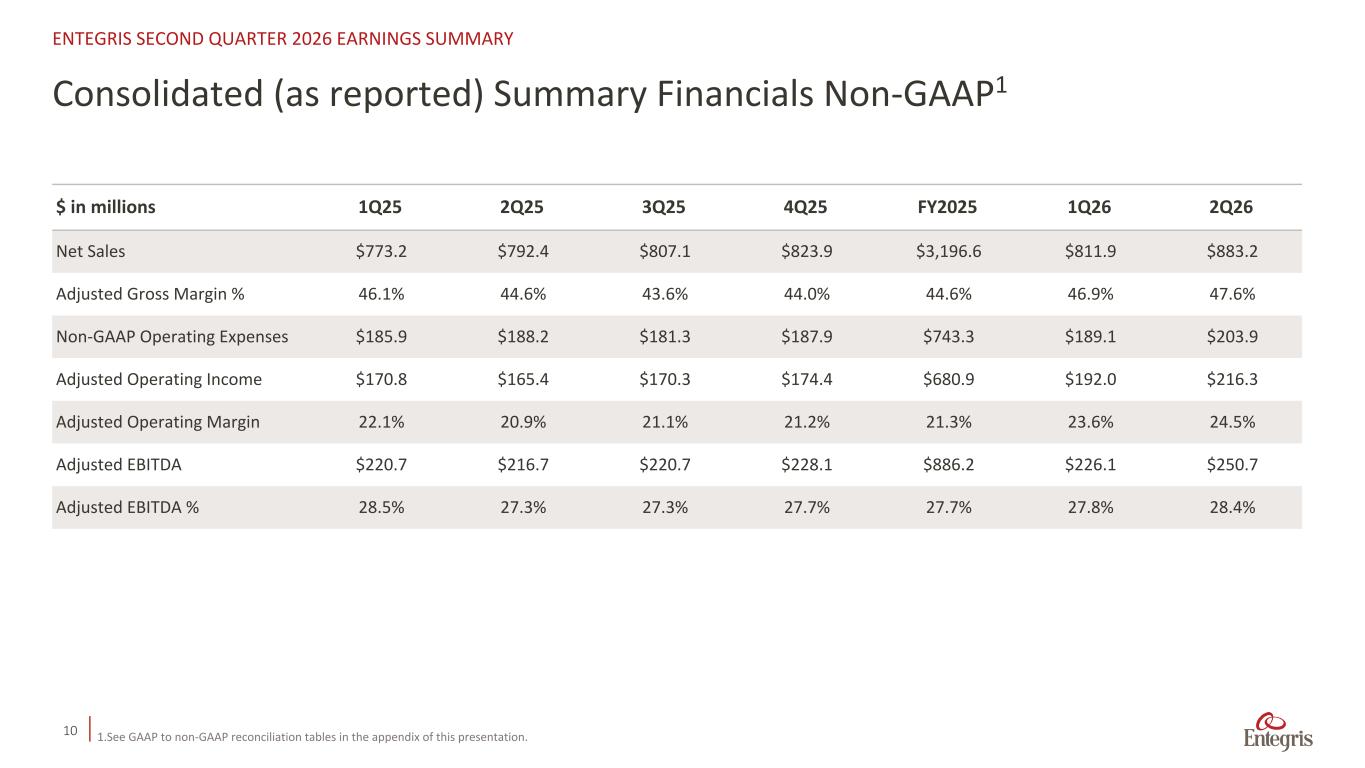
Thanks, Jeff, and good morning. The second quarter was another strong quarter for Integrus as we continued to capitalize on accelerating AI-driven demand and a significant and growing investment across the semiconductor ecosystem. We exceeded our guidance ranges on all metrics. Revenue growth of 11% year-over-year was above our guidance range, driven by double-digit growth in both our unit and CapEx-driven businesses. Throats margin improved sequentially as our operational initiatives gained momentum and strong free cash flow generation further enhanced our balance sheet and financial flexibility. Our performance reflects both improving market conditions and our focused efforts to strengthen and invest in our core semiconductor businesses. With these investments and our continued execution, Integrus is well-positioned to accelerate growth, expand profitability, and drive long-term shareholder value. Unit-driven revenues grew 10% in the second quarter. Technology transitions continue to increase the material content required to manufacture at the leading edge. This increased intensity is visible in the strong growth in liquid filtration, CMP, in particular pads, advanced deposition materials, and selective etch chemistries. Notably, liquid filtration delivered its fourth consecutive record quarter. CapEx-related revenue increased 15% year-over-year in the second quarter, driven by significant growth in FOOPS and broad-based strength in gas filtration and purification solutions. We continue to see customers accelerate investments to support AI infrastructure with increasing activity across advanced logic, HBM memory, and advanced packaging ecosystems. Bookings across our CapEx-oriented businesses strengthened throughout the quarter, driving backlog levels higher and providing greater visibility into customer spending plans. We believe these trends reflect the early stages of a broader semiconductor investment cycle, one that should benefit Integris through both the construction phase and the subsequent ramp to high-volume manufacturing. With increasing visibility into accelerating customer demand, we are proactively scaling ahead of the market, unlocking capacity, expanding capabilities, and strengthening supply chain readiness. As demand continues to build across areas such as filtration, specialty coatings, FOOPs, and CMP, the visibility we have enables us to identify emerging constraints early and take targeted actions to increase throughput and unlock additional capacity before they become limiting. Leveraging our existing global footprint and prior capacity investments, we are well positioned to meet customer needs, support technology roadmaps, and capitalize on the opportunities ahead. Turning to profitability, adjusted gross margin was another highlight of the quarter, exceeding our guidance range and reaching its highest level since early 2022. The improvement reflects stronger operational execution and the benefits of actions we have taken over the past several quarters to simplify and optimize the business. We also continue to sharpen our strategic focus and footprint during the quarter. given the significant and increasing semiconductor demand we decided to exit our life sciences fluid management business in the u.s concentrating resources on our core semiconductor businesses additionally we announced plans to close our logan utah facility our third diluted facility rationalization since late 2025 further streamlining our manufacturing footprint without impacting the availability for our core semiconductor market. These combined actions underscore our disciplined approach to portfolio management and our commitment to concentrating resources in an area where we have the greatest opportunities for long-term growth, differentiation, and value creation. Free cash flow was another highlight of the quarter, reaching $120 million, or 14% of sales. This performance was driven by higher earnings and disciplined working capital management, resulting in a greater than 10% year-over-year improvement in our cash conversion cycle. The strength of our cash generation enable us to repay an additional $200 million of debt and reduce net leverage to 3.4 times. Given our improved earnings trajectory and cash flow outlook, we now expect to end the year with net leverage in the high two-times range while continuing to invest for growth. Turning to the outlook for our end markets. Based on current demand trends, we now expect 7% to 8% MSI growth in 2026 versus the mid-single-digit assumption we started out with at the beginning of the year. While our expectations for advanced logic and memory remain largely unchanged, we expect a mixed but modestly improving environment for mainstream logic, contributing to a more constructive outlook for the industry. The most notable change since last quarter has been the continued acceleration in semiconductor capital spending. Momentum in both wafer fab equipment and fab construction is strengthening, as evidenced by increasing project awards and backlog growth. To put this in perspective, we are currently tracking over 20 major leading edge capacity expansions globally, including approximately 8 to 10 advanced logic facilities, 7 to 8 advanced memory facilities, and 6 to 8 advanced packaging projects. We expect these investments to become a more meaningful contributor to our growth in the second half of 2026 and into 2027. The breadth of these investments is also a leading indicator of future MSI growth and reinforces our confidence in the durability of the industry's growth and the expanding opportunities for Integra's. Breaking down the specific components of our in-market mix, advanced logic, which represents approximately 40% of our revenue, remains a significant growth opportunity as demand for leading-edge compute accelerates technology migrations and increases semiconductor complexity, playing directly into Integris' strengths. we are already seeing this translate into strong results including double-digit growth in taiwan driven by both advanced node capacity expansions and higher production volumes we also increased photo filtration winds tied to euv lithography and continued to see strong demand for foops reflecting our expanding content opportunity at the industry's most advanced nodes with positions of record at the industry's most advanced nodes and a strong innovation pipeline we are well positioned to accelerate growth as customers continue to scale next generation ai infrastructure memory which represents approximately 30 of our revenue remains a compelling growth opportunity driven by ai related demand and favorable technology roadmaps similar to advanced logic increasing memory complexity tighter process tolerances and growing performance requirements are driving greater need for the high purity materials and solutions where integris is differentiated in DRAM increasing investment activity is providing greater visibility into future capacity expansions and production road maps in NAND technology transitions and layer scaling continue to support higher output and improving demand trends which we expect to lead to additional capacity investments these dynamics reinforce our confidence in the long-term growth outlook for memory and the expanding role integris plays as a critical enabler of advanced semiconductor manufacturing. Recent HBM4 and TSVCMP wins, along with approximately two times year-over-year growth in molybdenum precursor demand, are further evidence that increasing memory complexity is translating to greater content opportunities for integrists across next-generation AI memory architectures. And lastly, mainstream logic remains mixed, and while modestly improved compared to last quarter, it continues to lag leading-edge markets. To summarize, the next phase of semiconductor investment cycle is underway, supported by healthy unit demand and accelerating capital investment activity, creating multiple growth vectors for Integris through the second half of 2026 and into 2027. Second, our technology leadership positions across key product lines, including CMP and selective etch processes, filtration, and purity solutions in FOOPS, combined with our growing presence at the industry's most advanced technology nodes, continue to strengthen our competitive advantage, increase our strategic importance to customers, and provide additional content opportunity. Finally, execution remains a key differentiator. We are expanding capacity and margins, strengthening cash generation, simplifying the portfolio, and enhancing financial flexibility. While proactively investing in next-generation products to meet increasingly stringent customer demands and capture future growth opportunities. These trends reinforce our confidence in Integris' long-term growth algorithm of above-market growth and margin expansion. Our technology leadership, expanding advanced node exposure, and discipline execution are positioning Integris to become the foundational materials platform, underpinning the build-out of global AI compute infrastructure. Our strong results this quarter are a direct reflection of the dedication and execution of our employees around the world. Their commitment to serving customers, advancing innovation, and operating with discipline continues to differentiate Integris. With that, let me turn the call over to Suthi to discuss the financials.
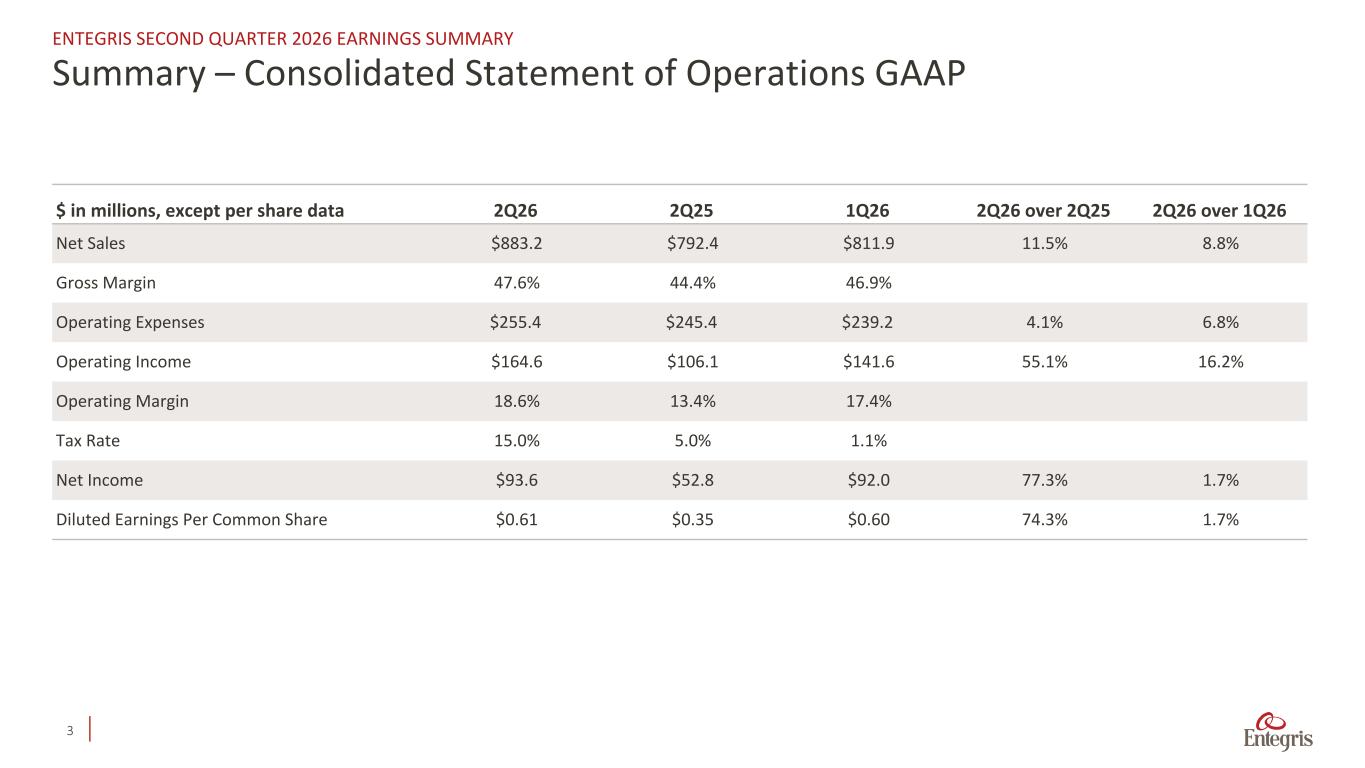
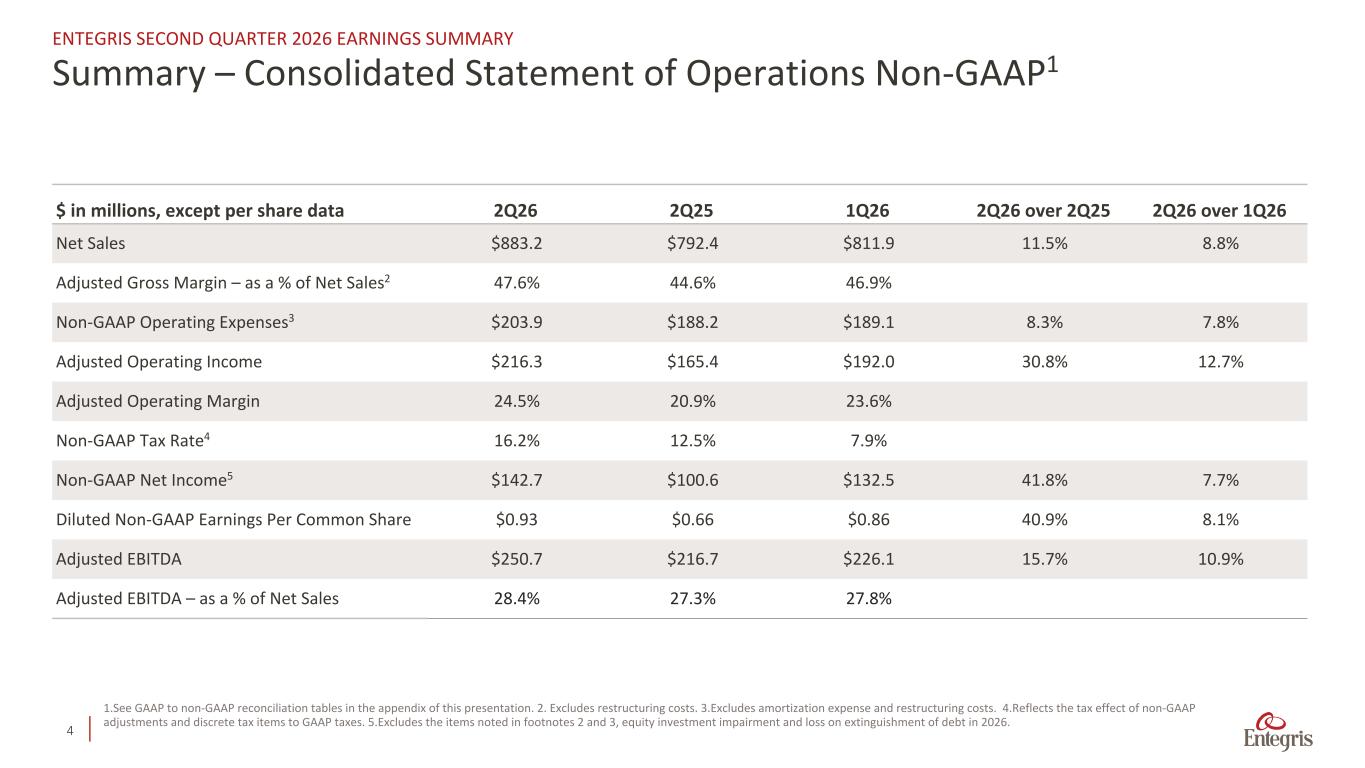
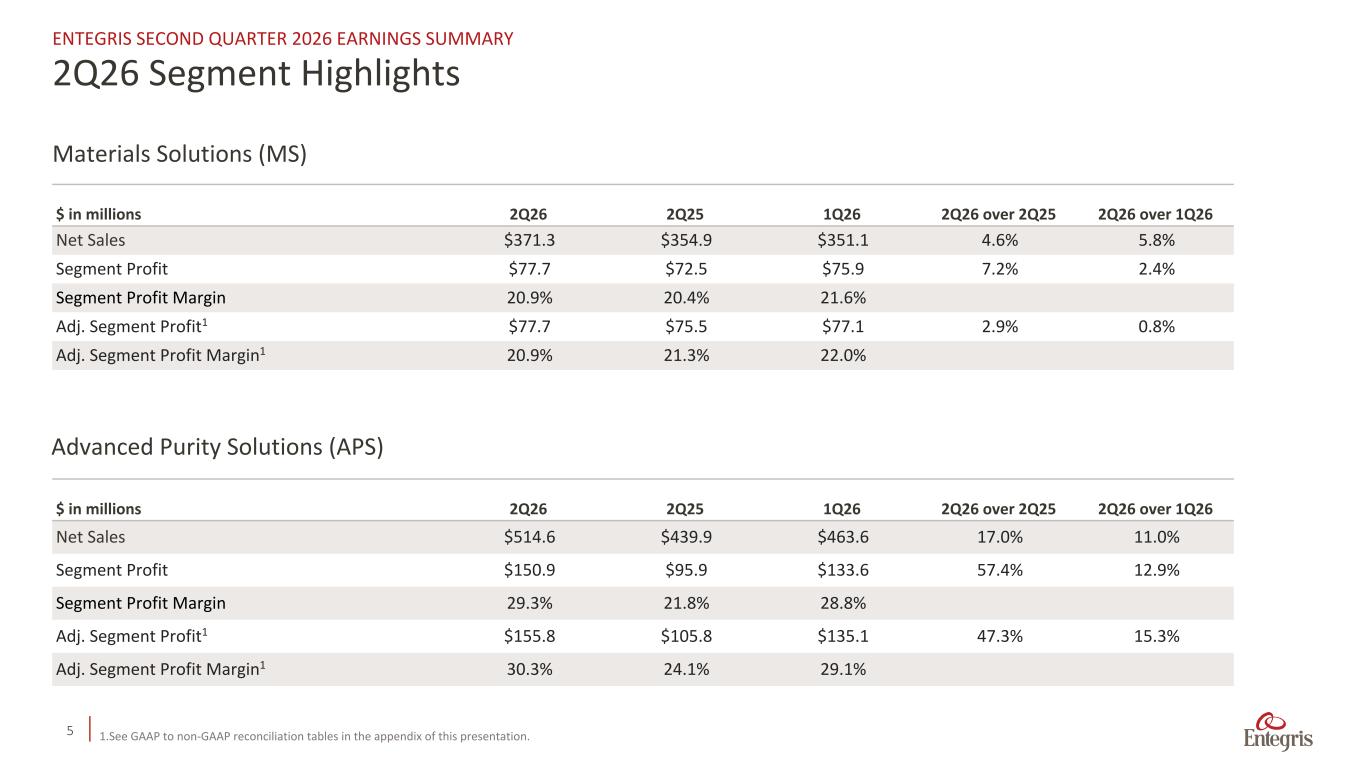
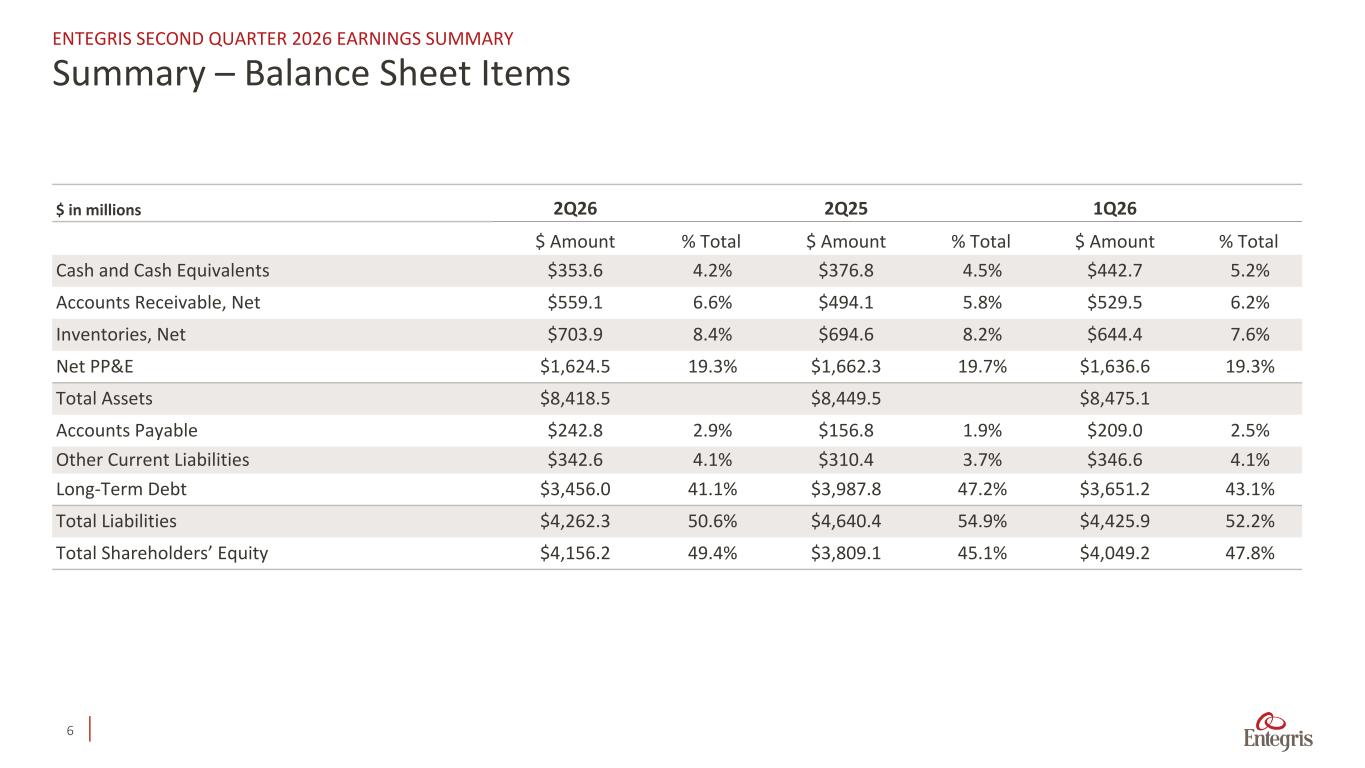
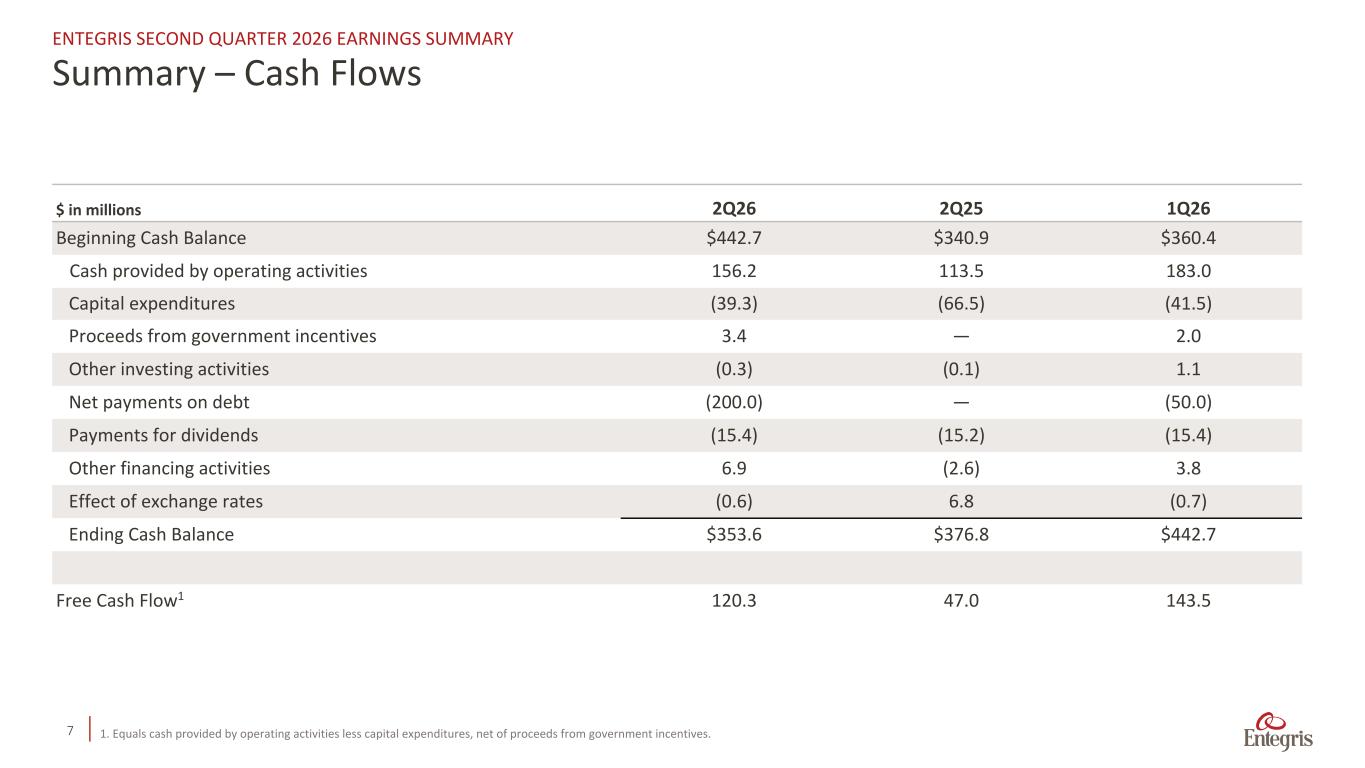
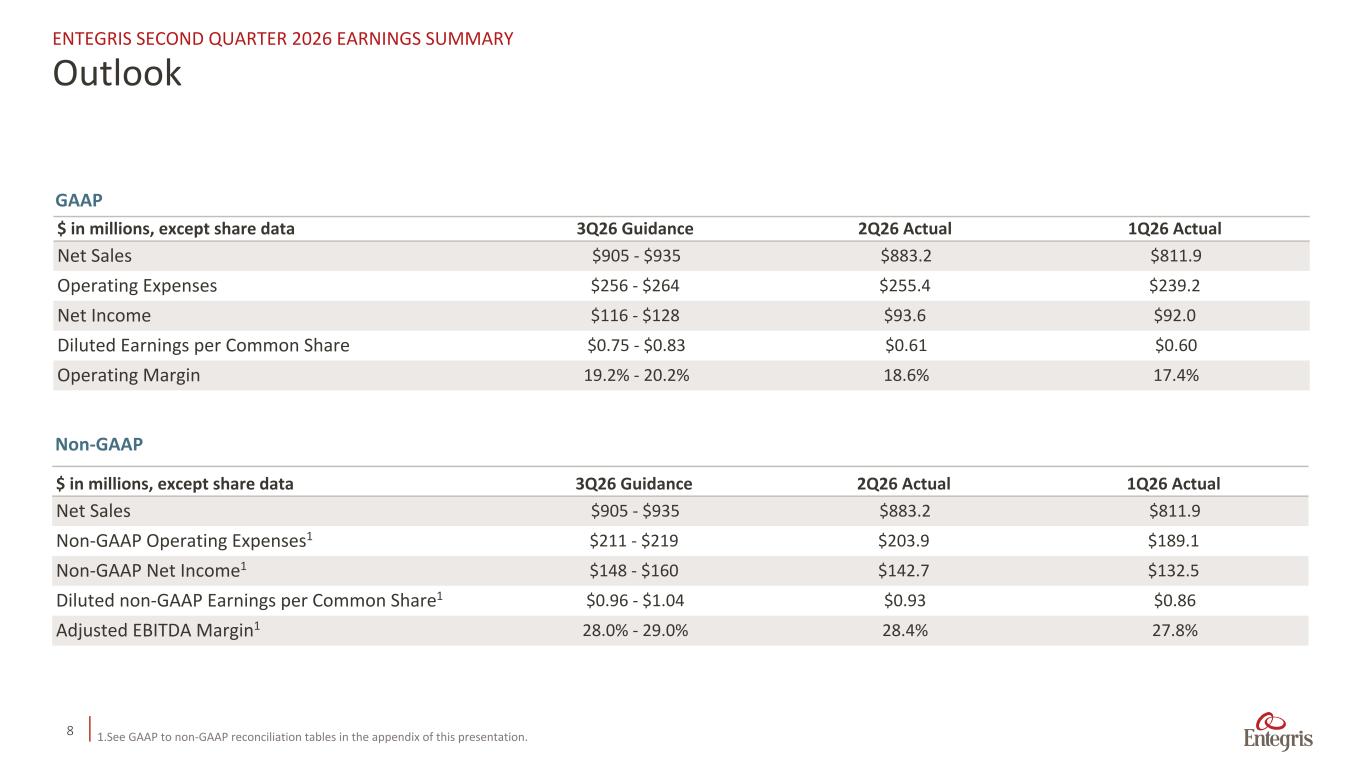
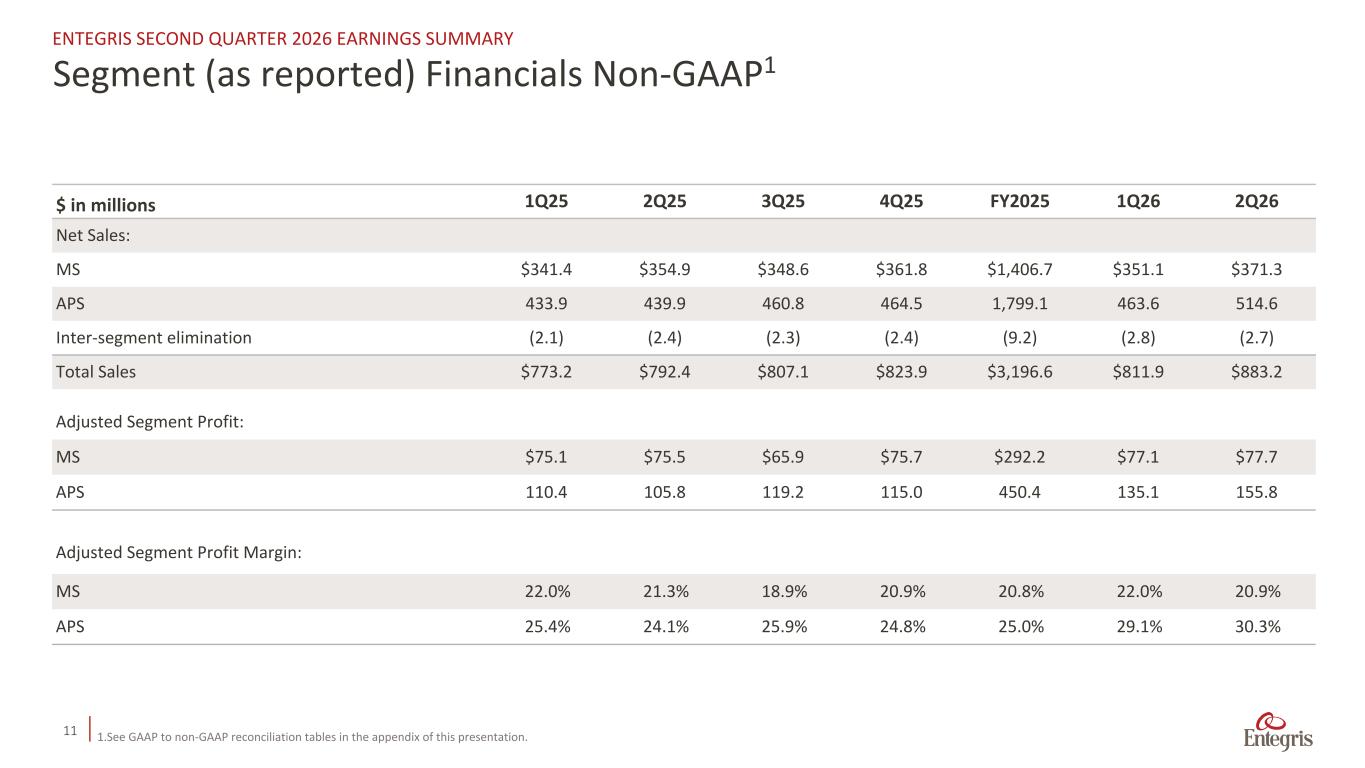
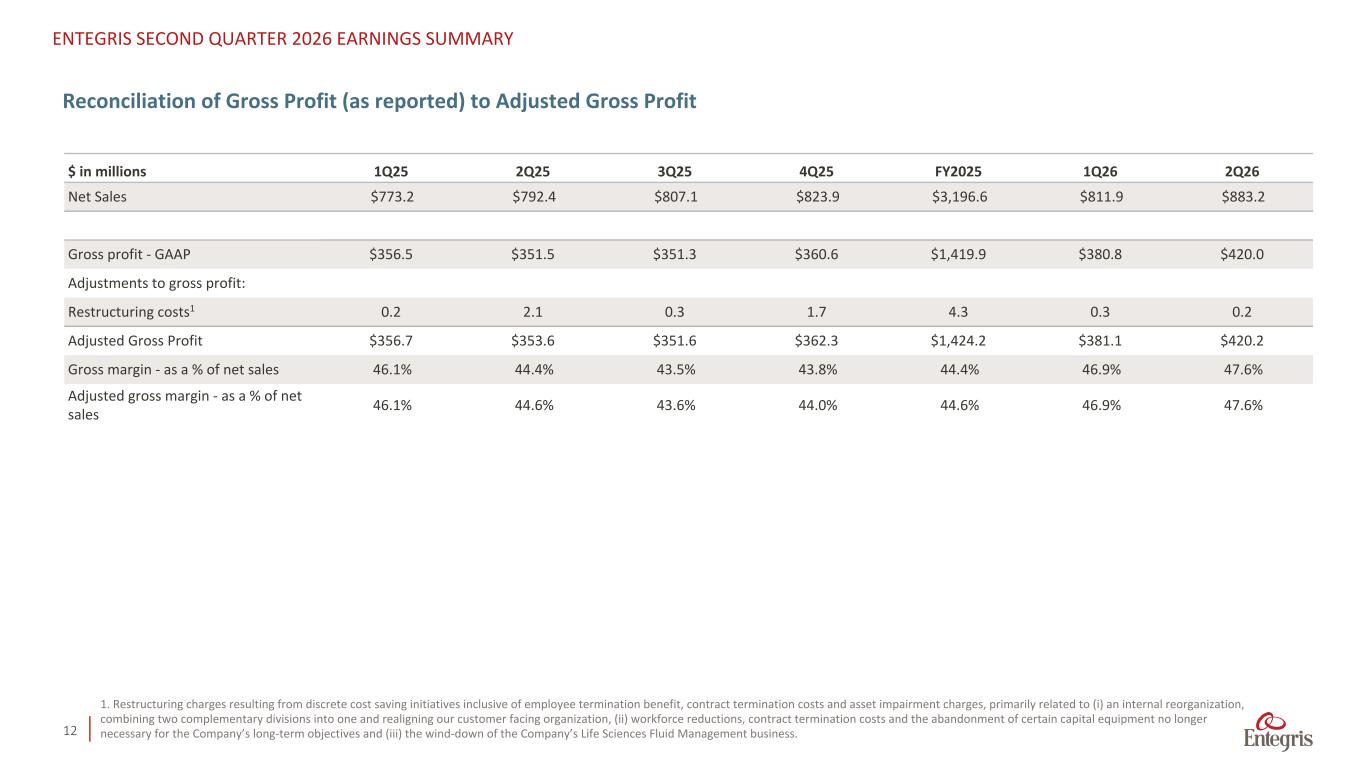
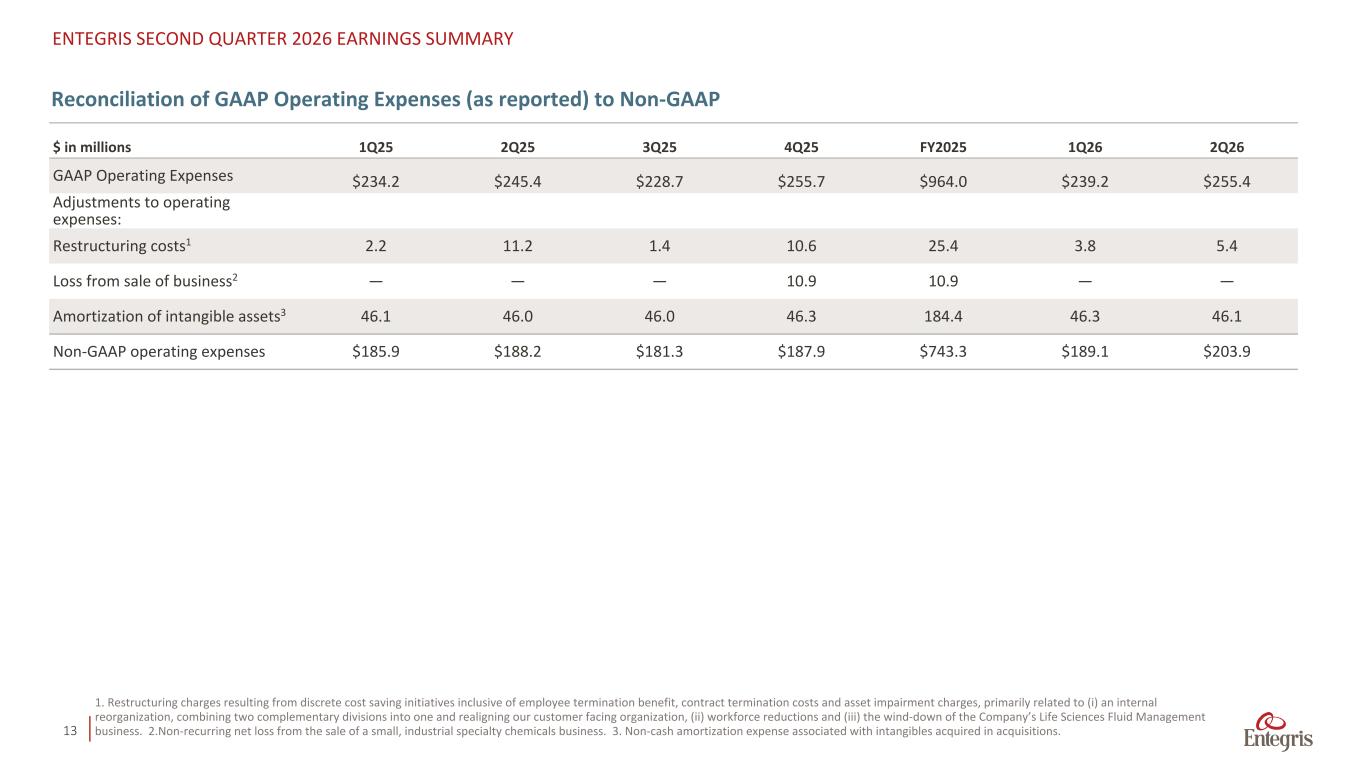
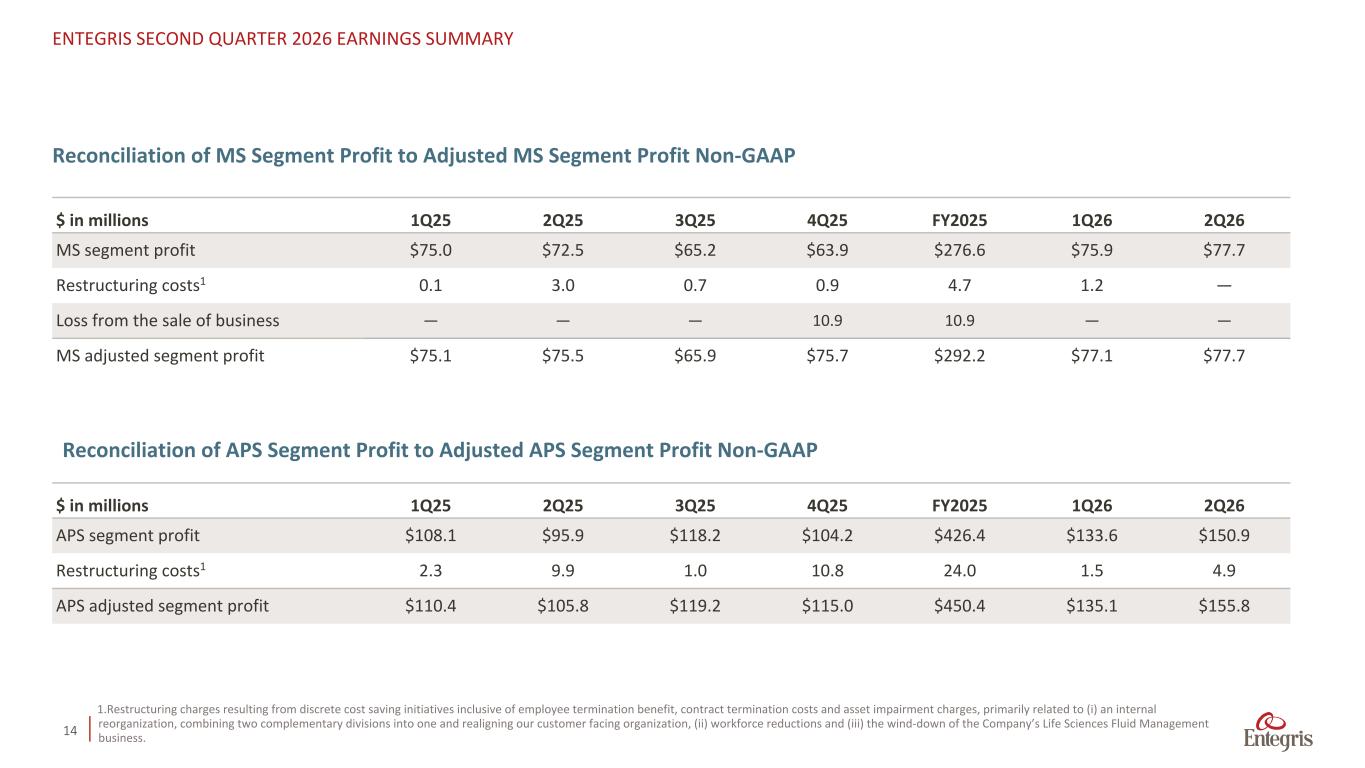
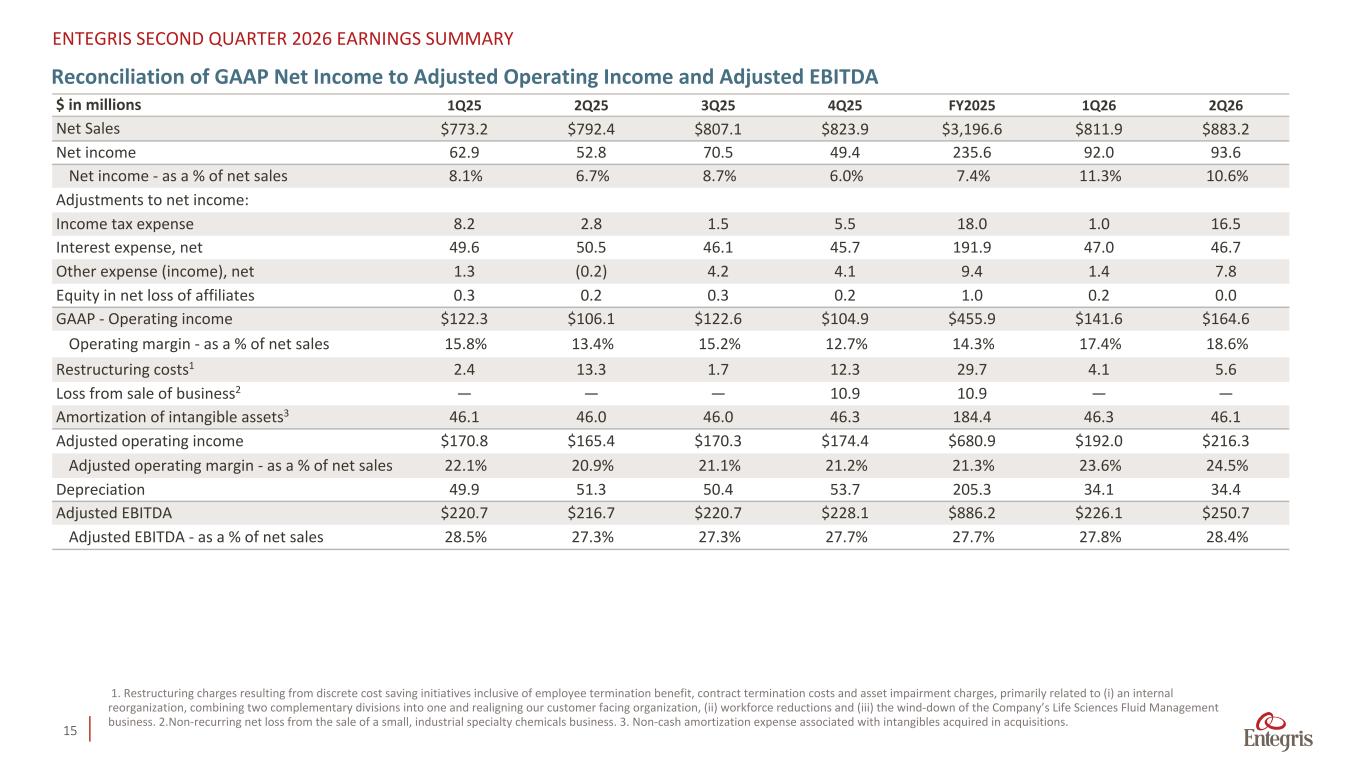
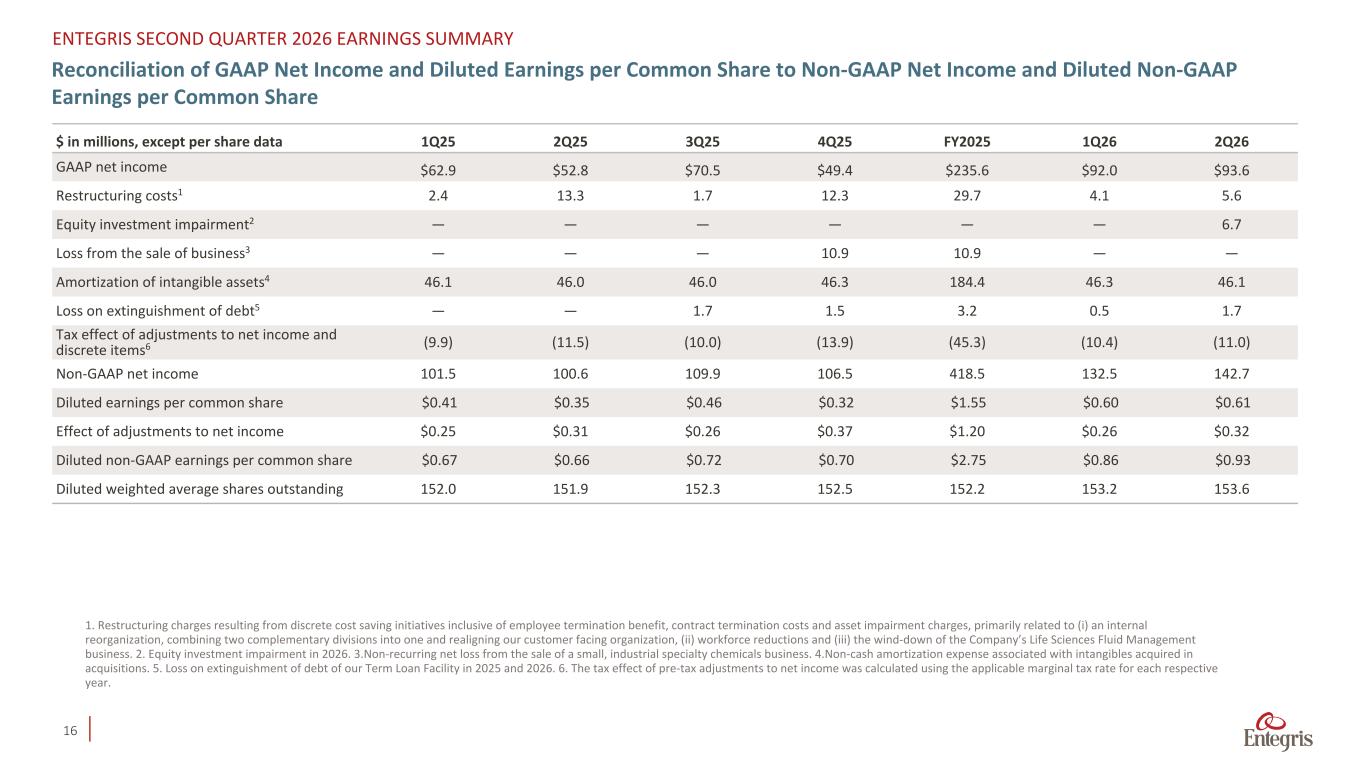
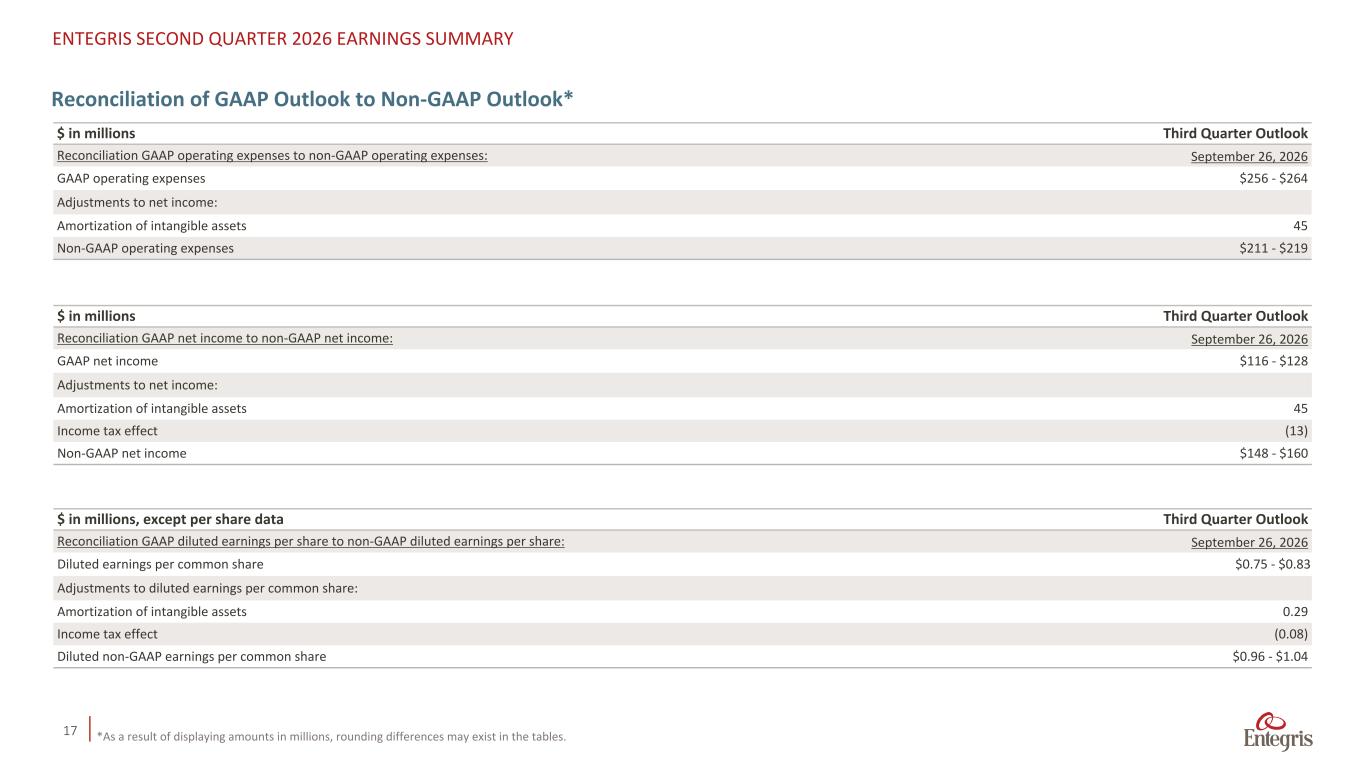
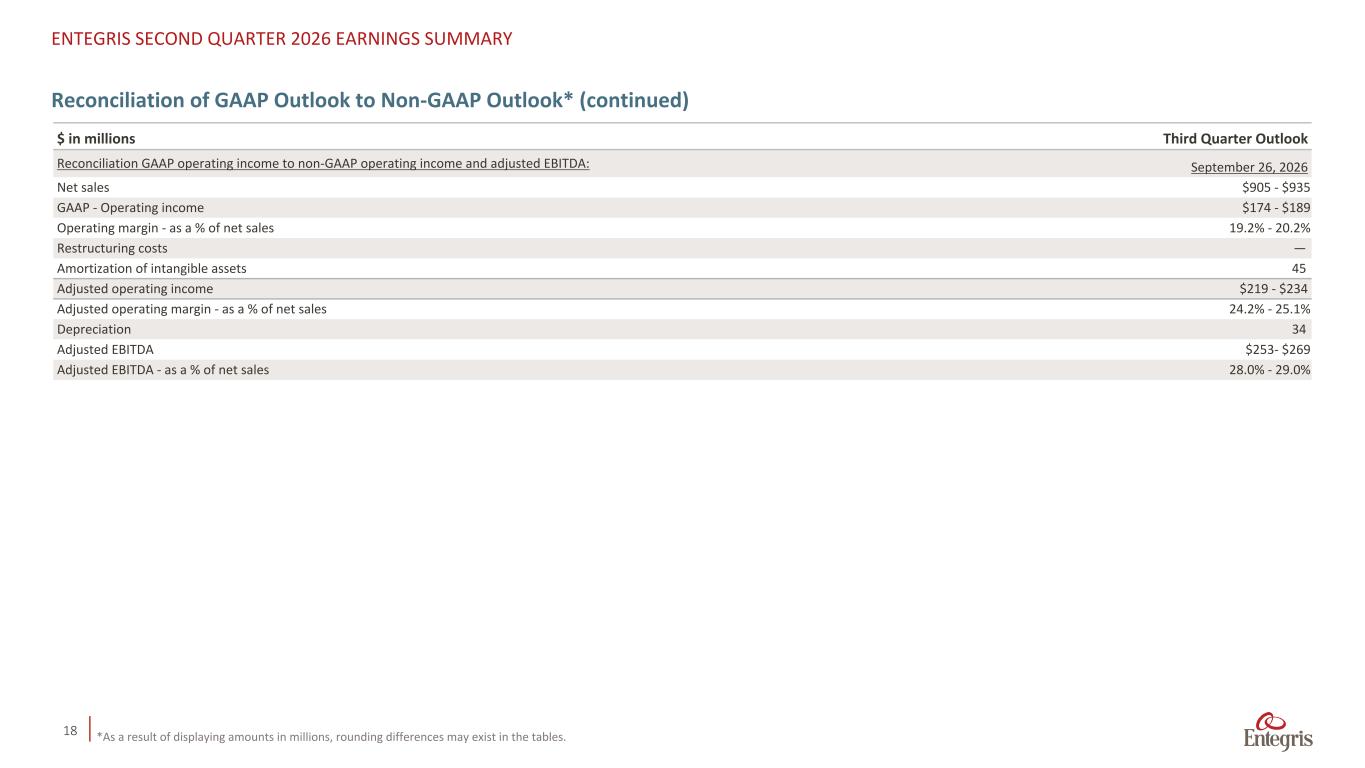
Thanks, Dave, and good morning, everyone. I'm thrilled to be joining Integris at such an exciting time for the company and the industry. The combination of market leadership and technology, strong customer partnerships, and significant growth opportunities ahead reinforces my confidence in the long-term potential of the business, and I look forward to working with the team to help unlock that potential. Q2 sales were $883 million, an increase of 11% year-over-year and above our guidance range. Our GAAP net income was $94 million, and our adjusted net income was $143 million, an increase of 42% from a year ago. Both top and bottom line metrics were above the high end of guidance. Gross margin on a GAAP and non-GAAP basis was 47.6%. The sequential improvement reflected continued progress in operations, even as we continued to invest for growth. We have increased our factory direct labor a double-digit percentage from Q4 that will help unlock additional capacity. We expect to build on this momentum as the year progresses. Operating expenses on a GAAP basis were $255 million in Q2 and $204 million on a non-GAAP basis or approximately 23% of sales. The majority of the year-over-year increase is driven by higher variable compensation associated with the stronger business performance. Adjusted EBITDA in Q2 was 251 million, or 28.4%, also above our guidance range, as the benefit of higher gross profits flowed through. The GAAP tax rate in Q2 was 15%, and the non-GAAP tax rate was 16%. GAAP diluted EPS was 61 cents per share in the second quarter, and non-GAAP EPS was 93 cents per share. Now, switching to our segments, Material Solutions delivered second quarter sales of $371 million, up 5% year-over-year, driven by advanced deposition materials, selective etch chemistries, and CMP. Growth in Material Solutions accelerated from the first quarter, and we expect the MS segment to deliver double-digit year-over-year growth in the second half of 2026, benefiting from increased demand across deposition, CMP, etch, and implant materials product lines. MS adjusted operating margin was 20.9% in line with the prior year. Higher raw material and logistics costs together with planned investments in direct labor associated with customer demand were largely offset by improved manufacturing performance and productivity initiatives across the segment. APS delivered Q2 sales of $515 million, up 17% year-over-year, driven by strength across both unit-driven and capex-related demand. Liquid filtration had its fourth consecutive record quarter. Our micro-environments business, led by FOOPS, delivered its strongest performance in more than three years. Demand was strong in Taiwan due to expansions in leading-edge logic and advanced packaging capacity. We also saw a return to year-over-year growth in North America. APS is benefiting from multiple growth drivers. We are seeing increasing demand tied to higher wafer starts, advanced node transitions, and accelerating semiconductor capital spending. These trends are creating opportunities across the portfolio that should persist throughout this year and beyond. Adjusted operating margin for our APS segment was 30.3% for the quarter, expanding both year-over-year and sequentially. This performance reflects volume growth, favorable mix, continued improvements in operational execution, more than offsetting costs and investments we are making for the customer demand. now switching to cash flow and the balance sheet we delivered free cash flow of 120 million in the second quarter or 14 percent of sales reflecting higher earnings lower capital spending and continued working capital improvements we reduced our cash conversion cycle by approximately 20 days year-over-year and repaid an additional 200 million of debt in the quarter as a result Net leverage improved to 3.4 times, and we now expect to end the year below three times. Moving on to the details of our third quarter outlook. We expect Q3 sales to range between $905 and $935 million, a year-over-year increase of approximately 14% at the midpoint, reflecting continued momentum in the industry. Gross margin is expected to be between 47.5% and 48.5%, both on a GAAP and a non-GAAP basis, marking another improvement from Q2 and more than 400 basis points of expansion year-over-year. At the midpoint, we expect GAAP operating expenses of approximately $260 million and non-GAAP operating expenses of approximately $215 million, reflecting higher variable compensation and investments to support the growth we are seeing across our portfolio. At the midpoint, we expect Q3 EBITDA margin to be 28.5%, net interest expense of approximately $43 million, and a non-GAAP tax rate of approximately 15%. We expect GAAP EPS between $0.75 and $0.83 per share, and non-GAAP EPS between $0.96 and $1.04 per share. And we expect depreciation to remain largely stable for the balance of this year at approximately $34 million per quarter. Looking ahead to our fourth quarter revenue expectations, with our current visibility, we expect revenue to grow approximately 4% from the midpoint of third quarter's guidance range, which represents mid-teens percentage growth year over year. Finally, I'd like to update a few modeling items for the full year 2026. We expect net interest expense to be approximately $180 million, the non-GAAP tax rate to be approximately 14%, and diluted share count of approximately $154 million for the full year, and CapEx of $250 million. We enter the second half with strong momentum. Since joining Integrus, I have spent considerable time with our global teams and have seen the strength of our technology, market position, and people. my near and midterm priorities are to deliver profitable growth help drive operational excellence and allocate capital with discipline before turning the call over to questions i'd like to mention that we will be hosting our investor day on november 9th in new york city we look forward to sharing a more detailed view of our ai materials platform strategy technology roadmap and long-term financial framework seating will be limited and by invitation only registration information will follow in the coming days the event will also be
Operator
webcast live for those unable to attend in person with that operator let's open the line for questions thank you the floor is now open for questions at this time if you have a question or comment please press star 1 on your telephone keypad if at any point your question is answered you may remove yourself from the you by pressing star 2. Again, we do ask that you please pick up your handset when posing your questions to provide optimal sound quality. We'll pause for just a moment. And our first question will come from Melissa Weathers with Doshibank. Your line is open.
Hi there. Thanks very much for the question. A lot to talk about. I guess for my first question on the FAB CapEx Outlook, I was just hoping you could talk a little bit more about what you're expecting um in terms of your capex oriented business we're seeing a lot of fabs get built out um so just trying to think about how you guys are um how we should be modeling that business second half of this year and into the first half of next year that'd be helpful good morning melissa thanks for the question uh as a reminder 75 of our revenue is driven by wafer starts and 25 percent by capex within capex 10 is driven by wfe and 15 by fab construction
so tactically for 2026 as you'd expect we're seeing the greatest uplift in our capex business from wfe with our wfe order rates up at a growth rate that's very similar to the growth rate that's being reported by the WFE market, so call it 20 to 30 percent. We are seeing some benefit from increased fab construction in 2026, but the majority of that benefit will actually accrue to 2027, not into the second half of 26. So thematically, second half of 26 CapEx revenue driven by strong WFE growth, call it low double digit, very low double digit fab growth in seven to eight percent unit growth. 2027 will benefit from much stronger fab construction growth followed again by WFE as those fabs are populated with tools which will then be followed again by increased wafer unit growth that those tools process wafers. Also I'd point out that I mentioned in my prepared commentary you know we're currently tracking 20 leading edge capacity expansions in the market. That's about eight to 10 in advanced logic, seven to eight in advanced memory, and six to eight in advanced packaging. So our teams are encouraged by the industry backdrop, and we're working very diligently to ensure that we've got supply position to deliver to our customers. Did you have a follow-up, Melissa?
Yes, I did. Thank you. Thanks for all that color. Maybe we'll first welcome Suki to the call. I guess, Suki, from the couple months that you've now been in the seat, anything that's stood out to you, any strategic priorities that you've been working on? And it was really helpful to hear about some of the rationalizations and the business exit that you talked about.
So, any strategic priorities that we should be looking forward to ahead of the analyst day yeah thanks uh melissa good morning again uh look i mean uh it's less than a quarter that i've been here and my first impressions really is like you know uh the technology that we have here is critical first and foremost i'm incredibly incredibly impressed with the technology at the company very few companies can deliver the innovation and the materials science that integris can provide be it uh be it on the purity solution side or on the advanced material solution side. Second, you know, what comes to mind here is that we have pretty strong positions in the fastest growing areas of the technology space, in semis especially. And third, we have ample room to optimize and get the full entitlement out of the portfolio of assets that we have here. So those are my first impressions here, being in the seat for less than a quarter. So with that backdrop, at least, you know, what comes to me mind is, like, my near-term priorities are pretty clear. We need to help drive profitable growth, further enhance the operational excellence and efficiencies of our assets, and deploy capital in a manner where we get the best return for every dollar spent.
Operator
Thank you. Our next question will come from Elizabeth Sun with Citi. Your line is open.
Good morning. Thanks for taking that question. I guess my first question is for the full year, it's good to see our guiding Q3 and Q4 both up like 4% sequentially. So that's for the full year, are you still on track to your target model of performing the market by like three to six points? And it will be the driver to the upside to the full year outlook.
Sure. Let me take that one. Elizabeth and Suki, if you have any follow-up, please build on the commentary. For third quarter, you know, at the midpoint of our guidance, we're essentially guiding up mid-teens. That implies more than 10% growth both in MS and in APS. And so what you're seeing is you're seeing the business accelerate 5% year-over-year growth in first quarter, going to 11% year-over-year growth for the second quarter, moving up to mid-teens year-over-year growth for the third quarter. So that's the guidance through the third quarter. Given our increased order visibility and our backlog, we did want to give you at least some improved visibility for fourth quarter, very similar to what we did in last quarter. We guided fourth quarter up sequentially about 4%. We'll tighten up that guidance when we get to our third quarter call. But based upon what we currently see, even that would be up mid-teens on a year-over-year basis, again, with MS and APS both growing more than 10%. So what we're seeing is we're seeing the business accelerate. We're seeing both businesses accelerate from the first half of the year into the second half of the year. And given all the activity, both in fab construction, as well as more than 50 engineering green engagements in new projects, we think that bodes well for 2027 as well. Did you have a follow-up, Elizabeth?
Yes, thanks for the caller. And on growth margin side, we're good to see your Q2 is above the guidance. So my first question is, what steps are upside in the Q2 growth margin? And then in Q3, it's nice to see you're touching 48. I'm not asking for a new target model, but from this point, you're talking about your operational efficiency improvements, factor rationalizations. I'm curious, what is the kind of baseline growth margin we should think of at this point?
Yeah, let me maybe take, you know, the big picture and Suki, maybe you can color in some of the details. Look, we're very excited about the potential of our product portfolio. You know, I sat here in third quarter last year, and I spoke about how we had a tremendous amount of untapped capacity in the network. I talked about how we were driving kind of four things operationally, the network optimization, the centralization of procurement, improved focus on yield, and then maniacal focus on productivity. And so when you think about all of those activities that you've seen us kind of consistently drive now for three quarters. We're actually making very good progress across all of those initiatives, including closing another diluted facility or announcing the closure, I should say, of another diluted facility. So we're very, very pleased with the progression, and we think we have significant room to continue to grow from here.
Suki, do you want to talk about some of the specific dynamics q1 to q2 and then q2 to q3 yeah look i mean our gross margin improves 70 basis points sequentially and we i think it's also important to note that we delivered pretty strong incrementals despite intentionally investing ahead for demand so that the that should show that should show some proof points that we're on the right track here the underlying business continues to benefit from productivity and operational improvements and our ability to drive structurally high margins and flow through as we continue to scale. You know, look, I think underlying business continues to benefit from all of this, and I think we'll be in a position to drive structurally higher margins through the cycle.
Those are good points, Suki, and if I could just maybe build on one comment that you had. We are investing ahead so that we can unlock that capacity that I mentioned across the network. You know, for example, we've increased direct labor by more than 20 percent since the end of 2025. Again, investing ahead of the capacity and the products that will be delivered in the future quarters. So we're making good progress to unlock really the capacity that exists in our manufacturing network.
Good to hear. Thanks, Derek. Thanks, Fuki.
Operator
Thank you. Our next question will come from Timothy Arcuri with UBS. Your line is open.
Thanks a lot. I don't know, Dave, if you or Suki want to take this, but I guess my question is on the gross margin rubric. So, you dropped through between 70% and 75% year-over-year in June. The guidance for September, 75%, 80% dropped through. Are there any one-timers in there? I guess the question is, is that a reasonable drop through to use? Because I don't see any reason why you should be growing like a year from now. You should be growing any less than what you're growing now. So if I use the same kind of mid-teens, you should be, and I use that kind of drop through, your gross margin should be in the 52% range a year from now. So I guess the question is like, are there any one-timers helping your drop through right now? And is that a fair sort of mid-70s to use?
Yeah, thank you for that question. Look, I think on a year-over-year basis, there was about 150 basis points of uplift because of the useful life adjustment that we had. And so if you take that off, we did also increase margins by more than 300 basis points, excluding that. So as you look forward into next year, I think what you would know, we'll give you an update on more of our target model at Capital Markets Day. But, you know, typically, I think what you should be seeing is like incremental flow through should be in the 60 percent range. Dave, you want to add anything there?
Tim, and look, we think the right comps would be from Q1 to Q2. We had nice flow through gross profit over revenue of around 60%.
It's a similar number at midpoint from second quarter to third quarter sequentially. uh that takes out you know any kind of year-over-year dynamics uh related to useful life so we think that's probably the best comp as you as you model out into the future okay cool and then um i do i do so suki just on the q4 guidance it's i mean up four is only really in line with kind of normal seasonal for q4 so it still seems a little conservative i mean you know you guys are doing great don't get me wrong but you know up four still seems a little light are there anything, any like dynamics that you call out in Q4?
No, that's a good question. Look, I mean, it's important to put the guidance in context, Tim. Look, a 4% sequential increase in Q4 would still translate to a mid-teens year-year growth represents pretty healthy growth rate and reflects our continued momentum across our businesses. When you consider the, you know, our composition of revenue, right, 75% of our revenue tied to semi-unit growth, we expect to grow, but that's expected to grow about 7% to 8%. The remainder is tied to capital spending. So our outlook implies meaningful outperformance relative to the underlying semi-market. This is again supported by content gains we're seeing, technology transitions, and our exposure to some of the leading edge pure play AI enablers. Dave, you want to add something to that? Well said. Thanks, Tim. Thank you, Tim. Thanks.
Operator
Thank you. Our next question will come from Bavesh Lodea with BMO Capital Markets. Your line is open.
Hi, good morning, Dave. Maybe on the strong growth that you are seeing in liquid filtration, could you add some more color as to maybe the regions that this is coming from? Is it playing a role in this as well?
You know, when you look at liquid filtration as, when you think about how important microcontamination is to the most advanced nodes, once you get down to, you know, sub five nanometer and down to two nanometer, I mean, two nanometer is 20 angstroms. And, you know, depending on the size of the molecule, you can have molecules that are five angstroms. And so purity is becoming increasingly critical at the most advanced nodes of manufacturing. And so you've seen liquid filtration kind of grow disproportionately as more production capacity is added to the most advanced nodes. And that's That's true the most in advanced logic, but it's also becoming increasingly true across memory and in limited examples across advanced packaging as well. So as the market expands capacity at the most advanced nodes, it drives tighter requirements that drives a greater need for filtration. With respect to operating sites like KSP, you know, we produce the majority of our filters kind of across three sites, one in North America, one in Japan, and obviously KSP in Taiwan. KSP, I would categorize as on track. We are on track perhaps to break even this quarter, you know, probably a little bit ahead of schedule. But KSP, I would color green and I would count that as on track for 2026. We're through a lot of the qualifications. There's still more to come, but we're basically now into the ramping stage of KSP. And when you think about ramping KSP, you're going from essentially a facility that, you know, was was losing money on a standalone unit of one basis to essentially what would be kind of break even touch wood here in the third quarter, certainly in the second half of this year. And then as we move and migrate into 2027, it'll move into the diluted category and then ultimately into the enterprise average gross margin category. So making good progress, and I would color KSP as being on track, and it is participating in some of the liquid filtration ramp that we've spoken about. Did you have a follow-up, Bhavesh?
Yes, please, and great to hear on KSP. For the follow-up, Dave, you have mentioned before that the business is around a billion dollars of incremental sales capacity without adding more plants or more capacity there. Is it possible to break that billion dollars between the consumable side and the CapEx-exposed part of the business? My guess is given how the CapEx business has performed over the last few years, you probably have more capacity than the 25% mix that you have for the business.
You know, I actually don't have the breakdown off the cuff between units and CapEx. You know, what I did mention last year was that we had significantly greater than a billion dollars. So I wouldn't I wouldn't just limit it to a billion dollars of incremental capacity in the network. It's it's more than that. It is broad based. It is across units and CapEx. I don't know that split off the cuff, but I can tell you, as I sit here today, we have increasing confidence that we can satisfy the vast majority of the demand that we see in front of us with the current manufacturing network with limited capital investments from here. So we have to do some things. We have to spend some money ahead to unlock that capacity. But by and large, we believe that we can satisfy the current demand that we have visibility to through the current manufacturing network.
Operator
Thank you. Our next question will come from Jim Schneider with Goldman Sachs. Your line is open.
Good morning. Thanks for taking my question. Clearly, the outlook for WFE growth continues to get more constructive for 2027. I think, Dave, you referenced the fact that your capex-related business, given the fab construction profile, could start to outpace – the construction piece could actually outpace growth next year. So I'm wondering, you know, were there some of the reasons why your CapEx-related business, that portion of the business, would or would not exceed WFE growth for 2027?
It's really just the timing, Jim. You know, if you think about the 25% of our business that is CapEx, 10% of it is WFE-driven, 15% of it is fab construction-driven. And, you know, we we don't we don't get revenue on time zero of a fab construction. So we don't get revenue when you kind of move dirt, pour concrete, play steel. We get revenue kind of 12 months post that. Once you start facilitizing the fab, then we get another slug of revenue as you're taking that process piping to tools. Then we get another slug of revenue with the tools, with the placement of those tools. And then finally, we get the unit volume at the end. So kind of a slug of revenue, let's round and call it 12 months. Another slug of revenue around 18 months. WFE around 24 months and units thereafter. And so really the fab construction piece, given all the fabs that we're currently tracking, assuming that they move into the construction build out and tooling stage we think timing wise that you kind of migrate from second half of 26 being more wfe driven to perhaps 27 being a bit more fab construction driven towards the end maybe a bit more wfe wfe continues to be strong obviously but then you start to get units out probably in in 28 so we think we kind of have these three waves of demand, if you will.
That's a very helpful color. Thank you. And then maybe as a follow-up, Dave, when you took over as CEO, I think you sort of referenced the fact that you would be looking at different elements of strategy, including your sales strategy, and maybe thinking about entering parts of the market or being more aggressive in parts of the market where you hadn't been previously. Can you maybe give us sort of an update on the overall sales strategy now?
Sure. Yeah, we have an enterprise sales team now that sits at the corporate level, which tracks all of our opportunities across kind of our top 35 customers, which represent the largest portion of our business. We've looked at all of those customers. We've tracked our product line placements within each one of those customers and have developed very detailed plans, specific customer by customer, to then go forth and kind of penetrate those accounts in greater volume with also more product line coverage. So that's the high-level kind of sales strategy that's somewhat different than what we had done historically. In terms of portions of the markets that we're interested in, we're going to color in the lines a little bit more at Capital Markets Day. So we hope to see you in November at Capital Markets Day. But we've talked about, for example, advanced packaging. That's an area where historically the company has not played in a significant way. We've always been more front end of line focused in the fab. As you know, advanced packaging is growing incredibly quickly. There are some portions of that market that are not as attractive to us, but there are also some portions of that market that are attractive to us. We have about $100 million runway, plus or minus, in that portion of the market today. That's an area that we would like to see our business grow more quickly, as well as have more product placement across categories in that portion of the market. So we'll color in more of the lines at Capital Markets Day, but an enterprise sales strategy, customer-by-customer plan across all product lines, not just a few product lines, deep customer engagements from an R&D perspective, more than 50 projects in flight, and then, of course, some attractive SAMs that are growing quickly, example of being advanced packaging that we're looking to penetrate a little bit more deeply in the future. And with that, maybe I'll end it there, and we can color in more of those lines at Capital Markets Day. Thanks, Jim. Thank you.
Operator
Thank you. Our next question will come from Charles Shee with Needham. Your line is open.
Thanks for taking my question, Dave and Asuki. Maybe the first question, by now, I mean, a lot of your customers, customers, or maybe customers, fab customers, are signing LTAs, et cetera, securing pricing with the customers, their customers. But wondering from a materials perspective, from your perspective, any opportunity for you, for your industry to really think about, maybe you should sign LTA as well, and maybe you should discuss pricing with those customers and maybe capture what's the fair value for companies like Integra's?
Thanks, Charles. We do have some supply agreements with our customers. I would say we've been approached more recently to engage in more supply agreements, given the current demand environment, and that's an area that we're certainly looking at very closely, not only from a pricing perspective, but just from a supply perspective. You know, our number one business priority at this stage is to make sure that we can support our customers through this period of accelerating demand. We will ensure that we are appropriately compensated for the value, capacity, and technology that we provide. But our number one priority right now is making sure that we can unlock the manufacturing network that I've spoken so much about and then be able to get that fixed cost absorption, get that volume, and provide the products that our customers desperately need as they engage in their ramps. You know, as I mentioned, we're currently tracking more than 50 engineering projects with customers. These are long-term engagements. There's more than 20 advanced fabs that are being built. And so while our guidance today doesn't contemplate material pricing, we are confident that we will be compensated for the value that we bring. Did you have a follow-up, Charles?
Yes. Thanks, Dave, for the color on pricing on LTA and all those stuff. I want to ask you a product question. I know, I mean, uh from time to time asking a question about the single product is kind of tough um but for what it's worth molly has been a focal point uh in a lot of the investor discussion for whatever it's worth again but um the we are we've been hearing from some of the equipment companies that uh at least there's a third uh equipment companies entering the molly uh deposition at these in the memory space, want to get your thoughts on overall Mali growth, what you're seeing today going to next year, and more importantly, looks like now it's three OEM equipment companies in the race.
Are you agnostic relative to the puts and takes of the market share uh among those three thank you yeah thanks charles um but molly we we haven't we we've have not seen um in the wild the uh the third entrant in a meaningful way as of yet um it's largely a two-horse race uh as we see it right now obviously we're we're we're staying close to this market you know molly is up significantly on a year-over-year basis i don't have the exact number in front of me for second quarter but i think the number was was more than 20 percent on a year-over-year basis up in the second quarter memory volumes are starting and i'm referring to nand are starting to to grow to kind of the the high 200s or the 300 plus layer count which is what's driving that need for molly we believe we are very well positioned there we have you know molly is a it's a unique and a novel chemistry and it's a new chemistry for the memory market it's a chemistry where you not only have to deliver a delivery cabinet it that has very stable pressure with a molecule that is incredibly aggressive from a process piping perspective, but you have to sublimate a solid into a gas and deliver it at pressure and at temperature to get the right performance out of the memory process. So we're very close with our position. We think overall it probably doubles for us on a year-over-year basis, 26 versus 25. And we're happy with the performance and the hard work the team's doing. Thanks, Charles.
Operator
Thank you. Our next question comes from John Roberts with Mizuho. Your line is open.
Thank you. Maybe you could back up a little bit and tell us where you are overall all in your footprint optimization program? You took a couple actions in the quarter, but put that in perspective for us in terms of what's to come.
Sure. Let me maybe broaden it out and talk a little bit about what are we trying to drive overall for manufacturing and operations. We have network optimization, which is the rationalization that you reference. We have centralizing procurements, which is driving more leverage throughout our total procurement supply chain. We have maniacal focus on driving yield, reducing scrap, improving throughput through those activities, and then, of course, productivity, and productivity is measured across both people as well as machines and tooling. And so those are kind of the four very high-level work streams that we have been working on now for almost a year, coming up on a year. We're making good progress across all of those. All of those have meaningful potential to expand gross margin or expand profitability while driving reduced future capital investments. So increasing units, driving increased profitability by using the same kind of fixed footprint. So those are the big efforts. In terms of additional rationalization, demand remains strong. We mentioned that demand increased materially in the middle of the first quarter and that we were taking a little bit of a pause on rationalization until we determined exactly where that demand signal settled. Demand increased again in the second quarter. And so I'll kind of play back the commentary from the first quarter that, you know, we're going to kind of carefully evaluate right now where this demand signal settles, because right now the demand profile is continuing to increase from a level that we thought was already elevated in Q1. So no additional plans at this time for incremental network optimization. We still have roughly 35 manufacturing facilities. We will utilize them all to the fullest extent. And then to the extent that we see opportunities in the future, we'll come back and update you at that time. Did you have a follow-up?
Yeah. And then as the balance sheet continues to improve, how are you thinking about bolt-on M&A? There's still a fair amount of white space across your customer needs.
Yeah, Suki, feel free to chime in on this if you'd like.
Sure. I mean, our immediate near-term focus really is on reducing our leverage. We have a clear path, right? I mean, so as we mentioned in our prepared remarks, we will get to under three times net leverage by the end of this year. In fact, we were actually, in the month of July, we repaid another $25 million dollars a debt. So that still remains our top priority. But overall, look, I mean, the way we look at investments here is relative to our cost of capital. We'll look at internal investments and the return we get from those type of investments. And then we'll look at CapEx-related investments. And then finally, external M&A. Each one of them has different risk profiles to it, but we'll be looking at each one of these areas with the view of actually getting the right type of return for each of the investments.
Dan, if I could just build on something that I'm incredibly excited about. The rate and pace of deleveraging is happening significantly faster than I expected. I never anticipated that I could sit here on this call today, here in August and be able to tell you that we expect to end the year with a net leverage ratio that starts with a two. That was an expectation that I did not have starting this year. And so the team has done a great job driving expansion and gross margin. They've taken that gross margin all the way down to net income. And even better, they've taken it all the way down through free cash flow through a lot of the work that's been done on the working capital side and so i expect that that great work to continue the reward for for good work is even more work and we're going to work very very hard in the second half of this year to continue to drive free cash flow to reduce continue to reduce our leverage and then as we do that it opens up a lot of opportunities as suki mentioned thank you thank you our next question comes from mike harrison with Seaport Global.
Operator
Your line is open.
Hi, good morning. One of your competitors today suggested that they think they're seeing some share gains in CMP slurries and cleans. I was hoping that you could talk a little bit about how you're seeing the competitive environment within CMP and whether you think you're encountering any share shift one way or the other.
We feel good about our CMP business. We've got nice growth rates in CMP. We actually think that we have some very market leading growth rates in pads. We think we're successfully growing, expanding, and defending plans of records and slurries. And so when you look at our CMP business overall, we're quite pleased with that that trajectory including some of the inroads into advanced packaging that you know that weren't in place a year ago so you know overall we feel we feel good about about our cmp business and as we mentioned uh you know ms is a business that's accelerating uh as we go through the course of this year expecting more than 10 growth in the third quarter and implying more than 10% of growth again in the fourth quarter. And so very happy with the MS business overall, and then specifically with the CMP business. Did you have a follow-up?
Yeah, my follow-up is specific to the molybdenum business. You talked a little bit about that, the growth that you're seeing there, but I'm curious. You've talked in the past about the need to optimize the CMP solution as well as selective etch and maybe some of the filtration components around that. Are you seeing that customers are adopting that full optimized suite from Integris or are they picking and choosing different suppliers for the different aspects of molybdenum deposition at CMP?
Look, specifically for molybdenum, the majority of the envelope tends to sit around the distribution cabinet that I mentioned and the actual molecule itself. The other portions of that process, as you mentioned, both the etch uh as well as some of the follow-on processes um those are those are by and large um those are by and large separate buying centers today thank you our next question our next question comes from chris parkinson with wolf research your line is open great thank you so much just in terms of what you're expecting the second half on a sequential basis uh both 3q and 4Q, could you hit on your expectation for mainstream operates into the second half of
the year, and then as well as HBM as it pertains to memory, just any color there would be greatly appreciated. Thank you.
Yeah. You know, mainstream demand remains mixed. There's memory related pressure on some of the consumer markets, but that's offset by its strength in some of the AI related applications like power management and silicon photonics. So we see mainstream as improving, but still somewhat mixed because obviously there's a lot of consumer related markets, mobile being a great example, that sit within mainstream and the memory pressure on those markets not to be discounted. We think foundry utilization in the mainstream has improved to probably 80% to 85%, depending on exactly on, you know, which mainstream provider you're looking at. But I do agree. I think the direction of travel seems to be modestly higher. So I think our view on it is just that it's slightly improved compared to last quarter, but we still expect it to be tempered and below the trend growth for 2026 and potentially longer pending the outcome of memory pricing and availability did you have a follow-up crest uh yeah just a quick one actually just uh can you give a little uh extra framework on the businesses um in life sciences that uh you are now out of in terms of just the optics uh on a segment level if you have been available thank you yeah so life sciences the business we exited uh think of it as less than 20 million of annual revenue. Think of it as being more like fluid management type products. So we still have some filtration products for life sciences. That business is still ongoing. Think of this as more fluid management in life sciences. It did have a dilutive margin, both gross margin as well as a significantly dilutive EBITDA margin. And so, given, you know, the tremendous growth in semiconductors and management time, effort, and focus, it made sense for us at this time to announce the closing of that business and the wind down of that standalone facility. Thanks, Chris. Thank you so much.
Operator
Thank you. Our final question for today comes from Edward Yang with Oppenheimer. Your line is open.
Hi, Dave, and welcome, Sookie. Nice quarter. Thanks for the time. On the MS side, it's great to see you guiding for double-digit growth in the second half, but it was a bit below industry MSI in the second quarter, and I just wanted to close a loop on that. Was that just timing? And the segment margin there was also down year over year. Do you expect margins in MS to expand in the second half as well?
Yeah, I'll talk about the growth and Suki, maybe you can comment on the margins. But for MS, yeah, it grew 5% year over year in the second quarter. MSI probably grew around 7% to 8% in the second quarter, depending on what numbers you're looking at in the market and making sure that you account for the wafer shippers versus actual wafer starts. We think we were in line, given some of the year-over-year comps related to Liberation Day last year and some of the pull forward that we saw in that business. So I would say that we grew in line with market for the MS business for second quarter. And we think based on current visibility that we will most likely grow above market in the third quarter and the fourth quarter as well. Suki, do you want to comment on the margins?
Yeah, look, on the margin side, as manufacturing here becomes really complex and customers continue to migrate to advanced nodes, the number of opportunities that the company has is continuing to expand. And we're seeing that reflected in the growing set of SAM opportunities across the portfolio. So as you would expect, we are investing accordingly in areas where we see significant long-term growth in the MS division. And that includes capabilities such as MOLI precursors and other high-value opportunities. So operating leverage we're generating right now is being intentionally – we are seeing intentional reinvestment to support future growth, and you should see that earnings power start to increase over time.
Edward, did you have a follow-up? Yeah, I do. So, Dave, coming back to your comments around advanced packaging and understand you'll provide more detail at Analyst Day, but it didn't sound like you're interested in acquiring a bigger footprint there. So I was just wondering how quickly you could scale that business organically from that $100 million revenue run rate.
Well, we never said that we won't comment on acquisitions either way, but we never said we weren't interested in looking at some businesses in that space. I think when we look at the advanced packaging market, though, it's still being defined. So even today, you still have changes in materials. You have changes in packaging sizes. You have changes in, you know, like real substantive technical changes with respect to, you know, thermal expansions, conductivity, attach. So there's a lot that's still to be defined in the space, and it's a very rapidly growing space. Five years ago, it was very low single digits as a percentage of CapEx in the industry, and this year it may be approaching double digits or approaching 10% in terms of percentage of total industry CapEx. So we think there are a lot of growing SAMs. We think there are a lot of SAMs that can support the type of differentiated products that we can provide. And those are the spaces that we want to target. And we think there's more than enough opportunity to target those spaces and still have the right to win without necessarily facing the incumbent advantage. So stay tuned for more during Capital Markets Day and appreciate the question, Edward.
Operator
Thank you. This concludes today's Integris Second Quarter 2026 Earnings Conference call. Please disconnect your line at this time and have a wonderful day.