Operator
Hello, and thank you for standing by. My name is Mark, and I will be your conference operator today. At this time, I would like to welcome everyone to Herc Holdings, Inc. third quarter 2025 earnings call and webcast. All lines have been placed on mute to prevent any background noise. After the speaker's remarks, there will be a question and answer session. If you would like to ask a question during this time, see the press star followed by the number one on your telephone keypad. And to withdraw your question, press star one again. And we kindly ask you to please limit to one question and one follow-up. Now, I would like to turn the call over to Leslie Hunsicker, Senior Vice President, Investor Relations. Please go ahead.
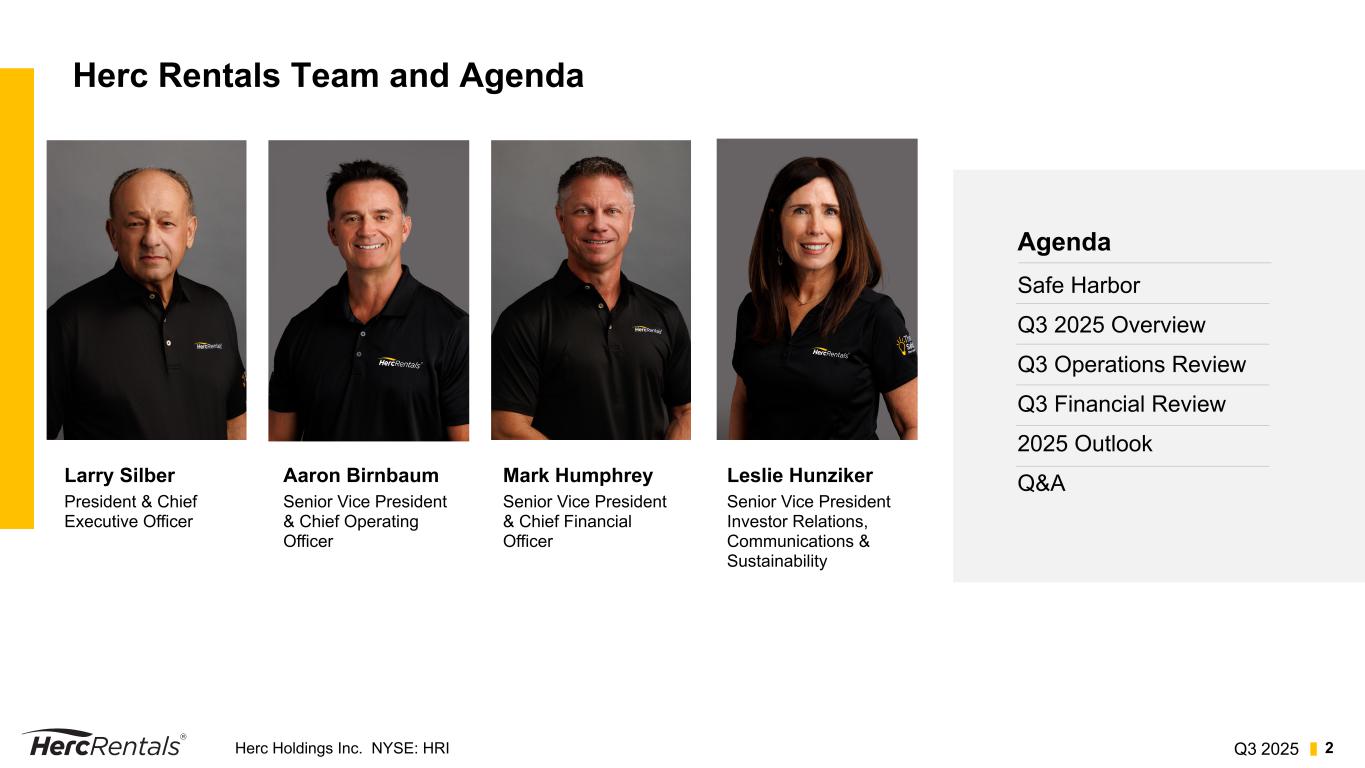
Thank you, Operator, and good morning, everyone. Today, we're reviewing our third quarter 2025 results with comments on operations and our financials, including our view of the industry and our strategic outlook. The prepared remarks will be followed by an open Q&A. Let me remind you that today's call will include forward-looking statements. These statements are based on the environment as we and are subject to risks and uncertainties that could cause actual results to differ materially from our expectations and projections. These risks and uncertainties include, but are not limited to, the factors identified in the press release, our Form 10-Q, and in our most recent Annual Report Form 10-K, as well as other filings with the SEC. Today, we're reporting our financial results on a GAAP basis, which include H&E results for June through September in the nine-month period for 2025. In addition, we will be discussing non-GAAP information that we believe is useful in evaluating the company's operating performance. Reconciliations for these non-GAAP measures to the closest GAAP equivalent can be found in the conference call materials. Finally, please mark your calendars to join our management meetings at the Baird Industrial Conference in Chicago on November 11th, Redbird Atlantic's Virtual CEO Conference on December 2nd, and the Mellius Research Conference in New York on December 10th. This morning, I'm joined by Larry Silbert, President and Chief Executive Officer, Aaron Birnbaum, Senior Vice President and Chief Operating Officer, and Mark Humphrey, Senior Vice President and Chief Financial Officer. I'll now turn the call over to Larry.
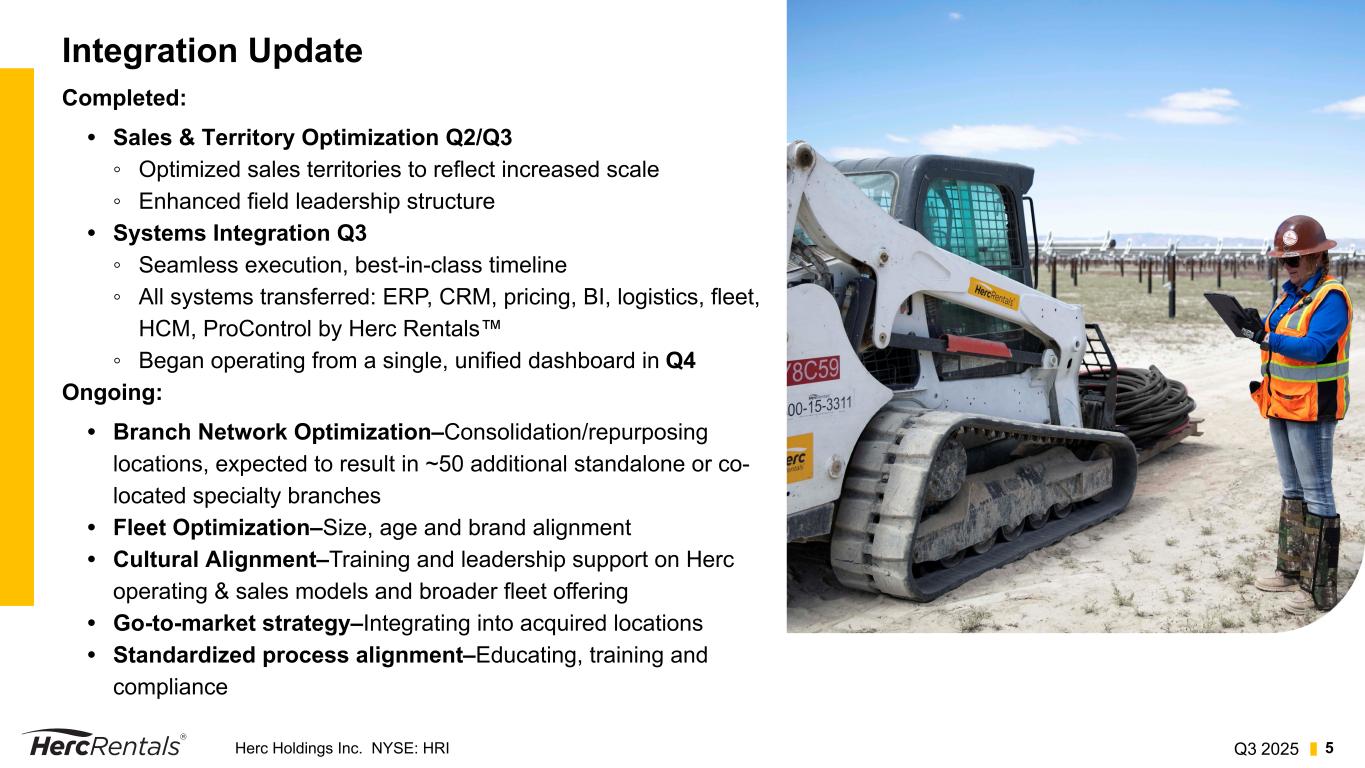
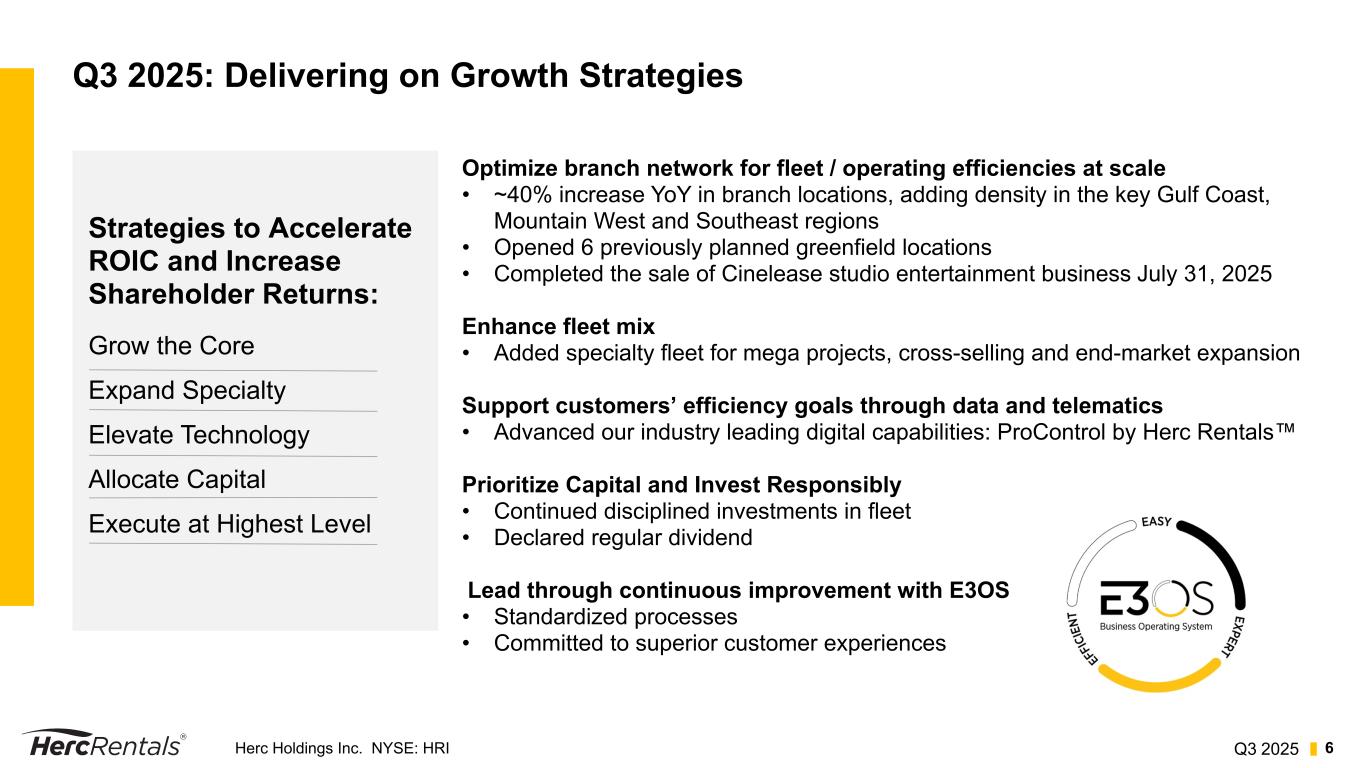
Thank you, Leslie, and good morning, everyone. I want to start by thanking all of Team Herc for their incredible energy, focus, and commitment throughout the third quarter. Integrating the largest acquisition in our industry is no small feet, but our team has truly risen to the challenge, driving alignment, accelerating progress, supporting one another, and accomplishing a large systems migration, all while remaining focused on scaling operations in a mixed demand environment. We continue to see robust activity across mega projects and specialty solutions, underscoring the strength of our strategic positioning. In the local markets, growth is limited as new projects in the commercial sector remain on hold due to the high interest rate environment. In this bifurcated landscape, our scale, advanced technology platform, and diversification across geographies and markets and product lines continue to be competitive advantages, enabling us to operate with agility and resilience. At the same time, we're executing against our integration roadmap with discipline, speed, and a clear focus on unlocking both cost and revenue synergies within our three-year time frame. Let's now turn to slide number five for an update on our progress. Since closing the transaction, we expanded our field operating structure from nine to 10 US regions reorganized districts and added key leadership roles to ensure operational continuity and scalability. Our regional vice presidents and field support staff continued to relentlessly manage change and support our teams for growth. Early on, we completed a comprehensive sales territory optimization exercise to restructure coverage and deepen customer relationships given our much larger scale, and we equipped our new sales team members with a broader product offering and expert product support. They are now undergoing training on enhanced market and customer analytics and customer engagement tools. Together, these initiatives will further improve retention and strengthen the capabilities and execution of our sales force. Equally important in the quarter we completed the full systems integration we got this done in just 90 days compared to the typical timeline of 6 to 18 months for companies of a similar size and complexity this accelerated execution reflects the strength of our internal capabilities discipline planning and deep experience with enterprise technology deployments This integration included an enterprise platform consolidation where we transitioned the H&E branch operations from SAP to our customized rental land front end system and Oracle ERP framework. Our proprietary pricing engine also is now fully integrated with centralized controls in place to ensure consistency, protect margins, and align pricing decisions with our broader business goals our logistics system called up is also now operational across the expanded network to improve delivery accuracy and optimize route planning at the lowest possible cost as we deployed our business intelligence suite across the acquired locations giving us real-time visibility beginning this month into combined performance metrics customer behavior and operational KPIs Finally, our industry-leading, customer-facing technology, ProControl by Herc Rentals, is now available to our entire customer portfolio, enabling equipment renting, tracking, and asset management and control from any device, anywhere. We view these systems integrations not just as a technical milestone, but as strategic enablers. They're going to allow us to scale faster, operate smarter, and deliver more value to our customers and shareholders. The systems alignment marks a turning point. For the first time beginning in the fourth quarter, we have full visibility into our combined business and are now positioned to analyze the operations at a more granular district and branch level. Specifically this quarter, we're drilling down into three key areas. First, productivity. We're using the data to benchmark performance, flagging underperforming locations for deeper review and identifying top-tier branches where we can replicate best practices to drive operational improvement across the organization. Second, expense management. We want to pinpoint additional variable cost-saving opportunities, discontinue activities that that do not align with our strategic priorities and eliminate inefficiencies at the local level. And third, fleet management. After having conducted a full order of our combined equipment assets in the third quarter, we made good progress of disposing underutilized, off-brand and aged acquisition fleets. Aaron will share some of those details, but our focus on fleet management is ongoing as we rebalance our portfolio to match demand patterns, optimize mix, and support scalable growth. Another way we're scaling the business for 2026 and beyond is by optimizing our network footprint. We've undertaken a market-by-market analysis of our combined branch locations with a goal of reducing redundancies and enabling better product allocation to further strengthen our market presence. Over the next six months, we expect to consolidate some general rental branches for cost and operational efficiencies. We'll repurpose certain of those branches into standalone specialty equipment locations. In other instances, we'll further expand access to our specialty solutions by co-locating specialty equipment within existing general rental facilities. These These initiatives are expected to result in about 50 additional specialty locations increasing our specialty network by 25% next year and supporting accelerated growth in these high margin product categories. Overall, we're making excellent progress on the integration. Our teams are getting acclimated, our systems are unified, our customers are already seeing early benefits. We remain confident in our ability to deliver the full value of the acquisition, both in terms of cost efficiencies and accelerated growth, while continuing to deliver on our long-term growth strategies, which are outlined on slide number six. As we said, integrating this acquisition is our primary focus, and therefore we have paused other M&A initiatives for the time being and are completing the remaining in-flight greenfields. fields. Year-to-date, we added 17 greenfield facilities, of which six were opened in the third quarter, and we have roughly 10 more new location openings planned for the fourth quarter. Capitalizing on the secular shift from ownership to rental, particularly in a specialty market, and yielding greater value from mega projects through specialty solutions is a key focus for us. Further cross-selling specialty gear is an important component of the revenue synergies with H&E. In line with this strategy, we've continued to over-index our gross capex plans towards specialty with a goal of increasing this category as a percent of our overall fleet composition long term. And of course, repurposing general rental branches into ProSolutions facilities, as I just mentioned, will support specialty equipment capacity for the 160 plus acquired locations. Finally, we continue to elevate our industry-leading ProControl by Herc Reynolds technology offering with new efficiency features and controls, seamless navigation, and tailored experiences all in a single app, addressing our customers' more complex and expanding needs. While we work through the integration of H&E, we'll continue to follow our playbook, leveraging branch network scale, our broad fleet mix, technology leadership, and capital and operating discipline to position us to manage across the cycle and generate substantial growth over the long term. We are committed to our goal of becoming the supplier, employer, and investment of choice for the equipment rental industry. Now I'll turn the call over to Aaron, who will talk a little bit more about operating trends, and then Mark will take you through the third quarter financial performance and outlook.
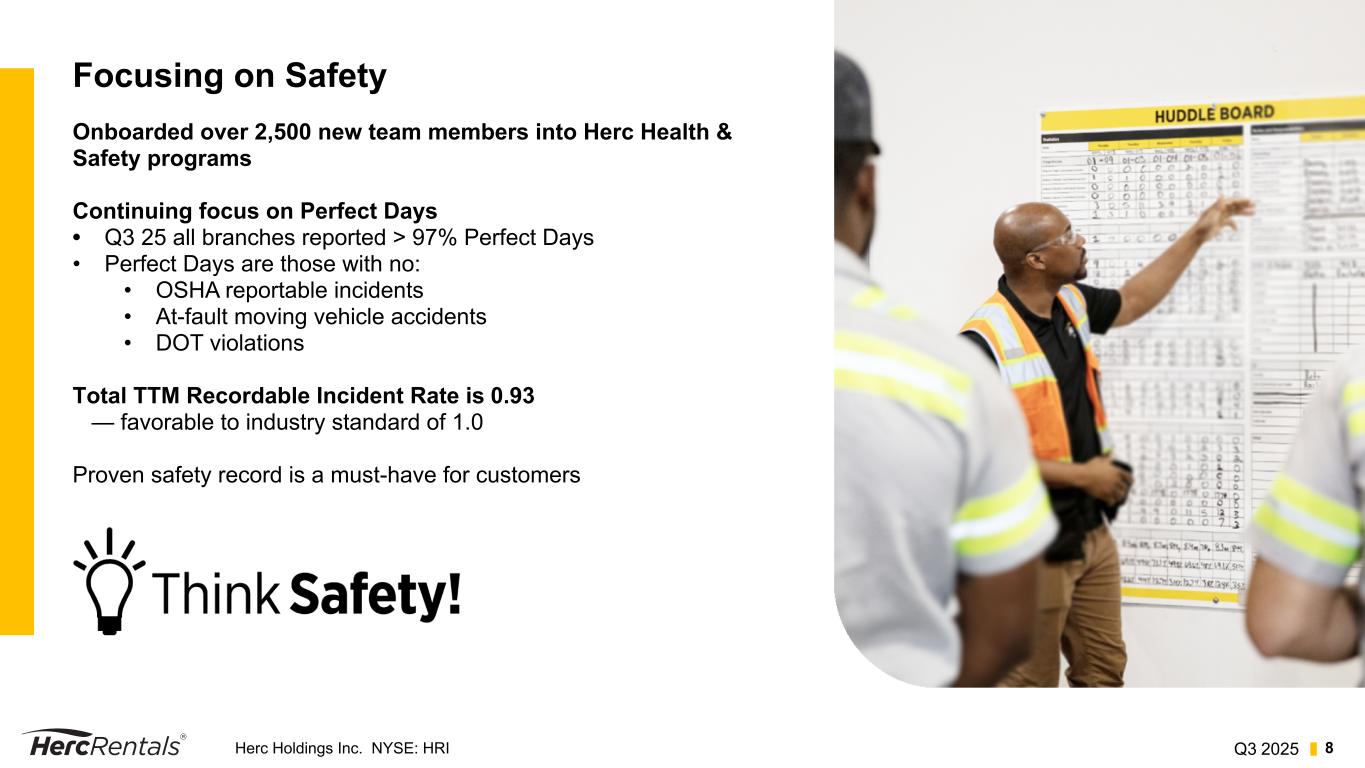
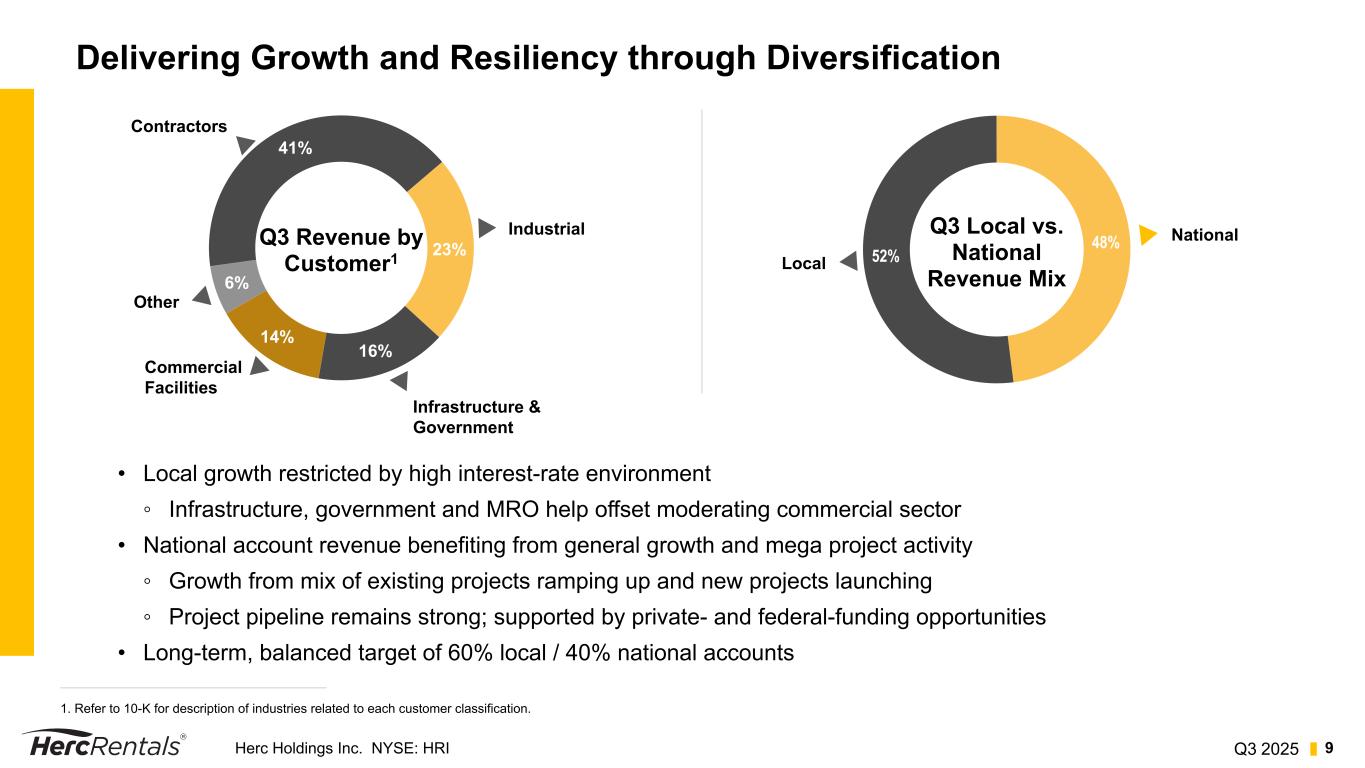
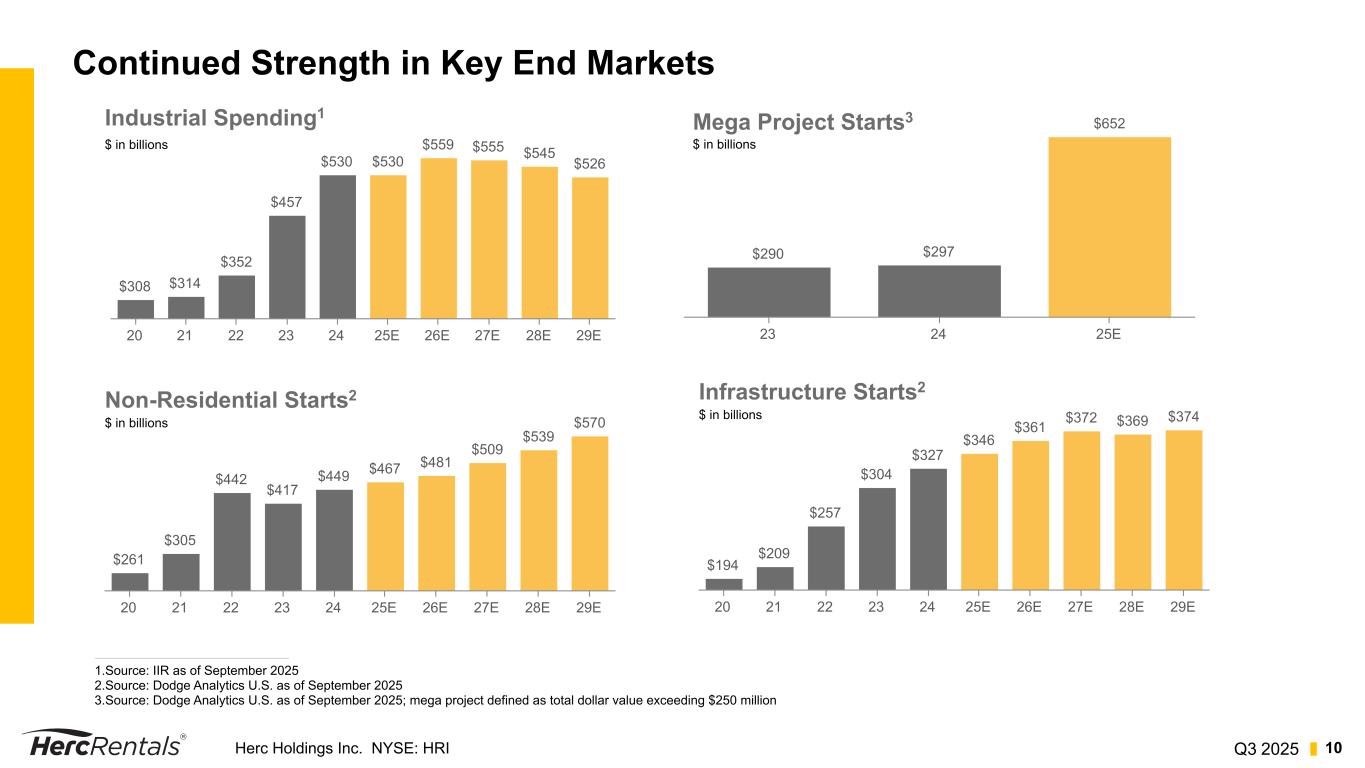
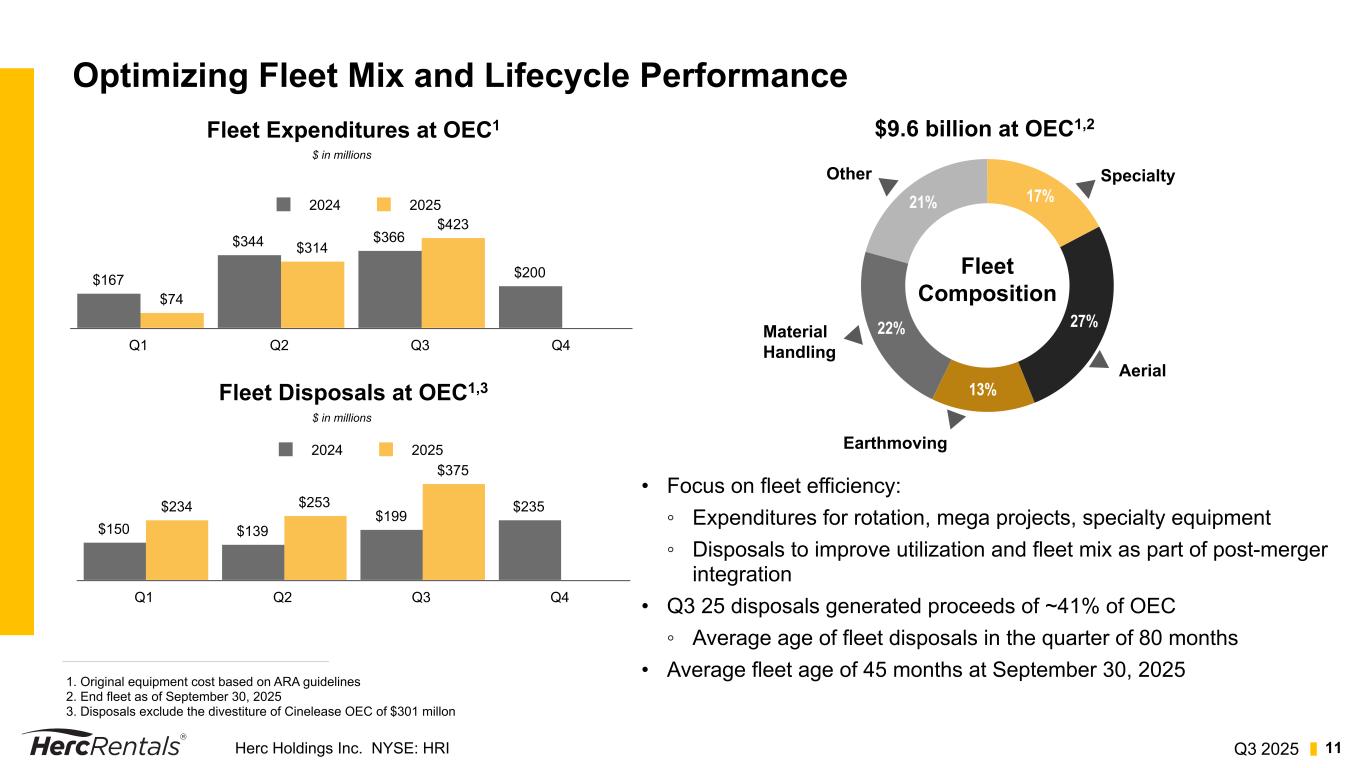
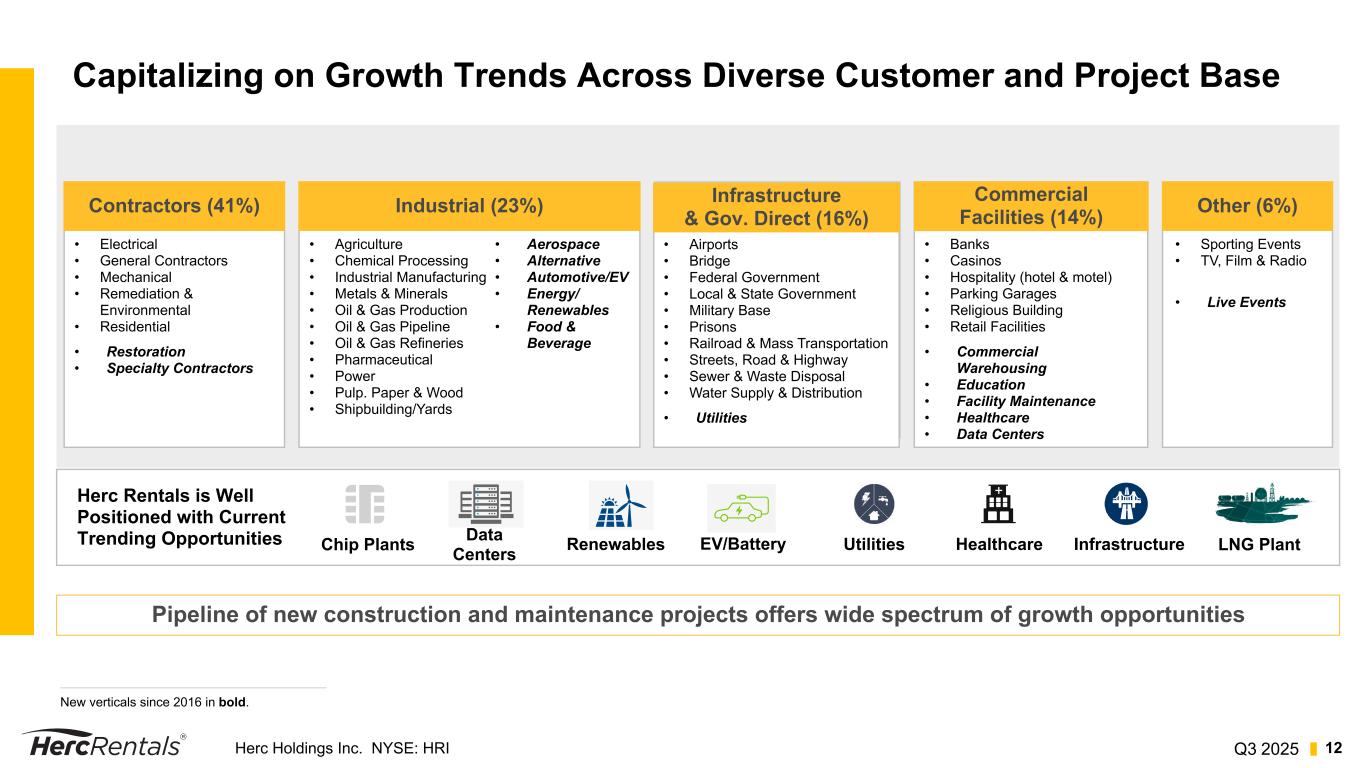
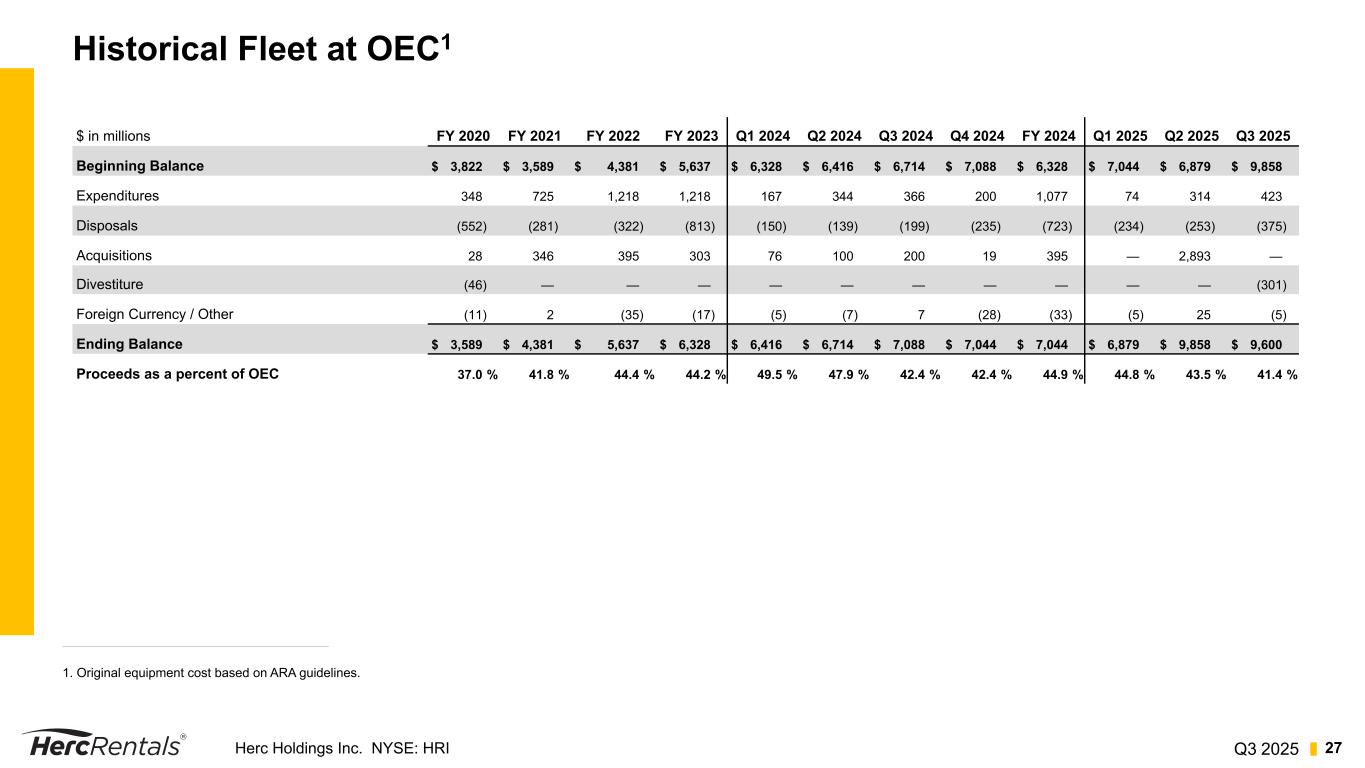
Aaron. Thanks Larry and good morning everyone. As we continue executing on this important integration, I also want to personally thank our teams for their incredible commitment and perseverance. Whether navigating change, supporting integration efforts, or pushing forward on growth initiatives, their resilience and focus have been exceptional. They have continued to show up for our customers, for each other, and for the future we're building together. That dedication is what drives our momentum, and it's what sets Team Herc apart. Equally important to our success is our unwavering commitment to safety. Safety is at the core of everything we do, and as an immediate integration priority, we onboarded 2,500 new Herc team members into our health and safety program in the third quarter. as you can see on slide eight our major internal safety program focuses on perfect days we strive for 100 perfect days throughout the organization in the third quarter on our branch by branch measurement all of our operations achieved at least 97 days as perfect also notable our total recordable incident rate remains better than the industry's benchmark of 1.0 reflecting our high standards and commitment to the safety of our people and our customers. Turning to slide nine, we're operating in a disproportionate demand environment where the local market remains affected by interest rate sensitive commercial construction while mega project activity continues to be robust. In the third quarter, local accounts represented 52 percent of rental revenue prepared with 53 percent a year ago on a pro forma basis. On the national account side, private funding for new large-scale projects is still quite robust. We kicked off several new mega projects in the third quarter as the push for reshoring manufacturing along with increases in LNG export capacity and the expansion of artificial intelligence are continuing to drive new construction demand. We are winning our targeted 10 to 15 percent share of these project opportunities with even more new mega projects on deck and current projects still ramping up. As a combined company will continue to target a 60% local and 40% national revenue split long-term knowing that this diversification provides for growth and resiliency. Sticking with the topic of resiliency, let's turn to slide 10 where you can see that despite the uncertain sentiment in the general market around interest rates and tariffs, industrial spending and non-residential construction starts still show plenty of opportunity for growth. Built on a foundation the mega project development and infrastructure investments taking a look at the updated industrial spending for forecast at the top left industrial info resources is projecting strong capital and maintenance spending through the end of the decade dodge's forecast for non-residential construction starts in 2025 is estimated at 467 billion dollars a four percent increase year-over-year, with 3% to 6% growth continuing in each successive year. Additionally, the mega-project chart in the upper right quadrant gives you a snapshot of the total dollar value in U.S. construction projects starts over the last two years in a growth projection that exceeds $650 billion for 2025. We estimate we are only in the early to middle innings of this multi-year opportunity. We don't take the chart out beyond this year because visibility is less clear, for actual start dates of those projects still in the planning phases. But there are trillions of dollars in the megaproject pipeline that aren't accounted for here. Finally, there's another $346 billion in infrastructure projects estimated for 2025. That's a roughly 6% increase over 2024, and infrastructure destruction activity is expected to further strengthen in the out years. Of course, there are some overlap in projects among these four datasets, But no matter how you look at it, for companies with the safety record, product breadth, technologies, and capabilities to service customers at the national account level, the opportunities for growth remain significant. Moving to slide 11, let me take a minute to walk you through how we're managing fleet levels and equipment mix in response to this dynamic and evolving landscape. First, we are right-sizing our acquired fleet and aligning brand consistency to drive operational efficiency and long-term value. At the same time, we're making targeted investments in specialty equipment to unlock revenue synergies, ensuring we're not just leaner, but also more capable and better aligned with high-value opportunities. Our fleet strategy is also calibrated to support the divergent operating environment. scaling a repositioning fleet to meet national demand while maintaining flexibility in local markets. In the third quarter, we executed against this strategy, increasing gross capex seasonally and expanding our specialty equipment offering in line with our much larger branch network and our revenue synergy goals. We're still expecting gross fleet capex of $900 million to $1.1 billion for 2025. Also in the latest quarter, we nearly doubled disposals on an OEC basis versus last year as we work to optimize our larger general rental fleet post-acquisition. Realized proceeds were 41% of OEC on those equipment dispositions. Given the significant amount of fleet we were selling and the variance in brand quality, more sales went through the auction channel this quarter than in the recent past. Once we have the fleet in a more optimal position, we'll resume our channel shift strategy to the higher return wholesale and retail outlets. For the full year, we're still expecting disposals at OEC of $1.1 to $1.2 billion. We're tracking at about 75% of that target, with the remainder coming in the fourth quarter. I know there's strong interest in our 2026 CapEx plan, but it's still early in the process, so we're not yet in a position to share specifics. But from a high level, I could tell you that we have an especially young fleet today as a result of the H&E acquisition. we'd like to get it back to Herb's historical average fleet age, so that's something that will be considered in our fleet plan. Also, we fully expect continued growth in national accounts and specialty solutions next year. We're planning our fleet by mix and geography to support that momentum. At the same time, demand visibility for local projects remains highly compressed, which reinforces the need for agility in both how we manage our existing fleet and the pace of planning for 2026. The scale we've gained bolsters our ability to respond to near-term trends in local markets while also leveraging efficiencies to prepare for the start of a cyclical recovery. But it's important to remember that a pickup and local demand typically lags interest rate reductions. Developers still need time to secure financing, and contractors have to obtain permits and mobilize labor for planned projects. So we're being thoughtful and disciplined in our planning, balancing short-term responsiveness with long-term readiness. Turning to slide 12, I'll continue to state the obvious. Diversification is an important strategy for fostering sustainable growth and navigating economic cycles. As Herc has diversified into new in-markets, geographies, and products and services over the last nine years, we have reduced our reliance on a single industry or customer. We've become more resilient to downturns and more adaptable to emerging opportunities like mega project developments technology advancements that support customer productivity and the secular shift from ownership to rental especially in the specialty category classes we believe we are well positioned to manage dynamic markets and the acquired scale further bolsters our capacity and therefore our opportunities with that i'll pass the call on to mark thanks aaron and good Good morning, everyone.
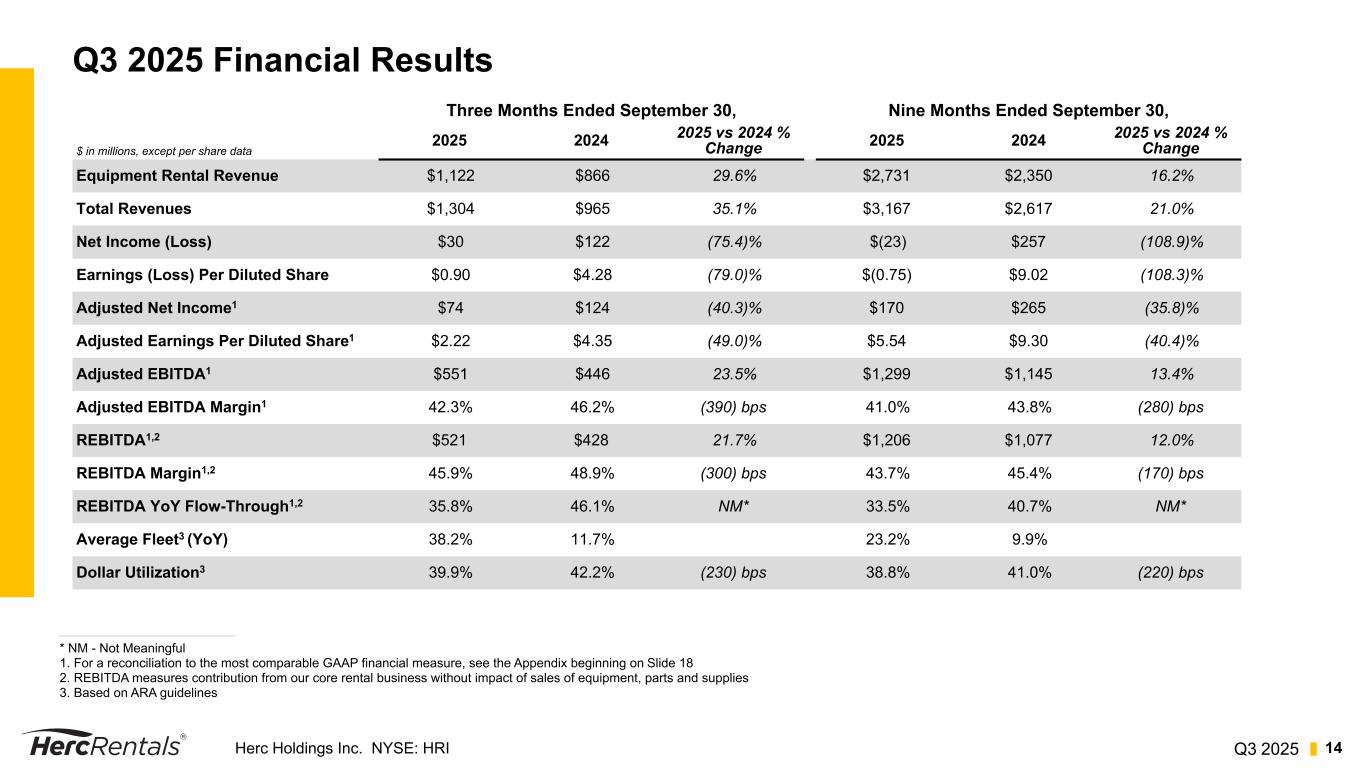
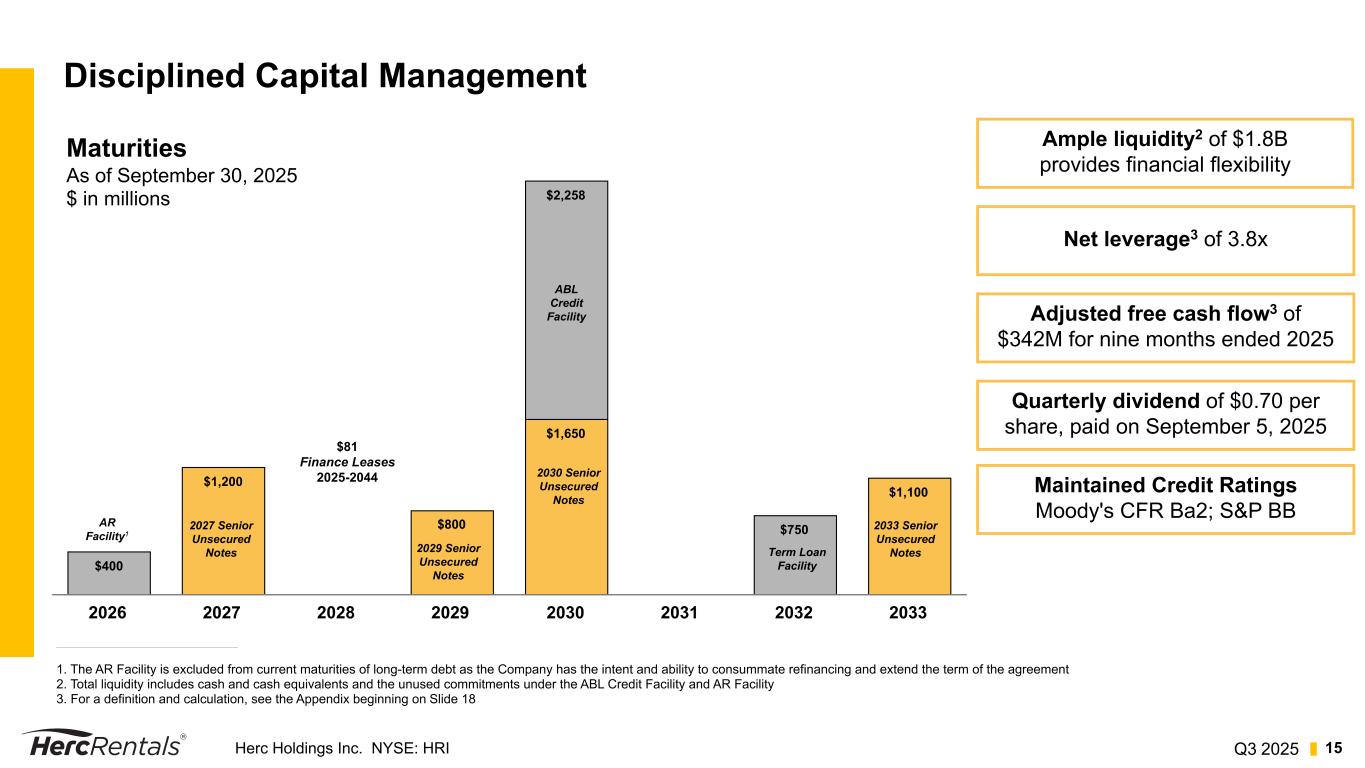
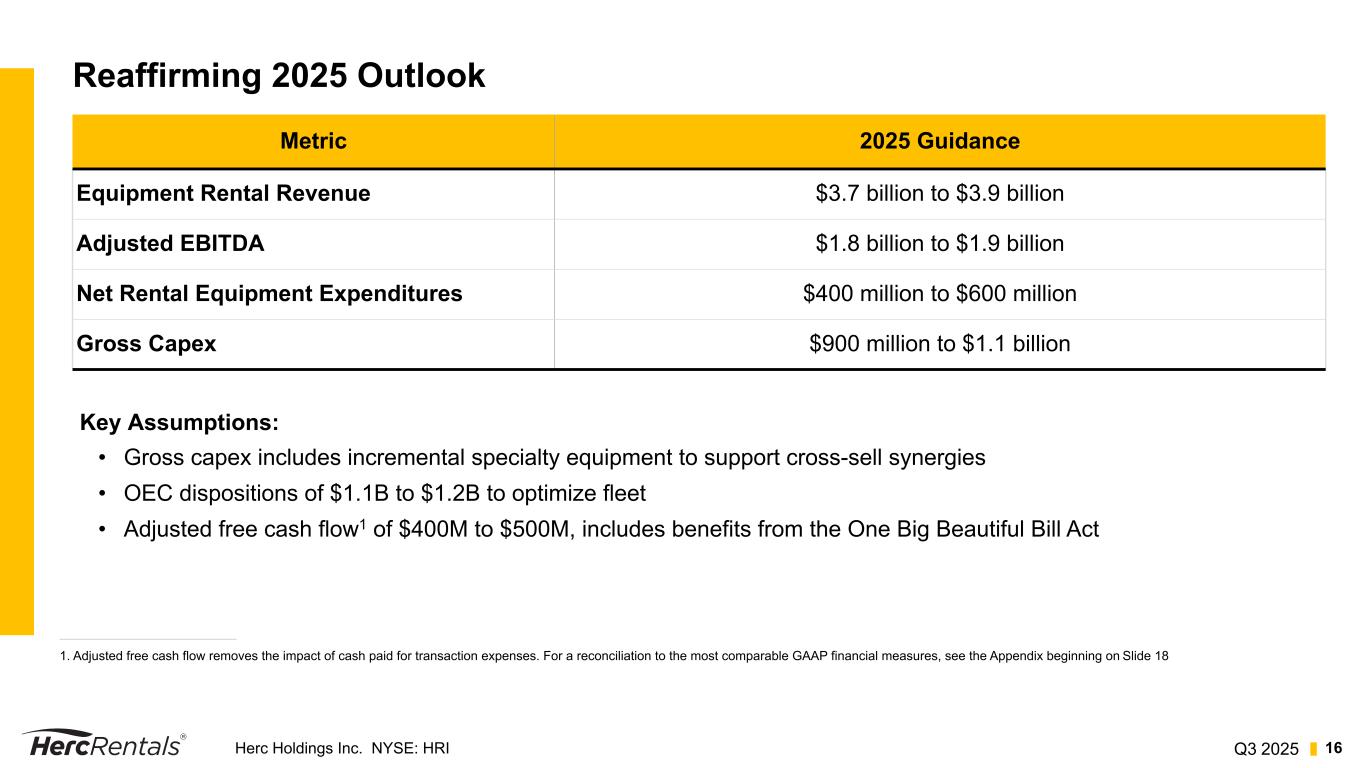
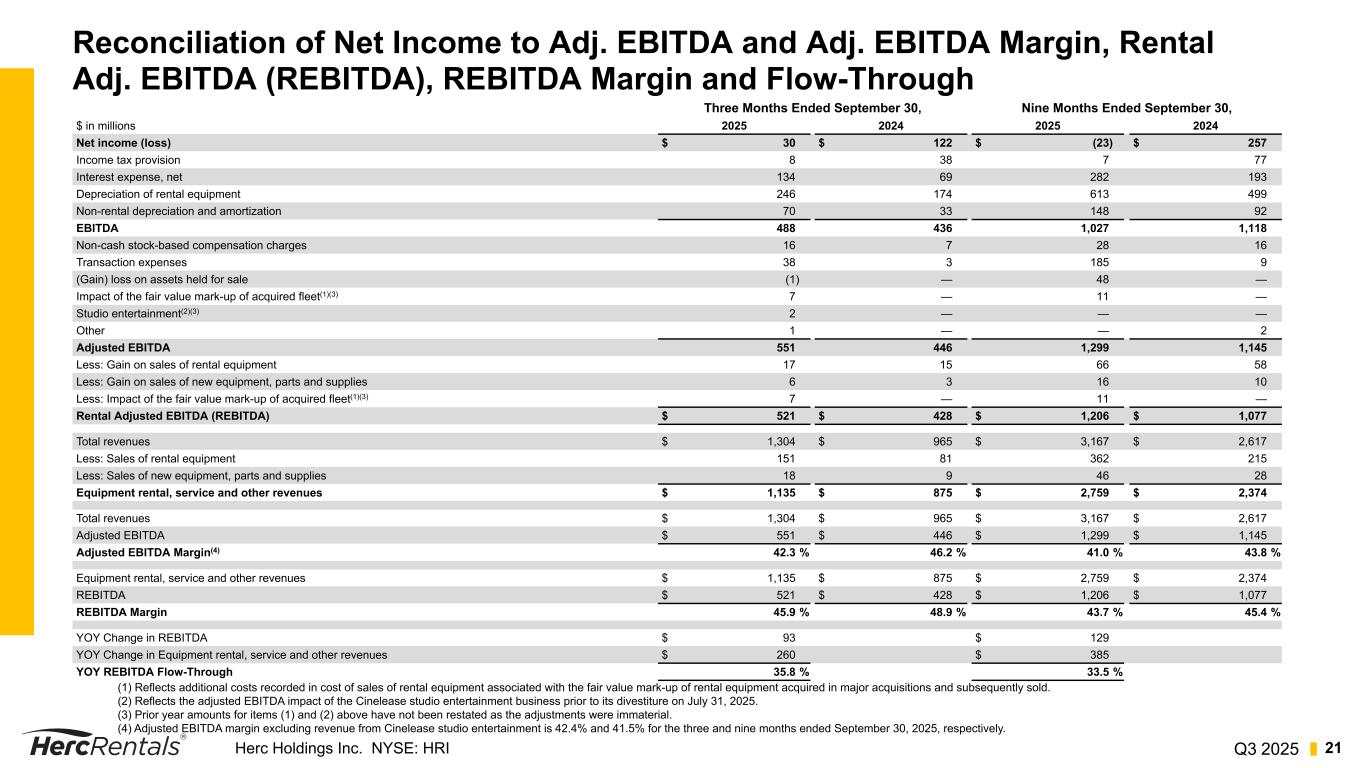
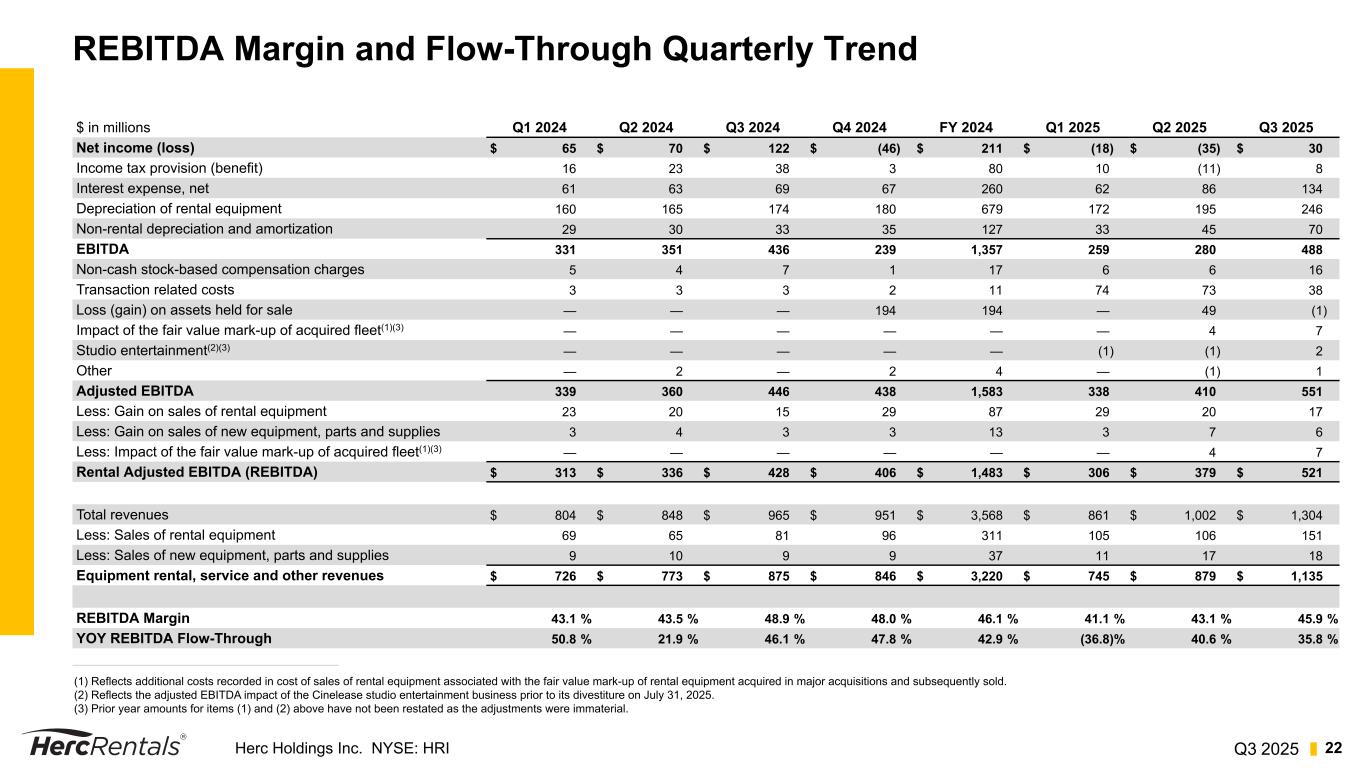
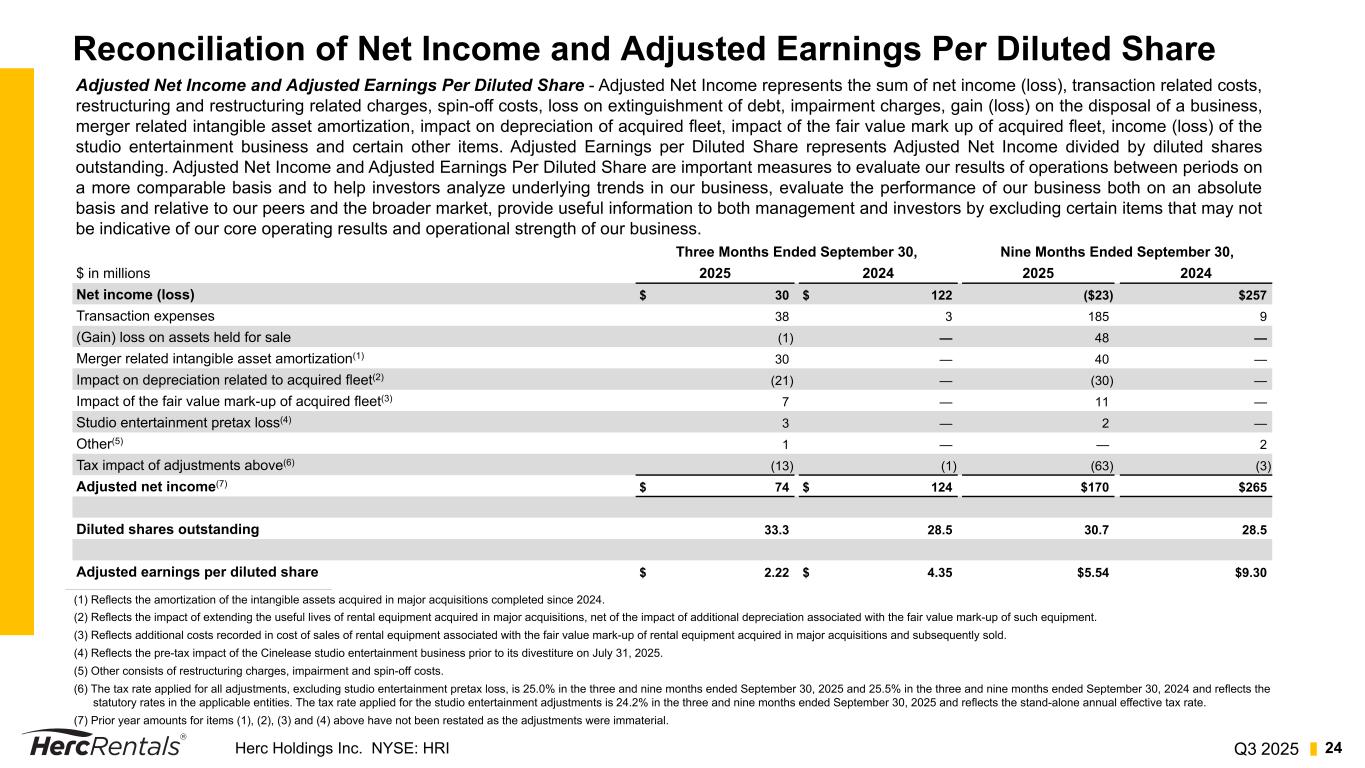
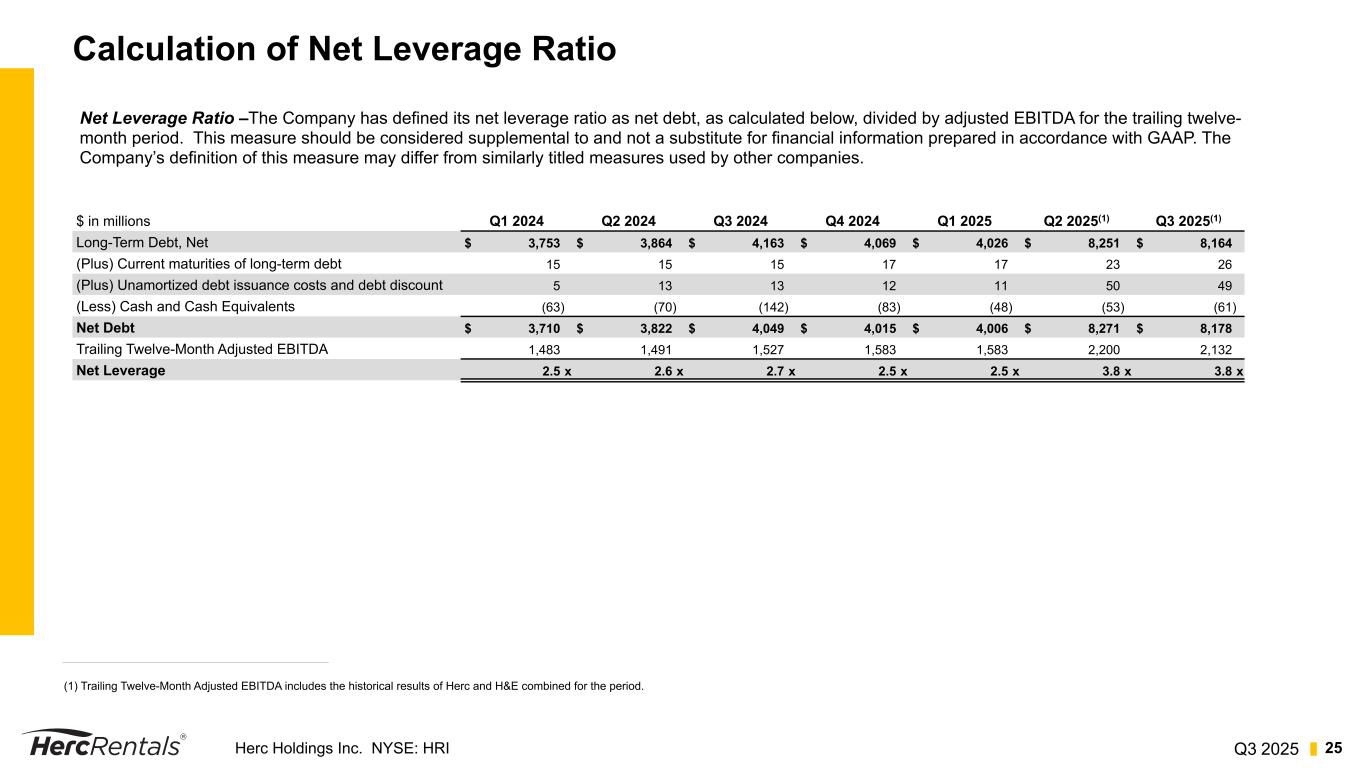
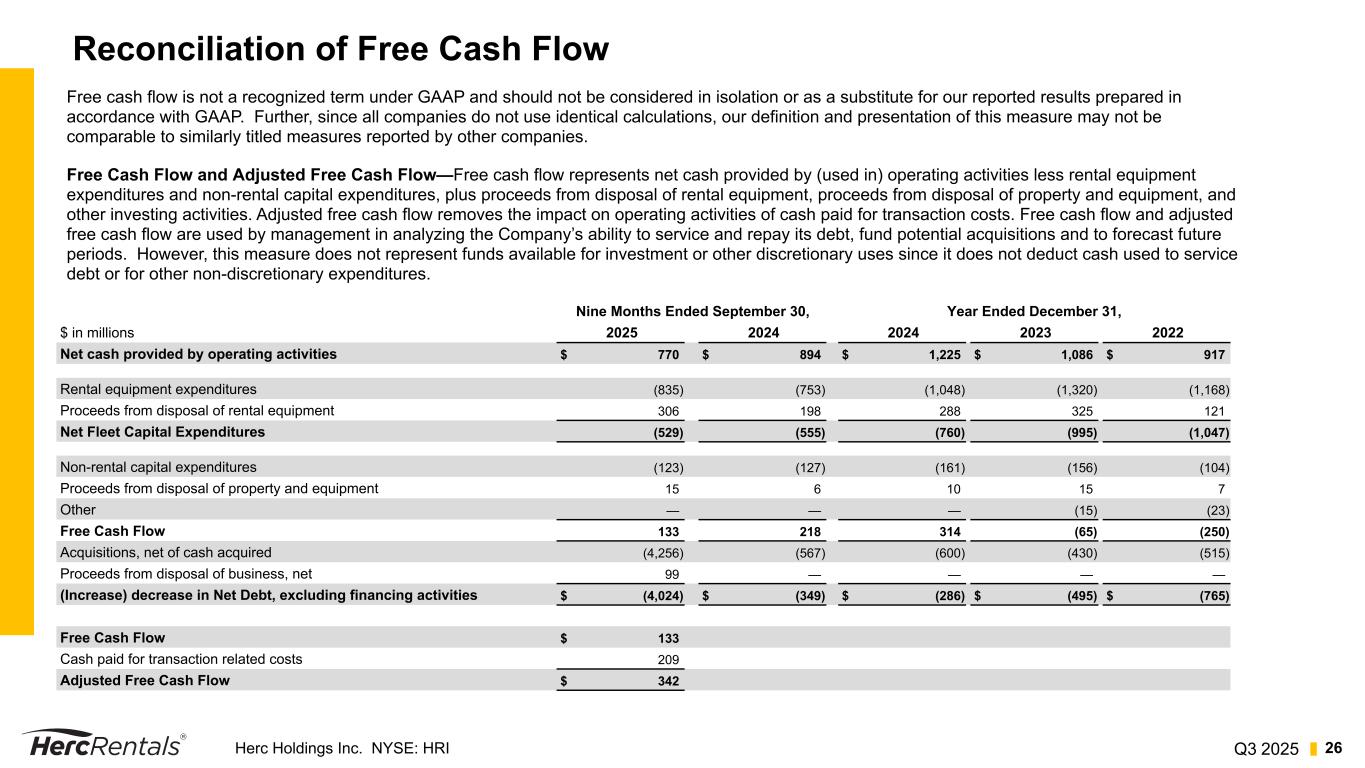
I'm starting on slide 14 with a summary of our key metrics for the third quarter, which includes SenaLease results for July. As you may have seen, we completed the sale of SenaLease on July 31st with proceeds used to pay down our ABL. For the third quarter on a gap basis, equipment rental revenue was up approximately 30% year over year, driven by the acquisition of H&E and strong contributions from mega projects and specialty solutions. Adjusted EBITDA increased 24% compared with last year's third quarter, benefiting from the higher equipment rental revenue as well as used equipment sales. Adjusted EBITDA margin was primarily impacted by a higher proportion of our used equipment sold through the lower margin auction channel as we worked to align the acquired fleet. Also affecting margin was lower fixed cost absorption as a result of the ongoing moderation in certain local markets where H&E was overweighted as well as acquisition-related redundant costs preceding the full impact of cost synergies. Rebidah, which excludes used equipment sales, was up 22% during the third quarter. Rebidah margin was 46%, impacted by the lower-margin acquired business. Margin improvement will come from equipment rental revenue growth and a shift over time to a higher-margin product mix, as well as delivery of the full cost synergies and improved variable cost management from the increased scale. Our net income in the third quarter included $38 million of transaction costs, primarily related to the H&E acquisition. On an adjusted basis, net income was $74 million. Shifting to capital management on slide 15, you can see that we generated $342 million of free cash flow, net of transaction costs in the nine months ended September 30th, 2025, which was in line with our expectations. Our current leverage ratio is 3.8 times. Our goal is to return to the top of our target range of two to three times by year-end 2027 as revenue and cost synergies drive higher EBITDA flow through, and less capital will be required to achieve the revenue synergies due to scale benefits on the utilization of existing fleet. The combined entity will be capitalized to maintain financial strength and flexibility. On slide 16, we're reiterating our 2025 guidance. When we set the guide a month into the integration, we modeled the back half of the year using the second quarter trends we were seeing for each of the legacy companies. Of course, in any large-scale acquisition, integrating the acquired operations and acclimating new team members is a phase of an ongoing effort. We're starting to get a better read on the pacing of training, upskilling, and reengaging the acquired team. And we're making good progress on backfilling for the H&E Salesforce attrition that occurred, with strong patterns in place for recruiting candidates and onboarding and training new Despite a lot of moving pieces with the integration overall, the guidance still feels about right based on current visibility. Two points I'd like to call out for the fourth quarter. First, unless something big happens in the next two weeks, we'll likely have a tougher comp from a U.S. weather standpoint, with last year benefiting from about two to three points of hurricane-related pro forma revenue upside for the combined company. Second, when it comes to fourth quarter adjusted EBITDA, you should expect that we'll continue to utilize the auction channel more than Herc typically would, as we're still right-sizing the acquired fleet with a focus on dispositions of off-brand and aged general rental equipment. This shift in channel mix will continue to pressure proceeds and therefore the used sales margin. With the completed systems integration now providing a uniform granular view of the entire company, we're putting action plans in place to address any underperforming areas or foundational inefficiencies. All of that will better position us as we plan for 2026. Longer term, based on all the opportunity we see, we remain confident in strategic value of this combination and our ability to achieve both the full revenue and cost synergies over the next three years with that operator we'll take our first question we will now begin the question and answer session if you would like to ask a question simply press star followed by the number one on your telephone keypad and your first question comes from the line of mick dobre with baird please go ahead Thanks for taking the question.
Good morning, everyone. I guess my first question goes to this comment on the right-sizing of the fleet, and I'm kind of curious where you are in this process. Do you expect to be largely done with this in the fourth quarter, or is this kind of stretching into 2026? And is there any way to maybe get us to better understand the magnitude of the work that needs to be done here, either in terms of, you know, amount of OEC that needs to be disposed or any other way that you want to frame it?
Yeah, Meg, this is Aaron. I'll take that question. A lot of the heavy lifting was done in Q3. We still have more work to do as we go through Q4. As long as the 2026 kind of landscape economic demand landscape is good, we'll be essentially kind of closing that part of it out. The Q3 higher disposals in Q3 was really related to just some rebalancing of the fleet. On the H&E side, they didn't do their normal cadence of disposals that they historically would have done in Q1 and Q2, so we had to catch up on that. and then just some of the brand mix you know the operations are more efficient when you've got a standardized kind of manufacturer type fleet so that's what some of the shaping was done and um you know we uh we feel good what we got done but as we mentioned you know a little more auction activity than we typically would do um and as we get into 26 we'll get back to our normal cadence of getting the higher um retail wholesale channel mig this is uh this is mark maybe just a couple of other points there.
You know, I think when you think about, you know, what Aaron said, going back to Q2 and the comments we made then, we thought that there was probably, call it $250, $300 million of activity that needed to happen in the back half of the year to sort of right-size or better right-size that fleet for the territories it was going in. And I would say, you know, as we sit here through Q3 probably half of that was completed maybe a little bit more than that in the third quarter and so you know the expectation would be better right sizing the fleet as we get through fourth quarter such that next year we can lean on aging the fleet and disposing of less gear all right that's helpful thank you then maybe a question on your overall mix the national accounts account for, if I'm not mistaken, pretty much a record as far as my model goes.
So, a lot more business done with national accounts. I guess that would be consistent with your comment on megaprojects being an area of growth. As you sort of think about 2026, I do wonder if this business, megaprojects, national accounts, is to some extent dilutive to margins if this is something that we need to think about as we as we think about the margin framework for next year and i'm not asking for guidance i'm just asking for some color as to as to how this portion of the business is really impacting it um yeah meg larry i'll take that look we're um we're expecting obviously for the same type of activity to continue into 26 because as you know, until interest rates, you know, have a substantial reduction, which maybe we'll
see tomorrow, another 25 basis points, who knows, it usually takes six to nine to as long as 12 months for that to trickle down into the local market to make that, you know, a more attractive business opportunity and certainly spur the activity for us in the local market, which remains you know somewhat muted overall though we we don't find that there's any significant margin dilution because remember when we put um equipment out a national account or a mega project you have minimal movement of that project you're not having you know excessive delivery there and um and we We also have a larger volume of equipment out there, and we tend to also get a lot more specialty product out on those projects that are opportunistic for us as we go along. So we don't see much solution at all relative to continuing in this trend.
Operator
And your next question comes from the line of Tammy Zakaria with JPMorgan.
Tammy, please go ahead. hi good morning thank you so much uh my first question is on the comment you made about combining some of the gen rent locations i think you said you're going to have a 50 additional specialty is it the right way to think about it that about 100 of the general rental locations would close and those would sort of merge and become 50 specialty or how should i think about the um interchange between the two no not at all actually um our our branch count increased dramatically as a result of the acquisition the way we want you to think about it is
there were i'll put in two buckets one we have a strategy where we typically do a branch and branch right so that's how we kind of scale the business we'll open a specialty business this inside of a general rental branch and let it mature and when it gets enough scale then we'll pop it off and have its own standalone location. That's really what's the fuel with the 50 new locations as we go through you know next year's period. There were just a handful of locations that each need where they're like one mile away from our branch and we could consolidate those and in those cases we're turning those into another specialty branch right away sooner than we typically would, but we're not closing branches from H&E. That would be saluted to what our strategy is. So we like the scale, and it gives us a bigger footprint, which allows us to solve the market needs better.
Understood. That's super helpful. And my second question is, now that the two businesses are on the same platform, it gives there more visibility into the combined business, would you consider revisiting some of the cost synergies and any revenue synergy targets you had at the start of the journey?
Yeah, I mean, I think, Tammy, I mean, that's an ongoing process, right? I mean, I think that from a, you know, a cost synergy perspective, we originally laid out $125 million, you know, into into buckets do those buckets look the same today as they did yesterday no um you know will they continue to change and evolve yes um and then i think that and and probably good news here you know as i mentioned in my prepared remarks there's also efficiency reviews taking place now that we're on the same platform and so whether you want to call that synergy or efficiency i don't care you know, ultimately it's an incremental margin and efficiency that we're going to gain. So that's how we're looking at it, and I think it will continue to evolve as we move forward.
Operator
Your next question comes from the line of Kyle Mangas with CD Group. Kyle, please go ahead.
Yeah, maybe following up on that, I guess, is there anything noteworthy or unexpected, you know, incremental coming from these efficiency reviews that are taking place now, now that you're on the same platform again i mean it's it's early innings right i mean this just sort of completed at the end of q3 i guess the way i would respond to that kyle is that you know herk has um you know a fair number of operational kpis and so you know as we sort of rolled ourselves out of q3 and had um clear visibility really for the first time right now it's about aligning our KPIs and our expectations to these newly formed or
you know re-devised territories on the consolidated platform so I don't think there's anything of a surprise nature in that I think it's just us running our playbook in our game plan and you know looking for efficiency along the way and that's exactly what we'll do yeah and you know keep in mind that we still while while we have the IT integration completed, we still have a fair amount of training and education and development of people and aligning resources that needs to happen here in Q4 to prepare the organization as it goes into Q1. And we have, you know, fair amount of work ahead of us still in addition to the movement of these branches that Aaron talked about a moment ago.
So a lot of work ahead and we'll continue to look for opportunities for improvement makes sense and then it would be helpful just to to hear an update on dis synergies and synergies i guess just what what's giving you guys confidence that dis synergies are behind you are you continuing to see that stabilization in the sales force any success bringing people back and then just would be helpful to hear an update on some of the earlier early uh revenue synergies that you're seeing as well yeah i'll take the first part of that and saying, yeah, look, we've been able to stabilize the sales organization.
Now, you know, attrition is happening at or below normalized Herc levels that we've seen in the past. And, you know, a lot of that is behind us. There have been a couple of folks that we've brought back into the organization. But, you know, we fill the vast majority of those holes with our with our team with our black and gold team that have been in training and preparation for sales territories and we're looking and we're looking to continue to keep you know with the training with the education with the introduction to our technology platform you know that's an enabler for these salespeople to earn more money and it's also a retention device so we're We're excited about that being behind us for the most part. Henry, do you want to?
Yeah, we're seeing on the revenue synergy side, we're seeing, you know, it's early innings. We're just getting started with it. You know, we're introducing some of the specialty products to customers that were on the H&E side, regional type customers, and we're getting some good traction, right? So it's some of the products we offer weren't offered at H&E, and the customers were able to kind of move their share of wallet our direction. So we're happy where the progress is, but we've got a lot more work to do.
Operator
Your next question comes from the line of Kenneth Newman with KeyBank Capital Markets. Kenneth, please go ahead.
Good morning. Maybe for my first question, Mark, it seems like gross margins in the quarter came in a bit lower than I would have expected. But you did leverage SG&A a little bit stronger than my model. Is there any way you could help us just dimensionalize how to think about gross margins sequentially, third quarter to fourth quarter, just given all the moving pieces? Maybe also a little bit of help on how we think about SG&A dollars going forward.
Yeah, I guess, you know, look, there was a little bit of noise, quite honestly, in the original view, at least the way that I was looking at this. And we couldn't know the answers until we finished all of the mapping of their expenses into our general ledger structure. structure. And so, you know, I think what, and the way that I would sort of guide you here is that, you know, in totality, you know, you probably had somewhere in the order of magnitude of 55% between, excuse me, between DOE and SG&A in the quarter. And I think that that's a reasonable proximity into the fourth quarter, recognizing that, you know, there's probably a little less coming through the funnel in the fourth quarter shoulder period. So I don't think that there'll be a ton of movement, but I think generally speaking, you're probably a little less efficient in the fourth quarter just from, you know, an overall revenue sort of downtick as you get into the November and December timeframe.
Okay. No, that's very helpful. You know, I'm sorry if I I missed it, but, you know, did you disclose how much he's contributed to rental revenue and EBITDA in the quarter? I'm just trying to get a sense of what core dollar use was like in the quarter.
You didn't hear that because I can't give it. You know, we wouldn't be doing our job, Ken, if I could still sort of pull apart and tell you the performance of H&E and Herc. I can't, and therefore I won't. But I would tell you that sort of overall, the business on whole performed about the way that we thought it would inside of Q3.
Operator
Your next question comes from the line of Rob Wertheimer with Milius Research. Rob, please go ahead.
A couple questions. Larry, you touched on employee retention and you're kind of going the positive direction now with hiring, rehiring, and then attrition has stopped. Customer attrition, can you talk about that on H&E kind of former accounts if we come through all the synergies as you kind of thought in recent quarters? And then I'll just bolt on my second one. When you've had a chance to look at the business more closely now, how does rental rates stack up and what do you need to do if it's below?
What do you need to do in what timeframe to kind of improve service levels or broaden out service levels and improve that thank you yeah look you know what i what i said and what i hope came through is that we've stabilized uh the the attrition that had happened prior to close and we feel that that is now at a normalized level with no further significant uh you know attrition that we're expecting that would be any different from what we would experience you know with her on a normalized basis um so you know i think we're we're okay there um but remember we have we have back filled a lot of those positions with um folks that have been in our black and gold what we call our psa program professional sales associate program so they're going into new territories they're on a learning curve picking up new responsibilities and uh And we'll have some training and education to do over the course, you know, the balance of the year and into early next year. But, you know, it'll have to ramp up, you know, probably into Q2 when we see them become, you know, fully effective. And, you know, as you know, that usually takes over a two to three year period for a salesperson to sort of really understand their territories and really perform at the levels we'd like them to perform at. I'll pass the other side over to Aaron relative to, you know, your comments on pricing and where it was and what we're doing to get back to, you know, the overall HIRC average.
Yeah, Rob, so I'd say to Larry's point, the attrition and all that stabilized. As Q3 went through, we focused a lot on integration, we got the reorganization all done, and now we're back to kind of like performance management and, you know, developing our sales team with the go-to-market strategies we already have. When H&E came into business, their pricing was lower than the ERC, so we're working on moving that through the needle upward with our tools and systems that we have. we talked about um some of our pricing tools that are proprietary to her so you know they're learning the tools our our sales management is working with them that's not going to happen overnight right that's uh that's a bridge that's going to happen over time to get them back to the herk historical kind of rental rate performance um but we've done a good job with the customers We've negotiated all the contracts H&E had into the Herc system, and the regional type H&E customers, as I mentioned earlier, have really embraced some of the extra fleet breadth that we have. And then, you know, the local customers where the market's not as strong, and there were some disruptions with some, you know, leading up to the closing up of the acquisition. Maybe that was because they weren't as busy, or maybe because their sales rep, you know, moved on. So we've got all the data, we're moving forward with our CRM and our sales efforts to engage with those customers. And some of those engagements take, you know, three or four different, five different cycles of connection. But we know that we've got a great rental operation, and we're confident those customers will come back over time. But we're happy where we are in the process right now.
Operator
That concludes our question and answer session. I will now turn the call back over to Leslie Hunsaker for closing remarks.
Thank you for joining us on the call today. We look forward to updating you on our progress in the quarters to come. Of course, if you have any further questions, please don't hesitate to reach out to us. Have a great day.
Operator
That concludes our question and answer session. This concludes today's call. You may now disconnect.