Operator
Thank you for standing by. My name is Carly, and I will be your conference operator today. At this time, I would like to welcome everyone to the Noble Corporation 3rd Quarter 2025 Earnings Call. All lines have been placed on mute to prevent any background noise. After the speaker's remarks, there will be a question and answer session. If you would like to ask a question during this time, simply press star, followed by the number 1 on your telephone keypad. If you would like to withdraw your question, press star 1 again. Thank you. I would now like to turn the call over to Ian McPherson, Vice President, Investor Relations. Please go ahead.
Thank you, Operator, and welcome, everyone, to Noble Corporation's third quarter 2025 earnings conference call. You can find a copy of our earnings report along with the supporting statements and schedules on our website at noblecorp.com. We will reference an earnings presentation that's posted on the Investor Relations page of our website. Today's call will feature prepared remarks from our president and CEO, Robert Eisler, as well as our CFO, Richard Barker. We also have with us Blake Benton, Senior Vice President of Marketing and Contracts, and Julie Collagia, Senior Vice President of Operations. During the course of this call, we may make certain forward-looking statements regarding various matters related to our business and companies that are not historical facts. Such statements are based upon current expectations and assumptions of management and, therefore, are subject to certain risks and uncertainties. Many factors can cause actual results to differ materially from these forward-looking statements, and NOBLE does not assume any obligation to update these statements. Also note, we are referencing non-GAAP financial measures on the call today. You can find the required supplemental disclosure for these measures, including the most directly comparable GAAP measure and an associated reconciliation in our earnings report issued yesterday and filed with the SEC. Now I'll turn the call over to Robert Eichler, president and CEO of NOBLE.
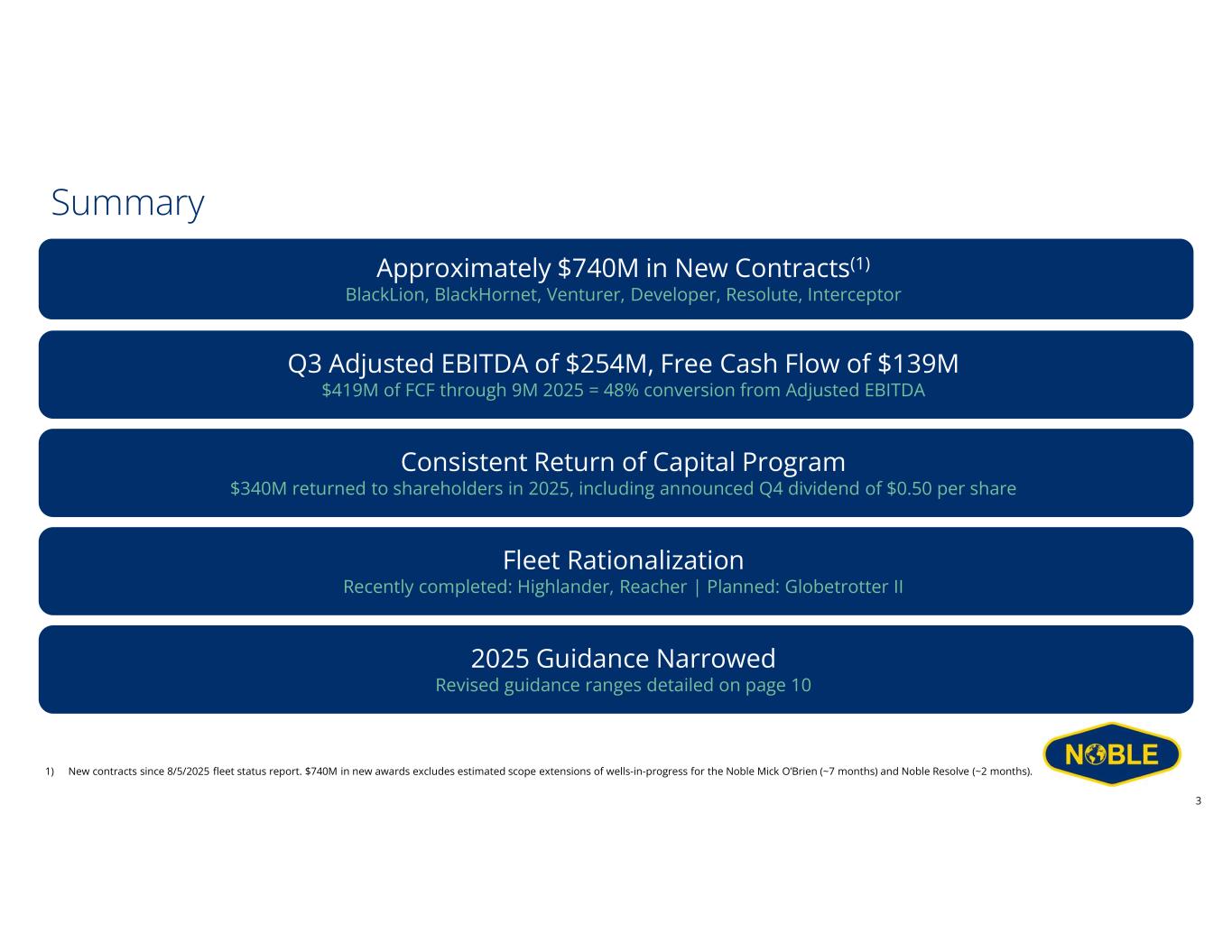
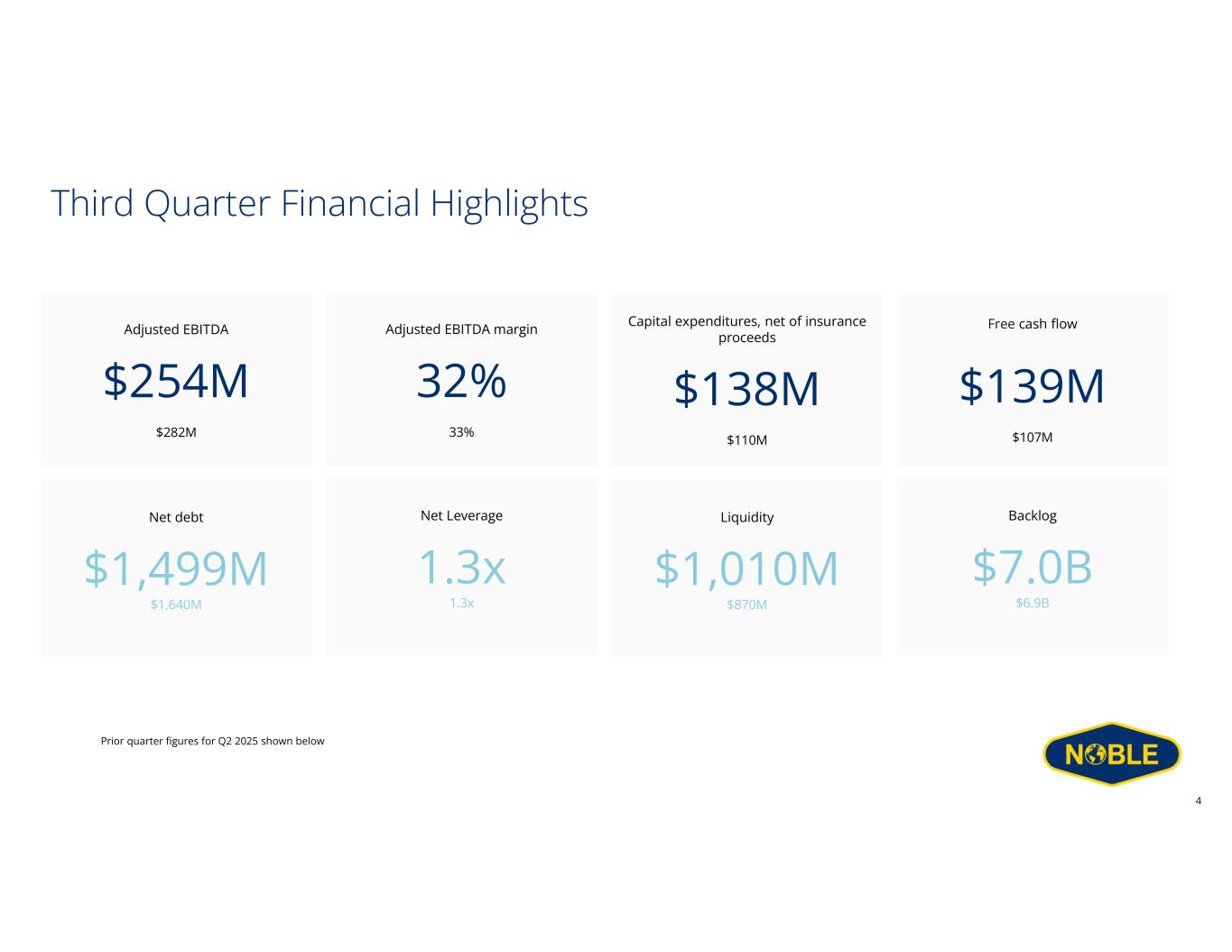
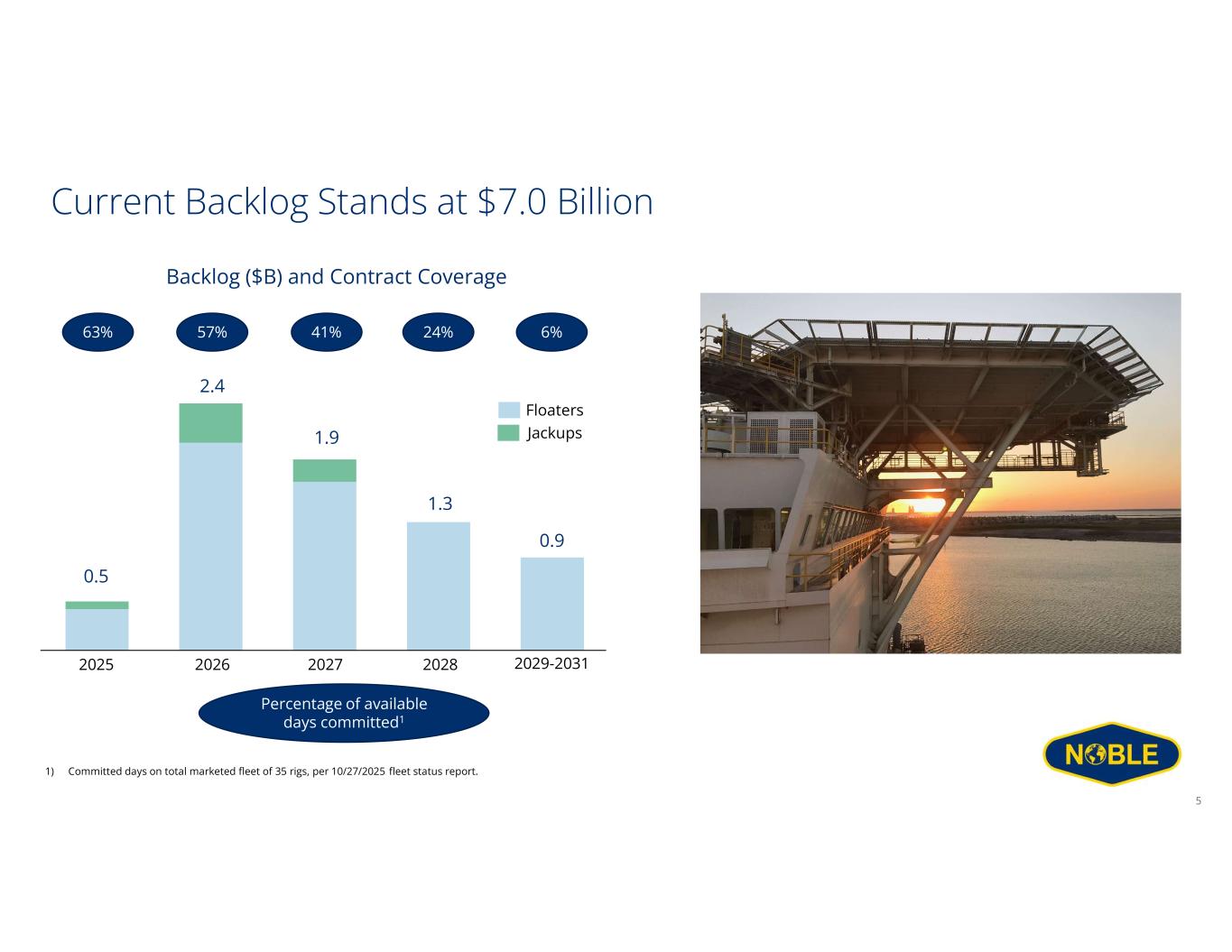
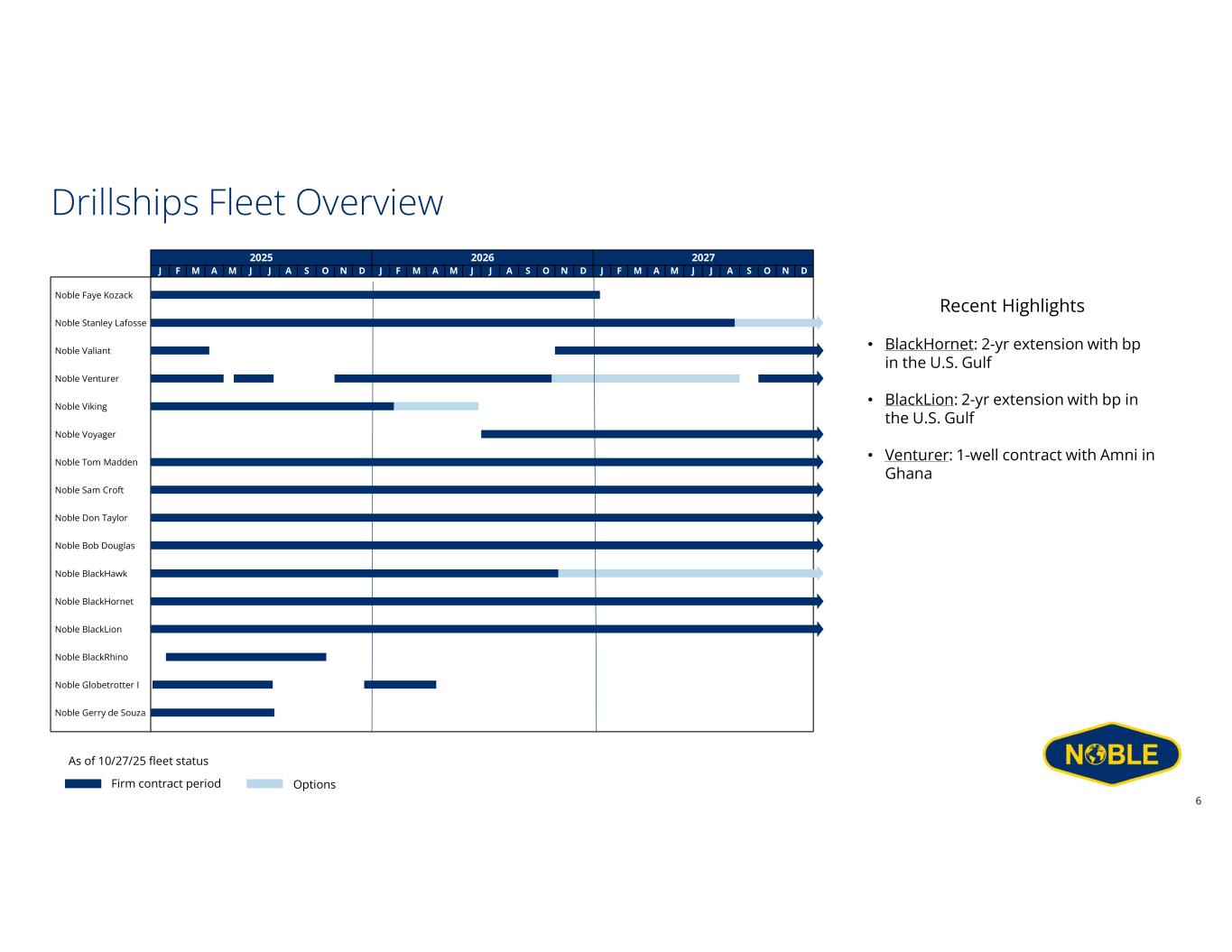
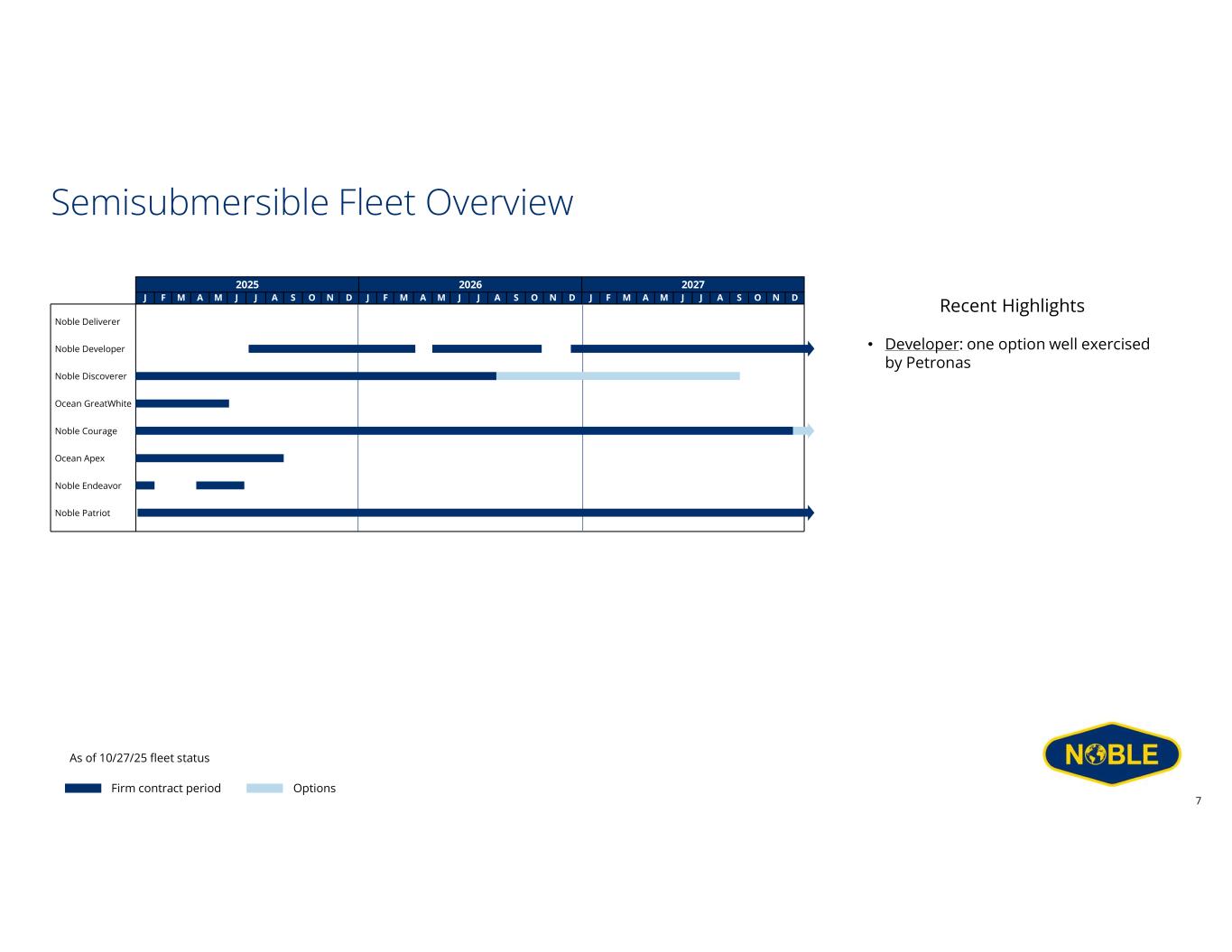
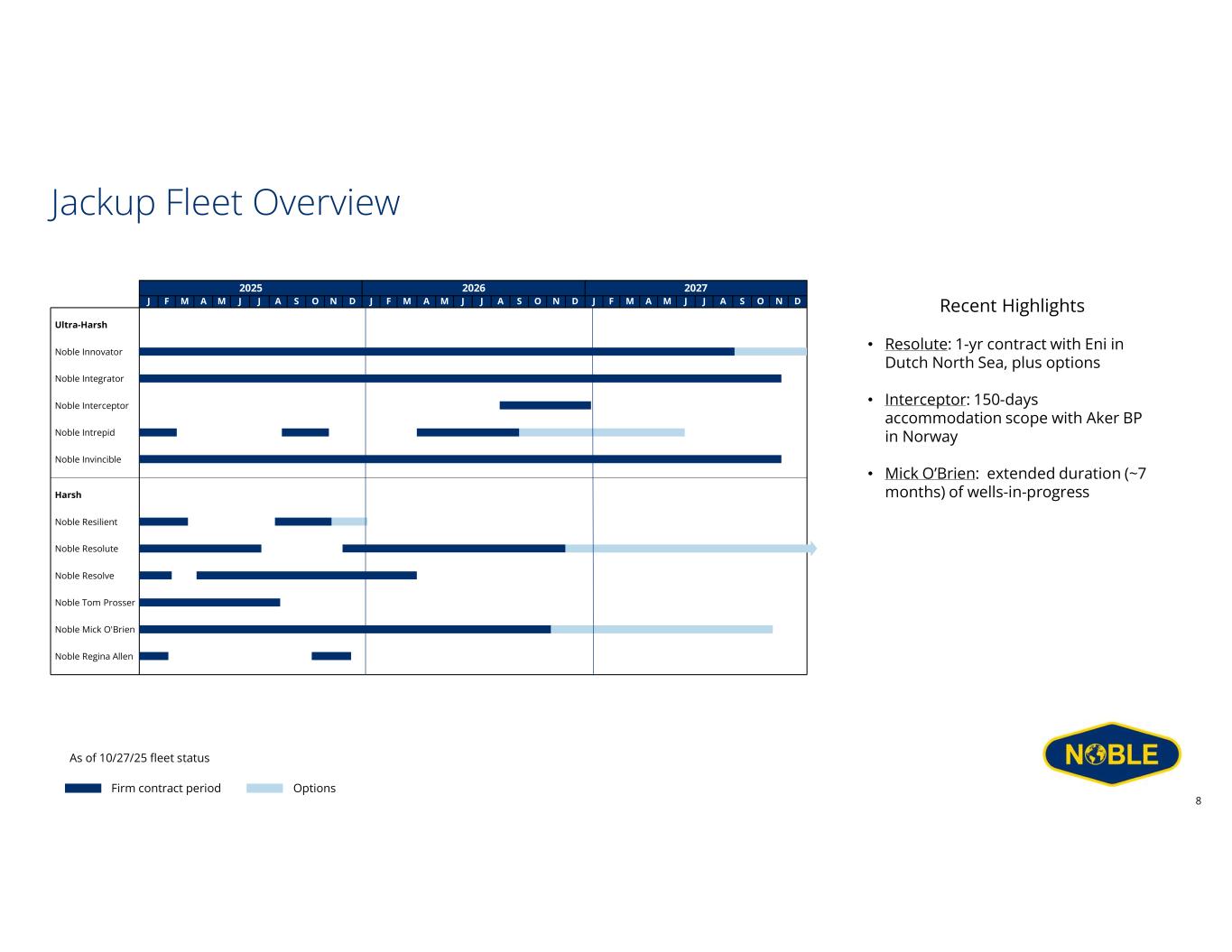
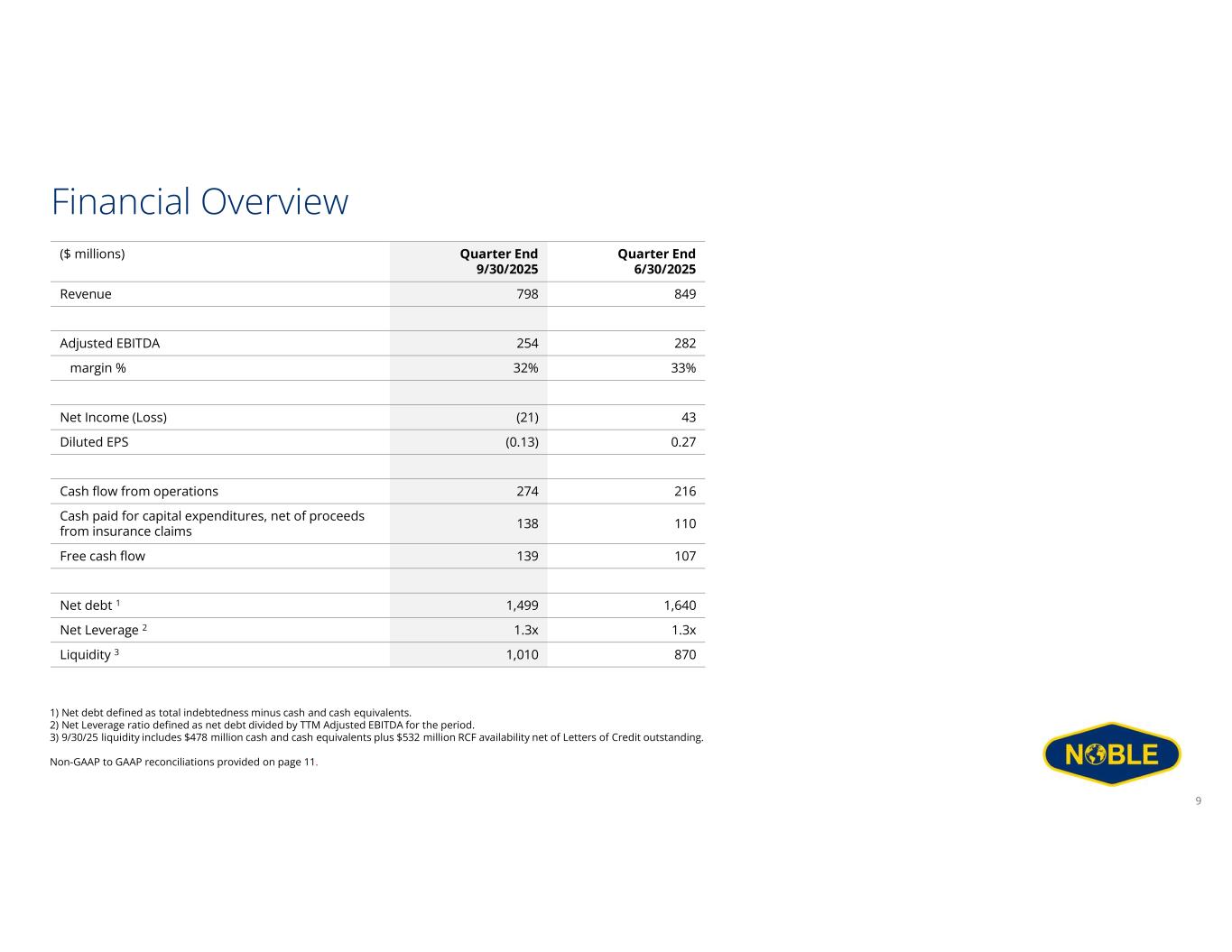
And welcome, everyone, and thank you for joining us on the call today. I'll open with a brief summary of our Q3 highlights and recent contract awards, then provide some perspective on the market outlook. Richard will provide more detail on the financials before I wrap up with closing remarks and move on to Q&A. During the third quarter, we earned adjusted EBITDA of $254 million, generated free cash flow of $139 million, and received an additional $87 million in net disposal proceeds. We again distributed $80 million to shareholders through our $0.50 quarterly dividend. Yesterday, our board declared to $0.50 per share dividend for the fourth quarter, bringing total 2025 capital returns to $340 million. The highly competitive cash yield on our stock continues to be a critical component of our story as we traverse this mid-cycle lull for our industry. Before we discuss the market, I'd like to commend and thank our crews and operating teams for achieving excellent operational uptime and HSE performance. Aided by tools like our norms, Horizon 56, and operations performance platforms, our teams have continued to push the envelope in technically challenging well construction and completion activities. In Guyana, our drill ships continue to post record-setting results within the Wells Alliance. We have now constructed over 200 wells in the basin, delivering 60% of the most recent 25 wells in under 35 days. In the U.S. Gulf, the Noble Black Hornet set a new benchmark in deepwater drilling operations, earning high praise from the customer for outstanding execution of MPD influx management on a complex exploration well. Nearby, the Noble Black Lion recently performed the longest step out yet for BP in the Gulf at over 12,500 feet, which was also delivered well ahead of AFE. Results like these continue to be a defining success story for the deep water industry and are leading the way in bringing deep water sharply down the cost curve and thereby structurally increasing the size of the prize. We've also had another solid quarter on the commercial front, with backlog increasing to $7 billion currently on the back of several key contract awards first the noble black lion and noble black hornet have both been extended by an additional two years by bp in the u.s gulf extending the rigs into september 2028 and february 2029 respectively these extensions are valued at 310 million dollars per rig excluding npd services and both come with an additional one-year priced option These contract extensions further amplify the merits of the diamond acquisition, which has materially over-delivered on our original accretion expectations, as the legacy diamond rigs continue to perform and recontract at very high levels. We are thrilled to continue the Black Lion and Black Hornets' long-term assignments, which will now be approaching one decade in tenure. These long-duration engagements demonstrate the power of the deeply collaborative service posture that we've been working hard to cultivate over the past several years in order to drive value for our customers and earn their repeat work through dependable performance. Next, the Jackup Noble Resolute has been awarded a one-year contract with E&I in the Dutch North Sea at a day rate of $125,000. This contract is expected to commence later this quarter. And the Noble Interceptor has booked a five-month accommodation contract with Akra BP in Norway, which is scheduled to start next August. Lastly, the 6G Semi Noble Developer has had an option exercised by Petronas for an additional well early next year. And the Drillship Noble Venturer was awarded a one-well contract from Omni in Ghana at a day rate of $450,000. dollars. This well is scheduled to follow in direct continuation of the ongoing telework in Ghana, which is expected to resume in its second phase within the next several days before the rig mobilizes to the U.S. Gulf for long-term work commencing in late 2027. Beyond these specific contract awards, the broader contracting and utilization trends in deep water are showing gradual signs of stabilization and improvement. The committed UDW rig count of approximately 100 of rigs and low 90% marketed utilization is in fact up slightly compared to recent quarters, despite some lingering near term availability across several units with longer dated contract starts. Additionally, deep water contracting momentum is on an uptrend with an average of 18 UDW rig years per quarter fixed in Q2 and Q3 this year, up 10% compared to the preceding two years. These are encouraging indicators, and there remains a significant number of additional fixtures anticipated over the next few months. Noble's backlog picture, as summarized on page 5 of the earnings presentation slides, shows 57% contract coverage across our entire fleet in 2026. When zooming in to our 15 high-spec drill ships, we are now 70% booked for available days in 2026, excluding options. However, we have active conversations behind all of our available rigs in 2026, including the Jerry D'Souza, Viking, and Black Rhino. And while we are also tracking the number of contract opportunities across the balance of the fleet, with Jacobs and floaters, securing additional work for these three drill ships is a key priority. And our objective is to obtain 90 to 100% contract coverage across our 15 high-spec drill ships by the second half of next year. On the jack-up side, activity in the harsh environment in northern Europe market has been stable at 28 rigs and marketed utilization at 90%, flat with last quarter, with leading-edge day rates for drilling programs in the southern North Sea holding flattish. Although the contracting environment has remained relatively subdued, we do have line of sight towards several opportunities that we hope to be able to book relatively soon. With the interceptor's pending reactivation, we now have improving contract coverage for all five of our ultra-harsh CJ70 jackups as we progress through next year. While our six harsh rigs presently have limited contract coverage in 2026, we do expect this picture to improve based on several bidding opportunities currently in process. So overall, we are encouraged by the shape of things and the opportunity set at hand, which includes a broad range of UDW requirements throughout the Golden Triangle, Asia-Pacific, Mozambique, Mediterranean, and the harsh environment basins. The pipeline for early 2026 jobs is still significantly more limited compared to late 26 and early 27. But at this point, we are not seeing indications of additional project or procurement deferrals. Assuming reasonably stable oil prices, the path toward a methodically tightening flutter market with deeper backlog appears to be on track. Now I'll pass it over to Richard to discuss the financials.
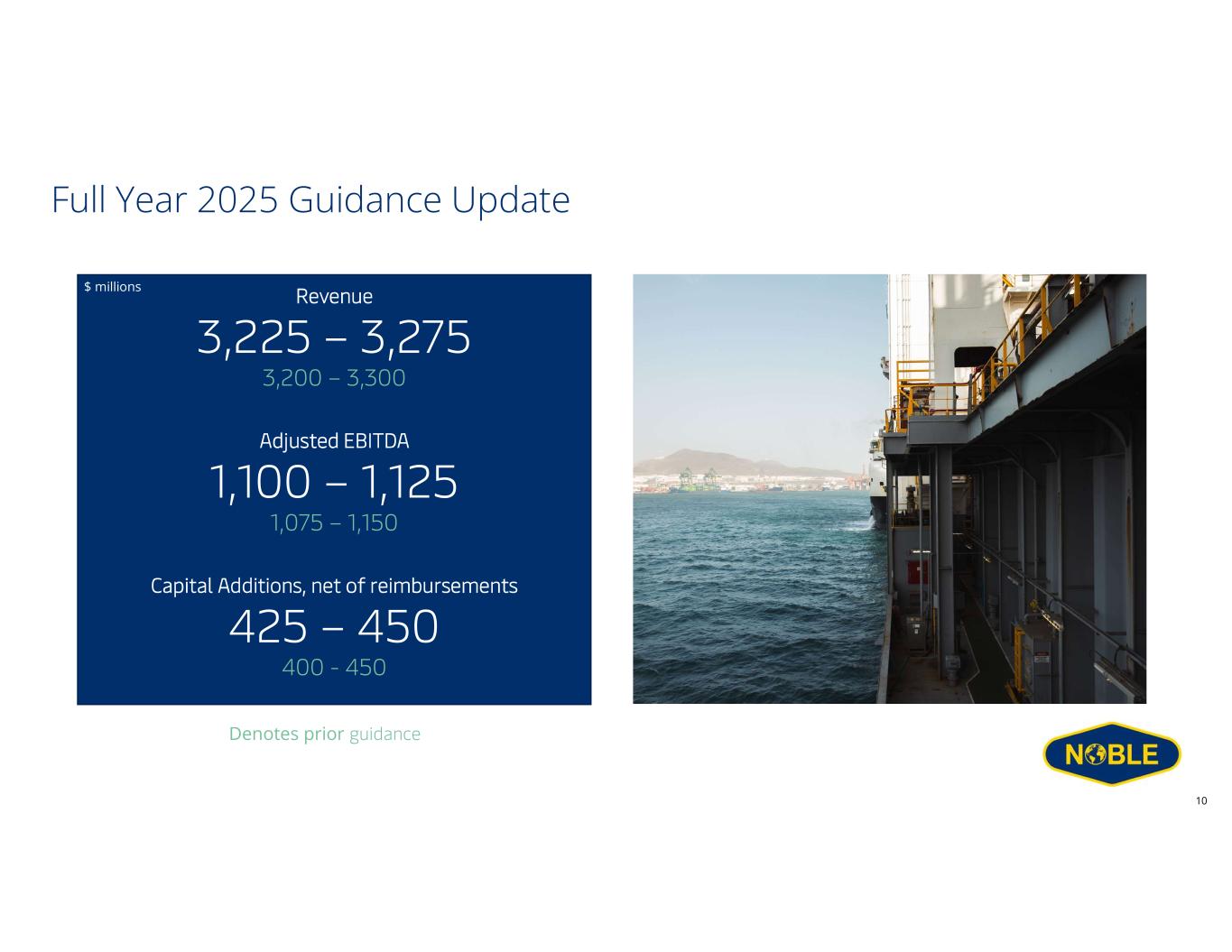
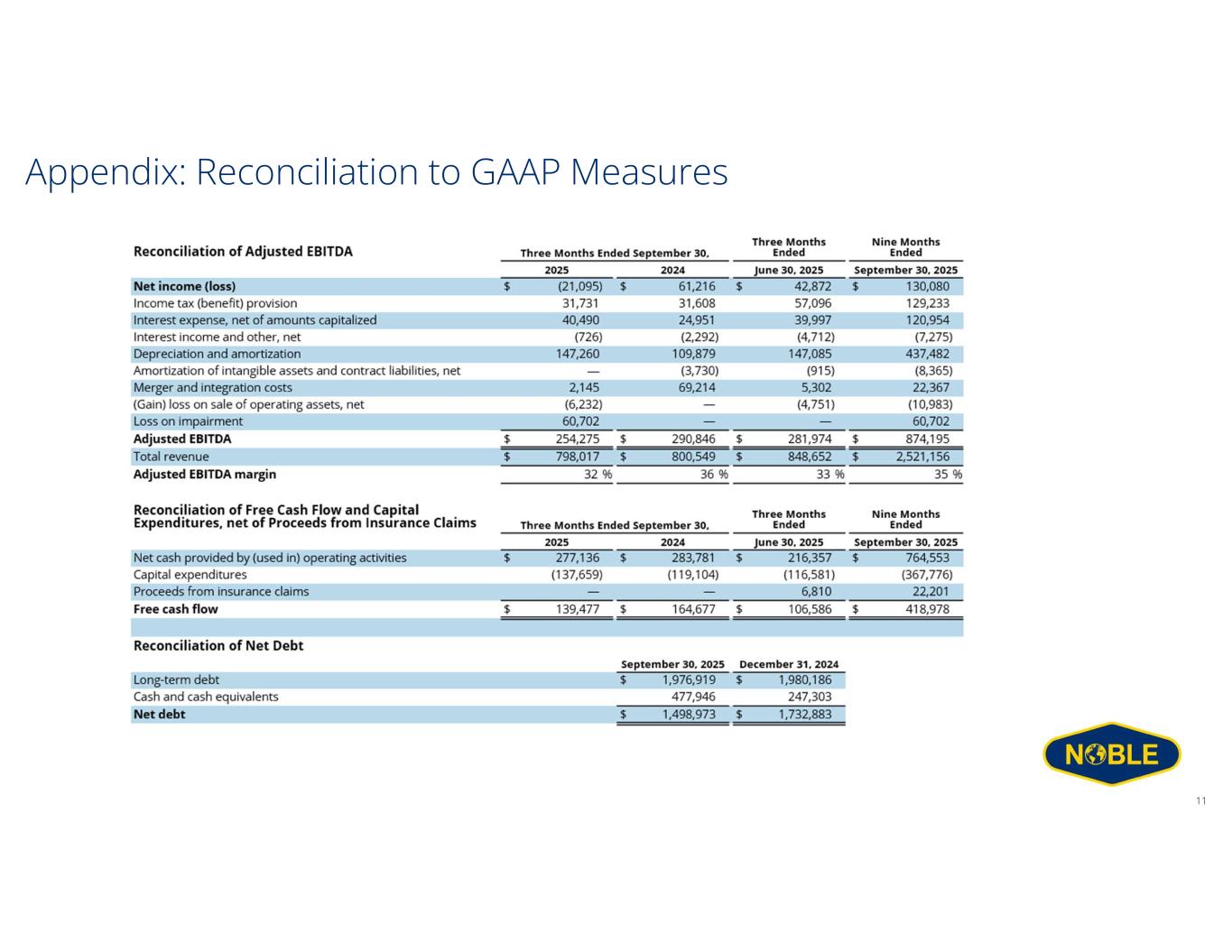
Good morning or good afternoon all. In my prepared remarks today, I will review our third quarter results and then discuss our outlook for the remainder of the year, as well as some additional high-level perspectives on 2026. Starting with our quarterly results, contract drilling services revenue for the third quarter totaled $798 million, adjusted EBITDA was $254 million, and adjusted EBITDA margin was 32%. As expected, Q3 revenue and adjusted EBITDA were sequentially lower, primarily due to a number of rigs rolling off contracts during the third quarter. Pre-cash flow of $139 million in Q3 excluded an additional $87 million in disposal proceeds, driven by the sale of the Pacific Meltem and Noble Highlander. Thus, we ended the quarter with a cash balance of $478 million, which is up $140 million compared to last quarter. Subsequently, in October, we have completed the sale of the Noble Reacher for alternative use outside the drilling market for $27.5 million. As a reminder, the reacher has not worked in drilling mode for several years, having recently completed a long-term and low-margin accommodation contract. The rig would have required a significant amount of capital to return to drilling mode again, and as such, the reacher was an outlier within athletes. As summarized on page 5 of the earnings presentation slides, Our total backlog as of October the 27th stands at $7 billion, which includes approximately half a billion dollars that is scheduled for revenue conversion for the remaining two-plus months of this year, and $2.4 billion and $1.9 billion scheduled for conversion in 2026 and 2027, respectively. As a reminder, these figures exclude reimbursable revenue and revenues from ancillary services. Referring to page 10 of the earnings slides, we are narrowing the range for our full-year 2025 guidance for adjusted EBITDA to $1.1 to $1.125 billion. The midpoint of this range implies Q4 adjusted EBITDA that is marginally lower versus Q3. I would point out that the exact start date of the Globetrotter 1 contract in the Black Sea, which we currently estimate in mid-December, is a key sensitivity for Q4 revenue due to the relatively compressed duration of the full contract value, including mobilization. We have narrowed guidance for full-year 2025 CapEx net of customer reimbursables to a range of $425 to $450 million. Reversible CAPEX is expected to be approximately $25 million this year, including approximately $20 million year-to-date through Q3. We plan to provide 2026 guidance on next quarter's earnings call. In directional terms, I would say that the shape of our current fleet status report would indicate an EBITDA trough in the first half of 2026 that would be somewhat below second half 2025 levels, as well as lower results on a full-year basis for 2026 versus 2025. However, based on current and anticipated backlog, we are tracking toward a material inflection from late 2026 onward, which we will look to define more sharply next quarter as the next slug of foundational contracts are expected to come into backlog. We continue to anticipate approximately $450 million in capex net of customer reimbursements next year based on our current contract status. However, this estimate may be subject to an increase to the extent that additional contract-supported opportunities arise with compelling accretion. The Capital II React A, the Noble Interceptor, will be reimbursed through an upfront mobilization payment. Additionally, we are likely to incur additional outlays totaling up to approximately $135 million associated with the termination of the BOP service and lease contracts on the legacy diamond blackships. During the third quarter, we delivered a termination for convenience notice for the service agreement, and we are currently in discussions around the lease agreement. We would expect an approximate $35 million of cash outlay during Q4 2025, which is expected to flow through OPEX and CAPEX, and then the remainder during 2026. These amounts are not included in the aforementioned guidance ranges. However, as a reminder, this cash outlay would be offset by annual savings of approximately $45 million across OPEX and lease payments on the agreements on a combined basis. We are focused on building cash here in the last quarter of this year in anticipation of next year's capital requirements, including the potential BOP-related payments. We are also committed to maintaining a robust return of capital program and a prudent balance sheet position. Based on existing backlog and current customer dialogue, we would expect a healthy EBITDA and cash flow inflection late next year. That concludes my remarks, and with that, I'll hand it back to Robert.
Thanks, Richard. To wrap up, we're continuing to see a number of positive signs of increased deepwater activity after the anticipated trough over the next few quarters. This is essentially very similar to how we assessed the outlook last quarter, albeit with additional backlog in our books today to help lay the path toward that outcome, but also with a bit more slippage with certain program start dates, which continues to bifurcate the 2026 versus 2027 picture. We still have some work to do with securing a few more key contracts in order to support our expectation for a meaningful free cash flow inflection by late next year, but the opportunity set there is highly encouraging and progressing well. We continue to watch our customers' budget announcements closely, which of course have, in aggregate, been less than inspiring at a headline level, and which remain the ultimate growth governor for our business. But at the same time, it has also been highly encouraging to see the relative resiliency of rigged contracting activity this year in the face of elevated macroeconomic noise, sluggish oil prices, and upstream capital restraint. these divergent dynamics underscore the strategic long-term criticality of deep water within the global upstream supply stack we see this in the renewed emphasis and urgency surrounding upstream reserve replacement metrics and in that same vein on the ground here in houston there's a palpable growing sense of the capital imperative toward deep water exploration in a way that feels different from anything over the past decade So, I would encourage investors to pay close attention to this important litmus indicator in the months and quarters ahead. Meanwhile, as we wait for these anticipated demand tailwinds to materialize, we continue to manage our costs and marketed capacity to optimize cash flow, and we remain committed to paying a competitive dividend and maintaining a strong balance sheet through the cycle. With that, let me hand it back to you, operator, to go to the Q&A section.
Operator
At this time, I would like to thank everyone in order to ask a question, press star, then the number one on your telephone keypad. We'll pause for just a moment to compile the Q&A roster. Your first question comes from Aaron Gerayim from JPMorgan.
Yeah, good morning, Robert. I wanted to maybe start with your thoughts on improving the utilization for your high-spec floater fleet. You mentioned that you're 70% booked for 2026, with the target of getting to 90% to 100% by the second half of 2026. Talk to us about the opportunity set to get there and kind of how long of a putt, using a golf analogy, would it take to get there?
Yeah, Lauren, thanks, Irene. So really it revolves around the Viking, the Jerry D'Souza, and the Black Rhino. And let's see, continuing with the golf analogy, I'd say it's really not a very long cut. I think while we didn't have any real new news for you this quarter versus last, we are advancing conversations around all three of those rigs. And, you know, we hope to have some news for you here in the not too distant future. So those are all very technically capable rigs. We're bidding them in discussions around a couple of different areas, but we do have a line of sight towards the work that we're hopeful to win.
Great, that's helpful. And maybe if you guys could maybe just elaborate on the Diamond Offshore BOP leases, I believe those are agreements on eight of the rigs that you acquired. Can you just go through maybe the mechanics of that a little bit? It sounds like it's a pretty quick, in terms of a cash return payoff, given the savings. But maybe just go through the numbers a little bit, just so we can tighten up our models.
Sure, I agree. So there's two components here. There's the service agreement and the lease agreement. So we've now terminated the service agreement, and we'll have about a $35 million payment on that here in Q4. Okay, so that's $35 million of cash out of the door here in the fourth quarter of this year. On the lease agreement, we're still working through that. There is a cap on that agreement of $85 million, and that would be payable next year. Obviously, there's a few remaining lease payments as well. So if you sum that all up together, there's a maximum of $135 million of cash out of the door, And then kind of the annual cash savings, if you will, to us is about $45 million for that. So it's about three times the multiple on that, if you will.
Great. Thanks a lot for those details.
Operator
Your next question comes from Greg Lewis with BTIG.
Hey, thank you. Good morning, everybody, and thanks for taking my question. You know, Robert, I was hoping for a little more color, and I guess you kind of touched on it with some of the comments to Arun. But, like, as we think about the first half of 26, you know, the kind of the moderately bound versus, you know, what we are going to do in the second half of 25, you know, as we kind of look at those drill ships, you know, some of them all have idle time in the second half of 25, you know, it looks like there's going to be some idle time in the first half of 26. is that largely what's driving that, or is there other costs? Is it maybe some idle time on the jack-up fleet, if you kind of help us maybe bridge why we're thinking it could be down? I'm assuming that the answer to getting it higher would just be some spot work.
Yeah, it really is largely driven by the floaters. Last quarter, we mentioned trying to get to a run rate of $400 million to $500 million of cash flow here, then kind of back half of the year. And really, the driver there are those three rates I mentioned earlier. You know, I think what I guess also I mentioned, we're aiming to get back to effectively market utilization, so low 90% to hit those numbers. And that translates to kind of two out of the three of those rigs working at any given time. And like I said, we have run a site on different jobs. We're not going to win everything that's out there, but we feel pretty confident that as we work through things that the goal of having two out of those three is very achievable and hopefully can outperform by finding work for all three of them. The spot work, you asked about spot work. You know, I think right now it's one of those times in the market. It's actually a more unique time, I think, than I've seen previously, where there is a fair amount of work on the horizon starting in 26 and 27, but there is a definitive gap in between where it's quieter than we've seen in multiple years. I'm probably missing some piece of history as I reflect on that, but I find it somewhat singular in nature. And so I think the spot work, the gap filler work, so to speak, is going to be really separated from the rest of the work that's out there as it prices and as people think through it. So I anticipate that to be a dynamic that plays out through 2026.
Okay, great. Super helpful. And then just the other question I had was around, you know, I know it's hard to look at snapshots in time, but just kind of trying to understand, you know, I think we all see the work out there, you know, whether it's West Africa or, you know, parts of Asia. But as we look at some of those term jobs that are out there, do we get a sense, are those states kind of remaining firm, just, you know, given some of the macro out there, are jobs that maybe three to six months ago we thought were going to be in the second half of 26 still lining up to be in the second half? I'm trying to understand if there's been any drift or slippage in some of this work that me and you and a lot of people are waiting to kind of start early.
Yeah, it's been a mixture. I think there's some that have held firm, and then there's some that have moved to the right. We really haven't seen anything being pulled back forward. That's certainly not the feeling we get right now. But I'm just off the top of my head. I can think of a handful of jobs that have been pushed by, say, six months, and I can think of a handful of jobs that are right on schedule with our customers, eager to start kind of in the middle or the beginning of a start window. So I think it's a mixture. Yeah.
Okay, super helpful. Thank you very much.
Operator
Your next question comes from Eddie Kim with Barclays.
Hey, good morning. I just wanted to touch on your expectations for the first half of next year. So you mentioned you expect moderately lower earnings and cash flow compared to second half 25 levels. Consensus currently has you guys at around $440 million in EBITDA, which represents about a 10% decline versus what your guidance implies for second half of this year. So just curious if you could speak to expectations for first half 26 relative to where consensus is at now and what it would take maybe in terms of some incremental contracting in the spot market from here to achieve that level of EBITDA or if that level might be a bit too optimistic at this point.
Yeah, so we haven't given out quarterly estimates, so let me think about how. So, you know, that is true directionally, that all that fits with kind of our narrative in the prepared remarks. And I think I would focus also on the fact that there's not a whole lot of work that we see in the first half of 26. There'll be a couple of announcements out there. There are some gaps in the work that I mentioned earlier. There really, I don't think, is a lot of room for upside improvement in the first half of the year. That does change pretty dramatically in the second half of the year. Of course, some of that's known and contracted and announced for both us and our competitors. But there's other work out there as well that's being negotiated and hasn't been announced, you know, industry-wide. So I think we're really focused on the timing of that, working. We've set everything up, as we've mentioned, to hit this cash flow inflection. And for us, the timing is a little less certain around that back half of the year, but we certainly see it coming.
Got it. Got it. Understood. Good. The follow-up is just on your expectation for that. You called it the deep water utilization recovery by late 26, early 27. Could you just talk about your confidence level in this recovery? Is it based on the tenders that are out there currently or the tone of your conversations with customers or contracts that you already have in hand? So if you could just talk to your confidence level in that recovery. Sure.
Yeah, I mean, it's a mixture of both. You know, we, starting with the contracts in the U.S. and in Suriname, I think we've kind of baked in somewhat of a floor for ourselves starting in the back half of next year. and we really see a tightening of the market out there. You know, some of that's announced and out there. Some of it is rumors that we understand some of our competitors have won some work and some of it's stuff that we're working on ourselves. You know, we're cautiously optimistic here that day rates have bottomed and not to say that there won't be some lower day rates that get announced after I've made this statement, but we're cautiously optimistic that from here, the market is tightening to a point in late 26 and 27 that we bottomed here. So, stay tuned.
Operator
Your next question comes from Cedric Stain with Clarkson Security.
Hey, Robert and Dame, hope you are well, and thank you for taking my question. So I think you've, you know, you've painted the relatively, I guess, optimistic picture of demand from the second half of 26 and beyond, and you've mentioned a handful of rigs by name, more specifically, you know, the white cane jerseys and the black rhino, which you seem to be relatively confident that you'll get some work on. But I was wondering, there's the Globetrotter 1, and there's the Deliverer, for example. Do you have any additional color on how we should think about those rigs specifically going into next year? And maybe even more so on the Globetrotter 1, is that also going to be, you know, at some point, an investment candidate after this contract, or do you think it can get more work?
Yeah, that's a good question. So, GT1, we continue to chase intervention work, as we've mentioned, and that we continue to believe that that is an interesting market for that asset. We also have said that it could be an investment candidate. So, it's a little too early for us to kind of give anything firm there. But I would say that both of those, frankly, are on the table. If we can't find work for the rig in the intervention market, then we'll make a decision there. On the deliverer, so I would maybe group all of the D-rigs together as a bundle and say that we see more work today than we've seen at any point since at least the noble side has owned those rigs for the last few years. Our outlook does not require all three of those rigs to be working. um uh so i think all finding work for all three would would would be um for us um but we have uh we think we have pretty good line of sight uh to at least two working and again probably more increase than we've had at uh at any point but that's very very helpful uh thank you um and as a follow-up just turning on on the list spoken about uh as it's also on the floater fleet and maybe more in the harsh environment side you have the great white the apex ambient ever that's
currently um idle um and i guess it's a two-part question here one on the great white um is originally a you know uk type of rig but but have you you know thought anything more about potentially uh taking that rig into norway you know getting a proper aoc and i'm sure that will come with a with a major you know capex payment if you you like to do something like that and on the apex on the endeavor uh how do you think about this fleet size in general or or do you think that's maybe you know one two mini rigs that are are currently on the on the lower spec hash environment side thanks yeah so the great white we're we're marketing uh but a number of different regions
around the world um you're you're right it was not built to to a Norwegian spec so there there would be a capital cost to take it into Norway uh if that were to become an option um so I think we're just a little little too early right now um to to give guidance on where that rig might end up um there will be some white space on it and um and we're we're trying to find the best best fit for it uh at any point in the future there are several different jobs out there in different places around the world the apex and the endeavor um likewise have um uh opportunities and um you know like with all of our older rigs we'll continue uh to have a very sharp pencil and look at our opportunities closely and you know for us any opportunity needs to stand on its own for those rigs and that's that's pretty firm on our side and so those are being marketed and hopefully have some update on direction there perhaps perhaps next quarter we'll see all right this is very good thank you for all the details and I'll hand it back.
Have a good day. Thanks, Freddy.
Operator
Your next question comes from Doug Decker with Capital One.
Thank you. Robert, I was hoping you'd expand on the prospects for the Black Lino specifically. Is this likely to be well-to-well work in U.S. Gulf or is it more likely to be term work in U.S. Gulf or some other region? I'll just give me you've talked about line of sight to contracting that rig.
That was the rhino you asked about. Yeah, I think we're talking to customers about both. And actually, we think we have opportunities both in the Gulf and outside the Gulf right now. So wish I had more direction than that. But we're kind of, honestly, we have opportunities that fit in all three of those categories. short-term U.S., long-term U.S., and long-term non-U.S. So we're going to have to just see what comes through for us here.
Well, fair enough. And then maybe looking back to Norway, I was kind of encouraging to see the reactivation of the Interceptor. Does this mean that there's a meaningful tightening in that market? And really kind of thinking about some of the CJ-70s that are working outside Norway, the potential of moving back in in, say, 27 or so?
Yeah. Look, I would say I wish I could report that we saw a flood of work coming in Norway for the CJ70s. I can't claim that right now. We do have more opportunities today than we did six months ago and certainly a year or two ago, and that's driven us to look at reactivating the interceptor there. You know, I'd say that'll be probably the most marketable rig in the region that doesn't have a contract as it rolls out of that accommodation work, so we like where it's positioned. And we're hopeful that perhaps rig demand takes up by one or if it's already picked up by one, say, kind of maintains steady there. But it is a little too early to tell. And this contract I had, you know, stands on its own, and we're really happy to have it.
Operator
Your next question comes from Noel Parks with Tui Brothers.
Good morning. I just had a couple. Is it safe to say at this point that price sensitivity is not in the mix in a big way? in customer decisions, either from sort of a formal perspective, which would, you know, maybe urge them to, you know, commit sooner rather than later, or sort of from a bargain hunting perspective. So is this sort of just what they want to do being conservative on their budget commitments the main driver that's at work these days?
I wish I could say yes. I don't think so at all. I think our customers are as price sensitive as ever. The macro outlook is obviously variable and uncertain. There's some downward oil price beliefs. And, you know, we'll learn more as 2026 budgets start to get announced or become more clear. But we're, I would say we're seeing the opposite. I'd say we're seeing extreme price sensitivity in our ongoing negotiations.
Okay. Okay. Thanks. And you did mention sort of in the wrap-up of the prepared remarks that in Houston on the ground there, it feels different from how it has in terms of sentiment towards the deep water at any time in the past decade. I wondered if we could talk a little bit more about, I don't know, if there's a sense of there being like an inevitability that capital needs to head offshore relative to onshore opportunities, but Just any sort of color or feel you can give for what you're hearing?
You know, I think here it feels like it's well known that deep water is going to be an important part of the supply mix going forward. That is obviously in the context of a slowing, plateauing Permian, which eventually some day has to decline. Deep water, you know, is obviously a long cycle and requires forward thinking and investment. And those investments have to start at some point. To me, that's the most obvious connector between the malaise in the macro environment in a world where a lot of people are calling for perhaps lower oil prices in the near term with the opportunity set that we see in 2026 and 2027. And so I think we see more activity than perhaps one would have predicted if just given the macro uncertainty out there today. And to me, that explanation is one possible explanation is the understanding that deep water is an important part of the energy mix going forward.
Right, right. And I could just add more.
I'll just add, Noel, you know, we mentioned exploration. I can't say today that we've seen any uptick in exploration wells. I have seen an analysis that shows that the entire explanation of the difference in recount from last market cycle high in 2013-14 to today is the difference between development work and exploration work. And so I think that's something we've watched very closely. I don't think it's right on the horizon as a driver for demand in our business, certainly not in 2026, but I do think that's an important litmus test, which is why we mentioned that, because we're running at around 90% utilization today on a pretty heavy development load, or put a different way, on a pretty low total exploration load. And so we watch that very closely, and we'll see what happens over the next couple of years here.
Great. Thanks. And I just wanted to ask one more, and that's about – I think last quarter you were observing that, in general, in West Africa, customers were a little slower to commit than compared to South America. So I just wondered if that's unchanged. And you're talking about oil sentiment. It has been surprising to me that there seems to be just a lack of attention to sustaining geopolitical premium in the oil strip these days, despite there being still quite a few hot spots out there, to be sure. And I just wondered if you saw the sort of concern about future oil prices or oversupply or whatever, if you saw it playing out more strongly in the thinking of customers in one region than another.
Yeah, sure. So first, just on West Africa, that's a long cycle region. It takes a lot of planning. You know, I think last quarter we mentioned, but certainly in the past, we mentioned that really the difference between where we at one point were hopeful the demand picture would be around this time and reality here is explained by a lack of West Africa demand. We see that starting to play out in a number of countries in West Africa. We mentioned Mozambique, too. I think that comes online in the next couple of years. So as that corrects itself, I think that's a few units of demand that I think it's going to really help in late 26 and 27 bring total demand back where we're predicting it to be. um on the oil piece i think there's a lot of negative sentiment there's you know a lot of people hold a belief that it's likely to go down before it goes up you know i we we we struggle to predict obviously um i will say i guess kind of repeat what i said around what we see on on service demand demand for our services which is is is encouraging um and then i always point to kind the middle part of the Brent curve, which has moved so much less than spot pricing and than a very volatile sentiment. If you're a deep water operator, you're obviously having to take five and ten year views. So it makes sense that with that middle part moving less that we're seeing planning continue, perhaps beyond what the otherwise volatile macro would suggest.
Operator
Again, if you would like to ask a question, press star 1 on your telephone keypad. Your next question comes from Josh Jamie, Daniel Energy Partners.
Thanks. Good morning. I just had one. I think it was at the end of the prepared remarks. You talked about the balance sheet and some cost rationalization. Maybe you could speak to the efforts you're taking on the cost side. And if you view those as sort of structural or if these are things that you're doing, assuming that we have a trough in the first half of next year before we cover it, maybe just go into more detail on the things that Noble's doing.
Sure, yeah. Well, obviously, the cost in the down market is very important. And, you know, I think as you think about the diamond transaction, as an example, right, So in that deal, we now have sort of 100 million synergies. You know, we achieved that, I guess, in Q2 of this year. And so, well, you know, it was – well, sorry, we're in the amount now. Obviously, there's some opportunity higher than that. But it's hard to buy, okay, what is the synergy versus the other kind of cost work we're doing in the company. So, you know, we haven't put out a kind of an incremental cost savings target, but I think it's fair to say that we're realizing, you know, kind of incremental cost savings here just obviously as activity slows here in the first half of May next year.
Operator
There are no further questions at this time. I'll now turn the call back over to Ian McPherson for closing remarks.
Thanks, everyone, for joining us today and for your interest in Noble. We'll look forward to speaking with you again next quarter. Have a great day.
Operator
Ladies and gentlemen, that concludes today's call. Thank you for joining. You may now disconnect.