Operator
Good morning. Thank you for joining us and welcome to Northwest Bankshare's second quarter 2025 earnings call. This session is being recorded and a playback will be available on Northwest Investor Relations website. All participants are currently in a listen-only mode. Following prepared remarks, we will open the call for a question and answer session. Now I would like to introduce Michael Perry, Northwest Managing Director of Corporate development and strategy and investor relations.
Good morning, everyone, and thank you, Operator. Welcome to Northwest Bank Shares' second quarter 2025 earnings call. Joining me today are Lou Torcio, President and CEO of Northwest Bank Shares, Doug Schosser, our Chief Financial Officer, and T.K. Krill, our Chief Credit Officer. During this call, we will refer to information included in the supplemental second quarter earnings presentation which is available on our investor relations website if you'd like to read our forward-looking and other related disclosures you can find them on slide two thank you and now i'll hand it over to lou good morning everyone thanks for joining us today to discuss our second quarter results first i'd like to start by welcoming Penns Woods customers, employees, and shareholders to Northwest, and Richard Grafmeier, Penns Woods former CEO, to our Board of Directors.
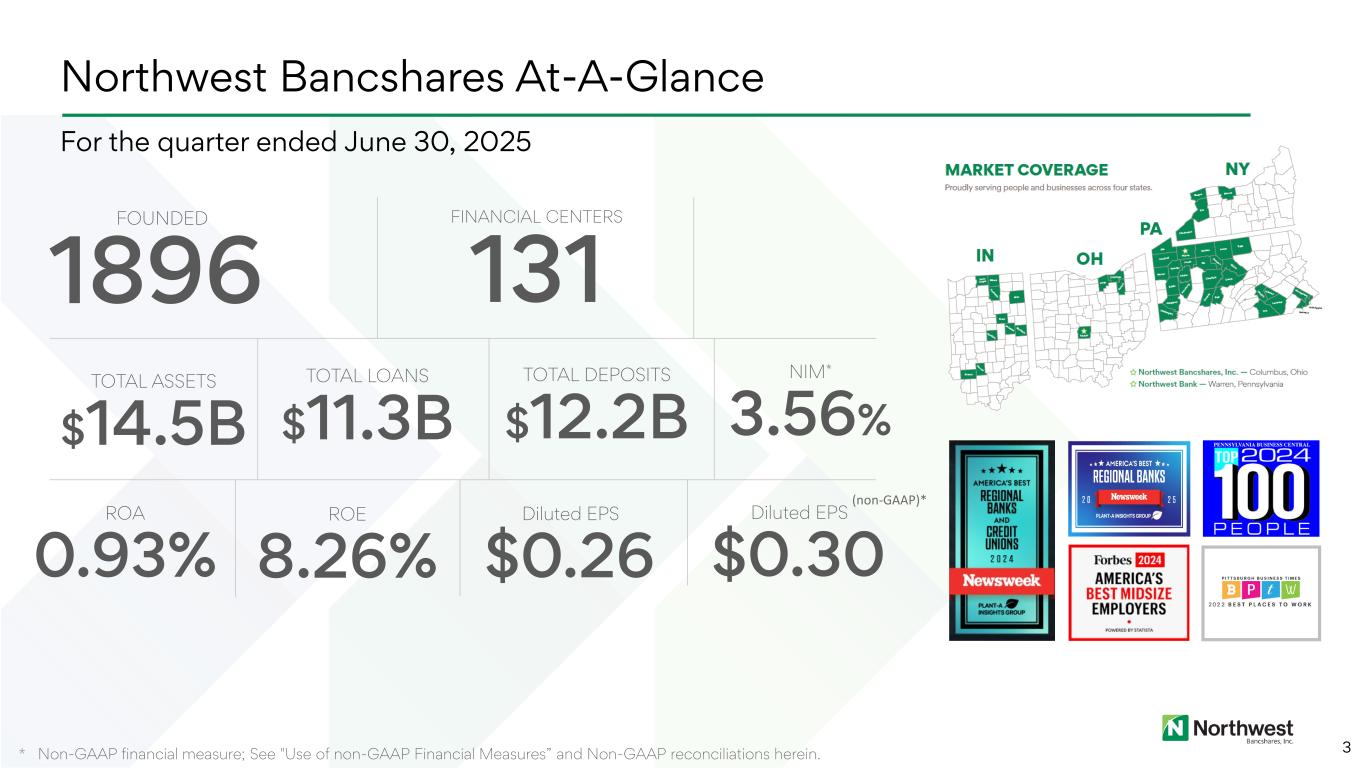
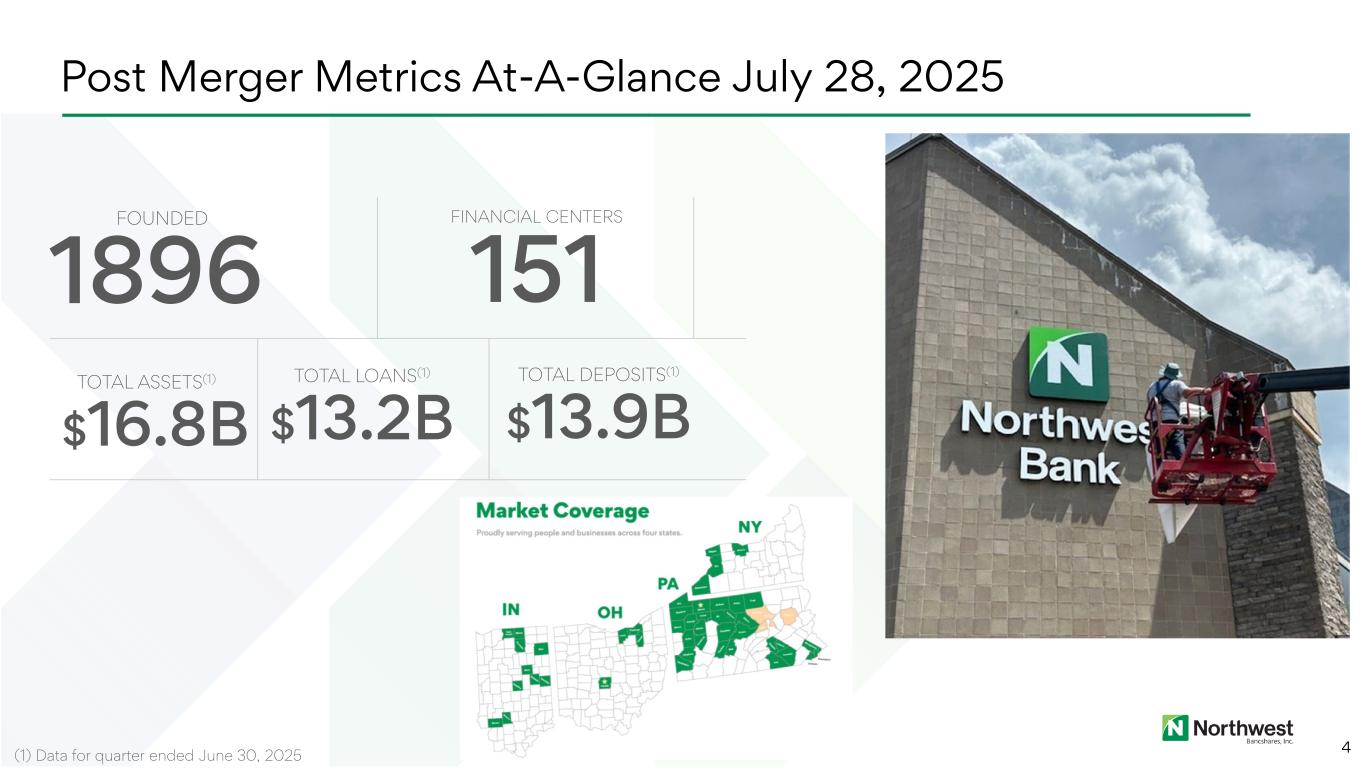
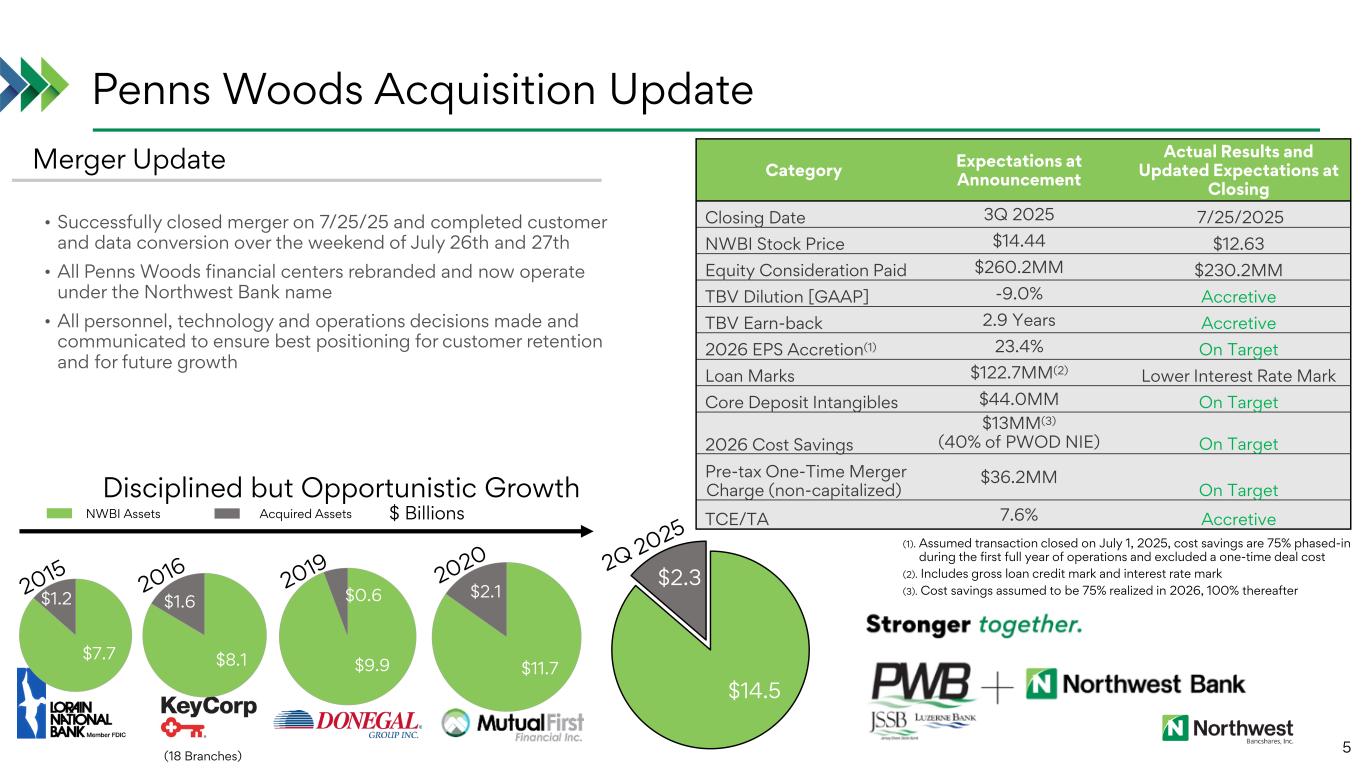
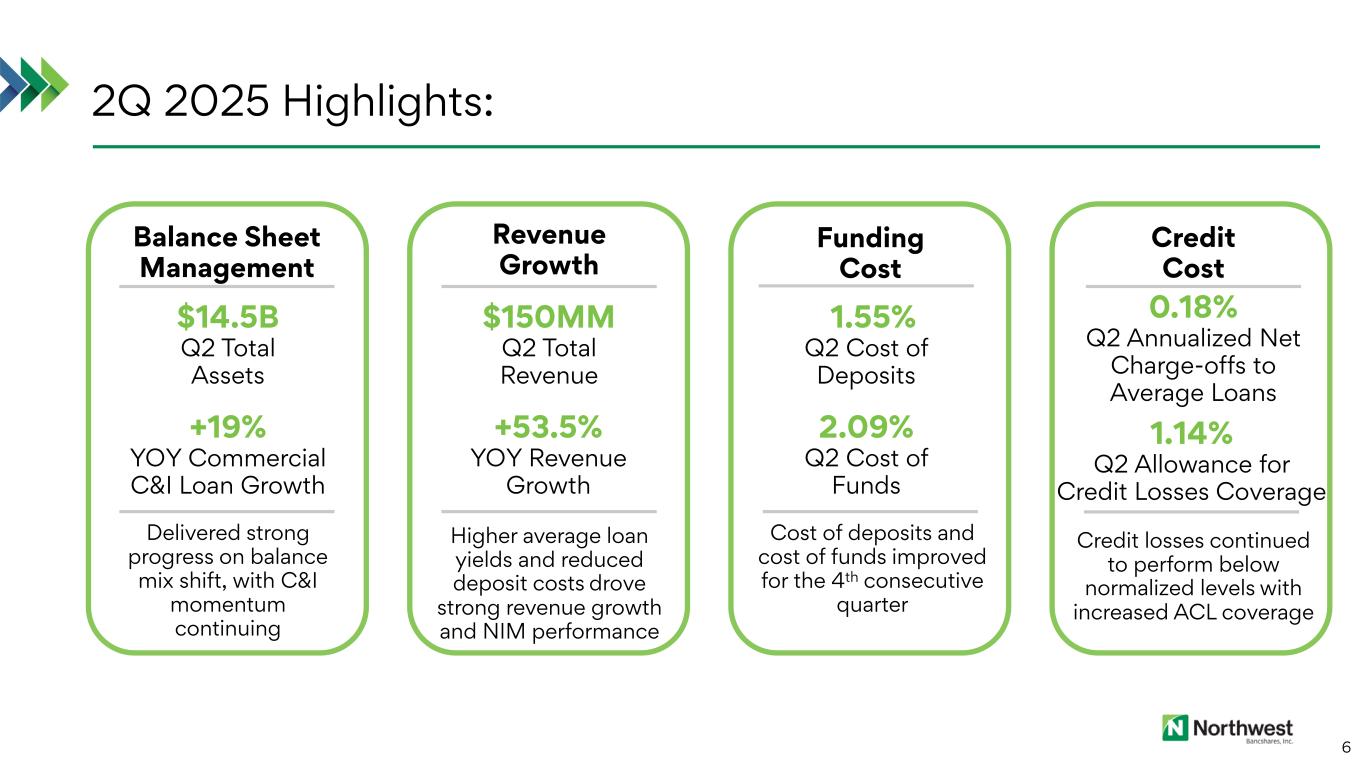
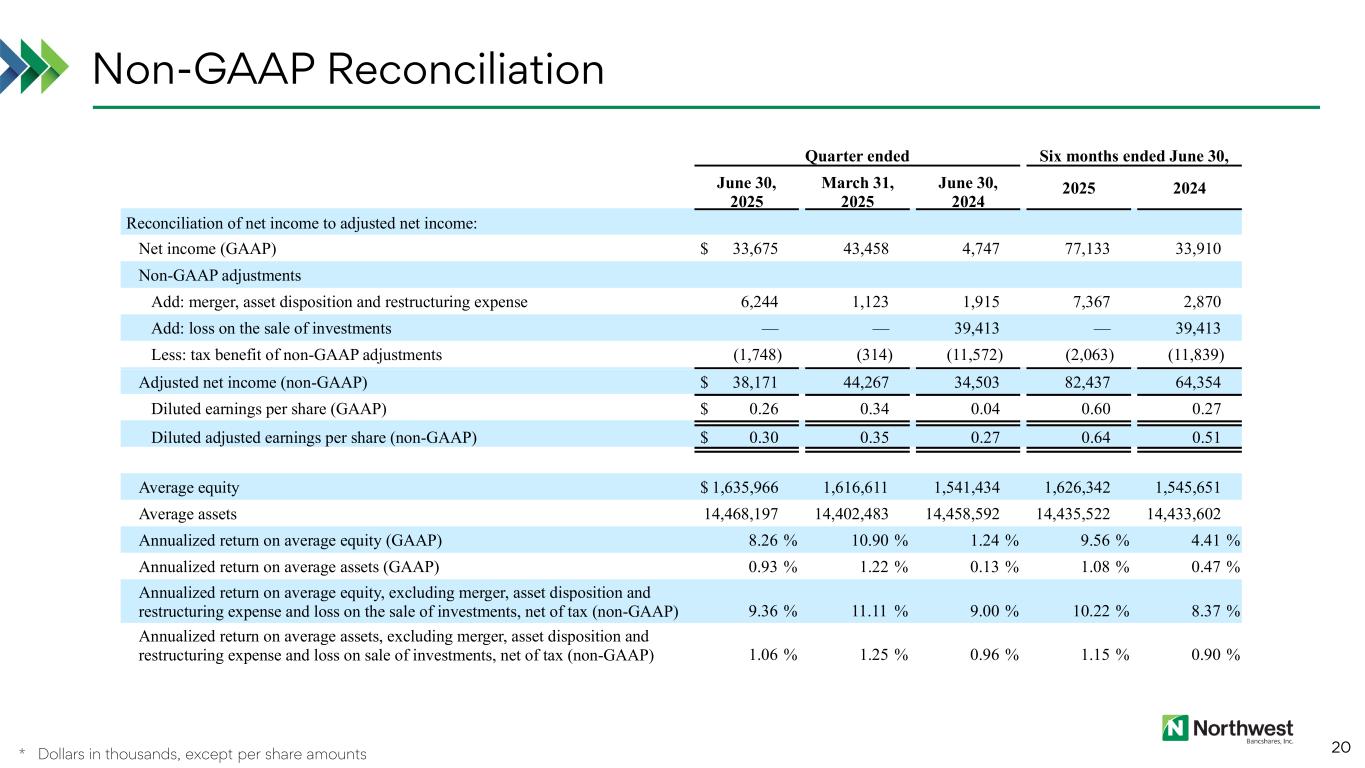
We completed the legal close of Penns Woods merger after the conclusion of business on Friday, July 25th, and subsequently began the customer and data conversion and financial center rebranding over the weekend. As of 8 a.m. Monday, July 28th, the former Jersey Shore State Bank and Luzerne Bank financial centers began operating under the Northwest Bank name. Closing the largest transaction in our company's history while continuing to deliver strong operational financial performance is a result of the cumulative effort of many months of hard work by our team. I'm grateful to everyone for their dedication to making this merger and conversion successful. I'd also like to note that the key metrics relating to the merger, including expected cost reductions, are on target or better than our original expectations. Our focused execution exemplifies our commitment to disciplined but opportunistic growth. You can see that trajectory on the bottom of page five. Northwest now ranks as one of the nation's 100 largest bank holding companies, with total assets of approximately $17 billion. We now have more than 150 financial centers across Pennsylvania, New York, Ohio, and Indiana, further enhancing our scale for driving sustainable Ford momentum and revenue. Together, we are better positioned to deliver value to our shareholders and to offer an expanded range of products and services to customers and communities across our Pennsylvania footprint. Although we are always evaluating acquisition opportunities for additional scale and strategic benefits, with the Pennswoods acquisition and conversion just behind us, we are primarily focused on optimizing the operations and financial performance of the newly combined entity. We continue to enhance our capabilities, expand our footprint through de novo branch openings and provide personalized services and expertise to our customers and the communities we serve. In June, we opened our first new full-service financial center in six years in Fishers, Indiana, and we have plans to open additional new financial centers in key locations in the high-growth Columbus and Indianapolis metro areas over the next 12 to 18 months. Turning to our second quarter, I'll address some of the quarter's highlights on slide six. I'm very pleased with our performance this quarter as we balance preparing for the acquisition and conversion of Penswood while maintaining our focus on executing our strategy and delivering on our commitment to sustainable, responsible, and profitable growth. Overall, we built on a strong start to the year, including continued strength in our net interest margin and improved fee income, which together resulted in $150 million of revenue for the second quarter. We continued to exercise prudent expense control, and we reported gap net income of $33.7 million and earnings per diluted share of $0.26 compared to $0.04 in the second quarter of 2024. If we adjust our second quarter 2025 results for the impact of one-time merger-related expenses on a non-GOT basis, we are reporting net income of $38.2 million and earnings per diluted share of $0.30 compared to net income of $35.5 million and $0.27 cents per diluted share in the second quarter of 2024, which has also been adjusted for the impact of the previously disclosed securities restructuring. This impressively would represent a 10% increase in earnings per share compared to the year-ago quarter. We made further solid progress on our balance sheet strategy while continuing momentum from our strategic shift towards commercial lending. We drove a 19% increase in average C&I loans compared to the same period last year. In addition, the team's focus on deposit gathering continues. We maintained our near best-in-class deposit franchise with a fourth consecutive quarter of reduced cost of funds, which provides us with a high-quality, stable funding base and improving net interest margin. Our credit costs continue to be in line with our expectations. We increased our ACL coverage while reporting modest credit losses with net charge-offs below our guidance range and no increase in total delinquency percentage this quarter. And finally, as we have for the previous 122 quarters, on behalf of the Board of Directors, I'm pleased to declare a quarterly dividend of $0.20 per share to shareholders of record as of August 8, 2025. This quarter's strong results and the successful closing conversion of our largest acquisition to date are the product of an extremely talented team's hard work. I want to thank our entire Northwest team for their continued dedication to our company's success. Looking forward to the rest of the year, we continue to focus on managing the factors within our control, serving our core customers and communities, building on our strong financial foundations, and maintaining cost control and risk management discipline. Now, it's my pleasure to introduce Doug Chaucer, our Chief Financial Officer, who will take us through our financial results. Doug?
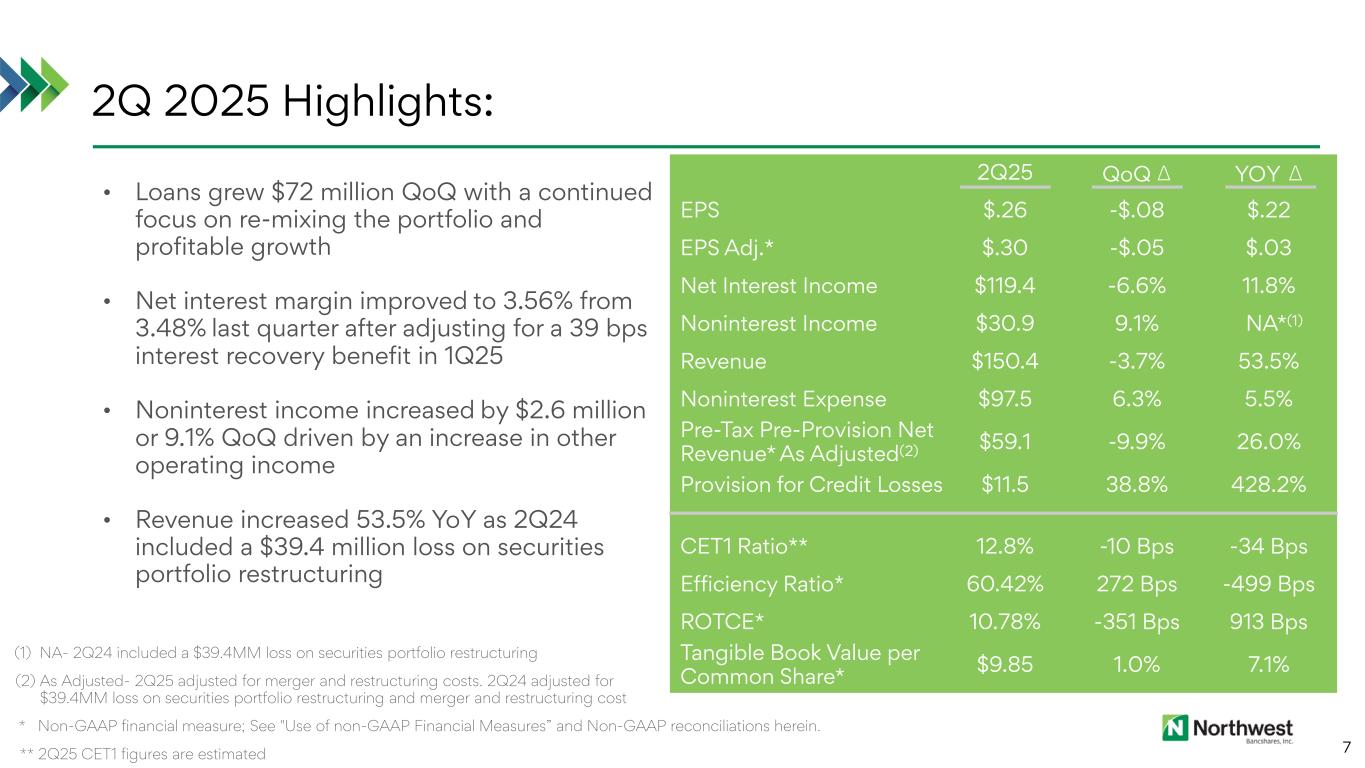
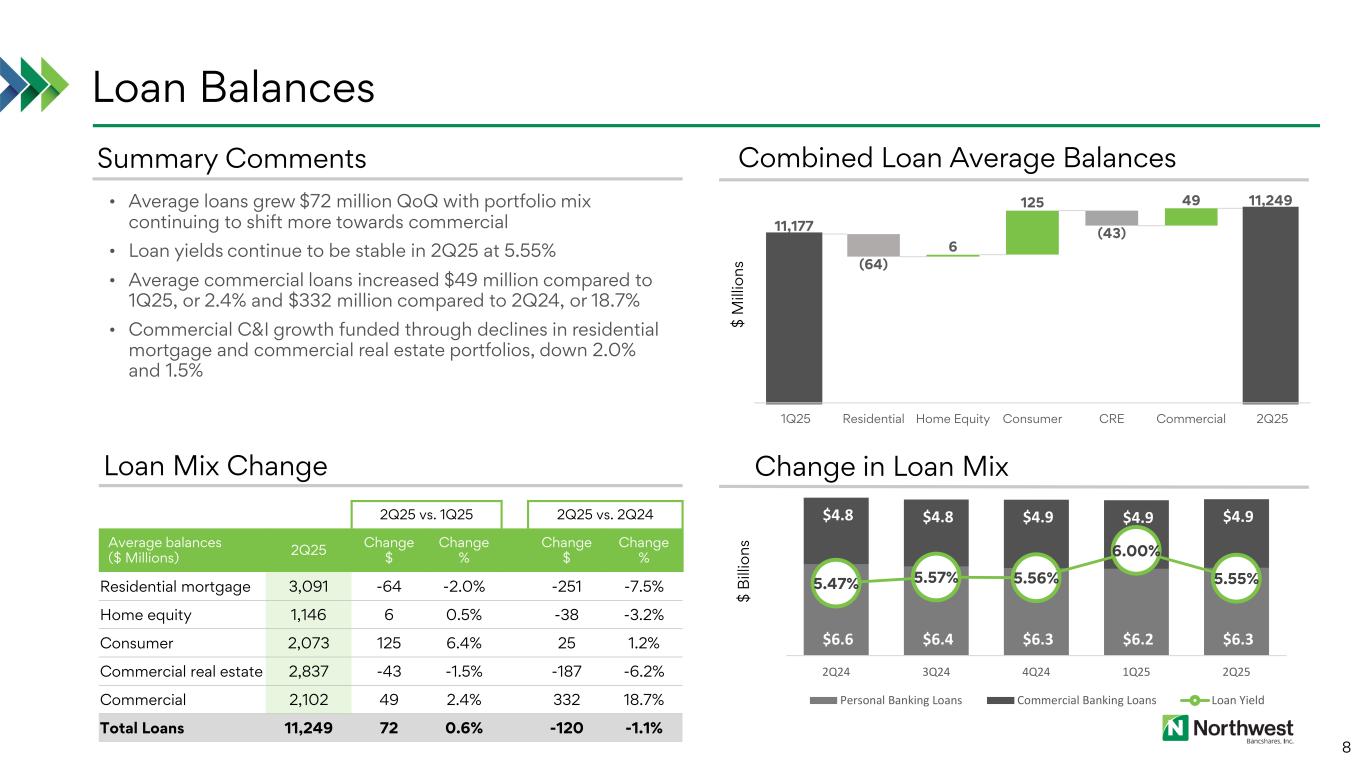
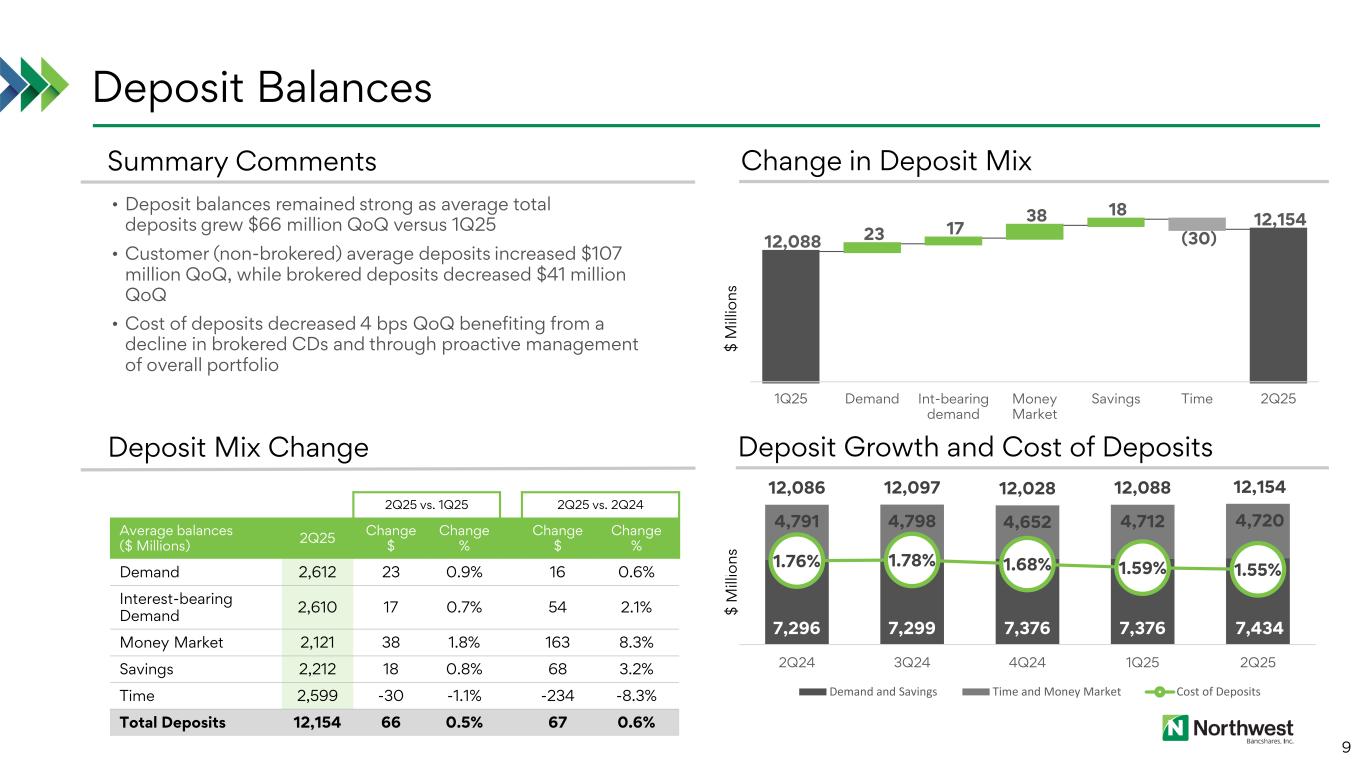
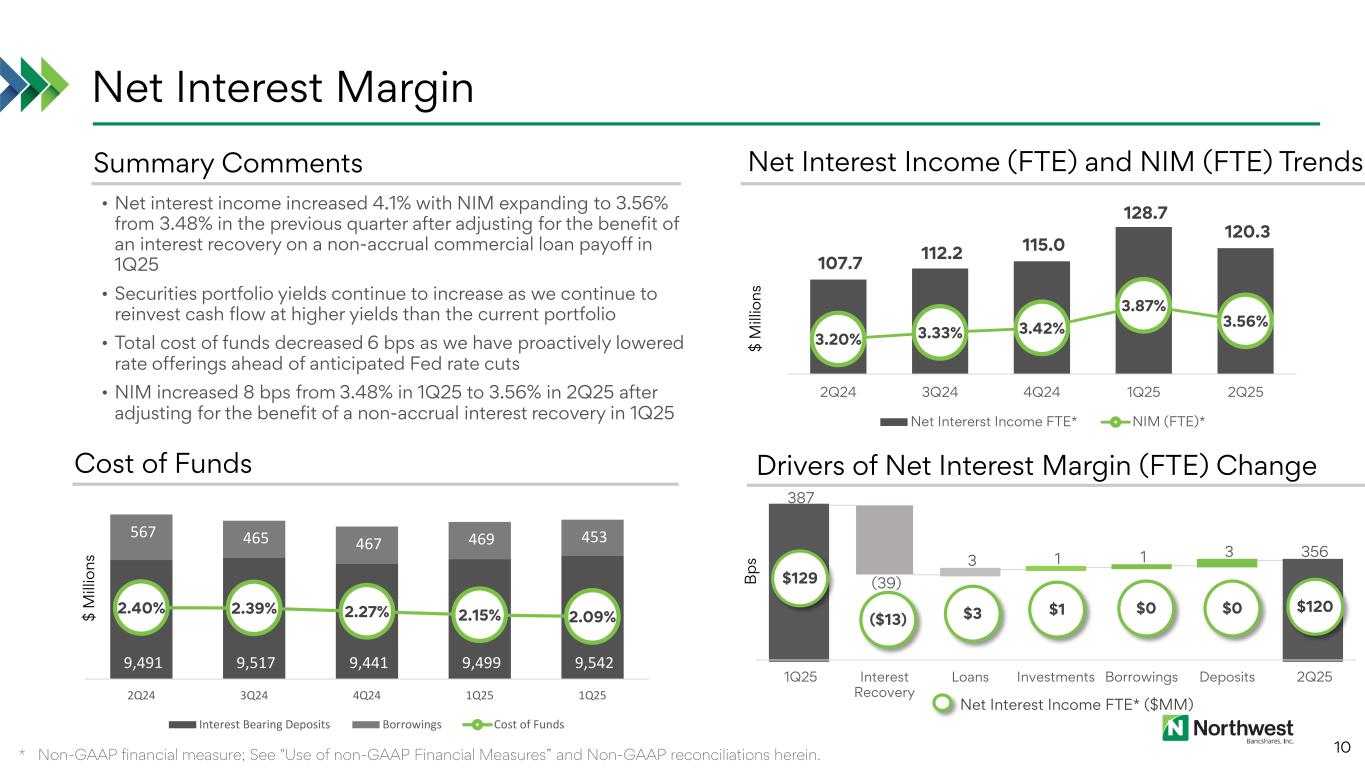
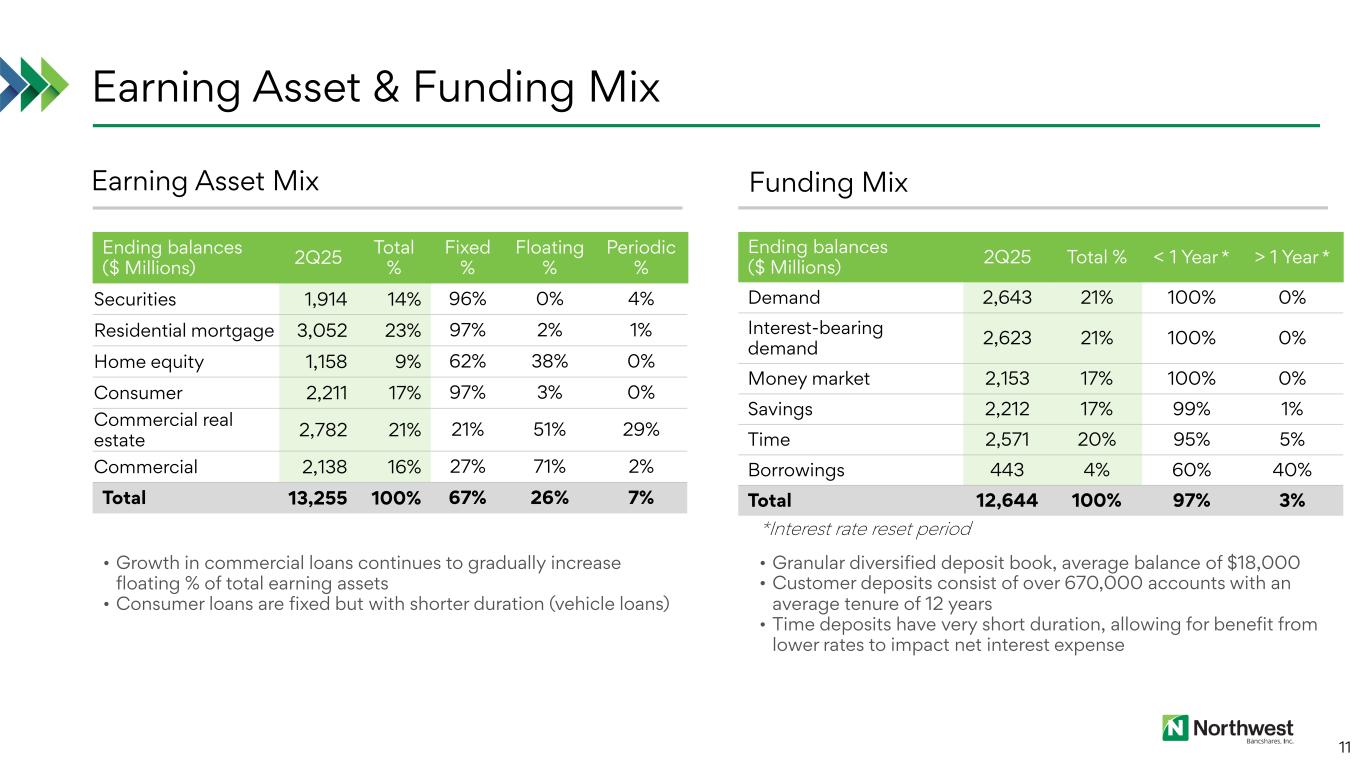
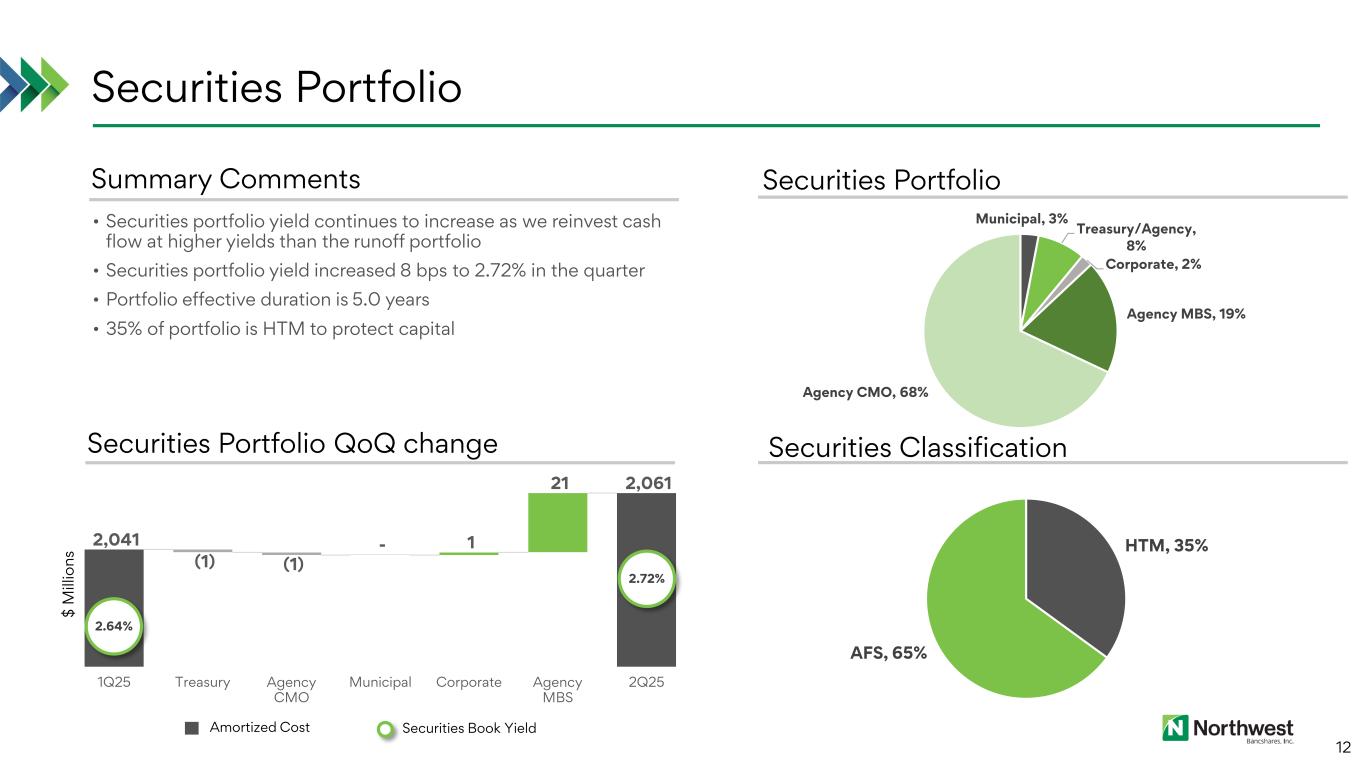
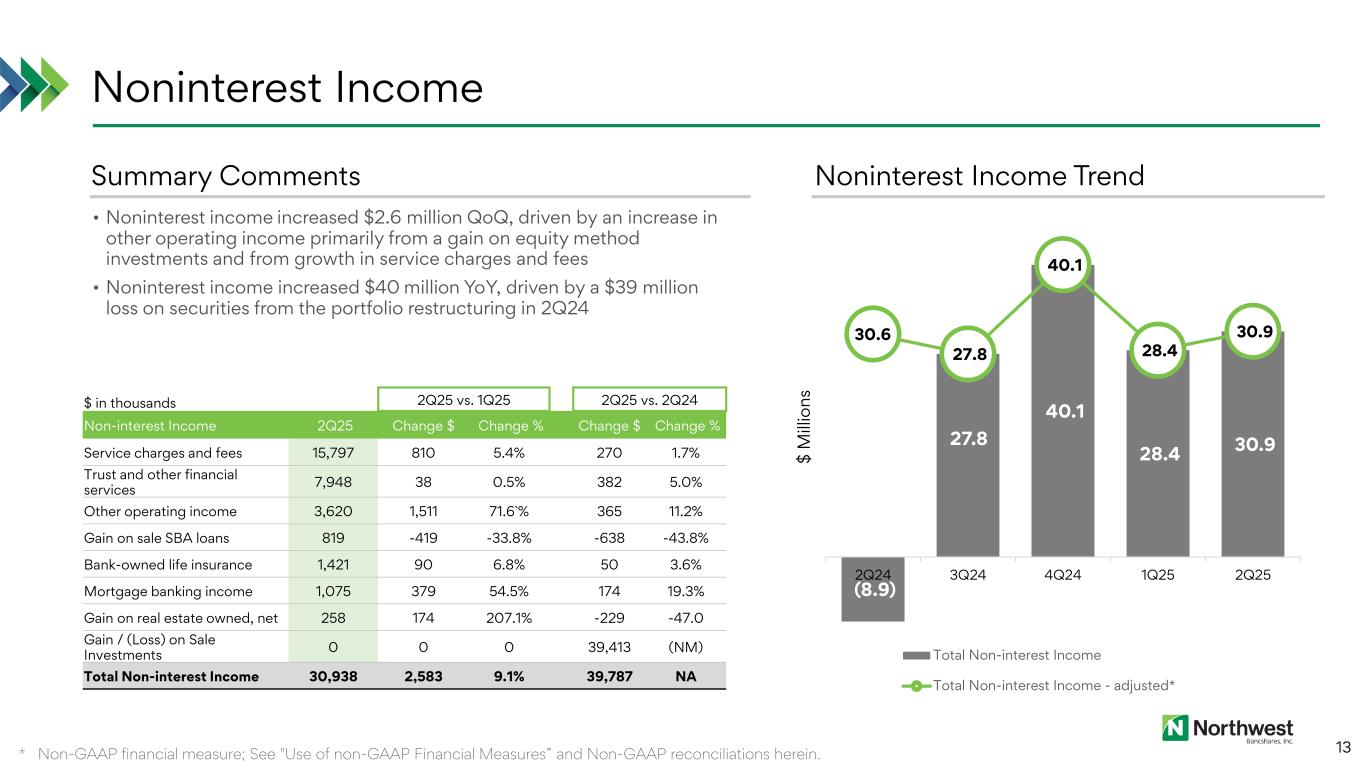
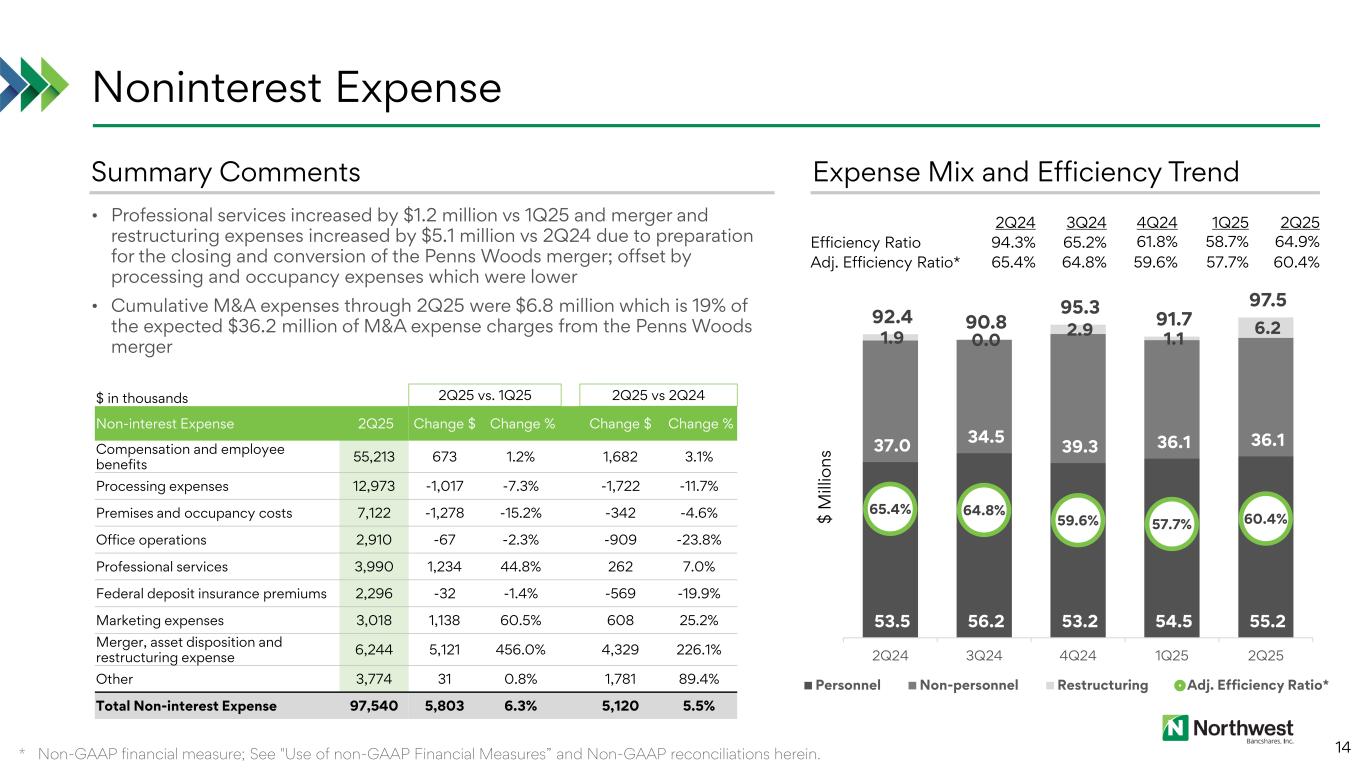
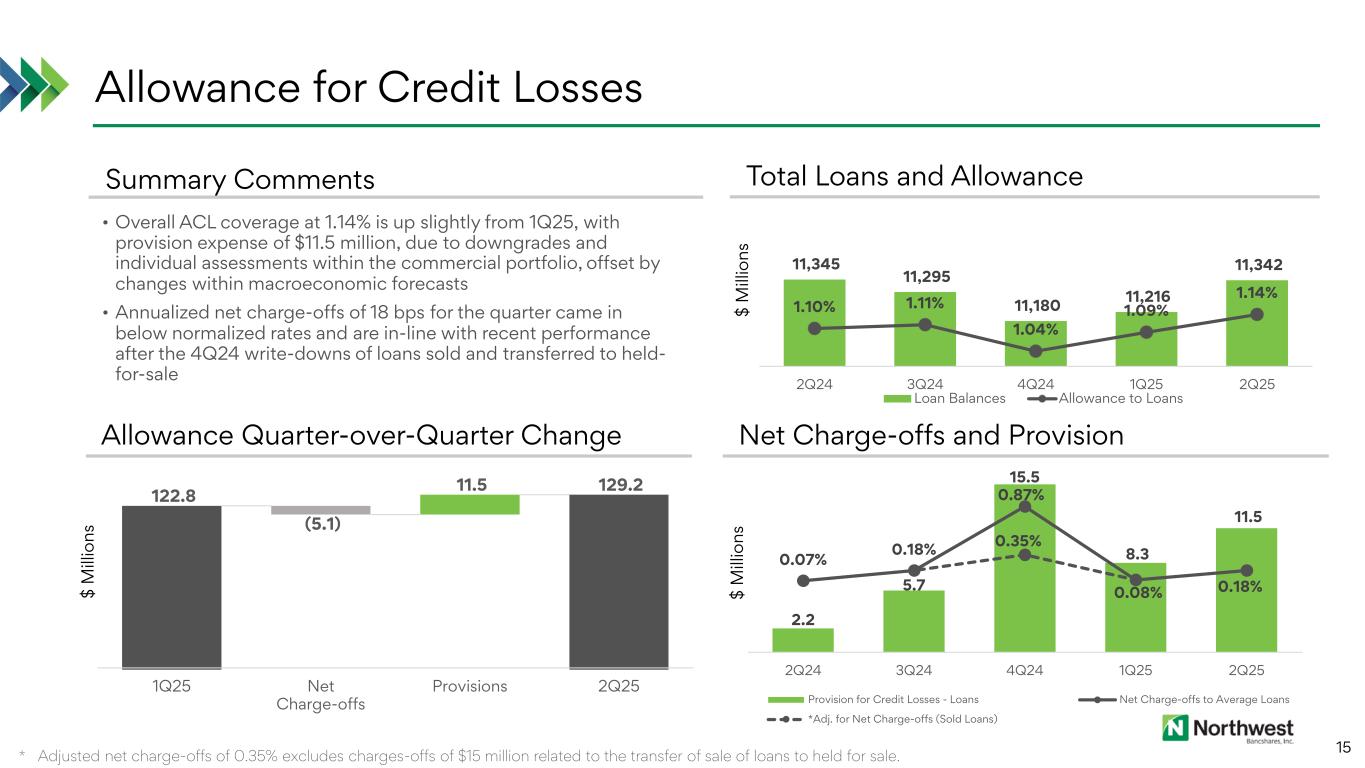
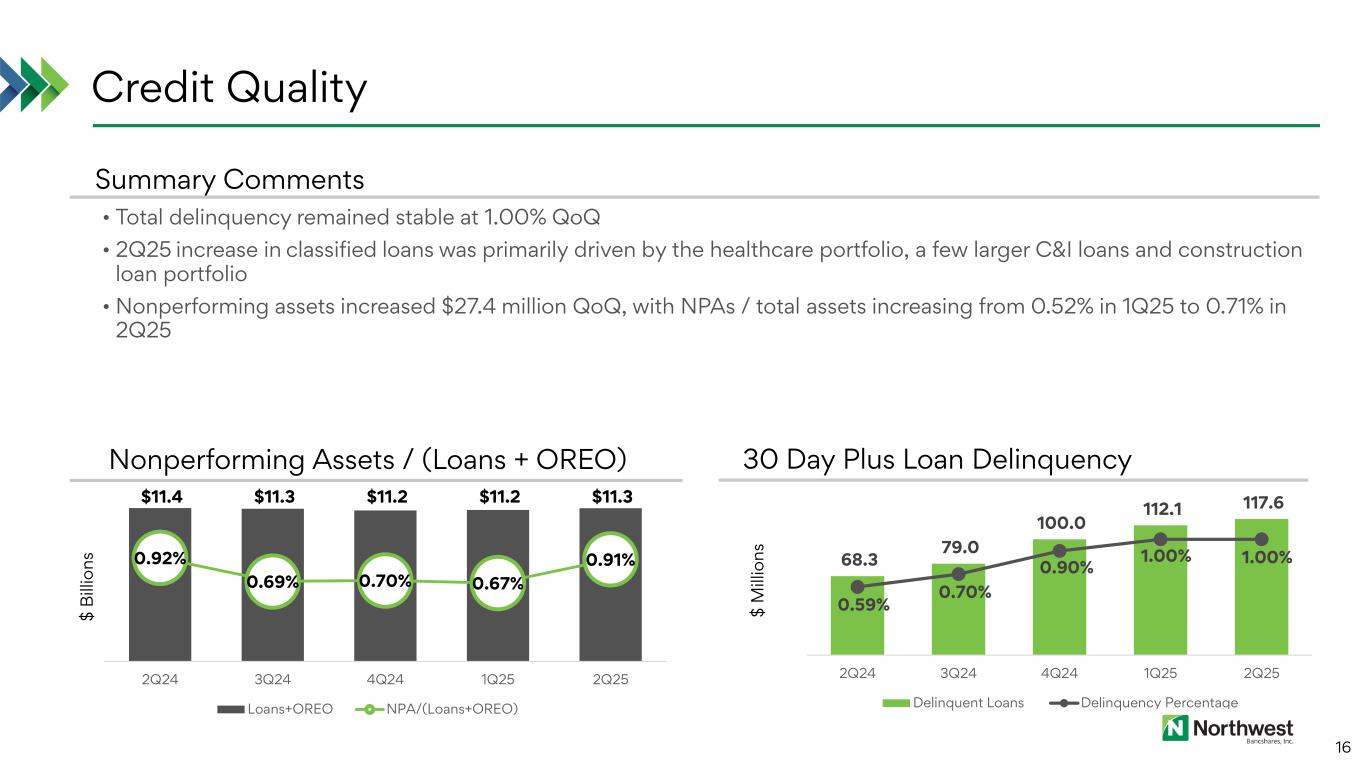
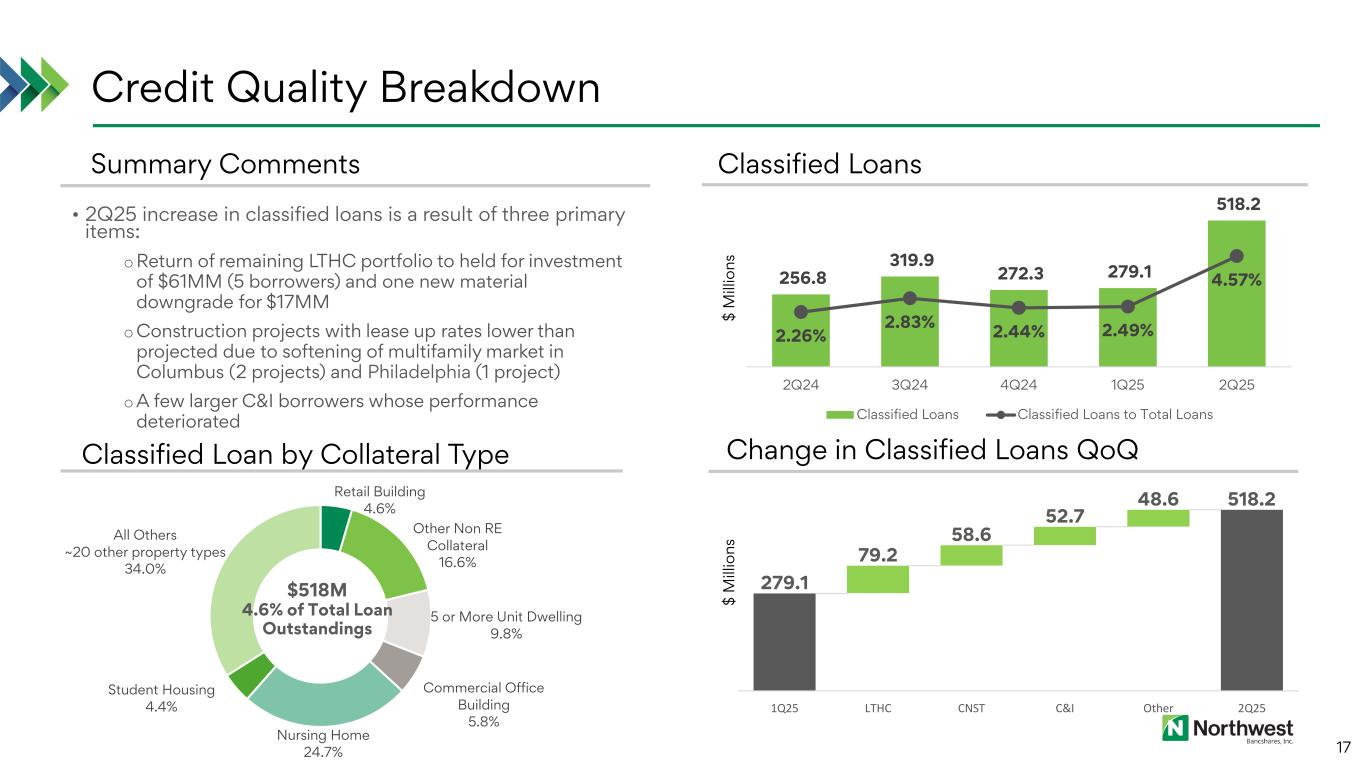
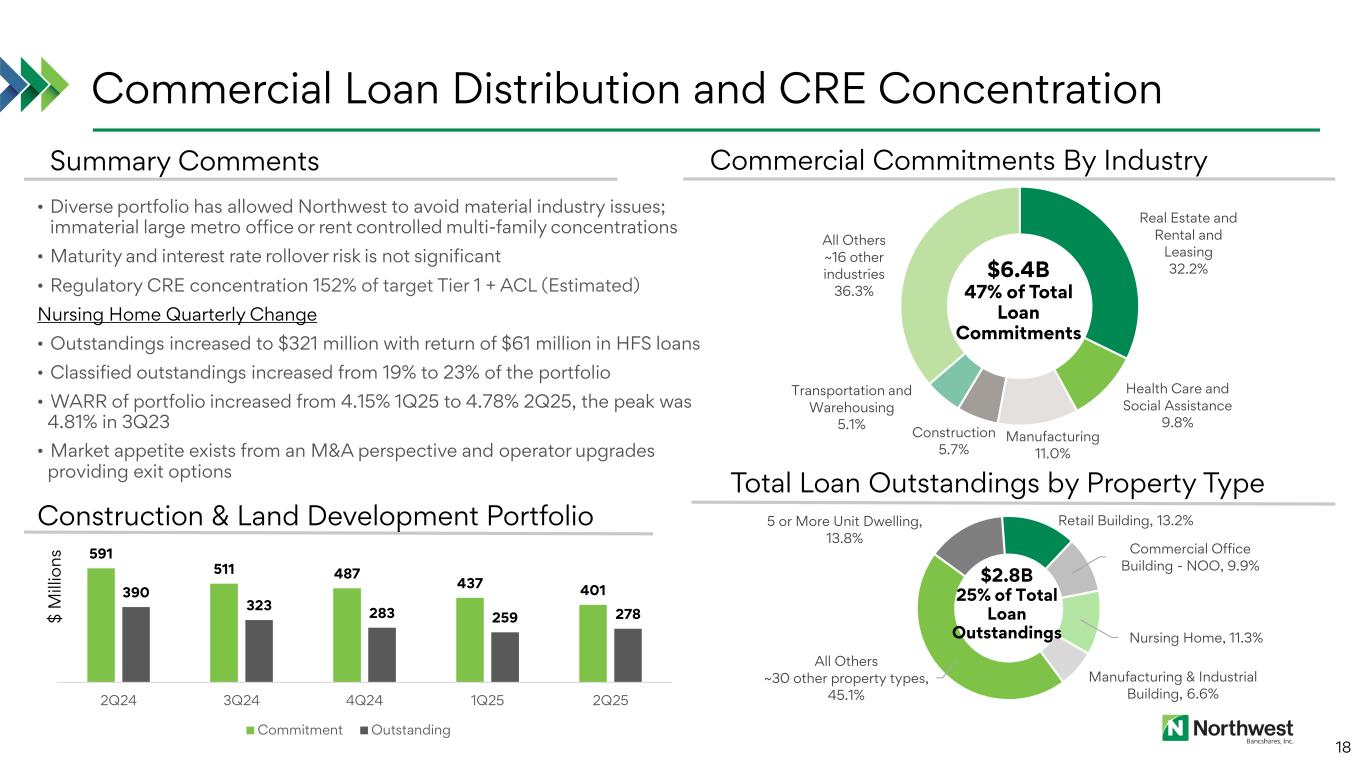
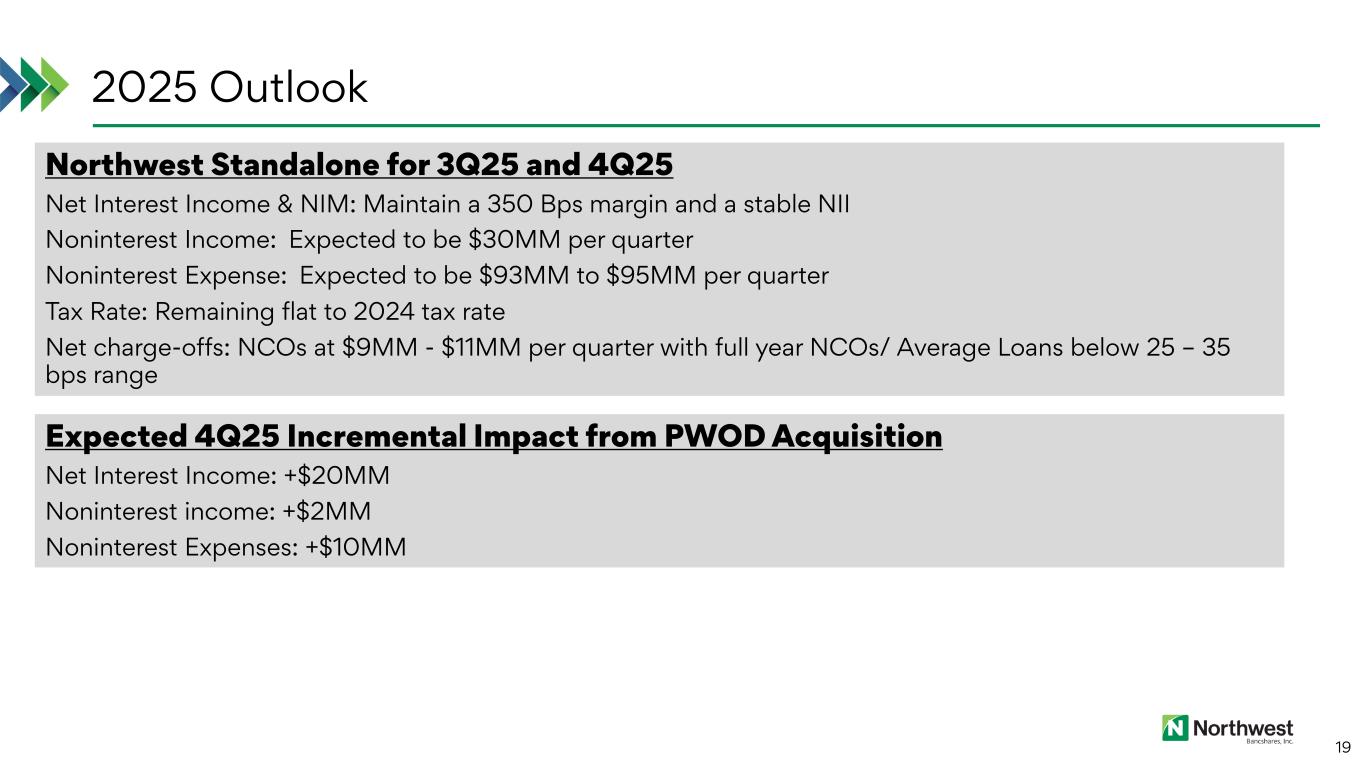
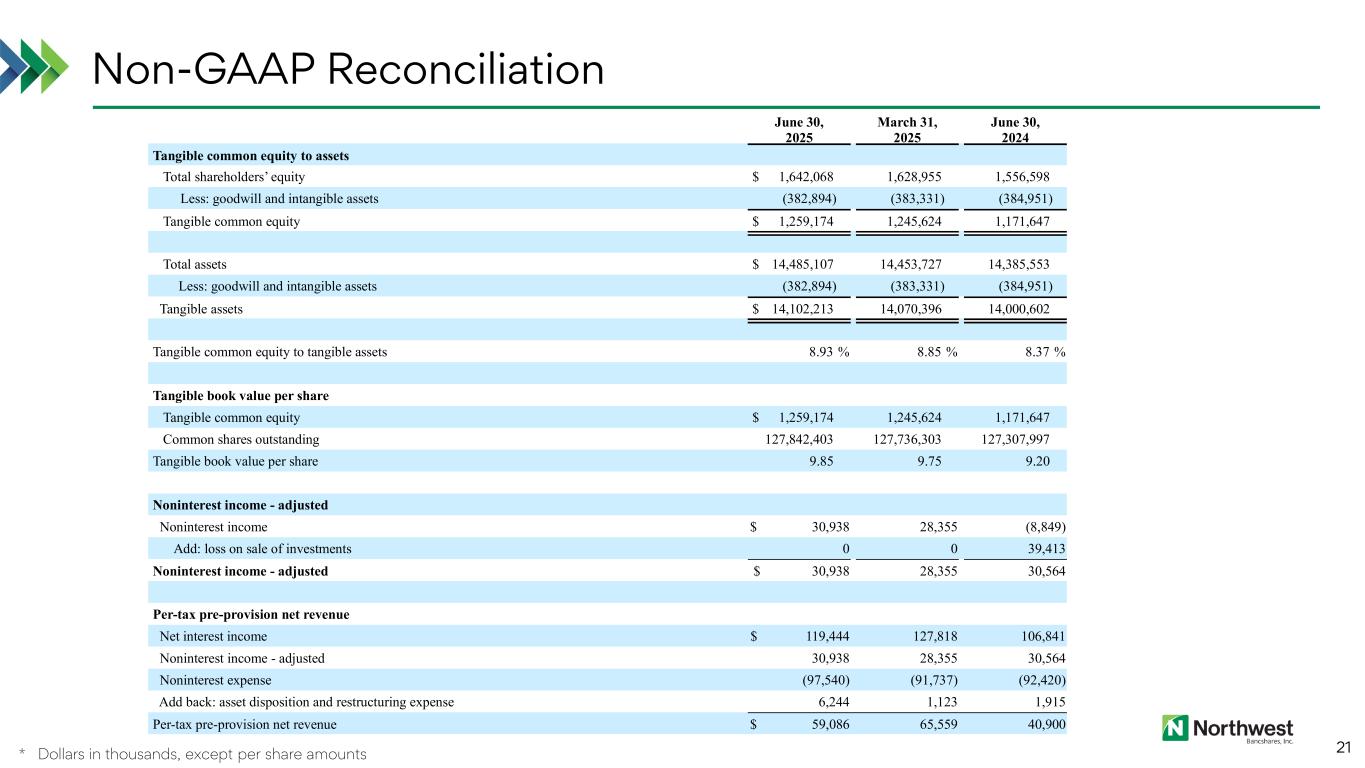
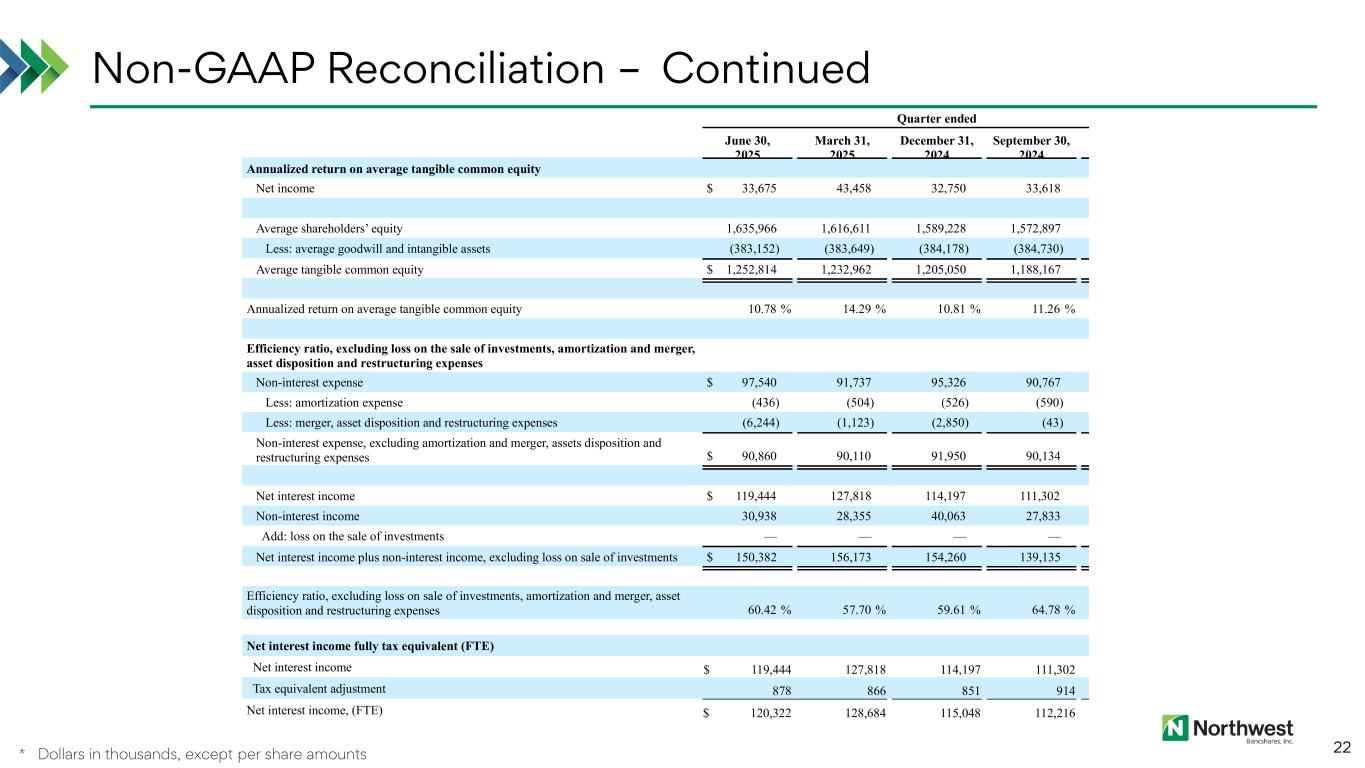
Thank you, Lou, and good morning, everyone. As Lou indicated, we are pleased with our second quarter financial performance. This is the product of the efforts of our entire team, working tirelessly to deliver these results while also ensuring that our merger and conversion activities went smoothly for our new customers and colleagues from Penns Woods. Regarding our Penns Woods acquisition, I would like to provide an update on the total equity consideration paid for this transaction. Based on our stock's closing price, July 25, 2025, of $12.63 per share, the total equity consideration paid calculated to be $230 million, which was $30 million less than the equity consideration disclosed at the deal signing in December of 2024. Other key financial metrics are in line with our original expectations, and one-time merger charges and cost savings remain on target. See slide 5 for more details. Now, let's continue on slide 7 of the earnings presentation, where I'll walk you through the highlights of Northwest's financial results for the second quarter of 2025. We reported GAAP's net income of $33.7 million, or $0.26 per diluted share inclusive of $4.5 million of after-tax merger-related costs, a decline of approximately $10 million quarter-over-quarter on a gap basis. As you recall, we did have a significant non-accrual interest recovery in the first quarter, which added approximately $9.4 million, or $0.08 cents in after-tax income in that period. We reported net interest margin of 3.56% for quarter to 2025, which would compare favorably to the prior quarter's adjusted margin of 3.48% after adjusting for a 39 basis point interest recovery benefit recorded in the first quarter. We continue to manage our funding costs and maintain our loan yields, driving improved margin performance. Non-interest income increased by $2.6 million or 9.1% quarter-over-quarter, driven by improvements in fee income from seasonal changes and some increase in other operating income. Total revenue of $150 million for the second quarter represents a 53.5% increase on the prior year period on a gap basis, which included a $39.4 million loss resulting from a securities portfolio restructuring. This was slightly down from the $156 million of revenue reported last quarter, which included a $13 million benefit from an interest recovery. Our non-interest expense increased 6.3% compared to the prior quarter and increased 5.5% versus the second quarter of 2024 due to expenses related to the preparation for and closing of and conversion of the Pennswoods merchant. Pre-tax, pre-provision net revenue was $59.1 million, which was down from the first quarter of 2025, again, due to the non-accrual interest recovery, and a 26% increase from the second quarter of 2024, largely due to the impact of the securities repositioning. Now, I will highlight some additional details on our quarterly results. Turning to slide 8 and our loan portfolio. Average loans grew $72 million quarter over quarter, or 0.6%, and were $120 million, or about 1% lower than in the second quarter of 2024. Again, we were opportunistic this quarter, taking advantage of some further consumer loan growth as interest rates remained supportive and we saw some demand returning to the CNI space. We continue to proactively shift our portfolio mix more towards commercial and industrial loans as part of our longer-term strategy. Average CNI loans increased 49.1 million, or 2.4%, compared to the first quarter, while consumer loans from both our indirect business and our home equity portfolios also grew by $131 million combined. These increases were partially offset by the declines in our CRE portfolio, which was down 1.5%, and our residential mortgage portfolio, which was down 2%. Loan yields continue to be stable over quarter at 5.55% for the second quarter, compared with 6.0% in the prior quarter, which was elevated due to the non-accrual loan recovery, and we maintain our focus on pricing discipline. On slide nine, we cover our deposit balances, which remain strong and stable over the prior quarter and prior year period. Average deposits increased $66 million, or half a percent quarter of quarter, and $67 million, or about 0.6% growth versus the second quarter of 2024. Customer average deposits increased $107 million quarter over quarter, while brokered deposits declined $41 million over the same period, resulting in a 0.5% overall deposit growth for the second quarter. We saw growth of deposit balances in most categories while maintaining reasonable deposit costs and are pleased with our progress here. Our cost of deposits decreased four basis points quarter over quarter through proactive management of the overall portfolio. As rates have been coming down during this declining interest rate cycle, our relative short maturity CDs are rolling into lower rates. Our current cost of deposit stands at 1.55%, still near best-in-class relative to our peers. Moving to slide 10 and our net interest margin. In the summary earlier, I touched on our net interest income and net interest margin performance for the quarter. The progress we've made on this front is a continuing highlight for us over the past year. In 2023 and in 2024, we reported full-year net interest income of $439 million. Based on our standalone second quarter 2025 performance, one would expect Northwest to report an annualized net interest income of $480 million, or an increase of 10%. We will further benefit from the last five months of Penns Wood's net interest income and from the first quarter non-accrual interest recovery. This is clearly a bright spot for our bank and will further improve many of our key profitability and return metrics. Slide 11 provides some additional details on our earning asset and funding mix. As you can see, we continue to grow our commercial loan portfolio and the proportion of floating rate earning assets. And on the funding mix, you'll note our time deposits have a very short duration, allowing us to continue to benefit from falling interest rates and lower interest expense. On slide 12, the yield on our securities portfolio also shows further ongoing improvement as we continue to reinvest cash flows at higher yields than the current portfolio and the benefit from the securities repositioning we completed in the second quarter of 2024. Slide 13 contains detail on our non-interest income, which increased $2.6 million from the last quarter, as most line items showed improvement from a normal seasonal rebound from the first quarter and an increase in other operating income, primarily from a gain on an equity method investment. Non-interest income increased $40 million year over year, driven by a $39 million loss on securities from the previously mentioned portfolio restructuring in the second quarter of 2024. Slide 14 details our non-interest expense. We incurred approximately $97.5 million of expenses on a gap basis for the second quarter. About $5.1 million of that increase from the prior quarter and $4.3 million from the prior year was merger-related. So, So excluding that line item, expenses are generally consistent with the underlying expense run rate over the past year. Our adjusted efficiency ratio of 60.4% after excluding those merger and restructuring expenses is an improvement from the 65.4% in the prior year period, which has been adjusted for the impact from our securities restructuring and other restructuring charges. This reflects our continued focus on managing expenses without an impact on our core operations or sacrificing customer service while still investing in talent to support future growth. On the next few slides, we cover credit quality. On slide 15, you can see our overall allowance coverage ratio has increased to 1.14% up slightly from the first quarter of 2025 due to downgrades within the commercial lending portfolio and offset by changes within macroeconomic forecasts. We believe our coverage is appropriate, prudent, and in keeping with our rigorous credit risk management approach. Our annualized net charge-offs of 18 basis points for the quarter were below guidance and in line with historic performance. On slide 16, you will note that our 30-day plus loan delinquencies remain stable at around 1% of outstanding loans, their NPAs as a percent of loans outstanding plus Oreo has increased to 91 basis points, which is similar to the levels recorded in QQ 2024. We provide some details on the drivers of this change on that slide. Turning to slide 17, we have included some additional information on the changes within classified loans reported this quarter. The Q225 increase in our classified loans is a result of three primary items. The remaining long-term health care loans held for sale were returned to held for investment. Given the specific circumstances of these borrowers and the market's currently dampened interest for loans in this sector, we believe managing these loans on our balance sheet will ultimately minimize incurred losses. Additionally, due to the current excess supply of multifamily units in the Columbus market, several construction projects came onto the market with lease-ups rates lower than projected. We expect demand to catch up with supply as market absorption rates continue to improve for these projects to exit successfully. But projects are all with strong, well-established developers who are invested in the community. And finally, there are a few larger CNI borrowers whose performance deteriorated based on current macroeconomic uncertainties with tariff policies and other industry-specific headlines. Slide 18 highlights our $6.4 billion in commercial loan commitments by industry classification, showing a diverse portfolio and has some additional detail on our CRE concentrations. I'd now like to review what we can currently disclose about the remainder of 2025. Bearing in mind we just closed our Pennswoods merger less than a week ago, we may release updated guidance for 2025 at a future date. On slide 19, we provided an updated perspective on our outlook. We continue to be confident about Northwest business and would expect to maintain our net interest margin at 350 basis points for the rest of the year before the accretive benefits of the Pennswoods acquisition. We are not providing specific information on the third quarter, as we will need to work through our purchase accounting marks, book expenses related to change in control contracts, and many other one-time merger-related costs. We would expect to earn approximately two-thirds of a quarter's worth of revenue and income from the incorporation of Penswood's balance sheet and customers into Northwest Bank. For the fourth quarter of 2025, we expect to maintain Penswood's earnings power. and current balance sheet level as we integrate their operations into Northwest. On a combined basis, we would expect to achieve the following fourth quarter 2025 financial results. Net interest income in the range of $139 million to $141 million. Non-interest income in the range of $32 million to $33 million. dollars. Non-interest expense in the range of 103 million to 105 million dollars. A flat tax rate of 23 percent. Net charge-offs of 9 million dollars to 11 million dollars per quarter with full year 2025 net charge-offs to average loans slightly below our previously disclosed range of 25 to 35 basis points. We will not have fully realized all cost savings from the Penns Woods acquisition in the fourth quarter of 2025, but we expect to achieve 100% of the savings by the second quarter of 2026. I'll now turn the call over to the operator who will open up the lines for live Q&A. Operator?
Operator
At this time, I would like to remind everyone in order to ask a question, press star, then the number one on your telephone keypad. We'll pause for just a moment to compile the Q&A roster. Your first question comes from Daniel Tamayo with Raymond James.
Thank you. Hey, morning. Thanks for all the color in the prepared remarks there. That was really helpful. You covered a lot of my questions. So on the expenses, sorry, I'm just kind of thinking out loud. It sounds like you're going to be, um, continuing to have cost savings next year through the second quarter. Um, maybe you could just give us a sense for, uh, once we get past that run rate of 103 to 105 in the fourth quarter, um, you know, how much savings is, is left, um, and, and as much as you can, the timing on, on, uh, on that in the first half of next year.
Yeah. So I would put it this way, Daniel. I mean, we just closed this transaction, you know, 48 hours ago, 72 hours ago, whatever. We'll provide much fuller guidance when we release fourth quarter earnings in January, like we would always do, at which point we'll be able to give you much more color. I would just say originally we announced that we would have 40% cost savings as a result of the transaction. We originally had indicated that we'd get about 75% of that in 2025 with the remainder coming through the second quarter of 26. So you would expect to get a little bit more efficient as we roll, but we'll give more specific guidance on that aggregate expense number next year.
Understood. Okay. And another one that maybe you might not have kind of the full information on given the timing of the close, but just curious if you have an initial, you know, updated estimate on what the accretion might be in the margin. And then I know you touched on it, but just remind us if you can, the kind of the core, the change to the core margin from the acquisition. Yeah, so we're still working through. Sorry, if you have any like balance sheet actions that you guys are going to be expecting to do as well. Sorry for that additional one.
Yeah, that's okay. Uh, so we're still working through purchase accounting accretion and the mark. So we can't really update on margin guidance, which is why I try to give you an idea of what the fourth quarter would look like aggregate net interest income. But again, um, we have a couple of opportunities to update guidance over the course of the third quarter, including a few conferences that we're going to attend. Uh, if we do, we'll obviously put out, uh, an AK and a new investor deck, uh, to help with that. So if you wouldn't mind giving us a little bit more time to come up with that information so that it's accurate. I'd appreciate it. Second part of your question, there will be some changes to the investment portfolio in particular when we moved Pennswoods over. So they had, like you would expect, some securities that didn't meet our return profiles or our risk profiles. Those will sell, will immediately pay down some excess borrowings with that cash, and then slowly kind of work through the rest of the book as we go. So So again, we need a little bit more time to give you a lot more color on that, but that at least gives you some idea of where we're at. Oh, one other thing I wanted to mention on the call. So on slide five, when we provide a guidance, we used a term to suggest that things were either on target or creative. I just want to clarify. When we said a creative, we actually meant better than originally expected versus that the actual number itself would be a creative in the end. And so just a slight clarification there for everybody on the call.
Yeah, I appreciate that. This may be along the same lines, but just get all the questions out now, and then you can say this to give the same answer if that's the answer. But just on that topic, the tangible dilution, do you have an updated number or have any kind of approximate amount in terms of what the dilution might end up being relative to the 9% expected originally?
We don't. But again, we did give you an idea of where the equity consideration was, which was down pretty significantly from originally announced. In addition to that, there's some extra cash. So in the original announcement, we suggested that total consideration would be around 270. We're probably closer to 235 by the time we factor in the cash that gets paid for options and partial shares. And then we do believe that the interest rate mark in the aggregate will be a bit lower.
All of that would lead you to clearly some less goodwill in the aggregate and slightly less earnings accretion from those interest rate marks but we'll try to clarify that when we can't okay well thank you i appreciate you taking all those questions that's uh that's it for me sure thank you daniel thank you dan your next question comes from matthew briste with stevens inc hey good morning morning um i appreciate the detail on the increase in classifieds i guess i just wanted to prod a little bit more and see how you felt about you know the potential for non-accrual creation or NPA creation on the back
of the um uh on the classified and then potential for lost content there do you feel like you're adequately reserved at this point do you feel that we're adequately reserved for losses so we'll start there and we also do feel like there's going to be a decent amount of opportunity over the next six months of course no one can see exactly what market conditions are going to be like. But we would expect to have some good opportunities to get some of those credits to repay over the course of the next six months. So we believe by the end of the year, we'll make progress against the MTAs without material losses. Those levels will return much closer to where they were in the earlier periods this year. Got it.
And then I was hoping for a little bit more in terms of, you know, deposit growth, prospects, composition? How do you feel like you can grow deposits through year-end? And have we, has the mix shift, you know, and changes in mix shift started to kind of stabilize?
I would say the mix shift has started to stabilize. We have seen, you know, somewhat consistent, albeit relatively low deposit growth consistently since the beginning of the year. I wouldn't necessarily expect that to change. I think generally speaking, we are seeing a less competitive market for deposits. So online deposit-only deposit gathering sources have not been as active on the rate side. So we feel pretty good about deposits going to the end of the year. And then, of course, we get the benefit of all the new Pennswoods customers coming in and being able to see how we can handle that deposit portfolio over time.
And then a couple of business-line-specific questions. Home equity loans this quarter talked a more recent trend of declining, saw some growth. Is that a one-off or is there a little bit of a change in strategy? And then similar question with consumer loans, which for two quarters now has been growing versus previously shrinking.
Yeah, this is Lou. I can address a couple of those questions. While we continue to remix the balance sheet towards a more equal-weighted consumer and commercial portfolio, we do have a pretty good consumer-generating machine established at the organization. And so we're starting to refocus in our branch network. We've created some congruency with the lending piece and Yurk Bauer, who now runs the consumer bank. So we have a more focused sales effort and different approach in the market there. Additionally, as you know, in the indirect book, we're able to sort of lever that up and down just based on the interest rate environment. And so we felt like we could grow that book this quarter and fix those assets, giving that in the second half of the year we may be facing a declining rate environment. So I think the good news that I would share with you is that we have a lot of levers both on the commercial side and the consumer side of the bank. We're balanced in our approach, and we'll take what the marketplace will give us. And so, you know, we've been really pleased with our ability to pivot, notwithstanding, as you know, we've created a national SBA vertical that gives us some variability and optionality in holding loans and selling loans. And so we think we're in a really good spot to go to market with both a balanced approach to commercial and consumer lending.
Yeah. Matthew, I would just add to your question, home equity loan growth was a little bit later than normal for us. So you might typically see that in the early spring.
We saw it a bit later and we did have some nice opportunity there, but not a change in strategy, more just being there for our clients when they ask the bank to provide funding for changes in their homes or what have you understood yeah my my initial hunt was you know commercial loans you know balances are up but the pace of growth has been slowing for a few quarters now and i was curious whether or not what we're seeing on the consumer front home equity front is kind of a response to you know more competitive conditions for commercial loans we've heard a lot about that this this quarter um or just maybe some uncertainty from your customers curious what how do you respond to that?
Yeah, I think that's why we tried to say we were as opportunistic as we could be in the beginning half of the year, given all of the uncertainty that Washington sort of interjected into everybody's businesses with tariffs and other things. So to the extent that the back half of the year, as some of this stuff gets clarified, might give us some more opportunity for commercial loans. That would be great. To lose point, we can flex down certainly that indirect book pretty quickly. But, you know, if core home equity was still an option for our customers, we will be there for our customers and market, and we continue to extend those loans as well. Okay.
Last one for me, just maybe some idea of roll-on yields for, you know, commercial and the growing consumer categories versus roll-off and how creative is that today? That's all I have. Thank you.
Yeah. So I think we're seeing commercial loans near seven, a little bit up or down depending on the month. And you would continue to see the consumer loans are going to be lower than that, but not different from what they're kind of coming off. So I'd say on the consumer book, you're pretty, at least with indirects, because rates have come down, roll on, roll off is pretty consistent.
Speaker 7
And then on the commercial book, we'd still have some opportunity there. thank you appreciate that thank you your next question comes from daniel cardenas with janie montgomery scott hi daniel more just returning to the um the increase in the classified loans on a sequential quarter uh basis um maybe a little bit of color on on the construction projects that popped up here in the quarter. What are loaned values looking like for those projects? Maybe debt coverage ratios as well. And then on the CNI front, were there any industry concentrations on those fewer or larger loans that popped up here?
Yeah, I think we tended not to provide all those details on the CRE side of things. So what we did want to talk through was there were a couple of developers, some sizable loans in Columbus, and those issues had more to do with absorption and some increase in supply that happened in the market. And as we stated in our prepared comments, we do expect the market to be able to absorb those over long term. They're also with very good developers that are heavily invested in the Columbus market. And then we indicated in the slides that there was one in Philadelphia. So without getting into all of the specific details on every credit, TK might have something to add.
Yeah, I'd just comment. They are multifamily to give a little more color. We have reviewed the loan to values and the coverage. The coverages are just coming in close to one-to-one, given the interest rate pressure that these projects have seen over this period, and then it's coming on to market in a soft We see demand continuing. It's just a lot of supplies come on, and so we'll work through that here over some But there is equity in these projects still, and we expect them to be supported by the sponsors, so no concern in that regard.
Speaker 7
Are these higher-end types of projects, or are they kind of mid-market? There's both in there. And then on the C&I side, were there any concentrations by industry?
No, no material concentrations. One larger one, kind of in the electronics space, but, you know, not like an industry trend, I would say.
Speaker 7
Yeah, all my other questions have been asked and answered.
Operator
That concludes the question and answer portion of the call. I'll now hand it back over to Northwest. Chair, for concluding remarks. Mr. Torsio?
Thank you. On behalf of the entire leadership team and the board of directors, thank you for joining our call this morning. With strong and stable financial foundations and prudent cost control and risk management discipline, we are well prepared to capitalize on the opportunities for driving sustainable, responsible, and profitable growth. I look forward to updating all of you on our progress on our third quarter earnings call. Thank you and have a good day.
Operator
This concludes today's conference call. You may now disconnect.