Operator
Welcome to the S&T Bancorp Second Quarter 2026 Earnings Conference Call. After the management's remarks, there will be a question and answer session. Now, I would like to turn the call over to Chief Financial Officer Mark Kochbar. Please go ahead.
Great, thank you, and good afternoon, everyone, and thank you for participating in today's earnings call. Before beginning the presentation, I want to take time to refer you to our statement about forward-looking statements and risk factors. The statement provides cautionary language required by the Securities and Exchange Commission for forward-looking statements that may be included in this presentation. A copy of the second quarter 2026 earnings release as well as this earnings supplement slide deck can be obtained by clicking on the materials button in the lower right section of your screen. This will open up a panel on the right where you can download these items. You can also obtain a copy of these materials by visiting our investor relations website at stbankcorp.com. With me today are Chris McComish, S&T's CEO, and Dave Antulik, S&T's president. I'd now like to turn the call over to Chris.
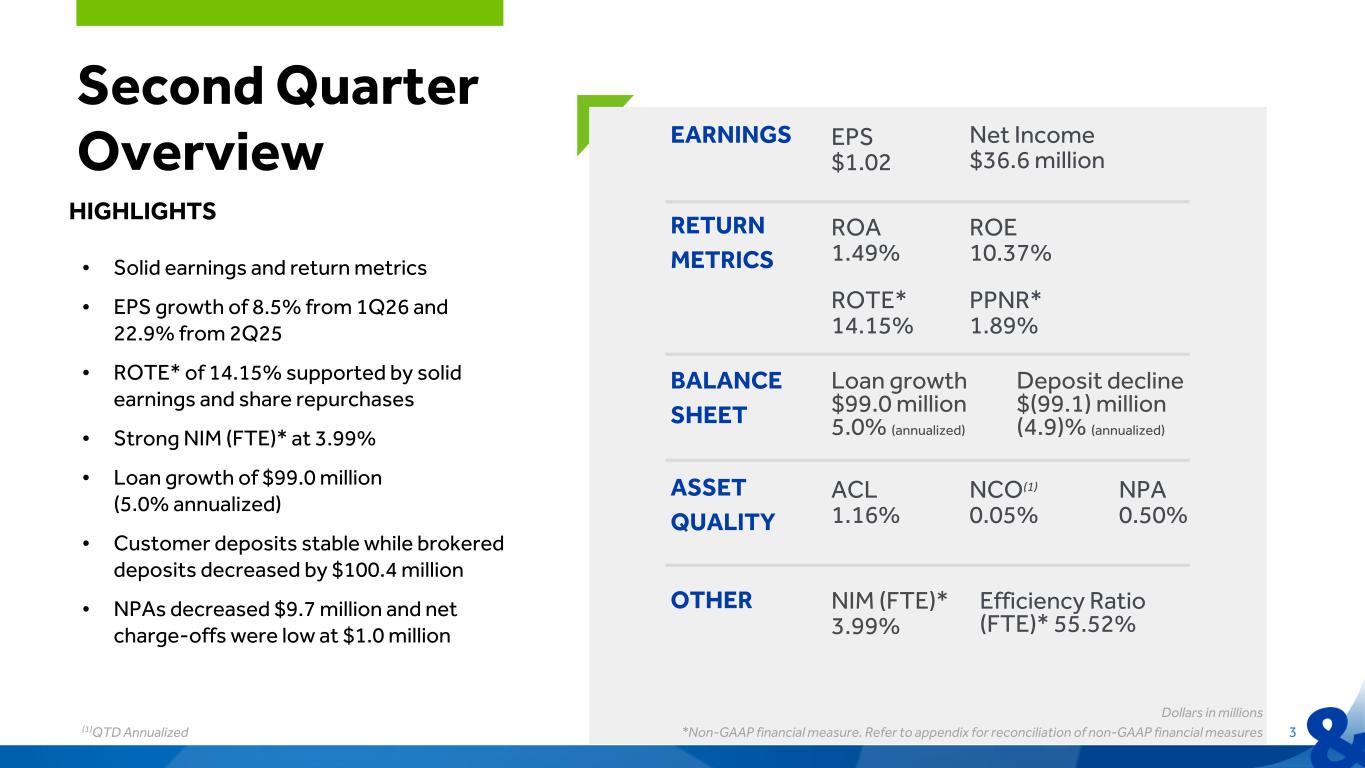
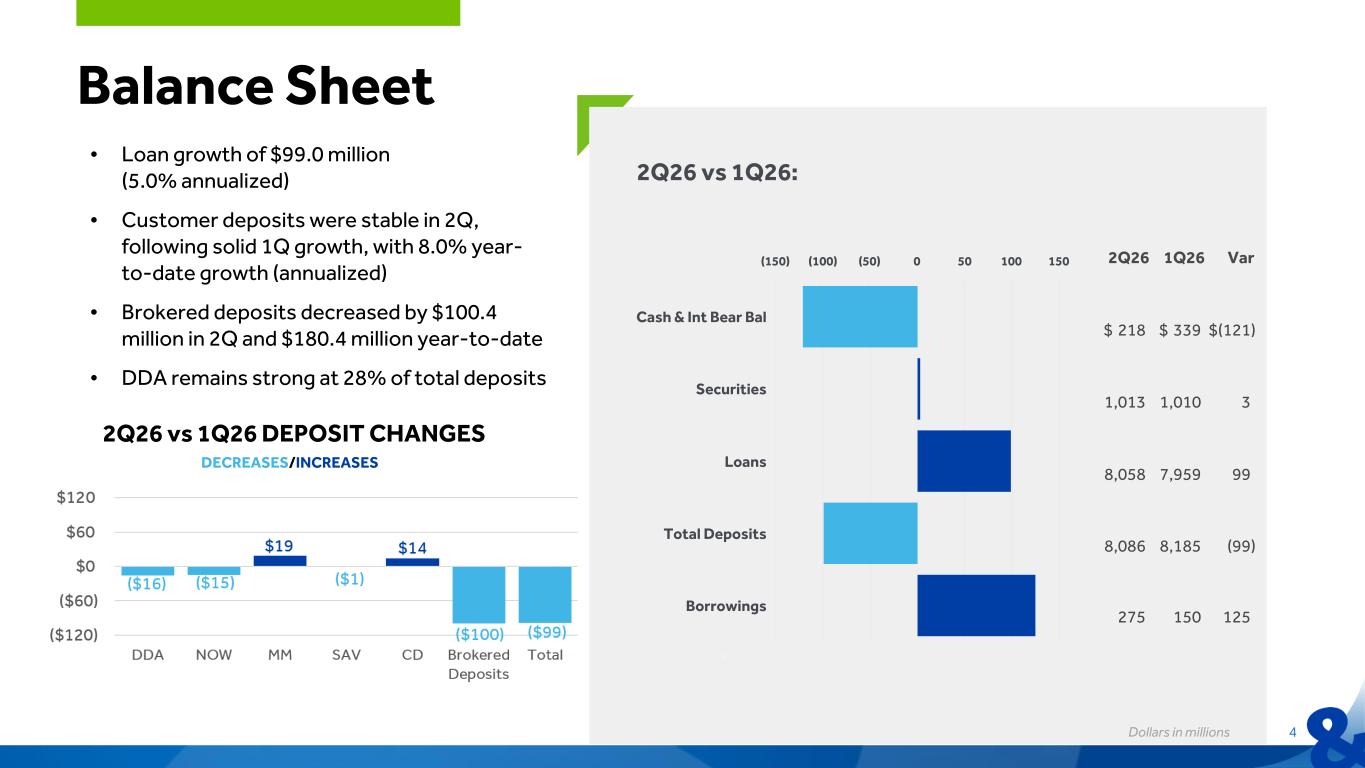
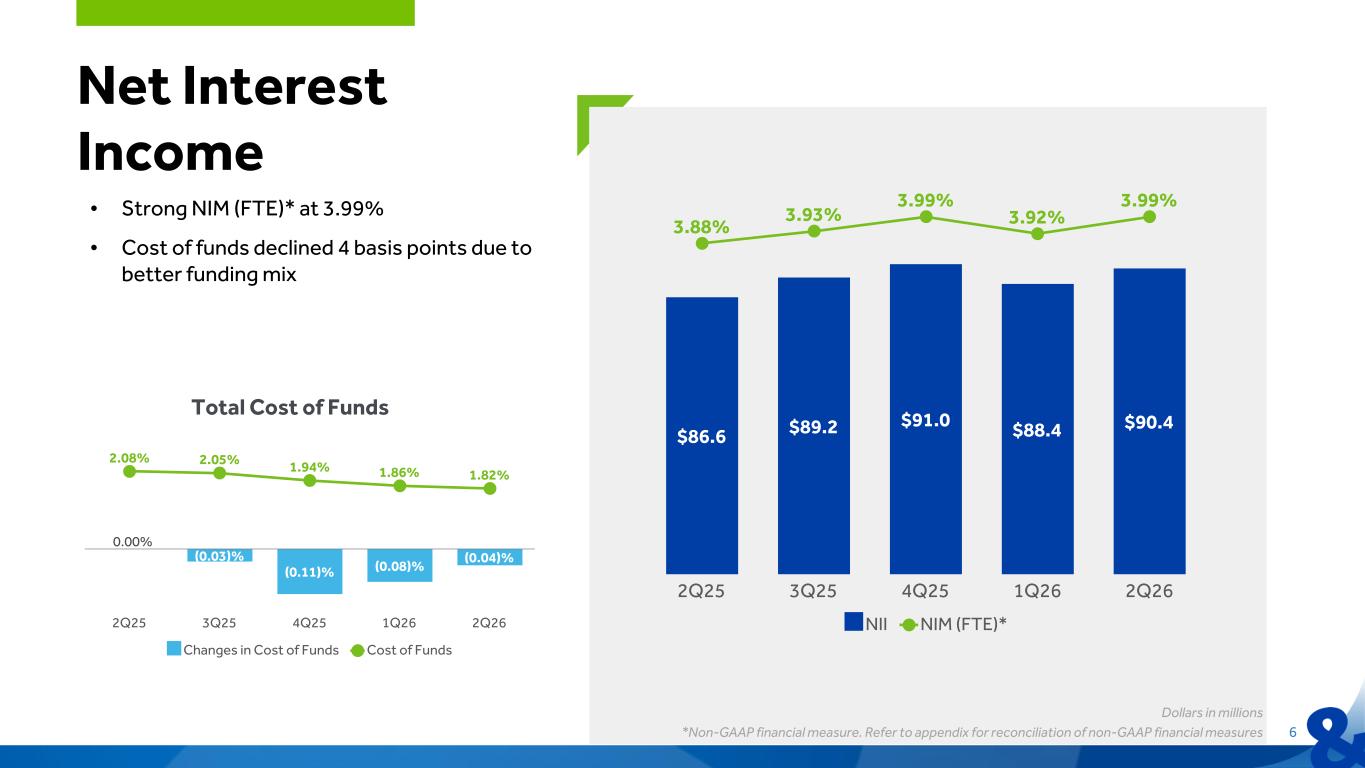
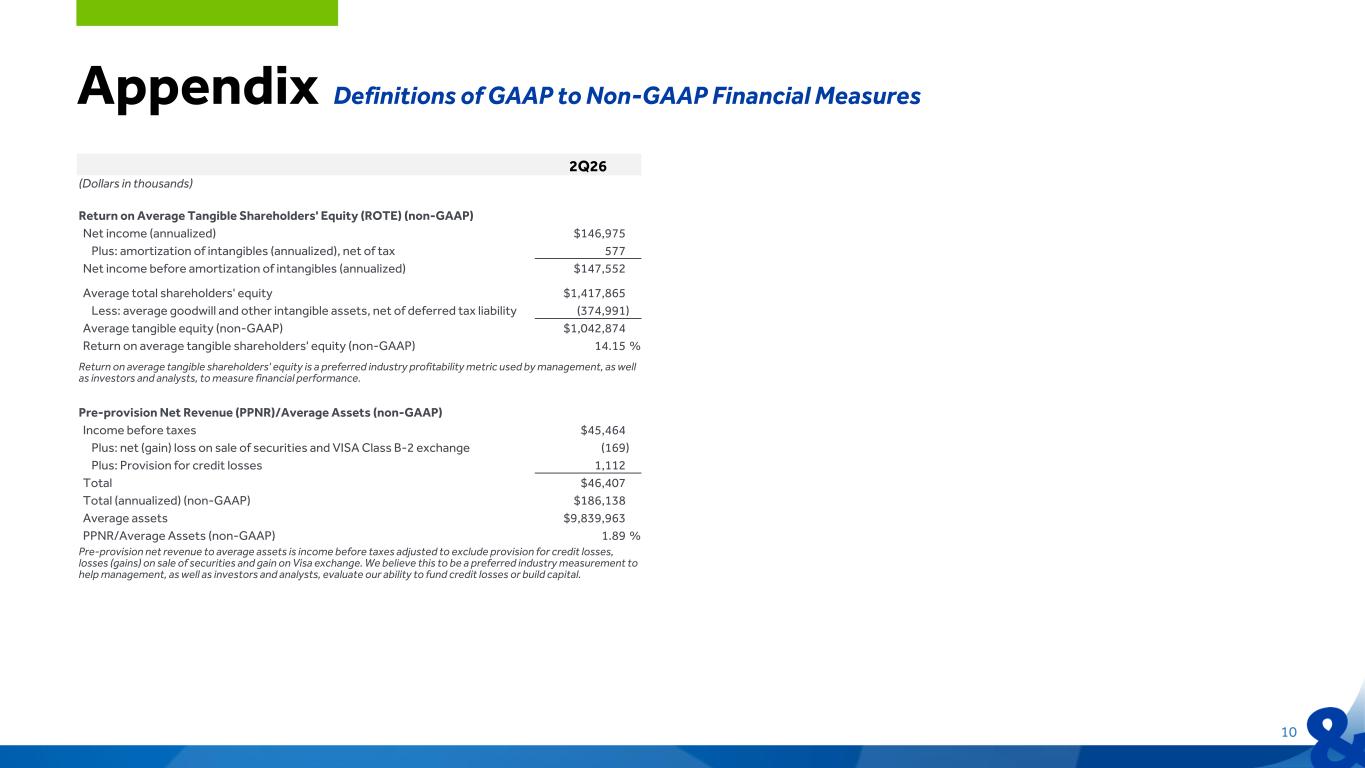
Mark, thank you, and good afternoon, everyone, and thank you for joining us today. We appreciate the analysts and investors being with us, and as always, we look forward to your questions. Before I get into the quarter, I did want to take a minute to recognize the broader momentum we are seeing across S&T. Our financial performance is one important measure of that momentum, but we also continue to see it reflected in the strength of our customer relationships and the trust customers place in our company. That was reinforced this quarter when S&T was named to the forbes america's best in state banks 2026 list this is a recognition based upon direct customer feedback across areas such as trust customer service financial advice digital experiences and overall satisfaction also during the quarter we celebrated our 124th year which means we begin celebrating S&T's 125th year legacy this quarter. This recognition is a timely reminder that our long-term success has been built on those same fundamentals, serving customers well, investing in our communities, and delivering value for our shareholders over time. These commitments have helped us navigate change, strengthen our culture, and position the bank to thrive for the next 125 years and beyond. Now turning to our financial results, I'll start on slide three. Turning to the quarter, we delivered a very strong performance. Net income was $36.6 million, or $1.02 per diluted share, up 8.5% from the first quarter of 26 and 22.9% from the second quarter of last year. Return metrics were also solid. We reported ROA of 149, ROE of 10.375, and a ROTCE of over 14. These results reflected the benefit of higher earnings, continued discipline across the company, and the impact of our share repurchase activity. Our operating performance was also strong. net interest margin expanded seven basis points from the link quarter to 399 supported by both higher loan yields and a better funding met net interest income increased to 90.4 million dollars compared to 88.4 million in the first quarter and 86.6 million a year ago importantly we're seeing positive year-to-date operating leverage through the first six months of the year revenue growth has outpaced expense growth meaningfully and our efficiency ratio improved to 55.38% compared to 57% for the first six months of 2025. As is noted, asset quality showed improvement during the quarter with low net charge-offs of just a million dollars and non-performing assets decreased by almost $10 million percent of total total loans in Oreo. On page four loan growth was $99 million or 5% annualized. On the deposit side, customer deposits were stable in the second quarter after a very strong year-to-date deposits are up almost eight approximately eight percent annualized. At the same time we reduced broker deposits $100 million during the quarter and 180 million dollars year to date which again improved the quality of our funding mix dda levels remain at an industry leading 28 percent of total deposits highlighting highlighting the value of our relationship-based model and the quality of our core deposit base we continue to actively manage capital also as you as you know we over the past three quarters we've repurchased almost 3.2 million shares representing 8 percent of outstanding shares for a total of 133 million dollars. We also got board approval yesterday for a reauthorization of another 100 million dollar opportunity. Our strong capital position gives us the flexibility to continue to support organic growth, remain disciplined around capital returns and evaluating strategic opportunities as they arise. In summary, this was a very good quarter for our bank. We delivered meaningful EPS growth, solid returns, favorable asset quality, positive year-to-date operating leverage, and continued capital management through share repurchases. I'm going to stop right there, turn it over to Dave. You can talk about asset growth, pipelines, and asset quality.
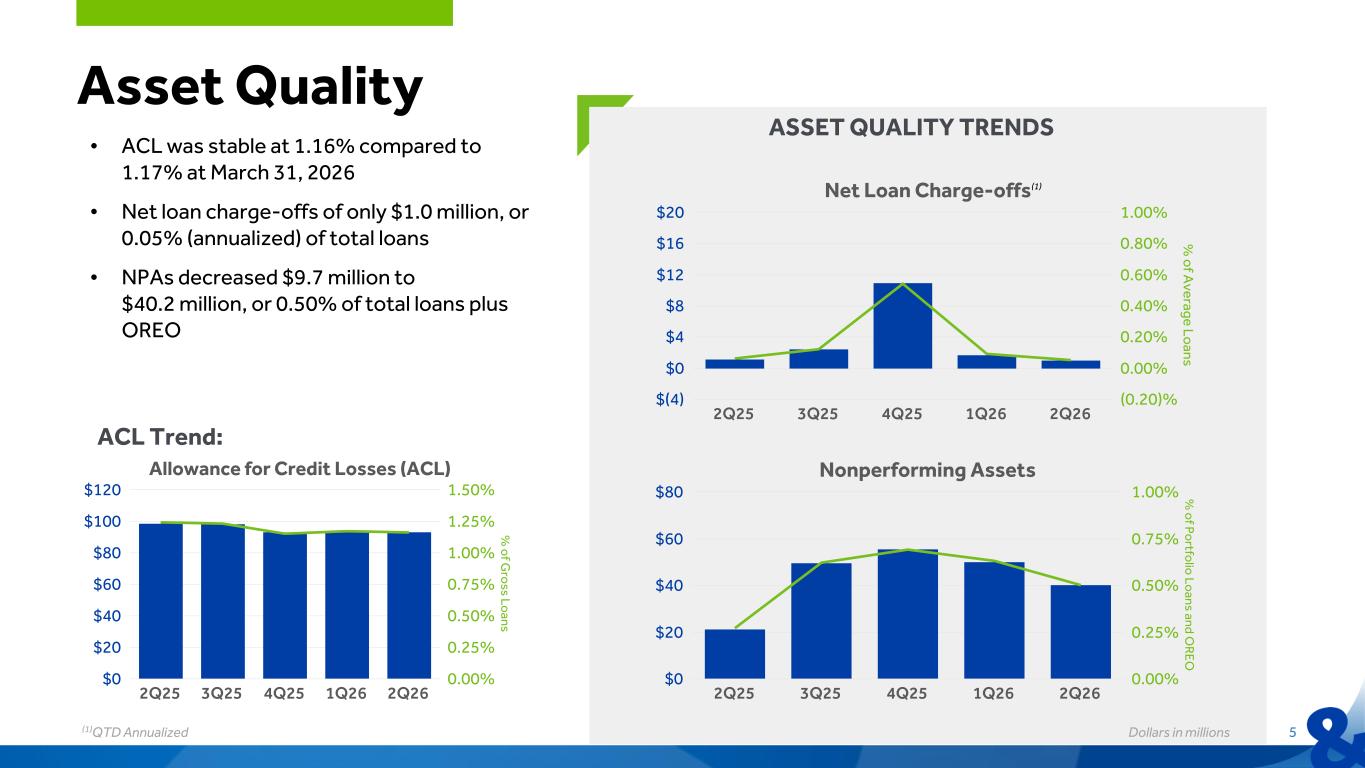
Great. Thank you, Chris. And as Chris mentioned and referring to page four, total loans increased by $99 million during Q2, representing approximately 5% annualized growth, driving balances over $8 billion. We're encouraged by both the composition and the quality of this growth. As discussed on previous calls, we are strategically focused on building our CNI capabilities and our investment in talent is beginning to pay off during the quarter we increased our cni banker count they've increased our total commercial banking team by approximately 20 year to date with a goal of reaching 30 by year end these hires strengthen our ability to deepen customer relationships expand our presence in attractive markets and support long-term loan and deposit growth the results can be seen in our CNI portfolio. During the quarter, CNI balances increased by $79 million. We saw encouraging signs from our CNI customer base with revolving line utilization increasing from 41 to 44 percent quarter over quarter, and at the same time, total CNI revolving commitments grew at 6 percent annualized, demonstrating continued demand from our customers along with increased banker productivity permanent commercial real estate balances declined by 46 million dollars primarily driven by loans that were paid off by non-bank lenders while this created a headwind to the portfolio growth it also reflects the continued quality of our borrower base and the attractiveness of these projects to the permanent market importantly we remain committed to supporting well-capitalized developers within our footprint as a result commercial construction balances increased by $71 million during the quarter. Additionally, total construction commitments increased by $65 million, and the total number of commitments increased by nearly 19% in Q2, providing further evidence of solid customer activity. Looking ahead, our CRE and C&I pipeline activities remain solid and support our expectation for annualized mid-single-digit loan growth for the balance of 2026 turned asset quality on page five our portfolio continues to perform in line with our expectations demonstrating our disciplined underwriting approach and ongoing portfolio management efforts non-performing assets declined by 9.7 million dollars during the quarter to 40.2 million dollars or 0.5 percent of total loans plus oreo Criticized and classified assets remained stable during the quarter, while losses were very low. Net charge-offs totaled just $1 million during Q2, resulting in a modest provision expense of $1.1 million. Given the continued stability of the loan portfolio, the allowance for credit losses remained essentially unchanged at 1.16% of total loans, compared to 1.17% at the end of Q1. And I'll turn the program over to Mark.
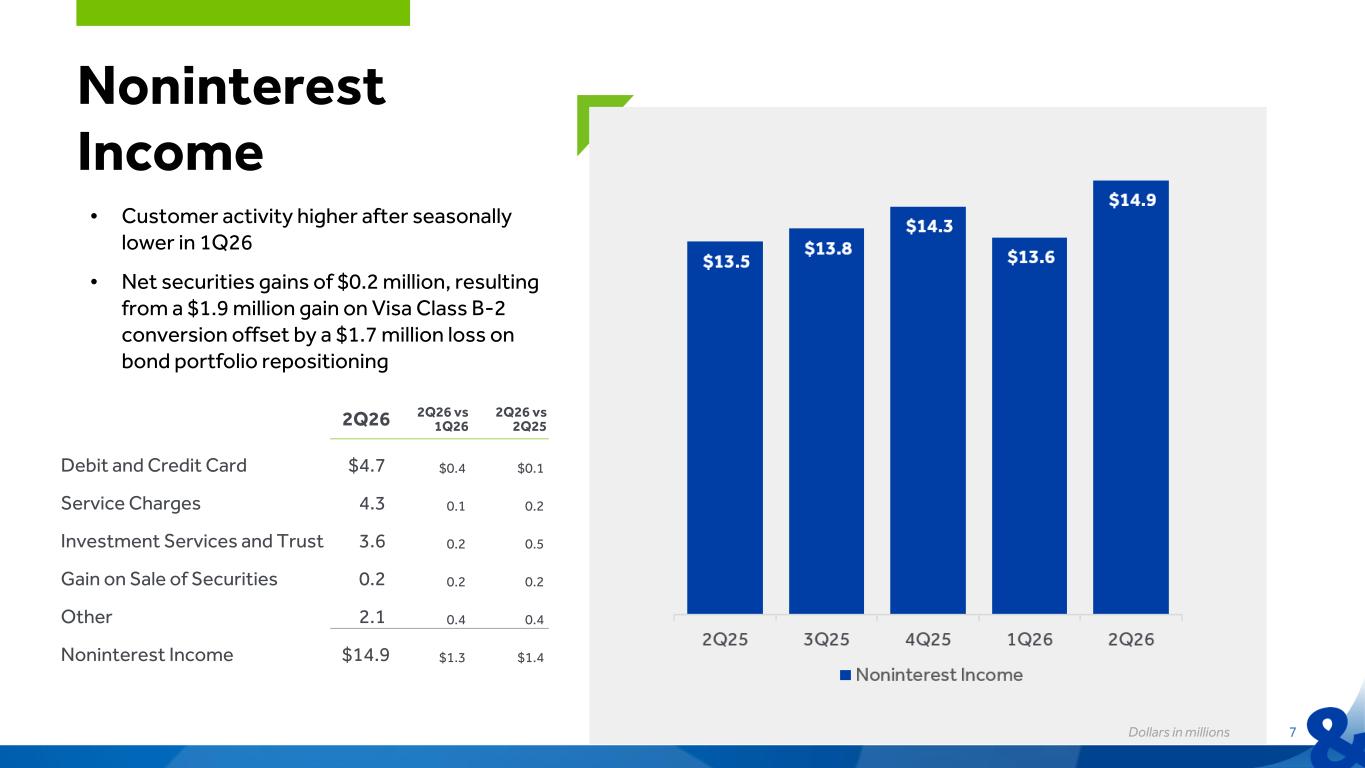
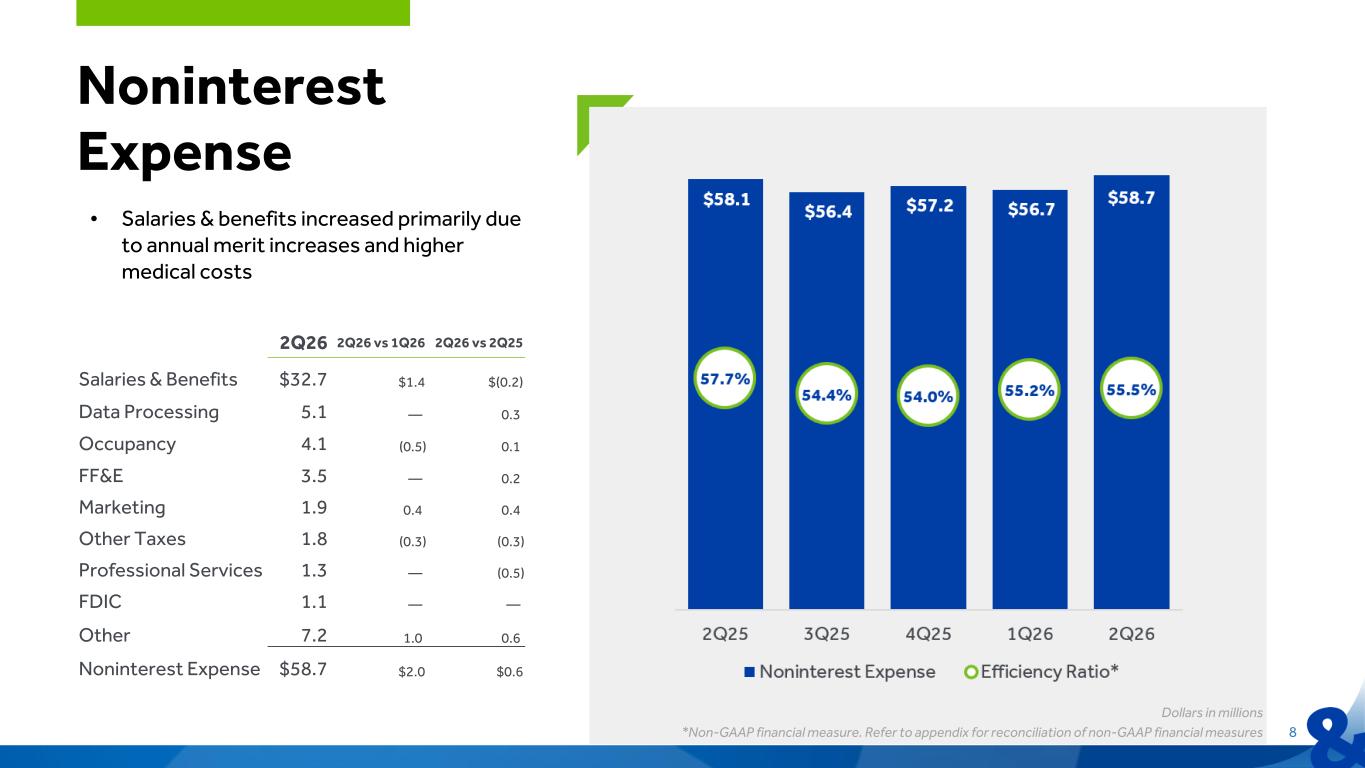
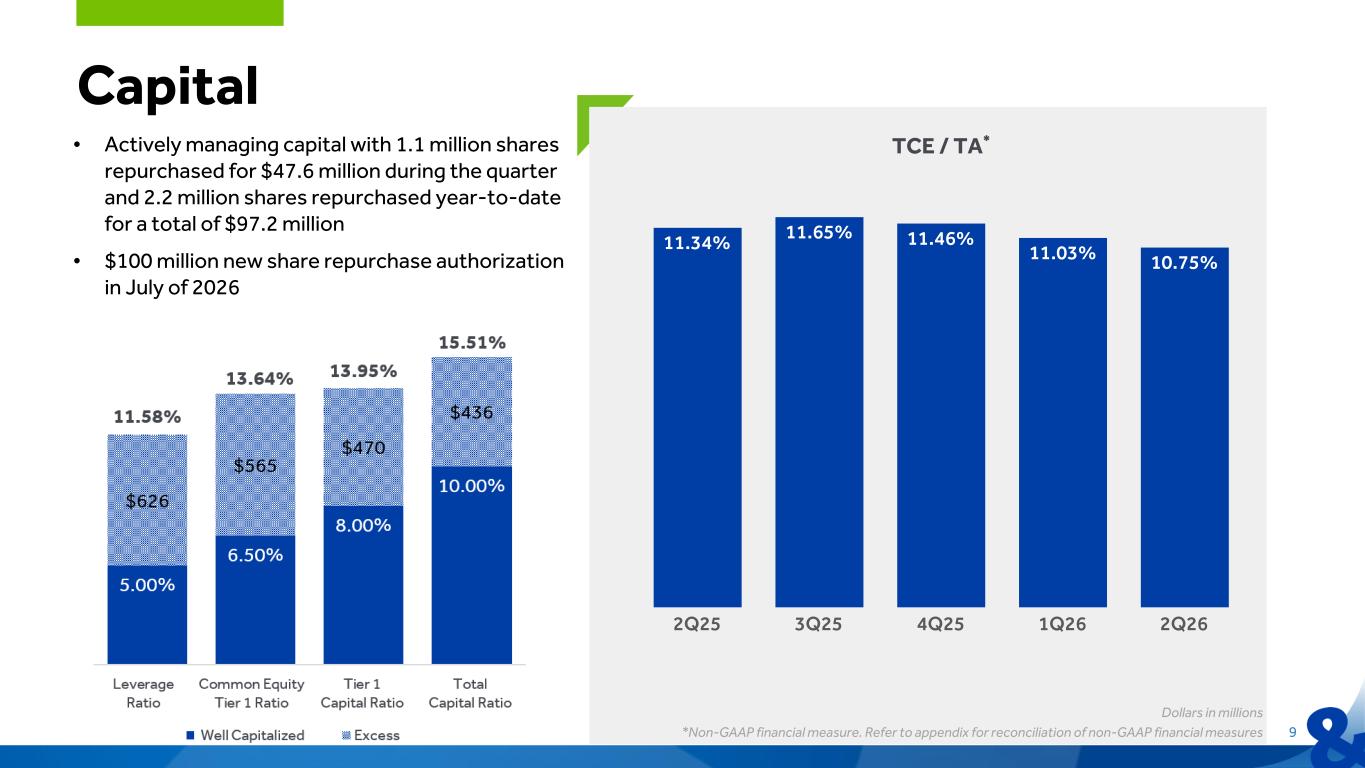
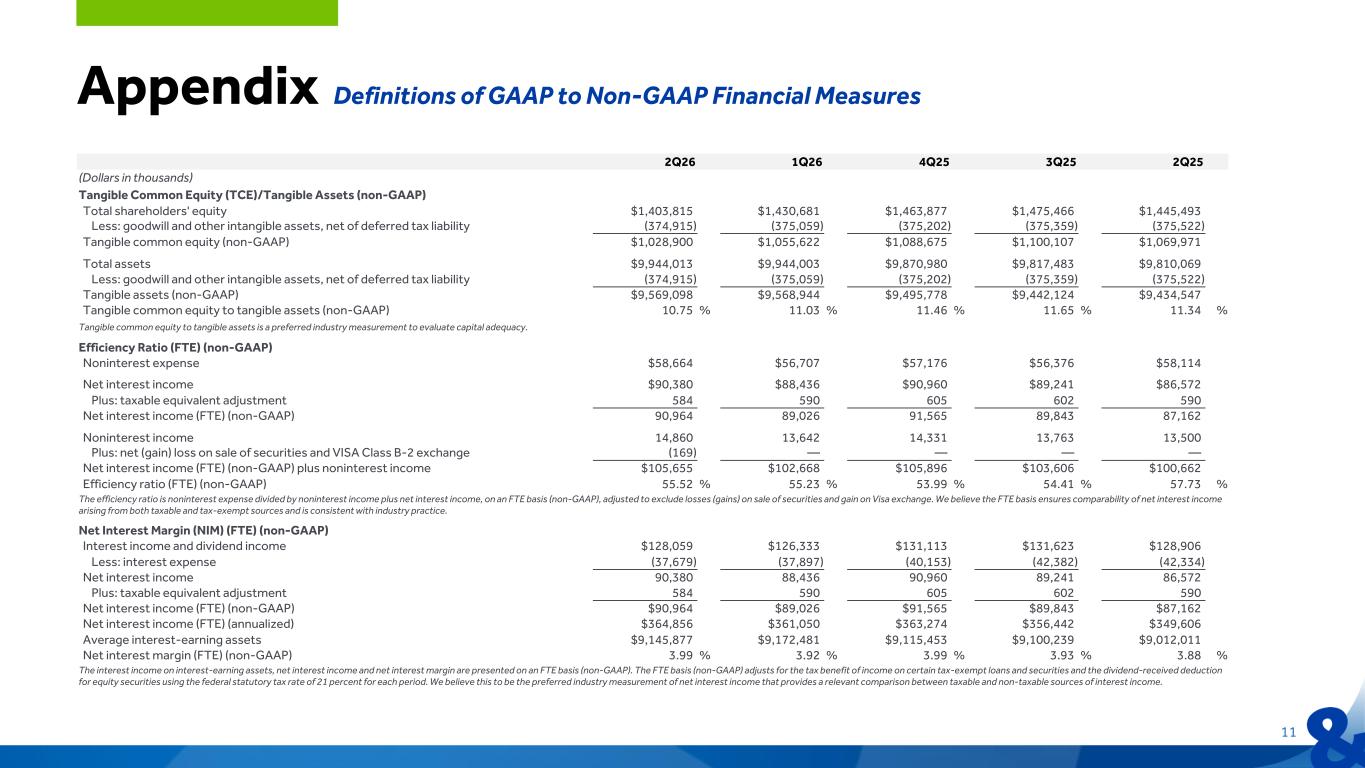
Hey, thanks, Dave. Second quarter, net interest income increased by $2 million due to an additional day, combined with improvements on both the yield on earning assets, which were up four basis points with better commercial performance, and the cost of funding, which was down four basis points due to lower interest-bearing deposit rates, and also a better funding mix. We expect relative net interest margin stability around the current high 390s level to continue for the next several quarters, and believe we are well positioned should interest rate conditions change. Tail widths from our maturing received fixed swaps along with some remaining security fixed rate loan and CD repricing all contribute to stability in the face of heightened loan and deposit pricing competition. Net interest income growth will be supported by improved loan growth. Average loan balances were actually down in the second quarter due to the timing of the growth in the first half, but we expect average loan balance growth going forward. Customer customer deposit growth momentum remains good even in the face of this increased competition, which should contribute to maintaining spreads and interest margin rates. Next on non-interest income, we saw an increase of $1.3 million in the second quarter. Increases were broad-based with improvements in really every category. Debit and credit card activity was higher after a seasonally slower first quarter. Investment services is up with better customer activity and market improvements. the gain on sale is the net of a 1.9 million dollar gain on the conversion of visa class b2 shares we offset that for the most part with a 1.7 million dollar loss on a small 34 million dollar bond portfolio repositioning the bond repositioning has an earn back of about 1.4 years it will add 300 000 per quarter to then interest income for the next several quarters the other category variance is due to one-time items. We had some partnership income and an unrealized gain on some equities that we own. Our expectations for fees in the second half of 2026 is approximately $14 million per quarter. On to non-expenses, which increased by $2 million in Q2, the largest variance was in salaries and benefits. And within that, salaries were up due to merit increases going into effect in April, and we also had some higher medical costs as deductibles were met during the first part of the year. Occupancy improvement was impacted by higher seasonal snow removal and utility costs in this cost in the first quarter. Marketing reflects just the timing of various promotional efforts. Other variances include tax-related contributions, which are offset by a favorable variance in other taxes. We had some higher T&E and employee recognition, along with some recruiting fees. We expect to manage our 2026 non-interest expense year-over-year to around 3% increase, which implies a quarterly run rate of around $58 million. For capital, the TCE ratio decreased by 28 basis points this quarter, primarily due to the share repurchases we completed in the second quarter. Again, for the quarter, we repurchased about 1.1 million shares, average price of $44.24 with a total of $47.6 million. Our regulatory ratios continue to be very strong with significant excess capital. We are evaluating next steps with respect to our capital management strategy and further buybacks. We're comfortable that even considering additional repurchases that were recently authorized by the board, we have more than sufficient capital currently and the generation capabilities that will position us well for the environment and enable us to take advantage of organic or inorganic growth opportunities should they arise. Thanks very much. At this time, I'd like to turn the call back over to the operator to provide instructions for asking questions.
Operator
The floor is now open for questions. If you have a question, please press star one on your device. We ask that while asking your question, please pick up your phone and turn off speakerphone for enhanced audio quality. Please remember to unmute your device. Please hold while we pull for questions. Your first question comes from the line of Daniel Tameo with Raymond James. Your line is now open. Please go ahead.
Good afternoon, everybody. How's it going? I apologize if you gave this already. Um, but, uh, the, um, the loan growth guy, did you, did, did we get a, was it mid single digit again, um, that we're looking for the rest of the year?
Exactly, Dan, mid, mid single digit.
Okay. All right, great. Um, and in terms of, uh, the deposits, I know you, you called out, it's been strong year to date. Um, still thinking that kind of full year will, will fund the, uh, the loan, the loan growth or how are you thinking? through the deposit.
Yeah, we will anticipate, yeah, based on pipelines activity we've seen year to date, we'll be able to sell funds through deposit cross.
Okay, great. And then I appreciate the commentary on the buybacks, but maybe just if you could just put a little more clarity around kind of how you're thinking about that other than opportunistic, like, you know, you got the $100 million re-up there. And then, you know, is that assuming kind of a stable stock price or stable growth in the stock price, you think that's something that you expect to use on a somewhat regular basis over the next several quarters? You know, obviously, it's dependent in part on the loan growth that comes through. I get that. But just your thoughts on like your intention to use that over the next year, I guess, is the authorization.
Yeah, I mean, it does last for a while. I mean, with the stock price moving higher, I mean, the calculus does change. So we are taking a closer look at that. I think it is something that we'll have opportunity to use over the next year. But again, the dynamics have changed as the prices move higher.
So based on like today's price, I mean, do you think that's something you're still interested in utilizing?
Probably not to the same degree as we've been. We've been pretty active the last three quarters. So we, you know, we would consider or look more closely at potentially stepping that back somewhat at current level.
And if, and if that happens and maybe the stock goes, goes higher and it becomes less attractive, like what, What do you think you would do with the capital at that point, absent kind of looking for other M&A opportunities?
Yeah, I mean, we haven't stopped looking for M&A opportunities and other things to do, both organically. So we would continue on that. You know, with the buybacks that we've made, you know, the improvements to returns, you know, are meaningful. people um so but that but again the the kind of incremental improvement that we get from the buybacks uh begins to get a little bit more constrained so um i think that's one of things as we go into here go into our planning process for the year that's something that we'll have to look a lot closer at over the next uh next quarter or so all right understood well thanks for the color guys appreciate it nice quarter okay thank you your next call comes from the line of david Bishop with Havdi Group.
Operator
Your line is now open. Please go ahead.
Yeah, good afternoon. Hey, Chris, you mentioned the ability to attract new commercial bankers and you called out the CNI growth. Just maybe some color on the increase there, how much represented maybe new client penetration versus existing customers getting more aggressive and utilizing lines and getting more optimistic on lending. Thanks.
Hey, Dave. So the majority of the growth was related to utilization rates increasing. But as I mentioned, we've seen the total revolving commitment growth as well, which would represent additional credit extended to existing clients as well as new customers. So it's a good mix. But the growth in CNI was outsized and a little more than what we'd expected from the quarter because of the increased utilization rates.
Which was interesting because utilization had dropped a little bit in Q1 and then it came back some in 2Q.
So the math becomes keep the utilization rate because it's now at a level where it was prior to Q1, keep that consistent, grow the overall customer base, which is the purpose behind hiring these new CNI bankers.
Got it. And then I'm not sure if I missed it during the preamble, but positioning for potential rate hikes here in terms of the margin. Just curious thoughts on sort of the puts and takes there as we head into the second half of the year. Thanks.
Yeah, I think with respect to our rate sensitivity, we feel like, you know, within, you know, 2550 bases per point or even a little bit more either way that we're fairly neutrally positioned right now. You know, we still have some tailwinds that I mentioned with the swaps and some of the back book repricing that should support us over the next several quarters. So it's hard to know what the Fed's going to do, but we think that we can hold on to the margin for the next several quarters, at least, in spite of any rate changes that might happen.
Operator
Your next call comes from the line of Kelly Mata with KBW. to you. Your line is now open. Please go ahead.
Hi, good afternoon. Maybe sticking on the point of the margin, it was really nice to see deposit costs come down in the quarter, including the rate on CDs. I'm wondering, you know, as you look out from here, is that tailwind kind of leveling off with the upcoming maturities coming up? And can you provide any spot color on deposit costs or what the incremental cost of new funding is coming in at. Thank you.
Yeah. So, I mean, you're right. We still got some repricing benefit on the CD book. That has, you know, maybe a couple more months to run. So, we might see a little bit more benefit in Q3. But after that, we're pretty much leveled off and replacing at the same cost because that book is fairly short. We're still highly concentrated in that six-month time frame. So, that's why we'll We'll start to see some uptick potentially after Q3 in deposit costs as there's still some repricing and some exception pricing being made. So to the extent we can hold on to the good mix that we have, we shouldn't see it move too much going forward.
Got it. That's helpful. Maybe one last question from me, just refreshing Durban. And it looks like you're $9.94 billion in assets, very flat quarter over quarter. It seems like given your kind of mid-single-digit growth outlook on loans, you will potentially run through that. Is that still a good assumption, or do you have some levers here that if you don't get a deal, you can plan to navigate on an organic basis? Thank you.
I mean, given the trajectory that Dave described on the loan side, if we're successful with that, we would anticipate a cross here in the second half. So as long as that comes true, we will go. In the first half of the year, we saw a decrease in loan balances in the first quarter. That sat in cash for the most part at the end of the first quarter. So in the second quarter, even though we had loan growth, we got a right side to the cash balance. So it looked like we were flat, but it was really back to the balance sheet actually be probably down under the hood in the first quarter, and it just kind of bounced back during the second quarter. But our trajectory should take us over $10 billion in the second half.
Got it. Thank you so much.
Yeah, Kelly, as Chris, as we've talked about before, we're talking about a little over six million dollars annualized doesn't impact us for you know assuming we went over at 1231 and wouldn't impact half of that would hit in 27 the other full amount of that would hit in 28 and our job is to uh is to lead the company through that your next call comes from the line of daniel cardenas with breen capital your line is now open please go ahead hey good afternoon guys hey dad So just kind of following up on Kelly's question with the crossing of the $10 billion threshold
and the $6 million gap that would be created there, how long do you think it would take your new hires to kind of fill that gap?
Do you think that can kind of happen in 28 or is that going to take a little bit longer for that the the new hires and the growth of the balance sheet is just you know just one one lever that we would pull um you know we're not going to we're not going to take on additional risk from a from an you know general remain disciplined we'll continue to look at you know expense saving opportunities that could make up some of that and generating other other forms of fee income you know if you think about an eight billion dollar balance sheet on either side of the loan and deposit makeup it's you're talking about a basis point or two to make up six million dollars annualized and you know net interest income and so we're and we we just feel confident that we're going to be able to pull you know any number of levers in order to overcome that that kind of number you know we've made 36 million dollars this quarter and so we don't want to do anything that is over to make up that number we believe we can go over time and that's the and that's just to clarify that we had a question come in on the timing of the impact if we crossed
here in the second half that would start in the second half of 27. and then uh just returning to to loan growth in the quarter um what what was the impact on um from paydowns and payoffs we did see that commercial real estate permanent loan bucket decline.
As you may know, the CMBS market is relatively active in the permanent insurance market. But we continue to fund through on our construction loans in support of those same borrowers. So based on what we see from existing commitments and demand in the market, we believe that that kind of pace can be continued. But that pressure, that headwind from the permanent market is going to continue to be something that we're going to face throughout the balance of the year and certainly in the next year.
So paydowns were a little bit lighter than typical in the quarter. So we did get a little bit of a benefit there in terms of the net growth by having slightly lighter. But looking ahead, we don't see that as being a trend.
Questions have been asked an answer. Thank you, guys. Thanks. Thanks, Dan.
Operator
Your next question comes from the line of Matthew Brees with Stevens, Inc. Your line is now open. Please go ahead.
Hey, good afternoon, guys. Hi, Matt. Hi, Matt.
Maybe we could just touch on pipeline, pipeline yields, spreads, and, you know, between CNI and commercial real estate, and curious how competitive dynamics are playing out in your markets it just sounds like elsewhere in kind of the mid-atlantic um you know things are you're heating up competition wise i'm curious what you're experiencing yes if i if i look at just strictly pipeline approved pipeline from first quarter versus second quarter we're up modestly uh in both cre and cni more so in the cre space as a as a recognition of those hirings that we've made. We have some pretty decent ABL pipeline activity that's headed our way that could help us with incremental growth. I turn to consumer mortgages, similar to where it was, Q1, and I would expect mortgage activity to look in Q2 similar to how it did in Q1. And then looking at consumer home equity, I would expect Q3, based on pipelines today, to show similar growth, maybe a little higher in Q3 than we saw in Q2. So kind of all those things combined give us that outlook to, you know, guidance of mid-single-digit total loan growth for Q2 – I'm sorry, for the bounce of the year. And how are yields holding up? Yeah, yields – they're holding up. I mean, there's still competitive pressure, but so far so good. We're disciplined relative to how we price, and the market, particularly in the areas where we see the most activity, construction, there's still a reasonable return based on the risk that we take in that book, and the market's willing to accept that pricing. We haven't seen any significant pressure there. We've seen some additional pressure in the deposit book. You're seeing CD pricing and money market pricing competition become more aggressive, particularly from smaller banks. Our larger bank brethren aren't as aggressive when it comes to deposit rates, but there are some smaller bank competition who tend to be a little pesky when it comes to pricing deposits.
Yeah, maybe to put a finer point on it, I mean, educated guess, are your pipeline deals still better than $650,000?
No, no. Overall, like, you know, the new loan rate over the quarter was just over $6,000. And I anticipate that the pipeline probably reflects a very similar sort of rate.
Got it. Okay. Chris, I know this comes up every quarter now, especially as you kind of inch towards 10 billion, but how are M&A discussions coming along and are conversation activities mimicking overall deal volumes that we're seeing in the space, which is pretty slow?
Yeah, I would say conversation activities haven't slowed down from the standpoint of you know, thinking strategically about partnerships. I think those activities continue to be at an acceptable pace, and I haven't seen any significant decline in those sorts of things. And so we continue to remain in the market and proactive with potential partners, as we do believe it's an opportunity for us down the road.
There are a number of deals that you know, since you stepped into the seat that you've passed on and maybe elaborate on, you know, whether or not that kind of makes you a more selective buyer than we might normally see?
Yeah, I'm not going to go there comparing myself with others or ourselves with others. But yeah, there are a number of deals that we've chosen not to move forward with. It may be, You know, we think about what is important to our company, cultural fit, business mix, the makeup of the company. You know, we know our, you know, one of the things that we've been working on art over the past few years is continuing to grow and enhance and build that deposit franchise. So, you know, some of the targets that we look at may be more of an asset play than a customer deposit play and that something like that may not be as appealing to us as it would be to somebody else. And then we also, as we've talked about in other quarters, Matt, you know, we think about geographic expansion and those contiguous markets south and east of us and, you know, through the state of Ohio are all very attractive to us. So we're not slowing down in the number of conversations, and that remains active. But, yeah, we've looked at a number of things that we've chosen not to pursue.
Great. I really appreciate that. I'll leave it there. Sure thing.
Operator
Your next call comes from the line of Justin Crowley with Piper Sandler. Your line is now open. Please go ahead.
Hey, good afternoon, guys. On the loan growth, you know, in particular, C&I, and, you know, I know you folks have been talking about that as a focus for a while, and, of course, poor fruit this quarter, you know, and I know it can be a lumpy area, but can you talk about expectations there going forward, and perhaps just any comments on, you know, are there any specialty groups or certain geographies driving that growth?
So, Justin, if you look at where we've hired, if I think about this more geographically than – because we're pretty well diversified when it comes to industry, but geographically the majority of the hires were in western Pennsylvania, so that's where we're seeing activity. We've also made a number of hires in northeast Ohio where we're seeing some increase to pipeline. We also added one CNI banker in eastern PA. So it's pretty well diversified both geographically, and again, looking at industry and concentration, there's nothing meaningfully that's moved, nor do we anticipate that. So we're relatively opportunistic, making sure that we have the right people in place, disciplined underwriters, and portfolio managers.
One area that Dave touched on earlier was solid there, the growth equation.
Okay, got it. And then it's just pivoting a little just sort of related to the conversation on buybacks. What are sort of your broader thoughts on capital levels where they are, you know, certainly still very strong, but, you know, of course down from the peak, is there a certain ratio or ratios where you look at targeting a certain threshold, what does that thought process look like?
Yeah, and we take, we take a combined sort of bottoms up approach to try to, you know, build at least some levels above which we're comfortable at based on regulatory environment plus our internal capital stress testing that we do to see how much capital we need as a cushion and then making sure that we have that plus. And we still think we have some room to reduce that. So the decision really becomes, you know, how do we manage that better? You know, we did – it was so large that buybacks, I think, made sense for that first round of it. But as we're starting to utilize that more, some other avenues like, you know, different types of asset growth and certainly the M&A piece comes into play. So we have, you know, some internal targets, but we still feel like we have space above that to maneuver. Okay.
And I don't know if you're really able to quantify that much further, but do you look at like regulatory ratios in terms of staying above a certain level?
Yes. I mean, that's part of the building blocks. We would start with the regulatory definitions and then add a cushion to that and then build upon that with what our stress testing is telling us that we would need to cover an extreme event in the market. And that becomes kind of the floor of the target range for us.
Okay, got it. And then one just quick last one, kind of like a modeling question, but just on expenses. If I heard it correctly, I think you threw at the $58 million number in terms of kind of the right way to think about the base going forward. And so just kind of curious what kind of, I guess, is going to drive that lower from where you were in the second quarter, just as we kind of think about the next few periods modeling ahead?
Yeah, I mean, quarter to quarter, there's always a little bit of lumpiness on the margin. So this particular quarter, there were a couple of things that don't necessarily repeat that were slightly higher. The main drivers are expense. The amount of people that we have and how much we spend, And that's been, and we anticipate that to be fairly consistent. So we think, you know, just given the kind of the minor lumpiness of expenses, just generally that that $58 million level is something we should be able to manage to for at least the rest of this year.
Okay, got it. I will leave it there. Thank you guys so much.
Thank you. there are no further questions at this time i would now like to turn the call over to chief executive officer chris mccomish for closing remarks thanks everybody for being on the call i know these are busy days for all of you with the number of earnings announcements but we certainly appreciate your engagement with our company and your your very good questions have a great rest of the day and we look forward to talking to you soon this concludes today's call Thank you for attending.
Operator
You may now disconnect.