Operator
Greetings, ladies and gentlemen, and welcome to the Truist Financial Corporation 4th Quarter 2025 Earnings Conference Call. Currently, all participants are in a listen-only mode. A brief question and answer session will follow the formal presentation. As a reminder, this event is being recorded. It is now my pleasure to introduce your host, Mr. Brad Milkseth.
Thank you, Betsy, and good morning, everyone. Welcome to Truist's 4th Quarter 2025 Earnings Call. With us today are our Chairman and CEO Bill Rogers, our CFO Mike McGuire, our Chief Risk Officer Brad Bender, as well as other members of Truist's senior management team. During this morning's call, they will discuss Truist's fourth quarter and 2025 results, share their perspectives on current business conditions, and provide an updated outlook for 2026. The accompanying presentation, as well as our earnings release and supplemental financial information, are available on the Truist Investor Relations website, ir.truist.com. Our presentation today will include forward-looking statements and certain non-GAAP financial Please review the disclosures on Slides 2 and 3 of the presentation regarding these statements and measures, as well as the appendix for appropriate reconciliations to GAAP. With that, I'll turn it over to Bill.
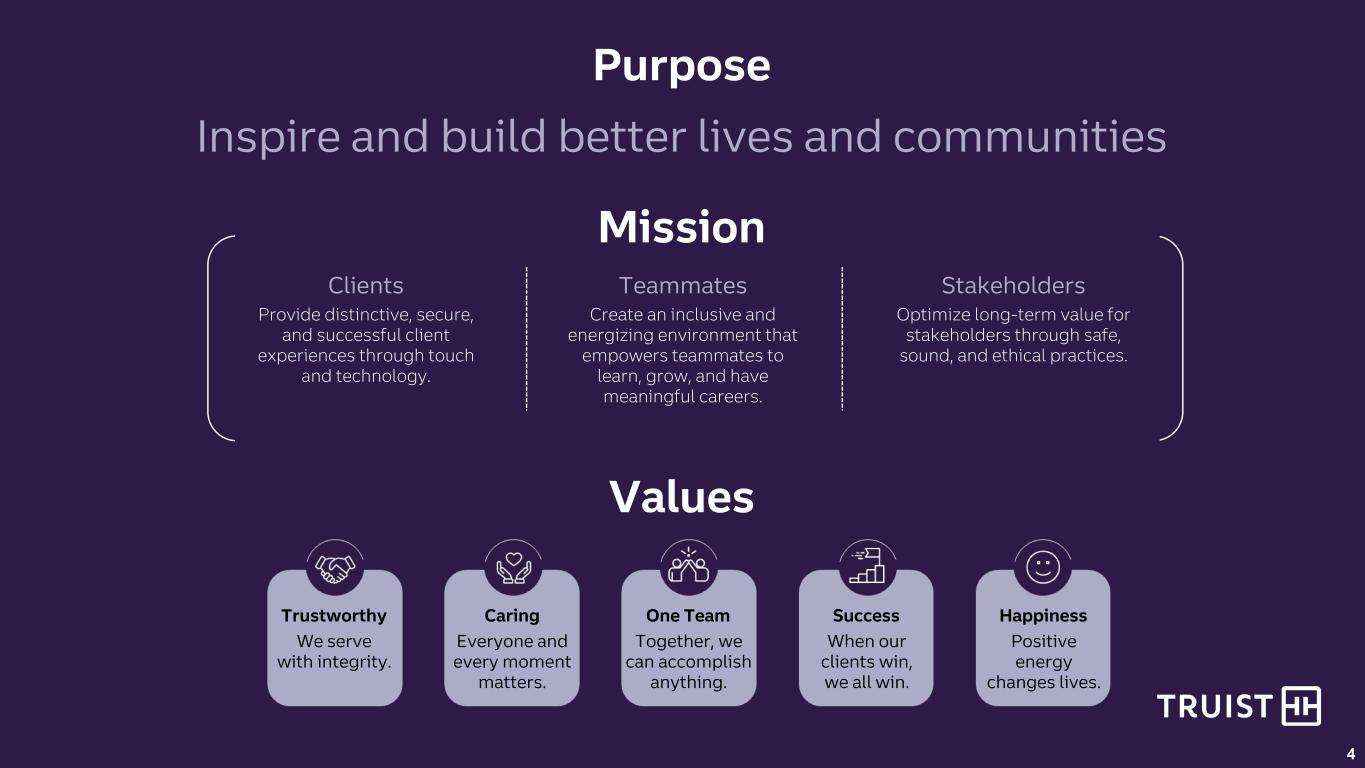
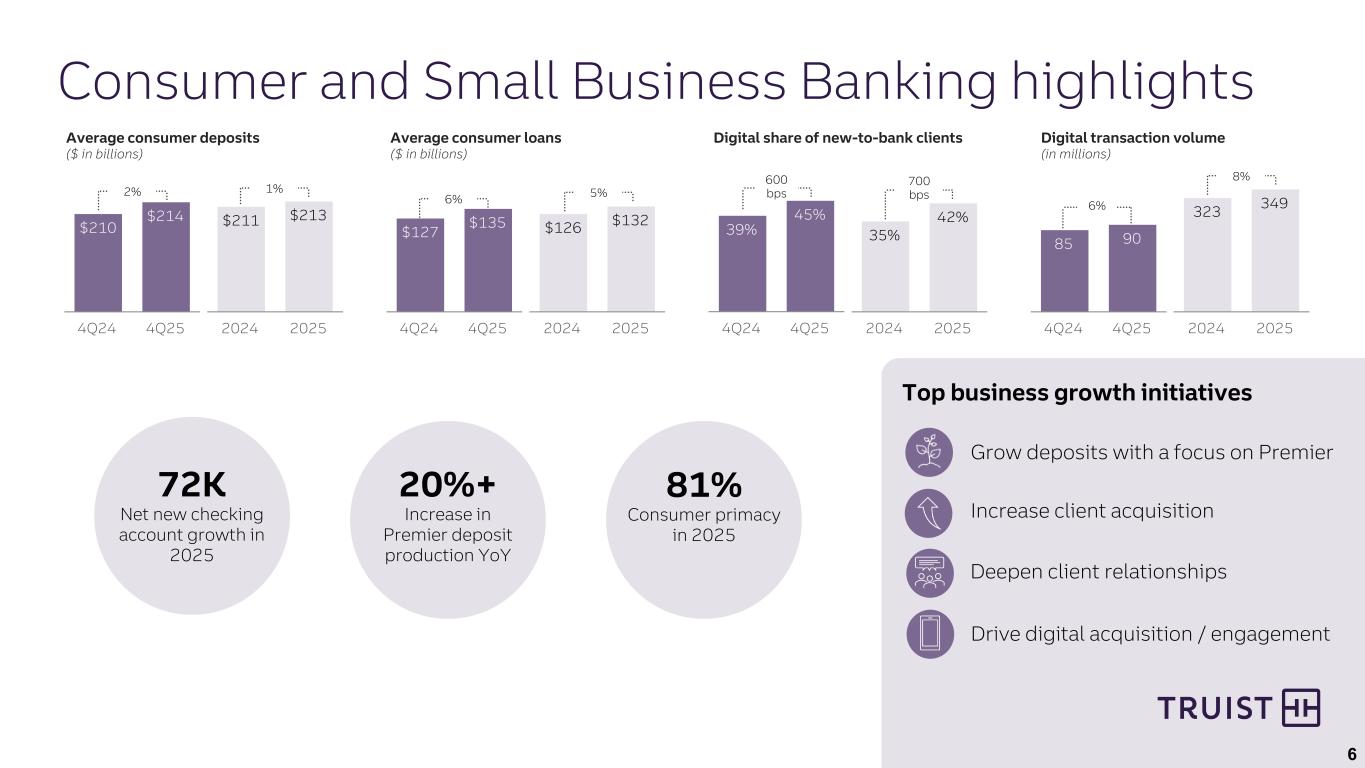
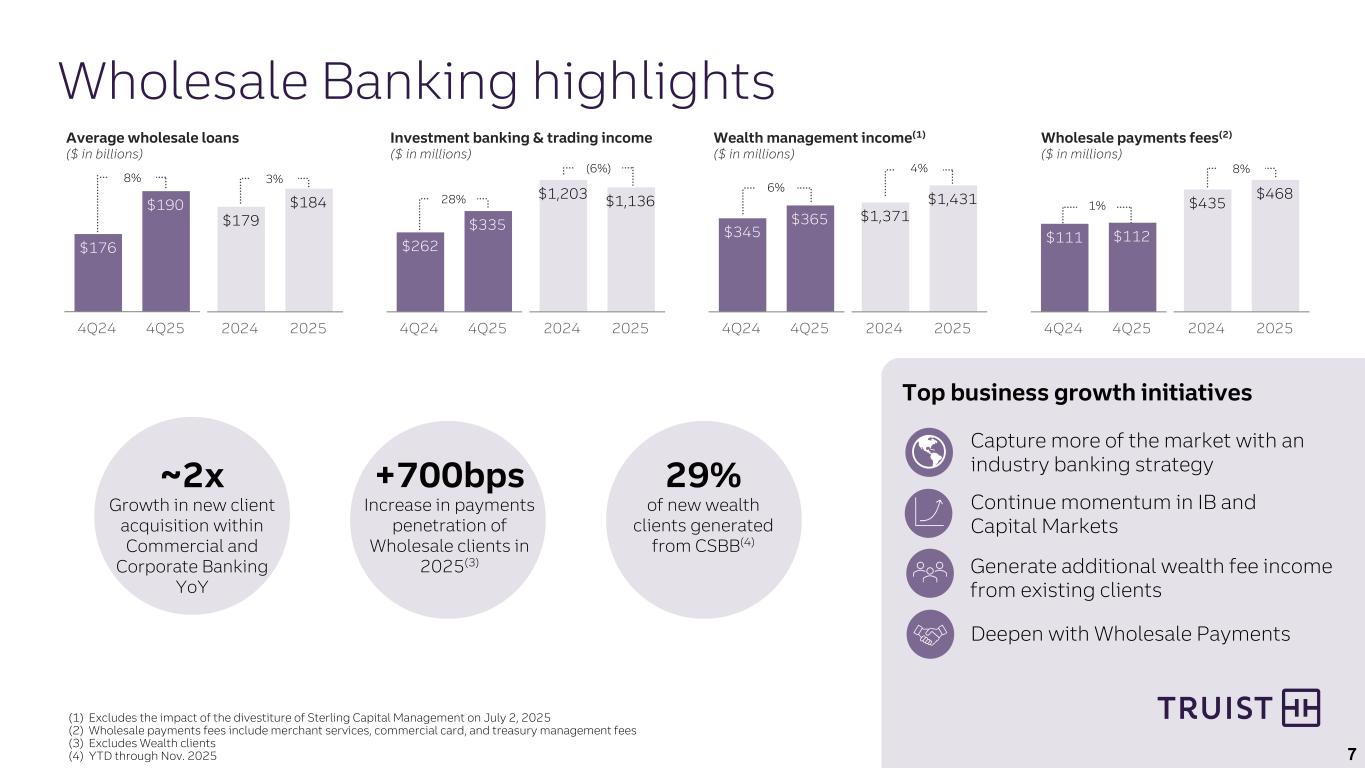
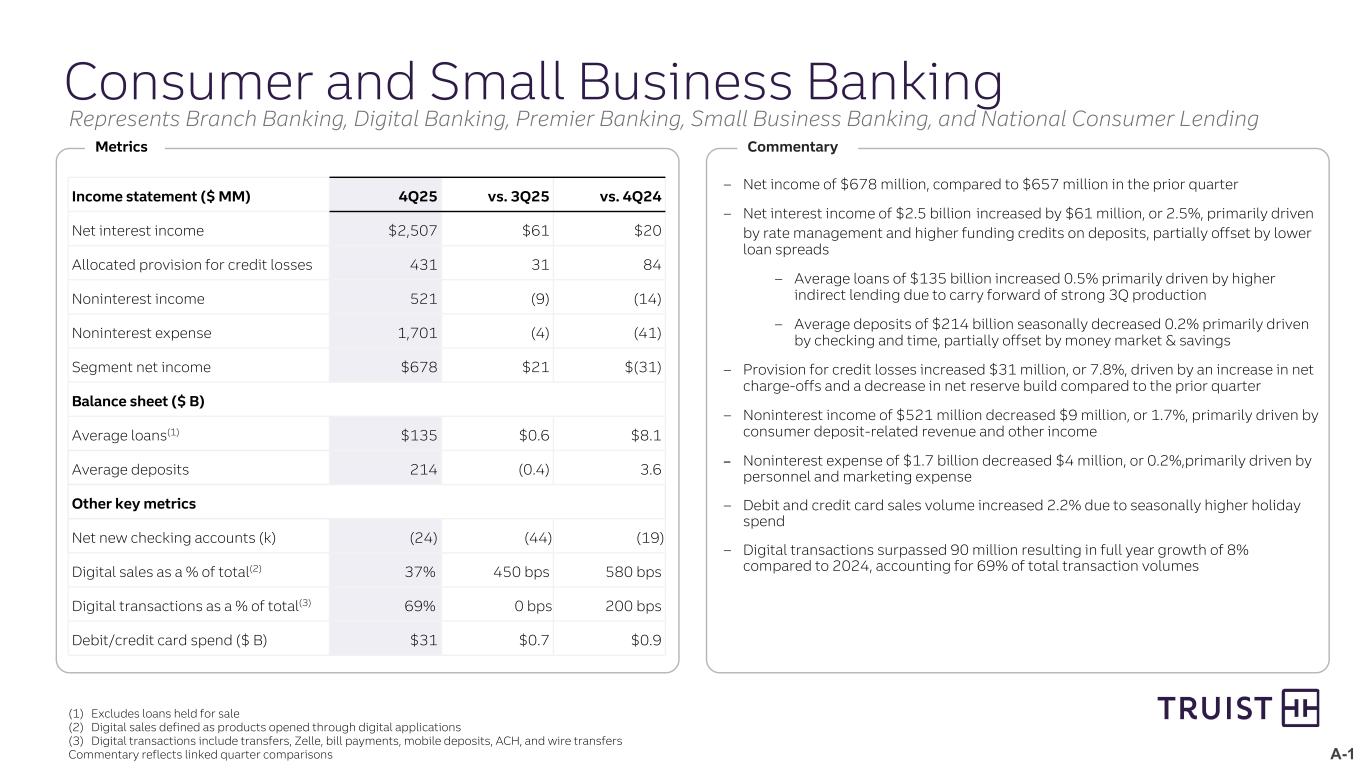
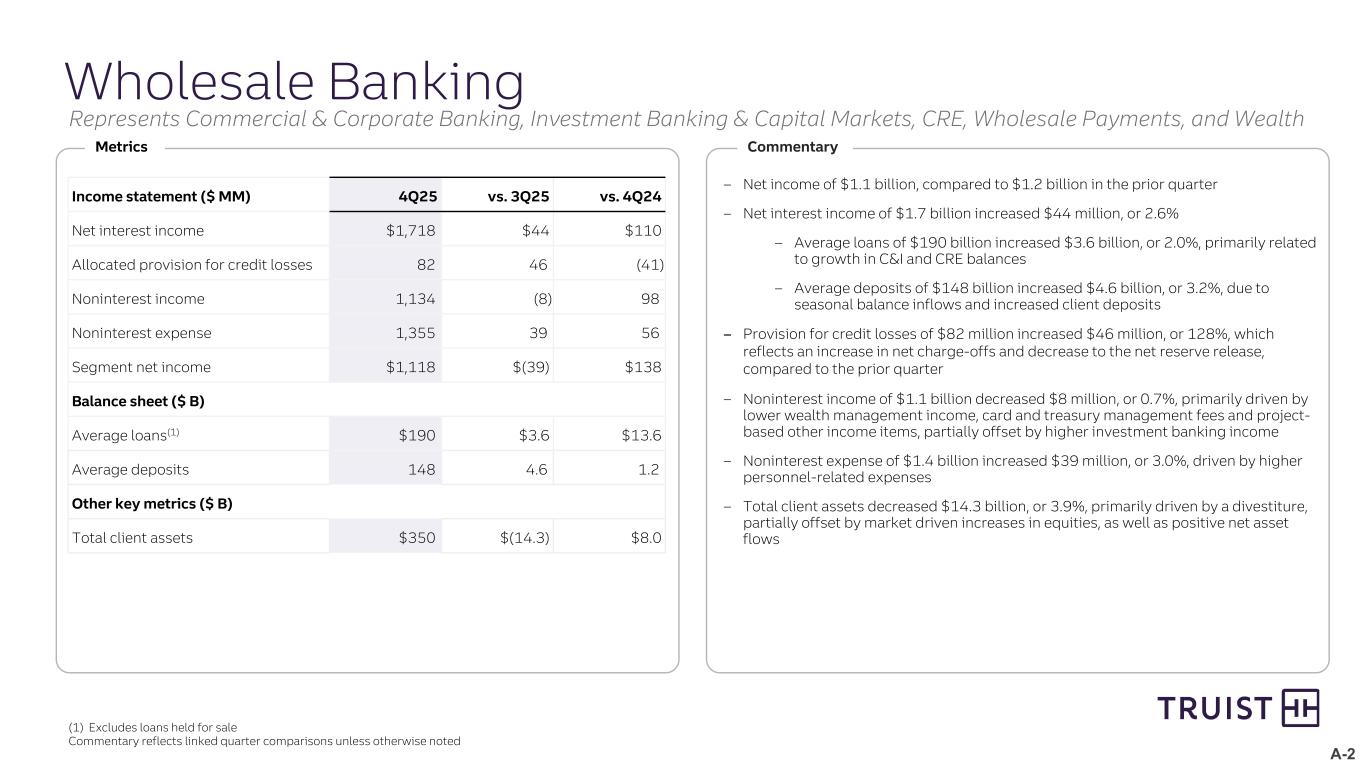
Good morning, and thank you for joining our call today. Before we discuss our fourth quarter in 2025 results, let's begin like we always do at Truist with purpose on Slide 4. At Truist, our purpose to inspire and build better lives and communities remains at the heart of everything we do. It drives our strategy and fuels our commitment to our clients and the communities we serve. Despite market volatility early in 2025, we stayed focused on supporting our clients and executing our growth and profitability agenda. This discipline drove higher earnings, stronger client relationships, and attracted new business. A key to delivering on our purpose and performance is the investment in our business, markets, and teammates. Some of these significant investments include enhancing our tech and digital capabilities in areas like AI and improving the client experience, recruiting and developing talented teammates to advise and serve clients with more complex and industry-specific financial needs, announcing plans to open 100 new insight-driven branches and high-growth markets, as well as enhancements to more than 300 branch locations in all markets. These investments underscore our commitment to the communities we serve and position us to deliver more personalized advice and create opportunities for outsized growth. As we enter 2026, our purpose continues to guide our focus on growth, profitability, and deeper client relationships. We're expanding our presence and delivering more differentiated, advice-driven experiences. I look forward to sharing more of these priorities during today's call. Now, let's turn to slide five. We closed 2025 with strong results and clear momentum heading into 2026. We delivered net income available to common shareholders of $1.3 billion, or a dollar per diluted share for the fourth quarter, and $5 billion, or 3.82 cents, per diluted share for the full year 2025. These results include certain charges, such as severance and an accrual related to a specific legal matter that was settled in the first quarter of 2026, which totaled $0.12 a share for the quarter and $0.18 a share for the year. At the start of last year, we outlined five strategic priorities aimed at accelerating our performance and improving our profitability in 2025 and beyond. While there's more to accomplish, I'm proud of the progress we made as a company in 2025 and excited about the momentum we have entering this year. First, we continue to generate strong, broad-based loan growth in both wholesale banking and consumer and small business banking, driven by new loan production and increased client acquisition. Second, strong loan growth, better second half results in investment banking, trading, and wealth, along with continued expense discipline, drove 100 basis points of positive adjusted operating leverage in 2025. Third, we made significant investments across our business in talent and technology, laying the foundation for future growth, which we expect to accelerate in 2026. Fourth, we maintained strong asset quality metrics as net charge-offs declined versus last versus 2024, and non-performing loans remain relatively stable. Finally, we return $5.2 billion of capital to shareholders through our common stock dividend and the repurchase of $2.5 billion of our common stock. Our total capital turn in 2025 reflects a 37% increase over 2024. Looking ahead, our strategic priorities remain unchanged and our focus clear. Accelerate revenue growth, drive greater positive operating leverage, continue to invest while maintaining our expense and risk discipline, and return capital to shareholders at an accelerated rate. Executing on these strategic priorities is central to improving profitability and achieving our long-term goals, including our commitment to deliver a 15% return on tangible common equity in So, in summary, we closed 2025 on a strong note and entered 2026 with significant momentum and confidence in our ability to deliver revenue growth at least twice the pace of 2025, greater positive operating leverage, higher levels of capital return, and improved profitability. Before I hand the call over to Mike to discuss our quarterly results, I want to spend some time discussing the positive momentum we're seeing within our business segments and with our digital strategy on slide 6 and 7. First, let me start with consumer and small business banking. CSBB delivered consistent strong performance throughout 2025. As shown on the slide, we generated 5% growth in average consumer and small business loans and 1% growth in average deposits. This momentum was fueled by our market-leading consumer lending businesses, another year of net new checking account growth and deeper relationships with our premier banking clients. Loan growth was broad based across the portfolio with especially strong contributions from Indirect Auto and our specialty niche lending platforms Sheffield Service Finance and Lightstream. These businesses continue to produce market-leading growth with attractive risk adjusted returns. As part of advancing our consumer lending strategy we fully integrated our digital end-to-end lending platform, Lightstream, into our truest mobile app experience and our branch banking account opening experience. This expanded scale is improving efficiency, broadening distribution, accelerating growth, and meaningfully enhancing the client lending experience. Beyond our national consumer lending platforms, Premier Banking also delivered strong results. with 2025 production up 22% in deposits, 32% in lending, and 12% in financial plans. This performance was driven by higher advisor productivity and strong branded mortgage and branch-led lending. We continue to see strong outcomes from our strategic investments in digital, delivering year-over-year growth across all core metrics. In the fourth quarter of 2025, we added 77,000 digital new-to-bank clients, up 10% from the prior year quarter, capping a solid full-year performance with digital production of 9%. We also took meaningful steps to deepen self-service adoption, expanding capabilities within our AI-powered Truist Assist mobile experience. The launch of Ask Truist Assist, our universal search capability, now delivers client quick, intuitive access from any screen. This drove a 97% increase in digital chat engagement in 2025 and is helping us improve efficiency and strengthen client connectivity as more activity naturally shifts to digital. Let's turn to wholesale on page seven. In wholesale, we delivered a strong finish to 2025, driven by meaningful improvement in the second half of the year in both loan and deposit growth, investment banking and trading revenue, and continued progress in strategic focus areas such as payment and We onboarded twice as many new corporate and commercial clients versus last year, spanning a diverse range of industries and markets. Building on these new client relationships and our focus on deepening existing ones, we saw our loan and deposit momentum strengthen as the year progressed. Average wholesale loans increased 3% in 2025, with momentum accelerating in the second half. Fourth quarter average loans were up 8% compared to the fourth quarter of 2024, fueled by new client acquisition and supported by focused talent investments as our strategy continues to gain traction. End of period wholesale deposit balances rose 6% late quarter. While seasonal public funds contributed to this growth, we saw growth from all of our industry banking teams and geographies. Full year investment banking and trading income declined 6% versus 2024 due to first half market volatility. However, activity rebounded strongly in the second half with fourth quarter revenues of 28% versus fourth quarter 24, driven by increased M&A, trading, equity, and debt capital markets activity. In wealth, net asset flows remain positive, supported by 8.5% increase in new clients last year, with almost 30% being generated by CSPB. Wholesale payment fees, which include merchant services, commercial card, and treasury management fees, rose 8% in 2025. treasury management fees, a key strategic focus, grew 13% on the strength of new client acquisition and deeper relationships within our existing base. Importantly, our payments pipelines are up significantly year-over-year, positioned us for continued growth in 2026. So now let me turn it over to Mike to discuss the financial results in a little more detail. Thank you, Bill, and good
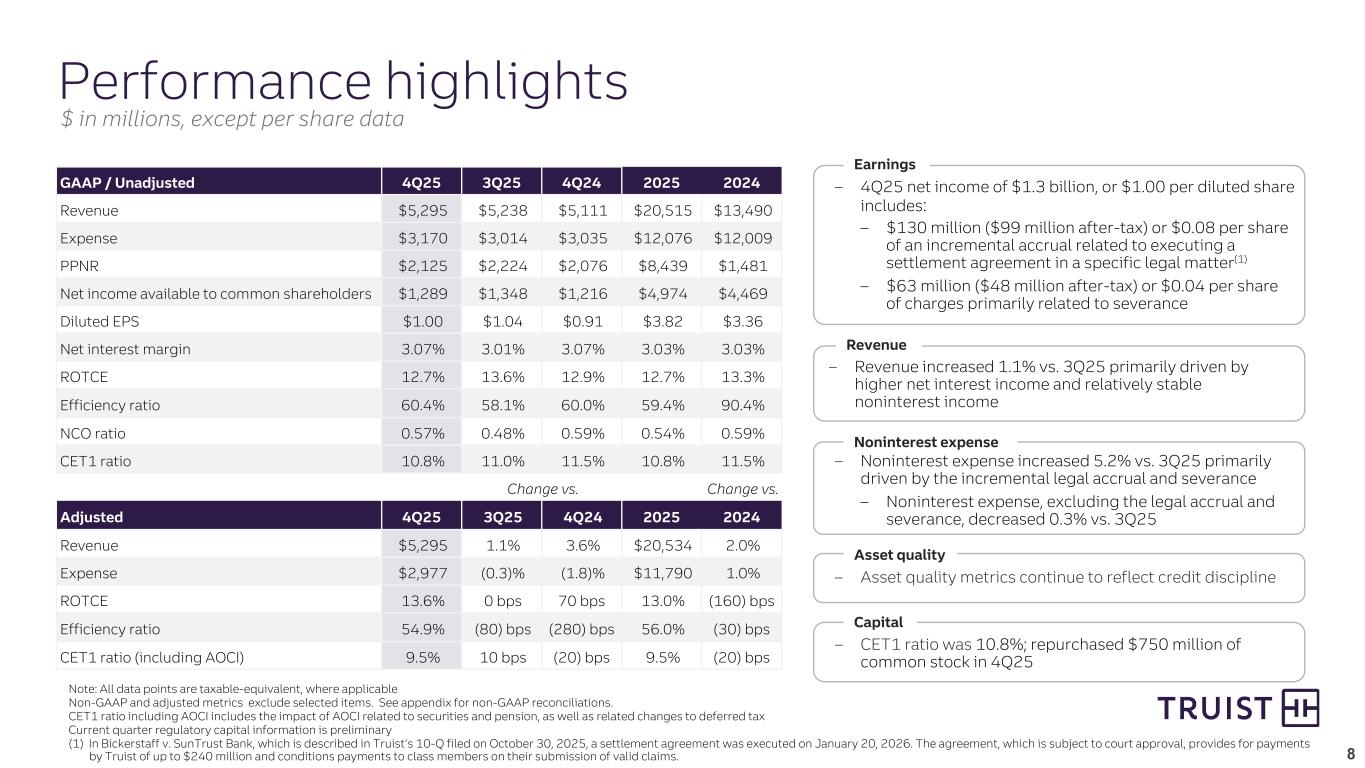
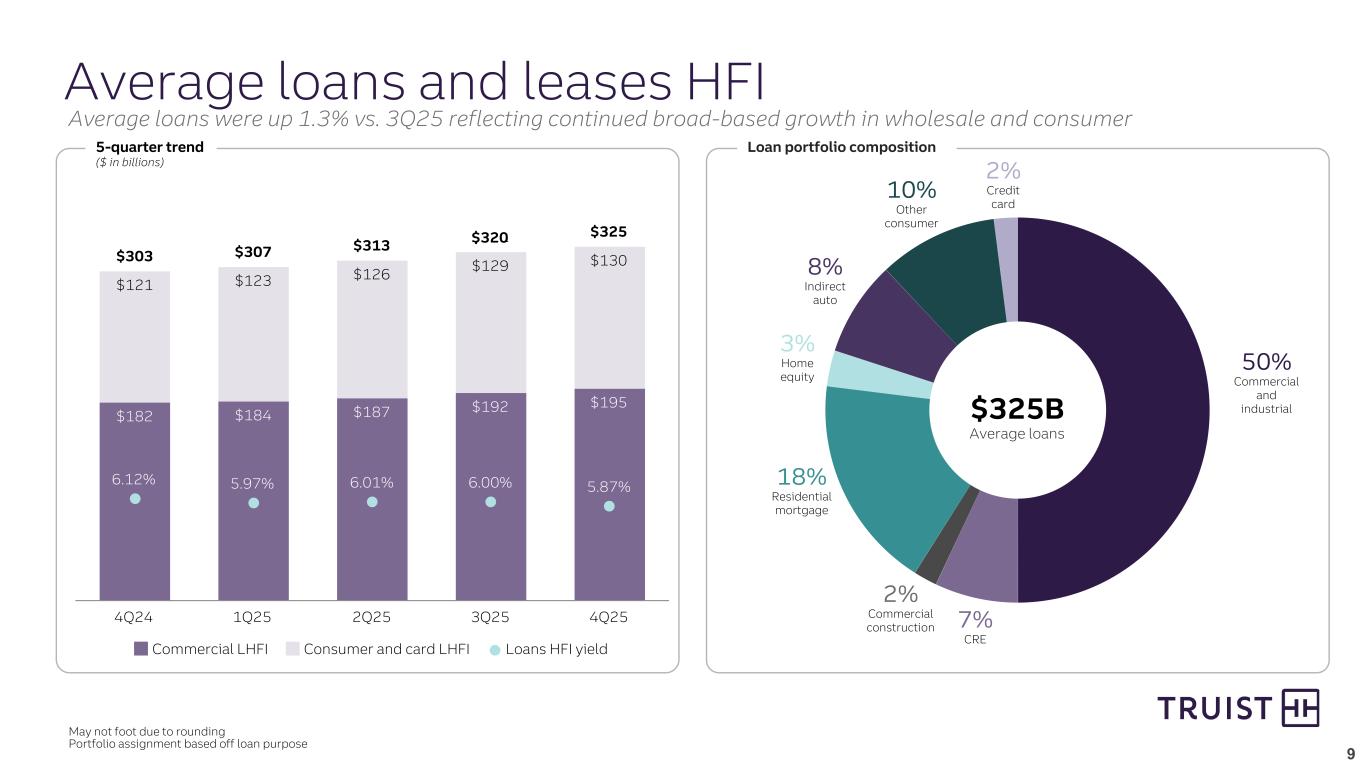
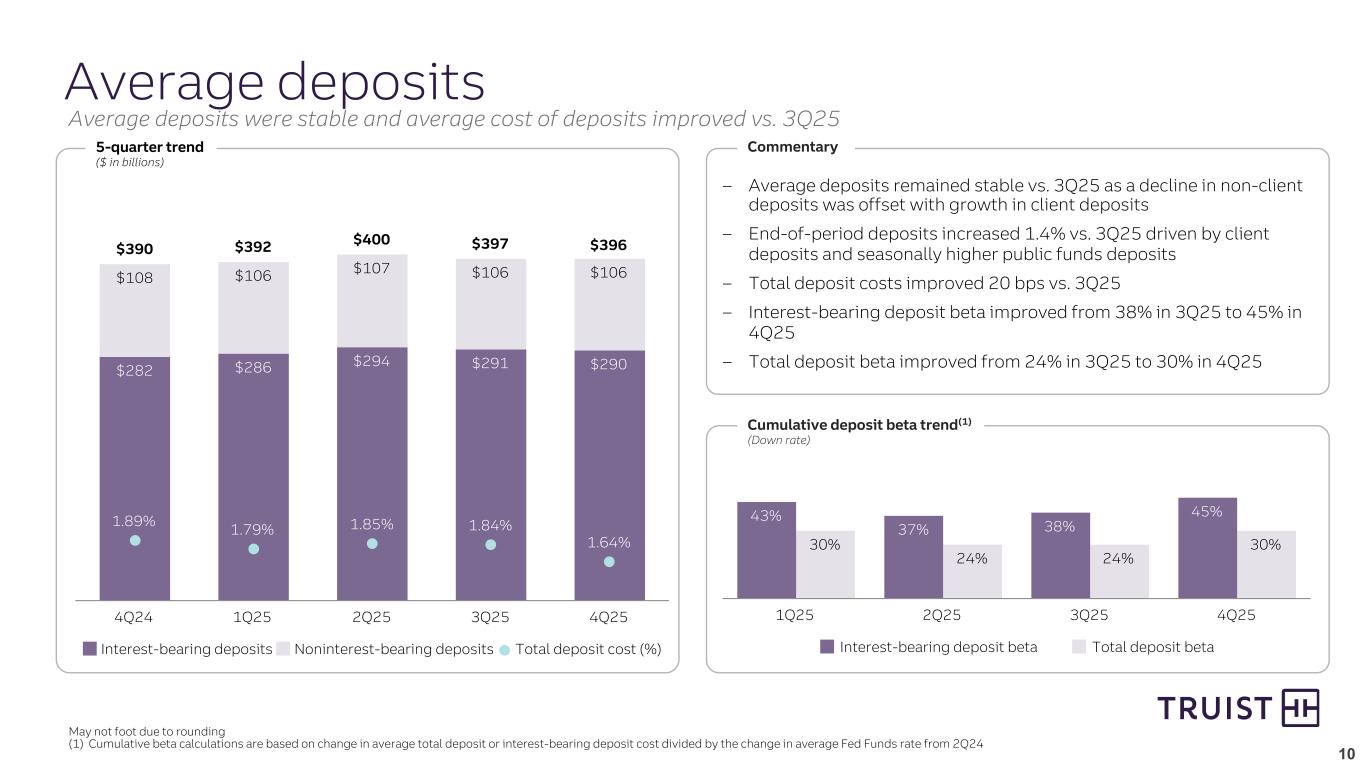
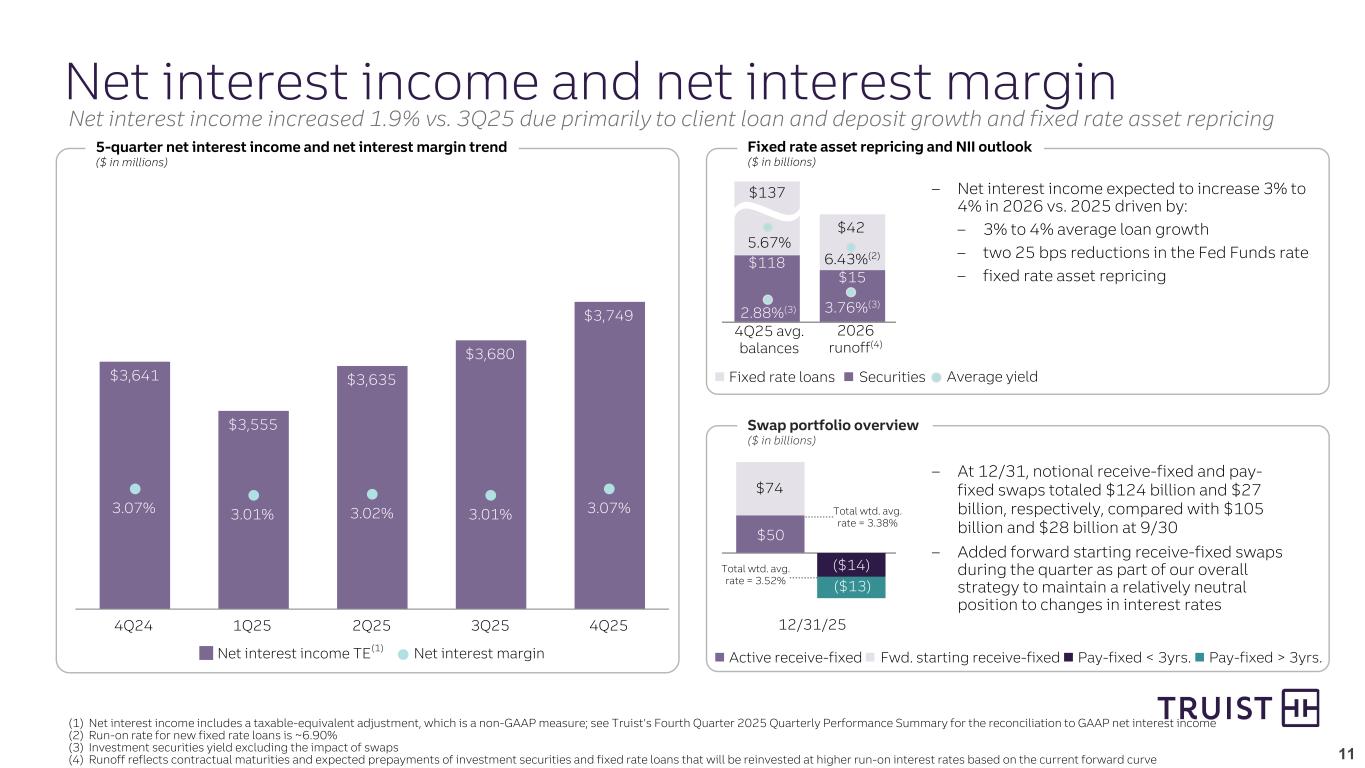
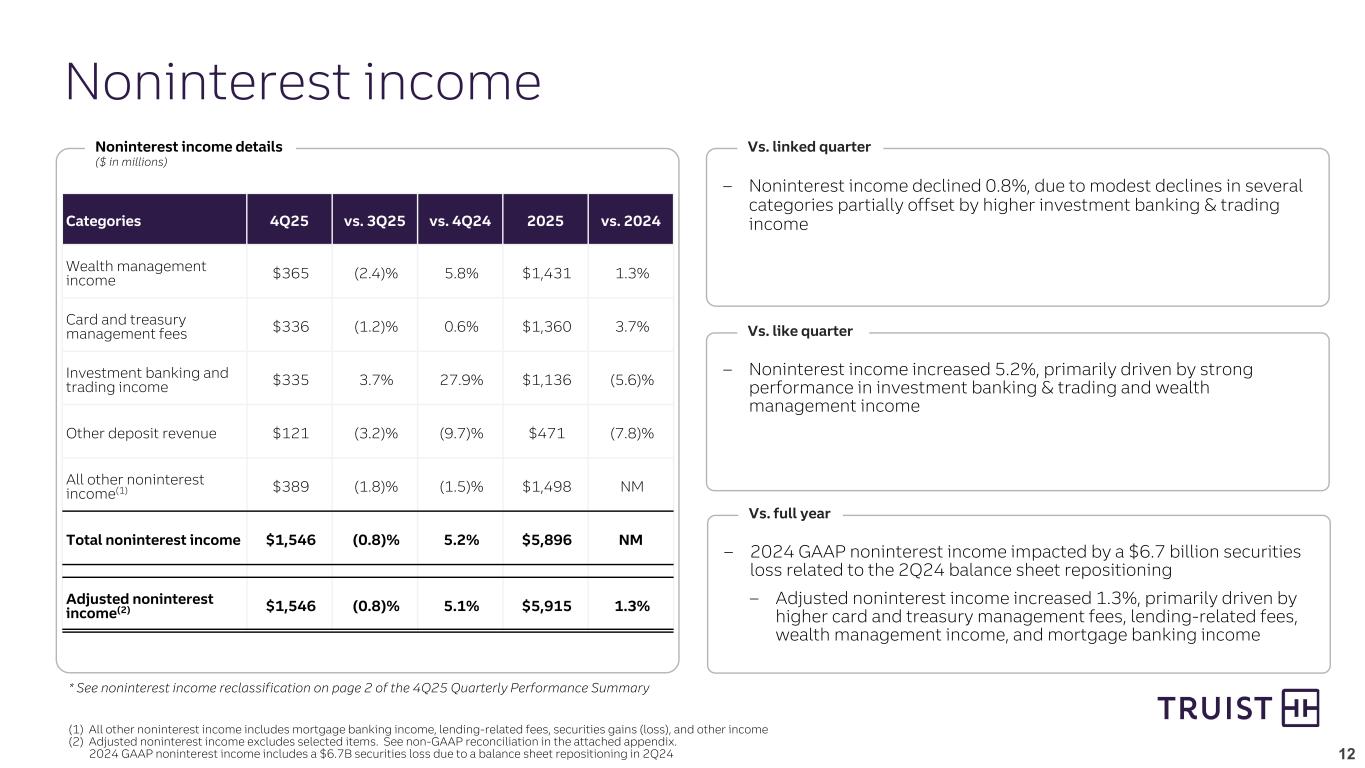
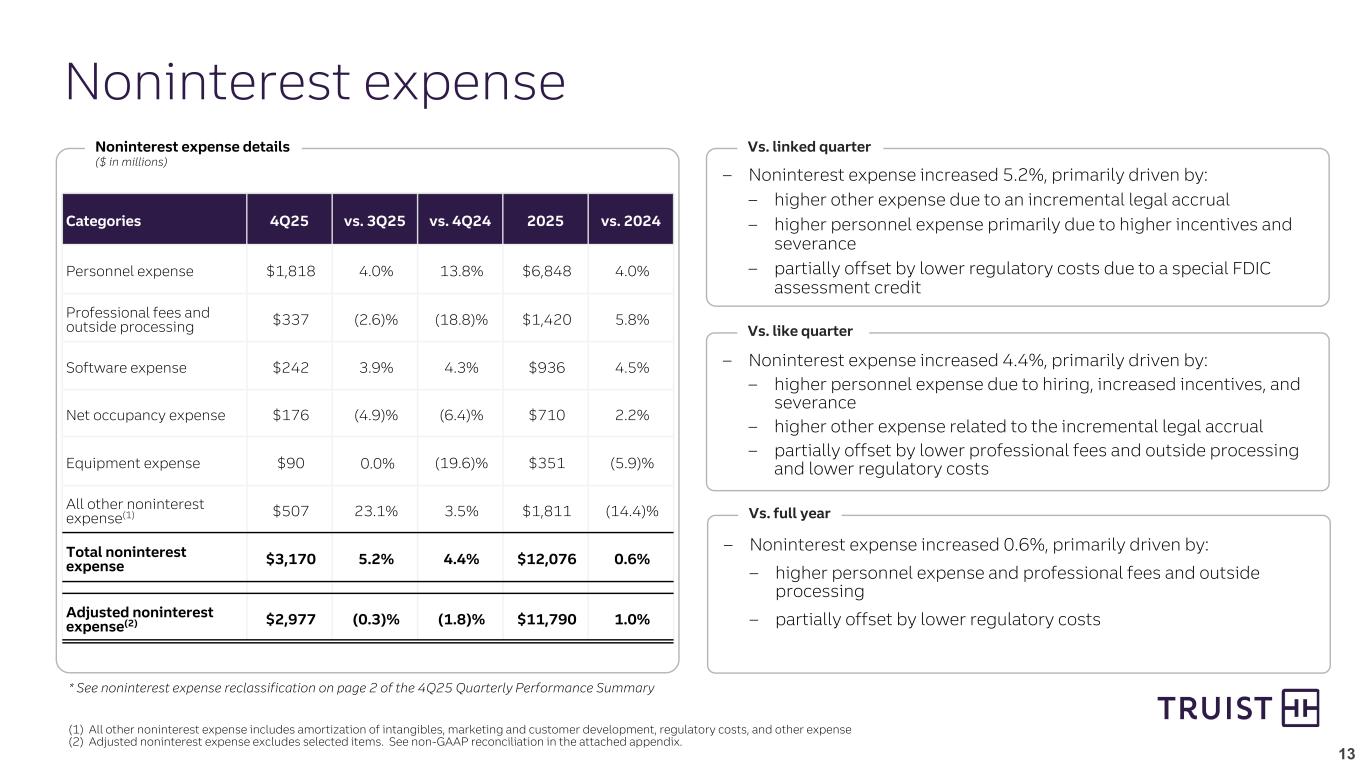
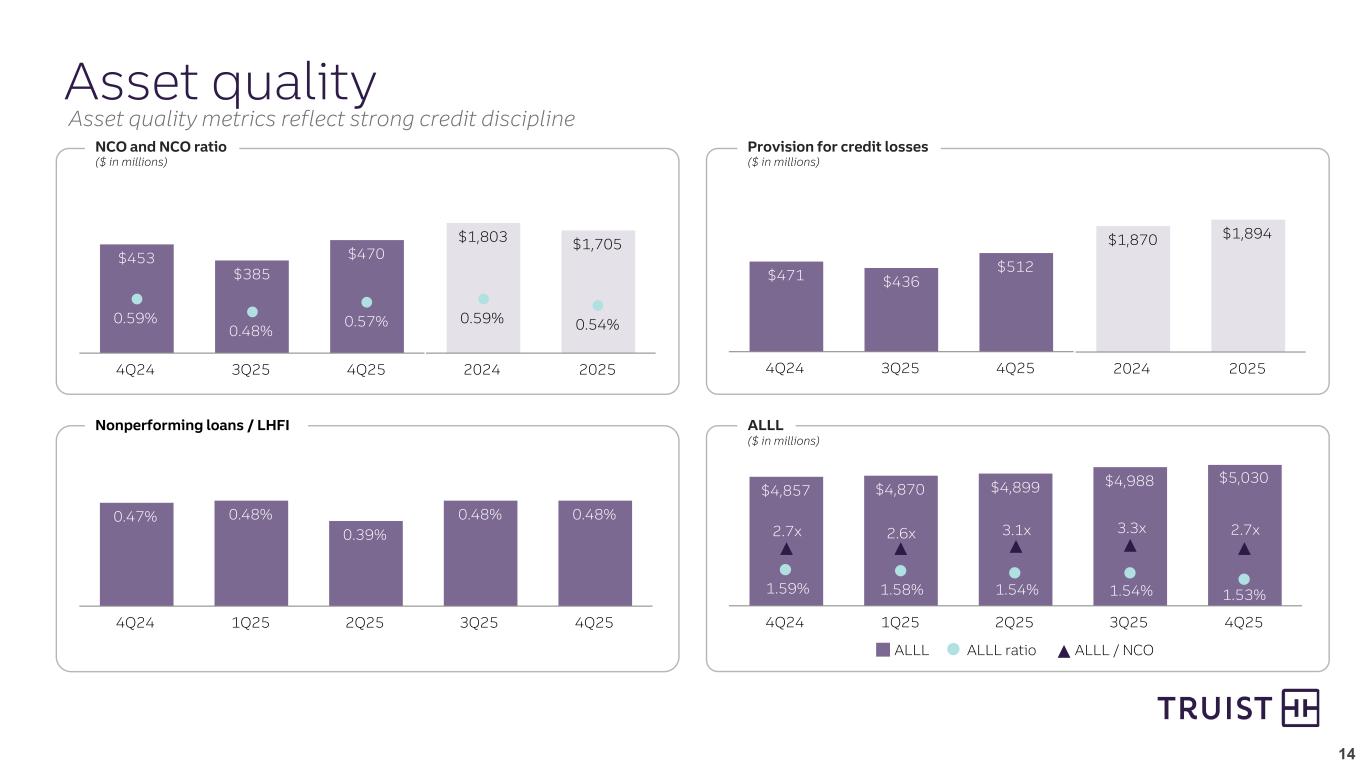
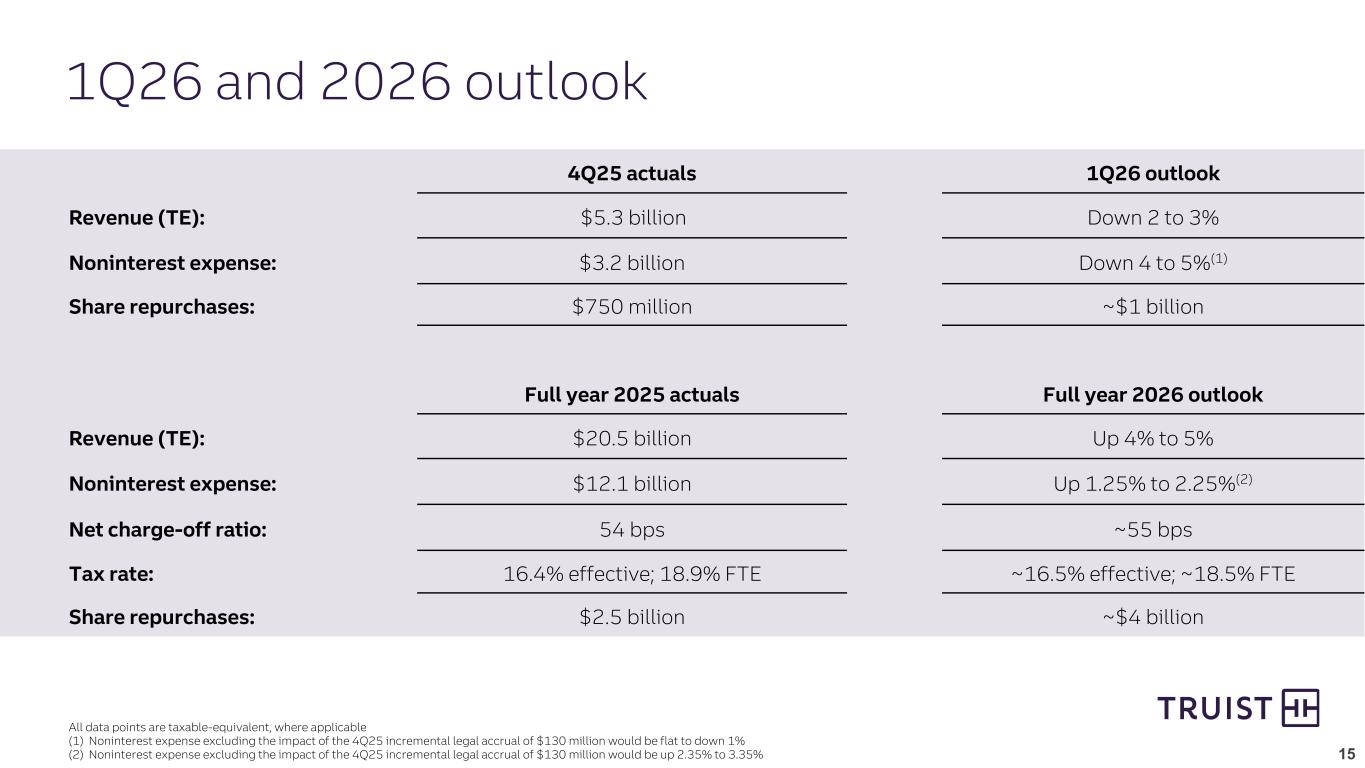
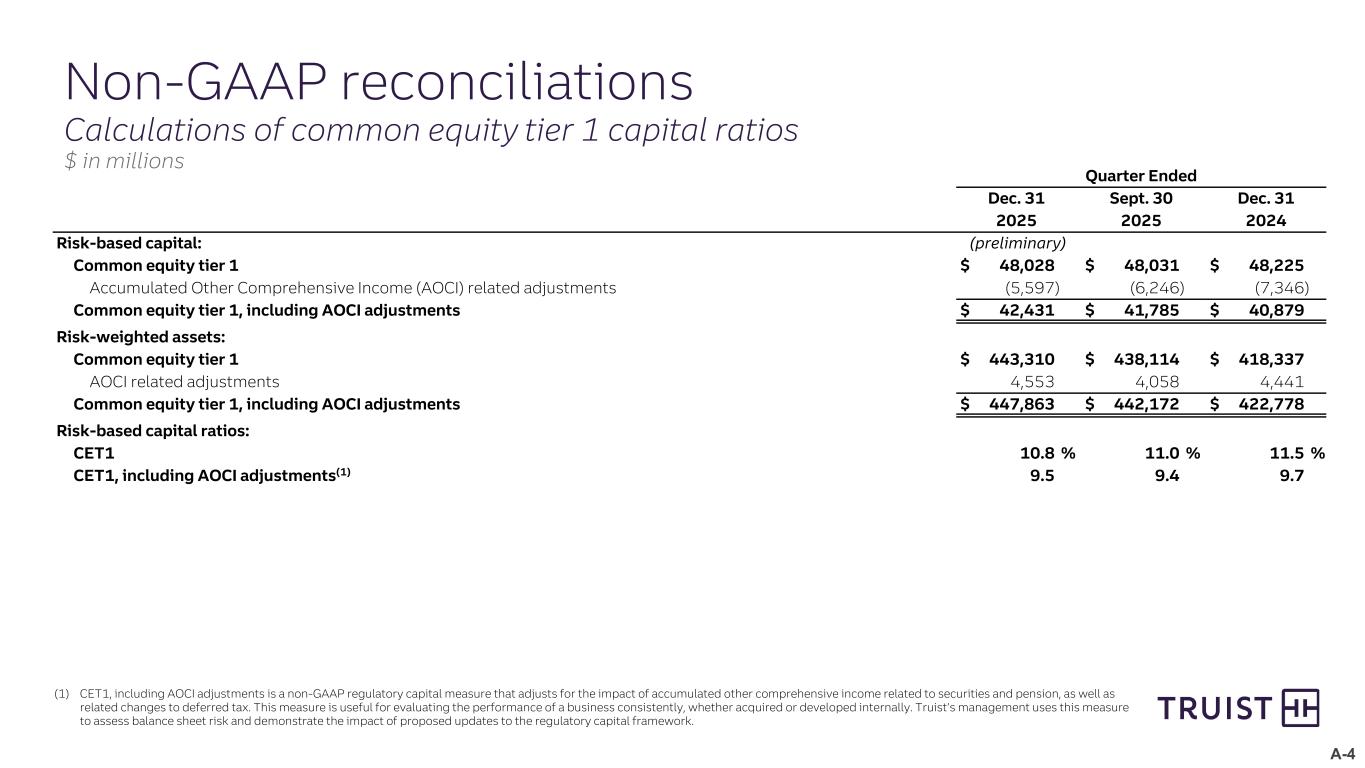
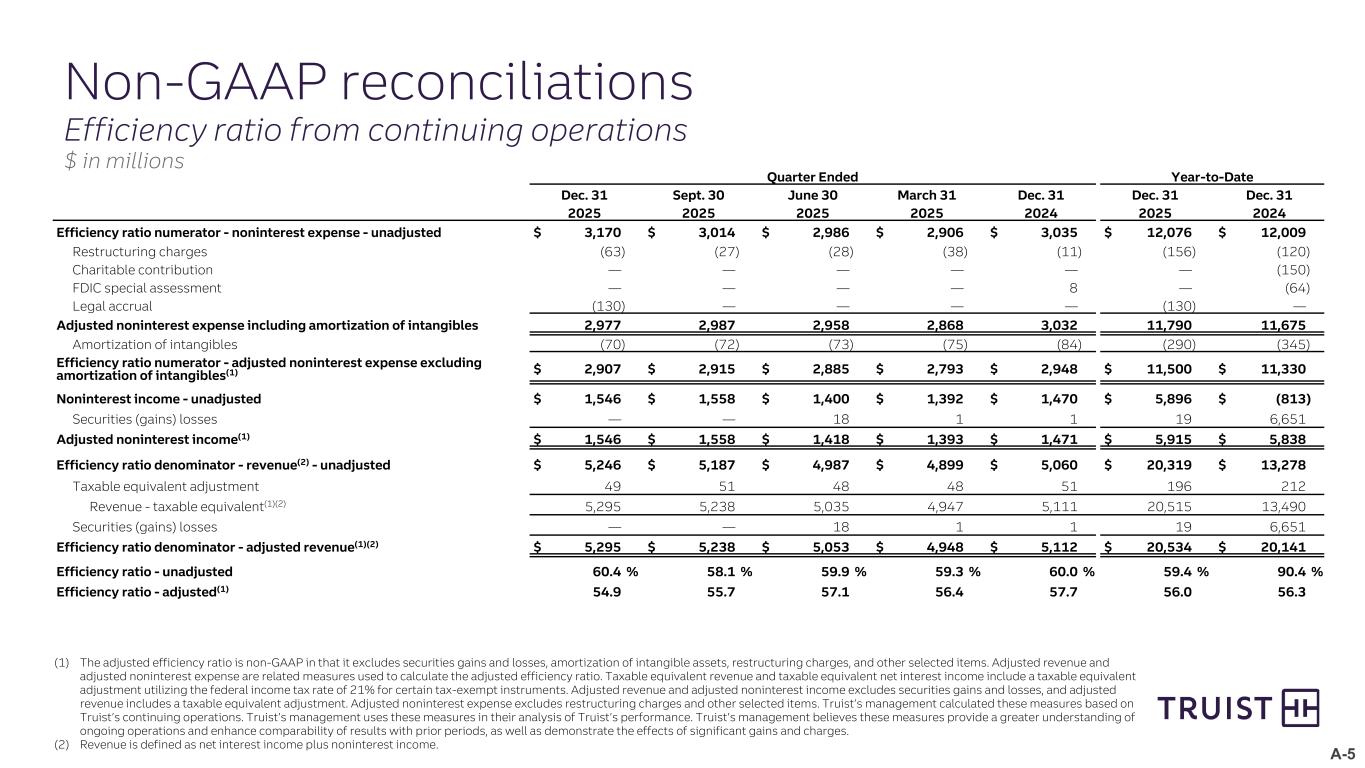
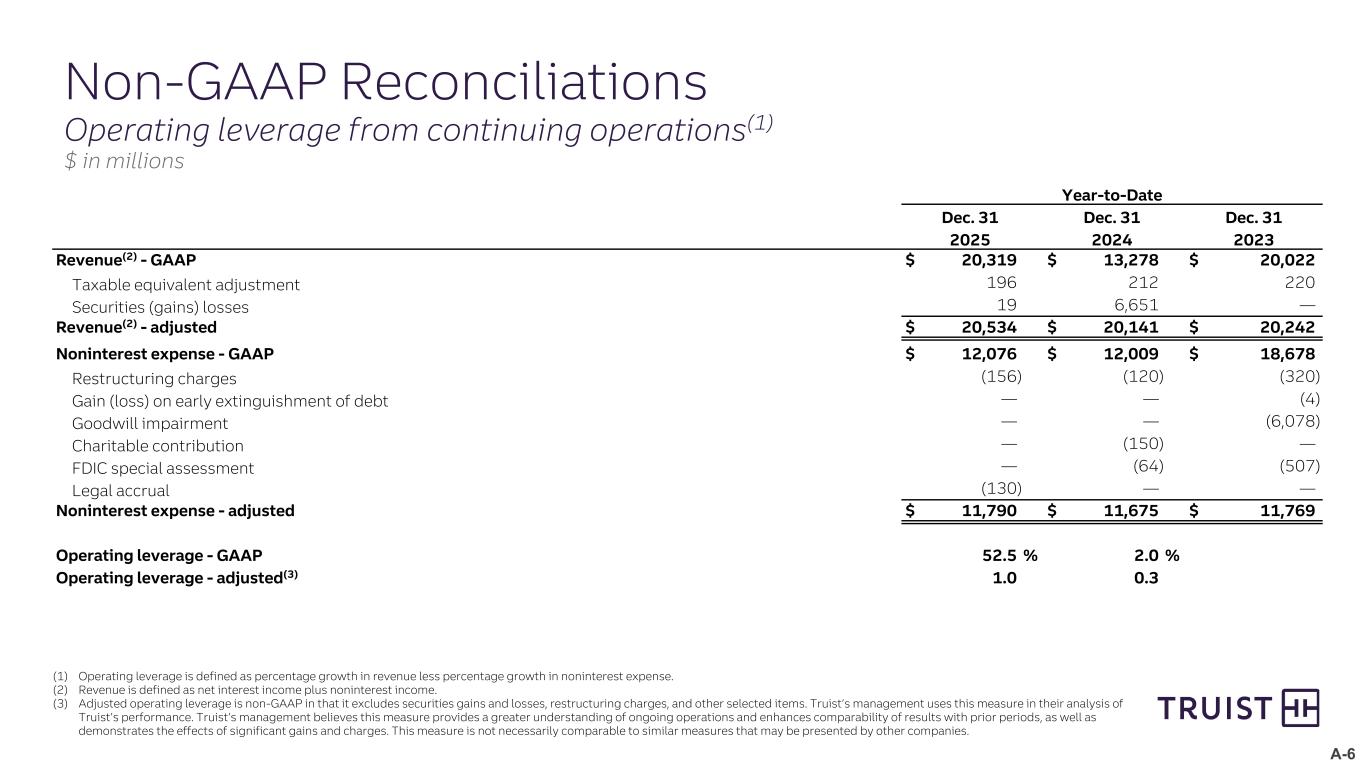
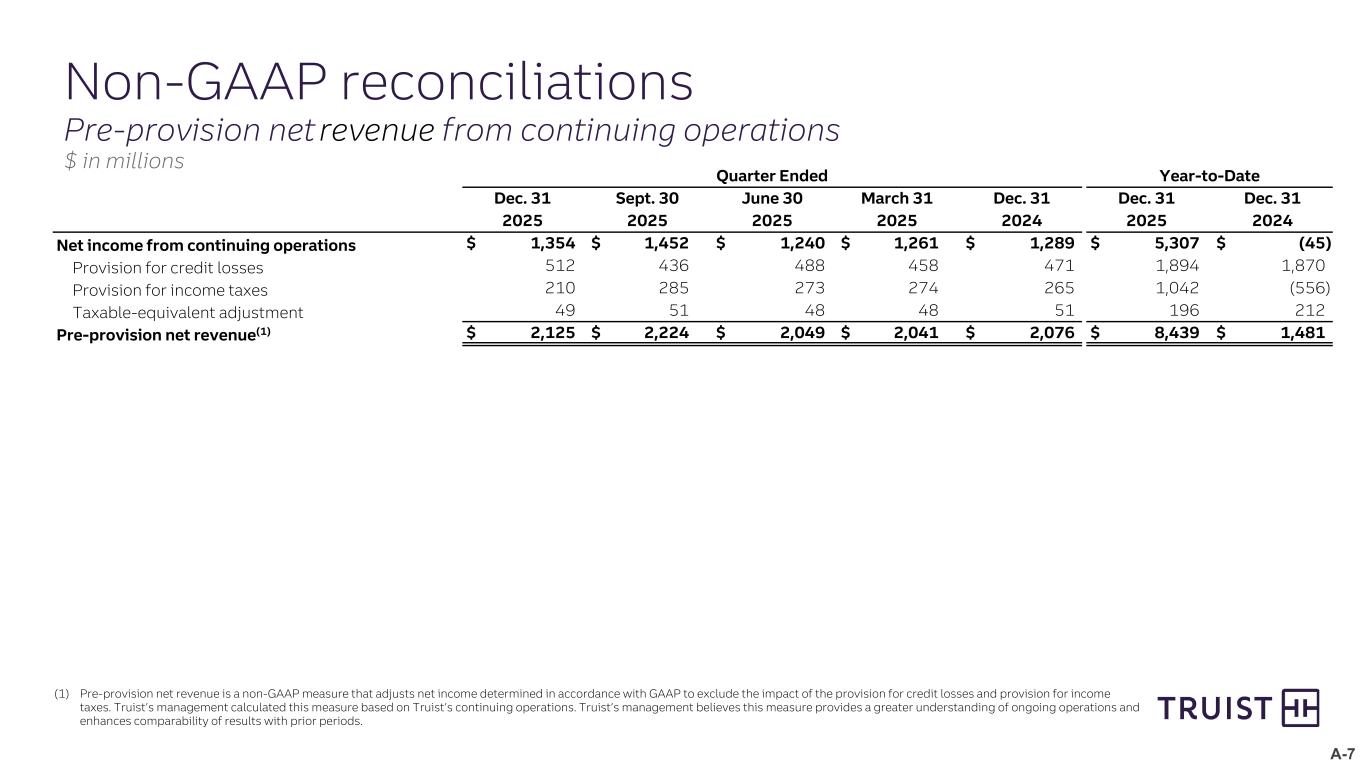
Good morning, everyone. So before I start with our performance highlights on slide 8, I do want to briefly mention certain changes to the presentation of our earnings materials today and on a go-forward basis. On January 12th, we filed an 8K detailing changes to the presentation of certain non-interest income and non-interest expense items. Effective December 31st, 2025, we changed the reporting line labeled Card and Payment fees to a new reporting line called card and treasury management fees. This line includes debit card, retail card, and commercial card fees, merchant discount fees, and treasury management fees. Previously, treasury management fees were included in the service charges on deposits line, which we renamed other deposit revenue. Other deposit revenue includes NSF and overdraft fees and other service charges. We believe these changes more accurately reflect how we're managing our business and will give of investors more insights into how we're progressing with important fee income generating initiatives. In terms of expenses, we will no longer disclose adjusted expense in our earnings materials. Instead, we will provide context on material items impacting results. For today's discussion, I'll provide you with adjusted expense for comparison purposes, but going forward, our expense commentary and guidance will be based on gap expense. As a result of this change, we moved restructuring charges which typically included expenses related to severance and facility charges back to their respective reporting lines such as personnel and occupancy expense okay with that said i'll now turn to the full year 2025 and fourth quarter results which starts on slide eight we reported 2025 gap net income available to common shareholders of five billion dollars or three dollars and 82 cents per diluted share in fourth quarter 2025 net income available to common shareholders of $1.3 billion or $1 per diluted share. Our fourth quarter 2025 results included a charge of $130 million or $0.08 per share after tax due to an incremental accrual related to Truist executing a settlement agreement on January 20, 2026 in the matter of Bickerstaff versus SunTrust Bank. In addition, our fourth quarter results included $0.04 per share of charges primarily related to severance. Revenue increased 1.1% linked quarter due to 1.9% growth in net interest income, partially offset by a modest decrease in non-interest income. GAAP non-interest expense increased 5.2% linked quarter, primarily due to the legal accrual and higher personnel expense. Excluding the legal accrual and severance, non-interest expense declined approximately 0.3% on a linked quarter basis. Net charge-offs increased 9 basis points on a linked quarter basis, reflecting normal seasonality in our consumer portfolio. Non-performing loans remained relatively stable on a linked quarter basis. Our CET1 capital ratio declined 20 basis points to 10.8%, and our CET1 ratio, including AOCI, increased 10 basis points linked quarter to 9.5%. During the quarter, we repurchased $750 million of common stock and announced a new share repurchase authorization of up to $10 billion with no expiration date. Next, I'll cover loans and leases on slide nine. Average loans held for investment increased $4.3 billion or 1.3% on a linked quarter basis to $325 billion due to growth in both commercial and consumer loans. For the full year, average loans held for investment increased 3.6% to $316 billion due to 5.4% growth in average consumer and card loans, and 2.4% growth in average commercial loans. Based on our current pipeline and economic outlook, we expect three to 4% average loan growth in 2026. However, average loan growth in 2026 will primarily be driven by growth in commercial loans and other consumer loans will relatively slower growth in residential mortgage and indirect auto compared with 2025. Other consumer loans, which include our specialty lending businesses, Sheffield, Service Finance and Lightstream are expected to grow at a similar pace as these businesses continue to offer attractive risk-adjusted returns. Moving to deposit trends on slide 10. Deposit growth is a key priority for Truist, and we are seeing improved momentum with clients in both consumer and wholesale. Average deposits were relatively stable on a linked quarter basis, as a decline in higher-cost broker deposits was offset by growth in lower-cost client deposits. This improving mix, along with recent reductions in the federal funds rate, resulted in a 27 basis point decline in average interest-bearing deposit costs to 2.23% and a 20 basis point reduction in our total cost of deposits to 1.64%. As shown in the chart on the bottom right hand of the slide, our cumulative interest-bearing deposit beta improved from 38% to 45%, and our total deposit beta improved from 24% to 30% on a linked quarter basis. These improvements reflect stronger client deposit growth and disciplined efforts to reduce rate paid. Moving now to net interest income and net interest margin on slide 11. Taxable equivalent net interest income increased 1.9% linked quarter or $69 million, primarily due to loan and client deposit growth and fixed rate asset repricing. Our net interest margin increased six basis points linked quarter to 3.07%. For full year 2026, we expect net interest income to increase by 3% to 4%. This outlook is based on 3% to 4% average loan growth, which implies low single-digit end-of-period loan growth. We also expect low single-digit end-of-period deposit growth. Average earning assets will grow at a slower rate in 2026 than average loans, as average investment securities and other earning assets are expected to decline by 4% to 5% on an annual basis. Lastly, we expect two 25 basis point reductions in the Fed funds rate, one in April and one in July, and we will continue to benefit from fixed rate asset repricing. Although we expect modest net interest margin compression in the first quarter, we anticipate full year 2026 average net interest margin will exceed the 25 average of 303 due to the benefits of fixed rate asset repricing and improved earning asset mix and lower deposit costs. As you can see on the right-hand side of the slide, we've also updated our fixed-rate asset repricing outlook and our swap disclosure. Turning now to non-interest income on slide 12. Non-interest income decreased $12 million, or 0.8%, versus the third quarter of 2025, reflecting modest declines across several fee income categories, partially offset by higher investment banking and trading income. Investment banking and trading increased $12 million and 3.7% in linked quarter and $335 million, reflecting stronger M&A-related fees partially offset by lower trading activity. Our new reporting line for card and treasury management fees was down slightly linked quarter due to seasonality, but grew 3.7% year-over-year as double-digit growth in treasury management fees was partially offset by lower merchant and corporate credit card fees. Next, I'll cover non-interest expense on slide 13. On a linked quarter basis, non-interest expense increased 5.2%, driven by higher other expense related to the legal accrual previously mentioned, higher personnel expenses due to increased incentives and severance. These increases were partially offset by lower regulatory costs due to an FDIC special assessment Excluding the impact of the legal accrual and severance costs, non-interest expense declined by 0.3% linked quarter. Adjusted non-interest expense increased 1% in 2025, reflecting our commitment to expense discipline and to driving positive operating leverage during the year. Moving to asset quality on slide 14, our asset quality metrics remain strong on both a linked and like quarter basis, reflecting our strong credit risk culture and proactive approach to quickly resolving problem loans. Non-performing loans held for investment remain stable at 48 basis points of total loans, while the ALLL declined one basis point to 1.53% of total loans. Net charge-offs increased nine basis points linked quarter to 57 basis points and were down two basis points versus the fourth quarter of 2024. The linked quarter increase in net charge-offs reflects higher C&I and seasonally higher consumer losses partially offset by lower CRE losses. For the full year 2025, net charge-offs declined five basis points to 54 basis points and now I'll turn to guidance on for 2026 on slide for full year 2026 we expect revenue to increase 4% to 5% relative to 2025 revenue of twenty point five billion dollars driven by three to four percent growth and net interest income and mid to high single-digit growth in non interest income we expect full year 2026 GAAP non-interest expense to increase by 1.25% to 2.25% in 26 versus GAAP-25 non-interest expense of $12.1 billion. Our 26 GAAP revenue and expense outlook implies positive operating leverage of 275 basis points in 2026. As I mentioned earlier, our non-interest expense guide will be based on GAAP non-interest expense, as we will no longer provide guidance on adjusted non-interest expense going forward. For comparison purposes, 2026 non-interest expense growth would be approximately 2.35% to 3.35%, and operating leverage would be approximately 165 basis points if you were to exclude the impact of the fourth quarter 2025 legal accrual that I discussed earlier in the call. In terms of asset quality, we expect net charge-offs of about 55 basis points in 2026, which is relatively stable compared with net charge-offs of 54 basis points in 2025. Finally, we expect our effective tax rate to approximate 16.5% or 18.5% on a taxable equivalent basis in 26 versus 16.4% and 18.9% in 2025.
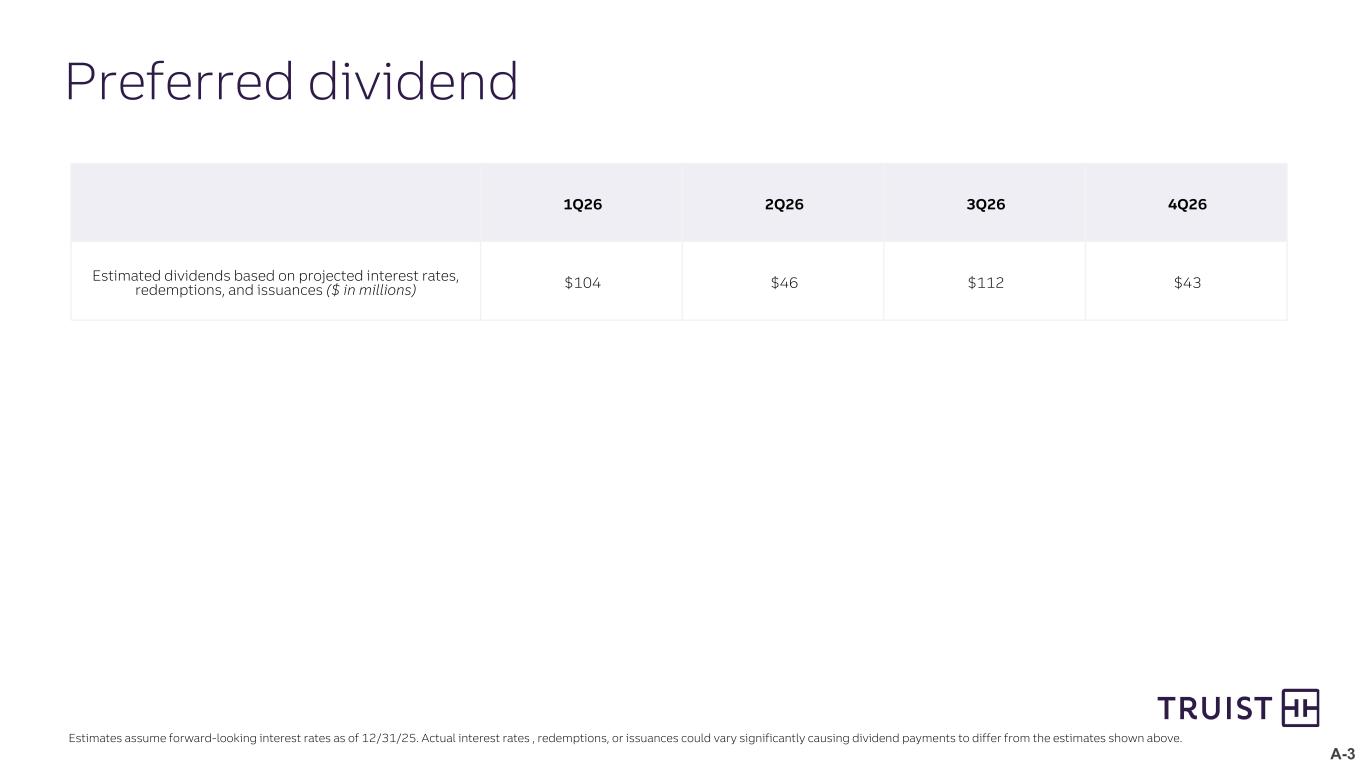
As it relates to buybacks, we're targeting approximately $4 billion of share purchases
during the year. Looking into the first quarter of 26, we expect revenue to decrease approximately 2-3% relative to fourth quarter revenue of $5.3 billion. We expect non-interest income to decrease approximately 2-3% in the first quarter, primarily driven by two fewer days in the first quarter relative to the fourth quarter, and a seasonal decline in public funds deposits. We expect non-interest income to decline 2-3% linked quarter due to lower other income. GAAP non-interest expense of $3.2 billion in the fourth quarter are expected to decrease by 4% to 5% linked quarter due to lower other expense and personnel costs partially offset by higher regulatory costs. If you were to exclude the impact of the fourth quarter 2025 legal accrual, non-interest expense would be flat to down 1% linked quarter. Finally, we're targeting a billion dollars of share repurchases in the first quarter of 2026. So with that, I'll hand it back to Bill for some final remarks.
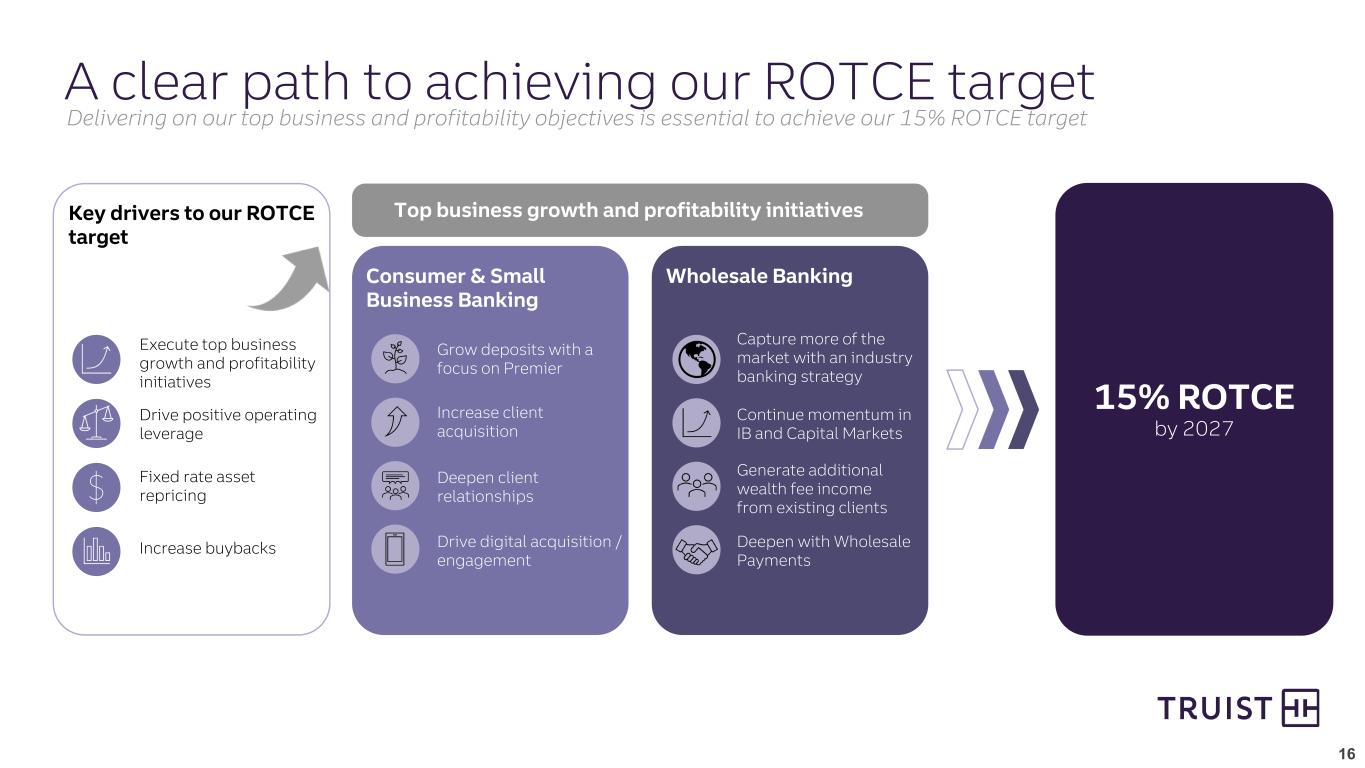
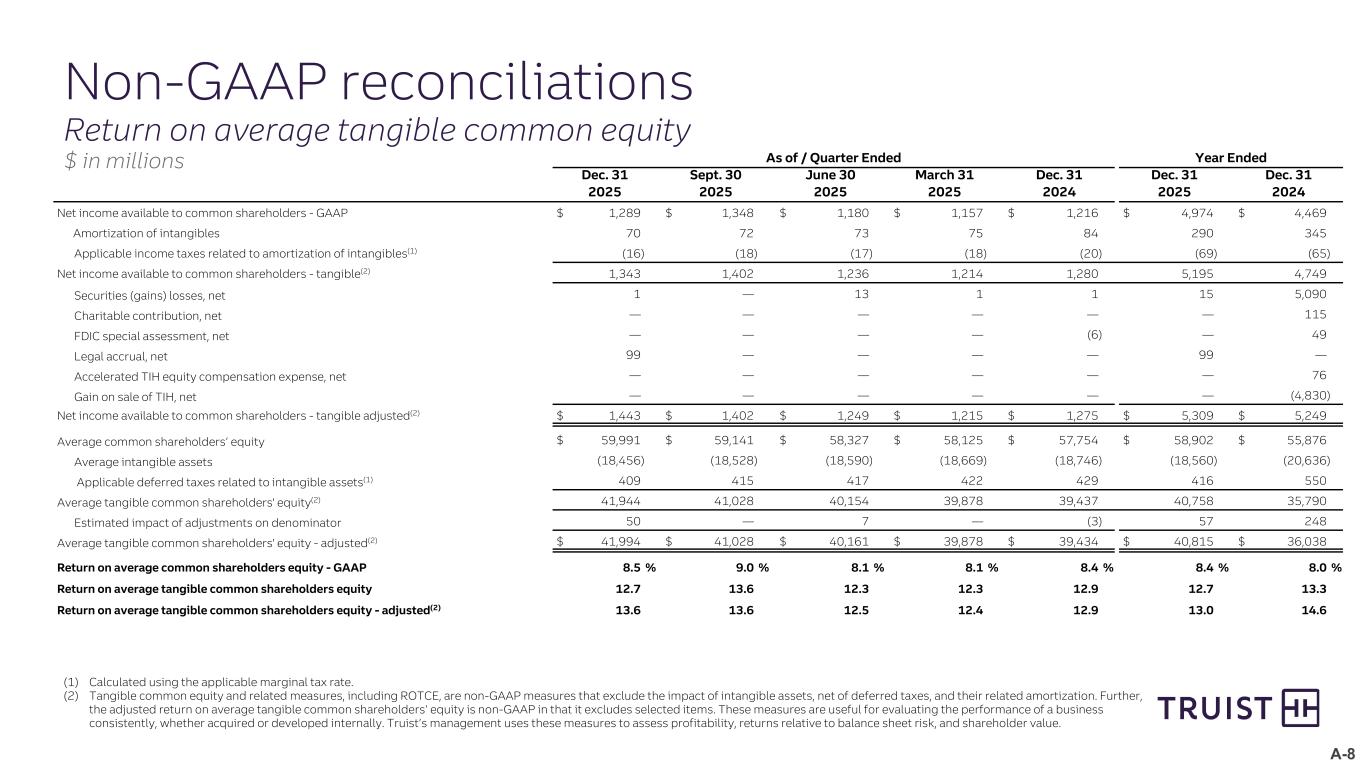
As we close, I want to emphasize the confidence I have in Truist direction. We're seeing tangible results across key businesses with strong momentum and client engagement and revenue growth. As shown on slide 16, our goal of achieving a 15% ROTCE in 2027 is locked in and reflects our confidence in truest long-term earnings power and strategic direction. We see and have invested in multiple paths to stronger revenue and profitability, and with disciplined execution, we expect meaningful improvement over the next two years. Much of this progress will come from deepening client relationships in consumer and wholesale, especially in wealth, payments, premier banking, investment banking and trading, small business, and corporate and commercial banking where momentum is already strong. This is highly accretive to our ROTCE commitment. Our expectation is that our revenue growth will double in 2026, and when combined with our expense discipline, should lead to even greater operating leverage and profitability improvement this year. Like 2025, we enter 2026 in a strong capital position, enabling us to support client growth and accelerate capital return through increased share repurchases. As Mike mentioned, we're targeting $4 billion of share repurchase this year, which represents a 60% increase versus last year. In summary, I am confident in our future. I'm encouraged by the results and momentum we're seeing across our company and remain focused on executing with discipline, delivering for our clients, and creating value for our shareholders. Thank you to our teammates for their incredible focus, productivity, and purpose-driven commitment to moving TRUIS forward. As always, we appreciate your continued interest and support, and we look forward to updating you on our progress in the quarters ahead. With that, Brad, let me turn it back over to you.
Thank you, Bill. Betsy, at this time, will you please explain how our listeners can participate in the Q&A session? As you do that, I'd like to ask the participants to please limit yourself to one primary question and one follow-up in order to accommodate as many of you as possible today we will
Operator
now begin the question and answer session to ask a question you may press star then one on your touchstone phone if you are using a speakerphone please pick up your handset before pressing the keys if at any time your question has been addressed and you would like to withdraw your question please press star We ask that you limit yourself to one question and one follow-up. At this time, we will pause momentarily to assemble our roster. The first question today comes from Ryan Nash with Goldman Sachs. Please go ahead.
Good morning, Bill. Good morning, Mike.
Good morning. Bill, can you maybe talk a little bit more about loan growth, where you ended the year at up eight year over year and you're guiding to three to four? You know, and it seems like, you know, if you think about the exit run rate, you're already running at about 3% average growth. So that implies, you know, as you said, low single-digit growth. So maybe just unpack the loan growth a little bit further between commercial and consumer, you know, and how are you thinking about growth across each of those areas?
Yeah, thanks, Ryan. Great to hear from you. My question. Yeah, as you noted, we're entering with some good momentum. And if you think about the mix, let's sort of talk about how I think this year will pan out. C&I is at its sort of strongest quarter. I mean, production was up really, really significantly. And just high-quality business. I mean, high-quality, you know, advice-driven business, you know, tied with treasury management, 62% plus had some side of the treasury management products, so really, really good momentum on the CNI side. I think overall, we're going to really sort of focus on, you know, places where we have great client demand, clients still healthy, but we're going to rebalance a bit, focus on higher client value and optimizing our return in our mix. And so I think the result of that is going to be a little more wholesale. The consumer businesses like Sheffield and Lightstream and Service Finance continue to see, you know, great opportunities there, probably in areas like Indirect Auto and some of those, probably a little less in terms of exposure, margins being a little bit tighter, you know, a little bit lower client value. So I think think about it in two ways. One, continuing the momentum and things that have high client value, long-term return characteristics, and optimizing that return and mix over time. All of that, though, contributing to 3% to 4%, what I would consider sort of like really, really high quality, you know, consistent growth. And, again, building on momentum that we already have.
Got it. And if I can ask a follow-up, Mike, on the net interest margin, I think you noted it would exceed last year's 3.03%. You know, given that you're currently at 307, can you maybe unpack what is included within the margin for deposit pricing? And do you expect the NIMH to expand from current levels, and what is the cadence behind that?
Yeah, sure. Good morning, Ryan. Yeah, so it was nice to see, you know, the uptick, obviously, in the fourth quarter, which was largely driven by some of the seasonal deposit mix and some of the benefit of the cuts. You know, that will go the other way on seasonality in the first quarter. So, while we sort of enter the year at 3.07, we would expect to back up just a touch. But throughout the course of the rest of the year, we would expect to see, you know, margin expansion, especially in the second half where we see the benefit of the cuts. You know, you asked around deposit pricing. You know, our expectation coming into the year is we'll grind a touch higher on the betas in the first quarter, but we would expect to be in the kind of low 50s neighborhood by year end. So, you know, you've got the lower cost of deposits. is you've also got the fixed asset, the fixed rate asset repricing engine happening in the background as well. And I think those are factors that are gonna really help us make really, I think, significant progress on the margin relative. I know previously we've talked about sort of a three-teens level in 27. We're gonna make significant progress towards that level in 26, and frankly, see ourselves exiting 26 in kind of that three-teens area, which is I think a really nice setup for 2027.
Thank you. Appreciate all the color.
Operator
The next question comes from John Pencary with Everforce. Please go ahead.
Morning. On your 2027 ROPSI target of 15%, I appreciate you reintegrated your confidence and the attainability there. Could you possibly help kind of unpack the components that give you that confidence? And you mentioned the three teams, NIM, and you might be able to get that by the end of 26. Just curious on maybe your efficiency expectations underneath that balance sheet growth, how we could think about the pace there as you approach that, you know, in 2027. And then also, I think, common equity tier one, you've alluded to the 10%, but how do you think about capital underneath that 15% roster?
Yeah, sure, John. So think about it maybe in its simplest term is the concept of holding the denominator of capital and dollars steady and then improving momentum and return from the numerator. So think about that as sort of the basic, you know, mantra that we're operating from. I'll also say, you know, that this is going to be, you know, we see this as more of a straight line. So in addition to 15, you know, we're locked in on 14 for this year, you know, so we don't, this isn't going to be an all at the end, you know, parabolic curve, you know, this is going to be a straight line, continued improvement. So again, think about that denominator in dollars holding steady. And then the part on the numerator that really is, you know, accretive and not necessarily in order, but I'll go down a few of these, payments is really significant. You know, so think about the growth in payments, we're seeing a 13% kind of growth. We expect that growth to continue in the double-digit kind of basis. So that's really creative to not only deposits, but also to NIM and sort of the overall ORA. Our middle market expansion, you know, we 2x the number of clients we're seeing in that business. So we see that as really, really positive to that growth. Premier and our wealth production, net asset flows and wealth, really positive. Premier, I talked about the deposit production and loan production, you know, sort of those 20-plus percent kind of activity. And then think about all the things that are deepening client relationships in all of those categories. Those are the things that are really most accretive because if you think about it, we've already committed talent, we've already committed capital to those businesses, and what we're doing is increasing the return against that. Mike mentioned fixed asset repricing is a component of it. There's all sorts of RWA maximization efforts, you know, to ensure that we're running our RWA engine really, really effectively. We talked about the improving operating leverage, so that's also a component of that, that is we'll run this revenue increase off a more efficient platform. And then your point on CET1, we're building this model on a 10% CET1. I think that's probably sort of the right zip code. And then looking, you know, this year to $4 billion in buybacks to accelerate all that. So, again, my high degree of confidence is everything I mentioned in there has got momentum against it, initiatives against it. We're starting nothing flat-footed, everything on our toes, which is why I sort of say locked in for 15%.
Got it. All that's helpful, Bill. And then staying along the same lines, I mean, no good deed goes unpunished. So, you set out that 14. You gave us the 15 last quarter on 2027, getting, you know, a lot of interest now on where you could ultimately go longer term. Your peers are flagging the mid-upper teams in terms of ROTC over time. Can you possibly talk about that, help us frame his truest position to operate in that range, and is that a reasonable range, and how do you think about that timing?
Yeah, you know, John, you know, our business model, we sort of look at our business model, look at our level of capital, and, you know, past 2027, I just, you know, I don't want to sort of speculate as to what all those things might be. We might be in a different capital position. The business model resulting from the momentum that we're generating, quite frankly, the economic environment that we might or might not be operating at that particular time. And if you think about it, like, for now, the ascension to 15%, so think about we start at 13, going to 15% plus our dividend. I think that's a really attractive path to that level. And as we get to the 15 and as we evaluate all the things I just talked about, then we'll look and see where we are at that particular juncture. I think it's sort of premature to sort of lay something out there that, you know, isn't as, quote, quote, walked in as we think we are on the 15th. We want to have confidence when we say a number. We don't want to sort of, you know, throw caution to the wind. We want to really be focused just like we are today.
Operator
The next question comes from Scott Sievers with Piper Sandler. Please go ahead.
Good morning, everyone. Thank you for taking the question. And let's see, I think you've touched, or at least alluded to this briefly a couple times, but just on the capital markets, I think there's just plenty of optimism about the industry's potential this year. That's, of course, an area where you all have invested really, really heavily. Maybe you could just sort of expand on your thoughts about momentum and potential there for the coming year.
Yeah, Scott, I think, as you pointed out, I mean, this is a business we've been investing in, you know, for decades. and I think we're in a really good position. We have really good momentum coming out of the second half of the year and, quite frankly, on a lot of cylinders. You know, so debt capital markets, leverage finance, M&A, all of our FRM, you know, derivatives, FX, all of those things are hitting on really good cylinders and we come into it with a good pipeline. So we come into it with a good pipeline and not only the pipeline from the, you know, investment banking, but really the pipeline that's generated from our middle market and commercial client base. I mean, probably what I'm most excited about is this organic activity that we're building. We put talent on the field that really understands how to leverage all of our industry specialties, understands how to leverage our product and capabilities and position those and great advice for our clients, you know, with the appropriate teamwork that goes on and the technology that we built to support all that. So, you know, part of the, you know, the double revenue, you know, story for us is we think we continue with a, you know, low double figure kind of compound growth in this business. I mean, I have every reason to be confident. It's organically built. We've hired some really good talent. You'll continue to see that, some really good talent. We've developed talent over a long time. We've got some, you know, senior leaders who've been in our business for quite a while. So this is a business I feel really confident in. I think we have a full, you know, capability and long-term, you know, continued high growth potential.
Terrific. Thank you. Thank you, Bill. And then, Mike, so, you know, on capital management, really robust repurchase plans and capacity. the, I guess, I think about sort of calls on capital or uses of capital, you know, the loan growth outlook schemes very prudent. You've got some things accelerating while you sort of dial back others. So I would guess that the overall repurchase plan is a very sturdy one. But just as you think about the coming year, any factors that would cause you to toggle down or up that pace of repurchase to get to the sort of net $4 billion?
Yeah, no. Good morning, Scott. You know, the way we're thinking about this is we believe that, you know, that 10% operating target or level is appropriate. You know, we've sort of laid out a trajectory that gets us there by the end of 27. And so, you know, there are going to be moving parts as we go. You know, if loans or the balance sheet grows a little faster, one quarter versus another, or we make a little more or a little less money, one quarter versus another. And of course, just the overall, I guess, economic backdrop, you wouldn't want to dismiss. But in a stable operating environment, we're going to trend to that 10% over the next eight quarters. So if you look at the math, that gets you to about a billion a quarter this year, frankly, perhaps maybe a touch higher. And so that's really how we're thinking about is just kind of retrending to 10 during that
Gotcha. Okay. Thank you guys very much.
Operator
The next question comes from Ibrahim Poonawalla with Bank of America. Please go ahead.
Two questions. One, I think just on deposits, talk about like do you expect both as you move towards this wholesale mix on the lending side, what does that mean for deposits and deposit growth as we look forward, both in terms of the mix, so when we think about DDA and non-interest And just the pace of overall deposit growth, do you think that kind of shifts for growth and how strong could it be?
Yeah, you know, you're not taught about this. You know, if you think about where we were, you know, a year ago with loans, you know, can we build the momentum and sort of the asset-generating part of our franchise, and you see us deliver on that, and then we pull that into this year, and we pull that into the momentum and we optimize that. But I think we're in the exact same place on deposits. I mean, we're sort of the same place. We're building that momentum. We're building that consistency. It's part of core to what we do. And then I look at the leading indicators on deposits and sort of think about, okay, what should give us confidence that we have deposit growth? First, I think this would be, you know, for the industry, it's a little bit of a natural tailwind with QE and lower rates. So I'm just going to put that on one side. But then, you know, idiosyncratic and specific to us, you know, think about the momentum. We saw wholesale deposits grow 400 basis points faster in the latter part of 2025 versus 24. I mentioned earlier, you know, 62% of our new clients came with deposits. And we've had two times the number of clients. So we have a lot more clients, a lot more clients with treasury management products, and some of those are still funding. So they're in the funding base. So, you know, deeper penetration in the middle market base. We still have some loan-only clients that were penetrating in that base. So in addition to the new, we look at the back book. End of period client deposits, you know, we're up, you know, almost $7.5 billion. The other leading indicator is that treasury management fees up 13 percent. And then you go to the consumer side and we look at sort of the, you know, leading indicators The first is net new. You know, so we're adding net new clients and the quality of those clients has increased year over the year. So the amount of deposits that they're bringing to us increases year over year. The focus on Premier, I talked about the deposit production being up significantly in Premier. The amount of off-us deposits from our Premier client base is actually quite significant, so their capacity to use great tools, you know, to approach those clients has been really significant. Technology, digital, you know, account opening of branches, branch expansion, more marketing related to deposit generation, deposit generation in, you know, expansion markets for us like Texas and Pennsylvania. So, you know, just my net summary is we have really good momentum in the deposit side. It might sort of outline the deposit and loan correlation for this year. So we feel good about deposit growth. We feel good about that opportunity headed into this year.
That's a good call, Bill. And I guess maybe this is a separate question around the wholesale strategy. On paper, half a trillion dollar balance sheet, you've been in investment banking for a long time. Cluist should be winning in terms of when we think about fee revenue growth, financing. Just give us a sense, one, does do some of the changes by the OCC around leveraged lending? Does that create a slightly better opportunity to compete in terms of risk-adjusted returns? And remind us where you think the sweet spot for Cluist is on the wholesale slash capital market side. Is it against the Wall Street banks? Is it against middle market investment banks? Would love some color there.
Yeah, let me try to unpack that question. So on the leverage lending specifically, remember, that's been a core competency for us for a long time. So I don't see the, you know, the guidance, you know, significantly changing our approach. You know, maybe there's something around the edge or that not, but we've been good in that business for a long time. And as you note, it's a really strong driver of our investment banking business as well. So I think sort of steady as she goes, continue on that front. And then in terms of our competitive position, the answer is, you know, to both. And it really relies on a couple things. I mean, I think what we want to be is sort of a couple things. One is the premier middle market investment bank, you know, so think about that. It's sort of like the high bar in terms of standard. and then really focused on places where we have specialization and a really strong right to win so think about those combinations so core middle market leveraging our franchise I mentioned earlier I've been really excited about the teamwork that the team that we have on the field the training we put in place the partnerships we have the new talent we have that really know how to to leverage the tools and capabilities for our, you know, sort of core commercial and middle market clients, and then anywhere on a specialty business, we have the right to win against anybody along that spectrum. I hope that clarifies it.
That's good, thanks Bill.
Operator
The next question comes from Ken Ustin with Autominus Research. Please go ahead.
Hey, thanks. Mike, just coming back to a prior comment you made, Bill had mentioned getting to the three-teens NIM by year-end 26, and you had mentioned kind of remixing average earning assets with loans growing and some of the other categories coming down as an offset. So I'm just wondering how you expect average earning assets to project off of the mid-480s exit, and also, like, where's your landing spot in terms of securities and cash as a percentage of total assets as you do that remixing? Thanks.
Yeah, sure, Ken. If you think back to 25, you'll remember throughout the course of the year, we brought the securities portfolio down really in the second half of the year from, I think, maybe the $125-ish billion ballpark down to the $117, $118 billion. And so, we would actually, I think, expect that to be relatively consistent in 26 at that $117, $118 billion level. And so if you just do that sort of math on the year-over-year average, you've got, you know, essentially the securities and a few of the other earning assets categories down that 5% to 6%. So you couple that with the loan growth in the 3% to 4% area, you get to maybe, I don't know, ballpark, you know, half that growth rate for earning assets. Now, the good news is, is, you know, at half the earning asset growth rate of loans, coupled with net interest margin expansion, that's what sort of gets you to the 3% to 4% outlook on NII for the year. In terms of mix, you know, we've, I think relatively stable, again, is kind of how we exit 25. So, you know, we think about, you know, sort of the securities and cash combined in the 140 to 150-ish billion dollars area. And so I think you'll see us there. That helps us, you know, sort of more than satisfy our sort of lab and ILSQ requirements. And we think it's sort of the right sort of place on the efficient frontier from an earnings perspective as well.
Okay, got it. And then just on that updated slide you gave us on the fixed rate repricing and the swaps book, you still obviously have a lot of forward-starting swaps relative to the size of the portfolio. Can you just help us understand, like, how that layers in and how much of a benefit will just the former drag, you know, be in terms of a year-over-year helper this year from the swaps?
In terms of the active receivers, Q3, Q4 was actually flat around $50 billion. And you see that sort of gradually phase in throughout the course of 26. So I think we go to like $57, $58 billion in the first quarter, then to $80 and $100. I think we end the fourth quarter a little over $100 billion. So you do have a much more significant proportion of the swaps effective. Now, at the same time, at least based on forwards, you've got the policy rate lower at almost sort of a similar rate. So you start the year with less notional active out of the money. You end the year with more notional active and even slightly in the money. So the answer to your question on like what's the impact year over year is it's a helper. Top of my head, maybe it's $100 million. dollars but obviously that's just one component of the balance sheet and so you're thinking about you know with the policy rate lower you know 50 basis points at least as we see it you know you've also got you know the floaters the cash loans etc you know going the other way so all that gets taken into consideration in our outlook and how we're positioned
Operator
okay thanks Mike next question comes from Mike Mayo with Wells Fargo please
go ahead. Hi, a lot of talk about NIMS and returns, and I was more focused on growth. And I know you're not satisfied with the growth and that you expect growth to be 2x in 2026 and 2025. So, directionally, I think you're moving where you want to be. But when you give your revenue guide of four to 5%, that seems kind of in line, maybe below a couple peers for 2026, yet the population growth in your footprint is what, 2x? So I'm just wondering, and you're talking about the momentum you have in a lot of businesses for that growth, but do you need to increase your investments even more than you're already doing just to keep up with the bigger banks that are increasing their investments? And in the 100 new Bonovo branches, you know, why now? Where are they going to be? It's just a contrast versus in the prior five years, the merger when you're closing a lot of
branches. Thank you. Yeah, Mike, I think your basic question is, you know, are we investing enough? You know, are we investing in the right places for growth? You know, let's sort of start with the concept of, you know, as you pointed out, we're doubling revenue you know so we are building momentum building you know capacity to be afforded so the investments that we've made are reflected in that doubling of revenue so let's sort of start as that premises we are making investments that that are mattering the things that are you know I would consider to be you know significant you know accretive market share accretive you know kind of growth if you think about investment banking in treasury management sort of in these low double-digit kind of categories, I mean, I think those are reflective of the fact that we're growing disproportionately and taking advantage of the opportunity that we have with our client base and with our markets. And then, you know, when we unpack the expenses and unpack sort of where we're investing, you know, it's a netting process. So remember, we're also continuing to create efficiencies in the company. So when we look at our overall expense level, that's a net number. You know, we're creating efficiencies that not only came out of the merger, but really came out of the work that we did in the end of 2023 when we, you know, as you duly noted, by the way, when we needed to really bend the expense curve, we bent that significantly, but we're still harvesting some of those savings. And then we look at the risk infrastructure that we've built at our company, that's been a really significant part of the expense growth base over the last several years. While that will continue to be high, and appropriately so, the rate of increase will lower. So again, creating efficiencies to redeploy and things that matter. And then you've seen the things that we're investing in. I mean, go down the list, you know, investment banking, talent, corporate banking, all the investments we're making in wholesale payments. I mean, we're rolling out literally new products and capabilities every month. You've seen the investments we're making in digital, the growth we've seen in digital, marketing, premier banking, deposit growth, tech investments to create efficiency and effectiveness. And then on the branch side, you know, this is a long-term game. You know, so this isn't a quarter-by-quarter game, so, you know, for the past, you know, six years, we've effectively not invested or added net new branches into our branch network. So, as the population, you know, shifts in our markets, as our focus gets really clear on things like Premier, you know, we're going to open these branches in places that have the highest, you know, return for our franchise long-term. So think about expansion markets, think about Texas in terms of examples, think about market demographics that have changed in markets like South Florida and markets like Atlanta where we'll continue to invest, and then overall, you know, in all of our markets, refurbishing. So, you know, I'm very confident that we're investing in the things that are delivering results, and I think you see that in the momentum we're building, and then we're putting a stake in the ground for continued momentum but you know doubling that revenue and you know creating this 15 percent return which obviously has those characteristics attached to it so I'm I'm satisfied and excited about the opportunities and then put on top of that AI other efficiencies and other opportunities we're going to open up the aperture to continue to invest even more and with lots of clarity we know the next place to invest the next dollar to save the next dollar to invest with a lot of clarity thanks Mike and then yeah
sure and just you keep mentioning the 15% seems like you're really hyper focused on the 15% return is that for the year 2027 or is that reaching 15% at some time in 27 thanks for the year 2027 okay and if that I guess that's not a final destination. When you announced the merger seven years ago, you were talking over 20%. So,
I imagine you'd want to go higher after that. Yeah, I mean, you know, different business model, in fairness, right? When we announced the merger, we had different businesses and a different return characteristics. So, I think that, you know, as I answered previously, I mean, you know, 15% is, you know, is not the final destination, but the path from here to 15% is actually quite attractive from a shareholder perspective. I think as we get closer to that 15%, as we understand, as I mentioned, for economic environment, business model, where we see momentum, where we see a chance to put our, you know, foot on the accelerator, you know, what we're seeing, the return on the branch investment, just talking about that as an example, you know, then we'll start to, you know, hone in a little bit better about where that next stage of the destination is. I think I'm careful in saying final destination. I mean, I don't think there's a finish line. I mean, I think we're sort of constantly want to be improving and moving forward. The 15% was just to declare from here to there, and the slope is, I think, actually quite positive from a shareholder perspective.
Operator
The next question comes from Betsy Grasic with Morgan Stanley. Please go ahead.
Hi. Good morning. Just continuing along those lines, the question I have is just trying to understand how the efficiency ratio projects as you manage through this process of driving up ROTC and specifically also looking to understand the impact of the severance that we have this quarter when that flows through into the P&L from a headcount perspective. And how do you see headcount trajecting and the efficiency ratio trajecting as you move towards the 15 percent?
Hey, Betsy. I'll get us started. So, on the efficiency ratio, look, we do expect to see sort of incremental improvement, you know, over the course of the next couple of years. I think that kind of mid-50s area is probably a reasonable expectation. That's lined up to improving, you know, Bill sort of talked about the numerator and sort of more throughput, you know, more sort of, I'll call it capital-efficient revenue that's going to drive our ROA higher with sort of a similar level of capital over time. So it gets you to that kind of off that 1% ROA higher and more in line with what it's going to take to get to that 15 level. In terms of severance, the charges we took in the fourth quarter would have been related to actions in the fourth quarter. You know, FTEs, there's a little bit of noise in that, Betsy, because we've got contractor conversions happening you know we've got headcount coming in coming out so in fact you might actually see headcount higher you know throughout the course of a year as we move from contractor to full-time employees now cost per FTE would go down you know assuming we do a good job executing that strategy and we can you know maybe throughout the course of this year you know maybe give you a little bit more detail around how that's playing out okay thank you
Operator
Ladies and gentlemen, in the interest of time, we ask that you limit yourself to one question. The next question comes from Matt O'Connor with Deutsche Bank. Please go ahead.
Good morning. A little bit of a follow-up on the last question here. Just as you think about the restructuring and severance costs for 26, do you think there'll be anything meaningful? I think there's about 150 this year. And I appreciate the guidance on a reported basis, Just trying to adjust for some of these items and see what the underlying operating leverage is.
Yeah, got it, Matt. Look, I mean, first of all, I appreciate the comment on sort of going to GAAP. You know, this is something that we've gotten some good feedback on from investors and I think it's going to be a more simple way to present our results. At the end of the day, the restructuring charges and sort of thinking about the originally, you recall sort of the MRCs, they've just become sort of less significant relative to our overall story. That doesn't mean they'll go away. Obviously we'll continue to have severance expense, we'll continue to have facilities related charges and the like, but I do think that there is an opportunity and an expectation that they'll be lower over time. Difficult to necessarily, you know, forecast just given their nature. You know, we do have an expectation that they'll be lower in 26 you know modestly and again it'll be sort of up to us to do a do a great job you know trying to create more opportunity there and and beyond so hopefully that hopefully that helps thank you yeah the next question
Operator
comes from Gerard Cassidy with RBC please go ahead morning Bill good morning
Mike? Can you share with us, Bill and Mike as well, I guess, obviously the outlook for yourselves and your peers this year looks really strong based upon the outlook for the economy, the yield curve, loan demands picking up across the board. And if you have to look around corners, aside from the big geopolitical risks we all see what what are you guys keeping your eye on that could kind of surprise us later in the year because again the outlooks across the board look pretty darn good yeah Mike we can each talk about what
keeps us up and so in terms of looking around corners I'm after I think you know this is what we get paid for we look around a lot of corners we stress for a lot of things within the within the business environment I think to your point of your question you know if you sort of said you know number one would be a more macro you know concerns and issues you know does the economy hold up are we able to deploy all our strategies and our initiatives against the backdrop of a of an expanding and growing economy so I sort of start with that because on the micro side you know I feel really confident about the things that we're doing, you know. So in terms of looking around our own corners, you know, again, we'll stress for everything. We'll stress for credit. We'll stress for idiosyncratic things. We'll stress for geographies, specialties, all that kind of stuff. We're always going to be looking at it, but given the diversity of our franchise, you know, those aren't my number one concerns. They really are on the macro, do we have the overall capacity to, you know, to grow our business. And right now, the client sentiment is pretty good. And I would say in the macro, if you can break it down, my probably number one focus is employment. If I look at a number every day is employment. The index of risk to financial services, I think we all learned in the financial crisis was related to employment. So that's what I say really focused on. Will businesses still you know be confident to you know continue to hire if consumers are confident that they have a job or can get a job or have a job and a gig job then you know that that confidence will stay and elevate it so most of mine are macro Mike you might have yeah I mean this might you know
air a touch too tactical but I mean one thing that's on our minds here is you know credit spreads are still tights and you know so that's I think sort of the longer that stays that way that you know in some respects is a risk that we're absorbing you know you know we talked a little bit about just the competitive nature of things right it's a fierce marketplace and so we should all be up at night you know worrying about that but so I think you I think you covered it
Operator
well thank you the next question comes from Saul Martinez with HSBC please go
Hey, good morning. Thanks for taking my question. I just have a real quick one follow-up to Matt's question, just to clarify, Mike. The guidance implies 12, we'll call it 12.2 to 12.3 billion of expenses. That does have some level of restructuring expenses embedded in it that are maybe slightly lower than this year, is that right? Because obviously, if it doesn't, it would imply something like three and a half to four and a half percent growth versus the adjusted number based on how you have been doing it. So, just wanted to clarify that.
Yeah, no, that's right. The outlook, so the one and a quarter to two and a quarter off the gap base includes, you know, what previously would have been outlined as restructuring charges or severance. And ex-legal, that would be closer to, you know, 2-3 and 3-3 year-over-year.
Okay. All right. So, it does include a similar number than this year. I just wanted to make sure.
No, understood. Understood. A little bit lower.
Operator
The last question today comes from Chris McGrady with KBW. Please go ahead.
If I look at slide six, it looks like you grew net new checking accounts, about 72,000 during the year. I guess two parts. Do you have that number for 2024? And then more broadly, you know, consumer and small business checking accounts were modestly negative year on year. I'm interested in kind of the impact of the branch openings in reversing this and when you might start to see kind of a tangible progress in those trends.
Yeah, Chris, the net new in 2024 was about 100, if I'm going to sort of go from memory, sort of like right in that zone. But as I mentioned earlier, the quality of the 70-plus this year is much higher. So a higher average deposit in those, and what we're seeing also is our pull-through is really higher with that, so the quality is really, really strong, and the diversity of where it comes from. So it comes from the digital channels. You know, I talked about the significant investment there, and also the branch network. And that leads to the, you know, to your next question is sort of the, you know, what are we going to see from the branch investment or re-employment? Keep in mind, we're just getting started. So, like, that day will come. We'll talk more about that. But the capabilities that we have now in our branches, I think some of the models that we used to use, I think we can sort of bend some of those curves because our ability to, you know, open accounts digitally in branches, do more in the branch than we could do before, I think allows us to have a little more confidence in the return characteristics of those investments. But that's too early to tell right now. So, you know, we're building the models. We're getting started. You know, great site selection, great markets, and we'll keep you updated on where we go there. But overall, NetNew continues to be strong, and the quality is improving.
Operator
This concludes our question and answer session. I would like to turn the conference back over for any closing remarks.
Okay. Thank you, Betsy. That completes our earnings call. If you have any additional questions, please feel free to reach out to the Investor Relations team. Thank you for your interest in Truist, and we hope you have a great day. Betsy, you're now free to disconnect the call.
Operator
The conference is now concluded. Thank you for attending today's presentation. You may now disconnect.