Operator
Hello and welcome everyone joining today's Bank of America earnings announcement. At this time, all participants are in a listen-only mode. Later, you will have the opportunity to ask questions during the question and answer session. To register to ask a question at any time, please press star 1 on your telephone keypad. Please note this call is being recorded. We are standing by if you should need any assistance. It is now my pleasure to turn the meeting over to Lee McIntyre with Bank of America.
Good morning. Thank you. Thanks for joining us to talk through our first quarter results. As always, the earnings release and presentation are posted on the Investor Relations section of bankofamerica.com and we'll reference those materials during the call. Brian will start us off with a few opening thoughts and then Alistair will walk through the quarter and provide more detail on the results. Before we begin, a quick reminder that during the call, we may make forward-looking statements and refer to non-GAAP financial measures. Those reflect management's current views and are subject to risks and uncertainties, which are outlined along with the relevant GAAP reconciliations in our earnings material and the SEC filings on our website. With that, Brian, over to you. Brian Good morning, and thank you for joining us, all of us.
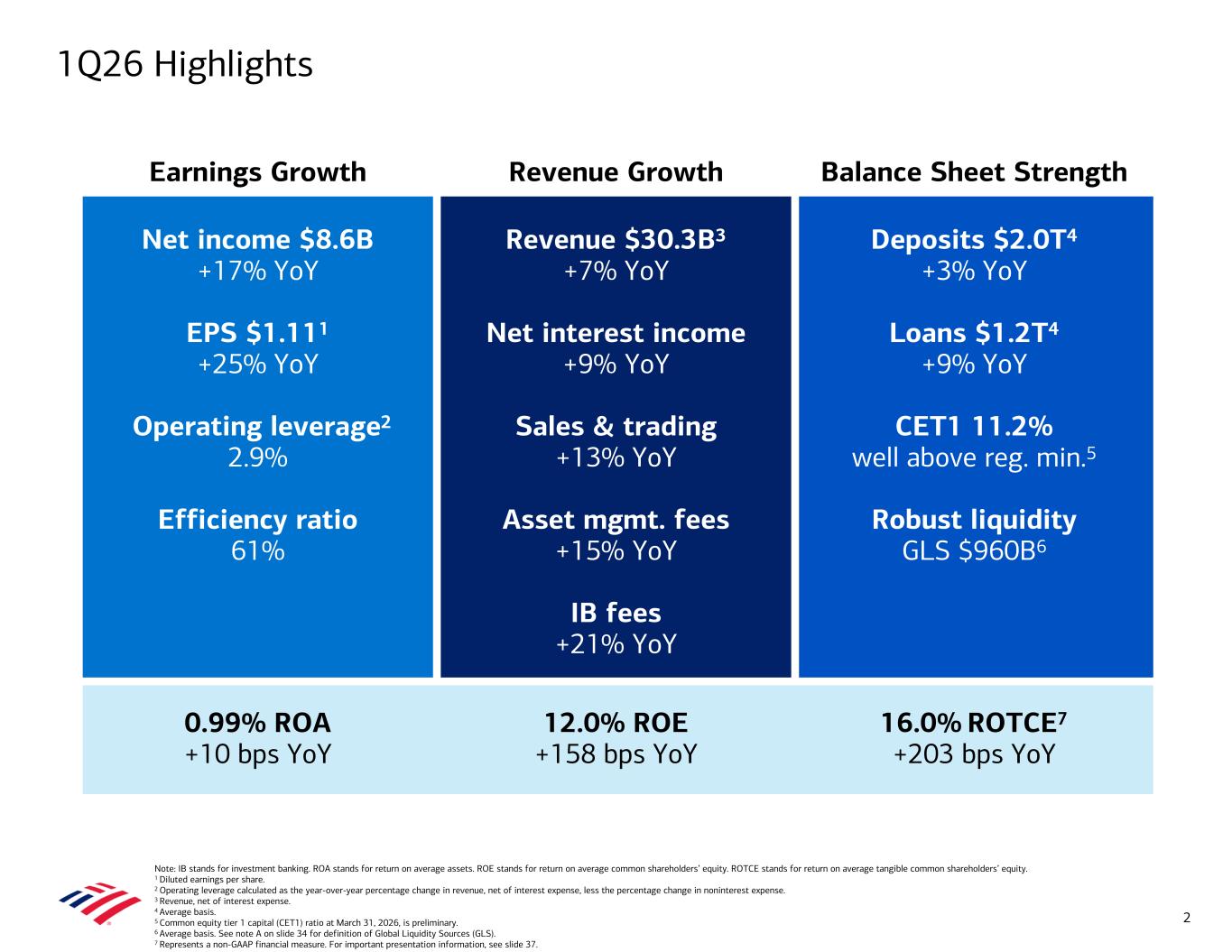
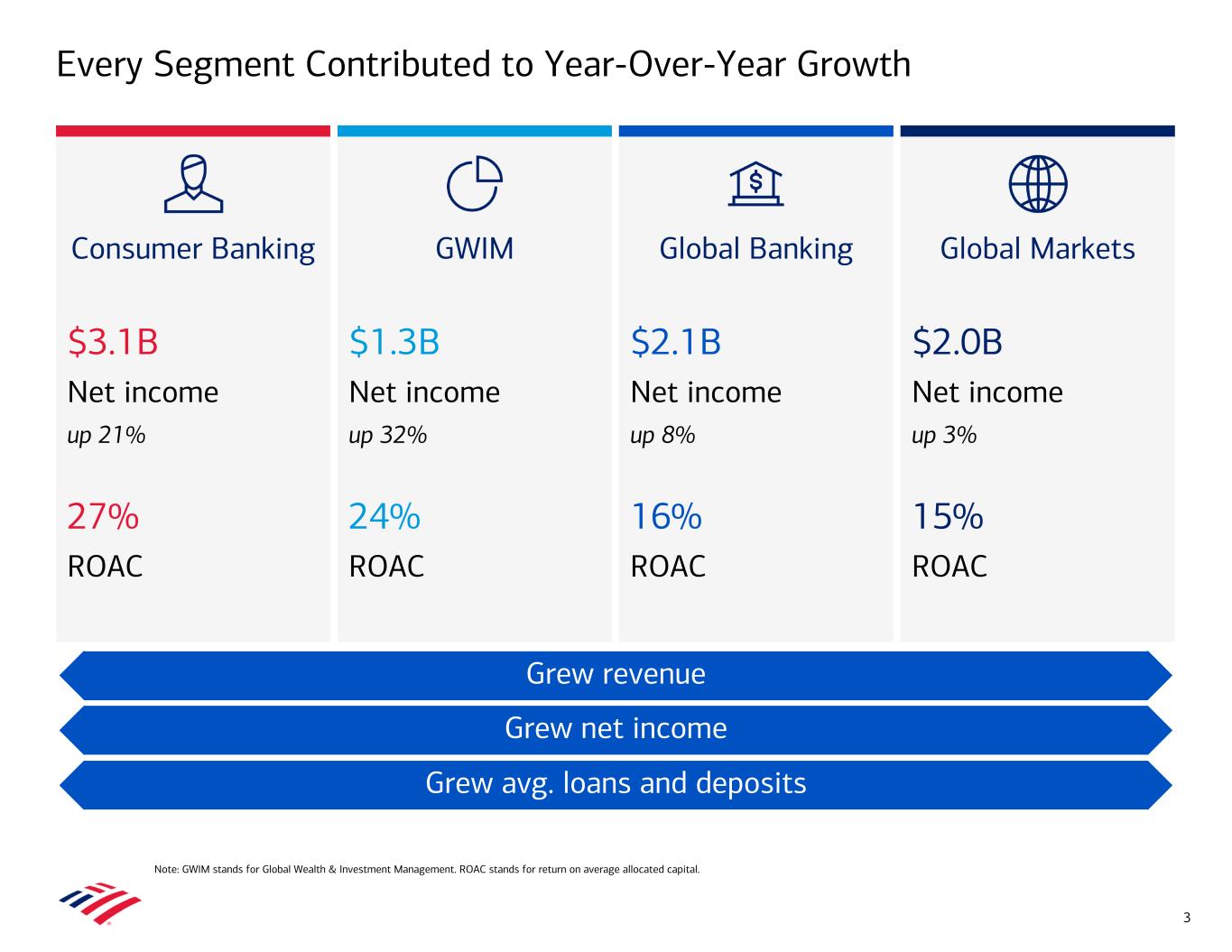
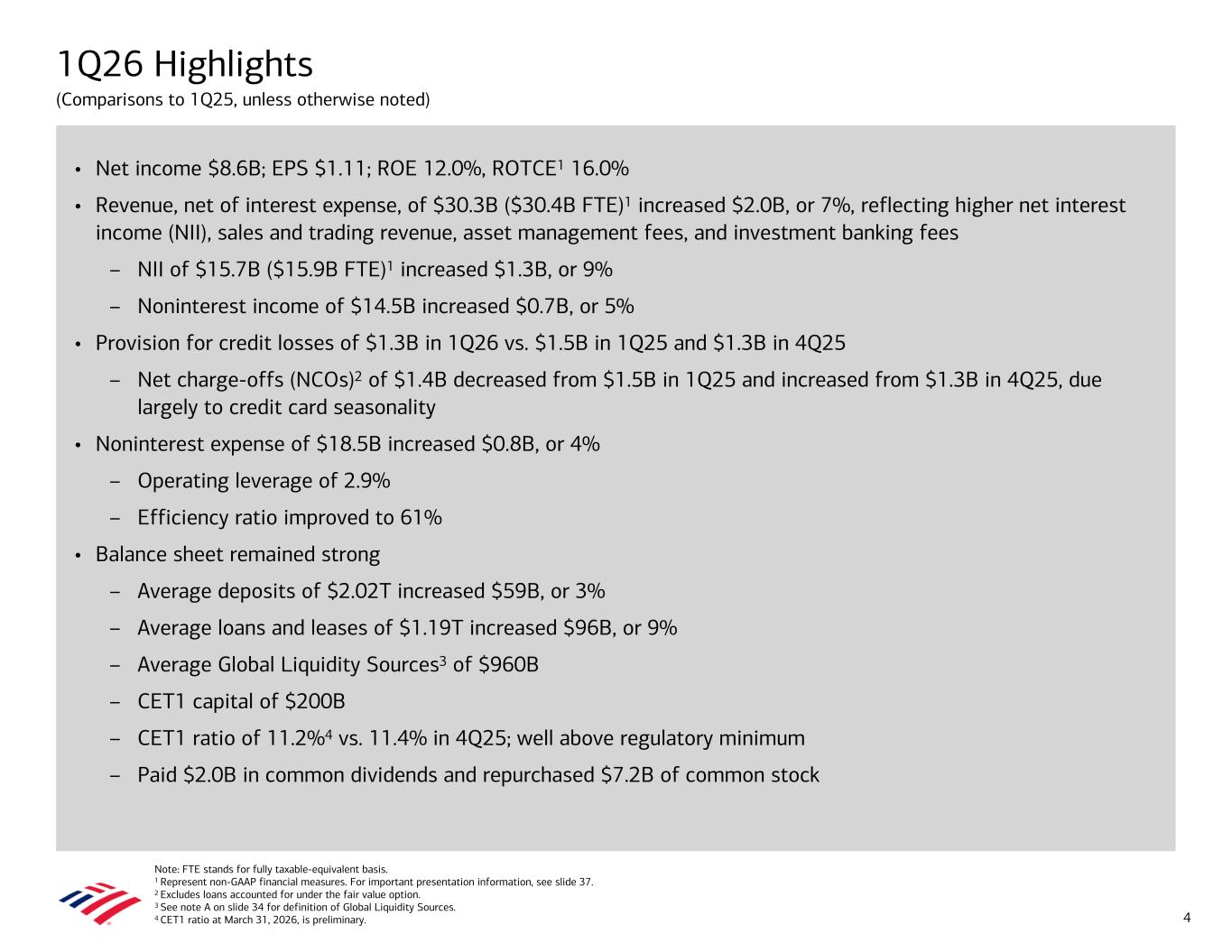
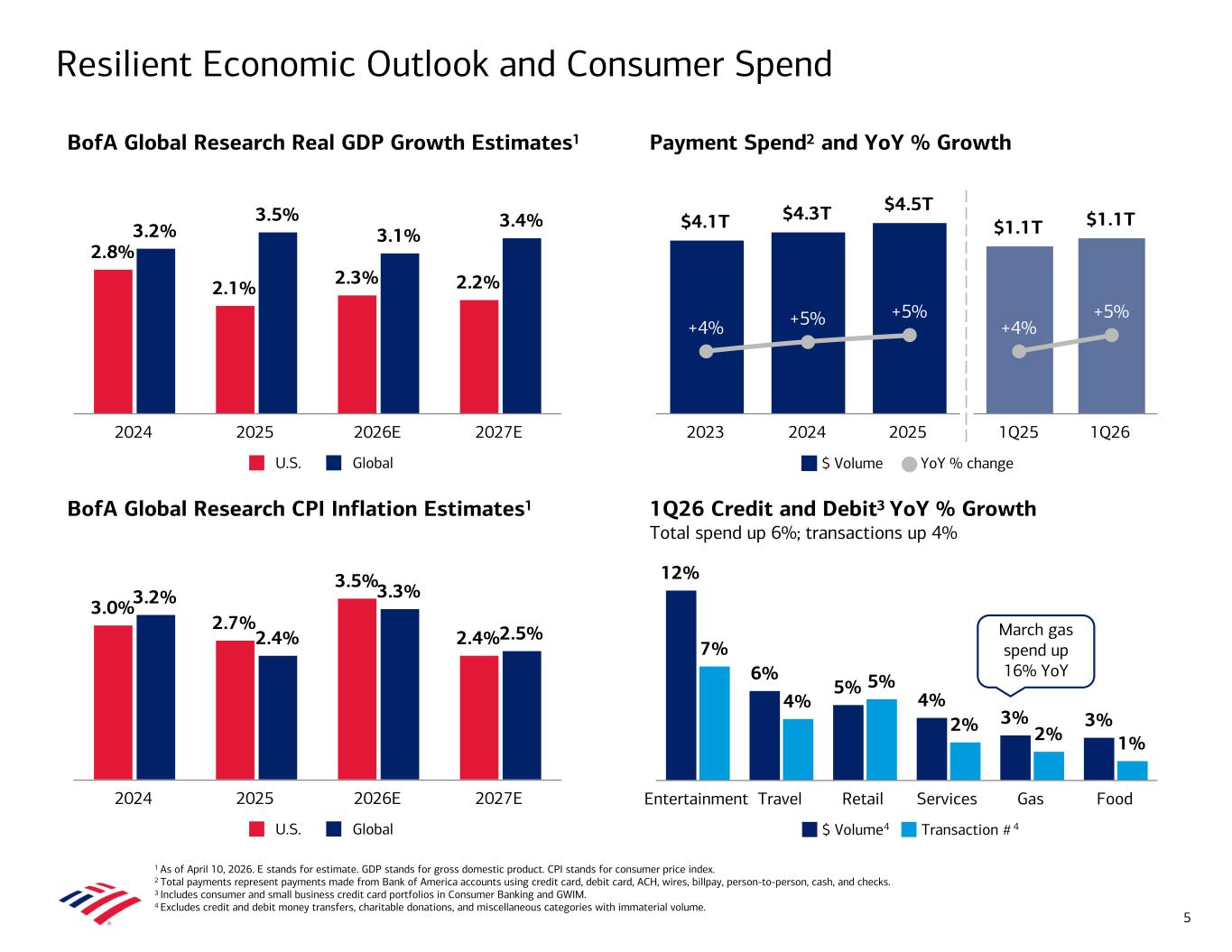
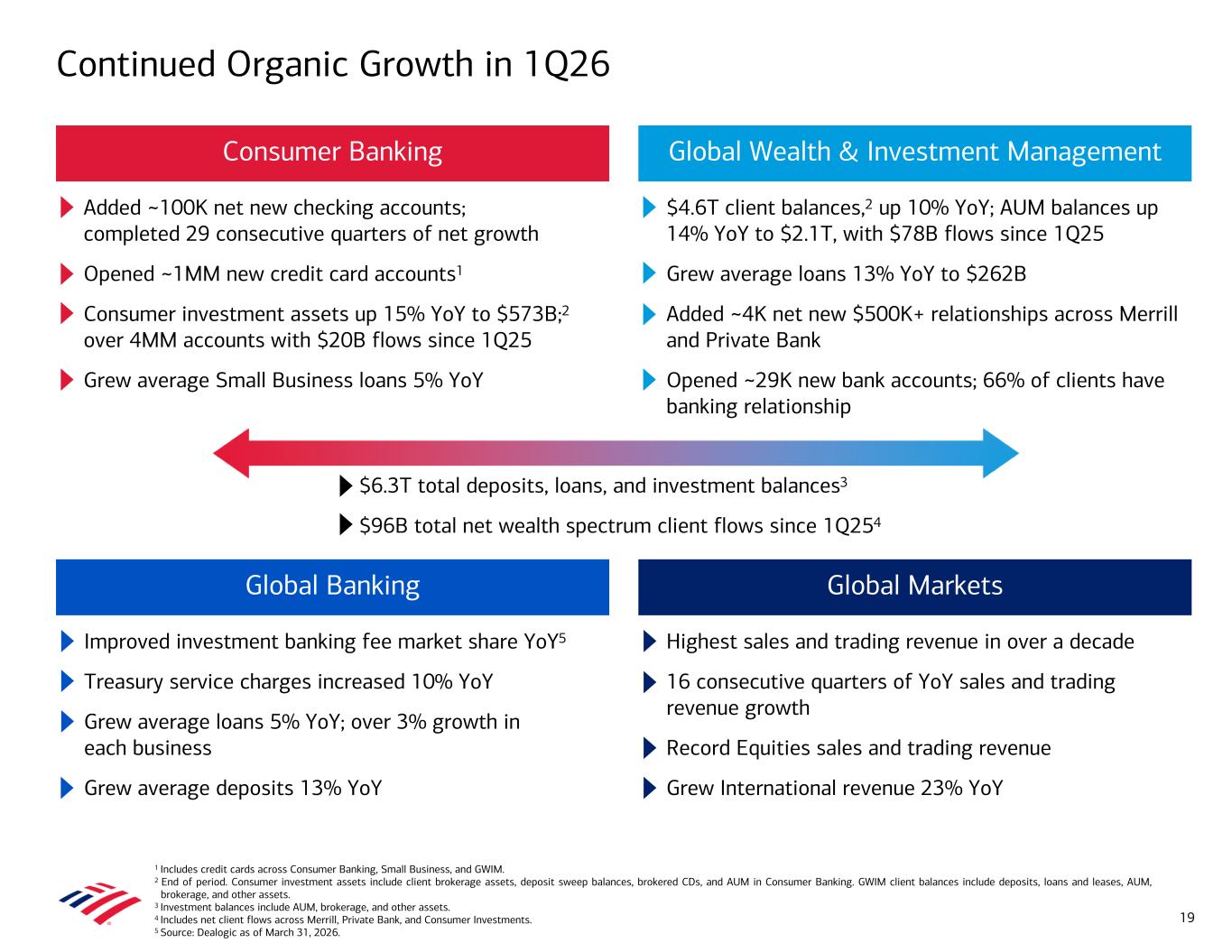
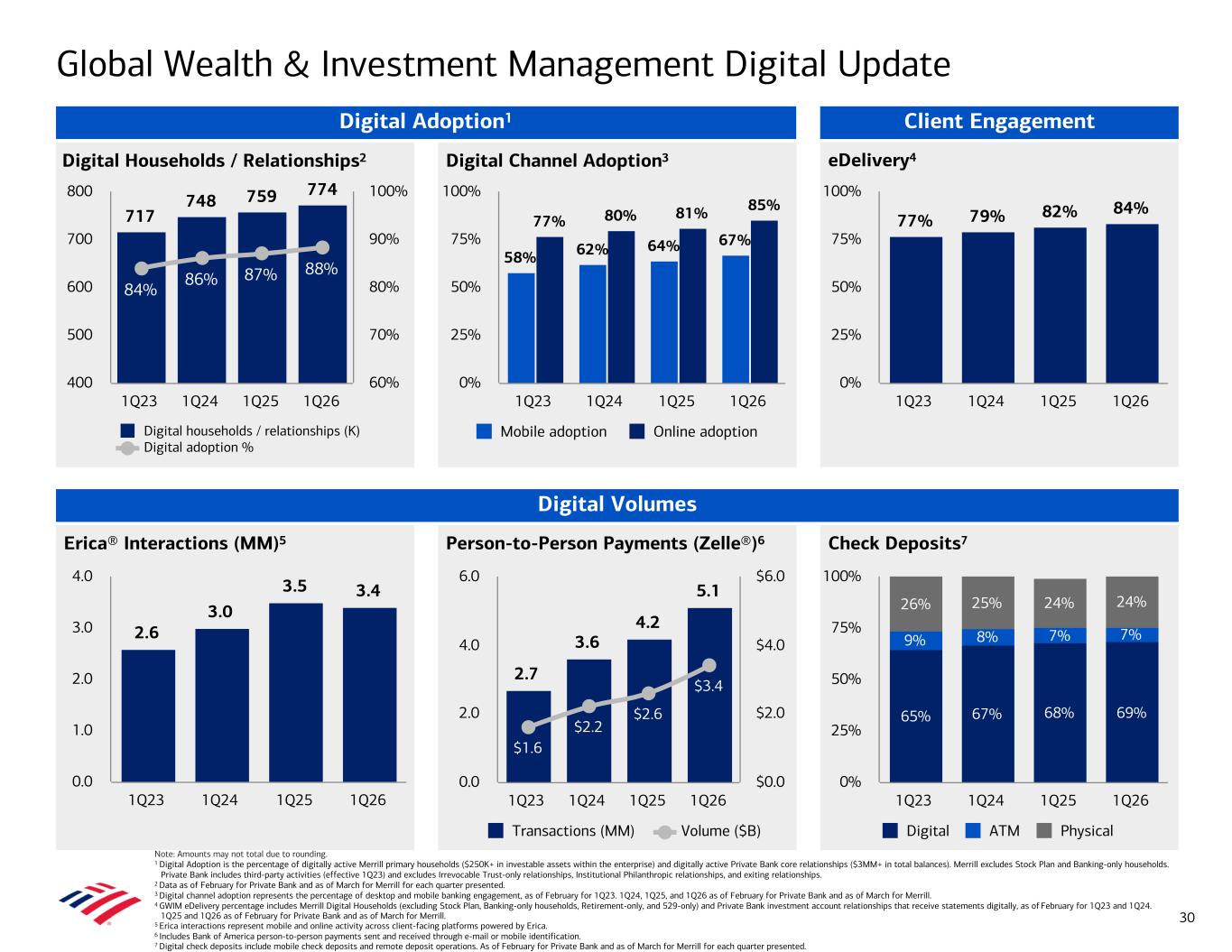
It's our earnings report for the first quarter of 2026. I'm going to begin on slide two. Bank of America delivered strong first quarter 2026 results. Revenue grew 7% year-over-year to 30.3 billion. Earnings per share were up 25% year-over-year to $1.11 per share. This performance was driven by balanced results across our businesses, continued operating leverage, solid client activity, and stable and modestly improved asset quality. We also saw solid year-over-year growth in both loans and deposits. Our capital liquidity positions remain strong and well above current regulatory requirements. Along the bottom of slide two, you can see the progress against some of our most important operating metrics. We delivered operating leverage of 290 basis points this quarter. The efficiency ratio for our company improved to 170 basis points year-over-year at 61 percent. And importantly, we generated a return on Tangible Common Equity, or OTCE, of 16 percent. The biggest highlight I can provide you is you fill up the slide three. There you can see that every segment of the company contributed to our year-over-year growth. Every segment grew revenue. Every segment grew earnings. Every segment grew average deposits, and every segment grew loans, and every segment drove. Now, moving to slide four, let me talk about some of the primary drivers of results before Alistair takes you through additional details. Net interest income performed better than expected. On an FTE basis, net interest income was $15.9 billion, up at 9 percent year-over-year. Second, our fee-based markets-facing businesses performed well. Markets, wealth, and investment banking all show good momentum. Client activity remained healthy, and revenues in each of these areas grew at double-digit rates compared to the first quarter of 2025. Third, our team continued to manage expenses well. We reported a non-earned expense of $18.5 billion in the first quarter, which was in line with a roughly 4% year-over-year increase we discussed on our last quarterly earnings Let me just spend a few moments on expense and how we think about them in the context of delivering growth and returns for our share. As we've said consistently, our focus is on delivering durable earnings and returns. Expense discipline is embedded in how we run our company. It's also one of the reasons we're able to convert scale, productivity, and macro tailwinds in operating leverage over time. In the quarter, the first quarter, our expenses reflected deliberate choices we made. First, we continue to invest in our revenue producing capabilities, whether it's relationship managers in all the businesses, new branches, technology of all types delivered throughout the platform, and product enhancements of all types. All those support the client activity, market share gains, and long-term earnings power of this company. These investments are return on investment driven. They're tied to businesses where you see clear demand and attractive returns. The second thing we do is we continue to offset those investments through productivity and simplification. The continued digitization of activities by our clients and inside our company, the application of artificial intelligence, the detailed process reengineering, all help reduce manual work, lowered unit cost, limited increase in our base cost structure. That's why, even as we've invested, we continue to deliver positive operating leverage. It's simply put that our revenue growth rate is faster than our expense growth rate. We remain highly disciplined in non-strategic spend. We are conscious not to add complexity, layers, or fixed costs that don't support the clients and what they need from us. That discipline is part of our responsible growth culture and has been going on for many years. If you think about that in terms of headcount, We are down about 1,070 people from year-end 2025 through attrition, and it continues to heavily extend the franchise, deepen the client relations, and deliver attractive turns. And we're doing it while reducing those FTEs and absorbing costs and inflationary costs out in the market. Turning briefly to asset quality, we saw improvement from last year, net charge-offs, card delinquencies, reservable criticized assets, and non-performing loans all declined versus the first quarter at 25. Provision expense was $1.3 billion compared to $1.5 billion last year, reflecting continued benign credit results. Finally, capital generation remained strong. We continued to deploy excess capital to support our WA growth across all the businesses while returning capital to shareholders through dividends and share repurchases. We ended the quarter with a strong capital position, including $200 billion-plus of CET1. We also continued to benefit from the many quarters of organic growth across our businesses. We include our standard organic growth view beginning on slide 19 and following in the appendix. I commend you to look at those across all the different business lines, all the activity and all the digital activity are there. All that activity remains a key differentiator for us, driving continued growth in deposits, investment assets, lending balances and trading counterparties. This combines with that strong engagement across our digital platforms and we believe of driving ongoing share gains and targets. It's also going to demonstrate the value of our diversified earning stream, the growth and durability of all our businesses across different environments, and in the end, is a strong performance by our team here at Bank of America, and I thank them for another great Before I turn to Alistair to go through a few observations, go through the quarter, I'm going to give you a few observations we see about the economy beginning on slide So we have two things at Bank of America to help us view the economy. First is our very strong research team, and they provide great data to us based on their view of the world. And you can see that on the left-hand side of slide five. But we also couple that with our internal data, what our customers really do, both on the consumer side, corporate side, small business side, et cetera, and you can see that on the consumer expressed on the right-hand side of the slide. So our research team continues to see the economy that is resilient, that the core activity of the economy continues to push along, even with all the uncertainty that we've all written about out there. We see the forward look of GDP growth rates in the U.S. in the 2% range, and we see a faster growth rate around the world. When you look at the inflation, you can see in the lower left, you can see that the projection is for it to be – remain elevated in 26 into 27. and we both had the U.S. basis in the global world. But when you look on the right, you can see where the resilience comes from. The U.S. consumer continues to spend through all its different platforms here, Bank of America. To put that in context, the total spending by consumers across all the ways they move money into the U.S. economy, Bank of America, is $4.5 trillion a year. For 2025, you can see that was up 5% from 2024. And that 5% growth has been consistent in the first quarter of 26 six compared to the first quarter of 25. And during that quarter, customers moved a trillion dollars plus. Look on the lower right, you can see the debit and credit card spending was up 6% year-over-year. This total is about 25% of the ways consumers spend money at Bank of America. If you look within the categories, you can see it's up in entertainment and services and travel and retail. And yes, it's up in gas prices, and we know that in March it was up 16 percent year-over-year. At the same time, we look at this data and see what it tells us. We also are mindful of all the risks out there, the ongoing conflicts in the Middle East, including implications for the energy market, inflation, and growth. We look at global trade flows and broader financial conditions. To date, these impacts have been measured and absorbed by the economies here and around the world, and we continue to watch them carefully. Looking at, our research team expects moderate U.S. and global growth over the next several years, and our data supports that view. In this environment, I'm asked if the capital markets activity has really inflected, or is this just the volatility produced in the results that our markets team produced or our investment banking team? What we're seeing is improved breadth in our global businesses, not just episodic activity. Trading has benefited from volatility. In fact, this is the 15th quarter. We have year-over-year revenue growth. But more importantly, investment banking pipelines are building and engagement is up across all. One of our corporate clients is strong. While they wonder about all the things I spoke about earlier, they continue to conduct strong activity. That activity is healthier than a year ago and supports a continued constructive view while those risks are out there. The macro product drop remains constructive and a diversified business model position as well to continue to deliver for you across a range of economic scenarios. With that context, I'll turn it over to Alistair for you in more detail.
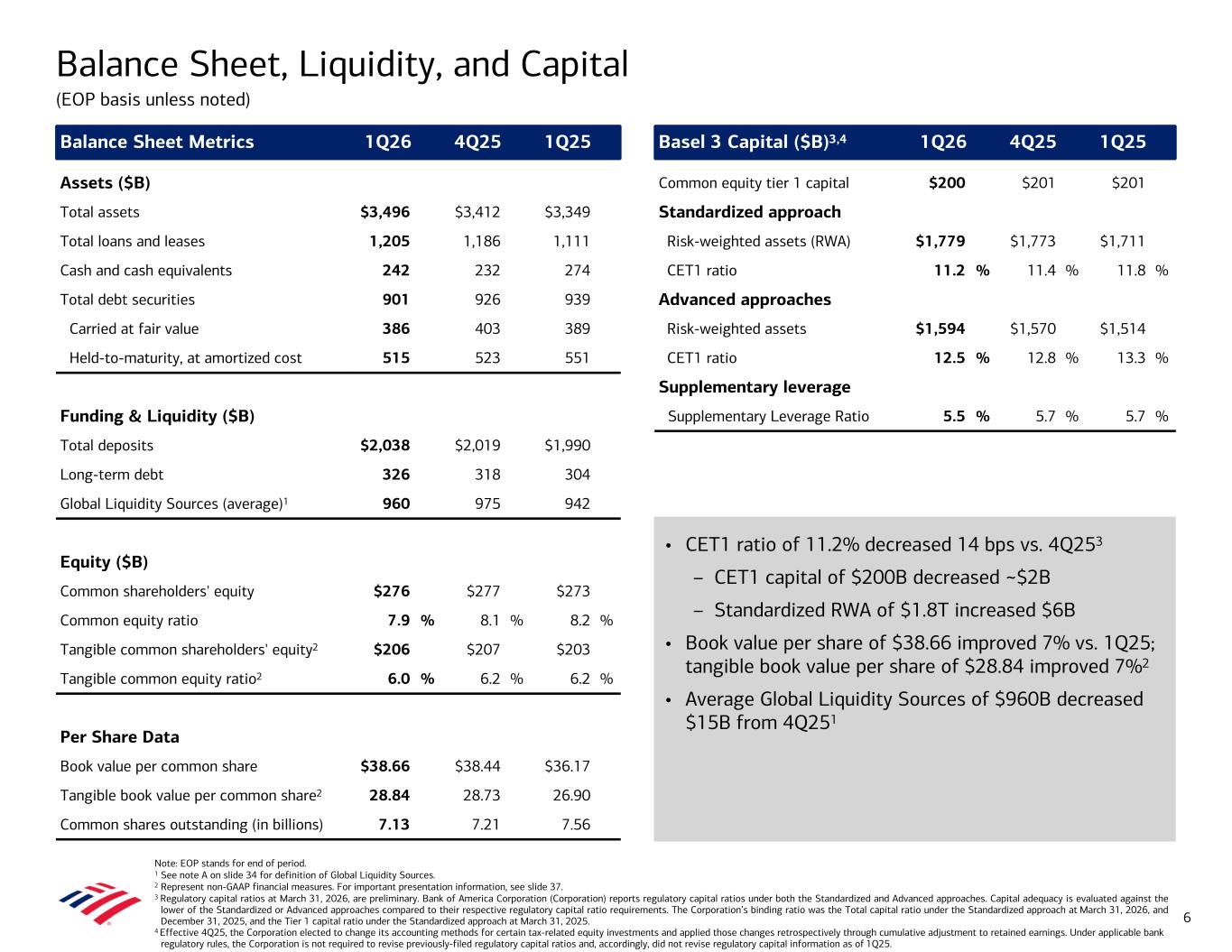
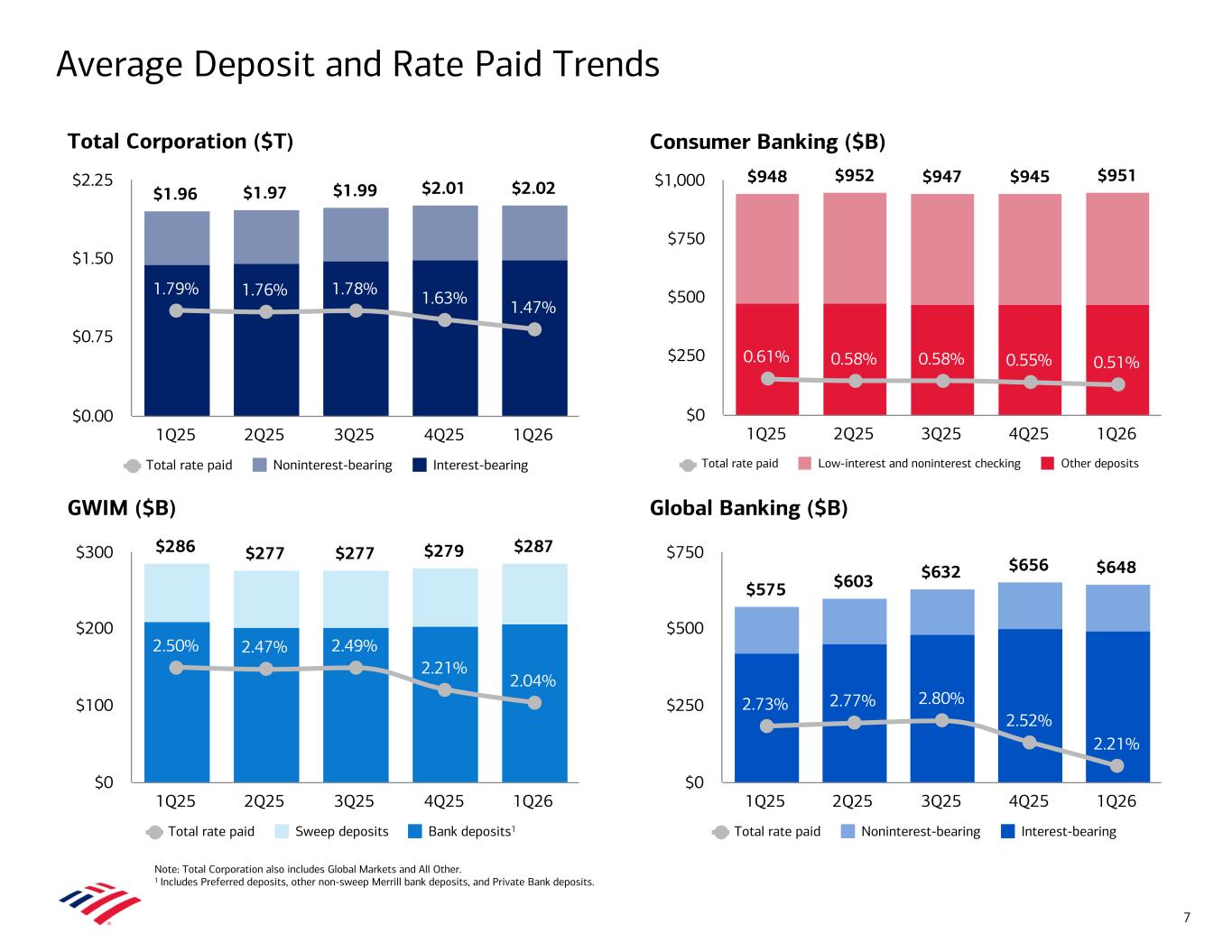
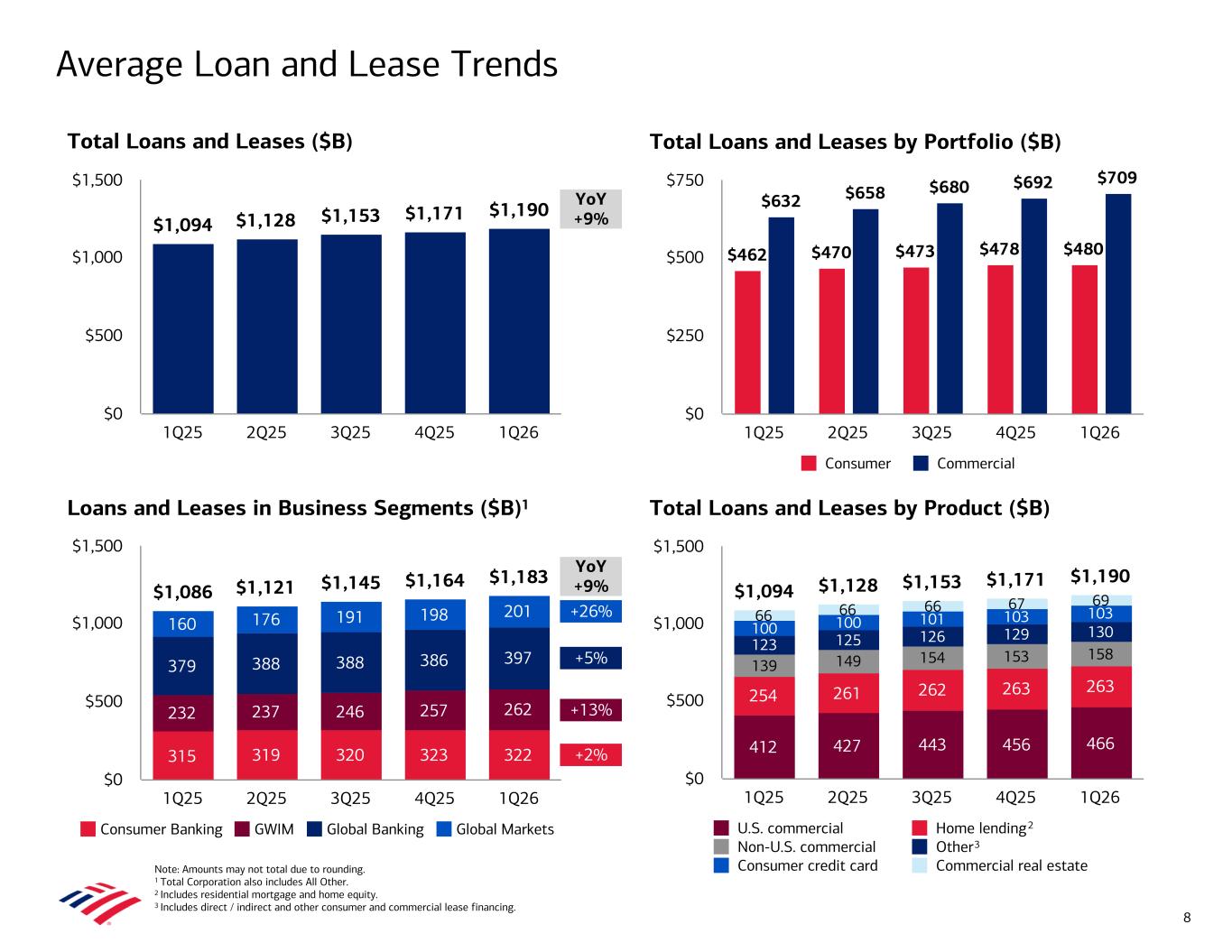
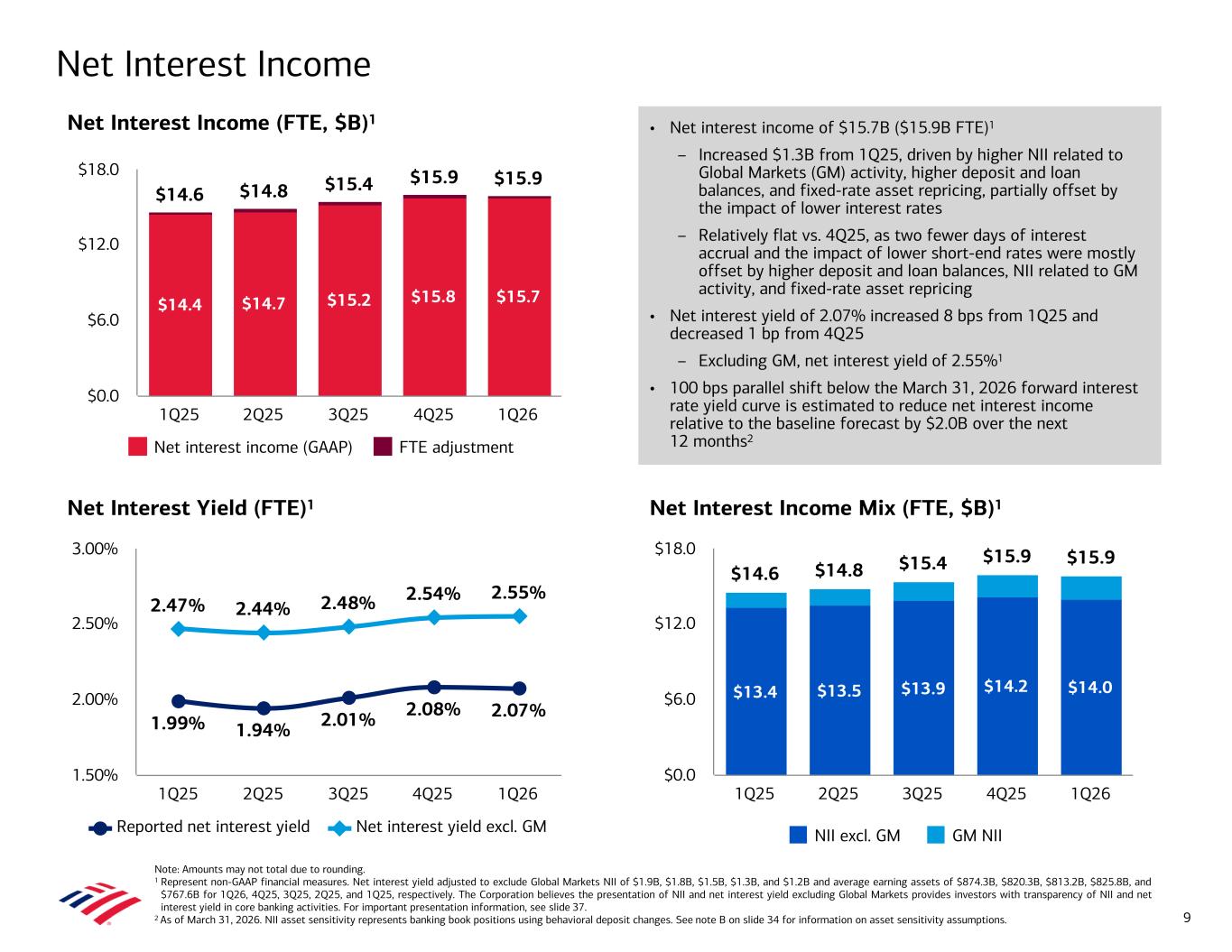
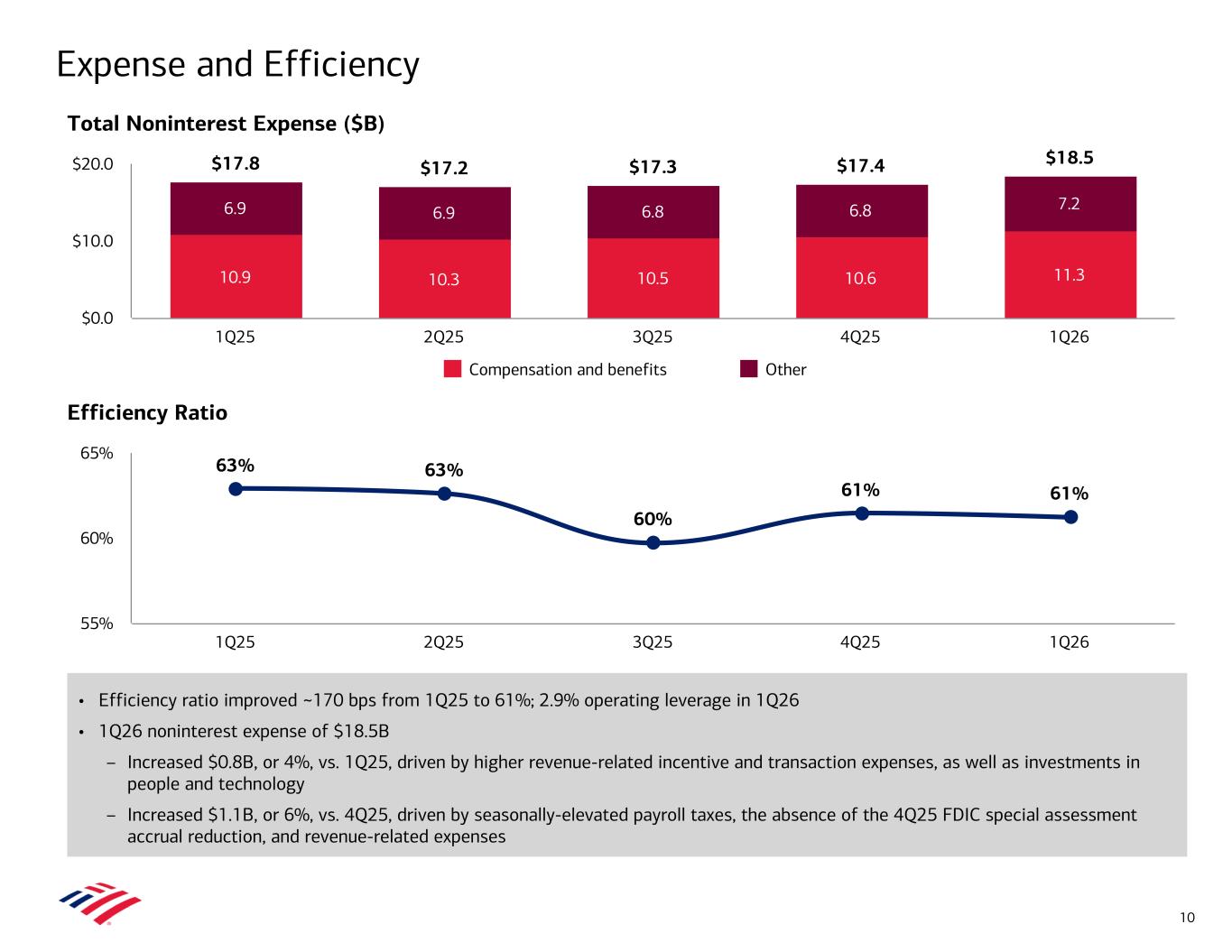
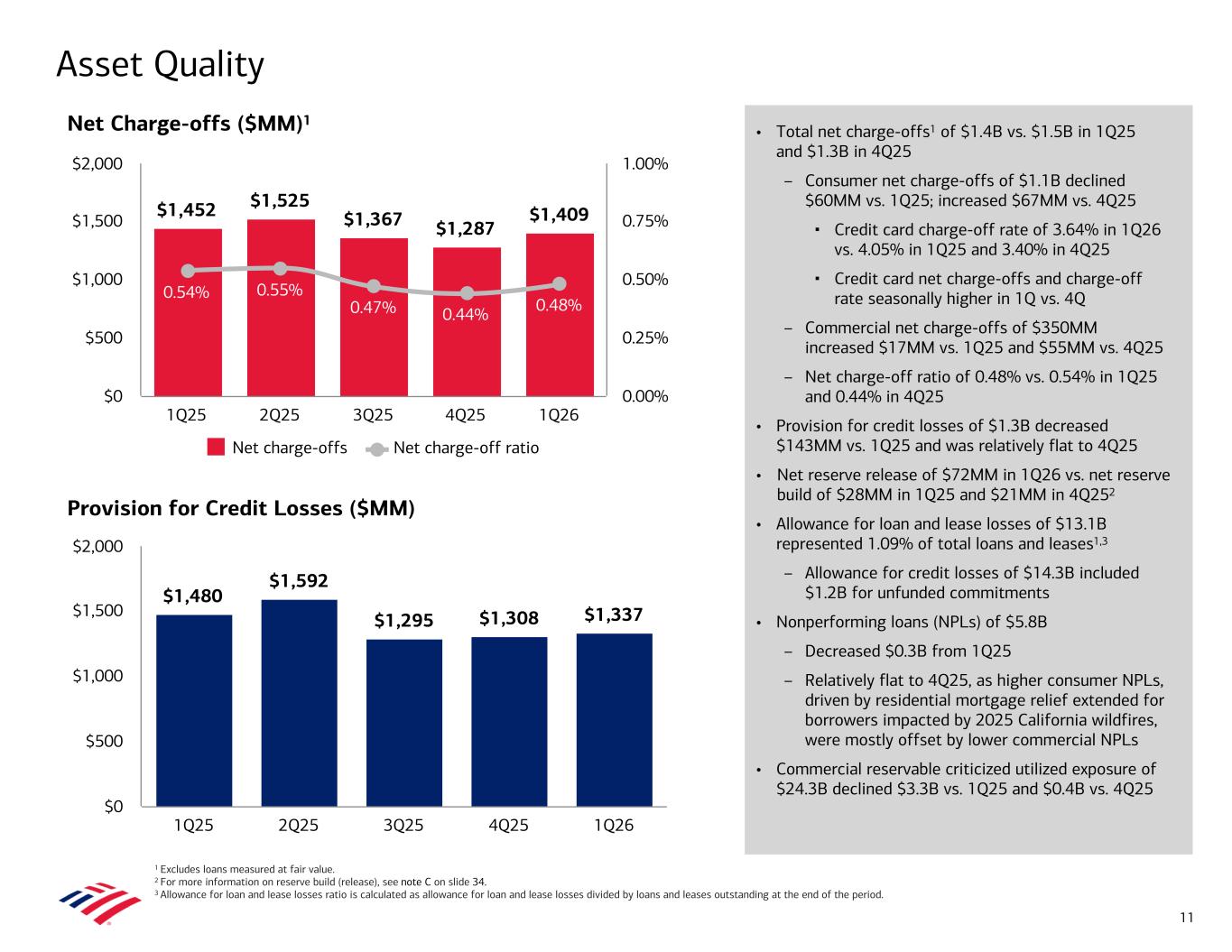
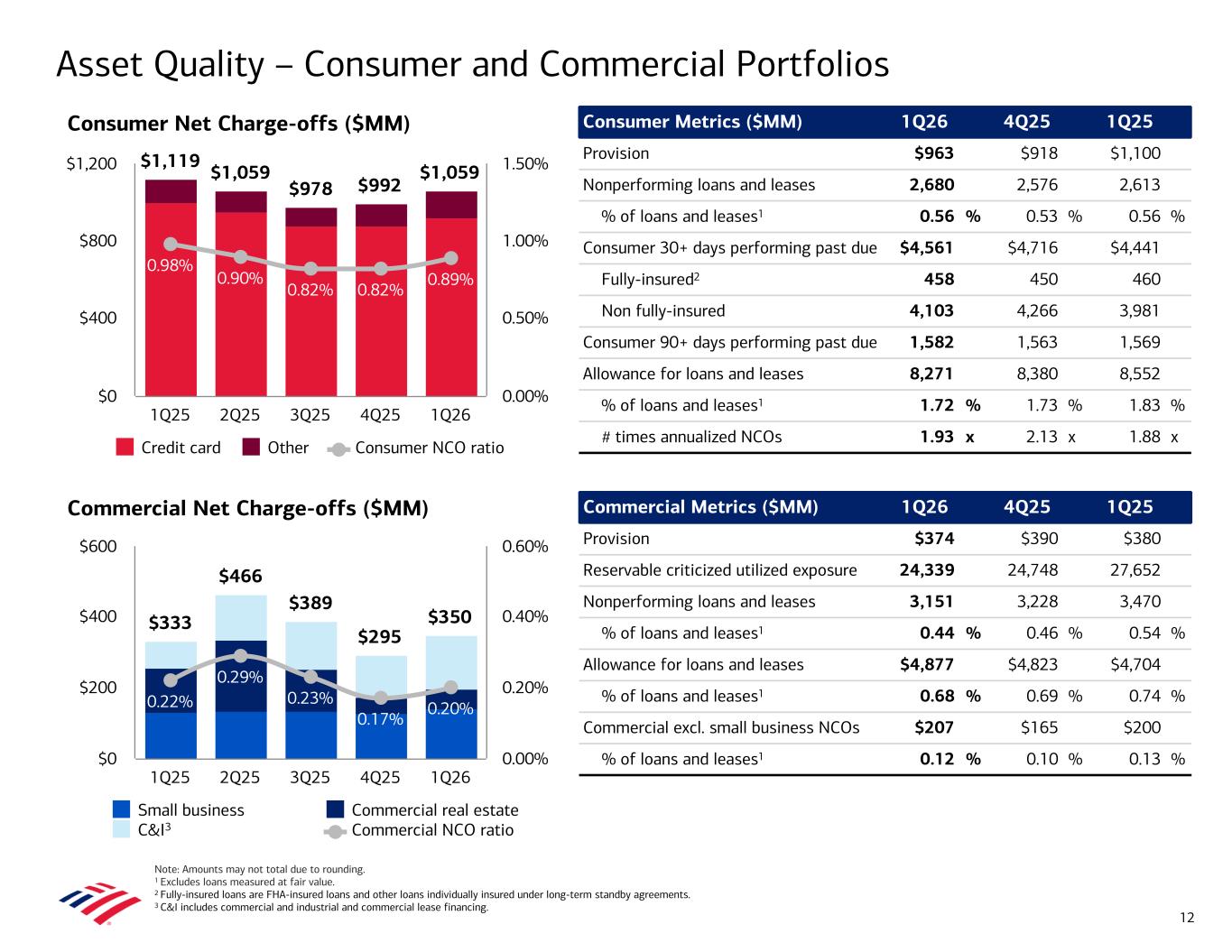
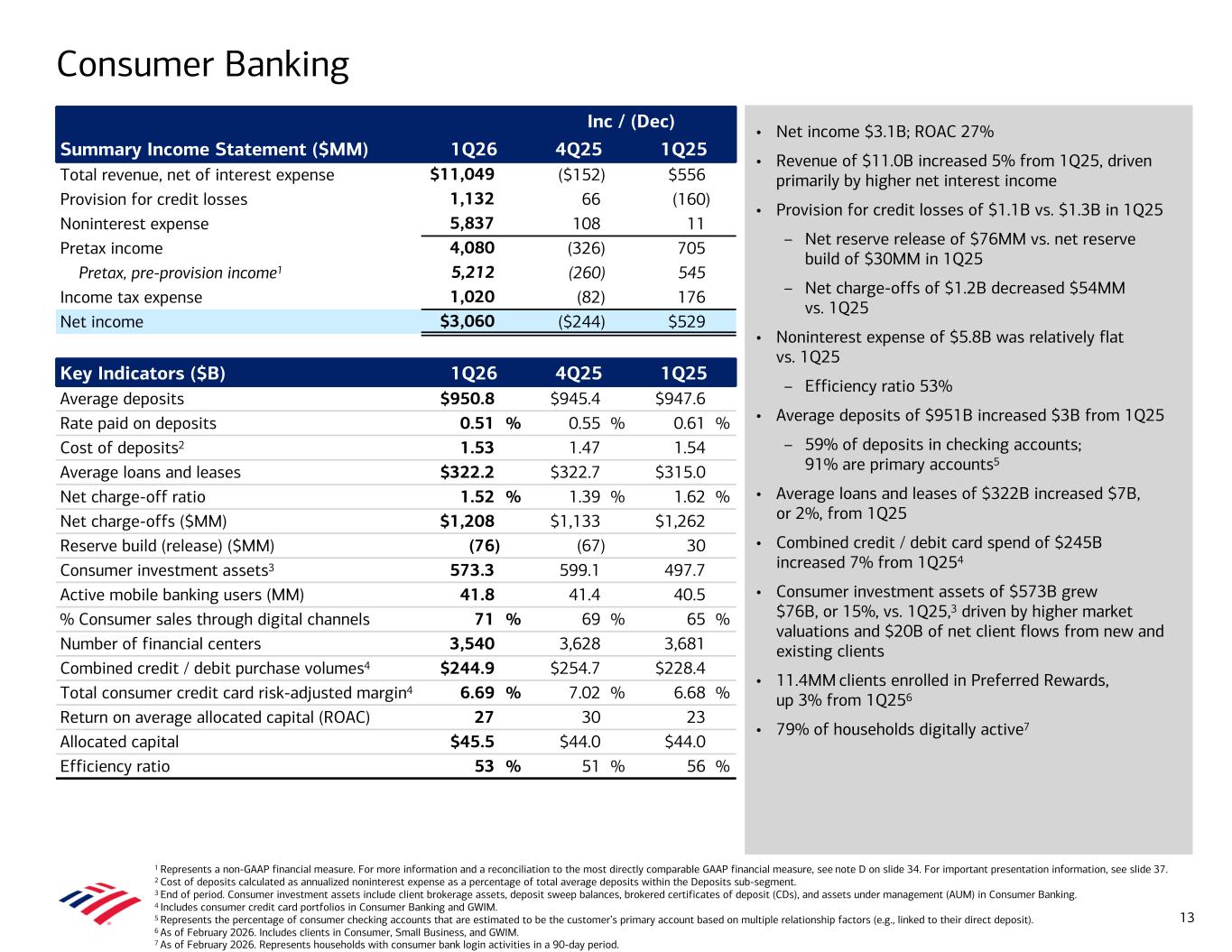
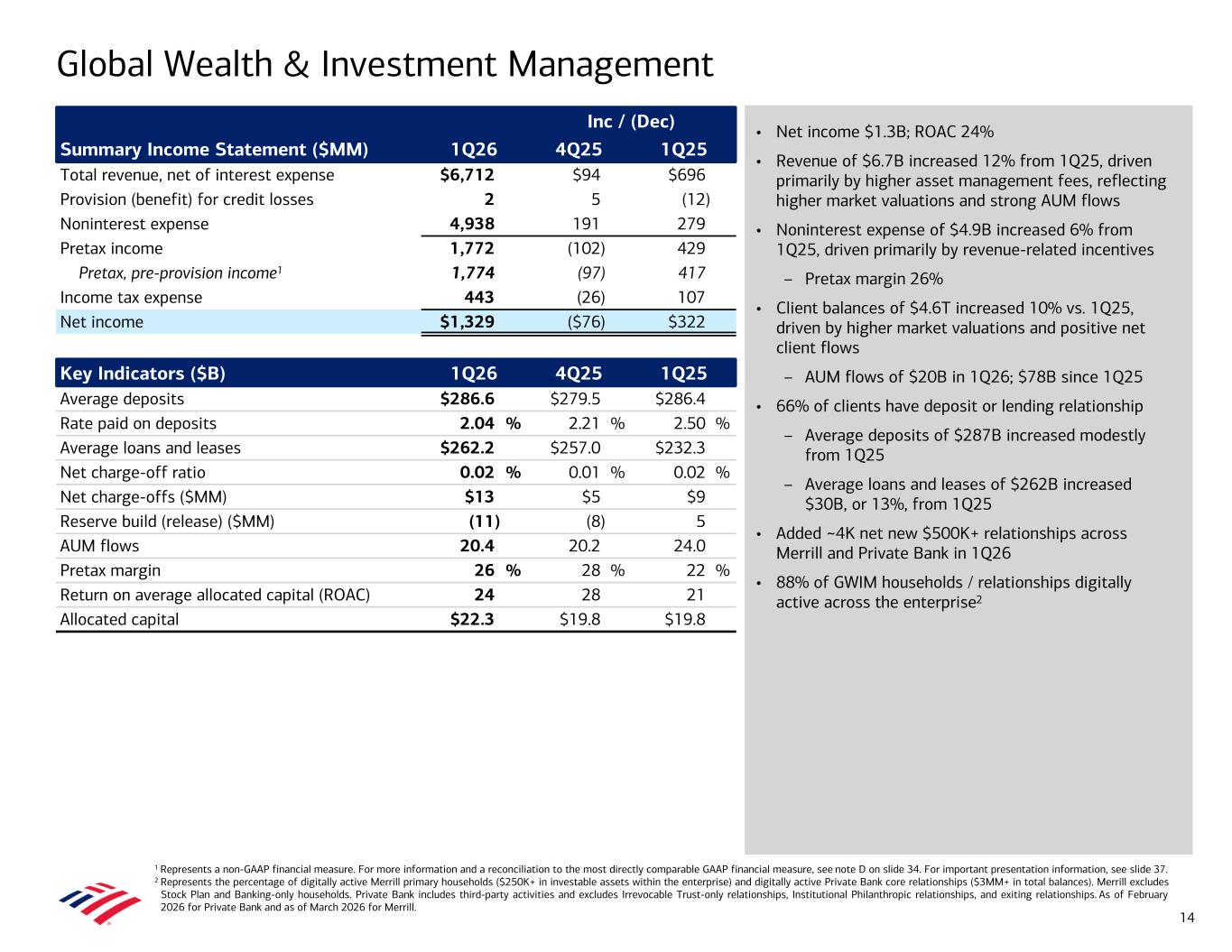
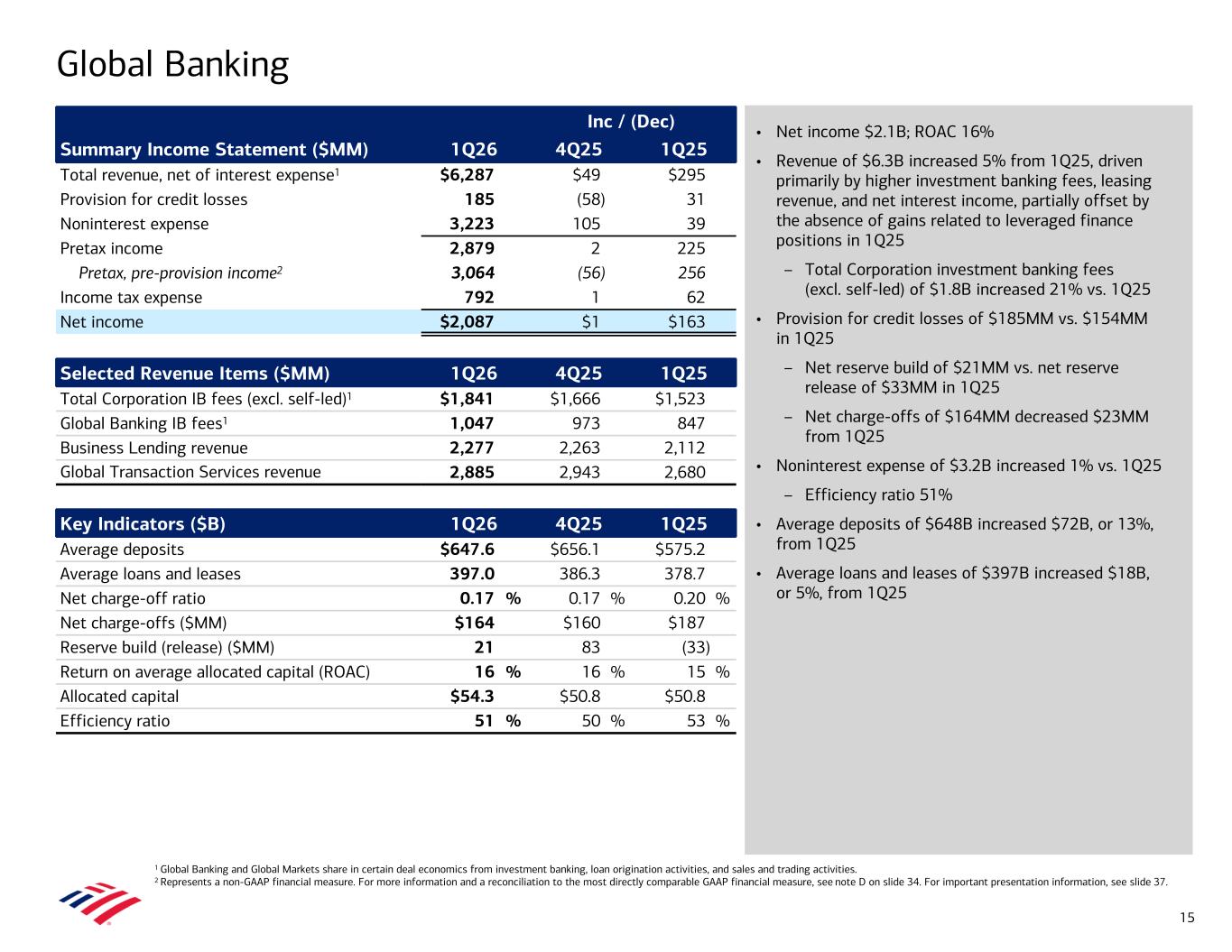
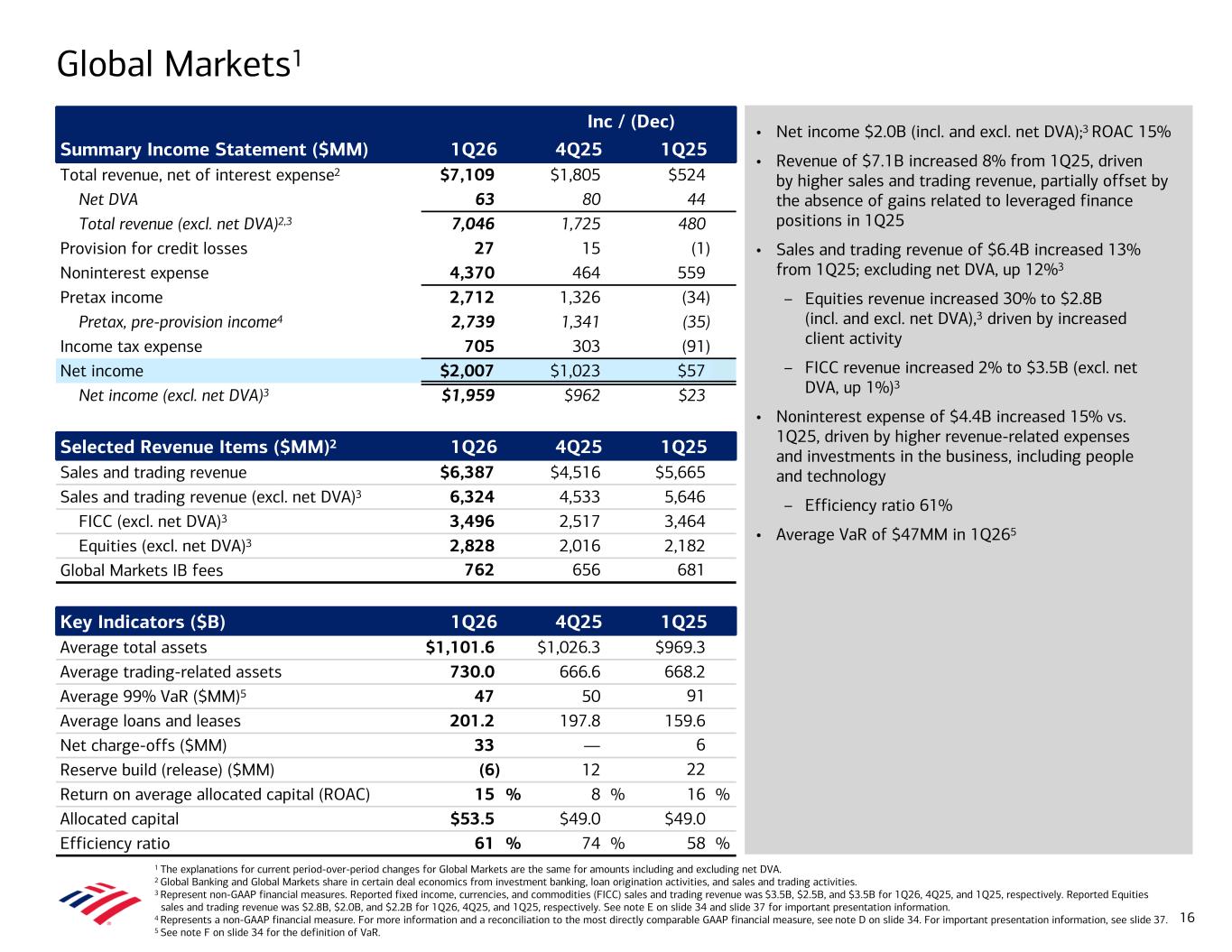
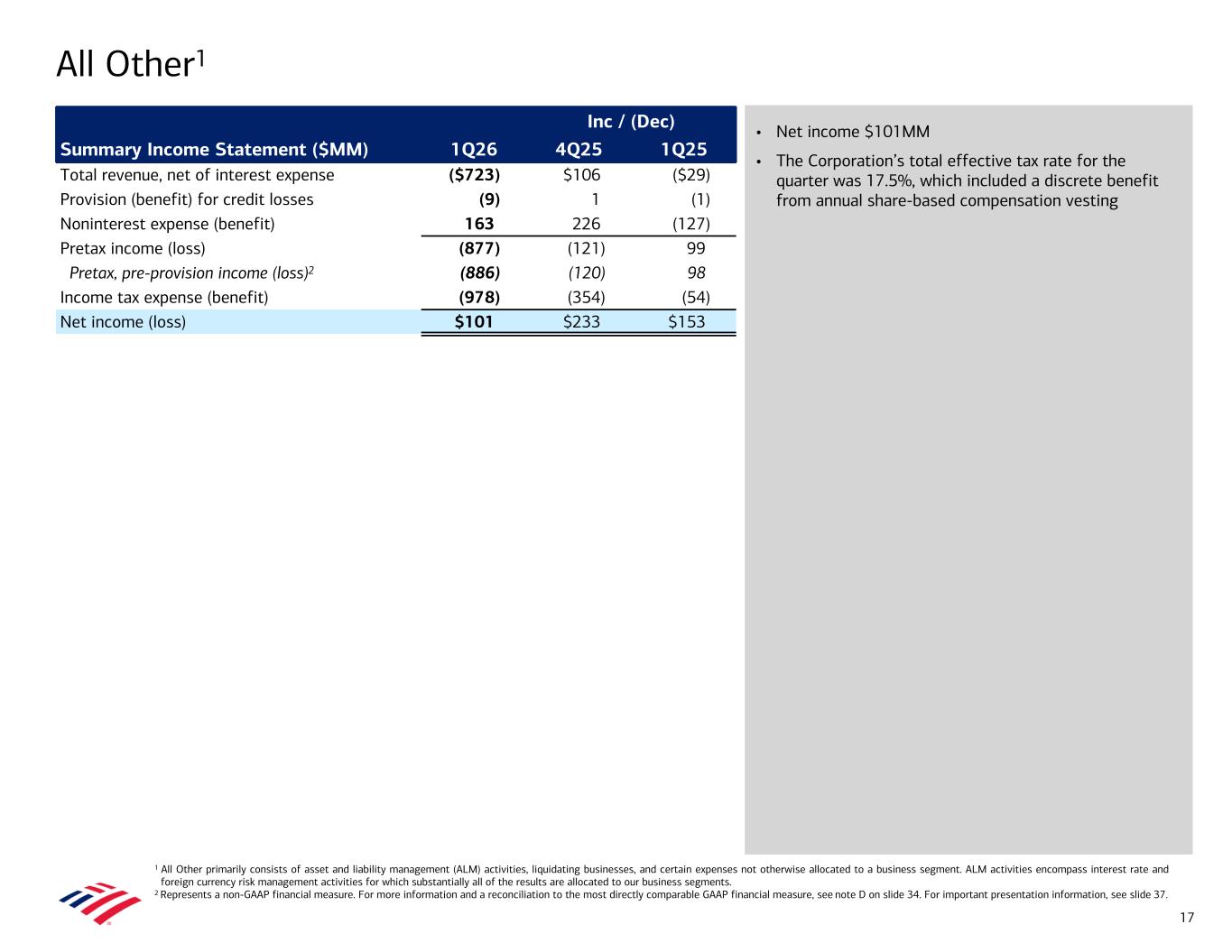
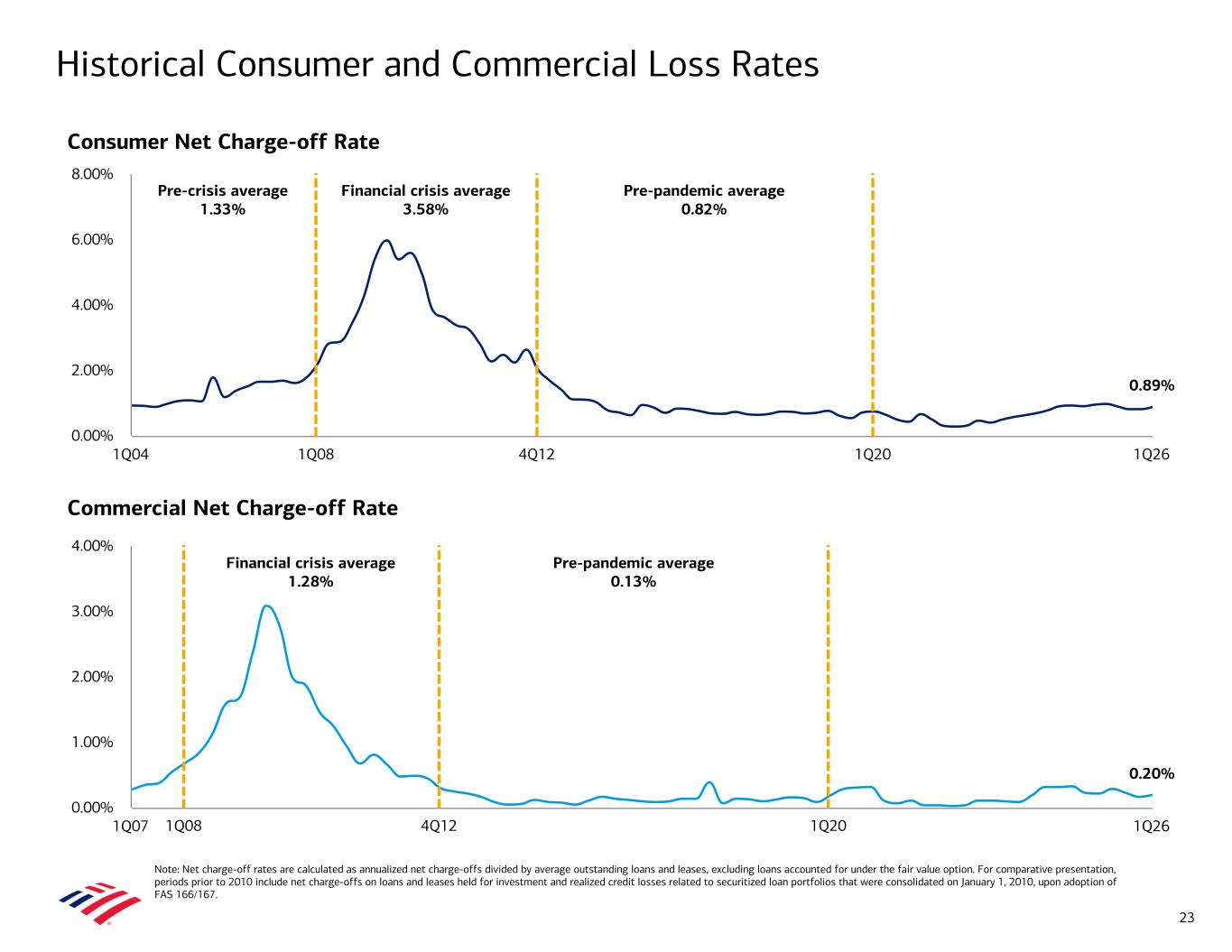
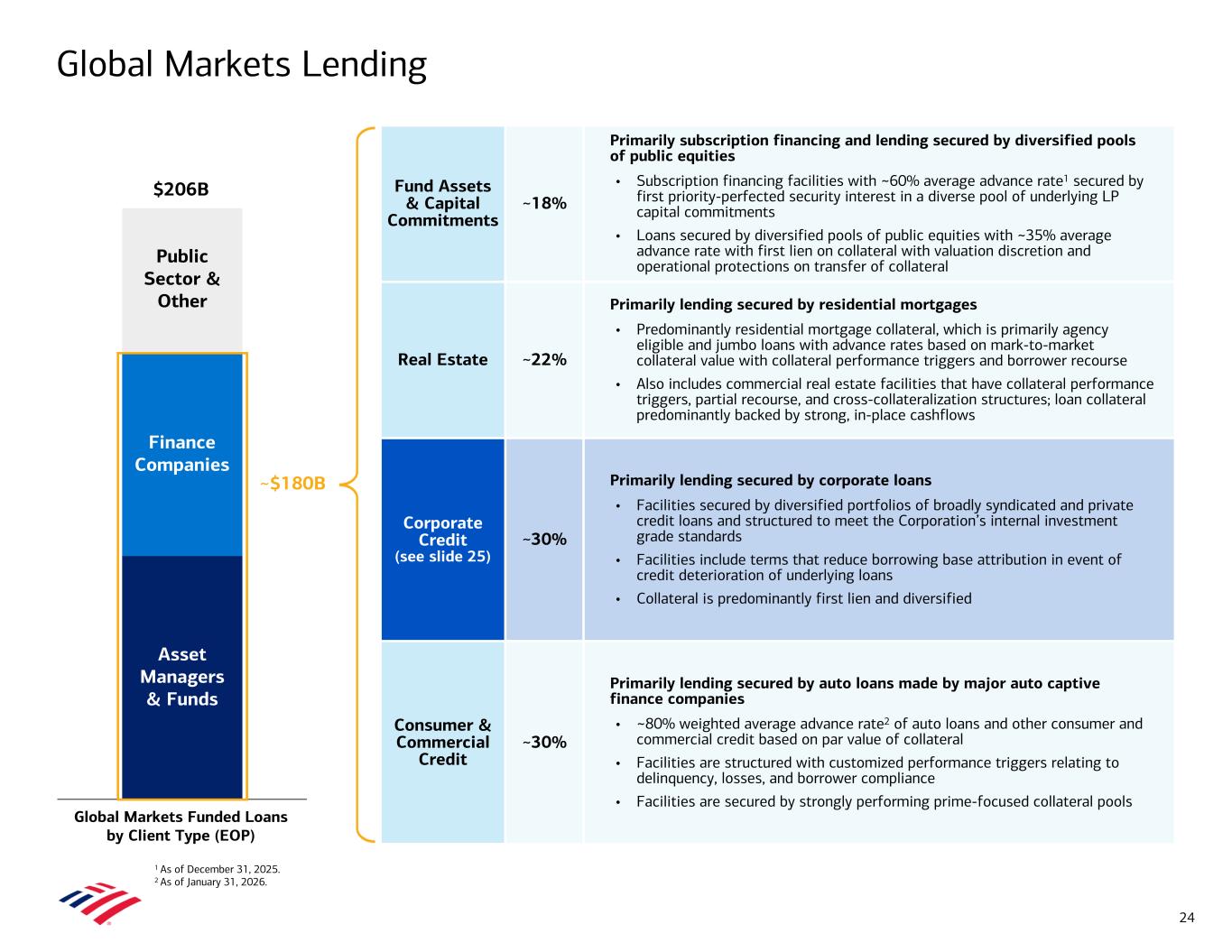
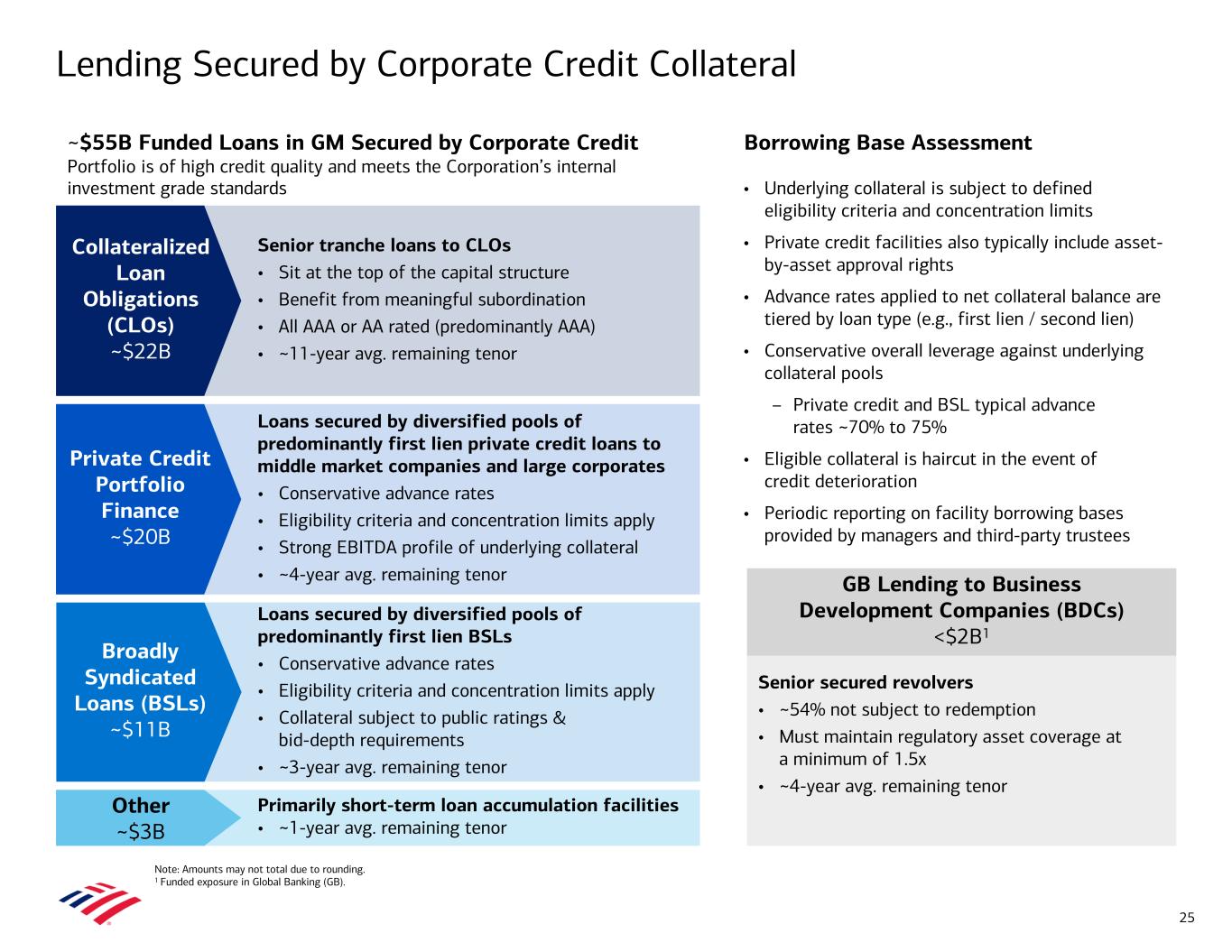
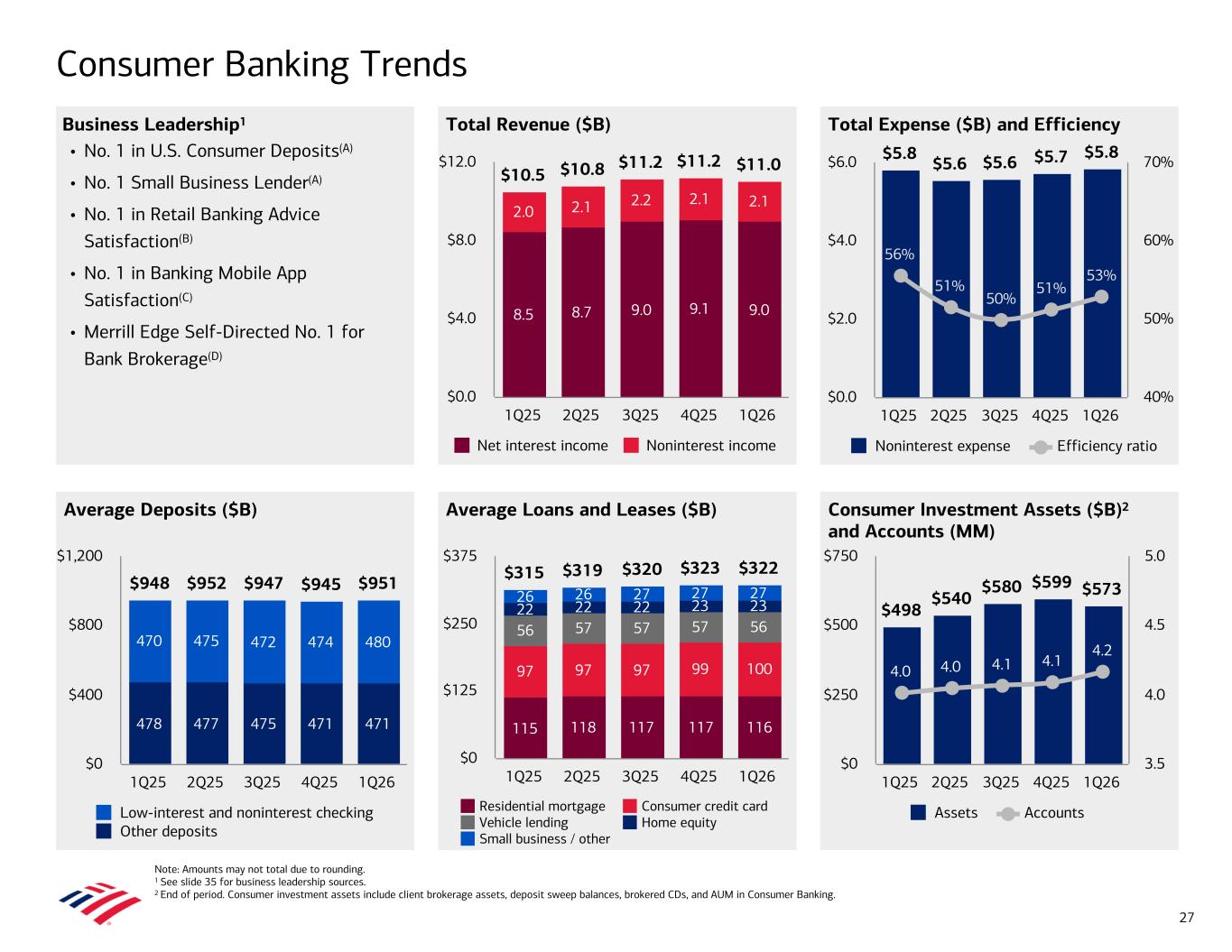
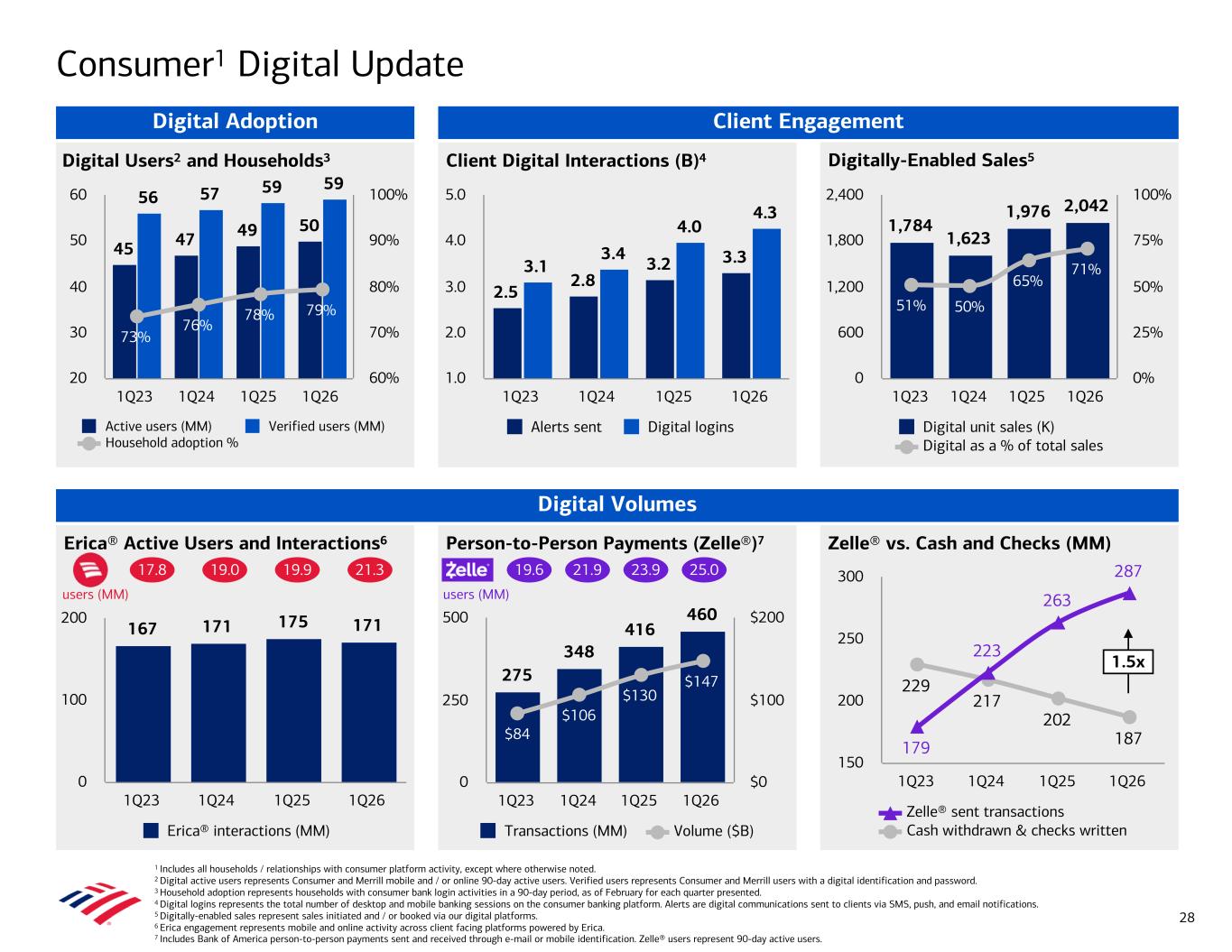
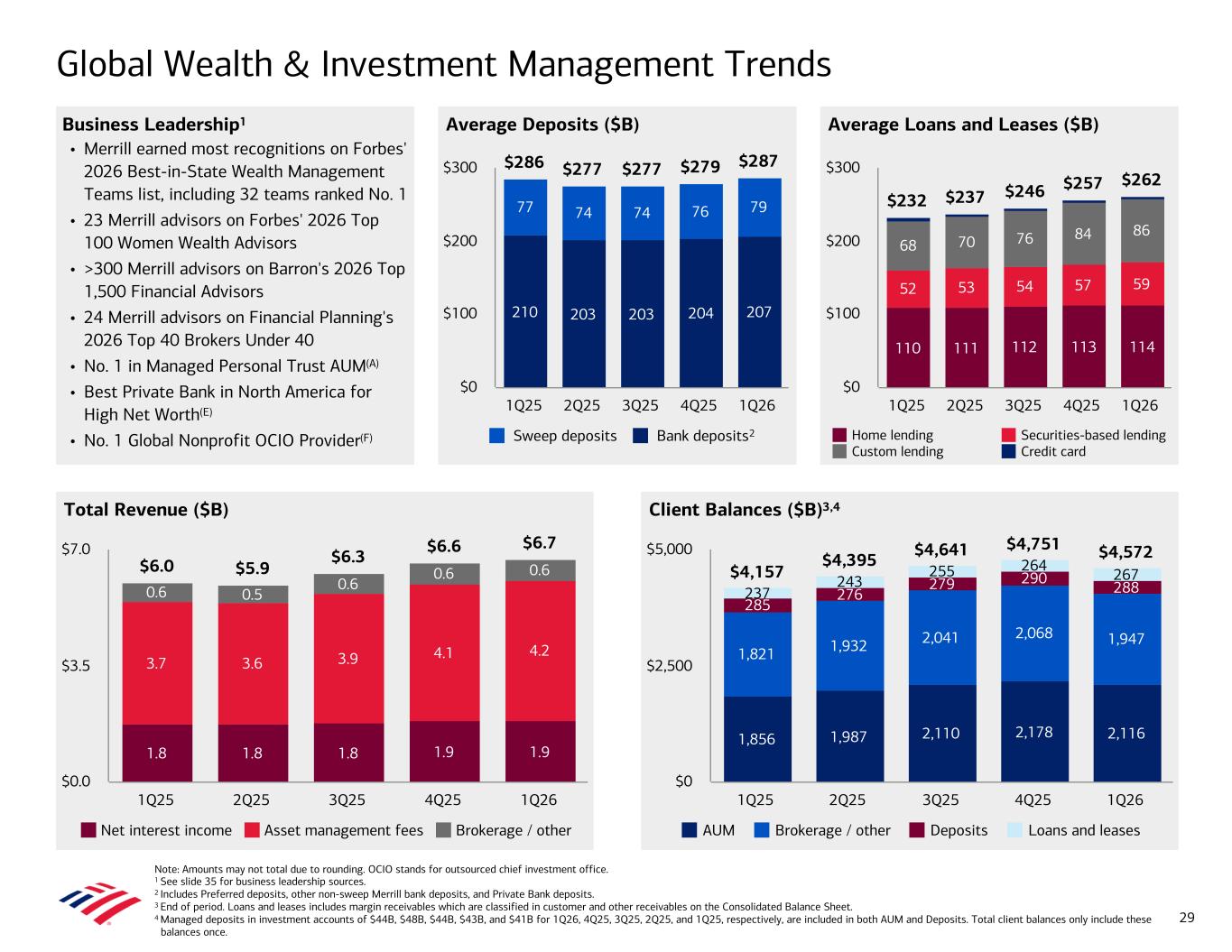
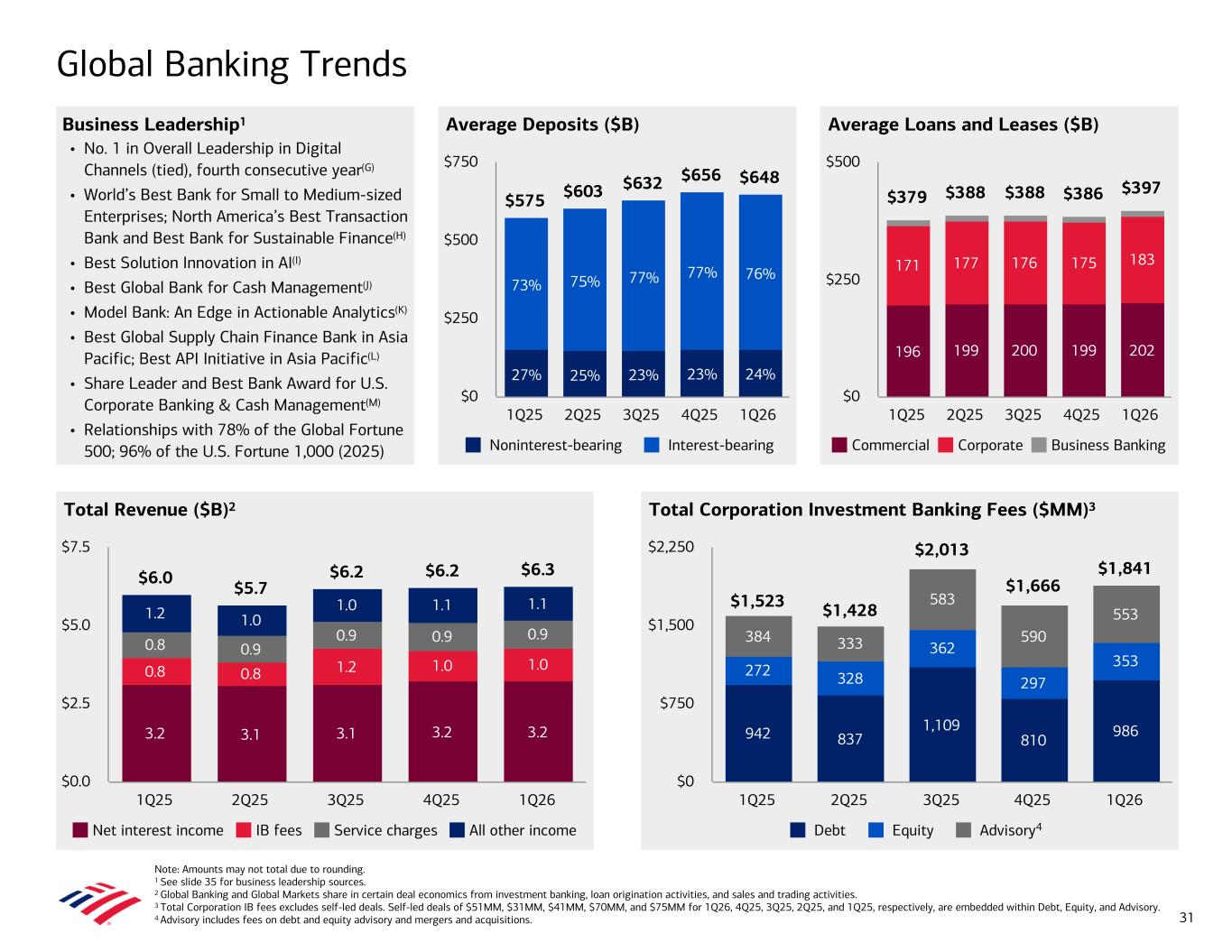
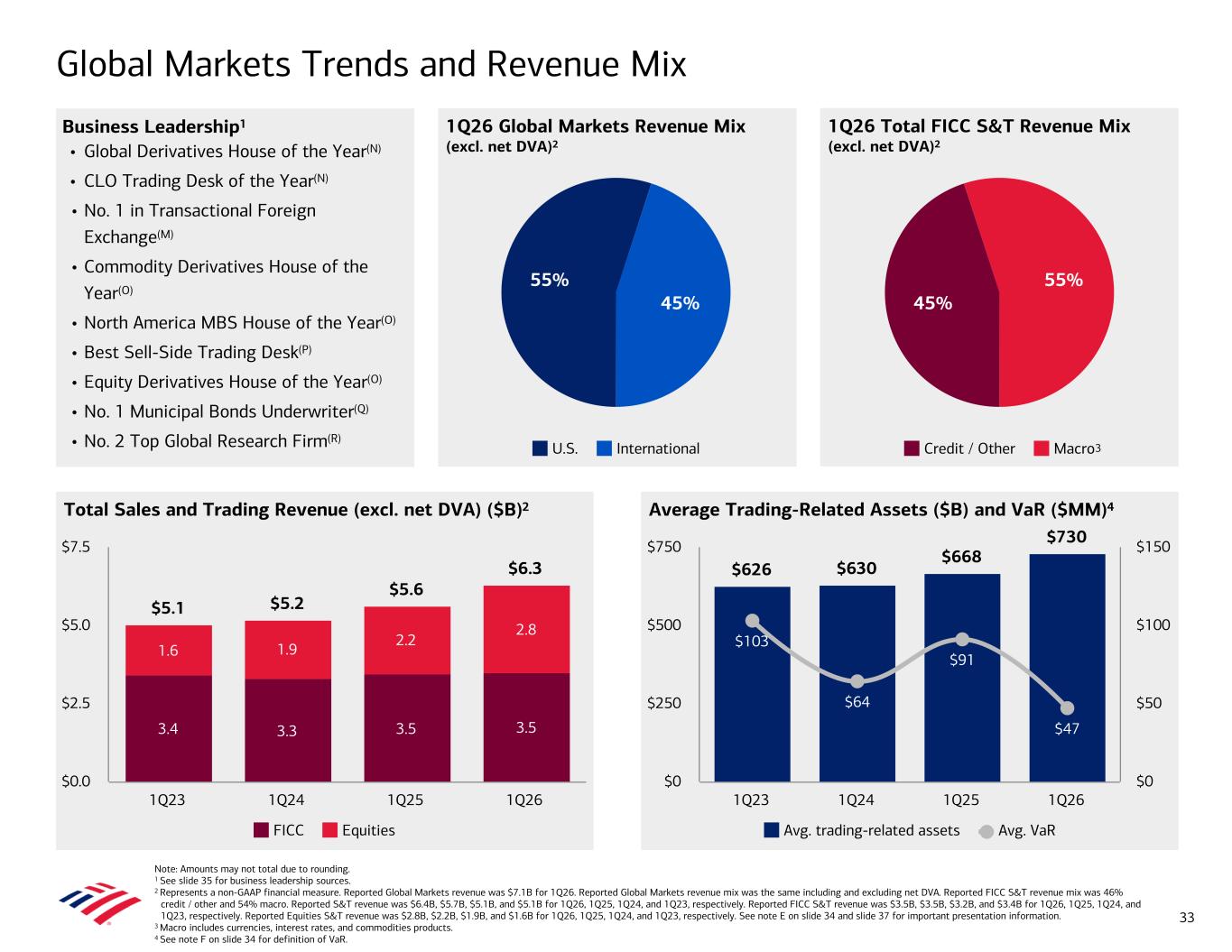
I'm going to begin with the balance sheet starting on slide 6. You can see total assets ended the quarter at approximately $3.5 trillion, up 2 percent link quarter, reflecting loan growth, deposit growth, and balance sheet to support our clients' increased activity in global markets. Deposits increased to more than $2 trillion, driven by continued strength in both commercial and consumer client engagement. Common shareholders' equity was approximately $276 billion, and relatively stable quarter over quarter, as earnings generation was more than offset by the capital we returned to shareholders through dividends and share repurchases. This quarter, we paid $2 billion in common dividends, and we bought back $7.2 billion of common shares. From a regulatory perspective, the CET1 capital ratio declined 14 basis points to 11.2 percent, and that decline primarily reflects the capital return to shareholders above earnings generation, as well as balance sheet growth and mixed change in support of our clients, and our ratio remains well above regulatory requirements. Looking ahead, we don't have any meaningful updates to report on the recently proposed Basel III endgame or GSIB capital changes. As proposed, Basel III would result in modestly higher capital requirements. However, the proposed changes to the GSIB surcharge are expected to more than offset the Basel III endgame impact for U.S. GSIBs. Taken together, if Basel III endgame and GSIB frameworks are adopted as proposed, we believe Bank of America is likely to see some reduction in overall capital requirements relative to the current regime in future periods. And the public comment period concludes in mid-June, and we look forward to the finalization of the rules. Liquidity remains strong, with global liquidity sources of more than $960 billion, well above regulatory requirements. And now as we go a little deeper on the balance sheet, we'll focus on loans and deposits. So start with deposits on slide 7, where our franchise continues to demonstrate strength, stability, and discipline. Average deposits remained solid during the quarter, increasing approximately $59 billion year-over-year, or 3%, reflecting the depth of our client relationships and the value customers place on safety, liquidity, and convenience, particularly in an environment where rates and market conditions remain dynamic. It's notable that both interest-bearing and non-interest-bearing deposits grew 3%. Growth was led by commercial clients while consumer banking grew more modestly, marking its fourth consecutive quarter now of year-over-year growth. Composition of our deposits remains a key differentiator. We benefit from a high-quality mix with a meaningful portion in low-cost operational balances and strong engagement across consumer, wealth, and commercial clients. that makes us continue to benefit our funding costs even as pricing competition persists across the industry the total rate paid on our deposits declined 16 basis points to 1.47 percent and this allows us to maintain one of the lowest cost funding profiles among the large u.s banks turning to loans on slide eight average balances grew nearly nine percent year over year driven primarily by client demand in our commercial portfolios. That growth was broad-based, and it reflects good core operating client activity. And as always, we remain disciplined in how we deploy our capital, prioritizing returns, credit quality, and relationship depth over volume. Consumer loan balances were up about 4% year-over-year, including 3% credit card growth. Wealth management contributed nicely to consumer loan growth through strong securities-based lending. And across both consumer and commercial portfolios, the credit performance remained consistent with our expectations, and we've not changed our risk posture. We remain highly liquid. We're focused on protecting our margin and preserving flexibility while continuing to support our clients. Let's turn to net interest income and slide nine. In the first quarter, net interest income on a fully taxable equivalent basis was $15.9 On a year-over-year, NII increased by $1.3 billion, or 9%, driven by growth in average loans and deposits, the ongoing benefit of fixed-rate asset repricing, and higher global markets client-related activity. And those tailwinds were partially offset by the impact of lower average rates in the Compared to Q4, NII was materially flat and reflected similar underlying benefits that were nearly enough to offset the negative impact of two fewer days of interest accrual in Q1. Net interest yield for the quarter was 2.07 percent, up eight basis points year-over-year, reflecting disciplined balance sheet management, funding optimization, and the continued benefit of repricing dynamics even as rates declined across the curve. Regarding interest rate sensitivity, we continue to provide a 12-month dynamic deposit-based sensitivity relative to the forward curve. And on that basis, an additional 100 basis point decline in rates beyond the forward curve would reduce NII over the next 12 months by $2 billion, while a 100 basis point increase would benefit NII by a little less than $500 million. Looking ahead, while the rate environment remains dynamic, we continue to see multiple levers supporting NII, including balance growth, funding optimization, and the ongoing roll-off of lower-yielding assets. Given our performance against expectations of NII in Q1 and based on the most recent interest rate curve, which has now shifted from two rate cuts expected to having none currently, we're raising our full-year NII growth guidance range for 26 versus 2025 to be up 6 to 8 percent, and that outlook continues to assume moderate deposit and long growth. Turning to expenses on slide 10, in the first quarter, non-interest expense was $18.5 billion. It was up 4% and consistent with the guidance we provided on our Q4 earnings call. We generated 290 basis points of operating leverage, and that translated into measurable improvement in both our efficiency ratio from 63% to 61% and an increase in the ROTCE to 16%. We continue to manage our cost base with discipline while investing selectively to support client activity and long-term growth. The year-over-year increase in expense largely reflects double-digit revenue growth in investment banking, asset management fees, and sales and trading, and the associated higher revenue-related incentives and transaction expenses. Stepping back, our approach here remains unchanged. We're investing where returns are clear, we tightly manage the discretionary spend, and we maintain our sharp focus on operating leverage, including expanding our use of technology and AI to improve operational efficiency and sales effectiveness. Looking ahead, we continue to expect more than 200 basis points of positive operating leverage for the year, consistent with our prior guidance, and we also have levers that preserve our flexibility to help navigate changing market conditions as required. Let's turn to slide 11 for a discussion of asset quality. Credit performance remains stable and consistent with our expectations. Net charge-offs were approximately $1.4 billion, with a net loss rate of 48 basis points. Both of those were down from Q125 and modestly up from Q4, primarily reflecting the normal seasonality in our card portfolio, with continued stability across the commercial portfolio portfolio and improved results in CRE office loans. Provision expense was approximately $1.3 billion, including a modest net reserve release driven by improvements in card and commercial real estate and partially offset by growth-related and targeted builds supporting corporate and commercial lending portfolios. Overall, as you can see, our credit results remain benign and we continue to feel good about the quality of our portfolio. Turning to slide 12 for some other credit metrics and a couple of comments here, commercial reservable criticized exposure declined to roughly $24 billion, while non-performing loans were flat quarter over quarter. It's also worth noting that this was the first quarter in more than three years with no new inflows of non-performing assets into office exposures, which is another sign of improvement in that portfolio. For perspective, we've now been in a benign credit environment for some time and our performance reflects the benefit of decades-long underwriting practices and responsible growth culture. We expect that approach to serve us well across a range of potential economic cycles. And we've updated the more detailed credit disclosures in the appendix beginning on slide 19. In addition, on Slides 24 and 25, we've chosen to include updated disclosure around our Global Markets Loan portfolio. And we start by saying we've not experienced any material losses in Global Markets Loans, and we feel good about the underwriting and the secured positions that we have here. We acknowledge the potential for underwriting dispersion in the portion that's considered the private credit market, particularly in the faster growth vintages, and we know that that risk sits first with sponsor equity and fund investors. Bank of America's exposure has structural insulation from those first loss positions. For losses to reach us, we believe operating company equity and a substantial portion of fund investor capital would need to be impaired before we would experience losses. We don't rely on sponsor marks. We re-underwrite collateral continuously for borrowing base purposes, and our exposure is governed by independently determined borrowing bases with ongoing performance tests. That means where credits deteriorate, the borrowing base contracts before the losses We see the market activity as largely a repricing of liquidity and growth expectations for alternative of asset managers, not evidence of systemic credit impairment. We continue to monitor the market closely, we're comfortable with our positioning, and we're also glad to see the return of more traditional C&I loan growth in the first quarter. Turning to slide 13, let's shift our focus to the lines of business and we'll start with consumer, where you can see consumer banking delivered a strong first quarter as customers continue to place their trust in Bank of America for their personal finances. Net income was $3.1 billion, up 21% year-over-year, driven by higher net interest income that led to 5% revenue growth, and we managed expense well. That resulted in over 500 basis points of operating leverage and a 53% efficiency ratio. We saw our fourth consecutive quarter of year-over-year deposit growth, with average deposits of $951 billion, while maintaining a high-quality mix with over half of balances in low and no interest checking. Client engagement remained a clear strength. We ended the quarter with a record 38.5 million consumer checking accounts, adding over 100,000 net new checking accounts this quarter. More than 90% of these relationships remain primary. Digital adoption remains strong, with 79% of households digitally active and 71% of sales coming through the digital channels compared to 65% a year ago. Finally, credit performance and consumer remain solid and in line with expectations. On slide 14, we turn to Global Wealth and Investment Management who also delivered a strong first quarter, benefiting from solid flows over the past four quarters, favorable market conditions, and disciplined expense management which together drove margin improvement and valuable operating leverage. Net income was $1.3 billion, up 32% year-over-year, on record first quarter revenue of $6.7 billion, driven by higher asset management fees and solid client flows. Pre-tax margin was 26%, reflecting the operating leverage achieved through disciplined expense management. Client balances increased to $4.6 trillion, up 10% year-over-year, supported by favorable market conditions and net client flows during the quarter. Asset management flows remain solid at $20 billion, and lending momentum continued with average loans up 13% year-over-year, led by custom lending and securities-based lending. We remain focused on pricing discipline, advisor productivity, and long-term client relationships. We're driving productivity higher on both newer and existing members of our financial advisors team, and we continue to attract talent across both new and experienced advisors. We moved to commercial and corporate client-facing businesses and global banking on slide 15, where global banking delivered solid results in the first quarter, year, reflecting strong client activity and continued balance sheet growth. Revenues were $6.3 billion, up 5% year-over-year, driven by higher net interest income and improved non-interest income. When combined with well-controlled expense, which rose only 1%, the business generated more than 350 basis points of operating leverage. Net income was $2.1 billion, up 8% from last year, as the higher revenue was partially offset by continued investment in the business and a higher provision for credit losses through builds of reserves that were primarily for loan growth. Investment banking fees of $1.8 billion were up 21% year over year and were a clear positive in the quarter. Investment banking Banking fees strong momentum was led by M&A with equity capital markets also up very nicely in the quarter. The year-over-year investment banking performance is particularly notable given our prior year first quarter included gains related to leveraged finance positions that didn't repeat this Balance sheet growth remained a strength and you can see average loans increased 5% year over year with all lines of business contributing. Deposits increased 13 percent year-over-year, reflecting continued client engagement across the franchise, and rates paid was down linked quarter and year-over-year. Returns remained strong with return on capital of 16 percent, which was higher year-over-year. Turning to global markets on slide 16, I'll focus my remarks as usual, ex-DVA, and global Global market's strong first quarter was driven by robust client activity and disciplined risk management in a volatile trading environment heightened by geopolitical uncertainty. Revenues ex-DVA were $7 billion, up 7% year-over-year, where sales and trading had its strongest performance in a decade, increasing 12% to $6.3 billion, led primarily by equities performance. And despite the noted volatility, we had no trading lost days during the quarter. Equities had their best quarter ever with revenues up 30% year-over-year, reflecting increased client activity and capital extended to the business for growth. The increase was driven by client financing activity, particularly in Asia, as well as strong trading performance in derivatives. FIC results remained strong and were modestly higher with strength in commodities, harshly offset by lower revenue in FX and interest rate products. Net income was $2 billion, which was up modestly from strong results in Q125 that also included roughly $230 million in gains related to leveraged finance positions. Higher revenues were offset by increased expenses on higher activity levels, increased people costs and our continued investment in this business. Average assets grew 14% year-over-year to $1.1 trillion, reflecting higher inventory levels and strong client balances. Returns remain solid with a 15% return on capital. Overall, Global Markets continues to deliver for our clients, producing consistent profitability, continued revenue momentum, and it reinforces the durability of the franchise across different and challenging market environments on slide 17 all other shows a modest profit of roughly 100 million dollars in Q1 with very little to cover here so as I wrap up I'll just note the Q1 effective tax rate was 17.5% that was seasonally lower reflecting the annual vesting of employee share based awards and as a reminder for the full year 2026 we expect an effective tax rate of just a little more than 20 percent so in closing first quarter of 26 reflected continued revenue momentum disciplined execution and improved efficiency and returns our diversified business model strong balance sheet and prudent risk management position as well for the remainder of the year and with that we'll open up the line for questions please leo thank you if you'd like to ask a question, press star 1 on your keypad.
Operator
To leave the queue at any time, press star 2. Once again, that is star 1 to ask a question, and we'll pause for just a moment to allow everyone a chance to join the queue. Thank you. Our first question comes from Nanan Gosalia with Morgan Stanley. Your line is open. Please go ahead.
Hi, good morning. Thanks for taking my questions. First up, just on the expense side, you know, the stronger NII guide was great to see, and you're keeping the expense guide, but you're also keeping the operating leverage guide. I know there's some level of rounding in here, but how do you think about dropping the benefit of the better NII to the bottom line?
Thanks for the question. We did this quarter, and we expect that the NII will drop the bottom line, and so if it goes up, you'd expect us to see a higher end of the operating leverage range like we did this quarter.
Got it. Perfect. And then maybe on the ROTC side, so I guess you've already delivered on a 16% ROTC within the 16 to 18% target. How do you think about staying within that range in the near term as you deliver on the operating leverage, and are there any one-timers, anything else we should be considering for this quarter?
Manon, I don't think there's any one-timers to consider here. We provided that guidance of a medium-term range for ROTCE over the course of the medium term, and, look, every quarter's going to be different. We're obviously gratified with 16% based on the strong operating leverage performance, But the key for us as a management team is just keep moving up the ladder. You know, a couple years ago it was 13%, then 14. Every quarter will be different. We've just got to keep making progress towards our goal, and that remains our focus as a management team.
Operator
Thank you. We'll now move on to Glenn Shore with Evercore. Please go ahead.
Hi. Thanks so much. Maybe an easy high-level one on the consumer. I think your spending is so good. Employment and wages have been strong. So the easy question is, why do you think loan and deposit growth in the consumer side is so sluggish? It's not like you're not opening new checking accounts, new credit card accounts. It's just curious on the high level there.
Well, Glenn, I think if we look back over time on the deposit side, what's been interesting, we talked about three or four years ago, at some point after the deposits were seeking higher yield, consumer would begin to find its floor when you look at what's happening right now you can see now four quarters in a row of year-over-year deposit growth so it looks like we're finding that floor and beginning to grow out of it you can also see if you look at our numbers growth in non-interest bearing and a little bit more this quarter than we've seen in the prior quarters so they're the elements that are sort of saying it's beginning to pick up now obviously there's an interest rate environment and there's a spend environment that go against deposits but it feels to us like the consumer part which is so powerful is beginning to turn and grow and at the beginnings of accelerating that's kind of where we are in the longer arc on the lending side you know we're in a period right now where unemployment's good home prices are good asset prices are good savings remain elevated so the lending's pretty broad based within consumer but it you know you're getting three or four percent growth there can we see more over time yes um but at this point i think relative to how the consumer is performing we're in a good place only final thing i'll just say is you know we've talked about the fact that we've got to focus on our own balance sheet efficiency. We've talked about the fact that we've got, you know, the ability over time just to allow some of the retail and the institutional CDs to pay off, and we've sort of done that. So we don't have to chase CDs at this point. That in turn has meant that, you know, we've been very disciplined on rate paid. So we could put up more deposit growth if we wanted to, but we're really choosing at this point to just maximize the core operating client account activity. That's what we're focused on. Well, I think it's working.
That's cool. I appreciate that. I was interested, you guys mentioned that headcount's down over 1,000 this year. If I look over the last five years, it's kind of flattish, but there's a lot underneath the covers, right? you're adding in growth areas you're subtracting some other areas and i think your attrition rate is more like seven percent so maybe can you talk about some of the puts and takes where you're adding where you're shrinking and obviously the question of how ai might where are you in the ai journey in terms of how that might bring a a little bit larger uh head count reduction or not replacing all the intrition going forward thanks well in the long arc if you look in 2007 seven before we bought Merrill and Countrywide, to give you a sense, we had more employees
at Bank of America than we have today. And so the application of technology to process and the customer utilization of our technology has let us basically run the company 19 years later on less people. And so this is not a new trend. What you're seeing now is the continuation of those trends. And you're right. So as we showed you at Investor Day, we showed you a shorter term. We showed headcount down 80,000. We showed it 50,000 out of the consumer set of businesses at 25,000 out of ops. What we're seeing now, and during that time we made massive investments in technologists and cybersecurity from a few hundred people to 3,000 people, et cetera, et cetera. We continue to shift investment. That went on again this quarter where you saw headcount drift down out of operational process and managers and things like that, and that investment goes into developing more headcount and the relationship manager businesses across the board, and so we'll continue to do that to support the growth of businesses. So we're doing it through attrition. Each month we have to hire 1,300 people round numbers to stay neutral in the company, and so you can adjust the headcount by just being careful and hiring and let attrition be your friend, as we call it. and that's how we got down 1,000 people. But it comes from eliminating work and applying technology and consumer and commercial customers using those technologies. AI gives us places to go we haven't gone. We've got 90 installations working. All 200,000 teammates have access to AI or can use it every day. Eric is more understood out there, but it's been brought across lots of platforms, the models. And so we're still in the early stages of what all this will do. but we're seeing real benefits out of it today.
Operator
Thank you. We'll now move on to John McDonald with Truist Securities. Please go ahead. Your line is open.
Hey, guys. In terms of capital, with a peek at the new proposals, how are you thinking about a capital target as you strive towards your ROTCE goals?
Just kind of wondering, now that you have some more incremental comfort in narrowing that management buffer that you have today, which is over 100 basis points to the reg minimums thank you thanks john well i think as we're getting more and more clarity you've seen us take advantage of that by just allowing the capital ratios to drift down so we'll wait ultimately to see what the final rules all look like but it's pretty clear to us at this point that yes basel 3 end game rwas will be a little higher Yes, it appears GSIB inflation indexing is going to give us some relief, particularly as you move forward into future periods. So that's allowed us to do a little bit more buyback. It's allowed us to put out a little bit more balance sheet. So we're gaining a little more confidence, but at the end of the day, we're in a good place right now. We have plenty of capital, plenty of flexibility, we're earning well. Now we've just got to wait for the final rules.
John, I think your point about operating closer to the minimums, leave aside everything Alistair talked about, and the shifts across time, the new rules, the old rules, and the transition. The reality is as we have studied this, the volatility in our earnings stream under all the stress scenarios that we run every quarter is how we start to think about the cushion we have to maintain. And that cushion could be tighter to the reg minimum without having the same threats because of stability in the earnings streams and the capabilities of the company. So we brought it from a broader range to a narrower range. They expect us to keep it in the 50 basis points that we said. And so if the underlying requirement goes down, you know, the whole number goes down, et cetera. So let it play out a little bit. But there's no philosophical change in maintaining a decent cushion, but not an overly big cushion. But our fine-tuning of that across the last three or four years really is based on the capabilities this company to earn through different things like the COVID, the regional bank crisis, et cetera. You can see that the volatility.
So what you're saying, Brian, is the 50 basis point kind of management buffer is over time what you'd expect to gravitate to.
And we were moving there, but we're taking all earned capital out, right, through dividends and buybacks. That then leaves the nominal amount the same, and we're growing the company into it. And then we've got all these rules and how they'll be implemented. Remember, there's step-ups and steps down, and, you know, that we've got to sort of see play out here, but you've got it right. Just think of the long-term 50 basis points over the minimum is more what we're shooting for.
And then, Alistair, could you give a little more color on the drivers of the change, the tweak, and the NII outlook, and more specifically what you're assuming within the modest loan and deposit growth inside of that guide?
Yeah, so we're not really changing anything in terms of the loan and deposit growth. we've been pretty encouraged with the way that started out the year so it's more a continuation of what we've seen but we've seen pretty good organic growth so that's been good the rotation is slowing from non-interest bearing or into interest bearing in fact non-interest bearing picked up a little bit this quarter so we're happy to see that so for as long as the loan growth stays there deposit growth looks good lost a couple of rate cuts those those might have hurt us at the back end of the year, they're not going to hurt us in the same way. So all those things, you add them up, it's a little bit of all of them. Put a little bit more balance sheet into global markets. So you add it up, that all feels good. And final thing, John, is if you take a look at the loan growth disclosure that we put out, I think it's on page 8 of our release, you'll see pretty broad based now from each of the lines of business, pretty broad-based by each of the products, so we're not reliant on any one thing, and that gives us a little more confidence around durability.
Operator
Thank you. We'll now move on to Jim Mitchell with Seaport Global. Your line is open.
Hey. Alistair, could you expand on the funding optimization point a little bit? It seems like you had a significant drop in rates paid on non-U.S. deposits, so overall, How much can you do on that fund optimization point? And how do we think about balance sheet growth in that context?
Yeah, so this is something we've talked about in prior earnings calls, Jim. So no change to what we've been thinking about over the course of the past couple of years. We, you know, had some, I'll call it balance sheet puffiness around some of the longer dated CDs and some of the repo activity. And as we go through the course of time, what we believe we can continue to do is just allow those to drift lower, which in turn is good for NIY. It probably doesn't impact NII particularly, but it just, we can fund the core growth of the clients while allowing some of that balance sheet puff to come out. So that's what we're doing, we're just sticking to that. You can see the CD's coming down quietly, slowly over time, taking some of the repo down quietly slowly over time while still getting more balance sheet to the business for clients and it can you quantify how much you think is left of that you know I think last time we got together we said probably you know somewhere around a hundred billion or so right that could be a little more could be a little less it's in that kind of a number Jim be careful about nominal in other words within your balance if we grow core loans within the balance sheet and let other stuff go off but you know the total footings at one point, but it's what you're holding within those footings that's
the key point and what liabilities you have within those footings. So I think it was pointed out by one of your colleagues earlier, if you think about deposits in our company and you look at slide 7 and look at the rate drop across the board, we are clearly at the core of core deposits in all the businesses. They have different aspects, obviously, a wealth management business, so a core deposit is different than a mass market consumer business or even a small business versus a large corporation. So look at that page and just think about, you know, we're sitting with $2 trillion of depository and two-ish of loans, and, you know, we're only going to take the deposits we need. We're going to take the deposits from the customers in line with their core operating capabilities and the core business. That's what we're focused on.
Yep. No, absolutely. And on the CNI side, Alistair, you mentioned that more traditional CNI growth is picked Is that an early read on taking some share from private credit given disruptions there, or is it simply just broadly improving demand and improvement in credit line utilization?
It's mostly credit line utilization this quarter. So at the end of Q4, we saw a little bit of revolver paydown, which probably took our loan balances down we still grew loans in q4 but the growth wasn't quite as high because the revolver utilization came down it just came back and a little bit more in q1 so we probably picked up five to ten billion of loan growth just from revolver draws so it's it's sort of core middle market activity building working capital across corporate america and internationally that's we saw the growth.
Operator
Thank you. We'll now move on to Mike Mayo with Wells Fargo Securities. Your line is open.
Hi. What a difference a quarter makes. I think what I hear you saying is that you feel better about the short term and you can correct that, but you got the 16% ROTC, you're guiding NII higher, you have 290 base points of year-to-year operating leverage so i think you're saying the short term better but uh since the last earnings report there's been concerns about the long term right that ai agents will come and take your deposits that ai bad actors will commit cyber crimes against you the ai spend will not bear fruit um so i know you guys have erica and cathro and gen ai at over 4 000 patents and you know as you You've brought up less employees since 2007 and also, you know, some other advantages there. But as you think about that debate, the long-term debate about AI, you being a victim or you being a beneficiary, why is Bank of America an AI beneficiary? And if you could just frame it some way, I know the question was asked already, but, you know, revenues per employee, how much would you expect that to increase or, you know, something around that?
Mike, I think in your question, you gave the answer, which is we are a beneficiary of the impacts of all technology, including AI. We've applied it and will continue to apply it. Our team's job, and we've got catalyst efforts going on on a corporate-wide basis to bring all the ideas to bear. Our team's job is to benefit from the technology. It creates issues about cybersecurity and things like that that you're reading about in the paper and we take those extremely seriously and invested heavily to do it and work with our industry colleagues and colleagues in other industries to ensure the safety and security of but there's you know they'll always be positive pressure on the earnings due to the application technology and AI gives us a lot of efforts there there's nothing new and different about the ability to move deposits, so that you can move them, we can move them in our company instantaneously to other, you know, off-balance sheet, on-balance sheet rates. So the question is what are the deposits for? And I think what gets lost in all this discussion is a little bit the reflection of the earlier discussion on deposit rate paid is we have the deposits because people have their transaction accounts with us, they're moving money. The CD and, you know, at-the-market deposit practice in our company is a small part of what we do to drive the economic value with our customers to be the core depository institution and transactional banks with them, as well as their lending bank. And we feel very strongly that advantages of AI will help us drive even greater markets.
I guess as a follow-up to that, I guess you remind me like the primary checking account, I think is what you're saying, is very sticky. How can you use AI to improve the trust of customers, whether it's with a cyber risk? I'm not sure if you were one of the CEOs who went down to D.C., or just trust with data and identity and the relationships.
Sure. I think the trust in our – the customer scores in our institution are at all-time highs. And the trust they see and the way we use data and the way we use information, frankly, some of the gates on our adoption of some of these technologies are we're protecting customer data where other people are not. And that's been a constant struggle from cloud computing into this. So we keep our data out of the models. We keep our customer data, et cetera, and take advantage of the models coming into us but not feeding them. And that's what we owe our customers. We feel we're in a great trusted position. We spent a lot of time and money over the years making sure we get to what we call never down and continue to deploy hot, hot, hot backups and systems that will step in for each other. We work with the industry to ensure that that goes throughout the other platforms, the FMUs and things like that. So if you ask digital capabilities or technology capabilities and the trust in this, as a matter of fact, it's higher than it's ever been, and it's growing literally month after month after month, so we feel good about that.
And then last follow-up, just in five years from now, we look back and say, okay, AI, tech, where should we see the benefits? Is it just the stickiness of the relationship, or is it efficiency, or where should that show up?
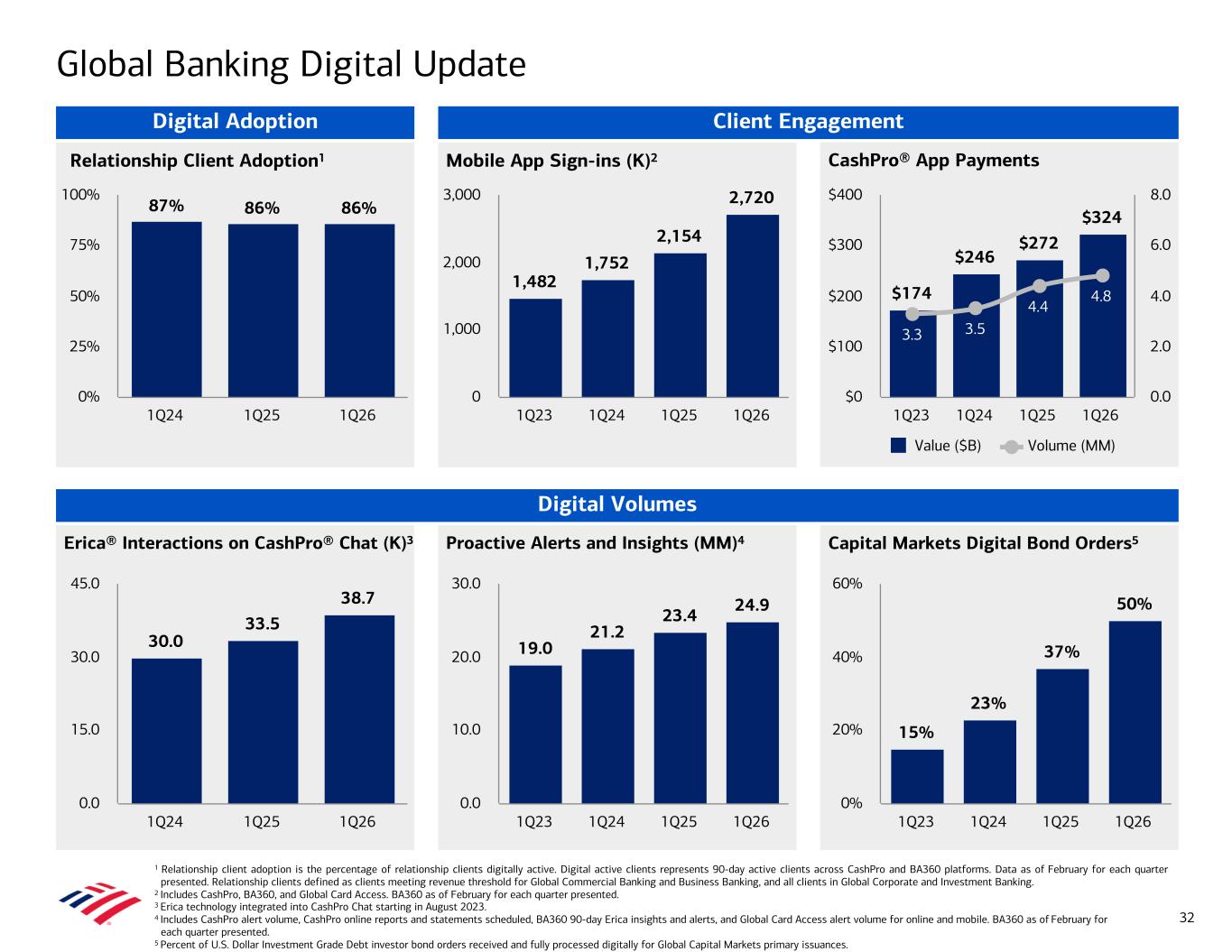
If you think about today, just on the consumer side, Mike, because it's two things. One, you said the core deposit account. It's a core deposit account. It's a core investment account. It's a core corporate transactional account. It's a core borrowing home. So each of these core is what you're seeking, not just growth overall. So I just want to make sure it's a little broader. But if you say five years from now and think about it, you know, I think you'll see the same elements. We should continue to see more and more digital or AI-generated interfaces of the client. But I think AI really helps us internally. Just to make it straightforward, 99% round numbers are digital already. So there's no person involved. So as you start to think about that, you go the inverse, the cost of that 1% is a pretty high number, and we're working on that with all this technology, and we're working on the efficiency even of the 99% in-house delivered. The example of that is Erica versus alerts. Alerts are basically, instead of doing prompts, we're using the same technology to deliver to you a constant flow of information. That saves the interface on the prompts and things, and also allows it to be more interactive with the customer. So in the AI, intelligence and technology intelligence is not different. So there'll be more of it. I think at the end of the day, if you think about from seven till now, the same number of people, we'll be plowing into the front end where relationship managers matter, the high touch piece, which is critically important delivery. You'll see us keep adding there, and you'll see us keep taking out of the activities that are not directly facing the customer. but even on the customer facing with 90,000 sales force moving to agent force and AI and prep will get more efficient on that too. So I'm not going to give you exactly because you know that's fraught with error because it never quite works out that way, but the trends will be more technology, more intimacy with the customers, more agentic versus prompt, more built into the process rather than have it be delivered by teammates doing something. i.e. it's part of the process more customers doing more with us and expense will be in the operating leverage will be there all right thank you thank you we'll now move on to erica najarian with ubs your line is open hi good morning um just two quick follow-up questions for me
um first on the net interest income outlook as we think about the possibility of no rate cuts How should we think about how B of A is going to handle deposit costs in that scenario? Could deposit costs be contained, particularly given sort of the loan growth in the market's balance sheet, if the Fed doesn't cut?
Erica, I think so. I mean, if the rates aren't moving, I don't see a great deal of impetus for us to be changing what we're paying in the interest-bearing side. and then it'll just be a question of which of the two categories grows faster interest-bearing or non-interest-bearing so pointed out right now we've got a little bit of growth in both so that's helpful we'll have to watch that over the course of the year but you know even with two rate cuts no longer no longer in the period in the second half doesn't make a great deal of difference because you're really talking about one cut for six months one for three months in the old version so we'll be a slight beneficiary of that but the main thing going on is just organic growth of the company at it and just a very technical
question on you know some of the capital reform proposals and you know this sort of came to everyone's attention when one of your peers reported yesterday you know fully appreciate that the regulators are trying to address retrospective inflation with the coefficient changes, but companies like Bank of America, you know, in theory, based on your 2025 G-sub score, are set to go up by January 1st, 2028. Now, clearly, a lot of that growth was related to the economy, and your risk density continues to go down you know as you think about the comment period you know is that something you would address um because obviously um you know there's there's 90 days and you you know there's a lot of dialogue i'm sure going on between the industry but i thought that was particularly notable in terms of that 2025 score potentially bringing your g-sib up you know by january 2028 despite the positive revision on the surcharge.
Yeah, so there are two worlds right now, Erica. There's the current rules and there's proposed rules. We don't have the proposed rules finalized yet. I just say the main thing you're talking about, which is G-SIB numbers going higher over time, the new proposal addresses that because there's inflation indexing. So what might look like a raise in the future may not be a rise in the G-SIB. So that's why we believe in the course of this, that's one of the most important things done here. We expect to be a beneficiary of that because we're an organic growth company, as will all the large GSIBs, one would think.
Erica, one thing to think about is, in the words of the old song, you can't always get what you want, but you can get what you need. At the end of the day, we needed a concept of indexing because it was in the original rule that off the 12-day, 2012 data, that it was supposed to be indexed. So we needed that in there. What we would have wanted was a longer-term perspective than we are getting on it, but at least it's in the concept and we baked in a rule. Then we can go to work on, you know, how that impact, because it was just, you know, we in the industry are not going to get everything we want in these proposals because in the end of the day, you know, there's, it's hard, there's some negotiation going on. But on the other hand, you know, we're getting what we need, which is a concept of indexing because it was meant to be an original rule. It wasn't put in, and then with a gross growth in the economy from 19 and now, we all had an increase in capital, 15, 20 percent with no major risk. So we got the concept in, let them finalize the rules. We're never going to get everything the industry should get or desires to get, or actually we believe we should get, but at the end of the day, we've got to get moving along here so we can get this implemented and then fine-tune the models around it.
Got it. And Brian, fantastic job on addressing the efficiency questions very clearly earlier in Thank you.
Operator
We'll now move on to Ken Houston with Autonomous Research. Your line is now open.
Thanks a lot. Yeah, just one follow-up here. With the great start on the 9% growth in NII and you took up the range to 6 to 8, I'm just wondering, Alistair, just as you look through the year, why couldn't the first-year growth rate, you know, stay there? And are there any either comp things or shifts in kind of the expectations around markets-related NII, you know, from NII to fees, given the higher for longer, or any other point that we should just be mindful of, or is it just, you know, we'll see because it's early in the year and there's a lot that could still play out?
Well, it's a little bit of that. It's early in the year. We'll see how it plays out. But it's also a little bit of recognition that last year we had a bigger second half, just because of the shape of the fixed-rate asset repricing that took place. And we just got a little bit less of fixed-rate asset repricing taking place in the second half of this year. So it's really a year-over-year comps thing that we're looking at. Now, by the way, the organic growth continues to pick up. Can we do better? Of course, but that's why we give you as much guidance as we can each quarter based on what we actually see.
That's fair. And then on Brian's point about the great start to operating leverage, 290, and the same kind of question. Like, you did great in holding the line on cost, and I know you're trying to not focus this on a cost guide per se, but is the demonstration of that flexibility going to be the ultimate, you know, driver of the incremental to get you, you know, from one side of the $200 to $300 to potentially the higher side? I mean, you know, I just kind of wonder just, you know, can you keep this range reasonably tight on the expense growth trajectory?
Yeah, so we provided a guidance on operating leverage looking forward over a three to five year period and said we're aiming for 200 to 300 basis points. If we can do more, we will. Every quarter is going to look different because your comparable versus last year will look different, the growth will look different, and so we just we recognize we have to have a range because it's not going to be the same every single quarter. That's one point. Second, The main thing that we have to do on the expense side is just be really disciplined on headcount because that remains 60 to 70 percent of the cost base when you really think about it. So you're going to look at the headcount. That's going to give you a pretty good idea as to whether or not we're really focused on the core operating expense and being disciplined there. And then you've got revenue-related expense. Many of those are good. Those are good expenses. We don't want to have to apologize for that. that's why we focus people on the operating leverage because when the assets under management fees are going up 15 percent when the investment banking's going up 20 percent when the sales and trading's going up 12 percent those are good things and with them come good costs so that's what we're managing on the operating leverage we had a good quarter this quarter we're on to the next we're figuring out how we can do 200 and higher this next quarter got it thanks thank you We'll now move on to Chris McGrady with ABW.
Operator
Your line is now open.
Chris McGrady Good morning, everybody. I'm interested in an update on the wealth strategy relative to the NNA targets laid out in November. Any recruiting or retention commentary would be great.
Chris McGrady So I think we, so two things, we'll update those targets, you know, not every quarter just because they're longer-term targets or medium-term, long-term targets on that new growth. On recruiting, I think the team's doing a very good job, and we're getting in a double amount of advisors this year, first quarter, as we did last year, something like that. But importantly, the attrition of the advisors is down to low level, and it's a net benefit So we feel that Lindsey and Eric and Katie in the private bank are all well on the way of driving those metrics to where they should go and the business you know had nice operating profit which it will do when markets year-over-year up it's a nice pickup and the margin continues to improve year-over-year up a couple of hundred basis points so they've done a good job importantly can look on the organic growth pages you'll see some pieces in there about account checking accounts and rounding out the relationship and the loan growth and wealth management is very strong for the last year or so so we're feel very good about it we'll update you on those when we do more of a general update for the company and we feel good.
Great, thanks Brian. And then the popular question this quarter is then you know durability of trading revenues. I'm interested in how you see you know the potential of the firm to grow trading revenues in the mix within trading over the next year in the immediate term. Thanks.
Well we still feel good about it and this is another quarter where we allocated a little bit more in the way of resources to the team. They delivered with another 15% return on allocated capital. And at the end of the day, we've got a big, global, diversified set of businesses in global markets. Equities did very well this quarter. Commodities did well this quarter. Our international businesses came through this quarter. So, you know, this is what you have when you've got a nice portfolio of businesses. Activity can move from one to another, still end up with 12% sales and trading increases year-over-year. So we've obviously invested a lot. We'll continue to invest in this business. The client activity remains robust. There's a lot going on in the world, and people have to think about then their financing and their risk management and repositioning. So we've clearly been a beneficiary of our client activity as well, but we feel good about the business, and we'll keep investing.
Operator
Thank you. We'll move next to Gerard Cassidy with RBC Capital Markets. Your line is open.
Thank you. Hi, Brian. Hi, Alistair. How are you? Good. Thank you. Alistair, you talked about the loan growth and how the utilization rates have come up a bit. You also mentioned about the consumer growth in the quarter, or maybe, Brian, at about 4%. The question I have is we're starting to hear from a few banks that, you know, the underwriting standards might be getting stretched. And I know you guys emphasize you're sticking to your discipline on underwriting standards. But are you guys seeing that in any areas, particularly in the global markets lending area? Are people pushing it? And you guys are just, you know, walking away from stuff maybe more often today than maybe 12 months ago?
Well, we've not seen any of that here. and we haven't detected that elsewhere at this stage.
Very good. And then as a follow-up, Brian, you talked about the growth of the consumer. You talked about the debit card growth and the credit growth. I think it was slide five. We often hear about this K-shaped recovery in the lower end, you know, struggling with inflation, the higher end better off because of the affluence. Are there any – what are the risks that may prop up or crop up for the higher end six or 12 months from now? Everybody's always focused on that lower end concern. Are there any, should there be some concerns at the higher end, or what could they be?
I think at the end of the day, whether you're talking about credit quality or the ability to spend money, it's always going to come back to the broad base of American population that's critical to the economy. They're working, and so are the unemployment levels staying in the four-and-a-half range and, you know, et cetera, and then there's wage growth there. And I think wage growth has been solid among all the different parts of the earnings spectrum. And the question will be will wage growth continue? And both those things have, you know, up until quarter you're saying, you know, spending grow among all those parts of the economy just at a faster rate. And we look at a third growing everywhere, faster rate in the middle and high. but the wage growth has been solid across all those populations and so the spending ought to be there so I I would just keep watching the unemployment new claims are up around 200,000 change continuing claims 1.8 their levels that they were on a bigger workforce than they were in pre-pandemic and so until those move I don't see anything that interrupts the actual spending capability of and I I know often people say you're optimistic I I'm giving the what we see
today in the spending even in early school thing what they do not what they say they're going to do and that's going to be dictated more am I employed do I have a job or my wages growing and I feel and I assume you guys are watching the tax refunds which are coming in better than expected which obviously will bolster consumer spending as well thank you I appreciate Brian and Alistair thank you we'll now move on to David Chavarini with Jeffries your line is open hi thanks for uh taking the questions um follow up on loan pipelines and borrower sentiment
on the commercial side are you observing any change in borrower behavior given the middle east tensions were the line utilization drawdowns defensive or normal course of business type of drawdowns?
These were not panic draws. This has generally been BAU working capital type of activity at this stage.
And, David, I think when you talk to commercial customers and you think about where they were last year with, you know, Liberation Day in the middle of that, you come a year forward and a lot of things have been figured out with trade tarot policy, you know, tax and deregulation was coming, the major principles were flowing through. Obviously, the Middle East and the trade tariff and all that stuff has got them thinking, but they're still seeing solid demands. They're all trying to figure out what happens next. And so the borrowings right now are because they see opportunities. And we'll see what happens with the resolution of the Middle East conflict and other things and what the terms are, what the duration of the inflation is. And that could impact them, but you're not seeing it now.
Great to hear. And then shifting over to fixed asset repricing, that's been a nice tailwind for you guys. At what point does the repricing tailwind begin to moderate? And if you happen to have at your fingertips, the dollar volume of fixed assets that are expected to reprice in coming quarters?
When we got together at Investor Day, we laid out, number one, the magnitude, number two, the time period. And you can think about it, David, as five years. So it's not going to be one quarter, it's going to be every quarter for the course of the next five years, assuming rates stay where they are. So we laid out pretty good disclosure there. I would encourage you just to take a look at that. What you'll see is we put it in three different buckets. One was the residential mortgage, the auto loans that come off our balance sheet with clients every quarter and new ones that come on. We laid it out in terms of treasuries and mortgage-backed securities in our securities portfolio that will mature and we reprice every quarter. And then we laid it out in terms of the cash flow swaps and the hedging activities we do. So it's pretty good disclosure there. It's a five-year thing. It's a little bit longer than that, but the majority is it, the vast majority is in the next five years. We laid out the numbers. It might be helpful, okay?
Operator
Thank you. We'll move on now to Saul Martinez with HSBC. Your line is open.
Hi. Thanks for taking my question. I want to ask about reserving. I was a little bit surprised that you saw the slight reserve release this quarter, given the macro uncertainties. And so, I guess, how are you factoring in macro volatility, downside case scenarios, into reserving? Because it does seem like you take a, you know, a different approach to reserving them than some of your peers. You know, I fully agree that you're under, you know, your track record on credit is comparatively strong. Lost content has been lower than your peers. You see that in the stress test that you guys have highlighted a number of times. But if I look at your reserve ratios by segment, but also things like reserve coverage of charge-offs, reserve coverage delinquent loans it tends to be lower than your peers so um i guess why not be a little bit more conservative in your reserving and i'm curious you know if you if you um agree or disagree with with my assessment that maybe you're i don't want to call it more aggressive and reserving but maybe more realistic in your reserving than some of your peers but i'm curious just philosophically um you know your approach here on reserving and and why not be a little bit more um you you know, a little bit more conservative in terms of your reserving?
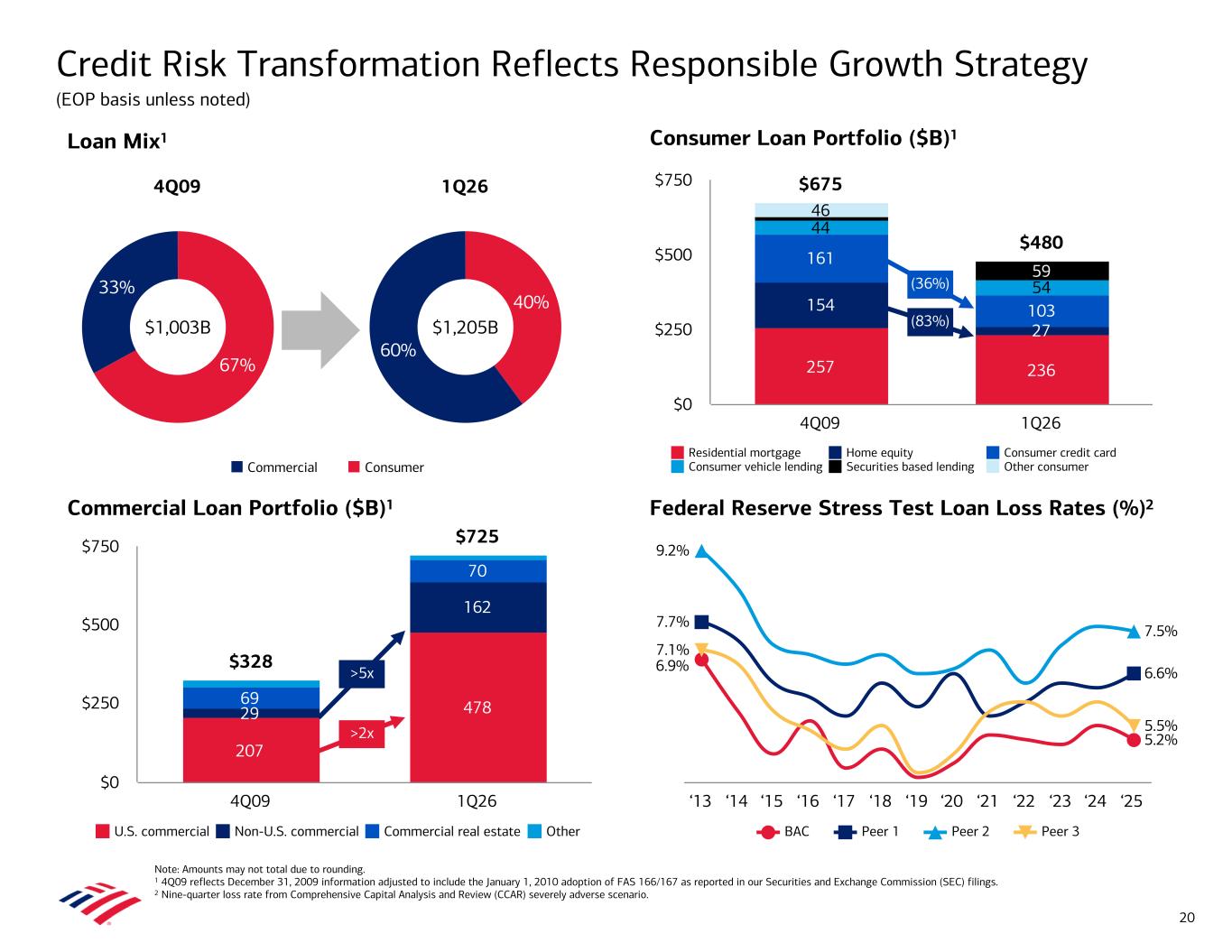
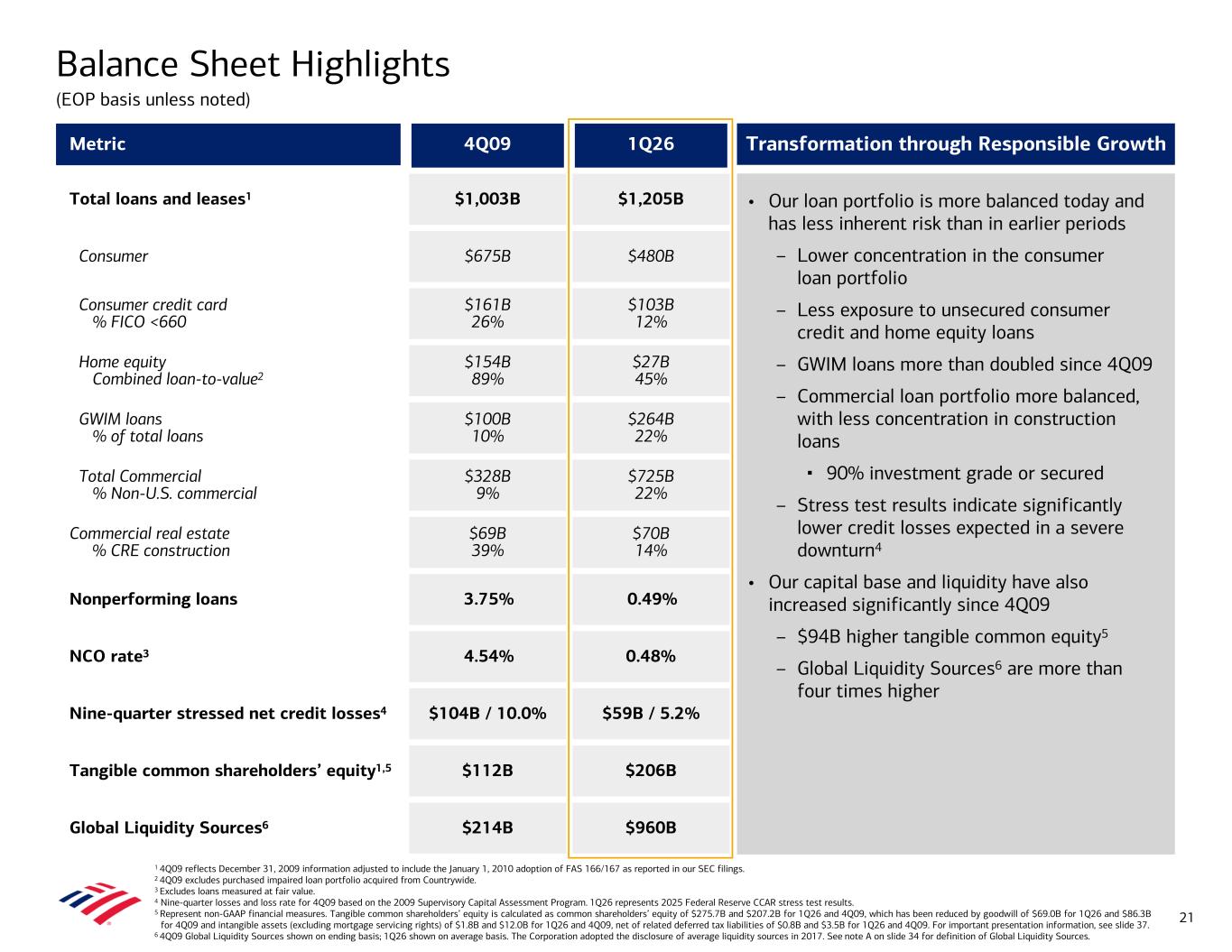
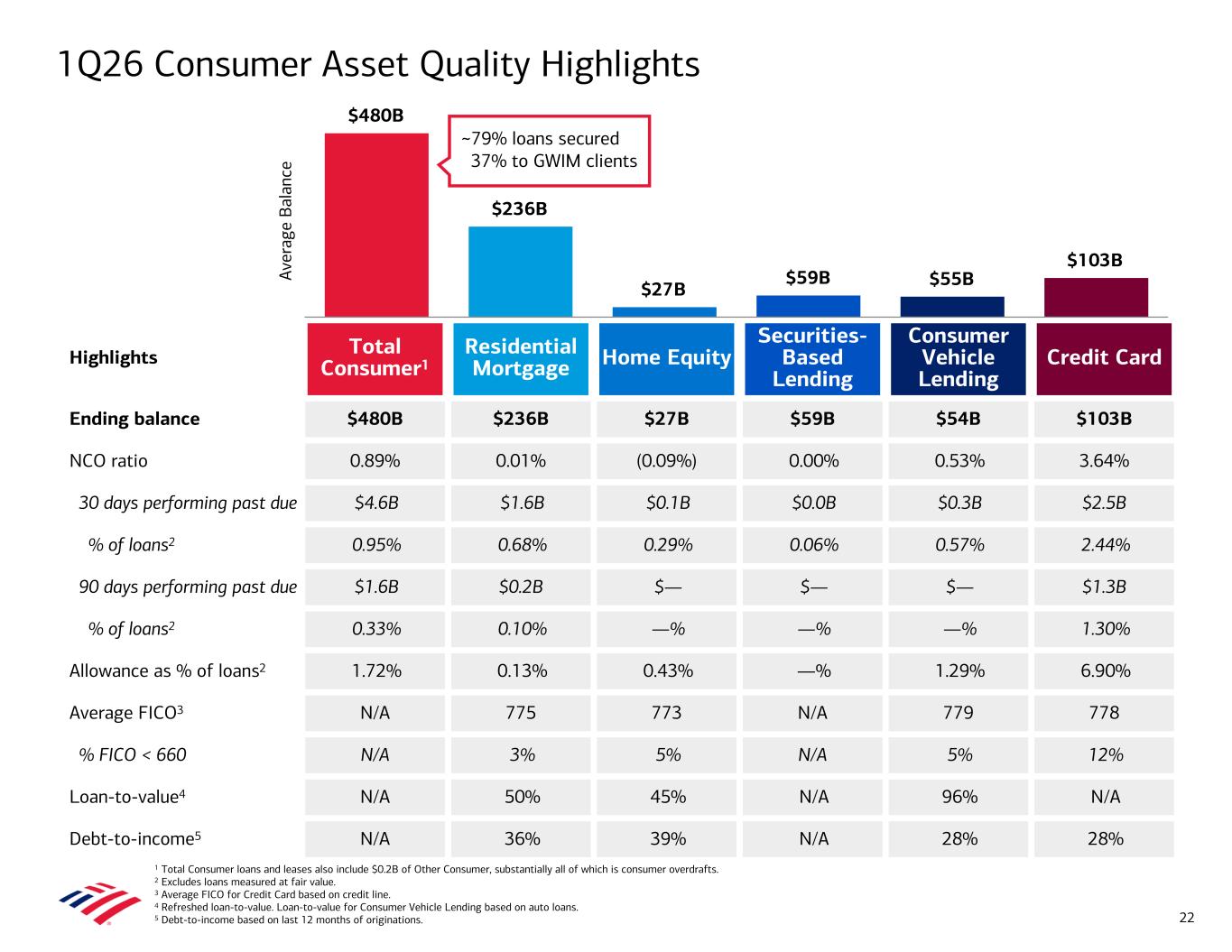
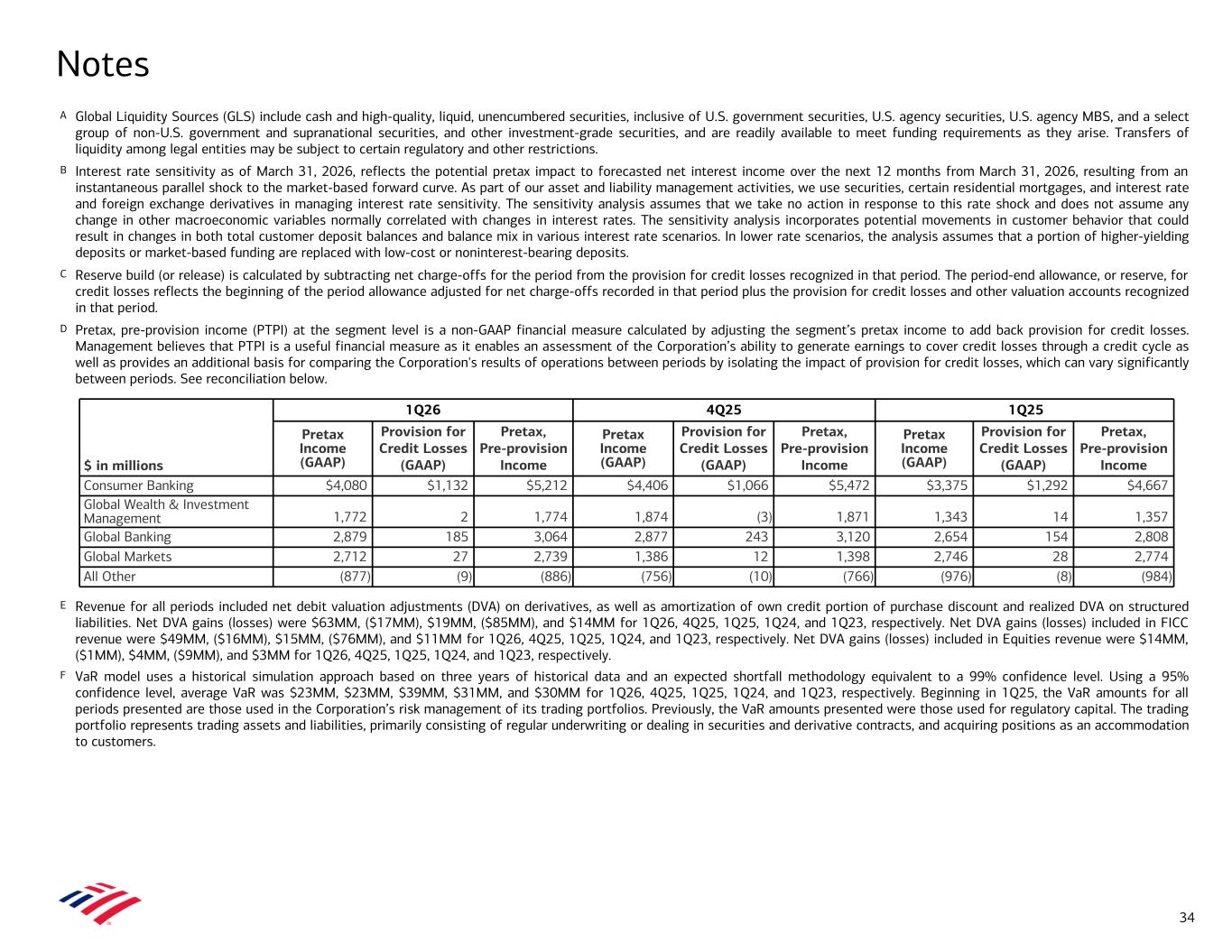
Okay, so first, I don't think we have any difference in the way we think about reserving relative to anyone else. We all operate under the same CECL methodology. We all operate in the same way. Second, I'd say in terms of whether we have lower reserves or allowance, tends for most banks to be reflective of the quality of their lending portfolio, the risk they take, and their client selection so when we show you on slides 20 21 and 22 how we have transformed the company over the course of the past 15 years we have a very different risk profile of our lending than many of our peers so when you look at for example on page 20 of the earnings you'll see that a lot less of consumer unsecured a lot less of credit card a lot less of home equity lines we have a lot more of wealth loans and when you look at the Federal Reserve stress test loss rate we've been the lowest 13 of the last 14 years which would tell you we probably should have a lower reserve because we have a more conservative approach to our client selection and the type of risk that we take. So we don't think we're any different than other people. We just think we've got a higher quality client base and a higher quality loan portfolio. And the final thing I'll just say is in the course of any given quarter, you might take, like for example, this quarter, we took 5% out of the upside case. Put it in the baseline. So we're pretty heavily skewed at this point towards a downside case plus baseline. And the only thing that happened to offset that was we had some release from the continued improvement in CRE office where we had built reserve pretty significantly. And as that portfolio has gotten smaller, as we've got less and less in the way of NPLs and res crit there, we've been able to take some of the reserve back out. So that's all that's going on in this particular quarter.
Okay, no, that's helpful. Maybe just a follow-up then on NII, obviously encouraging to see the guidance increased. NIIX markets up about 5% year-on-year, which is a good number, obviously lower than 9%, but a good number. How should we think about what the 6 to 8 means for growth in NIIX markets? And, you know, should we be thinking that global markets NII kind of, you know, stabilizes at current levels given that it's benefited from lower rates? And if we see, you know, the Fed on hold here, you know, maybe it kind of sticks around these levels. And also just, you know, remind us, you know, what proportion of global markets NII is revenue earnings neutral? Because my understanding is that some part of it is, you know, is not. but it does flow to the bottom line. But, you know, is it predominantly, you know, offset by, you know, higher global markets NII, offset by lower global markets, non-interest revenue? So just, you know, any color you can give there, that would be helpful.
Yeah, so the global markets business NII has benefited over the course of the past couple of years from, number one, rates coming lower, and number two, continued balance sheet growth. Yeah. If rates don't go lower, that engine for global markets, NII growth, won't be there. So, you know, you can almost think that going forward, more and more of the NII growth is going to come from global banking, consumer, and global wealth. And less of it is probably coming from global markets. And then, in terms of the NII, there will be quarters where a little bit of the NII is offset in MMSA. Last quarter happened to be one where I noted we got about $100 million or so of NII benefit that was offset in MMSA, but I don't anticipate that being a big story for us going forward. We've talked about the fact that the NII that we're generating is going to drop to the bottom That continues to be our position.
And that's true in markets as well.
Yes. Generally speaking, it just depends on the client activity in markets because sometimes Sometimes they can change from on-balance sheet to off-balance sheet. It sometimes changes the NII composition. But if it ever came up where it was a large impact, I would share that. Okay. That's really helpful.
Operator
Thank you. There are no further questions at this time. I'm happy to return the call to Brian Moynihan for closing comments.
So thank you for joining us. It was a good quarter of Bank of America, the first quarter of 2026. strong NII growth, strong overall revenue growth, great operating leverage, and good returns. We look forward to delivering for that in the future. Thank you.
Operator
Thank you. This brings us to the end of today's meeting. We appreciate your time and participation. You may now disconnect.