Operator
Good morning, ladies and gentlemen, and welcome to Kemper's second quarter 2026 earnings conference call. My name is Samantha, and I will be your coordinator today. At this time, all participants are in listen-only mode. Later, we will conduct a question-and-answer session, and instructions will follow at that time. As a reminder, this conference call is being recorded for replay purposes. I would now like to introduce your host for today's conference call, Michael Marinaccio. Kemper's Vice President of Corporate Development and Investor Relations. Mr. Marinaccio, you may begin.
Thank you. Good morning, everyone, and welcome to Kemper's discussion of our second quarter 2026 results. This morning, you'll hear from Steve McEnana, Kemper's President and CEO, and Brad Camden, Kemper's Executive Vice President and Chief Financial Officer. We'll make a few opening remarks to provide context around our second quarter results, followed by a Q&A session. During the interactive portion of our call, our presenters will be joined by Chris Flint, Kemper's Executive Vice President and President of Kemper Life, and John Buscelli, Kemper's Executive Vice President and Chief Investment Officer. After the markets closed yesterday, we issued our earnings release, filed our Form 10-Q with the SEC, and published our earnings presentation and financial supplement. You can find these documents in the Investor section of our website, Kemper.com. Our discussion today may contain forward-looking statements within the meaning of the safe harbor provisions of the Private Securities Litigation Reform Act of 1995. These statements include, but are not limited to, the company's outlook on its future results of operation and financial condition. Our actual future results and financial condition may differ materially from these statements. For information on additional risks that may impact these forward looking statements, please refer to our 2025 Form 10-K and our second quarter earnings release. This morning's discussion also includes non-GAAP financial measures we believe are meaningful to investors. In our financial supplement, earnings presentation, and earnings release, we have defined and reconciled all non-GAAP financial measures to GAAP where required in accordance with SEC rules. You can find each of these documents in the investor section of our website Kemper.com. All comparative references will be to the corresponding 2025 period unless otherwise stated. I'll now turn the call over to Steve.
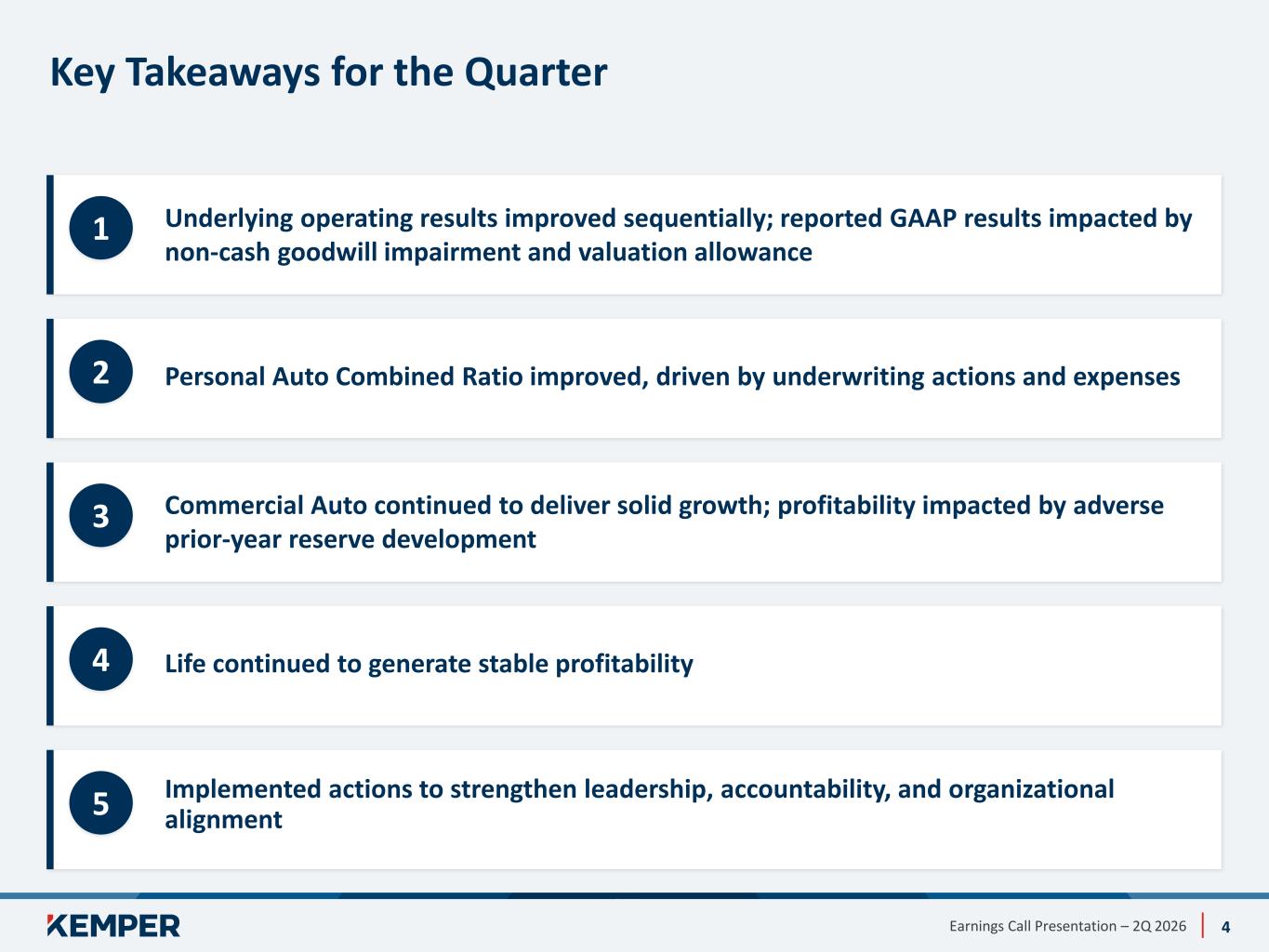
Well thanks Michael and good morning everyone and thank you for joining us. Since joining Kemper two months ago I've spent time with employees, agents, business partners, and members of the investment community. Those conversations combined with the work I've done to better understand the business have energized me about Kemper's future. I see a company with meaningful strengths, including the stability of life, the momentum within commercial auto, real potential for personal auto, and a talented team committed to improving results. Together, these strengths position us to deliver long-term shareholder value. At the same time, we have to be candid about where performance must improve. The clearest example of this is personal auto, where we are not delivering target returns, driven in large part by our concentration in California. We're addressing this, but the benefits of our actions will take time to flow through our results. These realities have shaped how I think about the business and the priorities that will drive success. Stepping back, there are three messages I want you to take away from this discussion. First, restoring profitability is our most important priority. I want to be very clear on this point. We do not view profitability and growth as competing objectives. Profitability is a prerequisite for growth, and as such, growth will be earned, not chased. In commercial auto, that means despite strong top and bottom line performance, we're going to take a more disciplined stance given successive quarters of prior year adverse development. We're making intentional adjustments moving forward to ensure growth is profitable and sustainable. Second, Kemper has the foundational elements necessary for long-term growth. Our focus is on improving performance and delivering more consistent results. Unlocking that value requires clearer accountability and more consistent execution. And that brings me to my third takeaway for stakeholders. We've realigned the P&C organization to improve accountability and execution. Underwriting, pricing, product, and claims are now under one P&C leader, Eric Kepler. We believe this structure will create sharper accountability, faster decision-making, and ultimately better execution. Eric's deep experience in nonstandard auto makes him well-suited to lead this work, and we look forward to introducing him at our next earnings call. I also want to officially welcome Tony DeSantis to our Board of Directors. Tony brings over 40 years of experience in our industry, including 10 in non-standard auto. He's already been a great addition to the board, and I look forward to his counsel and contributions. Taken together, these three points define our path forward. Restore profitability, unlock the value in our business, and strengthen leadership and accountability to deliver more consistent results. Against that backdrop, this quarter shows encouraging progress while also highlighting the work still ahead. For the quarter, underlying results improved sequentially, while reported gap results were adversely impacted by a goodwill impairment. Brad will cover the numbers in detail, but first, I wanted to share my perspective on each of our businesses. Within personal auto, rate and non-rate actions improved our combined ratio while also reducing our concentration in California. This is great progress, but as I said, meaningful work remains. Commercial auto continues to generate strong underlying results, but the business is not without challenges. The prior year reserve strengthening reinforces the importance of maintaining discipline as the business grows. While we continue to see attractive opportunities ahead, we'll be placing greater emphasis on profitability by taking more rate and tightening our underwriting, even if that results in less growth in the near term. And finally, life continues to provide stable earnings, consistent cash flow, and valuable diversification. Building on that foundation, we continue to advance our distribution and lapse management initiatives in support of profitable new business growth. In summary, our path is clear, restoring profitability is our top priority, and achieving that goal will earn us the right to grow. My confidence in our path forward is grounded in both the actions underway and the strength of our people. I feel incredibly fortunate to work alongside this management team and our talented employees across the country. I'm grateful for their commitment, and I'm looking forward to working with them and building a stronger Kemper. Thank you, and with that, I'll turn the call over to Brad.
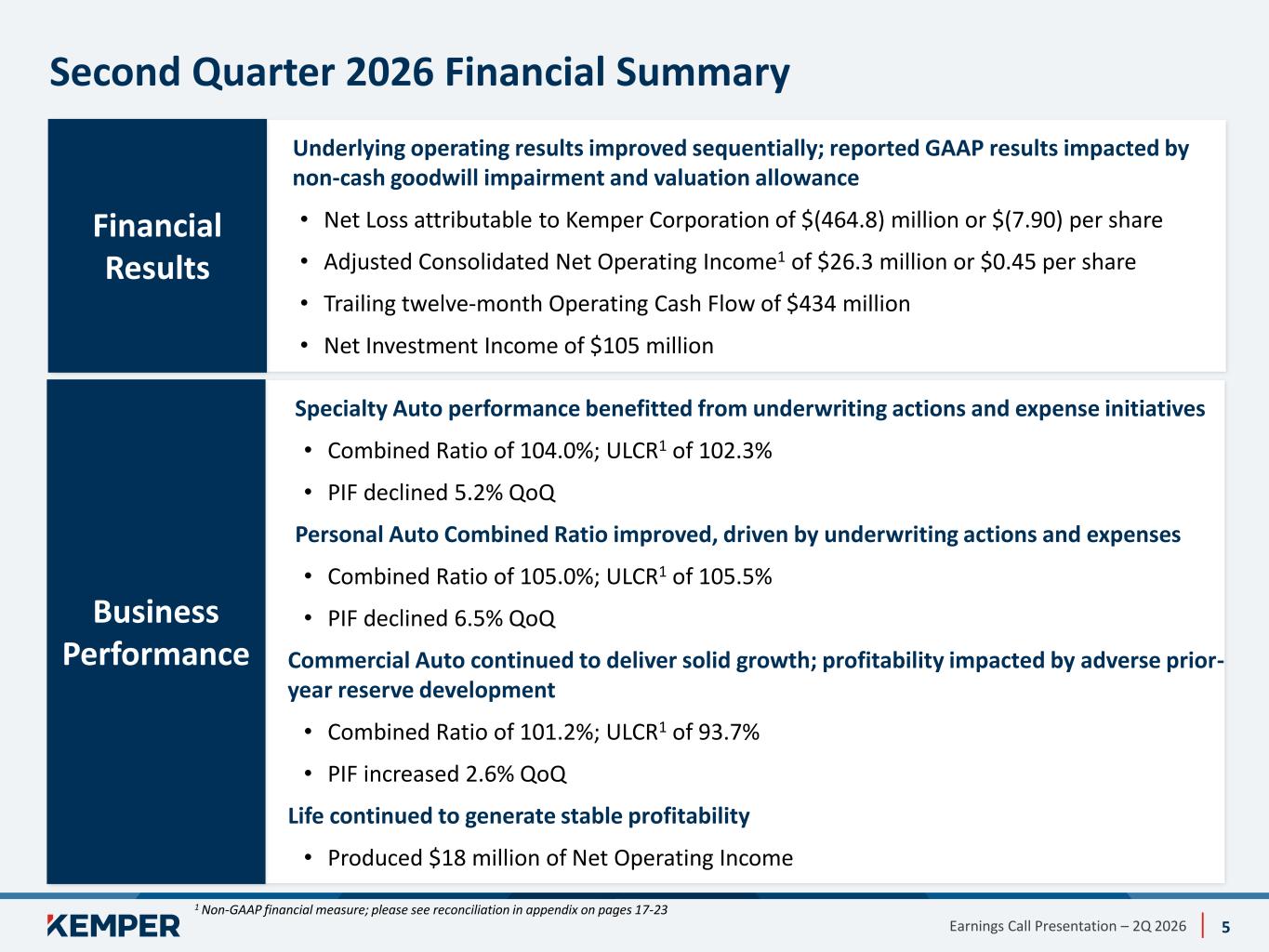
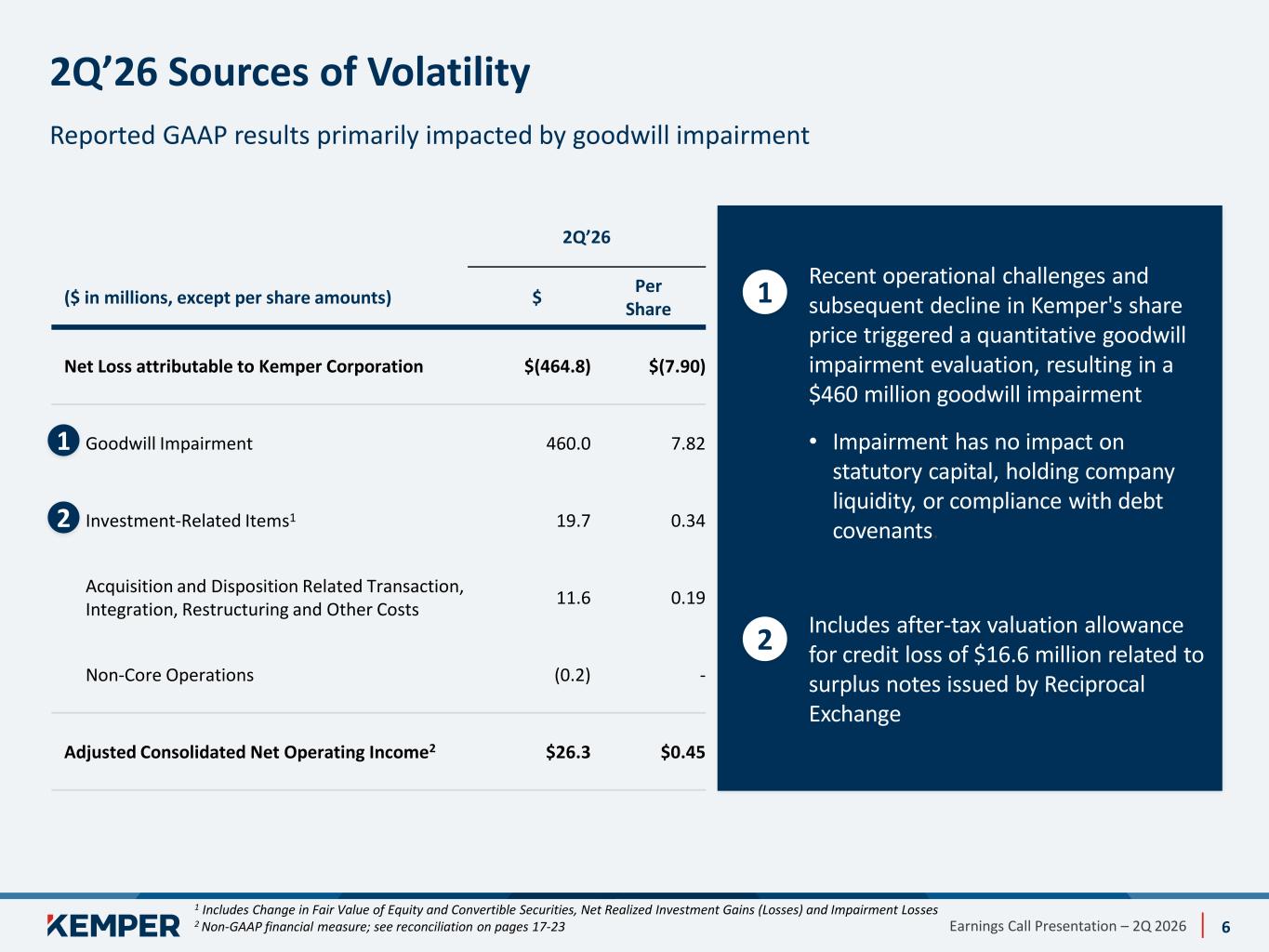
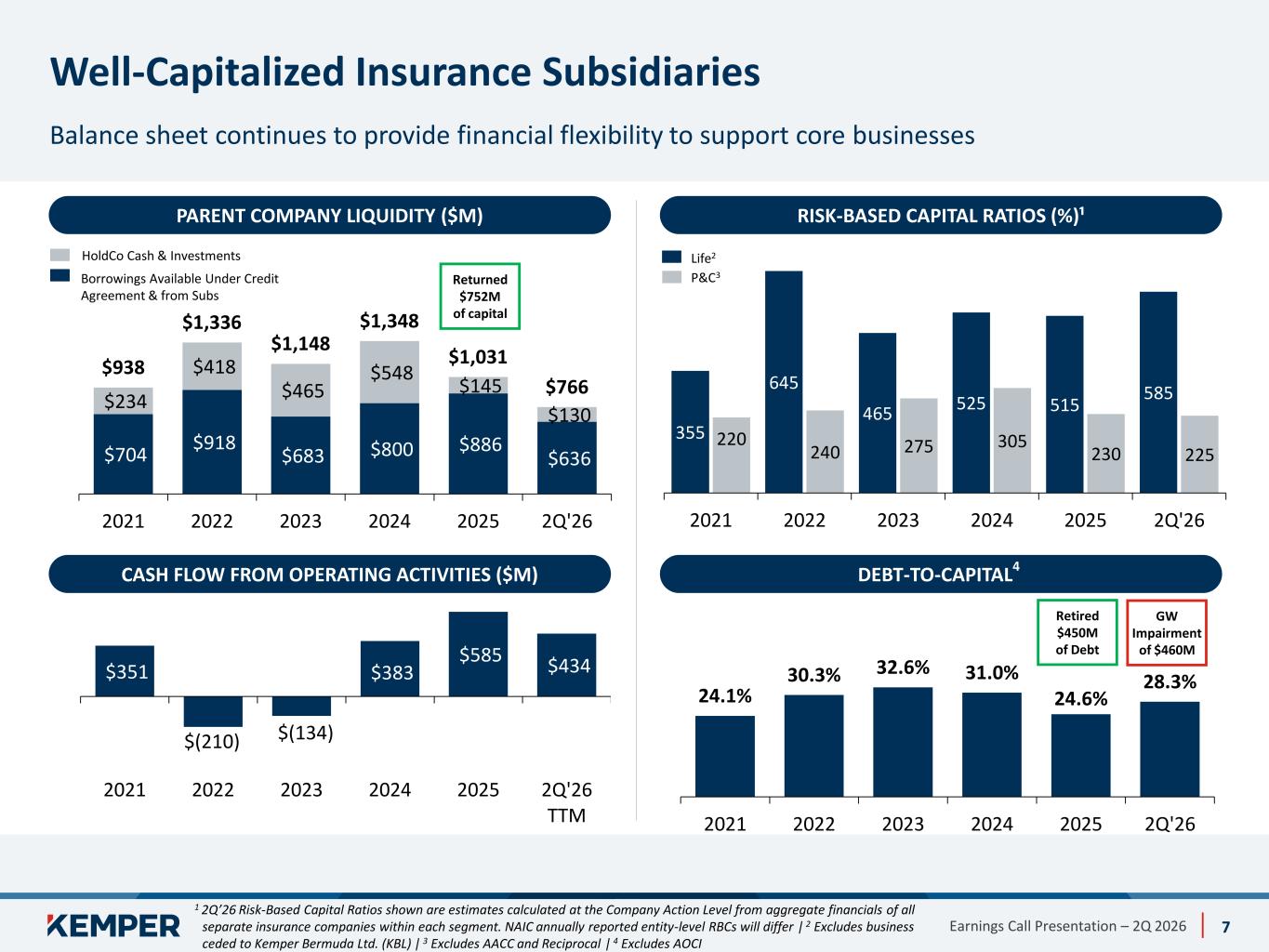
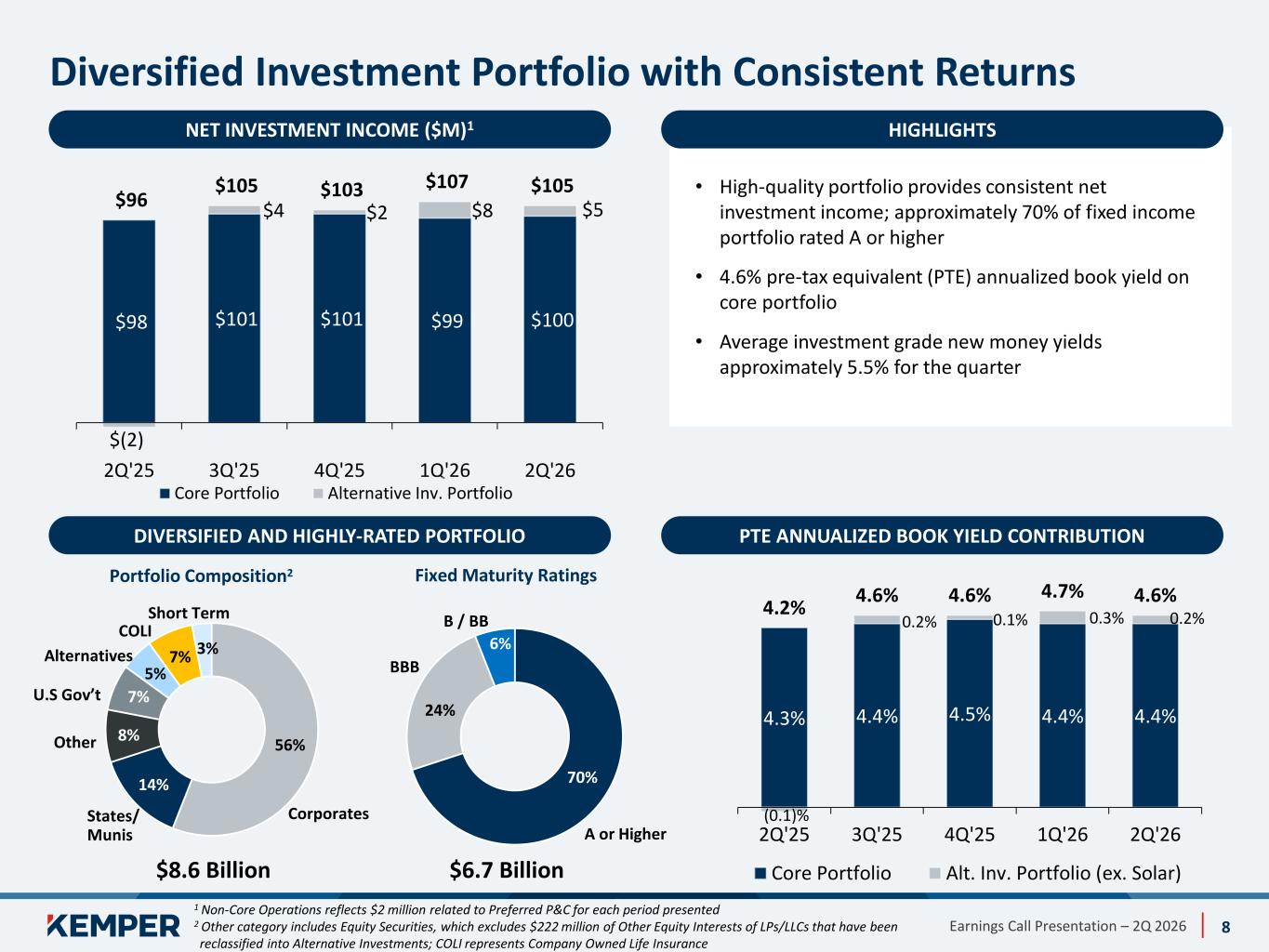
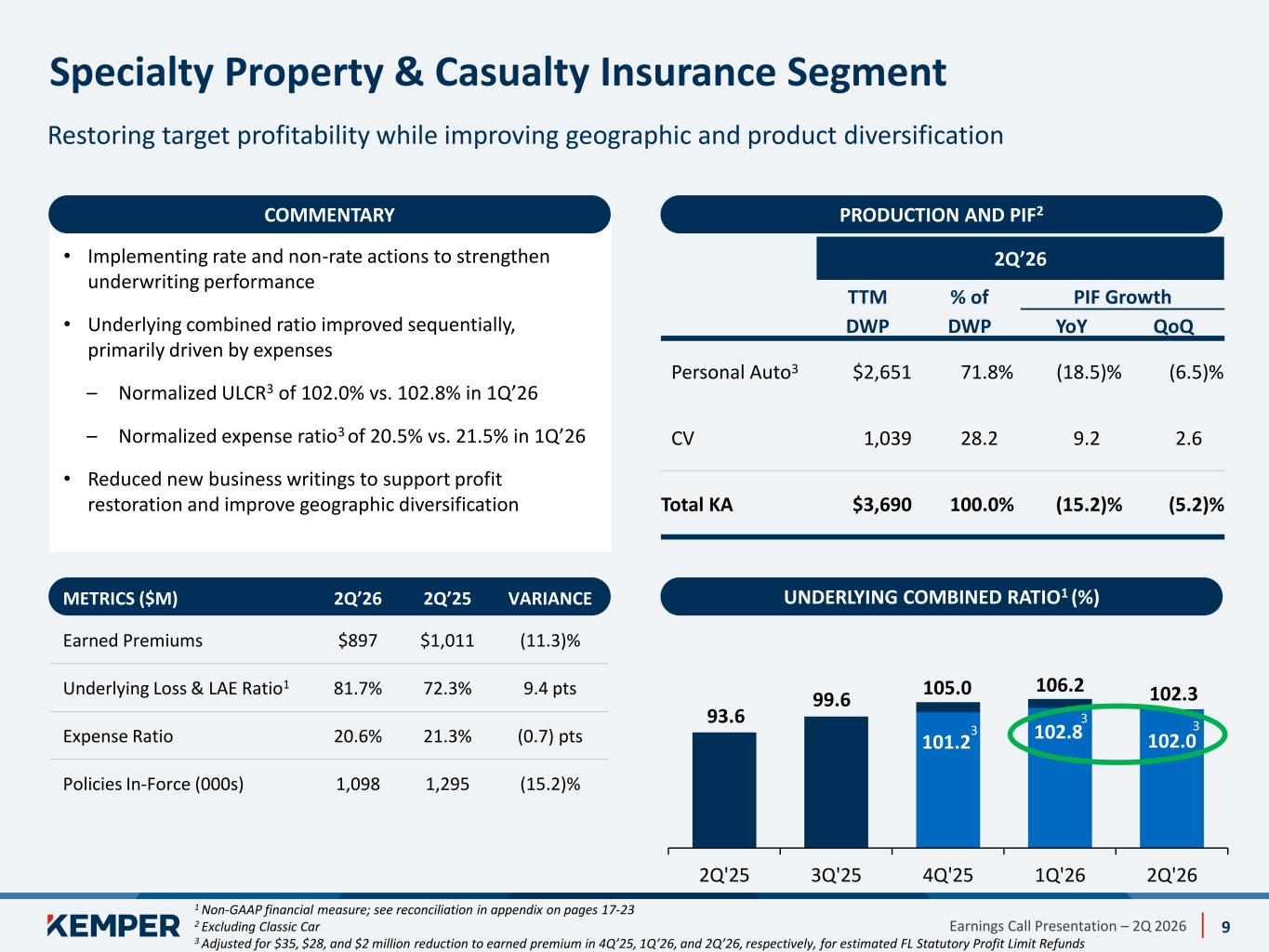
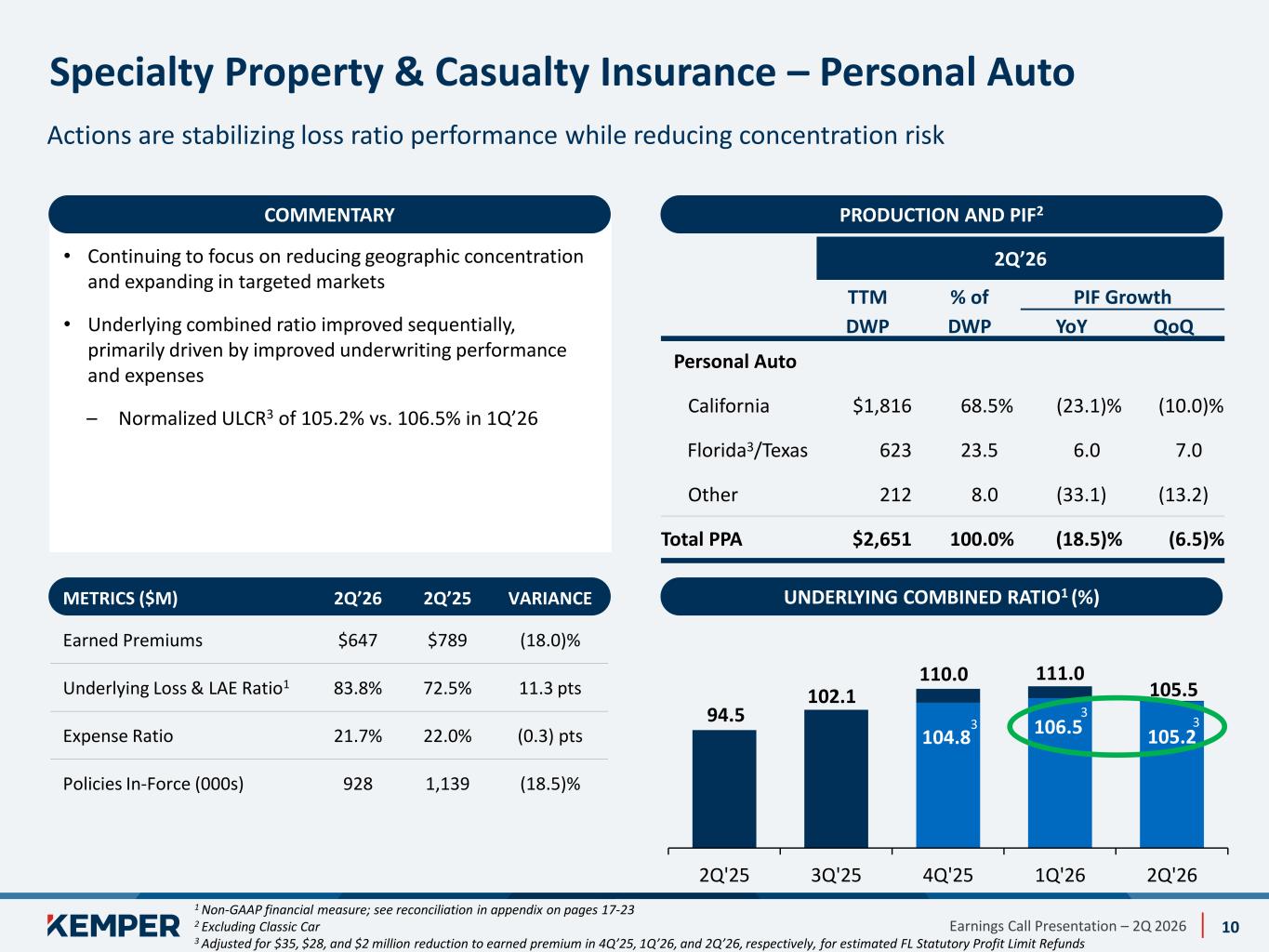
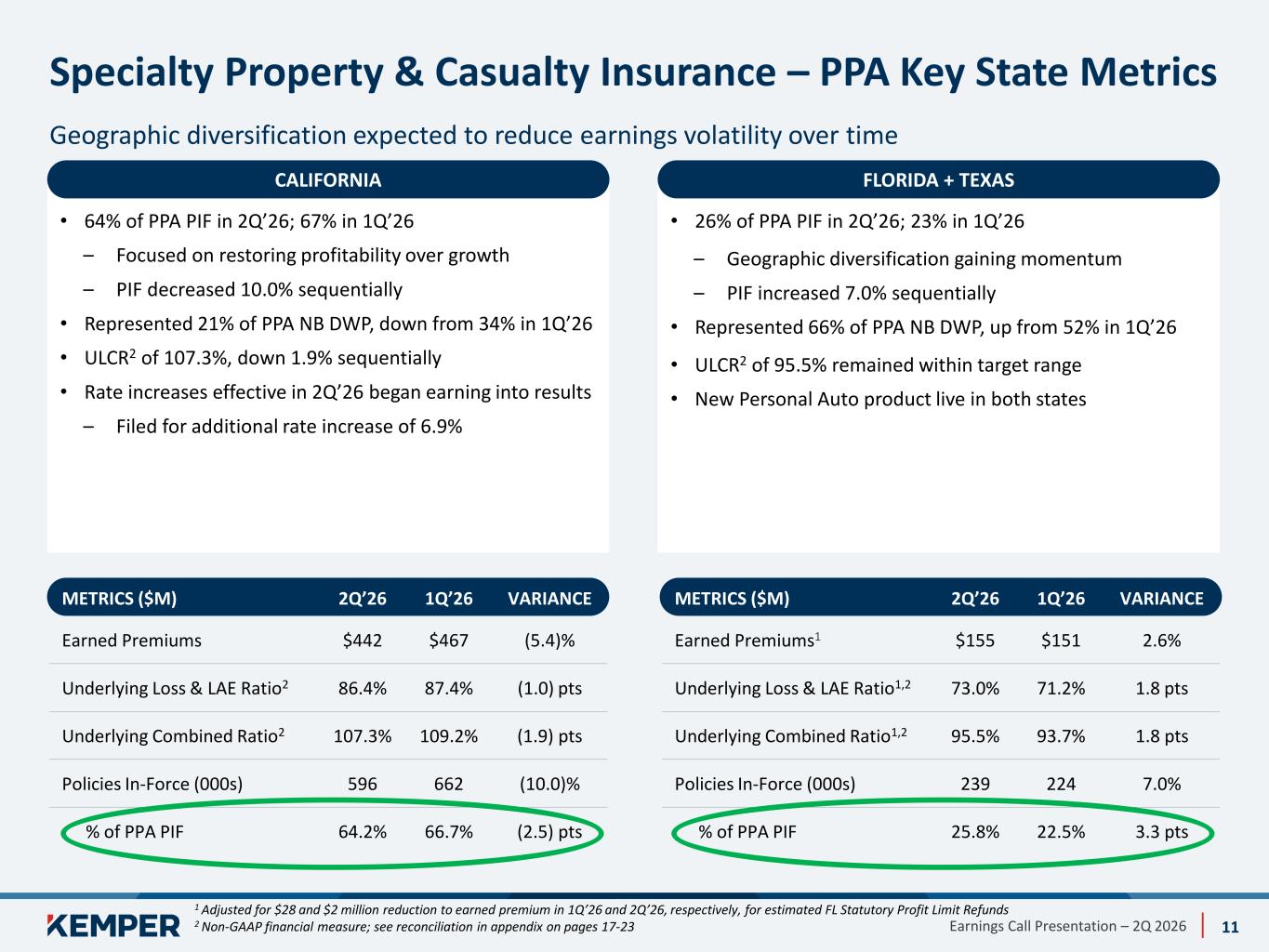
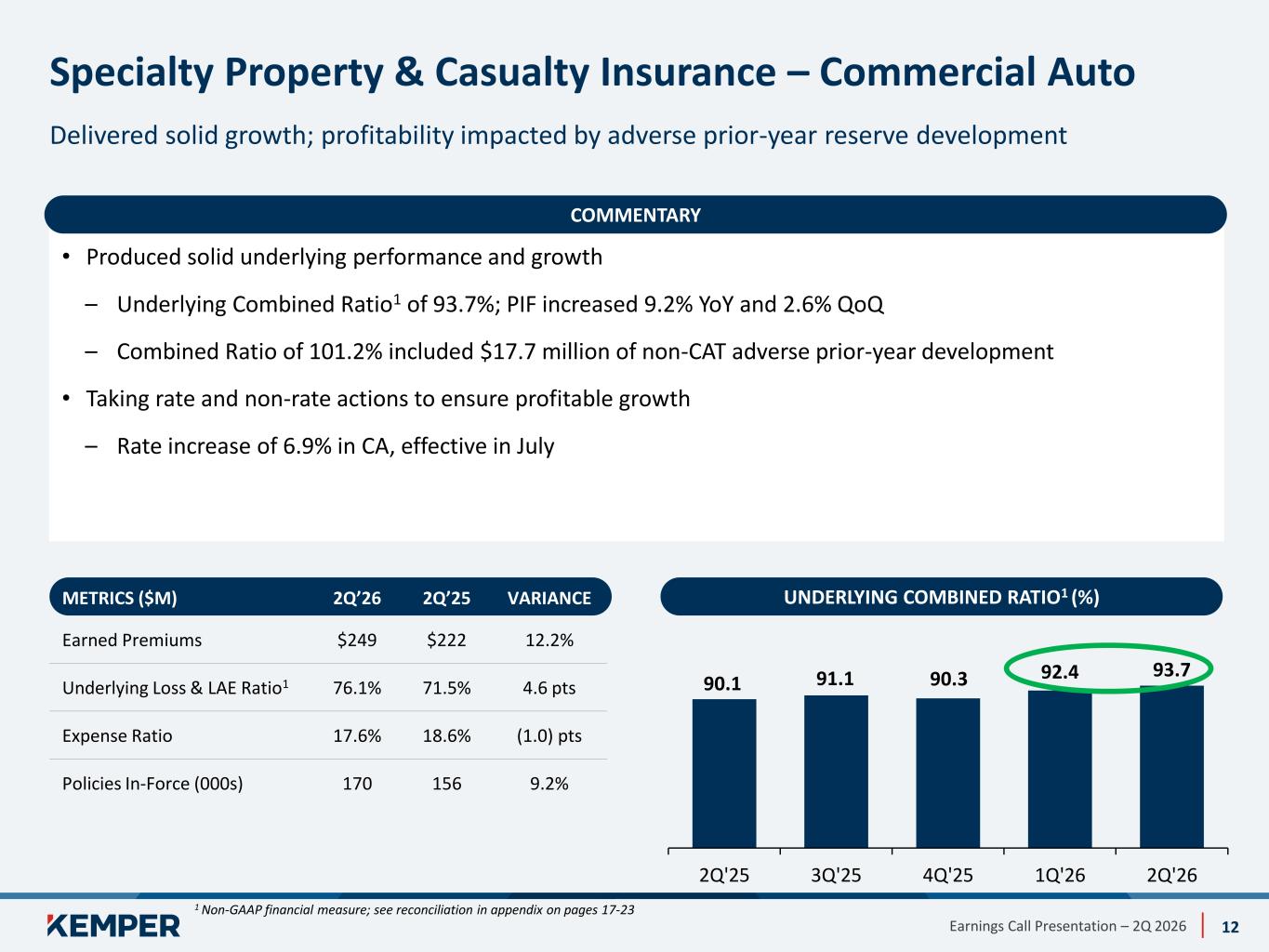
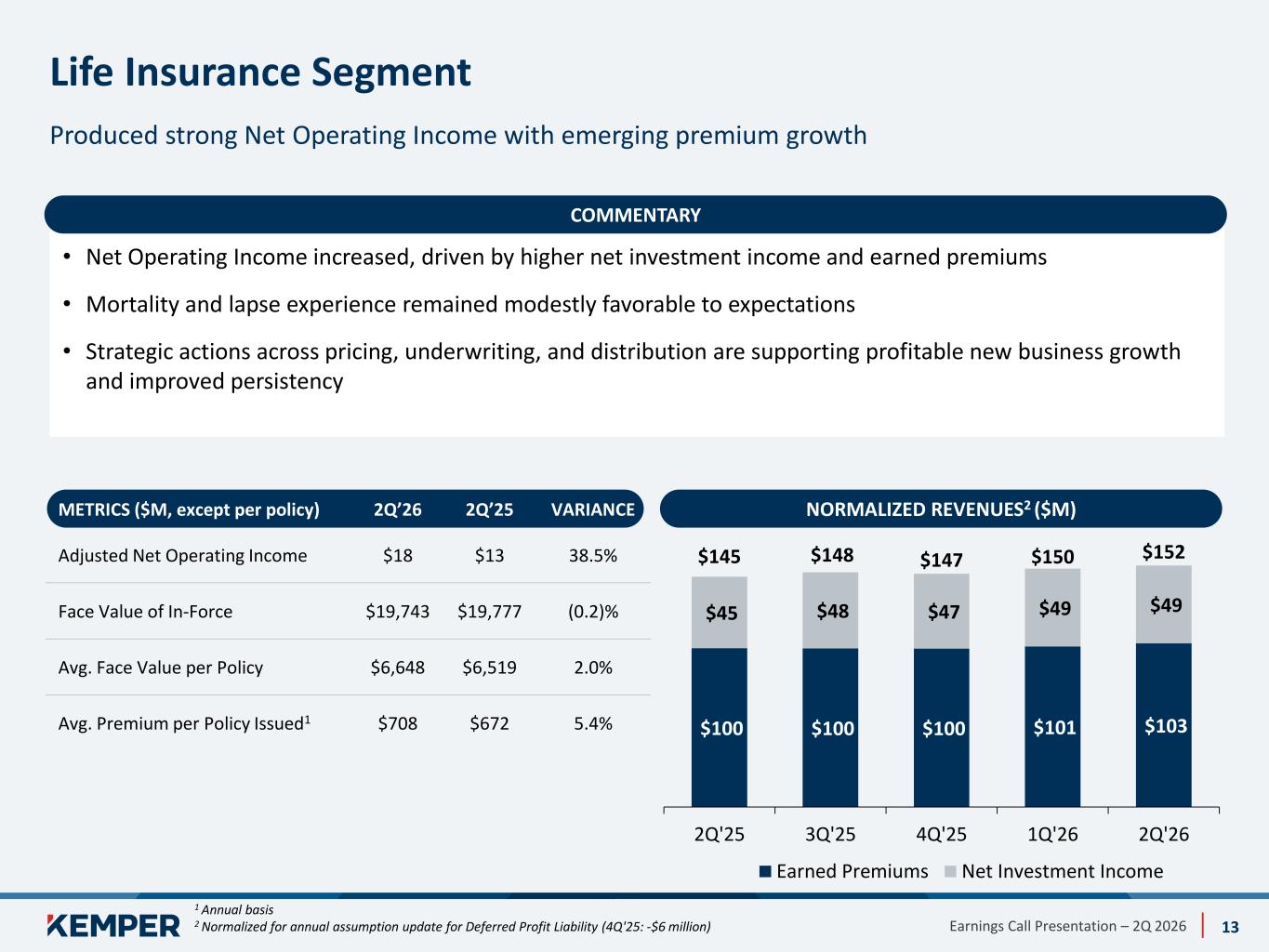
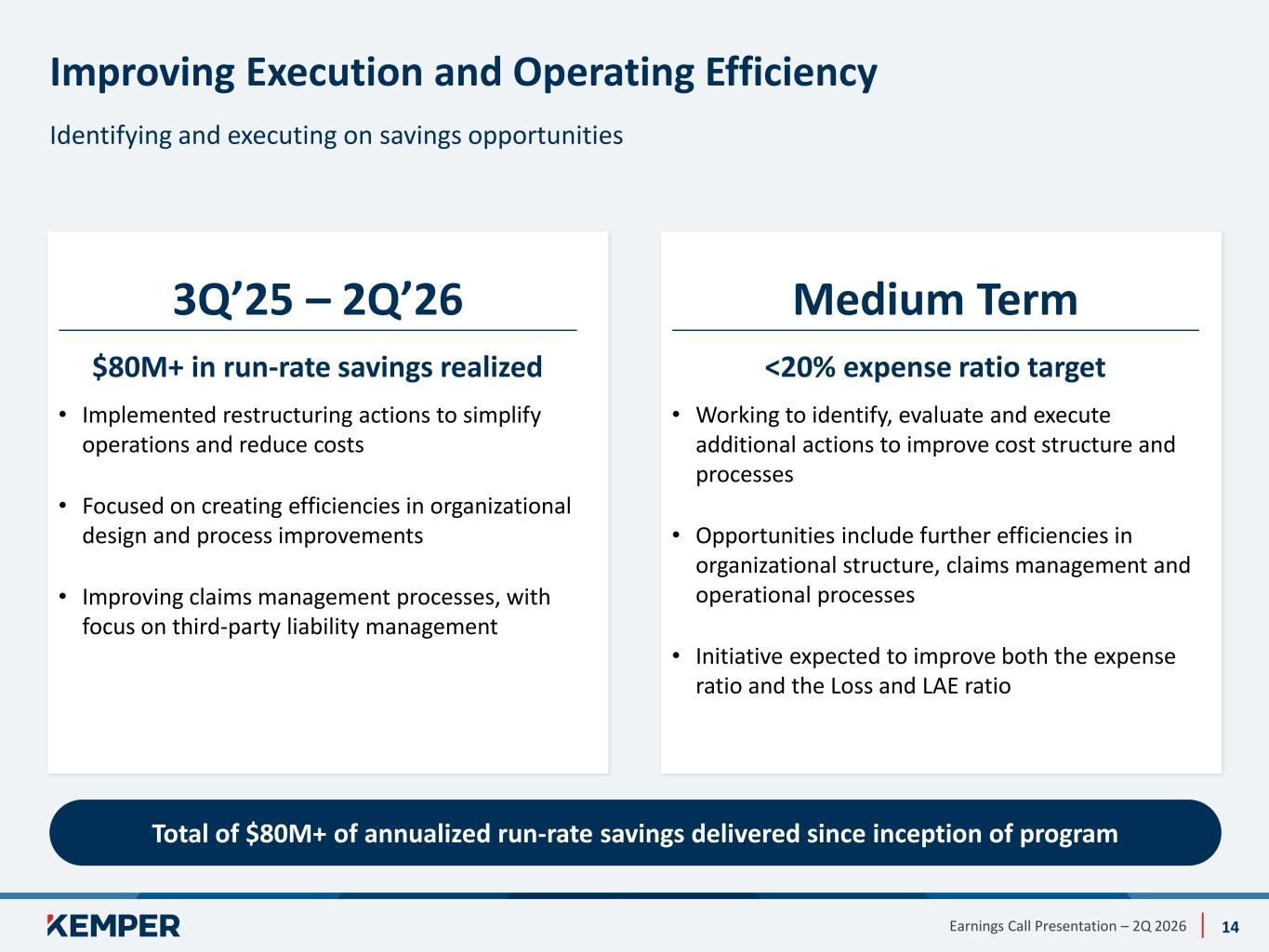
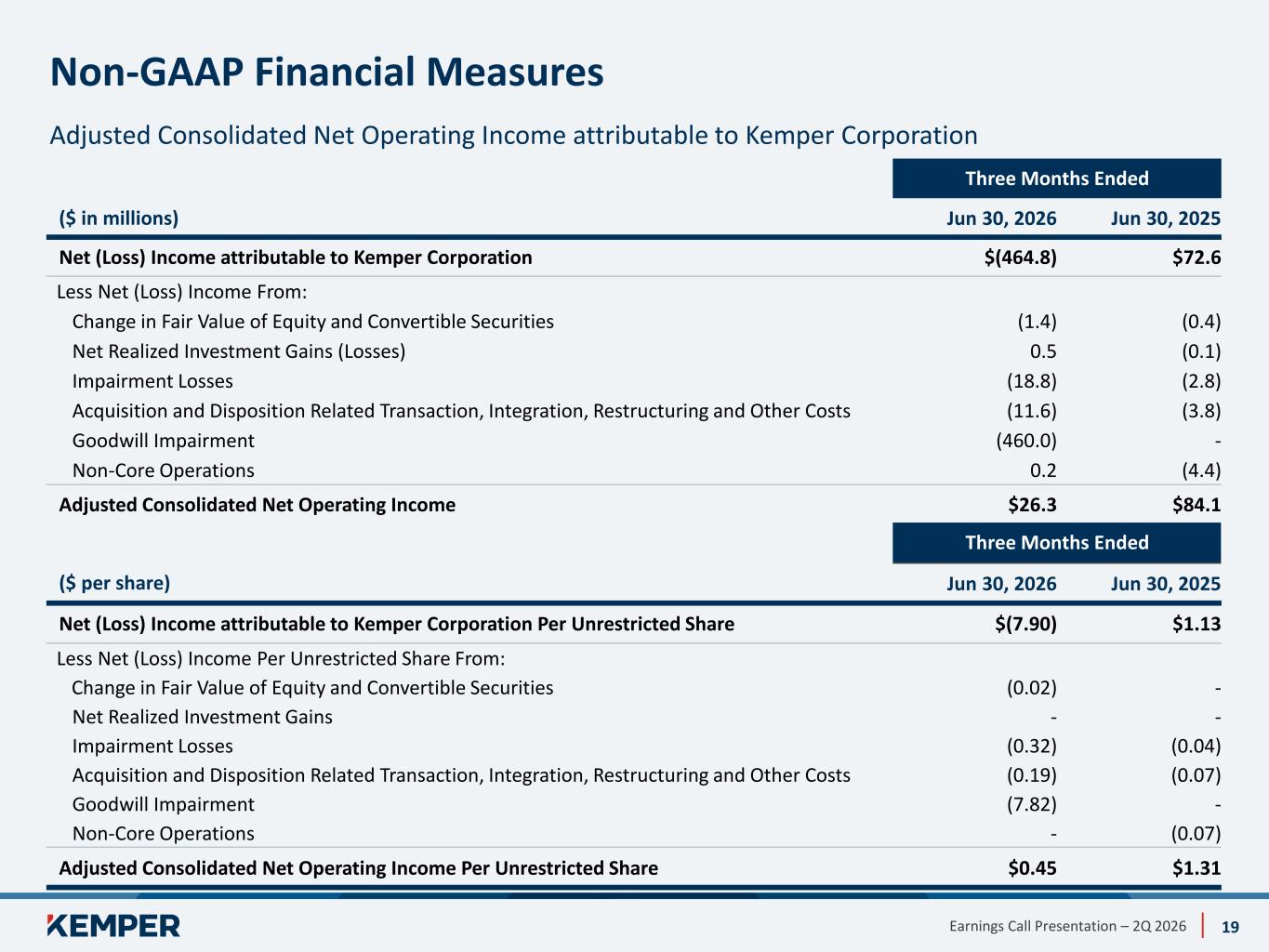
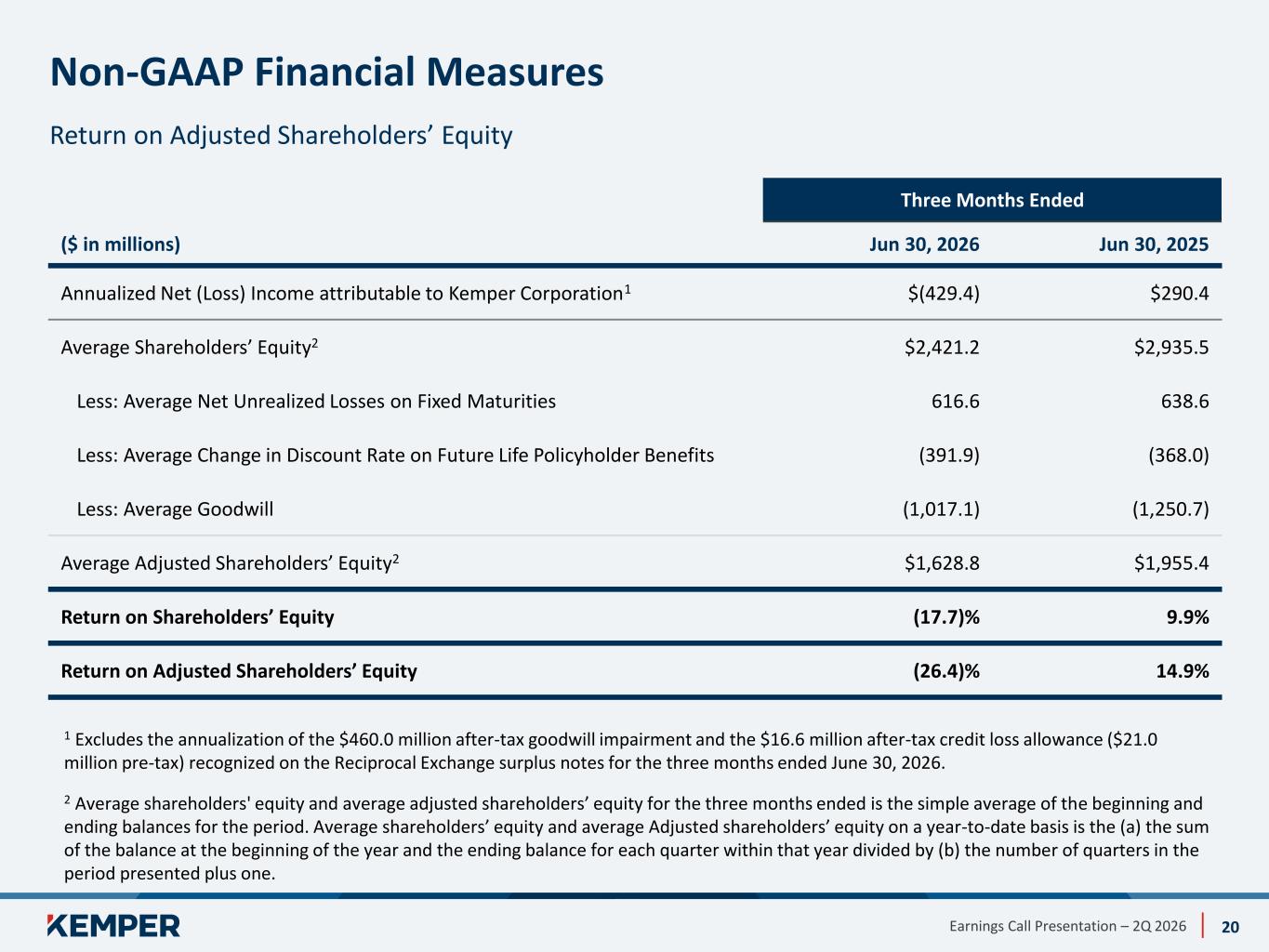
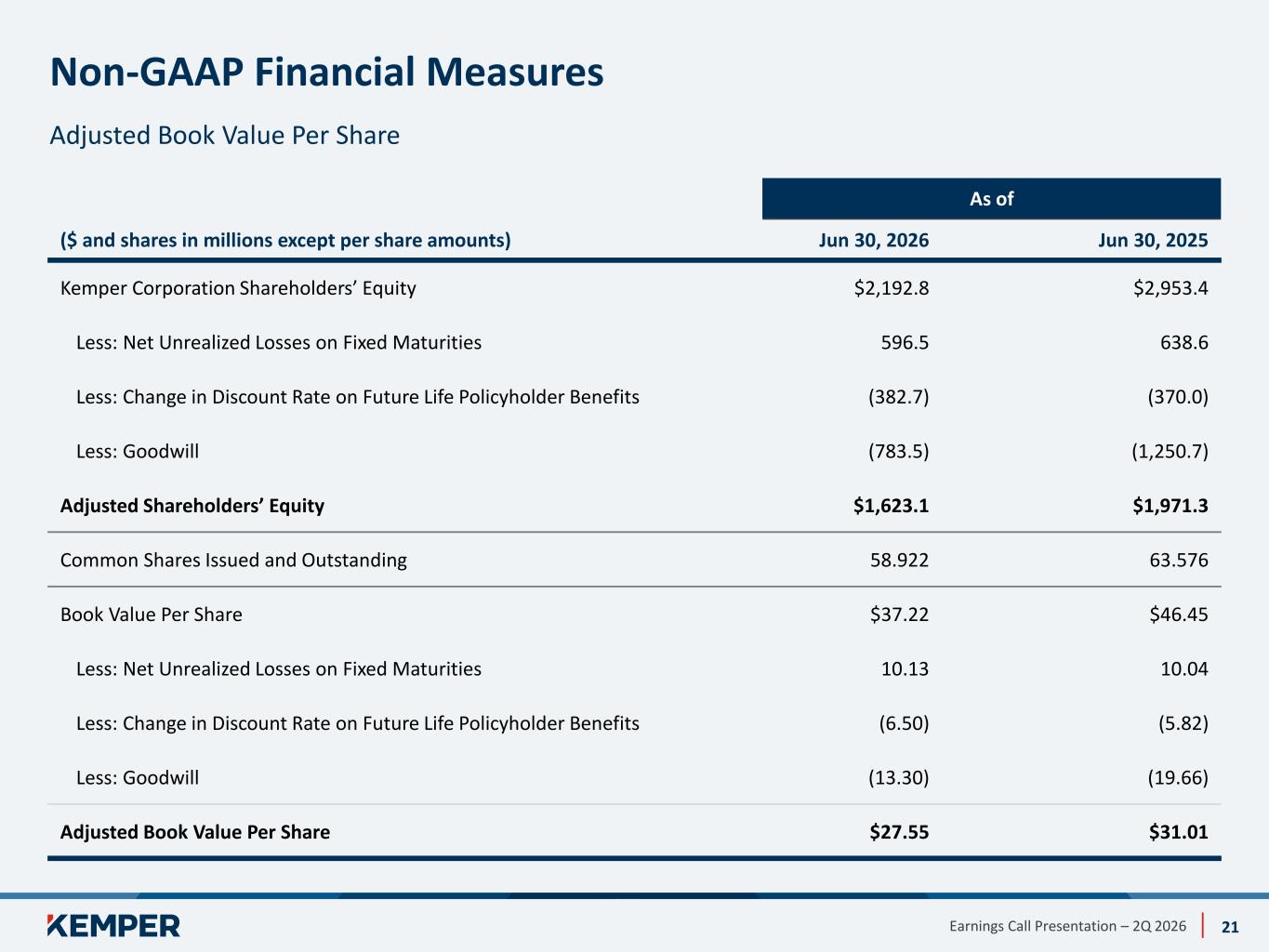
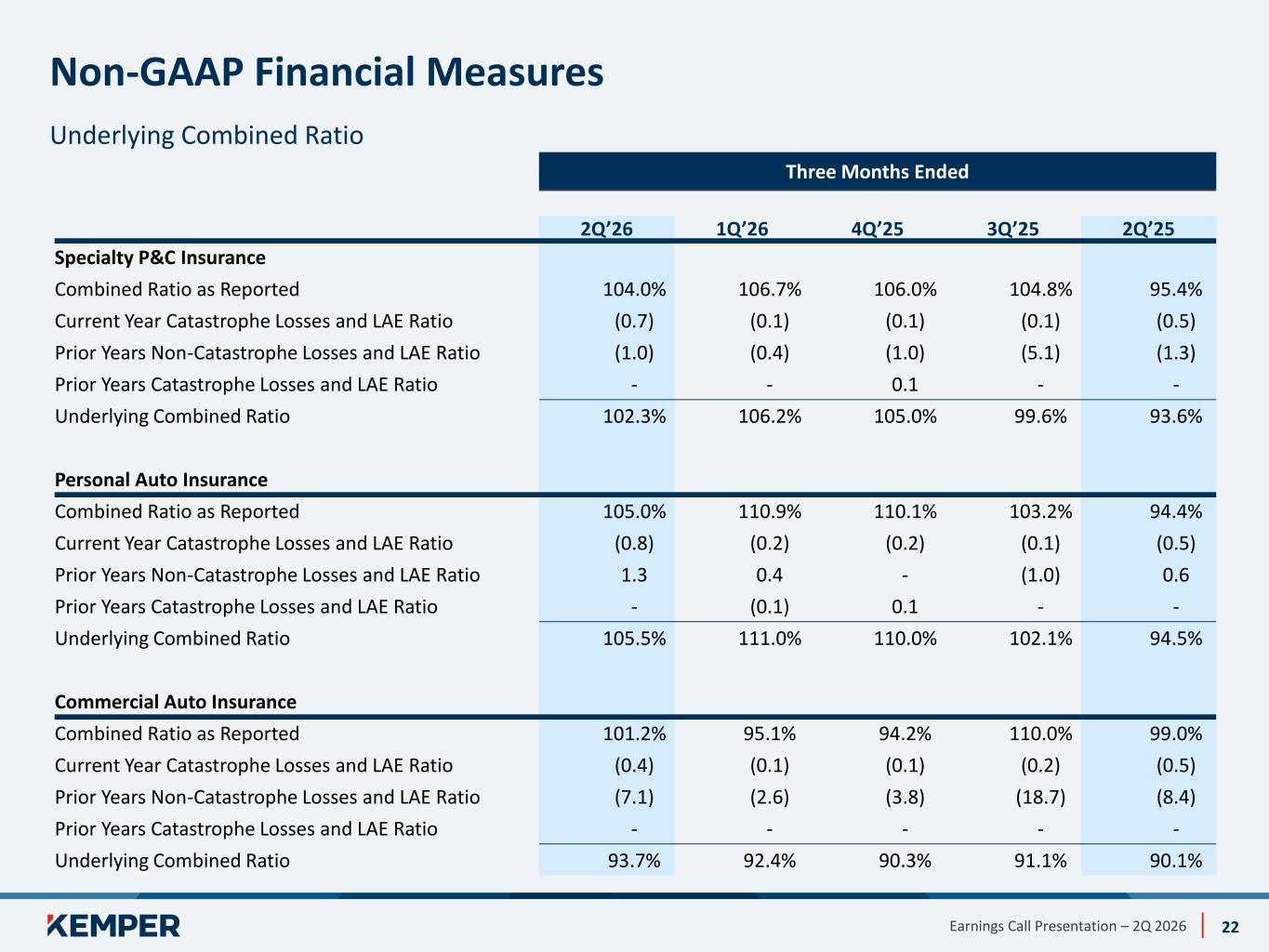
Thank you, and good morning, everyone. Steve discussed the progress we're making to restore profitability, the actions underway to improve execution, and the underlying strengths of the businesses. I'll provide additional perspective on our financial results, our capital position, and the operating trends we're seeing across the enterprise. Let me begin with our financial results. results. This quarter reflected sequential improvement in underlying operating performance, although our reported gap results were significantly impacted by two items that I'll discuss in more detail shortly. Net loss was $464.8 million, or $7.90 per share, while adjusted consolidated net operating income was $26.3 million, or $0.45 per share. Underlying operating results improved sequentially, driven by P&C underwriting performance, expense discipline, and stable earnings from our life business. Net investment income totaled $105 million, and trailing 12-month cash flow was $434 million, reflecting the consistent cash-generating ability of our businesses. Before discussing the quarter in more detail, let me provide additional context on the items that affected our reported results. The primary driver of our reported net loss was a $460 million non-cash goodwill impairment in our specialty auto segment. Recent operational challenges and the subsequent decline in our share price triggered a quantitative goodwill impairment evaluation in our gap. The resulting impairment reflects an estimate of fair value based in part on our second quarter share price. Let me emphasize that this does not affect the ongoing operations or cash generating ability of the businesses. While significant from a GAAP perspective, the impairment has no impact on our statutory capital, holding company liquidity, or compliance with our debt and revolving credit covenants. We also recognize a $16.6 million after-tax allowance for credit losses related to the surplus notes issued by Kemper Reciprocal Exchange. Based on our assessment of the expected recoverability of those notes under GAAP, we recorded an allowance during the quarter similar to the goodwill impairment this charge does not affect our insurance subsidiary statutory capital or holding company liquidity with that context let me turn to our balance sheet and capital position our balance sheet remains a source of strength insurance subsidiaries are well capitalized and we ended the quarter with 766 million of holding company liquidity while our debt to capital ratio increased to 28.3 percent that change was primarily driven by the goodwill impairment and does not reflect a deterioration in liquidity or statutory capital. Our investment portfolio performed well, generating $105 million of net investment income during the quarter. It continues to provide a stable and predictable source of earnings. I'll now turn to the operating performances of our businesses. I'll begin with our specialty auto segment, which includes both our personal and commercial auto businesses. Underlying results improved sequentially, with the normalized underlying combined ratio improving 0.8 points from 102.8% to 102%. Within personal auto, the normalized underlying combined ratio improved 1.3 points from 106.5% to 105.2%. The improvement reflected stronger underwriting performance and continued expense discipline. As part of our profit restoration strategy, California's share of the personal auto portfolio declined by 2.5 percentage points during the quarter, driven by a 10% sequential decline in policies in force, along with continued growth in other markets. Turning to commercial auto, the business delivered strong underlying performance with an underlying combined ratio of 93.7%, while PIF increased 9.2% year over year. Reported results, however, were impacted by 17.7 million of prior year reserve development. As Steve mentioned, the prior year reserve strengthening reinforces the importance of maintaining discipline as the business grows. Accordingly, we are taking additional rate actions and adjusting our underwriting standards. While these actions will temper growth in the near term, we believe they are prudent and position us to build on our underlying momentum and deliver stronger, more consistent profitability over time and finally our life business delivered another solid quarter generating 18 million of net operating income supported by growth and earned premiums favorable mortality and lapse experience and higher net investment income earned premiums increased to 103 million while average premium per policy increased 5.4 percent from the prior year period reflect reflecting the benefits of our pricing underwriting and distribution initiatives Importantly, LIFE continues to provide stable earnings, consistent cash generation, and valuable diversification for Kemper. Before I conclude, I'd like to provide an update on our restructuring program. Since announcing the initiative last October, we've identified more than $80 million of cumulative annualized run rate savings, an increase of $20 million since last quarter. While we continue to identify additional opportunities to improve our cost structure, the actions we've taken are contributing to improved financial performance, including lower expense and LAE ratios. Overall, the quarter demonstrated progress toward restoring profitability. While our GAAP reported results were significantly impacted by two items discussed earlier, underlying operating trends improved. As Steve emphasized, and I'll reiterate, restoring profitability is our top priority. This quarter reinforces that our actions are gaining traction while preserving the financial strength needed to execute our strategy and create long-term value for our shareholders. With that operator, we'd be happy to take questions.
Operator
We will now begin the question and answer session. Please limit yourself to one question and one follow-up. If you would like to ask a question, please press star 1 to raise your hand. To withdraw your question, press star one again. We ask that you pick up your handset when asking a question to allow for optimum sound quality. If you are muted locally, please remember to unmute your device. Your first question comes from the line of Gregory Peters with Raymond and James. Gregory, your line is open. Please go ahead.
Hey, good morning, everyone. You know, I think The great place to start is, Steve, as you're moving through the organization and realigning the executives, at the end of the day, it's the pricing and the underwriting that's going to drive the improvement. So maybe you can provide us some additional detail on how you're changing the pricing and the underwriting backbone of the company to give better results. And particularly interested in California, where, you know, obviously you're shrinking and it's a difficult market to get rate increases, sir.
Hey, Greg, thanks for the question. If I can kind of play it back, I think your question was kind of organizational in nature. And I'll kind of pull back and say, for me, the big aspect of the organizational change was aligning claims with the rest of the business. If I'm being candid, I feel like the things we're doing on the underwriting and pricing side prior to my joining were pretty effective. I think there are a couple of areas we can certainly speed up and maybe get a little more aggressive, but I'd say from my perspective, pretty effective. And so if I kind of pull back and sort of go through the levers we're pulling with sort of no emphasis on just California, we are taking rates up. The team, if you go back and look, the team swung pretty hard early on after the minimum limit change, and we followed it up with another filing recently. So I'd say the speed and urgency there was where we needed it to be, and we were pretty aggressive. I'd say second, as part of that, we sort of slowed down new business anywhere where we thought the calendar year impact was going to be adverse. And so again, the team swung pretty hard on that, and we're seeing pretty good results. I think Brad commented in his remarks that California share came down. I think the last thing I'd comment on is expenses, and that's not just an underwriting or pricing issue or pricing team issue rather. It's an enterprise-wide effort and initiative, and so as Brad said, I think we made a fair amount of progress there. So if I pull back, the primary aspect of the change was around aligning claims with the rest of the organization. And I feel like we're making progress on the levers that are at our disposal. The teams are moving quickly. And most importantly, we're seeing some of the results, some of the actions bear fruit in our results. And so we feel pretty good about that. Brad, I'll turn it to you and see if you wanted to add or amend to anything I just said.
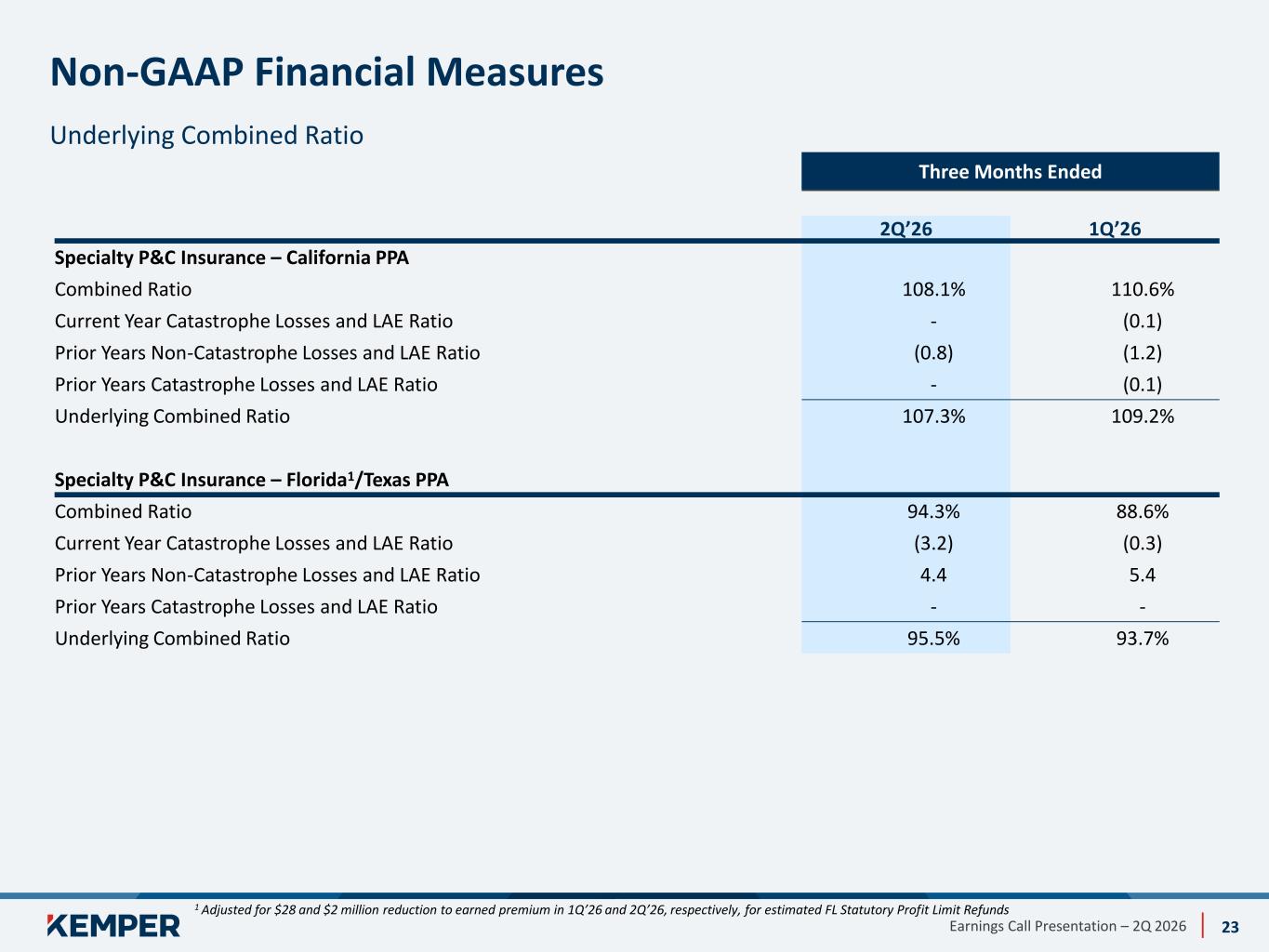
I'll just add to Steve's comments, Greg, and good morning to you. As Steve mentioned, we have made some significant progress. We got, you know, rate effective in California in the quarter, probably average between, you know, two of our programs, about five and a half percent beginning to earn in. We filed another six, nine, and then we continue to take, you know, non-rate actions, which you can see through the reduction in PIF growth quarter of a quarter um you know we like what we're seeing uh we're seeing some modest sequential improvement and we expect over time for that to improve um over the coming quarters so i'll leave it there um turn it back to the operator well i have a follow-up question if that's okay um of course i just wanted to go i just wanted to touch on the goodwill charge.
Just if you can walk us through the mechanics of that, because I know you still have some goodwill on the balance sheet, just trying to understand how you came at the number and where the stock price is. Is that going to result in continuing quantitative analysis every quarter on goodwill? Just give us an update there, please. Thank you.
Yeah, sure. Thanks for the question, Greg. You know, our goodwill impairment was triggered by the sustained decline in our stock price over the past year. You know, Kemper's down about roughly 50% year over year, roughly 30% year to date, and that required a quantitative goodwill impairment assessment evaluation. When you evaluate goodwill, you use multiple different methods. One is, you know, a discounted cash flow method, and one's a market value approach, which uses, you know, Kemper's public market valuations. And when you look at where our tangible book value is relative to book value, and you look at the evaluation of the fair value of our specialty auto segment, given the valuation and some of the control premiums, you know, we could no longer support the book value that was on our books. And so we had to bring down that that evaluation. As I mentioned earlier, we had a $460 million Goodwill impairment. That brings our specialty auto segment Goodwill down to about $570 million. When you think about as we go forward, another sustained decline in our share price would require us to do another quantitative Goodwill impairment, but that's not the only trigger. It also depends upon our operating results. And as we mentioned earlier, our operating results are improving, and we expect further improvement. But there's multiple things to look at, but you are correct, and we did mention this in our filings, that a sustained decline in our share price as well as continued or challenged operating results could result in additional impairment. But as we see it right now, we're comfortable with the position, we're comfortable with the goodwill on our books. and I'll also mention there was no adjustment to the life segment this quarter.
Thank you for the answers.
Operator
Your next question comes from the line of Paul Newsome with Piper Sandler. Paul, your line is open. Please go ahead.
Good morning. Thanks for the call. I wanted to touch on the $60 million write-off related to the surplus notes and the reciprocal. I'm guessing, and please tell me if I'm wrong, that you're essentially writing down the surplus note that was issued to the reciprocal, and I would guess that's because it's not expected to be profitable. But the major question is, assuming that I'm right, is does this mean that the prior management's thinking about moving everything into a reciprocal is not the current strategy? What's your thought on that?
Hey, Paul, this is Steve. Thanks for the question. So I'll start and then hand it over to Brad to cover some of the technical details. If you kind of pull back, I've been here since the beginning of June. My focus has been on getting my arms around the team, organization, and restoring profitability. The reciprocal is definitely on the agenda of things to sort of explore, study, and decide upon. But it's only been 60 days. We're going to focus on that in addition to a couple of other things throughout the remainder of the year. So what I would ask is, as it relates to sort of decisions on the reciprocal, give me a little bit of time to get my arms around the business and that particular issue. And we'll be in touch and communicate any decisions around that at the appropriate time. Brad, I'll hand it to you, and you can perhaps cover some of the technical issues.
Yeah, thanks, Stephen, and good morning, Paul. So, you know, similar to, you know, the goodwill impairment, when you think about the reciprocal exchange, Kemper issued or purchased $36 million of surplus note from the exchange. We look at the performance of that exchange, which has not been making money, and you look at, you forecast that out over the next, you know, three to five years, the exchange, you know, can no longer support the evaluation of those surplus notes. As a result, we wrote them down. We took a $21.1 million or $21 million pre-tax charge. There's roughly $15 million of surplus notes left. We'll evaluate those as we go forward based on the cash flows of that legal entity. And as Steve mentioned, we'll provide additional details around the reciprocal strategy and the exchange here in the near future.
That's great. Maybe a little bit of a follow-up to Greg's question. If you're just looking at California and the needed rate increases, is there a way for us to think about linking the rate increases that you're working your way through in stages to get to profitability with the PIS growth? And I guess I'm thinking is, you know, should we be thinking that PIFCRO should be under pressure really until the technical rate gets to its ultimate level, which I assume is not – obviously, you're not taking the full technical rate increase needed. So, you know, should we think about this sort of as a multi-stage period where eventually maybe another rate increase out or two, you get to that period, or do you think that PIF will not necessarily track what you're doing from a rate perspective?
Hey, Paul, this is Steve again. Thanks for the question. So let me try to, there's a lot to unpack in what you asked and brought up. So let me try to do it. We'll tag team with Brad and do our best to try to address your question. So let's start with sort of the diagnosis. Diagnosis as we sit here today is we need double digit rate in California. So you can look at the numbers. were not profitable and you see that with with other competitors as well we've taken one rate change we have a another filing pending and we feel good about that we feel good about the impact that rate is going to have on retention retention appears to be holding so we feel pretty good. But like I said at the beginning, this is about restoring profitability and putting that first and foremost. We want to make sure we have a thriving business on the other side, but it is profit first. I'd say the second thing is we are taking some non-rate action. So we have slowed down new business. New business generates economic value for the enterprise. However, in the near term, on a calendar year basis, as you're well aware, that can have an adverse impact on the combined ratio. So we are slowing that down. And then we are taking some non-rate actions, including but not limited to expenses. I'd say from my perspective, when you think about PIF growth, both in the aggregate and within California, It's not time-bound. It's conditional. And the condition is that we need to have profitability or at least clear line of sight towards profitability. We're not there yet. We're definitely marching towards it. We feel confident in the actions and the levers we're pulling. But once we see that, we will begin to thoughtfully and meaningfully start to grow our piff. Brad, if you want to add or edit anything I said, feel free.
I think you got it covered, and, you know, Paul will ask if you got a follow-up to Steve's answer.
No, I'm good, although I won't say it's a positive thing. I got some wonderful positive feedback on your new hires.
Operator
Our final question comes from the line of Andrew Kligerman with TD Cowan. Andrew, your line is open. Please go ahead.
Okay, great. Thank you, and good morning. I want to follow up on the question that Paul was just asking. So if I understand California correctly, you got 6.9%. You filed for another 6.9%. But then I think I heard you say that you need double-digit rate, and you've taken some non-rate actions already. So, you know, one, do you get that? Is California going to provide that rate? And I guess maybe you can share the competitive landscape in California right now such that, you know, what are your competitors doing? And ultimately what I want to get to is when do you think you'll get to a point where you could turn around PIF? This Kemper was a company that had, I think you had something well over 2 million in PIF prior to the COVID. And now you're sitting at 928,000 personal auto policies. So I guess, you know, to make it shorter, you know, what's it going to take to get to, you know, what's the competitive landscape allowing for you to kind of pivot to growth? And the part two of it is, well, that's it. Just, you know, what's going to allow you to pivot to growth?
Hey, Andrew, this is Steve. And thanks for the question. I think Brad and I will do our best to try to address the points that you raised. So let me pull back. I said we need somewhere in the double-digit range to restore profitability. We have 6-9 pending. You asked a question around, hey, when's that going to get approved? approved. We filed in accordance with CDI regulation. We have an effective date later this year. I can tell you the data supports the change. If you're asking me to guarantee that the CDI will approve it, I don't think anyone can guarantee CDI will approve, but we feel pretty confident that we can support it. The second piece of data that I'd sort of lean into is we're not alone. So when you look at competitor filings, you do see pretty substantial rate increases, particularly on the liability side. I'd say the third thing is eating into the double-digit rate need would be the filing and also some of the expense actions and initiatives we have under place and so from our perspective we feel like we're on track with our filing we feel like we are on track and continuing to pursue expense opportunities i'll go back to something i said earlier i've been here 60 days i frankly think it would be irresponsible for me to say here's the exact date upon which we're going to start growing PIF. From my perspective, I think what we want to see is clear signs of profitability in the book, or a very clear line of sight towards profitability. As we continue to navigate going forward, we will certainly communicate our plans, and we do have an expectation that we will be able to grow PIF, but we have to grow it profitably. And so once we get the filings approved, continue to make progress on our expense initiatives. We'll be talking about how and when we're going to be growing our PIF in California. Brad, if you wanted to add anything to that, feel free.
I'll just have a few comments. You know, we did see some nice improvement quarter over quarter, particularly in California. The rate actions we took, you know, late in 25 were effective in the second quarter, one in April, one in June. As Steve mentioned, we filed for another 6.9. I'd also highlight that the non-rate actions which are, you know, constraining the PIF growth are, you know, are helping improve the loss ratio and the combined ratio. My expectation is that those will continue to help improve the margins. And third, as Steve mentioned, the expenses are also, you know, significantly helping as well. When you think about, you know, Steve's comments, you know, we're doing everything we can to get rate and improve margins, but that will also be dependent upon the frequency severity trends in the marketplace. And I leave you with this, Andrew, you know, typically when you go from first quarter to second quarter, you have seasonality and we, our combined ratio typically goes up this quarter. It went down a little bit in California. And that is a positive sign. And that gives me confidence that the non-rate actions that we're implementing are having the intended effect.
That was very helpful. And maybe shifting over to commercial auto, I'm a little perplexed because you had an underlying combined of 93.7, but I think I heard that you're going to file for more rate to kind of fix the book. But if the underlying is okay, then I'm not sure why you would be, you know, needing dramatic rate. And just the second part of that and tied to that is, you know, this will be, I think, the fifth consecutive quarter of adverse development in commercial auto. So why do you think you might, well, might or might not have your arms around your reserving in commercial auto after this last adverse development?
Well, thanks for the question again, Andrew. So let me sort of pull back and tell you how we've been thinking about commercial auto. And I think it's important to sort of look at this under the lens of overall performance. And you have our results. You know what our combined ratio is in the aggregate across all businesses. And to some degree, that does sort of influence strategy thinking, et cetera. When we and I look at commercial auto, I see a couple of things, and I want to make sure I want to edit one of the words you used. I see pretty strong PIF growth, high single digits. I see a strong underlying combined ratio, low 90s. And like you, we see prior year development over successive quarters. I think that gives us sort of an opportunity to pull back and say, what are the options for us going forward? Option one, and I'll just simplify it, there are a ton, but option one is continue to go down our current path, continue growing at the current rate, continue taking rates up at our current level. And frankly, if you looked at that, that's a reasonable path, given some of the numbers you have. I think against the backdrop of overall performance and what we've seen with prior year development, and Brad will talk about his perspective on that, that sort of leads us to option two. What I didn't say is we're going to take meaningfully more rate. What I said was we're going to take more rate, and I think the consequence of that is going to be to slow down. and we'll tighten our underwriting as well, consequence of that will be likely to slow down our PIF growth. We'll still have positive PIF growth. I think this is sort of a more measured approach to sort of manage commercial auto, particularly given the backdrop of overall performance. And with that, I'll hand it to Brad. And Brad, if you wanted to comment on reserves, that'd be great.
Thanks, Steve. Andrew, you're correct. We've had, you know, successive quarters of adverse prior development, when you look at the total reserves for the commercial vehicle, you've got roughly a billion dollars of reserves. About 90% of those reserves are related to bodily injury, the bodily injury coverage. And that's been a challenging coverage to get correct. We've talked about this in the past, you know, 45% of our books in California, California is a highly litigious state, and you're seeing, you know, a lot of activity there. And you're seeing the cost to defend those claims continue to increase as a result of that environment we we find ourselves needing to continue to increase our reserves um you know when we think about um do we have a handle on this we we think we do um but that's not indicative of the last couple quarters um from our reserve you know our reserve strengthening um we like the trends that we're seeing uh things are are are getting better across the entire book um it was some favorable development and other coverages but um you know bi particularly in california continues to be the predominant issue and we'll continue to monitor and address the you know address uh
Operator
it as needed thanks for the good color on all that there are no further questions at this time i will now turn the call back to michael marinaccio for closing remarks Hi.
Once again, I just want to thank you all for joining us today. We appreciate your questions and continued support, and we look forward to talking to you again next quarter. Have a great day.
Operator
Thank you for attending today's call. You may now disconnect.