
LXU 10-Q
Lsb Industries, Inc. (LXU)
UNITED STATES
SECURITIES AND EXCHANGE COMMISSION
WASHINGTON, D.C. 20549
Form
For the quarterly period ended
OR
For the transition period from to
Commission File Number:
(Exact name of registrant as specified in its charter)
|
||
(State or other jurisdiction of incorporation or organization) |
|
(I.R.S. Employer Identification No.) |
|
||
(Address of principal executive offices) |
|
(Zip Code) |
(
(Registrant's telephone number, including area code)
Not applicable
(Former name, former address and former fiscal year, if changed since last report.)
Securities registered pursuant to Section 12(b) of the Act:
Title of each class |
|
Trading Symbol(s) |
|
Name of each exchange on which registered |
|
|
Indicate by check mark whether the registrant (1) has filed all reports required to be filed by Section 13 or 15(d) of the Securities Exchange Act of 1934 during the preceding 12 months (or for such shorter period that the registrant was required to file such reports), and (2) has been subject to such filing requirements for the past 90 days.☒
Indicate by check mark whether the registrant has submitted electronically every Interactive Data File required to be submitted pursuant to Rule 405 of Regulation S-T (§ 232.405 of this chapter) during the preceding 12 months (or for such shorter period that the registrant was required to submit such files).☒
Indicate by check mark whether the registrant is a large accelerated filer, an accelerated filer, a non-accelerated filer, a smaller reporting company, or an emerging growth company. See the definitions of “large accelerated filer,” “accelerated filer,” “smaller reporting company” and “emerging growth company” in Rule 12b-2 of the Exchange Act.
Large accelerated filer |
|
☐ |
|
|
☒ |
|
|
|
|
|
|
|
|
Non-accelerated filer |
|
☐ |
|
Smaller reporting company |
|
|
|
|
|
|
|
|
|
|
|
|
|
Emerging growth company |
|
If an emerging growth company, indicate by check mark if the registrant has elected not to use the extended transition period for complying with any new or revised financial accounting standards provided pursuant to Section 13(a) of the Exchange Act. ☐
Indicate by check mark whether the registrant is a shell company (as defined in Rule 12b-2 of the Exchange Act).☐ Yes
The number of shares outstanding of the registrant's common stock was
FORM 10-Q OF LSB INDUSTRIES, INC.
TABLE OF CONTENTS
|
|
PART I – Financial Information |
|
Page |
|
|
|
|
|
Item 1. |
|
|
3 |
|
|
|
|
|
|
Item 2. |
|
Management's Discussion and Analysis of Financial Condition and Results of Operations |
|
18 |
|
|
|
|
|
Item 3. |
|
|
28 |
|
|
|
|
|
|
Item 4. |
|
|
28 |
|
|
|
|
|
|
|
|
PART II – Other Information |
|
|
|
|
|
|
|
Item 1. |
|
|
31 |
|
|
|
|
|
|
Item 1A. |
|
|
31 |
|
|
|
|
|
|
Item 2. |
|
|
31 |
|
|
|
|
|
|
Item 3. |
|
|
31 |
|
|
|
|
|
|
Item 4. |
|
|
31 |
|
|
|
|
|
|
Item 5. |
|
|
32 |
|
|
|
|
|
|
Item 6. |
|
|
33 |
2
PART I
FINANCIAL INFORMATION
Item 1. Financial Statements
LSB INDUSTRIES, INC.
CONDENSED CONSOLIDATED BALANCE SHEETS
(Information at March 31, 2026 is unaudited)
|
|
March 31, 2026 |
|
|
December 31, 2025 |
|
||
|
|
(In Thousands) |
|
|||||
Assets |
|
|
|
|
|
|
||
Current assets: |
|
|
|
|
|
|
||
Cash and cash equivalents |
|
$ |
|
|
$ |
|
||
Short-term investments |
|
|
|
|
|
|
||
Accounts receivable |
|
|
|
|
|
|
||
Allowance for doubtful accounts |
|
|
( |
) |
|
|
( |
) |
Accounts receivable, net |
|
|
|
|
|
|
||
Inventories: |
|
|
|
|
|
|
||
Finished goods |
|
|
|
|
|
|
||
Raw materials |
|
|
|
|
|
|
||
Total inventories |
|
|
|
|
|
|
||
Supplies, prepaid items and other: |
|
|
|
|
|
|
||
Prepaid insurance |
|
|
|
|
|
|
||
Precious metals |
|
|
|
|
|
|
||
Supplies |
|
|
|
|
|
|
||
Other |
|
|
|
|
|
|
||
Total supplies, prepaid items and other |
|
|
|
|
|
|
||
Assets held for sale |
|
|
|
|
|
|
||
Total current assets |
|
|
|
|
|
|
||
Property, plant and equipment, net |
|
|
|
|
|
|
||
Other assets: |
|
|
|
|
|
|
||
Operating lease assets |
|
|
|
|
|
|
||
Intangible and other assets, net |
|
|
|
|
|
|
||
Total other assets |
|
|
|
|
|
|
||
Total assets |
|
$ |
|
|
$ |
|
||
Liabilities and Stockholders' Equity |
|
|
|
|
|
|
||
Current liabilities: |
|
|
|
|
|
|
||
Accounts payable |
|
|
|
|
|
|
||
Short-term financing |
|
|
|
|
|
|
||
Accrued and other liabilities |
|
|
|
|
|
|
||
Current portion of long-term debt |
|
|
|
|
|
|
||
Total current liabilities |
|
|
|
|
|
|
||
Long-term debt, net |
|
|
|
|
|
|
||
Noncurrent operating lease liabilities |
|
|
|
|
|
|
||
Other noncurrent accrued and other liabilities |
|
|
|
|
|
|
||
Deferred income taxes |
|
|
|
|
|
|
||
|
|
|
|
|
|
|||
Stockholders' equity: |
|
|
|
|
|
|
||
Common stock, $ |
|
|
|
|
|
|
||
Capital in excess of par value |
|
|
|
|
|
|
||
Retained earnings |
|
|
|
|
|
|
||
|
|
|
|
|
|
|
||
Less treasury stock, at cost: |
|
|
|
|
|
|
||
Common stock, |
|
|
|
|
|
|
||
Total stockholders' equity |
|
|
|
|
|
|
||
Total liabilities and stockholders’ equity |
|
$ |
|
|
$ |
|
||
See accompanying notes to the unaudited condensed consolidated financial statements.
3
LSB INDUSTRIES, INC.
CONDENSED CONSOLIDATED STATEMENTS OF OPERATIONS
(Unaudited)
|
|
Three Months Ended March 31, |
|
|||||
|
|
2026 |
|
|
2025 |
|
||
|
|
(In Thousands, Except Per Share Amounts) |
|
|||||
Net sales |
|
$ |
|
|
$ |
|
||
Cost of sales |
|
|
|
|
|
|
||
Gross profit |
|
|
|
|
|
|
||
|
|
|
|
|
|
|
||
Selling, general and administrative expense |
|
|
|
|
|
|
||
Other income, net |
|
|
( |
) |
|
|
( |
) |
Operating income |
|
|
|
|
|
|
||
Interest expense, net |
|
|
|
|
|
|
||
Non-operating other income, net |
|
|
( |
) |
|
|
( |
) |
Income (loss) before income taxes |
|
|
|
|
|
( |
) |
|
Benefit for income taxes |
|
|
( |
) |
|
|
( |
) |
Net income (loss) |
|
$ |
|
|
$ |
( |
) |
|
|
|
|
|
|
|
|
||
Net income (loss) per common share: |
|
|
|
|
|
|
||
Basic: |
|
|
|
|
|
|
||
Net income (loss) |
|
$ |
|
|
$ |
( |
) |
|
|
|
|
|
|
|
|
||
Diluted: |
|
|
|
|
|
|
||
Net income (loss) |
|
$ |
|
|
$ |
( |
) |
|
See accompanying notes to the unaudited condensed consolidated financial statements.
4
LSB INDUSTRIES, INC.
CONDENSED CONSOLIDATED STATEMENTS OF STOCKHOLDERS’ EQUITY
(Unaudited)
|
|
Common |
|
|
Treasury |
|
|
Common |
|
|
Capital in |
|
|
Retained Earnings |
|
|
Treasury |
|
|
Total |
|
|||||||
|
|
(In Thousands) |
|
|||||||||||||||||||||||||
Balance at December 31, 2025 |
|
|
|
|
|
( |
) |
|
$ |
|
|
$ |
|
|
$ |
|
|
$ |
( |
) |
|
$ |
|
|||||
Net income |
|
|
|
|
|
|
|
|
|
|
|
|
|
|
|
|
|
|
|
|
|
|||||||
Stock-based compensation |
|
|
|
|
|
|
|
|
|
|
|
|
|
|
|
|
|
|
|
|
|
|||||||
Vesting of equity compensation |
|
|
|
|
|
|
|
|
|
|
|
( |
) |
|
|
|
|
|
|
|
|
— |
|
|||||
Shares withheld upon vesting |
|
|
|
|
|
( |
) |
|
|
|
|
|
|
|
|
|
|
|
( |
) |
|
|
( |
) |
||||
Balance at March 31, 2026 |
|
|
|
|
|
( |
) |
|
$ |
|
|
$ |
|
|
$ |
|
|
$ |
( |
) |
|
$ |
|
|||||
|
|
|
|
|
|
|
|
|
|
|
|
|
|
|
|
|
|
|
|
|
|
|||||||
|
|
|
|
|
|
|
|
|
|
|
|
|
|
|
|
|
|
|
|
|
|
|||||||
Balance at December 31, 2024 |
|
|
|
|
|
( |
) |
|
$ |
|
|
$ |
|
|
$ |
|
|
$ |
( |
) |
|
|
|
|||||
Net (loss) |
|
|
|
|
|
|
|
|
|
|
|
|
|
|
( |
) |
|
|
|
|
|
( |
) |
|||||
Stock-based compensation |
|
|
|
|
|
|
|
|
|
|
|
|
|
|
|
|
|
|
|
|
|
|||||||
Vesting of equity compensation |
|
|
|
|
|
|
|
|
|
|
|
( |
) |
|
|
|
|
|
|
|
|
— |
|
|||||
Shares withheld upon vesting |
|
|
|
|
|
( |
) |
|
|
|
|
|
|
|
|
|
|
|
( |
) |
|
|
( |
) |
||||
Balance at March 31, 2025 |
|
|
|
|
|
( |
) |
|
$ |
|
|
$ |
|
|
$ |
|
|
$ |
( |
) |
|
$ |
|
|||||
See accompanying notes to the unaudited condensed consolidated financial statements.
5
LSB INDUSTRIES, INC.
CONDENSED CONSOLIDATED STATEMENTS OF CASH FLOWS
(Unaudited)
|
|
Three Months Ended March 31, |
|
|||||
|
|
2026 |
|
|
2025 |
|
||
|
|
(In Thousands) |
|
|||||
Cash flows from operating activities |
|
|
|
|
|
|
||
Net income (loss) |
|
$ |
|
|
$ |
( |
) |
|
Adjustments to reconcile net income (loss) to net cash provided by operating activities: |
|
|
|
|
|
|
||
Deferred income taxes |
|
|
( |
) |
|
|
( |
) |
Depreciation and amortization of property, plant and equipment |
|
|
|
|
|
|
||
Stock-based compensation |
|
|
|
|
|
|
||
Other |
|
|
( |
) |
|
|
|
|
Cash provided (used) by changes in operating assets and liabilities: |
|
|
|
|
|
|
||
Accounts receivable |
|
|
|
|
|
( |
) |
|
Inventories |
|
|
( |
) |
|
|
( |
) |
Prepaid insurance |
|
|
|
|
|
|
||
Supplies, prepaid items and other |
|
|
( |
) |
|
|
( |
) |
Accounts payable |
|
|
|
|
|
( |
) |
|
Accrued interest |
|
|
|
|
|
|
||
Customer deposits |
|
|
|
|
|
|
||
Other assets and other liabilities |
|
|
( |
) |
|
|
( |
) |
Net cash provided by operating activities |
|
|
|
|
|
|
||
|
|
|
|
|
|
|
||
Cash flows from investing activities |
|
|
|
|
|
|
||
Expenditures for property, plant and equipment |
|
|
( |
) |
|
|
( |
) |
Proceeds from short-term investments |
|
|
|
|
|
|
||
Purchases of short-term investments |
|
|
( |
) |
|
|
( |
) |
Other investing activities |
|
|
|
|
|
|
||
Net cash used by investing activities |
|
|
( |
) |
|
|
( |
) |
|
|
|
|
|
|
|
||
Cash flows from financing activities |
|
|
|
|
|
|
||
Payments on other long-term debt |
|
|
— |
|
|
|
( |
) |
Payments on short-term financing |
|
|
( |
) |
|
|
( |
) |
Taxes paid on equity awards |
|
|
( |
) |
|
|
( |
) |
Other financing activities |
|
|
( |
) |
|
|
— |
|
Net cash used by financing activities |
|
|
( |
) |
|
|
( |
) |
|
|
|
|
|
|
|
||
Net increase (decrease) in cash and cash equivalents |
|
|
|
|
|
( |
) |
|
|
|
|
|
|
|
|
||
Cash and cash equivalents at beginning of period |
|
|
|
|
|
|
||
Cash and cash equivalents at end of period |
|
$ |
|
|
$ |
|
||
See accompanying notes to the unaudited condensed consolidated financial statements.
6
LSB INDUSTRIES, INC.
NOTES TO CONDENSED CONSOLIDATED FINANCIAL STATEMENTS
(Unaudited)
1. Summary of Significant Accounting Policies
All references to “LSB Industries,” “LSB,” the “Company,” “we,” “us,” and “our” refer to LSB Industries, Inc. and its subsidiaries on a consolidated basis, except where the context makes clear that the reference is only to LSB Industries, Inc. itself and not its subsidiaries. The accompanying unaudited condensed consolidated interim financial statements and notes of LSB have been prepared pursuant to the rules and regulations of the Securities and Exchange Commission (the “SEC”). Pursuant to such rules and regulations, certain disclosures normally included in financial statements prepared in accordance with United States generally accepted accounting principles (“U.S. GAAP”) have been omitted. The accompanying unaudited condensed consolidated interim financial statements and notes should be read in conjunction with the financial statements and notes included in the Company’s Annual Report on Form 10-K for the year ended December 31, 2025 (our “2025 Form 10-K”), filed with the SEC on February 26, 2026. The accompanying unaudited interim financial statements in this report reflect all adjustments that are, in the opinion of management, necessary for a fair statement of the Company’s results of operations and cash flows for the three months ended March 31, 2026 and 2025 and the Company’s financial position as of March 31, 2026.
Basis of Consolidation – LSB Industries, Inc. and its subsidiaries are consolidated in the accompanying unaudited condensed consolidated interim financial statements. All intercompany accounts and transactions have been eliminated. Certain prior period amounts reported in our unaudited condensed consolidated interim financial statements and notes thereto have been reclassified to conform to current period presentation.
Nature of Business – We are engaged in the manufacture and sale of chemical products. The chemical products we primarily manufacture, market and sell are (i) ammonia and urea ammonia nitrate (“UAN”) for agricultural applications, and (ii) high purity and commercial grade ammonia, high purity ammonium nitrate, sulfuric acids, concentrated, blended and regular nitric acid, mixed nitrating acids, carbon dioxide, and industrial grade ammonium nitrate (“LDAN”) and ammonium nitrate (“AN”) solutions for industrial applications. We manufacture and distribute products in
Our customers include farmers, ranchers, fertilizer dealers and distributors primarily in the ranch land and grain production markets in the United States; industrial users of acids throughout the United States and parts of Canada; and explosives manufacturers in United States and other parts of North America.
Seasonality – These interim results are not necessarily indicative of results for a full year due, in part, to the seasonality of our sales of agricultural products and the timing of performing our major plant maintenance activities. Our selling seasons for agricultural products are primarily during the spring and fall planting seasons, which typically extend from March through June and from September through November.
Equity Awards – Equity award transactions with employees are measured based on the estimated fair value of the equity awards issued. For equity awards with only a service condition, the grant date fair value is based on the market price of our common stock and compensation is recognized so long as the service condition is met. For equity awards with simultaneous service, market and performance conditions, the grant date fair value is based on a Monte Carlo simulation, and compensation is recognized so long as the service condition is met and it is probable the performance condition will be achieved without regard to the outcome of the market condition. For equity awards with a service and market condition, the grant date fair value is based on a Monte Carlo simulation, and compensation cost is recognized so long as the service condition is met, without regard to the outcome of the market condition. For equity awards with service conditions that have a graded vesting period, we recognize compensation cost on a straight-line basis over the requisite service period for the entire award. Forfeitures are accounted for as they occur.
On February 10, 2026, we entered into a side letter agreement (the “Side Letter”) with our Chief Executive Officer, Mark T. Behrman, which modifies all of Mr. Behrman’s outstanding equity awards to incorporate qualifying retirement provisions. Pursuant to the Side Letter, upon a qualifying retirement, all of Mr. Behrman’s outstanding time-based restricted stock units (“RSU”) will accelerate and vest in full. Additionally, all outstanding performance-based RSUs will accelerate and vest at the greater of (i) target or (ii) actual performance through the retirement date, as determined by our Compensation Committee of the Board of Directors. For the purposes of the Side Letter, a “qualifying retirement” is defined as a voluntary retirement occurring (i) on or after age 63 with at least five years of service, (ii) more than one year after the applicable grant date, and (iii) absence of any determination by us of grounds for termination for cause. All future equity awards granted to Mr. Behrman shall also include the same qualifying retirement provisions, unless otherwise agreed in writing by us and Mr. Behrman.
7
LSB INDUSTRIES, INC.
NOTES TO CONDENSED CONSOLIDATED FINANCIAL STATEMENTS
(Unaudited)
Upon the execution of the Side Letter, Mr. Behrman met the criteria for a qualifying retirement with respect to his equity awards granted in 2024 and 2025. As a result of the shortened amount of time that Mr. Behrman would be required to serve in order to be eligible for vesting, we accelerated recognition of the remaining compensation cost associated with those grants in the amount of $
Cash and Cash Equivalents – Investments, which consist of highly liquid investments with original maturities of three months or less, are considered cash equivalents.
Short-Term Investments – Investments, which consist of U.S. treasury securities with remaining maturity at the time of purchase greater than three months but less than 12 months, are considered short-term investments and are classified as Level 1 under the fair value hierarchy. These investments are classified as held to maturity, consistent with our intent to hold these investments to maturity. U.S. treasury bills with remaining maturity at the time of purchase of three months or less are included in cash and cash equivalents. Due to the nature of these investments as U.S. treasury securities, no impairment is anticipated. See “Note 6. Financial Instruments” for more information regarding our short-term investments.
Accounts Receivable – Substantially all of our accounts receivable consists of trade receivables from customers. We have recognized an appropriate allowance for estimated uncollectible accounts to reflect any estimate of expected credit losses. Our estimate is based on historical experience and periodic assessment, particularly on accounts that are past due (based upon the terms of the sale). Our periodic assessment is based on our best estimate of amounts that are not recoverable, which includes a present collectability review and forward-looking assessment, where applicable. We write off accounts receivable when we deem them uncollectible and record recoveries of accounts receivable previously written off when received.
Impairment of Long-Lived Assets – Long-lived assets are reviewed for impairment whenever events or changes in circumstances indicate that the carrying amount of an asset (asset group) may not be recoverable. An asset’s fair value must be determined when the carrying amount of an asset (asset group) exceeds the estimated undiscounted future cash flows expected to result from the use of the asset (asset group) and/or its eventual disposition. If assets to be held and used are considered to be impaired, the impairment to be recognized is the amount by which the carrying amounts of the assets exceed the fair values of the assets as measured by the present value of future net cash flows expected to be generated by the assets or their appraised value. In general, our asset groups are reviewed for impairment on a facility-by-facility basis (such as the Cherokee, El Dorado or Pryor Facility) unless it is determined that the asset being evaluated will generate cash flows that are independent from the rest of the facility.
In addition, if the event or change in circumstance relates to the probable sale of an asset (or group of assets), the specific asset (or group of assets) is reviewed for impairment.
For the three months ended March 31, 2026, we recorded asset write-downs in the amount of $
Assets Held For Sale – In general, assets held for sale are reported at the lower of the carrying amounts of the assets or fair values less costs to sell.
During the third quarter of 2025, we entered into purchase and sale agreements for the disposition of real estate and tangible property for two former agricultural retail locations that had ceased operations. We closed on the sale of the first location on October 20, 2025, and closed on the sale of the second location on February 2, 2026. The aggregate purchase price for the real estate and tangible personal property at both locations was approximately $
In December 2025, we received an offer with respect to another parcel of land we own, for which we are currently negotiating a purchase and sale agreement. As the offer price was less than the carrying value of the land at the time, we recorded an impairment of $
Assets classified as held for sale on the condensed consolidated balance sheet as of March 31, 2026, reflect the net book value of the parcel of land for which a sale is pending.
Short-Term Financing – Our short-term financing represents the short-term note related to financing of our insurance premium, which is renewed annually.
Contingencies – Certain conditions may exist which may result in a loss, but which will only be resolved when future events occur. We assess such contingent liabilities, and such assessment inherently involves an exercise of judgment. If the assessment of a contingency indicates that it is probable that a loss has been incurred, we accrue for such contingent loss when such loss can be reasonably estimated. If the assessment indicates that a potentially material loss contingency is not probable but reasonably possible, or is probable but cannot be estimated, the nature of the contingent liability, together with an estimate of the range of possible loss if
8
LSB INDUSTRIES, INC.
NOTES TO CONDENSED CONSOLIDATED FINANCIAL STATEMENTS
(Unaudited)
determinable and material, would be disclosed. Estimates of potential legal fees and other directly related costs associated with contingencies are not accrued but rather are expensed as incurred. Loss contingency liabilities are included in current and noncurrent accrued and other liabilities and are based on current estimates that may be revised in the near term. In addition, we recognize contingent gains when such gains are realized or when the contingencies have been resolved (generally at the time a settlement has been reached).
Derivatives, Hedges and Financial Instruments – In order to mitigate a portion of the commodity price risk associated with natural gas, which we utilize in our manufacturing process, we periodically enter into natural gas forward contracts or volume purchase commitments. Such contracts are required to be accounted for as derivatives under applicable accounting guidance unless they are eligible for and we elect the normal purchase normal sale (“NPNS”) exception. We are eligible for the NPNS exception when these contracts provide for the purchase of natural gas that will be delivered in quantities expected to be used over a reasonable period of time in the normal course of business and are documented as such. In the event that we have natural gas derivatives that we do not elect or do not qualify for the NPNS exception, we would account for such contracts as derivatives by recognizing them in the balance sheet at fair value with changes in fair value recognized in the statement of operations. Such derivatives are not designated as hedges for accounting purposes.
Assets and liabilities measured at fair value are classified using the following hierarchy, which is based upon the transparency of inputs to the valuation as of the measurement date:
Level 1 - Valuations of contracts classified as Level 1 are based on quoted prices in active markets for identical contracts.
Level 2 - Valuations of contracts classified as Level 2 are based on quoted prices for similar contracts and valuation inputs other than quoted prices that are observable for these contracts.
Level 3 - Valuations of assets and liabilities classified as Level 3 are based on prices or valuation techniques that require inputs that are both unobservable and significant to the overall fair value measurement.
Leases – We are the lessee in most of the lease arrangements we enter into. We determine if an arrangement is a lease at inception or modification of a contract and classify each lease as either an operating or finance lease based on the terms of the contract. We reassess lease classification subsequent to commencement upon a change to the expected lease term or a modification to the contract. A contract contains a lease if the contract conveys the right to control the use of the identified property or equipment, explicitly or implicitly, for a period of time in exchange for consideration. Control of an underlying asset is conveyed if we obtain the rights to direct the use of and obtain substantially all of the economic benefit from the use of the underlying asset.
An operating lease asset represents our right to use the underlying asset as a lessee for the lease term and an operating lease liability represents our obligation to make lease payments arising from the lease. Currently, most of our leases are classified as operating leases and primarily relate to railcars, other equipment and office space. Our leases that are classified as finance leases primarily relate to railcars. Variable payments are excluded from the present value of lease payments and are recognized in the period in which the payment is made. Our current leases do not contain residual value guarantees. Most of our leases do not include options to extend or terminate the lease prior to the end of the term. Leases with a term of 12 months or less are not recognized in the balance sheet.
As a lessee, we use our incremental borrowing rate based on the lease term and other information available at the commencement date in determining the present value of lease payments. Lease expense is recognized on a straight-line basis over the applicable lease term.
From time to time when we have excess freight capacity, we may sublease a portion of our railcars fleet on a short-term basis to other parties. The income from these subleases is recorded as a component of “Other income, net” in our condensed consolidated statements of operations. For the three months ended March 31, 2026 and 2025, sublease income was not material.
As of March 31, 2026, we had an executed operating lease for railcars with a lease that has not yet commenced. The lease has a term greater than one year, with aggregate lease payments of approximately $
Recently Adopted Accounting Pronouncements
ASU 2025-05 - In July 2025, the Financial Accounting Standards Board (“FASB”) issued ASU 2025-05, Financial Instruments—Credit Losses (Topic 326): Measurements of Credit Losses for Accounts Receivable and Contract Assets (“ASU 2025-05”). The amendments in this ASU provide a practical expedient related to the estimation of expected credit losses for current accounts receivable and current contract assets that arise from our sales transactions. The practical expedient permits us to assume current conditions as of the balance sheet date that do not change for the remaining life of the current accounts receivable and current contract assets. Public business entities are not permitted to elect the optional accounting policy to consider subsequent cash collections. We adopted ASU 2025‑05 on January 1, 2026, on a prospective basis. The adoption did not have a material impact on our condensed consolidated financial statements. No changes were made to our credit‑loss estimation methodologies.
9
LSB INDUSTRIES, INC.
NOTES TO CONDENSED CONSOLIDATED FINANCIAL STATEMENTS
(Unaudited)
Recently Issued Accounting Pronouncements
ASU 2024-03 - In November 2024, the FASB issued Accounting Standards Update (“ASU”) 2024-03, Income Statement – Reporting Comprehensive Income – Expense Disaggregation Disclosures (Subtopic 220-40): Disaggregation of Income Statement Expenses. This ASU requires an entity to disclose the amounts of purchases of inventory, employee compensation, depreciation, and intangible asset amortization included in each relevant expense caption. It also requires an entity to include certain amounts that are already required to be disclosed under current U.S. GAAP in the same disclosure. Additionally, it requires an entity to disclose a qualitative description of the amounts remaining in relevant expense captions that are not separately disaggregated quantitatively, and to disclose the total amount of selling expenses and, in annual reporting periods, an entity’s definition of selling expenses. The amendments in the ASU are effective for annual reporting periods beginning after December 15, 2026 and interim reporting periods beginning after December 15, 2027, with early adoption permitted. An entity may apply the amendments prospectively for reporting periods after the effective date or retrospectively to any or all prior periods presented in the financial statements. While we are currently evaluating the effect of adopting this ASU on the disclosures in our financial statements, we do not expect this ASU to impact our financial condition and results of operations.
ASU 2025-11 - In December 2025, the FASB issued ASU 2025-11, Interim Reporting (Topic 270): Narrow-Scope Improvements. The update provides clarifications intended to improve the consistency and usability of interim disclosure requirements, including a comprehensive listing of required interim disclosures and a new disclosure principle for reporting material events occurring after the most recent annual period. The amendments do not change the underlying objectives of interim reporting but are designed to enhance clarity in application. The guidance is effective for us beginning in the fiscal year ending December 31, 2027, including interim periods within those fiscal years. While we are currently evaluating the effect of adopting this ASU on the disclosures in our financial statements, we do not expect this ASU to impact our financial condition and results of operations.
Changes to U.S. GAAP are established by the FASB in the form of ASUs to the FASB’s Accounting Standards Codification. We considered all ASUs issued and outstanding or that became effective since January 1, 2026 through the date of these financial statements and determined them not to be applicable or materially impact our financial statements other than those ASUs specifically addressed above.
2. Net Income (Loss) per Common Share
|
|
Three Months Ended March 31, |
|
|||||
|
|
2026 |
|
|
2025 |
|
||
|
|
(In Thousands, Except Per Share Amounts) |
|
|||||
Numerator: |
|
|
|
|
|
|
||
Net income (loss) |
|
$ |
|
|
$ |
( |
) |
|
Numerator for basic and diluted net |
|
$ |
|
|
$ |
( |
) |
|
|
|
|
|
|
|
|
||
Denominator: |
|
|
|
|
|
|
||
Denominator for basic net income (loss) per |
|
|
|
|
|
|
||
Effect of dilutive securities: |
|
|
|
|
|
|
||
Unvested restricted stock and stock units |
|
|
|
|
|
|
||
Dilutive potential common shares |
|
|
|
|
|
|
||
Denominator for diluted net income (loss) per |
|
|
|
|
|
|
||
|
|
|
|
|
|
|
||
Basic net income (loss) per common share |
|
$ |
|
|
$ |
( |
) |
|
|
|
|
|
|
|
|
||
Diluted net income (loss) per common share |
|
$ |
|
|
$ |
( |
) |
|
10
LSB INDUSTRIES, INC.
NOTES TO CONDENSED CONSOLIDATED FINANCIAL STATEMENTS
(Unaudited)
The following securities were not included in the computation of diluted net income (loss) per common share as their effect would have been antidilutive:
|
|
Three Months Ended March 31, |
||
|
|
2026 |
|
2025 |
|
|
|
|
|
Restricted stock and stock units |
|
|
||
|
|
|
||
3. Accrued and Other Liabilities
|
|
March 31, 2026 |
|
|
December 31, 2025 |
|
||
|
|
(In Thousands) |
|
|||||
Accrued interest |
|
$ |
|
|
$ |
|
||
|
|
|
|
|
|
|||
Accrued payroll and benefits |
|
|
|
|
|
|
||
Other |
|
|
|
|
|
|
||
|
|
|
|
|
|
|
||
Less noncurrent portion |
|
|
|
|
|
|
||
Current portion of accrued and other liabilities |
|
$ |
|
|
$ |
|
||
4. Long-Term Debt
Our long-term debt consists of the following:
|
|
March 31, 2026 |
|
|
December 31, 2025 |
|
||
|
|
(In Thousands) |
|
|||||
Revolving Credit Facility (A) |
|
$ |
— |
|
|
$ |
— |
|
Senior Secured Notes due 2028, with an interest rate of |
|
|
|
|
|
|
||
Finance (C) |
|
|
|
|
|
|
||
Unamortized debt issuance costs (1) |
|
|
( |
) |
|
|
( |
) |
|
|
|
|
|
|
|
||
Less current portion of long-term debt |
|
|
|
|
|
|
||
Long-term debt due after one year, net |
|
$ |
|
|
$ |
|
||
_____________________________
The Revolving Credit Facility matures on
11
LSB INDUSTRIES, INC.
NOTES TO CONDENSED CONSOLIDATED FINANCIAL STATEMENTS
(Unaudited)
LSB Industries, Inc. and all of its subsidiaries (collectively, the “Borrowers”) are co-borrowers under the Revolving Credit Facility. Obligations under the Revolving Credit Facility are secured by a first priority security interest in substantially all of our current assets, including accounts receivable and inventory, subject to certain exceptions.
The Revolving Credit Facility contains a financial covenant, which requires that, solely if we elect to remove the Availability Block, then
5. Commitments and Contingencies
Outstanding Natural Gas Purchase Commitments – Certain of our natural gas contracts qualify for the NPNS exception under U.S. GAAP and thus are not financial instruments for which we mark-to-market. At March 31, 2026, these contracts included volume purchase commitments with fixed prices of approximately
Legal Matters - The following is a summary of certain legal matters involving the Company:
A. Environmental Matters
Our facilities and operations are subject to numerous federal, state and local environmental laws and to other laws regarding health and safety matters (collectively, the “Environmental and Health Laws”), many of which provide for certain performance obligations, substantial fines and criminal sanctions for violations. Certain Environmental and Health Laws impose strict liability as well as joint and several liability for costs required to remediate and restore sites where hazardous substances, hydrocarbons or solid wastes have been stored or released. We may be required to remediate contaminated properties currently or formerly owned or operated by us or facilities of third parties that received waste generated by our operations regardless of whether such contamination resulted from the conduct of others or from consequences of our own actions that were in compliance with all applicable laws at the time those actions were taken.
In addition, claims for damages to persons or property, including natural resources, may result from the environmental, health and safety effects of our operations.
There can be no assurance that we will not incur material costs or liabilities in complying with such laws or in paying fines or penalties for violation of such laws. Our insurance may not cover all environmental risks and costs or may not provide sufficient coverage if an environmental claim is made against us. The Environmental and Health Laws and related enforcement policies have in the past resulted and could in the future result, in significant compliance expenses, cleanup costs (for our sites or third-party sites where our wastes were disposed of), penalties or other liabilities relating to the handling, manufacture, use, emission, discharge or disposal of hazardous or toxic materials at or from our facilities or the use or disposal of certain of its chemical products. Further, a number of our facilities are dependent on environmental permits to operate, the loss or modification of which could have a material adverse effect on their operations and our financial condition.
Historically, significant capital expenditures have been incurred by our subsidiaries in order to comply with the Environmental and Health Laws and significant capital expenditures are expected to be incurred in the future. We will also be obligated to manage certain discharge water outlets and monitor groundwater contaminants at our facilities should we discontinue the operations of a facility.
As of March 31, 2026, our for environmental matters totaled approximately $
12
LSB INDUSTRIES, INC.
NOTES TO CONDENSED CONSOLIDATED FINANCIAL STATEMENTS
(Unaudited)
1. Discharge Water Matters
Each of our manufacturing facilities generates process wastewater, which may include cooling tower and boiler water quality control streams, contact storm water and miscellaneous spills and leaks from process equipment. The process water discharge, storm-water runoff and miscellaneous spills and leaks are governed by various permits generally issued by the respective state environmental agencies as authorized and overseen by the United States Environmental Protection Agency (the “EPA”). These permits limit the type and volume of effluents that can be discharged and control the method of such discharge.
In 2017, the Company filed a Permit Renewal Application for its Non-Hazardous Injection Well Permit at the Pryor Facility. Although the Injection Well Permit expired in 2018, we continue to operate the injection well in accordance with an executed November 2023 Consent Order with the Oklahoma Department of Environmental Quality (“ODEQ”) that allows for the continued use of the injection well until a wastewater treatment process is designed, built and operational. The Company continues to work with the ODEQ under the terms of the Consent Order. We have identified and selected a wastewater treatment technology using biological processes that can and will treat the nitrogen-containing wastewater streams at our Pryor Facility. We are unable to estimate the costs related to the replacement of the disposal well at this time as we are in the early stages of design for the wastewater treatment process with a wastewater process design engineering firm. We have also commenced preliminary discussions with the ODEQ on permitting the treated wastewater discharges but have not received any confirmation from the ODEQ on their preliminary acceptance of our treated wastewater stream.
In 2006, the Company entered into a Consent Administrative Order (“CAO”) that recognizes the presence of nitrate contamination in the shallow groundwater at our El Dorado Facility. The CAO required us to perform semi-annual groundwater monitoring, continue operation of a groundwater recovery system, submit a human health and ecological risk assessment and submit a remedial action plan. The risk assessment was submitted in 2007. In 2015, the Arkansas Department of Environmental Quality (“ADEQ”) stated that the El Dorado Facility was meeting the requirements of the CAO and should continue semi-annual monitoring. A CAO was signed in 2018, which required an Evaluation Report of the data and effectiveness of the groundwater remedy for nitrate contamination. During 2019, the Evaluation Report was submitted to the ADEQ and the ADEQ approved the report. In August 2023, the Company received a Notice of Violation (“NOV”) for wastewater discharges from our El Dorado Facility. We have been in discussions with the ADEQ about our response to the NOV. The ADEQ provided notice of the cash penalty amount related to the NOV, which amount was not material and was paid in the third quarter of 2025.
2. Other Environmental Matters
In 2002, certain of our subsidiaries sold substantially all of their operating assets relating to a Kansas chemical facility (the “Hallowell Facility”) but retained ownership of the real property where the facility is located. Our subsidiary retained the obligation to be responsible for and perform the activities under a previously executed consent order to investigate the surface and subsurface contamination at the real property, develop a corrective action strategy based on the investigation and implement such strategy. In addition, certain of our subsidiaries agreed to indemnify the buyer of such assets for these environmental matters.
As the successor to a prior owner of the Hallowell Facility, Chevron Environmental Management Company (“Chevron”) agreed in writing, within certain limitations, to pay and has been paying of the costs of the investigation and interim measures relating to this matter as approved by the Kansas Department of Health and Environment (the “KDHE”), subject to reallocation.
During this process, our subsidiary and Chevron retained an environmental consultant that prepared and performed a corrective action study work plan as to the appropriate method to remediate the Hallowell Facility. During 2020, the KDHE selected a remedy of annual monitoring and the implementation of an Environmental Use Control (“EUC”). This remedy primarily relates to long-term surface and groundwater monitoring to track the natural decline in contamination and is subject to a periodic review with the KDHE. At this time there is no review scheduled.
The final remedy, including the EUC, the finalization of the cost estimates and any required financial assurances remains under discussion with the KDHE. Pending the results from our discussions regarding the final remedy, we continue to accrue our allocable portion of costs primarily for the additional testing, monitoring and risk assessments that could be reasonably estimated, which amount is included in our accrued liabilities for environmental matters discussed above. The estimated amount is not discounted to its present value. As more information becomes available, our estimated accrual will be refined, as necessary.
B. Other Pending, Threatened or Settled Litigation
We are also involved in various other claims and legal actions (including matters involving gain contingencies) in the ordinary course of our business. While it is possible that the actual claims results could differ from our estimates, after consultation with legal counsel, we believe that any such differences will not have a material effect on our business, financial condition, results of operations or cash flows.
13
LSB INDUSTRIES, INC.
NOTES TO CONDENSED CONSOLIDATED FINANCIAL STATEMENTS
(Unaudited)
6. Financial Instruments
Natural Gas Contracts
Periodically, we enter into certain forward natural gas contracts or volume purchase commitments, which are derivatives. We utilize these natural gas contracts as economic hedges for risk management purposes, but the contracts are not designated as hedging instruments. At March 31, 2026 and December 31, 2025, we had
Financial Instruments
At March 31, 2026 and December 31, 2025, we did
|
|
March 31, 2026 |
|
|
December 31, 2025 |
|
||||||||||
|
|
Carrying |
|
|
Estimated |
|
|
Carrying |
|
|
Estimated |
|
||||
|
|
Amount |
|
|
Fair Value |
|
|
Amount |
|
|
Fair Value |
|
||||
|
|
(In Millions) |
|
|||||||||||||
Senior Secured Notes (1) |
|
$ |
|
|
$ |
|
|
$ |
|
|
$ |
|
||||
Short-Term Investments |
|
$ |
|
|
$ |
|
|
$ |
|
|
$ |
|
||||
_____________________________
7. Income Taxes
Benefit for income taxes is as follows:
|
|
Three Months Ended March 31, |
|
|||||
|
|
2026 |
|
|
2025 |
|
||
|
|
(In Thousands) |
|
|||||
Current: |
|
|
|
|
|
|
||
Federal |
|
$ |
— |
|
|
$ |
— |
|
State |
|
|
|
|
|
|
||
Total Current |
|
$ |
|
|
$ |
|
||
|
|
|
|
|
|
|
||
Deferred: |
|
|
|
|
|
|
||
Federal |
|
$ |
|
|
$ |
( |
) |
|
State |
|
|
( |
) |
|
|
( |
) |
Total Deferred |
|
$ |
( |
) |
|
$ |
( |
) |
Benefit for income taxes |
|
$ |
( |
) |
|
$ |
( |
) |
The income tax benefit for the three months ended March 31, 2026, was $
We considered both positive and negative evidence in our determination of the need for valuation allowances for deferred tax assets. Information evaluated includes our financial position and results of operations for the current and preceding years, the availability of deferred tax liabilities and tax carrybacks, as well as an evaluation of currently available information about future years. Valuation allowances are reflective of our quarterly analysis of the four sources of taxable income, including the calculation of the reversal of existing tax assets and liabilities, the impact of financing activities and our quarterly results. Based on our analysis, we have determined that it is more-likely-than-not that all of our federal deferred tax assets and a portion of our state deferred tax assets will be utilized.
During the first quarter of 2026, our results of operations and expected results for the remainder of 2026 and future years significantly improved compared to our prior year-end forecast, primarily due to a favorable shift in pricing conditions across our product portfolio resulting from global supply constraints. This improvement supported the inclusion of future taxable income in our quarterly analysis
14
LSB INDUSTRIES, INC.
NOTES TO CONDENSED CONSOLIDATED FINANCIAL STATEMENTS
(Unaudited)
of the four sources of taxable income and represented a change in the weight of positive evidence relative to the negative evidence that had existed at year-end. As a result of this change, we recognized a discrete income tax benefit of $
We will continue to evaluate both the positive and negative evidence on a quarterly basis in determining the need for a valuation allowance with respect to our deferred tax assets. Changes in positive and negative evidence, including differences between estimated and actual results, could result in changes in the valuation of our deferred tax assets that could have a material impact on our condensed consolidated financial statements. Changes in existing tax laws could also affect actual tax results and the realization of deferred tax assets over time.
LSB Industries, Inc. and certain of its subsidiaries file income tax returns in the U.S. federal jurisdiction and various state jurisdictions. With few exceptions, the 2022-2025 years remain open for all purposes of examination by the U.S. Internal Revenue Service and other major tax jurisdictions. Additionally, the 2015-2020 years remain subject to examination for determining the amount of net operating loss and other carryforwards.
8. Net Sales
Disaggregated Net Sales
We primarily derive our revenues from the sales of various chemical products. The Company’s net sales disaggregation is consistent with other financial information utilized or provided outside of our condensed consolidated financial statements. Accordingly, this approach is reflected in disaggregated net sales, mirroring how the Company manages its net sales by product through contracts with customers.
The following table presents our net sales disaggregated by our products, which disaggregation is consistent with other financial information utilized or provided outside of our condensed consolidated financial statements:
|
|
Three Months Ended March 31, |
|
|||||
|
|
2026 |
|
|
2025 |
|
||
|
|
(In Thousands) |
|
|||||
Net sales: |
|
|
|
|
|
|
||
AN & Nitric Acid |
|
$ |
|
|
$ |
|
||
Urea ammonium nitrate (UAN) |
|
|
|
|
|
|
||
Ammonia |
|
|
|
|
|
|
||
Other |
|
|
|
|
|
|
||
Total net sales |
|
$ |
|
|
$ |
|
||
Other Information
Liabilities associated with contracts with customers (contract liabilities) primarily relate to deferred revenue and customer deposits associated with cash payments received in advance from customers for product shipments.
Our contract liabilities were minimal as of March 31, 2026 and December 31, 2025. For the three months ended March 31, 2026 and 2025, deferred revenues recognized were minimal which were included in the balances as of December 31, 2025 and 2024. Our contract assets consist of unconditional rights to payment from our customers, which are reflected as accounts receivable in our condensed consolidated balance sheets.
For most of our contracts with customers, the transaction price from the inception of a contract is constrained to a short period of time (generally one month) as these contracts contain terms with variable consideration related to both price and quantity. At March 31, 2026, we had remaining performance obligations with certain customer contracts, excluding contracts with original durations of less than one year and for service contracts for which we have elected the practical expedient for consideration recognized in revenue as invoiced. As of March 31, 2026, the remaining performance obligations totaled approximately $
15
LSB INDUSTRIES, INC.
NOTES TO CONDENSED CONSOLIDATED FINANCIAL STATEMENTS
(Unaudited)
9. Supplemental Cash Flow Information
The following provides additional information relating to cash flow activities:
|
|
Three Months Ended March 31, |
|
|||||
|
|
2026 |
|
|
2025 |
|
||
|
|
(In Thousands) |
|
|||||
Cash payments (refunds/reduction) for: |
|
|
|
|
|
|
||
|
|
|
|
|
|
|
||
Interest on long-term debt and other |
|
$ |
|
|
$ |
|
||
Capitalized interest |
|
$ |
( |
) |
|
$ |
( |
) |
Income taxes, net |
|
$ |
( |
) |
|
$ |
— |
|
|
|
|
|
|
|
|
||
Noncash investing and financing activities: |
|
|
|
|
|
|
||
|
|
|
|
|
|
|
||
Property, plant and equipment acquired and not yet paid at end of period |
|
$ |
|
|
$ |
|
||
10. Segment
The Company is managed on a consolidated basis with a reportable segment, chemical manufacturing, which is not an aggregation of individual operating segments. There have been no changes in the basis of segmentation or in the basis of measurement of segment profit or loss since the filing of our 2025 Form 10-K.
|
|
Three Months Ended March 31, |
||
|
|
2026 |
|
2025 |
|
|
(In Thousands) |
||
Net sales |
|
$ |
|
$ |
Less: |
|
|
|
|
Cost of sales excluding depreciation, amortization |
|
|
||
Depreciation and amortization |
|
|
||
Turnaround expense |
|
|
||
Total cost of sales |
|
|
||
Selling, general and administrative |
|
|
|
|
Wages and benefits |
|
|
||
Other selling general and administrative |
|
|
||
Total selling general and administrative |
|
|
||
Interest expense |
|
|
||
(Gain) loss from asset write-down and disposals |
|
( |
|
|
Income tax benefit |
|
( |
|
( |
Other segment (income) expense, net (a) |
|
( |
|
( |
Segment net income (loss) |
|
|
( |
|
|
|
|
|
|
Reconciliation of profit or loss |
|
|
|
|
Adjustments and reconciling items |
|
|
||
Consolidated net income (loss) |
|
$ |
|
$( |
_____________________________
(a) For the periods presented, amount consisted primarily of interest and sublease income.
The measure of our chemical manufacturing segment assets is reported on the condensed consolidated balance sheet as total assets. Expenditures for long-lived chemical manufacturing segment assets are reported on our condensed consolidated statement of cash flows.
16
11. Subsequent Events
Partial Settlement of Global Industrial Matter and Related Claims
As previously disclosed, since 2016, the Company has been involved in litigation with respect to engineering and procurement contracts related to the construction of the ammonia plant at the El Dorado Facility. On April 2, 2026, the Company, certain of the Company’s wholly owned subsidiaries, and Benham Constructors, LLC (f/k/a Leidos Constructors, LLC, f/k/a SAIC Constructors, LLC) (“Benham”) entered into a Settlement and Mutual Release Agreement (the “Settlement Agreement”), effective
Pursuant to the terms of the Settlement Agreement, Benham agreed to pay the Company approximately $
The Settlement Agreement does not release or otherwise discharge any claims, rights or remedies the Company has, may have had or may have in the future against Leidos Inc. (f/k/a Science Applications International Corporation) or Leidos Engineering, LLC (“Leidos Engineering”), including its claims for fraud and breach of contract. The Company plans to continue its vigorous prosecution of its filed claims against Leidos Inc. and Leidos Engineering and continues to seek actual and punitive damages in excess of $
Chief Executive Officer One-Time Retention Award
On April 24, 2026, the Compensation Committee of our Board of Directors approved a one-time retention grant of
The RSUs are subject to cliff vesting and will vest and become payable on March 31, 2029, subject to Mr. Behrman’s continued service with the Company.
The Award Agreement provides for accelerated vesting of the RSUs upon certain events. In the event of a Qualifying Separation from Service (as defined in the Award Agreement to mean a termination by the Company without cause, including a non-renewal of Mr. Behrman’s employment agreement, or a resignation by Mr. Behrman for good reason), all RSUs will vest in full, provided that such Qualifying Separation from Service does not occur in connection with a change in control of the Company. All outstanding RSUs will be forfeited if a Qualifying Separation from Service occurs in connection with a change in control that triggers a lump sum payment to Mr. Behrman and other benefits pursuant to Section 10(e) of his employment agreement.
In the event of Mr. Behrman’s death or total and permanent disability occurring on or after a change in control, all outstanding RSUs will immediately vest. If such termination occurs prior to a change in control, a pro-rata portion of the RSUs will vest, calculated based on the number of days elapsed from the date of grant relative to the total vesting period, and the remaining RSUs will be forfeited.
Each RSU will be credited with dividend equivalents and such dividend equivalents will be distributed upon settlement of the related RSU and will be forfeited if the underlying RSU is forfeited.
17
Item 2. Management’s Discussion and Analysis of Financial Condition and Results of Operations
This discussion is intended to provide a reader of our financial statements with management’s perspective on our financial condition, results of operations, liquidity, and certain other factors that may affect our future results. Investors should read the following discussion and analysis in conjunction with the consolidated financial statements and related notes included in “Item 1. Financial Statements.” Notes referenced in this discussion and analysis refer to the notes to consolidated financial statements that are found in “Item 1. Financial Statements—Notes to Condensed Consolidated Financial Statements.” Certain statements contained in this discussion may be deemed to be forward-looking statements. See “Special Note Regarding Forward-Looking Statements.” Actual results could differ materially from those discussed in or implied by forward-looking statements as a result of various factors, including those discussed below and in our Annual Report on Form 10-K for the year ended December 31, 2025, particularly in the section entitled “Risk Factors.” Unless we state otherwise or the context otherwise requires, the terms “LSB,” “we,” “us,” “our” and the “Company” refer to LSB Industries, Inc. and its consolidated subsidiaries.
Overview
General
LSB is headquartered in Oklahoma City, Oklahoma and we manufacture and sell chemical products for the agricultural and industrial markets. We own and operate three multi-plant facilities in Cherokee, Alabama (the “Cherokee Facility”), El Dorado, Arkansas (the “El Dorado Facility”) and Pryor, Oklahoma (the “Pryor Facility”) and operate a facility on behalf of Covestro LLC in Baytown, Texas. Our products are sold through distributors and directly to end customers primarily throughout the United States and other parts of North America.
Key Operating Initiatives for 2026
We expect our future results of operations and financial condition to benefit from the following key initiatives:
18
Summary of Low Carbon Ammonia Initiatives
In May 2024, we announced an agreement to supply, for a five-year period commencing January 1, 2025, up to 150,000 short tons per year of low carbon ammonium nitrate solution (“ANS”) to Freeport Minerals Corporation (“Freeport”). In early 2025 we began supplying conventional ANS to Freeport from our El Dorado Facility and expect to phase in the low carbon contracted volume in late 2026. Freeport intends to use the low carbon ANS purchased from us for its United States copper mining operations.
In April 2022, we entered into an agreement with Lapis Carbon Solutions (“Lapis”) to develop a project to capture and sequester CO2 at our El Dorado Facility. Lapis, backed by Cresta Fund Management, a Dallas-based middle-market infrastructure investment firm, will invest the majority of the capital required for project development. The project is expected to be completed and operational late in the fourth quarter of 2026 or the first quarter of 2027, subject to the approval of a Class VI permit, at which time CO2 injections are expected to begin. Once operational, the project at the El Dorado site will initially capture and sequester approximately 400,000 to 500,000 metric tons of CO2 per year in underground saline aquifers.
The sequestered CO2 generated from the facility’s ammonia production is expected to qualify for federal tax credits under Internal Revenue Code Section 45Q, which are $85 per metric ton of CO2 captured and sequestered. Lapis, as the majority owner of the carbon capture and sequestration equipment, will earn the 45Q tax credits and will pay us a fee for each ton of CO2 captured and sequestered. Once in operation, the sequestered CO2 is expected to reduce our overall scope 1 GHG emissions by approximately 25% from current levels. In addition, sequestering approximately 400,000 to 500,000 metric tons of CO2 annually is expected to enable us to produce approximately 305,000 to 380,000 metric tons of low carbon ammonia annually, a product that could potentially be sold at higher price levels than conventional ammonia. In February 2023, a key milestone was achieved in the advancement of our low carbon ammonia project at El Dorado by filing a pre-construction Class VI permit application with the United States Environmental Protection Agency (the “EPA”). The EPA recognized the application as complete in March 2023 and is currently in the review process. In June 2025, Lapis completed the drilling of a stratigraphic injection well at the El Dorado site and has been gathering data to support the EPA in its continuing technical review of our Class VI application. Lapis resubmitted the pre-construction Class VI permit application to the EPA in December 2025. Once the project receives EPA approval, we intend to use this well for CO2 injections.
Market Outlook
Demand for our industrial products remains consistent, including demand for AN for use in mining applications, which is robust across all commodities, particularly with copper and gold miners as they maximize production to take advantage of strong supply and demand fundamentals. Supply of AN is constrained in North America due, in part, to producer outages. These factors should continue to support AN demand well into 2026. Demand for nitric acid is robust domestically, where it is supported by tariffs and countervailing duties on imports of methylene diphenyl diisocyanate (MDI) for five years, which was recently finalized on April 8, 2026.
While economic uncertainty remains a risk due to tariffs, the U.S.-Iran conflict, higher oil prices, and concerns about inflation, we believe that we have a meaningful degree of downside protection in our industrial business. A significant portion of our volumes are already contracted, our customer base is diverse and almost entirely located in the U.S., and we have the ability to optimize our product mix. In addition, we expect European marginal cost of production to be higher throughout the remainder of 2026, driven by elevated natural gas costs and a tight global market for nitrogen products, particularly as demand for fertilizers in India remains strong and export capacity from China and other sources continues to be limited.
Ammonia prices currently reflect significantly reduced ammonia supplies due to ammonia carrying vessels being unable to transit through the Strait of Hormuz, higher costs of production in Europe, ongoing curtailment of ammonia production in Trinidad and new production outages in Australia, increased import demand in India and potential export controls in China, gas supply disruptions in North Africa reducing ammonia production and the slow ramp up in new U.S. production capacity which are constraining global supply availability.
Pricing for ammonia derivative fertilizer products remains strong. Urea Ammonium Nitrate (“UAN”) prices recently improved, reflecting increased demand during the application season and constrained supply and a strengthening in urea prices. Like ammonia,
19
urea prices have strengthened due to vessels being unable to transit through the Strait of Hormuz, leading to a tightening of urea supply and customers switching from urea to UAN, thereby driving up UAN demand.
Channel inventories remain on the tighter end of the range and are expected to remain so until late in the second quarter of 2026.
The outlook for U.S. corn calls for demand to keep stocks-to-use only modestly above historical levels. We are currently expecting approximately 95 million planted acres of corn for the 2027 season, underpinning nitrogen fertilizer demand levels in line with recent years.
Key Industry Factors
Supply and Demand
Industrial Products
Our industrial products sales volumes are dependent upon general economic conditions, primarily in the housing, automotive, mining and paper industries. Demand for our industrial products is robust across all commodities, particularly with copper and gold miners as they maximize production to take advantage of strong supply and demand fundamentals.
Our LDAN and AN solutions are primarily used to produce AN fuel oil and specialty emulsions for use in explosives in the quarry and the construction industries, for metals mining and to a lesser extent, for coal. AN demand for explosives for quarrying/aggregate production for infrastructure upgrade and expansion remains steady. Demand for nitric acid is robust domestically, supported in part by anticipated antidumping duties on imports of methylene diphenyl diisocyanate (MDI) from China, a downstream product of nitric acid. On April 8, 2026, the U.S. Department of Commerce issued a final affirmative antidumping determination on Chinese MDI, where duties were established for a period of five years. The International Trade Commission’s final injury determination remains pending.
Fertilizer
The price at which our agricultural products are ultimately sold depends on numerous factors, including the supply and demand for nitrogen fertilizers which, in turn, depends upon world grain demand and production levels, the cost and availability of transportation and storage, weather conditions, competitive pricing and the availability of imports. Additionally, expansions or upgrades of competitors’ facilities and international and domestic political and economic developments continue to play an important role in the global nitrogen fertilizer industry economics. These factors can affect, in addition to selling prices, the level of inventories in the market which can cause price volatility and affect product margins.
From a farmer’s perspective, the demand for fertilizer is affected by the aggregate crop planting decisions including farm economics, weather and fertilizer application rate decisions of individual farmers. Individual farmers make planting decisions based largely on prospective profitability of a harvest, while the specific varieties and amounts of fertilizer they apply depend on factors such as their financial resources, soil conditions, weather patterns and the types of crops planted.
Additionally, changes in corn prices, as well as soybean, cotton and wheat prices, can affect the number of acres of corn planted in a given year and the number of acres planted will drive the level of nitrogen fertilizer consumption, likely affecting fertilizer prices.
According to the World Agricultural Supply and Demand Estimates Report dated April 9, 2026 (the “April Report”), farmers planted approximately 98.8 million acres of corn in the 2025 planting season, up 8.7% compared to the 2024 planting season. According to the April Report, the U.S. Department of Agriculture (“USDA”) estimates the U.S. ending stocks for the 2025 Harvest will be approximately 54.0 million metric tons, a 37.1% increase from the 2024 Harvest. The USDA's expected yield per acre for the 2025 Harvest is 186.5 bushels, up approximately 4.0% from a year ago.
The following April 2026 estimates are associated with the corn market:
|
|
2026 Crop |
|
|
2025 Crop |
|
|
|
|
2024 Crop |
|
|
|
|
|||||
|
|
(2025 Harvest) |
|
|
(2024 Harvest) |
|
|
Percentage |
|
(2023 Harvest) |
|
|
Percentage |
|
|||||
|
|
April Report (1) |
|
|
April Report (1) |
|
|
Change (2) |
|
April Report (1) |
|
|
Change (3) |
|
|||||
U.S. Area Planted (Million acres) |
|
|
98.8 |
|
|
|
90.9 |
|
|
|
8.7 |
% |
|
94.6 |
|
|
|
4.4 |
% |
U.S. Yield per Acre (Bushels) |
|
|
186.5 |
|
|
|
179.3 |
|
|
|
4.0 |
% |
|
177.3 |
|
|
|
5.2 |
% |
U.S. Production (Million bushels) |
|
|
17,021 |
|
|
|
14,892 |
|
|
|
14.3 |
% |
|
15,341 |
|
|
|
11.0 |
% |
U.S. Ending Stocks (Million metric tons) |
|
|
54.0 |
|
|
|
39.4 |
|
|
|
37.1 |
% |
|
44.8 |
|
|
|
20.5 |
% |
World Ending Stocks (Million metric tons) |
|
|
294.8 |
|
|
|
296.3 |
|
|
|
(0.5 |
%) |
|
315.3 |
|
|
|
(6.5 |
%) |
20
The current USDA corn outlook for the U.S. is unchanged relative to the last month report. U.S. ending stocks remain at 54.0 million metric tons, up 14.3% from the 2024 harvest. Both acres planted and yields are up from the 2024 Harvest, 8.7% and 4.0%, respectively. Corn production for the 2025 Harvest is forecast at 17.0 billion bushels. If realized, harvested area would be the highest since 1933 and planted area of 98.8 million acres the highest since 1936.
Natural Gas Prices
Natural gas is the primary resource for conversion and manufacturing production of our nitrogen products. In recent years, U.S. natural gas reserves have increased significantly due to, among other factors, advances in extracting shale gas, which has reduced and stabilized natural gas prices, providing North America with a cost advantage over certain imports. As a result, our competitive position and that of other North American nitrogen fertilizer producers has been positively affected.
Historically, we have purchased natural gas either on the spot market, through forward purchase contracts, or a combination of both and have used forward purchase contracts to lock in pricing for a portion of our natural gas requirements. These forward purchase contracts are generally either fixed-price or index-price, short-term in nature and for a fixed supply quantity. We are able to purchase natural gas at competitive prices due to our connections to large distribution systems and their proximity to interstate pipeline systems.
Natural gas costs increased during the February settlement period primarily due to elevated market prices driven by Winter Storm Fern, which caused significant weather-related supply constraints and heightened regional demand, resulting in a higher average cost of natural gas for the period. Since that time, natural gas prices have moderated as market conditions normalized and weather-related constraints eased.
The following table shows the volume of natural gas utilized to produce the goods we sold and the associated average cost per MMBtu:
|
|
Three Months Ended March 31, |
|
|||||
|
|
2026 |
|
|
2025 |
|
||
Natural gas volumes (MMBtu in millions) |
|
|
7.2 |
|
|
|
7.5 |
|
Natural gas average cost per MMBtu |
|
$ |
5.26 |
|
|
$ |
3.78 |
|
Transportation Costs
Costs for transporting nitrogen-based products can be significant relative to their selling price. We continue to evaluate the rising costs of freight domestically. As a result of increases in demand for available rail, truck and barge options to transport product, primarily during the spring and fall planting seasons, higher transportation costs have and could continue to impact our margins, where we are unable to fully pass through these costs to our customers. Additionally, truck driver shortages could impact our ability to fulfill customer demand. As a result, we continue to evaluate supply chain efficiencies to reduce or counter the impact of higher logistics costs.
Key Operational Factors
Facility Reliability
Consistent, reliable and safe operations at our chemical plants are critical to our financial performance and results of operations. Planned downtime, including a planned major maintenance activity (each such activity, a “Turnaround”), and unplanned downtime can adversely affect results of operations through reduced sales volumes, lower fixed cost absorption, and increased repair and maintenance costs, which are expensed as incurred.
We performed major Turnaround activities at our Pryor Facility during the third quarter of 2024 and at our Cherokee Facility during the fourth quarter of 2024. Minor planned outages were executed at our El Dorado Facility in July 2024 to replace the ammonia primary reformer catalyst. We did not perform any major planned ammonia Turnaround events during 2025 at the El Dorado Facility, although a minor Turnaround was completed on our nitric acid plants at our El Dorado Facility during 2025.
Based on our current maintenance schedule, Turnaround activities in 2026 are expected to include an ammonia plant Turnaround at our El Dorado Facility during the second quarter and a full-site Turnaround at our Pryor Facility during the third quarter. Additionally, a minor Turnaround on the urea plant at our Cherokee Facility is planned for the third quarter of 2026.
21
Ammonia Production
Ammonia is the basic product used to produce all of our upgraded products. The ammonia production rates of our plants affect the total cost per ton of each product produced and the overall sales of our products.
For 2026, we are targeting total ammonia production of approximately 780,000 tons to 810,000 tons, which reflects planned Turnaround work at our El Dorado and Pryor Facilities during 2026.
Forward Sales Contracts
In certain instances, we may use forward sales of our fertilizer products to optimize our asset utilization, planning process and production scheduling. These sales are made by offering customers the opportunity to purchase product on a forward basis at prices and delivery dates that are agreed upon, with dates typically occurring within 12 months. We use this program to varying degrees during the year depending on market conditions and our view of changing price environments. Fixing the selling prices of our products months in advance of their ultimate delivery to customers typically causes our reported selling prices and margins to differ from spot market prices and margins available at the time of shipment.
Consolidated Results of the First Quarter of 2026
Our consolidated net sales for the first quarter of 2026 were $169.5 million compared to $143.4 million for the same period in 2025. Our consolidated operating income for the first quarter of 2026 was $23.2 million compared to $4.5 million for the same period in 2025. The items impacting our operating results are discussed in more detail below and under “Results of Operations.”
Items Affecting Comparability of Results of the First Quarter
Stock Based Compensation
During the first quarter of 2026, we modified certain equity awards held by our Chief Executive Officer to allow for accelerated vesting in the event of a qualifying retirement. As a result, we accelerated recognition of the remaining compensation cost associated with those grants in the amount of $3.1 million during the quarter. See our discussion in “Equity Awards” in Note 1.
Shift in Production Mix
In 2025, we transitioned our production from fertilizer grade ammonium nitrate (“HDAN”), an agricultural product, to ANS, a product used in industrial and mining applications. The transition was completed during the third quarter of 2025, at which time we ceased production of HDAN. This shift in production mix is consistent with our strategy to transition a portion of our sales from agricultural sales made at spot market pricing, which can be volatile, to sales under multi-year contracts that provide the pass-through of natural gas feedstock costs.
Selling Prices
For the first quarter of 2026, average selling prices for all of our major products increased compared to the first quarter of 2025.
Results of Operations
The following is a discussion and analysis of our condensed consolidated results of operations for the three months ended March 31, 2026 and 2025.
Net sales to unaffiliated customers are reported in the condensed consolidated financial statements and gross profit represents net sales less cost of sales. Net sales are reported on a gross basis with the cost of freight being recorded in cost of sales.
22
Three Months Ended March 31, 2026 Compared to Three Months Ended March 31, 2025
The following table sets forth certain financial information for the three months ended March 31, 2026 and 2025, the increase or decrease between those periods, and the percentage increase or decrease between those periods with respect to each line item:
|
|
Three Months Ended March 31, |
|
|
|
|
|
Percentage |
|
|||||||
|
|
2026 |
|
|
2025 |
|
|
Change |
|
|
Change |
|
||||
|
|
(Dollars In Thousands) |
|
|
|
|
||||||||||
Net sales: |
|
|
|
|
|
|
|
|
|
|
|
|
||||
AN & Nitric Acid |
|
$ |
75,347 |
|
|
$ |
57,618 |
|
|
$ |
17,729 |
|
|
|
31 |
% |
Urea ammonium nitrate (UAN) |
|
|
49,171 |
|
|
|
43,865 |
|
|
|
5,306 |
|
|
|
12 |
% |
Ammonia |
|
|
36,814 |
|
|
|
33,272 |
|
|
|
3,542 |
|
|
|
11 |
% |
Other |
|
|
8,155 |
|
|
|
8,677 |
|
|
|
(522 |
) |
|
|
(6 |
)% |
Total net sales |
|
$ |
169,487 |
|
|
$ |
143,432 |
|
|
$ |
26,055 |
|
|
|
18 |
% |
|
|
|
|
|
|
|
|
|
|
|
|
|
||||
Gross profit |
|
$ |
35,794 |
|
|
$ |
14,384 |
|
|
$ |
21,410 |
|
|
|
149 |
% |
Depreciation and amortization (1) |
|
|
20,847 |
|
|
|
20,063 |
|
|
|
784 |
|
|
|
4 |
% |
Turnaround expense |
|
|
3,894 |
|
|
|
1,995 |
|
|
|
1,899 |
|
|
|
95 |
% |
Adjusted gross profit (2) |
|
$ |
60,535 |
|
|
$ |
36,442 |
|
|
$ |
24,093 |
|
|
|
66 |
% |
|
|
|
|
|
|
|
|
|
|
|
|
|
||||
Selling, general and administrative expense |
|
$ |
13,825 |
|
|
$ |
10,153 |
|
|
|
3,672 |
|
|
|
36 |
% |
Other income, net |
|
|
(1,187 |
) |
|
|
(237 |
) |
|
|
(950 |
) |
|
|
401 |
% |
Operating income |
|
|
23,156 |
|
|
|
4,468 |
|
|
|
18,688 |
|
|
|
418 |
% |
Interest expense, net |
|
|
7,117 |
|
|
|
8,064 |
|
|
|
(947 |
) |
|
|
(12 |
)% |
Non-operating other income, net |
|
|
(1,516 |
) |
|
|
(1,673 |
) |
|
|
157 |
|
|
|
(9 |
)% |
Benefit for income taxes |
|
|
(2,130 |
) |
|
|
(283 |
) |
|
|
(1,847 |
) |
|
|
653 |
% |
Net income (loss) |
|
$ |
19,685 |
|
|
$ |
(1,640 |
) |
|
$ |
21,325 |
|
|
N/M |
|
|
|
|
|
|
|
|
|
|
|
|
|
|
|
||||
Other information: |
|
|
|
|
|
|
|
|
|
|
|
|
||||
Gross profit percentage (3) |
|
|
21.1 |
% |
|
|
10.0 |
% |
|
|
11.1 |
% |
|
|
|
|
Adjusted gross profit percentage (3) |
|
|
35.7 |
% |
|
|
25.4 |
% |
|
|
10.3 |
% |
|
|
|
|
Property, plant and equipment expenditures |
|
$ |
16,976 |
|
|
$ |
20,867 |
|
|
$ |
(3,891 |
) |
|
|
|
|
_____________________________
N/M-Not meaningful.
The following tables provide key operating metrics for the fertilizer and major industrial products, the increase or decrease between those periods, and the percentage increase or decrease between those periods with respect to each line item:
|
|
|
|
|
|
|
|
|
|
|
|
|
||||
|
|
Three Months Ended March 31, |
|
|
|
|
|
Percentage |
|
|||||||
Product (tons sold) |
|
2026 |
|
|
2025 |
|
|
Change |
|
|
Change |
|
||||
AN & Nitric Acid |
|
|
177,862 |
|
|
|
150,531 |
|
|
|
27,331 |
|
|
|
18 |
% |
Urea ammonium nitrate (UAN) |
|
|
128,623 |
|
|
|
148,565 |
|
|
|
(19,942 |
) |
|
|
(13 |
)% |
Ammonia |
|
|
66,040 |
|
|
|
73,403 |
|
|
|
(7,363 |
) |
|
|
(10 |
)% |
Total |
|
|
372,525 |
|
|
|
372,499 |
|
|
|
26 |
|
|
|
0 |
% |
|
|
|
|
|
|
|
|
|
|
|||||||
|
|
Three Months Ended March 31, |
|
|
|
|
|
Percentage |
|
|||||||
Gross Average Selling Prices (price per ton) |
|
2026 |
|
|
2025 |
|
|
Change |
|
|
Change |
|
||||
AN & Nitric Acid |
|
$ |
424 |
|
|
$ |
383 |
|
|
$ |
41 |
|
|
|
11 |
% |
Urea ammonium nitrate (UAN) |
|
$ |
382 |
|
|
$ |
295 |
|
|
$ |
87 |
|
|
|
29 |
% |
Ammonia |
|
$ |
557 |
|
|
$ |
453 |
|
|
$ |
104 |
|
|
|
23 |
% |
23
|
|
|
|
|
|
|
|
|
|
|
|
|
||||
|
|
Three Months Ended March 31, |
|
|
|
|
|
Percentage |
|
|||||||
Average Benchmark Prices (price per ton) |
|
2026 |
|
|
2025 |
|
|
Change |
|
|
Change |
|
||||
Tampa Ammonia Benchmark |
|
$ |
621 |
|
|
$ |
491 |
|
|
$ |
130 |
|
|
|
26 |
% |
NOLA UAN |
|
$ |
347 |
|
|
$ |
276 |
|
|
$ |
71 |
|
|
|
26 |
% |
Net Sales
We recorded net sales of $169.5 million during the first quarter of 2026 compared to $143.4 million for the first quarter of 2025, representing an increase of $26.1 million. The increase was primarily driven by higher sales prices on all our products. Decreases in ammonia and UAN sales volumes were offset by an increase in AN and Nitric Acid volumes as part of our product mix strategy, which includes upgrading ammonia to maximize higher value downstream products.
Gross Profit
We recognized a gross profit of $35.8 million for the first quarter of 2026 compared to $14.4 million for the same period in 2025, or a $21.4 million increase. Overall, our gross profit percentage for the first quarter of 2026 was 21.1% compared to 10.0% for the same period in 2025. Our adjusted gross profit percentage increased to 35.7% for the first quarter of 2026 from 25.4% for the first quarter of 2025. Our gross profit for the first quarter of 2026 was higher compared to the same period of 2025 primarily due to higher selling prices and improved product mix partially offset by increased cost of sales stemming from higher natural gas and sulfur costs.
Selling, General and Administrative
Our SG&A expenses were higher for the first quarter of 2026 compared to the same period of 2025, primarily due to an increase in stock based compensation from the acceleration of expense recognition for certain executive grants (see “Equity Awards” in Note 1) and an increase in short-term incentive compensation, which were partially offset by decreases in insurance and other miscellaneous expenses.
Other income, net
Other income, net for the first quarter of 2026 includes gains from the sale of real estate and tangible property for a former agricultural retail location that had ceased operations, partially offset by asset write-downs. Other income, net, was higher in 2026 compared to 2025 due to the disposal gain discussed above.
Interest Expense
Interest expense for the first quarter of 2026 was $7.1 million compared to $8.1 million for the same period in 2025. The decrease was primarily due to a lower outstanding balance on our Senior Secured Notes as a result of repurchases in the second and fourth quarters of 2025.
Non-operating Other Income, net
Non-operating other income, net for the first quarter of 2026 was $1.5 million compared to $1.7 million for the same period of 2025, primarily related to interest income earned during both periods from our short-term investments. Our average short-term investments balance including cash equivalents, was higher during the first quarter of 2026 but interest rates were lower during this period compared to the first quarter of 2025.
Benefit for Income Taxes
The benefit for income taxes for the first quarter of 2026 was $2.1 million compared to a benefit for income taxes of $0.3 million for the same period of 2025. The resulting effective tax rate for the first quarter of 2026 was a benefit on pre-tax income of 12.1% compared to a benefit on pre-tax loss of 14.7% for the same period of 2025. For the first quarter of 2026, the effective tax rate was lower than the statutory rate primarily due to the release of state valuation allowances, partially offset by nondeductible compensation expense. For the first quarter of 2025, the effective tax rate was lower than the statutory rate primarily due to changes in valuation allowance and nondeductible compensation, partially offset by state taxes. See discussion in Note 7.
24
LIQUIDITY AND CAPITAL RESOURCES
The following table summarizes our cash flow activities for the three months ended March 31:
|
|
2026 |
|
|
2025 |
|
|
Change |
|
|||
|
|
(In Thousands) |
|
|||||||||
Net cash flows from operating activities |
|
$ |
51,797 |
|
|
$ |
6,836 |
|
|
$ |
44,961 |
|
|
|
|
|
|
|
|
|
|
|
|||
Net cash flows from investing activities |
|
$ |
(45,480 |
) |
|
$ |
(5,271 |
) |
|
$ |
(40,209 |
) |
|
|
|
|
|
|
|
|
|
|
|||
Net cash flows from financing activities |
|
$ |
(5,187 |
) |
|
$ |
(6,765 |
) |
|
$ |
1,578 |
|
Net Cash Flow from Operating Activities
Net cash provided by operating activities was $51.8 million for the first three months of 2026 compared to $6.8 million for the same period of 2025, a change of $45.0 million. The increase was primarily a result of improved operating income and changes in working capital.
Net Cash Flow from Investing Activities
Net cash used by investing activities was $45.5 million for the first three months of 2026 compared to $5.3 million for the same period of 2025, a change of $40.2 million.
For the first three months of 2026, the net cash used by investing activities primarily related to purchases of short-term investments of $105.7 million and expenditures for property, plant and equipment of $17.0 million partially offset by proceeds from short-term investments and proceeds from sales of property, plant and equipment totaling $77.2 million.
For the first three months of 2025, the net cash used by investing activities primarily related to purchases of short-term investments of $49.0 million and expenditures for property, plant and equipment of $20.9 million, partially offset by proceeds from short-term investments of $64.5 million.
Net Cash Flow from Financing Activities
Net cash used by financing activities was $5.2 million for the first three months of 2026 compared to $6.8 million for the same period of 2025, a change of $1.6 million.
For the first three months of 2026, the net cash used by financing activities primarily consisted of payments on short-term financing and finance leases of $3.7 million and $1.5 million for tax withholding obligations related to the vesting of equity awards.
For the first three months of 2025, the net cash used by financing activities primarily consisted of payments on other long-term debt and short-term financing of $5.6 million and $1.2 million for tax withholding obligations related to the vesting of equity awards.
Capitalization
The following table summarizes our total cash and cash equivalents, short-term investments, long-term debt and stockholders’ equity as of March 31, 2026 and December 31, 2025:
|
|
March 31, 2026 |
|
|
December 31, 2025 |
|
||
|
|
(In Millions) |
|
|||||
Cash and cash equivalents |
|
$ |
20.6 |
|
|
$ |
19.5 |
|
Short-term investments |
|
|
161.0 |
|
|
|
129.0 |
|
Total cash, cash equivalents and short-term investments |
|
$ |
181.6 |
|
|
$ |
148.5 |
|
Long-term debt: |
|
|
|
|
|
|
||
Revolving Credit Facility |
|
$ |
— |
|
|
$ |
— |
|
Senior Secured Notes due 2028 (1) |
|
|
438.6 |
|
|
|
438.6 |
|
Finance Leases |
|
|
6.0 |
|
|
|
6.2 |
|
Unamortized debt issuance costs (2) |
|
|
(3.4 |
) |
|
|
(3.8 |
) |
Total long-term debt, including current portion, net |
|
$ |
441.2 |
|
|
$ |
441.0 |
|
Total stockholders' equity |
|
$ |
542.9 |
|
|
$ |
520.0 |
|
_____________________________
25
We currently have a revolving credit facility pursuant to a credit agreement, dated December 21, 2023, between us and the lenders identified on the signature pages thereof and JPMorgan Chase Bank, N.A, as administrative agent (the “Revolving Credit Facility”), with a borrowing base up to an initial maximum of $75 million, with an option to increase the maximum by an additional $25 million (which amount is uncommitted). Availability under the Revolving Credit Facility is subject to a borrowing base and an availability block of $7.5 million which is applied against the $75 million initially reducing the maximum (which can be removed by us at our sole discretion, subject to the satisfaction of certain conditions). The Revolving Credit Facility provides for a sub-facility for the issuance of letters of credit in an aggregate amount not to exceed $10 million, with the outstanding amount of any such letters of credit reducing availability for borrowings. As of March 31, 2026, our Revolving Credit Facility was undrawn and had approximately $59 million of availability. See Note 4 for further discussion of the Revolving Credit Facility.
For the full year of 2026, we expect capital expenditures to be approximately $75 million, of which $55 million is expected to be spent on sustaining production with the remainder spent on growth initiatives.
As of March 31, 2026, we had approximately $181.6 million of cash and short-term investments. From time to time, we may seek to deploy capital through common stock repurchases or the repurchase of outstanding debt. Such repurchases may be made in open market purchases, privately negotiated transactions or otherwise and will depend on prevailing market conditions, our liquidity requirements, contractual restrictions and other factors. The amounts involved may be material.
We believe that the combination of our cash and cash equivalents, short-term investments, the availability under our Revolving Credit Facility and our cash flow from operations will be sufficient to fund our anticipated liquidity needs for the next twelve months. Additionally, we expect our long-term liquidity position will be sufficient to meet our long-term liquidity needs with cash flows from operations and financing arrangements. However, in the event of changes in business conditions or other developments, including a sustained market deterioration, unanticipated regulatory developments, significant acquisitions, competitive pressures, or to the extent our liquidity needs prove to be greater than expected or cash generated from operations is less than anticipated, we may need additional liquidity. To the extent we elect to finance our long-term liquidity needs, we believe that the potential financing capital available to us in the future will be sufficient.
Compliance with Long-Term Debt Covenants
As discussed in Note 4, the Revolving Credit Facility does not include financial covenant requirements unless a defined covenant trigger event has occurred and is continuing. As of March 31, 2026, no trigger event had occurred.
Loan Agreements
Senior Secured Notes due 2028 – We had $438.6 million aggregate principal amount of Senior Secured Notes outstanding as of March 31, 2026. Interest is to be paid semiannually in arrears on May 15th and October 15th. The Senior Secured Notes mature on October 15, 2028.
Revolving Credit Facility – At March 31, 2026, our Revolving Credit Facility was undrawn and had approximately $59 million of availability, based on our eligible collateral, less outstanding letters of credit as of that date. Also see discussion above under “Compliance with Long-Term Debt Covenants.”
Finance Leases – Our finance leases consist primarily of leases on railcars. Most of our railcar leases are classified as operating leases.
Capital Expenditures – First Three Months of 2026
For the first three months of 2026, capital expenditures relating to property, plant and equipment were $17.0 million. Of the expenditures for the first three months of 2026, approximately $14.8 million was spent on projects to sustain our production capacity while approximately $2.2 million was spent on growth initiatives. The capital expenditures were funded primarily from cash and working capital.
See discussion above under “Capitalization” for our total expected capital expenditures for the remainder of 2026.
Expenses Associated with Environmental Regulatory Compliance
We are subject to specific federal and state environmental compliance laws, regulations and guidelines. As a result, our expenses were $1.5 million for the first three months ended March 31, 2026 in connection with environmental projects. For the remainder of 2026, we expect to incur expenses ranging from $4.0 million to $4.4 million in connection with additional environmental projects. However, it is possible that the actual costs could be significantly different than our estimates.
26
Seasonality
We believe sales of fertilizer products to the agricultural industry are seasonal, while sales into the industrial sectors generally are less susceptible to seasonal fluctuations. The selling seasons for fertilizer products are primarily during the spring and fall planting seasons, which typically extend from March through June and from September through November in the geographical markets where we distribute the majority of our fertilizer products. As a result, we typically increase our inventory of fertilizer products prior to the beginning of each planting season in order to meet the demand for our products. In addition, the amount and timing of sales to the agricultural markets depend upon weather conditions and other circumstances beyond our control.
Performance and Payment Bonds
We are contingently liable to sureties in respect of insurance bonds issued by the sureties in connection with certain contracts entered into by subsidiaries in the normal course of business. These insurance bonds primarily represent guarantees of future performance of our subsidiaries. As of March 31, 2026, we have agreed to indemnify the sureties for payments, up to $10.2 million, made by them in respect of such bonds.
New Accounting Pronouncements
Refer to Note 1 for recently issued accounting standards.
Critical Accounting Policies and Estimates
See “Critical Accounting Policies and Estimates,” Item 7 of our Form 10-K for the year ended December 31, 2025, filed with the SEC on February 26, 2026 (the “2025 Form 10-K”). In addition, the preparation of financial statements requires us to make estimates and assumptions that affect the reported amount of assets, liabilities, revenues and expenses and disclosures of contingencies and fair values, including, but not limited to, various environmental and legal matters, including matters discussed under footnote A of Note 5.
Income Taxes - Income taxes are accounted for under the asset and liability method. Deferred tax assets and liabilities are measured using enacted tax rates expected to apply to taxable income in the years in which those differences are expected to be recovered or settled. We establish valuation allowances if we believe it is more-likely-than-not that some or all of deferred tax assets will not be realized. Significant judgment is applied in evaluating the need for and the magnitude of appropriate valuation allowances against deferred tax assets.
It is also reasonably possible that the estimates and assumptions utilized as of March 31, 2026, could change in the near term. Actual results could differ materially from these estimates and judgments, as additional information becomes known.
Non-GAAP Financial Measures
Management uses adjusted gross profit as a supplemental measure to review and assess the performance of our core business operations and for planning purposes. We define adjusted gross profit as gross profit (loss) excluding depreciation and amortization and Turnaround expenses included in our cost of sales, which we believe are not reflective of our operating performance in a given period.
Adjusted gross profit is a metric that provides investors with greater transparency to the information used by management in its financial and operational decision-making. We believe this metric is useful to investors because it facilitates comparisons of our core business operations across periods on a consistent basis. Management believes that the non-GAAP measure presented in this Form 10-Q, when viewed in combination with our results prepared in accordance with United States generally accepted accounting principles (“U.S. GAAP”), provides a more complete understanding of the factors and trends affecting our business and performance.
Adjusted gross profit is not a measure of financial performance under U.S. GAAP, and should not be considered a substitute for gross profit, which we consider to be the most directly comparable U.S. GAAP measure. Adjusted gross profit has limitations as an analytical tool, and when assessing our operating performance, investors should not consider adjusted gross profit in isolation, or as a substitute for gross profit prepared in accordance with U.S. GAAP. Adjusted gross profit may not be comparable to similarly titled measures of other companies and other companies may not calculate such measure in the same manner as we do.
The following table reconciles gross profit to adjusted gross profit.
|
|
Three Months Ended March 31, |
||
|
|
2026 |
|
2025 |
|
|
(In Thousands) |
||
Reconciliation of Gross Profit to Adjusted Gross Profit: |
|
|
||
Gross profit |
|
$35,794 |
|
$14,384 |
Depreciation and amortization |
|
20,847 |
|
20,063 |
Turnaround expenses |
|
3,894 |
|
1,995 |
Adjusted gross profit |
|
$60,535 |
|
$36,442 |
27
Off-Balance Sheet Arrangements
We do not have any off-balance sheet arrangements as defined in Item 303(a)(4)(ii) of Regulation S-K under the Securities Exchange Act of 1934, as amended (the “Exchange Act”).
Item 3. Quantitative and Qualitative Disclosures about Market Risk
General
Our results of operations and operating cash flows are impacted by changes in market prices of ammonia and natural gas and changes in market interest rates.
Forward Sales Commitments Risk
Periodically, we enter into forward firm sales commitments for products to be delivered in future periods. As a result, we could be exposed to embedded losses should our product costs exceed the firm sales prices at the end of a reporting period. At March 31, 2026, we had no embedded losses associated with sales commitments with firm sales prices.
Commodity Price Risk
A substantial portion of our products and raw materials are commodities whose prices fluctuate as market supply and demand fundamentals change. Since we are exposed to commodity price risk, we periodically enter into contracts to purchase natural gas for anticipated production needs to manage risk related to changes in prices of natural gas commodities. Generally, these contracts are considered normal purchases because they provide for the purchase of natural gas that will be delivered in quantities expected to be used over a reasonable period of time in the normal course of business, and as such, are exempt from derivative accounting requirements. At March 31, 2026, we had no outstanding natural gas contracts which are subject to derivative accounting requirements.
Interest Rate Risk
We may be exposed to variable interest rate risk with respect to our Revolving Credit Facility when there are outstanding borrowings. As of March 31, 2026, we had no outstanding borrowings on this credit facility and no other variable rate borrowings and, as a result, we currently do not hedge our interest rate risk associated with any variable interest rate loan.
Item 4. Controls and Procedures
The Company maintains disclosure controls and procedures as defined in Rule 13a-15 under the Exchange Act designed to provide reasonable assurance that the information required to be disclosed by the Company in the reports it files or submits under the Exchange Act is recorded, processed, summarized and reported within the time periods specified in the SEC’s rules and forms. These include controls and procedures designed to ensure that this information is accumulated and communicated to the Company's management, including its Chief Executive Officer and Chief Financial Officer, as appropriate to allow timely decisions regarding required disclosure. Management, with the participation of the Chief Executive Officer and Chief Financial Officer, evaluated the effectiveness of the Company's disclosure controls and procedures as of March 31, 2026. Based on this evaluation, the Company's Chief Executive Officer and Chief Financial Officer have concluded that the Company's disclosure controls and procedures were effective as of March 31, 2026, at the reasonable assurance level. There were no changes to our internal control over financial reporting (as such term is defined in Rules 13a-15(f) and 15d-15(f) under the Exchange Act) during the quarter ended March 31, 2026, that have materially affected, or are reasonably likely to materially affect, our internal control over financial reporting.
28
SPECIAL NOTE REGARDING FORWARD-LOOKING STATEMENTS
Certain statements contained within this report may be deemed “Forward-Looking Statements” within the meaning of U.S. federal securities laws. All statements in this report other than statements of historical fact are Forward-Looking Statements that are subject to known and unknown risks, uncertainties and other factors, many of which are difficult to predict or outside of the Company’s control, which could cause actual results and performance of the Company to differ materially from those expressed in, or implied or projected by, such statements. Any such Forward-Looking Statements are not guarantees of future performance. The words “believe,” “expect,” “anticipate,” “intend,” “plan,” “may,” “could,” and similar expressions identify Forward-Looking Statements. All Forward-Looking Statements speak only as of the date on which they are made. Forward-Looking Statements contained herein, and the associated risks, uncertainties, assumptions and other important factors include, but are not limited to, the following:
29
While we believe the expectations reflected in such Forward-Looking Statements are reasonable, we can give no assurance such expectations will prove to have been correct. There are a variety of factors which could cause future outcomes to differ materially from those described in this report, including, but not limited to, the following:
30
Given these uncertainties, all parties are cautioned not to place undue reliance on such Forward-Looking Statements. Except to the extent required by law, we disclaim any obligation to update any such factors or to publicly announce the result of any revisions to any of the Forward-Looking Statements contained herein to reflect future events or developments.
PART II
OTHER INFORMATION
Item 1. Legal Proceedings
We are from time to time subject to various legal proceedings and claims arising in the ordinary course of business. For further discussion of our legal matters, see “Note 5. Commitments and Contingencies—Legal Matters” in the notes to the condensed consolidated financial statements in this report.
Item 1A. Risk Factors
Reference is made to Item 1A of our 2025 Form 10-K filed with the SEC on February 26, 2026. Except as set forth below, there were no material changes from the risk factors disclosed in our 2025 Form 10-K.
Geopolitical conditions, including political turmoil and volatility, regional conflicts, terrorism and war have negatively affected and could negatively affect United States and foreign companies, the financial markets, the industries where we operate, our operations and our profitability and could increase the volatility of our stock price.
Geopolitical events, including political turmoil, regional conflicts, instability and terrorist attacks in the United States and elsewhere have in the past, and can in the future negatively affect our operations and could increase the volatility of our stock price. For example, Russia’s invasion of Ukraine and the ongoing conflict in the Middle East, including the military conflict between Iran and the United States, have impacted our financial results. These conflicts have had an effect on commodity prices and fertilizer supply, and there is no guarantee that such conflicts will not draw military intervention from other countries or further retaliation, which, in turn, could lead to a much larger conflict. Furthermore, such military conflicts and the resulting geopolitical instability have caused, and may continue to cause, (i) disruptions to international shipping routes (including through the Strait of Hormuz and other critical transit corridors), (ii) disruptions in global energy markets and significant fluctuations in the prices of oil, natural gas and fertilizer and (iii) substantial disruption to global financial markets, leading to heightened investor uncertainty, reduced risk tolerance and increased market volatility.
It is possible that production volumes, supply chain and trade routes for our products that are traded globally, and the markets we currently serve, could be further adversely affected, which, in turn, could materially, adversely affect our business operations and financial performance. In addition, the market prices of our common stock have recently experienced, and may continue to experience, volatility.
Further, like other companies with major industrial facilities, we may be targets of terrorist activities. Many of our plants and facilities store significant quantities of ammonia and other materials that can be dangerous if mishandled. Any damage to infrastructure facilities, such as electric generation, transmission and distribution facilities, or injury to employees, who could be direct targets or indirect casualties of an act of terrorism, may affect our operations. Any disruption of our ability to produce or distribute our products could result in a significant decrease in revenues and significant additional costs to replace, repair or insure our assets, which could have a material adverse effect on our business, financial condition, results of operations and cash flows.
Item 2. Unregistered Sales of Equity Securities and Use of Proceeds
None.
Item 3. Defaults upon Senior Securities
Not applicable
Item 4. Mine Safety Disclosures
Not applicable
31
Item 5. Other Information
Adoption of 10b5-1 Trading Plans by Our Officers and Directors
Kristy D. Carver, Senior Vice President and Treasurer
On
Michael J. Foster, Executive Vice President, General Counsel and Secretary
On
Lynn F. White, Member of the Board of Directors
On
Cheryl A. Maguire, Executive Vice President and Chief Financial Officer,
On
Other than as described above, during the three months ended March 31, 2026, none of the Company’s directors or executive officers
32
Item 6. Exhibits
See “Index to Exhibits” on page 33.
Index to Exhibits Item 6.
Exhibit Number |
|
Exhibit Title |
|
Incorporated by Reference to the Following |
|
|
|
|
|
3(i).1 |
|
|
Exhibit 3(i).1 to the Company’s Form 10-K filed on February 28, 2013 |
|
|
|
|
|
|
3(i).2 |
|
|
Exhibit 3(i).2 to the Company’s Registration Statement on Form S-3 filed on November 16, 2021 |
|
|
|
|
|
|
3(ii).1(a) |
|
|
|
|
|
|
|
|
|
10.1 |
|
Severance and Change in Control Agreement, dated January 14, 2026, by and between LSB Industries, Inc. and Damien J. Renwick |
|
Exhibit 10.1 to the Company’s Form 8-K filed on January 21, 2026 |
|
|
|
|
|
10.2 |
|
Severance and Change in Control Agreement, dated January 14, 2026, by and between LSB Industries, Inc. and Scott D. Bemis |
|
Exhibit 10.2 to the Company’s Form 8-K filed on January 21, 2026 |
|
|
|
|
|
10.3 |
|
|
|
|
|
|
|
|
|
10.4 |
|
|
|
|
|
|
|
|
|
31.1(a) |
|
|
|
|
|
|
|
|
|
31.2(a) |
|
|
|
|
|
|
|
|
|
32.1(a)(b) |
|
|
|
|
|
|
|
|
|
32.2(a)(b) |
|
|
|
|
|
|
|
|
|
101.INS(a) |
|
Inline XBRL Instance Document – the instance document does not appear in the Interactive Data File because its XBRL tags are embedded within the Inline XBRL document. |
|
|
|
|
|
|
|
101.SCH(a) |
|
Inline XBRL Taxonomy Extension Schema Document |
|
|
|
|
|
|
|
101.CAL(a) |
|
Inline XBRL Taxonomy Extension Calculation Linkbase Document |
|
|
|
|
|
|
|
101.DEF(a) |
|
Inline XBRL Taxonomy Extension Definition Linkbase Document |
|
|
|
|
|
|
|
101.LAB(a) |
|
Inline XBRL Taxonomy Extension Labels Linkbase Document |
|
|
|
|
|
|
|
101.PRE(a) |
|
Inline XBRL Taxonomy Extension Presentation Linkbase Document |
|
|
|
|
|
|
|
104(a) |
|
Cover Page Interactive Data File (embedded within the Inline XBRL document) |
|
|
33
SIGNATURES
Pursuant to the requirements of the Securities Exchange Act of 1934, the registrant has duly caused this report to be signed on its behalf by the undersigned thereunto duly authorized.
|
LSB INDUSTRIES, INC. |
|
|
Date: April 30, 2026 |
/s/ Cheryl A. Maguire |
|
Cheryl A. Maguire |
|
Executive Vice President and Chief Financial Officer |
|
(Principal Financial and Accounting Officer) |
34
Exhibit 3(ii).1(a)
LSB INDUSTRIES, INC.
(a Delaware Corporation)
THIRD AMENDED AND RESTATED BYLAWS
(as amended through April 2, 2026)
ARTICLE I
Offices
Section 1. The principal office of the Corporation shall be in Oklahoma City, County of Oklahoma, State of Oklahoma, and the Corporation may also have offices at such other places as the Board of Directors may from time to time appoint or at such other places as the business of the Corporation requires.
ARTICLE II
Seal
Section 1. The corporate seal shall be in such form as the Board of Directors may from time to time prescribe. Said seal may be used by causing it, or a facsimile thereof, to be impressed or affixed or reproduced or otherwise.
ARTICLE III
Stockholders; Business to be Conducted at Annual or Special Meeting
of Stockholders; and Stockholder Access to Corporation’s Proxy Statement
Section 1. Place. All meetings of the stockholders shall be held at such place, if any, either within or without the State of Delaware, or by means of remote communication, as shall be designated from time to time by resolution of the Board of Directors and stated in the notice of meeting.
Section 2. Annual Meeting. An annual meeting of stockholders shall be held each calendar year on such date and at such time as shall be designated from time to time by the Board of Directors and stated in the notice of the meeting or in a duly executed waiver of notice of such meeting. At such meeting, the stockholders shall elect directors and transact such other business as may properly be brought before the meeting.
Section 3. Quorum. The holders of record of a majority of the stock issued and outstanding, and entitled to vote thereat, present in person, or represented by proxy, shall be requisite and shall constitute a quorum at all meetings of the stockholders for the transaction of business, except as otherwise provided by law, by the Certificate of Incorporation or by these Bylaws, but in the absence of a quorum the holders of record, present in person or represented by proxy at such meeting shall have power to adjourn the meeting from time to time, without notice other than announcement at the meeting, until the requisite amount of voting stock shall be present. A quorum, once established, shall not be broken by the subsequent withdrawal of enough votes to leave less than a quorum. At such adjourned meeting at which the requisite amount of voting stock shall be represented, any business may be transacted which might have been transacted at the meeting as originally notified.
Section 4. Voting; Proxies. Except as otherwise provided by the laws of the State of Delaware or the Certificate of Incorporation of the Corporation or these Bylaws:
Section 5. Notice of Meeting. For each meeting of stockholders written notice shall be given stating the place, date and hour, and, in the case of a special meeting, the purpose or purposes for which the meeting is called and, if the list of stockholders required by Section 6 is to be made available on a reasonably accessible electronic network, the information required to gain access to such list. Except as otherwise provided by Delaware law, the written notice of any meeting shall be given not less than 10 nor more than 60 days before the date of the meeting to each stockholder entitled to vote at such meeting. If mailed, notice shall be deemed to be given when deposited in the United States mail, postage prepaid, directed to the stockholder at his address as it appears on the records of the Corporation. Without limiting the manner by which notices of meetings otherwise may be given effectively to stockholders, any such notice may be given by electronic transmission in accordance with applicable law. Notice of any meeting need not be given to any stockholder who shall, either before or after the meeting, submit a waiver of notice or who shall attend such meeting, except when the stockholder attends for the express purpose of objecting, at the beginning of the meeting, to the transaction of any business because the meeting is not lawfully called or convened. Any stockholder so waiving notice of the meeting shall be bound by the proceedings of the meeting in all respects as if due notice thereof had been given.
Section 6. List of Stockholders Entitled to Vote. The Corporation shall prepare a complete list of the stockholders entitled to vote at any meeting of stockholders, arranged in alphabetical order, and showing the address of each stockholder and the number of shares registered in the name of each stockholder. Such list shall be open to the examination of any stockholder for any purpose germane to the meeting, for a period of at least 10 days ending on the day before the meeting date, (a) on a reasonably accessible electronic network, provided that the information required to gain access to such list was provided with the notice of the meeting, or (b) during ordinary business hours, at the principal place of business of the Corporation.
Section 7. Special Meetings. A special meeting of stockholders may be called at any time by the Chairman of the Board of Directors or by a majority of the directors then in office, and shall be called by the Chairman of the Board of Directors upon receipt of a written request to do so specifying the matter or matters, appropriate for action at such meeting, proposed to be presented at the meeting and signed by holders of record of two-thirds of the shares of stock that would be entitled to be voted on such matter or matters if the meeting was held on the day such request is received and the record date for such meeting was the close of business on the preceding day. Any such meeting shall be held at such time and at such place, within or without the State of Delaware, as shall be determined by the body or person calling such meeting and as shall be stated in the notice of such meeting.
Section 8. Chairman and Secretary at Meeting. At each meeting of stockholders, the Chairman of the Board of Directors or, in the absence or inability to serve by the Chairman of the Board of Directors, the Vice Chairman of the Board of Directors or, in the absence or inability to serve by both the Chairman of the Board of Directors and the Vice Chairman of the Board of Directors, the President or, in the absence or inability to serve by the Chairman of the Board of Directors, Vice Chairman of the Board of Directors and the President, the person designated in writing by the President or, if no person is so designated, then a person designated by the Board of Directors shall preside as chairman of the meeting; if no person is so designated, then the Board of Directors shall choose a chairman by plurality vote. The Secretary or in his absence a person designated by the chairman of the meeting shall act as secretary of the meeting. Except to the extent inconsistent with such rules and regulations as adopted by the Board of Directors, the chairman of any meeting of the stockholders shall have the right and authority to prescribe such rules, regulations, and procedures and to do all such acts as, in the judgment of such chairman, are appropriate for the proper conduct of the meeting. Such rules, regulations, or procedures, whether adopted by the Board of Directors or prescribed by the chairman of the meeting, may include, without limitation, the following: (a) the establishment of an agenda or order of business for the meeting; (b) the determination of when the polls shall open and close for any given matter to be voted on at the meeting; (c) rules and procedures for maintaining order at the meeting and the safety of those present; (d) limitations on attendance at or participation in the meeting to stockholders of record of the Corporation, their duly authorized and constituted proxies, or such other persons as the chairman of the meeting shall determine; (e) restrictions on entry to the meeting after the time fixed for the commencement thereof; and (f) limitations on the time allotted to questions or comments by participants.
Section 9. Adjourned Meetings. A meeting of stockholders may be adjourned to another time or place, and. notice need not be given of any such adjourned meeting if the time, place, if any, thereof and the means of remote communication, if any, are provided in accordance with applicable law. Unless the Board of Directors fixes a new record date, stockholders of record for an adjourned meeting shall be as originally determined for the meeting from which the adjournment was taken. If the adjournment is for more than 30 days, or if after the adjournment, a new record date is fixed for the adjourned meeting, a notice of the adjourned meeting shall be given to each stockholder of record entitled to vote. At the adjourned meeting any business may be transacted that might have been transacted at the meeting as originally called.
Section 10. Consent of Stockholders in Lieu of Meeting.
10.1 Action by Written Consent. Any action which is required to be or may be taken at any annual or special meeting of stockholders of the Corporation may be taken without a meeting, without prior notice and without a vote, if consents in writing, setting forth the action so taken, shall have been signed by the holders of outstanding stock having not less than the minimum number of votes that would be necessary to authorize or to take such action at a meeting at which all shares entitled to vote thereon were present and voted; provided however, that prompt notice of the taking of the corporate action without a meeting and by less than unanimous written consent shall be given to those stockholders who have not consented in writing.
Page 2 of NUMPAGES 2
10.2 Determination of Record Date of Action by Written Consent. The record date for determining stockholders entitled to express consent to corporate action in writing without a meeting shall be fixed as follows:
(a) Any stockholder of record seeking to have the stockholders authorize or take corporate action by written consent without a meeting shall deliver written notice to the Secretary requesting that the Board of Directors fix a record date, which notice shall describe the action proposed to be taken by consent.
(b) Upon receipt of a valid request under subsection (a), or upon a determination by the Board of Directors that the Corporation should seek corporate action by written consent, the Board of Directors shall fix as the record date the 10th day following such receipt or determination (or such later date as may be specified by the requesting stockholder or by the Board of Directors, as applicable).If such date falls on a Saturday, Sunday or legal holiday, the record date shall be the first day next following such date that is not a Saturday, Sunday or legal holiday.
(c) Any record date determined pursuant to this Subsection 10.2 shall be announced by a press release prior to the opening of trading on the principal exchange on which the Corporation’s securities are listed for trading on the next trading day following receipt of a stockholder request under subsection (a) or a Board determination under subsection (b).
10.3 Duration and Revocation of Consents. Stockholders of the Corporation shall be given at least 20 days from the record date to deliver or revoke written consents. Consents to corporate action shall remain valid for a maximum of 60 days after the record date, after which any undelivered consents shall expire. A consent may be revoked by written notice delivered (i) to the Corporation, (ii) to the stockholder or stockholders soliciting consents (or soliciting revocations in opposition thereto) (the “Soliciting Stockholders”), or (iii) to any proxy solicitor engaged by the Corporation or the Soliciting Stockholder(s).
10.4 Retention and Duties of Inspectors of Election. Within two business days after receipt of a stockholder request under Section 10.2(a) or a Board determination under Section 10.2(b), the Secretary of the Corporation shall engage a nationally recognized independent inspector of elections to perform the functions described in this Section 10.4. The inspector shall review all consents and revocations delivered to the Corporation, maintain a confidential count of valid and unrevoked consents, determine whether the requisite number of valid and unrevoked consents has been obtained to authorize or take the action specified therein, and forthwith certify such determination for entry in the records of the Corporation kept for the purpose of recording the proceedings of meetings of stockholders. The cost of retaining an inspector of elections shall be borne by the party proposing the action by consent.
10.5 Procedures for Counting and Challenging Consents. Consents and revocations shall be delivered to the inspectors upon receipt by the Corporation, the Soliciting Stockholders or their proxy solicitors or other designated agents. As soon as consents and revocations are received, the inspectors shall review the consents and revocations and shall maintain a count of the number of valid and unrevoked consents. The inspectors shall keep such count confidential and shall not reveal the count to the Corporation, the Soliciting Stockholders or their representatives. As soon as practicable after the earlier of (i) 60 days after the record date for the consents or (ii) a request therefore by the Corporation or the Soliciting Stockholders (whichever is soliciting consents) made after expiration of the period for giving or revoking consents under Subsection 10.3 above, notice of which request shall be given to the party opposing the solicitation of consents, which request shall state that the Corporation or Soliciting Stockholder(s) (as the case may be) in good faith believe that it or they have received the requisite number of valid and unrevoked consents to authorize or take the action specified in the consents, the inspectors shall issue a preliminary report to the Corporation and the Soliciting Stockholders stating: (i) the number of valid consents; (ii) the number of valid revocations; (iii) the number of valid and unrevoked consents; (iv) the number of invalid consents; (v) the number of invalid revocations; and (vi) whether, based on their preliminary count, the requisite number of valid and unrevoked consents has been obtained to authorize or take the action specified in the consents. Unless the Corporation and the Soliciting Stockholder(s) shall agree to a shorter or longer period, the Corporation and the Soliciting Stockholder(s) shall have 48 hours to review the consents and revocations and to advise the inspectors and the opposing party in writing as to whether they intend to challenge the preliminary report of the inspectors. If no written notice of an intention to challenge the preliminary report is received within 48 hours after the inspector’s issuance of the preliminary report, the inspectors shall issue to the Corporation and the Soliciting Stockholder(s) their final report containing the information from the inspectors’ determination with respect to whether the requisite number of valid and unrevoked consents was obtained to authorize and take the action specified in the consents. If the Corporation or the Soliciting Stockholder(s) issue written notice of an intention to challenge the inspectors’ preliminary report within 48 hours after the issuance of that report, a challenge session shall be scheduled by the inspectors as promptly as practicable. A transcript of the challenge session shall be recorded by a certified court reporter. Following completion of the challenge session, the inspectors shall as promptly as practicable issue their final report to the Corporation and the Soliciting Stockholder(s) containing the information included in the preliminary report, plus all changes in the vote totals as a result of the challenges and a certification of whether the requisite number of valid and unrevoked consents was obtained to authorize or take the action specified in the consents.
10.6 Notice of Results. The Corporation shall give prompt notice to the stockholders of the results of any consent solicitation or the taking of the corporate action without a meeting and by less than unanimous written consent.
Section 11. Fixing of Record Date. In order that the Corporation may determine the stockholders entitled to notice of or to vote at any meeting of stockholders or any adjournment thereof, or entitled receive payment of any dividend or other distribution or allotment of any rights, or entitled to exercise any rights in respect of any change, conversion or exchange of stock or for the purpose of any other lawful action, the
Page 3 of NUMPAGES 2
Board of Directors may fix, in advance, a record date, which shall not be more than 60 nor less than 10 days before the date of such meeting, nor more than 60 days prior to any other action. Notwithstanding the foregoing, the record date for determining stockholders entitled to express consent to corporate action in writing without a meeting shall be determined in accordance with Section 10.2 of Article III. If no record date is fixed, the record date for determining stockholders entitled to notice of or to vote at a meeting of stockholders shall be at the close of business on the day next preceding the day on which notice is given or, if notice is waived, at the close of business on the day next preceding the day on which the meeting is held; and the record date for determining stockholders for any other purpose shall be at the close of business on the day on which the Board of Directors adopts the resolution relating thereto.
Section 12. Business to be Conducted at the Annual or Special Meeting of the Stockholders; Notice of Proposals. At any annual meeting of the stockholders, only such business shall be conducted as shall have been brought before the meeting (i) by or at the direction of the Board of Directors, or (ii) by any stockholder of the Corporation who is entitled to vote with respect thereto and who: (a) was a stockholder of record (and, with respect to any beneficial owner, if different, on whose behalf such business as proposed, only if such beneficial owner was the beneficial owner of shares of the Corporation) both at the time of giving notice provided for in this Section 12 and at the time of the meeting; and (b) complies with the notice procedures set forth in this Section 12.
Except for proposals properly made in accordance with Rule 14a-8 under the Securities Exchange Act of 1934, as amended, and the rules and regulations thereunder (as so amended and inclusive of such rules as regulations, the “Exchange Act”) and included in the notice of the meeting given by or at the direction of the Board of Directors, the foregoing clause (ii) will be the exclusive means for a stockholder to propose business (other than with respect to director nominations) to be brought before the annual meeting of stockholders.
For business to be properly brought before the annual meeting by a stockholder, the Proposing Person (as defined below) must have given timely notice thereof in writing to the Secretary of the Corporation. The Proposing Person’s notice will be timely if delivered or mailed to and received at the principal executive offices at the Corporation not less than 120 nor more than 150 days before the date on which the Corporation first mailed its proxy materials for the prior year’s annual meeting of stockholders; provided however, that if such annual meeting is to be held on a date that is more than 30 days before, or more than 60 days after, the anniversary of the prior year’s annual meeting, notice by the Proposing Person, to be timely, must be so delivered, or mailed and received, not later than the 90th day prior to such annual meeting, or if later, the 10th day following the date on which public disclosure of the date of such annual meeting was made. Any adjournment or postponement of an annual meeting or the announcement thereof will not commence a new time period (or extend any notice time period) for giving the timely notice described above.
The Proposing Person’s notice to the Secretary shall set forth as to each matter such stockholder proposes to bring before the annual meeting, the following:
For purposes of this Section 12 and Section 13, the term “Proposing Person” shall mean (x) the stockholder providing the notice of business proposed to be brought before an annual meeting or notice of a nomination of a person for election as a director, (y) the beneficial owner or beneficial owners, if different, on whose behalf the notice of the business proposed to be brought before the annual meeting or notice
Page 4 of NUMPAGES 2
of nomination is made, and (z) any affiliate or associate (each within the meaning of Rule 12b-2 under the Exchange Act for purposes of these Bylaws) of such stockholder or beneficial owner.
Notwithstanding anything in these Bylaws to the contrary, no business (other than nominations of directors, which must be made in compliance with, and shall be exclusively governed by, Article III, Section 13 of these Bylaws) shall be brought before or conducted at the annual meeting except in accordance with the provisions of this Section 12. The officer of the Corporation or other person presiding over the annual meeting shall, if the facts so warrant, determine and declare to the meeting that business was not properly brought before the meeting in accordance with the provisions of this Section 12 and, if he should so determine, he shall so declare to the meeting and any such business so determined to be not properly brought before the meeting shall not be transacted.
A stockholder providing notice of business proposed to be brought before an annual meeting shall further update and supplement such notice, as needed, so that the information provided or required to be provided in such notice pursuant to this Section 12 shall be true and correct as of the record date for the meeting and as of the date that is 10 business days prior to the meeting or any adjournment or postponement thereof, and such update and supplement shall be delivered to, or mailed and received by, the Secretary of the Corporation at the principal executive offices of the Corporation not later than five business days after the record date for the meeting (in the case of the update and supplement required to be made as of the record date), and not later than eight business days prior to the date for the meeting (in the case of the update and supplement required to be made as of 10 business days prior to the meeting or any adjournment or postponement thereof).
This Section 12 is expressly intended to apply to any business proposed to be brought before an annual meeting of stockholders; except this Section 12 shall not apply to any proposal made pursuant to Rule 14a-8 of the Exchange Act, or to the nomination of persons for election to the Corporation’s Board of Directors at a meeting of stockholders at which directors are to be elected which shall be governed by Article III, Section 13 of these Bylaws. In addition to the requirements of this Section 12 with respect to any business proposed to be brought before an annual meeting, each Proposing Person shall comply with all applicable requirements of the Exchange Act with respect to any such business. Nothing in this Section 12 shall be deemed to affect the rights of stockholders to request inclusion of proposals in the Corporation’s proxy statement pursuant to Rule 14a-8 under the Exchange Act.
For purposes of these Bylaws, “public disclosure” shall mean disclosure in a press release reported by a national news service or in a document publicly filed by the Corporation with the Securities and Exchange Commission pursuant to Sections 13, 14 or 15(d) of the Exchange Act.
The officer of the Corporation or other person presiding at the meeting shall, if the facts so warrant, determine that business was not properly brought before the meeting in accordance with the procedures set forth in this Section 12, and, if he or she should so determine, he or she shall so declare to the meeting and any such business not properly brought before the meeting shall not be transacted.
At any special meeting of the stockholders, only such business shall be conducted as shall have been brought before the meeting by or at the direction of the Board of Directors.
Section 13. Election to the Board of Directors.
13.1 Only persons who are nominated in accordance with the procedures set forth in these Bylaws shall be eligible for election as directors of the Corporation. Nominations of persons for election to the Board of Directors of the Corporation may be made at a meeting of stockholders at which directors are to be elected only:
The foregoing clause (ii) will be the exclusive means by which a stockholder may nominate a person for election to the Board of Directors. Any proposed nominee shall not be eligible for election as a director unless such person has, within ten (10) days following any reasonable request therefor from the Board of Directors or the Nominating and Corporate Governance Committee, made himself or herself available for interviews by directors of the Corporation and/or other persons designated by the Board of Directors or the Nominating and Corporate Governance Committee and provided answers during such interviews that were accurate and reasonably complete in all material respects with respect to, among other things, the information about such person included in the notice from the Proposing Stockholder described in this Section 13 (if applicable), such person’s qualifications to serve as a director and other matters relating to such person’s candidacy or prospective service as a director of the Corporation.
13.2 Nominations of election as a director of the Corporation, other than those made by or at the direction of the Board of Directors, shall be made by timely notice in writing to the Secretary of the Corporation. To be timely, a Proposing Person’s notice shall be delivered or mailed to and received at the principal executive offices of the Corporation not less than 120 nor more than 150 days prior to the anniversary date of the Corporation’s immediately preceding annual meeting of stockholders; provided however, that if such annual meeting is to be held on a date that is more than 30 days before, or more than 60 days after, the anniversary of the prior year’s annual meeting, notice by the Proposing Person,
Page 5 of NUMPAGES 2
to be timely, must be so delivered, or mailed and received, not later than the 90th day prior to such annual meeting, or if later, the 10th day following the date on which public disclosure of the date of such annual meeting was made. Any adjournment or postponement of an annual meeting or the announcement thereof will not commence a new time period (or extend any notice time period) for giving the timely notice described above. The number of nominees a Proposing Person may nominate for election at an annual meeting pursuant to this Section 13 shall not exceed the number of directors to be elected by stockholders generally at such annual meeting.
Such Proposing Person’s notice shall set forth:
(A) all information relating to such person that is required to be disclosed in a proxy statement soliciting proxies for the election of such person as a director in an election contest (even if an election contest is not involved) or other filings required to be made in connection with solicitations of proxies for election of directors pursuant to Section 14(a) of the Exchange Act and the rules and regulations promulgated thereunder;
(B) a written representation and agreement (in the form provided by the Secretary of the Corporation upon written request within three (3) business days after receiving such request) executed by the nominee acknowledging that such person:
(1) consents to being named in the proxy statement as a nominee and to serving as a director if elected;
(2) intends to serve as a director for the full term for which such person is standing for election; and
(3) makes the following representations and undertakings: (a) that the director nominee has read and agrees to adhere to all applicable rules of any securities exchanges upon which the Corporation’s securities are listed, the Certificate of Incorporation, these Bylaws, the Corporation’s Corporate Governance Guidelines and any other of the Corporation’s policies or guidelines applicable to directors, including with regard to securities trading (which other policies and guidelines will be provided to such nominee within five (5) business days after the Secretary of the Corporation receives any written request therefor from such nominee), and will comply with all applicable fiduciary duties under Delaware law, (b) that the director nominee is not and will not become a party to any agreement, arrangement, or understanding with, and has not given any commitment or assurance to, any person or entity as to how such person, if elected as a director of the Corporation, will act or vote on any nomination or other business proposal, issue, or question (a “Voting Commitment”) that has not been disclosed to the Corporation or any Voting Commitment that could limit or interfere with such person’s ability to comply, if elected as a director of the Corporation, with such person’s fiduciary duties under applicable law, (c) that the director nominee is not and will not become a party to any agreement, arrangement, or understanding with any person or entity other than the Corporation with respect to any direct or indirect compensation, reimbursement, or indemnification that has not been disclosed to the Corporation in connection with such person’s nomination for director or service as a director, and (d) that the director nominee will provide facts, statements and other information in all communications with the Corporation and its stockholders that are and will be true and correct in all material respects and that do not and will not omit to state any fact necessary in order to make the statements made, in light of the circumstances under which they are made, not misleading in all material respects; and
(C) a representation that such nominee shall also provide any other information reasonably requested by the Corporation within 10 business days after such request);
Page 6 of NUMPAGES 2
No person shall be eligible for election as a director of the Corporation unless nominated in accordance with the provisions of this Section 13, and, if the Proposing Person desires or requests access to the Corporation’s proxy statement with respect to the election of a director, Article III, Section 14 of these Bylaws.
The officer of the Corporation or other person presiding at the meeting shall, if the facts so warrant, determine that a nomination was not made in accordance with such provisions and, if he or she should so determine, he or she shall so declare to the meeting and the defective nomination shall be disregarded.
If any stockholder provides notice pursuant to Rule 14a-19 under the Exchange Act, such stockholder shall deliver to the Corporation, no later than five (5) business days prior to the applicable meeting, reasonable evidence that it has met all of the applicable requirements of Rule 14a-19 under the Exchange Act. Without limiting the other provisions and requirements of this Section 13, unless otherwise required by law, if any Proposing Person provides such notice and either (A) fails to comply with the requirements of Rule 14a-19 under the Exchange Act, or (B) fails to timely provide reasonable evidence of such compliance as required by this Section 13, then the Proposing Person’s nomination of each such proposed nominee shall be disregarded, notwithstanding that the nominee is included as a nominee in the Corporation’s proxy statement, notice of meeting, or other proxy materials for any annual meeting (or any supplement thereto) and the Corporation shall disregard any proxies or votes solicited for such stockholder’s nominees.
Section 14. Stockholder Access to Corporation’s Proxy Statement.
Notwithstanding anything to the contrary contained in this Section 14, the Corporation may omit from its proxy materials any information or statement that it, in good faith, believes is untrue in any material respect (or omits a material fact necessary in order to make the statements made, in light of the circumstances under which they are made, not misleading) or would violate any applicable law, rule, regulation, or listing standard. Additionally, nothing in this Section 14 shall limit the Corporation’s ability to solicit against and include in its proxy statement its own statements relating to any Access Nominee.
Page 7 of NUMPAGES 2
Page 8 of NUMPAGES 2
If the Board of Directors nominates an Access Nominee as part of the Board’s slate of nominees, the Eligible Stockholder’s nomination will be deemed withdrawn and the former Access Nominee shall be presented to the stockholders in the same manner as any other nominee of the Board of Directors. If the Board of Directors does not so nominate the Access Nominee, access to the Corporation’s proxy materials shall be provided in accordance with the terms and subject to the conditions of this Section.
The Board of Directors or a committee thereof may adopt such rules or guidelines for applying the provisions of this Section as it determines are appropriate. These may include timing and other such adjustments as may be appropriate in the event an Access Nominee becomes unavailable or unwilling to serve or becomes ineligible.
ARTICLE IV
Directors
Section 1. Number, Term, Qualifications and Vacancies. The property, business and affairs of the Corporation shall be managed by or under the direction of its Board of Directors.
The number of directors that shall constitute the whole Board of Directors may be fixed from time to time pursuant to a resolution adopted by a vote of two-thirds of the entire Board of Directors and may consist of no fewer than three nor more than fourteen members. The directors shall be divided into three classes. Each class shall consist, as nearly as possible, of one-third of the whole number of the Board of Directors. At each annual election of the successors to the class of directors whose terms have expired in that year shall be elected to hold office for a term of three years. Each director elected shall hold office until his successor is elected and qualified or until his earlier resignation or removal. Directors and officers need not be stockholders.
Vacancies and newly created directorships resulting from any increase in the authorized number of directors shall be filled only by a majority of the directors then in office, although less than a quorum, or by the sole remaining director. Each director chosen to fill a vacancy or newly created directorship shall hold office until the next election of the class for which such directors shall have been chosen and until his successor is duly elected and qualified or until his earlier resignation or removal.
Section 2. Offices and Books. The directors may have one or more offices, and keep the books of the Corporation at the offices of the Corporation in Oklahoma City, Oklahoma, or at such other places as they may from time to time determine.
Section 3. Resignation. Any director of the Corporation may resign at any time by giving written notice of such resignation to the Board of Directors, the Chairman of the Board of Directors, the President or the Secretary of the Corporation. Any such resignation shall take effect at the time specified therein or, if no time be specified, upon receipt thereof by the Board of Directors, or one of the above-named officers; and, unless specified therein, the acceptance of such resignation shall not be necessary to make it effective. When one or more directors shall resign from the Board of Directors, such vacancy shall be filled only by a majority of the directors then in office, although less than a quorum, or by the sole remaining director. Each director so chosen shall hold office until the next election of the class for which such director shall have been chosen and until his successor is duly elected and qualified or until his earlier resignation or removal.
Section 4. Removal. Any one or more directors may be removed only for cause by the vote or written consent of the holders of a majority of the issued and outstanding shares of stock of the Corporation entitled to vote for the election of all directors.
Page 9 of NUMPAGES 2
Section 5. Regular and Annual Meetings; Notice. Regular meetings of the Board of Directors shall be held at such time and at such place, within or without the State of Delaware, as the Board of Directors may from time to time prescribe. No notice need be given of any regular meeting and a notice, if given, need not specify the purposes thereof. A meeting of the Board of Directors may be held without notice immediately after an annual meeting of stockholders at the same place as that at which such annual meeting of stockholders was held.
Section 6. Special Meetings; Notice. A special meeting of the Board of Directors may be called at any time by the Chairman or a majority of the directors then in office. Any such meeting shall be held at such time and at such place, within or without the State of Delaware, as shall be determined by the body or person calling such meeting. Notice of such meeting stating the time and place thereof shall be given (a) by deposit of the notice in the United States mail, first class, postage prepaid, at least three days before the day fixed for the meeting addressed to each director at his address as it appears on the Corporation’s records or at such other address as the director may have furnished the Corporation for that purpose, or (b) by delivery of the notice in person or by telephone, email or other means of electronic transmission, in each case at least two days before the time fixed for the meeting.
Section 7. Presiding Officer and Secretary at Meetings. Each meeting of the Board of Directors shall be presided over by the Chairman of the Board of Directors or in his absence by the President or if neither is present by such member of the Board of Directors as shall be chosen by the meeting. The Secretary, or in his absence an Assistant Secretary, shall act as secretary of the meeting, or if no such officer is present, a secretary of the meeting shall be designated by the person presiding over the meeting.
Section 8. Quorum. A majority of the whole Board of Directors shall constitute a quorum for the transaction of business, but in the absence of a quorum, a majority of those present (or if only one be present, then that one) may adjourn the meeting, without notice other than announcement at the meeting, until such time as a quorum is present. Except as otherwise required by the Certificate of Incorporation or these Bylaws, the vote of the majority of the directors present at a meeting at which a quorum is present shall be the act of the Board of Directors.
Section 9. Meeting by Telephone. Members of the Board of Directors or of any committee thereof may participate in meetings of the Board of Directors or of such committee by means of conference telephone or similar communications equipment by means of which all persons participating in the meeting can hear each other, and such participation shall constitute presence in person at such meeting.
Section 10. Action Without Meeting. Unless otherwise restricted by the Certificate of Incorporation, any action required or permitted to be taken at any meeting of the Board of Directors or of any committee thereof may be taken without a meeting if all members of the Board of Directors or of such committee, as the case may be, consent thereto in writing and the writing or writings are filed with the minutes of proceedings of the Board of Directors or of such committee.
Section 11. Executive and Other Committees. The Board of Directors may, by resolution passed by a majority of the whole Board of Directors, designate an Executive Committee and one or more other committees, each such committee to consist of two or more directors as the Board of Directors may from time to time determine. Any such committee, to the extent provided in such resolution or resolutions, shall have and may exercise all the powers and authority of the Board of Directors in the management of the business and affairs of the Corporation, and may authorize the seal of the Corporation to be affixed to all papers that may require it; but no such committee shall have the power or authority in reference to amending the Certificate of Incorporation (except that a committee may, to the extent authorized in the resolution or resolutions providing for the issuance of shares of stock adopted by the Board of Directors, fix the designations and any of the preferences or rights of such shares relating to dividends, redemption, dissolution, any distribution of assets of the Corporation or the conversion into, or the exchange of such shares for, shares of any other class or classes or any other series of the same or any other class or classes of stock of the Corporation or fix the number of shares of any series of stock or authorize the increase or decrease of the shares of any series), adopting an agreement of merger or consolidation, recommending to the stockholders the sale, lease, or exchange of all or substantially all of the Corporation’s property and assets, recommending to the stockholders a dissolution of the Corporation or a revocation of a dissolution, or amending the Bylaws; and unless the resolution shall expressly so provide, no such committee shall have the power or authority to declare a dividend or to authorize the issuance of stock. In the absence or disqualification of a member of a committee, the member or members thereof present at any meeting and not disqualified from voting, whether or not he or they constitute a quorum, may unanimously appoint another member of the Board of Directors to act at the meeting in the place of any such absent or disqualified member. Each such committee other than the Executive Committee shall have such name as may be determined from time to time by the Board of Directors. Any committee of directors may be discharged or discontinued at any time, with or without cause, by a majority vote of the Board of Directors at any meeting at which there is a quorum present, likewise, any member of any committee of directors may be removed from committee membership, with or without cause, by a majority vote of the Board of Directors at any meeting at which there is a quorum present.
Section 12. Compensation. Each director shall be entitled to reimbursement of his reasonable expenses incurred in attending meetings or otherwise in connection with his attention to the affairs of the Corporation. Each director who is not a salaried officer of the Corporation or of a subsidiary of the Corporation shall, as such director and as a member of any committee, be entitled to receive such amounts as may be fixed from time to time by the Board of Directors, in the form either of fees for attendance at meetings of the Board and of committees thereof, or of payment at the rate of a fixed sum per month, or both.
Section 13. Additional Powers. In addition to the powers and authorities by these Bylaws expressly conferred upon it, the Board of Directors may exercise all such powers of the Corporation and do all such lawful acts and things as are not by statute or by the Certificate of
Page 10 of NUMPAGES 2
Incorporation, as from time to time amended, or by these Bylaws, as from time to time amended, directed or required to be exercised or done by the stockholders.
ARTICLE V
Officers
Section 1. Designation. The Corporation shall have such officers with such titles and duties as set forth in these Bylaws or in any one or more resolutions of the Board of Directors adopted on or after the effective date of these Bylaws which are not inconsistent with these Bylaws and as may be necessary to enable the Corporation to sign instruments and stock certificates as required by law.
Section 2. Election; Qualification. The officers of the Corporation shall be a Chief Executive Officer, a President, one or more Vice Presidents, a Secretary and a Treasurer, each of whom shall be elected by the Board of Directors. The Board of Directors may also elect a Chairman of the Board of Directors, a Vice Chairman of the Board of Directors, a Controller, one or more Assistant Secretaries, one or more Assistant Treasurers, one or more Assistant Controllers, and such other officers as it may from time to time determine. The Chairman of the Board of Directors and Vice Chairman of the Board, if any, shall be elected from among the directors. Two or more offices may be held by the same person.
Section 3. Term of Office. Each officer shall hold office from the time of his election and qualification to the time at which his successor is elected and qualified, unless sooner he shall die or resign or shall be removed pursuant to Article V, Section 5.
Section 4. Resignation. Any officer of the Corporation may resign at any time by giving written notice of such resignation to the Board of Directors, the President or the Secretary of the Corporation. Any such resignation shall take effect at the time specified therein or, if no time be specified, upon receipt thereof by the Board of Directors or one of the above-named officers; and, unless specified therein, the acceptance of such resignation shall not be necessary to make it effective.
Section 5. Removal. Any officer may be removed at any time, with or without cause, by the vote of a majority of the whole Board of Directors.
Section 6. Vacancies. Any vacancy however caused in any office of the Corporation may be filled by the Board of Directors.
Section 7. Compensation. The compensation of each officer shall be such as the Board of Directors may from time to time determine.
Section 8. Chairman of the Board of Directors and Vice Chairman of the Board of Directors. The Chairman of the Board of Directors and, in his absence or inability to serve, the Vice Chairman of the Board of Directors, if such offices be occupied, shall serve as Chairman of the meetings of the Board of Directors and shall further advise and consult with the Chief Executive Officer and the President concerning the business and affairs of the Corporation and shall also have such powers and duties as the Bylaws or the Board of Directors may from time to time prescribe.
Section 9. Chief Executive Officer. Chief Executive Officer of the Corporation shall have general charge of the business and affairs of the Corporation and shall perform all such other duties as are incident to the chief executive officer, subject, however, to the right of the Board of Directors to confer specified powers on the Chief Executive Officer of the Corporation.
Section 10. President. In the absence of the Chief Executive Officer or his inability to same, the President shall serve as the Chief Executive Officer of the Corporation and shall have general charge of the business and affairs of the Corporation and shall perform all such other duties as are incident to the Chief Executive Officer, subject however to the right of the Chief Executive Officer or the Board of Directors to confer specified duties and/or powers on the President of the Corporation from time to time.
Section 11. Vice President. Each Vice President shall have such powers and duties as generally pertain to the office of Vice President and as the Board of Directors or the President may from time to time prescribe. During the absence of the President or his inability to act, the Vice President, or if there shall be more than one Vice President, then that one designated by the Board of Directors, shall exercise the powers and shall perform the duties of the President, subject to the direction of the Board of Directors.
Section 12. Secretary. The Secretary shall keep the minutes of all meetings of stockholders and of the Board of Directors. He shall be custodian of the corporate seal and shall affix it or cause it to be affixed to such instruments as he deems necessary or appropriate and attest the same and shall exercise the powers and shall perform the duties incident to the office of Secretary, and those that may otherwise from time to time be assigned to him subject to the direction of the Board of Directors.
Section 13. Treasurer. The Treasurer shall be the chief accounting officer of the Corporation (unless the Board of Directors appoints or has appointed another person to serve in the position of chief accounting officer) and shall have care of all funds and securities of the Corporation and shall exercise the powers and shall perform the duties incident to the office of Treasurer, subject to the direction of the Board of Directors.
Page 11 of NUMPAGES 2
Section 14. Other Officers. Each other officer of the Corporation shall exercise the powers and shall perform the duties incident to his office, subject to the direction of the Board of Directors.
ARTICLE VI
Capital Stock
Section 1. Stock Certificates. The interest of each holder of stock of the Corporation shall be (a) evidenced by a certificate or certificates in such form as the Board of Directors may from time to time prescribe or (b) represented by uncertificated shares as issued by the Corporation. The issuance of shares in uncertificated form shall not affect shares already represented by a certificate until the certificate is surrendered to the Corporation. In the case of certificated shares, each certificate shall be signed by or, in the name of the Corporation by the Chairman of the Board of Directors, or the President or a Vice President, and by the Treasurer or an Assistant Treasurer, or the Secretary or an Assistant Secretary of the Corporation. If such certificate is countersigned (a) by a transfer agent other than the Corporation or its employee, or (b) by a registrar other than the Corporation or its employee, any other signature on the certificate may be facsimile. If any officer, transfer agent or registrar who has signed or whose facsimile signature has been placed upon a certificate shall have ceased to be such officer, transfer agent or registrar before such certificate is issued, it may be issued by the Corporation with the same effect as if he were such officer, transfer agent or registrar at the date of issue.
Section 2. Transfer of Stock. Shares of stock shall be transferable on the books of the Corporation pursuant to applicable law and such rules and regulations as the Board of Directors shall from time to time prescribe on or after the effective date of these Bylaws.
Section 3. Holders of Record. Prior to due presentment for registration or transfer or receipt of proper transfer instructions, the Corporation may treat the holder of record of a share of its stock as the complete owner thereof exclusively entitled to vote, to receive notifications and otherwise entitled to all the rights and powers of a complete owner thereof, notwithstanding notice to the contrary.
Section 4. Lost, Stolen, Destroyed, or Mutilated Certificates. The Corporation may issue a new certificate of stock or uncertificated shares to replace a certificate alleged to have been lost, stolen, destroyed or mutilated upon terms and conditions as the Board of Directors may from time to time prescribe, and the Board of Directors may, in its discretion, require the owner of the lost or destroyed certificate or his legal representative, to give the Corporation a bond, in such sum as it may direct, not exceeding double the value of the stock, to indemnify the Corporation against any claim that may be made against it on account of the alleged loss of any such certificate.
Section 5. Transfer Agent and Registrar. The Board of Directors may appoint one or more Transfer Agents and Registrars for the Common Stock and Preferred Stock of the Corporation. The Transfer Agent shall be in charge of the issue, transfer, and cancellation of shares of stock and shall maintain stock transfer books, which shall include a record of the stockholders, giving the names and addresses of all stockholders, and the number and class of shares held by each; prepare voting lists for meetings of stockholders; produce and keep open these lists at the meetings; and perform such other duties as may be delegated by the Board of Directors. Stockholders may give notice of changes of their addresses to the Transfer Agent. The Registrar shall be in charge of preventing the over-issue of shares, shall register all certificated or uncertificated shares of stock, and perform such other duties as may be delegated by the Board of Directors.
ARTICLE VII
Checks
Section 1. All checks or demands for money and notes of the Corporation shall be signed by such officer or officers or such other person or persons as the Board of Directors may from time to time designate.
ARTICLE VIII
Fiscal Year
Section 1. The fiscal year shall begin the first day of January in each year.
ARTICLE IX
Dividends
Section 1. Declaration. Dividends upon the capital stock of the Corporation, subject to the provisions of the Certificate of Incorporation, may be declared by the Board of Directors at any regular or special meeting, pursuant to law. Dividends may be paid in cash, in property, or in shares of the capital stock of the Corporation.
Page 12 of NUMPAGES 2
Section 2. Reserve Fund. The Board of Directors may set aside out of any funds of the Corporation available for dividends a reserve or reserves for any proper purposes and in such sum or sums as the directors from time to time, in their absolute discretion, believe to be proper, and the Board of Directors may abolish any such reserve.
ARTICLE X
Notice
Section 1. Waiver of Notice. Whenever notice is required by the Certificate of Incorporation, the Bylaws, or as otherwise provided by law, a written waiver thereof, signed by the person entitled to notice, shall be deemed equivalent to notice, whether before or after the time required for such notice. Attendance of a person at a meeting shall constitute a waiver of notice of such meeting except when the person attends a meeting for the express purpose of objecting, at the beginning of the meeting, to the transaction of any business because the meeting is not lawfully called or convened. Neither the business to be transacted at, nor the purpose of, any regular or special meeting of the stockholders, directors, or members of a committee of directors need be specified in any written waiver of notice.
Section 2. Mailing of Notice. Whenever under the provisions of these Bylaws notice is required to be given to any director, officer or shareholder and such notice is not waived as provided in Section 1 of this Article X, it shall not be construed to mean personal notice, but such notice may be given in writing, by mail, by depositing the same in the post office or letter box, in post-paid sealed wrapper, addressed to such shareholder, officer or director at such address as appears on the books of the Corporation, or, in default of other address, to such director, officer or shareholder at the General Post Office in Oklahoma City, Oklahoma, and such notice shall be deemed to be given at the time when the same shall be thus mailed.
ARTICLE XI
Amendment of Bylaws
Section 1. Amendment. These Bylaws may be made, amended, altered, added to, revised or repealed only by a vote of a majority of the directors then in office or by a vote of the holders of two-thirds of the issued and outstanding shares of stock of the Corporation entitled to vote for the election of directors; provided, however, that Article IV, Section 1 of these Bylaws and this Article XI, Section 1, may be amended, altered, added to, revised or repealed only by a vote of two-thirds of the entire Board of Directors or by a vote of two-thirds of the issued and outstanding shares of stock of the Corporation entitled to vote for the election of directors.
ARTICLE XII
Exclusive Jurisdiction for Certain Claims
Section 1. Exclusive Forum. Unless the Board of Directors or one of its committees otherwise consents in writing to the selection of an alternative forum, the Court of Chancery of the State of Delaware (or, if, and only if, the Court of Chancery of the State of Delaware dismisses a Covered Claim (as defined below) for lack of subject matter jurisdiction, any other state or federal court in the State of Delaware that does have subject matter jurisdiction) shall, to the fullest extent permitted by applicable law, be the sole and exclusive forum for any (i) derivative claim brought in the right of the Corporation, (ii) claim asserting a breach of a fiduciary duty to the Corporation or the Corporation’s stockholders owed by any current or former director, officer or other employee or stockholder of the Corporation, (iii) claim against the Corporation arising pursuant to any provision of the General Corporation Law of the State of Delaware, the Certificate of Incorporation or these Bylaws, (iv) claim to interpret, apply, enforce or determine the validity of these Bylaws, (v) claim against the Corporation governed by the internal affairs doctrine, or (vi) other claim, not subject to exclusive federal jurisdiction and not subject to Section 4 below, brought in any action asserting one or more of the claims specified in clauses (i) through (v) herein above (each a “Covered Claim”); provided, however, that the provisions of this Article XII, Section 1 will not apply to claims brought to enforce any liability or duty created by the Exchange Act.
Section 2. Personal Jurisdiction. If any person or entity (a “Claiming Party”) files an action asserting a Covered Claim in a court other than one determined in accordance with Section 1 above (each a “Foreign Action”) without the prior approval of the Board of Directors or one of its committees, such Claiming Party shall be deemed to have consented to (i) the personal jurisdiction of the court determined in accordance with Section 1 in connection with any such action brought in any such court to enforce Section 1 (an “Enforcement Action”) and (ii) having service of process made upon such Claiming Party in any such Enforcement Action by service upon such Claiming Party’s counsel in the Foreign Action as agent for such Claiming Party.
Section 3. Notice and Consent. Any person or entity purchasing or otherwise acquiring any interest in the shares of capital stock of the Corporation shall be deemed to have notice of and consented to the provisions of this Article XII and waived any argument relating to the inconvenience of the forums referenced above in connection with any Covered Claim.
Section 4. Federal Forum. Unless the Corporation consents in writing to the selection of an alternative forum, the federal district courts of the United States shall be the exclusive forum for the resolution of any complaint asserting a cause of action arising under the Securities Act
Page 13 of NUMPAGES 2
of 1933, as amended. Any person or entity purchasing or otherwise acquiring any interest in any security of the Corporation shall be deemed to have notice of and consented to this provision.
Page 14 of NUMPAGES 2
Exhibit 10.3
Side Letter
LSB Industries, Inc.
February 10, 2026
Mark T. Behrman
3503 NW 63rd Street, Suite 500
Oklahoma City, OK 73116-2238
Re: Amendment to Outstanding Equity Awards – Qualifying Retirement Provisions
Dear Mark:
This Side Letter Agreement (this “Side Letter”) is entered into as of February 10, 2026, by and between LSB Industries, Inc. (the “Company”) and Mark T. Behrman (“you”).
Reference is made to all outstanding equity awards (the "Outstanding Awards") granted to you by the Company pursuant to the LSB Industries, Inc. 2025 Long-Term Incentive Plan (the "Plan") and any applicable predecessor plans, including all outstanding restricted stock units subject to time-based vesting conditions ("TRSUs") and restricted stock units subject to performance-based vesting conditions ("PRSUs") held by you as of the date hereof. Capitalized terms used but not otherwise defined herein shall have the meanings ascribed to them in the Plan or the applicable award agreements.
This Side Letter hereby amends, effective as of the date hereof, each of your Outstanding Awards to incorporate the qualifying retirement provisions set forth below, which shall apply notwithstanding any contrary provisions in your existing award agreements. In addition, the Company agrees that, unless you agree in writing otherwise, any future awards that the Company grants to you pursuant to the Plan shall include the same qualifying retirement provisions described in this Side Letter.
Amendment to TRSU Accelerated Vesting Provisions
Each Outstanding Award agreement governing TRSUs is hereby amended to provide that, notwithstanding any other provision therein, upon a Qualifying Retirement (as defined below), all outstanding TRSUs shall accelerate and vest in full. In addition, all Replacement Awards shall vest in full upon your Qualifying Retirement.
Amendment to PRSU Accelerated Vesting Provisions
Each Outstanding Award agreement governing PRSUs is hereby amended to provide that upon a Qualifying Retirement, all outstanding PRSUs, including any PRSUs subject to a Replacement Award, shall accelerate and vest in full at the greater of (i) the target number of PRSUs granted pursuant to the applicable award agreement and (ii) the number of PRSUs earned based on actual performance through the date of such Qualifying Retirement, as determined by the Committee in its sole discretion.
Definition of Qualifying Retirement
For purposes of each of your Outstanding Awards, "Qualifying Retirement" means a Termination of Service due to voluntary retirement, provided that (i) such Termination of Service occurs on or after the date you have reached age 63 and have completed at least five years of service with the Company or the Company Group, (ii) such Termination of Service occurs more than one year after the applicable Date of Grant, and (iii) the Company has not determined in good faith that Cause exists immediately prior to such Termination of Service.
For the avoidance of doubt, each Outstanding Award amended hereby is further amended to incorporate the definitions of “Termination of Service” and “Company Group” as set forth in the Plan, notwithstanding the fact that such Outstanding Award may have been granted under a predecessor plan and without otherwise modifying the terms of such Outstanding Award except as provided herein.
General Provisions
Except as expressly modified by this Side Letter, all other terms and conditions of your Outstanding Awards, including the provisions of the Plan, shall remain in full force and effect. In the event of any conflict between this Side Letter and the terms of your Outstanding Awards or the Plan, this Side Letter shall control with respect to the qualifying retirement provisions set forth herein.
This Side Letter shall be governed by the laws of the State of Delaware, without regard to conflicts of law principles thereof.
Please acknowledge your agreement to the terms of this Side Letter by signing and returning a copy to the undersigned.
Sincerely,
LSB INDUSTRIES, INC.
By: ____________________________
Name: Michael J. Foster
Title: Executive Vice President
ACKNOWLEDGED AND AGREED:
________________________________
Mark T. Behrman
Date: ____________________________
Page 2 of NUMPAGES \* Arabic \* MERGEFORMAT 2
RSU AWARD AGREEMENT
LSB INDUSTRIES, INC.
2025 LONG-TERM INCENTIVE PLAN
LSB Industries, Inc. (the “Company”) grants to the Participant named below (“you”) the number of Restricted Stock Units (“RSUs”) set forth below (the “Award”), under this RSU Award Agreement (“Agreement”).
Participant: |
[Name] |
Date of Grant: |
[Date] |
Total Number of RSUs: |
[Number] TRSUs – [Number] PRSUs – [Number] (at Target) (the “Target PRSUs”) |
Definition of RSU: |
Each RSU makes you eligible to receive 1 share of Common Stock (a “Share”)—or a cash amount equal to the Fair Market Value of 1 Share—in the future upon vesting, in each case subject to the terms of this Agreement. As used in this Agreement, “RSUs” means collectively, your TRSUs and your PRSUs. |
Definition of Time-Based Restricted Stock Unit (“TRSU”):
|
An RSU that becomes vested and payable based solely on your continued service with the Company and its Subsidiaries. |
Definition of Performance-Based Restricted Stock Unit (“PRSU”):
|
An RSU that becomes vested and payable based on a combination of your continued service with the Company and its Subsidiaries and the achievement of specified performance goals. |
Performance Period: |
Begins on January 1 of the calendar year in which the Date of Grant occurs and ends on December 31 of the third calendar year thereafter. |
Plan: |
LSB Industries, Inc. 2025 Long-Term Incentive Plan, attached hereto as Exhibit B. |
Defined Terms: |
As set forth in the Plan, unless otherwise defined in this Agreement. |
Vesting and Payment Terms: |
See Exhibit A attached hereto. |
Page 1 of 5
RSU TERMS
1. Grant of RSUs. You must accept the terms of this Agreement within 10 business days after the Agreement is presented to you by returning a signed copy of this Agreement to the Company in accordance with such procedures as the Company may establish from time to time in its sole discretion. The Committee may unilaterally cancel and forfeit all or a portion of the Award if you do not timely accept the terms of this Agreement.
2. Restrictions.
(a) You will have no rights or privileges of a stockholder as to any Shares underlying the RSUs before settlement under Section 6 below (“Settlement”), including no right to vote or receive dividends or other distributions; in addition, the following terms will apply:
(i) you will not be entitled to electronic registration of Shares or delivery of any Share certificates for the RSUs until Settlement (if at all), and upon the satisfaction of all other terms;
(ii) you may not sell, transfer (other than by will or the laws of descent and distribution), assign, pledge, or otherwise encumber or dispose of the RSUs or any rights under the RSUs before Settlement;
(iii) you will forfeit all of the RSUs and all of your rights under the RSUs will terminate in their entirety on the terms set forth in Section 5 below and Section 12(j) below; and
(iv) no Share underlying an RSU will be considered eligible for Settlement until the end of the Restricted Period applicable to the RSU.
(b) Any attempt to dispose of the RSUs, any interest in the RSUs, or any Shares in respect of the RSUs in a manner contrary to the terms of this Agreement will be void and of no effect.
3. Restricted Period. The “Restricted Period” is the period beginning on the Date of Grant and ending on the date the RSUs, or such applicable portion of the RSUs, are deemed vested and payable under the terms set forth in Exhibit A attached hereto.
4. Dividend Equivalents. Each RSU will be credited with any cash and stock dividends paid by the Company in respect of 1 Share (“Dividend Equivalents”). Dividend Equivalents will be accrued by the Company and credited to you and will not bear interest. Dividend Equivalents credited to you and attributable to any particular RSU will be distributed to you in cash (or, if determined by the Committee, in Shares having a Fair Market Value equal to the amount of such Dividend Equivalents) upon Settlement of the RSU to which the Dividend Equivalent is attributable and, if the RSU is forfeited, you will have no right to such Dividend Equivalent.
5. Forfeiture. If, during the Restricted Period, (a) you incur a Termination of Service (for the avoidance of doubt, which does not otherwise result in the immediate or continued vesting and payment of the RSUs), (b) you materially breach this Agreement, or (c) you fail to meet the tax withholding obligations described in Section 8 below, you will immediately and automatically forfeit all of your rights in respect of the RSUs.
6. Settlement of RSUs. Settlement of RSUs under this Agreement will be subject to the following:
(a) The Company will deliver to you 1 Share—or a cash amount equal to the Fair Market Value of 1 Share—for each RSU that has become vested and payable as soon as administratively practicable after the end of the applicable Restricted Period, but in no event later than the fifteenth day of the
Page 2 of 5
third month following the end of the fiscal year in which the Restricted Period ends, subject to the following:
(i) PRSUs will be settled in Shares; and
(ii) TRSUs will be settled in Shares.
(b) Any issuance of Shares under the Award may be effected on a non-certificated basis through electronic registration, to the extent not prohibited by Applicable Law.
7. Section 409A; Six Month Delay. The RSUs are intended to be exempt from Section 409A and this Agreement will be administered and interpreted consistently with that intent. Notwithstanding anything herein to the contrary, in the case of a conversion of RSUs and distribution of shares of Common Stock or payment of cash on account of any Termination of Service (other than death), if you are a “specified employee” as defined in § 1.409A-1(i) of the final regulations under Section 409A of the Code, then solely to the extent required under Section 409A of the Code, your distribution of the number of such Shares or cash (determined after application of the withholding requirements set forth in Section 8 below), plus any dividends payable with respect to such number of Shares or cash, shall not occur until the date which is six months following the date of your Termination of Service (or, if earlier, the date of your death).
8. Taxes. You are hereby advised to consult immediately with your own tax advisor regarding the tax consequences of this Agreement. Unless the Company otherwise consents in writing to an alternative withholding method, the Company, or if applicable, any Subsidiary (for purposes of this Section 8, the term “Company” shall be deemed to include any applicable Subsidiary) shall have the right to deduct from all amounts paid in cash or other form in connection with the Plan, any federal, state, local, or other taxes required by law to be withheld in connection with this Award. The Company may, in its sole discretion and prior to the date of conversion, require you upon conversion of RSUs to pay the Company the amount of any taxes that the Company is required to withhold in connection with your income arising with respect to this Award. Such payments shall be required to be made prior to the delivery of any certificate or the registration of such shares in your name for such Shares. Such payment may be made by (i) the delivery of cash to the Company in an amount that equals or exceeds (to avoid the issuance of fractional shares) the required tax withholding obligations of the Company; (ii) if the Company, in its sole discretion, so consents in writing, the actual delivery by you to the Company of Shares, which Shares so delivered have an aggregate Fair Market Value that equals or exceeds (to avoid the issuance of fractional shares) the required tax withholding payment; (iii) if the Company, in its sole discretion, so consents in writing, the Company’s withholding of a number of Shares to be delivered upon Settlement, which Shares so withheld have an aggregate Fair Market Value that equals (but does not exceed) the required tax withholding payment; or (iv) any combination of (i), (ii), or (iii). Notwithstanding the foregoing, the Company may, in its sole discretion, withhold any such taxes from any other cash remuneration otherwise paid by the Company to you; provided, however, if you are a “specified employee” as defined in § 1.409A-1(i) of the final regulations under Section 409A of the Code who is subject to the six months delay provided for in Section 7 above, the Company shall withhold the number of shares attributable to the employment taxes on the date of your Termination of Service and withhold the number of Shares attributable to the income taxes on the date which occurs six months following the date of your Termination of Service (or, if earlier, the date of your death).
9. Adjustment. Upon any event described in Articles 11 – 13 of the Plan (and any successor terms) occurring after the Date of Grant, the adjustment terms of such sections will apply to the Award.
10. Bound by Plan and Committee Decisions. By accepting the Award, you acknowledge that you have received a copy of the Plan and have had an opportunity to review the Plan, and you agree to be bound by all of the terms of the Plan. If there is any conflict between this Agreement and the Plan, the Plan will control. The authority to manage and control the operation and administration of this Agreement and the Plan is vested solely in the Committee. The Committee has all powers under this Agreement that it has
Page 3 of 5
under the Plan. Any interpretation of this Agreement or the Plan by the Committee and any decision made by the Committee related to the Agreement or the Plan will be final, binding, and conclusive on all interested parties.
11. Regulatory and Other Limitations. Notwithstanding anything else in this Agreement, the Committee may impose conditions, restrictions, and limitations on the issuance of Shares under the Award unless and until the Committee determines that the issuance complies with (a) all registration requirements under the Securities Act, (b) all listing requirements of any securities exchange or similar entity on which the Shares are listed, (c) all Company policies and administrative rules, and (d) all Applicable Laws.
12. Miscellaneous.
(a) Notices. Any notice that may be required or permitted under this Agreement must be in writing and may be delivered personally, by intraoffice mail, or by electronic mail or via a postal service (postage prepaid) to the electronic mail or postal address and directed to the person as the receiving party may designate in writing from time to time. Any notice required or permitted under this Agreement shall be deemed to be delivered only when actually received by you or the Company, as applicable.
(b) Waiver. The waiver by any party to this Agreement of a breach of any term of the Agreement will not operate or be construed as a waiver of any other or subsequent breach. You (as consideration for receiving and accepting this Agreement) irrevocably waive and release any right or opportunity you might have to assert (or participate or cooperate in) any Claim against any member of the Board or the Committee and any Subsidiary of the Company arising out of this Plan.
(c) Entire Agreement. This Agreement together with the Plan supersede any and all other prior understandings and agreements, either oral or in writing, between you and the Company with respect to the subject matter hereof and constitute the sole and only agreements between the parties with respect to the said subject matter. All prior agreements, commitments, or negotiations related to the Award are superseded.
(d) Binding Effect; Successors. The obligations and rights of the Company under this Agreement will be binding upon and inure to the benefit of the Company and any successor corporation or organization resulting from the merger, consolidation, sale, or other reorganization of the Company, or upon any successor corporation or organization succeeding to substantially all of the assets and business of the Company. Your obligations and rights under this Agreement will be binding upon and inure to your benefit and the benefit of your beneficiaries, executors, administrators, heirs, and successors.
(e) Governing Law; Jurisdiction. You acknowledge and expressly agree to the governing law and jurisdiction terms of Section 15.11 of the Plan (and any successor terms). This Agreement shall be governed by, construed, and enforced in accordance with the laws of the State of Delaware (excluding any conflict of laws rule or principle of Delaware law that might refer the governance, construction, or interpretation of this agreement to the laws of another state).
(f) Amendment. This Agreement may be amended at any time by the Committee, except that no amendment may, without your consent, materially and adversely affect your rights under the Award.
(g) Severability. The invalidity or unenforceability of any term of the Plan or this Agreement will not affect the validity or enforceability of any other term of the Plan or this Agreement, and each other term of the Plan and this Agreement will be severable and enforceable to the extent permitted by Applicable Law.
Page 4 of 5
(h) No Rights to Service; No Impact on Other Benefits. Nothing in this Agreement will be construed as giving you any right to be retained in any position with the Company or its affiliates. Nothing in this Agreement will interfere with or restrict the rights of the Company or its affiliates—which are expressly reserved—to remove, terminate, or discharge you at any time for any reason whatsoever or for no reason, subject to the Company’s certificate of incorporation, bylaws, and other similar governing documents and Applicable Law. The value of the RSUs is not part of your normal or expected compensation for purposes of calculating any severance, retirement, welfare, insurance, or similar employee benefit. The grant of the RSUs does not create any right to receive any future awards.
(i) Further Assurances. You must, upon request of the Company, do all acts and execute, deliver, and perform all additional documents, instruments, and agreements that may be reasonably required by the Company to implement this Agreement.
(j) Clawback. You acknowledge and consent to Section 6.13 of the Plan regarding clawbacks, and to the Company’s application, implementation, and enforcement of any applicable Company clawback or similar policy that may apply to you, whether adopted before or after the Date of Grant, and any term of Applicable Law relating to clawback, cancellation, recoupment, rescission, payback, or reduction of compensation, and the Company may take such actions as may be necessary to effectuate any such policy or Applicable Law, without further consideration or action.
(k) Electronic Delivery and Acceptance. The Company may deliver any documents related to current or future participation in the Plan by electronic means. You consent to receive those documents by electronic delivery and to participate in the Plan through any on-line or electronic system established and maintained by the Company or a third party designated by the Company.
(l) Counterparts. This Agreement may be executed in separate counterparts, each of which shall be deemed to be an original and all of which taken together shall constitute one and the same agreement.
13. Your Representations. You represent to the Company that you have read and fully understand this Agreement and the Plan and that your decision to participate in the Plan is completely voluntary. You also acknowledge that you are relying solely on your own advisors regarding the tax consequences of the Award.
Page 5 of 5
IN WITNESS WHEREOF, the Company has caused this Agreement to be executed by its duly authorized officer, and you, to evidence his or her consent and approval of all the terms hereof, has duly executed this Agreement, as of the Date of Grant.
LSB INDUSTRIES, INC., a Delaware corporation
[SIGNOR]
PARTICIPANT
[NAME]
Signature Page to
RSU Award Agreement
Exhibit A
Terms Applicable to TRSUs
Vesting and Payment of TRSUs: |
Subject to Accelerated Payment Events for TRSUs below, the TRSUs will vest and become payable as follows, as long as you do not have a Termination of Service before the applicable vesting date:
*Any resultant fractional TRSUs will not become vested or payable and will instead be subject to the next vesting and payment date. |
Accelerated Payment Events for TRSUs: |
As long as (i) you do not incur a Termination of Service before the occurrence of any of the events listed below, except as provided by paragraphs (c) or (d) below for certain Qualifying Separations from Service or paragraph (f) for a Qualifying Retirement and (ii) you hold TRSUs at such time: (a) in connection with a Change in Control, the TRSUs may be substituted pursuant to Section 12.4 of the Plan for a Replacement Award (as defined below), in which case the TRSUs will continue to vest in accordance with Vesting and Payment of TRSUs above, subject to the terms of this Accelerated Payment Events for TRSUs; provided that if a Replacement Award is issued and after the Change in Control the securities underlying the Replacement Award cease to be publicly traded on an established securities market, the Replacement Award will vest in full immediately before such securities cease to be publicly traded on an established securities market; (b) if any outstanding TRSUs are not substituted in connection with a Change in Control for a Replacement Award, all such TRSUs will vest in full upon the Change in Control; (c) all outstanding TRSUs will vest in full on a Change in Control if you have a Qualifying Separation from Service (as defined below) either (i) within 90 days before the date a definitive agreement is executed that results in a Change in Control within 180 days after the date the definitive agreement is executed or (ii) on or within 180 days after the date a definitive agreement is executed that results in a Change in Control within 180 days after the date the definitive agreement is executed; (d) all outstanding TRSUs (other than under any Replacement Award) that are scheduled to vest under Vesting and Payment of TRSUs above during the 18-month period after your Termination of Service will vest in full if you have a Qualifying Separation from Service before a Change in Control, and all remaining TRSUs will remain outstanding and eligible to vest pursuant to (c) immediately above, and if no definitive agreement is entered into within 90 days after such |
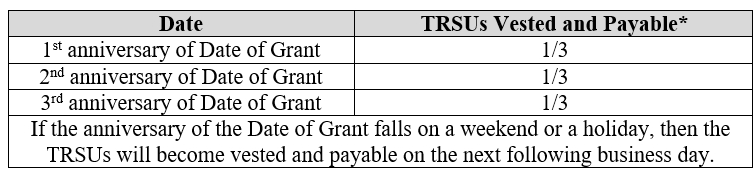
A-1
|
Termination of Service as provided in (c), then all such TRSUs (other than under any Replacement Award) will be immediately forfeited; (e) a pro-rata portion of the TRSUs and each Replacement Award, as applicable, will vest upon your Termination of Service due to your Total and Permanent Disability or death, calculated by multiplying the number of TRSUs or shares underlying any Replacement Award scheduled to vest on the anniversary of the Date of Grant immediately after your Termination of Service by a fraction, the numerator of which is the number of days that have elapsed from the last anniversary of the Date of Grant (or if the Termination of Service occurs before the 1st anniversary of the Date of Grant, then the number of days that have elapsed from the Date of Grant) through your Termination of Service, and the denominator of which will be 365; (f) notwithstanding the foregoing, upon a Qualifying Retirement (as defined below), all outstanding RSUs shall accelerate and vest in full; and (g) all Replacement Awards will vest in full upon your Qualifying Separation from Service or Qualifying Retirement, whichever occurs first. “Qualifying Retirement” means a Termination of Service due to voluntary retirement, provided that (i) such Termination of Service occurs on or after the date the individual has reached age 63 and has completed at least five years of service with the Company or the Company Group, (ii) such Termination of Service occurs more than one year after the Date of Grant, and (iii) the Company has not determined in good faith that Cause exists immediately prior to such Termination of Service. “Qualifying Separation from Service” means a Termination of Service (i) by the Company without Cause (including a notice of non-renewal of your employment agreement by the Company) or (ii) by you for Good Reason. “Replacement Award” means an award of restricted stock units in respect of common stock that is publicly traded on an established securities market with substantially equivalent terms as the replaced RSUs, including vesting terms and dividend equivalent rights, issued by the surviving or successor company or a parent or subsidiary of such company. “Cause” means (a) “Cause” as defined in your employment agreement, or (b) in the absence of such an agreement or such a definition, (i) your violation of the Company’s substance abuse policy; (ii) your refusal or inability (other than by reason of death or Total and Permanent Disability) to perform the duties assigned to you by the Company or your unacceptable performance of the same; (iii) acts or omissions evidencing a violation of your duties of loyalty and good faith, candor, fair and honest dealing, integrity, or full disclosure to the Company, as well as any acts or omissions by you that constitute self-dealing; (iv) disobedience of orders, policies, regulations, or directives issued to you by the Company, including policies related to sexual harassment, discrimination, computer use, or the like; (v) your conviction for or commission of a felony, a crime of moral turpitude, or a crime that could reasonably be expected to impair your ability to perform your job duties; (vi) revocation or suspension of any license or certification necessary for you to perform your duties to the Company; (vii) your willful generation of materially incorrect financial or engineering projections, compilations, or reports; or (viii) a false statement by you to obtain your position. |
A-2
|
“Good Reason” means (a) “Good Reason” as defined in your employment agreement, or (b) in the absence of such an agreement or such a definition, (i) a material diminution of your authority or duties; (ii) a material reduction in your base salary, unless the reduction is a proportionate reduction of compensation for you and all other similarly situated employees of the Company; or (iii) a material breach of this Agreement by the Company. |
Terms Applicable to PRSUs
Vesting and Payment of PRSUs: |
Performance Period: • The Performance Period applicable to the PRSUs (the “Performance Period”) shall begin on January 1 of the calendar year in which the Date of Grant occurs and shall end on December 31 of the third calendar year thereafter. The PRSUs shall vest, if at all, at the end of the three-year anniversary of the Date of Grant, subject to the Committee’s certification of performance. If the three-year anniversary of the Date of Grant falls on a weekend or a holiday, then the PRSUs shall vest and become payable on the next following business day. Performance Metrics: • The number of PRSUs that vest, if any, will be determined by the following process. • Performance shall be measured as of December 31 in each calendar year falling wholly or partially within the Performance Period (each, a “Covered Year”). The performance objective for each Covered Year shall be based on return on net assets (“RONA”), as calculated by the Committee in its discretion, or such other performance goal as may be determined by the Committee in its sole discretion and shall be established by the 90th day after the start of the applicable Covered Year (the “Performance Objective”). Each Performance Objective shall include threshold, target, and maximum performance levels, each with a corresponding percentage payout of the Target PRSUs, as reflected in the table below. • Following the completion of each Covered Year, the Committee will determine the payout percentage that was attained for such year (each, a “Payout Percentage”) and following the completion of the third Covered Year, the Committee will determine the total number of PRSUs eligible for vesting prior to the application of the TSR modifier in accordance with the following. The total number of PRSUs eligible for vesting, if any, based on the Performance Objective will equal (i) the Target PRSUs multiplied by (ii) the Average Payout Percentage (the “Pre-Modifier PRSUs”). The Average Payout Percentage will equal (x) the sum of the Payout Percentages for each of the Covered Years divided by (y) the number of Covered Years. • For the first Covered Year, the Performance Objective selected by the Committee is RONA and the Payout Percentage will be determined as set forth below. The method of calculating RONA is set forth on Schedule 1 attached hereto; provided, however, that the Committee shall have full and final discretion with respect to the determination and calculation of RONA. For the avoidance of doubt, the Performance Objective for each subsequent Covered Year may differ from the Performance Objective applicable to the first Covered Year. |
A-3
|
Straight line interpolation is used to determine the applicable Payout Percentage between threshold and target and between target and maximum performance levels. For the avoidance of doubt, in no event may the Payout Percentage of any Covered Year exceed 200%.
• TSR Modifier: The Pre-Modifier PRSUs, if any, shall then be subject to adjustment, based on the Company’s Total Shareholder Return (“TSR”) relative to the TSR of the companies in the Company’s peer group over the three-year Performance Period. Such adjustment shall be determined by multiplying the Pre-Modifier PRSUs by the TSR Multiplier Percentage, as set forth in the chart below. The application of the TSR Multiplier Percentage shall determine the final number of PRSUs eligible to vest, subject to the remaining terms and conditions of this Agreement. • For purposes of this Agreement, TSR for the Company shall be expressed as a percentage and calculated according to the following formula: TSR = (Ending Average Stock Price / Beginning Average Stock Price) – 1. “Accumulated Shares” shall mean, for a given trading day, the sum of (i) one (1) share plus (ii) the cumulative number of shares of Common Stock of the Company purchasable with dividends declared on the Common Stock to that point during the period since the first day of the Beginning Average Period, assuming same day reinvestment of such dividends at the Closing Price on the ex-dividend date.
“Beginning Average Period” shall mean the twenty (20) trading days immediately preceding the first day of the Performance Period.
“Beginning Average Stock Price” shall mean the arithmetic mean of daily Closing Prices multiplied by Accumulated Shares over the Beginning Average Period.
“Closing Price” shall mean for a given trading day, the closing price of a share of Common Stock on the primary U.S. stock exchange on which the Common Stock is principally traded.
“Ending Average Period” shall mean the twenty (20) trading days ending on and including the last day of the Performance Period.
“Ending Average Stock Price” shall mean the arithmetic mean of daily Closing Prices multiplied by Accumulated Shares over the Ending Average Period.
|

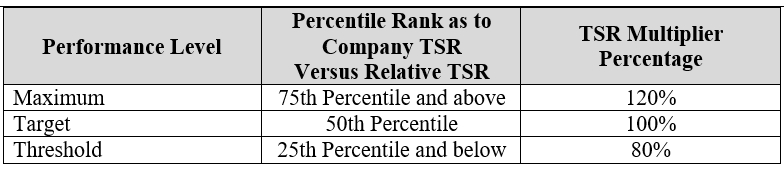
A-4
|
If the Company’s TSR as compared to the Peer Group’s TSR is between the prescribed threshold and maximum percentages set forth in the chart below, the PRSUs will partially vest on a pro rata basis. Notwithstanding the foregoing, if the Company’s TSR for the Performance Period is negative, the application of the TSR Multiplier Percentage shall be capped at the “Target” level prescribed in the chart above.
TSR calculations shall be adjusted to reflect stock splits, reverse stock splits, or other similar corporate transactions as determined in the sole discretion of the Committee. The Committee shall also have authority to make equitable adjustments to the Peer Group and percentile determinations in the event of extraordinary corporate transactions or changes affecting one or more members of the Peer Group. All calculations will be done by the Committee and will be final, binding, and conclusive on all persons and entities for all purposes under this Agreement.
(1) For TSR performance metric the Company’s peer group includes AdvanSix Inc., Intrepid Potash, Inc., The Mosaic Company, Nutrien Ltd., CF Industries Holdings, Inc., Avient Corporation, Olin Corporation, and Methanex Corporation (collectively, the “Peer Group”).
|
Accelerated Payment Events for PRSUs: |
As long as (i) you do not incur a Termination of Service before the occurrence of any of the events listed below, except as provided below for certain Qualifying Separations from Service, a Qualifying Retirement, your death and Total and Permanent Disability, and (ii) you hold PRSUs at such time: (a) if a Change in Control occurs before the end of the Performance Period, then the portion of the Target PRSUs that are eligible to vest under this Agreement will be determined solely by the Committee immediately before the Change in Control and will equal the greater of (x) the number of Target PRSUs and (y) the portion of the Target PRSUs that are eligible to vest under this Agreement based on actual performance, as determined solely by the Committee before the Change in Control by (1) shortening the Performance Period to end on the date of the Change in Control, (2) adjusting the applicable performance goals set forth immediately above as appropriate based on the shortened Performance Period, and (3) determining the level of achievement of such goals based on such shortened Performance Period ((x) or (y), as applicable, the “CIC PRSUs”); (b) in connection with a Change in Control, the CIC PRSUs may be substituted pursuant to Section 12.4 of the Plan for a Replacement Award, provided that any Replacement Award will vest solely based on your continued service with the Company and its Subsidiaries through the last day of the original Performance Period; provided, further, that if a Replacement Award is issued and after the Change in Control the equity securities underlying the Replacement Award cease to be publicly traded on an established securities market, the Replacement Award will vest in full immediately prior to such equity securities ceasing to be publicly traded on an established securities market; (c) if the CIC PRSUs are not substituted in connection with a Change in Control with a Replacement Award, the CIC PRSUs will vest in full upon a Change in Control such that you may participate as a stockholder in such Change in Control or, if determined by the Committee, the value of such CIC PRSUs may be paid to you in cash; (d) all Replacement Awards will vest in full upon your Qualifying Separation from Service or Qualifying Retirement; (e) the CIC PRSUs will vest in full on a Change in Control if you have a Qualifying Separation from Service either (i) within 90 days before the date a definitive agreement is executed that results in a Change in Control within 180 days after the date such definitive agreement |
A-5
|
is executed or (ii) on or within 180 days after the date a definitive agreement is executed that results in a Change in Control within 180 days after the date such definitive agreement is executed, and the value of such CIC PRSUs may be paid to you in cash; (f) if you incur a Termination of Service due to your Total and Permanent Disability or death before a Change in Control, at the end of the Performance Period (or the date of the consummation of a Change in Control, if earlier, where there is no Replacement Award), you will vest in a pro-rata portion of the Target PRSUs based on actual performance, as determined by the Committee at the end of the Performance Period (or the date of the consummation of a Change in Control, if earlier) based on the level of achievement of the applicable performance measures for the Performance Period, as adjusted pursuant to clause (a) of this Accelerated Payment Events for PRSUs, with such pro-rata portion calculated by multiplying the number of Target PRSUs that are eligible to vest under this Agreement, if any, by a fraction, the numerator of which is the number of days that have elapsed from the beginning of the Performance Period through your Termination of Service and the denominator of which will be the total number of days in the Performance Period (or, if a Change in Control occurs before the end of the Performance Period and there is no Replacement Award, the total number of days from the beginning of the Performance Period through the date of the Change in Control); provided that if there is earlier vesting upon a Change in Control where there is no Replacement Award, the value of the vested PRSUs may be paid to you in cash; (g) a pro-rata portion of any Replacement Award will vest upon the your Termination of Service due to your Total and Permanent Disability or death at the end of the Performance Period (or, if earlier, upon a subsequent Change in Control), with such pro-rata portion calculated by multiplying the number of shares covered by the Replacement Award by a fraction, the numerator of which is the number of days that have elapsed from the beginning of the Performance Period through your Termination of Service and the denominator of which is the total number of days in the Performance Period; (h) if, before a Change in Control, you incur a Qualifying Separation from Service, you will vest at the end of the Performance Period (or the date of a Change in Control, if earlier, where there is no Replacement Award) in a pro-rata portion of the Target PRSUs, with such pro-rata portion calculated by multiplying (i) the number of Target PRSUs that are eligible to vest under this Agreement, if any, based on actual performance, determined at the end of the Performance Period (or the date of the Change in Control, if earlier) based on the level of achievement of the applicable performance measures for the Performance Period, as adjusted pursuant to clause (a) of this Accelerated Payment Events for PRSUs, by (ii) a fraction, the numerator of which is the number of days that have elapsed from the beginning of the Performance Period through your Qualifying Separation from Service and the denominator of which is the total number of days in the Performance Period (or, if a Change in Control occurs before the end of the Performance Period and there is no Replacement Award, the total number of days from the beginning of the Performance Period through the date of the Change in Control); provided that if there is earlier vesting upon a Change in Control where there is no Replacement Award, the value of the vested PRSUs may be paid to you in cash; and (i) notwithstanding the foregoing, upon a Qualifying Retirement, all outstanding PRSUs, including any PRSUs subject to a Replacement Award, shall accelerate and vest in full at the greater of (i) the Target PRSUs and (ii) the number of PRSUs earned based on actual performance through the date of such Qualifying Retirement, as determined by the Committee in its sole discretion. |
A-6
|
For the avoidance of doubt, the Committee retains full discretion to determine performance for any partial-year periods resulting from the acceleration events described above. |
A-7
Exhibit B
LSB INDUSTRIES, INC.
2025 LONG-TERM INCENTIVE PLAN
The LSB Industries, Inc. 2025 Long-Term Incentive Plan (the “Plan”) was adopted by the Board of Directors of LSB Industries, Inc., a Delaware corporation (the “Company”), effective as of April 9, 2025 (the “Board Approval Date”) to be effective as of the date the Plan is approved by the Company’s stockholders (the “Effective Date”).
PURPOSE
The purpose of the Plan is to attract and retain the services of key Employees, key Contractors, and Outside Directors of the Company and its Subsidiaries and to provide such persons with a proprietary interest in the Company through the granting of Incentive Stock Options, Nonqualified Stock Options, Stock Appreciation Rights, Restricted Stock, Restricted Stock Units, Performance Awards, Dividend Equivalent Rights, Other Awards, and Tandem Awards, whether granted singly, or in combination, or in tandem, that will:
With respect to Reporting Participants, the Plan and all transactions under the Plan are intended to comply with all applicable conditions of Rule 16b-3 promulgated under the Exchange Act. To the extent any provision of the Plan or action by the Committee fails to so comply, such provision or action shall be deemed null and void ab initio, to the extent permitted by law and deemed advisable by the Committee.
DEFINITIONS
For the purpose of the Plan, unless the context requires otherwise, the following terms shall have the meanings indicated:
B-1
For purposes hereof:
“Affiliate” shall have the meaning set forth in Rule 12b-2 promulgated under Section 12 of the Exchange Act.
“Beneficial Owner” shall have the meaning set forth in Rule 13d-3 under the Exchange Act except that a Person shall be deemed to be the “Beneficial Owner” of all shares that any such Person has the right to acquire pursuant to any agreement or arrangement or upon exercise of conversion rights, warrants, options or otherwise, without regard to the 60-day period referred to in such rule).
B-2
“Company” shall mean, unless as otherwise provided in an Award Agreement, (i) the Company, as defined in Section 2.12; (ii) the entity for whom a Participant performs services for which an Award is granted; and (iii) an entity that is a stockholder owning more than 50% of the total number of outstanding shares of Common Stock (or other equity interests) and total voting power (i.e., a majority stockholder) of the Company or entity identified in (ii), or any entity in a chain of entities in which each entity is a majority stockholder of another entity in the chain, ending on the Company or the entity identified in (ii).
“Gross Fair Market Value” shall mean the value of the Company’s assets or the value of the assets being disposed of, determined without regard to any liabilities associated with such assets.
“Person” means any person or entity of any nature whatsoever, specifically including an individual, a firm, a company, a corporation, a partnership, a limited liability company, a trust or other entity; a Person, together with that Person’s Affiliates and Associates (as those terms are defined in Rule 12b-2 under the Exchange Act, provided that “registrant” as used in Rule 12b-2 shall mean the Company), and any Persons acting as a partnership, limited partnership, joint venture, association, syndicate or other group (whether or not formally organized), or otherwise acting jointly or in concert or in a coordinated or consciously parallel manner (whether or not pursuant to any express agreement), for the purpose of acquiring, holding, voting or disposing of securities of the Company with such Person, shall be deemed a single “Person.”
Notwithstanding the foregoing, no transaction or series of transactions shall be deemed to constitute a Change in Control unless and to the extent such transaction or transactions constitute a change in ownership or control under Section 409A of the Code. Additionally, for purposes of this Section 2.7, Section 318(a) of the Code, regarding constructive ownership, shall apply to determine stock ownership; provided, however, that any stock underlying unvested Nonqualified Stock Options or Incentive Stock Options shall not be treated as owned by such Participant who owns such Nonqualified Stock Option or Incentive Stock Option.
B-3
B-4
B-5
B-6
ADMINISTRATION
Membership on the Committee shall be limited to those members of the Board who are “non-employee directors” as defined in Rule 16b-3 promulgated under the Exchange Act. The Committee shall select one of its members to act as its Chairman. A majority of the Committee shall constitute a quorum, and the act of a majority of the members of the Committee present at a meeting at which a quorum is present shall be the act of the Committee.
B-7
The Committee may delegate to officers of the Company, pursuant to a written delegation, the authority to perform specified functions under the Plan. Any actions taken by any officers of the Company pursuant to such written delegation of authority shall be deemed to have been taken by the Committee.
With respect to restrictions in the Plan that are based on the requirements of Rule 16b‑3 promulgated under the Exchange Act, Section 422 of the Code, the rules of any exchange or inter-dealer quotation system upon which the Company’s securities are listed or quoted, or any other Applicable Law, to the extent that any such restrictions are no longer required by Applicable Law, the Committee shall have the sole discretion and authority to grant Awards that are not subject to such formerly mandated restrictions and/or to waive any such formerly mandated restrictions with respect to outstanding Awards.
ELIGIBILITY
Any Employee (including an Employee who is also a director or an officer), Contractor or Outside Director of the Company whose judgment, initiative, and efforts contributed or may be expected to contribute to the successful performance of the Company is eligible to participate in the Plan; provided that only Employees of a Corporation shall be eligible to receive Incentive Stock Options. The Committee, upon its own action, may grant, but shall not be required to grant, an Award to any Employee, Contractor or Outside Director. Awards may be granted by the Committee at any time and from time to time to new Participants, or to then Participants, or to a greater or lesser number of Participants, and may include or exclude previous Participants, as the Committee shall determine. Except as required by this Plan, Awards need not contain similar provisions. The Committee’s determinations under the Plan (including without limitation determinations of which Employees, Contractors or Outside Directors, if any, are to receive Awards, the form, amount and timing of such Awards, the terms and provisions of such Awards and the
B-8
agreements evidencing same) need not be uniform and may be made by it selectively among Participants who receive, or are eligible to receive, Awards under the Plan.
SHARES SUBJECT TO PLAN
B-9
GRANT OF AWARDS
B-10
B-11
B-12
If the Committee determines, in its sole discretion, that the established performance measures or objectives are no longer suitable because of a change in the Company’s business, operations, corporate structure, or for other reasons that the Committee deemed satisfactory, the Committee may modify the performance measures or objectives and/or the performance period.
B-13
AWARD PERIOD; VESTING
B-14
EXERCISE OR CONVERSION OF INCENTIVE
B-15
B-16
The distribution of any cash or Common Stock pursuant to the foregoing sentence shall be made at such time as set forth in the Award Agreement.
AMENDMENT OR DISCONTINUANCE
Subject to the limitations set forth in this Article 9, the Board may at any time and from time to time, without the consent of the Participants, alter, amend, revise, suspend, or discontinue the Plan in whole or in part; provided, however, that no amendment for which stockholder approval is required either (a) by any securities exchange or inter-dealer quotation system on which the Common Stock is listed or traded or (b) in order for the Plan and Incentives awarded under the Plan to continue to comply with Sections 421 and 422 of the Code, including any successors to such Sections, or other Applicable Law, shall be effective unless such amendment shall be approved by the requisite vote of the stockholders of the Company entitled to vote thereon. Any such amendment shall, to the extent deemed necessary or advisable by the Committee, be applicable to any outstanding Incentives theretofore granted under the Plan, notwithstanding any contrary provisions contained in any Award Agreement. In the event of any such amendment to the Plan, the holder of any Incentive outstanding under the Plan shall, upon request of the Committee and as a condition to the exercisability thereof, execute a conforming amendment in the form prescribed by the Committee to any Award Agreement relating thereto. Notwithstanding anything contained in this Plan to the contrary, unless required by law, no action contemplated or permitted by this Article 9 shall adversely affect any rights of Participants or obligations of the Company to Participants with respect to any Incentive theretofore granted under the Plan without the consent of the affected Participant. For purposes of clarity, any amendment to an existing Award resulting in a less favorable tax consequence to a Participant under the Award shall not be considered to adversely affect the rights of the Participant.
B-17
TERM
The Plan shall be effective as of the Effective Date and unless sooner terminated by action of the Board, the Plan will terminate on the 10th anniversary of the Effective Date, but Incentives granted before that date will continue to be effective in accordance with their terms and conditions.
CAPITAL ADJUSTMENTS
In the event that any dividend or other distribution (whether in the form of cash, Common Stock, other securities, or other property), recapitalization, stock split, reverse stock split, rights offering, reorganization, merger, consolidation, split-up, spin-off, split-off, combination, subdivision, repurchase, or exchange of Common Stock or other securities of the Company, issuance of warrants or other rights to purchase Common Stock or other securities of the Company, or other similar corporate transaction or event affects the fair value of an Award, then the Committee shall adjust any or all of the following so that the fair value of the Award immediately after the transaction or event is equal to the fair value of the Award immediately prior to the transaction or event (a) the number of shares and type of Common Stock (or the securities or property) which thereafter may be made the subject of Awards, (b) the number of shares and type of Common Stock (or other securities or property) subject to outstanding Awards, (c) the Option Price of each outstanding Award, (d) the amount, if any, the Company pays for forfeited shares of Common Stock in accordance with Section 6.4, and (e) the number of or SAR Price of shares of Common Stock then subject to outstanding SARs previously granted and unexercised under the Plan, to the end that the same proportion of the Company’s issued and outstanding shares of Common Stock in each instance shall remain subject to exercise at the same aggregate SAR Price; provided, however, that the number of shares of Common Stock (or other securities or property) subject to any Award shall always be a whole number. Notwithstanding the foregoing, no such adjustment shall be made or authorized to the extent that such adjustment would cause the Plan or any Stock Option to violate Section 422 of the Code or Section 409A of the Code. Such adjustments shall be made in accordance with the rules of any securities exchange, stock market, or stock quotation system to which the Company is subject.
The computation of any adjustment under this Article 11 shall be conclusive and shall be binding upon each affected Participant and upon the occurrence of any such adjustment, the Company shall provide notice to each affected Participant of its computation of such adjustment.
RECAPITALIZATION, MERGER AND CONSOLIDATION
B-18
An Award that by its terms would be fully vested or exercisable upon a Change in Control will be considered vested or exercisable for purposes of Section 12.4(a) hereof.
B-19
LIQUIDATION OR DISSOLUTION
Subject to Section 12.4 hereof, in case the Company shall, at any time while any Incentive under this Plan shall be in force and remain unexpired, (a) sell all or substantially all of its property, or (b) dissolve, liquidate, or wind up its affairs, then each Participant shall be entitled to receive, in lieu of each share of Common Stock of the Company which such Participant would have been entitled to receive under the Incentive, the same kind and amount of any securities or assets as may be issuable, distributable, or payable upon any such sale, dissolution, liquidation, or winding up with respect to each share of Common Stock of the Company. If the Company shall, at any time prior to the expiration of any Incentive, make any partial distribution of its assets, in the nature of a partial liquidation, whether payable in cash or in kind (but excluding the distribution of a cash dividend payable out of earned surplus and designated as such) and an adjustment is determined by the Committee to be appropriate to prevent the dilution of the benefits or potential benefits intended to be made available under the Plan, then the Committee shall, in such manner as it may deem equitable, make such adjustment in accordance with the provisions of Article 11 hereof.
INCENTIVES IN SUBSTITUTION FOR
INCENTIVES GRANTED BY OTHER ENTITIES
Incentives may be granted under the Plan from time to time in substitution for similar instruments held by employees, independent contractors or directors of a corporation, partnership, or limited liability company who become or are about to become Employees, Contractors or Outside Directors of the Company or any Subsidiary as a result of a merger or consolidation of the employing corporation with the Company, the acquisition by the Company of equity of the employing entity, or any other similar transaction pursuant to which the Company becomes the successor employer. The terms and conditions of the substitute Incentives so granted may vary from the terms and conditions set forth in this Plan to such extent as the Committee at the time of grant may deem appropriate to conform, in whole or in part, to the provisions of the incentives in substitution for which they are granted.
MISCELLANEOUS PROVISIONS
B-20
B-21
Except as otherwise provided herein, Awards may not be transferred, assigned, pledged, hypothecated or otherwise conveyed or encumbered other than by will or the laws of descent and distribution. Notwithstanding the foregoing, the Committee may, in its discretion, authorize all or a portion of an Award to be granted to a Participant on terms which permit transfer by such Participant to (a) the spouse (or former spouse), children or grandchildren of the Participant (“Immediate Family Members”), (b) a trust or trusts for the exclusive benefit of such Immediate Family Members, (c) a partnership in which the only partners are (1) such Immediate Family Members and/or (2) entities which are controlled by the Participant and/or Immediate Family Members, (d) an entity exempt from federal income tax pursuant to Section 501(c)(3) of the Code or any successor provision, or (e) a split interest trust or pooled income fund described in Section 2522(c)(2) of the Code or any successor provision, provided that (x) there shall be no consideration for any such transfer, (y) the Award Agreement pursuant to which such Award is granted must be approved by the Committee and must expressly provide for transferability in a manner consistent with this Section, and (z) subsequent transfers of transferred Award shall be prohibited except those by will or the laws of descent and distribution.
Following any transfer, any such Award shall continue to be subject to the same terms and conditions as were applicable immediately prior to transfer, provided that for purposes of Articles 8, 9, 11, 13 and 15 hereof the term “Participant” shall be deemed to include the transferee. The events of Termination of Service shall continue to be applied with respect to the original Participant, following which the Award shall be transferable, exercisable or convertible by the transferee only to the extent and for the periods specified in the Award Agreement. The Committee and the Company shall have no obligation to inform any transferee of an Award of any expiration, termination, lapse or acceleration of such Award. The Company shall have no obligation to register with any federal or state securities commission or agency any Common Stock issuable or issued under an Award that has been transferred by a Participant under this Section 15.8.
B-22
A copy of this Plan shall be kept on file in the principal office of the Company in Dallas, Texas.
***************
B-23
IN WITNESS WHEREOF, the Company has caused this instrument to be executed as of April 9, 2025, by its Chief Executive Officer pursuant to prior action taken by the Board.
LSB INDUSTRIES, INC.
By:
Name: Mark T. Behrman
Title: Chief Executive Office
B-24
Schedule 1
Calculation of Return on Net Assets (RONA)
The calculation of RONA for the first Covered Year shall be determined by reference to the ratio (expressed as a percentage) of the Company’s Adjusted EBITDA for fiscal year 2025 divided by its Average Net Operational Assets, in each case as calculated in a manner consistent with the Company’s financial reporting practices and as determined by the Committee in good faith, with authority to make reasonable, non-substantive adjustments to reflect changes in accounting standards, reporting conventions, or extraordinary or non-recurring events, provided that such adjustments do not materially alter the intent of the performance metric.
RONA = Adjusted EBITDA
Average Net Operating Assets
Where:
EBITDA is computed as the sum of:
Adjusted EBITDA means the Company’s Adjusted EBITDA, as calculated and reported in the Company’s earnings statement for the applicable fiscal year less turnaround expense.
Operating Assets is computed as the sum of:
Operating Liabilities is computed as the sum of:
Net Operating Assets means Operating Assets minus Operating Liabilities.
Average Net Operating Assets is computed as the simple average of (i) the Net Operating Assets of the Company as of December 31, 2025, and (ii) the Net Operating Assets of the Company as of December 31, 2024.
Schedule 1
Exhibit 31.1
CERTIFICATION
I, Mark T. Behrman, certify that:
Date: April 30, 2026
/s/ Mark T. Behrman |
Mark T. Behrman |
President, Chief Executive Officer |
and Chairman of the Board of Director |
Exhibit 31.2
CERTIFICATION
I, Cheryl A. Maguire, certify that:
Date: April 30, 2026
/s/ Cheryl A. Maguire |
Cheryl A. Maguire |
Executive Vice President |
and Chief Financial Officer |
Exhibit 32.1
CERTIFICATION PURSUANT TO
18 U.S.C. SECTION 1350
AS ADOPTED PURSUANT TO
SECTION 906 OF THE SARBANES-OXLEY ACT OF 2002
In connection with the Quarterly Report of LSB Industries, Inc. (“LSB”) on Form 10-Q for the period ended March 31, 2026 as filed with the Securities and Exchange Commission on the date hereof (the “Report”). I, Mark T. Behrman, President and Chief Executive Officer of LSB, certify pursuant to 18 U.S.C. §1350, as adopted pursuant to §906 of the Sarbanes-Oxley Act of 2002, that:
/s/ Mark T. Behrman |
Mark T. Behrman |
President, Chief Executive Officer |
(Principal Executive Officer) and |
Chairman of the Board of Director |
April 30, 2026
This certification is furnished to the Securities and Exchange Commission solely for purpose of 18 U.S.C. §1350 subject to the knowledge standard contained therein, and not for any other purpose.
Exhibit 32.2
CERTIFICATION PURSUANT TO
18 U.S.C. SECTION 1350
AS ADOPTED PURSUANT TO
SECTION 906 OF THE SARBANES-OXLEY ACT OF 2002
In connection with the Quarterly Report of LSB Industries, Inc. (“LSB”) on Form 10-Q for the period ended March 31, 2026 as filed with the Securities and Exchange Commission on the date hereof (the “Report”), I, Cheryl A. Maguire, Executive Vice President and Chief Financial Officer of LSB, certify pursuant to 18 U.S.C. §1350, as adopted pursuant to §906 of the Sarbanes-Oxley Act of 2002, that:
/s/ Cheryl A. Maguire |
Cheryl A. Maguire |
Executive Vice President |
and Chief Financial Officer |
(Principal Financial and Accounting Officer) |
April 30, 2026
This certification is furnished to the Securities and Exchange Commission solely for purpose of 18 U.S.C. §1350 subject to the knowledge standard contained therein and not for any other purpose.