OI 8-K
O-I Glass, Inc. /DE/ (OI)
UNITED STATES
SECURITIES AND EXCHANGE COMMISSION
Washington, D.C. 20549
FORM
CURRENT REPORT
Pursuant to Section 13 or 15(d) of
The Securities Exchange Act of 1934
Date of Report (Date of earliest event reported)

(Exact name of registrant as specified in its charter)
| (State or other jurisdiction of incorporation) |
(Commission |
(IRS
Employer |
(Address of principal executive offices) |
(Zip Code) |
(
(Registrant’s telephone number, including area code)
(Former name or former address, if changed since last report)
Check the appropriate box below if the Form 8-K filing is intended to simultaneously satisfy the filing obligation of the registrant under any of the following provisions:
| Written communications pursuant to Rule 425 under the Securities Act (17 CFR 230.425) |
| Soliciting material pursuant to Rule 14a-12 under the Exchange Act (17 CFR 240.14a-12) |
| Pre-commencement communications pursuant to Rule 14d-2(b) under the Exchange Act (17 CFR 240.14d-2(b)) |
| Pre-commencement communications pursuant to Rule 13e-4(c) under the Exchange Act (17 CFR 240.13e-4(c)) |
Securities registered pursuant to Section 12(b) of the Act:
| Title of each class | Trading Symbol | Name
of each exchange on which |
| |
Indicate by check mark whether the registrant is an emerging growth company as defined in Rule 405 of the Securities Act of 1933 (§230.405 of this chapter) or Rule 12b-2 of the Securities Exchange Act of 1934 (§240.12b-2 of this chapter).
Emerging growth company
If an emerging growth company, indicate by check mark if the registrant has elected not to use the extended transition period for complying with any new or revised financial accounting standards provided pursuant to Section 13(a) of the Exchange Act. ¨
| ITEM 7.01. | REGULATION FD DISCLOSURE. |
O-I Glass, Inc.’s (the “Company”) Chief Executive Officer Gordon Hardie and Chief Financial Officer John Haudrich are scheduled to present at the Citi 2025 Basic Materials Conference (the “Conference”) on Wednesday, December 3, 2025 at 11:30 a.m., Eastern Time.
A live webcast of the presentation will be available at the following link: https://kvgo.com/2025-basic-materials-conference/o-i-glass-inc-december. The replay from the conference will be posted within 24 hours of the presentation and will be archived through this link for 90 days following the completion of the Conference. A copy of the presentation slides, which will be discussed at the Conference, is attached hereto as Exhibit 99.1 and will also be available on the Company’s website, www.o-i.com/investors.
The information contained in this Item 7.01 and in Exhibit 99.1 hereto is furnished and shall not be deemed “filed” for purposes of Section 18 of the Securities Exchange Act of 1934, as amended (the “Exchange Act”), or otherwise subject to the liabilities of that Section, nor shall it be deemed to be incorporated by reference into any filing of the Company under the Securities Act of 1933, as amended, or the Exchange Act, except as expressly set forth by specific reference in such a filing.
| ITEM 9.01. | FINANCIAL STATEMENTS AND EXHIBITS. |
(d) Exhibits.
| Exhibit No. |
Description | |
| 99.1 | Citi 2025 Basic Materials Conference slides | |
| 104 |
Cover Page Interactive Data File (formatted as inline XBRL and contained in Exhibit 101) |
SIGNATURES
Pursuant to the requirements of the Securities Exchange Act of 1934, the registrant has duly caused this report to be signed on its behalf by the undersigned hereunto duly authorized.
| O-I GLASS, INC. | ||
| Date: December 2, 2025 | By: | /s/ John A. Haudrich |
| Name: | John A. Haudrich | |
| Title: | Senior Vice President and Chief Financial Officer | |
| CAPITAL MARKETS PRESENTATION 4Q 2025 |

| SAFE HARBOR COMMENTS AND FORWARD-LOOKING STATEMENTS This presentation contains “forward-looking” statements related to O-I Glass, Inc. (“O-I Glass” or the “Company”) within the meaning of Section 21E of the Securities Exchange Act of 1934, as amended (the “Exchange Act”), and Section 27A of the Securities Act of 1933, as amended. Forward-looking statements reflect the Company’s current expectations and projections about future events at the time, and thus involve uncertainty and risk. The words “believe,” “expect,” “anticipate,” “will,” “could,” “would,” “should,” “may,” “plan,” “estimate,” “intend,” “predict,” “potential,” “continue,” "target," “commit” and the negatives of these words and other similar expressions generally identify forward-looking statements. It is possible that the Company’s future financial performance may differ from expectations due to a variety of factors including, but not limited to the following: (1) the Company’s ability to achieve expected benefits from cost management, efficiency improvements, and profitability initiatives, such as its Fit to Win program, including expected impacts from production curtailments, reduction in force and furnace closures, (2) the general political, economic, legal and competitive conditions in markets and countries where the Company has operations, including uncertainties related to economic and social conditions, trade policies and disputes, financial market conditions, disruptions in the supply chain, competitive pricing pressures, inflation or deflation, changes in tax rates, changes in laws or policies, legal proceedings involving the Company, war, civil disturbance or acts of terrorism, natural disasters, public health issues and weather, (3) cost and availability of raw materials, labor, energy and transportation (including impacts related to the current Ukraine-Russia and Israel-Hamas conflicts and disruptions in supply of raw materials caused by transportation delays), (4) competitive pressures from other glass container producers and alternative forms of packaging or consolidation among competitors and customers, (5) changes in consumer preferences or customer inventory management practices, (6) the continuing consolidation of the Company’s customer base, (7) impacts from the Company’s decision to halt further MAGMA development and operations, (8) unanticipated supply chain and operational disruptions, including higher capital spending, (9) seasonality of customer demand, (10) the failure of the Company’s joint venture partners to meet their obligations or commit additional capital to the joint venture, (11) labor shortages, labor cost increases or strikes, (12) the Company’s ability to acquire or divest businesses, acquire and expand plants, integrate operations of acquired businesses and achieve expected benefits from acquisitions, divestitures or expansions, (13) the Company’s ability to generate sufficient future cash flows to ensure the Company’s goodwill is not impaired, (14) any increases in the underfunded status of the Company’s pension plans, (15) any failure or disruption of the Company’s information technology, or those of third parties on which the Company relies, or any cybersecurity or data privacy incidents affecting the Company or its third-party service providers, (16) risks related to the Company’s indebtedness or changes in capital availability or cost, including interest rate fluctuations and the ability of the Company to generate cash to service indebtedness and refinance debt on favorable terms, (17) risks associated with operating in foreign countries, (18) foreign currency fluctuations relative to the U.S. dollar, (19) changes in tax laws or global trade policies, (20) the Company’s ability to comply with various environmental legal requirements, (21) risks related to recycling and recycled content laws and regulations, (22) risks related to climate-change and air emissions, including related laws or regulations and increased environmental, social and governance scrutiny and changing expectations from stakeholders, and the other risk factors discussed in the Company's filings with the Securities and Exchange Commission. It is not possible to foresee or identify all such factors. Any forward-looking statements in this document are based on certain assumptions and analyses made by the Company in light of its experience and perception of historical trends, current conditions, expected future developments, and other factors it believes are appropriate in the circumstances. Forward-looking statements are not a guarantee of future performance, and actual results or developments may differ materially from expectations. While the Company continually reviews trends and uncertainties affecting the Company’s results of operations and financial condition, the Company does not assume any obligation to update or supplement any particular forward-looking statements contained in this document. Additionally, certain forward-looking and other statements in this presentation or other locations, such as the Company’s corporate website, regarding ESG matters are informed by various ESG standards and frameworks (which may include standards for the measurement of underlying data) and the interests of various stakeholders. Accordingly, such information may not be, and should not be interpreted as necessarily being “material” under the federal securities laws for SEC reporting purposes, even if the Company uses the word “material” or “materiality” in such discussions. In particular, certain standards and frameworks use definitions of “materiality” in the ESG context that differ from, and are often more expansive than, the definition under U.S. federal securities laws. ESG information is also often reliant on third-party information or methodologies that are subject to evolving expectations and best practices. The Company’s disclosures may change due to revisions in framework requirements, availability of information, changes in its business or applicable governmental policies, or other factors, some of which may be beyond its control. 2 |
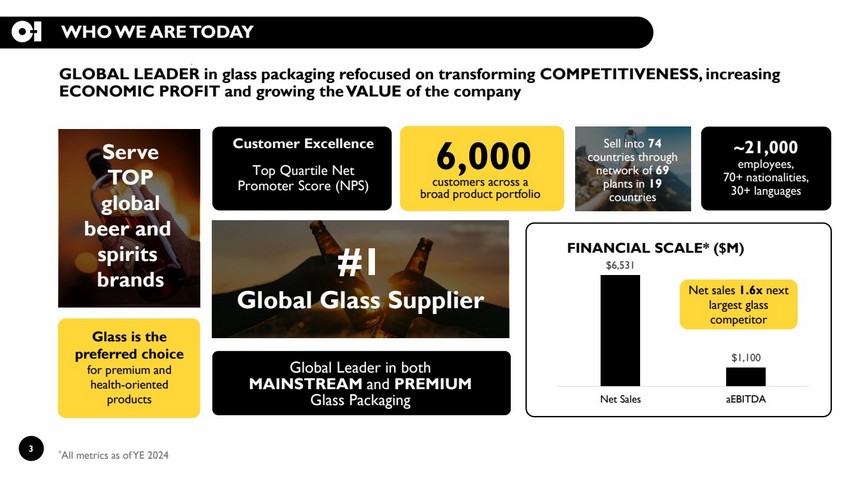
| GLOBAL LEADER in glass packaging refocused on transforming COMPETITIVENESS, increasing ECONOMIC PROFIT and growing the VALUE of the company 3 WHO WE ARE TODAY Glass is the preferred choice for premium and health-oriented products ~21,000 employees, 70+ nationalities, 30+ languages customers across a broad product portfolio Sell into 74 countries through network of 69 plants in 19 countries Serve 6,000 TOP global beer and spirits brands Customer Excellence Top Quartile Net Promoter Score (NPS) Global Leader in both MAINSTREAM and PREMIUM Glass Packaging $6,531 $1,100 Net Sales aEBITDA FINANCIAL SCALE* ($M) #1 Global Glass Supplier Net sales 1.6x next largest glass competitor * All metrics as of YE 2024 |
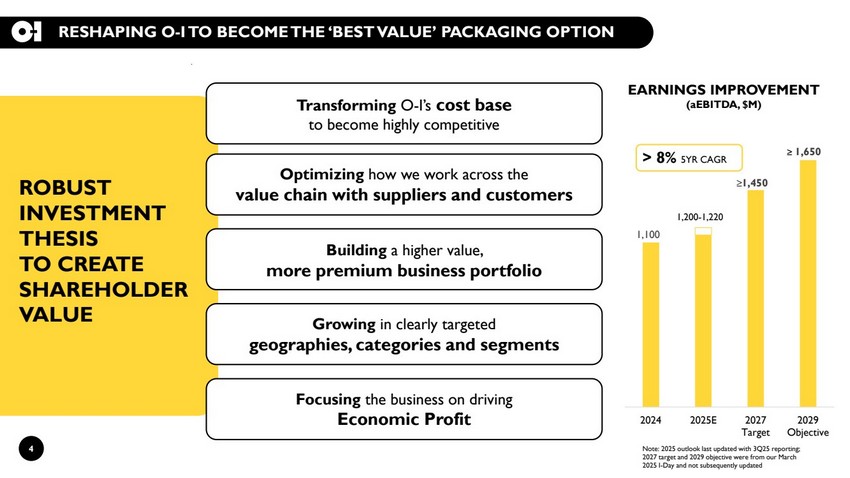
| 1,100 1,450 1,650 2024 2025E 2027 Target 2029 Objective 4 RESHAPING O-I TO BECOME THE ‘BEST VALUE’ PACKAGING OPTION Optimizing how we work across the value chain with suppliers and customers Transforming O-I’s cost base to become highly competitive Building a higher value, more premium business portfolio Focusing the business on driving Economic Profit Growing in clearly targeted geographies, categories and segments EARNINGS IMPROVEMENT (aEBITDA, $M) 1,200-1,220 ≥ ≥ > 8% 5YR CAGR ROBUST INVESTMENT THESIS TO CREATE SHAREHOLDER VALUE Note: 2025 outlook last updated with 3Q25 reporting; 2027 target and 2029 objective were from our March 2025 I-Day and not subsequently updated |
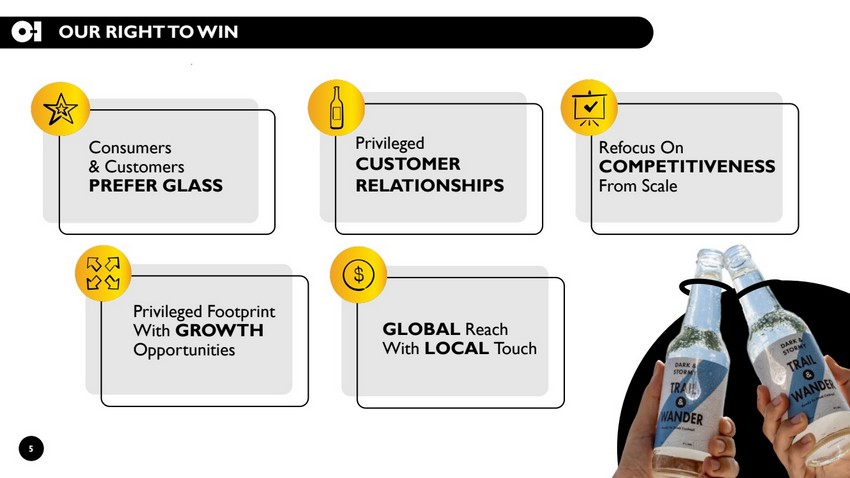
| 5 OUR RIGHT TO WIN Consumers & Customers PREFER GLASS Privileged Footprint With GROWTH Opportunities GLOBAL Reach With LOCAL Touch Privileged CUSTOMER RELATIONSHIPS Refocus On COMPETITIVENESS From Scale |
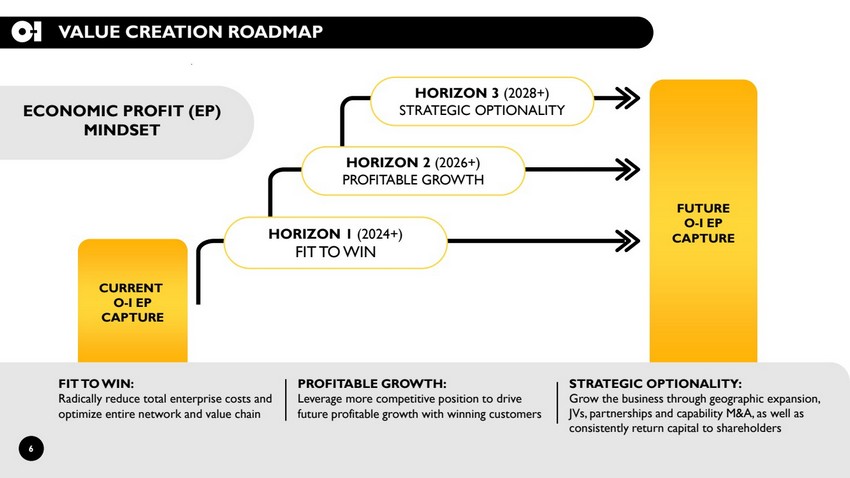
| 6 VALUE CREATION ROADMAP CURRENT O-I EP CAPTURE FUTURE O-I EP CAPTURE FIT TO WIN: Radically reduce total enterprise costs and optimize entire network and value chain PROFITABLE GROWTH: Leverage more competitive position to drive future profitable growth with winning customers HORIZON 1 (2024+) FIT TO WIN STRATEGIC OPTIONALITY: Grow the business through geographic expansion, JVs, partnerships and capability M&A, as well as consistently return capital to shareholders ECONOMIC PROFIT (EP) MINDSET HORIZON 2 (2026+) PROFITABLE GROWTH HORIZON 3 (2028+) STRATEGIC OPTIONALITY |
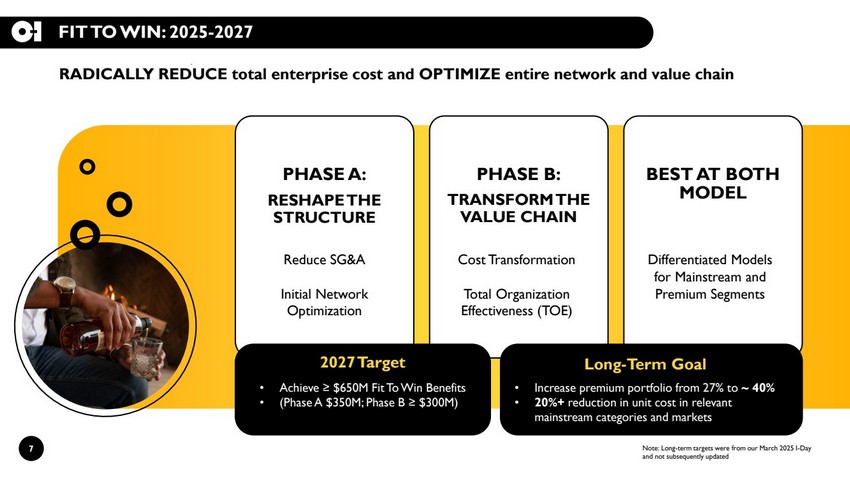
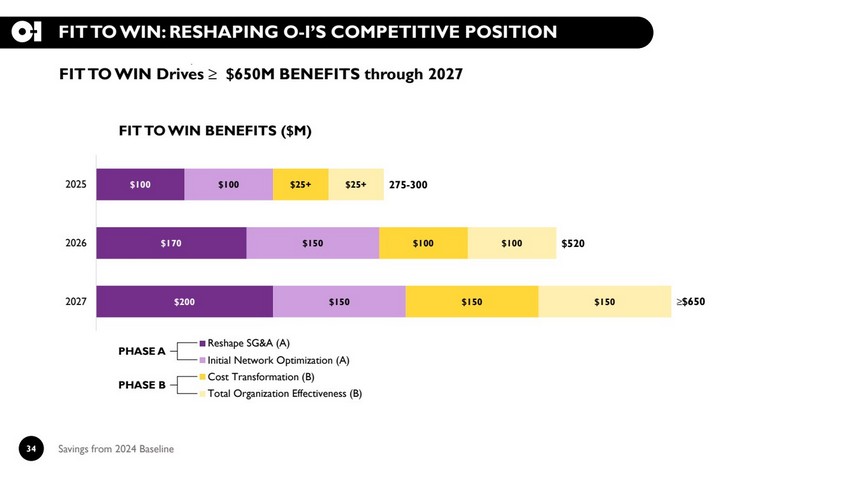
| RADICALLY REDUCE total enterprise cost and OPTIMIZE entire network and value chain 7 FIT TO WIN: 2025-2027 PHASE A: RESHAPE THE STRUCTURE Reduce SG&A Initial Network Optimization PHASE B: TRANSFORM THE VALUE CHAIN Cost Transformation Total Organization Effectiveness (TOE) BEST AT BOTH MODEL Differentiated Models for Mainstream and Premium Segments 2027 Target Long-Term Goal • Achieve ≥ $650M Fit To Win Benefits • (Phase A $350M; Phase B ≥ $300M) • Increase premium portfolio from 27% to ~ 40% • 20%+ reduction in unit cost in relevant mainstream categories and markets Note: Long-term targets were from our March 2025 I-Day and not subsequently updated |
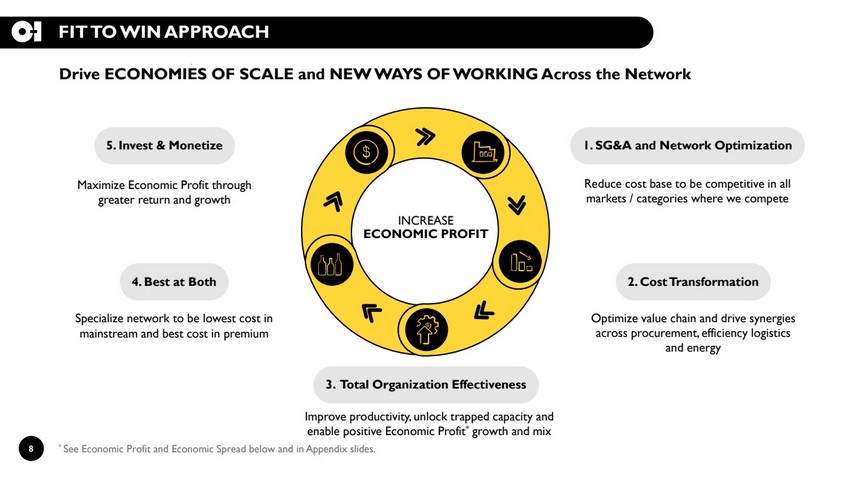
| Drive ECONOMIES OF SCALE and NEW WAYS OF WORKING Across the Network 8 FIT TO WIN APPROACH * See Economic Profit and Economic Spread below and in Appendix slides. Improve productivity, unlock trapped capacity and enable positive Economic Profit* growth and mix Optimize value chain and drive synergies across procurement, efficiency logistics and energy Reduce cost base to be competitive in all markets / categories where we compete Specialize network to be lowest cost in mainstream and best cost in premium Maximize Economic Profit through greater return and growth 2. Cost Transformation 3. Total Organization Effectiveness 4. Best at Both 5. Invest & Monetize 1. SG&A and Network Optimization INCREASE ECONOMIC PROFIT |
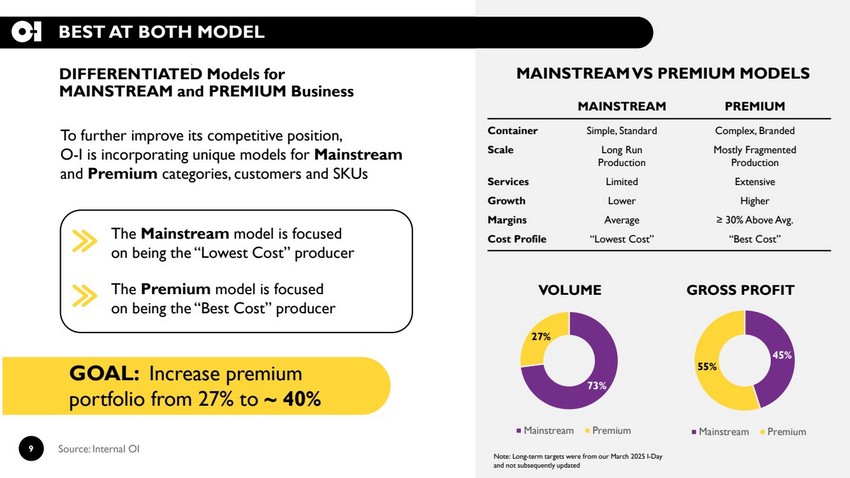
| BEST AT BOTH MODEL 9 DIFFERENTIATED Models for MAINSTREAM and PREMIUM Business MAINSTREAM PREMIUM Container Simple, Standard Complex, Branded Scale Long Run Production Mostly Fragmented Production Services Limited Extensive Growth Lower Higher Margins Average ≥ 30% Above Avg. Cost Profile “Lowest Cost” “Best Cost” 73% 27% VOLUME Mainstream Premium 45% 55% GROSS PROFIT Mainstream Premium MAINSTREAM VS PREMIUM MODELS To further improve its competitive position, O-I is incorporating unique models for Mainstream and Premium categories, customers and SKUs The Mainstream model is focused on being the “Lowest Cost” producer The Premium model is focused on being the “Best Cost” producer GOAL: Increase premium portfolio from 27% to ~ 40% Source: Internal OI Note: Long-term targets were from our March 2025 I-Day and not subsequently updated |
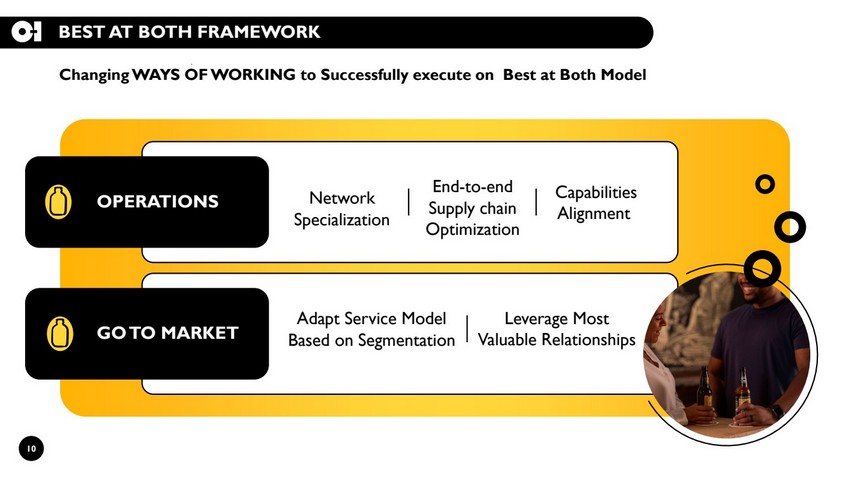
| Changing WAYS OF WORKING to Successfully execute on Best at Both Model 10 BEST AT BOTH FRAMEWORK OPERATIONS GO TO MARKET Capabilities Alignment Adapt Service Model Based on Segmentation End-to-end Supply chain Optimization Network Specialization Leverage Most Valuable Relationships |
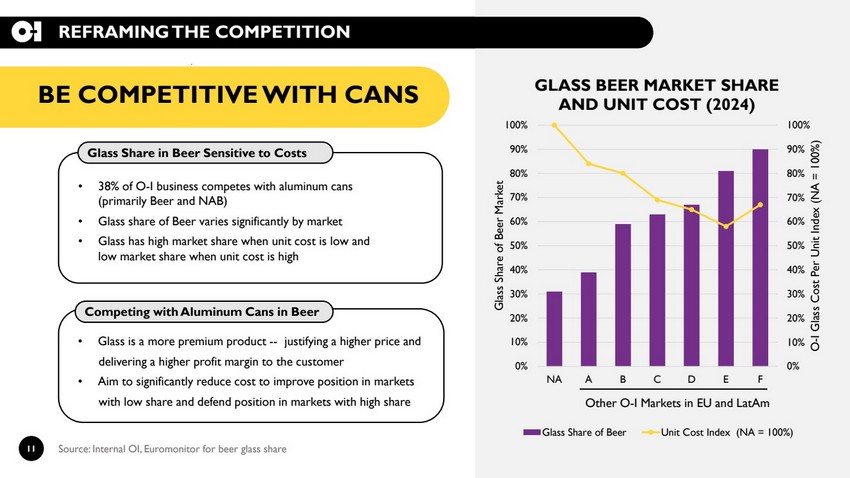
| REFRAMING THE COMPETITION 11 • 38% of O-I business competes with aluminum cans (primarily Beer and NAB) • Glass share of Beer varies significantly by market • Glass has high market share when unit cost is low and low market share when unit cost is high • Glass is a more premium product -- justifying a higher price and delivering a higher profit margin to the customer • Aim to significantly reduce cost to improve position in markets with low share and defend position in markets with high share Glass Share in Beer Sensitive to Costs Competing with Aluminum Cans in Beer BE COMPETITIVE WITH CANS 0% 10% 20% 30% 40% 50% 60% 70% 80% 90% 100% 0% 10% 20% 30% 40% 50% 60% 70% 80% 90% 100% NA A B C D E F O-I Glass Cost Per Unit Index (NA = 100%) Glass Share of Beer Market GLASS BEER MARKET SHARE AND UNIT COST (2024) Glass Share of Beer Unit Cost Index (NA = 100%) Other O-I Markets in EU and LatAm Source: Internal OI, Euromonitor for beer glass share |
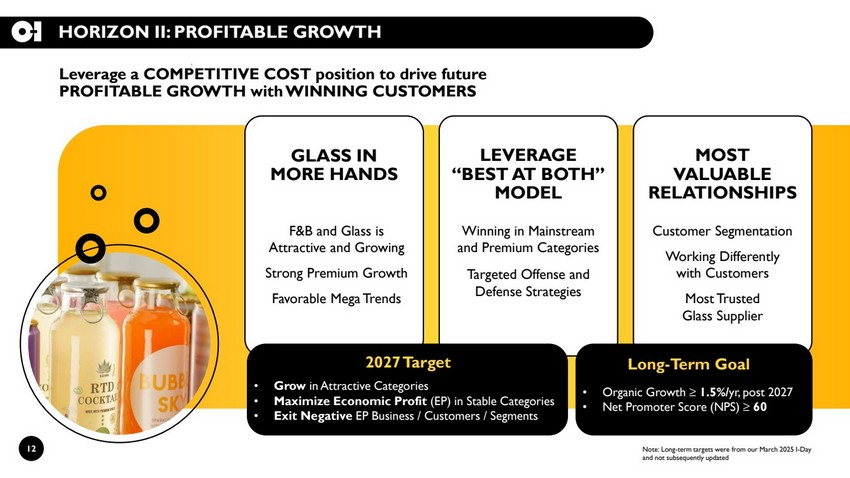
| Leverage a COMPETITIVE COST position to drive future PROFITABLE GROWTH with WINNING CUSTOMERS 12 HORIZON II: PROFITABLE GROWTH GLASS IN MORE HANDS LEVERAGE “BEST AT BOTH” MODEL MOST VALUABLE RELATIONSHIPS F&B and Glass is Attractive and Growing Strong Premium Growth Favorable Mega Trends Winning in Mainstream and Premium Categories Targeted Offense and Defense Strategies Customer Segmentation Working Differently with Customers Most Trusted Glass Supplier • Organic Growth ≥ 1.5%/yr, post 2027 • Net Promoter Score (NPS) ≥ 60 • Grow in Attractive Categories • Maximize Economic Profit (EP) in Stable Categories • Exit Negative EP Business / Customers / Segments 2027 Target Long-Term Goal Note: Long-term targets were from our March 2025 I-Day and not subsequently updated |
| Transforming COMPETITIVENESS Will Enable O-I to Take Advantage of Favorable MEGA TRENDS 13 LEVERAGING FAVORABLE MEGATRENDS Sources: Euromonitor, IWSR (USD Value % CAGR 2024-2028) Consumer Facts: 1. Wine Intelligence; 2. The IWSR US RTD Study; 3. Glass Packaging Institute; 4. EcoFocus Survey; 5. Mintel SUSTAINABILITY RESPONSIBILITY HEALTH & WELLNESS PREMIUMIZATION AFFORDABLE LUXURY 82% of wine drinkers perceive glass bottles as a sign of superior quality1. 92% of respondents feel positively toward glass packaging’s low environmental impact3. 70% of consumers believe glass is safer4. 43% of UK adults moderating their alcohol intake do so primarily for health reasons5. 41% of US consumers prefer glass for alcoholic RTDs2. 40% average recycled content. KEY CONSUMER TRENDS PREMIUM ALCOHOL SPIRITS- BASED RTDs PROSECCO FOOD LOW/NON ALC BEVS SPARKLING WATER +4% +12% +5% +3% +6% +10% |
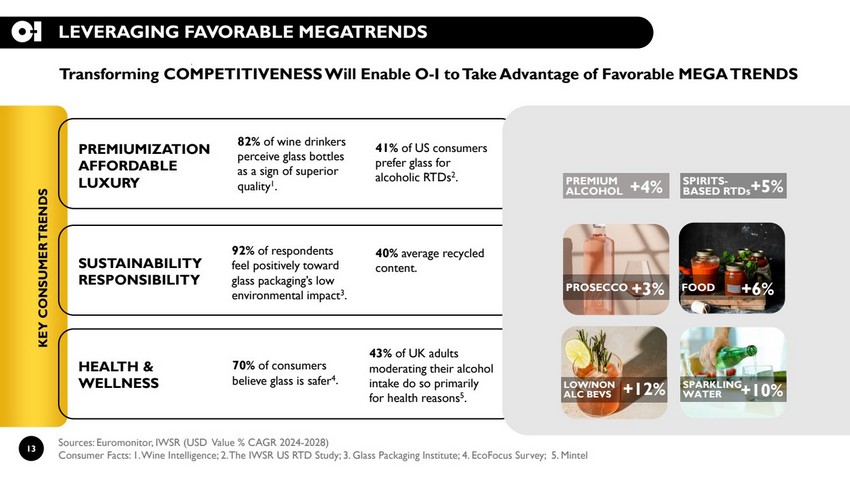
| Differentiated STRATEGY to deliver increased EBIT, RETURNS, GROWTH and FCF 14 TARGETED APPROACH TO DELIVER PROFITABLE GROWTH % OF SALES VOLUME INVEST AND GROW IMPROVE AND GROW OPTIMIZE AND DEFEND RESTRUCTURE Mainstream Premium OFFENSE Drive Profitable Volume DEFENSE Drive Higher Return/FCF |
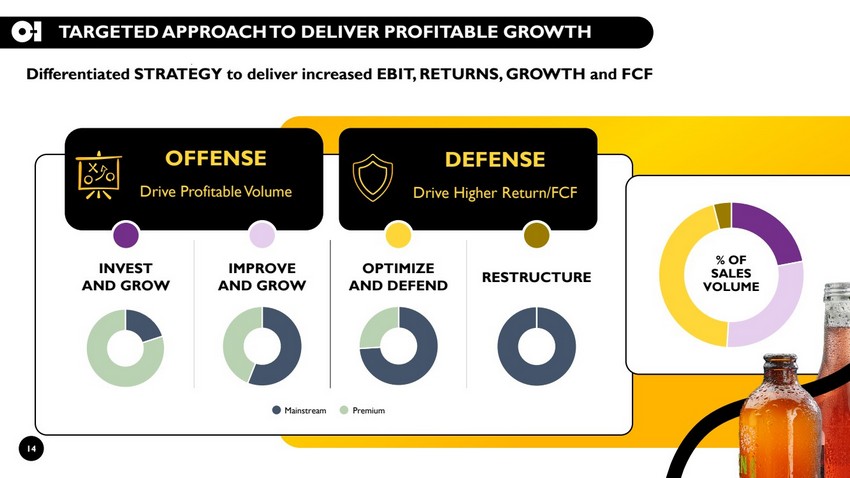
| PREMIUM: MAINSTREAM: STRENGTHEN CORE CAPABILITIES: Aligning Service Models and Investments to GROWING, PROFITABLE CATEGORIES 15 OFFENSE: GROWING IN ATTRACTIVE HIGH VALUE CATEGORIES CASE STUDY VIDEO: Winning in Premium Spirits Pernod Ricard • Offer premium value proposition at best cost by expanding network of specialized plants, innovation, design services and sustainability solutions • Invest with winning customers • Deliver glass at lowest cost through network optimization, capacity expansion, streamlining and lightweighting • Differentiate service model to optimize costs and improve productivity • Reliable quality and supply, recognized know-how, strong relationships • Build differentiated capabilities |
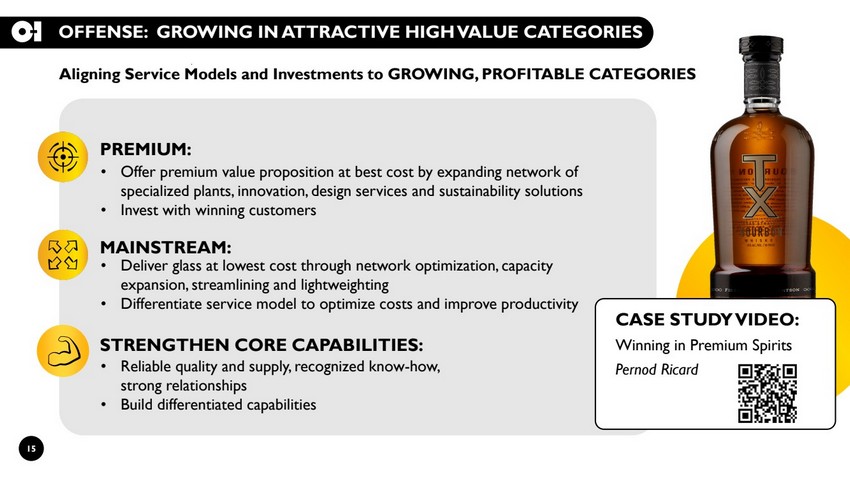
| 50% 100% 150% 200% 250% 2015 2016 2017 2018 2019 2020 2021 2022 2023 2024 Volume Gross Margin Per Ton OPTIMIZE and DEFEND profitable categories,RESTRUCTURE or EXIT unattractive businesses 16 DEFENSE: MAXIMIZE EP IN STABLE CATEGORIES LOW GROWTH BUT HIGH RETURN/FCF GENERATING CATEGORIES: SLOW GROWTH, UNPROFITABLE BUSINESS: 81% 73% 19% 27% 2019 2024 Mainstream Premium IMPROVING MIX CASE STUDY: EU FOOD Source: Internal OI • Deliver lowest cost through improved productivity, network optimization and value chain optimization • Differentiate service model to optimize costs and improve productivity • Improve economic profit • Deliver economic profit / cash or exit quickly |
| GROW through geographic expansion, M&A, JVs and partnerships and RETURN VALUE to shareholders 17 STRATEGIC OPTIONALITY INTRODUCTION GEOGRAPHIC EXPANSION Enter High Growth, EP Markets Grow with Winning Customers CORPORATE DEVELOPMENT Strategic JVs Strategic Partnerships Capability M&A RETURN CAPITAL TO SHAREHOLDERS Prioritize 2.0 – 2.5x Financial Leverage Ratio Greater Share Repurchases Initiate Dividend 2027 Target Long-Term Goal Achieve Financial Leverage Ratio ~ 2.5x • Financial Leverage Ratio Range 2.0x – 2.5x • Return More Capital to Shareholders Note: 2027 target and long-term goals were from our March 2025 I-Day and not subsequently updated |
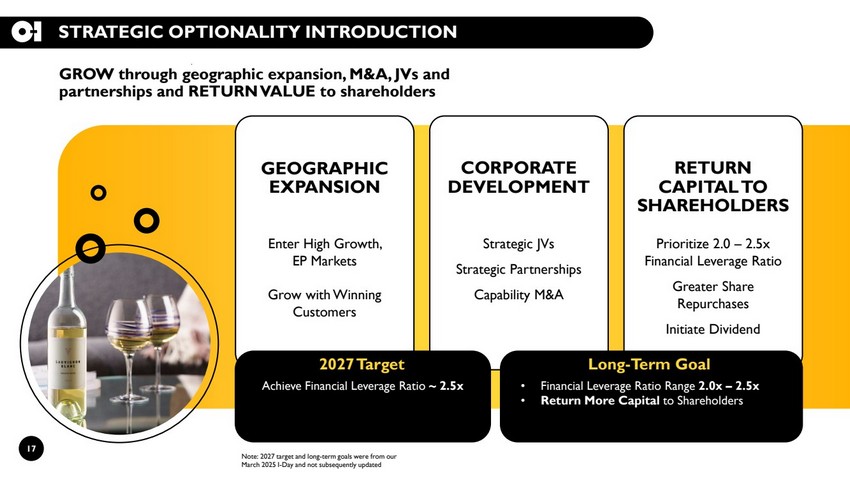
| GLASS FORECAST CAGR BY MARKET (2024-28) O-I is the GLOBAL LEADER IN GLASS but with Significant OPPORTUNITY TO EXPAND 18 GEOGRAPHIC EXPANSION: TOP GROWTH MARKETS GLASS TOTAL O-I MARKET NON O-I MARKET 1.5% F CAGR 0.8% F CAGR 2.8% F CAGR TOP 10 HIGHEST GROWTH MARKETS O-I MARKETS 20,000+ 10,000-19,000 5,000-9,9999 0-4,999 GLASS CONSUMPTION BY MARKET 2023 MN UNITS Source: Euromonitor Note: Long-term targets were from our March 2025 I-Day and not subsequently updated |
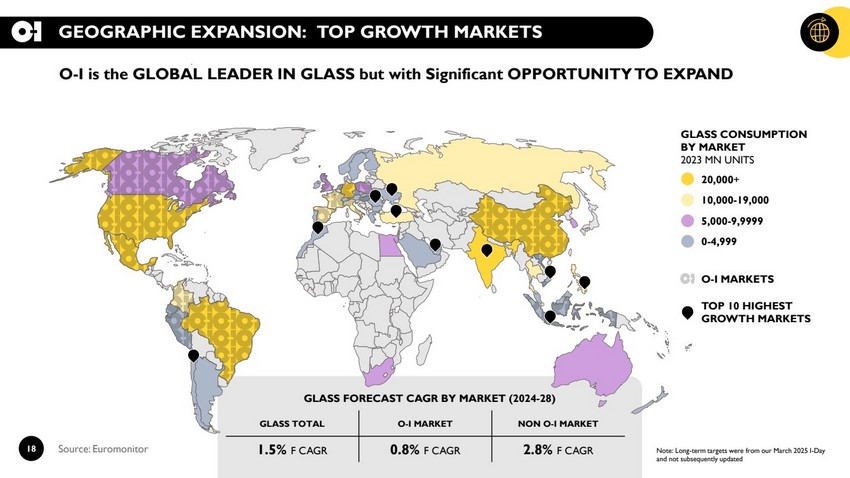
| 19 VALUE CREATION ROADMAP CURRENT O-I EP CAPTURE FUTURE O-I EP CAPTURE FIT TO WIN: Radically reduce total enterprise costs and optimize entire network and value chain PROFITABLE GROWTH: Leverage more competitive position to drive future profitable growth with winning customers HORIZON 1 (2024+) FIT TO WIN STRATEGIC OPTIONALITY: Grow the business through geographic expansion, JVs, partnerships and capability M&A, as well as consistently return capital to shareholders ECONOMIC PROFIT (EP) MINDSET HORIZON 2 (2026+) PROFITABLE GROWTH HORIZON 3 (2028+) STRATEGIC OPTIONALITY |
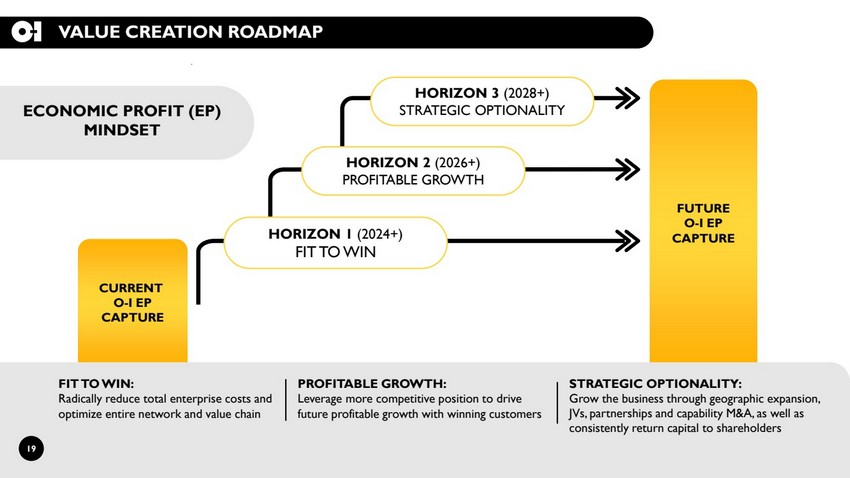
| 20 LEVERAGING RIGHT TO WIN WILL CREATE VALUE DRIVE PROFITABLE GROWTH LEVERAGING OPTIMIZED NETWORK INVEST IN TARGETED GROWTH RETURN CAPITAL TO SHAREHOLDERS DELIVER HIGHER EARNINGS, FCF AND ECONOMIC PROFIT TRANSFORM COST COMPETITIVENESS STRENGTHEN BALANCE SHEET (Financial Leverage Ratio ≤ 2.5X) INCREASE SHAREHOLDER VALUE Note: Long-term target was from our March 2025 I-Day and not subsequently updated |
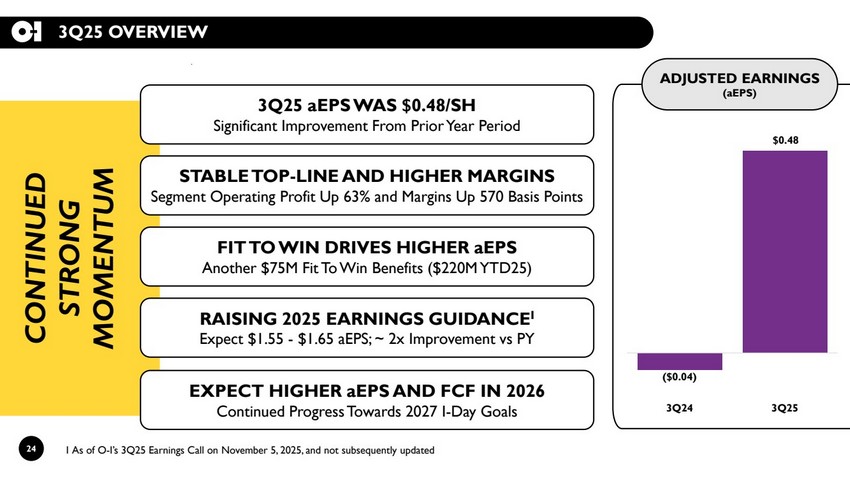
| 21 REFRAMING SUCCESS LONG-TERM OBJECTIVES (Post 2027) 2027 Target 2029 Objective aEBITDA Margin % Low 20s Mid 20s FCF % of Sales ≥ 5% ≥ 7% Economic Spread* ≥ 2% ≥ 4% ≥ $1,450M ≥ $1,650M Sustainable aEBITDA Organic growth ≥ 1.5%/yr Increase premium portfolio from 27% to ~ 40% 20%+ reduction in unit cost in relevant mainstream categories and markets Net Promoter Score (NPS) ≥ 60 Return more capital to shareholders * Economic Spread assumes 2024 WACC Achieve new 2030 Sustainability Goals Note: 2027 targets, 2029 objectives and long-term objectives (post 2027) were from our March 2025 I-Day and not subsequently updated |
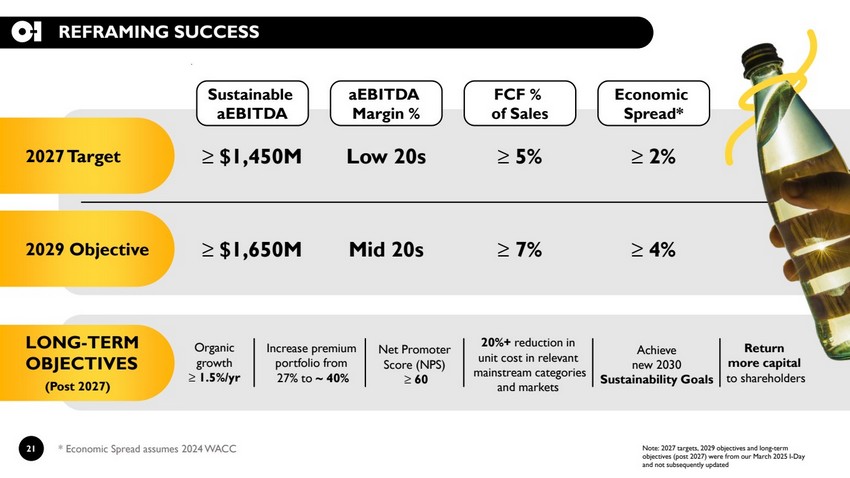
| CONSISTENT IMPROVEMENT in Sustainable aEBITDA 22 IMPROVE EARNINGS 2027 aEBITDATarget of $1.45B Through Fit To Win Benefits Despite Cautious Commercial Outlook Expect Continued Performance Improvement Through 2029 Supported by Cost and Growth/Expansion Initiatives ADJUSTED EBITDA ($M) 2024 Net Price Sales Volume Production Normalization Fit to Win 2027 Target Fit To Win Profitable Growth Strategic Optionality Prelim. 2029 Objective ≥ $1,450M (Low 20s) ≥ $1,650M (Mid 20s) $1,100M (17%) Includes potential impact of fav. Energy contract resets in 2026/2027 TBD Note: Long-term targets were from our March 2025 I-Day and not subsequently updated |
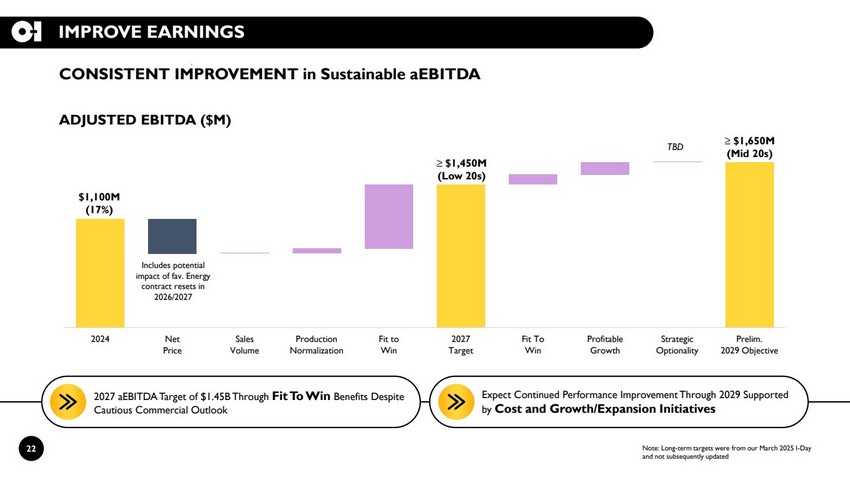
| Maintenance CapEx Productivity CapEx Restructuring Debt Reduction Share Repurchase / Dividend 23 CAPITAL ALLOCATION DRIVING ECONOMIC PROFIT FIT TO WIN INVESTMENTS • SG&A Restructuring • Network Optimization / Restructuring • Capacity / Productivity Investments RETURN CAPITAL TO SHAREHOLDERS • Anti-dilutive Share Repurchases • Evaluate Additional Share Repurchases • Evaluate Dividend IMPROVE PRICE, MIX, COST & PRODUCTIVITY TO DRIVE +2% ECONOMIC SPREAD PROFITABLE GROWTH • Capacity / Productivity Investments • Line Extension Investments • Selective Brownfield / Green Investments IMPROVE CAPITAL STRUCTURE • Prioritize ≤ 2.5x Financial Leverage • Long-term Target range of 2.0x - 2.5x Financial Leverage Ratio STRATEGIC OPTIONALITY • Geographic Expansion • M&A, JVs • Enter Glass Adjacencies ALLOCATION OF CASH FROM OPERATIONS (2025-2027) Note: Long-term targets were from our March 2025 I-Day and not subsequently updated |
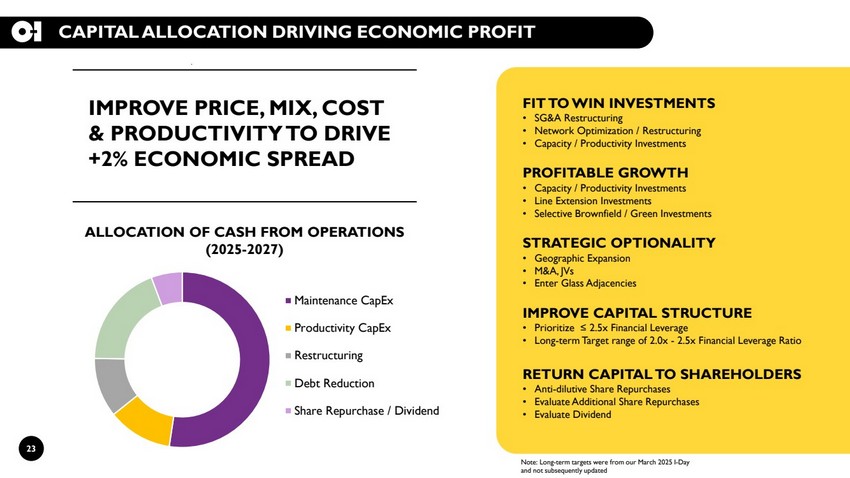
| 3Q25 OVERVIEW ($0.04) $0.48 3Q24 3Q25 RAISING 2025 EARNINGS GUIDANCEI CONTINUED Expect $1.55 - $1.65 aEPS; ~ 2x Improvement vs PY STRONG MOMENTUM 24 STABLE TOP-LINE AND HIGHER MARGINS Segment Operating Profit Up 63% and Margins Up 570 Basis Points 3Q25 aEPSWAS $0.48/SH Significant Improvement From Prior Year Period FIT TO WIN DRIVES HIGHER aEPS Another $75M Fit To Win Benefits ($220M YTD25) ADJUSTED EARNINGS (aEPS) EXPECT HIGHER aEPS AND FCF IN 2026 Continued Progress Towards 2027 I-Day Goals 1 As of O-I’s 3Q25 Earnings Call on November 5, 2025, and not subsequently updated |
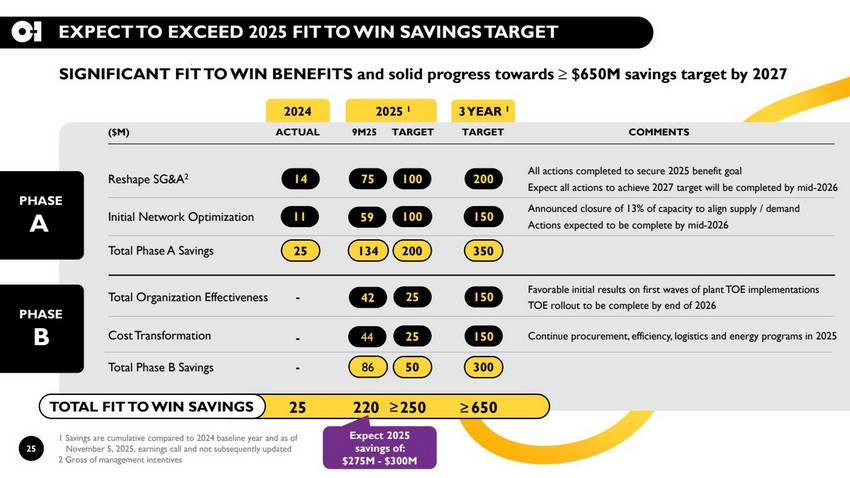
| SIGNIFICANT FIT TO WIN BENEFITS and solid progress towards ≥ $650M savings target by 2027 EXPECT TO EXCEED 2025 FIT TO WIN SAVINGS TARGET ($M) COMMENTS TOTAL FIT TO WIN SAVINGS 2024 ACTUAL 25 3 YEAR 1 TARGET 650 9M25 220 TARGET All actions completed to secure 2025 benefit goal Expect all actions to achieve 2027 target will be completed by mid-2026 Reshape SG&A2 14 75 100 200 Announced closure of 13% of capacity to align supply / demand Actions expected to be complete by mid-2026 Initial Network Optimization 11 59 100 150 Total Phase A Savings 25 134 200 350 - Favorable initial results on first waves of plant TOE implementations TOE rollout to be complete by end of 2026 Total Organization Effectiveness 25 150 Total Phase B Savings - 50 300 250 2025 1 PHASE B PHASE A Cost Transformation Continue procurement, efficiency, logistics and energy programs in 2025 - 25 150 25 1 Savings are cumulative compared to 2024 baseline year and as of November 5, 2025, earnings call and not subsequently updated 2 Gross of management incentives 44 86 42 ≥ ≥ Expect 2025 savings of: $275M - $300M |
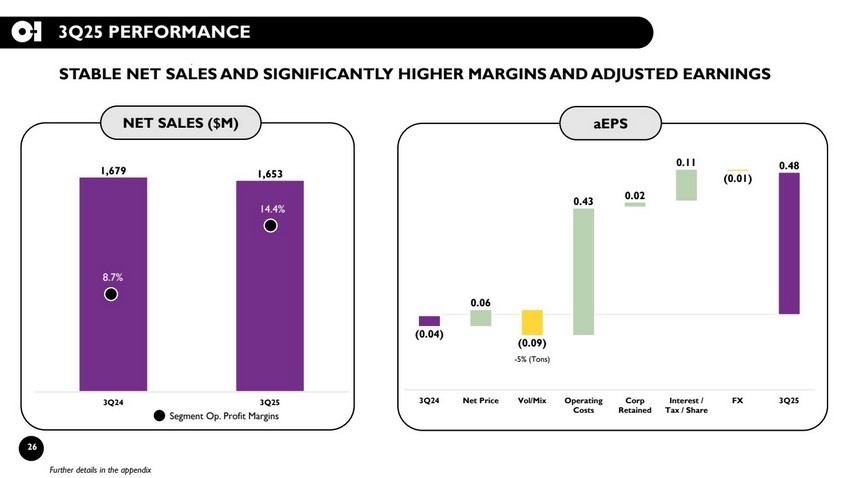
| 3Q25 PERFORMANCE 1,679 1,653 3Q24 3Q25 NET SALES ($M) STABLE NET SALES AND SIGNIFICANTLY HIGHER MARGINS AND ADJUSTED EARNINGS Further details in the appendix aEPS 26 (0.04) 0.06 (0.09) 0.43 0.02 0.11 (0.01) 0.48 3Q24 Net Price Vol/Mix Operating Costs Corp Retained Interest / Tax / Share FX 3Q25 Segment Op. Profit Margins 8.7% 14.4% -5% (Tons) |
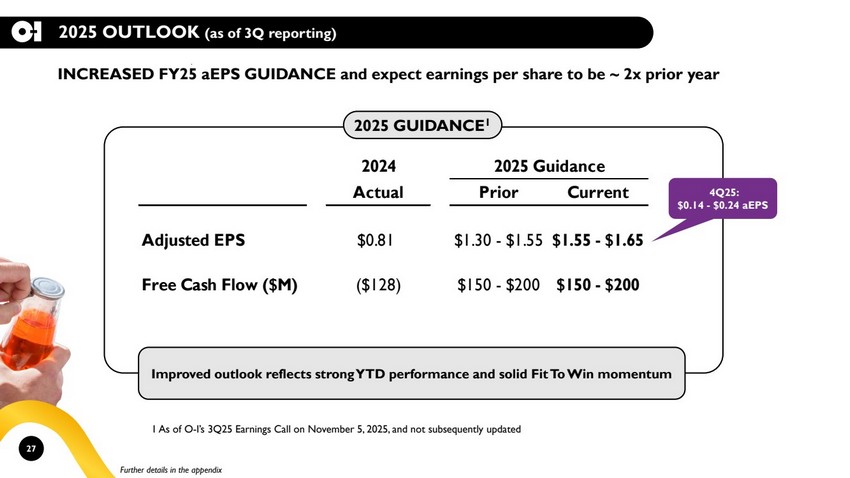
| INCREASED FY25 aEPS GUIDANCE and expect earnings per share to be ~ 2x prior year 27 2025 OUTLOOK (as of 3Q reporting) 2024 Actual Prior Current Adjusted EPS $0.81 $1.30 - $1.55 $1.55 - $1.65 Free Cash Flow ($M) ($128) $150 - $200 $150 - $200 2025 Guidance 25%-32% Improved outlook reflects strong YTD performance and solid Fit To Win momentum 2025 GUIDANCE1 4Q25: $0.14 - $0.24 aEPS Further details in the appendix 1 As of O-I’s 3Q25 Earnings Call on November 5, 2025, and not subsequently updated |
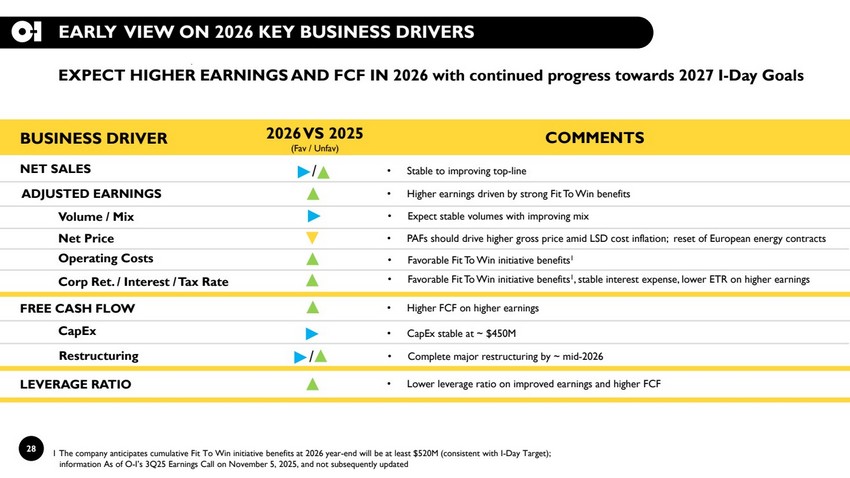
| / 28 EARLY VIEW ON 2026 KEY BUSINESS DRIVERS Operating Costs Corp Ret. / Interest / Tax Rate ADJUSTED EARNINGS NET SALES FREE CASH FLOW CapEx LEVERAGE RATIO 2026 VS 2025 (Fav / Unfav) BUSINESS DRIVER COMMENTS • Stable to improving top-line • Higher earnings driven by strong Fit To Win benefits • PAFs should drive higher gross price amid LSD cost inflation; reset of European energy contracts • Favorable Fit To Win initiative benefits1 • Favorable Fit To Win initiative benefits1, stable interest expense, lower ETR on higher earnings • Higher FCF on higher earnings • CapEx stable at ~ $450M • Lower leverage ratio on improved earnings and higher FCF 1 The company anticipates cumulative Fit To Win initiative benefits at 2026 year-end will be at least $520M (consistent with I-Day Target); information As of O-I’s 3Q25 Earnings Call on November 5, 2025, and not subsequently updated Volume / Mix Net Price • Expect stable volumes with improving mix Restructuring • Complete major restructuring by ~ mid-2026 EXPECT HIGHER EARNINGS AND FCF IN 2026 with continued progress towards 2027 I-Day Goals / |
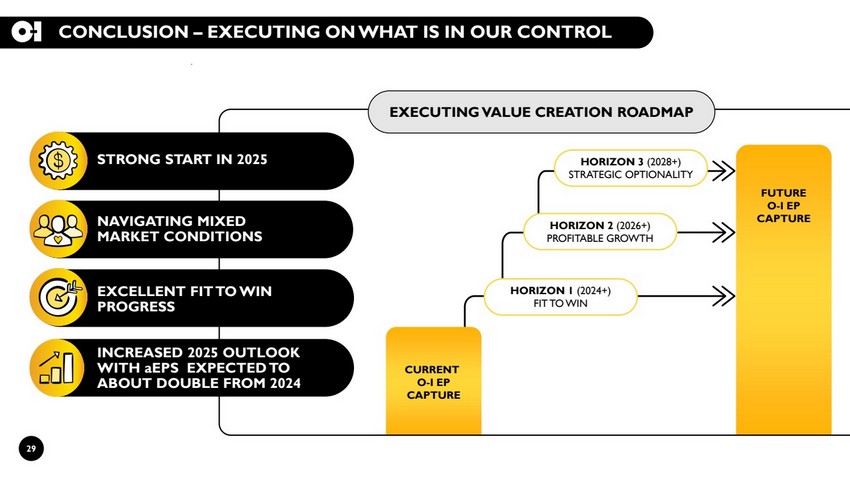
| HORIZON 1 (2024+) FIT TO WIN HORIZON 2 (2026+) PROFITABLE GROWTH HORIZON 3 (2028+) STRATEGIC OPTIONALITY CURRENT O-I EP CAPTURE FUTURE O-I EP CAPTURE CONCLUSION – EXECUTING ON WHAT IS IN OUR CONTROL EXECUTING VALUE CREATION ROADMAP INCREASED 2025 OUTLOOK WITH aEPS EXPECTED TO ABOUT DOUBLE FROM 2024 STRONG START IN 2025 EXCELLENT FIT TO WIN PROGRESS NAVIGATING MIXED MARKET CONDITIONS 29 |
| 30 APPENDIX |

| 31 O-I operations MANUFACTURING IN THE MARKET FOR THE MARKET PLANTS IN 19 COUNTRIES 69 SUBJECT TO ONGOING TARIFF UNCERTAINTY ~4.5% SALES/SUPPLY WITHIN 300 MILES OF O-I PLANTS 85% as of year end 2024 |
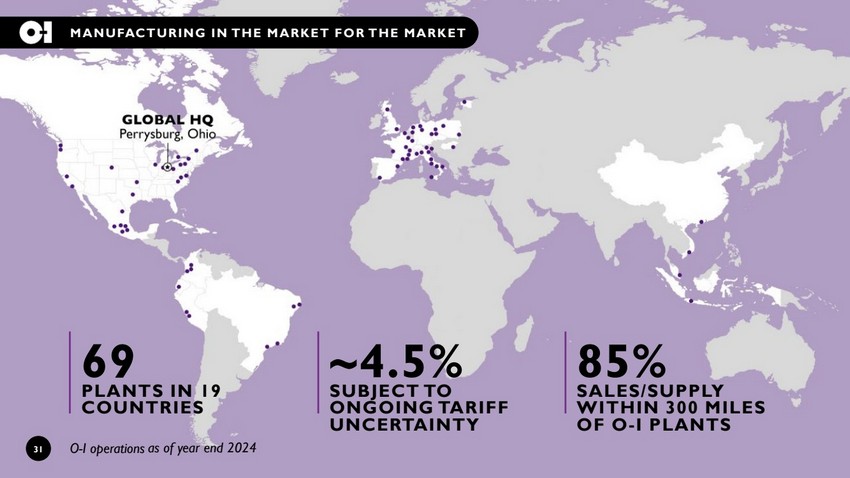
| 32 N EW TARIF F S REP RES EN T B OTH CHALLEN GES AN D OP P ORTUNITIES CHALLENGES: ▼ CURRENTLY EXPECT LIMITED DIRECT TARIFF EXPOSURE • 14% of O-I global sales volume (filled & unfilled) crosses U.S. border and exposed to new tariffs • 9.5% expected to be exempt because of USMCA compliance—mostly U.S. imports from MX/CAN • Net 4.5% potentially exposed to new tariffs—mostly U.S. imports of filled bottles from EU ▼ ELEVATED RISK TO TARIFF DRIVEN CONSUMER VOLATILITY OPPORTUNITIES: ▲ LOCAL SUPPLY CHAIN: ~ 85% sales/supply within 300 miles of O-I plants ▲ FAVORABLE SUBSTRATE DYNAMICS: Sector specific tariffs on Aluminum ▲ CHINA TARIFF BENEFIT: Elevated tariffs on glass imports to US from China ▲ LARGEST US GLASS SYSTEM: Supports higher consumption of domestic products ▲ FOREIGN EXCHANGE: Weaker U.S. dollar improving foreign earnings translation O-I CROSS BOARDER SHIPMENTS AND NEW TARIFF EXPOSURE 4.5% 4.5% 9.5% 0% 5% 10% 15% 20% % of O-I Global Sales Vol (KT) Crosses US Border % of O-I Global Sales Potentially Exposed to New Tariffs US / EU / UK US / MX / CAN CROSS BORDER SHIPMENTS AND POTENTIAL TARIFF EXPOSURES (Includes empty and filled bottles) Changes in global trade policy may create both new challenges and opportunities which cannot be fully determined at this stage Fit To Win and Improving O-I’s Competitive Position is Key To Mitigating Macro Uncertainty and Creating Shareholder Value Expected to be USMCA compliant |

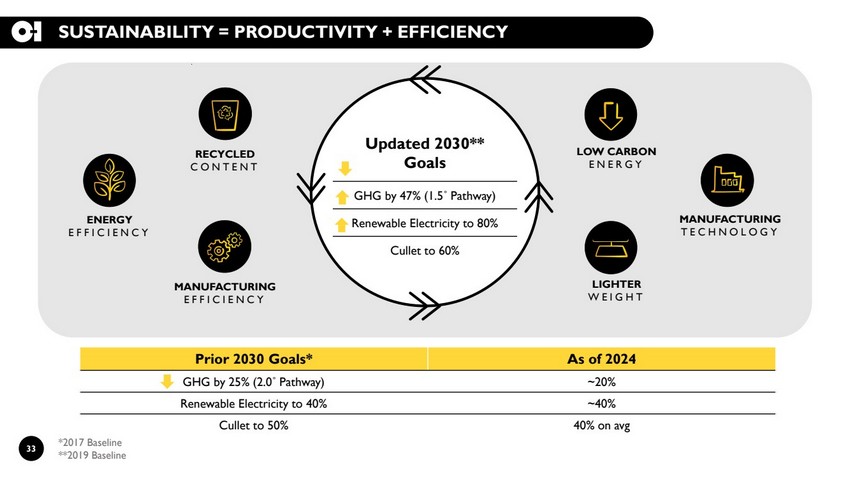
| 33 SUSTAINABILITY = PRODUCTIVITY + EFFICIENCY *2017 Baseline **2019 Baseline Prior 2030 Goals* As of 2024 GHG by 25% (2.0˚ Pathway) ~20% Renewable Electricity to 40% ~40% Cullet to 50% 40% on avg RECYCLED CONTENT MANUFACTURING EFFICIENCY ENERGY EFFICIENCY LOW CARBON ENERGY LIGHTER WEIGHT MANUFACTURING TECHNOLOGY Updated 2030** Goals GHG by 47% (1.5˚ Pathway) Renewable Electricity to 80% Cullet to 60% |
| PHASE A PHASE B $200 $170 $100 $150 $150 $100 $150 $100 $25+ $150 $100 $25+ ≥$650 $520 275-300 2027 2026 2025 FIT TO WIN BENEFITS ($M) Reshape SG&A (A) Initial Network Optimization (A) Cost Transformation (B) Total Organization Effectiveness (B) Savings from 2024 Baseline FIT TO WIN Drives ≥ $650M BENEFITS through 2027 34 FIT TO WIN: RESHAPING O-I’S COMPETITIVE POSITION |
| 35 NON-GAAP FINANCIAL MEASURES The company uses certain non-GAAP financial measures, which are measures of its historical or future financial performance that are not calculated and presented in accordance with GAAP, within the meaning of applicable SEC rules. Management believes that its presentation and use of certain non-GAAP financial measures, including adjusted earnings, adjusted earnings per share, free cash flow, adjusted effective tax rate, net debt leverage, EBITDA, adjusted EBITDA, segment operating profit, segment operating profit margin, Economic Profit and Economic spread provide relevant and useful supplemental financial information that is widely used by analysts and investors, as well as by management in assessing both consolidated and business unit performance. These non-GAAP measures are reconciled to the most directly comparable GAAP measures and should be considered supplemental in nature and should not be considered in isolation or be construed as being more important than comparable GAAP measures. Adjusted earnings relates to net earnings (loss) attributable to the company, exclusive of items management considers not representative of ongoing operations and other adjustments because such items are not reflective of the company’s principal business activity, which is glass container production. Adjusted earnings are divided by weighted average shares outstanding (diluted) to derive adjusted earnings per share. Segment operating profit relates to earnings (loss) before interest expense, net, and before income taxes and is also exclusive of items management considers not representative of ongoing operations as well as certain retained corporate costs and other adjustments. Segment operating profit margin is calculated as segment operating profit divided by segment net sales. Adjusted effective tax rate relates to the provision for income taxes, excluding items management considers not representative of ongoing operations and other adjustments, divided by earnings (loss) before income taxes, exclusive of items management considers not representative of ongoing operations and other adjustments. EBITDA refers to net earnings, excluding gains or losses from discontinued operations, interest expense, net, provision for income taxes, depreciation and amortization of intangibles. Adjusted EBITDA refers to EBITDA, exclusive of items management considers not representative of ongoing operations and other adjustments. Net debt leverage refers to total debt less cash divided by Adjusted EBITDA. Economic Profit (EP) refers to net earnings (loss) attributable to the Company, excluding interest expense, net and non-cash goodwill impairment charges, minus the product of the Company’s average invested capital and its weighted average cost of capital. Economic spread percentage (ES%) refers to economic profit divided by the Company’s average invested capital. Management uses adjusted earnings, adjusted earnings per share, segment operating profit, segment operating profit margin, EBITDA, Adjusted EBITDA, adjusted effective tax rate, economic profit, economic spread and net debt leverage to evaluate its period-over-period operating performance because it believes these provide useful supplemental measures of the results of operations of its principal business activity by excluding items that are not reflective of such operations. The above non-GAAP financial measures may be useful to investors in evaluating the underlying operating performance of the company’s business as these measures eliminate items that are not reflective of its principal business activity. Further, free cash flow relates to cash provided by operating activities less cash payments for property, plant and equipment. Management has historically used free cash flow to evaluate its period-over-period cash generation performance because it believes these have provided useful supplemental measures related to its principal business activity. It should not be inferred that the entire free cash flow amount is available for discretionary expenditures, since the company has mandatory debt service requirements and other non-discretionary expenditures that are not deducted from these measures. Management uses non-GAAP information principally for internal reporting, forecasting, budgeting and calculating compensation payments. The company routinely posts important information on its website – www.o-i.com/investors. |
| RECONCILIATION TO ADJUSTED EARNINGS 36 The Company is unable to present a quantitative reconciliation of its forward-looking non-GAAP measure, adjusted earnings and adjusted earnings per share, for the periods ending after September 30, 2025 to its most directly comparable GAAP financial measure, net earnings (loss) attributable to the Company, because management cannot reliably predict all of the necessary components of this GAAP financial measure without unreasonable efforts. Net earnings (loss) attributable to the Company includes several significant items, such as restructuring charges, asset impairment charges, charges for the write-off of finance fees, and the income tax effect on such items. The decisions and events that typically lead to the recognition of these and other similar items are complex and inherently unpredictable, and the amount recognized for each item can vary significantly. Accordingly, the Company is unable to provide a reconciliation of adjusted earnings and adjusted earnings per share to net earnings (loss) attributable to the Company or address the probable significance of the unavailable information, which could be material to the Company's future financial results. |
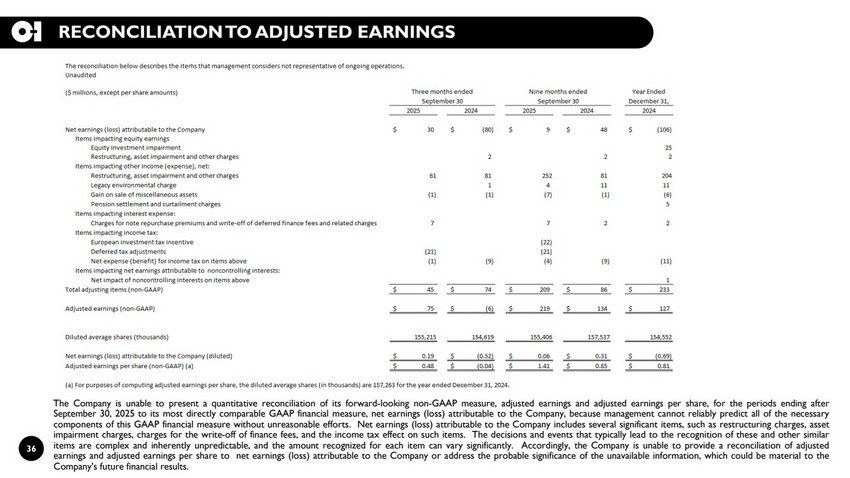
| 37 SEGMENT RECONCILIATIONS: 3Q25 3Q25 PRICE, SALES VOLUME AND CURRENCY IMPACT ON REPORTABLE SEGMENT SALES 3Q25 PRICE, SALES VOLUME, OPERATING COSTS AND CURRENCY IMPACT ON REPORTABLE SEGMENT OPERATING PROFIT (a) Currency effect on net sales and segment operating profit determined by using 2025 foreign currency exchange rates to translate 2024 local currency results. |
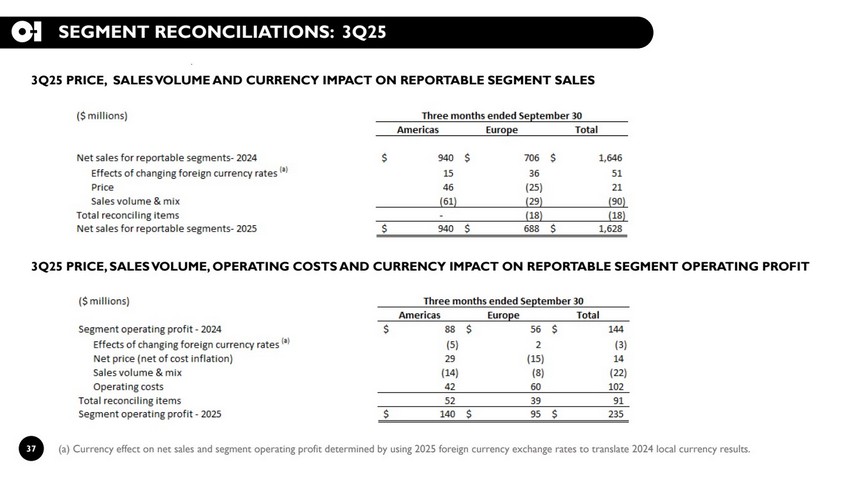
| 38 SEGMENT RECONCILIATIONS: YTD 3Q25 YTD 3Q25 PRICE, SALES VOLUME AND CURRENCY IMPACT ON REPORTABLE SEGMENT SALES YTD 3Q25 PRICE, SALES VOLUME, OPERATING COSTS AND CURRENCY IMPACT ON REPORTABLE SEGMENT OPERATING PROFIT (a) Currency effect on net sales and segment operating profit determined by using 2025 foreign currency exchange rates to translate 2024 local currency results. |
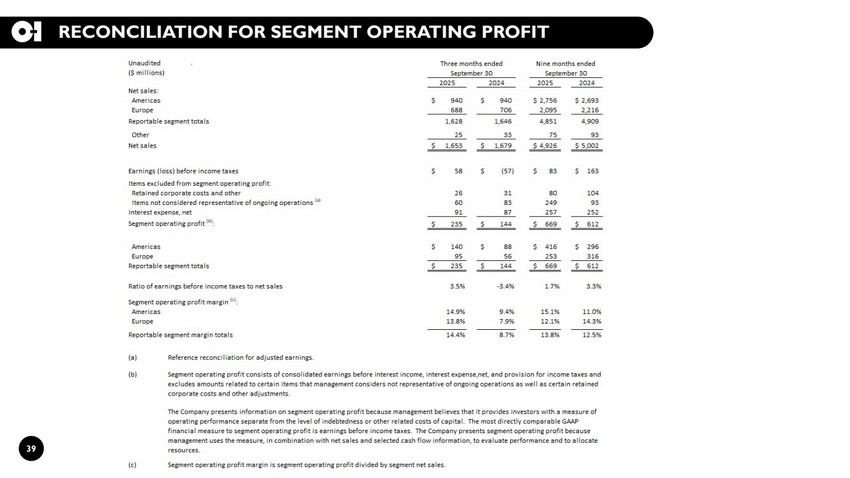
| 39 RECONCILIATION FOR SEGMENT OPERATING PROFIT |
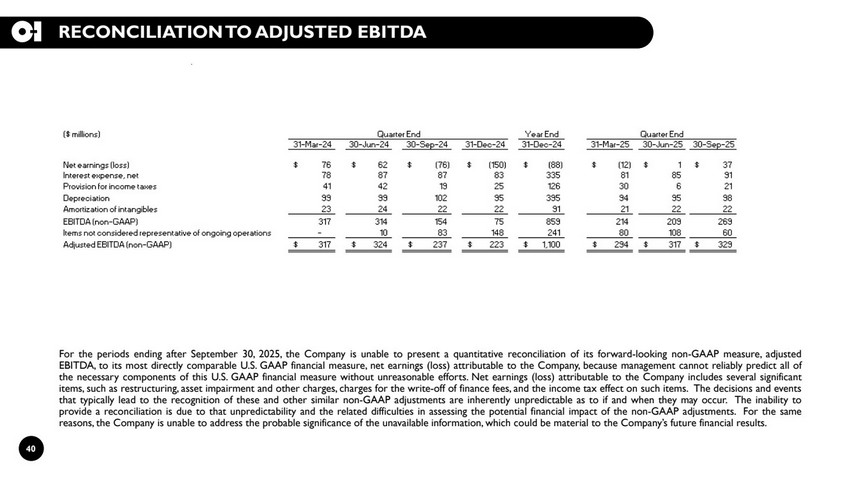
| RECONCILIATION TO ADJUSTED EBITDA 40 For the periods ending after September 30, 2025, the Company is unable to present a quantitative reconciliation of its forward-looking non-GAAP measure, adjusted EBITDA, to its most directly comparable U.S. GAAP financial measure, net earnings (loss) attributable to the Company, because management cannot reliably predict all of the necessary components of this U.S. GAAP financial measure without unreasonable efforts. Net earnings (loss) attributable to the Company includes several significant items,such as restructuring, asset impairment and other charges, charges for the write-off of finance fees, and the income tax effect on such items. The decisions and events that typically lead to the recognition of these and other similar non-GAAP adjustments are inherently unpredictable as to if and when they may occur. The inability to provide a reconciliation is due to that unpredictability and the related difficulties in assessing the potential financial impact of the non-GAAP adjustments. For the same reasons, the Company is unable to address the probable significance of the unavailable information, which could be material to the Company’s future financial results. |
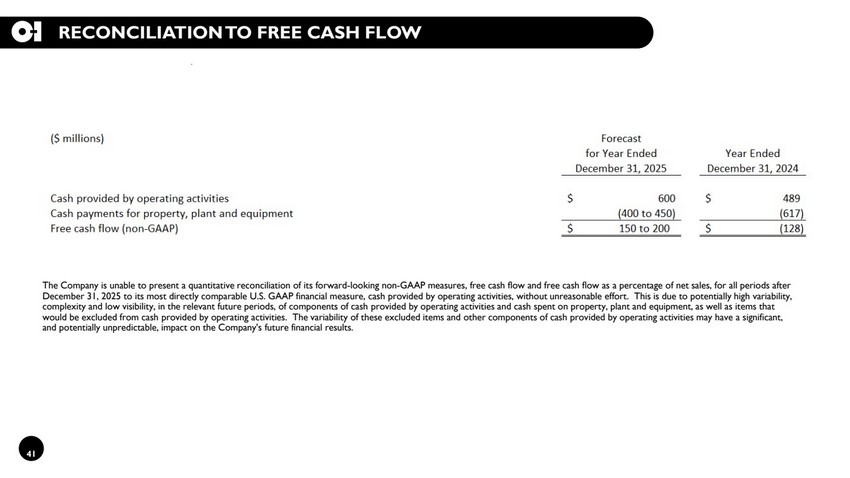
| RECONCILIATIONTO FREE CASH FLOW 41 The Company is unable to present a quantitative reconciliation of its forward-looking non-GAAP measures, free cash flow and free cash flow as a percentage of net sales, for all periods after December 31, 2025 to its most directly comparable U.S. GAAP financial measure, cash provided by operating activities, without unreasonable effort. This is due to potentially high variability, complexity and low visibility, in the relevant future periods, of components of cash provided by operating activities and cash spent on property, plant and equipment, as well as items that would be excluded from cash provided by operating activities. The variability of these excluded items and other components of cash provided by operating activities may have a significant, and potentially unpredictable, impact on the Company's future financial results. |
| ADDITIONAL RECONCILIATIONS 42 RECONCILIATION TO FINANCIAL LEVERAGE RATIO For the periods ending after September 30, 2025, the Company is unable to present a quantitative reconciliation of its forward-looking non-GAAP measure, economic profit and economic spread percentage, to its most directly comparable U.S. GAAP financial measure, net earnings (loss) attributable to the Company, because management cannot reliably predict all of the necessary components of this U.S. GAAP financial measure without unreasonable efforts. Net earnings (loss) attributable to the Company includes several significant items, such as restructuring, asset impairment and other charges, charges for the write-off of finance fees, and the income tax effect on such items. The decisions and events that typically lead to the recognition of these and other similar non-GAAP adjustments are inherently unpredictable as to if and when they may occur. The inability to provide a reconciliation is due to that unpredictability and the related difficulties in assessing the potential financial impact of the non-GAAP adjustments. For the same reasons, the Company is unable to address the probable significance of the unavailable information, which could be material to the Company’s future financial results. RECONCILIATION TO ECONOMIC PROFIT AND ECONOMIC SPREAD PERCENTAGE RECONCILIATION TO ADJUSTED EBITDA MARGIN For the periods ending after September 30, 2025, the Company is unable to present a quantitative reconciliation of its forward-looking non-GAAP measure, total financial leverage ratio, which is defined as the sum of total debt less cash and unfunded pension liability divided by Adjusted EBITDA, to its most directly comparable U.S. GAAP financial measure, Net earnings (loss), because management cannot reliably predict all of the necessary components of this U.S. GAAP financial measure without unreasonable efforts. Net earnings (loss) includes several significant items, such as restructuring, asset impairment and other charges, charges for the write-off of finance fees, and the income tax effect on such items. The decisions and events that typically lead to the recognition of these and other similar non-GAAP adjustments are inherently unpredictable as to if and when they may occur. The inability to provide a reconciliation is due to that unpredictability and the related difficulties in assessing the potential financial impact of the non-GAAP adjustments. For the same reasons, the Company is unable to address the probable significance of the unavailable information, which could be material to the Company’s future financial results. For the periods ending after September 30, 2025, the Company is unable to present a quantitative reconciliation of its forward-looking non-GAAP measure adjusted EBITDA margin to its most directly comparable U.S. GAAP financial measure, net earnings (loss) attributable to the Company, because management cannot reliably predict all of the necessary components of this U.S. GAAP financial measure without unreasonable efforts. Net earnings (loss) attributable to the Company includes several significant items, such as restructuring, asset impairment and other charges, charges for the write-off of finance fees, and the income tax effect on such items. The decisions and events that typically lead to the recognition of these and other similar non-GAAP adjustments are inherently unpredictable as to if and when they may occur. The inability to provide a reconciliation is due to that unpredictability and the related difficulties in assessing the potential financial impact of the non-GAAP adjustments. For the same reasons, the Company is unable to address the probable significance of the unavailable information, which could be material to the Company’s future financial results. |