Operator
Hello, and welcome to Progress Software Third Quarter Earnings Conference Call. At this time, all participants are in a listen-only mode. After the speaker's presentation, there will be a question and answer session. To ask the question during the session, you will need to press star 11 on your telephone. You will then hear an automated message advising your hand is raised. To withdraw your question, please press star 11 again. I would now like to turn the call over to Michael Michike, SVP of Investor Relations. You may begin.
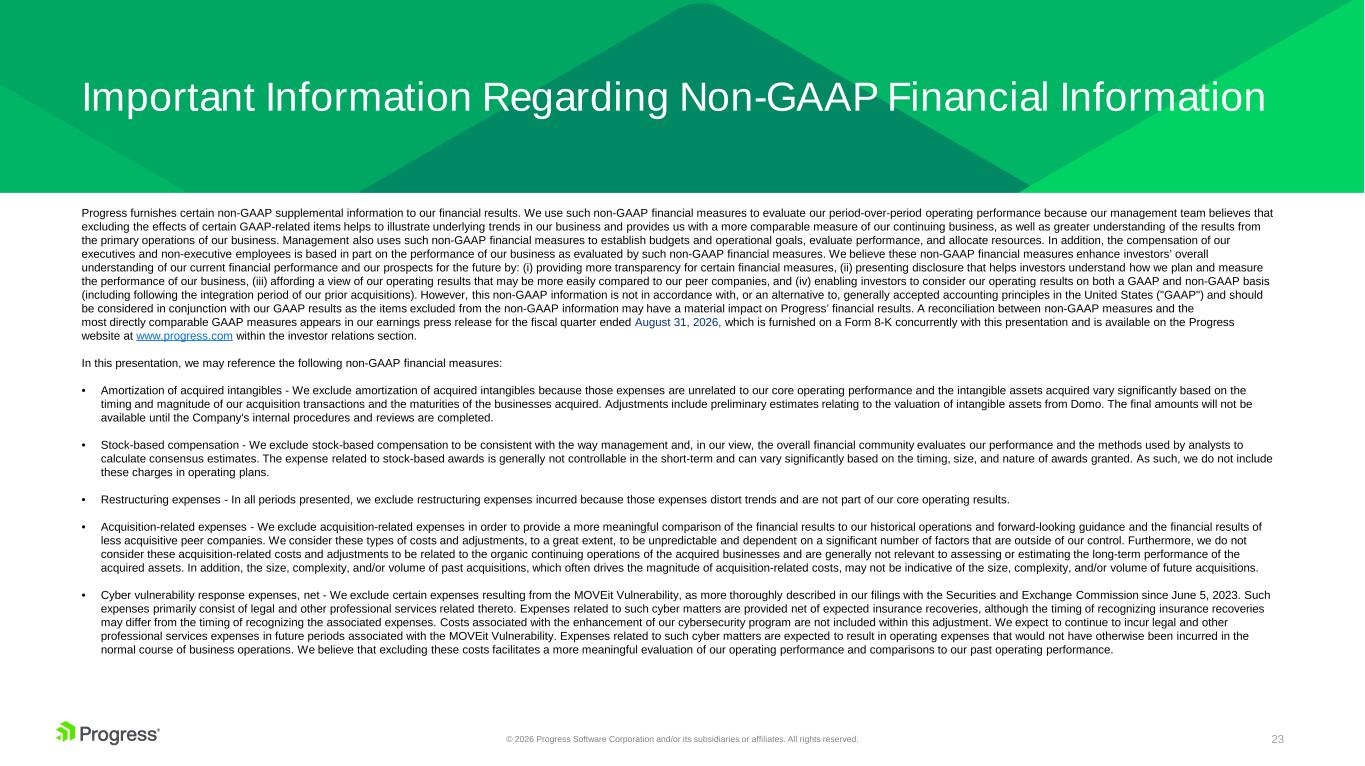
Thank you, Tawanda. It's nice to have you back with us. Good afternoon, everyone, and thanks for joining us for Progress Software's third fiscal quarter 2026 financial results conference call. Joining me on the call are Yogesh Gupta, our president and CEO, and Anthony Folger, our chief financial officer. Before we get started, please consider our safe harbor statement. During this call, we will discuss our outlook for future financial and operating performance, corporate strategy, product plans, cost initiatives, our acquisition and integration of Domo, and other information that might be considered forward-looking. Such forward-looking information represents Progress Software's outlook and guidance only as of today and is subject to risks and uncertainties, and our actual results may differ materially. For a description of the factors that may affect our future results and operations, Please refer to the risk factors in our SEC filings, particularly the risk factor section in our most recent form, 10-K, and the latest 10-Q filing which was filed in conjunction with this announcement. Progress assumes no obligation to update forward-looking statements included in this call. Additionally, please note that all the financial figures referenced in the call will be non-GAAP measures unless otherwise indicated. And you can find a reconciliation of the non-GAAP financial measures to the most directly comparable gap figures in our earnings press release, which also was issued at the market close today. This document contains additional information related to our financial results for the third quarter of fiscal year 2026, and I recommend that you reference it for specific detail. We've also provided a slide presentation that contains supplemental data for our second quarter, or excuse me, for our third quarter, and provide additional highlights, financial metrics, and information regarding the Domo acquisition. Both the earnings release and the supplemental presentation are available on the Investor Relations section of our website at investors.progress.com. And just a reminder that today's call is being recorded in its entirety and will be available for replay on the Investor Relations website shortly after we finish this call. So, Yogesh, we're done with that.
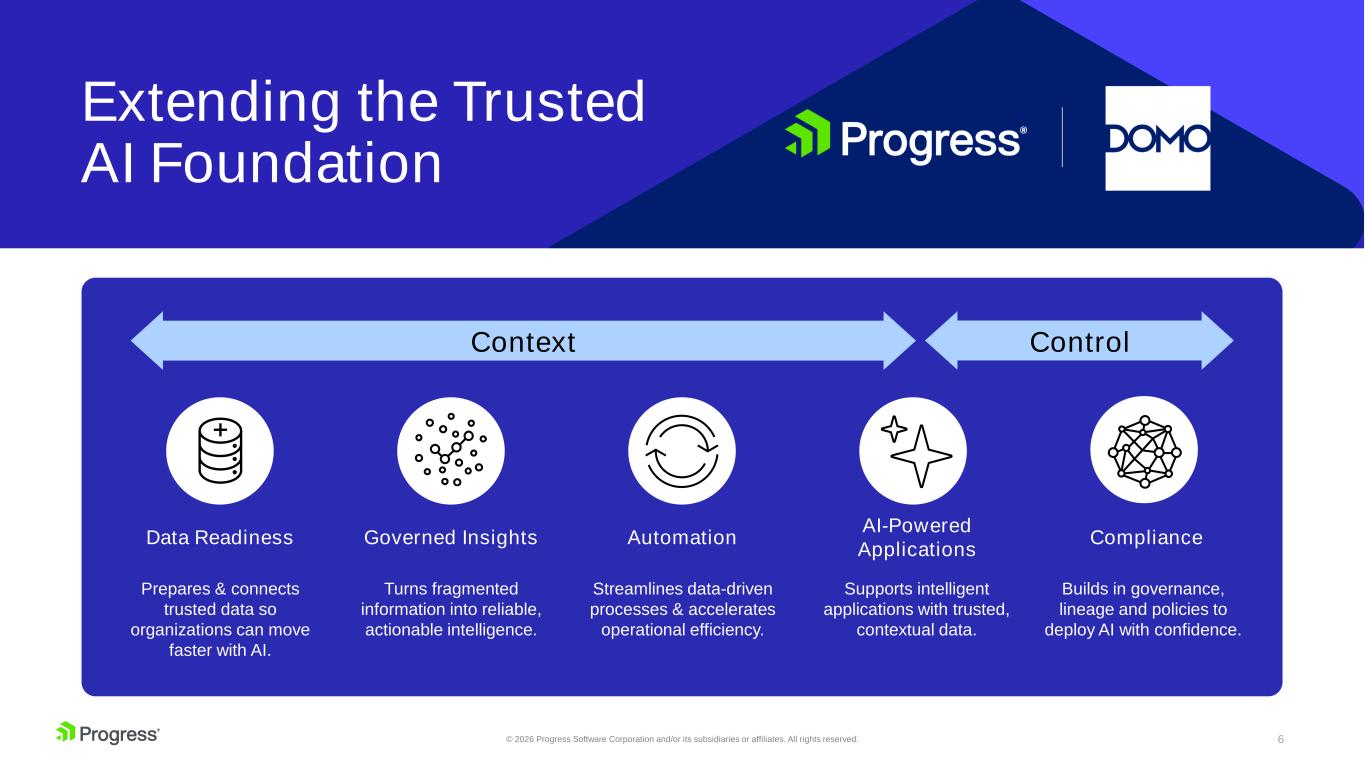
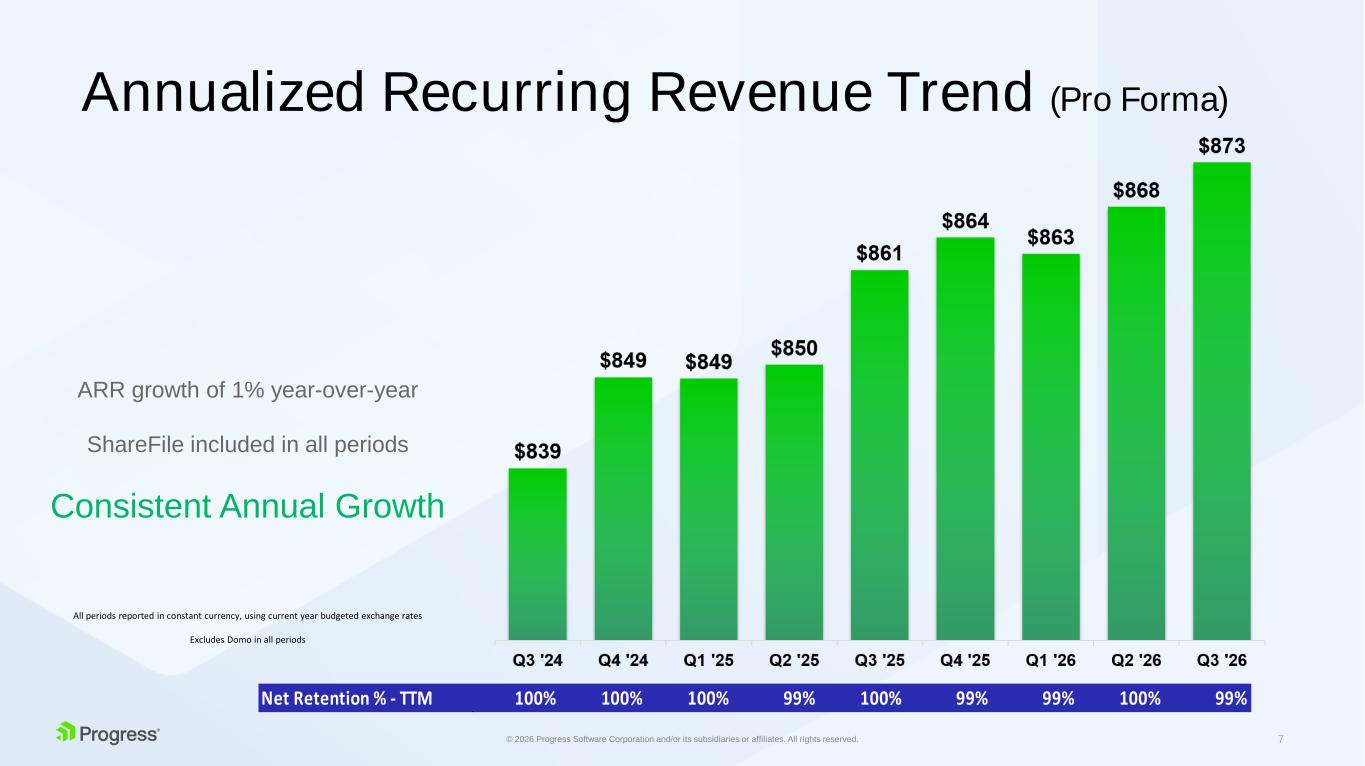
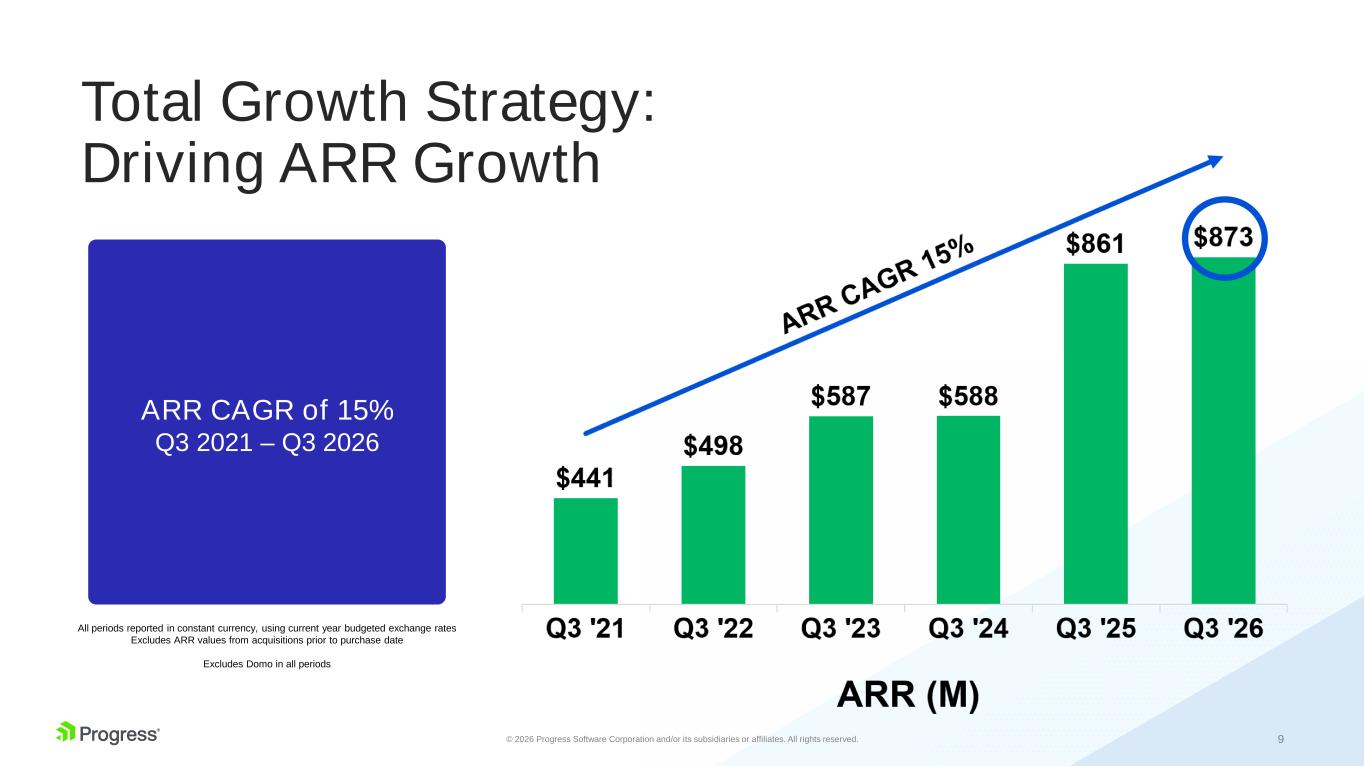
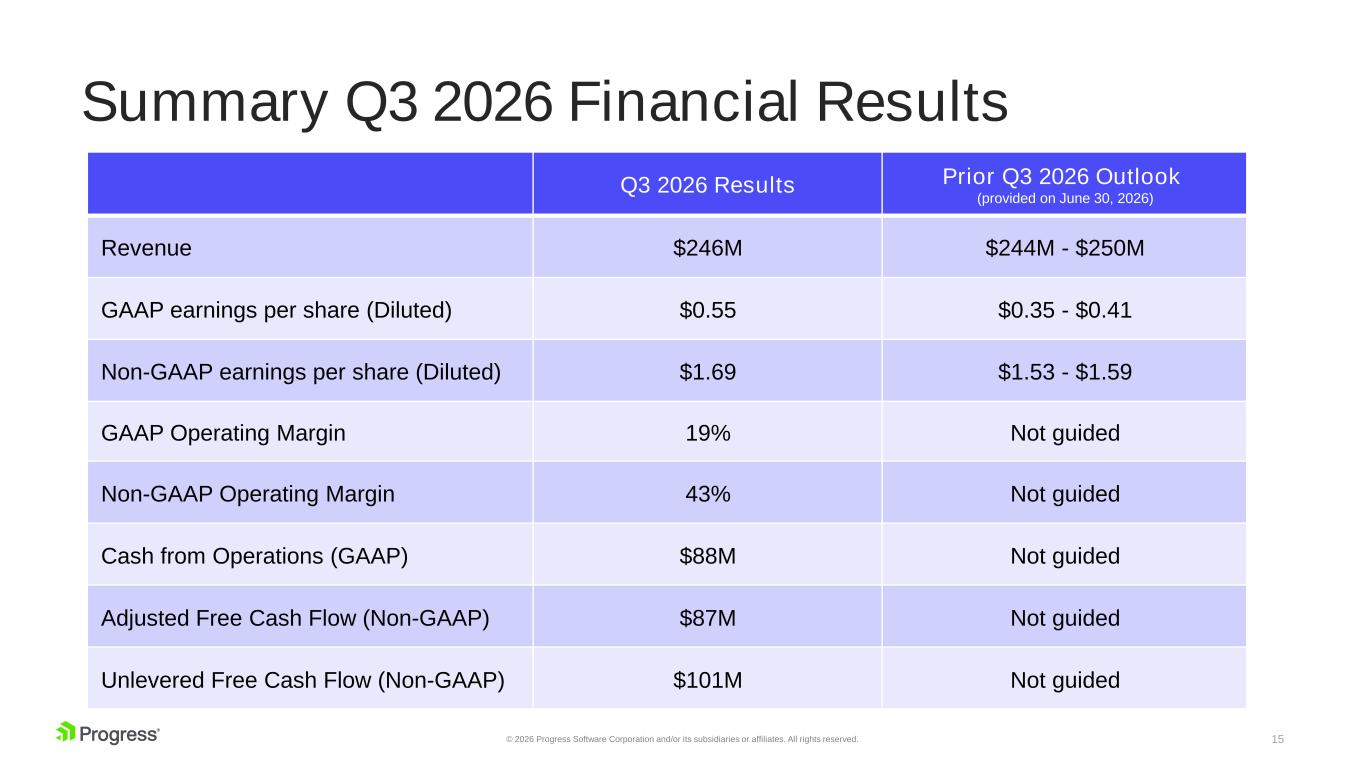
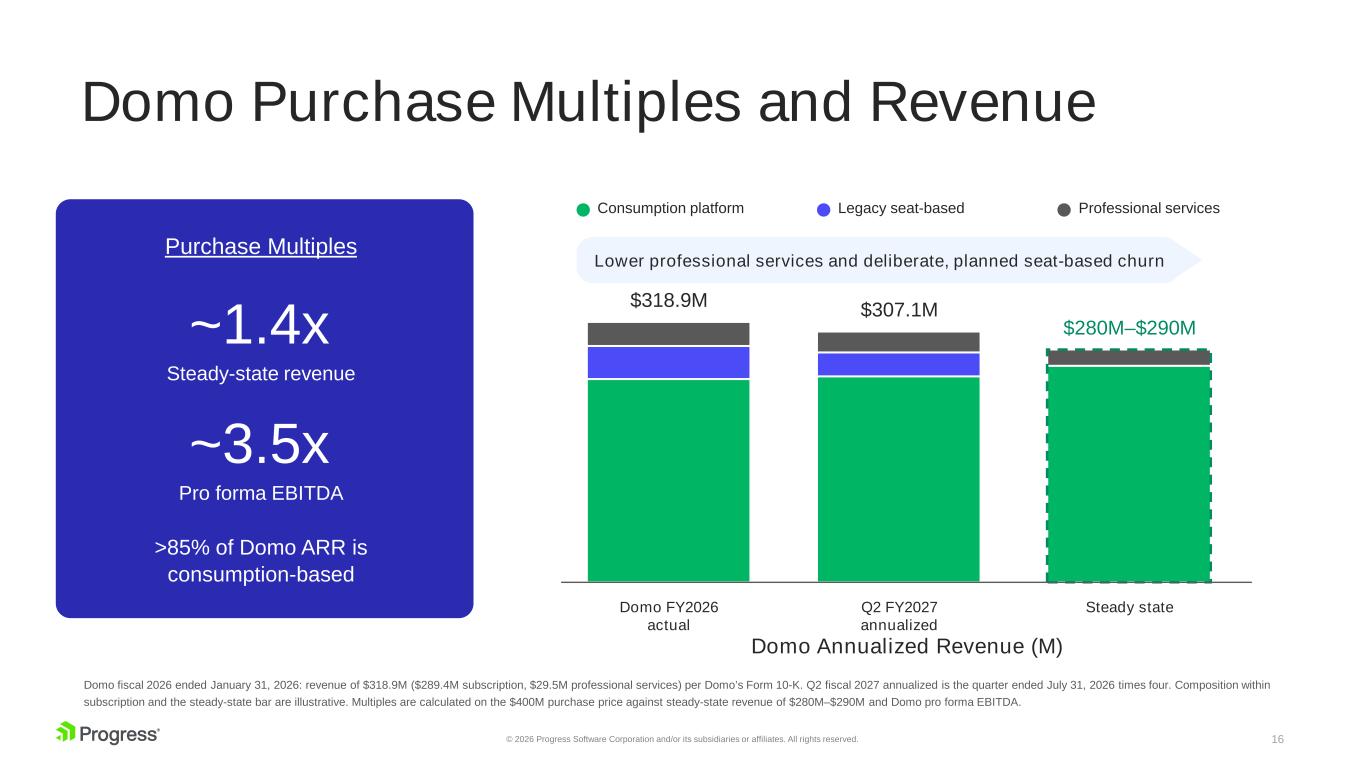
We'll turn it over to you. Thank you, Mike, and good afternoon, everyone. Thank you for joining us today to discuss the results of our third quarter of fiscal year 2026 and to also talk a bit about our acquisition of Domo which just closed last week. We delivered another solid quarter as ARR was up over 1% in constant currency to $873 million and net retention rate finished at 99% within our expected range of 99 to 100% consistent over the last several quarters. Q3 revenue was $246 million dollars right around the midpoint of our most recent guidance with notable strength again thanks to open edge data direct move it and load master among other products operating margins were exceptionally strong again coming in at 43 percent while earnings per share increased 13 percent to one dollar 69 cents exceeding the high end of our guidance cash flow continued to be very strong in the quarter as DSOs improved significantly and we continue to spend on our balance sheet to aggressive debt pay down. So we had a strong third quarter and our outlook for Q4 remains positive with the rest of the fiscal year on track. You'll hear more details from Anthony on our results and guidance later. Let me share some color on our Q3 results. Our performance again demonstrated the strength and ability and durability of our portfolio, which deals with deals across some of the world's largest enterprises and government agencies, reflecting the mission critical role our software plays in their business. Several major customers across the wide range of industries and geographies, we committed to and expanded their relationship with progress. This included major financial institutions, health organizations, global energy leaders, technology companies, several state agencies in the US, as well as one of the largest European law enforcement agencies. We also continue to gain momentum in highly regulated and security-sensitive environments where trust and performance matter most. These organizations are using progress products for mission-critical systems to securely manage and leverage their data and content, to automate complex processes, and to modernize their infrastructure. customers consistently cite reliability security compliance and operational efficiency as the key reasons for deepening their relationships with us most importantly we continue to see growing interest in our AI enabled capabilities as customers who rely on progress products to deliver the context and control for AI so that they can achieve their business goals with confidence. Context grounds AI-interested data, institutional knowledge, and business policies to produce reliable and dependable outcomes, while control ensures security, governance, and the management of the infrastructure and the costs of their AI projects. Organizations that successfully bring these two elements together are the ones that can and scale AI with confidence and realize lasting business value. That is one of the reasons we are so excited to add Domo's AI and data platform business to progress, which was a defining strategic development during the third quarter. What makes the Domo business particularly exciting is its ability to connect data across the enterprise, apply AI to that data, and deliver trusted insights and actions directly into business workflows. Customers across all industries are using Domo to build AI-powered applications and agents to automate decision-making and to empower employees with self-service access to real-time intelligence. They are using Domo offerings to turn data into measurable business outcomes from accelerating growth to improving operational efficiencies. For example, a leading sports broadcaster connects all fan social interactions, customer service conversations, and operational data using them, creating a real-time intelligence capability that provides the context to understand what fans are experiencing across live events and how to improve that experience. This allows the broadcaster to have the confidence to make real-time data-driven decisions, improve fan engagement, while resolving issues quickly and continuously enhancing the viewing experience of its audience from a technology and product perspective the strategic opportunity for integrating domo's cloud native ai and data platform with promises data platform is extremely compelling as data and data platforms become increasingly important layers in the ai enabled enterprise architecture combining and integrating domo's data transformation analytics and agentic workflow capabilities provides significant acceleration of our overall data platform progress already provides critical elements of the ai-enabled data architecture including ontology management unstructured data management semantic analysis agentic rag intelligent decision and ai-powered automated workflows Domo adds real-time data integration and transformation, analytics and visualization, automation, and agentic orchestration. Together, we can deliver a far more complete AI-ready data layer that takes complex data in and delivers deeper insights, automation, and trusted AI-driven outcomes. Now that Domo is a part of progress, we see significant opportunities to deepen our relationship with customers, to help them realize even greater value from their data analytics and AI investments. We've already begun to engage with Domo customers who are eager to hear how we intend to help them accelerate their AI journeys. Our general manager of the data platform business, John Ainsworth, and I have spoken to several of these customers who have shared their excitement about this acquisition and what it could mean for them. We also met with Domo's customer advisory board yesterday, which represents a broad cross section of their global customer base to share ideas, hear their input, and share our plans. And we have launched a global customer meeting tour covering a dozen cities around the world where at each event our senior executives expect to meet with 50 to 100 Domo customers. The first of these customer events also took place earlier this week. I want to especially thank the Domo team for continuing to stay focused on their business while dealing with the significant distractions and uncertainty this year, both prior to the announcement of the acquisition as well as the period between the deal announcement and Their dedication is truly commendable. For example, they completed all the work on a new release of the product, further extending the capabilities of the Domo offering, which we announced this morning. Anthony will discuss in detail the financial aspects of the deal and the significant financial opportunity that Domo brings, but let me share some highlights. As you recall, we paid $400 million for Domo, and because it's an asset purchase, we expect meaningful tax benefits and other favorable adjustments because of this very attractive valuation we are excited about the shareholder value creation opportunity that Domo represents I want to remind folks that the most exciting aspect of Domo's AI and data platform business is the part that is on the consumption-based model throughout a due diligence process we have believed that the seed-based business of Domo will continue to see significant churn and and that we would also continue to de-emphasize Domo's services business, something Domo itself had already started. As we manage the plan churn, the conversion of remaining C-based customers to the consumption-based model, and begin the work of maximizing customer retention in ARR, we anticipate that the steady-state revenue from Domo will stabilize in the range of $280 to $290 million, dollars, which again will largely come from the consumption-based model. Once Domo is fully integrated, which we plan to complete by the end of FY27, we believe that Domo will annually add well over a hundred million dollars of EBITDA to our business. In the meantime, our immediate priorities are to apply a proven integration playbook to integrate Domo's business into ours, to strengthen the customer retention and deliver our operating targets for the business by end of FY27. In closing, UP was another impressive quarter for progress with a lot going on. We delivered strong results, expanded margins, exceeded earnings expectations, and again generated excellent cash flow. At the same time, we executed on an integral component of our total growth strategy, completing yet another acquisition that adds significant scale to our business, expands our AI opportunity, and one which will contribute meaningfully to earnings and free cash flow. We're confident in the value Domo brings to progress and in our ability to deliver that value to customers and to our shareholders. I want to thank our employees around the world for this quarter, especially for delivering strong results while keeping us, while helping us make the largest acquisition in history. I continue to be in awe of their continued dedication and outstanding work. With that, Anthony, over to you.
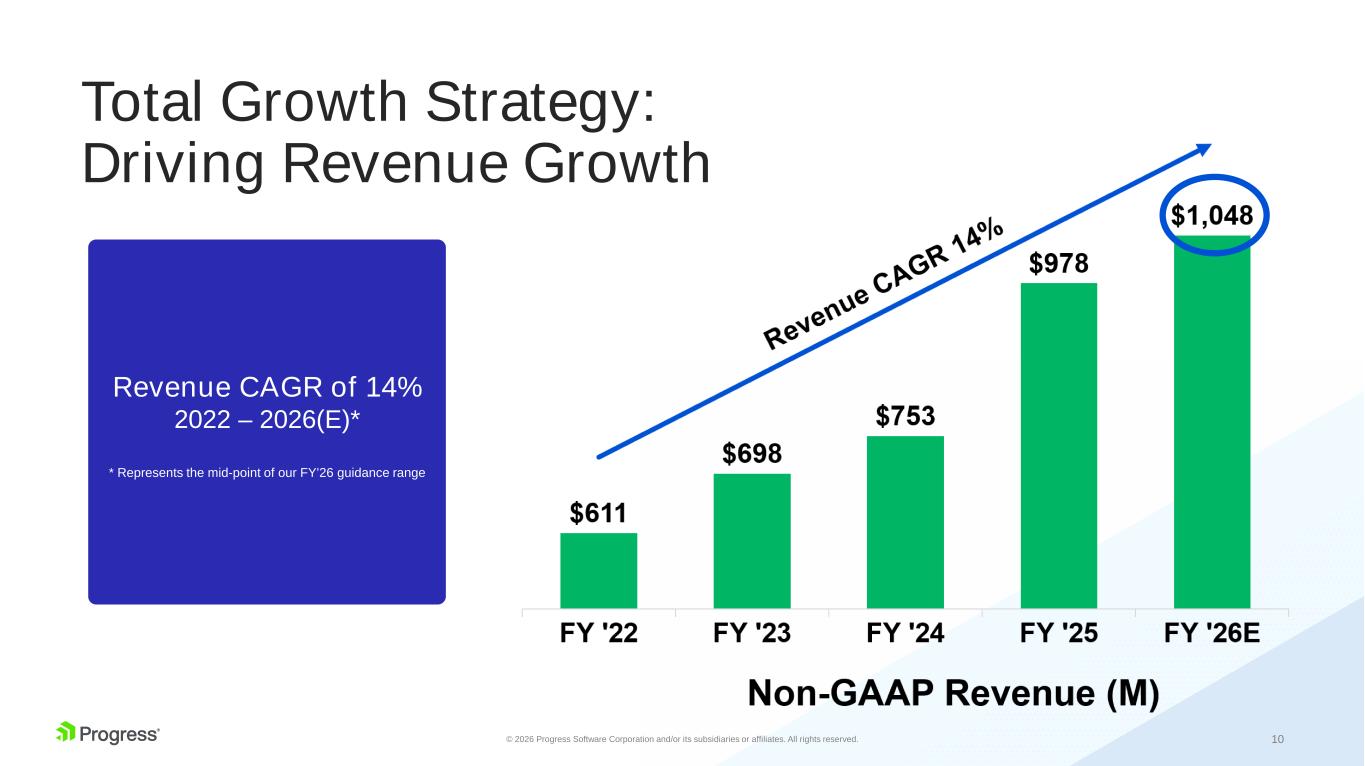
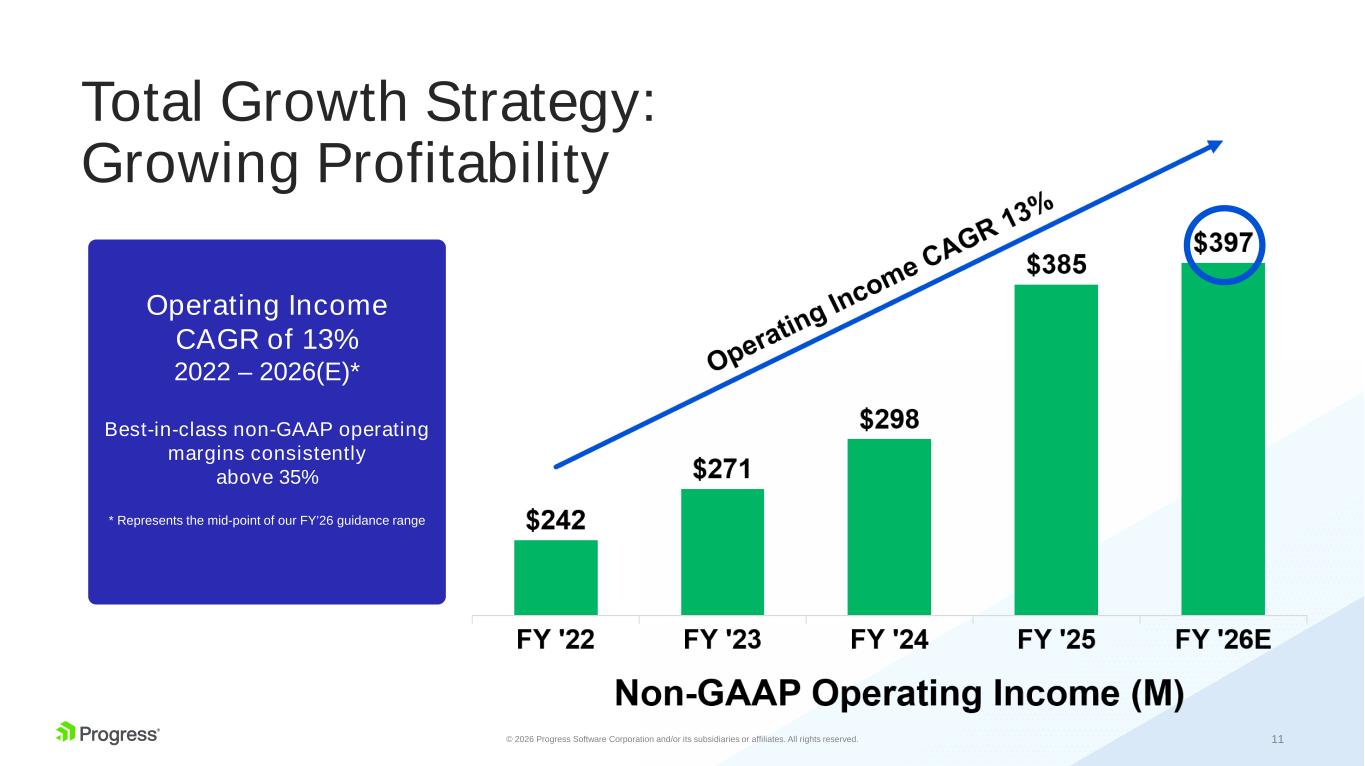
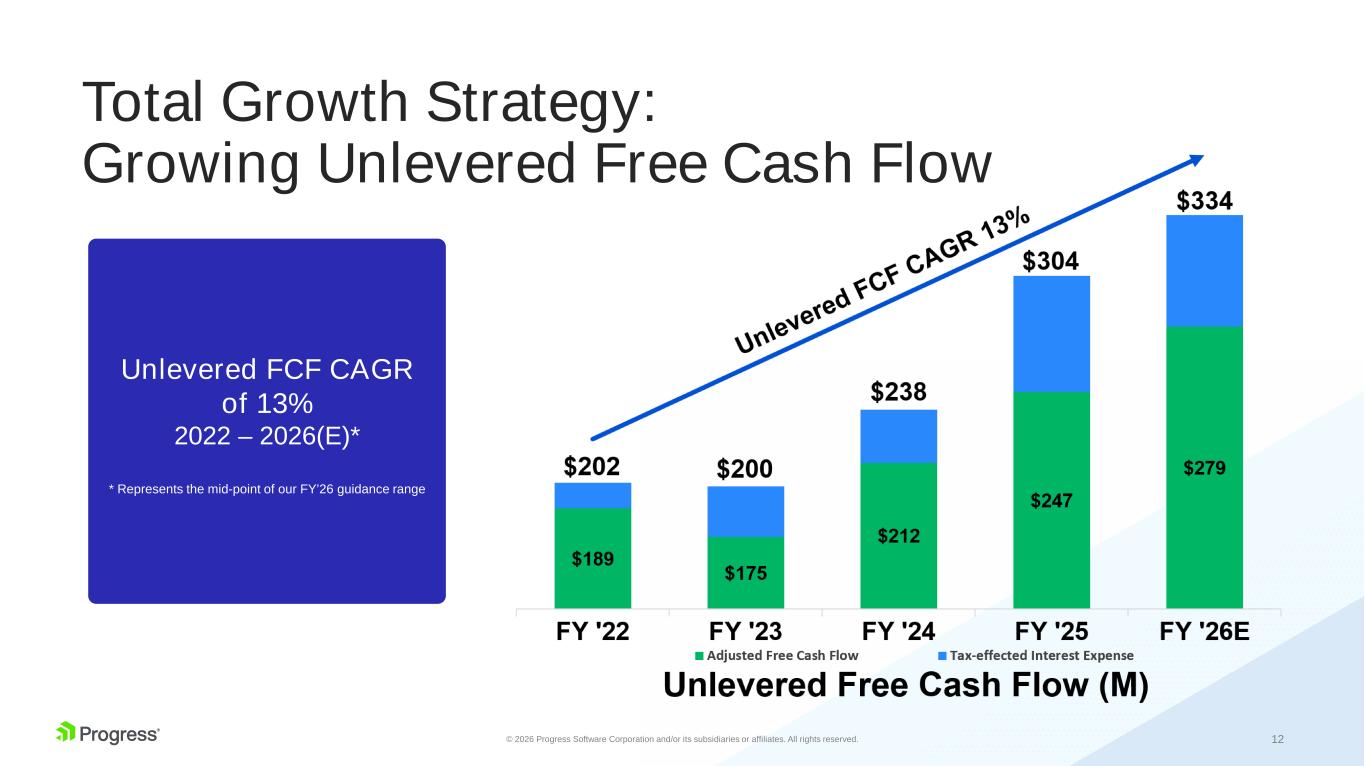
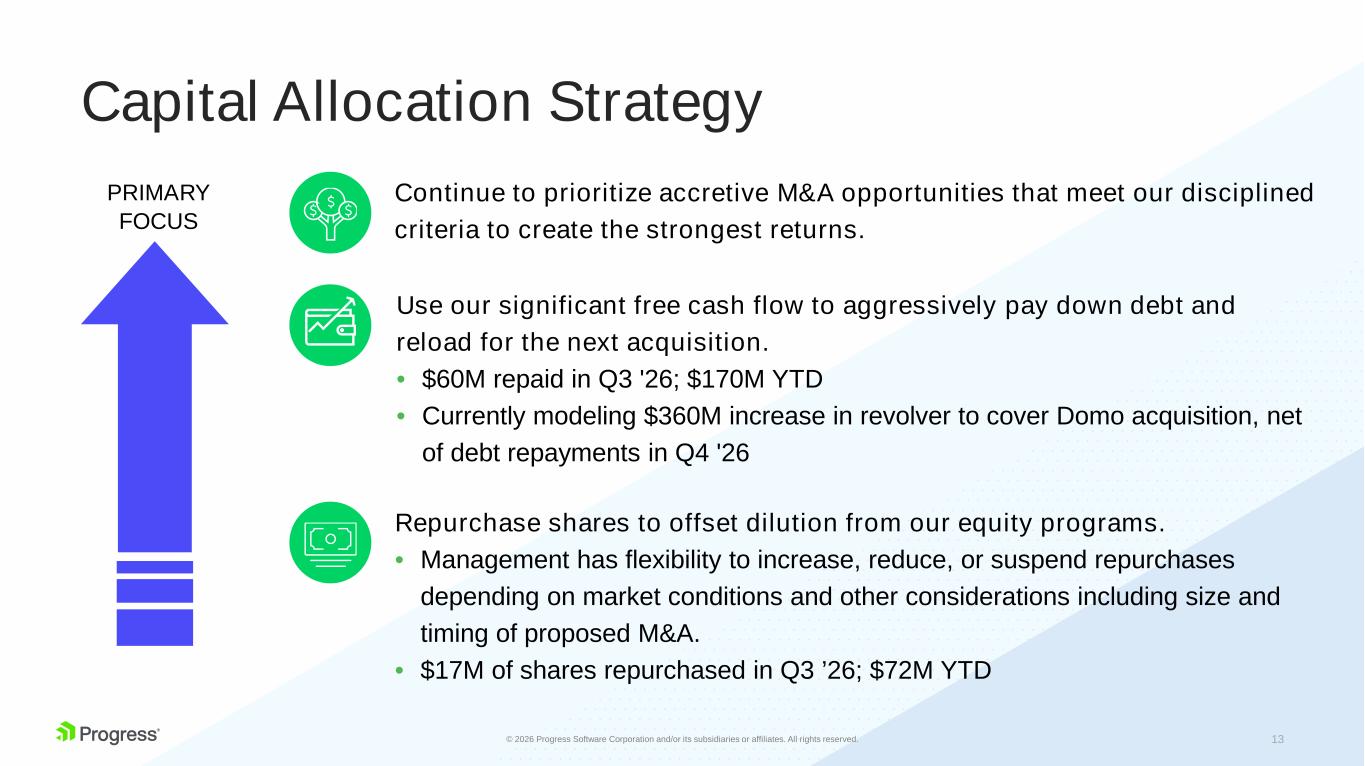
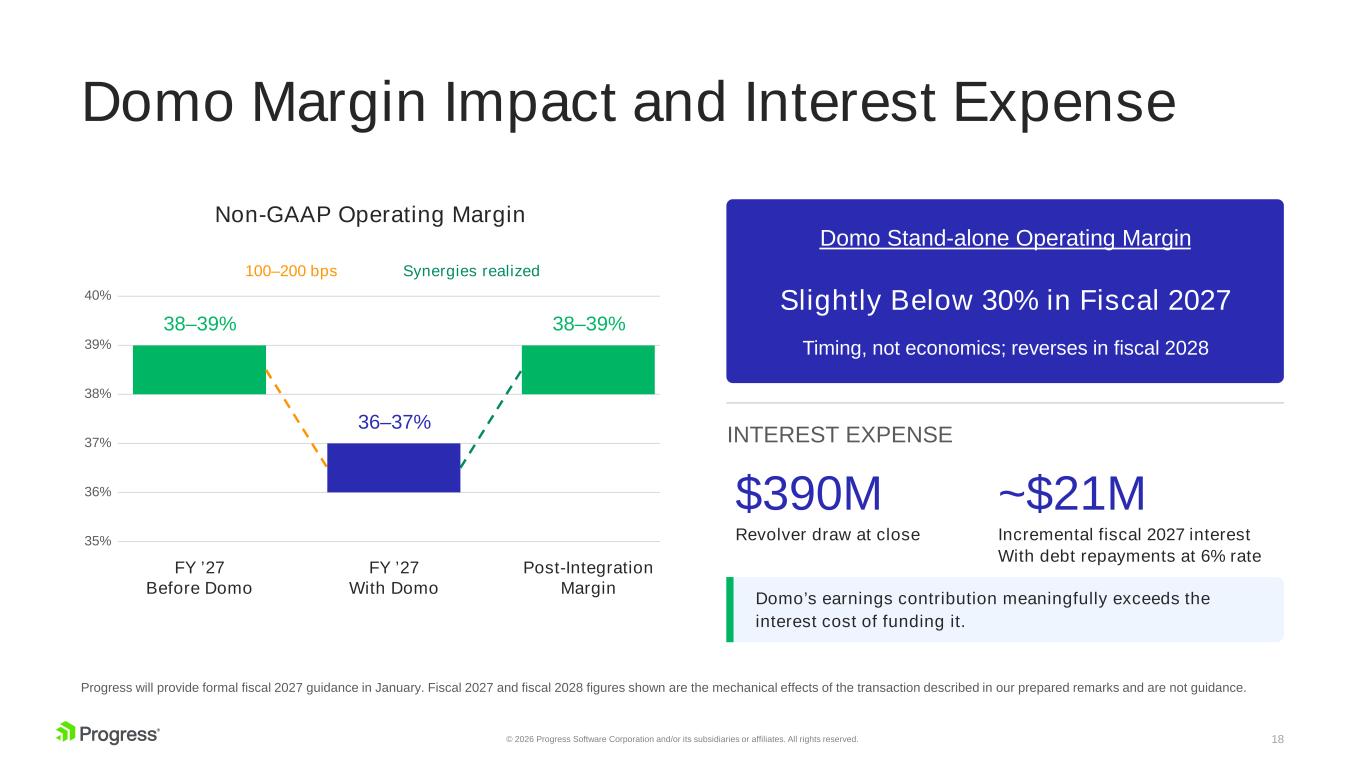
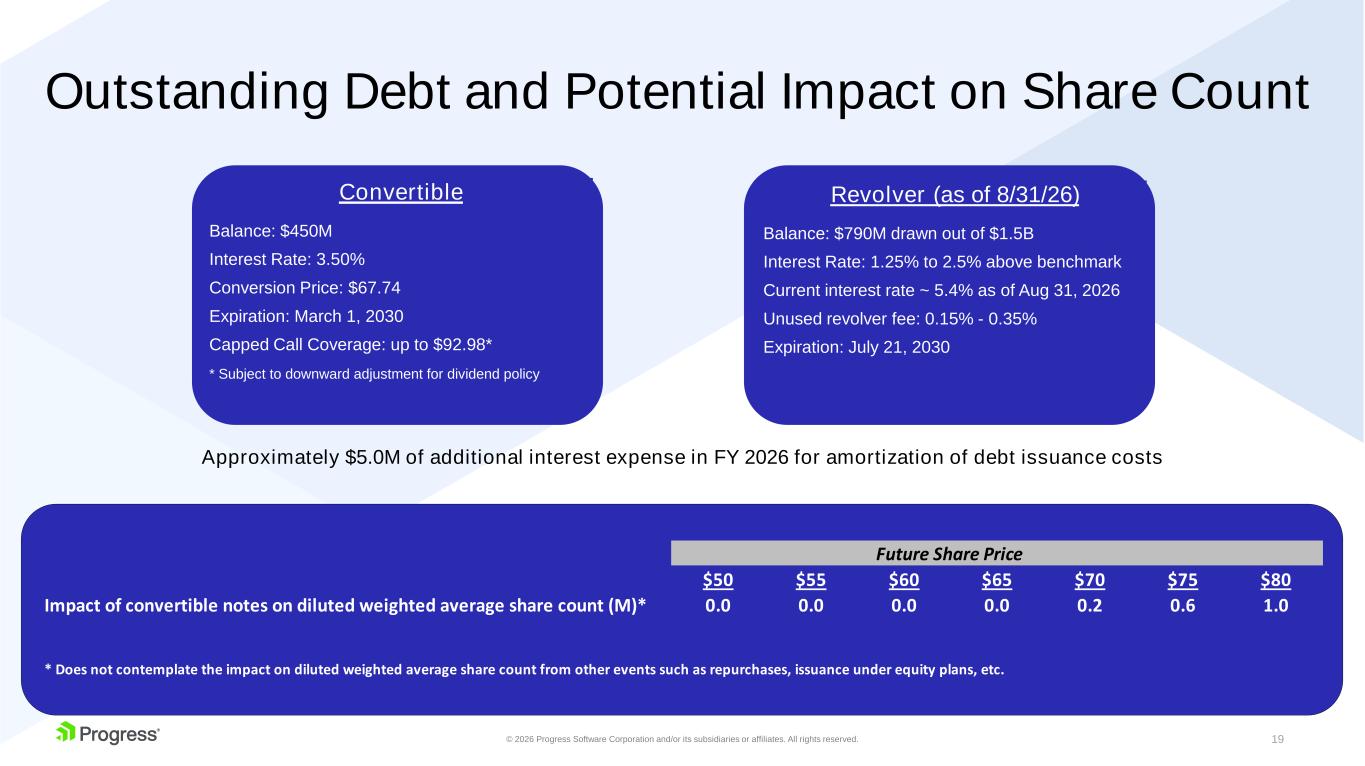
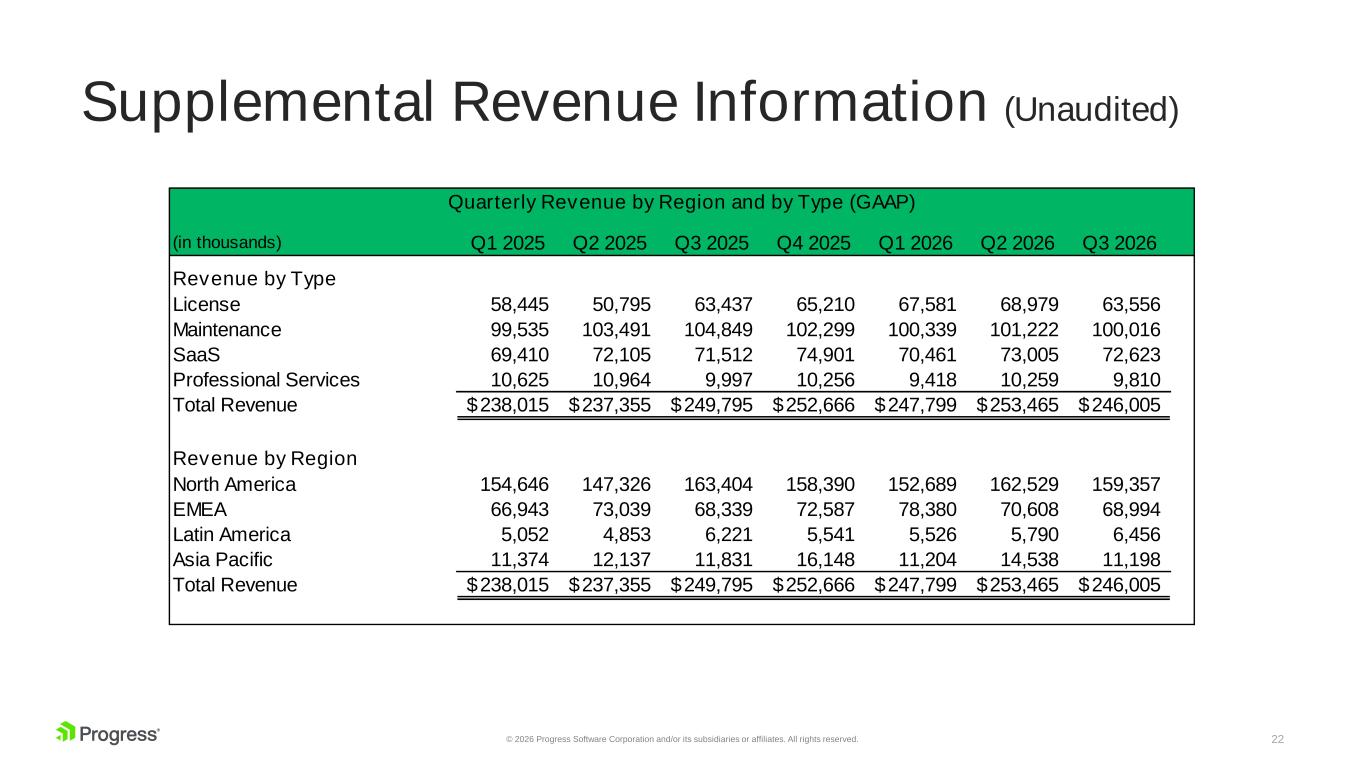
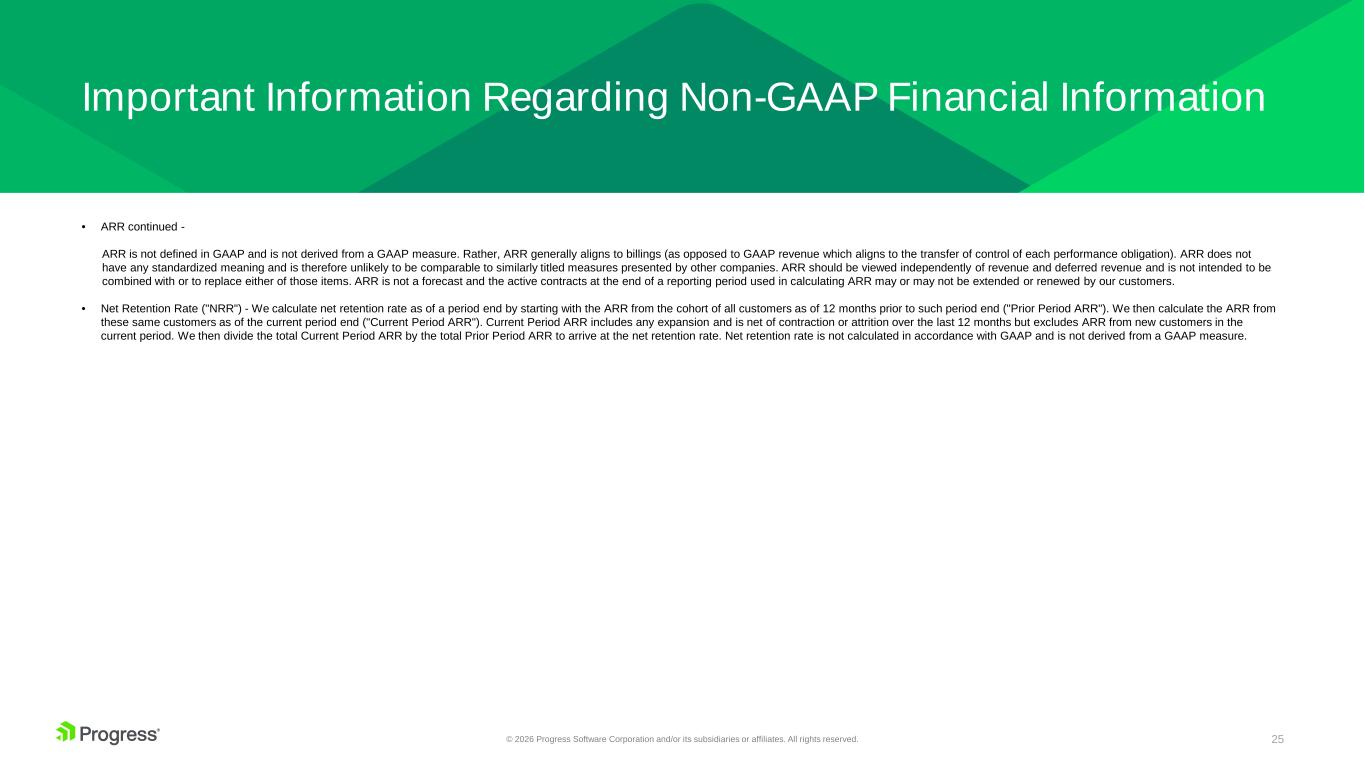
Great. Thanks, Yogesh, and good afternoon, everyone. Q3 was another quarter of strong execution. We delivered ARR growth of more than 1% and operating margin of 43%, earnings per share well above the high end of our range, and adjusted free cash flow growth of 17%. We also closed our acquisition of Domo's AI and data platform business last week. I'm going to spend a little more time on Domo today and provide some detail on what we bought and what it means for our longer-term model. With that, let's get right into the numbers. I'll start with ARR, which remains our key metric for assessing top-line performance. We closed Q3 with ARR of approximately $873 million, representing more than 1% pro forma year-over-year growth on a constant currency basis. For clarity, our pro forma results include ARR from acquired businesses in all periods presented, and our Q3 results exclude DOMO, which closed after quarter end and will be included in our ARR beginning next quarter the year-over-year growth in ARR was led by OpenEdge along with contributions from load master what's up gold our dev tools products and move it in addition our net retention rate for the quarter was again strong coming in at 99% Q3 revenue of 246 million was within our guidance range and with the timing of contract renewals affecting in quarterly revenue, I think it's worthwhile to point out that our year-to-date constant currency revenue growth of 2% maps very closely to our ARR growth rate, both squarely in the low single-digit range. Turning to expenses, total cost and operating expenses were approximately $141 million for the quarter, down approximately 10 million, or 6%, compared to the year-ago quarter. The decline reflects disciplined cost management across our business, and it contributed significantly to our earnings outperformance in the quarter. Operating income of $105 million increased 6% year-over-year, resulting in an operating margin of 43%, up 300 basis points from a year ago. Earnings per share of $1.69 came in well above the high end of our guidance range and grew approximately 13 percent on a year-over-year basis turning now to a few balance sheet and cash flow metrics we ended the quarter with cash and cash equivalents of 114 million dollars and total debt of approximately 1.24 billion for a net net position of approximately 1.1 billion our net leverage ratio at the end of q3 was approximately 2.7 times on a trailing 12 month basis. DSO for the quarter was 42 days, an improvement of 13 days compared to 55 days in the year-ago quarter, and a substantial improvement from 73 days at the end of fiscal 2025. Deferred revenue was approximately $406 million at the end of Q3, an increase of approximately $25 million compared to the year-ago quarter. Adjusted free cash flow was $87 million for the quarter, an increase of 17% compared to the prior year quarter, and unlevered free cash flow of $101 million, an increase of 14%. On a year-to-date basis, adjusted free cash flow is $265 million, an increase of 44% over the same period last year, reflecting materially improved collections along with continued strong operating performance. As for capital allocation, during the third quarter, we repaid $60 million against our revolving credit facility, bringing our year-to-date debt repayment to $170 million, and we repurchased approximately $17 million of progress stock, bringing our year-to-date total to approximately $72 million. At the end of Q3, we had approximately $131 million remaining under our current share repurchase authorization. Okay, now let me turn to Domo. As mentioned, we closed our acquisition of Domo's AI and data platform business last week and the integration process is already well underway. The headline purchase price was $400 million in cash. And if you include the minimum cash balance we received at closing and the net effect of assumed transaction expenses, our actual cash outlay was $390 million, which we funded by drawing on our revolving credit facility. We again intend to de-lever quickly and aggressively as we've done following all of our prior acquisitions. In his prepared remarks, Yogesh mentioned planned churn among some of Domo's products. So let me provide a little more detail around that. Domo's top line today annualizes at approximately $300 million and includes a strong and stable consumption based revenue model along with seat based revenue and a services business both of which were in decline prior to the acquisition in our model for Domo we anticipated continued seat based churn and declines in services revenue now that the deal is closed our outlook for Domo is that we expect the top line to settle at a steady state of approximately 280 to 290 million dollars. To elaborate further, we view Domo's top line as the combination of three elements. First, roughly 10% of Domo's revenue is professional services, and that revenue has been declining and will decline further as we shift delivery towards partners. This is what we do often in acquisitions, and it's margin accretive. Second, a portion of Domo's customers sit in legacy seat-based agreements, and we plan for a significant amount of that to convert to a consumption-based model or to churn at renewal. Third and most important is Domo's consumption-based platform, which, as Yogesh outlined, is strategically aligned to Progress's AI data platform, represents more than 85% of Domo's ARR, and carries significantly higher net retention rates. Yogesh covered the strategic rationale for buying Domo's AI and data platform business, but from a finance perspective, it's worth highlighting the math because profitability is one of the key tenants in the M&A pillar of our total growth strategy. Using the steady-state revenue range I provided, Progress paid roughly 1.4 times revenue, and from an earnings perspective, roughly 3.5 times pro forma EBITDA. At DOMO scale, that is a significant addition to our earnings power and cash flow. All of this brings me to fiscal 2027 and we'll provide formal guidance in January, but given the size of this transaction, we think it'll be helpful to highlight two mechanical effects of the transaction and how they'll show up in our numbers next year. The first is operating margin. For the full year 2027, DOMA will likely run slightly below 30% operating margin as the synergies rank. And that will result in some compression of progress's overall 2027 operating margin, maybe 100 to 200 basis points. So a progress margin in the range of 38 to 39% might look more like 36 to 37% as the integration proceeds. I want to be clear about this. Any 2027 margin compression is the result of integration timing and it reverses as the synergies are fully realized. The second point I want to highlight is interest expense. We drew $390 million on our revolver to fund this transaction and the incremental interest expense in 2027 is expected to be approximately $21 million and that will decline as we pay the revolver down. Net both of those items, we still expect fiscal 2027 to be a year of substantial earnings growth because Domo's earnings contribution meaningfully exceeds the interest cost of funding it. And as synergies fully ramp into fiscal 2028, both the margin dilution and a good portion of the interest brag reverse and deliver even more earnings growth. Okay, turning now to our outlook, for the fourth quarter of 2026, DOMA will contribute approximately two months of activity to our results, and we expect revenue to be between $297 and $305 million, and earnings per share between $1.24 and $1.33. For the full year 2026, we're raising our outlook, and now expect revenue of between $1 billion and $44 million and $1 billion and $52 million, an increase of more than $50 million from our prior guidance, driven by the addition of Domo for a partial quarter, together with solid underlying performance in our base business. We expect an operating margin for the year of 38%, which includes the impact of taking on Domo's business, which was running roughly break-even at close. We expect adjusted free cash flow of between 275 and 283 million and unlevered free cash flow of between 330 and 338 million, both slight increases from our prior guidance. And finally, we expect earnings per share of between $6.15 and $6.23, an increase from our prior guidance. Our guidance for full-year EPS assumes a tax rate of 20% and approximately 42 million weighted shares outstanding. In closing, Q3 again demonstrated the durability of our business. Strong margins, strong cash generation, and continued improvement in our balance sheet and collections. And to echo Yogesh, we're extremely excited to welcome Domo to progress, and we're looking forward to continuing to execute on our total growth strategy. With that, I'd like to open the call for questions.
Operator
Thank you. Ladies and gentlemen, as a reminder to ask the question, please press star 1-1 on your telephone, then wait for your name to be announced. To withdraw your question, please press star 1-1 again. Please stand by while we compile the Q&A roster. Our first question comes from the line of John DiFuse with Guggenheim Securities. Your line is open.
Hey, this is Lawrence Vansko on for John DeFucci. Nice job, team. You've proven that you can improve margins following an acquisition. And as we think about Domo and the journey to progress margins, where do you expect to gain the most leverage? How much leverage will you essentially get from redundant public company cost elimination or G&A, sales and marketing, or restructuring? And I just have a follow-up for Anthony.
So, hey, Lauren, you know, as you know, you know, we look at, first of all, public company, you know, two public company expenses versus one. There's some savings there, as you already recognize. Definitely, GNA is an area with a significant savings because we're able to leverage our existing GNA structure, integrate their business into ours, use our financial systems, use our HR systems and all that stuff, right? So there is significant synergies there. Also, when it comes to go-to-market expenses, the reality is that Domo had a strategy around trying to grow the top line very aggressively. We expect the top line of Domo to be mostly stable, maybe grow somewhat, but it is not the same level of focus on top-line growth that Domo had, right? So I think there are opportunities in multiple places. Anthony also mentioned, you know, that we would move the professional services efforts to some degree to partners because, again, it is a lower-margin business than the software side of the business. So I think the opportunities are across the board. and you know as we go into these acquisitions we actually plan those extremely carefully and methodically and thoughtfully we have done that our integration plans and plans are not only in place but we have begun to execute on those and we are confident and I am truly confident that we will get margins to be promising by end of FY27.
That's really helpful. Thanks, Yogesh. Both you and Anthony also talked about how free cash flow is very strong this quarter and accrue almost 20%, which is above where we were probably expecting. Just want to make sure, was there anything unique in cash flow this quarter that could have a negative effect on next quarter cash flow, or was this more of just a reflection of just efficient management of the business?
Thanks, Lawrence. Yeah, there definitely is, And I would say it's been in place for the full year 26. If you recall last year, there was a lot of discussion about Sharefile and the integration that was underway and some of the billing and collection challenges we had because that was a, you know, it was an asset deal and it was a divestiture out of a larger organization. And so I would say in 2025, our cash flow was probably light because of that. And in 2026, we've seen because that operational backlog is gone and because the systems and the processes have gotten a lot better, we've seen pretty meaningful improvement in cash flow and collections due to share file. So it's more that last year with light, this year were, you know, probably a little bit heavier than we would otherwise be. It probably normalizes next year. You know, and you can look at a normalized, you know, EVA data, free cash flow conversion ratio for us, you know, as opposed to trying to take this year's number for cash flow and map it out.
Operator
Thank you. Please stand by for our next question. Our next question comes from the line of Fatima. Bulani with Citi. Your line is open.
Oh, good afternoon. Thank you for taking my questions. Yogesh, I wanted to ask you kind of a strategy-leaning question as it relates to progress dipping its toes in different modalities of pricing. So historically, you've seen capacity growth with some of your core flagship products. You're now introducing and will be scaling the consumption modality by way of Domo. I'm wondering, you know, firstly, how much is just aggregate data growth and environmental growth with some of your customers as it relates to AI investment, how that is influencing maybe capacity growth trends kind of on a unit basis? And then relatedly, is there an opportunity to take some learnings from Domo's consumption model and maybe propagating that to other parts of the portfolio and why or why not? And then I have a quick follow-up for Anthony, please.
So, Fatima, I think those are really wonderful and strategically important questions. So, let me go through them one at a time. So, So first of all, you're absolutely correct. The volume of data that businesses are trying to now consume and they realize the value of has suddenly become dramatically larger and it's growing larger. So it's showing up in two places. In places like obviously Domo products, it's showing up as greater consumption because it's on the use of the data. In products that we have that are more traditionally capacity-based, It's showing up in greater capacity needs, bigger server needs, a larger number of servers, a larger compute capacity, therefore a larger number of licenses on the server side. The vast, vast, vast majority of progress products are either on the volume of infrastructure or volume of data in terms of capacity more than anything else. And that also impacts our infrastructure management products positively. As the infrastructure gets more complex, as they bring in more compute infrastructure to deal with AI workloads, all of this leads to additional capacity needs when it comes to observability products or our security products and so on. So I think that we see this, the whole, you know, rising tide on the use of data, the rising tide of complexity because of new types of hardware coming in. I mean, you know, people are buying, you know, these AI compute boxes to put on people's desktops and they're putting them in their own private clouds because they don't want to pay and run models on those rather than trying to pay some, you know, other AI company for their foundational models, et cetera. All of these things add to complexity and scale on the infrastructure side as well. So I think capacity growth will continue to be a driver for us and a positive trend for us. I think the second part of the question is really, really important. One of the things that we are doing is that we have been actually over the last 90 days analyzing Domo's consumption-based model and trying to understand how it can apply across a variety of our products across our portfolio. And I think there's a tremendous opportunity to do that because the vast majority of our products or something where the value is derived based on the amount of information, whether it is structured data or unstructured data, content, you name it, the amount of workflows that go through those, and therefore the consumption of that content or that data. I think those are the right metrics because that's where the business value lies. You know, the human seats are going to get replaced by automated AI agents. We all know that. which is why I think the seed-based models are under pressure out there, which is why we've been talking about the fact that the vast majority of our business is not on seed-based models. And so we continue to look at how we can apply the consumption model to any of our businesses that are still on seed-based models as well, and also maybe some of our capacity models. We could basically use consumption as a metric for capacity as an alternate measure if customer wants those rather than actual just, you know, volumes of data managed, right? They can say, no, we want to use the volumes of data used rather than managed because the volumes of data managed is actually right now going extremely fast. As time goes on, the volumes of data being used is going to go up even faster because the more the data becomes valuable because of AI, the more it's going to get consumed. So I think this is a really positive trend for businesses who are on the consumption-based model, for businesses who are on the capacity-based models, while they are a headwind, of course, for seed-based businesses.
I appreciate that detail so much. Thank you, Yogesh. And just as a follow-up, Anthony, as the business maybe transitions more towards a consumption orientation, as you evaluate the applicability of this model to more flagship products in the portfolio, is there something we need to consider or maybe reconsider as it relates to COG's profile or intrinsic profitability profile? profile, just because I noticed that you're talking about a post-integration margin zip code around 38, 39. We're certainly used to you delivering, you know, well above that, you know, below 40.
So I'm wondering, as the business sort of transitions and incorporates more of this modality, does that sort of structurally change kind of the upside or put a ceiling rather on your ability to deliver kind of 40 post-integration operating margins thank you sure that that's a good question and then I've got a you know my my knee-jerk reaction or my knee-jerk response is that we we generally guide 38 to 39 and deliver above that but in reality the point you're making I think is true you You know, Domo is another SaaS-based, you know, purely SaaS-based business that we're acquiring. This is the second one in a row. Sharefile was also pure SaaS. And the two of them together are going to be north of half a billion dollars of revenue. And we also have other SaaS-based offerings within the portfolio that are growing. And so we do know that those SaaS-based offerings do have a slightly lower growth margin. I wouldn't say we're ready to sort of lower, you know, the margin outlook at this point, but we are certainly, you know, evaluating the pricing model and trying to understand from a COGS perspective with the significant mixed shift towards SAS now, you know, is there a slight drag on gross margin and therefore on our operating margin? And there's potential for that, but I think that's more of a scale issue as we scale. You know, it could be slight where you would see a little bit of compression there, but I think it's, you know, it's a slight compression probably with better retention and a much higher mix of SaaS revenue as part of our overall revenue.
Operator
Thank you. As I reminded, ladies and gentlemen, that's star one-one to ask the question. Our next question comes from the line of Lucky Shreener with DA Davidson. Your line is open.
Great. Thanks for taking my questions here. Maybe just to start back on the margins and the guide for, you know, roughly 30% operating margins around Delmo. So, you know, given just how rapidly the technology is evolving here, is there a factor of you need to keep investing in the product and keep that product relevant today as the landscape changes so quickly, factoring into some of that, or, you know, how much, how quickly could we maybe see some of the upside around the operating margin?
So, Lucky, let me start, and then I want Anthony to follow up. I just want to clarify that what Anthony said is that for FY27, because their margin currently was basically zero when we acquired them, and the margin will ramp up over time as we go through the synergies, the margin contribution from the Domo side of the business will be around 30%, right? So that's not the steady state margin of the Domo business. The steady state margin of the Domo business we expect to be very similar to ours, right? So that's one clarification I just wanted to make. So once synergies are done, expect the same type of margins as we've had in our recent past. In terms of, you know, whether we would be investing more, whether, you know, because of the market changes. The reality, Lucky, is that the competitive landscape is shifting across our entire portfolio. If you look at how much we have invested in AI across our entire product portfolio within R&D, it is truly, truly meaningful. And we have delivered strong capabilities that are tremendously beneficial to our customers doing that. So we will continue to invest in Lomo as well. You know, we invest, you know, in our teams in our R&D expense every year. So it is a significant chunk of our operating expense line. And I actually think that that will continue because of that. And I think, you know, we believe that, you know, with the right focus and with the right set of – even the tools with AI are helping as well there on the other side lucky you know uh they're helping do more r d work and do faster r d work than one can do without it so i think it's a there's benefits to leveraging ai for for our engineering teams as well so with all that i think we are very comfortable saying that the overall margins with uh domo once we have fully synergized it the steady state margins will be very similar to the rest of progress. And we will be able to invest in the product the way we need to to sustain its long-term viability and customer attractiveness and market competitiveness.
I think that makes a lot of sense.
You know, I would just say that thanks for pointing that out, Yogesh. If it came across that Domo was only going to hit 30% margins, I should have clarified that that was really specific to 27, just to help people out with modeling in terms of how the synergies would progress through the year, that for the full year of 27, they may hit 30, but their exit rate is going to be a lot higher, obviously. And your question on R&D, I think our model is telling us we're going to invest at or even above levels we normally invest in domo. So, the investment level absolutely is going to be there from a product standpoint, and we're, I mean, you know, we're in sort of high teens, close to 20% in terms of R&D as a percentage of revenue. So, we do spend, I think, I like to think that we spend in the right areas, and I think we'll do the same with Delmo.
Understood. Yeah, very helpful. Maybe then on cross-selling and with Delmo, the asset purchase, the cross-selling motion is more practical and attractive today than previously. Is there any crossover factored into the 280 to 290 range that you gave for 2027, or is that all potential upside? And does that, you know, how quickly can you roll this out to both customer bases?
Yeah, so that is not factored into the 280 to 290. As you know, I've said this before, our initial plan is to focus really on getting the business integrated, getting the synergies done, and so on and so forth. And, by the way, improving retention of customers, paying attention to existing customers that Domo has, making sure that they recognize that it is a better home for Domo than maybe they previously felt that they had. so therefore we have not factored any cross cell in the model so it's all upside lucky and I think that as time goes on we will talk about it you know us we until we see actual traction and proof we don't like to put a pull out expectations I know we're just a different style that way and our style is to prove it out, see whether we are actually seeing that cross-sell. That said, I am extremely excited about the cross-sell opportunity because you're right. The progress data platform combined with the data platform and AI capabilities of Domo are truly compelling. And I just, I really, really do see cross-sell opportunities over time. I think it's just premature right now for us to talk about sizing it.
Makes a lot of sense. congrats on the acquisition or the asset purchase hey thank you thank you thank you thank you lucky thank you please stand by for our next question our next question comes from the line of john defusi with guggenheim securities it's follow up your line is open thank you this is john defusi not lawrence i i apologize you guys on the road but i i was i was hoping to hear Yagesh's public comments about Domo a little bit here because as you guys know you like we calculate you bought it for like 1.1 times recurring revenue and I and I know and you talked about um I think both Yagesh and Anthony mentioned there were other things that that add value here too with Domo and that's really unique right that kind of a multiple and and you know highly attractive at first look but at the same time for a recurring revenue company which this probably means the market was questioning how recurring that revenue stream really is in the era of AI. And Yagesh, I know you spoke about this a little differently, Domo, and I've watched Domo for a while, probably all of us have, but I never really officially covered it. But can you explain how you think of more traditional analytics? And I know Domo maybe is a little different but it's also put in that bucket in the era of AI is there still a place for it or you like are you changing Domo here or are the probabilistic derivations of AI likely to displace traditional analytics even though that a lot of what they do is deterministic which seems to be the conclusion of the market okay and you guys obviously see something different I'm going to shut up. Go ahead. Go ahead, Yogesh.
Yeah. Yeah, no. So, John, I think, I think that you are right that there is a segment of analytics that AI can and will disrupt, right? And especially when it comes to presentation. So when you think of analytics, there is the part of analytics that says, how do I bring data together from hundreds of different sources? How do I transform it? How do I rationalize it? How do I get semantics into it and apply ontologies to it? That stuff is hard, complex, and especially in a business context where you are trying to get dependable, reliable outcomes. Even though you understand some of it could be probabilistic, you still want dependable, reliable outcomes. and you want the same answer twice, you know, if you ask the same question twice, you know, there is a huge amount of work that goes in what was traditionally called data prep, but it's a combination of a lot of things. So I think there the value actually gets greater because of the amount of AI being leveraged that will be leveraged for basic analytics and reporting and what-if analysis will only need better and better quality data. So high-quality data with integrity, data that is business-specific, is something that Domo is one of the companies that actually leads in that market. And therefore, that's why I keep going back to the consumption side of the business, the business that is on the consumption model. And by the way, even, you know, you've heard Domo's own public comments about this. The consumption side business has much better net retention rates than the C-Pace business. And that has been historic. And customers who start on their consumption business have actually net retention rate of over 100%, right? And so it is really interesting to see that people who are leveraging Domo for truly just the AI portion are actually expanding as they go forward. Folks that have converted over are much more stable in their net retention rate. And then, of course, the seed-based business, which reflects more of the, you know, BI aspect of things or simple, what I want to call simple BI, where really the value is thought to be in the user experience rather than in the back-end aspect of data aggregation, data transformation, and applying, you know, AI on top of that. you know that's not reflected in the seed-based model which is why the seed-based model has continued to see more meaningful churn even at Doha and which is why our comments about where we see the business ending at steady state right so you're real I mean you've known that they just announced their last quarter and when you analyze it you know business has declined compared to what it was you know two or three quarters about and so we expect that decline to continue and we expect it to get to that 280 to 90 range we feel very comfortable about the stability of that part of the business I think that I think that's the question you're asking right so yes the multiple may not look as good as 1.1 or 1.2 it might look like 1.4 but you know what 1.4 times ARR is still a darn good multiple, at least in our book, or three and a half times the bit pro forma EBITDA, as Anthony mentioned. So I think that's our rationale. I think what is interesting is that the public markets are right now pretty wonky, and there is a lot of noise out there, and so therefore I think Domo's valuation in the public market was really challenged. And, of course, they also had other challenges in their business that led to significant, you know, share price erosion, which made the deal possible at the number it was. I mean, it's just a different, you know, it was a different environment. So I think some of the valuation challenges that Domo had were company-specific, not product or market-specific in which they play.
Thank you, Yogesh. I'm not surprised it's very thoughtful so if I could just as summer as I'm thinking about this the data preparation part of Domo you expect to actually continue to grow whereas some of the you know some of the traditional analytic components of Domo will see pressure but it's not going to be eliminated I mean there are still you still need that in certain instances with certain certain queries where you need a deterministic consistent response versus a probabilistic response that may be different every time so this is really clear yep go ahead yeah you're right John I mean you know that the deterministic answers are so important you know you're doing the financial
reporting you're doing your you know you know business numbers you're doing your you know forecasting of you know how much raw material you need to manufacture something I mean these things are you need exact numbers you You need to manage your supply chain correctly. You need to manage your distribution chain correctly. You can't have a probabilistic system that says, I think I will need 100, but I really ended up needing 110, and now I can't manufacture cars. I think there is tremendous value to the probabilistic answers in what-if analysis, all kinds of things, and other things where you're forecasting, the approximate is good enough, but then there are other places where you need deterministic. So I actually think that the analytics market is stronger than what people think, will be stronger than I think what people think, but I think it will still be under pressure. It won't have the same level of value. But you're right. You're absolutely correct, John.
By the way, I agree with that. And listen, if you guys, that multiple goes from 1.1 to 1.4 or 2.4, that is still, especially when you guys do what you do with margins, that's still um you said a darn good multiple i i i was thinking of a different word but uh yeah that makes it makes a lot of sense so i appreciate it thank you thanks yeah thank you thank you john thank you thank you ladies and gentlemen i'm showing no further questions in the queue now we now like to turn the call back over to mr good for closing remarks Thank you so much for joining everyone.
I'm really excited about what we have done and what lies ahead, and I'm looking forward to our conversation at the end of the fiscal year. Thank you. Bye-bye.
Operator
Ladies and gentlemen, that concludes today's conference call. Thank you for your participation. You may now disconnect.