Operator
Good morning, everyone, and welcome to the Broadridge Fiscal Fourth Quarter and Full Year 2026 Earnings Conference Call. All participants will be in a listen-only mode. Should you need assistance, please signal a conference specialist by pressing the star key followed by zero. After today's presentation, there will be an opportunity to ask questions. To ask a question, you may press star and then one using your touchtone telephones. To draw your questions, you may press star and two. Please also note today's event is being recorded. At this time, I'd like to turn the floor over to Eddings Thibault, Head of Investor Relations. Please go ahead.
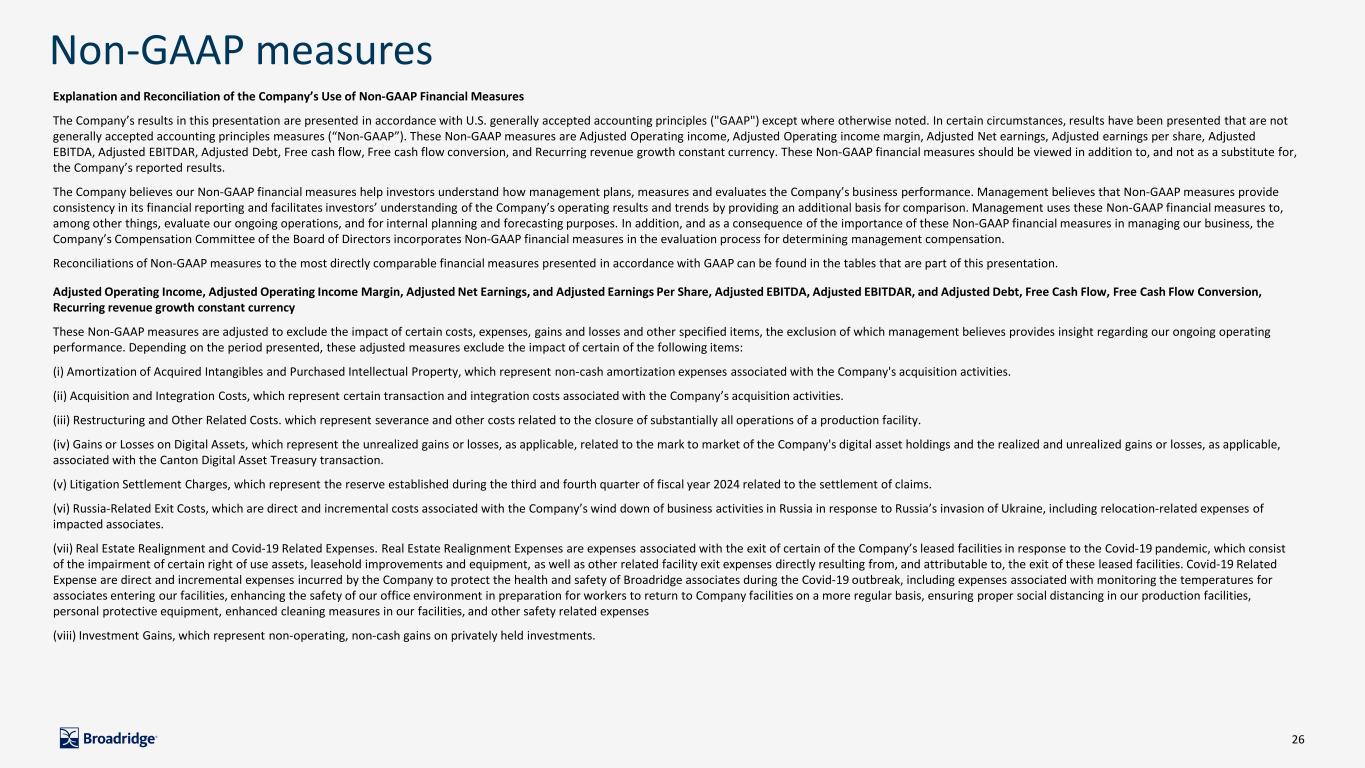
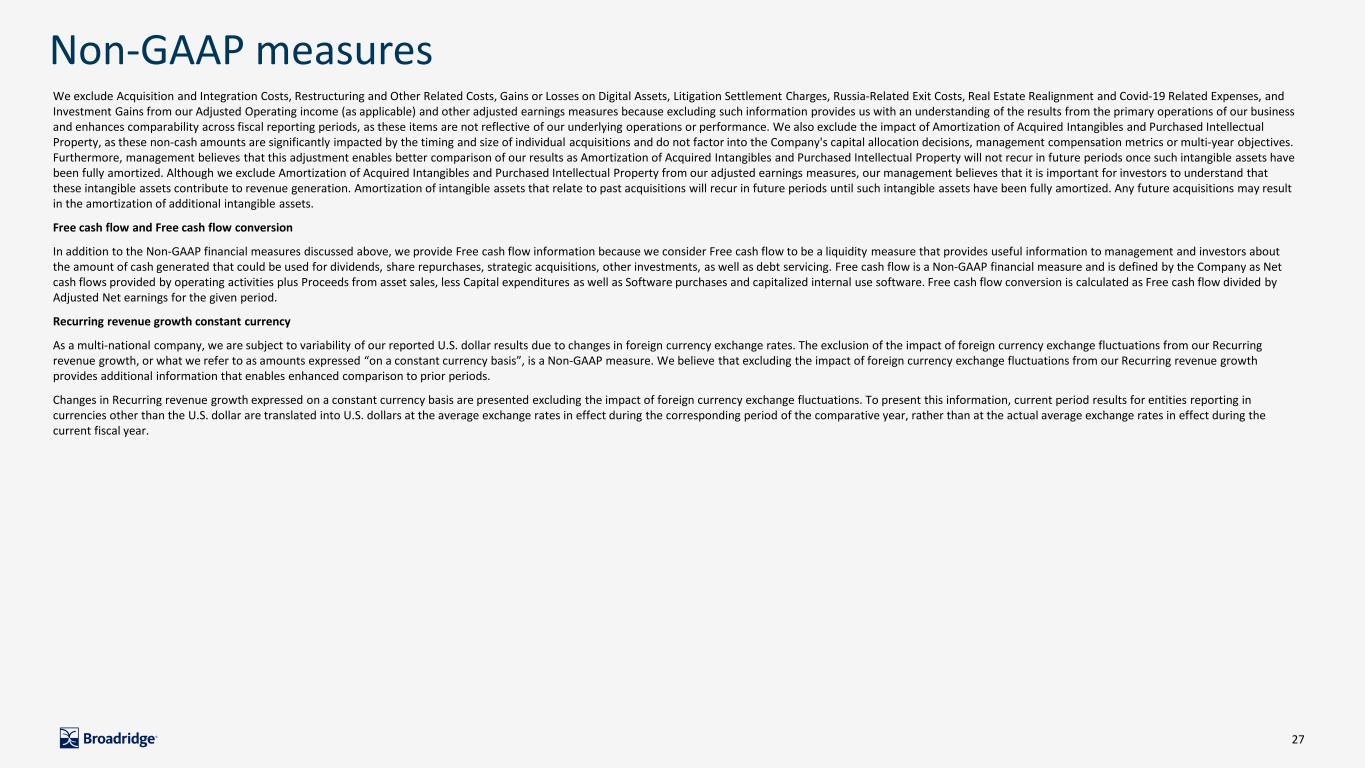
Thank you, Jamie. Good morning, everybody, and welcome to Broadridge's fourth quarter in fiscal year 2026 earnings call. Our earnings release and the slides that accompany this call may be found on the Investor Relations section of Broadridge.com. Joining me on the call this morning are Tim Gokey, our CEO, and our CFO, Ashma Geyi. Before I turn the call over to Tim, a few standard reminders. One, we will be making forward-looking statements on today's call regarding broadridge that involve risks. A summary of these risks can be found on the second page of the slides in a more complete description on our annual report on Form 10-K, which will be filed later today. Two, we'll also be referring to several non-GAAP measures, which we believe provide investors with a more complete understanding of Broadridge's underlying operating results. An explanation of these non-GAAP measures and reconciliations to the comparable GAAP measures can be found in the earnings release and presentation. Let me now turn the call over to Tim Gokey.
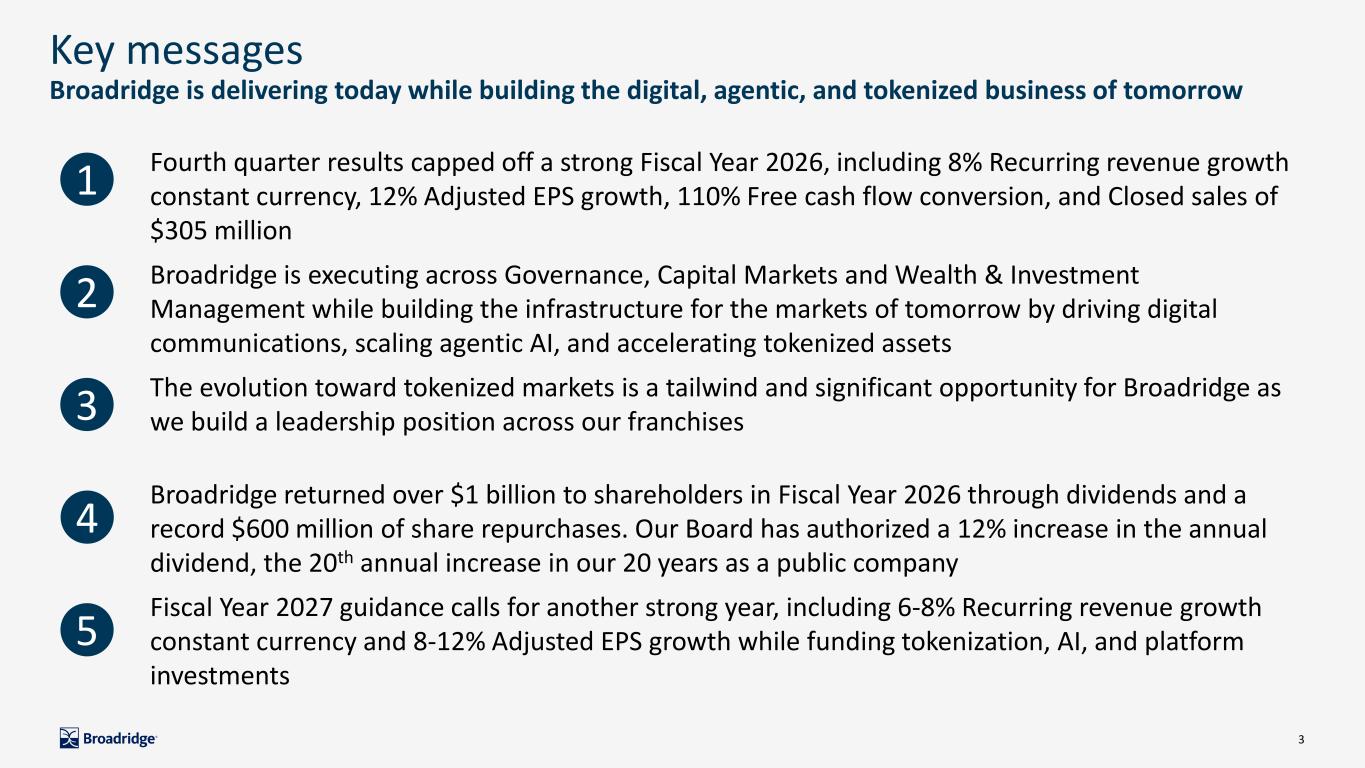
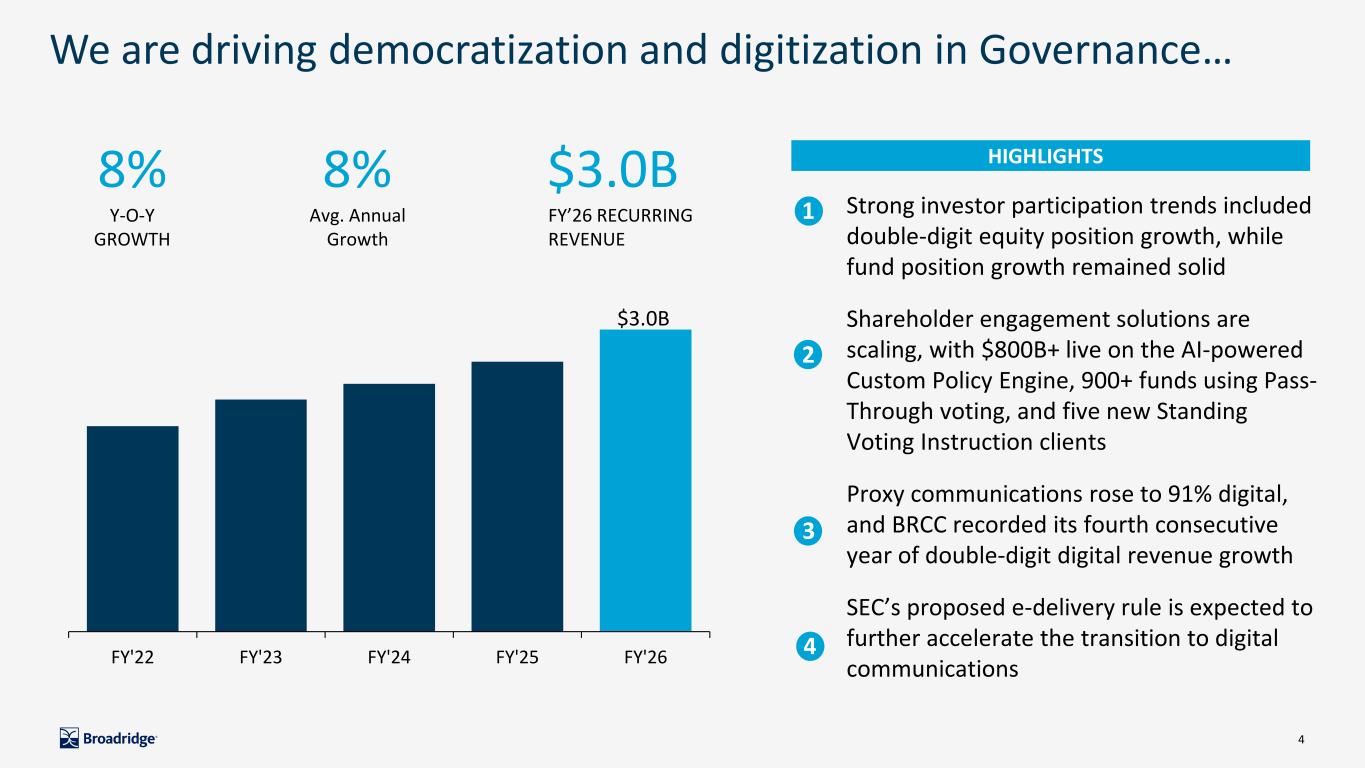
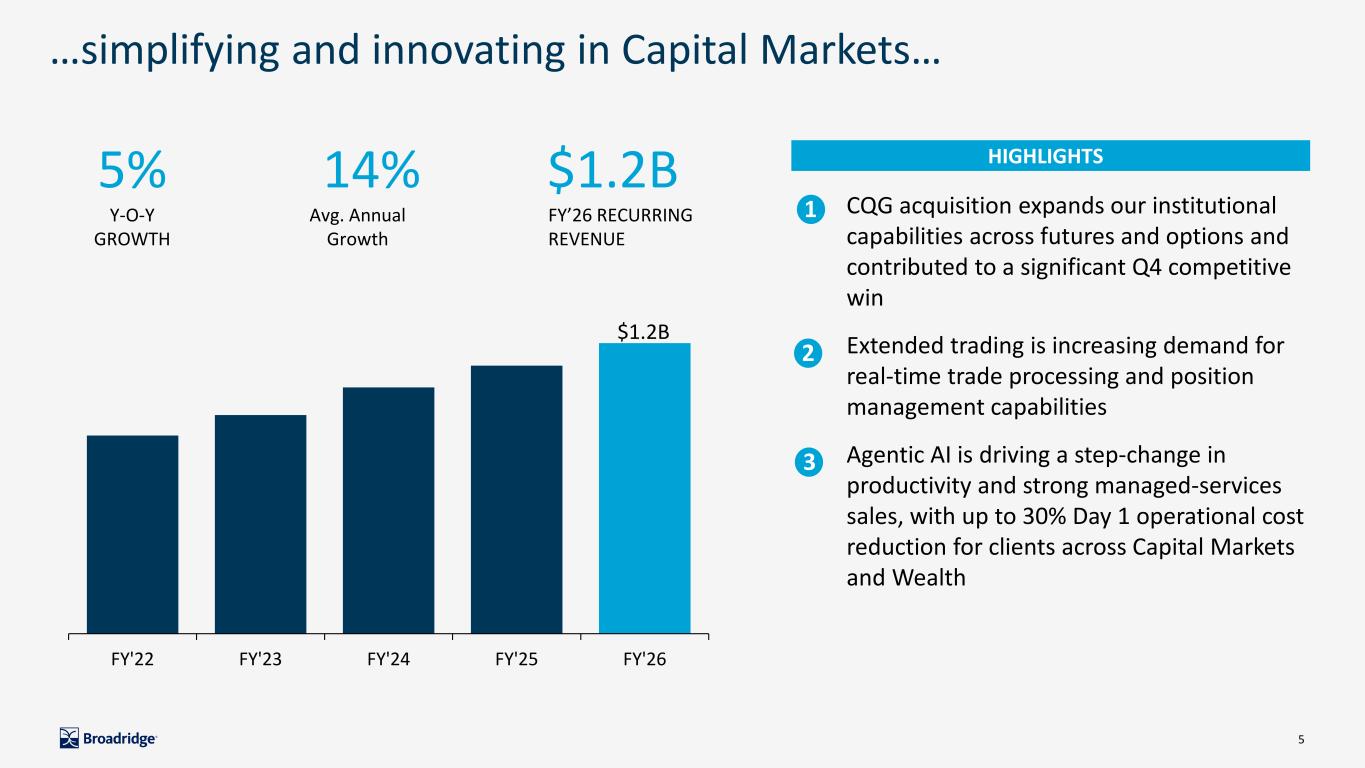
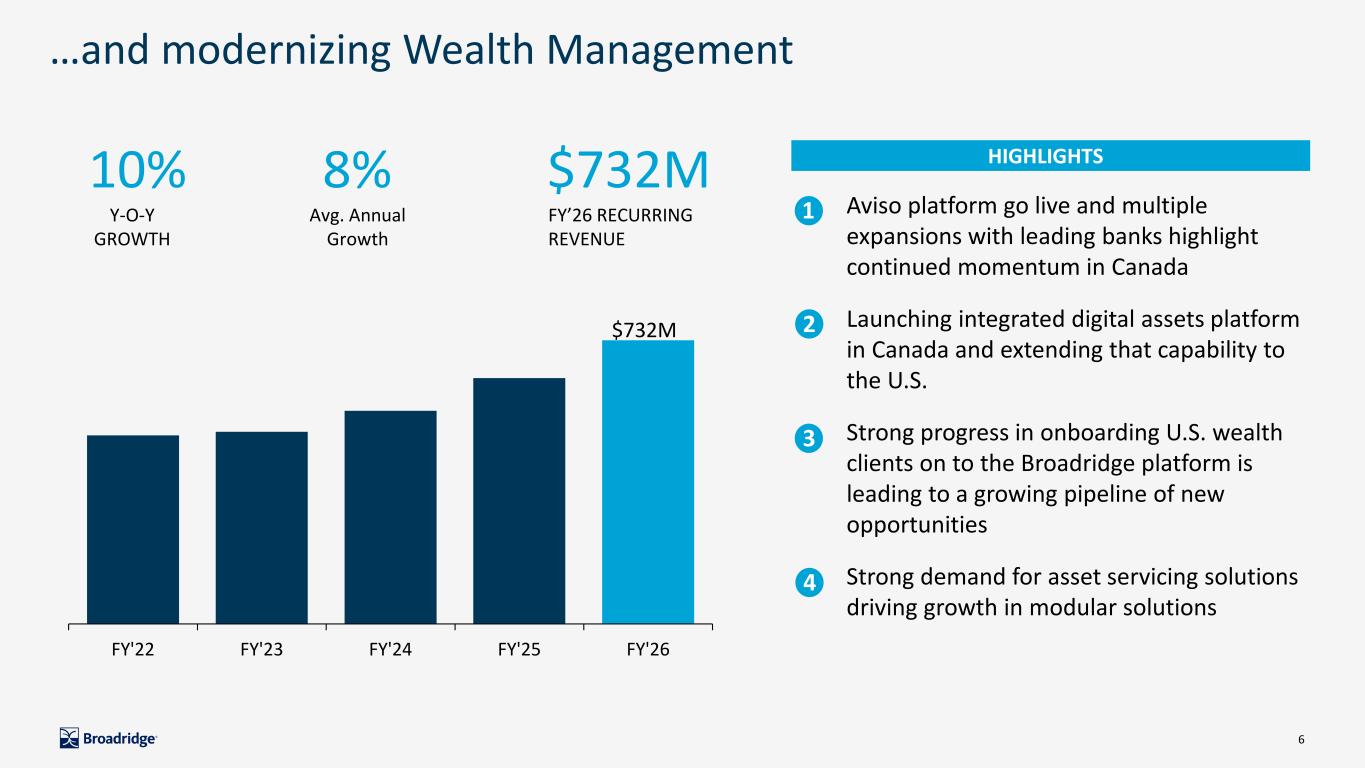
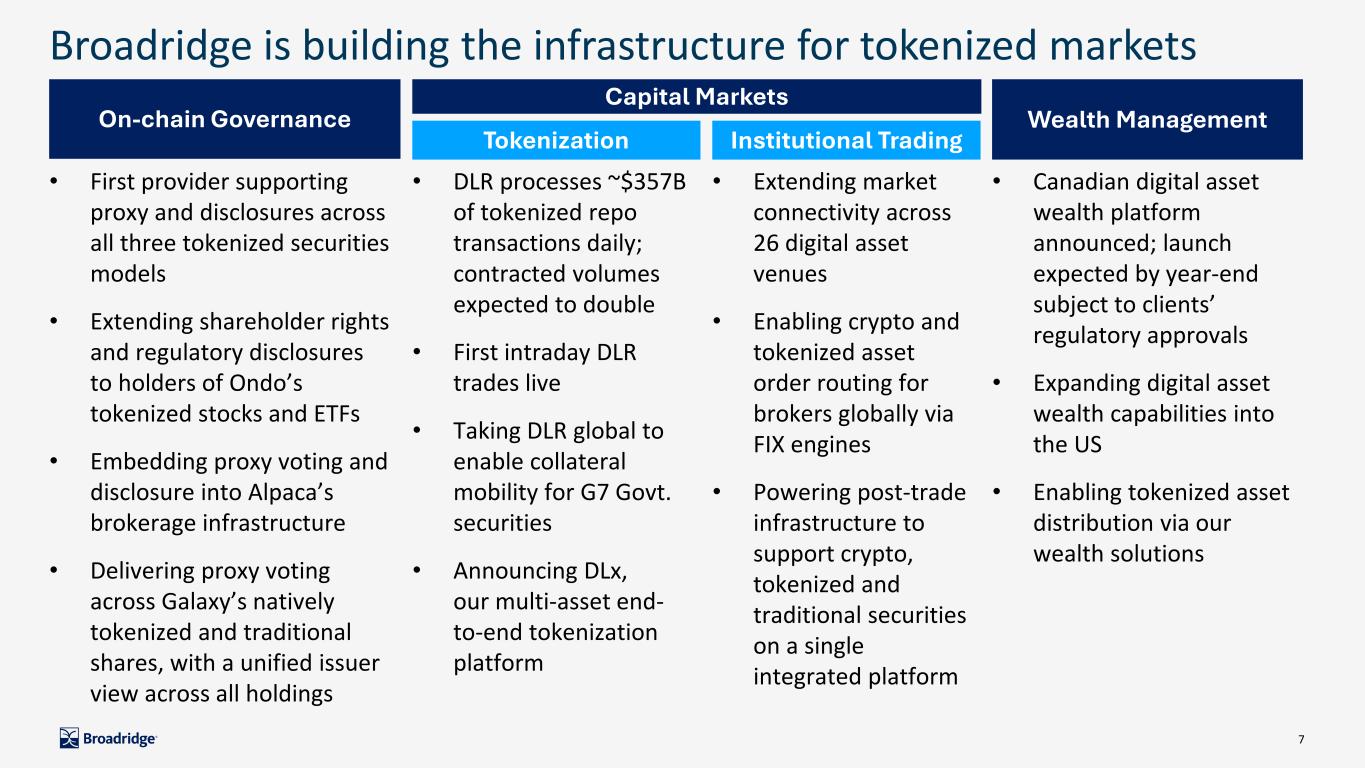
Thank you, Ed. And good morning. I'm excited to join you this morning to talk about our strong financial results. I'm even more excited to talk about the progress that we're making building the infrastructure for the financial markets of tomorrow, markets that will be digitized, agentic, and increasingly tokenized. Because the real story of fiscal 26 is that Broadridge is delivering today. Now, turning to the headlines. First, Broadridge delivered strong financial results. Fiscal year 2026 revenue rose 8%, constant currency. adjusted EPS rose 12%, and thanks to record fourth quarter, closed sales rose to $305 million. Second, Broadridge is executing across governance, capital markets, and wealth, while building the infrastructure for the markets of tomorrow by driving digital communications, scaling authentic AI, and accelerating tokenized assets. Third, as I just noted, we are building the infrastructure for tokenized securities, and we expect the evolution to tokenize markets will be a significant tailwind for Broadridge. Fourth, we returned over $1 billion to our shareholders in fiscal 27 in the form of our dividend and a record $600 million in buybacks. And last night, our board approved a 12% increase in our dividend. We've now raised our annual dividend in each of the 20 years that we've been a public company, underscoring our commitment to creating long-term shareholder value. Fifth and last, as we look ahead to fiscal 2017, we expect to drive another year of steady growth while continuing to fund our digital, agentic platform, and tokenization investments. We're guiding to 6% to 8% recurring revenue growth and to 8% to 12% adjusted EPS growth. So let's dig into the execution driving those results, starting on slide four. In governance, we're driving the democratization and digitization of investing. Fiscal 26 recurring revenue rose 8%, driven by new sales and double-digit equity position Market innovation continues to bring in new investors and drive portfolio diversification. Total equity record growth for the year was 16%, powered by the continued popularity of managed accounts. Equity revenue position growth was 12%. Funds are also benefiting from increased innovation in both passive and active strategies, driving fund position growth of 6%. For shareholder engagement, 2026 was also a year in which we moved from concept to reality. We completed a successful first proxy season for our AI-powered custom policy engine, which is giving asset managers a modern and independent voting capability and powering proxy votes who cost more than $800 billion in U.S. AUM. In fiscal 27, we'll expand the scope of the product to include global equities, and we're re-engineering our proxy-edge institutional voting workflow to make institutional voting even more intuitive. We're also enabling passive funds to extend governance decisions to their underlying shareholders were their pass-through voting solution, with more than 900 funds and $8 trillion in AUM using our voting choice capability, up from 600 funds and $4 trillion last year. We're also completing the first full year of our Standing Voting Instruction Solutions, or SVI. With a year of proven success and proven retail voting participation, we now have six clients on the platform. As U.S. companies become global bellwethers for innovation, We're seeing growing interest from global investors and global retail platforms in voting capabilities for U.S. equities. The ability to offer proxy voting solutions is seen as a differentiator, especially for new entrants, and that translated into fiscal 26 sales in both Europe and Japan. Each of these efforts I've discussed this morning extends our core regulatory communications By combining our deep voting and engagement expertise, our scaled technology and agentic AI, we've been able to accelerate our time to market and target new revenue sources. We're also extending our governance capabilities to tokenized securities, which I'll address And finally, our printed digital strategy is driving digitization. Digitization rates in our proxy communications are now nearing 95%, with 80% for funds. In customer communications, digital revenues grew more than 10% for the fourth consecutive And our Wealth in Focus solution continues to gain momentum, and we now have six leading U.S. wealth managers either on or in the process of onboarding to the platform. On the topic of digitization, the SEC has issued its much-anticipated e-delivery rule proposal, which will allow institutions to shift the default for client communications from physical mail to digital. We are pleased with the proposal, which is an exciting step forward for investors, public companies, funds, and brokers. As with any regulatory proposal, it will take time to be fully implemented. Broadridge is well positioned to help our clients through this change, and we expect it to be an important catalyst driving demand for more engaging digital-first communications like those enabled by our Wealth and Focus platform. Let's move next to capital markets on slide five. In capital markets, Broadridge is helping our clients simplify and innovate their trading operations. Fiscal 26 revenues rose 5% to $1.2 billion, driven by growth across both front and back office solutions. We closed the acquisition of CQG in early May to strengthen our futures and options capabilities, and it contributed to a nice competitive win with a significant trading institution in the fourth quarter. Our business is benefiting from the ongoing push to extended hours trading. That's driving demand for our real-time post-trade solutions and our managed services. We're also tokenizing collateral management. ELR volume rose to $360 billion in June, up 3x from May of 2025. We're currently onboarding multiple Tier 1 banks to our platform, and we expect 50% growth by December. We're further scaling as the fiscal year progresses. And last, we're extending our agentic capabilities across our managed services offering. Our agents analyze real-time data in operational context, identify exceptions, and initiate resolution, driving a step change function in productivity. In May, we announced the rollout of our agentic AI partnership model, offering up to 30% day one operational cost reduction with additional savings over time that's ai transformation in action turning to wealth management where we're modernizing the industry we had another strong year in fiscal 26 with recurring revenue growth of 10 thanks to the sis acquisition we're seeing new momentum in the canadian market in the spring we announced the onboarding of a visa as our latest platform client and recorded another significant win with a leading canadian bank we're also accelerating the adoption of digital assets with the launch of our next-generation digital asset capability, which unifies traditional and digital assets within a single operating model. In the U.S., we continue to make strong progress in onboarding the wealth platform sales closed last year, while on the component side, we're seeing strong demand for corporate actions and managed services offerings. Across all three franchises, our AI initiatives are delivering results. Our new AI products, including our custom policy voting engine and global demand model in ICS, and our operations solutions, BondGBT, and trading algorithms in GTO, are gaining traction. We're also deploying AI to accelerate product and software development and reduce the time and cost to onboard new clients. Finally, we're beginning to see real AI-driven productivity gains, including $25 million in fiscal 27, and we're just getting started. I'll close my operating view with sales. After a slow start to the year, we accelerated nicely with a record 158 million of closed sales in Q4. Three things stood out for me. First, we exceeded the expectations we had at the beginning of the quarter because we were able to drive larger deals to closing. These are the types of engagements that have been slower to move through the pipeline through much of the year. Second, our focus on closing did not come at the expense of sales origination. Our pipeline at year end is up significantly from a year ago, highlighting growing demand for our next generation solutions. And third, a growing share of our sales is driven by platform and innovation. Our platform-enabled AI and next generation products including shareholder engagement, DLR, and digital communications rose 60%, and they accounted for nearly 40% of our closed Before I sum up, I want to touch on a topic that's come up regularly in our conversations with you, tokenization on slide 7. Tokenization has the potential to reshape how assets are issued, traded, financed, and serviced, and we expect it to be a significant tailwind for Broadridge. The industry is now grappling with questions about where tokenization will create the most value, how quickly it will scale, and what kind of market infrastructure will be required to support it. At Broadridge, we're actively shaping the answers to those questions by building trusted, scalable, tokenized market infrastructure across governance, capital markets, and wealth. I'll start with governance, where we're in the early innings of what is likely to be an extended transition to tokenized equities. tokenized equities have the potential to power new products and to bring more investors to u.s markets driving more positions and new complexity for issuers brokers and others as they manage the range of voting and other asset servicing required there is no one better position than broadridge to solve that complexity at scale for the industry at broadridge we're actively extending our market leading proxy voting and disclosure capabilities to support synthetic custodial and native tokenized equity models, and we are the first provider to support all three models of tokenized equities today. The leading model today is synthetic, focused on non-U.S. investors. We are pleased to announce our relationship with Ando, the leading issuer of synthetic tokenized U.S. equities and ETFs, to provide a market-leading solution to enable holders of synthetic tokens to exercise governance. We expect further announcements in coming months. Longer term, we expect third-party custodial approaches to gain significant traction. We recently extended our relationship with ONDO to provide governance solutions for the custodial model they intend to launch in the U.S. We also signed an agreement with Alpaca, a leading provider of custody, clearing, and other infrastructure services supporting tokenized assets to provide a full suite of governance and shareholder communication services to clients on their network. For native issuance, we've completed the first and only on-chain voting for tokenized equities with Galaxy. And now integrating that capability into our ShareLink voting solution, giving corporate issuers a single voting platform covering tokenized, registered, and beneficial shares. We serve 80% of the Fortune 500 today for the registered shares. So if native issuance becomes a significant model, we expect it will be a positive for Broadridge. Turning now to capital markets, we have long believed that one of the biggest near-term payoffs of tokenization is enhanced collateral mobility. We've been working to address that opportunity for the past eight years. Today, our distributed ledger repo platform, DLR, processes $360 billion in tokenized repo transactions every day, as I mentioned, with nearly 20 institutions on the platform are in the process of onboarding. Now we're taking DLR Global, with G7 Securities entering the network to support cross-border repo activity and seamless collateral movements. DLR gives institutions a practical way to improve funding flexibility, optimize collateral and liquidity, and make efficient use of capital across global markets, all while operating within familiar institutional workflows. Building on DLR, we're launching DLX, our end-to-end multi-asset tokenization and digital asset platform to support always-on markets. DLX extends Broadridge's tokenization capabilities across multiple asset classes, combining tokenization, smart contracts, transaction orchestration, trading, settlement, and governance on the single platform for equities, funds, alternatives, and money market instruments. Institutions will be able to operate with one set of tokenization rails, one governance standard, and one operational model across their entire tokenized asset portfolio. Given the extended transition I described earlier, many clients are concerned about the cost of a separate infrastructure for digital and tokenized assets. That's why our recent digital asset survey showed that 69% of firms expect a hybrid infrastructure. Broadridge is stepping in to build that infrastructure at scale. We're extending Broadridge's market-leading multi-asset capabilities to support the trading and servicing of digital and tokenized assets across our full front-to-back infrastructure, from order and execution to books and records, offering clients the ability to support traditional, digital, and tokenized assets on the same integrated platform. And we will leverage many of the same components for wealth managers to deliver a full front and back office solution integrating tokenized and traditional assets. By linking digital asset capabilities to existing infrastructure, we're helping them move faster and unlock new opportunities in digital assets, alternatives, private assets, tokenized money market funds, and equities. We announced the expansion of our digital asset capabilities for the Canadian wealth market this past April, and we expect to go live by the end of the calendar year, subject to our clients' regulatory approvals. And we're pleased to announce that we're extending these capabilities to serve our U.S. wealth clients as well. Our unified platform will enable broker-dealers, registered investment advisors, and wealth managers to offer cryptocurrencies and tokenized assets alongside traditional investments across both advisor-led and self-directed experiences. At the end of the day, the future of tokenization is going to be about building tokenized markets. Markets that institutions, regulators, issuers, intermediaries, and most importantly, investors can trust. That means building not only the technology, but also the servicing model, market infrastructure, governance, and controls needed to support adoption at scale. And it means bringing together new entrants, incumbents, and infrastructure providers to shape a market that's efficient, resilient, and credible. That's a generational opportunity for Broadridge across our franchises, and we're seizing it. I want to come back to what I said at the beginning. Broadridge is delivering strong financial performance today while building for tomorrow. We have never been a stronger company. We have deep client relationships with the leading financial institutions, and we're now extending to new entrants. We have unmatched subject matter expertise, and we have the integrated technology platform to bring it all together. There is no one better positioned to build the next generation infrastructure that will power the markets of tomorrow. Before I turn it over to Ashima, I want to address the nearly 16,000 Broadridge Associates around the world, many of whom are listening to this call. You are the ones driving that execution. You're the ones creating that innovation. And you're the ones shaping the future. Your work is truly making a difference.
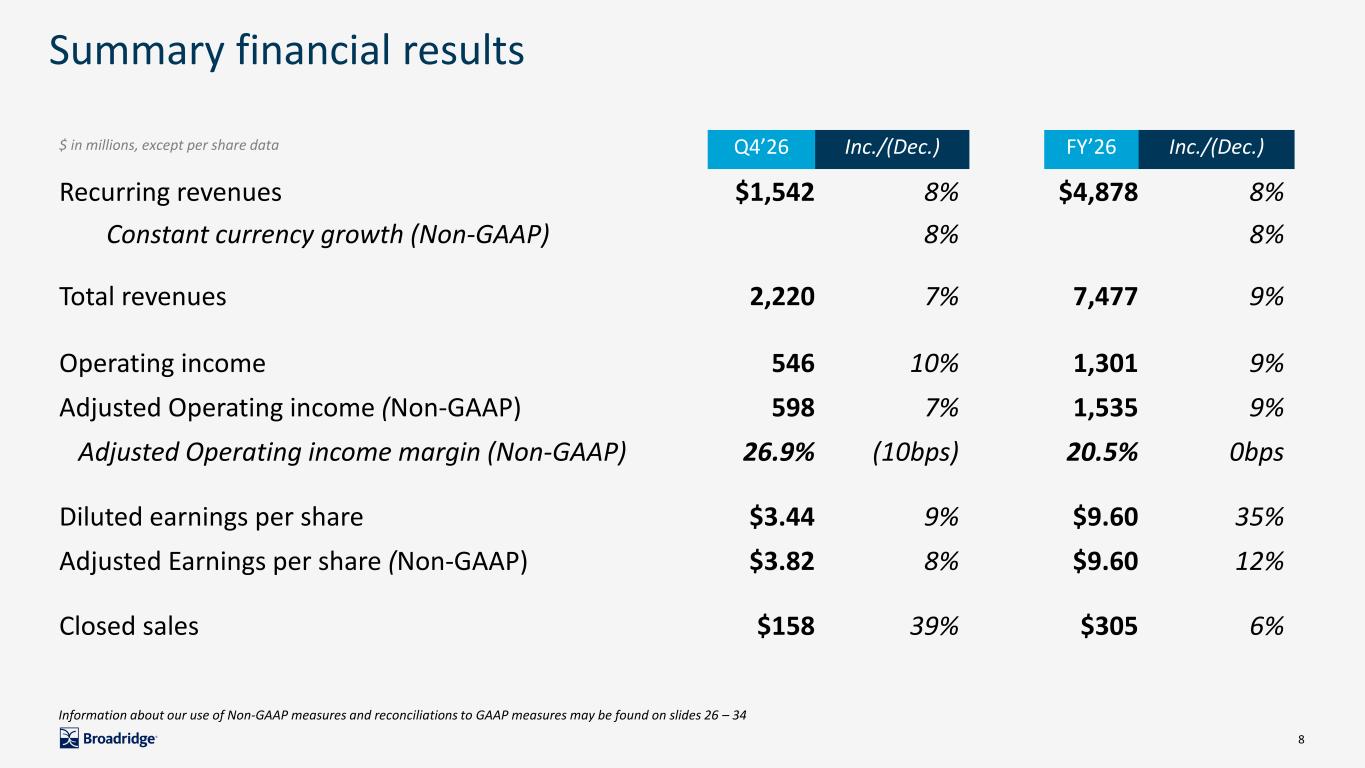
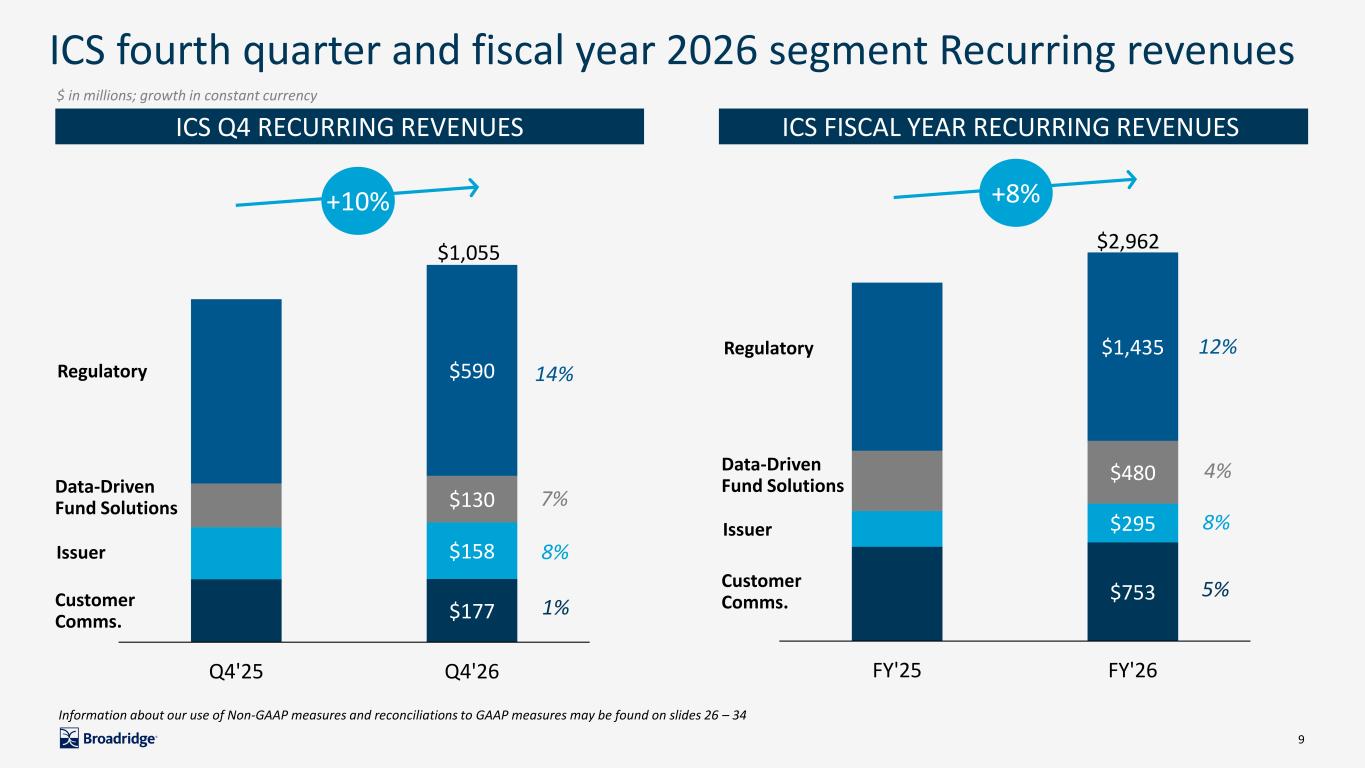
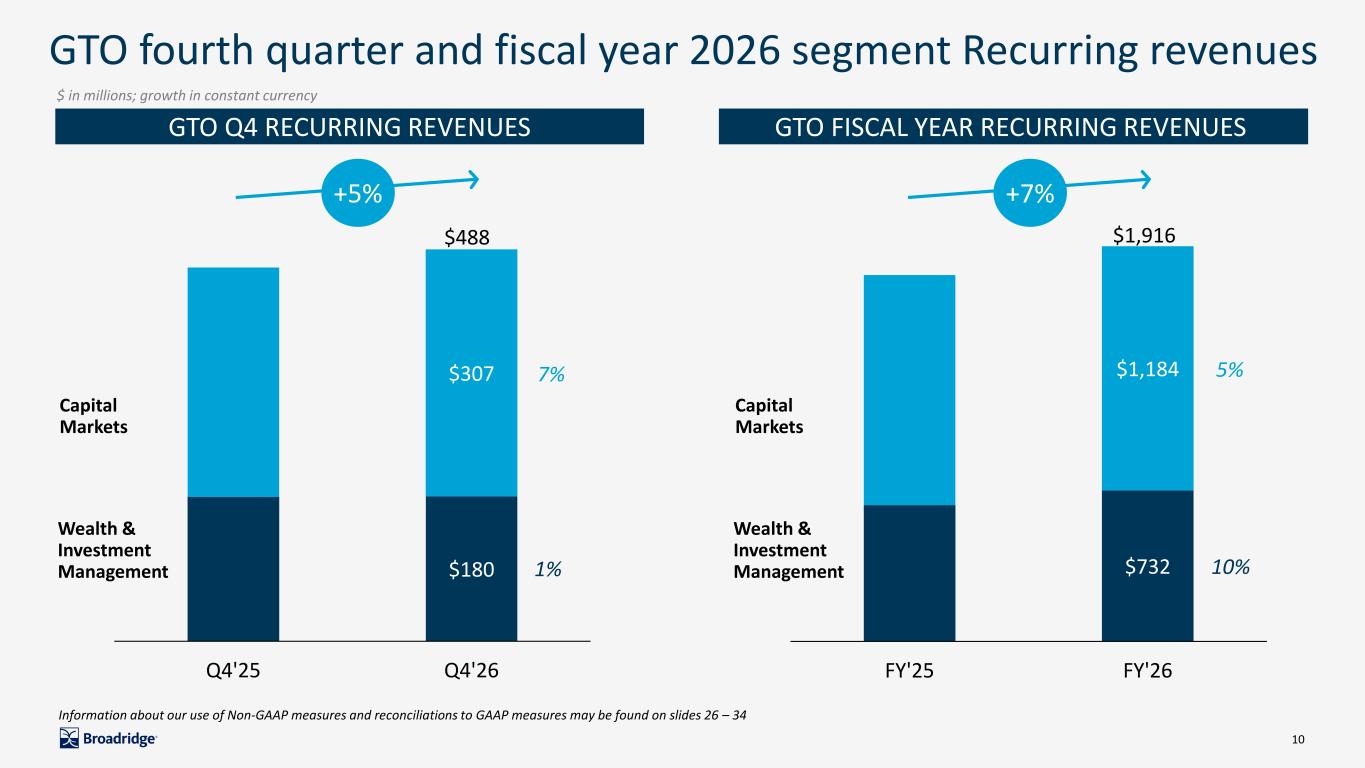
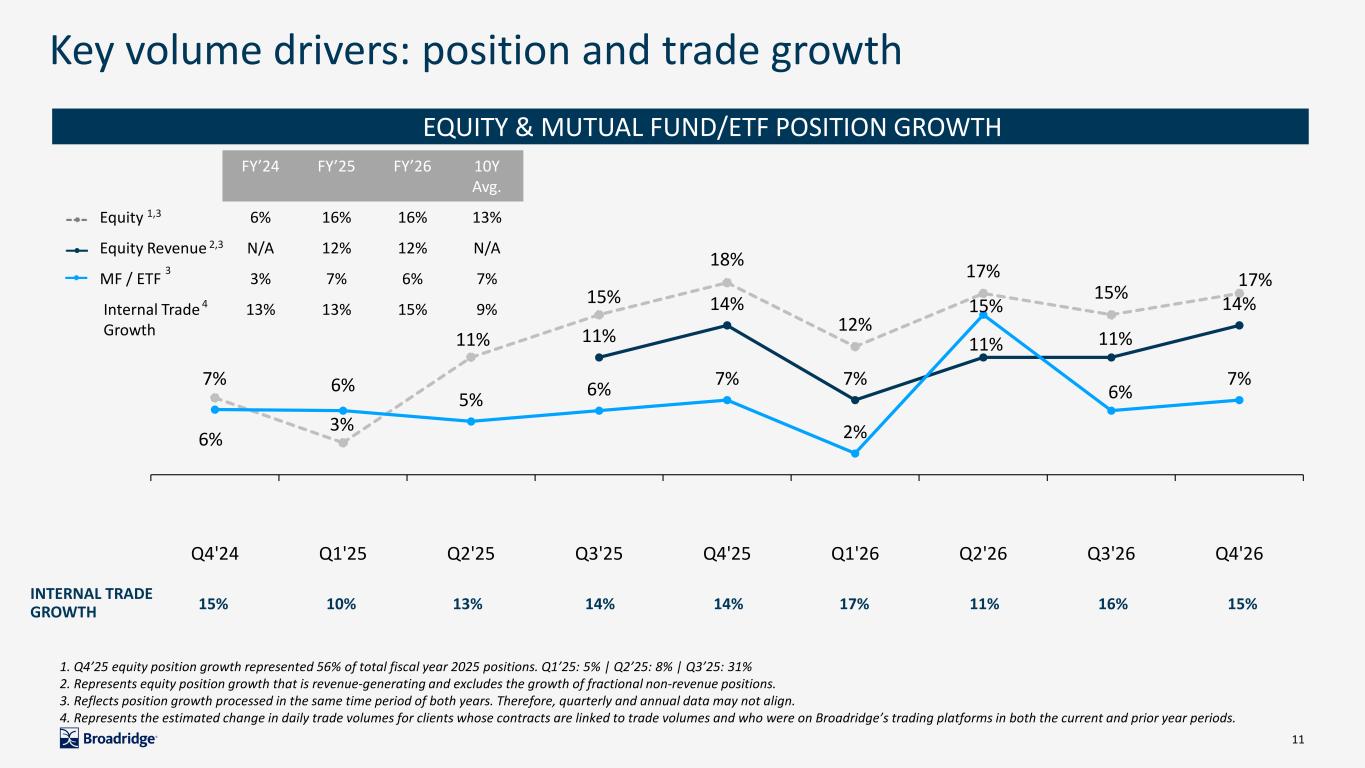
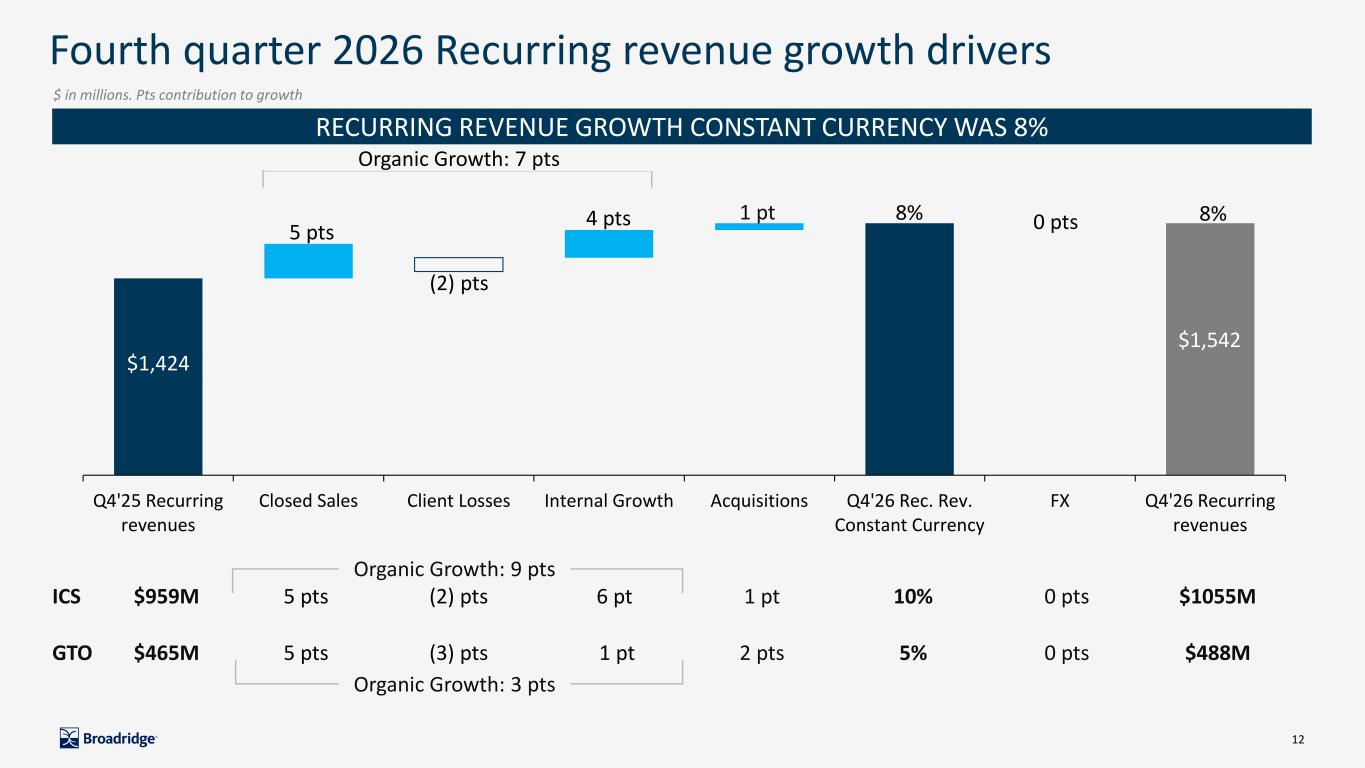
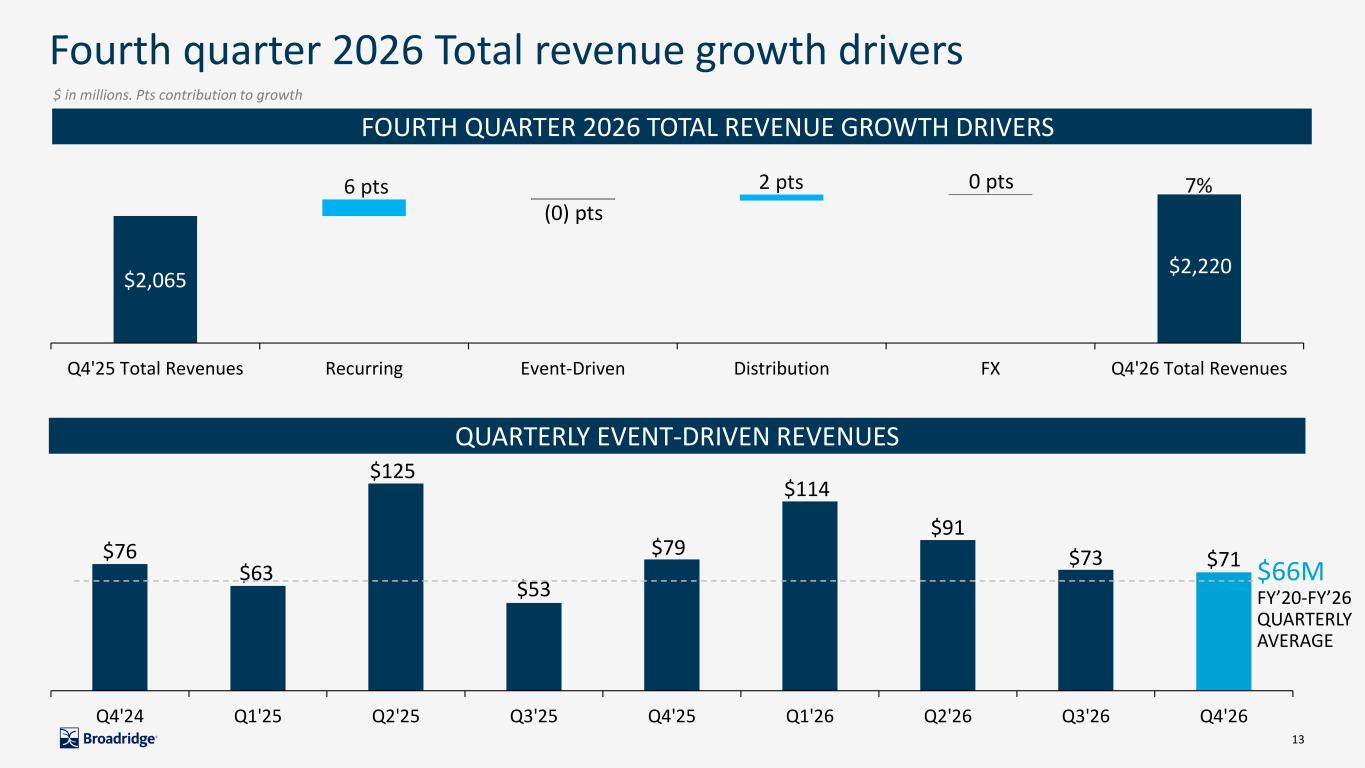
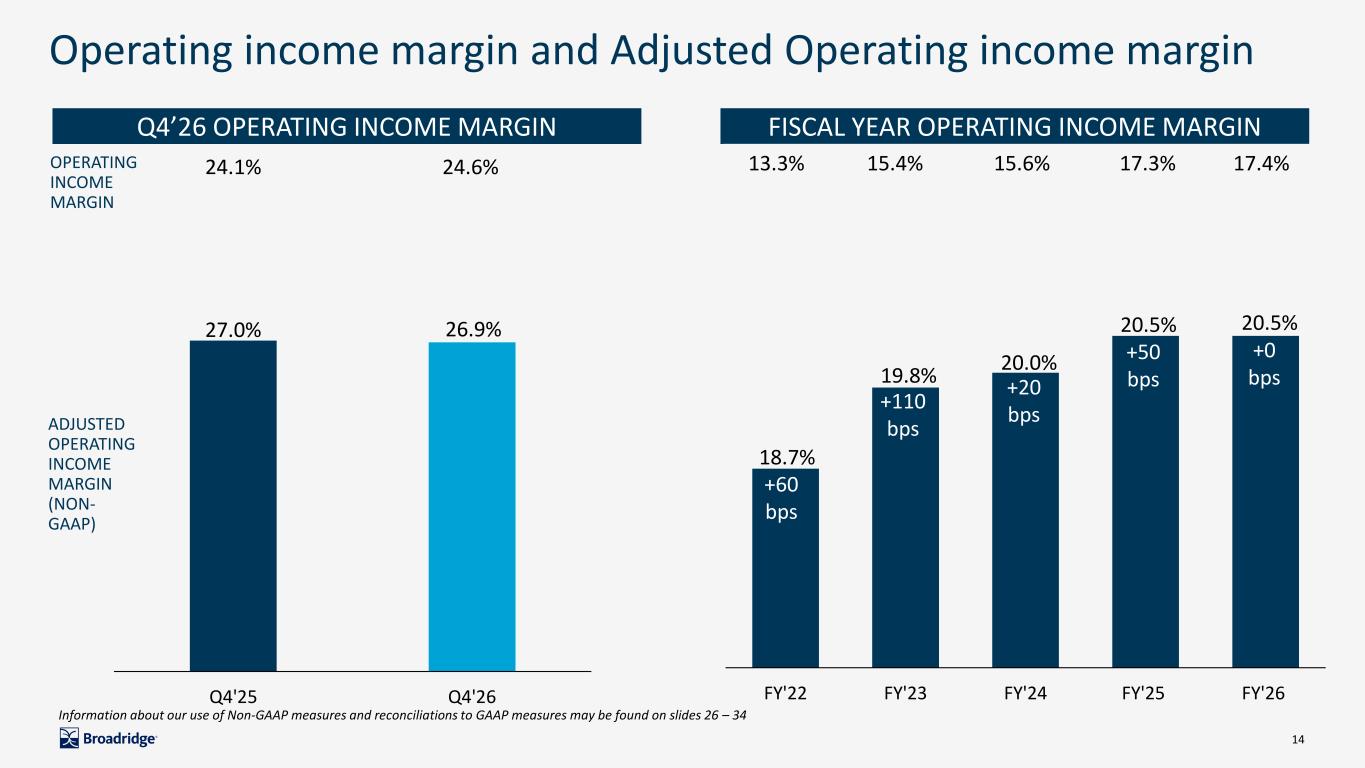
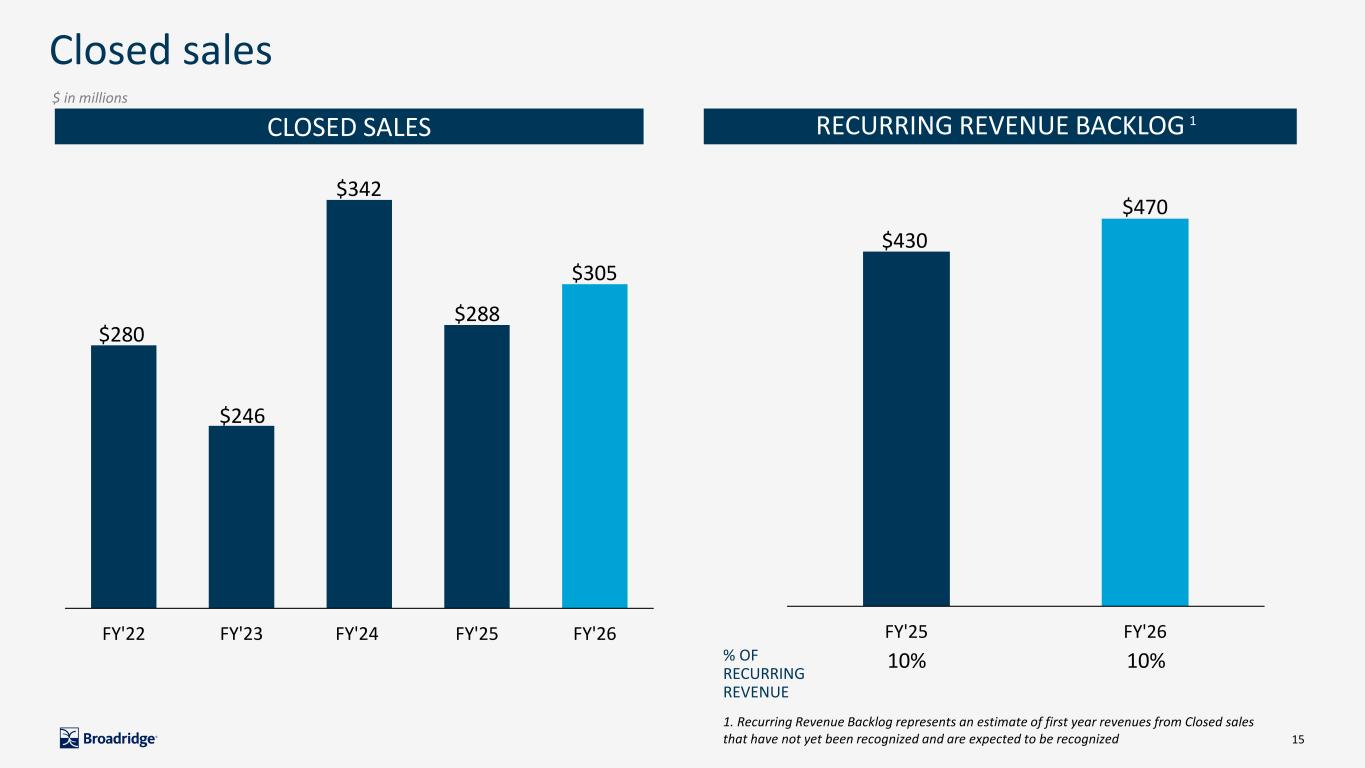
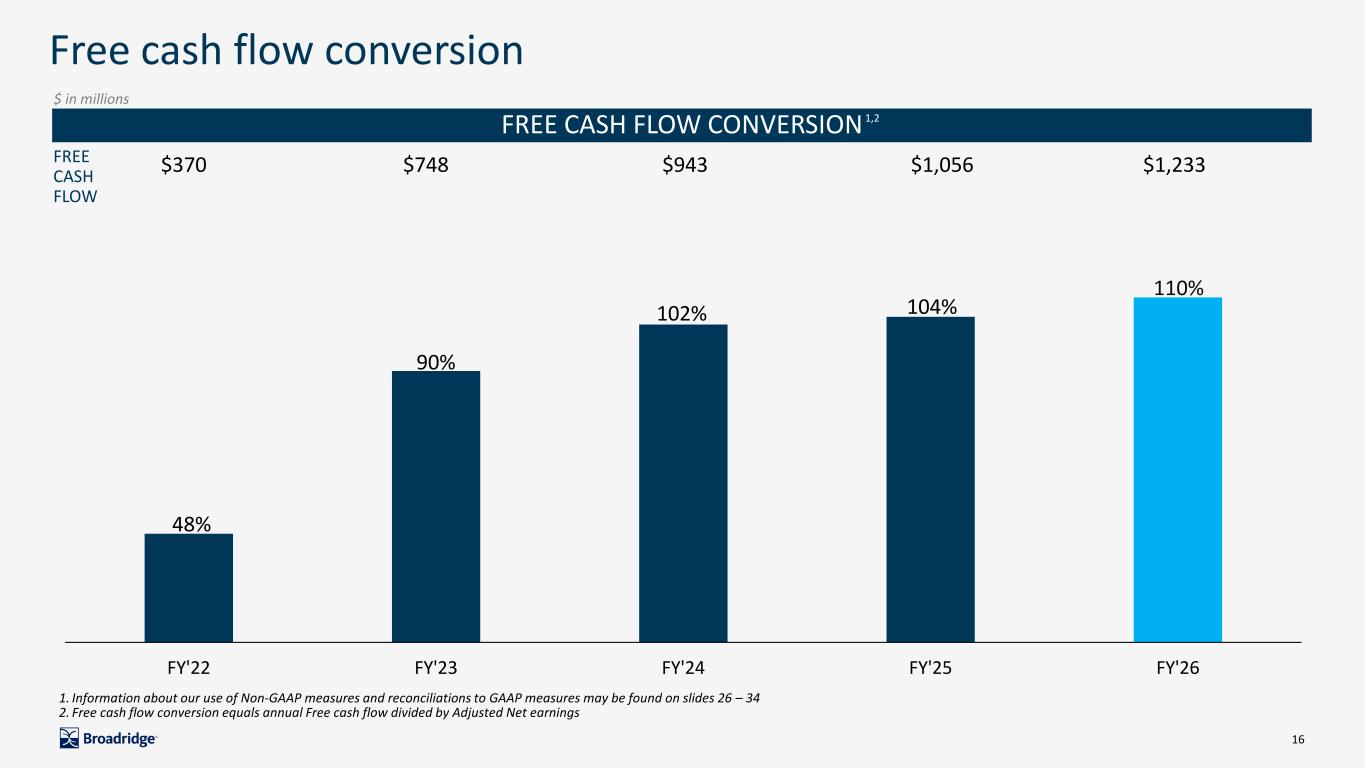
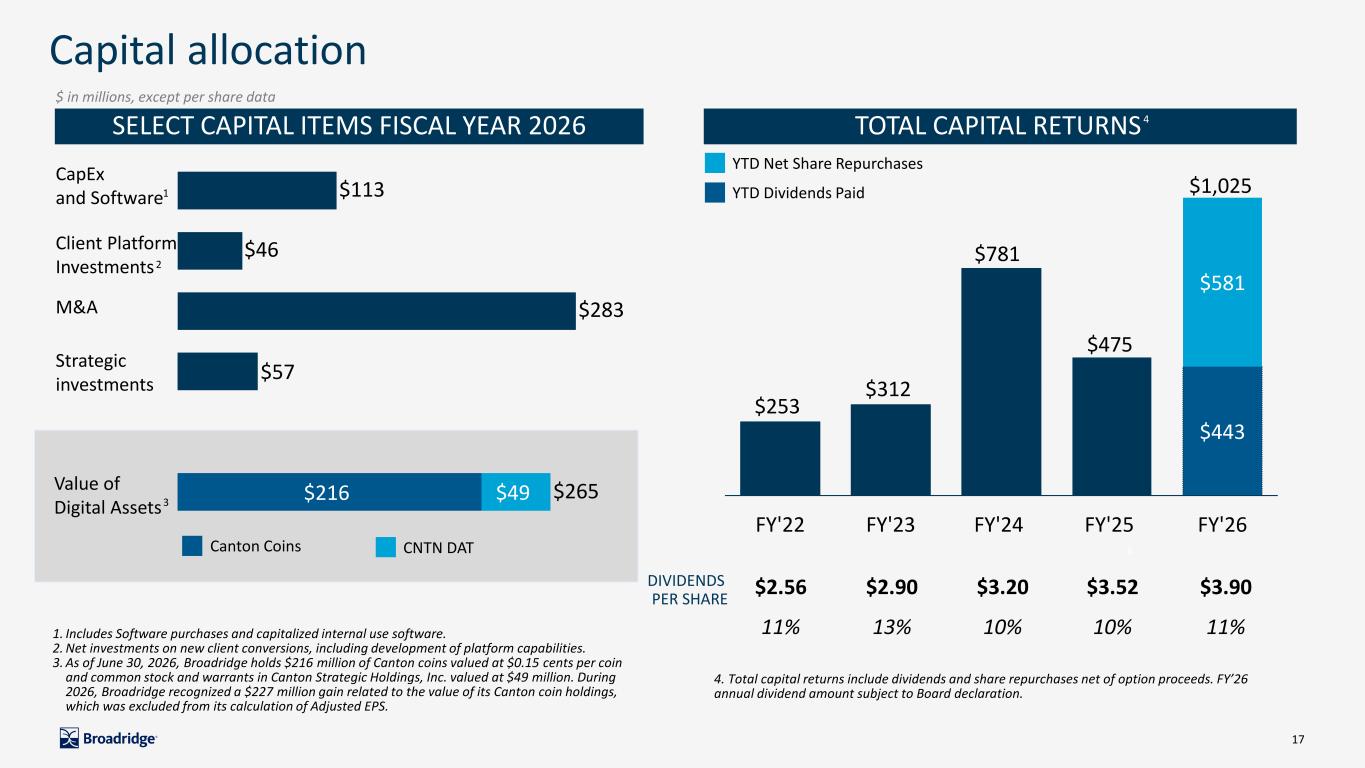
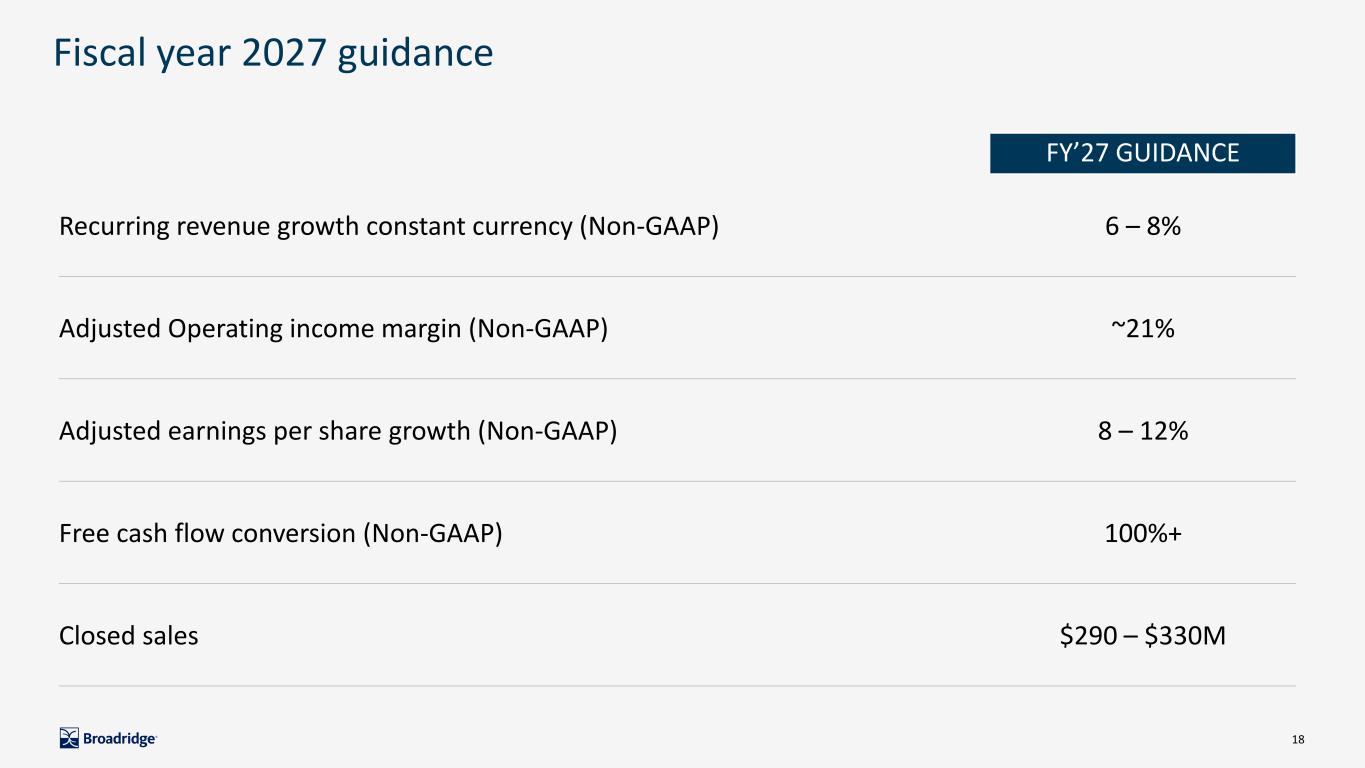
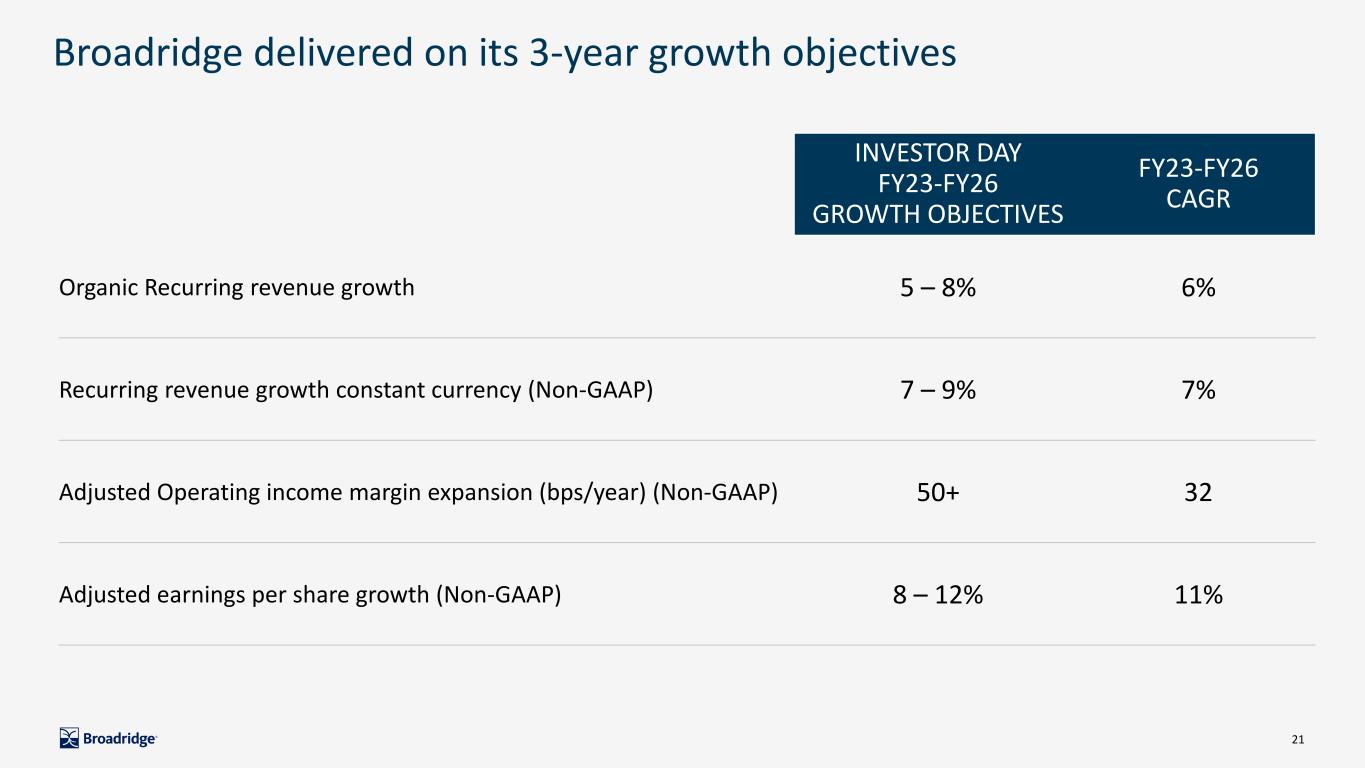
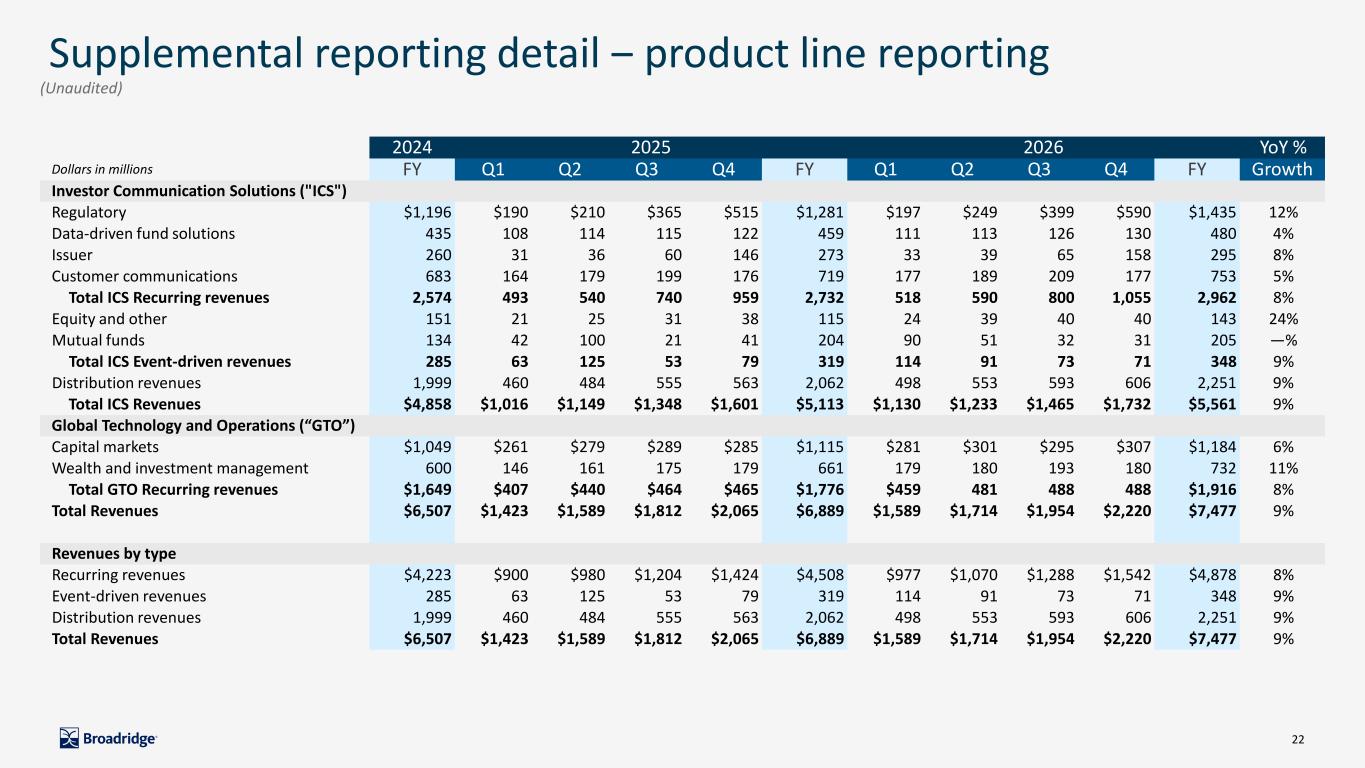
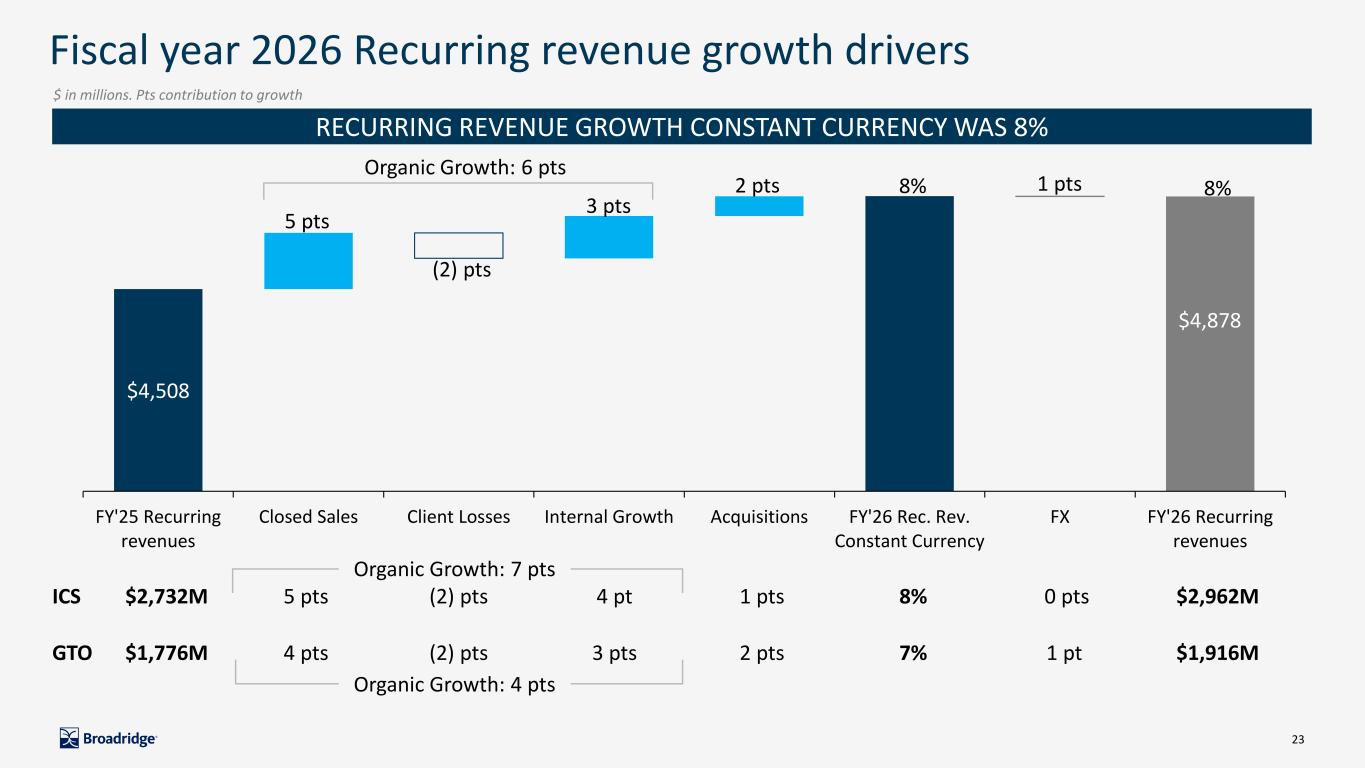
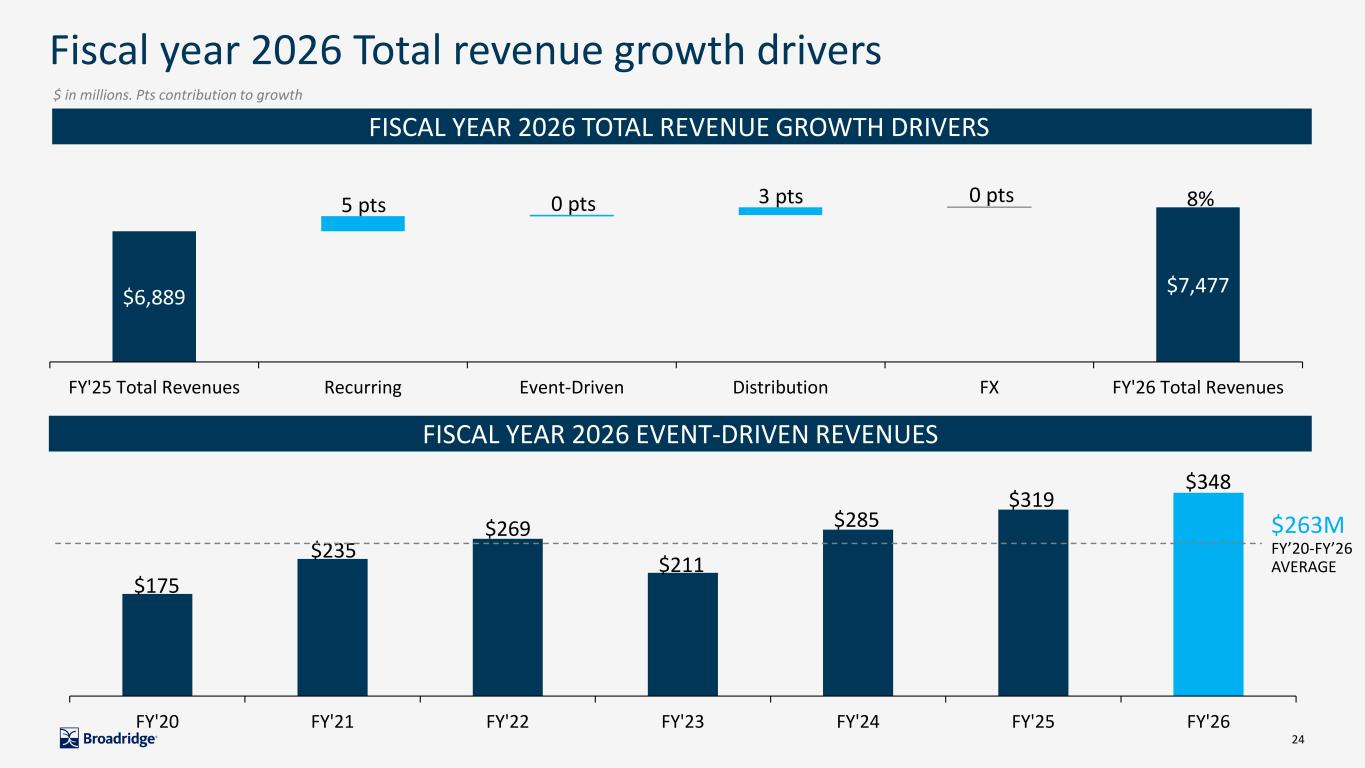
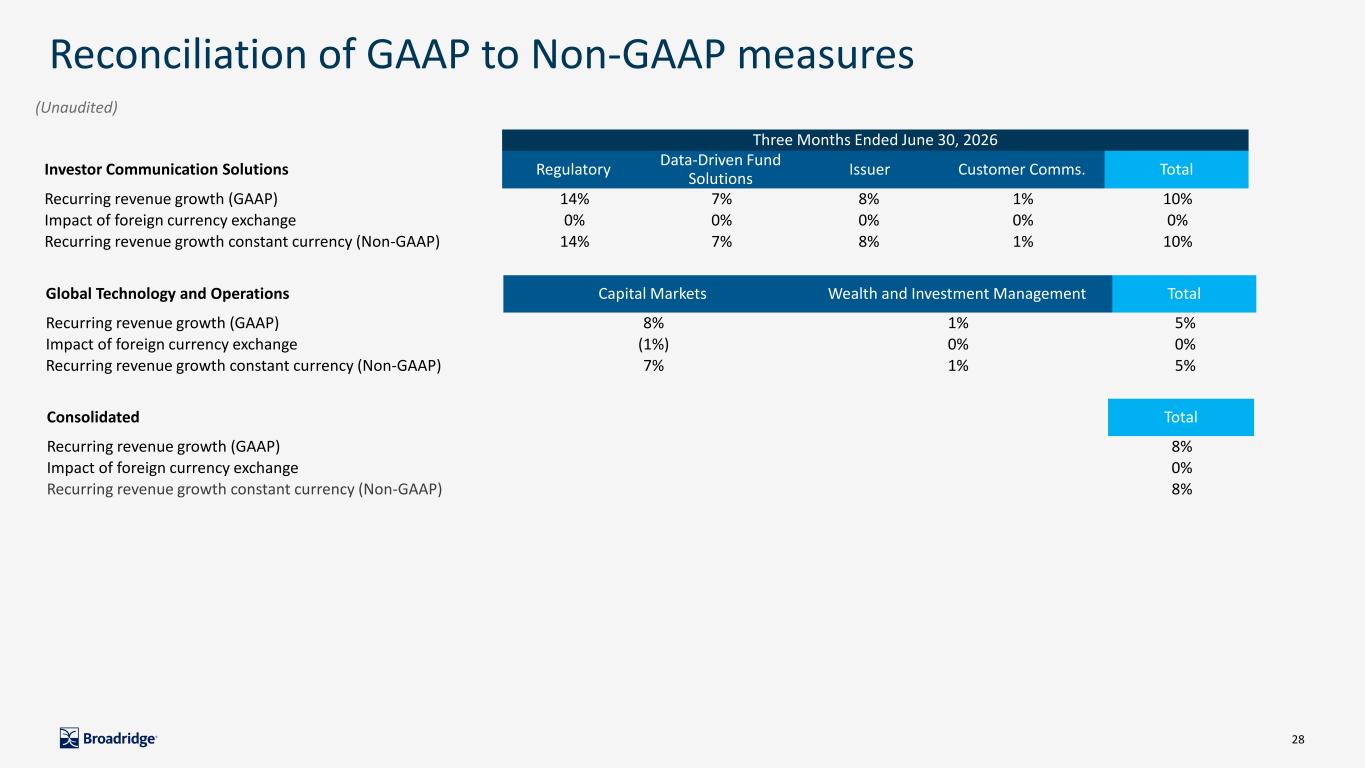
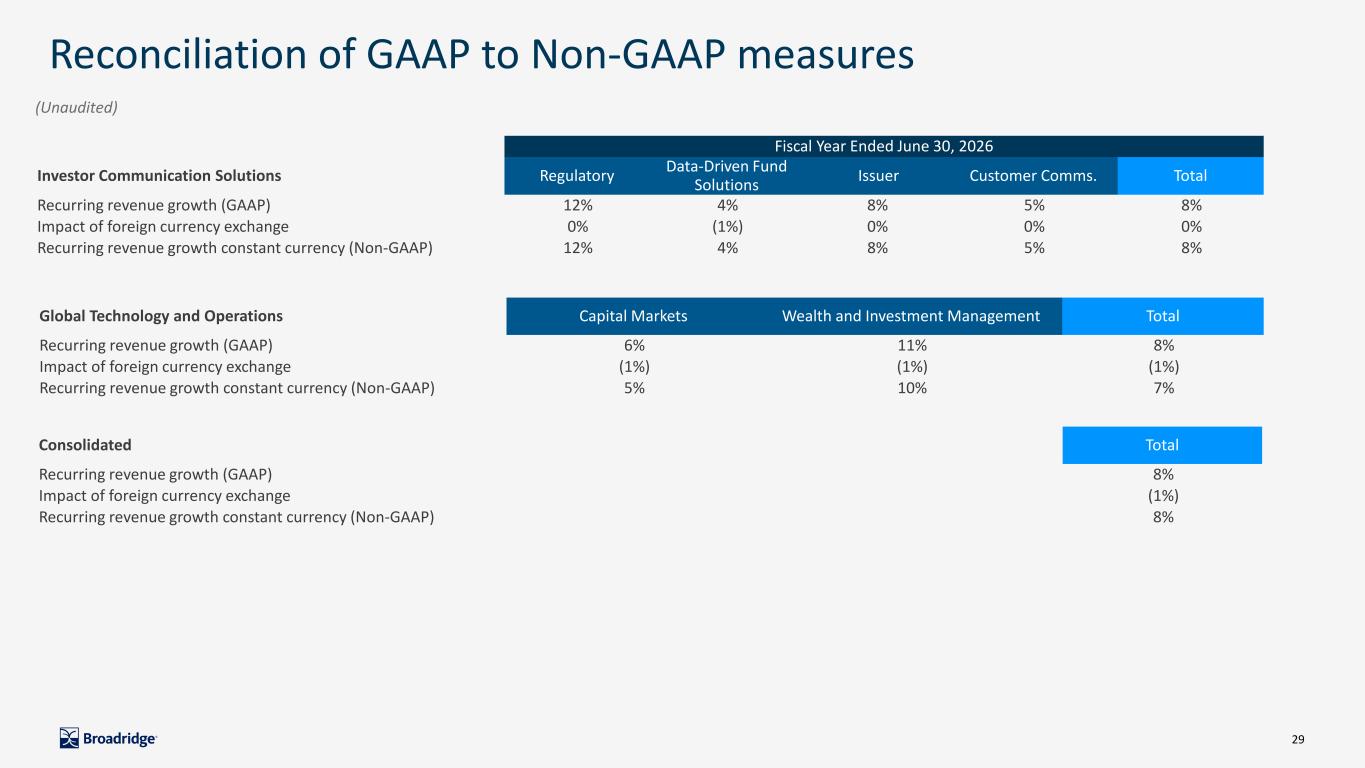
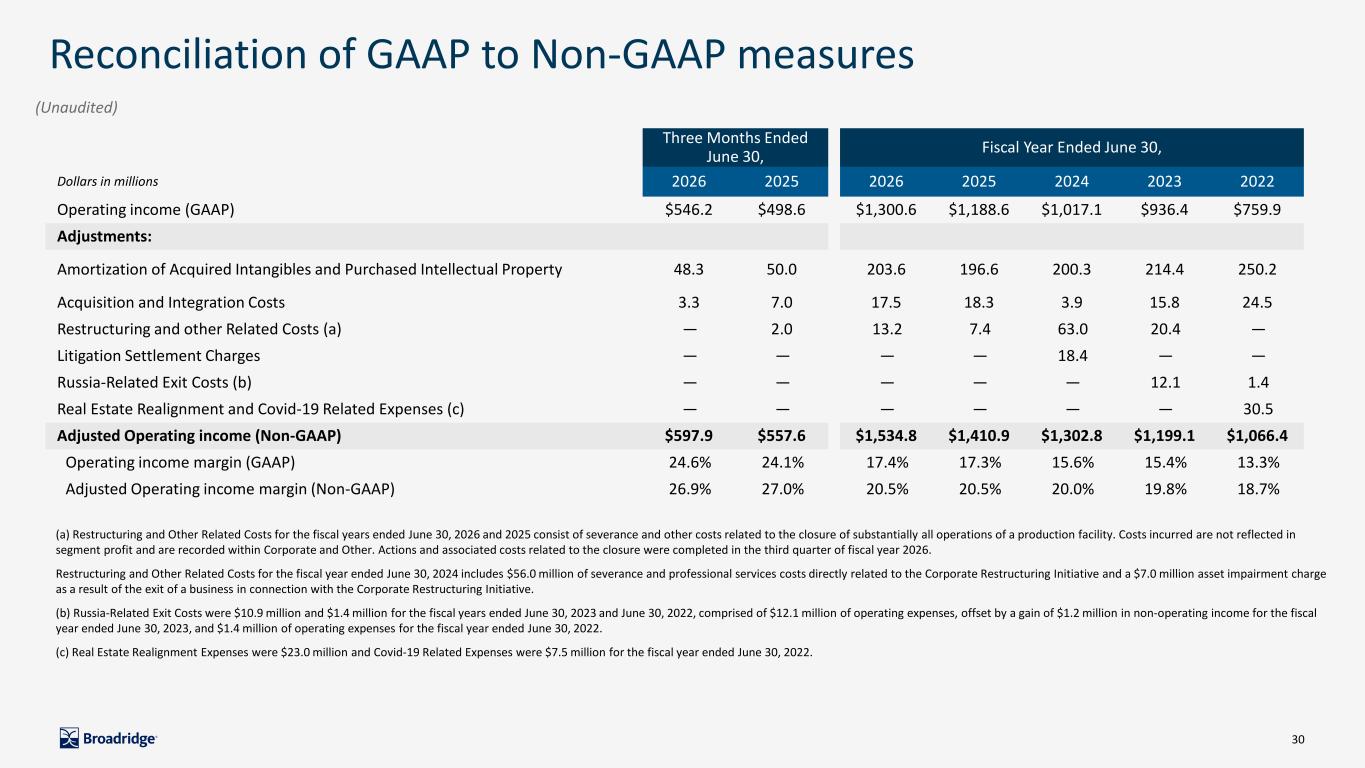
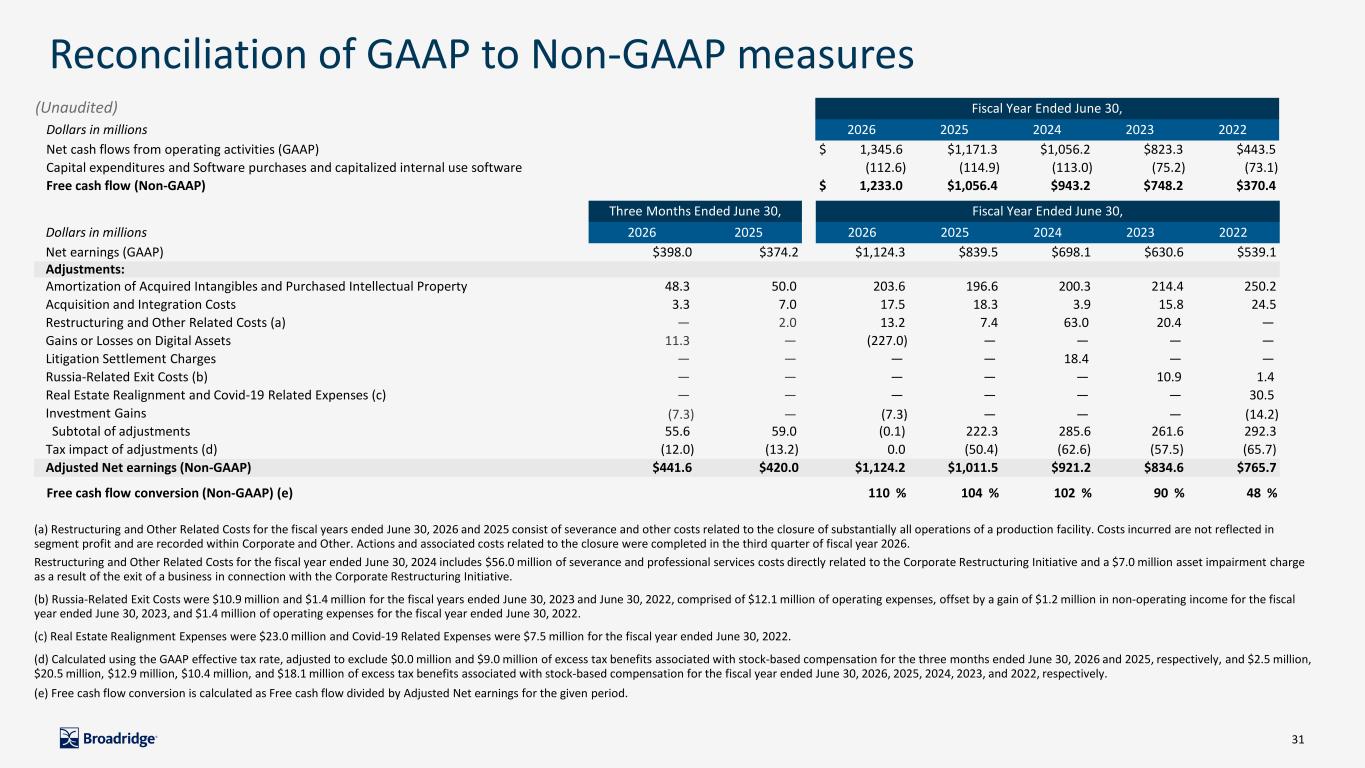
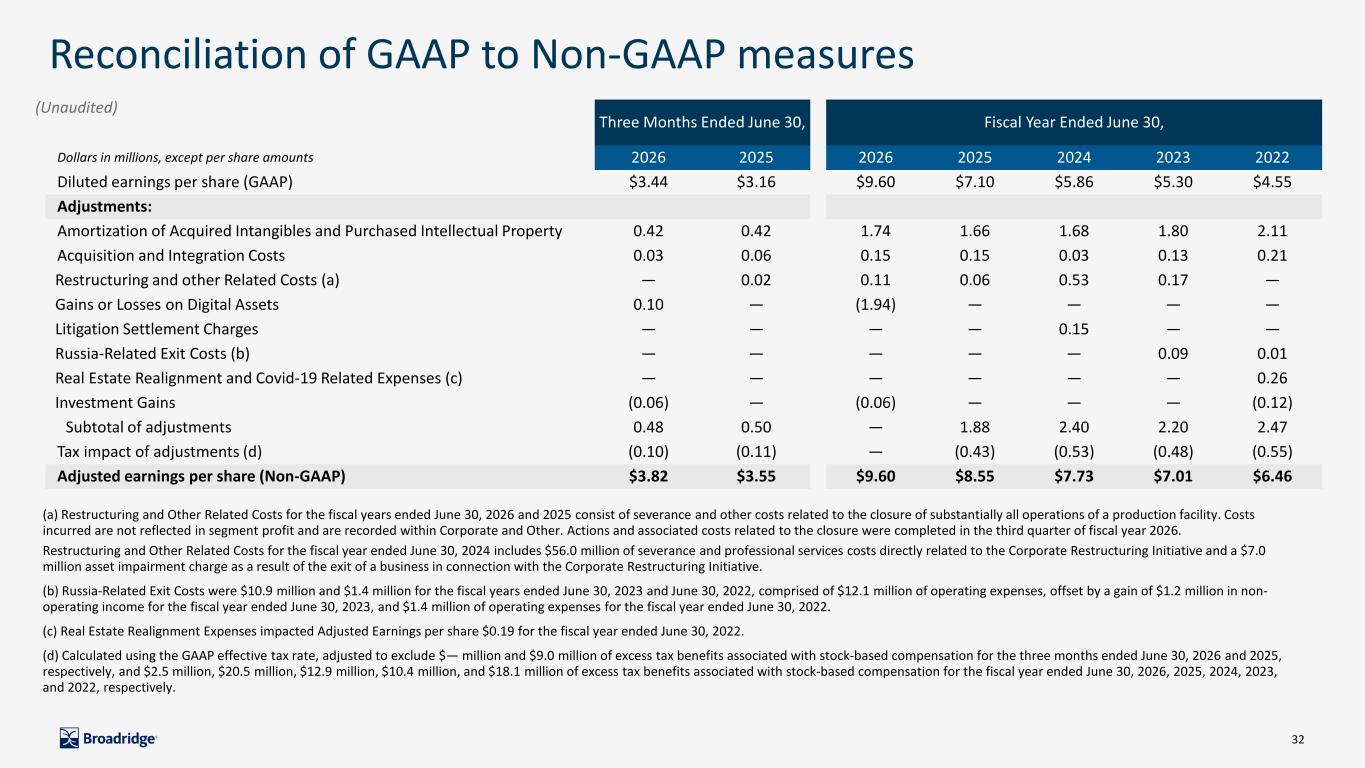
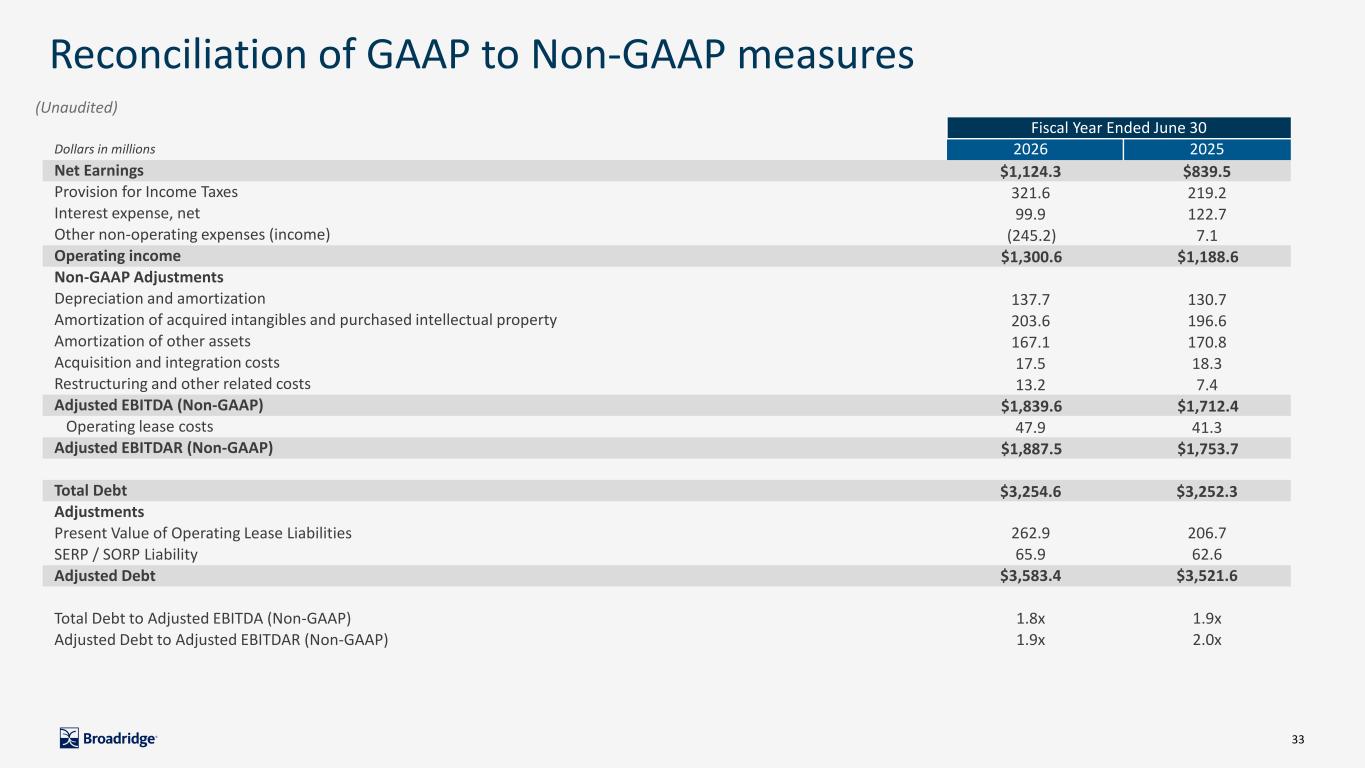
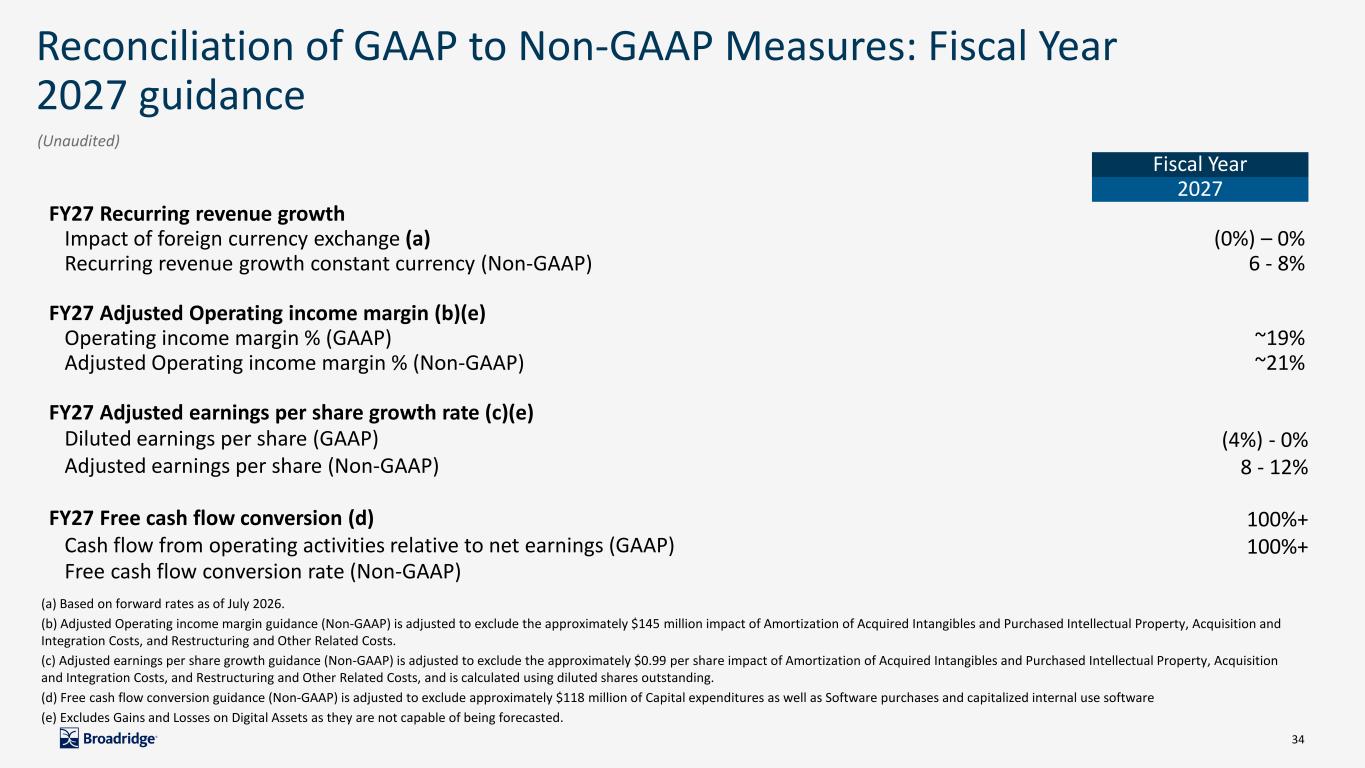
Thanks, Tim. Good morning. It's great to be here today. Before I begin my review of our strong Fiscal 26 results and Fiscal 27 guidance, I want to make four key call-outs. First, the Broadridge business model is working. During fiscal 26, we delivered high single-digit recurring revenue growth and another year of double-digit adjusted EPS growth while funding investments in digitization, agentic AI, and tokenization. Second, free cash flow and capital returns. Broadridge generated $1.2 billion in free cash flow, equal to 110% of our adjusted earnings. And between share repurchases and our dividend, we returned just under $9 per share to shareholders during the year. Third, we delivered on our three-year recurring revenue and adjusted EPS objectives for the fifth consecutive cycle. And finally, our fiscal 27 guidance calls for another year of strong recurring revenue and adjusted EPS growth while funding investment. There are two keys to that forecast. One, our $470 million recurring revenue backlog, which gives us great visibility into our growth. And second, $25 million in expected AI cost saves in fiscal 27, which reflects growing confidence in our ability to generate real AI productivity gains. With that, let's go to the numbers on slide 8. I'll start with the full-year results. Fiscal 26 recurring revenues grew 8% on a constant currency basis to $4.9 billion, driven by organic growth of 6%. Adjusted operating income margin rose slightly to 20.5%, overcoming a 40 basis points headwind from lower interest rates and higher postage. Adjusted EPS grew 12% to $9.60 and close sales were $305 million. And then turning to the fourth quarter, recurring revenue, constant currency, grew 8% to $1.5 billion, including 7% organic growth. Adjusted EPS rose 8% to $3.82. And we delivered a record $158 million in closed sales. Let's move to slide 9 to discuss our segment recurring revenue. ICS recurring revenues rose 8% for the year, including 10% growth in the fourth quarter, led by strong growth in regulatory revenues. Regulatory revenues rose 12% in fiscal 26 and 14% in Q4, driven largely by strong position growth across both equities and funds. In addition to underlying position growth, we are benefiting from strong global volumes and from a small but growing contribution from the new shareholder engagement products we have brought to market. Data-driven fund solutions revenue rose 4% in fiscal 26 and 7% in Q4. Fourth quarter growth was driven by a combination of solid organic growth and the acquisitions of Acklen and iJoin. Lower interest rates were a two-point headwind to organic growth. Issuer revenues rose 8% for the year and 8% for the quarter, closing out a strong year. Fourth quarter growth was balanced across our shareholder engagement and disclosure solutions, and more than offset a one-point headwind from lower rates. Finally, customer communications revenues grew 5% for the year, including 14% for digital and 1% for the quarter. Both quarter growth was driven by a two-point contribution from the signal acquisition, which offset lower print volumes. Looking ahead to fiscal 27, we expect another year of strong and consistent growth in ICS, in line with our overall recurring revenue guidance, and led by continued growth in regulatory revenues. Before I turn to GTO results, a quick note on the potential financial impact of the SEC's e-delivery rule proposal. First, given the expected implementation timelines, clients, we expect no impact on fiscal 27. Second, looking beyond fiscal 27, we expect the biggest impact will be a reduction in pass-through distribution revenues, which will have a positive impact on our reported adjusted operating income margin. Third, we anticipate a modest headwind to recurring revenue growth over a two to three year period as clients implement the rule change, which we expect to largely offset with new solutions. Net-net, we are not anticipating that it will have a significant impact on our adjusted earnings growth going forward. And last, I would just emphasize again, this is all preliminary, and we should know more when the final rule is released in the months ahead. Turning to GTO on slide 10, GTO revenues grew 7% for the full year and 5% in Q4. Capital markets revenues grew 5% for the year and 7% for the quarter. Fourth quarter organic growth was driven by a combination of new sales and higher equity trading volumes. The acquisition of CQG contributed three points. Total digital asset revenues, including coin revenues related to our Canton Supervalidator role and GLR revenues, contributed one point to fourth quarter growth. Now to wealth. Wealth and investment management revenues grew 10% for the full year and 1% in the fourth Excluding the headwind from lower-term licenses, revenues grew 5% in Q4, with growth being driven by a combination of revenue from sales and strength in retail trading volumes. Looking ahead to fiscal 27, we expect GTO revenue growth at the higher end of our recurring revenue guidance, with higher growth in capital markets driven in part by the acquisition of CQG. Now let's move to slide 11 to review our key volume indicators. Broadridge continues to benefit from strong growth in investor participation across both equities and funds. Fourth quarter equity position growth was 17%, including 14% growth in revenue-generating positions. Fund position growth was 7%. Looking ahead to the first half of fiscal 27, our position testing indicates continued strong position growth, which we expect to translate into high single-digit equity revenue position growth and mid-single-digit fund growth. In GTO, trade volumes rose 15% for the quarter, with double-digit growth in equity volumes and mid-single-digit growth in fixed income volumes. I'll wrap up my discussion of recurring revenue growth on slide 12. For the quarter, recurring revenue growth, constant currency, was 8%, primarily driven by seven points of organic growth. Our retention rates remained 98% for the quarter and for the full year, and acquisitions contributed 1.2 growth. Moving to slide 13, total revenue in Q4 increased 7% to $2.2 billion, driven by six points of growth from recurring revenue. Event-driven revenue of $71 million was a modest headwind to fourth quarter growth, largely driven by lower levels of mutual fund proxy activity. Low to no margin distribution revenues grew 8%, contributing two points to total revenue growth. Turning now to margins on slide 14, fourth quarter adjusted operating income margin was 26.9%, down 10 basis points from fourth quarter 25, as operating leverage from our scale business was offset by the timing of growth investments. On a full-year basis, adjusted operating income margin rose slightly to 20.5% as the combination of strong recurring revenue, record event revenue, and strong operating leverage enabled Broadridge to increase investments in key growth initiatives. For the year, the combination of lower float income tied to interest rates and the increase in pass-through distribution revenue was a 40 basis points headwind to margin. I'm also pleased to see increasing traction in our AI productivity efforts, and we expect that to continue. Our fiscal 27 forecast includes $25 million in AI-driven productivity gains, primarily in our technology organization, which we expect to use to fund investments and deliver earnings Let's move on to sales. Broadridge reported full-year closed sales of $305 million, including $158 million in closed sales in Q4. Our sales results lifted our closed sales backlog to $470 million, up $40 million from a year ago. At 10% of fiscal 26 recurring revenue, This provides strong visibility into the largest drivers of our expected growth in fiscal 27 and 28. Turning to cash flows, Prodra generated free cash flow of $1.2 billion in fiscal 26, up 17%, driven by a combination of higher earnings and working capital gains. Free cash flow conversion was 110%. Turning next to capital allocation on slide 17, with a decline in Broadridge's share price, we believe Broadridge shares represent a compelling value. We repurchased a record $600 million in fiscal 26, including $250 million in the fourth quarter. In addition, we deployed $443 million for our dividend. Taken together, Broadridge returned just under $9 a share to shareholders in fiscal 26 via dividends and buybacks. We also invested $113 million in capital spending and software, with an additional $46 million to onboard clients onto our platforms for the year. We closed four acquisitions for $283 million, including CQG, which closed in May. Beyond M&A, we invested $57 million across a number of strategic early-stage companies, primarily AI-native and tokenization ventures, focused on financial services, which give us a front-row seat into how others are driving innovation. Rounding out capital items with digital assets, as of June 30th, we hold $265 million in digital assets, including $216 million in coins and $49 million in digital asset treasury-related investments. During fiscal 26, we recognized a $227 million gain on these holdings, which has been adjusted out of our non-gap earnings. Last night, our board approved a 12% increase in our annual dividend amount to $4.36 per share. I would note that this increase marks the 14th double-digit increase in the last 15 years. Additionally, our board also increased our share repurchase authorization to $1.5 billion. Our leverage ratio at June 30th was 1.9x, comfortably below our target of 2.5x, positioning us to continue to actively repurchase shares while still having capacity for select strategic M&A. I will close my prepared remarks on slide 18 with some detail on our guidance, starting with revenue. We expect recurring revenue growth, constant currency of 6% to 8%, with balanced growth across both ICS and GTO. We expect organic growth to be driven by new sales as we onboard our $470 million backlog. Our fiscal 26 acquisitions are expected to contribute one point to growth. Following a record fiscal 26, we expect event-driven revenues to moderate to the range of $250 million to $300 million. Distribution revenues are forecast to grow at mid-single-digit range, driven by higher postage rates. We expect these low to no margin revenues to have a dilutive impact on the reported margins. Now let's move to margin. We expect adjusted operating income margin of approximately 21%, up from 20.5% in fiscal 26. The combination of operating leverage and AI-driven productivity gains should enable us to fund ongoing investments, offset lower event-driven revenues, and drive another year of strong adjusted EPS growth. Next, EPS. We expect adjusted EPS growth of 8 to 12 percent. Embedded in this outlook is an expected tax rate of 22 percent. Finally, we expect close sales of $290 to $330 million. Last, as always, our guidance excludes the impact of any unannounced acquisitions. Looking ahead to the first quarter, I have three call-outs. One, I want to remind you that we will lap a first quarter record $114 million of event-driven revenues last year, well ahead of the quarterly average of $60 million to $70 million. Second, we expect a four-point license tailwind in our GTO business across both capital markets and wealth management. Net-net, we expect first-quarter adjusted EPS to account for approximately 11% to 13% of our full-year earnings. I'll close there. The Broadridge financial model is working. We are coming off a strong year. We're well-positioned to deliver another. And we're investing in agentic AI, tokenization, and digitization to position Broadridge to be the transformation partner for the industry. With that, let's move to Q&A.
Operator
We will now begin the question and answer session. To ask a question, you may press star and then 1 on your touchtone phones. If you are using a speakerphone, we do ask that you please pick up your handset before pressing the keys. To withdraw your questions, you may press star and two. In the interest of time, we do ask that you please limit yourselves to two questions. At this time, we will pause momentarily to assemble the roster. Our first question today comes from Dan Perlin from RBC Capital Markets.
Operator
Please go ahead with your question. thanks good morning everyone and uh it's great to see the results today tim i wanted to just um revisit the closed sales number i know i know it can be you know lumpy quarter to quarter it was particularly strong this quarter you had a couple of call outs i was hoping maybe you could go a little deeper into some of those um especially the idea that you know you were able to get these larger deals closed um you know why it was difficult last quarter why you got it done this quarter, and then maybe if you could just also highlight the significance of the pipeline as we think about building it into next year.
Okay, Dan, thank you very much. And I have to say, we really feel good about how we close the year and with the new record. And I'll come to the timing, but I do want to just re-comment on the fact that, you know, we saw the growth in the areas where we're investing and that set of innovation products that I talked about, including the platform products, grew over 50% and accounted, as I said in my remarks, for almost 40% of closed sales for the year, which is really exciting. There were two drivers in terms of our good results, and one is the one you mentioned, which is some of the larger deals that we discussed on our last call, and there's a very significant communications deal was part of that. There were some post-trade deals, and the timing of those are just very unpredictable. And I think near the end of the third quarter, as you know, there's a lot of uncertainty in market. And the sort of pace of client conversations, we were just really feeling it was just uncertain as to how people would work through on the client side the business cases and the complex legal work that these large deals require. And so we just didn't have the confidence. And what we saw during the fourth quarter is a lot of that freed up. I think people were looking forward more, looking at the investments that they need to make on their side to drive their business. And so we saw acceleration, and we're really pleased with that. And mind you, those are things we originally thought were going to happen during the year, but we just had that period of uncertainty. Now, there is a broader point, though, which is there was a faster flow through of many midsize deals as well. And so it wasn't just the very large ones. There was across the board we saw a better flow through. So I think this reinforces getting to your question about the pipeline. What we did say on the last call is we thought the issue was timing, not demand. And I think that is true. We saw strong deal origination and healthy renewals, by the way, but we saw strong deal origination throughout the year. And so we really like the momentum we have going into fiscal 27. And if you look at our pipeline right now, compared to what it was a year ago, it's up by more than a third. And so we think that we're going to continue to benefit from the investments that we're making. We did some tuck-in acquisitions this year, so that's going to help also. And so we think it positions us well to do another year of 300-plus million sales next year.
Operator
Our next question comes from Patrick O'Shaughnessy from Raymond James. Please go ahead with your question.
Hey, good morning. I was hoping you could provide a little bit more detail on the 6% internal growth within ICS this quarter. Were there tailwinds besides the equity revenue position count growth that you called out?
No, we were quite pleased, Patrick, with the ICS growth. ICS continues to perform well, right? On the organic side, we benefited from a healthy mix of closed sales, strong record growth, and this was in spite of a 40 basis point headwind from interest rates. So overall, quite pleased with the performance. We're doing well across all dimensions, nothing specific to call out here.
Okay, thank you. And then I appreciate your comments on the SEC's proposal for electronic default for proxies. Curious about your thoughts on whether that impacts Broadridge's competitive mode in a world where communications are primarily electronic.
Yeah, Patrick, I will take that. And, you know, first of all, I just have to, you know, sort of re-advertise the fact that, you know, we think at the end of the day electronic delivery is an opportunity to better engage investors at lower cost and that we think the SEC's proposal is an exciting step forward for all the different stakeholders. And as you know, you know, we're a leader in e-delivery and communications are highly digital today. You know, in terms of the competitive dynamic, you know, we think this really strengthens things because when you look at the next generation digital experience to not just send someone a dead PDF, which is going to be really – will be really a second tier kind of experience in the future, the platform that we've invested in around an in-focus platform and then particularly wealth in focus is, you know, it's truly groundbreaking. and it allows composition through one work stream into both the digital side and the print side. And remember, I know you know this, but you're asking the question on behalf of others, which is that even in a world where there's electronic default, there is still going to be print. There are people that don't have addresses. There are people that are changing. And so there's always going to be that residual amount. And so you're always going to have to have the dual capability. And so being able to offer that dual capability seamlessly, not having two different composition engines, not having two different teams doing that. That's going to be a unique value proposition that we have. So we're excited about the future. And as you know, because you're well familiar with it, we've been working on this for more than a decade in terms of being ready. And we really look forward to helping our clients through this transition period. They are actively rethinking what their whole client experience is going to look like. and we're in a perfect position to help them with that.
Great. Appreciate the comments. Thank you.
Operator
Our next question comes from James Fawcett from Morgan Stanley. Please go ahead with your question.
Yeah. Hi, guys. It's Michael Infante for James. Thanks for taking our question. I just wanted to ask on some of the new wins that you had with the likes of Ondo and Alpaca and Galaxy on the tokenized security side. How should we be thinking about the unit economics and how that might evolve? Is that incremental to your existing per-position proxy economics or more of a re-rate of the same positions?
Thank you for asking the question to clarify. It's really very – we're using the same rate schedule. So if it's a natively issued, it would be the registered rate schedule, which is higher than the beneficial schedule. If it's a beneficial holding, which we think when we get to the custody side it will be, it will be under the beneficial schedule. And if it's synthetic, then it's very similar to what we're doing today with pass-through voting for the large asset manager. So very, very, very, very similar. And, you know, I just want to reemphasize that we think that, you know, change is good for Godrich because it introduces complexity for clients, and there's no one that's better positioned than we are to help them solve it. And, you know, when we think about those conversations you just talked about in governance, the most active players are telling us that they believe this is really important to provide, that they don't know how to do it, they don't want to make the investments or bear the fixed costs, and that's why we're signing up all the leading players to leverage our infrastructure, our regulatory knowledge, our multi-channel ability to communicate with investors. And, you know, we are seeing the earliest pool of demand is coming from global investors to a lesser extent from crypto-native investors. And so we think that's going to drive position growth. Then longer term, you know, these products will evolve to take care of the unique characteristics that tokenized securities can provide. And we think that's going to create even more demand to solve the complexity of managing governance for our clients. So we're excited about it.
That's good context, Tim. And maybe just a follow-up on the buyback reauthorization and how you guys are thinking about tucking M&A. I mean, billion and a half repurchase authorization, you obviously enacted 600 million of buybacks in 26 with fiscal 4Q being the high watermark. But if we just sort of step back and look at where the stock is trading on a PE basis over the last decade, right, how should we be thinking about your level of aggressiveness on the buyback from here and sort of how you're thinking about that relative IRR tradeoff between Tuck and M&A. Thanks.
Yeah, absolutely. And as you know from following us for a long time, we have a long history of balanced capital allocation, which we're not changing. It starts with investment-grade credit rating, making internal investments to drive organic growth, which you're certainly seeing us do, paying a dividend, we just raised it 12%, and pursuing attractive M&A, and then typically having buyback sort of as a residual from that. And then, as you know, at current levels, we believe that our shares are a compelling value. And so we have focused our capital allocation on share repurchases in the second half of fiscal 26. And as we look ahead to 27, we continue to see our shares as a strong value. I would anticipate continued healthy levels of share repurchases. And then all that said, we do continue to have very attractive tuck-in opportunities. If the right property presents itself, we have the cash flow and the leverage to do both. Remember, we're only at 1.9 leverage right now. And so I think it will be – the $1.5 billion is pretty much in line with the previous authorizations we've done. It gives us plenty of capacity. And I think I would look for us to be doing both heavier on share repurchases than we have in the past, but also leaving the option open for unique opportunities that will, if we were a shareholder, we would want to take advantage of.
Operator
Thank you, Tim. Our next question comes from Kyle Peterson from Needham. Please go ahead with your question.
Great. Good morning, and thank you for taking the questions. I want to start off on closed sales. Obviously, good to see you guys really closely or strong there, particularly on the Outlook, though, I guess, like at the midpoint, it's up around 2% for the coming year. So I guess, how should we think about some of the factors, either whether it's some large deals or such that would maybe steer you guys towards the high or the low end of the outlook for fiscal 27?
Well, thank you very much. You know, it's a good question. When we look at our pipeline and see that it's up very significantly from where we were last year, then that would have us feel strong confidence about the range that we put out. I think at the same time, it's been hard to predict the past couple of years, and so we don't want to be in a position where we're just not highly confident of what we're putting So, you know, we're very confident in another year of $300-plus million, and again, it'll be the third time I've said it, but we really like the fact that the things that are growing are the things where we've been making investments, and we're really seeing, in particular, platform, we've talked about this, the technology platform that we're putting in place with a common data ontology, and how that is really beginning to power our sales. If you look at our pipeline, half of it now is things that are platform-enabled. And we think that also really lays a nice groundwork for AI and for Agentec AI in the future because we all know that data is the driver, and being able to pull all that data together in a common architecture is going to really enable our clients, whether it's using our AI or their AI, to drive Agentec on top of that. So we're excited.
Great. That's really helpful. And then I wanted to switch over to tokenization, the DLR platform in particular. Good to see the updates. Seems like the volumes have really been picking up steam. You guys have a bit of a day trading now live. So I guess how should we think about the continued growth? Obviously, the comps are getting tougher, but it seems like the capabilities are growing and you could potentially get some network effect benefits. So I guess, how are you guys thinking about contribution and kind of specific areas or, you know, products or such as interday trading that, you know, you're most excited about for the upcoming year with DLR?
Yeah, Kyle, great question. And when you think about it, there is, we have multiple vectors. You know, one vector is just, we've already signed a number of very significant clients that are in the process of onboarding. So just within the current value proposition, you are going to see significant continued growth. And I talked about in the script, you know, 50% by the end of the year and further scaling after that. So that's just within the core of what we're doing now. And then we are really building out into, you know, intraday, as I mentioned, which as more and more people take that on, could be a really nice volume driver. And I continue to believe that that could be a really interesting thing for the industry as this moves from sort of something that's in the treasury to finance the firm to a desk level to finance trades and really could create some unique things there. So that remains a little bit of an option value in terms of if that really scales, but I particularly think that's a great value proposition. And then two other vectors of growth. One is going global. So we are in conversations, multiple countries and exchanges to really bring G7 securities into the network, and we think that is a really nice growth vector. And then the other sort of vector of opportunity is what we've talked about with DLX, which is really taking DLR and extending the capabilities into other asset classes, equities, funds, alternatives, money markets, and that's going to be live by the end of the year. And so that will create a much broader capability. And so this whole area around collateral and optimizing collateral, we think is really fruitful for capital markets firms and is going to be a really nice growth driver.
Operator
Our next question comes from Peter Heckman from DA Davidson. Please go ahead with your question.
Hey, good morning. Thanks for taking the question. A lot of information on this call. Just a point of clarification, in the first quarter, Ashima, you mentioned 400 basis points from rev rec the license just to be clear it were you referencing a tough comp with first quarter of fiscal 2026 or is this a benefit to 27 and then just to be clear is this a renewal or is this new business thanks for the question Peter yeah it's a benefit in fiscal 27 and it's a renewal.
So we'll just see about a four point tailwind in Q1 across the compare that we had last year. And it's spread across capital markets and wealth.
Great, great. And then anything else in terms, I think from an event driven standpoint, the first quarter was definitely the toughest cop, but second quarter was also a little bit difficult. Back half looked pretty close to the average. Any other difficult or easy compares you'd call out on the license side within GTO to think about during fiscal 2027?
So one, you're right on event, right? I called out the Q1 impact, specifically Q2 is a good reminder, Peter. I'm glad you have that on your radar. Second, license revenue for the full year is not a big driver. It's really the Q1 compare that would be a big driver for you. And third, don't forget the impact of the acquisitions that we did this year. We're going to, you know, for ICS, you'll see the M&A growth start to lag after the, tail off after the second quarter, because we did most of the acquisitions in the first half of the year. CQG, however, since it started in Q4, you're going to see the impact all through the year. So that will impact some of the total revenue growth as well.
Okay, that's a good call. I appreciate it. I'll get back in the queue.
Operator
Our next question comes from Scott Wurtzel from Wolf Research. Please go ahead with your question.
Good morning, guys. Thank you for taking my questions. Just on the DLX platform, wondering, would that replace the DLR in certain instances since it's sort of an expansion into, you know, multi-asset class, or would it be, you know, kind of built on top or integrated? Just any color on that would be appreciated.
Yeah, Scott, thank you very much. Great clarification. You know, when we built DLR in the first place, we always had the idea that it would be a multi-asset class platform. So it is, you know, there's no, it really is built on DLR, and there's been no sort of re-architecting involved. There's no, our clients are not going to need to go through a conversion or things like that. It's really opening up the capabilities that are latent in the DLR platform, you know, with the connectivity to these other asset classes. So great question, and really it's not that it's a new platform build. It's opening up new applications and getting clients on board that are going to be using those applications.
That's helpful. And then, Asma, just going back to the four-point license tailwind in 1Q, just wondering if you can help us understand how that would be spread across cap markets and wealth. Is it a skew towards one or the other, or is it pretty even?
Call it split evenly between the two.
Operator
Thank you. And our next question comes from Puneet John from J.P. Morgan. Please go ahead with your question.
Thanks for taking my question and strong results today. Let me ask about AI. So you talked about like $25 million in AI-driven productivity savings that you expect this year. Will these savings ultimately be passed on to clients or asking it other ways? How should we think about AI-driven solutions becoming a mode and being part of clients' decision-making as they decide to outsource or do it themselves?
Yeah, Puneet, I'm glad you asked the question because AI is such a great topic. And, you know, as we think about this going forward, we're seeing sort of three buckets. clients, we're seeing a bucket around new products, we're seeing a bucket around sort of speed to market, and a bucket around greater efficiency. And then more broadly, we're seeing an opportunity to position Broadridge as the agentic operating system for our clients. So, you know, specifically on the savings side, you know, we are seeing real savings as we move through fiscal 26. and so we have really, I think, already achieved the things that we're going to do that will drive the $25 million. Right now, because we're upping our investment in 27, we're reinvesting most of that in moving our roadmap ahead and that roadmap is moving nicely, going to the speed factor and how we'll be able to accelerate our product development and, by the way, client onboarding. And then to your point about how AI will be part of the buying decision in the future, I think there's sort of two pieces within that. There are going to be unique AI products that clients will take on or not take on based on their own characteristics, like custom policy engine, like the global demand model, like OpsGPT. So we have a number of those already in market. And then there's this broader question about what I'm going to call the agentic operating system in terms of having the right AI embedded in your product to drive demand. And then you'd see the demand play in really sales of your core products. And just, you know, you know this well, but we serve 22 of the 26 primary dealers and 20 in fixed income. We serve seven of the top ten in equities. And what I just mentioned on a previous question, you know, we've invested the past five years in the common data ontology and platform, and that positions us perfectly to enable our clients to leverage that platform either with our AI or their AI. And so we think that is going to be actually an increasing point of differentiation. And so I really like the question. Thank you.
And then last year in fiscal 26, you had very strong position growth in the regulatory business, which also drove your higher internal growth. How should we think about growth drivers this year as you expect positions growth to normalize? I think you said, like, high single digits in the first half of the year.
Yeah, so as I think about, I think your question, Puneet, is broader about revenue growth, right, and how we expect the revenue growth guidance to come through. So I'll tell you from a recurring revenue standpoint, we are expecting another strong year of growth in fiscal 27, frankly, very much in line with fiscal 26. Like you said, last year we had organic growth of 6%. Our guidance is calling for another 5% to 7% organic growth with an additional point from acquisitions. So we are seeing continued strong position growth, right? That's one of the core drivers. Our early testing is indicating mid to high single-digit equity revenue position growth, mid-single-digit fund position growth. And in addition to that, we're continuing to see contribution from revenue from sales, which has been one of the strengths of our business model, right? And the backlog that we have with $470 million is going to set us up well for the next couple of years as we convert some of that backlog into revenue. So frankly, I feel pretty good about the internal growth, given the visibility that we have not just in position growth, but our overall revenue from sales contribution as well.
So it's a high contribution from backlogged human revenue.
As well as internal from continued position growth.
Operator
And ladies and gentlemen, at this time, and showing no additional questions, I'd like to turn the floor back over to the management team for any closing remarks.
Thank you, Operator, and thanks to everyone for joining our call today. We are pleased to have delivered another strong year in fiscal 26. And as I think you heard, we're excited about the path ahead as we execute on our strategy across our three franchises and on building the infrastructure for the financial markets of tomorrow. Thank you for your interest in Broadridge, and we look forward to reporting our next day of results to you later this fall.
Operator
And with that, ladies and gentlemen, we'll be concluding today's conference call and presentation. We do thank you for joining. You may now disconnect your lines.