Operator
Good afternoon, ladies and gentlemen. Thank you for standing by and welcome to the Central Pacific Financial Corp. Second Quarter 2026 Earnings Call. During today's presentation, all parties will be in a listen-only mode. Following the presentation, the conference will be open for questions. This call is being recorded and will be available for replay shortly after its completion on the company's website at www.cpbbank.bank. I'd like to turn the call over to Mr. Gerald Robago, Senior Strategic Financial Officer. Please go ahead.
Thank you, Erica, and thank you all for joining us today as we review Central Pacific Financial Corps' financial results of the second quarter of 2026. Joining me this morning are Arnold Martinez, Chairman, President, and Chief Executive Officer. David Morimoto, Vice Chair and Chief Operating Officer. Ralph Misik, Vice Chair. And Dana Matsumoto, Executive Vice President and Chief Financial Officer. Before we begin, I would like to remind everyone that a copy of our earnings release and supplemental slides are available on our investor relations website at ir.cpb.bank. During today's call, management may make forward-looking statements. These statements are based on current expectations and assumptions and are subject to risk and uncertainties that could cause actual results to differ materially.
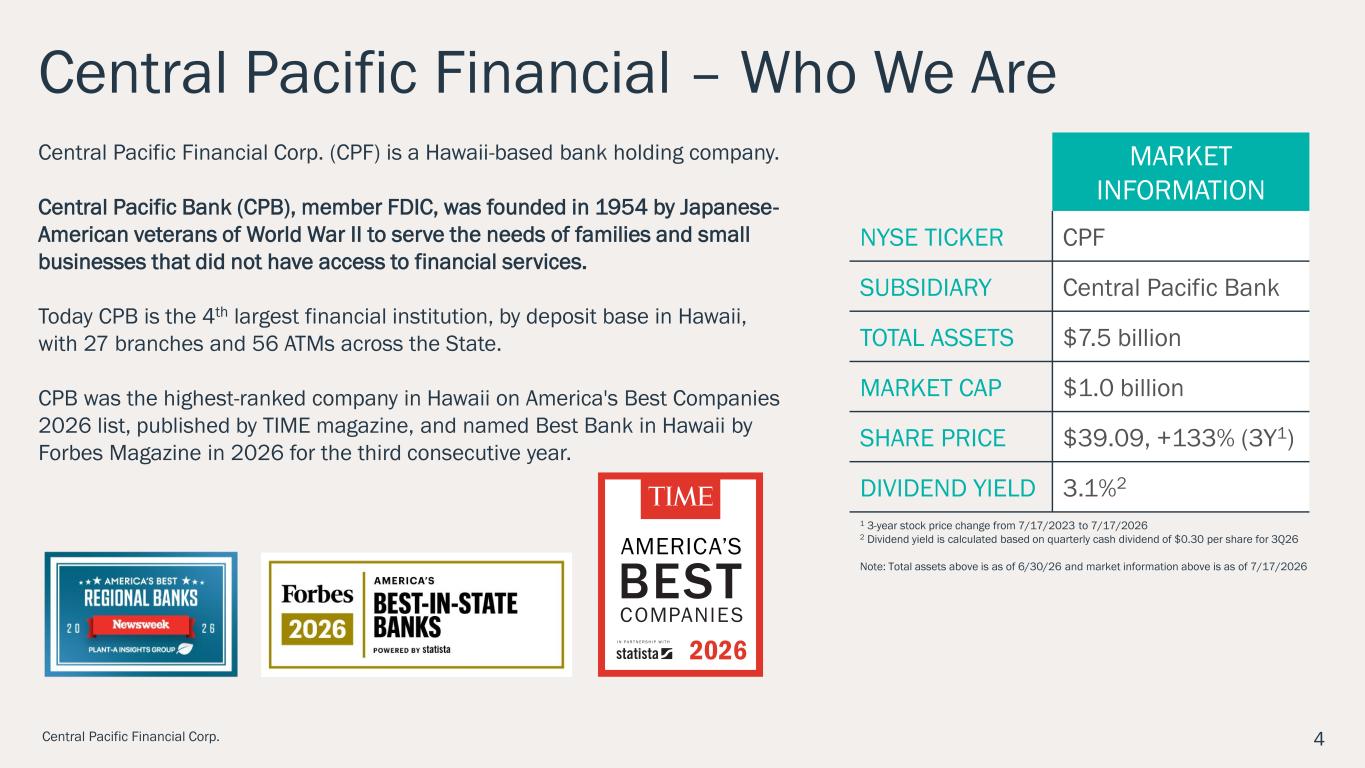
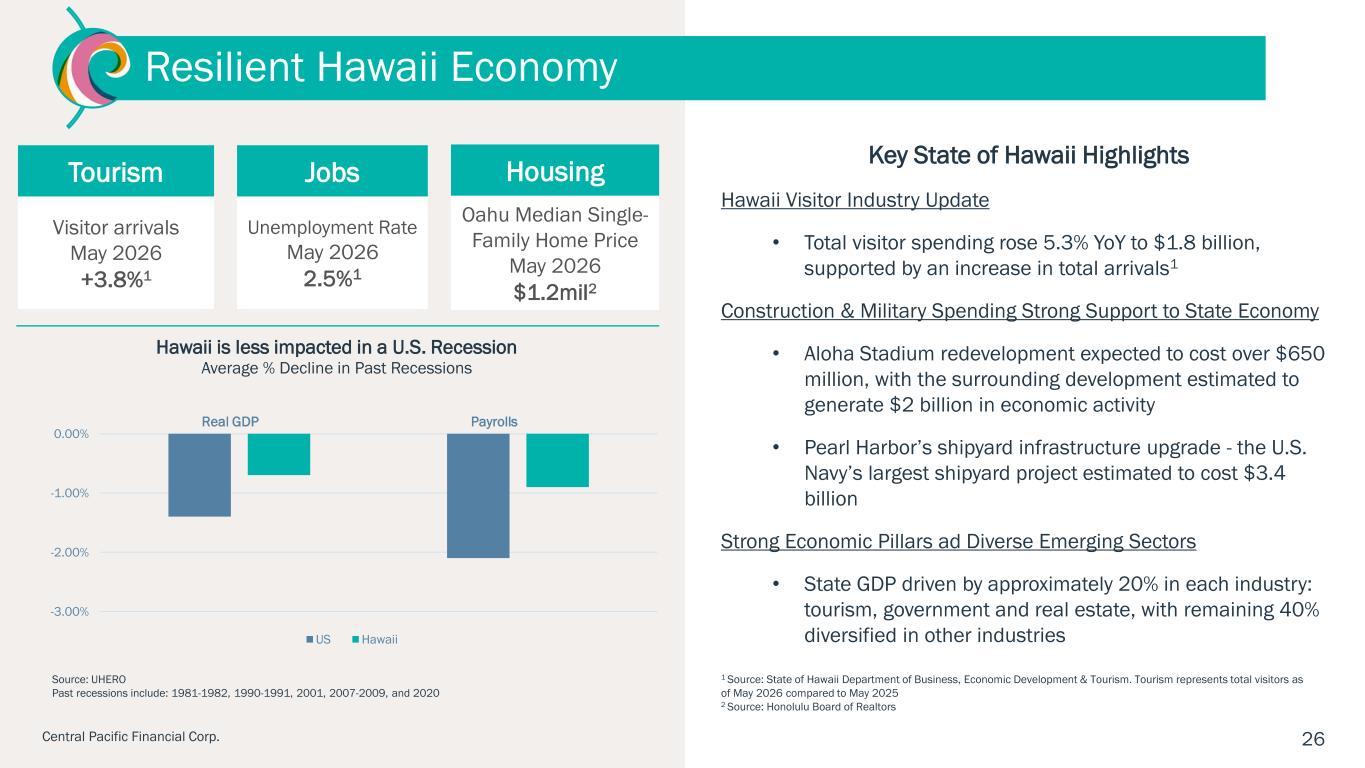
For a complete discussion of these risks related to our forward-looking statements please refer to slide two of our presentation with that i will now turn the call over to our chairman president and ceo arnold martinez thank you gerald and aloha to everyone joining us today we are pleased to report on a strong second quarter we maintain solid profitability and continue to manage our balance sheet with discipline we grew average earning assets maintained a stable car funding base and expended our net interest margin. Our strategic focus remains on being a high-performing bank that delivers sustainable, growing returns. In the first half of the year, we continue to build momentum to drive results that positions us well for the future. Our success reflects the strength of our relationship-focused banking model. We continue to serve Hawaii's people, small businesses, and local communities with a focus on long-term relationships, exceptional customer experiences, and disciplined execution. We were honored to be the highest-ranked company in Hawaii on America's Best Companies 2026 list, published by Time Magazine, and also recognized by Forbes as the best bank in Hawaii for the third consecutive year these recognitions reflect the trust of our customers and the commitment of our employees it is meaningful because it ties directly to our founding mission and the relationships we work to earn every day we continue to invest in our business in the areas of talent and technology including automation and data that supports future operating efficiencies at the same time we are also executing on discipline expense management and thoughtful allocation of resources across the organization overall we remain focused on continuing to generate positive operating leverage turning to the broader environment hawaii's economy remains resilient the visitor industry continues to be steady and we have recently seen promising increases in visitors from the u.s east and japan markets unemployment remains low at just 2.5 percent construction employment has increased and government contract awards continue to rise supported by public projects and military spending we continue to monitor external risks including the geopolitical conflict and its impact on oil prices and inflation. Our customers are resilient and we have not seen any significant impacts, but we will remain vigilant and committed to supporting our customers and community. With that, I will turn the call over to Dana.
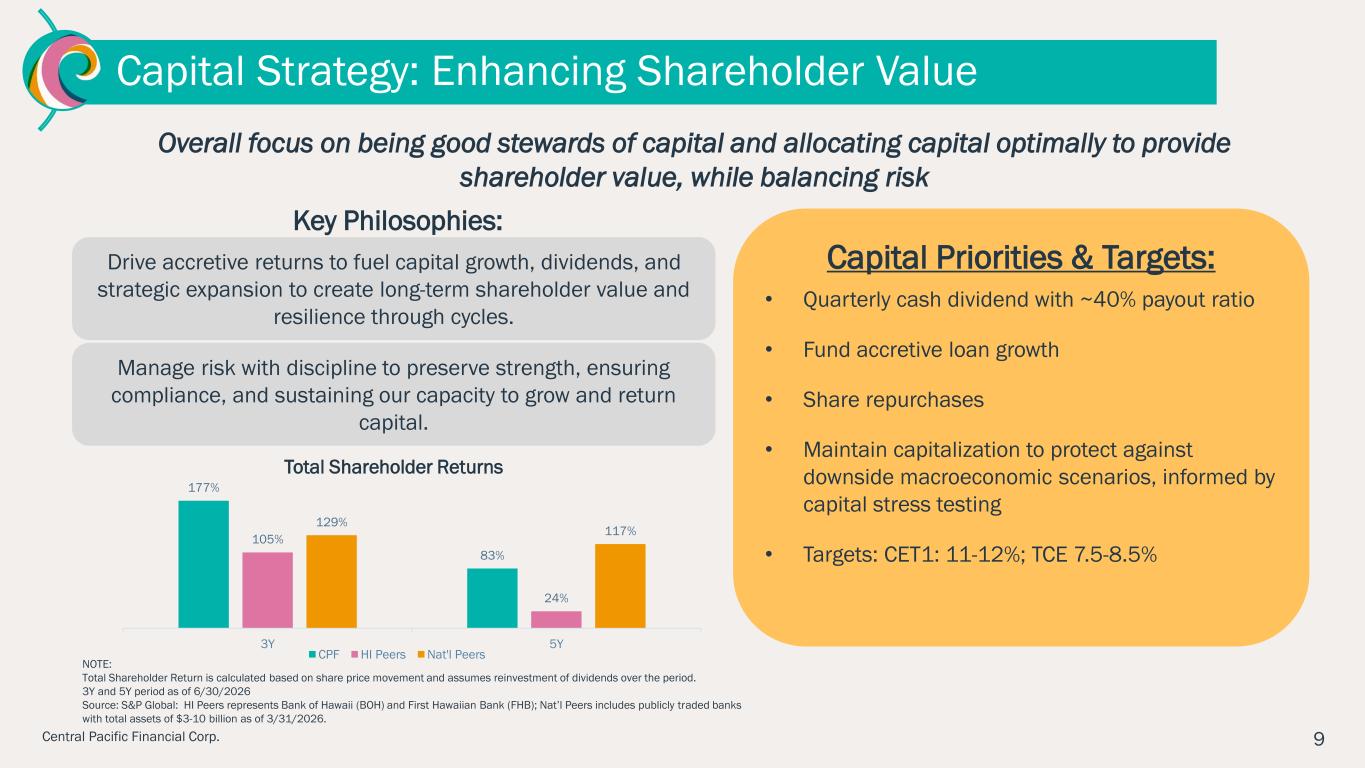
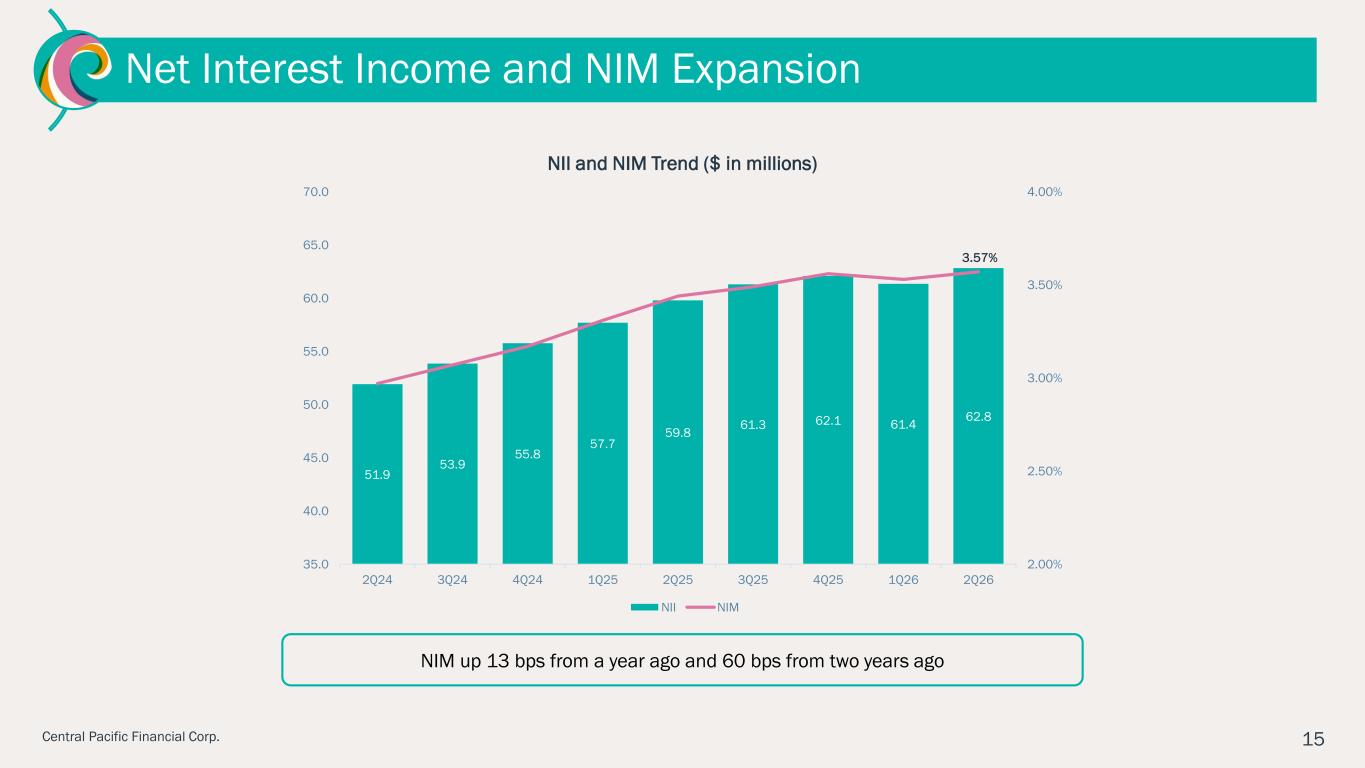
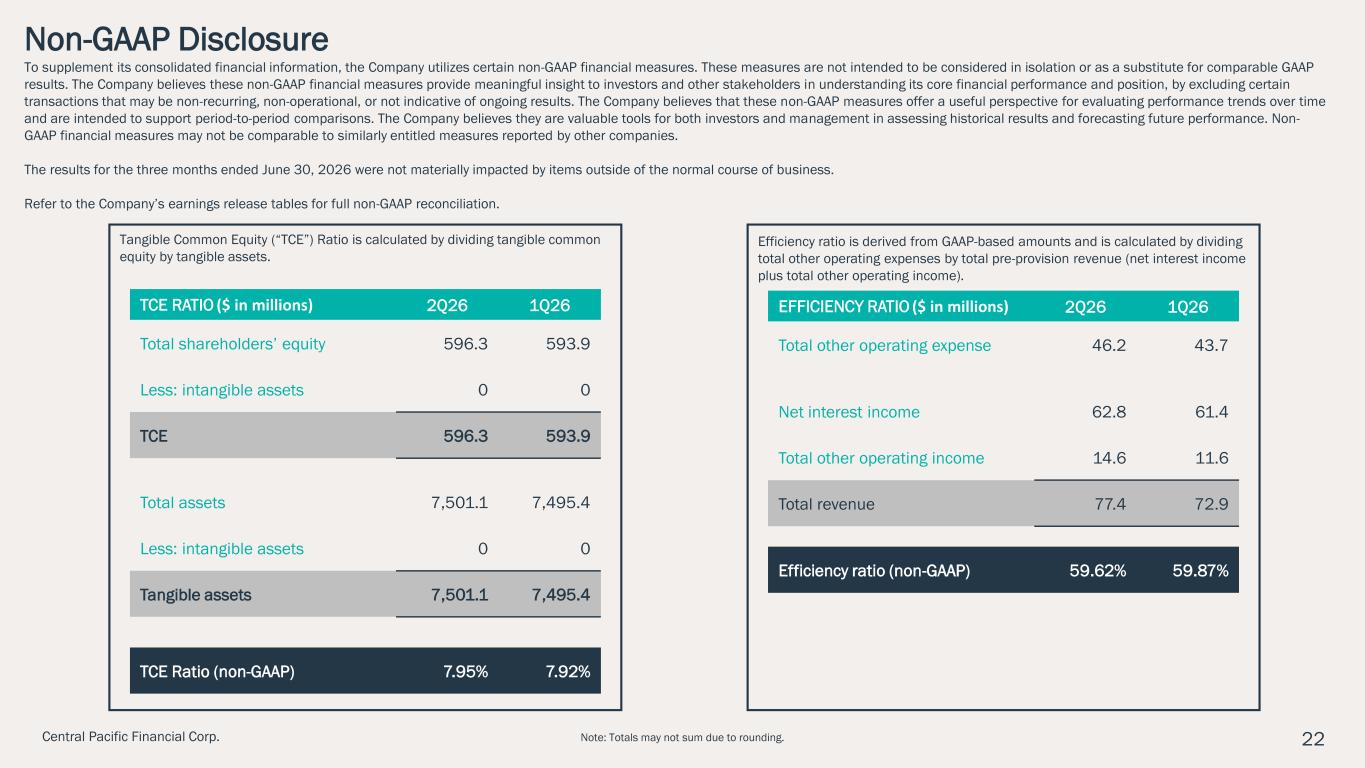
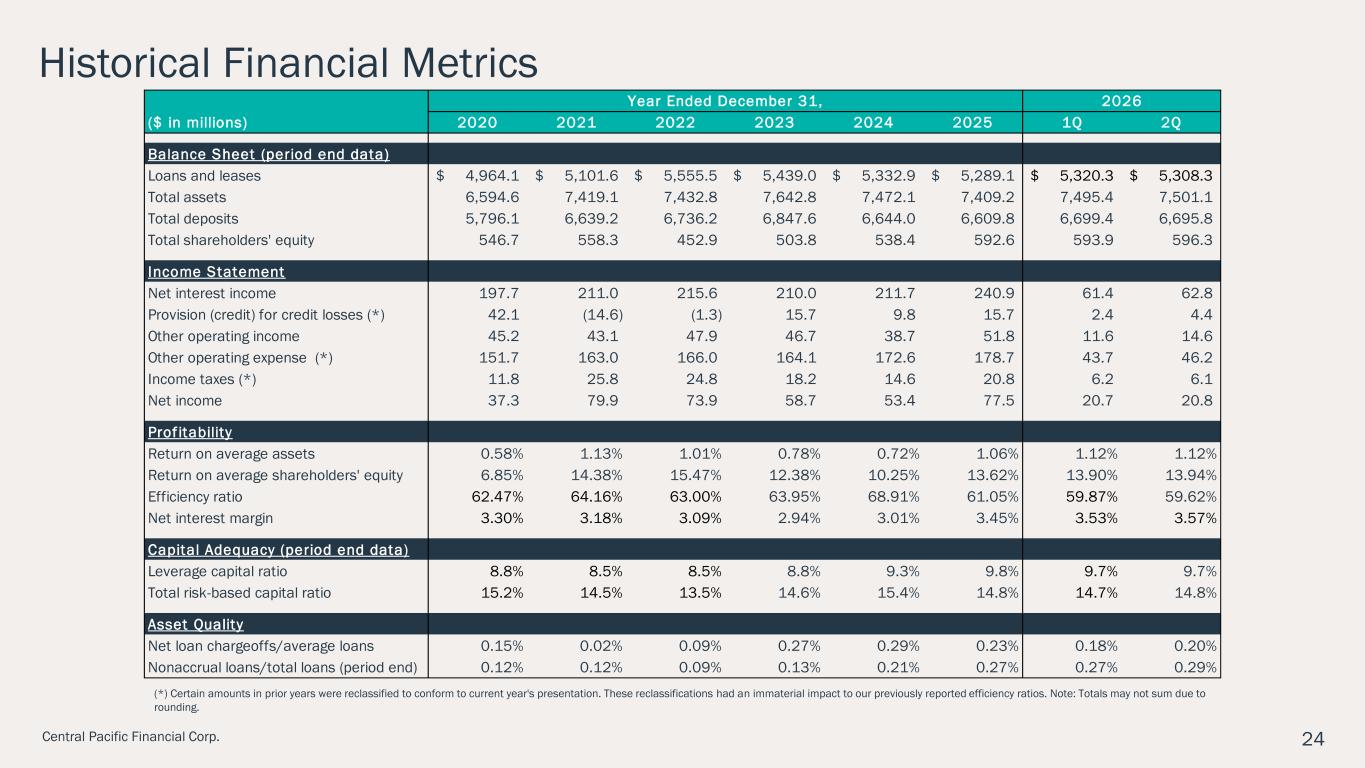
Thank you, Arnold. For the second quarter, net income was $20.8 million or 80 cents per diluted share, which is a meaningful 19% increase from the year-ago period on a diluted share basis. Return on average assets was 1.12% and return on average equity was 13.94%. Net interest income totaled $62.8 million and net interest margin increased by four basis points to 3.57%. We were successful in growing average loan and securities balances while also increasing earning asset yields. At the same time, funding costs remain stable. Our strong net interest margin provides us with flexibility as we continue to execute on our strategies and navigate market dynamics. With that said, we generally expect our NIM to remain relatively steady to a slight rise in the second half of the year. Backbook asset repricing remains beneficial, but has moderated, and we expect our deposit costs to remain fairly steady, assuming the Fed is on hold. Our guidance for full year net interest income remains at a 4 to 6% increase over the prior year. Our balance sheet sensitivity is relatively neutral to slightly asset sensitive. Therefore, our NII and NIM is well positioned for a potential Fed rate hike, although we do not expect it to have a significant impact this year. Total other operating income was $14.6 million, up $3 million from the prior quarter. The increase was primarily driven by BOLDI income that is tied to market performance. Excluding that item, our core fee income lines were relatively stable quarter over quarter. total other operating expense was 46.2 million dollars up 2.5 million dollars the increase was primarily driven by higher salaries and employee benefits due to higher deferred compensation expense also related to the strong market performance for the full year we expect our other operating expense to grow by 2.5 to 3.5 percent no change from what we've shared previously least. We paid a second quarter dividend of 29 cents per share, and with our continued strong earnings, our board declared a third quarter dividend of 30 cents per share, an increase of 3.4%. We repurchased approximately 322,000 shares for a total of $11.3 million. We have $33.2 million dollars of remaining available under our share repurchase program as of quarter end. We continue to have a very healthy capital position and remain committed to deploying capital in ways that enhance long-term value. This includes supporting organic growth, maintaining a strong balance sheet, returning capital through dividends and share repurchases, and preserving flexibility to respond to market opportunities. I will now turn the call over to David.
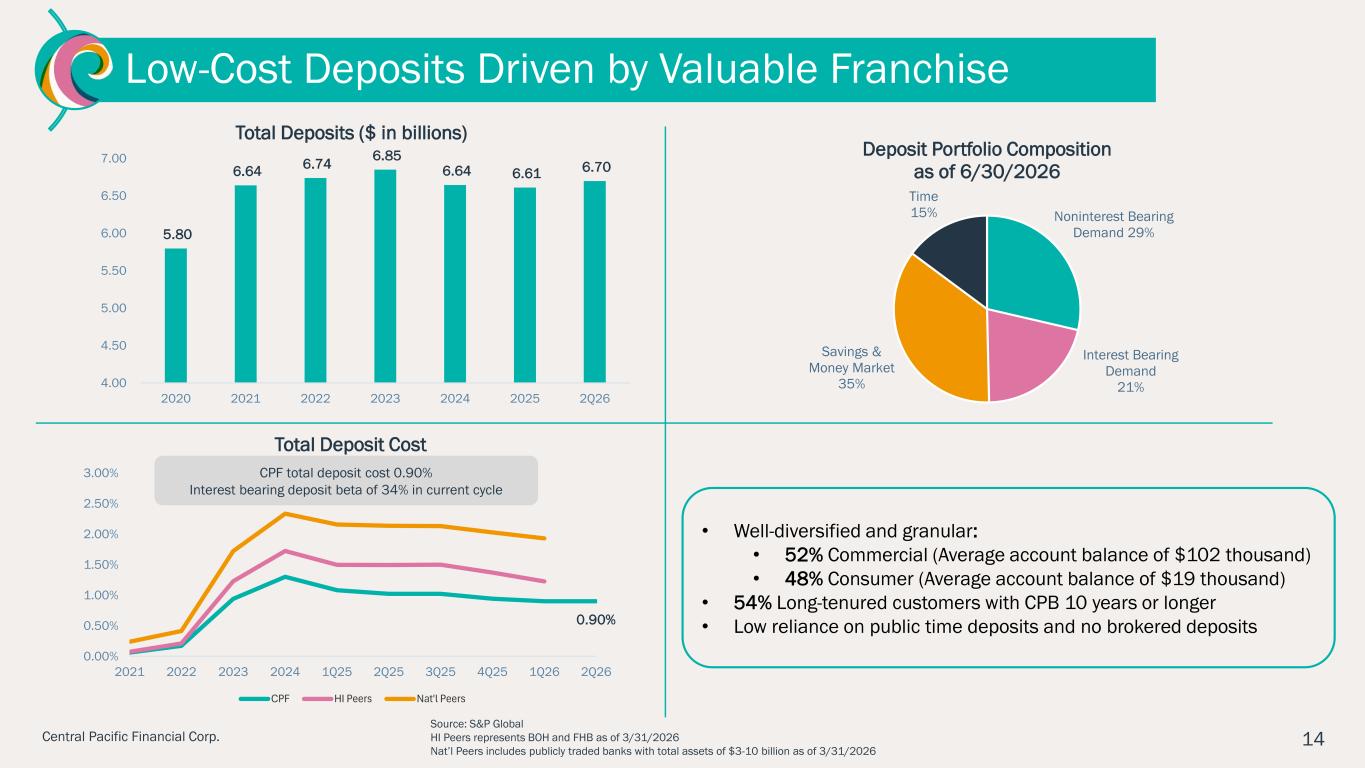
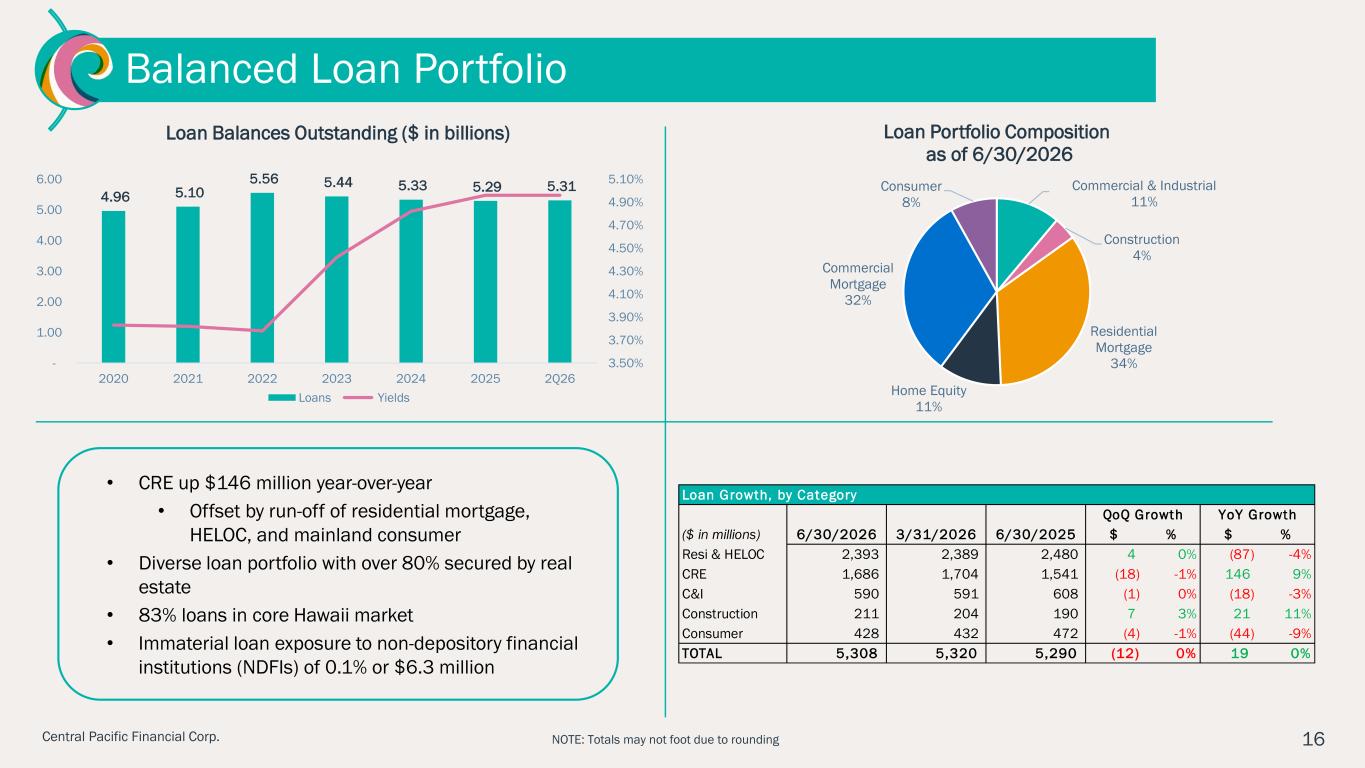
Thank you, Dana. Total loans ended the quarter relatively flat at $5.3 billion, with average loan balances increasing quarter over quarter by $33 million. Second quarter loan growth was impacted due to several loan closings moving to the third quarter, coupled with expected CRE loan payoffs. Second quarter loan production by type was well diversified among commercial and retail lending, and the majority of the production came from Hawaii. Looking forward, we continue to see opportunities in select mainland markets and expect greater fundings in the second half of the year. Average loan portfolio yield in the second quarter was 4.96% compared to 4.93% in the prior quarter. The increase in yield was primarily due to higher new production loan yields versus runoff yields. Total deposits remain largely unchanged at $6.7 billion. dollars core deposits represent over 90 percent of total deposits with continued growth in non-interest bearing and relationship-based total deposit costs remain unchanged quarter over quarter at an attractive 90 basis points looking ahead we continue to expect loan and deposit growth in the low single low single digit range for the full year as we move into the second half of 2026 We are prioritizing disciplined growth and balance sheet management, along with a consistent sales focus on new customer acquisition and increasing primary relationships. With that, I'll turn the call over to Ralph.
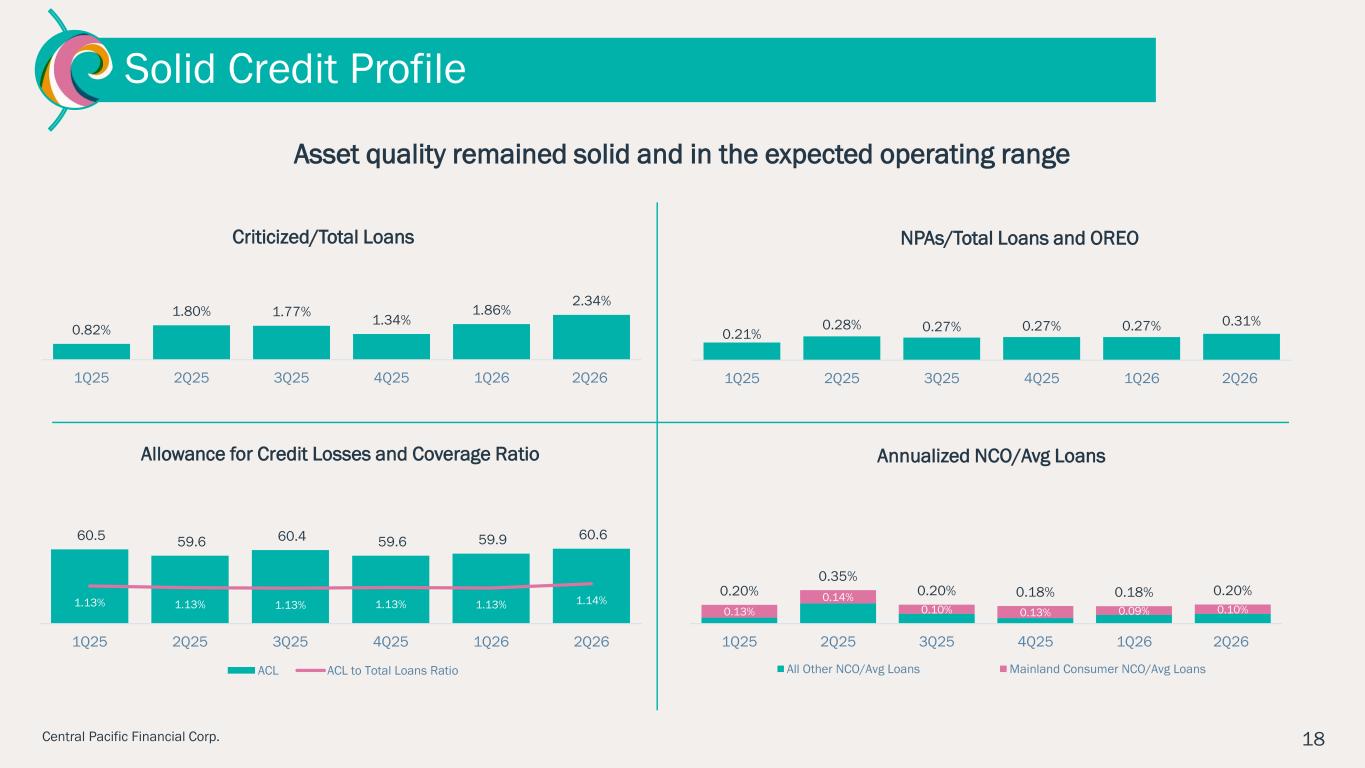
Thank you, David. Asset quality was strong at quarter end. Non-performing assets were $16.5 million, or 22 basis points of total assets, while net charge-offs were 20 basis points of average loans. Past due trends are stable, and we are not seeing evidence of broad-based weakness across the portfolio. Criticized loans increased to 234 basis points of total loans, driven primarily by a small number of Hawaii-based credits. These loans are well collateralized and actively managed. Our focus remains on disciplined underwriting, risk-adjusted pricing, and maintaining portfolio diversification. Revision expense totaled $4.4 million, including $3.3 million added to the allowance, and $1.1 million added to the reserve for unfunded commitments. The increase was driven primarily by more conservative economic assumptions and commitment growth, rather than deterioration in the loan portfolio. As a result, the allowance increased slightly to $60.6 million, or 1.14% of loans compared to 1.13% in the first quarter. The strength of the balance sheet, combined with strong credit performance and reserve levels, continues to support a robust capital position. We entered the quarter with a 12.7% CET1 ratio and a 14.8% total risk-based capital ratio, providing flexibility to support growth, maintain strong reserves, invest prudently across the balance sheet and continue returning capital to shareholders overall we remain constructive as our balance sheet is well positioned loss reserves are appropriate and capital levels provide a cushion to absorb any uncertainty in the environment i'll turn things over to arnold now for some closing comments thank you ralph to summarize the second quarter was a strong quarter we delivered solid earnings maintained credit quality thoughtfully managed loans and deposits
growth and continue to operate from a position of capital strength. I want to thank our employees across the state for their continued commitment to our customers and our communities. It is that commitment that makes results like this possible. We are happy to answer your questions at this time.
Operator
We will now begin the question and answer session. Please limit yourself to one question and one follow-up. If you would like to ask a question, please press star 1 to raise your hand. To withdraw your question, press star 1 again. We ask that you pick up your handset when asking a question to allow for optimum sound quality. If you are muted locally, please remember to unmute your device. Please stand by while we compile the Q&A roster. Your first question comes from the line of David Easton with Raymond James. Your line is open. Please go ahead.
Hi, good morning, everybody. Good morning, David. I wanted to start, maybe let's touch on the deposit front. I mean, obviously, if you've listened to any of these conference calls, everybody's talking about intensifying deposit competition on the mainland. Curious what you're seeing in the islands. How is the competitive landscape, obviously it's relatively insulated and it's historically been more rational. Is that the same case? And just kind of curious where marginal funding costs are locally and just kind of what you're seeing on the funding side.
Hey, David, it's David Morimoto. You know, I think the deposit competition in Hawaii has remained rather consistent. You know, it is somewhat more rational than on the mainland where there's uh you know a larger number of competitors having said that you know we we have been pleased with our deposit performance year to date uh we did have a strong uh first quarter that was slightly offset by um you know know, lesser growth in the second quarter. But on a combined basis, you know, total deposit growth was up close to $90 million year to date. So we're pleased with that level of growth and we expect it to continue.
Okay, that's helpful. And then maybe just wanted to, let's touch on some of the puts and takes on the margin guidance. You know, flat to modestly higher. I know there's a lot of embedded expansion just as you repriced lower-yielding assets. It sounds like there might not be a ton of funding cost leverage left. I'm curious, what's holding you back from expanding more and keeps it flattish? And then whether you're considering any other balance sheet optimization opportunities to maybe help expand the margin more?
Yeah, hi, David. This is Dana. Thanks for the question. On the margin, let me start by saying we are very focused on maintaining a strong margin. At the same time, though, we do balance growth and margin. As far as pricing competition, loan pricing continues to be fairly competitive in the Hawaii market. We have seen some spreads compress. On the deposit side, pricing continues to be pretty rational, and we're not expecting a ton of pressure there.
And so, therefore, we expect our NIM to remain relatively stable in the high 350s, and I feel like that gives us a good ability to take advantage of opportunities that arise okay um and maybe just digging in a bit into the underlying dynamics on loans on the quarter it sounds like there was some slippage into the third quarter just given higher as well as some higher prepays how were originations this quarter and how's the pipeline shaping up just kind of i want to understand what what gives you confidence that growth is going to accelerate it sounds like You're thinking about leaning maybe into the mainland more. Just kind of curious what's giving you confidence there. And does that guidance contemplate, you know, continued elevated payoffs?
David, again, you know, looking forward, we are confident that second half loan growth will be stronger than what we saw in the first quarter. One thing to start off with is during the second quarter, we did originate almost $70 million in new construction loans that obviously didn't really benefit us in the second quarter, but they will benefit us going forward. So we do have a decent amount of commercial construction loan fundings that will help drive loan growth in the back half of the year. Additionally, we do have a solid commercial pipeline that we've built. It's a little lumpier than we would expect. and that's what the timing of closings will be critical with the pipeline. Additionally, we have implemented a couple of initiatives on the Hawaii retail portfolio. These initiatives are designed to not eliminate or grow the portfolio, but slow the amount of runoff in commercial portfolio so i think when you put put all of that together that's why we have confidence for stronger growth in the second half of the year got it thank you the next question comes from the line of matthew clark with piper sandler your line is open please go ahead hey good morning morning Matthew.
Just on that last comment, David, I think you mentioned that you expect loan growth to be stronger than the first quarter, or do you mean the first half in the second half?
Yeah. First half, Matthew.
First half. Okay. Got it. And then on that $70 million of new commitments on the construction side. Can you give us a weighted average rate on that? Just trying to get a sense.
Matthew, they were primarily multi-family construction on the mainland. And I would say that the spreads, they're floating at sulfur in the low 200s.
Okay. Got it. um sounds good and then on the uh maybe deep for dana my typical question on deposit cost the spot rate at the end of june yeah hey matthew the spot rate on total deposits was 90 basis points so pretty stable there okay great okay and then um maybe just on the uptick in non-performers. I know it's tiny, but I guess any incremental increases makes a minor difference. So, just curious on getting some more color on the uptick in non-accruals and the increase in classified, just, you know, more about what caused them to migrate in the outlook there.
Sure, Matthew. This is Ralph. I think maybe first I kind of put it into some context in terms of how we risk rate credits. So our risk rating system is driven by a probability of default, not expected loss. This quarter, we identified several credits that had potential or defined weaknesses that could have an impact with regard to default probabilities. So that was the nature of the downgrade. The largest credit was a $20 million real estate loan. The ownership group is having a dispute and the principal guarantor has some financial difficulties. And that was the primary reason why it was downgraded. It's a real estate loan, Hawaii based. The debt service coverage of the loan is about 1.27 times third party leases, pretty diversified. And the loan to value is 57%. So we don't see any kind of lost content there.
And the downgrades, as I said, really reflect more kind of a default risk than an expectation of loss great thanks and then last one for me just on expenses maybe for dana um or operating expenses you're tracking call it you know 180 i'm sorry 180 million for the year if you just annual well a little bit higher than that for the full year which doesn't get you to two and a half to three and a half percent increase i guess maybe wanted to confirm the baseline you're using for 2025 in terms of non-interest expense and then um you know where the where the increase might be coming from after
we reset for the bully this quarter yeah hey matthew um i will say you know as far as our guidance range of two and a half to three and a half percent um our latest forecast is probably on the lower end of that range, just to give you an idea there. And in the second half of the year, we do expect some expenses to rise due to certain projects going live. We have a CRM system as well as a new branch system and some data platforms. Those are related to ongoing investments in our business. And beyond that, it's just going to be probably a function of timing of certain expenses.
Okay. And the baseline you're using for last year, if you had it offhand?
Yeah, I do. It's about, there was a little bit of non-recurring last year. So the baseline I'm using is about 177, 177 million.
Okay. Yep. That's what I thought. Okay. Thank you.
Operator
The next question comes from the line of Andrew Leish with Stone X Group. Your line is open. Please go ahead. So sorry, Andrew. Give me one second. I will reline you up in the queue. Andrew, your line is open. Go ahead.
Great, thank you. Just the pace on the share of purchases, should we expect a similar pace going forward here?
Hey, Andrew, it's Dana. I would say that we do generally plan to return capital at a similar pace as we did this past quarter through dividends and share repurchases. but as always the amount that we buy back each quarter it is dynamic and considers a number of factors including loan growth the environment and risks as well as our valuation but generally speaking i'd expect it to be a similar amount got it uh very helpful all my other questions have been asked and answered i'll step back thanks thanks andrew the next question comes from Kelly Moda with KBW.
Operator
Your line is open. Please go ahead.
Hey, thanks for letting me on. Maybe on the deposits, you have a lot of room on your balance sheet. You have some nice cash flows coming off the securities portfolio still. With the 79% loan to deposit ratio and your expectation for kind of a pickup and growth here for the back half of the year. How are you thinking about funding? Would you expect, based on your pipelines, a commensurate amount of deposits? Are we still thinking and kind of grow into your loan-to-deposit ratio and commentary on where you'd like to bring that?
Hi, Kelly. It's Dana. Yeah, starting with the loan-to-deposit ratio, at June 30, I think it was about 79%. I'd say that's on the lower end of our target. We typically target about 80 to 85% on the loan to deposit ratio. So I think there's some room there. And we're always looking to optimize the balance sheet. And our average earning asset growth, it really will depend on loan growth and our continued focus on optimizing. And there may some mixed shift in there as well.
Got it. That's really helpful. And then I'm sorry to circle back on this, but I just want to understand your expense commentary correctly. I appreciate the jumping off point. Can you clarify whether or not that includes the equity gains that impacted incentive comp this quarter for 2026? I just want to make sure I'm modeling appropriately. ahead?
Yes, Kelly, that does include the higher deferred compensation expense this quarter, but I am assuming for the back half of the year that we'll see some normalization there.
Great. And, you know, as you noted, you know, investing in some of these technology and systems is something that you ultimately hope is, you know, helping to drive greater efficiencies ahead. Could you share any, so far, any latest use cases or what you're seeing based on the changes made so far and what you're most excited for or looking to do as we look ahead here?
Yeah, Kelly, you know, if you're talking about AI, I think right now we're really taking a measured approach. So, you know, we don't really kind of intend to overstate what we can deliver, but we're aiming not to be, you know, a laggard or trying to lead on that. Today, right now, really, we're kind of focused on building out the data infrastructure and some of the guardrails. You know, because the technology is evolving, we want to make smaller investments. We want kind of near-term paybacks. And most of the applications are around sort of workflows, whether it be assembling credit information, you know, drafting routine documentation, supporting the AML, you know, reviews or automating certain types of risk reporting. We really want to retain kind of employee judgment and approval authority over this. We want to be very clear on what, you know, what kind of data we're looking at. And then we're really trying to work with, I'd say, more established providers than trying to develop our own tools right now.
Yep. Got it. Thank you so much. Appreciate all the color off the pack.
Operator
If you would like to ask a question, please press star one to raise your hand. There are no further questions at this time. I will now hand the call back to Mr. Gerald Robago for closing remarks.
Thank you, everyone, for joining us today and for your continued interest in Central Pacific Financial Corp. We look forward to updating you again next quarter. Thank you.
Operator
This concludes today's call. Thank you for attending. You may now disconnect.