Operator
Good day, and welcome to the Hope Bancorp 2025 Second Quarter Earnings Conference Call. Please note this event is being recorded. I would now like to turn the conference over to Angie Yang, Director of Investor Relations. Please go ahead.
Thank you, Drew. Good morning, everyone, and thank you for joining us for the Hope Bancorp 2025 Second Quarter Investor Conference Call. As usual, we will be using a slide presentation to accompany our discussion this morning, which is available on the Presentations page of our Investor Relations website. Beginning on Slide 2, let me start with a brief statement regarding forward-looking remarks. The call today contains forward-looking projections regarding the future financial performance of the company and future events. Forward-looking statements are not guarantees of future performance. Actual outcomes and results may differ materially. Hope Bancorp assumes no obligation to revise any forward-looking projections that may be made on today's call. In addition, some of the information referenced on this call today are non-GAAP financial measures. For a more detailed description of the risk factors and a reconciliation of GAAP to non-GAAP financial measures, please refer to the company's filings with the SEC as well as the safe harbor statements in our press release issued this morning. Now we have allotted 1 hour for this call. Presenting from the management side today will be Kevin Kim, Hope Bancorp's Chairman, President and CEO; and Julianna Balicka, our Chief Financial Officer. Peter Koh, our Chief Operating Officer, is also here with us as usual and will be available for the Q&A session. With that, let me turn the call over to Kevin Kim. Kevin?
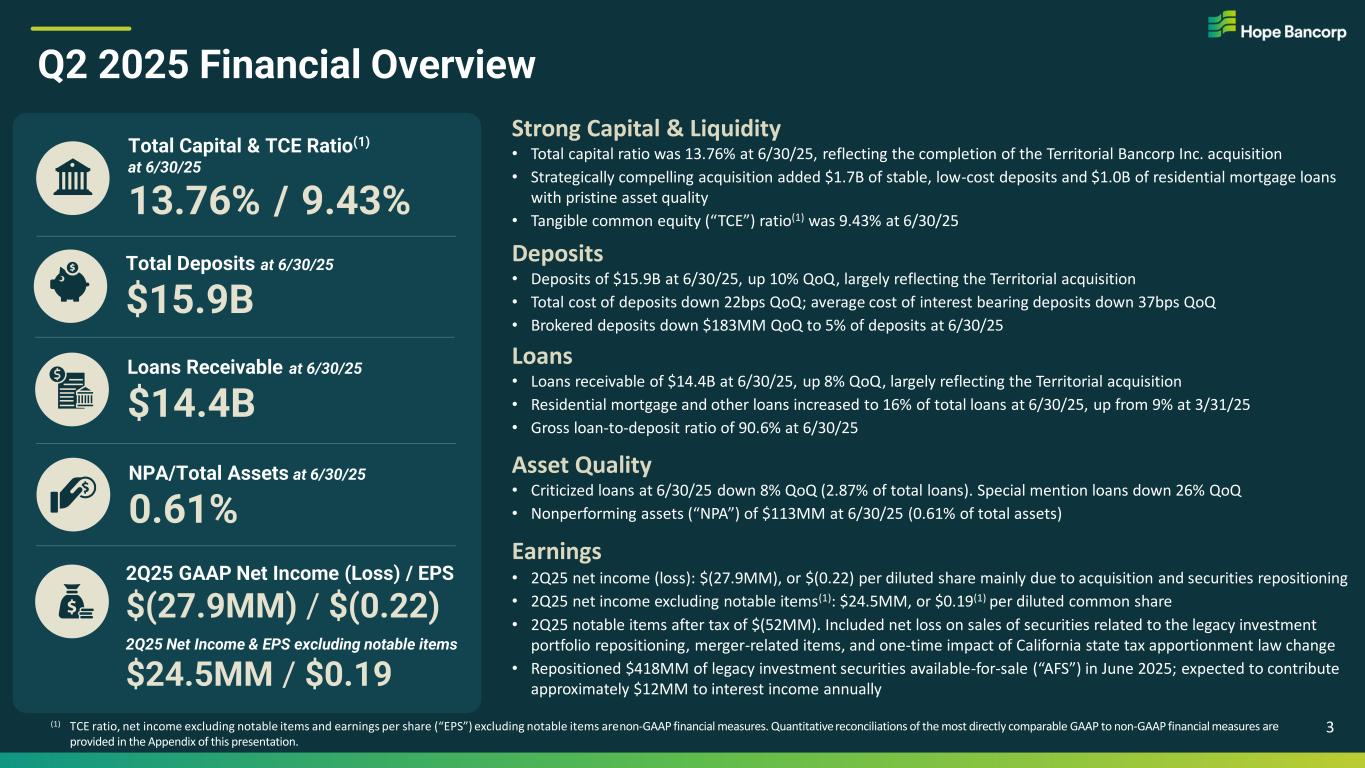
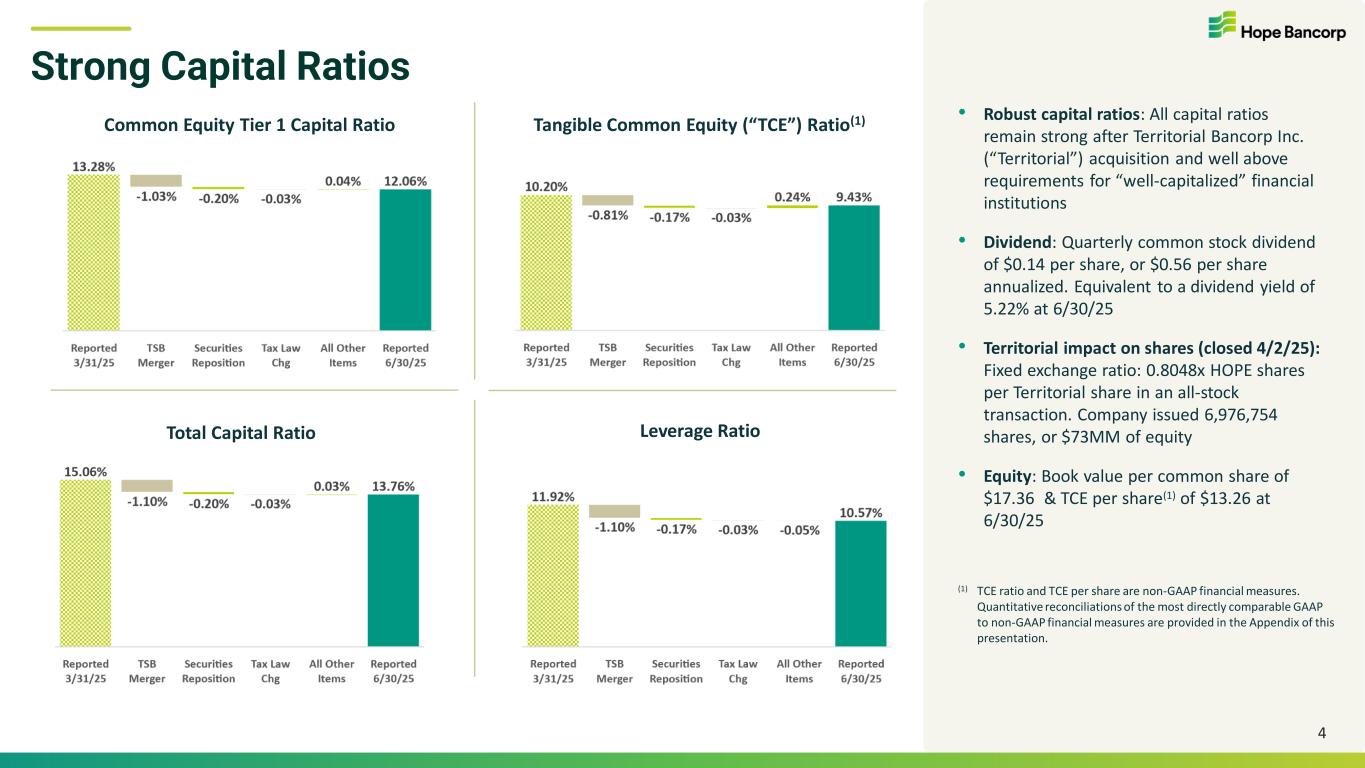
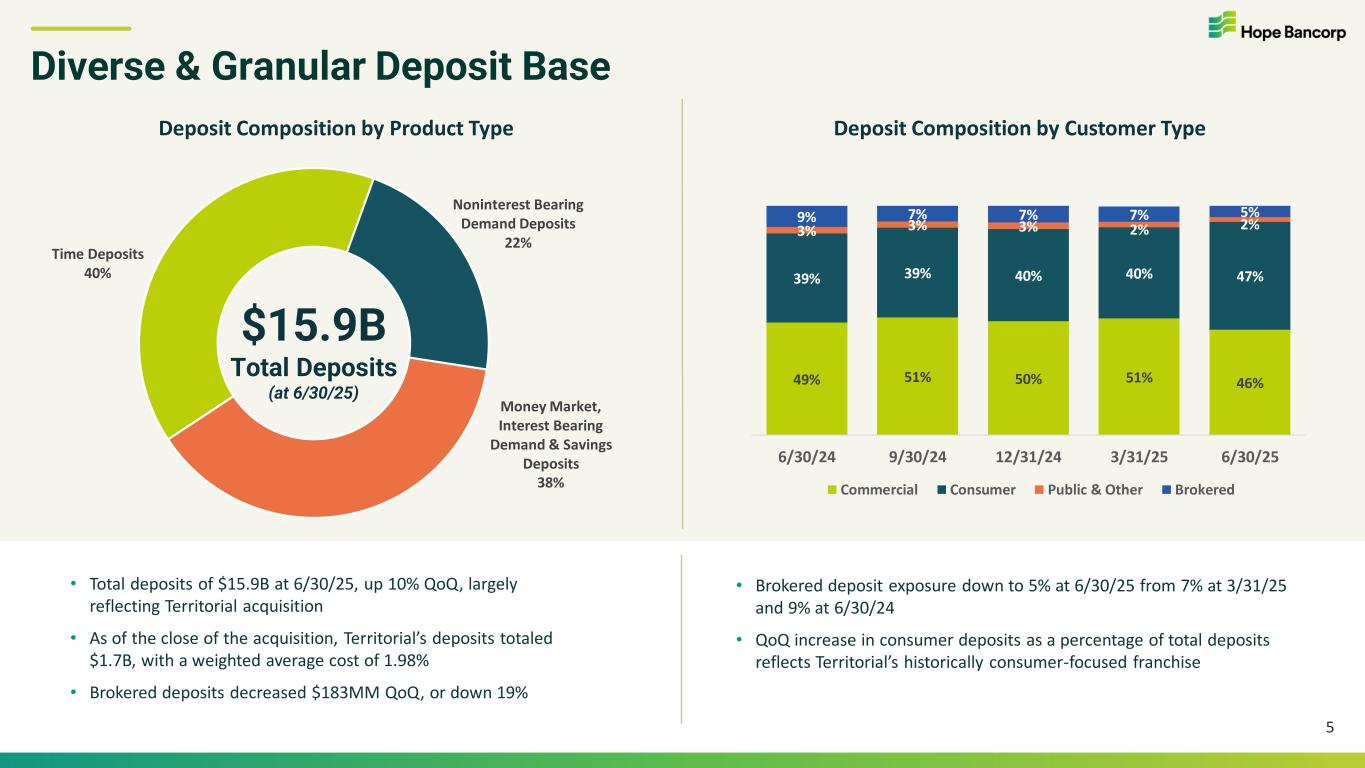
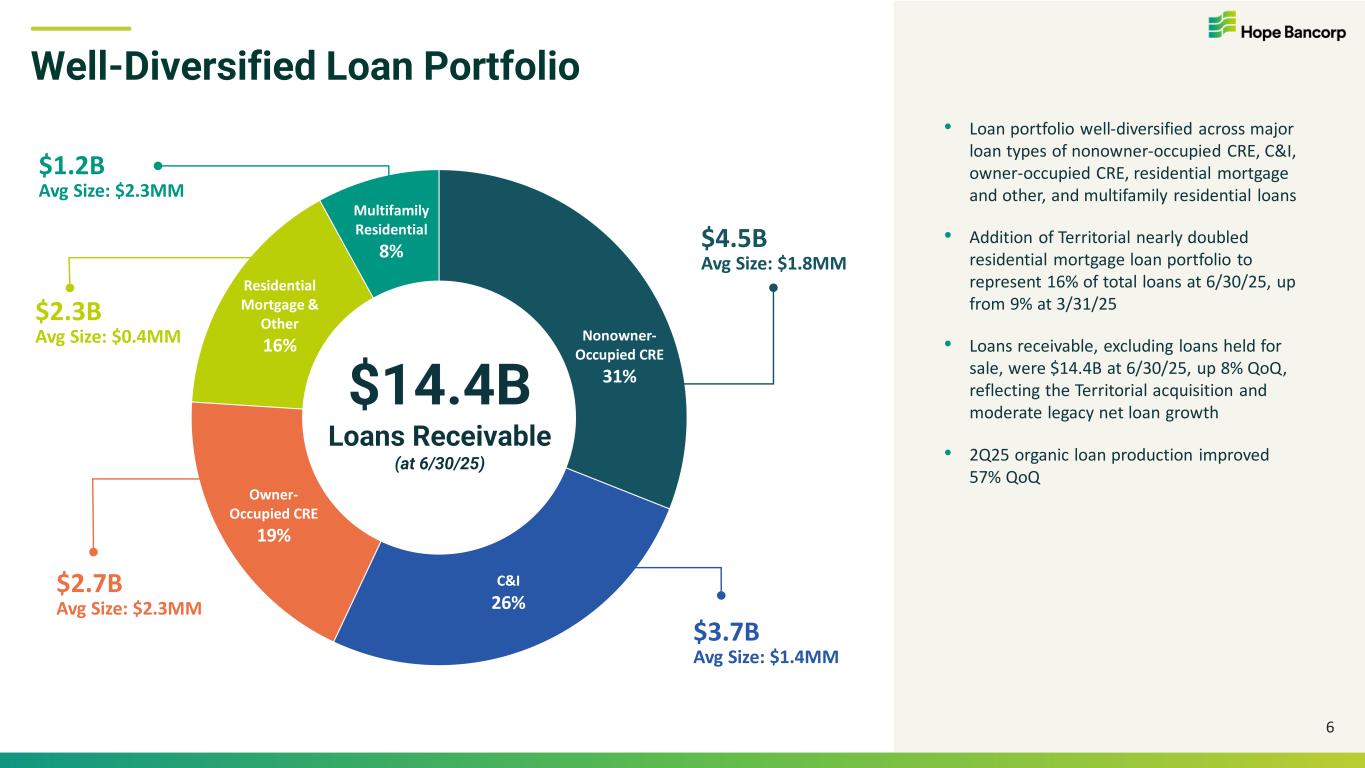
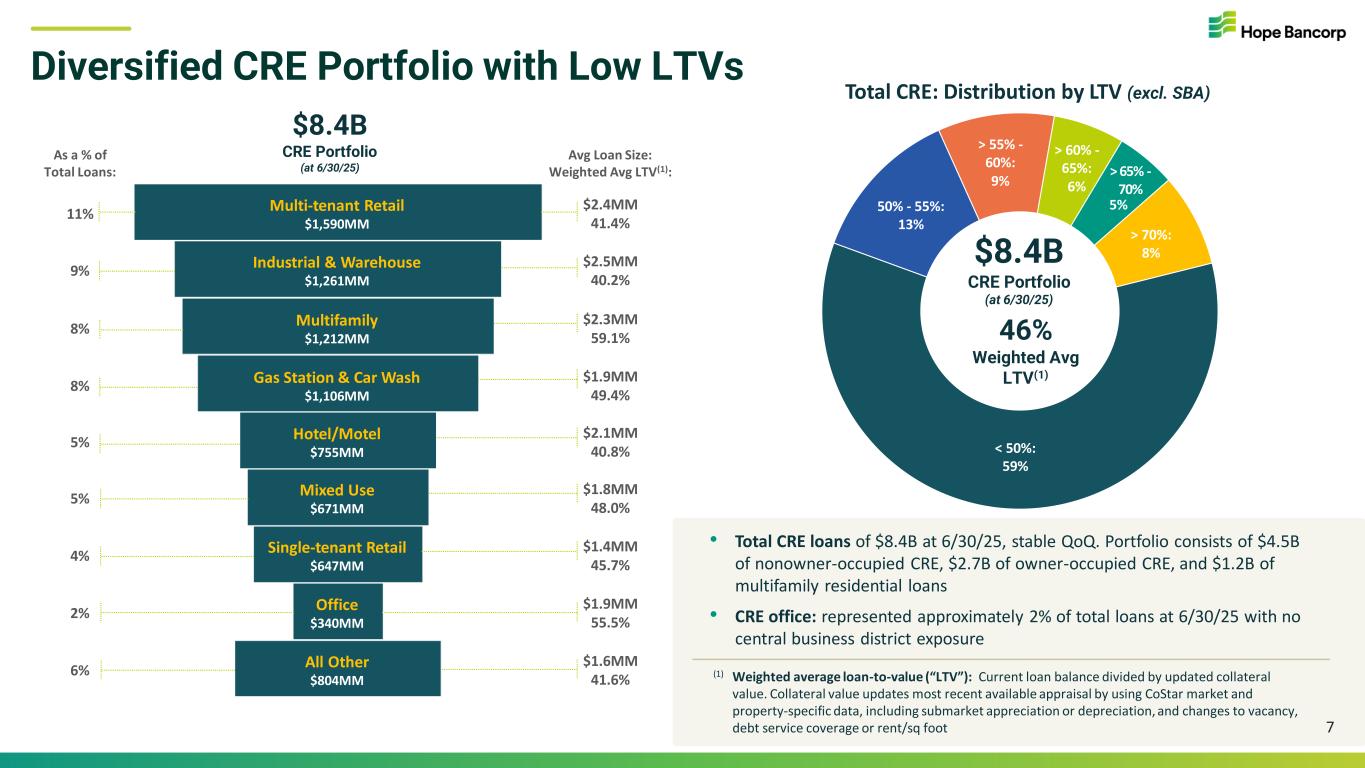
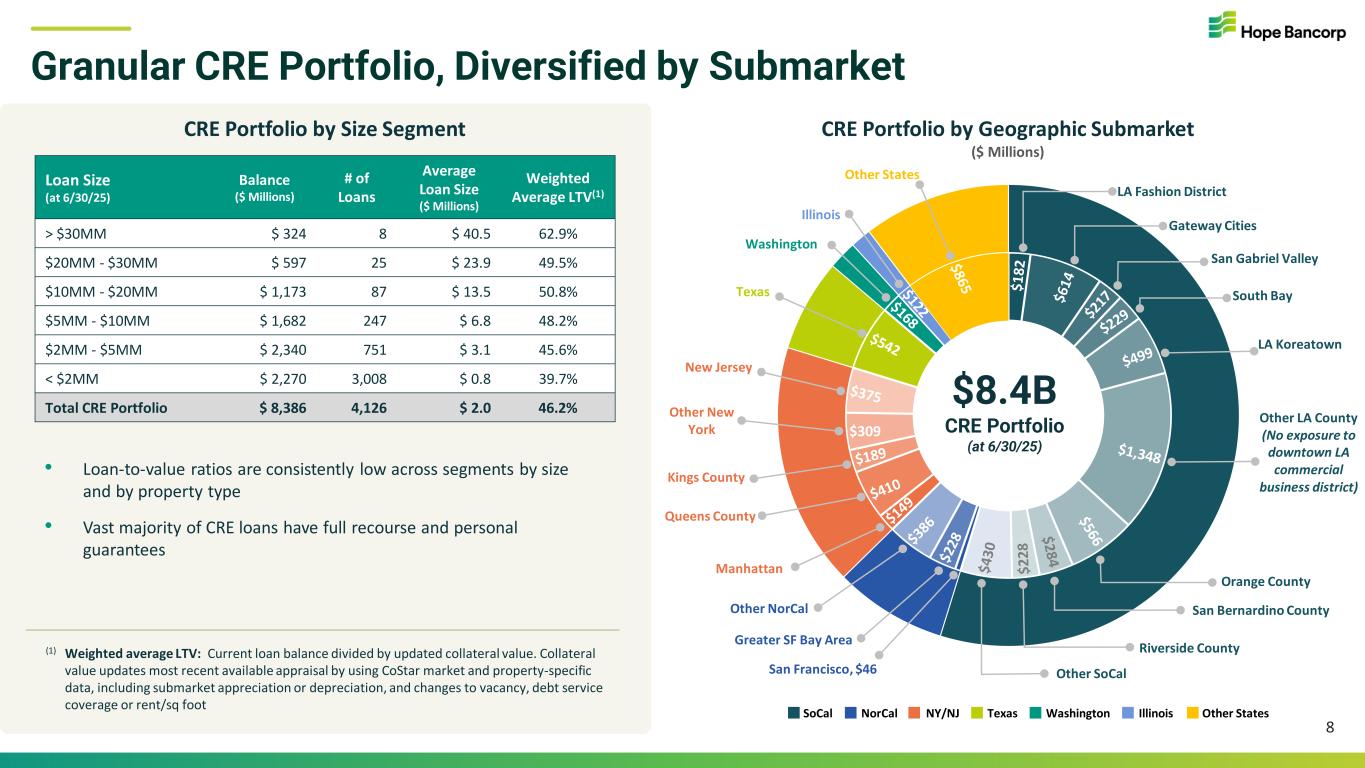
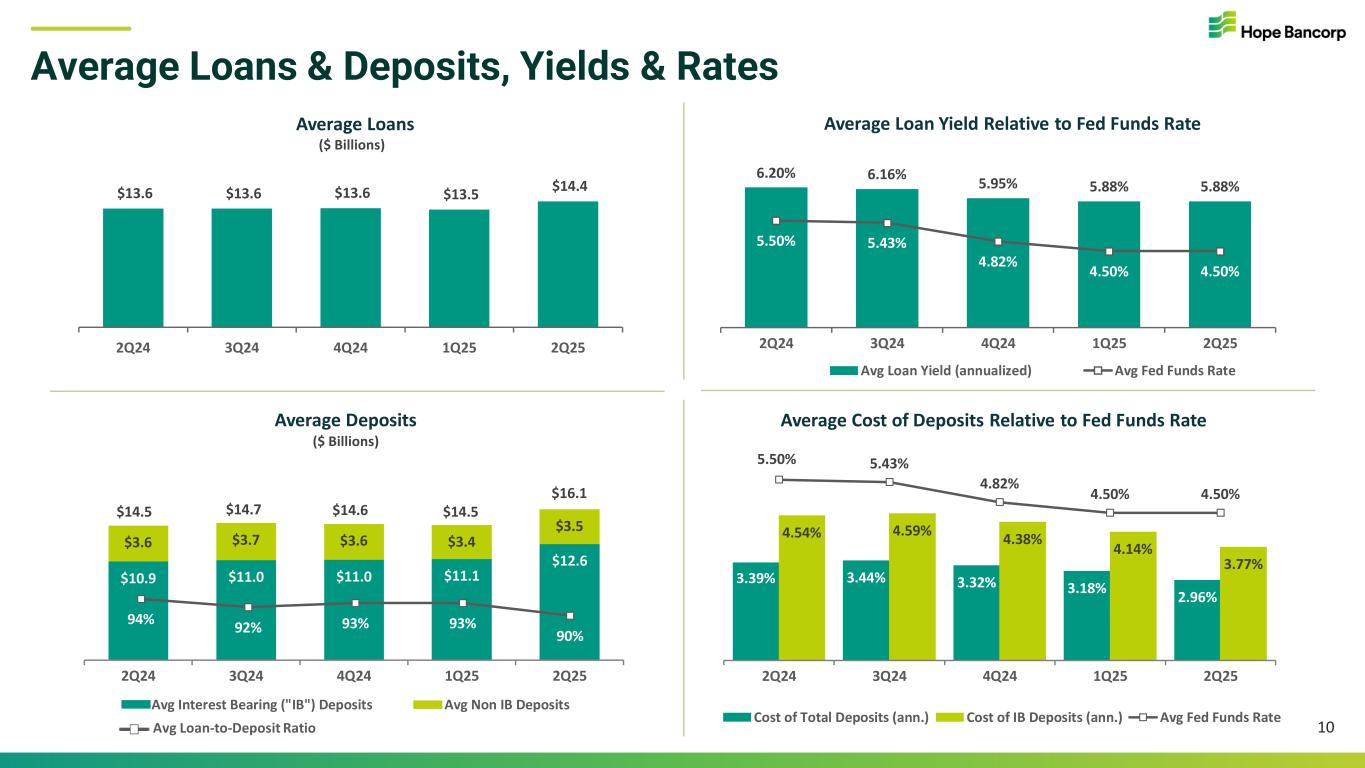
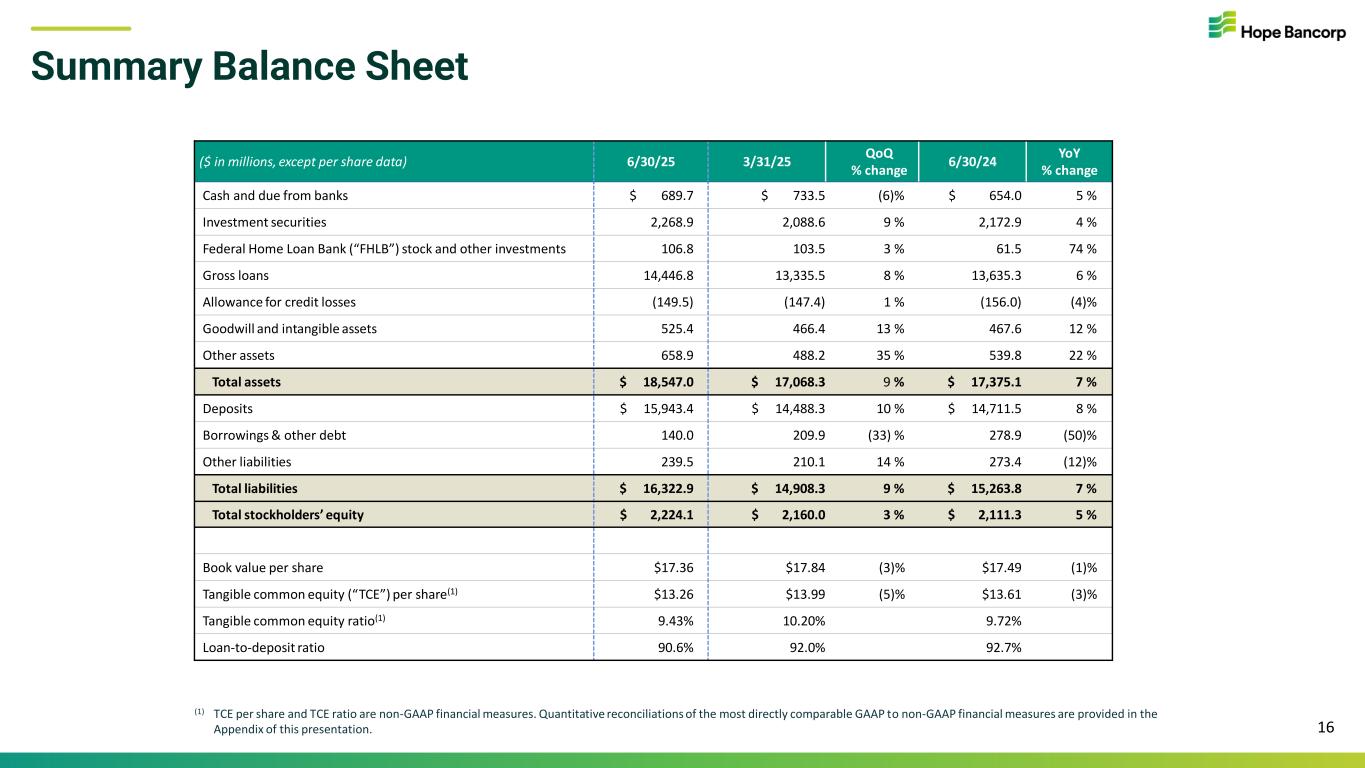
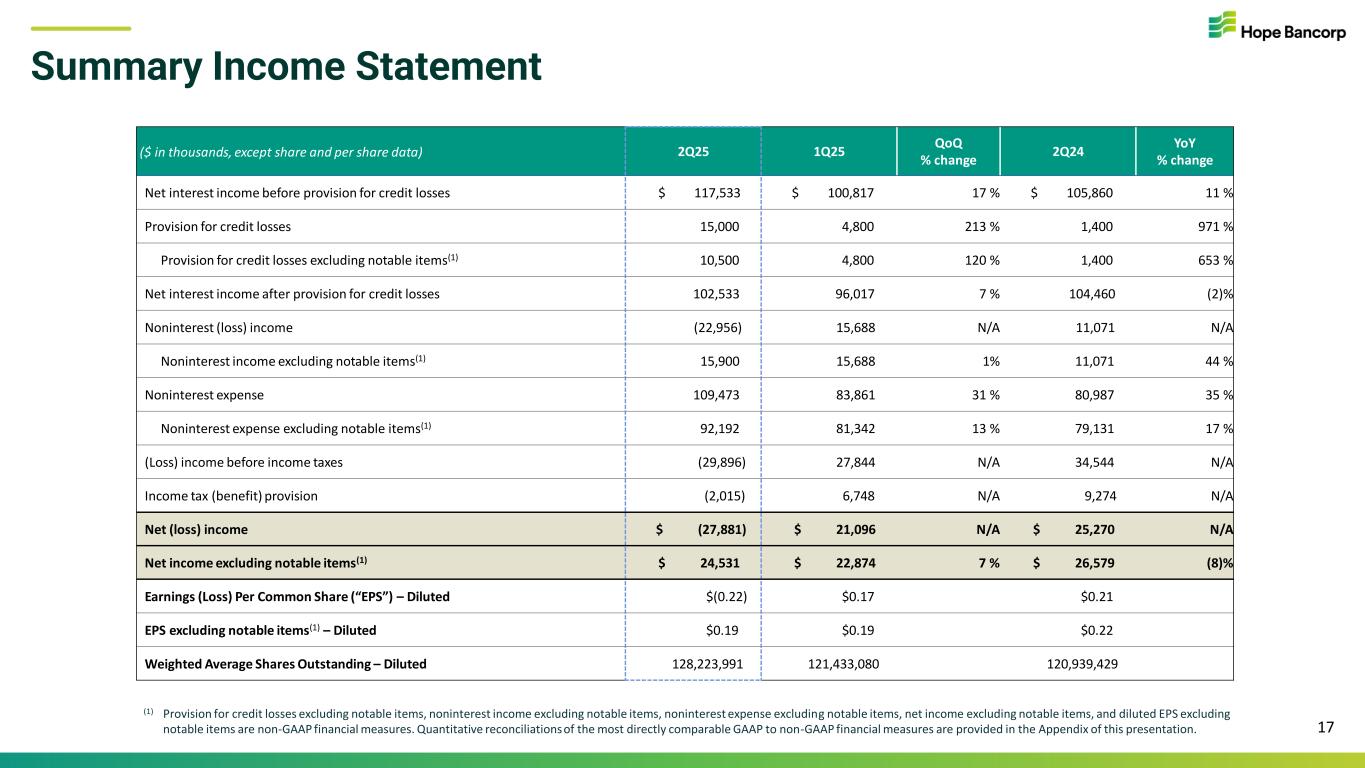
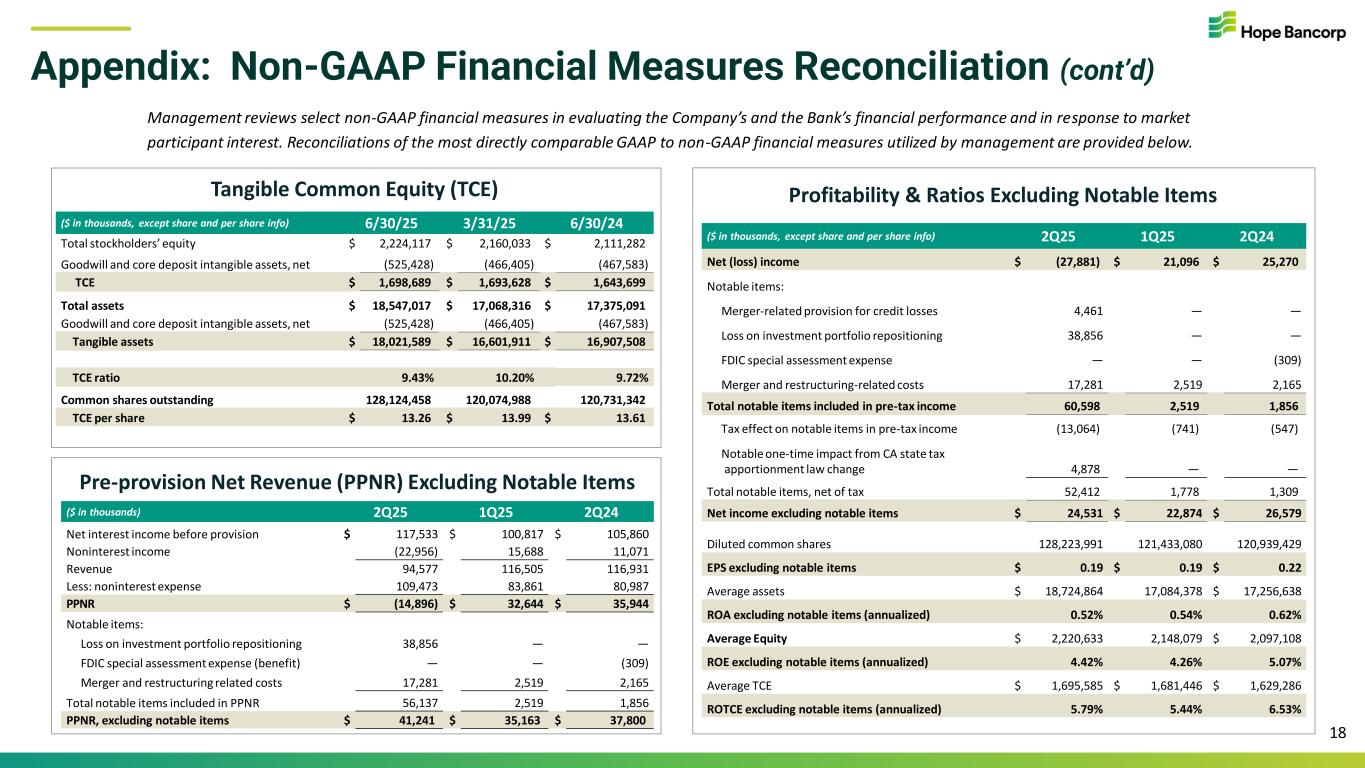
Thank you, Angie. Good morning, everyone, and thank you for joining us today. Let's begin on Slide 3 with a brief overview of the quarter. The second quarter of 2025 was a milestone quarter for Hope Bancorp as we completed the acquisition of Territorial Bancorp, entering the strategically important market of Hawaii. We are excited about the opportunities that this presents. We also repositioned a portion of our legacy securities portfolio to enhance our interest income. Accordingly, we believe net income, excluding notable items, is more indicative of our fundamental performance this quarter. Net income for the 2025 second quarter, excluding notable items, totaled $24.5 million, up 7% from $22.9 million, excluding notable items in the preceding first quarter. Earnings per diluted share, excluding notable items, were $0.19 for both quarters as we issued 9 million shares with the Territorial transaction. As a result of the onetime loss incurred from selling lower yielding legacy securities and from merger-related items, together with a onetime impact from a change in California's state tax apportionment law, we reported a net loss of $27.9 million for the second quarter. Pretax pre-provision net revenue, excluding notable items, grew to $41.2 million in the second quarter of 2025, up 17% from $35.2 million in the 2025 first quarter. This reflected the impact of the Territorial acquisition, legacy loan growth, improvement in the cost of deposits, and core fee income growth. Moving on to Slide 4. All our capital ratios remain well above the requirements for well-capitalized financial institutions after the close of the Territorial acquisition. Our strong capital levels and ample liquidity provide us a healthy cushion with which to navigate various macroeconomic scenarios and support prudent balance sheet growth. Our Board of Directors declared a quarterly common stock dividend of $0.14 per share, payable on August 15 to stockholders of record as of August 1, 2025. Continuing to Slide 5, strengthening our deposit franchise remains a key priority. At June 30, 2025, our total deposits with the completion of the Territorial acquisition grew to $15.9 billion, an increase of 10% from the end of the prior quarter. The addition of Territorial's low-cost deposits drove a substantial improvement in our cost of deposits. In addition, the ongoing maturity and renewal of CDs to lower rates will contribute to the improvement in the cost of funds. Our average cost of interest-bearing deposits declined 37 basis points quarter-over-quarter, and our average cost of total deposits decreased by 22 basis points quarter-over-quarter. Similar to past quarters, we continued to reduce our brokered deposits exposure, which decreased by $183 million or 19% quarter-over-quarter. Overall, the broker deposits ratio declined to 5% of total deposits at June 30, 2025, down from 7% as of March 31, 2025, and 9% as of June 30, 2024. Moving on to Slide 6. At June 30, 2025, loans receivable of $14.4 billion were up 8% from the end of the prior quarter, reflecting the addition of Territorial's loan portfolio as well as strengthening organic loan production. Organic loan production increased 57% from the first quarter levels with a well-diversified mix of originations across all our areas of lending. Stronger production has translated into modest net growth in our legacy portfolio. Similar to past quarters, we saw robust net growth from Bank of Hope's residential mortgage team. In addition, commercial real estate loans were up slightly quarter-over-quarter. Late in the quarter, we experienced some short-term paydowns in certain commercial lines of credit and those balances have largely rebuilt immediately after the quarter end. Overall, with the addition of Territorial, our loan portfolio diversification has improved notably. Residential mortgage and other loans represented 16% of our total loans as of June 30, 2025, up from 9% at March 31, 2025. On slides 7 and 8. We provide more details on our commercial real estate loans, which are well diversified by property type and granular in size. The loan-to-values remain low with a weighted average of approximately 46% at June 30, 2025, and the profile of our commercial real estate portfolio has not changed meaningfully. Asset quality remains stable. With that, I will ask Julianna to provide additional details on our financial performance for the second quarter. Julianna?
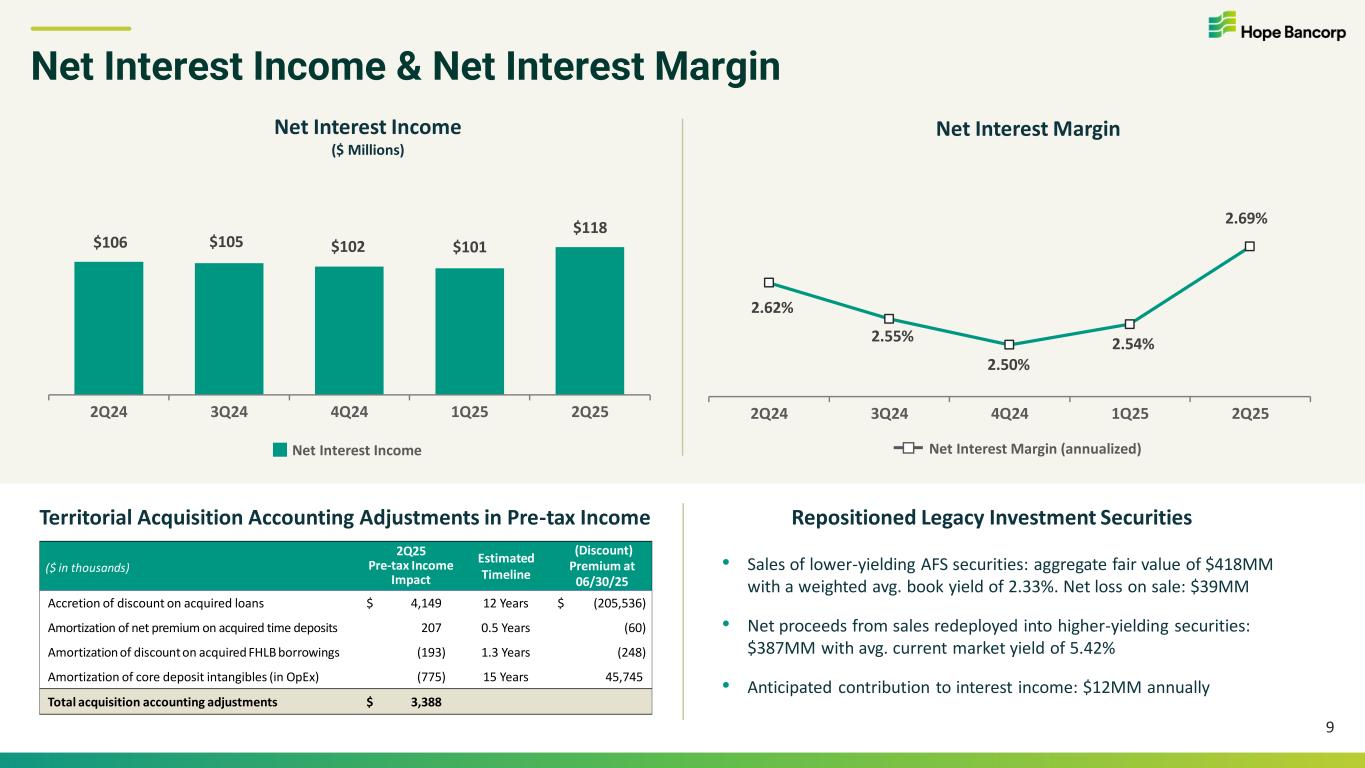
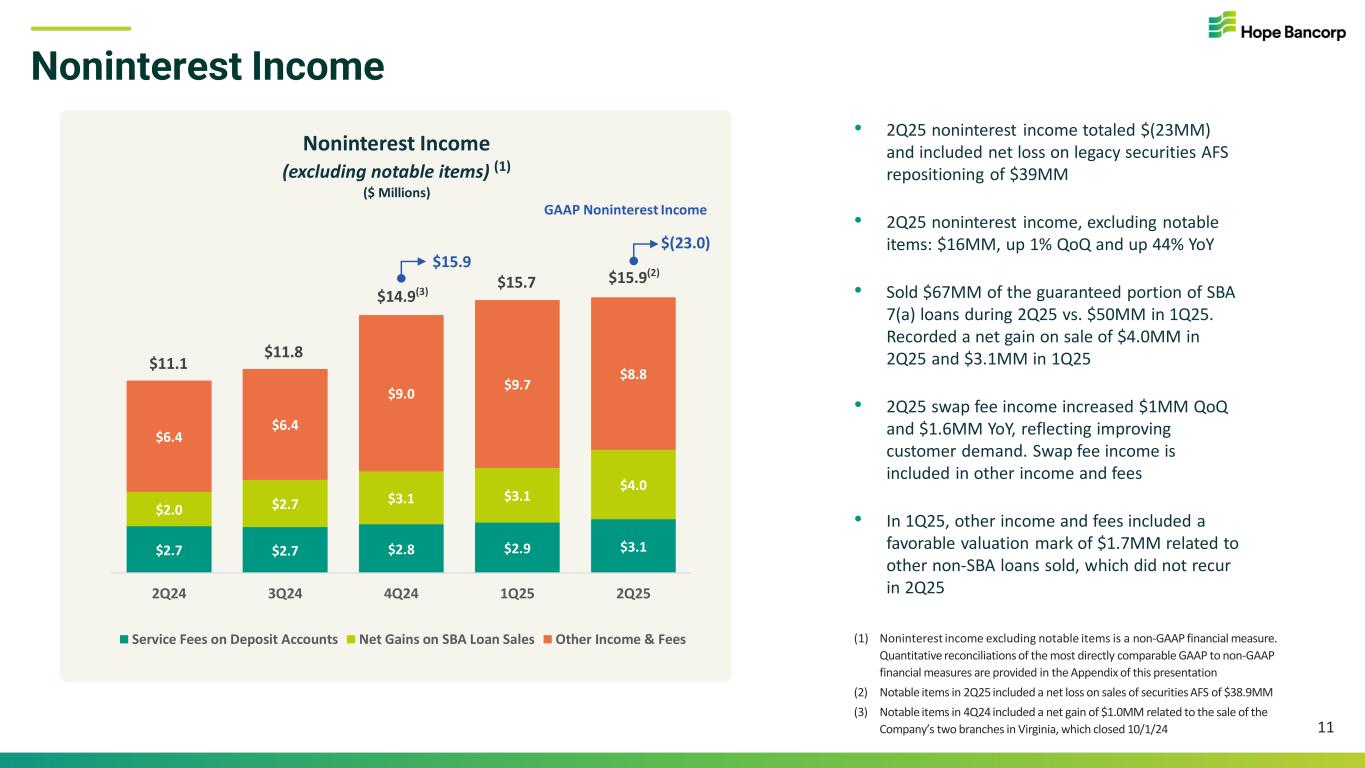
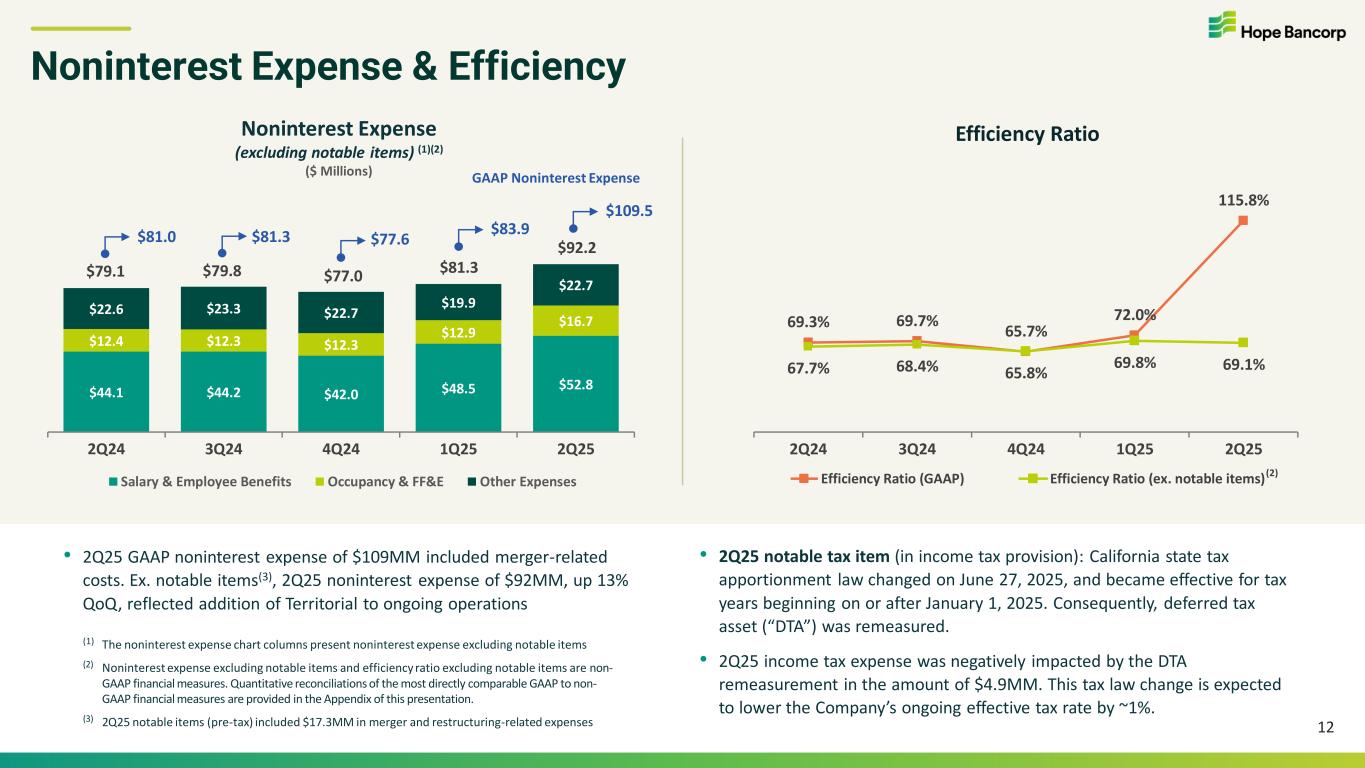
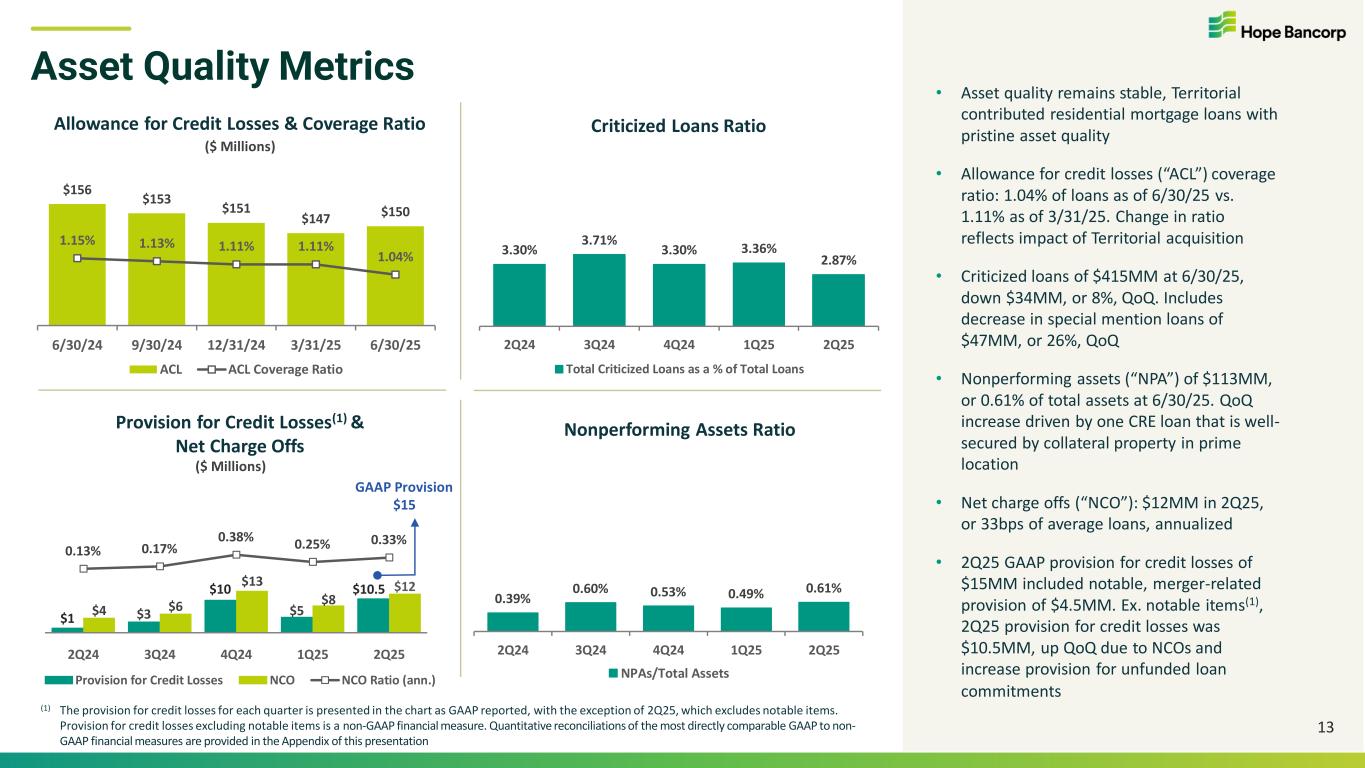
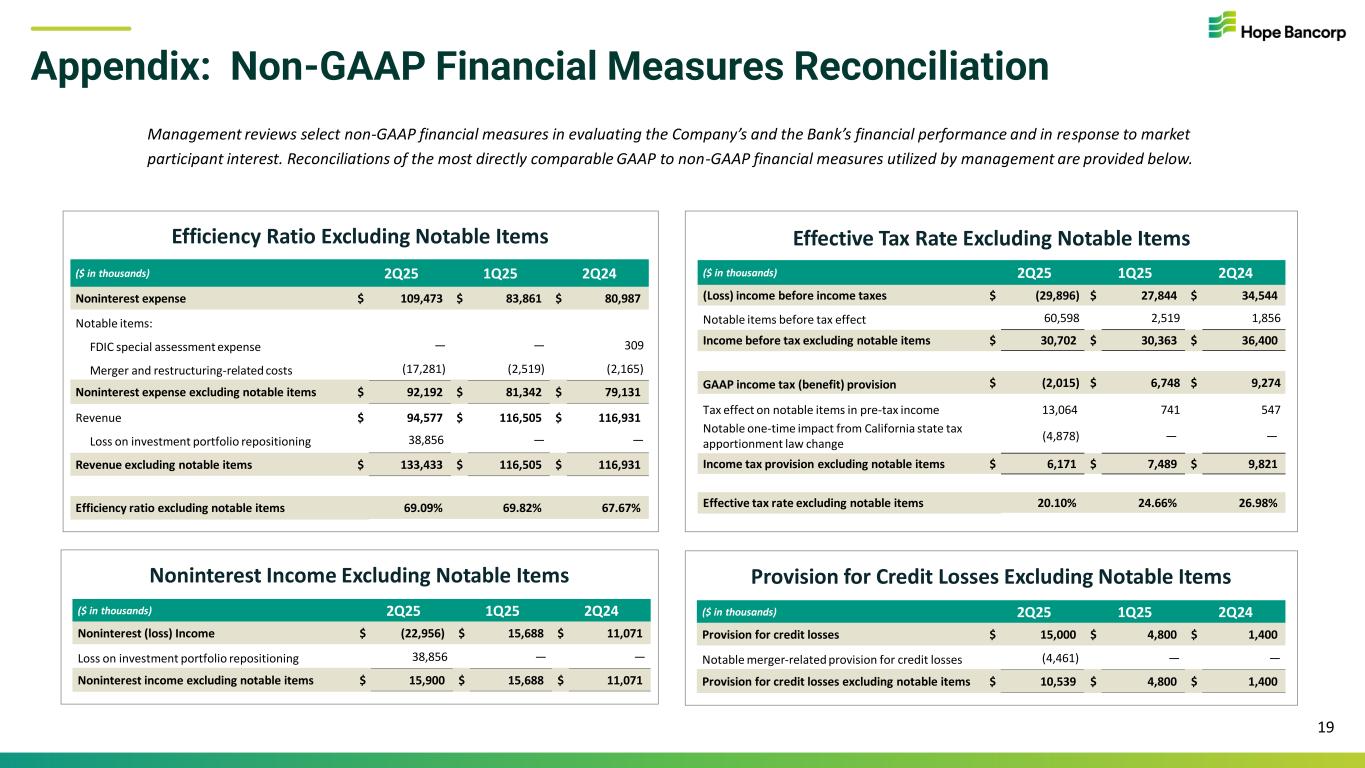
Thank you, Kevin, and good morning, everyone. Before I begin my remarks, let me just make a quick clarification to an earlier comment. We issued 7 million shares with the Territorial Bancorp transaction. And now beginning on Slide 9. Our net interest income totaled $118 million for the second quarter of 2025, an increase of 17% from the prior quarter. This reflects the positive impact of the Territorial acquisition and organic loan growth as well as an expansion in our net interest margin. On the bottom left quadrant of this slide, you can see the 2025 second quarter pretax acquisition accounting adjustments associated with the Territorial transaction. We will continue to recognize such adjustments on a quarterly basis through the amortization periods, as noted in the table. Accretion income from Territorial loans was $4 million in the second quarter. Accretion income is expected to become a recurring stable component of our interest income due to the long-dated nature of Territorial loans. The amortization period of this portfolio is currently estimated to be 12 years. I will point out that the prepayment rate on this portfolio is slower than what was initially estimated at merger close in part due to changed forward interest rate curve expectations. For 2025, we are now expecting to recognize approximately $12 million of loan accretion income at approximately $4 million per quarter compared with $14 million anticipated initially for 2025. In June, we sold a portion of our legacy investment securities available for sale with a fair value of $418 million and an aggregate weighted average book yield of 2.33%. The net proceeds from the sale were redeployed to purchase higher-yielding securities with an aggregate average market yield of 5.42% at the time of purchase. All else equal, the impact of this repositioning is expected to contribute approximately $12 million per year to interest income. Overall, our net interest margin increased by 15 basis points quarter-over-quarter to 2.69% for the second quarter of 2025. On Slide 10, we show you the quarterly trends in our average loan and deposit balances and our weighted average yields and costs. On to Slide 11. Let's look at our noninterest income. Included in noninterest income is a $39 million net loss on the investment securities repositioning that I just discussed, which we consider a notable item. Excluding notable items, the trajectory in our noninterest income has been a highlight over the last year. Second quarter 2025 noninterest income of $15.9 million, excluding the notable loss was up 44% year-over-year. Service fees on deposit accounts have continued to grow quarter-over-quarter. Swap fee income increased year-over-year by $1 million and year-over-year – excuse me, customer swap fee income increased quarter-over-quarter by $1 million and year-over-year by $1.6 million, reflecting improved customer demand. I will also note that first quarter 2025 other income included a favorable valuation mark of $1.7 million related to the sale of non-SBA loans, and this did not recur in the second quarter. In the second quarter, we sold $67 million of SBA loans and recognized net gains on sale of $4 million. This compares with sales of $50 million in the first quarter and $3.1 million of net gains on sale. Some sales that were initially planned for the first quarter moved into the second quarter, so we look at this result on a first half basis in aggregate. Moving on to noninterest expense on Slide 12. Our noninterest expense totaled $109.5 million in the second quarter, including notable items, which largely comprised onetime merger-related costs. Excluding notable items, noninterest expense was $92 million in the 2025 second quarter, which compared with $81 million in the first quarter, also excluding notable items. The quarter-over-quarter increase generally reflected the addition of the Territorial operations to our organization. Our efficiency ratio, excluding notable items, improved quarter-over-quarter to 69.1% compared with 69.8% for the first quarter of 2025. I will also mention a notable tax item this quarter. On June 27, 2025, California state tax apportionment law changed. Consequently, the onetime remeasurement of our deferred tax asset cost us $4.9 million this quarter, which we include in notable items. On an ongoing basis, this tax law change will lower our company's effective tax rate by approximately 1%. Now moving on to Slide 13. I will review our asset quality. Our allowance coverage of loans was 1.04% as of June 30, 2025, compared with 1.11% as of March 31. The change in the coverage ratio primarily reflected the addition of the loans acquired from Territorial, which have a lower reserve requirement due to the lower credit risk profile of residential mortgage loans. Criticized loans declined by $34 million or 8% quarter-over-quarter to $415 million at June 30, 2025. Within that, special mention loans decreased by $47 million or 26%. As a percentage of total loans, our criticized loan ratio was 2.87% at June 30, down from 3.36% at March 31, 2025. Nonperforming assets as of June 30th totaled $113 million, representing 61 basis points of total assets, up from 49 basis points of assets as of March 31. This fluctuation is largely driven by 1 commercial real estate loan, which is well secured by collateral property in a prime location. That charge-offs totaled $12 million or 33 basis points of average loans for the second quarter on an annualized basis compared with $8 million or annualized 25 basis points of average loans in the first quarter. The 2025 second quarter provision for credit losses was $15 million and included merger-related provision for credit losses of $4.5 million, comprising $3.9 million of day 1 provision for Territorial loans at acquisition close and $600,000 net write-off related to the exit of Hope's credit card portfolio. These items we consider as notable. With the acquisition, Hope is adopting Territorial's white label credit card program. Excluding notable items, the second quarter provision for credit losses of $10.5 million compared with $5 million in the first quarter, reflecting second quarter net charge-offs as well as a quarter-over-quarter increase in the allowance for unfunded loan commitments. With that, let me turn the call back to Kevin.
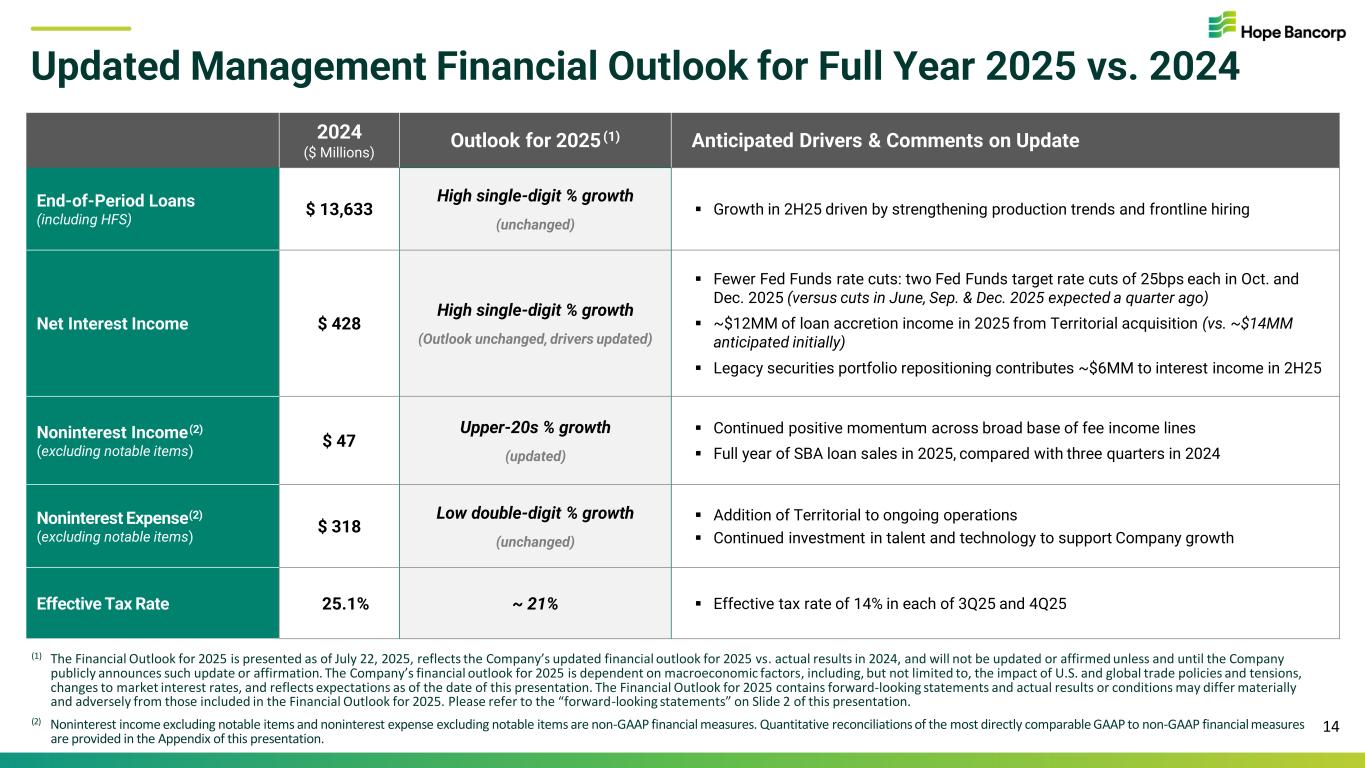
Thank you, Julianna. Moving on to the outlook on Slide 14. We continue to expect 2025 loan growth at a high single-digit percentage rate. Drivers in the second half of the year include continued improved frontline productivity, building on trends from the second quarter as well as the impact of frontline hiring that we are continuing to make. In our outlook, we customarily used the forward interest rate curve, which currently assumes Fed funds target rate cuts in October and December of 2025. A quarter ago, cuts were expected in June, September, and December. All else equal, higher for longer interest rates negatively impact our net interest income. Accordingly, in our outlook, we continue to expect net interest income growth in the high single-digit percentage range for 2025. The negative impact of fewer funds rate cuts on our net interest income, and the updated slightly lower amount of loan accretion income expected to be recognized in 2025 will be offset by the incremental increase in interest income from the legacy investment portfolio repositioning that we executed in June. We are increasing our year-over-year fee income growth expectations to be in the high 20s percentage range for 2025 based on the year-to-date momentum across various business lines. This excludes notable items. Our outlook for noninterest expenses, excluding notable items, is unchanged at low double-digit percentage growth year-over-year. Lastly, we anticipate an effective tax rate of approximately 14% in both the third quarter and the fourth quarter. This reflects the California state tax apportionment law change and the impact and timing of the tax credit investments we are making. With that, Drew, please open up the call for questions.
Operator
The first question comes from Matthew Clark with Piper Sandler.
Speaker 4
On your fee income guide, it seems you're on track to achieve approximately $63 million for the year. I understand there was a bit of a delay in sales in the second quarter related to SBA. Are there any other factors in the second half concerning fee income that we should be aware of?
Yes. I believe that for the second half of fee income, Matthew, it really comes down to timing. If you look at the first and second quarters and find the average, you'll get an idea. For the latter half of the year, we can consider some positive factors. As we mentioned, the growth in customer swap fee income has been a significant highlight compared to last year. Our company has been focused on promoting this product and underwriting commercial real estate loans with a customer swap, rather than the traditional fixed-rate loans. This approach continues to drive fee income growth. Additionally, as our loan production momentum improves, we are seeing positive trends in other loan-related fee income, including origination fees, unused commitment fees, and a variety of other fees within that general category.
Speaker 4
Okay. Okay. And then shifting to the margin, I didn't see a spot rate in your deck or in the release. But if you had the spot rate on deposits at the end of June and what you're assuming within your outlook in terms of cumulative beta on deposits through the cycle?
The spot rate at the end of June was 2.93%, and it has decreased further by the midpoint in July. This trend is continuing to improve. Regarding the overall beta we are expecting for the cycle, since rate cuts have been pushed to October and December, there isn't much more beta available this year. Therefore, our beta expectations remain unchanged from last quarter. However, I want to emphasize that when the cuts do happen, we plan to execute betas at a faster pace than during the initial cuts, aiming for 100% or better. This applies to deposit products as well, and the effect of CDs alters the total deposit beta calculation based on timing.
Speaker 4
Yes. Okay. And then can you just remind us what percent of your loans are truly floating, that reset with each Fed cut with Territorial now on board?
About 42% of our loans are truly floating.
Speaker 4
Got it. And do you know how much in cost savings are remaining for Territorial so we can take that into account going forward?
In the Territorial franchise, we are very delighted to welcome the Territorial team members into the Bank of Hope family, and we have been focusing on strengthening those operations, as you well know, through other M&A. Generally in M&A, the upfront cost saves are executed in the beginning, which generally relate to corporate administrative cost cuts. And as we have said in the past, we plan to focus on maintaining the continuity of the customer experience. So right now, I will say that there is still more integration and cost fees coming in the second half of the year. But as far as the magnitude, we will share that later in the year.
Operator
The next question comes from Gary Tenner with D.A. Davidson.
Speaker 5
A couple of my questions were already asked. But with the deal closed, CET1 ratio over 12% and the stock below tangible book, any thoughts here on a buyback as the dust settles on the transaction?
Well, Gary, we have been carefully evaluating our capital efficiencies and the securities repositioning in June was part of our capital deployment strategies, and we are continuing to assess additional opportunities, I think I can say that much.
Speaker 5
Okay. And then just in terms of the conversion timing for Territorial, when is that going to occur?
Conversion, meaning the system conversion?
Speaker 5
Yes. System conversion?
Yes, that is expected to be completed by the end of next year. We have tentatively decided to run a Territorial system for the time being because their system is very close to the expiration of their contract and we are very close to that.
Speaker 5
Okay. So does that just push out the cost savings that you had talked about when the deal was announced, I think it was like 27% or so of Territorial expenses that just pushed that out deeper next year.
Not necessarily the core costs and the IT costs were not the biggest component of Territorial's cost base. If you look at Territorial's disclosures and their proxy statements, you will see that the largest component of cost savings from that franchise would come from the form of executive compensation.
Operator
The next question comes from Kelly Motta with KBW.
Speaker 6
I was hoping to circle back to your expectations for loan growth. On an organic basis, it was relatively modest this quarter, but you mentioned you're making some frontline hires to help drive the outlook ahead. I'm wondering if you could share a bit more as to what you're doing on that front. And kind of the cadence of their contributions, as I know, it can take a bit of time in order for new hires to add to net growth?
Yes, we have been hiring experienced and talented commercial and corporate bankers in recent months, and we plan to continue this. If you examine our loan production in the second quarter, you'll see a significant increase compared to the first quarter. Looking at the pipeline at the start of the third quarter, I believe our loan production will keep growing throughout the year. In terms of payoffs, while our figures for the second quarter were not as high as those in the first quarter, we still see elevated levels in payoffs and paydown trends. Once these payoffs and paydowns stabilize and normalize, alongside the additional origination volumes we anticipate from our new bankers, I think achieving loan growth in the third and fourth quarters is quite feasible for us.
Speaker 6
Got it. That's helpful. I have a second question regarding asset quality. In your release, you mentioned the migration of CRE credit, noting that it is well secured and located in prime areas. Considering the overall credit landscape and your current observations, I’m curious if there has been any change in how you perceive the asset quality of your portfolio compared to a quarter ago when the situation was more uncertain due to tariffs. Could you provide some additional insights on your current outlook regarding credit and what aspects you are monitoring more closely?
Sure. This is Peter. Yes, we're actively monitoring our portfolio and feel cautiously optimistic. While there is still a lot of uncertainty, we are definitely keeping an eye on the situation. If you look at our overall level of potential problem loans, which is indicated by our criticized assets, you’ll notice a significant decline this quarter. Therefore, barring any unexpected fluctuations in the macroeconomic environment, we believe that asset quality remains manageable and stable.
Operator
The next question comes from Tim Coffey with Janney.
Speaker 8
Kevin, I was wondering, could you provide some commentary on the legacy borrowers in Hope Bancorp, the ones that are on the commercial side more towards the retail aspect of those businesses. How they did in the second quarter? Because I think at the beginning of the quarter, there might have been a lot of uncertainty around it, but it seems like that uncertainty started to evaporate by the end of the quarter.
Actually, this is Peter. I can probably answer that. I think just the level of uncertainty was much higher, I think, as we sort of started the quarter in Q2. I think a little bit of that dust is settling down. There's obviously still a lot of uncertainty. But actually, I think as we've been monitoring the situation. I think the economy and particularly, the consumer base has remained fairly resilient. And although there's still some risk there and we're definitely being proactive around that, we have really haven't seen much impact to our customer base as of yet.
Speaker 8
All right. Great. Thanks a lot, that appears great. And then looking at the deposit portfolio, right? I mean there seems to be a pretty good balance now between commercial and consumer balances. Is that something, one you'd like to continue to maintain that kind of that balance? And also, do you have a target for how much broker deposits you'll need going forward?
Well, we have stated in the past our target loan-to-deposit ratio is to be up to 95%. We're obviously at below 91% there. So we do have some growth and excess liquidity at the moment. However, but that should give you an idea for how much deposit growth we believe we need on an ongoing basis because we've also said in the past that on a medium-term basis, we would like to target loan growth in the high single digits, right? Now in terms of the customer base balance, I think we have a pretty great balance right now between consumer and commercial loans. Our broker deposits are down to 5% of total deposits. So this is a pretty good place from which to focus on generating growth and expanding the customer wallet share and adding new relationships.
Operator
And we have a follow-up from Kelly Motta with KBW.
Speaker 6
Thanks for letting me jump back in. Just a quick modeling question for Julianna. Can you remind us how much more onetime costs are yet to be realized? And now with the conversion kicked out a bit, would those occur closer to conversion? Or is there a cadence to expect for the back half of the year?
One second. In the back half of the year, there'll be probably a couple of million more of onetime costs in the third quarter and then probably a couple of million more in the fourth quarter just from various odds and ends, if you will. So that's what I can share with you right now.
Operator
And we have a follow-up from Gary Tenner from D.A. Davidson.
Speaker 5
I just wanted to ask, I apologize if I missed this. But in terms of the new production in the quarter, what was the average yield on new production?
The average yield on the new production was approximately 76%.
Operator
And we have a follow-up from Matthew Clark from Piper Sandler.
Speaker 4
Just another housekeeping item. For next year, the tax rate I know it's going to come down by 100 basis points, but does that imply 24% for next year?
No, I think that the tax rate for this year, on a full year basis sits at 21%. When you look at 2026, I think our tax rate going forward beyond this year will be in the 20 percentage range again, not taking into account any tax law changes that may impact 2026 from the passage of recent federal legislation, okay? So just based on what is in place today, I would say that our tax rate going forward will be in that 20%, 21% range, and it's down from the prior year because of the state apportionment tax law change, but also because we are continuing to invest in low-income housing and other tax credit investments to help lower our tax burden.
Speaker 4
Okay. Great. And then just net charge-offs this quarter up a little bit. Anything chunky in there or anything maybe unusual to call out? Just trying to get a sense for where that might go going forward? I know it's tough to say, but?
Yes. The charges were up slightly this quarter. I think that we remain at manageable levels. I mean, we still have some cleanup that we're undergoing right now. So I would just look at sort of just portfolio management as the reason there. But going forward, as you have heard, I think our level of overall criticized assets is going down. NPLs did have a little uptick, but it's a real estate property that's well secured. So on the asset quality front, we are, again, cautiously optimistic. Do you think there is a roadmap here? The macroeconomic environment continues to support that we will remain at stable manageable levels going forward.
Operator
And we have a follow-up from Kelly Motta with KBW.
Speaker 6
Thanks for letting me hop in a third time now. Last question for me on the guidance, you maintained it, but you also had the benefit of the securities restructuring in the back half of the year. It seems like some of the guide change is related to taking out a rate cut, the accretion from Territorial, but on a core, core basis, it still seems down. Wondering if you could share if that's really just the function of rates or if there's something else that is creating that variance, whether it's maybe some additional pressure on the deposit side or slower loan growth. Just wondering if you could provide some color as to what drove that.
Yes, I can provide some comments on that. When we issued our guidance in April, we anticipated the first rate cut to start in June. This would have resulted in two full quarters of a rate cut, plus another cut in September, equating to a full quarter of further cuts. As indicated in our 10-Q disclosures, a 100 basis point change affects our net interest income by $20 million. If we exclude the impact of the curve change from our initial forecast for the first quarter, we would have seen about a $4 million reduction in income. We managed to offset this through repositioning our securities portfolio. Additionally, the alteration in the forward curve has influenced the pace at which we recognize accretion; a prolonged period of higher rates tends to slow the prepayment speeds. Consequently, our upfront accretion for the first year is now projected at $12 million, down from $14 million. This helps explain how we maintain our net interest income. While we continue to enhance our originations, the blended loan yield on these originations did see a slight decrease quarter-over-quarter, reflecting competitive pricing pressures in the loan growth market. Overall, the calculations are heavily influenced by the curve and accretion factors. We are also actively working on optimizing our deposit mix and reducing higher-cost deposits, as evidenced by our ongoing improvement in broker deposit exposure.
Operator
This concludes our question-and-answer session. I would like to turn the conference back over to management for any closing remarks.
Thank you. Thank you, Drew. Once again, thank you all for joining us today, and we look forward to speaking with you in 3 months. So long, everyone.
Operator
The conference has now concluded. Thank you for attending today's presentation. You may now disconnect.