Operator
Ladies and gentlemen, thank you for joining us, and welcome to the Independent Bank Corp First Quarter Earnings Call. Before proceeding, please note that during this call we will be making forward-looking statements. Actual results may differ materially from these statements due to a number of factors, including those described in our earnings release and other SEC filings. We undertake no obligation to publicly update any such statements. In addition, some of our discussion today may include references to certain non-GAAP financial measures. Information about these non-GAAP measures, including reconciliation to GAAP measures, may be found in our earnings release and other SEC filings. These SEC filings can be accessed via the Investor Relations section of our website. Finally, please also note that this event is being recorded. I would now like to turn the conference over to Jeff Tengel, CEO. Please go ahead.
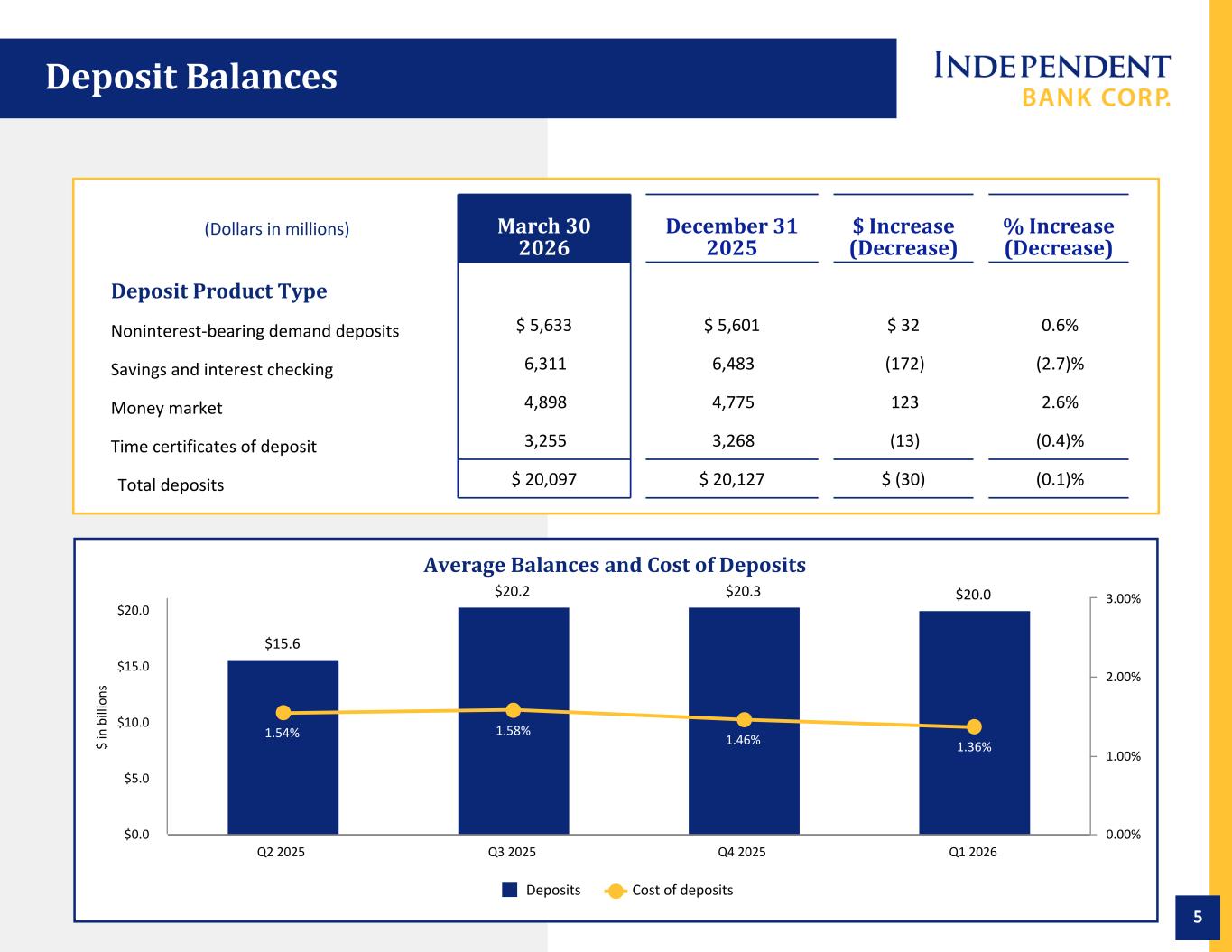
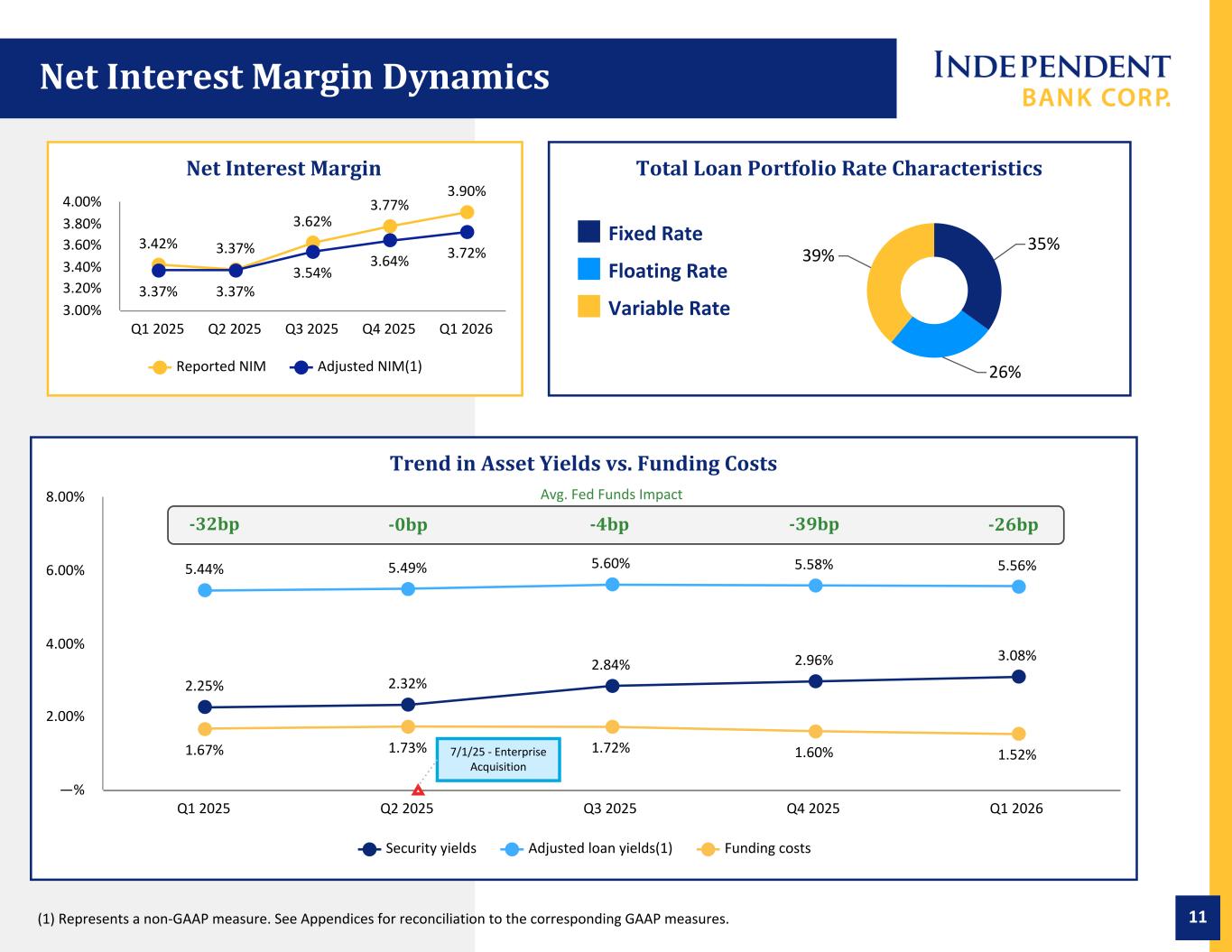
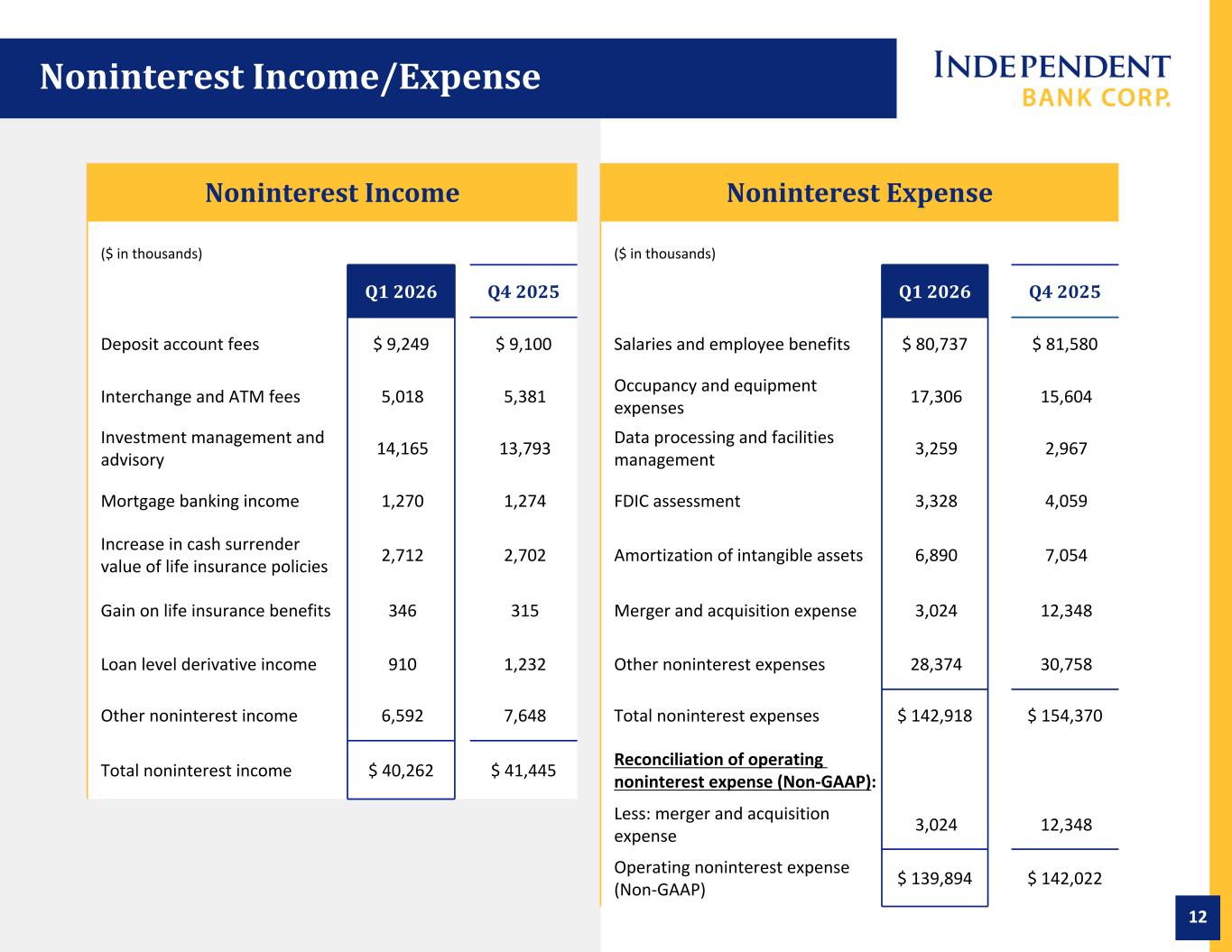
Good morning and thanks for joining us today. I'm accompanied this morning by CFO and Head of Consumer Lending, Mark Ruggiero. When we last spoke in January, I highlighted several major areas of focus for Rockland Trust in 2026. Organic growth, expense management, and capital optimization. Our first quarter results reflect progress in all of these areas. While reported loan and deposit growth were somewhat muted, I will talk later about why we remain encouraged with our ability to continue to grow organically. We held the line on expenses and continue to proactively manage our capital. The first quarter also saw a continued NIM improvement, increasing 13 basis points from the fourth quarter. This reflects pricing discipline across both our loan and deposit portfolios. Excluding loan accretion income, our adjusted NIMH rose by eighth basis point. Mark will elaborate on our NIMH during his comments. Excluding M&A charges, expenses were down 1.5% from the fourth quarter as we realized the impact of cost savings from the enterprise transaction, which was offset by seasonally higher employee and occupancy costs. Additionally, the quarter reduction benefited from the absence of certain outsized expenses occurred in the fourth quarter. With the investments we have made in people and technology over the past few years, we believe we have the scale to continue to grow without significant additions to our expense We returned $94 million of capital to shareholders in the first quarter, including the repurchase of 802,000 shares for $63 million. I would like to point out that despite our aggressive capital actions, tangible book value rose to $47.86. We also recently announced an 8.5% increase in our quarterly dividend. With expected further improvement in our profitability and moderate balance sheet growth, we expect capital management to remain a key priority for the balance of the year. There is a significant amount of work underway as we prepare to transition our core operating platform from Horizon to IBS, both part of the FIS ecosystem. The conversion is scheduled to take place in October of this year. The new operating system will provide additional product capability and enhanced efficiencies that reflect the size and scale of our organization. This is an important milestone for Rockland Trust and will position us for future growth. I'd like to take a moment to talk about AI. This is obviously a topic on investors' minds. In the first quarter, we established an Office of Digital Innovation. We have established a governance framework around our AI activities to ensure we stay within the guardrails of our moderate risk profile and any actions are consistent with our award-winning culture. This governance framework includes a steering committee that will serve as a clearinghouse for AI use cases. This will allow us to make AI investments in those areas that have a meaningful payback and avoid the proverbial boiling the ocean. I expect us to start with some relatively easy use cases as we build muscle memory. Over time, this should enable us to gain confidence in our ability to execute and take on bigger, more impactful applications. I mentioned earlier that somewhat muted in the quarter, marked volatility in interest rates and the lingering inflationary environment. It should be no surprise there is not a uniform consensus on the current business climate from our bankers and customers. The duration of the war and its impact on oil prices will dictate the ultimate effect on distribution companies, contractors with truck fleets, manufacturers, construction firms, and energy-intensive operators. Energy and commodity price volatility to weigh on cost structures. While a notable share of our clients indicate that they have adjusted to the current rate environment, Others suggest that the higher rates have delayed expansion plans. Lastly, inflation remains a dominant concern across sectors, particularly with respect to labor, health care benefits, materials, and utilities. Suffice to say, the environment is best characterized as somewhat challenging. I would summarize our customers' mindset as cautious. Importantly, though, we have not seen any meaningful stress in our loan portfolios as a result of the current environment, and our customers continue to manage through this. With that as a backdrop, our total commercial loans declined by $50 million from the fourth If we peel back the onion a bit, though, underlying results were stronger than reported. For example, excluding the impact of the $39 million decrease in our dealer floor plan business, which we are exiting, our C&I loans rose at a healthy 7% on an annualized basis. In addition, we would note that the office portfolio contributed $56 million of the $94 million drop in commercial real estate balances for the quarter. Our CRE concentration now stands at 283%, and we believe we've achieved most of the targeted reduction in transactional CRE business. While we have reduced transactional Cree balances, we funded $179 million of relationship-based Cree loans in the first quarter and added $290 million of Cree commitments. We still like the Cree asset class and will continue to support our clients in this space the way we always have. This dynamic continues the rebalancing of our commercial lending business. C&I loans now represent 25% of SOTA loans versus 22% at year-end 2024. It's important to note that our C&I growth is being driven by core relationship banking. We do not have any exposure to the NDFI or private credit segments that have driven much of the industry's loan growth. In summary, we're optimistic about our market position. We have the product set and talent to drive commercial loan growth going forward. Lines totaled $313 million, up from $278 million at year end. But importantly, we will not sacrifice credit structure or rate for new business. This is consistent with how the legacy Rockland Trust has always operated. On the funding side, period end deposit balances were essentially flat. The 1.5% decrease in average deposits from the fourth quarter is consistent with prior years as seasonality tends to adversely impact business operating balances in the first quarter of the year. DDAs represent 28% of overall deposits and the cost of total deposits was 1.36% in the first quarter, highlighting the immense value of our deposit franchise. Similar to the loan portfolio, and as we have said many times, we will not sacrifice rate to show deposit growth with transactional one product customers asset quality our net charge outs were 11 basis points for the first quarter and have averaged just 11 basis points over the last year as we suggested last quarter we're not out of the woods yet with respect to our quarter several office loans exited the bank while a couple of new office loans were added to criticize status we continue to believe the challenges within our office portfolio are identifiable and manageable As I've mentioned in the past, there's no quick fix here. We remain diligent in managing this portfolio segment, and while we are confident the worst is behind us, we'll continue to be transparent with the market as we work down this asset Our wealth management business continues to be a key fee-income driver for us. Despite an incredibly volatile market, our AUA were essentially flat at $9.2 billion dollars as positive net asset flows and strong relative portfolio performance mostly offset market-related declines. Importantly, we were pleased with the diversity of new client inflows. Revenues grew at an 11% annual rate driven by higher asset-based fee revenue and insurance commissions. The results represent another step forward in driving improved profitability at Rothman Trust. We remain focused on accelerating our organic growth, reducing our CRE office portfolio, and prudent capital management. These actions, coupled with our industry-leading deposit cost, discipline expense management, and operational excellence, will return INDB to our historical market premium valuation. I feel particularly confident about Rothman Trust's positioning across our markets, driven by the strength of our products, the dedication of our people, and the effectiveness of the strategies we've put in place. I want to thank all Rockland Trust employees for their tremendous efforts in making the first quarter a success. Every measure of our success is a direct result of their commitment. On that note, I'll turn it over to Mark.
Gap net income was $79.9 million, and diluted EPS was $1.63, resulting in a 1.31% return on assets, a 9.02% return on average common equity, and a 13.6%. The adjusted operating net income for presenting a 1.35% return on assets, a 9.27% return on assets, and a 14.05%. As Jeff alluded to in his comments, we maintained our robust CET1 capital ratios at 12.87% while repurchasing our common dividend. $24 million left on the current repurchase authorization. We anticipate establishing another round here in the second. We saw this element of uncertainty play out during the quarter in a couple of areas. The first area I'll note is in regards to price. As a bank that has never looked to lead with rate, we have seen some flow of excess customer funds leave for pricing. This dynamic combined with seasonal volatility, we operate with conviction that finding the right balance of pricing discipline while supporting our relationship customers is crucial. And we believe the Q1 results of flat while reducing the cost of deposit to 10 basis points is a strong outcome of this philosophy. On the lending side, we saw demand impacted in a few areas, as all the macroeconomic uncertainty that Jeff just talked about is keeping some customers. Our largest commercial portfolio, multifamily, is one particular afterclass where we have seen this impact. With the reduced Cree portfolio much more representative of our legacy relationship lending profile in the low 2A, While this pre-strategy continues to play out, we remain extremely optimistic over our near-term C&I. Reiterating the $39 million decrease associated with our winding down of the dealer floor plan portfolio, other C&I balances increased $78 million during the first quarter, or 7% on an annualized basis. In addition, the rebuild of our approved should bode well. On the consumer side, typical seasonality drove reduced overall volumes in the mortgage business, but an increase in saleable activity kept the mortgage banking result while absorbing runoff of lower yielding portfolios. And home equity volume has remained consistently strong with the $10 million increase in balances despite continued lower yielding. Here's a bit. The combination of the deposit cost reductions that I just discussed and securities cash flow repricing dynamics drove a solid eight basis point. Elevated purchase accounting accretion versus the prior quarter, the reported margin rose sharply to 3.90%. The balance sheet remains very well positioned to continue to drive consistent improvement in the net interest margin, while providing flexibility to lever up or down as needed to stay neutral to any short-term rate charges. Moving to asset quality, we highlight the following notable items for the first quarter. Total non-performing assets increased to $98.7 million, or 0.52% of total loans, driven primarily by the downgrade of one-off. Net charge-offs for the quarter were $4.8 million, or 11 basis points annualized, with $4 million related to a pre-relationship. And as a quick positive update, this $4 million charge-off loan was associated to a non-performing office loan that actually repaid the quota provision for loan loss was $5.5 million. And while total criticized and classified loans increased versus the prior quarter, Q1 levels of 4% of total commercial loans remain in the range we have experienced over the last year or so. The downgrades to criticized status during the quarter were primarily isolated to a few credits with no identified loss reserve. Our fee income businesses performed in line with expectations for the quarter, coming in relatively consistent with the prior quarter results despite fewer days in the quarter. Jeff provided color on the positive momentum within our wealth management group, and we are also pleased with the continued expansion of our treasury management services as many of the newer C&I customers leverage the full suite of cash management products that we offer. On the expense side, I'll first point out that we did have a final round of severance related to the enterprise acquisition that made up the majority of the three, slightly higher than our guidance. We remain focused on analyzing all areas of the bank to ensure expenses are appropriate and justified. Along those lines, our work on the upcoming core conversion is ongoing, with approximately $1.1 million of expenses in the first quarter, directly attributable to those conversion efforts. And lastly, as expected, the tax rate increased from the prior quarter to 23.38%. With that, I'll now finish up by revisiting our 2026 guidance. First, we reaffirm our two primary profitability targets for the fourth quarter of 2026. The first is return on average assets of 1.40%, and the second is return on average tangible capital. We update our Korean construction full-year estimates to now be flat to low single-digit percent on and deposit estimates. interest margin we increased our estimate to suggest that the 2026 fourth quarter margin will now be in the range of 390 to 395. all other guidance remains unchanged from the that concludes my comments and with that we will we will now begin the question and answer session
Operator
if you would like to ask a question please press star one to raise your hand to withdraw your question, press star one again. We ask that you pick up your handset when asking a question to allow for optimum sound quality. If you are muted locally, please remember to unmute your device. Please stand by while we compile the Q&A roster. Your first question comes from the line of Justin Crowley with Piper Sandler. Your line is open. Please go ahead. Hey.
Hey, good morning, everyone um was was wondering if you could start off on loan growth um you know you tweak the guide a bit lower on the crease side of course so just curious if you could expand even a little more on on what informed that decision and then and then also if you could just give us a sense you mentioned some uh you know some caution on the on the borrower side but just as far as demand how you've seen borrowers respond with some of the heightened macro volatility and how long you think that could maybe persist here.
Yeah, on the Cree side, it's interesting because the commercial real estate market has gotten very, very competitive. It's really competitive. We see it at the low end with a lot of the smaller banks and the mutuals, and we see it at the larger end, too, with some of the, you know, the larger banks. And it's a space where, as I said in my comments, you know, we're not going to stretch from, and so we think that the environment has been, is really very, very competitive. So we're continuing to support our existing clients where we can. The other thing that I think is providing a little bit of a cloud over the commercial real estate business in eastern Massachusetts anyways is the prospect of rent control, and so a lot of the multifamily projects, these would be mostly construction loans, really aren't happening. A lot of the investors are on the sidelines, and they're not commencing with any of the, you know, maybe historical pace that they would have in the construction space in that multifamily asset class, so we've definitely seen a market slowdown there. With respect to the second part of your question, it's kind of hard to pinpoint when that's going to turn. If you could tell me when the war is going to be over and when the price of oil is going to return to where it was prior to, I think I might have a, or maybe in listening to our clients have a better sense for how they're thinking about it, but I think caution right now is definitely the the word I would use to express how generally are you know that the middle market and lower middle market client base feels strong and and you know they'll continue to invest where they think is prudent but
it definitely is is causing the owner-operators that we probably makes them think a little bit long and hard you know the phrase about measure twice and cut once I think is definitely for their minds okay guys so I just have from a guide standpoint I think all of that uncertainty certainly has increased a bit over the first quarter and and I think just a bit of a part of 40 million dollar office loan shouldn't here in 2026 but you know having that play on a net loan was, you know, those were in terms of opportunity and the pipeline growing.
And then just flipping to, you know, on the credit side, you saw non-performers up a bit and then had the criticized inflow. Can you provide a little more detail on the drivers there? I think you mentioned offices back there, at least on the non-performing side, but that, you know, I'm not sure the extent when you looked at criticized balances. And then I know it's pretty formulaic at this point, but just how all the inputs, how that gets you to an allowance that was pretty flat for the quarter, just, you know, where you feel or how you stand on credit quality.
Yeah, I'll take the first part of that, Justin, and then Mark take the second part. With respect to the criticized assets, we really had three larger loans that moved to criticized status that make up the bulk of that increase. and all three are in different asset classes only one of those is in the office asset class one of them CNI and the other one I think is in the multifamily space which is really the first multifamily loan that I think has been criticized in quite some time and and in that particular instance it's just a little bit slower lease up which we're not overly concerned about it's just taken a bit longer and then we were just being prudent in moving it to criticized status, but still feel really, really confident that things are going to work out. So that's the quick overview of the increase in criticized loans, and as Mark pointed out, we're still well within the historical levels of criticized loans that we've operated at in the past. I'll let Mark address the second part of you.
I think from a provision to a bit of that answer, which is obviously the downgrade you know they're not at a point now where we reserve that needs to be set so that that drove a little bit of the of the need for provision I talked about the four million dollar charge off in the quarter that was a couple million dollars higher than what we had reserved and then you know we are tweaking the model a bit you know a conservative macroeconomic environment factor playing through I think on the consumer side we feel really good about the credit picture right now but you know I think you'd be naive to suggest there isn't a little bit more pressure on the health of the consumer so you know a million or two of added reserve on those
would be the three main drivers behind the five and a half million helps from a provision standpoint but it was it was really the charge-off the downgrades and a little bit of build on great and then just one last one you know get some of of the buyback executed in the quarter, obviously a lot of volatility in the market, but with average pricing coming in about where we're at today, I'm just curious if you can speak a little more on the ability and appetite to keep this sort of a pace as you look to reduce excess capital.
Yeah, I can tell you it will absolutely be able to keep capital relatively flat. Now, we can lever up and down a little bit from there, but I think that's the right, you know, a bit of a management over holding company liquidity, pre-concentration, and obviously optimizing capital. So I haven't announced a new plan yet. I would be very comfortable suggesting we will likely put one in place here in the second quarter, but the level of buybacks should be at a pace where we're going to try and keep capital relatively flat.
Great. I appreciate it. I'll leave it there.
Operator
Thanks for the time this morning. Your next question comes from the line of David Conrad with KBW. Your line is open. Please go ahead.
Yeah, thanks. Just really a follow-up on the capital and the buyback. I mean, your C2-1 level is about 12.9, and you started the buyback, and it really didn't budge. And I think earnings power is going to improve even if loan growth improves a bit. So maybe balance the discussion of why you would want and desire to keep that flat instead of working that down a bit and how you weigh the environment with, like, narrowing credit spreads and excess competition with potential, you know, using that for a potential by-best to offset that?
Yeah, it's a fair question. You know, I think, like, there's a growth path that we'd like to leave some level of capital flexibility. You know, ideally, I've said this a few times now, ideally we'd grow into that excess capital position. But we also are being realistic and recognized. You know, we're talking a lot about uncertainty in the environment. That's going to keep loan growth somewhat at bay, or looking at a minimum to basically keep flat. Doing more than that, David, to be honest, some of the practical limitations there will be funding. So in a holding company bank structure, ideally would be company dividends. You know, doing that at a pace that exceeds earnings. we wouldn't do it but you know where we're still weighing that pro and con and then we are still being you know cautious about keeping creek concentration at a range that we think is appropriate and allows us to grow when the market turns so that 280 to 290 range we're very comfortable with on the buyback side we're trying to find that right balance of about like I say at a minimum keeping cat will not pressure funding indoor creek concentration, but when you stop...
Got it. Fair enough. And then maybe a follow-up. Just regarding the Fed's proposal for Basel III, just wondering if you had any thoughts on risk-weighted assets within the mortgage or CRE portfolio, given their guidance.
We've done some rough modeling on that, and I think we would be comfortable suggesting our impact would be aligned with probably meaning, you know, with 25% of our book these are I think you'd expect to see somewhere around and then on the commercial side by basis point probably about a seven to eight percent which thank you certainly allows for an expectation for you know even more buyback or obviously just more time thank you your next question comes from the line of Steve Moss with Raymond James your line is open please go ahead Good morning, guys.
Hey, Jeff, Mark. Maybe just going back to the loan pipeline here and loan yields, just good to see the step-up in activity and the organic growth there. I'm just kind of curious, you know, where are you guys putting on loans these days?
On the commercial side, Steve, it's low sixes. It's in the five. On the consumer side, there's not a lot of portfolio going in, but that's probably a little bit lower yield, call it 575 to 6%. Most of the home equity volume continues to be prime. So that's, you know, the biggest driver, low sixes.
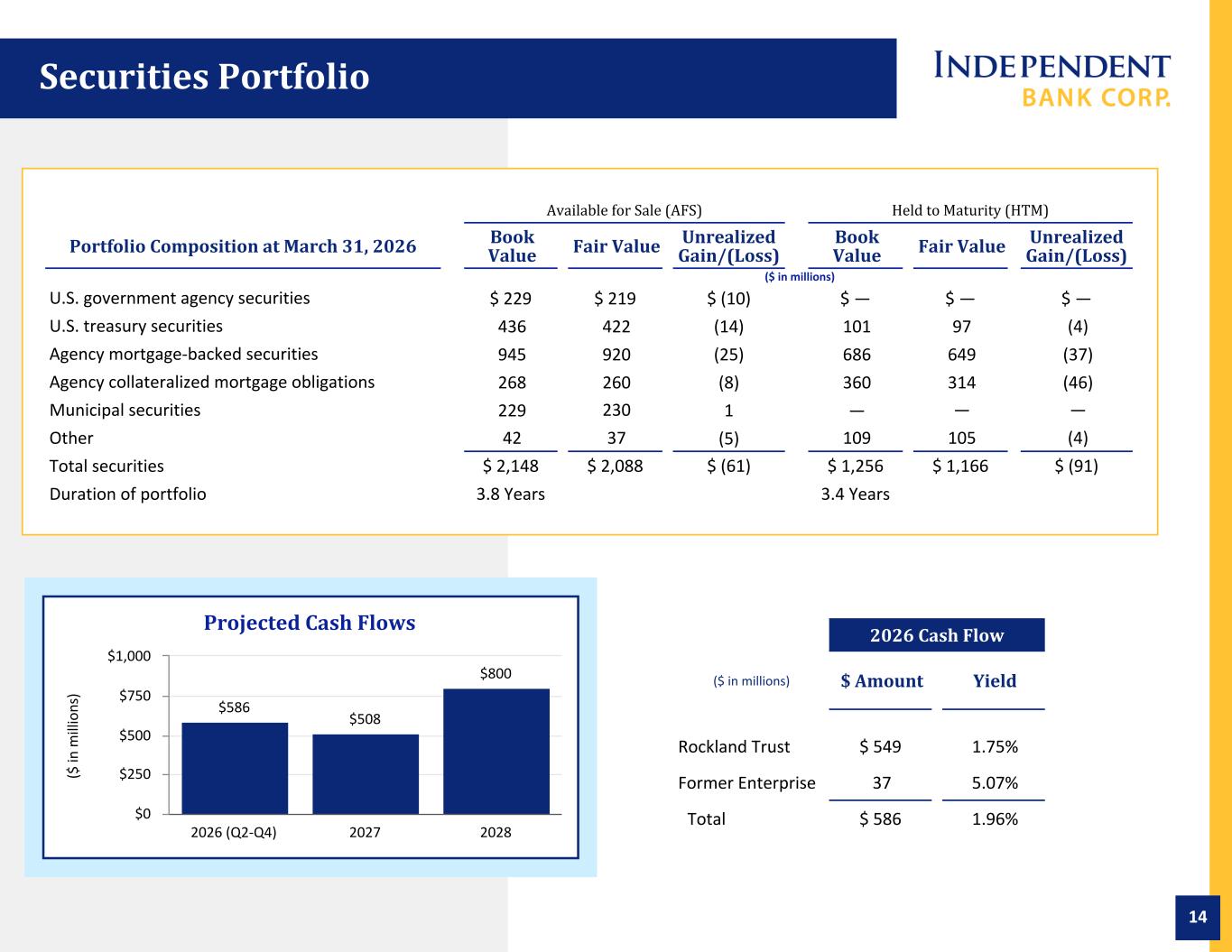
And then in terms of the securities cash flows here that you have coming on, coming off, just curious, Mark, you mentioned deposit pricing, obviously, saw some things run off. Are you thinking of using some of those cash flows to continue to manage higher-cost deposits lower, or are you thinking about, you know, parking those in securities here, or just what's the dynamic you're thinking going forward here?
Yeah, I think from a balance sheet position and liquidity management perspective, we'd be looking to keep the securities portfolio pretty flat where it is. I probably wouldn't want it to get too much lower than where we are. You know, maybe down to 11%, 12%. We certainly would be comfortable, but I think I'd expect to see the majority of the cash flow go back into the securities portfolio. We're seeing good yields there in terms of managing that portfolio and keep discounted, you know, fairly. We're getting, you know, on average, you know, that dynamic giving you 200 to another big driver of the market.
And then in terms of just the multi-family business in Massachusetts, you know, you guys have about a $2.9 billion book. Just kind of curious, you know, with the rent legislation here, you know, are you guys going to tighten underwriting standards? You know, are there any thoughts of adjusting the way you operate on that front? And could that be a little more of a headwind beyond just this year if it passes?
Yeah, I mean, the most obvious headwind would just be the muted new business coming from construction loans in the multifamily space. As I mentioned in my comments, I think a number of investors, and I've spoken to several of them, and they'll tell me, look, we have choices. We don't have to invest in Massachusetts. We can invest in, you know, Connecticut or, you know, New York or wherever. And so I think we're going to, until that issue gets, I think there's going to continue to be muted demand on the construction side. Within the existing portfolio, our multifamily portfolio is, I would suggest, is pretty seasoned. It's been underwritten, consistent with historical Rockland Trust conservatism. We don't underwrite the trended rents or any of those sorts of things. So we feel really good about the existing portfolio of multifamily loans that we have. We haven't seen any signs of, I think the biggest challenge is going to be with feeling like our existing.
And then in terms of just going back to the office credit here, I just want to clarify with regard to the payoff and the charge-off. Is it fair, did I understand correctly, that you charged off the $4 million and then the remaining balance, which I'm assuming is the $13.7 on the deck, was paid off just a few days ago? Or is it a recovery? I was kind of, okay.
No, no, we charged it off to the P&S that we knew.
That's what I expected. I just wasn't quite sure I heard it right. That's a good question. Okay, great. And then one more thing just on the non-interest bearing dynamics for the quarter. Just kind of curious, you know, they went down quite a bit, but EOP was flattish. Was there anything seasonal that maybe we should have been thinking about?
On the deposit side, particularly?
Yes, on non-interest bearing.
Yeah, yeah, there's definitely seasonality, particularly in our business segment. You know, when you look at the data in the reporting for the quarter, we're encouraged by a couple of things. The first is brought in new relationships and deposit dollars associated with new relationships that outpaced closed relationships. So where we saw some of that average deposit pressure is in existing balances being utilized. And I would attribute that to a couple of things. One is typical seasonality, tax payments, distributions, whatever it may be. We always see the low point of our deposits in the first quarter. Second is I think there is some level of, just to some modest degree, a level of spend, standing deposit balances. And then third, to be very candid, there is some money that we knew we let go that we're seeing in our market. So you may see a customer depending on the overall. all three quarter, but I'd say the biggest.
Great. I appreciate all the call here, and I'll get back in the queue. Thank you very much. Thank you. Thank you.
Operator
Your next question comes from the line of Lori Hunsaker with Seaport Research. Your line is open. Please go ahead.
Yeah. Hi, Jeff, Mark, and Derek. Good morning. I just wanted to say we're Seaflood on office, so just to go back to office for a minute because I think I'm just a little bit confused. When I'm looking at your office non-performers of $53.8 million, that $18 million that repaid is already out of those numbers, correct?
It's the $13.7 is out of those numbers.
Because you charged the performance.
It was originally $18, charged down to $13.7, and that paid off in April, correct?
Okay, perfect. Okay, right. And then you initially had a $2 million reserve on that in the fourth quarter. So you took another two before you charged it off. And then this new one that came on, you took a $2.8 million specific reserve. So if I look at your loan loss provision for the quarter, it basically was all office. Am I thinking about that the right way?
The new non-to-performer, the $17.7 million, that has a $2.8 million reserve. We had already reserved $2 million of that, plus a bit more $800,000 of provision needed to establish. So I think three out of the five is office-related. The rest is perfect.
And then the $17.7 million that's new, is that a class A or B? and do you have any occupancy? Can you give us any kind of color around that?
But the issue with that is it's a single tenant represented to us. They will be exiting the facility.
It's probably Class B. That would be my adventure, I guess.
We would likely be looking at a future foreclosure, and the reserve that was established is based on an appraisal, kind of on and as is being.
Okay, and just remind me, your life sciences book, how big is that?
It's not very big, Lori. I don't have it in front of me, but I'd say it's $100 million, plus or minus. It's not very big, and it's a little bit lumpy. I know we have a couple of larger loans in there, one in particular that it was a construction loan and I think we may have spoken about this in the past but it continues to lease up kind of bucking a trend in the general in that in that space and so it continues to get better honestly I'm referring to is criticized and we think it's likely to get upgraded sometime over the course of 2026 yeah that's a 28 million dollar loan that is in the queue follows once an empty building when we first. With good sponsorship, I might add.
That's great. And actually, that segues to my other question. By the way, I love the slide-time details. Thanks for continuing to include that. So, yeah, so you touched on the $54 million that's coming due in the fourth quarter of 26. Is there anything, you know, kind of looking between the third and the fourth quarter, you've got $20 million coming due, and obviously of the 54, you just touched on the 28. Is there anything, or I guess maybe how should we be thinking about that? Is there any color you can give us on those loans?
Yeah, I mean, these that we either do not have reserve Q1, that was extended. That is a participation, the refinance or sell. I'll be one to note, just if you've, I don't know, Laurie, you've done a nice job of tracking some of these through the life cycle here. So that one is the short-term maturities we feel, you know, knock on wood.
Okay. Okay. And then just switching over to the dealer floor plan line, so you mentioned you're discontinuing that book. How quickly does that book run off, and can you give us the current balance and any color behind your reasoning for discontinuing?
Yeah, so the reason we decided to exit was just we felt like we didn't have scale to compete. The segment that we're in tended to be smaller, I'll say relatively under-capitalized used car dealers. That industry, as you know, has consolidated quite a bit, and the larger, more well-capitalized companies didn't really fit our traditional profile, and so as we looked at it, we said to ourselves we're not very big in this space and we don't really feel great about the prospects of to grow it in a meaningful way and and I'm not a big fan of hobbies and I tell our people all the time if we like the business and like the space and I'll put resources against it and let's grow it if we don't then let's exit because otherwise we're going to make a mistake and it'll come back to bite us and so this was a good example of where we just didn't feel good about the go-forward strategy and our ability to be a meaningful player and so we decided to exit I think it started with me like a hundred hundred and fifty million dollars roughly about standings and we're down to I think I'm near 80 yes 70 or 80 million it's actually gone quite well to be honest with you we've Our team has done just a terrific job of facilitating the placement of a lot of these relationships with other banks so that the client, we're trying to be very client-centric, the client isn't disadvantaged. They're able to get financing from another local bank that is interested in being in this business. and so we've I think we've done a nice job of doing this without you know a lot of customer disruption or negative implications in the market I just looked up I think we're actually a little it's only about 50 million a little over 50 left so I would imagine more that'll probably be substantially done by year end okay that's great okay and then expenses obviously great guidance that give on side 15.
But if I'm just looking at a very high level, so you're at $143 million for this quarter, $3 million a merger, $2 million of snow, and then a million of core conversion systems, it takes you down to $137. And then obviously this quarter has a FICA. How much was the FICA?
Payroll taxes quarter over quarter are up $1.2 million. I wouldn't suggest that goes back down you know that'll gradually reduce over time so if you know if I had to predict Laurie it's probably you know you get three or four hundred thousand dollars of expense relief in Q2 versus Q1 if you follow me yeah I'm just looking and this seems like your core expenses taking out that course because I mean you're just you're running better lower right am I thinking about that the right way it's just or is there oh you are you're seeing the full you know the full cost save there was a little bit here in Q1 that I admit we didn't we didn't capture a little bit left of M&A so you actually had that and you know for half of a quarter in the expense base as well yeah we're also cognizant of April is when we do our annual merit increases kick in salaries, all other things being equal just from annual merit, call it 3% on average. So, you know, I think it's holding the line. You know, that's the mentality we're talking about is hold the line in all the major areas. I think you, I would hope and expect to see it kind of in that 138-ish, 139 range.
And just as an anecdote, Lori, we've talked a lot about the number of bankers that we've added over the last six to 12 months mostly in the CNI space and we we've been able to do that without any net incremental increase in our in our FTEs and that in that commercial banking spaces it's been people who either have retired or you know we've performance managed out or you know whatever so when When you look at the totals of our salespeople in our commercial space, it's relatively flat despite the fact that we've added a lot of really talented people over the last 12 months.
Okay, that's great. And then, Mark, just one quick question. And you flagged the outside loan accretion income, and I appreciate that. But do you have a spot margin for March? Maybe even a spot margin?
Yes, spot for March was on a – yeah. Sorry, go ahead. I didn't mean to jump in. You're looking for a core spot margin?
Yeah, if you have it, yeah.
It was 372. So in line with the securities with a little bit elevated payoff. It's an increase, obviously, off of that number, but spot was 372.
Okay. Okay, great. And then, Jeff, last question for you. I know you've been penciled down on M&A. Any sort of refresh now that EBTC is fully digested and your core systems conversion is right around the corner? How are you thinking about that?
Yeah, so just to be clear, like pendles down on bank M&A, we still remain interested in, you know, if it was in the wealth space or if there were unique deposit opportunities, whether it was, you know, branches or, you know, other ways that we could improve the overall franchise. But I would say we're still pencils down on Bank M&A. The conversion that we have coming up in October is really a big deal. And so we're pretty focused on getting that done and getting it done well. as I told a bunch of our people a few days ago we have one chance to make a good impression through this conversion so we have to get it right and so we've been spending a lot of our time and energy making sure that we do that we also feel like we have a lot of really positive momentum and you know a good path to growth in a number of our core businesses whether it's the wealth business which we talked about the C&I business which we've been talking about the last couple quarters. So we feel like organic growth very much remains kind of top of mind and one of the things that we're focused on in addition to getting the conversions done well. And that coupled with the environment. I mean, the environment right now, as you know, is a little bit uncertain, but I would characterize our posture as pencil tone.
Okay, great. Thanks for taking my question. Thanks so much.
You bet. Thanks, everybody.
Operator
Your next question comes from the line of Matthew Breeze with Stevens, Inc. Your line is open. Please go ahead.
Mark, maybe to start with you, could you provide, if you have it, the spot cost of deposits at quarter end and just maybe expand upon your commentary around competition. I'd be curious in terms of, you know, is it, you know, where is the most aggressive product-wise and competitor-wise? Are you seeing that mostly from the bigger kind of, the bigger banks or the mutuals?
Bit of a unique environment. You have, you know, still a lot of mutuals up, can be a bit aggressive on pricing. And, you know, we're seeing offers even from larger banks, you know, other, the forehandle on the deposit side. In some cases, you know, even relationships. So it's very, very competitive. And it's, you know, those types of dynamics that are, you know, of course we're looking at the portion of money that needs to be a forehandle and the overall cost of deposits is where we'd like it to be. That's the relationship we're going to continue to support. It's when you start to get the majority of a deposit, you know, this is higher than four percent, tough one to justify. You're seeing some of that dynamic and probably heightened by the level of mutuals and I can appreciate it's in the markets where we did the enterprise deal. You have some competitors in that space that are going to look to be aggressive because the thought rate on the cost of the deposit pretty sure was right in line, Matt, with So we're at a point now where I think you're still seeing the Fed cut in December. We were able to make some reductions. You had a little bit of the CD book still giving us some benefit as that was repricing. You know, you're basically at a point now where any CD maturities are going to sort of be neutral to cost of deposits, and I think because of the competition, I would imagine new money coming on is going to, I think, keeping deposits flat or slightly up in this environment will be a. Got it.
And then maybe just transitioning that into the NIM and the NIM guide, you know, the presentation suggests that you're going to end the year with a NIM in the 390, 395 range. I'm assuming that's the core NIM. Is that accurate?
So the 10 BIFs would be additive or – is he all NIM going to be – So let's work off of the three – the low 370s core NIM this quarter. Expected, anticipated, you know, expansion is the 390 by end of the year. tack on number 10 BIFs, all in and in close to 4% or just over by the end of the year. That's the way to think about it.
No, I would suggest 372 core goes to, call it 382 core, tack on 10 to get you to the.
So I guess with that in mind, you know, just considering flat deposit costs and then your roll-on versus roll-off dynamics are still accretive by, it sounds like 100 or so basis points, you know, it feels like the longer-term trajectory here is more than 4% on that NIM. Is that a fair assumption?
I do think if the rate environment stays, if the longer term and longer part of the curve stays where it is, and we could move the low, yes, I think, on NIM above 4. You know, I think that the guidance now of three to four basis points of core expansion per quarter does take into account You know, the fact that, you know, we may see a basis point or two tick up in cost of deposits if we're being realistic. So, I think that's a little bit of the development that I would suggest over the next three quarters. You're going to get the loan re-benefit. Our goal will be to keep deposits flat. The pricing pressure that's out there, I'd say that's an area where you may see that heat into it slightly where it's probably not.
Got it. Jeff, maybe one for you. we've talked about transactional commercial real estate a few times now. I'm not sure I've ever seen a dollar amount put on it. You know, what is the identified balance of transactional commercial real estate? Where was it? Where does it stand today? You know, I think you said it's not as much of a headwind to growth, but, you know, maybe just characterize for us where you want it to be.
Yeah, so that's a good question, Matt. and I don't know that we have a specific number that I would point to in terms of what that is. We've actually talked about trying to get a bit more specific and then ring fence it and be able to talk about our commercial real estate business as like a core relationship legacy Rockland Trust originated business. And then a transactional book. But it's obviously less today than it was a year ago, year and a half ago. If I had to venture a guess, I'd say it's probably somewhere between $300 million and $500 million, maybe towards the lower end of that, you know, $300 million. But we haven't really put, you know, put pencil to paper to really, you know, identify, okay, how much is it, and then when is it running off? You know, as you can imagine, some of the transaction real estate is just, you know, it has a maturity date that's well beyond, you know, the next year or two. And as long as it's performing, we're just going to have to continue to live with it. And that's not necessarily a bad thing because we're getting, you know, obviously the income off of it. And as long as the credit profile is okay, it's really the ones where we feel like there's some stress that we've been a lot more proactive at addressing and looking to move off.
I don't know if that answers your question. No, that's great. The first one is just, I would love your view on which way the pendulum is swinging on the rent control. You know, just kind of a quick Google search, it sounds like there's some, it's contested. I'm just not sure to what extent. I'd be curious what you think there. Is it like a likely outcome or not?
Yeah, maybe we need to go to the betting markets to see what they're saying about this. My own intuition, and this is not based on any inside baseball or anything like that, I think there's a good chance it doesn't pass because there's so much research out there that would suggest that it's not a good thing for the economy or for the commercial real estate in general it can have a you know a muted impact on you know new affordable housing new development and that's clearly not what what what we would like we want to continue to see investments in affordable housing and and new development and and um but you know we're hopeful that that that that argument kind of wins the day, but I have no expert on this or have a, you know, my crystal ball is not, you know, it's not all that precise.
I think in terms of significant influence, you know, our governor has been against it. I think there's a lot of business community lobbyists, including, you know, a chamber that I'm part of and lean in on suggesting why this is not a good answer for the economy. So the question becomes whether those on paper here rent control and think that'll help my pocket. So, you know, will the business community sort of messaging of why in the long term this is not good consumer momentum to get it passed? But I think to Jeff's point, the mitigant to here, though, is even if it does get passed, this is a state because there's so much demand and need for affordable housing. It's an area that is contained. So, you know, I do think it wouldn't, you know, if this does get passed, there is a path forward in our economy, but there is.
Great. Last one. Jeff, you had mentioned the onset and working into AI and putting some resources aside for it. I'm just curious what your initial impressions are. We'd love your thoughts on kind of impacts on the longer-term expense trajectory or maybe even revenue benefits. Just curious. That's all I have.
Yeah, it's probably a little too early to quantify what we think the benefits will be. I would say for us it's initially going to be around things like just making, you know, efficiencies, freeing up people's time to reinvest in other activities if they're doing things that are, you know, very standardized and routine and we think can be, you know, easily accommodated through a chat bot or something like that. I am a believer in not trying to bite off more than we can chew, meaning I'd like to get some wins under our belt here, which in my mind probably means a bit more modest use cases. And then once we get some wins under our belt, I think that will give us some confidence that we can continue to do this well. and I think as I said in my comments you know we can develop some muscle memory around how we roll this out and then you know as we as we think about use cases the more confidence we get I think the bigger use cases will take on which will have a bigger impact on the company my my intuition would also be it's going to probably lean more towards the expense side of things versus the revenue side of things, but a lot of that is still TBD.
Appreciate it. Thank you.
Operator
Your next question comes from the line of Jared Shaw with Barclays. Your line is open. Please go ahead.
Thanks. Good morning, guys. Just a couple quick ones to wrap up. So, Mark, I don't know if you have the securities accretion. You still called out some of the indirect impacts, but you have the dollar of security accretion this quarter, and maybe actually last quarter?
I'm sharing it, so just to give you.
Okay, and then when you look at the, do you still feel that you can get to that 80% CD beta through the cycle, and then I guess, how are you looking at, you know, staying active in the deposit space given the competition versus sort of the loan to deposit ratio, and how are you thinking about that dynamic?
I think on this I think cost of CDs pricing down as I mentioned in one of my earlier answers that you know we've probably seen the vast majority of that so even though Fed funds 360 you know one month money you know broker CDs in the one month 4% now so I think of it as we've sort of achieved that beta you know we still I think it's gonna for such a long time and attracting new money You know, that's the branches, that's the retail network involved in their communities. It's working with nonprofits. It's, you know, the C&I wins that we've been having typically coming over with more deposits. We still have good Cree relationships that hold money with us. So it's, you know, a lot of those pieces are still in place that have been able to drive deposit growth for us in the past. And then, you know, we're being really smart about our.
The only other thing I'd add to that, because I agree with everything Mark just said about our deposit gathering, is we are trying to get a little bit more focused and a little bit more specific around some of the market disruption that's happening here. And we think that that's an opportunity for us, because we, I think we're viewed as sort of the stable, you know, not a lot of change going on, and that's not true with some of our competitors and so I focus on developing marketing programs and have our both our commercial and our retail bankers you know arming them with you know with data to help them try and take advantage of some of the market disruption that we're seeing so so we're really focused on deposit we know that's an important part of our you know the overall company and funding the loan growth that we hope so it's a lot of things Mark talked about it's being more strategic with some of the market disruption that we're seeing and then we have a number of businesses that aren't credit oriented businesses they're just deposit verticals that were were doubling back on and seeing if there's ways that we can't accelerate the growth in some of those areas great thank you There are no further questions at this time.
Operator
I will now turn the call back to CEO Jeff Tangle for closing remarks.
Interest in INDV and Rockland Trust and have a great day.
Operator
This concludes today's call. Thank you for attending. You may now disconnect.