Good morning. This is Fatin Freja, VP of Investor Relations. Thank you for joining today's third quarter earnings call. To accompany this call, we've posted a set of slides on our IR website, ir.mccormick.com. With me this morning are Brendan Foley, Chairman, President, and CEO, and Marcos Gabriel, Executive Vice President and CFO. During this call, we will refer to certain non-GAAP financial measures. The nature of those non-GAAP financial measures and the related reconciliations to the GAAP results are included in this morning's press release and slides. In our comments, certain percentages are rounded. Please refer to our presentation for complete information. Today's presentation contains projections and other forward-looking statements. Actual results could differ materially from those projected. The company undertakes no obligation to update or revise publicly any forward-looking statements, whether because of new information, future events, or other factors. Please refer to our forward-looking statement on slide two for more information. I will now turn the discussion over to Brendan.
Good morning, everyone, and thank you for joining us. Our third quarter demonstrates the resilience and differentiated performance of our flavor-centered business model in a dynamic environment. We delivered strong sales growth, margin expansion, and increased earnings, supported by solid-based business performance and accretion from the McCormick de Mexico acquisition. Organic growth reflected in consumer momentum in EMEA and Asia-Pacific and improving trends in consumer Americas. Global flavor solutions delivered strong organic growth, though volumes were slightly below our expectations, reflecting cyclical customer demand patterns and a muted food industry environment. Our productivity initiatives and operational discipline are helping us manage higher input, freight, and other ongoing inflationary costs while expanding margins. This strengthens our capacity to continue investing in our brands, innovation, and capabilities, reinforcing sustainable growth and long-term value creation. Our fundamentals remain strong, supported by year-to-date results, advantage categories, and disciplined execution. We are confident in our ability to deliver on our 2026 outlook. We remain confident in the strategic benefits of the proposed combination with Unilever Foods. Integration planning remains on track, and we continue to advance the work required to support a successful close and a strong transition. Turning now to our results on slide four, focusing on the top line. In the third quarter, total sales grew by 17% in constant currency. reflecting acquisition contributions from McCormick de Mexico and organic sales growth of 2%, reflecting growth across consumer and flavor solutions. In global consumer, volume trends improved relative to the second quarter, reflecting continued momentum in EMEA and Asia Pacific and early benefits in the Americas from our targeted actions. While U.S. category consumption is soft in select areas, Our actions, including revenue growth management, value marketing, and innovation, alongside expanded distribution, are driving improvement. Importantly, the underlying business remains strong. Our categories are well-positioned for long-term growth, and we have the capacity to continue investing behind our brands and growth initiatives. In global flavor solutions, organic growth reflected pricing and volume growth. Softened demand from CPG and QSR customers weighed on volume performance, with the cyclospora outbreak impacting QSRs in the U.S. In EMEA, lower QSR foot traffic also pressured volumes. These factors were offset by strong performance in Asia-Pacific, driven by new product launches and limited-time offers with our QSR customers. Importantly, we delivered strong profit growth this quarter, supported by margin expansion and productivity initiatives, enabling continued investment in our long-term growth priorities. Let's move to slide five, and let me highlight for the quarter some of the key areas of success. Starting with global consumer, we saw good consumption trends in select categories. In herbs, spices, and seasonings, unit or volume share gains in Canada, France, Poland, and China continue to support global performance. In the U.S., as expected, we are seeing improving dollar and unit consumption trends. In recipe mixes, in the U.K. and Australia, we drove unit and dollar share gains for the last three quarters, supported by expanded distribution and new customer wins. In mustard, U.S. unit share gains were driven by enhanced distribution and promotional execution during the grilling season. Outside of the U.S., we continue to drive unit and dollar share gains in Poland and in the UK. In Hot Sauce, we continue to strengthen our position across key markets. In the U.S., we deliver dollar and unit share gains for the fourth consecutive quarter, led by Cholula's expanded distribution, continued base business momentum, and increased household penetration. In Australia, Franks and Cholula are gaining share, and we now hold a leading market position. In the UK, we also delivered unit and dollar share gains. These results reflect strong execution and continued brand momentum across key international markets. In Asia-Pacific, we delivered strong results in China, particularly through our retail business. Dai Chao, our chicken bullion brand, continued to perform well, supported by expanded distribution, innovation, and brand marketing investments. McCormick de Mexico delivered robust, volume-led quarterly growth, fueled by broad-based strength in the core mayonnaise and herbs and spices categories. Moving to flavor solutions, in flavors, customer innovation activity continued to support sales growth across large CPGs, private label, and high-growth innovators. We are seeing opportunities in functional beverage innovation, supplements, hydration, better-for-use snacks, premiumization, and customer diversification. In branded food service, we continue to see momentum across non-commercial channels, retail food service, and independent operators. Importantly, we delivered front-of-house share gains across Frank's, Cholula, French's, and McCormick. In Asia-Pacific, we delivered strong volume growth that exceeded expectations, supported by new product launches and limited-time offers with QSR customers. Continued customer diversification should support solid volume growth for the balance of the year, though at a more normalized rate than in the third quarter. Let me now touch on some areas where we are seeing pressure and speak to the actions we are taking to address them. Starting with global consumer, U.S. herbs, spices, and seasonings remain a growth category. Despite improving dollar and unit trends, we still have room to improve performance, especially in areas like cooking blends and gourmet. Performance also reflects a value-conscious consumer environment. Within certain segments of the category, consumption was pressured by increased seafood and beef prices. We are acting decisively to improve consumption and strengthen our competitive position. For example, portfolio and assortment optimization to better serve distinct consumer needs and improve shelf productivity. Targeted pricing, promotional and revenue growth management actions to reinforce value across key segments. Increased investment, including retailer search, holiday activation, precision marketing, and in-store execution. And continued scaling of high-growth platforms, including finishing salts and sugars, to create new usage occasions and drive incremental category growth. We have navigated similar consumer and competitive dynamics successfully in the past, and we are already seeing the positive impact of our actions in herbs, spices, and seasonings consumption. With these actions underway, we expect consumption trends to continue improving and strengthen share performance. In terms of volume shipments, we expect continued improvement in the fourth quarter. In addition, in consumer Americas, we are managing a short-term industry supply constraint on a specific type of packaging material. This may have a negative impact of up to one point on total company volume growth for the fourth quarter, potentially impacting the expected improvement in volume shipments. Our teams are working hard at mitigating its potential impact. In recipe mixes, performance reflected pressure in select segments, partially offset by improving trends in Mexican flavor and targeted pricing and promotional actions. We are confident that we are making progress to strengthen velocity across the core portfolio, expand consumer conversion behind McCormick Taco, and accelerate Cholula recipe mixes. Together, these actions are designed to improve near-to-performance and build a stronger foundation for sustainable, profitable growth. Moving to flavor solutions, in the Americas, as I mentioned earlier, we experience softer demand as macroeconomic pressure affected select CPG and QSR customers. In EMEA, QSR customer volumes, particularly in the UK, were pressured by softer foot traffic. We expect some of these trends to be sustained in the fourth quarter, as foot traffic with QSRs remained soft and consumers remained pressured. To help offset these pressures, we are focused on diversifying our customer base and working with existing customers on new products that align with evolving consumer flavor preferences and focus on value. Let me provide some context on the state of the consumer. Geopolitical volatility, elevated fuel costs, and persistent inflation continue to influence consumer confidence and spending. In the U.S., higher gas prices and the cyclospora outbreak have added pressure and contributed to softer traffic across food service and grocery channels. Consumers continue to look for practical ways to manage their budgets, including using what's already in their pantry, repurposing leftovers, and seeking simple, affordable ways to add flavor at home. At the same time, flavor exploration, health and wellness, and affordable indulgence remain important priorities, supporting demand for flavorful, convenient meal solutions across retail and food service. Within this environment, flavor remains a powerful constant. Consumers continue to cook at home as they seek affordable, healthier meal solutions, and flavor is the primary driver of purchase across occasions. The continued convergence of value-seeking behavior and health trends reinforces the central role of flavor and underscores our advantaged position across our flavor-focused portfolio. Let's turn to slide six and our growth plans, which support our confidence in delivering our top-line outlook for the year and improving volume performance. Starting with consumer, we recognize that the improvement in consumer Americas will be more gradual as certain categories are experiencing a more challenging demand environment. However, we continue to view these pressures as cyclical. Our categories remain fundamentally healthy, and we are focused on actions that strengthen consumption and position the business for sustainable growth. Ultimately, our priorities are clear, expanding distribution, accelerating portfolio renovation, and refining revenue growth management to address increased price sensitivity in select segments. including through optimized price pack architecture. We are also increasing innovation in brand marketing investment, including precision marketing and in-store activation, to build purchase intent and drive velocity across our core categories. These actions are designed to support an improvement in consumption trends as well as our shipments. In flavor solutions, we expect the current pressures, particularly among certain QSRs in the Americas and EMEA and large CPG customers in the Americas, to persist through the balance of the year. At the same time, our customer innovation pipeline remains healthy with opportunities across large CPG customers, private label, and high-growth innovators. We are leveraging our R&D and product development capabilities to help customers address evolving health and wellness preferences, premiumization, and demand for differentiated flavor experiences. And finally, in branded food service, we expect to sustain the sales momentum we have seen year-to-date. The environment remains competitive and value-conscious. This is why our targeted investments in menu placements, innovation, and disciplined execution are expected to drive growth across customer channels. Together, these initiatives reinforce our confidence in the resilience of our flavor-focused portfolio and our ability to deliver sustainable, profitable growth over time. Before turning it over to Marcos, I'd like to provide a brief update on the planned Unilever Foods transaction on slide 7. Integration planning is advancing on schedule and is increasingly validating the strategic and financial rationale for the combination. Since announcing the transaction, we have made significant progress in preparing for the integration of Unilever Foods. We have established the planned future leadership team and operating model, mobilized a dedicated integration management office and cross-functional teams, and put global transition service agreements in place to support business continuity from day one. Detailed bottom-up planning has also provided a clear view of the synergy opportunity and the actions, ownership, timing, and resources required to deliver it post-close. Lastly, we have made strong progress on regulatory approvals, with filings submitted on schedule and clear momentum across jurisdictions, reinforcing our confidence in a timely closing. We are excited about the opportunity to bring these two flavor-focused companies together and look forward to sharing more of our integration plans as we approach close. At the same time, we remain fully focused on delivering on our standalone PISCAL 2026 commitments as we're prepared to unlock the growth, capability, and cost-energy benefits of the combination. Now, over to Marcus.
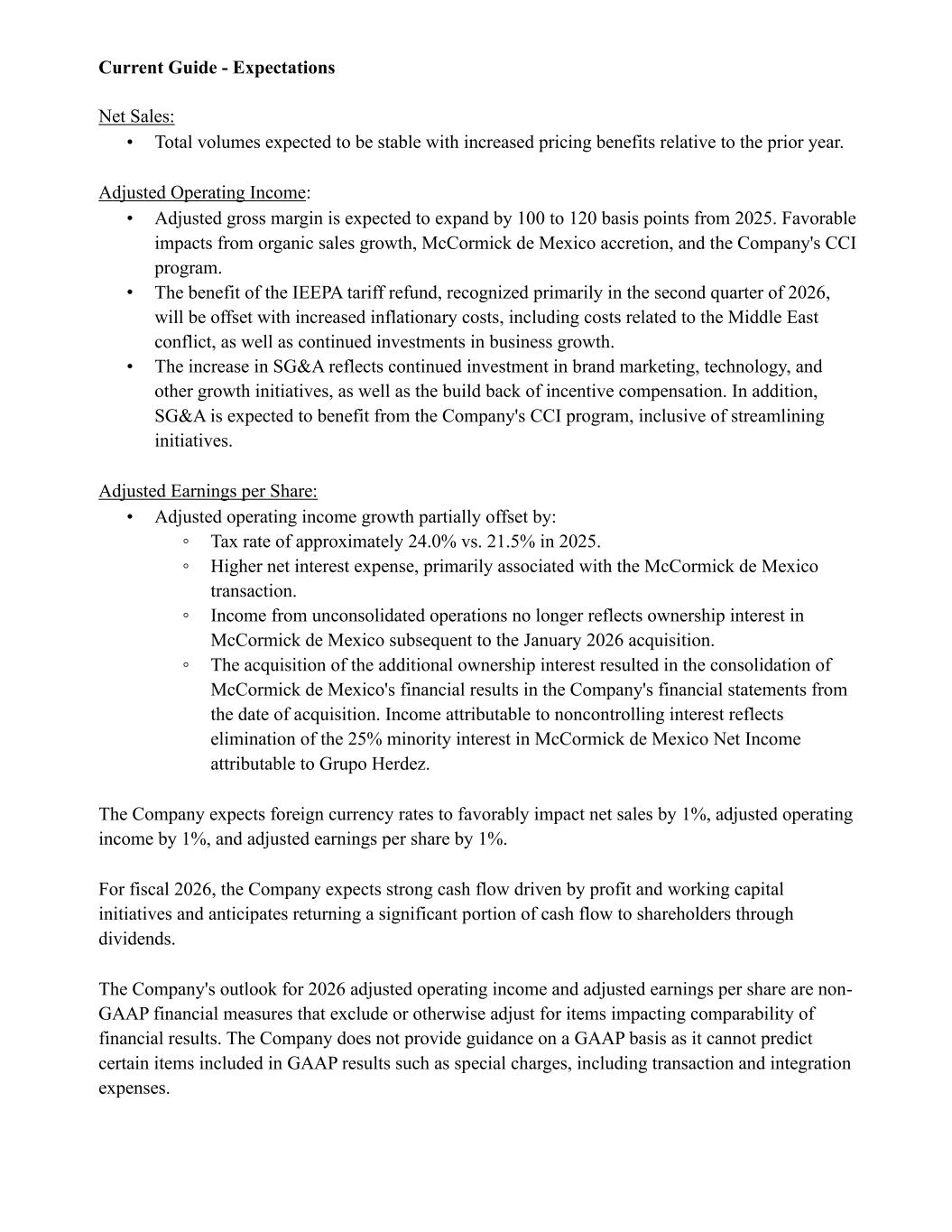
Thank you, Brendan, and good morning, everyone. Let's start on slide 9 and review our top-line results for the third quarter. Total net sales grew 17% in constant currency and included 2% in organic growth, with a balance driven by acquisition contribution from Acorn Academy of Mexico. As we previously noted, we have substantially completed the integration of this acquisition. Moving to consumer segment on slide 10, constant currency sales increased 24%, including a 1% increase in organic sales, with the remaining growth driven by acquisition contribution. Consumer organic sales in the Americas were flat, with pricing contribution of 2%, offset by volume decline. Volumes were pressured by the macro environment. We saw declines across certain categories, which were partially offset by growth in herbs and spices for the quarter. In EMEA, consumer organic sales grew 5%, driven by a 2% increase in volume and a 3% contribution from pricing related to targeted actions taken as a result of increased commodity and freight costs. We're pleased with the sustained volume growth for the 11th consecutive quarter in EMEA. Consumer organic sales in the Asia-Pacific region increased by 4%. The increase was driven primarily by volume and reflects the continued gradual recovery in China. The strength in our retail business is more than upsetting the softness we continue to see in food service. Outside of China, we deliver strong volume growth across Australia and Southeast Asia. Turning to our flavor solutions segment on slide 11, third quarter constant currency sales grew by 6%, including 3% organic growth, driven by price and volume. The remaining growth was driven by acquisition contribution. In the Americas, flavor solutions organic sales increased 3%, reflecting a 3% price contribution and flat volumes. Volumes for the quarter were impacted by softer trends with QSR and CPG customers. In EMEA, organic sales were up 1%, driven by price offset by lower volume, reflecting soft QSR customers' volumes due to declining food traffic, particularly in the U.K., In the Asia-Pacific region, flavor solutions organic sales increased by 8%, driven by a strong volume growth of 10%, partially offset by price. The strong volume growth was driven by timing of new product innovation and limited time offers with our QSAR customers in China and Southeast Asia. Moving to slide 12, adjusted gross profit margin expanded 180 basis points in the third quarter, driven by accretion from McCormick and Mexico, as well as improvements in our base business, including pricing, savings from our comprehensive continuous improvement program, or CCI, partially offset by increased freight costs. Selling general and administrative expenses, or SG&A, increased relative to the third quarter of last year, driven by the impact of consolidating McCormick and Mexico and increased investments in technology and brand marketing. As a percentage of sales, SG&A was 110 basis points higher compared to the prior year. For the quarter, adjusted operating income increased by 22%, or 21% in constant currency. This increase was driven by strong top-line growth and gross margin expansion, partially offset by higher SG&A. Our third quarter adjusted effective tax rate was 22.6%, compared to 16.1% in the prior year, driven by a greater level of favorable tax items in the prior year. Turning to segment operational results on slide 13, consumer-adjusted operating income increased 24%, with minimal impact from currency, with flat-adjusted operating margins. Benefits from acquisition, accretion, and productivity initiatives were offset by increased inflation, higher logistics costs driven by Middle East conflict, tighter freight capacity resulting from recent changes to U.S. federal regulations, and continued brand market investments. Flavor Solutions adjusted operating income increased by 18 percent or 16 percent in constant currency, and adjusted operating margin expanded by 120 basis points, reflecting top-line growth and our continued focus on improving Flavor Solutions' profitability in line with our 2024 Investor Day commitment. At the bottom line, as shown on slide 14, third quarter 2026 adjusted earnings per share was $0.86, up 1% compared to the year-ago period, reflecting increased adjusted operating income partially offset by a higher tax rate. On slide 15, we've summarized highlights for cash flow and balance sheet. Cash flow from operations year-to-date was approximately $600 million, compared to $420 million in the prior year, driven primarily by higher profitability and improved working capital. This strong cash generation enabled us to return $387 million of cash to shareholders through dividends and used $131 million for capital expenditures to expand capacity, advance digital transformation, and optimize our cost structure. We continue to expect strong performance in our cash flow from operations for the fiscal year. Our capital allocation priorities remain balanced. This means funding investments to drive growth, supporting our dividends, and maintaining a strong balance sheet. We remain committed to a strong investment grade rating. At the end of this quarter, our leverage ratio was approximately 2.9 times. We expect to continue to make progress in paying down debt, positioning as well ahead of the Unilever Foods close. As previously noted, at close of Unilever Foods, we expect to have industry-leading operating margins of 21% and working capital benefits that support 100% free cash flow conversion from net income, before any synergies. Post-close, we expect to continue investing in the business while driving margin expansion. delivering, and supporting our dividend consistent with our history. Based on current estimates, after-brand investments, costs to achieve synergies, and dividends, we anticipate having $1.5 to $2 billion available to pay down debt within the first two years and deliver two to three times. Longer term, we would target a leverage ratio of two to three times. Turning to slide 16 to review our 2026 financial outlook, which remains broadly consistent with what we shared on our last earnings call. A few call-outs. On organic growth, we expect full-year organic growth to reflect the stable volumes and positive pricing contributions, primarily driven by flavor solutions. Overall, we expect organic growth to be between the low-end and midpoint of our guidance range, including approximately a 30-basis-point impact from the supply constraint mentioned earlier. On tariffs, our cost assumptions, primarily related to the global 10% tariff, remain unchanged, based on the latest developments and information available today. At this time, we do not expect Canadian tariffs to have a meaningful impact on this year's results. Moving to gross margin, year-to-date performance has exceeded our implied guidance, benefiting from accretion from Accormade to the Mexico, strong sales growth, as well as our productivity initiatives, including some that were pulled forward into the third quarter. Looking at the full year, we now expect cost inflation of 6% to 7%, compared to a prior expectation of a mid-single-digit year-over-year increase. Despite this increase, we're maintaining our full year expectations of 100 to 120 basis points of gross margin expansion versus 2025, and now expect to be at the high end of the range. For the fourth quarter, we're implying some year-over-year margin compression, as we expect rising commodity and freight costs, as well as commercial investments in consumer Americas to impact gross margin. Overall, our implied guide reflects a dynamic cost environment while maintaining our commitment to invest for growth. Lastly, on operating income growth and earnings per share, we expect to be at the midpoint of the range for the year. In addition, our implied guide for the fourth quarter reflects continued investments in technology, including our ERP implementation costs and brand marketing support. These costs remain consistent with the assumptions we initially included in our full-year guidance back in January of this year. Earnings per share in the fourth quarter will be impacted by lacking a favorable tax rate in the prior year of 23.9%. To close, we remain confident in the long-term resilience of our business and our ability to deliver on our 2026 outlook. Through discipline execution, targeted investment in our growth priorities, and continued productivity progress, we're well-positioned to drive net sales and operating income growth, while generating strong cash flow to support balanced capital allocation.
Thank you, Marcos. I would like to close with three key takeaways on slide 17. First, our differentiated performance, flavor-focused portfolio, and geographic footprint continue to provide resilience in the dynamic environment. Third quarter results reflect the strength of our base business, the contribution from McCormick to Mexico, and the benefit of a disciplined productivity and cost management. Second, we are actively managing through uneven category performance while investing to strengthen our competitive position. Our gross margin performance enables us to continue to invest in the business to drive top-line growth and improve performance in consumer Americas. Third, we are executing against a clear value creation agenda, delivering our 2026 commitments, investing behind advantage growth platforms, and planning for the Unilever Foods combination. Strong cash generation, a balanced capital allocation framework, and continued deleveraging provide that financial flexibility support both near-term execution and long-term profitable growth. Finally, I want to thank all McCormick employees for their continued dedication, agility, and focus on delivering for our consumers, customers, and shareholders.
Operator
Thank you. We'll now be conducting a question and answer session. If you'd like to ask a question at this time, you may press star 1 from your telephone keypad and a confirmation tone to indicate your lines in the question queue. Let me press star 2 if you'd like to withdraw your question from the queue. For participants using speaker equipment, it may be necessary to pick up your handset before pressing the star keys. One moment, please, for our first question. The first question today is from the line of Andrew Lazar with Barclays. Please proceed with your questions.
Great. Thanks very much. Good morning, everybody. Brendan, in consumer, both EMEA and APAC are performing well, as you talked about. They you now look for a more gradual improvement in America's volumes versus, let's say, your previous guidance. You made some very specific interventions in 3Q to sort of improve volume trends, and we saw some sequential improvement, but I think a bit slower than probably most were expecting. So I guess my question is, how would you assess the success of those initial actions, and sort of what, if anything, do you need to do either differently or additionally in 4Q to continue to see more of that sequential improvement.
Well, Andrew, thank you for the question. Yeah, I think if I provide just some context on how we look to the third quarter and maybe how we're looking at the fourth quarter, too, we definitely saw improvement in our business, especially in America's consumer, not only on shipments, but also consumption for the quarter. Definitely, there were a lot of transitory issues that impacted the quarter. I mean, I think when we were walking, you know, out of the second quarter, I was expecting the consumer to largely be in a similar environment, you know, at that point in time for the rest of the back half. That's definitely not what happened, or at least what we saw. We saw softer category unit consumption, you know, like a good example might be in condiments and sauces and some select other categories. Higher beef and seafood prices, we think it definitely has impacted, you know, probably parts of our recipe mix business and maybe some other items that we have that are connected with those proteins. Rising gas prices definitely, we believe, drove increased price sensitivity for the consumer and therefore an increased focus on value. But, you know, our herb spices and seasonings business and recipe mix really sort of remain in a very competitive environment, and we're going to continue to drive improvement as we look at the fourth quarter, especially in areas like cooking blends and our gourmet line as well as recipe mix. I would also say in the third quarter, you know, perhaps the implementation speed of everything that we're trying to do, you know, just, you know, wasn't as fast as we wanted it to, as we're trying to coordinate plans with retailers, you know, et cetera. We had a lot of bright spots in the third quarter. As you said, great momentum in EMEA and Asia Pacific. But I would also say in the U.S., our U.S. red cap business, which is also expressed as our core herb and spice portfolio, performed very well. It was performing well year-to-date. It performed even better in the third quarter. And we continue to see share gains within herb spices and seasonings and strong unit volume coming from that. And then overall, you know, we're performing well in areas like Convenient Fresh and Seasoned Salt and other innovation platforms that we've been launching. So, and in addition, you know, share gains in hot sauce and mustard. So, there was a lot to be, you know, pleased with in terms of performance across the portfolio, but the areas that we really wanted to attack, we felt like we made the improvement, but the implementation speed, maybe not as great as we thought, and certainly a more pressured consumer. As I look to the fourth quarter, there are some things that are working well right now, and I would just give you some examples of just some of the levers that we're pulling that. We talked about in the second quarter, they're certainly going to have more impact, I believe, in the fourth quarter. Priceback architecture has been a plus. We launched it on our grill mates line, also on our cooking buns line. And so we're seeing, we believe, early improvement coming from that. And what it did was it filled a price pocket that we felt like we weren't competing in. So that was always in our innovation plan. We're increasing our competitive spend on search. We're seeing just a lot more productivity coming from that, and so that's having a really strong impact, and I expect that to be even more powerful as we go into the fourth quarter because the overall efficacy of the spend just continues to strengthen in that area. And then we're sharpening promotions and assortment across our categories. But, you know, I would say more work remains on areas like cooking blends. We're seeing early improvement to our renovation that we launched in the second half. So I expect to see maybe more continued improvement there. And the same is true on, like, recipe mixes. We're seeing good improvement in Mexican flavors, which is a specific targeted area that we had in the third quarter. we now need to make sure that we sort of shore up the core strength behind the rest of the recipe mix line. And we have a number of initiatives to kind of help that. So I'll stop right there unless you want to dig further. But I want to give you some context of both the third and the fourth quarter.
Yeah, that's helpful. I appreciate that context very much. Maybe just a very quick follow-up from Marcos. McCormick obviously set to issue debt with the completion of the transaction, and rates have risen since the deal was first announced. How should investors think about exposure to higher rates, and does this impact expected accretion in math at all? Thanks so much.
Yeah, thanks for the question, Andrew. I know this is on the mind of investors these days, so we are staying very close to market dynamics as we continue to really evaluate our debt financing strategy. Based on the assumptions today, we're well positioned to deliver on the commitments that we made, both in terms of EPS accretion as well as delivering from four times when we closed to down to three times in two years, even with interest rate volatility. So we feel pretty confident about that. As we continue to evaluate the go-forward approach, we have a range of alternatives at our disposal. So I'm going to comment on three elements that are very important. The number one is currency mix. As we think about debt financing in the future, as a larger company, we now have the capacity to add other currencies to the mix. So think about a mix of U.S. dollar as well as euro-denominated debt and that will help reduce overall weighted average cost of funding. The idea of adding currencies, we'll look into other markets as well, markets in which we'll have good presence, and we expect it to generate substantial cash flows that we can add to that mix of basket of currencies. So currency is one. The second element is the fixed versus floating ratio that we're going to be using. We are right now evaluating the right mix between fixed and floating rates that will also help balance the cost and provide flexibility to manage interest rates. You know, as we introduce floating rates, that helps lower near-term expenses, so that's a place that we want to be, but we want to find the right balance between fixed and floating. And then finally, I would say the maturity profile and the tenor of the debt. We're going to look at the very diversified maturities, likely staggered over the long term, and that approach will also help manage overall funding costs. So those are the three elements that we're looking into right now. Obviously, we're also looking into, you know, pre-issuance of hedging alternatives subject to market conditions. But it will depend on how the finance structure come along. But, you know, right now we believe we have a very prudent plan in place and the right strategies to really preserve the earnings that we have offline to you and in terms of earnings per share, but also as well as the cash generation to pay down that.
Operator
The next question is in the line of Peter Galbot with Bank of America. Nice to see you with your questions.
Hey, good morning. Thanks for taking the questions. Brendan, I'd like to go back to your commentary just around recipe mixes. You know, you've made the interventions. You've introduced, you know, the Cholula offering, I think, in Mexican. And it seems like it's starting to move in the right direction. But it still seems to be, I think, kind of the biggest thing holding you back from a volume perspective in the America's consumer business. And so understanding there's more interventions to come, but just maybe you can give us a little bit more of a timeline in terms of how you're going to get that business back to bright. Again, as the rest of the portfolio in America continues to kind of hum along, that would seem to be holding you back a bit from, you know, something that could be a more volume-led story, which I think is, you know, what obviously you'd like to try and get back to.
Well, yeah, thank you, Peter. If the context of the recipe mix, here's what I would say. I definitely would say our recovery is probably going a little bit longer than what we would have expected. And I think that the environment just reflects continued competitive activity, some retailer distribution changes, and just some value trade down that we've seen in select segments. Broadly, what we've seen within this last year is there's a demand shift in store shelf location, which impacted the category in our own performance. And so we're seeing a lot of strong growth in the Mexican aisle. So that's where you'll find a lot of, you know, products sort of dedicated to the sort of Mexican cuisine. But the great majority of our presence happens to be in another aisle. So, you know, we're seeing a ton of growth right now, certainly in that Mexican aisle. Certainly still some growth in the core aisle, but it's more demonstrable, I think, in the Mexican aisle. And we need to address that by being stronger in the Mexican aisle. And that's why, as you just noted, we're going to see even more increased focus behind Cholula as a brand, you know, competing in that offering for consumers, but also restoring the strength of the core recipe mix aisle. So it's a two-pronged game for us, and our priority is to rebuild the velocity in the core portfolio and improve our customer conversion, you know, behind McCormick Taco and also accelerate, you know, Cholula recipe mixes. And that will be supported by increased retail media, improved shelf execution, and addressing just pricing and promotion gaps in key accounts. As I just mentioned, we're already seeing really good improvement in Mexican-flavored recipe mixes and just positive unit volume more recently, and it's supported by some of those tactics that I just mentioned. And we expect to start lapping what was just certain prior to your pricing and distribution headwinds as we get into early 27, but having said that, you know, I'm not relying just on a comparison on consumption and share. We're really focused on just making sure that we fundamentally improve underlying consumption, and so that's been our plan. We feel like we're making the right progress on it right now, and I do expect continued, more gradual progress moving forward as we go into the first quarter of 27.
Great, okay, that's helpful. thanks. And maybe if we could touch a bit more on the packaging issue, I know you don't want to get into, you know, brand, brand specifics around that. But again, as we all are tracking some of the, you know, Nielsen data and Serkana data, just it's clearly going to become, you know, apparent where it is. So maybe you can just help us understand exactly what happened with the packaging supplier, what you're doing to rectify it, and maybe just, you know, what exactly because it's a little bit unclear to me, you know, as we're trying to track recovery, what that might look like. Thanks very much.
Sure. Well, the issue affects a specific packaging component. It really mostly just affects us in consumer Americas. There's no flavor solutions exposure to this, and it's not a commodity availability or a raw material issue. So our broader spice and seasoning sourcing is unaffected by this. And importantly, I would not call this a demand issue either. So overall, but it's really a packaging component and more of a conversion issue rather than the availability of material. And so as we work through that, and it tends to be more of an industry issue. It's not just impacting us. But we plan to mitigate it with other packaging formats. So that's why we felt like it was prudent just to call it out as a potential short-term supply issue. Just given the timing of this call and everything else, it's just sort of, well, let's just make sure that we at least illustrate that it could happen. But we're really actively trying to mitigate it right now with different packaging formats and just, you know, rectifying what was more of a material conversion problem. So, you know, that's about as far as we're going to go at this point, I think, in making sure that, you know, we illustrate it to everyone. But we'll report more on it as we get into the fourth quarter call in January.
Operator
The next question is in the line of Tom Palmer with J.P. Morgan. Please receive your questions.
Good morning. Thanks for the questions. The guidance and prepared remarks indicate input cost inflation has stepped up. I don't think that's surprising for people on this call. And it's going to be more apparent here in the fourth quarter. And I think the implication is that it does have some earnings impact. Should we think about the cost pressures as kind of an enduring headwind as we move into 2027 that will continue to constrain earnings growth? Or is maybe when we look at 4Q, there's a bit of timing where some of the mitigating actions don't take hold as fast as cost inflation steps up?
Yeah, I can answer that, Tom. So yes, there are timing of expenses that shifted from Q3 into Q4. So if I take a step back and comment on the gross margin for the year, and then I'll get to your 2027 question as well. I mean, if you take a step back, we came into the year with an expectation of 60 basis points gross margin expansion versus 2025. We're now expecting to deliver about 120 basis points. And even if you take tariff refunds out, which is about 35 basis points, it's still a significant gross margin expansion year over year, despite the very challenging cost environment that we are facing. So I would say, you know, it is, you know, the testament of the resilience, the strength of McCormick in terms of finding CCI and driving CCI to execution quickly over the last three quarters and be able to offset all this inflation that we're seeing come through. Year to date, we are about 180 basis points for the year. So that gives me confidence in, you know, in the call of 120 basis points for the full year. It is reasonable. It is achievable. Now, if you think about Q4, you've got to look about Q4 and Q3 to get in tandem because there was a shift of expenses between Q3 and Q4. So the best way of looking into Q3 and Q4 is really not in isolation one quarter, but putting them together and looking from a half-two perspective. In Q3, we had a very positive performance from McCormick in Mexico, which drove accretion across the P&L, and that was a good contributor in terms of gross margin. But also, pricing and CCI were able to offset cost inflation. But as I said, quite a bit of expenses got shipped into Q4. And then when you look at it, so it's going to be a tailwind into Q4, a headwind was a tailwind in Q3, it's going to be a headwind into Q4. If you think about Q4 specifically, in addition to that shifting cost from Q3 to Q4, we are facing more costs. You know, we raised our guide to about 7% inflation, and we're facing more costs both in terms of, you know, raw packaging but also freight, primarily freight costs due to fuel as well as, you know, capacity constraints in the U.S. We're seeing more impacts on freight specifically. So, you know, Q4 will see that, and also we'll be investing some of the gross margin gains in the earlier part of the year. We're going to invest some in trade investments to drive volume improvements in the quarter. But looking at it together, Q3 and Q4, you know, margin expansion is about 60 basis points. So that's how I would frame it for 2026. Going into 2027, obviously, it's a little bit too early to talk about, you know, formal outlook for 2027. However, you know, the environment has evolved meaningfully since we talked about it back in February. and we'll be able to provide an initial perspective when we report the fourth quarter results in January. But as I look back into 2026, quite a few factors have been less favorable than we expected. Inflation, the freight aspect that I talked to about it, consumer pressure, and even more uneven demand environment. But as we look into 2027, our priority will be to drive sales growth and volume across the company while managing the inflation. We do have a good CCI program in place. We expect inflation actually to continue into next year, but we do have a very good CCI program in place that you saw hitting us, impacting us in Q3 over the last three quarters, actually, very positively. That will continue into 2027, but we'll see more headwinds for margins and earnings per share as we go into 2026. So all to say that more to come. We're right into this discussion right now as we close the year, looking into the outlook for 2027. But this is the first qualitative, I would say, comments that I can make about that.
Thanks for all that detail. That was very helpful. Maybe just a follow up on that topic. I think one of the areas of focus this year has been, and I think it's worked, right, is addressing some price gaps as a way to help stimulate volume. As you move into this more inflationary environment, how do you kind of think about balancing the need to kind of protect the P&L, maybe with pricing actions versus maintaining that value centric angle?
I appreciate the question, Tom. I would say what was true a few years ago, let's say pre-pandemic, really isn't true today. You know, there hasn't been any reprieve on inflation as we think about this over the last several years. The consumer has been more pressured and also hasn't seen relief. And so it does make for a challenging environment to recover on price. And so, you know, the way we're looking at it is it's important to maintain a durable business model. And we're focused on this. But at the same time, you know, win with consumer value and maintain a very strong competitive posture on shelf. So, you know, kind of building on what Marcus just said, you know, we're looking to CCI our productivity program, which frankly exceeded our plan this year. It's gotten a lot of focus from us. Revenue growth management would be another lever. We're building out this with stronger technology and greater predictability, which allows us to be more precise. And, you know, the third area I would say broadly is just, you know, support brand superiority in our products. And, you know, that's important to have at shell, you know, especially if you're going to have a premium versus, you know, private label and other brands. So it's been challenging, I think, over this period. We're proud of how we navigated it, I think, thus far. And we think, you know, what's enabled us to do this is just our scale presence, having a portfolio focus on flavor, operating in great categories, and also having strong capabilities like global sourcing and brand marketing. So all of those sort of kind of create this broad competitive advantage to be able to sort of deal with this. But as Marcos just said, as we look ahead to 27 and we have a continued inflationary environment, at least that's kind of our current thinking, we're working through now how to plan for that. And, you know, we're going to still try to balance that need to meet the consumer with where they are, but also maintain a durable business.
Operator
Our next question is in the line of Steve Powers with Deutsche Bank. Pleased to see you through questions.
Hey, great. Good morning, guys. You know, different tactic. You know, as I think about, I think investors are very focused on the Unilever Foods business where growth has been trending softer than envisioned at the time of deal announcement. I guess as you're planning for integration, you know, obviously you're not in control of that business, Just that, you know, how confident are you that momentum can improve and be restored in that business before a deal closed? And how important is that recovery to realizing some of the growth synergies that were embedded in the transaction rationale?
Well, you know, like you said at this time, it's difficult for us to comment on their business since we're not really, you know, running it and don't have that, you know, sort of internal level insight about how they're looking at it. But, you know, that part of the business, particularly in the United States, is feeling more than likely the same very, very same pressures that we're seeing consumer face itself. So I imagine that those are very similar to what we're calling out on our own business. And I expect that probably going to be looking at very much the same sort of tactics and approach towards making sure they're, you know, getting back to, you know, volume growth as they historically have driven. So, you know, that's, you know, pretty confident that the company, you know, has a view on, you know, remaining very competitive as it relates to volumes, but also trying to balance out, you know, what's going on in terms of input costs. As we look ahead, and if the core or spirit of your question is, does it make me think differently about how, you know, we think about the, what underpins and what underwrites sort of the strength of this combination? It doesn't create, I think, an incremental level of concern. It's really all about continuing to sort of strengthen the business before we close, and then we get an opportunity to really dig into it. And I think we're collaboratively with the leaders that will, you know, be combined with McCormick leaders to really put forward, you know, just obviously a very strong and effective growth program. But, you know, as we go into 27, we still have a lot that we have to sort out right now in terms of inflation and costs and where the consumer is going to be. So I think those are very similar questions that they're going to be trying to address as we do it at the same time. But I still have confidence, Steve, in our ability to, you know, drive growth behind this portfolio. Again, I would point to we operate in really good categories. There's growth in these categories. They're fundamentally focused on flavor, and that is a key consumer need. But it is about, you know, short-term, there's going to be ups and downs. But over the long-term, we really do believe in the growth of both of these businesses.
Appreciate that. thank you very much um and then maybe maybe a question for marcos you know um it sounds like you know tsa planning and and um separation carve out work streams are progressing well i guess is there any any further you can go in terms of um um you know i guess more discreetly defining tsa scope uh you know duration of those agreements cost of those agreements any more details that available today, and if not today, I guess, when do you think you might be able to add some of that specificity? Thank you.
Yeah, sure. I mean, TSAs are in process, as we spoke before, continue to evolve the detail of the scope of each one. I mean, broadly, we talked about TSAs, you know, primarily supporting the back office of our operations. You know, think about global business solutions, think about IT, think about supporting to HR areas, finance areas. So that is primarily the support that we're going to get from TSA, you know, for about two years. We talked about two years. We're going to have a phased exit to TSAs. We don't want to exit all TSAs at the same time. That wouldn't be practical. So we're going to be having a more detailed plan. We're not able to share yet that plan, but we're going to be able to share a plan of more of a gradual exit of TSAs over the first couple of years. And then, you know, from the cost perspective, we do have those costs assumed in our deal model. So that should not be something incremental that we should think about that way. So overall, you know, progressing as planned. More details to come in the next, I would say, few months. And hopefully we'll be able to share more in the next earnings call.
Okay. Very good. Thank you. Appreciate it.
Operator
The next question is from the line of Robert Mosca with TD Cowan. Please receive your questions.
Hey, thank you. I was hoping if you can give a little more detail on what caused momentum with your CPG customers in the U.S. to slow down in third quarter. On the last earnings call, you sounded very confident about a lot of reformulation projects. and also it just sounded like, you know, that their sales performance was just okay. I mean, is it really just like the volume declines, the regular everyday volume declines just got worse, or did anything in the pipeline kind of get delayed in terms of reformulations and new products?
Rob, I think if I were to go quickly, you gave me two choices there. I would go with the first one. I think it was more based on the overall acceleration of volume declines that we saw in the industry over the course of the third quarter. Now, to provide just additional context, though, on top of that, we saw softer QSR traffic, particularly in the U.S. and the U.K., plus softer demand from CPG customers driven by softer-than-expected consumption. You know, back to my quick answer, given those two choices that you gave, that's the way we would express, you know, what we saw in terms of a slowdown that wasn't expected in the third quarter. I will say on the QSR side, the cyclospora outbreak in the U.S. is clear it did have pressure on QSR traffic. I think we started to really see that express itself in terms of store traffic in July. Maybe it started to come back in August, but by that point, I think suppliers already had enough inventory. So, customers already had enough inventory. So, we think that had an impact in the third quarter. I would characterize that as very short-term, based on everything that I'm hearing. But these pressures, you know, were really what impacted that. You know, we believe it's the third quarter. But we think we'll offset that. We believe the fact that we were flattening the Americas effectively on volume is a function of just having a healthy innovation pipeline, still have a lot of focus around customer diversification and gaining share in terms of customers, good private label growth, and just continue to strengthen the areas that we keep talking about, which is health and wellness, functional beverages, better for you snacking, and those continue to perform well. So hopefully that addresses sort of the insight you were looking for, Rob.
Yeah, it does. Thanks. And maybe a follow-up. I appreciate you acknowledging that the implementation of your interventions in U.S. retail were a little slower than expected. So I'm going to give you two choices again. Do you think it was related to retailers being a little reluctant to make changes at this time of the year? Or, you know, your organization is going through a lot right now. There's a lot of focus on the Unilever acquisition. Has that implemented, has that affected execution in any form or function? And I'll think of a third choice, but maybe just these two.
Again, I'm going with your first. So it really has a lot to do with just coordination of timing with customers. I'm going to come back to, you know, more context on the second point I think you were mentioning there. These teams are operating separately, so whoever's doing integration is working on integration exclusively, and those who are working on the base business, which is the majority of the company, is exclusively focusing on our current business. So I'm quite confident that's not the case. It really has a lot to do with implementation timing and coordination with customers.
Operator
Understood. Thank you. The next question is from the line of Alexia Howard with Bernstein. Pleased to see if there are questions.
Good morning, everyone. Can I focus in on the U.S. consumer business once again? You mentioned a couple of actions that you're taking, and maybe you could just provide a little more elaboration there. So you talked about the need to maybe invest in price and promotion to shore up the affordability side of things. I think America's consumer, we saw pricing up, I think it was a little over 2% this quarter. As we roll into fiscal 27, should we expect that price growth to turn negative once again, as it did a couple of years ago, the last time you were trying to fix this? And then you also mentioned portfolio assortment optimization to better serve some distinct consumer needs. Could you give us a couple of examples of that just so that we can understand what that means? Thank you, and I'll pass it on.
Alexia, your audio cut out in part of your first question. Could you just maybe hit that one more time?
It was just should we expect pricing to turn negative in U.S. consumer as it did a couple of years ago when you were shoring up the business before?
No, we don't expect pricing to go negative. It certainly will be perhaps less pricing contribution than what we've seen year to date, but we don't anticipate it to go negative. Now, there was a second question. Sorry I got distracted there by the audio cutout.
That's fine. You talked about portfolio assortment optimization to better serve distinct consumer needs. Could you give some examples of that so we can better understand it? Thank you, and I'll pass it on.
Yeah, I think really on portfolio assortment, it really is about, you know, probably going back to areas like thinking about some of the top selling flavors, making sure that those are on shelf, thinking about, you know, where we're getting strong velocity, as well as price pack architecture, continue to implement that on shelf. That's part of the assortment optimization that we're seeing in parts of our portfolio. You know, innovation sort of replaces, you know, either it's incremental to shelf or it replaces, you know, items that we think are not turning as well as they should. And so we see assortment optimization happen there on the shelf. But broadly, we are still gaining distribution as we look at our total portfolio.
Thank you very much. I'll pass it on.
Operator
Our next questions are from the line of Rob Dickerson with U.S. Bank Corp. Please receive your question.
Great. Thanks so much. um maybe just kind of you know a broader question around kind of you know where the consumer is and then some of your comments around the cyclicality right of the business and just kind of how well the portfolio is positioned because like kind of what I'm hearing is you know kind of renovate the portfolio a little bit right optimize um some of the assortment um you know kind of you know i guess lean in a little bit to brand spend but at the same time like we don't really see you know prices coming down necessarily which i get especially given the constellation but just like you know if the consumer still stretched and demand still a little weak right everyone's value conscious and they've been that way for multiple years but it's all cyclical like it's it's kind of like the kind of the the overall answer is like well the consumer just needs to get healthier. It just has to have more money and then everything's fixed. And I know that's a lame question, but just try to cut through a lot of the noise and just figure out what fixes it. That's it. Thanks.
Well, I think all of us would like healthier consumers, but we're not relying on that as we think about our plans moving ahead. We think about this environment as pretty much remaining status quo, if you will, especially as we look at perhaps 2027. But it did turn a little bit more incrementally, more pressured, I think, and so far in the back half of the year, at least is what we're seeing. I think the attitude that we're taking, Rob, is you got to, we keep using this expression, but it really does kind of guide our thinking. Meet the consumer with where they are. And I think the consumer is really looking for even better value right now. It isn't necessarily a lower price. You know, consumers are still willing to pay for convenience, you know, delivery. We see e-commerce growth growing for a reason because consumers find value in that overall. Or, you know, there are items where, you know, they'll spend more per item because they're getting just better value, you know, like in our large sizes. So it's a dynamics sort of environment. I would say we expect to continue to operate in this, you know, environment and continue to do well. And we're going to have periods where we have to find a way to recover from inflation, but also, you know, find, you know, even more creative ways in making sure that the consumer sees value at shelf. But I think if it's an outlook of sort of what has to be true for, you know, things to get better, I think it's really for our business, it's we're operating in great categories. And that fundamentally really drives and underwrites, you know, sort of our view of our business, you know, looking ahead. And that's why we remain flavor focused. And then on top of that, we have to continue to make sure that we have a competitive edge on shelf, you know, in terms of making sure we drive, you know, consumer value in whatever conditions we're operating in.
All right, super. That's fair. And then just maybe just a quick question. You know, have there been some comments just kind of around, you know, like improved or increased distribution, you know, and maybe I missed it, but is that like the way you're thinking about this is just like, you know, is that TDPs essentially, or is this, you know, there could be potential to kind of make more inroads into certain channels, maybe where you have less exposure now. That's all. Thanks a lot.
Yeah, we're measuring it both ways, Rob. So we are looking at TDPs. It's a pretty clear metric, especially if you look at sort of, you know, retail ACV distribution. But it's also about, you know, having more items in other channels. So and that's going to be, you know, we're seeing a lot of channel growth in, you know, club stores or e-commerce or discount channels. And so, you know, we see the need to continue driving distribution growth in those areas, too.
All right. Great. Thanks so much. Appreciate it.
Operator
Our next question is from the line of Max Gumpert with BNP Paribas. Please receive their questions.
Hey, thanks for the question. Between rising freight, which includes ocean freight, other inflationary pressures, and supply chain constraints, some of these dynamics feel reminiscent of what we heard and saw during the COVID and supply chain bottleneck years, which really hampered your margin in profit delivery during that period. So as you start to face these accelerating pressures again, I'm curious that you have more confidence in your ability to withstand them, particularly given learning from that period and maybe even some supply chain improvements you've made over the last several years. I'm really asking because as the market starts to consider what your gross margin delivery could look like next year, particularly given the implied X rate for 4Q, I think this will become more topical. Thanks very much.
You know, Max, I think you bring up – a relevant observation, which is that these are similar variables that we were dealing with back during that time period. I think one of the things that I would start off with, and I'm going to hand it over to Marcos for additional context, is one of the key priorities I've asked the organization to work on over the past three years is just really this idea of focusing on resiliency in all forms. Because the external marketplace isn't necessarily friendly all the time with making things easy. And so we think about resiliency as an important quality about our company that we want to keep improving. And we're always looking for opportunity areas where we can do that. And I think that gives us, I wouldn't say, I wouldn't call it overconfidence, just an ability to sort of deal with them maybe a little bit quicker and faster, you know, as we learn from each event that occurs. So that would be my kickoff. And Marcos, and you have to go.
Yeah, no, I would add to the resilience. I would add that, you know, our CCI program has really stepped up over the last couple of years, Max. You know, think about, you know, looking at all lines of the P&L in terms of where we find savings and productivity and optimization initiatives, this standardizing process across the globe. I mean, that standardization and automation of processes have been a key enable for us to continue to be more efficient overall. So a CCI program that is in place for 16 years now has been elevated over the last five, I would say, taking into account our global footprint, taking into account a global business solutions organization in many places across the globe, but also taking into account, you know, the use of technology. So, you know, all in all to say that we do have a more resilient business, as Brendan just mentioned, but also the underlying CCI program continues to evolve, continues to be widespread in the organization, and continues to give confidence. I mean, look at 2026 as an example, you know, 120 basis points of gross margin expansion, And, you know, a good portion of it was because of the CCI program that was put in place. So I do feel more confident, although headwinds are there for us to manage. But I do feel more confident today going into 2027 than back, you know, back in 2019.
Operator
Thanks very much. Very helpful. I'll leave it there.
Operator
Thank you. And our final question is from Nalando Scott Marks with Jeffries. Please just use your questions.
Hey, good morning, all. Thanks very much for squeezing us in here. I wanted to just ask one about McCormick to Mexico. It looks like performance was a bit stronger than folks were looking for. I'm wondering if you could just help us understand some of the key drivers within that business and, you know, as we look ahead, how you're thinking about trajectory, you know, as we look into Q4 and into next year.
Operator
Thanks very much.
Well, I think in our prepared remarks, I would go back to that. And the performance of the mayonnaise category was really pretty strong overall. And that is consistent with what our expectations are for the mayonnaise category in that market. And their level of, you know, that part of our organization, that level of execution, I think, has been really quite effective and quite strong. But we also saw performance in categories like herbs and spices, which is growing very nicely right now. We're able to, you know, grow share in that part of the portfolio there. And so we're seeing a nice lift in that category. As you might recall, we're present in a number of categories other than in that part of our business in Mexico. So we really were pleased with, I think, the performance of that category, too, you know, overall. As we look ahead, you know, I think the, you know, our outlook on this and the rationale and the thesis behind making sure that we sort of, you know, brought more of it back into, you know, McCormick's ownership still holds true. We see there's a growing market long term. We see good performance in the categories that we're operating in with a number of them, like herbs and spices, with even more upside. So I think we have a very sort of strong outlook for that part of our portfolio. As we called out when we did the original transaction, it was in January of this year.
Yeah, we committed to accretion across all lines of P&L, and that's coming through, you know, in 2026, very much.
Operator
I'm going to turn the floor back to Fah and Freja for closing remarks.
Thank you all for joining our call today. If you have any further questions, please reach out to me. And this concludes our conference call for this morning.
Operator
You may now disconnect your lines at this time. Thank you for your participation.