PMTS 8-K
CPI Card Group Inc. (PMTS)
UNITED STATES
SECURITIES AND EXCHANGE COMMISSION
WASHINGTON, D.C. 20549
FORM
CURRENT REPORT
Pursuant to Section 13 or 15(d) of
the Securities Exchange Act of 1934
Date of Report (Date of earliest event reported):
(Exact name of registrant as specified in its charter)
(State or other jurisdiction | (Commission File Number) | (IRS Employer |
CPI Card Group Inc. (Address of principal executive offices) | (Zip Code) |
(
(Registrant’s telephone number, including area code)
N/A
(Former name or former address, if changed since last report)
Check the appropriate box below if the Form 8-K filing is intended to simultaneously satisfy the filing obligation of the registrant under any of the following provisions:
Securities registered pursuant to Section 12(b) of the Act:
Title of each class | Trading Symbol(s) | Name of each exchange on which registered |
Indicate by check mark whether the registrant is an emerging growth company as defined in Rule 405 of the Securities Act of 1933 (§230.405 of this chapter) or Rule 12b-2 of the Securities Exchange Act of 1934 (§240.12b-2 of this chapter).
Emerging growth company
If an emerging growth company, indicate by check mark if the registrant has elected not to use the extended transition period for complying with any new or revised financial accounting standards provided pursuant to Section 13(a) of the Exchange Act. ☐
Item 2.02 Results of Operations and Financial Condition
On May 5, 2026, CPI Card Group Inc. (the “Company”) issued a press release announcing financial results for its fiscal quarter ended March 31, 2026 (the “Earnings Release”). A copy of the Earnings Release is attached hereto as Exhibit 99.1.
Item 7.01 Regulation FD Disclosure
In connection with the issuance of the Earnings Release, the Company is holding a public conference call on May 5, 2026, during which John Lowe, President and Chief Executive Officer, and Terra Grantham, Interim Chief Financial Officer, will provide the presentation attached hereto as Exhibit 99.2. Information regarding access to the conference call and webcast is set forth in the Earnings Release.
Item 9.01 Financial Statements and Exhibits
Exhibit No. | | Description |
99.1* | Press release issued by the Company on May 5, 2026, announcing the first quarter results. | |
99.2* | ||
104 | Cover Page Interactive Data File (embedded within the Inline XBRL document) | |
*The information furnished under Item 2.02 and Item 7.01 of this Current Report on Form 8-K, including Exhibits 99.1 and 99.2, is being furnished and shall not be deemed to be “filed” for the purposes of Section 18 of the Securities Exchange Act of 1934, as amended (the “Exchange Act”), or incorporated by reference in any filing under the Securities Act of 1933, as amended, or the Exchange Act, except as shall be expressly set forth by specific reference in such a filing.
SIGNATURES
Pursuant to the requirements of the Securities Exchange Act of 1934, as amended, the registrant has duly caused this report to be signed on its behalf by the undersigned hereunto duly authorized.
| CPI Card Group Inc. | |
|
|
|
By: | /s/ Darren Dragovich | |
| Darren Dragovich | |
| Chief Legal and Compliance Officer | |
Date: May 5, 2026 | ||
Exhibit 99.1
CPI Reports Solid First Quarter Results
Date: May 5, 2026
First Quarter Revenue Increased 20% to $147 Million
Net Income Decreased 57% to $2 Million due to Non-recurring Integration Costs; Adjusted EBITDA Increased 9% to $23 Million
Full Year Outlook Affirmed
Denver, Colo. May 5, 2026 -- CPI Card Group Inc. (Nasdaq: PMTS) (“CPI” or the “Company”), a payments technology company providing a comprehensive range of physical and digital payment solutions for U.S. financial institutions, processors, fintechs, prepaid program managers and more, today reported financial results for the quarter ended March 31, 2026 and affirmed its financial outlook for 2026.
CPI’s first quarter revenue exceeded the Company’s expectations, increasing 20% to $147.1 million, driven by the addition of Arroweye and increased sales of contactless cards and personalization services. Net income in the quarter decreased 57% to $2.1 million, primarily due to $3 million of integration costs related to the Arroweye acquisition, and Adjusted EBITDA increased 9% to $23.2 million.
“We delivered solid first quarter results and are on track to achieve our full year outlook,” said John Lowe, President and Chief Executive Officer. “We generated strong revenue growth in the quarter, led by contribution from Arroweye and increased sales of our other secure card solutions, while continuing to invest for long-term growth and diversification.”
The Company further advanced its strategy of providing payment technology solutions that help its customers win, driven by three primary growth pillars that underpin CPI’s value proposition:
| ● | A proprietary technology platform with a vast reach into the U.S. payments eco-system; |
| ● | A marketable base of thousands of deep and broad relationships across the U.S. payments market; and |
| ● | A proven track record of delivering evolving payment solutions that reflect changing market needs. |
Lowe added, “Recent strategic advances include expanding the base for our Software-as-a-Service-based instant issuance solution, delivering secure packaging solutions for the closed loop prepaid payment card market, and further building our integrations and customer pipeline to support push provisioning for mobile wallets and other digital solutions.”
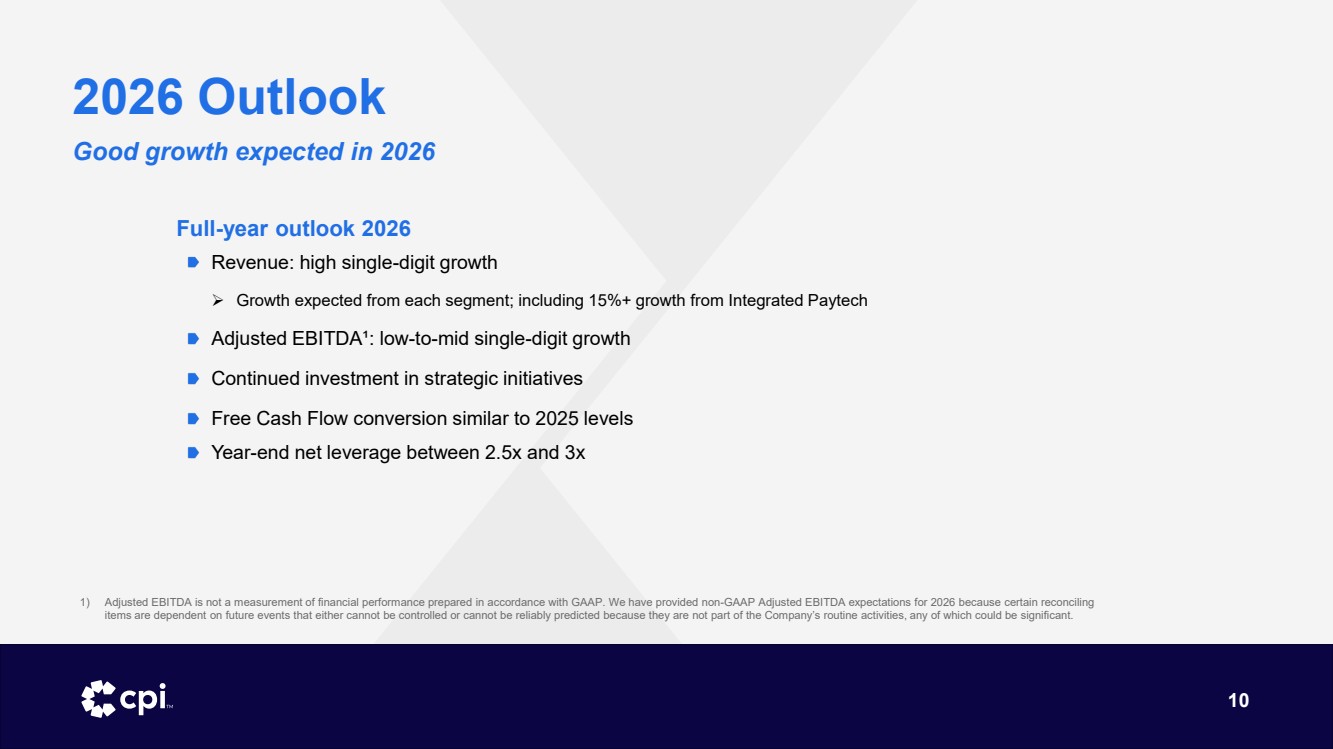
CPI today also affirmed its financial outlook for 2026, which projects high single-digit revenue growth and low-to-mid single-digit Adjusted EBITDA growth.
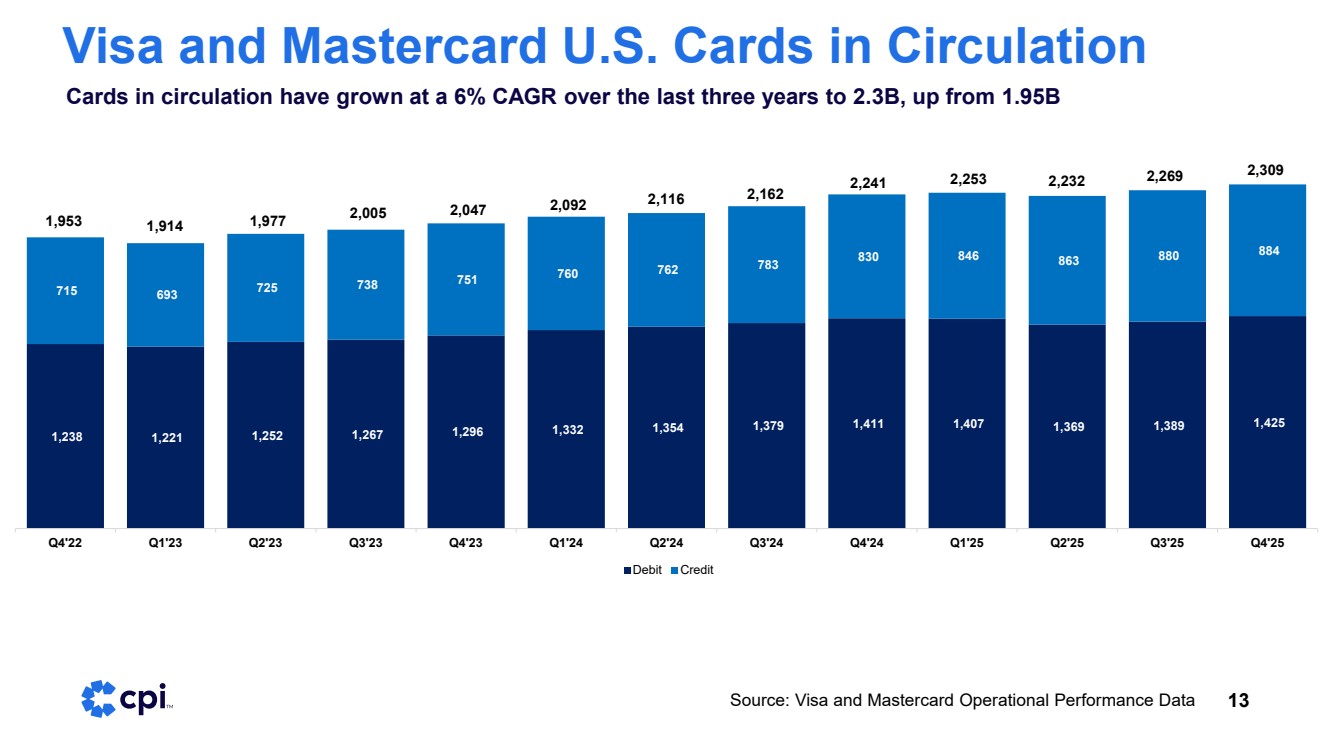
The Company operates in multiple growing markets, supported by increasing demand for digital solutions from financial institutions, increased focus on security for prepaid cards and packages, and ongoing growth in the payment card market, as evidenced by the 6% compound annual growth rate in Visa and Mastercard® U.S. debit and credit cards in circulation for the three-year period ending December 31, 2025.
Strategic, Business, and Capital Highlights
| ● | The Company advanced the integration and expansion of Arroweye, a leading provider of on-demand payment card solutions for the U.S. market acquired by CPI in May 2025. Arroweye has contributed nearly $60 million of revenue in less than 11 months since acquisition. |
| ● | CPI continued to team with Karta, an Australia-based payments technology firm that CPI made a minority investment in during 2025, to integrate Karta’s SafeToBuy technology with CPI’s prepaid solutions in the U.S. market, progressing an extensive pilot with a large national retailer. |
| ● | CPI continues to advance its market and product expansion strategies, including closed loop prepaid payment solutions and digital offerings such as push provisioning capabilities for mobile wallets and payment card fraud solutions. |
| ● | The Company generated strong Free Cash Flow in the first quarter, decreased its ABL revolver borrowings by $10 million, and ended the quarter with a Net Leverage Ratio of 3.0x. |
First Quarter 2026 Financial Highlights
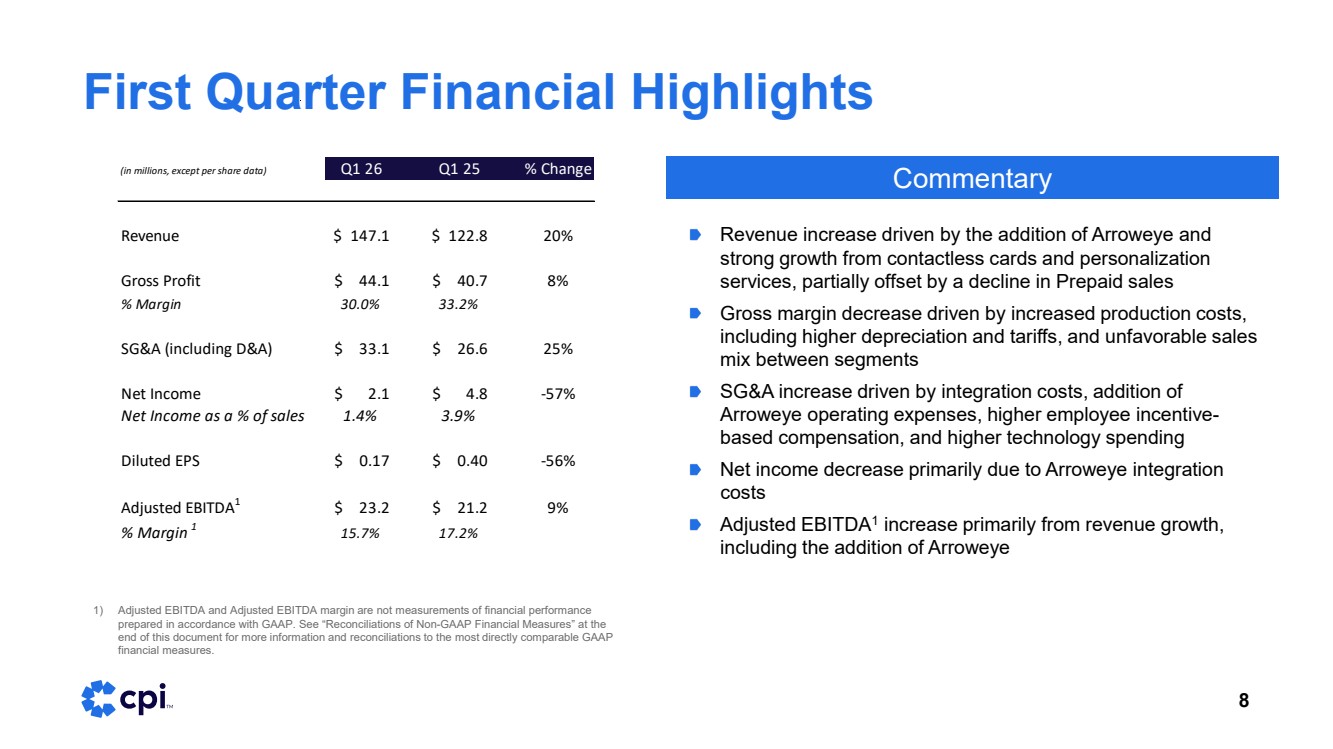
Revenue increased 20% to $147.1 million in the first quarter of 2026, compared to the prior year period.
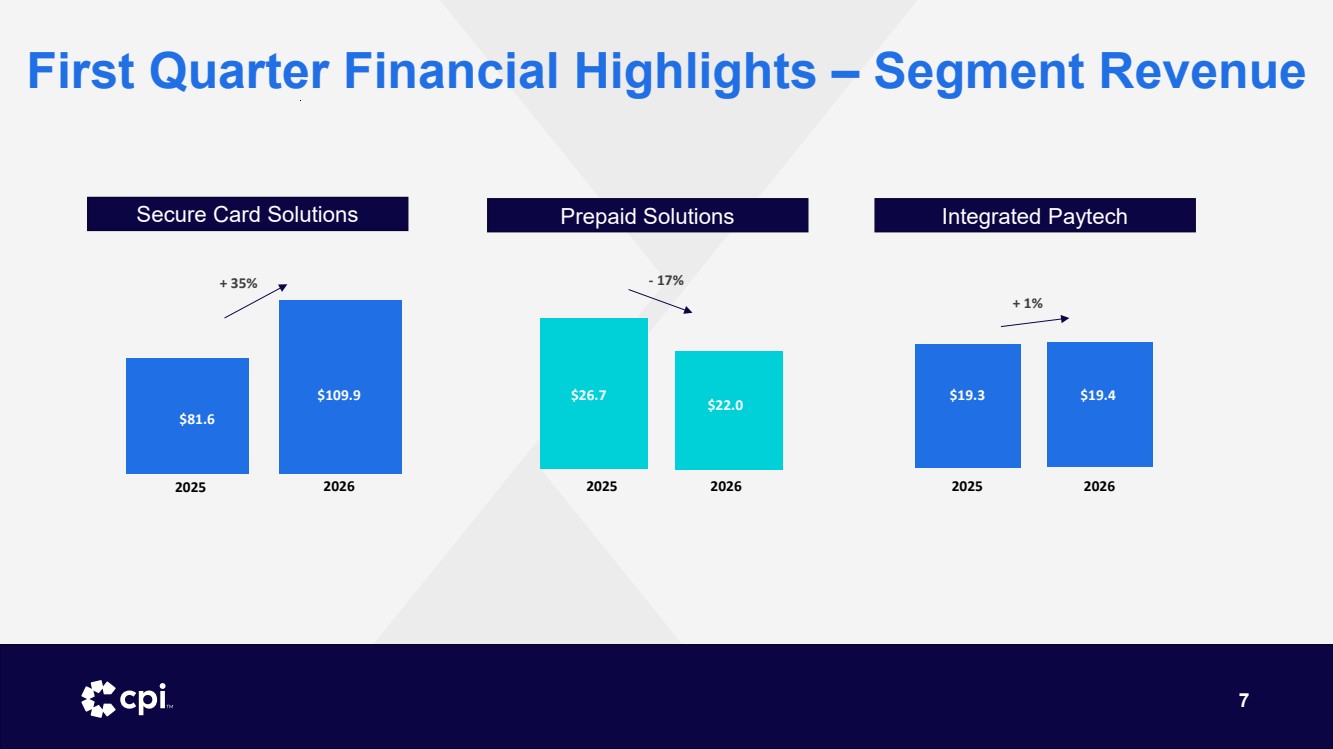
| ● | Secure Card Solutions segment revenue increased 35% to $109.9 million, driven by the addition of Arroweye, which contributed $16 million of revenue in the quarter; increased sales of contactless cards, including metal cards; and increased sales of personalization services. |
| ● | Integrated Paytech segment revenue increased 1% to $19.4 million compared to strong revenue levels in 2025, while gross profit margins increased more than 100 basis points to over 55%. |
Gross profit increased 8% to $44.1 million, driven by sales growth. Gross profit margin of 30.0% decreased from 33.2% prior year, primarily due to lower sales and margins in the Prepaid Solutions segment and increased production costs, including the impact of higher depreciation expense and tariffs, partially offset by benefits from increased sales in the Secure Card Solutions segment.
Net income decreased 57% to $2.1 million, or $0.17 diluted earnings per share, impacted by $3 million of Arroweye integration costs. Adjusted EBITDA increased 9% to $23.2 million.
Balance Sheet, Liquidity and Cash Flow
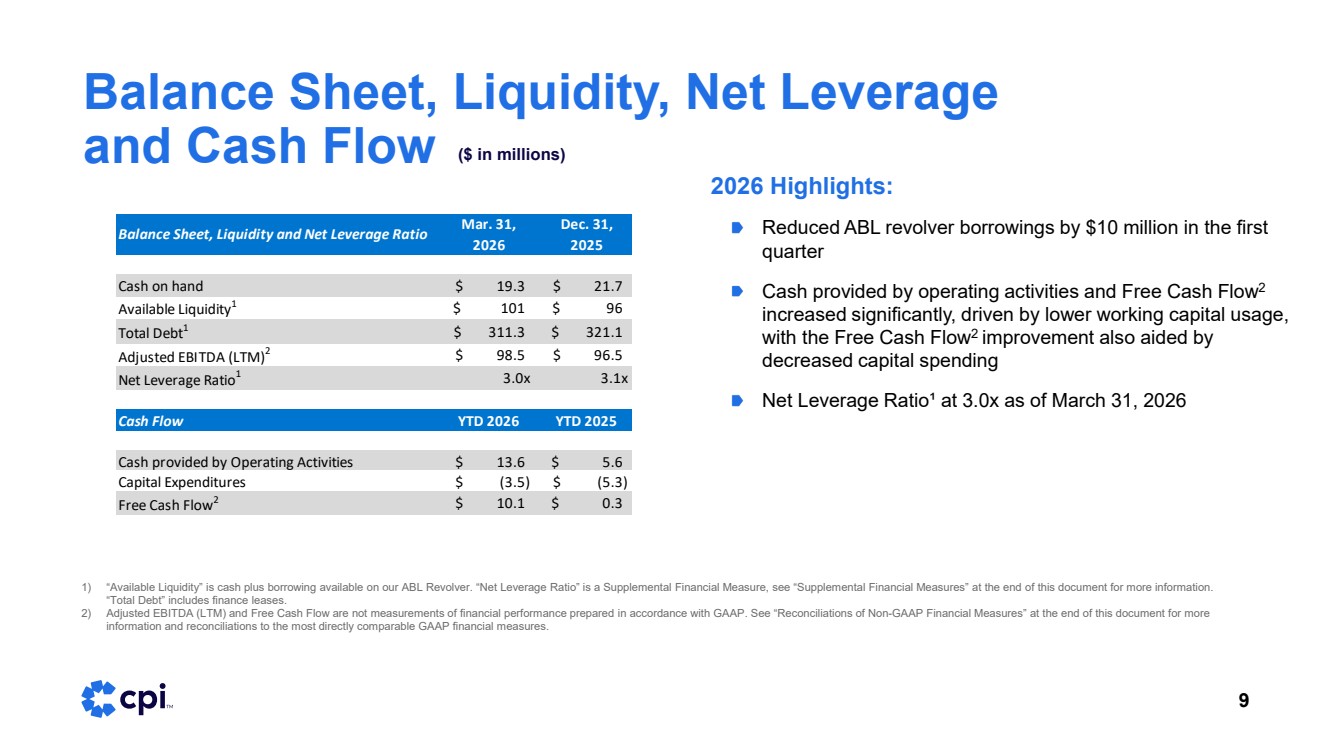
The Company generated cash from operating activities of $13.6 million in the first quarter of 2026, which compared to $5.6 million in the prior year period; and Free Cash Flow of $10.1 million, which compared to $0.3 million in the prior year. The increase in Free Cash Flow was primarily driven by strong working capital management and lower capital spending compared to the prior year period.
As of March 31, 2026, the Company had $19.3 million of cash and cash equivalents, $265 million of 10% Senior Secured Notes due 2029, and $15 million of borrowings from its ABL revolving credit facility outstanding. The Net Leverage Ratio decreased from year-end to 3.0x.
The Company’s capital structure and allocation priorities are focused on investing in the business, including strategic acquisitions; deleveraging the balance sheet; and returning funds to stockholders.
Outlook for 2026
The Company affirmed its financial outlook for 2026:
| ● | Revenue: high single-digit growth |
| ● | Adjusted EBITDA: low-to-mid single-digit growth |
| ● | Free Cash Flow conversion similar to 2025 levels |
| ● | Year-end Net Leverage Ratio between 2.5x and 3.0x |
Conference Call and Webcast
CPI will hold a conference call on May 5, 2026 at 9:00 a.m. Eastern Time to review its first quarter results. To participate in the Company's conference call via telephone or online:
U.S. dial-in number (toll-free): 888-330-3573
International: 646-960-0677
Conference ID: 8062733
Webcast Link: CPI Q1 Webcast or at https://investor.cpicardgroup.com
Participants are advised to login for the webcast 10 minutes prior to the scheduled start time.
A replay of the conference call will be available until May 12, 2026 at:
U.S. and Canada (toll-free): 800-770-2030
International: 609-800-9909
Canada: 647-362-9199
Conference ID: 8062733
A webcast replay of the conference call will also be available on CPI Card Group Inc.’s Investor Relations website: https://investor.cpicardgroup.com
Non-GAAP Financial Measures
In addition to financial results reported in accordance with U.S. generally accepted accounting principles (“GAAP”), we have provided the following non-GAAP financial measures in this release: Revenue excluding the Impact of an Accounting Change, EBITDA, Adjusted EBITDA, Adjusted EBITDA margin, Free Cash Flow, LTM Adjusted EBITDA and Net Leverage Ratio. These non-GAAP financial measures are utilized by management in comparing our operating performance on a consistent basis between fiscal periods and serve as a basis for certain Company compensation programs. We believe that these financial measures are appropriate to enhance an overall understanding of our underlying operating performance trends compared to historical and prospective periods and our peers. Management also believes that these measures are useful to investors in their analysis of our results of operations and provide improved comparability between fiscal periods. Non-GAAP financial measures should not be considered in isolation from, or as a substitute for, financial information calculated in accordance with GAAP. Our non-GAAP measures may be different from similarly titled measures of other companies. Investors are encouraged to review the reconciliation of these historical non-GAAP measures to their most directly comparable GAAP financial measures included in Exhibit E and Exhibit F to this press release.
Revenue excluding the Impact of an Accounting Change
Revenue excluding the Impact of an Accounting Change has been presented in Exhibit F and defined as revenue excluding the impact from an accounting change implemented in the second quarter of 2025 resulting from the Company moving from over-time revenue recognition for certain WIP orders to point-in-time recognition (revenue booked when shipped). This adjustment reflects WIP orders that were recognized at the end of the first quarter of 2025 as if such orders were consistently recognized using point-in-time recognition during the second quarter of 2025 for the results for the second quarter of 2025 and reflects WIP orders that were recognized at December 31, 2024 as if such orders were consistently recognized using point-in-time recognition during the year to date period presented for 2025.
EBITDA, Adjusted EBITDA, Adjusted EBITDA Margin, and LTM Adjusted EBITDA
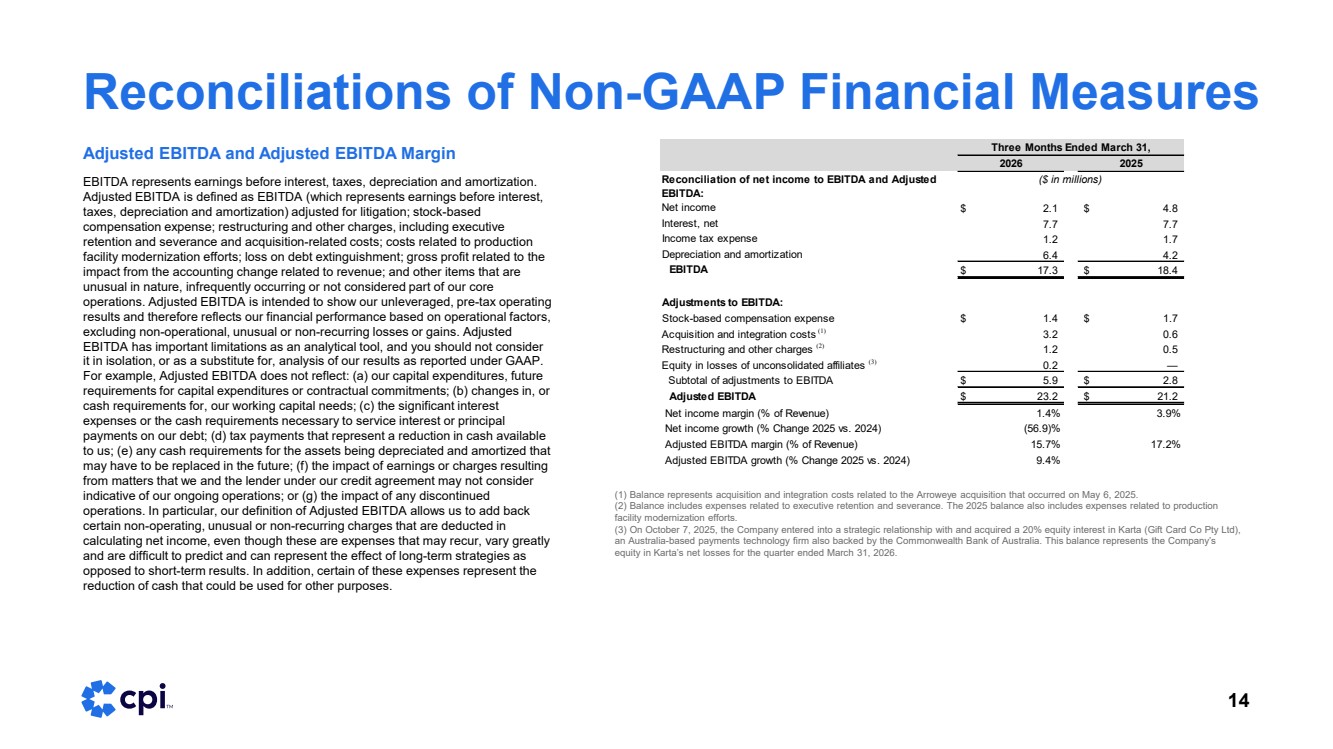
Adjusted EBITDA is defined as EBITDA (which represents earnings before interest, taxes, depreciation and amortization) adjusted for litigation; stock-based compensation expense; restructuring and other charges, including executive retention and severance and acquisition-related costs; costs related to production facility modernization efforts; loss on debt extinguishment; gross profit related to the impact from the accounting change related to revenue described above;
and other items that are unusual in nature, infrequently occurring or not considered part of our core operations, as set forth in the reconciliation in Exhibit E. Adjusted EBITDA is intended to show our unleveraged, pre-tax operating results and therefore reflects our financial performance based on operational factors, excluding non-operational, unusual or non-recurring losses or gains. Adjusted EBITDA has important limitations as an analytical tool, and you should not consider it in isolation, or as a substitute for, analysis of our results as reported under GAAP. For example, Adjusted EBITDA does not reflect: (a) our capital expenditures, future requirements for capital expenditures or contractual commitments; (b) changes in, or cash requirements for, our working capital needs; (c) the significant interest expenses or the cash requirements necessary to service interest or principal payments on our debt; (d) tax payments that represent a reduction in cash available to us; (e) any cash requirements for the assets being depreciated and amortized that may have to be replaced in the future; (f) the impact of earnings or charges resulting from matters that we and the lender under our credit agreement may not consider indicative of our ongoing operations; or (g) the impact of any discontinued operations. In particular, our definition of Adjusted EBITDA allows us to add back certain non-operating, unusual or non-recurring charges that are deducted in calculating net income, even though these are expenses that may recur, vary greatly and are difficult to predict and can represent the effect of long-term strategies as opposed to short-term results. In addition, certain of these expenses represent the reduction of cash that could be used for other purposes. Adjusted EBITDA margin as shown in Exhibit E is computed as Adjusted EBITDA divided by total revenue.
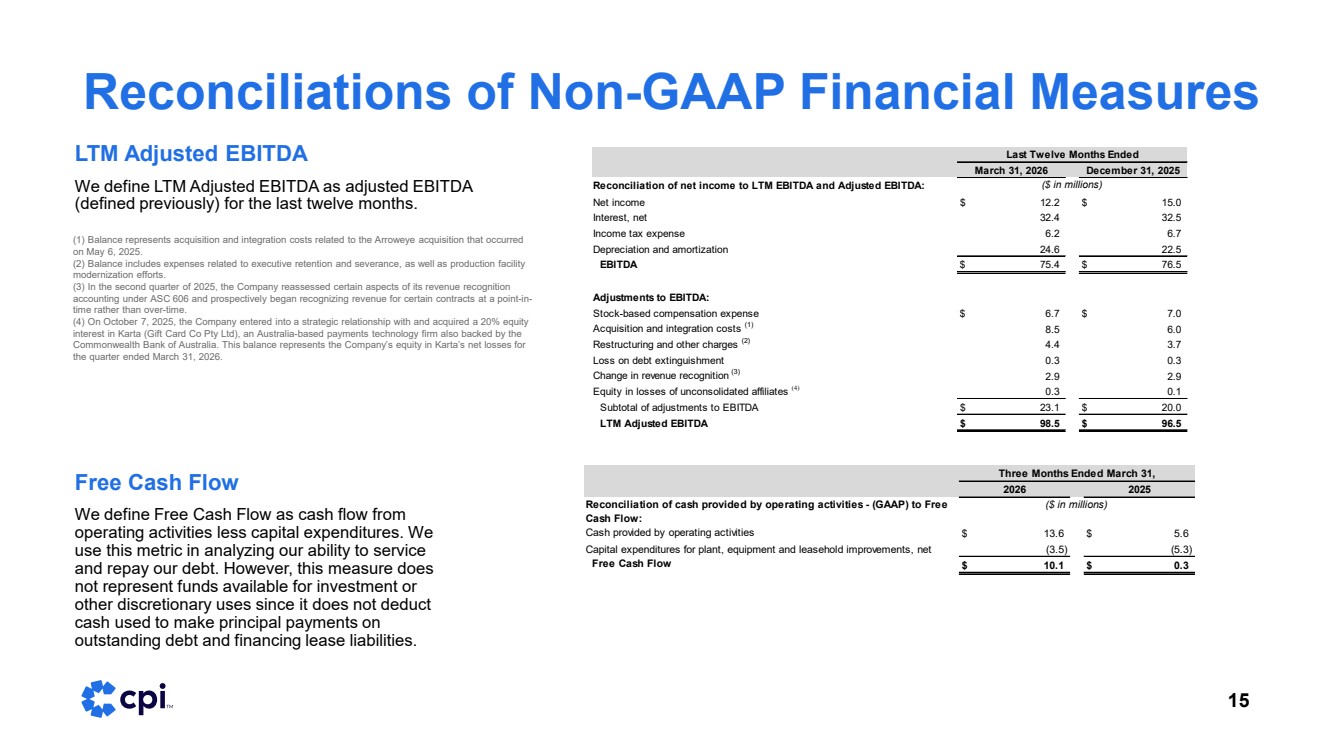
We define LTM Adjusted EBITDA as Adjusted EBITDA (defined previously) for the last twelve months. LTM Adjusted EBITDA is used in the computation of Net Leverage Ratio, and is reconciled in Exhibit E.
Free Cash Flow
We define Free Cash Flow as cash flow provided by (used in) operating activities less capital expenditures. We use this metric in analyzing our ability to service and repay our debt. However, this measure does not represent funds available for investment or other discretionary uses since it does not deduct cash used to make principal payments on outstanding debt and financing lease liabilities. Free Cash Flow should not be considered in isolation, or as a substitute for, cash (used in) provided by operating activities or any other measures of liquidity derived in accordance with GAAP.
Net Leverage Ratio
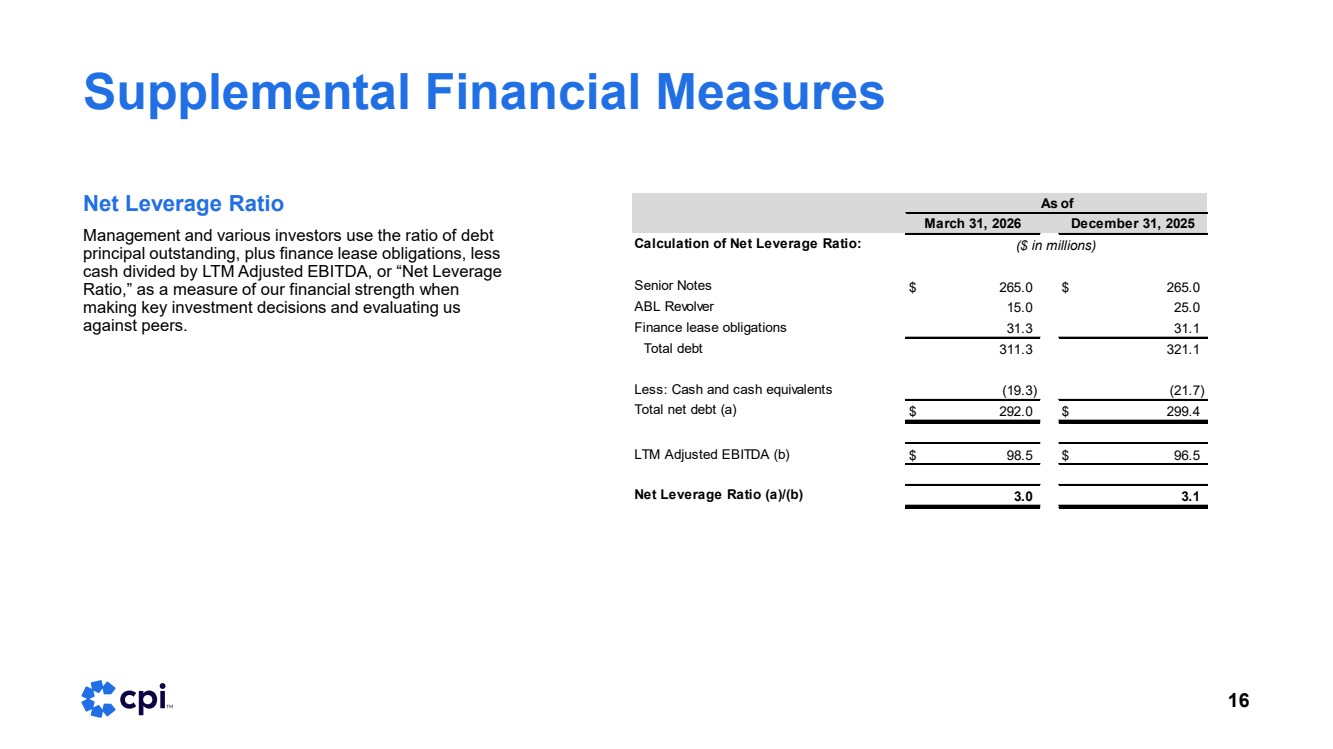
Management and various investors use the ratio of debt principal outstanding, plus finance lease obligations, less cash, divided by LTM Adjusted EBITDA, or “Net Leverage Ratio”, as a measure of our financial strength when making key investment decisions and evaluating us against peers.
Financial Expectations for 2026
We have provided Adjusted EBITDA expectations for 2026 on a non-GAAP basis because certain reconciling items are dependent on future events that either cannot be controlled or cannot be reliably predicted because they are not part of the Company’s routine activities, any of which could be significant.
About CPI
CPI is a payments technology company that is integral to the payments ecosystem. CPI’s connections, people, and solutions enable payments for a broad and expanding customer base including thousands of U.S. financial institutions, processors, fintechs, prepaid program managers and more, and these customers count on us to deliver what's next.
We continue to transform alongside the market, and for decades have invested in building deep connections and flexible solutions for our customers. Our proprietary platform and expertise uniquely position CPI to deliver today, tomorrow, and into the future as the market expands and payment methods evolve. Learn more at www.cpicardgroup.com.
Certain statements and information in this release (as well as information included in other written or oral statements we make from time to time) may contain or constitute “forward-looking statements” within the meaning of the Private Securities Litigation Reform Act of 1995, Section 27A of the Securities Act of 1933, as amended, and Section 21E of the Securities Exchange Act of 1934, as amended (the “Exchange Act”). The words “believe,” “estimate,” “project,” “expect,” “anticipate,” “affirm,” “plan,” “intend,” “foresee,” “should,” “would,” “could,” “continue,” “committed,” “attempt,” “aim,” “target,” “objective,” “guides,” “seek,” “focus,” “provides guidance,” “provides outlook” or other similar expressions are intended to identify forward-looking statements, which are not historical in nature. These forward-looking statements, including statements about our strategic initiatives and market opportunities, including our financial outlook for 2026, the impact of our investments in Arroweye and other solutions, and our qualitative color on our business in 2026 and beyond; are based on our current expectations and beliefs concerning future developments and their potential effect on us and other information currently available. Such forward-looking statements, because they relate to future events, are by their very nature subject to many important risks and uncertainties that could cause actual results or other events to differ materially from those contemplated.
These risks and uncertainties include, but are not limited to: (i) risks relating to our business and industry, such as a deterioration in general economic conditions, including due to inflationary conditions, resulting in reduced consumer confidence and business spending, and a decline in consumer credit worthiness impacting demand for our products; the unpredictability of our operating results, including an inability to anticipate changes in customer inventory management practices and its impact on our business; our failure to retain our existing key customers or identify and attract new customers; the highly competitive, saturated and consolidated nature of our marketplace; our inability to develop, introduce and commercialize new products and related services, including due to our inability to undertake research and development activities; new and developing technologies that make our existing technology solutions and products obsolete or less relevant or our failure to introduce new products and related services in a timely manner or at all; system security risks, data protection breaches and cyber-attacks; the usage, or lack thereof, of
artificial intelligence technologies; disruptions, delays or other failures in our supply chain, including as a result of inflationary pressures, single-source suppliers, failure or inability of suppliers to comply with our code of conduct or contractual requirements, trade restrictions, tariffs, foreign conflicts or political unrest in countries in which our suppliers operate, and our inability to pass related costs on to our customers or difficulty meeting customers’ delivery expectations due to extended lead times; changes in U.S. and global trade policy and the impact of tariffs on our business and results of operations; interruptions in our operations, including our information technology systems, or in the operations of the third parties that operate computing infrastructure on which we rely; defects in our software and computing systems; disruptions in production at one or more of our facilities due to weather conditions, climate change, political instability, or social unrest; problems in production quality, materials and process and costs relating to product defects and any related product liability and/or warranty claims and damage to our reputation; our inability to recruit, retain and develop qualified personnel, including key personnel, and implement effective succession processes; our substantial indebtedness, including the restrictive terms of our indebtedness and covenants of future agreements governing indebtedness and the resulting restraints on our ability to pursue our business strategies; our inability to make debt service payments or refinance such indebtedness; our inability to successfully execute on, integrate, or achieve the anticipated benefits of acquisitions, including the acquisition of Arroweye Solutions, Inc. (“Arroweye”), or execute on divestitures, strategic relationships, or investments; our status as an accelerated filer and complying with the Sarbanes-Oxley Act of 2002 and the costs associated with such compliance and implementation of procedures thereunder; our failure to maintain effective internal control over financial reporting and risks relating to investor confidence in our financial reporting; environmental, social and governance (“ESG”) preferences and demands of various stakeholders and the related impact on our ability to access capital, produce our products in conformity with stakeholder preferences, comply with stakeholder demands and comply with any related legal or regulatory requirements or restrictions; negative perceptions of our products due to the impact of our products and production processes on the environment and other ESG-related risks; damage to our reputation or brand image; our inability to adequately protect our trade secrets and intellectual property rights from misappropriation, infringement claims brought against us and risks related to open source software; our inability to renew licenses with key technology licensors; our limited ability to raise capital, which may lead to delays in innovation or the abandonment of our strategic initiatives; costs and impacts related to additional tax collection efforts by states, unclaimed property laws, or future increases in U.S. federal or state income taxes, resulting in additional expenses which we may be unable to pass along to our customers; our inability to realize the full value of our long-lived assets; costs and potential liabilities associated with compliance or failure to comply with laws and regulations, customer contractual requirements and evolving industry standards regarding consumer privacy and data use and security; our failure to operate our business in accordance with the Payment Card Industry Security Standards Council security standards or other industry standards; the effects of ongoing foreign conflicts on the global economy; adverse conditions in the banking system and financial markets, including the failure of banks and financial institutions; our failure to comply with environmental, health and safety laws and regulations that apply to our products and the raw materials we use in our production processes; (ii) risks relating to ownership of our common stock, such as those associated with concentrated ownership of our stock by our significant stockholders and potential conflicts of interests with other stockholders; the impact of concentrated ownership of our common stock and
the sale or perceived sale of a substantial amount of common stock on the trading volume and market price of our common stock; potential conflicts of interest that may arise due to our Board of Directors being comprised in part of directors who are principals of or were nominated by our significant stockholders; the influence of securities analysts over the trading market for and price of our common stock, particularly due to the lack of substantial research coverage of our common stock; the impact of stockholder activism or actual or threatened securities litigation on the trading price and volatility of our common stock; certain provisions of our organizational documents and other contractual provisions that may delay or prevent a change in control and make it difficult for stockholders other than our significant stockholders to change the composition of our Board of Directors; and (iii) general risks, such as relating to our ability to comply with a wide variety of complex evolving laws and regulations and the exposure to liability for any failure to comply; the effect of legal and regulatory proceedings and the adequacy of our insurance policies; and other risks that are described in Part I, Item 1A, Risk Factors in our Annual Report on Form 10-K for the year ended December 31, 2025 filed with the SEC on March 5, 2026, and our other reports filed from time to time with the Securities and Exchange Commission (the “SEC”).
We caution and advise readers not to place undue reliance on forward-looking statements, which speak only as of the date hereof. These statements are based on assumptions that may not be realized and involve risks and uncertainties that could cause actual results or other events to differ materially from the expectations and beliefs contained herein. We undertake no obligation to publicly update or revise any forward-looking statements after the date they are made, whether as a result of new information, future events or otherwise.
####
For more information:
CPI encourages investors to use its investor relations website as a way of easily finding information about the Company. CPI promptly makes available on this website the reports that the Company files or furnishes with the SEC, corporate governance information and press releases.
CPI Card Group Inc. Investor Relations:
(877) 369-9016
CPI Card Group Inc. Media Relations:
CPI Card Group Inc. Earnings Release Supplemental Financial Information
Exhibit A | Condensed Consolidated Statements of Operations and Comprehensive Income - Unaudited for the three months ended March 31, 2026 and 2025 |
| |
Exhibit B | Condensed Consolidated Balance Sheets – Unaudited as of March 31, 2026 and December 31, 2025 |
| |
Exhibit C | Condensed Consolidated Statements of Cash Flows – Unaudited for the three months ended March 31, 2026 and 2025 |
| |
Exhibit D | Segment Summary Information – Unaudited for the three months ended March 31, 2026 and 2025 |
| |
Exhibit E | Supplemental GAAP to Non-GAAP Reconciliations – Unaudited for the three months ended March 31, 2026 and 2025 |
| |
Exhibit F | Supplemental GAAP to Non-GAAP Reconciliations – Unaudited for the three months ended March 31, 2026 and 2025 |

| | | | | | EXHIBIT A |
CPI Card Group Inc. and Subsidiaries | ||||||
Condensed Consolidated Statements of Operations and Comprehensive Income | ||||||
(in thousands, except share and per share amounts) | ||||||
(Unaudited) | ||||||
| | | | | | |
| | Three Months Ended March 31, | ||||
| | 2026 | | 2025 | ||
Revenue | | $ | 147,108 | | $ | 122,761 |
Cost of goods sold | | | 102,984 | | | 82,065 |
Gross profit | | | 44,124 | | | 40,696 |
Selling, general and administrative expenses | | | 33,130 | | | 26,592 |
Income from operations | | | 10,994 | | | 14,104 |
Other expense, net: | | | | | | |
Interest, net | | | (7,656) | | | (7,685) |
Other income, net | | | 32 | | | 18 |
Total other expense, net | | | (7,624) | | | (7,667) |
Income before income taxes and equity in losses of unconsolidated affiliates | | | 3,370 | | | 6,437 |
Income tax expense | | | (1,158) | | | (1,663) |
Equity in losses of unconsolidated affiliates | | | (156) | | | — |
Net income | | $ | 2,056 | | $ | 4,774 |
| | | | | | |
Basic and diluted earnings per share: | | | | | | |
Basic earnings per share | | $ | 0.18 | | $ | 0.42 |
Diluted earnings per share | | $ | 0.17 | | $ | 0.40 |
| | | | | | |
Basic weighted-average shares outstanding | | | 11,457,573 | | | 11,245,844 |
Diluted weighted-average shares outstanding | | | 11,857,270 | | | 12,008,523 |
| | | | | | |
Comprehensive income: | | | | | | |
Net income | | $ | 2,056 | | $ | 4,774 |
Total comprehensive income | | $ | 2,056 | | $ | 4,774 |
| | | | EXHIBIT B | |
CPI Card Group Inc. and Subsidiaries | |||||
Condensed Consolidated Balance Sheets | |||||
(in thousands, except share and per share amounts) | |||||
(Unaudited) | |||||
| | | | | |
| March 31, | | December 31, | ||
| 2026 | | 2025 | ||
Assets | | | | | |
Current assets: | | | | | |
Cash and cash equivalents | $ | 19,296 | | $ | 21,700 |
Accounts receivable, net | | 88,681 | |
| 95,436 |
Inventories, net | | 65,504 | |
| 72,243 |
Prepaid expenses and other current assets | | 15,407 | |
| 15,565 |
Total current assets | | 188,888 | |
| 204,944 |
Plant, equipment, leasehold improvements and operating lease right-of-use assets, net | | 106,676 | |
| 108,433 |
Intangible assets, net | | 17,550 | |
| 18,544 |
Goodwill | | 48,764 | |
| 48,764 |
Other assets | | 24,576 | |
| 22,506 |
Total assets | $ | 386,454 | | $ | 403,191 |
Liabilities and stockholders’ deficit | | | | | |
Current liabilities: | | | | | |
Accounts payable | $ | 22,469 | | $ | 27,802 |
Accrued expenses | | 48,260 | |
| 52,379 |
Deferred revenue and customer deposits | | 3,600 | |
| 3,916 |
Total current liabilities | | 74,329 | | | 84,097 |
Long-term debt | | 276,903 | |
| 286,668 |
Deferred income taxes | | 2,565 | |
| 2,251 |
Other long-term liabilities | | 46,667 | |
| 47,508 |
Total liabilities | | 400,464 | |
| 420,524 |
| | | | | |
Commitments and contingencies | | | | | |
| | | | | |
Stockholders’ deficit: | | | | | |
Series A Preferred Stock; $0.001 par value—100,000 shares authorized; 0 shares issued and outstanding at March 31, 2026 and December 31, 2025 | | — | | | — |
Common stock; $0.001 par value—100,000,000 shares authorized; 11,475,608 and 11,456,061 shares issued and outstanding at March 31, 2026 and December 31, 2025, respectively | | 11 | | | 11 |
Capital deficit | | (100,824) | | | (102,091) |
Accumulated earnings | | 86,803 | | | 84,747 |
Total stockholders’ deficit | | (14,010) | |
| (17,333) |
Total liabilities and stockholders’ deficit | $ | 386,454 | | $ | 403,191 |
| | | | | EXHIBIT C |
CPI Card Group Inc. and Subsidiaries | |||||
Condensed Consolidated Statements of Cash Flows | |||||
(in thousands) | |||||
(Unaudited) | |||||
| | | | | |
| Three Months Ended March 31, | ||||
| 2026 | | 2025 | ||
Operating activities | | | | | |
Net income | $ | 2,056 | | $ | 4,774 |
Adjustments to reconcile net income to net cash provided by operating activities: | | | | | |
Depreciation expense | | 5,409 | | | 3,387 |
Amortization expense | | 994 | | | 860 |
Stock-based compensation expense | | 1,403 | | | 1,671 |
Amortization of debt issuance costs | | 328 | | | 329 |
Deferred income taxes and other, net | | 189 | | | (314) |
Changes in operating assets and liabilities: | | | | | |
Accounts receivable, net | | 6,755 | | | 9,998 |
Inventories | | 7,055 | | | (2,460) |
Prepaid expenses and other assets | | (3,235) | | | (1,348) |
Income taxes, net | | 1,362 | | | 444 |
Accounts payable | | (3,957) | | | 5,120 |
Accrued expenses and other liabilities | | (4,395) | | | (16,937) |
Deferred revenue and customer deposits | | (316) | | | 69 |
Cash provided by operating activities | | 13,648 | | | 5,593 |
Investing activities | | | | | |
Capital expenditures for plant, equipment and leasehold improvements, net | | (3,513) | | | (5,301) |
Other | | — | | | 50 |
Cash used in investing activities | | (3,513) | |
| (5,251) |
Financing activities | | | | | |
Payments on debt | | (10,000) | | | — |
Payments on finance lease obligations | | (2,403) | | | (1,825) |
Taxes withheld and paid on stock-based compensation awards | | (136) | | | (541) |
Cash used in financing activities | | (12,539) | |
| (2,366) |
Net decrease in cash and cash equivalents | | (2,404) | | | (2,024) |
Cash and cash equivalents, beginning of period | | 21,700 | | | 33,544 |
Cash and cash equivalents, end of period | $ | 19,296 | | $ | 31,520 |
Supplemental disclosures of cash flow information | | | | | |
Cash paid (refunded) during the period for: | | | | | |
Interest paid | $ | 14,332 | | $ | 14,998 |
Income taxes paid | $ | — | | $ | 2 |
Income taxes refunded | $ | (527) | | $ | — |
Right-of-use assets obtained in exchange for lease obligations: | | | | | |
Operating leases | $ | 187 | | $ | 7,382 |
Financing leases | $ | 2,454 | | $ | 1,888 |
Accounts payable and accrued expenses for capital expenditures for plant, equipment and leasehold improvements | $ | 616 | | $ | 1,654 |
Non-cash equity in losses of unconsolidated affiliates | $ | (156) | | $ | — |
EXHIBIT D | ||||||||||||
CPI Card Group Inc. and Subsidiaries | ||||||||||||
Segment Summary Information | ||||||||||||
For the Three Months Ended March 31, 2026 and 2025 | ||||||||||||
(dollars in thousands) | ||||||||||||
(Unaudited) | ||||||||||||
| | | | | | | | | | | | |
| | | | | | | | | | | | |
| | | | | | | | | | | | |
Revenue | | | | | | | | | | | | |
| | Three Months Ended March 31, | ||||||||||
| | 2026 | | 2025 | | $ Change | | % Change | ||||
Revenue by segment: | | | | | | | | | | | | |
Secure Card Solutions | | $ | 109,851 | | $ | 81,642 | | $ | 28,209 | | 34.6 | % |
Prepaid Solutions | | | 22,049 | | | 26,713 | | | (4,664) | | (17.5) | % |
Integrated Paytech | | | 19,382 | | | 19,253 | | | 129 | | 0.7 | % |
Eliminations | | | (4,174) | | | (4,847) | | | 673 | | * | % |
Total | | $ | 147,108 | | $ | 122,761 | | $ | 24,347 | | 19.8 | % |
| | | | | | | | | | | | |
Gross Profit | | | | | | | | | | | | | | | | | |
| | Three Months Ended March 31, | | ||||||||||||||
| | 2026 | | % of Net | | 2025 | | % of Net | | $ Change | | % Change | |||||
Gross profit by segment: | | | | | | | | | | | | | | | | | |
Secure Card Solutions | | $ | 27,702 | | | 25.2 | % | $ | 20,819 | | 25.5 | % | $ | 6,883 | | 33.1 | % |
Prepaid Solutions | | | 5,666 | | | 25.7 | % | | 9,442 | | 35.3 | % | | (3,776) | | (40.0) | % |
Integrated Paytech | | | 10,756 | | | 55.5 | % | | 10,435 | | 54.2 | % | | 321 | | 3.1 | % |
Total | | $ | 44,124 | | | 30.0 | % | $ | 40,696 | | 33.2 | % | $ | 3,428 | | 8.4 | % |
Income from Operations | | | | | | | | | | | | | | | | | |
| | | Three Months Ended March 31, | | |||||||||||||
| | | 2026 | | % of Net | | | 2025 | | % of Net | | | $ Change | | % Change | ||
Income (loss) from operations by segment: | | | | | | | | | | | | | | | | | |
Secure Card Solutions | | $ | 17,268 | | | 15.7 | % | $ | 14,310 | | 17.5 | % | $ | 2,958 | | 20.7 | % |
Prepaid Solutions | | | 4,093 | | | 18.6 | % | | 7,999 | | 29.9 | % | | (3,906) | | (48.8) | % |
Integrated Paytech | | | 6,865 | | | 35.4 | % | | 7,393 | | 38.4 | % | | (528) | | (7.1) | % |
Corporate | | | (17,232) | | | * | % | | (15,598) | | * | % | | (1,634) | | 10.5 | % |
Total | | $ | 10,994 | | | 7.5 | % | $ | 14,104 | | 11.5 | % | $ | (3,110) | | (22.1) | % |
EBITDA | | | | | | | | | | | | | | | | | |
| | Three Months Ended March 31, | | ||||||||||||||
| | 2026 | | % of Net | | 2025 | | % of Net | | $ Change | | % Change | |||||
EBITDA by segment: | | | | | | | | | | | | | | | | | |
Secure Card Solutions | | $ | 21,648 | | | 19.7 | % | $ | 16,543 | | 20.3 | % | $ | 5,105 | | 30.9 | % |
Prepaid Solutions | | | 5,211 | | | 23.6 | % | | 9,121 | | 34.1 | % | | (3,910) | | (42.9) | % |
Integrated Paytech | | | 6,955 | | | 35.9 | % | | 7,424 | | 38.6 | % | | (469) | | (6.3) | % |
Corporate | | | (16,541) | | | * | % | | (14,719) | | * | % | | (1,822) | | 12.4 | % |
Total | | $ | 17,273 | | | 11.7 | % | $ | 18,369 | | 15.0 | % | $ | (1,096) | | (6.0) | % |
Reconciliation of Income (Loss) from | | | | | | | | | | | | | | |
Operations by Segment to EBITDA by Segment | | | | | | | | | | | | | | |
| | | | | | | | | | | | | | |
| Three Months Ended March 31, 2026 | |||||||||||||
| Secure Card Solutions | | Prepaid Solutions | | Integrated Paytech | | Corporate | | Total | |||||
EBITDA by segment: | | | | | | | | | | | | | | |
Income (loss) from operations | $ | 17,268 | | $ | 4,093 | | $ | 6,865 | | $ | (17,232) | | $ | 10,994 |
Depreciation and amortization | | 4,346 | | | 1,274 | | | 90 | | | 693 | | | 6,403 |
Other income (expense), net | | 34 | | | (156) | | | — | | | (2) | | | (124) |
EBITDA | $ | 21,648 | | $ | 5,211 | | $ | 6,955 | | $ | (16,541) | | $ | 17,273 |
| | | | | | | | | | | | | | |
| | | | | | | | | | | | | | |
| Three Months Ended March 31, 2025 | |||||||||||||
| Secure Card Solutions | | Prepaid Solutions | | Integrated Paytech | | Corporate | | Total | |||||
EBITDA by segment: | | | | | | | | | | | | | | |
Income (loss) from operations | $ | 14,310 | | $ | 7,999 | | $ | 7,393 | | $ | (15,598) | | $ | 14,104 |
Depreciation and amortization | | 2,240 | | | 1,116 | | | 31 | | | 860 | | | 4,247 |
Other (expense) income, net | | (7) | | | 6 | | | — | | | 19 | | | 18 |
EBITDA | $ | 16,543 | | $ | 9,121 | | $ | 7,424 | | $ | (14,719) | | $ | 18,369 |
* Calculation not meaningful
| | | | | EXHIBIT E |
CPI Card Group Inc. and Subsidiaries | |||||
Supplemental GAAP to Non-GAAP Reconciliation | |||||
(dollars in thousands) | |||||
(Unaudited) | |||||
| | | | | |
| | | | | |
| | | | | |
| Three Months Ended March 31, | ||||
| 2026 | | 2025 | ||
EBITDA and Adjusted EBITDA: | | | | | |
Net income | $ | 2,056 | | $ | 4,774 |
Interest, net | | 7,656 | | | 7,685 |
Income tax expense | | 1,158 | | | 1,663 |
Depreciation and amortization | | 6,403 | | | 4,247 |
EBITDA | $ | 17,273 | | $ | 18,369 |
| | | | | |
Adjustments to EBITDA: | | | | | |
Stock-based compensation expense | $ | 1,403 | | $ | 1,671 |
Acquisition and integration costs (1) | | 3,153 | | | 640 |
Restructuring and other charges (2) | | 1,172 | | | 482 |
Equity in losses of unconsolidated affiliates (3) | | 156 | | | — |
Subtotal of adjustments to EBITDA | $ | 5,884 | | $ | 2,793 |
Adjusted EBITDA | $ | 23,157 | | $ | 21,162 |
Net income margin (% of Revenue) | | 1.4% | | | 3.9% |
Net income growth (% Change 2026 vs. 2025) | | (56.9)% | | | |
Adjusted EBITDA margin (% of Revenue) | | 15.7% | | | 17.2% |
Adjusted EBITDA growth (% Change 2026 vs. 2025) | | 9.4% | | | |
| | | | | |
| | | | | |
| Three Months Ended March 31, | ||||
| 2026 | | 2025 | ||
Free Cash Flow: | | | | | |
Cash provided by operating activities | $ | 13,648 | | $ | 5,593 |
Capital expenditures for plant, equipment and leasehold improvements, net | | (3,513) | | | (5,301) |
Free Cash Flow | $ | 10,135 | | $ | 292 |
| (1) | Balance represents acquisition and integration costs related to the Arroweye acquisition that occurred on May 6, 2025. |
| (2) | Balance includes expenses related to executive retention and severance. The 2025 balance also includes expenses related to production facility modernization efforts. |
| (3) | On October 7, 2025, the Company entered into a strategic relationship with and acquired a 20% equity interest in Karta (Gift Card Co Pty Ltd), an Australia-based payments technology firm also backed by the Commonwealth Bank of Australia. This balance represents the Company’s equity in Karta’s net losses for the quarter ended March 31, 2026. |
| Last Twelve Months Ended | ||||
| March 31, | | December 31, | ||
| 2026 | | 2025 | ||
Reconciliation of net income to LTM EBITDA and Adjusted EBITDA: | | | | | |
Net income | $ | 12,232 | | $ | 14,950 |
Interest, net | | 32,437 | | | 32,466 |
Income tax expense | | 6,151 | | | 6,656 |
Depreciation and amortization | | 24,617 | | | 22,461 |
EBITDA | $ | 75,437 | | $ | 76,533 |
| | | | | |
Adjustments to EBITDA: | | | | | |
Stock-based compensation expense | $ | 6,695 | | $ | 6,963 |
Acquisition and integration costs (1) | | 8,467 | | | 5,954 |
Restructuring and other charges (2) | | 4,406 | | | 3,716 |
Loss on debt extinguishment | | 287 | | | 287 |
Change in revenue recognition (3) | | 2,929 | | | 2,929 |
Equity in losses of unconsolidated affiliates (4) | | 290 | | | 134 |
Subtotal of adjustments to EBITDA | $ | 23,074 | | $ | 19,983 |
LTM Adjusted EBITDA | $ | 98,511 | | $ | 96,516 |
| (1) | Balance represents acquisition and integration costs related to the Arroweye acquisition that occurred on May 6, 2025. |
| (2) | Balance includes expenses related to executive retention and severance, as well as production facility modernization efforts. |
| (3) | In the second quarter of 2025, the Company reassessed certain aspects of its revenue recognition accounting under ASC 606 and prospectively began recognizing revenue for certain contracts at a point-in-time rather than over-time. |
| (4) | On October 7, 2025, the Company entered into a strategic relationship with and acquired a 20% equity interest in Karta (Gift Card Co Pty Ltd), an Australia-based payments technology firm also backed by the Commonwealth Bank of Australia. This balance represents the Company’s equity in Karta’s net losses for the quarter ended March 31, 2026. |
| As of | ||||
| March 31, | | December 31, | ||
| 2026 | | 2025 | ||
Calculation of Net Leverage Ratio: | | | | | |
Senior Notes | $ | 265,000 | | $ | 265,000 |
ABL Revolver | | 15,000 | | | 25,000 |
Finance lease obligations | | 31,261 | | | 31,058 |
Total debt | | 311,261 | | | 321,058 |
Less: Cash and cash equivalents | | (19,296) | | | (21,700) |
Total net debt (a) | $ | 291,965 | | $ | 299,358 |
LTM Adjusted EBITDA (b) | $ | 98,511 | | $ | 96,516 |
Net Leverage Ratio (a)/(b) | | 3.0 | | | 3.1 |
EXHIBIT F | |||||||||||||||||
CPI Card Group Inc. and Subsidiaries | |||||||||||||||||
Supplemental GAAP to Non-GAAP Reconciliation | |||||||||||||||||
(dollars in thousands) | |||||||||||||||||
(Unaudited) | |||||||||||||||||
| | | | | | | | | | | | | | | | | |
| Three Months Ended March 31, 2026 | | Three Months Ended March 31, 2025 | ||||||||||||||
| As Reported | | Impacts from Change in Revenue Recognition | | As Adjusted | | As Reported | | Impacts from Change in Revenue Recognition | | As Adjusted | ||||||
Consolidated CPI | | | | | | | | | | | | | | | | | |
Revenue (1) | $ | 147,108 | | $ | — | | $ | 147,108 | | $ | 122,761 | | $ | (296) | | $ | 122,465 |
Revenue growth (% Change 2026 vs. 2025) | | 19.8% | | | | | | 20.1% | | | | | | | | | |
| | | | | | | | | | | | | | | | | |
Secure Card Solutions | | | | | | | | | | | | | | | | | |
Revenue | $ | 109,851 | | $ | — | | $ | 109,851 | | $ | 81,642 | | $ | (612) | | $ | 81,030 |
Revenue growth (% Change 2026 vs. 2025) | | 34.6% | | | | | | 35.6% | | | | | | | | | |
| | | | | | | | | | | | | | | | | |
Prepaid Solutions | | | | | | | | | | | | | | | | | |
Revenue | $ | 22,049 | | $ | — | | $ | 22,049 | | $ | 26,713 | | $ | 316 | | $ | 27,029 |
Revenue growth (% Change 2026 vs. 2025) | | (17.5)% | | | | | | (18.4)% | | | | | | | | | |
| | | | | | | | | | | | | | | | | |
Integrated Paytech | | | | | | | | | | | | | | | | | |
Revenue | $ | 19,382 | | $ | — | | $ | 19,382 | | $ | 19,253 | | $ | — | | $ | 19,253 |
Revenue growth (% Change 2026 vs. 2025) | | 0.7% | | | | | | 0.7% | | | | | | | | | |
| (1) | For the three months ended March 31, 2026 and 2025, consolidated revenue include $4,174 and $4,847 of intersegment eliminations, respectively. |
Exhibit 99.2
| First Quarter 2026 Investor Presentation May 5, 2026 |

| 2 Cautionary Statements Forward Looking Statements Certain statements and information in this presentation (as well as information included in other written or oral statements we make from time to time) may contain or constitute “forward-looking statements” within the meaning of the Private Securities Litigation Reform Act of 1995, Section 27A of the Securities Act of 1933, as amended, and Section 21E of the Securities Exchange Act of 1934, as amended (the “Exchange Act”). The words “believe,” “estimate,” “project,” “expect,” “anticipate,” “affirm,” “plan,” “intend,” “foresee,” “should,” “would,” “could,” “continue,” “committed,” “attempt,” “aim,” “target,” “objective,” “guides,” “seek,” “focus,” “provides guidance,” “provides outlook” or other similar expressions are intended to identify forward-looking statements, which are not historical in nature. These forward-looking statements, including statements about our strategic initiatives and market opportunities, including our financial outlook for 2026, the impact of our investments in Arroweye and other solutions, and our qualitative color on our business in 2026 and beyond; are based on our current expectations and beliefs concerning future developments and their potential effect on us and other information currently available. Such forward-looking statements, because they relate to future events, are by their very nature subject to many important risks and uncertainties that could cause actual results or other events to differ materially from those contemplated. These risks and uncertainties include, but are not limited to: (i) risks relating to our business and industry, such as a deterioration in general economic conditions, including due to inflationary conditions, resulting in reduced consumer confidence and business spending, and a decline in consumer credit worthiness impacting demand for our products; the unpredictability of our operating results, including an inability to anticipate changes in customer inventory management practices and its impact on our business; our failure to retain our existing key customers or identify and attract new customers; the highly competitive, saturated and consolidated nature of our marketplace; our inability to develop, introduce and commercialize new products and related services, including due to our inability to undertake research and development activities; new and developing technologies that make our existing technology solutions and products obsolete or less relevant or our failure to introduce new products and related services in a timely manner or at all; system security risks, data protection breaches and cyber-attacks; the usage, or lack thereof, of artificial intelligence technologies; disruptions, delays or other failures in our supply chain, including as a result of inflationary pressures, single-source suppliers, failure or inability of suppliers to comply with our code of conduct or contractual requirements, trade restrictions, tariffs, foreign conflicts or political unrest in countries in which our suppliers operate, and our inability to pass related costs on to our customers or difficulty meeting customers’ delivery expectations due to extended lead times; changes in U.S. and global trade policy and the impact of tariffs on our business and results of operations; interruptions in our operations, including our information technology systems, or in the operations of the third parties that operate computing infrastructure on which we rely; defects in our software and computing systems; disruptions in production at one or more of our facilities due to weather conditions, climate change, political instability, or social unrest; problems in production quality, materials and process and costs relating to product defects and any related product liability and/or warranty claims and damage to our reputation; our inability to recruit, retain and develop qualified personnel, including key personnel, and implement effective succession processes; our substantial indebtedness, including the restrictive terms of our indebtedness and covenants of future agreements governing indebtedness and the resulting restraints on our ability to pursue our business strategies; our inability to make debt service payments or refinance such indebtedness; our inability to successfully execute on, integrate, or achieve the anticipated benefits of acquisitions, including the acquisition of Arroweye Solutions, Inc. (“Arroweye”), or execute on divestitures, strategic relationships, or investments; our status as an accelerated filer and complying with the Sarbanes-Oxley Act of 2002 and the costs associated with such compliance and implementation of procedures thereunder; our failure to maintain effective internal control over financial reporting and risks relating to investor confidence in our financial reporting; environmental, social and governance (“ESG”) preferences and demands of various stakeholders and the related impact on our ability to access capital, produce our products in conformity with stakeholder preferences, comply with stakeholder demands and comply with any related legal or regulatory requirements or restrictions; negative perceptions of our products due to the impact of our products and production processes on the environment and other ESG-related risks; damage to our reputation or brand image; our inability to adequately protect our trade secrets and intellectual property rights from misappropriation, infringement claims brought against us and risks related to open source software; our inability to renew licenses with key technology licensors; our limited ability to raise capital, which may lead to delays in innovation or the abandonment of our strategic initiatives; costs and impacts related to additional tax collection efforts by states, unclaimed property laws, or future increases in U.S. federal or state income taxes, resulting in additional expenses which we may be unable to pass along to our customers; our inability to realize the full value of our long-lived assets; costs and potential liabilities associated with compliance or failure to comply with laws and regulations, customer contractual requirements and evolving industry standards regarding consumer privacy and data use and security; our failure to operate our business in accordance with the Payment Card Industry Security Standards Council security standards or other industry standards; the effects of ongoing foreign conflicts on the global economy; adverse conditions in the banking system and financial markets, including the failure of banks and financial institutions; our failure to comply with environmental, health and safety laws and regulations that apply to our products and the raw materials we use in our production processes; (ii) risks relating to ownership of our common stock, such as those associated with concentrated ownership of our stock by our significant stockholders and potential conflicts of interests with other stockholders; the impact of concentrated ownership of our common stock and the sale or perceived sale of a substantial amount of common stock on the trading volume and market price of our common stock; potential conflicts of interest that may arise due to our Board of Directors being comprised in part of directors who are principals of or were nominated by our significant stockholders; the influence of securities analysts over the trading market for and price of our common stock, particularly due to the lack of substantial research coverage of our common stock; the impact of stockholder activism or actual or threatened securities litigation on the trading price and volatility of our common stock; certain provisions of our organizational documents and other contractual provisions that may delay or prevent a change in control and make it difficult for stockholders other than our significant stockholders to change the composition of our Board of Directors; and (iii) general risks, such as relating to our ability to comply with a wide variety of complex evolving laws and regulations and the exposure to liability for any failure to comply; the effect of legal and regulatory proceedings and the adequacy of our insurance policies; and other risks that are described in Part I, Item 1A, Risk Factors in our Annual Report on Form 10-K for the year ended December 31, 2025 filed with the SEC on March 5, 2026, and our other reports filed from time to time with the Securities and Exchange Commission (the “SEC”). We caution and advise readers not to place undue reliance on forward-looking statements, which speak only as of the date hereof. These statements are based on assumptions that may not be realized and involve risks and uncertainties that could cause actual results or other events to differ materially from the expectations and beliefs contained herein. We undertake no obligation to publicly update or revise any forward-looking statements after the date they are made, whether as a result of new information, future events or otherwise. Non-GAAP Financial Measures In addition to financial results reported in accordance with U.S. generally accepted accounting principles (“GAAP”), we have provided the following non-GAAP financial measures in this presentation: revenue excluding the impact of an accounting change, EBITDA, Adjusted EBITDA, Adjusted EBITDA margin, Free Cash Flow, LTM Adjusted EBITDA and Net Leverage Ratio. These non-GAAP financial measures are utilized by management in comparing our operating performance on a consistent basis between fiscal periods and serve as a basis for certain Company compensation programs. We believe that these financial measures are appropriate to enhance an overall understanding of our underlying operating performance trends compared to historical and prospective periods and our peers. Management also believes that these measures are useful to investors in their analysis of our results of operations and provide improved comparability between fiscal periods. Non-GAAP financial measures should not be considered in isolation from, or as a substitute for, financial information calculated in accordance with GAAP. Our non-GAAP measures may be different from similarly titled measures of other companies. Investors are encouraged to review the reconciliation of these historical non-GAAP measures to their most directly comparable GAAP financial measures included in the appendix to this presentation. |
| 3 Agenda Overview and Strategy Q1 Financial Review 2026 Outlook Summary Q & A 1 2 3 4 5 |
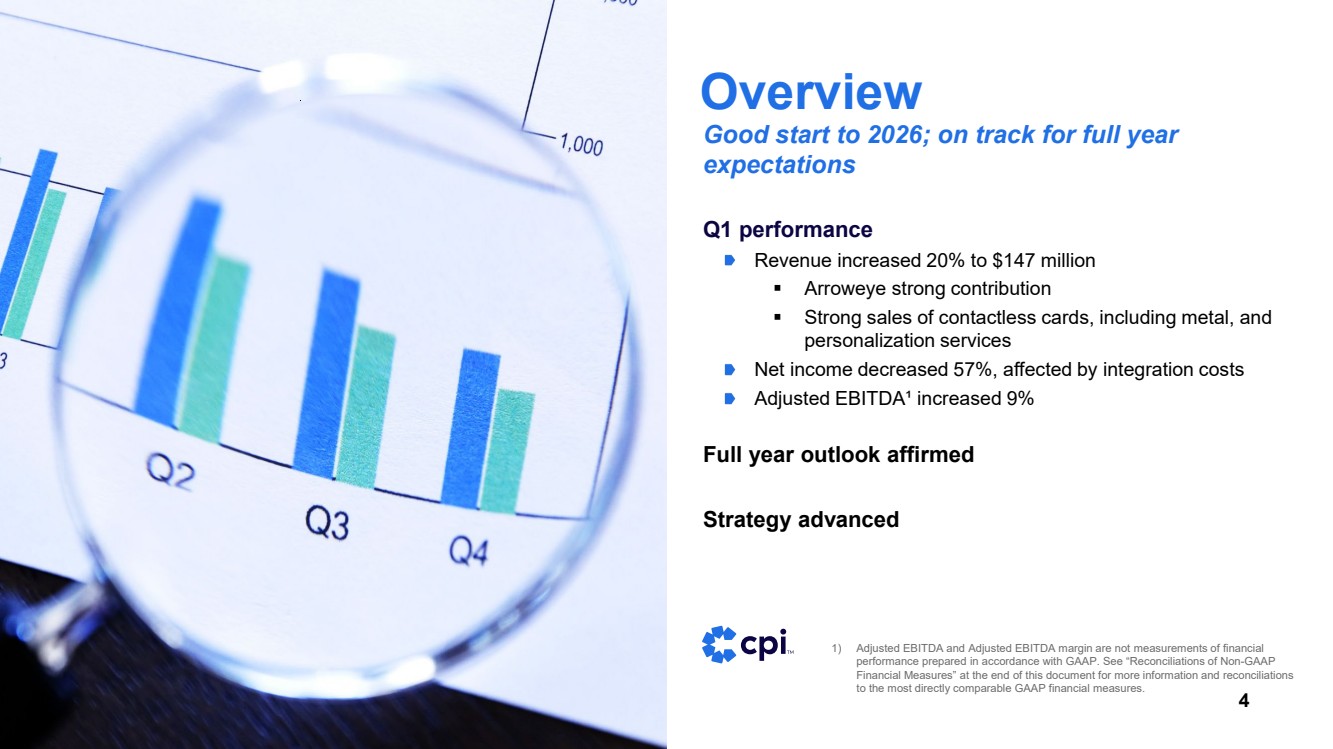
| Overview 4 Q1 performance Revenue increased 20% to $147 million Arroweye strong contribution Strong sales of contactless cards, including metal, and personalization services Net income decreased 57%, affected by integration costs Adjusted EBITDA¹ increased 9% Full year outlook affirmed Strategy advanced 1) Adjusted EBITDA and Adjusted EBITDA margin are not measurements of financial performance prepared in accordance with GAAP. See “Reconciliations of Non-GAAP Financial Measures” at the end of this document for more information and reconciliations to the most directly comparable GAAP financial measures. Good start to 2026; on track for full year expectations |
| 5 Strategy CPI is a payments technology company that provides a comprehensive range of physical and digital solutions for thousands of customers CPI’s Growth Pillars: Proprietary Technology Platform providing vast connections into the U.S. payments ecosystem Marketable Base of thousands of deep and broad relationships across the U.S. payments market Proven track record of delivering Evolving Payment Solutions that reflect changing market needs We will help our customers win by expanding our growth pillars |
| 2026 Q1 Financial Review 6 |
| 7 First Quarter Financial Highlights – Segment Revenue $81.6 $109.9 $19.3 $19.4 Secure Card Solutions Prepaid Solutions Integrated Paytech 2025 2026 2025 2026 2025 2026 + 35% + 1% $26.7 $22.0 - 17% |
| First Quarter Financial Highlights 8 Revenue increase driven by the addition of Arroweye and strong growth from contactless cards and personalization services, partially offset by a decline in Prepaid sales Gross margin decrease driven by increased production costs, including higher depreciation and tariffs, and unfavorable sales mix between segments SG&A increase driven by integration costs, addition of Arroweye operating expenses, higher employee incentive-based compensation, and higher technology spending Net income decrease primarily due to Arroweye integration costs Adjusted EBITDA1 increase primarily from revenue growth, including the addition of Arroweye Commentary 1) Adjusted EBITDA and Adjusted EBITDA margin are not measurements of financial performance prepared in accordance with GAAP. See “Reconciliations of Non-GAAP Financial Measures” at the end of this document for more information and reconciliations to the most directly comparable GAAP financial measures. (in millions, except per share data) Q1 26 Q1 25 % Change Revenue $ 147.1 $ 122.8 20% Gross Profit $ 44.1 $ 40.7 8% % Margin 30.0% 33.2% SG&A (including D&A) $ 33.1 $ 26.6 25% Net Income $ 2.1 $ 4.8 -57% Net Income as a % of sales 1.4% 3.9% Diluted EPS $ 0.17 $ 0.40 -56% Adjusted EBITDA1 $ 23.2 $ 21.2 9% % Margin 1 15.7% 17.2% |
| Balance Sheet, Liquidity, Net Leverage and Cash Flow 9 ($ in millions) 2026 Highlights: Reduced ABL revolver borrowings by $10 million in the first quarter Cash provided by operating activities and Free Cash Flow2 increased significantly, driven by lower working capital usage, with the Free Cash Flow2 improvement also aided by decreased capital spending Net Leverage Ratio¹ at 3.0x as of March 31, 2026 1) “Available Liquidity” is cash plus borrowing available on our ABL Revolver. “Net Leverage Ratio” is a Supplemental Financial Measure, see “Supplemental Financial Measures” at the end of this document for more information. “Total Debt” includes finance leases. 2) Adjusted EBITDA (LTM) and Free Cash Flow are not measurements of financial performance prepared in accordance with GAAP. See “Reconciliations of Non-GAAP Financial Measures” at the end of this document for more information and reconciliations to the most directly comparable GAAP financial measures. Balance Sheet, Liquidity and Net Leverage Ratio Mar. 31, 2026 Dec. 31, 2025 Cash on hand $ 19.3 $ 21.7 Available Liquidity1 $ 101 $ 96 Total Debt1 $ 311.3 $ 321.1 Adjusted EBITDA (LTM)2 $ 98.5 $ 96.5 Net Leverage Ratio1 3.0x 3.1x Cash Flow YTD 2026 YTD 2025 Cash provided by Operating Activities $ 13.6 $ 5.6 Capital Expenditures $ (3.5) $ (5.3) Free Cash Flow2 $ 10.1 $ 0.3 |
| 10 Full-year outlook 2026 Revenue: high single-digit growth Growth expected from each segment; including 15%+ growth from Integrated Paytech Adjusted EBITDA¹: low-to-mid single-digit growth Continued investment in strategic initiatives Free Cash Flow conversion similar to 2025 levels Year-end net leverage between 2.5x and 3x 2026 Outlook Good growth expected in 2026 1) Adjusted EBITDA is not a measurement of financial performance prepared in accordance with GAAP. We have provided non-GAAP Adjusted EBITDA expectations for 2026 because certain reconciling items are dependent on future events that either cannot be controlled or cannot be reliably predicted because they are not part of the Company’s routine activities, any of which could be significant. |
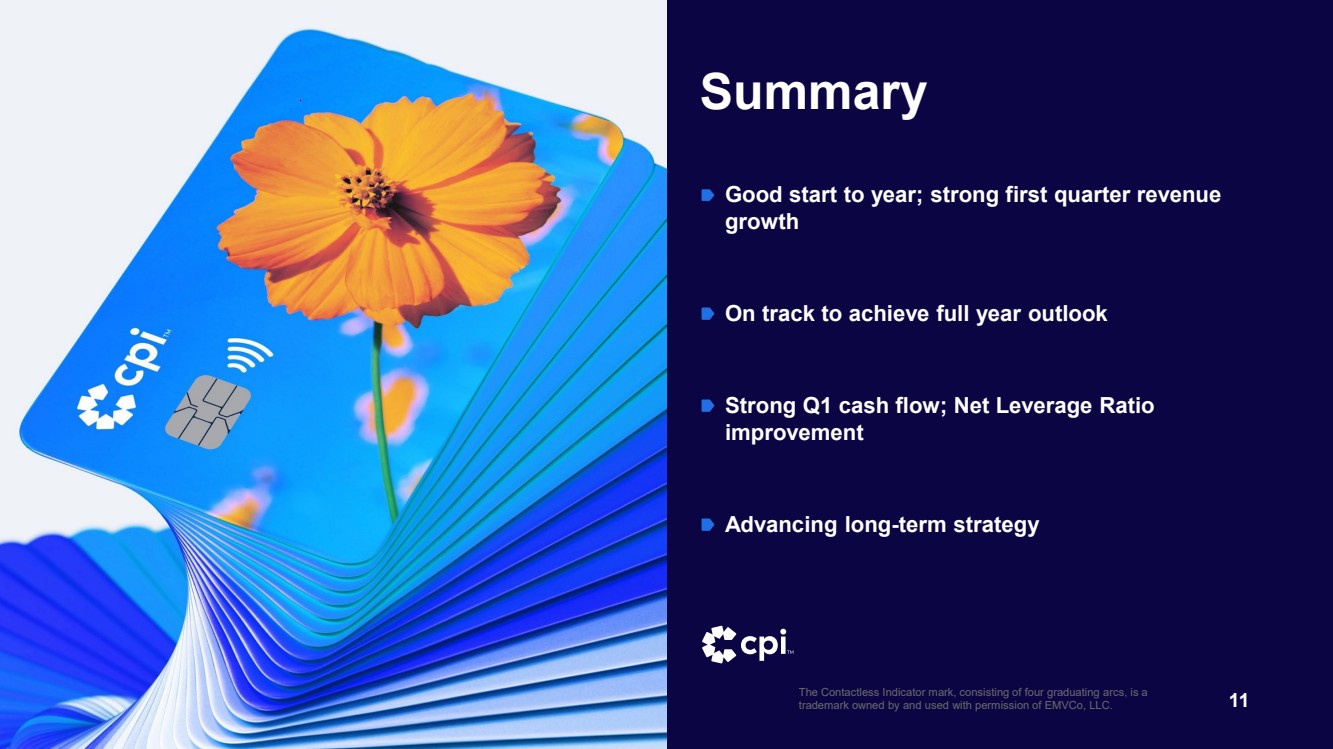
| Summary 11 Good start to year; strong first quarter revenue growth On track to achieve full year outlook Strong Q1 cash flow; Net Leverage Ratio improvement Advancing long-term strategy The Contactless Indicator mark, consisting of four graduating arcs, is a trademark owned by and used with permission of EMVCo, LLC. |
| Contact 12 (877) 369-9016 [email protected] www.cpicardgroup.com |

| 1,238 1,221 1,252 1,267 1,296 1,332 1,354 1,379 1,411 1,407 1,369 1,389 1,425 715 693 725 738 751 760 762 783 830 846 863 880 884 Q4'22 Q1'23 Q2'23 Q3'23 Q4'23 Q1'24 Q2'24 Q3'24 Q4'24 Q1'25 Q2'25 Q3'25 Q4'25 Debit Credit 13 2,253 2,116 2,162 2,241 2,232 2,269 1,953 1,914 1,977 2,005 2,092 2,047 Source: Visa and Mastercard Operational Performance Data Cards in circulation have grown at a 6% CAGR over the last three years to 2.3B, up from 1.95B 2,309 Visa and Mastercard U.S. Cards in Circulation |
| Reconciliations of Non-GAAP Financial Measures 14 Adjusted EBITDA and Adjusted EBITDA Margin EBITDA represents earnings before interest, taxes, depreciation and amortization. Adjusted EBITDA is defined as EBITDA (which represents earnings before interest, taxes, depreciation and amortization) adjusted for litigation; stock-based compensation expense; restructuring and other charges, including executive retention and severance and acquisition-related costs; costs related to production facility modernization efforts; loss on debt extinguishment; gross profit related to the impact from the accounting change related to revenue; and other items that are unusual in nature, infrequently occurring or not considered part of our core operations. Adjusted EBITDA is intended to show our unleveraged, pre-tax operating results and therefore reflects our financial performance based on operational factors, excluding non-operational, unusual or non-recurring losses or gains. Adjusted EBITDA has important limitations as an analytical tool, and you should not consider it in isolation, or as a substitute for, analysis of our results as reported under GAAP. For example, Adjusted EBITDA does not reflect: (a) our capital expenditures, future requirements for capital expenditures or contractual commitments; (b) changes in, or cash requirements for, our working capital needs; (c) the significant interest expenses or the cash requirements necessary to service interest or principal payments on our debt; (d) tax payments that represent a reduction in cash available to us; (e) any cash requirements for the assets being depreciated and amortized that may have to be replaced in the future; (f) the impact of earnings or charges resulting from matters that we and the lender under our credit agreement may not consider indicative of our ongoing operations; or (g) the impact of any discontinued operations. In particular, our definition of Adjusted EBITDA allows us to add back certain non-operating, unusual or non-recurring charges that are deducted in calculating net income, even though these are expenses that may recur, vary greatly and are difficult to predict and can represent the effect of long-term strategies as opposed to short-term results. In addition, certain of these expenses represent the reduction of cash that could be used for other purposes. (1) Balance represents acquisition and integration costs related to the Arroweye acquisition that occurred on May 6, 2025. (2) Balance includes expenses related to executive retention and severance. The 2025 balance also includes expenses related to production facility modernization efforts. (3) On October 7, 2025, the Company entered into a strategic relationship with and acquired a 20% equity interest in Karta (Gift Card Co Pty Ltd), an Australia-based payments technology firm also backed by the Commonwealth Bank of Australia. This balance represents the Company’s equity in Karta’s net losses for the quarter ended March 31, 2026. Reconciliation of net income to EBITDA and Adjusted EBITDA: Net income $ 2.1 $ 4.8 Interest, net 7.7 7.7 Income tax expense 1.2 1.7 Depreciation and amortization 6.4 4.2 EBITDA $ 17.3 $ 18.4 Adjustments to EBITDA: Stock-based compensation expense $ 1.4 $ 1.7 Acquisition and integration costs (1) 3.2 0.6 Restructuring and other charges (2) 1.2 0.5 Equity in losses of unconsolidated affiliates (3) 0.2 — Subtotal of adjustments to EBITDA $ 5.9 $ 2.8 Adjusted EBITDA $ 23.2 $ 21.2 Net income margin (% of Revenue) 1.4% 3.9% Net income growth (% Change 2025 vs. 2024) (56.9)% Adjusted EBITDA margin (% of Revenue) 15.7% 17.2% Adjusted EBITDA growth (% Change 2025 vs. 2024) 9.4% ($ in millions) Three Months Ended March 31, 2026 2025 |
| Reconciliations of Non-GAAP Financial Measures 15 LTM Adjusted EBITDA We define LTM Adjusted EBITDA as adjusted EBITDA (defined previously) for the last twelve months. Free Cash Flow We define Free Cash Flow as cash flow from operating activities less capital expenditures. We use this metric in analyzing our ability to service and repay our debt. However, this measure does not represent funds available for investment or other discretionary uses since it does not deduct cash used to make principal payments on outstanding debt and financing lease liabilities. (1) Balance represents acquisition and integration costs related to the Arroweye acquisition that occurred on May 6, 2025. (2) Balance includes expenses related to executive retention and severance, as well as production facility modernization efforts. (3) In the second quarter of 2025, the Company reassessed certain aspects of its revenue recognition accounting under ASC 606 and prospectively began recognizing revenue for certain contracts at a point-in-time rather than over-time. (4) On October 7, 2025, the Company entered into a strategic relationship with and acquired a 20% equity interest in Karta (Gift Card Co Pty Ltd), an Australia-based payments technology firm also backed by the Commonwealth Bank of Australia. This balance represents the Company’s equity in Karta’s net losses for the quarter ended March 31, 2026. Reconciliation of net income to LTM EBITDA and Adjusted EBITDA: Net income $ 12.2 $ 15.0 Interest, net 32.4 32.5 Income tax expense 6.2 6.7 Depreciation and amortization 24.6 22.5 EBITDA $ 75.4 $ 76.5 Adjustments to EBITDA: Stock-based compensation expense $ 6.7 $ 7.0 Acquisition and integration costs (1) 8.5 6.0 Restructuring and other charges (2) 4.4 3.7 Loss on debt extinguishment 0.3 0.3 Change in revenue recognition (3) 2.9 2.9 Equity in losses of unconsolidated affiliates (4) 0.3 0.1 Subtotal of adjustments to EBITDA $ 23.1 $ 20.0 LTM Adjusted EBITDA $ 98.5 $ 96.5 March 31, 2026 December 31, 2025 ($ in millions) Last Twelve Months Ended Reconciliation of cash provided by operating activities - (GAAP) to Free Cash Flow: Cash provided by operating activities $ 13.6 $ 5.6 Capital expenditures for plant, equipment and leasehold improvements, net (3.5) (5.3) Free Cash Flow $ 10.1 $ 0.3 ($ in millions) Three Months Ended March 31, 2026 2025 |
| Supplemental Financial Measures 16 Net Leverage Ratio Management and various investors use the ratio of debt principal outstanding, plus finance lease obligations, less cash divided by LTM Adjusted EBITDA, or “Net Leverage Ratio,” as a measure of our financial strength when making key investment decisions and evaluating us against peers. Calculation of Net Leverage Ratio: Senior Notes $ 265.0 $ 265.0 ABL Revolver 15.0 25.0 Finance lease obligations 31.3 31.1 Total debt 311.3 321.1 Less: Cash and cash equivalents (19.3) (21.7) Total net debt (a) $ 292.0 $ 299.4 LTM Adjusted EBITDA (b) $ 98.5 $ 96.5 Net Leverage Ratio (a)/(b) 3.0 3.1 As of March 31, 2026 December 31, 2025 ($ in millions) |