Operator
Good day and thank you for standing by. Welcome to the Carlyle Credit Income Fund Third Quarter 2026 Financial Results and Investor Conference Call. At this time, all participants are in a listen-only mode. After the speaker's presentation, there will be a question and answer session. To ask a question during the session, you will need to press star 11 on your telephone and wait for your name to be announced. To withdraw your question, please press star 11 again. Again, please be advised that today's conference is being recorded. I would now like to hand the conference over to your speaker today, Joseph Castilla, Managing Director, Product Specialist. Please go ahead.
Good morning and welcome to Carlyle Credit Income Fund's third quarter 2026 earnings call. With me on the call today is Nishal Mehta, CCIF's Principal Executive Officer and President, Lauren Bazmajan, CCIF's Chair and Carlyle's Global Head of Liquid Credit, and Nelson Joseph, CCIS Principal Financial Officer. Last night, we issued our Q3 financial statement and a corresponding press release and earnings presentation discussing our results, which are available on the Investor Relations section of our website. Following our remarks today, we will hold a question and answer session for analysts and institutional investors. This call is being webcast and a replay will be available on our website. Any forward-looking statements made today do not guarantee future performance and any undue reliance should not be placed on them. These statements are based on current management expectations and involve inherent risks and uncertainties, including those identified in the risk factors section of our annual report on the Form N-CSR. These risks and uncertainties could cause actual results to differ materially from those indicated. Carlyle Credit Income Fund assumes no obligation to update any forward-looking statements at any time. During the conference call, we may discuss adjusted net investment income per common share and core net investment income per common share which are calculated and presented on a basis other than in accordance with gap we use these non-gap financial measures internally to analyze and evaluate financial results and performance and we believe these non-gap financial measures are useful to investors gauging the quality of the fund's financial performance identifying trends in its results and providing meaningful period-to-period comparisons. The presentation of this non-GAAP measure is not intended to be a substitute for financial results prepared in accordance with GAAP and should not be considered in isolation. With that, I'll turn the call over to Nishal.
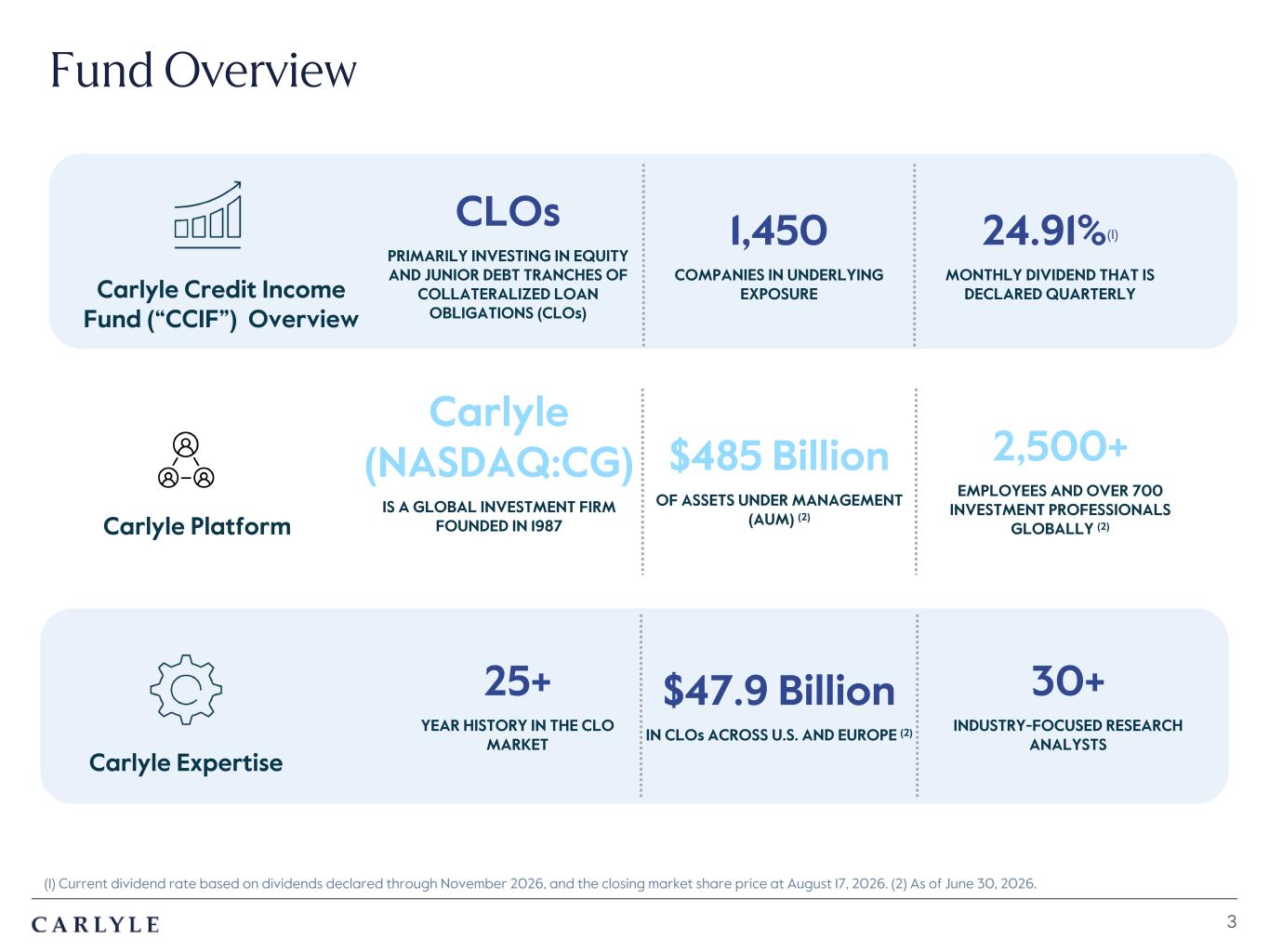
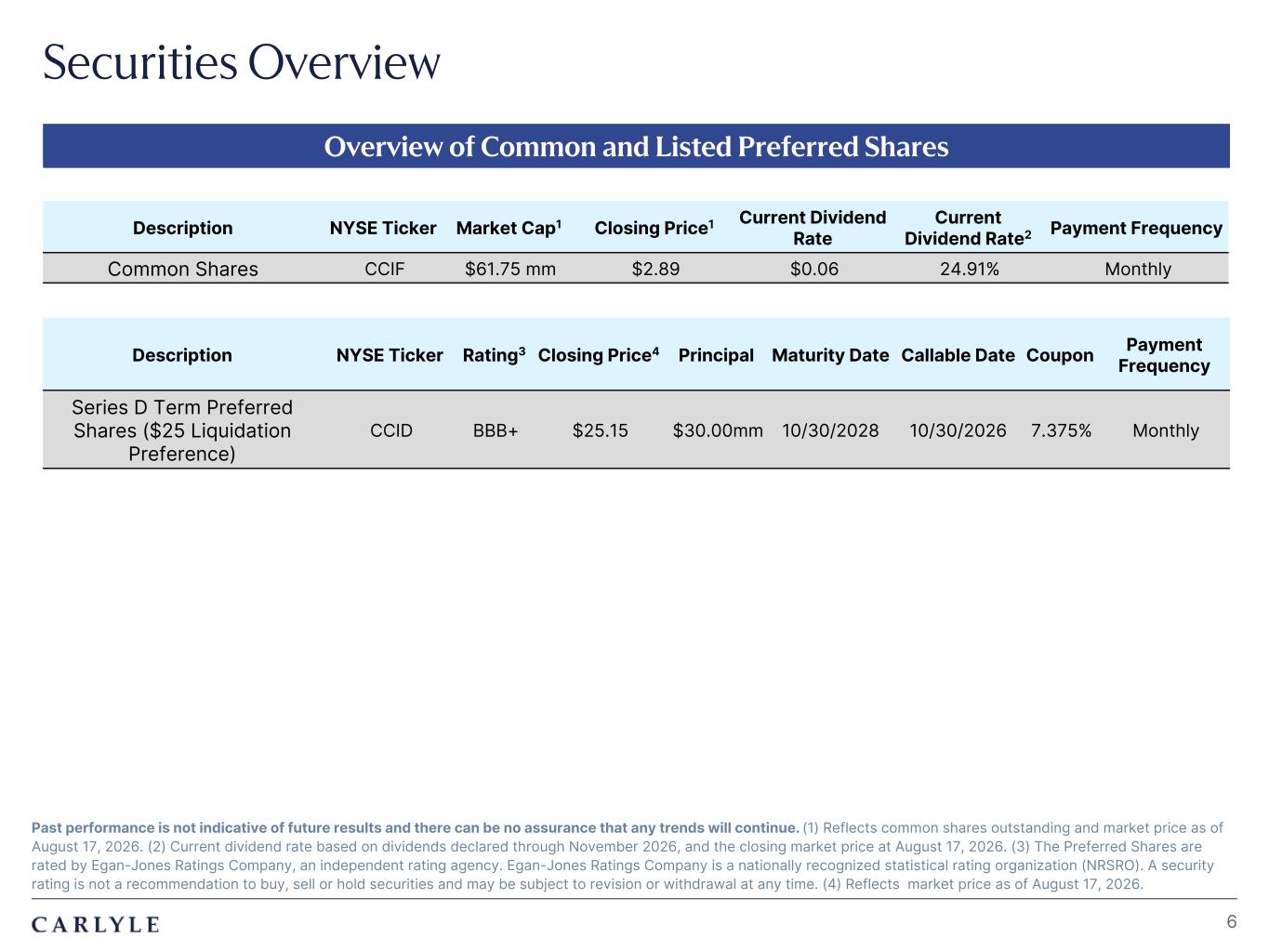
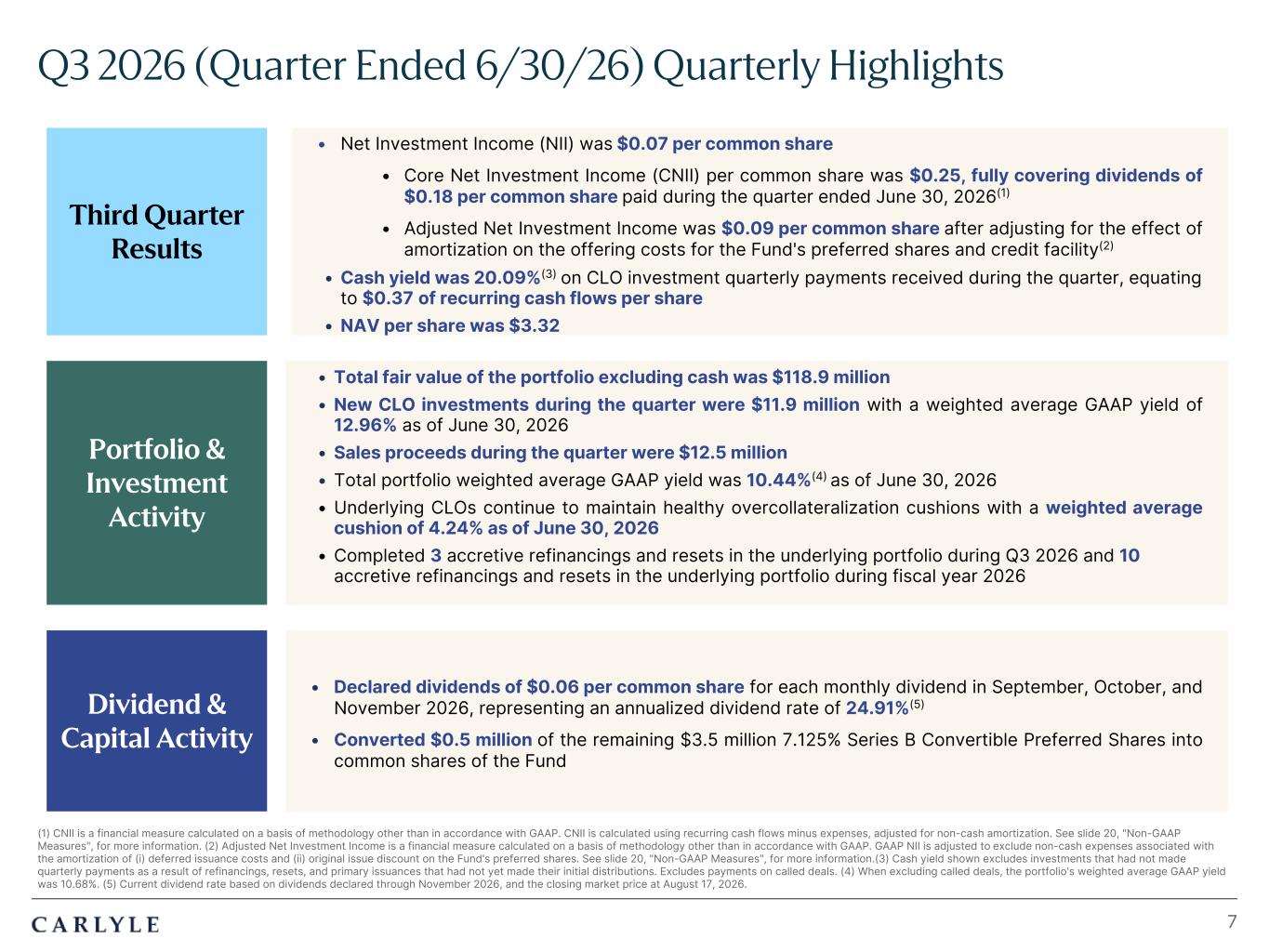
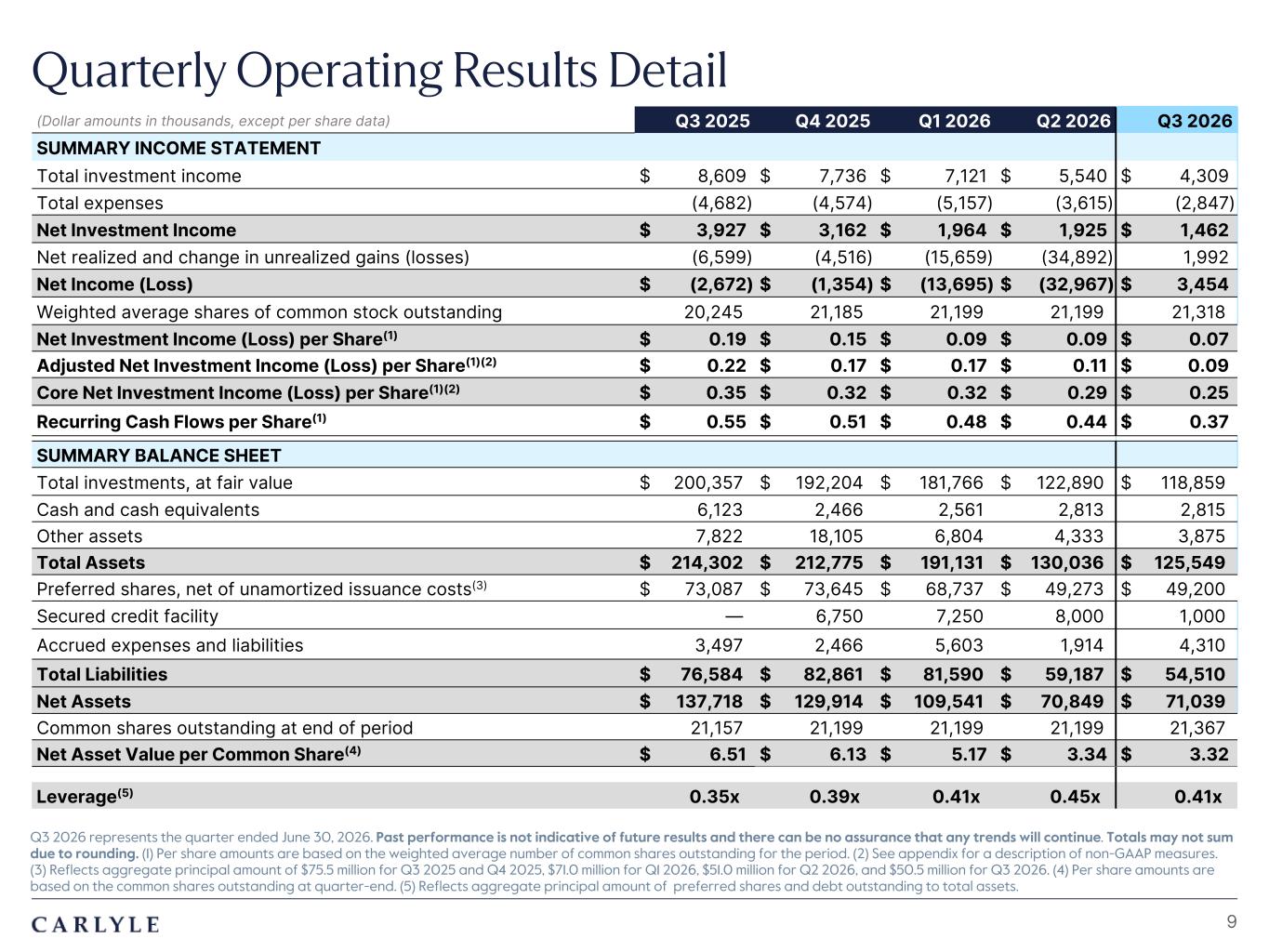
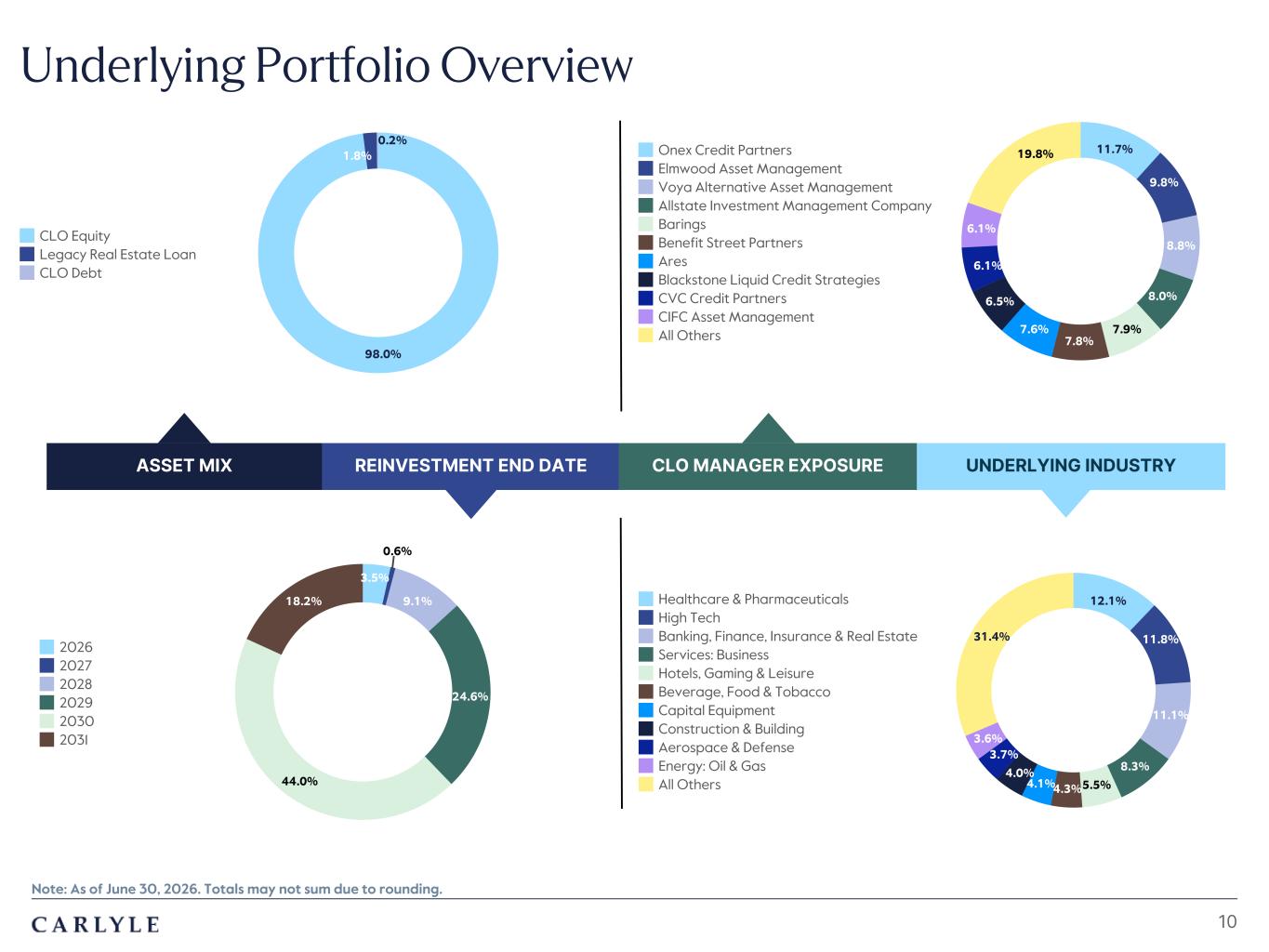
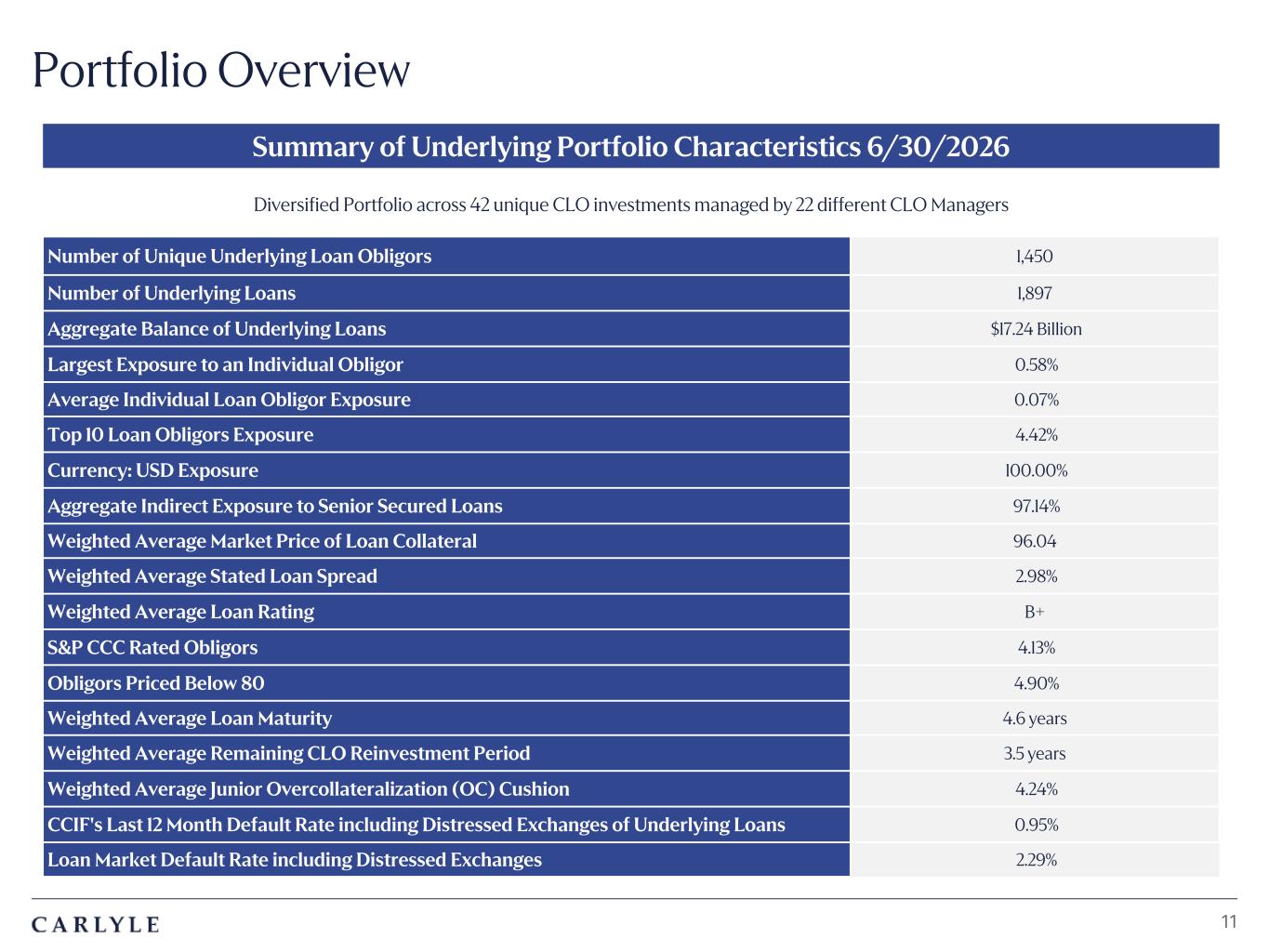
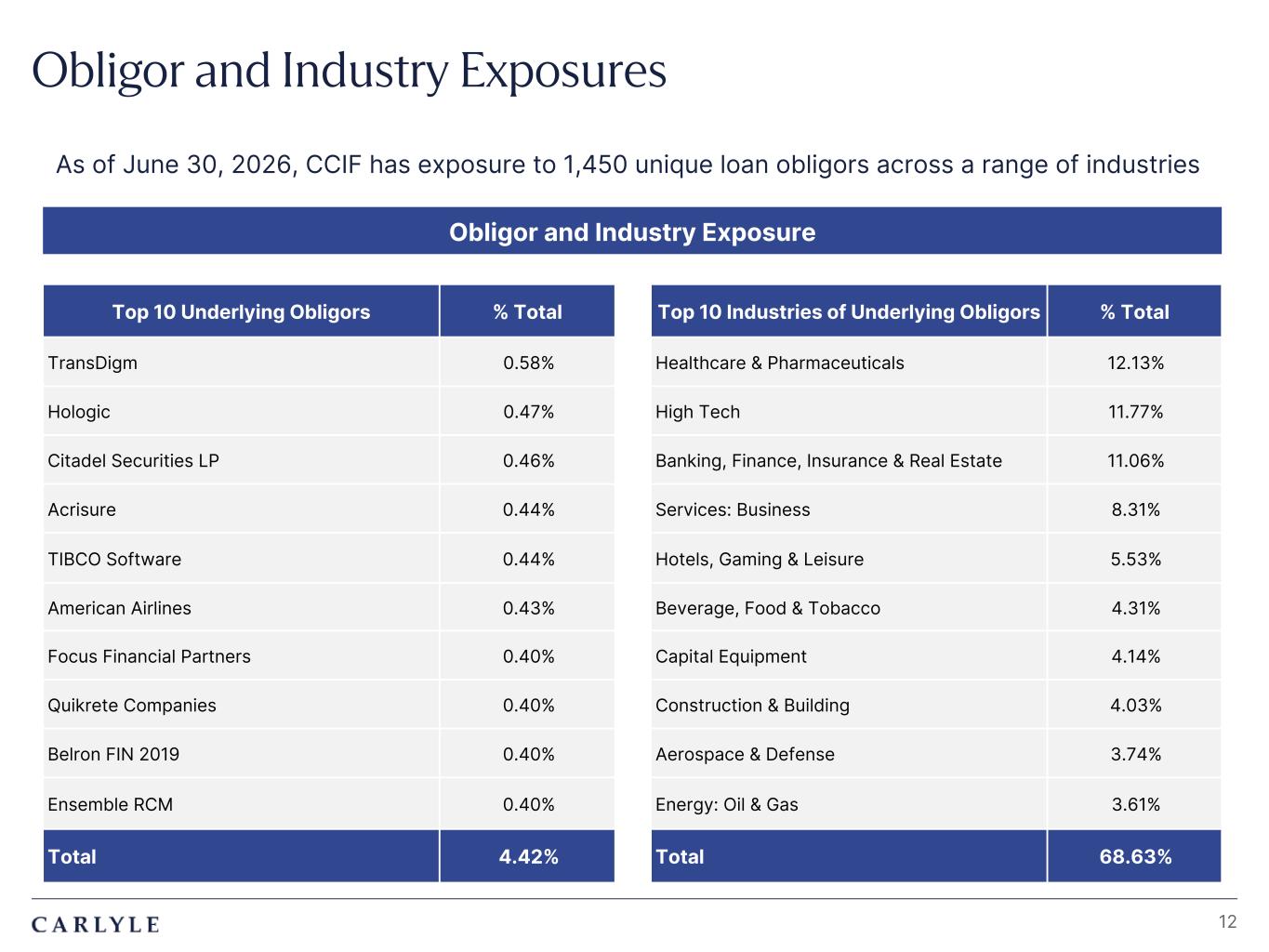
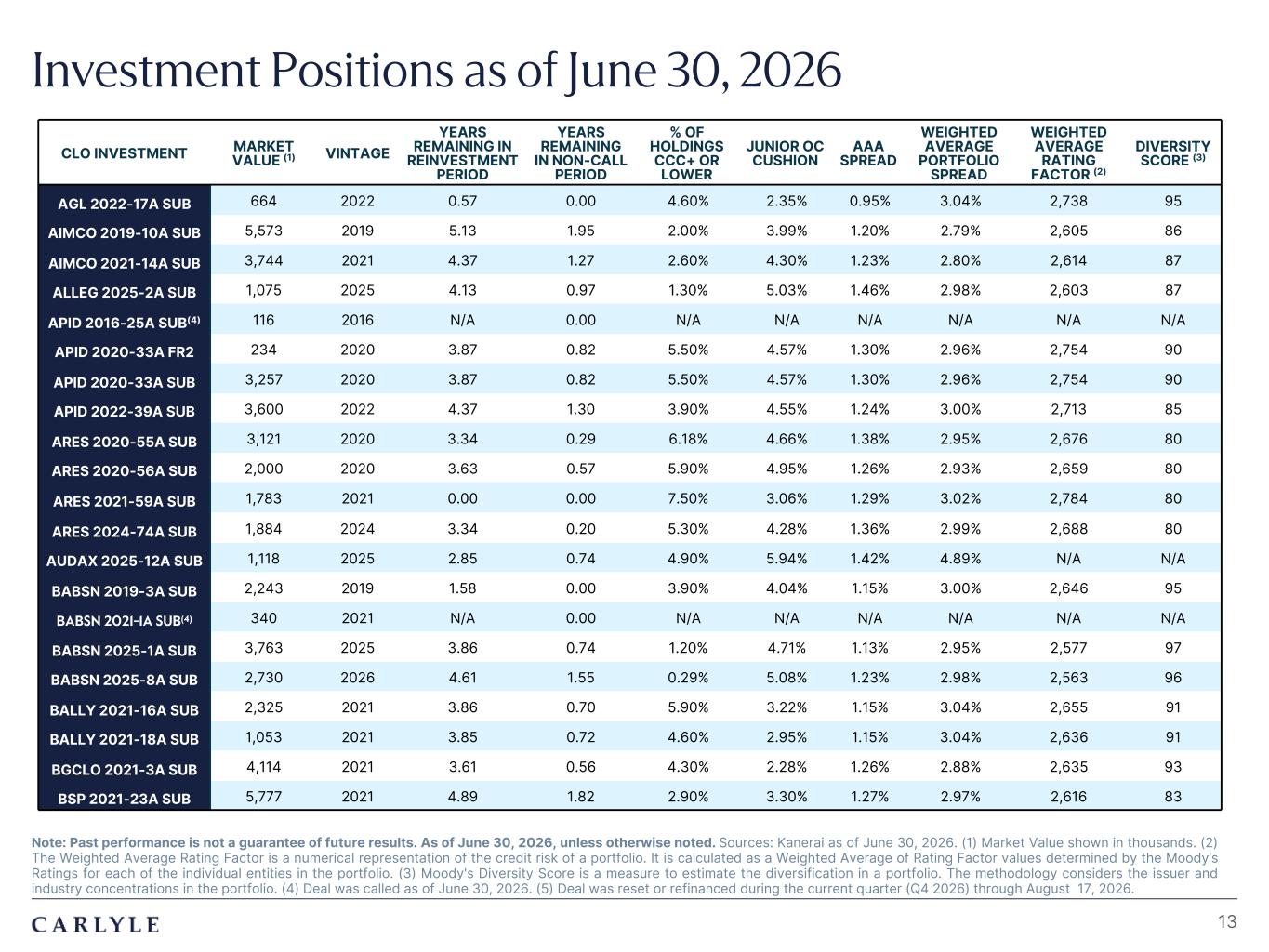
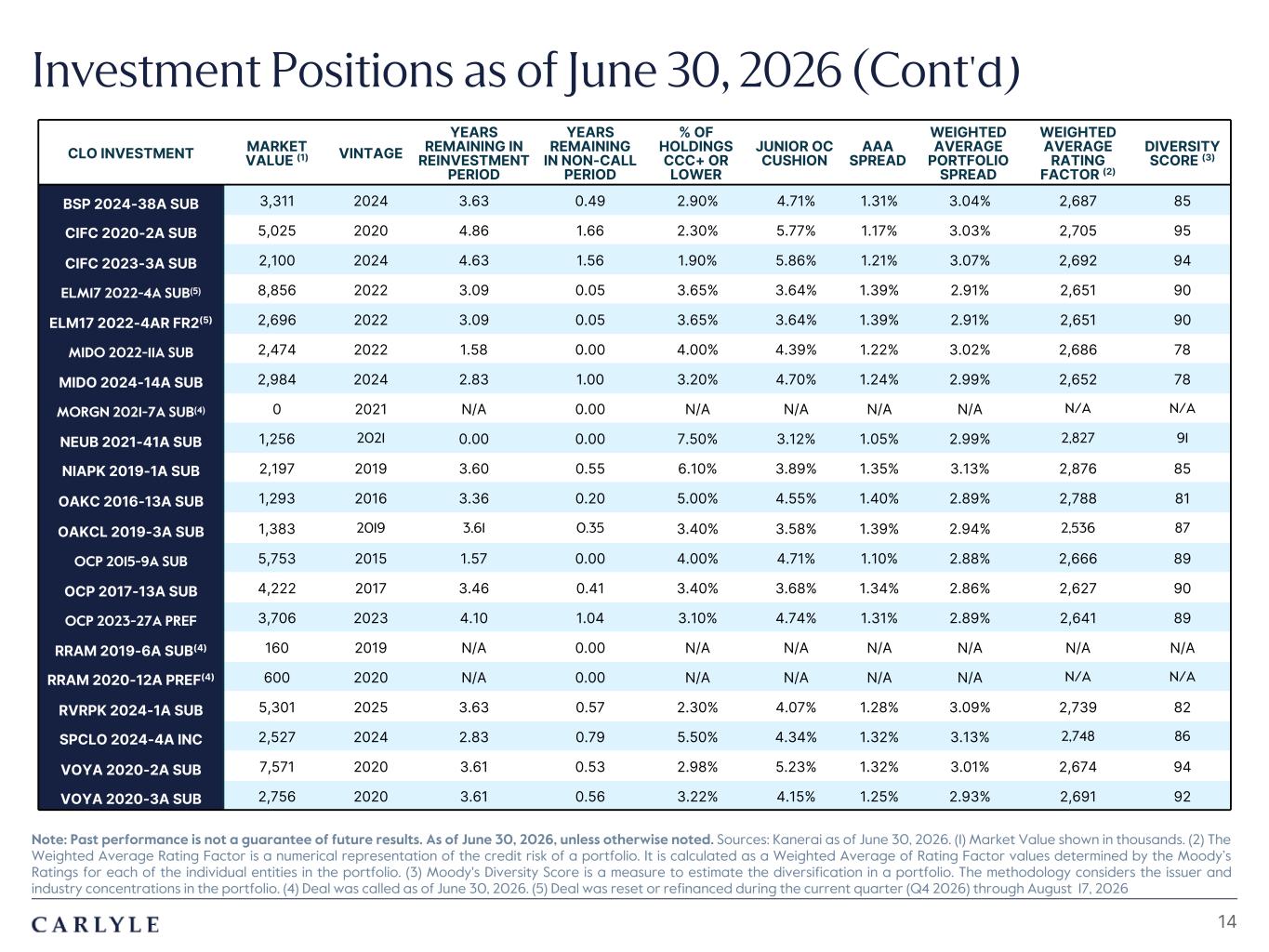
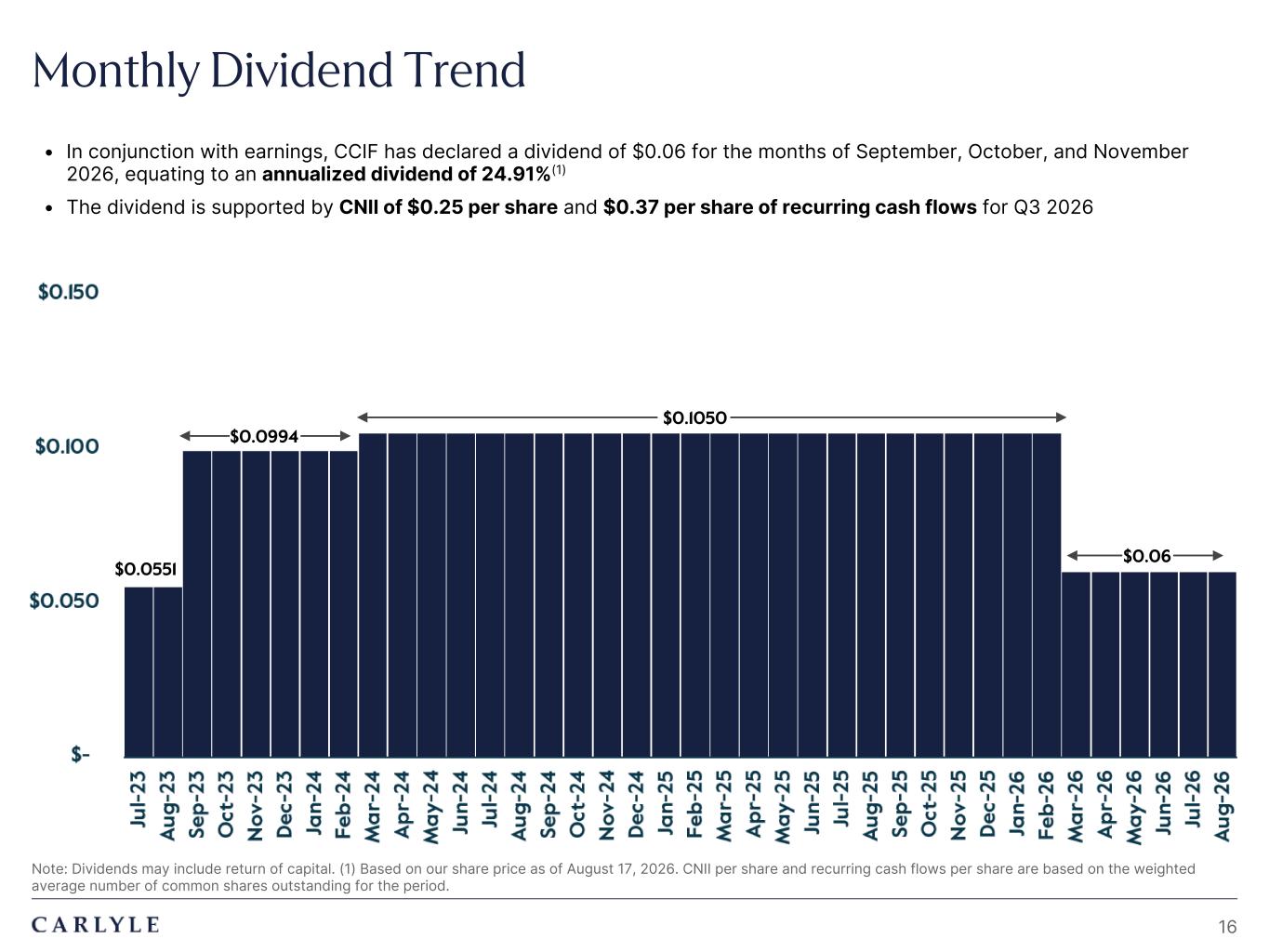
Thanks, Joe. Good morning, everyone, and thank you all for joining CCIS quarterly earnings call. The SEAL equity market was fairly stable during the second quarter, following considerable volatility in the first quarter. As a result, CCIS NAV remained largely flat during the quarter and underlying credit fundamentals remain broadly stable. We are encouraged by early signs that the pace of spread compression may be moderating, as repricing activity has slowed from the elevated levels seen over the past two years. We also continue to monitor loans maturing over the next few years. We expect continued amend and extend activity to address the maturity wall, which we believe could result in wider spreads and other lender-friendly protections that benefit CLO equity holders over time. On balance, we believe the pressure on spreads is now more two-sided than it has been, rather than a continuation of one-way compression. CCAS portfolio saw its weight average spread remain relatively flat last quarter, driven primarily by rotation into CLO portfolios with slightly higher spread collateral, partially offset by slowing the laundry pricings. We continue to believe recent CLO equity performance industry-wide has been driven by more valuation and technical factors than broad-based credit deterioration. Navigate this market environment, we continue to focus on optimizing the portfolio, including selectively completing refinancing and resets, and defensively positioning CCIFs with experienced CEO managers and transactions with longer reinvestment periods. I would like to highlight the fund activities over the last quarter and key stats on the portfolio as of June 30th. We maintain our monthly dividend at $0.06 per share or 24.9% annualized based on the share price as of August 17, 2026, which is now declared through November of 2026. CCS underlying investments generated an annualized cash on cash yield of approximately 20% for the quarter, which resulted in $0.37 of recurring cash flows and $0.25 of core net investment income for the quarter at the fund level. Core net investment income provided dividend coverage of 139% on our monthly dividends of $0.06 per share. New seal investments during the quarter totaled $11.9 million with a weighted average gap yield of 13%. And total sales proceeds during the quarter told $12.5 million as we continue to optimize the portfolio. Within CSAT's portfolio, we completed three refinancings and resets this quarter, increasing the total number of refinancing and resets in the fiscal year to 10. The refinancings and resets reduce the cost of liabilities and extend the reinvestment periods across these CELAs, bolstering equity cash flows. We expect to continue to refinance and reset the portfolio to enhance returns. The weighted average year is less than the reinvestment period increased slightly from approximately 3.3 years to 3.5 years. This provides CELA managers the opportunity to capitalize on periods of volatility through active management. The increase was due to a combination of resets and new investments with longer time left in the reinvestment period. We believe the portfolio we'd average junior over-collarization cushion of 4.24% as healthy and offsets potential defaults and losses in the underlying loan portfolios. The average percent of loans rated CCC by S&P was 4.1%, below the 7.5% CCC limit in CLS. We remain confident in the resilience of our portfolio, which is diversified across high-quality managers and structured to navigate evolving market conditions. Equity distributions have moderated industry-wide as the compression of loan spreads have outpaced the tightening in CELA liability costs, narrowing excess spread. However, we believe resilient credit fundamentals and continued demand for floating-rate assets will support CELA performance over time. Now I will discuss our CELA equity outlook. SEAL equity continues to benefit from historically attractive liability costs. We also continue to see a broadening and maturing base of demand for SEAL liabilities across investor types and geographies, which we expect to further support liability spread tightening over time. Any normalization in loan spreads or increase in loan supply could improve excess spread generation, particularly for deals with longer reinvestment runway. Looking ahead, we believe SEAL equity performance will continue to depend on manager selection, reinvestment discipline, and active credit management. We continue to position CCIF conservatively while selectively deploying capital into opportunities where we believe valuations appropriately compensate investors for underlying risk. We also continue to leverage CARL's in-house credit research platform to conduct detailed bottom-up analysis across underlying loan portfolios, including software-related exposures and involving AI-related risk. CSAT's portfolio remains highly diversified with exposure to approximately 1,900 underlying loans across roughly 1,400 unique obligors, with exposure to any single issuer representing less than 1% of the portfolio. In addition, the portfolio remains predominantly comprised of first-team senior secured loans, representing over 97% of exposure, which we believe continues to provide meaningful downside protection and structural resilience. With that, I will now I'll hand the call over to Lauren to discuss the current market environment.
Thank you, Nishal. I'd like to provide an update on the recent developments across both the loan and CLO markets. New-issue CLO volumes flowed during the quarter as CLO arbitrage remained challenged. Across the CLO capital stack, AAA through single-A tranches largely retraced their first quarter widening, while BBBs and BBBs continue to trade wider than their year-to-date types. New Issue CLO volume totaled approximately $23 billion, down roughly 35% from the first quarter, and the lowest quarterly total in about two and a half years. CLO resets and refinancings rose to $49 billion and $41 billion, respectively, from $28 billion and $23 billion in the first quarter. Turning to the loan market, after a volatile start to the year, U.S. leveraged loans stabilized in the second quarter. The loan index recovered its first quarter loss and has returned approximately 1.3% year-to-date, with the average bid price retracing to around $0.95 by quarter end, though dispersion persisted between performing and non-performing credits. Gross broadly syndicated loan issuance totaled approximately $220 billion during the quarter, roughly in line with the first quarter, while net issuance rose 14%, to $73 billion, led by Warner Brothers' record $13 billion term loan financing. Other than that, activity was driven largely by opportunistic refinancing, with new money, M&A, and LBO activity remaining subdued. Credit fundamentals within Carlyle's U.S. loan portfolio of over 550 borrowers remained resilient. Based on first quarter earnings, average year-over-year EBITDA and revenue growth were both approximately 10%, which is the highest growth rate in two and a half years. And within the software portfolio, these metrics are approximately 10% and 9% respectively. Interest coverage remains healthy, with an average interest coverage ratio of 3.4 times and less than 2% of the portfolio exhibiting a ratio below one time. Overall, borrower performance and credit quality remain broadly stable. While liability management exercises persist across the broadly syndicated loan market, they remain manageable. The default rate in loans continues to decline from a cycle peak at the end of 2024. The last 12-month default rate is 2.3%, which is below the 2.7% default rate in high-yield bonds. We are beginning to see software companies address their maturities with amend and extend activity picking up in July. For performing software borrowers, we expect these transactions to clear the market at higher interest rates, while non-performing borrowers that are unable to refinance may increasingly turn to liability management exercises to push out maturities. As capital for AI build-out remains in high demand, we are beginning to see new borrowers access the broadly syndicated loan market as a financing source. Overall, given ongoing AI, geopolitical, and inflationary risks, we believe the second half of 2026 will continue to be a period of dispersion with the haves and have-nots experiencing very different outcomes. I will now turn the call to Nelson, our CFO, to discuss the financial results.
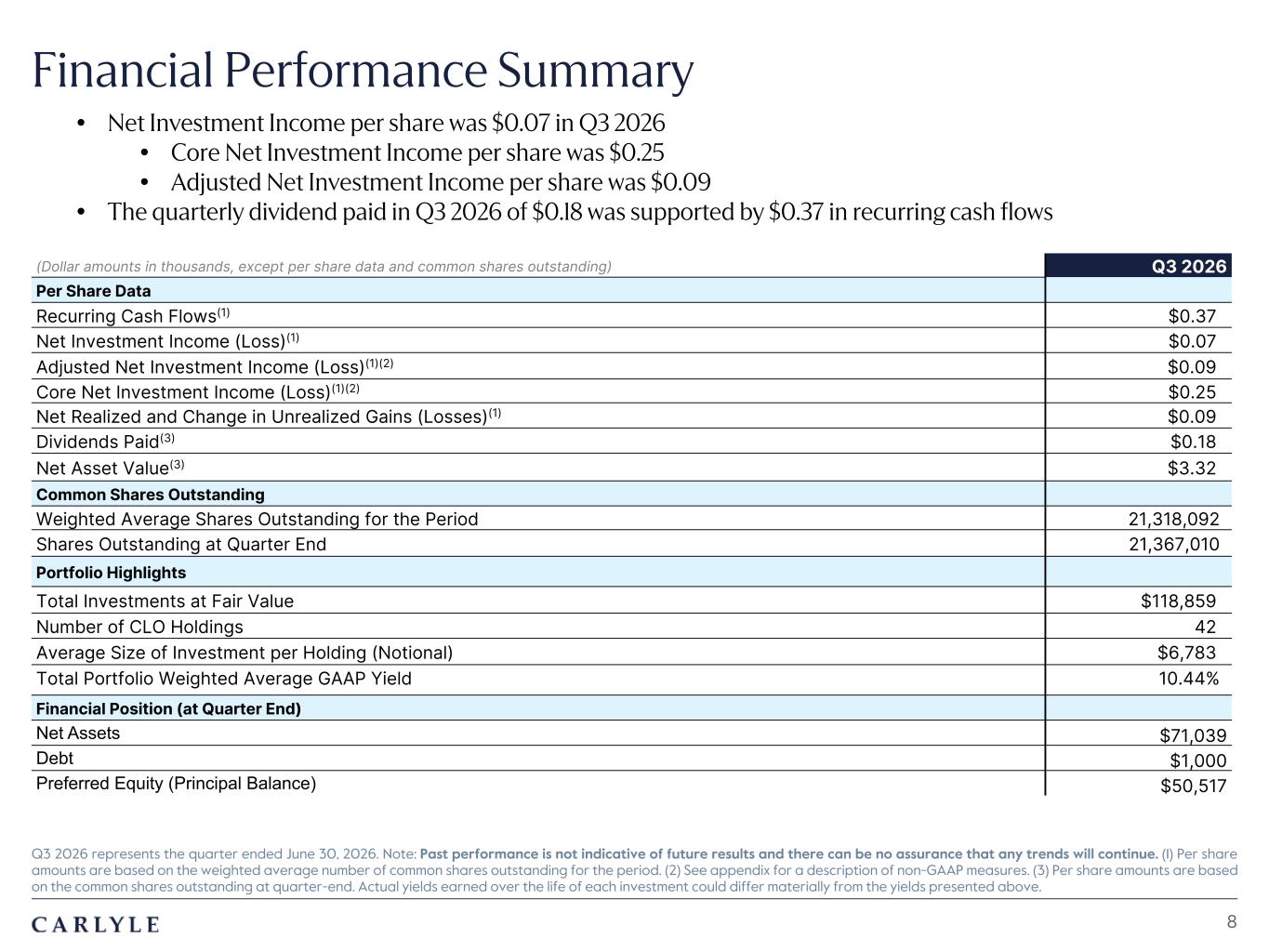
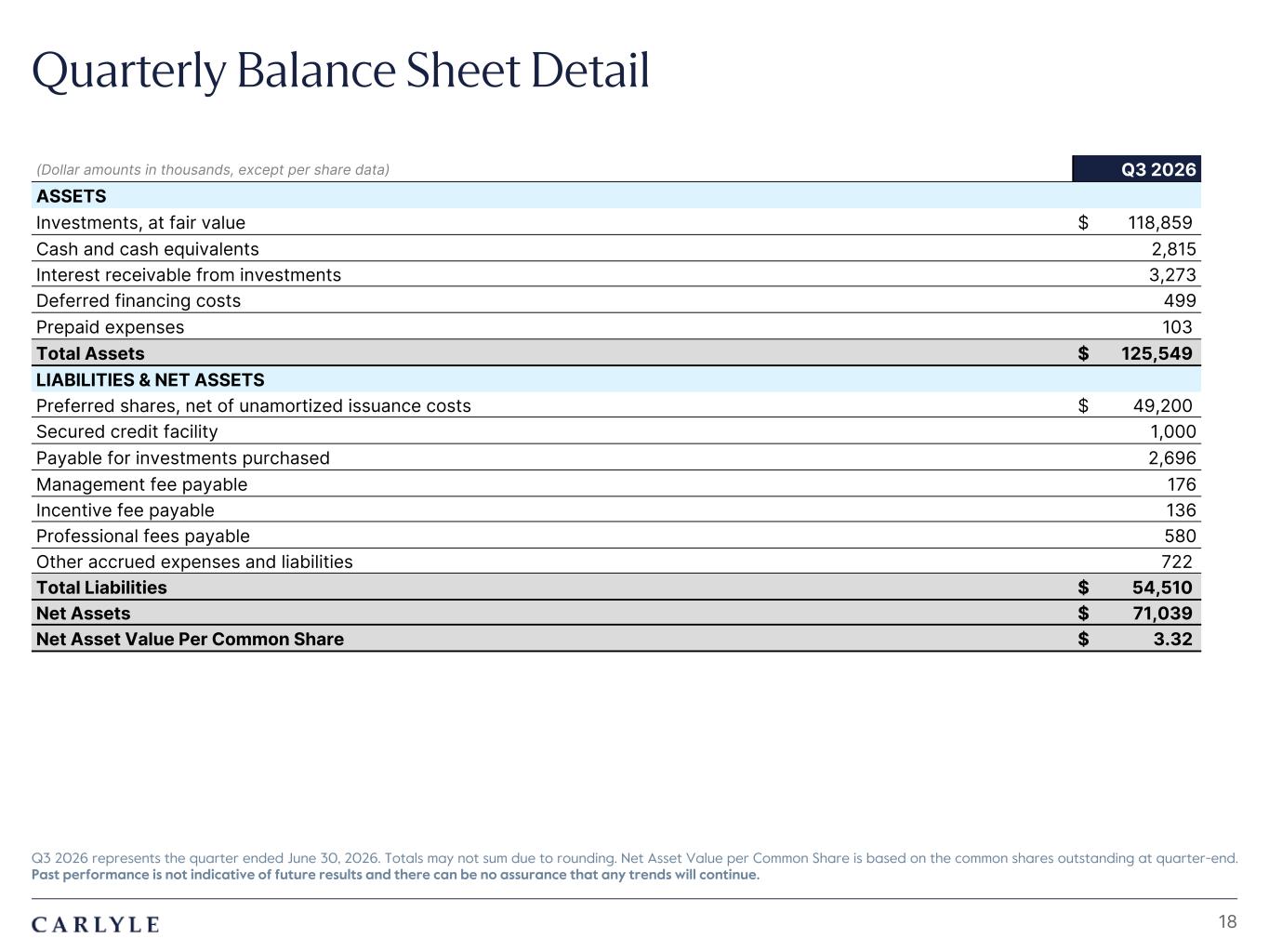
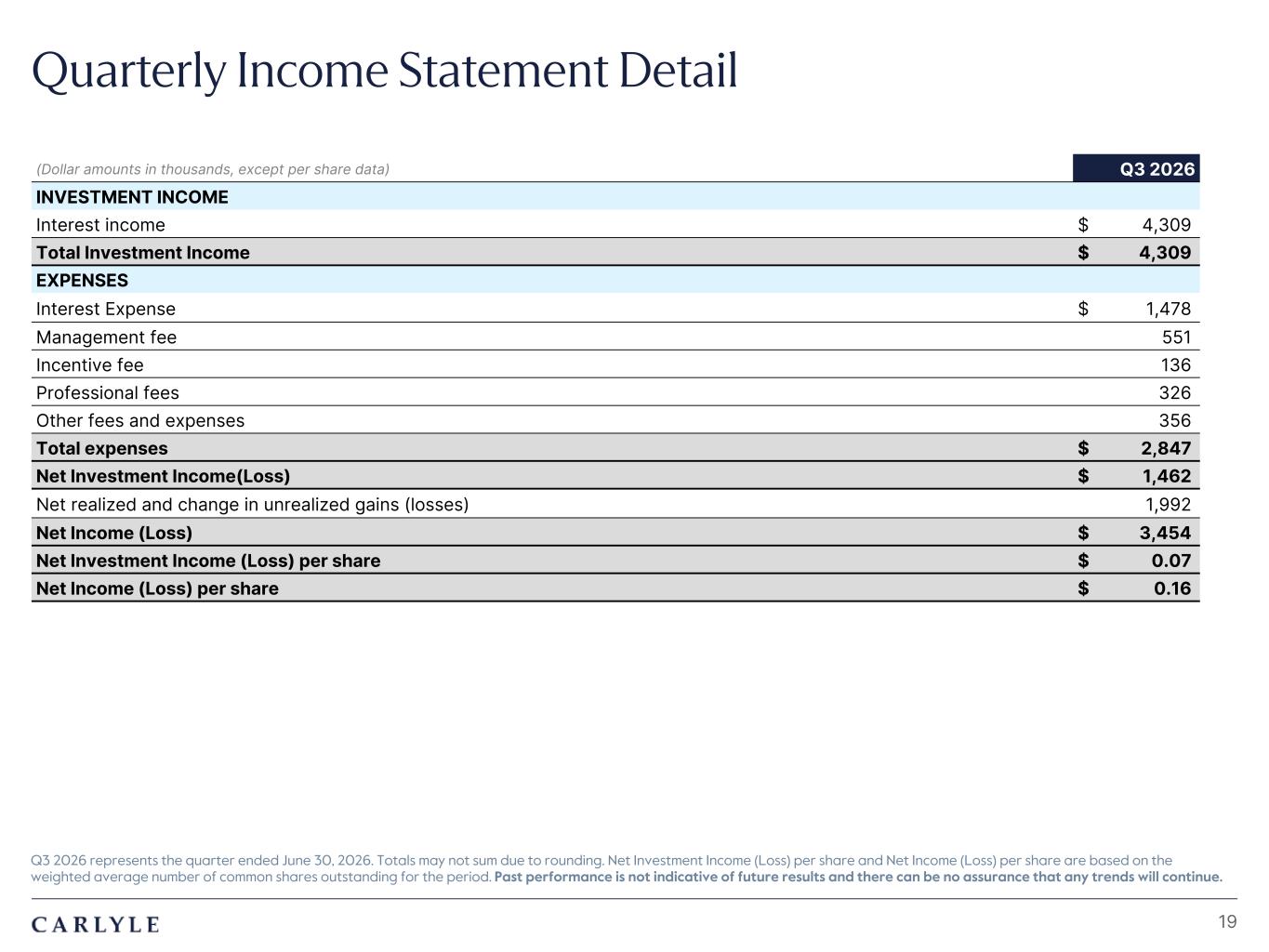
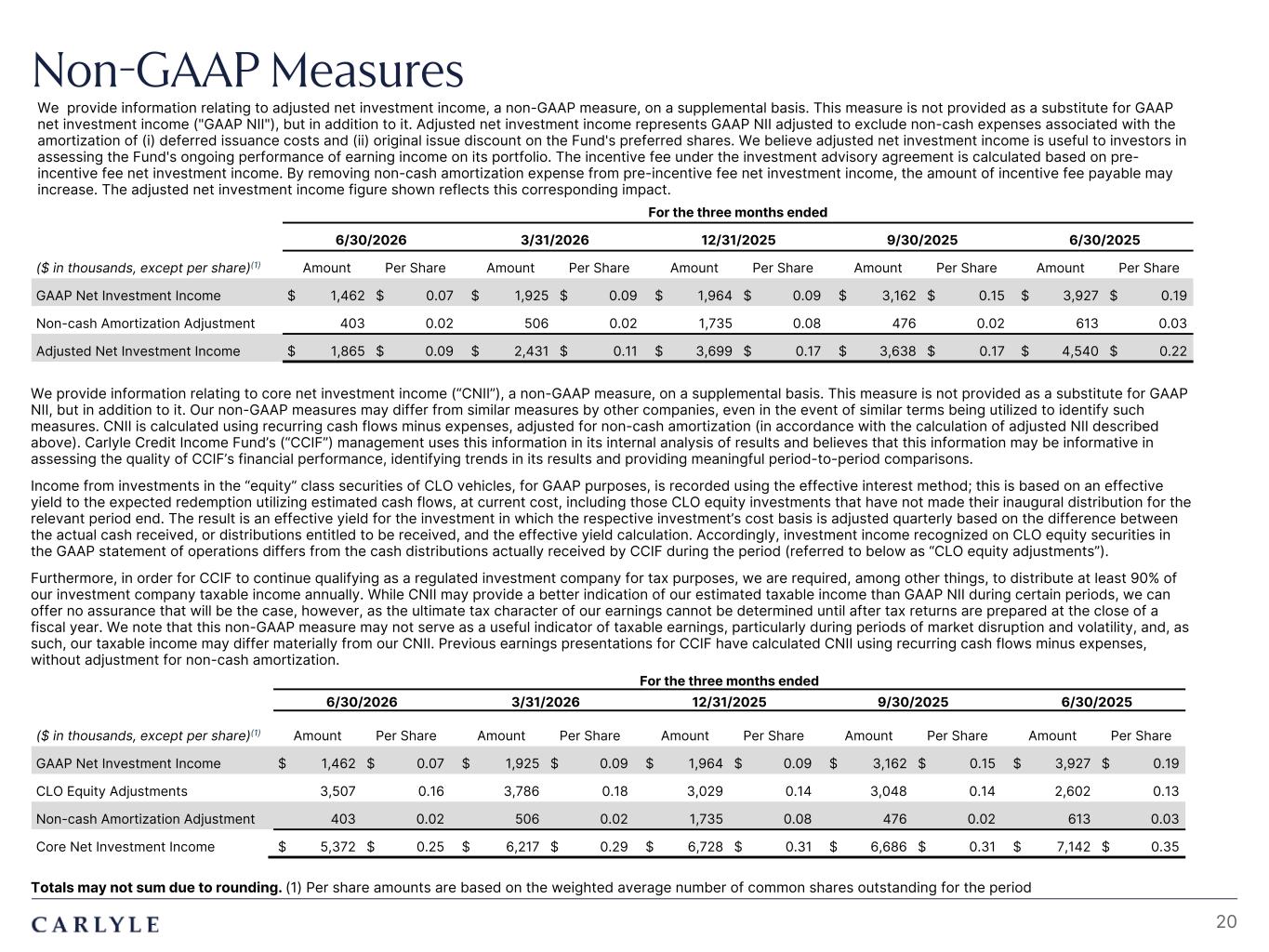
Thank you, Lauren. Today, Today I will begin with a review of our third quarter earnings. Total investment income for the third quarter was $4.3 million, or $0.20 per share. Total expenses for the quarter were $2.8 million. And total net investment income for the third quarter was $1.5 million, or $0.07 per share. Adjusted net investment income for the third quarter was $1.9 million, or $0.09 per share. Adjusted NII adjusts for the $0.02 per share impact from the amortization of the OID and issuance costs for the funds preferred shares and credit facility. Core net investment income for the third quarter was $0.25 per share, providing dividend coverage of 139% on our monthly dividends of $0.06 per share. We believe core net investment income is a more accurate representation of CCIS distribution requirement. Net asset value as of June 30th was $3.32 per share. Our net asset value and valuations are based on the bid side mark we receive from a third party on 100% of the COO portfolio. We continue to hold one legacy real estate asset in the portfolio. The fair market value of the loan is $2.2 million. With that, I'll turn it back to initial.
Thanks, Allison. We remain confident in the fundamentals of CCIS portfolio, which remains defensively positioned in the current market environment. We remain focused on experienced managers and transactions that demonstrate durable power build, strong underlying collateral quality, and disciplined credit underwriting, including ongoing evaluation of evolving AI-related risk across certain sectors. We are deploying capital selectively, prioritizing opportunities that offer attractive relative value across both new issue and season transactions. We continue to draw on the depth of the Carlyle Liquid Credit platform together with our collaborative One Carlyle approach to identify and invest in high-quality COO portfolios through our disciplined bottoms-up 15-step investment process.
Operator
With that, as a reminder, to ask a question, please press star 11 on your telephone and wait for your name to be announced. To withdraw your question, please press star 11 again. Please stand by while we compile our Q&A roster. And our first question will be coming from the line of Gaurav Mehta of Alliance Global Partners. Your line is open.
Thank you. Good morning. I wanted to ask you on your comments around signs of stabilization in the field market and the pace of spread compression moderating. And maybe can you guys expand on that? And do you think that those trends are sustainable for second half of 26?
Hi, it's Lauren. Oh, sorry. So, yeah, I think there is some signs of stabilization that look sustainable to us. Certainly, there's still a decent amount of the loan market that trades over par that suggests that there will be further repricings on that portion of the market. But that said, we're starting to see more amended extends for 2028 and even 2029 maturities come to our market. And if they're in any software or AI adjacent sector, there's significant spread being added to those loans. And when we couple that with some newer data center and GPU loans that we're seeing come to market, we could see some spread stabilization, if not, maybe a slight reversal in the trends that we've experienced over the last two, two and a half years. So, though it's early, we're starting to see a pickup in these transactions, and they are spread additive.
Okay. And as a follow-up on the loans for new data centers, GPU, can you expand on that? Like what kind of volume are you seeing for AI build-out loans? And is that something you're targeting for your own portfolio?
Yeah. So it is early days. There's an immense amount of funding, as you know, that needs to go on in this sector, really unprecedented. It's mostly done in the IT market, but it's coming to the high-yield market and into the loan market as well. So there's been between five and ten of the transactions coming into the loan market in the last four months, but I do expect the trend to continue.
All right. Thank you. That's all I had.
Operator
And our next question will come from the line of Eric Wick of Lucid Capital Markets. Eric, your line is open.
Thank you. Good morning, everyone. Just taking a look at the size of the investment portfolio, It's shrunken and declined over the past four or so quarters. And, Lauren, I know you noted that in terms of the primary market, we just experienced the lowest quarter of new CLO issues in the past two and a half years. So as you look at your pipeline for new investments today, could you just provide a little color in terms of how that looks in terms of primary market issuance versus secondary relative trading value? and it will be nearing the point where you can see maybe an inflection in the portfolio size and then see that start to grow again? Or do you think that at the current level, kind of given the market opportunities, is where you may be for the near term?
Yeah, Eric, good morning. It's Nisal. So one thing I'd clarify, just the decline in the total portfolio value, it's not really due to opportunities that we're seeing in the market. It's really just been a reflection of kind of the decline in valuations, mainly because of the spread compression. Now, on the investment opportunity side, we're always focused on trying to find where we think is the best relative value in the market today. I think we're seeing more attractive opportunities in the secondary versus primary, and the secondary market continues to be very robust, and so we're seeing trading and SEAL equity on a daily basis. So right now, just given that the fund is – we're not raising capital and we're at the higher end of our leverage target, what we are focused on is optimizing the portfolio. So as you saw in the last quarter, we rotated out of around $12 million of investments into new investments that are either higher quality, higher yielding, or both. And that's something that we continue to do today. Thanks, Nishal.
And you mentioned continuing to kind of execute on reset and refi opportunities to bring down the liability costs. I think about three and a half percent of the portfolio has reinvestment in dates before the end of 26. Are a fair amount of those likely candidates for resets or refis, or is it other portions of the book?
Yeah, it's pretty much we look at every single holdings we have to ensure that we are completing refinancings and resets as early as possible because they can be highly creative. So, yes, the two or three CLOs that have reinvestment periods ending this year, they're definitely on the higher target list of refis and resets.
Okay, thanks. And last one for me, just, I mean, it seems like new investment yields are coming on higher than the portfolio weighted average. So just thinking about the trajectory of earnings, and I know you kind of use core NII per share as a measure for being able to pay the dividend and that on its own, you know, continues to stay above that. But when you add in expenses, it's maybe a little bit shy. So just curious about, you know, levers to increase NII to cover, you know, both the dividend and expenses going forward.
And the one thing to clarify, so core NII is really just the recurring quarterly cash flows minus all of our expenses. And that's why we think it's a good representation of our dividend tax requirement. But increasing gap yield, obviously, it's been declining mainly due to the spread compression. But we think we might be at an inflection point. As Lauren mentioned, the market's much more two-sided today between repricings and you're actually seeing increase in loan spreads in these amended extends or maybe a new issue. On top of that, it's continuing to do that portfolio rotation and optimizing it. So, rotating out of underperforming CLOs, CLOs that may have lower gap yield, and finding attractive opportunities with high-quality CLO managers, high-quality portfolios with a gap yield of low-to-mid teens.
Got it. And thank you for the clarification on the recurring cash flows. That's all for me. Thanks, Eric.
Operator
And as a reminder, to ask a question, please press star 11 on your telephone and wait for your name to be announced. Our next question comes from the line of Timothy D'Agostino from B. Reilly Securities. Your line is open, Timothy.
Thanks for taking the questions. Just firstly, we've noticed some peers in the space have been diversifying their books and stepping into other types of private credit investments outside of CLO equity or CLO debt. So I was just wondering, do you guys ever examine those opportunities, or is the playbook for CCIF just to continue to be, you know, CLO equity focused? Thank you.
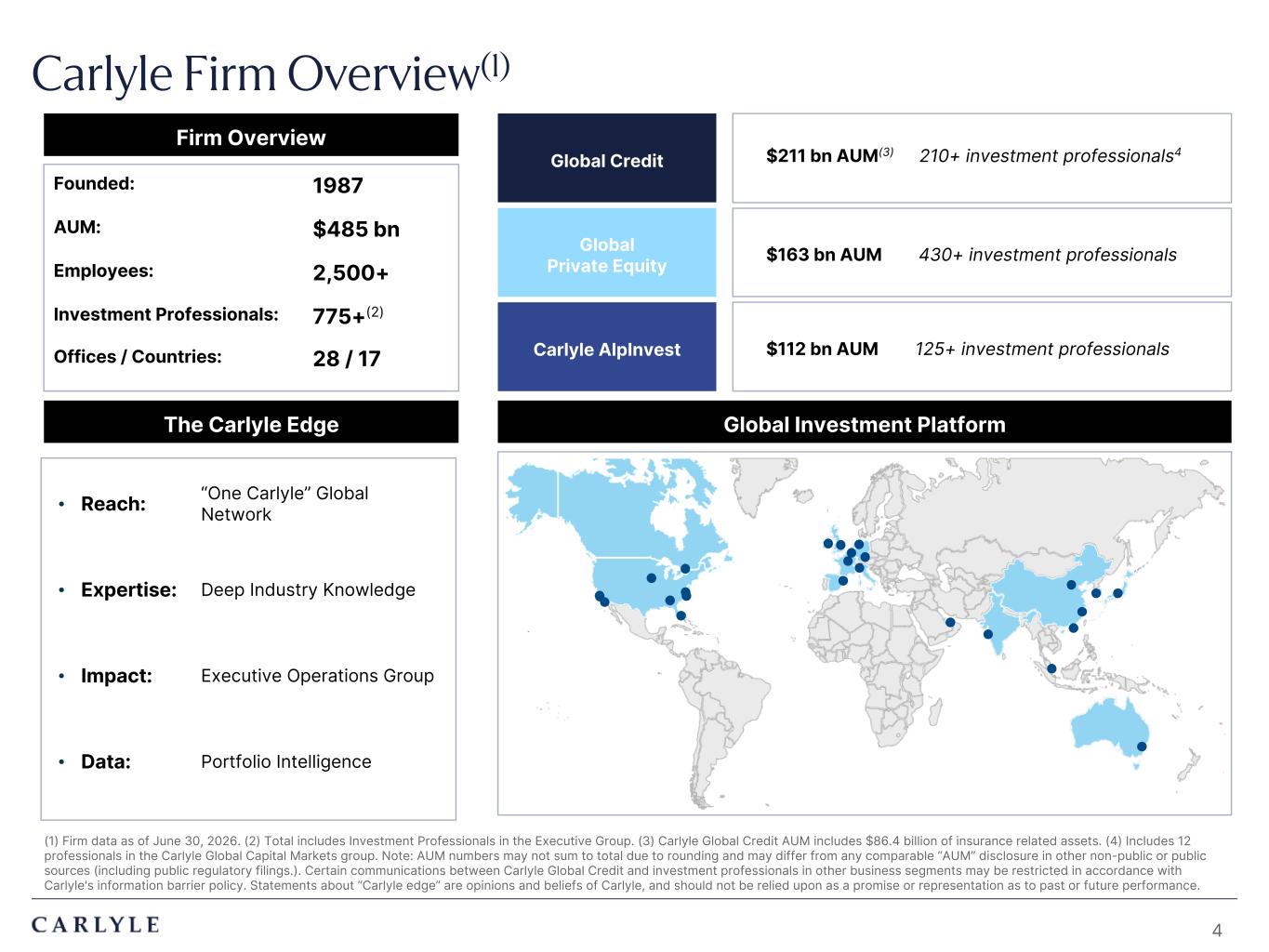
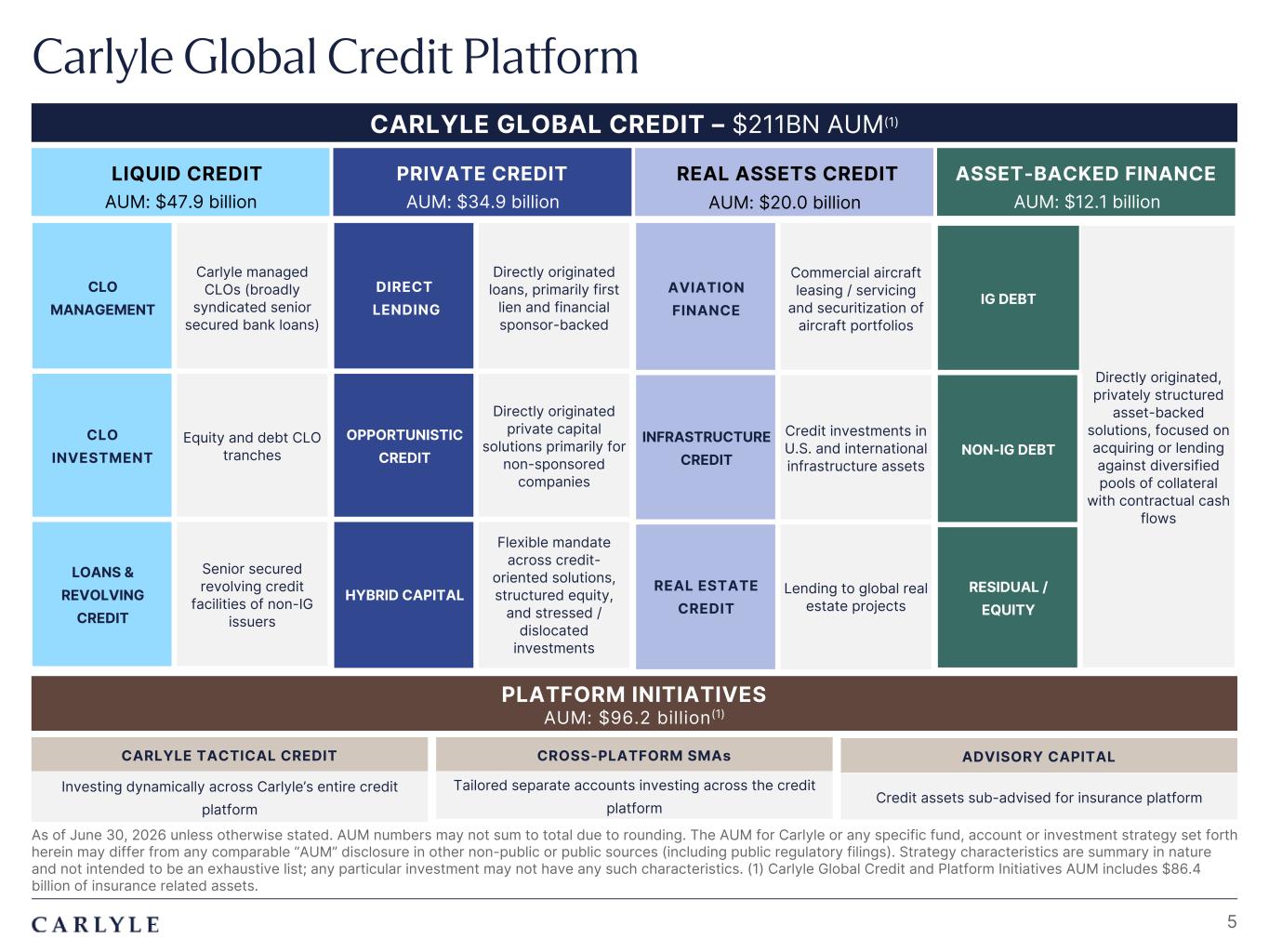
Yeah, good morning, Tim. So I would say, look, Carl, obviously a global asset manager. Just within credit, we have over 200 billion of assets under management and a multitude of strategies. So, it is something that we consider about potentially diversifying CSAF into kind of some of the other strategies if we like the risk-adjusted return. So, on the margin, is that something that we may like to do? But I think ultimately, the fund will retain its focus on SEWA equity.
Okay. Understood. So, it's maybe more of an opportunistic investment opportunity. So, great. And then just a second question from my end. looking at the investments, you continue to hold that one real estate asset. I was wondering if there's any updated commentary or plans surrounding that holding.
Yeah, it's a good question. So I'm by no means a real estate investor, but that market seems to move much slower than I expected. And so we continue to work with our partner on that piece of land and looking to maximize the value. It's just slow moving, but we are focused on exiting that position.
Okay, great. Thanks so much for taking the questions this morning.
Operator
And I'm showing no further questions. I would now like to turn the call back to Joseph for closing remarks.
Thank you all for joining. We look forward to speaking to everyone next quarter, if not sooner. please feel free to reach out if you have any questions and thank you again for your support and this concludes today's conference call thank you for participating you may now disconnect