Operator
Good day, and thank you for standing by. Welcome to the DICOM Industries, Inc. Second Quarter 2027 Results Conference Call. At this time, all participants are in a listen-only mode. After the speaker's presentation, there will be a question and answer session. To ask a question during the session, you will need to press star 11 on your telephone. You will then hear an automated message advising your hand is raised. To withdraw your question, please press star 11 again. Please be advised that today's conference is being recorded. I would now like to hand the conference over to Ms. Callie Tommaso, DICOM's Vice President of Investor Relations and Corporate Communications. Please go ahead.
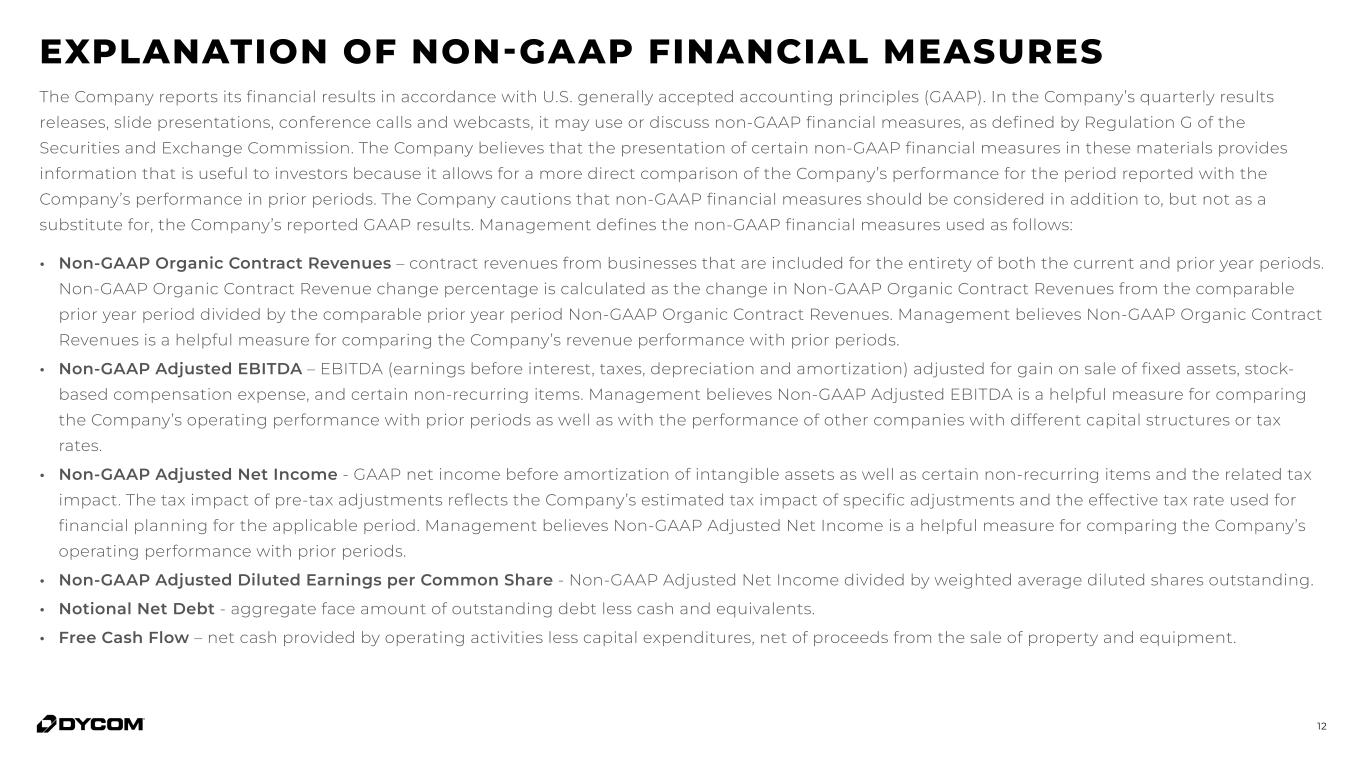
Thank you, Operator, and good morning, everyone. Welcome to DICOM's Fiscal 2027 Second Quarter Results Conference Call. Joining me today are Dan Pajovic, our President and Chief Executive Officer, and Drew DeFerrari, our Chief Financial Officer. Earlier this morning, we released our Fiscal 2027 Second Quarter results, along with certain Outlook information. The press release and accompanying materials are available in the Investor Relations section of our website, including the Outlook Expectations Summary document, which provides additional Outlook metrics beyond what will be discussed on today's call. These materials, which we will discuss during today's call, include forward-looking statements made pursuant to the safe harbor provisions of the Private Securities Litigation Reform Act of 1995. Our discussion and these statements reflect our expectations, assumptions, and beliefs regarding future events and are subject to risks and uncertainties that could cause actual results to differ materially. A detailed discussion of these risks and uncertainties is included in our filings with the SEC. Forward-looking statements are made date as of today's date, and we undertake no obligation to update them. Additionally, we will reference certain non-GAAP financial measures during today's call. Explanations of these measures and reconciliations to the most directly comparable GAAP measures can be found in our press release and accompanying materials. With that, I will turn the call over to Dan Pajovic. Dan Pajovic Thank you, Callie.
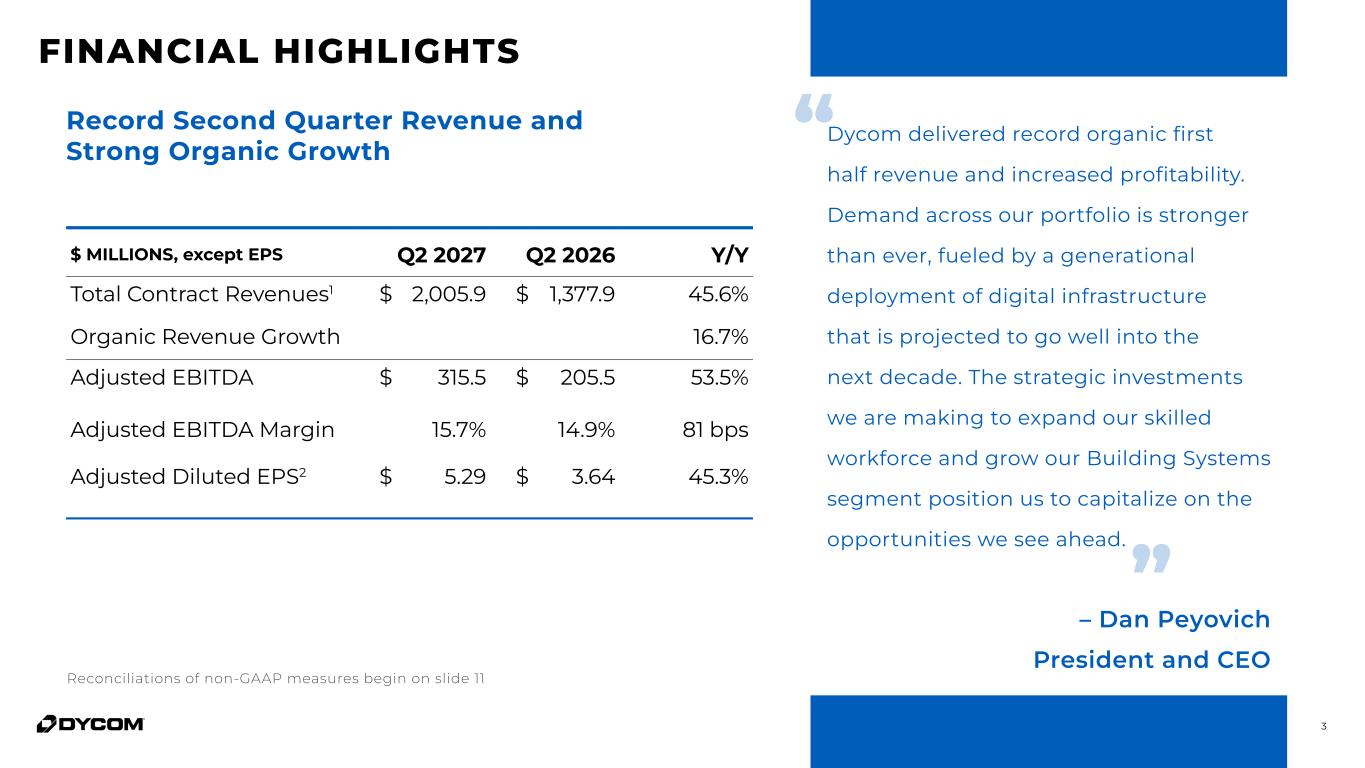
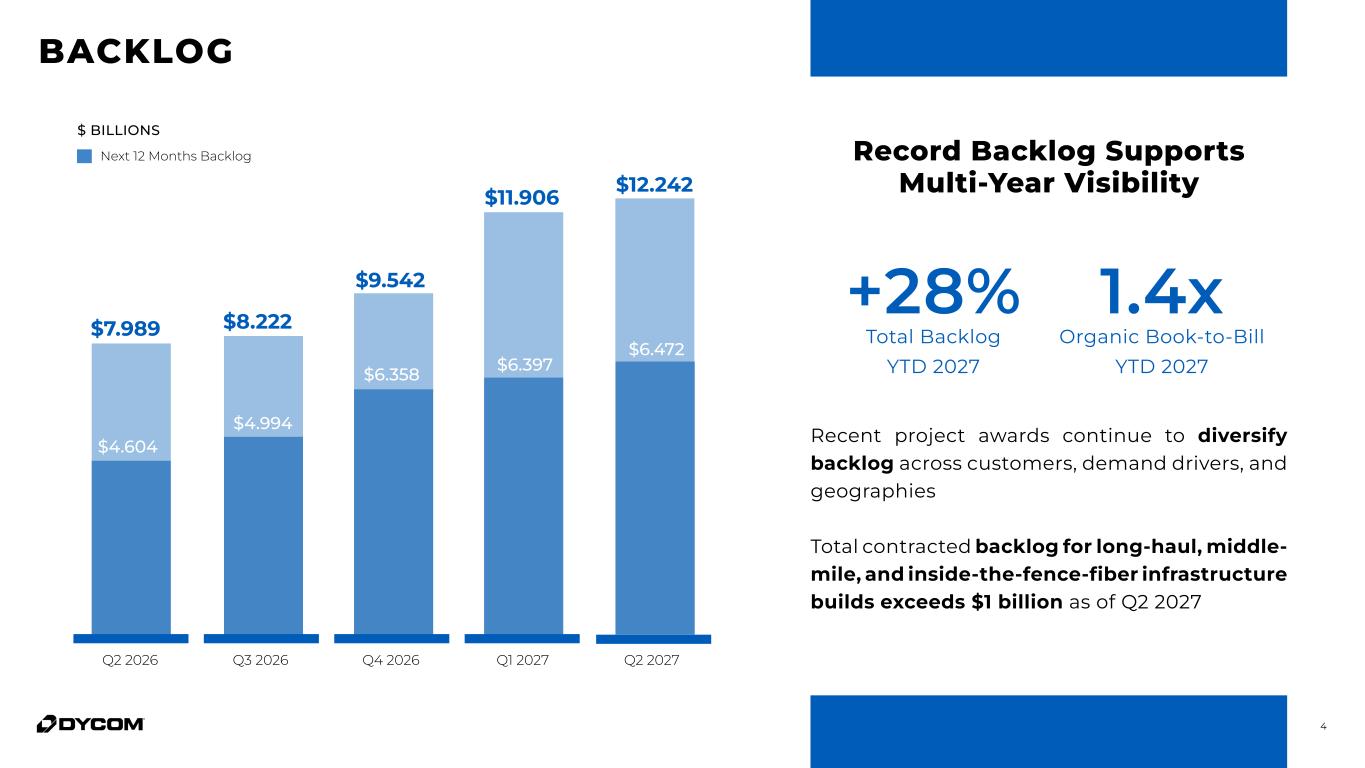
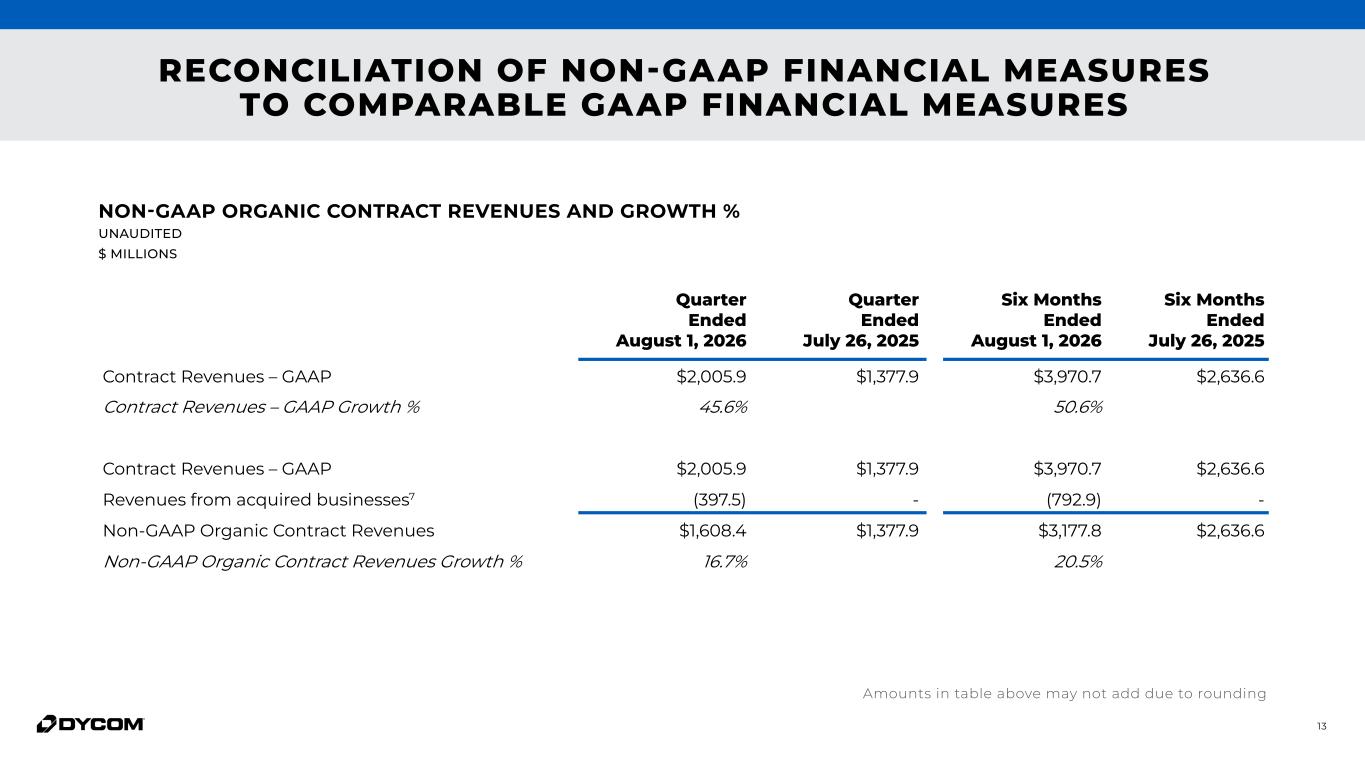
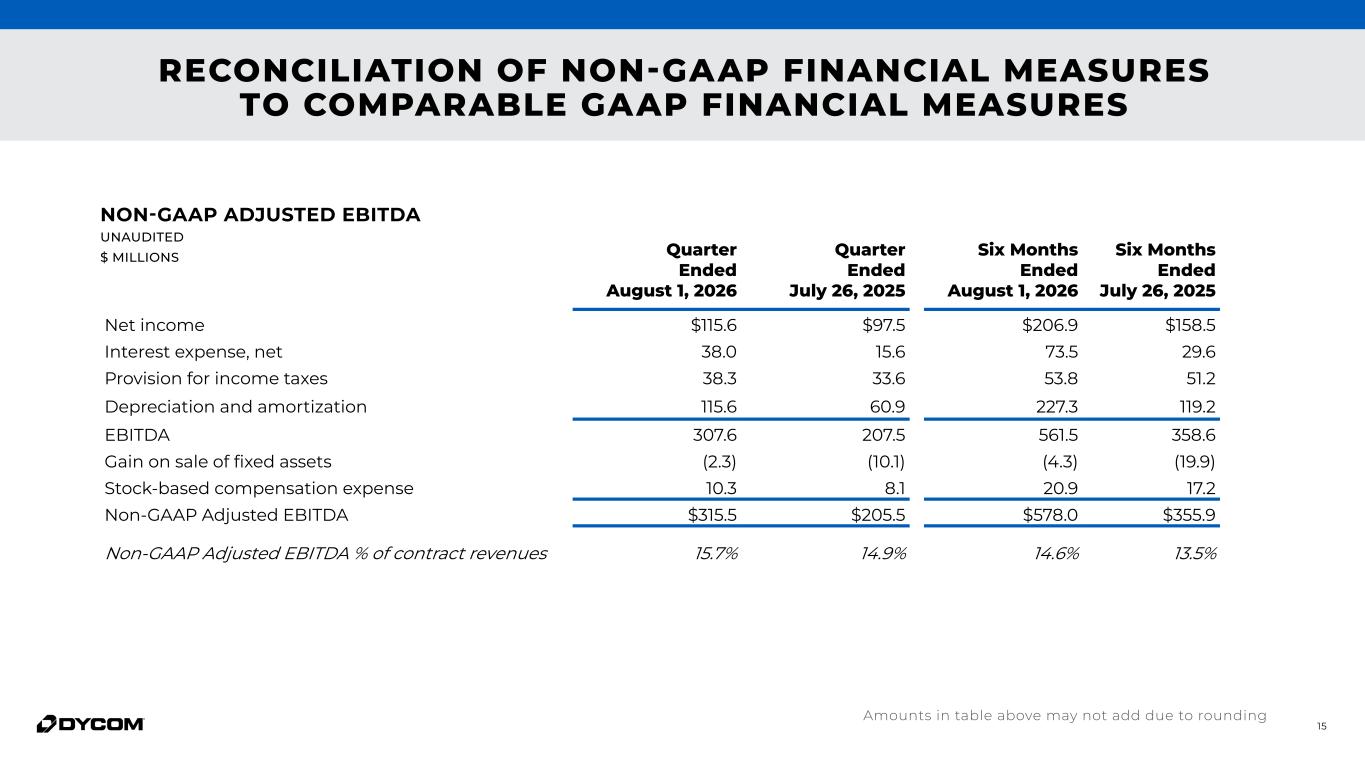
Good morning, everyone, and thank you for joining us. Our strong results reinforce the power of our strategy as a leader in digital and critical infrastructure. We delivered record organic first-half revenue, increased profitability, and continued above market growth. We also secured significant new awards, supporting continued confidence in our growth trajectory. Across our portfolio, DICOM brings together the national reach, local knowledge, and skilled workforce required to execute end-to-end work safety reliably and at the pace our customers demand. They recognize the unmatched certainty we bring to their most strategic and complex builds, allowing us to win quality work at returns that reflect our high level of service. This combination of scale, local expertise, and operational focus differentiates DICOM as an essential partner. Our leadership is readily apparent in our Q2 results. We achieved record quarterly revenue at $2.01 billion, growing 45.6% year-over-year and 16.7% organically. Total adjusted EBITDA of $315.5 million grew 54% year-over-year, exceeding the high end of our outlook and representing 15.7% of revenues. This performance reflects the continued strength of our revenue and quality of our backlog. Adjusted EPS of $5.29 grew 45% year-over-year, also exceeding the high end of our outlook and demonstrating our commitment and ability to deliver attractive returns for shareholders at our platform scale. Demand across our portfolio remains robust. We see heightened activity across Fiverr to the Home, Long Haul, Data Center Interconnect, and Data Center Electrical and Structured Cabling Systems. Customer demand on all these fronts is just as strong and in many cases stronger than a quarter ago. This generational deployment of infrastructure is projected to go well into the next decade, and we have line of sight too and are in discussions on those many years out. DICOM continues to be well positioned to capitalize on the growth drivers across our enterprise. Shifting the segment performance. In communications, fiber in the home increased nearly 60 percent in the first half of this year compared to the first half of the prior year. We are clearly differentiating ourselves in this market and continue to receive awards that further expand our reach. Concurrently, cloud migration, AI workloads, and data center growth are driving unprecedented demand for long-haul fiber corridors and high strand interconnects as evidenced by the wave of major nationwide bills announced publicly, each validating and even expanding the 20 billion addressable market we identified more than a year ago. Having entered this market early, we have a significant operational head start, an expanding backlog, and clear line of sight toward marked acceleration in overall industry activity in calendar 2027. DICOM is well-positioned to benefit from this massive investment cycle as hyperscalers, cloud providers, and carriers scale their infrastructure. On Bede, we recognize revenue this quarter for field engineering in Northeast. We continue to expect nominal engineering work through the back half of this year, with construction starting in earnest next year. In service and maintenance, we continue to execute across our broad and growing footprint, providing a large base of recurring revenues while uniquely positioning DICOM for bills across other demand drivers. Finally, our wireless equipment replacement program remains on track for a fiscal 2028 completion. Overall, this program has performed above expectations, providing outstanding returns on our wireless acquisition. It is not uncommon for large-scale deployment schedules to adapt over time, and we now anticipate approximately $150 million of wireless revenues to shift from the second half of this fiscal year into FY 2028. Importantly, overall program scope and backlog are unchanged. GICOM remains well positioned to support ongoing service and maintenance needs and to capitalize on future wireless densification and upgrade opportunities. Moving to the building system segment, Power Solutions delivered another quarter of substantial The strategic fit of this business is clearly reflected in its performance, contributing to an exceptional segment margin of 24.5% for the quarter, well above its historical average. With data center demand as strong as ever, we remain focused on scaling the critical workforce required to execute on significant builds in the DMV region. We also officially welcomed national technology integrators into the DICOM family during the quarter. Integration is progressing smoothly and we are already benefiting from the expanded reach and customer diversification they bring. Demand for inside plant structured cabling is very strong, and we are well positioned to leverage our collective footprint, including active cross-selling opportunities with power solutions and our communications operating companies. We finished the quarter with record total backlogs of $12.2 billion, representing a total book-to-build of 1.2 times and 1.1 times on an organic basis. This quarter, we secured additional awards for long-haul and data center interconnects, bringing total contracted backlogs for long haul, middle mile, and inside defense fiber to over $1 billion. With hundreds of millions of dollars of work already performed, we are highly confident in our positioning to drive sustained growth across this burgeoning opportunity set. Our robot, Diversified Backlog, underpins our confidence in this year's performance and our ability to generate sustained long-term growth. Reflecting strong execution, the wireless deferral and the addition of national technology integrators, we are raising our full-year outlook to a range of 7.48 billion to 7.66 billion. At the midpoint, this represents 36.5 percent total revenue growth and 11.3 percent organic growth year-over-year. Moving to strategy, we continue to make progress on our key priorities. First, talent and workforce development. Our workforce is DICOM's primary growth engine, and we are on an intentional journey to continuously improve how we support our people. As part of these broader efforts, we recently introduced key benefit enhancement across our operations, with further initiatives ahead to ensure DICOM remains the employer of choice. Our strategy is yielding results as we continue to grow our teams across the country. Central to this commitment is investing in the skills and safety of our people and construction is well underway on our new flagship training facility in Georgia, which is on track for an opening in the first half of calendar 2027. Second, expansion of building systems. Power Solutions integration continues to progress, and the strength of the business is visible in both its revenue and margin growth. We are incredibly pleased with this performance, which clearly shows DICOM's ability to attract, integrate, and grow quality businesses. This is also clear with national technology integrators whose initial contributions have exceeded expectations. As integration continues, we are confident in our combined ability to further enhance the business and capitalize on the opportunity set. As DICOM continues to diversify, we see opportunities to expand into other geographies and markets through additional M&A, a path we are actively pursuing. We believe that our culture and proven track record position us well for continued success. Third, margin expansion continued this quarter with adjusted EBITDA margin reaching 15.7 percent and 81 basis point improvement over the prior year. In communications, reduced operating leverage stemming from the shift in wireless combined with the investment to ramp across customer fiber infrastructure program is expected to result in slight pressure on adjusted EBITDA margins year over year. The benefits of our diversification strategy are clearly taking hold, highlighted by exceptional margins from our building system segment, which we expect to range from the high teens to low 20s. Across all operations, we remain disciplined in managing our backlog and execution to maintain and grow what we believe are industry-leading margins in each segment, while investing in both technology and training to drive long-term operating leverage. Fourth, cash flow enhancement. We continue to show rigorous working capital discipline, with DSOs coming in at 101 days, a seven-day improvement year-over-year. Fundamental enhancements across our business have transformed our cash flow profile over the past year. Operating cash flow and free cash flow both expanded in the quarter, but trailing 12-month free cash flow increasing nearly 200% compared to the prior year period. In summary, DICOM is effectively capitalizing on unprecedented demand and positioning our business for continued growth and diversification. We are executing with massive growth in fiber-to-the-home revenues, strong delivery and growing backlog of long-haul, middle-mile, and inside-defense fiber, increasing consolidated adjusted EBITDA margins, and disciplined investment to ensure DICOM remains a leader in digital and critical infrastructure and a relentless partner for our customers. Our success is made possible by our skilled workforce, nearly 21,000 strong, who bring excellence every day to the customers and communities we serve nationwide. I want to personally thank each of them for their dedication, for distinguishing our family of companies and for continuously raising the bar i am incredibly proud of our team and the value we are delivering for our customers and shareholders as we pursue our vision to be the people connecting america i'll now pass the call to drew to go deeper into our results and outlook thanks dan and good morning everyone we delivered strong top line and adjusted EBITDA growth and margin expansion while also investing in our future growth.
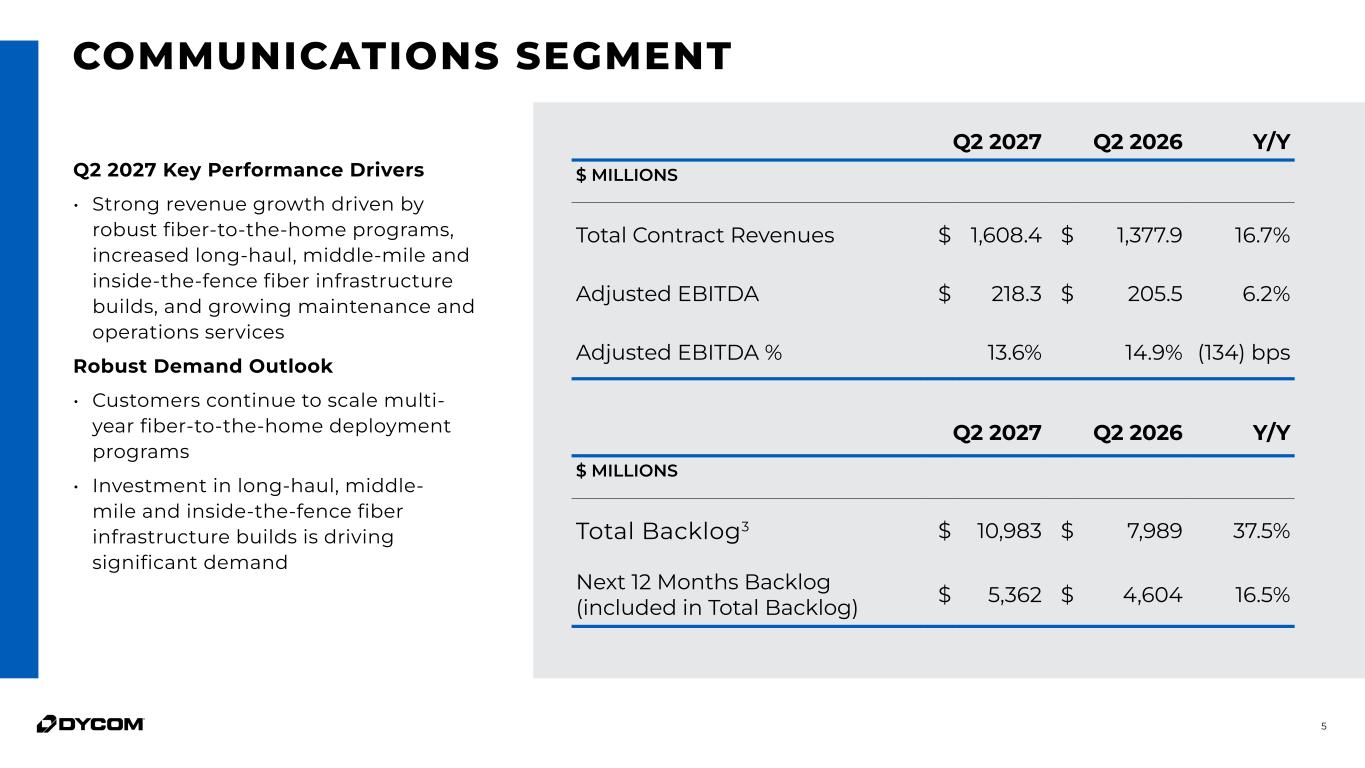
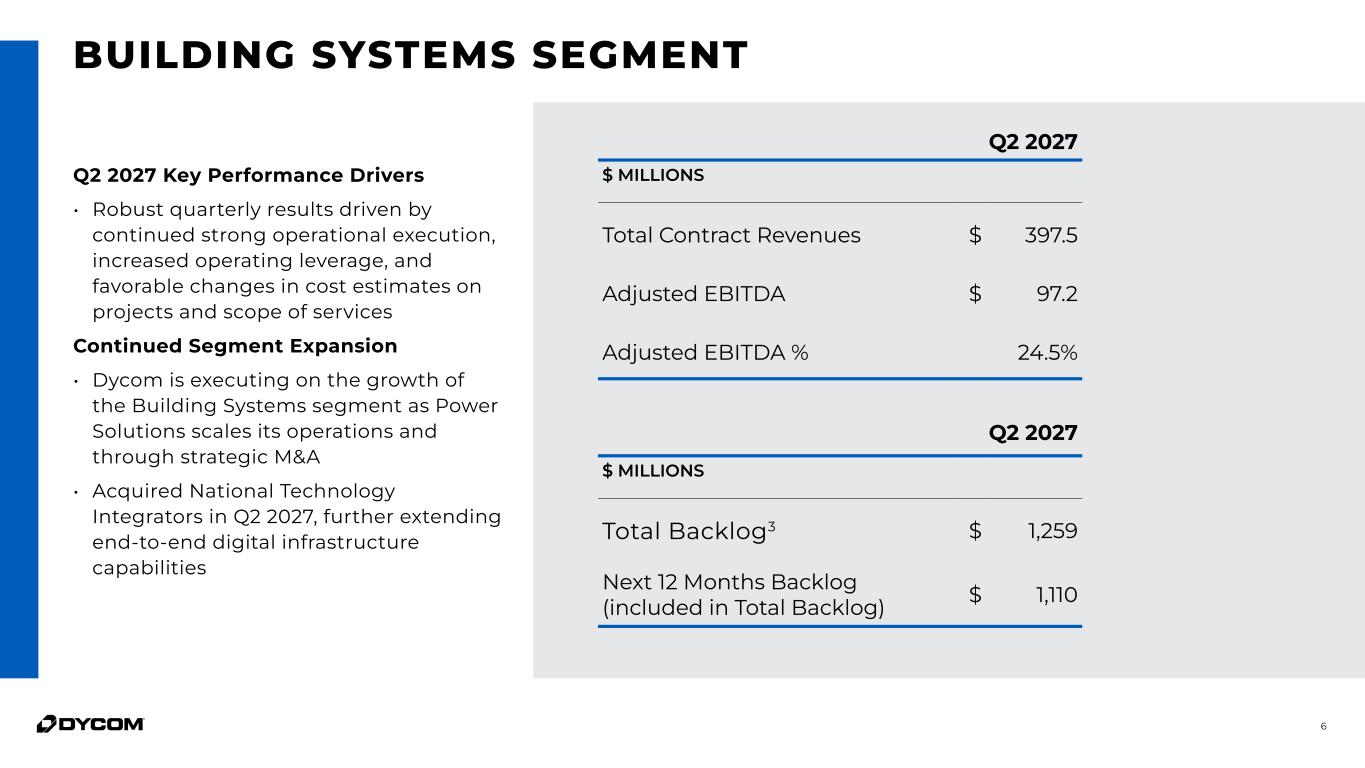
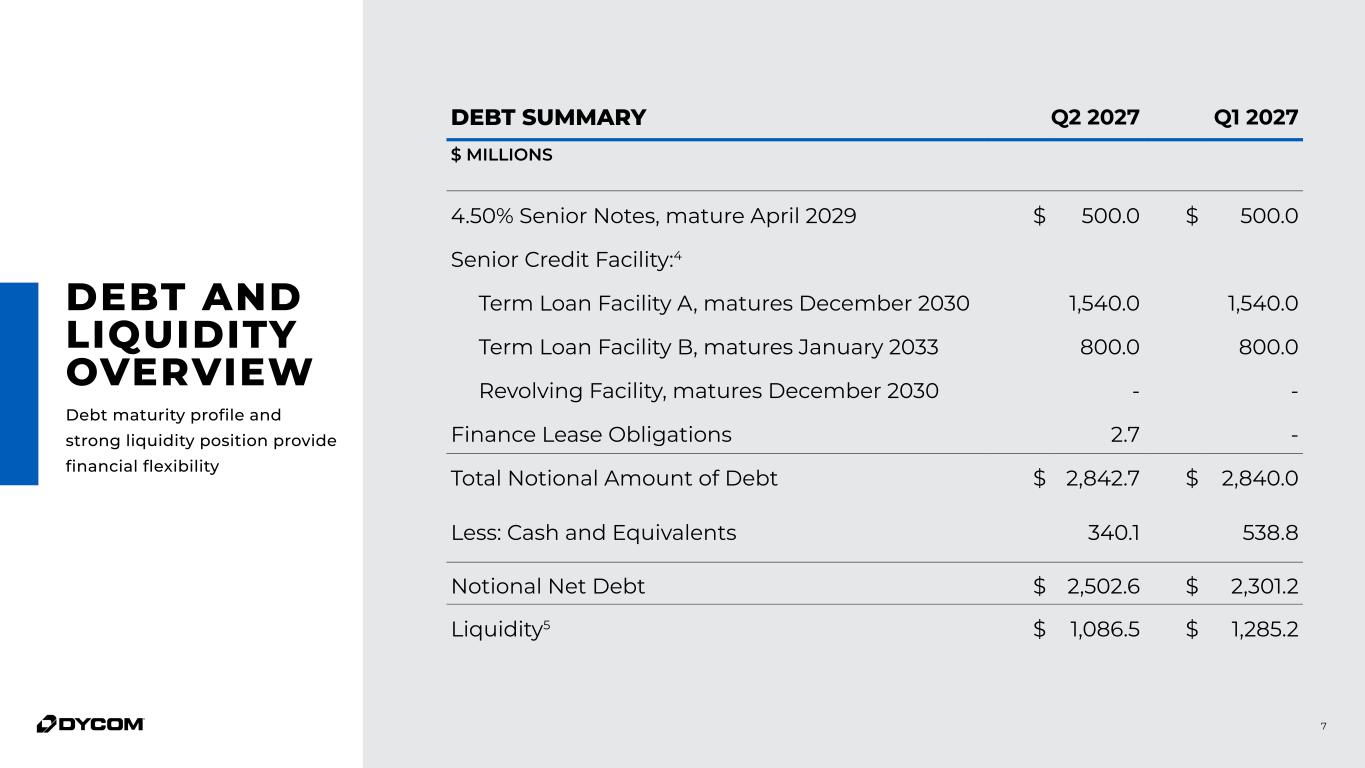
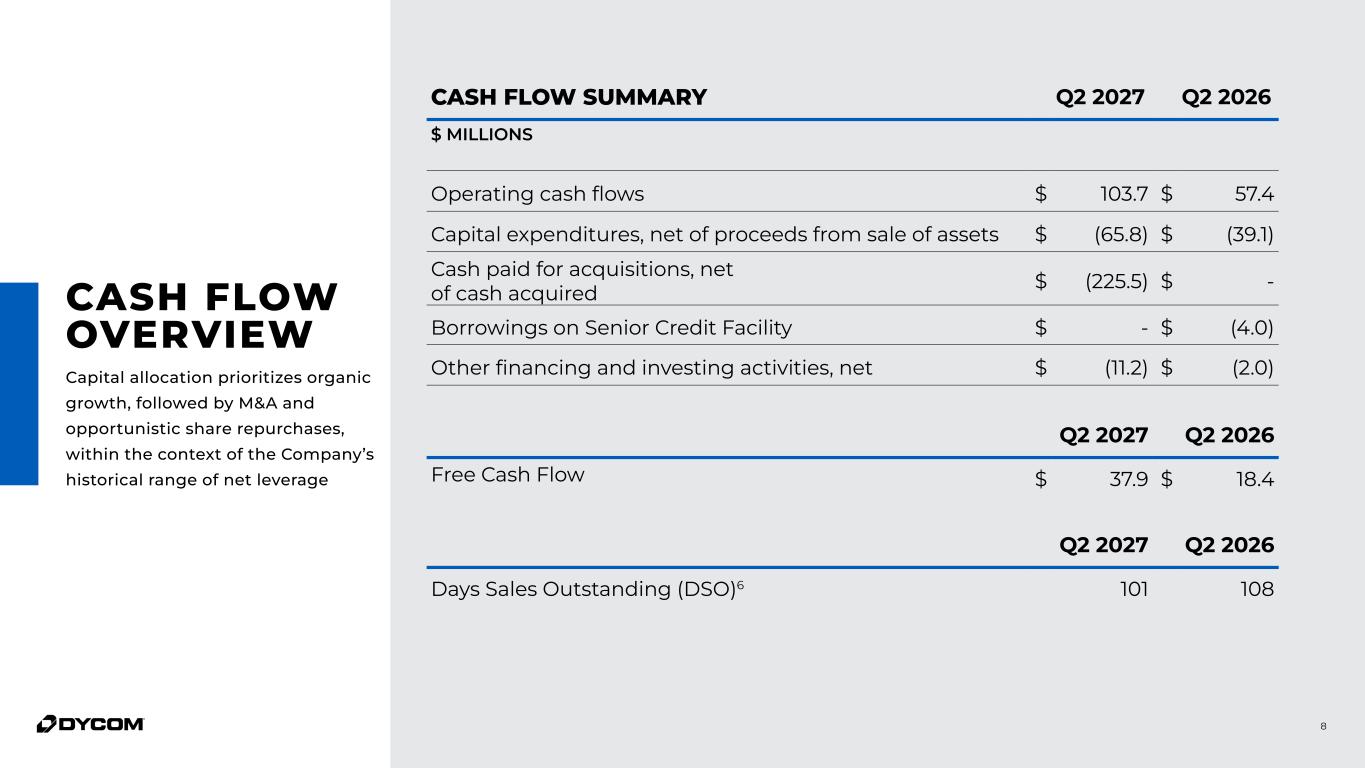
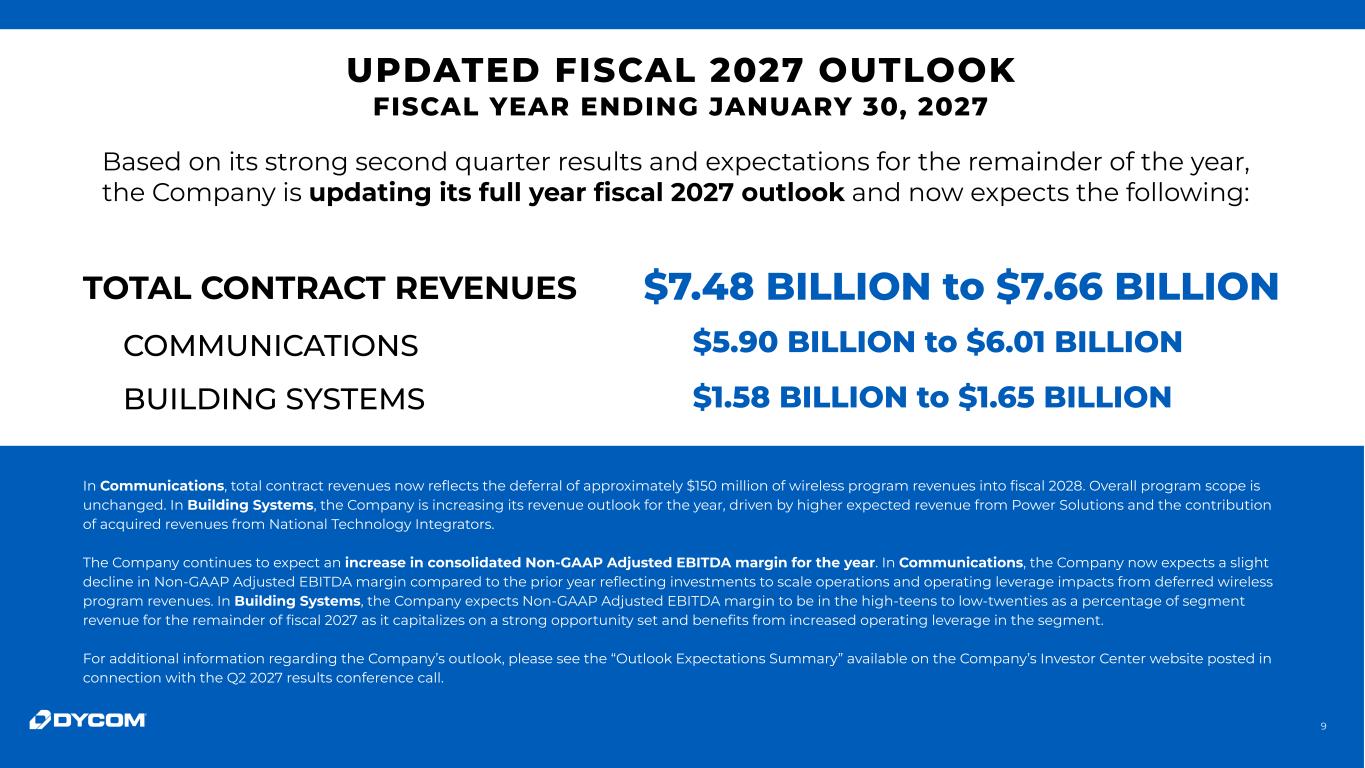
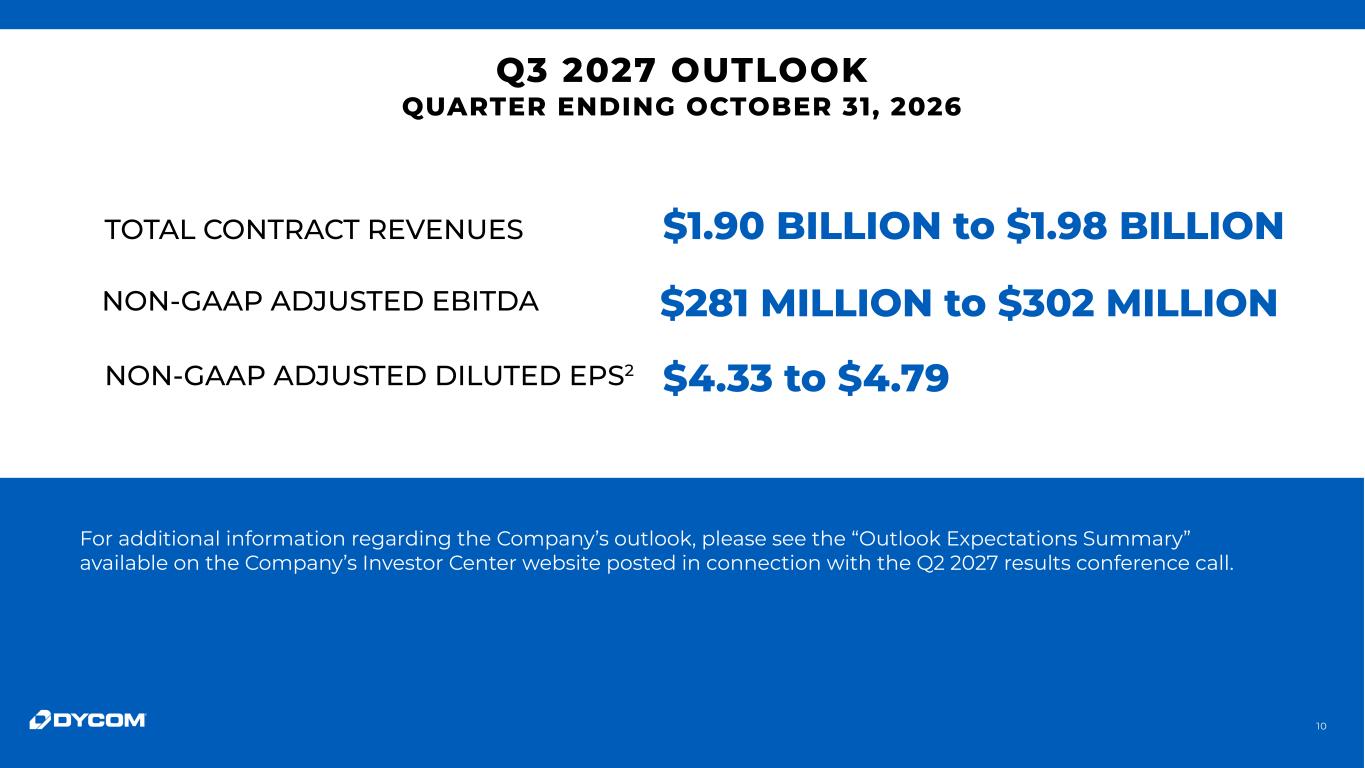
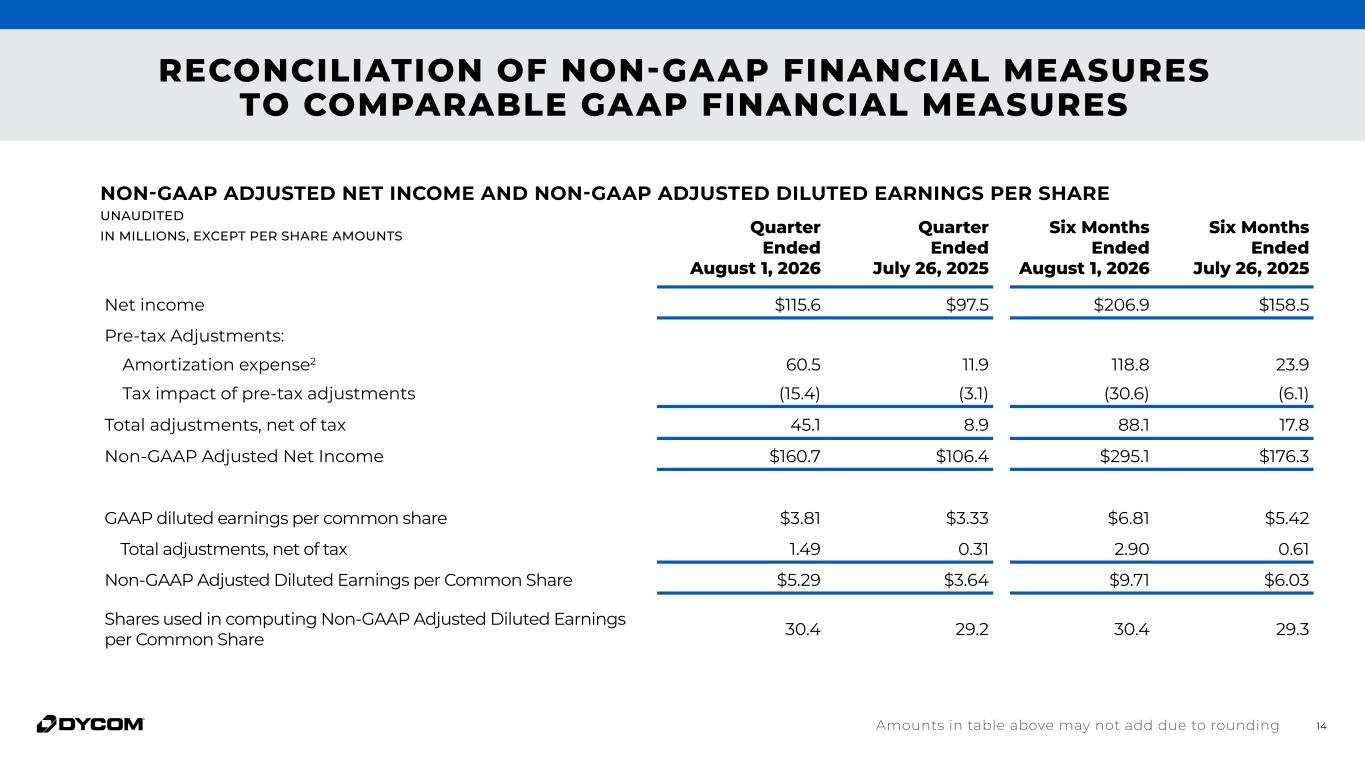
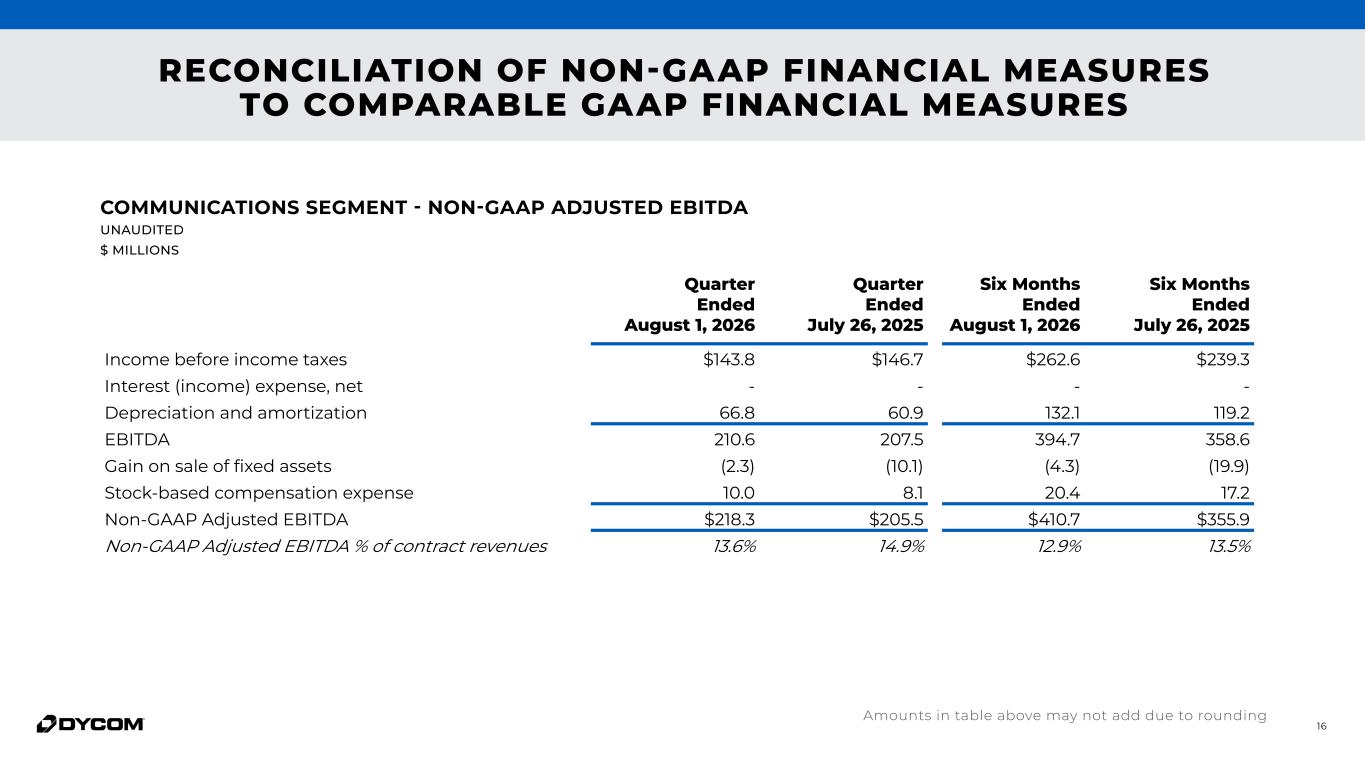
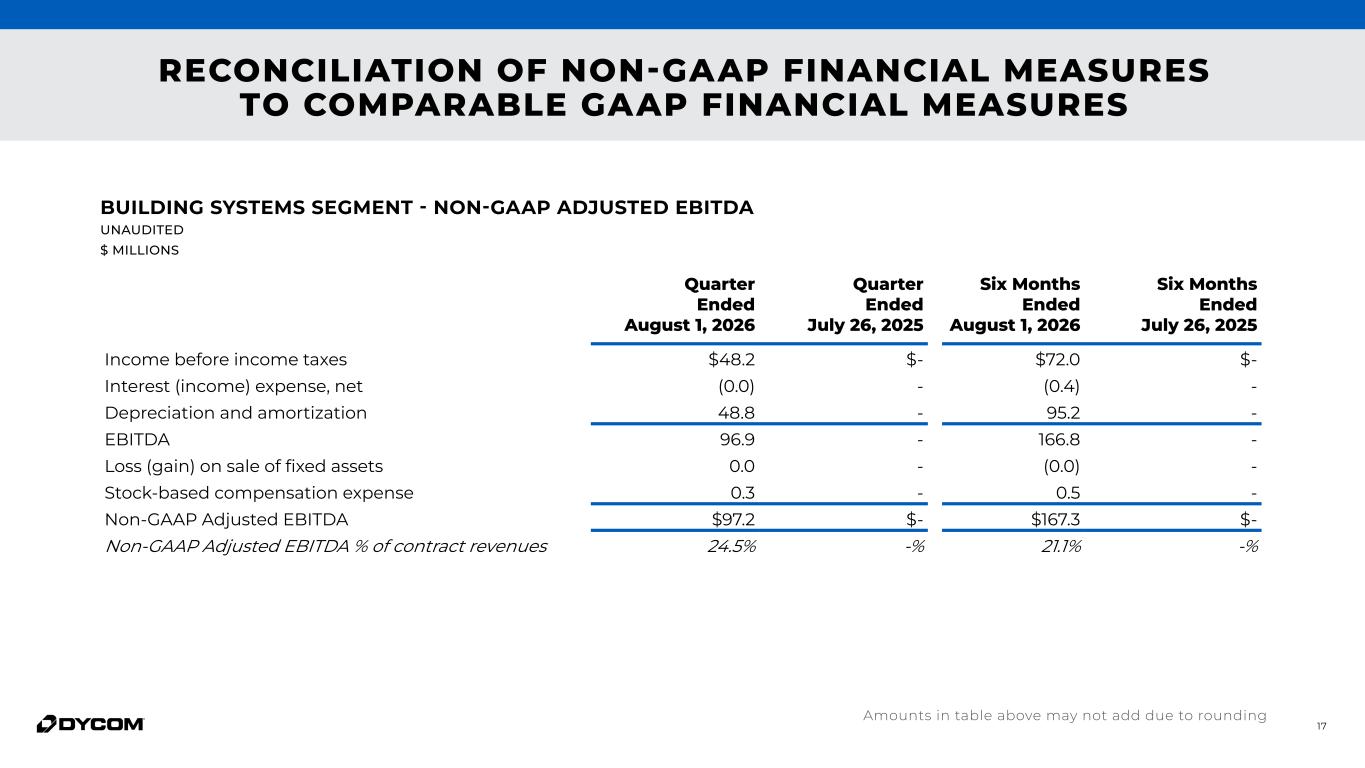
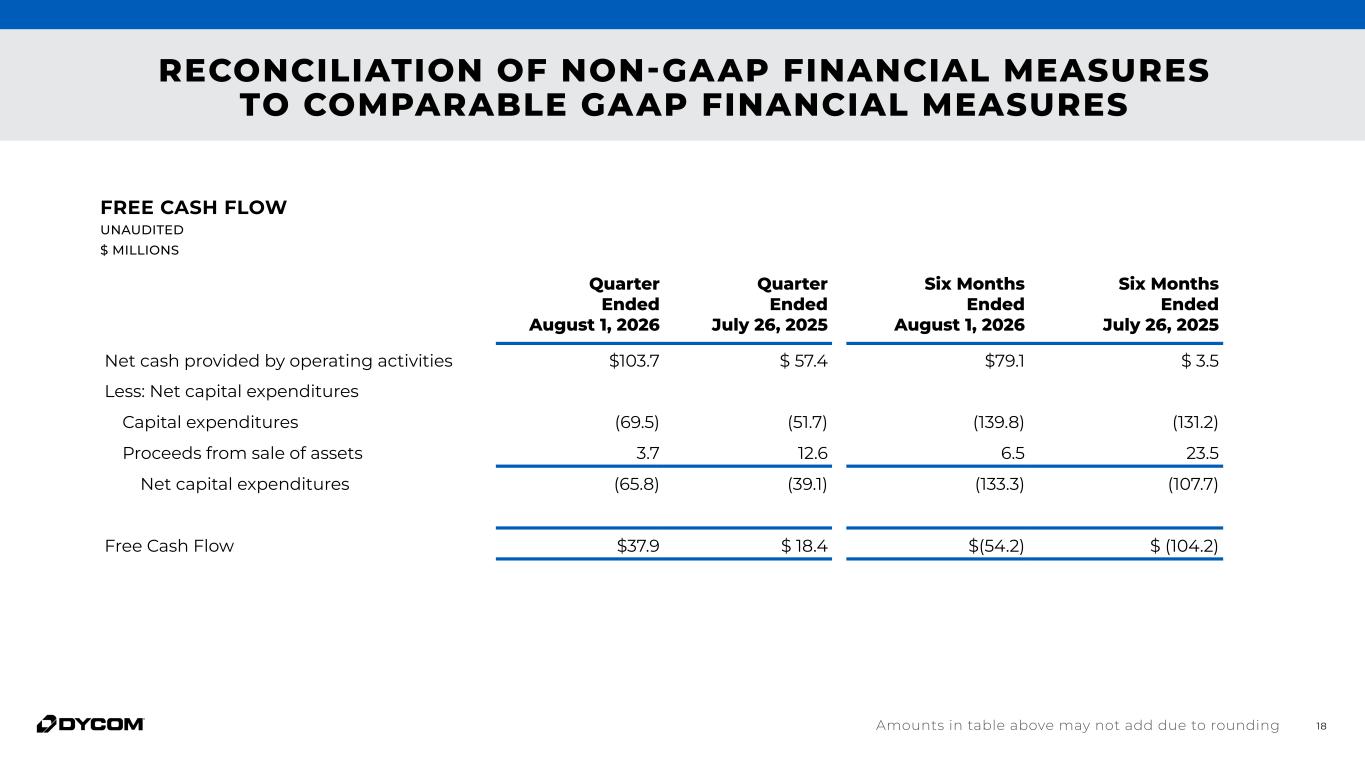
Q2 total contract revenues of $2.01 billion grew 45.6% over Q2 of last year. This reflects the strength of relationships and continued diversification across our customer base. Organic revenue of the communications segment grew 16.7% and building systems grew significantly. Building systems represented approximately 20% of total revenue for the quarter. Consolidated adjusted EBITDA of 315.5 million increased 53.5% over Q2 26 reflecting exceptional performance in a high demand environment. Consolidated adjusted net income was $160.7 million, and adjusted diluted EPS was $5.29 per share, an increase of 45.3% over Q2-26. These results are adjusted to exclude the amortization of intangible assets. Moving to the results of our business segments, Communications revenue was $1.608 billion and grew 16.7% organically, driven by robust fiber-to-home programs, increased long-haul and middle-mile fiber infrastructure bills, and growing maintenance and operations. Adjusted EBITDA for communications of $218.3 million increased approximately $12.8 million compared to Q226, reflecting overall growth in revenue. Adjusted EBITDA margin for communications of 13.6% of segment revenue decreased to approximately 134 basis points, reflecting higher investments to scale our operations, impacts on segment operating leverage from wireless projects deferred into next year, and approximately 35 basis points of cost pressure in the segment from higher fuel prices year-over-year. Building systems revenue of $397.5 million exceeded our expectations as we continue to experience rapid growth in this segment. We completed the acquisition of national technology integrators during the quarter and are pleased to welcome our new team members to DICOM. The acquired business performed well and contributed approximately $22.9 million of revenue during the quarter. Adjusted EBITDA for the building system segment was $97.2 billion, or 24.5% of segment revenue, as our businesses performed exceptionally well. During the quarter, we had favorable changes in cost estimates on projects and scope of services that drove the outperformance on margins in addition to operating leverage benefits. Total backlog at the end of Q2 was $12.2 billion, including $10.98 billion of communications backlog and $1.26 billion of building systems backlog. Backlog expected to be completed in the next 12 months is $6.47 billion, including $5.36 billion from communications and $1.11 billion from building systems. Strong cash flows remains a primary focus area, and we generated $103.7 million of operating cash flow during the quarter. The combined DSOs of accounts receivable and contract assets net were 101 days, a reduction of seven days year-over-year. We ended the quarter with cash and equivalents of $340.1 million, total liquidity of over $1.086 billion and proform a net leverage of approximately 2.3 times adjusted EBITDA, providing us with financial flexibility for continued strategic growth and investment. This week, our board of directors approved a new $150 million authorization for share repurchases through February, 2028. This authorization replaces the remaining amount from our prior authorization. We have clear momentum across our business and demand remains strong as we look ahead. We are updating our outlook for the full year and now expect total contract revenues to range from $7.48 billion to $7.66 billion. This revised outlook is an increase of approximately $55 million at the midpoint compared to our prior range of expectations. For the communications segment, we now expect contract revenues ranging from $5.90 billion to $6.01 billion, reflecting the deferral of approximately $150 million of wireless revenues into FY2028 compared to our prior expect. Building system segment, we are increasing our outlook, and we now expect contract revenues ranging from $1.58 billion to $1.65 billion, including the addition of approximately $90 million of acquired revenues from national technology integrators in the second half of the fiscal year. We continue to expect an increase in consolidated adjusted EBITDA margin for fiscal 27 compared to last year. For communications, we expect adjusted EBITDA margin to decline slightly compared to last year, reflecting investments to scale our operations, impacts on segment operating leverage from wireless projects deferred into next year, and cost pressure from fuel prices. For building systems, we expect adjusted EBITDA margin in the high teens to low 20s as a percentage of segment revenue as we capitalize on a strong opportunity set and benefit from increased operating leverage. On a consolidated basis for Q3, we expect total contract revenues of $1.90 billion to $1.98 billion, adjusted EBITDA of $281 million to $302 million, and adjusted diluted EPS of $4.33 to $4.79 per share, excluding the impact of intangible amortization. With a strong first half of the year completed and momentum across the business, we are confident in our ability to execute our strategy as we pursue the significant and growing opportunities ahead. Operator, this concludes our prepared remarks. You may now open the call for questions.
Operator
Thank you. At this time, we will conduct a question and answer session. As a reminder, to ask a question, you will need to press star one one on your telephone and wait for your name to be announced. To withdraw your question, please press star one one again. Please stand by. We compile our Q&A roster. And our first question will come from Richard Cho from JPMorgan. Your line is open. Hi.
I just wanted to get a little clarification on the wireless revenue push out, kind of what led to that, and how confident do you feel on that revenue coming through next year? And then along with that, how much of the first half of a contribution was wireless so we can get a better sense of what the non-wireless growth is doing through the year?
Good morning, Richard. Yeah, I want to be really clear about the wireless program. This is a program that we outlined in detail several years ago, a four-year program. And if you recall, that first year, we did have quite a bit of accelerations in the first year. So it's not abnormal for these programs to move and shift a little bit over time. But what we're talking about here with $150 million is a deferral next year. We have line of sight to the projects. In fact, there's a little bit of scope being added. We can see all that out in front of us. So a ton of confidence that that's going to continue. And we look at it as, listen, we've already got significant organic growth this year, significant organic growth this quarter.
Speaker 2
So having another $150 million push the next year is just a positive.
And then can you talk a little bit about the core wireless business? Like, what are the projects or what are the project cadence been like? And then on top of that, you know, how much is the split between new projects and maintenance? And what are you seeing there?
The large majority is the equipment replacements that we've been talking about, so this large four-year program. We did talk, as you remember, we talked about that decelerating this year and then decelerating again next year with the deferral. Now you're looking at something that's more planned. On the wireline side. Oh, on the wireline side. Excuse me. If you can ask the question again. Sorry, Richard. On the wireline.
Yeah, sorry. Mary, on the wireline side, I just wanted to get a sense of what projects you're seeing. Has there been any ramp or slowdown? Because there's been some uncertainty about fiber builds and then maybe a split of new projects versus maintenance.
First, I'll talk about what that differentiates DICOM. So, recall that about half of our overall communications business is service and maintenance. That continues to grow, although not at the same pace. our fiber to the home, 60% growth year over year in the first half for revenues. And again, if you recall last year, we talked about passing millions of homes. A reminder that passings and revenue don't directly correlate, but you're talking about significant growth and really a very large presence for DICOM across the space. What that means, though, is we are accelerating across many programs all over the country. And that's really what you see in the margin and the margin outlook, right? We need to make sure that we're investing to continue to grow into these programs, certainly on the fiber of the home, and that's very evident. It does take investment, right? We're looking multiple years out, making sure that we can stay in front of our customers and having those conversations with them to ensure that we have the workforce of tomorrow and that we're feeding into that. We talked a little bit in the prepared remarks about where we are now in the long haul. I want to be really specific there because I think this is an important point. The $20 billion that we framed out over a year ago, that is fiber in the ground to ultimately connect data centers nationwide. We talked about it as long-haul, middle-mile, and inside-designed fiber. When we talk about hundreds of millions of dollars of work in place, because we've been working on it for almost a couple of years now, and when we talk about over a billion dollars in backlog, we're not talking about data center-related work. We're talking about pure fiber that's ultimately going to connect data centers. So I think that's a really important point. And I think it positions us extremely well. Because remember, that $20 billion is back half-loaded, you know, towards the end of the decade. So, it positions us extremely well here at the outset. So, we're already very active there, continue to add to that space. And I think that really, when you look at it all, this is where Diatom is differentiating, is in that perspective.
Speaker 2
Great. Thank you. Thank you.
Operator
Our next question will come from Frank Louthon from Raymond James & Associates. Your line is open.
Great. Thank you. Reading into the deferral and the wireless business, is that customer doing anything else in the year? Will they increase some spending in some other areas? And then on the long-haul fiber, when we've seen recent announcements from NVIDIA with ZAO and Verizon and so forth, can you talk about the nature of those projects? Are those in the backlog? Are you going to be involved when we start to see some pickups there? And have you gotten any new customers lately on the long haul side? Thanks.
Good morning, Frank. On the deferral, first of all, just to be clear one more time, right, that's the same equipment replacement program we're talking about. It's the same overall timing. So, it's just simply a shift from this year to next year. So, we still feel really good about that and the added potential revenue there on wireless. On the wireline side, for that same customer, and I think this really goes to all of our customers, and another really important point, all of them reinforce their fiber of the home spend. They reinforced their build programs this quarter. We feel very confident in that. Again, you can see it in our results. So, you know, I wouldn't talk about necessarily increased spending, but everybody continues to be on track and on target, and you can see DICOM capitalizing on On the long haul, it is highly diversified, and I think that's a really important point. If you look at the hundreds of millions that we've done to date, if you look at the billion dollars that we have, that's not one program. That's not one customer. You know, we really look at diversification. There's very small programs in there, and there's very large programs.
Speaker 2
They vary across customers, and they vary across geography.
Operator
Thank you. Our next question will come from Manish Samaya from Cantor Fitzgerald. Your line is open.
Good morning, Dan and Drew. I was hoping to get reconciliation on the margin, year-over-year margin shortfall. I think, Drew, you mentioned fuel investments and revenue deferrals. It's going to help us understand how the impact of margin sits out from all these different factors.
Manish, you're breaking up a little bit. We think that you're asking about the comms margin and kind of what made up the difference there. Yeah, I'll jump in there.
As I commented in my prepared remarks, the fuel impact was about 35 basis points in the quarter year over year. And then the other two items, as Dan mentioned, were enhancing benefits, investing in our workforce. And so there's some cost there that we're happy to invest. And then also with the deferral on the wireless work, that's had some impact on the operating leverage.
Just going back to the 150 million wireless deferral into fiscal 28, that's one customer, and I'm just trying to understand what drove the timing shift. Is it equipment availability or just allocation of work? And maybe if you can just help us understand if it is equipment, you know, what kind of equipment are we talking about?
Thanks, Manish. We don't like to get too detailed in talking about the individual programs. This wireless program is something that we outlined several years ago. One, I would just reiterate, we did an acquisition in the wireless space to help lean us into this program. That's performed exceptionally well. The returns and this overall program size has been far more than we anticipated when we began that. So it is performing exceptionally well. We do have line of sight to the individual bills by line items, so we have a ton of confidence in how it's going to play out. And as I said in the prepared remarks, just like all of our work, it is not uncommon for these programs to adjust over time and when the actual spend is going to be. Really important to note that the overall spend, if anything has only gone up, it's not going down. We have a ton of confidence in that continuing to deliver. So nothing atypical in how any of our program.
And just lastly, Dan, on building systems, obviously margins were exceptional, 24.5%. When you announced power solutions, you talked about margins in the mid to high teens, and we sort of brought it down to mid-teens because of investments. Now we're massively outperformed, and now we're saying going forward, high teens to low 20s. So I'm just trying to understand how we should think about normalized bridge as we kind of look out to fiscal 28, 29 from our standpoint.
Yeah, and I think it's an excellent point to make. You know, DICOM's commitment is about long-term returns, right? We're looking at finding, if you think about M&A, we're looking at finding quality businesses that have performed well that we know when we combine forces together, when we help them lean into the future, and when we make those kind of investments that we made and we were very clear about, that we're opening up, really kind of shifting into another gear. So these are above the margins that they had performing coming into the business, and we feel very confident in them going forward. I would relate it really to the same thing that we're talking about on the communications margins, right? We see a period of time where we were capitalizing incredibly well. And I'll say it again, 60% growth year over year on an already very robust fiber to the home build program.
We really believe that we're out in front overall on the long haul middle mile.
And as we look towards the future, our ability to capitalize there requires that we continue to invest. And so our strategy has to adapt over time and make sure that we're investing today for tomorrow's growth. We're investing today for tomorrow's returns. That's exactly what we did with Power Solutions. We will continue to do the same thing with national technology integrators. And I think what you're seeing in that 24.5% is really just proof of that those investments are really strengthening the overall business.
Operator
Thank you. Thank you. Our next question will come from Eric Lubko from Wells Fargo. Your line is open.
Great. Thanks for taking the question. Dan, I wanted to dig into the 60% fiber to the home revenue growth you talked about first half of the year.
Obviously, really impressive. But I think the guide implies at least organic growth does decel a little bit in the second half of the year. So maybe you can touch on whether the outperformance first half of the year, is there any type of timing benefit or pull forward of activity that you might have expected in the second half of the year? Or do you think this is largely just a reflection of DICOM taking share in the market where you're doing work that maybe your competitors weren't able to get done? I've used this phrase before, Eric, so I'll use it again. Complexity favors DICOM. These programs are incredibly complex to get going. They're incredibly complex to get ramped up. You have all the permitting components. You have the planning components. You have obviously getting our workforce on that side of the business. It's 17,000 people or so, and crews that are less than three people all across the country. These are incredibly heavy lifts. And I think what you see is DICOM really differentiating our ability to execute and deliver that. You see that in our backlog, right, very strong backlog again after an incredible quarter of backlog growth last quarter. And then you see it in our execution. The deceleration is really just, you know, we're stacking these from the ground up, right? We're building it project by project, piece by piece. It's not always perfectly linear, but as we look out into the future, we still see significant opportunities for continued growth. And you see that in the organic growth, even in the Guides of the Year.
And just one follow-up for me on the building systems segment. There's been a lot of press recently around data center moratoriums, increasing backlash against data center construction more broadly in the country.
So I wonder if you've seen any signs of that in the DMV market or any signs that could potentially slow some of your builds.
And then how does that kind of NIMBYism aspect, that type of risk, inform how you're thinking about new market expansion as you look to move beyond just the DMV region?
With the incredible demand, Eric, there are issues being worked through that everybody certainly sees just about every day in the newspapers today. I think from where we are having conversations, from where we are on the ground and in the field, the demand continues to be significant, continues to only grow, if anything. And we are an incredible division. You certainly see that in the performance of power solutions this year, you can already see it in the performance of national technology integrators as we bring them into the business. You know, we're getting to have those conversations about projects that are not just happening today, but are happening many, many years out. Those partnerships built over decades really, we think, differentiate where we're at. We have a ton of confidence in our ability to continue to grow there. And then as we do look to other markets and other opportunities for acquisitions, of course, that's something that we're keeping top of mind. And again, we're just, we believe that we're in a good position to be able to really see a lot more than what people might be reading in the headlines.
Speaker 2
All right. Thanks, Dan.
Operator
Thank you. Our next question will come from Adam Tallheimer from Thompson Davis. Your line is open.
Hey, good morning, guys. I guess I'm still wondering, how would you characterize the core wire line business? And maybe you can just comment generally on trends in the various fiber programs.
How I would characterize it for DICOM is that we are executing. We are executing incredibly well. And you can see that, again, not only in the performance and the growth across programs, but you also see it in the backlog and our focus on high-quality backlog and the right kind of margins for the returns on the level of execution that we have in the field. So I would say if you look at Fiverr of the Home, I talked about that extensively. You know, I think we're incredibly well positioned to continue to be a leader there. And that's a program that we see continuing to go and grow many years out as a reminder. And then, you know, really everything that we laid out about the long haul and middle mile, and this is the first time we've given a little bit more insight into how we're approaching it. But that $20 billion we talked about over a year ago, Adam, really is taking shape. Our customers are talking about it quite a bit, reaffirming that that $20 billion is out there. And even though it's back half-weighted, we're already incredibly well-positioned, both from a backlog and performance perspective. So all in all, I would say if you think about wireline on the communication side, DICOM is incredibly well-positioned, and that's because of our strategy and our discipline.
And those, the long-haul and the middle-mile fiber opportunities, maybe you can help us think about how to size those and think about when that might come into backlog.
Yeah, it would be tough to give an outlook on when they come into backlog, certainly around execution and timing of signing contracts and whatnot. That $20 billion, remember, is back-half loaded. We do think that number has grown and extended over time. and something that we're tracking closely, not prepared to give any more color from where we are today. But what we really wanted to show, again, is DICOM's ability to capitalize there, our ability to execute. And as I said earlier, we're doing this across customers. We're doing it across programs. This isn't a singular bet. And DICOM, I would say, has more experience in this space. This work is highly, highly complex, and we believe that's going to differentiate it just like it did on Fiverr.
Operator
Thank you, Tim. Thank you. And our next question comes from Michael Funk from Bank of America. Your line is open.
Yeah, great. Thank you for the questions. You know, three quick ones, if I can. So tower companies noted during the quarter slower activity from one wireless customer, which they attributed to recent headcount reduction, not necessarily reduction in program overall. So, you know, wondering if, you know, that was the same customer that you're calling out here with the deferral, or maybe I'm making a connection that isn't there. You know, second, you mentioned BED funding coming through an engineering revenue in 2026, contributing more in 27. Any more help on thinking about the ramp in that revenue in 27 would be helpful. And then final questions on long-haul, middle-mile fiber. Have you seen any shift in the economics or competitive pricing for those contracts in the last couple months?
Thanks, Michael. Yeah, not sure on the correlation on the tower companies. Again, the way I would frame that is kind of confident in the remainder of that program, and it's still on track overall with what we outlined. just simply a deferral from this year to next year. On the BEAT side, please, that we have some engineering work in place and that we're going to continue that. You know, these are much smaller amounts if you look at DICOM's total backlog or our total revenue for the year, but it does continue to position us well as that program gets to a place to really start building construction next year in our fiscal 28 calendar 2027. We originally outlined that at about a $17 billion TAM. We'll kind of see how that comes in. There's some puts and takes. You know, where's the $22 billion going to end up? You know, you do have some subgrantees, changes that are happening. So we'll see how that all plays out. But we have a ton of confidence in incremental and upside opportunity overall for DICOM's And then on the long haul, again, this is really complex work that a lot of people have not performed, where DICOM has really been out in front. So we have a ton of confidence in what we're putting into our backlog as being quality backlog. We will see how it plays out with competitive dynamics over time. Great. Thank you, guys.
Operator
Thank you. Our next question will come from Stephen Fisher from UBS. Your line is open.
Speaker 4
Thanks. Good morning. Just wanted to follow up about the communication segment growth rate and maybe think about it for next year in light of kind of the exit rate and the first half comps in mind, and I guess bear with me on some of the numbers here, and maybe you're going to say it's still too early to comment, but it seems like we are going to be at a low single-digit growth rate in the second half of this year. So if we were to hit, let's say, double-digit growth for next year, you'd have to add around $600 million of revenues for next year you're taking 150 million out of this year adding it to next year so you'd need around 450 is long haul a middle mile at a scale of ramp yet to add that or is the combination of bead and fiber to the home uh can that get you there in light of the tough comps that you have in the first half of the year or is just double digit growth in in comps too high an aspiration to think about for next year?
Good morning, Steve. So you were right in what you said, that it's a little too early to get ahead of giving you an outlook for next year. But I will comment on some of those programs because I think it's important and it really goes to what we talked about with the comms margins. Right now is a time where we need to continue to invest. We have fiber to the home that has grown significantly. As we've talked about, that has a lot of growth left in those programs for years out. So we continue to see that going at a very rapid pace and our customers reaffirm that. I talked a little bit about BEAT. So that's a lot of upside for next year. And we're having a lot of really good quality conversations. So we're preparing for that opportunity. And then you're going to start seeing the long haul work ramping up over time. And you see that in our backlog. You see that in our performance to date. As all those come together, you're talking about massive pressure on the industry when it comes around to skilled workforce. And I think that's where we differentiate. We have around 17,000 people on the communication side that are out there every day. That really differentiates us, our ability to be ahead of this. There is a lot of training that has to happen if you're going to do long haul fiber splicing. There is a lot of training on how you deploy fiber to the home and program manage that properly. We're well ahead of that curve. And that's where we're making investments to stay there. So we see a lot of growth opportunity in the future, and we'll be excited to talk about it as we get closer to next year.
Speaker 4
That's very helpful. And then I guess just to follow up on some elements of what you just were talking about there in terms of the margin pressures and comms this year, the scaling cost there, was that more than you actually expected you might spend in the quarter? I'm just trying to gauge how you're factoring that into some of your thinking for the next couple of quarters. And then on the fuel side, just going to remind us of the process for recovering that if you can, or does that need to just sort of reset next year? And when you get easier comps on that, it'll kind of work its way through if you can just help on some of those comps margin elements. Thanks.
First, you know, we believe we have industry-leading margins in our communication segment. We're very pleased with the returns we're getting there. So I think that's a really important starting point. As we invest, looking forward, we want to be a relentless partner to our customers. When they come to us with large aspirations about ramping fiber-to-homework or ramping or building more long-haul work, we're going to be there to deliver and execute on that. As those programs do that, it takes a little bit to get that learning curve down, to get that program going. So we're making investments on that side. And then as Drew talked about, we're making investments with our workforce. You know, we want to make sure that we maintain our status as the employer of choice in our space. So we're doing all that together to stay ahead of it overall. And then just, sorry, I was thinking on your first question, do remember on the back app that we have Q4 seasonality. And, you know, we're always going to take a prudent approach to that. We had very favorable Q4 and Q1 last year. But, of course, there's no guarantee that that could happen again.
Speaker 4
Thanks a lot, Dan. Appreciate it.
Operator
Thank you. Our next question comes from Liam Burke from B. Riley Securities. your line is open.
Thank you. Good morning, Dan. Good morning, Drew. Good morning. Dan, on the building system side, you've had strong organic growth, good margin expansion. Do you anticipate having a craft shortage in that area and having to reinvest at the expense of margin in the future, or are you comfortable scaling that business?
We are comfortable scaling that business, and that's really where you see the margin raise, the high teens to low tonies as we go forward. Electricians, and this is going to be no surprise to anybody, electricians are still in short And even with our performance and our growth, there are still projects that we are turning away because it takes a while to get those resources ramped up and trained. So we feel really good about our growth prospects going forward, but absolutely that industry continues to be constrained as we look down the road.
Great. And then you were talking about visibility on the longer term on your fiber projects. You took a margin hit or will take a margin hit on communications the second half of the year. Do you have similar visibility on returning to positive operating leverage on that side of the business as we get past the initial investment in craft labor?
It's an ongoing thing, right? It's something that we're always testing with the market, testing, you know, certainly as we look internally and think about our strategy, those investments are not always linear. You know, Drew and I talked in our prepared remarks about furthering our benefits for our workforce. It's really important right now that we stay ahead of the massive demand in the communication segment. So again, I want to bring everybody back up to the top of, you know, we have outstanding margins in our communications segment, what we believe are industry leading. We're very pleased with that return. Are we always working to continue to grow it? Absolutely. But we feel really good about our positioning as we stand here today, our ability to continue to grow in that space and move ourselves into additional markets and additional customers. Thank you, Dan.
Operator
Thank you. Our next question will come from Joseph Osha from Guggenheim Securities. Your line is open.
Speaker 4
Hey, thanks for taking the question. This This is Mike Stratote on for Joe. Just on NTI, you mentioned that the initial contributions have been exceeding your expectations. I'm just curious if you could dive into this more. Is it smoother than expected integration? Are you seeing new cross-selling opportunities with Power Solutions? Is it stronger than expected demand? Something like that.
It really goes into the profile, Mike, of the businesses that we look for. This is another very strong management team, a very strong improvement business with very strong customer relationships. So similar to Power Solutions, we're leaning in, we're making investments. It was great to see them have a very strong performance in the approximate months that they were part of our business this quarter. And you see a strong outlook in the overall margin profile for building system segment. We absolutely are seeing cross-sell. That's something that, you know, quite frankly, we were having conversations about even before the acquisition closed, the opportunities out there from the prior relationships with Power Solutions. So we feel good about that, and as I said in our prepared remarks, we also feel good on the outlook of, you know, looking to continue to grow our footprint through future M&A opportunities in the building.
Speaker 2
Great. Thank you.
Operator
Thank you. And as a reminder, to ask a question, please press star 1-1. And our next question will come from Michael Dudas from Vertical Research Partners. Your line is open.
Yes, good morning, Callie, Drew, Dan. Good morning. Maybe this is for Drew. Maybe you could share with us your thoughts on second half operating and free cash flow dynamics relative to pretty good recovery here in Q2 and encourage about the board authorizing another share tranche or share repurchase. Dan, how are you thinking about allocation second half into next year, mentioning all the tremendous demand and growth opportunities and maybe a little color on your active M&A pipeline, And it will, you know, I've assumed share repurchase, given where the shares have corrected to, would be part of this calculus going forward.
Mike, thanks for the question. Really appreciate the observation there. So, yeah, over the past 12 months, we've had north of $700 million worth of operating income or operating cash flow. Very pleased with that, pleased with the result this quarter of over $103 million. And as we think of the rest of the year, we do still have that, you know, that seasonality that comes into the business on the cash flow side. So we do have expectations around that. Please, the net leverage on a pro forma basis is in the 2.3 area. As we talked about when we acquired Power Solutions last December, we talked about bringing that down throughout the year over a 12 to 18 month period to get back to that 2 area. We're on our way there. And then as far as capital allocation, really no changes there from a priority perspective. We're investing in organic growth. We've talked about all the opportunities that we have ahead of us there. Nice to see the organic growth this quarter and what we see ahead, followed by M&A. Pleased that we closed on the national technology integrators acquisition in the quarter. And then I'm pleased that we re-upped the authorization around the share repurchases over the next 18 months that we'll continue to evaluate and look at that on an opportunistic basis. So no change on the capital allocation priorities.
Operator
Thank you. Thank you. And I'm showing no further questions from our phone lines. I'd now like to turn the conference back to Mr. Dan Pajofich for any closing remarks.
Thank you for joining us today. What we believe the takeaway is that DICOM is executing incredibly well across our platform. We're excited about the opportunities in front of us, and I want to thank all of the men and women working across the country to continue to deliver and raise the bar for our customers. With that, we will see you all next quarter.
Operator
Thank you. This concludes today's conference call. Thank you for your participation. You may now disconnect.