Hello, everyone, and welcome to Ineo's second quarter 2026 earnings call. Our first is a publicly listed company. My name is Tim Fursillo, Vice President of Investor Relations at Ineo, and I'm joined by our CEO, Olaf Berling, and our CFO, Dennis Schilze. With us in the room are also Martin Wiedner, leading global sales for data centers and power solutions at Ineo, and Andreas Eberharter, responsible for product management and marketing. Let's have a quick look at today's agenda. First, Olaf and Dennis will present the second quarter results. Then you'll have approximately 30 minutes for your questions. Please note that this conference call is being recorded today, July 28, 2026. Our conference call will include both GAAP and non-GAAP financial results. Reconciliations of our non-GAAP measures to the most directly comparable GAAP measures can be found in our Form 10-Q for the quiet period ended June 30, 2026. Our quarterly earnings release in the corresponding presentation slides, all of which are available on our IR website. We will be making forward-looking statements about our business, market position, and future performance. These statements are made only as of today's date. We do not undertake any obligation to update these statements except as may be required by law. These statements involve known and unknown risks and uncertainties that may cause our actual results to differ materially from those anticipated or implied today. For additional information on risks and uncertainties, please refer to our SEC filings. Unless otherwise specified, all comparisons refer to Q2-2026 versus Q2-2025. And with that, I'll hand it over to Olaf.
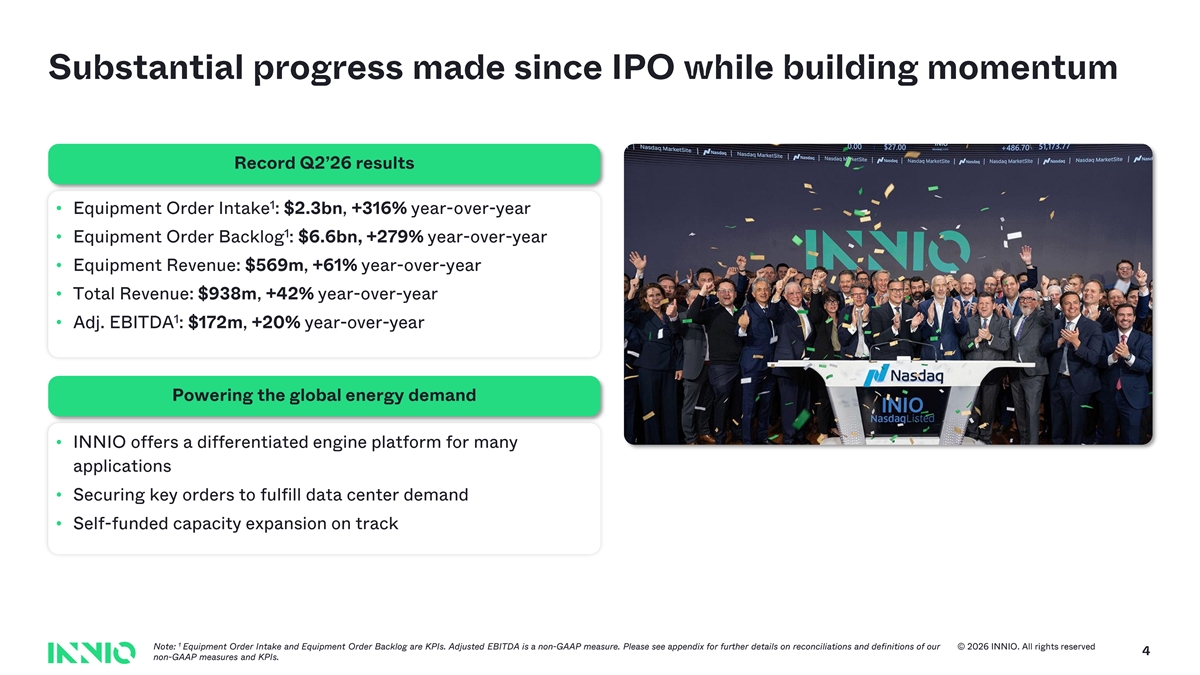
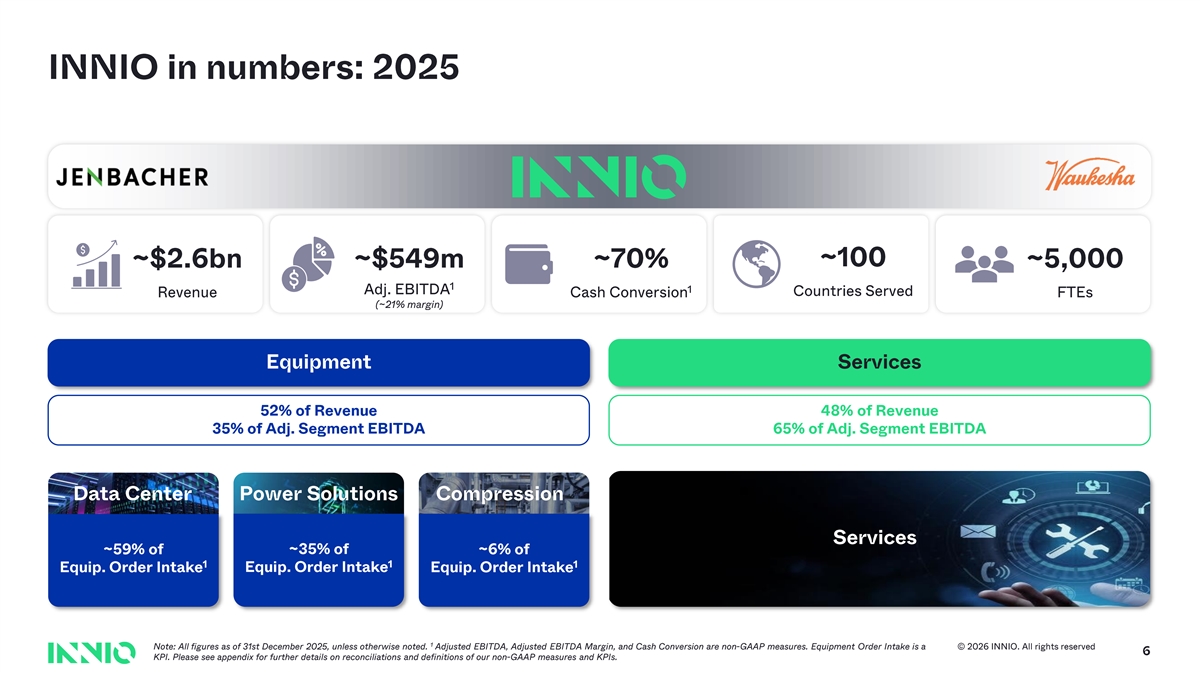
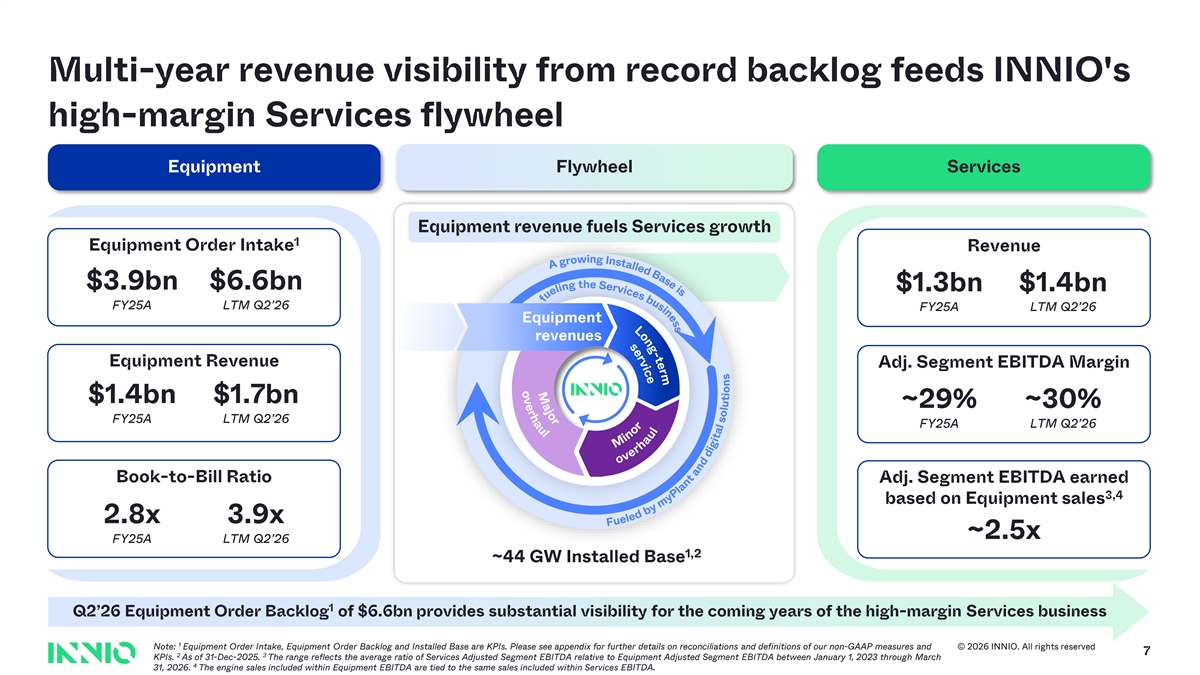
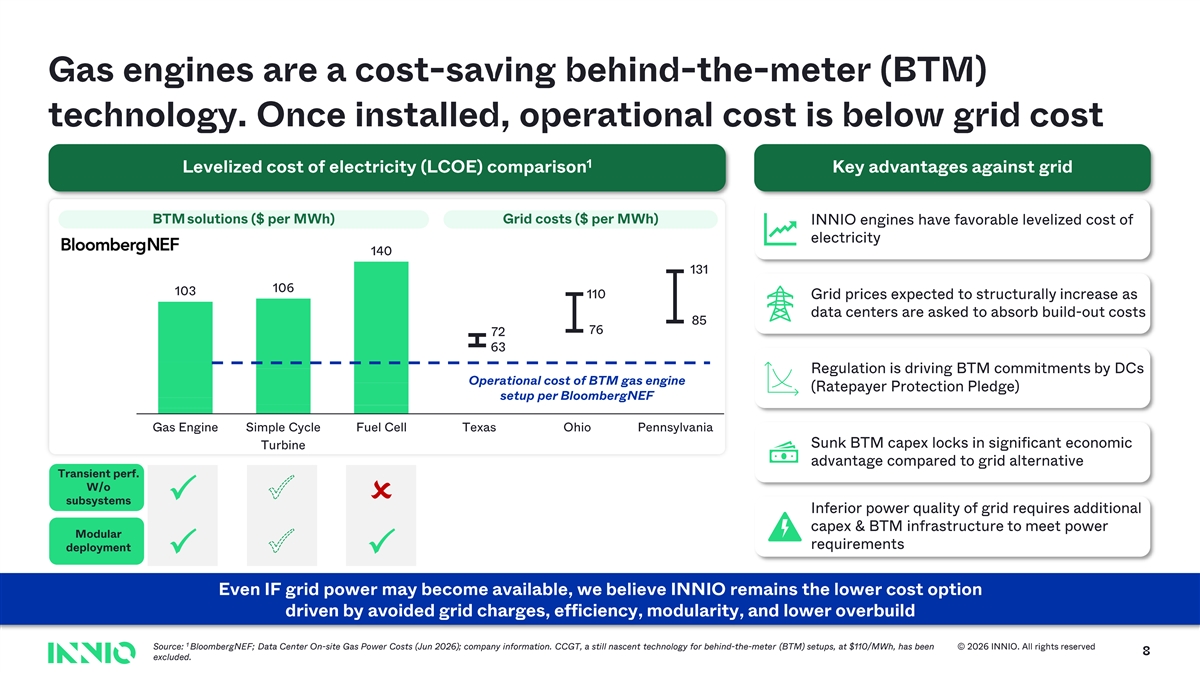
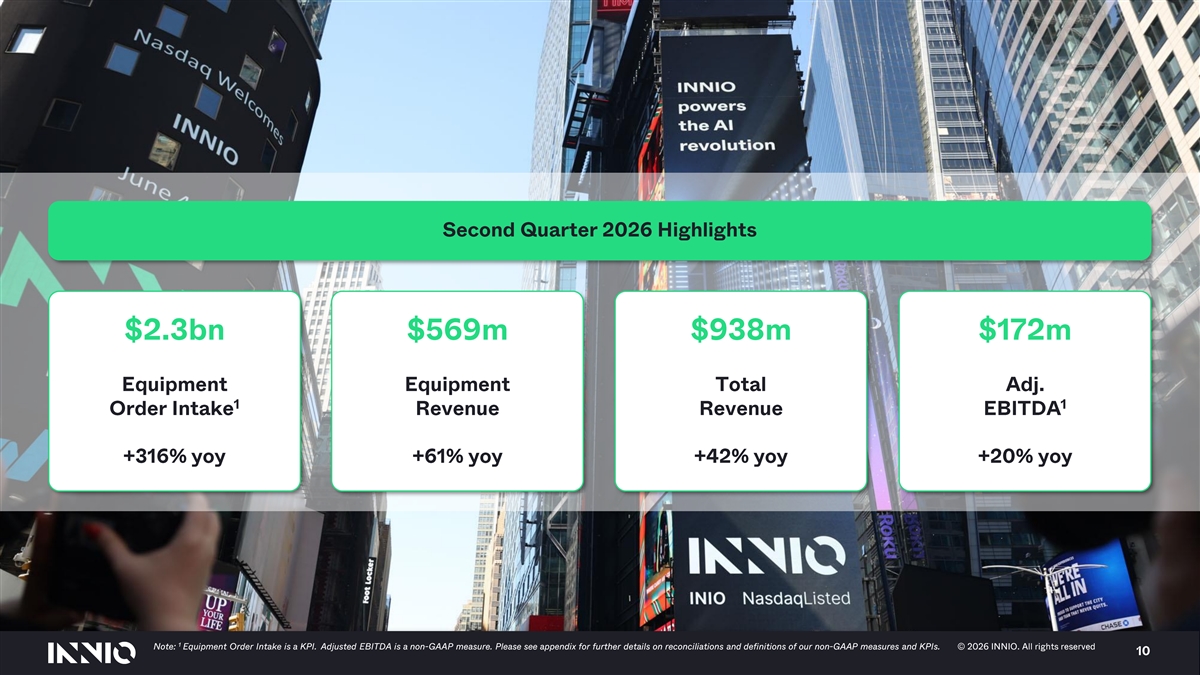
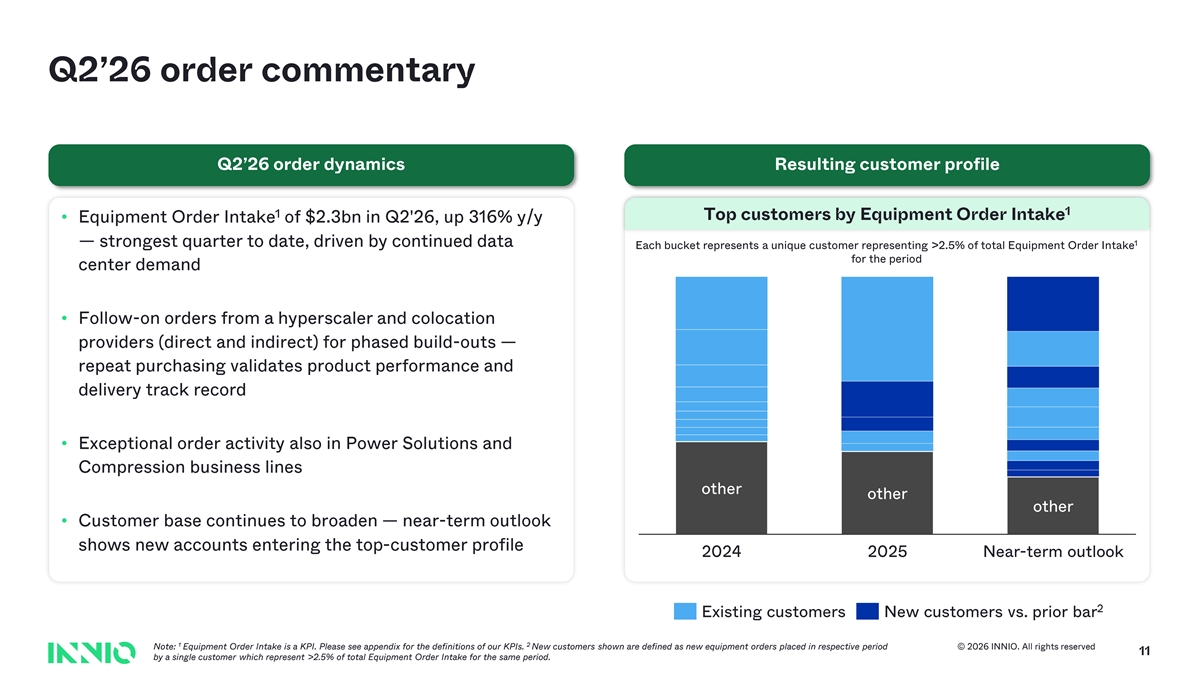
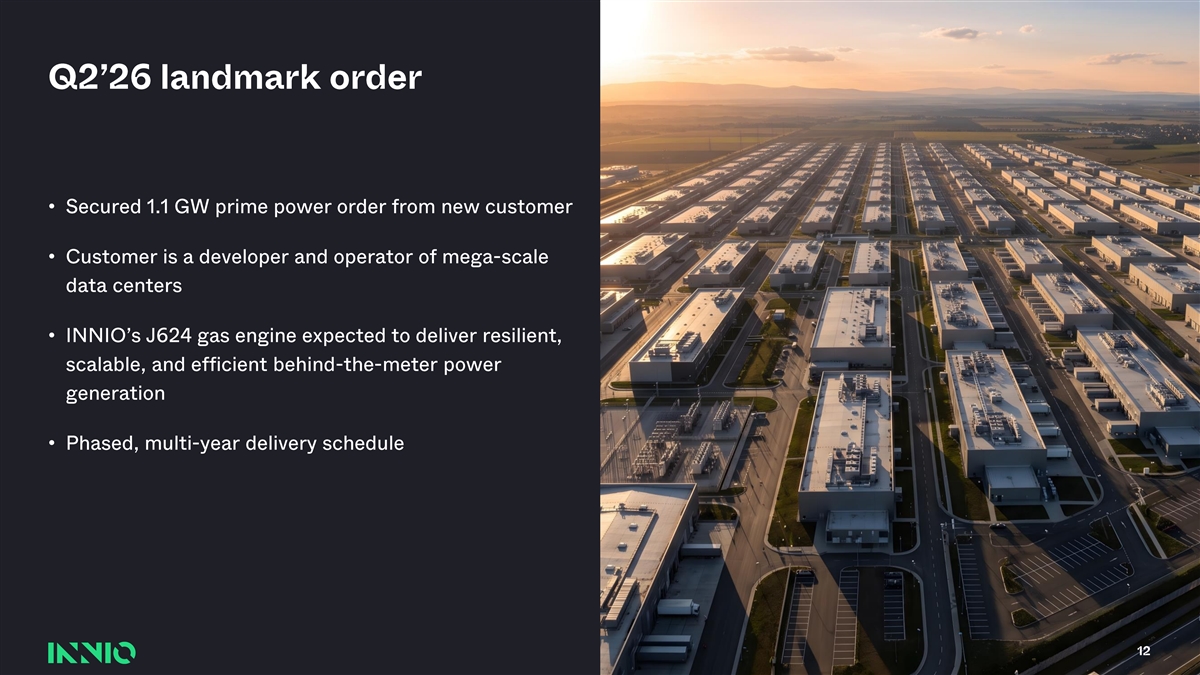
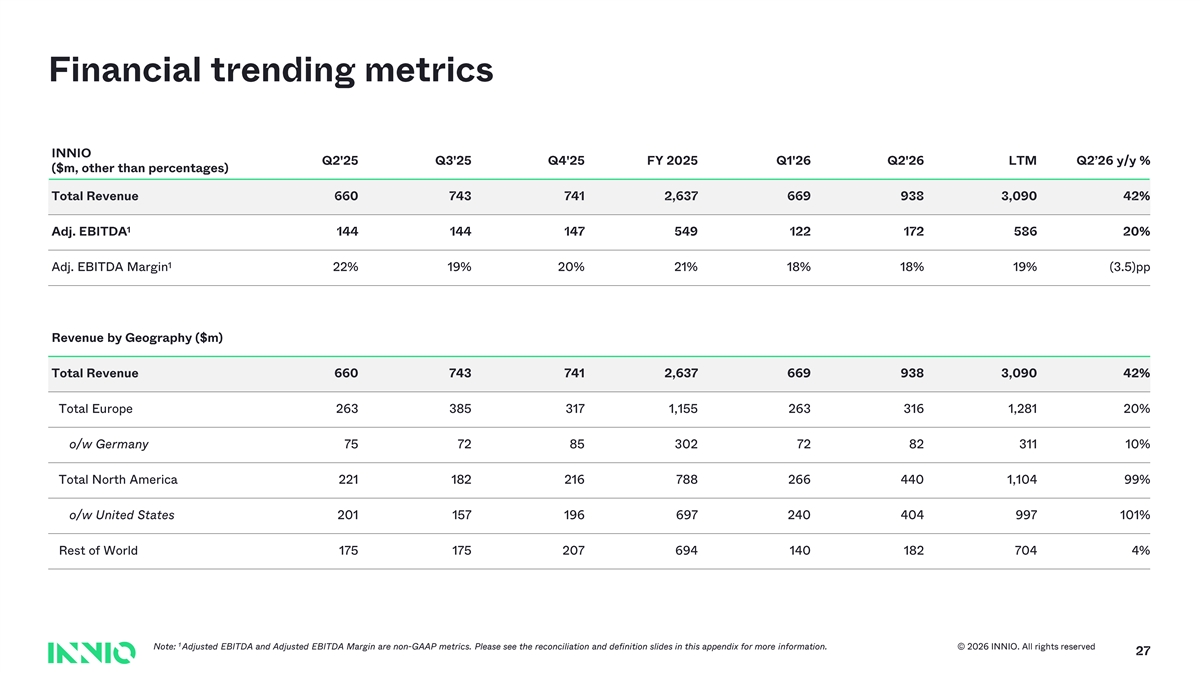
Thank you, Tim. Hello, everyone, and thank you for joining us today. it's great to have you on the call time has flown by since our IPO and we are very excited to continue our success story no as a listed company since our IPO in you has made substantial progress while continuing to build momentum across the business in q2 we delivered a record equipment order intake of 2.3 billion dollars up 316 percent year over year revenue increased 42 percent to 938 million dollars adjusted ebta grew 20 percent to 172 million dollars given this strong performance and our record backlog we are introducing full year 2026 guidance today dennis will provide you further details later our order equipment backlog reached a record 6.6 billion dollars at quarter end with capacity expansion progressing as planned we are well positioned to deliver continued profitable growth as this is our first earnings call some of you may not yet be familiar with in I therefore begin with a brief introduction of the company before walking you through our key highlights for the quarter. So, let me begin with who we are, what we do, and what is driving the growing demand we see from customers. INU delivers decentralized power solutions for critical infrastructure and the AI industry. In 2025, Inu generated $2.6 billion in revenue, reflecting continued growth across our businesses. With adjusted EBTA of $549 million, profitability was also attractive. Now, please look at the top of this slide, where you can see our leading brands. On the left, Jenbacher, a market leader in power generation with long heritage. On the right, Waukesha, a key player in the compression market. On the lower half of the slide, you can see how we operate business through two segments, equipment and services. Equipment on the lower left represents 52% of 25 revenue, and it's our growth engine. Across our three business lines, data center, power solutions, and compression, we serve a diverse range of end customers. Strong data center momentum is reflected in 59% of 2025 equipment order intake. Power solutions, represent 35% of the equipment order intake in 2025, has been our core business for decades. We serve critical infrastructure, utilities, industrial customers, and municipalities worldwide. As coal-fired generation continues to retire and renewable penetration increases, our power solutions business is growing. It is supported by continued demand for pica plants that help maintain grid stability. At the same time, we are seeing continued momentum of our biogas solutions, especially in Germany, with growing potential in the United States. Services on the lower right accounted for 48% of 25 revenue. It is built on a continuously growing installed base fueled by the equipment business. Each segment has a long track record of strong profitability. With that, let's move to page number seven. Here you can see one of the key strengths of the INU business model, our service flywheel. Every engine we sell enters in an installed base. That installed base generates high-margin recurring services, revenues through long-term service agreements, for a large portion of our fleet. As end of 25, INU's installed base stood at approximately 44 GW globally. The fleet requires regular maintenance, path replacement, and periodic overhauls with its operational life. This is resulting in a potentially long-duration, non-discretional revenue stream that we compound at fleet growth. The dynamic acceleration of our flywheel is clearly visible in our numbers. On the left side, you can see the significant growth of our equipment order intake, which increased from $3.9 billion and $25 to $6.6 billion for the last 12 months. This impressive order momentum has driven our backlog to a record $6.6 billion. The equipment order backlog is providing excellent visibility into the future revenue growth and supporting continued expansion in our installed fleet. At the same time, we are meaningfully expanding our capacity to support future growth. As additional capacity comes online, we expect to release further production slots, providing further runway for the order growth as a result we remain confident in our ability to grow backlogs through 27 and beyond on the right side you see our expanding installed base continues to translate into profitable recurring revenue service revenue reached 1.4 billion dollars for the last 12 months ended in Q226 with an adjusted segment EBTA margin of 30% for the same period. With demand continuing to accelerate, an important question is why are more and more customers choosing gas engine solutions? Let's move on page 8. As electricity demand grows and The grid constraints become more acute. Customers are increasingly looking for practical ways to secure power and support growth. Behind-the-meter gas engines deliver both. Take a look at the left side on our slide. An actual Bloomberg NEF analysis shows gas engines can offer the lowest levelized cost of energy among behind-the-meter technologies. And even the grid access becomes available. The operating cost of an installed gas engine can remain below the cost of the grid power, supporting our belief that behind-the-meter solutions are not the bridge solution, but are here to stay. As shown on the right side, the business case becomes even more compelling when you consider recent market developments. Last week, the White House announced that nearly all utilities as well as several co-location companies signed the Ratepayer Protection Pledge. We believe this is a sign of growing support for behind-the-meter power. Their participation follows an earlier commitment made by leading global hyperscalers. In many ways, the pledge formalizes what we are already seeing in the market. Data center operators and utilities increasingly recognize this. Securing dedicated on-site power can be a fast, reliable, and cost-effective path to support growing AI demand. This trend is further supported by infrastructure bottlenecks across the power ecosystem. And this is where INU is uniquely positioned. Our platform is built around the Jenbacher Type 6 engine family, including the J624. This engine was recently recognized by Semi-Analytis as the industry most consequential engine. It is combining outstanding performance with highly attractive economics. Our competitive advantage comes down to two factors, performance and modularity. The Jedenbacher Type 6 platform delivers industry-leading power density, fast response times, and high rotational inertia. With this, it is ideally suited for the demanding and dynamic load profiles of AI-driven data centers. The modular design allows customers to scale rapidly, reduce costs, and accelerate time to power. When a 1 gigawatt of data center capacity can support more than $10 billion in revenue, every month counts. Speed to power becomes a key competitive advantage. Let me show you how our strong market position translates into our business performance. Just look at our second quarter highlights on page 10. Overall, it was an excellent quarter for Inu. First, we delivered very strong order intake, supported by a major new customer win and strong demand across our end markets. Equipment order intake increased 316% year-over-year to $2.3 billion. second revenue growth continues to accelerate group revenue increased 42 percent year over year reflecting high customer demand and ongoing execution third we continue to grow profitable while investing for the future we expanded capacity to support increasing demand At the same time, adjusted EBITDA increased 20% year-over-year to $172 million, demonstrating a strength and resilience of our business model. Taken together, these results highlight the strength of our market position and our execution capabilities. dennis will go into details later but let me provide some color on the order activity we saw during the quarter on the next page number 11. the key message is that demand remains strong broad based and diversified starting on the left order intake in q2 26 reached record levels driven by continued data center demand. We saw follow-on orders from hyperscalers customers and co-location providers as they continue to execute phased data center build-outs. This is particularly encouraging as repeat orders validate our technology and execution capabilities. Combining with the composition of our backlog, they further support our view. The structural demand outlook for data center power remains highly durable. While data centers continue to be significant growth driver, demand was not limited to the market. Importantly, our growth remains diversified. As illustrated on the right, no single customer represents an outsized share of our order book looking ahead we see additional customers entering our top customer profile the pattern is clear the customer base continues to broaden providing a healthy balance across the portfolio before i hand over to dennis please let me show you how in you is helping power the next generation of ai driven growth please move to page number 12. the highlight deal this quarter was a 1.1 gigawatt order for mega scale data center customer one of the largest orders in in news history we outlined in today's press release more than 200 yen macher j624 engines are expected to provide resilient scalable behind the meter prime power this order is powerful proof by our technology and our ability to execute at scale it is further reinforcing in use position as a key enabler of ai infrastructure with a diversified and growing customer base and the momentum is clearly reflected in our results with that Let me hand over to Dennis to walk through the financials. Thank you, Olaf, and hello everybody from my side as well.
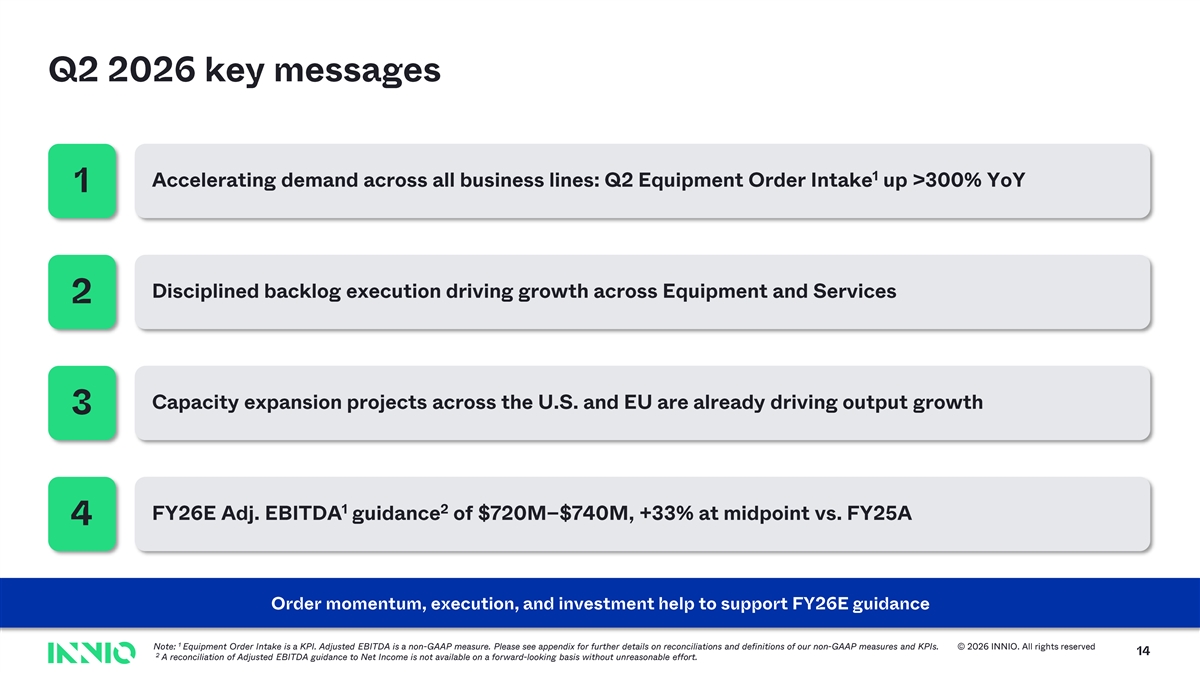
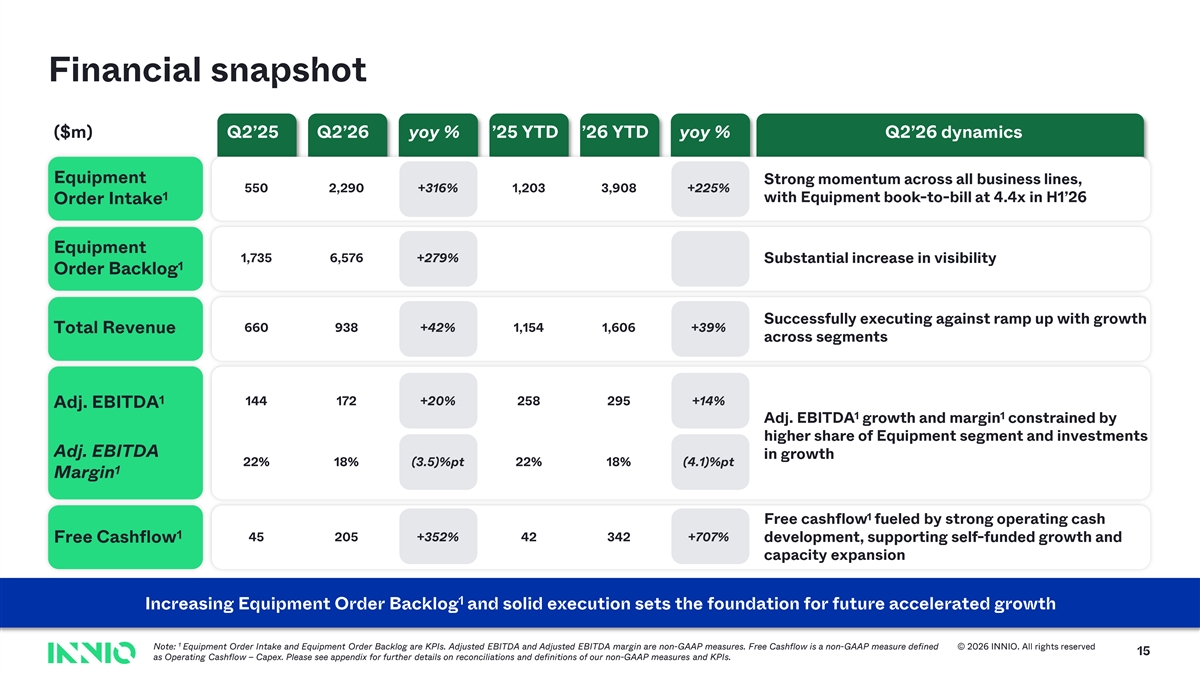
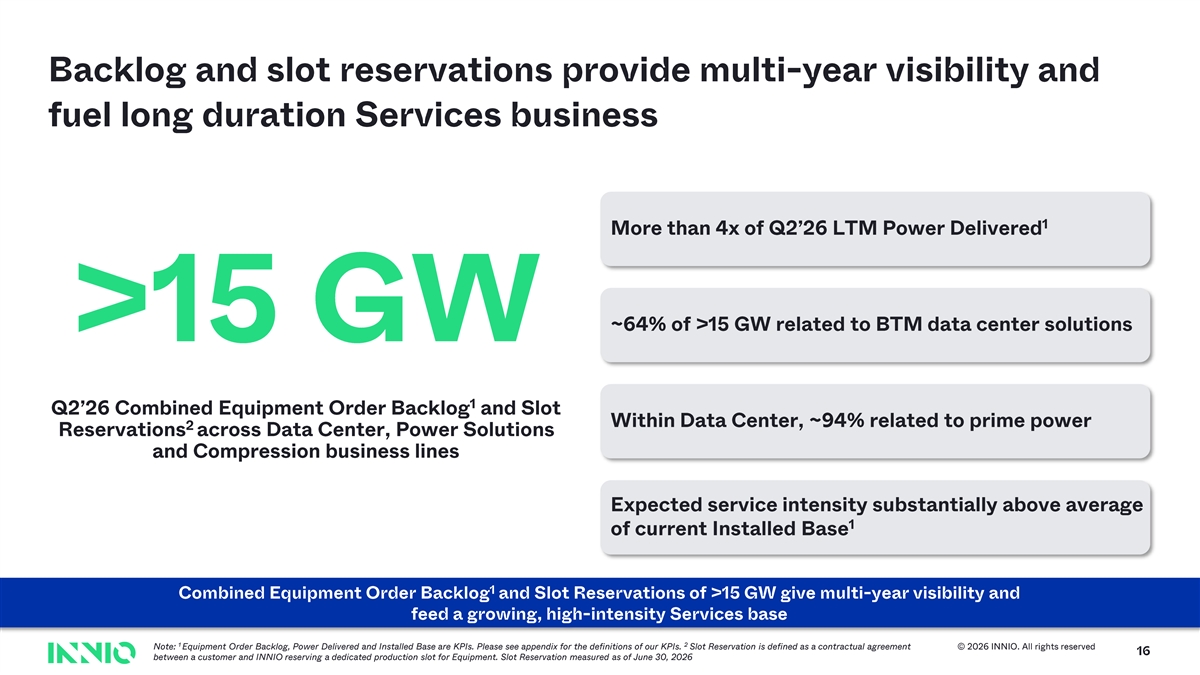
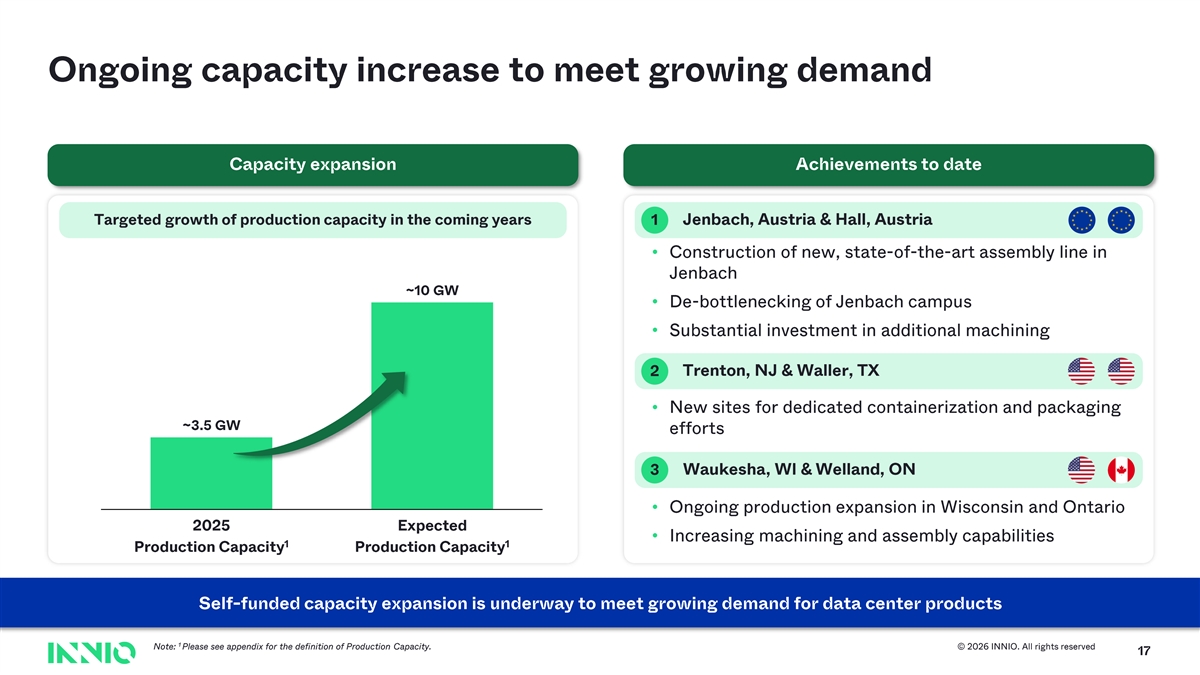
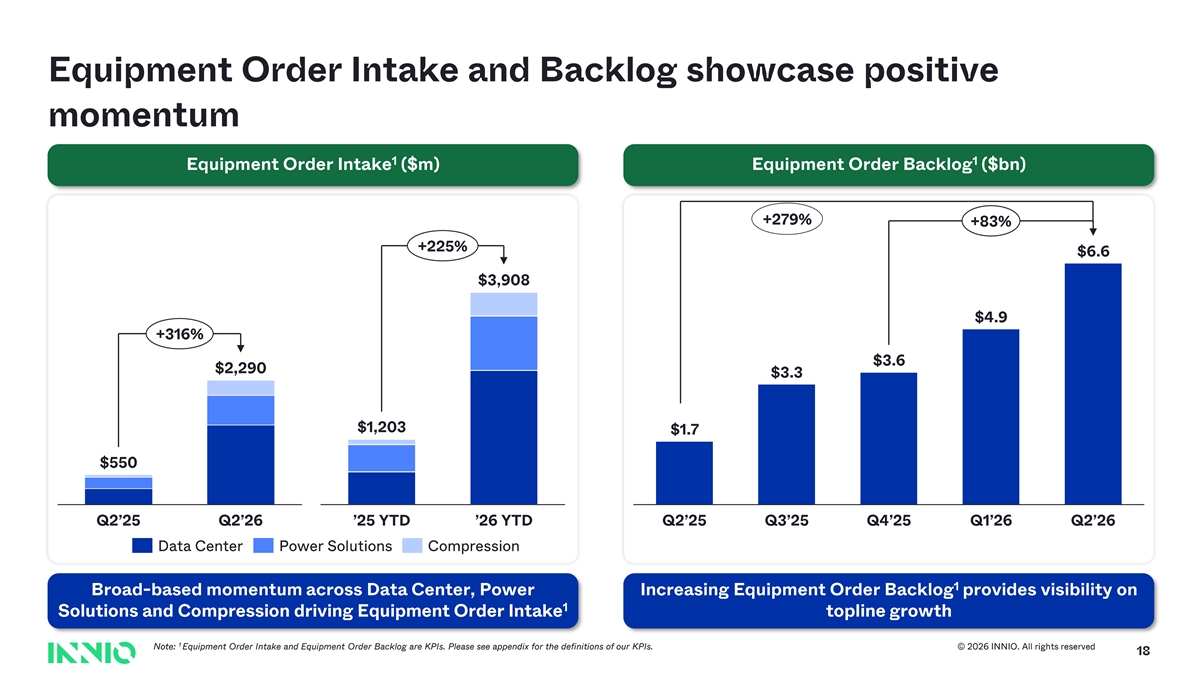
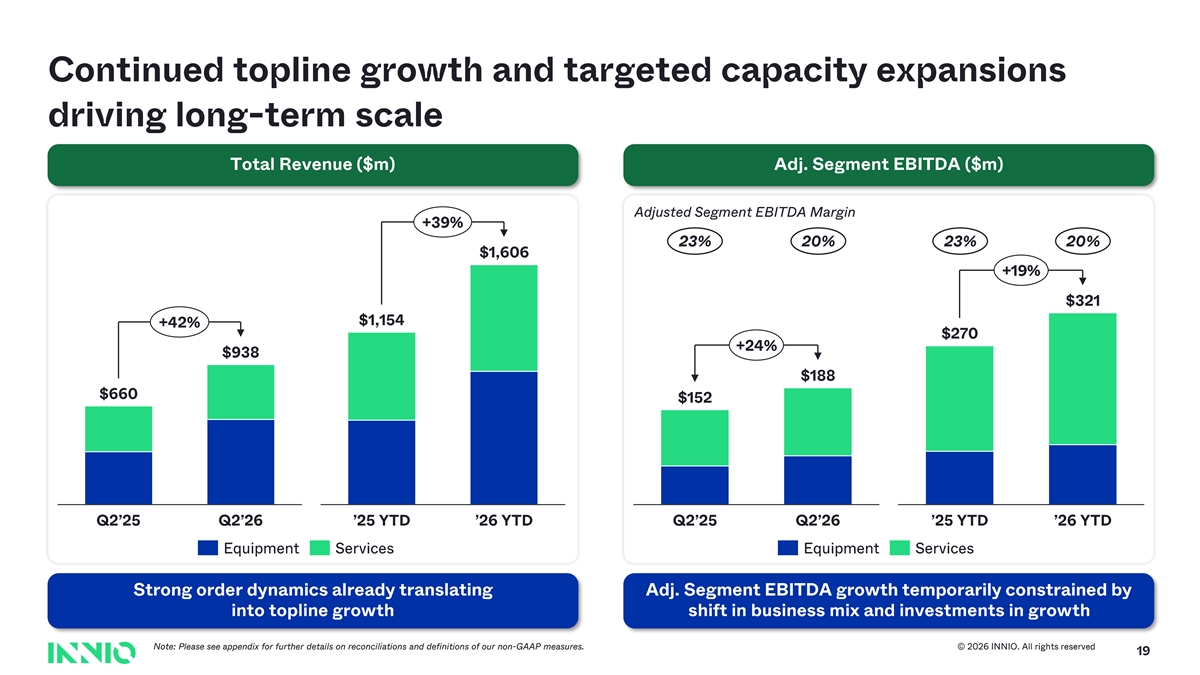
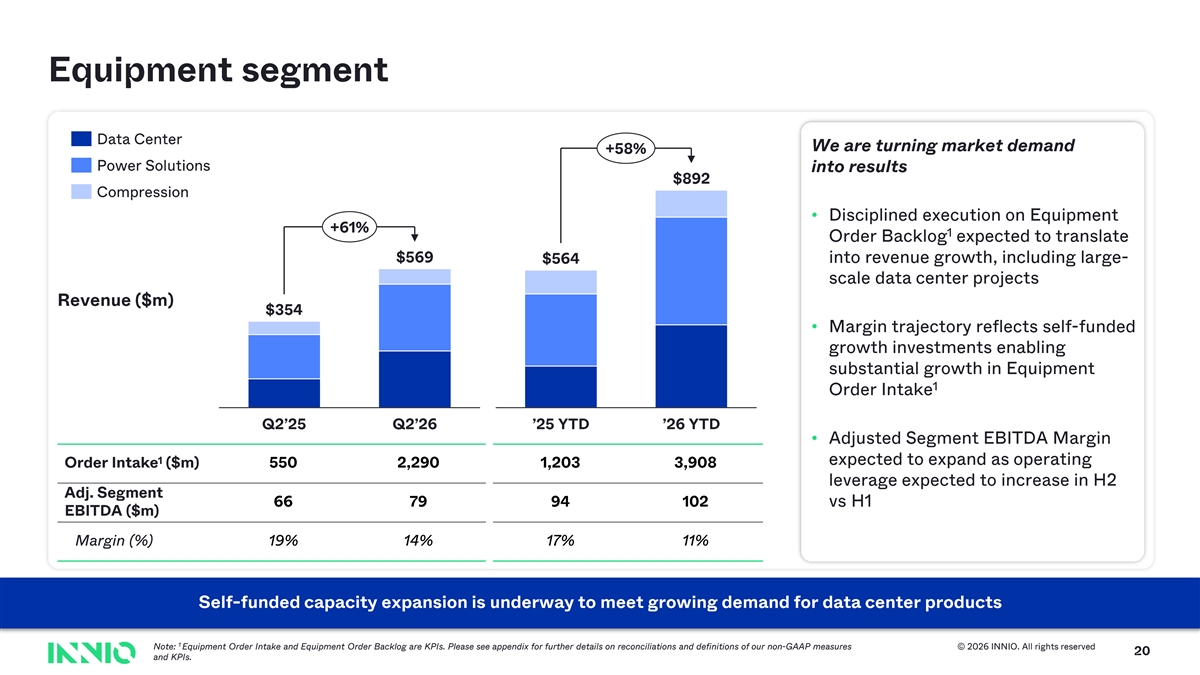
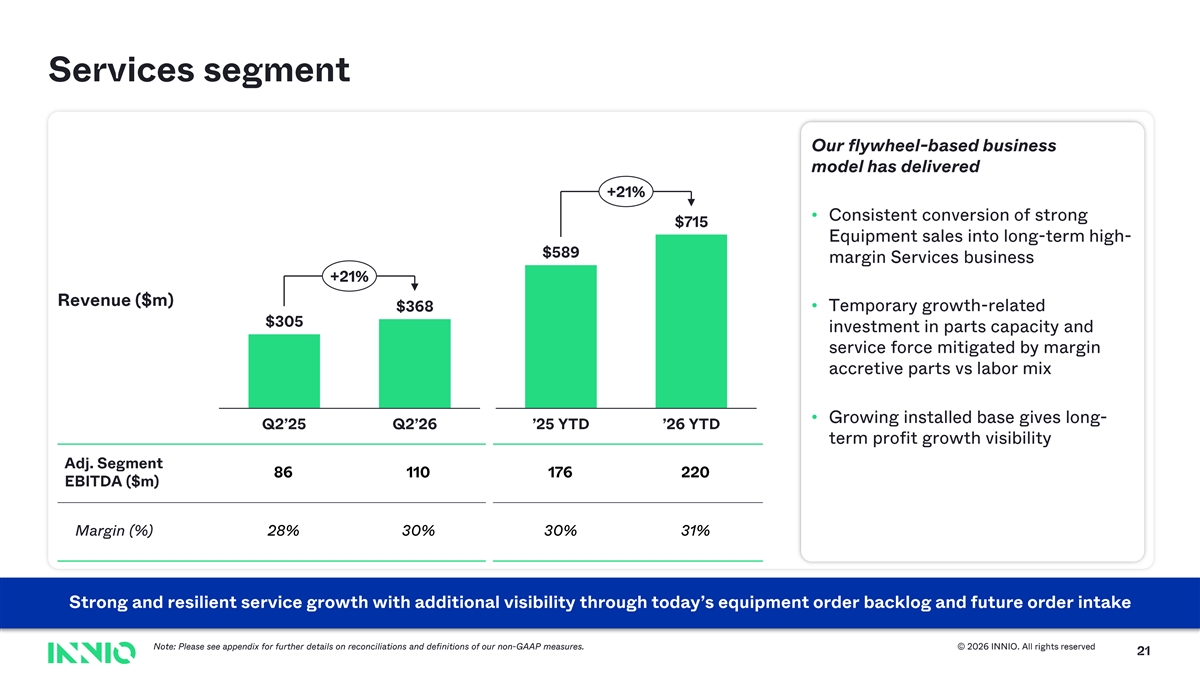
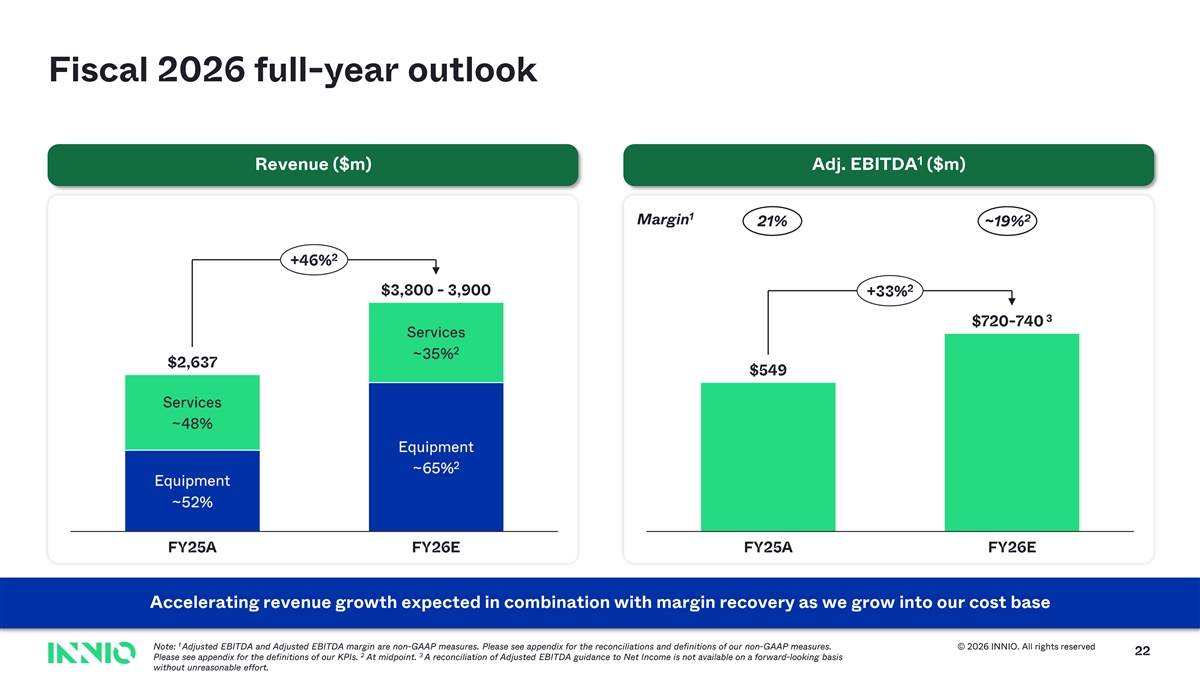
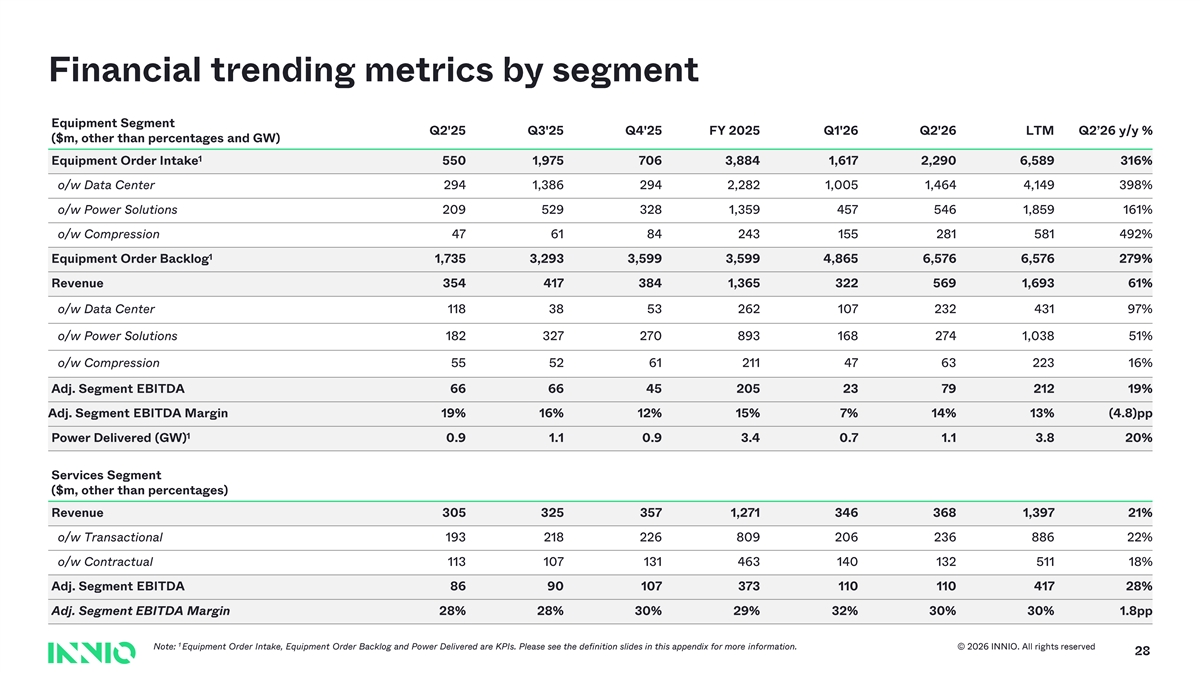
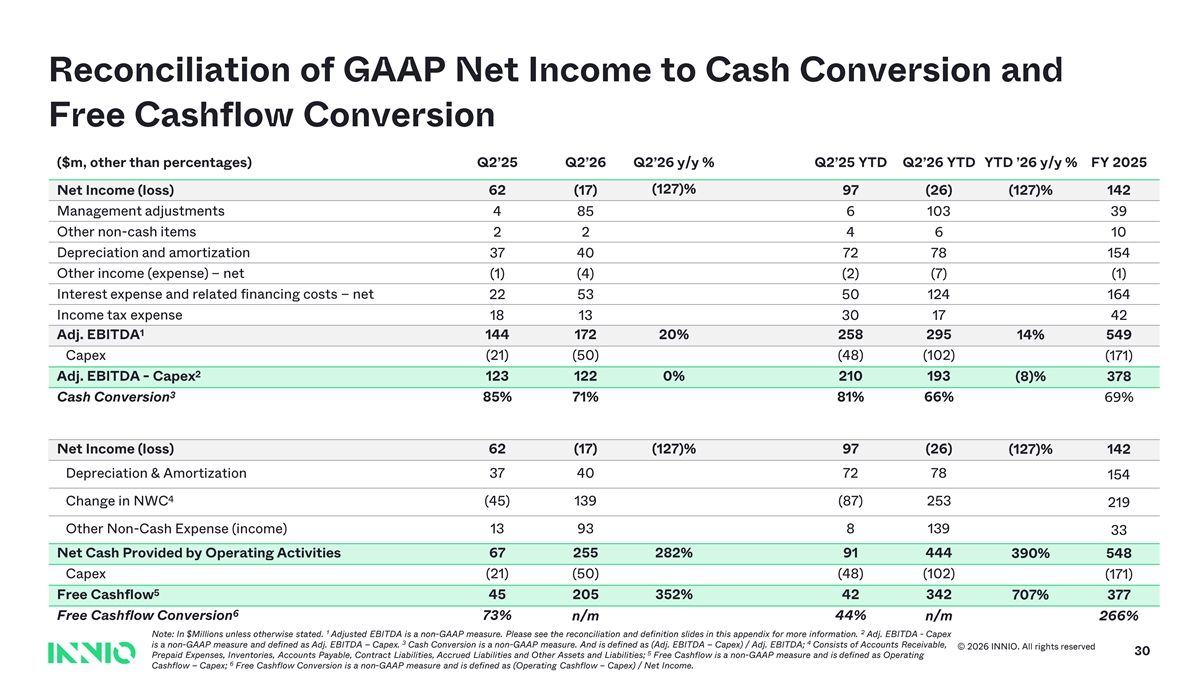
It is a great pleasure to present Ineo's financial results to you for the first time as a public company. I will take you through our second quarter performance, the visibility we have on the business ahead, our capacity expansion, and at the end, our outlook for the full year. Let me start with the four key messages of this quarter. First, demand is accelerating across all of our business lines. Second quarter equipment order intake was up more than 300% year over year. Second, we are delivering strong top line growth in equipment and services as we execute on our backlog and control our supply chain and operations against a demanding growth plan third the success of our multi-year capacity expansion plan across the u.s. and europe is already visible today as we continue to increase our output the expansion is financed from our own operating cash flows and fourth we are initiating full year 26 guidance with adjusted EBTA of 720 to $740 million, an increase of 33% versus 25. In summary, we are pleased with our second quarter performance. Accelerating demand and disciplined execution both reinforce our confidence in our full year guidance and our midterm ambition. Let me now walk you through the details starting with the financial snapshot on the next slide. One table, five lines, and each line tells the same story of accelerating momentum. Starting at the top with equipment order intake, $2.3 billion in the second quarter, up 316% year over year. And I would like to highlight one number in particular. With $3.9 billion of order intake in the first six months, we have already booked more orders in the first half of 26. than in the entire year of 25 our equipment book to bill stands at 4.4 for the first six months demand is strong and our growing capacity allows us to convert the demand into firm orders second line equipment order backlog 3 6.6 billion dollars up 279 percent year over year this backlog provides multi-year visibility for our equipment business and because of our service flywheel that Olaf described earlier we believe it can lock in decades of high margin services revenue on top the growth we are seeing in equipment today translates into our services business of tomorrow. Third line, total revenue. $938 million in the quarter, up 42% year over year. Equipment revenue growth shows that we are executing successfully against our order book, while services continue to grow on the back of our expanding installed base and pricing. Fourth line. Adjusted EBTA. $172 million, up 20% year-over-year. Here I would like to spend some time on the EBTA margin, which is notably below prior year. Consistent with our expectations and communication in the past, this is driven by a few deliberate factors. The natural mid-shift toward equipment based on our order intake, some changes in product scope with a higher share of containerized solutions, and front-loaded investments and ramp-up costs related to our capacity expansion. Margin is in line with Q126 and ahead of our planned path for the year. Based on operating leverage and pricing dynamics in our backlog, we are confident to deliver on our full year guidance. Fifth line, free cash flow. $205 million in the quarter, up 352% year over year, fueled by strong operating cash flows. As we pointed out in the past, INU's business model is supported by a production cycle in which customer down payments keep equipment manufacturing cash positive from order to commissioning. Since Olaf touched on the Q2 order dynamics before, let me give you some color on the overall backlog and visibility. Combining our equipment order backlog with our slot reservations, we have more than 15 gigawatts of committed business as of Q2 26. This is more than four times the power we delivered over the last 12 months. When we say slot reservations, these are production slot commitments. They are non-tradable and they typically carry a non-refundable down payment. We are particularly excited about this metric for three reasons. First, approximately 64% of the more than 15 gigawatts relates to behind the meter data center solutions. And within data center, around 94% relates to prime power. The substantial majority of our data center business is prime power. We believe in new engines are solidifying their reputations as the power generation technology of choice when it comes to powering data centering in behind-the-meter setting. Second, the expected service intensity embedded in this backlog is substantially above the average of our existing installed base. Our data center customers rely on our engines as their primary power source and run these assets hard. In other words, we believe every megawatt we install from this backlog carries more service content over its life than our historical fleet average raising the long-term earnings power of the flywheel and third quality the pricing on our recent order bookings shows a positive margin trend compares to our historical average so this is not growth at any price as the backlog growth we expect the embedded profitability to grow with it the takeaway is simple more than 15 gigawatts of committed business gives us multi-year revenue visibility and feeds a growing higher intensity service base and confidence in our long-term ambitions this demand raises an obvious question can we build it the answer is yes our self-funded capacity expansion is well underway giving us the confidence to continue driving order intake and expanding our backlog. Importantly, we are enabling this expansion through de-bottlenecking and doubling down on our existing facilities. A brownfield approach, not greenfield, which we believe meaningfully reduces execution risk. Let me make this more tangible with a few numbers. We are on our way to roughly double our output in the coming years and to approximately triple our total production capacity by 2030 from 3.5 gigawatts per year in 25 to roughly 10 gigawatts per year. We feel very good about our progress today as we are ramping our production output with gigawatts delivered in q2 already at 1.3 times of prior year as new capacity comes online we expect to release incremental production slots and each one of these can convert directly into additional order intake given demand has recently been exceeding our ability to take orders where is this happening first at our jenbach campus in austria we are constructing a new state-of-the-art assembly line which exists with debottlenecking the existing lines and can significantly increase throughput for our data center products in parallel we are investing substantially in additional machining capacity including our new site in hall just a few minutes from jenbach Second, in the U.S. Our new sites in Trenton, New Jersey, and Waller, Texas, are dedicated to containerization and packaging. In addition to increasing capacity, these sites offer proximity to key suppliers and customers, thereby shortening lead times and reducing logistics costs. And third, in Waukesha, Wisconsin, and Welland, Ontario. We continue to expand machining and assembling capabilities, driving an other step change in capacity. Two aspects about our growth plan are important to understand. The expansion is financed from our own operating cash flows, supported by a production cycle in which customers down payments, keep equipment manufacturing cash positive from order to commissioning. Secondly, our investments yield attractive ROIs and paybacks, which means that our substantial backlog and slot reservations visibility can substantially de-risk our gross investments. Now, let's take a deeper look into our Q2 equipment order intake. Two charts, one message. On the left, the composition of our order intake. The growth is broad-based. In the second quarter, data center contributed close to $1.5 billion, power solutions $546 million, and compression $281 million, each business line growing strongly year over year. And all of them were aligned with the market trends Olaf outlined earlier. So, while data centers are the largest driver, this order momentum is more than a data center story. Our equipment book-to-bill stands at 4.4 for the first six months. On the right, our equipment order backlog. Growing from $3.6 billion end of 25 to $6.6 billion as of June 30, 26, representing an 83% increase just in H-126. Compared to prior year's quarter, the increase is even significantly higher at 279% with sequential growth in every single quarter. As mentioned before, we generally observe that new orders carry accretive pricing and higher service intensity compared to our average past business. Our growing backlog and book-to-bill ratio show the continuing acceleration of our business with increasing visibility for the years ahead. our proactive investments and flexible supply chain are already delivering strong top-line growth against this demand at the same time and as we communicated in the past we continue to invest which is temporarily reflected in our relative margins on the left total revenue 938 million dollars in the quarter up 42 percent year over year with attractive growth on both equipment up 61 percent and services up 21 percent for this first half revenues reached 1.6 billion dollars up 39 percent on the right adjusted segment ebta 188 million dollars up 24 percent year over year at a 20% segment margin. I commented on the drivers of the temporary margin compression earlier in this presentation. As mentioned, this development is in line with our expectations and supports our full-year guidance and continued margin improvement. I'm now going to step through the segments on this and the following page. Equipment revenue reaches $569 million in the quarter, up 61% year over year. We are delivering against our order book, which includes large scale data center projects. In Q226, data center revenue nearly doubled to $232 million. Power solutions grew to $274 million and compression contributed $63 million. This growth across all business lines demonstrates the execution strength of our teams our production sites and our supply chain on profitability the segment margin came in at 14 compared to 19 percent in the prior year quarter this reflects the self-funded growth investments that are enabling the substantial increase in order intake you saw earlier as well as the increase in order scope. This expanded scope for the early data center products was priced with a lower average margin than our core business. Two points that are important here. First, the equipment segment margin already recovered meaningfully from the first quarter. And secondly, we are expecting to continue to grow equipment segment margins to high teens in Q4 based on operating leverage and backlog pricing dynamics turning to services or quarterly trading nicely shows that our flywheel based business model delivers and our existing installed base generates growth at attractive margins services revenue grew 21% year over year to 368 million dollars and 21% for the first half of the year as you You will recall, our services are non-discretionary, recurring businesses, based on wear parts, overhauls, and upgrades. With a healthy share of long-term service contracts, our installed base gives INU a stable earnings foundation which compounds over time. For the quarter, services adjusted segment EBDA margin came in at 30%. Similar to equipment, we made temporary growth-related investments in parts capacity and in our service force, which were largely mitigated by a margin-accretive mix of parts versus labor. For the first half, the service margin stands at 31%. We showed you earlier how our equipment-adjusted EBTA generally carries 2.5 times lifecycle services-adjusted EBTA. Based on everything we see in our backlog and order pipeline, we feel confident to deliver or improve on this relationship for our business. This brings me to our full year guidance we are initiating today for fiscal year 26. On revenue, we expect $3.8 to $3.9 billion for the full year. Growth of approximately 46% at the midpoint versus 25. Within that, we expect the mix to continue shifting towards equipment at around 65% of revenue as we deliver our booked business in line with available capacity. Revenue growth is expected to further accelerate in the second half. On profitability, we expect adjusted EBITDA to be $720 to $740 million, an increase of roughly one-third versus the $549 million we delivered in 25 at a group margin of approximately 19%. To help you with the quarterly phasing, we expect the fourth quarter to be stronger than the third, driven by shipment cadence against the backlog and the ramp-up of our added capacity. Adjusted EBTA margins are expected to increase as the equipment business stands to benefit from improved operating leverage and the conversion of our margin-improving backlog, taking equipment segment adjusted EBTA margins to an expected exit rate in the high teens by the year end. In summary, accelerating revenue growth combined with an improving margin profile delivered by a self-funded growth model. And with that, back to you, Olaf.
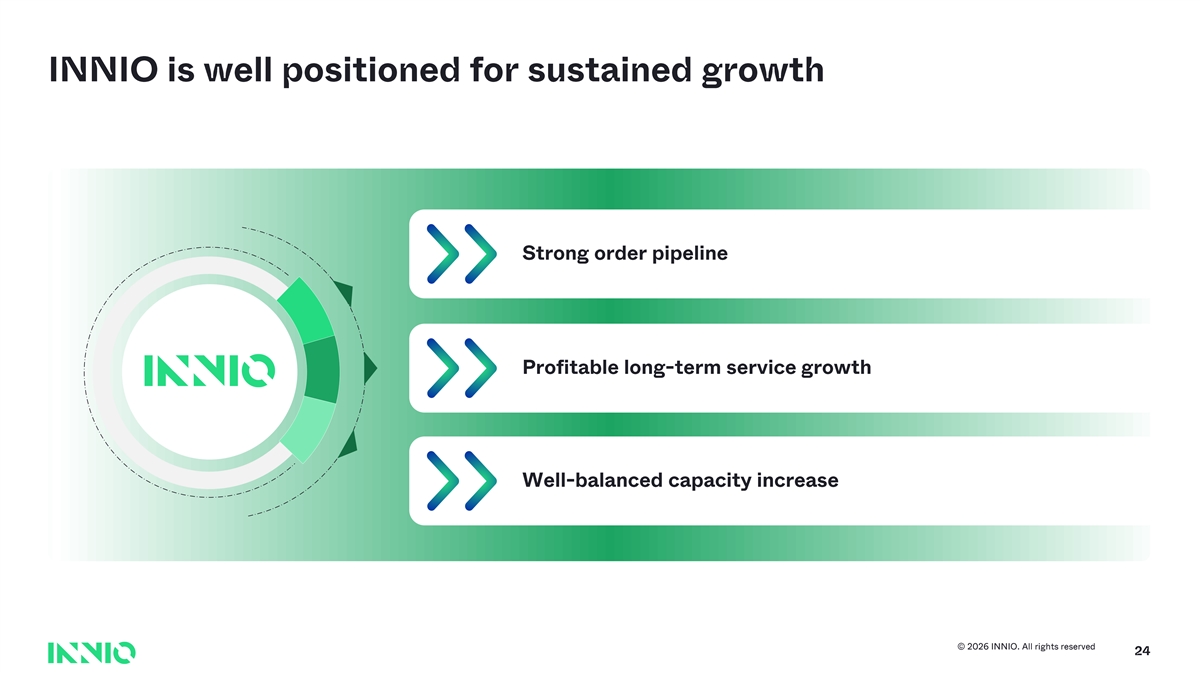
Thank you, Dennis. Let me close by summarizing the key takeaways. Please turn to page 24. First, demand is strong and broad-based across our business, driven by the long-term trends of AI, data centers, and decentralized power generation, providing high visibility into our revenue growth through 2030 and beyond. Second, every engine we deliver today expands our install base and fuels our long-term high-margin service business. Third, to capture this opportunity, we continue to invest in our people, technology, and capacity. We are working towards strengthening our technology leadership. We are expanding capacity in a target and returns-focused manner and building the scale of our North American services, offering to support future growth. And finally, none of our success would be possible without the outstanding in your team. I would like to thank over more than 5,000 employees around the world for the dedication, commitment, and hard work. The opportunities ahead of us are significant, and we will remain focused on creating long-term value for our stakeholders. And with that, I'll hand over to Tim.
Before we open the line, I ask everyone to ask just one question so we can get as many people as possible. Operator, please open the line for questions.
Operator
Thank you, dear participants. As a reminder, if you wish to ask a question, please press star 1-1 on your telephone keypad and wait for your name to be announced. To withdraw a question, please press star 1-1 again. Please stand by. We'll compile the Q&A roles to these. We'll take a few moments. And now we're going to take our first question, and it comes to the line of David Arcaro from Morgan Stanley. Your line is open. Please ask your question. Oh, hi.
Thanks so much. And congratulations on the first quarter here being public. I was wondering if you could comment on maybe first on the pricing trends that you're seeing, especially on new slot reservations and just generally pricing trends in the market for engines.
Is this your first question or you would like to have another question?
Let's see. I guess that was that was my first question. If I were to throw another one in there, I guess I was also curious if when you consider the slot reservations that you have, how far out are you reserved at this point? Is there any capacity available in 2028?
Thanks, David. Nice to hear you again. Hope to see you in New York. Coming to your first question, the pricing trend is clearly still strong. That means the demand is high. if the demand is high and delivery is limited, you are always in a good position to do something on prices. So I do not see any signals going down on price trend. And on the delivery time, we are talking about today delivery on 29 and 30. we are more or less sold out for 26 27 and if customer asking us we have many projects they are talking about 30 and 31 so for example the project what we announced this morning is delivery tilt 31 any additional things yeah maybe just to add on the slot reservations because as you asked how long we are sold out and we're dead ones.
So we use this powerful tool to secure that the customers are buying from us. We don't allow to trade the slot reservations, so they are only dedicated to a single project. And as Olaf mentioned, the slot reservation reaches out now until 2030.
Thank you. Great. Thank you so much. Thanks, David.
Operator
Thank you. Now we're going to take our next question. and the next question comes line of Joe Ritchie from Goldman Sachs. Your line is open. Please ask your question.
Hey guys, good morning and again congratulations on your first public company earnings call. So I wanted to ask about the order trajectory. So clearly the orders were robust this quarter. I know that orders can be lumpy.
I'm just curious as you kind of take a look at your your pipeline for the second half of the year like maybe provide a little bit of color on what the pipeline looks like and then for the one really large order that you booked in data centers this quarter i was curious like what portion of the billion and a half that you booked this quarter from an order standpoint was that one large order hi joe yeah good question um look i think we are really remain very confident that we expect our order backlog at the year end to be higher than it is today so looking ahead continue to expect to see strength in the h2 given we see very healthy demand environment and we expect our order backlog to increase further so there is no no decline or weaknesses in the pipeline so I'm looking now in the eyes of Martin and he is saying no, no, no it really is very, very strong and we are talking together about so many projects so I don't see it and maybe we see 1.1 gigawatt would you like to add on this the portion of it is below one third definitely below one third even below 30% some of the engines sold to this one 1.1 gigawatt is containerized so with more scope some of it is
for a powerhouse installation so with a little bit less scope um but this was just one very big deal we had as well many many other deals bigger deals smaller deals uh worldwide and um as olaf said uh but all the robustness is fantastic, right? So I do have so many requests for projects which we are not able to fulfill because of capacity. So I don't see at all that the market demand is going down for us, right? So this is really, we are really in a fantastic environment at the moment.
Okay, great. Thank you, guys.
Thanks, Joe. thank you so much and now we're going to take our next question and the next question comes line of Nicole de Blas from Deutsche Bank your line is open please ask your question yeah thanks guys good morning and I'll echo my congratulations on the first the first big quarterly results so maybe first just on capacity expansion and update there maybe double click on how much progress you've made towards the plan that you laid out and then And, you know, with the orders being much better than expected and the really robust commentary on backlog and pipeline, I'm curious if 10 gigawatts is enough. And then second question on the 1.1 gigawatt data center order. I'm just curious if you see more orders of this magnitude in your pipeline.
Okay, Nicole. Thanks for asking. Dennis speaking, starting with your question on capacity. I think overall the capacity expansion is progressing on Klan. Our scale up from 3.5 to 7 based on our site in Yenbach and then up to 10 based on further ramp up from 28 onwards in Waukesha is on track. We don't see any stumbling blocks from today's perspective and we are executing on Klan and the project. and both projects are actually fully on track. The one is delivering already right now. We are going to be ahead of 3.5 obviously this year and the other project in Waukesha is also on track. On your question regarding the 10 gigawatts, this is something that we as a management team are reviewing on an ongoing basis on a quarter by quarter, month by month basis. From today's perspective, we are fully focused to execute on the 10 gigawatts but we'll obviously carefully review the situation over time and we'll take respective decisions on that one. On your second question, probably.
I can do the 1.1 gigawatt, you know, that we just announced today. Look, maybe you have seen that we announced a RELCO one with 1.25 gigawatt. It's a little bit longer run project. So we have some of them, you know, We just signed, and I think that's in the press as well, that we are talking with Agreco, a long-term contract, delivering engines, Type 4 and Type 6. So there are many of these coming up. So from my point of view, as a strong demand, and as Martin said, we don't see any weaknesses in this area.
Yeah, project size of 1.1 gigawatt, luckily, is not the exception. It's now, I would say, common, common size.
Operator
Now we're going to take our next question. And the question comes line of Amit Meharotra from UBS. Your line is open. Please ask your question.
Thank you. Morning, afternoon, everybody. I don't know if you guys disclosed an actual data center revenue number for the quarter. I think it was about 100 million last quarter. Can you just give us that number, Dennis? And I assume that the margin inflection as we progress through this year to the high teams and equipment has to do with that revenue scaling. So just give us a sense of, you know, where we were in data center revenue, where we are and where we expect to go and sort of your confidence in executing on that ramp. And then related to that, Martin, there's a lot of questions about sustainability of demand and concerns that people have around any potential cliff in demand for anything related to data centers. Obviously, with your order number today, that is a strong counterpoint against that. But maybe, Martin, talk about when you talk to your data center customers, hyperscaler customers, or even the energy as a service customers, how confident are they that this level of ordering and spending is sustainable, not just in 2030, but beyond? Just give us a flavor for those types of conversations.
Hey, Amit. Thanks for your question and good talking again. On your first question regarding the data center revenue, yes, we are disclosing it, and the number for the second quarter stands at $232 million. So first quarter has been $107 million, second quarter has been $232 million, and that's the trajectory that we are seeing. Your question also on the connect to margins. And yes, obviously, the trend that you are seeing by, you know, slightly ahead of 7% margin for all of the equipment segment in the first quarter now is improved to 14. I commented that we are seeing a further trend up. So at the end of the year 26, We should see the latest deals getting out on average at high teens. So the trajectory is upwards. This is driven by us working through the backlog. You could see the orders step by step improved in terms of margins. So there's the upwards trajectory. And if you look at what is driving really the upturn, it is mainly driven by the data center revenues now flowing through the funnel.
You're absolutely right on that one. and amitla hi and martin and me we will answer this question uh as i said we have a strong sustainable demand for projects um you know look think about we have this unique technology with the five megawatt engine the j624 so um if we talk to the energy as a service company the rental companies and maybe then martin please uh you can talk about every single day you have calls and we have both together sms and whatsapp what we can deliver maybe talk about the rental company and energy as a service company was just asking it's a long-term asking for that yes amit we hear as
well that there is some noise in the market about how sustainable it is the only thing i can tell you on on inio and on the demand i see for our product it's it's it's huge it's it's as high as ever and talking about a lot of projects in 29 in 2030 in 2031 a pipeline of projects we together develop with energy as a service companies with rental companies for different hyperscalers is huge going into permits already into plans for 2031 2032 so this proves to me at least that our pipeline is is really sustainable and strong in addition um what i need to say we always talk about data center but i'm even to be honest uh a bit concerned about the capacity we have because there are so many other markets coming up uh there was big auctions in brazil auctions coming in argentina uh germany changed the law uh on the staff uh on the on the power pledge you know so so there is demand growing and growing and growing um and as i said uh kept us capacity constraint but not market constraint and as martin said you know in germany and for 26 the german government
agreed that nine gigawatt is coming in in the market and auction will be delivered in 29 30 31 um auction for 27 you have another two gigawatt so as martin said it's not only data center i know we are talking about the data center but our core business is power solution and this is very strong pika business and maybe one one last sentence to this we talked about our containerized solution uh fast to install on site we don't need a lot of epc capability on site which is a very very strong argument at the moment because as you know everybody knows in this in the states ebc capacity
is constrained with our solution we don't have here a big need so that's the reason i really see a huge demand for our got it helpful thank you thanks thank you now we're going to take our next question and the next question comes line of david rudely lane from bank of america your line is open please ask a question hi good morning this is david really laying on for andrew oban can you talk about the timing of those expected incremental production slots so when are you going to release the incremental production slots from those capacity additions and would you be releasing Could there be any 2027 slots in there, 2028 slots? What is the delivery time for those incremental production slots? Thank you very much.
Thanks, David. Hey, David. Yeah, Dennis speaking. Good to talk again. Good question here on that one. And you're completely right. We commit to increase our capacity from 3.5 to 10, and this provides for a certain curve. And as we mentioned beforehand, we are not selling everything under this curve already right now because we want to get sufficient visibility that this ramp up is in time, in spec, so that we can really deliver what we promise to our customers. Having said that, we are freeing up slots on the way. This is not a digital decision where we decide at one point to free this up. So we are freeing this up over time. And since we last spoke, probably six weeks ago or so, or 12 weeks ago, we freed up certain slots already. You saw in our statement that we already have 15 gigawatts plus in backlog and slots reservation. And a certain amount of this is linked to this already freed up slots. So this is an ongoing process. 27 is completely sold out, so there are no further slots to be freed up for 27. And we are now talking about 28 and the further ramp up then in Waukesha 29 and 2030. So overall, an ongoing process. We are well on track, as I mentioned beforehand.
Now we're going to take our next question. and the next question comes line of anti-kaplovits from ctu line is open please ask your question good morning everyone morning morning morning services was stronger than i expected and had a good year over year growth i know a lot of the data center contracts don't kick in to higher service levels for you know several years five years but you did mention more demand for spare parts, for instance. So you give more color on what you're seeing. Do you expect to continue to see a sustained step up in transactional work? And what could that mean for service revenue in the future?
Sure. I'm happy to give it a gig here, Andy, Dan speaking. You're absolutely right. The second quarter came in strong on parts versus labor. And to a certain extent, that's been also driving our pretty nice margin that we delivered in the quarter percent up versus the quarter beforehand so as we mentioned before parts are coming with a pretty nice margin right now I wouldn't read too much into it rather than the ongoing good running hours of our equipment out there in the field and good running hours of our Waukesha business line and that business line is then to a certain extent more transactional and more parts driven actually than labor-driven, given our position in the value chain. So good momentum on that end. I don't see a slowdown on that. We're obviously carefully monitoring that. Cut off between second and third quarter came in handy for us, so probably a bit of a tailwind in the second quarter. We have to see if this continues in the third and the fourth quarter. So far, we don't see a change there. So that's been the overall framework. As you rightfully mentioned, this is not driven at this point in time by the data center fleet. This is only going to be installed, growing, and the real service category from that is only really kicking in and driving our margin from the early 2030s onwards.
What we're seeing right now is a very healthy operating performance of our installed fleet in our traditional business. but supports our sentence you know that we are we have a strong business as a side of the data center so we have in gas compression we had a strong business in in service and service parts and as well as on our power solutions data center service is coming up in the future not yet appreciate the color guys thanks andy thank you and now we're going to take our next question And the question comes to the line of Mark Strauss from GP Morgan.
Operator
Your line is open. Please ask your question.
Yeah, great. Thanks for taking our questions. And I'll echo my welcome to the public markets here. So I appreciate the disclosure that about 94% of your data center backlog is for prime power. Dennis, you touched on this a bit, but I'm curious if you can just give a bit more color on how to think about the magnitude of the upside in kind of service ASPs and margins over time, just given that higher mix towards prime power. And then just my quick follow-up, with the greater than 15 gigs that are in backlog and slot reservation, are you able to give us kind of a split of the percentage of what is backlog versus SRAs? Thank you.
Thanks, Mark, and good to speak. On the second question, no, that's not a number that we are going to talk about now and also going forward. So we have the absolute amounts, obviously, in terms of dollars for the backlog, and we are not going to split down the gigawatts at this point in time. Regarding your question on the service side, we see some positive momentum in the service business driven by, now, short-term, given by the effects that I just mentioned. You're referring to the positive performance of the data center business in terms of service. As we talked about beforehand, given the way we account for this and given that the real calories on the service side for these bigger data centers are really sitting in the minor and major overhauls that are happening after 30K and 60K hours. We definitely see positive tailwinds and maybe more than we thought about beforehand. This is supporting our story and giving us confidence to deliver or even over deliver on the service part of the business. But this is going to hit our P&L 30K from today, which is like four years out. But yes, from that point in time onwards, what we are seeing right now gives us great confidence to even over deliver to what we believed beforehand to be our plan.
Operator
Thank you, Mark.
Operator
And now we're going to take our next question. And the next question comes to the line of Moses Sutton from BNP Paribas. Yolan is open. Please ask your question.
Thanks for squeezing me in. Congrats on the first print here. The note of the 94% of data center backlog relating to prime power.
So I just want to clarify the 6% therefore emergency backup for data centers that replaces what we normally would have thought goes to diesel and any thoughts broadly on your ability to capture share from diesel backup that would be great thank you yeah yeah so yeah you're fully you're fully right then the 94 is prime power and the six percent is backup power where diesel engines were that's replaced with gas engines and the reason for that is uh that the the data center hubs get so big that even the diesel emissions would be too high the NOX emissions if you have all these engines would be too high. That's the reason this customer, one of the hyperscalers, chose here gas engines. And we are, as a company, going in that market, we would have the opportunity to even get more of these orders to translate more from diesel to gas. However, given the capacity we have, we look very, very detailed on that, how much we want to give to Prime and to backup power very helpful thank you thank you thank you and now we're going to take our last question for today and the question comes line of Ben color from the to line is open please ask a question hey good day thanks guys and congrats my question was just you know with the with the order and backlog and congratulations on that could you just talk about the
concentration not with specifically a customer but with projects as you know We've seen project delays, whether permitting or financing, and just how you guys think about any kind of risk with projects slipping to the right as they get permitting and financing throughout your order book. And thank you guys very much.
Thanks, Ben. Good question. As I said on our roadshow and testing the water, you know, we are celebrating this year 500 years, and we are doing business in 100 countries. So we have really customer over all the world. Nevertheless, we have now big hyperscalers and they are big customers. Of course, the big difference if you have a smaller customer like or you have one of these six or seven big hyperscalers and they are all our customers. nevertheless we have not one single cancellation that means we don't have and we take really a deep look before we go to a project about the financing the project who is the customer and for this reason we do not have one single cancellation today in smaller project as well as in big projects and maybe to add the the second part of the question on the permitting
so far our customer projects are on time of course right the the usual few few days or weeks up and down but so far we don't see a big delay on construction on site on permitting on site due to our standardized containerized solution as well the job on site is easier and as Olaf said we are really taking care that the projects we are awarding and we get awarded that we have detailed know your customer we know that the permits are ongoing or in place and that's the reason we risk we try to reduce this risk a lot hope this answers
thank you thanks Ben yeah with this we are finished for today thanks for your question and of course hope to see you and speak to you soon