Operator
Good morning, ladies and gentlemen, and welcome to the Amalgamated Financial Corporation Fourth Quarter and Full Year 2024 Earnings Conference Call. During today's presentation, all parties will be in a listen-only mode. Following the presentation, the conference will be opened for questions with instructions to follow at that time. As a reminder, this conference call is being recorded. I would now like to turn the call over to Mr. Jason Darby, Chief Financial Officer. Please go ahead, sir.
Thank you, operator, and good morning, everyone. We appreciate your participation in our earnings call. With me today is Priscilla Sims Brown, our President and Chief Executive Officer. Additionally, Sam Brown, our Chief Banking Officer, is also here for the Q&A portion of today's call. As a reminder, a telephonic replay of this call will be available on the Investors section of our website for an extended period of time. Additionally, a slide deck to complement today's discussion is also available on the Investors section of our website. Before we begin, let me remind everyone that this call may contain certain statements that constitute forward-looking statements within the meaning of the Private Securities Litigation Reform Act of 1995. We caution investors that actual results may differ from the expectations indicated or implied by any such forward-looking information or statements. Investors should refer to Slide 2 of our earnings deck as well as our 2023 10-K filed on March 7, 2024 for a list of risk factors that could cause actual results to differ materially from those indicated or implied by such statements. We will also discuss certain non-GAAP measures during today's call, which we believe are useful in evaluating our performance. The presentation of this additional information should not be considered in isolation or as a substitute for results prepared in accordance with US GAAP. A reconciliation of these non-GAAP measures to the most comparable GAAP measure can be found in our earnings release as well as on our website. Let me now turn the call over to Priscilla.
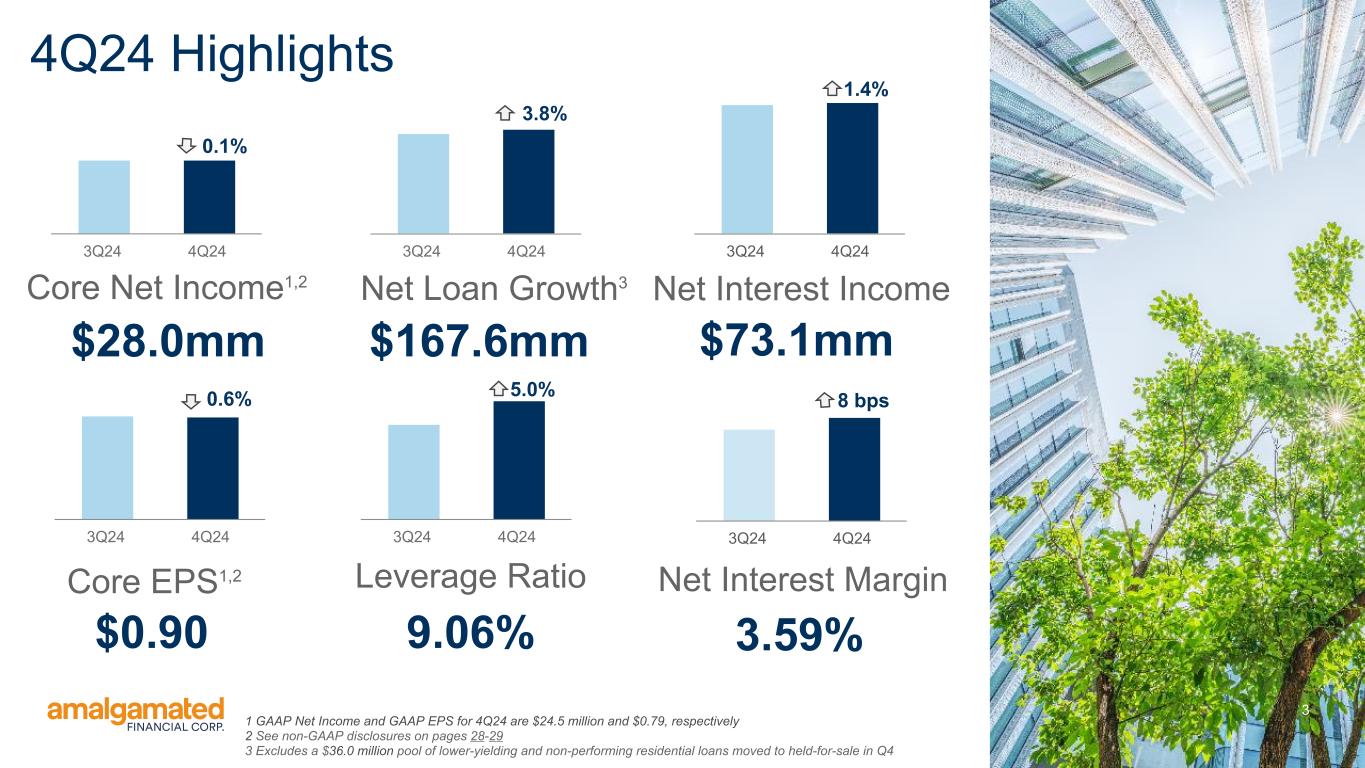
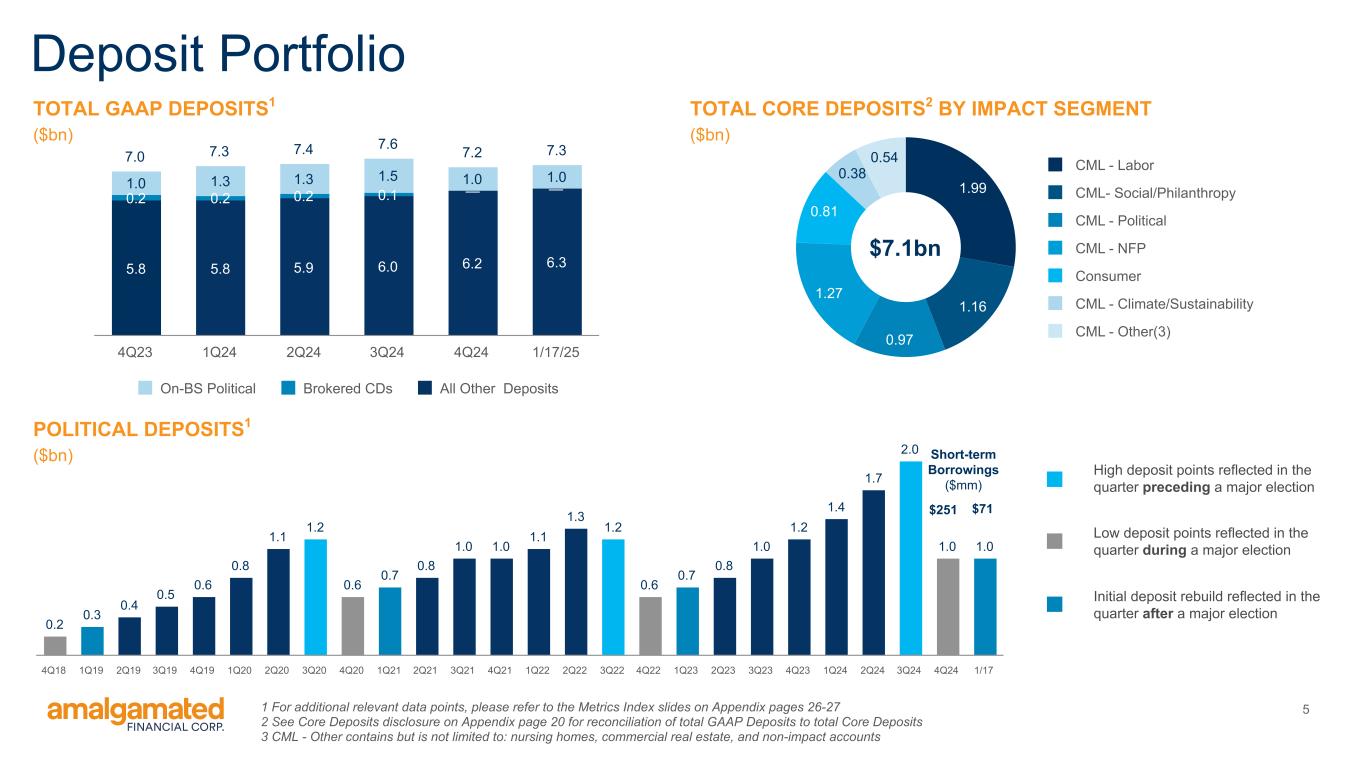
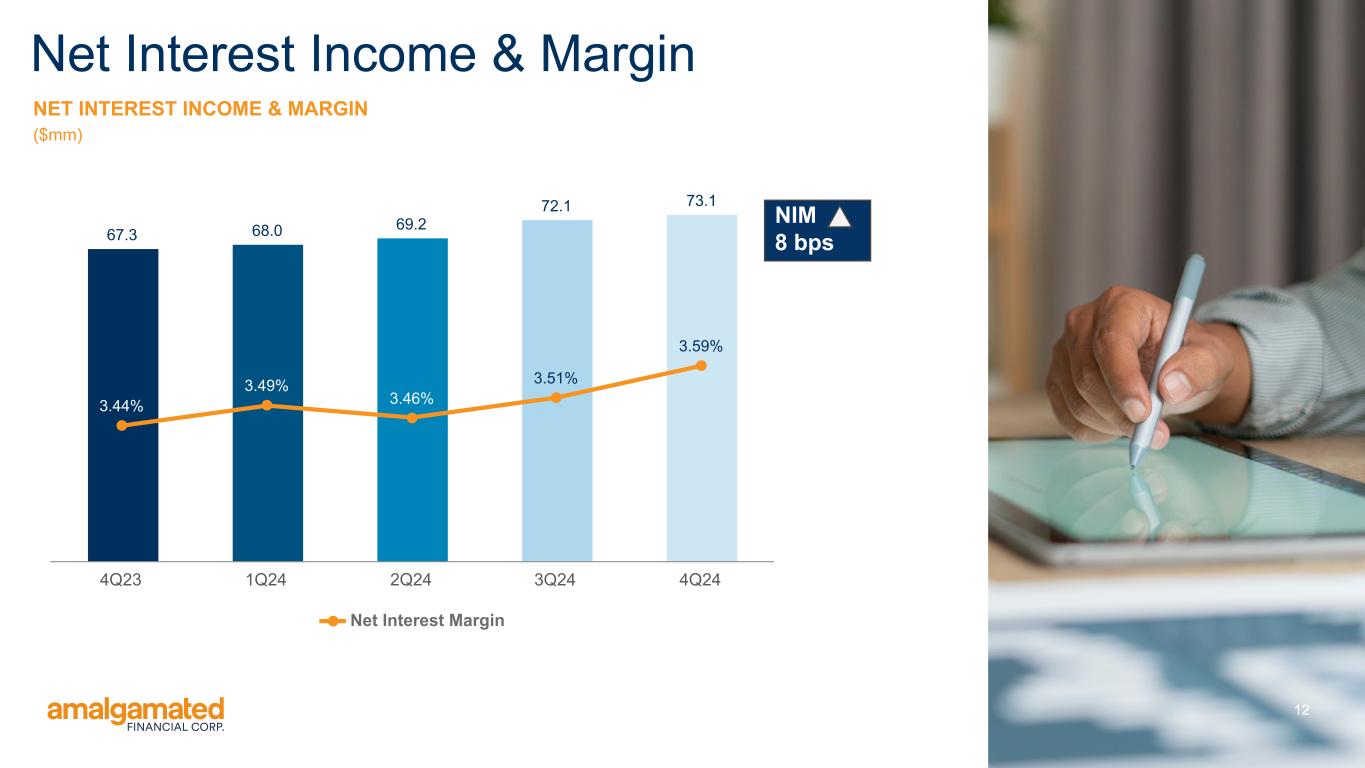
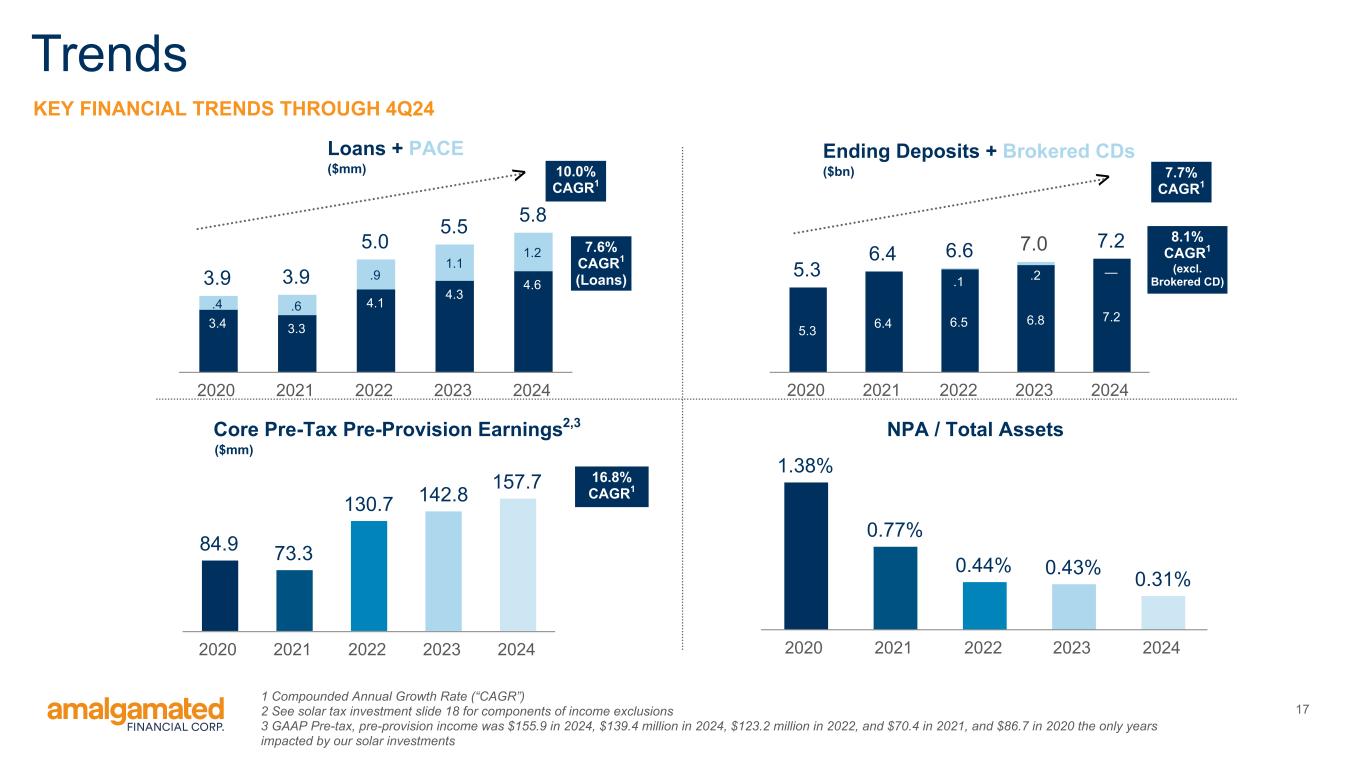
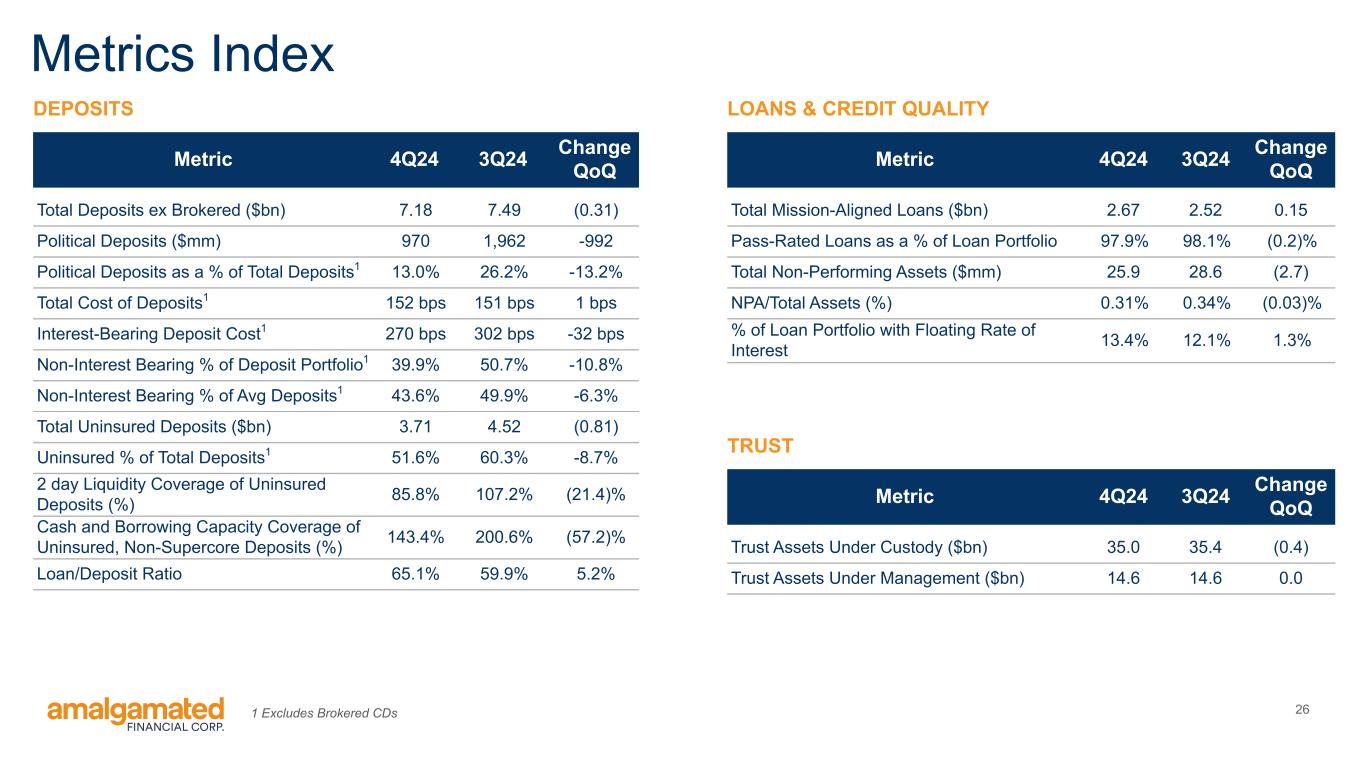
Good morning, and thank you for joining us. Our quarterly results continue to show the power and sustainability of our earnings and profitability as we posted another near-record quarter of $0.90 core earnings per share. One of the most important things to remember is that this quarter concluded another election cycle for Amalgamated and the country. Historically, due to the expected outflows of our political deposits, there is predictable noise in the quarter during the end-of-the-election period, with related impacts on our funding mix and net interest margin. And while there certainly was heavy spending again this cycle, our diverse segments drove remarkable stability. Deposits outperformed the previous 2022 election cycle across all relevant metrics. Our ending political deposits were $326 million or 50.6% higher than the prior cycle and totaled nearly $1 billion. Our use of short-term borrowings was only $250.7 million, substantially lower than the $580 million from the prior cycle. Our cost of deposits and cost of funds went down, and our net interest margin actually increased to 3.59% despite a remix of nearly $400 million from DDA to interest-bearing deposit accounts. And as we experienced a change in power in Washington, I am delighted at how well our bank performed and how well we are positioned for continued success in 2025. Given the unique but predictable nature of how an election year cycle concludes for us, it's helpful to zoom out from the quarter and actually look at the year in totality. For the full year, we delivered record earnings of $106.4 million, driven by strong loan growth and expanding margins. Deposit growth also played a huge role in our story as total deposits excluding brokered CDs increased by $410.8 million; that's over 6%. This occurred in a year where many banks experienced negative deposit growth as liquidity pressure remained very high, driven by the interest rate environment. We also built capital throughout the year, which positions us to not only reinvest in our business but also begin to return more capital to shareholders over time. We enter the new year in an enviable position and we're ready to take advantage of the many opportunities that we see to drive value for all of our stakeholders. As a new administration ushers in changes in D.C., the trend of sequentially higher political fundraising continues and the ecosystem around politics also continues to grow with leaders and organizations who support their customers, communities, and society and need a bank to partner with them. As evidenced by our 2024 results, we have a defensible position and business model that is well-diversified and not dependent on a single customer segment. It has delivered robust growth cycle after cycle during our more than 100-year history. In fact, we've seen broad-based strength across segments over the past year as our customers increasingly understand that their money can have a significant impact in the world when the bank is Amalgamated. Our segment-focused relationship bankers made strong progress throughout the year, growing deposits across our labor and not-for-profit customer segments where we have significant opportunity to increase our share of these markets. Now looking to 2025, I see many opportunities to further grow Amalgamated and deliver increased value to our shareholders. One thing that is paramount is that we keep growing revenue per share so that we can continue to invest in the bank with positive operating leverage. Accordingly, developing a repeatable and more predictable C&I lending business, primarily rooted in sustainable lending, is a key strategic objective. This will result in two things: first, a pipeline to higher-priced loans that lift our asset yields; and second, a balanced contribution that keeps our commercial real-estate portfolio concentration at conservative levels. Our sustainability lending segment is well-positioned for growth as states and municipalities strive to meet the country's growing demand for energy. The outlook for renewable energy demand is strong. In 2022, annual U.S. energy generation in renewables surpassed coal for the first time in history. And by the end of 2025, domestic solar energy generation is expected to increase by 75%. And this investment doesn't break down along party lines. Red states represent six of the top ten states with the most permitted utility-scale renewable energy projects in the country, with Texas leading the way. And so, we will continue to invest in attracting top talent to our sustainable lending team to capitalize on this enormous opportunity space. I believe Amalgamated Bank is nearing the inflection point of becoming a larger bank. Over the past three-and-a-half years, we've seen tremendous improvement in our capital base, our currency value, and our return metrics, but we still have more work to do to responsibly grow the size of the bank. In addition to the investment in our C&I business that I just mentioned, we will also make investments in our trust business to generate more revenue and better diversify our revenue mix. And while I do not expect to show any significant growth in trust revenue in 2025, the investments nevertheless will be made with 2026 results in mind. We will also continue to invest in our technology infrastructure so that we can grow at scale. A significant portion of this work is already well underway. As I hope you can tell, I'm very excited about the opportunities that lie ahead for Amalgamated, our employees, our customers, and our shareholders. We recognize the bar for success has been set very high for 2025 and beyond, and we believe we're up to the challenge. We know that if we focus on the things that I've outlined today, we will continue to thrive in the years to come. Jason, over to you.
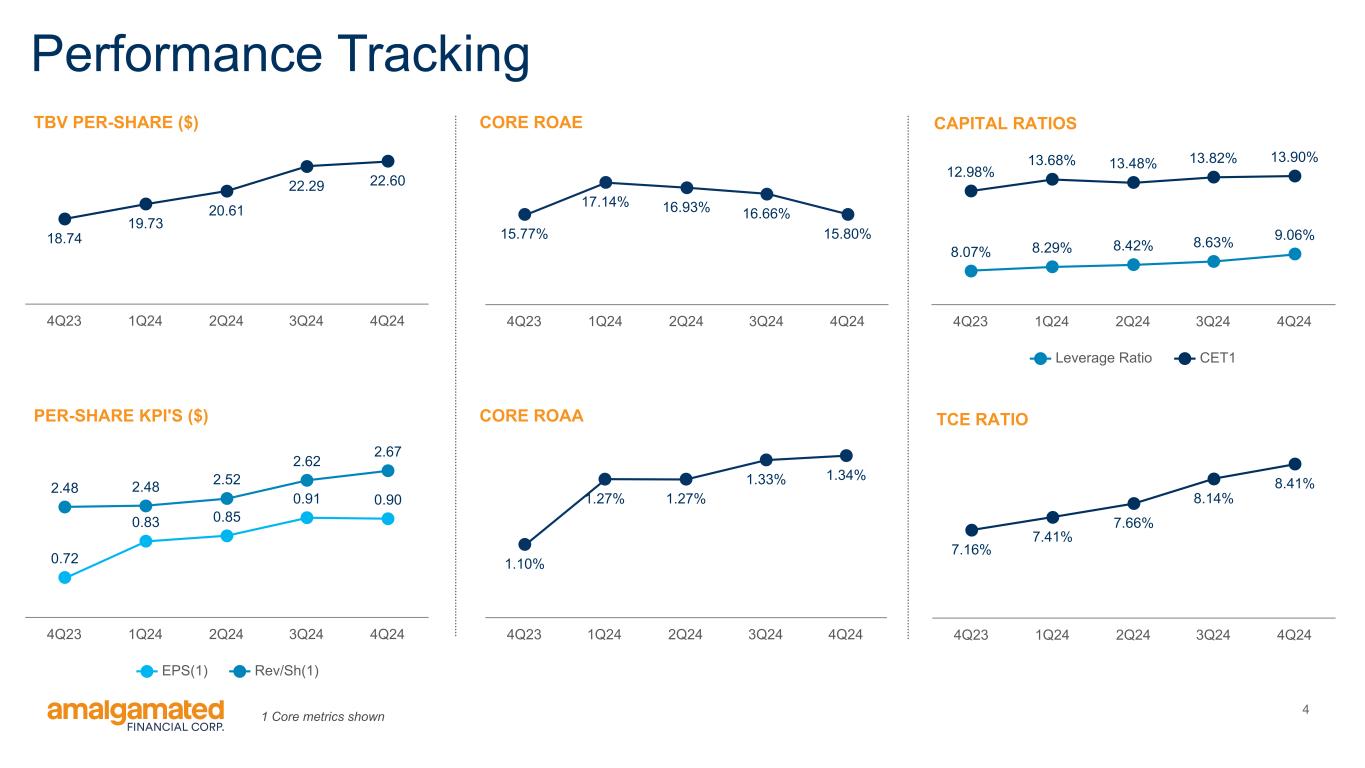
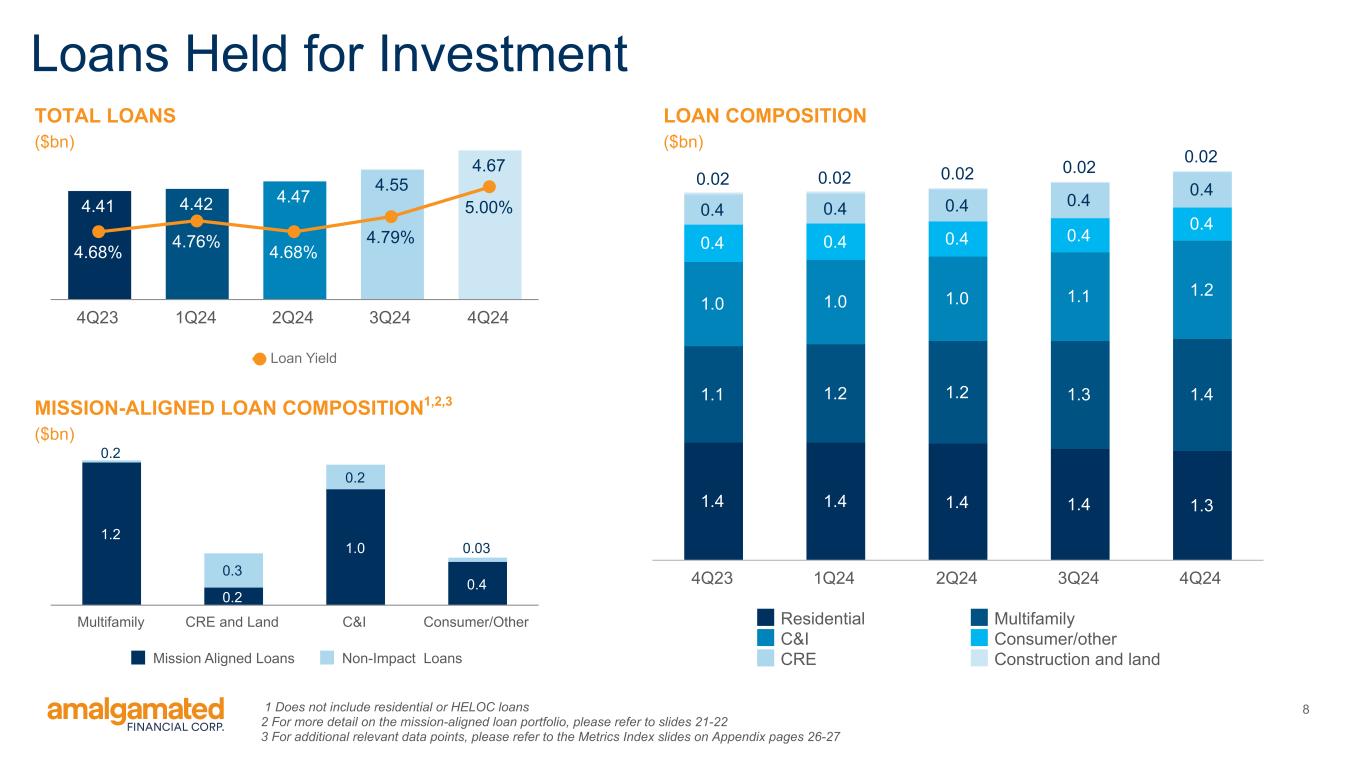
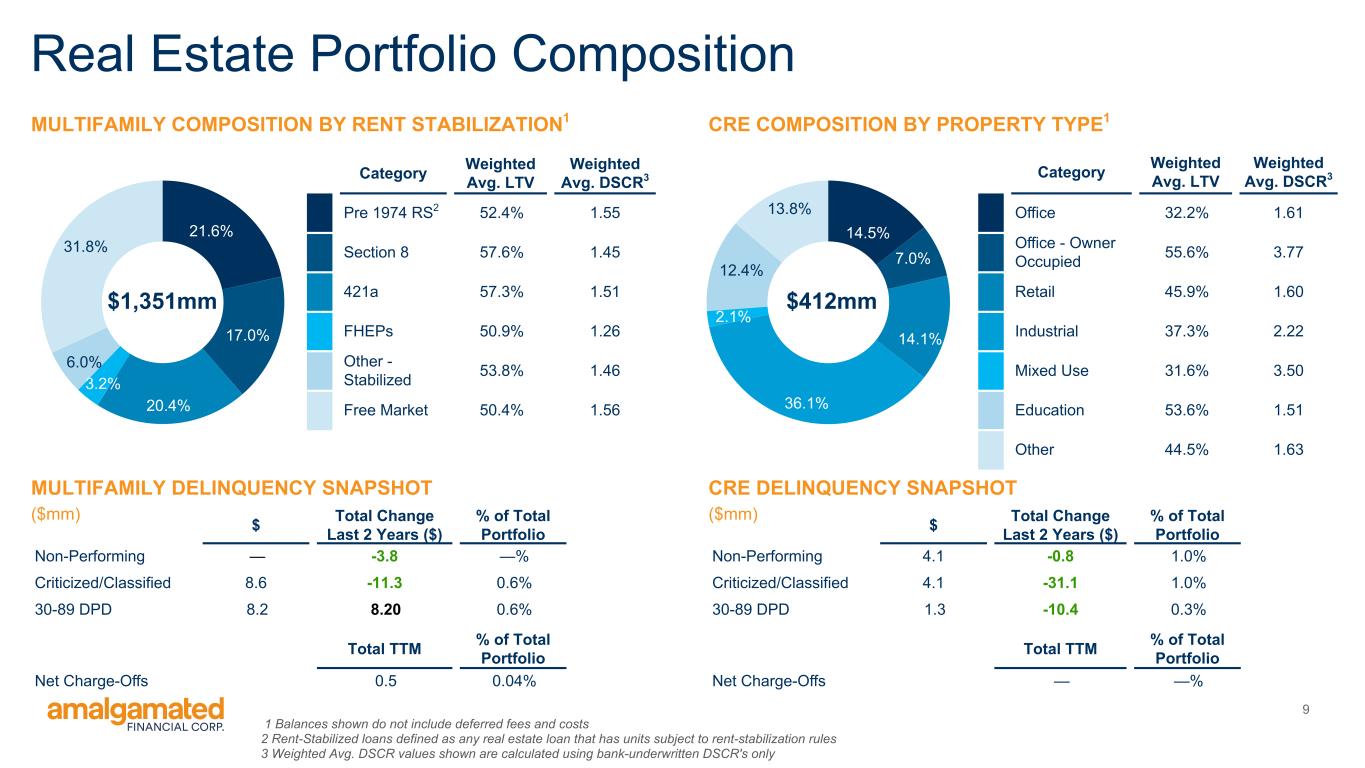
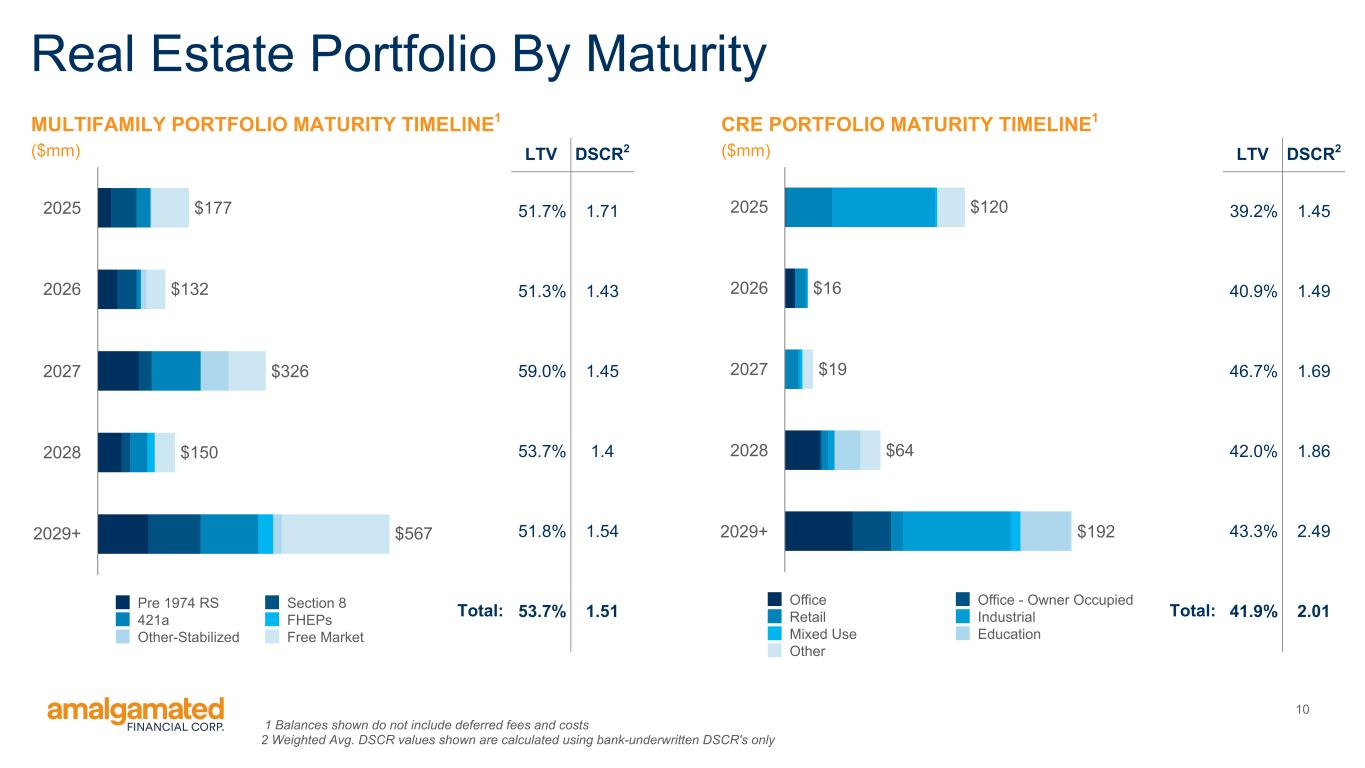
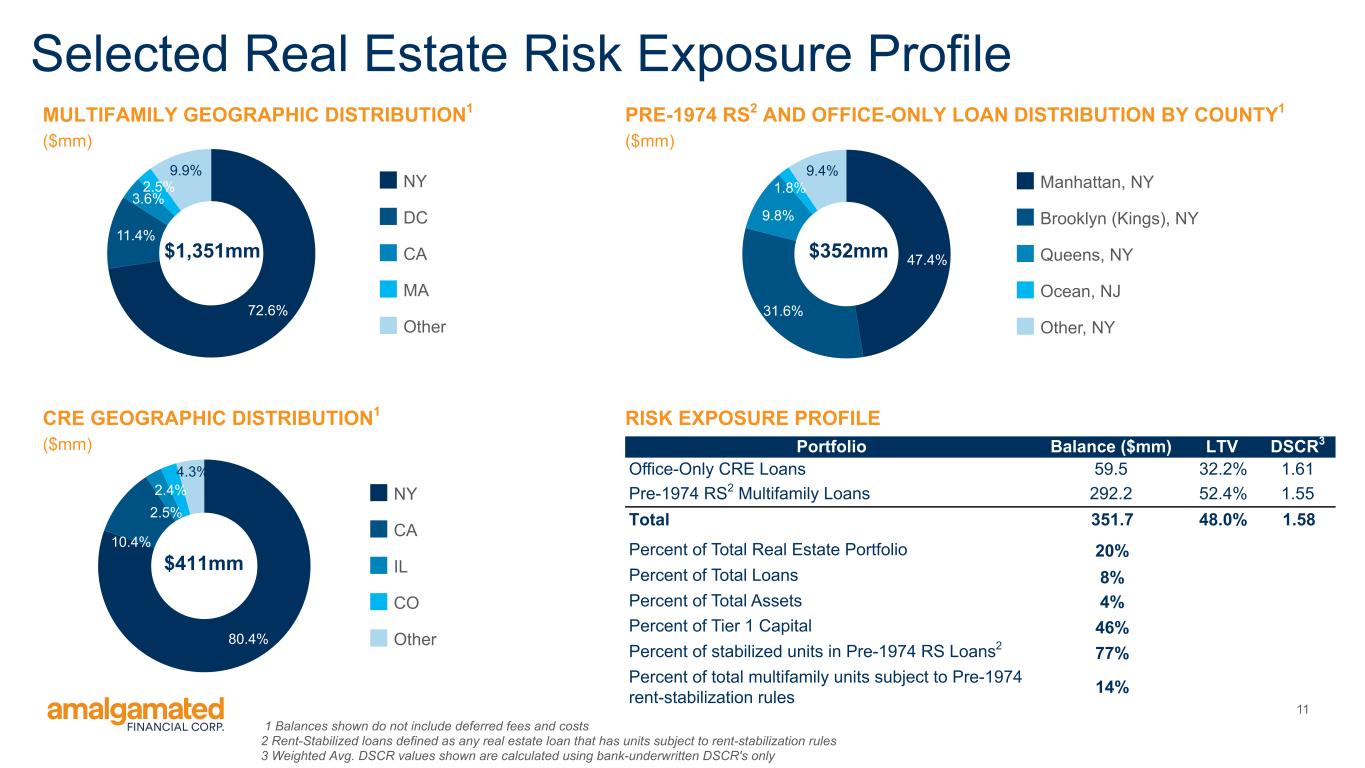
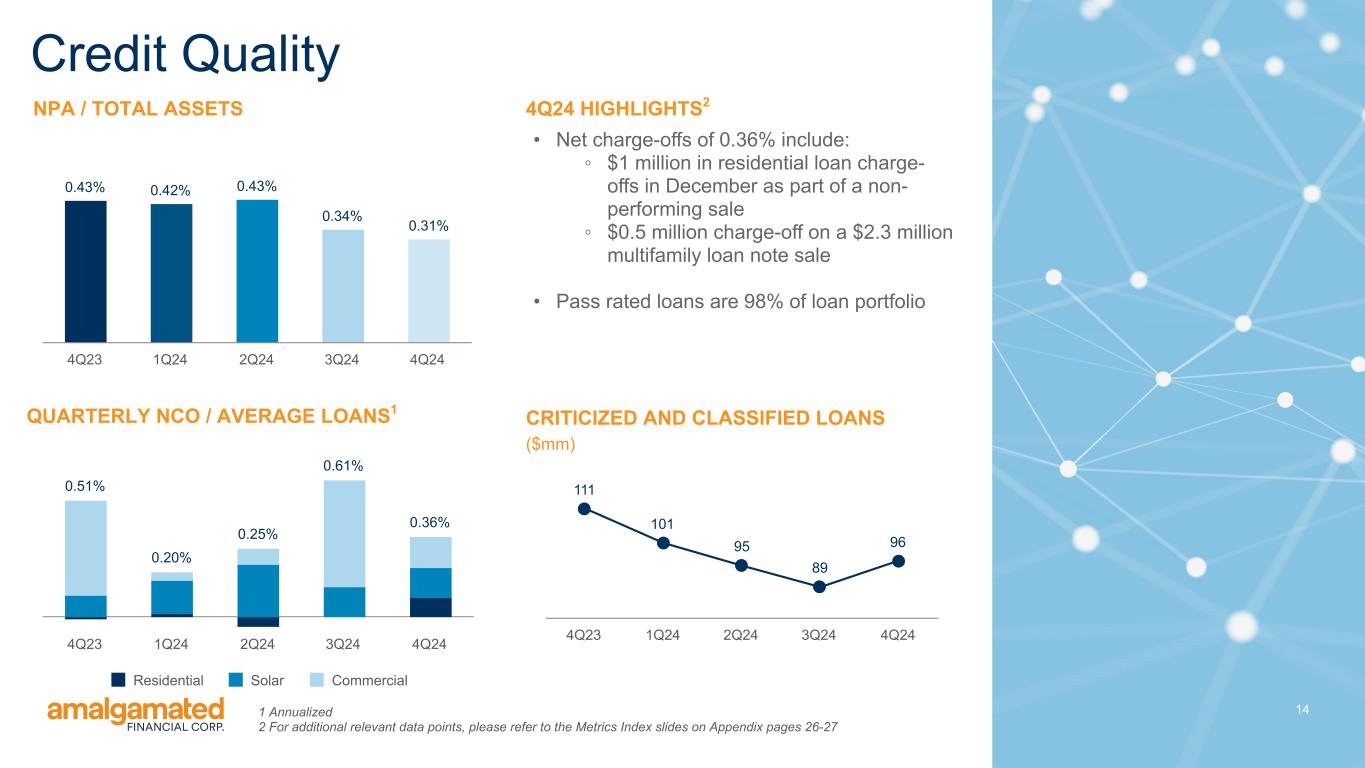
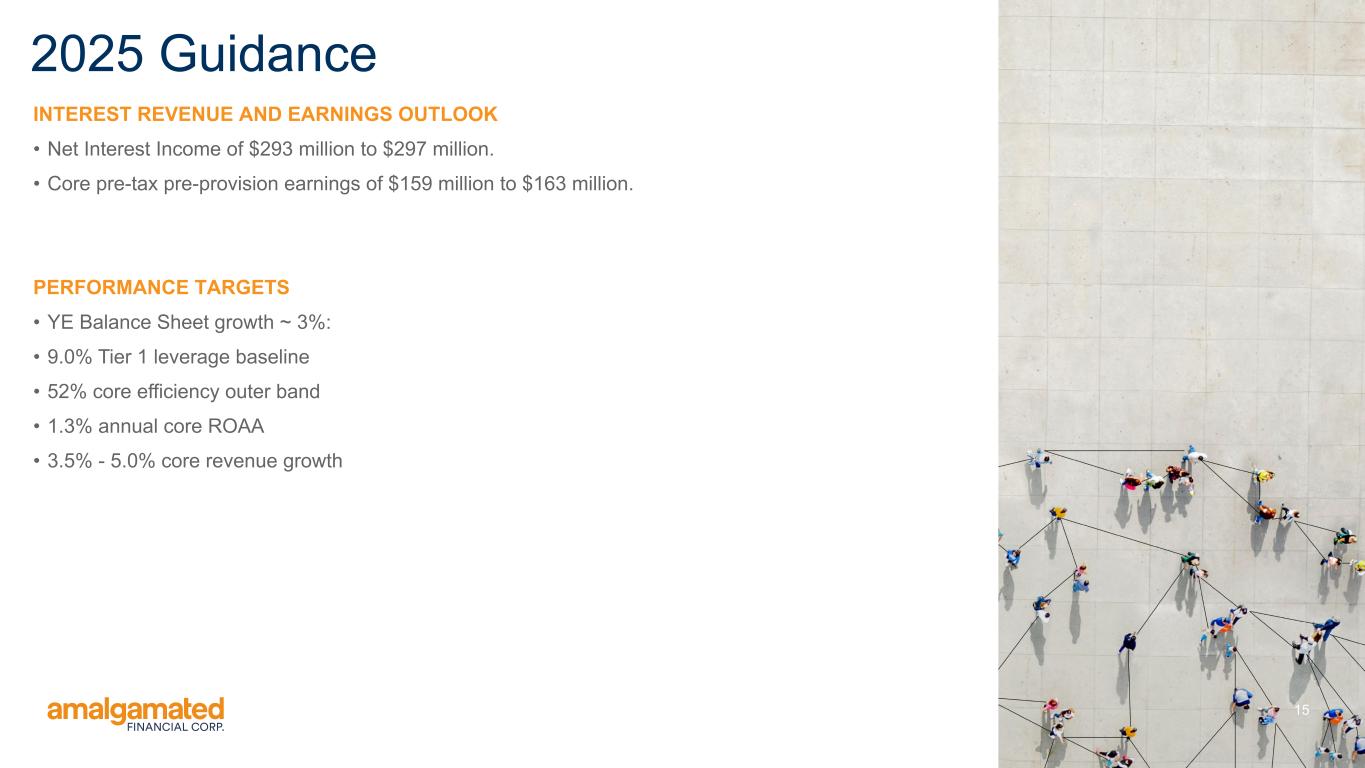
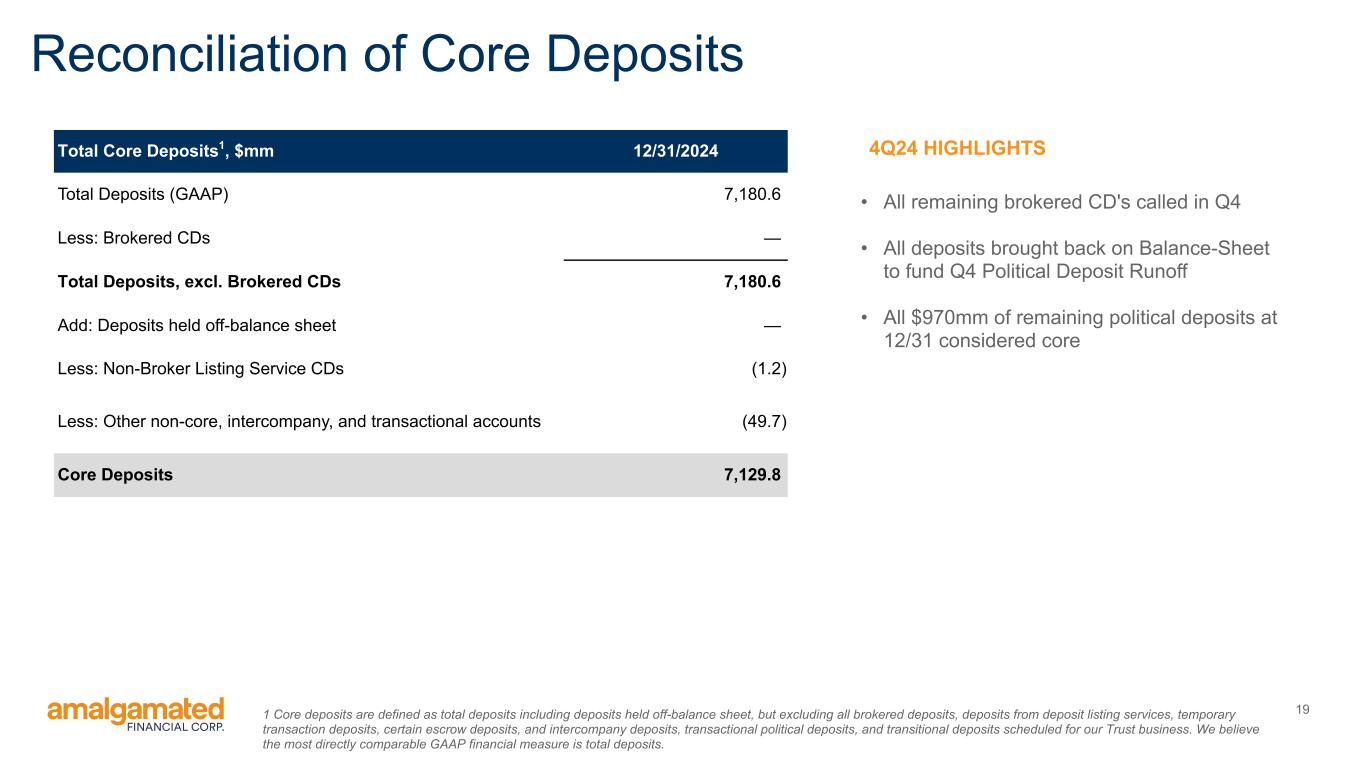
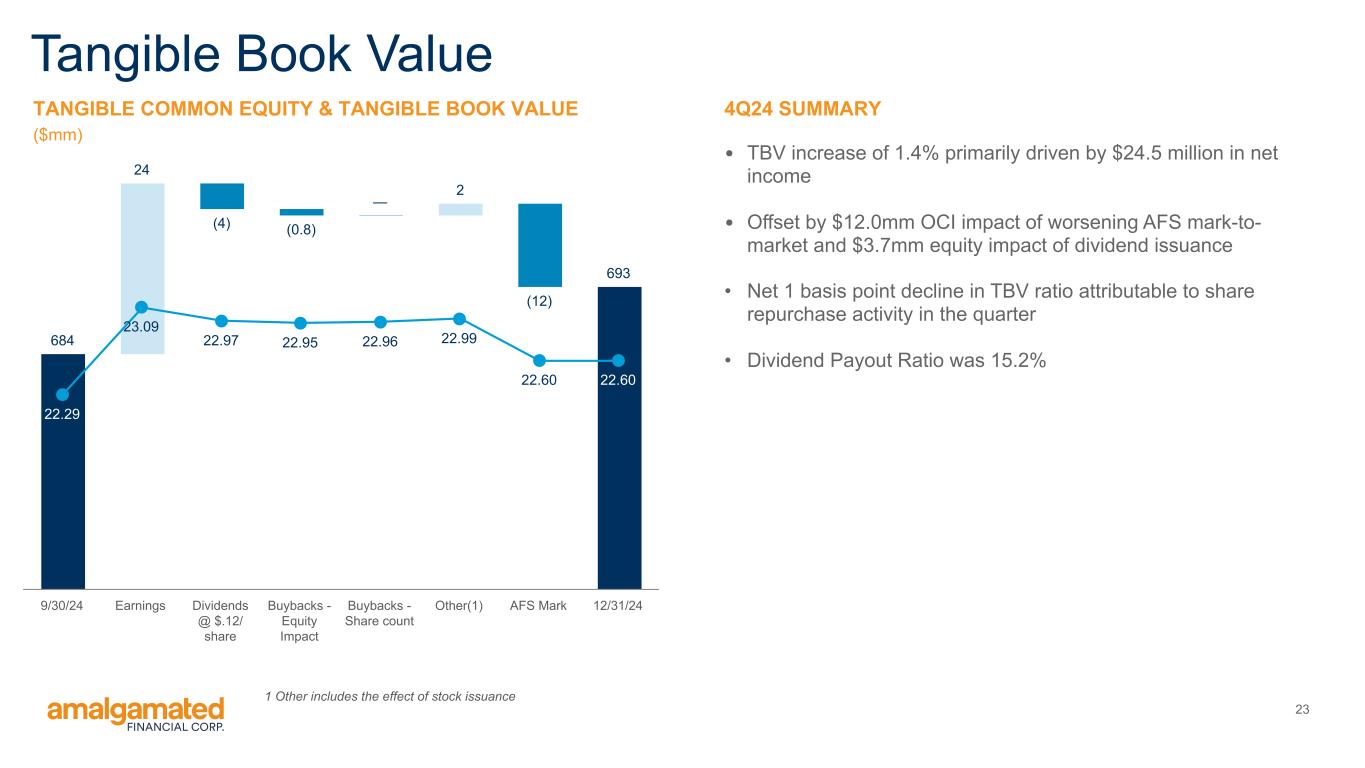
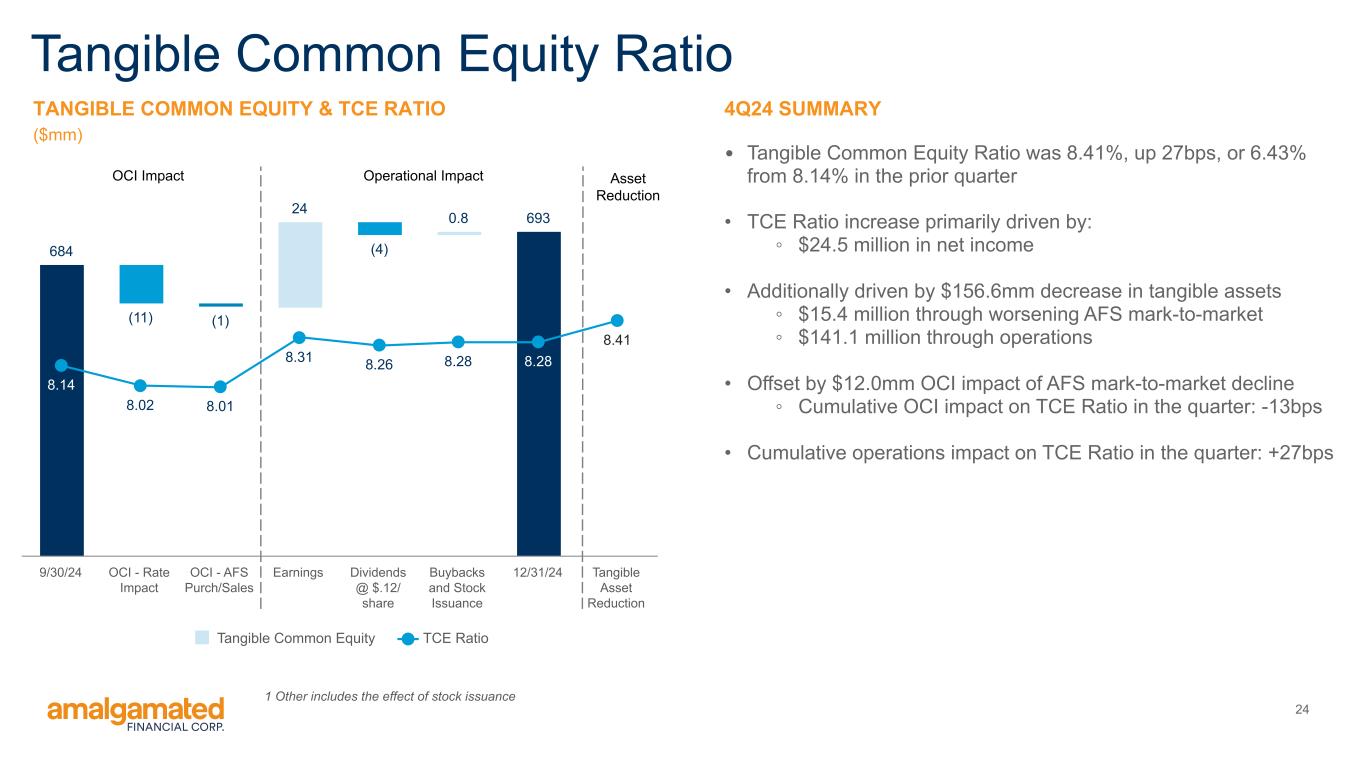
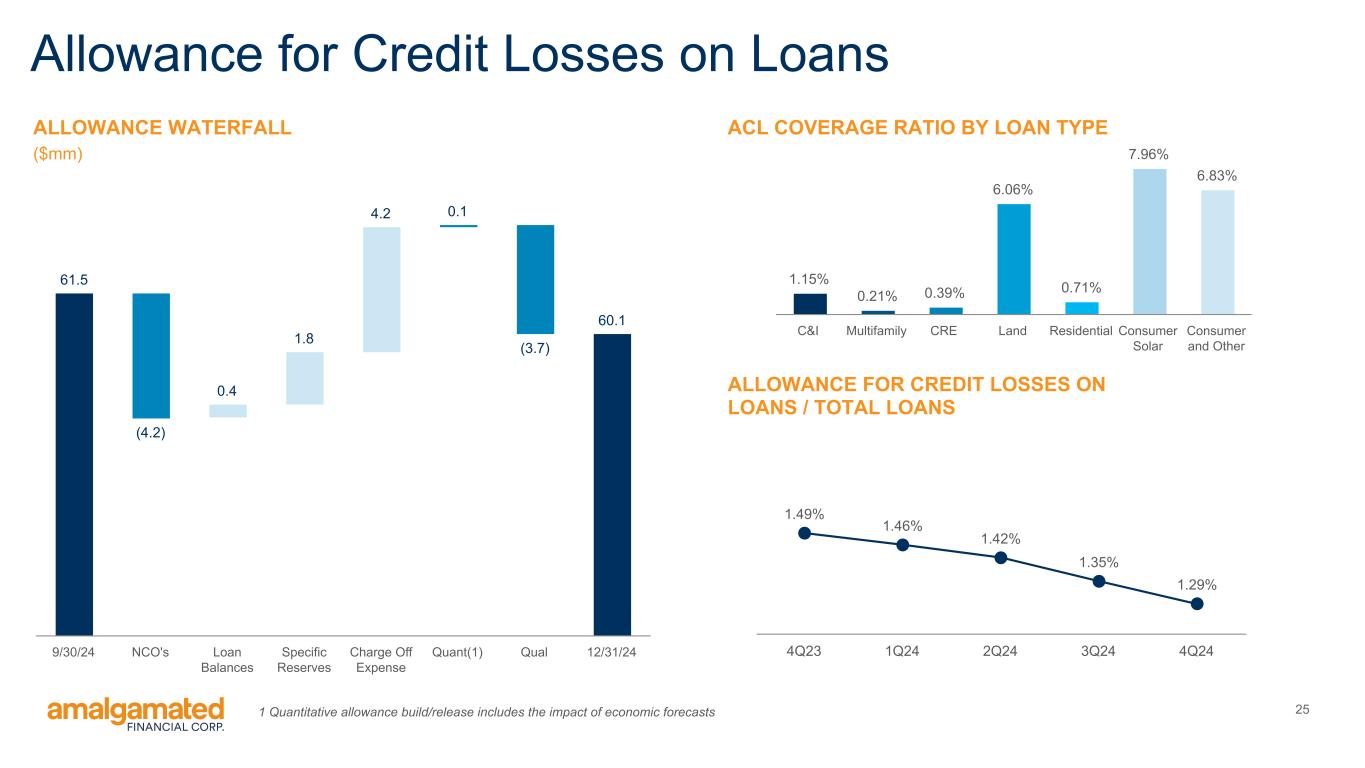
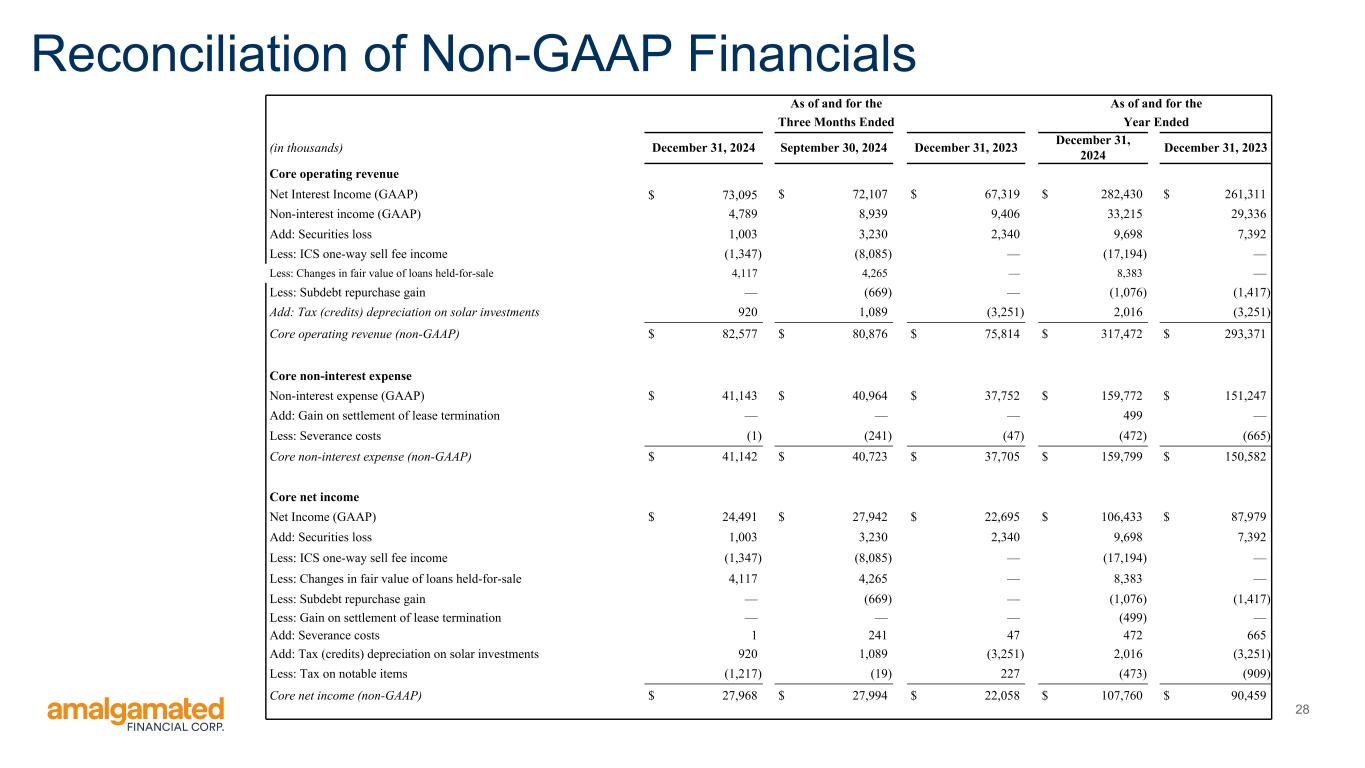
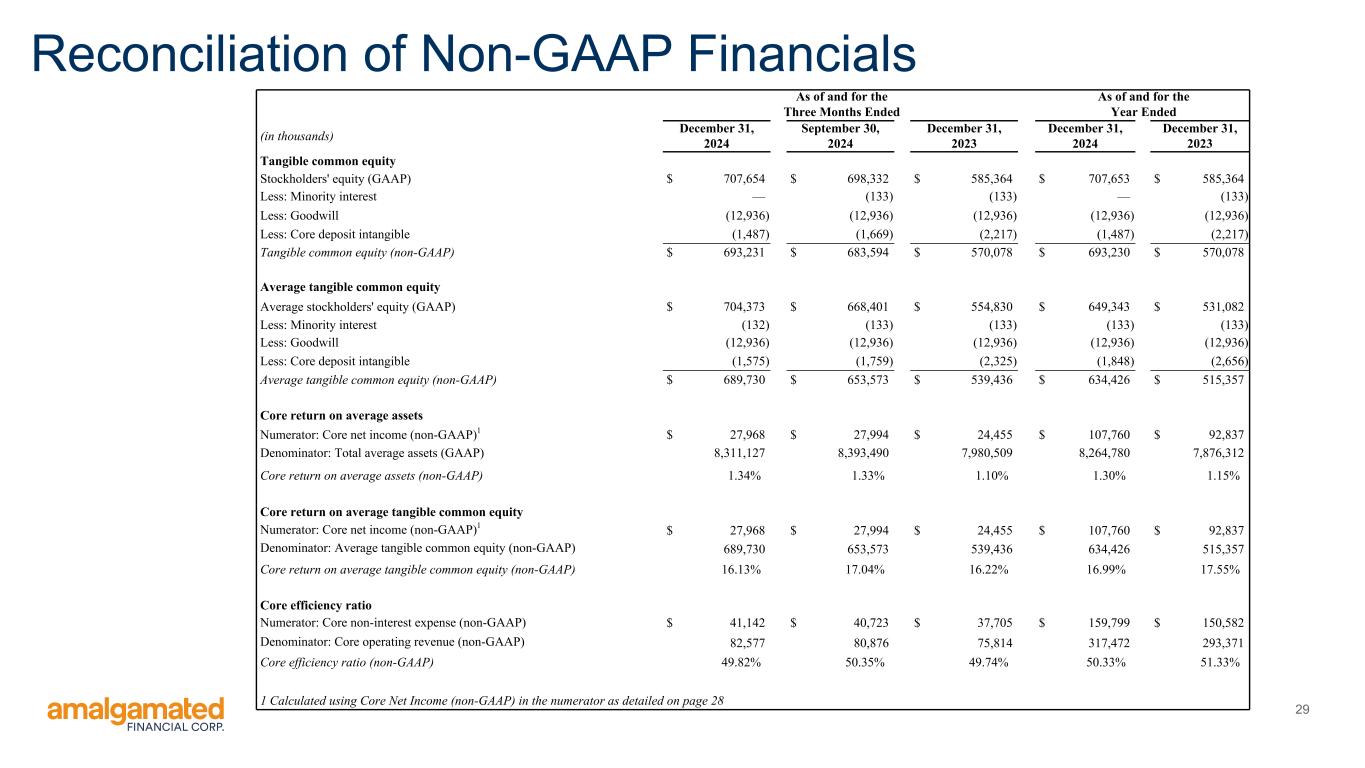
Good morning, everyone. When considering this was an election cycle conclusion quarter, I'm particularly proud of the solid results we produced as usually, this is a tougher quarter for us financially. As Slide 3 shows, net income was $24.5 million or $0.79 per diluted share, and core net income, a non-GAAP measure, was $28 million or $0.90 per diluted share, $0.01 below our prior quarter record, reflecting the power and sustainability of our earnings. And while the quarter does show the large but also expected decline in political deposit balances, which peaked at a record $2 billion during October, we also beat our expectations with $1 million of net interest income growth, a 43 basis point leverage ratio increase, an 8 basis point increase in our net interest margin, and loan growth of nearly 4%. Looking a little more closely, the net interest income increase was aided by our ability to call our above-market brokered CDs early in the quarter, enabled by the higher political deposit balances, and by our interest-bearing deposits repricing nicely in response to the movement in the Fed rate. We did have a significant remix of our deposits as our DDA to IBA ratio declined from 50% to 40%, and yet our margin still improved as our cost of funds lowered and we were able to shrink the balance sheet a little bit by selling securities at a nominal gain to fund our loan growth. Overall, we were quite pleased with our core financial performance. Now, the GAAP EPS was lower, but this reflects our continued work on restructuring the lowest-yielding part of our loan portfolio by marking and moving to held-for-sale another $32 million of performing residential loans at a $4 million pre-tax loss. This loss brings the full year 2024 difference between non-core off-balance sheet deposit income and non-core security sales losses and non-core fair value marks on residential loans held-for-sale to nearly zero. Additionally, we agreed to sell $3.9 million of non-performing residential loans and sell the note for $2.3 million non-performing multifamily loan. Taken as a whole, all of this work was done to strengthen our balance sheet, which we believe is the number one driver of bank valuation. Continuing to Slide 4, we look at some of our key performance metrics during the fourth quarter. Starting on the left, our tangible book value per share increased $0.31 or 1.4% to $22.60. And our core revenue per diluted share was $2.67 for the fourth quarter, a $0.05 increase from the prior quarter. Moving across to our returns, core return on average equity was 15.8%; this decline has been expected as we added over $120 million of organic capital during the year. That said, we remain near the top of the pack and well positioned to return more capital to shareholders as Priscilla previously mentioned. Our core return on average assets was 1.34%, demonstrating our earnings optimization at our current asset size. Regarding capital, our CET1 ratio is at an industry-leading 13.9%, demonstrating the strength of our balance sheet and the conservative risk-based allocation of our capital while still generating top-level earnings. Tier-1 leverage improved another 43 basis points to 9.06%, showing the momentum that Amalgamated now builds capital. As a result, our Board of Directors authorized a 17% increase to our dividend to be paid in February, and we repurchased approximately $845,000 in shares in the fourth quarter. Going forward, we are targeting a quarterly 20% to 25% total payout ratio, which includes both dividends and share repurchases. Our tangible common equity to tangible assets was 8.41%, representing the ninth consecutive quarter of improvement. This reveals the impact of selling over $835.7 million of underwater securities since March of 2022. Moving to Slide 5, total deposits at December 31, 2024 were $7.2 billion, a decrease of $414 million from the linked quarter. On-balance sheet deposits, excluding brokered CDs, decreased by $311.9 million or 4.2% to $7.2 billion. Additionally, our non-interest-bearing deposits decreased to approximately 44% of average deposits and 40% of ending deposits, excluding brokered CDs in relation to political deposit outflows. Importantly, our average cost of deposits, excluding brokered CDs, held relatively steady at 152 basis points in the fourth quarter as compared to 151 basis points in the linked quarter. As noted, we borrowed $250.7 million of short-term funds to cover the year-end outflows, where we're already seeing reduced borrowing levels as cyclical pension deposits return to the balance sheet. And while our political deposit balance has not changed much since year-end, we expect balances to steadily increase in the coming months as we begin the accumulation phase of what should be a highly spirited 2026 mid-term election. Jumping ahead to Slide 8, net loans receivable at December 31, 2024 were $4.6 billion, an increase of $126.4 million or 2.8% compared to the linked quarter. The yield on our total loans increased 21 basis points to 5% during the quarter. The increase in loan income and yield was primarily due to $126.2 million increase in average loan balances, as well as the recognition of a $1.3 million acceleration of deferred costs on certain loans in the prior quarter. Adjusted for this discrete item, loan interest income increased by $2.6 million in the quarter and yields increased 9 basis points. Importantly, our loan growth in the quarter was well balanced with $56.5 million in commercial real estate and $117.1 million in C&I. For 2025, we target around 2% loan growth per quarter with similar balance between commercial real estate and C&I. Moving to Slides 9, 10, and 11, looking at the real estate portfolio, we have $297 million in lower-priced commercial real estate and multifamily loans maturing over the course of 2025 and another $148 million in 2026. During the quarter, we renewed one $5.4 million credit with pre-1974 exposure via a combination of cash infusion and amortizing terms in exchange for modest rate concessions. In 2025, we have just $28 million of pre-1974 loans maturing. And perhaps most notably, we reduced our allowance coverage ratio on our multifamily portfolio to 21 basis points, reflecting our confidence in the portfolio asset quality after selling the note for a rapidly deteriorating credit. Moving to Slide 14, there were a fair amount of puts and takes in our criticized assets during the quarter. While our total criticized assets modestly increased $7.3 million to $95.9 million, there were downgrades to four commercial industrial loans totaling $38.2 million to substandard and accruing as well as downgrades to one $5.4 million performing multifamily loan and an additional $0.9 million of small business loans. These movements were mostly offset by other payoffs or upgrades along with charge-offs that reflect our decisive action on problem assets. Finishing on Slide 15, we are introducing full year 2025 guidance of core pre-tax pre-provision earnings of $159 million to $163 million, and net interest income of $293 million to $297 million, which considers the effect of the forward rate curve of 2025. Additionally, we estimate an approximate $1.7 million decrease in annual net interest income for a parallel 25 basis point decrease in interest rates beyond what the forward curve currently suggests. Briefly looking at the first quarter of 2025, our net interest margin may compress 2 basis points to 3 basis points from our Q4 mark while our political deposits rebuild and we pay down our short-term borrowings from year-end. As a result, we expect our net interest income to range between $70 million and $71 million in the first quarter. Rounding out 2025 full year guidance, our plan shows solid growth in revenue and core pre-tax pre-provision earnings, albeit at a more normalized pace compared to our stellar growth rates in 2024. 2025 will be a transformative year where we'll make necessary investments for the purpose of significantly growing revenue in 2026 and infrastructure preparations for becoming larger in the years to come. With that said, we have appropriate constraints in our plan that prioritize performance metrics and shareholders. Wrapping up, we are delighted to deliver record results for our shareholders in 2024 and look forward to opportunities to grow the bank in the years ahead. And now, operator, please open up the line for any questions.
Operator
Thank you. We will now begin the question-and-answer session. Our first question is from Mark Fitzgibbon with Piper Sandler. Please go ahead with your question.
Speaker 3
Hi, good morning. First question, Jason, just to clarify something you said before. I think you said you expect 2% loan growth per quarter in 2025, but your guidance in the slide for balance sheet growth is only about 3%. So, should we assume the securities book is going to shrink a bunch this year?
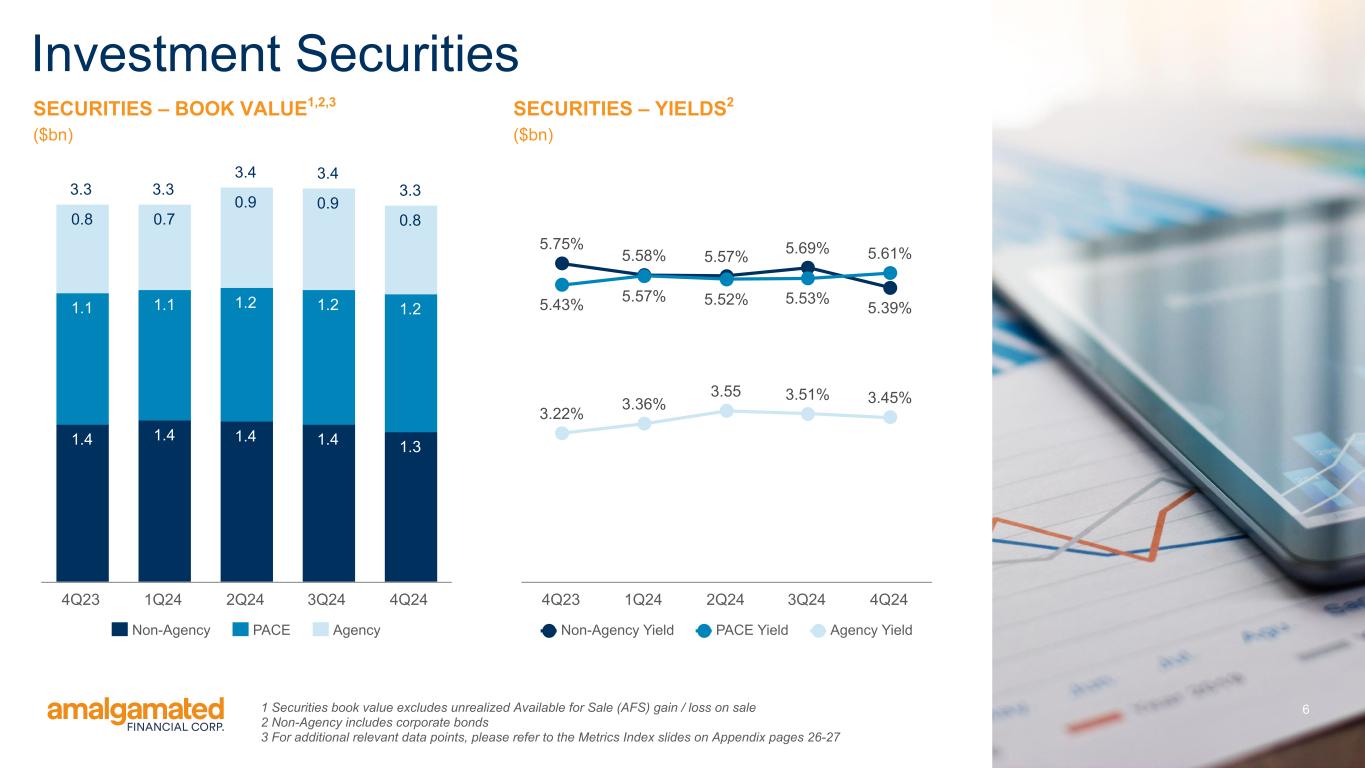
Yeah, Mark, how are you doing? That's exactly the play. The balance sheet is going to work in concert with movement in the securities portfolio, and we do expect to shrink the traditional securities portfolio to support the loan growth that we are talking about. 2% is probably going to be our outer range in terms of growth for the quarter. If it's something less than that, we will still be in a good spot to meet the balance sheet targets that we've set out. But to answer your question specifically, yes, we would see the securities portfolio do the funding for a decent portion of that loan growth that would be in that 2% target.
Speaker 3
Okay. Great. And then secondly, I wondered if you could share any color with us on the loan pipeline, maybe size, complexion, average rate, things like that.
Speaker 4
Hey, Mark, it's Sam. Good morning. Thanks for joining us. Happy to. We're optimistic about the pipeline. It's definitely got good diversified components between C&I and the multifamily and CRE book. We're seeing rates coming on, the pipeline on the CRE side in the kind of mid-to-high 6s. On the C&I side, higher than that in the kind of low-to mid-7s. Also seeing some good activity coming on in the C-PACE portfolio, which we're pretty happy about. So, I think all in all, between pipeline and the maturity schedule, we feel really good about being able to hit that 2% per quarter range.
Speaker 3
Okay. Great. And then I wondered if you could share any comments with us on the four C&I loans that caused that uptick in criticized and classified?
Speaker 4
Sure. A significant part of that comes from the various influences in the commercial and industrial loan portfolio due to the prolonged high-interest rate environment. We are confident in the structures of those loans, and that's reflected in the criticized category. We ensure transparency in our operations to avoid surprises. Our discussions with borrowers are productive, allowing us to secure necessary support for their projects, and we believe these structures are solid and on a positive path.
I think an add to that just we're pretty conservative, Mark, in terms of how we put our risk rating together. And if things are marginal on performance metrics, we'll move to classify them in a manner that we think is appropriate for investors to understand what the credits look like. But it's important to note that all of them are accruing standard and none of them have missed payments at this point in time. It's just our look at the most recent financials and how we view presentation to investors for conservative purposes. But on the flip side, we've done that for several other credits throughout the year that have returned to favorability and that's what drove that relatively minor overall increase in the criticized/classified; is that other credits have a similar type of grading earlier in the year did return to a performing status during the quarter as well.
Speaker 3
Okay. And then lastly, you and I talked about previously, Jason, I was curious, any impact on the PACE credits related to the California wildfires?
There have been no impact in our portfolio. There might be one very small credit that was affected by it. It's very immaterial, but we've done a review of the portfolio by zip code and we feel very good about the quality portfolio and the risk that were there. There's nothing in our commercial portfolio as well. So, all in, while it's a horrific situation, the credit distribution that we have was able to escape that particular issue. Obviously, the fires are still ongoing. So, we'll see how everything plays out, but we've not made any moves in our portfolio or have we made any additional coverages through the ACL to account for anything related to the fires.
Operator
Thank you. Our next question is from Chris O'Connell with KBW. Please proceed with your question.
Speaker 5
Good morning. Just wanted to start off, I may have missed it, did you mention an expense guide for '25?
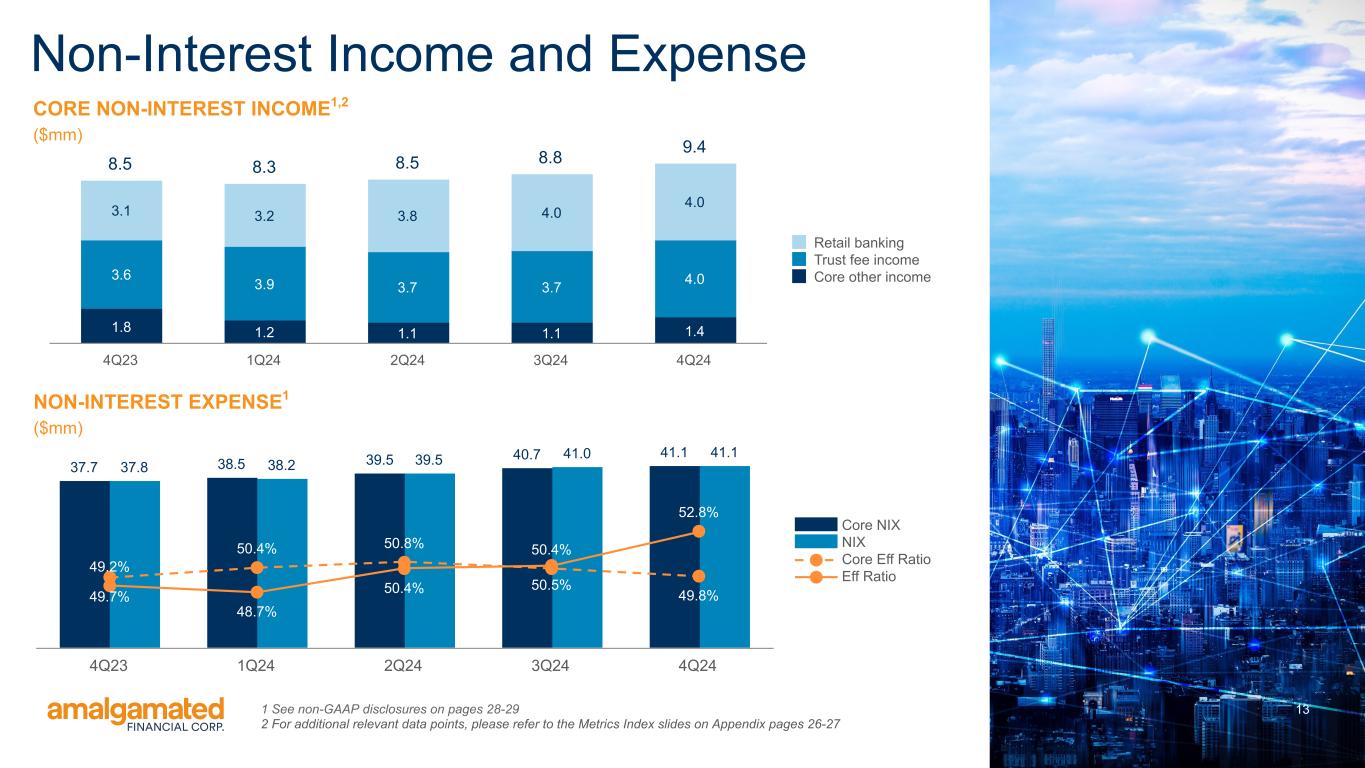
We did not include a specific reference in the guidance regarding expenses, but we are aiming for about $170 million for the year. This represents approximately a 6% increase from what we expect to close out 2024, and it considers several necessary investments we believe will support revenue growth towards the end of this year and into the future. Regarding the $170 million, I don't have an even distribution to share. What you will likely see is that expenses will be somewhat elevated in the first quarter compared to our fourth quarter, and then gradually increase throughout the year, as most of the increase will come from additional hiring for production and technology-related investments that will start impacting the profit and loss statement in the latter half of the year.
Speaker 5
Okay. Great. Do you think that the 6% pace continues into 2026? Is this pace inclusive of efforts and preparations towards reaching the $10 billion mark?
Difficult to say what the pace of expense will be in 2026, but what I can comment on is the investments now are a little bit ahead of the revenue growth because we know that we need to have assets put in place to be able to continue to drive revenue growth above where the expense growth will be in the coming years. So, we intend to get back to a positive operating leverage model in 2026, and the extent to which revenues are going to grow would really dictate what the expense pace will grow as well.
Yeah. This is Priscilla. Thanks for the question. I absolutely would underscore that this is a little bit different than what we've talked about for the last three years around sort of putting revenue ahead of expense. In this instance, what we're telling you is that we recognize that some technology investments, some investments both in trust and other parts of the sort of sales areas would benefit us over the long run, and you will start to see that revenue toward the end of '25 or certainly by the beginning of '26.
Speaker 5
Okay. Thanks, Priscilla. And then, just circling back to the balance sheet, appreciate the overall growth color and on the loan side. How are you guys thinking about the level of PACE growth into next year?
We are aiming for approximately $20 million per quarter in residential PACE. This is on a net basis. Additionally, we expect to fill a bucket in commercial PACE in the range of $60 million to $75 million. We are not limited by this target at all and believe there is room for growth. Our pipeline shows many promising opportunities, particularly in the commercial sector. PACE will remain a significant asset class for us. We aim to achieve around $150 million net across both our PACE and C-PACE tranches this year. With interest rates in the low-7% range for each of these asset categories, this would be a great way for us to generate fixed yield while maintaining a strong CET1 position.
Speaker 5
Can you discuss the timing and impact of the outflows towards the end of the quarter, particularly those that seemed to go beyond political factors? Do you anticipate these deposits recovering quickly in the first quarter of '25, or do you expect a more gradual increase over time?
I believe it’s best to consider two things. First, take a look at how deposits grew over the year in nearly all our segments. However, when you assess the fourth quarter, consider the political factors; you have the bar chart and have heard us discuss throughout the year what the cycle looks like. Particularly during election quarters, you notice increased spending. This applies to the surrounding ecosystem as well. We observed this trend in other and not-for-profit segments where spending and investments occurred in the fourth quarter in expectation of a new administration. Additionally, the labor cycle tends to follow a predictable pattern each year. Typically, at the end of each quarter, there’s a slight decline, but in the fourth quarter specifically, spending tends to increase, and we’ve already seen some of that return. Sam, you might have more insights on this.
Speaker 4
Yeah, that's right, Chris. I think what happened in the labor bucket is very seasonal, very demonstrated through AMAL's history over many, many years. And just as Priscilla said on Page 5, where we showed what has already come back and just in the first few weeks of the year, very much focused in the labor space. There was, in our social and philanthropic bucket, a number of investments that were made at the end of the year that drove a lot of that. We were happy in the actual not-for-profit section. Those were relatively flat quarter-over-quarter. But we are bolstered by what we are seeing in pipeline and activity and just again what is already rebuilding as we enter the replenishment phase in the first quarter here in '25.
So Chris, if you'll indulge me, I'll just add one last part to this answer for you, which hopefully is fulsome. The way that we've modeled the rebuild though for the first quarter has been quite slow and steady, right? So, to Sam and Priscilla's point, we do expect to see us move back in not just with political, but across all of our segments throughout the year. But the way that we see the first quarter shaping up and that's why we said we might have a little margin compression and might see NII be down a little bit is that we're going to be working through the short-term borrowing position that we ended up with at the end of the year. And because we are operating from a significantly higher place in terms of interest-bearing accounts versus non, we've moved from 50% to DDA to IBA down to 40%. You'll see us have to reaccumulate those lower DDA-related deposits to see the NII start to lift and that will probably start to happen again into Q2, Q3, and Q4. So, you'll see a little bit of dip in NII probably in Q1 and then margin expansion, NII expansion as we move throughout the rest of the year in relation to the answers that Sam and Priscilla gave.
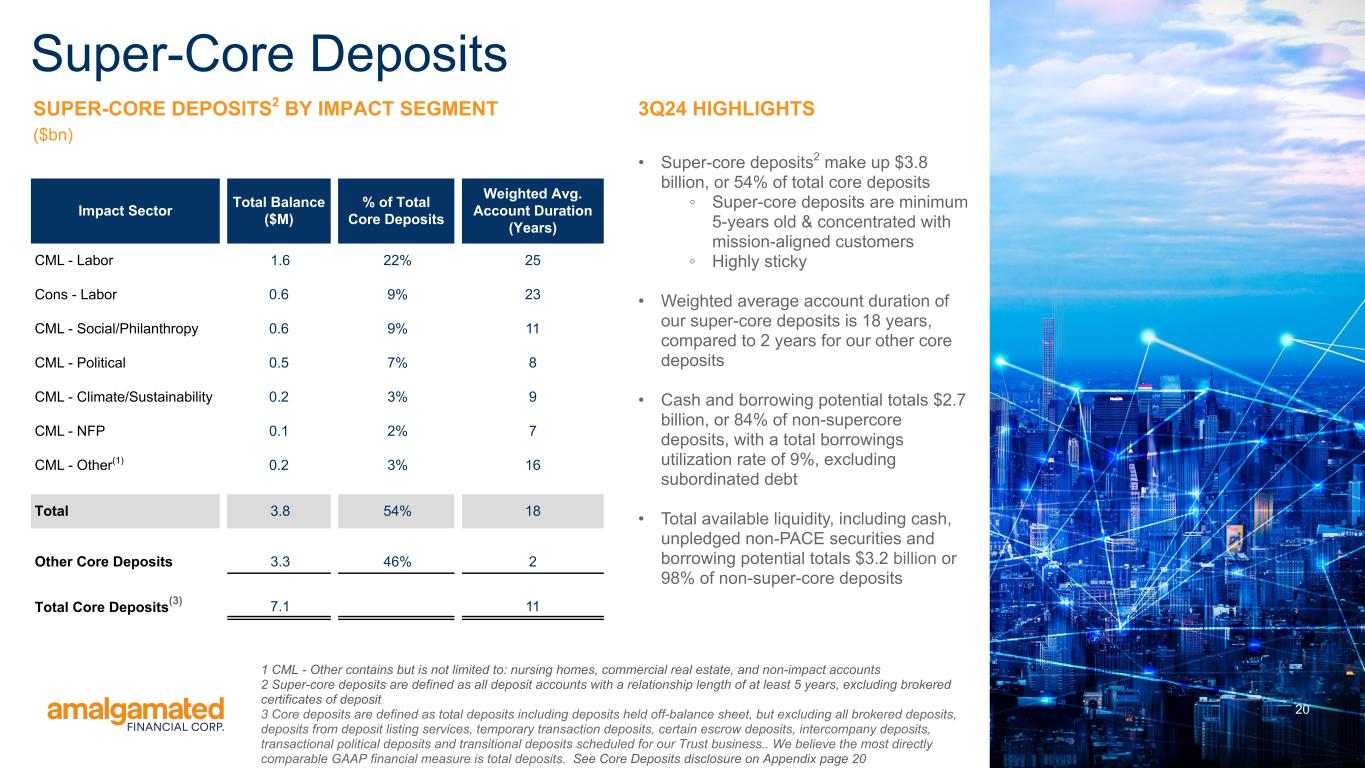
I want to emphasize an important point that I mentioned earlier. This has been a remarkable year for us, especially in contrast to an industry facing negative deposit growth; we achieved a 5% growth. Our super-core deposits have continued to increase by 200 basis points year-over-year, reflecting the ongoing shift towards newer relationships as well as our long-term, stable relationships. While the growth may be gradual due to ongoing investments in these sectors, we view this situation as cyclical and predictable, and we are confident about our pipeline.
Speaker 5
Great. Yeah, appreciate all the detail. And I know you guys are following the forward curve in the NII guide, but just to be a bit more specific, would you mind disclosing how many Fed cuts you have in there and just the timing?
Sure. We are modeling two rate cuts in the NII guide right now. The timing generally is March and then December, although we don't have it specifically marked on those particular months for just sort of following what we think the cut will be. It's a little bit more blended, but I would call it weighted more towards the second half of the year than the first, but those two cuts, 50 basis points in total and that's where we've come up with our NII projections. And we think they're pretty conservative assumptions too relative to betas and things of that nature. I think we always try to give you our most conservative view on what NII will look like, especially this early in the year, and you can probably expect us to refine our guidance targets throughout the year as we get a little bit more view and certainty as to what's going to happen with the rate environment and the overall macroeconomic environment as well.
Speaker 5
Perfect. I have a couple more questions. Regarding credit, it seems that this quarter involved some cleanups with the sales of underperforming assets, and overall, the trend appears positive. Have you observed the consumer solar segment? Do you think it will continue to decline, as it has been in the last few quarters but is down from earlier levels? Do you expect this downward trend in charge-offs to persist into 2025? Additionally, how are you approaching the expectation of more normalized net charge-off levels for next year?
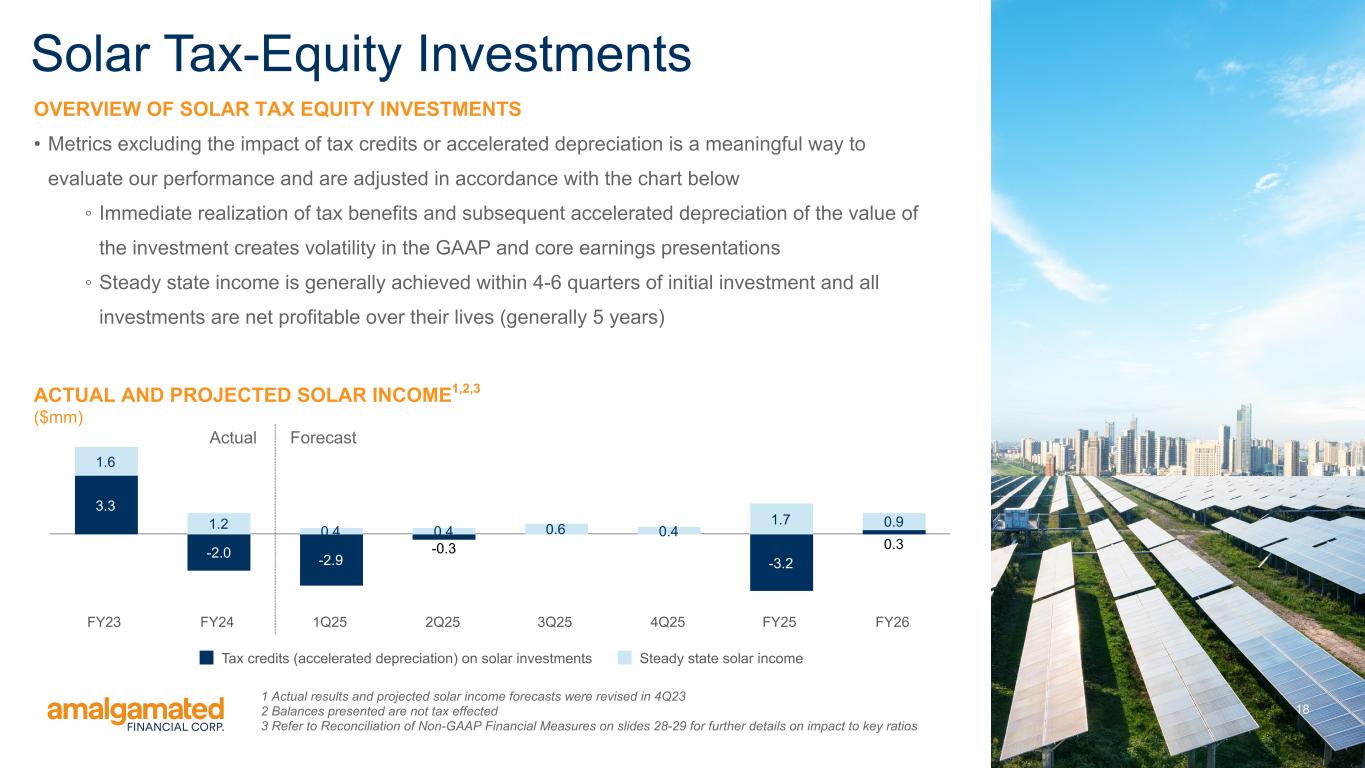
Sure. So, on the consumer solar, really difficult to predict just given the historical performance of the portfolio and also the fact that the rate environment is probably going to remain in an elevated place. So, the longer that goes on, the more stress it places on certain types of consumers. With all that said, we model charge-offs for this year similar to what we experienced last year, trying to take a conservative approach on that. But we've also been working very hard and I've talked about this a little bit before, we've been working very hard behind the scenes to control our destiny a little bit better on the collection side. As you probably know, Chris, the consumer solar portfolios are all serviced by others, and the bank has been active in acquiring those servicing rights so that we can perform our own collections. Now, we're not at a place to say where we are exactly with that acquisition, but at the same time, we feel pretty good that if we are able to get a hold of the servicing rights that we'll be able to drive more recoveries through the process, which would ultimately have a beneficial impact on that net charge-off. But as of right now, we're modeling it to look similar to last year with the hopes that this will be the peak in terms of elevation levels and that we'll be able to drive that number lower going forward. I don't know if I got the whole question there, but that was the consumer solar part. Was there something else, Chris, that I didn't answer for you?
Speaker 5
No, no, that was great. And then...
Speaker 5
No, I was just going to say last is just what's a good go-forward tax rate here?
I'm sorry, good go... tax rate.
Speaker 4
Tax rate, sorry about that. Yeah, we're looking at 26.85% as an effective tax rate coming up. So, if you're there 27%, I think that's a good model estimate for the coming year. And we feel pretty good that we've been able to move most of the discrete items off of the provision inventory and have a pretty clean tax base going forward, which will hopefully reduce a lot of volatility that we've had in past years.
Speaker 5
Great. I appreciate the time. Thanks for taking my questions.
Operator
Thank you. There are no further questions at this time. I would like to hand the floor back over to Priscilla Brown for any closing comments.
Thank you, operator, and thank you for those questions and your continued interest. We appreciate the time. We love talking about our results, and we believe that they continue to demonstrate the strength and competitive advantages that Amalgamated has. I'd like to thank our employees as usual for their hard work and dedication to the bank. It's been a stellar year, and our success would not be possible without the commitment and determination of every one of our talented team members, many of whom are on this call. And to conclude, I just would say that we couldn't be more excited about the opportunities that lay ahead for the company. The bank continues to operate at a high level with a strong earnings base and multiple avenues to drive further growth and returns. And we look forward to updating you on our progress on the first quarter call. Thank you again for your time today.
Operator
This concludes today's conference. You may disconnect your lines at this time. Thank you for your participation and enjoy the rest of your day.