Operator
Welcome to CPI's second quarter 2026 earnings call. My name is Alexandra and I will be your operator today. If you are viewing on the webcast, you may advance the slides forward by pressing the arrow buttons. The call will be open for questions after the company's remarks. If you would like to get in the queue for questions, please press star one to raise your hand. To withdraw your question, press star one again. Now, I would like to turn the call over to Davis Barker, head of investor relations.
Thank you, operator. Welcome to CPI's second quarter and first half 2026 earnings call. As a brief introduction, I recently joined the CPI team, and I'm incredibly excited to partner with CPI's leadership to share our compelling story with the investment community. Joining me on the call today are John Lowe, president and chief executive Officer, and Tara Grantham, Chief Financial Officer. Before we begin on Slide 2, I'd like to remind everyone that this call may contain forward-looking statements as they are defined under the Private Securities Litigation Reform Act of 1995. These statements are subject to certain risks and uncertainties that could cause actual results to differ materially from those expressed in the forward-looking statements. For a discussion of such risks and uncertainties, please see CPI's most recent filings with the SEC. All forward-looking statements made today reflect our current expectations only and we undertake no obligation to update any statement to reflect the events that occur after this call. During today's call, the company will be discussing one or more non-GAAP financial measures including but not limited to EBITDA, adjusted EBITDA margin, net leverage ratio, and free cash flow. Reconciliations of these non-GAAP financial measures to the most directly comparable GAAP measures are included in the press release and slide presentation we issued this morning. Today's press release, as well as the presentation that accompanies this conference call and the Form 10-Q, are accessible on CPI's Investor Relations website at investor.cpicardgroup.com. We will open the call for Q&A after our remarks. I would now like to turn the call over to John.
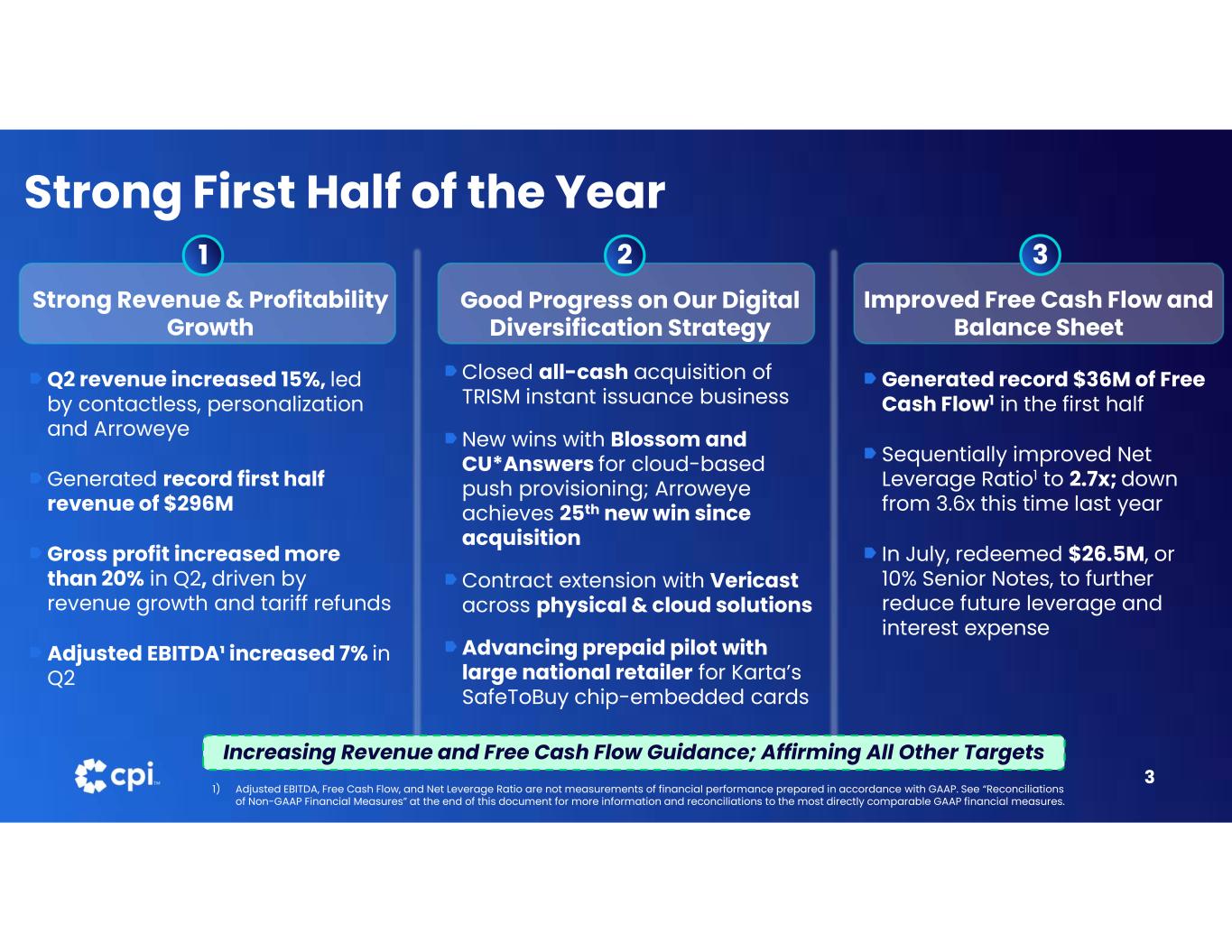
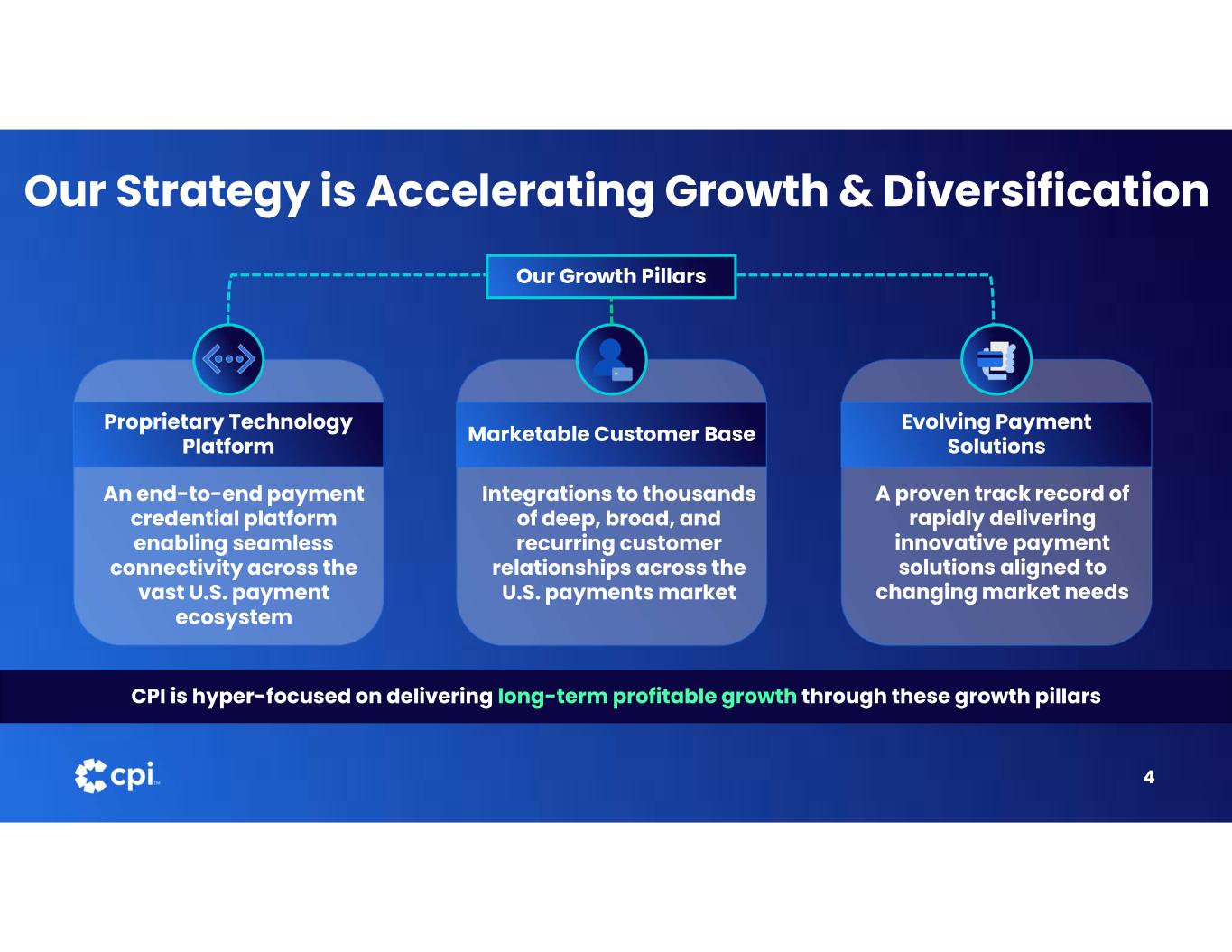
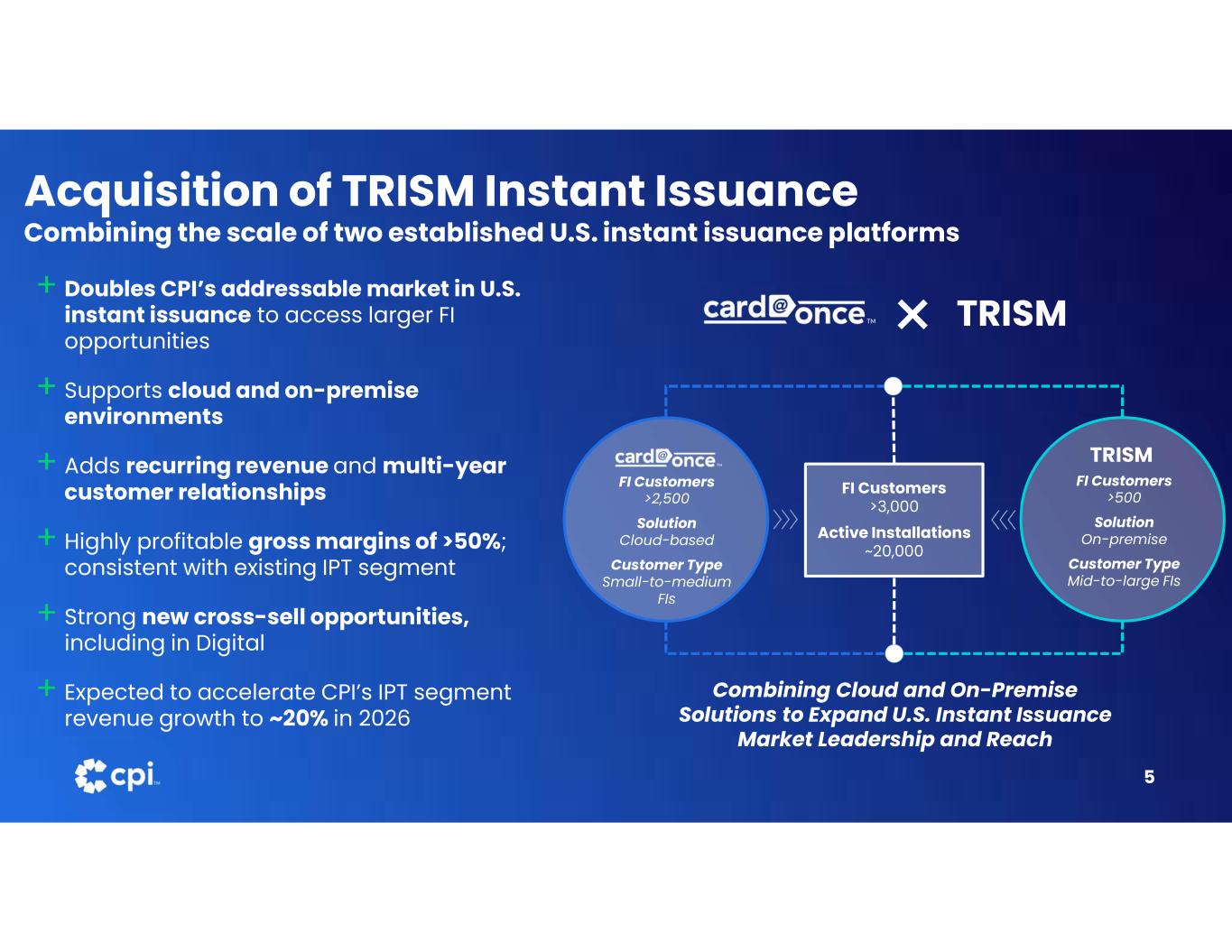
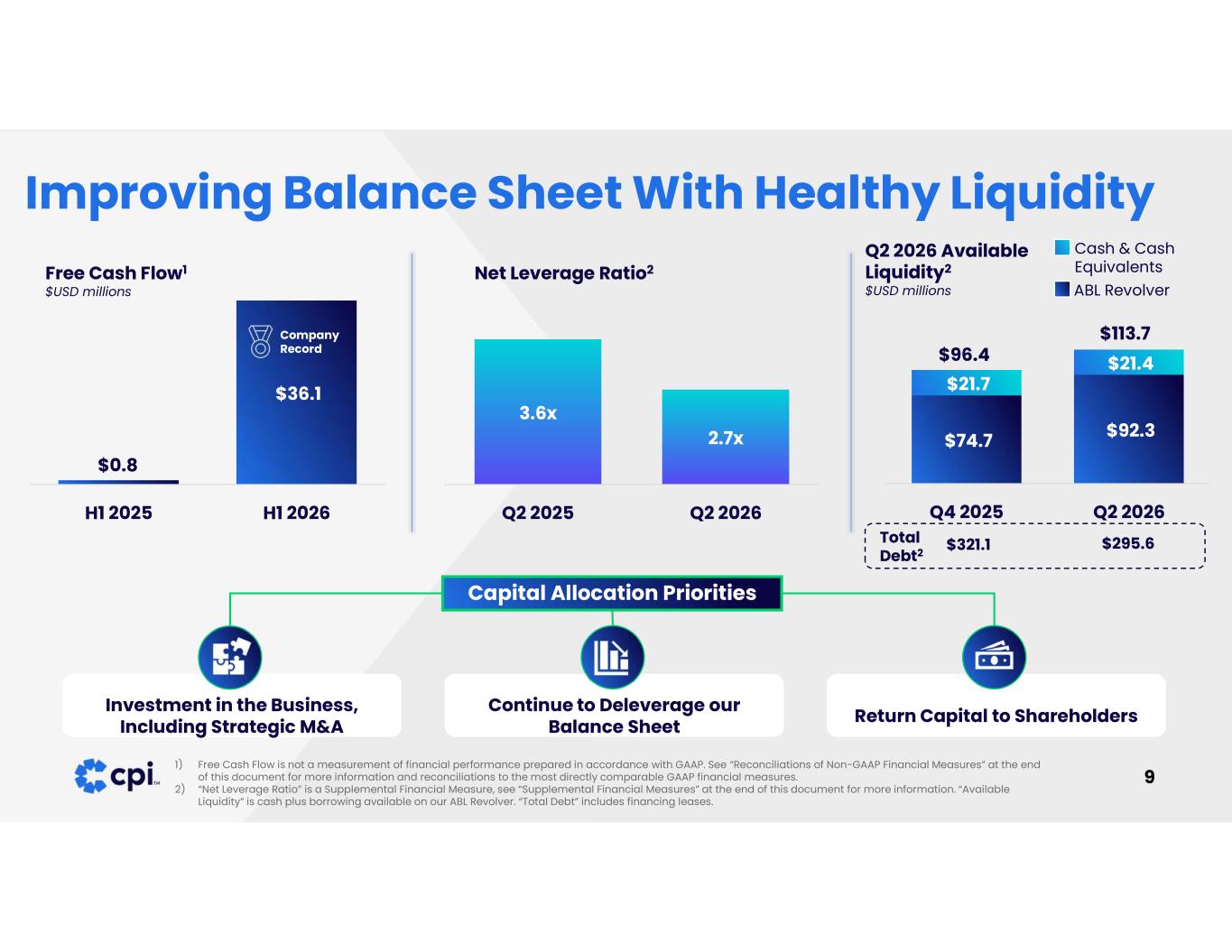
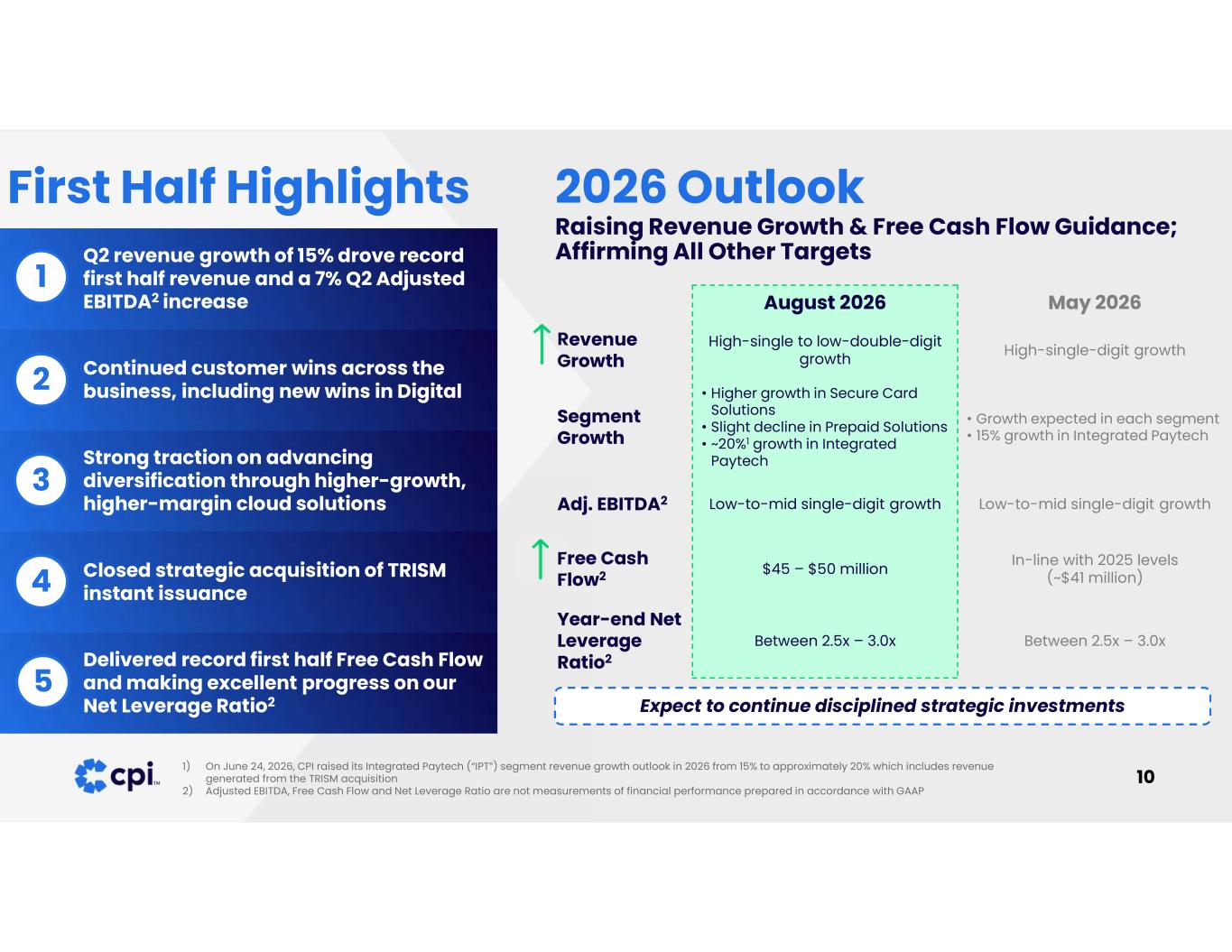
Thanks, Davis, and welcome aboard. We're excited to have you on the CPI team. Good morning, everyone, and welcome to the call. Before I begin, I'd like to officially congratulate Tara on her appointment as Chief Financial Officer. Since joining CPI in 2017, Tara has been a key driver of CPI's evolution into a payments technology leader, and after an outstanding job as interim CFO, I couldn't be more excited to have her in the role permanently. Turning to slide three, the CPI team delivered a strong second quarter and first half of 2026. We achieved revenue growth of 15% in the second quarter and 17% in the first half, resulting in a record first-half revenue for the company. Our performance reflected continued momentum in SecureCard solutions, including another quarter of strong execution from AeroEye, which continues to exceed our original expectations. We completed another strategic acquisition, buying an instant issuance solution known as Trism, which further supports the expansion of our higher-growth, higher margin, integrated pay tax segment. We also received tariff refunds in the second quarter, which benefited the P&L by more than $3 million. These successes were partially offset by some market choppiness in prepaid as we continue to see softness within that segment, which we expect will continue until late 2026. We delivered good profitability growth, exceeding our expectations with second quarter adjusted EBITDA increasing 7% to $24 million, while generating a company record free cash flow of $36 million in the first half. Strong performance in our secure card solutions is driving significant operating cash flow growth as higher volumes accelerate inventory optimization initiatives. Just as importantly, we continue to strengthen our balance sheet, reducing net leverage to 2.7 times and redeeming $26.5 million of our senior notes shortly after quarter end. These results reinforce the strength of our business model and our ability to consistently generate strong operating cash flow, deliver our balance sheet, and create additional value through disciplined capital allocation. With our strong first-half performance and visibility into the second half of the year, we are pleased to raise our full-year revenue growth and free cash flow guidance while reaffirming all other guidance targets. Tara will share more about our updated outlook shortly. Beyond the financial results, what excites me most is the continued progress we're making executing our strategy and diversifying cpi we continue to see strong momentum across our cloud-based and digital solutions which are helping us generate new recurring revenue streams deepen customer relationships and expand our role in the payments ecosystem during the quarter we continue to build go-to-market momentum across our businesses in our integrated paytech segment we're excited to expand the reach of our cloud-based push provisioning and card at once solutions with blossom a leading digital banking and payments platform serving 350 plus credit unions and cu answers a leading core processing and digital banking provider serving more than 400 credit unions across the us we continue to be excited about the momentum we're building as we expand our reach into the payments ecosystem as a provider of digital solutions leveraging our tokenization capabilities In our secure card solution segment, we hit a new milestone with Arrowine, where we executed our 25th new customer win since closing the acquisition in May of last year. We are also excited to have extended our relationship with Veracast, a data-driven fintech that services roughly 60% of U.S. commercial banks and credit unions, and a customer relationship that spans more than two decades. On the prepaid side, while the current year remains choppy, we remain excited about our long-term opportunities in the open-loop market and the much larger closed-loop market. This quarter, we've continued to win share and are now serving all of the top prepaid program managers in the U.S., further strengthening our position as the center of the prepaid market and creating new opportunities to deliver our secure packaging solutions. We are making good progress with Carta on our joint pilot to launch prepaid packages with safe-to-buy chip-embedded technology at one of the largest U.S. national retailers, and we are seeing encouraging signs in the adoption of ClosedLoop, a market where we estimate is approximately five times the size of OpenLoop. Given our leadership position in prepaid packaging, chip-enabled solutions and customer relationships, we believe CPI is uniquely positioned to capitalize on the prepaid market as it actions to reduce Altogether, these wins across our business are a great example of how CPI is leveraging both physical and digital payment solutions to create value for customers and drive profitable growth. Turning to slide four, let me briefly remind everyone of the foundation of our strategy. Everything we do is built around three core growth pillars. Our proprietary technology platform, our marketable base of thousands of customer relationships across the payments ecosystem, and our ability to deliver innovative payment solutions that evolve alongside market needs. These pillars continue to drive growth and diversification across the company, and our acquisition of TRISM instant issuance is an excellent example of that strategy in action. Turning to slide five, TRISM expands our leadership position in the attractive U.S. instant issuance market and roughly doubles our instant issuance addressable market by enabling us to serve larger financial institutions that prefer an on-premise solution. The acquisition increases our instant issuance presence to nearly 20,000 locations across over 3,000 financial institutions, adds recurring revenue and long-term customer relationships, and creates attractive cross-selling opportunities across CPI's broader portfolio. I met with the TRISM team last week, and on behalf of the leadership team and all of CPI, we are excited to have TRISM as part of our team. TRISM is expected to increase integrated pay-tech growth to approximately 20% in 2026 while maintaining a gross margin profile of over 50%, consistent with our existing integrated pay-tech business. Additionally, this acquisition had little impact on leverage, enabling us to complete the strategic acquisition while maintaining our disciplined approach to capital allocation. In summary, we delivered an excellent second quarter. We gained share, generated strong revenue growth and profitability expansion delivered record first half free cash flow and continue to improve our balance sheet we are executing our strategy to grow and diversify the business positioning cpi well for the second half of the year and beyond with that i'll turn the call over to tara to provide more detail on our financial results and outlook for the remainder of the year thanks john before i begin i'd like to thank john our board of directors and the entire CPI team for their confidence and support as I take on the CFO role.
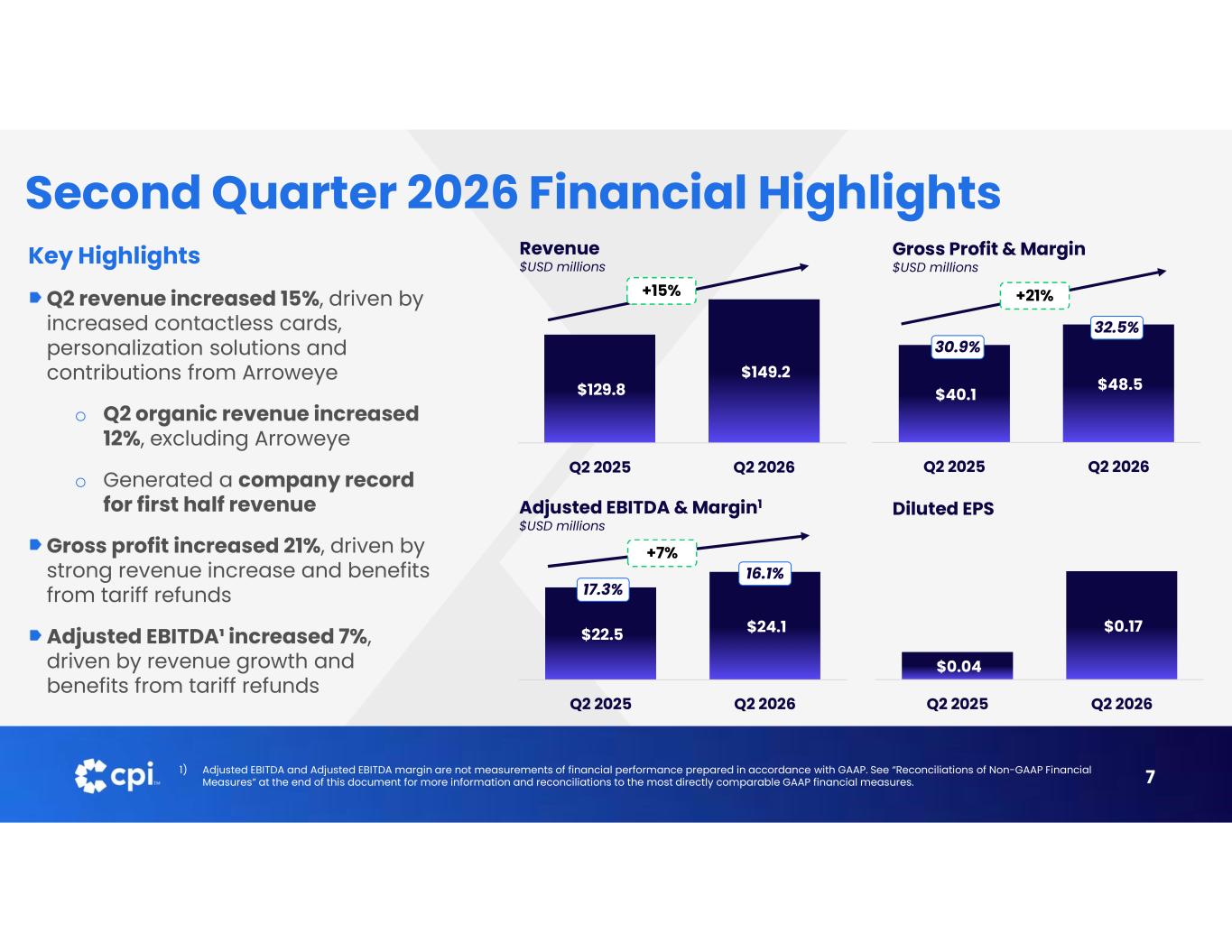
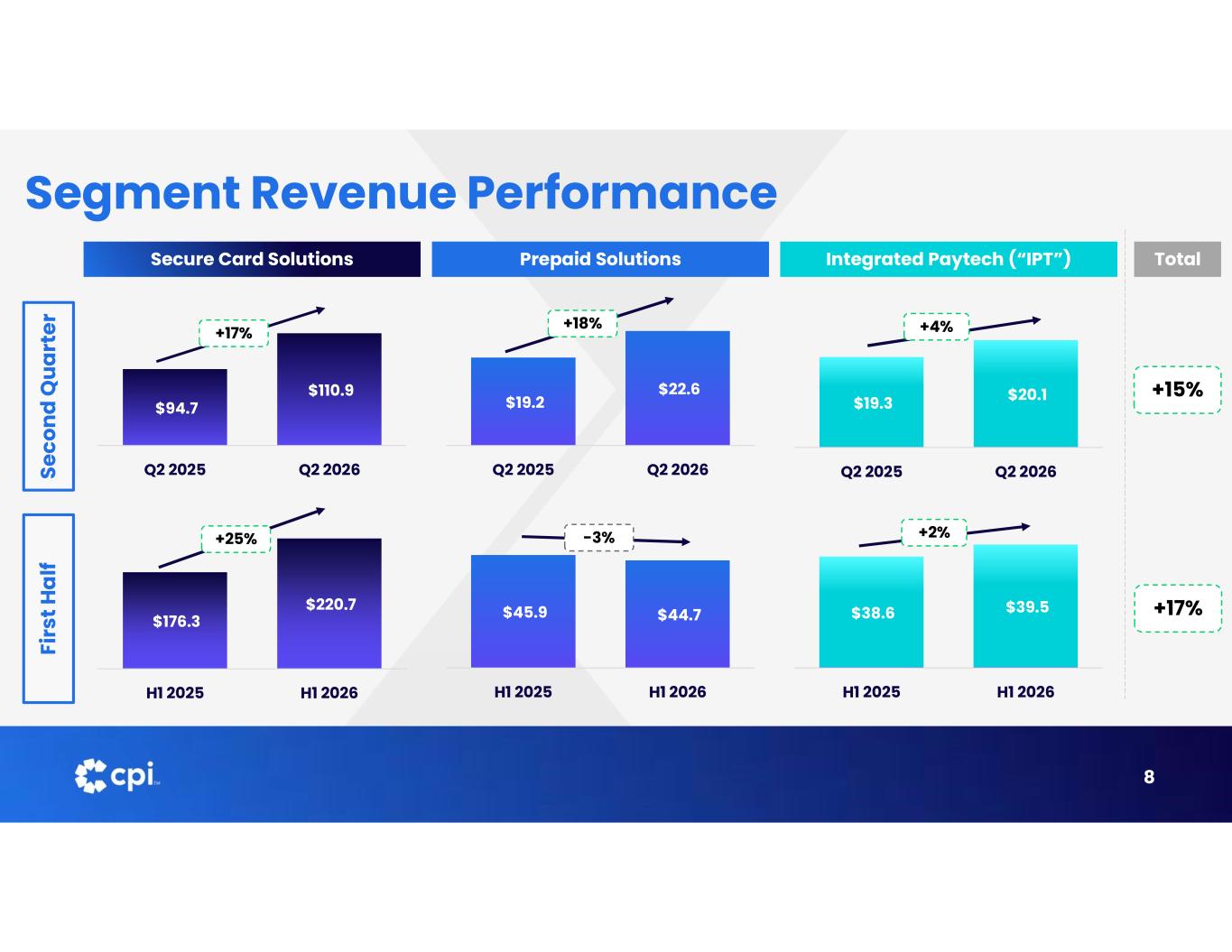
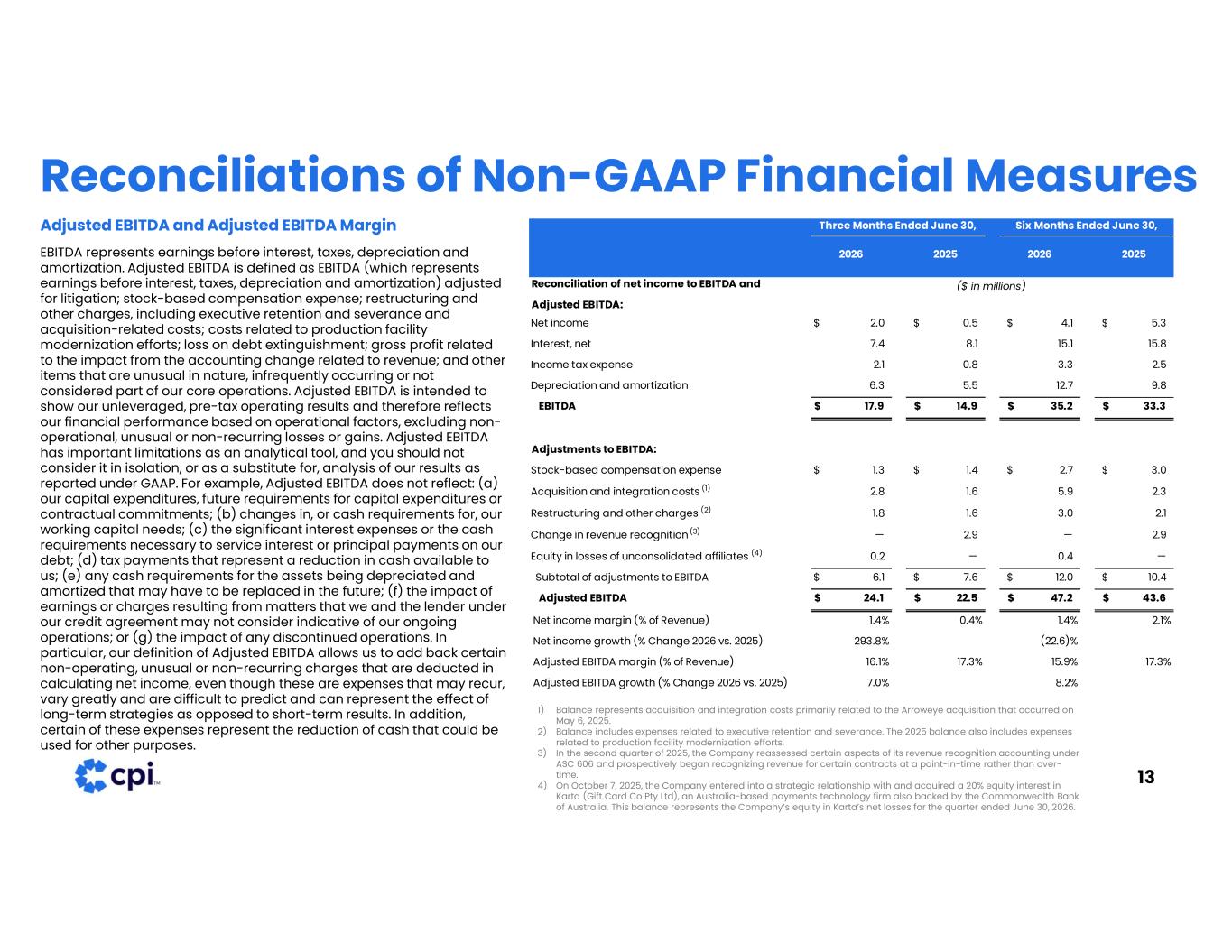
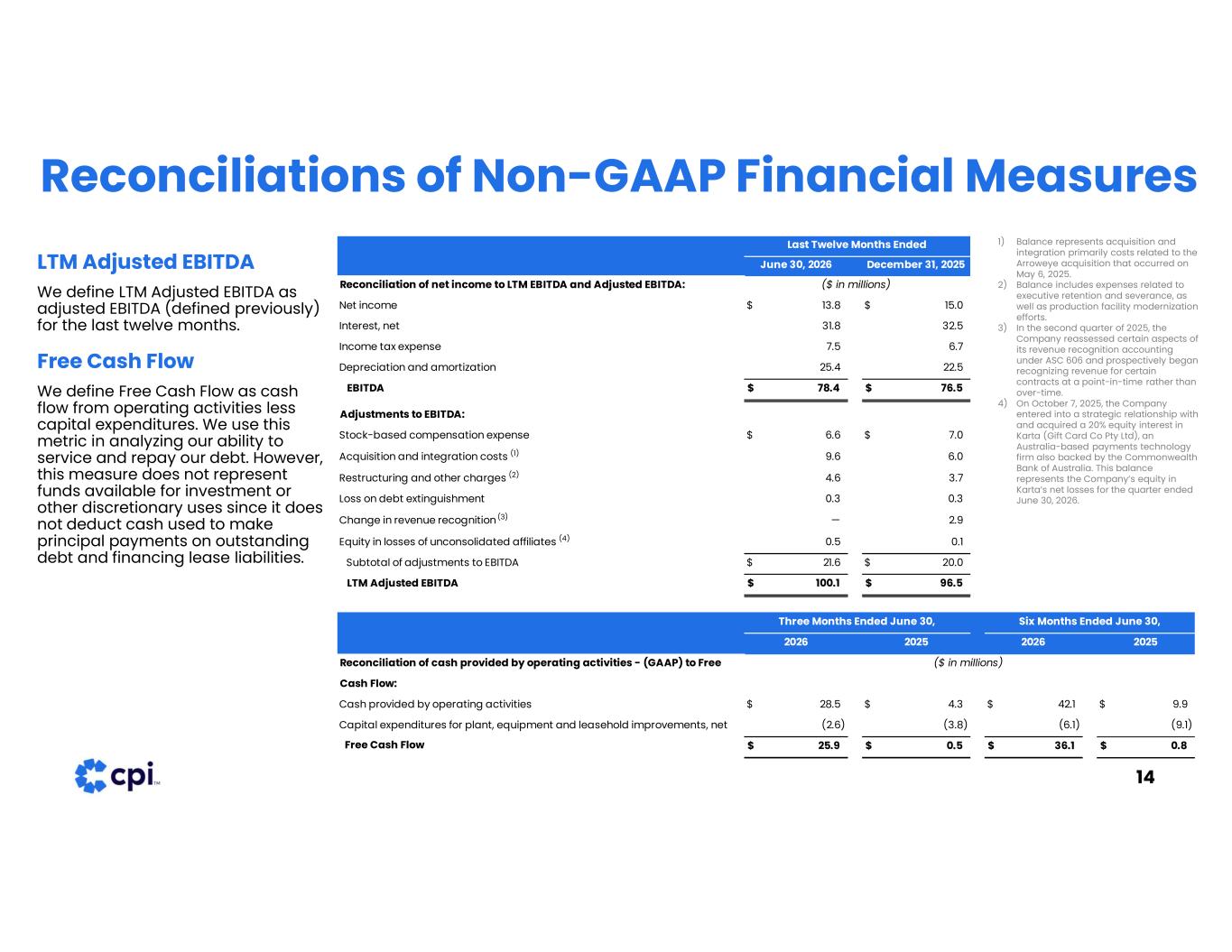
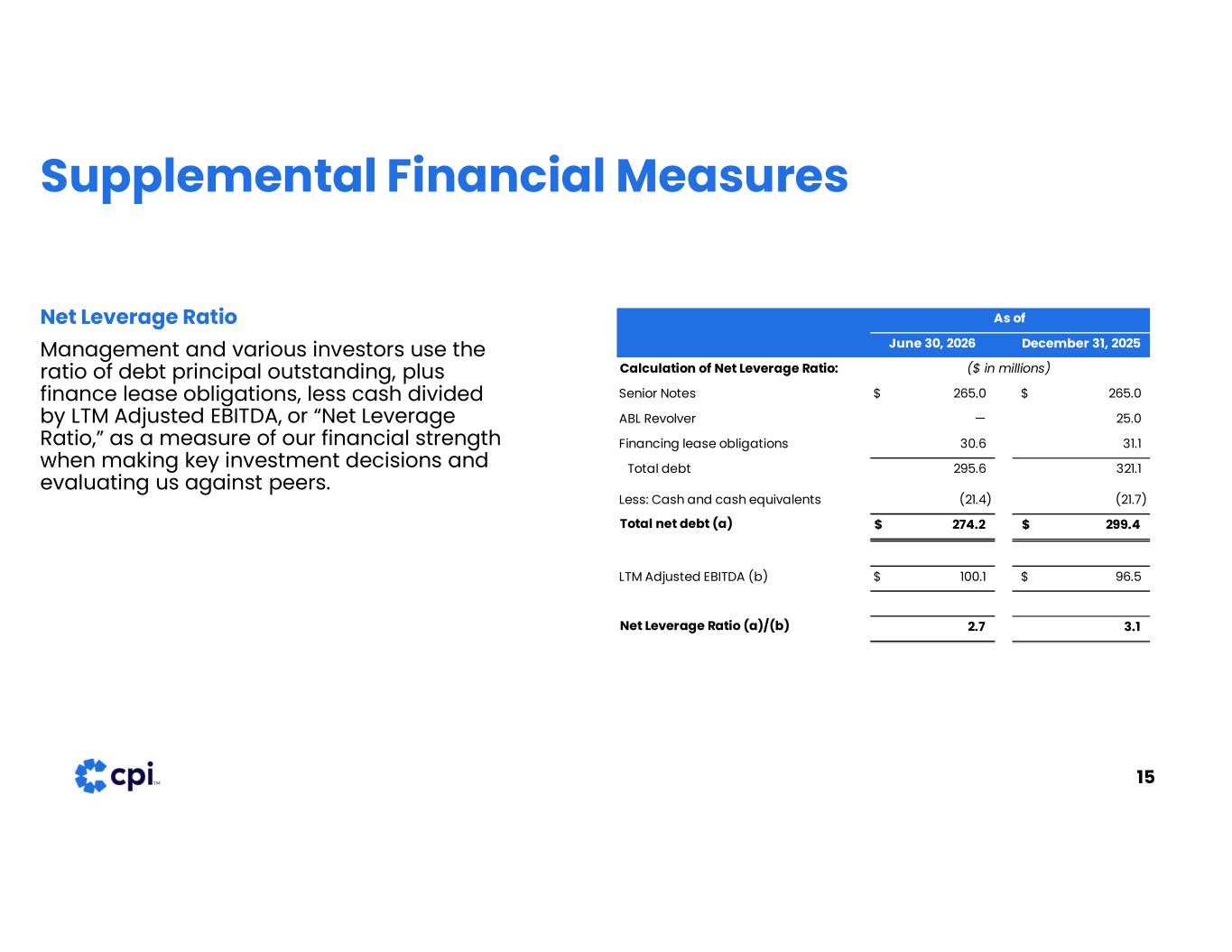
I look forward to continuing to partner with our leadership team as we execute our strategy, drive profitable growth, and create long-term value for our shareholders. I'll begin with our consolidated revenue and profitability results on slide 7. We are pleased with our second quarter and first half financial performance. Our strong results for the second quarter were better than our expectations, although the mix of performance across the business evolved as the first half progressed. Strong performance in Secure Card Solutions helped offset a slower-than-expected start to the year in prepaid solutions. Revenue increased 15% in the second quarter to $149 million dollars compared to 130 million dollars in the prior year period, driven by increased volumes of contactless cards and higher personalization solutions as well as contributions from the acquisition of AeroI. Excluding AeroI, total organic revenue grew 12 percent in the second quarter reflecting the underlying strength of our business. Second quarter gross profit increased 21 percent resulting in a gross profit margin of 32.5 percent in the second quarter an increase of approximately 160 basis points from 30.9 percent in the prior year period primarily driven by a benefit of more than three million dollars of tariff refunds second quarter adjusted EBITDA was 24 million dollars representing growth of seven percent driven by revenue growth in the benefits of tariff refunds. Gross margin and adjusted EBITDA margins were impacted by unfavorable segment mix due to softness and higher margin prepaid revenue that was partially offset by continued growth in Secure Card solutions, which, while profitable, carries lower margins than our prepaid business. SG&A expenses were $37 million in the second quarter compared to $31 million in the prior year period. The increase in SG&A was driven by AeroI integration expenses and investments in digital and technology as we fuel our efforts to grow and diversify in our higher margin, more recurring revenue businesses like Card at Once and digital. Integration and transaction-related costs, primarily related to AeroI, were nearly $3 million dollars in the second quarter. We expect these to be significantly lower in the second half of the year. We will have TRISM integration expenses in the second half, but at significantly lower spend levels. These investments have and will continue to support our long-term growth strategy through expanded capabilities and revenue and operating synergies. And as a reminder, under these costs are not included in adjusted EBITDA, but do impact net income. We are driving initiatives designed to improve margins over time. During the second quarter, we progressed supplier negotiations, realized incremental acquisition synergies, including freight scale efficiencies, advanced worksite optimization across our secure card solutions footprint, and moved our automation initiatives forward. We also continued our focus on expanding our growth in higher-margin solutions, including metal cards, and our integrated paytex segment. While some of these initiatives are already generating benefits, we expect a larger impact as we move through the year. Turning to our segment results on slide 8. In Secure Card Solutions, second quarter revenue increased 17% to $111 million, driven by increased volumes of contactless cards, higher personalization, and $5 million of AROI contribution. Excluding AROI, second quarter organic revenue in a Secure Card segment increased 13%, with strong underlying growth in our largest segment. In prepaid solutions, second quarter revenue increased 18% to $23 million, primarily due to a change in accounting that was implemented in the second quarter of 2025, partially offset by comparisons with strong sales of higher value packaging solutions in the prior year period. As I shared at the start of my remarks, we experienced a slower-than-expected start to the year in prepaid, as customer ordering patterns remained uneven. While the recovery has been slower than originally anticipated, we continue to be well-positioned to capture new revenue opportunities in this market, including in closed-loop, where we are continuing to see strong customer interest and in our strategic partnership with CARTA. Within Integrated Paytech, second quarter revenue increased 4%, driven by increased Card at Once revenue and a very small contribution from the TRISM instant issuance acquisition, which closed in late June. We continue to expect Integrated Paytech to deliver approximately 20% growth for the full year, an increase from 15% expected at the start of the year. While this implies a significant increase in growth in the second half of the year, we have confidence in this expectation based upon continued adoption of our Card at Once and digital solutions, contributions from TRISM, and the benefits of favorable comps versus the prior year. We generated exceptional cash flow in the first half of the year. Cash flow from operating activities was a record 42 million dollars in the first half compared with 10 million dollars in the prior year period free cash flow was 36 million dollars compared with 1 million dollars in the prior year period driven by lower working capital usage including reductions in chip inventory a strong secure card solutions performance accelerated inventory optimization initiatives Our free cash flow through the first six months of the year is a record for the company. Capital expenditures totaled $6 million in the first half, down from $9 million in the prior year period, as capital spending last year included investments for our new Indiana production facility. We now expect full-year CapEx to be slightly below our 2025 levels, driven by a reduction in certain equipment investments and lower software capitalization and plans. We are focusing CapEx on growing our digital solutions, enhancing our technology, driving automation, and other key growth investments. On the balance sheet, at quarter end, we had $21 million of cash, $92 million of available borrowing capacity under our ABL revolver, and $265 million of senior notes outstanding prior to our $26.5 million senior note redemption in mid-July. Net leverage ended the quarter at 2.7 times, down from 3.6 times at this point last year. The progress on our balance sheet reflects our commitment to deleveraging and reducing our interest expense while continuing to grow adjusted EBITDA. Wrapping up with our 2026 financial outlook on slide 10, as John shared at the beginning of the call, we are pleased to be increasing our 2026 financial guidance on revenue growth and free cash flow while holding our guidance on adjusted EBITDA and year-end net leverage. Our adjusted EBITDA outlook remains unchanged as the benefits from stronger SecureCard solutions performance and tariff refunds are expected to largely be offset by continued investment in integrated pay tech and ongoing choppiness in our higher margin prepaid solutions segment. We now expect revenue growth of high single digits to low double digits, • Adjusted EBITDA growth of low to mid single digits • Pre-cash flow ranging from $45-50 million and increase from our prior guidance of a conversion rate in line with 2025. • Year-end net leverage from 2.5 times to 3.0 times And as we already shared, we are raising our integrated pay tech segment revenue growth from 15% to approximately 20% helped by our acquisition of TRISM. Overall, our first half results keep us on track to achieve our updated full year objectives. We currently expect third quarter revenue and adjusted EBITDA to be slightly better than the second quarter as we progress toward our updated guidance. The actions we are taking to grow the business, expand our market opportunity, improve margins, and generate strong cash flow position us well for the remainder of 2026 and beyond. I'll now turn the call back to John for some closing remarks.
Thanks, Tara. We delivered a strong first half of 2026, achieving double-digit revenue growth and record-free cash flow, while continuing to execute on our strategy to grow and diversify the business. We expanded our digital and cloud capabilities, secured exciting customer wins, completed another strategic acquisition, and continued building momentum across our portfolio. At the same time, we strengthened our balance sheet, reduced debt, and maintained the flexibility to invest in future growth while creating value for shareholders. As I wrap up today's remarks, I want to recognize the CPI team for delivering a strong first half and positioning us for an even stronger second half of 2026. We have a robust sales pipeline, an increasingly high-quality recurring revenue customer base, and a clear focus on generating profitable growth. Operator, we will now open the call up for questions.
Operator
We will now open the call for your questions. If you would like to ask a question, please press star 1 to raise your hand. To withdraw your question, press star 1 again. We ask that you pick up your handset when asking a question to allow for optimum sound quality. If you are muted locally, please remember to unmute your device. Please stand by while we compile the Q&A roster. Your first question comes from the line of Peter Heckman with D.A. Davidson. Your line is now open. Please go ahead.
Good to see the nice, strong first half results. I had a question on the TRISM acquisition. I infer that this is a relatively small deal. I think in the original press release, you said that you didn't expect it to change your net leverage ratio at all. I did hop on a little bit late, so I apologize if you already covered it. But I guess in terms of thinking about incremental revenue, perhaps that you could pick up for 2027, And we should be thinking about maybe something like, you know, for the full year, like five to ten million dollars in revenue. And and and then just in terms of like the rationale for that deal, you know, I know I don't think there's very many players in the instant card issuance market. And and so absorbing this one, I should really help your competitive position. And so you can talk a little bit about what what what attributes the deal brings to CPI.
Yeah, Pete, good morning. Good question. No problem jumping on late. We can cover that. So just to start, you know, TRISM is a great strategic acquisition for us. You think about our position in the instant issuance market broadly. We historically have been the market leader by far in software as a service, kind of cloud-based solution where you're servicing those small to medium banks that don't have the ability to manage their own technology. We would also compete against a couple other players that would have on-premise solutions where they're typically servicing the larger banks with a greater number of locations that, you know, have large technology operations that can manage things on their own, and they want that somewhat. They want to buy the software, but they want to manage it on-site on their own. And so, Trism fits into that latter mold, so it really grows our addressable market essentially double from where we were, and a great investment for us. That said, going to your other question, size-wise, you know, we talked about TRISM increasing our integrated pay tech segment guidance this year from 15% to 20%. If you just ran that math, that's roughly, you know, three and a half, four million is what we expect for the latter part of this year. That said, that's because we're getting them kind of up and running under the CPI umbrella. We would expect that run rate to be double and probably a little bit larger in 2027, so don't want to necessarily give guidance yet. But I wouldn't expect just to be able to double that, and that's the guidance for 27, put it that way. Pete, does that answer your question?
Operator
Your next question comes from the line of Jacob Stefan with Lake Street Capital Market. Your line is now open. Please go ahead.
Appreciate you taking the questions. First, maybe just kind of building off of that last one on TRISM. Um, you know, when I look at IPT, it grew kind of, you know, low single digits in the first half, but, you know, your, your fiscal year guide is 20%. I think TRISM is, is probably, you know, in the three to $4 million range. Uh, what, what's the other 10 million, uh, that you're expecting to, to ramp in the, in the second half?
Hey, morning, Jacob. Uh, so really three things, um, you know, one, uh, our card at once business, uh, we, do have strong confidence in kind of the second half of the year. We see the line of sight to greater growth there, and that's good for us. You add in Trism, that's, as I mentioned, a small percentage of the growth. And then if you just look at comparables, you know, for 26 compared to 25, you know, Q3 was a pretty good quarter in 26. Q4 in 26 or 25 was a little bit slower of a quarter. So we would expect a fairly strong growth in Q3 for integrated pay tech segment and very strong growth in Q4 26 for integrated pay tech. So we're confident in the business and our line of sight to hit the 20% guidance for the year.
Okay, great. Maybe just on secure card, You know, that was up 25% in the first half. I guess how much of the incremental was, you know, AROI versus kind of your organic contactless personalization? And can that kind of maintain against, you know, as we look at the second half of the year?
Yeah, so I think if you look, Jacob, at our organic growth, it was also very strong in the first half of the year and in Q2. So overall for CPI, our organic growth for Q2 was 12%, and for the first half was 14%. And the majority of that was driven by strong organic growth and secure card solutions.
Last one for me, you know, just on the free cash flow, obviously $36 million is outstanding in the first half. Um, I guess, you know, with, with your guide, you know, being your, your commentary being 45 to 50, um, what, what kind of reverses in the second half and, um, how much inventory kind of releases is left in the model?
Well, Jacob, uh, first I'd say, I just want to thank the team. I mean, we had a tremendous amount of cashflow in the second quarter. Uh, that's a really first half is a record for us. You know, the performance in the business is really driving what I would say significant volume growth, which ultimately drives inventory optimization, which we've been pushing to do for a period of time post-COVID. And so we knew we'd get to this point, but, you know, now we look forward and we're excited about the cash flow perspectively. But I'll let Tara cover kind of second half a little bit.
Yeah. So, again, I'll echo what John said. Very happy with our pre-cash flow performance in the first half. And a lot of that was driven by inventory, I would say, acceleration of our inventory optimization. And I do want to say we actually, you know, continue to focus on that, and we expect our inventory to continue to improve in the second half. But we do have some other items in the second half that will not be as positive in the first half, primarily kind of around our AR and AP, which we did have some timing things there, so really good performance in the first half. And some of that was with team efforts and strong working capital management, but we also had a little bit of timing. And then we do expect a higher capex in the second half as well. But overall, we're very focused on, you know, continuing to drive cash flow, super excited about that strong performance and strong working capital management as we continue to go forward.
Okay, great. I appreciate all the color. I'll turn it over.
Operator
Your next question comes from the line of Peter Heckman with D.A. Davidson. Your line is now open. Please go ahead.
Hey, John, sorry about that. I was on mute and I did have a follow-up question, but your answer to the prior question on TRISM was very helpful. Just thinking about, and again, I apologize if I missed it, but could you just go into a little bit of detail in terms of progress on anti-fraud packaging, on closed-loop prepaid cards, if you've had any progress there and, you know, whether or not you have had any change in terms of your thoughts about the relative opportunity there over the next 18 months.
Yeah, Pete, no problem. And good question. The prepaid market broadly, you know, we said this in the last couple quarters. I think we're extremely well positioned for what may occur on a go-for basis. You know, just like any other market, things change on a kind of a slow basis, if you know what I mean. So it's hard to put a specific date on changes. But if you think about the two big markets, right, open loop where we've been a leader for a long time, closed loop where we're just entering into closed loops about five times the size of open loop from a volume perspective. and the value of closed-loop continues to rise as there's regulation changing in the states and retailers, merchandisers, essentially demanding greater packaging around closed-loop cards. And that's where we fit in because we're the largest prepaid packager in the United States by far. And on the open-loop side, when you add in our ability to take our chip expertise, if you will, that we have on the secure card solution side, the IPT side. That is something that we're already in pilot with one of the largest national retailers in the United States. We're kind of in the second stages of that pilot. Seems to be going well. So just like anything else, you know, things take time, but we're excited about the opportunity. And again, wouldn't put a number on what that means for 27 or 28. But I will say we're happy about our position in the market, and we're excited about what's to come in prepaid broadly.
Okay, that's helpful. And then just last question on metal cards. I know it's a very small portion of your overall business, but I do think it's getting bigger. If I remember correctly, you had a pretty good year last year, and I think I've seen a couple of advertisements here and there.
Can you talk a little bit about how your metal cards differ from maybe the other major metal card provider and where you see some opportunities there? yeah good question um well you know we didn't really cover it this morning but we did have decent metal sales in q2 we had pretty strong metal sales in q1 just a much smaller part of the business that said but where we compete is at a a more uh value price point than some of our competitors but also while providing a high value uh kind of marketable product if you will The latest one that our teams have been working on is almost like an on-demand metal product, and that we've been slightly advertising, I'd say. It's kind of in early days, but metal's a market we will continue to participate in, continue to innovate in, and we feel like our value proposition within the market, especially for those thousands of small to medium banks we serve, We feel like we're well-positioned to capitalize on metals. It continues to grow from a market perspective.
Great. Okay. I appreciate it. Have a good day.
Operator
Your next question comes from the line of Andrew Scutt with Roth Capital Partners. Your line is now open. Please go ahead.
Good morning, guys, and thank you for taking my questions and that continued progress. First, going to piggyback off the previous question on prepaid. Just outside the packaging, you guys kind of mentioned a little bit of lumpiness in demand in the quarter. Can you guys just kind of talk about what pockets you're kind of seeing that are working and maybe some of the areas where demand might be lagging a little bit behind expectations?
Yeah, I mean, I think we said this. We knew the first half of the year would be a little bit weak. I'd say the second half, we just expect things to continue further as the market tries to figure out how to protect against fraud. And the demand side, most of that is in the open loop side of the market, because that's the majority of what we service, as well as our leading position is an open loop. But that said, Andrew, you know, closed loop, just as a reminder, we really started entering the closed-loop market in the latter part of 2025, did a small amount of closed-loop in the latter part of 2025, but had really decent growth in closed-loop. I mean, it's still small in relation to the whole business, but closed-loop is very positive for us, and we see a ton of customer interest from where we're positioned and what our capabilities are, especially on the packaging side for closed-loop. So, again, I think the prepaid market will remain choppy through late 26. That's our expectation. But that said, I mean, we're well positioned to grow with prepaid market and somewhat are supporting that growth through the innovation that we have from a packaging and chip expertise perspective.
Great. Appreciate the caller. And then second for me, it's wonderful to hear the continued organic growth and secure card solutions.
Now, kind of as we think of the transition to the Fort Wayne facility, how has that kind of helped you absorb these additional volumes and kind of can you help us quantify how much more capacity you have for you know continued continued growth yeah I mean I'll I'll start and ask Tara to jump in I mean we're excited about Fort Wayne I mean the Fort Wayne team's doing a great job we're now able to move work pretty much between Fort Wayne and our other site in Colorado pretty easily the team's innovated quite a bit to make those two sites streamline that that helps us to manage kind of uh where to put the best work for the best margin if you will um but that said uh capacity
wise i think we do have uh a ways to go before we're at full capacity and we we essentially built the site you know looking you know 10 plus years out not necessarily for next year but tara any color you would give um yeah i mean i would just add that i mean we were definitely at a point where we were kind of uh you know running out of capacity so uh it was a really important investment for us to continue to be able to grow the business. And, you know, as John said, not at full capacity yet, but as you can see in our results, you know, we are continuing to grow in our secure card solutions business, you know, gaining share there. And certainly that's a very important component that we've invested in that Indiana business to, or sorry, in that Indiana site to be able to facilitate that growth as well as future growth.
Understood. Well, thanks for taking my questions and congrats on the strong first half. Yep.
Operator
Your next question and final question will come from Hal Goach with B. Riley Securities. Your line is now open. Please go ahead.
Hey, guys. Terrific results. You mentioned prepaid is going to be choppy through late 2026. And are you facing basically tough comparisons or, you know, what is the cause maybe of what you would think maybe is a very consistent business, it's very choppy this year, even, you know, Q1 or Q2 growth is much better than Q1. What are some explanations for that? And if you have any extra color, thank you.
Yeah, morning, Hal. Well, there's kind of two things. One, we did have some strong quarters last year, I would say. Prepaid had especially a really good Q4 of 2025, if you go back and look at it. So there are kind of high comparables in comparison. And we've seen that in the prepaid business and where we sit in the market, just given our position in the market. As the market ebbs and flows, right, we experienced that. But just going back broadly, I mean, if you think about our position and the market trying to protect against fraud, I think the point we would make is we still believe it's a growing We've heard that from our customers. Our position in the closed-loop side, there's a lot of opportunity there. And whether you're in the open-loop or closed-loop side, it all comes back to how do you protect against fraud? Do you implement greater packaging or do you implement some sort of chip solution? And we, by far, are the largest packager of prepaid cards in the U.S. and have extremely deep ship expertise, which is a unique combination that no one else has in the market. So, you know, I wish I had better information on the prepaid goal for this year, but I think it's going to be a little bit choppy this year. But we're confident in the longer-term growth and opportunities set in the prepaid business.
Yeah. Two quick follow-ups. One is on the balance sheet. So, terrific work there. But, you know, a lot of the free cash flow, you know, stems from like a, you know, really getting inventories in line, you know, accounts receivable lower, you know, where there's some, you know, big invoices outstanding in receivables, so it's a big working capital benefit, probably won't get too much more of that, but, you know, it's still great to see, bringing that, be able to pay that term loan. So, any other comments on, like, you know, the free capital situation? We probably should expect this kind of performance every first half of the year, should we?
Yeah, I mean, there were definitely some specific drivers, Hal, of our strong K-1 performance. And, you know, as we've talked about, the, you know, the inventory optimization was accelerated by our strong growth in our secure card solutions.
But, you know, some of that is due to timing. however just kind of wanted to remind we did take up our free cash flow guidance though for the full year so to 45 to 50 million so uh definitely really strong performance and uh expect uh really great performance for the full year as well okay and last one for me like you know after in fort wayne new plant kind of running maybe opting optimized is it any color on the benefits that new plant has done any any lessons learned or any color of the learning curve of the new planet is it producing for you what you thought above expectations in line any color would be great
yeah i mean how i mean we we've talked about the um you know automation we've been investing in um really just a kind of a more advanced site if you will i'd say the other side of it is we've been bringing customers through regularly. And, you know, we're investing where many in our industry are not putting those dollars to work to really modernize their locations, right? They're trying to squeeze as much out of a site as they can. And that investment is something that really shows to our customers, shows them that we're willing to help them win in what they're doing. And so, you know, margin-wise, things will continue to improve and efficiency will continue to improve. But I think people underestimate the value of investing for customers, and that's a strategy that we'll continue to employ. But, Tara, anything else you would add?
Yeah, I mean, I think one of the initiatives, too, that is exciting that we've done is we've built out that facility is something John mentioned earlier, which is being able to really move things across sites. So that really helps us as well. in terms of, you know, getting to a, I'll call it that optimized, you know, production mix and making sure that we're able to put jobs in the most profitable place within that network.
Operator
As there are no further questions in the queue, I would now like to turn the call back over to John Lowe for closing remarks.
Well, thanks everyone for joining us. Before we sign off, I'd like to thank our employees for their continued dedication, our customers for their trust and partnership, and our shareholders for their ongoing support. We look forward to delivering a strong second half of 2026. Have a great day.
Operator
This concludes today's call. Thank you for attending. You may now disconnect.