Operator
Everyone, thank you for standing by and welcome to the TE Connectivity third quarter earnings call for fiscal year 2026. At this time, all lines are in a listen-only mode. Later, we will conduct a question and answer session. If you would like to ask a question, please press 1 to raise your hand. To withdraw your question, press 1 again. As a reminder, today's call is being recorded. I would now like to turn the conference over to our host, Vice President of Investor Relations, Sujal Shah. Please go ahead.
Good morning, and thank you for joining our conference call to discuss TE Connectivity's third quarter results and outlook for our fourth quarter of fiscal 2026. With me today are Chief Executive Officer Terrence Curtin and Chief Financial Officer Heath Mitts. During this call, we will be providing certain forward-looking information, and we ask you to review the forward-looking cautionary statements included in today's press release. In addition, we will use certain non-GAAP measures in our discussion this morning, and we ask you to review the sections of our press release and the accompanying slide presentation that address the use of these items. The press release and related tables, along with the slide presentation, can be found on the investor relations portion. You may rejoin the queue if you have a second question. Now let me turn the call over to Terrence for opening comments.
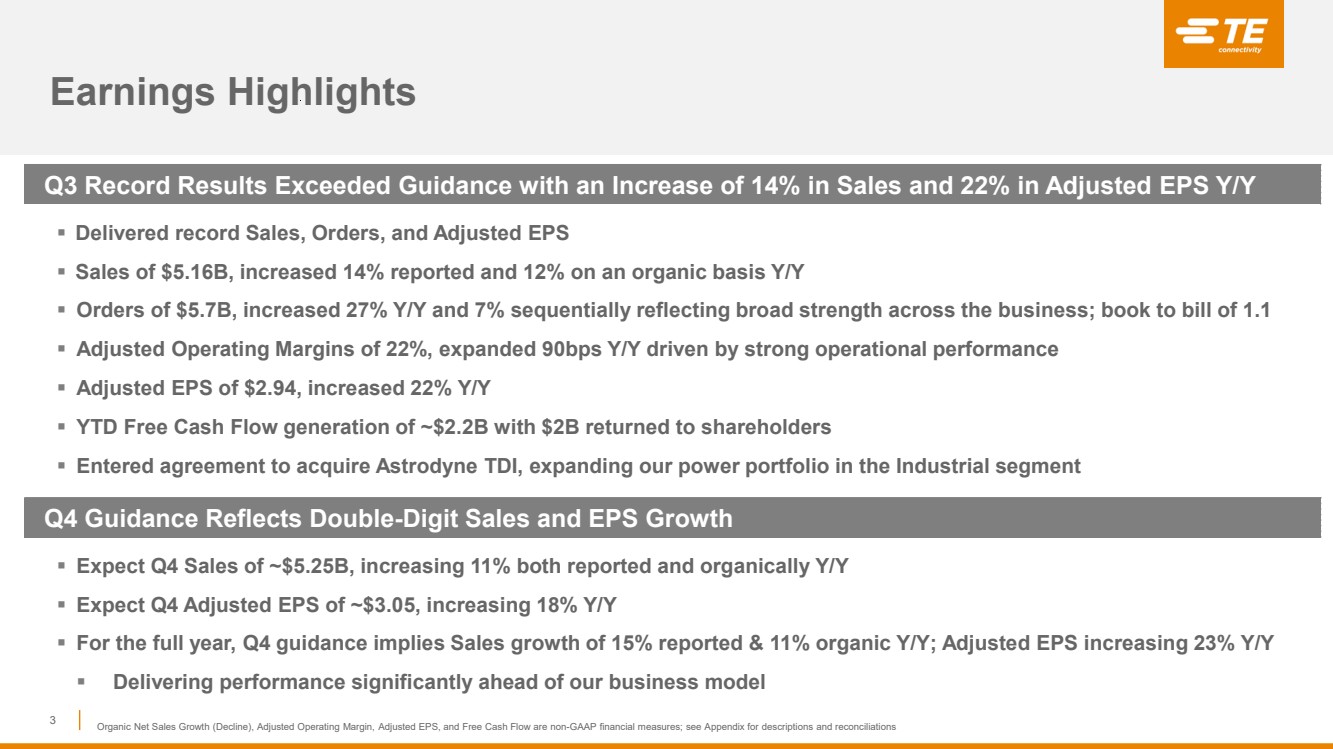
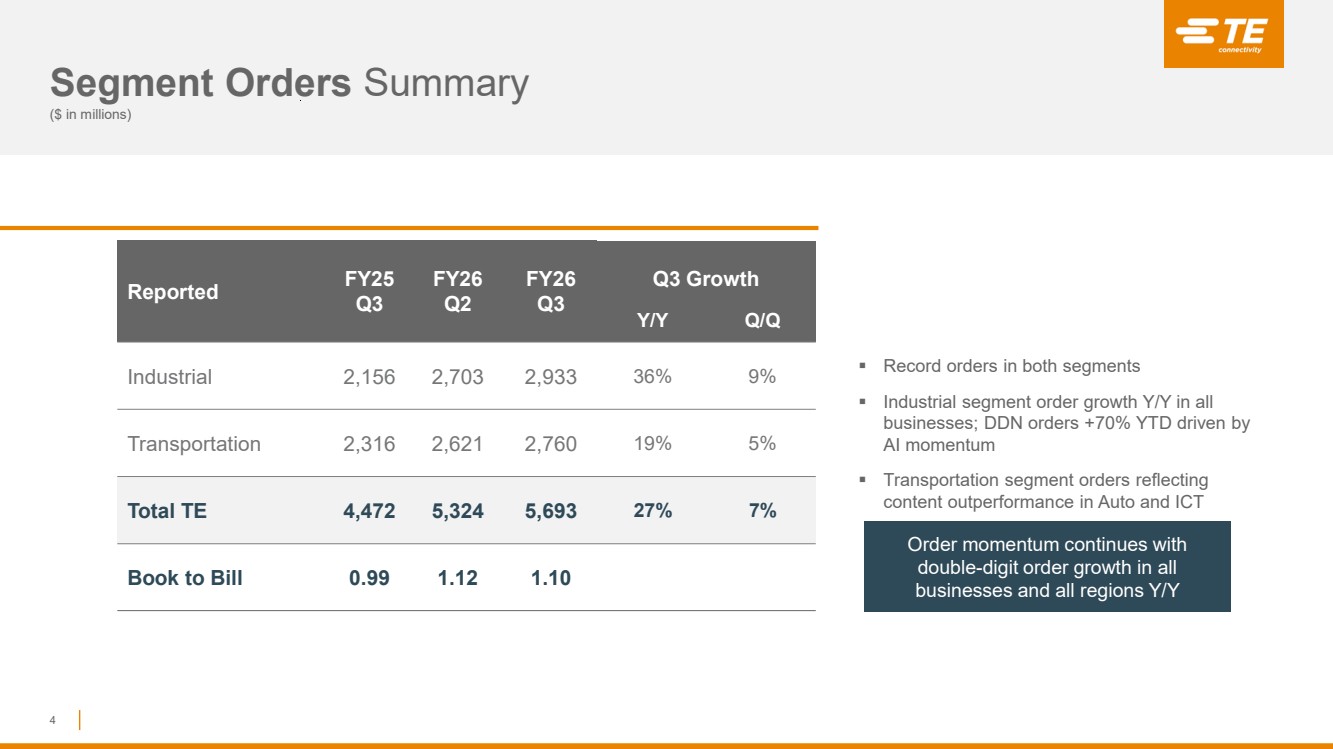
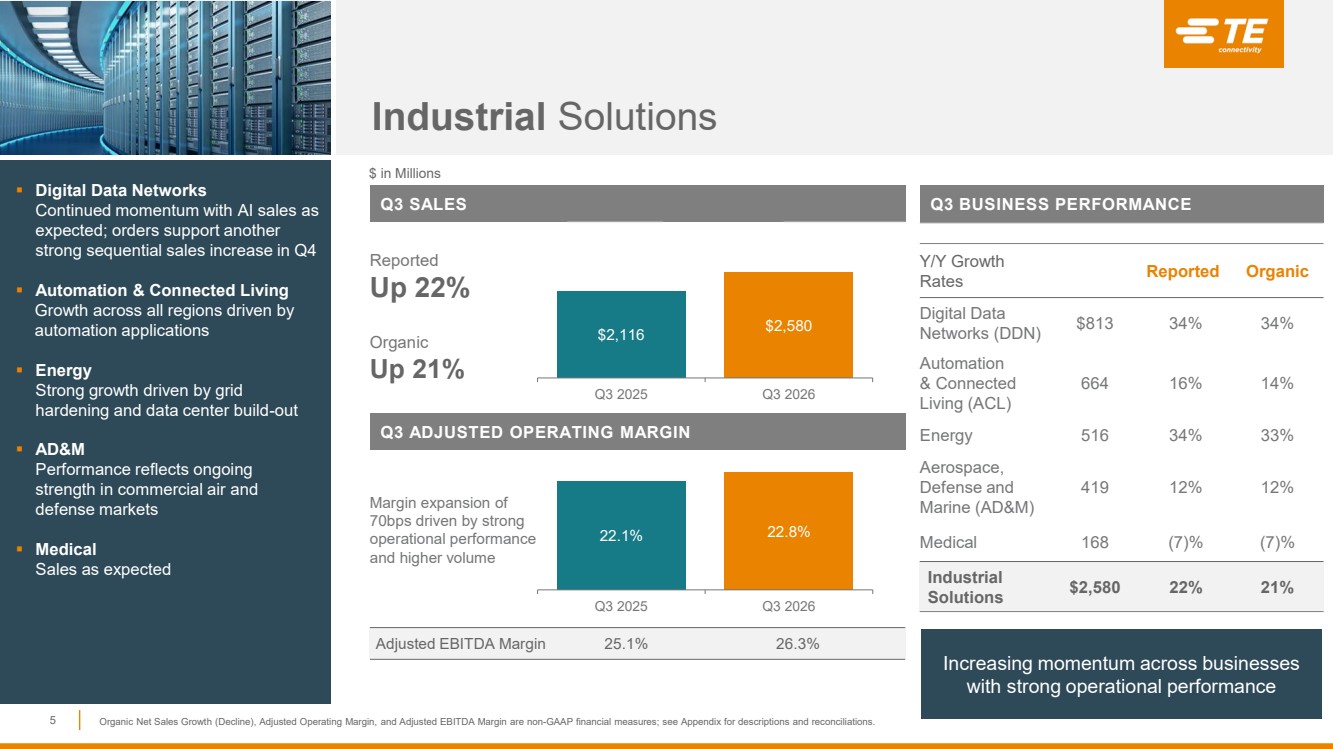
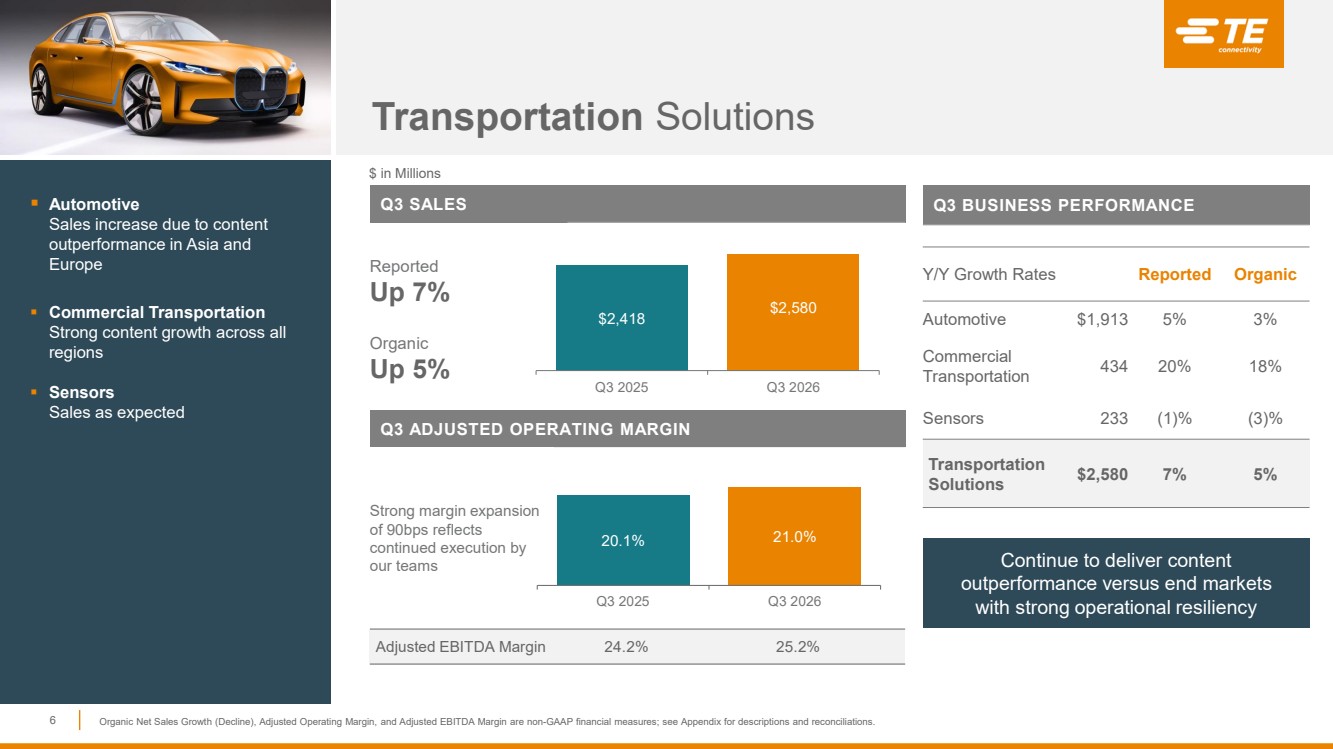
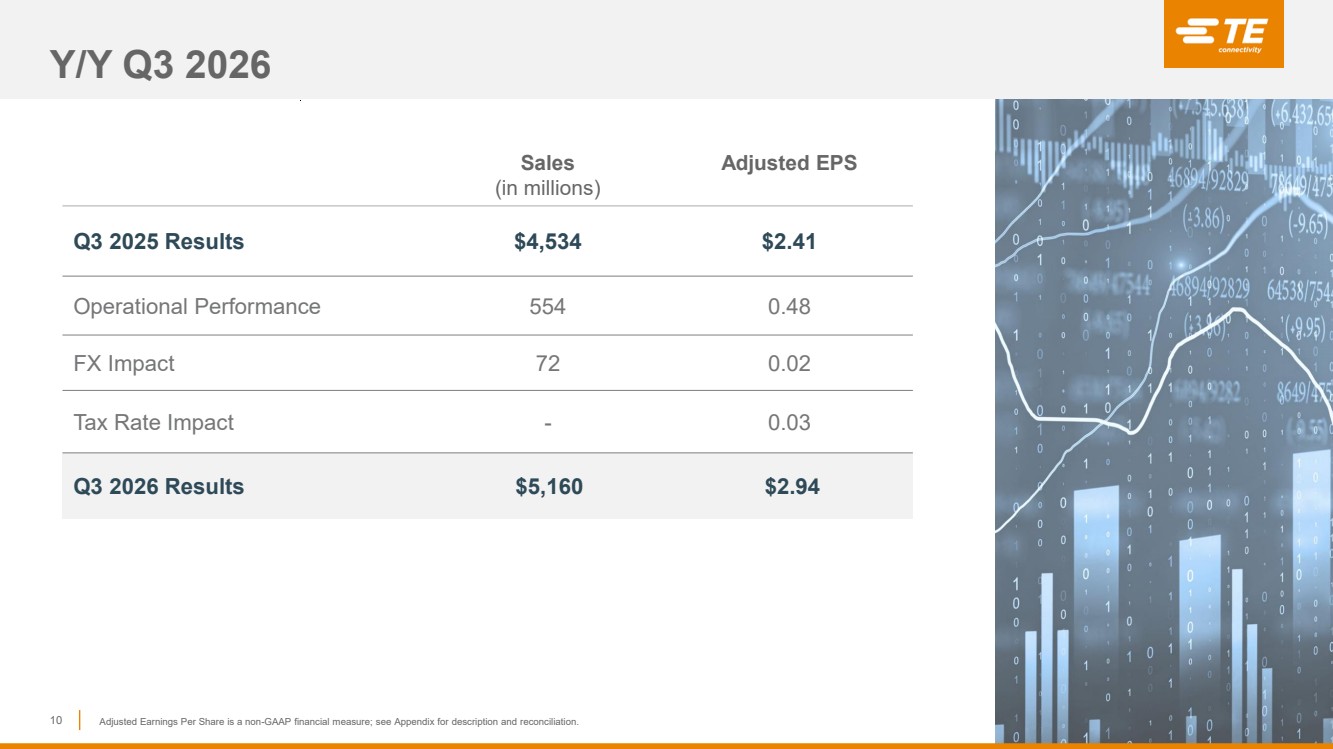
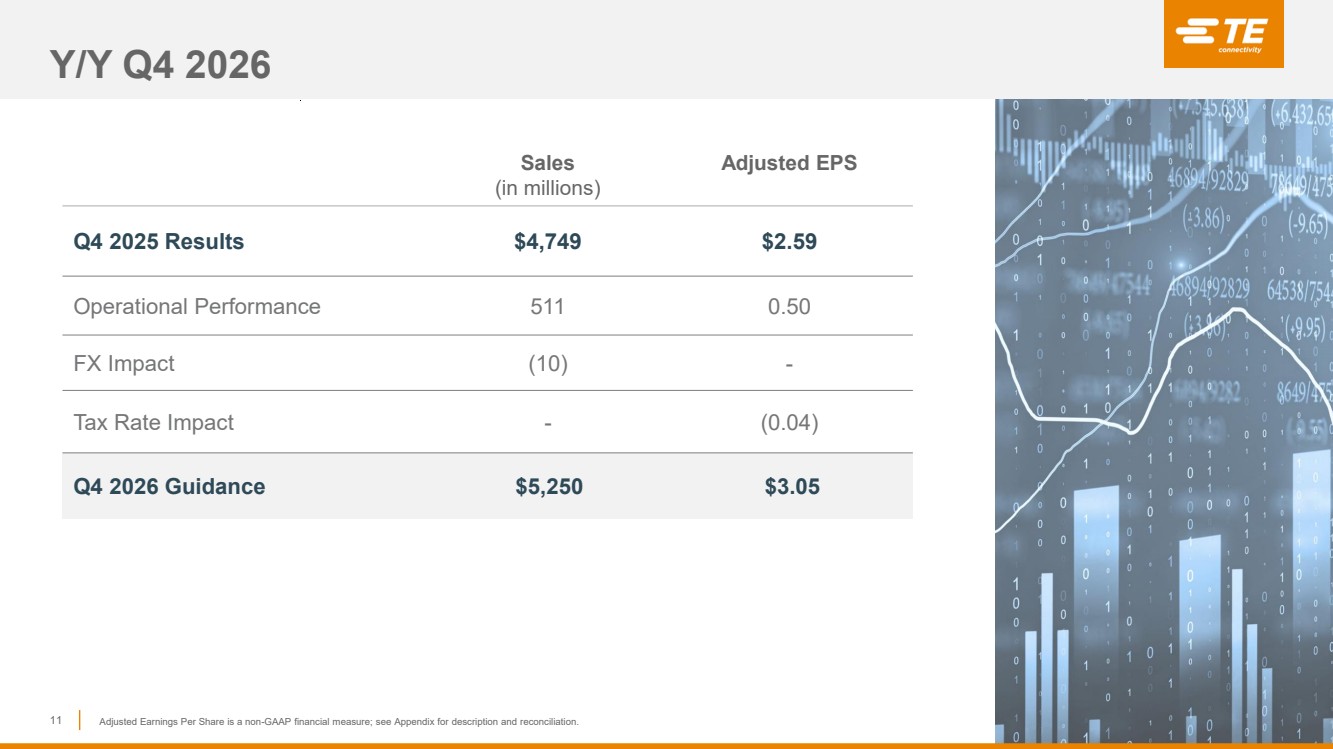
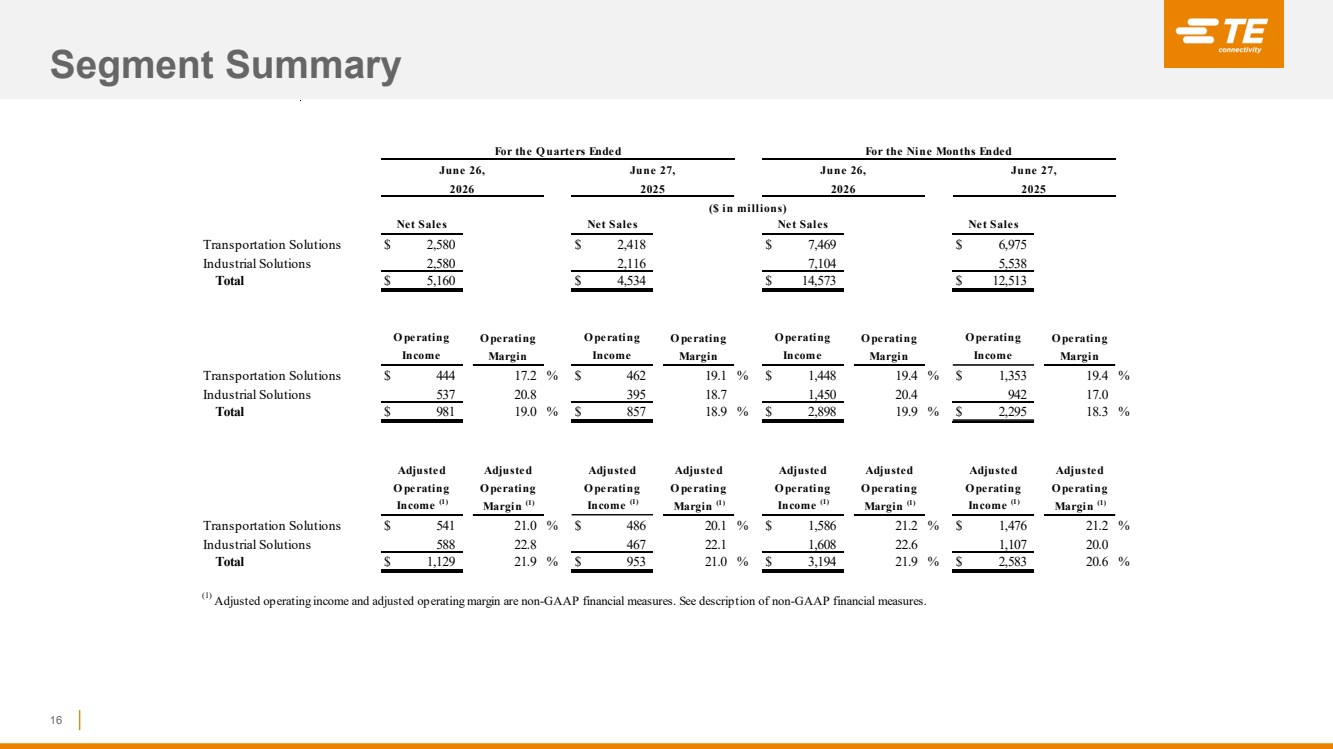
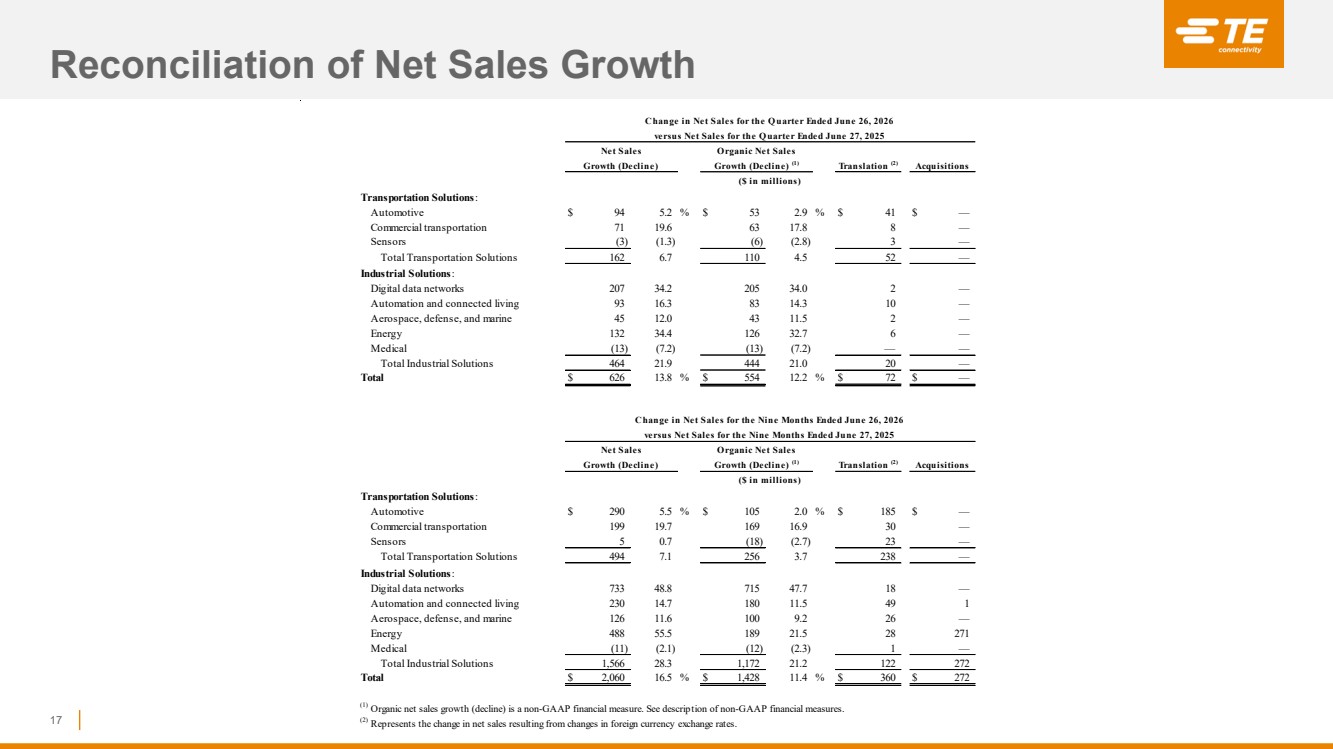
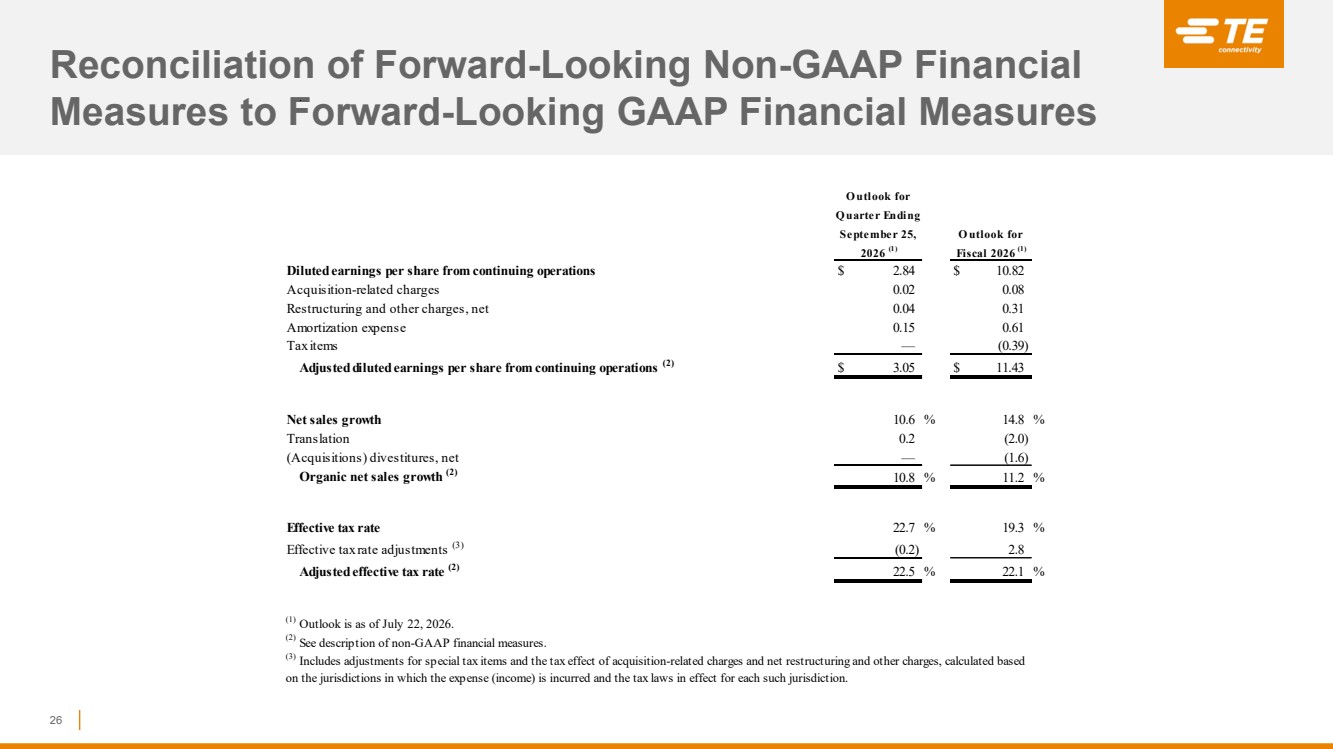
Good morning, everyone, and thank you for joining us. And before I get into the details on the slides, I do want to frame today's call around a couple key takeaways. Our strategic positioning around the accelerating data and power trend continues to drive broad-based outperformance. And we are at the intersection of the largest technology and infrastructure investment cycle that's taking place around the world. We also continue to benefit from continued market momentum driven by both secular growth trends as well as positive cyclical market inflections, and we'll click down on these during today's call. As we outlined at our investor day earlier this year, we expect our strategy to deliver broad-based growth while driving sustained margin expansion and double-digit earnings growth. As we progress through this year, we have continued to execute against this strategy, and our third quarter results and outlook provide further evidence that our strategy is working. Our positioning is creating opportunities across multiple long-term growth drivers as increasing data and power requirements are reshaping our customers' architectures, and this is where our interconnect technologies are essential. Investments in AI infrastructure continue to drive strong growth in both our digital data networks and energy businesses. Further secular trends including electrification, automation, and increasing compute at the edge applications are driving growth across our aerospace and defense, automation and connected living, automotive, and commercial transportation businesses. These investments are expanding our opportunities across both our segments and reinforce our confidence in TE's long-term growth outlook. The strength of these trends is reflected in our record order performance with double-digit order growth in every business across both segments. For the full fiscal year, we now expect sales to grow approximately 15%, representing more than $2.5 billion of incremental revenue in 2026 while delivering margin expansion and earnings per share growth above 20%. Importantly, our record order momentum and growing backlog provide increasing visibility into continued broad-based growth as we move into next year, reinforcing our strategy and our ability to compound earnings that create long-term value for our owners. So with that as a quick overview, I'd ask you to turn to slide three to review our third quarter results and our outlook for the fourth quarter. In the third quarter, sales were $5.2 billion and they increased 14% on a reported basis and 12% organically over last year. You know, our order momentum continues to increase, which resulted in record order levels of 5.7 billion dollars growing 27 percent versus the prior year as well as seven percent on a sequential basis and as i normally do i'll provide more details on sales and orders in the next few slides we deliver 22 earnings per share growth to a record adjusted earnings per share of two dollars and 94 cents and adjusted margins expanded 90 basis points reflecting the continued execution of our teams, while also delivering for our customers. You know, in this growth environment, the other thing that we're proud of, we continue to demonstrate the strength of our cash generation model. Year-to-date, we've generated approximately $2.2 billion of free cash flow, while continue to make investments to support future growth in both engineering as well as manufacturing capacity. In addition to the organic investments, today we signed an agreement to acquire Astrodyne TDI, which is a bolt-on acquisition that broadens our portfolio of power and filter products for mission-critical applications that'll be part of our industrial segment. And Heath will click down with some additional details about this acquisition that we're excited about in his section. Looking forward, we expect our fourth quarter sales of approximately $5.25 billion, which will increase 11% versus the prior year. And we expect to deliver adjusted earnings per share of approximately $3.05. For the full year, we expect to deliver growth of 15% in sales and 23% in adjusted EPS year over year. So let's get into orders. And if you could please turn to slide four, I'll click down into the order trends we're seeing. Orders increased over $1 billion year over year to a record of $5.7 billion in the quarter. And the order momentum was in both segments which reinforces the breadth of our growth. The industrial segment continues at strong momentum with orders increasing 36% versus the prior year. These record industrial orders were driven by increasing momentum in AI along with strong growth in every business. And just to give you the flavor of the momentum, in our digital data networks business year to date our orders are up over 70 percent versus last year and in our energy aerospace and defense and automating connected living all have 20 percent order growth year to date turning to transportation segment orders increased 19 percent versus the prior year reflecting continued content growth in both automotive and commercial transportation we saw double-digit year-over-year order growth across all three of the transportation businesses, supporting our competence and continued market outperformance driven by where we positioned ourselves on content. We are running a book to bill of 1.1, both in the quarter as well as year to date. Our orders have not only translated into strong growth this year, but also have resulted in a record backlog position. And this backlog position is a strong growth indicator as we move into our fiscal 2027. Now let me click down into the segment results and I'll start with the industrial segment that is on your slide five. In the third quarter, our industrial solution sales grew 22% on a reported basis and 21% organically year-over-year with broad-based growth as you see on the slide across the segment led by over 30% organic growth in both our DDN and energy businesses. We are uniquely positioned at the intersection of the accelerating data and power investment cycle. What differentiates our industrial segment is the breadth of our participation across the AI infrastructure with AI driving demand not only for high speed and power connectivity in and around the rack but also for the energy infrastructure required to bring power to the data center. This positions both our DDN and energy businesses to benefit as AI infrastructure continues to scale while the rest of our industrial portfolio continues to benefit from broader secular growth trends. In digital data networks, our teams delivered another very strong quarter of growth, with sales increasing 34% year-over-year and up $100 million sequentially, which was aligned with our expectations, and we expect DDN to deliver the full-year growth we talked about last quarter. In data connectivity, we continue to see increasing demand as AI architectures evolve towards ingenic workloads driving greater deployment of CPUs and networking, which increases the addressable market for high-speed copper connectivity. In optical, we see additional long-term growth opportunities beyond what we have outlined in Investor Day. Through the RAM Photonics acquisition, we strengthened our optical roadmap with fiber attached connectivity, and we are encouraged by our customer engagement around this future growth opportunity in our daydm business we also see growing opportunities and power connectivity as our customers evolve their architecture we have deep expertise in material science thermal management safety and reliability challenges associated moving to higher voltage connectivity as the industry moves towards higher voltage architectures we are well positioned to support our customers evolving connectivity requirements turning to energy we saw very strong sales growth and our organic sales increased a very strong 33 driven by continued investment across grid hardening where utilities continue to modernize aging infrastructure for increased power needs as well as data center build outs our ai opportunity extends beyond the rack data center build-outs are driving significant investment across the power infrastructure and we provide the connectivity solution that enable generation transmission and distribution infrastructure which gives us the unique position i highlighted earlier turning to our automation and connected living business sales increased 16 and 14 on an organic business basis with growth across every region. Versus 90 days ago, we are seeing additional indicators of both cyclical growth as well as content outperformance. We now expect this market to grow high single digits this year and with our strong position in automation, we expect to outperform the end market. In aerospace and defense, our business grew 12%, which reflects the continued strength in both the commercial airspace as well as what we're seeing in the defense markets where our data connectivity and power products are essential to next generation platforms in our medical business our team delivered sales as we expected and at the segment level turning to margins industrial segment adjusted operating margins expanded 70 basis points to nearly 23 reflecting continued strong execution by our teams now let me turn to our transportation solution segment, and that'll be on slide six. In the third quarter, our transportation solution segment grew 7% on a reported basis and 5% organically year over year. Growth was driven by content outperformance in our end markets, particularly in Asia, our leading global position, as well as our customer co-creation model. In automotive, sales increased 5% on a reported basis and 3% organically. We continue to deliver growth above the market due to content drivers despite a decline in vehicle production. Data connectivity in the vehicle continues to be a significant driver along with electrification of the powertrain where we benefit largely in Asia and software-defined vehicle architectures. We expect our full-year content outperformance to be in our four to six point range for both this year as well as longer term. Turning to our commercial transportation business, sales increased 20 percent on a reported base as well as 18 percent on an organic basis. We continue to see improving cycle trends across regions and market verticals while delivering significant growth above the market through new program winds, further electrification of trucks in Asia, and strong execution across all regions. In our sensors business, our performance was as we expected. And at the segment level, and looking at margins, the transportation team delivered adjusted operating margins of 21%, demonstrating the resiliency of the execution by our transportation team. So with that as a click down on the segment performance, let me turn it over to Heath who'll get more details on the financials and our expectations going forward.
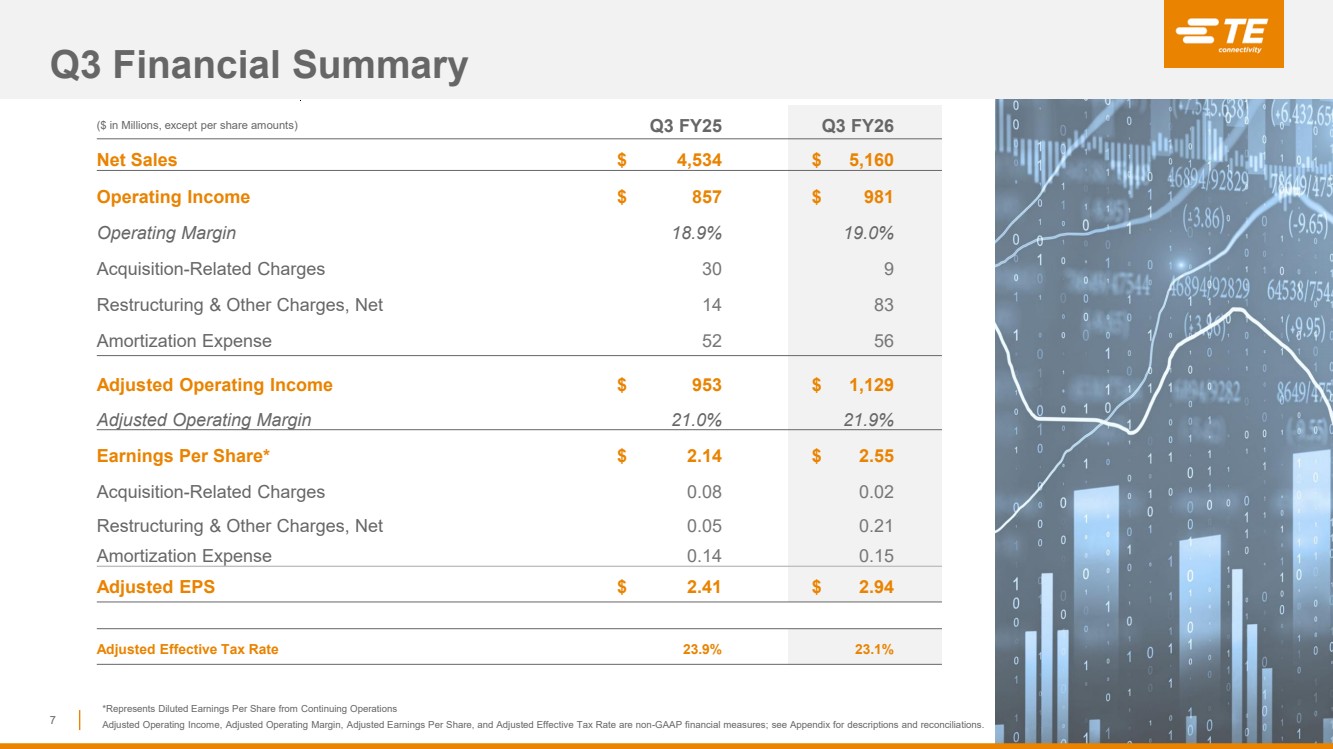
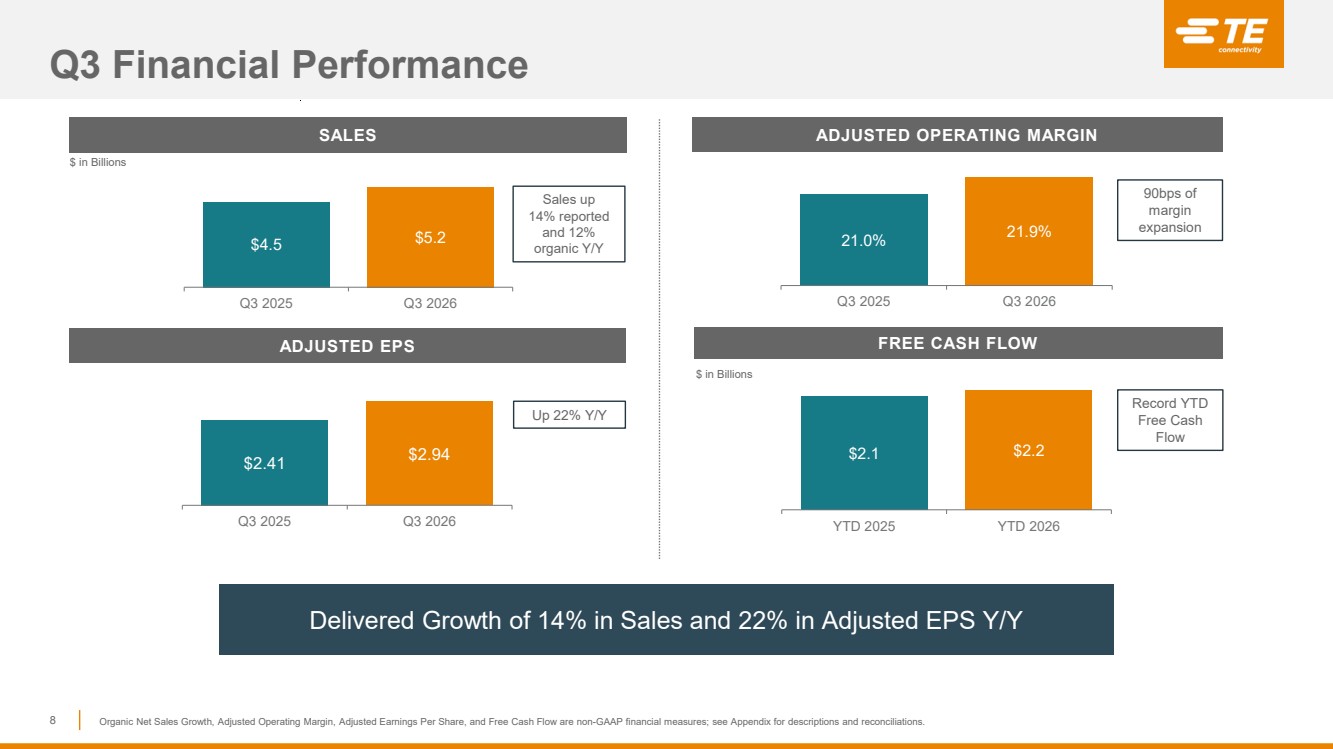
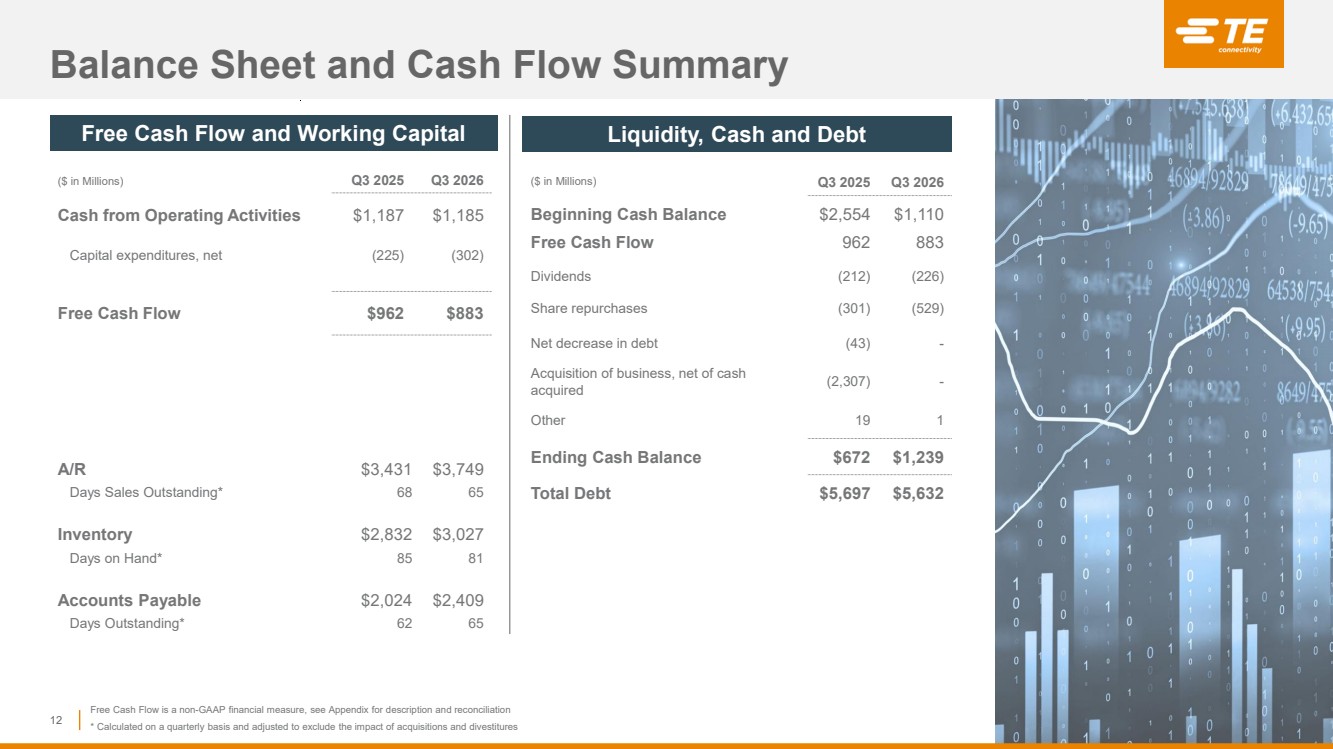
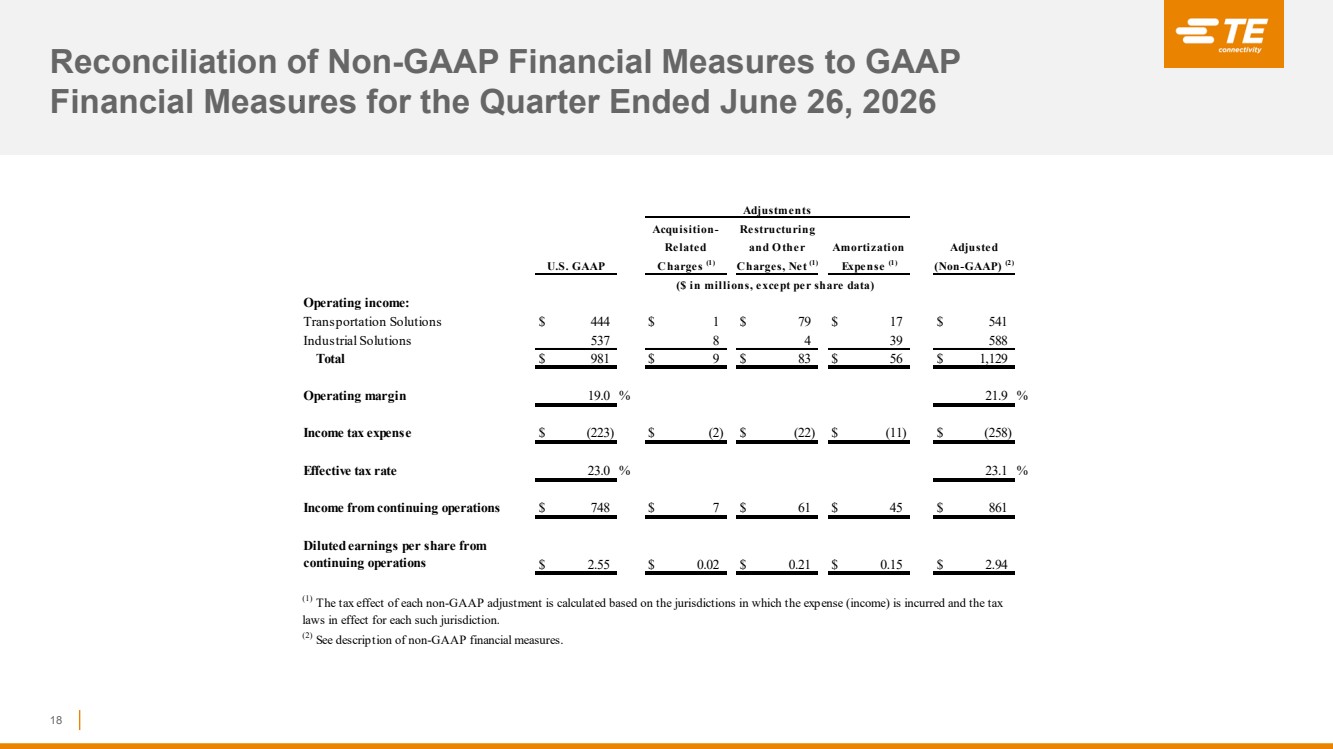
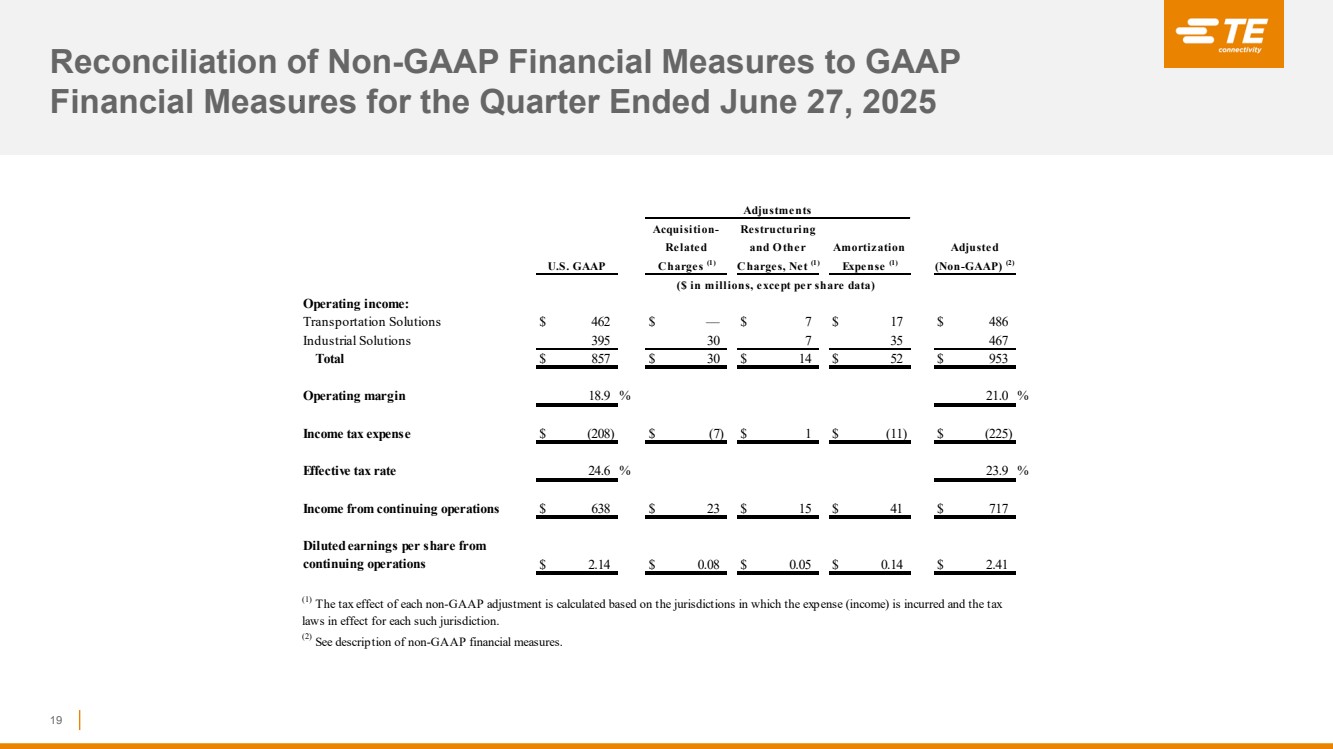
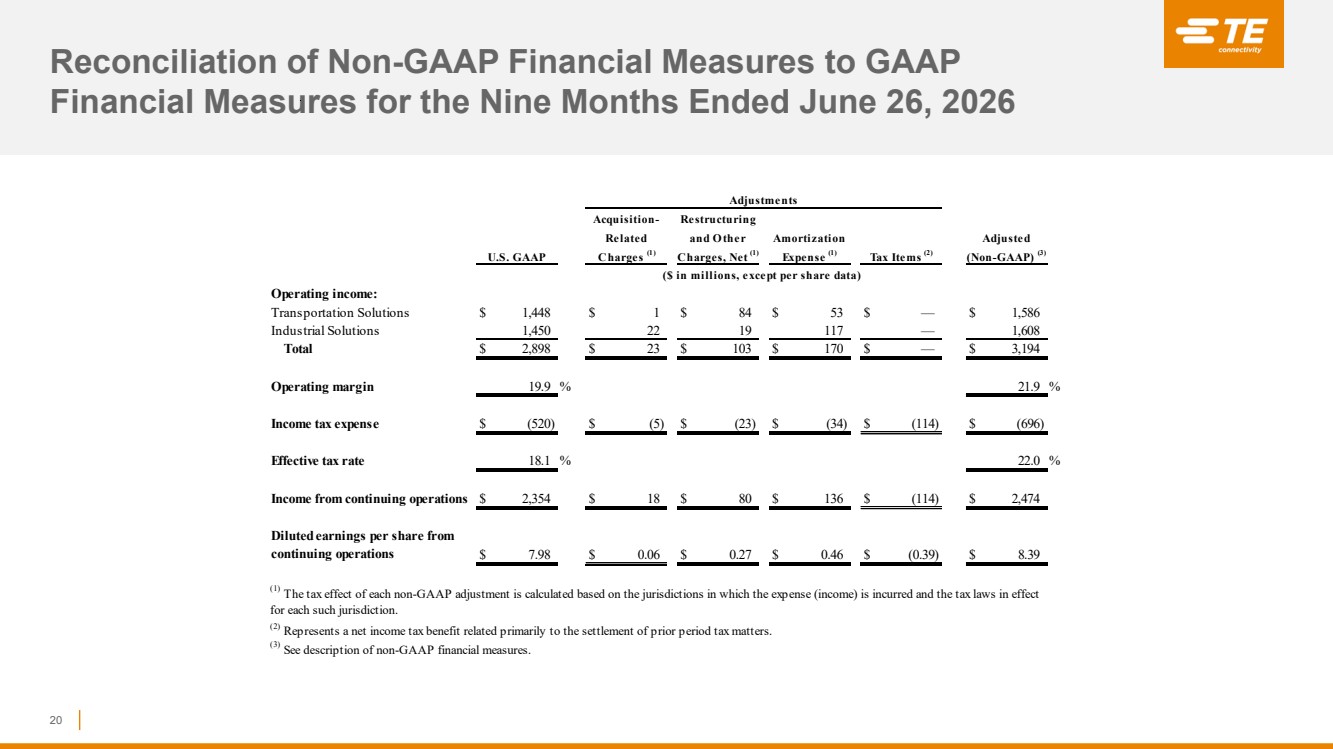
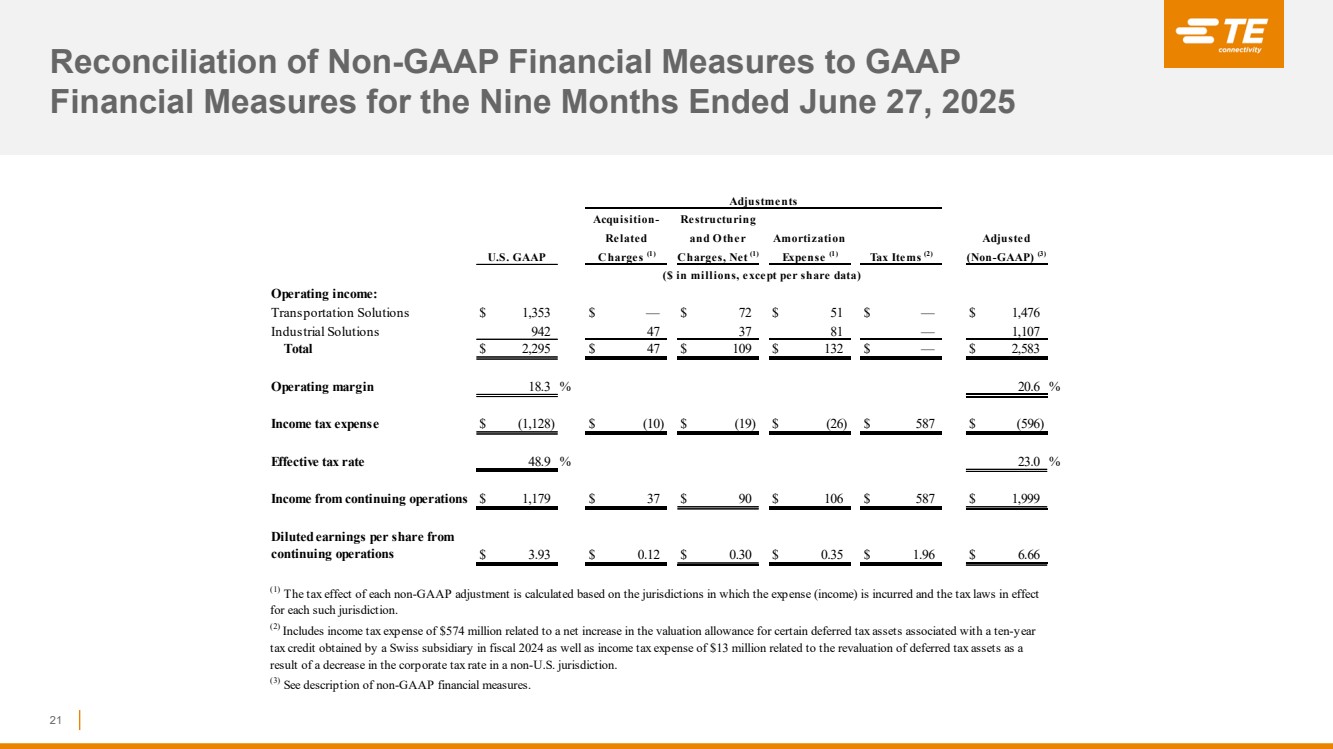
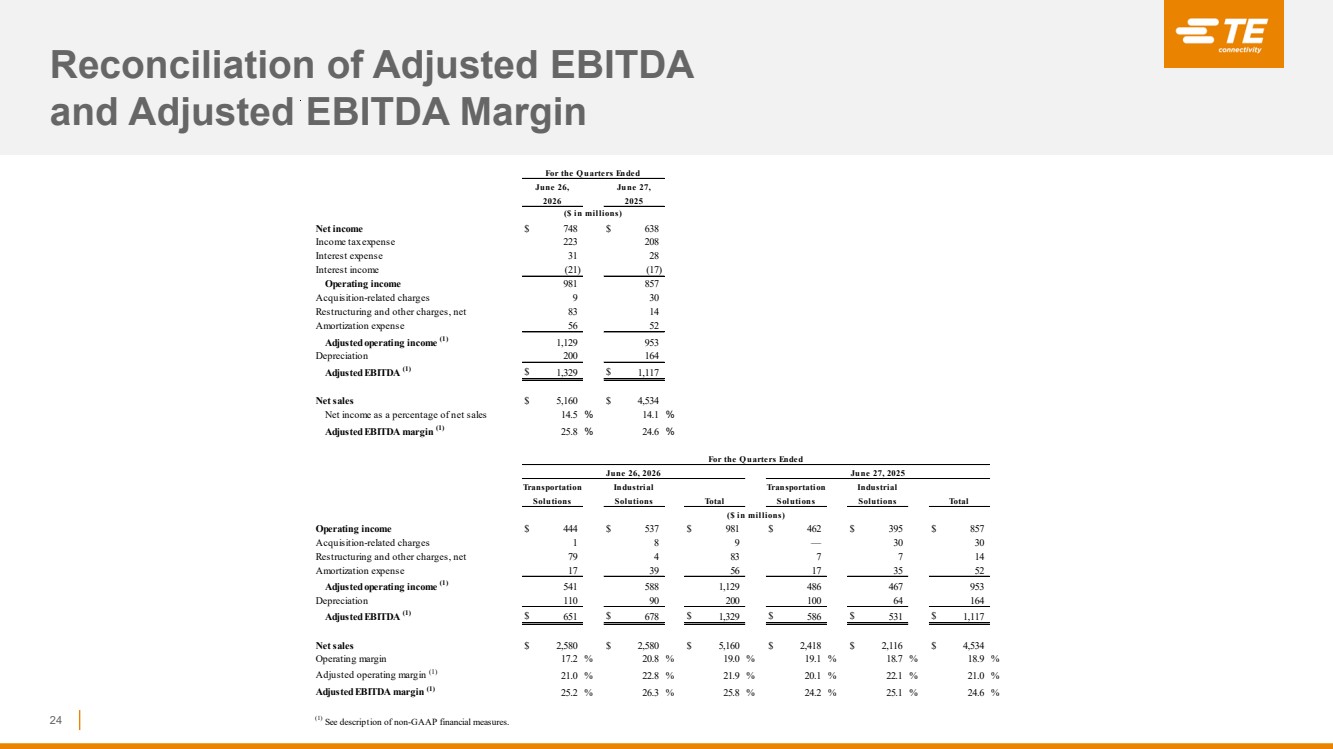
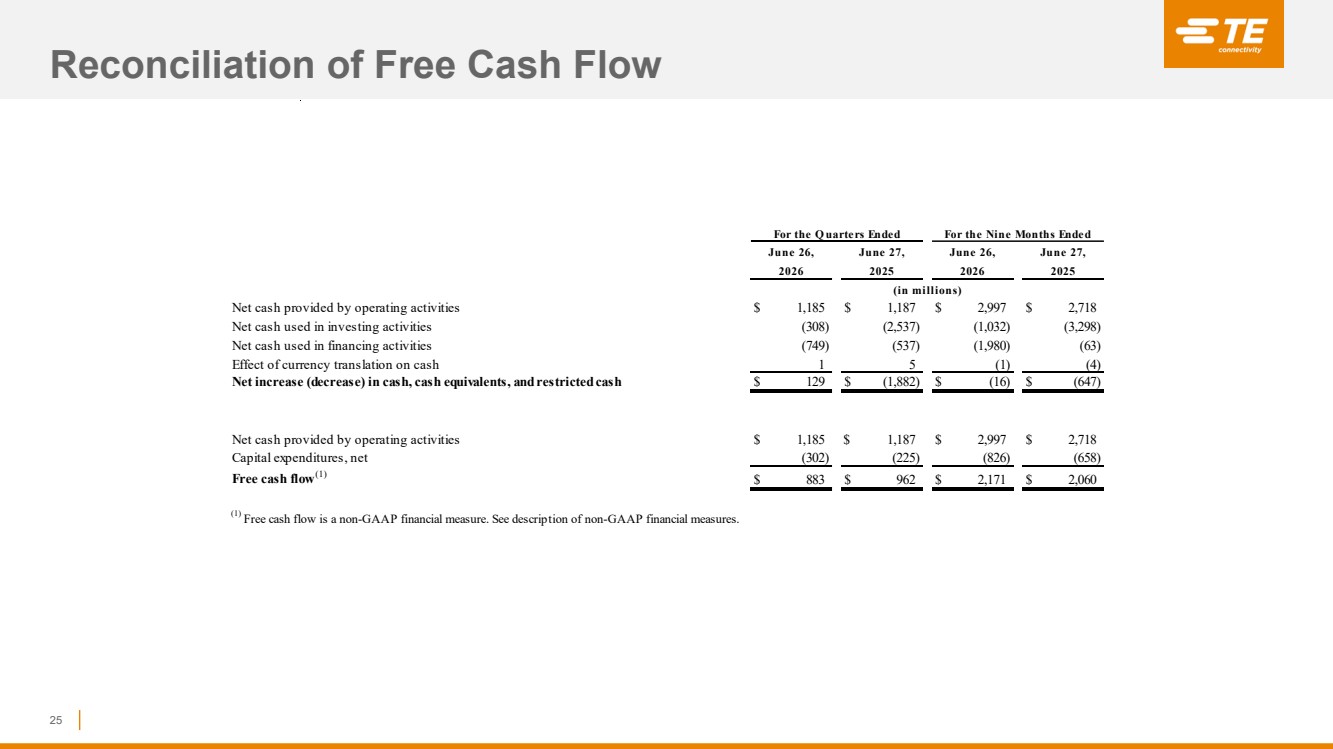
Thank you Terrence and good morning everyone. Please turn to slide 7. For the quarter we achieved adjusted operating income of over 1.1 billion dollars and adjusted operating margins of 21.9 percent. GAP operating income was $981 million and included $9 million of acquisition-related charges, $83 million of restructuring and other charges, and $56 million of amortization expense. I continue to expect restructuring charges in fiscal 26 to be roughly $100 million. Adjusted EPS was $2.94. GAP EPS was 255 for the quarter and included restructuring acquisition other charges of 23 cents and amortization expense of 15 cents the adjusted effective tax rate was 23 percent in q3 and we expect q4's rate to be between 22 and 23 percent importantly as always we expect our cash tax rate to remain well below our adjusted effective tax rate please turn to slide eight this slide reinforces the themes terence discussed which are ongoing broad-based growth across the segments strong operational execution by our teams and continued earnings growth sales of 5.2 billion were evenly split between the industrial and transportation segments given the order strength that terence mentioned earlier we will exit this year with a strong backlog position in both segments certainly this is influenced by ai program wins within the ddn business the order momentum and backlog growth give us confidence that our strong performance will continue into next year adjusted operating margins were 21.9 percent expanding 90 basis points year over year adjusted earnings per share were 294 up 22 percent year over year driven by sales growth and margin expansion. The teams are doing a very good job of meeting customer demands while continuing to manage inflationary pressures through both price as well as cost actions. Turning to cash flow, cash from operations was $1.2 billion and free cash flow was $883 million during the quarter. Year-to-date free cash flow is roughly $2.2 billion and we've returned approximately $2 billion to shareholders through dividends and share buybacks so far this year. We continue to expect our free cash flow conversion to be roughly 100% this year. Now, let me talk about the acquisition that Terrence mentioned earlier. Astrodine TDI will generate more than $250 million in annual sales and had a purchase price of approximately $1.4 billion. we expect to close the transaction by the end of this calendar year subject to customary closing conditions our cash generation model coupled with our strong balance sheet supports our capital deployment strategy and astrodyne is a good example of a strategic bolt-on acquisition while we are still returning capital to our shareholders and before i turn it over to questions let me reinforce that our performance reflects our positioning to benefit from the largest technology and infrastructure investments taking place globally we are delivering well ahead of our through cycle business model generating strong margins earnings growth and cash flow and just as important our record order order momentum provides heightened confidence as we wrap up fiscal 26 and jump into fiscal 27 which starts in october with that let's open it up for questions.
Thank you, Heath. Pascal, can you please give the instructions for the Q&A session?
Operator
We will now begin the Q&A portion of the call. I would like to remind you that to ask a question, you will need to press star one on your telephone keypad. In order to have time for all questions, each participant is limited to one question. Your first question comes from the line of Scott Davis from Mellius Research. Scott, your line is open. Hey, good morning.
Good morning, guys. Good morning, Scott. Hey, guys, I'm going to switch directions a little bit, and can you talk a little bit about the ramp you expect in your FAU optical business? I mean, my understanding is it's a hard business to scale up and scale out, but you guys seem to have some capabilities here. It could be pretty important to kind of calming that debate of copper versus optical. So just kind of curious to see where you're at there. Thanks.
No, thanks, Scott. Let me start with the second half, and then I'll talk about the FAU. I think the first thing is that we said, it's copper and optical. I'm going to come back to that again, because you're going to have different needs. And we've seen the architectures where within the rack in the in this you know what you're doing in the rack you know it's going to be copper is going to be the heavy workload but with what we've done with the ram photonics acquisition it really is something that we opened up incremental market access to as optics come into the things that are going to be the scale out and also probably moving off the switch in the architecture and as you know you know there's a lot of customers that are working on this what really makes this exciting for us is the engagement that we have with our customers on the fau technology it's early days i think this is the type of thing you know you won't really see revenue until we meaningful revenue until we get to 28 and beyond that but it's an incremental tam scott and it builds on uh the copper position and it's going to add incremental revenue and TAM for us as we go forward. So near term, we're investing in it. Certainly, you all know the acquisition that we did. Certainly, we are investing in the scale, scaling of the manufacturing, as well as the engineering teams off that acquisition to really make sure we can meet the intercept point that our customers expect us to meet, which will be more in the 28 and beyond timeframe.
And, you know, that's what we get excited about, how we rounded out the portfolio with that and we'll continue to look for opportunities that strengthen it based upon where we're co-creating with our customers okay thank you scott we have the next question please your next question comes from the line of mark delaney with goldman sachs mark your line is open good morning thank you very much for taking my question i'm hoping you can give more color on how the record orders and backlog are setting the company up for revenue growth, not only for this year, but any early thoughts on 2027. And as a part of the order commentary, can you speak specifically to DDN orders relative to your outlook for sales growth? Because you cited improving momentum in AI orders, but then you also said that revenue is tracking in line with your prior expectation within the DDN segment. So I'm trying to reconcile those comments and why DDN revenue for this year isn't tracking to be better than you previously thought in light of the AI order momentum. Thank you.
Yeah, sure, Mark. Thanks for the question. And then, you know, like you said, the orders I talked about in the call are up about $1.2 billion. And the bigger jump was in our industrial segment. So about $800 million increase in industrial. And half of that order growth came from DDN. So it ties right into the trends that you see that relate to AI. And, you know, that's going to just continue. AI is a percentage of that. It's just going to continue to increase. And I did mention that we had 70% order growth year to date in DDN. And let's face it, that's building backlog as we're ramping programs. So just with where we are in the year, with three months left, these are program ramps. And we have multiple program ramps going on at any time. So really, this momentum is really going to deliver more into next year than increases to this year. And we do expect EDN to be up in our fourth quarter sequentially over the third quarter. But just as importantly, when you think about that industrial segment order, and I know I mentioned some of these, you know, energy business, AD&M business, as well as the ACL business, are all up 20% year to date. And when you look at energy and AD&M, they're really, really strong secular growth trends that we don't see that momentum slowing down. You know, it's broad-based. It's certainly, you can look at the investments that are happening that, you know, that traction is going to continue and carry into 27 to your 27 question. And then the last piece that I think is the big piece in our industrial segment is ACL. ACL is a little bit more, you know, has more cyclicality to it. And, you know, it's nice that we're having that cyclical uptick, but those orders are up. And then in transportation, you know, our orders are up $400 million year over year. And we're seeing benefit of ICT. But the orders that we're seeing are really just reinforcing our content position in automotive. And, you know, vehicle production, you know, is down slightly. It really hasn't moved from when we talked to you back early in the year. And we think it'll stay around this, you know, slightly decline. line, but our team's doing a great job delivering the performance of content above production, and that's what our orders are reinforcing, you know, the programs that are coming in to really make sure it continues to have that four to six points out performance.
Okay, thank you, Mark. Can we have the next question, please?
Operator
Your next question comes from the line of Wamsi Mohan from Bank of America.
Thanks for taking my question. Thanks for taking my question. It's Ruplu filling in for WAMSI. Terence, the question is on the transport segment. You said global vehicle production is expected to be slightly down this year. Now, there's some concern on the China market. How do you see the China domestic market evolving versus the export market, and how do you see TE positioned here?
Ruplu, thanks for the question, and thanks for covering for WAMSI. Absolutely. It's a great question. So let me frame it a little bit, because when you think about tea, we need to think about production. And production is slightly down. And certainly there's headlines that are out there that, hey, what's happening in China domestically? But China auto production is down similar to the global picture. and our Asian-China position is very strong, and we had eight points of outperformance over production in China. Actually, our China business grew six percent against two percent down in production. And exports are the element that I think people miss in that narrative. So right now, the exports are short of our China OEMs are offsetting a weak China local market, But you have to think about those exports that's really driving it and what they're doing in Southeast Asia, Central and South America, where they have over 100 percent exports to Africa as well as Europe. So, you know, I do think some of the narrative is around the car sales in China, but the exports are clearly benefiting from that and offsetting that. The other thing I would just highlight, you know, while production hasn't changed, you know, our European business had four points of outperformance in the quarter. You know, they're square back in there. You know, after last year was sluggish due to some of the EVs. And really, Asia and Europe are offsetting, you know, a weak North American market still. So net-net, we feel very good about the four to six. Production is staying exactly where we thought. And we would expect production to be similar next year, you know, maybe down a little bit. So feel good about the team momentum and also the content outperformance that we have this year and into the fourth quarter that'll roll into 27.
All right. Thank you, Rupu. We have the next question, please.
Operator
Your next question is from Christopher Glynn at Optenheimer. Your line is now open.
Thank you. Good morning. Just wanted to go a little more into the energy segment. so the organic had pretty meaningful acceleration in organic growth versus a tougher comp. You know, that spells exceptional sequential too. Are you seeing a particular build in just kind of baseline run rates there? In other words, is that, you know, new key program and design and layering in, or was there something peculiar about the growth in this quarter for energy?
No, Chris, thanks for the question. And, you know, let me let me frame it a little bit for you. You know, one of the things that was really nice and we've been talking about energy and how we get excited about it certainly ties into the power trends. But, you know, it was well over a hundred million dollars of growth this quarter of our six hundred million dollars of total growth. So it's very meaningful. And when you look at it, you know, we think of our energy business and three basic verticals below it that you should think about it. About 60 percent of it, or two thirds, is, you know, really around where we service the utilities. And we talked to you about grid hardening. There's the investment that's happening around the aging infrastructure. You know, clearly that is on an upward inflection point that you all know about. There's about 20 percent of it that we call industrial, but this is also where you bring power into a data center, you bring power into buildings, and that is clearly growing very fast and we're benefiting from it and even reflected in some of this quarter's numbers. And then the remainders around clean energy that had been and is a growth driver, been stronger in the past, but certainly what we're seeing in the data center as well as the grid hardening is just accelerating. And if you look at energy this year, we're probably expecting it, you should think about it more as a mid-teens type grower this quarter there is a project nature to some of our programs because you're selling into infrastructure but i really think as you look at it this year and in the next year think about it more of a mid-teens grower is the right way to think about it and just the last thing i i would tie back to is and when we look at this market yeah there's energy capex but we do think about a third of the energy market growth where we're positioned is driven by data center build outs. So it ties back into, yes, we have a great position in DDN, but you also know where we're going to benefit from the power infrastructure build out is just as important.
Okay, thank you, Chris. Can we have the next question, please?
Operator
Your next question is from Amit Dharianani from Evercore. Your line is now open.
Hey, Amit. Thanks. Hello. Good morning. Hope you all are doing well. Good morning, Terrence. There's been a lot of focus on AI revenues, and maybe I missed this part, but could you just touch on how are you tracking in the June quarter versus your targets? Is it still 70% obedient? It would be good to get that clarified. And then really more broadly, as I think investors focus in on this copper versus fiber debate, can you just help frame tease opportunity across copper, optical, and power, and how do you see these businesses complementing each other over time and if the scale up architectures really migrate more aggressively towards optics do you think that's a tailwind a headwind a neutral thing for your content story thank you yeah fair so let's you know the first question is pretty straightforward when you think about what we think about DDN and where AI is it you know we're on track to what we said last quarter you know for DDN DDN will be exactly where we thought
we were going to be. And when you look at it, because of the AI momentum and the orders that we see, all you're going to continue to see is the percentage of AI of DDN is just continuing to increase. It goes up. So I know a few quarters ago, we talked about it 70%. Every quarter, it goes up as AI continues to accelerate, and that trend is going to continue. So that's the first part. On the second part, on copper, and it goes back to Scott's question, on the copper and the inflection points a couple of things when you when you're in the scale up versus scale out let's face it scale out already is very optical you know because you have longer lengths and things like that optics exist um when you're getting into getting to more energetic workloads that's where you're introducing more cpus that's all going to be copper on it so when you look at it as architecture is evolving and that's why you hear the global merchant um chip makers say copper is going to be the workhorse within the rack and in that scale up is going to continue. I think where you get the inflection point, which is incremental benefit for us, is when you would get opticals like CPO coming in at the switch level. It's sort of in between. And in that regard, that's where I think with what we've done with RAM on the FAU side really plays into the connectivity suite, and that's incremental TAM. And that doesn't even get into, and that's just on the data side when we're talking about it like i said in the prepared remarks power just continues to move up you know the power connectivity as they're moving to higher voltage architectures you introduce optics that creates more power need and if you look at that in some cases we can get content increases that'll be 1.5 what traditional power content would be so all this inflection, we like it. We think it is all positive for us. And we have to realize when you play with technology and play where we want to play, architectures evolve. And you need data, you need power, and we do both. So we get excited about it. We think it's going to continue to benefit us as we move forward. And clearly, our orders also represent that.
All right. Thank you, Amit.
We have the next question, please. your next question comes from the line of joe giordano with td cowen your line is now open hey guys how you doing hey joe um good i wanted to touch on i wanted to touch on the other parts of ddn so like if you're tracking towards your you know ai cloud number of like you know around 2.4 billion it suggests that like the rest of ddn you know that 800 million of more traditional stuff isn't growing that fast this year and i'm just curious what the can you can you frame that piece for us and when you talk about the agentic cpu type incremental demand that that you see
where would that fall would that fall within that 2.4 billion that you're currently calling ai cloud or would that fall into that other like 800 ish million of like more traditional and how should we think about the content step up there well a couple of things when you see that content step up this is where in this space it blurs a lot and it depends on you know where the customer is that's doing it joe and i'm not trying to be cute but when you actually sit there if the hyperscalers doing it we would put it more in the ai cloud number if it was just somebody buying a server it might be an enterprise type number so we continue to get clouding on that due to how these architectures evolve and it's another reason why you're going to hear us talk much more at the DDN level as we go forward. But when you look at it, you know, talked about it just in the prior question, the growth in AI and cloud is the big momentum and growth driver. What you look at in the other areas, you do see people prioritizing, you know, to the AI workload. So while you do see some increase elsewhere, it's not as big of an increase as AI and cloud. You know, in some cases, we actually see down a little bit as you have shift of investment but net net long term both will be benefited as these architectures go forward i just think we're in really early days to see it outside of the ai and cloud space all right thank you joe we have the next question please your next question comes from the line of asia merchant with city asia your line is now open Great.
Just a little bit, if you can clarify on the sequential order growth that you're seeing within these DDN and AI and cloud, I think the commentary was more year-to-date with orders up 70%. So just if you could clarify that in line with, you know, the content growth that you expect or one would expect as you see, you know, new architectures coming here, which tend to be more content intensive and should benefit TE? Thank you.
Yeah, so when you look at it, we had very strong organic growth in bookings, as you saw on that slide. You'll look at that. And I'm just trying to get a paper in front of me on a sequential basis. You know, about half of that growth was due to DDN, similar to the year over year. So we continue to get very strong growth momentum and as i said i think the real number is that 70 plus um year-to-date booking growth that we have so it's very strong across as you look at it but ddn played a very big role in that order growth um in industrial in the quarter which was about half of our overall order growth sequentially okay thank you asia can we have the next question please your next question comes from the line of stephen fox with fox advisors llc your line is now open hi good morning i was just wondering terrence go a little bit hi i'm wondering if you could just go a little bit deeper on the acquisition you just announced i'm not quite clear what's special about it and as a just as a related subject um does this mean given what you've done recently in in that power space does this mean you you know you're more aggressive in that area it seems like there's a lot of opportunity you guys build an even bigger business thanks no steve great question and you know let me talk about a little bit and to your point i know we get a lot of discussion around data especially with ddn and where we do data connectivity in the vehicle but we get excited about power and data because when you think about where we plan the architecture somebody's making a semi-choice somebody's making a power supply choice and how does the architecture come together is always what we're looking at so we look at both you know even if you look at this year with ram you know that we don't which in optical connectivity that's data this is a power play and you know i'll ask seeds to talk about but when you look at what you know we announced astrodon tdi you know has a very good position you know both in power filters which make sure you have quality of power coming into applications as well as some custom power supplies and we already have a very similar position that astrodyne has in the power filter side you know we've had something from a legacy perspective we added to it with schaffner and about 40 of astrodyne is in the filtering power filtering side so this just continues to add to our position which certainly you know is a great thing to have on top of it they do some custom power solutions that actually go into applications that we really like like semiconductor equipment goes into the defense market as well as medical markets that we talk about so we're going to continue for those customers as they evolve their architecture to be able to give a pretty robust power solution piece to them that we've given them but it's going to expand it and that really the custom piece expands our time and we're very excited for this
team to join tea later in our uh later this calendar year and he wants you to talk about some of the numbers uh thanks and steve you know i mentioned on the call that this is this business has been uh growing very nicely with a really nice uh trajectory going forward um and if we calendarize it for our fiscal year it's about 250 million sales right now as i mentioned In my pair of remarks, we paid about $1.4 billion that will be funded through cash. We expect it to close later this year. This business, as it comes into TE and our industrial segment, it will be accretive to our growth rates and our margins at both the TE level and the industrial level. So it's a really attractive business. On top of that, we do see the operational synergies, both in where they manufacture versus where we manufacture and some opportunities there, as well as some other things that we bring to the table in terms of the construct of the deal. So pretty excited about getting this one over. We just got to get it through the customary close process towards the end of this calendar year.
All right. Thank you, Steve. Can we have the next question, please?
Operator
Your next question comes from the line of Manmohanpreet Singh from JP Morgan. Your line is now open.
Hi, good morning. Thank you for taking my question. I just wanted to ask about the AI specific revenues. Can you please provide an update on the updated guide for AI revenues relative to the past update of $2.4 billion and also how to really think about AI linked or AI data center linked revenues within the energy segment and now potentially also within in the Estrodyne acquisition.
Let's go a couple of things. First off, being as we said earlier, we expect DDN to be delivered in what we said 90 days ago. So it's fully as we expected. And it's going to continue. The AI revenues are going to continue to increase as a percentage of DDN, based upon the strong backlog we have and the growth momentum going into 27. On the energy, as I mentioned a little bit earlier, about 20% of our energy business is benefiting from where you get data center build out. So you do see that. You see that driving really nice growth in the energy business. And when you look at the acquisition we just talked about with Astrodon, it gets the benefit really from where it plays into semiconductor equipment. Clearly, where you have that increased capacity going in for chips that are all driven by ai clearly that's a really good position they have and we will benefit from that through that um position that they have and we're going to build on okay thank you mp can we have the next question please your next question comes from the line of joe's back with ubs joe your line is now open hey joe thank you hey good morning um parents at your investor day in in late 25 and you talked about that AI cloud being $3 billion in two years, which would be next year,
27. But you've raised that number through this year. And even in your commentary today that it's in line with prior communications, it suggests the annualized rate in fourth quarter is already at, if not above, $3 billion. So I was wondering if you could help provide an update to that figure or maybe some context and sort of, you know, how you're thinking about that business, you know, over the coming years?
No, I think the things you said were right on, Joe, and let me give you context, you know, and we said this last quarter, you know, the $3 billion we laid out, we're ahead of, and that has continued to shift left, and that's how you should think about it. Even with the momentum we have in the orders we've laid out, you know, DDN is going to be a very big growth driver into 27 again and you know as well as the other units that we have you know from a growth perspective so nothing has changed on that three billion dollars continues to shift left and you will be above that and what's really good is the breadth of the growth we have which includes ddn to really make sure we continue to compound the growth that we've had on top of the 15 percent we're going to deliver this year all right thank you joe can we have the next question please Your next question comes from the line of Colin Langan with Wells Fargo.
Operator
Colin, your line is now open.
Oh, great. Thanks for taking my question. Could you touch on the opportunity on 800 volt data centers? Obviously, that sort of came up during the quarter. Does that any color on how much content, you know, that switch could add? And then any color on, you know, the competitive landscape, does that change opening up some maybe new competitors? Obviously, you have the current data center market fairly locked up, but does that actually allow some new competitors to come in with that technology shift potentially coming in the next few years?
First off, being, you know, when you think about power and, you know, in our AI revenue, probably one-third of what we do in AI is power connectivity, whereas two-thirds is, you know, data connectivity. And when you sit there, you're going to continue to see as that power inflects up, you know, it's going to create opportunity for us. So, you know, we have a very strong position in power. You know, we're already architecting with our customers around how does the data and the power needs go together when when you're really talking at the rack, I don't see new entrants coming in because this is a simultaneous equation of trade-offs and constraints between the data and the power equation when you're at the rack. And our customers really like somebody that understands both the power chain and the signal chain. So when we look at it, we feel very fortunate that we can have discussions with them on the power chain that also considers the data chain, And that's an advantage position. And we feel that you're going to continue to see outgrowth in that area as people move up the high voltage architectures. Some people are playing with 800 volt, but there's a whole continuum of where people are making trade-offs. So I don't think it's one end game. And that's what's really great about what DDN is going through. All of our customers are really experimenting in the architecture on different trade-offs to make sure they get to the lowest cost per token. We have to realize that's the ultimate end game that they're going to, and different customers have different paths they're trying to challenge. So when we look at it, that's going to be part of the growth momentum we have is what's happening on the power chain as you move up. And like I said, already a third of our business is related to the power connectivity side.
Operator
Your next question comes from the line of William Stein with Truist Security. William, your line is now open.
Great. Thanks for taking my question. Believe it or not, I'm going to get off the AI topic for a moment anyway. I'm hoping, Terrence, you can talk to us a little bit more about what's going on in defense. Our channel check suggests that the strength and that in market has been unusual. And I'm hoping you can talk about new projects and backlog trends and perhaps component pricing as well in that end market. Thank you.
Sure, Will. Thanks for the question. Yeah. And on defense, I mean, let's face it, it is at a different inflection point due to some of the geopolitics in the world. And you all know that. So I don't need to talk about that. But what we're also seeing, you know, we are seeing a velocity increase on programs, you know, due to what's going on. And, you know, it is also both very strong in Europe as well as in the U.S. So it's on both of those vectors that are very much driving the increased backlog. And even when we talk about the backlog position earlier, and we said it a quarter or so ago, So backlog that we're having, you know, some of the more significant builds are not only DDN, it's also in aerospace and defense, and, you know, especially on the defense side. So that inflection point, and even when you look at what is budgeted for defense spending around the hardware side, which is where we would play, is very important. It is also important when you think about when you get into UAVs and applications like that, comes back to the data connectivity and the power connectivity is very important. And, you know, when you get things that are remotely controlled, that comes into very high-speed elements where the compute has to actually happen real-time, and we're benefiting from that. So we're on a breadth of programs. The growth that we're having, you know, defense is growing faster than Comair right now, you know, which is, you know, a little bit different than you would have thought about TE maybe 10 years ago. but that trend is a real secular trend that we don't see slowing down and we continue to invest in capacity to make sure we can deliver for our customers.
Operator
Thank you, Will. Your next question comes from the line of Shreyas Patel with Wolf Research. Your line is now open.
Hey, thanks a lot for taking my question. Terrence, maybe to put a finer point on some earlier questions, how much of the business today is tied to optical in AI, in areas such as transceivers. And then maybe pivoting away from that, I'm curious if we could talk a little bit about the incremental margins in the quarter. They look pretty strong at 36%, even as you're facing input cost inflation. And on my map, it looked like the organic flow through the next quarter appears pretty strong as well. So I'm just curious what's driving that. Thanks.
Sure, Shreys. Let me take the first piece. As I said earlier, when you think about optics today, we do have optical positions today that we have in DDN. The element is we are not a major player in scale-out. So when you think about scale-out, which is almost all optical today, we have a limited position there. Where we typically are completely focused is in the scale-up in the rack is where our focus has been and continues to be as we make the investments. Do you want to talk about the margin? Sure.
Sharia, we are running kind of where we would expect at these volume levels. And so certainly the heightened growth in industrial, you would expect to see 30 plus percent flow through for those types of for this types of volume um you know a given quarter as i've said in the past is is not always the best measuring stick but i would say the momentum is there and you see it in our margin um and our margin rates as those continue to improve uh both at the industrial segment as well as the transportation segment that doesn't have quite the same uh market support that we're seeing in the industrial segment but uh you know as we finish up the year your fourth quarter questions as we wrap up the year certainly we maintain that strong momentum there's nothing that really uh changes that perspective on things and and quite honestly as we jump into 27 you know we would we would expect the same kind of momentum okay uh thank you can we have the next question please there are no more questions in the queue this therefore concludes our q a and i will pass the call back for some closing remarks No, thank you.
We want to thank everybody for joining us this morning. And if you have any questions, please contact Investor Relations at TE. Thank you and have a nice day.
Operator
Today's conference call will be available for replay beginning at 1130 a.m. Eastern Time today on the Investor Relations portion of TE Connectivity's website. That will conclude the conference for today.