Operator
good afternoon my name is sarah and i'll be your conference operator today at this time i would like to welcome everyone to the knight swift transportation first quarter 2026 earnings call all lines have been placed on mute to prevent any background noise if at any time during this call you require immediate assistance please press star zero for the operator speakers from today's call will be adam miller chief executive officer andrew hess chief financial officer brad stewart treasurer and senior vp of investor relations mr stewart the meeting is now yours thank you sarah
good afternoon everyone and thank you for joining our first quarter 2026 earnings call today we plan to discuss topics related to the results of the quarter current market conditions and our earnings guidance we have slides to accompany this call which are posted on our investor website our call is scheduled to last one hour following our commentary we will answer questions related to these topics in order to get to as many participants as possible we limit the questions to one per participant if you have a second question please feel free to get back in the queue we will answer as many questions as time allows if you are not able if we are not able to get to your question due to time restrictions you may call 602-606-6349 to begin I will first refer you to the disclosures on slide 2 of the presentation and note the This conference following presentation may contain forward-looking statements made by the company that involve risks, assumptions, and uncertainties that are difficult to predict. Investors are directed to the information contained in item 1A, Risk Factors, or part 1 of the company's annual report on Form 10-K filed with the United States SEC for discussion of the risks that may affect the company's future operating results. Actual results may differ.
Now, I will hand the call to Adam for some opening remarks. Thank you, Brad, and good afternoon, everyone. These are certainly interesting times, and there are now more reasons to be optimistic about our industry than we have seen in over four years now. We operate one of the largest fleets in the truckload industry. Roughly 70% of our fleet is deployed in one-way or over-the-road service. It is true the one-way market has been the most difficult place to be over the past three years plus, as this market has felt the brunt of the influx of capacity over the last several years. Much of that capacity may not have been playing by the rules that we play by, and therefore operating with a different cost structure, with distorted pricing behaviors and cyclical patterns. The ongoing efforts of the FMCSA and the DOT to prevent and revoke invalidly issued CDLs, shut down non-compliant CDL schools, and address hours of service abuses are in the early stages and are already having an impact on the market. This cleanup effort should, in our view, have an outsized impact on not just the one-way truckload market but on the lowest price capacity in this market the market that was the hardest hit over the past few years is now benefiting the most from the removal of capacity a dynamic which we expect will continue as we mentioned last quarter the market has progressed to a point where even small changes can cause disruption and we saw evidence of that during the first quarter as the severe Weather in January led to acute tightness and an elevated spot market almost overnight. We were able to leverage our one-way over-the-road capacity at scale to provide solutions across multiple brands to help our customers recover from the storm when others in our space were not able. Following the recovery from the storm, the tightness in the truckload market has continued to build largely due to declining capacity though some indications of improving demand are beginning to emerge broad truckload market indicators show improving trends for load tenders tender rejections and spot pricing our business is experiencing even stronger levels on these metrics metrics as our leading presence in the one-way market grows increasingly valuable to shippers so late in the first quarter we began to see the outcomes from early first quarter bins which showed our volumes generally holding steady or growing while achieving mid single digit percentage rate increases for reference that is better than last year at this time when targeting slight slightly lower price increases often led to to lower volumes pricing activity is very busy now In addition to bid season being in full swing, mini-bid activity has increased, indicating incumbent carriers are unable to or perhaps unwilling to service rate at existing rates. In addition, turn-back bids are happening more frequently as bid awards are being at least partially rejected by the awarded carriers as networks have shifted or the market has moved well past rates that were proposed even one or two months ago. Unlike the past few years, shippers are generally not issuing off-cycle bids opportunistically to improve service or drive prices lower. These actions are driven by a need to secure capacity. At the same time, previously deep discounts in the spot market have evaporated, further encouraging shippers to align with quality asset capacity. This is on top of a trend of shippers favoring asset-based relationships that have formed late last year in response to the regulatory enforcement efforts. Whether for these reasons or because of expectations of improving demand, we have already had a number of shippers initiate discussions about peak season demand support, which is not typical this early in the year. As we navigate a busy and rapidly evolving bid environment, we have shifted our bid targets to a range of high single to low double-digit percentage increases on current pricing activity as compared to our low to mid single-digit target one quarter ago. Across our truckload brands, we are reviewing business that is not subject to current or near-term bids and addressing rates that are below market. Aside from the market developments and our position in one-way service, we believe our work over the past two years, structurally cutting costs out of our business with ongoing opportunities for further progress, sets us up for greater incremental margin as business conditions improve. As the market improves, recruiting and retaining quality drivers have and will become more challenging. We believe we have an advantage with our terminal network and academies to source and develop drivers. However, we expect this to be a challenge for the industry in the back half of the year. While the LTL sector is not seeing the same sharp tightening as truckload, we are seeing our freight mix improve and rate renewals continue at a mid-single-digit pace. Shipment volume trends have been directionally in line with normal seasonal patterns, though somewhat understated until late in the first quarter. However, we saw a notable improvement in weight per shipment for the first time in years, with this measure progressively growing throughout the quarter. This is a result of bringing on more industrial customers who can leverage our expanded network footprint to move heavier and longer length of haul shipments. We believe we are in the early stages of our network transition from regional to national. We expect that over time, growing into our network investments, a maturing freight mix, improvement in network density, and continuously refunding our operational and cost execution will allow us to drive sustained methodical improvement in operating margin. We remain committed to thoughtfully deploying capital, intentionally leveraging our strengths, and creatively unlocking synergy opportunities across our businesses. And with that, I will turn the call over to Andrew and Brad to review the results and our guidance.
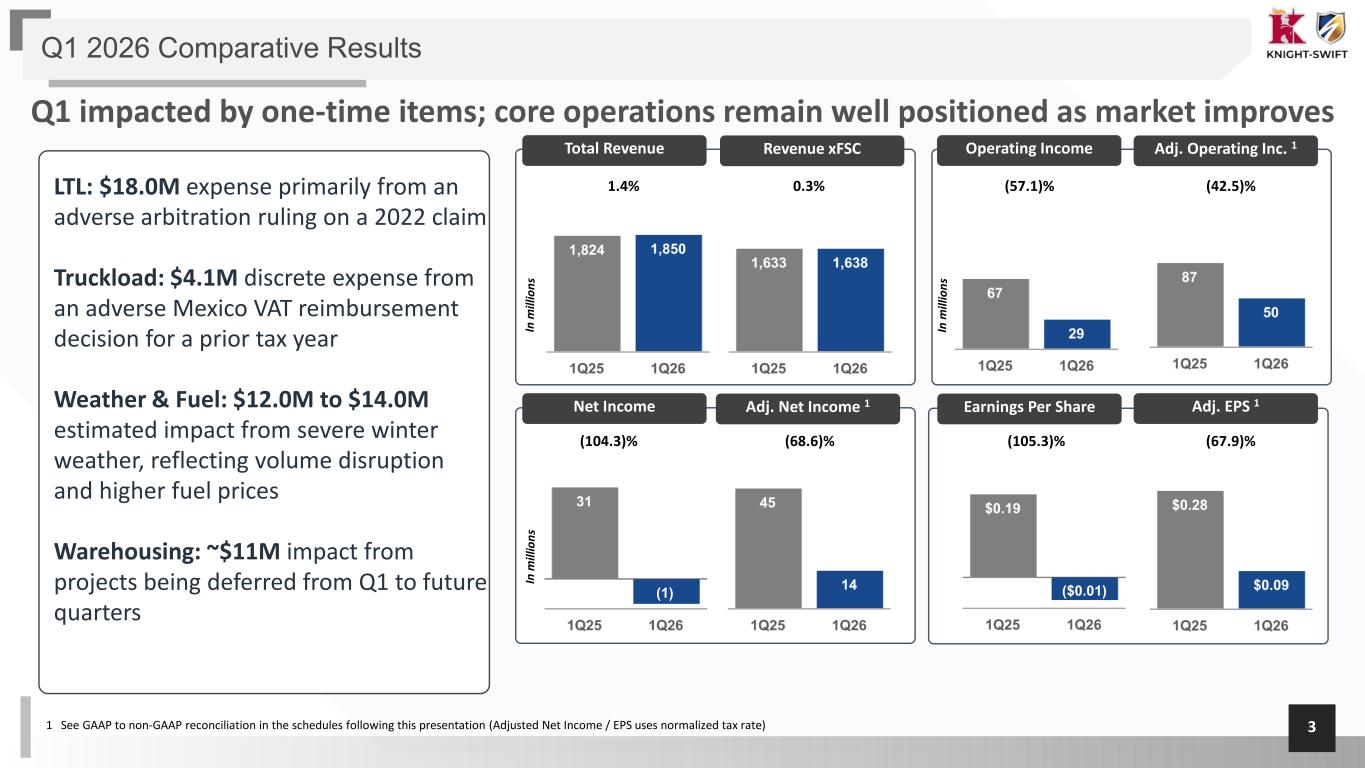
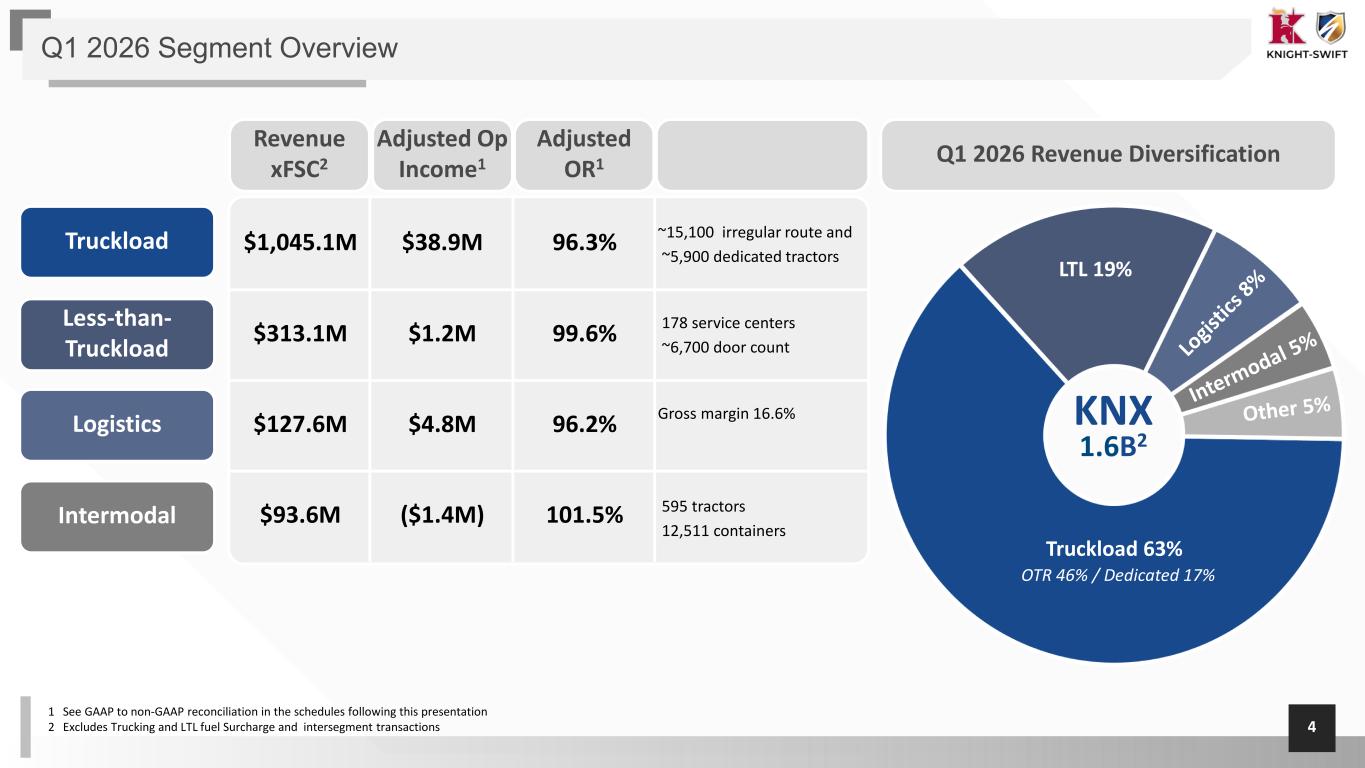
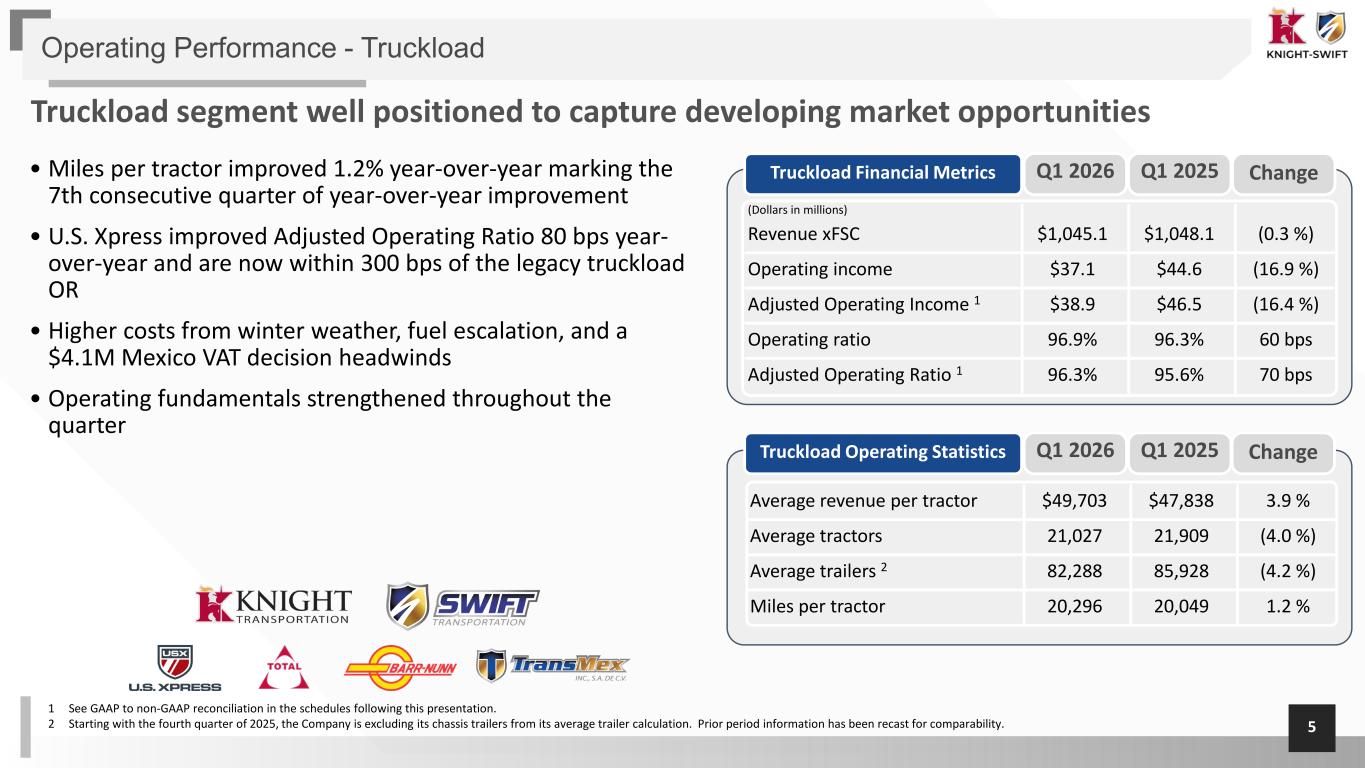
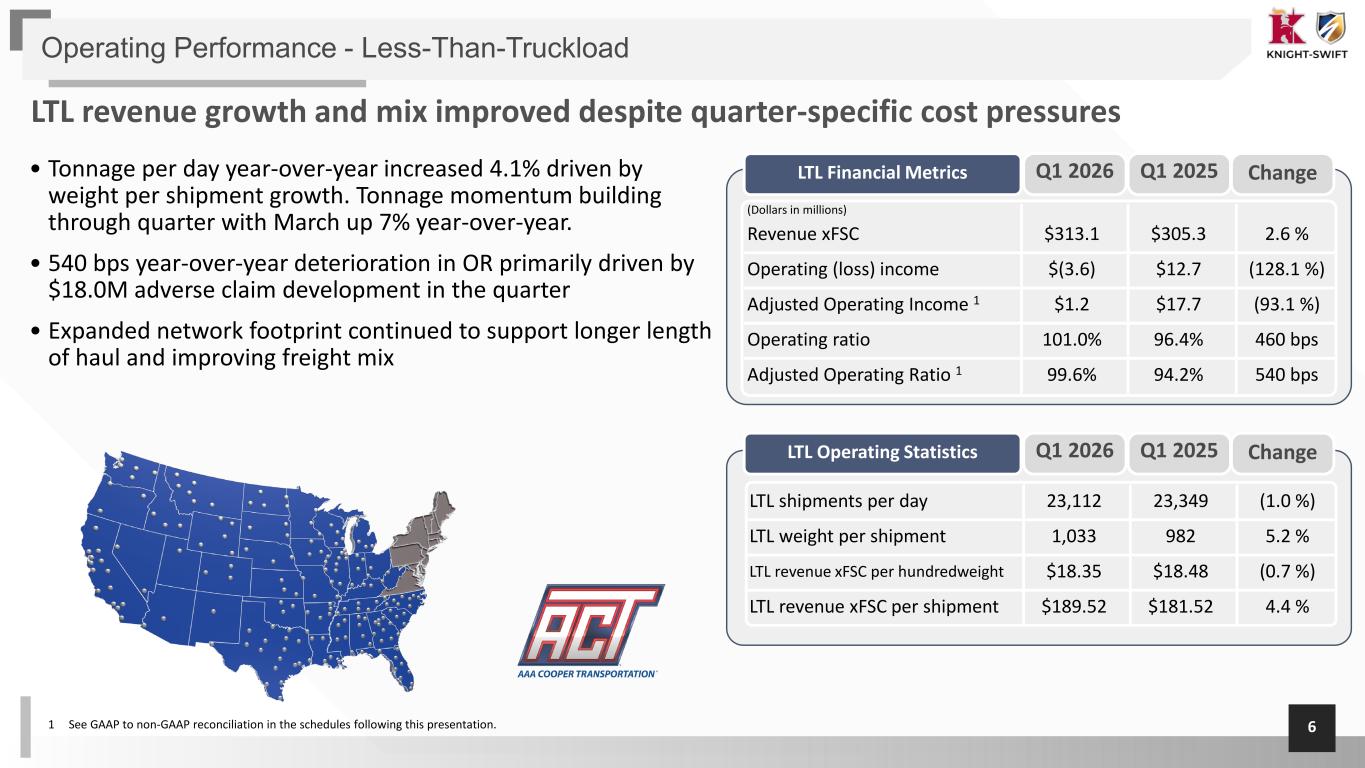
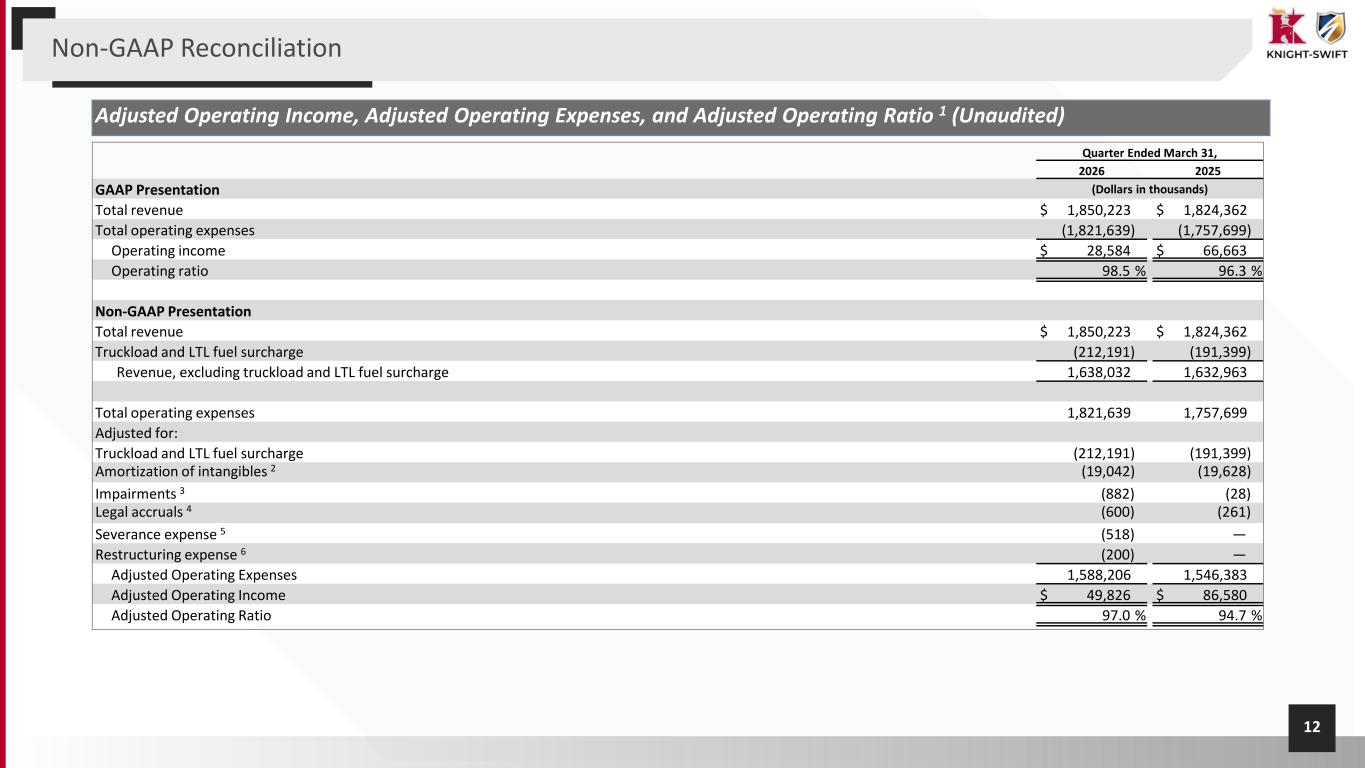
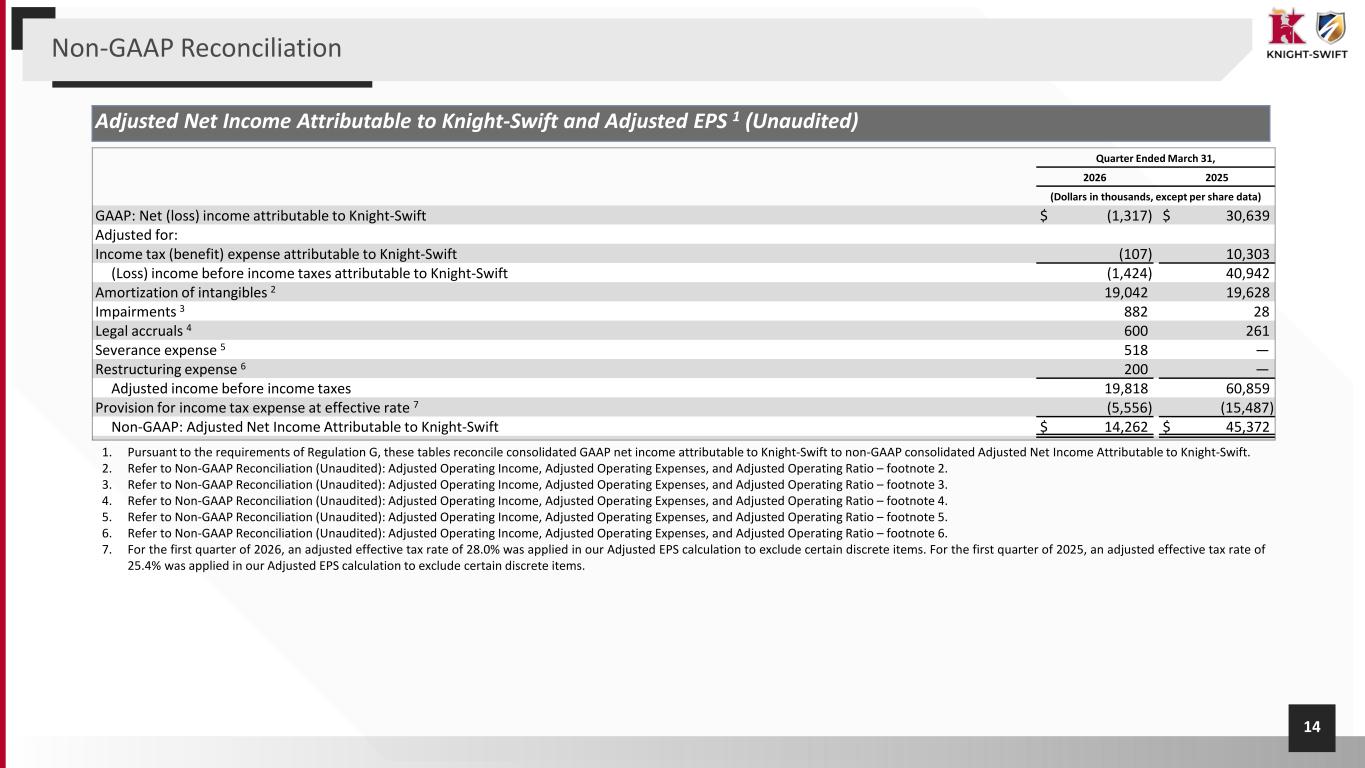
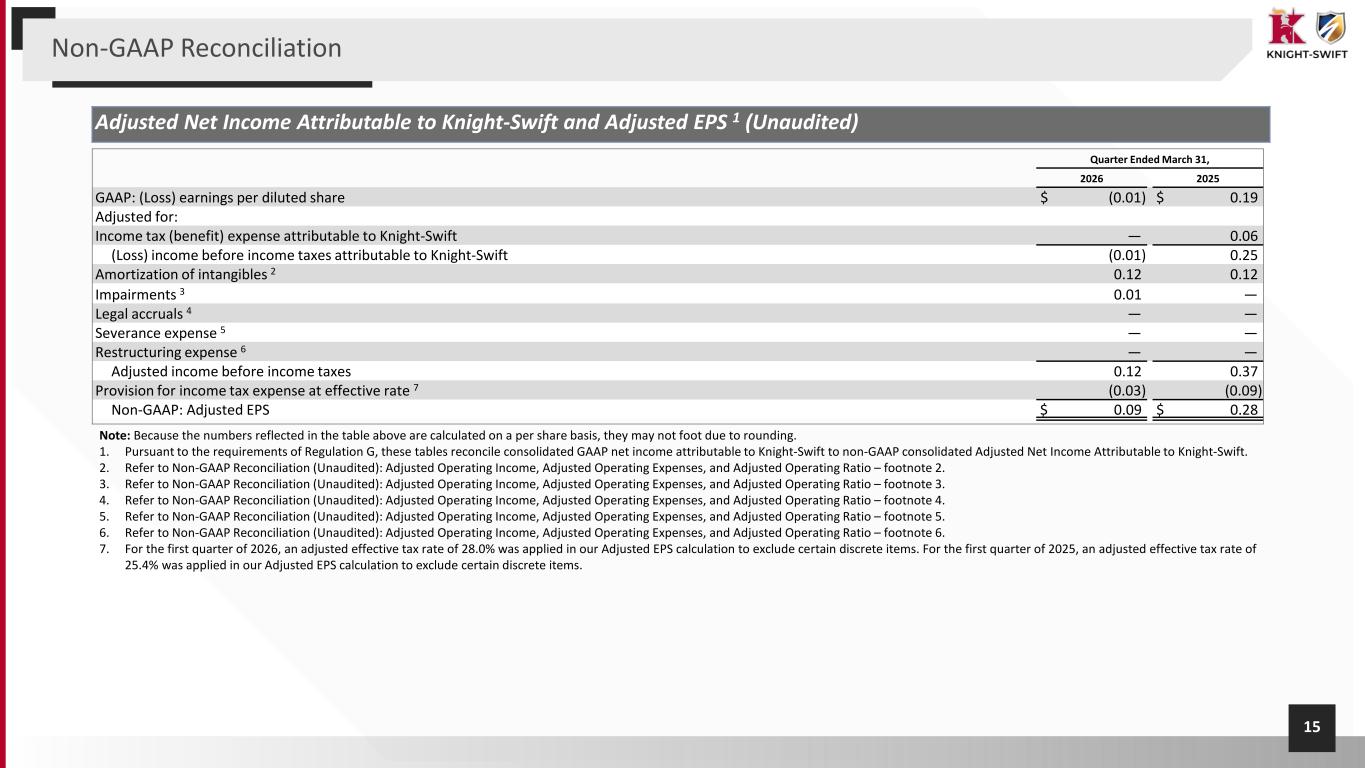
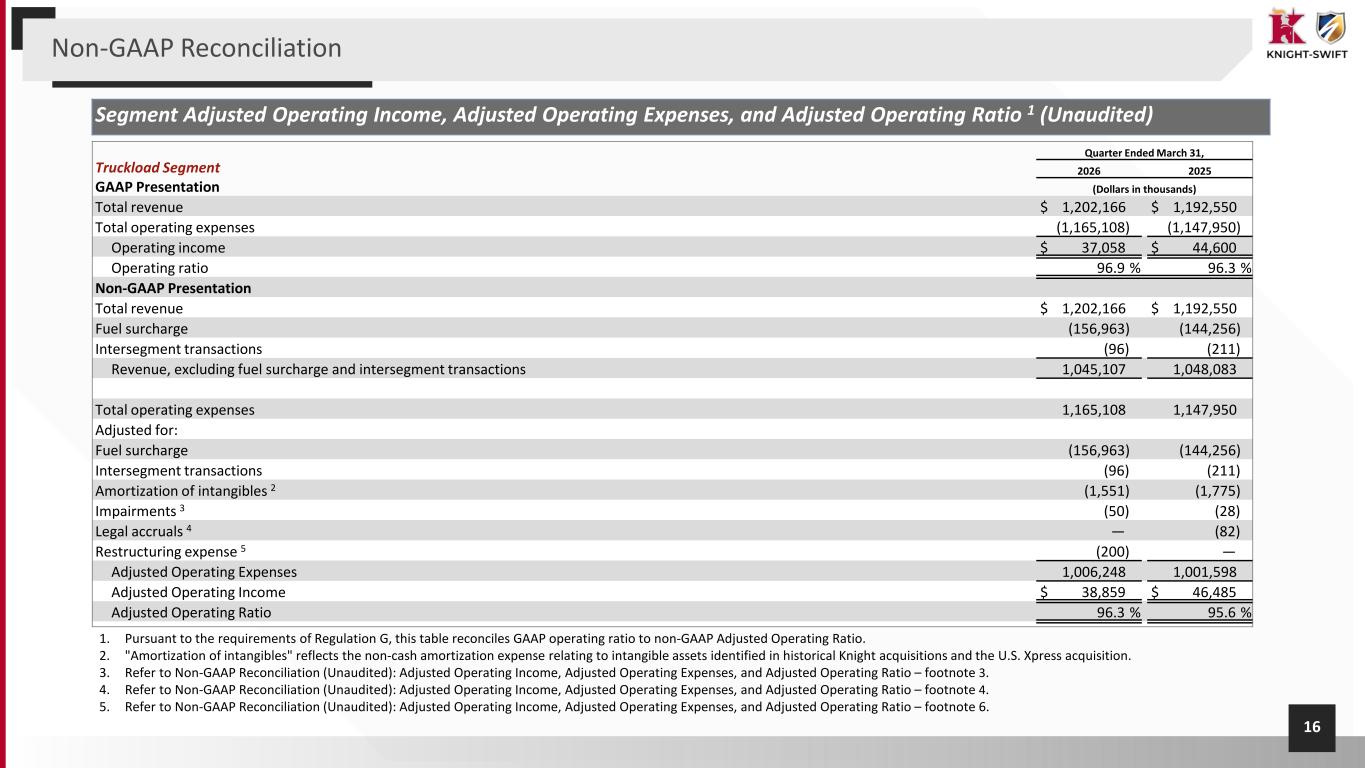
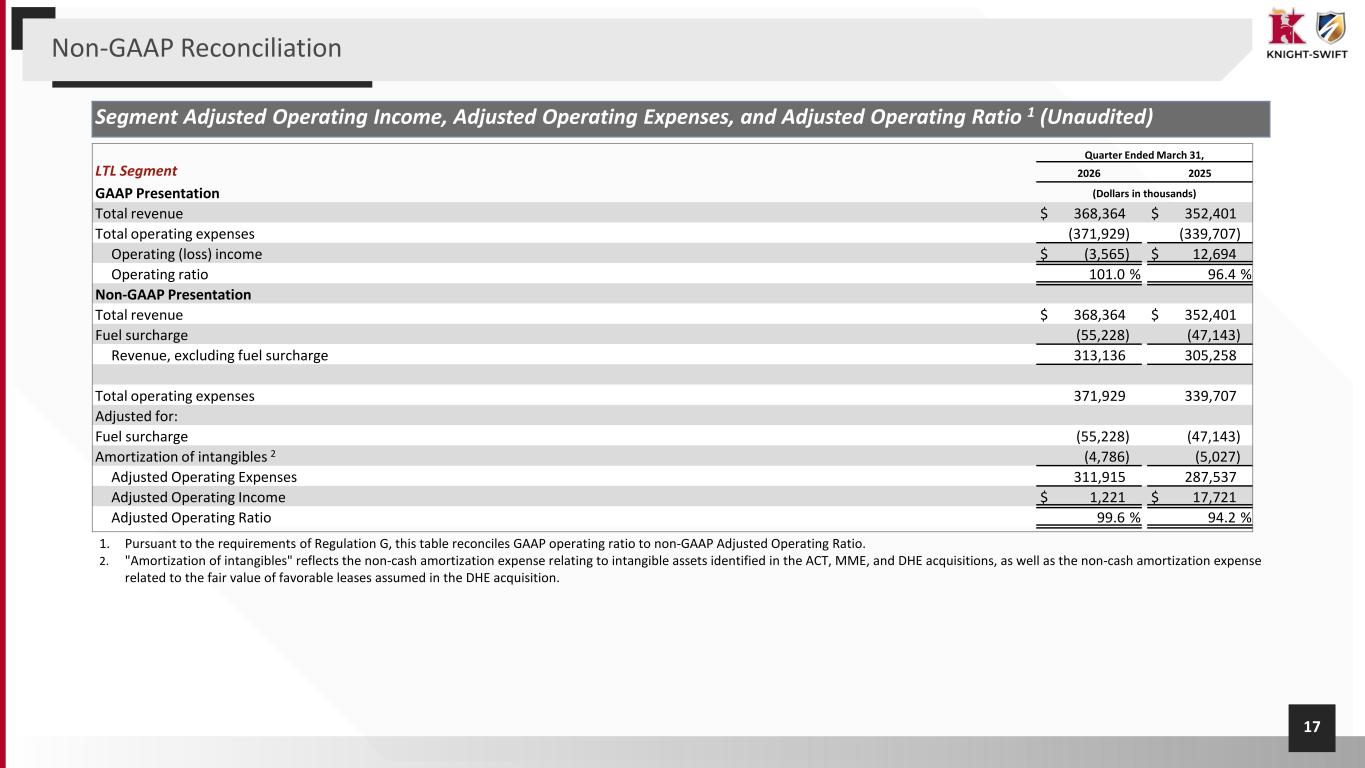
Thanks, Adam. The charts on slide three compare our consolidated first quarter revenue and earning results on a year-over-year basis. Consolidated revenue, excluding truckload and LTO field surcharge, was essentially flat. an operating income declined by $38 million year-over-year, largely due to the $18 million expense for claim development in our LTL segment, primarily related to an adverse arbitration ruling on a 2022 claim. $4 million of expense in our truckload segment for an adverse decision on VAT reimbursement in Mexico for prior tax years, where housing project business deferred to future quarters and an estimated 12 to 14 million dollar net negative impact for volume and cost headwinds from severe winter weather disruptions and sharply rising fuel prices during the quarter adjusted operating income declined 37 million dollars year over year primarily driven by the same items gap earnings per diluted share for the first quarter of 2026 were a loss of one cent primarily due to the items noted above gap earnings per dealer to share in the prior year quarter were 19 cents adjusted eps was nine cents for the first quarter of 2026 compared to 28 cents for the first quarter of 2025. our consolidated adjusted operating ratio was 97 percent up 230 basis points year over year the effective tax rate on our gap results was seven percent and non-GAAP effective tax rate was 28%. Slide four illustrates the revenue and adjusted operating income for each of our segments for the quarter. Overall, the relative shares of our various service offerings remains largely consistent quarter over quarter, with LTL gains slightly over the fourth quarter as it exits its seasonally weakest period of the year. Now we will discuss each of our segments, starting with our truckload segment on slide five. Aside from the negative impacts to volume and cost from severe winter weather and fuel challenges in the quarter, most operational metrics were improving throughout the quarter. Revenue per loaded mile, excluding fuel surcharge and intersegment transactions, turned out stronger than we anticipated and even improved sequentially over our end-of-year peak season result largely driven by spot opportunities that developed within the quarter however volumes and cost per mile for the quarter were both unfavorable as a result of the weather and fuel challenges on the whole our truckload adjusted operating ratio of 96.3 percent only degraded 70 basis points year over year as a reduction in empty miles and the strengthening rate environment largely offset the headwinds to volume and cost q1 marks the seventh consecutive quarter of year over year improvement in miles per tractor importantly the strengthening rate backdrop and improving network efficiency have ongoing implications for our business while the weather issues are not expected to reoccur on a year-over-year basis revenue excluding fuel charge surcharge was essentially flat as a 1.4 percent improvement in revenue per loaded mile excluding fuel surcharge and intersegment transactions largely offset a 1.8 percent decrease in loaded miles adjusted operating income declined 7.6 million year-over-year largely as a result of the adverse decision and vat reimbursement as noted earlier as well as the cost headwinds from severe winter weather and fuel escalation in the quarter us express made further progress on operating efficiency and and trailed the legacy brands and adjusted operating ratio by approximately 300 basis points for the quarter the ongoing progress that us express is encouraging and we expect this business will continue closing the gap in margin performance with our legacy brands is the market. Moving on to slide six, our LPL business brew revenue, excluding fuel surcharge, 2.6% year-over-year, driven by a 5.2% increase in weight per shipment with an 8.5% increase in length of haul. Tonnage trends showed momentum as the quarter progressed, ending with March average daily tonnage up 7 percent year-over-year. Our expanded service coverage and presence in new markets is helping us win business with new customers, gradually increase our industrial exposure, and transition our network and freight mix from regional to national. Shipments per day were down 1 percent year-over-year for the quarter, largely as a result of winter weather disruption in january and the shift in freight mix to a higher weight per shipment revenue per hundred rate hundred weight excluding fuel surcharge fell slightly by 70 basis points year over year driven by the increase of weight per shipment while renewal rates continued their trend of mid single digit increases we continue to make progress normalizing operational and cost fundamentals following a period of significant change to our network and freight. Purchase transportation as a percentage of revenue, equipment rent, and variable labor for shipment all showed improvement year-over-year in the first quarter, and we anticipate further improvements in efficiency as we refine our network and freight flows. As mentioned earlier, adjusted operating income and adjusted operating ratio were negatively negatively impacted year-over-year by the adverse claim development. We are encouraged by emerging seasonal freight patterns, steady progress on rate renewals, accelerating volume trends late in the quarter, and an improvement in wait for shipment for the first time in years as freight mix continues to develop into our expanded terminal network. Now I'll turn it over to Brad for a discussion of our logistics segment on slide seven.
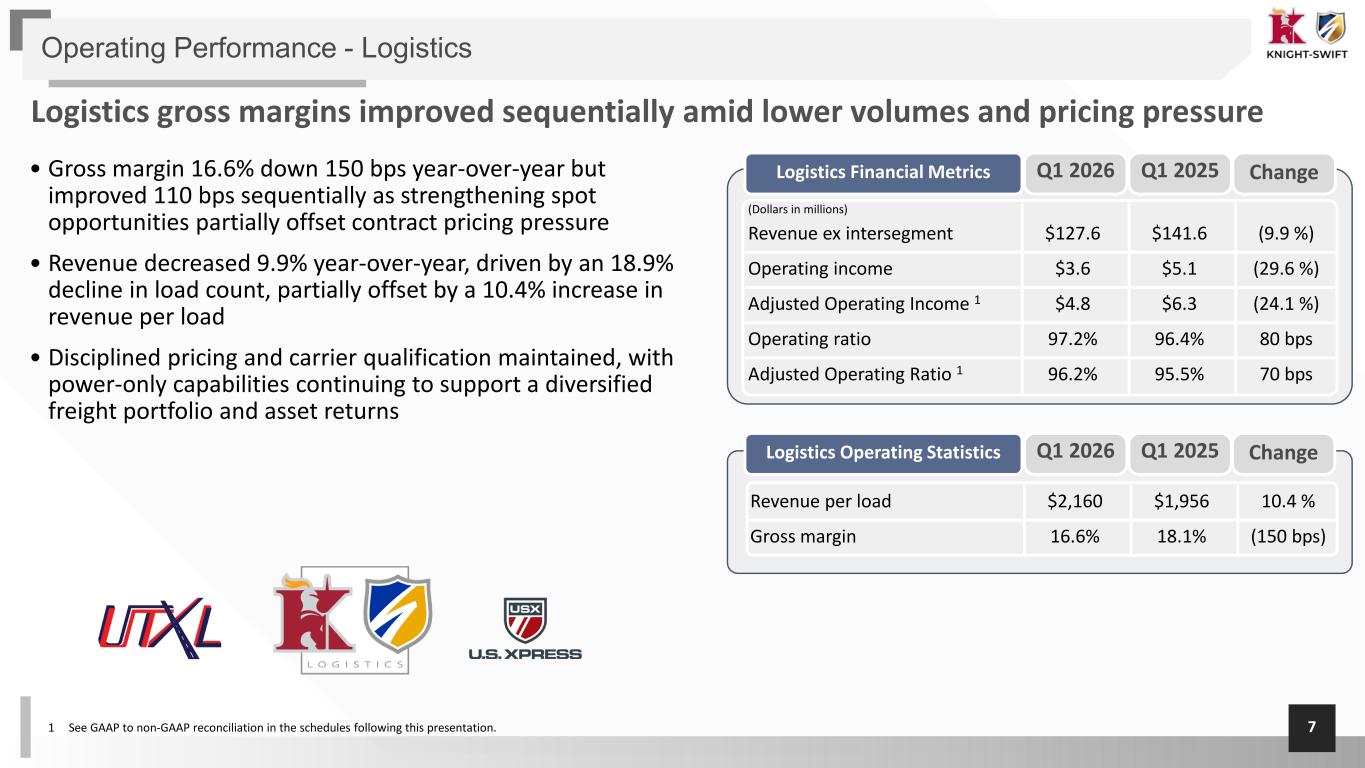
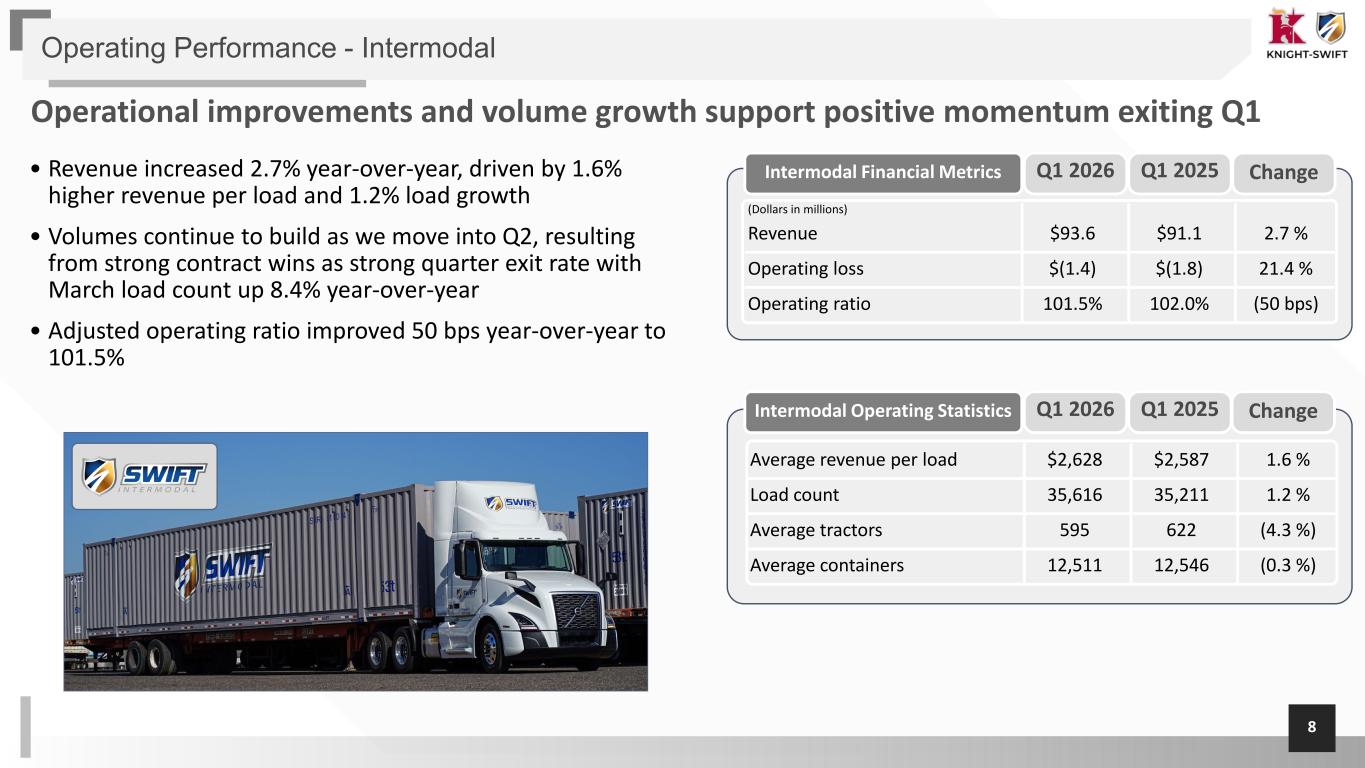
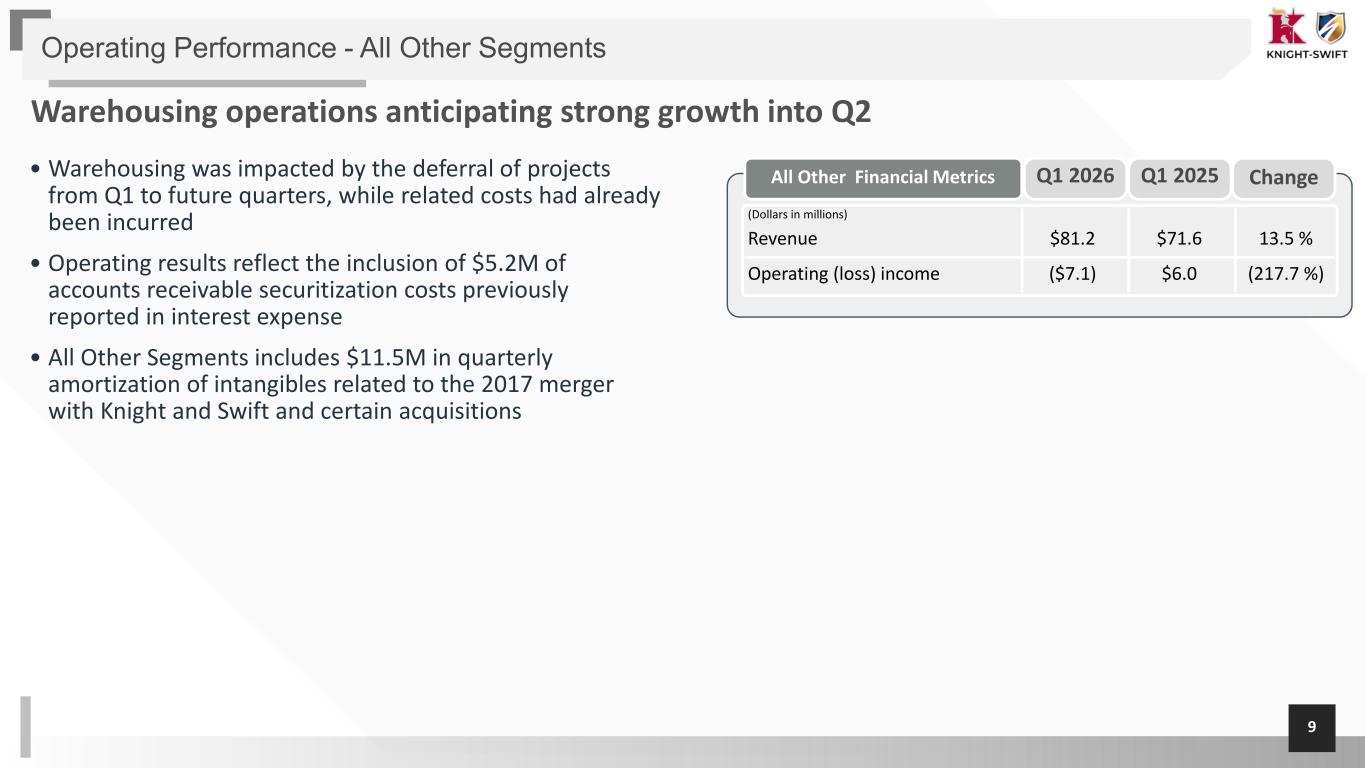
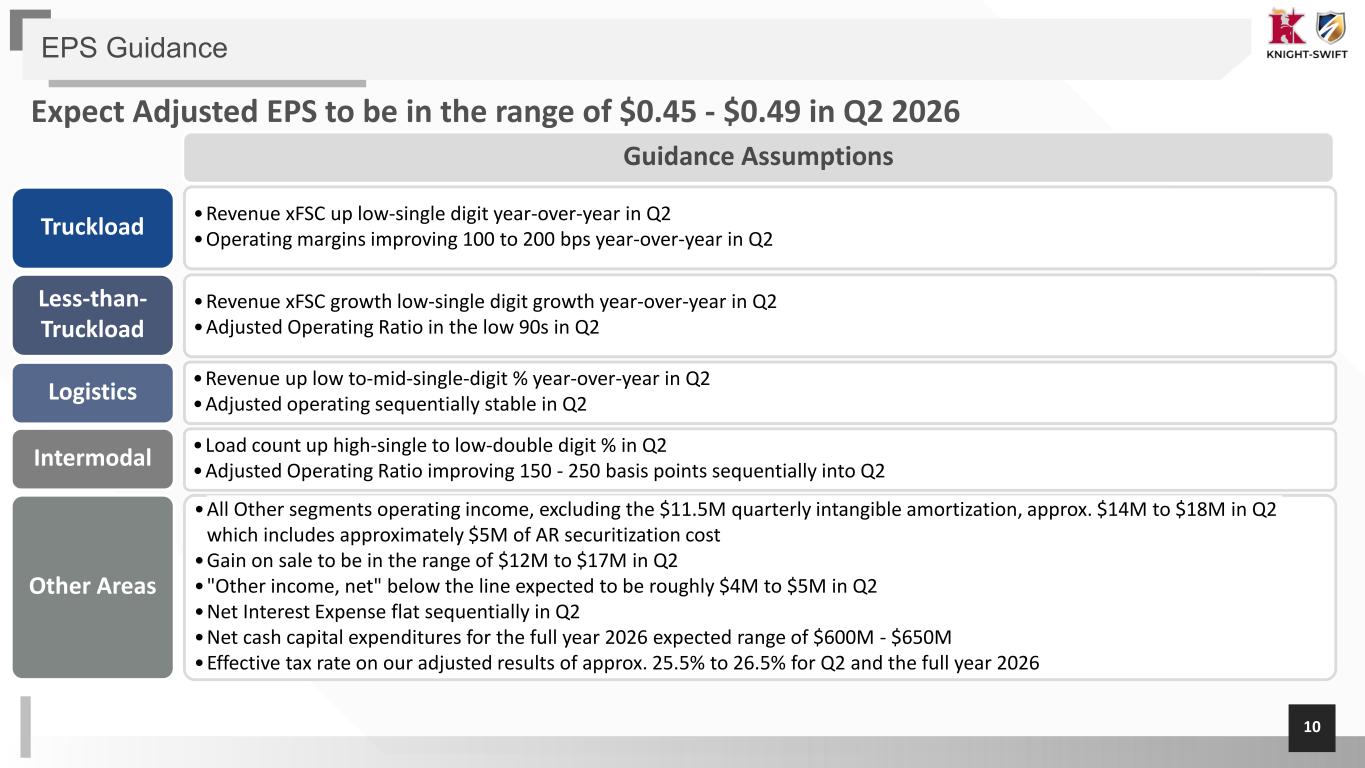
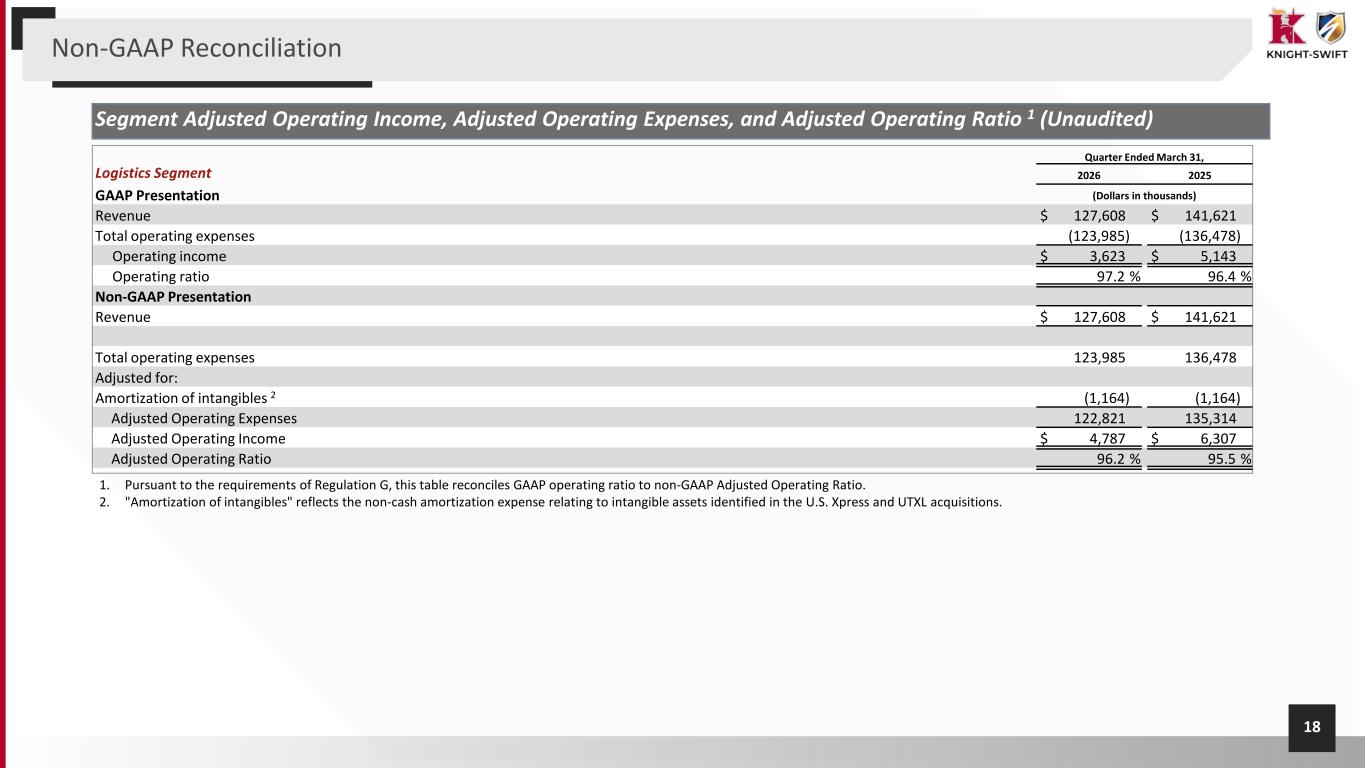
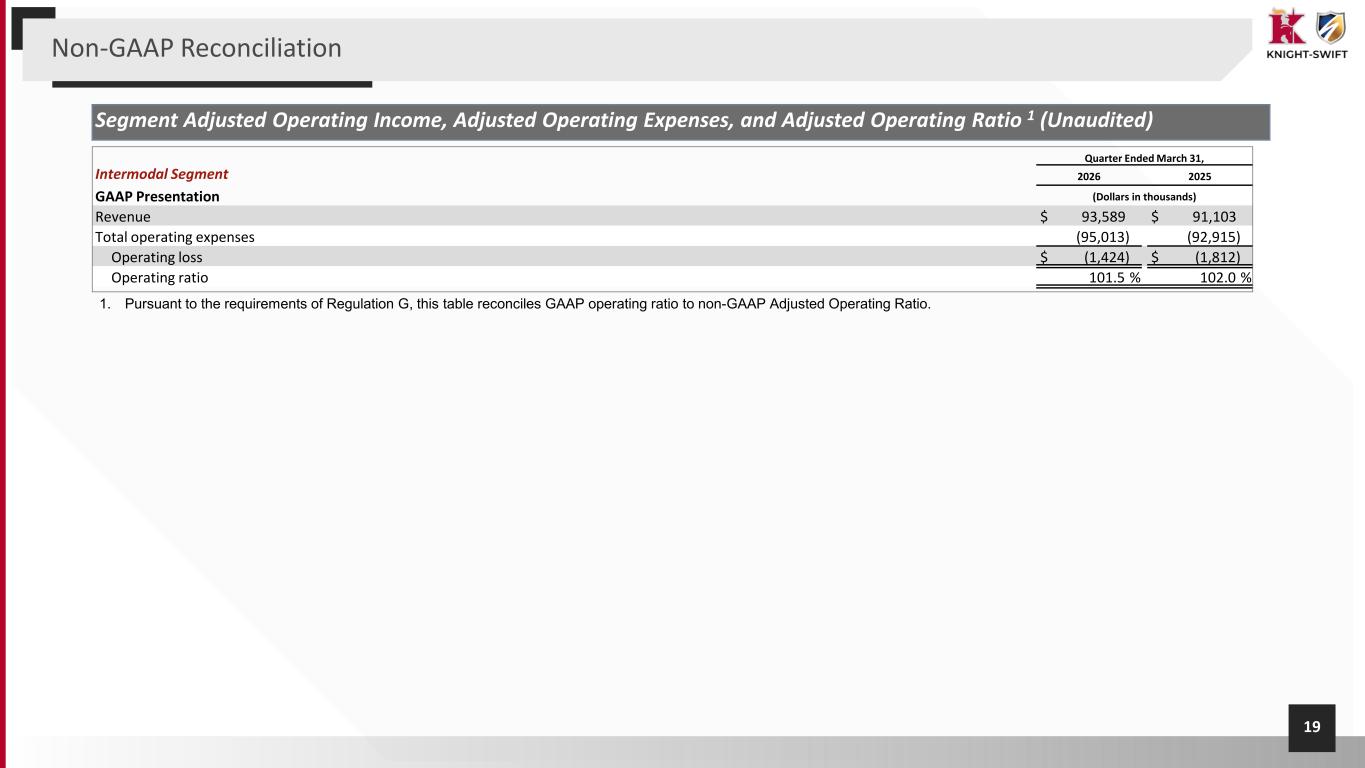
Brad Dixieff Thanks, Andrew. Logistics revenue for the first quarter declined 9.9% year-over-year, as volumes were down 18.9%, while revenue per load grew 10.4%. Third-party carrier capacity grew more difficult to source during the fourth quarter, and this trend continued through the first quarter. Gross margin of 16.6% for the first quarter declined 150 basis points year-over-year, but improved 110 basis points from fourth quarter levels, as strengthening spot opportunities helped to offset pressure on contractually priced business despite the year over year decline in volumes and gross margin our logistics segment produced an adjusted operating ratio of 96.2 percent only a 70 basis point degradation euro in addition to the increase in third-party carrier costs brought on by the regulatory pressures on capacity our logistics business experienced increased pressure on gross margin as we further enhanced our already rigorous carrier qualification standards in response to a sharp increase in cargo thefts in the industry and the troubling carrier practices exposed by recent regulatory efforts. This affects not only new applicants seeking to join our carrier base but also resulted in a reduction in the number of existing carriers we are tendering loads to. While such efforts were a headwind to capacity costs and caused us to reject more loads as unprofitable, as we reset contractual pricing through the bid season we expect that load count will improve and pressure on gross margin should lessen. Given the complementary relationship between our logistics and asset-based truckload segments, we believe the improving market dynamics will ultimately benefit both our asset and logistics businesses over time. Our logistics business has demonstrated its agility in navigating a volatile market the past few years by maintaining its operating margin close to target levels through disciplined pricing and cost management. This team is now further leveraging technology to take cost efficiencies to a new level, as well as to improve our responsiveness and our ability to capture opportunities in the marketplace, which we expect will contribute to our earnings in 2026. Now on to slide eight for discussion of our intermodal business. The intermodal segment grew revenue 2.7 percent and improved its operating ratio 50 basis points year over year as a 1.6% increase in revenue per load and a 1.2% increase in load count offset headwinds from winter weather in the quarter. Load count and revenue per load improved progressively throughout the quarter, with March load count up 8.4% year-over-year. While the intermodal pricing environment is more competitive than truckload at this point, we are encouraged by ongoing opportunities to leverage our strong service performance and our truckload relationships to continue growing our volumes at improving rates. We remain focused on delivering excellent service and driving appropriate turns through growing our load count with discipline pricing, cost control, network balance, and equipment utilization. Flag 9 illustrates our All Other Segments category. This category includes warehousing activities and support services provided to our customers, independent contractors, and third-party carriers, such as equipment sales and rentals, equipment leasing, owner-operator insurance, and maintenance. Additionally, beginning January 1st of 2026, all other segments also includes the cost of our accounts receivable securitization program that was formally reported below the line in interest expense in prior quarters. For the first quarter, revenue increased 13.5%. Operating results declined to an operating loss, partially due to the inclusion of $5 million of costs for the accounts receivable securitization program as well as startup costs on new contract awards in our warehousing business for which revenue is expected to ramp in the coming months on slide 10 we have outlined our guidance and the key assumptions which are also stated in the earnings release actual results may differ from our expectations based on our assumptions we project our adjusted eps for the second quarter of 2026 will be in the range of 45 cents to 49 mindsets. This range represents a larger-than-normal sequential increase in quarterly results, as the first quarter was negatively affected by events that we do not expect to recur, and because freight market fundamentals are improving exiting the first quarter. Our projections reflect recent trends in volumes, spot rates, and bid activity, as well as expectations for a continued seasonal build and freight demand for both truckload and LTL services. The key assumptions underpinning this guidance are listed on this slide. I won't take time to read through all of our assumptions here, but I do want to highlight the point that the recent strengthening of the truckload pricing environment will generally impact our contractual rates beginning late in the second quarter and into this. This concludes our prepared remarks, and before I turn it over for questions, we want to remind everyone to keep it to one question for a participant. Thank you, Sarah.
Operator
We will now open the line for us thank you ladies and gentlemen we will now begin the question and answer session if you would like to ask a question please press star one on your telephone keypad if you would like to withdraw your question simply press star one again your first question comes from chris weatherby with wells fargo your line is open hey thanks good afternoon guys um you know i guess obviously that the pricing environment in the truckload market is improving you know probably materially versus what we talked about last time so adam i was kind of curious how you think about the margin opportunities or maybe the the earnings opportunity for the truckload business as we go through i guess this year but but maybe bigger picture do you think this cycle has the potential to be what you kind of hoped it could be in terms of the mid-cycle earnings of the truckload business or the mid-cycle margins of the truckload business any color around that and maybe timing towards getting there would be helpful.
Yeah, so I mean, that's a great question, Chris. And, you know, it's, you know, it's early in the inflection here, so it's hard to know exactly the strength, the duration, and the timing and how that will play out. But just, you know, leaning in on our, you know, experience in previous cycles, you know, I don't think we've ever really seen the pressure on capacity and that coming from regulatory forces versus just normal economics. And so I think we could see more capacity coming out of the network than we typically would see in a cycle. And I feel like that could be a catalyst to really drive a strong bid season this year, but also into next year. And so the question is going to be, you know, can we capture rates, but can we also improve the utilization on our equipment, which, you know, we've done that now for seven consecutive quarters on a year-over-year basis, and then can we grow our seated trucks? Not necessarily investing in more trucks. Now, hey, if we get to that point, obviously we'd have the ability to do that, but to be able to seat more of the trucks that we have on our fleet while running them productively. If we're able to do all three of those, then I do believe this sets up to be able to get back to a more normalized earnings or margin profile that we're accustomed to seeing in our businesses. And that includes even U.S. Express getting to the legacy performance that we've seen at Knight and Swift. It's early in the cycle, and we're just getting some feedback on bids, and we're seeing how those awards are coming in, and then how some of our customers are tendering those awards and what mini-bid activity looks like, what turndown business is looking like. So still a lot to read through into the market, but it certainly feels like the setup is there for those in the industry to get back to kind of sustainable rates that puts our industry in a position where the good, quality, compliant carriers have the ability to make enough margin to invest in their businesses, invest in drivers, invest in safety, and invest in good quality equipment.
Operator
Appreciate that perspective. Thanks very much.
Operator
The next question comes from Richa Harnain with Deutsche Bank. Your line is open.
Yeah, thanks for the time, guys. So just following up from that previous question, Adam, when you say normalized margins, maybe you can highlight kind of what that is. mid-cycle? Is it sort of low teens that we're talking about here? And then just, you know, I think, Brad, when you ended the segment, you said, you know, the impact of this high single digit, low double digit rate improvement will really be seen towards the end of Q2 into the back half of the year. But if you can just kind of like give us a sense of, you know, the level of magnitude of margin expansion as we move through the year, you're already calling for 100 to 200 basis points of year-over-year improvement in Q2 before we really start to see the evidence of this type of rate environment. I think in Q2 you're just calling for low single-digit improvement, right? So I'm just trying to get a sense of how we should flow through this in the model near term and maybe more longer term if you could help. Thanks.
Okay, well I'll hit on maybe the first portion, I'll try the second, and Brad you can you can delve till on that. You know, I think we've probably got this question on normalized margins for the last like five earnings calls in a row, so I'll try to be consistent on how I answer this. You know, we look at our business, you know, in a normalized market, the truckload business typically operates in the mid-80s, right? So that's kind of that mid-teens margin. When the market's really good, you know, we've operated, you know, sub-80s, and then typically in a difficult market, your upper 80s, obviously this cycle played out differently, has been far more challenging across the industry, and for us, included in that. But that's where I'm referencing getting back to that mid-80s normalized earnings. I feel like there's the setup here in this bid season and going into next to be able to achieve that. And then when you look at where we're at, we have our LTL business that's been growing, and that doesn't have the same cycles as truckload. And we look at just methodically improving the margins in that business. Obviously, we have the anomaly with the claim development in the first quarter, but we expect that to be put behind us and continue down the path of improving margins as we grow into that network and start to march down into the 80s, which I still feel this year we can achieve a sub-90 operating ratio during the year and just continue to build upon that. And then typically when our truckload business is healthy, the logistics business can grow exponentially. Now, early on as the cycle changes, logistics feels pain because the rates haven't adjusted yet to what the third-party capacity, you know, rates are, and so you probably see a low-count degradation, which we've seen because you just can't take freight that you can't make a margin on. As rates reset, contractual rates, but also backup rates, which we do a lot of with our customers, and so when the routing guy falls apart they tender us loads with the backup rates that hopefully put us in a position where we can't do it with our own trucks we could do it with quality third-party capacity through our logistics business and then we are able to take a lot more of the loads that we're turning down today so in in normal earnings i would expect logistics to be growing and then intermodal we believe is on a path to profitability i think we laid out the improvement sequentially that we expect to achieve in Intermodal, which would mean we're profitable, and volumes are really starting to build in that business. Last year, this time, we took a big step back when you had the tariffs announced that we were kind of pushing for improving our revenue per load, and that led to us losing some volume. But this year, it's very different. We're getting improvement, some improvement in rate, not near what you're getting on the truckload side, but some improvement, and it's resulting in better volume as well. So we're starting to see things build and we'd expect, you know, Intermodal to get to profitability and to see that improve as the cycle, you know, strengthens. So that's how we're viewing kind of this, I'm saying normalize. You're never really at normal. It's kind of, you're always flowing in the cycle but that's how I'd frame it up, Richard, with that for that question. And then on terms of the high, low, double digit you know requests you know right now we're probably got about 70 percent of our of our business in bid but a lot of that starts to be implemented kind of mid to late second quarter and then it starts to flow into third quarter we have some pretty big customers that that hit in the in the third quarter so we may be seeing the the activity really really build in terms of approving you know healthy rate improvement or rate increases but it may not flow through to the p and l immediately but we expect that margin to to really flow start to flow through kind of fully baked uh more in the
third quarter and then build into the fourth quarter brad i don't know if you had anything else you wanted to elaborate on i'll say those what's that and just just one thing i would add is uh in terms of our contract versus spot mix uh you know we came into the first quarter in the uh know that 10 to 12 percent kind of range low double digits where we had been for really the last couple years in terms of spot exposure we exit the first quarter just a couple of points higher than that you know kind of low to mid teams perhaps um and look as we as we navigate the pricing environment and navigate trying to manage our our business and extract yield from from our network uh jumping into spot exposure is not step one in trying to manage yield and so our first priority is our contractual recurring relationship business and and we have expectations for what where the market is on price at this point and that's what we're trying to address first and foremost and um if if we can't come to come to agreement on on the or see price the same way in terms of the market uh we may end up with less contractual exposure on certain accounts uh and that will create more spot exposure and so that's something that can evolve over the next several months as we continue to work through bid season and so that's just another lever that can contribute to our realized rate per mile in addition to the contract and the backup rates as adam as adam spoke to so that's something that we're going to be managing and watching week by week as we work
Operator
through this but a lot of different avenues uh to to generate that's great guys thank you all right thanks richard your next question comes from ken hoekster with bank of america your line is open Hey, great.
Good afternoon. And I guess, Brad, just to extrapolate on that a bit, right, it sounds like in the prepared remarks, Adam, I think you might have mentioned you're revisiting contracts that are longer in nature. Are you already starting to give those notices to get out of the contracts and start to renew? Is that how tight the market has gotten? I just want to understand kind of the comments around that. And to clarify, on the LTL, did you say the delay, but the weights are ramping, the delay in getting pricing, but you're seeing weights ramping given the industrial move? How long does that delay get till you get that pricing?
Well, let me clarify that. We're not saying we're getting delayed pricing on LTL. I think we're saying we're getting mid-single-digit on the renewals, but we're seeing a freight mix change where we're getting, you know, longer length of haul, heavier shipments that we believe will improve the yield of the business. And so the revenue per hundredweight may get a little bit skewed in terms of the year-over-year comparison because of the freight mix change, but we're not seeing delay in LTL pricing. And then in terms of the rate reviews is what we would call them is we're going through our network and looking at any rate that may just be stale. If it's beyond a year, it's something we're going to look at. We're reviewing those that are called the bottom 20 percent performing and looking at what we need to do to get those rates to where they're closer to market. And so if we don't have an active bid to address those, we're being proactive of going through that review and then having discussions with customers around that. So that is something that is active, I think, early stages right now because there are a lot of customers that do, you know, RFPs. And, you know, like I said, we're probably, you know, in the heart of about 70% of that business. But there is the 30% that we need to make sure we're addressing as the market moves quickly.
And same for the LTL. Does that gap close? Do you get if you're already at high single, low double in truckload? Can you see that transfer to the LTL market?
I don't know that they align that well. Right now on LTL, on renewals, we're getting mid-single digits right now. Thanks guys.
Operator
Your next question comes from Ravi Shankar with Morgan Stanley. Your line is open.
Great thanks to everyone. Adam, last quarter you very helpfully walked through what you saw were upcoming catalysts on the supply side. Obviously, lots of moving parts here, but everything from the Dalila's Law, the Montgomery case on the brokerage side, new proposal for $5 million minimum insurance, as well as all of the rules that we saw last year. How do you see this evolving over the next few months and potentially the market tightening up more?
Yeah, I mean, I think you hit him, Ravi. I mean, these are all, you know, pressures that we think are going to deter bad actors from coming into our space. I think it's going to push capacity out of the market that aren't at sustainable rates and aren't acting in a compliant manner. I think clearly when our industry saw spot rates jump dramatically in 2021 and then we had this push for immigration, this industry was targeted. And we had a lot of people enter our space that didn't have much experience in trucking, probably didn't have a great safety background, didn't have proper training, and also were probably exploited by some of the chameleon carriers that are out there and ultimately paid them rates well below what, you know, someone who's a citizen of the U.S. would view as livable wages. And so I think that population is getting pushed out with the pressure on eliminating the improperly issued non-domicile CDLs, and I think Delilah's Law will help codify that into law, among other things. I think we've got an administration who's really pushing on what some of these chameleon carriers, how they've exploited the system, and the self-certification of training, the self-certification of logs, and putting more regulation behind that. And I just think there's going to be a lot more oversight from the FMCSA that's needed. Now, hey, if we get minimum insurance, that's another big thing. I mean, you've got English language proficiency, that's pushing capacity out of the market. And, hey, I think drug testing is another big one where, you know, we already have set a much higher standard for ourselves. We've been doing hair follicle drug testings for over a decade, and we see that you're probably 10 to 15 times more likely to pick up a positive drug test than you would with urine. Yet we don't accept that as a valid way to test drivers, and you can't even submit those positive results to the clearinghouse. And so those drivers can just go on to another company and get a job and be behind the wheel, and we don't think that's right. And so I think that's another thing that I think this industry needs to help clean it up and really be focused on putting the safest drivers on the road. But, Robbie, what I'd say is we've never seen this type of push to clean up some of the capacity of the unsafe drivers out on the road. And when you pull – not one of them, I think, moves the needle enough, but when you aggregate them, I think we're already starting to see that influence the market. And really, you know, the improvement we're seeing and the ability for us to get rate is driven largely by capacity reduction versus demand. And if we start to see demand pick up in conjunction with some of these other, you know, efforts that are just in the early innings, I think we could find ourselves in a much more favorable position from a carrier standpoint.
Yeah, Ravi, I would say that, you know, I think it's clear to us through our conversations, the administration is committed to the cleanup that needs to happen in our industry. We think if we can get, you know, legislative support through Delilah's law and the like, that, you know, obviously that makes that more durable through future administrations, but we don't think it's dependent on that. we think whether whether that happens or not that the uh actions of the administration are going to be effective over the next few years as we continue to kind of get things right with our industry very helpful thank you thanks robbie your next question comes from scott group with wolf research your line is open.
Hey, thanks. Afternoon, guys. So, Adam, what are you seeing with seated tractor counts and drivers generally? And then just, you know, big picture, if you think back last cycle, just massive growth in, you know, your and everyone's brokerage business. But, you know, all the things that you talked about in that last question with non-domicile and chameleon and montgomery all these sorts of things i'm wondering like as you're having these big conversations is there a sense from shippers that they're less willing to do a brokerage offering right now and they're maybe are they are they willing to pay more for asset based um this time versus maybe prior cycles yeah okay well let me let me hit on those uh scott so on the On the seated truck side, you know, certainly finding drivers, hiring drivers has always been a challenge in our space.
I've always said in our industry, you either have drivers or you have loads. Really, do you have them at the same time, right? So we're starting to see the loads come through, and so we're making investments to ensure that we can have an advantage in sourcing drivers. And so we're making investments in our marketing spend, in the number of recruiters we have. We're leveraging AI to ensure that we're very quick to react to leads as they come in. And we're really leveraging the academy network that we have to train and develop drivers. And as we've made those investments, as we saw the market change, we're starting to see that build some momentum really across all of our different brands. And so I'm feeling more bullish on our ability to not only improve rates, but to improve our utilization and grow seated truck, which I know was its biggest challenge during the last upciple in the pandemic. I think everyone went backwards to truck with how difficult labor was. But the challenge that we'll have is that we've only gone after the high-quality drivers, and some of our space have been able to hire those that don't meet the criteria that we have. Now, as some of those drivers are kind of pushed out of the market because of some of the things we just talked about, the quality drivers that we look at are going to be more attractive. But we believe we bring far more to the table with the terminal network we have, the equipment we have, and the ability to give high-quality training. And so we feel like we'll have an advantage to maintain and even grow our seated truck count as drivers become more challenging. And to your point about logistics, I agree with you that I think we saw this proliferation in logistics because you had customers that just had to move goods at all costs because demand was so high, and you had this flood of capacity coming in. I think when talking to shippers, I think they're going to have a bias towards asset-based carriers. I mean, we're already starting to see that. We're starting to see that they're limiting, you know, even some bids, mini bids only to asset-based carriers or limiting the percentage that they will allow, you know, in terms of brokers to participate in a bid. And I think that's going to continue. Now, I think we get viewed a little bit differently because we do bring some assets to the equation with the power only that we offer. But we've also talked about what we're doing to vet the carriers that we work with. We have taken a great number of steps to really ensure that we have high-quality, safe carriers. Now, you're not always going to be perfect at that, but we have cut down the number of carriers that we work with dramatically. Just since the beginning of this year, we're down 30%, and we had made a large cut even earlier last year. And so we vet how long you've been in business. We're looking at evidence that you have logs, that we can see where your tractors are at. We actually, because I think one of the challenges in our space is the broker has no idea, in most cases, who is actually driving the truck. And I think that's been a real challenge for the broker and the shipper to really know that. And so we are taking steps to ensure we know we have a copy of the license, we know who's in the truck, especially if they're going to operate and leverage one of our trailers. So we're taking a lot of steps to put ourselves in a position that when customers kind of demand that as part of the logistics solution, we have that to offer. So I don't think you're going to see the same, you know, expensive growth that we saw during the pandemic. But I do think those that are good quality logistics providers do it the right way and have an asset solution to complement what they're offering will have the ability to grow in a strengthening market. Thank you. Thanks, Scott.
Operator
Your next question comes from Jonathan Chappell with Evercore ISI. Your line is open.
Thank you. Good afternoon. Adam, I know you don't go into the monthly detail on LTL as some of the peer plays do, but is there any way to help give a cadence on kind of how the first quarter, maybe April, transpired as we think about, like, wait's been good. That's finally getting the turn there. But are we going to start to see more consistent kind of shipment tonnage growth? And then importantly, do you feel if you do get that demand tailwind or tonnage tailwind, shipment tailwind behind you, I know cost alignment was kind of pretty difficult. Have you been building up the national network? Do you feel like your costs are now appropriately aligned that if there were to be a demand pickup, that would kind of go right to margin improvement as opposed to still kind of chasing that with resources? Okay.
That was a long question, John. I'll try to hit every component of it. That was the shortest one so far. Yeah. Okay. So on the LCL front, I think we talked about in our commentary that we were a little bit slower on volume to begin the quarter, but it did build with March being the strongest and then those trends continuing into April. You know, we only got a couple weeks into April, but we're not seeing that slowdown at all. And then typically second quarter is one of our strongest quarters in LTL. We do believe we have a tremendous amount of operating leverage in the business. You know, there's just a few pinch points that we have where we may have a few locations to open up this year, but it's not going to be near the investment we had to make in the prior years. And so it's allowed us to focus on the fundamentals with ensuring that we're efficient with our labor, managing the purchase trends. I think some of the things that Andrew touched on on the LTL discussion. And so, yeah, as we see the tonnage improve, and because of the freight mix, it may not even have to be a huge lifting shipment count if you're getting more tonnage that typically yields better. And as we look at our kind of our weekly performance, and we have an estimated OR in that weekly performance, as we see that building, yeah, I think we're seeing the operating leverage in the business and a lot of that flowing to improved margins. And so that's where if you feel like if this continues, you know, it could be back half of this year, we start to see that operating ratio begin with an eight versus a nine, and then just continue to build from there. I mean, hey, we're still working on freight flows and, again, adjusting to the changing network, but we feel very confident about our LTL team and what we're doing there and just making kind of consistent improvement in both the freight mix and the cost structure.
Andrew, you may have something you want to add to that. Well, let me just say a couple things. Just to give you a sense for the momentum within the corridors, obviously the southeast was pretty heavily impacted by weather. and that's kind of where our highest density volume is in our business but if you look at tonnage in january it was up 1.6 february 2.6 in march 6.9 so we really and it ended up at 4.1 percent up or so on tonnage year over year so we we really did see that build as we kind of moved out of the weather and as some of the new contract wins took took effect so i think that's that's be positive momentum as we build into what for us in q2 was our strongest seasonal uh quarter of our business but when it comes to cost i think you know below the surface obviously the the claim had or the the uh the arbitration uh liability cost impacted the core a lot but we have we're seeing steady progress in our cost efficiency so we saw our variable wage per ship improve from from the fourth quarter to the first quarter we expect that's going to continue we expect we've seen I guess I would say just to give you a little feel for it we're seeing the most improvement in our dock wages per shipment and I think line haul is the next area where we're going to start to see the most improvement. So the costs that came out of the business as we brought our different businesses together last year, in terms of vehicle we're in, travel costs, right-sizing our equipment, all of those are showing positive trends. The one thing I would probably mention to you is we've mentioned that we're slowing down building new locations, and and that is right that's kind of where we're at but we are going to we have locations where there are pinch points that uh in our the security security of our flow need to be addressed and we are increasing door counts in those locations that that's going to allow our freight to flow in a more natural way in a more cost efficient way so you're going to see us add locations where uh where we need to to help with that flow those are going to create some growth but primarily they're going to help with our cost so we're still aligning our evolving network with our footprint but we're we're in a place now where it's just uh we're positioned well we're just going to see improvement in terms of that efficiency we expect going forward super helpful andrew thank you thanks adam all right thanks john your next question comes from dan moore with baird your line is open.
Hey, guys. A lot of questions have been asked and answered, but one that was not addressed yet that I think is definitely worth a little bit of time is leverage around U.S. Express.
So, you know, I can't imagine a better rate environment to begin to realize momentum in that business.
I think we've argued for a while now that that's really what was needed. I know you guys have done a lot of cost repair and management repair in terms of the business, But, you know, just the ability to move through a rate cycle, much less a rate cycle like this one, really presents a lot of opportunity. Can you talk to us about the size of the business today, generally, and maybe talk to the potential earnings leverage of U.S. Express as we move forward? Thank you.
Well, so, Dan, I think you're right. I mean, when we purchased U.S. Express a few years ago, I mean, we felt like we were going to be in a more favorable environment sooner than we have found ourselves. And so that's put some pressure on the margin and how quickly we were able to, you know, drive accretion through that acquisition. But I agree, we're finally in a place now where we can, you know, work on improving their freight network and improving their rates to a more sustainable level. And we've got a great team there. The gentleman who leads that business led sales at Swift following the merger and was an integral part of the improvement at Swift and the margin profile at Swift. And so we feel him and his team are well-positioned to understand what it takes to make some of the changes. And, hey, some of those rates are going to need to go up in a very meaningful way. And they're very equipped with understanding of the market, leveraging the network information we see across all of our brands, and closing the gap on where we're at from a legacy standpoint. I think this last quarter, they're about 300 basis point difference from an OR standpoint. Some of that is still a cost delta, but I think a lot can be made up through, you know, getting the rates closer to where we are from a legacy standpoint. I think we've got the right team there. We've made a lot of changes there. But, you know, feel well positioned at the discussions with other customers and getting, you know, I think good feedback in the early parts of the bid and expect to see rate continue to grow and develop.
And from a cost perspective, let me just make a couple points. Hold on.
What were you going to say, Dan?
Yeah, I'm sorry. I just wanted to – one thing that would be helpful to understand is just the size of the business today. And, you know, if you want to bracket it, that's fine, or, you know, any manner in which you'd like to answer the question. I know it's, you know, I know obviously that it's a consolidated business at this point, but we don't know how, we don't know what the revenues are. So if you can maybe add some context around that today, if at all possible, that would be really appreciated.
Yeah, I think between the trucking and the logistics business, I mean, you're just under $2 billion between those two, probably about $1.7, close to that. And now, Andrew, you want to...
Yeah, so just, I think, four areas that I think are opportunities ahead of us on cost. First, the cost of insurance and safety, so that, you know, we've had to go through something of a culture change there. in regards to how we manage safety and insurance. And, you know, the CSA crash basic, I think, is a good number for us to look at. That's over 60% better than where we were at the acquisition. So we're seeing especially we're starting to see that impact the business. And those legacy costs of insurance and claims have weighed on the business. We think that the safety performance that's improved dramatically is going to start to impact the business. The equipment costs, we're still working through some of our high-cost equipment leasing. And so we think as we roll through that equipment, that's going to provide some opportunity. In terms of hiring costs and advertising, we think there's opportunity there as we get better at that to bring that cost down. But obviously, the biggest opportunity is rate that Adam talked about, where we think that we have more than a normal amount of progress to make on rate. So, a lot of the work we've done on cost has been on the fixed cost side, on our overhead costs, which has been pretty significant in the last year. We think that that's going to be structural and sustainable through volume growing in the business.
A lot of tailwinds emerging. Good luck with the remainder of the year, guys. All right.
Operator
Your next question comes from Brian Ostenbeck with JPMorgan Chase. Your line is open.
Hey, thanks for taking the question. Maybe just to come back to some of the more topical ones here we'll be discussing here for a while. Just in terms of the, I guess, the work you did with carriers in the logistics business, down 30% I think it was for accepted care that's a pretty significant number so is that something you feel like the rest of industry has to go through as well maybe they have an even higher number of carriers they're gonna have to squeeze out of their of their networks and you know Adam we've heard for a long time about hair follicle testing and things of that nature sounds like I think you said there's some momentum but like what are the one of the steps we would have to see for that to get a bit more progress and when should we expect maybe we could see that start to begin thanks well look i i don't want to speak to what other logistics
companies should do or have to do i think about what we felt like was required of us to ensure that we're putting quality carriers you know hauling our shipments hauling our trailers when they're doing power only we're anticipating that you know our customers are going to start being more concerned about this as, you know, this becomes more of a relevant issue. And I think we're already seeing that in mainstream media. We've already had some discussions with some of these shippers about, you know, how we're really monitoring who's hauling their freight, who's actually driving the truck. And so we felt it was prudent for us to, you know, take the steps to eliminate capacity that we didn't feel comfortable with. And do I think others will do that? I think some will. I think some will still take the cheapest carrier when they're available, and that may just be based on survival. So I don't know how that'll play out, but I do think some of this capacity is just going to have to exit regardless because of some of the regulatory changes that are being enforced, and we feel very supportive of this administration and the actions that they're taking. So some logistics companies may not have a choice because the capacity they're leverage today won't exist. But we're not waiting for that. We want to be proactive and to do the right thing. On the hair follicle, Brad, do you want to maybe touch on that? Brad, you've been engaged in that.
Yeah, I was just maybe going to share in terms of what we've seen in our own experience over the last decade or so, as Adam mentioned. You know, we do both, right? We do the urinalysis test because that's what's recognized by the feds. And we do the hair follicle test because that's what works so we pay incremental cost to do that in addition to that because that is an important part of our hiring process and what we found over doing this you know thousands if not tens of thousands of times a year is that the hair follicle test identifies roughly 14 times the drug users that the urinalysis test does so that prevents us from hiring them it does not prevent them from driving in our industry because not all carriers do that and so there is an openness it seems in in washington to at least engage in this conversation you know congress uh passed this years ago and just health and human services has not gotten around to writing the rules to actually put this into practice uh so it does seem like there's maybe an openness to engaging in that conversation we would ask just to allow us to report what but those of us who are paying for the test what we are finding maybe don't require it of everyone but if we're going to pay for it let us report that to the registry because we do think that is important for safety for the motoring public.
Okay, thanks very much. Appreciate it. Please, Brian.
Operator
Your next question comes from Ari Rosa with Citigroup. Your line is open.
Hey, good afternoon. So, Adam, I wanted to ask a bit of a strategic question. You've shed a few thousand tractors since the USX acquisition. It makes sense to us, of course, why that decision would have been desirable in the downturn when obviously it was difficult to find loads. But now as we think about the upcycle, is there any dimension in which that holds back the ability to get the same level of upside that you might have seen if you would kind of retain those tractors? I'm just hoping you can kind of discuss that decision or maybe defend that decision a bit. Give us a little bit of color on like why that was the right decision to shed those tractors and also put it in the context of on an absolute basis, obviously we're looking at a larger tractor count now than what you had in kind of the prior cycle. So kind of how do those dynamics play out against each other as we think about what the upside could look like? Thanks.
Yeah. Well, what I'd say, Ari, is, you know, we don't go into an acquisition with the intentionally trying to shrink, you know, the capacity. I think as we go in and review the freight network and U.S. Express, 40% of their loads were coming from brokers, which obviously you're not going to be successful if that's where, you know, who you're relying on for your freight. So we had to go in and adjust their network to find, you know, direct, you know, relationships, loads that can support their network. And so in doing so, you had to turn some of the business they were very dependent on. At the same time, we're ensuring that we have good, quality, safe drivers. And so we did change the standards, the hiring standards that U.S. expressed very early on in the acquisition to ensure that we had good quality drivers to drive down the craft basics, to improve the safety, to improve productivity, some of the things that Andrew has mentioned. And so when you do that, you're limiting the class sizes that you're going to have, and then you're changing your freight network. When you have that kind of churn, you'll naturally end up or you have the risk of ending up with more open trucks than you'd feel comfortable carrying as overhead. And so as you went through that to get the business on a better foundation and position them to be far more healthy long term, you end up with some capacity that you just need to sell and exit and remove from your overhead. And so that was the process that we went through at UExpress. Now, we feel stable today, and we're making the same investments there on the recruiting front and now leveraging the academies that we have at Swift and some at night to be able to train like our other brands do. and obviously as you have a better freight market they'll be able to make uh some some uh progress in repairing their network and putting themselves in a position to have sustainable rates uh to to grow uh the business back and hey we we'd love to be able to seat more trucks and and grow trucks but today we have you know we still have you know some empty trucks that we want to fill before we invest in additional capital. But hey, we're in a much better spot today than if we would have just tried to hang on to all the trucks from the original acquisition and keep the poor freight and not adjust the standards that we hire in terms of drivers. So I still feel it was the right move. We feel good about how we're positioned and expect to make some real progress on margin and drive accretion to the business.
And I'm just going to add a little bit of context. Ari, this is Brad. I know the up income right now coming out of the long and arduous down cycle doesn't show it, but we are running more miles than we were prior to the last up cycle. So we've got more of a basis there to work with going into this new cycle.
So I appreciate the question, Ari. I think that now concludes our call. I think we're beyond the time here. so appreciate all the questions and interest from everyone and again if you weren't able to get to your question you can call 602-606-6349 and we'll try to return your call as quick as possible thank you everyone this concludes today's conference call thank you for joining you may