Operator
Good afternoon, and welcome to Abcelera's full year 2024 business update conference call. My name is Tamiya, and I will facilitate the audio portion of today's interactive broadcast. If you would like to ask a question, please press star 1. Please press star 0 should you need assistance during the call. At this time, I would like to turn the call over to Trent Stymart, Abcelera's Chief Legal and Compliance Officer. You may proceed.
Hello, everyone. Thank you for joining us for Abcelera's 2024 full-year earnings call. I'm Trent Steimart, Abcelera's Chief Legal and Compliance Officer. Dr. Carl Hansen, Abcelera's President and CEO, and Andrew Booth, Abcelera's CFO, are joining me on today's call. During this call, we anticipate making projections and forward-looking statements based on our current expectations and according to the safe harbor provisions of the Private Securities Litigation Reform Act of 1995. Our actual results could differ materially due to several factors outlined in our latest Form 10-K and subsequent Forms 10-Q and 8-K filed with the Securities and Exchange Commission. Upseller is not obligated to update any forward-looking statements, whether due to new information, future events, or otherwise. Our presentation today, including our earnings press release and SEC filings issued earlier today, are available on our Investor Relations website. The information we provide about our pipeline is for the benefit of the investment community and is not intended to be promotional. As we transition to our prepared remarks, please note that all dollars referred to during the call are U.S. dollars. After our prepared remarks, we will open the lines for questions and answers. Now, I'll turn the call over to Carl.
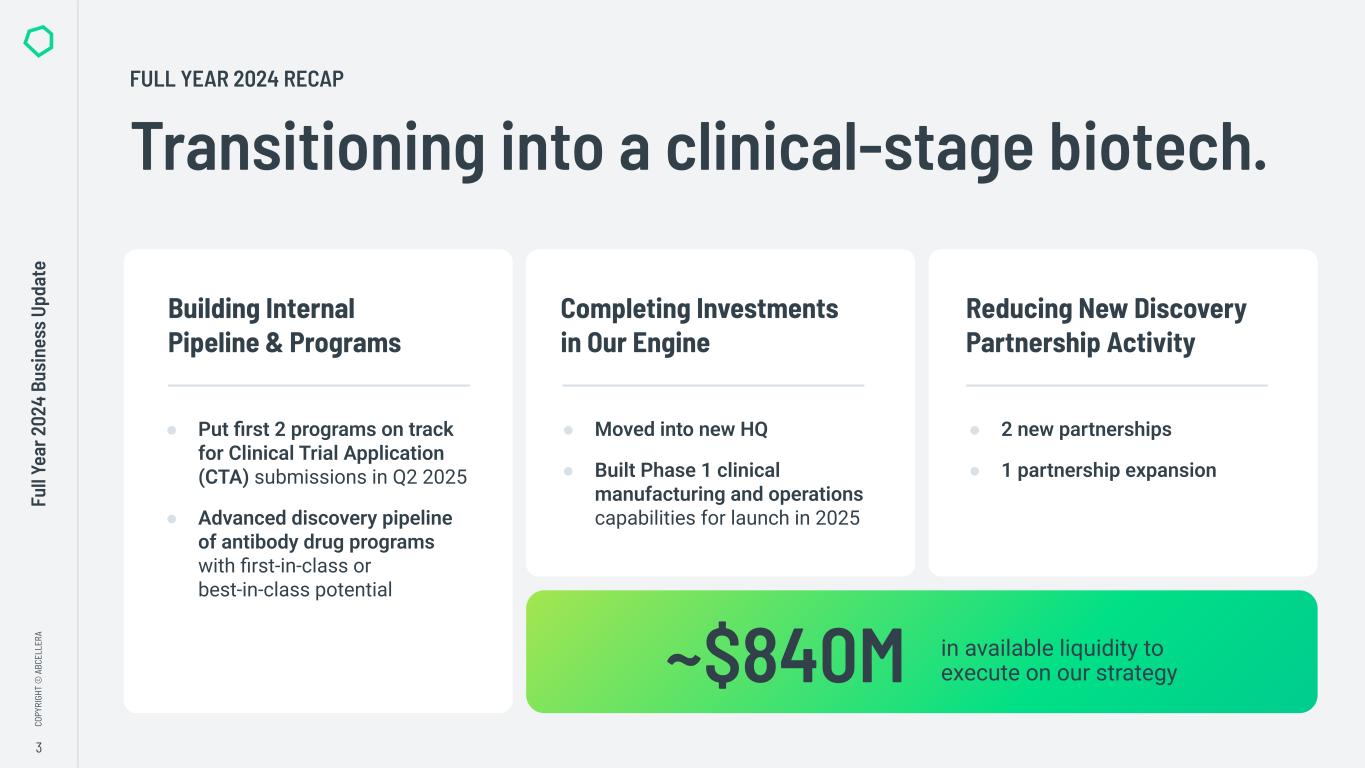
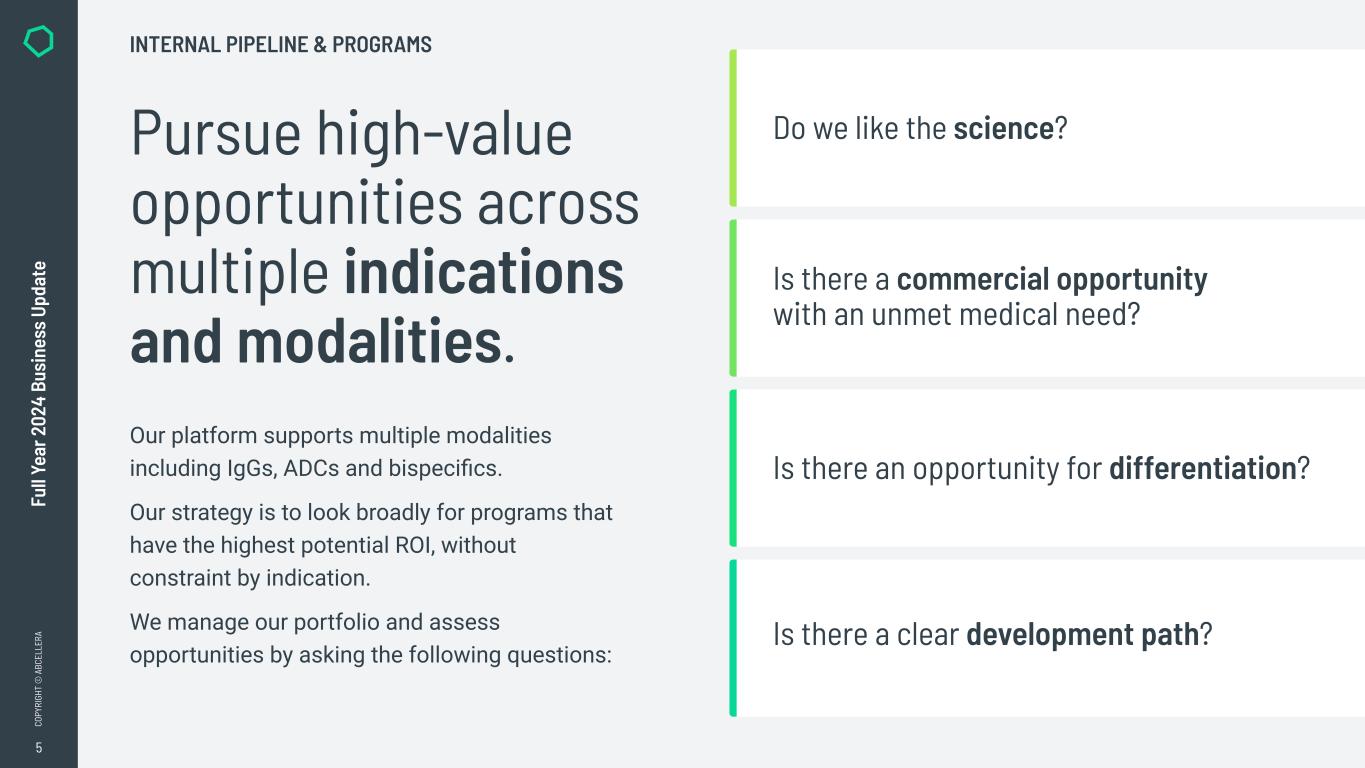
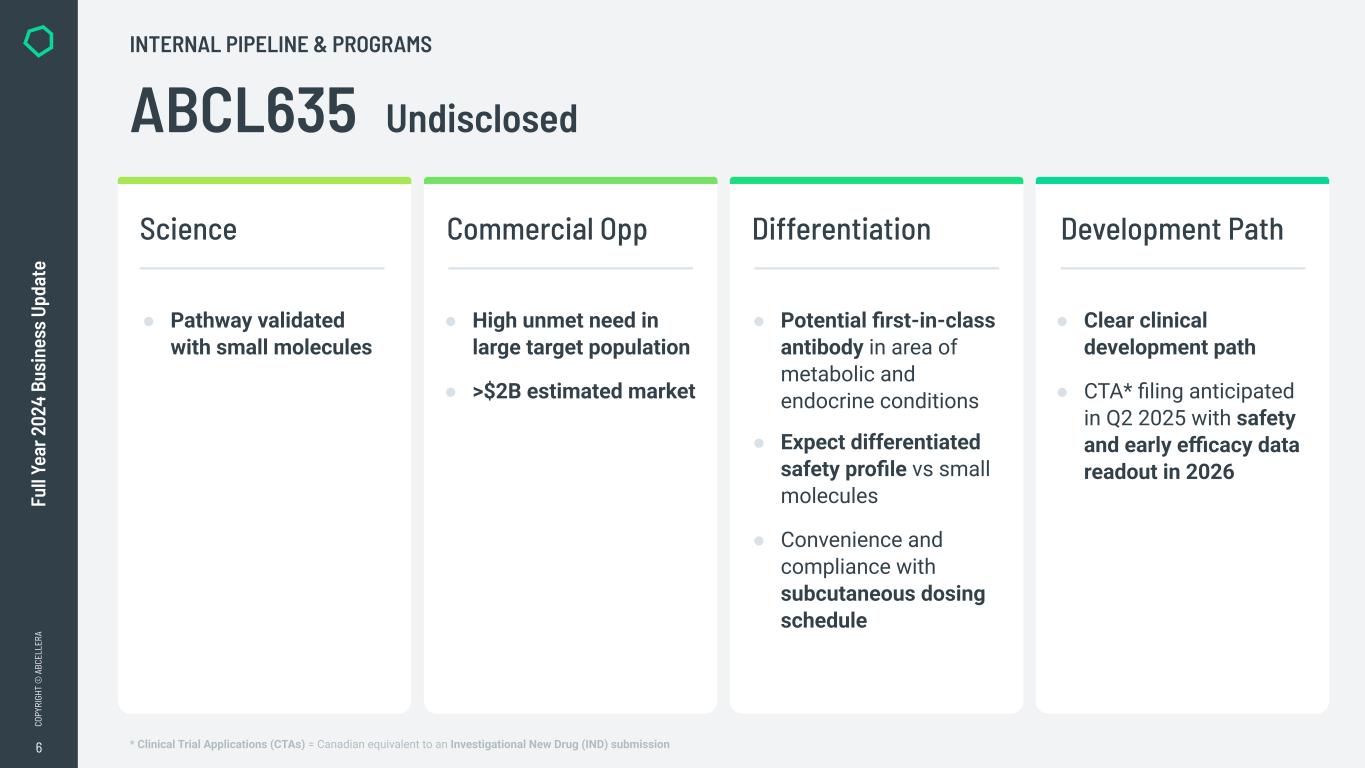
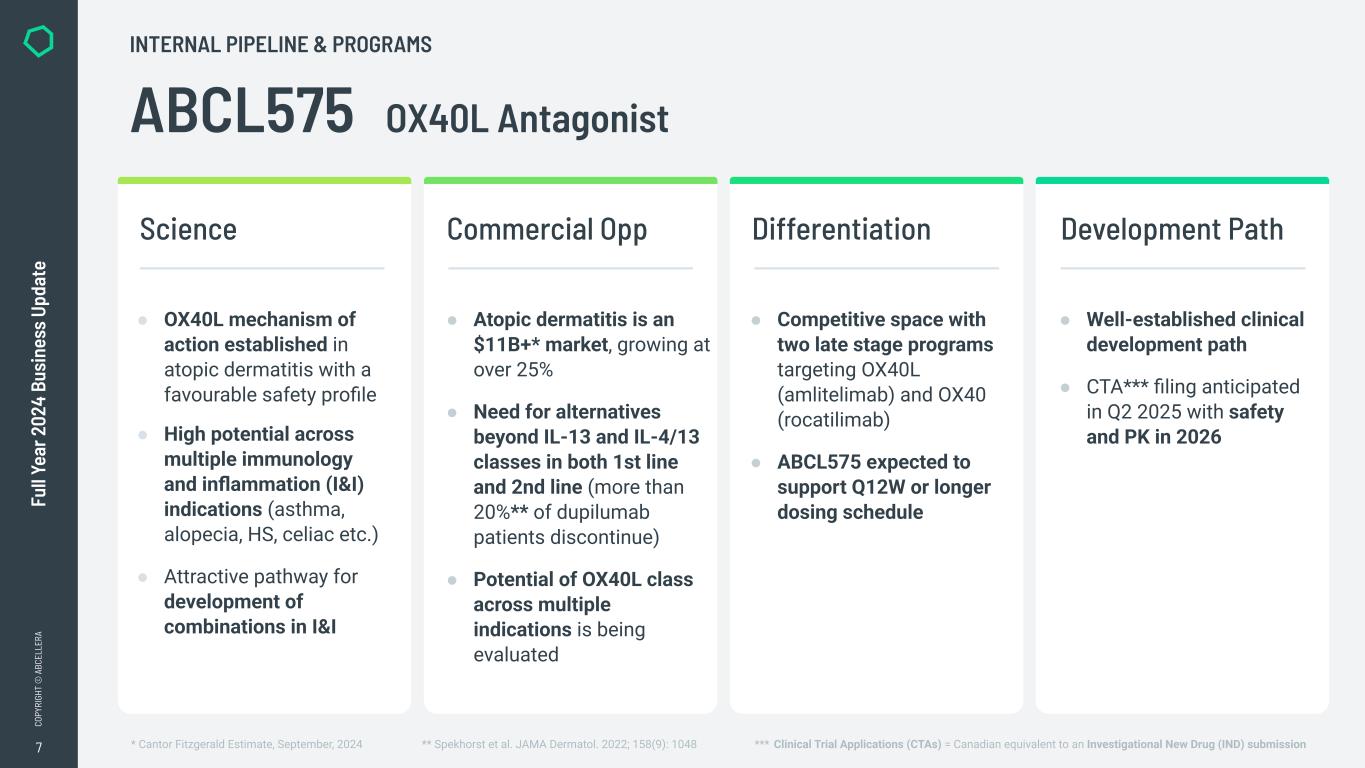
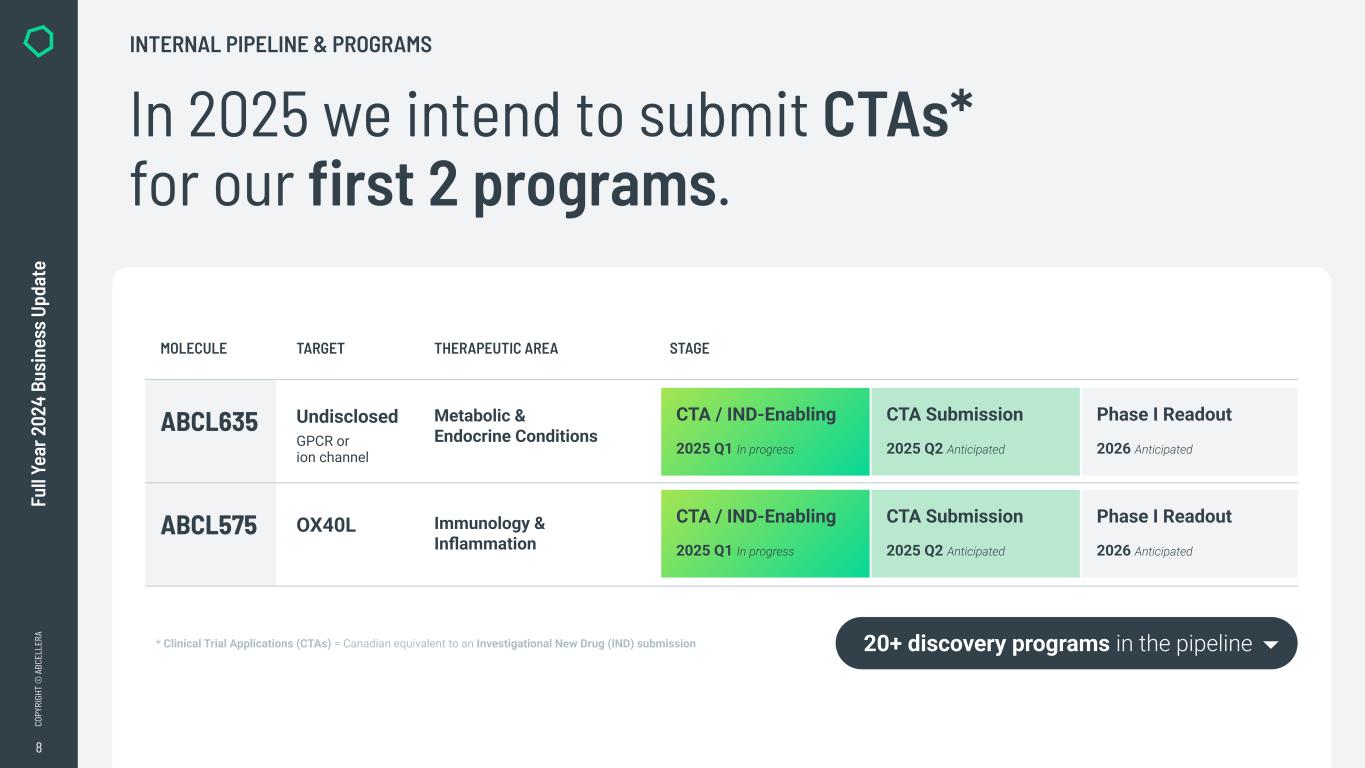
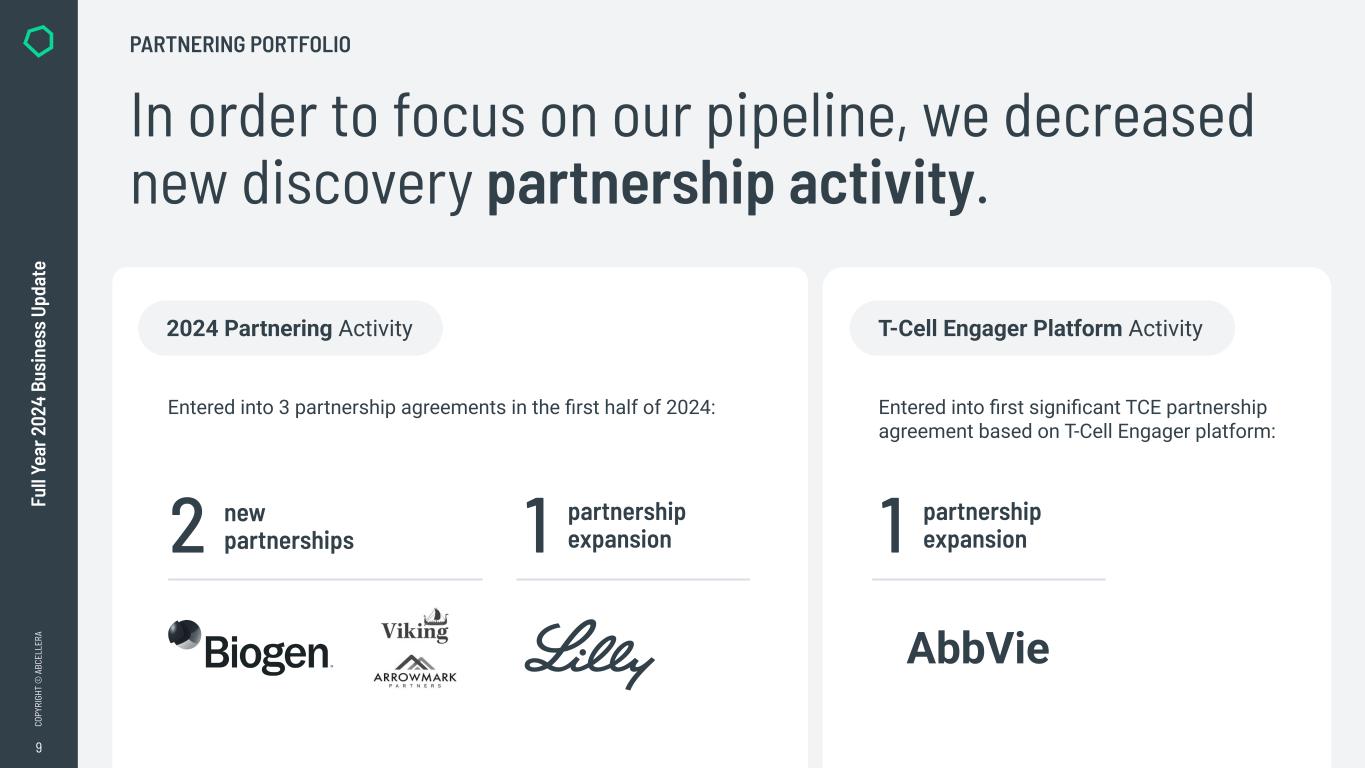
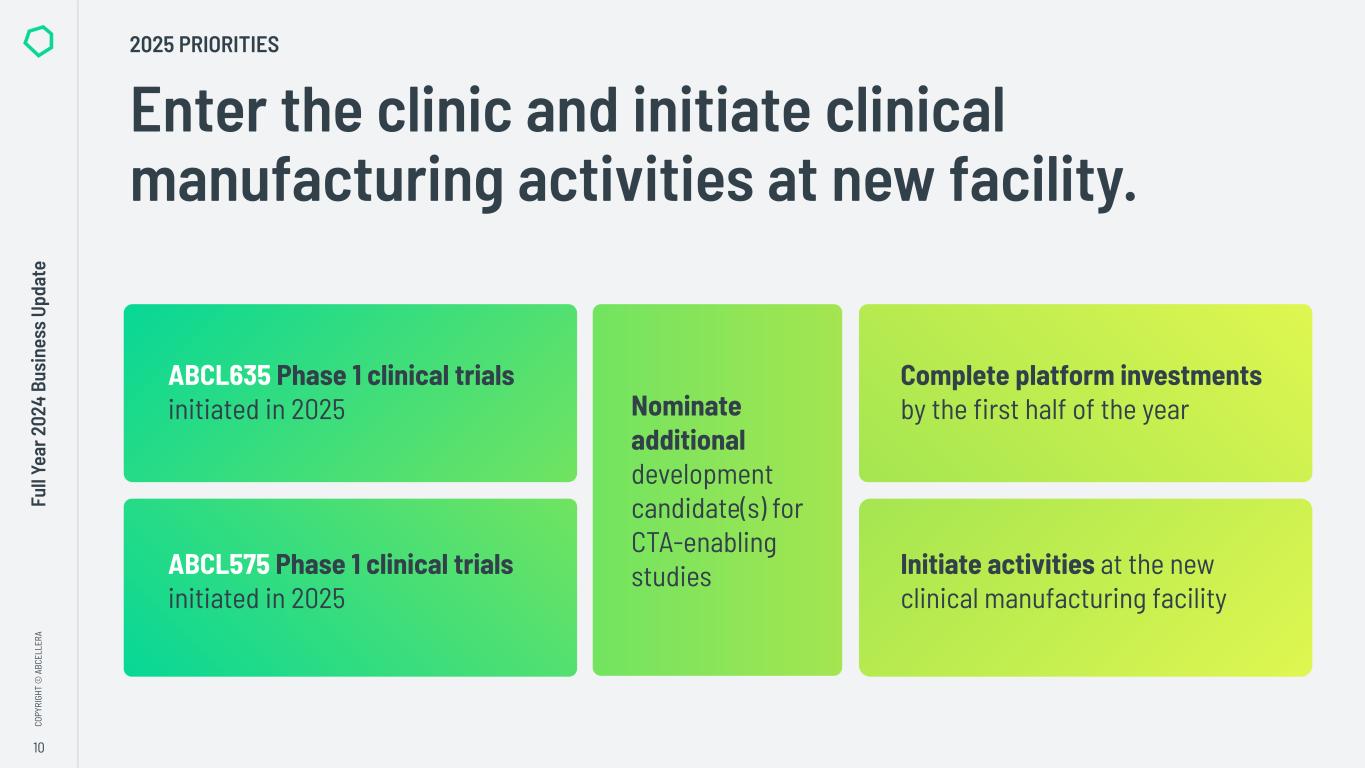
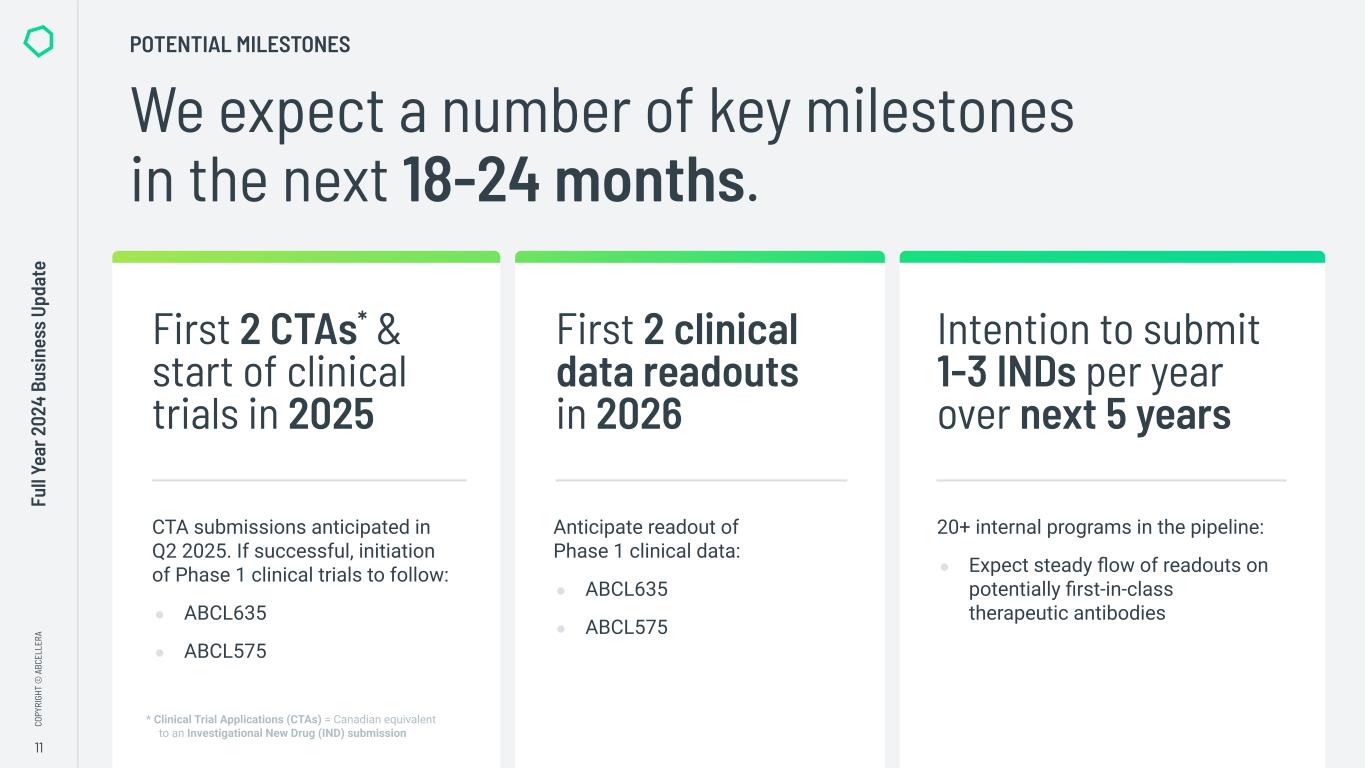
Thanks, Trin, and thank you, everyone, for joining us today. Today, I'll review the progress we made in 2024 and discuss our priorities for 2025. 2024 was a year of significant change at Abcelera. In late 2023, we decided to transition from a platform and partnership company to a clinical stage biotech. Accordingly, over the past 18 months, our focus has been on building our internal pipeline and completing investments in our platform, while at the At the same time, improving efficiency and maintaining a strong cash position. Through the year, we achieved the following milestones. We advanced two programs, ABCL 635 and ABCL 575, which are now positioned for CTA filings in Q2 of this year. Behind these, we are advancing a robust pipeline of internal programs and discovery. We completed our move into our new headquarters and are on track to bring our clinical manufacturing facility online in 2025. Importantly, we expect significant investments in our platform and facilities to be complete in the first half of this year. We are reducing the new discovery partnership activities. In the first part of 2024, we engaged in two new partnerships and expanded one existing collaboration. And finally, we closed the year with over $800 million in available liquidity and are in a strong position to execute on our strategy. As we enter 2025, I believe we are in a unique position. We are nearing completion of a multi-year build of our facilities and workforce. We have a demonstrated competitive advantage in the creation of therapeutic antibodies and we have arrived here with over 800 million in liquidity. Over the coming years we will use our capital and our technology to create and develop a pipeline of wholly owned and co-owned drug development programs. From here the most important strategic question is how do we allocate our time and our capital to build our pipeline how do we choose which programs to work on where do we double down where do we stop investing and when do we partner in choosing programs we are explicitly indication agnostic we're open to all opportunities where we perceive an unmet need and an outsized chance of succeeding in the clinic and in the market we assess this by answering four central questions first do we have conviction in the science Second, do we see a large unmet need and commercial opportunity? Third, is there a case for strong differentiation so we can win in the market? And lastly, is there a clear development path? At this stage, we are particularly focused on finding those opportunities where, for a limited amount of cost and time, we can get proof of concept and build conviction in our programs. In the perfect world, we would build a portfolio where every program scores highly on all of these different criteria. The reality is that every program has its strengths and its weaknesses, and these need to be weighed together. With that framework in mind, I will share how we think about our first two programs, ABCL 635 and ABCL 575. ABCL 635, which is our LEAP program, is for an undisclosed target and indication in the area of metabolic and endocrine conditions. This is a program that we are particularly excited about because it scores well across all four dimensions. First, from the pathway side, this is a target that has been well validated both in preclinical work and in the clinic with small molecules. Accordingly, we believe that if we can achieve sufficient target engagement, it is likely to be both efficacious and safe. Second, we believe that this program would address an important unmet need with a significant commercial opportunity. In our estimation, there is a total addressable market of at least $2 billion in annual sales. In terms of differentiation, ABCL 635 has the potential to be a first-in-class antibody therapy. We believe there is potential for differentiation in terms of the safety profile, and we believe that a product that is a once-monthly subcutaneous injection will be preferred by patients. And lastly, this is a program where a clear development path and well-established biomarkers exist. At the end of our Phase I trial, we expect to have a clear view as to whether or not we are engaging the target and whether it's likely to work as a therapeutic. We plan to disclose the target and the indication for ABCL 635 at our next earnings call. Our second program, ABCL 575, is a non-depleting Ops40 ligand antagonist. This is a program following amlitilumab, which is a a molecule that's now in Phase III by Sanofi in atopic dermatitis and has also been evaluated in Phase II for several other indications. In Phase II, amlitilumab has demonstrated efficacy that was comparable to dipixent in atopic dermatitis at a clean safety profile and a longer duration, albeit with a slower time to the onset of that effect. With this precedent, we have high conviction that ABCL-575 will also prove to be efficacious and safe. there's clearly a large commercial opportunity here atopic dermatitis is already north of a 10 billion dollar market with biologic penetration in the single digit percentage range for the patient group we also know that for dupixent there's approximately a 20 percent of patients that discontinue so that even as a second line therapy this represents an attractive commercial opportunity although there is also lebrachizumab from lily levery targets the levery targets the AL-13 pathways, and therefore has nearly complete overlap with Depixin's mechanism of action. For this reason, for patients that proceed to second line, having a distinct option, like an ox40 ligand antagonist, is attractive. Beyond atopic dermatitis, there's a good case to be made for the development of ox40 ligand antagonists across many autoimmune conditions. As I mentioned, amlotilumab is currently being evaluated for celiac disease, asthma, HS, alopecia, and others. We view success in these trials as potential upsides that support the proposition that oxfordyligand will emerge as a dominant class in treating autoimmune conditions. As compared to amlotilumab, the main differentiation thesis for ABCL-575 is a combination of high potency and excellent biophysical properties, making it amenable to a high concentration formulation, and an FC that is engineered with a YTE mutation to provide extended half-life that supports less frequent dosing. We view this as a modest case for differentiation, but one that could prove more or less important depending on what happens in ongoing trials with ametilimab and the profile of other early-stage oxfordyligan antagonists that are currently in late preclinical or early clinical development. From a development perspective, there is a clear path, and we expect to have a CTA submitted in Q2 of 2025. We expect the first readout for safety in PK in 2026, which is at the same time as ABCL 635. In summary, we view ABCL 575 as a program with low scientific risk and a large potential market opportunity across multiple autoimmune indications, but a program with risks associated with being in a competitive space with modest differentiation. With ABCL 635 and ABCL 575 on track for entry into the clinic in 2025, we expect to complete our transition from a preclinical platform and partnership company to a clinical stage biotech. Behind these programs, we have a robust portfolio of more than 20 preclinical programs that we view as having the potential to become highly differentiated assets. As we focus our activities on our pipeline, we are reducing our new partnering activities. In the first half of 2024, we added two additional partnerships with Biogen and with Aeromarks and Viking, and expanded our collaboration with Lilly. Subsequent to the close of Q4, we entered into our first significant partnership based on our TCE platform with AbbVie, who we first began working with at the end of 2022. We see our TCE platform as a source for internal programs and as a basis for future partnership activities. And accordingly, we will continue to seek collaborations in this area. Looking to 2025, we are focused on entering the clinic and bringing our manufacturing capabilities online. our priorities for the year are first to initiate phase one clinical trials for abcl 635 and abcl 575 second to nominate additional development candidates for cta enabling studies third to complete platform investments by the end of the second quarter and fourth to start activities in our new clinical manufacturing facility in terms of key milestones we expect to see the following to occur over the next 18 to 24 months. CTAs and clinical starts in 2025, our first two development, our first two clinical readouts in 2026, and the election of, on average, two additional development candidates per year. And with that, I'll hand it over to Andrew to discuss our financials. Andrew?
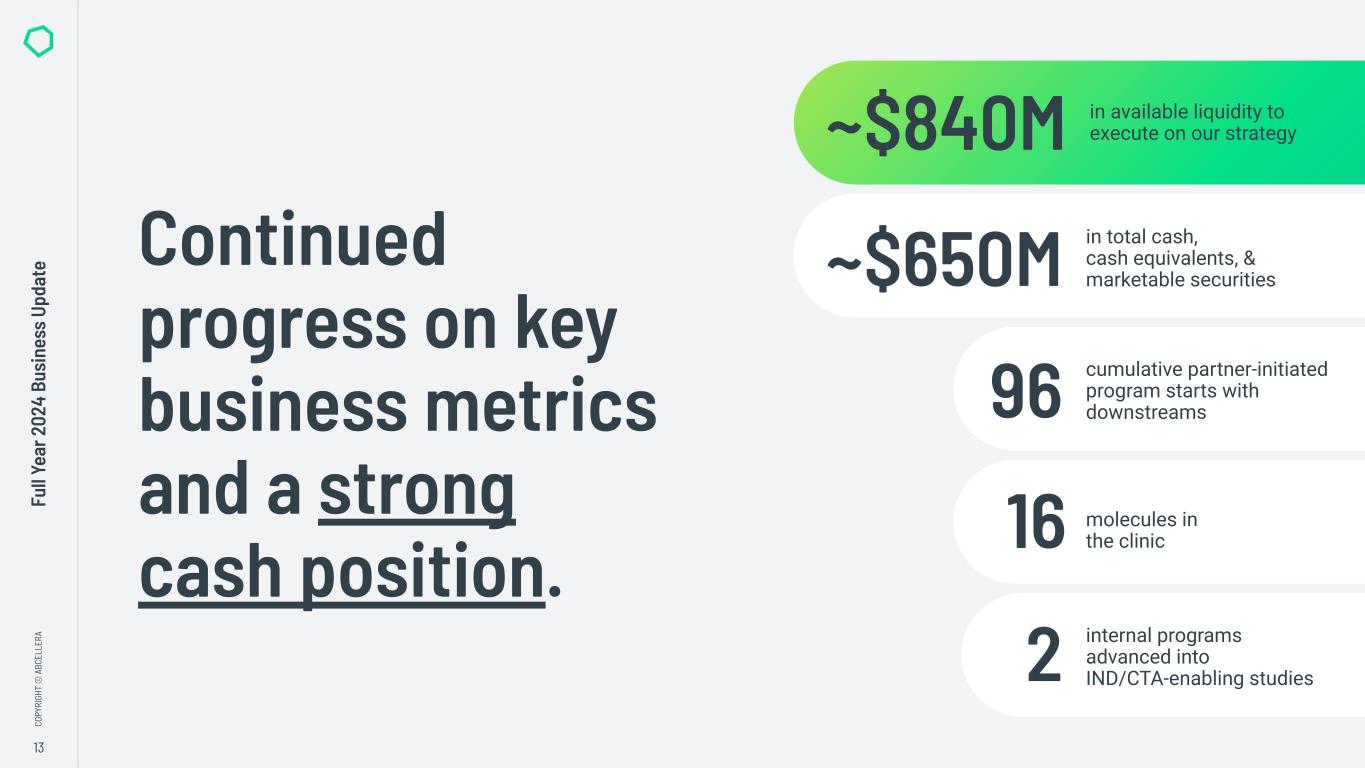
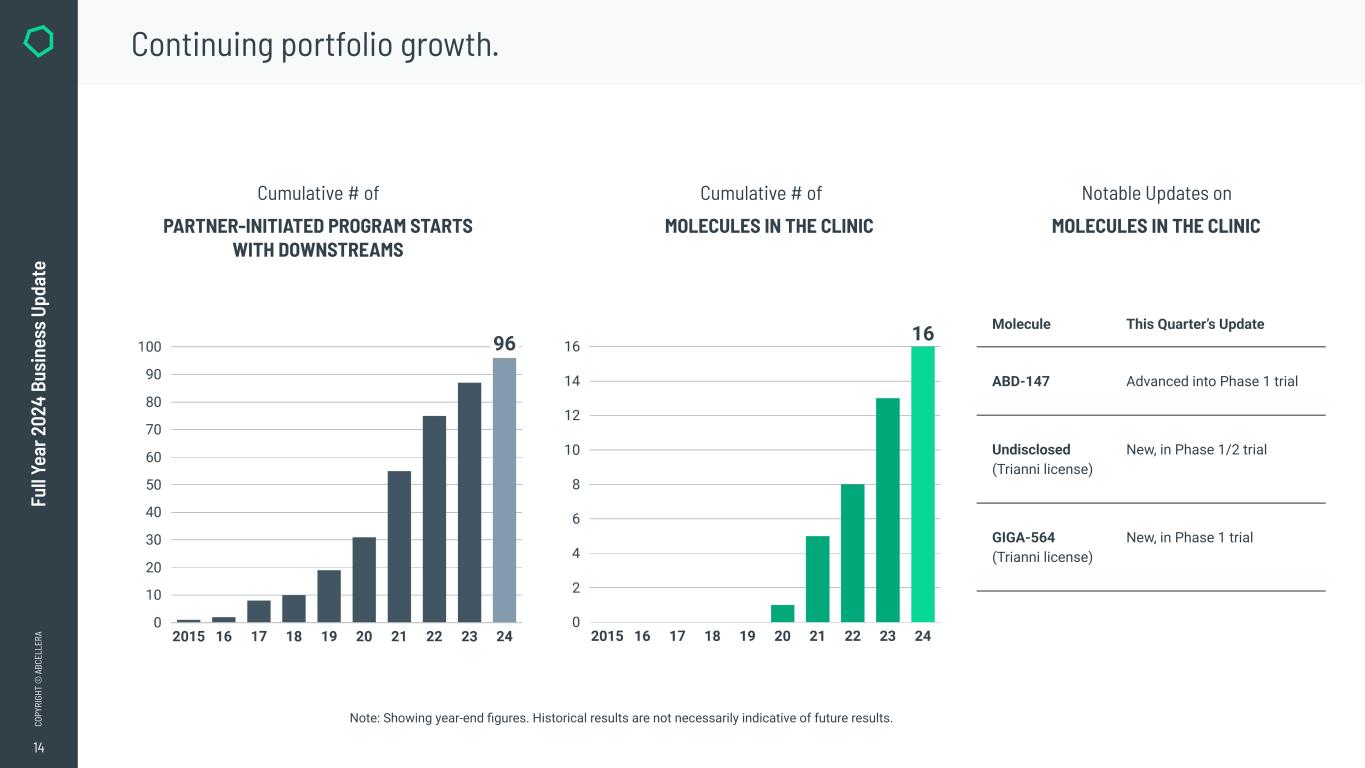
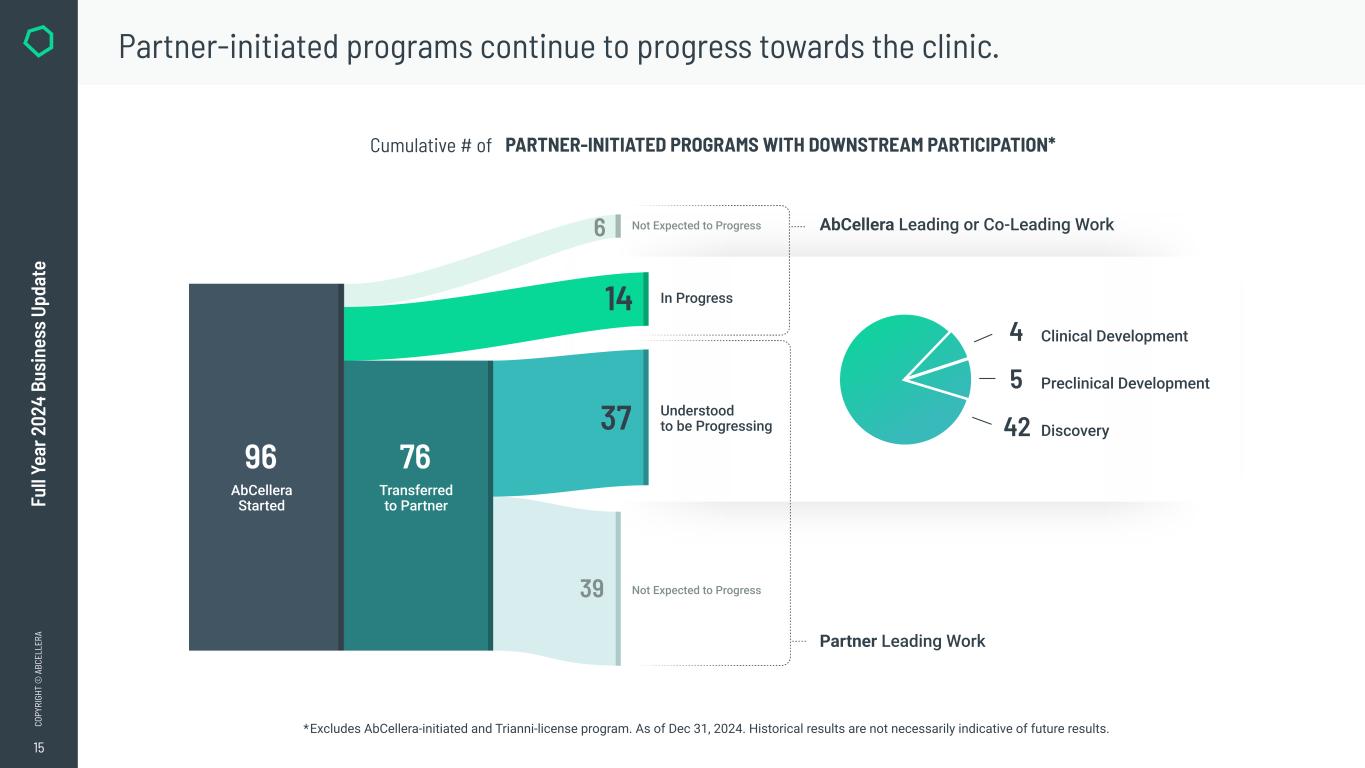
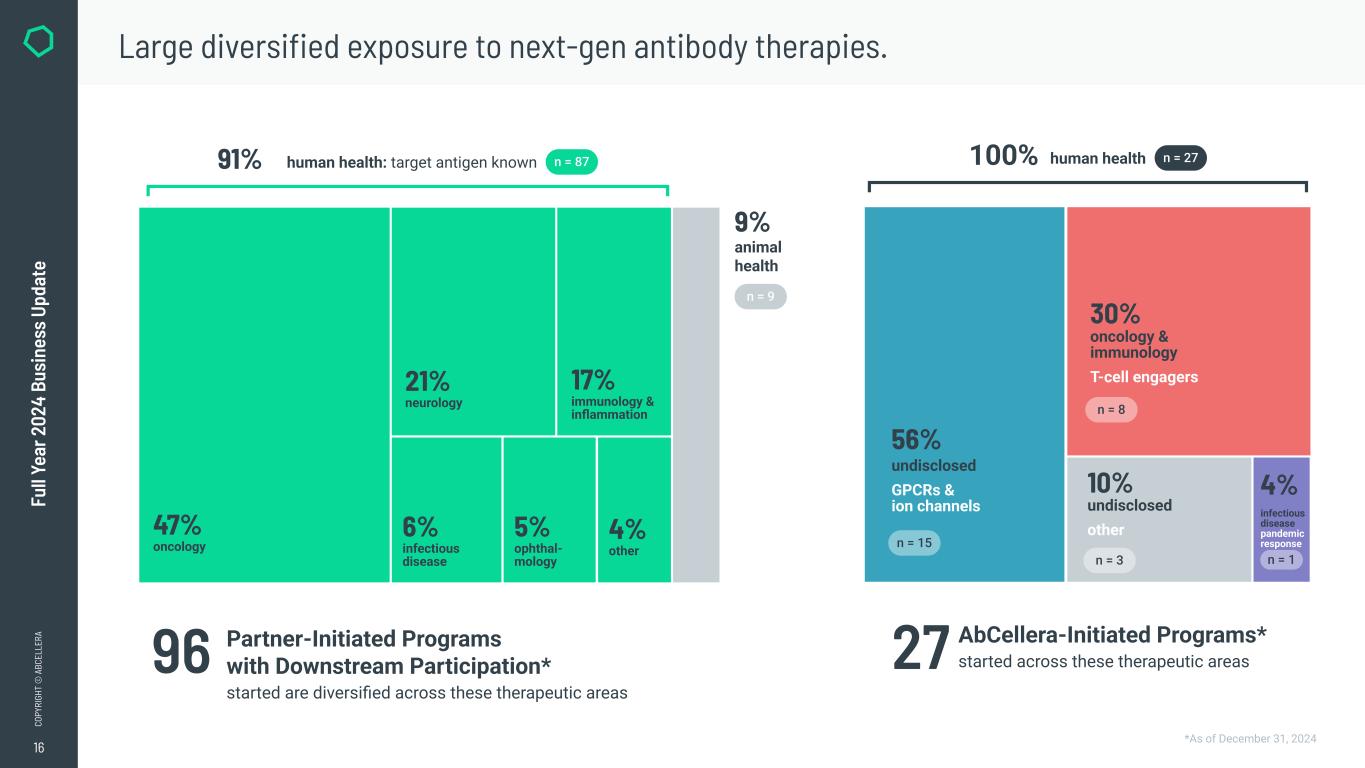
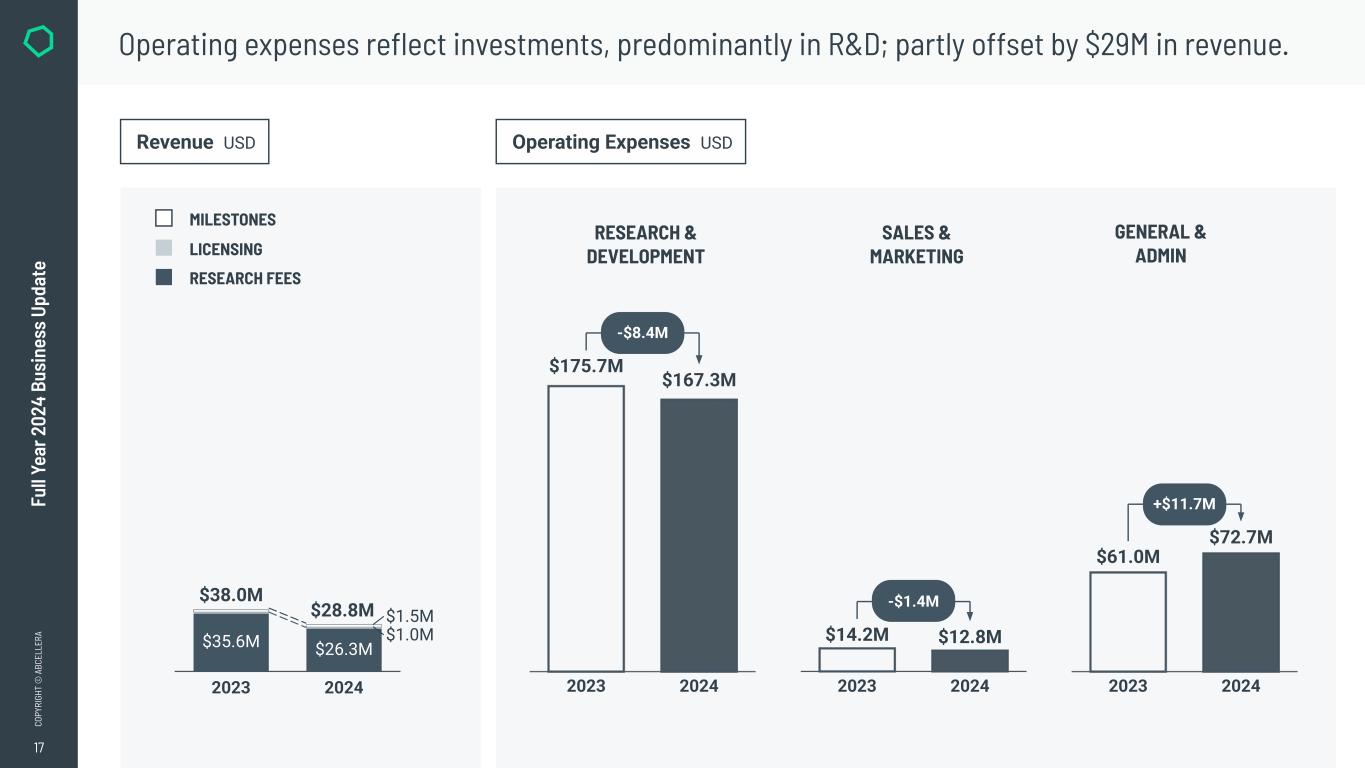
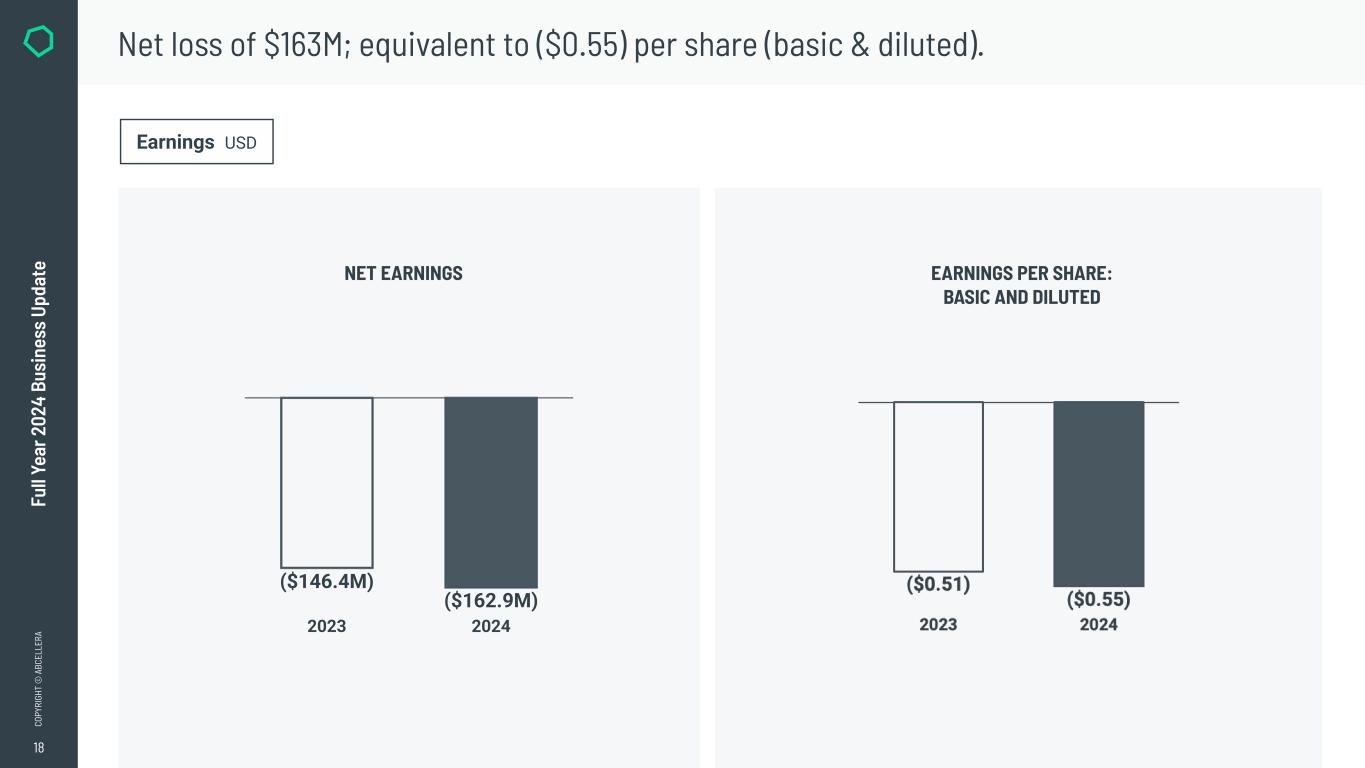
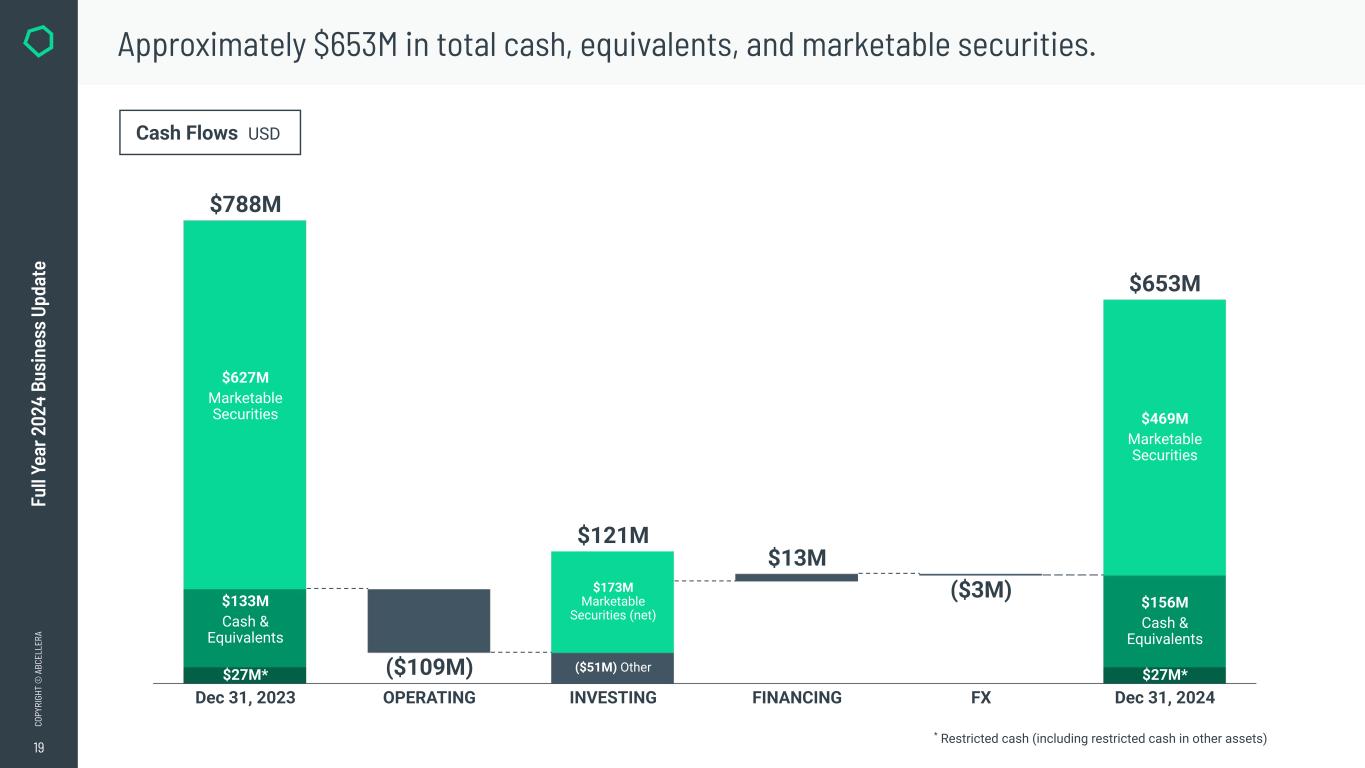
Thanks, Carl. As Carl pointed out, Abcelor continues to be in a strong liquidity position with approximately $650 million in cash and equivalents and with roughly $190 million in available committed government funding to execute on our strategy. In 2024, we continued to execute on our plans, shifting our efforts towards internal programs and to completing our CMC and GMP investments. Looking at our key business metrics, in the fourth quarter, we started work on one partner-initiated program, which takes us to a cumulative total of 96 programs with downstream participation. In 2024, we saw our partner Abdera advance its lead molecule ABD147 into Phase I clinical trials, and in addition, two new molecules developed under a Triani license, GigaGen's Giga564 and an undisclosed molecule, were brought into the clinic. That brings us to a cumulative total of 16 molecules to have reached the clinic. As we have stated previously, we view our growing list of progressing molecules in the clinic as specific examples of our near and midterm potential revenue from downstream milestone fees and royalty payments in the longer term. As we do annually, we'll take a closer look at the progression of those 96 partner initiated programs with downstream participation. As of December 31st, we were still actively leading or co-leading the work on 14 of these programs. For 76 programs, we have successfully completed the agreed scope of work and have transferred the resulting antibody sequences and data to our partners for evaluation and further development under their leadership. To the best of our knowledge, our partners are actively progressing 37 of those 76 programs. Of the 51 programs that are actively progressing, we believe that 42 are in late stage discovery, five in pre-clinical development, and four have reached clinical development. Overall, we view the progress of the molecules we have discovered in our our partners hands positively and the attrition is consistent with our expectations over half of all programs with downstream participation that we have started are currently still progressing we look forward to more molecules from our programs reaching the clinic over time and we will continue to report on these progressions to the clinic on a quarterly basis looking more broadly across the program starts in both our partner initiated portfolio as well as our upsell or initiated internal programs we see significant diversification across therapeutic indications of our 96 partner initiated programs with downstream the majority are in oncology neurology immunology broadly reflecting the active activity in the industry as of december 2024 we also have 27 abseller initiated programs up from the 19 at the beginning of the year and all of the abseller initiated programs are in human health it is from this set of programs that we aim to advance, on average, two programs per year into CTA enabling studies. Turning to revenue and expenses, revenue for the year was almost $29 million, mostly driven by research fees relating to work on partnered programs. This compares to revenue of approximately $38 million in 2023. We expect research fee revenue to trend lower as we are increasingly focused on internal and co-development programs. Our research and development expenses for the year were approximately $167 million, $8 million less than the previous year. This expense is driven by ongoing program execution, continuing platform development and our increasing investment in our internal programs. The overall decrease from the prior year reflects a specific one-time payment of approximately $32 million related to investment in our internal programs that we made in 2023. In sales and marketing, our expenses for 2024 were approximately $13 million, a small reduction relative to the previous year. And in general administration, expenses were approximately $73 million compared to roughly $61 million in 2023, with the increase largely driven by expenses related to the defense of our intellectual property. Looking at earnings, we are reporting a net loss of roughly $163 million for the year compared to a loss of about $146 million the previous year. This year's loss includes non-cash impairment charges for in-process R&D of approximately $47 million net of their deferred tax impact. In terms of earnings per share, this year's result works out to a loss of $0.55 per share on a basic and diluted basis. Turning to cash flows, operating activities for 2024 used approximately $110 million of cash and equivalents. Excluding investments in marketable securities, investment activities amounted to net $51 million, including just over $78 million invested in property, plant, and equipment, driven by our ongoing work to establish CMC and GMP manufacturing capabilities. The investments in PP&E were partially offset by government contributions and the cash proceeds from the sale of our stake in Invitex during the year. We expect our PP&E investments to continue in the first half of 2025 and be substantially complete by mid-year. As a part of our Treasury strategy, we have nearly $470 million invested in short-term marketable securities. Our investment activities for the year included approximately $170 million net decrease in these holdings. Altogether, we finished the year with over $650 million of cash, cash equivalents, and marketable securities. And as a reminder, we have received commitments for funding for our GMP facility and for the advancement of our internal pipeline from the Government of Canada's Strategic Innovation Fund and the Government of British Columbia. This available capital does not show up on our balance sheet, and with over $650 million in cash and equivalents and the unused portion of our secured government funding, we have approximately $840 million in total available liquidity to execute on our strategy. For 2025, we expect cash usage for operating activities to be similar to 2024, and we would expect investments in PP&E to be approximately half of what we spent in 2024 and weighted towards the first half of the year as we complete our investments in CMC and GMP capabilities. The cash used in 2025 will prioritize advancing our two lead programs to the clinic, building the preclinical pipeline, and completing our investments in an integrated CMC and GMP capabilities. As previously communicated, the new manufacturing facility is scheduled to come online at the end of 2025 with respect to our overall operating expenditures our capital needs are very manageable and we continue to believe that we have sufficient liquidity to fund well beyond the next three years of increasing pipeline investments and with that we will be happy to take any questions operator thank you we will now begin the q a session if you would like to ask a question please press star followed by one on your telephone keypad.
Operator
If for any reason at all you would like to remove that question, please press star followed by two. Again, to ask a question, please press star one. As a reminder, if you are using a speakerphone, please remember to pick up your handset before asking your question. The first question comes from Stephen Willey with Stiefel. You may proceed.
Yeah, good afternoon. Thanks for taking the questions and appreciate the additional clarity around some of the metrics in the slide deck today. But just a question for Carl, you know, you talked about being indication agnostic, and I guess I appreciate the concept there, but, you know, how do you think about the longer term competencies that you're going to need to bring into the organization to effectively design and execute clinical trials across multiple different disease areas?
Thanks, Steve. Great question. Yeah, so we are explicitly indication agnostic. Obviously, the reason for that is that it is a non-trivial thing to find an attractive opportunity for drug development, and we want to keep our aperture broad, and we have a platform that can respond quite broadly across antibodies, both in terms of targets and modalities. So for that reason, you know, we're looking for a winner, and we're looking broadly to find programs where we have really high conviction. At this point, we have our first two programs that are moving into clinical development. As part of that, over the past year, we have made significant investments in building up translational science and the clinical development teams that are now in place to support those. And so we're building that in a manner that is on time for the programs and driven by the programs. And I do expect that that's going to be the case as we move forward. So what you will see in terms of hiring and recruitment from Upselera will be heavy on the back end of the company, looking at development and clinical development, and the areas in which we need to build are going to be motivated by where we see the best opportunities as the programs progress. And so it's clear you need the expertise, and we're confident we'll be able to bring it in on time, but there's work to be done there, both in terms of figuring out which are the best programs and then getting those teams in place.
Understood. And then congrats on getting the AbbVie collaboration done on the TCE side. Is there a finite number of candidates that are contemplated under that collaboration? And maybe second to that, I think you talked about seeking new partnerships on the TCE side, and there's been a lot of chatter about business development that's happening in China right now and the headwinds that that might be posing to the sector itself. Are you seeing any kind of those headwinds as you're engaging with partners in discussions?
Those are great questions. First, at the highest level, we are confident in the capabilities of the TC platform that's been maturing. So we feel we're very well positioned. And we are increasingly enthusiastic based not just on internal results, but also on what's happening in the market broadly in the space of TCEs. So I think I've said it before, but the activity is clearly heating up, and that's being driven by some pretty impressive clinical results that show that you can translate some of the success from blood cancers into solid tumors. So we feel we're well positioned for that and the collaboration with AbbVie for us is a terrific first collaboration where we've got a meaningful TCE deal and we're working together on multiple but a small number of targets and with them we're excited to explore what we think is some very promising scientific directions for TCEs that we think are going to be important. To the second part of your question about the increasing competitive dynamic coming from China, so we're certainly seeing that. that's been a big deal in the cd19 cd3 spaces there's been several uh transactions there uh for the most part of our for the most part our portfolio uh speaking broadly not just restricted to tce is emphasizing highly differentiated first in class assets and so compared to some other peers i believe that our portfolio is likely quite robust to that dynamic you don't know what you don't know but I'd be surprised if for many of these programs we saw a lot of competition there's always going to be some but a lot of competition coming from China or elsewhere so we're watching that carefully but you know in the end the best you can do is find the good science and make sure you've got molecules that toe-to-toe stand up against whatever shows up from other other players thanks for taking the questions thank you the next question comes from Andrea Newkirk with Goldman Sachs.
Operator
You may proceed.
Talani
Analyst — Goldman Sachs
Hi, all. This is Talani on for Andrea. Thanks for taking our questions. Two from us, please. First, could you share any more color on the attrition rate for the partner-initiated programs, and how should we expect that to trend, you know, on the forward? And then, similarly, what drove the decision to reduce the number of partnerships you're pursuing, and how should we think about the longer-term impact on new program starts?
Hey, there. It's Andrew here. I'll answer your first question. On the attrition rate for the partnered programs you know those are so as I explained in my prepared remarks there those are what we've seen once we've handed back the the scope of work to our partners and there's going to be more details in the 10k very similar to the same disclosure that we had at this time last year of the partner of those programs that we know are still being actively worked on by our by our partners we don't disclose which of the ones are the the identity of the partner or the identity of the target until they would hit the clinic, and then you would expect to see more details on any one of those partnerships once they arrive at the clinic.
And Carl here, I'll take the second part of the question. So in September of 2023, we made a clear decision to transition from a partnership and platform model to being a clinical stage biotech. That is something that we have done successfully and that we will see come to fruition in Q2 and Q3 of this year as we get our first two CTAs submitted and ultimately get into clinical development. The rationale for simultaneously ramping down the large majority of the partnership business defined as we were running it, let's say back in 2020, is that you need to make decisions in priority as to where you put your time and attention and your money. And we don't believe that you can walk both those roads simultaneously so making a decision to be a clinical stage biotech means putting your focus on that objective now the one area where we still remain active in partnering and where i think there's some real potential to push forward the science to get interesting programs and possibly to generate significant cash that would help the business is on the tce front the deal with abby is in line with that and we will continue to look for such opportunities going forward i'll also just add that while we are backing away from discovery style partnership businesses we do remain active in partnering or collaborating with companies where we see an opportunity to bring technologies together and we think that that can help put some interesting assets into our pipeline so a recent collaboration would be the one we did with prelude where we're working with them to bring forward a new modality that combines their small molecule chemistry with our antibody expertise in those cases you know we will evaluate those based on the criteria that are laid out do we like the science do we think there's an unmet need and market opportunity can we be differentiated and do we like the development path and if that looks good and we find good synergy with a partner then you'll see us doing those but that'll be on an opportunistic basis all right that's helpful thank you thank you thank you our next question comes from steve dick dicker with keycore hey guys thanks for taking our questions um something to give some more background on how the partnership with abby came together i know you guys were prudent with selecting who you want to partner with um on your t-cell engager platform thank you i can take that one um you know so the the backdrop of this is that you know now for you know two or three years we have been investing significantly to build uh our tce platform which is comprised of a large and diverse and well-optimized set of CD3 molecules, our biospecific platform, a set of high-throughpoint assays for evaluating those, and increasingly an understanding of the biology that helps direct where you want to bring those molecules going So we feel really we're in a terrific spot. And in my view, we have certainly one of the best, if not the best, toolkit for designing TCEs, provided that you've got a good thesis for where you're going to go in terms of indication and what you want that profile to look like. So the partnering objective was to make a significant transaction with a large and enabled partner that has a commitment to really put some time and money into that space. We have a previous collaboration with AbbVie, so we've got an excellent working relationship and have been productively working on the initial programs that of course was the basis to initiate a collaboration around tce and uh you know with that we've we've come to a deal uh that we're we're very happy with um one that uh essentially meets uh the objective that we set some time ago to have a first transaction in tce and sets the stage for what we think could be a much bigger and deeper collaboration either with abby or with other partners great thank you thank you the following comes from jacqueline kisa with td
securities you may proceed great this is jackie um thanks for taking the question um maybe shifting back towards the geopolitical side are you seeing any exposure to tariffs from the canadian side and uh how much if any impact do you expect expect us could have on customer conversations especially if these tariffs continue to be a play from this administration uh this is andrew i'm happy to take that.
In terms of the retaliatory tariffs, I think, or the contemplated retaliatory tariffs of products coming from the United States back into Canada, actually, in the guidance that's set out by the Canadian government for those retaliatory tariffs, there are a number of exemptions, and actually products for buy-all manufacturing are included in those exemptions, so we wouldn't expect any sort of material impact in our financials or in the operations from any of the products that we buy that are originating in the United States so it looks as though that won't be of an impact in our operations at this point in time and so I do believe that we'll even if the if those tariffs are to come in place it won't impact the way we're operating our
business great and maybe just one more I'm pivoting to your internal pipeline what are your plans with regards to carrying your assets towards commercialization? Are you interested in looking for opportunities to partner or sell off the assets? And if so, kind of what stage do you think you'd carry the asset to?
Sure. Carl here. Happy to take that, Jackie. So the answer really is that we are constantly evaluating each program and looking to optimize return on investment and success of that program ultimately getting to the clinic and to patients so in some cases you know we certainly would be on board with taking a program into late stage clinical development and down the road perhaps even to commercial although of course that's quite a few years away from where we are today in other programs there may be a good case for getting it into the hands of another partner you know as a case in point for ABCL 575. Our enthusiasm and excitement for that program is about what we perceive to be an immense potential for the Ox40 Ligon class. One scenario is that that program ends up being transferred to a large committed partner that can simultaneously develop that program across multiple indications and maximize value. And probably that's the most likely scenario from where we sit today. But another scenario could be that we identify one or more indications where we could develop it ourselves and create more value at least into phase two or perhaps even phase three. And we don't know what the answer to that is. It's going to depend on what happens with the program and what happens on competitive programs. And we're going to make the best decision. But the short answer is that, you know, for some programs, we would decide to partner very early if that's what made sense.
For others, we're prepared to take it all the way, recognizing that since we're just about to start clinical development, that's way off on the horizon and not taking a lot of our attention and time right now great that's super helpful thank you so much thank you as a quick reminder if you'd like to ask a question please press star one on your telephone keypad the next question comes from malcolm hoffman with bmo you may proceed hi guys thank you for taking our question uh with five seven five and six three five coming up on the cta filing next quarter uh someone asked what if any initial preparations are you making for these programs to enter the clinic, and are there any nuances that you think are worth noting that may change how you file the CTA in the U.S. or IND? Thanks for any commentary there. Appreciate it.
Sure. So, obviously, we began IND enabling studies for 635 and 575, you know, more than 18 months ago, and so there's been an immense amount of work getting prepared to bring those through CTA enabling studies and prepare the clinical teams and the clinical plan to execute on that all that is in place uh both programs have had proceeded very smoothly and so there's uh at this point nothing you know particularly noteworthy uh in terms of you know special considerations we're confident with the plan and we're confident we have the team in place to execute on those Thanks, guys.
Operator
Thank you. The next question comes from Puneet Suda with Learing Partners. You may proceed.
You have Michael on for Puneet. My question has to do with your internally initiated program. Just looking relative to last year, it seems like most of the new programs you started were from the ION channel, the GPCRs, and I'm curious what is driving your decisions on initiating new programs and if you think that the activity in 2024 is going to be similar to what you're expecting for 2025 in terms of program initiations?
Sure. Carl here. So I think the question was, what are the considerations for initiating new programs? So the first thing I'll say is that in addition to 635 and 575, we have a preclinical pipeline at various stages of discovery that represents roughly 20 programs or so. So when we go to elect a program, we are thinking about the framework that I mentioned in my prepared remarks. So we are looking for opportunities where we have high conviction in the science, where we see a large unmet need, where there's a clear path to differentiation, and where we believe that the development, and I mean the clinical development, would allow us to get an answer and build conviction either in the positive or the negative for the program for a relatively small amount of money and a relatively small amount of time. uh in terms of you know the the distribution of uh target class in that portfolio there is a large representation of multi-pass transmembrane proteins ion channels and gpcrs and the reason for that is that first those are classes where there are a lot of well-known targets where many of those targets have been validated by small molecules and there's a strong case for why an antibody would be differentiated either in safety or convenience or perhaps even efficacy it's also a place where we believe we can have a strong differentiation because we have built a competitive advantage in the antibody discovery side it's our view that we are second to none in being able to prosecute what have been traditionally very difficult targets and we're certainly looking in that space for good opportunities to move forward so that that I think today, you know, maybe 50% or so of programs sit in the ion channel and GPCR class. And moving forward, you know, first order approximation would be that that would remain roughly constant for the next few years. But by no means are we only looking at that target class in the pipeline.
Great. Thank you very much.
Operator
Thank you. There are currently no other questions queued. So as a quick reminder, it is star one on your telephone keypad if you'd like to ask a question. No more questions of queued. I'll turn it back over to the team for closing remarks.
Thank you everyone for joining us today. It's an exciting time for the company as we finish our transition from a platform and partnership business into a clinical stage biotech. We thank you all for joining and look forward to speaking to you on the next call.
Operator
This concludes today's conference call. Thank you for your participation.