Good morning and welcome to the Academy Sports and Outdoors Second Quarter 2026 Earnings Conference Call. This call is being recorded and all participants are on a listen-only mode. Following the prepared remarks, there will be a brief question and answer session. Questions will be limited to analysts and investors. We ask that you please limit yourself to one question and one follow-up. To ask your question during the call, please press star 1 from your telephone keypad. If you require operator assistance during the call, please press star zero. I would now like to turn the conference over to Dan Eldridge, Vice President, Investor Relations for Academy Sports and Outdoors. Thank you. You may begin.
Good morning, and thank you for joining the Academy Sports and Outdoors second quarter fiscal 2026 financial results call. Participating on today's call are Steve Lawrence, Chief Executive Officer, and Carl Ford, Chief Financial Officer. As a reminder, today's earnings release and the comments made by management during this call include forward-looking statements. These statements are subject to risks and uncertainties that could cause our actual results to differ materially from our expectations and projections. These risks and uncertainties include, but are not limited to, the factors identified in today's earnings release and in our most recent form, 10-K and 10-Q filings. The company undertakes no obligation to revise any forward-looking statements. Today's remarks also refer to certain non-GAAP financial measures. Reconciliations to the most comparable GAAP measures are included in today's earnings release, which is available on our website at investors.academy.com. This morning, we will review our financial results for the second quarter of fiscal 2026, provide an update on our strategic initiatives, and discuss our outlook for the year. After we conclude prepared remarks, there will be time for questions. With that, I'll turn the caller over to Steve.
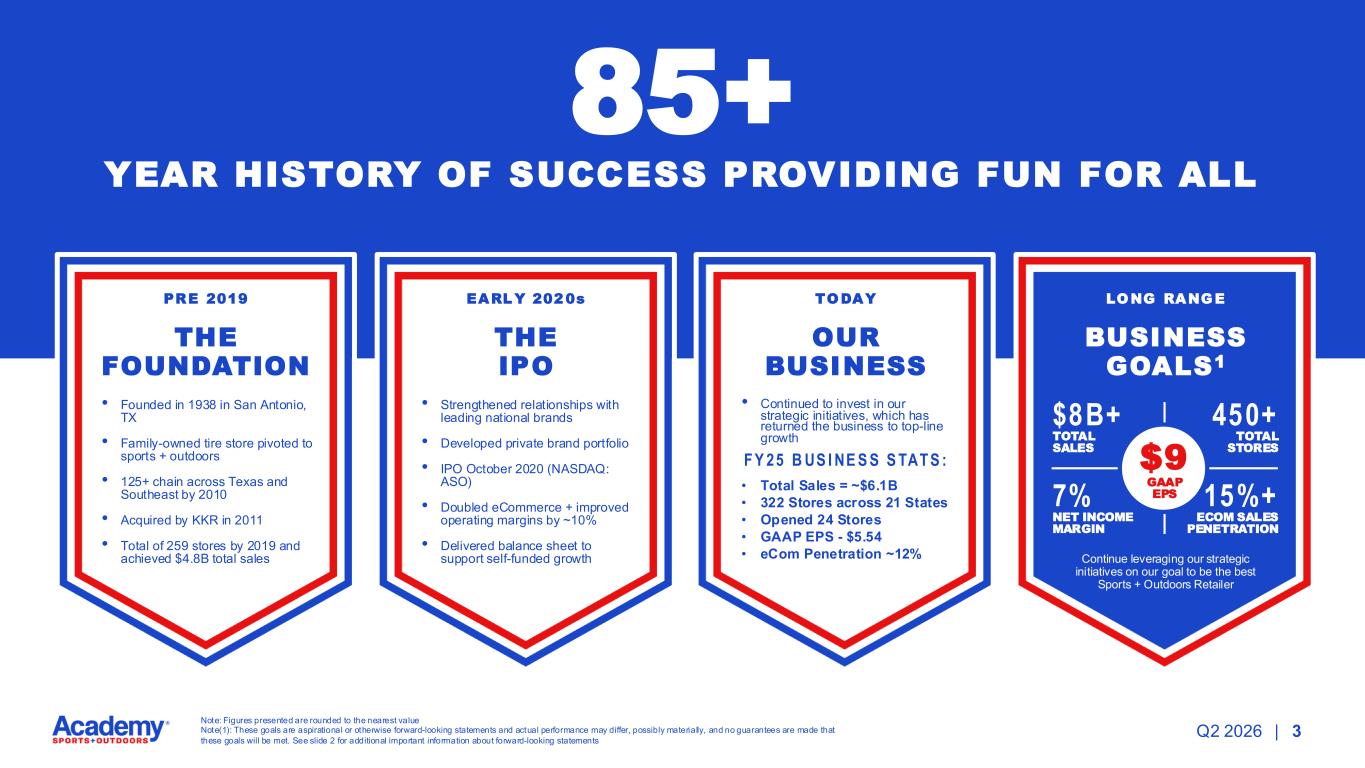
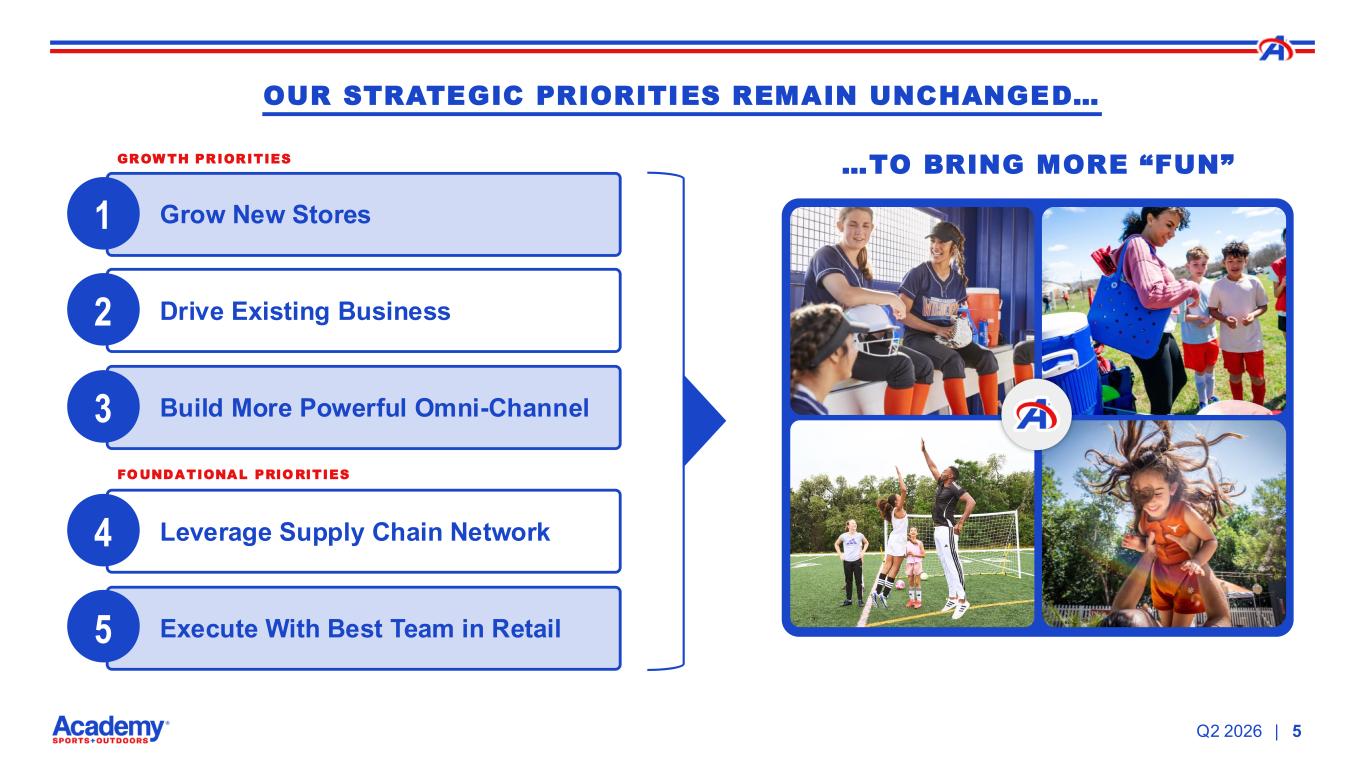
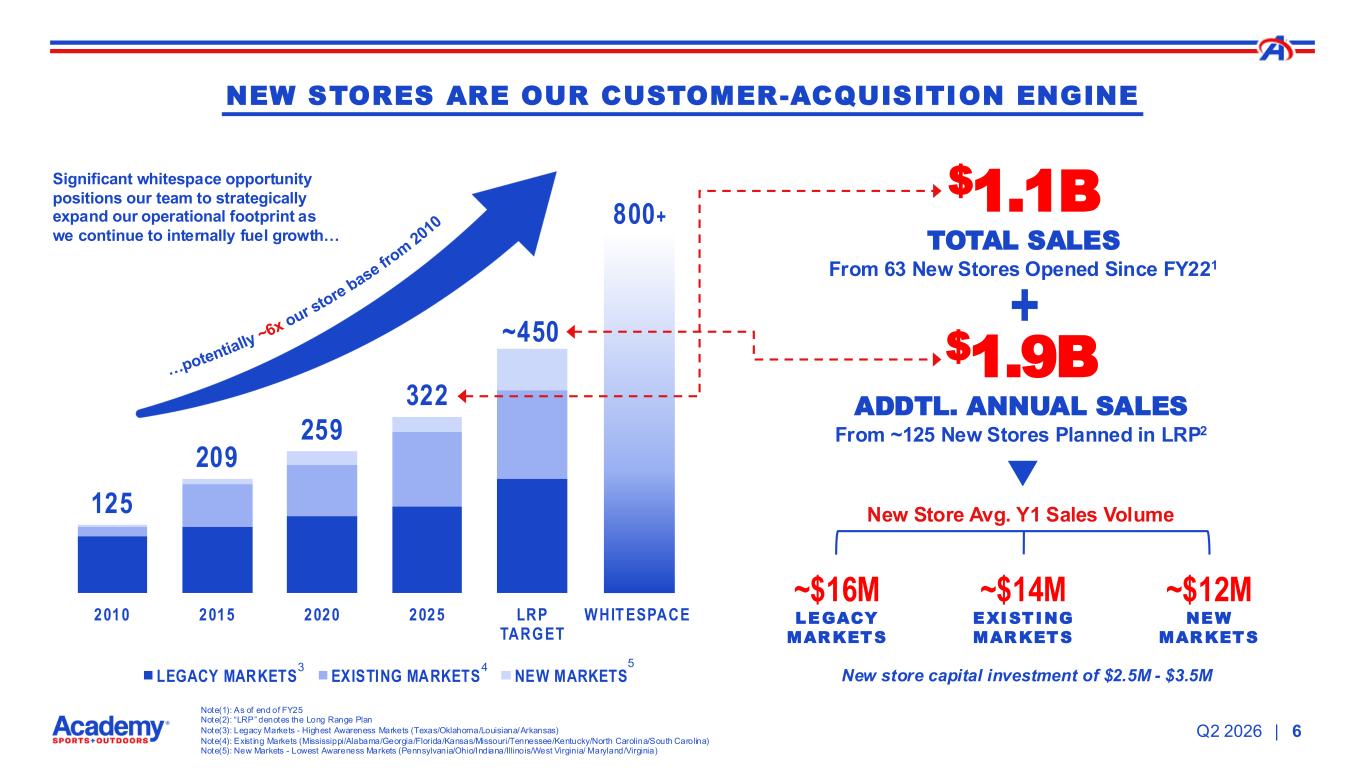
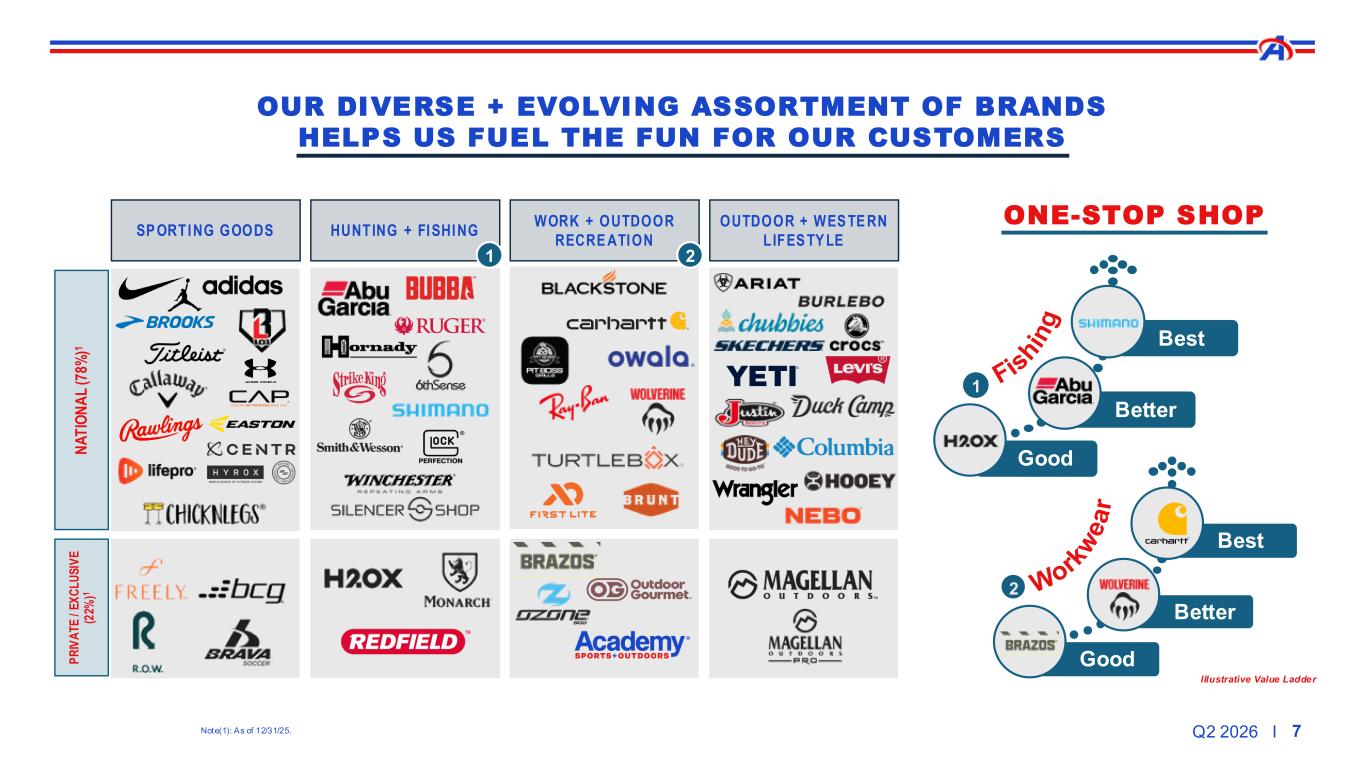
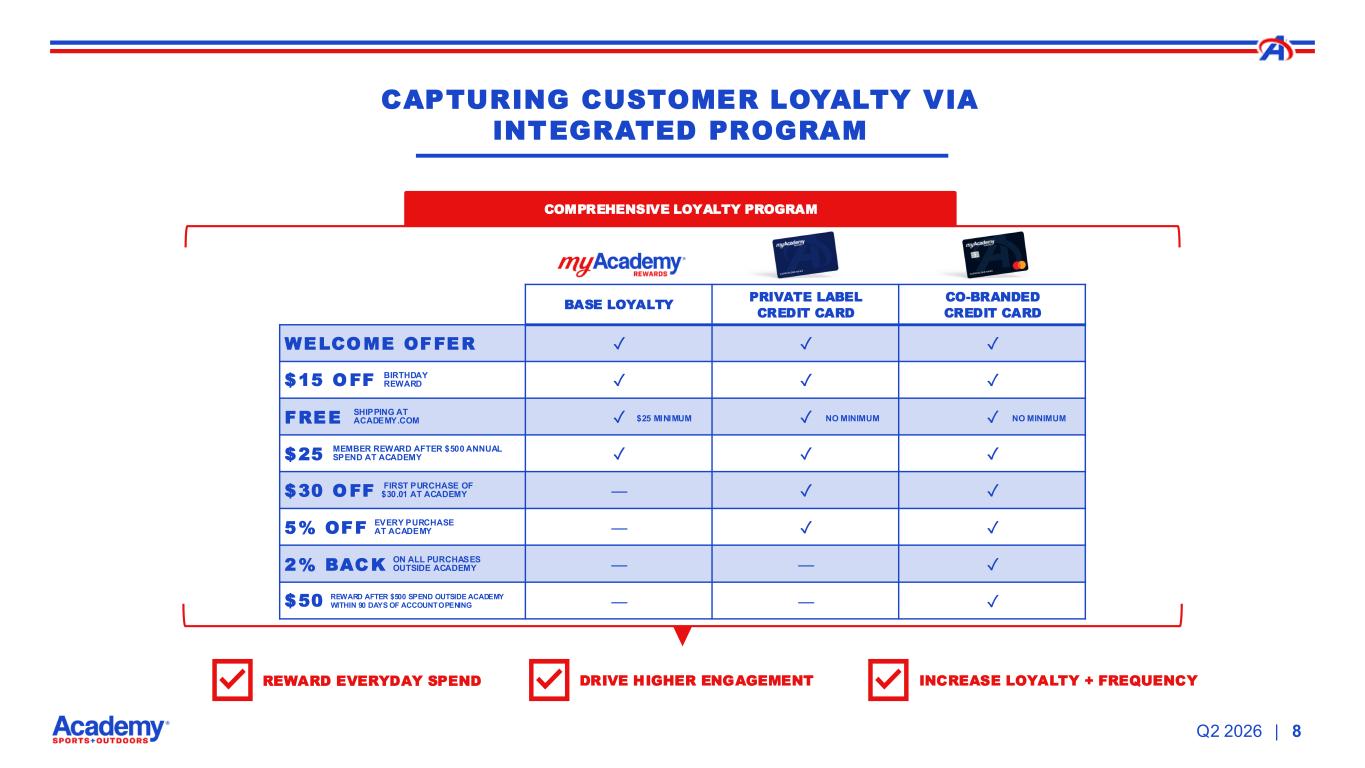
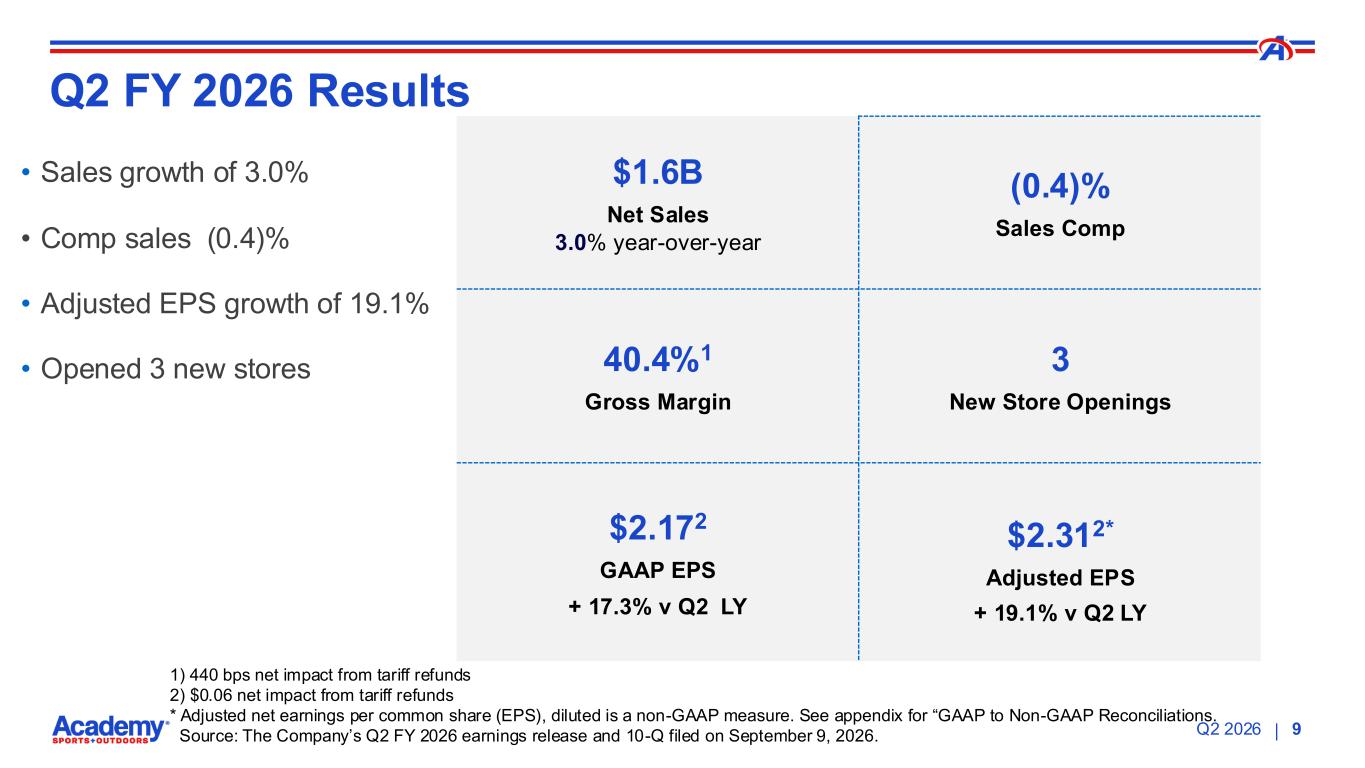
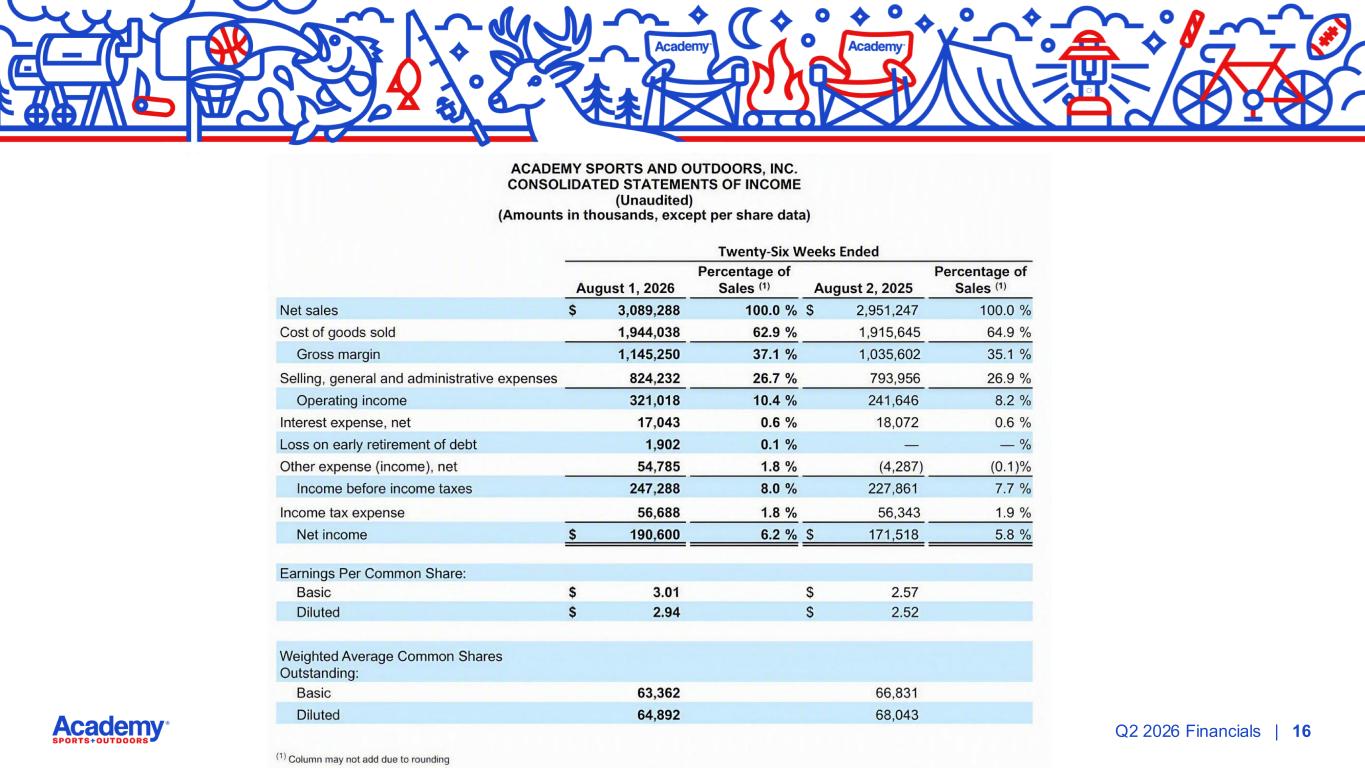
Good morning, and welcome to our second quarter earnings call. As you read in our press release earlier today, we saw continued top-line momentum in the business, with sales for the quarter coming in at $1.6 million, which was up 3% in total and translated into a slightly negative comp at down 0.4%. Our dot-com business continued to grow double digits at up 12.8%, which improved penetration in this channel by 110 basis points versus last year. During our Q1 call, we mentioned a slowdown at the end of the quarter as we transitioned to Q2, which we attributed to overall inflationary pressures on the consumer, which were no longer being offset by increased tax refunds. This trend persisted into the early part of second quarter, May and June running up 2% in total and down 1% on a comp basis. You see this most pronounced in traffic trends from the lower-income households making less than $50K annually, which were down high single digits during the quarter. This was a larger decrease than we saw in Q1, which was down low single digits. Conversely, we continue to see strong traffic trends in the higher income cohort with traffic from households greater than $100K annually, tracking up high single digits during Q2, which was an acceleration to what we saw in the first quarter. We're pleased to end Q2 on a high note, with July being our best month of the quarter, plus 3% in total, which translated into a modest, positive comp. We believe July sales in back-to-school categories would have been even stronger. We had four states in our footprint, Oklahoma, Missouri, Virginia, and South Carolina, shift their tax-free weekends from the last week of July into the first week of August. While this disadvantaged the tail end of Q2, it did help us get off to a good start in Q3, with sales through Labor Day running up low single-digit comps. As we've seen in the past, when the customer is under pressure, they shop episodically and aggregate their purchases around the key events on the calendar as a way to expand their spending power. This held true this past quarter with events such as Memorial Day, Father's Day, Fourth of July, and back-to-school performing well. These also happen to be the time periods where the promotions traditionally are at their sharpest. Similar to Q1, we continue to see stronger performance on the hard goods side of the business. Sports and recreation was our best business at up 6%, with continued strength in sporting goods. Within sporting goods, we're definitely seeing a World Cup effect, the soccer gear sales running up double digits for the quarter. We expect this trend will continue throughout the remainder of the year and into next. We're also seeing strength and fitness with treadmills up high single digits during the quarter as customers continue to prioritize health and wellness. Another varied note is our front-end department, which is somewhat of a catch-all for us. This business continues to benefit from significant investments in trend-right categories such as trading cards and outdoor speakers driven by Turtle Box. Outdoor was our second best performing division at up 4%, driven by shooting sports, coolers, and camping. While not as strong as hard goods, we did have some bright spots on the soft goods side of the business. While apparel sales were flat, we did see strong performance from categories such as World Cup jerseys and tees, outdoor, and work in Western apparel. Some of the World Cup good news was offset by a decline in NBA championship gear as we anniversary the Oklahoma City Thunder winning the title last year. As we look to comp the World Cup next year, we believe the Women's World Cup merchandise coupled with a strengthening assortment and improved localization in our fan shop assortment should allow us to offset the gains from this year. Footwear is our softest category for the quarter, with sales now 1%. But even running this decline, we did pick up market share during the quarter. While Footwear is our smallest division at roughly 20% of our total sales, it is an important business for us. We service a diverse portfolio of customer needs, including cleats and athletic shoes you can wear on the field or court, casual shoes and sneakers, work boots and shoes, along with a meaningful business and seasonal styles such as sandals and flip-flops in spring and boots in fall. The team is focused on moving back to top-line growth in this division by aggressively shifting funding from underperforming styles towards the items and brands that are currently driving the business, such as performance-running styles from brands like Nike, Adidas, Brooks, and New Balance, as well as trending lifestyle brands such as Birkenstock and Ariat. Clearly, we've seen a shift in the consumer spending patterns as we progress to the first half of the year, with demand decelerating from Q1 into Q2. Our expectation is that trends we saw take shape in Q2 will persist throughout the remainder of the year. Based on this assumption, we're reacting accordingly. We know that being able to present our customers with compelling value during the key events on their calendar is critical to driving sales in the back half of the year. Some actions are taken on this front. First, we're reinvesting the majority of the proceeds from the tariff refunds we receive back into approved pricing for our customers. We've done a thorough review and have adjusted pricing across many of our private brand products to offer customers pre-tariff level prices, which has already stimulated demand, driven traffic, and delivered value to our customers. A couple examples of this are, in Q2, we promoted our outdoor gourmet three-burner gas and charcoal grills for key events at $99.99. We've taken our largest private brand key item in the Gellin Outdoors Laguna Madre shirt back to $19.99 versus $24.99 previously. And finally, within our BCG apparel brand, we're promoting key programs such as our Coaches Polo at $9.99. Second, we continue to make sure that for the key events on the customer's calendar, we have market-leading deals in value on both national and private brands. We'll continue to rationalize promotions during the lulls in the calendar in order to help fund these more aggressive promotions in the peaks. We'll also continue to utilize clearance as a way to drive traffic in off-peak months by providing deep value on end-of-life products as we close out each season. This strategy has proved to be particularly valuable with the under-50K-a-year household who frequently shop out-of-season as a way to outfit their family in advance to the next year's needs. We're leaning into our newly reinvented and relaunched multi-tier MyAcademy loyalty program by providing more targeted discounts and offers to our loyalists during key moments on the calendar. We're still in the early innings on this program, but are already seeing increased engagement from this initiative, and I'll share more on this front a little bit later in the call. Finally, we're doubling down on our commitment to delivering newness and innovation across all of our categories as a way to drive traffic with existing and new customers. This has been a key ingredient in our success over the past couple of years, and we're accelerating our pace on this front. A couple of examples of this are, we're excited to announce the launch of Hoka in 15 stores and online for this fall. Stores at GoodHoka will also receive distorted allocations and improved in-store merchandising for all key performance-running programs across brands such as Nike, Brooks, Adidas, New Balance, and Asics. The team has also done a great job of identifying and incubating new brands in smaller door accounts and then rapidly expanding them into additional doors and categories once we get a good read on them. A case study for this has been Burleybow, which continues to grow high double digits for us over the past several years. We grew the brand from 25 doors to all doors within two years, and Burley Bow is now one of our top ten apparel brands. The team used the same model to test Chicken Legs, a trend-right conversational print running short brand in 25 doors this past spring. The results were well above our expectations, and we quickly scaled this brand out to roughly 200 doors. We're also leveraging the continued growth and work in Westernwear by expanding one of our key brands area through shop installations in 200 doors, which is double the amount of doors we announced in Q1. This category has been experiencing strong growth over the past couple years. With a partnership we're building on this front, we expect this growth to continue for the remainder of this year and into next. Newness is not just limited to the soft goods business. A great example is how we're scaling new brands and categories in shooting sports we've been rolling out suppressors this year. We now have this new category in roughly 85 doors at the end of Q2, with the goal of pushing out to 135 doors by the end of the year versus our original plan of roughly 100 stores. Ultimately, we expect to see this going to almost all doors in 2027. As a reminder, this business is 100% incremental for us. In addition, we're rolling out private-label hunting rifles under the Redfield brand in the back half of the year. The introduction of Redfield into the firearms category will allow us to fill a void in the marketplace with shotguns and scoped hunting rifles that can retail for $100 less in comparable national brand firearms. We believe the refinements we're making to our go-forward strategy will continue to drive both traffic and sales increases by delivering compelling value, coupled with a steady diet of new and innovative brands and items. This gives us the confidence to reaffirm our sales guidance for the full year of plus 3% to plus 5%, flat to plus 2% comp for fiscal 2026. Shifting gears, I'd like to share more on the continued progress we're making against our long-range plan strategies. I'll start with our single-largest growth initiative, New Stores. We remain on track to open up 22 to 24 stores this year, and during Q2, we opened up three new stores with locations in Altoona, Pennsylvania, and Morristown in North Knoxville, Tennessee. We plan to open 11 additional stores in Q3. The remaining stores for this year are scheduled to open up in November, giving customers a great option to shop for holiday gifts. At this point, we have 46 stores that were opened up between 2022 and 2025 that are currently in the comp base, and these stores continue to perform well in Q2, topping in the mid-single digits. As we progress through the back half of the year, we'll continue to see fall 2025 stores start to move into the base, and by the end of the year, we'll have 63 stores from prior vintages help fuel our comp sales. A major sales initiative is driving outsized growth in our dot-com business. We're running up 14% in our .com channel through the first half of the year, and during Q2, we continue to make solid progress on this front. We rolled out storefronts on both the Instacart and Uber same-day delivery platforms to complement our existing partnership with DoorDash, because there is minimal overlap between users on these platforms, so we view this as an incremental business. We also completed our migration on our site and app from traditional keyword search to AI-based semantic search. Moving forward, this will continue to improve our overall site experience, as more and more users adopt conversational prompts over keywords as their everyday choice for how they search across the web with AI. At the tail end of Q2, we launched our Academy Retail Media Network, or ARM for short, and have already onboarded several vendor partners who believe we can provide them with expanded and unduplicated reach in the marketing to the always-gamed families who serve across our footprint. While we don't expect this to be a huge source of revenue or profitability during the back half of this year, we believe our retail media network should be a solid contributor starting next year. We also plan to launch our first foray into social commerce during Q3 with a TikTok shop featuring our Freely brand. As you already know, this is a rapidly growing channel for commerce, and we see this as a key way to attract younger consumers to our brand. The third leg of our long-term growth algorithm is to strengthen our existing base business. One of the key focuses on this front has been the integration of our My Academy Rewards program with our credit card program. During the quarter, we completed this relaunch and are seeing a very strong reaction from customers right out of the gate. A couple of data points I'd share to support this. Credit card applications were up 15% during the quarter, with approval rates up over 900 basis points for the same time period. Spent on Academy credit cards was also up roughly 20% during the quarter. This tells us that our new value proposition is resonating with existing customers while also helping us attract a larger number of affluent customers who also tend to have higher credit ratings. We've also seen the spend outside of the Academy on the co-branded card exceed our expectations. This tells us customers are starting to move their MyAcademy Rewards MasterCard to their top of wallet choice. As a reminder, customers earn 2% back on outside spend that generates rewards that are redeemable at Academy. So we put, as more and more customers adopt MyAcademy Rewards MasterCard for their everyday purchases, this behavior will translate into additional traffic and sales for Academy down the road. The end result is we believe we should hit 16 million members from MyAcademy program by the end of the year and are currently sitting at over 15 million members in the program, which was our original goal for the end of this year. This initiative is also in the early innings and there is ample opportunity for us to scale this program both in terms of new customer acquisition and driving expanded usage with existing members. As a reminder, members that have a private-level credit card spend two and a half times the the average customer, we expect those with co-branded cards to spend three and a half times the average customer. We expect the impact of this integration and relaunch of our loyalty and credit card program will provide us a powerful new tool to drive sales and profitability moving forward. Another key initiative under this strategy is to build a deeper connection with families and communities we serve. To help with this, we're working across a couple of fronts with two of our key vendor partners, Nike and the Jordan brand, to launch the H-Town Classic basketball tournament next month. This is a three-on-three tournament for youths age 11 to 18 to help celebrate basketball culture in our hometown. The tournament will be played in the parking lot of one of our local stores where we expect to see over 150 teams compete, and we're really excited to see this idea to come to life this fall. Second, we've signed a sponsorship agreement with High Rocks to complement our brick-and-mortar exclusivity with this rapidly growing fitness trend. With this partnership, we will tie activations to races and key markets in our footprint, such as Atlanta, Dallas, Nashville, and Tampa, including the title sponsorship of the race in Houston next spring. As you can tell, we're making solid progress against our long-range plan initiatives, but we still have a lot more opportunity ahead of us, each as these growth initiatives strengthen and scale. At this point, we're halfway through the year, and our sales year-to-date are plus 4.7% to last year, $3.1 billion, which translates into a plus 1.1% on a comp basis. These results put us squarely in the middle of our annual comp sales guidance range of flat to plus 2%. Our expectation is that the consumer backdrop will remain challenged during the back half of the year. At the same time, we continue to build momentum in our long-term strategies, and when you couple that with the adjustments we've been making in our assortment and pricing, we believe we can successfully navigate through the remainder of fiscal 2026 and deliver against our annual guidance. Now, I'd like to turn it over to Carl to give you a deeper dive into the financials. Thanks, Steve.
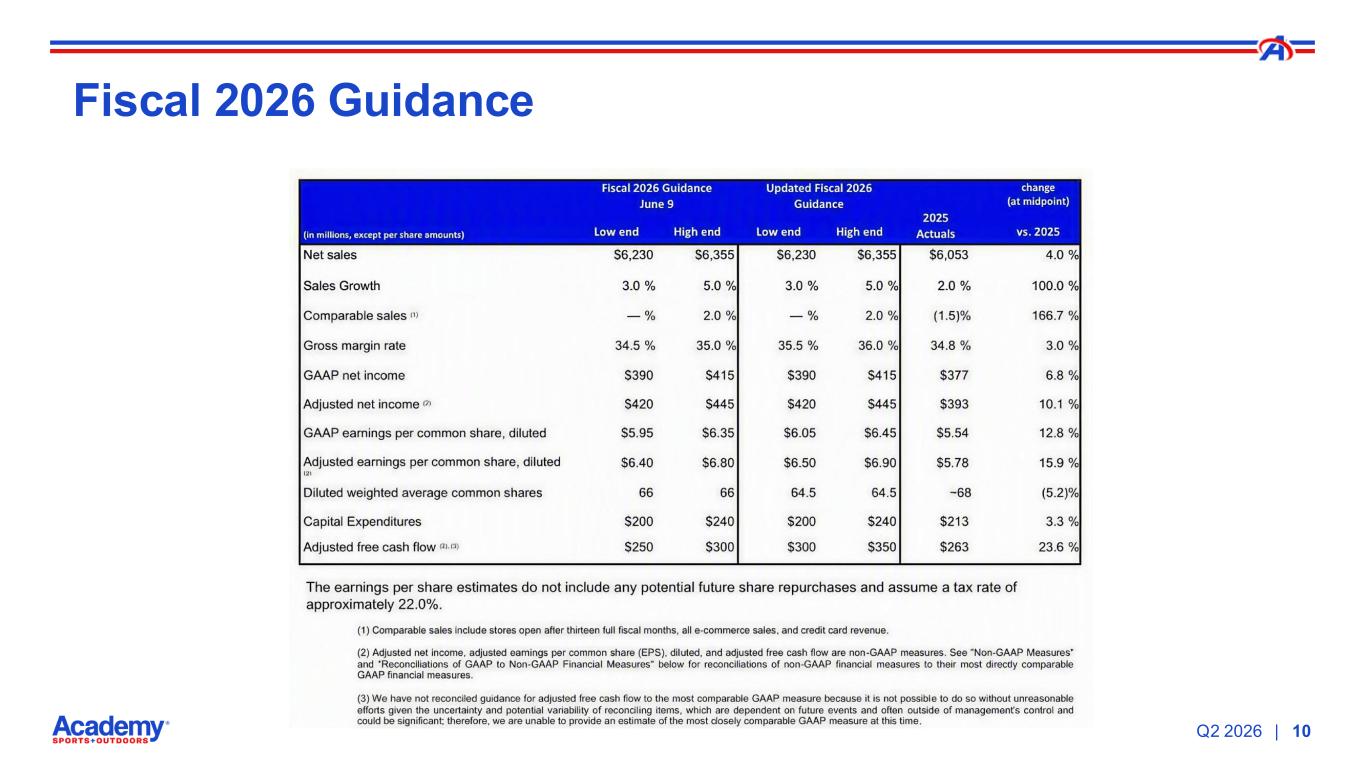
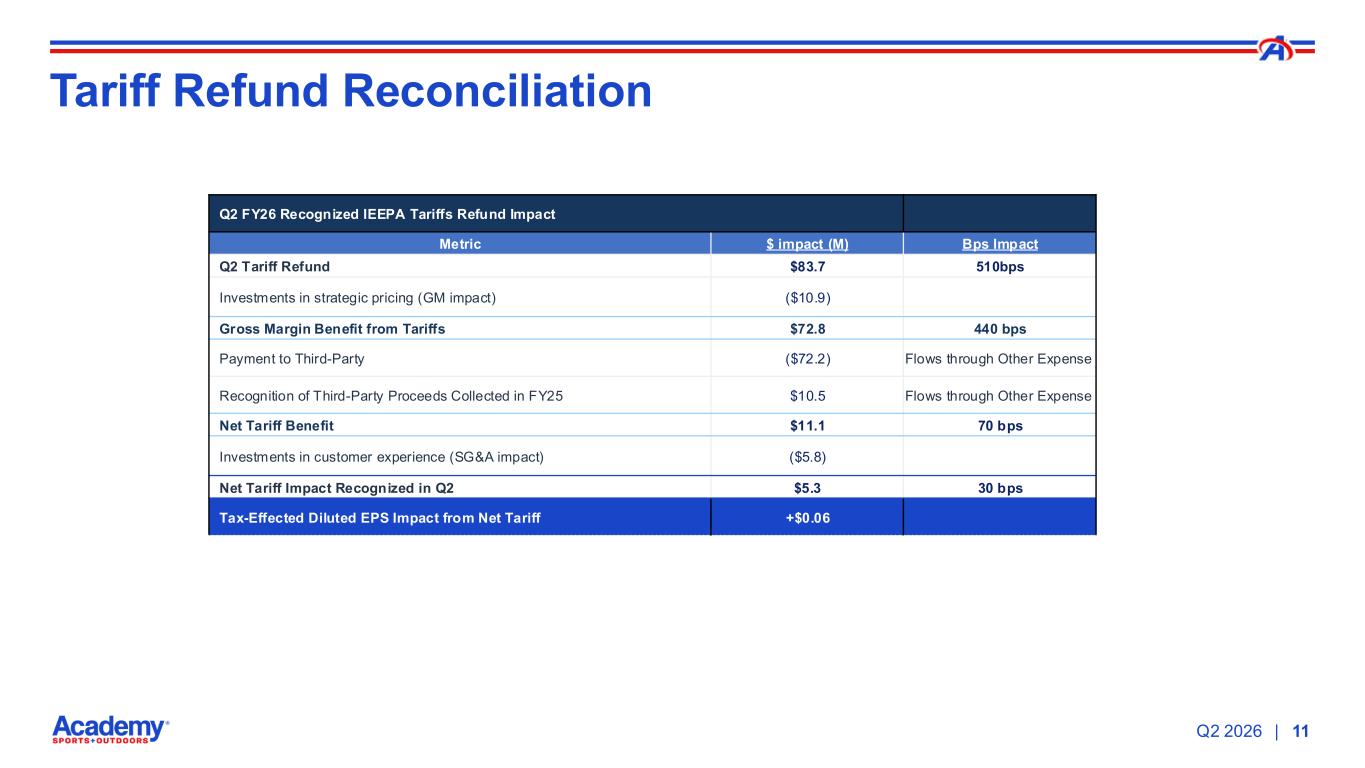
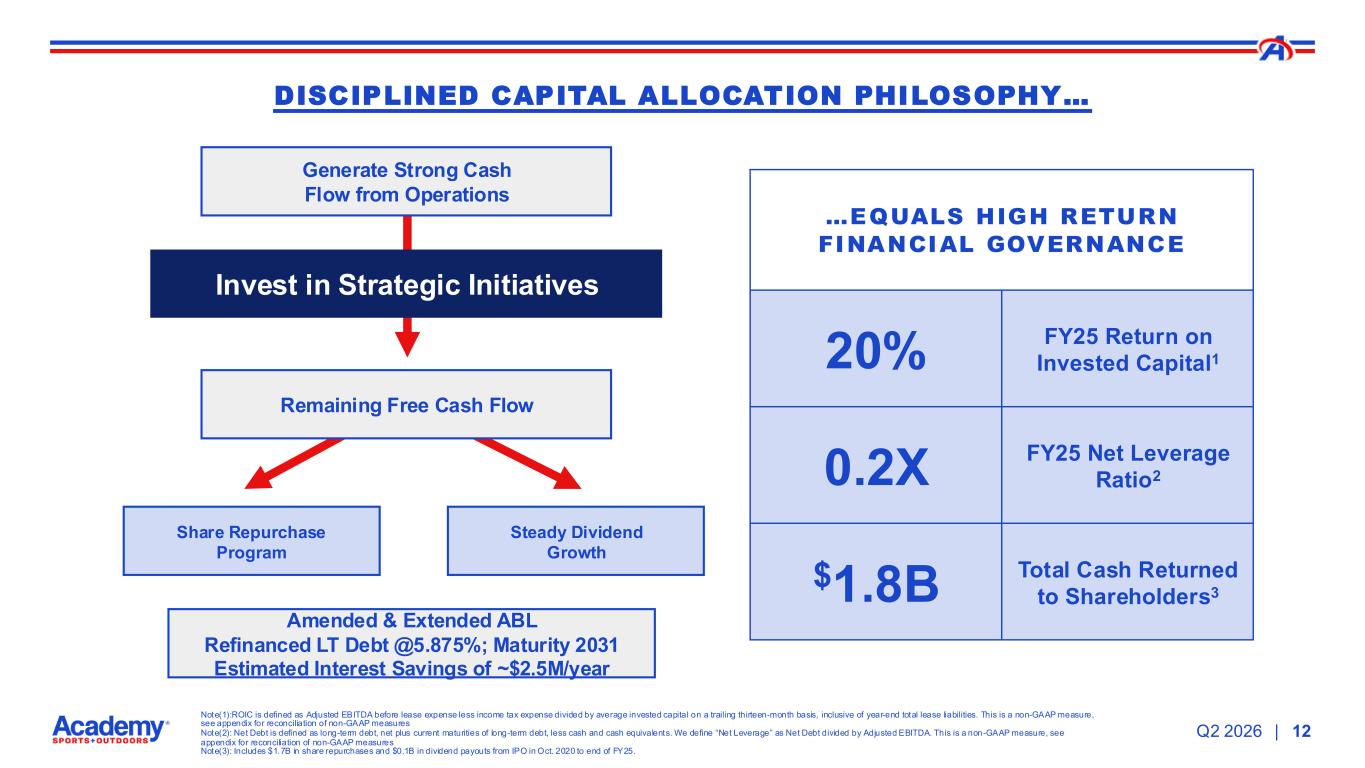
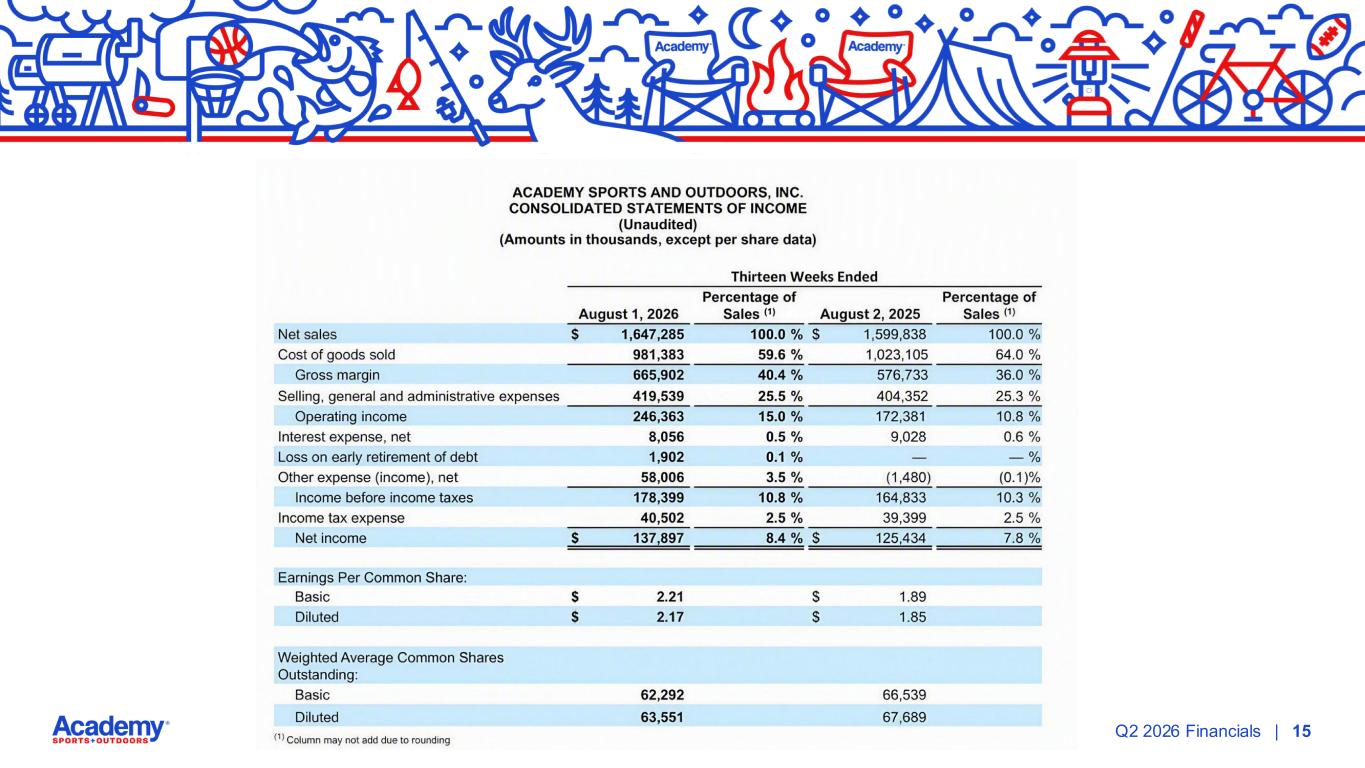
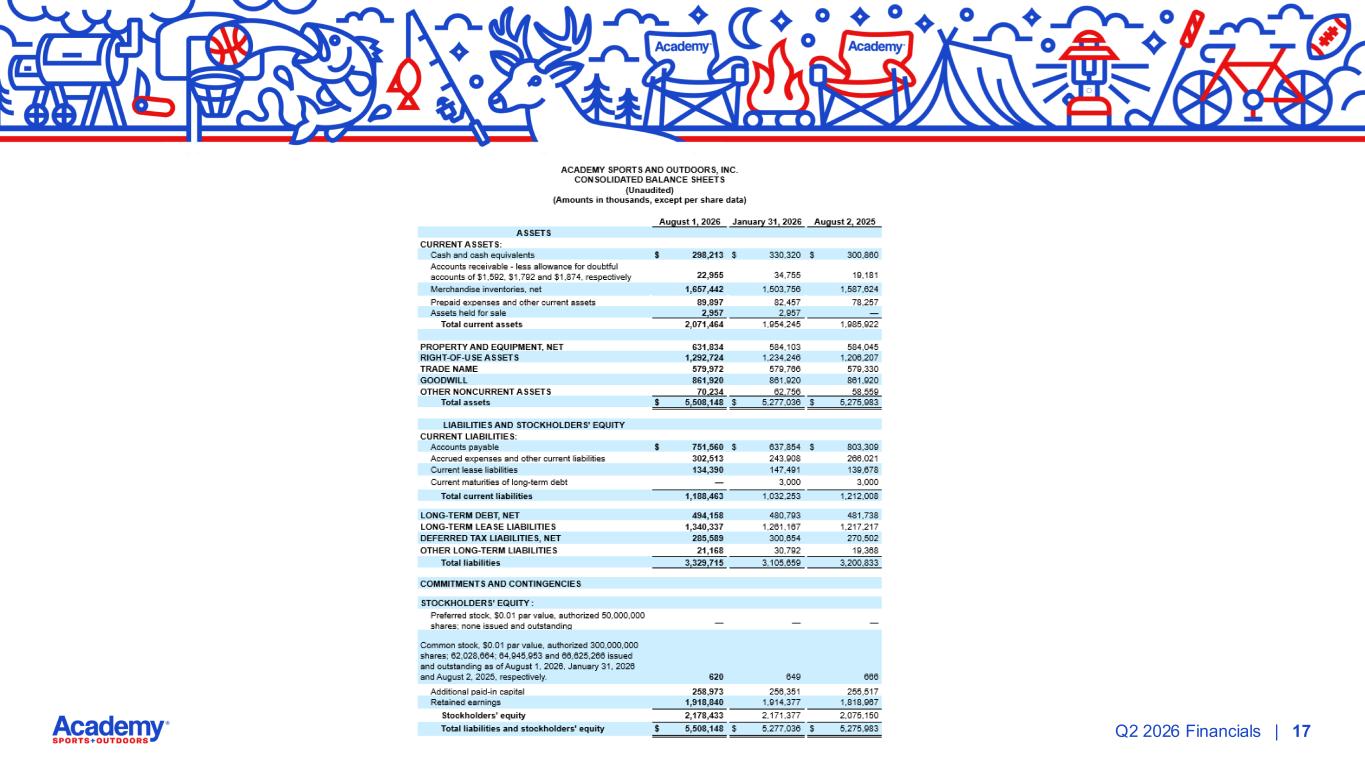
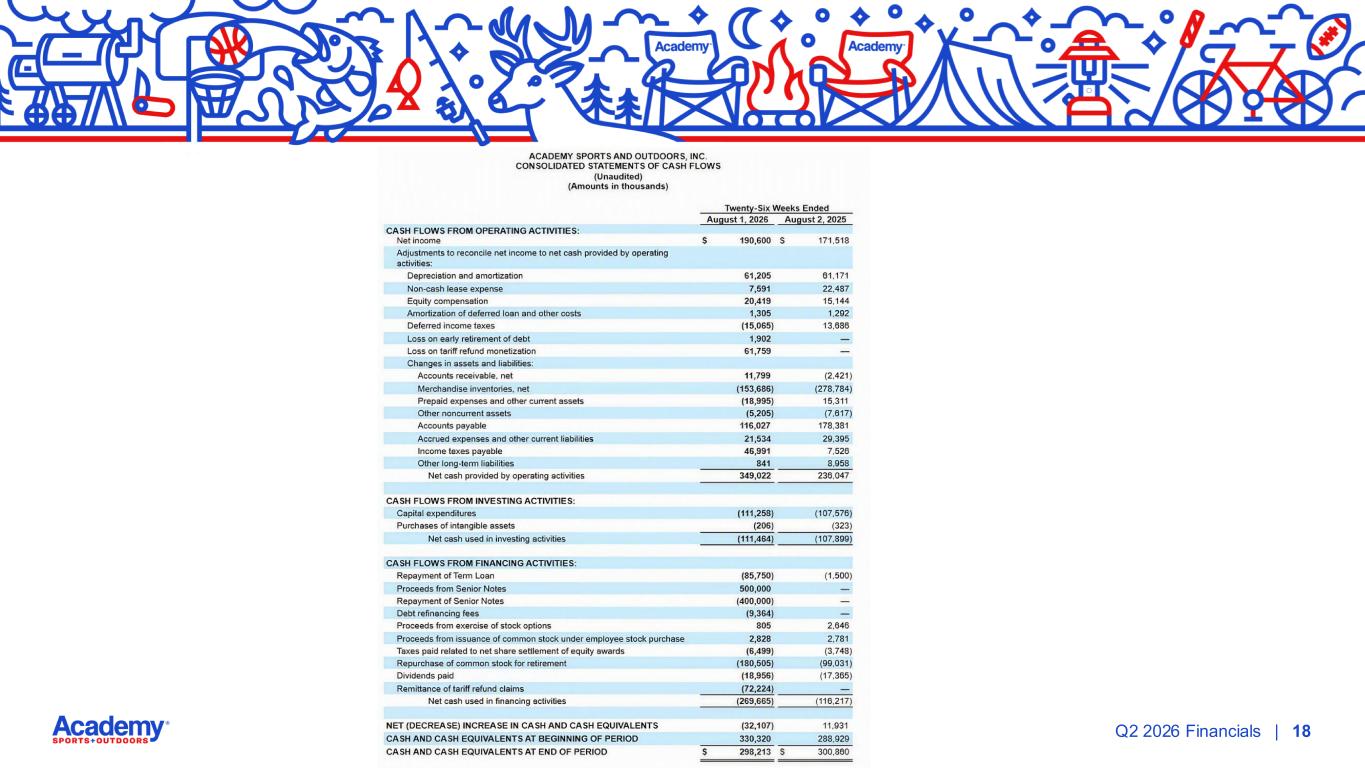
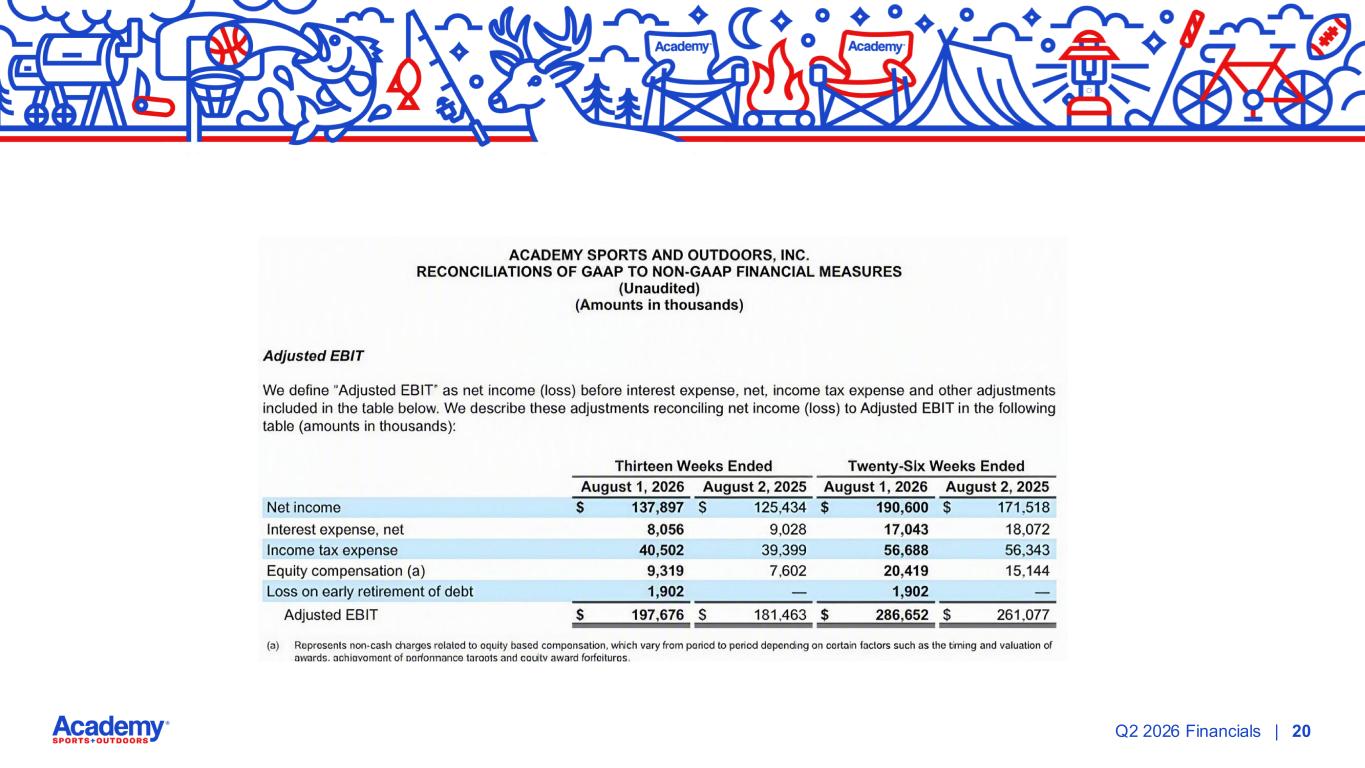
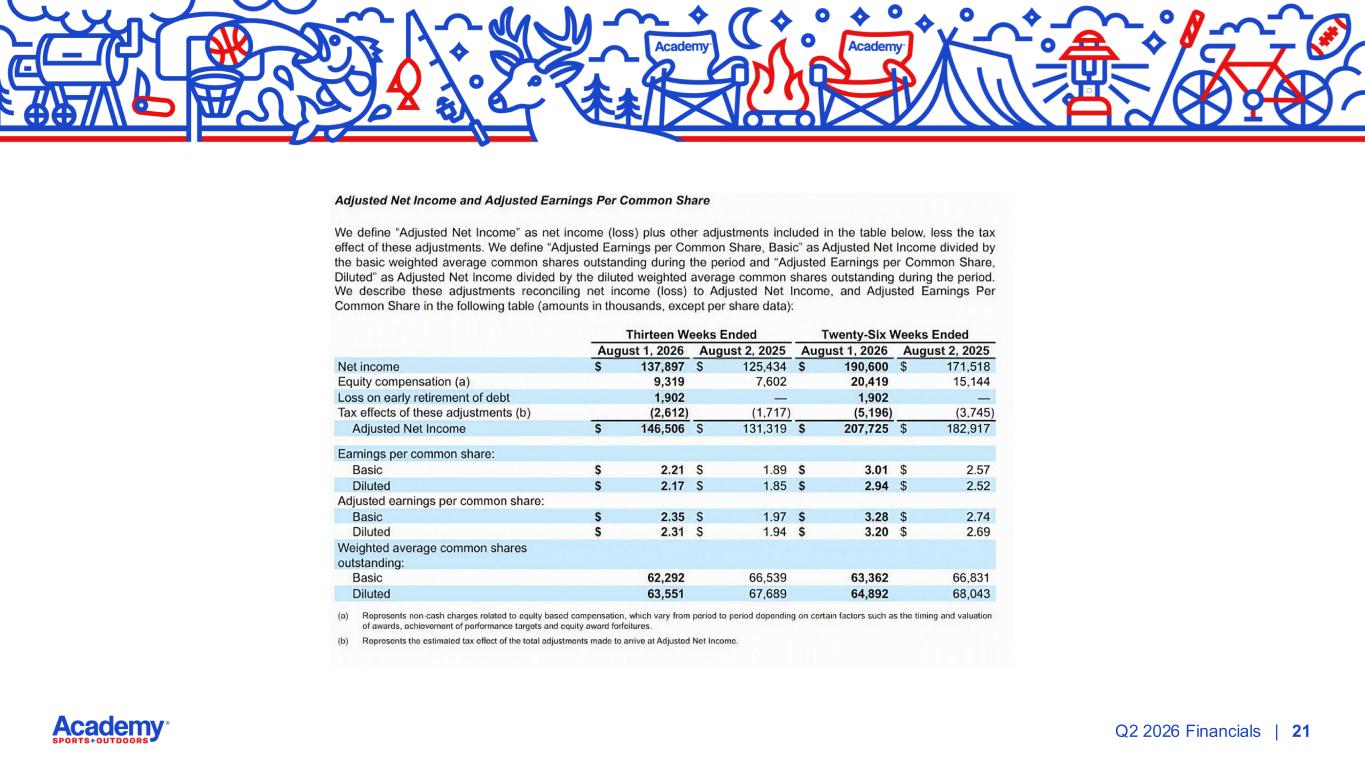
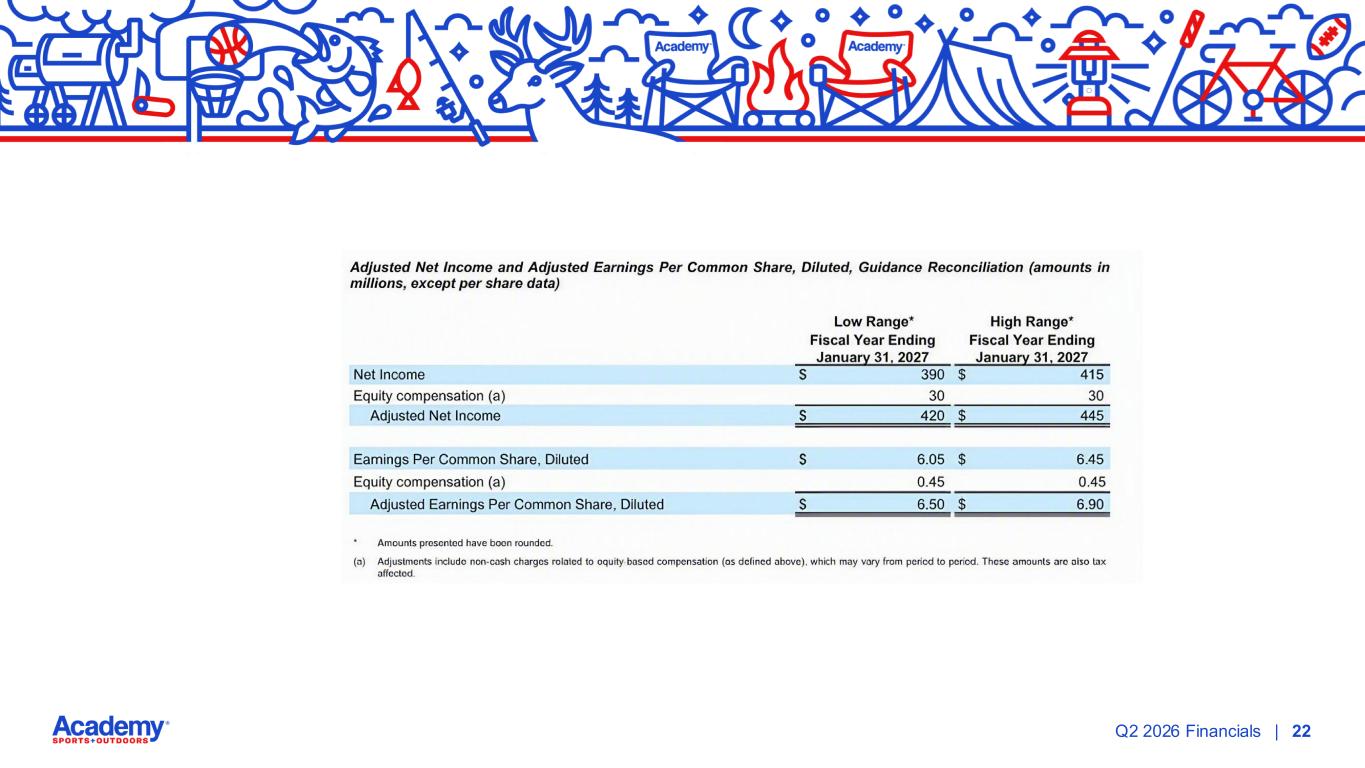
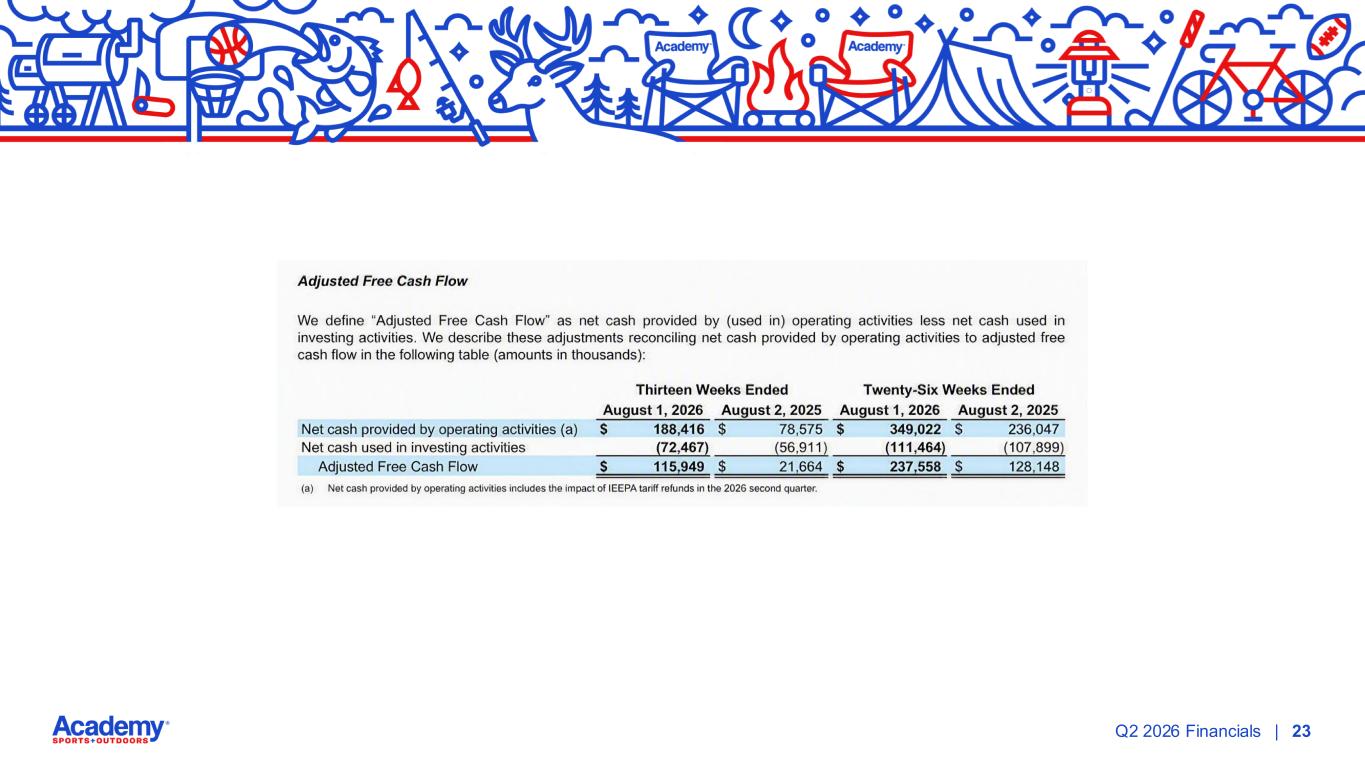
Net sales for the second quarter were $1.6 billion, an increase of 3%, with comparable sales down 0.4%. E-commerce remained a strength in Q2, with continued investment resulting in 12.8% sales growth. Continued to provide a consistent tail-up mid-single digits, and they contributed approximately 50 basis points to comp during the quarter. The two-year stack total company has continued its positive trajectory with sequential improvement with the two-year stack for Q2 slightly negative. Spending on the Academy credit cards was up approximately 20% during the quarter, was 40.4%, up approximately 440 basis points year over year. The increase was driven by 510 basis points, partially offset by a negative 70 basis point impact from merch margin as we reinvested tariff refund proceeds into improved pricing for our net benefit of 440 basis points to gross margin in the quarter. The majority was offset as part of our FY25 also used for strategic investments, examples of which Steve mentioned in his remarks. We have received substantially all tariff refunds during the second quarter and do not accept P&L impact for the remainder of the year. 25.5 basis points year over year, primarily driven by our investments in strategic growth initiatives for 21 new stores opened since Q2 FY25, tech investments in e-commerce and customer data, the rollout of 55 new Jordan brand shops in Q2, and the reinvestment of tariff refunds into incremental store labor and marketing. We deleveraged SG&A by 150 basis points. During the quarter, we leveraged base expenses by 130 basis points on a negative 0.4% comp. And year-to-date, we have leveraged SG&A in total by approximately 20 basis points. Operating income for the quarter was $246 million, up 42.9%, inclusive of tariff refunds year-over-year, $61.8 million attributable to the tariff refunds we sold in 2025. 5. Diluted earnings per share was $2.17, an increase of 17.3%, and adjusted earnings per share, which excludes stock on early retirement of debt, was $2.31, an increase of 19.1%. Free funds net of strategic investments into price, labor, and marketing had a positive net impact on EPS and adjusted EPS by six cents during the quarter. In the earnings presentation on page 11 that details the impact from the tariff refund. Cash flow standpoint, we remain in a position a story was up 4.4% year over year, but on a per store basis was down 2.3% in dollars and down 5.6% in units as we continue to manage the flow of new products while expanding our store count on liquidity and generated healthy free cash flow net of tariff refunds of $32 million year over year investing in the business while returning capital to share million dollars at the end of the second quarter and we have an untapped 1 billion q2 and improved our weighted average cost of debt by 50 basis points. We also amended and extended our ABL early in the second quarter, which directly led to the $1 million reduction in interest expense, a $1.9 million from the original 2020 issuance. The fee has not changed. Approximately 50% of cash flow from operations on an annual basis is reinvested back into the business. The remainder to shareholders through dividends and share repurchases. Half of the year, we repurchased approximately $181 million of our shares, representing about 5% of our outstanding shares, paid approximately $19 million in dividends, strategic investments, omni-channel capabilities, and technology initiatives. $156 million remaining on our share repurchase authorization. Continued share repurchases as conditions warrant, but we expect they will not be to the same level as the first half of the year. The initiatives in our growth algorithm give us confidence in maintaining our sales into the business, comping up mid-single digits while contributing 50 basis points of comp for the first half of the year. Secondly, our e-commerce business grew 14% for the first half of the year, and functionality for customers, and we expect this to be a tailwind for years to come. ...business by leveraging our loyalty platform to drive incremental sales, with the sales up almost 20% during Q2. ...like areas to be macro uncertainty. What is certain in this challenging environment to reflect the second quarter performance while also planning for $100 billion, 0% for the year, while affirming net income guidance in a range of $390 million to $415 million for a lower share count per share of adjusted earnings per share to be in the range of $6.50 to $6.90, adjusted $3 million. At the midpoint, we expect expansion of 100 basis points, resulting in EPS growth of over 12% when compared to fiscal year 2025. This EPS guidance from future, you should expect full-digit EPS growth five years.
Thank you. At this time, we'll be conducting a question and answer session. If you'd like to ask a question, please press star 1 on your telephone keypad. A confirmation tone will indicate your line is in the question queue. You may press star 2 if you'd like to remove your question from the queue. As a reminder, we ask that you please limit to one question and one follow-up. For participants using speaker equipment, it may be necessary to pick up your handset before pressing the star keys. One moment, please, while we poll for questions.
Our first question comes from Chris Harbors with J.P. Morgan.
Please proceed with your question.
Thanks. Good morning, guys, and thanks for all the detail this morning. Can you talk about how you're thinking about the cadence of sales in the back half of the year, you have a lot of newness that's hitting. You've got the credit card potentially accelerating some of your transactions and ticket there. And then you also have the new store lift. On the other hand, we have to be cognizant of comparisons. And so how are you thinking about the cadence between the third and the fourth quarter? And then within that, can you isolate how much the back to school shift tax holiday shift was a detriment to the second quarter versus what you spoke to quarter to date?
Sure, Chris, I'll start. I would tell you that if you look at just that, those four states with tax-free shifts, if that hadn't happened, we would have been essentially plaque for the quarter. And that would have taken us to, we'd still be running positive quarter to date through Labor Day, but slightly less than we currently are. So it definitely impacted the end of the quarter. It gave us a good start to the first week or two of the quarter here, but we'd be running positive without that shift for Q3. And as we mentioned, we're running up full single digits positive through Labor Day. So we're excited about that. In terms of cadence throughout the back half of the year, the midpoint of the guidance implies roughly the continuation of the trend we saw in the first half of running up 1.1 comp through the first half of the midpoint implied in the guidance would be roughly a one comp. I don't see there being a big variance between performance between Q3 and Q4 from a comp perspective. You know, we're up against negative comps from Q3 and Q4 last year. I think we're down 0.9 in Q3 and I think down 1.5, 1.6% in Q4. So fairly consistent from quarter to quarter. So we'd expect the business to be fairly consistent in the back half of the year. And, yeah, you're right. What we're excited about is, you know, we've been quietly investing in a lot of these long-term growth drivers for us over many years. And we feel like they're all starting to kind of take hold and really start making meaningful impact in the business. You know, obviously we've been opening up new stores now for four years. We had 47 stores in the comp base in the quarter from 22 through 25 that we opened up. By the end of this year, we'll have 63 of those stores in there as a lot of the back half stores from last year kind of pull in the comp base. We think that's going to continue to accelerate. We think that the relaunch of the credit card and the combination with our loyalty program is off to a really good start. We think that's going to be a growth driver for many years. We think that in a world where the customer, at least the lower-end consumer, is really stretched, we think we've done the right thing in terms of reinvesting in price and providing some really outstanding value to them. And on the flip side, the other thing that continues to work is newness. We feel like we've got a steady diet of new and innovative brands coming. Obviously, the thing we're most excited about for this quarter would be the launch of HOCA. But, you know, the expansion of chicken legs, the area chops we talked about, all those things should be growth drivers for us moving forward. And other things we didn't talk about in the prepared remarks, but, you know, we were two years into this RFID journey. That continues to help us from an in-stock perspective. And I would also say that if you remember last year, the back half of the year was somewhat disrupted by some of the price change activity that was taking as a result of the tariffs. We start to lap this this year. In some cases, we'll have even better pricing than we did last year. So all those things give us confidence that we think we can, you know, kind of go right down the goalpost in terms of hitting our guidance. I don't think it's going to be easy. I think the consumer backdrops can continue to be challenged. But we feel really good about the initiatives we have, and it's showing so far through this year that we can overcome some headwinds out there.
Thanks so much. So as a follow-up on the gross margin, in the second quarter, you reinvested in pricing about $11 million. You mentioned mostly private label investments. So a two-part question. One is, is your outlook for gross margin any different than it was prior to today for the back half of the year? and, you know, some of your peers and brands have talked about, you know, expected higher clearance and promotional pressures in some of the footwear that you also carry. So I guess to what extent do you see that as a pressure in the market today or are you anticipating embedding in the back half guidance?
I think we'll break that one up, Chris. I think overall embedded within the annual guidance that we gave, the fall assumption for gross margin is roughly flat. I think there's a couple of puts and takes to that. From a tailwind standpoint, shrink continues to be good news in both the first and the second quarter. I would expect that to continue. I think the overall tariff rate will be a tailwind. I think we will reinvest into what you would call a headwind, which would be pricing investments. And I think fuel is going to earn.
In terms of promotional and competitive backdrop, I mean, I definitely think we saw the same thing a lot of our competition did in terms of an increase in promotions around the peaks, you know, most notably Father's Day, 4th of July, back to school. We expect that to continue into holiday. You know, we're in a bit of a lull now as we kind of get passed back to school. but our anticipation as we go into Q4 is that it will be more promotional than last year. We have that embedded into our plans and forecast. And as I said, we've been working on rationalizing pricing in the lulls to try to afford some of that increased promotionality. And I think we've got a good beat on how the back half of the year is going to play out, and I think we're ready for it.
Have a great fall season.
Our next question comes from Jeff Lick with Stevens. Your line is now live.
Congrats on a great quarter, and thanks for taking my question. Guys, I was wondering, obviously, you know, your largest competitor announced had disappointing results, I guess, for a variety of reasons. You know, you guys don't necessarily overlap with them perfectly merchandise-wise and or geographically. And I was wondering maybe if you could just kind of, as you looked at that, you know, what would you point out as, hey, this is where we were different, either merchandise or geographically?
Yeah, I would start with, I think it comes down to assortment. And I think we have a really unique position in the marketplace because of the diversity of our assortment. You know, certainly we overlap with, you know, some people on an athletic footwear and apparel side of the business and maybe a little bit in sporting goods. But, you know, we also do a big outdoor grilling and backyard business. We do a big cooler and drinkware business. We have a big outdoor business that has been really strong through the first half of the year in terms of shooting sports and fishing and camping. So I think we're maybe our results are a little different than some of the people out there that are maybe a little more invested in purely footwear or apparel is the diversity of the sort. So I think sometimes that doesn't work in our favor, certainly when you're in a footwear cycle and you've got lifestyle footwear and athletic brands driving the business. I think that benefits people to an outsized perspective, and probably we didn't reap the benefits of that. And I think on the downside, we're a little more insulated because of the diversity of our assortment. That doesn't mean, though, that our footwear business was great. I mean, it was our toughest business at roughly down 1%. We're excited that we did pick up market share there, and I once again point to diversity. You know, we don't just have an athletic footwear business. You know, we sell cleats. We sell performance running, which did well, but we also sell work boots and work shoes. We do a big seasonal business in spring with sandals and flip-flops. Our Birkenstock business has been really good. Our work in Western wear business has been really good with Harriet. So I think really what it comes down to is the diversity of our assortment is probably what's going to set us apart a little bit from some of our competition moving forward.
Yeah, I just wanted maybe if you could drill down a little more. You know, you gave some granularity in terms of the under 50K income, and then obviously it seems like you're getting some traction in the above 100K. You know, if you can just combine that with, you know, the kind of the blue collar areas you're in, maybe just drill down a little more because it does seem like you're, you know, you might be catching a part of the economy that, you know, is doing okay relative to themselves. It could just give us any more granularity.
Yeah, I would tell you that if you look at the under 50K consumer, we saw traffic there down high single digits, which is an acceleration, or you could say deceleration, I guess, from the trend we saw in Q1 where it was down, I think, low single digits. So I think that customer remains under pressure. I think that gas prices and tariff-driven inflation on discretionary products is really limiting their spending power. and I think they're being very choiceful about when they shop. Clearly we're seeing them shop closer to need, so I think that impacted a little bit of the back-to-school timing where we saw people buying closer to actually being back in school versus in advance of back-to-school. I think they're aggregating purchases around the key events in the window because they know that's when retailers are the most promotional. So I'm not going to tell you that that customer is particularly healthy or we're seeing great trends there. we are seeing strong reaction when we do lean into promotions. We've been able to target them a little more aggressively with our new loyalty program where we weren't as surgical before. So that's a new tool in our arsenal. But what we're also excited about is we're really starting to add more consumers at the higher end, which traditionally hadn't been where we're strongest. You know, we saw mid to high single digit traffic in the first half of the year with that customer over 100K. That's been going on for multiple years now. We think a lot of the new brands and initiatives that we brought in are getting that customer permission to come in and shop us. And what we're finding is they come in that they're trading broadly across the store. They're not just coming in and chair-picking those new brands. And so our expectation is that the back half of the year, the under-50K consumer is going to remain under pressure and they're going to shop episodically. They will come out for Christmas, but I think they'll come out when the discounts are the deepest. And we're going to continue to lean into loyalty to attract them and promote us. And then on the upper-end consumer, we're going to keep running the plays have been running to get them to come in and shop with us and build that customer basket.
Appreciate the color. Thanks very much, and good luck with 3Q and 4Q.
Our next question comes from Kate McShane with Goldman Sachs. Your line is now live.
Good morning. Thanks for taking our question. We wondered, with regards to the World Cup, do you think there was any cannibalization within the store, just given the demand for the World Cup merchandise. And I know you mentioned in the prepared comments of lapping the World Cup next year. How much do you think it lifted the comp? And can you maybe go through the initiatives again for next year that will allow you to lap it?
Sure. So I would tell you that the World Cup, in essence, made our plan. We hit right at what we planned it at for the quarter. I would say that, you know, when the World Cup took place, it was right in the peak of Father's day and uh you know i wouldn't say it was 100 additive certainly i think people who maybe last year got a magellan shirt or a nike shirt for a polo for father's day maybe got a world cup jersey this year i would also say it was somewhat muted um for us a little bit because we were up against oklahoma city winning the championship uh last year and obviously you know we have a lot of stores in oklahoma that really benefited us so that would say dampened the effect a little bit um as we think about lamping it next year uh we do have the women's world cup i don't think that'll be as big as obviously having the world cup in the united states but certainly you got to believe that the usa team will probably one of the favorites and we expect to see some offset there we also think there's continued opportunity to get better at localization within our licensed team business and then third i would say some of the work we've been doing around sharpening our pricing so you know we talked about returning value uh in some of our private brands um you know what we found was some of the pricing that we'd had to move through to offset some of the tariffs on some of our fighter private brands these would be brands like bcg which is kind kind of our opening price point athletic brand, or Magellan Laguna Madre, which is kind of our fighting outdoor shirt. Those, you know, when we took those up, we saw a customer pull back. And so as we've adjusted pricing back down to last year's kind of pre-tariff level pricing, we've seen demand come back with that. And so we do have that as an opportunity in the first half of next year. What we've managed to also do is to work on sourcing over the last year and find new countries and find ways to kind of mitigate or offset some of the tariff impacts so that we can live at those prices we used to live at. Now, this is not broad-based. We can't do this everywhere. But certainly on those opening price point fighter items, we believe having stronger pricing through the back half of this year and the first half next year will also help us offset some of the World Cup volume that we generated this past spring.
Thank you. And just as a quick follow-up, is there any way you can quantify what you saw with regards to traffic versus price or transaction versus value in the quarter?
Yeah, from a total basket standpoint, our ticket was up 4.5%. That had AURs up and units per transaction down. So ticket up 4.5% and transactions down about 2%.
Our next question comes from Simeon Gutman with Morgan Stanley. Your line is now live.
Hey, team. A quick follow-up to the back half comp question. So, Steve, you mentioned the midpoint of 1%.
I guess, could we draw the line in the sand that we should see positive comps going forward using the new store waterfall plus the inflection you've seen quarter to date plus all the newness that you have going? we give a range for guidance for a reason I think you know what we can control with the initiatives that we have in place and I would reiterate those you know we've got the credit card loyalty program which we're you know one quarter deep into and it's driving really great results we've got the reinvestment in the price we've got a trending hard good side of the business it's helping offset a little bit of softness and some of the softer side of the business. We've got a ton of newness coming in with new brands we're launching, notably Hoka, the wall of chicken legs, the area shops, the Redfield launch, et cetera. We've got a dot-com business that's been running double-digit comps for multiple quarters. You've got the RFID expansion I already mentioned, and then the new source coming into the waterfall. So those are all positives. You know, I think the wild card is just what is going to continue to happen with the consumer backdrop. That is something, you know, we don't control. And we think we've got the appropriate guidance moving forward. And I think at the midpoint, it would fall back to a positive comp. We think we're very confident we can be within kind of the goalposts on that guidance. But that would be the thing that would make it tough to, you know, guarantee, which I think we're looking for a 1% comp in the back half of the year.
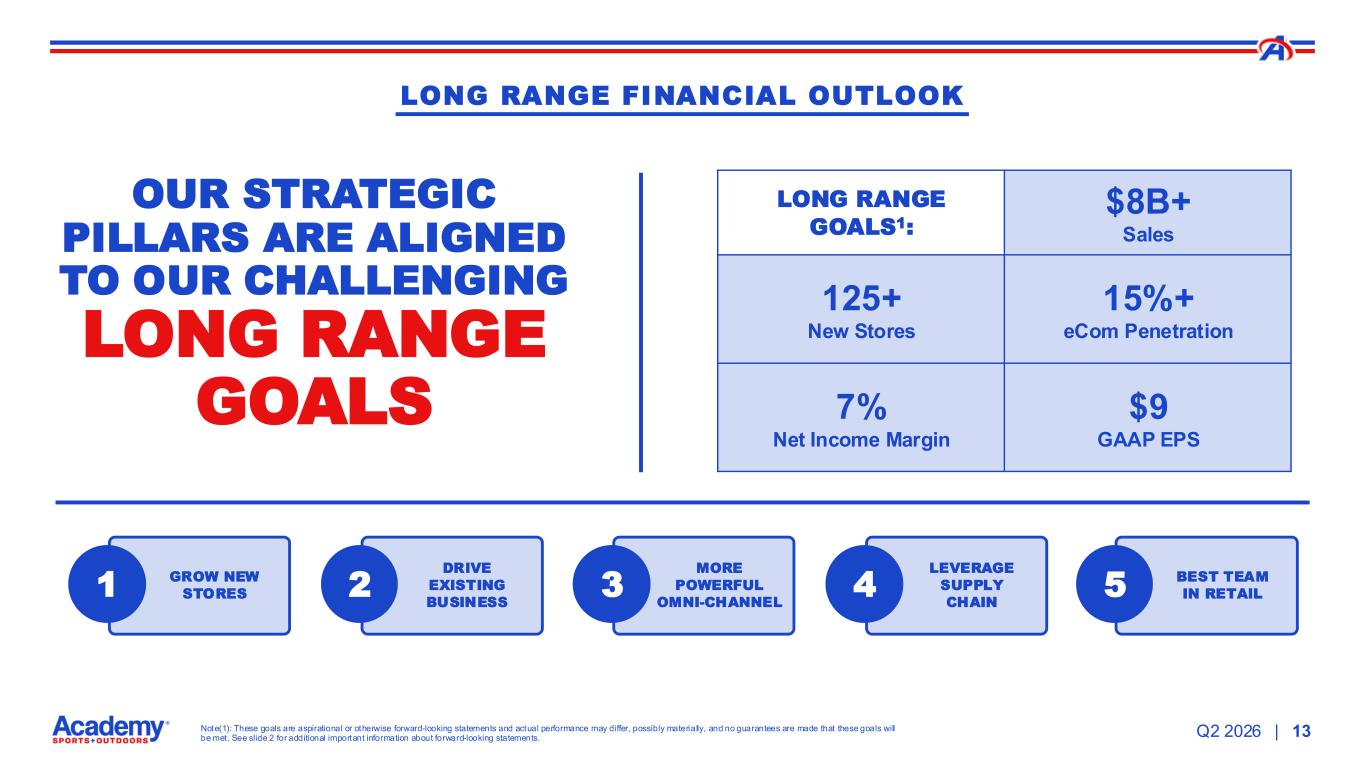
At the risk of piggybacking On Steve, I would say that the midpoint of our back half guidance implies about a 1% comp. I think if you move beyond FY26 and you look at the things that we talked with you guys about in the Analyst Day back in April, we feel really good about that long-term algorithm of sales up 5%, low single-digit comps, and double-digit EPS. I think once we get to the back of this year, if you look at what it is that we're at, the midpoint that we're forecasting, up 4%, up 10% from a adjusted net income standpoint, and gap earnings per share up 12.8%, it feels like a prototype of what you should expect to us.
But, yeah, back half embedded guidance is plus one comp. um like a two-question follow-up or two-part follow-up um the percentage of customers that you defined as low income have you told us that and then the other follow-up is this when we had investor day you showed us a couple of stores i think one was searcy one was perimeter perimeter georgia if you take stores and i don't know if this is true but has have a less competitive overlap right you learn from some of the openings we talked about this from four or five years ago and you've repositioned the openings. Is there a tale of different comps if you take a cluster of stores that are in these more favorable locations versus call it some of the legacy ones that are just higher competitive overlap?
Yeah, so I think I'll start with your first part of that question, the percentage and the cohorts. We talk with you guys about traffic, and I think if you look at the customers above 100,000, It's our largest and our fastest growing cohort of customers. It's pushing 40%. If you look at those that are below 50,000, you know, earlier this year they were about 30%. I think it's, you know, still generally in that neighborhood. But shrinking, obviously. Yeah, one's growing high single digits and one's shrinking. So I like to say that beginning with that trend back in Q3 of 2024, If you look at our customer portfolio, it's significantly de-risked associated with where we're at now, just base that we're seeing. And I think that those changes are really a reflection of that commitment to value. And I think that's going to be even more in demand going forward. Yeah, we've pivoted a lot since we started reopening stores back in FY22. You know, initially, those first nine stores in 2022 were very, very opportunistic. I think where we see it as being able to market, like to get outside and algorithm right in terms of where we're launching the stores, outsized. We talked about mid-single-digit growth. I'm optimistic about the back half of 2025 stores that get into the comp later in the year. Overall, 50 basis points that we go along, and I think you'll see more of that in the 100.
One thing I'd add to Carl's comment is if you look at the stores that are slated to open in the back half of this year, they're heavily weighted to those types of markets you just called out, Simeon. It's more midsize, smaller markets in our legacy or existing footprint, underserved customer, low competitive density. We have high expectations for those stores to perform well.
Okay. Appreciate it. Thanks, guys. Good luck.
Our next question comes from Michael Lazar with UBS. Your line is now live.
Good morning. Thank you so much for taking my question. When you look at the category composition of what drove the business in the second quarter, a lot of hard goods, including sports and firearms, as you've moved into the current quarter where your comps are running up low single digits quarter to date, has it been the same categories that have driven the business? and can you achieve this midpoint of the guidance for the back half of the year if footwear and apparel remain under pressure? Thank you.
So we have seen the complexity of the business beneath the surface change a little bit, obviously, in August and early September. You know, the footwear and apparel businesses are the ones that most are impacted by back to school. We saw both of those come back in the month of August. So, you know, what that tells us is the customer is still out there. They will shop when they need to. As I mentioned earlier, we're seeing them buy closer to need. So I think there was maybe a little bit of a shift out of back to school, at least for us, because, you know, we tend to have that earlier back to school into August from July. Some of that was probably driven by the tax-free moves as well. And if you look at how we modeled the back half of the year, we definitely shifted some investment around, you know, for the remainder Q3 into Q4 to fuel the trends we're seeing in the hard goods side of the business. And I think we've got the appropriate forecast for the soft side of the business, knowing that it's going to be a little more competitive from a pricing perspective.
Thank you very much for that. My follow-up question is, obviously, there were a lot of moving pieces within the gross margin in the second quarter. So can you give us more detail on what you're expecting for the gross margin in the back half of the year? And as you move into 2027, should we be anticipating that Academy's gross margin is going to be down after you have lapped some of the different moving pieces from this year. Thank you.
Thank you for the question. You've got the annual guidance embedded within that annual guidance is for fall gross margin roughly flat. The puts and the takes, I'll just kind of reiterate what I said earlier. I think shrink will continue to be a tailwind and tariffs will be a tailwind headwinds will be that investment into pricing and I think fuel is going to be with us for the entirety of the back half of the year as it relates to next year's you know we're not giving up by 27 guidance at this time we will during during when we typically do but I would just point you back towards what we talked you through in the analyst day related to going from a 9% EBIT to a 10% EBIT. That does not have a regression of gross margin embedded into it. The one thing, and I hope that you give us at least credit for transparency associated with the breakout of tariff refunds that we provided. What I will say is that 440 basis points of net gross margin impact in Q2, that is non-recurring, non-recurring. But I think as it relates to FY27 and beyond, we're not thinking about gross margin going down. We're thinking about private brand penetration going up and how does new lower cost sourcing products allow us to do that. We're thinking about retail media network. We put 30 basis points of EBIT margin in the waterfall that we showed you on Analyst Day. Look, it's going to be a smidgen this year in fall, but that's going to get bigger. You know, we've got a credit card partnership that's performing well. We're seeing Ido Academy up 20% year over year. And for the first time ever, we launched, you know, the MyAcademy MasterCard, Rewards MasterCard. And so, you know, that provides a revenue stream for the company that will manifest itself in gross margin rate as well. So we're not planning to regress on gross margin.
Our next question comes from John Heinbuckle with Guggenheim Partners. Your line is live.
Hey, Steve, I wanted to ask behavior of those higher income consumers, you know, in terms of, you know, how they shop the store, you know, buying closer to need, responding to promotion. What's their behavior like differently than the base? And then where do you think you're under-indexing with them? Where's the greatest opportunity to pick up wallet share?
I think the trends you cited are true of pretty much all of our income cohorts, but I think it's more exaggerated within the lower-income cohort. So I think the shopping is even more episodic. They definitely come out during the peaks of the calendar, or retreat during the lulls, and it takes some pretty deep discounting to get some of those people, I think, in the store during those time periods. That's one of the reasons when we talked about ways we can get them to activate with us, we talked about using clearance, right? That is a way we can deliver deep value at the end of the season to these customers, and what we found in our customer research was they told us, hey, we will buy, you know, the out-of-season bat this year so that my kid can play, you know, softball or baseball next year, and they're okay with that if they can get a really good deal. So we're going through one of those periods right now in September. We go through another one as we exit fall into spring in February and early March. And I think they definitely come out then. I think they'll come out again during holiday when, you know, we're running heat discounts around Black Friday and kind of those promotional windows. But I think you're just seeing more of a pronounced behavioral change from them than you do see from the upper income consumer. That being said, on the other end of the spectrum, Nunes continues to do well. So we will see almost agnostic of price that if there is something really new that they have to have, that they will buy it. And so we're also leaning into that as well. But I think that's probably a little more of the higher-end consumer than the lower-end consumer.
On the under-indexing, where are we under-indexing with the higher household income? I think the brands that we're launching, I think the Hoka going live with online and 15 stores out of the gate, that will give us a really good read about how our customer responds to that and whether it drives more customer cohorts in. I look at what we're doing with work in Western, you would think. That's not a guy out there who's, you know, road grading and stuff like that. That's a look, and it typically has a higher household income that he's willing to invest in. And so I think that to the extent that we're launching new brands that are exciting and compelling, I think it'll draw more traffic, which is what we've seen from that above 100,000 household, but I think it'll drive new traffic as well.
And Carl, a quick follow-up. The base leverage expenses is impressive. Where's the bulk of that coming from? Is that, you know, because it's got to be a large number. Is it overhead predominantly? Is it a little bit of that supply chain? I mean, I guess, where is it coming from? And then I don't know how sustainable 120 or 130 basis points is, but, you know, what's your thought on that?
Yeah, I actually really appreciate the question. So year-to-date SG&A is 20 basis point levered from a year ago. In the second quarter, we were 20 basis points of deleverage. We talked in my prepared remarks about where we're investing. thing, that should not be a surprise to you guys. That is our long-term algorithm. And we threw in a little bit of tariff refunds on top of it. That was a deleverage of 150. So, where the 130 basis points of what I referred to as base leverage came from would be corporate labor and recruiting and, you know, maintenance and repairs and third-party spend with what we call professional fees. You know, I think the team is doing a great job of managing safety incurrences. So things like workers' comp and general liability, like those are providing benefit for us, and the team has managed health care costs well. So those would be some of the categories that I would include in base. And, yeah, I don't think it's realistic that it's going to be 130 basis points on a slightly negative comp, But I think if you do the math on what low single-digit comps would mean, that gets to be really exciting and makes that 10% EBIT mark, you know.
All right, next question comes from Greg Millick with Evercore. Your line is now live.
Hi, thanks. Two questions. First, thanks for the detail on the tariffs and the reinvestment. Just wanted to make sure we're thinking about it the right way. If we think about that, what was in gross margin and price, that should be a number that sort of continues into the back half and maybe goes up a little bit just given the way it flows in. And then on SG&A, should we consider the reinvestment in store experience to be something that's in the base in the back half? And then my follow-up was on the new innovation.
Yeah, I think as you think about reinvestment into the customer in the form of price, I think you should consider that as part of the algorithm for flat gross margin overall in fall. And the investments into customer experience, specifically with labor and marketing, was in some very select markets in the second quarter. We were testing and learning. I would not bake that into the long-term algorithm.
Got it. Super helpful. And then I guess as you're seeing some of the benefits come and things like even treadmills, et cetera, how is the reallocation of the store footage going as you do this to Jordan's shop and shop and even as you bring in Hoke and other things? Are we expecting a certain area to expand and maybe another area to attract, contract? And is the skew count growing or shrinking as part of this?
Yeah, what I would tell you is that we're continuing to focus on localization. You know, I think that we've done a good job of localization over the past couple of years. I think we can continue to do an even better job. And as we move forward, I think you're going to see us continue to kind of shift floor space around towards the trending categories, maybe even reposition some things in the stores based off of what the localized preference is. We would tend to probably make those moves either A, in kind of the new store footprints as we roll out those new stores, or one of the things we shared with you guys at the analyst day is that we're going to be remodeling roughly 30 to 40 stores a year moving forward. So we'd be reallocating space as we go through each one of those, if it makes sense. So there definitely is some reallocation of space going, happening, and it's definitely going to be an ongoing thing for us over multiple years. And it's not just reallocation. It's also shifting things around to highlight and feature things that the customer is showing a strong demand for.
Yeah, from a skew count standpoint, I give a lot of credit to our chief merchant, Matt McCabe. He talked with me the day that I started about depth and breadth. I think the team does a good job of optimizing and reducing breadth to invest into depth, and I think you're seeing that related to in-stock positions, and I think you'll see more of that rationalization to invest into newness going forward.
Our next question is from Jonathan Mazunwetsky with Jeffries. Your line is now live.
Oh, great. Good morning and nice quarter. I had two questions. The first one was on pricing. Appreciate the examples of some of the price point changes made possible by the refunds. So just to clarify from maybe a pricing gap perspective relative to peers, is it fair to say when we exit this year, given the reinvestment in price, It sounds like your gaps relative to some of your larger peers, is that going to be kind of consistent with how your pricing was relative to them before Liberation Day?
I would tell you we track this on a weekly, daily basis, and I would tell you that our pricing gaps relative to our peers has remained consistent throughout this year and the back half of last year. So when we took our pricing up, in some cases, that did not decrease that pricing gap relative to our competition. What I will tell you is there's a couple instances, and I want to make sure we're clear on this. It's not everything, right? It's not broad-based, but there are select items where we saw a pretty big fall off in demand crossing some of those kind of magic price barriers. Like we took a coach's poll that I mentioned on the call from $9.99 to $12.99, and demand fell off, and the AUR uplift is not enough to offset the unit. down as we saw. So we have gone back and adjusted those prices back to kind of those key natural price points. So in effect, that might even actually widen the gap with us versus some of our competitors. But we think it's something we have to do because it's on these items that we saw the biggest demand erosion based off those price increases.
Understood. And then just to follow up on the assortment, Carl, you mentioned your chief merchant. I guess just as you think about the shift in your customer file over the past couple of quarters can you maybe just level set where your mix stands today uh in terms of sales you know maybe good better best and you know considering some of the current brands that you're expanding uh into more doors and then some of the new brands that you're welcoming how does that kind of good better best mix change over the next 12, 24 plus months? Thanks.
Yeah, I'll take it. I'll take the question on a broader perspective. If you go back over time, you know, it's a, you know, even pre-pandemic, we probably didn't have any best. It was primarily a good and better assortment. We've evolved a lot over the past five to six years. It's been a slow, gradual evolution. We're probably sitting now with about 25, 30 percent of our assortment in the best tier. And it really depends by category. Some categories lend themselves more to, you know, better best product than others. But I would say that best, depending upon the category, is probably somewhere in that 20, 25% range. You know, that will continue to grow a little bit, but we do not want to lose our anchor in the good, because I will tell you that at our core, we're a value-based retailer, and that's what that good level represents for us. What we found was we were basically forcing customers to go shop other places because we didn't have that better best end of the assortment so we see that as mostly additive but we're not going to give up that core good business and good price points thank you best of luck thanks we have reached the end of the question and answer session i'd like to turn the call back over to steve lawrence for closing comments thanks i want to close by uh thanking everyone for joining us today i also want to recognize and thank the 22 000 plus academy team members who are working tirelessly to provide our always-game families the sports and outdoor gear they need to feel the fun in their busy lives. Additionally, I'm excited to welcome Matt Posh as our new EVP and Chief People Officer. Matt brings a wealth of retail knowledge and experience from his tenure at Burlington, and he's going to play an important role in building out and developing our team in the future. As the remainder of this year plays out, we're going to be focused on driving sales, gaining market share, delivering value for our customers, and executing the strategic initiatives that will drive sustainable growth over the long term. Despite ongoing uncertainty related to the consumer environment, we believe that our strong balance sheet, disciplined operating model, and compelling value proposition position us well for the remainder of the year. You combine that with the momentum we're seeing so far in Q3 with sales out of back-to-school and labor coming in at a low single-digit positive comp, we're confident in our ability to deliver against our updated guidance and remain committed to generating free cash flow, investing in profitable growth and returning excess capital to our shareholders have a great rest of your day this concludes today's conference you may disconnect your lines at this time and we thank you for your participation